Volume 16 : Issue 7
TM
www.HRProfessionalsMagazine.com
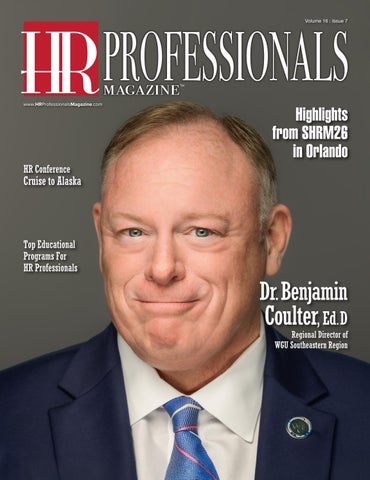
Highlights from SHRM26 in Orlando
HR Conference
Cruise to Alaska
Top Educational Programs For HR Professionals
Dr. Benjamin Coulter, Ed. D Regional Director of WGU Southeastern Region
Did Your Candidate Change Their Social Security Number Mid-Application? Fraud doesn't always announce itself. Sometimes it looks like a "small correction." A different birth date, revised Social Security number, or modified name. Small edits may be innocent, or they may be the candidate’s attempt to cover up information you need to know. That's why Data Facts created R.E.D - Real-Time Edit Detection. R.E.D. monitors candidate edits to pre-populated data and IMMEDIATELY alerts you when information changes during the application process. Accessing flagged edits helps you avoid bad hires that could damage your organization. R.E.D. time-stamps every modification and documents every edit. Did we mention? It’s FREE for Data Facts clients. Catch suspicious edits early. Investigate sooner. Don't SEE red. TRUST R.E.D.
Build the Capabilities That Power Workplace Performance. One Investment. Three Essential Learning Paths.
Develop enterprise-ready leaders with the mindset, behaviors, and adaptability to lead teams, navigate complexity, and strengthen execution.
Equip inclusion and diversity (I&D) leaders with actionable strategies that drive impact by connecting civility to organizational operations, collaboration, and performance improvement.
Build deeper capability across your team so your HR function can execute, adapt, and reduce risk. Attend, upskill, and earn a SHRM credential in just days.
LEARN MORE shrm.org/ATW26-invest
Tuesday, September 22, 5:00pm to 8:00pm Zen House, 831 S. Cooper St. Memphis, TN
en – 5 minutes each – slides auto-rotate every 15 seconds – ideas that are bold HR Professionals Magazine is recognized
by SHRM to offer Professional Development OFFICIAL MEDIA SPONSOR
Credits (PDCs) for SHRM-CP® or SHRM-SCP® recertification activities.
Get Your&Tickets Bringing Human Resources Management Expertise to You – SCAN BELOW
34%
A portion of each ticket sold will be donated to Agape Child & Family Services
of HR Managers are certified. www.HRProfessionalsMagazine.com
Features 5 a note from the editor
Editor Cynthia Y. Thompson, MBA, SHRM-SCP, SPHR Publisher
The Thompson HR Firm, LLC Art Direction
Park Avenue Design Marketing and Social Media Specialist
Julie Nagem Project Specialist
Liz Rogers Photographer
Charles B. Thompson Webmaster
Leo Dimilo
Contributing Writers William Brown Amy Schabacker Dufrane Kim Estep Mahesh Kumar Geoffrey Linkley Anastasia Muzitova Bob Pipkin Shirley Rijkse
Contact HR Professionals Magazine: To submit a letter to the editor, suggest an idea for an article, notify us of a special event, promotion, announcement, new product or service, or obtain information on becoming a contributor, visit our website at www.hrprofessionalsmagazine.com. We do not accept unsolicited manuscripts or articles. All manuscripts and photos must be submitted by email to Cynthia@hrprosmagazine.com. Editorial content does not necessarily reflect the opinions of the publisher, nor can the publisher be held responsible for errors. HR Professionals Magazine is published every month, 12 times a year by the Thompson HR Firm, LLC. Reproduction of any photographs, articles, artwork or copy prepared by the magazine or the contributors is strictly prohibited without prior written permission of the Publisher. All information is deemed to be reliable, but not guaranteed to be accurate, and subject to change without notice. HR Professionals Magazine, its contributors or advertisers within are not responsible for misinformation, misprints, omissions or typographical errors. ©2026 The Thompson HR Firm, LLC | This publication is pledged to the spirit and letter of Equal Opportunity Law. The following is general educational information only. It is not legal advice. You need to consult with legal counsel regarding all employment law matters. This information is subject to change without notice.
4
www.HRProfessionalsMagazine.com
6 Profile of Dr. Benjamin Coulter, WGU Southeast Regional Director
28 New Hiring Fraud Headaches . . . and How HR Can Fight Back 36 Keeping the Workplace Safe
7 Choose Your 2027 Sailing Adventure
Employee Benefits
8 Highlights from SHRM26 in Orlando
13 The Benefits Group – We do all the work!
10 Disrupt HR in Memphis September 22
33 SHRM 2026 Employee Benefits Survey
20 Highlights from the 2026 HR Conference Cruise to Alaska 24 The Degree Didn’t Fail Them. The Bridge Did. 29 Book Look – “Pivot” by Dr. Shelley Kemp
Talent Management and Recruiting 11 JJ Keller Leave Manager 12 Artificial Intelligence in the Workplace: Balancing Innovation with Responsibility 16 The Missing Link Between People, Pay, and Performance: Why Job Architecture Matters More than Ever 17 Compensation Isn’t One Task; It’s a Living System 19 Become the Employer Great Talent Chooses
Employment Law 30 Is Placing an Employee on a PIP an Adverse Action for Purposes of a Discrimination Plan? 31 Rainey Kizer Reviere & Bell – The Strength of Experience
SHRM 2026 Conferences Update 3 All Things Work in Nashville Nov. 15-18
39 Greater Memphis Employee Benefits Council Summer Social June 4
18 SHRM Ohio HR Conference in Sandusky, September 22-24
Top Educational Programs for HR Professionals
32 SHRM Tennessee in Knoxville, September 13-16
14 An Interview with Dr. Kim Estep with WGU 15 Register for our Affordable Online SHRM-CP | SCP Certification
22 HR Florida in Orlando, August 30 – September 2
34 SHRM South Carolina Conference in Myrtle Beach, September 16-18 35 ARSHRM Conference in Hot Spring, October 14-16 38 HR Southwest Conference in Dallas October 11-13
23 The Best Degrees Come with a Raise at the School of Law and Labor Relations 27 Your Career Looks Different When You’re SHRM Certified 37 HRCI One 40 Earn Your M.S. in Human Resource Management at WGU
HR Professionals Magazine is recognized by HRCI to offer professional recertification credits for HRCI activities.
a note from the editor
As
we delve deeper into the evolving landscape of Human Resources, it’s clear that innovation and expertise are paving the way for transformative change. This month, we’re thrilled to highlight visionary leaders and groundbreaking initiatives designed to empower HR professionals. From new educational opportunities to exclusive networking experiences, this issue is brimming with insights that aim to inspire and elevate your HR journey. We are also bringing you the highlights from SHRM26 in Orlando, which you do not want to miss! In case you missed our Facebook Live videos from Orlando during the conference, check out my interviews on LinkedIn! We also have highlights from the 2026 HR Conference Cruise to Alaska! We are excited to introduce you to Benjamin Coulter, Ed.D., who serves as Regional Director of Western Governors University (WGU) Southeast Region, where he leads strategic initiatives that expand access to high-quality, workforce-aligned education across seven states: Tennessee, North Carolina, South Carolina, Georgia, Florida, Alabama, and Mississippi. With nearly three decades of experience spanning higher education, global operations, and military service, Dr. Coulter brings a distinctive blend of leadership, innovation, and mission-driven focus to advancing talent development in today’s evolving workforce landscape. With nearly three decades of experience spanning higher education, global operations, and military service, Dr. Coulter brings a distinctive blend of leadership, innovation, and mission-driven focus to advancing talent development in today’s evolving workforce landscape. Be sure to check out WGU’s M.S. in Human Resource Management that includes SHRM’s Specialty Credential on our back cover!
Our July issue features top educational programs for HR professionals. Among them are three exciting HR Conference Cruises where you can earn up to 16 SHRM PDCs and HRCI business credits for each! There are 3 exciting sailings departing from Port Canaveral and Fort Lauderdale, Florida in March and April 2027. Check out the details on Page 8. But wait! There’s more – check out the NEW HR Conference Cruise to Alaska setting sail in May from Seattle. Check Page 3 for details. Go to HRCruise.com to learn more. Use CODE FRIENDOFCYNTHIA to receive a $50 discount! If you are not currently certified as an HR professional, I invite you to attend our upcoming SHRM CP | SCP Certification Exam Prep Class beginning October. We will meet on Monday and Wednesday evenings from 6 PM CT to 7 PM CT. According to recent statistics, certified HR professionals earn up to 20% more than non-certified HR professionals! Our class is guaranteed so that if you do not pass your exam the first time, you may take the next class at no charge. I will stay with you until you pass! Our class has a 90% pass rate. You can register on our website at www.hrprofessionalsmagazine.com. The deadline to register is September 15. See details on our website or email me at cynthia@hrprosmagazine.com. Watch your email for your invitation to our July complimentary webinar sponsored by Data Facts, which is tentatively planned for July 23. Our webinars are pre-approved for one HRCI business credit and one SHRM PDC. If you are not currently receiving our monthly email invitation, you can subscribe on our website at www.hrprofessionalsmagazine.com.
cynthia@hrprosmagazine.com
I was also honored to grab a quick interview with Dr. Kimberly K. Estep, Regional Vice President, Southeast Region, for WGU, while in Orlando. Catch my interview on Page 14.
Connect with me on LinkedIn:https://www.linkedin.com/ in/cynthia-thompson-mba-shrm-scp-sphr-325b8715/ Like us on Facebook.com/HRProfessionalsMagazine
Register today for the HR Conference Cruise to Alaska May 15-22 at HRCruise.com www.HRProfessionalsMagazine.com
5
Dr. Benjamin on the cover
COULTER, ED.D
Advancing Workforce-Centered Higher Education Across the Southeast Benjamin M. Coulter, Ed.D. serves as Regional Director of Western Governors University’s (WGU) Southeast Region and Chancellor of WGU North Carolina, where he leads strategic initiatives that expand access to high-quality, workforcealigned education across seven states: Tennessee, North Carolina, South Carolina, Georgia, Florida, Alabama, and Mississippi. With nearly three decades of experience spanning higher education, global operations, and military service, Dr. Coulter brings a distinctive blend of leadership, innovation, and mission-driven focus to advancing talent development in today’s evolving workforce landscape.
Earlier in his career, Dr. Coulter served at Western Carolina University in North Carolina, where he held dual roles as Director of Instructional Technology and Assistant Professor in the Department of Educational Leadership and Foundations. In addition to managing technologydriven learning initiatives, he taught graduatelevel courses at both the master’s and doctoral levels, helping to prepare the next generation of educational leaders. His experience in both administration and the classroom provides him with a well-rounded perspective on the challenges and opportunities facing higher education institutions today.
In his current role, Dr. Coulter is responsible for driving WGU’s regional strategy, strengthening partnerships with employers and policymakers, and ensuring that educational pathways align with the skills and competencies demanded by today’s labor market. His work is deeply rooted in the belief that higher education plays a critical role in economic mobility and workforce readiness. Through collaboration with chambers of commerce, workforce boards, and industry leaders, he supports initiatives that connect education directly to career outcomes, an approach that resonates strongly with HR professionals seeking scalable, skills-based talent solutions.
Before transitioning into higher education, Dr. Coulter served as a career officer in the United States Army, specializing in Military Intelligence with a focus on counterintelligence and counterespionage operations. His military service not only shaped his leadership philosophy, emphasizing discipline, adaptability, and mission clarity, but also informs his ongoing commitment to veteran advocacy and support. He remains actively engaged in organizations that serve military-connected populations, bringing heightened awareness to the importance of translating military experience into civilian workforce opportunities.
Dr. Coulter’s career reflects a consistent focus on institutional effectiveness and organizational development. Prior to joining WGU, he served as Vice President of Global Operations at a privately held firm in the United Kingdom, where he led international initiatives and business operations. He also held a leadership role as Executive Director of Higher Education at a private consulting firm in New York City, advising colleges and universities across the United States and internationally. In these positions, he developed deep expertise in institutional accountability, academic program accreditation, and learning outcomes assessment, areas of increasing importance for organizations evaluating the real-world value of educational credentials. 6
www.HRProfessionalsMagazine.com
Dr. Coulter’s areas of expertise are broad and highly relevant to HR and workforce leaders. They include postsecondary accreditation, organizational leadership and development, business operations, institutional program design and implementation, legislative relations, and veteran affairs. His ability to operate at the intersection of education and industry positions him as a key thought partner for organizations navigating talent shortages, upskilling strategies, and workforce transformation. Academically, Dr. Coulter holds a Doctor of Education in Higher Education Administration from North Carolina State University, a Master in Human Resource Development from Western Carolina University, and a Bachelor of Science in
International Law from Idaho State University. His academic background underpins his commitment to evidence-based practices and continuous improvement in both educational and organizational settings. Beyond his professional responsibilities, Dr. Coulter maintains active involvement in a range of civic, professional, and industry organizations. His affiliations include Rotary International, the North Carolina Technology Association (NC TECH), and multiple regional chambers of commerce, including those in Raleigh, Durham, and Charlotte. He is also engaged with the North Carolina Economic Development Association, reflecting his commitment to linking education with regional growth and economic vitality. His continued involvement with military and veteran-focused organizations, such as the Veterans of Foreign Wars (VFW), the Association of the United States Army, the Military Officers Association of America (MOAA), and the North Carolina National Guard Association, demonstrates his enduring dedication to service and leadership. For HR professionals, Dr. Coulter’s work offers a compelling example of how higher education institutions can play a transformative role in workforce development. By championing competency-based education models, fostering cross-sector partnerships, and aligning academic programs with industry needs, he is helping to shape a more responsive and inclusive talent ecosystem. His leadership underscores the critical importance of collaboration between education providers and employers in building a future-ready workforce. Through strategic vision, operational expertise, and a lifelong commitment to service, Dr. Coulter continues to redefine how education and workforce development intersect, creating pathways that empower individuals, strengthen organizations, and drive regional economic impact. n
www.HRProfessionalsMagazine.com
7
SHRM
ORLANDO, FL JUNE 16 – 19, 2026
HIGHLIGHTS 375+ SESSIONS. GLOBAL INSIGHTS. ONE VIRTUAL PASS. Everything shaping the future of HR — accessible from anywhere. SHRM26 will give you the knowledge and perspective to drive real impact without missing a beat.
8
ACCESS IT ALL. REGISTER NOW. www.HRProfessionalsMagazine.com ATTEND VIRTUALLY.
www.HRProfessionalsMagazine.com
9
DISRUPTION AFTER-HOURS Tuesday, September 22, 5:00pm to 8:00pm Zen House, 831 S. Cooper St. Memphis, TN The Visionary Ten – 5 minutes each – slides auto-rotate every 15 seconds – ideas that are bold OFFICIAL MEDIA SPONSOR Join us for a premium wine tasting and wellness chair massages before and after The Visionary Ten.
10
www.HRProfessionalsMagazine.com
Get Your Tickets – SCAN BELOW A portion of each ticket sold will be donated to Agape Child & Family Services
Boost Your FMLA Compliance Confidence Supervisors are often the first to hear about a leave request. Knowing what to say — and what to do next — matters. Get FREE FMLA training resources from the J. J. Keller® LEAVE MANAGER solution to help you respond with confidence, including guidance on: • What questions you can ask when an employee requests leave • How to recognize situations that may qualify for FMLA protection • What qualifies as a “serious health condition” under the law
AVOID COSTLY FMLA MISTAKES The average cost to defend an FMLA lawsuit is $80,000.
Designed specifically for front‑line supervisors, these practical resources help you handle leave conversations correctly and avoid costly mistakes — before they become compliance issues.
GET FREE FMLA TRAINING LeaveManager.com/FreeTraining 855-206-2983 www.HRProfessionalsMagazine.com
11
Artificial Intelligence in the Workplace: Balancing Innovation with Responsibility Artificial intelligence (AI) is no longer a future workplace trend—it is a present reality. Employees are already using AI tools to draft emails, summarize meetings, analyze data, create presentations, and streamline everyday tasks. For employers, the question is no longer whether AI will be used, but how to ensure it is used responsibly. Like the internet and personal computer before it, AI has the potential to transform workplace productivity. Organizations are embracing AI because it can reduce administrative burdens, improve efficiency, and allow employees to focus on higher-value work. Human resources departments are finding practical applications in employee communications, onboarding, training development, policy creation, and benefits education. However, AI is not without risks. One of the most significant concerns is accuracy. AI-generated content can sound convincing while containing incomplete, outdated, or incorrect information. Employees who rely on AI without reviewing its output may unintentionally create errors that impact customers, coworkers, or business operations. Privacy and confidentiality concerns also deserve attention. Employees may unknowingly enter sensitive company, customer, or employee information into public AI platforms, potentially creating security and compliance risks. In addition, employers should exercise caution when using AI in hiring, promotions, performance evaluations, or disciplinary decisions, as improper use may introduce bias or create legal exposure.
These challenges do not mean employers should avoid AI. Rather, they highlight the need for clear expectations and appropriate safeguards. A written AI policy is becoming an essential risk-management tool. While every organization's needs will differ, employers should establish guidelines addressing approved AI tools, confidentiality requirements, human review expectations, employee accountability, and appropriate uses of AI in employment-related decisions. Training employees on responsible AI use is equally important. The legal landscape continues to evolve. Although there is currently no comprehensive federal law governing workplace AI usage, regulators are increasingly focused on issues such as discrimination, privacy, transparency, and automated decision-making. Existing employment laws still apply, regardless of whether AI is involved in the process. The organizations that benefit most from AI will not necessarily be those with the most advanced technology. They will be those that combine innovation with sound judgment and effective oversight. AI can help employees work faster and more efficiently, but accountability, critical thinking, creativity, and leadership remain uniquely human responsibilities. The future workplace will not be defined by artificial intelligence alone. It will be defined by how effectively organizations leverage technology while continuing to invest in the people who make their success possible.
“AI should be viewed as an assistant, not an authority.” Five Questions Every Employer Should Ask Before Implementing AI 1. What information are employees allowed to enter into AI tools? This should be the first question every employer answers. Employees should never enter confidential company information, customer data, employee records, financial information, trade secrets, or protected health information into public AI platforms unless specifically approved by the organization. Action Item: Create a list of prohibited information and include it in your AI policy. 2. Which AI tools are approved for business use? Many employees are already experimenting with AI applications on their own. Without guidance, employees may use tools that do not meet the organization's security or privacy standards. 12
www.HRProfessionalsMagazine.com
Action Item: Publish a list of approved AI platforms and establish a process for evaluating new tools before they are adopted. 3. W ho is responsible for verifying AI-generated content? AI can make mistakes. Reports, emails, presentations, calculations, and recommendations generated by AI should always be reviewed by a qualified employee before being distributed or acted upon. Action Item: Require human review and approval of all AI-generated work product used for business purposes. 4. W ill AI be used in hiring or employment decisions? Using AI to screen applicants, evaluate performance, recommend promotions, or support disciplinary decisions may create compliance and discrimination risks if not carefully managed.
Action Item: Require human involvement in all employment-related decisions and consult legal counsel before implementing AI-driven hiring or evaluation tools. 5. Have employees been trained on appropriate AI use? Even the best policy is ineffective if employees do not understand it. Training should address confidentiality, accuracy, approved uses, prohibited uses, and employee accountability. Action Item: Include AI training as part of onboarding and annual compliance education.
care@benefits.place www.thebenefits.group
(615)250-3334 will@benefits.place
www.HRProfessionalsMagazine.com
13
SHRM SPECIALITY CRED
Lear
wgu.ed
Dr. Kimberly K. Estep Regional Vice President, Southeast Region Western Governors University
Interview 1. Tell us how long you have been at WGU. I joined WGU in July 2013, so it’s been 13 wonderful years!
2. What is your role? I’m the Regional Vice President. While I am based in Tennessee, I also oversee events and many other initiatives in North Carolina, South Carolina, Georgia, Tennessee, Florida, Alabama, and Mississippi.
3. What’s new at WGU that HR professionals need to know? WGU’s HR degrees are well aligned to the competencies recognized by SHRM. Our programs are competency based and can be completed as fast as a student can go (and they can save money, not just time, as we don’t charge by credit hour—just a flat rate every six months).
4. What degrees are available for HR professionals? We offer a variety of degrees in our School of Business that HR professionals would find valuable, not only undergraduate and graduate HR degrees, but other relevant business degrees that will help HR professionals provide strategic guidance to their companies.
5. How long does it take to complete a WGU degree in HR? WGU degrees are competency-based, so it depends upon how much the learner already knows, as well as how much time they are able to spend on their degree. On average, undergraduates complete in less than three years, and graduate students in about 19 months, but there is a lot of variation.
14
www.HRProfessionalsMagazine.com
6. Do you have specific degrees or certificate programs to assist HR professionals with AI? We do! We just launched a degree in AI, but for professionals who want a quicker pathway to understanding how AI works, WGU Academy offers short-term certificates in AI. I just completed WGU’s introductory certificate in AI (after not having enrolled in any higher ed program in 22 years) and I found it to be helpful and accessible.
7. How does the cost of a WGU degree compare with other HR degrees? Cost depends upon how much time a student takes to complete. But WGU is very competitive with other private institutions, and also with state institutions, at about $8,500 per year.
8. When is your next HR degree program beginning? Students can start our degree programs on the first day of any month, so they don’t have to wait if they are ready to start NOW! Academy certifications can be started at any time.
9. Does WGU have a specific degree to teach AI skills? AI competencies are being built into all our degree programs. We see AI as a set of skills that all professionals will need to master to be successful in their careers.
10. Tell us about your master’s degree in human resource management. Our M.S. in HR Management consists of ten courses. You can find information about those courses here: https://www.wgu.edu/online-business-degrees/ human-resources-masters-program.html
The Missing Link Between People, Pay, and Performance: Why Job Architecture Matters More Than Ever By MAHESH KUMAR
Ask a compensation professional what creates the most frustration during salary review season, and they probably won’t say salary ranges. More often, the challenges start much earlier.
the job architecture behind it. Before determining what a role should be paid, organizations must first establish what the role actually is.
A manager wants to promote a high-performing employee but cannot clearly articulate how the next level differs from the current one. Recruiters struggle to benchmark a new role because similar jobs across the organization have evolved in different directions. Employees compare titles and compensation and question why two seemingly similar positions are paid differently. HR teams spend weeks debating where a role belongs before they can even begin discussing market data or pay decisions.
Job Descriptions Document Work. Job Architecture Organizes It.
These situations are often treated as compensation issues. In reality, they are usually job architecture issues. Job architecture rarely gets the same attention as pay equity, pay transparency, or compensation planning. Yet it sits underneath all of them. It provides a structure that allows organizations to make consistent decisions about pay, performance, career growth, and workforce planning. Without it, compensation becomes reactive. With it, compensation becomes strategic.
Compensation Programs Are Only as Strong as the Jobs Beneath Them Organizations frequently invest significant resources in salary surveys, market pricing, pay equity analyses, and compensation planning tools. These investments are important, but they all rely on one assumption: the organization has a clear understanding of its jobs. That assumption is often incorrect. Consider a company with three employees carrying the title “HR Business Partner.” One supports a single business unit of 150 employees. Another supports a global function spanning multiple countries. The third leads workforce planning and organizational design initiatives while advising senior executives. The title may be the same, but the scope, complexity, impact, and decision-making responsibilities are fundamentally different. When organizations skip defining career levels and job structures, compensation teams are forced to address these inconsistencies downstream. Market pricing becomes difficult because it is unclear which external benchmark is appropriate. Salary ranges become harder to defend. Promotion decisions become subjective. Pay equity analyses raise difficult-to-answer questions. This is why experienced compensation leaders often say that market pricing is only as good as 16
www.HRProfessionalsMagazine.com
One reason job architecture is often misunderstood is that it gets confused with job descriptions. A job description captures information about a specific role. It explains responsibilities, qualifications, and expectations. Job architecture takes a much broader view. It creates the framework that organizes work across the enterprise. It defines job families, career levels, progression criteria, competencies, and relationships between roles. The distinction matters. Most organizations can tell an employee what their current responsibilities are. Far fewer can clearly explain what separates a Level II role from a Level III role, or what capabilities an employee must demonstrate to move from manager to senior manager. Employees increasingly expect that level of transparency. Managers need it as well. Without a shared framework, promotion conversations often devolve into subjective discussions of effort, tenure, or visibility rather than measurable growth and expanded contribution. The Career Growth Problem Nobody Talks About Many organizations invest heavily in employee development programs while overlooking one critical question: Development toward what? Employees are frequently told to build skills, seek stretch assignments, and prepare for advancement. Yet they are often given very little visibility into how career progression actually works. Imagine a top-performing financial analyst who wants to advance within the organization. She meets expectations, consistently delivers strong results, and takes on additional responsibilities. During a career discussion, she asks what it will take to reach the next level. Her manager believes she is ready. HR is not sure whether the role has sufficient scope. Compensation is concerned with maintaining internal equity. Leadership has different interpretations of what the next level should represent. And then, the conversation stalls. The issue is not performance. The issue is the absence of a clearly defined framework that aligns expectations, career levels, and compensation opportunities.
Strong job architecture removes much of this ambiguity. Employees gain visibility into career paths. Managers have a common language for discussing growth. HR can support advancement decisions using consistent criteria rather than individual interpretation. Perhaps most importantly, employees begin to trust that advancement decisions are based on transparent standards rather than politics or perception. Why Technology Is Changing the Conversation Historically, maintaining job architecture required significant manual effort. Job descriptions lived in shared folders. Compensation structures lived in spreadsheets. Career frameworks existed in PowerPoint presentations. Competencies were stored in separate talent management systems. Each update triggered a cascade of administrative work across multiple systems and stakeholders. As organizations grow, this fragmentation becomes increasingly difficult to manage. HR tech platforms are increasingly helping organizations connect these previously isolated processes. Job architecture can now serve as the foundation that links compensation management, performance expectations, career frameworks, and workforce planning. This value extends beyond efficiency. When compensation structures, career levels, and performance expectations are aligned through a common framework, organizations can make more consistent decisions, provide greater transparency, and deliver a stronger employee experience. Employees gain a clearer understanding of where they are, where they can go, and what it takes to get there. Managers spend less time navigating ambiguity. HR teams spend less time reconciling conflicting information and more time focusing on strategic talent decisions. That is ultimately why job architecture matters. It is not simply an organizational chart exercise or a job description project. It is the foundation that allows people, pay, performance, and career growth to work together as a cohesive system rather than a collection of disconnected HR programs.
Mahesh Kumar, Managing Director, TraineryHCM™ mkumar@TraineryHCM.com
BOOK DEMO CompBldr.ai/ book-demo
Your prescription is ready for pick up. Get ready for HRx 2026, where you’ll refill your skills, empower your practice, and get a fresh dose of inspiration for the year ahead. We will be celebrating our 54th Annual Ohio Human Resource Conference once again at Kalahari in Sandusky, OH.
Inspiring Keynotes
Breakout Sessions
Exhibit Hall
Networking
delivering fresh perspective & practical insights
with actionable strategies you can actually utilize
featuring tools, technology, and trusted HR partners
and fun with peers across the HR community
Mark Your Calendar! Tuesday - Thursday September 22-24, 2026 Kalahari Resort | Sandusky, OH
18
www.HRProfessionalsMagazine.com
REGISTER TODAY FOR $749! ohioshrmhrc.org
BECOME THE EMPLOYER GREAT TALENT CHOOSES
Build a talent pipeline competitors can’t match.
Learn more: shrm.org/talentedge
TAL E
CR
N IO
In a market where top candidates have options, hiring strategy becomes business strategy. The SHRM Talent Acquisition Specialty Credential builds your expertise to attract stronger talent, create a better candidate experience, and fill critical roles faster.
ACQUIS IT NT
ED ENTIA
L
HR Conference Cruise to Alaska May 15-22, 2026
20
www.HRProfessionalsMagazine.com
www.HRProfessionalsMagazine.com
21
22
www.HRProfessionalsMagazine.com
www.HRProfessionalsMagazine.com
23
WORKFORCE DEVELOPMENT | SHRM E² INITIATIVE | HIGHER EDUCATION
The Degree Didn’t Fail Them. The Bridge Did. What happens when two SHRM-certified HR professionals walk into a university and ask students the questions no career center ever did? At NCCU, the answers are reshaping how we think about workforce readiness — and who is responsible for it. By SHIRLEY RIJKSE, SHRM-SCP, and ANASTASIA MIZITOVA SHRM-SCP, PCC
She had a master’s degree, fifteen years of work experience, and a resume. She had been laid off and applying to jobs for months. And she had heard almost nothing back. She was not alone. When Shirley Rijkse and Anastasia Mizitova launched the inaugural cohort of the Purpose-to-Profession (P2P) Exchange at North Carolina Central University (NCCU) this spring, they asked 50 graduate students and alumni one simple question before the first session began: what is standing between you and your next career move? The answers were not what most career centers would predict. The barriers were not missing credentials, insufficient experience, or the wrong degree. They were far more specific — and far more solvable. 42% of participants were applying to jobs with resumes that would not survive an ATS screening. 72% had LinkedIn profiles that were essentially invisible to recruiters. 22% planned to reach out to fewer than two professional contacts in the next month. And the number one frustration, cited by the majority of respondents, was submitting application after application and hearing nothing back.
“The biggest barrier between a master’s degree and a meaningful career isn’t skills. It’s selfawareness — and that’s actually very good news, because it’s fixable.” These participants were motivated — 94% already had a career direction and 82% were targeting employment by the end of 2026. They were not passive. They were trying. They were simply missing the precision tools, market intelligence, and self-knowledge to convert their effort into outcomes. That gap is exactly what this program was built to close.
THE READINESS GAP: KEY DATA FROM COHORT 1 PRE-SURVEY
24
www.HRProfessionalsMagazine.com
THE INITIATIVE BEHIND THE PILOT The P2P Exchange did not emerge in a vacuum. The program was developed in collaboration with SHRM and SHRM North Carolina. It is the first program formally certified under SHRM’s Education-toEmployment (E²) Initiative; a national effort designed to strengthen connections between education and the workforce and help more individuals successfully transition into meaningful careers. SHRM President and CEO Johnny C. Taylor, Jr. testified before Congress on workforce preparedness, challenging lawmakers to imagine what the country could be if it truly unleashed the power of talent. Emily Dickens, SHRM’s Chief Administrative Officer, leads the effort to translate that national mission into local action — empowering state councils to build real, on-the-ground programs that connect students to careers. Dickens championed the grant mechanism through SHRM that turned vision into reality. SHRM North Carolina answered that call by funding the pilot at NCCU, a historically Black university in Durham whose graduate population reflects precisely the kind of motivated, credentialed, underserved talent the E² Initiative was designed to reach. The program was formally reviewed and awarded the P2P/E2E Certification — independent recognition that it meets the standards for workforce-readiness collaboration between universities and the HR profession. Dr. Jim C. Harper II, Interim Associate Provost and Dean of NCCU’s School of Graduate Studies, embraced the partnership immediately. “This type of collaboration has been long overdue,” he said. “Colleges can no longer just teach — they need to ensure students are ready to enter the professional world, or pivot to fill roles before those roles even have a name.”
BUILT ON DATA, DESIGNED FOR SCALE Most workforce programs are designed around assumptions. This one was designed around evidence. From the outset, Rijkse and Mizitova made a deliberate choice: this program would not just deliver content — it would collect and act on substantial data at every stage. Before the first session, every participant completed a comprehensive pre-survey capturing confidence levels across eight career readiness dimensions, practical readiness markers, top priority areas, and the frustrations keeping them up at night. The result was a baseline so precise that every session could be calibrated to close specific, documented gaps. That data-first approach is not incidental. It is the architecture of a program designed to make impact at scale — replicable at any institution because the evidence base travels with it.
WHAT THE FOCUS GROUPS REVEALED In addition to the quantitative survey, Rijkse and Mizitova conducted in-depth focus groups with students after the program — sitting with them long enough to understand not just what they learned, but what had actually changed. “We wanted to know what was actually standing between these students and their first real career move,” Mizitova said. “The answers had nothing to do with their GPA.” What emerged was a consistent pattern. The students who struggled most were not the least qualified. They were the ones who had never been asked to articulate what made them distinctive. They had built careers and credentials inside a single lane and had never been given a framework for seeing — or presenting — the broader value they carried. One student came into the program feeling guilty about using AI tools, as though leaning on them was somehow cheating. By the end, she understood that writing a good AI prompt is simply asking for help — like consulting a knowledgeable colleague. She immediately used that reframe to tailor her resume to a specific job posting. Another discovered, through the DiSC behavioral assessment, that she had been suppressing her natural Influencer style for years — presenting herself as smaller than she was because no one had ever told her that her warmth and persuasiveness were professional assets. These were not skills gaps. They were self-awareness gaps. And as Rijkse noted: that is actually very good news, because it is fixable.
“I no longer feel confined to one area. I feel much more confident to expand my career path by building on the skills I already have.” — Cohort 1 participant
A CURRICULUM BUILT AROUND WHAT ACTUALLY WORKS. The P2P Exchange runs across multiple sessions of live instruction, earning participants CEU credit and an NCCU Digital Badge upon completion. But the structure matters less than the philosophy behind it. Most career development programs teach students what to do. This one starts with who they are. Before any student touches a resume or rehearses an interview answer, the program invests heavily in the foundation that everything else depends on: self-knowledge, strategic clarity, and a mindset shift from passive job-seeker to active architect of their own career. The opening framework positions every participant as the chief decision-maker of their professional trajectory — not a candidate waiting to be chosen, but a professional with something specific and valuable to offer. From that foundation, the program moves into the practical mechanics of the modern job market — the tools, platforms, and signals that determine whether a qualified candidate is seen at all. This is where HR professionals will recognize the most familiar terrain: the gap between having credentials and being findable, presentable, and positioned correctly for the roles being sought. The behavioral communication component is where the most profound personal shifts tend to happen. Rather than simply distributing assessment results, the program creates conditions where self-awareness becomes visible — where participants can see how they show up to others, not just how they see themselves. For many, this is the first time anyone has helped them understand their professional style as an asset to be deployed rather than a fixed trait to be managed. The program closes not with a final lecture but with a tangible act: participants leave having completed a career portfolio, a personal brand plan, and documented evidence of real job search activity. The program does not end with preparation. It ends with activation. Every participant in Cohort 1 also received a signed copy of Anastasia Mizitova’s career development guide, Your Career Your Way — a detail that is easy to overlook and worth noticing. It signals something about the program’s relationship to the people inside it: that each participant is worth a personal investment, not just a curriculum.
THE HUMAN QUESTION IN AN AI MARKET No conversation about workforce readiness in 2026 can avoid artificial intelligence — and the P2P Exchange does not try to. AI was the dominant theme in the open-response survey data, with the vast majority of participants asking not whether AI matters, but how to use it without losing themselves in the process. “How can I use AI to help me rather than hinder my creativity?” one participant wrote. “How can I redesign my career so I’m working with AI rather than competing against it?” Continued on page 26 www.HRProfessionalsMagazine.com
25
Dr. Harper, who has watched these anxieties play out across his student body, offers a framework that every HR professional will recognize. “AI is a tool,” he said. “It is not a replacement. The professionals who understand that early — who step into the role of guiding, managing, and interpreting AI — are the ones who are going to lead. True human intelligence coupled with artificial intelligence is the winning combination.” The program operationalizes that philosophy across multiple sessions: AI as a resume tailoring tool in Session 2, AI as an interview preparation partner, and an explicit conversation in the focus groups about the ethics of AI use and the line between strategic assistance and inauthenticity.
A MODEL BUILT TO TRAVEL The P2P Exchange was never designed to be a single NCCU program. It was designed to be a proof of concept — and by every available measure, it has become one. Cohort 2 is already oversubscribed, with 40 students enrolled. Interest has arrived from institutions in Florida and Texas. At SHRM’s 2026 North Carolina State Advocacy Day on May 13, HR professionals and business leaders presented the program to state lawmakers as a concrete example of what the E² Initiative looks like when it moves from policy to practice. House Speaker Destin Hall acknowledged SHRM and SHRM North Carolina from the floor of the North Carolina House of Representatives. The program is built for replication: entirely virtual, modular, curriculum-documented, and supported by a digital resource library with permanent participant access. The pre-survey instrument travels with it — any institution can establish its own baseline and demonstrate its own local impact using the same framework. Dr. Harper’s advice to institutions considering adoption is precise: “Build an advisory board first. Not just for credibility — but because the right advisory board is your fundraising engine and door-opener at the same time. The people you recruit arrive with funding commitments. They connect you to philanthropists, foundations, and industry partners you cannot reach alone. That is how you fund this. That is how you scale this.”
WHAT HR PROFESSIONALS CAN DO NOW The talent pipeline will not repair itself. SHRM’s E² Initiative has identified the problem, built the framework, and — through programs like the P2P Exchange — demonstrated the solution. What happens next depends on what HR professionals choose to do with it. The ask is not abstract. It is specific. Contact your SHRM state council. Ask whether an Education-to-Employment pilot is active in your region. If it is, support it — with funding, with your network, with a seat on an advisory board. If it is not, ask why not, and offer to help change that. The students in this cohort are not waiting for the economy to improve or the job market to stabilize. They showed up. They adapted. They confronted their digital blind spots, mastered their behavioral profiles, and actively built their professional networks. That is what a fixed pipeline looks like.
ABOUT THE AUTHORS Shirley Rijkse, SHRM-SCP is a leadership development consultant and former NC SHRM State Director, with extensive experience in HR, DiSC behavioral assessment, and workforce readiness. She is the founder of Resources by Rijkse and was featured in the February 2026 edition of HR Professionals Magazine. Contact: shirleyr.ncshrm@gmail.com
Anastasia Mizitova is the founder and CEO of Talent14, a globally recognized authority in HR strategy and leadership development with 25+ years of experience, 20+ award-winning training programs, and 2,000+ hours of executive coaching. She is a SHRM Faculty member, LinkedIn Top Voice in HR (2024), and the author of three books including Your Career Your Way. Contact: amizitova@gmail.com Special thanks to Pam Pippin, SPHR, Brenda Clegg, CDE®, SHRM-CP, and Stanislav Berlizov, MBA for their contributions to our first cohort.
“The story that will attract partners is not a pitch deck. It is the results. It is the students. It is the people who believed from the beginning and what they helped create.” — Dr. Jim C. Harper II, NCCU
26
www.HRProfessionalsMagazine.com
The P2P Exchange: Eagle Professional Tier is certified under SHRM NC’s Education-to-Employment (E²) Initiative. Digital Badge aligned with SHRM BASK, NACE Career Competencies Readiness, ANSI/IACET Standard for Continuing Education and Training. For information on bringing this program to your institution, contact the facilitating team or the NCCU School of Graduate Studies.
YOUR CAREER LOOKS DIFFERENT WHEN YOU’RE SHRM-CERTIFIED SHRM certification turns proven HR judgment into recognized career momentum. Earn credibility, visibility, and executive trust to greatly expand your opportunities.
Candidates who complete the SHRM Certification Prep System are
2.2x more likely to pass their SHRM certification exam.*
Explore prep options to get SHRM-certified today! shrm.org/certify26 *Candidates who use the SHRM Certification Prep System and complete the SHRM-CP or SHRM-SCP timed practice exam in the system are 2.2 times more likely to pass the SHRM certification exam. 260320
Lying to get hired isn’t new. People have been claiming degrees they never got, extending their dates of employment, and covering up criminal records and drug use for longer than any of us have been alive. Fraud isn’t new. But it’s morphing into something barely recognizable. Artificial intelligence, remote hiring, sophisticated identity theft, and online credential scams make the perfect storm for candidates to misrepresent themselves and their qualifications. What’s worse, it’s easier to get away with it.
inconsistent procedures create unnecessary risks of hiring an ineligible job applicant. • And Then There’s AI While many job seekers use AI responsibly, some applicants leverage the technology to fabricate qualifications, generate false employment histories, and exaggerate skills.
As fraud tactics advance, employers need to get aggressive in protecting their workforce, customers, patients, and reputation.
The concern goes beyond written applications. Deepfake technology can alter video interviews, manipulate voice recordings, and create highly realistic digital identities. In remote hiring environments, it’s more difficult for employers to verify that the person being interviewed is truly the individual applying for the position.
Newer, Sneakier Hiring Fraud Tricks Your Candidates Are Probably Pulling
How HR Can Fight Back Against Modern Fraud Schemes
And many organizations are still relying on screening strategies designed for yesterday’s threats.
Today’s hiring fraud extends beyond embellished resumes and false references. Remote hiring and digital onboarding expanded new opportunities for dishonest, and even nefarious, people to squeeze through the cracks. For HR professionals, catching sophisticated attempts to manipulate the hiring process is challenging, but crucial. And it starts with recognizing them. • Using More Elaborate Ways to Fake Identities Instead of exaggerating qualifications, some applicants use stolen identities, synthetic identities, or another person’s credentials to obtain employment. It’s easier for applicants with bad intentions to hide behind screens and avoid face-toface verification than it was even five years ago. nfortunately, traditional screening methods alone may not U always detect these schemes. • Making Real Time Application Edits Sometimes hiring fraud starts with a seemingly minor change to an application. A revised Social Security number, corrected date of birth, or updated legal name. Now, these edits may be completely legitimate. Or it may be an attempt to hide something important during the screening process. Without visibility into these changes, employers may never know critical information was altered after the application was submitted. • Purchasing Fabricated Degrees Some candidates knowingly purchase degrees online to qualify for positions they’re not prepared to perform. These look authentic right up to the university seal and transcripts. For employers, hiring someone who has misrepresented their education can cause poor performance, compliance concerns, safety risks, litigation, and harm to the brand. • Employment Eligibility Fraud Remains a Risk Even after hiring the applicant, there could be secrets lurking below the surface. The person may not be eligible to work in the United States. Incomplete forms, document errors, and 28
www.HRProfessionalsMagazine.com
Dishonest applicants continuously adapt their methods. HR must do the same. The great news is that employers aren’t powerless against hiring fraud. The most effective defense is a screening program that combines technology, verification, and consistent processes. Strengthen your organization’s defenses by: • Verifying identities with real-time detection tools early in the hiring process, especially for remote candidates. • Using an experienced third party to confirm educational credentials and professional licenses that are relevant to the position. • Monitoring candidate edits to critical application information like names, dates of birth, and Social Security numbers. • Using an automated system for maintaining a consistent, compliant I-9 process. • Training hiring managers and recruiters to watch for and recognize common fraud indicators and suspicious behavior. • Reviewing screening policies regularly to address emerging threats, like AI-generated content, deepfakes, and synthetic identities. • Partnering with a trusted background screening provider that understands evolving fraud tactics and compliance requirements.
Adapt Your Processes to Minimize the Risk of Hiring Fraud Hiring fraud isn’t going away. It’s only going to become more sophisticated, more complex, more difficult to detect, and more accessible to untrustworthy applicants. From stolen identities and fabricated degrees to real-time application edits and AI-generated deception, today’s threats require a more proactive approach to screening and verification. Organizations can no longer assume applicants are who they claim to be or that seemingly legitimate credentials and information are accurate. Chances are good the next hiring fraud scheme is already being tested by someone. The question is whether your organization, and your vendors, are prepared for it.
Data Facts | www.datafacts.com
“PIVOT” BY BOB PIPKIN
Some books come with a backstory so compelling that you can’t wait to find a quiet corner and a good reading lamp to dive in. The Pivot Principle is one of them. This is a practical, uplifting guide that helps HR leaders—and anyone balancing demanding work with family responsibilities—excel professionally while navigating life at home. It’s also a candid personal narrative about a woman who loves basketball and faces a family crisis when her son is injured in an accident that could lead to longterm disability. Dr. O. Shelley Kemp was serving as an HR executive with the NBA’s Memphis Grizzlies when she received a text: “Come home. Now. Anthony. Accident… lawnmower.” While mowing the yard, Anthony’s foot slipped and his big toe was nearly severed. Doctors were able to save the toe—great news—but whether he would regain full mobility was unclear. Weeks of appointments and months of physical therapy followed. As Anthony’s mother, Dr. Kemp took a lead role in his recovery while continuing to meet the demands of a highprofile role. To manage both, she turned to what she knew best: basketball. The pivot— anchoring one foot while rotating to find
a better angle—became her guiding metaphor. Kemp offers a quick courtside lesson in seven elements of an effective pivot, then distills them into five PIVOT Truths—an easytoremember framework: • P — Prayer (or Purpose): Build on a foundation of faith or a clear sense of purpose that provides daily meaning and direction. • I — Inquiry: Commit to continuous learning and reflection; like elite athletes, never stop training your mind. • V — Visualization: See the outcome you’re striving for; focused goals keep you moving in a positive direction. • O — Offering: Progress requires contribution and sacrifice—time, energy, and service in pursuit of what matters.
actionable leadership advice with a heartfelt story. It will resonate with HR executives and people leaders who are navigating highstakes roles while caring for family. The framework turns courtside wisdom into everyday leadership rhythms: clarifying priorities before meetings, asking better questions in the moment, picturing desired outcomes, committing time and energy to what counts, and building the resilience to sustain both results and relationships. Practical, memorable, and easy to implement in minutes a day, it helps leaders show up with focus and grace—whether preparing for a board update, guiding a team through change, or caring for loved ones after hours. Addendum: If you’re wondering about Anthony, there’s a happy ending. His foot healed, and he’s now a mechanic at a Porsche dealership—the kind of role that can inspire envy among car enthusiasts, complete with performance test drives.
• T — Training: Strengthen both body and mind; consistent routines build the resilience to meet challenges. The Pivot Principle is a daily habit routine that helps leaders focus on what really matters—at work and at home, blending
Bob Pipkin
Contributing Author bob@pipkinpr.com
www.HRProfessionalsMagazine.com
29
Is Placing an Employee on a Performance Improvement Plan an Adverse Employment Action for Purposes of a Discrimination Claim? BY GEOFFREY LINDLEY
To make out a Title VII discrimination claim, an [employee] must show some harm respecting an identifiable term or condition of employment. Muldrow v. City of St. Louis, 601 U.S. 346, 355 (2024). To establish a prima facie case of discrimination, an employee: must show that (1) he or she was a member of a protected class; (2) he or she suffered an adverse employment action; (3) he or she was qualified for the position; and (4) he or she was replaced by someone outside the protected class or was treated differently than similarly-situated, non-protected employees. Wright v. Murray Guard, Inc., 455 F.3d 702, 707 (6th Cir. 2006) (emphasis added). But What is An Adverse Employment Action? For years courts described an adverse employment action in the context of a Title VII discrimination claim as any material or significant change to the terms and conditions of employment. See Muldrow v. City of St. Louis, 601 U.S. 346, 355 (2024); See also Walsh v. HNTB Corp., 169 F.4th 330, 339 (1st. Cir 2026). However, as noted above, the United States Supreme Court recently clarified what constitutes an adverse employment action in the context of a discrimination claim in the Muldrow case. In Muldrow, the Supreme Court pointed out that the statutory language of Title VII of the Civil Rights Act of 1964 prohibits “‘discriminat[ing] against’ an individual ‘with respect to’ the ‘terms [or] conditions’ of employment because of that individual’s [protected status, i.e., race, sex, religion, etc.]”. 601 U.S. at 354. In reviewing this language, the Supreme Court recognized that nowhere does the statute require that an employee claiming discrimination show a “material” or “significant” change in the terms and conditions of employment. Therefore, the Court held that “an adverse action is any employment event, regardless of its severity, in which an employer’s conduct leaves an employee (1) ‘worse off’ (2) with respect to the ‘terms [or] conditions’ of their employment.” Walsh, 169 F.4th at 339 (quoting Muldrow, 601 U.S. at 354-55). 30
www.HRProfessionalsMagazine.com
An Involuntary Performance Improvement Plan Leads to Litigation Performance Improvement Plan and Resignation Joanne Walsh worked for HNTB Corporation as an information technology (IT) employee out of its Boston, Massachusetts office from January 1994 until September 2020. Walsh v. HNTB Corp., 169 F.4th at 334, 336. In 2018, Walsh’s new supervisor, Jim Clark, wrote in her performance review that she “[m]et [e]xpectations” but noted that her rating was “at the lowest in the range.” Clark further noted that Walsh lacked “initiative to stretch beyond the day-to-day and status quo of the Boston area offices” and that she did not “improve upon any of the necessary HNTB characteristics” identified in her review from the previous year. Clark concluded that Walsh was “at risk of not meeting expectations [which] may result in a performance improvement plan.” Id. Thereafter, on August 1, 2019, HNTB placed Walsh and her slightly older co-worker, Lindsay Allinson, on nearly identical performance improvement plans. Walsh’s performance improvement plan (PIP) stated as follows. • There had been “[r]ecent feedback from office staff [and] office/division leadership [stating] that [Walsh] ma[de] it difficult to get things done [and was] perceived to be an impediment to the success/performance of the office.” • In particular, the PIP noted that the office perceived Walsh as “contentious, pushing back on suggestions/ideas and unwilling to look for solutions before saying something can’t be done.” • The PIP also indicated that Walsh “’hid[] ‘ in the IT room,” was “reluctant to engage with employees proactively,” and “d[idn’t] adequately represent the customer service focus that is critical to the success of a Technology Support Representative at HNTB.” • In addition to these concerns, the PIP criticized Walsh for not properly maintaining the IT office, which made it difficult for other employees to “access IT resources.” • The PIP concluded its critique by noting that Walsh had failed “to act on and improve the performance issues identified in [her] 201[8] Performance Review,” including that she “stretch beyond the status quo to meet performance expectations.” • “The PIP lasted three months and provided a list of necessary performance improvements that correlated to the criticisms just described.” 169 F.4th at 336-37.
Walsh’s PIP ended on November 1, 2019. Although Walsh successfully completed the PIP, Clark told her that she “had barely improved enough to get off the PIP.” 169 F. 4th at 337. Sometime after November 1, Walsh’s team leader, Dan Vealey, replaced Clark as Walsh’s supervisor and wrote the following about Walsh in her 2019 performance evaluation. • Walsh “[i]nconsistently [m]et [e]xpectations” and that 2019 was “a somewhat turbulent year” for Walsh with “some mixed results.” • Walsh “performed the normal daily activities as consistently as she ha[d] in the past” and that “[h]er technical skills [were] very solid.” 169 F. 4th at 337. After her PIP, Walsh believed that her working conditions deteriorated. 169 F. 4th at 337. For example, according to Walsh, Vealey would take credit for her and Allinson’s work, would blame them when projects went “sideways”, micromanaged their communication to employees who made technology-related requests, and would pressure them to work faster than necessary. Id. at 337-38. Walsh and Allinson both resigned on September 11, 2020, about ten months after completing the PIP. Id. at 338. However, from the time that she completed her PIP until her resignation, Walsh did not complain to human resources or submit a concern to the company’s hotline. The company did not demote her or reduce her compensation. And no one with the company asked her to quit. Id. at 338. Employee Sues, but District Court Dismisses the Case Thereafter, Walsh filed suit against HNTB under the Age Discrimination in Employment Act (ADEA) and comparable state law claiming that she was discriminated against and forced to resign because of her age. The United States district court dismissed the case granting HNTB’s motion for summary judgment. Id. at 338. In doing so, the court determined that Walsh had not suffered an adverse employment action as she was neither demoted nor lost pay. Id. Further, any changes in her job responsibilities or supervision were de minimis, and Walsh provided no proof that the company was considering terminating her prior to her voluntary resignation. Id. Does Placing an Employee on a PIP Constitute an Adverse Employment Action? Walsh appealed the district court’s decision to the United States Court of Appeals for the First Circuit. The First Circuit applied the new adverse employment action standard from Muldrow, noting that the ADEA uses the same or similar language as Title VII with regard to employment discrimination. Id. at 339-340. In addressing whether a PIP is an adverse employment action, the First Circuit stated as follows.
A PIP does not have the same effect in every employment situation. Sometimes, an employer may issue a PIP to warn an employee about performance deficiencies or assist an employee in developing a plan to achieve an identified opportunity for skill development. . . . In those cases, a PIP is not an adverse employment action. . . . Other times, a PIP may impose new job responsibilities, change the present terms of employment, or deprive an employee of potential advancement opportunities. . . . In these situations, a PIP may serve as an adverse employment action. . . . Post-Muldrow, then, there is no one-size-fitsall answer for whether a PIP constitutes an adverse employment action. Rather, the inquiry is fact intensive and PIP-specific.
The First Circuit affirmed the district court’s dismissal of Walsh’s claim.
169 F. 4th at 340-41 (internal citations and parentheticals omitted).
Employer Takeaways
The First Circuit then looked to the undisputed facts to determine if the PIP at issue affected Walsh’s terms and conditions of employment. For the following reasons, the court determined that it did not. • The clear written purpose of the PIP was to provide Walsh with “the opportunity to correct [her] unsatisfactory performance.” • The PIP delineated several employment issues and corresponding ways for Walsh to
improve in those areas. It also encouraged Walsh to “be more proactive” and serve as an “advocate” for the offices she supported. • It noted that Walsh’s office was in such disorder that it made “it difficult for employees to access IT resources.” Therefore, she was required to clean her work area. • Importantly, the PIP did not provide Walsh with new duties, change her job title, alter her compensation, or limit her ability to advance within the company. The PIP did reserve the company’s right to terminate Walsh before the expiration of the PIP.
Whether a PIP is an adverse employment action depends on what an employer is trying to accomplish with the PIP. Is the employer using the PIP to address performance issues while providing a structured opportunity to correct those issues? If so, then the employer should ensure that the PIP clearly outlines the employee’s deficiencies and provides ways that the employee can address those deficiencies along with metrics by which the employee’s performance will be objectively measured during the existence of the PIP. The
PIP should also clearly state the time frame for the PIP. However, if the PIP assigns new job duties, changes the employee’s usual performance metrics, removes responsibilities, places the employee on probation, alters the employee’s compensation, or worsens the employee’s terms and conditions of employment in some way, then the PIP will most likely be considered and adverse employment action. (Of course, that does not necessarily mean that the PIP is unlawful discrimination. As noted above, an adverse employment action is but one element in an employee’s prima facie case of discrimination. And even if an employee establishes a prima facie case, an employer still has an opportunity to show that it took adverse action for a legitimate, non-discriminatory reason.) Taking adverse employment action, through a PIP or otherwise, is justified in certain circumstances. Nevertheless, it is prudent for employers to know when a PIP crosses the line and becomes adverse employment action. And the Walsh case provides helpful guidance in making such a determination.
Geoffrey Lindley
Attorney at Law, Rainey Kizer Reviere & Bell, PLC
T H E ST R E N GT H O F E X P E R I E NC E As the issues facing employers and HR professionals become more frequent, challenging, and complex each year, you need a law firm that provides advice for your specific organization. For over 50 years, Rainey Kizer Reviere & Bell has advised businesses, non-profit organizations, and governmental agencies in all aspects of employment law. To learn how we can assist your organization, please contact us at 731.423.2414. TENNESSEE MEMPHIS • JACKSON • NASHVILLE • CHATTANOOGA Tennessee does not certify specialists in the area of employment law. Attorney Advertisement
r a i n e y k i z e r. c o m www.HRProfessionalsMagazine.com
31
2026
CONFERENCE & EXPO SEPTEMBER 13 -16, 2026
KNOXVILLE CONVENTION CENTER
If you're already in, here's what's going on after dark.
Need to mix in some learning, too? We’ve got you covered. Total Rewards & Employee Wellbeing
Legal & Compliance: What's Next
SUNDAY EVENING Sponsors Reception
After the first half day of travel and sessions, relax and enjoy craft beers, cocktails, bubbles, heavy hors d'oeuvres, and a live jazz trio. Reconnect with old friends, make new ones, and ease into an Incredible few days.
Talent Without Borders:
Attraction, Development & Retention Al, HR Technology & Data Analytics Employee Experience & Workplace Culture Strategic Leadership & Business Acumen for HR
MONDAY EVENING
Exhibitors Reception in the Marketplace
The exhibit hall turns into a full-blown party with games, live music, a DJ, cocktails, and a mountain of food to please everyone. Wander the booths, discover solutions you didn't know you needed, then dance like nobody from your chapter is watching. What happens in Knoxville...;-)
Conference Room Block
TUESDAY EVENING Knoxville Museum of Art
Our grand finale, just steps from the
Convention Center, sets the stage for
equal parts elegant and unforgettable - the kind of evening you'll still be talking about next year. Don't be the one back home
scrolling through everyone else's photos.
Registration and information at www.tnshrm.org Register by August15 and save $200 off Last Call!
Discounts for 5 or more from the same organization. Contact admin@tnshrm.org
Reserve your room next door to the Knoxville Convention Center at the Hilton Knoxville Downtown with our special conference room block rate of $219, and enjoy modern comfort and exceptional amenities of top-tier accommodations in the heart of downtown-all at the preferred group price.
Book early! The room block is limited, and all rooms will sell out.
SHRM 2026
Employee Benefits Survey SHRM released new findings from its 2026 Employee Benefits Survey during the SHRM Annual Conference & Expo (SHRM26) in Orlando and virtually. For the last 30 years, SHRM has collected benefits data from employers nationwide representing a variety of industries, sizes, locations, and regions across the U.S. These findings can help employers improve organizational resilience, talent retention, and workforce readiness in a time of rising costs, shifting employee expectations, and accelerating technological change. The 2026 findings point to a broader leadership challenge: employers are making strategic decisions about how to support workforce health, financial security, flexibility and long-term performance. As employers navigate economic pressure and workplace transformation, the most effective benefits strategies align employee value with business sustainability. Key Findings from the 2026 Employee Benefits Survey: • Health-related benefits remain highly-rated as important by employers, with 88% rating them as “very important” or “extremely important,” reinforcing that health-related benefits continue to serve as the foundation of a competitive total rewards strategy. The share of employers offering fully insured health plans fell from 70% to 67%, while self-insured plans increased from 27% to 29%. • Retirement and leave benefits remain central to workforce stability, with 82% of employers rating each as very or extremely important. • Employer-sponsored subscriptions to AI tools climbed to 33%, a 17-percentage-point increase from 2025, reflecting a broader shift toward equipping workers for an AI-enabled future — and underscoring the growing need to pair technology access with skill development. • Flexible work offerings continue to evolve: while the prevalence of flextime during core business hours declined by six percentage points and hybrid work by three percentage points, 27% of employers now offer limited-time work-from-anywhere arrangements, suggesting a more targeted and deliberate approach to flexibility.
for GLP-1 medications, are driving changes in employer health strategies. The share of employers who offer prescription drug coverage bundled with their health insurance fell from 93% to 77%, while third-party pharmacy management programs grew from 18% to 23%, suggesting that organizations are attempting to shed the costs associated with covering specialty medications. • Leave for new parents saw some of the largest gains this year, with paid parental leave increasing to 46% of employers, up 7 percentage points from 2025, paid maternity leave beyond legal requirements rising to 44%, up 6 percentage points, and paid family leave reaching 36%, an increase of 5 percentage points. • Employers invested more into leadership training, with the prevalence of leadership and managerial coaching increasing by 8 percentage points to reach 55%. “This year’s survey highlights that health coverage remains the foundation of competitive benefits, while retirement and leave offerings are central to workforce stability,” said Alex Alonso, PH.D, SHRM-SCP Chief Knowledge Officer, SHRM. “We’re seeing a strong shift toward technology access, with more employers investing in AI tools. Flexible work arrangements are evolving, and targeted family-support benefits are on the rise. As organizations navigate economic pressures and workplace transformation, aligning benefits strategies with both employee value and business sustainability is more critical than ever. By leveraging these insights, leaders can build resilient organizations that support workforce health, financial security, and long-term performance.” For SHRM Members, the 2026 Employee Benefits Survey provides an interactive online tool that enables benchmarking by industry groupings, organization size, and location (region and state). Members gain access to five years of historical data, providing deeper insights and trend analysis to make informed and strategic decisions. Non-members can still access the Executive Summary on the Benefits Survey page. You can find more information about the 2026 employee Benefits Survey here.
• Rising specialty medication costs, including demand
www.HRProfessionalsMagazine.com
33
34
www.HRProfessionalsMagazine.com
Keynote
Morris Mo
rrison
DISRUPT Y OURSELF: Driving Change To Create G rowth & Opport unities!
te
o yn
Ke
m ce m u an
r form D n er the
P sa High roughm u S ng Th ra i
ild
Bu
s g am nea e T En
Keynote
er Chad PortYo u r
Inspiring A Bette
www.HRProfessionalsMagazine.com
35
Keeping The Workplace Safe By AMY SCHABACKER DUFRANE
Safety should be a minimum requirement in every workplace—not only regarding building codes and cybersecurity, but also within employee relationships. And while, in the staff sense, it might seem that “safety” would equate strictly to physical violence, smaller acts of conflict, microaggressions, and even cyberbullying are the more common reality. Conflict mitigation requires a combination of policies, procedures, training, and assistance programs to ensure all employees and managers understand how (and are equipped) to handle situations that arise. While disagreements cannot be addressed by a single program or policy, we must continually develop and refine the ways in which the HR community can help provide physical and psychological safety, creating workplaces where employees feel respected and can thrive. HRCI’s latest survey showed that 4 in 10 HR professionals have witnessed some form of aggressive or criminal behavior, including verbal abuse, direct threats, and physical altercations. One-third have witnessed bullying; 29 percent have seen overt acts of aggression. External forces in society further complicate workplace safety: almost half of the respondents have experienced issues related to politics. More than a third (35%) have observed or heard a political argument at work, and almost one in six (14%) have seen an employee leave due to political tensions. Psychological and physical safety requirements go beyond the confines of a physical facility or corporate network. For example, during times of military conflict, employees are impacted by the strain of uncertainty as well as the obligations of active duty— whether their own or that of their loved ones. Employees in high-risk areas might need alternate work arrangements and additional mental health assistance. Polarizing conversations around current events might drive further divides in the workplace, as heightened global tensions increase emotion and stress. Safety and stability go hand-in-hand when it comes to how employers foster resilient workplace relations. Having policies in place that cover violence and harassment, anonymous reporting systems that include prompt follow-up on reported incidents, 36
www.HRProfessionalsMagazine.com
manager training in conflict resolution, and an Employee Assistance Program that includes counseling can meaningfully reduce risk and support employee well-being. Harassment isn't always obvious—which is exactly why clear policies and expectations matter. Communicate what constitutes unacceptable behavior, provide guidelines for reporting incidents, outline disciplinary measures, and review and update these policies regularly to ensure they remain effective and reflect changing workplace dynamics. Employees and leadership turn to HR for compassionate guidance during challenging times. HR needs to blend legal responsibility and sound judgment with clear communications. Rather than reacting to a situation, role playing potential scenarios and developing a comprehensive violence prevention plan is advisable. Train managers to recognize warning signs. Provide conflict resolution and de-escalation training and establish post-incident response protocols. HR leaders set the tone, but workplace safety is a shared responsibility. Bring the C-suite, managers, and team leaders into the conversation. Account for every worker: remote and in-office, contractors and consultants, field and road workers. Their groundlevel knowledge strengthens your policies. We all have a responsibility to contribute to workplaces where employees feel physically and psychologically safe. It starts with HR.
Amy Schabacker Dufrane, Ed.D., SPHR, CAE, is CEO of HRCI® — where she is responsible for driving and disrupting the conversations about building high-performing, strategic HR teams. An engaging thought leader at the intersection of talent strategy and continuous learning, Dr. Dufrane is an awardwinning leader and celebrated keynote speaker on the human side of successful business strategy in the 21st century.
All learning. All HRCI certification products. All for one price. $1395
Subscribe Today!
www.hrsouthwest.com The HRSouthwest Conference The HRSouthwest Conference @hrsouthwest
Registration is Open!
The HRSouthwest Conference is one of the nation's largest regional education & networking events for HR professionals and proudly serves as the official State of Texas SHRM Conference!
TXSHRM and SHRM Members receive discounted rates!
38
www.HRProfessionalsMagazine.com
Summer Social June 4
Memphis Brooks Museum of Art 1934 Poplar Avenue
1
2
3
4
5
6
7
8
1 Angie Carrier, Kristin Lockart, Trevor Benitore, Samuel Nelson 2 Bailey Curtright - Becca Chamblin 3 Andrienne Kornelson and Preston Cox 4 Miranda Griffin - Mary Ellen Kelly 5 Jill Archdeacon - Ted Archdeacon - Jonathan Frisch - Lisa Frisch 6 Andrea Cox, Preston Cox, and Renee Dillard 7 Sara Shivani - Bailey Curtright - Samuel Nelson 8 Jason Rogers - Carmella Rogers - Samuel Nelson
www.HRProfessionalsMagazine.com
39
can
I CAN’T BE A LEADER IN HR
EARN YOUR M.S. IN HUMAN RESOURCE MANAGEMENT. SHRM SPECIALITY CREDENTIAL INCLUDED.
Learn more. wgu.edu/hrpro