Volume 16 : Issue 1
TM
www.HRProfessionalsMagazine.com
2026 SHRM
2026 Updates for HR
Conferences
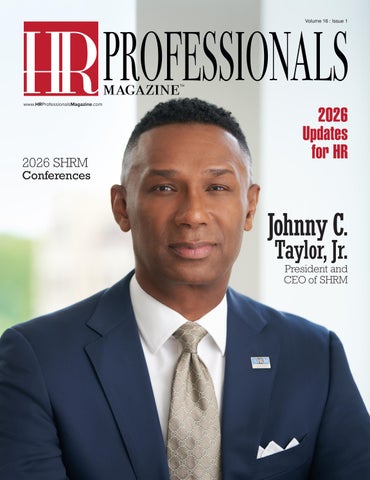
Johnny C.
Taylor, Jr. President and CEO of SHRM
Today’s Digital Behavior is Tomorrow’s Workplace Culture When half our lives are online, a candidate’s digital behavior matters. Violent language, harassment, hate speech, and public misconduct can create workplace risk, but reviewing social media in-house can expose teams to bias and inconsistent evaluation. Data Facts offers a compliant social media screening solution that helps identify job-related red flags while minimizing risk and protecting fairness. With social media screening, you can make confident decisions that include the full picture of a candidate’s digital behavior.
SHRM
ORLANDO, FL JUNE 16 – 19, 2026
80%
OF CAREGIVERS NEED LONG-TERM SUPPORT AT WORK. But only 35% of HR pros are ready.*
SHRM26 equips you to close this critical gap — before it impacts retention, compliance, and culture.
The gap is real. The impact is lasting. The time to act is now.
REGISTER TODAY:
shrm.org/SHRM26-hrprosjan
*Source: The Caregiving Imperative: Organizational Solutions for Supporting Caregivers and Elevating Business Performance, SHRM, 2025. 252882
SHRM Annual Conference & Expo 2026 | Orlando, FL | June 16-19
HR Professionals Magazine is recognized by SHRM to offer Professional Development Credits (PDCs) for SHRM-CP® or SHRM-SCP® recertification activities.
Bringing Human Resources & Management Expertise to You
25%
of workers took no PTO in 2025 www.HRProfessionalsMagazine.com
Features 5 a note from the editor
Editor Cynthia Y. Thompson, MBA, SHRM-SCP, SPHR Publisher
The Thompson HR Firm, LLC Art Direction
Park Avenue Design Marketing and Social Media Specialist
Julie Nagem Project Specialist
Liz Rogers Photographer
Charles B. Thompson Webmaster
Leo Dimilo
Contributing Writers Jeanne Achilles William Brown Amy Schabacker Dufrane
Contact HR Professionals Magazine: To submit a letter to the editor, suggest an idea for an article, notify us of a special event, promotion, announcement, new product or service, or obtain information on becoming a contributor, visit our website at www.hrprofessionalsmagazine.com. We do not accept unsolicited manuscripts or articles. All manuscripts and photos must be submitted by email to Cynthia@hrprosmagazine.com. Editorial content does not necessarily reflect the opinions of the publisher, nor can the publisher be held responsible for errors. HR Professionals Magazine is published every month, 12 times a year by the Thompson HR Firm, LLC. Reproduction of any photographs, articles, artwork or copy prepared by the magazine or the contributors is strictly prohibited without prior written permission of the Publisher. All information is deemed to be reliable, but not guaranteed to be accurate, and subject to change without notice. HR Professionals Magazine, its contributors or advertisers within are not responsible for misinformation, misprints, omissions or typographical errors. ©2026 The Thompson HR Firm, LLC | This publication is pledged to the spirit and letter of Equal Opportunity Law. The following is general educational information only. It is not legal advice. You need to consult with legal counsel regarding all employment law matters. This information is subject to change without notice.
4
www.HRProfessionalsMagazine.com
6 Profile of Johnny C. Taylor, Jr. 9 HR Conference Cruises March 7-12 & March 16-21 11 SHRM Board of Directors 12 Meet the SHRM Oklahoma State Council 18 SHRM Linkage Appoints Tracey Walker as CEO 38 Highlights of the SHRMMemphis Executive Roundtable Holiday Party 39 Register for the HR Conference Cruise to Alaska May 15-22
Talent Management and Recruiting 2 Today’s Digital Behavior is Tomorrow’s Workplace Culture 8 SHRM Position on the Trump Administration’s AI Executive Order 13 What Keeps Your CEO Up at Night? 14 The Internet as the New Interview? 16 EEOC New Guidance on National Origin Discrimination 22 There’s Two Ways to eat a Turnover 24 The Benefits of Daily Pay for the Employee – and the Employer
34 Update on Incivility in the Workplace 35 The Importance of Conducting an I-9 Audit in Your Organization
Employee Benefits 20 HR Insights Brought to You by The Benefits Group
Top Educational Programs for HR Professionals 15 SHRM’s Skills First Specialty Credential 19 SHRM-SCP Certification – Strategic Growth Starts at the Top 26 Register for our Affordable Online SHRM Certification 30 HR and the Year of the Fire Horse
33 Rainey Kizer Reviere & Bell Celebrating 50 Years
SHRM 2026 Conferences Update 3 SHRM26 in Orlando, FL, June 16-19 7 The AI + HR Project in San Francisco, CA, March 9-10 10 SHRM -Atlanta SOAHR Conference April 22-23 17 SHRM Louisiana Conference in Lafayette, LA, April 22 – 23 25 SHRM Tennessee in Knoxville, TN, September 13-16 27 SHRM Talent 2026 in Dallas, TX, April 19-22
31 Join HRCI Engage 36 March 2025 Graduates of the HR Conference Cruise 37 Register for our Online HRCI | PHR | SPHR Certification 40 Earn Your M.S. in Human Resource Management at WGU
Employment Law 28 Bass Berry Sims 2026 Best Lawyers 32 Rainey Kizer Reviere & Bell 2026 Best Lawyers
2026 HR Professionals Magazine is recognized by HRCI to offer professional recertification credits for HRCI activities.
a note from the editor
Welcome to 2026! Can you believe it? It was great meeting you and covering the SHRM conferences in the Southeast during 2025! We also loved covering the annual SHRM Conference in San Diego. It’s time to start planning which SHRM conferences you want to attend in 2026, so that you can include them in your HR budget. Make plans now to attend SHRM26 in Orlando! It’s a fabulous city to visit. Get your tickets early! We can’t wait! (https://annual.shrm.org/rate) We are SO excited to have SHRM President and CEO, Johnny C. Taylor, Jr., on our January cover. It is the perfect way to kick off 2026! We have planned more exciting covers in the coming year that feature the movers and shakers in the HR community who have made a difference in our industry. If you are looking for credits for your SHRM recertification and HRCI recertification, we’ve got you covered. Stay tuned for the details of our upcoming webinars on Tuesdays and Thursdays. Special thanks to Data Facts who sponsors my monthly complimentary webinars. Our next webinar is January 22 at 2 PM CT/3 PM ET. Watch your email for your invitation. Please mark your calendars and plan to join us.
Best wishes for a happy, healthy, and prosperous 2026!
cynthia@hrprosmagazine.com Connect with me on LinkedIn:https://www.linkedin.com/ in/cynthia-thompson-mba-shrm-scp-sphr-325b8715/ Like us on Facebook.com/HRProfessionalsMagazine
Congratulations to Sandra Creswell, SPHR!
Sandra is an independent senior HR consultant with over 30 years of experience providing comprehensive HR services to organizations of up to 500+ employees. She previously worked for Chesapeake Employers Insurance Company, BoMark Electric and Atlantic Builders Group, Inc. Her expertise spans employee relations, performance management, benefits and compensation, recruitment, HRIS, safety and risk management across diverse industries with SPHR, WCP, and Gallup Global Strengths Coach certifications, providing a proven strategic impact.
www.HRProfessionalsMagazine.com
5
on the cover
Johnny C.
TAYLOR, JR.
Johnny C. Taylor, Jr., SHRM-SCP
President and Chief Executive Officer of SHRM Johnny C. Taylor, Jr., SHRM-SCP, is President and Chief Executive Officer of SHRM. With nearly 340,000 members in 180 countries, SHRM impacts the lives of more than 362 million workers and their families globally. As a global leader on the future of employment, culture, and leadership, Mr. Taylor is a sought-after voice on all matters affecting work, workers, and the workplace. Recognized as one of the “300 Most Influential Executives in Corporate America” for 2024 by Savoy Magazine, on the “Virginia 500: Power List” by Virginia Business, and as one of the “Most Influential People Shaping Public Policy” in our nation’s capital by Washingtonian Magazine, Mr. Taylor is frequently asked to testify before Congress on critical workforce issues and authors the weekly USA Today column, «Ask HR.» Mr. Taylor’s career spans more than 20 years as a lawyer, human resources executive, and CEO in both the not-for-profit and for-profit spaces. He has held senior and chief executive roles at IAC/InteractiveCorp, Viacom’s Paramount Pictures, Blockbuster Entertainment Group, the McGuireWoods law firm, and Compass Group USA. Most recently, Mr. Taylor was President and Chief Executive Officer of the Thurgood Marshall College Fund. He is the author of the national bestseller, RESET: A Leader’s Guide to Work in an Age of Upheaval, which immediately upon its release in September 2021, was in the top three of The Wall Street Journal’s list of best-selling hardcover business books. Mr. Taylor serves on the corporate boards of XPO, Inc.; Flores HR; and Guild Education. He previously served on the White House American Workforce Policy Advisory Board and as chairman of the President’s Advisory Board on Historically Black Colleges and Universities during the Trump Administration. In 2020, he received the Distinguished Executive of the Year Award from the Academy of Management, and he was named 2021 ALA Professional Society CEO of the Year by CEO Update. He is a Fellow of the National Academy of Human Resources and is licensed to practice law in Florida, Illinois, and Washington, D.C.
6
www.HRProfessionalsMagazine.com
75%
O F O R G A N I Z AT I O N S H AV E N O G U I D E L I N E S OR POLICIES REGARDING G E N E R AT I V E A I , D E S P I T E GROWING USAGE.
Source: What Recent Global Regulations of AI Will Mean for HR, SHRM, 2024.
ARE YOUR HR PRACTICES READY?
THE AI+HI PROJECT 2026 ISN’T A TECH CONFERENCE. IT’S A HANDS-ON, HR-FOCUSED LEARNING EXPERIENCE B U I LT B Y S H R M T O H E L P Y O U : • Stay ahead of compliance and policy shifts. • See HR challenges solved in real time. • Join innovation labs and shape solutions. • Experience AI-personalized insights and networking.
REGISTER TODAY! SHRM.ORG/AIHI26-HRPJ
GET THE CONFIDENCE YOU NEED TO LEAD HR INTO THE FUTURE.
SHRM Position on the Trump Administration’s AI Executive Order ALEXANDRIA, Va. – As artificial intelligence rapidly reshapes the world of work, SHRM supports a regulatory framework that protects workers, promotes ethical innovation, and gives employers the clarity they need to implement AI responsibly. If the federal government moves to a nationwide AI governance strategy, SHRM believes it must fully assume responsibility for establishing national workplace AI standards that are actionable, predictable, and grounded in real business and workforce realities. To ensure fairness, innovation, and regulatory consistency, SHRM calls on the federal government to:
1. Establish clear and comprehensive workplace AI standards. Federal policy must address recruitment, selection, performance evaluation, workforce monitoring, scheduling, pay decisions, and job displacement risks.
2. Center HR expertise in policymaking. AI in the workplace is fundamentally about people. Federal agencies must incorporate HR and talent experts into advisory councils, rulemaking processes, and stakeholder consultations.
3. Provide consistent, harmonized rules across federal agencies. A unified federal approach must avoid conflicting mandates from multiple regulators, ensuring employers can navigate compliance confidently.
4. Support employers with implementation tools, timelines, and guidance. Standards should be accompanied by practical resources, including federal toolkits, training, model policies, and phased compliance deadlines.
5. Balance worker protection with space for innovation. Policies must encourage responsible adoption and avoid burdening employers with excessive or conflicting requirements. SHRM stands ready to partner with the Trump Administration, lawmakers, agencies, and business leaders to shape a federal workplace AI framework that supports both organizational performance and worker well-being.
About SHRM SHRM is a member-driven catalyst for creating better workplaces where people and businesses thrive together. As the trusted authority on all things work, SHRM is the foremost expert, researcher, advocate, and thought leader on issues and innovations impacting today’s evolving workplaces. With nearly 340,000 members in 180 countries, SHRM touches the lives of more than 362 million workers and their families globally. Discover more at SHRM.org.
8
www.HRProfessionalsMagazine.com
March 2026... Got Plans? You do now! Set sail on your choice of two HR Conference Cruises® in March 2026.
March 7-12
March 16-21
Sailing Onboard Explorer of the Seas
Sailing Onboard Explorer of the Seas
Leaving from Port Canaveral, FL
Leaving from Port Canaveral, FL
Visiting... Cozumel, Mexico Puerto Costa Maya, Mexico
Visiting... Nassau, Bahamas Perfect Day at Coco Cay
Join HR professionals at sea for a learning experience that goes beyond the typical conference environment. Bringing education, networking, and exploration together in a setting designed to inspire growth. Each sailing has been submitted for 15 credits from SHRM & HRCI. Attend four preconference webinars prior to sailing for a head start on credits! Secure your spot today with a $100 nonrefundable deposit. Use code FRIENDOFCYNTHIA for $50 off your registration!
VISIT HRCRUISE.COM FOR MORE INFORMATION
April 22-23 Sessions
90+ booths
50+ sessions
20+
HRCI/SHRM credits
Register by March 6 to maximize discounts
shrmatlanta.org/conference
SHRM Board of Directors
Betty Thompson, SHRM-SCP Chair
Johnny C. Taylor, Jr., SHRM-SCP President & CEO, SHRM
SHRM Board of Directors
Sean N. Woodroffe, SHRM-SCP Director-at-Large Executive Vice President, Chief People, Culture and Communications Officer, Lincoln Financial
Nilanjan Adhya Director-at-Large
Valerie Vargas Director-at-Large
Chief Digital Officer BlackRock
Senior Vice President, AT&T Advertising and Retail Marketing
Susana Suarez Gonzalez, Ph.D., SHRM-CP Director-at-Large Executive Vice President, Chief Human Resources and Diversity, Equity & Inclusion Officer, Amcor
Michael D'Ambrose, SHRM-SCP Director-at-Large
Paula Harvey, SHRM-SCP Director-at-Large
Global Business Strategist & Board Director
Vice President of Human Resources and Safety Schulte Building Systems, Inc.
James Clark Director-at-Large President and CEO, Boys & Girls Clubs of America
William Phelan Director-at-Large Senior Finance Executive
Scott Snell, Ph.D. Director-at-Large
Marlon Sullivan Director-at-Large
Maryjo Charbonnier Director-at-Large
Piyush Mehta Director-at-Large
Frank Sands, Sr., Chair in Business Administration, Darden Graduate School of Business, University of Virginia
Executive Vice President and Chief Human Resources Officer, Johnson Controls International
Chief Human Resources Officer, Kyndryl
Chief Human Resources Officer and Country Manager for India, Genpact Limited
www.HRProfessionalsMagazine.com
11
Meet the SHRM Oklahoma State Council Executive Committee
State Director Tara Crowley
MBA, SPHR, SHRM -SCP
State Council Director Elect Melissa Lockhart SHRM-CP, SPHR
Immediate Past State Director Kristi Spaethe
Secretary/Treasurer Kendi Cox
PHR, SHRM-CP
District Directors
District Director- West Krystal Brue Ph.D , SHRM - SCP
District Director- West Kelly Potter MBA, SPHR, SHRM -SCP
District Director-East Phyllis Spriggs
District Director-East Tim Sullivan SHRM -CP
Core Leadership Areas
College Relations Barbara Abercrombie
Certification Chair Rebekah Pryor
D&I Regina Lane
Foundation Director David McLaughlin
General Council Michael Bowling
Legal & Legislative J.D Robinson
Membership Shalynne Jackson
Workforce Readiness Brenda Rogers
SHRM- SCP, SPHR, Ph.D
12
www.HRProfessionalsMagazine.com
PHR, SHRM - CP
MHR, SHRM -SCP
MBA , PHR
What Keeps Your CEO Up at Night?
2026 Guidance for HR Professionals CEOs balance technology, growth, and talent as strategic priorities.
AI is transforming value creation but raising new risks.
Adopting artificial intelligence (cited by 40%), driving revenue growth (31%), and attracting top talent (27%) are CEOs’ leading priorities for the year ahead. These results reflect how leaders are integrating technology, business performance, and workforce strategy to sustain innovation and competitiveness in a rapidly changing environment.
Nearly 9 in 10 CEOs (89%) expect AI to redefine how their organizations create and capture value, while 88% said it will automate repetitive tasks and drive large-scale reskilling (87%). Yet, 88% also anticipate heightened cybersecurity threats, and 82% expect an increased need for investment in AI governance.
Technological change has become the defining CEO challenge.
Workforce strategies are expected to evolve to meet demands for agility and efficiency.
More than half of CEOs (56%) identified technological advancements as a top macroeconomic challenge — surpassing inflation (38%) and economic uncertainty (36%). Internally, 54% said adapting to technological advancements is an organizational challenge, underscoring how innovation and disruption are reshaping the CEO agenda.
CEOs anticipate significant shifts in how organizations manage and structure their workforce over the next year. Many expect a growing emphasis on organizational agility in workforce management (78%), increased workforce reductions or layoffs (75%), and increased organizational redesigns or restructurings to improve efficiency and agility (74%). Together, these changes highlight how leaders are re-engineering their workforce strategies to enhance adaptability, manage costs, and sustain performance in an unpredictable environment.
www.HRProfessionalsMagazine.com
13
The Internet as the New Interview? Looking at Digital Behavior in Hiring Not to sound old, but “times sure have changed.” Conversations that once happened at conference tables, over coffee, or across a cubicle wall now unfold on screens, publicly, permanently, and with an audience. The average person spends more than six hours daily scrolling, liking, posting, commenting, and sharing. Over weeks and years, this adds up to thousands of micro-decisions and digital expressions that paint a detailed picture of a person’s values, emotional intelligence, and everyday habits. Digital behavior has become one of the best indicators of how people present themselves when they’re not being evaluated.
Digital Behavior: The Background You Can’t See on Paper This isn’t about surveillance, nitpicking, or punishing a candidate for a single regrettable post from 2010. It’s about acknowledging that the online world is an extension of the real world. Workplace culture, reputation management, and employee conduct are becoming increasingly connected to public platforms. Ignoring digital behavior means overlooking context that may affect your organization’s culture, safety, and brand trust.
Ways HR Teams Can Responsibly Evaluate Digital Behavior 1. Review public, voluntarily shared digital information. Public information is part of modern identity, but private accounts are exactly that, private. This helps ensure consistency, fairness, trust, and bias reduction. 2. Establish written guidelines. Without a roadmap, digital behavior review can wander into personal preference rather than objective assessment. Create a policy or criteria list informed by DEI principles, compliance, and legal counsel. Clear guidelines should include: o Which behaviors legitimately pose harm or risk. o Which behaviors are irrelevant to job duties. o Which digital data points should never be considered. 3. Train decision-makers before problems arise. Bias (conscious or not) can appear in the smallest interpretations such as reading sarcasm literally, misinterpreting cultural expressions, or forming opinions based on looks and lifestyle. Digital behavior evaluation is a contextual tool, not a character trial. Workshops or discussions may include: o Discerning behavior from identity. o Evaluating patterns rather than isolated posts. o Avoiding protected-class characteristics. o When to escalate for review and when to disregard. 4. Consider third-party vendors. No HR professional wants to reject a great candidate unfairly, nor unknowingly welcome harmful behavior into their culture. Policies protect both outcomes. Some organizations outsource processes to a trusted third-party vendor to remove bias. Using third-party tools helps keep the process fair, documented, compliant and job-relevant.
Why Digital Behavior Matters to Hiring Teams
What Digital Assessment Should (and Shouldn’t) Be
Today, digital platforms function as professional billboards, networking channels, and news sources. Employees commonly work, collaborate, and communicate online, often representing companies whether they intend to or not. For HR leaders, online behavior offers peek into:
As with any part of the hiring process, everyone involved should be thorough and fair. Responsible digital behavior review should be:
• Behavioral patterns and emotional responses. Does the individual engage respectfully in disagreements? Do they use inflammatory language when frustrated? Have they shown aggression, discrimination, or harassment online? Consistent patterns can help anticipate how someone may react under stress in the workplace. • Public alignments that conflict with organizational values. Every organization has a culture and code of conduct (formal or not). If a candidate’s public content contradicts those values, hiring them may create friction, mistrust, or brand risk. This doesn’t mean expecting every hire to align 100% with a company’s philosophy. It just gives HR a way of identifying behavioral red flags that could impact the work environment, like: o Hate speech or discriminatory statements. o Harassment or threats. o Public calls for violence. • Ethical judgment. Hiring individuals who show integrity and good judgment is a smart goal for every organization. Digital behavior can uncover lapses in mindful behavior like: o Posting confidential information. o Publicly disparaging former employers. o Sharing illegal activity. o Publishing unfounded accusations. On the positive side, digital behavior can also reveal leadership and influence patterns such as community involvement, thought leadership, and inclusive communication and advocacy. A well-rounded digital presence can demonstrate initiative and emotional intelligence - qualities that are difficult to assess on a resume and in a 45-minute interview. 14
www.HRProfessionalsMagazine.com
• Contextual. Look for patterns, not isolated incidents. • Job-related. Focus on behaviors tied to workplace risks. • Transparent. Never vague or misleading. • Protective. Support culture, safety, and reputation. The intent with reviewing digital behavior is to understand the whole picture, responsibly and respectfully. A compliant review is NOT: • Policing personal beliefs. • Digging through private accounts. • Assuming guilt by association. • Looking for reasons not to hire.
The Digital Puzzle Piece of Modern Hiring Evaluating digital behavior is a new reflection of how humans now engage with the world. Resumes show experience. Interviews show communication. References show reputation. Digital behavior shows context. HR can learn valuable information that won’t ever be on their resume, like: • How they respond when no one is evaluating them. • How they build connections. • How they treat others. • How they represent themselves. • How they handle frustration, disagreement, and success. Thoughtfully assessing a candidate’s digital behavior helps mitigate the risk of a bad hire. It also supports building teams grounded in respect, emotional intelligence, and shared values. And ultimately, that’s the foundation of every strong workplace, online or off.
Data Facts | www.datafacts.com
When you lead with skills, you lead with impact. Hiring for skills means seeing potential beyond resumes and degrees, creating a fairer and faster pathway for growth.
What it means to hire skills-first: Build career paths that are fair, clear, and growth-focused.
See potential where others see only inexperience.
Keep your best people by investing in what they can do.
GET STARTED
Created by HR, for HR, the SHRM Skills First Specialty Credential gives you the road map and confidence to move your own career forward. Visit shrm.co/skillsfirst www.HRProfessionalsMagazine.com
15
EEOC BUILDING IN WASHINGTON, D.C.
EEOC New Guidance on National Origin Discrimination Nothing justifies illegal national origin discrimination — whether rooted in the cost of labor, customer preferences, or stereotypes.” The U.S. Equal Employment Opportunity Commission (EEOC) recently released new and updated educational materials reaffirming Chair Andrea Lucas’ commitment to advancing robust enforcement and awareness around national origin discrimination and Anti-American bias. The agency issued a new one-page technical assistance document, “Discrimination Against American Workers Is Against The Law” to help workers understand their rights. The agency also updated its national origin discrimination landing page (a page on the agency’s website that gathers information and resources regarding national origin discrimination) with additional helpful information for both workers and employers on what unlawful national origin discrimination can look like in the workplace and how individuals can act if they believe their rights have been violated. Both resources are based on Title VII of the Civil Rights Act of 1964, existing EEOC policy guidance and technical assistance documents, and Supreme Court precedent. The landing page also notes that misconduct involving national origin discrimination may violate other laws in addition to Title VII, and provides links to the EEOC’s federal agency partners, including the U.S. Department of Labor and the U.S. Department of Justice’s Civil Rights Division. The new and updated materials underscore EEOC Chair Andrea Lucas’ continued focus on strengthening compliance with civil rights protections against national origin discrimination and ensuring those protections are applied evenhandedly to all workers. They also reflect her priority to confront unlawful anti-American national origin bias, an area she has identified as a significant and ongoing focus for the agency’s compliance efforts, enforcement work, and litigation. “The EEOC is here to protect all workers from unlawful national origin discrimination — including American workers,” Lucas said. “Unlawful bias against American workers, in violation of Title VII, is a large-scale problem in multiple industries nationwide. Many employers have policies and practices preferring illegal aliens, migrant workers, or non-immigrant guest workers
16
www.HRProfessionalsMagazine.com
(guest worker visa holders) over American workers — in direct violation of federal employment law. The EEOC is committed to ensuring employers and workers better understand the even-handed protections provided to all workers by Title VII’s prohibition against national origin discrimination.” Discrimination based on national origin at work involves treating employees or applicants unfavorably or favorably because they are from a particular country or part of the world, because of ethnicity or accent, or because they appear to be of a certain ethnic background, all of which could violate Title VII.
Lucas said, “Nothing justifies illegal national origin discrimination — whether rooted in cost of labor, customer preferences, or stereotypes.” The educational resources provide information about how national origin discrimination can take many forms, including disparate treatment, harassment, retaliation, job advertisements, or hiring decisions. Employees or job seekers who suspect they may have been subjected to national origin discrimination are encouraged to review information on filing a charge at https://www.eeoc.gov/ filing-charge-discrimination. The EEOC is the sole federal agency authorized to investigate and litigate against businesses and other private sector employers for violations of federal laws prohibiting employment discrimination. For public sector employers, the EEOC shares jurisdiction with the Department of Justice’s Civil Rights Division; the EEOC is responsible for investigating charges against state and local government employers before referring them to DOJ for potential litigation. The EEOC also is responsible for coordinating the federal government’s employment antidiscrimination effort. More information about the EEOC is available at www.eeoc.gov. Stay connected with the latest EEOC news by subscribing to our email updates.
B
Business DOWN TO
LA SHR M
gie
FINDING THE HR RHYTHM April 22 & 23, 2026 Lafayette Cajun Dome & Convention Center
REGISTRATION
Chapter/SHRM Member FULL 2-day $440 | Early bird $405 Early-bird available through 2/15/2026 CONFERENCE TRACKS Talent Acquisition & Talent Management Stayin’ Alive with Talent: Keeping the groove strong by attracting, engaging, and growing the right people to keep your organization’s rhythm alive Total Rewards & HR Technology Disco Inferno: Rewards & Tech on Fire Leadership & Strategy Groovin’ with Leadership: Choreographing vision, culture, and strategy
Legal Play That Funky Law, HR: Staying in tune with the law of the land
louisianashrm.org
SHRM Linkage Appoints Tracey Walker as Chief Executive Officer Walker is a nationally recognized executive strategist and transformational CEO with more than two decades of impact across business, government, and professional services.
SHRM Linkage announced the appointment of Tracey Walker as its Chief Executive Officer. Walker is a nationally recognized executive strategist and transformational CEO with more than two decades of impact across business, government, and professional services. As the CEO of SHRM Linkage, she brings a bold, evidence-based vision for elevating leadership excellence worldwide— grounded in organizational behavior data, strategic foresight, high-performance cultures and an unwavering commitment to developing leaders who inspire trust and deliver measurable, enterprise-level results. Prior to joining SHRM Linkage, Walker spent 19 years at the global organization, RSM, where she was a Principal and Chief Culture Officer, followed by public sector leadership as Chief Experience Officer at Alvarez and Marsal. A three-time CXO, she built her career in global organizations where she became known for uniting talent strategy, stakeholder engagement, and disciplined business methodology to accelerate sustainable growth. Her counsel and organizational behavior expertise, has guided Fortune 500 companies, federal agencies, and mission-driven enterprises in unlocking performance, elevating the people experience, modernizing culture, and expanding markets through strategic inclusion and human-centered AI. “We are thrilled to welcome Tracey as the new leader of SHRM Linkage. With a proven record of enterprise transformation, crosssector impact, and award-winning results, she is uniquely positioned to drive SHRM Linkage into its next era— strengthening leadership pipelines, advancing organizational trust, and driving sustained innovation and growth for organizations worldwide. With her guidance, we are confident that Linkage will not only build upon its 35-year legacy of delivering exceptional leadership development but also continue to set new benchmarks within the industry,” said Syed Wasey, Acting Executive Vice President (EVP), Global Business, SHRM. “It is my privilege to assume the role of CEO at SHRM Linkage,” said Walker. “This is a critical moment for organizations to elevate how they develop leaders and unlock the full potential of their talent to drive performance. We are committed to expanding the transformative impact Linkage delivers to organizations around the world. Together, we are setting a new standard for leadership excellence.” Walker’s leadership impact has earned national distinction. She has been named one of the AICPA’s 50 Most Powerful Women in Accounting, received the AGA President’s Award, and was honored as ALPFA’s 2025 Executive of the Year—recognition that reflects her influence across industry and the broader business community. Throughout her career, she has led multi-million-dollar portfolios, built high-performing revenue organizations, and guided complex transformation initiatives across HUD, Treasury, USDA, Freddie Mac, and Fannie Mae. Her thought leadership is widely sought by top academic institutions and professional associations. Her lecture and executive instruction include the AICPA and Societies nationwide, Howard University, IFAC, Kelley School of Business, US Department of Treasury, and UMass Amherst Isenberg School of Management among others, shaping the next generation of leaders prepared to navigate a rapidly evolving world of work. About SHRM Linkage SHRM Linkage empowers organizations to drive enterprise results by developing talent critical to their success. Backed by SHRM, the world’s largest HR association, they deliver research-driven talent and leadership development solutions grounded in more than 1 million data points from 100,000 leadership assessments collected over 30 years. 18
www.HRProfessionalsMagazine.com
STRATEGIC GROWTH STARTS AT THE TOP Earn your SHRM-SCP® certification and lead with credibility, foresight, and influence. The SHRM-SCP is the benchmark for HR leadership. It validates your ability to align workforce strategy with business goals, guide executive-level decision-making, and influence culture at scale.
NEED HELP PREPARING? Study smarter, not harder — the SHRM Learning System is the most comprehensive online preparation tool for the SHRM certification exam. Master the material and gain confidence before your exam! shrm.org/LS25
APPLY NOW AND SAVE! shrm.org/shrm-scp
CPR-252244
www.HRProfessionalsMagazine.com
19
Brought to you by: The Benefits Group
Avoiding AI Employee Training Mistakes
As artificial intelligence (AI) tools become increasingly embedded in workplace operations, more employers are asking their workforce to use AI in their day-to-day roles. However, not all AI initiatives have a positive impact on employees. According to a recent survey by Howdy.com, a staffing and recruitment company, an estimated 1 in 6 workers say they pretend to use AI, and 1 in 5 feel pressured to use it even though they are uncomfortable doing so. This disconnect between reported and actual engagement with AI reveals that many employees feel pressured to adopt technologies they don’t fully understand or trust, often without adequate training or support. This article explores employee adoption of AI, outlines common mistakes employers make when introducing AI tools and offers tips on how to avoid them.
Employee Adoption of AI
While AI holds immense promise for improving productivity, decision-making and innovation, its implementation is not without pitfalls. Employers eager to stay competitive may inadvertently rush the process, assigning AI-related tasks to employees without assessing their readiness or providing clear guidance. This can lead to misuse, inefficiency and even resistance, undermining the very goals AI is meant to achieve. Moreover, forced adoption can foster a culture of fear or dishonesty, where employees feel compelled to fake it rather than admit confusion. This can skew internal metrics and stifle meaningful feedback that could improve AI integration strategies. To harness AI’s potential responsibly, organizations must approach their rollout with intentionality, balancing enthusiasm with empathy and innovation with education.
This HR Insights is not intended to be exhaustive nor should any discussion or opinions be construed as professional advice. © 2025 Zywave, Inc. All rights reserved.
6 AI Training Mistakes to Avoid
Training employees on AI tools and concepts may allow an organization to become more competitive, but it’s easy to overlook key factors that can hinder adoption and effectiveness. A successful AI training program requires thoughtful planning, clear communication and ongoing support. The following are six common mistakes to avoid when training employees on AI: 1.
Assuming familiarity—Many organizations roll out AI tools under the assumption that employees are already tech-savvy or will “figure it out.” This overlooks the wide range of digital literacy levels across teams. Without assessing baseline understanding, employers risk alienating those who feel overwhelmed or underprepared, leading to disengagement or misuse of the tools.
2.
Implementing one-size-fits-all training— Generic training modules often fail to address the specific needs of different roles. For example, a customer service representative may need hands-on experience with AI chatbots, while a data analyst might require deeper insights into machine learning models. Tailoring training to job functions can help ensure relevance and increase adoption.
3.
Assuming AI works for all tasks—One of the most counterproductive assumptions in AI adoption is believing it should be used for every task, regardless of context. Not every task benefits from automation or algorithmic assistance, and forcing AI into every workflow can diminish trust and reduce overall effectiveness. Instead, managers should collaborate with employees to identify specific tasks where AI can genuinely add value. This targeted approach can improve productivity and help employees see AI as a helpful tool rather than a burdensome requirement.
4.
Overwhelming employees without teaching contextual use of AI tools—One of the most common missteps is introducing AI without helping employees understand where it fits and where it doesn’t. Without clear guidance on appropriate use cases, employees may either over-rely on AI for tasks that require human judgment or avoid it altogether out of uncertainty. Effective training should go beyond tool functionality and focus on decision-making: when AI can enhance efficiency or insight, and when manual processes or human expertise are more appropriate. This can empower employees to use AI thoughtfully, not just habitually.
5.
Failing to stay up to date on AI developments—AI tools and platforms evolve rapidly, often with significant changes to capabilities, interfaces and best practices. When organizations fail to stay informed about these updates, they risk using outdated methods, missing out on efficiency gains or even introducing security vulnerabilities. Employees may unknowingly rely on deprecated features or overlook new functionalities that could simplify their work. Employers should build regular check-ins, update cycles and learning opportunities into their AI strategy to keep both leadership and staff informed.
6.
Neglecting to create an AI policy—In the rush to adopt AI tools, many organizations either overlook the need for a formal, written AI policy or hastily create one without updating it as technologies rapidly evolve. Without clear guidelines, employees may be unsure about what’s permitted, what’s confidential and how AI should be used responsibly. This ambiguity can lead to inconsistent practices, data misuse, compliance risks and even ethical concerns. A well-crafted AI policy helps set expectations around usage, accountability and limitations, ensuring that employees understand the opportunities and boundaries of AI in their roles.
Conclusion
When implemented thoughtfully, AI can be a powerful catalyst for growth, efficiency and innovation across an organization. However, its success depends not just on the technology itself but also on how well people are prepared to use it. Avoiding common training missteps can help employees feel supported, informed and confident. By investing in clear communication, tailored learning and ongoing engagement, companies can create a culture where AI is embraced as a helpful tool rather than a source of confusion or pressure. Contact us today for more workplace resources.
The Benefits of Daily Pay for the Employee – and the Employer Daily pay refers to the option for employees to access their earned wages before the traditional payday. It is a relatively new trend in the workforce. However, it’s worth noting that the use of daily pay options is growing as more employers and employees seek flexible and convenient payment solutions. Here are some benefits of daily pay for both employees and employers:
For Employees:
24
For Employers:
1 Financial Flexibility: Employees can access their wages when they need them, helping to manage unexpected expenses, bills, or emergencies without resorting to high-interest loans or credit cards.
1 Attraction and Retention of Talent: Offering daily pay can be a competitive advantage in attracting and retaining employees, especially in industries with high turnover rates.
2 Reduced Financial Stress: Daily pay can alleviate financial anxiety and stress associated with waiting for the next paycheck, promoting better mental health and overall well-being.
2 Increased Employee Engagement: Providing flexible pay options can lead to higher morale and productivity, as employees feel more empowered and supported in their financial situations.
3 Improved Budgeting: Access to daily earnings allows employees to budget more effectively, as they can plan their spending based on actual income rather than waiting for a set payday.
3 Reduced Absenteeism: Employees with access to daily pay may be less likely to take unscheduled time off for financial reasons, as they have better control over their cash flow.
4 Increased Job Satisfaction: Employees may feel more valued and engaged when they have control over their earnings, which can lead to higher job satisfaction and loyalty.
4 Enhanced Reputation: Companies that offer innovative pay solutions can enhance their brand reputation as forward-thinking and employeecentric.
5 Better Work-Life Balance: For those with fluctuating income needs, daily pay can support a more balanced lifestyle, allowing for timely payments related to personal needs or obligations.
5 Streamlined Payroll Process: Some daily pay systems can integrate with existing payroll systems, making the payment process more efficient and reducing administrative burdens.
www.HRProfessionalsMagazine.com
Overall, daily pay can create a win-win situation for both employees and employers, enhancing financial wellness and workplace satisfaction. Daily pay is a relatively new trend in the workforce, and data on the exact percentage of workers using this method may not be widely tracked or reported. However, it’s worth noting that the use of daily pay options is growing as more employers and employees seek flexible and convenient payment solutions. For the most accurate and up-to-date information on this topic, consult industry reports, labor statistics, or financial research studies.
CONFERENCE AND EXPO
SEPTEMBER 13 -16, 2026
2026
KNOXVILLE CONVENTION CENTER
Registration and information at www.tnshrm.org
K E Y N O T E S
Kelly Merbler Leadership Development Consultant & Keynote Speaker
Jon Gordon
Best Selling Author and Keynote Presenter
Morris Morrison Writer, Entertainer and Keynote Presenter
Leslie Beale
Leadership Expert, Human Capital Consultant, Executive Coach
The Future of HR: Reimagining Work, Culture & Leadership Join us in Knoxville, TN for the 2026 SHRM Tennessee Conference & Expo, where bold ideas and inspiring speakers will spark fresh thinking around how we lead, work, and shape workplace culture. Reserve your room now at the Marriott Knoxville Downtown with our special conference room block rate of $229, and enjoy top-tier accommodations in the heart of downtown—all at the preferred group price.
Hosted by:
Book early! The room block is limited, and rooms will sell out.
EARLY REGISTRATION NOW OPEN Save $200 off the the regular registration price until 3/31/26 at www.tnshrm.org
HR Professionals Magazine is recognized by SHRM to offer Professional Development Credits (PDCs) for SHRM-CP® or SHRM-SCP® recertification activities.
Affordable Online SHRM-CP® | SHRM-SCP® Certification Exam Prep Class Online classes begin April 20, 2026 and will meet twice per week for 12 weeks on Monday and Wednesday evenings from 6:00 PM to 7:00 PM.
SHRM Learning System® Participant Materials
The total cost of the SHRM-CP® | SHRM-SCP® Online Certification Exam Prep Class is $1025 (plus $25.00 shipping)
You may pay by PayPal, credit card or check.
2026 Spring Exam Window May 1, 2026 – July 15, 2026 For more information visit shrmcertification.org
Guarantee If you do not pass, you can retake the class at no additional charge if you meet these two requirements: – Attend 80% of the scheduled online classes – Score 80% on all practice quizzes
Deadline to register is April 15, 2026 Contact cynthia@hrprosmagazine.com OR visit our website at www.hrprofessionalsmagazine.com
About the instructor: Cynthia Y. Thompson is Principal and Founder of The Thompson HR Firm, a human resources consulting company in Memphis. She is a senior human resources executive with more than twenty years of human resources experience concentrated in publicly traded companies. She is the Editor | Publisher of HR Professionals Magazine, an HR publication distributed to HR Professionals and SHRM members in the contentinental U.S. Cynthia has an MBA and is certified as a Senior Professional in Human Resources (SPHR) by the Human Resource Certification Institute and is also certified as a Senior Certified Professional by the Society for Human Resource Management. She is a faculty member of Christian Brothers University. Cynthia was appointed to serve on the Tennessee DOHR Board of Appeals by Gov. Bill Haslam in 2014. 26
www.HRProfessionalsMagazine.com
Are You Ready... to Take Your 2026 Talent Strategy Even Further? Shift toward a skills-first economy. Explore the integration of artificial intelligence in HR. Go beyond trends and gain the strategies needed to shape the future of HR practices. Your takeaways will include: Leveraging data-driven hiring. Designing global workforce ecosystems. Fostering human connection. Future-proofing careers. Implementing AI in HR. Redesigning job structures. It’s all happening at SHRM Talent 2026.
Register today to shape the future of talent. shrm.org/talent26-hrpros1
“Lawyer of the Year” by The Best Lawyers in America© 2026
Tim Garrett, Member, Nashville
David Thornton, Member, Memphis
Best Lawyers® 2026, Lawyer of the Year Litigation – Labor and Employment; Employment Law – Management
Best Lawyers® 2026, Lawyer of the Year Litigation – ERISA
The Best Lawyers in America© 2026
Lymari Cromwell, Member, Nashville
Susan Bilbro, Member, Nashville Employee Benefits (ERISA) Law
Employment Law – Management; Health Care Law
Davidson French, Member, Nashville
Robert Horton, Member, Nashville
Employment Law – Management; Litigation – Labor and Employment
Employment Law – Management; Labor Law – Management; Litigation – Labor and Employment
Mary Leigh Pirtle, Member, Nashville Employment Law – Management; Litigation – Labor and Employment
28
www.HRProfessionalsMagazine.com
Best Lawyers: Ones to Watch® in America 2026
Noah Black, Associate, Nashville
Brittany Roberts, Labor & Employment Attorney, Nashville
Employee Benefits (ERISA) Law
Labor and Employment Law – Employee; Labor and Employment Law – Management
Catherine Simpson, Associate, Memphis
Hunter Yoches, Associate, Nashville
Employee Benefits Law
Labor and Employment Law – Management
www.HRProfessionalsMagazine.com
29
HR and the
Year of the Fire Horse By AMY SCHABACKER DUFRANE
Astrologers believe that 2026 will bring great progress. Known as the “Year of the Fire Horse,” its characteristics of energy and fire are said to come around every 60 years. The last such occurrence was in 1966, when NASA flew several successful missions, ATMs were introduced, and the Beach Boys released one of the most influential records in pop music history. In those days, HR was usually known as “Personnel,” and in many cases, reported through finance, operations, or “industrial relations.” Our predecessors had maintained file drawers filled with paper folders, administered pay and benefits according to policy and union contracts, and managed timekeeping – without calculators. Performance reviews were for pay decisions, and the ideas of job design, coaching, or behavioral science weren’t yet part of the picture. Returning to the present: According to a study by Nick Bloom and Mert Akan of Stanford University, CHRO pay now aligns with that of other senior executives. In 2024, American businesses employed 1.3 million HR professionals, with a similar trend in Australia, the U.K., and Germany. With state governments requiring greater oversight of sick leave and pay equity, HR professionals manage countless complexities that few other business functions have to face. One might speculate that it’s why former HR executives, such as General Motors’ Mary Barra, thrive in the CEO role. As I reflect on the promise of a new year and memories of how far we’ve come as HR professionals, poet Mary Oliver’s famous quote plays in my head: “Tell me, what is it you plan to do with your one wild and precious life?” Is there something magical about January 1? Do we count on astrology to decide our fate? Or are we in control of our future, deciding how to seize the brass ring starting today?
Certified HR Proficiency At HRCI, we’ve spent a lot of time this year helping our community prepare for the innovations, disruptions, and strategies that will define the years to come. Our HRCI Pro Series is a collection of certificate courses that focus on advanced HR and business concepts. The AI for HR certificate, for example, includes Artificial Intelligence and the Employee Experience, Generative AI for HR Professionals, and Responsible Implementation and Compliance. Other HRCI Pro Series 30
www.HRProfessionalsMagazine.com
courses include compensation, ethics, benefits, talent acquisition, and employment law. HR professionals tell us that these certificate courses are helping them be practical today while preparing for tomorrow and are earning them respect among their colleagues. Already accustomed to an accelerated business environment, HR teams turn to HRCI because their time for learning new technologies and practices is limited. Technology is coming at them from every possible angle, combined with return-to-office challenges, workforce reductions, and the endless quest for qualified talent. The pace of change gallops at the rate of the fire horse, yet adoption and depth of usage for new ways of solving problems remain uneven.
People Still Matter More There are also the inherent challenges related to culture and the role of human decision-making. While it feels like everything will be automated soon, think back to when HR was “personnel.” Are there still a few file cabinets within your line of sight? Perhaps an Excel spreadsheet for labor scheduling? Or grievance management that’s being intentionally kept off the company’s email system? HR knows that not everything can be driven by AI. Whenever there are people involved, there are subtle complexities that must be weighed, which is why the organization turns to HR for guidance. If there’s anything we can all take away from the start of a new year – whether it’s to debate the energy of the year of the snake vs. the horse; whether or not to implement AI across the enterprise; or to lean into a skills-first talent strategy –I think we can agree that every big win starts with readiness. Identifying gaps inside your HR team – whether in change management, vendor selection, compliance, or AI fluency – means you can take full advantage of the corresponding courses at HRCI. Planning what to do with your one wild and precious career can make you the north star within your organization. HRCI can help you get there. Amy Schabacker Dufrane, Ed.D., SPHR, CAE, is CEO of HRCI® — where she is responsible for driving and disrupting the conversations about building high-performing, strategic HR teams. An engaging thought leader at the intersection of talent strategy and continuous learning, Dr. Dufrane is an awardwinning leader and celebrated keynote speaker on the human side of successful business strategy in the 21st century.
Be part of something big.
JOIN
A Global HR Online Community From HRCI—the trusted leader in human resources learning and certification for over 50 years—comes a fresh, innovative online space for HR professionals around the world to connect, collaborate, and grow. • For Every Career Stage: Emerging professionals and seasoned leaders have a place in this dynamic community. • Forge Valuable Connections: Engage with a global network of peers and industry experts who share your vision for HR excellence. • Develop Your Strategic Edge: Stay ahead of HR trends, address current challenges, and access resources for professional growth.
Join HRCI ENGAGE today at: www.hrci.org/engage
Rainey Kizer Attorneys Named to
The Best Lawyers in America© 2026 Rainey, Kizer, Reviere & Bell, PLC is proud to have Labor, Employment & Governmental law attorneys John Burleson, Robert Binkley Jr., and Geoffrey Lindley recognized in The Best Lawyers in America® 2026 edition. For over 40 years, Best Lawyers® has been esteemed by both legal professionals and the public as a premier benchmark for legal integrity and distinction in the United States. Best Lawyers® recognitions are compiled based on an exhaustive Purely Peer Review® evaluation recognizing the top legal talent in America.
John Burleson John Burleson is a member of Rainey, Kizer, Reviere & Bell, PLC and has been associated with the Firm since receiving his law degree, with honors, in 1983 from the University of Tennessee. Burleson is also distinguished as a Rule 31 Listed General Civil Mediator, a certification he obtained in 2013. He is one of only eight attorneys located in the Jackson, Tennessee area listed in the U.S. District Court Mediator Directory. Since 2013 Burleson has mediated cases in both state and federal courts in Middle and West Tennessee. He is an experienced mediator in cases involving age, gender, and race discrimination, FMLA violations, sexual harassment, civil rights violations, landowner disputes, auto accidents, wage and hour issues, construction litigation, violation of noncompete agreements, contract disputes, premises lability, and ADA violations. Furthermore, John was recently inducted into the National Academy of Distinguished Neutrals (NADN). The National Academy of Distinguished Neutrals is a professional association whose membership consists of ADR professionals distinguished by their hands-on experience in the field of civil and commercial conflict resolution. Membership is by invitation only and all Academy members have been thoroughly reviewed and found to meet stringent practice criteria. Members are amongst the most in-demand neutrals in their respective states, as selected by their peers and approved by local litigators.
Robert Binkley Jr. Robert Binkley is a member of Rainey, Kizer, Reviere & Bell, PLC and joined the Firm in 1986 shortly after receiving his Doctorate of Jurisprudence from the University of Tennessee College of Law. For over thirty-eight years, Binkley has represented employers and individuals in employment, workers’ compensation, insurance, and tort matters. Binkley assists and counsels private and public employers in conducting investigations and litigation concerning Title VII, FMLA, ADEA, ADA, FLSA, THRA, and other state and federal employment related laws. In addition, he has extensive experience in personal injury and workers’ compensation litigation and speaks to groups on employment law topics. Binkley is a member of the Firm’s Labor, Employment & Governmental Law and Tort & Insurance Practice Groups and served as the Firm’s personnel partner from 2012-2019.
Geoffrey Lindley Geoffrey Lindley is a member of Rainey, Kizer, Reviere & Bell, PLC and has been associated with the Firm since receiving his Doctor of Jurisprudence from the University of Tennessee College of Law in 2001. Lindley concentrates his practice in the areas of labor and employment law (representing employers only), governmental entity law, and civil rights litigation. His labor and employment law practice includes advising employers on issues concerning all areas of labor, employment, and human resource concerns, including law such as Title VII of the Civil Rights Act of 1964, the Americans with Disabilities Act, the Family Medical Leave Act, the Age Discrimination in Employment Act, the Fair Labor Standards Act, the National Labor Relations Act, and other laws applicable to employers. Lindley also litigates labor and employment claims for employers. He also has experience representing counties and municipalities, including defending police departments and municipalities in 42 U.S.C. § 1983 litigation. Lindley frequently speaks to attorneys and HR professionals at educational conferences and seminars on labor and employment issues. He currently serves as the Firm’s Labor, Employment & Governmental Law Practice Group Leader. 32
www.HRProfessionalsMagazine.com
T H E ST R E N GT H O F E X P E R I E NC E
As the issues facing employers and HR professionals become more frequent, challenging, and complex each year, you need a law firm that provides advice for your specific organization. For 50 years, Rainey Kizer Reviere & Bell has advised and represented businesses, non-profit organizations, and governmental agencies. To learn how we can assist your organization, please contact us at 731.423.2414.
TENNESSEE MEMPHIS • MARTIN • JACKSON • NASHVILLE • CHATTANOOGA K ENTUCK Y FULTON
Tennessee and Kentucky do not certify specialists in the area of employment law. Attorney Advertisement
raineykizer.com | 731.423.2414
Update on Incivility
in the Workplace
The issue of incivility has emerged as a significant challenge for organizations across the globe. Workplace incivility refers to low-intensity deviant behavior, which can include rudeness, disrespect, and social isolation, and can be detrimental to both employee well-being and organizational performance. As more emphasis is placed on workplace culture and employee engagement, understanding the need for civility in the workplace has never been more important. Workplace incivility can takes on many forms, including dismissive comments, condescending tones, ignoring colleagues during discussions, and other behaviors that undermine mutual respect. Unlike overt forms of aggression, such as bullying or harassment, incivility tends to be more subtle and often goes unnoticed, therefore unaddressed. When these behaviors go unnoticed, they accumulate leading to a toxic work environment. Recent studies indicate that workplace incivility is growing. According to a survey conducted by the Workplace Bullying Institute, approximately 30% of employees report experiencing incivility in their workplaces. The percentage has increased over the last decade, suggesting that the issue is becoming more prevalent. The COVID-19 pandemic further exacerbated these trends, as many employees are adjusting to remote work, which leads to challenges in communication and collaboration. Recent research found that 38% of employees have experienced incivility from a coworker or supervisor, and 43% have witnessed such behavior. The findings showed that U.S. workers collectively experience over 81 million acts of incivility per day. In Q4, over one-quarter of U.S. workers (26%) said they are likely to leave their jobs due to incivility in their workplace. These statistics highlight the widespread nature of incivility and its potential impact on employee morale and productivity. Understanding the causes of workplace incivility is essential in in order to address the issue effectively. Several factors contribute to this negative behavior, such as: 1 High Stress Levels: Workplaces that demand high performance create stress among employees. Stress leads to frustration and impatience resulting in uncivil behavior. 2 Poor Leadership: Leaders set the tone for workplace culture. If managers display uncivil behavior or fail to address it, employees feel justified in adopting similar attitudes. 3 Lack of Diversity and Inclusion: A homogenous work environment can lead to isolation and resentment among employees who feel marginalized. This can lead to incivility, as individuals express frustration through negative behavior. 4 Remote Work Dynamics: The shift to remote work altered the way teams interact. Miscommunication and the absence of non-verbal cues can lead to misunderstandings, that can escalate into incivility. 5 Cultural Norms: Incivility may be normalized or encouraged as a means of fostering competition, which can perpetuate disrespect and hostility. 34
www.HRProfessionalsMagazine.com
As result of workplace incivility, it may extend beyond individual employees; it can impact an entire organization. It can be categorized into several key areas.
Employee Well-Being Incivility takes a toll on employees' mental and emotional health. It can lead to increased stress, anxiety, and job dissatisfaction, ultimately resulting in higher turnover rates. Employees subjected to incivility are more likely to disengage from their work and less likely to contribute positively to team dynamics.
Organizational Performance The presence of incivility can hinder collaboration and teamwork, leading to decreased productivity. When employees are constantly on edge due to the fear of disrespect or rudeness from their colleagues, their focus shifts from performing their tasks effectively to navigating interpersonal conflicts. This can stifle creativity and innovation, ultimately affecting the organization's bottom line.
Workplace Culture Incivility can create a toxic workplace culture where employees feel undervalued and disrespected. This culture can deter potential talent from joining the organization and can damage the organization’s reputation in the industry.
Legal and Financial Implications In severe cases, incivility can escalate to workplace bullying or harassment, which can have legal implications for organizations. Employers may face lawsuits and financial losses due to a hostile work environment.
Strategies for Addressing Incivility Combatting workplace incivility requires a comprehensive approach that fosters a respectful and inclusive environment. Organizations can implement several strategies to address this issue
Establish Clear Policies Ensure that your organization develops and communicates clear policies regarding acceptable behavior in the workplace. The policies should define incivility and state the consequences of such behavior.
Provide an Inclusive Culture Foster diversity and inclusion by mitigating feelings of isolation by your employees. Organizations should create initiatives to promote understanding and respect for different perspectives and backgrounds. Lastly, train and equip your employees and managers with the tools they need to recognize and prevent incivility in your workplace.
The Importance of Conducting an I-9 Audit in Your Organization Ensuring compliance with employment laws is paramount for organizations in today’s complex regulatory environment. One significant aspect of this compliance involves the Form I-9, a document required by the U.S. Citizenship and Immigration Services (USCIS) to verify an employee's identity and eligibility to work in the U. S. Conducting an I-9 audit is a best practice that is important for an organization’s overall compliance strategy. Here are the steps involved in conducting an I-9 audit and to ensure your organization is compliant.
Understanding Form I-9 The purpose of the Form I-9, Employment Eligibility Verification, is to help employers confirm that their employees are legally eligible to work in the United States. Every employer must complete an I-9 form for each employee hired after November 6, 1986. The form requires employees to present specific documents to establish their identity and their right to work. Employers must retain these forms for a designated period and provide them for inspection if requested by an authorized government official.
5. Improve Record-Keeping An I-9 audit enhances your record-keeping practices within your organization. Reviewing I-9 forms and appropriate documents ensures that your records are accurate, complete, and up to date. This also enhances your compliance and your organization’s ability to retrieve information quickly for audits, legal inquiries, or internal reviews.
Steps Involved in Conducting an I-9 Audit Conducting an I-9 audit involves several key steps to ensure accuracy. Here’s a step-by-step guide for organizations to ensure and implement an effective audit process: 1. Establish an Audit Team
The Importance of I-9 Audits
Start by assembling a team to conduct the audit. The team should include an HR representative, legal counsel, and hiring managers. A diverse team ensures that all aspects of the audit are covered, beginning with compliance and ending in operational efficiency.
1. Ensure Compliance with Federal Laws
2. Review I-9 Forms
The most important reason for conducting regular I-9 audits is to ensure compliance with federal immigration laws. Failure to comply can lead to very expensive penalties for your organization, which include fines and hefty legal fees. The penalties for I-9 violations can range from hundreds to thousands of dollars per violation, depending on the severity and whether the violation is intentional or negligent. Regular audits help organizations identify and update any compliance issues before an audit occurs. 2. How to Mitigate Legal Risks In addition to potential fines, non-compliance with I-9 regulations can expose organizations to legal risks, including investigations by U.S. Immigration and Customs Enforcement (ICE). An I-9 audit can eliminate these risks by identifying improper documentation, incomplete forms, or incorrect information, allowing organizations to take corrective action prior to an actual audit. By proactively addressing these issues, HR can protect their organizations against potential legal problems. 3. Enhance Your Operational Efficiency Conducting an I-9 audit can improve operational efficiency within an organization. Review your I-9 forms and processes to identify areas for improvement, streamline your procedures, and implement best practices. This leads to a more efficient onboarding process for new hires, reduces administrative issues, and ensures that compliance requirements are met. 4. Promote a Culture of Compliance Regular I-9 audits send a strong message to employees about the importance of compliance within your organization. A culture of compliance enhances trust and accountability among employees, as they notice the organization taking legal and regulatory requirements seriously. Establishing this culture leads to higher employee morale and stronger commitment to your organizational values.
Start the audit by collecting all I-9 forms from current and former employees. Review each form for completeness and accuracy. Check for missing signatures, incorrect dates, and improper documentation. Check the expiration dates of documents provided by employees carefully, as expired documents can lead to severe compliance issues. 3. Identify Errors and Discrepancies Review the I-9 forms and document any errors or discrepancies you find. Common mistakes include missing sections, incorrect document lists, and failure to verify documents appropriately. Categorizing these errors can help when it’s time to correct them. 4. Correct and Update Forms Once you have identified errors, take steps to correct them. This involves contacting current and former employees to obtain missing information or documentation. It is essential to ensure that all corrections are made in compliance with USCIS guidelines. 5. Implement Training Programs Use insights gained from your audit to implement training programs for HR staff and hiring managers. Educate employees about the importance of I-9 compliance and the correct procedures for completing the forms to prevent future issues. Following these steps will help reduce the chance that your organization will incur financial loss due to errors found in your I-9 process. www.HRProfessionalsMagazine.com
35
March 2025 Graduates of the HR Conference Cruise
Join us for the March 2026 HR Conference Cruise to Puerto Costa Maya and Cozumel March 7-12, 2026! HRCRUISE.com Use CODE FRIENDOFCYNTHIA FOR $50 OFF REGISTRATION! 36
www.HRProfessionalsMagazine.com
90% Pass Rate
Online HRCI PHR | SPHR Certification Prep Class Online classes begin February 18, 2026 and will meet twice per week for 8 weeks on Monday and Wednesday evenings from 6:00 PM to 7:00 PM. HRCP 2026 Study Materials included: • Six Study Guides • Online practice exams for each Study Guide • 100s of Flashcards • HRCP materials that are among the most effective study guides available and are easy to read and understand
The total cost of the HRCI PHR | SPHR Certification Prep Class is $900 plus shipping ($25.00). You may pay by PayPal, Credit Card, or Check.
Guarantee If you fail the exam, you may retake the class as long as you – Attend 80% of the scheduled online classes – Score 80% on all HRCP practice quizzes during the program
Deadline to register is February 16, 2026 Contact cynthia@hrprosmagazine.com OR visit our website at www.hrprofessionalsmagazine.com
About the instructor: Cynthia Y. Thompson is Principal and Founder of The Thompson HR Firm, a human resources consulting company in Memphis. She is a senior human resources executive with more than twenty years of human resources experience concentrated in publicly traded companies. She is the Editor | Publisher of HR Professionals Magazine, an HR publication distributed to HR professionals and SHRM members in the U.S. Cynthia has an MBA and is certified as a Senior Professional in Human Resources (SPHR) by the Human Resource Certification Institute and is also certified as a Senior Certified Professional by the Society for Human Resource Management. She is a faculty member of Christian Brothers University. Cynthia was appointed to serve on the Tennessee DOHR Board of Appeals by Gov. Bill Haslam in 2014. www.HRProfessionalsMagazine.com
37
SHRM-MEMPHIS
EXECUTIVE R O U N D TA B L E H O L I D AY PA RT Y Monday, December 15, 2025 5 – 7pm
Sharon Harris (host of party), Sarah Colley (SHRM Executive Roundtable Chair), Malinda Tyson (SHRM-Memphis President (effective 1/1/26))
Sarah Colley, Verlinda Henning, Sharon Harris, Malinda Tyson, Cici Ebersole, Vanessa Frazier
Cindy Cleveland, Verlinda Henning, Sharon Harris, Malinda Tyson, Cici Ebersole, Vanessa Frazier 38
www.HRProfessionalsMagazine.com
LEARN. NETWORK.
ADVENTURE. Juneau, Alaska
The HR Conference CruiseSM to Alaska is designed to deliver accredited learning, strategic insights, and meaningful HR connections. Take the opportunity to deepen your expertise, earn recertification credits, and engage with peers—all aboard Royal Caribbean’s Voyager of the Seas.
MAY 15-22, 2026
Join us for Born to be Wild! Skagway, Alaska
• Recertification credits • Unmatched networking at sea • 7 days of exploration Juneau, Alaska Discover fresh perspectives amid majestic mountains and glacial waters. Skagway, Alaska Take your leadership to new heights where gold rush history meets frontier spirit.
Endicott Arm & Dawes Glacier, Alaska
Endicott Arm & Dawes Glacier, Alaska Reflect and recharge while witnessing nature's most powerful forces in action. Victoria, British Columbia Wrap up your voyage surrounded by timeless charm and forward-thinking dialogue.
Register TODAY! Victoria, British Columbia
USE CODE FRIENDOFCYNTHIA FOR $50 OFF REGISTRATION!
HRCRUISE.COM www.HRProfessionalsMagazine.com
39
can
I CAN’T BE A LEADER IN HR
EARN YOUR M.S. IN HUMAN RESOURCE MANAGEMENT. SHRM SPECIALITY CREDENTIAL INCLUDED.
Learn more. wgu.edu/hrpro