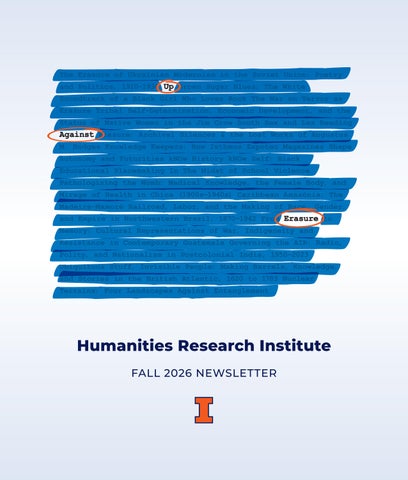
The Erasure of Ukrainian Modernism in the Soviet Union: Poetry and Politics, 1910–1930 Up Brown Sugar Blues: The White
Soundtrack of a Black Girl Who Loves Rock The War on Terror as
Erasure Tribal Self-Determination, Economic Development, and the
Status of Native Women in the Jim Crow South Sex and Lex Reading
Against Erasure: Archival Silences & the Lost Works of Augustus
M. Hodges Knowledge Keepers: How Isthmus Zapotec Magazines Shape Autonomy and Futurities kNOw History kNOw Self: Black
Educational Placemaking In The Midst of School Violence
Pathologizing the Womb: Medical Knowledge, the Female Body, and Mirage of Health in China (1900s–1940s) Caribbean Amazônia: The
Madeira-Mamoré Railroad, Labor, and the Making of Race, Gender, and Empire in Northwestern Brazil, 1870–1942 From Erasure to
Memory: Cultural Representations of War, Indigeneity and
Resistance in Contemporary Guatemala Governing the AIR: Radio, Polity, and Nationalism in Postcolonial India, 1950–2023
Ubiquitous Stuff, Invisible People: Making Barrels, Knowledge, and Stories in the British Atlantic, 1620 to 1783 Nuclear Terrains: Four Landscapes Against Entanglement
Humanities Research Institute FALL 2026 NEWSLETTER
The Erasure of Ukrainian Modernism in the Soviet Union: Poetry and Politics, 1910–1930 Up Bro Erasure Tribal Self-Determination, Economic Development, and the Status of Native Women in
Works of Augustus M. Hodges Knowledge Keepers: How Isthmus Zapotec Magazines Shape Autonomy a
At HRI, we respectfully acknowledge that we are on the lands of the Peoria, Kaskaskia, Piankashaw, Wea, Miami, Mascoutin, Odawa, Sauk, Mesquaki, Kickapoo, Potawatomi, Ojibwe, and Chickasaw Nations. These Nations were forcefully removed from their traditional territories and these lands continue to carry the stories of these Nations and their struggles for survival and identity. As part of a land-grant institution, we have a particular obligation to recognize the peoples of these lands and the histories of dispossession upon which the university rests. In keeping with the spirit of land acknowledgment statements, we also recognize that these histories are both shared with and distinct from those of African American, Latine, Asian American, and Pacific Islander communities, among others. As humanists, we recognize that the past is not past, and that no field or arena of inquiry is exempt from the responsibility of addressing the legacies of settler colonialism, enslavement, and their contemporary manifestations well beyond acknowledgments such as this. Thus, this statement is a demonstration of our ongoing commitment to supporting the work of Indigenous scholars and communities. It is also a reminder of how accounting for Indigenous erasure and survivance makes visible the urgency of imagining change as collaboratively and collectively as possible. Let us, then, together envision what Muskogee (Creek) poet Joy Harjo calls “a map to the next world.”
About the Cover The cover design is inspired by erasure poetry (or “blackout” poetry), a form that starts with an existing text that a writer obscures or removes in part to create something new—in this case, a call-out to this year’s fellowship theme, Up Against Erasure. In “On Erasure,” Leigh Sugar writes, “… rather than define erasure poetry as a form that solely reveals what may be hidden, we might well understand it as a form and action that, when engaged consciously, can illuminate, for the purpose of celebrating, condemning, revealing, or interrogating, that which is otherwise invisibled.…” Through our fellows’ research activities, wide-ranging event series, and the broader community’s engagement in this work, we hope to do just that.
own Sugar Blues: The White Soundtrack of a Black Girl Who Loves Rock The War on Terror as the Jim Crow South Sex and Lex Reading Against Erasure: Archival Silences & the Lost
and Futurities kNOw History kNOw Self: Black Educational Placemaking In The Midst of School
Table of Contents Director’s Q & A. . . . . . . . . . . . . . . . . . . . . . . . . . . . . .
2
HRI Fellows, 2026–27 . . . . . . . . . . . . . . . . . . . . . . . . . .
4
Fellowship Call. . . . . . . . . . . . . . . . . . . . . . . . . . . . . .
5
Summer Faculty Fellows, 2026. . . . . . . . . . . . . . . . . . . .
6
Humanities Research Lab Courses, 2027. . . . . . . . . . . . .
6
Interseminars Graduate Courses, 2027. . . . . . . . . . . . . . .
7
Humanities Without Walls . . . . . . . . . . . . . . . . . . . . . .
8
Event Previews . . . . . . . . . . . . . . . . . . . . . . . . . . . . . .
9
Calendar of Events. . . . . . . . . . . . . . . . . . . . . . . . . . . .
10
Application Deadlines . . . . . . . . . . . . . . . . . . . . . . . . .
11
The Year in Review . . . . . . . . . . . . . . . . . . . . . . . . . . .
12
Celebrating Antoinette Burton’s Directorship. . . . . . . . . .
14
The Odyssey Project. . . . . . . . . . . . . . . . . . . . . . . . . . .
16
Education Justice Project . . . . . . . . . . . . . . . . . . . . . . .
18
Humanities in Action, 2026 . . . . . . . . . . . . . . . . . . . . . .
19
HWW Postdoctoral Research Associate. . . . . . . . . . . . . .
20
Scholarship Out Loud . . . . . . . . . . . . . . . . . . . . . . . . .
20
Giving to HRI . . . . . . . . . . . . . . . . . . . . . . . . . . . . . . .
21
Experiential Learning at HRI . . . . . . . . . . . . . . . . . . . . .
22
HRI Staff & Advisory Committees . . . . . . . . . . . . . . . . . .
23
From the Fellows
24
. . . . . . . . . . . . . . . . . . . . . . . .
The Erasure of Ukrainian Modernism in the Soviet Union: Poetry and Politics, 1910–1930 Up Bro Erasure Tribal Self-Determination, Economic Development, and the Status of Native Women in
Works of Augustus M. Hodges Knowledge Keepers: How Isthmus Zapotec Magazines Shape Autonomy a
Director’s Q&A In August the Humanities Research Institute welcomed new director Jerry Dávila. Dávila is the Jorge Paulo Lemann Chair in Brazilian History and most recently served as executive director of the Illinois Global Institute. How do you envision HRI’s place in the university’s research landscape—and at this particular juncture in time? One of the exciting things about Illinois is the well-established recognition that humanities research takes place everywhere on campus. I understand HRI’s role as both supporting research in the humanities and the humanities in research. Vibrant humanities research is indispensable to the health of all fields. The challenges the humanities face today form part of challenges that our communities and our world contend with as a whole. They include, for example, questions about the web of interactions between people and AI. How do we historicize, contextualize, relativize, and live it? And if AI seems to be everywhere, where isn’t it? One answer is embodied experiences and perspectives. Another challenge is contending with the aftermath of the idea that a liberal model of rights and institutions produced universal and progressively expanding civil rights, more democratic institutions, and more reasoned choices. As we can plainly see, neither rights nor reason rest on linear inevitability. This year’s fellowship theme, “Up Against Erasure,” is a way to reconsider those foundations.
This year’s fellowship theme is “Up Against Erasure.” How do you see it functioning as a unifying throughline in upcoming events and activities? This is an interesting theme to step into this year because it distills not just the potential but the realities of risks and responses that humanists contend with. The ambition of the
2 | HRI FALL 2026 NEWSLETTER
theme is to show why the subjects we take up are both in danger of erasure and yet impossible to obliterate. And as the theme’s name implies, it doesn’t mean just chronicling loss but pushing against it. In the fall we’ll welcome Nanna Bonde Thylstrup, who leads the project Data Loss: the Politics of Disappearance, Destruction and Dispossession in Digital Societies. Last year’s Director’s Fellows are organizing a panel and symposium that will take up the erasure theme, as will a series of book talks by Illinois faculty. And the year culminates with the visit of Layli Long Soldier, author of Chromosomory, Whereas, and Night Poems and Day Poems, whose poetry embodies what it means to play with and against erasure. Her visit will come shortly after the release of her newest work, We. For the full array of events, see the calendar on pages 10–11.
What keeps you inspired in your daily work? I’ve been involved in a lot of conversations lately about the nature of collaboration in the humanities. Whether we are talking about a collaborative project or collaboration across our work, this is foundational to the humanities because knowledge, methods, skills, perspectives, questions, are larger than any of us. To bring this into focus a bit, I’m just back from a trip to finish work for a book on ways people in twentieth-century Brazil responded to racial discrimination and segregation. The historical actors in this work labored to make their experiences visible, to make the case that incidents were part of a color line, and to push against it. This meant individuals stepping out of the idea that discrimination was formed by individual experiences, and through collaboration, building social recognition of societal problems. This led, in the last thirty years, to public practices to address systemic and structural racism. The same logic applies to our work at the university: it’s the connections that we make within and across our work, whether it is research, or teaching, or institutional, that make it possible to go beyond individual limits. That’s what excites me in my daily work: the different kinds of connections that happen across that work.
own Sugar Blues: The White Soundtrack of a Black Girl Who Loves Rock The War on Terror as the Jim Crow South Sex and Lex Reading Against Erasure: Archival Silences & the Lost
and Futurities kNOw History kNOw Self: Black Educational Placemaking In The Midst of School
I’m coming to HRI from the Illinois Global Institute (IGI), which is the home of Illinois’ area and global studies centers and thematic programs. The IGI grew out of the shared effort of the eleven centers and programs that are part of it and the amazing IGI staff. The centers, programs, and their affiliated faculty collaborated to create a new Institute that brought together existing centers and programs. That collective labor gave the institute, centers, and programs the organization and resilience to push up against a national crisis of erasure of area and global studies that come from suspended federal programs and other pressures.
What are you excited to get started on? I have a lot to learn, so I am most excited about starting the process of meeting and talking
“It’s the connections that we make within and across our work, whether it is research, or teaching, or institutional, that make it possible to go beyond individual limits.”
with the many people who are the reason HRI does its work. Many of these will be new conversations, and some will be a shift in perspective with students and colleagues I have had the chance to work with in other contexts. But all these conversations are guided by an understanding of how important HRI has been to my work. And within HRI, I’m eager to start working closely with staff and colleagues in Odyssey, the Fellows Seminar and Interseminars, Humanities in Action, and Humanities Research Lab. Looking further ahead, I hope to explore how we can relaunch HRI Research Clusters. We’re happy to bring back HRI’s opening reception on September 9 and I look forward to seeing all of you there.
Attendees at Erin Brock Carlson lecture
UNIVERSITY OF ILLINOIS URBANA-CHAMPAIGN | 3
The Erasure of Ukrainian Modernism in the Soviet Union: Poetry and Politics, 1910–1930 Up Bro
HRI Fellows, 2026–27
Erasure Tribal Self-Determination, Economic Development, and the Status of Native Women in
Works of Augustus M. Hodges Knowledge Keepers: How Isthmus Zapotec Magazines Shape Autonomy a
HRI Faculty Fellows Olha Khometa
Slavic Languages and Literatures “Ukrainian Modernism and Its Erasure in the Soviet Union: Poetry and Politics, 1910–1930.”
Kimberly Mack English
English
“Sex and Lex”
Angelica Waner
“Brown Sugar Blues: The White Soundtrack of a Black Girl Who Loves Rock”
Spanish and Portuguese
Junaid Rana
Asif Wilson
“The War on Terror as Erasure”
“kNOw History kNOw Self: Black Educational Placemaking In The Midst of School Violence”
Asian American Studies
Jacki Thompson Rand
American Indian Studies / History “Tribal SelfDetermination, Economic Development, and the Status of Native Women in the Jim Crow South”
4 | HRI FALL 2026 NEWSLETTER
Lindsay Rose Russell
“Knowledge Keepers: How Isthmus Zapotec Magazines Shape Autonomy and Futurities Across Twentieth Century Mexico”
Curriculum and Instruction
own Sugar Blues: The White Soundtrack of a Black Girl Who Loves Rock The War on Terror as the Jim Crow South Sex and Lex Reading Against Erasure: Archival Silences & the Lost
and Futurities kNOw History kNOw Self: Black Educational Placemaking In The Midst of School
HRI Graduate Student Fellows David Bishop English
“Reading Against Erasure: Archival Silences & the Lost Works of Augustus M. Hodges”
Yating Li
East Asian Languages and Cultures “Pathologizing the Womb: Medical Knowledge, the Female Body, and Mirage of Health in China (1900s–1940s)”
Owen MacDonald History
“Caribbean Amazônia: The Madeira-Mamoré Railroad, Labor, and the Making of Race, Gender, and Empire in Northwestern Brazil, 1870–1942”
Gerson Morales Pérez Spanish and Portuguese
“From Erasure to Memory: Cultural Representations of War, Indigeneity and Resistance in Contemporary Guatemala”
Anirban Mukhopadhyay Institute of Communications Research “Governing the AIR: Radio, Polity, and Nationalism in Postcolonial India, 1950–2023”
Cheryl Trauscht History
“Ubiquitous Stuff, Invisible People: Making Barrels, Knowledge, and Stories in the British Atlantic, 1620 to 1783”
Taisuke L. Wakabayashi Landscape Architecture
“Nuclear Terrains: Four Landscapes Against Entanglement”
2027–28 Campus Fellowship Call: Sovereignties A word that first appeared in English in the 14th century, sovereignty is pluripotent. At its root are the indelible marks of “rule over” which makes it as much a claim as an imperative, and a singular one at that. Imperial sovereignty, national sovereignty, territorial sovereignty, state sovereignty, popular sovereignty, data sovereignty: These are all staples of history, political theory, law, international relations, cybersecurity, and more. But as with all aspirations to power and hegemony, the term has long been open to appropriation and counterclaim. We need only think about the demands of bodily sovereignty and traditions of Indigenous sovereignty— or even distinctions between de jure and de facto sovereignty—to grasp how multiform its descriptive, analytical, and imaginative possibilities are. And when we proactively pluralize it— when we imagine sovereignty as always already sovereignties—we materialize a set of scholarly force fields ripe for interdisciplinary inquiry across the full range of humanities, social science, and arts-based research. HRI invites applications for the AY 27–28 Fellows Seminar from scholars whose research, methodology, and/or practice take up questions of sovereignty— whether literally or figuratively. The submission portal opens September 1, 2026 and closes December 4, 2026. Visit go.illinois.edu/campusfellows for full fellowship details..
UNIVERSITY OF ILLINOIS URBANA-CHAMPAIGN | 5
The Erasure of Ukrainian Modernism in the Soviet Union: Poetry and Politics, 1910–1930 Up Bro
Summer Faculty Fellows 2026
Erasure Tribal Self-Determination, Economic Development, and the Status of Native Women in
Works of Augustus M. Hodges Knowledge Keepers: How Isthmus Zapotec Magazines Shape Autonomy a
Research Amanda Daniela Cortez
Alisa Hardy
Communication “Speculative Remembrance: Naming Breonna Taylor in a Mediated World”
Anthropology “The Politics of Multispecies Relating: Indigeneity, Gender, and Photography Tourism in the Peruvian Andes”
Paige Cunningham Caldarella
Mania Taher Art & Design
“Shifting Dwellings: Worldmaking of Bangladeshi Immigrant Women in New York”
Dance
“Merce Cunningham’s Summerspace as a Departure Point for Contemporary Reflection”
Course Development Yazmín M. Crespo Claudio Architecture
ARCH 403: Spatial Theories From/With the Caribbean
Humanities Research Lab Courses – Spring 2027 AAS 215: US Citizenship Comparatively Soo Ah Kwon Asian American Studies
6 | HRI FALL 2026 NEWSLETTER
LLS 100: Introduction to Latina/o Studies Natalie Lira Latina/Latino Studies
own Sugar Blues: The White Soundtrack of a Black Girl Who Loves Rock The War on Terror as the Jim Crow South Sex and Lex Reading Against Erasure: Archival Silences & the Lost
and Futurities kNOw History kNOw Self: Black Educational Placemaking In The Midst of School
Interseminars Graduate Seminars – Spring 2027 Living Between Worlds: Gender, Migration, and the City Deepasri Baul History Mania Taher Art & Design
Remembering and Reimagining HIV/AIDS in Contemporary Times Daniel Nabil Maroun French & Italian Nic Flores Latina/Latino Studies
The City through the Body
Jennifer Monson Dance Magdalena Novoa Urban & Regional Planning
Humanities Without Walls Appointments Lázaro García Angulo Spanish and Portuguese
Project: Humanities in Action program management
Alex Jacobs History
Project: Archiving project with the Greater Community AIDS Project of East Central Illinois
HRI Reading Groups See the group descriptions and organizers’ contact information at go.illinois.edu/HRIgroups. • Diversity in Youth Literature Reading Group • History of Anthropology • Modern Jewish Thought • Organize & Analyze: Social Movements Reading Group • Shadow Infrastructures: Technologies of Risk, Reproduction, and Repair • Spanish Theory Reading Group • Strangeways Idea Lab • Textual Criticism and the Editing of Premodern Literature • Weird Cities
UNIVERSITY OF ILLINOIS URBANA-CHAMPAIGN | 7
The Erasure of Ukrainian Modernism in the Soviet Union: Poetry and Politics, 1910–1930 Up Bro Erasure Tribal Self-Determination, Economic Development, and the Status of Native Women in
Works of Augustus M. Hodges Knowledge Keepers: How Isthmus Zapotec Magazines Shape Autonomy a
Humanities Without Walls Putting “R & R” in Action As Humanities Without Walls comes to a close in 2027, we have expanded the model of our paid PhD summer internship at Illinois to five consortial partner institutions through the R & R in Action Program. During the summer of 2026, 27 PhD students in the humanities and arts across the University of Iowa, University of Michigan, Penn State University, University of Minnesota Twin Cities, Marquette University, and University of Illinois Urbana-Champaign partnered with local community organizations to support their missions and gain professional experience through reciprocal knowledge sharing and skill building. Read more about the programs at go.illinois.edu/HWWRR.
HWW Summer Bridge Program The Summer Bridge Program connects humanities PhD students from the University of Illinois with community partners for a summer-long collaborative project. Through the Bridge experience, students have the opportunity to explore career paths and build skills while contributing to an area of need in the community. This program is made possible through collaboration with our U of I partners We CU and the Graduate College.
2026 Participants and Partners • Johnson Adegbola, Anthropology, DREAAM • Madeline Belland, English, Grand Prairie Friends • Fredrick Gaisie, English, City of Champaign Township • Janet Husunukpe, Urban and Regional Planning, Root Causes • Erica Kolson, Communication, Tolerance Museum and Education Center • Nathalie Martinez, Anthropology, First Followers
Grand Research Challenge Project Showcases To highlight the incredible work of each of the Reciprocity and Redistribution Grand Research Challenge projects, HWW will be hosting four virtual showcases in the 202627 academic year. During each event, 2-3 teams will present their projects and share a bit about the centrality of reciprocal and redistributive methods to their work. We are planning for virtual sessions in October/December 2026 and January/March 2027. A detailed schedule of presenters and Zoom registration information will be announced soon, so stay tuned.
8 | HRI FALL 2026 NEWSLETTER
GRC Update: Amplifying Mothers of Police Violence Survivors “Amplifying Mothers of Police Violence Survivors,” a Humanities Without Walls Grand Research Challenge-funded project, equips family members and loved ones of those impacted by state violence to create political change through advocacy and activism. This project is a collaboration between the Chicago-based organization Mothers Activating Movements for Abolition and Solidarity (MAMAS) and the University of Illinois Chicago. In early 2026, principal investigator Nadine Naber shared an update from mother and advocate Rosemary Cade, whose son Antonio Porter had been incarcerated for 23 years. Porter and his family have long maintained his innocence and advocated for his freedom, and in January 2026 Porter’s conviction was vacated by the judge. He has been reunited with his family while he waits for a new trial. Read more about this GRC project at go.illinois.edu/mamas.
own Sugar Blues: The White Soundtrack of a Black Girl Who Loves Rock The War on Terror as the Jim Crow South Sex and Lex Reading Against Erasure: Archival Silences & the Lost
and Futurities kNOw History kNOw Self: Black Educational Placemaking In The Midst of School
Event Previews
September 24–27 PYGMALION is a multidisciplinary, multi-day event entering its 22nd year of programming. It annually celebrates music, literature, science, comedy, film, culinary arts, and more, and this year will welcome internationally recognized acts like comedian Robby Hoffman, musical acts such as Ratboys, The Belair Lip Bombs, Racing Mount Pleasant, Covet, The Appleseed Cast, Julianna Barwick and Mary Lattimore along with readings from decorated authors and poets such as Gabriela Garcia, Lisa Low, and Mary Helen Specht. HRI is excited to cosponsor a reading by University of Illinois Urbana-Champaign MFA candidates, whose selections will explore the institute’s 2026 research theme “Up Against Erasure.” This year will also debut the addition of film screenings curated by the Chambana Film Society, along with a performance at the Crystal Lake Boat House for the very first time. All events take place in Urbana. thisispygmalion.com
Ethos of Care: A Humanities, Arts, and Social Sciences Community of Practice Guided by Reciprocity, True Collaboration, and Radical Empathy Organized by Spurlock Museum and supported by HRI, this initiative aims to develop and nurture a community of practice to support graduate students, staff, and faculty who are engaged in or want to delve into cultural heritage care and research in an ethical and non-extractive manner. By creating a cross-disciplinary community of practice we hope to develop scaffolding for collaboration, provide connection and support, and advance more relevant, meaningful, and ethically sound practices for the benefit of the communities we serve. For the 2026–27 academic year, our community of practice activities will include a workshop series, events, and graduate student mentoring sessions. Learn more at go.illinois.edu/ ethos.
Degrees of Erasure: Consolidation, Deportation and AI in University Governance March 25–26 HRI’s 2025–26 Director’s Fellows are inviting presenters under the “Up Against Erasure” theme. These guests will examine the trend of “consolidation” that has led to the weakening, disbanding and elimination of Gender, Women’s and Sexuality Studies, Ethnic Studies, African American Studies, and American Studies departments and programs at public universities. Featuring scholars who are at the forefront of organizing against these consolidations, the symposium will help us understand the method of consolidation as erasure, strategies for responding and contesting erasure and the types of public universities we want to see/need in the future.
HuMetricsHSS Events | November 5–6 HuMetricsHSS (humetricshss.org) is an initiative offering a values-enacted, process-oriented approach to scholarly production, decision-making, and evaluation. For almost a decade, the team has been working with individual departments, colleges, institutes, and academic-adjacent organizations to bring about meaningful changes in promotion, tenure and hiring processes, leadership development, campus culture, and strategic planning. Join us to learn from their work and to consider how it could benefit scholars and departments at Illinois.
UNIVERSITY OF ILLINOIS URBANA-CHAMPAIGN | 9
The Erasure of Ukrainian Modernism in the Soviet Union: Poetry and Politics, 1910–1930 Up Bro
2026–27 Calendar of Events
Erasure Tribal Self-Determination, Economic Development, and the Status of Native Women in
Works of Augustus M. Hodges Knowledge Keepers: How Isthmus Zapotec Magazines Shape Autonomy a
2026
SEPTEMBER
9
HRI Opening Reception Reception and Welcome
24-27
9
UP AGAINST ERASURE Panel Discussion: Percival Everett’s Erasure A Director’s Fellow event organized by Christopher Freeburg. Affiliated with the Black Letters Collective.
15
PYGMALION Events
NOVEMBER
MARCH
UP AGAINST ERASURE HuMetricsHSS Events
INTERNATIONAL WOMEN’S DAY Presentations and Celebration
5-6
2027
FEBRUARY
11
OCTOBER
3
Cohosted by the Center for the Study of Global Gender Equity
4
1
UP AGAINST ERASURE Justin Jackson Lecture: “Occupied: Military Structures and Rule” History, University of Massachusetts Amherst A CAS MillerCom event
8
UP AGAINST ERASURE Faculty Reading: Ángel Garcia Indifferent Cities
English/Creative Writing
29
Arts and Cultural Studies, University of Copenhagen
UP AGAINST ERASURE Faculty Book Talk: Gillen D’Arcy Wood
The Wake of HMS Challenger: How a Legendary Victorian Voyage Tells the Story of Our Oceans’ Decline English and Earth Science & Environmental Change
10 | HRI FALL 2026 NEWSLETTER
Justice in the Balance: Democracy, Rule of Law, and the European Court of Human Rights
Cohosted by the Center for the Study of Global Gender Equity
Anthropology
25-26
25
UP AGAINST ERASURE Nanna Bonde Thylstrup Lecture: “Staying with the Trouble of Preservation: The Ambivalent Politics of Deletion in Digital Societies”
UP AGAINST ERASURE Faculty Book Talk: Jessica Greenberg
UP AGAINST ERASURE Patricia Owens Book Talk: Erased: A History of International Thought Without Men
UP AGAINST ERASURE Mitsuki: the In-Between Film Screening and Discussion With Roderick Wilson (East Asian Languages & Cultures and History) and Anna Jungeun Lee (East Asian Languages & Cultures)
UP AGAINST ERASURE Symposium: “Degrees of Erasure” A Director’s Fellows event organized by Toby Beauchamp, Natalie Lira, and Anke Pinkert.
own Sugar Blues: The White Soundtrack of a Black Girl Who Loves Rock The War on Terror as the Jim Crow South Sex and Lex Reading Against Erasure: Archival Silences & the Lost
and Futurities kNOw History kNOw Self: Black Educational Placemaking In The Midst of School
APRIL
1
MAY
6
PRIZES FOR RESEARCH Ceremony and Reception
HRI Application Deadlines 2026-27 SEPTEMBER 18
Prindable Internship
OCTOBER 16
Humanities in Action
DECEMBER 4
UP AGAINST ERASURE Faculty Book Talk: Siobhan Somerville
Naturalization: A Queer Genealogy of US Citizenship, Race, and Sexuality Gender and Women’s Studies/English
Please note that details and locations may be subject to change. For a full slate of HRI events and the most upto-date information, visit go.illinois. edu/calendar.
Campus Fellowships
You can also sign up for weekly event news and other emails at go.illinois. edu/EmailList
MARCH 5
FEBRUARY 5
Summer Faculty Fellowships Prizes for Research in the Humanities
MARCH 26
Humanities Research Lab
MARCH 29
Humanities Gateway Internship
15
MARCH 31
Odyssey Project Internship
MAY 31
Reading Groups
INSIDE SCOOP Layli Long Soldier Creative Writing, Institute of American Indian Arts
PUBLIC READING Layli Long Soldier
UNIVERSITY OF ILLINOIS URBANA-CHAMPAIGN | 11
The Erasure of Ukrainian Modernism in the Soviet Union: Poetry and Politics, 1910–1930 Up Bro
HRI Year in Review
Erasure Tribal Self-Determination, Economic Development, and the Status of Native Women in
Works of Augustus M. Hodges Knowledge Keepers: How Isthmus Zapotec Magazines Shape Autonomy a
1
2
3
HRI’s activities in 2025–26 centered around the theme of “Story & Place,” featuring speakers whose work took us places near and far: among them, the Midwest (Nadine Naber, Erik McDuffie, and Justin Garcia), the Caribbean (Catherine Hall), Appalachia (Erin Brock Carlson), and Germany (Anke Pinkert). Our year closed with an unforgettable visit by the singular Rita Dove, the annual HRI prize ceremony, and a joyful gathering to celebrate the leadership of Director Antoinette Burton.
1. Jennifer Morgan, Catherine Hall, and Antoinette Burton 2. Catherine Hall 3. Angela Diaz at ISR 4. Nadine Naber 5. Erik Mcduffie 6. Erin Brock Carlson 7. International Women’s Day presenters 8. Anke Pinkert 9. Justin Garcia and Antoinette Burton 10. Rita Dove with Christopher Kempf’s MFA class 11. Rita Dove 12. Katherine Holliday with Humanities Research Lab class 13. Lázaro García Angulo and Antoinette Burton 14. Bobby J. Smith II and Alisa Hardy 15. Susan Martinis 16. Antoinette Burton and guests
4
5
11
12 | HRI FALL 2026 NEWSLETTER
6
7
12
13
own Sugar Blues: The White Soundtrack of a Black Girl Who Loves Rock The War on Terror as the Jim Crow South Sex and Lex Reading Against Erasure: Archival Silences & the Lost
and Futurities kNOw History kNOw Self: Black Educational Placemaking In The Midst of School
Humanities Open House In October the university held its first Humanities Open House, featuring academic departments, student groups, resources, and alumni panelists. The event was a collaboration across three centers of humanities excellence at Illinois—HRI, the College of Liberal Arts and Sciences, and the University Library.
1
1. Dean Venetria Patton 2. Dean Claire Stewart 3. Kristin Romberg and students 4. Medieval York Play performance 5. Department activities at the Literatures, Cultures, and Linguistics Building 6. Skeumorph Press printing demonstration 7. Library virtual reality experience 8. Alumni panelists
6
8
9
14
15
2
3
4
5
7
8
10
16
UNIVERSITY OF ILLINOIS URBANA-CHAMPAIGN | 13
The Erasure of Ukrainian Modernism in the Soviet Union: Poetry and Politics, 1910–1930 Up Bro
In Retrospect
Erasure Tribal Self-Determination, Economic Development, and the Status of Native Women in
Works of Augustus M. Hodges Knowledge Keepers: How Isthmus Zapotec Magazines Shape Autonomy a
Celebrating a Legacy: Antoinette Burton’s Directorship After 11 years of distinguished leadership at HRI, Antoinette Burton stepped down from the directorship as of August 2026 and returned to her full-time faculty role in the History Department. She was named director in 2015 during a time of change, when the institute (then called the Illinois Program for Research in the Humanities or IPRH) shifted administrative homes from the College of Liberal Arts and Sciences to the Office of the Vice Chancellor for Research and Innovation. She also presided over the next notable change in 2020 as IPRH advanced to institute status.
“Antoinette has had incredible impact at, and on behalf of, the University of Illinois—elevating the HRI from a college program to a highly recognized campus Institute in 2020, securing substantial funding and national attention for signature projects in the humanities, and tirelessly advocating
Over her years of service, she secured significant support to strengthen and broaden HRI’s reach, including the Mellon-funded Odyssey Project, renewals of Humanities Without Walls, and the Interseminars grant. In addition to her stalwart commitment to faculty and graduate research support, her commitment to community-engaged research and public-facing humanities—including undergraduate student initiatives—are hallmarks of her tenure.
for the centrality of the humanities
Here, we’d like to call out some highlights from the past 11 years.
-Susan Martinis, Senior Vice Chancellor for Research & Innovation
on our campus. Her commitment to elevating others while doing this work is a hallmark of Antoinette’s approach to leadership.”
Passion for Poetry Antoinette’s love of poetry is well known (as is her penchant for giving out Joy Harjo books at events). Perhaps some of the most memorable events during her directorship were the poetry readings that drew joyful crowds from across campus and the community. And some, like the Festival of Writers (pictured below), took place amid the logistical and physical challenges brought by COVID—a time when the power of the written (and spoken) word was a muchneeded balm.
Odyssey Milestones During Antoinette’s tenure at HRI, the Odyssey Project reached milestones of 10 and 15 years (soon to be 20!) on the Illinois campus. During this time, she oversaw the pivotal transition to offering Odyssey students U of I credits. Through changes in personnel, curriculum, and funding, Antoinette set a sure and steady course for sustaining this community-facing adult education humanities program.
14 | HRI FALL 2026 NEWSLETTER
own Sugar Blues: The White Soundtrack of a Black Girl Who Loves Rock The War on Terror as the Jim Crow South Sex and Lex Reading Against Erasure: Archival Silences & the Lost
and Futurities kNOw History kNOw Self: Black Educational Placemaking In The Midst of School
Humanities Without Walls Antoinette strengthened and bolstered the work of humanities centers in the Midwest and beyond through two Mellon Humanities Without Walls renewals in 2016 and 2020, when it expanded to a 16-member consortium. Under her leadership, the consortium’s work moved to a “reciprocity and redistribution” methodology focused on equitable and ethical practices. Overall, HWW has supported 48 Grand Research Challenge projects and 228 career diversity fellows.
Innovation in the Humanities During her tenure, Antoinette oversaw the Implementation of multiple Mellon awards, including one to study Emerging Areas in the Humanities, leading to the creation of intergenerational research teams in the Biohumanities, Environmental Humanities, and Legal Humanities. Another Mellon award, the Interseminars Initiative, supports innovation in interdisciplinary graduate education.
Community-Engaged Initiatives
Commitment to Fellowship Support
Antoinette’s commitment to public-facing work led to the expansion of undergraduate experiences: Humanities in Action, a service-based program, and Humanities Research Lab courses, which feature community-engaged research. She also introduced a Community Speakers Series that invited local guests to share their knowledge. Indeed, her dedication to this work led to a 2025 Campus Distinguished Award for Excellence in Public Engagement.
Antoinette has also left her mark on campus fellowships, a staple program that supports a faculty and graduate cohort and Fellows Seminar. When IPRH became an institute in 2020, Antoinette increased the resources for graduate fellows. Under her leadership, HRI also collaborated on fellowship themes with the Illinois Global Institute (“The Global and its Worlds”) and Gender, Ethnic, and Women’s Studies departments (“Un/Doing”).
UNIVERSITY OF ILLINOIS URBANA-CHAMPAIGN | 15
The Erasure of Ukrainian Modernism in the Soviet Union: Poetry and Politics, 1910–1930 Up Bro
In Retrospect
Erasure Tribal Self-Determination, Economic Development, and the Status of Native Women in
Works of Augustus M. Hodges Knowledge Keepers: How Isthmus Zapotec Magazines Shape Autonomy a
2026 Odyssey Graduation
Graduation speaker Crushion Stubbs
The Odyssey Project The Odyssey Project had another stellar academic year in 2025–2026. Once again, our students brought open minds, courage, and wisdom to the classroom, which quickly developed into a safe and thought-provoking learning environment. They took that spirit with them as we ventured into the community, hearing about Champaign-Urbana Black history from local historians and activists Dr. Barbara Suggs-Mason and Ms. Imani Bazzell. The class also thoroughly enjoyed exploring local libraries and archives, including two trips to the University’s Rare Book and Manuscript Library and a visit to the Champaign County Archives at the Urbana Free Library. Throughout the year, students worked on various creative and scholarly projects, including an oral history interview, a braided essay weaving personal experiences with the themes found in Lorraine Hansberry’s A Raisin in the Sun, and a map of their educational experiences thus far. They also contributed original poetry and photographs to the fourth annual Odyssey poetry collection, which you can read on our website, go.illinois.edu/ OdysseyArchive. We also welcomed
16 | HRI FALL 2026 NEWSLETTER
Kristen Sackley, Director of the Bachelor of Liberal Studies degree in the College of Liberal Arts & Sciences, to the classroom to share this exciting new learning opportunity with students. The year culminated with an especially joyful graduation ceremony, where graduates and audience members alike were treated to two phenomenal speakers. Crushion Stubbs, Odyssey ’21, gave an inspiring speech and finished with the excellent news that he was completing his bachelor’s degree from the U of I this spring. Student speaker Ms. Ann Brooks, a long-time university employee, concluded the ceremony speaking about the positive effects Odyssey has had in her life. As always,
we are very proud of our graduates and wish them luck as they apply Odyssey lessons (and credits!) in their lives, educational journeys, and careers. Next year will bring some changes to Odyssey as our current critical thinking & writing professor, Dr. Dana Kinzy, transitions to her new role as lead professor. We look forward to Odyssey’s continued evolution, and an aspect that always endures—the annual blooming of a caring community of learners and creators.
20 Years of Odyssey During the 2026–27 academic year we will be recognizing 20 years of the Odyssey Project in CU! Initially established in 2006 as a Bard Clemente Course in the Humanities, in partnership with Illinois Humanities, Odyssey became a credit-bearing program at the University of Illinois in 2019. Watch for more information to come as we celebrate the vibrant history and promising future of this life-changing program.
own Sugar Blues: The White Soundtrack of a Black Girl Who Loves Rock The War on Terror as the Jim Crow South Sex and Lex Reading Against Erasure: Archival Silences & the Lost
and Futurities kNOw History kNOw Self: Black Educational Placemaking In The Midst of School
Collisions Across Color Lines: Interseminars Culminating Event The third Interseminars project— Collisions Across Color Lines—presented their culminating event in fall 2025. Through guest speakers Mariana Mora and Vivek Bald, who presented a film screening, as well as an anti-panel conversation, they invited attendees to “engage with thematic definitions that shape, reshape, and unshape our interpretations of color lines: the urgency of resistance, the resolve of refusal, and the radical possibilities of re-existence.” Cohort members included faculty conveners Erik McDuffie (African American Studies and History), Gilberto Rosas (Anthropology and Latina/ Latino Studies,) and Gisela Sin (Political Science). Graduate fellows were Yasmine Adams (Anthropology), Grace Eunhyn Bae (Art Education), Jose Figueroa Díaz (Spanish & Portuguese), Omar Agustin Hernandez (Anthropology), Samantha Jenae Jones (Design for Responsible Innovation), Nik Owens (Dance), Ann Xiaoxu Pei (Comparative & World Literature), Leonardo Ventura (History), and Tooma H. Zaghloul (Urban and Regional Planning).
1
2
3
4
5
6
PHOTOS 1. Gisela Sin and Mariana Mora 2. Steering committee members Siobhan Somerville and Patrick Hammie 3. Vivek Bald 4. Attendees at the culminating event 5. Gilberto Rosas and audience members 6. Anti-panel event 7. Interseminars 3 cohort
7
UNIVERSITY OF ILLINOIS URBANA-CHAMPAIGN | 17
The Erasure of Ukrainian Modernism in the Soviet Union: Poetry and Politics, 1910–1930 Up Bro
In Retrospect
Erasure Tribal Self-Determination, Economic Development, and the Status of Native Women in
Works of Augustus M. Hodges Knowledge Keepers: How Isthmus Zapotec Magazines Shape Autonomy a
Education Justice Project The Education Justice Project’s newest initiative, Prison to Gown, recognizes that providing higher education opportunities to individuals while they are Mike Pierce incarcerated is not enough. In a more ideal world, people coming out of prison would be welcomed back into society without being subject to heightened scrutiny and suspicion. However, that world does not yet exist. Instead, former EJP students, like formerly incarcerated students across the country, report multiple obstacles and rejections as they seek to continue their education upon release. That reality came into focus for EJP last year when former EJP student Mike Pierce applied to the University of Illinois Urbana-Champaign. While studying at Danville Correctional Center, he’d discovered a passion for research. Mike
set his sights on a PhD in Education, hoping to one day help expand prison education programs across Illinois. Applying to Illinois, the campus that had recognized his abilities and was clearly committed to educational equity, felt like a natural step. Instead, he was denied admission because of his record. With support from Prison to Gown and strong advocacy from faculty in the College of Education, Mike assembled an appeals package that led to his admission to a master’s program. He has since been accepted into the PhD program in Curriculum and Instruction. Mike’s story is unfortunately not unique. For many justice-involved applicants, the greatest obstacle is not academic readiness but navigating an admissions process that can seem mysterious and labyrinthine. The appeals process, especially, which many such applicants have to navigate once they face an initial rejection, has been described by individuals as “demeaning” and “demoralizing.”
significantly expanding Prison to Gown. In addition to helping prospective and current University of Illinois students navigate admissions, financial aid, and university life, the program is now able to provide eligible Illinois students with tuition assistance, housing stipends, laptops, and other technology needed to succeed. This fall, EJP will continue building connections between the campus and the prison classroom through its second blended course, Creative Writing (CW 463), taught by Michael Hurley and Jess Williard in the Department of English. Students at Danville Correctional Center and on the Urbana campus will learn together throughout the semester, meeting primarily over Zoom while gathering in person at the prison for three class sessions. The course reflects EJP’s continuing commitment to creating learning communities that transcend prison walls and provide opportunities for shared learning, growth, and discovery.
Thanks to generous support from the Sunshine Lady Foundation, EJP is now
Humanities Research Lab Spring 2026
Yumna Hasmi, Anne Abbott, Karen Karen Rodriguez’G, and Nathan Moawad
18 | HRI FALL 2026 NEWSLETTER
The Humanities Research Lab (HRL) program continued in spring with two undergraduate courses featuring community-based research. Kathryn Holliday (Architecture) taught ARCH 403: A Sense of Where You Are, and Ann Abbott (Spanish & Portuguese) taught SPAN 232: Spanish in the Community. At a research showcase in May that was part of Undergraduate Research Week, the architecture students presented on their project to nominate Champaign’s Bethel AME Church as a historical landmark, and the Spanish students discussed and displayed creative zines advocating for linguistic justice.
own Sugar Blues: The White Soundtrack of a Black Girl Who Loves Rock The War on Terror as the Jim Crow South Sex and Lex Reading Against Erasure: Archival Silences & the Lost
and Futurities kNOw History kNOw Self: Black Educational Placemaking In The Midst of School
Humanities in Action Spring 2026 Last spring, the Humanities in Action program welcomed seven undergraduate students. The HIA scholars were matched—through the Community Learning Lab in the School of Social Work—with a community partner to address a vital area of need in the Champaign-Urbana community.
Michelle Cordova
Class of 2028, Philosophy and Spanish/Pre-Law Books to Prisoners
Amari Davis
Class of 2027, Sociology, minors in History and Criminology, Law, and Society Feeding Our Kids
Lucas Hennessey
Class of 2027, Urban Studies and Planning Feeding Our Kids
Jacky Mejia
Class of 2028, Integrative Biology and Spanish The Refugee Center
Jatin Mirzayi
Class of 2027, History DREAAM
Bianca O’Shea
Class of 2028, Political Science Solidarity Gardens
Julie Roman-Catalan
Class of 2028, Human Development and Family Studies
Humanities Advocacy on the Hill A delegation of humanities faculty and students from the University of Illinois UrbanaChampaign and the Alice Kaplan Institute of the Humanities (Northwestern University) traveled to D.C. in March to advocate for the humanities. They had a successful day on the Hill encouraging Illinois representatives to support the National Endowment for the Humanities and the U.S. National Archives. The delegation met with staff from the offices of Congressman Darin LaHood, Senator Durbin, and Senator Duckworth. Among the group was undergraduate Illinois student Serena Naji (English), who had the opportunity to lead the discussion in Senator Durbin’s office. Through this trip she had the opportunity to meet other undergrad delegates from across the country and to learn more about the inner workings of the political system. “What this trip made me realize is that the humanities touch every department on this campus and every part of our communities, and so I definitely think we should mobilize students more to engage in this work,” she said. Graduate student Dale Mize also noted the benefits of meeting delegates from other institutions and the camaraderie of discussing research and sharing experiences. “This experience has probably been the most interdisciplinary thing that I have ever done in HRI programming,” he said. “The interdisciplinary narrative of this conference and advocating for the humanities, I think, breathed new life into the ways that I’m thinking about my own work, and even the world.” With thanks to the Illinois delegation, pictured above: Antonios Augoustakis, Associate Dean for the Humanities; Justine Murison, Professor and Head of English; Mariselle Meléndez, Director of the School of Literatures, Cultures & Linguistics; Serena Naji, Undergraduate student, English; and Dale Mize, Ph.D. student, History.
Angel’s Youth Center
UNIVERSITY OF ILLINOIS URBANA-CHAMPAIGN | 19
The Erasure of Ukrainian Modernism in the Soviet Union: Poetry and Politics, 1910–1930 Up Bro
In Retrospect
Erasure Tribal Self-Determination, Economic Development, and the Status of Native Women in
Works of Augustus M. Hodges Knowledge Keepers: How Isthmus Zapotec Magazines Shape Autonomy a
Humanities Without Walls Research Associate in Public Humanities Jordan Woodward continued her second and final year as postdoctoral research associate in public humanities for Humanities Without Walls, partnering with the Climate Jobs Institute as part of the Illinois Coal Workers & Communities Listening Project team* to travel across the state of Illinois and speak to dozens of people living in communities marked by the decline of the coal industry. You can read more about her research at go.illinois. edu/Woodward. In the spring semester she organized campus visits and activities with guest speakers, including Erin Brock Carlson (West Virginia University), who presented on the importance of “dwelling” in place-based research, highlighting her community-based research projects in central Appalachia. Woodward was also a panelist at an event held at Krannert Art Museum in April: “Life after Coal: Envisioning Just Transitions Across Borders.” She joined members of the Women’s Collective from Lota, Chile, together with University of Illinois scholars, discussion exploring the Collective’s work, the history of coal mining in their community, and the role of arpilleras (bright patchwork art) in preserving bilingual participation. *This research was conducted as part of the Illinois Coal Workers & Communities Listening Project, led by the Climate Jobs Institute at the University of Illinois UrbanaChampaign, in collaboration with University of Illinois Department of Urban & Regional Planning; University of Illinois Extension; University of Illinois Labor Education Program; University of Illinois Humanities Research Institute; Harlem Documentary Project; and Prairie Rivers Network. The project seeks to listen to and learn from Illinois coal workers, their families, and communities affected by mine and plant closures — preserving their stories and informing policies for a just and equitable transition.
20 | HRI FALL 2026 NEWSLETTER
Graduate Programming After the successful launch of Scholarship Out Loud in 2025, HRI’s Graduate Advisory Committee expanded the program in 2026 to four events. In this series, graduate students share their research in brief “lightning” talks and engage in informal discussion and networking with fellow humanists. As part of the expansion, one of the Scholarship Out Loud sessions was part of the Center for Writing Studies’ 16th Annual Gesa E. Kirsch Graduate Symposium, while another was held at the annual Women’s and Gender History Symposium. In addition to some coworking sessions at Levis Faculty Center, graduate students were also offered the opportunity to attend the Graduate Fellowship Brownbag, a collaborative session with the Writers Workshop for tips and guidance on preparing an HRI Graduate Fellowship application.
International Outreach in India Antoinette Burton was part of a campus delegation who met with government and industry leaders, representatives of IIT Mumbai, IIT Delhi and IISc Bangalore, entrepreneurs, and others to see what kinds of partnerships might be possible. We hope to develop deeper connections with humanists in some of the IITs in the coming year.
own Sugar Blues: The White Soundtrack of a Black Girl Who Loves Rock The War on Terror as the Jim Crow South Sex and Lex Reading Against Erasure: Archival Silences & the Lost
and Futurities kNOw History kNOw Self: Black Educational Placemaking In The Midst of School
Giving to HRI Celebrating a Life Through the Humanities
Join Us
It’s a safe bet that for most residents of Champaign-Urbana, the name “Merry-Ann” invokes an immediate association with a local institution: the iconic Merry-Ann’s Diner, which has been a staple of the community for more than 40 years. Thanks to Tony Pomonis (LAS ’02), whose late mother was the real life Merry-Ann, she is also the namesake of a newly created fund supporting volunteer opportunities for humanities students, particularly those with an affinity for writing: the MerryAnn Pomonis Humanities Fund. Because of Tony, his sisters, and additional friends and family who have generously given to the fund, three undergraduate students were supported in HRI’s Humanities in Action program this year (HIA student at celebration luncheon pictured left).
You can make a difference today by visiting hri.illinois. edu/giving or contacting Director of Advancement Betsy Rodriquez at epowers2@illinois.edu. Want to stay connected to the HRI community? Sign up for our emails at go.illinois.edu/EmailList.
“We all want to live up to the promise of who she was and what she stood for,” said Pomonis said of his mother. “It feels really good and meaningful for our family to honor mom in this way.” Read more about the fund: go.illinois.edu/pomonisgift.
HRI Gift Updates Student work on display at Odyssey graduation.
David F. Prindable’s (BUS ’69) Communications and Outreach Internship saw its 11th intern over the 2025-26 academic year. We are also grateful for his dedicated support of the Odyssey Project. Donor Dr. Dan Shin’s (LAS ’91) support of the Odyssey Project and Humanities in Action program are essential to their success. We are thankful to his continued funding of the annual Medical Humanities Lecture series, which is a key part of our event programming (most recently, Kinsey Institute Director Justin Garcia). Past Odyssey instructor Shelley Weinberg continues her much-appreciated support through the Odyssey Project Futures Endowment Fund. HRI thanks Elizabeth Nolan (LAS ’81) for generously continuing her support of the Humanities Gateway Internship and the Humanities Research Lab. We recently hired the fifth Gateway intern since the inception of the program! HRI participated in Orange & Blue Days 2026 in March, bringing in gifts from 16 donors to benefit Odyssey. Thank you for helping to make the campaign a success!
Instructor Dana Kinzy with Odyssey graduate and class speaker Ms. Ann Brooks.
UNIVERSITY OF ILLINOIS URBANA-CHAMPAIGN | 21
The Erasure of Ukrainian Modernism in the Soviet Union: Poetry and Politics, 1910–1930 Up Bro
HRI Team
Erasure Tribal Self-Determination, Economic Development, and the Status of Native Women in
Works of Augustus M. Hodges Knowledge Keepers: How Isthmus Zapotec Magazines Shape Autonomy a
Experiential Learning at HRI
Welcome, New Staff
David F. Prindable Intern
Emily Clark joined HRI in September 2025 as visiting assistant director of Humanities Without Walls. Emily holds a B.A. in art history from Elon University and an M.A. in art history from Indiana University, where she focused primarily on medieval maps. Her master’s thesis is titled “Geography, Movement, and the Place of Redemption in the Catalan Atlas.” Before coming to HWW, Emily worked as the Program and Procurement Coordinator at the Center for Research on Learning and Technology in Indiana University’s School of Education and as the Grants and Assessment Coordinator for the Institute for Digital Arts and Humanities at Indiana University.
Lucy Roller, a sophomore studying English and creative writing, served as HRI’s David F. Prindable Communications and Outreach Intern. This year, she assisted with HRI’s social media, stories, and reflection pieces. Her favorite project was covering the International Women’s Day event, which gave her the opportunity to hear the stories of many inspiring women while further developing her writing skills.
Humanities Gateway Intern Yehoshua McClerklin, a political science major, held the Gateway internship for a second year. Through this role, which is a partnership between HRI and Illinois Public Media, McClerklin worked with journalists to facilitate listening sessions with citizens in our region to help inform news coverage of Illinois communities.
Odyssey Project Intern Juju Gonzalez-Moreno, a senior double majoring in psychology and Latina/Latino studies, served as the Odyssey Project intern. In this role, she worked directly with Odyssey students, offering support in the classroom, with technology, and with tutoring. Through the experience, she was inspired by the students’ passion and enjoyed seeing their growth throughout the program.
22 | HRI FALL 2026 NEWSLETTER
In June, HRI welcomed Andrew Almeter as the events and space coordinator. Andrew Almeter is an event management professional with experience in performing arts operations and production. Most recently, he served at Krannert Center for the Performing Arts at the University of Illinois, where he coordinated productions for internationally recognized touring artists, managed events for multiple university departments, and oversaw the operational needs of a large performing arts center. Prior to joining the university, Andrew served as operations coordinator for the Buffalo Philharmonic Orchestra, where he supported the needs of musicians and touring artists while also working with contracts and facility logistics.
own Sugar Blues: The White Soundtrack of a Black Girl Who Loves Rock The War on Terror as the Jim Crow South Sex and Lex Reading Against Erasure: Archival Silences & the Lost
and Futurities kNOw History kNOw Self: Black Educational Placemaking In The Midst of School
HRI Staff & Advisory Committees STAFF
COMMITTEES
ADMINISTRATION
EVENTS & SPACE USE
HRI ADVISORY COMMITTEE
Jerry Dávila, Director jdavila@illinois.edu 217-244-3344
Ryan Reid, Levis Events and Space Manager rdreid1@illinois.edu 217-300-2863
Angela Aguayo, Media and Cinema Studies
Nancy Castro, Deputy Director ncastro@illinois.edu 217-244-7913 Stephanie Uebelhoer, Office Manager suebelho@illinois.edu 217-244-3344
BUSINESS OFFICE Jenna Zieman, Budget and Finance Manager zieman@illinois.edu 217-244-5013
COMMUNICATIONS Erin Ciciora, Assistant Director for Communications elukehar@illinois.edu 217-265-7580 Julia Jing, Digital Media Specialist yingj3@illinois.edu 217-300-0318
Andrew Almeter, Events and Space Coordinator aalmeter@illinois.edu 217-300-6675
John Levi Barnard, English/ Comparative and World Literature Angela Calcaterra, American Indian Studies Eleanor Courtemanche, English
HUMANITIES WITHOUT WALLS CONSORTIUM
Verena Erlenbusch-Anderson, Political Science/Philosophy
Emily Clark, Visiting Assistant Director eclark13@illinois.edu 217-300-3607
Ryan Griffis, Studio Art, Art & Design
INTERSEMINARS
Bobby J. Smith II, African American Studies
Danielle Sekel, Interseminars Project Coordinator dsekel2@illinois.edu 217-244-7939
ODYSSEY PROJECT Kate Spies, Visiting Odyssey Project Academic Advisor and Student Support Coordinator kspies@illinois.edu 217-265-4036
Robert Morrissey, History
HRI GRADUATE STUDENT ADVISORY COMMITTEE Jose Figueroa Díaz, Spanish and Portuguese Alex Jacobs, History Nathalie Sofia Martinez, Anthropology Amy Vandervelde, Classics
UNIVERSITY OF ILLINOIS URBANA-CHAMPAIGN | 23
The Erasure of Ukrainian Modernism in the Soviet Union: Poetry and Politics, 1910–1930 Up Bro Erasure Tribal Self-Determination, Economic Development, and the Status of Native Women in
Works of Augustus M. Hodges Knowledge Keepers: How Isthmus Zapotec Magazines Shape Autonomy a Ryan Griffis, “When the Landscape Recognizable Today Was Shaped,” 2025. Video still. Courtesy of the artist. Griffis’ work was part of the faculty exhibition “Another Place: Storymaking the Entangled Prairie” at Krannert Art Museum, curated by Teri Weissman. The exhibition was presented in theme with HRI’s “Story & Place” series.
From the Fellows Throughout the year, Campus Fellows contribute to HRI’s research blog Inquiry. Here’s a roundup of some reflections on the Fellows Seminar, a cornerstone of the fellowship program. View more at go.illinois.edu/InquiryBlog. “In my experience, the Fellows Seminar is one of the rare places where truly cross-disciplinary discussion happens in the academy, in a way that is simultaneously rigorous and generous. HRI’s welcoming embrace of such diverse creativity and scholarship encourages me to not only be more thoughtful in my own research, but to be fully present and engaged with the work of the other fellows. As an artist that often works within collectives and other forms of collaboration, I find the HRI fellows seminar to be exemplary of a shared space for learning that reminds me why I do what I do.” Ryan Griffis Faculty Fellow, Art and Design
“As I approach the completion of my dissertation and prepare for my thesis defense, I have come to fully appreciate the immense value of the Fellows Seminar. … they provided encouragement and moral support at a moment when such affirmation is especially vital for any PhD candidate. I must confess that being an HRI Fellow has been an experience of a lifetime. It stands among the finest opportunities that the University of Illinois offers!” Debayudh Chatterjee Graduate Fellow, English
“Being a part of the Fellows Seminar has been a vital part of my dissertation writing experience. I struggle to write in isolation, but the seminar has offered a place of community throughout the writing process. When I shared my chapter draft, the fellows offered feedback with care and consideration. Because the fellows have such a wide range of expertise and disciplinary training, the conversation helped me realize many different points of connection I could explore further. In particular, the seminar has helped me rethink my approach to and analysis of visual sources, something I have had less practice with. I feel so grateful to work with and alongside both graduate students and faculty who value interdisciplinary community.” Priyanka Zylstra Graduate Fellow, History
24 | HRI FALL 2026 NEWSLETTER
own Sugar Blues: The White Soundtrack of a Black Girl Who Loves Rock The War on Terror as the Jim Crow South Sex and Lex Reading Against Erasure: Archival Silences & the Lost
and Futurities kNOw History kNOw Self: Black Educational Placemaking In The Midst of School
Pictured: Letter from Rita Dove to Gwendolyn Brooks. (Photograph ©2026 by Fred Viebahn. All rights reserved.) Lynne Thomas, head of the RBML, and curator Cait Coker with Rita Dove. (Photo provided by Rita Dove.)
A Poetic Moment Bridging Past and Present It should come as no surprise that humanists love a good archive. And when HRI’s guests travel to our campus, they often make time to view the university’s special collections. The Rare Book & Manuscript Library’s Gwendolyn Brooks collection is a particular favorite of the poets—or as former U.S. Poet Laureate Rita Dove shared in a social media post, “the cherry on the cake” of her visit to Illinois this past spring. Among the rich collection of records and files was a piece of Dove’s own personal history. She writes, “After 33 years, I saw again the letter I’d written to Gwen upon my appointment as Poet Laureate of the United Sates; she and I had just given a joint reading in Chicago.”
UNIVERSITY OF ILLINOIS URBANA-CHAMPAIGN | 25
Humanities Research Institute The Humanities Research Institute (HRI) at the University of Illinois Urbana-Champaign fosters interdisciplinary study in the humanities, arts, and social sciences. Established in 1997 as the Illinois Program for Research in the Humanities, HRI is a vibrant hub for humanities activity on campus. We coordinate and host lectures, symposia, and panel discussions on a wide variety of topics, and we award prizes recognizing excellence in faculty and student humanities research. We convene distinguished scholars from around the world, and we support Illinois faculty and graduate student research through fellowships and a bimonthly seminar. HRI cultivates collaborative faculty-driven initiatives through its Research Clusters; hosts multi-million-dollar external foundation grants; and supports faculty and graduate student reading groups.
Phone (217) 244.3344 Email info-hri@illinois.edu Website hri.illinois.edu @HRIatIllinois
University of Illinois Urbana-Champaign Levis Faculty Center, Suite 400 919 West Illinois Street Urbana, Illinois 61801