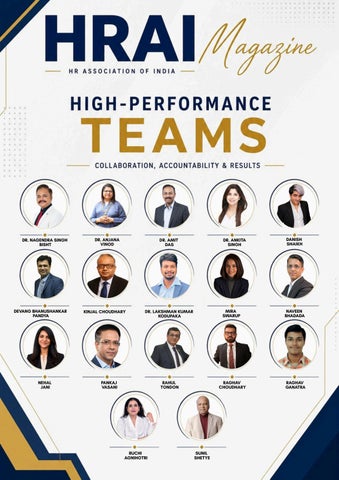
DR. NAGENDRA SINGH BISHT
DEVANG BHANUSHANKAR PANDYA
NEHAL JANI
DR. ANJANA VINOD
DR. AMIT DAS
DR. ANKITA SINGH
DANISH SHAIKH
KINJAL CHOUDHARY
DR. LAKSHMAN KUMAR KODUPAKA
MIRA SWARUP
NAVEEN BHADADA
RAHUL TONDON
RAGHAV CHOUDHARY
RAGHAV GANATRA
PANKAJ VASANI
RUCHI AGNIHOTRI
SUNIL SHETYE
WELCOME TO THE LATEST EDITION OF
HRAI Magazine HIGH-PERFORMANCE TEAMS – COLLABORATION, ACCOUNTABILITY & RESULTS
PREVIOUS EDITIONS:
READ NOW
READ NOW
READ NOW
READ NOW
READ NOW
READ NOW
READ NOW
READ NOW
READ NOW
READ NOW
CHECK OUT ALL THE EDITIONS 2
EDITOR'S HRAI TEAM'S NOTE At HRAI, we believe that trust is the cornerstone of every successful workplace. In an era defined by rapid change, technological advancement, and evolving workforce expectations, organizations that prioritize transparency, ethical decision-making, and credible leadership are better positioned to build resilient cultures and sustainable success. Trust is no longer just a leadership quality—it is a business imperative. Employees seek leaders who communicate openly, act with integrity, make fair decisions, and consistently demonstrate accountability. When trust is embedded into organizational culture, it strengthens collaboration, drives engagement, fosters innovation, and creates an environment where people feel safe to contribute, grow, and thrive. This edition, High-Performance Teams – Collaboration, Accountability & Results, explores how organizations can cultivate trust as a strategic advantage. Through expert perspectives, leadership insights, and real-world experiences, we examine the role of transparent communication, ethical leadership, responsible decision-making, and authentic relationships in shaping workplaces where credibility and confidence flourish. As you turn these pages, we invite you to reflect on the leaders and cultures that have earned your trust and inspired your best work. By championing transparency, upholding ethical values, and leading with authenticity, we can build organizations where trust is not just expected—it is intentionally nurtured, strengthening people, performance, and the future of work.
3
1,22,000+ FOLLOWERS ON LINKEDIN A GROWING COMMUNITY OF PROFESSIONALS ENGAGING WITH HRAI’S INSIGHTS, INITIATIVES, AND INDUSTRY CONVERSATIONS.
About HRAI Founded by Dr. Ankita Singh, the HR Association of India (HRAI) drives industry-led initiatives and curates prestigious recognitions for organizations, emerging professionals, and trailblazing women across the business ecosystem. HRAI serves as a platform for learning, collaboration, and recognition, bringing together professionals and subject-matter experts from across industries. What We Do Industry initiatives and professional forums Awards, recognitions, and curated listings Knowledge-sharing through talk shows, panels, and articles Community-building for HR and business professionals Organizations We’ve Engaged With Lenovo, Hindustan Unilever, Biocon Biologics, IHG Hotels, L&T, CBRE, Sutherland, Capgemini, EY, and more.
4
HIGHLIGHTS: KNOWLEDGE & THOUGHT LEADERSHIP Elite voices such as Dr. TV Rao, Harjeet Khanduja, and Prasenjit Bhattacharya have been featured in HRAI’s one-on-one talk shows, contributing practical insights and real-world perspectives for professionals. HRAI MAGAZINE INITIATIVE HRAI publishes thought-provoking articles authored by senior professionals from organizations such as Reliance Jio, Times of India, KPMG, Eveready, Volvo, and more. HRAI LIST FEATURES HRAI curates an annual list of features recognizing exceptional professionals and changemakers aligned with a central theme each year. 23 of 2023 |24 of 2024|25 of 2025. Notable organizations featured include: Adani, Amazon, Flipkart, Samsung, Myntra, Uber, Raymond, and more.
EXCLUSIVELY FEATURED SHARK TANK JURY IN THE VISIONARY CEOS LIST: AMIT JAIN, DEEPINDER GOYAL, GHAZAL ALAGH, RITESH AGARWAL,VINEETA SINGH
For HR professionals in India, HRAI offers unparalleled opportunities to connect with like-minded peers, learn from experts, and gain recognition for their hard work and achievements. By joining HRAI, HR professionals can stay updated on the latest trends, best practices, and strategies that can help them take their careers to the next level.
5
TABLE OF CONTENT 8
DR. NAGENDRA SINGH BISHT PRINCIPAL HR ADVISOR,ELEVATE PEOPLE HR
12
DR. ANJANA VINOD IMAGE CONSULTANT & CORPORATE TRAINER
18
DR. AMIT DAS DIRECTOR & CHRO, BENNETT COLEMAN & CO. LTD.(THE TIMES OF INDIA)
24
DR. ANKITA SINGH FOUNDER, HR ASSOCIATION OF INDIA
30
DANISH SHAIKH HEAD-HR CENTRE OF EXCELLENCE,ACG CAPSULES
38
DEVANG BHANUSHANKAR PANDYA GENERAL MANAGER-HRA, ANALYTIX SOLUTIONS
46
KINJAL CHOUDHARY GLOBAL PRESIDENT – HUMAN RESOURCES, CADILA PHARMACEUTICALS LIMITED
54
DR. LAKSHMAN KUMAR KODUPAKA
60
MIRA SWARUP COACH & SPEAKER:IMPACT COMMUNICATION & EXECUTIVE PRESENCE
64
NAVEEN BHADADA CHIEF FINANCIAL OFFICER, SUGAR BRANDS PVT LIMITED
68
NEHAL JANI CHIEF PEOPLE OFFICER, SPACE-O TECHNOLOGIES
SENIOR DIRECTOR-TALENT ACQUISITION,SUTHERLAND
EVENT CHRONICLE
22 GCC SUMMIT HYDERABAD 2026 52 MOST PREFERRED WORKPLACE FOR WOMEN 2026–27
72
PANKAJ VASANI GROUP CHIEF FINANCIAL OFFICER,CUBE HIGHWAYS TRUST
82
RAHUL TONDON BUSINESS HEAD(GAS), BHARAT PETROLEUM CORPORATION LIMITED
86
RAGHAV CHOUDHARY FOUNDER & MANAGING DIRECTOR,CRESCENDO GLOBAL
90
RAGHAV GANATRA DEPUTY MANAGER-LEARNING & DEVELOPMENT,VFS FLOBAL
94
RUCHI AGNIHOTRI COUNSEL, LEGAL ADVISOR, ARBITRATOR,RICS ACCREDITED EVALUATIVE MEDIATOR, INDEPENDENT DIRECTOR & ENTREPRENEUR
98
DR. SUNIL SHETYE FOUNDER & CEO, SUMIRA LIFE MANAGEMENT
COLUMNS 78
SUMIT AGARWAL LINKEDIN TOP VOICES
Sumit Agarwal is a global DEI Advisor to Fortune 500 companies and a trailblazer in Diversity, Equity & Inclusion. As the SDG Ambassador for Diversity and Inclusion and a Mentor of Change with NITI Aayog, he brings a unique blend of empathy and innovation to his work. Known for using LEGO® SERIOUS PLAY®, Design Thinking, and visual facilitation tools like Moth Cards and Liberating Structures, Sumit has conducted 350+ sessions worldwide. A UN-certified inclusion expert and motivational speaker, he transforms complex DEI concepts into actionable strategies that inspire inclusive leadership and lasting organizational change.
KHANDUJA 42 HARJEET SVP- HR, JIO Harjeet Khanduja is an international speaker, author, poet, influencer, inventor and an HR leader. He is also known as RK Laxman of Business. He is currently working as the Senior Vice President HR at Reliance Jio. He has 4 published patents and authored 9 bestseller books. Harjeet has been a LinkedIn Power Profile, TEDx speaker, Guest Faculty at IIM Ahmedabad and XLRI, Board Member of Federation of World Academics, Global Thought Leader, Global Digital Ambassador. Harjeet features in Top 200 Global Leadership Voices and ET Top 20 HR Influencers.
DR.NAGENDRA SINGH BISHT PRINCIPAL HR ADVISOR, ELEVATE PEOPLE HR
Dr Nagendra Singh Bisht works at the intersection of higher education and HR consulting, bringing more than two decades of professional experience across Australia, India and the Philippines. He has held senior HR leadership roles in diverse organisations and advised industry partners on culture building, capability development, talent management and workforce engagement. Alongside his consulting work as Founder and Principal HR Advisor at Elevate People HR, Nagendra teaches business, management, leadership and business law across Australia’s higher education and vocational education sectors. He is passionate about connecting academic concepts with workplace realities and helping students and professionals develop practical, future-focused capabilities. Nagendra holds a PhD in Management, an MBA in Human Resources, an LL.B. and Australian qualifications in training, assessment and leadership. He is also recognised as a Fellow Certified HR Practitioner of the Australian HR Institute (FCPHR). Through his work, he seeks to contribute thoughtfully to stronger workplaces, capable leaders and meaningful learning experiences.
8
Every organisation wants high-performing teams, yet relatively few build the conditions for them to consistently thrive. Bringing talented people together is only the beginning. Sustainable performance emerges when people understand the purpose of their work, trust one another, accept responsibility for outcomes and execute with discipline. In today’s workplace, this has become more challenging. Hybrid arrangements, cross-functional projects, multigenerational workforces, rapid technological change and growing performance pressure have changed how employees interact. Teams are expected to move faster, collaborate across boundaries and deliver results despite continuing uncertainty. Consequently, organisations must look beyond individual capability and examine the quality of the environment in which people work together.
A safe team is not one in which poor performance is overlooked. It is one in which expectations are clear, difficult conversations are respectful, and people can discuss failure without becoming defensive. Trust and accountability are therefore complementary, not competing, principles. Clarity converts effort into results Many teams do not suffer from a lack of effort. They suffer from fragmented effort. Employees may work hard while interpreting priorities differently, duplicating work, or waiting for decisions that nobody realises they own.
of
High-performing teams establish clarity at three levels: purpose, priorities and responsibility. Purpose explains why the team exists. Priorities identify what matters most now. Responsibility makes it clear who will decide, who will deliver and who needs to be consulted.
Psychological safety is often misunderstood as creating a comfortable workplace where people always agree. It means creating an environment where employees can question an assumption, acknowledge a mistake, challenge a decision or seek help without fear of humiliation or retaliation.
Job descriptions alone cannot provide this clarity because contemporary work frequently crosses formal reporting lines. Teams require regular conversations about decision rights, dependencies and changing priorities. A simple question—“Who owns the next step?”—can prevent considerable confusion.
Psychological performance
safety:
the
foundation
This matters because unresolved concerns rarely disappear; they usually become operational problems. When employees hesitate to speak, weak ideas remain unchallenged, risks go unreported, and mistakes are repeated. Conversely, when leaders respond constructively to uncomfortable information, teams learn faster and make better decisions. Psychological safety must, however, coexist with performance discipline.
Accountability without blame Accountability is sometimes introduced through increased monitoring, tighter reporting and more frequent escalation. While these mechanisms may produce short-term compliance, they do not necessarily create ownership. Employees demonstrate genuine accountability when they understand the outcome, possess reasonable authority to act and feel personally committed to delivering it. 9
DR. NAGENDRA SINGH BISHT
Leaders should distinguish accountability from blame. Blame looks backwards and searches for an individual to fault. Accountability examines what happened, what was within the team’s control and what must change. This approach does not remove consequences; rather, it ensures that consequences are fair, proportionate and connected to learning. Collective accountability is equally important. In high-performing teams, members do not say, “My part is complete,” while the overall outcome is failing. They recognise dependencies, communicate risks early and support colleagues when priorities shift. The team’s result becomes more important than individual visibility. Collaboration requires productive tension Collaboration is not the absence of disagreement. In fact, teams that agree too quickly may be avoiding the very conversations required for innovation and sound decision-making. Productive teams can debate ideas strongly while maintaining respect for the people presenting them. Leaders can encourage productive tension by inviting alternative viewpoints, asking quieter members to contribute and preventing hierarchy from automatically determining the answer. This is particularly relevant in culturally diverse workplaces, including India, where respect for seniority may sometimes discourage employees from openly challenging experienced leaders. Meetings should also be designed around decisions and action, not merely information sharing. Each meeting should answer three questions: What have we decided? Who is responsible?
By when will it be completed? Without these answers, collaboration can become a series of pleasant conversations with limited business impact. Feedback as an everyday practice Annual performance discussions cannot meet the needs of fast-moving teams. Feedback must become part of everyday work: timely, specific and focused on behaviour and impact. The most useful feedback does not simply tell someone what went wrong. It helps the individual understand what should be continued, changed or tried next time. Recognition is equally important. Leaders should acknowledge not only visible achievements but also the collaborative behaviours that make results possible—sharing knowledge, raising risks, supporting colleagues and helping the team recover from setbacks. Employees must also be able to provide upward and peer feedback. When feedback travels only from manager to employee, the organisation loses valuable information about leadership effectiveness, workflow barriers and team dynamics. The leader as an architect of conditions The traditional image of the leader as the person with all the answers is becoming less relevant. In complex environments, no single individual possesses all the required knowledge. The leader’s role is increasingly to create the conditions in which expertise can surface and coordinated action can occur. This involves setting direction, removing obstacles, making timely decisions and ensuring that standards are consistently applied.
DR. NAGENDRA SINGH BISHT
10
It also requires leaders to regulate their own behaviour. A leader who reacts defensively to bad news teaches employees to hide problems. One who takes credit for success and distributes blame during failure gradually destroys collaboration.
Sustainable teams deliver while preserving the capability and commitment required to deliver again.
High-performing leaders combine humility with decisiveness. They listen before acting, but they do not allow endless consultation to delay execution.
High-performance teams are not created through motivational slogans or isolated teambuilding activities. They are built through repeated leadership choices: clarifying expectations, encouraging honest dialogue, addressing underperformance fairly, recognising contribution and keeping collective outcomes at the centre.
AI as an enabler, not a substitute Artificial intelligence is beginning to influence how teams plan work, access knowledge and monitor performance. Used appropriately, AI can summarise meetings, identify workflow bottlenecks, support workforce planning and reduce repetitive administrative tasks. This can give employees more time for judgement, creativity and relationshipbuilding. However, technology cannot create trust or accountability. Excessive AI-driven monitoring may even weaken them by making employees feel constantly observed. Organisations should therefore establish clear safeguards concerning privacy, transparency, bias and human oversight. AI should improve the quality of decisions—not remove human responsibility for them. Measuring what truly matters Performance measurement should balance results with the health of the team. Revenue, productivity and project completion remain important, but leaders should also monitor employee turnover, quality, customer outcomes, collaboration and the team’s ability to learn from setbacks.
The way forward
The central lesson for organisations is straightforward. Collaboration without accountability produces activity but not achievement. Accountability without trust produces compliance but not commitment. Results become sustainable when people feel safe enough to speak, clear enough to act and responsible enough to follow through. In a workplace increasingly shaped by technology and constant change, the human foundations of performance matter more—not less. Organisations that strengthen these foundations will be better prepared not only to achieve ambitious results, but to build teams capable of succeeding together over time.
“Results become sustainable when people feel safe enough to speak, clear enough to act and responsible enough to follow through.”
Short-term results achieved through exhaustion, fear or unhealthy competition should not be confused with high performance. 11 DR. NAGENDRA SINGH BISHT
DR. ANJANA VINOD IMAGE CONSULTANT & CORPORATE TRAINER
Dr. Anjana Vinod: A Masterclass in Positive Leadership Dr. Anjana Vinod is a two-time TEDx speaker, published author, Amazon bestseller, executive coach, and leadership facilitator with over 30 years of crosssector experience. She has impacted more than two lakh professionals through transformative learning programs across India and internationally. A postgraduate in Economics from the University of Mumbai, IIM Bangalore alumna, and PhD holder specializing in Theater in Training, Dr. Vinod brings a unique experiential and human-centred approach to leadership development. She is also a certified Emotional Intelligence and POSH Assessor. A leading breast cancer coach for women, she has received two Guinness World Records and several prestigious national awards, including the Dr. A.P.J. Abdul Kalam, Sardar Patel, and Sir Ratan Tata Awards. Crowned Mrs India International 2023, she has also been featured by Forbes Asia and recognized as a Most Admired Global Indian. Her work spans leadership, women’s empowerment, faculty development, and positive living, with engagements across diverse audiences including the Mumbai Police, Income Tax Department, and Armed Forces Women’s Wing.
A few years ago, I was sitting through what looked like an ordinary team meeting. Nine people around a table, a project update underway, nothing particularly exciting on the agenda. Then something happened that stayed with me. A young analyst noticed a flaw in the numbers being presented by the project lead. She pointed it out. There was a brief silence—but no awkwardness. The project lead looked at the numbers, thanked her for catching it, and the team immediately began working through what needed to change. No defensiveness. No attempt to save face. No conversation after the meeting about whether she should have challenged someone senior. They fixed the problem and moved on. In fact, the meeting finished early because there was nothing left to debate. I remember thinking, this is what a team working well actually looks like. Most of us have experienced the opposite too. A meeting where everyone politely agrees, heads nod around the table, and nobody raises the uncomfortable question. Then the meeting ends and suddenly the real conversations begin —in corridors, over coffee, on WhatsApp, or in smaller calls. Same organization. Often equally talented people. Completely different outcomes. So what makes the difference? Over the years, working with teams and leaders across organizations, I have become convinced that high performance is rarely about simply putting talented people together. It is about creating the conditions in which that talent can work together.
DR.ANJANA VINOD
I think of it as the invisible architecture of a team—the things you cannot see on an organization chart but can certainly feel when you enter the room. For me, that architecture rests on five important pillars. I call them S.C.O.R.E. S — Safety Net C — Clarity of Roles O — Ownership Over Compliance R — Real-Time Feedback E — Execution as One And perhaps the name itself is a useful reminder. Ultimately, teams are not built merely to get along. They are built to deliver. S — Safety Net: Can I Say What Needs to Be Said? Psychological safety is sometimes misunderstood as creating a workplace where everybody is nice to each other and nobody feels uncomfortable. That is not what it means. A psychologically safe team can have disagreements—sometimes strong ones. The difference is that disagreement does not become dangerous. Can I say, “I think we are getting this wrong”?, Can I admit, “I made a mistake”?, Can I ask a question that everyone else seems to know the answer to?, Can I challenge someone more senior than me without worrying about what it will cost me later? That is the real test. I often think of psychological safety as the oxygen in a room. When it is there, nobody notices it. Take it away, and suddenly it is the only thing people can think about. 13
Leaders therefore need to watch what happens immediately after somebody disagrees with them. That moment tells you far more about team culture than any employee-engagement survey. Does the leader become defensive? Does someone roll their eyes? Does the room suddenly go silent? Or does someone say, “Tell me more”?
It sounds almost too basic. Yet many teams spend hours discussing what needs to happen and surprisingly little time clarifying who owns what. The result is activity without movement. Clarity reduces friction. And when people know where their responsibility begins and ends, accountability becomes much easier.
High-performing teams don’t eliminate uncomfortable conversations. They make them possible.
“The strength of the team is each individual member. The strength of each member is the team.”
O — Ownership Over Compliance: Are We Growing Gardeners or Tenants?
“THE QUALITY OF A TEAM IS REVEALED NOT WHEN EVERYTHING GOES RIGHT, BUT IN HOW PEOPLE RESPOND WHEN SOMETHING GOES WRONG.”
C — Clarity of Roles: Who Actually Owns This? If safety is the oxygen of a team, clarity is its plumbing. Nobody talks about plumbing when it works. But when it doesn’t, everybody notices. Think about how often work gets delayed because of sentences such as: “I thought you were doing it.”, “I didn’t know I had to approve that.”, “I was waiting for their response.”, “Nobody told me that was my responsibility.” We often diagnose these situations as poor performance when the actual problem is poor clarity. Before beginning important work, strong teams answer three surprisingly simple questions: Who decides?, Who executes?, Who needs to know? DR.ANJANA VINOD
There is a big difference between someone who completes what was asked and someone who notices what needs to be done before being asked. I think of this as the difference between a tenant and a gardener. A tenant maintains what is already there. When something breaks, the landlord gets a call. A gardener behaves differently. The gardener notices that the soil is getting dry and waters it before the plant begins to wilt. Organizations need more gardeners. But here is where leaders sometimes get it wrong: ownership cannot simply be demanded. We say, “I want my people to take more ownership,” while continuing to make all the important decisions ourselves. People are far more likely to own something when they have had some role in shaping it. Invite people early—not only when it is time to execute. Ask: “What are we missing?”, “How would you approach this?”, “What could go wrong?”, “What would you do differently?” 14
Ownership grows when people stop feeling like pairs of hands executing somebody else’s thinking and start feeling like contributors to the thinking itself.
If leaders can ask for feedback themselves—and receive it without becoming defensive, they send a powerful signal. Feedback then stops being done to people and becomes something teams use for improvement.
“A TEAM BECOMES HIGHPERFORMING WHEN ‘MY RESPONSIBILITY’ QUIETLY BECOMES ‘OUR OUTCOME.”
“High performance is not about having stars in the team. It is about creating a team in which everyone can shine.”
R — Real-Time Feedback: Make It Normal
E — Execution as One: Watch the Handoffs
In many organizations, feedback resembles an annual health check-up. Important, formal, slightly uncomfortable—and something everyone is relieved to finish. But highperforming teams don’t wait for an appraisal cycle to tell each other what is working and what isn’t. Feedback becomes part of everyday work.
Ultimately, a team must deliver. I like to think about execution as a relay race. Of course, individual speed matters. But relay races are often won or lost during the handoff. Teams are similar.
A quick conversation after a presentation. “That landed really well. One thing you could do differently next time… ”A five-minute discussion after a difficult client meeting. “What worked? What should we change?” The biggest shift happens when teams learn to separate feedback about the work from judgment about the person. “This approach didn’t work” is very different from “You are not good enough.” Yet people often hear the second message even when the first was intended. Leaders have an important role here.
DR.ANJANA VINOD
We spend a great deal of time developing individual capability, yet many failures happen in the spaces between people. Sales hands over to operations. Strategy hands over to execution. One function hands over to another. One shift hands over to the next. The question is not simply, “Did I finish my part?” It is, “Did I make it possible for the next person to succeed?” That small change in thinking moves people from individual performance to collective performance. And when something does go wrong—and eventually something will—strong teams resist the temptation to immediately ask, “Whose fault was this?” Instead, they ask: “What did we miss as a team?”, That question changes everything. 15
The Real Differentiator High-performing teams are not necessarily filled with extraordinary people. Often, they are ordinary people operating in an extraordinary environment. An environment where speaking up is safe. Where roles are clear. Where people are invited to take ownership. Where feedback is normal rather than threatening. And where execution is seen as a collective responsibility. That is why the most important aspects of high performance rarely appear on an organization chart or KPI dashboard. You see them in everyday moments. Someone admitting, “I don’t know.” A junior colleague challenges an assumption. A leader saying, “You were right. I missed that.” A colleague steps in because the team outcome matters more than whose job it technically is. Or perhaps in something as simple as a meeting ending twelve minutes early—because the conversation that needed to happen actually happened in the room, rather than after everyone left. That is what the invisible architecture of a high-performing team looks like. And the encouraging part is this: you don’t have to wait for extraordinary talent to build it. You can start building it with the team you already have.
“GREAT TEAMS ARE NOT BUILT BY FINDING THE RIGHT PEOPLE. THEY ARE BUILT BY CREATING THE RIGHT CONDITIONS FOR PEOPLE TO BECOME THEIR BEST TOGETHER.”
DR.ANJANA VINOD
16
“The strength of the team is each individual member. The strength of each member is the team.” -Phil Jackson
17
DR. AMIT DAS DIRECTOR & CHRO, BENNETT COLEMAN & COMPANY LTD. (THE TIMES OF INDIA) Amit is a Global Thought Leader & HR Visionary with a career spanning 37+ years, shaping future-ready organizations across diverse industries through leadership transformation, cultural coherence, agile workforce capability, and tech-enabled people architecture. Over the years, he has held leadership roles with marquee organizations including Tata Motors, CESC Ltd, Britannia Industries, Vodafone, RPG Group and Reliance Group, bringing deep expertise in building scalable people systems and resilient performance cultures. Currently holds the position of Director-HR & CHRO, Bennett Coleman & Company Ltd (The Times of India), India’s largest media conglomerate with multiple power brands across print & publishing like The Times of India, The Economic Times, Navbharat Times, Maharashtra Times to name a few. Amit is a trusted strategic partner and credible advisor to shareholders, promoters, and business leaders, known for enabling human-capital-led enterprise value creation and leading organization-wide transformation during pivotal phases of innovation-led growth and transition. An Engineering & Management graduate, alumnus of the Kellogg School of Management, and PhD from KIIT School of Management. Beyond corporate and public policy leadership, he serves as Advisory Board & Governing Council Member across leading academic institutions, strengthening the industry– academia bridge to build next-generation capabilities that will power India’s rapid growth in the global economic landscape. On the personal front, Amit is a fitness enthusiast, avid reader, and a continuous learner in today's integrated, multi-cultural & diverse ecosystem.
Earlier this year we constituted cross functional taskforces to take forward a few strategic projects, ranging from agentic AI and onboarding to performance management and employer branding. Thirty colleagues were drawn in from different functions, locations and levels, most of whom had not previously worked together, all of them continuing to carry their existing responsibilities. Some found their rhythm almost immediately, others took a few weeks longer, and the difference had little to do with the seniority or subject expertise in each group. High performing teams are often described as fortunate assemblies of talent and temperament. In four decades I have come to see them differently. They are built from the same material as every other team, and what distinguishes them is that somebody thought carefully about how they were assembled and kept refining that design as the work evolved. If performance were a function of composition, our options would be limited to selection. Because it is largely a function of design, it is something we can influence continuously, which is a far more useful proposition for those of us responsible for building capability. Four conditions, in my experience, determine how well a team performs. The first is clarity of ownership. Ask any member of a team who decides on a particular piece of work. Where the answers are consistent and immediate, the team will hold up well under pressure. Where they vary, or begin with a qualification, there is a design question waiting to be settled. The taskforces that moved fastest were those DR.AMIT DAS
that resolved at the outset who was accountable, who was contributing and who was being consulted. It took them a single session. The groups that treated this as procedural spent their first month circling the same decisions, not for want of effort but because every meeting reopened questions the others had closed once. Clarity of role enables collaboration rather than constraining it, and it matters most in matrixed work, where people arrive carrying the assumptions of their parent function. The second is candour, held alongside demanding standards. The most useful formulation of psychological safety remains Amy Edmondson’s, which places it on two axes rather than one. Safety paired with high standards creates a genuine learning environment, in which people raise issues early and stretch themselves willingly. Organisations that build both together tend to hear about their challenges while those challenges are still small. We designed our leadership development programme on this premise, asking participants to bring their apprehensions into the room and take candid feedback from peers and mentors rather than present a finished account of themselves. It was uncomfortable in the first cohort. What we learnt is that the discomfort belongs to the design rather than being a flaw in it, and that a group which has said difficult things to each other and survived the experience disagrees far more productively afterwards. Candour, in the current context, means something quite specific: that a colleague can say they are still learning a new tool, or ask how their role is likely to evolve, and receive a straight answer. 19
Those teams are consistently better informed, and better informed teams make better decisions. Alongside that openness, the strongest teams maintain an unembarrassed insistence on the commitment made. Anything may be said, and what was promised is expected to be delivered. The third is the speed at which feedback travels. Where the relationship between action and consequence is difficult to predict, shorter cycles serve us better than longer ones: define the problem accurately, attempt something limited, expose it to reality, and let the result shape the next attempt. Feedback is that principle applied to individuals, and its value is largely a function of timing. An annual conversation asks two people to reconstruct a situation neither remembers precisely, and the exchange becomes a negotiation about the past. Delivered close to the event, the same conversation becomes information the individual can act on straight away. Moving towards continuous conversation, supported by AI generated insight, has done more for us than any revision of forms or rating scales. The insight comes from the system. The judgement remains with the manager, and should. The fourth is a bias towards completion. Collaboration is sometimes measured by activity, by forums convened and colleagues consulted. The teams that produce results are distinguished instead by how decisively they close things: decisions recorded, items finished, workstreams concluded once they have served their purpose. Our internal AI showcase illustrated this. Over a hundred colleagues took part,
DR.AMIT DAS
and the solutions presented had been developed by them rather than commissioned centrally: an advertisement booking platform, a testing platform, a dashboard. What was notable was not the ambition but the completion, these being working applications built by people already carrying full responsibilities elsewhere. Capability is distributed far more widely than our structures record. The instinct to take something to a finished state is worth more than a good deal of what we conventionally describe as talent. These four conditions are now being tested in an unfamiliar way. As agentic systems begin to execute work independently, teams will include contributors who are not people, producing output no individual member has personally assembled. This concentrates accountability rather than dispersing it, since each output still requires a named individual who has examined it and can answer for it. Expertise can be borrowed; accountability cannot be outsourced. Teams that settle this early will adopt the technology with considerably greater confidence, and in my observation the settling of it takes one conversation, not a policy. Which suggests an ambition beyond resilience, a word that describes only a return to the previous state. What is available to us is something better: teams that improve through difficulty, where disagreement sharpens the analysis, where a missed target produces a redesign, and where an unfamiliar technology ends with some members teaching the others. That capacity is designed, not discovered. For those of us leading such teams, this defines a focused and demanding role: establish direction without ambiguity, remain honest about the route, remove the obstacles the team cannot address itself, and then allow it to work. The last asks the most of us, since we were promoted on the strength of doing the work rather than enabling it.
“Teamwork is the fuel that allows common people to attain uncommon results.” — Andrew Carnegie
21
ET EDGE / GCC SUMMIT 2026
GCC Summit Hyderabad 2026: Redefining Enterprise Through Leadership and Intelligence India's GCC story has entered a new phase of transformation. What began as a model centered on operational efficiency and global service delivery has evolved into an ecosystem that now influences enterprise intelligence, product innovation, digital transformation, talent strategy, and business outcomes on a global scale. Today, GCCs are no longer viewed as support structures within multinational organizations. They are increasingly becoming strategic engines that help shape the future of enterprise. As this evolution continues, the questions facing GCC leaders have changed as well. The conversation is no longer about whether GCCs can deliver value. It is about how they can create greater enterprise impact through leadership, intelligence, innovation, and transformation. Throughout this journey, the ET Edge GCC Summit has remained closely connected to the evolution of the ecosystem. Across 12 successful editions hosted in key innovation hubs including Hyderabad, Bengaluru, Pune, and Delhi, the Summit has consistently brought together GCC leaders, policymakers, enterprise decision-makers, and industry stakeholders to explore the forces shaping the future of global capability centers. With 500+ distinguished speakers, 5,000+ senior delegates, 180+ partners, 30+ curated roundtables, and over 1,000 business engagements, the platform has evolved into one of India's most respected gatherings for the GCC community.
Why Hyderabad? The Calibo presents 13th Edition of the ET Edge GCC Summit 2026, co-powered by Wipro, arrives in Hyderabad at a time when the city continues to strengthen its position as one of India's most dynamic GCC destinations. Home to more than 200 GCCs across technology, BFSI, life sciences, engineering, aerospace, and digital services, Hyderabad has become a preferred destination for global enterprises building innovation-led operations. The city's ability to combine deep talent pools, worldclass infrastructure, progressive governance, and advanced technology capabilities has helped create a thriving ecosystem for enterprise transformation. From AI and cloud computing to cybersecurity, life sciences innovation, data engineering, and digital transformation, Hyderabad is increasingly helping define the next chapter of India's GCC growth story. It is also the perfect backdrop for this year's theme:
22
ET EDGE / GCC SUMMIT 2026
Redefining Enterprise Through Leadership and Intelligence The New Enterprise Mandate
Recognizing Impactful GCC Leaders of India Continuing its tradition of recognizing excellence, the Summit will honor organizations and leaders who are creating measurable enterprise value through innovation, leadership, governance, talent development, business impact, and strategic transformation. The recognition programme celebrates those who are not only delivering operational success, but also redefining what global enterprises can achieve through India's GCC ecosystem.
The modern enterprise is operating in an environment shaped by unprecedented technological change. Artificial intelligence is reshaping workflows. Data is influencing business strategy at every level. Cybersecurity and resilience have become boardroom priorities. Talent expectations continue to evolve. At the same time, organizations are expected to innovate faster while remaining agile, secure, and competitive. In this environment, leadership and intelligence have become inseparable. For GCCs, this means taking on a larger role in helping enterprises think differently, act faster, and create value in new ways. This year's Summit will explore some of the most important conversations shaping this evolution: How Enterprise Intelligence and Generative AI are transforming decision-making and business outcomes Building future-ready talent and workforce models for the next era of enterprise growth Strengthening cybersecurity, governance, and digital resilience in an increasingly interconnected world The growing influence of life sciences, deep-tech, and innovation-led GCCs The evolution of GCCs from capability centres into strategic drivers of enterprise value creation The nature of the discussion has fundamentally changed. The question is no longer how GCCs support global enterprises. The question is how GCCs help shape them.
From Hyderabad to the World As GCCs continue to evolve, they are becoming increasingly central to how enterprises drive intelligence, innovation, talent transformation, and long-term business growth. The Calibo presents 13th Edition of the ET Edge GCC Summit 2026, co-powered by Wipro, arrives at a pivotal moment for the industry. Because the future of GCCs is no longer defined by capability alone. It will be defined by how effectively leadership and intelligence come together to redefine enterprise success.
𝗘NQUIRE NOW: https://gcc.et-edge.com/enquire-now/? utm_source=socialmedia&utm_medium=hrassociationofindia
A Community Driving Transformation One of the defining strengths of the ET Edge GCC Summit has been its ability to bring together the leaders influencing the future of the ecosystem. From GCC CEOs and Country Leaders to CIOs, CTOs, CHROs, policymakers, investors, and industry associations, the Summit creates a platform where meaningful conversations, strategic relationships, and future-focused ideas converge. It is this community that continues to drive the next generation of enterprise transformation from India to the world.
23
DR. ANKITA SINGH FOUNDER, HRAI
Dr. Ankita Singh is the CPO & Board Director, CIGNEX & Relevance Lab. With 22+ years in HR, primarily in the ITES sector, Ankita has driven transformation through performance-driven practices and inclusive culture. At RELEVANCE LAB, her leadership helped the company earn multiple “Great Place to Work” certifications (2017–2021). She has been recognized as “Woman Leader of the Year” by The Times of India Group and featured in Forbes India’s “Top 100 Managers.” Ankita holds an MBA in HR+IT, an Executive MBA from SCMHRD, and a Ph.D. in Management. A respected voice in the industry, Ankita blends strategic insight with a passion for people development and culture building.
Put a group of highly capable people together and you do not automatically get a highperforming team.
something, ask for help and acknowledge a mistake without constantly calculating the personal consequences.
You may get intelligence, experience and individual excellence, but collective performance requires something more. People need to be able to think together, challenge one another, make decisions, take ownership and execute consistently.
Google’s Project Aristotle reached a similar conclusion. Its research into team effectiveness identified five important dynamics: psychological safety, dependability, structure and clarity, meaning, and impact. Psychological safety emerged as a particularly important foundation for team effectiveness.
That distinction matters more than ever. Teams today operate across locations, functions, generations and time zones. Technology and AI are accelerating individual productivity, but individual speed does not necessarily translate into collective performance. Atlassian’s 2026 State of Teams research found that 80% of work happens at the team level, yet only 24% of leaders focus on using AI to improve teamwork. The future of performance, therefore, will not be determined only by how capable individuals become. It will depend on how effectively those capabilities come together. For me, a high-performance team can be understood through five elements captured in TEAMS: Trust, Execution, Accountability, Meaning and Shared Success. T: Trust Trust is often treated as a cultural aspiration. In high-performing teams, it is an operating requirement. People must be able to disagree, question a decision, admit that they do not know
DR.ANKITA SINGH
Psychological safety, however, should never be confused with permanent agreement or excessive comfort. The strongest teams are not necessarily the most harmonious. They are teams that can have difficult conversations because disagreement is not automatically interpreted as disrespect.
“A safe team is not one where nobody challenges you. It is one where challenge does not threaten you.”
Leaders create this environment through everyday behaviour. Think about what happens when somebody says, “I disagree.” Consider how a leader responds when a junior employee identifies a flaw in a senior leader’s idea or when someone admits a mistake. Those moments define psychological safety far more powerfully than any statement displayed on an office wall. E: Execution Collaboration has become one of the most frequently used words in organisations. It is also one of the most misunderstood.
25
More meetings do not necessarily mean more collaboration. Neither do more people copied on emails or more communication channels. Teams can remain extremely connected while still being disconnected from outcomes. Atlassian’s research found that 93% of executives believed teams could deliver similar outcomes in half the time if they collaborated more effectively. The same research found that 64% of knowledge workers felt their teams were constantly being pulled in too many directions. This is the collaboration paradox. Everyone is communicating, yet execution can still suffer. High-performing teams convert conversation into action. They know what matters, what can wait, who owns what and how success will be measured.
“Collaboration creates value only when collective conversation becomes collective execution.”
The real test of teamwork is not how well people work together when everything is going according to plan. It is how quickly they can align when priorities change, information is incomplete and the original plan stops working. A: Accountability Accountability is where many seemingly collaborative cultures begin to struggle.
Functions blame other functions. Dependencies become excuses. Decisions travel upwards. Everyone participated, but nobody truly owned the result. High-performing teams operate differently. They understand the difference between participation and ownership. Ten people may contribute to an initiative, but ownership must still be visible. Accountability must also work in both directions. Employees need to own their commitments, quality and timelines. Leaders need to own clarity, decisions, priorities and the environment in which employees are expected to deliver. Gallup’s extensive engagement research demonstrates why the quality of the team environment matters commercially. Its analysis of more than 183,000 business units across 53 industries and 90 countries found that topquartile engaged teams had 23% higher profitability than bottom-quartile teams. They also demonstrated 18% higher sales productivity and significantly lower absenteeism. Accountability and engagement are therefore not opposites. Done well, accountability strengthens engagement because good people want to know what is expected of them and whether their contribution makes a difference.
“Accountability without clarity becomes pressure. Clarity without accountability becomes intention. Performance needs both.”
When accountability is weak, missed outcomes generate explanations. DR.ANKITA SINGH
26
M: Meaning
S: Shared Success
A team can be busy without being productive. It can also be productive without necessarily working on what matters most.
Many organisations say they value teamwork while their systems continue to disproportionately celebrate individual heroes.
High-performing difference.
This creates an obvious contradiction.
teams
understand
this
People need clarity not only about what they are doing but also about why it matters. A task becomes more meaningful when employees can connect it to a customer, a business outcome, a strategic priority or a larger organisational purpose. This becomes particularly important in dynamic organisations where priorities can change faster than job descriptions. When people understand the larger objective, leaders do not have to prescribe every step. Teams can adapt because they understand the intent behind the instruction. Role clarity becomes equally important. People need to understand their responsibilities while appreciating how their work intersects with others. Ambiguity around ownership creates duplication, delays and frustration. Clarity should not be mistaken for micromanagement. In many ways, clarity is what makes autonomy possible.
“The strongest teams do not need instructions for every move. They need enough context to make the right move themselves.”
DR.ANKITA SINGH
If rewards, recognition and visibility consistently go to individuals while outcomes depend on teams, people quickly learn to optimise for personal success. High-performance cultures recognise individual contribution without losing sight of collective achievement. This does not mean treating everyone identically. Contributions will vary, responsibilities will vary and recognition should reflect that. However, the ultimate question must remain simple: Did the team deliver what mattered? The best teams also make feedback continuous. They do not wait for an annual appraisal to discuss what is working and what needs to change. Feedback moves sideways, upwards and downwards. Teams reflect not only on who performed well but also on how effectively they performed together. They discuss what helped them succeed, what slowed them down, where collaboration failed and what they should do differently the next time. This changes performance from an evaluation exercise into an everyday discipline. High Performance Is a System, Not a Collection of Stars
27
One of the biggest misconceptions about highperforming teams is that organisations simply need to find exceptional people and put them together.
That is when collaboration moves beyond being an organisational value and becomes a genuine business advantage.
Talent matters, but the environment in which talent operates matters just as much. Gallup reports that managers account for 70% of the variance in team engagement. That finding should make every leader reconsider how performance is created. A manager is not merely allocating work. The manager is creating the conditions under which talent either multiplies or diminishes.
“A high-performing team is not a team where everyone performs. It is a team where everyone’s performance makes everyone else better.”
As AI makes expertise increasingly accessible and individual execution faster, this responsibility will become even more important. Competitive advantage may increasingly move from having the smartest individual in the room to creating the smartest collective behaviour across the organisation. High-performing teams will still need exceptional talent, but talent needs the right environment to thrive. TEAMS provides that foundation through Trust that encourages people to speak, Execution that turns ideas into outcomes, Accountability that creates ownership, Meaning that connects work with purpose, and Shared Success that keeps everyone focused on the larger result.
“When trust, accountability, purpose and execution come together, individual potential transforms into collective strength. When that strength is aligned with a shared vision, it creates a culture where people inspire one another, performance becomes sustainable, and success becomes a shared achievement rather than an individual pursuit.”
Ultimately, high performance is not about assembling people who are individually brilliant.
DR.ANKITA SINGH
28
“Talent wins games, but teamwork and intelligence win championships.” — Michael Jordan
29
DANISH SHAIKH HEAD - HR CENTRE OF EXCELLENCE,ACG CAPSULES
Danish Shaikh is an HR and Organizational Development leader with 16+ years of experience in building highperforming,future-ready organizations. He currently heads the HR Centre of Excellence at ACG Capsules and is pursuing a PhD focused on psychological safety, allyship, and inclusive leadership. With an MBA in HR and a foundation in Physics, he has led enterprise-wide HR transformations, designed talent systems, and built Centres of Excellence aligned with business outcomes. An award-winning professional, Danish has been recognized as Asia HR Director of the Year and a 40 Under 40 honoree. He is also an ICF-certified coach and published researcher, with work presented at global forums including Oxford and published in Scopus and Web of Science Journals.
===
The Inclusion-Performance Paradox: Why Belonging Without Challenge Isn’t Enough
The more interesting question, therefore, is not simply whether people belong.
There is a comforting image of a high-performing team that many of us carry.
It is what their belonging enables them to do.
People trust one another. Relationships are strong. Everyone feels included. Meetings are collaborative. There is alignment, energy and a shared sense of purpose.
What studying difference taught me about teams
Most of this is desirable. But there is one question we perhaps do not ask often enough: What if everyone is getting along because nobody is challenging anyone? For several years, organisations have invested significantly in creating workplaces where people feel included and experience a sense of belonging. This has been an important correction to an older philosophy of work in which employees were often expected to adapt themselves to the organisation rather than expect the organisation to make room for difference. Yet, as our thinking about inclusion matures, I believe we need to move the conversation forward. Belonging is important. But belonging, by itself, is not high performance. A team can be welcoming and still conformist. It can be psychologically comfortable and intellectually cautious. People can genuinely like one another and still avoid the conversations that matter most.
DANISH SHAIKH
My own thinking on this has been shaped, perhaps unexpectedly, by my research on LGBTQIA+ experiences in Indian workplaces. My first paper with Dr Hemangi Bhalerao, From ‘Closet to Cubicle’: Examining the Experiences of LGBTQIA+ Individuals During the Coming Out Process at the Workplace, was published in European Economic Letters in 2024. We examined what happens when an individual considers bringing an aspect of identity into the workplace that they may previously have concealed. The contrast between inclusive and non-inclusive environments was striking. Our review found that inclusive workplaces were associated with better mental health, greater engagement and career satisfaction, while non-inclusive environments were associated with stress, social isolation and hindered career progression. At one level, this is a story about LGBTQIA+ inclusion. At another, it raises a much more universal workplace question: How much energy do people spend managing themselves when they are uncertain whether difference will be accepted?
31
Our subsequent research turned the lens around. In Parallel Worlds, Shared Workspaces: Exploring Heterosexual Men’s Perceptions of Gay Men in Indian Workplaces, published with Dr Hemangi Bhalerao and Arpan Simon in the Journal of Lifestyle and SDGs Review in 2025, we studied heterosexual men who had openly gay male colleagues. What interested me was not simply whether participants were accepting or prejudiced. It was what happened when an existing assumption encountered a real person. Some reactions were shaped by stigma, misconceptions and established cultural stereotypes. Others reflected curiosity, empathy and respect. Some participants actively sought information. Some reconsidered assumptions they had previously held. And something even more human emerged. For some participants, a colleague coming out was interpreted as an act of trust. That trust was sometimes reciprocated through sharing their own personal experiences, strengthening the interpersonal relationship. Difference had created a conversation. The conversation had, in some instances, changed the relationship. Our latest study, Navigating Masculinity: The Influence of Media and Friendships on Heterosexual Men’s Perceptions of Gay Colleagues in Indian Workplaces, published in Masculinities & Social Change in 2026, explored this further.
Based on interviews with 25 heterosexual men, we examined how media, cultural conditioning, friendships and organisational interventions influenced perceptions of gay colleagues. We found that stereotypical representations could reinforce bias, while contemporary portrayals and direct interpersonal friendships could foster empathy and greater acceptance. Personal interaction was associated with shifts in expressed attitudes, while organisational policies and diversity interventions supported sensitisation and acceptance. Across these studies, I began to see an idea that extends beyond the specific context we were researching. The real value of difference is not realised when the group merely learns to tolerate it. It is realised when encountering difference changes something in the group itself. That is also where I believe inclusion begins to connect with performance. Inclusion cannot end with assimilation Organisations frequently talk about bringing your “whole self” to work. The intention is admirable. But there is a subtler question underneath it. Once I bring that different self into the room, does the room remain exactly the same? Consider diversity in its broadest sense - not simply gender, sexuality, generation or nationality, but experience, expertise, personality, worldview and ways of thinking.
32 DANISH SHAIKH
We assemble diverse teams because we expect difference to improve collective judgement. Yet that advantage disappears if people learn that belonging depends upon adapting themselves to the dominant view. If I am welcome in the team but quickly discover which opinions are acceptable, which questions irritate the leader, which assumptions should not be challenged and which disagreements carry a career cost, I may still experience social belonging. But the team has lost much of the performance value of my difference. That leads me to a distinction I think is important:. Representation puts difference in the room.
The Inclusion-Performance Matrix One way of thinking about this is through two dimensions that high-performing teams must manage simultaneously: Belonging and Challenge. Most organisations would immediately recognise the risks in the upper-left quadrant. Low belonging and low challenge produce withdrawal. The upper-right is equally problematic. Challenge without belonging can create an environment where people constantly have to prove themselves, defend territory or protect their standing. But I find the bottom-left quadrant far more interesting.
Inclusion allows difference to remain in the room. High-performance inclusion allows difference to change the conversation in the room.
Low Belonging
High Belonging
Because it can look remarkably like a successful team.
Low Challenge
High Challenge
Disengagement - People withdraw, contribute selectively and protect themselves.
Conflict - People challenge, but without sufficient relational security, disagreement can become d f i li i l High-Performance Inclusion People are secure enough in their membership of the group to question, disagree, i d h ld
Conformity - Relationships may be strong and the environment pleasant, but harmony begins to suppress di
33 DANISH SHAIKH
People are engaged. Relationships are warm. Meetings are harmonious. Conflict is rare. People describe their colleagues as friends. And that is precisely the danger. Belonging without challenge can quietly become conformity. The team becomes so good at maintaining cohesion that it becomes reluctant to disturb it. The destination is therefore the fourth quadrant: high belonging and high challenge. This is where inclusion becomes a performance capability. Here, “I disagree with you” and “I respect you” can coexist. A junior colleague can question a senior leader without the disagreement becoming a referendum on hierarchy. Someone can acknowledge a mistake without fearing that the admission will permanently redefine their competence. A minority opinion can survive the gravitational pull of consensus. And colleagues can challenge one another precisely because the relationship is strong enough to withstand the challenge. Psychological safety is not the absence of discomfort This distinction also matters when we talk about psychological safety. Psychological safety is sometimes inadvertently translated into comfort: be supportive, avoid judgement, create harmony.
But a genuinely safe team should actually be capable of considerable discomfort. It should be able to hear: “I think we are wrong.” “I don't know.” “I made the mistake.” “We are avoiding the real issue.” “I disagree with the majority.” “Your feedback is difficult to hear, but I need to understand it.” The absence of these statements should concern a leader more than their presence. A high-performing team is not one without tension. It is one that has learned to distinguish intellectual tension from interpersonal threat. That distinction is crucial. We should be able to challenge an idea without diminishing the person who proposed it. We should be able to hold somebody accountable without making them question whether they belong. And we should be able to change our own minds without experiencing that change as a loss of status. From diversity of people to diversity of thought There is another implication from our research that I find particularly relevant. Policies matter. Training matters.
Representation
matters.
But interaction matters too. 34
DANISH SHAIKH
Our studies showed how real interpersonal contact could complicate stereotypes that had previously seemed straightforward. A category became a colleague. An assumption encountered a relationship. Curiosity sometimes replaced certainty.
Perhaps one of the responsibilities of leadership is therefore to stop treating harmony as evidence that a team is healthy. Sometimes harmony is trust. Sometimes it is silence.
The parallel powerful.
for
high-performing
teams
is
Organisations can recruit extraordinary diversity and still fail to benefit from it if people merely coexist. The performance dividend comes through interaction - when different experiences collide with assumptions, when people become curious about perspectives they do not initially understand and when somebody else's view causes us to reconsider our own. That requires leaders to pay attention to seemingly ordinary moments. Who speaks first? Who is interrupted? Whose disagreement is explored rather than dismissed? What happens when someone brings bad news? Does the leader become defensive when challenged? Are dissenters eventually labelled “difficult”? Does the same small group shape every important decision? And perhaps most importantly: when somebody takes the risk of saying something uncomfortable, what happens next?
Inclusive leaders need to know the difference. Their role is not to remove discomfort from the team. It is to create enough belonging that people can enter discomfort without fearing exclusion. That means inviting dissent before offering their own opinion. It means being curious when challenged rather than merely tolerant of challenge. It means protecting minority viewpoints long enough for them to be properly considered. It means responding to bad news in a way that ensures the next piece of bad news reaches them sooner, not later. And it means holding people to high standards without making acceptance conditional upon flawless performance. This is where inclusion and accountability sometimes treated as opposing forces actually reinforce one another. If I know that challenging your work does not threaten our relationship, I can give you more candid feedback. If I know that admitting a mistake will lead to problem-solving rather than humiliation, I can surface it earlier.
Culture is often revealed in the answer. The leader’s job is not to eliminate friction DANISH SHAIKH
If I know that disagreeing with my leader does not jeopardise my standing, I can say what the organisation may desperately need someone to say. 35
Belonging, in other words, should not protect us from challenge. It should give us the security to engage in it.
Perhaps its greater potential lies in the reverse: What becomes possible when the individual is also allowed to change the organisation?
The question beyond belonging The inclusion conversation has rightly asked organisations: Do people feel that they belong here?
That is the journey from representation to participation, from participation to influence, and from belonging to performance.
We should continue asking it.
Because perhaps the ultimate test of belonging is not whether I feel accepted when I agree with the group.
But organisations seeking high performance need to ask a second question:
It is whether I still know I belong when I challenge it.
What does belonging enable people to do here? Can they question? Can they disagree? Can they acknowledge uncertainty? Can they tell a colleague that their work is not good enough? Can they challenge the most powerful person in the room? Can someone whose experience differs from the majority actually influence how the majority thinks? My research began with a very particular form of difference: what happens when LGBTQIA+ individuals disclose an identity that may challenge assumptions held by those around them. But studying those experiences - and subsequently studying the colleagues on the other side of that disclosure - has led me to a broader reflection about organisations.
“True inclusion is not simply about making people feel that they belong. It is about creating the trust and security to speak up, challenge assumptions, disagree openly and bring a different perspective to the table. When people know they can challenge the group without losing their sense of belonging, difference becomes more than representation— it becomes a force for better thinking, stronger teams and higher performance.”
Inclusion is usually described in terms of how the organisation changes the experience of the individual. 36 DANISH SHAIKH
“Individual commitment to a group effort—that is what makes a team work.” — Vince Lombardi
37
DEVANG BHANUSHANKAR PANDYA General Manager-HRA, Analytix Solutions
Devang Pandya is currently serving as General Manager-HRA, Analytix Solutions Ahmedabad, where he leads teams in Talent Acquisition, HR Business Partnering (HRBP), Payroll, and Compliance. With 18+ years of experience across diverse industries such as Information Technology, Manufacturing, and Pharmaceuticals, he has worked with leading MNCs and Indian companies. Throughout his career, Devang has been instrumental in managing mission-critical projects and providing strategic insights to drive business success. His passion for continuous learning, along with his dedication to developing and coaching teams, sets him apart as a leader. His expertise spans across HR Analytics, Organizational Development & Talent Management, Employee Engagement, Learning & Development, Leadership Development, and Coaching & Mentoring. He has served as Professor of Practice to Management institutes like, Adani Institute of Digital Technology Management, GLS – IMBA, Navarachna University, LJ University on HR related subjects. He holds an MBA with a specialization in Human Resources and is currently pursuing a Ph.D. focused on HR Analytics. Additionally, Devang has completed a certification in HR Analytics from IIM Rohtak and holds a Diploma in Training and Development from ISTD, Delhi.
A successful organization is not built by one person. It is built by a team that works together, takes responsibility, and stays focused on achieving common goals. Imagine watching a Formula 1 race. A car screams into the pit lane at full speed and comes to a complete halt. In just two seconds, twenty people swarm the car, change all four tires, clean the air vents, adjust the front wing, and send the driver flying back onto the track. Nobody bumps into each other. Nobody stops to ask what they should do next. Nobody drops a tool and blames their coworker. A high-performance team is not simply a group of talented people. It is a team where people trust each other, communicate openly, take ownership of their work, and help each other succeed. Collaboration: Don't Just Be Busy, Be in Sync Good teamwork starts with collaboration. Every person in a team brings different skills, experiences, and ideas. When we bring these strengths together, we can solve problems better and make better decisions. Collaboration does not mean that everyone has to agree on everything. In fact, healthy teams should have different opinions. What matters is that people can share their views openly and respectfully. Good communication is also very important. Everyone should know what the team is trying to achieve, what their role is, and how their work connects with others. When people work together instead of working in isolation, the team becomes stronger.
DEVANG BHANUSHANKAR PANDYA
Accountability: Taking Ownership The second important part of a high-performance team is accountability. Accountability means taking ownership of our work and our commitments. If we say we will do something, we should make every effort to deliver it. But accountability is not about blaming people when something goes wrong. Things will go wrong in every team. The important question is not “Who made the mistake?” but “What can we learn from it, and how can we improve?” A strong team member does not wait for someone else to solve every problem. They take initiative, raise concerns early, and look for solutions. At the same time, leaders must give people the clarity, support, and authority they need to take ownership. When people feel trusted and empowered, they naturally become more responsible. Results: Focus on What Matters At the end of the day, teamwork should lead to results. Sometimes teams can be very busy but still not achieve what really matters. Meetings, discussions, emails, and activities are not the final measure of success. The results are. Every team should be clear about three things: What are we trying to achieve? How will we know we have achieved it? What do we need to do differently if we are not getting the desired results? Clear goals help everyone stay focused. It is also important to regularly review progress. We should celebrate what is going well, openly discuss what is not working, and make changes when required.
39
A good team does not wait until the end of a project to discover that something is going wrong. They identify issues early and work together to fix them.
Most importantly, leaders should lead by example. If we expect accountability from our team, we must first demonstrate accountability ourselves.
What Makes a Team High-Performing?
Building a High-Performance Team
In my view, there are a few simple things that make a big difference:
Building such a team does not happen overnight. It starts with small, consistent actions, clear communication, keeping commitments, helping each other, giving honest feedback, and staying focused on the common goal.
Clarity: Everyone knows the goal and their role. Trust: People can depend on each other. Communication: People speak openly and keep each other informed. Ownership: Everyone takes responsibility for their commitments. Support: Team members help each other instead of working only for themselves. Focus: The team spends time on what really matters. Learning: Mistakes are used as opportunities to improve. These may sound simple, but doing them consistently is what makes the difference. The Role of a Leader Leaders have an important role in building highperformance teams. A leader should give direction, set clear expectations, remove obstacles, and support the team. But leadership is not about controlling every small activity. People perform better when they are trusted to do their job. A good leader should also listen. Sometimes the best ideas come from the people who are closest to the customer, process, or problem. Recognition is equally important. Appreciating good work does not always require a big reward. Sometimes a simple “Good job” or “Thank you for taking ownership” can make a big difference.
The best teams are not teams where there are no problems. The best teams are those that know how to face problems together. When people trust each other, take ownership, and work towards the same goal, the team becomes much stronger than the sum of its individual members. Conclusion High-performance teams are built on three simple principles: Collaborate well. Take ownership. Deliver results. When collaboration becomes part of our everyday work, accountability becomes a habit, and results become a shared responsibility, we create teams that are not only successful but also enjoyable to work with. Ultimately, high performance is not about people working harder. It is about people working better together.
40 DEVANG BHANUSHANKAR PANDYA
“It is literally true that you can succeed best and quickest by helping others to succeed.” — Napoleon Hill
41
HARJEET KHANDUJA SVP-HR JIO
Harjeet Khanduja is an international speaker, author, poet, influencer, inventor and an HR leader. He is also known as RK Laxman of Business. He is currently working as the Senior Vice President HR at Reliance Jio. He has 4 published patents and authored 9 bestseller books. Harjeet has been a LinkedIn Power Profile, TEDx speaker, Guest Faculty at IIM Ahmedabad and XLRI, Board Member of Federation of World Academics, Global Thought Leader, Global Digital Ambassador. Harjeet features in Top 200 Global Leadership Voices and ET Top 20 HR Influencers.
A few years ago, I came across one of the most fascinating examples of teamwork in Mumbai. Every morning, thousands of dabbas leave homes across the city. They are collected, sorted, transported through crowded roads and railway stations, sorted again and finally delivered to the right office and the right person. By afternoon, the same network works in reverse to bring the empty dabbas back home. What makes this remarkable is not just the scale. It is the coordination. For more than a century, Mumbai's dabbawalas have built a delivery system renowned for its reliability, using remarkably simple processes and very little technology. Think about what has to go right. One person has to collect the right dabba. Another has to sort it correctly. Someone else has to ensure it gets onto the right train. Another person has to receive it, sort it again and deliver it to the right building. If one person gets it wrong, the mistake can travel through the entire system. Yet the system works because every individual understands something bigger than his own task. He is not simply responsible for carrying a dabba. He is responsible for keeping the entire chain moving. That is the essence of a high-performance team. A high-performance team is not a collection of high performers. It is a group of people who know how to collaborate, take accountability and deliver results together. The best people don't automatically create the best team. Many leaders and organisations have a notion that the best people create the best team.
HARJEET KHANDUJA
We spend enormous amounts of time identifying the best talent. We hire people with impressive credentials, strong technical skills and proven track records. Then we put them together and assume that a high-performing team will emerge. It doesn't always happen. Google discovered this when it conducted Project Aristotle, a major study of its teams. Researchers studied more than 180 teams to understand what separated effective teams from the rest. The surprising finding was that who was on the team mattered less than how the team worked together. Five factors stood out. Psychological safety, dependability, structure & clarity, meaning and finally impact. That finding should make every leader pause. Because we often try to fix team performance by changing people. Sometimes we should be changing the way people work together. Look at any successful sports team. Eleven outstanding cricketers do not automatically make a winning cricket team. A great batsman cannot compensate for poor fielding. A brilliant bowler cannot win a match if the batting collapses every time. Individual excellence matters, but it becomes valuable only when it contributes to collective performance. The same is true at work. And that brings us to the first element of CAR. Collaboration At Tata Motors, I have worked in cross-functional teams formed to reduce cost or improve quality. Bringing people together across functions and locations creates a different kind of conversation. People stop protecting their functional boundaries and start solving a common problem.
43
These teams build a culture of collaboration. Collaboration isn't merely working together. It is optimising for the collective outcome rather than protecting functional boundaries. In such teams, people stop asking, "Whose problem is this?" and start asking, "How do we solve this?" Accountability The second element is accountability. And this is where many teams struggle. Ask a group, "Who owns this?" Someone often responds, "We all do." It sounds inclusive. It is actually dangerous. If everyone owns something equally, there is a good chance that nobody owns it completely. Highperformance teams create clarity about ownership. People know what they are accountable for, what they need from others and what outcome they are expected to deliver. Responsibility is doing your part. Accountability is owning the outcome. Imagine a relay race. The runner is responsible for covering his distance, but he is also accountable for making the handover successfully. It doesn't help him to say, "I ran my 100 metres perfectly," if he drops the baton.
Results The third element is results. This sounds obvious, but organisations routinely confuse activity with performance. We celebrate meetings conducted, projects launched, presentations made, training hours completed and dashboards created. But none of these are results. The real question is, What changed because the team did the work? Tata Steel's Kalinganagar plant offers a compelling example. Employee-led teams worked on more than 25 performance indicators, using data and analytics to improve operations. The teams achieved at least 80% of their targeted improvements across those indicators and generated an estimated $70–80 million in value, along with a 2–3 percentage-point uplift in EBITDA. That is what performance looks like. The team wasn't successful because it used analytics. It was successful because analytics helped people improve business outcomes. This distinction is critical for HR leaders as well. We should stop asking only whether our programmes are being implemented. We should ask whether they are changing something. If the answer is no, we may have completed an activity without creating an impact.
Organisations are full of dropped batons. Finally A high-performance team thinks differently. People understand that their accountability does not end when their individual task is completed. It ends when the agreed outcome is delivered. That is exactly what makes the dabbawala system so interesting. Every person in the chain depends on the previous person doing his job correctly. The system creates accountability through interdependence. Accountability becomes stronger when people can see how their work affects someone else. HARJEET KHANDUJA
Collaboration, Accountability and Results are the three wheels of CAR. But we know that every car needs four wheels. The fourth wheel is Trust. Because without trust, collaboration slows down, accountability becomes blame and results become pressure. Build CAR with Trust, and you don't just build a high-performing team. You build a team that can move at exceptional speed.
44
“Great things in business are never done by one person; they’re done by a team of people.” — Steve Jobs
45
KINJAL CHOUDHARY GLOBAL PRESIDENT – HUMAN RESOURCES CADILA PHARMACEUTICALS LIMITED Kinjal Choudhary is a senior Human Capital leader with over 30 years of experience in shaping workforce strategy, organizational transformation, and leadership development across global enterprises. Currently serving as Global President – Human Resources at Cadila Pharmaceuticals, he leads the company's global people strategy, focusing on leadership capability, organizational agility, culture transformation, and HR modernization. An alumnus of St. Stephen's College, JNU, and XLRI Jamshedpur, Kinjal has held senior leadership positions at ITC Limited, Hindustan Unilever, PepsiCo, Amazon, Volvo Eicher Commercial Vehicles, and Paytm. Throughout his career, he has partnered closely with CEOs and Boards to align human capital strategy with business growth, while driving leadership succession, workforce productivity, industrial relations, and HR digital transformation. Widely respected for building high-performing, people-centric organizations, Kinjal continues to guide enterprises in strengthening leadership capability, governance, and sustainable organizational excellence.
In today’s rapidly changing business environment, organizational success depends increasingly on the ability of teams to work together effectively, take ownership of outcomes, and consistently deliver results. While technology, processes, and infrastructure remain important, the real competitive advantage of any organization lies in its people and, more specifically, in the quality of collaboration among its teams. At Cadila Pharmaceuticals, where scientific excellence, quality, innovation, and operational discipline are essential to sustained growth, building high-performance teams is not simply an HR initiative. It is a business imperative. In an organization operating across research, manufacturing, quality, sales, marketing, supply chain, and other critical functions, exceptional results are rarely achieved through individual effort alone. They are created when people work with a shared purpose, clear responsibilities, mutual trust, strong accountability, and an unwavering commitment to collective execution. High-performing teams are therefore not defined merely by having talented individuals. They are distinguished by how effectively those individuals come together to achieve a common goal. The Foundation: A Shared Purpose and Clear Direction Every high-performing team begins with clarity. People need to understand not only what they are expected to do but also why their work matters. When employees can connect their individual responsibilities with larger organizational objectives, their work becomes more meaningful and purposeful. A shared purpose aligns different functions and individuals toward a common destination. KINJAL CHOUDHARY
It reduces the possibility of teams operating in silos and encourages people to make decisions based on what is best for the overall organization rather than what is convenient for their individual department. At Cadila Pharmaceuticals, this alignment can be particularly significant because the work of one function often directly influences the success of another. Research and development, manufacturing, quality assurance, regulatory affairs, supply chain, sales, and support functions must operate as interconnected parts of one larger system. A delay, error, or lack of coordination in one area can have consequences throughout the value chain. High-performing teams therefore require clarity around three fundamental questions: What are we trying to achieve? What is my role in achieving it? How will we measure success? When these questions are answered clearly, teams can prioritize more effectively and make faster decisions. Clarity transforms effort into focused execution. Psychological Safety: Creating an Environment Where People Can Speak Up One of the most important differentiators of a high-performing team is psychological safety. This refers to an environment in which people feel comfortable expressing ideas, asking questions, raising concerns, admitting mistakes, and challenging existing assumptions without fear of embarrassment or unfair consequences. Psychological safety does not mean lowering standards or avoiding difficult conversations. In fact, high-performance environments require both high levels of trust and high standards of accountability. 47
When people are afraid to speak, important information often remains hidden. Risks are identified too late, innovative ideas are never expressed, and problems continue because employees hesitate to challenge established ways of working. In a pharmaceutical environment, the importance of speaking up becomes even more critical. Quality, compliance, safety, and patient wellbeing depend on employees having the confidence to raise concerns when they observe something that requires attention. Leaders play a crucial role in creating psychological safety. They can do this by listening actively, responding constructively to concerns, encouraging different viewpoints, and treating mistakes as opportunities for learning while still maintaining appropriate accountability.
collaboration can be a major driver of speed and effectiveness. For example, when manufacturing, quality, supply chain, and other functions communicate proactively, potential issues can be anticipated and addressed before they become significant operational challenges. The strongest teams replace the mindset of “my work is complete” with the mindset of “our objective is complete.” This requires open communication, timely information sharing, respect for functional expertise, and a willingness to support colleagues when priorities demand collective action. It also requires teams to eliminate unnecessary barriers between departments.
A team becomes stronger when people can say, “I am not sure,” “I need help,” or “I believe there may be a better way,” without fear.
Collaboration is most effective when individuals understand that organizational success is interconnected. One team’s achievement should not come at the expense of another team’s performance.
Collaboration: Moving Beyond Coordination
Accountability: Ownership Without Blame
Many teams believe they are collaborating simply because they attend meetings together or exchange emails. True collaboration, however, goes much deeper.
Accountability is often misunderstood as blame. However, high-performance accountability is not about finding someone to criticize when something goes wrong. It is about creating a culture in which people take responsibility for commitments, decisions, and results.
Effective collaboration requires shared ownership of outcomes. It means that team members do not simply complete their individual tasks and consider their responsibility finished. Instead, they understand how their contribution affects the performance of others and the overall success of the team. At Cadila Pharmaceuticals, cross-functional
KINJAL CHOUDHARY
Accountability begins with ownership. Employees must have sufficient clarity, authority, and resources to perform their responsibilities effectively. Once expectations are clear, individuals and teams should take ownership of delivering the agreed outcomes.
48
In high-performing teams, accountability is visible in everyday behaviour. People follow through on commitments. They communicate early when challenges arise. They do not hide behind excuses or shift responsibility to others. Equally important is peer accountability. In a strong team, accountability does not depend entirely on the manager. Team members support and challenge one another because they are collectively committed to the same standards. For Cadila Pharmaceuticals, strengthening accountability can mean creating a disciplined rhythm of goal-setting, progress reviews, performance discussions, and corrective action. Commitments should be measurable, responsibilities should be clearly defined, and progress should be reviewed consistently. A healthy accountability culture asks a simple question: What can I do to help us achieve the result? Feedback: The Improvement
Engine
of
At Cadila Pharmaceuticals, a culture of continuous feedback can strengthen both individual capability and organizational effectiveness. Leaders and employees should feel comfortable discussing performance, expectations, development opportunities, and improvement actions throughout the year. The objective should be continuous improvement rather than occasional correction. Execution: Turning Plans into Results Ideas are important, but execution is what creates impact. High-performing teams distinguish themselves through their ability to convert strategy into disciplined action.
Continuous
High-performing teams do not wait for annual performance reviews to discuss what is working and what needs improvement. They create regular opportunities for constructive feedback. Effective feedback should be timely, specific, respectful, and focused on behaviour and outcomes. Its purpose is not to criticize the individual but to improve performance. Positive feedback is equally important. Recognizing good performance reinforces the behaviours that contribute to team success. When employees know that their contributions are valued, motivation and engagement increase. KINJAL CHOUDHARY
Constructive feedback, however, must not be avoided. Difficult conversations are often necessary for growth. Leaders who delay feedback in order to avoid discomfort may unintentionally allow performance issues to become more serious.
Strong execution requires clear priorities. Teams cannot successfully treat every activity as equally important. They must identify the critical few objectives that will have the greatest impact and focus their energy accordingly. This also requires a strong operating rhythm. Teams should regularly review progress, identify obstacles, make decisions, and assign clear actions. Meetings should lead to outcomes rather than simply discussions. An effective execution culture requires teams to: Establish clear and measurable goals. Define ownership for every important action. 49
Set realistic timelines and milestones. Review progress regularly. Identify obstacles quickly. Take corrective action without delay. Learn from both successes and failures.
Culture is shaped by what leaders consistently demonstrate, reward, and reinforce.
For an organization such as Cadila Pharmaceuticals, consistent execution can become a significant competitive advantage. When strategic priorities are translated into clear team-level actions, employees can see exactly how their daily work contributes to larger business objectives.
High-performing teams are built intentionally. They require a shared purpose, clear roles, psychological safety, open communication, strong collaboration, accountability, continuous feedback, and disciplined execution.
The Role of Leadership Leaders are responsible for creating the conditions in which high-performance teams can thrive. They set the direction, define expectations, remove barriers, and create the environment for collaboration and accountability. However, leadership is not limited to formal positions. In a high-performing team, every individual demonstrates leadership by taking ownership, supporting colleagues, solving problems, and contributing to the success of the collective. The most effective leaders balance support with challenge. They create trust, but they also maintain high standards. They empower employees, but they remain clear about expectations. They encourage innovation, but they ensure disciplined execution. Most importantly, leaders must model the behaviours they expect from others. A culture of accountability cannot develop if leaders avoid accountability themselves. Collaboration will not flourish if senior leaders operate in silos.
KINJAL CHOUDHARY
Conclusion: Performance Is a Collective Achievement
At Cadila Pharmaceuticals, the continued pursuit of organizational excellence can be strengthened by creating an environment where people are encouraged to work beyond functional boundaries, take ownership of outcomes, and hold themselves and one another accountable for results. The future of high performance will belong to organizations that combine individual capability with collective strength. Talent may create potential, but teamwork transforms potential into performance. Ultimately, the defining question for every team is not simply, “How well did each individual perform?” The more important question is, “What were we able to achieve together?” When collaboration is strong, accountability is embedded, and teams remain focused on collective results, organizations can move with greater speed, resilience, and confidence. That is the true power of a high-performance team— and it is through such teams that organizations like Cadila Pharmaceuticals can continue to build sustainable excellence in an increasingly dynamic and competitive environment."
50
“Coming together is a beginning, keeping together is progress, working together is success.” — Henry Ford
51
DR. LAKSHMAN KUMAR KODUPAKA SENIOR DIRECTOR-TALENT ACQUISITION,SUTHERLAND Dr. Lakshman Kumar Kodupaka is a seasoned Global Talent Acquisition leader with over two decades of experience in shaping and scaling talent strategies across technology, digital engineering, consulting, and enterprise services. Currently serving as Senior Director – Global Talent Acquisition, he drives strategic workforce planning, leadership hiring, talent transformation, and global recruitment operations across geographies. A thought leader in the talent and HR ecosystem, Dr. Lakshman brings expertise in executive hiring, workforce analytics, employer branding, AI-driven recruitment, talent intelligence, and organizational capability building. He has also been a speaker at industry forums and leadership summits, sharing perspectives on the future of work, AI in Talent Acquisition, leadership development, and workforce transformation. His contributions to the profession and society have earned him several leadership and excellence recognitions, including an Honorary Doctorate in Public Service. Passionate about people, innovation, and continuous learning, he believes that great organizations are built through great talent and high-performing teams.
Talent wins games, championships.
but
teamwork
wins
" While this quote is often associated with sports, it has never been more relevant in today's business world. Organizations invest millions in technology, digital transformation, artificial intelligence, and innovation. Yet despite these investments, the difference between companies that consistently outperform and those that struggle often comes down to one simple factor: the quality of their teams. In an era where change is constant and disruption is the norm, individual brilliance is no longer enough. Success belongs to organizations that can build high-performing teams—teams that collaborate effectively, hold themselves accountable, adapt quickly, and execute relentlessly. The question is no longer whether performance teams matter. The question is: what makes them different?
high-
The Performance Gap Is Real Research from Gallup's 2024 workplace study covering more than 183,000 business units across 90 countries found that highly engaged teams outperform their peers significantly. Topperforming teams achieve 23% higher profitability, 18% higher productivity, and 78% lower absenteeism compared to low-performing teams. Yet despite overwhelming evidence, only 23% of employees globally describe themselves
DR.LAKSHMAN KUMAR KODUPAKA
as engaged at work, meaning nearly four out of five employees are either disengaged or merely going through the motions. Gallup estimates that disengagement costs the global economy approximately $8.9 trillion annually in lost productivity. These statistics highlight an uncomfortable truth: many organizations are operating far below their potential. Psychological Safety: The Secret Ingredient When leaders discuss high-performing teams, conversations often focus on skills, processes, and technology. However, one of the strongest predictors of team success is something far less tangible—psychological safety. Psychological safety is the confidence that team members can speak up, challenge ideas, admit mistakes, and offer new perspectives without fear of embarrassment or retaliation. Think about the best team you have ever been part of. Chances are it was not the smartest people in the room who made the difference. It was the environment. People felt heard. Ideas flowed freely. Problems were surfaced early. Feedback was welcomed. Innovation thrives where people feel safe to contribute. In contrast, when employees are afraid to speak up, organizations lose valuable ideas, risks go unnoticed, and opportunities are missed. Clarity: The Most Underrated Performance Driver Many organizations do not suffer from a lack of talent. They suffer from a lack of clarity. 55
High-performing teams are remarkably clear about three things: Where they are going. What success looks like. Who is responsible for what. Clarity eliminates confusion and accelerates execution. It reduces unnecessary meetings, minimizes duplication of effort, and improves decision-making speed.
In contrast, organizations that operate in isolated departments struggle to keep pace with change. The future belongs to teams that can think collectively rather than individually. Accountability: Where Results Are Won or Lost If collaboration creates momentum, accountability converts momentum into results.
When priorities are unclear, even talented teams become inefficient. When expectations are clear, average teams can produce extraordinary results.
One of the biggest differences between average and exceptional teams is ownership.
In many ways, clarity is the bridge between strategy and execution.
In high-performing teams, accountability is not driven by management oversight. It is driven by personal commitment.
Collaboration Advantage
Is
the
New
Competitive
The complexity of today's business challenges means no individual possesses all the answers. Whether launching a new product, implementing AI solutions, entering new markets, or improving customer experiences, success increasingly depends on cross-functional collaboration. The strongest teams understand that collaboration is not about agreeing with one another. It is about leveraging diverse perspectives to arrive at better decisions. Effective collaboration is built on: Trust Transparency Mutual respect Shared goals Organizations that break down silos and encourage knowledge sharing are often the fastest innovators. DR.LAKSHMAN KUMAR KODUPAKA
People do not ask: "Who is responsible?" They ask: "What can I do to solve this?" This shift in mindset is transformational. Accountability is not about blame. It is about ownership. It means honoring commitments, addressing problems proactively, and focusing on solutions rather than excuses. The most successful teams create cultures where commitments matter and results are everyone's responsibility. Feedback: The Improvement
Fuel
for
Continuous
Elite athletes do not wait until the end of the year to understand how they performed. They receive feedback continuously.
56
The same principle applies to high-performing teams.
In fact, Gallup research suggests that managers account for approximately 70% of the variance in employee engagement levels.
Organizations often treat feedback as a performance management process. Highperforming teams treat feedback as a growth mechanism.
Simply put, great teams rarely happen without great leadership.
Regular feedback enables teams to: Correct mistakes faster. Improve performance continuously. Build stronger relationships. Accelerate learning. Equally important is recognition. Employees who feel valued are more likely to remain engaged, contribute discretionary effort, and support their colleagues. A culture of continuous feedback transforms performance from an annual event into a daily habit.
The Future of High-Performance Teams As artificial intelligence transforms industries, many routine tasks will become automated. However, the capabilities that make teams exceptional—trust, creativity, empathy, adaptability, and collaboration—will become even more valuable. Technology may improve efficiency, but human connection drives performance. The future workplace will not be defined by humans versus AI. It will be defined by teams that successfully combine technological capability with human ingenuity.
Leadership's True Role
Organizations that master this balance will have a significant competitive advantage.
Many leaders believe their responsibility is to drive performance.
Conclusion
The best leaders understand that their responsibility is to create the conditions where performance naturally occurs. They provide direction without micromanaging. They create accountability without creating fear. They encourage debate without creating conflict. They inspire trust without demanding it. Research consistently shows that managers have a profound impact on team engagement and effectiveness. DR.LAKSHMAN KUMAR KODUPAKA
High-performing teams are not created through chance, perks, or motivational slogans. They are built intentionally through psychological safety, clarity, collaboration, accountability, continuous feedback, and strong leadership. The evidence is compelling. Organizations with highly engaged teams are more productive, more profitable, more innovative, and more resilient. Yet most organizations still have significant room for improvement.
57
In a world where change is accelerating and uncertainty is constant, the ability to build highperforming teams may be the most important capability an organization can develop. Because ultimately, organizations do not succeed because they have the best strategy. They succeed because they have teams capable of bringing that strategy to life.
High-performing teams are the foundation of sustainable organizational success. Beyond technology, strategy, and innovation, it is the ability of people to collaborate, take ownership, adapt, and execute together that creates lasting performance. Dr. Lakshman highlights six essential pillars of high-performing teams: psychological safety, clarity, collaboration, accountability, continuous feedback, and strong leadership. When employees feel safe to speak up, understand their roles and priorities, work across boundaries, take ownership of outcomes, and receive regular feedback, teams become more agile, innovative, and effective. The role of leadership is equally critical. Great leaders create an environment where people can perform at their best—providing direction without micromanagement, accountability without fear, and trust without hesitation. As AI and automation reshape the workplace, human capabilities such as trust, empathy, creativity, collaboration, and adaptability will become even more valuable. The organizations that thrive will be those that successfully combine technological capability with human potential. Ultimately, high performance is not about individual brilliance—it is about creating teams that can turn collective talent, trust, and accountability into meaningful results.
DR.LAKSHMAN KUMAR KODUPAKA
“The key is not to prioritize what’s on your schedule, but to schedule your priorities.” — Stephen R. Covey
59
MIRA SWARUP
COACH & SPEAKER: IMPACT COMMUNICATION & EXECUTIVE PRESENCE
Mira Swarup is a Coach, Speaker, and invited Tedx Speaker, specialising in Executive Presence and Impact Communication. With over 13 years of experience, she has partnered with 30+ leading organisations — including Deloitte, BCG, DBS Tech, BlackRock, and Razorpay — training over 3,000 professionals and coaching 500+ individuals to communicate with clarity, confidence, and conviction. Her corporate programmes span impact communication, executive presence, business storytelling, difficult conversations, and personal branding. Mira’s journey from clinical research to personal development shapes her distinctive, transformation-focused coaching approach, moving beyond instruction to drive genuine behavioural change. She is also the Host of the Candid With Mira Podcast Series. Mira is based in India and can be reached at mira@miraswarup.com
Every organization I work with can describe what a high-performance team looks like once it exists. Fewer can describe how it got there. Leaders point to talent density, to process discipline, to the right OKRs (Objectives and Key Results) — and all of it matters. But after years of coaching leadership teams through transitions, restructures, and growth sprints, I have come to believe the differentiator hiding in plain sight is far less glamorous: how the team communicates under pressure. Collaboration, accountability, and results — the three pillars this theme rightly centres on — don't fail because people lack skill or intent. They fail because the communication scaffolding holding them together is invisible until it breaks. Psychological Safety Is a Communication Practice, Not a Personality Trait Google's Project Aristotle famously found psychological safety to be the single biggest predictor of team effectiveness. What gets lost in the retelling is that safety isn't an atmosphere leaders create through good intentions — it's built through specific, repeatable communication behaviours: how a leader responds to the first person who raises a dissenting view, how mistakes get discussed in the room versus around it, how often "I don't know" is said out loud by the most senior person present. In my coaching work, the teams that recover fastest from setbacks aren't the ones with the most talented individuals. They are the ones where the leader has, often unconsciously, modelled that surfacing a problem early is rewarded and burying it is what actually damages trust. MIRA SWARUP
Accountability Breaks Down at the Handoff, Not the Assignment Most accountability failures I am brought in to diagnose don't start with someone dropping the ball. They start earlier — at the moment a task, decision, or context was handed from one person to another and the receiving person's understanding quietly diverged from the sender's intent. Nobody notices until the output doesn't match the expectation, and by then it looks like a performance issue rather than what it actually was: a communication gap at the handoff. A framework I use with leadership teams is simple: every handoff needs a closed loop, not an open broadcast. "Here's the ask" is a broadcast. "Here's the ask — tell me back what you are hearing as the priority" is a closed loop. The extra thirty seconds this takes is consistently the most economic insurance a team can buy against weeks of misaligned effort. Results Are a Lagging Indicator of How Well a Team Talks to Itself By the time results dip, the underlying communication pattern has usually been in place for months. Teams that sustain high performance tend to share three habits I look for when I am assessing a leadership team's health: 1. They separate the update from the ask. Status reporting and decision-making get conflated constantly, which buries the actual request under narrative. Clear teams state the ask first. 2. They treat silence as data. When a team member goes quiet in a discussion that affects their work, high-performing leaders don't move on — they name it and invite the voice back in, because silence is rarely agreement.
61
3. They debrief in public, briefly. Whether a project succeeded or missed, a short, structured "what did we learn" conversation — done consistently, not just after failures — keeps accountability collective instead of personal. The Leader's Role: Set the Tone Before You Set the Target Executive presence, at its core, is about legibility — being clearly understood in intent and tone, especially under pressure. Leaders who invest in this aren't performing confidence; they are reducing the ambiguity their teams have to individually resolve before they can act. That reduction in ambiguity is, in practice, what most people mean when they describe a team as "high-performing." The organizations winning on collaboration, accountability, and results in 2026 are not the ones with better dashboards. They are the ones that have quietly made communication a discipline — coached, practiced, and reviewed with the same rigor as any other business metric.
MIRA SWARUP EXPLORES HOW HIGH-PERFORMING TEAMS ARE SHAPED BY CLEAR COMMUNICATION, PSYCHOLOGICAL SAFETY, TRUST, AND ACCOUNTABILITY. HER ARTICLE HIGHLIGHTS THE CRITICAL ROLE LEADERS PLAY IN CREATING AN ENVIRONMENT WHERE PEOPLE CAN SPEAK OPENLY, ALIGN EXPECTATIONS, LEARN FROM SETBACKS, AND CONSISTENTLY DELIVER RESULTS.
MIRA SWARUP
62
“Talent wins games, but teamwork wins championships.” — Michael Jordan
63
NAVEEN BHADADA CHIEF FINANCE OFFICER, SUGAR BRANDS PVT LTD Naveen Bhadada is a finance leader who believes the true role of finance lies beyond numbers. With more than 2 decades of experience and currently serving as CFO at SUGAR Cosmetics, he has helped build financially resilient, growth-oriented organizations in fastmoving consumer environments. His work focuses on aligning strategy with disciplined execution, strengthening decision-making, and building futureready finance teams. Known for his clarity of thought and people-centric leadership, Naveen is also a mentor and speaker, passionate about shaping the next generation of finance leaders.
We often talk about high performance teams as though they are created simply by bringing talented people together, setting ambitious targets and giving them the right resources. My experience has taught me otherwise. A group of talented individuals does not automatically become a high performing team. What makes the difference is what happens between those individuals: the trust they build, the ownership they demonstrate, the conversations they are willing to have and, most importantly, their ability to put the collective outcome ahead of individual credit. I have always believed that “numbers tell us what happened, but people determine what happens next.” This thought, which is central to my book Leading Beyond Numbers, becomes particularly relevant when we look at high performance. Every organisation measures revenue, profitability, productivity, customer satisfaction and employee engagement. But behind every number is a decision, a behaviour and ultimately a person. When a team consistently delivers exceptional results, there is usually much more happening beneath the numbers than what a dashboard can capture. The first foundation of a high performing team is psychological safety. People need to feel comfortable saying, “I disagree,” “I do not understand,” or even, “I made a mistake.” A team where everyone agrees with the leader may look harmonious, but it may simply mean that people have stopped challenging ideas. Real collaboration requires the confidence to question, debate and disagree without fear of being labelled difficult. At the same time, psychological safety cannot become an excuse for avoiding accountability.
A healthy team creates an environment where people can challenge a decision before it is made, but once the decision is made, everyone takes ownership of executing it. Trust gives people the courage to speak; accountability gives them the responsibility to act. Clarity is equally important. I have often seen organisations where everyone is busy, every department is working hard and yet the desired result is not achieved. The problem is not always capability or effort. Sometimes it is simply that people are unclear about what they actually own. When responsibility is shared too broadly, accountability can disappear between the cracks. A high performance team therefore needs clarity about roles, expectations, decision rights and outcomes. Every individual should be able to answer a simple question: “What am I personally accountable for, and how does my success contribute to the success of the team?” When that connection is clear, ownership becomes much stronger. Collaboration, however, goes beyond coordinating activities. It requires people to understand that their function is only one part of a larger organisational ecosystem. Finance cannot look only at numbers, HR cannot look only at people, sales cannot look only at revenue and operations cannot look only at efficiency. The customer experiences the organisation as one entity, not as separate departments. Some of the best results come when people stop protecting functional boundaries and start solving organisational problems together.
65 NAVEEN BHADADA
Collaboration is not about working beside each other; it is about taking responsibility for what happens between us. Feedback is another defining characteristic of high performance. In many organisations, feedback is still treated as an annual event, when it should really be part of everyday leadership. Strong teams do not wait for a formal review to discuss what is working and what is not. They have honest conversations early, when problems are still manageable. The ability to give difficult feedback respectfully and receive it without becoming defensive is a sign of maturity, both at an individual and organisational level. The objective of feedback should never be to prove who is right. It should be to make the person, the decision and ultimately the team better. There is also a leadership lesson here that I have personally come to appreciate over the years. Leaders sometimes measure their importance by the number of decisions that come to them. I believe the opposite should eventually be true. The stronger the team becomes, the fewer decisions should require the leader's intervention. A leader's real success is not how well the team performs when the leader is in the room, but how confidently the team performs when the leader is not. Leadership is not about becoming indispensable; it is about building a team that can succeed without depending on you for every answer. This becomes even more important in today's dynamic working environment, where teams are increasingly cross functional, distributed and diverse.
We may not always share the same office, working hours or even working styles, but we are expected to share ownership of the outcome. Technology can connect people instantly, but technology alone cannot create trust. Trust is built through consistency, transparency, keeping commitments and having the courage to communicate difficult truths early. Ultimately, high performance is not created by targets alone. Targets provide direction, but culture determines how people respond when the path becomes difficult. A high performing team does not hide bad news, pass responsibility or wait for the leader to solve every problem. It surfaces issues early, supports colleagues, challenges assumptions and remains focused on the larger objective. This is why I believe the future belongs to organisations that can combine humanity with performance. We should not have to choose between caring about people and demanding results. In fact, the two are deeply connected. People who feel trusted are more willing to take ownership. People who feel respected are more willing to speak honestly. People who understand the purpose behind their work are more willing to go beyond their job description. In the end, the difference between an ordinary team and a high performing team may come down to one simple shift in mindset. An ordinary team asks, “What do I need to deliver?” A high performing team asks, “What do we need to achieve together?” That shift changes everything. Because great teams do not merely deliver results; they create the trust, ownership and discipline that make great results repeatable. 66
NAVEEN BHADADA
“Great teams do not hold back information. They share it, challenge it, and use it to make better decisions.” — Amy C. Edmondson
67
NEHAL JANI CHIEF PEOPLE OFFICER, SPACE- O TECHNOLOGIES
Nehal Jani is a Chief People Officer and Human Resources leader with over 15 years of experience in talent management, employee experience, organizational development, and people strategy across high-growth, technology-driven organizations. She is passionate about creating peoplecentric workplaces where business goals and employee well-being go hand in hand. Known for her storytelling approach to leadership and workplace insights, Nehal regularly writes about life, leadership, workplace culture, employee experience, and personal growth. Through her newsletter, Lessons Between Year, she believes meaningful workplaces are built through trust, empathy, strong leadership, and authentic human connections the Lines, she shares reflections and practical lessons drawn from everyday professional and personal experiences. A recognized Top LinkedIn Voice (India 2025) and Women Achiever of the—helping organizations create environments where both people and performance can thrive.
Both may have completed their KRAs. Only one is thinking like an owner.
High-Performance Teams Don’t Need More Superstars. They Need More Owners.
That's where we introduce collaboration and collective execution. Then psychological safety
Why trust, clarity and collective ownership matter more than individual brilliance
The central thought:
If an employee notices on Tuesday that Friday's deadline is at risk, what do we want?
Over the years, one thing has changed in the way I look at high performers. Earlier, I looked for exceptional at their job.
But ownership cannot exist where people are afraid.
people
who
Someone who stays silent until Friday because they fear the reaction?
were Or someone who says on Tuesday:
Today, I pay more attention to people who care about the outcome—even when the problem doesn't sit neatly inside their job description.
“We have a problem. I may need help.”
That difference is small on paper.
It's about making uncomfortable information safe to share early.
That's why psychological safety isn't simply about making people comfortable.
In a team, it changes everything. That's a fresh way of explaining it. Then bring a very relatable workplace example: Role clarity without creating silos Imagine a critical delivery is due tomorrow. Then bring an important contradiction: One person says: “I've completed my part.”
Clear roles are essential. Rigid boundaries are dangerous.
Another notices that the next team is stuck and says:
People should know: “This is what I own.”
“My part is complete, but the outcome is still at risk. What can I do?”
But high-performing teams also understand: 69
NEHAL JANI
“The final outcome belongs to all of us.”
But that creates an interesting question:
That's a much stronger distinction than simply saying roles need to be clear.
If everyone becomes individually more productive, does the team automatically become highperforming?
Feedback I don't think so. Instead of another generic paragraph about continuous feedback: In average teams, feedback often arrives after the result. In high-performing teams, feedback changes the result.
We may have faster individuals and still have slow decisions. Better tools and still have poor collaboration. More data and still have unclear ownership. AI may accelerate individual capability.
A colleague saying: “I think we're missing something here” three days before delivery is more valuable than a beautifully documented lesson learned three weeks afterwards.
But collective performance still depends on how humans coordinate that capability. That's a much more sophisticated AI point for an HR magazine. And the conclusion
Feedback should not only evaluate performance. It should improve performance while it is still happening.
I'd finish with:
Then AI — but only as a modern example
After years of working with people and teams, I don't think high performance is about creating a workplace where nobody fails.
This is where Nehal can add something contemporary without repeating her previous AI content.
It's about creating one where people: Speak before problems become crises.
AI is making individual productivity easier to scale. One person can research faster, analyse more information, automate repetitive work and produce outputs in minutes that once took hours.
NEHAL JANI
Know what territory.
they
own
without
protecting
Give feedback before it's too late. Ask for help without feeling weak. Challenge ideas without relationships.
challenging
70
And care about the final result—not just their individual contribution. Technology will keep changing how work gets done. But perhaps the most valuable sentence inside a high-performing team will remain remarkably simple: “This may not be my task, but it is our outcome.” That's where collaboration becomes ownership. And where a group of high performers finally becomes a high-performing team.
NEHAL JANI
71
PANKAJ VASANI GROUP CHIEF FINANCIAL OFFICER, CUBE HIGHWAYS TRUST
Pankaj Vasani is a senior finance and business leader with over two decades of experience in executive roles and as a board and audit committee member. Currently serving as Group Chief Financial Officer at Cube Highways Trust. He brings extensive expertise across finance, operations, legal, tax, treasury, and business strategy, with leadership experience spanning diverse sectors including infrastructure, telecom, FMCG, automotive, media, and technology, having worked with organizations such as Publicis Groupe, Vodafone, Coca-Cola, and Subros. A multi-award-winning professional, he has been honored with accolades such as CFO of the Year (ICAI, 2023 & 2018) and the Professional Achiever Award. He also holds an honorary doctorate for Excellence in Management. His academic credentials include CA (India & England & Wales), CPA (Australia), executive education from IIM Bangalore, a law degree (Gold Medalist) from Delhi University, and international tax studies from Leiden University.
There is an old saying in sports: a team of stars does not necessarily make a star team. The corporate world repeatedly discovers this truth. Put five exceptionally talented people in a room, and you may get brilliance. Or you may get five brilliant people protecting their own turf, competing for credit, second-guessing one another and quietly hoping the next person makes the mistake. The difference is not talent. It is trust, clarity and collective ownership. The most effective teams I have encountered share an almost paradoxical quality. People are comfortable enough to say, “I don’t know,” “I got this wrong,” or “I disagree.” Yet they are disciplined enough to say, “I committed to this, and I will deliver.” That combination – psychological safety with accountability – is where high performance begins. The courage to speak – and the confidence to listen
Psychological safety is sometimes misunderstood as creating a workplace where everyone is perpetually comfortable. It is almost the opposite. It means creating a workplace where people are sufficiently secure to be uncomfortable with ideas. The junior analyst should be able to question the senior executive or any CXO. The relationship manager should be able to say that a client strategy is not working. The finance professional should be able to flag a number that doesn't look right – even when everyone in the room wants the presentation to go out in 10 minutes. A culture where bad news travels quickly is usually healthier than one where bad news travels beautifully. As Amy Edmondson, whose work helped establish the concept of psychological safety, has put it: “Psychological safety is not about being nice.” It is about creating the conditions for candour, learning and intelligent risk-taking. That distinction matters. Collaboration is not consensus
Google’s much-discussed Project Aristotle examined more than 180 teams to understand why some performed better than others. Its most important finding was striking: how people worked together mattered more than who was on the team. Psychological safety emerged as the most important of five factors, alongside dependability, structure and clarity, and meaning and impact.
PANKAJ VASANI
Another misconception is that collaboration means everyone agrees with everyone. It does not. A high-performing team is not an orchestra in which every instrument plays the same note. It is an orchestra in which different instruments know when to play, when to listen and what music they are collectively creating.
73
Healthy disagreement is therefore not a sign of dysfunction. Often, it is evidence that people care enough about the outcome to challenge the route. Consider a leadership meeting discussing a major business decision.
High-performing teams make ownership visible. If five people are jointly responsible for a deliverable, there should still be one person who wakes up at 2 a.m. thinking about whether it will get done. That is not bureaucracy.
In many organisations with an average team, the CEO speaks, the senior executives nod, and the meeting concludes with unanimous agreement. In a high-performing team, someone may say: “I think we are looking at this the wrong way.”
That is accountability. The best leaders I have seen do not merely delegate tasks. They create owners.
There may be a pause.
There is a profound difference between telling someone, “Please take care of this,” and saying, “You own this outcome.”
The room may become uncomfortable.
The first assigns work.
And then the real conversation begins.
The second creates responsibility.
The objective is not to eliminate disagreement. It is to disagree without becoming disagreeable.
Accountability without fear Accountability is sometimes confused with pressure.
Clarity is kindness It shouldn’t be. Few things destroy teamwork faster than ambiguity. Who owns the decision? Who owns the execution? Who needs to be consulted? What does success look like? When is it due? When these questions remain unanswered, organisations develop a peculiar habit: everyone is responsible, which often means nobody is.
PANKAJ VASANI
Fear may produce compliance for a while. It rarely produces sustained excellence. True accountability sounds different. It says: We trust you to do the job. We expect you to raise your hand when something goes wrong. We will help you solve the problem.
74
But we will not pretend that commitments do not matter.
From individual performance to collective execution
That balance is critical.
Ultimately, high performance is not about having the brightest individual in the room.
A psychologically safe team without accountability can become a comfortable team. An accountable team without psychological safety can become anxious. The sweet spot is where people feel safe to speak and responsible enough to act.
It is about ensuring that the collective is smarter than any one individual. The best teams have a shared vocabulary: our client, our number, our deadline, our problem. There is no hiding behind departmental walls.
The power of the small moment Culture is rarely built in the annual offsite or the beautifully designed values document. It is built in small moments. When a manager says, “I don’t agree, but tell me why you think that.” When a colleague says, “I missed the deadline. Here is what happened, and here is how I will fix it.” When a senior executive gives credit to the person who did the work rather than taking the applause. When someone notices that a colleague is struggling and asks, “Can I help?” These moments seem insignificant. Collectively, they define whether people bring merely their skills to work – or their judgement, courage and discretionary effort.
PANKAJ VASANI
When something generously.
succeeds,
credit
travels
When something fails, accountability travels quickly. And when circumstances change – as they inevitably do – the team adapts without losing sight of its purpose. That is perhaps the defining characteristic of a high-performance team: it does not merely perform when conditions are favourable. It performs when conditions are uncertain. Essentially, collaboration is about how we work together. Accountability is about whether we can be relied upon. Results are the consequence. The strongest teams understand that these are not three separate ideas. They are three links in the same chain.
75
Trust allows people to speak. Clarity enables them to act. Accountability makes them deliver. Accountability And collective ownership turns individual effort into extraordinary results.
Perhaps that is the real secret of high performance. Not finding a group of perfect people. But creating an environment in which ordinary people can do extraordinary things together.
“The strongest teams understand that collaboration, accountability and results are not not three separate ideas. They are three links in the same chain. Trust allows people to speak, clarity enables them to act, accountability makes them deliver, and collective ownership turns individual effort into extraordinary results.”
PANKAJ VASANI
76
“Coming together is a beginning, keeping together is progress, working together is success.” — Henry Ford
77
SUMIT AGARWAL SDG AMBASSADOR FOR DEI, ICON OF THE ELCECTION COMMISSION OF INDIA, AND MOC NITI AAYOG, GOVT. OF INDIA
Sumit Agarwal is an SDG Ambassador for DEI and an Icon of the Election Commission of India. Born with cerebral palsy, he is a passionate advocate for disability inclusion and inclusive workplaces. With experience guiding startups and Fortune 500 organisations, Sumit has spoken at 350+ events, including TEDx, IITs and IIMs. He is an Associate at Great Place to Work and a recognised LinkedIn Top Voice for Disability Advocacy.
Why most “high-performance team” advice fails — and what actually separates teams that deliver from teams that merely feel good about themselves Every organisation says it wants highperforming teams. Almost none of them are willing to build the structures that produce one. What gets built instead is a culture of comfort — good vibes, regular check-ins, a Slack channel full of praise emojis — mistaken for a culture of performance. The two are not the same thing, and confusing them is why so many “great teams” quietly underdeliver.
If leadership genuinely wants dissent surfaced early — where it’s cheap — rather than late, where it’s expensive, the fix isn’t a workshop. It’s making disagreement structurally low-risk: separating the person who evaluates an idea from the person who evaluates the individual’s career, and rewarding the person who was right to object, publicly, even when it was inconvenient at the time.
High performance is not a personality outcome. It is a design outcome. It emerges from how decision rights, consequences, and information are structured — not from how warmly people treat each other in a meeting.
Role clarity is decision-rights clarity
Psychological safety is a power question, not a comfort question Psychological safety has been reduced, in most workplaces, to “people feel nice talking to each other.” That’s a misreading of the original research, and it’s a convenient one — because the comfortable version requires no redesign of anything. The real test of psychological safety is narrower and harder: can a junior person contradict a senior person’s decision, in front of others, without professional cost? That is a question about power distribution, not tone. Teams that score well on “culture surveys” but still watch analysts nod along in meetings and raise objections privately afterward do not have psychological safety — they have politeness. Politeness protects hierarchy. Safety threatens it, which is exactly why so few teams build it deliberately.
“Everyone knows their role” is usually measured by job titles and job descriptions. That’s the wrong unit of analysis. What actually determines execution speed is whether people know who has the authority to decide, versus who merely has an opinion worth hearing. Most execution failures aren’t caused by unclear tasks. They’re caused by unclear decision rights — three people believing they own a call, or nobody believing they do. Dynamic environments make this worse, not better, because the org chart was drawn for a static situation and reality has already moved past it. High-performing teams don’t have more clarity of roles. They have more clarity of authority: who decides, who is consulted, who is informed, and who can veto. That’s a governance artifact, not a personality trait, and it needs to be written down and revisited as often as the environment changes — which, for most teams today, is constantly.
79 SUMIT AGARWAL
Ownership without consequence-linkage is theatre “We want people to take ownership” is one of the most repeated and least examined phrases in modern management. Ownership is being asked of people who were given responsibility without authority, and accountability without any real consequence attached to outcomes either way. Ownership is not a mindset you inspire. It is a structural condition you install: the person closest to a decision has enough authority to actually make it, and the outcome — good or bad — visibly returns to them. Remove either half and you get one of two familiar failure patterns: either people perform “ownership” language while quietly protecting themselves from blame, or genuinely capable people disengage because their judgment carries no real weight. This is where accountability and psychological safety intersect, and where most frameworks get it backwards. Safety without accountability produces comfort without results. Accountability without safety produces feardriven compliance, which looks like performance for a while and then collapses under pressure. High-performing teams run both systems simultaneously — and that requires deliberate design, not a values poster. Feedback is an information system, not a personality trait “Be more open to feedback” treats feedback as an individual virtue. It’s actually an infrastructure problem.
SUMIT AGARWAL
Teams that adapt fast under changing conditions have short, frequent, low-stakes feedback loops built into the actual workflow — not an annual review that arrives too late to change anything, and not “an open-door policy” that quietly depends on who’s brave enough to walk through it. The design question worth asking is: how many steps, and how much risk, does it take for a piece of critical information to reach the person who can act on it? In most organisations, the answer is “too many, and too much.” That’s not a communication culture problem. It’s an orgdesign problem wearing a culture costume. Collective execution under ambiguity The teams that actually hold together under pressure aren’t the ones with the strongest camaraderie. They’re the ones with pre-agreed protocols for what happens when things are unclear: who convenes the call, how fast a decision needs to be made versus how thoroughly it needs to be debated, and what “good enough to act on” looks like before waiting for perfect information. Remove that pre-agreement and even close-knit teams fragment the moment ambiguity rises, because everyone defaults to protecting their own exposure instead of moving the work forward. The board-level implication None of this is a people-team problem to be quietly delegated downward. Decision rights, consequence-linkage, and information flow are governance decisions, and their absence shows up eventually as delivery risk, retention of your best judgment-holders, and slow response to market change. Boards ask about engagement scores. They rarely ask who actually has the authority to decide, and what happens when that person is wrong. That second question is the one that predicts performance.
“Cooperation is the thorough conviction that nobody can get there unless everybody gets there.” — Virginia Burden
81
RAHUL TONDON BUSINESS HEAD(GAS), BHARAT PETROLEUM CORPORATION LIMITED
Rahul Tandon is a seasoned business leader with three decades of experience driving enterprise growth, transformation, and strategic change across the energy sector. He currently serves as Business Head (Gas) at BPCL, where he leads a ₹25,000+ crore portfolio at a critical juncture in the evolution of India’s gas industry. With extensive experience across the enterprise value chain, Rahul has previously led a ₹41,000 crore Industrial & Commercial business and played a pivotal role in shaping BPCL’s digital transformation through Project Anubhav. His leadership philosophy, “Perform as you Transform,” reflects his ability to balance strong business performance with long-term transformation and future readiness. Rahul focuses on building businesses that are commercially resilient, digitally enabled, operationally disciplined, and sustainable, while translating organizational scale into lasting competitive advantage. His leadership continues to contribute to creating future-ready enterprises capable of delivering consistent value in an increasingly dynamic and complex energy landscape.
When Diversity Finds a Common Rhythm ! What makes an organization truly fascinating is not just the business it does, but the people who come together to make it happen. Walk into any large organization and you will find an extraordinary mosaic of people. Different educational backgrounds. Different experiences. Different generations. Different perspectives. Different ways of solving problems and aspirations.. Some may have spent decades in the organization, while others may have just begun their journey. Some may be working in bustling metros, while others may be contributeing from remote locations. And yet, they all make a deliberate choice to belong to the same one organization. That is where something rather interesting begins to happen. From many identities to one collective identity Every organization has its own personality. It has a vision of where it wants to go, a purpose that defines why it exists, aspirations that stretch its possibilities, and values and ways of working that gradually define become its unique culture. But how does a diverse group of individuals, each bringing their own experiences and perspectives, come together to create something that is larger than themselves? How does diversity coexist with a shared identity? Most importantly how does a group of individuals gradually begin to say “this is how we do things here”? This, to me, is one of the most intriguing phenomena within organizations. RAHUL TONDON
The answer is not uniformity, it is shared purpose. People do not need to have the same backgrounds, the same experiences or even the same ways of working to move in the same direction. What brings them together is a common understanding of why they are here, what they are collectively trying to achieve, and what they stand for while achieving it. That is where culture plays a powerful role. Culture is more than what is written on the wall Most organizations have beautifully articulated values. They appear in induction presentations, on posters, in offices, on websites and in leadership messages. But culture does not live on posters. Culture lives in everyday choices. It is reflected in how we treat a customer when things do not go as planned. It shows up in how a leader responds when a team member makes a mistake. It is evident in how decisions are made, how people collaborate and how we respond when faced with difficult choices. So, Culture is therefore not a one-time intervention. It is built through hundreds of small moments, repeated over time. From knowing the values to living the values Recently, within our Business, together with the leadership team, we have been consciously working towards strengthening this collective alignment through immersive sessions focused on our organizational values and culture. Such conversations are often introduced during induction, and rightly so. But can a few hours of orientation truly create culture? Clearly not. Induction can introduce us to values. Experience gives those values meaning. 83
Repeated practice turns them into habits. And consistent demonstration eventually makes them part of how we work and who we are. Repeated practice can make them a habit and consistent demonstration eventually makes them a part of who we are. Culture is built over time, through hundreds of small moments. Every interaction is an opportunity to reinforce it.Every decision is an opportunity to demonstrate it. Every leadership action is an opportunity to strengthen it. Leadership: Turning Diversity into Collective Strength This is where leadership becomes particularly important. In a diverse organization, leadership is not about eliminating differences. It is about creating the conditions in which those differences can contribute to a larger purpose. Alignment does not mean agreement. Culture does not mean conformity. A strong organization does not need everyone to think alike; it needs people to understand what they are collectively trying to achieve and the values that guide how they get there. Leaders play a critical role in making this happen. They shape culture not only through what they communicate, but through what they recognise, reward, challenge, tolerate and, most importantly, demonstrate themselves. When leaders encourage different perspectives while remaining anchored to a shared purpose, diversity becomes a source of strength rather than fragmentation. When this happens, people begin to move from “I work for the organization” to “I am part of this organization.”
RAHUL TONDON
That shift is significant. Because the goal of culture is not to make people the same. It is to help different people move in the same direction. Many individuals. Many stories. perspectives. One shared purpose.
Many
Because a great organization is not an orchestra in which every instrument plays the same note. It is one in which different instruments understand the same composition. That is when diversity finds a common rhythm. And that is when a collection of individuals becomes a collective.
When Diversity Finds a Common Rhythm explores how diverse people, perspectives, and experiences come together through a shared purpose and strong organizational culture. True inclusion is not about uniformity, but about enabling differences to contribute toward a common goal. The article highlights how culture is built through everyday actions, leadership behaviour, collaboration, and consistently living organizational values. When leaders create space for diverse perspectives while keeping teams aligned to a shared purpose, diversity becomes a source of collective strength—turning individuals into one cohesive organization.
84
“Leadership is an action, not a position.” — Donald McGannon
85
RAGHAV CHOUDHARY FOUNDER & MANAGING DIRECTOR, CRESCENDO GLOBAL
Raghav Choudhary is the Founder and Managing Director of Crescendo Global, India's leading mid to senior leadership hiring firm. Since 2014, Crescendo Global has partnered with 100+ organisations and placed 5,000+ senior leaders across Fortune 500 companies, GCCs, and India's fastest growing businesses.
Every quarter, across India's most competitive organisations, a version of the same conversation plays out in leadership meetings. A strong performer resigns. The team is surprised. The manager is surprised. HR pulls the exit interview data and finds a professionally worded response about personal growth and a better opportunity. A counteroffer is made. Sometimes it works for six months. Mostly it does not. And then the organisation moves on, absorbs the loss, and hires again. The cycle repeats. What nobody stops to ask is the question that actually matters: why did the best person on a high performing team decide to leave in the first place. Comfort Is Measuring
the
Variable
Nobody
Is
India's talent retention conversation has been captured almost entirely by compensation. The counteroffer industry, now a standard feature of mid to senior hiring across Technology, BFSI, GCCs and Consumer sectors, is built on a single assumption: people leave for money and they stay for more of it. Deloitte's 2024 Global Human Capital Trends report found that 67% of professionals who voluntarily exit high performing teams cite lack of growth opportunity as the primary driver, ranking it well above compensation, leadership quality, and work life balance. LinkedIn's Workforce Confidence Index recorded that professionals in the four to eight year experience bracket demonstrated the highest voluntary attrition intent across all seniority levels through 2024 and into 2025, with 71% of this cohort actively exploring external opportunities at any given point. RAGHAV CHOUDHARY
These are professionals sitting inside teams that, by every conventional measure, are working. Strong culture. Clear goals. Competitive pay. Respected peers. And yet they are leaving. The variable nobody is measuring is comfort. Specifically, the comfort that high performing environments generate over time as a byproduct of their own success. How High Performance Creates Its Own Erosion Here is the paradox that India's talent leaders are living inside without naming it clearly. The conditions that make a team high performing in its first two years, role clarity, strong peer cohesion, psychological safety, predictable feedback loops, are the same conditions that begin working against retention in year three and beyond. When a team functions exceptionally well, the edges disappear. Roles that once demanded creative problem solving become familiar. Challenges that once required genuine stretch become routine. The professional who joined hungry, energised by the distance between where they were and where they wanted to be, finds that distance closing. And when the distance closes, something shifts that performance dashboards rarely capture in time. Gallup's State of the Global Workplace 2025 placed India's active employee engagement rate at 32%. The figure beneath that headline is the more instructive one: among professionals classified as high performers by their own organisations, 44% described themselves as either passively disengaged or actively exploring alternatives. These are the people their leaders would identify as their most settled and most retained. 87
Comfort arrived dressed as success. And in India's corporate culture, where stability has historically been treated as an achievement rather than a warning sign, nobody questioned it until the resignation letter landed.
providing: the productive discomfort of work they had never done before.
The Middle Layer Is Where This Plays Out
India's leadership culture carries a structural bias toward visible struggle as a marker of engagement. The professional who raises problems reads as invested. The professional who delivers quietly reads as settled.
The erosion follows a consistent pattern across industries. Senior leaders in high performing environments operate in genuine strategic complexity that sustains engagement almost indefinitely. Junior professionals are accumulating foundational competency at a pace that feels like constant growth. The middle layer, professionals with four to eight years of experience who form the execution backbone of most high performing Indian teams, is where comfort does its most corrosive work. A 2025 Mercer India Talent Trends study found that this cohort accounted for 58% of all voluntary attrition in high performing teams across India's BFSI, Technology, and GCC sectors. These are the professionals who deliver most reliably, collaborate with least friction, and generate the least visible noise inside the organisation. They are also the last people a senior leader identifies as flight risks. By the time the resignation arrives, the decision has been forming for six to nine months. The exit interview reveals a professional who felt their growth had plateaued inside a team they genuinely respected. They waited. They hoped the scope would expand. It stayed the same. And then an external opportunity arrived that offered what the current role had stopped
The Misdiagnosis That Is Costing India's Best Teams
The retention strategies most Indian organisations deploy in response address the symptom rather than the cause. Compensation revisions, title upgrades, recognition programmes. These interventions solve for dissatisfaction. They rarely solve for stagnation. A Harvard Business Review analysis of high performing teams across emerging markets found that the single strongest predictor of mid level retention was the presence of structured growth pathways, outperforming compensation, culture scores, and manager quality as standalone variables. The differentiating factor across every organisation that retained its best people was consistent: the deliberate, structured deployment of new challenge before the professional felt compelled to seek it elsewhere. The organisations that hold their best people treat discomfort as a resource to be deployed, not a problem to be managed away. They rotate strong performers into adjacent scope before those performers start looking outward. They build career conversations around what the professional has never done yet, not what they are currently doing well. They understand that mastery in one area, left unextended, becomes a ceiling rather than a foundation. 88
RAGHAV CHOUDHARY
The Question Every High Performing Team Needs to Answer India's working professional base is projected to cross 600 million by 2030. Inside that expanding pool, the competition for mid to senior professionals who can operate at genuine high performance levels in dynamic environments will intensify considerably. Retention in that environment will be decided by growth architecture, not compensation benchmarks. The best people on every high performing team in India are carrying a version of the same question, whether they articulate it or not. Am I still becoming someone here? The teams that answer that question with genuine substance, with new scope, with real challenge, with the productive friction of work that has never been done before, will hold their best people through whatever the market offers them. The teams that answer it with a better number will hold them until the next offer arrives. High performance is a moving target. The conditions that produce it in year one are categorically different from the conditions required to sustain it in year four. At Crescendo Global, across hundreds of leadership mandates and thousands of conversations with India's most consequential organisations, one pattern has stayed consistent: the companies that win the talent war in the long run are the ones that treat retention as a growth architecture decision made at the hiring stage, long before a resignation letter forces the conversation.
RAGHAV CHOUDHARY
The organisations that build this way will own the talent that defines the next decade of Indian business. The ones still running the counteroffer playbook will keep wondering why their best people keep leaving teams that, by every visible measure, were working.
High-performing teams are built on strong collaboration, trust, clarity and consistent results. Yet, over time, the very environment that creates success can unintentionally create comfort. When roles become predictable, challenges become routine and learning slows down, even the most committed professionals can begin to feel that their growth has reached a plateau. For India’s organisations, retaining top talent is no longer just about compensation, promotions or counteroffers. High performers want to keep learning, take on meaningful challenges, expand their responsibilities and see a clear path path toward what comes next. When that opportunity is missing, an external role can become attractive—not because the current organisation is failing, but because growth has become limited. The answer lies in creating a culture of continuous growth. Leaders must identify when their strongest people are ready for greater challenges, provide opportunities to explore new roles and responsibilities, and make career conversations about future potential rather than only current performance. Ultimately, retention is not about making talented people comfortable enough to stay. It is about creating an environment where they are challenged enough to grow, trusted enough to lead and inspired enough to continue the journey.
89
RAGHAV GANATRA DEPUTY MANAGER-LEARNING & DEVELOPMENT, VFS GLOBAL
Raghav Ganatra is a dedicated Learning & Development (L&D) and Human Resource (HR) professional based in Ahmedabad, Gujarat, India. He holds an MBA in Human Resource Management and a BBA in General Management from Ahmedabad University. Raghav possesses extensive experience managing enterprise Learning Management Systems (LMS) such as SAP SuccessFactors and Moodle across prestigious organizations, including VFS Global, Walker Chandiok, and Indian Institute of Management Ahmedabad. A Certified PoSH Trainer and Certified Diversity Professional, Raghav is actively engaged in the HR community as a Managing Committee Member of the Indian Society for Training & Development (ISTD) - Ahmedabad Chapter, and a member of various professional associations like the HR Association of India (HRAI), National Institute of Personnel Management (NIPM), National HRD Network (NHRDN), All India Management Association (AIMA), and All India Employee Association (AIEA).
Beyond Synergy: The Architecture of HighPerformance Teams In an era of rapid disruption, relentless shift toward hybrid work models, and accelerating technology cycles, the difference between an average team and an exceptional one is rarely a matter of individual talent. Brilliant individuals fail in dysfunctional systems every day. Conversely, high-performing teams consistently produce results that exceed the sum of their individual capabilities. What differentiates a team that merely operates from one that redefines standards? High performance is neither an accident of chemistry nor a stroke of hiring luck. It is an intentional system built on three foundational pillars: Collaboration, Accountability, and Results. 1. The Foundation: Psychological Safety and Radical Collaboration True collaboration is often misunderstood as consensus or frictionless agreement. In reality, high-performing collaboration is active, energetic, and occasionally uncomfortable. Psychological Safety as the Catalyst As documented in Google’s landmark Project Aristotle, the single most critical factor in team effectiveness is psychological safety—the belief that one will not be punished, humiliated, or marginalized for speaking up with ideas, questions, concerns, or mistakes. Psychological safety creates an environment where team members can take calculated risks, admit failures early, and challenge the status quo. RAGHAV GANATRA
Without safety, collaboration devolves into politeness, and politeness is the enemy of innovation. Structural Clarity and Complementary Roles While psychological safety sets the cultural tone, operational clarity provides the blueprint. High-performing teams eliminate ambiguous ownership. Every member understands not only their specific responsibilities, but also how their work directly intersects with and supports their peers' efforts. Role clarity reduces internal friction, prevents duplicate work, and transforms collaboration from a chaotic effort into a synchronized execution stream. 2. The Engine: Ownership, Feedback, and Continuous Accountability If collaboration creates momentum, accountability directs it. In low-performing groups, accountability is imposed from the top down as a punitive measure. In high-performing teams, accountability is peer-to-peer, continuous, and rooted in ownership. From Task Ownership
Completion
to
Extreme
High performers do not view their responsibilities through the lens of inputs ("I sent the email" or "I wrote the code"). They view them through outcomes ("The customer issue is resolved" or "The feature is deployed successfully"). This mental shift—from task execution to end-toend ownership—eliminates hand-off gaps.
91
When individuals take pride in the team’s overall objective, they naturally step outside their formal job descriptions to solve systemic problems before they escalate.
When every team member understands how their micro-decisions affect the macro objective, autonomy increases, alignment tightens, and execution accelerates.
Real-Time Feedback Loops
Resilience in Dynamic Environments
Accountability cannot survive on annual reviews. Exceptional teams rely on highfrequency, low-stakes feedback loops.
Modern work environments are defined by volatility. A high-performing team does not break when plans change; it pivots. Because the team shares deep trust, clear role boundaries, and a focus on outcomes, it can adjust course quickly without losing momentum or engaging in internal politics.
Cadence: Issues are addressed in real time—within hours or days, not months. Focus: Feedback is decoupled from personal attack; it targets the work, the process, and the outcome. Bi-directionality: Junior team members feel empowered to provide feedback to leadership just as readily as leadership offers guidance to them. Regular retrospectives ensure that mistakes are converted immediately into process improvements, creating an agile operational environment. 3. The Destination: Collective Execution and Measurable Results Ultimately, culture and accountability are means to an end: delivering impact. Highperforming teams maintain an unrelenting focus on collective execution. Alignment Around a "North Star" High performers operate with absolute clarity regarding what success looks like. They align around clear, measurable objectives (such as OKRs) that connect daily tasks directly to broader organizational strategy.
RAGHAV GANATRA
Sustaining High Performance Building a high-performing team is not a single project—it is a continuous discipline. It demands leaders who act as facilitators rather than commanders, and team members who value collective triumph over individual recognition. By cultivating psychological safety, demanding radical clarity, instilling peer accountability, and locking focus onto shared results, organizations construct teams that do not merely adapt to change—they drive it.
EXCEPTIONAL TEAMS DON’T HAPPEN BY CHANCE; THEY ARE BUILT THROUGH COLLABORATION, ACCOUNTABILITY AND A RELENTLESS FOCUS ON RESULTS. WHEN PSYCHOLOGICAL SAFETY ENCOURAGES PEOPLE TO SPEAK UP, OWNERSHIP DRIVES THEM BEYOND TASK COMPLETION, AND A SHARED “NORTH STAR” KEEPS EVERYONE ALIGNED, TEAMS MOVE FROM SIMPLY OPERATING TO REDEFINING STANDARDS. BUILDING A HIGH-PERFORMING TEAM IS NOT A SINGLE PROJECT—IT IS A CONTINUOUS DISCIPLINE OF TRUST, CLARITY, OWNERSHIP AND COLLECTIVE EXECUTION.
92
“Accountability is the glue that ties commitment to results.” — Bob Proctor
93
RUCHI AGNIHOTRI Counsel, Legal Advisor, Arbitrator,RICS Accredited Evaluative Mediator Independent Director & Entrepreneur Ruchi Agnihotri is a distinguished legal professional with over 27 years of experience across litigation, dispute resolution, arbitration, corporate governance, white-collar crime and ESG. She has served as a Partner at Shardul Amarchand Mangaldas & Co. and as General Counsel at Hindustan Power, advising leading organisations, boards, investors and senior leadership teams on complex legal and strategic matters. Currently a Legal Consultant, Independent Director, Dispute Resolution Expert RICS Accredited Evaluative Mediator and Arbitrator, Ruchi brings extensive experience in managing complex disputes, regulatory and enterprise risks, governance matters and strategic legal challenges. She is also actively engaged in discussions around ESG, sustainable development and climate-resilient governance, reflecting her broader perspective on the evolving role of legal leadership in business.
Workplace culture is often discussed through policies, benefits, town halls and technology platforms. But for most employees, the organisation is experienced through a far more immediate relationship: the one they have with their manager. After nearly twenty-seven years across dispute resolution, white-collar crimes, and General Counsel leadership, I have learnt that many workplace disputes are not born in law. They are born much earlier - in silence, avoidance, unclear expectations, unchecked power and conversations that should have happened but did not. Gallup's research confirms this: managers account for at least 70% of the variance in team engagement, and teams led by highly engaged managers see roughly 59% less turnover. One in two employees has, at some point, left a job to escape a manager.[1] Managers are, in effect, the daily transmitters of culture. They determine whether values are lived or merely laminated on a wall. The legal system sees conflict at its most escalated stage. Mediation sees it at a more human one. Management must learn to see it at its earliest. A slight dismissed as minor, a grievance informally buried, a high performer allowed to intimidate, or a complaint met with defensiveness - each of these can alter the moral climate of a workplace. By the time such issues surface as formal complaints, attrition, investigations or litigation, the organisation has usually already paid a cultural price far greater than any legal cost. RUCHI AGNIHOTRI
Listening Before Leading My own movement towards mediation and mediation advocacy has reinforced that resolution is rarely about who is right. It is about identifying interests, restoring communication, preserving dignity and creating outcomes people can live with. This has direct lessons for managers. A mediation mindset asks: What is really being said beneath the complaint? What does each person need to move forward? Can accountability coexist with repair? Can we resolve the issue without destroying the relationship? Google's Project Oxygen offers a useful reference point [1]. Google's internal research found that effective managers were among the strongest predictors of team success, cohesion and retention. The behaviours that distinguished them - coaching rather than directing, empowering without micromanaging, communicating with clarity, actively supporting career development and building a team environment where everyone felt valued - were teachable skills. This is a significant finding: the capacity to lead people well is a discipline. Negotiation research further confirms that people in conflict often value being genuinely heard more than winning their stated demand [1]. The most capable managers are, in effect, in-house mediators - and that capacity, like mediation itself, can be taught. Yet organisations routinely promote their best individual performers into people-leadership roles and assume the skill will follow. It does not. Better works finds that 66% of middle managers struggle to lead, absorbing pressure from every direction while receiving little instruction on the actual craft of managing people. 95
The strongest employers have understood that listening is a structural one. Hilton, ranked No. 2 on Fortune's 2026 100 Best Companies to Work For after two consecutive years at the top [1], builds its employee programmes by first asking people what they need rather than issuing directives from above. The result: 93% of its workforce say management is approachable and easy to talk to. Hilton's "Crisis Concierge" (a dedicated single point of contact for employees navigating bereavement) was born from a single, unhurried conversation between an employee and the company's HR head. That is what listening in practice looks like. Culture, Safety and the Role of Managers Culture is not disseminated through posters. It is disseminated through what managers reward, tolerate, ignore and choose to escalate. The TCS Nashik matter of 2026 is a sobering illustration of what happens when systems exist on paper but not in practice. In May 2026, the National Commission for Women's fact-finding committee reportedly flagged sexual harassment, abuse of authority, systemic bullying and significant gaps in POSH compliance and grievance redressal at the Nashik unit.[1] The illustrative point here is not legal but managerial. Managers shape the very first experience of disclosure. A careless or defensive response can silence an employee permanently while a responsible and empathetic one can protect both the individual and the institution. A speak-up culture is the same discipline applied in another direction.
RUCHI AGNIHOTRI
EY's analysis of CARO disclosures across the Nifty 500 found that fraud disclosures rose fivefold in three years, while whistleblower complaints considered during audit rose from 188 companies in FY 2022–23 to 209 in FY 2024–25 [1]. These numbers signal that reporting mechanisms are beginning to work but only in organisations where leaders actively protect those who use them. Stewards of Trust in the Digital Age The advent of AI is reshaping the landscape that managers operate in. In the 2026 CHRO Survey[1], 91% of chief HR officers ranked AI and digitization of workspace among their top concerns, citing barriers that are largely organisational rather than technical - led, above all, by employees' fear of displacement. While understandable, that fear may be slightly premature. SHRM's State of AI in HR 2026 finds[1] AI is 5.7 times more likely to shift job responsibilities, and three times more likely to create new roles, than to eliminate jobs outright. The challenge for managers is therefore to translate technology to help their teams navigate change with clarity, reskill with confidence and understand that human judgment remains the irreplaceable variable. As biometrics, performance-monitoring tools and digital HR systems become embedded in the employment relationship, that stewardship extends to data. Under the Digital Personal Data Protection Act, 2023[1], employers are required to process employee data lawfully, for specified purposes and on a strict need-toknow basis. Mishandled employee data a breach of trust. And trust, once forfeited, is the most expensive thing in any workplace to rebuild. 96
Conclusion An adversarial victory is extractive: you win once, and lose the relationship. A mediated resolution is regenerative: the matter is settled, and the people remain. The same logic underpins sustainable business. Talent retention is the sustainability of an organisation's people, and culture is an institution to steward, not a resource to mine for one good quarter. I have come to believe that authority may be temporary, but institutional integrity must be permanent. The task of a manager is not to hold power, but to leave the team, and the institution, stronger, safer and more trusted than they found it. That is what it means to say, with full weight, that managers matter.
“GREAT MANAGERS DO MORE THAN MANAGE WORK—THEY SHAPE HOW PEOPLE EXPERIENCE THE WORKPLACE.”
RUCHI AGNIHOTRI
97
DR. SUNIL SHETYE FOUNDER & CEO, SUMIRA LIFE MANAGEMENT Dr. Sunil Shetye (h.c.) is an author, life coach, and corporate strategist specializing in human consciousness and organizational alignment. Drawing from years of firsthand corporate experience with Wipro and Siemens alongside an honorary doctorate in Leadership & Management, he founded Sumira Life Management (recipient of the India 5000 Best MSME Award 2024) to bridge executive performance with inner well-being. As the author of Soul Journey of Human Being, Sunil uses patented consciousness assessment frameworks to help leaders eliminate operational friction, decode team dualities, and transform workplace challenges into high-performance flow.
In the modern corporate landscape, organizational friction is almost universally misdiagnosed. When deadlines are missed, projects stall, or interpersonal tension escalates, management typically points to "personality clashes," "poor communication," or a "lack of accountability." However, viewed through the lens of human consciousness and structural team dynamics, these issues are rarely personal or behavioral failures. They are Parameter Incompatibilities. Every team member possesses a unique operational blueprint—a specific frequency of decision-making speed, cognitive depth, and baseline perspective. When leadership fails to recognize these distinct operational parameters, the resulting misalignment manifests as organizational drag. True high performance is not achieved by attempting to homogenize a team or forcing individuals into rigid, traditional corporate boxes. It is achieved by mapping individual parameters, establishing psychological safety, and managing team dynamics through structural alignment. The Foundations Alignment
of
Team
Parameter
High-performing teams operate on a level far deeper than simple task execution; they function as an interconnected ecosystem. When individuals come together in a highstakes environment, their natural cognitive speeds and analytical depth interact constantly. Without strategic alignment, these interactions create friction. There is a need to create PMO structure or some organisation which can monitor the overall engagement with authority.
DR.SUNIL SHETYE
By applying comprehensive Individual & Group Assessments, leadership can evaluate the precise operational profile of every team member. Rather than relying on standard personality tests that merely categorise behaviour, parameter mapping identifies how an individual processes stress, calculates risk, and communicates under pressure. 1. The Team Heat Map Once individual profiles are established, compiling a Team Heat Map provides a clear visual matrix of the department's collective composition: Identifying Parameter Clusters: Visualizing whether a department is "topheavy" in rapid execution or overly weighted toward deliberate analysis. Exposing Duality Voids: Locating missing operational perspectives before they result in project vulnerabilities. Predictive Risk Assessment: Recognising potential blind spots in decision-making early in the planning phase. The conditioned organisation has independent risk assessment team to avoid manipulation. 2. Decoding Organizational Conflict Analysing past project failures often reveals that breakdowns stemmed from parameter misalignment rather than a lack of technical skill. When a high-speed execution profile is paired with a deep-analysis profile without a structural bridge, the analyst perceives the executor as reckless, while the executor perceives the analyst as an obstacle. Understanding this gap transforms interpersonal blame into objective problem-solving. Need to have a integrated or controlling group / team or PMO office to control all horizontal engagement of organisation to the client. 99
Optimizing Roles & Managing Cognitive Diversity
without encroaching productivity.
Bridging the gap between different operational styles requires leadership to move beyond traditional role definitions and embrace true cognitive diversity.
Practical Execution
Strategic Role Optimization High-performance teams align individuals with responsibilities that match their natural operational rhythms. Placing high-speed parameters into agile, fast-pacing initiatives prevents stagnation, while assigning deepanalysis parameters to long-term risk mitigation and quality assurance protects organizational integrity. Bridging Structure and Flow A major source of corporate drag is the divide between structure-oriented and flow-oriented professionals: This is called as duality which I have been talking about and todays world it is called as EI( Emotional intelligence ) Structure-Oriented Parameters: Thrive on clear frameworks, predictable cadences, and measurable benchmarks. I call it is as Intelligence part of personality . The backend operational / service team. Flow-Oriented Parameters: Excel in ambiguous, creative, and rapidly evolving environments. Emotional part of personality. The customer-facing team. Building a resilient team culture requires teaching analytical minds to communicate effectively with creative minds. Establishing a neutral work environment ensures these different operational approaches can co-exist DR.SUNIL SHETYE
on
Frameworks
each
for
other's
Collective
Translating these alignment principles into daily operations requires structured routines that build organizational elasticity—the capacity to shift seamlessly between disciplined execution and creative problem-solving. And management provides appropriate authority given and support for resources. The sponsor of the team should be empowered enough to handle team engagement. Phase 1: The Synchronized Meeting High-stakes discussions often fail because participants enter the room operating at entirely different mental paces. Implementing a brief, structured alignment at the start of critical meetings ensures the group establishes a shared focus before making key decisions. Phase 2: Conflict Alchemy When disputes arise, leadership should apply a systematic framework to de-escalate tension: 1. Isolate the Friction: Identify whether the conflict stems from execution speed, communication depth, or risk tolerance. 2. Reframe the Narrative: Shift the conversation from "who is right" to "which parameters are misaligned." 3. Adjust the Interface: Modify workflows or handoff protocols to allow both perspectives to contribute constructively. Phase 3: Sustainable Output Model Maintaining peak performance requires protecting the team's collective energy reserves. 100
High-velocity output without adequate recalibration leads to acute burnout and turnover. A sustainable operational model balances periods of high-intensity execution with intentional recovery phases, preserving long-term capability. Leadership & Strategic Hiring, Selecting team Building High-Performance Resonance you need to create 3 tier Progressive Funnel / Alignment Pyramid LEVEL 1 (TOP): Leadership Self-Awareness The leader's operational profile sets the tone for overall department culture and energy. LEVEL 2 (MIDDLE): Recruitment by Resonance Evaluating technical capabilities alongside operational pace and structural compatibility. LEVEL 3 (BASE): High-Performance Resonance Harmonized team execution characterised by psychological safety and low friction. Leadership Alignment & Strategic Hiring The operational posture of a leader significantly shapes the culture and performance of the entire department. Leadership acts as a mirror; an uncalibrated leader inevitably creates unpredictable team dynamics. Recruitment by Resonance Traditional hiring focuses almost exclusively on technical qualifications. DR.SUNIL SHETYE
While technical competency is essential, highperformance recruitment also evaluates structural fit: Functional Competency: Does the candidate possess the required skills and experience? This nis Intelligence part of personality Parameter Alignment: Does the candidate's operational pace and communication style complement the existing team composition? This is Emotional part of personality which contributes to the relational foundation. Hiring for both functional capability and structural compatibility prevents team imbalances before they occur. Conclusion Achieving high performance across corporate teams does not require eliminating individual differences or enforcing rigid uniformity. Instead, it relies on mapping human parameters, establishing clear operational frameworks, and building an environment grounded in psychological safety and shared accountability. EI assessment of individuals and teams is essential. Sumira Life Management has patented assessment as well as a course on Synergising the Collective: Redefining HighPerformance Teams Through Parameter Alignment for corporates. By shifting management focus from controlling behaviours to optimising underlying operational parameters, organisations can transform internal tension into creative momentum— establishing a sustainable flow of clarity, alignment, and execution. Every problem holds a hidden solution, and every challenge conceals an opportunity—it all depends on the lens through which you choose 101 to see it.
THANK YOU FOR READING
STAY TUNED FOR MORE INSIGHTFUL CONTENT!
FOLLOW US NOW!