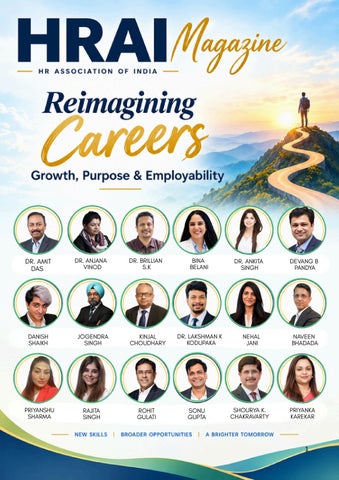
DR. AMIT DAS
DR. ANJANA VINOD
DR. BRILLIAN S.K
BINA BELANI
DR. ANKITA SINGH
DEVANG B PANDYA
DANISH SHAIKH
JOGENDRA SINGH
KINJAL CHOUDHARY
DR. LAKSHMAN K KODUPAKA
NEHAL JANI
NAVEEN BHADADA
PRIYANSHU SHARMA
RAJITA SINGH
ROHIT GULATI
SONU GUPTA
SHOURYA K. CHAKRAVARTY
PRIYANKA KAREKAR
1
WELCOME TO THE LATEST EDITION OF
HRAI Magazine REIMAGINING CAREERS – GROWTH, PURPOSE & EMPLOYABILITY
PREVIOUS EDITIONS:
READ NOW
READ NOW
READ NOW
READ NOW
READ NOW
READ NOW
READ NOW
READ NOW
READ NOW
READ NOW
CHECK OUT ALL THE EDITIONS 2
FROM THE FOUNDER'S DESK "WE USED TO ASK PEOPLE TO FIT INTO CAREERS. NOW WE MUST BUILD CAREERS THAT FIT INTO PEOPLE's LIVES. THAT IS THE REAL REIMAGINATION." Reimagining Careers is not a theme, it's our responsibility. When we started HRAI, the idea was simple - to create a community where HR doesn't just discuss policy, but shapes the future of work in India. Today, as you hold this edition in your hands, that future is already here. For decades, we told our people that a career is a ladder. Study, get a job, get promoted, retire. That ladder has collapsed. Today, a career is a landscape - vast, non-linear, full of possibilities. You can build multiple paths, take a pause, pivot, learn, unlearn, and start again. That is why we chose this theme: Growth, Purpose & Employability. Growth is no longer just vertical. The real growth today is lateral - in skills, in mindset, in resilience. Purpose is what this generation is demanding. They don't just ask "What will I get?" They ask "Why should I do this?" If we as organisations cannot answer the 'why', we will lose the 'what'. And Employability is our shared promise. It is not the responsibility of an individual alone. It is the responsibility of industry, academia, and us as HR leaders to keep talent future-ready.
Dr. Ankita Singh Founder, HR Association of India Chief People Officer & Board Member
In this edition, I am joined by 17 incredible leaders who have brought their diverse perspectives on how careers are being reshaped across industries. I am truly happy and honoured to share space with them in this edition. Their insights are honest, practical and deeply human - from building new skills to creating broader opportunities. I am grateful to each one of them for being part of the HRAI family and making this edition meaningful. As a Founder, and also as a Chief People Officer and Board Member, I live this duality every day. As a Founder, I dream of what HR can become. As a CPO and Board Member, I deal with what HR must deliver today - balancing business growth with human growth. What I have learnt on both sides is the same: the best retention strategy is not a policy, it's purpose. And the best career plan is not a promotion chart, it's continuous learning. This magazine is our attempt to bring those two worlds together. I hope as you read it, you don't just read it as an HR professional, but as someone who is also reimagining your own career. Thank you for being part of HRAI. Thank you for believing that we can build a brighter tomorrow, together.
3
4
5
TABLE OF CONTENT 8
DR. AMIT DAS
12
DR. ANJANA VINOD
18
DR. BRILLIAN S.K
DIRECTOR & CHRO, BENNETT COLEMAN & CO. LTD.(THE TIMES OF INDIA)
IMAGE CONSULTANT & CORPORATE TRAINER
EXECUTIVE VICE PRESIDENT & CHIEF PEOPLE OFFICER, TIMESPRO
24
BINA BELANI CHIEF PEOPLE OFFICER,ASCEND TELECOM INFRASTRUCTURE
28
DR. ANKITA SINGH FOUNDER, HR ASSOCIATION OF INDIA
34
DEVANG BHANUSHANKAR PANDYA
40
DANISH SHAIKH
48
JOGENDRA SINGH
54
KINJAL CHOUDHARY
64
DR. LAKSHMAN KUMAR KODUPAKA
70
NEHAL JANI
GENERAL MANAGER-HRA, ANALYTIX SOLUTIONS
HEAD-HR CENTRE OF EXCELLENCE,ACG CAPSULES
PRESIDENT & GROUP CFO, HERO CORPORATE SERVICE P LTD
GLOBAL PRESIDENT – HUMAN RESOURCES, CADILA PHARMACEUTICALS LIMITED
AVP-DIGITAL HIRING,SUTHERLAND
CHIEF PEOPLE OFFICER, SPACE-O TECHNOLOGIES
CONGRATULATIONS
16 AI TRANSFORMATIONAL LEADERS POWERLIST 2026
74
NAVEEN BHADADA
78
PRIYANSHU SHARMA
82
RAJITA SINGH
88
ROHIT GULATI
96
SONU GUPTA
102
SHOURYA K. CHAKRAVARTY & PRIYANKA KAREKAR
CHIEF FINANCIAL OFFICER, SUGAR BRANDS PVT LIMITED
DIRECTOR - RECRUITMENT SALES & STRATEGIC PARTNERSHIPS, YITRO GLOBAL PVT LTD
CHIEF PEOPLE OFFICER INDIA, KYNDRYL
DIRECTOR MARKETING-INDIA & SOUTH ASIA, JOHNSON & JOHNSON
FOUNDER & CHIEF HUMAN RESOURCE OFFICER, CODERSBRAIN
CHIEF HUMAN RESOURCE OFFICER, VICE PRESIDENT-HUMAN RESOURCES,CSR,CAREER SERVICES & DEVELOPMENT, APTECH LIMITED
COLUMNS 92
SUMIT AGARWAL LINKEDIN TOP VOICES
Sumit Agarwal is a global DEI Advisor to Fortune 500 companies and a trailblazer in Diversity, Equity & Inclusion. As the SDG Ambassador for Diversity and Inclusion and a Mentor of Change with NITI Aayog, he brings a unique blend of empathy and innovation to his work. Known for using LEGO® SERIOUS PLAY®, Design Thinking, and visual facilitation tools like Moth Cards and Liberating Structures, Sumit has conducted 350+ sessions worldwide. A UN-certified inclusion expert and motivational speaker, he transforms complex DEI concepts into actionable strategies that inspire inclusive leadership and lasting organizational change.
KHANDUJA 60 HARJEET SVP- HR, JIO Harjeet Khanduja is an international speaker, author, poet, influencer, inventor and an HR leader. He is also known as RK Laxman of Business. He is currently working as the Senior Vice President HR at Reliance Jio. He has 4 published patents and authored 9 bestseller books. Harjeet has been a LinkedIn Power Profile, TEDx speaker, Guest Faculty at IIM Ahmedabad and XLRI, Board Member of Federation of World Academics, Global Thought Leader, Global Digital Ambassador. Harjeet features in Top 200 Global Leadership Voices and ET Top 20 HR Influencers.
DR. AMIT DAS DIRECTOR & CHRO, BENNETT COLEMAN & COMPANY LTD. (THE TIMES OF INDIA)
Most large organisations have, over the past few years, announced a version of the same intention. Careers are no longer ladders. Talent should move across the business rather than up a single line. Skills matter more than titles. I agree with all of it and have argued much of it myself. What is striking is how little changes underneath. I have watched this in five industries now, and the pattern rarely varies. We revise the language of careers without revising the systems that decide them, and employees work out the difference long before we do. The structure most of us inherited is a pyramid: a single route upward, with fewer positions available at each level. What the business now requires is closer to a lattice, in which capability moves laterally and diagonally at least as often as it rises. Making that real requires four choices: define work through capabilities rather than titles, remove the penalty managers incur when good people move, make career guidance widely available, and invest in employability before a skill gap becomes urgent. Growth has to mean more than promotion A lattice will not earn employees' confidence if lateral movement is simply a new name for more work at the same level and pay. Growth can mean deeper capability, broader experience, greater autonomy, stronger earning potential or movement into work that will remain valuable. Promotion remains one form of growth, but it cannot be the only form an organisation recognises or rewards.
DR.AMIT DAS
The unit of a career is no longer the role A role is a container. Its title, grade and reporting line tell you little about what the person in it can actually do. An internal marketplace is only as good as the vocabulary beneath it. If roles remain fixed boxes rather than collections of capabilities, the marketplace becomes a list of vacancies that makes sense only to people already qualified for them. We encountered this when designing our gig ecosystem. We scored roles across revenue, editorial, engineering and enabling functions against five weighted parameters, and fortyfive emerged as genuinely convertible to a flexible model. The exercise was about contracting. The lesson was about careers: the role and the work are separable, though our structures had assumed for decades that they were not. Mobility fails at the releasing manager The employee wants to move. The receiving manager wants the capability. The releasing manager carries the cost: a gap in the team, a target that does not move and a replacement to find. Faced with that arithmetic, the manager is behaving sensibly rather than badly. The move is discouraged gently, or agreed in principle and never quite scheduled. I did it myself as a younger leader and told myself it was about continuity. Building and releasing talent must therefore carry weight in how we assess a leader. Internal notice periods need clear limits held by HR rather than negotiated between two managers of unequal standing.
9
The releasing team may need temporary capacity, and disputed moves need an independent decision. Until the manager who develops and releases strong people is better regarded than the one who quietly keeps them, the lattice stays a diagram. Career conversations rationed
cannot
remain
For most of my career, a real career conversation, where what a person wanted shaped what happened next, was something we could do properly for perhaps forty people a year. Everyone else received a form and a rating. Attention was the scarce resource; we rationed it and called the rationing talent management. That constraint is lifting. Used well, AI can help a person describe transferable capabilities, explore adjacent work and find projects through which to close gaps. It can make a career conversation better prepared and more widely available. It cannot decide what a person should become, ensure that an opportunity is fair or compensate for a manager who will not let someone move. Those remain human and organisational responsibilities. Employability is built forward Employability is usually assessed backwards, from what a person has already done and the qualifications they hold. It is more useful looked at forwards. Capability investment has to begin eighteen months before the need becomes obvious, not six months after it has. Our planning still tends to begin where something is already hurting.
DR.AMIT DAS
IBM’s 2026 CHRO Study shows skill erosion is a top concern for 46% of executives, while 60% of employees say it directly affects them. Organisations need new skills, but they must also protect the judgement and critical thinking through which experience is built as AI takes on more routine work. Some of my most instructive conversations this year were with support staff and facility colleagues who had learnt to use AI on their own phones, by voice and in their own languages, months before we formally taught anyone. The AI literacy programme we are building for our indirect workforce exists because of what they had already begun. A growth path open only to people holding degrees and designations is not a growth path. It is a privilege. The question beneath the others Employees rarely ask about their career path in those words. They ask whether they are still learning, whether the work counts for anything and, less often aloud, whether there is a version of themselves in this organisation five years from now that they would want to be. That last question is what purpose means in a career. It is the ability to connect today's work with a contribution that matters and a future a person can picture themselves inside. Systems cannot manufacture that purpose. They can give people agency and a fair chance to build towards it, or quietly make it unreachable.
10
What this asks of us None of this requires a new philosophy of work. It requires someone senior enough to change compensation bands, job architecture, mobility rules, learning investment and the way managers are assessed, and willing to spend real capital doing it. That is harder than adopting a framework, which is why most organisations settle for the framework. Three questions expose the difference. Can employees describe their capabilities independently of their job titles? Does a manager gain standing when good people move into larger roles elsewhere in the organisation? Are learning investments based on the work the business will need next, or only on shortages that already exist? Careers will be reimagined over the coming years, by design or by attrition. The choice is whether we change the systems while people still have time to build a future through them, or explain the change after their options have narrowed. Employees will know which choice we made long before the framework says so.
ABOUT THE AUTHOR Amit is a Global Thought Leader & HR Visionary with a career spanning 37+ years, shaping future-ready organizations across diverse industries through leadership transformation, cultural coherence, agile workforce capability, and tech-enabled people architecture. Over the years, he has held leadership roles with marquee organizations including Tata Motors, CESC Ltd, Britannia Industries, Vodafone, RPG Group and Reliance Group, bringing deep expertise in building scalable people systems and resilient performance cultures. Currently he holds the position of Director & CHRO, Bennett Coleman & Company Ltd (The Times of India), India’s largest media conglomerate with multiple power brands across print & publishing like The Times of India, The Economic Times, Navbharat Times, Maharashtra Times to name a few. He is also a Director & Board Member in Metropolitan Media Company Ltd. (MMCL), the media house of Vijay Karnataka & Bangalore Mirror. Amit is a trusted strategic partner and credible advisor to shareholders, promoters, and business leaders, known for enabling human-capital-led enterprise value creation and leading organization-wide transformation during pivotal phases of innovation-led growth and transition. He is an Engineering & Management graduate, alumnus of the Kellogg School of Management, and PhD from KIIT School of Management. He is an active member of multiple Think Tanks with Central & State Government bodies, contributing to national skill building and steering India’s evolving talent, skills, and workforce agenda, including participation in key initiatives and platforms, spanning both economic and social dimensions of workforce development and reflecting a deep commitment to aligning economic growth with employability, inclusion, and long-term workforce resilience. Beyond corporate and public policy leadership, he serves as Advisory Board & Governing Council Member across leading academic institutions, strengthening the industry– academia bridge to build next-generation capabilities that will power India’s rapid growth in the global economic landscape.
DR.AMIT DAS
11
DR. ANJANA VINOD IMAGE CONSULTANT & CORPORATE TRAINER
From Ladders to Repertory: Reimagining Careers for a Future That Won't Sit Still Lately I've been working with a diamond design house in Mumbai, and I've been fascinated by the craft. A diamond cutter never adds brilliance to a stone. The brilliance is already inside. The cutter's job is to find the right angles, the facets that let light in and send it back out. I've come to believe that's the most useful way to think about careers today. Organizations can't manufacture talent. But they can decide whether to keep it rough and hidden or cut it so it catches the light. The ladder has left the building For most of the last century, a career looked like the Mumbai local's slow line: Churchgate to Virar, every station in order, no skipping. You joined, you waited, you moved up one rung at a time. Loyalty was the ticket and tenure was the timetable. That train still runs, but hardly anyone wants to ride it end to end. Today's professionals want to switch to the fast line when they're ready, change platforms at Dadar, and sometimes get off at a station nobody had planned for. Roles are being reshaped by AI, skills now go stale in a few years instead of a few decades, and the people we most want to keep are the ones with options elsewhere. So the question for organizations has changed. It used to be "How do we move people up? " Now it's "How do we help people move, full stop?"
The expertise trap Consider the story I see in boardrooms again and again. I recently designed a program called Leadership Beyond Expertise for the heads of a global manufacturing group. Every person in that room had earned their seat by being brilliant at something technical. And every one of them was now being asked to succeed at something entirely different: leading, influencing, letting go. This is the quiet tragedy of the traditional career path. The only way up is to stop doing what you love and start managing people who do it. We lose great specialists and gain reluctant managers. Progressive organizations are fixing this with dual career tracks, where a master engineer can grow in influence and reward without being forced into people management. They're also creating "expertise-plus" roles, where depth is honoured and leadership becomes a choice rather than a toll gate. 13
DR.ANJANA VINOD
What theatre taught me about careers My doctoral work was in Theatre in Training, and the theatre offers the best metaphor I know for internal mobility. In a repertory company, the same actor might play the king on Monday, the fool on Wednesday, and the messenger on Friday. Directors deliberately cast against type, because stretching the actor makes the whole company stronger. In most corporations, by contrast, we typecast. Once you've been the finance person or the plant person for eight years, that's the only role anyone will audition you for. Internal talent marketplaces are essentially a casting board. They let people raise their hands for projects, gigs, and stretch assignments across departments. The technology is the easy part. The hard part is the director, meaning the manager who "hoards" a star performer because losing them would hurt this quarter's numbers. Until managers are rewarded for exporting talent rather than keeping it, the best marketplace platform will simply be a very expensive notice board. Purpose is the new promotion Every year I work with young graduates stepping from campus into corporate life, including through HPCL's Campus to Corporate program. What strikes me about this generation is how early they ask about meaning. The designation matters to them, but they also want to know what they'll learn, who they'll become, and whether their work will count for something.
DR.ANJANA VINOD
I see the same hunger at the other end of life's spectrum. As a coach to women navigating cancer, I've watched women come back to work with a completely redrawn map of what matters. Few of them want to go back to "more of the same." They want work that fits their values, not just their CVs. Organizations that treat growth purely as a salary increase or a new title will keep losing people to those that offer meaningful growth journeys: mentoring, cross-functional exposure, social impact projects, and conversations about purpose that happen well before the exit interview. Employability: the promise that outlasts the job Here's the uncomfortable truth. No organization can promise lifetime employment anymore. What it can promise is lifetime employability:
"While you're with us, you'll become more valuable, not just to us, but to the world." I can speak to this from experience. In over 30 years, my own path has taken me through corporate training, a PhD, a TEDx stage, two Guinness World Records, and a crown at Mrs. India International Classic in 2023.
14
No org chart would ever have drawn that path. My career hasn't been a ladder. It has been a series of reinventions, each one building on the last. The paradox is that people who are made employable tend to stay longer. When people feel they're growing, they have little reason to leave. The R.O.L.E. framework for reimagined careers For leaders and HR teams ready to act, I offer a simple framework: R – Reveal skills, not just titles. Map what people can actually do, including hidden talents from hobbies, volunteering, and past lives. O – Open the gates. Build marketplaces, gigs, and lateral moves, and make a sideways step a badge of honour rather than a sign of failure. L – Let managers be talent exporters. Measure and reward leaders for the people they grow and release. E – Embed purpose in every stage. From the fresher to the senior head, make "why these matters" part of every growth conversation. Back to the cutting table A rough diamond and a brilliant one are the same stone. The difference is attention, skill, and the courage to cut new angles.
DR.ANJANA VINOD
Your people already carry the light. The real question is whether your career architecture lets it shine through or keeps it locked inside a ladder nobody wants to climb anymore.
ABOUT THE AUTHOR Dr Anjana Vinod: A Masterclass in Positive Leadership a two-time TEDx speaker, published author, and Amazon bestseller, Dr Anjana Vinod is a distinguished learning and development professional, executive coach, and leadership facilitator with over thirty years of experience across multiple sectors, including banking, pharma, manufacturing, IT, retail, entertainment, and government. She is recognized as one of India's leading breast cancer coaches for women and holds two Guinness World Records and several prestigious honors. She has a graduate degree in Economics from the University of Mumbai and is an alumna of the Management Development Program at IIM Bangalore. She holds a PhD with a specialization in Theater in Training, demonstrating her inimitable experiential and human-centred approach to learning. She is a certified Emotional Intelligence Assessor from 6 Seconds in the UK and a certified POSH Assessor. Having facilitated transformative sessions for over two lakh professionals across India and internationally, Dr Vinod has made a significant impact on many lives. She specializes in outbound training programs, women's development initiatives, and faculty development programs, and has worked extensively with diverse audiences, including the Mumbai Police Force and professionals from the Income Tax Department. She has also been invited by the Armed Forces Women's Wing for her remarkable, positive approach to life. Dr Vinod was crowned Mrs India International 2023 and is a three-time national awardee, including the Dr A.P.J. Abdul Kalam, Sardar Patel, and Sir Ratan Tata Awards, in recognition of her contributions to education, women's empowerment, and breast cancer awareness. She has featured on the cover page of Passion Vista and international business magazine as the Most Admired Global Indian. Her most recent accolade includes featuring in the 17th Edition of FORBES Asia, BHARAT 2.0 recognition and a impactful L&D professional and being a part of the Pink Parliament a government of India Nari Shakti 15 initiative.
AI TRANSFORMATIONAL LEADERS 2026 POWERLIST Celebrating the leaders shaping the future of work through vision, trust, and impact.
The HRAI AI Transformational Leaders Powerlist 2026 celebrates visionary professionals who are redefining the future of work through responsible AI adoption, strategic innovation, and people-first leadership. These leaders connect technology with human potential to build agile organisations, strengthen employee experience, and deliver sustainable business impact.
Their journeys reflect courage, curiosity, ethical decision-making, and a commitment to preparing people and workplaces for an AI-enabled future.
HRAI proudly recognises these changemakers for advancing business, people, and society through purposeful transformation.
HR Association of India (HRAI) proudly recognises these outstanding professionals for their visionary leadership, responsible AI adoption, and transformative contributions to business, people, and society through the AI Transformational Leaders Powerlist 2026.
Congratulations
DR. BRILLIAN S.K EXECUTIVE VICE PRESIDENT & CHIEF PEOPLE OFFICER,TIMESPRO
“For years, the career deal was simple. Stay loyal, climb the ladder, retire happy. Today, our best people do not ask "What is my next title?" They ask three things. Am I growing, do I matter, am I becoming more valuable here? The ground reality is this, as a growing company, not everyone can afford higher pay packages. But we can grow people better than they do. Here is how we could reimagine careers. These moves are small. They can be copied without much effort or money. 1.The Queen does not climb In chess, the pawn moves one square at a time. Straight, slow, and fully predictable. The queen is different. She moves in any direction. Forward, sideways, diagonally. That is the career talent wants today. Growth is not always upwards, sometimes it is sideways, sometimes it is a jump to a new part of the board. What we can do is create opportunities. List a few growth moves that do not need a new title or additional spends. It could be a stretch project, a cross team collab, or a mentoring role. This builds credibility and lets talent know we are listening and keen to see them grow. 2.Create a ‘Skills Exchange Program’ We do not need costly software to build one. We just need people to see each other. Build and run an internal Skills Exchange Program. It could be a simple channel. Teams can post a short term skill need. People can post what they want to learn. When a match happens, a skill is gained. The cost is close to zero.
3.Make inside moves the first move Think about the pawn, to reach the other side and become a queen, it must move one square at a time. It faces blocks. It faces capture. It takes forever. Many pawns never make it. That is how most companies treat growth. You wait your turn, you fight for one small step, you hope one day you get there. We do not want our talent to feel like pawns. We want them to move like queens. So every open role should go to our people first, for five days. A person should not wait years for a chance to grow. The board should be open for all. This is one of the toughest things to do. Start small and see the difference. Buy in from the sending and receiving team managers should be a must have. 4.Connect purpose to real people Purpose is not a poster on the wall. It is seeing the work change something real. Link every role to one success story each quarter. At the next all hands meet, ask someone to share how their work helped one customer. Success stories are great. We should also explore lessons learnt, so others do not make the same mistakes. 5.Track employability Shift beyond engagement, we need to move from "Are you happy?" to "Are you worth more than last year?" The move to being employable, even internally, is a great way to showcase growth and purpose through employability. 19
DR.BRILLIAN S.K
6.Partner for growth. Inside moves and skill markets are a strong start. But talent also needs new skills from outside the board. This is what we at TimesPro do. We work with leading universities and industry experts to offer certified programs. These cover new age skills like data, digital, fintech, and leadership. As an upskilling partner, we help design learning paths that fit your roles. We also help people earn credentials that matter in the market. Often people ask, why do we need upskilling and reskilling? We are doing so well. The answer is simple. Jobs are changing fast. A skill that got someone hired three years ago may not be enough today. New tools arrive, new roles appear, old roles shift. If our people do not learn, they lag. If they lag, they feel stuck. Upskilling means learning new skills for the same role to stay relevant. Reskilling means learning skills for a different role. Both are needed to keep our talent future fit and engaged. A partner makes this simple by bringing the content, the experts, and the credibility. Learning must become a habit, not a one-time event. Cliched as it may be, people do not leave companies. They leave stuck versions of themselves. A pawn waits and hopes. A queen moves and grows. When you build careers around growth, purpose, and employability, you do more than keep talent. You become the place where talent grows through. That is a name no salary can buy, and it starts with one talk this week. Let us build careers worth staying for and leaving better than we found them.
20 DR.BRILLIAN S.K
ABOUT THE AUTHOR
ABOUT THE AUTHOR
Dr. Brillian S. K. Executive Vice President & Chief People Officer | C-Suite People Strategy Leader | Culture Architect | Leadership Advisor | Human-Centered Experience Curator A transformational HR leader With over 27 years of experience, Dr. Brillian S. K. is a transformational HR leader known for shaping high-performing, people-centric organisations. His unique transition from engineering to human resources has enabled him to drive impactful people strategies across IT, BFSI, Education, and Logistics, with leadership roles at TimesPro, Aptech, BNP Paribas, CRISIL, and SP Jain Global. A respected thought leader, author, speaker, and Gallup-Certified Strengths Coach, he is passionate about leadership, workplace culture, employee well-being, and futureready organisations. His contributions have earned him prestigious recognitions, including Maharashtra's Top HR Visionary Leader 2025, the Top 10 Global CXO Excellence Award 2024, and the REX Karamveer Gold Fellowship 2024. Beyond the corporate world, Dr. Brillian actively mentors emerging HR professionals and is a strong advocate for diversity, inclusion, and leadership development. Through initiatives such as the #LeaderSlip podcast and #BrillianTips, he continues to inspire leaders to build workplaces where people and organisations thrive together.
DR.BRILLIAN S.K
21
22
23
BINA BELANI CHIEF PEOPLE OFFICER, ASCEND TELECOM INFRASTRUCTURE
The C-Suite career is no longer a destination. It is a continuing proposition of relevance. For much of corporate history, a senior career followed a recognisable arc: build functional expertise, take on larger teams, move into enterprise leadership and, eventually, reach the C-suite. Success was often measured by the scale of the role, the size of the organisation, the title and the number of years spent at each level. That model is changing. Today, even the most experienced executives operate in an environment where business models are being reinvented, technology is altering the nature of work, stakeholder expectations are shifting and leadership tenures are becoming more fluid. Research in 2026 increasingly points to the same reality: senior leadership roles themselves are being reshaped by AI, changing operating models and faster business cycles. The implication for senior professionals is profound. A successful career can no longer be built simply by accumulating experience. It must be continuously renewed through relevance. At the senior-most levels, careers are rarely linear anymore. A CFO may become a transformation leader. A CHRO may increasingly be expected to shape workforce strategy, productivity and business transformation. A technology leader may become central to business strategy. A business head may need to understand AI, digital ecosystems and new models of value creation far beyond their traditional mandate. The question is therefore no longer, “What is my next role?”. It is: “What problems can I solve for the organisation next?”. That is a fundamentally different way of thinking about a career.
The strongest CXO careers are increasingly defined by range - the ability to move beyond functional expertise and understand the enterprise as a whole. Business acumen, technology fluency, financial understanding, stakeholder management, risk awareness, people leadership and strategic judgement are becoming increasingly interconnected. This does not mean that functional depth has become less important. Quite the opposite. Functional credibility remains the foundation. But at the C-suite level, depth gets you into the room; enterprise perspective determines the value you create in that room. We often equate career growth with a larger title, a larger team, a larger geography or a larger compensation package. For senior leaders, growth can take a different form. It may mean moving from functional leadership to enterprise leadership. It may mean taking responsibility for a transformation that has no established playbook. It may mean working across markets or businesses. It may mean taking a difficult mandate that requires rebuilding an organisation, integrating cultures, improving productivity or preparing the business for a fundamentally different future. Sometimes, the most significant career move is not a promotion. It is a move into greater complexity. This is where purpose becomes important. At senior levels, professionals increasingly want their careers to answer a deeper question: What difference am I actually making?
25 BINA BELANI
Purpose does not have to mean a social cause disconnected from business. Purpose can be found in building a sustainable business, creating employment, developing leaders, improving customer outcomes, strengthening governance, building an inclusive organisation or transforming an industry. For a CXO, purpose is often expressed through the enterprise one leaves behind.
I believe the currency of senior leadership is moving from experience to experience + relevance + judgement. Experience tells us what has happened before. Data tells us what is happening now. Technology helps us understand what could happen next. But judgement determines what we should actually do. That distinction matters enormously.
There is another aspect of career reinvention that deserves greater attention: employability. Employability at senior levels is not about keeping one's résumé updated. It is about ensuring that one's value proposition remains relevant to the problems businesses are trying to solve. The pace of change has made this more important than ever.
As AI becomes embedded into executive decision-making and business processes, leadership will not become less human. It will demand better judgement. Current research on the C-suite increasingly points towards leaders needing to combine technology understanding with strategic thinking, decision-making and the ability to lead people through uncertainty. The executive who knows every technology but cannot distinguish value from hype will struggle. The executive who understands the business but refuses to evolve will eventually become less relevant. And the executive who constantly chases every new trend without understanding the business context will create activity without necessarily creating value. The future belongs to leaders who can connect the three: technology, business and people.
For senior executives, this creates a responsibility to continuously ask: Do I understand how my industry is changing? Can I translate technology into business value? Do I understand the financial consequences of my decisions? Can I lead transformation rather than simply participate in it? Am I developing leaders who can succeed without me? Can I operate effectively with a Board, investors, customers and multiple stakeholder groups? Have I built a reputation beyond my current organisation? These are not questions for the final years of a career. They are questions that should accompany every stage of senior leadership.
This also changes the role of organisations. If organisations want future-ready leadership, they cannot treat careers as a series of promotions administered through an annual talent review. They need to create enterprise careers - careers that allow senior leaders to take on different businesses, functions, geographies, transformation mandates and strategic challenges. Succession planning should therefore not simply ask: “Who can replace this leader?” 26
BINA BELANI
It should ask: “What capabilities will this organisation need in three to five years? and where will those leaders come from?” Similarly, talent reviews should look beyond performance in the current role. A high-performing CXO may not necessarily be ready for a broader mandate today - but may have the learning agility, enterprise orientation and leadership capacity to grow into one tomorrow. That is where thoughtful career architecture becomes a strategic advantage. Perhaps the biggest shift is psychological. A Csuite title is not the culmination of a career. It is another platform from which to learn, contribute and reinvent. The most enduring executive careers are not built by holding on to relevance from the past. They are built by creating relevance for the future. That requires humility to unlearn, curiosity to keep learning, courage to take on unfamiliar problems and discipline to remain connected to the fundamentals of business. Ultimately, reimagining careers is not about asking how far we can climb. It is about asking: How much value can we continue to create as the world around us changes? Because at the highest levels of leadership, career growth is not measured only by where we go next. It is measured by how relevant we remain, how many people we enable to grow, and how much stronger we leave the organisation because we were there. That, to me, is the real intersection of Growth, Purpose and Employability.
ABOUT THE AUTHOR Bina Belani is the Chief People Officer at Ascend Telecom Infrastructure and an award-winning HR leader with over two decades of experience across telecom, technology, mining and global organizations. She has held leadership roles with Reliance Jio, Vedanta Resources, Wipro, and SLK Software, driving transformation across talent, culture, learning and organizational effectiveness. Recognized as CHRO of the Year and among India's Top HR Icons, Bina is passionate about building highperformance, human-centred workplaces. A published author of Lighthouse Chronicles, she is a soughtafter speaker on leadership, future skills, AI in HR and the future of work. Her leadership philosophy is centred on creating cultures where people and performance thrive together.
27 BINA BELANI
DR. ANKITA SINGH FOUNDER, HRAI
For decades, the career promise was relatively straightforward. Join an organisation, perform well, gain experience, move into a bigger role and gradually climb the hierarchy.
G: Growth Beyond the Next Designation
That promise is becoming harder to sustain.
For too long, we have conditioned employees to see upward movement as the primary evidence of progress. A new title means growth. A larger team means growth. A promotion means success.
Organisations are becoming flatter, skills are changing faster, roles are being redesigned and AI is altering how work gets done. At the same time, employees are asking different questions. They are not only asking, “When will I be promoted?” They are asking, “What am I learning?”, “Where can I go from here?”, “Will my skills remain relevant?” and increasingly, “Does this work still mean something to me?” This requires us to rethink what career growth actually means. The World Economic Forum’s Future of Jobs Report 2025 estimated that 39% of workers’ existing skill sets will be transformed or become outdated by 2030. It also found that 85% of employers planned to prioritise upskilling their workforce. These numbers tell us something important. Career development can no longer be treated as an occasional HR initiative. It is becoming a business continuity requirement. The new career proposition needs to move beyond promotion and focus on GROW: Growth, Relevance, Opportunity and Worth.
DR.ANKITA SINGH
One of the biggest changes organisations need to make is separating growth from designation.
But organisations cannot create a bigger designation for everyone every two years, nor should they. Growth can mean deeper expertise, broader responsibility, exposure to a new industry, participation in a strategic project, movement into another function, international experience or the opportunity to build an entirely new capability. LinkedIn’s 2025 Workplace Learning Report found that organisations with mature career development practices were more likely to be confident about profitability and their ability to attract and retain talent. The message is increasingly clear. Employees need to be able to see movement even when that movement is not upwards.
“A career should not stop growing simply because the organisation runs out of titles.”
29
This requires a change in both organisational systems and employee expectations. We need career architectures that show multiple possibilities rather than one predetermined ladder. Sometimes the most valuable career move is sideways. Sometimes it is deeper. Sometimes it is a stretch assignment that does not change the designation at all but changes the person’s capability significantly. That is still growth. R: Relevance as the New Career Security There was a time when career security came largely from tenure, experience and organisational knowledge. Today, those remain valuable, but they are no longer sufficient. The more sustainable form of career security is relevance. As technology changes roles, employees need to continuously ask whether their skills are becoming more valuable, remaining stable or slowly becoming obsolete. Organisations have an equally important responsibility to help employees answer that question before the market answers it for them This is where skills-based workforce planning becomes critical. Traditional job descriptions tell us what somebody is expected to do today. A skills architecture helps us understand what people can do, what adjacent capabilities they possess and what they need to learn next.
DR.ANKITA SINGH
AI makes this increasingly possible. Organisations can map skills, identify adjacent capabilities, recommend learning pathways and connect people with opportunities that may never have appeared in a conventional career discussion. But technology alone will not solve the problem. Employees need time, access, encouragement and real opportunities to apply what they learn.
“The strongest career promise an organisation can make today is not that you will always have the same job. It is that we will help you remain relevant for the jobs that come next.” That is a very different employment proposition. O: Opportunity Should Be Visible Many organisations have more opportunities than employees realise.
career
Projects need support. Teams need temporary expertise. New capabilities are being built. Leadership roles emerge. Cross-functional initiatives need volunteers. Yet employees often discover these opportunities through informal networks rather than transparent systems. This is where internal talent marketplaces can fundamentally change career development.
30
Instead of viewing talent only through current roles, organisations can create platforms where employees discover projects, gigs, mentors, open positions, learning assignments and stretch opportunities based on their skills and aspirations.
A mature talent culture celebrates managers who develop people for the organisation, not only managers who retain people for themselves.
Internal mobility is also becoming increasingly important for retention. LinkedIn has repeatedly highlighted internal mobility and career development as significant elements of employee retention and organisational agility.
Career conversations cannot focus only on skills and opportunities. People also want to feel that their work has worth.
Yet internal mobility requires more than publishing vacancies. Managers have to be willing to release good people. This is often the hidden barrier. Organisations say they support mobility, but managers naturally want to retain their strongest performers. Talent then becomes trapped inside teams. That is not talent retention. It is talent restriction.
“If your best people can grow only by leaving your team, eventually they may grow by leaving your organisation.”
W: Worth, Purpose and Meaningful Progress
Purpose does not have to mean changing the world. It can mean solving a difficult customer problem, building something useful, mentoring another employee, improving a process or seeing how one’s work contributes to a larger organisational outcome. The challenge is that organisations often communicate purpose at the corporate level while employees experience work at the task level. The connection between the two has to become visible. Managers play an important role here. A meaningful career conversation should go beyond, “What role do you want next?” It should explore what the employee enjoys, what they are good at, what they want to learn, what energises them and where those interests intersect with organisational needs. That intersection is powerful because sustainable careers cannot be designed entirely by HR, managers or employees individually. They have to be co-created.
DR.ANKITA SINGH
31
From Career Paths to Career Possibilities
The future of careers will therefore depend on
Perhaps we need to stop talking about career paths altogether.
GROW: Growth that goes beyond designation, Relevance that strengthens employability, Opportunity that makes movement possible, and Worth that gives progress meaning.
A path suggests that the destination is known and the route is relatively predictable. Modern careers look very different. They may include lateral moves, career pivots, specialist roles, leadership assignments, project-based work, periods of reskilling and roles that do not even exist today. Organisations therefore need to create career possibilities rather than rigid career paths. That means making skills visible, opportunities accessible and career conversations continuous. It means rewarding managers for developing talent beyond their own teams. It means giving employees greater ownership while providing the infrastructure that allows them to act on that ownership. Most importantly, it requires us to rethink the psychological contract between employer and employee. Organisations may no longer be able to promise lifetime employment. What they can promise is meaningful experience, continuous learning, fair access to opportunities and the chance to leave every role more capable than when the employee entered it.
The organisations that understand this will not necessarily retain every employee forever. That should not be the objective. The objective should be to create an environment where talented people continue to choose the organisation because they can see a future for themselves within it.
“The best career is not necessarily the one that keeps moving upwards. It is the one that keeps moving you forward.” In a world where roles will continue to change, that may become the most meaningful definition of career growth.
Employees, in return, need to take greater responsibility for keeping themselves relevant. Career ownership cannot sit entirely with the organisation.
DR.ANKITA SINGH
32
ABOUT THE AUTHOR
ABOUT THE AUTHOR
Dr. Ankita Singh is the CPO & Board Director, CIGNEX & Relevance Lab. With 22+ years in HR, primarily in the ITES sector, Ankita has driven transformation through performancedriven practices and inclusive culture. At CIGNEX, her leadership helped the company earn multiple “Great Place to Work” certifications (2017–2021). She has been recognized as “Woman Leader of the Year” by The Times of India Group and featured in Forbes India’s “Top 100 Managers.” Ankita holds an MBA in HR+IT, an Executive MBA from SCMHRD, and a Ph.D. in Management. A respected voice in the industry, Ankita blends strategic insight with a passion for people development and culture building.
DR.BRILLIAN S.K
33
DEVANG BHANUSHANKAR PANDYA GENERAL MANAGER-HRA, ANALYTIX SOLUTIONS
For generations, careers were often viewed through a simple lens, getting a good education, securing a stable job, working hard, climbing the ladder, and success will follow. While that formula worked for many, the world of work has changed dramatically. Technology is reshaping industries, new roles are emerging faster than ever, and the expectations people have from their careers are evolving. Today, individuals across generations are asking deeper questions, not just about what they do for a living, but about why they do it and who they are becoming in the process. As someone who has spent years interacting with professionals at different stages of their careers, I have observed one common reality, while generations may express their aspirations differently, the desire to grow, contribute, and stay relevant is universal. Growth Beyond Titles and Promotions Traditionally, career growth was associated with promotions, larger responsibilities, and higher compensation. Those milestones continue to matter, but they are no longer the only indicators of success. In today's dynamic environment, growth is increasingly defined by one's ability to learn, adapt, and evolve.
Your career is not defined by how high you climb, but by how much you learn, how deeply you contribute, and how meaningfully you grow.
A professional who acquires new skills, embraces unfamiliar challenges, mentors others, or navigates change successfully is growing, even if their designation remains unchanged. Growth is no longer restricted to moving upward; it can also mean moving across functions, expanding expertise, or developing capabilities that prepare us for the future. Interestingly, different generations often view growth through slightly different lenses. Experienced professionals may value mastery, stability, and the opportunity to create a lasting impact.
DEVANG BHANUSHANKAR PANDYA
35
Younger professionals, particularly Gen Z, often seek continuous learning, diverse experiences, faster feedback, and opportunities to contribute meaningfully from an early stage. Yet the underlying aspiration remains the same, the desire to become better than we were yesterday.
This expectation is increasingly visible across the workforce. While younger generations may articulate it more openly, professionals across age groups seek meaning, recognition, and a sense of contribution. The language may differ, but the human need remains remarkably similar. People want to know that their efforts matter.
The organizations that will thrive in the future are those that recognize and support these varied definitions of growth. The Search for Purpose A few decades ago, a good career was often defined by financial security. Today, while financial stability remains important, many professionals are looking for something more: purpose. Purpose is not necessarily about pursuing extraordinary missions or changing the world. More often, it is about understanding how our work contributes to something meaningful. The recruiter who helps a candidate find a lifechanging opportunity, the manager who develops future leaders, the customer support executive who solves a critical issue, or the analyst whose insights help shape business decisions all contribute to outcomes that matter.
Progression follows demonstrated capability, not simply time spent in a role. When individuals can connect their daily work with a larger purpose, work becomes more than a collection of tasks. It becomes a source of fulfillment.
DEVANG BHANUSHANKAR PANDYA
Employability: The New Career Security For many years, job security was often associated with long-term employment in a single organization. Today, career security is increasingly linked to employability. Employability is the ability to remain relevant, adaptable, and valuable in a rapidly changing world. The reality is that technologies, business models, and customer expectations will continue to evolve. Roles will transform. Skills will become obsolete and new capabilities will emerge. In such an environment, continuous learning is no longer optional; it is essential. However, employability is not only about acquiring technical skills. Human capabilities such as communication, critical thinking, emotional intelligence, creativity, collaboration, and resilience are becoming equally important. Technology can automate tasks, but it cannot easily replicate empathy, judgment, curiosity, or the ability to build trust. The professionals who will remain employable are those who embrace learning as lifelong practice, regardless of their age, experience, or stage of career. After all, the future belongs not to those who know everything, but to those who are willing to keep learning.
36
A Shared Responsibility Career development is often viewed as an individual's responsibility, but sustainable career success is rarely achieved alone. Individuals must take ownership of their growth by staying curious, seeking feedback, and investing in their development. Managers must create opportunities, offer guidance, and encourage learning. Organizations must provide environments where people can experiment, grow, and discover their potential. This partnership becomes even more important in today's multi-generational workforce. There is immense value when experienced professionals share wisdom and context, while younger employees bring fresh perspectives, digital fluency, and new ways of thinking. The strongest organizations are not those that favor one generation over another; they are those that create opportunities for generations to learn from each other. When knowledge meets curiosity, both individuals and organizations benefit. Redefining Success for the Future Perhaps the most important lesson in reimagining careers is that there is no longer a single definition of success. For some, success may mean leading an organization. For others, it may mean becoming a subject matter expert, creating social impact, achieving work-life harmony, building a business, or mentoring future talent.
What matters is not whether our career journey looks like someone else's, but whether it enables us to learn, contribute, and grow in ways that align with our values and aspirations. As the future of work continues to evolve, one truth remains constant: careers are not destinations. They are journeys of continuous transformation. Regardless of generation, the professionals who will thrive are those who remain committed to growth, guided by purpose, and focused on strengthening their employability. Because in the end, a meaningful career is not defined by how high we climb, but by how much we learn, how positively we impact others, and how well we adapt to the opportunities and challenges that lie ahead.
“While every generation may define success differently, the desire to grow, find meaning, and remain relevant is universal. The language may change. The aspiration does not.”
Success is becoming increasingly personal.
DEVANG BHANUSHANKAR PANDYA
37
ABOUT THE AUTHOR
ABOUT THE AUTHOR
Devang Pandya is currently serving as General Manager-HRA, Analytix Solutions Ahmedabad, where he leads teams in Talent Acquisition, HR Business Partnering (HRBP), Payroll, and Compliance. With 18+ years of experience across diverse industries such as Information Technology, Manufacturing, and Pharmaceuticals, he has worked with leading MNCs and Indian companies. Throughout his career, Devang has been instrumental in managing mission-critical projects and providing strategic insights to drive business success. His passion for continuous learning, along with his dedication to developing and coaching teams, sets him apart as a leader. His expertise spans across HR Analytics, Organizational Development & Talent Management, Employee Engagement, Learning & Development, Leadership Development, and Coaching & Mentoring. He has served as Professor of Practice to Management institutes like, Adani Institute of Digital Technology Management, GLS – IMBA, Navarachna University, LJ University on HR related subjects. His leadership at Analytix encompasses talent acquisition, payroll, and compliance, with a core focus on strategic HRBP to align people initiatives with business outcomes. A true practitioner-academic, Devang is also a Ph.D. scholar and a Professor of Practice, sharing his expertise in HR management and analytics with the next generation of leaders at premier management institutes. DR.BRILLIAN S.K
38
“The future belongs to those who learn more skills and combine them in creative ways.” – Robert Greene
49
DANISH SHAIKH HEAD - HR CENTRE OF EXCELLENCE,ACG CAPSULES
Q What if the best career development programme you ever created made your best employee leave? It is not a question anyone in Talent Management particularly enjoys asking. We want people to grow. We invest in their skills, give them stretch assignments, expose them to different parts of the business, coach them, mentor them and prepare them for larger responsibilities.
What if we don't invest in them - and they stay? That question becomes particularly relevant when the World Economic Forum's Future of Jobs Report 2025 estimates that 39% of workers' existing skill sets will be transformed or become outdated by 2030. In that environment, employability is no longer simply an employee concern. It is an organisational capability issue.
And if we do all of that exceptionally well, something slightly inconvenient happens.
Yet many of our career systems still carry assumptions from a more predictable world.
They become more employable.
Join an organisation. Perform well. Accumulate experience. Move upwards.
Not just to us. To everyone else.
Career success was visible on an organisation chart.
Therein lies one of the more uncomfortable tensions in talent management:
Up meant progress. Sideways required explanation. Staying still meant stagnation.
Does investing in people's careers eventually make it easier for them to leave?
But organisations are becoming flatter, specialist careers more important, and skills more transient. Careers increasingly include projects, lateral moves, cross-functional assignments and experiences that may not come with a new designation.
Academic literature has a name for this - the Employability Paradox. But perhaps we have been worrying about the wrong side of the paradox.
Perhaps, then, organisations need to stop promising career paths.
What if we develop them and they leave? The traditional anxiety is familiar: What if we invest in them and they leave? There is, of course, an equally uncomfortable counter-question: DANISH SHAIKH
A path assumes somebody knows where it leads. What we can create instead are career possibilities. I have been circling this question for a while 41
Looking back at my own writing in Danoramic Digest (look it up on my Linkedin profile), I realise I have been circling this question for some time.
More recently, while writing about Growth Mindset in The Power of ‘Not Yet’, I returned to a similar idea:
In Reimagining IDPs: From Plans to Progress, I argued:
Someone may not be ready today. That is not always the same as being incapable of becoming ready.
“Development is not about what people do. It is about what they become capable of doing.”
The distinction matters. A completed course is an activity. A new capability belongs to the individual. In the second part of that series, while exploring the 4E framework of Education, Experience, Exposure and Environment, I wrote: “Education can initiate cannot complete it.”
development.
It
Because real capability is built when people lead unfamiliar projects, navigate ambiguity, solve difficult problems, receive feedback and are trusted with responsibilities they have not carried before.
DANISH SHAIKH
And in Succession Planning: The Gap Between Slides and Reality, I made another distinction: “Potential speaks to trajectory… Readiness speaks to responsibility.” Across these pieces, the underlying argument has remained surprisingly consistent: talent management should not merely categorise people. It should increase what they are capable of doing next. In Talent Management Needs a Reset Button, I described this as moving “from labeling people to preparing them” and “from episodic reviews to continuous movement.”
42
Seen together, these ideas lead to a conclusion I had perhaps not articulated explicitly then: Good talent management should continuously increase a person's career options.
Their findings put the feared turnover risk into perspective. Several development activities increased perceived internal employability, while only upward job transition was associated with turnover through increased external employability.
And some of those options may eventually exist outside our organisation.
The researchers concluded that their findings “downplay the employability paradox.”
What does the research tell us?
Perhaps, therefore, the risk is not simply that we make people employable.
The fear that development creates flight risk sounds intuitively reasonable. Research, however, paints a more nuanced picture. A longitudinal study by Jill Nelissen, Anneleen Forrier and Marijke Verbruggen, published in the Human Resource Management Journal, followed 588 employees to test the Employability Paradox. The researchers distinguished between external employability - the alternatives an employee perceives outside the organisation - and internal employability - the opportunities they perceive within it.
The greater risk is that we make them employable and then give them nowhere to go. The Employability × Opportunity Matrix This leads me to think about careers across two dimensions: How employable is the individual becoming? And: How much opportunity can they see within the organisation? Put the two together and four very different career relationships emerge.
Low Internal Opportunity
High Internal Opportunity
Low Employability
Trapped - People may stay because their alternatives are limited, not because their commitment is high.
Dependent - Opportunities may exist, but the individual has not yet built sufficient career capital to access them.
High Employability
Flight Risk - Capability is growing, but the organisation offers insufficient possibility to retain it.
Career Partnership - People become increasingly valuable while continuing to find meaningful ways to grow within the organisation.
DANISH SHAIKH
43
The quadrant that worries me most is not necessarily Flight Risk. It is Trapped. Because trapped employees can make retention numbers look excellent.
A lateral assignment that gives someone commercial exposure may create more career capital than another year in the same role. A six-month cross-functional project may create more growth than a new designation. A specialist can become dramatically more valuable without ever becoming a people manager.
They stay. But someone saying “I want to stay” and someone thinking “I don't know where else I could go” produce exactly the same number on an attrition dashboard. They represent entirely different organisational realities.
This requires organisations - and employees - to become more sophisticated in how they define progress. Instead of asking: “What role do you want next?” perhaps the better career question is:
The destination should therefore be Career Partnership.
“What do you need to learn, experience or become capable of doing next?”
Here, an employee can genuinely say: And then we meet the manager “I know I could build a career elsewhere. I continue to see reasons to build it here.” That is a far stronger employment relationship than dependence.
There is, however, an inconvenient reality between elegant talent philosophies and actual internal mobility. The manager.
From career paths to career capital If promotion can no longer carry the entire weight of career growth, we need a broader currency.
Organisations routinely tell managers to develop talent. Then an excellent employee finds an internal opportunity. Suddenly:
I think of that currency as career capital: Skills. Experiences. Exposure. Scope. Reputation. Mobility.
Networks.
“She's critical to my team.” “This isn't the right time.” “He needs another year.” Sometimes legitimate.
DANISH SHAIKH
those
statements
are
entirely
44
Sometimes they are talent hoarding disguised as business continuity. No internal talent marketplace can create mobility in a culture where managers believe good talent belongs to them.
When all three work together, careers move. When one is missing, even the most sophisticated career architecture becomes a PowerPoint presentation. Perhaps retention is the wrong obsession
Perhaps leaders should therefore be recognised not only for the talent they attract and retain, but also for the talent they export. A manager who develops three people who subsequently succeed elsewhere in the organisation has not lost three employees.
We have traditionally treated retention as an outcome to maximise. But should the objective really be to retain everyone for as long as possible? People will leave.
They have created three organisational assets. Sometimes they should. Who owns the career? An employee may reach a point where the experience they need next simply cannot be provided by their current organisation. They may leave, build capability elsewhere and perhaps return years later with experiences they could never have acquired had they stayed.
There is another phrase we use frequently: “Employees own their careers.” Yes. But only partly. Employees can own their curiosity, learning, networks, aspirations and willingness to take on unfamiliar experiences.
That is not necessarily a failure of talent management. Perhaps a healthier ambition is this:
But they cannot manufacture organisational opportunity. That responsibility is shared. Employees bring agency. Organisations create access. Managers provide exposure sponsorship.
and
Everyone who spends meaningful time with us should become more employable than when they arrived.
That requires a degree of organisational confidence. Because choice is development failed.
DANISH SHAIKH
not
evidence
that
45
Choice is often evidence that development worked. The responsibility of the organisation is not to remove those choices. It is to ensure that one of the most compelling choices continues to be us.
The strongest organisations of the future may not be those that make it difficult for talented people to leave.
A different career conversation
They may be the ones confident enough to make their people highly employable - and compelling enough that they continue to choose to stay.
So perhaps the next time we sit across from an employee during a career conversation, we should resist beginning with:
Because perhaps the ultimate measure of retention isn't that someone needs your organisation.
“Where do you see yourself in three years?”
It's that they have options - and still choose you.
We may not know whether that role will exist. We may not know what skills the organisation will need. And the individual may discover ambitions neither of us can currently predict. Instead, perhaps we should ask: “Three years from now, what would you like to be capable of that you cannot do today?” And then ask ourselves an equally important question: “Can this organisation give you enough opportunities to become that person?” That, to me, is the new career contract.
“People may stay because they have a job, but they choose to stay when they find meaningful growth, new opportunities, a sense of purpose, and an organisation that continues to invest in the future they want to build.”
Not employment in exchange for loyalty. Not development in exchange for retention. But a continuing exchange opportunity and value.
DANISH SHAIKH
of
capability,
46
ABOUT THE AUTHOR
ABOUT THE AUTHOR
Danish Shaikh is an HR and Organizational Development leader with 16+ years of experience in building high-performing,future-ready organizations. He currently heads the HR Centre of Excellence at ACG Capsules and is pursuing a PhD focused on psychological safety, allyship, and inclusive leadership. With an MBA in HR and a foundation in Physics, he has led enterprise-wide HR transformations, designed talent systems, and built Centres of Excellence aligned with business outcomes. An award-winning professional, Danish has been recognized as Asia HR Director of the Year and a 40 Under 40 honorable. He is also an ICFcertified coach and published researcher, with work presented at global forums including Oxford and published in Scopus and Web of Science Journals.
DR.BRILLIAN S.K
47
JOGENDRA SINGH PRESIDENT & GROUP CFO, HERO CORPORATE SERVICE P LTD
विद्या ददाति विनयम विनयात याति पात्रताम I पात्रत्वाद धनं आ ो त धनात धमः ततः सुखम I (Knowledge (Vidya) gives humility, From humility, a person attains capability or worthiness (Patratam), True worthiness naturally attracts prosperity and opportunities and From wealth, one performs righteous deeds (Dharmam), and from righteousness comes true happiness (Sukham). For much of my career, the implicit bargain was simple: work hard, remain loyal, climb the ladder, and the organisation would look after your future. That bargain is fraying. Today, professionals are asking a more unsettling question: will the expertise that built my career still have value tomorrow? Reimagining careers requires us to connect growth, purpose and employability with an honest discussion about artificial intelligence. The opportunity and the uncomfortable truth The World Economic Forum projects 170 million new roles and 92 million displaced roles globally by 2030. These figures cover several economic and technological forces; they are not estimates of AI’s impact alone. WEF also expects 39% of existing skill sets to change or become outdated. The arithmetic offers hope, but a new role in one industry does not automatically rescue a displaced worker in another.
“Knowledge may open the door, but continuous learning keeps us ready for every door that follows.”
Which skills will matter? WEF’s ten fastest-growing skills through 2030 are: AI and big data; networks and cybersecurity; technological literacy; creative thinking; resilience, flexibility and agility; curiosity and lifelong learning; leadership and social influence; talent management; analytical thinking; and environmental stewardship. These are skills expected to rise in importance, rather than ten entirely new skills. Analytical thinking remains the leading core skill today. The combination matters: technological confidence must be accompanied by sound judgment and the ability to work with people. For a finance professional, this means using AI to investigate variances while checking the evidence and explaining the commercial implications. For an HR leader, it means using workforce analytics while recognising bias and preserving human accountability. As Satya Nadella puts it, “The learn-it-all does better than the know-it-all.” Digital confidence also means recognising limits. Professionals must protect confidential information, question plausible but unsupported outputs, and know when a decision requires expert review. Environmental stewardship asks them to understand how resource use and climate risks affect business choices. Curiosity requires the humility to unlearn; resilience requires the capacity to recover without accepting avoidable exhaustion as normal. Organisations should make these abilities observable through assignments, feedback and assessment. 49
JOGENDRA SINGH
Otherwise, tomorrow’s skills will become another catalogue of training programmes, disconnected from the everyday decisions through which people build careers and enterprises create value. Growth is wider than promotion A larger title can coexist with a smaller learning curve. A lateral assignment in operations, technology or customer service can build the judgment required to lead a business. Growth should therefore be measured through breadth of exposure, depth of expertise, quality of decisions and the ability to develop others. Organisations must open internal opportunities and reward managers who release talent. A manager who hoards a capable person may eventually lose that person altogether. Artificial Intelligence: fear, evidence and the missing first rung The fear deserves respect. Behind “Will AI take my job?” lie concerns about income, identity, status and whether years of experience will retain their value. Reassurance without a credible transition plan will deepen distrust. Equally, headlines about mass replacement can obscure how work is actually changing. Three distinctions help. First, exposure is not job loss. The ILO–NASK study estimates that one in four jobs worldwide is potentially exposed to generative AI, with transformation the more likely outcome because many tasks still require human input. Second, employer intentions are not completed redundancies: WEF reports that 41% of employers plan workforce reductions where AI automates tasks, while 77% plan upskilling. JOGENDRA SINGH
These intentions can coexist within the same organisation. Third, the outcomes observed already show both gains and pressure. A study of 5,172 customersupport agents found that AI assistance increased issues resolved per hour by 15% on average. That is evidence of productivity improvement in a particular setting, rather than a universal jobs forecast. Stanford’s August 2026 analysis of US payroll data found employment among 22– 25-year-olds in highly AI-exposed occupations about 19% below the level implied by growth among less-exposed peers. The researchers found no widespread economy-wide displacement; the adjustment appeared mainly through reduced hiring. They also stress that these descriptive patterns do not establish AI as the cause. This is an early warning, not an estimate for India. But the warning needs to be taken seriously. The leadership implication is serious: if routine junior work disappears, we must deliberately create new routes through which people acquire judgment. We cannot demand experienced professionals tomorrow while removing their learning opportunities today. Apprenticeships, supervised AI projects and exposure to customers must become part of career design. Purpose must survive the Monday morning test Purpose becomes credible when daily work connects to a customer, a community, a useful product or an ethical choice.
50
It loses credibility when a company celebrates AI productivity but provides no explanation of how employees will share in the gains. Leaders should be explicit about whether released capacity will support growth, better service, learning or workforce reductions. Fair compensation, dignity and meaningful contribution belong together. A demanding role can still offer purpose; uncertainty compounded by managerial silence rarely does. Employability is a shared responsibility Individuals should review their work every six months: which tasks are becoming routine, which problems deserve more attention, and what evidence of a new capability can they show? Learn a tool, apply it to a real problem, verify the result and teach a colleague. A certificate has value when it represents demonstrable competence. Employers must map tasks before declaring roles obsolete, provide paid learning time, and create credible routes into new assignments. Boards should track redeployment, skill application and early-career hiring alongside automation savings. In India, smaller-city graduates, returning women and experienced technicians need accessible assessments and opportunities to demonstrate ability.
Universities and enterprises should co-design paid apprenticeships and live projects. The costs of transition cannot fall entirely on individuals while organisations capture the gains. The inner compass The career of the future will rarely be linear. It can still be coherent: keep creating value, keep learning and keep your ethical compass intact. For leaders, the decisive test is whether technological progress also expands people’s capacity to build a future.
The Bhagavad Gita reminds us, “कर्मण्येवाधिकारस्ते मा फलेषु कदाचन”: our responsibility begins with the quality of our action, even when outcomes are uncertain. Guru Nanak’s “ਮਨਿ ਜੀਤੈ ਜਗੁ ਜੀਤੁ” (Japji Sahib) points to mastery of the mind. Neither asks us to abandon ambition. Both ask that ambition be governed by discipline and character.
The global jobs outlook
WEF projections to 2030, in millions. All major drivers combined; these are not AI-only job estimates. Net increase = new roles less displaced roles. 51 JOGENDRA SINGH
1. WEF, Future of Jobs Report 2025, executive digest and press release.
2. WEF, Future of Jobs Report 2025
3. Microsoft Learn, Growth Mindset, Satya Nadella quotation.
4. ILO–NASK, Generative AI and Jobs: A Refined Global Index of Occupational Exposure, May 2025.
5. Brynjolfsson, Li and Raymond, Generative AI at Work, Quarterly Journal of Economics, 2025
6. Stanford Digital Economy Lab, Canaries in the Coal Mine?, August 2026 revision; US ADP data through June 2026. Observational findings; causal attribution and generalisability remain uncertain
7. Bhagavad Gita 2.47; Sri Guru Granth Sahib, Japji Sahib, Ang 6. Roman transliterations
ABOUT THE AUTHOR Jogendra Singh is President & Group CFO and Board member of Hero Corporate Service P Ltd’ which includes companies engaged in Steel Manufacturing, Real Estate, Insurance Broking operations, Not for Profit Foundations and Investment Office. He was the 1st employee for Daimler India for setting up Bharat Benz Truck & Bus plant in India.He is Honorary Doctorate and Guest Faculty to ISB, IIM Lucknow, Indore, Sambalpur, IIT Dharwad, IMT, Pokhra University, and speaker at CXO conferences. He was featured as of the Most Influential Punjabis of the World by IPCC and also by Punjabi TV Channel PTC. He has been awarded multiple CFO awards including ‘CFO of the Year’ and ‘Great Asian Leaders Award’
52
“Education is the most powerful weapon which you can use to change the world.” – Nelson Mandela
49
KINJAL CHOUDHARY GLOBAL PRESIDENT – HUMAN RESOURCES CADILA PHARMACEUTICALS LIMITED
From Career Ladders to Meaningful Career Journeys The traditional career model was built around a relatively predictable equation: join an organisation, perform well, move upward, take on greater responsibility and eventually reach senior leadership. That model is being fundamentally reshaped. Today, careers are less about a fixed ladder and more about a journey of continuous growth, employability, mobility and purpose. Employees want to understand not only what their next designation will be, but also what they can learn, what experiences they can gain, what skills they can build and what impact they can create. This shift has become particularly relevant with the arrival of Gen Z in the workplace. Gen Z professionals bring digital fluency, ambition and a strong desire for purpose and impact. At the same time, they can sometimes expect rapid progression and immediate recognition. The challenge for organisations is therefore not simply to create faster careers, but to create better career journeys—ones that combine opportunity with learning, autonomy with accountability, and purpose with patience. The experience at Cadila Pharmaceuticals provides an interesting illustration of how this transition can take shape.
Employees may move laterally, take crossfunctional assignments, acquire new capabilities, undertake special projects or move into emerging areas before progressing vertically. Cadila's Career Development framework had reflected this broader philosophy. Its structured process had included career discussions, identification of career aspirations and development needs, career pathing, skills-gap identification and individual development plans. Development interventions had included training, mentoring, stretch assignments and cross-functional exposure. This represented an important change in the nature of the career conversation. Development was not limited to asking an employee whether they wanted the next promotion. It involved understanding
“where the employee wanted to go, what capabilities were required and what experiences would prepare them for that journey.”
From Career Ladders to Career Journeys A career ladder traditionally implied that growth meant moving vertically. Modern careers are more fluid.
KINJAL CHOUDHARY
Internal Mobility as a Talent Strategy Internal mobility has become one of the most important mechanisms for building future-ready organisations.
55
Instead of treating every capability requirement as an external recruitment problem, organisations can unlock significant value from talent already within their workforce. Internal movement also gives employees visibility of possibilities that may otherwise remain hidden. Cadila had institutionalised this principle through its internal promotion process for the branded field force. The framework had been designed to meet first-line management and higher-level manpower requirements through internal promotion, with defined nomination, assessment and induction processes. The assessment itself went beyond tenure. It considered market and product knowledge, managerial capability, counselling and coaching skills, interpersonal and communication skills, analytical ability, team-building capability, adaptability and track record. This reinforced a critical principle of modern careers:
Progression follows demonstrated capability, not simply time spent in a role. From Job Opportunities
Opportunities
to
Skills
The next evolution of career management is the movement from jobs-based talent management to skills-based talent management.
KINJAL CHOUDHARY
Cadila's Career Pathing process had already incorporated elements of this approach. Employees could upload their resumes, generate their skills profile, explore available career roles and identify the gap between their existing capabilities and the skills required for their chosen career direction. This is significant because it gives employees a more tangible answer to one of the most important career questions:
"What do I need to learn to become what I want to become?" Employability is increasingly defined by the answer to that question. In a world where AI and automation are changing jobs faster than traditional job descriptions can be rewritten, technical skills alone are unlikely to provide lifelong security. Critical thinking, judgement, communication, learning agility, emotional intelligence, relationship-building and ethical judgement become increasingly valuable because they complement technology rather than compete with it. The Gen Z Dimension: Purpose Without Impatience Gen Z has brought a different expectation into the career conversation.
56
They value purpose, flexibility, learning, meaningful work and well-being. These expectations are positive and have encouraged organisations to rethink the employee experience.
The organisations that succeed with Gen Z will therefore be those that provide purpose and opportunity while also creating a culture of accountability, resilience and learning. Purpose Makes Careers Meaningful
But there is another side to the conversation. Growth without purpose can eventually become transactional.
Career growth is rarely instantaneous. One of the most important lessons for young professionals is that talent alone does not create sustainable career success. Credibility, relationships, reliability and judgement are built over time. The early years of a career are often less about gaining a title and more about becoming exceptionally good at something, developing professional credibility and learning how organisations actually work. This creates an important balance organisations and Gen Z employees alike.
for
Employees need meaningful opportunities to grow, but they also need to understand that growth and progression are not always the same thing. A stretch assignment may provide more career value than an immediate promotion. A difficult project may develop more capability than a comfortable role. A demanding manager may teach lessons about resilience and communication that a highly supportive environment never would. Healthy boundaries are equally important. Protecting well-being is not the same as avoiding discomfort. Some experiences are genuinely harmful and require boundaries; others simply stretch capability and create opportunities for growth. KINJAL CHOUDHARY
Employees increasingly want to understand how their work contributes to something larger than themselves. This is particularly relevant in healthcare and pharmaceuticals, where the connection between organisational work and human lives is tangible. Cadila's career proposition had connected professional development with the broader purpose of healthcare. Its career communication positioned employees around opportunities to contribute to healthcare solutions, develop their capabilities and build careers beyond simply holding a job. It had also highlighted continuous learning, internal mobility, cross-functional exposure, leadership development, mentoring and purposeful impact. This creates a powerful employee proposition:
I am not merely working for an organisation; I am developing myself while contributing to something that matters. 57
The Human Skills That Will Define Careers Technology will continue to transform work, but the most successful professionals will not necessarily be those with the most technical knowledge. They will be those who combine technical capability with uniquely human strengths. For Gen Z professionals especially, the ability to build relationships is critical. Networking does not have to mean transactional self-promotion. Meaningful professional relationships are built through curiosity, collaboration, helping others and consistently delivering good work. Similarly, leadership potential in the early stages of a career is not demonstrated by authority. It is demonstrated through ownership, curiosity, reliability, collaboration, initiative and professional maturity. These qualities become the foundation upon which future leadership is built.
Cadila's career-development framework had reflected this shared responsibility. Employees had actively participated in career discussions and development actions; managers had conducted career conversations and provided coaching and mentoring; HR Business Partners had supported implementation; and the L&D team had provided tools, resources and development support. This is ultimately what reimagining careers means. It is not about promising everyone rapid promotion. It is about making growth visible, skills relevant, mobility accessible and purpose tangible. For Gen Z, it means creating workplaces where ambition is welcomed but patience is valued; where well-being is protected but learning discomfort is embraced; and where employees are encouraged to build relationships rather than simply networks. For organisations, it means moving from managing positions to building capabilities.
The New Career Contract The future career relationship is therefore becoming a shared contract. Organisations provide opportunity, learning, mobility, meaningful work and an environment in which people can grow. Employees bring curiosity, accountability, adaptability, resilience and ownership of their own employability.
KINJAL CHOUDHARY
The careers of the future will not be defined simply by how high someone climbs. They will be defined by how much they learn, how adaptable they remain, how meaningfully they contribute and how many possibilities they create for themselves and others.
The future of careers is therefore not a ladder. It is a journey—and the organisations that make that journey purposeful, developmental and future-fit will have the strongest talent advantage. 58
ABOUT THE AUTHOR
ABOUT THE AUTHOR
Kinjal Choudhary is a senior Human Capital leader with over 30 years of experience in shaping workforce strategy, organizational transformation, and leadership development across global enterprises. Currently serving as Global President – Human Resources at Cadilla Phamacuticals, he leads the company’s global people strategy, focusing on leadership capability, organizational agility, culture transformation, and HR modernization. An alumnus of St. Stephen’s College, JNU, and XLRI Jamshedpur, Kinjal has held senior leadership positions at ITC Limited, Hindustan Unilever, PepsiCo, Amazon, Volvo Eicher Commercial Vehicles, and Paytm. Throughout his career, he has partnered closely with CEOs and Boards to align human capital strategy with business growth, while driving leadership succession, workforce productivity, industrial relations, and HR digital transformation. Widely respected for building high-performing, people-centric organizations, Kinjal continues to guide enterprises in strengthening leadership capability, governance, and sustainable organizational excellence.
DR.BRILLIAN S.K
59
HARJEET KHANDUJA SVP-HR RELIANCE JIO
I was travelling in an Uber when I asked the driver, “Since when have you been driving Uber?” He replied, “I started a couple of months ago.” I asked, “What were you doing earlier?” He smiled and said, “Uber is my side business. I am actually a marketing person.” Then he explained his routine. “I drive Uber only in the morning and evening. My job takes care of the home loan. Driving runs home.”
Someone can leave a corporate career and become an entrepreneur. Another person can move from employment to freelancing and back to employment. The career ladder is increasingly looking like a Chinese checker board. You can move forward, sideways, diagonally or even change direction completely. And people are becoming comfortable with that. The AI Factor
He replied, “I am evaluating whether I can earn more by driving Uber full-time.”
Technology is changing jobs faster than organisations can rewrite job descriptions. Artificial Intelligence has accelerated this change even further. Some jobs will disappear. New jobs will emerge that we cannot clearly define today.
I have met countless drivers who have moved from traditional professions into entrepreneurship. One of them started with a single vehicle, gradually added more cars and eventually built a business that was earning almost ten times what his earlier job had offered.
That uncertainty is changing the psychological contract between employees and organisations. Earlier, employees could reasonably expect that the skills they acquired would remain valuable for many years. Today, that assumption is becoming increasingly risky.
The interesting part is how people are redefining what a career means.
The question is no longer,
I was curious. “What do you enjoy more?”
The Career Ladder The traditional career ladder used to move in one direction. People chose a profession, joined an organisation and kept working towards reaching the next rung of the ladder. Growth meant a bigger role, a bigger salary and eventually a bigger designation. That model is changing. The gig economy has created thousands of alternative ways to earn, learn and build a livelihood. A person can have a full-time job and a side business.
HARJEET KHANDUJA
“Will my job be secure?” The more relevant question is, “Will I remain employable?” The Work-Life Balance Factor The pandemic changed another thing. People experienced the fragility of life first-hand. People discovered hobbies, side businesses and alternative ways of working. Many began questioning whether career success should come at the cost of everything else. For many people, career growth today is not simply about earning more or becoming more senior. It is also about having autonomy, purpose, flexibility and time for things that matter.
61
So What Should Organisations Do? Siemens offers an interesting example through MyGrowth, which connects employee skills, learning and career development. More than 250,000 Siemens employees have been part of this ecosystem, with access to a large catalogue of learning opportunities.
Organisations that can answer these questions will not merely retain employees. They will create people who are capable of reinventing themselves.
The underlying idea is powerful. A career should not depend entirely on the next vacancy becoming available. Employees should be able to build skills, acquire experiences, work on projects, find mentors and explore different opportunities within the organisation. That changes the role of HR. HR's job is no longer simply to create career paths. It is to create career possibilities. There is a fundamental difference between the two. A career path tells an employee, “This is where you can go.” A career marketplace tells them, “Here are the possibilities. Now build your own journey.” That is also where employability becomes more important than job security. No organisation can honestly promise an employee that the same job will exist five years from now. But an organisation can help that employee develop the capabilities required for the jobs that will exist five years from now. That is a much more meaningful employee proposition. The future of careers will therefore be shaped by three questions What can I learn? What can I experience? What impact can I create?
HARJEET KHANDUJA
ABOUT THE AUTHOR Harjeet Khanduja is an internationally recognised author, speaker, inventor, influencer, Professor of Practice and HR Leader. An alumnus of IIT Roorkee and INSEAD, he currently works with Reliance Jio and is popularly known as the “R. K. Laxman of Business.” Harjeet has built 30+ products, holds 4 patents, and is the author of 9 bestselling books. He has been recognised as a Top HR Influencer by ET and SHRM and is among the Top 200 Global Leadership Voices. He has also been recognised as a LinkedIn Power Profile and is a TEDx speaker. He has taught as Guest Faculty at IIM Ahmedabad and XLRI and has co-chaired CII and NASSCOM committees, bringing together experience across business, technology, academia, innovation and leadership.
62
“It is not in the stars to hold our destiny but in ourselves.” – William Shakespeare
49
DR. LAKSHMAN KUMAR KODUPAKA AVP- DIGITAL HIRING,SUTHERLAND
As a Global Talent Acquisition leader, I increasingly believe that one of the biggest talent challenges organizations face today is not simply how we hire the right people, but how we make sure the people we already have continue to see a future with us. For many years, career growth was relatively predictable. You joined an organization, built experience, moved into a larger role, took on more responsibility and eventually became a manager or leader. That model is changing. Today, careers are becoming less like ladders and more like networks of skills, experiences, projects and opportunities. The numbers tell us why these matters. The World Economic Forum’s Future of Jobs Report 2025 estimates that 39% of workers’ existing skills are expected to be transformed or become outdated by 2030. It also estimates that 59 out of every 100 workers will need training by 2030.
A software engineer may want to become a solution architect. A recruiter may want to move into talent intelligence, workforce planning or HR technology. A finance professional may want exposure to transformation or analytics. Growth should therefore not be defined only by promotion. Growth can mean learning a new skill, moving sideways into another function, taking on a strategic project, gaining international exposure, becoming a subject-matter expert or developing leadership through influence rather than hierarchy. This makes important.
internal mobility
increasingly
That changes the talent conversation completely. The question cannot only be, “Who should we hire?” It also has to be, “Who do we already have, what can they become, and how quickly can we help them get there?” From career ladders to career lattices I believe organizations need to move beyond the traditional career ladder. Not everyone wants to become a people manager.
DR.LAKSHMAN KUMAR KODUPAKA
LinkedIn’s 2025 Workplace Learning Report identifies career development and internal mobility as important priorities for organizations and notes that only 36% of organizations qualify as career development champions, reflecting the opportunity for companies to strengthen how they support career growth.
65
Imagine an employee being able to look across an organization and see not just available jobs, but the skills required, the skills they already possess, the gaps they need to close and the learning experiences that can help them move forward. That is the beginning of a true internal talent marketplace. Skills will become the new currency Another major shift is from job-based thinking to skills-based thinking. Historically, organizations have organized people around job descriptions. But job descriptions can become outdated faster than the people performing those jobs. The WEF identifies AI and big data, networks and cybersecurity, and technological literacy among the fastest-growing skill areas. At the same time, human capabilities such as creative thinking, resilience, flexibility, curiosity and lifelong learning remain critical. The future, therefore, is not about technology versus people.
What capabilities does this person have? How transferable are those skills? And how quickly can this person learn? That means looking beyond resumes and job titles toward skills, potential and learning agility. Learning must become part of the job One of the biggest mistakes organizations can make is treating learning as something employees do separately from work. The future of learning has to happen inside the flow of work. A project can become a learning opportunity. A stretch assignment can become career development. Job shadowing can build capability. A cross-functional project can open an entirely new career path. LinkedIn reports that 84% of employees agree that learning adds purpose to their work. That is a powerful insight because learning is not only about employability; it can also strengthen the connection between what people do today and where they want to go tomorrow.
It is about technology + human capability. Someone who combines AI fluency with judgement, creativity, communication and business understanding may be far more valuable than someone who possesses technical expertise alone. This also means Talent Acquisition needs to evolve. Recruiters cannot simply ask whether someone has performed the exact job before. We increasingly need to ask:
DR.LAKSHMAN KUMAR KODUPAKA
I would encourage organizations to make career conversations much simpler: What do you want to learn? What do you want to become? What experience do you need? And how can we help you get there? That conversation should not happen only once a year.
66
AI makes this even more urgent Artificial intelligence redesigning of careers.
is
Career growth without purpose will not be enough.
accelerating
the
PwC's 2025 Global Workforce Hopes and Fears Survey, covering nearly 50,000 workers across 48 countries, found that 54% had used AI for their work during the previous 12 months.
People want to understand why their work matters. They want to see how their contribution connects to customers, innovation, communities and the organization’s larger mission. As technology removes some repetitive work, we have an opportunity to redesign jobs around problem-solving, creativity, relationships, judgement and meaningful contribution.
I don't see AI primarily as a career threat. I see it as a career redesign opportunity.
“But organizations have a responsibility. We cannot simply tell employees, “AI is changing your job— go learn AI.”
The employee proposition of the future should therefore not simply be:
"“JOIN US AND WE WILL GIVE YOU A JOB.” IT SHOULD BE: “JOIN US AND WE WILL GIVE YOU OPPORTUNITIES TO LEARN, CONTRIBUTE, EXPERIMENT, MOVE, GROW AND BUILD A CAREER THAT REMAINS RELEVANT.”
We need to provide the tools, learning opportunities, time and confidence required to make that transition. That is a much stronger proposition. The objective should be to help people move from “Will AI replace my job?” to “How can AI help me become better at my job and prepare me for my next one?” Purpose has proposition.
to
be
part
of
the
career
Talent Acquisition has to become part of the career ecosystem. As Talent Acquisition leaders, we have traditionally been the front door of the organization. I believe our role now needs to extend beyond the front door.
DR.LAKSHMAN KUMAR KODUPAKA
67
We need to work much more closely with Learning & Development, Talent Management, HR and business leaders to understand future skills, identify adjacent talent and create pathways into emerging opportunities. The WEF reports that 63% of employers identify skills gaps as a major barrier to business transformation, while 85% expect to prioritize workforce upskilling. That makes one thing clear: We cannot recruit our way out of every skills gap. Sometimes the best talent strategy is not external hiring. Sometimes it is finding the capability inside the organization, giving it a new direction and creating the conditions for that person to succeed. That, ultimately, is what I mean by reimagining careers. The future of work will not be won simply by organizations with the best hiring engine. It will be won by organizations continuously create employability.
that
can
Because the real competitive advantage is no longer having people who are ready for today's jobs.
ABOUT THE AUTHOR Dr. Lakshman Kumar Kodupaka is a strategic Global Talent Acquisition leader with over two decades of experience shaping talent strategies across technology, digital engineering and global business environments. He currently serves as Senior Director – Talent Acquisition at Sutherland, where he leads talent acquisition for Digital Engineering Services across global markets. Lakshman is passionate about the future of work, AI-led talent transformation, skills-based hiring, workforce planning and building highperforming talent ecosystems. He is also a CoFounder and General Secretary of the Hyderabad Human Capital Forum, contributing to the HR community through knowledge sharing, networking and professional development. A frequent speaker and HR thought leader, he shares perspectives on emerging themes including Generative AI, Industry 5.0, talent mobility, career transformation and the future of work. His leadership philosophy is centred on creating meaningful career opportunities, enabling organisations to access future-ready talent, and using technology and human potential together to create sustainable business impact.
It is having people who are confident that they can grow into tomorrow's opportunities.
DR.LAKSHMAN KUMAR KODUPAKA
68
“Growth is never by mere chance; it is the result of forces working together.” – James Cash Penney
49
NEHAL JANI CHIEF PEOPLE OFFICER, SPACE- O TECHNOLOGIES
For decades, career growth followed a simple script: perform well, gain experience, earn a promotion, move to the next level. Success was measured by designation, hierarchy, and the number of people reporting to you.
When employees can see more than one possible future within the organization, career conversations become far more meaningful.
That model is breaking apart. The Bureau of Labor Statistics shows that adults now hold an average of 12 jobs by the time they turn 55. LinkedIn's 2025 Workplace Learning Report found that only 36% of organizations qualify as "career development champions." And 49% of talent development professionals report that executives are concerned employees lack the skills to execute business strategy. For organizations, this creates an urgent question:
Organizations frequently search externally while capable employees inside are looking for their next opportunity. The research is unambiguous: employees stay 41% longer at companies with high internal mobility, regardless of compensation - approximately 5.4 years versus 2.9 years. And 81% of organizations offering internal mobility reduce turnover by 30% or more (Fuel50, 2026). Yet only 25% of organizations fill more than half their roles internally.
Are we still managing careers through yesterday's structures while expecting people to be ready for tomorrow? Growth Cannot Mean Promotion Alone One of the biggest shifts HR leaders need to make is separating career growth from promotion. Not every meaningful career move needs to be upward. At Space-O Technologies, I have seen this play out firsthand. Some of our most impactful career moves have been lateral - a developer transitioning into client-facing solution architecture did not go "up," they went broader. They gained business context, strengthened communication skills, and became far more valuable. That kind of growth does not appear on a career ladder, but it is unmistakable in the capability it builds. Organizations need multiple pathways: vertical progression into leadership, lateral movement for breadth, specialist tracks for deep expertise, project-based stretch assignments, and internal mobility across teams. NEHAL JANI
Internal Mobility: A Strategic Imperative
Unilever's FLEX Experiences platform redeployed over 8,000 employees during the pandemic, redirecting 300,000+ hours of work through internal mobility, with 95% employee endorsement. Schneider Electric discovered that nearly 50% of voluntary turnover stemmed from perceived lack of internal mobility and built their Open Talent Market - an AI-powered platform enabling employees to find gigs, mentoring, and role changes globally. In my leadership experience, normalizing internal movement is a cultural shift. A manager losing a strong employee to another team should not be seen as a loss. If the employee stays, grows, and contributes in a new capacity, the organization has retained that capability. Employees stay 41% longer at organizations with high internal mobility. Why it matters: When people can move, learn, and grow within an organization, career development becomes a pathway to both employee growth and 71 talent retention.
Skills: The New Career Currency Job titles tell us where someone is today. Skills tell us where they can go tomorrow. The shift toward skills-based practices is accelerating: 85% of employers have adopted skills-based hiring. Internal talent marketplace usage in the U.S. grew from 25% to 35% in a single year. Hiring for skills is five times more predictive of job performance than hiring based on education alone (Testlify, 2026), and companies using skills-based approaches save $7,800 to $22,500 per hire by reducing mishires. At Space-O Technologies, where frameworks and platforms evolve constantly, employees who build adjacent skills - a mobile developer learning cloud architecture, a QA professional adopting automation - become not just more versatile but more engaged. The learning itself becomes career growth. The objective is not another complicated HR system, but making opportunities and skills more visible and accessible. Employability Is a Shared Responsibility No organization can guarantee every role will remain unchanged. PwC reports that 80% of workers will need reskilling. IBM estimates 1.4 billion workers globally will need reskilling by 2027. Yet only 34% of organizations have a formal AI reskilling program in place. The question should not only be, "Will AI change this role?" A more useful question is: "How do we help this person become more capable because AI is changing the role?"
Employees in organizations with AI-supported reskilling programs report 23% higher job satisfaction and 19% higher retention. At Space-O, we invest in continuous learning through training, technology exposure, and cross-project assignments - with a clear expectation: growth is not something that happens to you, it is something you actively pursue. Purpose Makes Growth Meaningful Career growth without purpose eventually becomes just another title change. Gallup shows that 70% of employees say their sense of purpose is defined by work, yet only one in four say their work feels meaningful. Employees connected to their organization's purpose are four times more engaged, and those who feel appreciated are 12 times more likely to find meaning in their work. The business impact: highly engaged workforces experience 23% greater profitability and 81% lower absenteeism (Gallup, 2026). Purpose is created through everyday experiences: meaningful responsibility, trust from a manager, recognition for contribution, and clarity about impact. Career conversations should go beyond "Where do you want to be in three years?" We should also ask: What problems do you enjoy solving? What capabilities do you want to build? What work gives you energy? Those questions reveal atraditional career plan.
far
more
than
72 NEHAL JANI
The Journey Ahead As careers are reimagined, HR's role must evolve from managing positions and promotions to creating an ecosystem where people continuously grow. Gartner projects that one-third of recruiting effort will shift to internal talent as external costs rise. The future of careers will not look like a ladder. It will look like a journey - with different directions, experiences, transitions, and opportunities to reinvent ourselves.
ABOUT THE AUTHOR Nehal Jani is the Chief People Officer at Space-O Technologies, with extensive experience in people strategy, talent management, organizational development, and employee engagement. She focuses on aligning people initiatives with business priorities while fostering an environment where employees learn, contribute, and grow.
"We will create an environment where you have the opportunity to keep learning, contributing, and becoming ready for what comes next." - Perhaps the most powerful career promise an organization can make today.
Nehal believes the future of HR lies in balancing technology and data with the human experiences of trust, purpose, and meaningful work. Her approach emphasizes practical HR transformation, continuous learning, leadership development, and building sustainable workplace cultures that enable both individuals and organizations to evolve.
73 NEHAL JANI
NAVEEN BHADADA CHIEF FINANCE OFFICER, SUGAR BRANDS PVT LTD
For decades, careers were built like ladders. You joined an organization, performed well, earned a promotion, took on a larger role and gradually moved upward. The path was relatively predictable, and career success was often measured by the height one climbed. But the world of work has changed fundamentally. Technology is reshaping jobs, business models are evolving faster, skills are becoming obsolete more quickly, and employees are increasingly looking for something beyond titles and compensation. In this environment, the traditional career ladder is giving way to something far more fluid—a career journey.
“The future of careers will not be defined by the speed at which people climb the ladder, but by the range of possibilities they can explore.”
This shift requires organizations to rethink what a career actually means. A career can no longer be viewed simply as a sequence of roles and promotions.
It is an accumulation of experiences, capabilities, relationships, perspectives and impact. An employee may begin in finance, move into strategy, lead a transformation initiative, develop technology skills and eventually take on a business leadership role. Another may choose to become a deep functional specialist rather than a people manager. Both journeys can create significant value. The challenge for organizations is to create an environment where multiple pathways to growth are possible rather than expecting everyone to follow the same route. This is where internal mobility becomes more than an HR initiative. It can become a strategic capability. Organizations often search externally for skills while significant talent and potential already exist within their own workforce. The question is whether employees can see the opportunities and whether organizations can identify the capabilities they possess. Internal talent marketplaces, projectbased assignments, cross-functional opportunities and skill-based matching can help connect people with opportunities that may never have appeared on their formal career path.
“Sometimes the next career opportunity is not outside the organization. It is hidden inside it.”
75 NAVEEN BHADADA
However, technology and talent marketplaces alone will not transform careers. The bigger change has to be cultural. Managers need to move from being owners of talent to being enablers of talent. A high-performing employee should not be seen as someone a manager must retain within the team at all costs. Instead, managers should take pride in helping people become capable of taking on larger and different challenges—even if that eventually takes them somewhere else within the organization. This requires a fundamental change in the way we think about leadership and talent development. At the same time, employees themselves need to take greater ownership of their employability. Organizations can provide learning platforms, career frameworks and opportunities, but no organization can permanently guarantee relevance. The half-life of skills is shrinking, and the ability to learn, unlearn and relearn is becoming one of the most important career capabilities. Employability is therefore no longer simply about what someone knows today; it is about how quickly they can acquire what tomorrow will require.
“Your current role may define your position, but your ability to learn defines your future employability.” NAVEEN BHADADA
Yet there is another dimension that is equally important—and often overlooked in discussions around careers: purpose. People do not necessarily want a career that is only bigger; they want one that is more meaningful. They want to understand how their contribution connects with something larger than their individual responsibilities. Growth without purpose can become exhausting, while purpose without opportunities for growth can become frustrating. The organizations that succeed in creating meaningful career journeys will be those that connect what an individual is good at, what they aspire to become and what the organization needs from them. This also changes the nature of the career conversation. The traditional question has often been, “What role do you want next?” Perhaps the more relevant question today is, “What capability do you want to build next?” That simple shift moves the conversation from positions to possibilities. It encourages employees to think beyond promotions and encourages managers to think beyond vacancies. A career conversation can then become a discussion about experiences, exposure, skills, purpose and contribution. The role of the organization, therefore, is not to design every step of an employee's career. It is to create the ecosystem in which employees can navigate their careers with confidence. This means making opportunities visible, enabling movement, investing in learning, encouraging experimentation and creating leaders who are willing to have honest conversations about aspirations. 76
It also means recognizing that not every employee defines growth in the same way. For one person, growth may mean leading a large team; for another, it may mean becoming a recognized expert; for someone else, it may mean moving across functions or working on problems that have a larger social or business impact.
“Career growth is not always about moving up. Sometimes it is about moving across, moving deeper or moving towards something that matters.”
Ultimately, reimagining careers is about moving from an organization-designed career to an employee-enabled career. The organization provides the ecosystem; the employee brings curiosity, ownership and the willingness to evolve. When these come together, careers become more resilient, organizations become more adaptable and talent becomes more future-fit.
Perhaps, therefore, the most important career question for organizations is no longer, “Where will this employee be five years from now?” The better question is: “What could this person become, and what can we do today to create the environment for that potential to flourish?” That is the real opportunity before organizations today. Not merely to retain talent, not merely to fill future roles, but to create workplaces where people can continuously grow, discover purpose, build employability and reinvent themselves. Because the future of careers is unlikely to be a straight line. It will be a journey of possibilities.
ABOUT THE AUTHOR
ABOUT THE AUTHOR
Naveen Bhadada is a finance leader who believes the true role of finance lies beyond numbers. With more than 2 decades of experience and currently serving as CFO at SUGAR Cosmetics, he has helped build financially resilient, growth-oriented organizations in fast-moving consumer environments. His work focuses on aligning strategy with disciplined execution, strengthening decision-making, and building future-ready finance teams. Known for his clarity of thought and people-centric leadership, Naveen is also a mentor and speaker, passionate about shaping the next generation of finance leaders.
77 NAVEEN BHADADA
PRIYANSHU SHARMA DIRECTOR-RECRUITING SALES & STRATEGIC PARTNERSHIPS YITRO GLOBAL PVT LTD
Beyond Promotions: Why Purpose Is Becoming the New Career Currency
"The two most important days in your life are the day you are born and the day you discover why." — Mark Twain A few months ago, I found myself in a conversation that perfectly captured how careers are changing today. I was working with a senior professional who had spent nearly fifteen years building an impressive career. He had led large teams, managed complex programs, and held titles that many aspiring professionals dream of achieving.
A few days later, when I called to discuss his choice, he surprised me. "I've chosen the second role," he said. Curious, I asked him what made him walk away from the larger title and compensation. There was a brief pause before he responded.
"PRIYANSHU, I'VE SPENT YEARS CHASING PROMOTIONS. THEY FEEL GOOD FOR A WHILE. BUT AT THIS STAGE OF MY CAREER, I WANT TO BUILD SOMETHING MEANINGFUL. I WANT TO KNOW THAT WHAT I DO EVERY DAY ACTUALLY MATTERS. I WANT TO BE EXCITED ABOUT MONDAY MORNINGS AGAIN."
At the time, he was evaluating two opportunities.
That conversation stayed with me.
The first came with everything one would traditionally associate with career progression—a bigger title, a substantial increase in compensation, and the prestige of joining a wellestablished organization.
Not because it was unique, but because it wasn't.
The second opportunity was different. It offered a smaller salary increase, a less glamorous title, and significantly more uncertainty. However, it also gave him the chance to build a new business vertical, influence strategy, and create something from scratch. Naturally, I assumed the decision would be straightforward.
Over the last few years, I have had remarkably similar conversations with professionals across industries, functions, and experience levels. Whether speaking with software engineers, sales leaders, HR professionals, or CXOs, a common thread continues to emerge. People are no longer asking only, "What's the title?" They are increasingly asking, "What's the purpose?" 79
PRIYANSHU SHARMA
The Career Conversation Has Changed For years, career success was measured by promotions, larger teams, and bigger designations. While these factors still matter, they are no longer the sole indicators of growth. Today's professionals are evaluating opportunities through a different lens. They want to know whether they will learn, grow, make an impact, and align with an organization's values. Research supports this shift. According to McKinsey & Company, employees who find a strong sense of purpose at work are significantly more engaged and committed. Similarly, Deloitte's Global Human Capital Trends highlights that purpose-driven organizations consistently outperform their peers in engagement, innovation, and retention. The question has evolved from "What role can I get?" to "What difference can I make?"
Purpose creates emotional commitment where compensation often creates transactional commitment. According to PwC, employees who find meaning in their work are more likely to stay with their employers, recommend them to others, and consistently perform at higher levels. Purpose is no longer just a cultural aspiration— it's a business advantage. The Role of Leaders Purpose cannot be created through mission statements alone. Employees experience purpose through leadership behaviors, growth opportunities, and meaningful work. Leaders who connect individual contributions to business outcomes, invest in development, and create opportunities for ownership help employees see the impact of what they do every day.
Why Purpose Matters -Work occupies a significant part of our lives. When people understand how their efforts contribute to customers, communities, or organizational success, work becomes more meaningful. As a Talent Advisor, I've seen highly compensated professionals leave organizations because they felt disconnected from the larger mission. I've also seen employees stay through challenging periods because they genuinely believed in what they were building.
The organizations that will attract and retain the best talent in the future won't simply offer jobs. They will offer growth journeys. A New Measure of Success Perhaps the biggest shift underway is the redefinition of success itself. For some, success may still mean leading larger teams. For others, it may mean becoming a subject matter expert, launching a business, changing careers, or contributing to a cause they deeply care about.
80 PRIYANSHU SHARMA
Careers are becoming more personal, flexible, and purpose driven. Promotions will continue to matter. Titles will continue to matter. Compensation will continue to matter. But increasingly, people are seeking something more. They are seeking meaning. Because in a world defined by constant change, promotions may mark progress, but purpose is what gives a career lasting value.
ABOUT THE AUTHOR Priyanshu Sharma is a seasoned Business Development and Talent Solutions leader with over 12+ years of experience spanning recruitment consulting, client acquisition and strategic account management. As Director – Recruiting Sales & Strategic Partnerships at Yitro Global, she partners with enterprises, GCCs, startups, and consulting organizations to build futureready teams while driving business growth through talent-led strategies. Having worked closely with CXOs, founders, HR leaders, and business decision-makers across diverse industries, she brings a unique perspective at the intersection of talent, leadership, and organizational growth. An IMT alumna & GTML Certification holder she is passionate about bridging business objectives with talent outcomes and frequently shares insights on leadership, hiring trends, organizational challenges, and the future of careers.
81 PRIYANSHU SHARMA
RAJITA SINGH CHIEF PEOPLE OFFICER INDIA, KYNDRYL
Growth, Purpose & Employability in the Age of Reinvention
For decades, careers came with a fairly familiar map. Join. Perform. Get promoted. Manage a bigger team. Move up another level. The career ladder was simple, visible and reassuring. The problem is that the world of work is no longer behaving like a ladder. It is behaving more like Google Maps. The destination may remain important, but the route keeps changing. New roads open. Some disappear. Traffic builds unexpectedly. And sometimes the smartest move is not to keep going straight, but to recalculate. That, to me, is what organisations need to understand about careers today. Employees are not necessarily asking, “When is my next promotion?”
Promotion cannot be the only proof of progress One of the biggest mistakes organisations still make is equating career growth with hierarchy. Not everyone can be promoted every year. Nor should they be. But everyone should be able to grow every year. Growth can mean managing a larger client problem. Learning an adjacent skill. Leading a cross-functional project. Moving into a new geography. Becoming an expert rather than a manager. Mentoring others. Or simply doing more meaningful work than you were capable of doing twelve months ago. Think about how we use streaming platforms. We do not watch only one genre forever because that was the first category we selected. Our interests evolve. The platform learns. It introduces us to something adjacent, then something completely new. Career systems should work the same way. Instead of telling employees, “Here is the next job in your function,” organisations should be able to say, “Based on your skills, aspirations and experiences, here are five possibilities you may not have considered.”
Increasingly, they are asking: Am I learning? Am I becoming more valuable? Is my work meaningful? And will the skills I have today still matter tomorrow? That is a very different career conversation.
RAJITA SINGH
83
That is where internal talent marketplaces become powerful.
Talent belongs to the organisation — and ultimately, to the individual.
Done well, they turn the organisation into an ecosystem of opportunity rather than a collection of departments protecting talent. Internal mobility must become easier than resignation There is an uncomfortable truth organisations need to confront. Sometimes it is easier for an employee to find a new job on LinkedIn than to discover an opportunity inside their own company.
Skills are becoming the new career currency
That should worry us.
Today, they tell us much less.
We invest years building capability, relationships and institutional knowledge, and then allow talent to leave simply because internal opportunities were invisible, inaccessible or controlled by managerial boundaries.
Two people with the same title may have dramatically different skills, experiences and future potential.
The future organisation should operate more like UPI than a traditional bank branch.
Job titles once told us a lot about capability.
Which is why the real career architecture of the future will not be built around jobs alone. It will increasingly be built around skills, experiences and capability portfolios. I often think of careers like Lego.
UPI became powerful because it made movement frictionless. You did not need to understand the plumbing underneath; you simply needed the ability to transact.
For years, organisations handed employees a finished model and said, “Build this.” The future is different.
Internal mobility needs the same simplicity. Skills should be visible. Opportunities should be searchable. Managers should be rewarded for exporting talent, not penalised for losing it.
We give people the pieces — skills, assignments, mentors, projects, networks — and enable them to build different versions of their career over time.
Talent cannot belong to a manager.
RAJITA SINGH
84
Some will build deep expertise. Some will build breadth. Some will become leaders. Some will move between disciplines entirely.
IThrough their manager. Through their team. Through the work they are trusted to do. Through whether growth conversations actually happen.
The organisation's role is not to dictate the model. It is to ensure employees have enough pieces to keep building.
Purpose is therefore not only an organisational statement. t is a daily managerial behaviour.
Purpose matters — but it cannot become a poster on the wall There is also a deeper shift underway. People increasingly want careers that create both economic value and personal meaning. Meaning does not necessarily mean changing the world every Monday morning. Sometimes meaning is much simpler. It is knowing why your work matters. Seeing the customer your work helps. Understanding how your effort connects to something bigger. Having autonomy. Being trusted. Learning. Feeling that your manager sees you as more than a resource on a spreadsheet. Organisations often spend enormous energy articulating corporate purpose.
Employability may be the new psychological contract There was a time when organisations implicitly offered something close to lifetime employment. That promise is increasingly unrealistic. Perhaps the more credible promise today is this:
While you are here, we will make you more employable than when you joined.
But employees experience purpose locally. RAJITA SINGH
85
That is a powerful contract.
It is a daily managerial behaviour.
It changes learning from a catalogue of courses into a shared responsibility.
Employability may be the new psychological contract
The employee owns curiosity. The manager creates exposure. The organisation creates access.
There was a time when organisations implicitly offered something close to lifetime employment. That promise is increasingly unrealistic.
And leadership creates the environment where movement is possible. Future-fit organisations will not measure career success only by how many people moved upward. They will ask better questions. How many people gained a new skill? How many moved across functions? How many took stretch assignments? How many discovered opportunities internally before looking externally? How many employees believe they are becoming more valuable? Because ultimately, careers are not ladders anymore. They are landscapes.
They will be the ones that give people more places to go, more ways to grow, and more reasons to stay.
RAJITA SINGH
While you are here, we will make you more employable than when you joined.
That is a powerful contract. It changes learning from a catalogue of courses into a shared responsibility.
And the organisations that win will not be the ones that promise everyone a faster climb.
Perhaps that is the career employees need most today:
Perhaps the more credible promise today is this:
The employee owns curiosity. The manager creates exposure. The organisation creates access. And leadership creates the environment where movement is possible.
proposition Future-fit organisations will not measure career success only by how many people moved upward. 86
Purpose matters — but it cannot become a poster on the wall There is also a deeper shift underway.
Don’t promise me a title. Help me become someone who will always have choices.
People increasingly want careers that create both economic value and personal meaning. Meaning does not necessarily mean changing the world every Monday morning. Sometimes meaning is much simpler. It is knowing why your work matters. Seeing the customer your work helps.
ABOUT THE AUTHOR Understanding how your effort connects to something bigger. Having autonomy. Being trusted. Learning. Feeling that your manager sees you as more than a resource on a spreadsheet. Organisations often spend enormous energy articulating corporate purpose. But employees experience purpose locally. Through their manager. Through their team. Through the work they are trusted to do. Through whether growth conversations actually happen. Purpose is therefore not only an organisational statement.
RAJITA SINGH
Rajita Singh is a senior people and transformation leader with over two decades of experience shaping culture, leadership, talent and organisational transformation across global businesses. In her current leadership role at Kyndryl, she works at the intersection of business transformation, future skills, leadership capability and employee experience. Known for combining commercial pragmatism with a deeply human perspective on work, Rajita is passionate about reimagining careers, strengthening managerial capability and creating organisations where performance and purpose can coexist. She has been recognised among leading voices in the HR community and regularly contributes to conversations on the future of work, leadership, trust and organisational culture. Her leadership philosophy is simple: organisations become stronger when people can see not only where the business is going, but how they can grow with it.
87
ROHIT GULATI
DIRECTOR MARKETING – INDIA & SOUTH ASIA, JOHNSON & JOHNSON
For decades, careers were designed as ladders. Employees entered an organization, mastered their roles, earned promotions, and steadily climbed upward. Growth was measured by titles, hierarchy, and tenure. It was a system that worked in a world where industries evolved gradually, job descriptions remained stable and career paths were largely predictable. That world no longer exists. Today, artificial intelligence is reshaping work, skills are becoming obsolete faster than ever before, and organizations are competing for talent in an environment where employability matters as much as employment. Employees are not simply asking, "What is my next role?" They are asking, "How do I remain relevant, fulfilled and futureready?" This shift requires organizations to fundamentally reimagine careers. From Job Security to Employability Security The most progressive organizations today recognize that long-term employee engagement is no longer built solely on compensation or promotion opportunities. It is built on confidence that employees can continue to grow, adapt, and thrive. The new employee value proposition is not merely job security. It is employability security. Employees want organizations that invest in building capabilities, expanding experiences, and creating pathways that make them more valuable tomorrow than they are today. ROHIT GULATI
The best organizations understand that their responsibility is not only to create jobs but also to continuously create opportunities for learning, exposure, and reinvention. When organizations invest in employability, they simultaneously strengthen retention, engagement and business resilience. Career Growth Directional
Is
Becoming
Multi-
One of the biggest myths in career development is that growth only happens upward. In reality, some of the most transformative career experiences occur through lateral moves, cross-functional assignments, projectbased work, international exposures, and temporary stretch opportunities. Organizations are increasingly replacing rigid career ladders with career lattices. A marketer may spend time in commercial excellence. A finance professional may work on digital transformation. A sales leader may lead customer experience initiatives. These experiences broaden perspectives, build adaptability, and accelerate leadership readiness far more effectively than traditional promotions alone. Growth is no longer defined by moving up. It is defined by expanding capability. The Rise of Internal Talent Marketplaces Perhaps one of the most significant shifts in talent management is the emergence of internal talent marketplaces. 89
These platforms connect people with projects, gigs, mentorship opportunities, learning experiences, and open roles based on skills rather than job titles alone. Research and leading organizational practices increasingly demonstrate that internal mobility improves retention while enabling organizations to leverage existing talent more effectively. Internal job boards, cross-training opportunities, mentoring programs, and AIpowered career marketplaces are now becoming fundamental components of workforce strategy.
Career exploration tools, targeted learning paths, mentorship opportunities, and gig assignments are increasingly being used to help employees close skill gaps and prepare for future opportunities.
This represents a profound change.
Purpose Remains the Ultimate Engagement Driver
Historically, employees looked externally to discover career opportunities. Increasingly, organizations are ensuring those opportunities can be discovered internally first.
While technology and skills platforms are transforming career development, one truth remains unchanged.
When employees can see future possibilities within the organization, they are more likely to stay, grow and contribute. Skills Are Becoming the New Career Currency In the future of work, skills matter more than titles. Organizations are moving toward skills-based talent models where workforce planning, learning investments, hiring decisions, and career progression are increasingly guided by capabilities rather than traditional role definitions. This shift is powerful because skills create transparency. Employees gain greater clarity about where they stand today, which capabilities are needed to progress, and how they can actively shape their own development journey.
The question is no longer: "What position do you hold?" The more relevant question is: "What capabilities are you building?"
People want meaning. Employees increasingly seek organizations that connect personal aspirations with organizational purpose. They want to understand how their work contributes to customers, patients, communities and society. Purpose gives direction to growth. Employees who connect their strengths to a larger mission are more resilient, more engaged, and more committed to continuous learning. They view career development not merely as advancement but as a journey toward greater impact. Organizations that successfully create this connection between purpose and opportunity unlock extraordinary levels of engagement.
90 ROHIT GULATI
The New Role of Leaders Reimagining careers responsibility.
is
not
solely
an
HR
It is a leadership responsibility. The best leaders today act less as supervisors and more as career architects. They help individuals discover strengths, identify development opportunities, create visibility, and navigate future possibilities. The most important question a leader can ask is no longer: "How is your performance?" It is: "How are you growing?" Organizations that encourage meaningful career conversations, self-reflection, learning agility, and future-focused development create cultures where talent flourishes. Looking Ahead The future belongs to organizations that see careers not as predefined paths but as dynamic journeys. The organizations that will attract and retain the best talent will be those that create ecosystems of opportunity, where skills are continuously built, internal mobility is celebrated, purpose is deeply connected to work, and learning never stops.
In the age of AI and rapid transformation, competitive advantage will not come from technology alone. It will come from organizations that help people continuously reinvent themselves. Because the careers of the future will not be built by climbing ladders. They will be shaped by creating possibilities.
ABOUT THE AUTHOR Rohit Gulati is a senior healthcare and MedTech leader with over two decades of experience across Johnson & Johnson, Karl Storz, BD, Bausch & Lomb, and MSD. He currently leads Marketing for India and South Asia and has built a reputation for driving growth, innovation, commercial transformation, and capability development across diverse healthcare businesses. Beyond his professional role, Rohit is a TEDx speaker, mentor, board advisor, and passionate advocate for leadership development, lifelong learning, and the intersection of AI and human potential. He believes that future-ready organizations will be defined not only by the products they create but by their ability to continuously develop talent, foster purpose-driven careers, and build cultures where people can grow, adapt, and thrive in a rapidly changing world.
91 ROHIT GULATI
SUMIT AGARWAL ICON OF THE ELECTION COMMISSION OF INDIA, SDG AMBASSADOR FOR DEI & MOC NITI AAYOG, GOVT OF INDIA
The Career Ladder Was Built for a World That No Longer Exists In 2023, I shut down PR Signal, the firm I had spent six years building. On paper, it looked like a step backwards: no team, no title that fit on a visiting card. In reality, it was the most important career move I have made. No org chart had a box for what I was becoming. I had to build that path myself, and that is exactly what most employees are being asked to do today. Most organizations still run careers on a promotion calendar. It is a ladder designed for jobs that lasted decades and skills that aged slowly. The World Economic Forum’s Future of Jobs Report 2025 estimates that 39% of workers’ core skills will change by 2030, and that 59 out of every 100 workers will need training by then. A ladder cannot keep pace with a skill set that expires faster than the promotion cycle. The real problem is not the absence of opportunity. It is who controls it. In most companies, a manager is rewarded for team output, not for how many people they grow. So when a high performer wants to move internally, the manager loses. The rational response is to slow-walk the transfer, and the employee quietly updates their LinkedIn profile. LinkedIn’s Global Talent Trends research has found that companies with strong internal mobility retain employees almost twice as long, around 5.4 years against 2.9. Yet many organizations still pay a hiring premium for outsiders while ignoring the talent they already have.
This is why skill marketplaces often disappoint. Companies buy the platform and leave the incentives untouched. If a manager can veto a move, the marketplace is just a job board no one can safely apply to. A redesign that works looks different: •Talent belongs to the enterprise, not the department. •Managers are measured on people they have developed and released, not only people they have retained. •Employees can spend 10 to 20% of their time on projects outside their function. •Skills, not tenure or proximity to power, decide who gets visibility. That last point matters more than it seems. Opaque internal mobility runs on sponsorship, and sponsorship runs on networks. Left alone, the system quietly reproduces whoever already had access. India has over 2.68 crore persons with disabilities (Census 2011), and most of them are invisible in any “high-potential” pipeline. Career design is an inclusion mechanism, whether or not anyone calls it that. Purpose is the other piece. Gen Z does not ask for a lifetime job. They ask a sharper question: “What will I be able to do in two years that I can’t do today?” Meaningful growth is not a ping-pong table or a wellness week. It is agency, meaning the ability to move, learn and be credited for it. Companies that answer that question honestly build employability. Some fear they are training people to leave. The ones who leave anyway were never being trained at all. 93
SUMIT AGARWAL
For boards, this is not an HR topic. Stalled internal mobility signals succession risk, rising replacement cost and a widening skills gap in the same breath. Ask your leadership team for three numbers: the internal fill rate for open roles, the average time an employee spends in one role, and how many managers were rewarded for developing someone who then left their team. Those numbers show whether your culture is a career system or just a hiring funnel.
ABOUT THE AUTHOR Sumit Agarwal is an SDG Ambassador for DEI and an Icon of the Election Commission of India. Born with cerebral palsy, he is a passionate advocate for disability inclusion and inclusive workplaces. With experience guiding startups and Fortune 500 organisations, Sumit has spoken at 350+ events, including TEDx, IITs and IIMs. He is an Associate at Great Place to Work and a recognised LinkedIn Top Voice for Disability Advocacy.
“Careers are no longer climbed. They are designed. The only question is whether your organization is the designer or the obstacle.”
94 SUMIT AGARWAL
“Success is not final, failure is not fatal: it is the courage to continue that counts.” – Winston Churchill
49
SONU GUPTA
FOUNDER & CHIEF HUMAN RESOURCE OFFICER, CODERSBRAIN
Founder of CodersBrain. I’m passionate about building businesses, creating opportunities, and staying curious about what’s next. My journey has taught me that lasting growth comes from people, purpose, and the courage to keep evolving. There was a time when a career was easy to explain. You joined an organization, worked hard, learned your role, moved up the ladder, and gradually took on greater responsibility. The path was fairly predictable. Today, it is anything but predictable. Technology is changing the way we work. New roles are emerging, existing roles are being redesigned, and the skills that are valuable today may look very different a few years from now. At the same time, people are asking more from their careers. They want growth, but they also want meaning. They want opportunities, but they also want the freedom to explore. This is why I believe we need to stop thinking of careers as ladders and start thinking of them as journeys. Growth Doesn't Always Mean a Promotion For a long time, career growth was closely associated with a new designation, a larger team, or a bigger salary. These things certainly matter. But they are not the only measures of growth. Sometimes growth means taking on a challenging project. Sometimes it means moving into a completely new function. Sometimes it means learning a skill that has nothing to do with your current job but could shape your future.
A person may spend two years in one role and emerge from that experience with capabilities that open five new doors. Organizations need to recognize this. If we only reward vertical movement, we may unintentionally limit the way people think about their own potential. The next generation of employees will increasingly look for opportunities to learn, experiment, contribute and explore—not simply wait for the next promotion cycle. The Talent We Already Have One of the most interesting opportunities for organizations lies within their own walls. Every organization has people who are capable of doing more than their current job description suggests. They may have a hidden skill, an unexplored interest, or an ambition that their current role doesn't provide an opportunity to express. Internal mobility can bring this talent to the surface. Imagine a technology professional who has developed a strong interest in product management. Or an HR professional who has an aptitude for analytics. Or a finance professional who wants to contribute to a digital transformation project.
97 NEHAL JANI
ITheir current designation doesn't tell the whole story.
The question is no longer simply, "What job do I want next?"
Organizations that create pathways for people to move across functions, work on projects, develop new skills and take on different responsibilities are not just creating career opportunities. They are unlocking talent that already exists. And there is another benefit: people begin to see a future within the organization. Skills Will Matter More Than Titles The world of work is gradually moving from a job-based mindset to a skills-based mindset. Instead of asking only, "What is your current role?", we need to ask, "What can you do? What are you learning? What could you contribute to next?"
It becomes, "What skills do I need to build to create the future I want?" That is a much more empowering question. Purpose Makes Growth Meaningful There is another side to career growth that we sometimes overlook. Purpose People don't want to spend their working lives simply completing tasks. They want to know that their work matters. Purpose doesn't always have to be something extraordinary. It can be as simple as knowing that the work we do helps a customer, supports a colleague, solves a problem, creates employment, or contributes to something larger than ourselves.
This is an important change. Leaders have an important role here. A job title can describe where someone is today. Skills can tell us where that person could go tomorrow. Organizations therefore need better ways to identify, develop and connect skills with opportunities. Internal projects, mentoring, short-term assignments, learning programs and skill marketplaces can all play a role. For employees, this creates a powerful opportunity to take greater ownership of their careers.
People need to understand not just what they are doing, but why it matters. When growth and purpose come together, work becomes much more meaningful. Employability Is the New Career Advantage Perhaps the biggest change we need to embrace is the idea of employability.
98 SONU GUPTA
No role is completely insulated from change. Markets change. Technologies change, Businesses change. Expectations change. The strongest form of career security, therefore, is not staying in the same role forever. It is developing the ability to adapt when the role itself changes. That means staying curious. Learning continuously. Being willing to unlearn. Building skills that can travel with us from one opportunity to another. Organizations can create the environment for this, but individuals must also take ownership of their learning. I have always believed that curiosity is one of the most underrated career strengths. The willingness to ask questions, understand something new and try again after failure can take a person much further than simply following a predefined career plan. A Different Conversation Employees and Organizations
Between
Perhaps the future of careers will require a different conversation altogether. Instead of asking employees, "Where do you see yourself in five years?"
"What do you want to learn?" "What kind of problems do you want to solve?" "What experiences would help you grow?" "Where do you believe you can create the most value?" These questions open up possibilities. They also make career development a shared responsibility. The organization provides the environment, opportunities and support; the individual brings curiosity, ownership and the willingness to grow. The Career of the Future I don't think the future of careers will be about finding one perfect job. It will be about building the ability to navigate many possibilities. People may move between functions, industries, technologies and even different forms of work. Some careers will be linear; many will not. What will connect them is a person's ability to learn, adapt and continue creating value. For organizations, this means creating workplaces where people don't feel trapped by their current role. For leaders, it means becoming facilitators of growth rather than simply managers of performance. And for individuals, it means taking responsibility for their own employability.
organizations could ask:
99 SONU GUPTA
Reimagining careers is ultimately about giving people room to grow. Because when people are given the opportunity to learn, explore and find purpose in what they do, organizations gain something equally valuable—a workforce that is not only prepared for the future, but genuinely excited to be part of it.
The future of careers may not have a fixed path. And perhaps that is exactly what makes it exciting.
ABOUT THE AUTHOR Sonu Gupta, Founder & CHRO of CodersBrain. My journey has been shaped by technology, entrepreneurship, people, and a constant curiosity to understand what comes next. Over the years, I’ve focused on building teams, creating opportunities, and exploring how talent and technology can come together to create meaningful business impact. I ’m grateful to have been recognised as Best Talent Management Leader at the HRBP Summit & Awards 2026, Employee Engagement Winner at The CEO Magazine’s Executive of the Year Awards 2026, and HR Trailblazer of the Year at the Bharat HR & L&D Summit 2025. I was also honoured at the Vanguard Felicitation Ceremony 2026 at IIM Bangalore. For me, these recognitions are less about awards and more about the responsibility to keep learning, keep building, and create greater opportunities for people and businesses.
100 SONU GUPTA
“The key is not to prioritize what’s on your schedule, but to schedule your priorities.” – Stephen R. Covey
49
SHOURYA K. CHAKRAVARTY CHIEF HUMAN RESOURCE OFFICER, APTECH LIMITED
For years, we have spoken about careers as ladders. You joined an organisation, learned your role, moved to the next level, became a manager, then a leader and success was often measured by the designation you earned along the way. But the world of work has changed, more importantly, people’s expectations from work have changed. Today, careers are less about climbing a predefined ladder and more about navigating a landscape of opportunities, experiences, skills and purpose. We have come to believe that the most important question organisations need to ask is no longer “How do we retain our talent?” It is “How do we help our people continue to grow, remain relevant and find meaning in the work they do?” This results in a fundamental shift from Career Ladders to Career Journeys. The traditional career ladder worked well when jobs were relatively predictable and skills remained relevant for long periods. Today, technology, AI, changing business models and evolving customer expectations are reshaping roles at remarkable speed. A job that exists today may look very different three years from now. This means organisations cannot assure employees a perfectly predictable career path. What they can provide is something more valuable in career visibility, learning opportunities, mobility and the confidence to navigate change. A career journey may move upwards, sideways, across functions, into new geographies or even into completely new areas of expertise. A highperforming finance professional may discover an interest in technology. A sales professional may transition into learning and development. A young employee may move from an operational role into analytics after discovering an aptitude for data. These are not deviations from a career. They are careers. The responsibility of organisations is to make these possibilities visible. SHOURYA K.CHAKRAVARTY
“The career ladder gave people a destination. The career journey gives them possibilities.”
103
PRIYANKA KAREKAR VICE PRESIDENT-HUMAN RESOURCES,CSR,CAREER SERVICES & DEVELOPMENT, APTECH LIMITED
Internal Mobility should be focussed on unlocking existing talent. It should not simply mean filling vacancies internally. It should mean creating an environment where employees understand what opportunities exist within the organisation and what skills they need to move towards them. When an employee sees a future within the organisation, the psychological relationship changes. The organisation is no longer just a place where they hold a job. It becomes a place where they can build a career. For HR, this requires a deeper understanding of skills, aspirations and potential and not just current job descriptions, which increasingly are becoming agile. It also requires managers to become career enablers. A manager's role should not be limited to asking, “How are you performing in your current role?” We should also be asking: “What could you become next?” That one question can open an entirely different conversation. Imagine an organisation where employees can see projects, assignments, mentoring opportunities, learning programmes and roles that match their existing capabilities or skills they are actively developing. Instead of waiting for a vacancy, employees can actively explore opportunities that expand their experience. This creates a more dynamic relationship between people and work. It also helps organisations understand an important truth - a person's potential is often much larger than the job description attached to their current position/role. Technology can certainly help map skills and opportunities. But technology alone cannot create meaningful careers. That requires conversations. It requires managers who recognise potential. It requires HR teams that understand the business. And above all, it requires a culture where people feel safe enough to say:
"I want to try something different." Employability is the new currency. Perhaps the most important shift is from employment security to employability assurance. However, no organisation can guarantee that every role will remain unchanged forever. But organisations can help people become more capable, adaptable and confident, provided the people themselves want to upskill! Employability is not simply about technical skills. It includes curiosity, communication, collaboration, problem-solving, digital fluency, leadership, resilience and the ability to learn continuously.
ABOUT THE AUTHOR Priyanka Karekar is Vice President – Human Resources, CSR, Career Services & Development at Aptech Limited, with over 20 years of experience across human resources, talent acquisition, employee experience and organisational development. She has held progressive leadership roles at Aptech and has also led Talent Acquisition for Corporate, Operations & Supply Chain at DMart. In her current role, Priyanka focuses on advancing people strategy, strengthening a people-first culture, developing talent and leadership capabilities, and creating meaningful career pathways. Her mandate also encompasses CSR and career development initiatives. She is recognised for her strategic approach to people and organisational growth and was featured in HRAI’s 40 Under 40 list.
105 SHOURYA K.CHAKRAVARTY
This is particularly important for young talent entering the workforce. Preparing people for careers cannot stop at giving them knowledge. We need to help them understand how that knowledge translates into opportunities, how to keep learning and how to remain relevant as industries evolve. The question is no longer: “What degree do you have?” but “What can you do, what can you learn next, and how effectively can you apply it?” Growth without purpose can become exhausting. People want to know that their work matters. They want to understand how their contribution connects to something larger than a quarterly target or an annual appraisal. Purpose does not mean that every employee needs to change the world through their job. Sometimes purpose is much simpler. It can be the satisfaction of solving a customer's problem. It can be developing a young colleague. It can be building something that makes a process easier. It can be knowing that your work contributes to an organisation that creates opportunities for others. When people can see the connection between what they do, why they do it and whom it impacts, engagement becomes much more authentic. HR folks need to understand that the traditional definition of relevance has changed and they need to evolve accordingly. They cannot remain only the custodian of processes, policies and programmes. They have to become architects of career ecosystems. That means connecting talent strategy with business strategy. It means understanding emerging skills before they become urgent. It means creating learning ecosystems rather than isolated training programmes.
PRIYANKA KAREKAR
It means using data without losing the human conversation. And it means designing employee experiences around different stages of a person's career not assuming that everyone wants the same definition of success. Some want leadership. Some want expertise. Some want flexibility. Some want meaningful projects. Some want to learn. Some want to mentor others. And many want a combination of all of these at different points in their lives. There is no single definition of a successful career anymore. Retention also has evolved from retaining a performing employee to retaining a value adding employee. When we think only about retaining people, we can become focused on preventing exits. When we think about building careers, we focus on creating reasons to stay. There is a fundamental difference. People stay where they can see a future. They stay where their contribution is recognised. They stay where they can learn. They stay where their aspirations are heard. And they stay where they believe the organisation is willing to invest in their growth. Ultimately, the strongest retention strategy may not be a retention strategy at all. It may simply be a great career experience. The future of work will belong to organisations that can connect three things: Growth - giving people opportunities to learn and progress. Purpose - helping them understand why their contribution matters. Employability - ensuring they remain capable and confident in an evolving world. When these three come together, career development stops being an HR programme. It becomes part of the organisation's culture. The real opportunity before us is to create better career journeys where people can learn, grow, reinvent themselves, contribute with purpose and remain future-ready. 106
ABOUT THE AUTHOR Shourya K. Chakravarty is a senior enterprise leader with expertise in enterprise leadership, governance, people and culture, and organisational change. He brings a peoplecentric perspective to business transformation, with a focus on strengthening leadership effectiveness, organisational capability and sustainable performance. As a coach and author, Shourya is passionate about developing leaders, fostering purposeful workplace cultures and enabling individuals and organisations to navigate change with greater clarity and resilience. His work reflects a strong belief in the power of trust, authentic leadership and human potential to create lasting organisational impact. He continues to contribute insights on leadership, culture and the evolving world of work.
JOGENDRA SINGH
107
THANK YOU FOR READING
STAY TUNED FOR MORE INSIGHTFUL CONTENT!
FOLLOW US NOW!