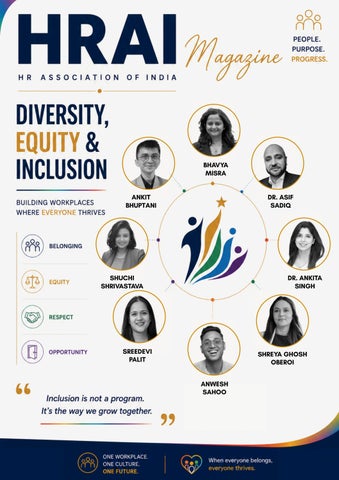
DIVERSITY,EQUITY & INCLUSION – THE FOUNDATION OF BELONGING
At HRAI, we believe that the bridge between academia and industry is the foundation for building a future-ready workforce. By fostering collaboration between educational institutions and the corporate world, we can empower students with the skills, mindset, and resilience needed to thrive in a rapidly evolving workplace.
In today’s evolving world, Diversity, Equity, and Inclusion are no longer optional ideals they are essential pillars of meaningful progress. True belonging is created when every individual feels seen, valued, respected, and empowered to contribute authentically.
This edition explores how DE&I shapes stronger workplaces, healthier communities, and more compassionate leadership Diversity brings different voices to the table, equity ensures fair opportunities for all, and inclusion creates the environment where those voices are genuinely heard Together, they form the foundation of belonging.
As you read through these stories, insights, and perspectives, we invite you to reflect on the role each of us plays in fostering spaces where people can thrive without fear of exclusion or bias. Creating belonging is not a one-time initiative it is an ongoing commitment rooted in empathy, understanding, and action. Because when people feel they belong, innovation flourishes, relationships deepen, and communities become stronger.
1,05,000+ FOLLOWERS ON LINKEDIN
A GROWING COMMUNITY OF PROFESSIONALS ENGAGING WITH HRAI’S INSIGHTS, INITIATIVES, AND INDUSTRY CONVERSATIONS.
About HRAI
Founded by Dr. Ankita Singh, the HR Association of India (HRAI) drives industry-led initiatives and curates prestigious recognitions for organizations, emerging professionals, and trailblazing women across the business ecosystem. HRAI serves as a platform for learning, collaboration, and recognition, bringing together professionals and subject-matter experts from across industries.
What We Do
Industry initiatives and professional forums
Awards, recognitions, and curated listings
Knowledge-sharing through talk shows, panels, and articles
Community-building for HR and business professionals
Organizations We’ve Engaged With Lenovo, Hindustan Unilever, Biocon Biologics, IHG Hotels, L&T, CBRE, Sutherland, Capgemini, EY, and more.
KNOWLEDGE & THOUGHT LEADERSHIP
Elite voices such as Dr. TV Rao, Harjeet Khanduja, and Prasenjit Bhattacharya have been featured in HRAI’s one-on-one talk shows, contributing practical insights and real-world perspectives for professionals.
HRAI MAGAZINE INITIATIVE
HRAI publishes thought-provoking articles authored by senior professionals from organizations such as Reliance Jio, Times of India, KPMG, Eveready, Volvo, and more.
HRAI LIST FEATURES
HRAI curates an annual list of features recognizing exceptional professionals and changemakers aligned with a central theme each year. 23 of 2023 | 24 of 2024 | 25 of 2025 . Notable organizations featured include: Adani, Amazon, Flipkart, Samsung, Myntra, Uber, Raymond, and more.
EXCLUSIVELY FEATURED SHARK TANK JURY IN THE VISIONARY CEOS LIST:
For HR professionals in India, HRAI offers unparalleled opportunities to connect with like-minded peers, learn from experts, and gain recognition for their hard work and achievements. By joining HRAI, HR professionals can stay updated on the latest trends, best practices, and strategies that can help them take their careers to the next level.
TABLE OF CONTENT
SHUCHI SHRIVASTAVA
INCLUSIVE EXPERIENCES LEADER, ADOBE INDIA
14
44
ANKIT BHUPTANI (TEDX SPEAKER)
HARJEET KHANDUJA SVP- HR, JIO 08
ANWESH KUMAR SAHOO (TOP GRAPHIC DESIGN VOICE)
SREEDEVI PALIT DIRECTOR HUMAN RESOURCE HEAD,D&I INDIA COGNIZANT
SUMIT AGARWAL LINKEDIN TOP VOICES
TEDX SPEAKER
Walk into a DEI training session at most Indian companies today and you'll find something that feels slightly off. The frameworks are American. The vocabulary is from San Francisco The case studies are about racial equity in Fortune 500 firms Occasionally there's a slide about India, usually about gender parity in the IT sector, and then it's back to concepts developed for a country whose inclusion problems have almost nothing in common with ours.
Nobody says this out loud, but the implicit assumption running through most of corporate India's DEI work is that inclusion is a Western invention that we are in the process of adopting The more sophisticated version of this assumption is that we ' re adopting it imperfectly, held back by culture, by caste attitudes, by conservatism The prescription that follows from this is always more training, better frameworks, closer alignment with global standards.
I've been doing this work for over a decade, in boardrooms and in factory canteens, in Tier 1 cities and in districts where the word "inclusion" doesn't have a Hindi equivalent that lands right. And I want to suggest that this assumption, which most Indian DEI practitioners take for granted, is the source of much of what goes wrong
India doesn't need to import a framework for inclusion It needs to excavate one it already has.
The
colonial interruption
Before 1861, homosexuality was not illegal in India. This is not a minor historical footnote. It is evidence of a civilization that had, for centuries, made philosophical and legal space
for identities that Victorian England considered criminal.
Section 377 of the Indian Penal Code was introduced that year by the British colonial administration, modeled on the Buggery Act of 1533. It criminalized sexual acts "against the order of nature" and was used to prosecute homosexual conduct When India gained independence in 1947, this statute stayed. It remained on the books for 71 more years, until the Supreme Court struck it down in 2018.
What colonialism did, in other words, was interrupt a much older tradition. The Vedas describe three categories of human nature: pums-prakriti (male), stri-prakriti (female), and tritiya-prakriti, the third nature, a recognized category covering what we would today call gay, lesbian, and transgender identities. This wasn't fringe thinking The Kamasutra, written as a classical philosophical text rather than the titillation manual it's been reduced to in popular imagination, devotes considerable attention to tritiya-prakriti, treating this third nature as a natural feature of human life requiring its own social and ethical framework. The Arthashastra, Kautilya's treatise on governance, references it. The Puranas are full of stories of gender transformation treated not as aberration but as cosmic possibility
British colonial officials viewed all of this as evidence of Indian degeneracy They systematically narrowed the legal and cultural space for non-binary identity And here is the part that should concern Indian HR professionals: when the British left, we kept their narrowness Section 377 outlasted the empire by seven decades. The Victorian moral architecture became our own
This is the origin story of India's supposed "conservatism" on questions of gender and sexuality. It isn't ancient. It's 165 years old. The tradition it replaced is far older
Why this matters for how we build inclusion at work
The failure mode I see most often in Indian DEI work is this: a company hires a consultant, runs a programme built on Western frameworks, and finds that it lands poorly in certain parts of the organization. Older employees resist it. Employees in tier 2 cities find the vocabulary alienating. Deeply religious employees feel they're being asked to trade one set of values for another. The company concludes that its workforce is "not ready" or "culturally behind." The consultant concludes that more education is needed. Neither asks whether the framework itself might be the problem
I've had a different experience when I ground inclusion conversations in Indian philosophical inheritance rather than imported vocabulary. When I'm working with a company whose employees are predominantly Hindu, and I introduce the concept of tritiya-prakriti, something changes in the room I'm not asking them to accept a foreign idea.
I'm showing them that their own tradition recognized, and in many contexts honored, the kind of diversity we ' re asking them to include in their workplace today. The resistance doesn't disappear, but its character changes People aren't defending their culture against an outside imposition. They're reckoning with a gap between their culture's actual history and what they assumed that history was.
The same principle applies to caste Western DEI frameworks address race as their primary equity lens, which makes sense in their context. Applied to India, these frameworks produce confusion. Race and caste share structural features but they operate completely differently. Indian practitioners who try to translate American antiracism frameworks to caste dynamics generally produce something that satisfies neither the framework's intellectual demands nor the reality on the ground The concepts that actually help in the Indian caste context come from Indian constitutional thought, from Ambedkar, from the Dalit literary tradition, from a long history of indigenous social reform movements These exist They're rich and rigorous. We systematically underuse them because the assumption is that imported frameworks carry more authority
The specific cost of this in practice
Research on DEI implementation in non-Western contexts consistently shows that applying US or Western European frameworks without local adaptation fails A study published by IntechOpen in 2025 noted that DEI principles shaped in North America often emphasize issues like race and gender in ways that don't resonate in regions where caste, tribal affiliations, and colonial histories create different social inequities. The mismatch isn't incidental. It's structural.
The numbers from Indian workplaces bear this out Despite years of DEI investment and genuine effort from some of India's best companies, only 10.2% of employees in workplaces claiming to be inclusive actually feel recognized, according to data from Pride Circle's ERG
Summit Godrej's DEI Lab, arguably the most rigorous in the country, counted 245 openly LGBTQ+ employees across the organization in its 2024-25 annual report, roughly 0 5% of its workforce. These are not failures of commitment They reflect a gap between the frameworks being deployed and the cultural context in which they're deployed.
The Open for Business City Ratings 2025 placed five major Indian metros in the "partially open " category for LGBTQ+ inclusion, ahead of most Asia-Pacific peers. A Deloitte survey cited in the same report found that Indian workplaces actually outperformed global averages on one measure: LGBTQ+ employees' comfort disclosing their identities at work. Progress is real. It's just slower and more uneven than the investment would predict, which is usually a sign that something in the method isn't quite right
What a genuinely Indian DEI framework looks like
The philosophical raw material is not difficult to find. What's missing is the willingness to treat it as legitimate professional knowledge rather than cultural curiosity
The concept of anekantavada in Jain philosophy, the doctrine that truth is manysided and no single perspective captures it fully, is a more useful foundation for building genuinely inclusive decision-making culture than most of what gets taught in unconscious bias trainings. It doesn't just say "be open to different views." It says the structure of reality requires multiple perspectives to be understood at all. That's a serious epistemological claim, and it maps directly onto what research consistently shows about diverse teams making
better decisions
The Buddhist concept of karuna, compassion as an active practice rather than a sentiment, provides a more grounded framework for building psychological safety than the language of "belonging" and "safe spaces " that tends to feel performative in many Indian corporate settings Sikhism's concept of seva, service as spiritual practice, reframes allyship in terms that resonate with workforces where those terms do
None of this requires abandoning rigour. McKinsey's research showing that top-quartile diverse companies are 39% more likely to outperform peers on profitability is as relevant in India as anywhere. The business case is not in dispute. What's in dispute is whether the methods used to build diverse, inclusive organizations should be borrowed wholesale from contexts that developed them for their own specific histories, or whether India might build something more durable by working from its own
I'm not suggesting that Indian tradition is sufficient on its own or that it's uncomplicated. The argument isn't that tradition is good and imports are bad The argument is that building inclusion on foundations that people actually recognize and claim as their own produces different results than building it on frameworks they experience as external requirements.
The
practical implication
For senior HR leaders and DEI practitioners in India, this suggests a fairly specific reorientation
Start inclusion conversations by asking what your organization's people already believe
about human dignity, about community obligation, about the relationship between individual identity and collective belonging. In most Indian workforces, those beliefs are not blank slates. They come from somewhere: from faith traditions, from family structures, from regional culture, from caste experience. The DEI work that sticks is work that enters into dialogue with those existing beliefs rather than attempting to replace them.
Use Indian constitutional thought more. Ambedkar's vision of social democracy, the constitutional framers' decision to protect equality not just for majority communities but specifically for those who had been excluded, this is a DEI framework. It's also one with enormous moral authority in India because it emerged from Indian experience rather than being borrowed from outside.
On LGBTQ+ inclusion specifically, the most effective conversations I've had in Indian corporate settings are ones that begin with the historical record, with the pre-colonial tradition of tritiya-prakriti, with the fact that Section 377 was imposed from outside and was always a foreign object in Indian legal culture. This reframes inclusion not as accommodation of a new Western concept but as restoration of something that was disrupted That framing changes what the conversation is about.y
The DEI field globally is at a moment of genuine uncertainty, with programmes being questioned, budgets being scrutinized, and the vocabulary that held the work together becoming contested. India has an opportunity to build something more resilient than what's being dismantled elsewhere, but only if it stops treating Western frameworks as the default and its own inheritance as a supplement.
India's inclusion tradition is not a footnote It's the foundation. The work is to remember it well enough to build on it.
“INCLUSION IS NOT A CONCEPT BORROWED FROM ELSEWHERE IT IS A VALUE DEEPLY ROOTED IN OUR OWN HISTORY, HUMANITY, AND SHARED BELONGING. WHEN WE HONOUR EVERY VOICE, WE BUILD WORKPLACES WHERE PEOPLE DO NOT JUST WORK TOGETHER, THEY GROW TOGETHER.”
ABOUT THE AUTHOR
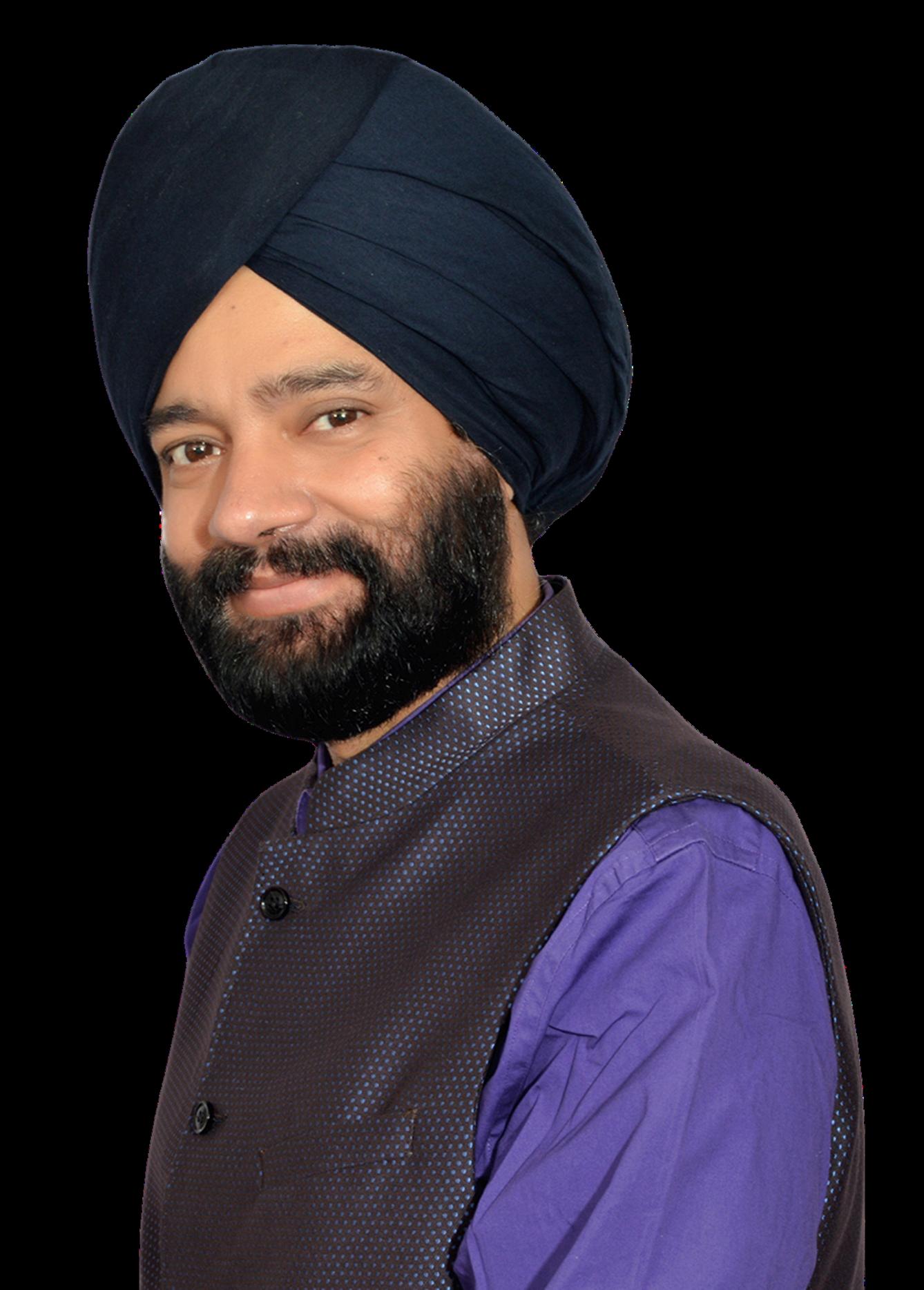
Ankit Bhuptani is a leading DEI strategist and LGBTQIA+ rights advocate with over a decade of experience driving inclusion across corporate India. An MBA in Social Entrepreneurship from NMIMS, he has worked with 30+ organizations and addressed 70+ national and international platforms, including the UNHRC and G20 Human Rights Working Group Twice honored with the Global Diversity & Inclusion Leadership Award by the World HRD Congress, he also collaborates with UN Women's LGBT forum and is a recognized TEDx and JoshTalks speaker
"Diversity is being invited to the party; inclusion is being asked to dance, and belonging is when you can dance like nobody’s watching"
TOP GRAPHIC DESIGN VOICE
I often say I live two lives One where I obsess over mipmaps, memory caches, and Unity prefab optimization And another where I paint brown queer bodies in opulent jewelry and flowing dhotis, dancing to their own rhythm Somewhere in between those two worlds is me. Anwesh Sahoo. A technical artist, a storyteller, and a proud queer person trying to build safer, softer spaces wherever I go.
Belonging wasn’t something I found easily. I grew up being told I was too much Too soft Too expressive. Too different. But it was in being all of those things that I started to build a language for myself. First through drawing. Later through performance. And eventually through digital tools From sketching Odissi dancers in my childhood, to now creating complex shader systems and leading game art pipelines, my journey has always been about reclaiming space where I was once asked to shrink
In tech, queerness can sometimes be quietly brushed aside, or tokenized in corporate posts during Pride month. For someone like me, who enters these spaces as a gay man, sometimes, there isn’t an option to blend in. I remember debugging a crash report in Unity all day long in the office, and then coming back home and finishing a watercolor piece from my Dancing Men series, a visual rebellion where brown queer men in all shapes, skin colors and sizes, fly, fall, and feel without shame.
That duality is where I find power. Both sides feed each other. My queerness makes me a more empathetic collaborator in my game development teams. My technical discipline helps me render my artistic visions with more precision and poetry.
Projects like Feeling Bratea and Effeminared Under The Lucky Star aren’t just art to me. They are love letters to queer joy and rebellion. They are my way of carving out visual languages where softness is celebrated Where men dance without apology. Where brown queer bodies take up space And as a Lead Technical Artist, when I mentor juniors or optimize visual pipelines, I know I am also shaping what inclusivity can look like behind the scenes
Belonging, to me, isn’t just about being seen. It is about being celebrated in your fullest form. It is when someone on my team says, “Hey Anwesh, your art helped me feel more myself.” It is when my character design gets to wear a rainbow taahiya and no one questions it. It is when I no longer have to choose between being the technical one or the queer one. I get to be both. Fully.
That is what Pride means to me now Not just tolerance. Not just inclusion. But thriving. In all my colours. My contradictions. My chaos
Because we have always belonged We are just reclaiming the frame now.
It was just another Monday morning when Priya, a high-potential manager at a multinational firm, received feedback that her promotion was being held up for reasons unrelated to her performance. She had exceeded targets, led a key digital transformation project, and scored top marks in 360-degree reviews Yet, her promotion letter remained stuck in an invisible pipeline. When she finally asked why, a senior executive casually said, "We already promoted a woman from your division last quarter "
This wasn’t an isolated story. Across boardrooms and HR cabins today, DEI (Diversity, Equity, and Inclusion) is undergoing a quiet but seismic shift What started as a bold movement to correct systemic imbalances is now increasingly tangled in optics, performative actions, and unfortunately, political resistance. In some regions, DEI is being rebranded or even sidelined to avoid controversy. But in the process, the soul of the movement fairness is getting lost.
The Problem with Performative Inclusion
Many organizations fall into the trap of symbolic diversity They showcase curated diversity panels, post #InclusionMatters graphics on LinkedIn, and celebrate International Women's Day with flair. But ask employees from marginalized groups if they feel heard, respected, and represented every day, and the answer is often a quiet " no "
True inclusion is not a PR campaign. It’s in the micro-decisions: who gets to speak in meetings, who gets constructive feedback, who is mentored, who is forgiven for mistakes, and who is consistently overlooked.
DEI, when treated as a checkbox, does more harm than good. It creates resentment, feeds tokenism, and reinforces the very bias it aims to dismantle.
Organizations exist in societies. And fairness, access, and equity are not radical ideas—they're good business.
The Political Pushback and Why It Matters
Recent political and social developments in parts of the world have caused DEI to be seen as a partisan agenda. Organizations are being forced to defend their inclusion strategies against scrutiny that misrepresents their intent Some leaders, fearing backlash, are quietly cutting down on DEI efforts or renaming them under less "charged" terms.
But let's be clear: DEI is not a political stance. It is a leadership responsibility. Organizations exist in societies And fairness, access, and equity are not radical ideas they're good business. Companies that embed diversity and inclusion in their DNA outperform those that don’t, not just in innovation and profitability, but in trust, retention, and resilience.
"We all should know that diversity makes for a rich tapestry, and we must understand that all threads of the tapestry are equal in value no matter what their colour "
Diversity, Equity & Inclusion – The Foundation of Belonging
Diversity, Equity and Inclusion are often spoken about together, yet too often they are approached separately Diversity becomes representation. Equity becomes policy. Inclusion becomes aspiration. When these elements are disconnected, organisations miss the deeper opportunity: belonging.
Belonging is what happens when diversity is present, equity is intentional, and inclusion is consistently experienced It is the point at which people no longer feel they need to navigate the organisation in order to succeed Instead, they can focus their energy on contributing, creating and performing. That is why belonging is not simply a cultural aspiration. It is a strategic and commercial advantage
When people feel they belong, engagement rises, trust strengthens, collaboration improves and innovation accelerates. People are more willing to share ideas, challenge thinking and give discretionary effort. Teams are more resilient during change and more effective under pressure In contrast, when belonging is absent, organisations often pay a hidden cost through silence, disengagement, burnout, lower productivity and lost talent.
Many organisations began their Inclusion journey through visible initiatives such as employee networks, awareness campaigns, mentoring programmes, heritage month events and training sessions. These can all play an important role They signal intent, create visibility and can build momentum. But initiatives alone do not transform culture Culture is shaped by systems.
It is shaped by who gets hired, who gets developed, whose voice is heard, how performance is assessed, how leaders behave under pressure, and who progresses It is shaped by who receives stretch opportunities, who is sponsored, whose mistakes are forgiven and whose potential is recognised. If those systems are not equitable, no amount of messaging can compensate for the lived experience people have inside them.
This is why leading organisations are moving Inclusion beyond standalone programmes and embedding it into the operating model of the business. The shift now is from asking, “What initiatives do we have?” to asking, “How do our systems create fairness, opportunity and trust?” That is where mature DEI work begins.
Leadership is central to this. No policy can outperform poor leadership Inclusive leadership is one of the strongest predictors of whether people experience belonging. It shows up in everyday moments: how meetings are run, how decisions are made, whose input is invited, how feedback is given, how conflict is handled, and whether people feel psychologically safe to contribute.
Inclusive leaders do not need to be perfect. They need to be intentional They are curious enough to question assumptions, aware enough to recognise that others may experience the same environment differently, courageous enough to challenge exclusionary behaviour, and accountable enough to turn good intent into consistent action.
They also understand that fairness does not always mean treating everyone the same. Different people may need different support, different access points or different levels of
DR. ASIF SADIQ
to succeed Equality gives everyone the same starting line. Equity recognises that not everyone started from the same place
This is why leadership ownership matters so much. Employee networks can support culture HR can enable it. Inclusion teams can guide and advise. But leaders shape whether inclusion is truly felt Employees do not experience culture through strategy documents. They experience it through their manager, their team and the decisions made around them.
Belonging also cannot be declared. It must be experienced. A values statement saying people matter does not create belonging Consistent behaviours, fair systems and meaningful opportunity for all do
That experience may look different depending on context A corporate employee may need voice and visibility. A frontline employee may need fairness of shift allocation, access to training or respect from supervisors. A new joiner may need connection and clarity. A parent may need flexibility Someone from an underrepresented background may need confidence that progression is genuinely possible A colleague working remotely may need inclusion in conversations and decisions that happen informally elsewhere
Belonging is therefore not one-size-fits-all It requires leaders to understand the different realities people experience and respond intentionally The most effective organisations listen deeply through engagement data, focus groups, pulse surveys and honest dialogue to understand where belonging is strong, where it is weak and what needs to change.
There is now clear evidence linking diversity with stronger decision-making, innovation and performance. Teams made up of different perspectives are often better at solving complex problems, identifying risks and understanding broader customer needs. But diversity alone is not enough
Diversity gives you difference. Inclusion enables contribution Belonging unlocks performance
Without inclusion, diversity can become symbolic. Without belonging, talent can remain present but underutilised. People may be in the room but not truly heard They may stay employed but mentally disengage. They may have the capability to lead but not the confidence that leadership is open to them.
The organisations that outperform are those that know how to convert diversity into advantage by creating environments where varied perspectives are heard, challenged and applied. In a world shaped by rapid change, AI disruption, global uncertainty and evolving employee expectations, broader thinking and stronger trust matter more than ever
For leaders, the priorities are clear. First, audit systems, not slogans Look at hiring, progression, pay, performance and opportunity allocation Second, build inclusive leadership capability. Equip leaders to lead across difference, not just manage tasks. Third, listen to experience Use data and dialogue to understand how culture is truly felt. Fourth, create accountability What gets measured and discussed gets prioritised. Fifth, design for belonging. Move from reactive interventions to intentional environments where people can thrive.
DR. ASIF SADIQ
The future of Inclusion will belong to organisations that stop treating it as a separate agenda and start recognising it as core to how successful organisations operate This is no longer about doing the right thing alone. It is about building organisations that are smarter, stronger and more sustainable
Because when people belong, they do more than stay. They grow, contribute and perform. They innovate more freely, collaborate more openly and lead more confidently And when that happens at scale, organisations do too.
ABOUT THE AUTHOR
Dr Asif Sadiq MBE is a globally recognised leader in inclusive leadership, culture and organisational transformation, with more than 20 years of experience across media, technology, public sector and financial services He has held senior leadership roles at globally recognised organisations including Warner Bros. Discovery, adidas, EY and the City of London Police.
Belonging is not created by Belonging is not created by policies alone — it is built policies alone — it is built through everyday actions that through everyday actions that make people feel valued, make people feel valued, respected and empowered to respected and empowered to contribute. When contribute. When organisations move beyond organisations move beyond representation and create representation and create cultures where every voice cultures where every voice matters, diversity becomes matters, diversity becomes strength, inclusion becomes strength, inclusion becomes impact, and people perform at impact, and people perform at their best. their best.
A Chartered FCIPD and CMI Chartered Companion, Asif is known for helping organisations translate ambition into measurable impact through inclusive leadership, equitable systems and high-performing cultures His work has focused on enabling leaders and organisations to embed inclusion into strategy, talent, culture and decision-making rather than treating it as a standalone initiative.
He is the author of From Intent to Impact, a practical guide for leaders and organisations seeking to create workplaces and products where inclusion is intentional, embedded and measurable The book challenges passive declarations and focuses on the sustained actions required to drive meaningful change. Asif’s contributions have been recognised through being awarded an MBE by the Queen, an honorary doctorate from Open University, alongside numerous professional accolades, reflecting his significant impact in advancing inclusion and belonging on a global scale
CHRO-GODREJ CAPITAL
Diversity, Equity & Inclusion: Building Cultures Where People Truly Belong
Inclusion is often spoken about through policies and announcements. But that is not where it is built
Inclusion is created in the everyday – in whose ideas are heard, whose contributions are acknowledged, and who feels safe enough to speak. It lives in the choices leaders make and the behaviours organisations reinforce
This is why Diversity, Equity & Inclusion (DEI) cannot remain a standalone initiative. It must be woven into how organisations think, decide, and operate. Belonging is not a promise; it is the outcome of systems and behaviours that consistently support people
At Godrej Capital, DEI is a part of our DNA: shaping how we build teams, design products, and engage with the communities we serve.
Inclusion Begins Where Assumptions End
At the heart of meaningful inclusion lies a simple but often undervalued capability: listening
Not performative listening, but the kind that informs decisions In a country as layered as India, where identity intersects with gender, region, language, and socio-economic context, inclusion cannot be templated
Organisations cannot assume what people need. They must ask, and act on what they hear.
When employees see their inputs reflected in decisions, trust builds. Without that, even welldesigned policies feel distant Inclusion, therefore, is not just about giving people a voice; it is about ensuring that voice has impact
Designing for Inclusion at Scale
For DEI to create real impact, it must be embedded into systems. It should influence how roles are structured, how opportunities are allocated, and how decisions are made.
Accessibility is a clear example Workplaces designed for flexibility and technology-enabled participation automatically widen access and allow more people to contribute fully.
The same applies to hiring Skills-based, structured evaluation reduces bias and expands opportunity Our Pride in Tech initiative shows how thoughtful design can open fair entry pathways for LGBTQ+ professionals while strengthening our talent pipeline
Inclusion must also shape products Financial systems historically catered to narrow definitions of identity. Reimagining these frameworks expands access, such as enabling home loans for same-sex partners. This is not only a product shift but a step toward financial equity.
When design aligns with intent, inclusion becomes visible in outcomes.
Inclusion as an Ecosystem
The most effective DEI efforts extend beyond the workplace. When inclusion connects customers, partners, employees, and communities, it creates impact at scale. At Godrej Capital, initiatives such as Aarohi reflect this approach by expanding access and opportunity across multiple touchpoints.
This includes enabling thousands of women customers while building a growing ecosystem of women partners and professionals
Viewed together, these efforts move beyond individual programmes to create sustained participation and long-term value
Because belonging is not experienced in isolation It is reinforced across every interaction.
The Capability Imperative
As organisations scale, inclusion must also address access to growth. India’s workforce is young and ambitious, but the nature of work is changing rapidly. Roles are evolving, and skills need constant renewal.
In this environment, access to learning becomes a key inclusion lever When reskilling is embedded into the flow of work and made available across talent pools, it creates more equitable pathways for progression. Often, the capability organisations seek already exists internally The opportunity lies in recognising it and enabling it to grow.
The Business Case for Belonging
DEI is not only a cultural priority; it is a business one.
Inclusive organisations make better decisions, respond more effectively to diverse customer needs, and build stronger trust. Diverse teams bring varied perspectives, which reduces blind spots and improves outcomes.
As organisations scale technology and datadriven systems, this becomes even more critical. The quality of what is built depends on the diversity of those building it. Belonging, therefore, is not just an outcome It is an advantage.
Building Forward
The next phase of DEI will be defined by integration It must move beyond programmes and become part of everyday operations: shaped by continuous listening, thoughtful design, and consistent action.
Organisations that lead will be those where inclusion is lived, not stated, and where belonging is a shared experience, not an outcome left to chance. Because when people feel they belong, they do more than contribute – they grow, innovate, and move the organisation forward with them.
ABOUT THE AUTHOR
Bhavya Misra, CHRO at Godrej Capital, brings nearly 20 years of HR experience across Technology, FMCG, and Retail, with leadership roles at PepsiCo, Bharti Walmart, and Lenovo She specializes in Talent Management, Organizational Transformation, and Business Partnering At Godrej Capital, she champions DEI initiatives, focusing on LGBTQIA+ and PWD inclusion, and drives gender balance in the workplace. Known for her empathetic and pragmatic approach, Bhavya ensures employee well-being remains central to business decisions.An alumna of MDI Gurgaon and St Stephen’s College, Delhi, she continues to shape a diverse, inclusive, and high-performing culture.
SUMIT AGARWAL
SDG AMBASSADOR FOR DEI, ICON OF THE ELECTION COMMISSION OF INDIA AND MOC NITI AAYOG
I was not supposed to be alive today.
When I was born, the doctors told my parents to prepare for the worst. 70% of my body restricted. Four major surgeries before I was old enough to understand what a Cerebral palsy is The world had already made up its mind about me before I had taken my first step, before I had spoken my first word, before I had a chance to show anyone who I was.
I share this not for sympathy. I share it because that experience of being written off by systems before you even enter them is something millions of people in India live with every single day. And it raises a question that every HR leader, every CHRO, every boardroom in this country must sit with: If the world decides you do not belong before you arrive, what systems must exist to prove it wrong?
That question about systems, not sentiments is the real story of Diversity, Equity, and Inclusion
The Problem with How We Talk About DEI
Most organizations treat DEI as a calendar event. A workshop in March for women A post on social media in December for persons with disabilities. A panel discussion that checks a box and changes nothing The language is warm The intent is genuine. The structural impact is near zero.
McKinsey’s research across 1,265 companies in 23 countries shows that organizations with diverse executive teams are 39% more likely to outperform financially. That is a powerful number. But here is the number that should concern HR leaders far more: in the same research, while positive sentiment around diversity stood at 52%, sentiment on inclusion was only 29% positive and 61% negative. Hiring diverse talent is not enough.
The workplace experience determines whether people stay, contribute, and thrive
Deloitte’s Global Human Capital Trends survey echoes this structural gap: only 15% of organizations connect diversity progress to business outcomes such as profitability or productivity. DEI, for most companies, remains an HR initiative that lives in a silo disconnected from governance, strategy, and accountability
This is not an inclusion problem It is a design problem.
What My Mother Taught Me About Belonging
Before I understood systems, I understood survival. And my first lesson in belonging came not from a policy document, but from a woman who refused to accept the world’s verdict on her son
My mother was told, repeatedly, that I would not walk, would not study in a regular school, would not hold a job, would not live independently Every institution medical, educational, social had written me off. She fought each one. Not with optimism, but with an unyielding refusal to let the system’s limitations define her child’s ceiling. She found schools that would admit me when others would not. She found doctors who would try when others had given up. She built, around me, a counter-system one that created access where none existed, dignity where it was denied, and belief where evidence was thin
That is what belonging actually looks like. Not a feeling A structure A deliberate, designed environment that refuses to let circumstances become permanent exclusion
Every CHRO reading this has the same power my mother had. The question is whether they are using it
The Invisible Workforce: India’s Disability Inclusion Crisis
India is home to an estimated 40–90 million persons with disabilities, depending on which data set you trust the 2011 Census recorded 26.8 million, while the National Family Health Survey-5 estimates 63.28 million. The gap itself tells a story: we do not even count our people with precision, and what is uncounted remains invisible.
Here is what the data does tell us The workforce participation rate for persons with disabilities in India is approximately 36%, compared to 60% for those without. Among women with disabilities, only 23% are employed. In the private sector, employment of persons with disabilities is a staggering 0.28% and in multinational companies, it drops to 0 05% Among the Nifty 50 companies, only five have more than 1% of persons with disabilities on their payroll, and four of those are public sector undertakings
The ILO has estimated that India could lose between 3–7% of GDP due to the non-participation of persons with disabilities in the workforce. Less than 25% of Indian workplaces provide accessible infrastructure such as ramps, adapted restrooms, or assistive technologies Over 40% of posts reserved for persons with disabilities in central government remain vacant.
These are not just statistics. They are a systemic confession India’s workplaces are not merely failing to include persons with disabilities they are architecturally designed to exclude them.
From Representation to Redesign: What Belonging Actually Demands
There is a convenient hierarchy in how organizations approach DEI First, representation: we hire different people. Then, inclusion: we make them feel welcome Then, maybe, belonging: they feel they can be themselves.
This hierarchy is backwards. Belonging is not the last mile of DEI It is the foundation Without it, representation is cosmetic, and inclusion is performative.
Having spoken on over 350 platforms from TEDx stages and IITs to corporate boardrooms I have observed a recurring pattern: organizations that treat belonging as an outcome to be measured in annual surveys are the same ones where diverse hires leave within 18 months Because belonging is not something you measure after the fact. It is something you engineer before the first day.
What does that engineering look like?
First, infrastructure before intention. Accessible buildings, adaptive technologies, flexible work policies, and reasonable accommodations are not gestures of goodwill. They are prerequisites If your office cannot be physically entered by a person in a wheelchair, your diversity statement is fiction.
Second, accountability before awareness. DEI training without consequences for exclusion is organizational theatre. Link inclusion metrics to leadership KPIs, promotion criteria, and board-level governance The moment exclusion has a cost, behaviour changes.
Third, dignity before data. Every person who enters your organization carries a story. Some carry visible disabilities Others carry invisible ones neurodivergence, chronic illness, mental health conditions, caregiving burdens. Belonging means the system does not require people to disclose their vulnerabilities in order to access basic support
A Million Lives, One System at a Time.
My life’s work is anchored in a single, nonnegotiable vision: to help one million persons with disabilities thrive. Not survive. Not be accommodated. Thrive.
That number is not aspirational rhetoric. It is a design brief It requires workplaces that do not merely open their doors, but redesign their rooms. It requires HR functions that treat disability inclusion not as a CSR footnote, but as a governance imperative linked to ESG frameworks, BRSR reporting, and board-level accountability It requires leaders who understand that the cost of exclusion estimated at over USD 210 billion for India’s economy is not an abstract loss It is a daily, compounding failure of imagination.
I have lived the consequences of systems that were not built for people like me. Four surgeries. Years of isolation A childhood spent proving that I deserved to exist in spaces that had already decided I did not And yet, I am here not because the systems worked, but because a few people chose to build something better around me.
The Real Question for HR Leaders
On your deathbed, all you will remember are the people you have touched and helped inspire. That is not a corporate statement
That is a personal conviction that has shaped every keynote, every workshop, every policy framework I have ever built
But here is the harder truth: inspiration without infrastructure is cruelty dressed in good intentions. The person with a disability who hears a motivational speech at your company ’ s annual day and then returns to an inaccessible office on Monday has not been included. They have been performed at
So I leave HR leaders with this: stop asking whether your organization is diverse. Start asking whether it is designed for belonging. Audit your physical infrastructure Audit your policies. Audit who gets promoted, who gets heard, and who quietly leaves Connect inclusion to risk, governance, and business outcomes because that is where power lives.
Belonging is not a feeling. It is an architecture. And the blueprints are in your hands
ABOUT THE AUTHOR
Sumit Agarwal is a DEI strategist, keynote speaker, and disability inclusion advocate. Born with cerebral palsy (70% body restriction), he has spoken on 350+ platforms including TEDx, Josh Talks, IITs, and IIMs, and has been featured in Forbes, Fortune India, and Business Standard He currently serves as Consultant with The Ability Network (Tech Mahindra Foundation), Associate at Great Place to Work® Institute India, and Consultant at India Autism Center He is a LEGO® SERIOUS PLAY® Certified Facilitator, SVEEP & PWD Icon with the Election Commission of India, and SDG Ambassador. His life’s mission is to help one million persons with disabilities thrive.
FOUNDER, HRAI
Diversity, Equity & Inclusion– The Foundation of Belonging
For many years, diversity, equity, and inclusion lived in presentations, policies, and wellintended initiatives They appeared in annual calendars, training programs, and carefully worded statements. Important, yes but often peripheral Something organizations did, rather than something they were.
That line is quietly shifting.
Today, DEI is no longer judged by how many initiatives an organization launches, but by how people actually experience the workplace Not by representation alone, but by belonging. Not by intent, but by impact.
The question organizations are now being asked by employees, candidates, customers, and even investors is far more personal: Do people feel seen, heard, and treated fairly here?
From Initiatives to Everyday Experience
Most organizations begin their DEI journey with initiatives. Hiring targets, training sessions, celebration days, employee resource groups These steps matter. They create awareness and signal intent
But initiatives, on their own, do not change culture
Culture is shaped by everyday decisions who gets listened to in meetings, how feedback is given, whose mistakes are forgiven, and whose growth is supported It lives in performance systems, promotion decisions, pay structures, and leadership behavior
This is where the shift is happening Organizations are beginning to move DEI from isolated programs into the fabric of how work actually gets done Inclusion is no longer something that happens “in addition to” business it is increasingly becoming how business is done.
Equity: The Often-Missed Middle
Diversity brings people into the room Inclusion invites them to participate. Equity determines whether they have a fair chance to succeed.
Equity is often the hardest part of the DEI conversation because it forces organizations to examine uncomfortable truths. Are opportunities distributed fairly? Are performance expectations applied consistently?
Do systems unintentionally favor some groups over others?
Equitable systems are not about lowering standards. They are about removing invisible barriers that prevent people from performing at their best. This includes equitable access to development, transparent career pathways, fair pay practices, and consistent performance evaluation.
Organizations that take equity seriously stop asking, “Are our policies neutral?” and start asking, “Are our outcomes fair?”
Inclusive Leadership: Where DEI Becomes Real
No policy can compensate for leadership behavior.
Inclusion is experienced or broken through managers and leaders. Inclusive leaders are not perfect, but they are intentional. They listen more than they assume They create space for different voices. They notice who speaks up easily and who holds back
Inclusive leadership shows up in simple moments: whose ideas are acknowledged, how disagreements are handled, how feedback is delivered, and how mistakes are treated These moments determine whether people feel safe to contribute fully.
As work becomes more distributed and diverse, inclusive leadership is no longer a “nice to have.” It is a core leadership capability.
“People don’t experience inclusion through strategy documents. They experience it through their managers. ”
Belonging: The Outcome That Matters Most
Belonging is the true measure of DEI maturity.
It is the feeling that you don’t have to edit yourself to succeed. That your voice carries weight That you are trusted, respected, and valued not despite who you are, but because of it
Belonging cannot be mandated. It is built slowly, through consistent behavior and fair systems. Organizations that foster belonging see higher engagement, stronger collaboration, and better retention not because people are obligated to stay, but because they want to.
In times of uncertainty or change, belonging becomes even more critical
When people feel they belong, they are more resilient, more open to change, and more willing to contribute beyond their formal roles.
The Business Case for Diversity Beyond the Numbers
The business case for diversity is often supported by data and rightly so. Diverse teams bring broader perspectives, better problem-solving, and stronger decision-making. Organizations with diverse leadership are consistently shown to be more innovative and adaptable.But the deeper business case lies beyond metrics
Diverse and inclusive organizations build trust with employees, customers, and communities They are better at understanding diverse markets They attract talent that values fairness and authenticity. And they are more resilient in the face of disruption because they are not reliant on a single way of thinking
Diversity without inclusion, however, creates frustration. Inclusion without equity creates fatigue. It is the combination of all three diversity, equity, and inclusion that creates sustainable impact.
Embedding DEI Into Culture, Not Campaigns
Organizations moving DEI from initiatives to culture focus on systems, not slogans. They embed inclusion into hiring processes, leadership development, performance management, and decision-making frameworks.
They measure progress not only through representation numbers, but through lived
experiences engagement data, retention patterns, promotion outcomes, and feedback loops. They hold leaders accountable, not just for results, but for how those results are achieved
Most importantly, they accept that DEI is not a destination. It is an ongoing practice that evolves as the organization and its people evolve
Looking Ahead
The future of DEI will not be defined by how eloquently organizations talk about inclusion, but by how consistently they practice it.
Belonging will become the new benchmark. Not as a soft sentiment, but as a strategic advantage Organizations where people feel safe, valued, and fairly treated will outperform those that rely solely on structure and process
In the end, DEI is not about checking boxes or meeting quotas It is about creating workplaces where differences are not just tolerated, but welcomed and where every individual has a fair opportunity to contribute, grow, and belong.
“Inclusion is not about “Inclusion is not about bringing people into the bringing people into the room. It is about making room. It is about making sure they are heard once sure they are heard once they are there.” they are there.”
ABOUT THE AUTHOR
Dr. Ankita Singh is the CPO & Board Director, CIGNEX & Relevance Lab. With 22+ years in HR, primarily in the ITES sector, Ankita has driven transformation through performance-driven practices and inclusive culture At CIGNEX, her leadership helped the company earn multiple “Great Place to Work” certifications (2017–2021) She has been recognized as “Woman Leader of the Year” by The Times of India Group and featured in Forbes India’s “Top 100 Managers ” Ankita holds an MBA in HR+IT, an Executive MBA from SCMHRD, and a Ph D in Management A respected voice in the industry, Ankita blends strategic insight with a passion for people development and culture building
SENIOR DIRECTOR, INCLUSION
HEAD-INDIA, CAPGEMINI
Diversity, Equity and Inclusion (DEI) today stand at the heart of progressive organizations, shaping how workplaces function as well as how people feel within them. Increasingly, leading organizations are moving beyond viewing DEI as a set of standalone initiative and are instead embedding it into the core of how they operate, lead, and grow Organizations understand that DEI is more than a set of programs or policies; it is an organizational commitment that enables belonging at scale
Belonging is the experience of being accepted, respected, and valued for who you are while having equitable access to opportunities to thrive. When diversity is embraced, equity is operationalized, and inclusion is practiced consistently, belonging becomes a lived reality rather than an aspirational ideal. This shift from intent to integration is what differentiates organizations that talk about DEI from those that realize its full people, cultural, and business value.
Diversity is the starting point of this journey. It represents the spectrum of identities, experiences, and perspectives that individuals bring to the workplace. Today, diversity is not limited to representation It ensures that varied perspectives actively shape decisions, drive innovation, and lead to positive outcomes. Organizations that embed diversity into talent pipelines, leadership roles, and succession planning are better positioned to respond to a rapidly changing world
The gender diversity pillar plays a critical role in advancing this vision by focusing on representation, progression, and leadership equity for women Through focused development programs, return‑to‑work initiatives, and continuous pay equity reviews, many organizations are seeking to dismantle structural barriers
This reflects a broader shift toward equitable systems, where fairness is built into processes such as hiring, performance evaluation, and career progression.
Equally important is the LGBTQIA+ pillar, which reinforces a belief that authenticity fuels performance. Unique initiatives supporting the said community and leadership advocacy create safe spaces where LGBTQIA+ employees can open up and be visible without fear of bias or exclusion The goal is to grow from awareness to normalization, ensuring inclusion is embedded into everyday workplace interactions, policies, and leadership behaviours. Visibility and allyship strengthen not just individual confidence but collective trust, becoming one of the foundational elements of belonging.
While diversity acknowledges difference, equity ensures fairness Equity recognizes that individuals start from different places and may require differentiated support to access the same opportunities Incorporating equity requires redesigning systems, from infrastructure to digital experiences, making them inclusive by default. For instance, many organizations are actively redesigning systems for Persons with Disabilities (PwDs) to enable accessibility by design. From infrastructure and digital platforms to assistive technologies and flexible accommodations, they strive to remove physical, systemic, and attitudinal barriers. Sensitization of managers and teams further ensures that disability is understood not as a limitation, but as an integral dimension of diversity.
Equity also extends to the neurodiversity pillar, which challenges traditional notions of the right fit and performance
As organizations rethink conventional definitions of productivity and potential, they recognize that cognitive diversity can unlock new ways of problem-solving and innovation. Flexible work models, inclusive assessments, and awareness programs help ensure neurodivergent colleagues are empowered to succeed on their own terms. True equity is achieved when systems are proactively designed to enable success for all, rather than requiring individuals to adapt to rigid norms
Inclusion is where diversity and equity are activated in everyday behaviour. It is reflected in how leaders engage, how teams collaborate, and how decisions are made At the core of this transformation is inclusive leadership. Leaders today are expected to manage performance and fulfil business priorities while cultivating psychological safety, inviting diverse perspectives, and making equitable decisions Inclusion is not a one time initiative but a continuous practice that shows up in meetings, feedback conversations, and performance discussions. When people feel safe to speak up and take risks, creativity and innovation naturally follow
The generational diversity pillar highlights inclusion across age groups and career stages. With multiple generations working side by side, inclusion means valuing experience while embracing new perspectives. Organizations must promote cross generational collaboration through reverse mentoring, continuous learning platforms, and knowledge sharing forums. Such practices reinforce that inclusion is not static and evolves with workforce dynamics, ensuring that every generation feels relevant, respected, and empowered.
For global organizations, the strength lies in multicultural and ethnic diversity.
Embedding inclusion across geographies requires balancing global consistency with local relevance. Cultural intelligence, inclusive communication, and context-sensitive practices enable organizations to build cohesion When cultural identities are acknowledged rather than assimilated, individuals feel seen while belonging deepens.
Binding all these pillars together is allyship A defining characteristic of organizations that successfully embed DEI into culture is active allyship. Allies listen, challenge bias, amplify voices, and advocate for equitable practices. This transforms DEI from an agenda into a shared movement, strengthening trust and psychological safety
Belonging is ultimately experienced in the everyday moments that shape working life It is found in whether people are invited into critical conversations, whether ideas are acknowledged, and whether growth opportunities are distributed fairly. While metrics and representation remain important, organizations must increasingly focus on lived experiences, measuring inclusion through engagement, voice, and opportunity. Listening forums, employee resource groups, and feedback mechanisms ensure employees shape the DEI journey.
The impact of belonging extends beyond culture. It is a proven driver of business performance Inclusive organizations consistently demonstrate higher engagement, stronger innovation, improved retention, and better decision‑making. By embedding DEI into operating models and leadership accountability, organizations pave the way for measurable outcomes. This makes inclusion a moral imperative and a strategic move
SHREYA OBEROI GHOSH
DEI is not an isolated ambition; it forms the foundation of belonging When DEI is embedded into culture through equitable systems, inclusive leadership, and a sustained focus on belonging, it moves from intent to impact. And when belonging is prioritized, organizations build workplaces that are inclusive, resilient, and future ready.
ABOUT THE AUTHOR
Sreya Ghosh Oberoi is the Future of Work Head for Capgemini in India which takes care of Diversity and Inclusion, Employee Engagement and Wellbeing, GenAI for HR, Culture and OD. From an Inclusion perspective, her responsibility is to create an inclusive workplace across all business units, improve gender balance in the leadership roles, inclusion of people with abilities, and LGBTQAI+.
Shreya brings over 22+ years of Operations and Human Resources experience in several industries like IT-ITES, oil & gas, manufacturing heavy industries and service industries. She joined Capgemini from JSW group (steel, cement, paints, infra and energy), where she was leading diversity & inclusion and Employee engagement Prior to that, in Sodexo she led Diversity and inclusion efforts in the APAC region (China, Singapore, Indonesia, Malaysia, Philippines, Thailand and Australia) and India. She was responsible for D&I strategies, building an inclusive culture in the workplace, and building Sodexo brand as an inclusive organization. In her extended global role, she held the position of Co-chair in Sodexo’s global disability taskforce. She has also worked as the HR Business partner to the Healthcare business vertical in APAC (India, China, Singapore & Thailand).
She has completed her management studies in Human Resources from IMT, Ghaziabad, is a certified green belt in six sigma and has received a certification in Diversity and Inclusion from Cornell University
SHREYA GHOSH OBEROI
The office was buzzing with the energy of another busy morning. Laptops were open, teams were preparing for meetings and coffee conversations filled the corridors Everything was moving as planned until an unexpected visitor changed the rhythm of the day.
A pigeon had somehow entered the office
At first, it sat quietly on a ledge near the ceiling. But soon it started flying frantically from one corner to another It hit the glass partition, turned abruptly and flew again. The more it tried to escape, the more trapped it seemed Employees looked up from their screens Some smiled, others were startled, but everyone could see one thing clearly. The pigeon was not trying to stay. It was desperately trying to leave.
A young employee quietly said, “It wants to go out.”
Someone opened the main door Another employee moved chairs to create a clear path A few people switched off lights near the windows so the bird would notice the opening. Meetings paused. Calls stopped For a few minutes, an entire office came together with one purpose. Help the pigeon find a way out.
Slowly, the pigeon moved lower, flew toward the entrance, paused for a second and then disappeared into the open sky
Now let me ask a question.
“Was this against Diversity, Equity and Inclusion to take the pigeon out of the room?”
Take a pause and answer the question before you read further
Now imagine this pigeon was an employee who was curious to be part of an organization.
The first version of the story is this.
A talented pigeon made it to the office. It brought a unique ability that no one in the office had It could fly But after arriving inside the office, the pigeon found that no one valued the unique skill. Others were not even interested in flying These people were too busy with their own activities They did not even try to include the pigeon in any of their activities. It tried to attract their attention, tried to connect and tried to contribute
Instead of adapting the environment or including the pigeon in their ecosystem, people created arrangements for it to leave Had the office been truly inclusive, perhaps the pigeon could have added value in ways no one had imagined.
Now consider the second version of the same story.
A pigeon somehow made it to the office Its natural environment was not the office. The skillset and strength of the pigeon was not aligned to the purpose of the organization In trying to move around, it became a distraction for others who were meaningfully contributing to their work The pigeon was also hurting itself in the process, colliding with glass walls, growing anxious and becoming increasingly distressed.
Hence to protect the pigeon and to ensure safety of other employees, a safe passage was created for the pigeon. Because inclusion is not forcing someone to stay in a room where they cannot flourish. Sometimes inclusion means helping them find the right environment to succeed.
Which version feels right depends entirely on the intent, the method and the mindset behind the action
That is what defines the true spirit of Diversity, Equity and Inclusion.
“INCLUSION IS NOT FORCING SOMEONE TO STAY IN A ROOM WHERE THEY CANNOT FLOURISH. SOMETIMES INCLUSION MEANS HELPING THEM FIND THE RIGHT ENVIRONMENT TO SUCCEED."
ABOUT THE AUTHOR
Harjeet Khanduja is an international speaker, author, poet, influencer, inventor and an HR leader He is also known as RK Laxman of Business. He is currently working as the Senior Vice President HR at Reliance Jio. He has 4 published patents and authored 9 bestseller books. Harjeet has been a LinkedIn Power Profile, TEDx speaker, Guest Faculty at IIM Ahmedabad and XLRI, Board Member of Federation of World Academics, Global Thought Leader, Global Digital Ambassador. Harjeet features in Top 200 Global Leadership Voices and ET Top 20 HR Influencers.
"Belonging is the feeling of security and support when there is a sense of acceptance, inclusion, and identity for every individual."
SHUCHI SHRIVASTAVA
INCLUSIVE EXPERIENCES LEADER, ADOBE INDIA
“The Inclusion Shift: From Programme to Everyday Practice”
You have seen this play out especially if you work in HR or lead teams
A company hires someone for their fresh perspective an outside-in voice to challenge assumptions. The new joiner arrives full of ideas. Within weeks, they keep hearing, “That’s not how we do things here.”
The ideas dry up The person learns to read the room before speaking. Six months later, they are either disengaged or halfway out the door We hired them for how they think. Then we trained them to think like everyone else. And that, in a nutshell, is where most inclusion efforts break down not in what organisations do, but in how work actually happens
The How Is What Breaks and What Fixes
Most DEI action lives in “the what”: what we hire for, what policies we write, what training programmes we roll out. These matter. But they are only as strong as the everyday behaviours that surround them.
When inclusion depends on individual managers or gets overridden the moment business pressure spikes it becomes fragile It starts depending on goodwill and personal intent.
The shift happens when inclusion is designed into the system, not left to individual choice.
That means embedding it into the structures people already operate within:
Hiring rubrics that prompt for perspective diversity, not just skill fit
Meeting rhythms where the chair invites the quietest voice before the loudest one fills the space
Decision-making frameworks where unfamiliar ideas are met with “What would this look like?” instead of precedent
Performance reviews where leaders are recognised not only for outcomes, but for how they enable others to contribute
When these behaviours become defaults not heroic exceptions inclusion stops being optional. It becomes culture.
And when culture is consistent, inclusion becomes an organisational capability: something the organisation can rely on, deploy, and scale. Not something owned by HR alone. Not the first thing dropped when budgets tighten
That requires leadership to treat inclusion as a performance expectation, not a personal virtue. Managers must be held accountable for how they lead in the same conversations where revenue, delivery, and execution are reviewed.
When inclusion depends on goodwill, it is a hope.
When it is designed into how the organisation operates, it becomes a capability.
From How We Work to What We Build
When inclusion is woven into how an organisation operates, it does more than make people feel welcome It builds the ability to think like the people the organisation serves not just look like them
A team can reflect every demographic category and still carry blind spots Headcount diversity does not guarantee perspective diversity But when people from genuinely different lived experiences can speak up and be heard organisations start seeing what they were previously missing
A product team with someone who grew up navigating small-town government offices will instinctively design for first-time digital users. A financial services team with a first-generation banking customer will question onboarding assumptions others take for granted
What gets built outside is a direct reflection of what gets heard inside
Research supports this BCG found that companies with diverse leadership teams generate 19% more revenue from innovation. McKinsey’s analysis across 1,000+ organisations shows those in the top quartile for diversity are 39% more likely to outperform financially This is not coincidence it is what happens when inclusion moves from an HR initiative to an operating model
Now, Widen the Lens
In India, inclusion needs a wider lens.
Beyond gender, disability, caste, and sexual orientation all of which remain essential
there is another powerful dimension: economic and cultural starting point.
One of the biggest inclusion gaps in Indian organisations is the distance between Tier 1 corporate India and the rest of the country.
A first-generation professional from a Tier 3 city carries perspectives no market research can replicate about digital access, trust in institutions, and what simplicity really means when connectivity is inconsistent and systems feel intimidating.
When organisations bring these perspectives into their DEI lens, strategy shifts tangibly. Products begin to reach customers they were earlier designing around, not for. The realities of Bharat not just India move from afterthought to input.
This is how DEI reaches an organisation’s DNA Not as a programme. Not as a label. But as the way the organisation sees, thinks, and builds
Back to That New Joiner
Remember the person hired for their fresh perspective and then taught to suppress it?
In an organisation where inclusion lives in how work gets done in systems, meeting rhythms, and decision habits that first contrarian idea does not get shut down It gets explored Built on. Sometimes even shipped.
That is belonging
Not a programme outcome Not a survey score But the felt experience of being valued for the perspective you bring and seeing it shape what the organisation builds
Shuchi Shrivastava is a Top 25 DEI Leader of 2025 in India and the Inclusive Experiences Leader for Adobe India. With 14+ years of experience across manufacturing, consulting, services, IT, and product organisations, she brings a rare cross‑industry lens to embedding belonging into leadership behaviour, decision making, and everyday organisational systems.
Diversity, Equity & Inclusion – The Foundation of Belonging
For years, diversity, equity, and inclusion in organizations meant standalone initiatives, annual training sessions, or well-meaning statements of intent. From a compliance-focussed approach led by legal and HR, most organizations have matured to programmatic level, where DEI initiatives comprise demographic targets, training programs, mentoring, events and employee resource groups However, to address systemic and cultural barriers, inclusion strategy and initiatives need to be led by business. (ref Deloitte diversity and inclusion maturity model)
In today’s fast changing AI-driven world, the need for organizations to leverage diverse perspectives for innovation has become multi-fold. This means embracing inclusion to unlock the full potential of their workforce, driving better decision-making, adaptability, and long-term success.
Culture is not shaped by words, but by what we consistently do. Embedding DEI into the fabric of an organization requires reimagining systems, redefining leadership, bringing accountability into everyday practices and intentionally cultivating belonging across all levels.
Building Equitable Systems, Not Just Equal Opportunities -redesigning hire to retire talent processes and systems to eliminate bias and create fairer outcomes Equity should be systemic, not situational. diverse talent sources skills- based hiring and diverse interview panels transparent pay frameworks to close wage gaps
equitable performance management processes and merit- based career progression inclusive policies that support employees at various stages of life and career
accessible facilities and digital systems that meet the industry and statutory requirements.
Invest in continuous education – move beyond one-time workshops to learning journeys, measurable action plans and reinforcement mechanisms Explore opportunities for business leaders to role model inclusive behaviours and provide safe spaces for experience sharing
Inclusive Leadership as a Core Competency- it’s no longer a ‘nice to have’, but a critical capability that is measurable. Inclusive behaviour should be ‘business as usual’ and embedded in everyday practice. Leaders need to foster psychological safety, so employees feel safe to speak up, actively seek and value diverse perspectives, address microinequities, consciously use inclusive language and hold themselves accountable for outcomes Pivot to intentional action and not performative allyship. Rewarding inclusive behaviours go a long way in reinforcing them across organizations
From Engagement to Belonging - while engagement measures satisfaction, belonging measures connection. It answers a deeper question: Do I feel valued, seen, and accepted for who I am? Belonging transforms workplaces from transactional environments into communities where individuals can thrive authentically.
Creating a culture of belonging requires intentionality and individual accountability It shows up in everyday moments whose voices are heard in meetings, whose contributions are recognized, whose identities are respected.
Communities and support networks: Encouraging employee resource groups (ERGs) as strategic partners, not interest groups.
They provide connection, advocacy, and shared learning
ABOUT THE AUTHOR
Invest in supplier diversity: Procurement process should include engagement with diverse suppliers and those from underrepresented communities.
Responsible tech so no one is left behind: As organizations adopt AI, it is the need of the hour to find balance in using agentic AI to enhance productivity, while intentionally designing human-in-the loop models
Measure What Matters: Move beyond diversity metrics to assess inclusion and belonging through inclusion index
Employee voice, sentiment, lived experiences should guide action
Making DEI Sustainable
The true test of DEI maturity is sustainability. Initiatives can be launched quickly but culture change requires persistence, accountability, and alignment. It is an ongoing journey. It requires organizations to remain adaptable, reflective, and committed, even when progress feels incremental
ABOUT THE AUTHOR
Sreedevi is an award- winning Diversity &Inclusion with over 2 decades of experience in talent development roles. Passionate about inclusion and leading with empathy, she has extensive experience in designing and facilitating programs for Cognizant leaders and clients She is the Solution architect for award-winning Cognizant women ‘ s leadership development programs Propel and RISEAs a core member of Cognizant’s Global D&I Leadership Team, she is D&I leader for India, responsible for driving inclusion strategy and initiatives, incorporating regional nuances and supporting client narratives. She alsoprovides strategic guidance to D&I training in a global role.
Sreedevi joined Cognizant in 2006 She is a certified NLP Practitioner, Social Styles Coach, CIPD Certified Solutions Designer, and has completed her MBA in India. She is pursuing ICF PCC accreditation.She has been recognized among the Top DEI leaders in India by Human Resource Association of India in 2023 and 2025 Currently based in Kolkata, India, she loves to travel and bake when not at work.
“BELONGING IS CREATED WHEN PEOPLE ARE NOT JUST INCLUDED IN THE ROOM, BUT VALUED FOR THE PERSPECTIVE THEY BRING.”
"Strength lies in differences, not in similarities, and true progress begins when every individual feels valued, respected, and empowered to contribute"