PIECING TOGETHER THE PERFECT SLED
VOLUME 52 NO. 6 - NOVEMBER 2026
Khaos BRUCE KERBS
ABSOLUTE
US $4.95 • CANADA $5.95
NOVEMBER 2026
FLASHBACK: 1997 SKI-DOO SUMMIT
YOU SEND IT. WE’LL PROTECT IT. The rush of the trails can make you feel unstoppable, but it isn’t the same as being unstoppable. That’s why there’s Progressive snowmobile insurance with comprehensive coverage to protect your snowmobile just in case. So, you focus on carving turns and getting out in the powder.
Progressive Casualty Insurance Co. & affiliates. Coverage subject to policy terms. Prices vary based on how you buy.
1- 80 0 -PROGRESSIVE
PROGRESSIVE.COM/SNOWMOBILE
Get a quote in as little as 3 minutes
RACE-BRED FROM THE INSIDE OUT Meet the new Rotax® 600RR E-TEC®. With best-in-class 130 HP and 20% faster engine response, it delivers hard-hitting acceleration the instant you ask for it. Smart ECO mode cuts oil consumption by up to 20%. Race-bred response takes care of the rest.
DISCOVER THE 600RR E-TEC® ©2026 Bombardier Recreational Products Inc. (BRP). All rights reserved. ®, ™ and the BRP logo are trademarks of BRP or its affiliates. In the USA, products are distributed by BRP US Inc. †All other trademarks are the property of their respective owners. BRP reserves the right to discontinue or change specifications, prices, designs, features, models or equipment without incurring obligation. Some models shown may include optional equipment. Product performance may vary depending on external factors. Read the operator’s guide and safety instructions. All adult snowmobile models are meant to be used by drivers of age 16 and older. MXZ 120 youth snowmobiles are meant to be used by children age 6 and older in daylight conditions. MXZ 200 youth snowmobiles are meant to be used by children age 13 and older in daylight conditions. All children must have the right physical and psychological capabilities to use the youth snowmobile responsibly and be under an adult’s supervision at all times. Observe applicable laws and regulations. Always wear appropriate protective clothing, including a helmet. Riding and alcohol/drugs don’t mix. Always ride responsibly and safely. See your authorized BRP dealer for details and visit https://www.ski-doo.com.
SNOWDUST
EXTREME CAPABILITY
WE’RE NOT KIDDING WHEN WE SAY THE 2027 LYNX SHREDDER RE IS EXTREME. IF YOU HAVEN’T RIDDEN ONE, YOU DON’T KNOW WHAT YOU’RE MISSING. YOU’VE NEVER EXPERIENCED A SUSPENSION THAT RIDES AND HANDLES LIKE THIS. MAKE IT A GOAL TO FIND ONE AND TRY IT THIS SEASON. RIDERS: JASON RIBI PHOTO: TRISTIN IRONI FOR SNOWEST 4 SNOWEST NOVEMBER 2026
SNOWDUST
6 SNOWEST NOVEMBER 2026
HOT KNIFE THROUGH BUTTER
WE’VE GONE ON AND ON ABOUT THE SKI-DOO SUMMIT EXPERT’S NARROW 32-INCH FRONT END SINCE IT WAS INTRODUCED ON THE 2026 LINEUP. IT GIVES RIDERS AND ADVANTAGE CLINGING TO SIDEHILL LINES AND CARVING ACROSS RAVINES AND DRAINAGES. RIDER: TONY JENKINS PHOTO: TRISTIN IRONI FOR SNOWEST
NOVEMBER 2026
THE AUTHORITY FOR WESTERN SNOWMOBILING
FEATURES 14 PRO RIDER PROFILE: KYLE PULSIFER Kyle Pulsifer wears many hats for Polaris and RMSHA racers. But he is a phenomenal backcountry rider as well. 18 ABSOLUTE KHAOS How the Pro RMK paved the way for the RMK Khaos. 26 PRO RIDER PROFILE: DAVID MCCLURE Get to know Arctic Cat ambassador and World Champion hillclimber David McClure. 30 RIDER TIPS: JUSTIN STEVENS SnoWest test rider Justin Stevens talks about getting the most out of the RMK. 36 IN PIECES SnoWest’s Steve Janes pieces together the best aspects of every mountain sled. 42 90S SLEDS: SKI-DOO Flashback to the Ski-Doo Summit from 30 years ago.
DEPARTMENTS 4 10 12 13 46
SNOWDUST SNOW REPORT NEW PRODUCTS STAFF SNOWDUST
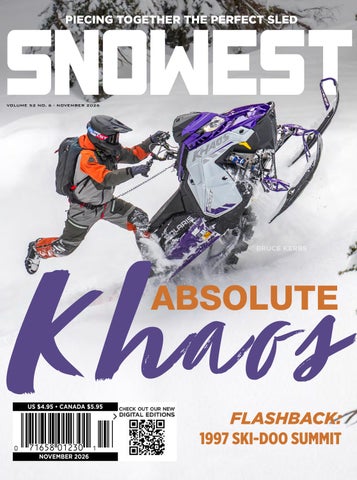
COVER
SnoWest test rider Bruce Kerbs aboard the 2027 Polaris Khaos RMK Patriot Boost. Photo: Tristin Ironi for SnoWest
CONTENTS
Mathieu Hamel is Ski-Doo’s Project Manager for Deep Snow. He’s taking the brand higher and higher each season. Photo: Tristin Ironi for SnoWest 8 SNOWEST NOVEMBER 2026
DEEP SNOW
LIGHT WORK EXPLORE THE INDUSTRY’S LIGHTEST MOUNTAIN SLEDS SNOWEST NOVEMBER 2026 9
SNOW REPORT
INTERNATIONAL SNOWMOBILE MANUFACTURERS ASSOCIATION ANNOUNCES The International Snowmobile Manufacturers Association (ISMA) is pleased to continue its annual celebration of snowmobiling with the first of two signature events: International Snowmobile Day on October 31st, 2026. Snowmobile Day events invite clubs, dealers, and snowmobile enthusiasts across North America to celebrate the sport, welcome new riders, and build community. ISMA supports local snowmobile clubs with grants to host this event, encouraging fun, safety, and camaraderie at the start
of the season. Snowmobile Day, inspired by Sweden’s long-running Snöskoters Dag, brings dealers and clubs together to showcase new products, highlight safety, and promote club membership as we start gearing up for the winter to come. Events often include: • Vintage and custom sled “Show and Shine” displays • Groomer and towing vehicle exhibits • Safety training and maintenance sessions • Games, raffles and giveaways from local businesses
ISMA CONGRATULATES THE FOLLOWING CLUBS SELECTED FOR 2026–2027 SNOWMOBILE DAY AND RIDE DAY GRANTS. Snowmobile Club: Dealer Partner: Location: Dalton Ridge Runners Dalton Mountain Motorsports Lancaster, NH Davis County Snowmobile Club Karl Malone ADS Ogden UT D.R.A.G. of Speculator Village Motorsports, Inc Speculator, NY Fergus Elora Belwood Snowmobile Club Lockhart’s Odyssey Guelph, ON Forsyth Snowmobile & ATV Club Ride North Marquette Ishpeming, MI Fort Mountain Trail Winders Bickfords Sport Center Epson, NH Lakeville Sno-Trackers Inc Leo’s South Lakeville, MN Lancaster Snowdrifters Dalton Mountain Motorsports Lancaster, NY Lyme Pinnacle Snowmobile Club Robbins Powersports Windsor, VT Melfort and District Trail Riders Inc Thomas Motors Melfort, SK Prince Albert Trail Riders Inc Rally Motor Sports Prince Albert, SK Riverbend Benders Nielsen Enterprises Lake Villa, IL Salt Lake Valley Snowmobile Club Karl Malone Powersports Salt Lake City, UT Sister’s Sno-Go-Fers Cascade Motor Sports Bend, OR Sno-Kommanders of Lake County Nielsen Enterprises Lake Villa, IL Snow Riders of Nashaway Central Mass Power Sports Lunenburg, MA Waumbek-Methna Snowmobile Club Dalton Mountain Motorsports Lancaster, NH 10 SNOWEST NOVEMBER 2026
wyoming is
unreal
where the only thing that’s packed is your bag, and the only lines are the ones you leave behind.
visitlaramie.org | 307-745-4195
SNOWEST NOVEMBER 2026 11
KLIM REDESIGNED OVERRIDE VEST
Ride More. Stay Longer. ALPINE, WYOMING’S EXTENDED STAY HEADQUARTERS 307-203-3351 wyndhamhotels.com/hotels/alpine-wyoming 12 SNOWEST NOVEMBER 2026
Riders often focus on temperature when choosing gear. But temperature alone doesn’t determine comfort. The real challenge is managing a rider’s micro-climate. A micro-climate is the thin layer of protective air surrounding the body. It’s constantly changing based on rider activity, environmental conditions, moisture levels and layering choices. When a rider becomes too warm, overheating leads to perspiration. When that moisture remains trapped against the body, it accelerates heat loss. When riders become too cold, blood flow begins shifting away from extremities to preserve core temperature. Effective layering helps riders maintain balance between these extremes. THE GOAL IS SIMPLE: • Manage moisture • Balance heat • Protect against the elements This philosophy continues to drive the development of KLIM’s layering systems. Within a complete layering system, the mid-layer serves as the control layer.
Positioned between a moisturemanaging base layer and a protective outer shell, the mid-layer’s role is to: • Regulate Warmth • Manage Moisture • Adapt To Changing Conditions As riding intensity changes throughout a day, the demands on rider comfort change as well. A properly designed mid-layer keeps riders closer to their ideal comfort zone over a wider range of conditions. For riders producing significant body heat through active riding, breathable insulation often provides the optimal balance. THE REDESIGNED OVERRIDE VEST FOCUSES ON: • Lightweight warmth • Moisture management support
• Breathability • Layering versatility • Mobility and comfort Klim’s layering products function as the adjustment layer within the system, allowing riders to fine-tune insulation without sacrificing moisture transfer or freedom of movement. For mountain riders, backcountry riders and aggressive technical riders, maintaining breathability can be just as important as adding insulation. KEY BENEFITS • Breathable insulation • Moisture management support • Lightweight comfort • High-output riding compatibility • Versatile layering options See more at www.klim.com
ADVERTISING AND EDITORIAL OFFICES 190 1st St. - Idaho Falls, ID 83401 Phone: 208-524-7000 Fax: 208-522-5241 PUBLISHER/EDITOR RYAN HARRIS rharris@snowest.com CONTRIBUTING EDITOR STEVE JANES PHOTOGRAPHER TRISTIN IRONI SNOWEST TEST STAFF RYAN HARRIS - STEVE JANES RHETT CLARK - JUSTIN STEVENS BRUCE KERBS - BROC GENTA ADVERTISING MANAGER Kevin Malcom kevin@snowest.com WEB CONTENT DESIGN MANAGER Laci Thompson Karcin Harris CONTROLLER SOCIAL MEDIA Clayton Ward ASSISTANT Kwynn Harris CIRCULATION Chuck Harris
SNOWEST MAGAZINE
is published 7 times per year by Harris Publishing Shows, LLC Copyright (c) 2026. Harris Publishing Shows, LLC All rights reserved. Reproduction in whole or in part, without written permission, is strictly prohibited. SUBSCRIPTION SERVICES / ADDRESS CHANGE 190 1st St. Idaho Falls, ID 83401 208-524-7000 or crh@snowest.com. SUBSCRIPTION RATES SnoWest, $38.95 Print + Digital per year. $12.00 Digital only per year. Back issues, when available, $5.00 each.
Largest Snowmobile Largest Snowmobile Track Dealer Track Dealer in in America! America! WE TRADE / BUY TRACKS INQUIRE
Ski Boots Black - $149 / Colors $159
WWW. .COM 10340 67th Avenue SE, Lake Lillian, MN 56253 info@tracksusa.com
146 x 16 x 1.6 Cobra - $425 Hurricane 1.75 / Ripsaw ll 1.5 Backcountry 1.75 & 2 Cobra / Ice Cobra 1.6 Crossover 1.5 / Intense 1.5
136 x 15 x 1 Energy - $399 Ice Arrowhead 130 Storm / Ice Storm / Cobra 1.352 Ripsaw 1 & Ripsaw ll Ice Attack XT / Hacksaw
Discount pricing for Extension Packages to include track, tunnel, and rail extensions
NEW: 147 x 15 x 3, 146 x 16 x 2.5 Challenger Extreme - $785 Challenger 2 & 2.3 Peak 2.5, Challenger LX 250 & 300 Challenger X 3.2
320-382-6128 320-382-6128
RAIL EXTENSIONS Catalyst applications in stock World’s best rail extensions. Interlocking design provides guaranteed strength. Priced from $105
SNOWEST NOVEMBER 2026 13
WHAT’S YOUR GO-TO MOVE? BY KYLE PULSIFER
I would say my specialty is very steep, technical tree riding. I’m looking for the steepest terrain to separate yourself where there’s mandatory hop-overs or maneuvers in areas where it’s really high consequence. I enjoy going up things as fast as I can. A lot of people like playing around and doing tricks. But I’m kind of old school—I like climbing stuff. The steeper, longer, more vertical feet I can gain as fast as possible without making mistakes is what I really love doing. I came into this sport working for Chris Burandt. This was his style of riding and I just like doing it. Even if I go out riding with others who just want to play around, I still need to head out into the trees to get my fix to technical climbing. What I’ve worked on over time, and have taken from Chris Burandt, is to riding extremely front-end light. If you plant a ski into something, it’s going to take a lot of your speed and you’re going to have a hard time making that speed up. So, I ride really far back on the sled but with my body weight over the top of the sled—using my feet and my knees to keep my body weight forward while pulling back on the handlebars. It allows the sled to steer with tiny input with your toes in the running boards and letting the sled just stay underneath you while you’re climbing stuff with very little effort on the handlebars. The brake is definitely used as much as the throttle. There are times when you’re actually on both the brake and the throttle at the same time—a place where you don’t want to let off on your rpm but you want to calm the front end down a little bit. Sometimes you also rotate—gas, brake, gas, brake—as you chop a sidehill through the trees. And if you want to chop that frontend downhill, the brake is super important to drop the front downhill.
14 SNOWEST NOVEMBER 2026
SNOWEST NOVEMBER 2026 15
TIPS FOR THE AVERAGE RIDER
I’d say that the biggest danger for the average rider is once he gets to where he thinks he can ride in the real technical terrain, he may still not have that balance in brake control and speed control. There are times on a 40-degree slope where fast enough to have control and slow enough to not get stuck is 2 mph, and other times is much faster. You need to know how to read the terrain a head of time, and read the snow that can quickly change as you change the aspect of the slope or wrap around to the other side of the ridge. You need to read the terrain right so you don’t come into something way too fast for your ability to stop. You need to maintain your control and to be able to slow things down to match the conditions.
16 SNOWEST NOVEMBER 2026
ADVERTISEMENT SNOWMOBILE
protect your winter adventures
WITH SNOWMOBILE INSURANCE As winter sports enthusiasts, we eagerly await the snowy season for the adrenaline rush of snowmobiling. The feeling of the cold air rushing past, the sight of the unspoiled white landscapes—it’s a winter wonderland waiting to be discovered. Amidst the excitement and adventure, it’s essential to ensure that you’re properly protected with snowmobile insurance. Here are a few reasons why snowmobile insurance is a wise decision. Peace of mind The most significant benefit of snowmobile insurance is the peace of mind it brings. Knowing that you’re covered in case of unexpected events allows you to fully immerse yourself in the winter experience. Focus on the breathtaking landscapes and the adrenaline rush of riding, without the nagging worry of potential financial setbacks.
Family and friends Policies can provide off-premises and permissive use, allowing you to confidently have friends and family drive your snowmobile occasionally. You also have the option to add minor operators as drivers, so you can rest easy knowing that you have the right protection if something goes wrong.
Protect your snowmobile Your snowmobile is a valuable investment that deserves protection. With comprehensive and collision coverage, you can rest easy knowing that repair or replacement costs will be covered in the event of certain damage, theft, or accidents. Keep your ride in top condition without breaking the bank.
Personalized protection Since no two snowmobilers are alike, snowmobile insurance lets you choose your own coverage options. You can customize your policy to include things like accessory and custom parts/equipment coverage to provide protection if you’ve made enhancements or upgrades to your snowmobile. This way, you can be sure that your insurance plan matches your specific needs.
Be prepared for the unexpected Accidents can happen, even to the most experienced riders. Snowmobile insurance offers liability coverage, protecting you from the financial implications of thirdparty injuries or property damage, up to specified limits. You can relax and have fun in your winter activities, whether riding on trails or exploring the backcountry, when you have the right protection. Homeowners insurance Homeowners insurance may provide some coverage for your snowmobile, but it often has limitations and can have a more costly deductible. A dedicated snowmobile insurance policy ensures that you’re adequately covered specific to your needs.
Confidence for financing Obtaining insurance coverage for your snowmobile is often a requirement from lenders if you have financed its purchase. Not only does snowmobile insurance fulfill this obligation, but it also provides peace of mind by safeguarding your financial interests. Have fun in the winter with confidence, knowing that you have the proper coverage for your situation. Invest in snowmobile insurance and ensure that your thrilling escapades remain just that—thrilling, safe, and unforgettable. Let the snow-covered landscapes be your playground, and let insurance be your safety net.
Scan to get a quote in as little as 3 minutes Progressive Casualty Ins. Co. and affiliates Coverages subject to policy terms and conditions.
Go to progressive.com to learn more. SNOWEST NOVEMBER 2026 17
ABSOLUT POLARIS FLAGSHIP MODEL
THE PRO PAVED THE WAY FOR THE KHAOS RMK
When the Polaris Pro RMK was introduced in 2011, it represented the best of the best. For over a decade it set the standard for mountain snowmobiles. But in 2020, Polaris engineers decided to expand the best over-the-snow vehicle with a more playful trim—the RMK Khaos—which changed the style of riding for many Polaris riders. The Khaos ushered in the next generation of mountain riders who changed the focus from the destination to the journey. The Khaos was designed lift higher, turn sharper and spin around faster. By changing the rear suspension from the Pro RMK rear to the RMK Khaos rear, weight transfer became instant. With a subtle adjustment of foot position and flick of the throttle the Khaos front end would explode out of the snow, allowing you to instantly set in in the direction you wanted to go.
Kh
TRISTIN IRONI
18 SNOWEST NOVEMBER 2026
TE
haos
SNOWEST S NOWEST NOVEMBER 2026 19
KYLE PULSIFER
Within a few short seasons, more Polaris riders where trading in their old Pro RMKs for this next generation of excitement on the snow. Although there are plenty of Polaris faithful still attached to the deep snow performance of the Pro RMK with the 155 and 165 tracks, many of the younger generation were finding that the 146 and 155 tracks of the Khaos best accommodated their style of riding. For the Pro, most riders preferred the Series 9 3.25-inch tracks, although the Series 8 2.75-inch tracks were slightly more versatile and offered a better ride down the trail. For the Khaos, even though many riders who spend the most amount of their time in deeper snow conditions still preferred the 3.25 or 2.75 tracks, which are available for the 155 and 165 skids, for the riders who are more focused on pounding terrain, hitting jumps and playing in the tight areas, the Series 6 2.6-inch track or the Crossover 2-inch track offer a more playful feel.
20 SNOWEST NOVEMBER 2026
ANDY THOMAS
CAL LARSON
SNOWEST NOVEMBER 2026 21
But if you want to pin down the true flagship of the Polaris lineup, it would likely be the 850 RMK Khaos with the 155x2.75 track. It’s the most versatile, best value model that delivers a playful aggressive style of mountain riding whether you are in bottomless powder and settled snow conditions. The Pro RMK is a precision mountain sled with the focus on technical riding, deep snow and sidehilling. Even though it’s been around for over 15 years, it definitely isn’t the same snowmobile that was introduced in 2011. Each year it has improved in subtle design changes to reduce weight, improve performance and enhance handling. The RMK Khaos is the beneficiary of this process of evolution. And in recent years have even contributed to the improvement of the Pro RMK. Whether you are satisfied with the abundance of power with the Patriot 850 engine, or rather upgrade to the 9R or Boost, the Khaos and the Pro still reign supreme in mountain performance.
22 SNOWEST NOVEMBER 2026
OPEN EVERY DAY JAN 1 - APRIL 1
RIDING CLINICS LEVEL 1-3 & GUIDES LEVEL 1 CLASS: JAN 7-9 | LEVEL 2 CLASS: JAN 22-24 NEWLY REMODELED FOR THE 2026-27 SEASON 4 HOTEL ROOMS, 2 BEDS PER ROOM HOME-COOKED MEALS 8-PERSON BARREL SAUNA
Book your next Adventure in the Beartooth Mountains, conveniently located in the heart of the riding with premium access.
CALL MASON WITH QUESTIONS AT 406-425-0899
SNOWEST NOVEMBER 2026 23
If you’re looking for the absolute best of everything in the Polaris mountain line, the new 2027 RMK Factory Edition model offers all the bells and whistles with the 9R or Boost engine packages. However, it’s also the most expensive model in the Polaris mountain lineup. This model is inspired by Hillclimb racing competition and features the most aggressive performance products. It has the highend suspension, a reinforced structure and a premium finish so it will look good on the winner’s
24 SNOWEST NOVEMBER 2026
SUPPORT THE CAUSE
WIN THE SLED
SCAN TO ENTER
Grand Prize: Perfect Winter Sled
2026 Polaris Khaos 9R 165, Parts by: SLP, TRS, ZRP, IceAge Performance, ZBROZ, Seat Concepts, ArcticFX, Carbon Pursuit, and 3D Logik
First Prize: TruckBoss 8' Custom Sled Deck Full Snow Bundle including many upgrades
Second Prize: Perfect Winter Sled Upgrades Over $6,000 worth of personalized sled upgrades for your snowmobile
Third Prize: Head-to-Toe Klim Gear Package Lochsa One-Piece, F3 Carbon Helmet, Atlas 24L Avalanche Backpack KLIM Edge Goggle, Adrenaline Pro GTX BOA Boot
Fourth Prize: Ortovox Safety Package FOCUS VOICE Transceiver & AVABAG LITRIC FREERIDE 18
SNOWEST NOVEMBER 2026 25
26 SNOWEST NOVEMBER 2026
WHAT’S YOUR GO-TO MOVE? BY DAVE MCCLURE
I’d say my signature move would be the bow tie even though a lot riders are kind of cutting on the bow tie because it’s overdone. But it’s just fun to do and I enjoy doing it. So, I’m always looking for different spots where I can do it, even in tight areas like trees. Anyone can do them out in the open, on an open hillside. But if I can find a spot where there’s a 10-foot opening in between two trees, I’ll try to throw a bow tie there. It’s just fun, especially when you can get the track out of the snow. There are other moves that are more practical, like the hopover, where you’re going one way and you need to change direction. The bow tie is just kind of like, ‘I’m comfortable, and I can throw in a little trick here and keep going.’ So, the bow tie is not necessarily like a hop-over to change direction. It’s just a way of saying ‘Hey, I’m just showing off.’
SNOWEST NOVEMBER 2026 27
TIPS FOR THE AVERAGE RIDER
Honestly, I think most all of the tricks are doable on these new sleds. There’s not one that that you can’t try. However, the hop-over is one that’s probably the most challenging. You have to get enough ski lift to get up and over the sled, you know, hopping over the seat. But the bow tie is one that I would say the sled will follow the head. You get the skis up, and if you quickly look over your shoulder, the sled will follow. You’ll be surprised. But there can be risk and you need to be careful. I’ve seen a lot of guys try those moves, and get hung up in the skid. Sometimes they’ll fall off the back and their legs will go into the skid. I definitely encourage you to have your tether connected 100 percent of the time because things can go bad really quick.
28 SNOWEST NOVEMBER 2026
edition HEATED HELMET CABINET
STEREO W/USB PORTS
REPEAT.
KICKER SOUND SYSTEM
SKIS GLIDE
Trails West trailers don’t need hype—they’re proven by riders who demand performance.
LOWER LIGHT PACKAGE
CUSTOMIZE YOUR TRAILER For Dealer Info: TrailsWestTrailers.com :: 1.208.852.2200
FORCED AIR FURNACE W/ TRACK MELT
SNOWEST SNOWESTNOVEMBER OCTOBER 2026 29
SNOWEST TEST RIDER
EYES FOR HAND ON JUSTIN STEVENS OFFERS INSIGHTS ON POLARIS BY STEVE JANES
W
hen it comes to technical riding on the Polaris mountain sleds, there are some subtle adjustments you need to make depending on the Polaris model, snow conditions and terrain. Justin Stevens, SnoWest Snow Test Rider has spent a lot of time on all of the Polaris mountain sleds, the different engine packages, the different track sizes and the different suspension options. Through years of riding experience, Stevens took the time to share some of his thoughts on how to handle riding in extreme and varied terrain. Here are his tips on riding sidehills, deep powder, mountain drainages, trees and hillclimbing.
SIDEHILLING
“If I’m going slightly uphill on a sidehill, one of the things I like about the Polaris is it’s pretty stable once you get the sled up on its side and establish the line you want to follow,” Stevens said. “My body position is usually wrong-foot-forward, maybe 6-8 inches back from the foot well, maybe farther back depending on snow conditions and steepness of the hill. I want to be in a comfortable position with low input with my stance so I can easily maneuver the sled if I want to turn a little more uphill or downhill while maintaining that balance.” Stevens noted that the Khaos feels lighter than the Pro RMK on the front end because of the more transfer allowed due to the longer limiter strap. Sometimes this requires a little more brake input to keep it level. “I always have a finger on the brake in case I need it to make a maneuver, and usually I’m just burping the throttle as I go across the hill. This way I’m free to give it more throttle if I need a little more power to cross the hill or maneuver,” he explained. With the Pro RMK, the rear suspension makes it more suited for traversing long steep slopes while the Khaos is more inclined to make quick turns. Stevens notes that it takes a little more rider effort to make a major direction change on the Pro RMK, and it requires a little more rider effort to maintain a long straight sidehill line on the Khaos. “If I need to start a descent on the hill, I want to let the sled roll more into the hill, especially if its steep, so I can shave a little bit of speed off and still maintain the sidehill as it goes down the 30 SNOWEST NOVEMBER 2026
slope. I try to get back into a neutral position to maintain more control over my snowmobile,” Stevens explained. Depending on the speed you want to be carrying, Steven said he’s either working a little more throttle or a little more brake. “If it starts to come over and you want it to come over a little bit more, you give it a little bit more throttle and have the track break loose so the sled comes over a little bit quicker. A lot of the throttle/brake interaction comes naturally.” Stevens said it hard to explain how much he’s controlling the sled with the throttle/brake since it’s more of a natural feel that you really don’t think about. “So often as you’re doing it, it’s happening together—a little bit of throttle, a little bit of break— keeping the sled going where I want it to.”
DEEP POWDER
Rider position in deep snow is also critical. If you’re feet are too far back on the running boards, the front end wants to lift and you end up with too much track coming out of the snow, losing your traction and forward thrust. “I try to stay forward if I’m getting a little too much lift in the nose,” Stevens explained. “Sometimes on the Pro RMK, depending on the snow, I might actually get a little bit back of neutral and encourage the front end to lift so the sled becomes a little bit more playful. This also makes it more maneuverable if you are working your way around trees and things while climbing up the slope. On the Khaos, you can be standing closer to neutral and the sled will naturally lift the front end.” Stevens said he typically prefers to have the skis up out of the snow. “I don’t want them straight up in the air, unless of course I want to be standing on the tail. But typically, I like a little less ski pressure going up the hill,” he explained. “Your suspension setup can really make a difference here. I think for the most part it’s easier to maneuver through the trees and obstacles if you have the nose up a little bit. That’s why the Khaos is a little easier to ride in more technical terrain.” The difference between the Pro RMK and the Khaos is that where the Pro RMK makes very predictable turns while holding a clean line, the Khaos will carve the snow more quickly and easier since it’s a little easier to break the track free and spin the snowmobile around.
R TIPS …
RWARD, N BRAKE
SNOWEST NOVEMBER 2026 31
DRAINAGES
“When I’m riding either the Pro RMK or Khaos into a steep drainage, I’m still riding it wrong-foot-forward on the uphill side as I slide down into the drainage,” Stevens explained. “I will use a little bit of brake and a little bit of throttle to keep the snowmobile’s momentum as I work my way to the bottom of the drainage. Often there is a small area where the slope flattens out where you can then make a move to cut across the drainage and onto the other slope where you reverse your stance to the other side of the sled.” The speed during this cross-over depends on the track length and engine size. With a 9R or Boost and a 3.25-inch track, you can carry a little less speed because you will have instant power once you grab a fistful of throttle. But Stevens pointed out that the key to the cross-over is to quickly regain your balance as you slide from one side of the snowmobile to the other as you start your climb up the other side of the drainage. “Depending on what sled you’re riding, I feel like the Polaris has always been pretty user-friendly when it comes to throttle control,” Stevens said. “I don’t think the 850 engine really ever gets out of control. The 9R does have a little quicker throttle response, which is what I prefer when I’m in tighter areas where you don’t see your line as quick or you make a mistake and need to recover, it’s easier to jump back into it. It usually easy to maintain control of your sled unless you lose balance and perhaps grab too much throttle … then it can get a little western.”
TREES
The key to tree riding, regardless of what snowmobile you’re on, is keeping your eyes forward and looking for lines and options as you wind your way through tight spaces. “I guess the biggest thing is that you always have to be looking forward and kind of riding ahead of where you are actually at,” Stevens said. “We have a tendency to microfocus on the obstacle that we’re trying to get through at the moment. But if we’re already in that obstacle, it’s probably too late to do anything about it so we should be looking ahead to see where we want to be getting to.” Stevens said while riding in trees you need to have an A gap, B gap, and even C gap so you have the options and you are ready to adjust for the speed you are going. “You always want alternative gaps and you want to maintain momentum through the trees,” he said. “Riders who struggle in trees probably aren’t keeping up enough momentum to stay on top of the snow. But it’s hard to maintain momentum if you don’t have options.” The Pro RMK tends to allow you to travel at lower speeds since it stays up on top of the snow. And since it takes a little more effort to make a tighter turn, you don’t want to be packing too much speed or you will miss your gap. With the Khaos, you can pack a little more track speed and it’s still quick enough to make a sudden adjustment to hit your gap. “Polaris is probably one of my favorite models to ride in the trees,” Stevens said. “I feel like it always has a pretty impressive stability and predictability that makes tree riding really easy. I never question whether or not I can hit the gap I’m looking at and I trust the sled can create the momentum to adjust to the change in direction—whether it’s up or down or straight across.” Stevens noted, however, that sometimes on a downhill you find that the Polaris front end tends to wash out, depending on the snow conditions or steepness of the slope. But in the trees, the Polaris is very predictable and is easy to find the gap.
HILLCLIMBING
“I say for the most part, if you’re just pointed straight up a slope and wanting to climb to the top of the hill, you want to stay pretty neutral in your stance, or perhaps a little bit back, 32 SNOWEST NOVEMBER 2026
so you can keep the front end light,” he said. “You want to be on the throttle so you can keep your momentum up while keeping the brake covered in case you need more track in the snow.” With any hillclimb, there is always that point of the slope where you may need to make the decision whether to go left or right or abort your climb, you want to be able to get to the uphill side of the snowmobile where you can maintain your balance as you choose the line you need to take. “The key to riding this kind of terrain is you need to always be looking forward, looking for your options, looking for where you may need to turn out if you don’t like your line,” Stevens said. “You need to be looking for those open gaps in the trees that may be your line.” With Polaris, you might be on the 850, or 9R or Boost. Each one would offer different options due to the sled’s power and performance characteristics. “The 9R is such a powerhouse and quick to respond. If you want to play in the trees all day, I believe that’s the most fun sled,” Stevens said. “It is quick, responsive and has lots of power. With the Boost, you have to get use to how the power comes on. The more you ride it the more you learn where the power hits and how much momentum you need to be carrying before it comes on. This will help you understand how much you need to either burp the throttle or stay into the throttle to maintain momentum to keep into that power.” Stevens said each of the sleds he rides handle just a little bit differently. Also the track lengths and the lug lengths come into play. “These all can make a significant difference on how the sled handles. But regardless, I think the throttle plays a huge part in any riding.”
SNOWEST SNOWEST NOVEMBER MARCH 2026 2026 33 41
BUILDING THE PERFECT SNOWMOBILE...
IN PIEC
TAKING THE OEM’S BEST FE
34 SNOWEST NOVEMBER 2026
CES
EATURES-PART 1
If you could pick and choose features off the OEM snowmobiles and combine them to create the perfect mountain sled, what would you build? This question was posed to the SnoWest SnowTest staff during the 2027 New Model Intros at West Yellowstone, MT, last winter. Simple put, we broke down every aspect of the snowmobile and then hashed out from which manufacturer’s parts inventory would we steal which parts. In Part 1 of this two-part segment, we will explain what skis, track, rear skid, front suspension, side panels, engine and clutches we would choose. In Part 2 in next month’s SnoWest we will cover the running boards, tunnel, handlebars, hand warmers, throttle, brake, gauges, bumpers and seat. We probable should have included the starter and reverse features … but it was pretty much a given that we would just keep Ski-Doo’s magic button that features SHOT start and RER reverse because nothing else actually comes close to these innovations for function, ease of use, and weight savings. The SnoWest SnowTest crew features Broc Genta, Bruce Kerbs, Justin Stevens and Rhett Clark. Here’s the what they chose.
SKIS—POLARIS GRIPPER
This choice came down to the Polaris Gripper and Ski-Doo Pilot 4 skis. “I feel like the Gripper ski floats well in powder and also has enough bite or is aggressive enough to hold the line in the snow,” Kerbs said. “Yet it’s not overly aggressive where it’s pulling you from one side to the other. The ski is very predictable.” Kerbs took it over the Ski-Doo Pilot 4 ski even though he admits that Ski-Doo has put a lot of effort in its ski design over the past few years and made it better holding lines on sidehills. “They are a little more aggressive on harder packed snow and they still perform just fine in powder,” he explained. “But I still believe Polaris still has the edge when you consider all snow conditions.’ Stevens also felt the Polaris Gripper was the better all-around ski. “There are definitely places where the Gripper ski shines more than others,” Stevens said. “On a sidehill they definitely stick and hold the line really well, probably where it matters most to me.” Stevens said that when it comes to deep snow performance, perhaps the Ski-Doo Pilot 4 ski works a little bit better. “But in deep snow, it matters less to me on ski performance as it does in more technical riding areas,” he explained. SNOWEST NOVEMBER 2026 35
TRACK—POLARIS SERIES 9 155X3.25
The choice came down to Polaris Series 9 and Arctic Cat PowerClaw. “For our area I would pick the Polaris Series 9 155x3.25 track,” Genta said. “This track just moves a lot of snow and you can feel the sled lift up out of the snow.” Genta said his second choice would be the Arctic Cat PowerClaw 154x2.6 track. “This track really hooks up hard,” he explained. Clark agrees that the Polaris Series 9 155x3.25 track is super impressive in deep snow. “It has good traction any time you want it, and it gets you up on the snow,” Clark said. “With all tracks, when you easy up on the throttle they tend to sink a little deeper in the snow. But with the 3.25 track, when you give your sled a little gas, this track will find the traction and pop you back on top of the snow.” Clark said the Arctic Cat PowerClaw is somewhat similar in performance with the Polaris tracks. “The PowerClaw is super responsive and gets on top of the snow, almost like it floats,” he explained.
REAR SKID—SKI-DOO TMOTION X
The choice came down to the Ski-Doo tMotion X with coil-over shocks and the Polaris Factory HD. “We kind of referenced the new rearend coil-over performance in the Summit X, and we all kind of agree they Ski-Doo has done a great job in improving the rear suspension to make it work really 36 SNOWEST NOVEMBER 2026
well,” Steven said. “I think the Factory Edition skid in the Polaris also works really well. Polaris did a phenomenal job improving the performance of that skid.” Clark agreed that with the improved changes in the rear in skid, Ski-Doo greatly improved the performance and predictability of the Summit X package. “It works really well on the trail when you’re going through deep moguls,”
Clark said. “The suspension is just impressive on how it works well in all conditions.” Clark noted that Polaris has had coil-over suspension on their skids for a few years and they work great. “However, the Polaris ride is not quite as plush as the Ski-Doo, but it works well for mountain riding,” he said. “But it is a little harsh on how it reacts in bumps and harder snow conditions.”
IDAHO SNOWMOBILE SHOW Ford Idaho Sports Complex Nampa, ID
NOV 20-21 snowest.com/idaho
SNOWEST NOVEMBER 2026 37
FRONT SUSPENSION— POLARIS RMK REACT
The choice came down to the Polaris RMK React and the Arctic Cat AWS 36. “The Polaris RMK React front is a little more rigid and I think that’s what helps it hold a line on a sidehill,” Kerbs said. “It is very predictable. If you want to suddenly change directions the front end reacts instantly to rider input.” Kerbs also felt the Arctic Cat AWS 36 front end performs well in deep snow. “With the Cat, when you’re riding it, the front end seems pretty small; there’s not much in front of you and you feel like you’re on a smaller snowmobile. Even though you’re still riding an 858, the front makes it handle like it’s a much lighter snowmobile.” For Stevens, when it comes to backcountry mountain performance, there’s just something about the Polaris front end and how it maneuvers in technical terrain. “I think that’s across all their mountain models,” Stevens said. “The front end works really well. The sled goes where you want it to. That’s why it’s number one.” Stevens also admitted that when you are charging up a mountain, the Arctic Cat AWS 36 front end also works quite well.
SIDE PANELS—SKIDOO REV GEN5
The choice came down to the Ski-Doo and the Arctic Cat side panels. “The side panels on the Summits are so user friendly,” Genta said. “One little click and they open right up. With the narrow front end, you would think that the sled would panel-out in the snow. But the panels are so tight around the powerplant of the snowmobile you don’t panel-out.” Genta also likes the Arctic Cat side panels because they are tight to the powertrain and gives the front end a very small appearance. Stevens had the Summit side panels on the top of his list as well. “I think Ski-Doo has done a great job making sure everything is really tight and compact,” Stevens said. “The look is good, the fit-and-finish is good. It never seems to panel out in the snow.” Stevens also agreed that Arctic Cat has also done a good job with the Catalyst platform to make a good side panel for a good sled. 38 SNOWEST NOVEMBER 2026
SNOWEST NOVEMBER 2026 39
ENGINE—ROTAX 850 E-TEC TURBO R
The choice came down to the Rotax 850 E-Tec Turbo R found on both Ski-Doo and Lynx snowmobiles and the Polaris Patriot 9R if you wanted a naturally-aspirated engine. “The Rotax 850 E-Tec Turbo R engine just works well,” Kerbs said. “Ski-Doo and Lynx has really strong engines … and having great clutching helps. I feel like the clutches are definitely part of the engine. Rotax engines are crisp. Their tuning has always been spot on. Their mapping has always matched the elevation.” If Kerbs were to choose a naturally-aspirated engine he would definitely take the Polaris Patriot 9R. “I feel like this is Polaris’ best running engine. The lighter crank makes it quick responding and it pulls strong all the way through the powerband. It also has great topend speed. It really works.” Clark is also on board with the Turbo R. “All Rotax engines are dialed, not only on the Turbo R but on the 850 E-Tech naturally aspirated,” Clark explained. “The Rotax engine runs strong, the power is linear; it’s smooth and it’s always there. You can let off the throttle when you’re doing a downhill turn buried in powder, or if you are climbing up a hill and let off the power, when you get back on the throttle there is no hesitation. The power is always there and the delivery is always on point.” For Clark, even though the Polaris Patriot Boost offers great power, he would probably still go with the 9R as his second choice. “With the Boost the power comes on a lot later. To me it still has the characteristics of an aftermarket turbo. By the time the turbo kicks in you are already going so fast that you need to back off the throttle. I think the 9R engine is actually a better pick than the Boost. I love the power of that engine.”
CLUTCHES—SKI-DOO P-DRIVE
The choice came down to the Ski-Doo p-Drive with clickers and the Polaris P-22Team LWT. “I’m always so impressed on how well Ski-Doo produces power and gets that power to the track,” Stevens said. “They’ve just have their engine performance and clutching dialed on these latest models. Stevens said he always felt Polaris has done a solid job in clutching with their QuickDrive and Team LWT combination. “Polaris seems to be doing a really good job in pairing their engines with their clutching in order to get the power to the track. I don’t ever have to mess with it.” For Clark, the Ski-Doo (and also Lynx) p-Drive clutch system with adjustable clickers has always been a great system to handle the performance produced by the Rotax engine. “It shifts when you want it to; it backshifts quick and it doesn’t heat up.” Clark also sees the strength in the Polaris clutching system. “The Polaris clutches seem to always run a little cooler and I think that gives you better belt life,” he explained. “It’s amazing how the engineers have really dialed in their clutching to their engines.”
-PART 2 NEXT MONTH-
We’ll finish piecing our Frankensled together next month when we address the running boards, tunnel, handlebars, hand warmers, throttle, brake, gauges, bumpers and seat. 40 SNOWEST NOVEMBER 2026
LIMITED EDITION OUTSIDER HAT
LIMITED EDITION SHIRTS SNOWEST NOVEMBER 2026 41
90S SLEDS: SKI-DOO
WHAT MOUNTAIN SLEDS WERE LIKE 30 YEARS AGO BY RYAN HARRIS ALL PHOTOS ARE FROM THE SNOWEST TEST ARCHIVES
When Ski-Doo first launched the Summit in 1994, do you think they had any idea where it would take the brand 33 years later? Factory turbos and radical models like the 2027 Summit Expert and Freeride shown here are just steps along the path of continued design and development. But what a ride it’s been.
42 SNOWEST NOVEMBER 2026
The 1994 Ski-Doo Summit 470 and 583 were released mid-season of the 1993 model year. It was a shot from Ski-Doo claiming to push the first dedicated mountain sled to market. The ’94 Summit 583 was built on the F2000 chassis and was a starting point for what would arguable be the best deep-snow mountain sled of the ‘90s: the Summit 670.
SnoWest built some incredible project sleds over the past 35 years, and Project Projectile was one-of-a-kind. It featured a ’94 Ski-Doo Summit 583 with an ATS turbo system. Keep in mind this sled was carbureted and had a primer for cold starts—nothing like what you see on modern turbo sleds or even aftermarket turbos of the past decade. SnoWest editor Steve Janes rode Project Projectile to new heights that season.
Ski-Doo actually first released the 1996 Summit 670 in the F2000 platform when the sleds were announced in March 1996. Had it gone to production in the F2000 chassis, the Summit 670 would have marked the third year of F2000 Summits.
SNOWEST NOVEMBER 2026 43
90S SLEDS: SKI-DOO
ABOVE: Instead, SkiDoo later announced the Summit lineup (and Summit 670) as S2000 platform models. This move gave the Summit 670 the boost it needed to become one of the most popular sleds of the ‘90s. RIGHT: Toni Haikonen, the Flying Fin, was a dominant snocross racer on the S2000based MX-Z.
44 SNOWEST NOVEMBER 2026
30 years ago, the 1997 Ski-Doo Summit 670 made waves in the industry on the continued success of the 670 Rotax twin. The 670 competed agains the 1997 Polaris 700 RMK, Yamaha Mountain Max 700, and Arctic Cat Powder Extreme.
ABOVE: The 1997 Summit 670 was a huge hit out West. Its DSA front end hardly touched the snow as the deep-lug track pushed the mountain sled to new heights.
ABOVE: The bar was raised with the Polaris 700 RMK, and Ski-Doo answered in 1998 with the iconic Summit X. The Summit X featured new flat-top pistons and a new head, with revised cylinder porting, update RAVE valve, bigger 44mm carburetors, new exhaust system, DPM, significant weight reductions and a 1.75-inch deep lug track compared to the 1.5-inch track on the regular Summit. LEFT: The 1999 Summit X 670 was another huge seller out West, and it was the last Summit of the S2000 platform. SNOWEST NOVEMBER 2026 45
SNOWDUST
FULL FACTORY
POLARIS SEES A NEW MARKET SPLINTERING OFF OUT WEST, WHERE RIDERS WANT MORE FROM THE FACTORY OEM SLEDS TO GO DO BIG-HIT STYLE RIDING. TOUGHER RAILS, LARGER SHOCKS, HEAVIER SPRINGS… IT ALL ADDS UP TO MAKE THE 2027 POLARIS RMK FACTORY EDITIONS THE MOST CAPABLE YET. RIDER: KYLE PULSIFER PHOTO: TRISTIN IRONI FOR SNOWEST 46 SNOWEST NOVEMBER 2026
SNOWEST NOVEMBER 2026 47
• Most durable and most breathable mountain snowmobile jacket • Stay dry and protected from the harshest riding conditions • High degree of abrasion resistance
YOUR ENVIRONMENT
CONTROL
SHOP VALDEZ JACKET & TOGWOTEE BIB AT KLIM.COM