POTATO GROWER
NOVEMBER 2026
SERVING THE NATIONAL POTATO INDUSTRY
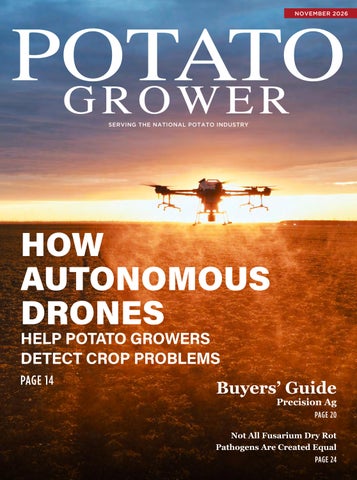
HOW AUTONOMOUS DRONES HELP POTATO GROWERS DETECT CROP PROBLEMS PAGE 14
Buyers’ Guide Precision Ag PAGE 20 Not All Fusarium Dry Rot Pathogens Are Created Equal
PAGE 24
It All Starts in the Soil.
Your crops deserve more than just conventional fertilizer. Dairy Doo® blends will feed the biology that drives nutrient uptake, improves soil structure, and sets your crop up for success from the start. Our Custom Blends are built for your acres, your soil tests, and your goals—because when you farm the soil first, you grow better potatoes.
✔
✅ Proven on farms across across Michigan and beyond
✅ Available for broadcast or in-furrow application
✅ Backed by agronomists who understand your crop
Start your season the Dairy Doo way. Call today or visit DairyDoo.com to connect with a soil health expert. (231) 734-2451 potatoapril.indd 1 2 POTATO GROWER | NOVEMBER 2026
4/4/25 4:46 PM
POTATO EXPO JANUARY 5-7, 2027
GAY LOR D R O C K I E S DEN VER , C O LO RA D O
Volume 55 Issue 11
CONTENTS
DEPARTMENTS
6
Calendar
8
New Products
10
Around the Vine
26
PapaDX Brings AI-Powered Potato Diagnostics And Field Intelligence To Growers
28
Study Offers New Way To Stop Global Potato Pathogen Once Linked To Ireland’s Great Famine
FEATURES
14
How Autonomous Drones Help COLUMNS Potato Growers Detect Crop 34 Potatoes USA Problems Before Yield Loss
The technology to grow a good potato crop is there. The question is how to take advantage of it and use it to better your crop. By Andrew Mabry
BUYERS’ GUIDE
20
36
Not All Fusarium Dry Rot Pathogens Are Created Equal
Cover photo by Alexey Bondar/Getty Images
4 POTATO GROWER | NOVEMBER 2026
Washington State Potato Commission
Washington Potato Growers Are Feeling The State’s Financial Squeeze
Precision Ag
DIGGIN’ IN
24
Potatoes Mark A Decade As America’s Favorite Vegetable – And Perceptions Keep Climbing
38
National Potato Council Ag Labor Reform: A Long-Overdue Lifeline For The Potato Industry
NOT A BIOLOGICAL. NOT A SYNTHETIC.
THE ADDITION THAT
MULTIPLIES
Add PhycoTerra® to your potato operation to feed soil microbes and deliver up to an
11:1 ROI
SCAN ME!
PILERS W/REMOTE
2003 Milestone MSBP42 480 V 3ph All Belt 42” 1998 Double L 861 480 V 3ph All Belt 42” 1995 Double L 831 480 V 3ph Chevron belt 36” 2000 Wemco 230 V 3ph all belt 36” 1999 Double L 831 230 V 3ph 36mm Belt Chain 36” 1996 Spudnik 550 230 V 3ph 36mm Belt Chain 30” 1989 Spudnik 550 230 V 3ph 36mm Belt Chain 30” 1988 Double L 813 230 volt 3ph 36mm Belt Chain 30”
PLANTERS
2016 Spudnik 8210 Pull type Cup 10 row 28” rear steer 2014 Spudnik 8080 Pull type, Cup rear steer 2013 Underhaug 3745 AVR Cup 30-36” set 32” 4 row pull hitch 2008 Spudnik 8080 Pull Hitch, Cup, rear steer 2009 Spudnik 8060 6 row 36” semi mount 2008 Grimme GL36 Cup 6 row 36” Pull Hitch
PLANTER FILLER DIRT PILER
1995 Spudnik 1115 30” x 25’ Gas motor Mayo 24” Telescopic Planter filler Piler Davis 20’’ x 20’ dirt piler Spudnik 1100 Tare piler 24” x 20’ 220 Volt 1ph
SEED CUTTERS
2014 Better Built 72” Model 472, 480 V 3ph 2004 Better Built 60” model 460, 230 V 3ph
TREATERS
2013 Better Built CDT10’-10” Duster Chemical auger 2010 Better Built CDT10’-10” Duster 2000 Better Built CDT12-10 Duster 2004 Milestone 42” Barrel Duster 1996 Milestone 36” Barrel duster 1994 Milestone 36” Barrel Duster Reconditioned
BULK BEDS/BOXES/
2025 New Double 901 20’ combo, Owner Priced to sell 1990 Spudnik 2100 20’ Electric, Reconditioned 1989 Logan 20ft, Electric
TRUCKS
2019 KW T370 Auto w/2spd reduction, 1999 GMC C8500 Top Kick 3126 Turbo Cat Allison auto 2005 Spudnik 4200 bed Combo PTO/Elec. 1996 Ford L9000 Auto, Cummins 2012 Logan 22’ bed 1978 IH Tandem IH Diesel 10spd
HARVESTERS
2019 Double L 953 4 row 2019 Lockwood 674 4 row 34” bed, 72” finger table 2018 Double L 7340 4 row 72” Reverse roll finger table 2016 Double L 973 4 row return flow, finger table 2012 Lockwood 474H 4 row 2005 Lockwood 474H 4 row 2006 Double L 883 “Air” 4 row Cummins Motor, galaxy table
CROSSOVERS/WINDROWERS
2019 Logan Scoop Pro 30” 230 3phase 1997 Double L 30" 3ph Spudnik model 150 30’’ 3ph Refurbished Spudnik model 100 24" 1ph
2021 Lockwood 554 RH 36” 2013 Spudnik 6160 6 row 34” 2007 Spudnik 6140 4 row 36” 2006 Spudnik 6140 4 row 36” 2005 Lockwood 5000 RH 4 row 1996 Double L 851 36” bed RH 4 row
DAMMER DIKERS
ROCK/CLOD/AIR ELIMINATORS
SCOOPERS
2018 Logan Yield Pro 6 row Water Saver 2013 Ag Engineering 4 row Hyd. Reset 1996 AG Engineerng 6 row Tillage Master, Trip shanks 1991 Ag Engineering 4 row Hyd. Reset 36” 2020 Spudnik 9305 6 row Hyd. Reset
EVEN FLOWS/ SURGE HOPPER/ CROP CART
1994 Spudnik 1800 48” Elev. 36” bin 240 Volt 3ph 30Ton 1993 Spudnik 1800 48” Elev. 36” bin 480 Volt 3ph 30Ton 1988 Spudnik 1800 48” Elev. 72” bin 480 Volt 3ph 50Ton 2010 Double L 968 Even Flow 1000 cwt 3ph 1 Stinger 36” 2015 Kringstad 3600 Crop Shuttle Tracks 1994 STI Model 1200 Even Flow 600cwt 1988 Spudnik 1800 600cwt 72” discharge
CONVEYORS -TELESCOPIC
2015 Logan LTC4885 Tel. Conv. 480 volt 3ph 2004 Spudnik 1255 36”/42”/85’ 480V3ph 1994 Double L 820 30” x 60’ 3ph 1989 Double L 810 30” x 50’ 3ph
CONVEYORS - STRAIGHT
2023 Lockwood Vacs Mobile 2014 Lockwood Vacs 8 2013 Harriston 4240 Clod Hopper, Ellis table, peg belt, blower, Full width elevators 2010 Harriston 3240 CH fingers peg belt blower sizing fingers 230 V 3ph 2002 Harriston 240 CH Ellis Table 480 Volt 3ph 2004 Harriston 200 CH Ellis Table 480 Volt 3ph
SIZER
DIRT ELIMINATOR
2014 Spudnik 990 Multi Sep Dirt Elim 72” 480 volt 3ph 2009 Spudnik 990 60”belt elev., 72” Rev/Roll Table BC picking 480 V 3ph 2006 Spudnik 995 72”Finger rollers, Rev/Roll table 2003 Milestone 36” hopper 60” fingers 48 belt picking table Hang-on
2024 Kerian Sizer 60” with 72”x 22’ & 72” x 12’ take away conveyors 2015 Spudnik 925 84” Acorns, 240 Volt 3ph 2000 Spudnik 925 -72” Acorns, 240 volt 3ph 1997 Spudnik 925 72” Acorns, 480 volt 3ph
2011 Mayo 36” x 40’ Str. Conv. 480V3PH x 2 1994 Spudnik 1225 Scale Conv 30” x 16’ 1ph 1998 DL 809 30”/38’ 3ph x 3 Milestone 30” x 30’ 3ph x 2
SHREDDERS
2021 Newhouse P1830 6 row 3 point 36” Newhouse 4 row 3-point w/tire rollers 36”
WAREHOUSE & MISC
2011 Daumar PA 25D CB67 Wicketed bagger 2016 Tri Steel SS Grading/rolling table 3ph motor 24" wide rollers x 15ft long Tri Steel Bag Conveyor 36" x 19'H-Adjust Thermo Fisher Scientific Versa Flex Checkweigher System Model 40-060.
KWIK LOCS
Neu Tech 9 lane weigher Ag Pak bagger 2 Kwik Locs Grain Treater USC LP2000 with seed wheel
WWW.POTATOGROWER.COM 5
GROWER
POTATO GROWER May 2009 - $3.95 - Serving The National Potato Industry - www.potatogrower.com
POTATO GROWER
CALENDAR
May 2009 - $3.95 - Serving The National Potato Industry - www.potatogrower.com
Published 13 times a year by Harris Publishing Inc. SUBSCRIPTIONS: U.S. and Possessions $24.00 per year, International $120.00 per year. To subscribe call (800) 638-0135
PUBLISHER Jason Harris
May 2009 - $3.95 - Serving The National Potato Industry - www.potatogrower.com
Copyright 2026 Harris Publishing Inc. All rights reserved. Reproduction in whole or in part without permission is prohibited. Back issues available at $5 per copy. Limited quantities. Publisher not responsible for content of materials submitted.
PRESIDENT Jason Harris
EDITOR Lane Lindstrom lane@potatogrower.com
ADVERTISING DIRECTOR Rob Erickson rob.erickson@potatogrower.com
TREASURER
PRODUCTION Sandon Wixom
GRAPHIC ARTIST Laci Thompson
CIRCULATION Chuck Harris
millerresearch.com
Montana Agritourism Conference
Yogo Inn Lewistown, Montana www.montanaagritourism.com/conference
NOVEMBER 8-11 Western Growers Annual Meeting
Clayton Ward
IT DEPARTMENT Chuck Harris Canadian Publisher’s reement No. 40606038, Customer No. 7004671.
Herrett Center, College of Southern Idaho Twin Falls, Idaho
NOVEMBER 5-6
VICE PRESIDENT Chuck Harris
NOVEMBER 4-5
Idaho Association Of Plant Protection Annual Meeting
ACCOUNTING Clayton Ward
Mailed under a standard rate mailing permit at Idaho Falls, Idaho, and at additional mailing offices.
Grand Wailea Resort Maui, Hawaii wgannualmeeting.com
NOVEMBER 11 Big Idaho Potato Harvest Meeting
Also Publishers of Sugar Producer
ICCU Bengal Alumni Center Pocatello, Idaho www.idahopotato.com/industry/events NATIONAL POTATO COUNCIL (202) 682-9456 www.nationalpotatocouncil.org
POTATOES USA (303) 369-7783 www.potatoesusa.com
FOUNDED BY
Darryl Harris CORPORATE OFFICES:
HARRIS PUBLISHING INC. 190 E 1st Street Idaho Falls, ID 83401 208-523-1500 www.potatogrower.com
UNITED POTATO GROWERS OF AMERICA (801) 266-5050 www.unitedpotatousa.com
ALLIANCE FOR POTATO RESEARCH & EDUCATION www.apre.org
POTATO ASSOCIATION OF AMERICA (734) 239-8022 FALLS PRINTING PLAN
•
•
www.potatoassociation.org
PROMOTE
Printed in Idaho Falls, ID by Falls Printing rob.erickson@fallsprinting.com
INTERNATIONAL POTATO CENTER
NOVEMBER 11-12
Montana Seed Potato Seminar
Holiday Inn Missoula, Montana www.mtseedpotatoseminar.com/
NOVEMBER 17-18 Fresh Pack Potato Symposium
Canyon Crest Event Center Twin Falls, Idaho go.uidaho.edu/fresh-pack-potato-symposium
NOVEMBER 23-25
Alberta Potato Conference & Tradeshow
Red Deer Resort & Casino Red Deer, Alberta www.albertapotatoes.ca
www.cipotato.org
6 POTATO GROWER | NOVEMBER 2026
DECEMBER 7-10 Irrigation Show
Las Vegas Convention Center Las Vegas, Nevada irrigation.org
DECEMBER 8-10 Great Lakes Expo
DeVos Place Convention Center Grand Rapids, Michigan https://glexpo.com
DECEMBER 21 Famous Idaho Potato Bowl
Boise State University Boise, Idaho famousidahopotatobowl.com
JANUARY 5-7 National Potato Expo
Gaylord Rockies Denver, Colorado nationalpotatocouncil.org
JANUARY 8-13
American Farm Bureau Federation Convention
Charlotte, North Carolina annualconvention.fb.org
JANUARY 9-16
111th Annual Pennsylvania Farm Show
PA Farm Show Complex Harrisburg, Pennsylvania www.pa.gov/agencies/farmshow
JANUARY 20-21 Idaho Potato Conference
Idaho State University Pocatello, Idaho idahopotatoconference.com
Primary Tillage
Durable, Long-Lasting and Productive Farm Equipment
Zone Commander
Sub Soiler
SB Series Soil Builder
CD Series Soil Builder
PT Series Pulverizer
Chisel Plow
Secondary Tillage
WL Series Pulvi-Mulcher
X, XL, XXL Series Pulverizer
3600 Series Pulvi-Mulcher Wing Float Pulverizer
ML Series Pulvi-Mulcher
Seeding Equipment
Landscape Seeder
Till ‘N Seed®
4620-24 Folding Seeder Food Plot Seeder
Agricultural Seeder
No matter how large or small your operation is, Brillion has the tool to help you with your tillage, seedbed preparation , and seeding equipment needs.
www.landoll.com Brillion, WI 54110 855.320.0373 ©2026 Brillion Farm Equipment
WWW.POTATOGROWER.COM 7
NEW PRODUCTS
OTR Delivers More Flat-Free Options With New SolidBoss Smooth Skid-Loader Tire Assembly Size
OTR Engineered Solutions has expanded its popular SolidBoss smooth skid-loader tire lineup with the introduction of a new 31x10-20 (10-16.5) size, providing customers with another flat-free solution engineered for demanding hard-surface applications. The new tire assembly extends the reach of
the SolidBoss family, giving equipment owners and fleet managers a durable, low-maintenance tire option for skid steers operating in some of the harshest environments, including demolition sites, recycling facilities, scrap yards, waste handling operations, and other applications where tire damage and downtime can significantly impact productivity. SolidBoss smooth tire assemblies are specifically designed for maximum durability on abrasive surfaces such as asphalt and concrete. Unlike traditional pneumatic tires, the semi-pneumatic SolidBoss design eliminates flats while incorporating cushioning apertures that help absorb shock and deliver a smoother, more comfortable ride. In addition to its flat-free construction, the SolidBoss smooth tire features proprietary rubber compounds engineered to resist chunking, tearing, and slicing damage commonly encountered in severe-duty environments. The result is longer service life, reduced maintenance costs, and increased machine uptime. For more information, visit www.otrwheel.com.
Aigen Launches Element Gen 2 X4, The Only Scalable Mechanical Alternative To Chemical Weed Control Aigen, the company building autonomous, solar-powered robots for agriculture, announced Element Gen 2 X4. With more onboard capability, the company’s newest robot removes weeds at a cost similar to what many farmers already spend on chemical herbicides, while offering growers plantlevel data and field-level analytics. Element Gen2 X4 is already deployed with Fortune 500 companies for weed control, data collection and analytics. Element Beats Weeds That Defeat The Alternatives Chemical herbicides are banned in organic farming, while conventional farmers are battling 275 herbicide-resistant weed species worldwide. Laser weed control is limited to only between rows to avoid striking the crop, and becomes less effective as weeds get larger. Element removes weeds at the root mechanically, in the row and between rows, even up to 12 inches foliage diameter. Precision Of A Hand Crew At The Scale And Cost Of A Sprayer Element Gen 2 X4 is currently cost-competitive with organic herbicide programs, as well as the more expensive conventional chemistries, and in areas where repeat chemical applications during the growing season are necessary. Aigen is on track
8 POTATO GROWER | NOVEMBER 2026
to compete on cost with conventional herbicides in the near future. More Capability, Same Solar Power Upgrading to four independently operating arms was a critical technical breakthrough for Aigen and Element, enabling each robot to cover more rows more effectively. Aigen’s custom edge AI identifies every plant and directs all four arms to only the weeds, in real time, as the robot moves. Twoand three-arm (X2, X3) configurations remain available. Every robot runs entirely on solar, with a solarcharged battery backup, and works as part of a coordinated fleet. No driver, no fuel, no charging infrastructure. Element Gen 2 X4 records weed density going into a field and removal coming out, giving growers a plant-level record of what was there and what was removed on every pass. For more information, visit aigen.io.
HGS BioScience Launches HumiK ONE Slingshot To Advance Fertility Programs
HGS BioScience, a biological crop solutions company, has introduced HumiK ONE Slingshot, a combination of humic substances and beneficial microbes designed to improve fertilizer efficiency, build soil health and help crops withstand environmental stress. The launch is the company’s first integrated biological product since its acquisition of Pharmgrade earlier this year, bringing together HGS BioScience’s humic technology and advanced microbial inoculants in a single product. Designed for use with dry fertilizer programs, HumiK ONE Slingshot can be applied pre-plant, at planting, in season or post-harvest on crops including potatoes, corn, soybeans, wheat and cotton. The granular formulation integrates directly into existing fertilizer programs, eliminating the need for liquid application systems or additional equipment. HumiK ONE Slingshot features proprietary Extracted Granule Technology, which evenly delivers active humic substances and beneficial plant microorganisms with dry fertilizer, unlocking 15-20 percent more phosphorous and potassium in the soil. Humic substances improve soil structure, increase water-holding capacity and retain nutrients in the root zone, where crops can use them more efficiently. They also stimulate root growth, support beneficial microbial activity and improve stress tolerance. The microbial consortium includes bacteria and fungi that promote growth by releasing bound phosphorus and potassium, fixing atmospheric nitrogen and establishing a beneficial microbial community around plant roots. HumiK ONE Slingshot is available through HGS BioScience’s authorized distribution network. Growers can contact their local HGS BioScience representative through the company’s website. For more information, visit https:// hgsbioscience.com/.
Locus Agriculture’s Unpac Tackles Soil Compaction To Support Stronger Crop Performance Locus Agriculture is expanding the use of Unpac, its glycolipid-based soil conditioner, across row and specialty crop production systems where soil compaction and restricted water movement can limit root development and crop performance. Soil compaction is a widespread production challenge. A USDA Economic Research Service analysis found that growers identified soil compaction as a resource concern on 22 percent of surveyed wheat, soybean, oat and cotton fields. Dense, compacted soils can restrict root development and limit a crop’s ability to access available water and nutrients. Unpac uses fermentation-derived glycolipid technology to reduce surface tension, helping water penetrate and spread more effectively through the soil profile and create more favorable conditions for root development. Third-party laboratory testing for Unpac demonstrated reduced soil density across a range of moisture levels in agricultural soils collected from California’s Central Coast and Central Valley. Testing also found improved water penetration through both soil types compared with untreated water. Crop Applications Demonstrate Versatility Unpac is being incorporated into production programs across a range of cropping systems, including specialty crops where soil structure and root-zone conditions can have a significant impact on crop development and ultimately, yields. In potato production, Unpac can be applied in-furrow as part of a crop program to help create a looser growing medium as roots and tubers develop. Locus field experience with programs combining Unpac and its microbial technology has shown yield increases ranging from 10-15 percent. California strawberry growers are also incorporating Unpac into production systems to address soil compaction associated with raised-bed construction. Applied through drip irrigation beneath plastic-covered beds, Unpac helps improve root-zone conditions. Locus agronomists have observed looser soil conditions that allow strawberry roots to penetrate more effectively. A Different Approach To Soil Compaction Unpac is designed to address compaction through soil-water interactions rather than mechanical disturbance. At a field application rate of approximately 4 fluid ounces per acre, the product reduces surface tension, helping water spread laterally and penetrate more effectively through the soil. By improving water movement into soil micropores, Unpac helps create root-zone conditions that support root penetration and access to available water and nutrients, while fitting into existing cropmanagement programs. Expanding Glycolipid Technology In Agriculture Unpac represents one agricultural application of Locus FS’s fermentation-derived glycolipid technology. While Locus Agriculture’s microbial products work through biological activity, glycolipid-based products such as Unpac use functional molecules produced through fermentation to address physical and chemical challenges within crop-production systems. For more information, visit https://locusfs.com. WWW.POTATOGROWER.COM 9
AROUND THE VINE
Record Number Of Winners Take Home Top Prizes In 2026 Idaho Potato Lovers Display Contest Idaho potatoes were the hit of the season as more retail produce departments than ever before competed — and won — in the 35th annual Idaho Potato Lovers Display Contest. “From the 136 Honorable Mention awardees to the three sweepstakes winners and their category managers, this year we had an amazing number of even more amazing Idaho potato displays,” says Ross Johnson, IPC vice president of retail. “The Idaho Potato Commission was delighted to award more than $150,000 in cash and prizes to honor our retailers’ creativity, including six luxury television sets valued up to $3,500 as the sweepstakes grand prizes.” The Idaho Potato Lovers Display Contest is still the only contest that awards every entrant for participating. This year, every qualified entrant received an exclusive mini portable 4K projector that allows direct projection from an iPhone or Android device. Retailers competed with other same-size stores in one of three categories: 1-5 cash registers, 6-9 cash registers or 10+ cash registers. Within each store category, entrants were eligible to win these prizes: 1st place – $1,500 2nd place – $1,000 3rd place – $750 4th place – $500 5th place – $250 Honorable Mention – $100 (136 selected from remaining entries) The Category Manager Match Program awarded equivalent prizes to corporate category managers for stores that qualified for a 1st through 5th place prize or the sweepstakes television set. In-store displays were required
10 POTATO GROWER | NOVEMBER 2026
to incorporate fresh Idaho potatoes (bag, bulk or both) with a clear label showing the Idaho name and the “Grown in Idaho” seal. The display also had to use IPC 2026 special themed point-of-sale materials: two double-sided Idaho Potato Lovers logo display signs, one large and two small doublesided signs with an appetizing photo, and six inflatable Mylar Idaho potato balloons. Displays were required to be in the store’s produce section for at least one week between Feb. 1 and March 28, 2026. Idaho Potato Lover’s Display Contest 2026 Winners Congratulations to the PLM grand prize winners. Garrett Fowden of Kamas Foodtown in Kamas, Utah; Michele Gangloff of Tops in Olean, New York; and Laurie Weaver of Grocery Outlet in Waynesville, North Carolina, are the newest recipients of the incredible prize of a brand-new television. MILITARY WINNERS Military Sales Bands 1-3 1st Place Barstow Military Sales Band 4 1st Place Bremerton Military Sales Band 5 1st Place McConnell Military Sales Bands 6-7 1st Place Imperial Beach Military Sales Bands 8-9 1st Place Fort Stewart Military Sales Bands 10-14 1st Place Camp Pendleton View the 2026 Honorable Mentions To check out the 2026 winning displays, visit www.IdahoPotato. com/Retail.
1-5 Cash Registers_ 1st Place Hyung Choi Food Bazaar Brooklyn, NY
6-9 Cash Registers_ 1st Place Tony Fort Fareway Meat & Grocery Red Oak, IA
10+ Cash Registers_1st Place Massiel Rodriguez Hernandez Food Bazaar Supermarket Queens, NY
Tom Hanyzewski Joins Idaho Potato Commission Foodservice Team The Idaho Potato Commission (IPC) has named produce industry veteran Tom Hanyzewski as its new foodservice promotion director – northeast/midwest. Hanyzewski brings more than 44 years of experience in the produce industry, with a career spanning sales, procurement and business development. He has built a
reputation for strong industry relationships and a commitment to service and results. In his new role, Hanyzewski will work primarily with foodservice distributors throughout the Northeast and Midwest, while also supporting operators and other industry partners across the region. He will focus on strengthening relationships, growing the Idaho potato business and serving as a resource for the foodservice industry.
Hanyzewski and his wife have been married 29 years and have two grown daughters. Outside of work, he enjoys traveling and seeking out great local restaurants. A lifelong classic car and motorcycle enthusiast, he also enjoys home improvement projects, exploring real estate and spending time with family, friends and his dogs. For more information, visit idahopotato.com.
Thilani Jayakody and Jeewan Pandey as professionals who have demonstrated their talent and commitment to enhance the U.S. potato industry. “It is a true honor to receive this support from Potato LEAF, especially as the first African recipient in the foundation’s history,” said Ulasi. “By developing disease-resistant diploid potato germplasm, my research will directly benefit U.S. growers with stronger yields and lower input costs. Thank you to Potato LEAF for supporting my career and research.” Before pursuing his Ph.D. at Michigan State University, Ulasi
earned a Master of Science in Plant Breeding and Genetics from Michael Okpara University of Agriculture in Umudike, Nigeria, and a Bachelor of Agriculture Technology (Horticulture option) from the Federal University of Technology in Minna, Nigeria. His professional background includes more than five years as a research assistant, three years as a lecturer at the University of Uyo, and a year as a field agronomist. Author of 20 published research papers, Ulasi is a member of the Potato Association of America and participates in the B4U Bayer Mentorship Program. For more information, visit pleaf. org.
Potato LEAF Awards 202627 Academic Scholarship To Joseph Ulasi Of Michigan State University The Potato Leadership, Education, and Advancement Foundation (Potato LEAF) has named Michigan State University Ph.D. candidate Joseph Ulasi as the recipient of its 2026-27 academic scholarship. The annual $10,000 award recognizes graduate students whose research significantly advances the U.S. potato industry. The winner is selected based on several criteria, including academic achievement, leadership abilities, research in potato-related areas, benefit to the U.S. potato industry, the commercial value of his research, extracurricular activities and grades. Ulasi’s research focuses on introgressing and pyramiding durable late blight (Phytophthora infestans) resistance into diploid potato germplasm without compromising yield. Late blight costs the U.S. potato industry over $200 million annually in fungicides and lost yields. His work benefits the U.S. potato industry by enabling broad applicability across market classes, lowering production costs for growers, accelerating variety development through validated markets, and strengthening U.S. competitiveness in international potato markets. Ulasi joins previous recipients Hannah Johnson, Xiuyan Zhang, Jacob Meeuwsen, Paige Hickman,
WWW.POTATOGROWER.COM 11
AROUND THE VINE
U Of I Hires Nematologist To Fill First Presidential Endowed Chair Position Nematodes are omnipresent in Idaho soils and can cause millions in annual losses to individual farming operations, yet they often go undetected and overlooked. Erika Consoli will help bring solutions to Idaho producers as the inaugural holder of the Saad Hafez Presidential Endowed Chair for Nematology, at University of Idaho’s Parma Research and Extension Center. She’ll be the university’s first presidential endowed chair, a designation reserved for endowed positions supported by at least $3 million in funding. The endowment’s namesake, U of I Emeritus Professor Saad Hafez, helped develop U of I into a national leader in nematology and established the university’s modern nematode diagnostics program. Consoli, who will start at U of I on Nov. 9, began studying nematodes as an undergraduate at the University of Sau Paulo, Brazil. The tiny organisms play a surprisingly large role in agriculture. The roundworms live in soil, water, plants and even animals and are the most abundant animals on Earth. Most are threadlike, unsegmented and microscopic. Some nematodes help farmers by cycling nutrients and controlling pests, while other plant-parasitic species inconspicuously damage crops, spread diseases and reduce yields. According to a U of I agricultural economist’s 2025 study focused on potato production in Idaho and five other major potato-growing states, nematodes cause $1.8 million in annual lost economic activity per 100 acres of infested fields. Consoli comes to U of I from Pennsylvania State University in University Park, Pennsylvania, where she’s worked since April 2025 as a postdoctoral scholar. “This is one of the largest nematology endowments, not only in the U.S., but in the world, demonstrating our commitment toward addressing a pressing need for Idaho agriculture,” said Leslie Edgar, J.R. Simplot
12 POTATO GROWER | NOVEMBER 2026
Endowed Dean of the College of Agricultural and Life Sciences. “With the help of our stakeholders, we’ve hired an emerging star in the field who brings a breadth of experience and a global perspective.” Consoli’s experience includes field and greenhouse research, nematode diagnostics, plant and nematode interactions and molecular techniques, with an emphasis on developing practical approaches to nematode management. Consoli has studied and worked in several countries, including Brazil, France, Belgium, Germany and Switzerland. She was raised on a small farm in Brazil with a diverse rotation that included high-value crops such as grapes, strawberries and coffee. Consoli graduated with a bachelor’s degree in agricultural engineering from the University of Sao Paulo in the fall of 2014 and continued her study of nematodes, which she began through an undergraduate internship. Through a dual-enrollment program with her university in Brazil, Consoli went on to earn a master’s degree in agricultural engineering from the School of Engineering in Agronomy, Food and Environment in Lyon, France, followed by a master’s degree in agricultural and environmental nematology from Ghent University in Ghent, Belgium. Consoli moved to Bozeman, Montana, in January 2021, where she earned a doctorate in plant sciences from Montana State University. Her dissertation focused on breeding wheat for nematode resistance. While in Bozeman, she also worked as a postdoctoral research associate with MSU’s Cereal Diseases Laboratory, before taking her current position at Penn State. The Parma Research and Extension Center is surrounded by a wide variety of crops that are affected by nematodes, providing a meaningful laboratory from which Consoli and her team can research issues impacting a broad segment of Idaho farmers. Consoli also plans to work with county Extension educators to conduct a statewide survey of the distribution of nematode species in Idaho farm fields.
Stephanie Vrakas Bagshaw Appointed Chief Executive Officer Of TIMAC AGRO USA TIMAC AGRO announces the appointment of Stephanie Vrakas Bagshaw as chief executive officer for its United States subsidiary. She will lead the company’s next phase of development in the U.S., with a focus on growth, customer proximity and operational excellence. “The U.S. is an important market for TIMAC AGRO and one where we see significant potential for further development. Stephanie brings strong experience in leading businesses, driving growth and strengthening execution, together with a deep understanding of the U.S. market. Her appointment will help us build on what has already been achieved and take TIMAC AGRO USA into its next phase. I am very pleased to welcome her to TIMAC AGRO,” said Guillaume Jouslin de Noray, CEO of TIMAC AGRO International. Vrakas Bagshaw brings more than 15 years of experience in business leadership, strategy and growth across U.S. and global industrial businesses. She has led regional and global businesses of up to $350 million, with responsibilities spanning business performance, strategic marketing, innovation, pricing and cross-functional leadership. Most recently, Vrakas Bagshaw served as global market leader for Personal Protection, Nomex and Kevlar at Arclin. Before joining Arclin, she spent five years at DuPont in global and North American market leadership roles for Nomex and Kevlar, including leadership of the thermal industrial segment and global marketing competency. For more information, visit www. us.timacagro.com. WWW.POTATOGROWER.COM 13
HOW AUTONOMOUS DRONES HELP DETECT CROP PROBLEMS BEFORE 14 POTATO GROWER | NOVEMBER 2026
The production of potatoes is greatly dependent on the time factor. This type of problem can manifest very rapidly and before it is noticed during routine ground scouting. Plant establishment, emergence, irrigation issues, disease and nutrient deficiency, pest pressure and localized plant damage can all affect plant development and impact marketable yield. With large acreages, the challenge for growers is not only in identifying a problem, but identifying a problem early enough to investigate and respond. The field of modern agriculture is becoming more visible with the addition of autonomous drones. Growers can manage larger areas and select sites for closer examination using aerial platforms rather than having to rely on workers driving or walking the fields. Advances in modern farming drone technology are creating a new generation of autonomous aircraft with high-resolution cameras, specialized sensors and dataprocessing capabilities that enable aerial monitoring to be integrated into a comprehensive farm management system, rather than a random “scouting trip.” This can be especially beneficial for potato growers since field uniformity is seldom met. Within the farm, soil properties, drainage, irrigation distribution, plant health, terrain, weather exposure and pest pressure can vary significantly. A person making a ground-level inspection of crops sees crops individually. However, by looking at the plants from the air, larger spatial patterns can be detected, for example, areas of poor canopy or stressed areas that are difficult to see when standing between rows.
P POTATO GROWERS E YIELD LOSS By Andrew Mabry
Detecting Problems Before They Become Field-Wide Problems The real value of agricultural drone monitoring is not just pretty pictures of the field from overhead, but that drone imagery can help growers pinpoint where they should be looking. Say you have a potato field where the canopy is looking healthy … except for one fairly small portion of the field that starts to struggle visually. This might be very hard to see visually while walking the field or driving past it on the road. Visual data from the entire field may show such a discrepancy. Visual difference doesn’t actually mean a diagnosis. An ailing canopy can have a host of reasons for this issue. The value of the WWW.POTATOGROWER.COM 15
drone imagery is that it shows the grower the affected region earlier than with regular ground scouting alone and allows the grower, crop consultant or agronomist to go and identify the reason. Typical workflow: Drone Survey → Aerial Data → AI/Software Analysis → Area of Interest → Ground Inspection → Management Decision. This is where differentiation is critical. Drones should be used to supplement and aid agricultural management decisions and not serve as a replacement for visual confirmation. An AI-Powered Drone for Survey: This idea can be taken further by complementing regular aerial surveys with computer vision and automatic data processing. Instead of just having each flight as an independent file of photos, software allows information to be managed based on its location; it enables comparisons between images and helps pinpoint an area in the field if conditions are unique for that spot or compared with the surroundings. It also allows the grower or agronomist to decide if it is a case for an on-site examination. Monitoring Large And Remote Potato Farms Large farms can be difficult to monitor because there is simply so much land to cover. Traditional field scouting is still important, but driving or walking across large areas takes time and effort. Some parts of a farm can also be harder to reach because of rough terrain, irrigation systems, distance or field conditions. Autonomous flight planning can make aerial monitoring easier and more consistent. A drone can follow a planned route over specific areas of a farm and capture images from the same locations and heights, as long as weather, site conditions, operating limits and aviation rules allow. This gives growers a wider view of their fields before deciding where closer ground inspection is needed. Rather than checking every acre in the same way, aerial images can help identify areas that may need more attention. Collecting More Field Information In Less Time Ground scouting provides detail that aerial systems cannot replace. However, a person standing within a crop sees only a limited portion of the field at one time. Drones provide a different scale of observation. Aerial imagery can help reveal patterns involving: • Uneven crop emergence or canopy development • Areas showing unusual plant stress • Irrigation or drainage irregularities • Field-edge damage • Gaps or inconsistencies within rows • Localized changes between repeated surveys • Sections requiring closer agronomic inspection The objective is not to eliminate scouting. It is to make scouting more targeted. If aerial monitoring indicates that most of a field appears consistent but several 16 POTATO GROWER | NOVEMBER 2026
locations show unusual changes, personnel can spend more time investigating those specific areas instead of treating every part of the field equally. AI-Powered Analysis: Finding Patterns In Aerial Data AI-powered agricultural drones can generate a substantial amount of imagery. The next challenge is turning those images into useful information. Computer vision and AI machine learning systems can help analyze visual patterns across aerial datasets. Depending on the sensors, software, model and operating conditions, these systems may help identify differences in canopy appearance, vegetation patterns, temperature or changes between surveys. A simplified workflow might be: Image Collection → Data Processing → Pattern Detection → Location Mapping → Human Review For example, software could compare imagery from two survey dates and identify a section where crop appearance has changed more significantly than in neighboring areas. This does not mean AI has diagnosed a disease or prescribed a treatment. Many crop problems can produce similar visual symptoms. The drone system has instead identified an anomaly worth investigating. That is a more practical role for AI in agriculture: helping growers find meaningful information within large datasets while keeping agronomic decisions in human hands. Thermal And Multispectral Monitoring A standard RGB camera captures visible-light information similar to what the human eye sees. Other drone sensors can provide additional perspectives. Thermal cameras measure differences in surface temperature. In agricultural environments, temperature patterns may provide useful clues about field conditions, including potential variations associated with water availability or plant stress. Multispectral sensors record information across selected portions, and data can be used to assess spatial differences in crop reflectance and vegetation characteristics that may not be as obvious in ordinary photographs. For farming production, the value lies in combining these observations with agronomic knowledge. A sensor does not independently know why a section of potatoes looks different. The grower still needs to consider irrigation, soil conditions, disease, nutrients, insects, weather and other possible explanations. Day And Night Farm Monitoring Most crop assessment is best done by daylight, especially if good-quality visual or multispectral imagery is desired. However, under appropriate operating conditions, thermal technology can also offer another type of information – during authorized nighttime
NPC WASHINGTON
SUMMIT FEBRUARY 22-25, 2027 HILTON WASHINGTON, D.C. AT NATIONAL MALL THE WHARF, WASHINGTON, D.C.
Building pivots farmers don’t have to fuss over?
JUST COMMON SENSE. SEE WHY.
WWW.POTATOGROWER.COM 17
operations. There may be other applications of night monitoring than the assessment of the crop. Wildlife activity, equipment issues, unauthorized access or other issues during non-working hours can occur on agricultural properties. Thermal cameras are able to identify heat differences and can be used to assist operators to find warm objects, animals, vehicles and/or persons under certain conditions. But this is not to say that a thermal camera can automatically detect any animal or threat. The classification is based on factors such as image quality, distance, environmental conditions, sensor capabilities and analytical software. Wildlife And Crop Protection Wild boar and other wildlife can cause serious localized crop damage in some agricultural regions. The challenge is often discovering activity before substantial damage has occurred. A drone equipped with an appropriate thermal camera may provide an additional observation tool where operations are lawful and conditions permit. Thermal imagery can help reveal heat signatures, while visual imagery and human verification can provide additional context. An AI-assisted workflow could potentially be: Thermal Detection → Location Identified → Visual/ Contextual Analysis → Operator Alert → Human Verification Again, detection should not be confused with certainty. The practical benefit is improved awareness that allows farm personnel to investigate and take appropriate, lawful preventive measures. Farm Security And Situational Awareness Modern farms contain more than crops. Irrigation equipment, machinery, storage areas, access roads, buildings, fuel, and other valuable infrastructure may be distributed across large properties. Aerial monitoring can provide an additional layer of situational awareness across these areas. Instead of using drones solely during a crop problem, farms may eventually incorporate autonomous aerial observation into routine operations. Planned surveys could provide information about field conditions, infrastructure, access areas and selected farm assets. Growers evaluating how different aircraft, sensors, payloads, flight characteristics and agricultural applications fit their operation can use a Complete Agriculture Drone Guide as a starting point for understanding the practical considerations involved in selecting an agricultural drone system. Benefits For Modern Agriculture & Farming Earlier Awareness: Aerial monitoring can help identify unusual crop or field patterns before they become obvious during routine observation. Targeted Scouting: Growers can direct personnel 18 POTATO GROWER | NOVEMBER 2026
toward specific areas requiring investigation rather than relying exclusively on uniform field-wide inspection. Large-Area Visibility: Drone surveys provide a broader perspective across large properties and can help monitor locations that require significant time to reach physically. Multi-Sensor Information: Visual, thermal and multispectral sensors can provide different perspectives on crop and field conditions. Repeatable Monitoring: Planned flight routes can collect comparable observations throughout the growing season and help reveal changes over time. AI-Assisted Analysis: Computer vision and automated processing can help organize large aerial datasets and prioritize anomalies for human review. Additional Farm Awareness: Depending on equipment and operating conditions, aerial systems may also support observation of wildlife activity, infrastructure, access areas and other farm-management concerns. Technology Should Support the Grower The best agricultural technology is not always one that has the greatest number of sensors or the most advanced AI. The reality is technology that provides farmers with actionable intelligence. False positives (overzealous triggering, lack of quality imagery), difficult climatic conditions, the limitations inherent in sensor capabilities, sensor battery life and communication problems (including regulatory constraints and computational burdens, for example) all must be taken into account. The need for agronomist experience cannot be ignored. For example, a drone may show that the condition in a given area has changed. AI may highlight the specific position where it has changed. A thermal or multispectral sensor might add another layer of data. However, knowing what it means and what to do next still hinges on field experience and, in many cases, agronomist competence. The strongest model is therefore: Drone Observes → AI Prioritizes → Grower Investigates → Agronomic Decision Conclusion Autonomous drones can give agriculture, farming and potato growers earlier and broader visibility into changing field conditions, helping prioritize scouting and management decisions before problems expand. ZenaDrone technology combines autonomous aerial capabilities with advanced sensing and data collection for modern agricultural applications. The greatest value comes when these tools complement field experience, agronomic knowledge and timely human decisionmaking. (Andrew Mabry is a technology researcher and analyst specializing in UAV and drone technology, artificial intelligence, machine learning, automation and emerging digital technologies.)
PRECISION AG
BUYERS’ GUIDE
TreadX Dozer (336) 264-6068 https://treadxdozer.com/
TreadX Dozer
The TreadX Dozer is a remote-controlled tank designed to clear dirt and debris from air ducts underneath air floor storages. It helps you clean your storages in a fraction of the time it would take using other methods. It fits in ducts as low as 10 inches tall and delivers exceptional pushing power in a small space. It features electric drive motors and swappable batteries for continuous operation. Whether you need a standard unit, a custom unit tailored to your unique storage, or even a completely custom system for an entirely different purpose, we’re here to help.
PPT Pro
T-L Irrigation (402) 462-4128 www.tlirr.com
Featuring continuous movement on all towers, the PPT Pro control offered by T-L Irrigation has functions of convenience and safety, including power options, low voltage, auto reverse/stop, speed/direction programming and precision speed control. Program your pivot by degrees using the GPS position, end gun and auto reverse/stop functions. Delay start the machine with the timer or control auto restart and water pressure on the panel. Access the safety history, auxiliary control relays and use the remote telemetry features to monitor and have full control of your pivot. 20 POTATO GROWER | NOVEMBER 2026
PTx Trimble www.ptxag.com TrueTracker Implement Steering
TrueTracker in PIQ is an active implement guidance system that keeps the tractor and implement on the same guidance line. It can work with virtually any steerable implement or hitch, giving growers more flexibility across different applications. Instead of letting the implement drift on slopes, high draft operation or uneven ground, TrueTracker independently steers the implement to keep it where it needs to be. For potato growers, that can help keep rows more consistent, reduce crop damage and make it easier to stay lined up during later passes through the field. TrueTracker now works through Precision-IQ with compatible GFX displays and the NAV-960, giving operators one familiar interface for both tractor and implement guidance. NAV-960 tracks five different GNSS constellations to provide the positioning and steering performance needed to keep both working together accurately. The new generation of TrueTracker has exciting new usability features as well. Steer to Zero helps bring the implement back to a neutral position when turning around at the end of the field, while Dual Stage Engage lets the tractor and implement steering engage in a more controlled sequence for smoother operation.
Lindsay Corporation (402) 829-6800 Lindsay.com/towerwatch TowerWatch
Save valuable time and resources by pinpointing irrigation tower faults faster with TowerWatch, a premier tower alignment monitor designed by Lindsay.
PRECISION AG TowerWatch is the newest addition to the company’s suite of innovative SmartPivot Solutions. Available on Zimmatic pivots and aftermarket for most existing pivots in North America, TowerWatch may reduce your troubleshooting time by 75 percent through alerts from FieldNET Premier. TowerWatch also allows you to save on water and energy costs. When a tower fault occurs, growers using Lindsay’s SmartPivot Solutions can expect to: • Get an instant notification from their FieldNET app • Immediately identify the location of the fault • Remotely control water application with awardwinning FieldNET • Arrive at the right tower quicker to inspect the issue • Make fewer trips to the field, saving time and money By enabling you to identify the exact tower requiring inspection and addressing the issue promptly, TowerWatch can help ensure healthier crops, minimize downtime and ultimately maximize yields and profitability.
Irrometer Company Inc. (951) 682-9505 www.irrometer.com
Fusionware (208) 557-9056 Fusionware.com Fusionware
Fusionware is a cloud-native operations platform built for potato grower, packer and shipping operations. It connects the day-to-day work that usually lives in spreadsheets, whiteboards and disconnected systems, from planting and harvest through storage, packing and shipment, into one clear operational picture. Fusionware sits on top of your existing accounting or ERP system rather than replacing it, so your finance team keeps the tools they know while the rest of the operation gains real-time visibility. Field, lot and storage records link automatically as product moves, and every load traces back to where it came from. That means traceability ready for FSMA 204 key data elements, PTI labeling and mock recalls without the scramble. Crews capture information where the work happens, managers see what’s in storage and what’s committed, and sales knows what’s available to ship. Fusionware connects the routine, and your team owns the decisions.
Ceres AI (888) 704-9398 https://ceres.ai/ IRROcloud IC-10 Sensor Monitor
The IRROcloud IC-10 Sensor Monitor makes precision irrigation simple and affordable. This reliable device collects data from up to 10 sensors and sends it directly to the cloud via LTE-M cellular, eliminating the need for gateways or solar panels. Setup requires no configuration or sensor calibration and the battery life is greater than four years. Access your data anytime, anywhere through the IRROcloud web platform, featuring a quick-view dashboard, detailed graphing suite and optional alerts via text. Monitor soil moisture, irrigation, rainfall, soil/air temperatures, flow and more with sensor options like the rugged WATERMARK soil moisture sensor or the high-accuracy IRROMETER RSU-V. The platform also supports API integration and data downloads for further analysis. With no radio masts or line of sight required, the IC-10 can be installed wherever LTE-M coverage is available. It’s a simple, affordable and reliable way to make confident irrigation decisions.
Irrigation Optimization
Ceres AI is a data analytics solution company that simplifies agricultural management by offering an easy way to collect, visualize, and analyze plant and fieldlevel data. Using its 10-year proprietary dataset of highresolution plant-level data, AI, and advanced computer vision, the company combines in-field data with advanced analytics and highresolution imagery to offer an unbiased, precise representation of plant and field-level insights for farmland across the globe. By measuring the field once, they enable all ag ecosystem participants to make smarter decisions about WWW.POTATOGROWER.COM 21
PRECISION AG
BUYERS’ GUIDE
acquiring, managing, and ensuring farmlands. One of the products they offer is Ceres’ Irrigation Optimization, which enables growers to minimize waste and maximize profitability. It combines custom crop coefficients derived from aerial imagery with evapotranspiration forecasts to calculate the optimal amount of water to apply. Data is tailored to specific fields, irrigation zones, and local weather forecasts. Ceres’ Irrigation Optimization takes a targeted approach, providing customers with completely customized irrigation recommendations based on the actual water requirements of their plants as measured through Ceres’ water demand maps. These recommendations are more accurate, scalable, and cost-effective than competing precision irrigation solutions that rely on point measurements.
PlantMetrics (402) 404-5081 https://plant-metrics.com
NPK & Water In Vivo Sensor
Plants are speaking to us, and we need to learn their language. Until now it was just a dream. We are turning the dream into reality throughout the beta-testing phase. Sensors are able to measure and interpret bio-signals from the sap. Real time monitoring of the plant’s nutritional and environmental needs are then possible. Other features offered: • Ability to detect stresses prior to the onset of symptoms and monitor the healing process after treatment. • Live communication. • Cloud-based platform integrated with the YB AgTech ecosystem. • Can communicate with other farm-based devices. • Linking plant physiology and hardware development to ensure efficiency in the use of resources. • Continuous reading of plant and influencing parameters – internal and external. 22 POTATO GROWER | NOVEMBER 2026
Soiltech Wireless (202) 705-9993 www.soiltechwireless.com
Soiltech Beacon and Signal Platform
The Soiltech solution is the first fully-integrated seed-to-shelf analysis tool, delivering full-cycle product information you can trust to increase operational efficiency and make informed management decisions across your agricultural product pipeline. Everything begins with the Soiltech Beacon, a sensor that can be planted, harvested and transported with crops. The sensor delivers data throughout the entire product life cycle. The Soiltech Signal platform actively monitors real-time success factors, integrating soil moisture, temperature, humidity, crop damage and location with a robust set of agronomic insights. These measurements provide growers, advisors, researchers and downstream supply chain partners with critical insights, enabling optimal decisionmaking. Soiltech has worked directly with growers and their advisors to develop a cost-effective product that provides actionable data that can now help manage workforce resources, reduce inputs and increase yields. The device arrives to users pre-calibrated and activated, so users need only bury it under the soil.
Tesseract Ventures http://www.tesseractventures.io
PRECISION AG Tesseract Ag Drone
Tesseract Ventures announced the dual use application of its cutting-edge military technology and specialized robotics platform in the agricultural sector, specifically tailored for American farmers. The Tesseract Ag Drone is a cutting-edge tool made in the U.S. to help farmers manage their crops and data more accurately. Using advanced computer vision and optics, this drone gives farmers detailed, real-time information about their fields. When integrated with the Tesseract Synthesis Software, the drone transforms raw data into actionable insights, enabling farmers to make informed decisions with use of 21st century AI tools and easy-to-use software interfaces. With the Tesseract Ag Drone, farmers can identify pests, monitor weed growth, assess crop and soil health, track weather impacts, and observe crop development. The drone delivers real-time data and intelligent recommendations, significantly enhancing efficiency, yield, and sustainability. Its American-made quality and reliability set it apart in the industry. Pairing the Tesseract Ag Drone with the Tesseract Synthesis Software simplifies precision farming. This powerful combination collects real-time data and leverages AI to analyze it, offering immediate insights into crop health, pest issues, weed pressure, and weather effects. This centralized data management system streamlines decisionmaking and fosters collaboration on the farm. Designed for user-friendliness, even those less tech-savvy can harness this technology to enhance crop management, increase yields, and promote sustainable farming practices. This robust yet easyto-use solution is essential for modern farmers aiming to optimize productivity and sustainability.
Raptor Dynamic (309) 361-7656 RaptorDynamic.com
XAG P150 MAX
For potato growers looking to boost efficiency without sacrificing precision, the XAG P150 MAX is a serious contender. This highcapacity agricultural drone packs a 21-gallon tank and delivers up to 7.9 gallons per minute, making it ideal for large-scale
spraying across potato fields. Its quad-rotor design generates a strong downdraft, ensuring even coverage over dense foliage and uneven terrain — crucial for managing pests and diseases in tuber crops. What sets the P150 apart is its autonomous intelligence. With advanced environmental perception and 4D imaging radar, it navigates fields without preloaded maps and detects obstacles from 5 to 300 feet. That means safe, hands-free operation at speeds up to 40 mph, even in complex field layouts. Whether you’re managing hilly plots or wide rows, this drone adapts to your farm’s unique challenges. For growers focused on reducing labor costs and maximizing yield, the XAG P150 MAX offers a smart, scalable solution. It’s not just a drone — it’s a precision tool built for the future of potato farming.
48th Annual
Eastern Idaho Ag Expo 59th Annual
Idaho Potato Conference 48th Annual Eastern Idaho Ag Expo Jan. 19-21, 2027 HOLT ARENA Pocatello, ID Tuesday - 9 a.m.- 5 p.m. Wednesday - 9 a.m.- 5 p.m. Thursday - 9 a.m.- 1 p.m.
59th Annual Idaho Potato Conference and Trade Show Jan. 20-21, 2027 I.S.U. Student Union Building Pocatello, ID Wednesday - 8 a.m. - 5 p.m. Thursday - 8 a.m. - 12 p.m.
For More Information Call 208-939-6426 WWW.POTATOGROWER.COM 23 4870-6 SpectraProductions13s.indd 1
10/2/24 10:14 AM
DIGGIN’ IN U OF I | Not All Fusarium Dry Rot Pathogens Are Created Equal Kasia Duellman
You probably already know Fusarium dry rot can be a costly problem, in storage and on seed at planting. Did you also know that the severity of dry rot can be influenced by the potato variety and by which Fusarium species is present? A study conducted by the University of Idaho evaluated 17 isolates representing four common species of Fusarium dry rot pathogens: Fusarium sambucinum, Fusarium oxysporum, Fusarium redolens and Fusarium culmorum. The goal was to determine how aggressively these pathogens infected seven potato varieties commonly grown in the Pacific Northwest. The varieties selected for the study included two red varieties (Dark Red Norland and Ciklamen), three russet varieties (Clearwater Russet, Russet Burbank and Umatilla Russet) and two chipping varieties (Atlantic and Snowden). One of the clearest findings was that pathogen species strongly influenced disease severity. Across varieties, F. sambucinum and F. oxysporum generally produced the largest dry rot lesions, while F. redolens and especially F. culmorum were less aggressive (Figure 1). Previous studies have often identified F. sambucinum as the most aggressive dry rot pathogen. However, this study found that F. oxysporum could be just as damaging under certain conditions, highlighting the importance of identifying which species are present. We also observed differences in symptom appearance. Lesions caused by F. oxysporum and F. redolens often included a wetlooking brown discoloration
Figure 1: Symptom variation and relative aggressiveness of Fusarium dry rot pathogens to different potato varieties (modified from Christian and Duellman, AJPR 103:200-208).
extending beyond the dry, crumbly tissue typically associated with Fusarium dry rot. We were able to successfully re-isolate the pathogens from these areas. Not surprisingly, variety response was not the same across pathogens. The interaction between pathogen species and potato variety was highly significant (Figure 2). In other words, a variety that performed reasonably well against one Fusarium species might be more susceptible to another. Among the varieties tested, some notable patterns emerged.
24 POTATO GROWER | NOVEMBER 2026
Fusarium sambucinum produced the largest lesions on Umatilla Russet, Russet Burbank and Atlantic. Fusarium oxysporum was particularly aggressive on Dark Red Norland. Fusarium redolens caused larger lesions on Dark Red Norland than on several other varieties. Fusarium culmorum consistently produced the smallest lesions across all varieties. For example, Umatilla Russet was especially susceptible to F. sambucinum, while Dark Red Norland was highly susceptible to F. oxysporum. These results
Figure 2: Mean lesion size in tubers of seven potato varieties inoculated with four different Fusarium dry rot pathogens. For the species by variety interaction, columns with the same letter are not significantly different based on selected pairwise comparisons with Tukey adjustment (α = 0.05); specifically, the uppercase letters designate comparisons of lesions formed by one species across all varieties, while the lowercase letters represent comparisons of all four species within only a single variety. Bars represent standard errors (modified from Christian and Duellman, AJPR 103:200-208).
suggest that understanding which pathogen species are present could help inform variety selection when alternatives are available. Which varieties were most susceptible? When lesion size was averaged across all pathogen species, Dark Red Norland had the largest lesions, followed by Atlantic. Russet Burbank, Umatilla Russet, Snowden and Clearwater Russet were intermediate, while Ciklamen generally exhibited the smallest lesions. We included Clearwater Russet because growers have frequently reported dry rot problems in storage on this variety. Surprisingly, Clearwater Russet did not emerge as the most susceptible variety in our study. Instead, its response was similar to Russet Burbank and generally less susceptible than Umatilla Russet when challenged
with F. sambucinum. This unexpected result may be due to the fact that we inoculated tubers that had been stored for months, with healthy skin set, rather than shortly after harvest when skin set timing may vary among varieties. If we had examined this relationship with freshly harvested tubers, our results might have differed. It may be worth repeating this experiment under those conditions. What does all this mean for growers? The findings reinforce a simple theme: managing Fusarium dry rot does not necessarily have a one-size-fits-all solution. Though wound prevention, wound healing and effective fungicides remain the primary means of management, disease severity can be influenced to some degree by the pathogen species present and the potato
variety selected. While most commercial varieties lack strong resistance to Fusarium dry rot, selecting varieties with lower susceptibility to the predominant pathogen species could help reduce risk when variety choice is an option. Likewise, accurate identification of the pathogen involved may improve storage and marketing decisions. For example, if a highly aggressive pathogen is detected in a lot of potatoes destined for storage, growers may benefit from prioritizing those tubers for earlier marketing rather than longterm storage, where dry rot can continue to develop. This study demonstrates that both potato variety and Fusarium species may influence the severity of dry rot. Fusarium sambucinum and F. oxysporum were generally the most aggressive pathogens, while F. culmorum and F. redolens caused less severe disease. Some varieties performed better against certain pathogens than others, emphasizing the value of understanding which Fusarium species are present in production and storage systems. As research continues, tools that help identify Fusarium species quickly and accurately could become a meaningful part of integrated dry rot management for Pacific Northwest potato growers. If you would like to read more about this research, you can find the open-access peer-reviewed publication in the American Journal of Potato Research (https://link.springer.com/ article/10.1007/s12230-02510034-6). This research was funded in part by the Northwest Potato Research Consortium, USDA Hatch project No. IDA01572, and the University of Idaho. (Duellman is associate professor of Plant Pathology and seed potato Extension specialist at the University of Idaho. She can be reached at kduellman@uidaho. edu.) WWW.POTATOGROWER.COM 25
DIGGIN’ IN
PAPA DX |
PapaDX Brings AI-Powered Potato Diagnostics And Field Intelligence To Growers PapaDX by Aconcagua is an AI-powered mobile application developed specifically for potato growers, combining crop diagnosis, field information, weather data and agronomic intelligence in one simple tool. The project was created in Argentina by Santiago Cardoso, a third-generation potato and seed potato grower, with the goal of building technology around the real needs of growers in the field. PapaDX originally started as a tool capable of identifying potato diseases, pests and nutritional deficiencies from a photograph. Since then, it has evolved into a broader crop intelligence assistant. Today, growers can use PapaDX to: • Diagnose potato diseases, pests, nutrient deficiencies and weeds from images. • Interact with an AI assistant specialized in potato production. • Register fields, planting dates and varieties. • Track Growing Degree Days (GDD) and estimated crop development stages. • Access local weather and geolocation information. • Receive proactive alerts based on weather conditions and crop stage. • Record field applications and maintain an application history for each field. • Give the AI assistant context about each field, including planting date, GDD, crop stage and recent applications. The objective is not to replace agronomists, but to give growers faster access to relevant information and help them make better-informed decisions in the field. One of the key ideas behind PapaDX is specialization. Rather than creating a general-purpose agricultural AI platform, PapaDX is being built specifically around potato production and the everyday questions potato growers face. Beyond PapaDX: The Aconcagua Platform PapaDX is also part of a broader digital initiative called Aconcagua, currently being developed to connect field traceability, sustainability data and reporting in a simple platform for growers and agribusiness companies. The goal is to bring together operational field records, traceability, water and input use, and sustainability indicators in a way that remains practical for day-to-day farming while also supporting the information requirements of processors, food companies and other industry partners. 26 POTATO GROWER | NOVEMBER 2026
Aconcagua is being designed around a simple principle: growers should be able to record information easily in the field, while companies can receive structured, traceable and auditable data without adding unnecessary complexity to farm operations. Future developments are also being explored around GlobalG.A.P. recordkeeping and compliance, helping growers transform everyday field data into structured information that can support certification and audit processes. PapaDX represents the grower-facing side of this broader vision: using AI and simple digital tools to make potato production more informed, traceable and connected. Availability PapaDX is currently available for iPhone through the Apple App Store and supports multiple languages, including English, Spanish and Hindi. An Android version was scheduled to become available in October 2026, expanding access to growers in more potatoproducing regions around the world.
The platform continues to evolve, with new functions being developed around crop monitoring, field history, traceability and AI-assisted decision support. For more information, visit: • PapaDX by Aconcagua – App Store: https://apps.apple. com/ar/app/papadx-by-aconcagua/id6787927839 • Tu LinkedIn – Santiago Cardoso: https://ar.linkedin. com/in/santiago-cardoso-645270378 • LinkedIn de Aconcagua Digital: https://www.linkedin. com/company/aconcagua-digital WWW.POTATOGROWER.COM 27
DIGGIN’ IN GREAT FAMINE |
KTH Royal Institute of Technology
A comparison of two potatoes inoculated with Phytophthora infestans. Seven days after inoculation, the untreated potato (left) shows the characteristic late blight symptoms, while the potato treated with the peptide CS5 (right) shows no symptoms.
Study Offers New Way To Stop Global Potato Pathogen Once Linked To Ireland’s Great Famine Scientists in Sweden have taken an important step toward fighting potato late blight, a plant disease that once triggered an historic famine in Ireland and now threatens to spread globally due to climate change. A new study reports the synthesis of a peptide that specifically attacks Phytophthora infestans (P. infestans) to protect potato and tomato crops — without harm to other plants. The work was carried out by researchers at Stockholm’s KTH Royal Institute of Technology, in collaboration with research partners in Italy, India and Australia. The P. infestans pathogen remains one of the most destructive crop diseases in the world nearly 200 years after setting the stage for what would become known as the “Irish Potato Famine” – a crisis in which Ireland lost one quarter of its population to starvation and emigration. Late blight continues to cost farmers billions of dollars each year, threatening staple crops such as 28 POTATO GROWER | NOVEMBER 2026
potatoes and tomatoes. While modern agriculture has prevented a famine on the scale of Ireland’s 19th century calamity, climate change is increasing humidity and rainfall patterns that favor the rapid spread of the disease. “Regions that once saw late blight only sporadically – from cool highlands to temperate fringes – are now experiencing longer, more intense infection windows as seasons become warmer and wetter,” says Vaibhav Srivastava, a glycoscience researcher at KTH. At the same time, more diverse and aggressive P. infestans populations are exploiting these new niches, challenging spray calendars and resistance strategies that were designed for yesterday’s climate. Their solution exploits the peculiar nature of the pathogen, Srivastava says. This pathogen is often referred to as a “water mold” but belongs to the oomycetes, a group more closely related to algae such as kelp than to fungi.
Oomycete cell walls are mostly made of cellulose and related complex sugars, with little or no chitin. Because of this, many researchers doubted whether the enzyme that makes chitin was important enough to target. The researchers resolve this uncertainty by showing that the enzyme PiChs does in fact produce specific chitin fragments — and that blocking it clearly slows the pathogen’s growth and ability to infect plants. “CS5 is designed to match and bind to this singular enzyme,” he says. In lab tests, CS5 blocked the enzyme’s activity and slowed, or stopped, the pathogen’s growth. It also prevented infection in treated potato samples. Srivastava says the peptide poses no threat to anything but P. infestans because the particular chitin synthase enzyme that it binds to is not present in humans or any plant. “We’ve shown that this pathogen depends on a specific internal process to grow — and that a specially designed peptide can switch it off,” he says. “This gives us a completely new way to fight late blight. It also works alongside existing methods and could help farmers slow the rise of resistance while relying less on chemical sprays.” Srivastava says CS5 and related compounds could form the basis of environmentally-friendly crop protection tools, either alone or in combination with other targeted treatments. Such approaches
“Regions that once saw late blight only sporadically – from cool highlands to temperate fringes – are now experiencing longer, more intense infection windows as seasons become warmer and wetter.”
— VAIBHAV SRIVASTAVA, A GLYCOSCIENCE
RESEARCHER AT KTH.
could help farmers protect yields while cutting back on broad spectrum fungicides and their wider environmental impact. The study also lays the groundwork for developing comparable peptide based controls against other economically damaging oomycete pathogens. The study was the result of an international collaboration involving the University of Milan, Italy; Flinders University, Australia; and Indraprastha Institute of Information Technology, India. For more information, visit https://via.tt.se/ pressrum/3236652/kth-royal-institute-of-technology.
WWW.POTATOGROWER.COM 29
SEED SECTION
SEED INC.
The Potato Grower Seed Lot is where you will find seed producers from Manitoba to Maine, from Montana to Michigan—all conveniently gathered in one place. If you’re a seed grower interested in being a part of The Seed Lot, call Rob at (208) 521-1090.
30 POTATO GROWER | NOVEMBER 2026
4117-21PArklandPotatoVarieties12h 1
9/12/23 3:01 PM
K-line Russet Burbank G2 and G3 - early maturing, high yielding, bulky tuber type
Clearwater G2 and G3 Umatilla G2 and G3 K-line Norkotah G2 and G3
Rigid Sanitation Line Selection Program & MSU Tissue Culture Hawaii & Washington Seed Plot Trials 406-282-7592 Office 6140 Kimm Road, Manhattan, MT 59741
406-580-7592 Bill 406-539-3620 Jason
Bill
Jason
Alan
Mark
WWW.POTATOGROWER.COM 31
SCHUTTER SEED FARM
“SPECIAL “S PECIAL SELECTED” RUSSET BURBANK AND UMATILLA
Russet Burbank Umatilla Clearwater 3627 Wooden Shoe Rd. • Manhattan, MT 59741 Office: (406)539-6125 • (406)580-6446 Sid • John Jr. • Carl • Nick and Cliff Schutter 4082-3SchutterSeed13s.indd 1
9/21/20 10:45 AM
HARVEST SUCCESS
ELEVATE YOUR HARVEST
MONTANA: YOUR SOURCE FOR CERTIFIED SEED POTATOES. WHERE TR ADITION MEETS QUALIT Y
DIG IN AT MONTANASPUD.ORG
32 POTATO GROWER | NOVEMBER 2026
Download Your Free Certification Directory
Northwest Norkotah llc where seed is everything
Visit our website
Trusted by growers across the region, Northwest Norkotah varieties are bred for performance.
1
2
3
NW 901, NW 1112, NW 2183 varieties in different growth stages
Our NW 90, NW 111, and NW 218 lines combine adaptability, high yields, and consistent quality--making them a trusted choice for commercial production.
Contact a licensed Northwest Norkotah grower today to secure your 2026 seed
Arnold Farms – (208) 313-5422 Skyline Farms – (208) 313-6310 Jorgensen Farms – (208) 681-8122 Telford Sun Valley Seed – (208) 431-5957 Silver Creek Seed – (208) 309-5522 Parkinson Foundation Seed – (208) 833-4450
ACCUMULATOR ADIRONDACK BLUE ALL BLUE ANDOVER ATLANTIC BLISS (NY - 163) BURBANK CARIBOU RUSSET CHIEFTAIN COLOMBA COLORADO ROSE CONSTANCE DARK RED NORLAND ENVOL EVA FINGERLINGS GOLDEN GLOBE GOLDRUSH KENNEBEC KEUKA GOLD CALL 207-764-1844 OR 1-800-333-1564 LAMOKA Todd Bradley or Dan Peers LEHIGH
MODOC NADINE NORWIS REBA POMERELLE RUSSET RED LASODA RED LASODA (NY STRAIN) RED MARIA RED PONTIAC RUSSET NORKOTAH SATINA SHEPODY SIFRA SILVERTON SNOWDEN SORAYA SUPERIOR VIVALDI WANETA YUKON GEM YUKON GOLD
Tyler Bradley (Field Specialist)
CALL 207-764-1844 OR 1-800-333-1564 Todd Bradley or Dan Peers Tyler Bradley (Field Specialist)
WWW.POTATOGROWER.COM 33
POTATOES USA STATE POTATO COMMISION By Marisa Stein, Director of Marketing
Potatoes Mark A Decade As America’s Favorite Vegetable — And Perceptions Keep Climbing
Potatoes are America’s favorite vegetable for the 10th consecutive year, and the 2026 Consumer Attitudes & Usage study, sponsored by Potatoes USA, suggests the ranking is built on more than just tradition. Over three-quarters of consumers say they eat potatoes at least weekly, and 22 percent have had them within the past 24 hours. They increasingly see potatoes as healthy, nutrient-dense and a high-quality carb, and the youngest consumers are potatoes’ most enthusiastic eaters. For the industry, that points to a demand base that’s durable today and building for the years ahead.
Health Perceptions Are Rising Health perceptions have been climbing steadily. Today, 65 percent of consumers consider potatoes to be healthy, up significantly from 55 percent in 2020, and 72 percent say potatoes provide nutrients. Fifty-nine percent say potatoes are nutrient-dense. Across fueling attributes, the trend runs the same direction. Agreement sits at 68 percent for the sentiments that potatoes help fuel everyday activities and provide sustained energy, both up from 61 percent in 2020, and the share who say that spuds help them feel good about what they’re serving their families has climbed to 68 percent from 59 percent over the same span. The idea that potatoes are “fuel for my body and brain,” a newer attribute tracked since 2023, also stands at 68 percent. Barriers, meanwhile, have largely held steady. The belief that other vegetables offer more nutritional benefits is the single largest barrier to eating more potatoes, with 19 percent of consumers calling it a highly significant reason they don’t eat more. Other reasons include perceptions that potatoes are “high in carbs” (16 percent) and “I already eat enough potatoes” (15 percent). A Better Understanding Of Carbohydrates Perhaps the most consequential shift this year is how 34 POTATO GROWER | NOVEMBER 2026
consumers think about carbohydrates. Forty-five percent now hold a positive view of carbs, a five-point jump from last year. More than half (58 percent) consider potatoes a high-quality carb, and among carb-positive consumers, that climbs to 71 percent. Potatoes are also increasingly seen as a whole, natural food, with 78 percent rating them minimally processed. This shift creates room to keep positioning potatoes as a nutrient-dense source of energy.
Potatoes As Performance Fuel: Strong Growth, Opportunities Remain Consumers are also connecting potatoes to energy and performance more often, and the gains are measurable. Every performance-related attribute has improved significantly since the launch of the “Potatoes. Real Food. Real Performance.” campaign in 2018, with the belief that potatoes are “good for athletic performance” now at 52 percent, up from 43 percent in 2020. Sixty-two percent now call potatoes an energy-packed vegetable, up from 55 percent in 2020. More than half (56 percent) rate them good for recovery, and 48 percent say they’re used and approved by athletes. However, there remains a gap between belief and behavior. Among consumers who exercise, just 14 percent use potatoes as workout fuel, compared with 36 percent for protein bars and 35 percent for sports drinks. Convenience Still Drives The Decision Alongside those perception gains, potatoes hold a durable practical advantage. Nearly half of consumers (48 percent) name convenience and ease of cooking as a primary reason they choose potatoes, the top-ranked message tested. Potatoes deliver on it, with 82 percent rating them convenient and easy to use, and 88 percent saying they can be eaten in a number of ways. Consumers define a convenient potato dish first as something everyone in the
house will eat (28 percent), followed by minimal steps (26 percent). Gen Z Drives The Category’s Momentum The most encouraging signal for the industry’s future is Gen Z. This generation names potatoes as its favorite vegetable — even more decisively than the general population — and eats them often, with 48 percent having three or more servings a week. They are also the most carb-positive generation by a wide margin, at 56 percent versus 37 percent of Boomers, and they spend time in the kitchen. Eightyeight percent use recipes at least sometimes, gravitating toward food that’s flavorful and “something you get excited to eat.” Foodservice Stays A Workhorse Away from home, potatoes remain a staple. Eighty-seven percent of consumers eat some form of potatoes at a restaurant at least monthly, and fries rank first on most attributes tested, including favorite side dish. What It Means For Growers Taken together, the 2026 results point in a hopeful direction: a category holding its lead, shedding dated perceptions, and connecting with the next generation of consumers. Some work remains, however. The industry still needs to close the nutritional comparison perception gap with other vegetables, demonstrate how potatoes can be used as fuel so belief turns to action, and keep Gen Z engaged as they age into their peak cooking years. The Consumer Attitudes & Usage online study is conducted annually to gather insights on U.S. consumers, evaluating their attitudes toward foods — potatoes in particular — and their dietary choices. This year’s study was fielded in February 2026 and included results from 2,000 respondents balanced to current census data on gender, income, and age. Explore the 2026 Consumer Attitudes & Usage study here: https://potatoesusa.com/wpcontent/uploads/2026-ConsumerAttitudes-and-Usage-Research.pdf
ABERDEEN 1801 S. 2800 W. (208) 397-5300
AMERICAN FALLS 522 S. Lincoln St. (208) 226-2555
BLACKFOOT 489 W. Hwy 39 (208) 782-2555
MAKE EVERY DROP COUNT Idaho Power’s Irrigation Efficiency Rewards Program offers incentives for replacing worn or damaged equipment. It’s an opportunity to receive a cash incentive and lower your energy use. Learn more at idahopower.com/irrigation.
WWW.POTATOGROWER.COM 35
WASHINGTON STATE POTATO COMMISION Chris Voigt, Executive Director
Washington Potato Growers Are Feeling The State’s Financial Squeeze EXTRA RULES, REGULATIONS WEIGHING ON GROWERS Washington potato growers are among the most productive in the world. The Columbia Basin’s long days, fertile soils, irrigation network and innovative operators allow farms to produce exceptionally high yields of consistent-quality potatoes. Yet those strengths exist inside a state farm economy that ranked 50th in 2024 for “returns to operators,” a USDA measure of the income remaining after production expenses are paid. The ranking does not mean every potato operation lost money, nor does it measure yield or total output. It highlights a statewide cost-and-revenue imbalance. WSU reported roughly $14.16 billion in gross farm receipts against $14.46 billion in production expenses, leaving returns near negative $302 million in inflation-adjusted 2025 dollars. For potato growers, the lesson is familiar: record productivity does not guarantee an adequate margin. Potatoes are a high-cost crop to plant, grow, harvest and store. Seed, fertilizer, fumigation, crop-protection products, specialized equipment, irrigation and storage power are costs that must be
Washington imposes additional labor obligations that are uncommon among major agricultural states. 36 POTATO GROWER | NOVEMBER 2026
paid before the first revenue check arrives. Washington’s labor rules add costs that are not present or less extensive in many large farm states. In 2026, the state minimum wage is $17.13 per hour. Since January 2024, state legislation requires agricultural employees to receive time-and-a-half after 40 hours in a work week. At the minimum wage, that means at least $25.70 per overtime hour for the least experienced employees. Potato planting, growing and harvest are weatherdriven, so a farm may have to pay overtime during a narrow operating window, add crews and equipment to hold workers below 40 hours which is difficult to do since the labor supply is so short, or accept delays that threaten yield and quality. Whichever option a grower chooses, the cost is real and difficult to recover through a fixed processing contract. Most Washington potatoes are tied to processing, especially frozen french fries, so farm viability depends on more than the price of raw potatoes. Growers often commit acreage under contracts that specify varieties, volume, timing and quality. Those arrangements provide a market, but they may not adjust quickly enough to offset sudden increases in fertilizer, fuel, wages, interest or storage power. The war in Iran is a perfect example of rising fuel costs after contracts were signed. At the same time, processors must match production with restaurant demand and export sales; when inventories rise or demand slows, contracted acreage can fall. Fresh market growers face their own price swings and packing costs. In either market, growers have limited ability to pass higher expenses forward, while deductions for size, specific gravity, defects, bruising or storage losses can reduce the final return. Export exposure makes the potato sector especially sensitive to events far beyond the farm gate. Washington sends a large share of its potatoes overseas as frozen fries, so currency values, tariffs, port reliability, shipping rates and foreign restaurant
demand influence what processors can buy from growers. New processing capacity and lower production costs in countries such as China and India are intensifying competition in price-sensitive Asian markets. Canadian and European suppliers also compete for customers. Washington’s advantages remain quality, dependable supply, food-safety standards and excellent yields, but distance is expensive. Potatoes must move efficiently from field to storage to plant, and finished products must reach ports and overseas buyers. Any disruption anywhere in that chain can return pressure to acreage and prices. Washington imposes additional labor obligations that are uncommon among major agricultural states. Employees accrue at least one hour of paid sick leave for every 40 hours worked. Agricultural workers must receive a paid 10-minute rest period for every four hours. The outdoor-heat rule requires shade or cooling, drinking water, training and paid cooldown opportunities beginning at 80 degrees F; at 90 degrees F it requires a paid 10-minute break every two hours and at 100 degrees F a paid 15-minute break every hour. Wildfire-smoke rules add monitoring, planning, training, communication and escalating protective measures. Farms must also administer Washington Paid Family and Medical Leave and WA Cares payroll reporting; in 2026 the Paid Leave premium DOMINATOR® 4857
is 1.13 percent of covered wages, with employers of 50 or more paying 28.57 percent of that premium, while WA Cares requires a 0.58 percent employee deduction and quarterly reporting. These mandates can protect workers, but during the growing season and harvest season, they also add paid nonproduction time, payroll complexity, supervision, equipment and compliance risk that competitors in many states do not face to the same degree. Improving financial viability for potato growers will require coordinated action across the entire value chain. Contracts must recognize realistic production, financing, storage and regulatory costs while sharing extraordinary risk more fairly. Policymakers can expand dependable water supplies, preserve productive farmland, maintain roads and ports and avoid duplicative requirements. Research funding should continue to support improved varieties, pest and disease control, irrigation efficiency, soil health and storage technology. Trade and market-development programs must defend access to overseas customers while building demand at home. Risk-management and lending tools should reflect the capital intensity and quality requirements of potato production. Washington potato growers have proven they can produce more per acre with exceptional consistency. The challenge is ensuring that the price and market structure allow that productivity to sustain farms, rural communities, processors and the next generation of growers. Combination Primary Tillage
BOOST YOUR YIELDS
• 25" coulters on 9" spacing with constant flow hydraulics provide excellent residue sizing • Double K® points on 18" narrow spacing deliver maximum subsoil fracture • Reverse tandem disc conditoner allows for uniform pass-to-pass performance • 24/7® dual range, heavy-duty conditioner reel sizes clods and firms soil • No daily grease maintenance on coulter gangs, rear disc conditioner, and 24/7® reel • NEW Smart Soil Technology® option puts you in complete control from the cab 10'6" - 19'6" working widths
Invest in Quality www.kuhn.com
®
Visit our website to locate a dealer near you!
WWW.POTATOGROWER.COM 37
NATIONAL POTATO COUNCIL Mike Wenkel, Chief Operating Officer
Ag Labor Reform: A Long-Overdue Lifeline For The Potato Industry
STABILITY NEEDED FOR GROWERS
Following President Trump’s successful actions to secure the U.S. border, agriculture champions in the House of Representatives are following through on a long-stated agreement with U.S. agriculture. Specifically, that deal held that once the security of our southern border was achieved, Republicans in Congress would be able to take on long-needed agriculture labor reforms. In that pursuit, just before the Fourth of July, House Agriculture Committee Chairman Glenn “GT” Thompson (R-PA) introduced the Securing Agriculture’s Workforce Act of 2026, a bipartisan bill that would deliver comprehensive reform to a broken labor system. For the U.S. potato industry, this legislation arrives not a moment too soon. Our current agricultural guest worker framework dates back to 1986. In the 40 years since its inception, agriculture has transformed, yet federal regulations have remained frozen in time. This regulatory stagnation has created an unprecedented labor crisis. National H-2A program participation skyrocketed from 100,000 positions in 2013 to 400,000 in 2025. What’s telling about the need for outside labor is that, despite mandatory local advertising, fewer than 400 domestic workers applied for those positions nationwide. Ongoing labor shortages hit close to home for U.S. potato growers. On a recent episode of the Eye on Potatoes Podcast (How the Securing Agriculture’s Workforce Act Protects the Potato Supply Chain), I joined Brett Jensen, a third-generation grower in Idaho Falls and National Potato Council vice president of Trade Affairs, who has used the H-2A program for nearly 30 years. Guest workers have provided a stable, reliable labor force that has allowed his operation to grow. Jensen now employs a second generation of workers, with fathers bringing their sons to work on the farm. Despite living in an area of 100,000 people, Jensen told us that domestic applicants simply do not exist. In over three decades of posting job notices in local papers, only one domestic applicant ever inquired about a job posting – 38 POTATO GROWER | NOVEMBER 2026
and then never showed up for the interview. Even for experienced producers, the current system creates intense friction. Last year, random border checks held up several of Jensen’s 25-year veteran employees for 10 days during a critical production window. The Securing Agriculture’s Workforce Act was designed to fix these vulnerabilities by focusing on three pillars: expanding access, controlling costs and streamlining processes. On the pillar of expanding access, the bill removes the outdated seasonality requirement. It redefines eligible labor as temporary work of 350 days or less, opening the program to year-round operations. Crucially for our industry, the bill also expands access to packing sheds that handle commodities in their natural state, regardless of the facility’s location or ownership. This change will immediately relieve operational pressure on the 30 to 35 packing sheds in Idaho and dozens more nationwide that constantly struggle to remain fully staffed. To help control costs, the bill provides predictability. Between 2018 and 2025, the national Adverse Effect Wage Rate surged 45 percent from $12.20 to $17.74 per hour, outstripping inflation by 70 percent. The new bill limits annual wage fluctuations to a maximum 3.5 percent increase or 1.5 percent decrease, codifying the predictable wage methodology introduced by the Trump Administration. Finally, the legislation helps streamline the process by, among other things, eliminating duplicative paperwork. Growers currently waste months mailing physical documents between state and federal agencies. The bill mandates a single, centralized online platform for all employer-agency interactions. It also transfers the authority to define agricultural labor from the Department of Labor to the Department of Agriculture, ensuring that agricultural experts interpret the rules. As we in the agriculture industry know, consumers are blessed with fully stocked grocery store shelves but are not entitled to them. If we fail to secure the hands that harvest our crops, Americans will face empty shelves and greater reliance on foreign food imports.
YOUR STRONGEST ADVERTISING BUY TO REACH POTATO GROWERS NATIONWIDE
POTATO GROWER MARCH 2025
SERVING THE NATIONAL POTATO INDUSTRY
State Of The Potato Industry
PAGE 16
Buyers’ Guide Fumigants and Fertilizers
PAGE 22
Withstanding An Economic Downturn PAGE 20
SERVING THE NATIONAL POTATO INDUSTRY SINCE 1971 www.potatogrower.com
READ • LEARN • GROW
BEST FERTILIZER YOU’VE NEVER HEARD OF. AND BETTER THAN MOST YOU HAVE. Higher yields. Increased nitrogen use efficiency. Improved quality and storability. Lower carbon footprint. If you can find a crop nutrition solution that adds more value than YaraLiva calcium nitrate, buy it.
Only available from leading crop input retailers.
40 POTATO GROWER | NOVEMBER 2026