HLB, Antonie Take New Step In Nematode Diagnostics With AI Technology
A breakthrough in potato cyst nematode analysis brings the agricultural sector closer to fast, scalable and standardized diagnostics. HLB and Antonie have developed a new AI-driven technology that automates one of the most labor-intensive parts of the analysis process.
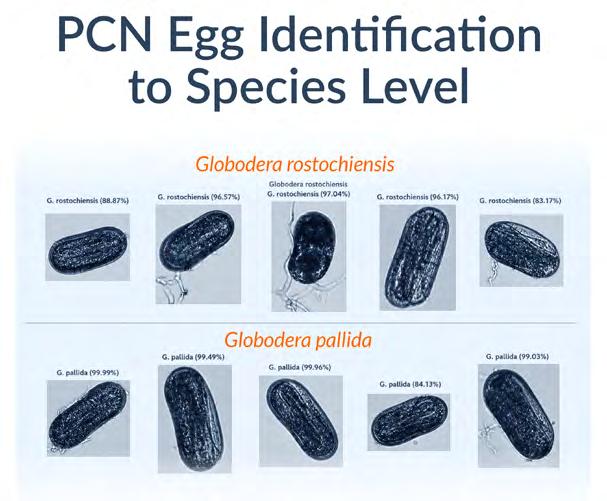
During the annual meeting of the European Society of Nematologists (ESN), Antonie co-founder Peter den Hartog presented a worldfirst: an innovative method for the automated analysis of potato cyst nematodes (PCN).
By combining artificial intelligence (AI), automated microscopy and advanced image analysis, a large part of the analysis process can now be performed faster, more consistently and at scale.
Potato cyst nematodes are among the most economically damaging soil-borne pests worldwide. Reliable and timely analysis is essential for crop management decisions, export certification and integrated crop protection. Until now, this work has relied heavily on specialist microscopy and highly experienced laboratory personnel.
Automating A LaborIntensive Process
The new technology automates exactly this labor-intensive part of the workflow. By combining AI, automated microscopy and highthroughput image analysis, large numbers of eggs and juveniles from opened cysts can be assessed rapidly and reproducibly.
As a specialized agricultural laboratory, HLB played an important role in the development and validation of the new methodology. Existing protocols
for isolating and opening cysts remain unchanged. The innovation lies in the automated analysis of cyst contents, a step that until now has been performed largely by hand.
Beyond potato production, the technology also offers opportunities for other cystsensitive crops such as sugarbeet and soybean. As a result, this innovation contributes to more efficient diagnostics, improved crop management decisions and more sustainable agriculture. For more information, visit www.hlbbv.nl and antonie.ai.
Fox Solutions
Announces Partnership With JASA
Fox Solutions has entered into a strategic partnership with JASA, a Netherlandsbased leader in weighing and packaging automation, to bring fully integrated packaging and automation solutions to the U.S. produce market.
As one of only two authorized U.S. distributors for JASA, Fox Solutions will provide sales, service and parts support for JASA equipment, giving domestic growers and packers direct access to JASA’s technology.
The partnership addresses a clear gap in the market.
Fox Solutions has long supported fresh produce packers across core commodities including potatoes, citrus and onions. Through the JASA partnership, Fox Solutions can now support full packing lines for expanded markets including leafy greens, fresh cut fruits, tomatoes, meat and poultry, seafood and tapas — categories that demand equipment built for speed, frequent changeovers and strict hygiene standards. By pairing JASA’s engineering with Fox Solutions’ materials knowledge, system integration capabilities, and domestic service network, the two companies are delivering a solution where equipment and packaging are specified and supported together.
Two Packaging Formats, One Integrated System
Central to the partnership is a direct connection between Fox Packaging’s bag formats and JASA’s VFFS equipment. Fox Packaging manufactures two formats that can now be produced on JASA machinery: Vertimesh, a VFFS bag with a film strip running through the center; and Vertifilm, a film-and-net VFFS structure that wraps film around a net bag. Both formats are designed to run without laminated films, and JASA equipment supports multiple configurations including gusseted bags and other styles without machine changeover, a meaningful operational advantage for high-volume lines. For growers and packers, this means the bags and the equipment that runs them are sourced, specified and supported by the same family of companies.
VFFS Technology: Proven Globally, Now Available Domestically
Fox Solutions now offers JASA’s vertical form fill seal (VFFS) machinery, including the JASA 260 and NXXT models, to new and existing customers across the United States. The NXXT platform is the equipment of choice for leafy greens, tomatoes and other fresh produce categories that require consistent fill weights, gentle product handling, and the flexibility to run
multiple bag formats on a single machine.
JASA VFFS equipment has a strong track record in fresh produce applications worldwide, with proven performance across potatoes, citrus, leafy greens, tomatoes and fresh cut vegetables.
Sleever Capabilities: Expanding Into Tray And Cup Applications
In addition to its VFFS lineup, JASA manufactures a high-performance sleever designed for trays and cups across a wide range of food categories. The JASA Sleever applies pre-folded, pre-glued sleeves to square, rectangular, oval and round trays, and is built around a cassette-based changeover system that allows operators to switch between tray and sleeve configurations in under five minutes. For operations running multiple SKUs or shifting between product types throughout the day, this is a significant production advantage.
The sleever is built with stainless steel construction and hygienic design, making it the right fit for meat and poultry, seafood and fresh cut fruits, as well as tapas and other prepared food formats in thermoformed trays.
The double-lane PGS-2100 model reaches speeds of up to 100 packs per minute (mechanical capacity), and the compact footprint allows for straightforward integration into existing packing lines.
The JASA partnership positions Fox Solutions to serve a broader range of packers than ever before. JASA equipment is purpose-built for the demands of high-volume fresh food packing across produce, protein and prepared food categories. Its NXXT vertical bagger platform is engineered around six core performance pillars: cleanability, fast changeovers, operator efficiency, reliability, processing speed and remote connectivity through JASA Connect. For packers running multiple SKUs or switching between product types, the ability to change configurations without a machine changeover is a significant operational advantage.
For more information, visit https://www.foxbag. com/.
STOP LOSING WEIGHT IN STORAGE
Proven dormancy enhancer that reduces shrink & protects quality.
1,4SIGHT®
Less shrink. More value.
www.14group.com
AROUND THE VINE
NPC Calls For 100 Percent Tariff On Chinese Frozen Fries
The National Potato Council filed formal comments with the Office of the U.S. Trade Representative (USTR) on May 13, urging aggressive action against China’s surging excess production capacity in frozen fries.
The letter was issued during President Trump’s official state visit to China to meet with President Xi Jinping. Following the meeting, USTR Ambassador Jamieson Greer stated the U.S. expects China to commit to purchasing “double-digit billions” worth of U.S. agricultural products, although neither side has yet to make official announcements.
The submission responds to USTR’s Section 301 investigation into Chinese industrial policies that leverage state support and subsidized financing to scale exports rapidly. NPC highlighted that China’s exports of frozen fries increased by more than 2,100 percent in value and over 3,000 percent by volume
Lamb Weston Announces Intention To Close Broekhuizenvorst Production Facility In The Netherlands
Lamb Weston Holdings announced plans to close its production facility in Broekhuizenvorst, the Netherlands, to align its global supply chain footprint with evolving market conditions and as part of its broader executional excellence efforts.
“These actions are part of our commitment to ensure the long-term resilience and competitiveness of our global supply chain network,” said Sylvia Wilks, chief supply chain officer of Lamb Weston. “While this is a very difficult step, particularly given the strong commitment of our Broekhuizenvorst team, it is necessary to position us to improve our operational
over the last seven years.
“Chinese frozen fry production is compressing returns for U.S. fry manufacturers and distorting demand in Asian markets that have traditionally been supplied by the United States,” NPC wrote.
Data included in the submission shows a dramatic flood of Chinese exports into priority U.S. markets between 2019 and 2025:
• Japan: Increased from $5.4 million to over $66 million (1,119 percent increase).
• Philippines: Increased from less than $2 million to over $83 million (5,130 percent increase).
• Vietnam: Increased by a staggering 42,556 percent.
To protect the long-term competitiveness of the U.S. industry, NPC requested that USTR:
• Raise the U.S. tariff on Chinese frozen fries from 43 percent to 100 percent to prevent these products from flooding the domestic market.
• Work with other trading partners to develop a collective strategy to address global market distortions caused by Chinese overcapacity.
efficiency and better align our manufacturing footprint with customer needs.”
The company will now initiate a formal consultation process with the Works Council, in accordance with Dutch regulations. Lamb Weston is committed to conducting this process in an open and constructive manner and will communicate further details following its completion.
The company plans to support the approximate 110 affected team members throughout the process, treating them with fairness, respect, and in full compliance with applicable laws and regulations. These strategic actions are part of the company’s ongoing execution of its Focus to Win strategy, which includes prioritizing markets and channels, strengthening customer partnerships, achieving executional excellence and setting the pace for innovation. For
Vive Crop Protection Announces Leadership
Changes To Drive Strategic Priorities
Vive Crop Protection has announced a series of key changes to its Executive Leadership Team (ELT), reinforcing the company’s commitment to scaling its commercial impact, strengthening market alignment, and enabling more agile decisionmaking as it enters its next phase of growth.
Greg Esco, previously director of sales, will join the Executive Leadership Team as vice president of sales. In this role, Esco will lead Vive’s commercial sales organization across the United States and Canada while overseeing channel relationships. Esco has played a crucial role in building and leading Vive’s sales team, bringing deep knowledge of the company’s customers, markets and critical partnerships. His addition to the ELT ensures a strong, direct connection between Vive’s leadership and the market, supporting faster, more informed decision-making as the company continues to grow.
Dor Kestecher has been appointed to vice president of product & marketing, also joining the Executive Leadership Team. Kestecher’s responsibilities will expand from his role as North American product leader to
include leadership across product management, marketing and business development. Kestecher brings excellent customer and market insights into portfolio management, working closely with Vive’s technology team on aligning development priorities. In his new role, Kestecher will oversee how Vive brings its product innovations to market, including brand messaging, demand generation, and go-tomarket execution.
Jeff Lacrooy has been promoted from senior vice president of finance to chief financial officer.
Over the past year, Lacrooy has led several key initiatives, including the closing of Vive’s recent equity round, building the company’s financial infrastructure, and securing a working capital solution with Farm Credit Canada to support growth. As CFO, Lacrooy will continue to play a central role in guiding Vive’s financial strategy and supporting both commercial and technology teams as the company scales.
For more information, visit www.vivecrop.com.
The World Agrees On Fries: McCain
Foods’ Inaugural Spud Report Reveals The Fry Habits That Connect Us
It turns out there is one thing the entire world can agree on: fries.
From late-night traditions to family dinner tables, fries continue to show up in everyday moments around the world — creating rituals, moments and shared experiences that cross cultures and borders. And according to many people globally, they’re a love language.
McCain released its inaugural Spud Report, a global consumer study conducted in collaboration with Pollara Strategic Insights. Surveying more than 12,000 people across 11 countries, the report explores how people eat, share and enjoy potatoes and fries in everyday life.
And the verdict is clear: fries reign supreme. Across every country surveyed, French fries ranked as the favourite potato dish overall, outperforming local classics and traditional favourites alike.
The World Has Very Strong Feelings About Fries
The report reveals that fries spark emotion, connection and surprisingly strong opinions around the world:
• 78 percent of respondents globally say fries would improve their mood.
• 55 percent say fries make them feel happy, while 46 percent say they make them feel relaxed.
• 1 in 3 say sharing fries feels more intimate than holding hands.
• Taking fries from someone else’s plate without asking is the most frowned-upon behaviour globally, though 56 percent of parents admit to stealing fries from their own children – without getting caught.
The full Spud Report is available at www. mccain.com/spudreport.
MINNESOTA POTATO GROWERS LAUNCH NEW INDEPENDENT ASSOCIATION
By Jocelyn Schlichting
After decades of operating as the Minnesota Area II Potato Research and Promotion Council, Minnesota potato growers are making a significant change.
Beginning July 1, 2026, the organization transitioned to a new independent nonprofit known as the Minnesota Potato Growers Association (MNPGA).
While the new name represents a major organizational change, growers shouldn’t expect much to change in terms of the association’s mission. MNPGA will continue to focus on the same priorities it always has: funding practical potato research and providing opportunities for growers to gather and learn about the latest research, production practices and industry developments.
So why make the change?
Over the past several years, potato market conditions have continued to evolve while the cost of conducting meaningful research has increased significantly. More than a year ago, growers voted to increase the checkoff rate to ensure adequate funding for future research projects.
Minnesota growers have formed a new independent nonprofit association in an effort to better control how their checkoff dollars are being used.
ABOVE: This logo representing the new Minnesota Potato Growers Association shows the potato growing areas of the state that are in the MNPGA.
However, the process of implementing that change through the existing structure proved difficult, with administrative and regulatory hurdles preventing the increase from moving forward.
At the same time, the administrative costs associated with operating as a checkoff organization have risen dramatically. As a result, a growing share of grower
dollars was being directed toward administration rather than the potato research and grower programming those dollars were intended to support. Minnesota potato growers have always taken pride in running a lean organization. The goal has never been to build bureaucracy — it has been to put as many resources as possible directly into research that helps
LEFT: Minnesota Potato Growers Association Executive Director Jocelyn Schlichting
growers improve yields, quality, storage performance, sustainability and profitability.
By transitioning to an independent nonprofit organization, MNPGA will have greater flexibility to respond to changing industry needs, reduce administrative costs and ensure that a larger percentage of grower contributions are invested directly into potatofocused research and grower education.
Under the previous structure administered through the Minnesota Department of Agriculture, participation in the checkoff program was mandatory, although growers could request a refund of their assessments. Under the new structure, membership in MNPGA will be completely voluntary.
Despite the move to a voluntary model, support from growers has been overwhelmingly positive. Many of Minnesota’s largest potato operations have already committed to participating in the new association because they recognize the value of maintaining a strong, grower-led research program. Membership dues will continue to be calculated much like the previous checkoff assessment, based on a flat rate per hundredweight (CWT) of potatoes sold each quarter. The association will continue working with first purchasers to facilitate the collection and remittance of member dues.
Beginning July 1, 2026, the membership rate will increase from $0.03 to $0.04 per cwt on potatoes sold during the July 1 through September 30 quarter. This adjustment reflects the increasing cost of research and will help ensure Minnesota growers continue to have access to the science, innovation and educational programs needed to remain competitive.
The name may be changing,
but the purpose remains the same: supporting Minnesota potato growers through practical research, education and industry collaboration. The Minnesota Potato Growers Association represents a new structure designed to keep more grower dollars working directly for growers and the future of Minnesota’s potato industry. As this transition moves forward, grower engagement will remain critical to the association’s success. MNPGA was built by growers, for growers and its direction will continue to be shaped by the needs and priorities of Minnesota potato producers. Whether you have
questions about the new structure, membership process, dues collection or simply want to learn more about the association, we encourage you to reach out.
MNPGA looks forward to continuing its long tradition of investing in research, sharing knowledge, and working alongside growers to ensure a strong and profitable future for Minnesota’s potato industry.
(Schlichting is the executive director, Minnesota Potato Growers Association [MNPGA]. She can be reached at (320) 3334291 and MNPotatoGrowers@ gmail.com.)
BUYERS’ GUIDE
BAGGING, PACKING & SHIPPING EQUIPMENT
Kerian Machines (701) 352-0480
www.kerian.com
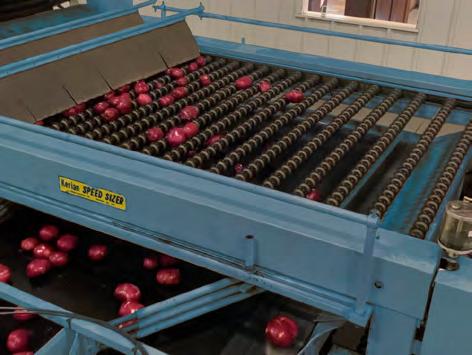
Kerian Sizer
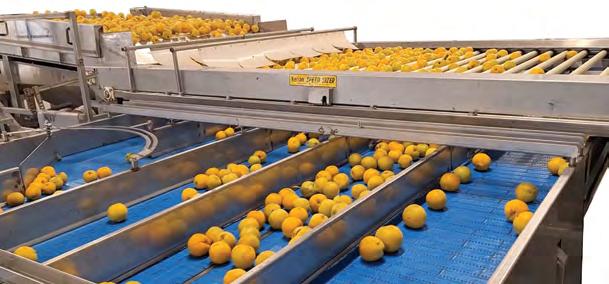
The Kerian Speed Sizer will gently and accurately sort your potatoes by size. It is affordable and proven in use for both round and Russet potatoes. With 13 different standard models, the Kerian Speed Sizer can fit your application whether it is a small packing line or a large processing plant. The constantly rotating rollers provide consistent and precise sizing that is fast, gentle, accurate and easily adjustable. All stainless steel models and stainless steel contact points are also available.
Ag-Pak, Inc. (716) 772-2651
www.agpak.com
NEWTEC Celox Optical Grader
NEWTEC Celox Optical Grader sorts potatoes by size and quality simultaneously. The machine sorts washed potatoes directly, eliminating the need for pregrading and minimizing the need for manual labor while ensuring consistent quality and high throughput.
Up to 13 categories of products can be sorted simultaneously. Sorting criteria for these categories
are instantly customizable according to the current needs. Premium product selections can effortlessly be sorted out of bulk produce. There is no need for mechanical pre-grading.
Additionally, the machine collects detailed real-time product data which is available with Newtec WebServices. The same data can be integrated into your own business IT systems for further analysis.
Volm Companies (800) 253-4737
www.volmcompanies.com
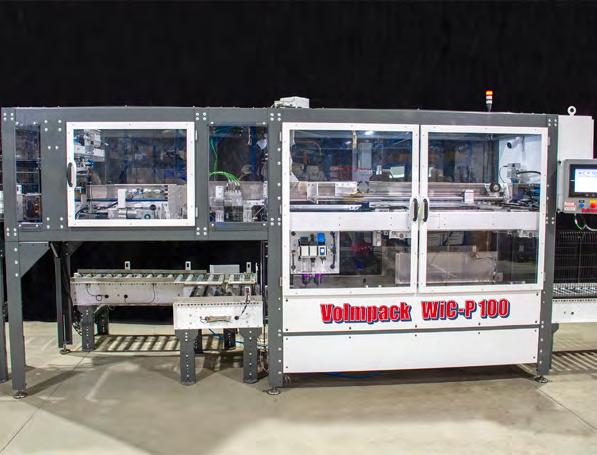
Volmpack WiC-P 100
Volm Companies has introduced the Volmpack WiC-P 100, the first and only case packing system designed for wicketed bags. High-speed and fully automated, this solution offers multiple packing configurations –filling cartons, trays and RPCs with precision. Capable of handling up to 60 bags a minute, the WiC-P 100 is incredibly easy to use and extremely low maintenance. Its unique handling features and wide range of patterns offer optimal flexibility for all case packing needs.
Sept. 2-4, 2026
Sun Valley, Idaho
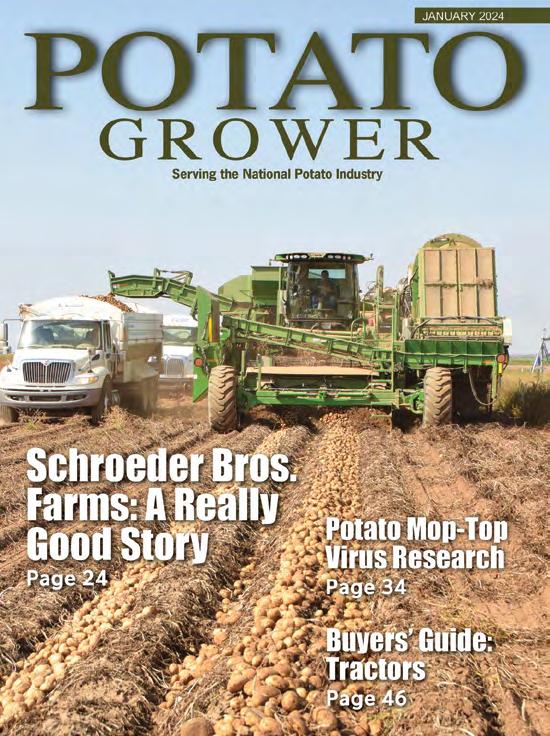
Cover photo courtesy of Eagle Eye Produce
Idaho talks, the
Haute Potato at New York Fashion Week
In February, the Haute Potato Collection turned heads at NYFW. The collection featured 10 original potato sack-inspired designs with proceeds supporting No Kid Hungry ®. The activation generated tons of buzz including attention from People, InStyle, USA TODAY and NBC’s TODAY show
RESULTS
163+ million media impressions
world listens
Idaho® Potatoes hasn’t become a household name by accident, The Idaho Potato Commission is constantly finding new ways to build awareness and loyalty among consumers, ultimately leading them to look for the Grown in Idaho® seal. And for 2026 we expanded that message even further.
National Broadcast
The Astronaut launched across national TV and streaming platforms including TBS, TNT, Food Network, Discovery, HGTV, ID, Hallmark, TLC, HBO Max, Discovery+, Hulu/Disney+, and Tubi
The ad playfully reminds viewers to look for the Grown in Idaho® seal.
POTENTIAL REACH
127+ million people
Tasty Collaboration
Mashing the Myth on Potatoes
This year the IPC teamed up with the American Diabetes Association® (ADA) to tackle common potato nutritional myths. Idaho Potatoes are the first vegetable certified by the ADA, recognizing their role as a versatile and balanced part of a diabetes-friendly diet.
RESULTS
475 media pickups
Once again, IPC teamed up with Tasty, the world’s largest recipe network, to create custom video content with fan-favorite shows like Potatoes 100 Ways. These crave-worthy videos help connect to younger foodie audiences in a fun, authentic way.
REACHED
17+ million people
PROUD
CONVENTION SPONSORS
The Idaho Grower Shippers Association would like to thank all of our generous sponsors for helping make this year’s convention a success.
INDUSTRY PARTNERS
48forty
Ball Brothers Produce
Farm Bureau GroupAg
Magic Valley Produce
Northwest Norkota
Syngenta
TitleOne
Tri Steel Manufacturing
Trinity Trailer Mfg.
United Potato Growers of America
West Pack Zions Bank
CHAIRMAN’S MESSAGE
IGSA Convention: Ideas To Help Move Forward
Oswald Eagle Eye Produce Chairman, IGSA Board of Directors
Dear Idaho Potato Industry Members and Friends,
It is my pleasure to invite you and your families to join us in Sun Valley for the 98th Annual Idaho Grower Shippers Association (IGSA) Convention, taking place September 2–4, 2026.
For nearly a century, the IGSA Convention has provided an opportunity for our industry to come together, strengthen relationships, exchange ideas and prepare for the opportunities and challenges that lie ahead. While the faces, businesses and technologies continue to evolve, one thing remains unchanged — the importance of working together to ensure a strong future for Idaho potatoes.
The past year has tested every segment of our industry. From growers and shippers to processors and service providers, we have experienced one of the most difficult economic environments many of us can remember. Returns have been disappointing and uncertainty has challenged even the most experienced operators. Yet if there is one lesson the Idaho
potato industry has taught us over generations, it is resilience. The challenges we face today will not define us. What will define us is how we respond. Idaho potato growers and shippers have always found ways to adapt, innovate and move forward. While no one can predict exactly what the coming season will bring, there is reason for optimism. Demand for high-quality Idaho potatoes remains strong, and our industry continues to be built upon hardworking people who are committed to producing the best product in the world.
Serving as chairman this year has given me an even greater appreciation for the dedicated individuals who volunteer their time and talents to serve on the IGSA board of directors. I have loved working alongside this outstanding group of individuals. Their willingness to share ideas, tackle challenges and advocate for the industry is a reminder of what makes Idaho agriculture so special. The friendships and experiences I have gained through board service are something I will always value.
I would also like to recognize Shawn Boyle, whose leadership as president and general counsel continues to move the association and the Idaho potato industry forward. Shawn’s tireless advocacy, commitment to our members and ability to bring people together have strengthened the IGSA and helped position our industry for future success. We are fortunate to have someone so talented, passionate and dedicated representing the Idaho potato industry.
This year’s convention will once again provide outstanding educational and networking opportunities. We are grateful for the support of our industry partners, including the Idaho Potato Commission, National Potato Council, Potatoes USA, IACI and many others who help make this event a success. Their expertise and leadership continue to strengthen our industry and provide valuable insight into the issues affecting the Idaho potato industry.
Of course, the convention is about much more than meetings and seminars. It is an opportunity to reconnect with friends, build new relationships and spend time with the people who make this industry special. Whether you participate in golf, pickleball, bowling, trapshooting or simply enjoy visiting with colleagues, the relationships built during convention week continue to be one of the greatest strengths of the IGSA.
This year’s chairman’s banquet will be especially meaningful as we recognize Steve Thorne as the recipient of the 2026 Russet Aristocrat Award. In 2010 while serving as the IGSA chairman, Steve wrote in his chairman’s message that after a difficult season, one thing was certain: everyone needs to get involved. Those words still ring true today. Throughout his career, Steve has embodied that principle through his leadership, service, and friendship. His contributions have left a lasting impact on the IGSA and on countless individuals throughout our industry. We look forward to celebrating his well-deserved recognition.
Coleman
Coleman and Randi Oswald
SCHEDULE AT A GLANCE
IGSA 98th Annual Convention – Sept. 2-4, 2026 – Sun Valley, Idaho This schedule is subject to change. For the most current schedule, visit www.idahoshippers.org.
“Each year presents its challenges and each year is different. We are probably all in agreement there has not been a ‘season’ like the one we are now finishing. In view of this season, when we plea for your input and concerns, we think we all understand one definite fact. And that fact is everyone needs to get involved.”
Steve Thorne spoke those words 16 years ago at the 82nd annual Idaho Grower Shippers Association convention when he was serving as chairman of the board for the IGSA.
As Idaho growers and shippers come off a challenging marketing season for the 2025 crop and entered this growing season with a myriad of issues hanging over their heads (drought, heat, dismal commodity prices, etc., etc., etc.), it seems that Thorne’s comments all those years ago are still applicable today.
There were challenges then – and now – in the potato industry. By all accounts, Thorne managed the challenges he and his potato employer faced during the time he was active in the potato industry – he retired from Nonpareil in 2016 – as best he could and with all his energy but is now facing new personal challenges that he is attacking with the same determination.
Thorne was diagnosed with Parkinson’s disease about 20 years ago. As his wife Jeanne points out, “The various stages have been unkind. But Steve wakes up and does exercises more days than not and continues to fight the battle with all of his effort to slow the effects as much as possible.”
Steve Thorne, 2026 IGSA Russet Aristocrat
Determination
That determination started years ago and developed over years of service and leadership in and out of the potato industry, which includes several years coaching sports at Snake River High School west of Blackfoot.
Born in Twin Falls and raised in Shoshone, Thorne didn’t grow up on a farm but rather worked along with his siblings at their father Burton’s service station in Shoshone. After graduating from high school in 1965, he helped clean the rails for Union Pacific Railroad for a summer and was then offered a job with the Bureau of Land Management on one of its range fire crews where he was made a manager. From there he went to Dixie College for a year and then served a two-year mission in Guatemala and San Salvador for The Church of Jesus Christ of Latter-day Saints. After his mission he attended school at Ricks College (now BYU-Idaho) while also managing a service station in Rexburg.
After Ricks College Thorne helped his brother Allen in the moving and storage business (Roche Moving and Storage), managing the office in Pocatello. He also managed his own moving and storage business in Logan, Utah, with his brothers. After selling the business, Thorne became the assistant manager of Smith’s grocery store in Pocatello, where he also finished his schooling at Idaho State University, earning a bachelor’s degree in business marketing.
About a year after his two-year mission, he married Jeanne Burgie and together they have four sons. After graduating from Idaho State, he worked for Consolidated
Freightways and Yellow Freightways in Pocatello. He moved his family to Blackfoot while working in the freight business and it was there he met Chris Abend through some community activities in town and Thorne started working at Nonpareil in the early 1990s.
Friendships A Lasting Memory
In addition to working at Nonpareil, Thorne also worked at Taylor Produce and Eagle Eye Produce. It didn’t really matter where Thorne landed, it was the friends he made along the way that he cherishes most. Jeanne said, “Steve has fond memories of the friendships he made at those companies with the people who he
Steve and Jeanne Thorne at the 2010 IGSA annual convention. Thorne finished his term as chairman of the board for IGSA at that convention.
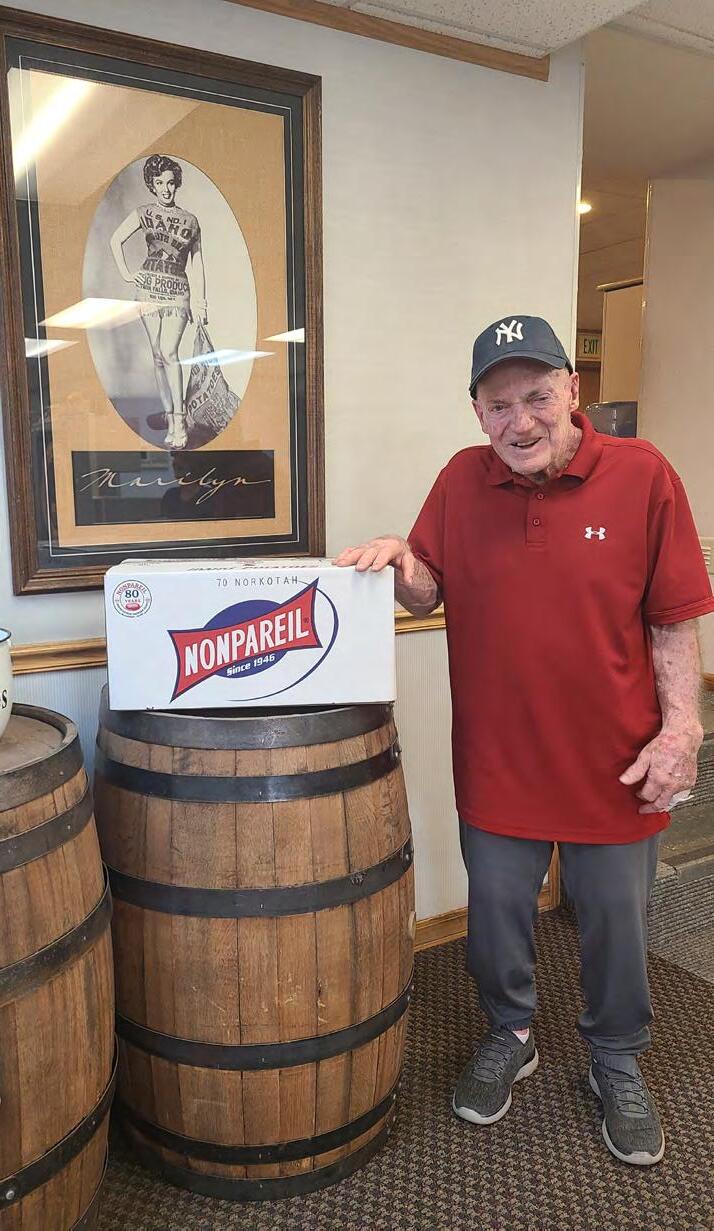
Dandee Hale (l) poses with Steve Thorne and Rulon Robinson (r) at Nonpareil’s headquarters in Blackfoot.
worked with in all their different capacities. He is also grateful for the friendships he made with the different individuals that he sold potatoes to. As he said on one occasion, ‘Sales is about building meaningful relationships and friendships with people.’ To this day, Steve still speaks with friends who he made through selling.”
Hats he wore at Nonpareil included salesman, sales manager, plant manager and sales director. It was from his position as sales director that he retired.
One of the things Thorne appreciated about his time at Nonpareil was the latitude he had to lead, of which Jeanne explained, “Working at Nonpareil where freedom was given to lead, manage and build relationships with fellow employees and customers” was a highlight.
He served as IGSA chairman of the board in 2009-10, another opportunity he had to build relationships and lead. “Steve also enjoyed his opportunity to travel to Mexico with then Idaho Governor Dirk Kempthorne as part of the IGSA,” she said. “He loved his time on the board of the IGSA and the people with whom he served.”
The Potato Industry?
Looking back at a multitude of careers over his years of working, perhaps one of the most surprising places he landed was in the potato industry. Jeanne explained, “After working in many places and in many industries, he never thought he would have the opportunity to
work in the potato industry. His favorite experiences all stem from the opportunity to know people and make friends with those in the industry.”
More specifically, talking about Idaho potatoes, Jeanne said Steve commented, “The Idaho potato has proven itself in the past and it will prove itself in the future. We’re blessed with the greatest people to grow and market the greatest potatoes.”
Over the years, Throne said he has had a number of mentors who have influenced and helped him in his career. Those include Bob Meek, Kevin Searle, Alan Taylor, Chris Abend and his family, Scott Phillips, Travis Blacker, Dean Gibson, Kevin Stanger and many others.
Prior to the physical limitations of Parkinson’s slowed him down, Thorne’s favorite hobby was golf. Now he enjoys spending time with his grandchildren and going to their activities when he is able.
Thorne expressed many times to us his gratitude for being named this year’s Russet Aristocrat.
Of the award, he simply said, “What an honor.”
IGSA Russet Aristocrat Award Recipients
Honoring Excellence in the Idaho potato industry
The Russet Aristocrat Award is the Idaho Grower Shippers Association’s highest honor, presented to growers and shippers who have made exceptional contributions to the Idaho potato industry. Recipients are regular members whose leadership, innovation and long-standing service have left a lasting impact on the success and reputation of Idaho potatoes.
2026 Steve Thorne
2025 Jim McBride
2024 Kevin Searle
2023 Robert Tominaga
2022 Steve Trevino
2021 Dave Kingston
2020 *Convention Cancelled
2019 Kent Taylor
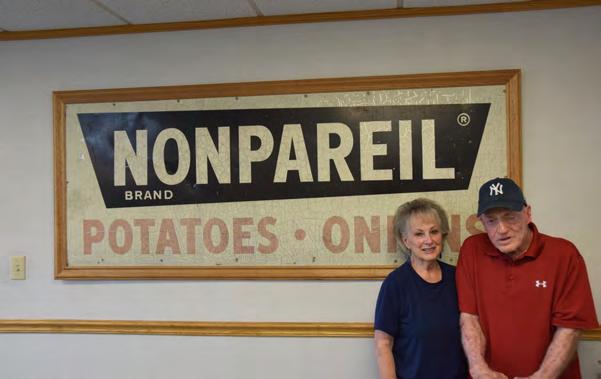
Jeanne and Steve Thorne at Nonpareil’s Blackfoot headquarters.
Steve Thorne said one of his most cherished memories of his career in potatoes was when he was able to go on a trade mission to Mexico. He is seen here at Mexico’s famous Teotihuacan.
2026 – IGSA BOARD MEMBERS
Coleman Oswald Chairman Eagle Eye Produce
Kevin Stanger Vice Chairman Wada Farms
Kendell Wray Liberty Gold
Bryan Mickelsen Treasurer/Secretary Rigby Produce
Stephen Hurst Mart Produce
Kendall Rolfe Idaho Sunfresh
Ragen Darrington IVI
Ernie Eggers Driscoll Potato
Steve Cummings IPAK
IGSA CONVENTION COMMITTEE ACTIVITIES
Kevin Stanger Chairman - Wada Farms
Coleman Oswald Eagle Eye Produce
Bryan Mickelsen Rigby Produce
Derek Peterson Wilcox Fresh
Cody Hendrix AgWest Farm Credit
Steve Smith AgWest Farm Credit
Eric Whalen Pleasant Valley Potato
Kendall Keller Agri Stor East
Phil Kunz Walters Produce
Becky Arteaga Arrowhead Potato
Tyson Arnold IVI
Travis Blacker Idaho Potato Commission
Steve Cummings Idaho Package Co.
Chris Lee Idaho Package Co.
Nick Higham Volm Companies
Ernie Eggers Pleasant Valley Potato
Jerry Higham Volm Companies
Ragen Darrington IVI
Brian Hart Intermountain Paper
Greg Nickerson Agri-Stor
Idaho Built This Before We Needed It
By Idaho Lt. Governor Scott Bedke
If you had asked me two years ago what the 2026 growing season would look like, I couldn’t have told you the exact number on the snowpack report.
But I could have told you this: whatever water year we got, Idaho would be in a better position to handle it than almost any other state in the West. That’s not luck. That’s the result of hard
work that started long before this year’s shortfall ever showed up on anyone’s radar.
This year is a short water year. There’s no getting around that, and I won’t pretend otherwise. But the real story of 2026 is that Idaho spent the last several years building the structure to handle a year exactly like this one. That work is what I want to talk about.
Go back to the summer of 2024. Senior surface
water users and junior groundwater users in the Eastern Snake Plain had been at odds for years, sometimes in court, over how to share a shrinking aquifer and water supply. I spent that summer alongside Idaho Water Resource Board Chairman Jeff Raybould, sitting down with water users from eastern Idaho and the Magic Valley to hammer out what became the 2024 Water Settlement Agreement — the Eastern Snake Plain Mitigation Plan.
These negotiations were not easy. People had real grievances, real history and real money on the line. But everyone in that room understood something important. Continuing to fight in court wasn’t going to put more water in the aquifer. Only cooperation would. The agreement we reached put an end to pending litigation, set out a structure for how surface and groundwater users would share the burden in dry years,
and gave everyone — farmers, cities, power producers — a level of certainty they hadn’t had in a long time.
That agreement is the backbone of how Idaho is managing this year’s shortage. Without it, a year like 2026 would likely mean lawsuits, curtailment fights and chaos. With it, water users know the rules going in. That is the difference between a hard year and a crisis.
On top of that framework, we were able to support it with real money. Last year, we worked with the Idaho Legislature to appropriate $30 million a year for water infrastructure, and the Idaho Water Resource Board has already put that funding to work. The projects include funding aquifer recharge, groundwater-to-surface water conversions and efficiency upgrades for irrigators across southern Idaho. None of that happened overnight, and none of it happened by accident.
Former U.S. Navy Blue Angel John Foley (l) with Idaho Lt. Governor Scott Bedke at the 2025 Idaho Grower Shippers Association annual convention.
It happened because we built the financial commitment into law before we needed it.
I get asked a lot why Idaho has managed to do this when other states are still stuck in court fighting over water. I think the answer is, we decided early on that this had to be an Idaho solution built by Idaho water users, not something handed down by a court or by Washington D.C. Federal or judicial involvement always comes with strings attached, and once you hand over control of your water, it’s very hard to get it back.
Idaho’s approach has been to keep the people who actually depend on this water — the farmers, the ranchers, the irrigation districts — in the room making the decisions. That can be a slow process. It takes longer to get neighbors to agree than it does for a federal agency to hand down a mandate. But what you get at the end is an agreement people will actually live by because they helped write it.
I won’t tell you the job is finished, because it isn’t. The 2024 agreement set the structure, but the implementation is ongoing -- meaning continued investment in aquifer recharge, continued monitoring of the Eastern Snake Plain Aquifer, and continued buildout of the infrastructure projects the Water Resource Board has approved. These lines in the budget must translate to real projects on the ground.
Long-term, we also need to keep working on storage. Conservation and efficiency get you only so far. But at some point, Idaho needs more capacity to capture water in good years so
we have it to use in years like this one.
If there is one thing I’d ask people to take away from this, it’s the value of certainty. A farmer deciding what to plant, a rancher deciding how many head to run, a business deciding whether to expand in southern Idaho — all those kinds of decisions depend on knowing how much water they can count on, not just this year, but five and ten years out. The 2024 agreement, and the funding behind it, give people that certainty. That’s worth more than people sometimes realize, because the alternative is what actually drives families and operations out of agriculture.
I would tell a young farmer starting out today the same thing I would tell anyone: water stewardship is not optional, and it is not somebody else’s job. The agreements we’ve reached hold up only if the next generation honors them the way this generation did. That means using water efficiently, staying engaged with your local irrigation district and the Water Resource Board, and understanding that the work doesn’t stop just because we reached an agreement.
What gives me real confidence about the future of Idaho agriculture is exactly what I saw in that room back in 2024. People disagreed, sat down anyway, and found common ground because they understood what was at stake. The agreement reached then is providing the framework that will get us through this year. It worked before we needed it most.
That’s the Idaho way.
IGSA SCHOLARSHIP PROGRAM
Supporting our communities across Idaho and the future leaders of our industry is important to the Idaho Grower Shippers Association and its members, as it has been for a number of years.
The IGSA contributes thousands of dollars in scholarship money each year to support the higher education aspirations of young individuals with a connection to the Idaho potato industry. These scholarships are available to children of IGSA members and their employees who are committed to pursuing any associate, bachelor or graduate degree or technical certification.
The 2026 IGSA Scholarship Program will include
distributions of up to $15,000, made possible by generous donations from IGSA members and sponsors. To date, more than $165,000 has been awarded to scholarship recipients.
The 2026 scholarship recipients will be announced and recognized at the IGSA Annual Convention. We are proud of all our scholarship recipients, and are confident each will represent their families and the Idaho potato industry well in their future endeavors.
Congratulations to the 2026 scholarship winners. They include, along with the member company and college they will be attending:
2026 IGSA Scholarship Recipients
The Friend Of The IGSA Award
Honoring Outstanding Support Of The Idaho Potato Industry
The Friend of the IGSA Award is relatively new to the association and is presented to individuals who have demonstrated exceptional support, service and advocacy for the IGSA and its members.
The special award is now in its fourth year. Recipients of this award are associate members, including individuals from companies, organizations or service providers who support the success of the IGSA and Idaho potato growers and shippers in exceptional ways.
Past winners include:
• 2026 – Rob Hansen, Volm Companies (retired)
• 2025 - Jeff Riggs, IPAK
• 2024 - Byron & Shanda Duffin, Musical Miles Podcast
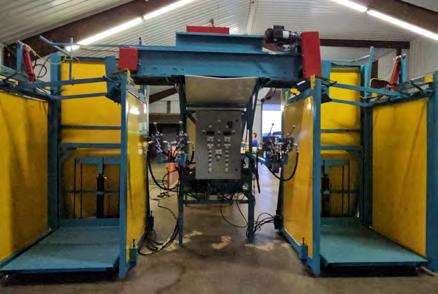
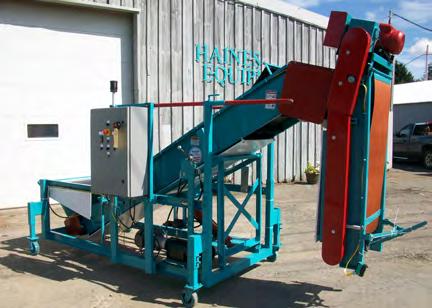
Keep your packing line moving while slashing manual labor costs. The Haines One Ton Bulk Bag & Box Filler is specifically built for potatoes, onions and other bulk produce or commodities. Auto lowering platforms reduce product drop. The reversing cross conveyor instantly switches sides the moment your target weight is reached, with continuous operation.
The Haines Single Station is ideal for lower-volume operations requiring a compact footprint, while the Dual Station allows higher output.
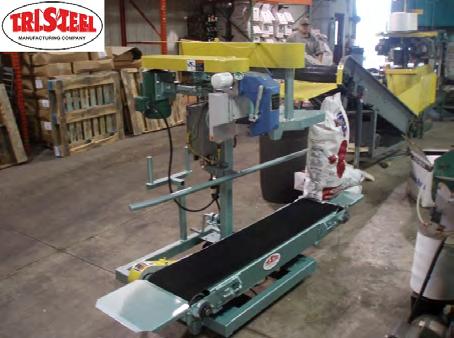
The Tri-Steel Sewing and Infeed System with mounted conveyor for portability is a fast, efficient and economical way to sew open-mouth bags for the potato industry, roundish produce and small granular products such as beans, sunflowers and grain. These systems are manufactured in all stainless steel today and are capable of sewing multi-wall paper, burlap and woven mesh 5-100 lb. open-mouth bags. Tri-Steel has manufactured many of these systems over the years and has enjoyed excellent performance. Complete systems have an air system, VFDs for sewing head, power belt infeed and bag conveyor synchronization. These systems can work with Fischbein, American Newlong and Union Special sewing heads. Features include:
• 15-inch power belt infeed for bag gathering
• Complete adjustable air system for the thread cutter
• Photo-eye bag detector sensor
• Adjustable height pedestal
• 8-foot bag conveyor
• 24-volt control panel with 208V 3-phase input power with VFD speed control
Options include various sewing heads, bag printing and flat or V-bag conveyor.
Fox Solutions (956) 682-6176
www.foxbag.com
Automation & Equipment
Fox Solutions manufactures, distributes and supports state-of-the-art potato packing equipment. Setting the standard, Fox Solutions exemplifies equipment quality, safety and inclusive pack line solutions, including weighers, baggers, case packers and more. Fox Solutions provides single source sales and support for a number of best-in-class equipment brands, including Newtec, Haith, Kwik-Lok and C-Pack.
BUYERS’ GUIDE
BAGGING, PACKING & SHIPPING EQUIPMENT
Verbruggen Palletizing Solutions (509) 845-0185
www.verbruggen-palletizing.com
V-Stack 315
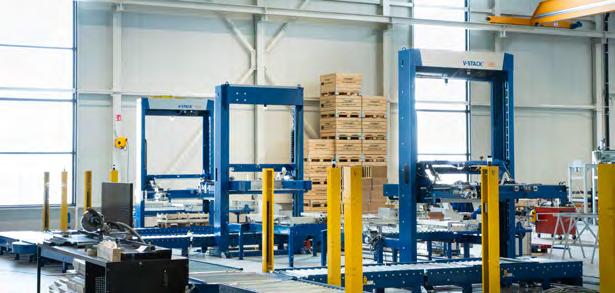
The V-Stack 315 is designed to help potato growers, packers and processors improve productivity while reducing labor dependency. Combining gentle product handling with reliable performance, the system creates stable, uniform stacks of boxes, crates and trays ready for palletizing. Using Verbruggen’s proven sliding stacking principle, products are positioned in precise rows on a retractable shuttle plate, minimizing product and packaging damage while maintaining stack quality. The machine handles a wide range of package sizes and weights up to 25 kg (55 lbs), making it suitable for many fresh produce applications. With configurable stacking patterns, operators can quickly adapt the machine to different packaging
requirements. The user-friendly touchscreen interface simplifies operation and changeovers, while the integrated remote access module allows Verbruggen’s service team to provide fast diagnostics and support whenever needed.
The V-Stack 315 can process up to 15 units per minute and handle layer dimensions up to 1,250x1,250 mm (49x49 in.), delivering the throughput required for modern packing facilities. For operations seeking a higher level of automation, the machine
Fox Packaging (956) 682-6176
www.foxbag.com
Flexible Packaging For The Potato Industry
Responsible packaging that extends shelf life and enhances product visibility on retail shelves is just one of Fox Packaging’s goals. Fox Packaging offers a comprehensive range of potato packaging solutions tailored for growers, packers, shippers, repackers and retailers, including Fox Fresh Mesh, Fox Fresh Mesh Wicketed and durable 5-lb. to oversized 50lb. Leno bags. Designed to allow your product to naturally breathe, our potato packaging integrates seamlessly with automatic wicketed baggers and packing equipment, ensuring efficiency, consistency, and reduced product loss throughout the supply chain. Our sustainable solutions support both retail and wholesale operations, maintaining product freshness and protection.
can be equipped with an optional automatic pallet transport system, creating a complete end-of-line stacking solution.
Key benefits:
• Up to 15 units per minute
• Gentle handling for potatoes and other fresh produce
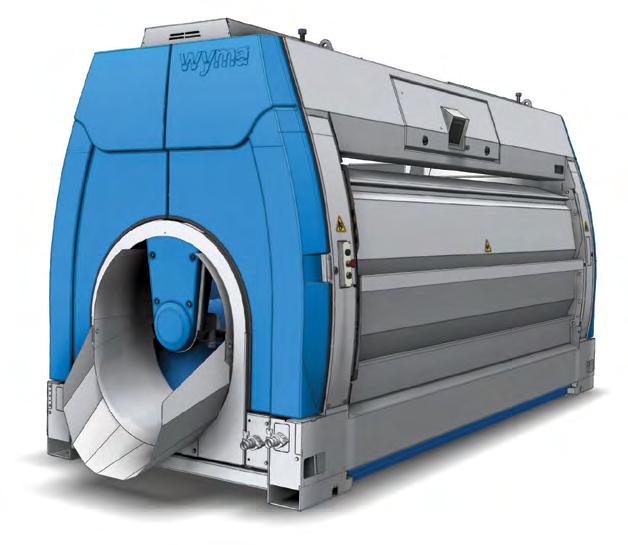
The Wyma Flume Destoner separates stones, clods and other foreign material that has a specific gravity heavier than the produce. It is suitable for all root vegetables including potatoes, parsnips, carrots, celeriac and beets. Produce, stones and debris enter the top flume, typically via a conveyor or elevator. Produce flows down a fast water slide and passes over an upwell of rising water over the width of the flume. Stones and clods and other heavier material will sink through the upwell of water to the elevator where they are ejected as waste. Water jets are provided in the entry flume to ensure products and stones travel to the upwell. Typically produce will exit from the outfeed weir to a flume, or a dewatering system and then a conveyor. A very efficient system particularly suited for all produce sizes, especially larger heavier products such as Russet potato varieties.
Sormac Inc. (567) 200-8420 www.sormac.com
Sormac Potato Processing Line
Sormac, a leading manufacturer of processing technology for the freshcut fruit and vegetable industry, offers a wide range of stand-alone machines and fully automated processing solutions for potatoes, including third-party equipment integration. Achieve optimal product quality and maximize automation with the Sormac potato processing line. Capable of processing up to 5,500 lbs of potatoes per hour, the line handles potatoes with diameters ranging from 1 inch to 3 1/8 inch and a maximum length of 4.75 inches. It is configured for product supply from a storage bunker, screw destoning, abrasive peeling, knife peeling, visual inspection, segmenting (into 2 or 4 pieces), and weighing. Designed for maximum efficiency, the line delivers peeled and cut potatoes that are ready for further processing or packaging.
University Of Idaho Research Tackles A Growing Black Dot Threat With Timing-Based Management Tools
By John O’Connell
A University of Idaho scientist has published management recommendations based on a decade of research to help Idaho potato farmers protect their crops against an increasingly troublesome fungal disease called black dot.
Phillip Wharton, an associate professor of plant pathology, compiled findings from several black dot studies conducted from 2011 to 2022 into a single paper. The journal Plant Health Progress published the paper online on March 31.
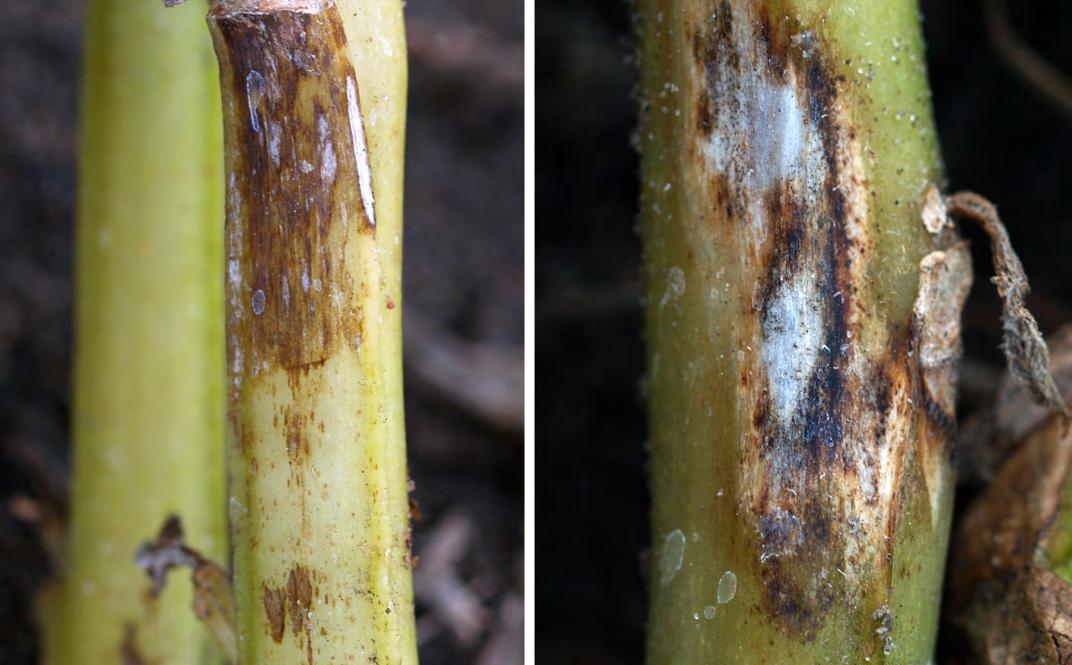
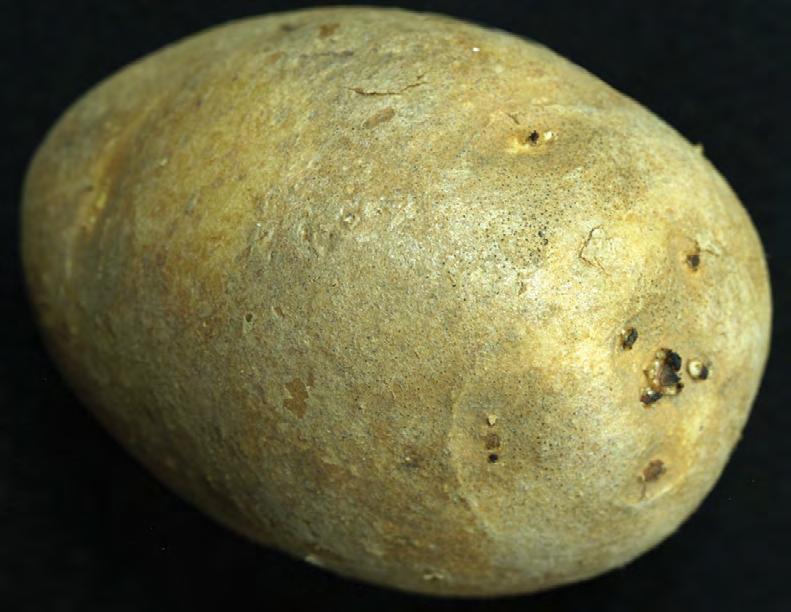
Black dot is caused by the fungus Colletotrichum coccodes and is named for the abundant black dots that form on tubers, roots, stems and stolons, which are horizontal plant stems, commonly known as runners, that form clonal plantlets.
Symptoms appear late in the season, after the crop canopy fully covers the rows, a stage known as row closure. Stem lesions typically form around the base of leaf petioles, which are the slender stalks that attach a leaf blade to a plant stem, and they begin as small brown
spots and can grow together into larger lesions that may surround the stem. As lesions mature, they develop centers that range from circular to irregular in shape and appear white or straw-colored.
Based on his research, Wharton advises potato farmers to shorten their growing season to reduce black dot infections that appear in storage. His research shows this can be done without sacrificing yields.
“For growers, the big takeaway is that black dot has to be managed in the field,” Wharton said. “By the time you see it in storage, the infection has already happened.”
In response to rising demand among farmers for information about black dot, Wharton reexamined previously unpublished research and combined those findings with results of replicated fungicide field trials in 2021 and 2022. The paper covers soil testing, cultural control methods, growing season length, storage practices and fungicide timing.
Wharton believes several factors may be causing increased problems for growers, including potentially fungicide-resistant strains, new potato varieties and
outdated management and storage practices.
Black dot reduces potato quality, mars their appearance and can increase processing waste. It tends to be uniformly distributed throughout a field, and the fungus can remain viable in the field for up to a decade. It produces spores on dead plant material in the soil during the spring and spreads via water droplets that splash on emerging plants.
“In the past couple of years, I noticed that I was being asked to present my work on black dot a lot more often, which suggests it’s becoming more of an issue,” Wharton said. “This is something we want to address: Why is it becoming more of an issue?”
In a 2011-12 project funded by the Idaho Potato Commission, Wharton adapted diagnostics developed in the United Kingdom for black dot detection for use in Idaho soil testing.
Wharton also began trials to determine how adjusting the length of the growing season affected how often black dot occurs and how severe it becomes. He planted fresh-market potato varieties and harvested them between 100 and 130 days after half of the plants had emerged.
Though he saw no noticeable yield difference between the harvest dates, black dot was more common and more severe in the potatoes harvested after 120 days. Among potatoes harvested between 100 and 110 days, 0-17 percent had noticeable levels of black dot, with symptoms covering 5-10 percent of the tuber surface. By contrast, about 55 percent of potatoes harvested after 120 days had black dot, with the disease covering 10-20
percent of the tuber surface.
In a 2012 soil survey of southern Idaho fields, nearly half of samples tested positive for black dot. From 2012-22, Wharton conducted trials for managing black dot in the field and in storage. He and his research team discovered black dot does not spread in storage. Instead, potatoes that show symptoms in storage were infected before vine kill in the field. Wharton advised growers to promptly cool potato cellars after loading them and carefully manage humidity to slow development of symptoms.
Based on data from his field trials conducted from 2018 through 2022, Wharton concluded fungicide applications early in the season are much more effective than those applied later. He found growers who apply fungicides between sprouting and when plants are 6 to 8 inches tall see better disease control and fewer storage problems. Wharton saw similar results with all fungicides registered for black dot control, suggesting timing matters more than the specific product used.
Based on his many studies of Colletrotrichum diseases in potatoes and other crops, Wharton suggests plants can naturally resist infection during early growth stages. After row closure — when plants stop growing and focus on tuber development — these defenses weaken. This allows the pathogen to grow, infect stems and produce material that washes into the soil and infects developing tubers.
Wharton plans to share his black dot research in a University of Idaho Extension bulletin later this year.
For more information, contact Wharton at (208) 8446317 or pwharton@uidaho.edu.
LEFT: Potato stems show symptoms of black dot disease. Photo courtesy of University of Idaho. ABOVE: A potato shows symptoms of black dot disease, which is becoming increasingly prevalent. Photo courtesy of University of Idaho.
DIGGIN’ IN
Hickman, Ph.D. and Louise-Marie Dandurand, Ph.D.
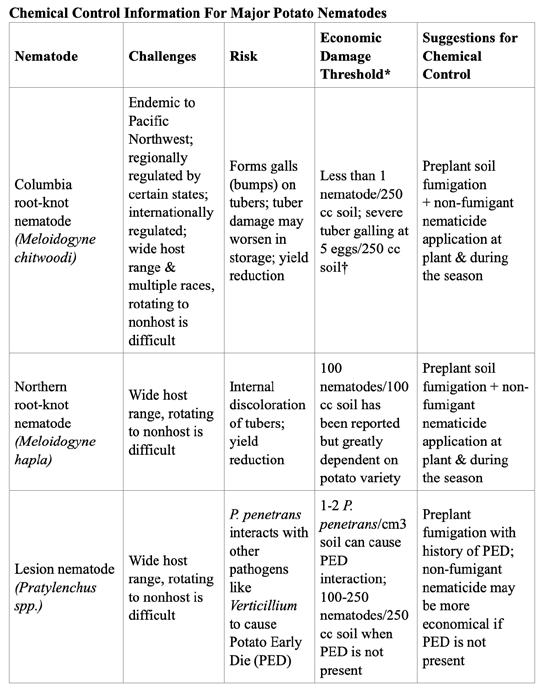
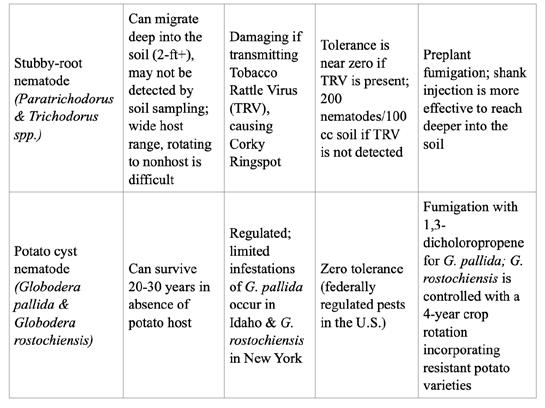
Considerations For Controlling Potato Nematodes With Nematicides
Nematicides are the most common strategy to control nematodes in potato. According to a recent study by Dr. Phil Watson, professor of applied economics at the University of Idaho, potato nematodes reduce farmgate revenues by $332,000-$570,000/100 acres.
Watson found that nematode control costs potato growers $500/acre on average with additional chemical costs accounting for about $400/acre. The high cost necessitates optimizing applications for maximum nematode suppression.
When determining the need for and choosing a nematicide, there are several factors to consider including the field history and crop to be planted. The first step is systematic soil sampling to provide information on the nematode species and densities present in the field. The best time of year for soil sampling to assess nematode risk for the following season is summer/early fall. If nematode densities are at the economic damage threshold, nematicide application is recommended to maximize yield.
Soil sampling can also identify high-density problem areas for a potential spot treatment. Depending on the nematode densities and other practices, fumigant and/or nonfumigant nematicides may be considered.
Fumigant Nematicides
Fumigants are broad-spectrum and applied preplant to knock down high infestations. They can target a variety of potato nematodes including root-knot nematode (RKN), lesion nematode and stubby-root nematode. The best application window is following harvest in the late summer or early fall when soil conditions are best for fumigant application: well-tilled with soil moisture at 60-80 percent field capacity and temperatures between 50-80 degrees F.
These conditions will allow for maximum diffusion through the soil. Nematodes are still active at this time, but as temperatures begin to drop, they will move deeper into the soil, making fumigants less effective. Shank injection is the usual application method with the target depth for nematodes being 8 to 18 inches. It is better to fumigate
*Damage thresholds can be highly dependent on nematode species and densities, time of year soil is sampled, region, soil properties, potato varieties and other environmental factors. Research is ongoing to determine damage thresholds for potato nematodes in the Pacific Northwest. †Reported by Studebaker et al. (unpublished data).
Ultimately, nematode infestations are best controlled through the use of integrated strategies. Nematicides are a powerful tool for potato nematode control. Other strategies can be implemented, depending on the situation, and help reduce chemical control inputs and costs.
Potato yield loss caused by the golden nematode can be quite dramatic, as seen here. On the left is the yield from a healthy field; on the right, the yield from a nematode-infested field. Yield losses can be similar for a wide range of nematode-infested fields. Photo by Bill Brodie.
before applying soil amendments and to allow organic matter to decompose before application. To maintain a lethal soil concentration long enough to effectively kill nematodes, soil should be sealed. Depending on the fumigant, sealing can be achieved by tarping, mechanical soil compaction or water-sealing. Common fumigant nematicides are 1,3-dichloropropene, metam sodium and metam potassium.
While fumigants are critical in reducing severe nematode infestations, there are concerns about the toxicity of these chemicals, regarding risks of ground water contamination, off-target effects and potential harm to human and environmental health.
Another consideration is that fumigants contribute to high operational costs and in the case of 1,3-dichloropropene, there are supply constraints because it is created using certain byproducts from automotive plastic production. Reduced plastics production leads to a trickle-down shortage for agricultural formulation.
Non-Fumigant Nematicides
Non-fumigant nematicides can be applied in-furrow and incorporated into the root zone at plant and/or applied during the growing season typically via chemigation or foliar sprays.
Foliar sprays are only effective for systemic nematicides.
Non-fumigant nematicides move through soil in water, so proper irrigation to maintain soil moisture is essential to maximize efficacy. Excessive watering, however, can dilute the nematicides or cause them to leach away from the root zone.
Popular non-fumigant nematicides for potato include oxamyl, fluopyram and ethoprophos. In some cases, non-fumigants can have a nemastatic effect on certain nematodes, temporarily paralyzing them rather than being lethal; the nematode may recover, so applications throughout the season may be necessary. Knowing the nematodes and densities at which they are present is again important in deciding which non-fumigant nematicide, application rates, frequency and timing.
For more information on potato nematodes and Dr. Dandurand’s program, visit our website, potatonematodes.org or use the QR code to the right.
(Dandurand is a professor and director of the Potato Cyst Nematode Program at the University of Idaho and can be reached at lmd@uidaho.edu. Hickman is a postdoctoral fellow in Dandurand’s program and can be reached at phickman@uidaho.edu.)
MICHIGAN
POTATO INDUSTRY COMMISSION
Zeke Jennings, Marketing and Communications Manager
Michigan Chips Belong On America’s Biggest Stage
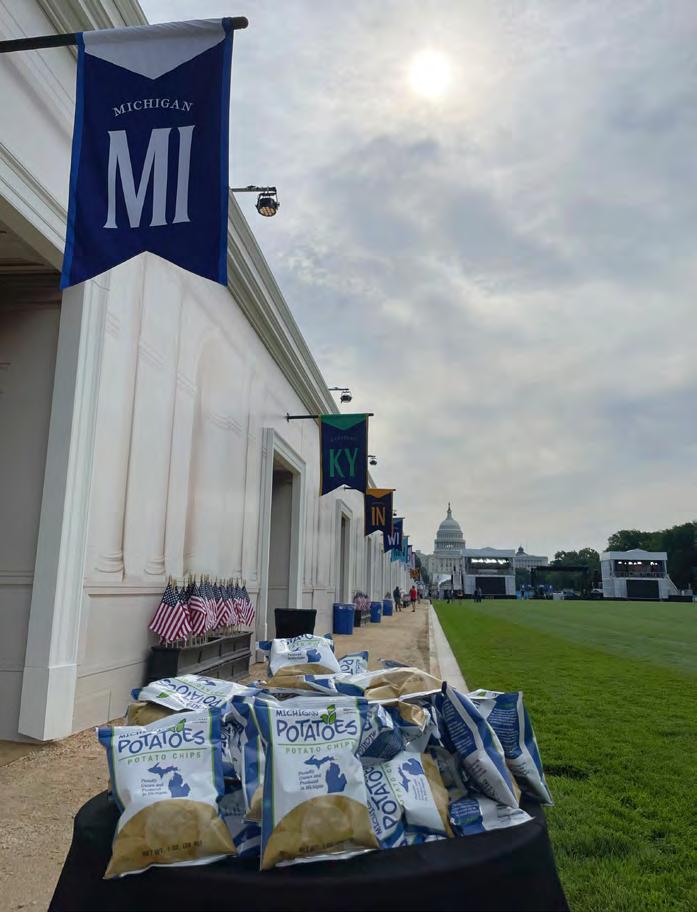
When millions of Americans gather in Washington, D.C., this summer to celebrate the nation’s 250th birthday, Michigan potatoes will be there, too.
The Great American State Fair, part of the Freedom 250 celebration, transformed the National Mall into a modernday World’s Fair from June 25 through July 10. Organizers expected approximately 2.5 million visitors during the 16day event, which showcased all 56 states and territories in a nationwide celebration of American culture, innovation and achievement.
Michigan’s pavilion highlighted the state’s agricultural strength, manufacturing heritage, and four-season economy under the Pure Michigan banner. Among the featured products will be something many of us know represents Michigan agriculture at its best: potato chips made from Michigan-grown potatoes.
In partnership with the Michigan Department of Agriculture and Rural Development (MDARD) and Better Made Snack Foods, the Michigan Potato Industry Commission helped make possible the distribution of 100,000 bags of Michigan Potato-branded potato chips
during the event.
And frankly, it seems only fitting. After all, Michigan isn’t just another potato-producing state. We are the nation’s leading producer of potatoes grown specifically for potato chips. Every year, Michigan farmers supply processors with the high-quality potatoes needed to make the chips that fill grocery store shelves across America. From the rich muck soils of the southern counties to the sandy soils of central and northern Michigan, generations of growers have helped build a reputation for quality that is recognized throughout the industry.
In fact, about 28 percent of all bags of potato chips produced in the U.S. are filled with Michigangrown potatoes. Each year, roughly 1.4 billion pounds — 70 percent of Michigan’s total crop — go to the chip industry.
Yet many consumers have no idea where their potato chips come from. That’s why opportunities like this matter.
A bag of potato chips may seem like a simple snack, but for our industry it tells a much larger story. Behind every bag is a grower making decisions about seed, fertility, irrigation and pest management. Behind every bag is a storage facility preserving quality through the winter months. Behind every bag is a processor, truck driver, equipment dealer, researcher and countless others who help bring that product from field to consumer.
The Great American State Fair gives us a rare opportunity to tell that story to a national audience. Imagine a family from Missouri, California or North Carolina strolling between exhibits on the National Mall, picking up a bag of Michigan potato chips, and learning that the potatoes were grown by Michigan farm families. For many visitors, it may be their first introduction to the fact that Michigan is one of America’s potato powerhouses and the undisputed leader in chipping potatoes.
Michigan is the most agriculturally diverse state in the union with
Behind
consistent access to fresh water, and potatoes are a big part of it. The potato sector contributes $2.5 billion of impact to the state economy every year and supports close to 22,000 in-state jobs. Potatoes are Michigan’s second largest specialty crop sector, behind only apples.
Those moments matter because agriculture often goes unseen. Consumers encounter the finished product but rarely the people behind it. Events like Freedom 250 help close that gap, creating a connection between the food people enjoy and the farmers who produce it.
The distribution of 100,000 bags
of chips won’t change the potato market overnight. But it will put Michigan potatoes directly into the hands of thousands of consumers while showcasing our state’s agricultural excellence on one of the biggest stages in the country.
As America celebrates 250 years of history, Michigan’s potato industry has every reason to stand a little taller. Our growers have spent decades building an industry that feeds families, supports rural and urban communities, and supplies the nation’s chip manufacturers.
This summer, that story will be told in the heart of our nation’s capital — one bag of Michigan potato chips at a time.
North America’s Potato Grading Expert
NEWTEC Dealer since , Ag-Pak has do ens of NEWTEC Celo Op cal Grader installa ons incl ding the er first North American machine hich is s ll going strong.
D al-Lens Celo grades potatoes b both si e and q alit Ad anced AI, Small Footprint, No Mandator S bscrip ons, Free So� are Updates, Carton Filling, and o r E pert Technicians make Ag-Pak and Celo the best choice in the US and Canada for potato grading.
772-2651
NATIONAL POTATO COUNCIL
Kam Quarles, CEO
USMCA Delivers Growth For U.S. Potatoes
NPC ENCOURAGES STABILITY IN TRADE AGREEMENTS
Twenty percent of all the potatoes grown in the U.S. must reach consumers in international markets. With solid, reliable rules, American growers can capitalize upon the opportunities presented by valuable export markets.
U.S. potato exports generate more than $4.75 billion in positive economic impact for the country and support nearly 34,000 American jobs.
Alternatively, when markets are inaccessible or limited, the consequences to growers are immediate.
Mexico and Canada are examples of markets that the industry has capitalized upon, standing as two of our
However, as our nations prepare to evaluate this trade framework, the National Potato Council stands firm on a clear message: USMCA works for the U.S. potato industry, and our leaders must preserve its stability.
top three trading partners. Their significance is due to geographical proximity and trade stability. The latter is provided in large part by the U.S.-Mexico-Canada Agreement (USMCA) completed in the first Trump Administration.
According to the latest U.S. Department of Commerce numbers, U.S. potato exports to Mexico rank second at $477 million in 2024-25, while exports to Canada rank third with $337 million. (Even without access to their fresh market, Japan now ranks as our top export market, at $507 million.)
Without the zero-duty protections that USMCA guarantees, the financial health of family farms across rural America would fracture. We saw the concrete value of this agreement recently when President Trump deferred proposed tariffs on Mexican goods, explicitly validating the USMCA framework.
When it was finalized, one of the requirements of the USMCA is that it doesn’t continue in perpetuity but instead must be reviewed every six years. The first review is happening this summer, and it carries with it the possibility that the agreement may not continue. This creates uncertainty after a period of generally reliable trade between the three countries.
Though reliable, the relationship hasn’t been entirely perfect over these years. We have seen the consequences of efforts to protect growers in British Columbia by placing unilateral tariffs on certain U.S. exports. We also fought a long battle to fully access Mexico for fresh potato exports. Exchange rate and freight rate advantages can also create challenges for U.S. growers.
As the review is beginning, certain segments of the U.S produce industry are advocating for the Trump Administration to take action against competing imports. Unlike some of our objections to China’s efforts to corner the processed potato market, these “seasonal and perishable” imports are not supported by foreign government subsidies or other illegal practices that distort the market.
Though we recognize the challenging circumstances that our import-sensitive colleagues are in, a productive remedy to their difficulties cannot make the problem worse. Should the U.S. act without the justification authorized under the USMCA or other trade remedies against otherwise entirely legal imports, it would encourage a cycle of retaliation that would likely impact our exports.
Maintaining trade stability requires us to settle disagreements through established mechanisms rather than upending the entire review process. If negotiators allow competitive issues to derail the pact, they risk dragging other commodities into tit-for-tat retaliation that multiplies economic instability.
Just as USMCA was an enhancement of its predecessor – the North American Free Trade Agreement (NAFTA) – it is reasonable that this six-year review may offer a chance to make some improvements again. However, as our nations prepare to evaluate this trade framework, the National Potato Council stands firm on a clear message: USMCA works for the U.S. potato industry, and our leaders must preserve its stability.
Potatoes are the most widely grown vegetable in the United States, spanning from Maine to Florida to California and the vast majority of states in between. When our industry speaks, this widespread production provides a magnified voice for our growers with policymakers.
This USMCA review is an opportunity to educate Washington on how fair trade supports consumers by providing reliable, affordable and secure food. It also allows growers to enhance their profitability through access to more consumers and a secure supply of vital inputs.
We urge the Trump Administration and Congress to maintain and enhance the value of USMCA, providing the long-term trade certainty that our family farms deserve.
NEBRASKA
Jenn Dillinger, Administrative Manager
Drought Doub t
It has been a wild weather week here in western Nebraska as I write this during late June.
There have been multiple tornadoes (small ones, but they count), hail that totaled my car and left me wondering why I can’t take out insurance on potted flowers, and enough wind to rearrange my patio furniture into the next county. Even with all the damage, however, I can’t be upset. Any guesses why? The chaotic weather patterns brought rain with them.
Nebraska is currently dealing with its warmest, driest drought on record, and the results are being felt across the state, particularly in the agriculture sector. There have been other growing seasons that have been incredibly warm and dry (2012 comes to mind), but compounding the problem this year is the winter that we experienced. Data compiled by the National Weather Service shows that Nebraska recorded its third warmest winter since the 1930s. Yes, those 1930s. The Dust Bowl years. What set this winter apart from other warm years is the lack of moisture. Much of western and
WATCHING RESILIENCY BLOOM AMIDST DIFFICULTY
central Nebraska had little to no snowfall over the winter months. Low snow cover, low moisture levels in the soil and the seemingly constant Nebraska wind on ground that barely froze is a disastrous combination.
The drought has led to some very noticeable impacts. So far in 2026, more than 800,000 acres of Nebraska land have been burned by wildfire. This includes the Morrill fire, newly crowned the largest wildfire in the state’s history, clocking in at just more than 643,000 acres, or as one fire tracking website helpfully described it, slightly smaller than Rhode Island. These fires are especially concerning, as wind erosion has long been a major productivity concern for Nebraska producers. Loss of cover at any time is a danger, but even more sor in a year this dry.
Water management systems throughout the state have warned irrigators that water may be in short supply, with some districts already imposing limits. Our neighboring states had similar winters, and without much snowpack in the mountains of Colorado and Wyoming, there is less
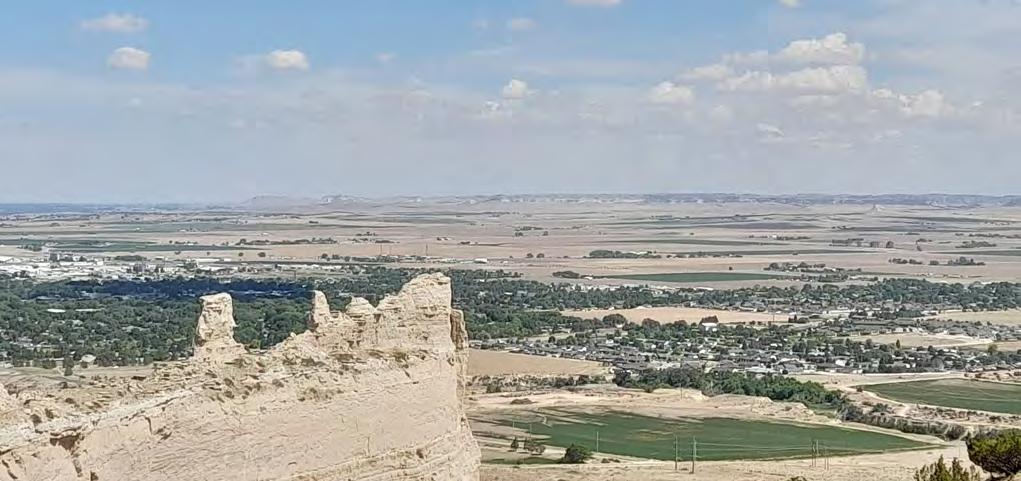
This is a view of Nebraska’s north Platte River Valley in early June of this year.
water flowing into Nebraska to utilize. While the hope is that there will be water to last the growing season, producers are keeping a wary eye on it.
As of this week, the U.S. Drought Monitor has just over 65 percent of the state categorized as in severe, extreme or exceptional drought. The states around us, particularly our western and southern neighbors, are in similar or worse conditions. Across the potato producing areas of our state, the various regions would need anywhere from eight to sixteen inches of rain to make up for the lack of moisture. It just doesn’t seem likely.
The situation certainly seems dire, but as I have experienced almost constantly in my time working within this community,
when situations seem dire, potato producers analyze, make a plan and then keep going. As I have conversations with various growers around the state, I am impressed at their adaptability and their positivity, even in a tough year.
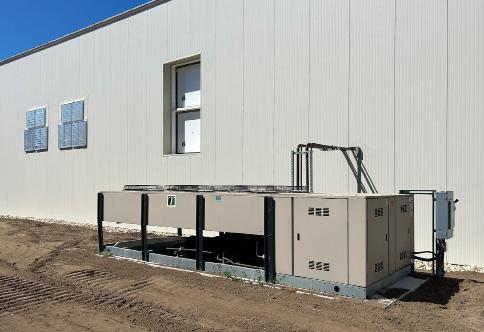
To cope with the warm winter months, multiple seed producers were running their air conditioning in storage nearly all winter long, something that is certainly not typical. This increased maintenance costs, as well as the cost of running refrigeration to keep potatoes in good condition for buyers came in a year when nobody needed higher costs. There was also a lot more work than normal to do maintaining winter cover crops such as rye and winter wheat. This included processing straw to cover and protect those crops from the wind, as well as some winter irrigation to replace moisture normally provided by snow.
When it came to the time for planting this spring, there was more work that went into preparation than usual. Without snow cover throughout the winter months, the ground was baked dry, so more time was spent working most fields to prepare the soil for planting. Many fields were also preirrigated before tubers were put in the ground, which is not a typical need.
Since the crops were planted there have been small, periodic rains spaced out just right and nice sunshine. Everything is growing and it appears that all of that careful preparation and planning is paying off.
There are still concerns about this drought and what it will mean for later in the year and future years if there isn’t a shift. For now, however, it’s been gently raining since last night, and we’re all savoring the cool damp air. It’s been a while.
The Morrill Fire earlier this year was the largest wildfire in Nebraska’s history.