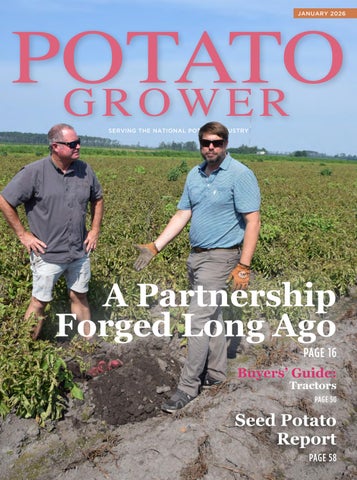
POTATO GROWER JANUARY 2026
SERVING THE NATIONAL POTATO INDUSTRY
A Partnership Forged Long Ago PAGE 16
Buyers’ Guide: Tractors PAGE 50
Seed Potato Report PAGE 58
FARMS NEED PROPER MAINTENANCE FACILITIES EXACTLY WHAT YOU NEED NOTHING THAT YOU DON’T
READY TO HELP YOU
2 POTATO GROWER | JANUARY 2026
A
Force in the
Field
The Bayer family of products is powerful, especially when used together. Combined, they create an agronomic force field around your crops, providing protection during the first 75 days when potatoes are most susceptible to pests and diseases. Safeguard your potatoes against nature's harmful pests and diseases with the Bayer 75-Day Integrated Pest Management program. Visit BayerPotato75DayIPM.com to learn more. ALWAYS READ AND FOLLOW PESTICIDE LABEL DIRECTIONS. Not all products are registered for use in all states and may be subject to use restrictions. Leverage ® 360 is a restricted use pesticide. The distribution, sale, or use of an unregistered pesticide is a violation of federal and/or state law and is strictly prohibited. Check with your local dealer or representative for the product registration status in your state. Admire,® Bayer, Bayer Cross, Emesto,® Luna Tranquility,® Minuet,™ Movento ® HL, Oberon,® Scala,® Serenade,® Sivanto ® and Velum ® are trademarks of Bayer Group. For additional product information call toll-free 1-866-99-BAYER (1-866-992-2937) or visit our website at www.BayerCropScience.us. Bayer CropScience LLC, 800 North Lindbergh Boulevard, St. Louis, MO 63167. ©2025 Bayer Group. All rights reserved.
12-24 Potato Growers Magazine .5 Page AD (7x5).v1.pdf
1
2025-11-25
10:47 am
Building the best and making it better…your way! When you invest in a Western Spud Express® you can rest assured your new trailer has been built to stand up to the rigors the potato industry can dish out. The backbone of the Express is our high tensile steel main frame, treated with our level 4 paint system. Year after year the Spud Express delivers quickly and gently the biggest payloads, along with the highest resale value of any potato trailer on the market!
Learn more at www.westerntrailer.com or call 888.344.2539 4 POTATO GROWER | JANUARY 2026
The Idaho Potato Commission (IPC) and the American Diabetes Association® (ADA) have teamed up to tackle some of the most common misconceptions about one of America’s favorite foods: the potato. Idaho® Potatoes are proud to be recognized by the ADA’s Better Choices for Life program, highlighting how preparation and pairing play an important role in enjoying potatoes as part of a balanced, diabetes-friendly eating plan. The new Mashing the Myth campaign reframes how we think about potatoes by pairing science-backed facts with crave-worthy recipes that prove healthy can still taste amazing. To learn more, visit idahopotato.com/ada.
PROUD SUPPORTER OF THE
Volume 55 Issue 1
CONTENTS
DEPARTMENTS
10
Calendar
12
The Eyes Have It
14
New Products
20
Around the Vine
Growers Are The Next Best Thing
FEATURES
24
A Partnership Forged Long Ago
“Playing in the dirt” takes on a new meaning these days for North Carolina potato growers Dawson Pugh and Hunter Gibbs. By Lane Lindstrom
6 POTATO GROWER | JANUARY 2026
30
U.S. Rep. Moolenaar Talks Ag Issues
U.S. Representative John Moolenaar tackled some tough issues this past summer, including the threat of China poses to U.S. agriculture.
38
Making Sense of Soil Mosture Sensors
Reviewing what’s available in sensors. By Dr. Emily Bedwell
42
Is Farming Still A Viable Legacy In A Changing World?
Idaho grower Brandon Hurst says yes to that question. We explore why he feels that way.
46
Potato Sustainability Alliance
From The Ground Up: PSA’s Collaborative Approach To A Sustainable Potato Future By John Mesko
Products that Profit Take Control of your ROI with BRANDT® EnzUp® Zn BRANDT EnzUp Zn isn’t just another Zn input – it’s designed for stronger early-season crop development. With its enzyme delivery system, BRANDT EnzUp Zn boosts microbial activity, improving nutrient absorption and plant growth. The result? Healthier crops and higher yields. Take Control with BRANDT EnzUp Zn and turn your investment into profits.
www.brandt.co
Volume 55 Issue 1
CONTENTS
BUYERS’ GUIDE
COLUMNS
50
88
Idaho Potato Commission
90
United Potato Growers Of America
Tractors
DIGGIN’ IN
58
Seed Potato Report For 2025
78
Welcome To The 2026 Idaho Potato Conference
80
Potato Production By The Numbers
84
International Chefs Tour U Of I’s New Parma Lab, Learning How Science Influences Spud Quality
8 POTATO GROWER | JANUARY 2026
Idaho Potatoes And The American Diabetes Association: Partnering To Change Perceptions
Curely And Intelligence
92
Montana State Seed Potato Certification Program
Working Together For Montana’s Seed Potato Future: MSU Research Leading The Way
Conveyor Belts
Serving Farmers Since 1982
208-356-4317
GROWER
POTATO GROWER May 2009 - $3.95 - Serving The National Potato Industry - www.potatogrower.com
POTATO GROWER
CALENDAR
May 2009 - $3.95 - Serving The National Potato Industry - www.potatogrower.com
Published 13 times a year by Harris Publishing Inc. SUBSCRIPTIONS: U.S. and Possessions $24.00 per year, International $120.00 per year. To subscribe call (800) 638-0135
PUBLISHER
National Potato Expo
EDITOR
Gaylord Texan Dallas, Texas
May 2009 - $3.95 - Serving The National Potato Industry - www.potatogrower.com
Copyright 2026 Harris Publishing Inc. All rights reserved. Reproduction in whole or in part without permission is prohibited. Back issues available at $5 per copy. Limited quantities. Publisher not responsible for content of materials submitted.
PRESIDENT Jason Harris
Lane Lindstrom lane@potatogrower.com
ADVERTISING DIRECTOR Rob Erickson rob.erickson@potatogrower.com
PRODUCTION Sandon Wixom
GRAPHIC ARTISTS Laci Thompson
VICE PRESIDENT Chuck Harris
VICE PRESIDENT
CIRCULATION Chuck Harris
Ryan Harris
TREASURER
IT DEPARTMENT
Clayton Ward
Chuck Harris
ACCOUNTING Canadian Publisher’s reement No. 40606038, Customer No. 7004671.
Clayton Ward
POTATOES USA (303) 369-7783 www.potatoesusa.com
FALLS PRINTING PLAN
•
•
UNITED POTATO GROWERS OF AMERICA (801) 266-5050 www.unitedpotatousa.com
ALLIANCE FOR POTATO RESEARCH & EDUCATION
www.dakotafarmshow.com
JANUARY 9-14
10 POTATO GROWER | JANUARY 2026
Wisconsinpotatoes.com/events
FEBRUARY 3-5
Southern Rocky Mountain Agriculture Conference Ski Hi Regional Event Center Monte Vista, Colorado
FEBRUARY 3-5
Annualconvention.fb.org
JANUARY 20-22 Manitoba Ag Days
The Keystone Centre Brandon, Manitoba, Canada agdays.com
JANUARY 27-28
Western Idaho Ag Expo Canyon County Fairgrounds Caldwell, Idaho www.idahoagshows.com
JANUARY 27-29
Washington Oregon Potato Conference Three Rivers Convention Center Kennewick, Washington potatoes.com/potatoconference
JANUARY 27-29
Michigan Winter Potato Conference
www.mipotatoindustry.com/
www.cipotato.org
Holiday Inn Hotel & Convention Center Stevens Point, Wisconsin
Anaheim, California
POTATO ASSOCIATION OF AMERICA (734) 239-8022
INTERNATIONAL POTATO CENTER
WPVGA & UW Division of Extension Grower Education Conference & Industry Show
www.agconferencesrm.com
Sheraton Grand Rapids Airport Hotel Grand Rapids, Michigan
www.potatoassociation.org
FEBRUARY 3-5
American Farm Bureau Convention
www.apre.org
PROMOTE
Printed in Idaho Falls, ID by Falls Printing rob.erickson@fallsprinting.com
University of South Dakota DakotaDome Vermillion, South Dakota
idahopotatoconference.com
www.nationalpotatocouncil.org
CORPORATE OFFICES:
Dakota Farm Show
Idaho State University Pocatello, Idaho NATIONAL POTATO COUNCIL (202) 682-9456
HARRIS PUBLISHING INC. 190 E 1st Street Idaho Falls, ID 83401 208-523-1500 www.potatogrower.com
JANUARY 6-8
Idaho Potato Conference
Also Publishers of Sugar Producer
Darryl Harris
www.nationalpotatocouncil.org
JANUARY 21-22
Mailed under a standard rate mailing permit at Idaho Falls, Idaho, and at additional mailing offices.
FOUNDED BY
JANUARY 6-8
Jason Harris
Spokane Ag Days
Spokane Convention Center Spokane, Washington agshow.org
FEBRUARY 10-12 World Ag Expo
International Agri-Center Tulare, California worldagexpo.com
FEBRUARY 11-14
National Farm Machinery Show Kentucky Expo Center Louisville, Kentucky farmmachineryshow.org
FEBRUARY 17
Northland Potato Growers Association Annual Meeting Alerus Center Grand Forks, North Dakota https://northlandpotatoes.com/
FEBRUARY 18-19 International Crop Expo Alerus Center Grand Forks, North Dakota www.cropexpo.com
FEBRUARY 23-26 NPC Washington Summit Hilton Washington DC National Mall The Wharf Washington, DC www.nationalpotatocouncil.org
FIELD-FOCUSED. GROWER-DRIVEN. SINCE 1962 Across America’s potato regions, growers rely on Gowan’s family of products to keep fields clean and yields strong. Our portfolio brings together trusted weed control like Sonalan c HFP, Eptam ®, and Vida ®, disease prevention from Zing! ®, Gavel ®, Badge ® SC, Badge ® X2, and Reason ®. Insect and Mite control from Onager ®, and Imidan ®. Real solutions for real growers. Grounded in agronomy, rooted in the field, and ready for whatever the season brings.
GOWANCO.COM Badge®, Eptam®, Imidan®, Reason®, Sonalan®, Vida®, Onager® and the donkey logo are registered trademarks of Gowan Company, L.L.C. Gavel® and Zing!® are registered trademarks used under license by Gowan Company, L.L.C. Always read and follow all label directions.
THE EYES HAVE IT Lane Lindstrom, Editor
Growers Are The Next Best Thing TECHNOLOGY IS GREAT, BUT GROWERS ARE THE GREATEST
In today’s world of “What’s the next best thing?” or even what’s the next thing?,” AI, ChatGPT, SEO, analytics and a host of other technology advancements, it’s almost a little overwhelming to grasp all that is going on and the speed at which it is happening. Yes, technology is great and very helpful in many cases. But not all the time and not in all cases. And yes, advances in technology (read: GPS-guided tractors and AI sensors and graders used in potato packing, for example) have been very beneficial in agriculture. And technology continues to improve and help growers produce a better crop. But what I like about the ag industry is how measured most folks are when approaching technological advances. Sometimes it’s a wait-and-see approach and other times it’s anxiousness to get the product in the field to see how well it works. Either way, I don’t sense (unless I’m completely missing something) growers having an overpowering “What’s the next best thing?” attitude. After all, you’ve been making this ag thing work for decades and have been pretty darn good at it. And you’ve adapted to the changing marketplace by adopting new practices and technology. Is it fair to say that that adaptation has been careful and calculated? For me, it’s nice to be part of an industry that is a little more grounded, so to speak, and takes a cautious but proactive approach to the next best thing. I know there are many in this industry who work diligently to advance growing practices and increase efficiency. They should be recognized for their efforts and encouraged to keep moving forward. However, I also know there are some outside the ag industry who think the industry is “behind” on technology and too comfortable with the “old ways.” To them I say, “Have you driven a tractor lately?” Or “Have you been to a potato packing shed that uses robotics and AI sensors and grading?” Just reading in this issue’s buyers guide about all the technology used on today’s tractors is really very impressive and amazing. And don’t forget irrigation systems, remote sensors, drones, etc., etc., etc. Maybe it’s those same folks who think the ag industry is behind the times who give little thought to how the food in their local grocery store got there. And how plentiful it is. Or don’t give it a second thought when they drive through 12 POTATO GROWER | JANUARY 2026
the rural parts of this country and see hundreds of acres of crops, oblivious to how those crops got there and the effort it takes to grow them, with and without technology. It’s very clear to me that many folks today have become either impatient or complacent in today’s world. It seems to take a lot to impress some people these days. A more than sub-4-minute mile (3:43.13 minutes is the current record). A time of 2:00:35 in the marathon, which is a crazy and amazing pace of 4 minutes 39 seconds a mile for 26.1 miles. Or how about the NFL average lineman (average weight is 239 lbs.) 40-yard dash of 5.1 to 5.3 seconds? In every sport there are athletes who accomplish incredible feats and some sit back and criticize and say, “That’s all you’ve got?” It reminds me of one of my favorite comedian, Jim Gaffigan’s, jokes. “The best brain surgeon. “Isn’t it enough that someone’s a brain surgeon? “None of us can even get into med school. “A brain surgeon goes to medical school, afterwards specializes in neurology, after that, specializes in surgery of the brain and we’re like: yeah, but are they any good? “Yeah, they’re a brain surgeon!” That line of thinking is probably too prevalent in many facets of life today. I think the Covid period brought into ultra-sharp focus the importance of growers and the food you provide. People took notice of how vital you are to not only the food supply but also to national security. But now we’re barely three years out from that awful time and it’s like, “Why are food costs so high? Farmers are just being greedy.” Anyone in the business of growing food knows all too well it’s not growers who are responsible for high food prices. But that is not a message that is being shouted from the rooftops, although many ag groups continue to beat the drums about that very thing. It shouldn’t take being in crisis or disaster mode for people to appreciate the value of growers. So while the industry does embrace the latest technology to help improve the planting, growing, harvesting, packaging and marketing of food, it is important to remember how vital growers are in all of this. Growers are the next best thing and have been ever since we started eating.
info@GroupAg.com 208-356-7800 www.GroupAg.com Kevin Steel: (208) 881-1568
Jared Hansen: (208) 432-2734
The future of
refrigeration
Distributed by:
NEW PRODUCTS
Fendt Launches 1000 Vario Gen4 Tractor, All-New Optimum Planter AGCO has announced the launch of the Fendtâ 1000 Vario Gen4 tractor and the Fendt Optimumä planter. The Fendt 1000 Series has long been recognized for delivering tremendous productivity and versatility in high-horsepower applications. That legacy continues with the introduction of the Fendt 1000 Vario Gen4. With new, bold styling, this next generation features a modern, commanding look that stands out in the field. New optional interior comforts include foot pegs, an added coolbox and cabin dust extraction for an improved operator experience. The updated line will be available in four models – 1040, 1044, 1048 and 1052 – ranging from 426 horsepower up to 550 horsepower for the most demanding tillage, heavy-duty seeding and transport work. All new models come standard with the latest 12.4L MAN engine, which includes the Fendt iD low-speed concept for increased torque at lower rpms, and DynamicPerformance for optimized horsepower delivery and improved efficiency. Equipped for the future, the 1000 Gen4 Series can be
optionally unlocked from the factory for PTx OutRun grain cart and tillage automation solutions. OutRun, a pioneering automation system, delivers autonomous operation to increase efficiency, reduce operator fatigue and ensure crops can be harvested on time. Alongside the Gen4 launch, Fendt is debuting its first stackfold planting system, the Fendt Optimum planter. Designed to bring planting precision, capacity and flexibility to operations with stack-fold planters, the Optimum combines transport efficiency with the advanced agronomic features farmers have come to expect from Fendt’s Momentum line. With four separate hinge points and standard wing downforce, the Optimum’s stack-fold toolbar automatically flexes to ensure
optimal ground contact and uniform depth across uneven or rolling terrain. An optional vertical contouring hitch moves the planter up and down, tilting it forward and back, allowing the toolbar to follow the topography to provide accurate seed placement and even emergence. The Optimum can be outfitted with row unit seed hoppers or a 55-bushel center fill station, giving farmers the flexibility to choose what works best for their operation. Additionally, Optimum features Precision Planting technology, including a 20|20 display, vSet, vDrive, DeltaForce, SpeedTube, Reveal residue managers and FurrowForce for highly accurate seed placement and superior emergence. For more information, visit www.fendt.com/us/.
New RedEdge-P Green Camera Advances Precision Agriculture AgEagle Aerial Systems has launched the RedEdge-P Green, a groundbreaking multispectral camera designed to revolutionize precision agriculture from planting to harvest. The new RedEdge-P Green camera delivers highquality data and modularity, enabling advanced deep learning capabilities in data-rich, cost-effective imaging. The RedEdge-P Green will provide agronomists and researchers with actionable, high-resolution data to optimize crop management and boost productivity. Key benefits of the new RedEdge-P Green sensor apply to multiple industries: • Farming: Achieve higher yields through quicker interventions both early on and late in the crop cycle. Operators can reduce fertilizer and irrigation inputs and engage in smart harvesting techniques using optimized indices and targeted indices like the Plant Senescence Reflectance Index (PSRI). • Researchers: Access a robust toolset of narrow spectral bands for advanced studies and machine learning applications, driving innovation in crop health and environmental monitoring. • Environmental management: Gain deeper 14 POTATO GROWER | JANUARY 2026
insights into biome health and invasive species across all seasons, in diverse biomes and at varying latitudes. The unique spectral bands of the RedEdge-P Green offer insights into chlorophyll, carotenoids and flavonoid content, providing a richer set of data and enhancing tracking capabilities during critical harvest periods. Users can improve yield, taste, and storage life through smarter harvesting decisions. The RedEdge-P Green camera is NDAA-compliant and integrates seamlessly with multiple drone platforms. Each camera kit includes a Calibrated Reflectance Panel (CRP) and a Downwelling Light Sensor (DLS2) for radiometric calibration, ensuring reliable data under varying light conditions to support time-series analysis. For more information, visit www.ageagle. com.
NEW PRODUCTS
The Final Roar: AVR Launches Ultimate Version Of Legendary Puma The same identity, the ultimate version. AVR launches the finalized version of its legendary self-propelled harvester: the AVR Puma. With a sensational new design – at all levels. The ultimate version of a legend. The final roar. Fifth Generation “The very first AVR Puma came off the production line in 2006. Up till then, 4-row self-propelled harvesters were either cumbersome oversized machines, or they lacked the necessary sieving capacity to achieve a 4-row harvest. The AVR Puma was a real game changer,” according to Pieter Galle, product director at AVR. “The conditions in the field have never been more challenging. Climate change, an increasing potato acreage, periods of drought and floods, hard clods and stones, and a shortage of workers lead to increasingly stringent requirements for the harvesters. “But these challenges have inspired us. We saw one last chance to transform our existing machine into this ultimate, perfect version. An ultimate version that is ready to take on the challenges of both today and tomorrow.” With this fifth generation, AVR continues to build on the Puma’s exceptional concept, while focusing on userfriendly modernization and an increase in capacity, thanks to the optimized haulm processing modules, sieving path, cleaning unit and bunker. What’s In A Name? Speed, maneuverability and force. Those are the characteristics the Puma owes its name to. These strengths were further developed with, amongst others, an even sharper rotation angle, an incredible 551 hp engine power and a seriously upgraded hydraulic system. All the strong characteristics that make the Puma so versatile have been preserved: the Varioweb combination of cleaning modules, the lightweight construction, the lowest fuel consumption in the market, the large tires, the optimal weight distribution, the high user-friendliness and the option to work on caterpillar tracks. How Does This 5th Generation Of The AVR Puma Stand Out? • More capacity, more control – high-level cleaning: The cleaning modules in the AVR Puma allow for the cleaning surface to be increased by no less than 20 percent. Thanks to the reduced drop height at the haulm roller units, the product transfer goes extremely smoothly and potato-friendly. All sieving webs have been given more available power and are individually reversible – for maximum flexibility in every working condition. The well-known, patented Varioweb system offers maximum flexibility for using the axial rollers. Depending on the circumstances, you can choose to use the rollers fully, partially or not use them at all. The Varioweb system has been further optimized with inclination control: now, it is possible to set the Varioweb cleaning unit between -2.5 degrees and 7.5 degrees directly from the cabin, so you can respond perfectly to the cleaning needs in the field. This ensures maximum
16 POTATO GROWER | JANUARY 2026
cleaning efficiency, both driving uphill and downhill, and makes use of the fully available cleaning capacity. Furthermore, the surface of the pintle belt has been extended by 10 percent to allow a higher sieving capacity and an even better functioning pintle belt. • Bunker - Capacity and speed: The bunker of the AVR Puma has 25 percent extra volume (up to 10 tons) thanks to the redesigned fixed part and the new raising plates which automatically fold out when in Field Mode. To quickly unload this larger volume, the full bunker is raised 40 cm using a parallelogram construction. This allows you to unload even 50 percent quicker. Moreover, the unloading arm can unload across four rows – even in high dumpers – which is extremely useful when opening plots. And that’s not all. An extra cleaning roller and an open rod elevator again ensure an additional cleaning, the well-known AVR Clean & Go concept. • Powerful haulm processing: The haulm topper gets a serious upgrade: 40 percent more rotor power for tough or abundant haulm, a standard integrated haulm spreader as well as the option to easily change ejection sides, which is useful when opening fields and plot edges. The haulm roller units have also been upgraded. By connecting the haulm roller to the nose roller of the subsequent sieving web, drop heights are reduced. The position of each haulm roller can be easily adjusted from the side of the machine or directly from the cabin. The haulm rakes that guide the haulm towards the haulm roller at the first haulm roller unit cover the entire width and can be adjusted from the cabin. • Digging unit – excellent view and quickly exchangeable: From the cabin, the driver has an excellent view of the digging unit, which has been strategically placed slightly forward. The redesigned ACC digging unit is equipped with a quick-change system allowing you to disconnect the full digging unit - including the share holder - with one move. This allows the user to switch to another activity such as harvesting onions in less than half an hour. • The Gentle Giant’s maneuverability: The AVR Puma excels in maneuverability. The front axle has an impressive 55-degree steering angle, an increase by 5 degrees. The rotation angle on the rear axle amounts to 24 degrees, which is an increase by 4 degrees. The trailing axle with its wide wheels ensures an even ground pressure. The choice of large wheels ensures a substantial ground clearance, and a machine that is ready for the most extreme conditions. If you want more traction, you can simply replace the rear wheels with tracks. For more information, visit www.avr.be.
We again offer a heartfelt ”THANK YOU” to all our customers, as we sincerely appreciate your business! The new year will bring new varieties, new challenges, new opportunities and, most importantly, new relationships.
Joyful holiday wishes from all of us at
REDS
• Becca Rose • Dark Red Norland • Modoc • Red Lasoda-NY • Red Norland • Sangre
RUSSETS
• Dakota Russet • LaBelle Russet • Mountain Gem Russet • Norkotah– Jorde Strain • Pomerelle • Prospect • Rainier • TXN-278 • TXN-296
WHITES
• Atlantic • Bliss • Dakota Pearl • Dundee • Lamoka • Mackinaw • Waneta
YELLOW FLESH • Belmonda • Paroli
All sales subject to limitation of warranty provided in 2-4 10-2.1 of NDCC. All lots ELISA tested for PVY & PVX Generation I, II, & III.
Growing relationships in the potato industry since 1946 Highway 17 East, P.O. Box 838, Cando, ND 58324
WWW.POTATOGROWER.COM 17
NEW PRODUCTS
OTR Debuts New Non-Directional Compact Tractor Tire OTR Engineered Solutions (OTR) introduces its new versatile WorkBoss® CT tire – a breakthrough in compact tractor tire design. The WorkBoss CT combines superior off-road traction, sidewall protection and self-cleaning abilities with unique design elements for enhanced use on everything from extreme off-road surfaces to turf. It also features a non-directional tread pattern for added traction in both forward and reverse and to simplify installation and inventory. “We worked closely with OEM customers to develop a specialized tire for compact tractors and came up with an excellent solution to meet the needs of this market,” said Chris Strabley, Technical Specialist, Engineering for OTR. “We gave the WorkBoss CT aggressive lugs to provide the off-road characteristics needed in most compact tractor applications, but then we took the design to another level with unique tie bars between the lugs and a shallower center groove to improve multi-purpose performance on turf, while creating a better, quieter ride on paved surfaces.” Beyond the multiple application advantages, the WorkBoss CT’s shallow center groove increases stiffness, which results in less bending under load for greater stability. Other key features include aggressive centerline lugs with deep inter-lug grooves, offering an unrivaled mix of forward traction, self-cleaning performance, and rapid water displacement. The shoulder blocks have a high void-to-lug ratio for excellent lateral stability, while enhancing grip when cornering under torque.
Tapered lug faces reduce rolling resistance and increase service life. Additionally, the reinforced sidewall knuckles offer maximum sidewall protection against impact or abrasion. Currently available in 18x8.50-10 and 26x12.0012 sizes, many more sizes of the WorkBoss CT will be produced over the next few months. Each size is available in multiple ply ratings to accommodate the load capacities of various applications. This new line of tires also marks the launch of OTR’s ability to mold QR codes directly into the sidewall, which opens multiple opportunities for easier access to enhanced product information, inventory tracking, support, and more. For more information, visit www.otrwheel. com/workboss-ct.
Väderstad Launches E-Connect: A New Era Of Smart Farming Väderstad announces the launch of E-Connect. E-Connect is a cutting-edge telematics solution designed to transform the way Väderstad farmers manage their operations. E-Connect provides farmers a digital tool to monitor and manage their Väderstad machinery in real-time. With comprehensive visibility into fleet activity and machine performance, users can track fieldwork progress, analyze operational efficiency and make informed decisions based on accurate, upto-date data. The system is designed with seamless integration in mind, allowing it to connect with major Farm Management Systems (FMS), ensuring that machine data becomes an integral part of the broader farm planning and analysis ecosystem. The owner of a compatible Väderstad machine will be able to set up a user account and login to the E-Connect portal. In the portal the farmer will be able to add his/her machines and invite co-workers at the farm. Built with usability at its core, E-Connect features an intuitive interface, giving farmers the flexibility to manage their operations on the go. Whether it’s optimizing machine performance, reducing 18 POTATO GROWER | JANUARY 2026
downtime, or improving field productivity, E-Connect is designed to help farms operate at their full potential. E-Connect will be available for Väderstad seed drills, planters and tillage equipment machines fitted with a connected gateway, with a rollout beginning in early 2026. For more information, visit https://www. vaderstad.com/us-en.
DISCOVER BEYOND THE POSSIBLE
The first precision series of center pivot systems. To learn more about E3™ and explore the full scope of its innovative features, visit www.discoverE3.com.
5773 Crystal Road • Vestaburg, MI
877-287-5711
65” LENCO SELF PROPELLED AIRHEAD WITH TRACS
10’, 7.5’ AND 5’ STONE PICKERS
Manufacturer of Lenco Equipment
Custom Built Potato Harvesting Equipment www.lenco-harvesters.com
50” STATIONARY AIRHEAD WWW.POTATOGROWER.COM 19
4869-12AdvancedFarmEquipment12h.indd 1
9/12/24 2:26 PM
AROUND THE VINE
Idaho Potato Commission Welcomes Three New Commissioners
The Idaho Potato Commission (IPC) announced the appointment of three new Commissioners — Scott Mickelsen, Doug Ruff and Brad Russell — who were officially sworn in on October 22, 2025. Together, they bring a wealth of experience and deep ties to Idaho’s potato industry, continuing IPC’s longstanding commitment to promoting and protecting the world-famous “Grown in Idaho” seal. Scott Mickelsen is the business manager at Rigby Produce, where he brings decades of hands-on experience in the potato packing industry. Having grown up working alongside his father and brothers, Mickelsen has been immersed in Idaho’s potato business since childhood. A lifelong Idahoan, he’s proud to represent an industry that has been his family’s lifeblood for more than 60 years. Brad Russell is the director of Global Potato Procurement for Simplot Global Food, based in Boise, Idaho. With 28 years of experience in potato processing and procurement, including 10 years in fry processing and 18 years in procurement, he brings a wealth of knowledge and leadership to Idaho’s potato industry. A fifth-generation Idahoan and Oregon State University graduate, Russell and his family are proud to represent the state’s agricultural community and its long-standing potato heritage. Doug Ruff is the owner and operator of Ruff Times Farms, which he runs alongside his sons. A third-generation Idaho farmer and University of Idaho graduate, Ruff also holds a CPA and brings a unique blend of business expertise and agricultural experience to the Commission. He looks forward to helping promote and protect the state’s world-famous potato industry. “We’re thrilled to welcome Scott, Doug, and Brad to
the commission,” said Jamey Higham, president and CEO of the Idaho Potato Commission. “Each of them brings invaluable experience, perspective, and passion for Idaho’s potato industry. Their leadership will help ensure Idaho potatoes continue to set the standard for the quality customers expect and prefer.” Nine commissioners represent Idaho potato growers, shippers and processors. They are nominated by industry peers and appointed by Governor Brad Little. The commissioners are: • Daren Bitter (Chairman) – Bittersweet Farms • Brian Jones (Vice Chairman) – Sun Valley Potatoes • Eric Jemmett – J&S Farms, Inc. • Mark Darrington – Big D Farms • Brian Lundquist – Idahoan • Mike Telford – Sun Valley Seed • Scott Mickelsen – Rigby Produce • Brad Russell – Simplot • Doug Ruff – Ruff Times Farms For more information, visit idahopotato.com.
IVI Provides Growers With Expert Solutions For Refrigerant Compliance And Cost Savings
The sales and technical experts at Industrial Ventilation, Inc. (IVI) are focused on sensible solutions for growers in complying with the latest refrigerant regulations aimed at reducing emissions and restricting ozone depletion. Growers are concerned about what these regulations mean for potential capital investments and operational changes. Also, consideration of emerging refrigerant technologies may warrant planning for equipment replacement versus maintenance of existing equipment. End users should consider the limitations of new production as well as the leak rates for refrigeration systems. IVI’s focused expertise provides growers with a dependable resource in an evolving landscape that requires timely attention, as regulations are either in place or fast approaching. When growers are looking for the best route for maintaining legacy systems, IVI is committed to being a highly informed resource to help. IVI’s team is focused on providing growers options to help maintain their legacy systems. Ben Ingalls, chief growth officer of IVI, has 20 POTATO GROWER | JANUARY 2026
vast experience with agriculture ventilation and refrigeration. Ingalls states that for most growers, a refrigeration audit is an important first step. “With that information, planning for transitions and upgrades can be explored, as well as viable alternatives,” he said. For more than 50 years, IVI has been at the forefront of effective potato and onion storage solutions that meet the specific needs of growers. This includes storage system design, equipment and information to help growers get the results they require. This includes IVI’s industry-leading control panels. IVI also provides stored crop treatment applications to protect against disease and ensure optimal outcomes. IVI meets the needs of growers of varying scale, here in the USA and across the globe. For more information, visit ivi-air.com.
WWW.POTATOGROWER.COM 21
AROUND THE VINE
Investindustrial Agrees To Acquire Kiremko, Idaho Steel, Reyco An independently managed investment subsidiary of Investindustrial VIII SCSp and its affiliates has entered into an agreement to acquire Kiremko Group B.V., Idaho Steel Products, Inc. and Reyco Systems, Inc., collectively one of the leaders in the design and manufacture of customized equipment and solutions for the food processing industry with a focus on potato processing systems. The group – composed of Kiremko, founded in 1965 and headquartered in Montfoort, Netherlands; Idaho Steel, founded in 1918 and headquartered in Idaho Falls, Idaho; and Reyco, founded in 1975 and headquartered in Caldwell, Idaho – has been serving the world’s leading potato processors under a tri-brand partnership since 1996. Over the course of its collective history, the group has established itself as one of the industry’s leading innovators and a best-in-class global supplier of fullline solutions for the industrial production of potato products such as frozen french fries, hash browns and potato flakes. In serving a diverse global base of over 300 customers in more than 50 countries, the Kiremko, Idaho Steel and Reyco brands have become synonymous with quality, innovation and reliability. Supported by a team of more than 450 employees operating across manufacturing facilities and offices in the Netherlands, United States, India, and China, the group generated over $200 million in sales in 2024. Through its intended investment in the group and in partnership with the group’s management, Investindustrial aims to further integrate the group and build a leading global food processing equipment platform positioned for continued global growth, both through organic and acquisitive expansion in its existing markets and extension into adjacent food processing equipment categories. With over a century of combined experience, a reputation for innovation and quality and a broad international footprint, the group is exceptionally well positioned to serve as the ideal foundation for this ambitious growth strategy. Building on its proven success in supporting companies at the intersection of the industrial automation and food & beverage industries, with investments such as Omnia Technologies and Piovan, Investindustrial brings the deep sector experience, integration capabilities, operational expertise and global presence needed to support the Group’s continued development. With this transaction, Investindustrial’s portfolio companies in industrial automation collectively generate approximately €1.5 billion in revenue and employ around 5,000 people, while those in the food & beverage sector generate approximately €8.2 billion in revenue and employ over 20,000 people as of December 2024. Kiremko is currently owned by Paul Oosterlaken and Andy Gowing, while Idaho Steel and Reyco are owned by the Bradshaw and Christensen families. Investindustrial will acquire 100 percent of the three companies at closing, reinforcing Investindustrial’s reputation as the partner of choice for ambitious families and entrepreneurs.
22 POTATO GROWER | JANUARY 2026
Lamb Weston Opens New Mar del Plata, Argentina, Production Facility
Lamb Weston leaders officially open its Mar del Plata, Argentina production facility.
Eagle, Idaho & Buenos Aires, Argentina -- Lamb Weston Holdings, Inc., a leading global supplier of frozen potato products, announced the official opening of its 40,000-square-meter production facility located in Mar del Plata, province of Buenos Aires, Argentina. The opening marks the completion of a multi-year project to build a state-of-the-art facility to serve customers’ needs for premium potato products in the growing Latin America market. Using the most advanced technology, the facility has the capacity to process 200 million pounds of potatoes per year, producing more than 100 varieties of frozen potato products. The facility is now fully operational and completed its first shipments to Brazil. In total, approximately 80 percent of product will be exported to Brazil and other Latin America markets, capitalizing on the strategic location of the Mar del Plata port. “We’re excited to reach this important company milestone as the Mar del Plata, Argentina plant will be a key strategic asset in meeting customers’ needs and expanding our business in Latin America,” said Mike Smith, president and CEO. “This grand opening marks the completion of our quest to build out a modern, state-of-theart facility, setting new standards for quality, efficiency and sustainability, custom-made to meet customers’ requirements.” “Opening our doors in Mar del Plata is significant for Lamb Weston and our customers, but also for Argentina, injecting additional income into the region, engaging experienced, innovative Argentine talent, and proudly supplying all of Latin America with our beloved french fries,” said Romina Broda, vice president and general manager of Latin America. “We are pleased to invest in the local industry and, together, take Argentine quality and ingenuity to the broader region.” To date, Lamb Weston has created 250 direct jobs, including administrative, technical, engineering, and operational positions, and
approximately 3,000 indirect jobs are expected to result from this venture. Additionally, Lamb Weston is working directly with more than 100 local producers to source the highest quality raw materials. Further, the new plant utilizes efficient and sustainable practices to generate minimal waste and maximize the use of natural resources. For more information, visit www.lambweston.com.
Kiremko, Idaho Steel, Reyco Appoint CEO, CFO
rigid plastic packaging. His global perspective and collaborative leadership style will guide the group into its next phase of integration and innovation. van der Drift is a seasoned financial executive with more than 40 years of successful experience in international finance, M&A and strategic transformation. Among others, he previously served as chief financial officer at Ammeraal Beltech, a global leader in conveyor belting solutions, and most recently as CFO at Datamars, a Swiss-based global technology company. In both roles,
he led successful M&A integrations, strengthened financial transparency, and built forward-looking finance organizations that supported business growth and long-term value creation. The Group Executive Team will bring together deep industry experience and regional expertise to drive this next phase of growth. It will be composed of Gerardo Chiaia, president and chief executive officer; Kees van der Drift, chief financial officer; Marcel van Huissteden, president EMEA, Asia & Pacific; and Jon Christensen, president Americas.
Contiuned on Page 83
(l to r) Gerardo Chiaia and Kees van der Drift
Montfoort (NL)/Idaho Falls (US)/ Caldwell (US) – Kiremko, Idaho Steel and Reyco have announced the appointment of Gerardo Chiaia as president and chief executive officer (CEO) and Kees van der Drift as chief financial officer (CFO). These appointments mark a new phase of growth and leadership as the three companies move forward together under common ownership following their recent acquisition by Investindustrial. With more than 25 years of international leadership experience in advanced manufacturing and packaging industries, Chiaia brings a proven track record of transformation and value creation. Before joining Kiremko, Idaho Steel and Reyco Group, he served as president at Husky Injection Molding Systems, leading major business units across Asia and globally, and as CEO of Logoplaste, a worldwide leader in
Strengthen soil quality by feeding it the power of the sea. Our cold-processed seafood hydrolysate liquid fertilizer builds soil health by feeding beneficial soil fungi and bacteria.
WWW.POTATOGROWER.COM 23
A Partn FORGED LONG AGO By Lane Lindstrom
GIBBS, PUGH TAKE “PLAYING” IN THE DIRT TO A NEW LEVEL The chances are pretty good that when Dawson Pugh and Hunter Gibbs were little boys they played in the North Carolina dirt together – a lot. Some things never change. Except these days, Pugh and Gibbs have turned that play into hard work as the two lifelong friends are now partners in Pamlico Shores Produce, a potato and onion business in North Carolina’s Hyde County, practically a stone’s throw from Pamlico Sound, which is separated, in part, from the Atlantic Ocean by the state’s famed Outer Banks. Pugh owns and operates Middlecreek Farms, which is the growing side of the potato and onion business, while Gibbs is president of Pamlico Shores. They are partners on the potatoes and Pamlico Shores markets and sells the onions Pugh raises. Gibbs and Pugh each own 50 percent of Pamlico Shores, which relies on the “muck soil” – known as the Blacklands of North Carolina – for its quality crops. While the two have known “each other since we could walk,” the business side of their friendship has been in place for the past 17 years. Gibbs and Pugh went to college together and after college Gibbs began selling produce for North Carolinabased L&M Companies. Pugh went back to farming and eventually took over the family farm from his father, 24 POTATO GROWER | JANUARY 2026
growing the operation from 2,400 acres to 6,000 acres today, raising, in addition to potatoes and onions, corn, soybeans and cotton.
Discussing A Partnership
“In 2008 we were riding around together and started talking about going into business together,” Gibbs explained. After teaming up to start Pamlico Shores Produce, Pugh continued to handle the farming/field side of the business while Gibbs handles the packing and selling. “We both have inputs in the crop and both make decisions on how to grow them,” Gibbs said. At the time they formed their partnership Gibbs was still selling produce for L&M but went full-time at Pamlico Shores five years ago. The business relationships he made during his produce-selling days are a definite benefit in his marketing efforts today. The business has grown steadily since the partnership formed. The business has been in the present-day packing shed on U.S. Highway 264 in Swanquarter where all of Pamlico Shores potatoes are packed and shipped from. Two years ago storage sheds were added and there are coolers on location that help cool the potatoes after harvest prior to packing and are also used to store potatoes short-term until
nership Dawson Pugh and Hunter Gibbs stand in one of their potato fields in eastern North Carolina. The two, who have been friends since they were toddlers, forged a partnership to grow, market, package and sell potatoes.
they’re shipped to market. Pugh raises 400 acres of potatoes for Pamlico Shores with the No. 1 variety being yellows, of which they raise four different varieties. Three different varieties of reds are also in the mix, along with russets and purples. The purples are sold to a potato chip maker. A new venture – they’re in their second year – for Gibbs and Pugh is raising seed potatoes, making them the only certified seed potato growers in North Carolina. They raised 25 acres of seed potatoes this past growing season, all of which were destined for Central America.
Potatoes For The Carolinas
The majority of Pamlico Shores’ fresh potatoes go to retail with some going to food service. Gibbs explained that 75 percent of their potatoes are sold and stay in the Mid Atlantic region as they ship fresh potatoes to North Carolina, South Carolina, Georgia and New Jersey. Fifty percent of that 75 percent are sold in North Carolina and South Carolina. The planting begins in early March with the harvest beginning in late June and lasting until late July/early August, which means they can market and sell fresh potatoes in the summer, giving them a jump over more northern growing regions in delivering fresh potatoes. That also means Pamlico Shores can usually fetch a premium price for its potatoes. “We strive to pack a premium pack with high quality,” Gibbs said of their company being rewarded for the
Planting in eastern North Carolina begins the beginning of March, when daytime temperatures are in the 50s. By the time those potatoes are harvested, the temps are well into the 90s. Photo courtesy of Hunter Gibbs
quality potato crop. Being able to customize what a customer wants is also an advantage for the grower/shippers. Pamlico Shores sells its potatoes under its own label as well as packs for private labels using 3-, 5- and 10-lb. packages. Gibbs said the club stores tend to request bigger bags, which his company is happy to supply. WWW.POTATOGROWER.COM 25
Pamlico Shores Produce President Hunter Gibbs holds some yellow potatoes that will be harvested in a few days. Gibbs is no stranger in the potato industry as he serves as the chairperson of the Market Development: Consumer Committee for Potatoes USA.
The day of our visit to Pamlico Shore’s 42,000-square-foot facility the crew was finishing up packaging onions for shipment. When the onion season is done, Gibbs and Pugh move right into the potato harvest, which stretches over about five weeks. Gibbs said the goal is to harvest about 20 acres per day. Regardless of whether it’s potatoes or onions, the goal is to protect the crops as much as possible as temperatures are in the 90s during that time of year in North Carolina, although onions are a bit more tolerant of the heat than potatoes. “We try to get both out as quickly as we can,” Gibbs said.
Chillin’
When it comes to the potato harvest, Gibbs explained that although potatoes come in dirty, they go into the cooler for a while and then go 26 POTATO GROWER | JANUARY 2026
to the wash and grading and then are packed. Depending on the need, however, some go right to washing, grading and packing. Potatoes that are put in storage after the harvest will usually be packed 3-4 weeks after they are put in. This allows for a longer shipping season. However, most of their potato crop is packed and shipped before the fall potato harvest starts in other places in the country. While there is not much disease pressure for potatoes in eastern North Carolina, dealing with the weather variables is enough to keep Pugh and Gibbs busy during the growing season. First, there’s the aforementioned high temps during the harvest, but then there is also a potential issue with rainfall, which can be up to 50 inches a year. At the time of our visit in June this past summer, the year-to-date rainfall was already at
Pamlico Shores Produce partners Hunter Gibbs and Dawson Pugh stand in one of the company’s coolers, where potatoes are brought after harvest to cool before being packaged and shipped.
22 inches, although the rainy season is during the winter months. That kind of rainfall means there is no need for irrigation but the rainfall can vary widely even in their fields, all of which are located in Hyde County. “We like to spread our farms out to handle the potential for heavy rainfall,” Gibbs said. “Because we might get five inches in one spot and two miles away not get any rain.” Because of that heat and too much rain, the goal is to have the potatoes all harvested by Aug. 1. When you look at the fields, you’ll see ditches running through the fields, especially in low spots. The ditches help drain the heavy rains off the field and lead to a larger ditch at the edge of the field. Those go to an even larger ditch. There’s not much slope in this area as the farms are only about 3 feet above sea level. The mineral/organic soil type here does have a lot of muck in it, Gibbs said, which has great moisture holding capacity and holds nutrients well. That’s why they can grow a consistently good potato crop year after year.
Pamlico Shores tries to harvest about 20 acres a day and this shows one field that has been killed and is ready to harvest next to a field waiting its turn. The yellow and red varieties are harvested first, followed by purples and russets. WWW.POTATOGROWER.COM 27
On The Lookout
The combination of heat and high moisture has Pugh and Gibbs constantly on the lookout for potato varieties that can handle heat and moisture. In the meantime, the yellows, reds, russets and purples keep them plenty busy. Interestingly enough, Pamlico Farms is the only North Carolina grower growing and selling fresh market russets. When it comes to the harvest, reds and yellows come out of the ground first, followed by the purples and then the Gold Rush Russets. Yellow potatoes, which Gibbs said are a little easier to manage than red potatoes, account for about 60 percent of the crop, followed by reds (Dark Red Norlands are the largest red variety they grow) at about 30 percent with the other 10 percent the other varieties. “The biggest thing for us is yield,” Gibbs said, which across all varieties is 200 cwt./acre. Yellows lead the way in highest yielding varieties for Pamlico Shores. Thanks to a combination of great timing in being able to market their potatoes, good growing conditions and other favorable conditions, Gibbs said he and Pugh feel they can expand that part of their operation. “We would like to increase our potato acreage,” Gibbs said. “We feel like the market is there. But we can only pack so much. We’re trying to expand.” The addition of the storage sheds has helped them expand some, he said. Adding an optical sorter has also helped them be more efficient but buildings and equipment cost money, as all growers and shippers know. “Our holdback right now is infrastructure,” Gibbs continued. “We just completed a $2 million expansion. We’re trying to be smart about our expansion. We would have to expand smartly. It costs a lot to expand, mostly in infrastructure.” While expansion is on their minds, so is diversification and planning ways to weather the storms that inevitably come along in farming and shipping potatoes. Gibbs addressed that as well. “For us, diversification is important. That’s where the seed potatoes come in.” The days of “playing” in the dirt continue for Gibbs and Pugh with the return hopefully just as rewarding today as it was when they were kids, maybe even more so. During our visit to Pamlico Shores, there was no doubt about their love of the land. Gibbs summed it up when he said, “I love the growing aspect of it. Planting a seed and growing it to produce food to go on someone’s plate to feed their family is great.” 28 POTATO GROWER | JANUARY 2026
(Top) The same sun that creates scenic sunrises and sunsets in eastern North Carolina also produces some intense heat during the summer potato harvest, upwards of 90 degrees F. Photo courtesy of Hunter Gibbs (Above)Red potatoes are one of four varieties grown by Dawson Pugh for Pamlico Shores Produce. The harvest takes about five weeks, stretching from late June to Aug. 1. Photo courtesy of Hunter Gibbs
WWW.POTATOGROWER.COM 29
U.S. Rep. Moolenaar Talks Ag Issues
D
COMPLEX ISSUES TAKE CENTER STAGE
uring a summer gathering of growers and others in the sugar industry in Michigan, U.S. Representative John Moolenaar touched on some important and heavy topics facing American growers and agriculture in this country.
While some of his comments were sugar-related, most touched on a handful of issues facing all of American agriculture. First and foremost is the threat China is on a number of fronts, including and especially agriculture. Moolenaar also talked about the H-2A and appropriations. American Sugarbeet Growers Association Executive Vice President and CEO Luther Markwart asked Moolenaar, who represents Michigan’s second congressional district, several questions, so we’ll share Markwart’s questions and Moolenaar’s answers. 30 POTATO GROWER | JANUARY 2026
In his opening remarks, Moolenaar said, “I appreciate the contribution you make. You know food security is national security, and our growers are the best in the world.” Prior to his first question to Moolenaar, Markwart pointed out that the U.S. Representative is the Chairman of the House Select Committee on the Strategic Competition Between the United States and Chinese Communist Party (CCP). It was obvious during their conversation that Moolenaar is definitely an expert of the CCP. Markwart set up his first question to Moolenaar by talking about the CCP’s strategy of the U.S. becoming complacent and not viewing China as a competitor.
MARKWART: “What specific concerns do you have about how that strategy impacts U.S. agriculture?”
MOOLENAAR: “… That’s a great setup to see that China is very patient, has a long-term strategy. They
(l to r) American Sugarbeet Growers Association Executive Vice President and CEO Luther Markwart visits with Michigan U.S. Representative John Moolenaar about concerns the United States has with China and its policies.
are governed by the Chinese Communist Party, headed by Xi Jinping, and he really runs the show. If you ask who is Xi Jinping accountable to, I couldn’t tell you who that is. And if you say the Chinese Communist Party, some people like to say, well, that’s kind of like the Republican Party or the Democratic Party. No, that is the government. And they have different laws in place. Their national security laws basically say any Chinese national, wherever they are in the world, is responsible to the Chinese Communist Party. “So if the Chinese Communist Party requires them to do something, they are to carry that out or they are in violation of the national security laws. So when you consider, as Luther was saying, just the dynamics between our countries, you have to realize it’s a very complicated relationship. On one hand, it’s a great market. That was always the aspiration, to have 1.3 billion people buying American products, and what a great thing to have that kind of trade happening. Agriculture would be leading the way. They are an agriculture food importer, and it makes a lot of sense to continue to grow those markets and have those exchanges. On the other hand, they are quickly and very much willing to retaliate against countries that go against the direction that they want to go. And unfortunately, agriculture often gets caught as a means of retaliation.
“And so you see that with beans, you see it with other products. But as Luther pointed out, what started as a peaceful development of China, with all the rhetoric that was in place, now what you have is a superpower who is building a vast military capability. The largest shipbuilding capacity in the world. A navy that is able to sail around the world. You see their involvement in the Panama Canal. And people will say, ‘Well, what’s wrong with that?’” “The reality is they use everything for leverage. And so you’re seeing this dynamic right now where our manufacturing is very dependent on critical minerals. And so if you want battery technology, if you want automotive technology, military technology, they all need critical minerals and magnets. “What’s the first thing the Chinese Communist Party wants to do? They want to leverage that, create a dependency and leverage it. And so we are in a very different dynamic. So why do we have a select committee? Because these issues span so many different areas. Trade policy, national security policy, human rights issues, and relationships with our other allies and friends, trading relationships. How do we have supply chains? I think COVID really showed how dependent we were on China when they were willing to cut off some of those protective equipment, medicines. And it started to show some of our vulnerabilities. “And so our job is to really expose some of our vulnerabilities and how do we make a change in that? But also what are the intentions of the Chinese Communist Party with their aspirations around the world? And what are they willing to do to accomplish that? What we’ve realized is the China we’ve hoped for, that was going to become more wealthy, more democratic, more freedom loving under Xi Jinping in the last decade has become just the opposite. More authoritarian, more threatening to our friends and allies in the region. More willing to leverage whatever advantage they have against the United States. “Let’s play off that a little bit. And we saw right here in Detroit, maybe a month, six weeks ago, that the Chinese were bringing a fungus in that could be a threat to corn and wheat and other things. So it’s kind of eco-terrorism. So are those issues that are on the committee’s plate that you’re watching for, or theft of seed genetics, where they get to skip over a bit of doing the work themselves and they just take it. You know, in all these areas, they will have an effort to steal technologies, drive competitors out of business. So, for instance, they’ll manipulate different things, currency, but they’ll also subsidize. They’ll make an effort to drive people out of business. “They have used our openness in the area of research in incredibly destructive ways for the United States. And so when you consider that the Department of Energy, Department of Defense often would fund different research projects at universities, many times those universities would partner with Chinese universities. And in the research mindset, you’re trying to develop WWW.POTATOGROWER.COM 31
“So I want to give another real example that’s right in front of us. Seventy percent of U.S. ag protection products or pesticides, 70 percent of them come from China. And I’m going to use Roundup or glyphosate as a key example. Thirty-five percent of the glyphosate that we use in the United States comes from China. Sixty-five percent is made here. And you’ve seen all the lawsuits, the tort lawyers chasing Roundup. And Roundup is used on 190 million acres in the United States. So if the trial lawyers essentially drive U.S. production of Roundup out of business, you become 100 percent dependent on China. 190 million acres.” American Sugarbeet Growers Association Executive Vice President and CEO Luther Markwart
new knowledge, share it with the world to benefit humanity, right? Well, in China, they really have this thing called civil-military fusion, which basically says everything that they develop, if there’s a military application that kind of gets preeminence. And so we had situations where we had Department of Defense dollars funding U.S. research projects that were joint projects with Chinese entities that were affiliated with the Chinese military. So you have taxpayer dollars funding advances in the Chinese military. “Luther was talking about the University of Michigan. It’s been kind of a rough year or two because a couple
years ago, we had a situation where there were five Chinese national students who were studying in a joint program with the University of Michigan and a Chinese university. And those Chinese students were caught outside of Camp Grayling (a military base in Michigan), where we do a lot of military training. And they were in the woods. They said they were stargazing and got a little off track with all this elaborate equipment. But at the same time, there was military training going on with Taiwanese military leaders. And they’re in the process of trying to prepare for a possible invasion of Taiwan by China. So you get these five Chinese nationals in the woods just outside observing exercises at Camp Grayling. “Well,there have been different instances at the University of Michigan, as Luther mentioned, where some of the researchers were caught bringing in these fungus that was considered sort of eco-terrorism. And, of course, the person who brings it in, who lies about it, says, well, I was just doing this for research. Well, then you find out that, you know, she’s corresponding with her boyfriend who’s telling her how to hide it. Other places on her cell phone, she’s talking about her commitment to the Chinese Communist Party. So there have been a number of instances like this. And I always say as the leader of this committee: our goal is not to cast aspersion on the Chinese people. I love the Chinese people. The problem is the Chinese Communist Party will leverage people every way possible, both in a way that hurts the Chinese people as well as for their uses in terms of trying to espionage, theft, you name it, in the United States. And that’s what we’re trying to address.” At this point Markwart shared some important
RIGID FRAMES SIZES 12 TO 24 FEET TILLAGE SEED BED PREPARATION FOLDING FRAMES SIZES 24 TO 40 FEET
• Heavy duty 2 3/16” bearings • Heavy duty construction • Hydraulically controlled leveling bar - standard • Hydraulically controlled s-tines - optional • Grain drill hitch attachment available • Grease line kits - optional • Better prepared seed bed
www.parmacompany.com www.arenagroomer.net 32 POTATO GROWER | JANUARY 2026
4 BAR ROLLAHARROW • Multiple packer rings & roller options
• 14-20, 16-22 in Standard Gray cast or Ductile Iron • 20” Crowfoot • 20” Welded Pipe Rollers
PO Box 190 • Parma, ID 83660 (208) 722-5116 • FAX: (208) 722-6012
For over 50 years, the self-unloading EAGLE BRIDGE® has delivered potatoes safely and efficiently. From custom belt trailers, to service and parts, pre-owned equipment, rentals, and in-house financing* on all equipment types, Trinity Trailer provides the complete solution.
TRINITYTRAILER.COM | 800.235.6577 *All financing is on approved credit (OAC) | © 2026 Trinity Trailer Mfg., Inc.® All rights reserved.
WWW.POTATOGROWER.COM 33
Three Chinese National scholars from University of Michigan laboratory charged for conspiring to smuggle biological materials into the U.S. – U.S. Attorney’s Office
How China could use U.S. farm land to attack America – CBS News
s a W n o o ll a B y p S e s e in h Exclusive – C - Newsweek h c e T n a ic r e m A h it Packed W information. He said, “So I want to give another real example that’s right in front of us. Seventy percent of U.S. ag protection products or pesticides, 70 percent of them come from China. And I’m going to use Roundup or glyphosate as a key example. Thirtyfive percent of the glyphosate that we use in the United States comes from China. Sixty-five percent is made here. And you’ve seen all the lawsuits, the tort lawyers chasing Roundup. And Roundup is used on 190 million acres in the United States. So if the trial lawyers essentially drive U.S. production of Roundup out of business, you become 100 percent dependent on China. 190 million acres.”
MARKWART: “So the question is, and you
talked earlier about it, is China such an important market for our corn and soybeans and pork and all those other things? And how do we push them away militarily and yet maintain that relationship with markets, not only for our inputs but for our export markets?”
MOOLENAAR: “We have to realize they are food dependent on external sources. So they will use agriculture as retaliation in a way that hurts the United States. But in the case of glyphosate, I think it starts with making sure we’re using good science in the United States. A lot of our problems with China get back to we have to get it right in our own country and make sure we’re using good science when it 34 POTATO GROWER | JANUARY 2026
comes to evaluating different products. And as you said, the trial lawyers have had quite a day. “And so you get a company that produces glyphosate, and if they’re losing money doing that, it is a tremendous vulnerability. They’ll go out of business, and then we will become dependent on China, like we are. “ … So my hope is that as a country, we can get back to better science and to let the market determine these things rather than the government regulations that put our businesses at risk and further dependence.”
MARKWART: “There’s a growing alarm on foreign ownership, Chinese ownership of farmland in the United States or companies tied to China. What’s Congress doing or should be doing to better protect our food supply and future?” MOOLENAAR: “Well, one thing we’ve done is we’ve now required the Secretary of Agriculture to be part of what’s called the CFIUS process, the Committee on Foreign Investment in the U.S. That’s something that has happened occasionally that the Ag Secretary is involved, and now it’s a requirement that they would be looking at this. I also am cosponsoring legislation that would require more transparency when it comes to foreign ownership. “The thing about the CFIUS process that’s really driven by Treasury is we also increased some of the
The Heavy-Weight in Pulvi-Mulchers Gets BIGGER.
The 3600 Series Pulvi-Mulcher from Brillion features wider working widths, increased trash clearance and reduced downtime in the field. The series is available in 21’, 25’, 30’ and 36’ working widths. The 30’ model weighs 80% more than the popular WL360 for more clod crushing power. The 36’ unit is the widest PulviMulcher offered by Brillion.
All 3600 Series models feature 8” roller axles with heavy-duty bearings that improve reliability and reduce maintenance interruptions in the field. The design includes three rows of two-piece edge bent s-tines on overall 6” spacing. 25” of under frame clearance improves trash flow through the machine. A leveling harrow in front of the rear roller helps level ridges left by the shanks.
New to the 3631 series is the 24” Notched Ductile Iron wheel to provide even more clod crushing power with its heavy weight.
Scan this code or visit our website to learn more.
Brillion, WI 54110 855.320.0373
www.brillionfarmeq.com
©2021 Brillion Farm Equipment
HIGH-QUALITY, ADDED ACRES.
Building on the success of the R55 (Released in 2013), the R65 incorporates a narrower body and new nozzle system contributing to improved uniformity and increased effective radius at low pressure. 270 DEGREE WATER PATTERN brings water behind sprinkler for overlap with pivot sprinklers for increased uniformity at end of iron. BUY AMERICAN —CHOOSE NELSON. ACCESSORIES
CONTROL VALVES
PIVOT SPRINKLERS
PRESSURE REGULATORS
END OF PIVOT
NELSONIRRIGATION.COM WWW.POTATOGROWER.COM 35
parameters, the distance from strategic locations. So, for instance, in North Dakota, Chinese wanted to buy property that was close to a military base, and it really took a lot to finally get that idea shut down. One of the concerns I’ve had in my district is that a Chinese battery company wants to manufacture it, and it’s within 100 miles of Camp Grayling. Again, I don’t want to have Chinese nationals, many of whom would be well-intentioned, but are all leverageable by the Chinese Communist Party. If they’re being asked to do something, they’re in violation of national security laws, and right in the Articles of Incorporation of the parent company, it pledges allegiance to advance the goals of the Chinese Communist Party. So this is different. We’re used to a private sector and then a government, and then the government’s job is to secure the rights of the people. In China, it’s just the opposite. It’s the government; the people don’t have rights, other than what the government decides they can do at any given moment.”
Labor And H-2A MARKWART: “Okay, I want to switch now to labor. We just had a session here on ag labor, the challenges, we’ve known the problem for a long, long time. The administration has some limits on what they can do. It always kind of gets kicked to the Congress and the Congress can’t seem to get it done. And I know that the President is now focused on this for agriculture. What steps can the Congress take? And will they take them to finally resolve this problem for agriculture and frankly, other service industries like the hotel industry and others? MOOLENAAR: “I think there’s a short-term and a
long-term solution. The short-term is when it comes to H-2A … I can only speak really to Michigan, but in Michigan, people who use H-2A workforce, often they’re supplying transportation, supplying housing. And now the wage requirement is over $18 an hour. 36 POTATO GROWER | JANUARY 2026
And so I hear from fourth and fifth generation growers that they just can’t sustain this anymore. And they’re trying to decide, will they stay in business or do they do something else? And that really concerns me. “So in the short run, my goal has been how do we give relief immediately? So I introduced legislation that would freeze the adverse effect wage rate at 2022 levels, 2023 levels. So like a two-year freeze. So it doesn’t keep increasing because it’s forcing people out of business. But that’s like a mandate, that’s a shortterm thing, but it would give some relief to families. “In the long run, I think, and I’ve spoken with both Secretary Rollins and Secretary Chavez De-Remer about this, because you have multiple departments involved in this, you have labor, you have agriculture, in the case of the H-2B visas, which is more of a tourism one, then you get Homeland Security involved as well. And in all of these cases, I think we just need to make a strong case that what we’re talking about are policies that make a workforce possible. Actually discourage illegal immigration, encourage people doing the right thing because our visa programs are workable, and they allow both the user of the program as well as the beneficiary of the program to do what they do best. And right now, the general public, and I would say Congress, doesn’t understand that. Because everything gets conflated with people coming across the border illegally. And so we’ve got to do more to communicate that what we’re talking about is a win-win for countries who are trying to keep their population there, not leaving, and at the same time, make sure that we can grow crops in the United States and we don’t have to have our agriculture leaving this country because we can’t afford to do it.”
Appropriations MARKWART: “Now I’m going jump to appropriations and the deficit. The national deficit’s getting out of control. It’s a national security issue. How can Congress address that? That’s the first part of it, and the second part of it is, we need more
money for domestic programs, farm programs. We talked all morning about we’ve got to have that in order to keep farmers in business. We’ve got research funding, which is the future of our industry. We’ve got to have subsidized crop insurance because if we don’t have that subsidy, we can’t afford the crop. So how do we balance the issue of the deficit with the needs of the people, not only in agriculture, but other parts? From an appropriations perspective, how do you balance those two?”
MOOLENAAR: “Well, first of all, you guys are not the problem, so you can feel good about that, right? Now, when you look at sort of the automatic spending, whether it’s interest on the debt, Medicare, Medicaid, Social Security, you look at, those are kind of the drivers of the increased debt, the increased deficits. It’s a very serious issue, but it’s really hard to get people to work on something that is considered important but maybe not as urgent as the day-to-day press of issues. “In my view, we’ve got to address whether you use the term automatic spending or entitlement spending. We’ve got to figure out how do we preserve those programs but reform them in a way that doesn’t affect people who are retiring or near retiring but make sure they’re in a financially, fiscally responsible path and are there for the next generation. You ask a lot of young people right now, ‘Do you think Social Security will be there for you when you retire?’ They most likely don’t think so. And so for us to actually do that, both parties have to be part of the solution because anytime you have one party trying to reform programs like that, it’s very tempting to politicize it and demonize the other party. I think in order to be successful, it has to be both parties. It really needs to be both candidates for president describing this as a problem that Americans face and we need to work together to have a solution. And because if one does, the other one doesn’t, then it’ll just get demonized in the campaign. “So it has to be the leadership of the country talking about it, campaigning on it, and then winning on it because the American people see that as something that needs to be addressed. It’s a very, very challenging thing.”
NATIONAL GENERAL CONTRACTOR PLAN BETTER | BUILD BETTER | MAINTAIN BETTER Mark Rice, Owner | (208) 863-7242 | mrice@mcgowanrice.com | COMMITTED TO QUALITY SERVICES Master Planning Design/Engineering Potato Storage Consulting General Contracting United States and Canada PROJECT TYPES Potato Storage: - Air Envelope - Straight Wall - Arch Buildings - Bin Storage Truck/Maintenance Shops Wash/Grading Facilities Packing Sheds Building Maintenance Remodels mcgowanrice.com
4868-13McGowanRice13s.indd 1
8/12/24 9:55 AM
WWW.POTATOGROWER.COM 37
Making Sense Of Soil Moisture Sensors By Dr. Emily Bedwell
Why Consider Soil Moisture Sensors?
Potatoes have very specific water needs, and those needs change dynamically throughout the growing season as plant growth and development moves from emergence to tuber initiation and bulking. Keeping soil moisture within an optimal range is critical for maintaining yield, tuber quality and overall crop health. Both overwatering and underwatering can create costly challenges; excess water can increase disease pressure and nutrient leaching, while inadequate moisture can limit tuber development and reduce yield. Soil moisture sensors are powerful tools for helping ensure that these changing water
demands are met. By providing continuous, real-time data, soil moisture sensors offer a clear picture of moisture conditions throughout the root zone. This information can help fine-tune irrigation, avoid unnecessary applications, and maintain soil moisture at levels that support crop water needs at each growth stage.
Types Of Soil Moisture Sensors
New technologies can be overwhelming, especially when there are many options that each have their own pros and cons. Below is a breakdown of some common types of soil moisture sensors, how they work and what to consider before purchasing.
Soil Water Tension Sensors
• Measures: Soil water tension Units: kilopascals (kPa) or centibars (cbars) (1 cbar ≈ 1 kPa) Tension-based sensors measure how strongly the soil holds onto water, which simulates how hard roots must work to extract moisture from the soil. There are two common types of tension-based sensors: true tensiometers and granular matrix sensors. A. Tensiometers These are true tensiometers consisting of a water-filled tube and a porous ceramic cup. As the soil dries, water is drawn out of the instrument, creating suction measured on a gauge. PROS CONS Easy to interpret Require refilling, adjusting for air bubbles Direct measurement of plant water stress Limited reading range in very dry soils Performs well across soil textures Freeze-sensitive B. Granular Matrix Sensors While granular matrix sensors technically are not tensiometers, they measure the same unit: soil water tension. Instead of water inside a tube, these sensors contain a granular matrix that absorbs moisture from the soil. An electronic reader measures the electrical resistance in the matrix, which correlates with soil tension. PROS CONS No maintenance (no refilling needed) Require good soil contact Can remain in soil year-round Slower to respond after irrigation Long life (5+ years) Slightly less intuitive than a gauge
38 POTATO GROWER | JANUARY 2026
There are few things more important to a potato crop than proper irrigation. There is a multitude of ways to ensure you’re putting the right amount of water on your crop, including soil moisture sensors. Photo by Steve Smede
WWW.POTATOGROWER.COM 39
Capacitance Sensors
• Measures: Volumetric water content (VWC) or Available soil moisture (ASM) Units: percent (%) Capacitance sensors send an electrical signal into the soil. Because water conducts electricity differently than soil or air, the sensor calculates the volume of water per volume of soil. For example, a reading of 22 percent VWC means that 22 percent of the soil’s volume is water. Many probes include several measurement points along a single shaft, providing data throughout the root zone. PROS CONS Low maintenance Requires calibration for accuracy Multi-depth data Readings vary by soil texture Shows water movement after irrigation Higher cost per sensor
Time-Domain Reflectometry (TDR) Sensors
• Measures: Volumetric water content (VWC) or Available soil moisture (ASM) Units: percent (%) TDR sensors send a fast electromagnetic pulse down metal rods. The “travel time” of that pulse changes depending on how much water is in the soil. This provides a highly accurate measurement of VWC. PROS CONS Very accurate when calibrated Requires careful installation Low maintenance Most expensive type of sensor
Most all soil moisture sensors do the same thing: measure moisture levels in your soil. But not all of those devices accomplish this the same way. There are a handful of options available for today’s growers.
Understanding VWC% vs. ASM (%)
Some sensors report soil moisture in VWC, while others report it in ASM. Understanding the difference between these two units is one of the most confusing parts of soil moisture data. Volumetric Water Content (VWC%) • Physical measurement of water volume per soil volume • Does not indicate ease of plant uptake • Soils with identical VWC% but varying sand/silt/clay composition can have different irrigation needs Available Soil Moisture (ASM %) • Calculated value based on field capacity and wilting point of a specific soil texture • Represents how much water is usable by the crop • A 60% ASM reading does not equal 60% VWC Some sensors estimate ASM based on a soil type-specific conversion, but without calibration, these values are only approximations.
Knowing the right time to put down some water on your potatoes can be aided by soil moisture sensors.
How To Get Started
No matter which sensor you choose, the goal is the same: to gain better insight into what’s happening below the soil surface. Soil moisture sensors provide data to help conserve water, improve yield and quality, and reduce pest and disease risk. For assistance with selecting, purchasing or installing soil moisture sensors, contact your local irrigation dealer or crop consultant. Also, you can always contact your county’s University of Idaho Extension Educator for help evaluating the benefits of integrating soil moisture sensors into your operations. (Bedwell is an assistant professor and the Extension Irrigation Technology Specialist at the University of Idaho in Kimberly. She can be reached at ebedwell@uidaho.edu.)
(Graphic Image) Different soil moisture sensors detect how much water is left in the soil in different ways. Some measure soil moisture by how strongly the soil holds onto water while others calculate the volume of water compared to the volume of soil. 40 POTATO GROWER | JANUARY 2026
PROUDLY DISTRIBUTING:
YOUR POST-HARVEST PROFESSIONALS
info@GroupAg.com 208-356-7800 www.GroupAg.com WWW.POTATOGROWER.COM 41
Is Farming Still A Viable Legacy In A Changing World? IDAHO FARMER BRANDON HURST AND KOMET IRRIGATION SAY YES: WITH SMART WATER, STRONGER PARTNERSHIPS 42 POTATO GROWER | JANUARY 2026
(Left) Fourth-generation farmer Brandon Hurst grows eight different crops, including potatoes, on his farm in southcentral Idaho. And because it’s Idaho (read: not much rain), he relies on irrigation to grow all those crops. (Above)Declo, Idaho grower Brandon Hurst says his pivots run more than 2,000 hours per year, making reliability top of mind for him when it comes to operating and maintaining those pivots.
I
n the heart of Idaho farm country, where annual rainfall barely scrapes 10 inches, Brandon Hurst is nurturing more than crops. He’s cultivating legacy and embracing innovation to protect it. A fourth-generation farmer in Declo, Hurst grows potatoes, sugarbeets, winter wheat, corn, alfalfa, oats, pumpkins and sunflowers across 1,500 acres. Like many rural Idahoans, he grew up around the land but wasn’t always sure he’d return. Music was his first love. He played drums and dreamed of sound engineering. But
time away on an LDS mission gave him a new perspective on the value of home, land and culture. “I realized farming isn’t just work. It’s a community. It’s family. It’s something worth preserving,” Hurst said. Today, with development pushing in and agricultural regulations tightening, he’s not sure what farming will look like for the next generation. But he’s committed to keeping the door open for his three young sons. Hurst raises 125 acres of Russet Burbank potatoes in the Declo area. His potato contract sends them all to be processed. He pointed out that his father, Shawn, who also farms in the Declo area (Brandon and Shawn have separate farming entities), raises 300 acres of potatoes, a mix
of Russet Burbanks and Russet Norkotahs, about two-thirds of which go to processing and the other third to fresh. It’s being close to his father that is part of the “It’s family” that brought him back to the farm.
Long Rotation
When it comes to spacing his potatoes out with other crops, Hurst’s rotation is sometimes more than twice that of other growers. He said, “We prefer a 7-plus year rotation. We have been able to have a good relationship with neighbors and do a one-year lese within their farm rotation which is often a 10plus year rotation.” He added, “We like to follow wheat, which gives us time to prep ground and makes for a nice mulch to plant into.” WWW.POTATOGROWER.COM 43
Despite wanting to pursue a different career path in music, Idaho grower Brandon Hurst determined he really did want to be a farmer and now runs 1,500 acres of crops in southcentral Idaho.
One of the biggest challenges he faces? Water. His pivots run more than 2,000 hours per year. Reliability isn’t optional; it’s survival. That’s what led him to Komet Irrigation, a family-founded company with a global reach. Earlier this year, Komet hit a major milestone: its precision sprinkler systems now power over 5 million irrigated acres across North America. But to Hurst, what mattered wasn’t the number, it was the relationship. He met Wesston Hughes, Komet’s Idaho-based technical sales manager, by chance. Hughes didn’t just pitch a product, he offered a demo, listened and asked for honest feedback.
“Run It”
“He dropped off a unit and said, ‘Run it. Let me know what you think,’” Hurst recalls. “I was impressed. It wasn’t just about the sprinkler. It was the service, the connection.” Now, with Komet products on his new pivots, Hurst sees better water uniformity, more consistency and less stress during critical growing windows. More importantly, he sees a model for what modern farming relationships could look like: honest, practical and built on trust. “In farming, everything’s connected. One weak link, especially in water, and you feel it for a whole season,” he says. “Komet gets that.” All Hurst’s farm ground is 100 percent irrigated, with water coming from the Burley Irrigation District’s system of canals. All that canal water comes from the Snake River. “Currently we have one field with Komet products on it,” Hurst said. “But as we maintain our pivot’s sprinkler packages, our new packages will be Komet. I think we are redoing about two or three pivots during the 2026 season. I’ve been using the Komet Precision Twister (KPT) with the standard plate and the Komet Precision Regulator (KPR-X) at 15 psi. On the end of the pivot I am using the new Komet Precision Wave (KPW), which is mind blowing to watch work and see all the thought and technology that went into it.” 44 POTATO GROWER | JANUARY 2026
A Real Connection To Komet
Additionally, he said, along with the KPW, he uses a Komet Twin Ultra for the big gun. While the service and connection Komet provides is highly important to him now and in the long term, it’s how well the product keeps his fields watered that really helps him make the connection to the company. “The biggest thing for me on the irrigation system is consistency,” he said. “I feel like Komet offers that. Ninety percent of my time on the farm is spent working with irrigation throughout the growing season. I was so happy to drive by the Komet sprinklers and see a consistent pattern from the first tower to the last and it stayed that way through the whole season. “The next thing is water loss. The Komet sprinklers have less mist [water loss] coming off than any of our other systems.” Water loss can usually be traced back to a sprinkler itself and how it delivers. As irrigation systems evolve, better precision in efficiency and delivery are key. That’s what really catches Hurst’s attention. “I think the precision is in the consistency of the droplet sizes,” he said. “Also, having met many of Komet’s team members, I think their goals and focuses are very precise, which reflects in their product and service. It really is an attitude that comes from the top down.” While Komet’s milestone matters to the irrigation industry, it’s stories like Hurst’s that show what those numbers mean on the ground. As agriculture faces mounting pressure, climate change, rising input costs and urban encroachment, farmers like Hurst are redefining sustainability through partnerships, not just products. “We’re price takers. We deal with constant uncertainty,” Hurst said. “But when companies truly listen, and communities support each other, farming still has a future.” And what advice would he give to younger farmers? “Don’t be afraid to try something new. Relationships matter more than new paint. And creativity might be your best crop.” WWW.POTATOGROWER.COM 45
From the Ground Up: PSA’s Collaborative Approach To A Sustainable Potato Future Potatoes have a remarkable sustainability story — and it’s one worth telling. As one of the world’s most important food crops, potatoes are grown in every corner of the globe and form an essential part of the human diet.
Potato Sustainability Alliance CEO John Mesko.
Unlike many other foods, there’s no real alternative to the potato. That makes ensuring potatoes are grown sustainably not just an agricultural goal, but a global necessity. At the Potato Sustainability Alliance (PSA), the growers who bring this vital crop to life every season deserve recognition for the stewardship they practice every day. Across North America, potato growers are among the most innovative and environmentally conscious producers. They balance yield, quality and efficiency — all while generating measurable sustainability outcomes. Until recently, there was no coordinated way for potato growers to define, measure and report that story to their buyers and customers. That’s exactly why we built the PSA Program.
Measuring Efforts: The PSA Program
The PSA Program provides a common framework for measuring and reporting sustainability and regenerative efforts in potato production. It is designed by and for the potato value chain — growers, processors, retailers and allied partners — to deliver credible, actionable data that reflects real-world practices and results. This program gives growers the ability to take credit for what they’re already doing well while identifying new 46 POTATO GROWER | JANUARY 2026
opportunities for continuous improvement. It also opens doors to market recognition and value-chain alignment. The Program’s three core components — On-Farm Assessments, the Education Portal and Verification — work together to create a full picture of sustainability in potato production: 1. On-Farm Assessments document sustainability practices in the field, from nutrient management and soil health to water stewardship and biodiversity.
2. The PSA Education Portal serves as an online hub where growers and industry organizations can access sustainability resources, share events and track learning opportunities. 3. Verification through third-party assessors adds credibility to grower data and builds trust with buyers. Potato growers have long been innovators — implementing smart irrigation, precision nutrient management and soil-health practices well before “sustainability” or “regenerative” became buzzwords. The PSA Program gives structure to that excellence so the rest of the value chain can see and appreciate it.
Putting Sustainability Into Action
Sustainability isn’t just about measurement — it’s about making those numbers meaningful in the field. At PSA, we’re taking what we learn through the program and putting it into practice through collaborative projects that turn data into action. A prime example is the Lake Winnipeg Basin Project, a multi-partner water-stewardship initiative bringing
together growers, processors and environmental organizations to address nutrient loss and water quality across the Lake Winnipeg Basin, which stretches from North Dakota through Manitoba. This project showcases how science-based collaboration can deliver tangible results for growers and ecosystems. Through this collaborative project, we’re working to quantify the environmental benefits of sustainable potato production, such as nutrient cycling, reduced runoff, improved soil retention and better water regulation — and to translate those benefits into tools growers can use to make informed decisions and demonstrate their impact. Our goal is to take what we’re learning in places like the Lake Winnipeg Basin and apply those lessons across the industry. It’s about connecting sustainability data with what happens on the farm so growers can see the results of their management practices and be recognized for them. More information and results from the Lake Winnipeg Basin Project can be viewed on PSA’s website potatosustainability.org/lake-winnipeg-basin. In 2026, PSA is looking to expand into additional collaborative projects, focusing on biodiversity and soil health. These are key focus areas in our PSA Program Framework and have emerged as priority opportunities for improvement in the on-farm assessment, accompanied by growing cross-industry interest in developing collaborative projects around them. Each initiative reflects PSA’s core belief that sustainability should be measurable, credible and growerled. If you have a project that aligns with PSA’s mission, contact us at info@potatosustainbility.org to get started.
WWW.POTATOGROWER.COM 47
The Purpose Behind The Projects
All of this work — the assessments, verification, education and collaborative projects — serves a single purpose: helping growers thrive in a changing world. Potato growers face unique risks. They are growing a crop that comes straight out of the ground, ready to eat, with limited room for error. Every season involves hundreds of decisions about timing, technology and resource use. The PSA Program is designed to recognize that reality — to celebrate the care and precision already embedded in potato production — while helping the industry stay ahead of future expectations. By documenting and verifying sustainability outcomes, we’re helping growers meet the data demands of retailers, processors, and consumers without losing sight of what matters most: producing quality potatoes.
Looking Ahead
As we move into 2026 and 2027, PSA’s strategic focus is expanding beyond on-farm measurement toward broader industry recognition. Our goal is to ensure that sustainability data generated through the PSA Program is recognized and accepted by retailers and buyers as credible sustainability reporting. This next phase will bring retailers more directly into the PSA member network, bridging the gap between farm-level reality and marketplace expectations. The ultimate goal is to create a shared language of sustainability — one that connects growers’ efforts to the values retailers want to promote and the transparency consumers expect. Potato growers deserve to be recognized as leaders in sustainability. The work we are doing now ensures that buyers across the food chain can confidently say, “Yes, these potatoes come from a verified sustainable source.”
48 POTATO GROWER | JANUARY 2026
To get there, we’re refining the PSA Program to ensure consistency, credibility and usability across the industry. We’re also expanding partnerships with universities, technology providers and other organizations to help translate sustainability data into actionable insights for both growers and their value-chain partners.
Our Commitment To The Future Is Collaboration
Sustainability isn’t a competition — it’s a collaboration. PSA’s strength lies in our network of growers, processors, buyers, fresh marketers, allied industry partners and NGOs who believe in working together for the long-term success of the potato industry. Every step forward strengthens our collective voice in sustainability — reinforcing the message that potatoes are part of a resilient, regenerative food system. As I reflect on where PSA is today, I am struck by how far this industry has come — and how much potential still lies ahead. The growers, processors and partners who make up this Alliance are proving that sustainability isn’t a side project; it’s the future of agriculture. We’re standing at a point where collaboration, transparency and outcomes will define our success. The tools and partnerships we’re building today will ensure that potato production continues to be both resilient and respected in a world that increasingly values sustainability. At PSA, we’re proud to stand beside the growers who make that future possible. Sustainability is about ensuring that potato growers, processors, and their communities continue to thrive for generations to come. Learn more at potatosustainability.org/the-psaprogram or e-mail info@potatosustainability.org.
Viloprid®4
WWW.POTATOGROWER.COM 49
TRACTORS
BUYERS’ GUIDE Fendt (404) 797-4817 www.fendt.com 900 Vario Tractor
The Fendt® 900 Vario represents the pinnacle of tractor innovation, technology and efficiency. Whether for planting, transportation or nutrient application, the 900 Series gives farmers unrivaled fuel efficiency, uptime and agronomic benefits. Available in five models ranging from 296 to 415 hp, the 900 Vario is great for farmers who need efficient power to tackle tough jobs. It features VarioDrive, Fendt’s legendary continuously variable transmission, which allows for seamless speed control from 65 ft./h to 33 mph and provides maximum tractive force while increasing ground protection. The Fendt iD low-speed concept coordinates all major components, including the engine, transmission and hydraulics, to achieve high levels of torque at low engine speeds, extending the machine’s service life and lowering fuel consumption. The 900 Vario also features an optional, integrated VarioGrip tire inflation system, which gives farmers incab control of tire pressure to reduce soil compaction, improve efficiency and prolong tire life. For farmers who require even more traction, the 50 POTATO GROWER | JANUARY 2026
Fendt 900 Vario MT offers the power and efficiency of the 900 Series in a proven tracked platform. Ideal for medium- to high-speed tillage and demanding implement work, it combines Fendt’s smooth transmission with a durable two-track system that improves traction, reduces compaction, and maximizes comfort and productivity. The Fendt 900 Vario Series comes standard with Fendt’s industry-leading Gold Star Customer Care Program. Gold Star gives farmers a 3-year or 3,000hour full machine warranty, including all scheduled maintenance and a guaranteed machine loaner if repairs take longer than 48 hours. Gold Star now includes three years of PTx FarmENGAGE on model year 2026 and newer machines.
JCB (912) 447-2000 www.jcb.com JCB Fastrac iCON 4220
The JCB Fastrac iCON 4220 is designed for unmatched productivity, comfort and versatility, making it a top choice for any farm operation. It features seamless control and a unique all-round self-leveling suspension that allows you to work faster and more efficiently, even on the roughest terrain. With a powerful 6-cylinder engine delivering up to 235 hp and CVT transmission managed by smart transmission control, the Fastrac ensures smooth, reliable performance in every task. Farmers appreciate the mid-mounted cab, which offers 360-degree visibility, advanced hydropneumatic suspension and a heated, ventilated seat for superior comfort during long hours in the field. The Fastrac’s customizable operator environment includes adjustable screens, seats and controls, enhancing ease of use.
Safety is a key feature of this machine, with truck-standard ABS, all-round disc brakes and a full-length rigid chassis providing exceptional stability and control – even at speeds up to 43 mph. The 50:50 weight distribution optimizes tractive performance without the need for excessive ballast, while four-wheel steer and multiple implement mounting positions make it a versatile choice for diverse applications. The JCB Fastrac iCON 4220 is engineered to deliver the ultimate balance of power, speed and comfort.
John Deere www.deere.com 8RX Tractors
Industry exclusive John Deere 8RX tractors give potato growers the technology and configurations to optimize their production. The 8RX tractors offer the widest array of track spacing suited for potato rows, including wide space configurations in 132-, 136-, 144- and even up to 152-inch spacing, giving growers a larger footprint for putting power to the ground, the ability to turn and hold track lines easily under load, and a reduced risk of bruising during harvest with optional 16.5-inch tracks. All John Deere tractors are fully equipped with the latest technology right from the factory, including a G5Plus display, an integrated StarFire 7500 receiver and a JDLink connection to the John Deere Operations Center for managing field and machine data. For customers with challenging cellular connectivity, we also have our optional JDLink Boost offering satellite data connection to John
Deere Operations Center. John Deere 8R 370 and 410 hp models are available with electric variable transmission (EVT) that allows customers to pick precise speeds, with higher efficiency and power but also has the ability to offboard electrical power to implements. This John Deere exclusive technology enables growers, through partnership with Spudnik potato harvesters, to independently control the AirSep system, refining fan speed for any condition independent of harvest speed.
Kubota Tractor Corporation (888) 458-2682 www.kubotausa.com Kubota M7 Series Gen 4 Kubota’s fourth-generation M7-4 pairs strength and weight with a small size for dominant performance. The lineup includes the M7-134, M7-154 and M7-174, delivering 128 to 168 engine horsepower with configurations in Deluxe, Premium and Premium KVT to match field demands from planting to harvest. An 87-gallon fuel tank supports long days, while a powerful gear drive transmission and Closed Center Load Sensing hydraulics provide precise control for planters, hillers, toppers and harvesters. The standard four-speed live independent PTO and generous hydraulic capability support
demanding implements and the LM2606 front loader offers up to 167 inches of lift height and 5,776 pounds of lift at the bucket pivot pin for handling seed, bulk bags and yard work. Multi-Speed Steering Control helps reduce fatigue on tight headlands, and options like premium LED lighting, heated mirrors and automatic HVAC keep operators productive in early mornings and late nights. The M7-4 helps growers work efficiently and precisely. WWW.POTATOGROWER.COM 51
TRACTORS
BUYERS’ GUIDE
New Holland (866) 639-4563 newholland.com PowerStar Series Tractors85
For decades, the PowerStar name has been synonymous with power, utility and comfort. The next generation offers no exceptions with new sleek styling and LU Series loaders outside, refined comfort inside the VisionView cab and a wide array of productivityenhancing features across the four models in the series from New Holland. Just as its name implies, the PowerStar Series spans from 86 to 117 engine horsepower and
delivers the latest four-cylinder engines from Fiat Powertrain Technologies (FPT). Along with common rail fuel injection, fuel consumption has been further optimized with a longer stroke and more displacement. All models meet Stage V emissions standards by utilizing Compact HI-eSCR 2 technology, which results in higher torque, more unrestricted power, and unhindered visibility. Additionally, a larger fuel tank and long 600-hour service intervals maximize your uptime. Get impressive visibility and ergonomics inside the VisionView cab with rugged lifting power outside thanks to the new LU Series loaders designed specifically for PowerStar tractors. The attachment
point puts their center of gravity closer to the tractor’s rear axle for greater stability and lifting power. An open-center hydraulic system comes standard with 35 percent more flow for greater loader response. Sloping arms match the hood’s contour, while the tractor’s U-shaped exhaust and super high-visibility panel provides even greater visibility.
Bobcat Company (701) 241-8700 www.bobcat.com Bobcat Utility Tractors
Case IH (877) 422-7344 www.caseih.com Magnum Rowtrac
The Case IH Magnum Rowtrac lineup includes three innovative and cost-effective models ranging from 355 to 405 engine horsepower. Paired with your choice of a CVXDrive or PowerDrive transmission and a field-proven Case IH track drive system, the Magnum Rowtrac can be configured as the ultimate potato-harvesting or planting tractor for your operation. Its unique track design delivers superior flotation, exceptional traction and a smooth ride, all while maximizing pulling power and fuel efficiency. Inside, operators will appreciate a cab built for long days, featuring semi-active cab suspension, a 40-degree swivel heated and ventilated seat, and an ergonomic multifunction handle that place key functions right at your fingertips. With tread spacings from 76 to 152 inches and track widths from 16 to 30 inches, you can tailor the tractor precisely to your operation. Integrated telematics and subscription-free technology, all connected through Case IH FieldOps, make it easy to monitor and manage machine performance in real time.
52 POTATO GROWER | JANUARY 2026
Bobcat Company introduced three utility tractors, which join its tractor lineup including sub-compact, compact and articulating tractors. The UT6066, UT6566 and UT6573 utility tractors are built for heavy-duty work, while making it easier for operators of all experience levels to accomplish more. They feature 12x12 power shuttle transmissions that deliver smooth shifting without stepping into a clutch pedal. Powered by turbocharged, Tier 4 diesel engines, they offer high-power performance with impressive low-end torque, plus an efficient fuel system. The tractors offer reliable starts, swift travel speeds, long component life, easy service access and simple maintenance, as well as reduced noise and vibration for operator comfort. The climate-controlled cab, which comes standard on the UT6566 and UT6573, provides year-round comfort. The utility tractors also feature wide glass panels, convenient visibility to the 3-pt hitch, power and tilt steering, and ergonomic controls to enhance operator performance and minimize fatigue. Bobcat utility tractors feature a rear power take-off (PTO) that achieves 540 rpm at engine speeds of either 1,800 rpm or 2,500 rpm for maximum power. The Category 2, 3-point hitch is key to Bobcat utility tractors’ versatility, allowing operators to take on tasks that require both non-powered and PTOpowered implements.
NPC WASHINGTON
SUMMIT FEBRUARY 23-26, 2026 HILTON WASHINGTON, D.C. AT NATIONAL MALL THE WHARF, WASHINGTON, D.C.
DOMINATOR® 4857
Combination Primary Tillage
BOOST YOUR YIELDS
• 25" coulters on 9" spacing with constant flow hydraulics provide excellent residue sizing • Double K® points on 18" narrow spacing deliver maximum subsoil fracture • Reverse tandem disc conditoner allows for uniform pass-to-pass performance • 24/7® dual range, heavy-duty conditioner reel sizes clods and firms soil • No daily grease maintenance on coulter gangs, rear disc conditioner, and 24/7® reel • NEW Smart Soil Technology® option puts you in complete control from the cab 10'6" - 19'6" working widths
Invest in Quality www.kuhn.com
®
Visit our website to locate a dealer near you!
WWW.POTATOGROWER.COM 53
TRACTORS
BUYERS’ GUIDE
Mahindra Ag North America (877) 449-7771 https://www.mahindrausa.com/ 2100 Series
The Mahindra 2100 series is available in two models with 22.9 hp and 25.3 hp engine options. Like the 1100 series, these tractors are engineered for high performance and efficiency, ensuring low operating costs while delivering ample power and torque. They feature a 3-cylinder, naturally aspirated, indirect injection, watercooled diesel engine that meets stringent emission standards. The hydrostatic transmission (HST-
3 range) offers infinite speeds, eliminating the need for gear shifting and providing smooth, seamless operation. Both series boast a 3-point hitch, but the 2100 series offers a higher lift capacity of 1760 lbs. and a loader lift capacity of 1477 lbs., making it even more capable of handling heavy-duty tasks effortlessly. Built to exceed expectations, the 2100 series also comes with large, projector-style headlights and a narrow, steepnosed hood for superior visibility, allowing efficient operation at any time of day, the mComfort seat, an intuitive cockpit, and an electronic PTO.
The 2100 series also includes advanced features such as the MyOJA software for real-time tractor health monitoring and alerts and the option for a climatecontrolled cab with 360-degree visibility, making these tractors ideal for year-round use.
Massey Ferguson (770) 813-9200 https://www.masseyferguson.com/en_us/products/ tractors/high-horse-power/mf-9s.html 9S Series Tractor
The Massey Ferguson 9S Series tractor delivers unmatched performance to achieve better cost per hour for farmers, ensuring an industry-leading total cost of ownership. Five models, ranging from 310 to 425 hp, pair the powerful 8.4-liter AGCO Power engine with the Dyna-VT transmission for seamless operation under heavy loads. With up to a 15 percent fuel advantage and up to a 20 percent increase in efficiency, this series is built to be intuitive and reliable, keeping farmers working during critical planting windows. Industry-leading dependability, backed by MF Care Pro service and an extended warranty, reduces downtime and operating
costs, delivering long-term value at a better cost per hour to your farm. Optimized ballast minimizes soil compaction while maximizing traction for demanding tasks. Its advanced 90 gpm ECO pump provides high flow rates, improving planting and seeding precision for better profitability. The operator-focused cab features an ergonomic design and MultiPad joystick, ensuring comfort and control, while Protect-U technology enhances ride comfort.
Claas of America www.claasofamerica.com ARION 600 Series
The ARION 660, 650 and 630 multi-purpose tractors are efficient and comfortable options for producers looking to handle a long list of tasks. Available in a horsepower range of 165 to 205 and equipped with a continuously variable CMATIC transmission, the ARION 600 Series offers superior fuel economy for mowing, tedding, raking, baling, loading, filling, tilling, cleaning, spreading, hauling and feeding – just to name a few. With a maximum transport speed of 31 mph and a lift capacity of 17,600 pounds, the ARION 600 Series is capable of making short work of many chores on the farm or ranch. ARION also offers a four-point suspension for a smoother ride, along with a front PTO and three-point hitch. When used in conjunction with the CLAAS 54 POTATO GROWER | JANUARY 2026
FL150 hydraulic self-leveling loader, the ARION can lift 7,546 pounds of material up to 15 feet high. A highly spacious, ergonomically designed cab is available for superior operator comfort and excellent visibility. Its 12-inch CEBIS touchscreen display puts essential controls at the operator’s fingertips. The combination of versatility, power and comfort make the ARION the perfect all-around workhorse.
FITS TO A The Perfect Fit for CPB Control With Torac ® Insecticide, you get control of Colorado Potato Beetle and a broad spectrum of other troublesome pests including aphids, psyllids, leafhoppers, and thrips. Torac works quickly, causing rapid feeding cessation, and it is effective on all life stages of target pests. Additionally, the unique mode of action of Torac makes it an excellent rotational option to manage pest resistance in potato, onion, and vegetable crops. With all this, you’ll want to fit Torac in your CPB spray program this season. To learn more, contact your distributor or local Nichino America sales representative.
©2025 Nichino America, Inc. All rights reserved. Torac is a registered trademark of Nichino America, Inc. Always read and follow all label directions. | 888-740-7700 | www.nichino.net
WWW.POTATOGROWER.COM 55
TRACTORS
BUYERS’ GUIDE
Versatile (204) 661-8711 www.versatile-ag.com DeltaTrack and 4WD Models
Versatile tractors are powerful, reliable, and easy to service and maintain. Today’s high-horsepower articulating lineup includes four-wheel drive models from 405 to 620 and DeltaTrack units from 530 to 620. The 620 and 620DT models are equipped with a powerful Cummins X15 engine and Cat TA22 transmission, delivering up to 8 percent power bulge at 1,900 rpm and a torque rise of 34 percent at 1,500 rpm. Engineered for maximum power, the drawbar pulls from the center articulation point, lessening slippage and improving ground contact. The optional Category V drawbar on the 620DT features an impressive
vertical load rating of 15,000 lbs (6,804 kg). All Versatile tractors feature the largest cab in the industry segment, providing a comfortable ride and 85.9 sq. ft. (7.98 sq. m) of window glass for an unmatched view. Robust LED lighting options allow for longer working hours, less fatigue and greater visibility.
McCormick (866) 327-6733 www.mccormick.it/us X8 VT-Drive Series
With its innovative design, the McCormick X8 makes farmers excited and proud to drive it. The hood and fenders with their sharp, dynamic lines give this tractor an aggressive and attractive look, while the automotivestyle LED lights seamlessly integrated into the front grill highlight the McCormick family styling. The four-post cab, with its large glass surfaces and transparent roof hatch, provides exceptional visibility in all directions. In addition, roof-mounted work lights provide excellent illumination for night work. The X8 series offers three models with power ratings of 264, 286 and 310 horsepower, powered by Betapower Fuel Efficiency six-cylinder engines with electronically controlled variable-geometry turbocharger and SCR exhaust gas after-treatment technology that meet Tier 4 emission regulations. To match the new power levels,
Zetor www.zetorna.com
F100HSX PREMIUM AG SERIES TRACTORS
Premium HSX HT and HD HT Series
Zetor’s HSX HT and HD HT Series tractors are equipped with the proven and reliable 30F/30R semi-powershift transmission with Power Shuttle and PowerClutch (de-clutch) function. These tractors have 13 transmission working speeds between 2.48 and 7.45 miles per hour, delivering maximum fuel economy, performance and productivity, with engine horsepower ranging from 118 to 157. 56 POTATO GROWER | JANUARY 2026
the X8 series has been equipped with McCormick’s VTDrive four-stage continuously variable transmission. Standard equipment also includes a front hitch with a lift capacity of 11,000 pounds and a front 1,000-rpm PTO. The front axle is standard equipped with an electronically controlled center-pivot suspension system and wet multi-disc brakes to ensure safe positive stopping and driving comfort.
TRACTORS Mahindra Ag North America (877) 449-7771 https://www.mahindrausa.com/ 1100 Series
The Mahindra 1100 series is available in three models with engine options of 20.1 hp, 22.8 hp and 25.3 hp. These tractors are designed to deliver high performance and efficiency, ensuring operating costs remain low while providing ample power and torque. They feature a 3-cylinder, naturally aspirated, indirect injection, watercooled diesel engine that meets stringent emission standards. The hydrostatic transmission (HST2 range) offers infinite speeds, eliminating the need for gear shifting while providing smooth, seamless operation. The tractors also boast a 3-point hitch, lift capacity of 770 lbs., and a loader lift, capacity of 794 lbs., making them capable of handling heavy-duty tasks effortlessly. The tractors are built to exceed expectations: they have large,
projector-style headlights and a narrow, steep-nosed hood, which provide superior visibility and allow for efficient operation at any time of day. The mComfort seat comes with
foldable armrests and power steering to ensure a comfortable ride, while the intuitive cockpit and electronic PTO (Power Take Off) engagement enhance safety and ease of use.
HC SURGE HOPPER
ELEVATING CONVEYOR
UTILITY LOADER
WEB BELT SIZER
RECEIVING HOPPER
MAYOMFG.COM 800-223-5873 WWW.POTATOGROWER.COM 57
DIGGIN’ IN DIGGIN’ IN SEED REPORT |
Seed Industry Report
Seed Potato Report For 2025 Mostly favorable conditions reported coast-to-coast in North American seed potato industry
Unlike 2024 when the seed potato crop was a mixed bag, mostly due to weather conditions, reports on the 2025 seed potato crop were mostly favorable. Testing is underway and early reports are also favorable with little disease report. That’s a reflection of seed potato growers on both sides of the border and certification specialists working hard year-round to help ensure a clean, safe supply of high-quality seed for the potato industry. We reached out to many of the key certification programs on the 2025 seed potato crop and here’s what they reported. 58 POTATO GROWER | JANUARY 2026
Colorado
Andrew Houser Manager Colorado Potato Certification Service
Potatoes being grown in the Delta Basin of California.
California
Ashley Koala Seed Potato Certification Manager California Crop Improvement Association California has four major commercial potato production regions: The Klamath Basin, mostly for fresh, processing and seed potatoes; Kern County area, mostly for fresh, chipping and seed potatoes; the Delta Basin, mostly for seed potatoes; and the Desert Valleys for fresh potatoes. According to the 2025 USDA acreage report, California’s total area planted to potatoes was about 20,000 acres in 2025. The California Crop Improvement Association (CCIA) certified 415 acres of seed potatoes in 2025. Of those acres, 96 percent of the certified seed potatoes were produced in the Delta Basin and 4 percent in Kern County. On these acres, a total of 24 varieties were in the certification program. Apart from proprietary varieties, the five varieties with the most acres were Red La Soda, Red La Soda NY 10, Russian Blue, Odett and Bodega Red. The seed potatoes produced annually in the Klamath Basin close to the northern California border with Oregon were again inspected and certified by the Oregon Seed Certification Service under mutual agreement between our agencies. This year one grower had 44.7 acres. Field planting in the Kern County region was from December 17, 2024-January 2, 2025. Field planting in the Delta Basin was from May 13-June 20, 2025. CCIA field inspections in Kern County were from March 19-April 10, 2025 and in the Delta Basin from June 27-Aug. 13, 2025. The California Certified Seed Potato Directory may be obtained via the link: https://ccia.ucdavis.edu/ application-information/certified-potato-directory
The San Luis Valley, where all of the field grown seed is produced in Colorado, had a cool spring, warm July and rainy first half of September and October. Fortunately, the rainfall turned into sunny days during the peak of harvest. Certified seed growers began killing vines in late July and continued through early – mid-August, limiting potential spread of virus by late season aphid flights. Overall, crop yields have been above average. This year we will once again take a closer look at using Direct Tuber Testing to supplement our post harvest test. Our Post Harvest Test will be taking place on the North Shore of Oahu, Hawaii, again this year. Colorado certified seed potato acreage was up from 8,119 acres in 2024 to 9,425 acres in 2025. The 2025 accepted certified acreage after summer field inspections was 8,960 acres. Rejections were primarily caused by PVY/Mosaic and blackleg. Total potato acreage in the San Luis Valley was 51,474 acres, up from 50,188 acres in 2024. The 2025 top six certified potato varieties in Colorado are: • Reveille Russet (2,611 acres) • Russet Norkotah selections (2,444 acres) • Canela Russet (457 acres) • Soraya (429 acres) • Teton Russet (339 acres) • Alegria (371 acres) Reveille Russet continues to gain popularity in Colorado and surpassed Russet Norkotah selections in certified acreage for the first time this year. An official 2025 certified seed directory is posted on-line at http://potatoes.colostate.edu/programs/potato-certificationservice/crop-directory/. Additional information can be found on the Colorado Certified Potato Growers’ Association website: www.coloradocertifiedpotatogrowers.com. All seed lots imported into Colorado are required to undergo a Post Harvest Test, a lab test for PVYN and a 21-day incubation test for late blight to comply with the late blight quarantine for all seed coming into the San Luis Valley.
Blake Canty is enjoying planting for Colorado’s post harvest test of seed potatoes. WWW.POTATOGROWER.COM 59
Idaho
Alan Westra Southeast Area Manager Idaho Crop Improvement Association Seed potato acreage eligible for final certification in 2025 totaled 31,205 acres, a 2.9 percent decrease from the previous season. Excluding proprietary genetics, this acreage represents 129 varieties, selections and advanced clones. That’s 15 more varieties than in 2024. The top 10 varieties account for 77 percent of total acres, with the leading types being: • Russet Burbank (all strains) – 25 percent • Russet Norkotah (all strains) – 22 percent • Ranger Russet (all strains) – 10 percent • Clearwater Russet – 8 percent • Dakota Russet – 3 percent A full summary of Idaho seed acres and varieties is available in the “Reports” section of the Idaho Crop Improvement Association (ICIA) website at www. idahocrop.com.
Seed potatoes in storage on Chris Karren’s farm in northern Utah’s Cache Valley. They will be stored here until it’s time for them to be shipped for planting this upcoming season.
GROWING CONDITIONS & HARVEST
Crop yield for 2025 is generally reported as good. Planting began on schedule – slightly earlier than usual in parts of eastern Idaho. Growth was excellent, with the crop running 7-10 days ahead of normal. Harvest conditions have been warm and favorable, providing excellent digging conditions, and the seed potato harvest is largely complete at the time of this report.
LIMITED GENERATION CERTIFIED SEED POTATOES
SEED HEALTH & QUALITY
Seed health in 2025 is comparable to last season. The percentage of seed lots with visually detectable PVY during field inspections declined to 5.6 percent. Blackleg incidence was very low, and once again there were no detections of potato leaf roll or bacterial ring rot. Overall, seed quality going into storage is reported as excellent, with the crop showing an excellent shape and size profile.
DIRECTORY ACCESS
A complete listing of this year’s seed potato crop is available in the 2025 Idaho Certified Seed Potato Directory, posted on the ICIA website at www.idahocrop. com. Hard copies may also be obtained by contacting the ICIA Idaho Falls office, 1680 Foote Drive, Idaho Falls, ID, 83402 or by calling (208) 522-9198. 60 POTATO GROWER | JANUARY 2026
Field Planting Equivalency Table 1 YEAR IN FIELD 2,3 AGENCY
1
2
3
4
5
6
7
8
Alaska
G1
G2
G3
G4
G5
G6
G7
G8
California
G1
G2
G3
G4
G5
----
----
----
Colorado
G1
G2
G3
G4
G5
G6
----
----
Idaho (Old System)
N
G1
G2
G3
G4
G5
G6
----
Idaho (New System)
FY1
FY2
FY3
FY4
FY5
FY6
FY7
----
Maine6
FY1
FY2
FY3
FY4
FY5
----
----
----
Michigan6
FY1
FY2
FY3
FY4
FY5
FY6
----
----
Minnesota
G1
G2
G3
G4
G5
G6
C
----
Montana
N
G1
G2
G3
G4
G5
----
----
Nebraska/Wyoming
N
G1
G2
G3
G4
G5
----
-------
Nevada
N
G1
G2
G3
G4
G5
----
New York4
(U)G1
(U)G2
(U)G3
G4
G5
G6
----
----
North Dakota
N
G1
G2
G3
G4
G5
C
----
Oregon
N
Utah
G1
G2
G3
G4
G5
----
----
N(G1)
G2
G3
G4
G5
G6
-------
Washington
N
G1
G2
G3
G4
G5
----
Wisconsin5
FY1
FY2
FY3
FY4
FY5
FY6
C
----
Canada
PE
E1
E2
E3
E4
F
C
----
The purpose of this table is to express equivalency of terms used by various certification agencies for seed potatoes harvested from successive field plantings. Terms used by various agencies for seed potatoes for any particular year are: C = certified; E = elite; F = foundation; G = generation; N = nuclear; and PE = pre-elite.
Maine
Sita R. Ghimire Certified Seed Program Manager Maine Department of Agriculture, Conservation & Forestry Potato production in Maine began in the early 1800s and remains one of the most valuable crops, contributing an estimated $1.3 billion annually. Seed certification started in 1919 and was formalized under C.M.R. 01-001, Chapter 252, effective November 1, 1976. In 2025, 73 seed potato growers cultivated nearly 9,000 acres, consistent with the past three years. Aroostook County remains the production center, with additional growers in Lincoln, Penobscot and Piscataquis counties. Growers planted 102 varieties. Caribou Russet (PVP) led acreage, followed by Lamoka (PVP) and Waneta (PVP), which together made up 28 percent of total plantings. Field inspections ran from early July to mid-September. All seed lots passed and qualified for post-harvest testing. Post-harvest testing targets PVY and PLRV using sprouts induced from tubers treated with gibberellin and bromomethane. Other disease tests are performed as needed. The sprout induction has been completed and PVY and PLRV testing is underway. The Seed Certification Program has participated in the Potato Cyst Nematode (PCN) Survey since 2007. In 2025, soil samples from 2,311 acres were collected and sent to the USDA Nematode Lab in Avoca, NY. Weather posed challenges in 2025. Heavy rains in May delayed planting but improved soil moisture. A hot, dry summer followed through early fall.
Picking potato sprouts for virus testing.
POTATO GROWER MAGAZINE
If you’d rather receive this magazine in your inbox in a digital version email, let us know and we will switch it over for FREE. All we need is your email address.
Contact Rob at rob.erickson@harrispublishing.com
MAKE EVERY DROP COUNT Idaho Power’s Irrigation Efficiency Rewards Program offers incentives for replacing worn or damaged equipment. It’s an opportunity to receive a cash incentive and lower your energy use. Learn more at idahopower.com/irrigation.
www.potatogrower.com WWW.POTATOGROWER.COM 61
Michigan
Damen Kurzer Executive Director Michigan Seed Potato Association The growers of the Michigan Seed Potato Association have 2,609.26 acres entered for certification from the 2025 season, a 75.26 acre increase from 2024. The 2025 top five certified seed potato varieties by acreage are: • Proprietary varieties - 865.81acres • Manistee - 497.90 acres • Mackinaw - 238.80 acres • Reveille Russet - 178.70 acres • Lamoka - 165.52 acres This year’s crop is 80 percent chipping varieties, 17 percent russets and 3 percent yellows. Planting season started warm at the beginning of May but it cooled and kept dry to stay on schedule without issue. Despite extreme drought in lower Michigan, the growing season in the Upper Peninsula and northern Lower Peninsula was characterized by adequate precipitation, easing irrigation. The weather warmed and dried in August, lowering humidity. Vine kill started early for some as growers were satisfied with their size, yield, maturity and because they wanted to avoid late infestations of aphids. With a few exceptional rainfalls localized to the western Upper Peninsula, dryness continued into September and for the third autumn, the greatest challenge to harvest was heat. To avoid heat going into storage, growers worked in short morning, evening and night intervals. Yields and size are down but tuber set, quality and seed health all look exceptional based on grower reports and harvest inspections, a condition of Michigan certification. A week before the harvests ended, post-harvest test sample collections began early on October 6 for an earlier winter grow-out planting date set for November 16. Duplicate samples were also collected from more than 2,000 acres of seed for Direct Tuber Testing using PCR. In Hawaii both
Minnesota
Eric Byre Supervisor Plant Protection Program, Minnesota Department of Agriculture Certified seed potato growers in Minnesota applied to certify 6,415.90 acres for the 2025 crop year, a decrease of 645.25 acres from 7,061.15 acres in the 2024 crop year. In total 5,689.83 acres were certified when subtracting 8.37 experimental acres and 717.70 rejected acres. Most of the rejected acres were due to severe mosaic and the remaining rejected acres failed to meet eligibility requirements. Russet Burbank remained the variety with the most acres planted, followed by Umatilla Russet. The mild winter led to a comfortable spring with most growers able to finish planting by early to mid-June. The Minnesota Department of Agriculture (MDA) inspectors were busy, with three inspections conducted on all certified seed potato lots. The beginning of the growing season started out warm. As the season continued, some parts of the state witnessed above 62 POTATO GROWER | JANUARY 2026
The northern lights illuminate the potato harvest in Michigan’s Upper Peninsula.
sets of samples will be grown and tested via inspection and ELISA leaf-testing to certify the seed potato lots of Michigan and expand validation of Direct Tuber Testing. average rainfall and flooding. The heat returned for August and September, delaying harvest some days. Overall, growers reported the harvest produced average to below average yields statewide with good quality. The MDA Potato Inspection Unit uses a generation system and remains vigilant in detecting potato virus and other disease. The Certified Seed Potato Program continues to honor the USDA Animal and Plant Health Inspection Service memorandum of understanding for Necrotic Virus Management Plan. The Minnesota Department of Agriculture will be conducting the Post-Harvest Winter Test on the North Shore of Oahu, Hawaii, again this year. Samples were collected in October at the office in East Grand Forks. The samples will be planted and each lot observed visually for stand, vigor and potato virus. All positive potato virus visual observations are confirmed with a laboratory test. Once complete, the results will be communicated to the growers and industry. For copies of the Minnesota Certified Seed Potato Directory please visit the Minnesota Department of Agriculture website www.mda.state.mn.us/potato-inspection.
Montana
Aritra Roy Choudhury Director Montana State University Seed Potato Certification Program The 2025 season represents an important milestone for me personally, as it is my first full year overseeing the Montana Seed Potato Certification Program. Montana’s certified seed production spans three major districts, and the year began quite differently across these regions. In District 3, which includes Gallatin County, which accounts for the majority of the seed potato acreage, growers endured an unusually wet spring. Persistent rainfall made field access difficult and slowed early-season operations, delaying planting until midJune. On the other hand, the state’s other two production districts experienced far more favorable spring conditions and were able to complete planting by the middle of May. After the challenging start in parts of the state, the remainder of the growing season strongly supported crop development. Dry weather and moderate temperatures prevailed through the summer months, contributing to favorable growing conditions. Harvest was equally cooperative. Most farms finished digging by the first week of October and reported excellent yields, well-graded tubers and strong overall quality across certified lots. For the 2025 crop year, Montana certified 10,702 acres of seed potatoes, which represents a small 2.4 percent decrease from 2024. Russet varieties once again made up
the bulk of statewide acreage. Russet Burbank remained the most widely planted variety at 2,981 acres, followed by Clearwater Russet at 1,942 acres, Umatilla Russet at 1,244 acres, Ranger Russet at 927 acres and Alturas at 702 acres. While most of these major russet varieties declined in acreage compared with the previous season, Alturas was the clear exception. Its acreage rose by 17 percent from 2024 and has increased by 7 percent over the past five years. Russet Burbank has seen a gradual reduction of about 15 percent over that same five-year period. Clearwater Russet dropped by 13 percent, Umatilla by 9.8 percent and Ranger Russet by 10.1 percent from last year. The Russet Norkotah selections accounted for 1,184 acres statewide, marking a 5.9 percent decline from the previous year. However, one selection stood out within this group. The Texas 278 line increased to 736 acres that accounted for 22.7 percent increase compared with 2024 and reflecting its continued strong performance for growers. Montana’s specialty varieties including reds and yellows to purple and fingerlings held steady at 237 acres, continuing to occupy a modest but consistent share of total certified acreage. Chip-processing varieties also maintained their upward momentum. Atlantic, Lamoka and Snowden covered a combined 260 acres, continuing the gradual growth trend observed in recent seasons. The 2025 crop year underscores both the resiliency and adaptability of Montana’s seed potato industry. As the season closes, it stands as both a personal benchmark for me and a reminder of the dedication that continues to define Montana’s certified seed program.
BUILT TODAY. STRONGER TOMORROW.
With over 40 years of experience, Titan continues the standard of providing high-quality, durable steel buildings. Committed to our desire for excellence, we build for the future - Built Today. Stronger Tomorrow.
(208) 793-0892 sales@titansteelidaho.com www.titansteelidaho.com
WWW.POTATOGROWER.COM 63
Nebraska
Jenn Dillinger Manager Potato Certification Association of Nebraska Nebraska seed potato growers entered 8076.825 acres for certification during the 2025 growing season. This was a slight decrease from the 2024 crop, which was 8167.29 acres. A total of 1014.97 acres were removed prior to entry into the post-harvest test for use in the commercial industry. Varieties grown in Nebraska lean heavily toward potato chip varieties, with Russet Norkotah, Reveille Russet, Umatilla Russet and Lamoka leading the list for other top varieties. Weather conditions for planting and the early growing season were mostly dry and windy, with some moisture that caused slight delays for some growers. There was some early hail damage from the typical June storms and at least one very exciting tornado but overall, the growing season was hot,
generally dry and not overly eventful. Harvest season remained mostly dry and warm, and growers were able to harvest without moisture delay until the very end, although the heat was a deterrent for some. Leaf samples were collected during the growing season to test for PVY for all lots, as well as other diseases of interest as requested by individual growers. There were no positive lab results for PVY, although trace levels
Nevada
Russ Wilhelm Seed Program Manager, Agriculturist II Nevada Department of Agriculture, Division of Plant Health and Compliance The Nevada Department of Agriculture (NDA) is the presiding authority over the certification of seed potatoes in Nevada. The state has a humble seed program in the northern region of the state. The 2025 growing season began in mid-May. Weather patterns this season were mild, with a few late season cold fronts, but ultimately resulted in limited pest interference with steady vegetative growth. Vine kill occurred in August, with harvest completed by mid-September. Recognized yields were elevated compared to the previous few years, and total production acreage in 2025 was up slightly from 2024. Two vegetative inspections and a harvest inspection were performed on each lot by NDA staff to evaluate certification eligibility throughout the 64 POTATO GROWER | JANUARY 2026
were detected in three lots in the field. Levels were not severe enough for rejection of any lot. Samples were shipped to Hawaii on November 5 and will be planted near Waialua Nov. 17-19. PCAN personnel will return to Hawaii after Christmas for readings and virus testing. A 2025 Nebraska Seed Directory can be obtained by calling (308) 760-3330 or by e-mailing jdillinger@ nebraskapotatoes.com
growing season. Post-harvest testing trials will begin in mid-November for 2025 eligible lots. These trials will occur in greenhouse facilities on site at the NDA Headquarters in Sparks, Nevada, for Lamoka and Frito-Lay varieties, and will assess viral presence within stock progeny. NDA standards and protocol require assessment of the progeny for both chemical injury and viral presence including Potato Leaf Roll (PVY) and Well-Defined Mosaic (PVX). Testing for the presence of Potato Virus S (PVS) will sometimes occur as well. Post-harvest trials are expected to be complete by early February and final certification data will be available in early 2026 for Nevada’s 2025 production. Eligibility and certification standards for Nevada-produced certified seed potatoes can be located online via Nevada Administrative Code, Chapter 587.364-587.444. Please contact the NDA for more information related to the Certified Seed Potato Program at seed@agri.nv.gov.
New York
Rj Richtmyer III New York Seed Improvement Project Manager Cornell University Certified seed potato acres in New York state for 2025 totaled 835.18 inspected. Lamoka, Bliss and Waneta again represented the largest acreages with 265.16, 141.05 and 79.57 acres inspected, respectively. This continues the recent shift we’ve seen, with Lamoka remaining the dominant variety, while Bliss and Waneta maintain strong acreage. Interest in NY-174 and NY-177 continue to grow, with more growers evaluating these lines for commercial production. Growing Season 2025 – A Cold, Wet Start Followed By Dry Stress The 2025 growing season presented growers with another year of extremes. Spring was unusually wet and cold, slowing fieldwork and delaying planting across much of the state. Many growers reported extended periods where soils remained saturated well into early June, limiting equipment access and
pushing planting windows later than normal. Conditions shifted sharply in mid-June as the weather turned hotter and very dry. Much of New York saw below-average rainfall through July and August, leading to soil moisture deficits, uneven emergence in late-planted fields and increased irrigation demand. The persistent dryness raised concerns about tuber set and bulking, particularly in lighter soils and in fields where planting was already delayed by the early-season cold and wet conditions. By September, scattered showers helped stabilize crop conditions in some areas, but overall, the season’s pattern of cold, wet early stress followed by prolonged dryness is expected to result in average to slightly below-average tuber size, with variability tied closely to planting date, soil type, and access to irrigation. Where To Find More Information Details about varieties and acres entered for certification are available online at nyseed.cornell.edu/directory, as well as in our annual New York Certified Seed Potatoes Crop Directory. To request a copy, please contact the New York Seed Improvement Project at (607) 255-9869 or NYSIP@ cornell.edu.
WWW.POTATOGROWER.COM 65
North Dakota
Adam Winchester Director, Potato Programs North Dakota State Seed Department The 2025 crop of North Dakota certified seed experienced minor delays during planting due to variable hot and cold weather. Quality for shorter season dryland varieties was above average and growers reported average to slightly below average yields. Longer season varieties on irrigated fields had average yields. The growing season was exceptionally wet and cool. The excess moisture (often erratic) caused isolated quality issues such as growth crack and secondary growth. Twenty North Dakota certified seed growers entered acreage this year. Four hundred and eighty-two lots, accounting for 11,993.41 acres, were entered into the program this spring. Foundation class eligibility (≤0.3 percent PVY in summer field readings) dropped to 9,528.21 acres following summer field inspections. Of the 11,993.41 acres entered, 2,317.17 acres were eligible as certified class only (0.4 percent to 2.0 percent PVY in summer field readings). Twenty-one acres were ineligible for either foundation or certified class due to PVY being in excess of 2.0 percent in summer field readings. Early generation seed lots planted in isolation inspected free from viruses. These seed lots provide the basis for future North Dakota seed production. North Dakota State Seed Department seed stock staff harvested an excellent
Oregon
Tami Brown Certification Specialist Oregon Seed Certification Service Oregon accepted 2,747 acres this year for seed potatoes. This ended the six-year trend for increasing acres in Oregon. Three lots were rejected at the time of application due to not being eligible for recertification. No lots were rejected for any reason during the field inspection season. Our top five grown varieties have shifted around over the years but this year for the first time in four years Clearwater Russet was not in the top position. Lamoka had the most acres followed by Clearwater Russet, Frito Lay Lines, 66 POTATO GROWER | JANUARY 2026
greenhouse minituber crop in June and October, providing a clean seed source for future crops of certified seed. Seed stock staff is also experimenting with the use of alternative growth media for these seed stocks, such as coconut coir, in order to reduce the risk of infection from powdery scab (Spongospora subterranean). The North Dakota Seed Potato Industry experienced a massive increase in yellow acres in 2025 over 2024. In 2024, 390.94 acres of yellow certified seed potatoes were grown in North Dakota; in 2025, that number increased to 717.23 acres. Fontane, a long processing variety of Dutch origin, is the main contributor to this growth. Between 2024 and 2025 acreage for this variety grew substantially, from 29.7 acres in 2024 to 191.9 acres in 2025. Agristo, a Belgian family-owned company that specializes in the production of frozen potato products, is driving this expansion. A new Agristo processing plant is scheduled to break ground in Spring of 2026 in Grand Forks, which will heavily utilize this particular variety. The introduction of yellow varieties in general, and Fontane in particular, to the North Dakota Seed Potato Industry is a reason for hope. Fontane is an early maturing variety with high yield potential and is suitable for dryland production. Though not strongly resistant to PVY, it has demonstrated a higher level of tolerance to the disease than other commercial potato varieties, such as Yukon Gold. North Dakota State Seed Department potato inspectors often mention the variety’s uniformity in both the plants and tubers. Waneta and Ciklamen. Our growers continue to grower a diverse range of potatoes including russet, chippers and specialty/heirloom varieties. Oregon had a fairly good growing season. One area, Klamath County, had consistent summer rains assisting irrigation and growth. Although these rains were accompanied by some hail, this damage remained minimal. Most areas were able to avoid the late summer smoke that was persistent over the last few seasons as well. The post harvest test for Oregon is planted in greenhouses. Visual readings are conducted for off-type, chemical and PVY symptoms with lab testing completed when requested. Direct tuber testing was offered for the first time last year and will continue to be an option for our growers to use.
Washington
Benita Matheson Field Operations Manager Washington State Department of Agriculture A total of 3,001 acres of seed potatoes entered certification during the 2025 growing season. This is a 122-acre decrease from last year. Top varieties grown included: • Ciklamen - 308 acres • Russet Burbank - 240 acres • Chieftain - 190 acres and other proprietary varieties A complete report on seed lots will be posted here Seed Potato | Washington State Department of Agriculture. The total acres planted include 146 different potato varieties ranging in size, anywhere from partial-acre plots to 65-acre fields. Most seed lots are less than 20 acres and include numbered clones, table stock, processing and heirloom varieties. Digging finished around the third week of October. In eastern Washington, growers had a nice spring planting season with reduced acreage, and the growing season was next to ideal with not too many extremes. Harvest time schedule is on time like usual and growers are seeing a good quality seed crop coming in with a nice profile. Western Washington growers had no issues other than always fighting to get tubers out of the ground before it starts raining for the season. Rain has been weirdly intermittent, so harvesting has been off and on, but it definitely progressed quickly. Due to labor expenses, growers have invested in extremely sophisticated harvesting and grading equipment. It has not only cut down on labor, but speeds up the harvest process dramatically. Quality has been very good. Some common scab in old dairy ground, but that is always anticipated and managed appropriately. Yields have been, well, phenomenal. Growers are concerned about running out of storage space. Washington State Certified seed growers are in the process of submitting seed lot samples for the postharvest test that will continue in Hawaii.
Over 30 years BTU Ventilation has been at the forefront, providing cutting-edge ventilation and refrigeration solutions for the vegetable industry world wide!
North America’s Potato Grading Expert
NEWTEC Dealer since 1986, Ag-Pak has dozens of NEWTEC Celox Op cal Grader installa ons including the very first North American machine which is s ll going strong. Latest Dual-Lens Celox improves accuracy and capacity while sor ng by both size and quality. New AI So�ware, LED ligh ng, Near Infrared, Small Footprint, and our Expert Technicians make Ag-Pak and Celox the best choice in the US and Canada for potato grading.
(716) 772-2651 - www.agpak.com WWW.POTATOGROWER.COM 67
Wisconsin
Brooke Babler Associate Research Program Director University of Wisconsin-Madison Wisconsin seed potato growers entered 9,418.33 acres for certification during the 2025 growing season. Acreage was down 269.28 from 2024, yet consistent with the average acreage over the past decade. Chipping varieties remain strongly oriented toward Atlantic, Lamoka, Snowden and proprietary. Silverton remains a strong freshmarket russet with approximately 539 acres entered for certification. Reveille Russet continues to gain interest in the state, with an additional 50 acres planted. Spring weather provided favorable conditions for a midMay to mid-June planting season. Vine killing occurred on a similar to slightly earlier schedule compared to previous years, with growers focused on restricting aphid movement to mitigate late season Potato Virus Y (PVY) infection. The harvest season began in early to mid-September
Manitoba
Manitoba Seed Potatoes Manitoba’s seed producing regions had an excellent crop year. Planting started early and continued without major delays. Despite being warm and dry for the most part, irrigation was able to make up for any moisture deficit. There were no reports of late blight in the province again this year. Aphid oils and insecticides were used to combat insect pressure and prevent the spread of viral disease in seed crops. Harvest conditions were good with little rain and mellow soil conditions. While heat delayed harvest several days and pushed digging into early October, harvest was completed without any significant frost. Most farms are happy to report average to above average yields and good quality and size with surpluses in some varieties. Early planting in spring of 2025 meant good skin set and maturity so the storage season should be uneventful. Grading and shipping has started for some early customers but most will take place in February through April.
68 POTATO GROWER | JANUARY 2026
but was initially slow due to unseasonably warm temperatures. Favorable weather later in the season allowed harvest to finish up by mid-October. Wisconsin Seed Potato Certification inspectors observed excellent tuber quality and size along with average to slightly below average yields across seed potato lots. Potato Virus Y (PVY) was observed during the growing season, leading to a small number of seed lots being downgraded (foundation to certified) or rejected following field inspections. No late blight was detected during field inspections. Wisconsin Seed Potato Certification staff are actively conducting the post-harvest grow out with focus on growing latent varieties in the program’s greenhouses, while those expressing PVY are planted in Hawaii. A combination of visual inspections and ELISA testing will be used to certify postharvest seed potato lots. The team also continues to advance direct tuber testing (DTT), a valuable postharvest testing tool used to strengthen the program’s commitment to disease-free, high-quality seed production.
Storage Ventilation Refrigeration Solutions Laboratory Services Impact Recording Device
Count on Techmark for all of your Storage Ventilation Needs Contact us at 517-322-0250 www.techmark-inc.com
PLANTERS
2012 Spudnik 8040 4 row 36” Cup 2015 Double L 9560 6 row 34” 2015 Lockwood 606 air cup 6 row 34” 2009 Spudnik 8060 6 row 36” semi mount 2008 Grimme GL36 Cup 6 row 36” Pull Hitch 2008 Spudnik 8080 Pull Hitch, Cup, 36” row spacing rear steer 2002 Kverneland 3200 4 row cup
PLANTER FILLER DIRT TARE
1999 Double L 815 24”x25’ Planter Filler Honda Motor 1998 Double L 815 24”x25’ Planter Filler Honda Motor Mayo 24” Telescopic Planter filler Piler Lockwood 18” x 18’ Dirt Tare Piler Tri Steel 18" x 30' Swing boom Tare Piler Shop Built 24” x 26’ Tare Piler
SEED CUTTERS
1985 Milestone MSC48 48” Cutter 1988 Better Built 36” model 2300 2014 Better Built 72” model 400 3ph
TREATERS
2013 Better Built CDT10’/10” Duster Chemical auger 2010 Better Built CDT10’/10” Duster 1996 Milestone 36 Barrel duster 1994 Milestone 36” Barrel Duster Reconditioned
BULK BEDS/BOXES/ 2003 Spudnik 4200 20’ Electric 1996 Spudnik 2100 20’ Elec. 1988 Double L 801 20’ Electric 1985 Logan 20’ Electric
SCOOPER
2025 Logan Scoop Pro 36” New 230 3phase Spudnik model 150 30” Reconditioned 230 volt 3ph Spudnik 100 24” 3ph Spudnik 1000 Scoop trailer
TRUCKS
HARVESTERS
PILERS
CROSSOVERS/WINDROWERS
2005 Pete Cummins Auto Trans 2024 Logan LP22 bed PTO 2002 KW Cummins 9LL Trans 2024 Logan LP22 bed PTO 2019 KW T370 Auto w/2spd reduction, 1996 Ford L9000 Auto, Cummins 2012 Logan 22’ bed 1986 Pete 349 Truck with Logan 20’ bed Combo 1978 IH Tandem DS 10spd PTO, 20’ bed ready 2000 Wemco 36” all belt 230 volt 3ph remote all hydraulic 1999 Double L 831 36” BC Elev/49’ boom 3ph HYD Drive & Remote 1998 Double L 831 36” BC Elev./49’ boom 3ph Elec. Drive & Remote 1989 Spudnik 550 36” BC Elev. 48’ Boom 3phase 480 Volt Remote Reconditioned 1991 Spudnik 525 30” All belt 480 Volt 3phase, new remote 1989 Spudnik 550 30” BC Elev. 48’ Boom 3phase VFD’s 230 Volt Remote 1982 Spudnik 450 36” BC Elev. 45’ Boom 1 phase 220 volt 1985 Double L 813 30” x 49’ 230 volt 3phase, remote Reconditioned
DAMMER DIKERS
Ag Engineering 8 row Dammer Diker HYD Reset 2018 Logan Yield Pro 6 row 2015 Logan Yield Pro 6 row 2013 Ag Engineering 4 row Hyd. Reset
EVEN FLOWS/ SURGE HOPPER/ CROP CART
2023 Logan Surge Hopper 330 60” 230 Volt 3ph 2013 Mayo 455 Surge Hopper 300cwt 3ph, 2 belt stingers 2010 Double L 968 Even Flow 1000 cwt 3ph 1988 Spudnik 1800 525 cwt 30” conveyors 230 volt 3ph 2018 Spudnik 4835 Crop Cart 2 axle 2015 Kringstad 3600 Crop Shuttle Tracks
DIRT ELIMINATOR
2019 Double L 953 4 row 2019 Lockwood 674 4 row 34” bed, 72” finger table 2018 Double L 7340 4 row 72” Reverse roll finger table 2016 Double L 973 4 row return flow, finger table 2012 Lockwood 474H 4 row 2005 Lockwood 474H 4 row
2014 Spudnik 990 Multi Sep Dirt Elim 72” 480 volt 3ph 2009 Spudnik 990 60”belt elev., 72” Rev/Roll Table BC picking 480 V 3ph 2004 Spudnik 995 DES 72” split picking 230 volt 3ph. 2006 Spudnik 995 72”Finger rollers, Rev/Roll table 2003 Milestone 36” hopper 60” fingers 48 belt picking table Hang-on 1996 Milestone MSDS72 hopper 60” / 72” fingers 3ph 1998 Spudnik 900 hopper 48” Fingers 60” 230 volt 3ph
2023 Double L 6540 4 row 1996 Double L 851 36” bed RH 4 row 2009 Lockwood 554 LH 4 row 2005 Lockwood 5000 RH 4 row 2008 Spudnik 6140 RH 4 row 2019 Spudnik 6140 32” rows R&L discharge
CONVEYORS -TELESCOPIC 2001 Spudnik 1255 30’’/36’’/85’ 3ph 1997 Spudnik 1255 30”/36”/85’ 1 ph 1994 Double L 820 30” x 70’ 3ph 1996 STI 30” x 70’ 480 volt 3ph 1989 Double L 810 30” x 50’ 3ph
ROCK/CLOD/AIR ELIMINATORS
2023 Lockwood Vacs Mobile 2014 Lockwood Vacs 8 2015 Harriston 4240 Clod Hopper 2012 Harriston 3240 CH fingers peg belt blower sizing fingers 230 V 3ph 2002 Harriston 240 CH Ellis Table 480 Volt 3ph 1995 Harriston 200 CH New13 finger roller table 480 volt 3ph
COLLECTORS & STINGERS/PUPS 2001 Mayo 250 Side shift Belt Table 36”w/ 2 Stingers 2014 Spudnik 2200 Belt Stinger 30”x10’ 3ph
SIZER
2015 Spudnik 925 -84” Acorns, 240 Volt 3ph 2000 Spudnik 925 -72” Acorns, 240 volt 3ph 1997 Spudnik 925 72” Acorns, 480 volt 3ph Kerian 60”W x 10’ L, 4 adjustable lanes 1” to 4.5”, rib rolls
SHREDDERS
2009 Newhouse 6 row 3-Point Model 1952 36” w/Tire Rollers 2014 Newhouse 8 row Pull type Model 2530 36” w/Tire Rollers
CONVEYORS - STRAIGHT Spudnik 1205 42” x 40’ 3ph Spudnik 1205 36” x 40’ 3ph 1998 DL 809 30”/38’ 3ph Milestone 30” x 30’ 3ph
WAREHOUSE & MISC
2011 Daumar PA 25D CB67 Wicketed bagger 2016 Tri Steel SS Grading/rolling table 3ph motor 24" wide rollers x 15ft long Tri Steel Bag Conveyor 36" x 19'H-Adjust EDP Electro Bagger 4 head 10lb-50lbs 2014 Newhouse P2530 Vine Shredder 8 row rear tires Thermo Fisher Scientific Versa Flex Checkweigher System Model 40-060. 2017 Alliston 48” x 8’ rolling table Alliston Flume 48''Wx13'L SS destoner Kwik Locs Neu Tech 9 lane weigher Ag Pak bagger 2 Kwik Locs Grain Treater USC LP2000 with seed wheel
WWW.POTATOGROWER.COM 69
SEED SECTION
SEED INC.
The Potato Grower Seed Lot is where you will find seed producers from Manitoba to Maine, from Montana to Michigan—all conveniently gathered in one place. If you’re a seed grower interested in being a part of The Seed Lot, call Rob at (208) 521-1090.
70 POTATO GROWER | JANUARY 2026
Global genetics, local solutions, potato varieties that deliver. Visit us in January 2026 in booth #714 at the Potato Expo in Dallas, TX to discover what Europlant America can do for you.
Visit us online or call EuroplantAmerica.com • 208.552.3096 to find out how you can benefit from our quality potato varieties.
WWW.POTATOGROWER.COM 71 4117-21PArklandPotatoVarieties12h 1
9/12/23 3:01 PM
ND SEED AD.pdf
1
11/14/24
1:54 PM
NORTH DAKOTA CERTIFIED SEED POTATOES
701.231.5400
growing strong together.
www.ndseed.com
Northwest Norkotah llc where seed is everything
Since 1942
Visit our website
Trusted by growers across the region, Northwest Norkotah varieties are bred for performance.
1
2
3
NW 901, NW 1112, NW 2183 varieties in different growth stages
Our NW 90, NW 111, and NW 218 lines combine adaptability, high yields, and consistent quality--making them a trusted choice for commercial production.
Contact a licensed Northwest Norkotah grower today to secure your 2026 seed
Arnold Farms – (208) 313-5422 Skyline Farms – (208) 313-6310 Jorgensen Farms – (208) 681-8122 Telford Sun Valley Seed – (208) 431-5957 Silver Creek Seed – (208) 309-5522 Parkinson Foundation Seed – (208) 833-4450 72 POTATO GROWER | JANUARY 2026
CERTIFIED SEED
GEN II & III
• Russet Burbank • Norkotah L-3 •278 Jared Baum 208.390.8889 Ashton, ID 83420
BIG SKY SEED
Planted With Precision •Alturas •Clearwater Russet
Grown To Perfection • ‘Dark Red’ Norland •Nordonnas
Conn Crapo 208 313 6310 ~ conncrapo@gmail.com Matt Graham 406 949 0445 ~ bigskyseed@gmail.com
Harvested With Care •Ranger Russet •Russet Burbank
PO Box 1003 Townsend, MT 59644
PLANTING THE FUTURE MONTANA: YOUR SOURCE FOR EXCEPTIONAL CERTIFIED SEED POTATOES.
ELEVATE YOUR HARVEST
WHERE TR ADITION MEETS QUALIT Y
DIG IN AT MONTANASPUD.ORG
Download Your Free Certification Directory
EXCEPTIONAL QUALITY SEED POTATOES SINCE 1960. Our isolated Northern location along with our group of 11 experienced growers have been producing exceptional seed potatoes with increased energy and the lowest possible diseases levels for over 50 years. Our longevity and historical performance have made us a valued resource and seed potato supplier to growers across North America and the world. With over 100 varieties including main crop and specialty selections, we invite you to give us a call to discuss how we can help you make this growing season the best one yet. Contact Darcy Olsen for the latest info on availability of varieties & generations. Email: darcyo@epg.ab.ca Toll Free 1 (800) 362-9791 • Ph: (780) 447-1860 Edmonton Potato Growers, 12220 - 170 Street, Edmonton, AB T5V 1L7
WWW.POTATOGROWER.COM 73
TELFORD SUN VALLEY & LOST RIVER SEED
~ Varieties ~ Alturas Russet Burbank Clearwater Russet Ranger Northwest Norkotah 90
Contact us today to secure your seed needs for 2025! (208) 431-5958 Or (208) 431-5957
Northwest Norkotah 218
Quality Seed Since 1982 74 POTATO GROWER | JANUARY 2026 4869-10TelfordSunValleSeed12s 1
9/3/24 3:01 PM
K-line Russet Burbank G2 and G3
- early maturing, high yielding, bulky tuber type - great for fresh pack or process
Clearwater G2 and G3 Umatilla G2 and G3
Rigid Sanitation Line Selection Program & MSU Tissue Culture Hawaii & Washington Seed Plot Trials visit us online at www.kimmseedpotatoes.com 6140 Kimm Road, Manhattan, MT 59741
406-282-7592 Office
kimmseed@gmail.com
406-580-7592 Bill
4870-14KimmSeed12H.indd 1
Bill
Jason
Alan
Mark 10/18/24 1:35 PM
WWW.POTATOGROWER.COM 75
76 POTATO GROWER | JANUARY 2026
Tim Hensley 406-949-1200 Toston, MT
WWW.POTATOGROWER.COM 77
DIGGIN’ IN
James Woodhall, Emily Bedwell,
U OF I | Kasia Duellman, Joseph Sagers,
Gustavo Teixeira and Jason Thomas
Welcome To The 2026 Idaho Potato Conference
IF IT HAS TO DO WITH POTATOES, YOU’LL FIND IT AT THIS YEAR’S CONFERENCE
Every January, three big potato events take place in Pocatello, Idaho: the Idaho Potato Conference, Eastern Idaho Ag Expo and the ICIA Seed Potato Seminar. At the top of the list is the 58th Annual Idaho Potato Conference presented by the University of Idaho Extension and Spectra Productions. This event will be held January 21-22 in the Pond Student Union Building on the campus of Idaho State University. Each year, this potato-focused conference covers a wide range of educational and informative sessions, workshops and panel discussions as well as relevant industry updates. This year, we welcome three guest speakers to share new information on nutrient management, agronomy and insect pests: Dr. Amber Moore, Oregon State University; Dr. Mark Pavek, Washington State University; and Dr. Russell Groves, University of Wisconsin-Madison. Registration For The Idaho Potato Conference • Early registration: $40/person (through end of January 14) • Register online at https://www.uidaho.edu/extension/ events/potato-conference • Save time and money – register early • On-site registration: $50/person In between conference sessions, attendees will have ample opportunity to engage with trade show vendors that fill the adjoining ballroom in the Pond Student Union Building, with displays highlighting agricultural products and services. Highlights For This Year’s Potato Conference Include 78 POTATO GROWER | JANUARY 2026
• Pre-conference social • FREE - Hot potato snacks each day, provided by McCain • FREE - baked potato bar lunch on Wednesday, featuring the classic Russet Burbank • Industry updates from the National Potato Council, Potatoes USA and Idaho Potato Commission • New information on water and nutrient management, soil health and potato pests and diseases from University of Idaho experts and guest speakers from Oregon State University, University of Wisconsin-Madison and Washington State University • Insights on current water conditions and irrigation for potato production • Pesticide applicator license credits for Idaho, Oregon and Washington • Continuing Education Units for Certified Crop Advisors
Included with the conference are the ever-popular Spanish language sessions. This year’s Spanish session will include topics like tuber quality response to dairy manure applications and optimizing nutrient management. Sessions will cover major pests and threats, including parasitic nematodes, wireworms, and aphids. Essential information will be provided on post-harvest conservation techniques (temperature and humidity), dealing with hail damage and bruising and pesticide safety. Join presenters, growers and others in the potato industry at a pre-conference social the evening of January 20 at the Red Lion Hotel (1555 Pocatello Creek Rd, Pocatello, Idaho). The first 100 to arrive win a complimentary hat. Those who have registered early can pick up their conference name badge and other conference materials at the social to avoid the long lines at the Idaho Potato Conference on Wednesday morning. The 47th Eastern Idaho Ag Expo also takes place the same week on the ISU campus. This annual event, organized by Spectra Productions, will be held nearby at the ICCU Dome January 20-22. Check out the latest in farm equipment, products and services, with more than 150 vendors including those in the ballroom at the Pond Student Union Building. The Idaho Ag Expo is a great place to learn about new products and updates to existing products in the ever-changing industry of agriculture. Parking is free at the ICCU Dome, and shuttles provide transportation between the Ag Expo and the Idaho Potato Conference at the Pond Student Union Building. The annual Idaho Seed Potato Seminar, organized by the Idaho Crop Improvement Association (ICIA), is an informative session that will be held on Tuesday, January 20. The Idaho Seed Potato Seminar is held every year at the Red Lion Hotel (1555 Pocatello Creek Rd, Pocatello, Idaho) and it is open to anyone interested in attending. Pre-registration is available by contacting Pauline Silvester, ICIA Southeast Area Administrative Assistant by phone (208) 522-9198 or e-mail paulines@idahocrop.com, and on-site registration will be available at the venue. More information on the Idaho Potato Conference, the Idaho Seed Potato Seminar and the Eastern Idaho Ag Expo can be found online at https://www. uidaho.edu/extension/events/potatoconference.
IRRIGATION DECISIONS?
LET YOUR CROP DECIDE SIMPLE AFFORDABLE RELIABLE
4870-2IrrometerCompanyInc13s.indd 1
9/25/24 9:36 AM
WWW.POTATOGROWER.COM 79
DIGGIN’ IN
For the most complete recent year of statistics for the potato crop in the U.S., the USDA reports that 927,000 acres of potatoes were harvested in 2024. The average yield was 454 cwt./acre nationwide. Total sales, i.e., fresh, processed, etc., was $4.6 billion. The final value of Idaho’s 2024 potato crop sold was $1.22 billion, down 12 percent (or $160,477,000) from 2023. The marketing year average price for potatoes in Idaho was $9.02 per cwt, down 61 cents from 2023 year. In Oregon, the 2024 potato crop sold was valued at $298 million, down 4 percent from 2023. The potato price was $11.40 per cwt, down 20 cents (minus 1.7 percent) from 2023. Washington’s 2024 potato crop sold was valued at $1.03 billion, down 12 percent from 2023. The marketing year average price for potatoes was $10.40 per cwt, down 80 POTATO GROWER | JANUARY 2026
| Potato Production By The Numbers
TOP 10 U.S. POTATO PRODUCING STATES – ACRES FOR 2025 1. Idaho 314,500 acres 2. Washington 144,500 acres 3. North Dakota 71,000 acres 4. Wisconsin 67,000 acres 5. Colorado 54,800 acres 6. Maine 51,500 acres 7. Michigan 47,000 acres 8. Oregon 43,000 acres 40,500 acres 9. Minnesota 20,900 acres 10. Nebraska
NEMATODES DON’T STAND A CHANCE. TELONE™ II by Teleos is the world's best defense against nematodes, including root-knot, root-lesion,
and stubby-root. Prepping the soil with TELONE™ before planting leads to healthier roots, higher yields, and improved quality. A custom blend of TELONE™ (to combat nematodes) and chloropicrin (to target soil-borne diseases like fusarium wilt and scab) is an effective one-two punch!
REMEMBER, THERE'S NO COMING BACK FROM A POOR START!
UNTREATED SOIL
SOIL PREPPED W/ TELONE™ BY TELEOS & CHLOROPICRIN
Contact your Teleos Ag Solutions TELONE™ Specialist to learn more.
www.TeleosAg.com
TELONE™ and Teleos Ag Solutions™ are registered trademarks of Teleos Ag Solutions, Inc. TELONE™ by Teleos is a federally Restricted Use Pesticide. Always read and follow label directions.81 WWW.POTATOGROWER.COM
80 cents from the previous year. In Idaho, potato production for 2024 totaled 135 million cwt, down 6 percent from 2023. That total comes from 324,500 harvested acres. The previous year, Idaho’s harvested acres were 329,500. In 2024, Idaho’s average yield was 430 cwt. per acre. In Oregon, production was 26.2 million cwt, down 2 percent from 2023. Oregon potato growers harvested 42,000 acres in 2024, down from 43,000 the year before. The average yield in Oregon in 2024 was 610 cwt. per acre. Production in Washington was 98.9 million cwt, down 5 percent from 2023. Washington potato growers harvested 144,500 acres in 2024, down from 164,500 in 2023. The average yield in Washington in 2024 was 620 cwt. per acre. Processors in Idaho used 82.4 million cwt of potatoes for the season. That’s nearly 70 percent of the total production in the state. In Oregon, the NASS’s figures for potatoes used by processors for the season are more than the total state’s production so we don’t have an accurate figure there. In Washington, 58.9 million cwt of potatoes had been used by processors for the season. That’s 59.6 percent of the state’s total potato production for 2024.
TOP 10 U.S. POTATO PRODUCING STATES – AVERAGE PRICE RECEIVED/CWT. FOR 2024 $ 1. Florida 24.40 $ 23.10 2. California $ 17.10 3. Texas $ 16.50 4. Michigan $ 15.40 5. Wisconsin $ 14.80 6. Maine $ 14.70 7. Nebraska $ 13.80 8. Minnesota $ 11.40 9. Oregon $ 10. Washington 10.40 82 POTATO GROWER | JANUARY 2026
TOP 10 U.S. POTATO PRODUCING STATES – CWT. FOR 2024 1. Idaho 2. Washington 3. Wisconsin 4. Oregon 5. North Dakota 6. Colorado 7. Michigan 8. Maine 9. Minnesota 10. Nebraska
135,235,000 98,890,000 26,400,000 26,169,000 25,305,000 22,058,000 20,425,000 18,326,000 17,892,000 10,137,000
TOP 10 U.S. POTATO PRODUCING STATES – CWT. PER ACRE FOR 2024 1. Washington 620 2. Oregon 610 3. Nebraska 485 4. Texas 465 5. California 430 6. Idaho 430 7. Michigan 430 8. Minnesota 420 9. Colorado 410 10. Wisconsin 400
Contiuned from Page 23 McCain Foods Announces Agreement To Acquire Penobscot McCrum, Expanding Its North American Footprint Toronto, Canada – McCain Foods, a global leader in prepared potato and appetizer products, has entered into an agreement to acquire Penobscot McCrum LLC, one of North America’s premier suppliers of frozen potato specialty products. The transaction represents an important step in strengthening McCain’s North American network and its operations in potato products. Closing of the transaction is subject to satisfaction of customary closing conditions. The transaction includes McCrum’s potato processing facility in Washburn, Maine. The McCrum farming operation will remain independently owned and will enter a long-term potato supply agreement with McCain. All of the approximately 130 employees at the Washburn facility will join McCain, with McCrum’s chief executive officer and chief financial officer supporting the transition. McCain has been part of Maine’s potato industry for nearly 50 years, acquiring its Easton, Maine, processing facility in 1976 and working alongside local growers ever since. Built in 2020, the McCrum processing facility in Washburn is a state-of-the-art and highly automated plant, adding capacity to complement McCain’s Easton facility, supporting local employment and regional supply resilience. The American Northeast is an important agricultural hub, and an area where McCrum has a proud legacy, providing a strong foundation for continued growth and further investment in Maine farmers that will bring more Maine-grown potato products to tables across the country. “As family-owned companies dedicated to producing foods families love, there is a lot of synergy between McCain and McCrum,” says Howard Snape, regional president, North America, McCain Foods. “We share a strong commitment to integrity, sustainability, and the highestquality standards. Both companies enjoy strong relationships with local farmers, and all of that will continue. On the ground, we expect this transition to be seamless for the newest additions to the McCain team and the McCrum farmers who grow potatoes for us.”
Proudly serving the needs of agriculture since 1959.
www.bofc.bank
WWW.POTATOGROWER.COM 83
DIGGIN’ IN CHEF’S TOUR|
John O’Connell
Mike Thornton, emeritus professor of plant sciences who specialized in potato and onion agronomy in Parma, speaks to international chefs participating in a Potatoes USA reverse trade mission, making a stop at the Idaho Center for Plant and Soil Health at University of Idaho’s Parma Research and Extension Center. Photo by John O’Connell
International Chefs Tour U Of I’s New Parma Lab, Learning How Science Influences Spud Quality Thirty-one chefs from throughout the world recently toured a new laboratory at University of Idaho’s Parma Research and Extension Center, witnessing how cuttingedge research contributes to Idaho potatoes’ famous quality. The chefs, many of whom conduct culinary research and development for large international eateries and restaurant chains, made a stop at U of I’s year-old, 9,600-square-foot Idaho Center for Plant and Soil Health as part of a reverse trade mission organized by Potatoes USA, which is the nation’s potato marketing and 84 POTATO GROWER | JANUARY 2026
promotions organization. International representatives with Potatoes USA invited chefs from a dozen global markets for U.S. potatoes to join the tour. Chefs were chosen based on the volume of U.S. potato products they’re already using and their potential to increase their U.S. potato orders. “The work being done in Parma reflects the U.S. potato industry’s commitment to science-based programs, ensuring U.S. potatoes remain the global standard for consistency and excellence,” said Marisa Stein, Potatoes USA global marketing director.
YOUR STRONGEST ADVERTISING BUY TO REACH POTATO GROWERS NATIONWIDE
POTATO GROWER MARCH 2025
SERVING THE NATIONAL POTATO INDUSTRY
State Of The Potato Industry
PAGE 16
Buyers’ Guide Fumigants and Fertilizers
PAGE 22
Withstanding An Economic Downturn PAGE 20
SERVING THE NATIONAL POTATO INDUSTRY SINCE 1971 www.potatogrower.com
READ • LEARN • GROW
WWW.POTATOGROWER.COM 85
The reverse trade mission also visited Idaho potato farms, frozen potato processing facilities and a facility specializing in snack food and potato processing research and development, educating the chefs about the U.S. potato supply chain. The trip concluded in Chicago, where the chefs experimented with U.S. potatoes and created their own innovative products.
Riding A Harvester
Domingo De Obaldia, a chef who owns several
“It’s good to show we’re working in a quality, cuttingedge environment. If we have the right environment to do the work, then we’ll also have quality, cutting-edge research and provide that information to our stakeholders.” James Woodhall, a UI Extension specialist of plant pathology
restaurants in Panama, including five Doxi’s Chicken Fingers locations, was thrilled to have the chance to ride aboard a potato harvester at a Treasure Valley farm and couldn’t believe how efficiently the machine unearthed and loaded spuds. He was also impressed by the rigor and sophistication of the potato research findings presented by UI Extension faculty in Parma. “Coming here and seeing all the studies they do to make Idaho potatoes as world renowned as they are in terms of quality, production, yields and all of that — it’s incredible,” De Obaldia said. “As far as the research goes, this helps me solidify the knowledge that the product I use in my restaurant is top quality and it’s been studied and investigated and made specifically to be what I need it to be.” Chefs were especially interested in the modern irrigation systems used on the farms they visited, as well as the emphasis that farmers place on keeping foreign materials out of their crops. James Woodhall, a UI Extension specialist of plant pathology who organized the Parma tour, relished the opportunity to share the university’s new state-of-the-art Idaho Center for Plant and Soil Health with an influential international audience. Parma faculty who presented to the chefs highlighted the center’s important contributions toward potato variety development, minimizing impacts of potato insect pests, advancing storage physiology science and diagnosing diseases — including efforts
Armando Falcon-Brindis, a UI Extension specialist of entomology, discusses research conducted to benefit the potato industry at the U of I’s Parma Research and Extension Center and its new Idaho Center for Plant and Soil Health. Photo by John O’Connell 86 POTATO GROWER | JANUARY 2026
to predict risk and prevent crop infection. “The new facility is one of the best facilities in the western U.S.,” Woodhall said. “It’s good to show we’re working in a quality, cuttingedge environment. If we have the right environment to do the work, then we’ll also have quality, cuttingedge research and provide that information to our stakeholders.”
History Tour
Mike Thornton, emeritus professor of plant sciences who specialized in potato and onion agronomy in Parma, gave the chefs a history of the center and an overview of the other important crops studied at the facility. The station originated in 1925 as part of an effort to address a problem affecting alfalfa seed. “We’re known worldwide for our seed crop production,” Thornton told the group. “We’re No. 1 in sweet corn, alfalfa seed, carrot seed and onion seed production. If producers in your country plant those crops, there’s a good chance they are planting seed from Idaho.” Potatoes USA hosts a reverse trade mission annually, alternating between inviting international chefs and then importers and distributors working in international food retail and food service. The reverse trade missions are funded with USDA Market Access Program dollars, in addition to a 10 percent match from Potatoes USA. About 20 percent of the U.S. potato crop is exported internationally, and Potatoes USA’s reverse trade missions have played a major role in boosting global demand. For example, participation in a past reverse trade mission led Grupo Barrio, a leading restaurant group in Nicaragua, to grow its potato purchases by 50 percent, and L.A. Chicks, a fastcasual chain in the Philippines, began sourcing U.S. fries valued at approximately $17,000 annually. “This is a monumental experience for these chefs,” Stein said. “They’ll go back and remember this experience for years to come, and they’ll talk about it.”
Often Copied... Never Duplicated
Authorized Dealer For
Proven Since 1973 Specializing In: • Potato Storages • Feed Barns • Shops • Hangars • Commercial Buildings Brad Hill Potato Cellars/ Storage (208) 351-1035
Bob Conger Chief Financial Officer (208) 709-0161 WWW.POTATOGROWER.COM 87
4868-3TetonWest12p.indd 1
7/26/24 9:09 AM
IDAHO POTATO COMMISION Jamey Higham, President and CEO
Idaho Potatoes And The American Diabetes Association: Partnering To Change Perceptions The strength of the Idaho potato brand lies not only in our quality but in the truth behind it. For decades, our growers have worked tirelessly to produce the world’s best potatoes — nutritious, delicious and deeply rooted in Idaho soil. Yet misconceptions about potatoes and health still persist. That’s why our partnership with the American Diabetes Association (ADA) has been such an important step forward for our industry, our growers and for consumers. Since forming our multi-year collaboration in 2023, Idaho potatoes are proud to be recognized by the American Diabetes Association’s Better Choices for Life program, which helps consumers identify products that meet its nutrition guidelines. This recognition reinforces our commitment to promoting wholesome,
For Idaho’s growers, this partnership reinforces what we stand for: integrity, quality and continuous improvement.
88 POTATO GROWER | JANUARY 2026
nutritious food choices and educating consumers about the role preparation and pairing play in maintaining a balanced, diabetes-friendly diet. The new Mashing the Myth campaign takes this mission a step further. It addresses several long-held misconceptions, including the belief that potatoes cause sugar spikes, lead to weight gain or lack nutrition. Backed by experts from the American Diabetes Association, the campaign shares science-based facts and simple preparation tips that show how potatoes can fit within the ADA’s Diabetes Plate Method. For Idaho’s growers, this partnership reinforces what we stand for: integrity, quality and continuous improvement. It brings credibility to the work happening in our fields every day and strengthens consumer confidence in choosing Idaho potatoes. When shoppers see the ADA’s Better Choices for Life mark alongside the Grown in Idaho seal, they can feel good knowing they’re choosing a food that’s both nutritious and trusted. As we continue this partnership, I’m proud of what it represents — a shared commitment to health, transparency, and the enduring power of the Idaho potato.
47th Annual
Eastern Idaho Ag Expo 58th Annual
Idaho Potato Conference 47th Annual Eastern Idaho Ag Expo Jan. 20-22, 2026 HOLT ARENA Pocatello, ID
58th Annual Idaho Potato Conference and Trade Show Jan. 21-22, 2026 I.S.U. Student Union Building Pocatello, ID
Tuesday - 9 a.m.- 5 p.m. Wednesday - 9 a.m.- 5 p.m. Thursday - 9 a.m.- 1 p.m.
Wednesday - 8 a.m. - 5 p.m. Thursday - 8 a.m. - 12 p.m.
For More Information Call 208-939-6426 4870-6 SpectraProductions13s.indd 1
10/2/24 10:14 AM
Give Your Potatoes a Healthy Foundation with DAIRY DOO!
Morgan Composting
Layer Ash Blend with Gypsum Avg NPK 2-2-2
Layer Manure~ DAIRY DOO~ Gypsum~ Sili-K *Powerful tool against nematodes and leaching.
Layer Manure Avg NPK 4-3-2-11 Ca
*An economical soil ammendment with the added benefits of calcium, sulfer, biology & trace minerals.
Gypsum Plus Avg NPK 1-1-1 16Ca 8s
Layer Manure~ DAIRY DOO~ Gypsum *Increase nitrogen and include plenty of active microbiology. potato grower.indd 1
inc.
Boost Your Soil Health!
Connect with a Soil Health Expert to Create a Custom Blend to Boost Microbial Life and Balance Nutrition.
Contact Us Today! 4353 US 10 Sears, MI. 49679 231-734-2451
www.dairydoo.com
WWW.POTATOGROWER.COM 89 11/11/24 4:08 PM
UNITED
POTATO GROWERS OF AMERICA Buzz Shahan
Curley And Intelligence Making sense of tragedies Remember the movie City Slickers? The story is about three city guys, two brothers and a friend. Every year, these friends take a vacation away from their wives. This year, henpecked Phil, newly married Ed and mid-life-crisis Mitch decide to reignite their masculinity by joining a cattle drive across the great Southwest. 90 POTATO GROWER | JANUARY 2026
Curley would doubtlessly suggest that russet growers stop glutting the market and start doing something else. Every aspect of herding cattle, from saddling and riding horses to the rough mannerisms of real cowboys, is new and shocking to them. But they learn, taught mostly by a rugged old cowhand, Curley. Riding along day after day, Curley listens to what seems important to these city guys, everything from how their parents mistreated them growing up to adjustments to marriage and family relationships. It seems to Curley that the object of these city fellows is more about making mountains out of molehills than about getting on with life’s bigger issues. Because Curley knows everything about cattle and horses and the city slickers know nothing about either, they gain respect for him. Perhaps he knows something about life, and so they ask him, “Curley, what is the meaning of life?” Without hesitation, Curley raises his index finger, points it skyward, and says, “This is the meaning of life.” “Your finger is the meaning of life?” “No,” says Curley. “The meaning of life is one thing.” “The meaning of life is one thing?” “Yes.” “What is it?” “That’s what you have to figure out.” “Come on, Curley, tell us what it is.” Curley clams up, smiles and rides on, leaving the city slickers to ponder what he means. While these city slickers know
little about herding cattle, they are intelligent people, but what defines an intelligent person? An intelligent person sorts through and understands events using logic and reason, especially those events whose outcomes are important to him. Psychologists define an intelligent person as one who has the ability to learn from experience and to use that knowledge to make adjustments that create a desired outcome. Using potato production as an example, what would Curley suggest that potato producers do? Reviewing the russet sector’s recent market glut, Curley would doubtless suggest that russet growers stop glutting the market and start doing something else. To use a 60s expression, “Right on, Curley!” Few people have traveled to more potato-producing regions than I have, and few have met and had social exchanges with more potato growers than I have. And I can tell you this: I have not met a single potato producer who is not a good person. I have not met a single potato producer who is not an intelligent person. I have not met a single potato producer who does not wish the best for his potato-producing operation and for his family. So, financially speaking, what is the best thing a potato producer can do for his operation and for his family? Like Curley, can you name one thing more important than balancing supply with demand such that a producer’s operation prospers, and, by extension, his family as well?
“The Industry Leader In Vent Floor Systems”
• Better distribution of air flow • Reduces moisture loss by up to 50% • Low maintenance • Quick cleanup • Greater storage yield • Easy storage loading and unloading for onions and potatoes CURRENTLY BEING USED BY: Frank Tiegs-Pasco, WA Cleaver Storages-Hermiston, OR Lamb Weston-American Falls Madison Farms-Echo, OR Munn Farms-Prosser, WA Hartley Farms-Prosser, WA Lamb Weston-Patterson, WA Agri NW-Plymouth, WA Warden Hutterians-Warden, WA Weyns Farms-Othello, WA
If you are ready for the BEST air floor system Please Contact ... Lynn Tegland 509-529-4898 1243 Reser Road Walla Walla, WA 99362 (509) 529-4898 Fax: (509) 527-0390 doubletltd@gmail.com
www.doubletconstruction.biz WWW.POTATOGROWER.COM 91
MONTANA SEED POTATO CERTIFICATION PROGRAM Dr. Aritra Roy Choudhury, Director
Seed potato field at Lake Seed, Ronan, Montana.
Working Together For Montana’s Seed Potato Future: MSU Research Leading The Way This year’s Montana Seed Potato Seminar in Missoula offered a clear reminder of something fundamental about our industry: progress happens when science, field experience and certification standards move in the same direction. As growers, industry partners and researchers gathered over two days, a unifying theme emerged which showcased the commitment of Montana State University in building a coordinated research effort that directly supports the long-term strength of our seed potato program. What stood out to me was how each presentation, though focused on a different challenge, ultimately pointed toward the same collective goal: protecting the quality, reliability and reputation of Montana seed. The seminar began with a topic that is rising quickly in importance: the increasing role of technology and datadriven decision making. Dr. Paul Nugent’s presentation 92 POTATO GROWER | JANUARY 2026
on precision opportunities in seed potato systems highlighted how spatial analytics, sensors and digital tools can help growers refine management decisions with a level of accuracy that simply wasn’t available a decade ago. His insights reminded us that as Montana growers face compressed planting windows, shifting weather patterns and increasing disease pressure, precision agriculture is no longer a luxury as it is becoming an essential part of safeguarding seed quality and improving field uniformity. Disease pressures remain among our biggest threats, and several MSU researchers addressed them from different but complementary angles. Dr. Janak Joshi shared his work on using biocontrol and other integrated tools to manage soft rot and blackleg. His approach reflects a broader movement toward biological solutions that reduce reliance on conventional chemistries while still delivering dependable protection. Dr. Joshi’s focus
on practical, field-ready tactics is particularly important for Montana’s seed system, where disease thresholds are low and certification depends on early, accurate mitigation. Building on that theme, Dr. Cahya Prihatna, who works as a postdoctoral researcher in MSU Potato Lab under my supervision has offered a detailed look at the epidemiology of blackleg-causing pathogens. His work tracks how these organisms move through plants, water sources, and even air, clarifying routes of spread that growers often suspect but rarely have data to confirm. His findings not only strengthen our diagnostic and testing strategies but also help refine field and storage practices so that the risks of spread are limited long before problems emerge. While bacterial diseases demand attention, insect pests and viruses shape our management decisions just as strongly. Dr. Jessica Kansman’s recap of the 2025 aphid survey offered a clear, data-driven understanding of how aphid species fluctuated across Montana this season. The shifts highlighted – based on abundance and timing – will help us anticipate periods of elevated Potato Virus Y risk, allowing growers and our certification team to prepare more effectively. Her work is central to Montana’s long-standing success in virus management. Complementing her perspective, Dr. Tiziana Oppedisano broadened the lens by sharing insights from her previous experience of working in Oregon State University. Her presentation showed that staying ahead of pests requires not only local vigilance but awareness of regional trends. When we anchor our decisions in both in-state and regional observations, we strengthen our ability to stay proactive rather than reactive. Adding yet another dimension, Luis Cervantes Esquevel and Ethan Harbo from Dr. Mike Giroux’s group presented on the impact of hydrogen sulfide on potato growth and yield. Their work draws attention to plant physiological responses that have long been observed in the field but
Testing for PVY, part of which is shown here at the Montana Seed Potato Certification Program lab at Montana State University in Bozeman, is a big part of Montana’s seed program.
are not well understood. As stresses change in frequency and intensity, understanding how potatoes respond at the biochemical level helps us anticipate what growers may face under future production conditions. When taken together, these MSU-led presentations formed a compelling narrative: our research community is not working in isolation. Whether focused on precision agriculture, bacterial epidemiology, insect vectors, biocontrol strategies, regional pest dynamics, or plant physiology, each topic feeds into the same overarching mission of maintaining Montana’s reputation for producing some of the cleanest, highest-quality seed potatoes in the country. As director of the Montana Seed Potato Certification Program, I rely on these scientific partnerships every day. Our program can only be as strong as the information, diagnostics, and innovations behind it. What I witnessed in Missoula was a research team deeply committed to ensuring our growers have the tools they need to stay ahead of emerging threats while continuing to excel in an increasingly demanding landscape. Montana’s seed potato system has always been defined by its
collaborative spirit. This year’s seminar reaffirmed that MSU researchers, growers, and the certification program are moving forward with a shared sense of purpose.
WWW.POTATOGROWER.COM 93
POTATOES USA Steve Elfering, Chairman of the Board
Success For The Potato Industry Is A Long Game Recently we heard from Blair Richardson about the future opportunities he sees for our industry. I appreciated his futurefocused perspective because, especially as I’ve gotten more closely involved with the programs Potatoes USA conducts, I know that success for the industry is a long game. The Potatoes USA board and staff have a singular function: to strengthen the demand for potatoes. Not for just one year at a time, not for just one crop, not dependent on what the market looks like at any point in time. Our aim is consistently educating people and changing perceptions to strengthen demand over the long term. And a lot of the most impactful programming that achieves this takes time. Things like: • Working with international companies to invest in processing plants in the U.S. It can take two to three years to find the right company, and another three to five years for them to build. We commit to it because we believe the end result will make a positive impact on the industry, not only for us but for future generations. • Collaborating with chefs at restaurant chains to help them come up with innovative potato menu items. It can take up to a couple of years from the time Potatoes USA’s chefs work with restaurant leaders to the day a customer can order the new offering. We know that patience is worth it. For example, we first worked in Twin Peaks in 2019, which led to four limited-time offer (LTO) 94 POTATO GROWER | JANUARY 2026
menu items launched in 2021. Based on the success of those LTOs, demonstrating the power of potatoes on their menu, last year – over five years after the first meeting – they launched two new baked potato dishes, resulting in 1.7 million more pounds of potatoes sold annually. • Investing in potato nutrition research. APRE (the Alliance for Potato Research and Education) was established in 2011, and its first study was published in 2013. Now we have 48 published manuscripts, with 23 additional studies underway. This process takes time, but it provides scientific evidence supporting the nutritional benefits of potatoes, strengthening our messaging across programs. • Changing the conversation about potato nutrition among different audiences. Under the umbrella of Culinary Medicine, Potatoes USA is focused on educating
healthcare professionals in the medical community, ensuring they understand how potatoes can fit in their recommendations to patients. On the consumer side, general understanding about potato nutrition continues to strengthen over time as people think more favorably about potatoes. • Merchandising best practices to sell more potatoes in retail settings. Potatoes USA shares with retail leaders proven tactics to sell more potatoes, and gives them the reason why they should care: sales data show that shoppers with potatoes in their grocery carts spend more money overall. These are just a few examples of the impactful programs Potatoes USA executes on our behalf, working hard year after year. If you want to be closer to the work, I encourage you to become a board member if you’re not already.
FOR NEWS
M A G A Z YOU I N E CAN USE
WEEKLY E-NEWSLETTER
RECEIVE THE MOST CURRENT RECEIVE THE MOST AND UPDATED POTATO MAGAZINE CURRENT AND INDUSTRY NEWS FOUR TIMES A MONTH
UPDATED POTATO SIGN UP BY GOING TO: INDUSTRY NEWS www.potatogrower.com
WWW.POTATOGROWER.COM 95
NEW YEAR
N E W
I D E A S
Don’t miss the opportunities that can set you up for success in 2026! Southern Idaho 208.733.7000
Eastern Idaho 208.785.7000
Colorado 719.850.7783
Washington 509.349.7000
Alberta, CAN 403.894.6769
Nova Scotia, CAN 902.576.5888
96 POTATO GROWER | JANUARY 2026
SEE IT ALL HERE
AGRI-STOR.COM