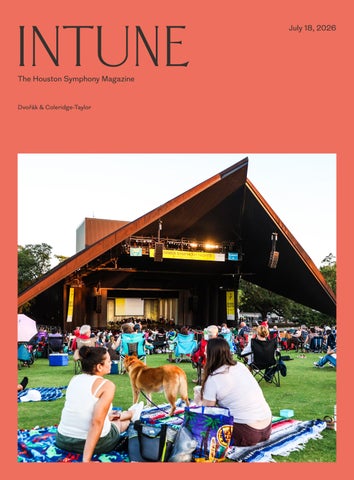
InTUNE The Houston Symphony Magazine
Dvo!ák & Coleridge-Taylor
July 18, 2026
ORCHESTRA ROSTER Juraj Val!uha
Steven Reineke, Principal POPS Conductor
Music Director Roy and Lillie Cullen Chair
FIRST VIOLIN Yoonshin Song, Concertmaster Max Levine Chair Vacant, Associate Concertmaster Ellen E. Kelley Chair Boson Mo, Assistant Concertmaster Qi Ming, Assistant Concertmaster Fondren Foundation Chair Tong Yan Ferenc Illenyi Si-Yang Lao Christopher Neal Sergei Galperin SECOND VIOLIN Vacant, Principal Vacant, Associate Principal Amy Semes Annie Kuan-Yu Chen Mihaela Frusina Jing Zheng Anastasia Iglesias Tina Zhang* Yankı Karataş Hannah Duncan Alexandros Sakarellos VIOLA Joan DerHovsepian, Principal Wei Jiang, Acting Associate Principal Samuel Pedersen, Assistant Principal Paul Aguilar Sheldon Person Fay Shapiro Keoni Bolding Jimmy Cunningham CELLO Brinton Averil Smith, Principal Janice H. and Thomas D. Barrow Chair Christopher French, Associate Principal Jane and Robert Cizik Chair Anthony Kitai Louis-Marie Fardet Jeffrey Butler Maki Kubota Xiao Wong Charles Seo Jeremy Kreutz DOUBLE BASS Robin Kesselman, Principal Timothy Dilenschneider, Associate Principal Andrew Pedersen, Assistant Principal Eric Larson Logan May Burke Shaw Donald Howey Avery Weeks
COMMUNITY-EMBEDDED MUSICIAN Lindsey Baggett, Violin LIBRARIANS Ali Verderber, Associate Librarian Megan Fisher, Assistant Librarian
Andrés Orozco-Estrada, Conductor Laureate Gonzalo Farias, Associate Conductor
FLUTE Kayla Burggraf, Principal General Maurice Hirsch Chair Matthew Roitstein, Associate Principal Judy Dines Kathryn Ladner
TRUMPET Mark Hughes, Principal George P. and Cynthia Woods Mitchell Chair John Parker, Associate Principal Robert Walp, Assistant Principal Richard Harris
PICCOLO Kathryn Ladner
TROMBONE Nick Platoff, Principal Bradley White, Associate Principal Phillip Freeman
OBOE Jonathan Fischer, Principal Lucy Binyon Stude Chair Anne Leek, Associate Principal Vacant Adam Dinitz Pablo Moreno+ ENGLISH HORN Adam Dinitz Barbara and Pat McCelvey Chair CLARINET Mark Nuccio, Principal Bobbie Nau Chair Vacant, Associate Principal Christian Schubert Alexander Potiomkin Ben Freimuth+
BASS TROMBONE Phillip Freeman TUBA Dave Kirk, Principal TIMPANI Leonardo Soto, Principal Matthew Strauss, Associate Principal PERCUSSION Brian Del Signore, Principal Mark Griffith Matthew Strauss HARP Allegra Lilly, Principal
E-FLAT CLARINET Vacant Ben Freimuth+
KEYBOARD Vacant, Principal
BASS CLARINET Alexander Potiomkin
LIBRARIAN Luke Bryson, Principal
BASSOON Rian Craypo, Principal Isaac Schultz, Associate Principal Elise Wagner Adam Trussell CONTRABASSOON Adam Trussell HORN William VerMeulen, Principal Mr. and Mrs. Alexander K. McLanahan Endowed Chair Robert Johnson, Associate Principal Nathan Cloeter, Assistant Principal/Utility Ian Mayton Barbara J. Burger Chair Brian Mangrum Spencer Bay+
*on leave + contracted substitute
STAGE PERSONNEL Vacant, Stage Manager José Rios, Assistant Stage Manager Nicholas DiFonzo, Head Video Engineer Justin Herriford, Head Audio Engineer Connor Morrow, Head Stage Technician Giancarlo Minotti, Audio Production Manager
ADMINISTRATIVE STAFF LEADERSHIP GROUP Gary Ginstling, Executive Director/CEO Margaret Alkek Williams Chair Elizabeth S. Condic, Chief Financial Officer Vicky Dominguez, Chief Operating Officer Rolanda Gregory, Chief Marketing Officer Jennifer Renner, Chief Development Officer Mayenne Minuit, Executive Assistant DEVELOPMENT Leanna Aldis, Manager, Foundation Relations Sarah Bhalla, Board Relations Associate Lauren Buchanan, Development Communications Manager Alex Canales, Manager, Donor Services Jessie De Arman, Development Associate, Gifts, Records, & Research Timothy Dillow, Senior Director, Individual Giving Amanda T. Dinitz, Director, Principal Gifts & Endowment Kamra Kilmer, Manager, Corporate Relations Karyn Mason, Institutional Giving Officer Hadia Mawlawi, Endowment & Planned Giving Officer Emilie Moellmer, Membership Manager Gavin Reed, Major Gifts Officer Tim Richey, Major Gifts Officer Katie Salvatore, Director, Annual Giving & Membership Phillip Smith, Special Events and League Liaison Officer Lena Streetman, Director, Development Operations Sarah Thompson, Donor Events Manager Christina Trunzo, Director, Institutional Giving EDUCATION | COMMUNITY ENGAGEMENT Olivia Allred, Education Manager Allison Conlan, Senior Director, Education & Community Engagement Austin Hinkle, Education & Community Engagement Coordinator Jazmine Olwalia, Community Engagement Manager Community-Embedded Musicians (CEM): Lindsey Baggett, Lead CEM Lucinda Chiu, CEM Teaching Artist David Connor, Senior CEM Teaching Artist Bensen Kwan, CEM Education Specialist Brittany Leavitt, CEM Teaching Artist Bianca Lozano, CEM Teaching Artist Adrian Ponce, CEM Teaching Artist Lauren Ross, CEM Teaching Artist Jaya Varma, CEM Teaching Artist
FINANCE | ADMINISTRATION | IT | HR José Arriaga, Systems Engineer Henry Cantu, Finance Accountant Kimberly Cegielski, Staff Accountant Heather Fails, Database Administrator Ronin Jackson, IT Intern Joel James, Director of Human Resources Tanya Lovetro, Director of Budgeting & Financial Reporting Freddie Piegsa, Help Desk Technician Morgana Rickard, Controller Gabriela Rivera, Senior Accountant Pam Romo, Office Manager/HR Coordinator Lee Whatley, Senior Director, IT & Analytics MARKETING | COMMUNICATIONS Bryan Ayllon, UX & Conversion Specialist Rachel Cheng, Marketing & External Relations Assistant Bella Cutaia, Manager, Patron Services Kathryn Judd, Director, Marketing Priya Kurup, Senior Associate, Group Sales Caroline Lawson, Patron Services Representative Yoo-Ell Lee, Graphics & Media Designer Milow Lozano, Ticketing Systems & Marketing Operations Specialist Ciara Macaulay, Creative Director Ashley Martinez, Patron Services Coordinator Mariah Martinez, Email Marketing Coordinator Casey Pearce, Graphic Design Manager Aracely Quevedo, Patron Services Representative Nadjalie Santos, Front of House Coordinator Eric Skelly, Senior Director, Communications Christian Sosa, Web Experience Director Alexa Ustaszewski, Manager, Revenue and Audience Insights Sophie Volpe, Digital Content Specialist Leecia Whatley, Patron Services Representative Jenny Zuniga, Director, Patron Services OPERATIONS | ARTISTIC Stephanie Alla, Associate Director of Artistic Planning Becky Brown, Associate Director of Orchestra Personnel Juan Pablo Brand, Artistic Assistant Ryan Diefenderfer, Concert Operations Assistant Megan Fisher, Assistant Librarian Michael Gorman, Director of Orchestra Personnel Julia Hall, Assistant Director, Houston Symphony Chorus Parker Hart, Concert Operations Manager Adrian Hernandez, Concert Media Production Manager Giancarlo Minotti, Audio Production Manager José Rios, Assistant Stage Manager Brad Sayles, Senior Recording Engineer Nathan Trinkl, Artistic Assistant & Assistant to the Music Director Ali Verderber, Associate Librarian Meredith Williams, Director of Concert Operations Rebecca Zabinski, Senior Director of Artistic Planning
2026–27 SEASON
SOCIETY BOARD OF TRUSTEES OFFICERS Barbara McCelvey President
Barbara J. Burger Immediate Past President
John Rydman** Board Chair Chair, Artistic & Orchestra Affairs
Mike S. Stude** Chair Emeritus Paul Morico General Counsel
Jonathan Ayre Secretary Chair, Finance
Gary Ginstling^ Executive Director/CEO Margaret Alkek Williams Chair
Janet F. Clark^ Immediate Past Chair
EXECUTIVE COMMITTEE Brad W. Corson Chair, Governance & Leadership
Ed Schneider Chair, Development
Juraj Val!uha^ Music Director Roy and Lillie Cullen Chair
Carey Kirkpatrick Chair, Marketing & Communications
Robert Orr Chair, Strategic Planning
Joan DerHovsepian^ Musician Representative
Jesse B. Tutor** Chair, Audit
Mark Hughes^ Musician Representative
Jerre Williams President, Houston Symphony League
Jeremy Kreutz^ Musician Representative
Evan B. Glick Chair, Popular Programming Sippi Khurana, M.D. Chair, Education & Community Engagement Mary Lynn Marks Chair, Volunteers & Special Events
James H. Lee^ President, Houston Symphony Endowment
Steven P. Mach^ At-Large Member Bobby Tudor^** At-Large Member Gretchen Watkins^ At-Large Member
Mark Nuccio^ Musician Representative
GOVERNING DIRECTORS Gary Beauchamp Eric Brueggeman MK Campion John Cassidy, M.D. Khoa Dao Lidiya Gold
David J. M. Key David Krieger Cindy Levit Isabel Stude Lummis Cora Sue Mach** Rodney Margolis**
Meredith Marshall Leslie Nossaman Chris Powers Brittany Sakowitz Ed Schneider Justin Stenberg
William J. Toomey II Betty Tutor** Robert Weiner Margaret Alkek Williams**
TRUSTEES Christopher Armstrong David Balderston David J. Beck Carrie Brandsberg-Dahl Nancy Shelton Bratic Terry Ann Brown** Ralph Burch John T. Cater** Robert Chanon Heaven Chee Michael H. Clark Virginia Clark Andrew Davis, Ph.D. Denise Davis Tracy Dieterich Kelli Cohen Fein Jeffrey B. Firestone Eugene A. Fong Aggie L. Foster
Kate Dearing Fowler Aoife French Carolyn Gaidos Andrew Gould Lori Harrington Pablo Hernandez SchmidtTophoff Jeff Hiller Grace Ho Gary L. Hollingsworth John W. Hutchinson Brian James Matthew Kades I. Ray Kirk, M.D. Matthew Loden Kirby Lodholz Michael Mann, M.D. Nancy Martin Jack Matzer
Jackie Wolens Mazow Diane K. Morales Tim Ong Edward Osterberg Jr. Gloria G. Pryzant Miwa Sakashita Andrew Schwaitzberg Helen Shaffer** Becky Shaw Robert B. Sloan, D.D., Theol. Jim R. Smith Miles O. Smith** Quentin Smith Tad Smith Anthony Speier Tina Raham Stewart Nanako Tingleaf Terry Thomas Margaret Waisman, M.D.
Fredric A. Weber Vicki West Steven J. Williams David J. Wuthrich Ellen A. Yarrell Robert Yekovich
FOUNDATION FOR JONES HALL REPRESENTATIVES Janet F. Clark Brad W. Corson As of June 5, 2026
Barbara McCelvey
EX-OFFICIO Alejandro Gallardo Reverend Ray Mackey, III Frank F. Wilson IV
Fredric Weber ^Ex-Officio **Lifetime Trustee
PERFORMANCE CALENDAR 2026-27 season
S
A. R. Rahman with the Houston Symphony July 24 & 25
S
Pepe Aguilar with the Houston Symphony August 28 & 29
S
Idina Menzel August 30
S
S
Rachmaninoff Festival: Rachmaninoff’s Piano Concerto No. 3 October 9, 10* & 11 Mozart’s Jupiter & JIJI October 16, 17* & 18 Dolly Parton’s Threads: My Songs in Symphony October 30, November 1
How to Train Your Dragon in Concert September 5 & 6 Opening Night: Celebrating America at 250 September 19
Haunted Halloween October 31 S
Simply the Best: A Tribute to Tina Turner September 25 & 26*
Disney Tim Burton’s The Nightmare Before Christmas in Concert Live-to-Film October 31 Shostakovich’s Ninth Symphony & Yoonshin Song November 6, 7* & 8
Rachmaninoff Festival: Rachmaninoff’s Second Symphony October 2, 3* & 4
La Vida Loca November 21 & 22* See our full year calendar for even more concerts!
Classical Series
Bank of America POPS Series
PNC Family Series
S
Summer & Specials
Chamber Series
*Performance livestreamed
Featured Program
MILLER OUTDOOR THEATRE:
Dvořák & ColeridgeTaylor Gonzalo Farias, conductor *Njioma Grevious, violin 0:04
KORNGOLD – Overture to Captain Blood
0:33
COLERIDGE-TAYLOR – Violin Concerto in G minor, Opus 80 I. Allegro maestoso II. Andante semplice III. Allegro molto
INTERMISSION 0:18
R. STRAUSS – Don Juan, Opus 20
0:09
DVOŘÁK – Carnival Overture, Opus 92
*Houston Symphony debut
Presenting Sponsor
About the Music
Friday, July 18
Miller Outdoor Theatre
8:30 p.m.
Program Notes KORNGOLD Overture to Captain Blood (1935)
On a Monday morning in late 1935, Albert Glasser, a 19-year-old music copist, hid behind some boxes on a Warner Brothers soundstage, waiting for a recording session to begin. He had just spent the weekend hurriedly copying the orchestral parts for the opening credits to Captain Blood, a new film scheduled to be released only a few weeks later. Glasser had become so entranced by the music that he snuck onto the soundstage to hear an orchestra perform the music he had been frantically copying. He later recalled: “And then, here comes the great Korngold. Thick-set, portly, full of humor, making jokes the whole time—a typical Viennese. He walked up to the podium, opened the score, and lifted the baton. As soon as he gave the downbeat, I felt an electric shock run through my body, my hair stood on end, and I knew instantly that here was a truly great, natural-born musician. He had a dynamic something or other, what we later learned to call a ‘stick hand’ that instantly made you sit up straight. I’ll never forget it as long as I live.” This was of course the composer and conductor Erich Wolfgang Korngold. The son of Julius Korngold, one of Vienna’s most prominent music critics, Korngold had been declared a prodigy by the likes of Mahler and Strauss and had won success as an opera composer with his 1920 classic, Die tote Stadt (The Dead City). When the Nazis took
Sponsors
Presenting Sponsor
City of Houston through the Miller Theatre Advisory Board Guarantor
The Houston Symphony’s Miller Outdoor Theatre concerts are endowed by The Brown Foundation, Inc. in memory of Stewart and Hanni Orton
The Houston Symphony’s sound shell ceiling is made possible through the generosity of the Beauchamp Foundation and the Fondren Foundation
Program Notes KORNGOLD Overture to Captain Blood (1935)
power in 1933, they banned all performances of his music in Germany on account of the Austrian composer’s Jewish identity. Given that Germany was one of the main markets for Korngold’s German-language operas, this severely reduced his income from royalties. Fortunately, a new opportunity came calling from sunny Los Angeles in 1934, when Warner Brothers decided to adapt Shakespeare’s A Midsummer Night’s Dream for the silver screen. The composer was tapped to adapt Mendelssohn’s classic incidental music for the film, but Jack Warner was keen to put this star composer to work on other films as well. He promised Korngold tempting movie-operetta projects featuring leading opera singers and soon put the composer to work on just such an operetta, Give Us This Night (which sadly flopped due to a clunky plot and incessant meddling from script doctors). While Korngold was working on Give Us This Night, Warner also enticed the composer to throw together a score for a new swashbuckler, Captain Blood, by promising further operatic projects. A remake of a 1923 silent film, Captain Blood starred a then relatively unknown Errol Flynn and Olivia de Haviland. Set in the 17th century, the film followed the adventures of an Irish doctor unjustly sentenced to involuntary servitude, including his escape into a life of piracy. After some haggling, Korngold agreed to score the film. He thus spent November 1935 recording the music for Give Us This Night by day and composing Captain Blood by night, completing his first (almost entirely) original film score in only three weeks. Due to the incredibly tight deadline, Korngold, like the pirates in the film, was driven to plunder, using excerpts from Liszt’s tone poems Mazeppa and Prometheus to score two scenes. For this reason, Korngold insisted that his credit only consist of “Musical Arrangements by Erich Wolfgang Korngold,” although the vast majority of the score was original. He was thus ineligible for an Oscar for best score, although many members of the Academy voted for him as a write-in candidate anyway. The brief overture—essentially the opening credits music that made such an impression on Glasser—makes it easy to see why. With its brassy fanfares, soaring strings, and glimmering woodwinds, this music helped inaugurate a new era of film scoring. In the concert hall, it makes a fine opening to a program, whetting the appetite for musical adventures to come. —Calvin Dotsey
COLERIDGE-TAYLOR Violin Concerto in G minor, Opus 80 (1911)
Born to an English mother and Sierra Leonean father, Coleridge-Taylor grew up in London and displayed musical talent from an early age; at 15, he was admitted to the Royal College of Music, where his classmates included Ralph Vaughan Williams and Gustav Holst. It was ColeridgeTaylor, however, who was marked out as a rising star by the school’s director, Charles Villiers Stanford, and his early works were championed by none other than Edward Elgar. In 1898, his Hiawatha’s Wedding Feast, a cantata that set verses of American poet Henry Wadsworth Longfellow, was an extraordinary success and made him one Britain's most popular composers. His Violin Concerto would be one of his final completed works before his untimely passing from pneumonia at the age of 37. Coleridge-Taylor
Program Notes COLERIDGE-TAYLOR Violin Concerto in G minor, Opus 80 (1911)
composed his concerto for the American violinist Maud Powell, one of the leading soloists of the era. Powell studied with Joseph Joachim and befriended Max Bruch during her studies in Germany, collaborated with Camille Saint-Saëns in France, and gave the U.S. premiere of the Sibelius Violin Concerto. (Incidentally, her father, the educator William Bramwell Powell, and her uncle, the explorer and geologist John Wesley Powell, were two of the founding members of the National Geographic Society.) She had championed the works of Coleridge-Taylor since at least 1900 and met the composer at the 1910 Norwich Festival in Connecticut. It was likely this meeting that spurred Coleridge-Taylor to compose the concerto for her, and by July 1911 the Musical Times reported that the premiere was scheduled for the 1912 Norwich Festival. The concerto was completed by March 1912, but the composer had to hastily reconstruct the piece after the score and parts were lost in transit across the Atlantic. Fortunately, the June 4 premiere in Connecticut was a success. Powell soon gave several other performances, but after Coleridge-Taylor’s death in September, the work fell into neglect. Since its revival in recent decades (the work received its first commercial recording in 2004), it has at last won its rightful place in the repertoire. Powell described the concerto as “a pretty, melodious one—like a bouquet of flowers,” recognizing its strong lyricism. The concerto also has its dramatic moments, and although it is organized in the traditional three movements, the work features an original formal structure. The concerto opens with the orchestra intoning the main idea of the first movement, an expressive theme in G minor characterized by a marchlike triplet rhythm. The soloist then reinterprets this melody, and after a turbulent transitional passage, introduces a light, mercurial secondary idea marked by dotted rhythms and coloristic modulations. This builds to an heroic orchestral development of the opening before the soloist reenters for a rhapsodic development. A powerful recapitulation of the main theme introduces a cadenza for the soloist accompanied by rumbling timpani and double basses. In place of a full restatement of the second idea, the first movement concludes with a dramatic coda. The second movement, a disarming Andante simplice, opens with a sweet melody for muted strings featuring a typically Coleridgian sighing figure. This main theme alternates with contrasting episodes, including a tremulous, minor key section and a more passionate and developed secondary theme. Attentive listeners will note that the first movement’s triplet rhythm is woven into several passages. After a few assertive chords from the orchestra, the metrically inventive finale opens with a playful, lilting melody for the soloist in 3/8. This main theme alternates with contrasting episodes, including a yearning theme that shifts between 2/4 and 3/4 and a more swaggering, march-like theme that mixes triplets and duplets. Midway through, the main theme of the first movement and the secondary theme of the second movement return, suggesting a confrontation. After a recapitulation of the finale’s main themes, the swaggering, heroic melody seems on the verge of bringing the concerto to a triumphant conclusion when the solemn first movement theme plunges the work back into G minor. This final, dramatic return only resolves to a hopeful G major tonality at the final chord.
Program Notes R. STRAUSS Don Juan, Opus 20 (1889)
Richard Strauss was a musically precocious child who produced two symphonies as well as concertos for horn and violin by the age of 20. The son of the great horn player Franz Strauss (who believed that music had gone downhill since the death of Mendelssohn), Richard began by composing in a conservative style modeled on the classics of Mozart, Beethoven, and Schubert; in 1885, however, he rebelled. That year, young Richard was converted to the music of Wagner, the composer his father detested most. Influenced by Wagnerian ideas, Richard abandoned the abstract, classicizing symphonies and sonatas of his youth and began composing graphic tone poems inspired by literature. In 1889, the 24-year-old composer would complete his first masterpiece: Don Juan. Specifically, Strauss found inspiration in a fragmentary verse drama by the mid-19th century German poet Nikolaus Lenau, who left his Don Juan incomplete upon his descent into madness and untimely death. There is also evidence suggesting that Strauss had more personal sources of inspiration, including stern letters from his father warning him against scandalous behavior. Sometime between 1883 and 1889, Richard had a passionate, but ultimately impossible affair with a married woman, and in 1887, he began giving music lessons to the fiery soprano Pauline de Ahna, who would later become his wife. Though Strauss titled his tone poem Don Juan and prefaced the score with quotations from the play, he himself never provided a detailed plot for the piece. Nevertheless, traditional interpretations have arisen, and much of the music is quite explicit on its own. The frenzied opening of the piece indubitably represents Don Juan’s lust. Lenau’s play commences with a scene in which Don Juan’s brother, Diego, confronts the rake with a message from their father, who implores Don Juan to abandon his reckless life and come home. Defiantly, Don Juan declares, “That magic circle, immeasurably wide, of beautiful femininity with their multiple attractions, I want to traverse in a storm of pleasure, and die of a kiss upon the lips of the last woman.” Just as Don Juan thumbs his nose at his father, so too does Strauss with wild, ultra-modern music unmistakably influenced by Wagner. From the beginning, the entire piece is incredibly difficult, requiring an orchestra of virtuosos. During a rehearsal for the premiere, one of the horn players famously cried out, “Dear God! What sin have we committed, for You to send us this scourge for our backs!” The sins are all Don Juan’s, however; after the lust theme, a giggling transitional passage has traditionally been interpreted as Don Juan’s first conquest. No sooner is it completed than the lust theme strikes up again, until a demur violin solo appears—usually interpreted as the next feminine object of Don Juan’s desire. Soon the violins (representing the woman) begin a duet with the horns and cellos (representing Don Juan), their melodies entwining about each other with increasing passion. The climax, however, is surprisingly dark—perhaps hinting at Don Juan’s ultimate fate—and the lust theme immediately resumes its insatiable course. Don Juan begins his next seduction with a brooding melody in the cellos and violas, to which a sighing flute responds. This time however, a tender oboe melody arises, suggesting a deeper emotional involvement.
Program Notes R. STRAUSS Don Juan, Opus 20 (1888)
In the play, Don Juan alludes to Anna, the only woman who seems to have touched his heart. Naturally, this interlude does not last: as Don Juan renounces monogamy, the horns belt a new, heroic theme, traditionally matched with one of the quotes Strauss selected: “I shun satiety and the weariness of pleasure, and keep myself fresh in the service of the beautiful; hurting the individual woman, I adore the whole species. […] Out, then, and away after ever-new victories as long as the fiery ardors of youth still soar!” This new theme initiates a developmental section which spirals out of control. Traditionally, this has been interpreted as a drunken, orgiastic carnival scene. Lenau’s play does contain a masked ball, but other episodes seem perhaps even more suited to the music. In one scene, Don Juan sneaks a bevy of young women disguised as page boys into a monastery. At his signal, they reveal themselves. The apparently helpless monks immediately succumb to their charms, much to the dismay of the prior, who attempts to burn the monastery down with everyone inside (fortunately, they all escape). Another possibility occurs at the end of the play, when a horde of women and bastard children demanding justice descend upon Don Juan’s castle. The episode collapses, leading to an eerie passage traditionally associated with a cemetery scene from the play. Brief quotations of the earlier love themes suggest memories of the women Don Juan seduced— alternatively, some of those women do indeed appear to confront Don Juan at the end of the play. Don Juan promises to divide the residue of his estate among them when he dies, and Don Pedro, whose father was killed by Don Juan in a duel, obligingly appears seeking vengeance. The return of the lust theme seems to correspond with Don Juan’s duel with Don Pedro. As skilled in the arts of war as in those of seduction, Don Juan easily bests him, but is careful to avoid seriously injuring him. The heroic horn theme of Don Juan’s resolve to eternally seek after new women then returns with intense longing. The lust theme consumes it, building to a thunderous silence. Almost on a whim, Don Juan, bored with life and the endless cycle of seduction, casts aside his rapier, and Don Pedro stabs him. In the preface, Strauss quotes Don Juan: “All my desires and hopes are in suspended animation; perhaps a lightning bolt, from the heights that I contemned, mortally struck my amorous powers, and suddenly my world became deserted and benighted. And yet, perhaps not—the fuel is consumed and the hearth has become cold and dark.” The piece ends with deathly quiet as Don Juan perishes. At its premiere in Weimar on November 11, 1889, Don Juan scandalized and delighted audiences; never before had they heard such graphically suggestive music. Don Juan sealed Strauss’s fame as the genius of his generation, and he became the darling of the musical modernists. Special thanks to Amy Tanguay for her help in translating Lenau’s Don Juan. —Calvin Dotsey
Program Notes DVOŘÁK Carnival Overture, Opus 92 (1891)
In January 1892, Antonín Dvo!ák wrote to his publisher: “Dear Herr Simrock! I send you my best wishes for the New Year. But my Muse should not be left behind, either. I have the following things: 1. ‘Dumky’ for Piano, Violin, and Cello in chamber music style (half an hour in duration), 2. Rondo for Cello with Piano Accompaniment, 3. Overture in F Major, ‘Nature,’ 4. Overture ‘Life’—‘Carnival,’ 5. Overture ‘Love’—‘Othello.’ These three overtures form a cycle and have the title ‘Nature, Life, and Love’ (for orchestra, of course), have a shared opus number, and can also each be played separately.” By this time established as one of Europe’s leading symphonic composers, Dvo!ák wrote these three overtures between March 1891 and January 1892. In addition to his programmatic indications, the overtures are also interconnected musically, as each one incorporates a motif that appears at the opening of the first overture, which Dvo!ák ultimately titled In Nature’s Realm. Nevertheless, despite Dvo!ák’s instruction to publish the overtures as a single opus and have them (at least occasionally) performed together, they were published separately and are usually performed alone. Although all three overtures are appealing works with a firm place in the repertoire, the second, Carnival, is the most popular thanks to its extraverted character. The work combines the tunefulness of the Czech composer’s Slavonic Dances with the ingenious construction of his symphonies, giving full expression to the idea of “Life” through the colorful, topsy-turvy world of the carnival. The overture opens with cymbals, triangles, tambourine, and unbridled brass underpinning a lively main theme in A major. A transitional passage then leads to a soulful second melody for violins in E minor before turning to playful music in E major. Unexpectedly, the tempo slows for what appears to be a miniature nocturne within the overture. The impression of a moonlit scene is perhaps underscored by quotations of the “nature motif” from In Nature’s Realm. Suddenly, the tempo snaps back to full speed, commencing a wild development full of unexpected twists and turns. This climaxes with a return of the opening. Carried forward by an unstoppable momentum, the overture dispenses with the niceties of a full recapitulation and plunges headlong into a thrilling coda, which whirls faster and faster to its final chords. —Calvin Dotsey
Program Bio He was one of six conductors chosen for the prestigious Bruno Walter National Conductor Preview, presented by the League of American Orchestras, and was appointed by the National Endowment for the Arts as a grant review panelist.
Gonzalo Farias, conductor Gonzalo Farias, Associate Conductor of the Houston Symphony, is an imaginative and engaging orchestral leader, awardwinning pianist, and dedicated educator. Praised for his “clear, engaging style with a lyrical, almost Zen-like quality,” he is recognized as “a focused, musical artist who knows what he wants and how to get it—with grace and substance.” He has held conducting posts with the Kansas City Symphony, Jacksonville Symphony, Virginia Symphony Orchestra, and the Baltimore Symphony Orchestra. As Music Director of the Joliet Symphony Orchestra, he strengthened community connections through innovative programming, pre-concert lectures, and bilingual collaborations, including a narrated performance of Bizet’s Carmen. Recent and upcoming appearances include the Nashville Symphony, Lyric Opera of Chicago, Buffalo Philharmonic, Tallahassee Symphony, and the Houston Symphony, where in 2024 he conducted the world premiere of Arturo Márquez’s Guitar Concerto with Pablo Sainz-Villegas.
Born in Santiago de Chile, Farias began piano studies at age five. He earned his bachelor’s degree at the Pontificia Universidad Católica de Chile and continued his education at the New England Conservatory, studying under Wha-Kyung Byun and Russell Sherman. He has won prizes at the Claudio Arrau International Piano Competition, Maria Canals, and Luis Sigall competitions. His conducting mentors include Donald Schleicher, Marin Alsop, Larry Rachleff, and Otto-Werner Mueller. Beyond performance, Farias is committed to reimagining music as a force for personal growth, dialogue, cooperation, and community-building. His doctoral dissertation, Logical Predictions and Cybernetics, examines Cornelius Cardew’s The Great Learning to explore music-making as a self-organizing system. Influenced by Zen Buddhist practice and second-order cybernetics, he views music as a shared space where performers and audiences co-create meaning, reflecting on our shared human condition.
Njioma Grevious, violin Praised for her expressive tones, elegant playing, and a “dazzling performance” with the National Symphony Orchestra of Washington, DC, violinist Njioma Chinyere Grevious is a passionate and versatile solo, chamber, and orchestral musician. A winner of the prestigious 2024 Avery Fisher Career Grant, she has been described as “superb” by the Chicago Classical Review. In 2023, she won both the Robert F. Smith First Prize and the Audience Choice Award in the Senior Division of the Sphinx Competition as well as the Grand Prize of the Concert Artist Guild (CAG) and the Young Classical Artist Trust (YCAT) Elmaleh Competition. A graduate of the Juilliard School in 2021, Njioma was awarded the John Erskine Prize for scholastic and artistic achievement. She has been named a Classic FM Rising Star. As a soloist, Njioma has debuted at the world-renowned Concertgebouw in Amsterdam with the Brussels Philharmonic and at Carnegie Hall in New York City with the Sphinx Virtuosi. She also debuted at the iconic Wigmore Hall, undertaking a UK tour as a YCAT artist. Named as the Chicago Philharmonic’s inaugural Artist-in-Residence, Njioma will be a featured soloist
Program Bio over three years in addition to building upon her outreach and mentoring of local children. Njioma has performed with the Boston Pops, Minnesota Orchestra, Chicago Philharmonic, Florence Symphony Orchestra, and Western Michigan Symphony, among others. Appearances in 2026 include recitals in New York City and San Francisco as well concerto performances with the Springfield and Bucks County Symphony Orchestras, Chicago Philharmonic, Colorado Music Festival Orchestra, Houston Symphony, and the Indianapolis Symphony featuring Sphinx.
Njioma will be on tour in June with Chineke! Orchestra in London, Vienna, Lugano, and Amsterdam. A founding member of the awardwinning Abeo Quartet, Njioma is also a member of New York City’s self-conducted, collaborative Orpheus Chamber Orchestra. Additionally, she has been invited to perform in numerous series and festivals including the Seattle Chamber Music Festival, La Jolla SummerFest, Jupiter Chamber Players, Rockport Chamber Music Festival, and the Gateways Music Festival. Njioma is the recipient of an outstanding violin by Pietro Guarneri of Mantua c. 1679 on generous loan from the Stradivari Society.
Juraj Valčuha, Music Director
Jones Hall – 615 Louisiana Street houstonsymphony.org