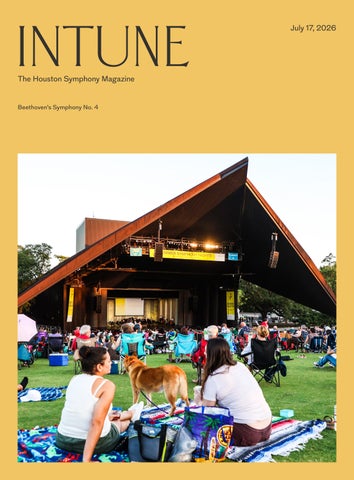
InTUNE The Houston Symphony Magazine
Beethoven’s Symphony No. 4
July 17, 2026
ORCHESTRA ROSTER Juraj Val!uha
Steven Reineke, Principal POPS Conductor
Music Director Roy and Lillie Cullen Chair
FIRST VIOLIN Yoonshin Song, Concertmaster Max Levine Chair Vacant, Associate Concertmaster Ellen E. Kelley Chair Boson Mo, Assistant Concertmaster Qi Ming, Assistant Concertmaster Fondren Foundation Chair Tong Yan Ferenc Illenyi Si-Yang Lao Christopher Neal Sergei Galperin SECOND VIOLIN Vacant, Principal Vacant, Associate Principal Amy Semes Annie Kuan-Yu Chen Mihaela Frusina Jing Zheng Anastasia Iglesias Tina Zhang* Yankı Karataş Hannah Duncan Alexandros Sakarellos VIOLA Joan DerHovsepian, Principal Wei Jiang, Acting Associate Principal Samuel Pedersen, Assistant Principal Paul Aguilar Sheldon Person Fay Shapiro Keoni Bolding Jimmy Cunningham CELLO Brinton Averil Smith, Principal Janice H. and Thomas D. Barrow Chair Christopher French, Associate Principal Jane and Robert Cizik Chair Anthony Kitai Louis-Marie Fardet Jeffrey Butler Maki Kubota Xiao Wong Charles Seo Jeremy Kreutz DOUBLE BASS Robin Kesselman, Principal Timothy Dilenschneider, Associate Principal Andrew Pedersen, Assistant Principal Eric Larson Logan May Burke Shaw Donald Howey Avery Weeks
COMMUNITY-EMBEDDED MUSICIAN Lindsey Baggett, Violin LIBRARIANS Ali Verderber, Associate Librarian Megan Fisher, Assistant Librarian
Andrés Orozco-Estrada, Conductor Laureate Gonzalo Farias, Associate Conductor
FLUTE Kayla Burggraf, Principal General Maurice Hirsch Chair Matthew Roitstein, Associate Principal Judy Dines Kathryn Ladner
TRUMPET Mark Hughes, Principal George P. and Cynthia Woods Mitchell Chair John Parker, Associate Principal Robert Walp, Assistant Principal Richard Harris
PICCOLO Kathryn Ladner
TROMBONE Nick Platoff, Principal Bradley White, Associate Principal Phillip Freeman
OBOE Jonathan Fischer, Principal Lucy Binyon Stude Chair Anne Leek, Associate Principal Vacant Adam Dinitz Pablo Moreno+ ENGLISH HORN Adam Dinitz Barbara and Pat McCelvey Chair CLARINET Mark Nuccio, Principal Bobbie Nau Chair Vacant, Associate Principal Christian Schubert Alexander Potiomkin Ben Freimuth+
BASS TROMBONE Phillip Freeman TUBA Dave Kirk, Principal TIMPANI Leonardo Soto, Principal Matthew Strauss, Associate Principal PERCUSSION Brian Del Signore, Principal Mark Griffith Matthew Strauss HARP Allegra Lilly, Principal
E-FLAT CLARINET Vacant Ben Freimuth+
KEYBOARD Vacant, Principal
BASS CLARINET Alexander Potiomkin
LIBRARIAN Luke Bryson, Principal
BASSOON Rian Craypo, Principal Isaac Schultz, Associate Principal Elise Wagner Adam Trussell CONTRABASSOON Adam Trussell HORN William VerMeulen, Principal Mr. and Mrs. Alexander K. McLanahan Endowed Chair Robert Johnson, Associate Principal Nathan Cloeter, Assistant Principal/Utility Ian Mayton Barbara J. Burger Chair Brian Mangrum Spencer Bay+
*on leave + contracted substitute
STAGE PERSONNEL Vacant, Stage Manager José Rios, Assistant Stage Manager Nicholas DiFonzo, Head Video Engineer Justin Herriford, Head Audio Engineer Connor Morrow, Head Stage Technician Giancarlo Minotti, Audio Production Manager
ADMINISTRATIVE STAFF LEADERSHIP GROUP Gary Ginstling, Executive Director/CEO Margaret Alkek Williams Chair Elizabeth S. Condic, Chief Financial Officer Vicky Dominguez, Chief Operating Officer Rolanda Gregory, Chief Marketing O!cer Jennifer Renner, Chief Development O!cer Mayenne Minuit, Executive Assistant DEVELOPMENT Leanna Aldis, Manager, Foundation Relations Sarah Bhalla, Board Relations Associate Lauren Buchanan, Development Communications Manager Alex Canales, Manager, Donor Services Jessie De Arman, Development Associate, Gifts, Records, & Research Timothy Dillow, Senior Director, Individual Giving Amanda T. Dinitz, Director, Principal Gifts & Endowment Kamra Kilmer, Manager, Corporate Relations Karyn Mason, Institutional Giving Officer Hadia Mawlawi, Endowment & Planned Giving Officer Emilie Moellmer, Membership Manager Gavin Reed, Major Gifts Officer Tim Richey, Major Gifts Officer Katie Salvatore, Director, Annual Giving & Membership Phillip Smith, Special Events and League Liaison Officer Lena Streetman, Director, Development Operations Sarah Thompson, Donor Events Manager Christina Trunzo, Director, Institutional Giving EDUCATION | COMMUNITY ENGAGEMENT Olivia Allred, Education Manager Allison Conlan, Senior Director, Education & Community Engagement Austin Hinkle, Education & Community Engagement Coordinator Jazmine Olwalia, Community Engagement Manager Community-Embedded Musicians (CEM): Lindsey Baggett, Lead CEM Lucinda Chiu, CEM Teaching Artist David Connor, Senior CEM Teaching Artist Bensen Kwan, CEM Education Specialist Brittany Leavitt, CEM Teaching Artist Bianca Lozano, CEM Teaching Artist Adrian Ponce, CEM Teaching Artist Lauren Ross, CEM Teaching Artist Jaya Varma, CEM Teaching Artist
FINANCE | ADMINISTRATION | IT | HR José Arriaga, Systems Engineer Henry Cantu, Finance Accountant Kimberly Cegielski, Staff Accountant Heather Fails, Database Administrator Ronin Jackson, IT Intern Joel James, Director of Human Resources Tanya Lovetro, Director of Budgeting & Financial Reporting Freddie Piegsa, Help Desk Technician Morgana Rickard, Controller Gabriela Rivera, Senior Accountant Pam Romo, Office Manager/HR Coordinator Lee Whatley, Senior Director, IT & Analytics MARKETING | COMMUNICATIONS Bryan Ayllon, UX & Conversion Specialist Rachel Cheng, Marketing & External Relations Assistant Bella Cutaia, Manager, Patron Services Kathryn Judd, Director, Marketing Priya Kurup, Senior Associate, Group Sales Caroline Lawson, Patron Services Representative Yoo-Ell Lee, Graphics & Media Designer Milow Lozano, Ticketing Systems & Marketing Operations Specialist Ciara Macaulay, Creative Director Ashley Martinez, Patron Services Coordinator Mariah Martinez, Email Marketing Coordinator Casey Pearce, Graphic Design Manager Aracely Quevedo, Patron Services Representative Nadjalie Santos, Front of House Coordinator Eric Skelly, Senior Director, Communications Christian Sosa, Web Experience Director Alexa Ustaszewski, Manager, Revenue and Audience Insights Sophie Volpe, Digital Content Specialist Leecia Whatley, Patron Services Representative Jenny Zuniga, Director, Patron Services OPERATIONS | ARTISTIC Stephanie Alla, Associate Director of Artistic Planning Becky Brown, Associate Director of Orchestra Personnel Juan Pablo Brand, Artistic Assistant Ryan Diefenderfer, Concert Operations Assistant Megan Fisher, Assistant Librarian Michael Gorman, Director of Orchestra Personnel Julia Hall, Assistant Director, Houston Symphony Chorus Parker Hart, Concert Operations Manager Adrian Hernandez, Concert Media Production Manager Giancarlo Minotti, Audio Production Manager José Rios, Assistant Stage Manager Brad Sayles, Senior Recording Engineer Nathan Trinkl, Artistic Assistant & Assistant to the Music Director Ali Verderber, Associate Librarian Meredith Williams, Director of Concert Operations Rebecca Zabinski, Senior Director of Artistic Planning
2026–27 SEASON
SOCIETY BOARD OF TRUSTEES OFFICERS Barbara McCelvey President
Barbara J. Burger Immediate Past President
John Rydman** Board Chair Chair, Artistic & Orchestra Affairs
Mike S. Stude** Chair Emeritus Paul Morico General Counsel
Jonathan Ayre Secretary Chair, Finance
Gary Ginstling^ Executive Director/CEO Margaret Alkek Williams Chair
Janet F. Clark^ Immediate Past Chair
EXECUTIVE COMMITTEE Brad W. Corson Chair, Governance & Leadership
Ed Schneider Chair, Development
Juraj Val!uha^ Music Director Roy and Lillie Cullen Chair
Carey Kirkpatrick Chair, Marketing & Communications
Robert Orr Chair, Strategic Planning
Joan DerHovsepian^ Musician Representative
Jesse B. Tutor** Chair, Audit
Mark Hughes^ Musician Representative
Jerre Williams President, Houston Symphony League
Jeremy Kreutz^ Musician Representative
Evan B. Glick Chair, Popular Programming Sippi Khurana, M.D. Chair, Education & Community Engagement Mary Lynn Marks Chair, Volunteers & Special Events
James H. Lee^ President, Houston Symphony Endowment
Steven P. Mach^ At-Large Member Bobby Tudor^** At-Large Member Gretchen Watkins^ At-Large Member
Mark Nuccio^ Musician Representative
GOVERNING DIRECTORS Gary Beauchamp Eric Brueggeman MK Campion John Cassidy, M.D. Khoa Dao Lidiya Gold
David J. M. Key David Krieger Cindy Levit Isabel Stude Lummis Cora Sue Mach** Rodney Margolis**
Meredith Marshall Leslie Nossaman Chris Powers Brittany Sakowitz Ed Schneider Justin Stenberg
William J. Toomey II Betty Tutor** Robert Weiner Margaret Alkek Williams**
TRUSTEES Christopher Armstrong David Balderston David J. Beck Carrie Brandsberg-Dahl Nancy Shelton Bratic Terry Ann Brown** Ralph Burch John T. Cater** Robert Chanon Heaven Chee Michael H. Clark Virginia Clark Andrew Davis, Ph.D. Denise Davis Tracy Dieterich Kelli Cohen Fein Jeffrey B. Firestone Eugene A. Fong Aggie L. Foster
Kate Dearing Fowler Aoife French Carolyn Gaidos Andrew Gould Lori Harrington Pablo Hernandez SchmidtTophoff Jeff Hiller Grace Ho Gary L. Hollingsworth John W. Hutchinson Brian James Matthew Kades I. Ray Kirk, M.D. Matthew Loden Kirby Lodholz Michael Mann, M.D. Nancy Martin Jack Matzer
Jackie Wolens Mazow Diane K. Morales Tim Ong Edward Osterberg Jr. Gloria G. Pryzant Miwa Sakashita Andrew Schwaitzberg Helen Shaffer** Becky Shaw Robert B. Sloan, D.D., Theol. Jim R. Smith Miles O. Smith** Quentin Smith Tad Smith Anthony Speier Tina Raham Stewart Nanako Tingleaf Terry Thomas Margaret Waisman, M.D.
Fredric A. Weber Vicki West Steven J. Williams David J. Wuthrich Ellen A. Yarrell Robert Yekovich
FOUNDATION FOR JONES HALL REPRESENTATIVES Janet F. Clark Brad W. Corson As of June 5, 2026
Barbara McCelvey
EX-OFFICIO Alejandro Gallardo Reverend Ray Mackey, III Frank F. Wilson IV
Fredric Weber ^Ex-Officio **Lifetime Trustee
PERFORMANCE CALENDAR 2026-27 season
S
A. R. Rahman with the Houston Symphony July 24 & 25
S
Pepe Aguilar with the Houston Symphony August 28 & 29
S
Idina Menzel August 30
S
S
Rachmaninoff Festival: Rachmaninoff’s Piano Concerto No. 3 October 9, 10* & 11 Mozart’s Jupiter & JIJI October 16, 17* & 18 Dolly Parton’s Threads: My Songs in Symphony October 30, November 1
How to Train Your Dragon in Concert September 5 & 6 Opening Night: Celebrating America at 250 September 19
Haunted Halloween October 31 S
Simply the Best: A Tribute to Tina Turner September 25 & 26*
Disney Tim Burton’s The Nightmare Before Christmas in Concert Live-to-Film October 31 Shostakovich’s Ninth Symphony & Yoonshin Song November 6, 7* & 8
Rachmaninoff Festival: Rachmaninoff’s Second Symphony October 2, 3* & 4
La Vida Loca November 21 & 22* See our full year calendar for even more concerts!
Classical Series
Bank of America POPS Series
PNC Family Series
S
Summer & Specials
Chamber Series
*Performance livestreamed
Featured Program
MILLER OUTDOOR THEATRE:
Beethoven’s Symphony No. 4 *Taichi Fukumura, conductor *Eva Gevorgyan, piano 0:07
FARRENC – Overture No. 1 in E minor, Opus 23
0:30
GRIEG – Piano Concerto in A minor, Opus 16 I. Allegro molto moderato II. Adagio— III. Allegro moderato molto e marcato
INTERMISSION 0:32
BEETHOVEN – Symphony No. 4 in B-flat major, Opus 60 I. Adagio--Allegro vivace II. Adagio III. Allegro vivace IV. Allegro ma non troppo
*Houston Symphony debut
Presenting Sponsor
About the Music
Friday, July 17
Miller Outdoor Theatre
8:30 p.m.
Program Notes FARRENC Overture No. 1 in E minor, Opus 23 (1834)
Louise Farrenc was born Louise Dupont, a member of an illustrious artistic family which had been patronized by French kings since the days of Louis XIV. Her brother Auguste would continue this family tradition by becoming an acclaimed sculptor, but Louise set out on a slightly unconventional path by pursuing music in place of the visual arts. From a young age, she displayed great talent as a pianist and composer, beginning studies with Antonín Reicha at the Paris Conservatoire at age 15. Her studies were briefly interrupted by her marriage at 17 to Aristide Farrenc. The son of a merchant family in Marseille, Aristide had run away to Paris to pursue music. Although he enjoyed some success as a flautist, oboist, and composer, he found his true calling as a music publisher, specializing in the works of Beethoven, Hummel (a friend of the couple), and of course, his wife. Louise’s biographer Bea Friedland describes their marriage thus: “A stable and mutually supportive relationship, the Farrenc union seems to have achieved a blend of communality and independence rarely seen in the 19th century.” Over the course of her impressive career, Farrenc composed three symphonies and many pieces of chamber and solo piano music. In 1842, she became a professor of piano at the Paris Conservatoire, the only woman to hold a permanent post of that rank there during the 19th
Sponsors
Presenting Sponsor
City of Houston through the Miller Theatre Advisory Board Guarantor
The Houston Symphony’s Miller Outdoor Theatre concerts are endowed by The Brown Foundation, Inc. in memory of Stewart and Hanni Orton
The Houston Symphony’s sound shell ceiling is made possible through the generosity of the Beauchamp Foundation and the Fondren Foundation
Program Notes FARRENC Overture No. 1 in E minor, Opus 23 (1834)
century; her two concert overtures, however, date from earlier in her career. Her first publicly performed works for orchestra, both were composed in quick succession in 1834. The newly formed Gymnase musical gave the premiere of her Overture No. 1 in E minor, Opus 23, in Paris in June 1835. As is typical of Farrenc, the work is a bold and daring work which is nevertheless grounded in classical forms. The overture begins with a slow introduction; its majestic E major opening soon turns toward the darker key of E minor. The faster, main body of the movement begins with a breathless main theme that alternates violins and woodwinds. A tumultuous bridge then leads to a lovely second theme in G major for solo clarinet (astute listeners will note fragments of the main theme in the accompaniment). This second theme becomes the focus of an ingenious development section that leads back to the tempestuous main theme. When the second theme makes its final return, it appears in E major as a duet for flute and horn, leading the seemingly tragic overture to an uplifting coda. —Calvin Dotsey
GRIEG Piano Concerto in A minor, Opus 16 (1868)
After studying music in Germany as a young man, Grieg returned to his native Norway, where his compatriots inspired him to create a new, Norwegian style of classical music. In 1866, he settled in Oslo and flung himself into the arduous quest of developing audiences and institutions to support the artform in a country that still had limited interest in it. With a new wife and child to support, he was hard pressed to make money by giving piano lessons and seldom had time to compose. In the summer of 1868, he took his family on an extended holiday to visit his in-laws in Denmark. There, the creativity that had been dammed up within the 25-year-old composer at last came pouring out in the form of his piano concerto, and the premiere took place the following spring. Despite the concerto’s instant success, the perfectionistic Grieg continued to adjust it as late as 1906. From its premiere, however, audiences and pianists alike treasured its heart-on-sleeve emotions, virtuoso pianism, and unforgettable Nordic melodies. The concerto famously begins with a timpani roll and a dramatic descent for the soloist. Woodwinds then introduce the resolute main theme of the first movement; later, the cellos introduce a meltingly beautiful, contrasting second theme. Dramatic trumpet fanfares initiate a dreamy development based on fragments of the main theme, and the following reprise of the main themes leads to an intense cadenza—an extended passage for the soloist alone. The orchestra briefly reenters, and the movement ends as it began. The slow second movement transports listeners to a distant dreamworld with a long, yearning theme for strings. The entrance of the piano begins a tranquil contrasting section, and the soloist concludes the movement with a passionate version of the strings’ opening theme. The finale opens with a distinctive melody that recalls the Hardanger fiddle music
Program Notes GRIEG Piano Concerto in A minor, Opus 16 (1868)
of the halling, an athletic Norwegian folk dance. This vigorous main theme alternates with contrasting episodes, including a lyrical melody introduced by a solo flute. At the end, the halling theme is transformed, switching from duple to triple meter and from minor to major. The concerto concludes with a magnificent return of the flute theme. Influenced by Norwegian folk music, it is inflected with G-naturals in place of the expected G-sharps. In 1869, Grieg presented his new concerto to the great composer and pianist Franz Liszt, who astounded Grieg by playing it perfectly at sight. Years later, Grieg recalled “one particularly divine episode”: “In the very last measures [...] [Liszt] suddenly stopped, rose to his full height, left the piano, and with mighty theatrical steps and raised arms strode throughout the great monastery hall, literally roaring out the theme. When he got to the above mentioned G, he gestured imperiously with his arm and cried: ‘G, G, not G-sharp! Fantastic! That’s the real Swedish article!’” True, Grieg was Norwegian, but in light of the master’s excitement, the young Grieg was easily able to forgive him. —Calvin Dotsey
BEETHOVEN Symphony No. 4 in B-flat major, Opus 60 (1806)
Though the sketchbook for Beethoven’s Fourth Symphony has been lost, surviving evidence suggests that Beethoven composed this masterpiece during the summer or early autumn of 1806 while staying at the country estate of his patron, Prince Lichnowsky. Shortly after completing his revolutionary Third Symphony, the Eroica, Beethoven began sketching his Fifth, a work that expands on the theme of heroic struggle so vividly explored in the Third. He set it aside, however, to write a completely different kind of symphony. Throughout his career, Beethoven liked to work on contrasting works simultaneously, and in character, the Fourth Symphony could not be more different from the Third or Fifth. Instead of an epic journey from darkness to light, Beethoven’s Fourth is a lighthearted work full of comedy and enchantment. Several passages look forward to the music Mendelssohn would write to evoke the magical forest of Shakespeare’s A Midsummer Night’s Dream, and throughout, the symphony is suffused with a mischievous good humor. It begins with a slow, mysterious introduction; this gloom, however, is soon dispelled by the effervescent theme that begins the main body of the work. An exuberant transition leads to a contrasting second theme, which begins as the woodwinds pass its opening motif from one instrument to another. A third theme is introduced by the clarinet, before an explosive passage brings the first part of the movement to a close. Minus the slow introduction, these themes are repeated, leading to a developmental section that begins as the music becomes softer and softer. Beautiful, lyrical phrases give way to stormier outbursts, until this frenetic music nearly comes to a standstill. Gradually, fragmentary motifs crescendo to the reprise of the main themes, and the movement concludes with an irresistible coda. The slow second movement is one
Program Notes BEETHOVEN Symphony No. 4 in B-flat major, Opus 60 (1806)
of Beethoven’s most singular creations; the rhythmic motif that begins the work has been likened to a heartbeat, and its pulse recurs frequently throughout the movement. Combined with the yearning violin melody that follows (marked cantabile—Italian for “singing”), these musical ideas led the renowned music writer Sir George Grove to discern an amorous coloring in the movement. After a vehement transition, a solo clarinet introduces a second cantabile theme. A more intense, developmental passage follows, until the opening theme returns as a flute solo, now ornamented with two-note sighing figures. After a reprise of the other main ideas, the movement ends with an endearing timpani solo. The outer sections of the impish third movement are full of rhythmic games and sudden mood changes, while the middle features gentler music for the woodwinds. After the opening section returns, Beethoven surprises audiences with an unexpected turn of events. The finale is a mirthful romp that begins with an almost impossibly fast, perpetualmotion theme for the violins. A more lyrical theme for woodwinds then leads to an outrageous musical joke. After these main themes are repeated, Beethoven begins the movement’s development by ratcheting the violin’s perpetual-motion theme higher and higher. A series of delightfully disorienting modulations leads to a vigorous climax before the main themes of the movement are reprised. Beethoven saves his best jokes for last as this uproarious finale comes to an end. —Calvin Dotsey
Program Bio the position of Music Director with the Illinois Symphony Orchestra (ISO). A rising Japanese American conductor acclaimed for his dynamic stage presence and musical finesse, Fukumura is the Second Prize Winner of The Mahler Competition 2023, and a four-time recipient of the Solti Foundation U.S. Career Assistance Award.
Taichi Fukumura, conductor Taichi Fukumura is the current Assistant Conductor of The Cleveland Orchestra appointed by Franz Welser-Möst, and also holds
In the 2025–26 Season, Fukumura conducts multiple programs with The Cleveland Orchestra as part of his new role. In addition to community and education concerts, he collaborated with Itzhak Perlman
on tour in Miami and stepped in on short notice to lead two performances of Verdi’s Requiem. Recent and upcoming international engagements include guest conducting debuts with the Bamberg Symphony and the Yomiuri Nippon Symphony. In the U.S., he returned to the Fort Worth Symphony Orchestra as guest conductor, where he previously conducted more than 110 concerts as an Assistant Conductor appointed by Robert Spano. Other recent guest conducting debuts include the Utah Symphony, North Carolina Symphony, Chicago Philharmonic,
Program Bio Eugene Symphony, Delaware Symphony, and Colorado Springs Philharmonic. As the Music Director of the Illinois Symphony, Fukumura has led an ongoing initiative to broaden the repertoire of the orchestra. Focusing on well-balanced, impactful programming, he has highlighted the work of living composers including Brian Raphael Nabors, Christopher Theofanidis, Stacy Garrop, and Gala Flagello. Fukumura served as the Assistant Conductor of the Chicago Sinfonietta where he previously received mentorship from Music Director Mei-Ann Chen as a Freeman Conducting Fellow. He also returned to the Aspen Music Festival as guest assistant conductor following a summer as a conducting fellow and was invited by Barbara Hannigan to assist at the Munich Philharmonic and the Musikkollegium Winterthur in Switzerland. Born in Tokyo, Taichi Fukumura holds a Bachelor of Music in violin performance from Boston University, and both Master of Music and Doctor of Musical Arts degrees in orchestral conducting from Northwestern University under the mentorship of Victor Yampolsky. He is a recipient of the Concert Artists Guild Richard S. Weinert Award. Fukumura is fluent in both English and Japanese.
Eva Gevorgyan, piano Eva Gevorgyan plays as if youth were not a limitation, but a form of fire. At only 21, she has already been described as a pianist who takes “full, authoritative charge” of the music, with articulation of extraordinary precision and a sonority that has drawn comparisons with Russian luminaries such as Emil Gilels and Bella Davidovich. A Yamaha Young Artist and laureate of more than 40 international piano competitions, Gevorgyan has already received major recognition across the world, including top prizes at the Cleveland International Piano Competition for Young Artists and the Van Cliburn Young Artist Competition, the Prix du Bern, the Discovery Award at the International Classical Music Awards, the Grand Prix at the Russian National Orchestra Competition, and finalist distinction with a Special Prize at the Chopin International Piano Competition in Warsaw. Gevorgyan has appeared as soloist with orchestras including the NHK Symphony, Sapporo Symphony, Dallas Symphony, Sydney Symphony, Auckland Philharmonic, Orchestra of St. Martin in the Fields, Lucerne
Symphony, Brussels Philharmonic, Warsaw Philharmonic, Prague Symphony Orchestra, Belgrade Philharmonic, Filarmonica de Bologna, Mariinsky Orchestra, Russian National Orchestra, Stuttgart Philharmonic, and Armenian National Philharmonic, among others. She is a regular guest at major international festivals and has appeared in recital at the prestigious Scherzo Great Pianist Series in Madrid, and at Amsterdam Concertgebouw, among others. The 2026–27 Season marks a decisive expansion of her international profile. She will be Artist-in-residence at the Real Filarmonia de Galicia, appearing with three different piano concertos: Rachmaninov No. 1, Grieg, and Tchaikovsky No. 1. Eva will also undertake the complete cycle of Rachmaninov Piano Concertos and Rhapsody on a Theme of Paganini with the Armenian State Symphony Orchestra in Fall 2026. She debuts with the Houston Symphony, Columbus Symphony, Quebec Symphony, Dresden Philharmonic, Munich Symphony, Staatsphilharmonie of RheinlandPfalz, Danish Philharmonic, Slovak Philharmonic, Bournemouth Symphony, Sofia Philharmonic, Orchestra della Toscana, Zagreb Philharmonic, Bilbao Symphony, Orquesta Sinfonica de Galicia, and Orchestre National de Montpellier. Eva Gevorgyan is already past the stage of being defined by promise. What defines her now is substance: sound, structure, discipline, fire—and the rare ability to make virtuosity feel inevitable.
PRESENTED BY SPEC'S/SPEC'S CHARITABLE FOUNDATION
SUMMER SYMPHONY NIGHTS AT MILLER OUTDOOR THEATRE
July 17
Beethoven’s Symphony No. 4
July 18
Dvo&ák & Coleridge-Taylor
Presenting Sponsor
OPENING NIGHT
CELEBRATING
AMERICA AT 250 September 19
Steven Reineke, conductor Isabel Leonard, mezzo-soprano Matthew McConaughey, narrator
Concert Sponsor and Lead Gala Underwriter
Exclusive Benefits for Groups of 10+ Guests ENJOY THE SYMPHONY TOGETHER!
Whether you’re planning a night out with friends, a family gathering, or a company event, the Houston Symphony offers a setting that turns moments into lasting memories. Bring a group of 10 or more and unlock exclusive benefits designed to make your experience seamless—and even more rewarding. Ready to plan your group outing? Let’s make it unforgettable.
Juraj Valčuha, Music Director
Jones Hall – 615 Louisiana Street houstonsymphony.org