InTUNE
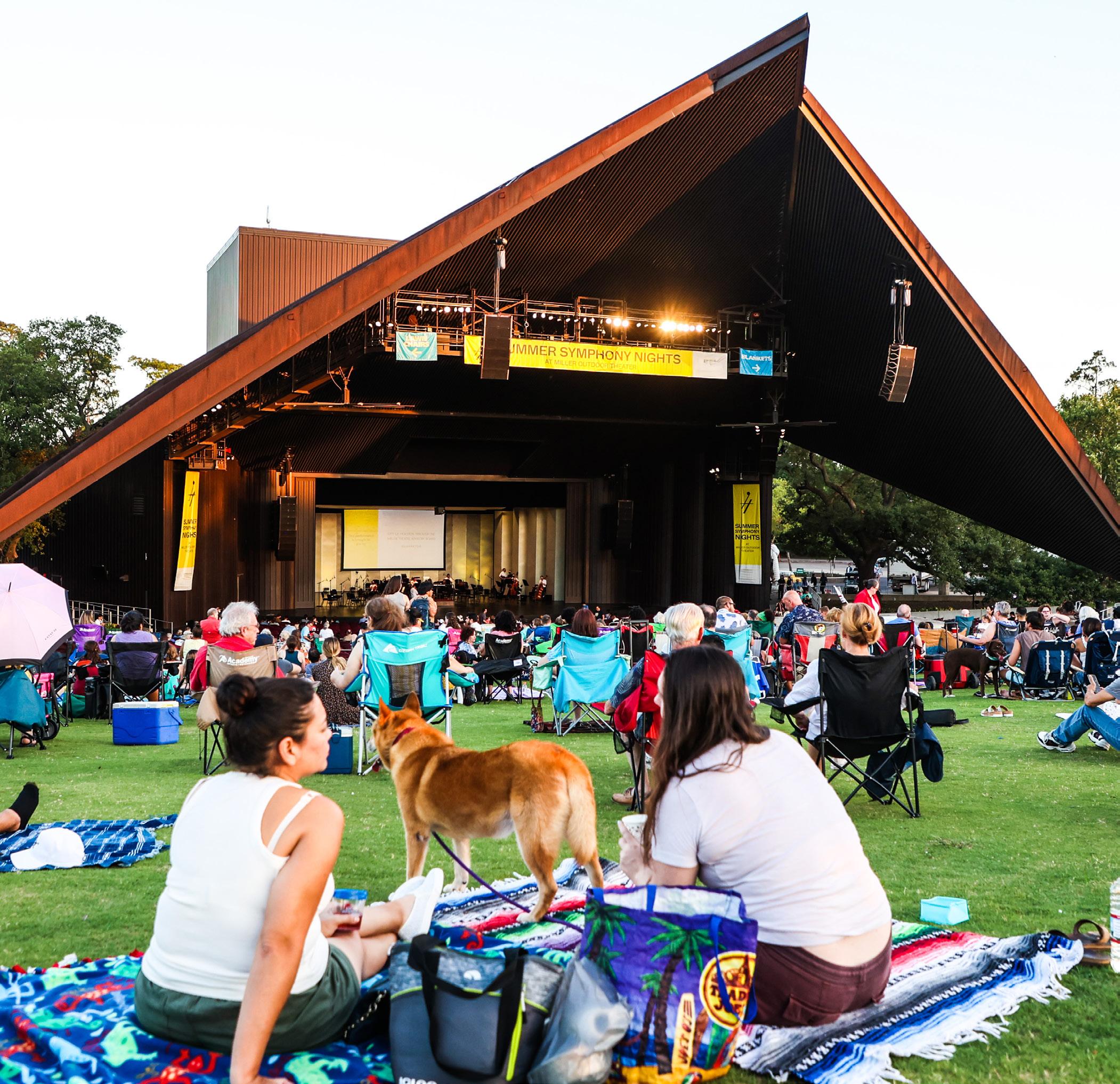
Mendelssohn & Márquez
The Houston Symphony Magazine

Juraj Val!uha
Music Director
Roy and Lillie Cullen Chair
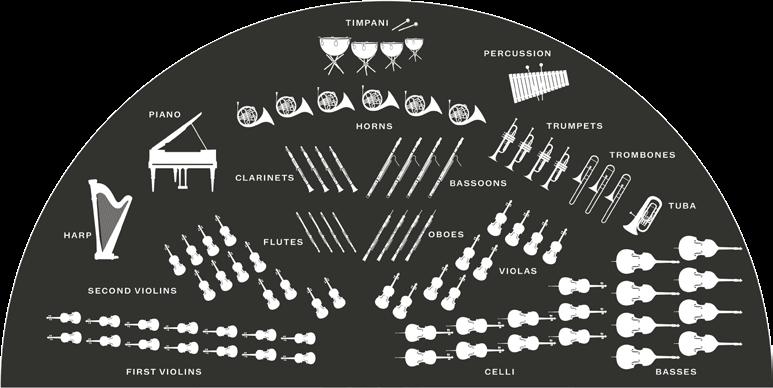
FIRST VIOLIN
Yoonshin Song, Concertmaster
Max Levine Chair
Vacant, Associate Concertmaster
Ellen E. Kelley Chair
Boson Mo, Assistant Concertmaster
Qi Ming, Assistant Concertmaster
Fondren Foundation Chair
Tong Yan
Ferenc Illenyi
Si-Yang Lao
Christopher Neal
Sergei Galperin
SECOND VIOLIN
Vacant, Principal
Vacant, Associate Principal
Amy Semes
Annie Kuan-Yu Chen
Mihaela Frusina
Jing Zheng
Anastasia Iglesias
Tina Zhang*
Yankı Karataş
Hannah Duncan
Alexandros Sakarellos
VIOLA
Joan DerHovsepian, Principal
Wei Jiang, Acting Associate Principal
Samuel Pedersen, Assistant Principal
Paul Aguilar
Sheldon Person
Fay Shapiro
Keoni Bolding
Jimmy Cunningham
CELLO
Brinton Averil Smith, Principal
Janice H. and Thomas D. Barrow Chair
Christopher French, Associate Principal
Jane and Robert Cizik Chair
Anthony Kitai
Louis-Marie Fardet
Je rey Butler
Maki Kubota
Xiao Wong
Charles Seo
Jeremy Kreutz
DOUBLE BASS
Robin Kesselman, Principal
Timothy Dilenschneider, Associate Principal
Andrew Pedersen, Assistant Principal
Eric Larson
Logan May
Burke Shaw
Donald Howey
Avery Weeks
COMMUNITY-EMBEDDED MUSICIAN
Lindsey Baggett, Violin
LIBRARIANS
Ali Verderber, Associate Librarian
Megan Fisher, Assistant Librarian
Steven Reineke, Principal POPS Conductor
Andrés Orozco-Estrada, Conductor Laureate
Gonzalo Farias, Associate Conductor
FLUTE
Kayla Burggraf, Principal
General Maurice Hirsch Chair
Matthew Roitstein, Associate Principal
Judy Dines
Kathryn Ladner
PICCOLO
Kathryn Ladner
OBOE
Jonathan Fischer, Principal
Lucy Binyon Stude Chair
Anne Leek, Associate Principal
Vacant
Adam Dinitz
Pablo Moreno+
ENGLISH HORN
Adam Dinitz
Barbara and Pat McCelvey Chair
CLARINET
Mark Nuccio, Principal
Bobbie Nau Chair
Vacant, Associate Principal
Christian Schubert
Alexander Potiomkin
Ben Freimuth+
E-FLAT CLARINET
Vacant
Ben Freimuth+
BASS CLARINET
Alexander Potiomkin
BASSOON
Rian Craypo, Principal
Isaac Schultz, Associate Principal
Elise Wagner
Adam Trussell
CONTRABASSOON
Adam Trussell
HORN
William VerMeulen, Principal
Mr. and Mrs. Alexander K. McLanahan Endowed Chair
Robert Johnson, Associate Principal
Nathan Cloeter, Assistant Principal/Utility
Ian Mayton
Barbara J. Burger Chair
Brian Mangrum
Spencer Bay+
STAGE PERSONNEL
Vacant, Stage Manager
José Rios, Assistant Stage Manager
Nicholas DiFonzo, Head Video Engineer
Justin Herriford, Head Audio Engineer
Connor Morrow, Head Stage Technician
Giancarlo Minotti, Audio Production Manager
TRUMPET
Mark Hughes, Principal
George P. and Cynthia Woods
Mitchell Chair
John Parker, Associate Principal
Robert Walp, Assistant Principal
Richard Harris
TROMBONE
Nick Plato , Principal
Bradley White, Associate Principal
Phillip Freeman
BASS TROMBONE
Phillip Freeman
TUBA
Dave Kirk, Principal
TIMPANI
Leonardo Soto, Principal
Matthew Strauss, Associate Principal
PERCUSSION
Brian Del Signore, Principal
Mark Gri th
Matthew Strauss
HARP
Allegra Lilly, Principal
KEYBOARD
Vacant, Principal
LIBRARIAN
Luke Bryson, Principal
*on leave + contracted substitute
LEADERSHIP GROUP
Gary Ginstling, Executive Director/CEO
Margaret Alkek Williams Chair
Elizabeth S. Condic, Chief Financial O cer
Vicky Dominguez, Chief Operating O cer
Rolanda Gregory, Chief Marketing O!cer
Jennifer Renner, Chief Development O!cer
Mayenne Minuit, Executive Assistant
DEVELOPMENT
Leanna Aldis, Manager, Foundation Relations
Sarah Bhalla, Board Relations Associate
Lauren Buchanan, Development Communications Manager
Alex Canales, Manager, Donor Services
Jessie De Arman, Development Associate, Gifts, Records, & Research
Timothy Dillow, Senior Director, Individual Giving
Amanda T. Dinitz, Director, Principal Gifts & Endowment
Kamra Kilmer, Manager, Corporate Relations
Karyn Mason, Institutional Giving O cer
Hadia Mawlawi, Endowment & Planned Giving O cer
Emilie Moellmer, Membership Manager
Gavin Reed, Major Gifts O cer
Tim Richey, Major Gifts O cer
Katie Salvatore, Director, Annual Giving & Membership
Phillip Smith, Special Events and League Liaison O cer
Lena Streetman, Director, Development Operations
Sarah Thompson, Donor Events Manager
Christina Trunzo, Director, Institutional Giving
EDUCATION | COMMUNITY ENGAGEMENT
Olivia Allred, Education Manager
Allison Conlan, Senior Director, Education & Community Engagement
Austin Hinkle, Education & Community Engagement Coordinator
Jazmine Olwalia, Community Engagement Manager
Community-Embedded Musicians (CEM):
Lindsey Baggett, Lead CEM
Lucinda Chiu, CEM Teaching Artist
David Connor, Senior CEM Teaching Artist
Bensen Kwan, CEM Education Specialist
Brittany Leavitt, CEM Teaching Artist
Bianca Lozano, CEM Teaching Artist
Adrian Ponce, CEM Teaching Artist
Lauren Ross, CEM Teaching Artist
Jaya Varma, CEM Teaching Artist
FINANCE | ADMINISTRATION | IT | HR
José Arriaga, Systems Engineer
Henry Cantu, Finance Accountant
Kimberly Cegielski, Sta Accountant
Heather Fails, Database Administrator
Ronin Jackson, IT Intern
Joel James, Director of Human Resources
Tanya Lovetro, Director of Budgeting & Financial Reporting
Freddie Piegsa, Help Desk Technician
Morgana Rickard, Controller
Gabriela Rivera, Senior Accountant
Pam Romo, O ce Manager/HR Coordinator
Lee Whatley, Senior Director, IT & Analytics
MARKETING | COMMUNICATIONS
Bryan Ayllon, UX & Conversion Specialist
Rachel Cheng, Marketing & External Relations Assistant
Bella Cutaia, Manager, Patron Services
Kathryn Judd, Director, Marketing
Priya Kurup, Senior Associate, Group Sales
Caroline Lawson, Patron Services Representative
Yoo-Ell Lee, Graphics & Media Designer
Milow Lozano, Ticketing Systems & Marketing Operations Specialist
Ciara Macaulay, Creative Director
Ashley Martinez, Patron Services Coordinator
Mariah Martinez, Email Marketing Coordinator
Casey Pearce, Graphic Design Manager
Aracely Quevedo, Patron Services Representative
Nadjalie Santos, Front of House Coordinator
Eric Skelly, Senior Director, Communications
Christian Sosa, Web Experience Director
Alexa Ustaszewski, Manager, Revenue and Audience Insights
Sophie Volpe, Digital Content Specialist
Leecia Whatley, Patron Services Representative
Jenny Zuniga, Director, Patron Services
Stephanie Alla, Associate Director of Artistic Planning
Becky Brown, Associate Director of Orchestra Personnel
Juan Pablo Brand, Artistic Assistant
Ryan Diefenderfer, Concert Operations Assistant
Megan Fisher, Assistant Librarian
Michael Gorman, Director of Orchestra Personnel
Julia Hall, Assistant Director, Houston Symphony Chorus
Parker Hart, Concert Operations Manager
Adrian Hernandez, Concert Media Production Manager
Giancarlo Minotti, Audio Production Manager
José Rios, Assistant Stage Manager
Brad Sayles, Senior Recording Engineer
Nathan Trinkl, Artistic Assistant & Assistant to the Music Director
Ali Verderber, Associate Librarian
Meredith Williams, Director of Concert Operations
Rebecca Zabinski, Senior Director of Artistic Planning
OFFICERS
Barbara McCelvey President
John Rydman** Board Chair Chair, Artistic & Orchestra
A airs
EXECUTIVE COMMITTEE
Brad W. Corson Chair, Governance & Leadership
Carey Kirkpatrick Chair, Marketing & Communications
Evan B. Glick Chair, Popular Programming
Sippi Khurana, M.D. Chair, Education & Community Engagement
Mary Lynn Marks Chair, Volunteers & Special Events
GOVERNING DIRECTORS
Gary Beauchamp
Eric Brueggeman
MK Campion
John Cassidy, M.D.
Khoa Dao
Lidiya Gold
Christopher Armstrong
David Balderston
David J. Beck
Carrie Brandsberg-Dahl
Nancy Shelton Bratic
Terry Ann Brown**
Ralph Burch
John T. Cater**
Robert Chanon
Heaven Chee
Michael H. Clark
Virginia Clark
Andrew Davis, Ph.D.
Denise Davis
Tracy Dieterich
Kelli Cohen Fein
Je rey B. Firestone
Eugene A. Fong
Aggie L. Foster
Janet F. Clark
Barbara J. Burger Immediate Past President
Mike S. Stude** Chair Emeritus
Paul Morico General Counsel
Jonathan Ayre Secretary Chair, Finance
Janet F. Clark^ Immediate Past Chair
Ed Schneider Chair, Development
Robert Orr Chair, Strategic Planning
Jesse B. Tutor** Chair, Audit
Jerre Williams President, Houston Symphony League
James H. Lee^ President, Houston Symphony Endowment
Juraj Val!uha^ Music Director Roy and Lillie Cullen Chair
Joan DerHovsepian^ Musician Representative
Mark Hughes^ Musician Representative
Jeremy Kreutz^ Musician Representative
Mark Nuccio^ Musician Representative
Gary Ginstling^ Executive Director/CEO
Margaret Alkek Williams Chair
David J. M. Key
David Krieger
Cindy Levit
Isabel Stude Lummis
Cora Sue Mach**
Rodney Margolis**
Kate Dearing Fowler
Aoife French
Carolyn Gaidos
Andrew Gould
Lori Harrington
Pablo Hernandez Schmidt-
Topho
Je Hiller
Grace Ho
Gary L. Hollingsworth
John W. Hutchinson
Brian James
Matthew Kades
I. Ray Kirk, M.D.
Matthew Loden
Kirby Lodholz
Michael Mann, M.D.
Nancy Martin
Jack Matzer
FOR JONES HALL REPRESENTATIVES
Brad W. Corson
Meredith Marshall
Leslie Nossaman
Chris Powers
Brittany Sakowitz
Ed Schneider
Justin Stenberg
Jackie Wolens Mazow
Diane K. Morales
Tim Ong
Edward Osterberg Jr.
Gloria G. Pryzant
Miwa Sakashita
Andrew Schwaitzberg
Helen Sha er**
Becky Shaw
Robert B. Sloan, D.D., Theol.
Jim R. Smith
Miles O. Smith**
Quentin Smith
Tad Smith
Anthony Speier
Tina Raham Stewart
Nanako Tingleaf
Terry Thomas
Margaret Waisman, M.D.
Barbara McCelvey
Steven P. Mach^ At-Large Member
Bobby Tudor^** At-Large Member
Gretchen Watkins^ At-Large Member
William J. Toomey II
Betty Tutor**
Robert Weiner
Margaret Alkek Williams**
Fredric A. Weber
Vicki West
Steven J. Williams
David J. Wuthrich
Ellen A. Yarrell
Robert Yekovich
EX-OFFICIO
Alejandro Gallardo
Reverend Ray Mackey, III
Frank F. Wilson IV
Fredric Weber
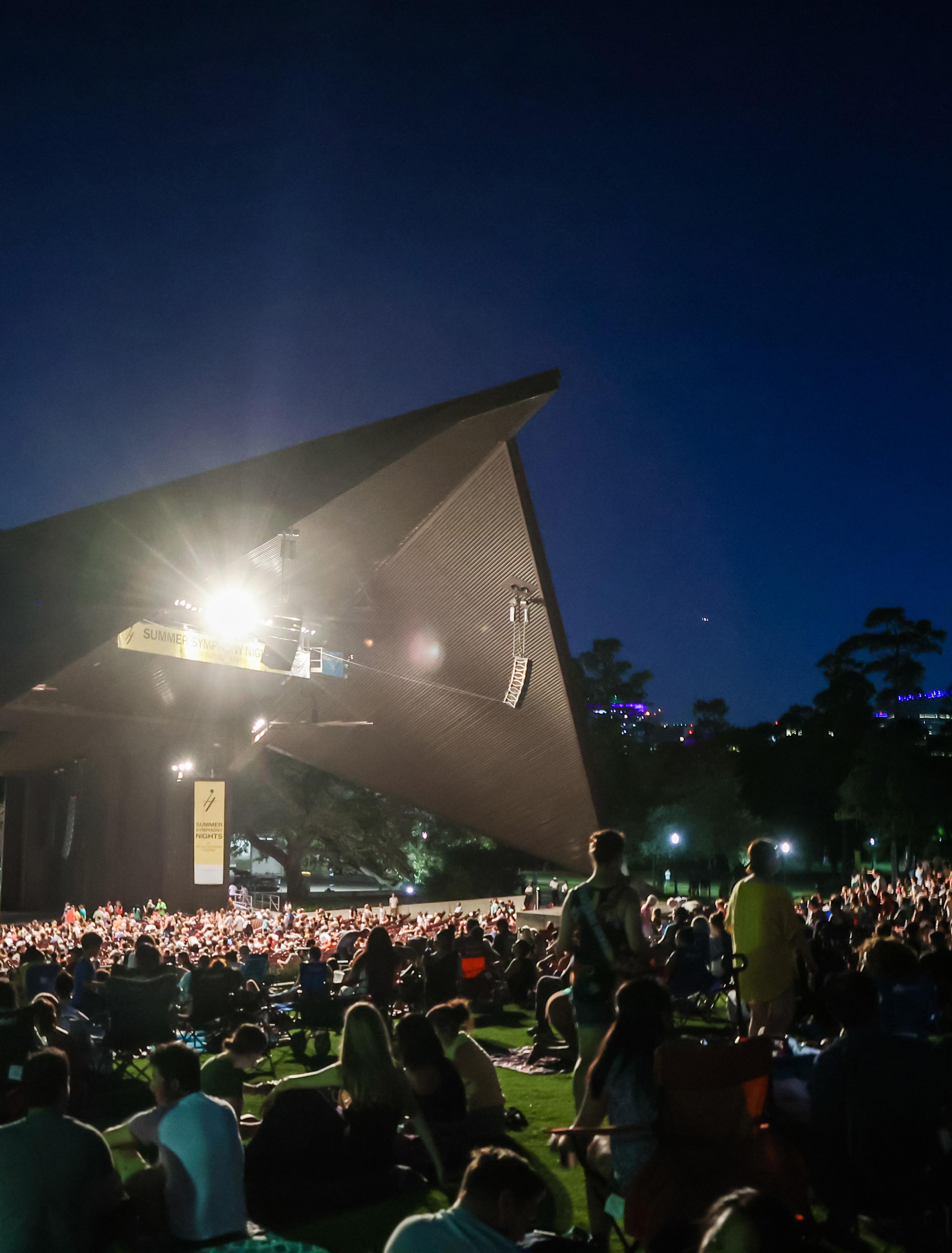
Friday, July 11
MENDELSSOHN
Symphony No. 4 in A major, Opus 90 (Italian) (1833)
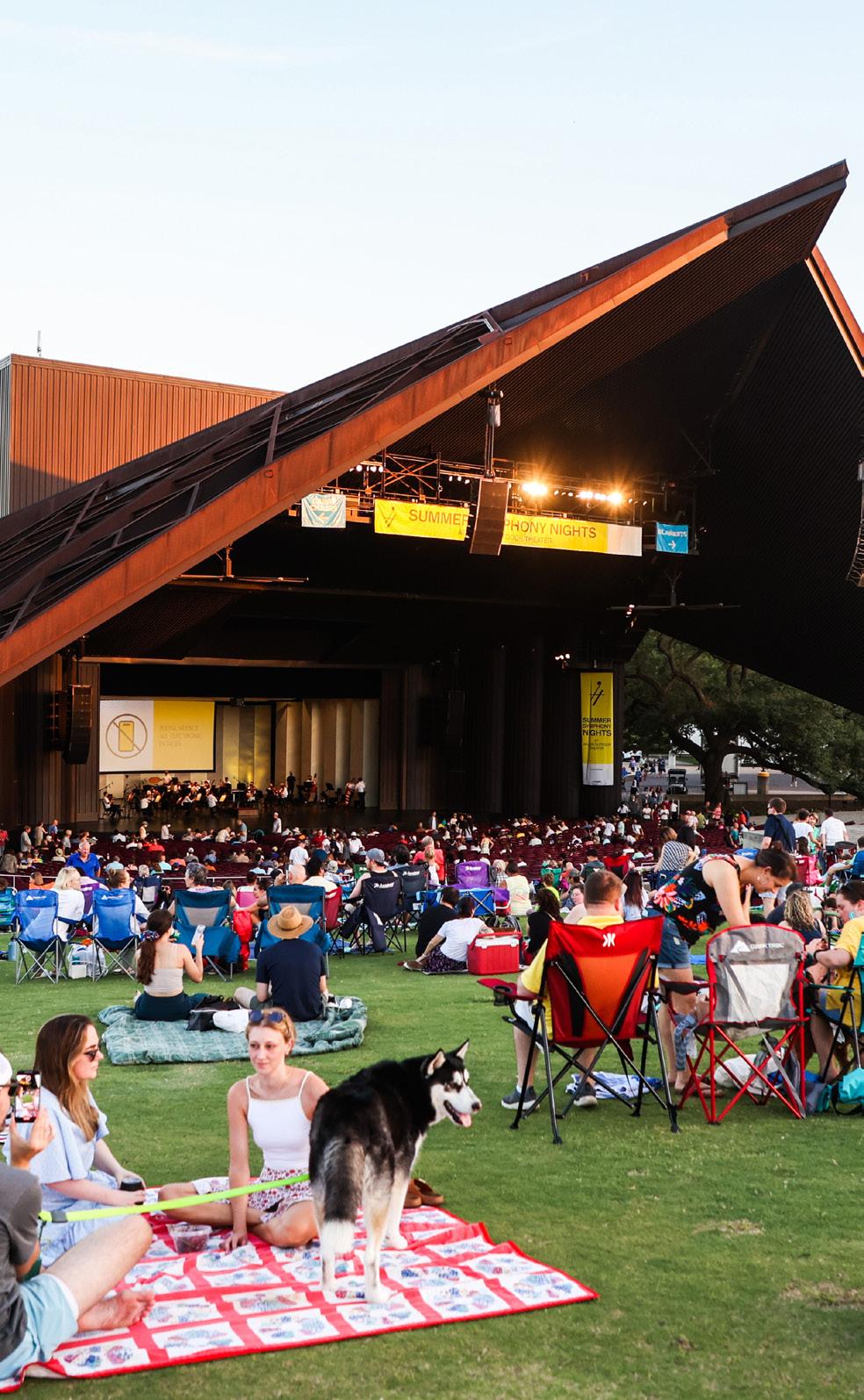
Miller Outdoor Theatre
8:30 p.m.
There is an old saying that artworks are never finished, only abandoned; some, however, are abandoned more quickly than others. Although the earliest sketches for Mendelssohn’s Italian Symphony do not survive, the composer likely began jotting them down during his sojourn through Italy from the autumn of 1830 through the spring of 1831. By February, he wrote home that “The Italian symphony is making great progress; it will be the lustiest piece I have yet composed”; by April, he hoped he would “be able to finish the Italian symphony while still in Italy.” However, work seems to have stalled until November 1832, when the London Philharmonic Society granted the 23-year-old composer his first international commission, requesting “a Symphony, an Overture, and a Vocal Piece.” The work was finished by April and premiered in London on May 13, 1833. By all accounts the new piece was a smashing success with everyone—except Mendelssohn. Often his own harshest critic, Mendelssohn remained dissatisfied with the symphony and revised the last three movements in 1834. He intended to revise the first as well, declaring “I shall have to change the whole theme, from the fourth measure on, and with it pretty much the entire first movement,” but was called away by other pressing matters. He never did revise the first movement and ultimately withdrew the work, much to the consternation of the many listeners who had hailed the original version as a masterpiece. Mendelssohn’s sister Fanny, herself a gifted composer, voiced
Presenting Sponsor

City of Houston through the Miller Theatre Advisory Board
Guarantor
The Houston Symphony’s Miller Outdoor Theatre concerts are endowed by The Brown Foundation, Inc. in memory of Stewart and Hanni Orton
The Houston Symphony’s sound shell ceiling is made possible through the generosity of the Beauchamp Foundation and the Fondren Foundation
MENDELSSOHN
Symphony No. 4 in A major, Opus 90 (Italian) (1833)
the critical consensus when she wrote to her brother: “In general, I think you are all too ready to change a successful piece later merely because one thing or another pleases you more then.”
Despite Mendelssohn’s misgivings, the London Philharmonic gave several additional performances of the original version during the composer’s lifetime and revived the work after his death, including at a memorial performance attended by Queen Victoria in June 1848. The 1833 version of the work has held its place in the repertoire ever since, while the 1834 revisions remained unpublished and unperformed until the late 20 th century. Although comparing the two versions o ers a fascinating glimpse into the mind of the composer, the familiar 1833 version remains the most often performed today.
In keeping with his belief that music should speak for itself, Mendelssohn never publicly referred to this symphony as “Italian,” and during his lifetime no critics ever identified the music as having a particularly Italian character. The work only acquired its nickname after an 1850 biography of Mendelssohn stated that the symphony was composed in Italy. To be fair, in private correspondence Mendelssohn did refer to the work as an “Italian Symphony,” and it contains many Italianate elements, including orchestration and melodic turns reminiscent of contemporary Italian opera.
The first movement opens with a joyful, leaping theme which leads to a lyrical song without words for clarinets. Midway through the movement, fragments of a minor-key march begin a thrilling contrapuntal development—a nod to Mendelssohn’s admiration for the music of Bach. This mysterious march theme only reveals itself in full at the end of the movement.
Audiences during Mendelssohn’s lifetime typically found the second movement the most striking. Dating from the 1850s, the traditional interpretation of this movement as a “pilgrims’ march” likely stems from conflating the movement with the “March of the pilgrims singing the evening prayer” from Berlioz’s Harold in Italy. The image seems to have stuck thanks to the opening melody’s ecclesiastical character and walking bassline, which suggest a religious procession.
The musicologist John Michael Cooper argues that the third movement, a graceful minuet, was inspired by “Lili’s Park,” a poem by Goethe; during his time in Italy, Mendelssohn wrote of the poem that he wanted “to make a scherzo of a symphony out of it.” The poem centers on the Circe-like fairy Lili, who tames wild animals through enchantment. The narrator is a bear who has reluctantly fallen for her charms. According to this interpretation, the beginning and ending of the movement depict the lovely Lili and her magical menagerie; the middle section, with its woodsy hunting horns, depicts the bear, who despairs at his inability to resist the fairy’s spell.
The finale has the clearest Italian connection, as Mendelssohn labeled it a saltarello, a lively Italian folk dance which became popular at the end of the 18th century. In a letter from his Italian trip, Mendelssohn relates that one evening “there was dancing [...] Louise Vernet [...] dances the saltarello with Horace [Horace Vernet, her father, a French painter and director of the French Academy in Rome]. When she had to stop for even just a moment and would take up the large tambourine and begin beating on it [...] I should have liked to be a painter. It would have made a splendid picture!” Perhaps
MENDELSSOHN
Symphony No. 4 in A major, Opus 90 (Italian) (1833)
FALLA
Three Dances from El Sombrero de tres picos (The Three-Cornered Hat) (1919)
the symphony’s finale is this picture. In an original touch, the movement is in A minor, making the symphony one of only a handful of works in the history of European music which begins in a major key and ends in a minor key.
—Calvin Dotsey
Manuel de Falla’s famed ballet score, El Sombrero de tres picos, originated as an old folk tale Pedro de Alarcón had adapted into a novel in 1874. Léonide Massine choreographed it for the Ballets Russes in 1919, also dancing the role of the Miller. The title is taken from the triangular hat worn by the old rural Magistrate (Corregidor in Spanish) who has a roving eye for the Miller’s Wife. While her husband is neither too bright nor too handsome, she loves him, and the pair succeeds in turning the tables on the old fool.
The climax of the action comes in the second part, after the Magistrate has the Miller jailed and sneaks o in a second attempt to woo his Wife. Alas, he falls into a stream, takes o his wet clothes, climbs into the Miller’s bed and falls asleep. He is quickly discovered by the Miller, who disguises himself in the Magistrate’s clothes and gets revenge by flirting with the Magistrate’s Wife.
The second part of the ballet contains the most familiar music, which Falla later adapted into the second—and most popular—of two orchestral suites. It opens with an ensemble piece, a series of seguidillas danced by the Neighbors, followed by a bold, strutting farruca for the Miller.
After having the Miller jailed (to the tune of the “fate” motive from Beethoven’s Fifth Symphony, which Falla impishly parodied), the Magistrate re-enters with a theme played by a solo bassoon and attempts to sway the Wife with a pompous minuet, just before falling into the water. After the bedroom episodes, the ballet ends with the exuberant jota.
—Carl R. Cunningham
GINASTERA
Danzas del Ballet Estancia, Opus 8a (1943)
Alberto Ginastera grew up in Buenos Aires, Argentina, as it was blossoming into one of the world’s most cosmopolitan cities. Yet the neighboring prairie—the pampa—cast a spell over him. “Whenever I have crossed the pampa or have lived in it for a time, my spirit felt itself inundated by changing impressions, now joyful, now melancholy … produced by its limitless immensity and by the transformation that the countryside undergoes in the course of a day,” he explained.
Those visions helped inspire his ballet Estancia. Depicting a day of toil and romance on a ranch—estancia in Spanish—the ballet celebrates the gaucho, the iconic ranch hand of the pampas. Folk-dance dynamism drives the music, and Ginastera enhances the homegrown flavor with narration drawn from a cornerstone of Argentine literature: José Hernández’s Martín Fierro, an epic depiction of the gaucho’s life.
The orchestral suite, which Ginastera assembled when World War II delayed the ballet’s premiere, features four colorful sections. Estancia begins at dawn, and “The Land Workers” describes the ranch bursting to life. “Scarcely had the horizon begun to take color, the birds to sing and the hens to cluck, when it was time to get moving, everyone o to work,” the narration says.
GINASTERA
Danzas del Ballet Estancia, Opus 8a (1943)
MÁRQUEZ
Danzón No. 2 (1994)
The music crackles with bold rhythms, staccato themes, and vivid colors; and Ginastera plays o the flashy opening against a light, chattering woodwind motif. Stillness reigns in “Wheat Dance,” which precedes “The Land Workers” in the ballet. A lilting flute melody sets the scene, with plucked strings suggesting the gentle strumming of a guitar; soaring violins take over, gleaming like dawn’s first light. Pounding drums and lusty French horns conjure up the vigor of “The Cattlemen.” And the “Final Dance” is the most riveting sequence of all.
It grows from the malambo, a folk dance traditionally performed by men to show o their agility. Sparkling woodwinds and buoyant rhythms animate the opening, and the excitement ratchets up when the full orchestra cuts loose with a bounding dance that could be the Latin American cousin of an Irish jig. Accented by French horn whoops and piccolo shrieks, the music drives headlong to its close.
—Steven Brown
Born in 1950 in Álamos, Mexico, Arturo Márquez studied composition with many renowned teachers in Mexico, Paris, and California. In the 1990s, Márquez began to compose works inspired by popular 20 th-century urban dance music, including his series of Danzónes. In 1993, Márquez was inspired to create a danzón that would be a brilliant showpiece for orchestra. The music alternates languid, nostalgic melodies for solo instruments with more fiery passages, building to an explosive finale.
—Calvin Dotsey
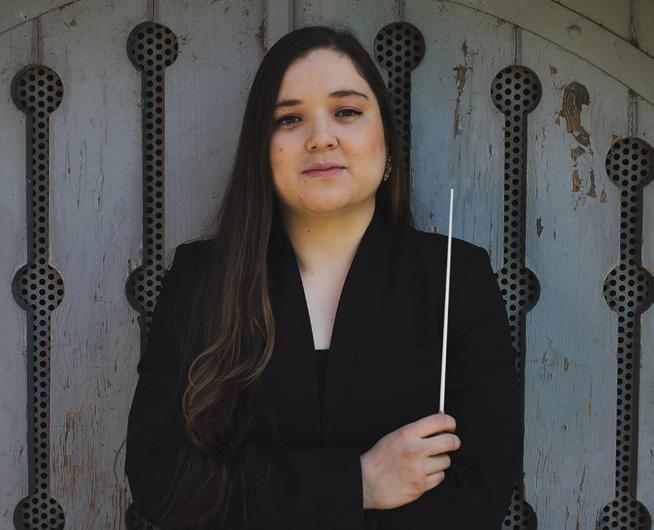
Praised for “strength and her tranquility of being” (Le Temps), Ana María Patiño-Osorio has been
gathering praise as a remarkable conductor, expressing wisdom, finesse, and deep respect for music.
Born in Medellín, Colombia, Ana is Music Director of the Orquesta Filarmónica de Medellín and serves as the 2025–26 Dudamel Conducting Fellow with Los Angeles Philharmonic. In April 2024, she captured international attention at the Malko Competition for Young Conductors in
Copenhagen, winning Second Prize, Audience Prize, and Youth Jury Prize. Symphony Orchestra. She also
The 2025–26 Season marks a series of prominent debuts in Europe and North America. Ana María will tour the Basque Country with the Euskadiko Orkestra (Basque National Orchestra) and debut with the Orquesta y Coro Nacionales de España, Orquesta Sinfónica y Coro de RTVE in Madrid, Orquesta Sinfónica de Galicia, Orchestre Philharmonique de Strasbourg, RundfunkSinfonieorchester Berlin, Arctic Philharmonic, Malmö Symphony Orchestra, Stavanger Symphony Orchestra, Los Angeles Philharmonic, and Dallas
returns to the National Symphony Orchestra of Uruguay (SODRE).
In recent seasons, Ana María collaborated with the Orchestre national Bordeaux-Aquitaine, Orchestra Sinfonica Nazionale della RAI, Danish National Symphony Orchestra, Orchestre de la Suisse Romande, Orchestre de Chambre de Lausanne, Geneva Camerata, the Orquesta Sinfónica Nacional de Colombia, and the Orquesta Filarmónica de Bogotá.
Committed to working with young musicians, since 2015 Ana María has also been involved with Iberacademy Orchestra in Medellín, where she has been assisting its co-founder and conductor Roberto González-
Monjas in a multitude of projects. She conducted the Iberacademy Orchestra at the Mozartwoche in Salzburg, led a highly successful European tour with Orquesta Juvenil Sinfonía por el Perú, and conducted the orchestra of The Royal Conservatory of Brussels.
Ana began her musical training as a saxophonist before transitioning to orchestral conducting. She completed her undergraduate degree in Orchestra Conducting at the Universidad EAFIT in Medellín before being accepted to the prestigious master’s program of Orchestral Conducting at the Zürcher Hochschule der Künste, where she graduated with honors in 2021. From 2022 to 2024, Ana Maríá was Assistant Conductor of OPENING NIGHT

September 19
Steven Reineke, conductor
Isabel Leonard, mezzo-soprano
Matthew McConaughey, narrator


the Orchestre de la Suisse Romande, the first person to hold this position.


PRESENTED BY SPEC’S/SPEC’S CHARITABLE FOUNDATION
AT MILLER OUTDOOR THEATRE
July 11 July 17
July 18
Mendelssohn & Márquez
Beethoven’s Symphony No. 4
Dvo& ák & Coleridge-Taylor
Presenting Sponsor