Sippi Khurana, M.D. Chair, Education & Community Engagement
Mary Lynn Marks Chair, Volunteers & Special Events
GOVERNING DIRECTORS
Gary Beauchamp
Eric Brueggeman
MK Campion
John Cassidy, M.D.
Khoa Dao
Lidiya Gold
TRUSTEES
Christopher Armstrong
David Balderston
David J. Beck
Carrie Brandsberg-Dahl
Nancy Shelton Bratic
Terry Ann Brown**
Ralph Burch
John T. Cater**
Robert Chanon
Heaven Chee
Michael H. Clark
Virginia Clark
Andrew Davis, Ph.D.
Denise Davis
Tracy Dieterich
Kelli Cohen Fein
Je rey B. Firestone
Eugene A. Fong
Aggie L. Foster
FOUNDATION
Janet F. Clark
Barbara J. Burger Immediate Past President
Mike S. Stude** Chair Emeritus
Paul Morico General Counsel
Jonathan Ayre Secretary Chair, Finance
Janet F. Clark^ Immediate Past Chair
Ed Schneider Chair, Development
Robert Orr Chair, Strategic Planning
Jesse B. Tutor** Chair, Audit
Jerre Williams President, Houston Symphony League
James H. Lee^ President, Houston Symphony Endowment
Juraj Val!uha^ Music Director Roy and Lillie Cullen Chair
Joan DerHovsepian^ Musician Representative
Mark Hughes^ Musician Representative
Jeremy Kreutz^ Musician Representative
Mark Nuccio^ Musician Representative
Gary Ginstling^ Executive Director/CEO
Margaret Alkek Williams Chair
David J. M. Key
David Krieger
Cindy Levit
Isabel Stude Lummis
Cora Sue Mach**
Rodney Margolis**
Kate Dearing Fowler
Aoife French
Carolyn Gaidos
Andrew Gould
Lori Harrington
Pablo Hernandez Schmidt-
Topho
Je Hiller
Grace Ho
Gary L. Hollingsworth
John W. Hutchinson
Brian James
Matthew Kades
I. Ray Kirk, M.D.
Matthew Loden
Kirby Lodholz
Michael Mann, M.D.
Nancy Martin
Jack Matzer
FOR JONES HALL REPRESENTATIVES
Brad W. Corson
Meredith Marshall
Leslie Nossaman
Chris Powers
Brittany Sakowitz
Ed Schneider
Justin Stenberg
Jackie Wolens Mazow
Diane K. Morales
Tim Ong
Edward Osterberg Jr.
Gloria G. Pryzant
Miwa Sakashita
Andrew Schwaitzberg
Helen Sha er**
Becky Shaw
Robert B. Sloan, D.D., Theol.
Jim R. Smith
Miles O. Smith**
Quentin Smith
Tad Smith
Anthony Speier
Tina Raham Stewart
Nanako Tingleaf
Terry Thomas
Margaret Waisman, M.D.
Barbara McCelvey
Steven P. Mach^ At-Large Member
Bobby Tudor^** At-Large Member
Gretchen Watkins^ At-Large Member
William J. Toomey II
Betty Tutor**
Robert Weiner
Margaret Alkek Williams**
Fredric A. Weber
Vicki West
Steven J. Williams
David J. Wuthrich
Ellen A. Yarrell
Robert Yekovich
EX-OFFICIO
Alejandro Gallardo
Reverend Ray Mackey, III
Frank F. Wilson IV
Fredric Weber
Friday, July 10
About the Music Program Notes
D. TABAKOVA
Orpheus’ Comet (2017)
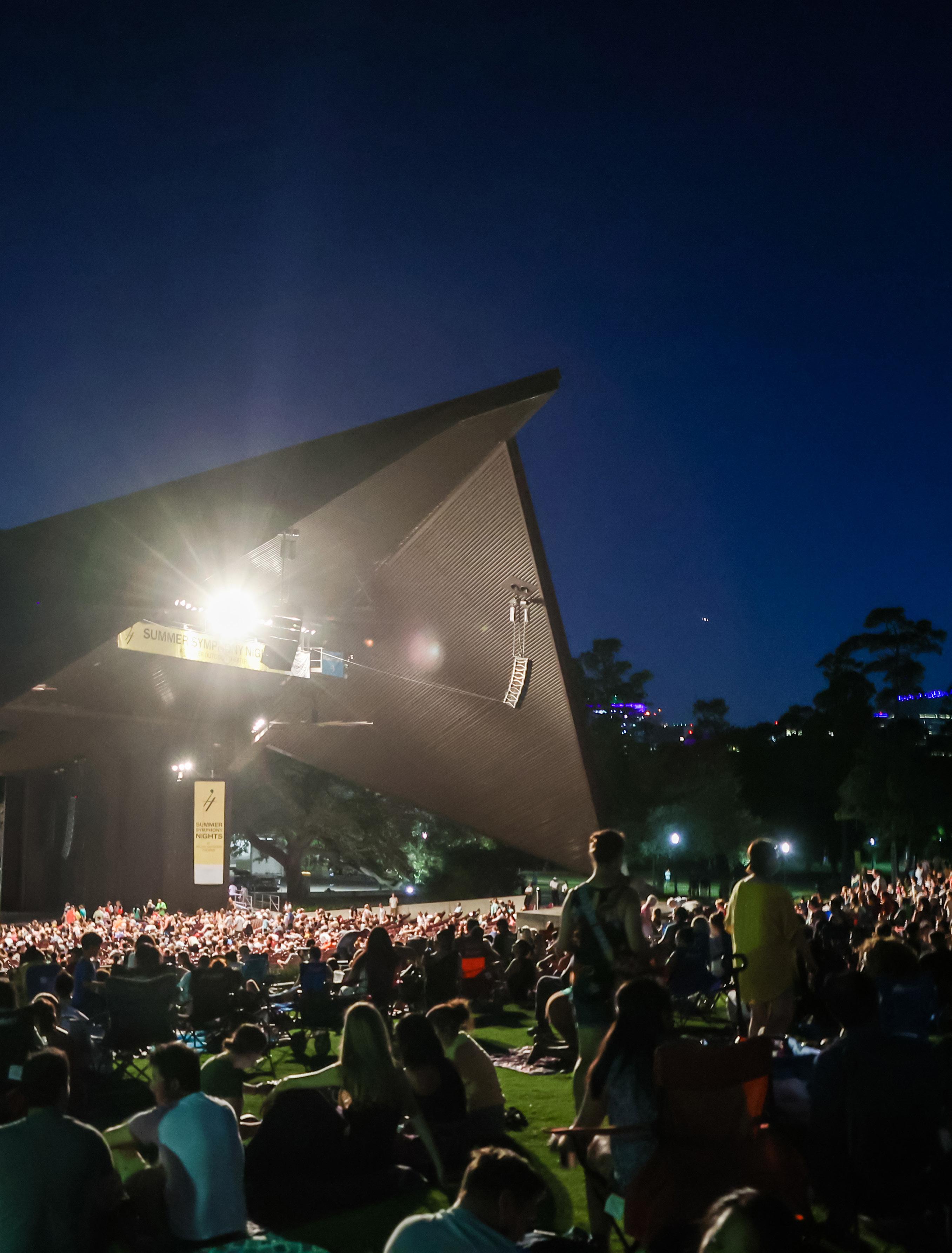
Miller Outdoor Theatre
8:30 p.m.
Dobrinka Tabakova was born in the ancient city of Plovdiv, the second largest metropolitan area in what was then the People’s Republic of Bulgaria. She came to music relatively late, only beginning piano lessons at age eight. Her parents, a medical physicist and an engineer, initially tried to dissuade her, encouraging her to pursue “a practical job where you can earn a pension afterwards” instead, but the young Tabakova insisted on music. Composing seems to have come naturally, as she took to improvising and embellishing parts of piano pieces she had not completely learned yet; fortunately, her teacher encouraged this interest. After the fall of Bulgaria’s communist regime in 1990, the family immigrated to the UK. Tabakova progressed rapidly there, enrolling in the Junior Department of the Royal Academy of Music at 13 and winning the Vienna International Music Competition’s prestigious Jean-Frédéric Perrenoud Prize in composition at 14. Since graduating from the Guildhall School of Music and Drama and earning a PhD in composition from King’s College London, Tabakova has emerged as one of the most exciting voices in classical music today.
Tabakova composed Orpheus’ Comet : Celebration for Orchestra in 2017 to fulfill a joint commission from the BBC and the European Broadcasting Union honoring the 50th anniversary of the Music
Sponsors
Presenting Sponsor
City of Houston through the Miller Theatre Advisory Board Guarantor
The Houston Symphony’s Miller Outdoor Theatre concerts are endowed by The Brown Foundation, Inc. in memory of Stewart and Hanni Orton
The Houston Symphony’s sound shell ceiling is made possible through the generosity of the Beauchamp Foundation and the Fondren Foundation
Program Notes
D. TABAKOVA
Orpheus’ Comet (2017)
Exchanges of Euroradio (Euroradio is the radio division of the European Broadcasting Union, an alliance of public media organizations somewhat similar to National Public Radio in the United States). Conductor Johannes Wildner led the BBC Concert Orchestra at LSO St. Luke’s (an historic London church converted into a concert hall) in the premiere performance on November 27, 2017.
Regarding the piece, Tabakova wrote, “This began as a work about bees, inspired by Virgil’s Georgics, but gradually the bees became cosmic particles and Orpheus’ Comet was born.” The Georgics is a Latin poem from circa 29 BCE which purports to be an instructional guide on farming, but also contains many poetic digressions. The work is divided into four books, the last of which discusses bee-keeping, although Virgil’s description of a beehive is easily read as a metaphor for Rome under the rule of Augustus (and human society more broadly). By way of explaining the process of bugonia (a misconceived ancient belief that bees spontaneously generate from the carcasses of sacrificed cattle), the book also contains an episode recounting the myth of Orpheus, the musician who sang his way through the underworld to reclaim the shade of his late wife, Eurydice, only to lose her once again by breaking the god Pluto’s command not to look at her until they returned to the world of the living.
The subject of Orpheus, as it turned out, had a connection to Euroradio. Tabakova explained, “The signature melody of Euroradio—the opening of Monteverdi’s opera L’Orfeo—becomes the culmination, which is reached through a series of nebula clusters. First the buzzing horns begin and are answered by the low strings, while accents spark throughout the rest of the orchestra. This dialogue continues, until a solemn chorale appears out of the busy texture. The chorale is taken up by the strings and grows to include the buzzing ideas, which are transformed to almost hypnotic rhythmic loops. A soaring melody in the flute and clarinet hovers above as momentum starts to build. Trombones underpin this build-up and prepare for a special finale.”
There can be little doubt that what makes the finale particularly special is the climactic quotation of the fanfare which opens Monteverdi’s 1607 opera L’Orfeo (“Orpheus”), a fanfare which typically introduces Euroradio broadcasts. Overall, the work yields the impression of order (melody) gradually emerging from chaos (whether buzzing bees or nebula clusters), leading to an uplifting, a rmative conclusion.
—Calvin Dotsey
Program Notes
ELGAR
Cello Concerto in E minor, Opus 85 (1919)
For Western Europe, World War I marked the end of an era. Initially embraced by millions as an opportunity for national heroism, the war’s brutality and unprecedented casualties soon disillusioned them. Elgar was no exception. Recognized as England’s greatest living composer, he was eager to do his part; at 57, Elgar volunteered as a constable shortly after the war began, much to the dismay of family and friends who strained to imagine him wielding a billy club. Fortunately, his service was brief and without incident; he found he could contribute more by writing patriotic compositions to rally his country’s spirits. At the same time, he was saddened to be separated from German musician friends and appalled by the war’s violence; an animal lover, he was especially moved by the many horses that perished in combat.
As the years passed, he retreated into a private world, composing music for a children’s play, a ballet, and intensely personal chamber music. When the war ended, he scarcely recognized the modern society emerging from its ashes, a society alienated from both him and the Romantic ideals of his music. Against this backdrop, he composed his final masterpiece, the Cello Concerto. The haunting main melody of the first movement came to him in March 1918, but Elgar truly set to work on the piece in the summer of the following year, ensconced in the idyllic Sussex countryside. The work that grew from this soil has been called Elgar’s war requiem; one can also hear it as an elegy for a lost era, the solo cello a lonely figure akin to Elgar himself.
The concerto begins with a soliloquy for the soloist; its broken chords form a motto that recurs throughout the work. We then hear the melody that first came to Elgar, bleak and unaccompanied in the violas. The soloist takes up this theme, leading to a searing variation for full orchestra. A lilting, bittersweet idea in the woodwinds introduces a contrasting middle section. After a reprise of the main melody, the first movement fades to a return of the opening motto, this time played as brittle pizzicatos.
The motto transitions to the second movement, a quicksilver scherzo punctuated by passionate declarations. The third movement is a slow, introspective meditation that ends unresolved; the ensuing finale begins with a brusque, march-like theme, the subject of numerous virtuoso developments for the soloist.
Approaching the end, the music slows. A passage of intense yearning leads to the return of the motto. After this moment of reflection, the march returns, speeding the concerto to its conclusion. The October 26, 1919, premiere in London proved disappointing; the hall was far from full. Soon after, Elgar’s beloved wife, Alice, died of cancer. Broken-hearted, Elgar never completed another major work. Championed by sympathetic soloists and conductors, the concerto would ultimately be recognized as one of the great works for cello and orchestra. Two Houston Symphony music directors proved pivotal in its history: Leopold Stokowski (music director, 1955–61) led the U.S. premiere in 1922, and Sir John Barbirolli (music director, 1961–67) led the legendary 1965 recording of the piece featuring cellist Jacqueline du Pré.
—Calvin Dotsey
Program Notes
DVOŘ ÁK – Symphony No. 9 in E minor, Opus 95 (From the New World ) (1893)
Greeted by the recently installed Statue of Liberty, Antonín Dvoř ák sailed in to the metropolis of gilded-age New York on September 27, 1892, ready to assume his duties as the new director of the National Conservatory of Music. O cially incorporated in 1891, the institution was remarkably progressive for its time, o ering need-based scholarships and welcoming women, minorities, and the disabled. It was the brainchild of visionary philanthropist Jeannette Thurber, who had successfully tempted the world-renowned Czech composer away from his beloved Bohemia. Thurber, however, was interested in more than the prestige Dvoř ák would bring to the school.
By the end of the 19 th century, the United States had become a formidable economic powerhouse, but many Americans now wished to compete with the centuries-old artistic traditions of Europe. Thurber hoped Dvoř ák would compose new classical works in a distinctly American style, providing guidance to the next generation of American composers. In many ways, Dvoř ák was ideally suited for this task. He had made his reputation by taking the genres at the center of the AustroGerman classical tradition—symphonies and string quartets—and making them Czech, helping to invent a new style influenced by Slavic folk music traditions. Though he was ardently attached to his homeland, Dvoř ák also had long been fascinated by the United States. He had devoured Longfellow’s The Song of Hiawatha, an epic poem inspired by the stories of the Ojibwa Indians, and he had deep sympathies for American democracy.
As soon as Dvoř ák arrived, he was barraged by music critics, colleagues, and other acquaintances who were eager to provide him with examples of American music that might inspire him. Perhaps the most important influence, however, came from a black student at the conservatory: Harry Burleigh. Burleigh became a frequent guest at Dvoř ák’s East 17th Street apartment, where he sang songs learned from his mother and grandfather, one of the few enslaved people who had been able to buy his own freedom before the Civil War. “[Dvoř ák] was in his shirtsleeves, with all his kids round him,” Burleigh later recalled. “I’d accompany myself at the piano. Dvoř ák especially liked ‘Nobody Knows the Trouble I’ve Seen’ and ‘Go Down Moses.’” Fired by the manifold sights and sounds he experienced in New York, Dvoř ák began composing a symphony in January 1893 and completed it by May.
The premiere with the New York Philharmonic at Carnegie Hall on December 16, 1893, proved one of the great successes of Dvoř ák’s career. The symphony itself is a sweeping drama, by turns full of conflict and longing. Dvoř ák was a master at creating highly evocative music that begs for narrative interpretation. Though he himself only hinted at possible sources of inspiration, many have tried to find hidden meanings and stories within Dvoř ák’s masterpiece.
Even if he did have something in mind, however, Dvoř ák himself realized it was best left unsaid. His recurring melodies are mysterious symbols that invite us to discover our own meanings within them. The 400th anniversary of Columbus Day, Longfellow’s The Song of Hiawatha, living memories of the Civil War, tales of the American West, and the
Program Bios
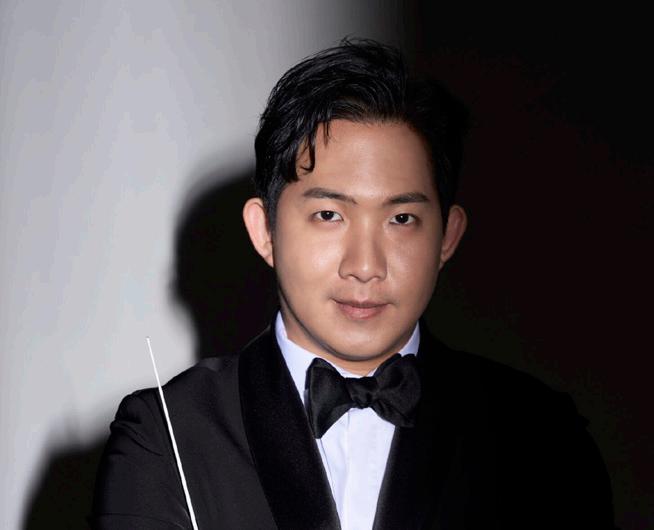
Samuel Lee, conductor
Samuel Lee is the winner of the Malko Competition for Young Conductors 2024. Previously, he was awarded first prize winner of the BMI International Conducting Competition in Bucharest and the International Conducting Competition in Taipei. At the end of the 2024–25 Season, he completed his tenure as Associate Conductor of the Cincinnati Symphony.
Lee’s 2025–26 Season included his conducting debuts with the Iceland Symphony, Tonkünstler Orchestra, Aarhus Symphony Orchestra, Copenhagen Philharmonic, Malmö Symphony Orchestra, Turku Philharmonic, Kansas City Symphony, Norwegian Radio Orchestra, Bodensee Philharmonic, and Teatro Carlo Felice di Genova, as well as returns to the Cincinnati Symphony, Stuttgarter Philharmoniker, and the Korean National Symphony Orchestra. He also made his first appearances with the Orquesta Cuidad de Granada and Arctic Philharmonic as soloist and conductor.
Amongst the orchestras Lee has conducted are Konzerthausorchester Berlin, Bamberger Symphoniker, Hamburger Camerata, Leipziger Symphonieorchester, Symphoniker Hamburg,
Nuremberg Symphony Orchestra, Frankfurt State Orchestra, Brandenburg Symphony Orchestra, Tokyo Philharmonic Orchestra, Bucharest Symphony Orchestra, Arad Philharmonic Orchestra, Seoul Philharmonic Orchestra, KBS Symphony Orchestra, and the SAC Festival Orchestra.
An avid promoter of contemporary music, Lee has conducted premieres by Bryce Dessner, Giuseppe Gallo-Balma, and Marc Migó. He was a conducting fellow with the Cabrillo Festival of Contemporary Music in 2021 and 2022.
Lee is an alumnus of Hochschule für Musik Hanns Eisler Berlin, where he studied viola with Tabea Zimmermann and later orchestral conducting with Christian Ehwald. Lee completed his studies in orchestral conducting at Hochschule für Musik und Theater Hamburg with Ulrich Windfuhr.
As a violist, Lee has performed as a soloist with orchestras such as the Baden-Baden Philharmonic, Münchener Kammerorchester, Bodensee Philharmonic, Seoul Philharmonic Orchestra, KBS Symphony, and Korean National Symphony orchestras, and at the Schleswig-Holstein Music Festival and Mecklenburg-Vorpommern Music Festival.
From 2009 until 2017, Lee was the violist of the Novus String Quartet, touring all over the world to venues such as the Berliner Philharmonie, New York’s Carnegie Hall, Vienna’s Musikverein, Kölner Philharmonie, and Tokyo’s Suntory Hall. He served as a viola professor at Hochschule für Musik und Theater Felix Mendelssohn-Bartholdy in Leipzig, Germany until 2022.
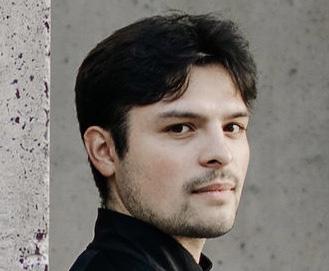
Andres Sanchez, cello
Cellist Andres Sanchez-Linares, born in Allentown, Penn., began his cello studies at the age of eight years old under the wing of former Puerto Rico Symphony cello principal Miguel Rojas. He continued his studies with cellist Jesús Morales, member of the Dali Quartet and former principal of the Puerto Rico Symphony. At 10 years old, Andres made his solo debut at the Midwest Clinic of Chicago and the Ocean City Pops Orchestra. Three years later, he made his Carnegie Hall debut as soloist with the ArCoNet Chamber Orchestra and at age 16 was accepted to the Curtis Institute of Music, where he studied with cellists Peter Wiley and Carter Brey. Following his graduation from the Curtis Institute of Music in 2020, he continued his studies at the New England Conservatory with Paul Katz.
In January 2026, Andres was named the First Prize Winner in the Senior Division of the National Sphinx Competition and, in 2025, was a Semifinalist in the Schoenfeld International Cello Competition.
Andres is an avid chamber musician, and his piano trio, the AYA Piano Trio, was awarded First Prize in the 2020 Yellow Springs
Program Bios
Competition, First Prize in the 2018 WDAV Competition, and has been a Semifinalist in the Naumburg Foundation and the Chesapeake Chamber Music competitions.
Andres has made solo appearances with the Indianapolis Chamber Orchestra, Longwood Symphony, Kenneth Square Symphony, the Central Jersey Symphony, the Summit Symphony, Pennsylvania Sinfonia, and the Gabrieli Ensemble. As a member of the AYA Trio, he made his Beethoven Triple Concerto debut with the Waterbury
Symphony and performed across the United States in esteemed chamber series such as Concerts International in Memphis, Tenn., the Schneider Concert series at the Mannes School of Music, the Brevard Music Center, Merkin Concert Hall, and Chamber Music Tulsa.