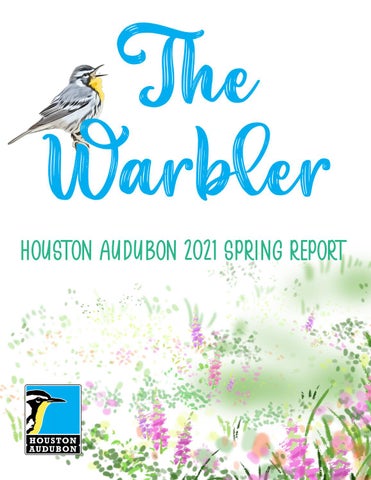
The Warbler
HOUSTON AUDUBON 2021 SPRING REPORT
SPRINGTIME IN THE TRENCHES By Helen E. Drummond, Executive Director, Houston Audubon Very little is as beautiful as spring—it is a highly anticipated season for many of us. Buds, shoots, and blooms—lush, colorful, and sweet—fill our yards, gardens, and natural areas. The sounds, shades and dances of migrating birds making heroic journeys to northern breeding grounds reward us with exciting glimpses of one of nature’s grandest miracles. These subjects of spring fuel many of Houston Audubon’s signature works and offerings—from avian photography and art to habitat restoration and citizen science. Spring at Houston Audubon is synonymous with birding, native plantings, and connecting with people and places in meaningful ways. Every season has its moments, and spring 2021 was full of memorable ones. This edition of the Warbler celebrates the vernal season by sharing a few first-hand accounts of this time in the trenches with Houston Audubon. I hope you enjoy the read and consider sharing your own springtime story or reader comments at www.houstonaudubon.org/springreport.
Baltimore Oriole | Cameron Kirkpatrick @TheTexasBirder IG
2
HIGH ISLAND THROUGH THE DECADES By Steve Astrich, High Island Visitor since 1989 I was introduced to birding and High Island in 1989, but my love of nature started when I was two years old. My dad used to take me saltwater fishing on Bolivar, stopping by my uncle’s bait shop in Seabrook on the way. As a kid, I was enthralled by the egrets and herons but was mostly into fishing. One late spring day in 1989, after we’d wrapped up day of fishing on Rollover Pass, we happened upon High Island. The large number of people on 5th Street caught our eye. Spotting the entry kiosk and boardwalk, we decided to take a walk. Two things made an impression during that first visit – a Redbreasted Nuthatch and a fence supporting hundreds of Indigo Buntings – one in every hole! That was the first of many visits – I have a High Island patch from every year since 1991.
Yellow-crowned NIght-Heron Greg Lavaty
1989 was the same year I had my “spark bird.” On my daily commute to work, I used to drive on Main Street past the Astrodome, and most days I would see a small, exotic-looking bird in a ditch. After a couple of months, I finally grabbed a bird guide and identified the Yellowcrowned Night-Heron. At that moment, a birder was born! A friend and fellow Boy Scout used to accompany me on my annual spring visits to High Island in my 20s. We were usually the first visitors there, stopping by in early March to clear the trails from about 1990 – 1995. We’d visit two or three times before peak bird migration, mainly to search for the early migrant YellowRed-breasted Nuthatch | Greg Lavaty
Yellow-throated Warbler | Greg Lavaty
throated Warbler. Continued on pages 4-5 3
Continued from Page 3
Through the years, I have seen the High Island sanctuaries change quite a bit. When I got to High Island in late April, I was very pleased with the improvements. The new canopy walkway is beautiful, and there’s no evidence of damage to the trails and habitat beneath. I used to walk the entire area that the canopy walkway now covers – back when you had to cross a 30-foot telephone pole to get to the rookery. This year, my most lasting impression was seeing people in motorized chairs able to utilize the ADA-accessible canopy walkway and the sheer amount of people that were using it with plenty of space to spare. I was lucky enough to have a top 5 birding day at High Island with my daughter this year. We arrived at Boy Scout Woods shortly before noon and began our usual route, which heads to Prothonotary Pond and loops around to the house right off the property. That’s when we started seeing orioles come in – two to three at first, and then they kept coming in large numbers from the beach. It only got better from there. The purple thistle in the field was swarming with hummingbirds. Then, Blue Grosbeaks and a few Painted Buntings started showing up in the weeds. We started walking toward the back boardwalk through a tunnel of honeysuckle, about 20-30 feet long. The fragrant honeysuckle blooms were loaded with so many hummingbirds I didn’t attempt to count them. 4
Golden-winged Warbler, Tennessee Warbler, Black-and-white Warbler | Steve Astrich
Our next stop, TOS Hooks Woods, was immediately rewarding— at the back of the fence towards the beach, unbelievable numbers of orioles and warblers started coming in. Besides a couple of other birders, it was just me and my daughter at the drip for a half hour of a fantastic spectacle. My most exciting bird was the Golden-winged Warbler, as it’s one of my favorites. We also saw Black-and-white, Tennessee, and Yellow Warblers, Orchard and Baltimore Orioles, Indigo Buntings, American Redstarts, parulas, and tanagers among other species. It was a once-in-a-lifetime event for me. We continued on to Smith Oaks, and the warblers on the canopy walkway were amazing. The numbers were overwhelming, and not having warbler neck in itself is quite a blessing. Other birders were equally mesmerized. We Yellow Warbler, American Redstart | Steve Astrich
were so far above the ground that we could easily observe the critters down below without disturbing them – snakes, turtles, alligators, and even birds working the water. The canopy walkway provided vantage points of
Yellow-billed Cuckoo Steve Astrich
several different habitats that you Northern Parula | Steve Astrich
normally wouldn’t see.
So often, people say to me that I’m lucky to see certain birds. I think it’s just that I’m watching more. Timing is also key. If you visit High Island at the right time, it’ll turn anybody into a birder! And non-birders should know that the sanctuaries are great places to walk and enjoy. Just don’t forget the mosquito spray! 5
GET INVOLVED! Become a Member for as little as $35/year
SAVE THE DATE FOR OUR SIGNATURE FALL EVENTS!
Volunteer with us
Adopt a Bird to support the care of our education animals
Donate to support bird conservation
Follow us on social media at @HoustonAudubon!
October 21 featuring keynote speaker,
Sneed B. Collard III,
author and naturalist
We’d love to know what you think about our Spring Report! Share your comments with us at www.houstonaudubon.org/springreport. 6
RONALD MCDONALD HOUSE GETS A POLLINATOR GARDEN By Berri Moffett, Natives Nursery Manager, Houston Audubon Houston Audubon partnered with Ronald McDonald House (RMDH) and US Fish and Wildlife Service (USFWS) to plant a pollinator garden for RMDH’s Holcombe House. A grant provided by USFWS allowed Houston Audubon to provide over 160 native plants from the Natives Nursery, guide the planting effort, and consult on upkeep and future plantings. On April 13, Natives Nursery Manager, Berri Moffett, and nursery volunteer Julie d’Ablaing joined RMDH staff and volunteers to install 130 gallon-sized native plants in Emily’s Garden. A diverse mix of several Rudbeckia species, goldenrods, milkweeds, coreopsis, and Corpus Christi fleabane as a “green mulch” groundcover were arranged by color to make a yellow “smile” shape to bring a smile to the families who utilize RMDH. The garden is centrally located to provide enjoyment from the picnic pavilion, playground, inside the building, and even from the street nearby. The staff and volunteers were enthusiastic and so excited for this garden. They all worked hard to get the plants in the ground in only a couple of hours. Thank you to Sandra Trevino with RMDH, Nancy Brown with USFWS, and Houston Audubon Natives Nursery volunteers Julie d’Ablaing, Karen Hoffman, and Mary Spolyar. This partnership will go a long way to nurture and support wildlife, birds, pollinators, and people. Houston Audubon also delivered a presentation to families staying at the Ronald McDonald House, bringing the “wild” to those who can’t get out to participate in programs. 7
Cattail Island, Smith Pond, Smith Oaks Bird Sanctuary | Anna Vallery
FIVE BIRD SPECIES MAKE USE OF NEW NESTING ISLAND By Dr. Richard Gibbons, Conservation Director The Texas colonial waterbird counts are
We watched and waited the first two
underway and Houston Audubon staff are
years as the willow and cattails filled in the
out conducting this important monitoring
bare island. It was the Tricolored Herons
work. A fantastic surprise in the coast-wide
that finally put nesting material to cattail
monitoring effort is the first-time use of
stalk to get the party started. Five species
Cattail Island in Smith Pond, an island built
nested on Cattail Island for the first time!
for just that purpose in Smith Oaks Bird
Roseate Spoonbill, Snowy Egret, Tricolored
Sanctuary. This now three-year-old island
Heron, Little Blue Heron, and Cattle Egret
was part of a nesting expansion project
are making themselves at home at this
completed with the National Fish and
primo nesting site. For those interested in
Wildlife Foundation and Ducks Unlimited to
seeing this new nesting site, it is the next
help recover species affected by the Gulf Oil
pond over from the existing rookery in
Spill. After construction, it was planted with
High Island and can be seen at the western
native vegetation. Nesting condominiums
end of the Kathrine G. McGovern Canopy
were built and installed to entice pioneering
Walkway in High Island, Texas.
herons, egrets, and spoonbills.
Nesting birds on Evia Island taken during a Texas Waterbird UAV Survey | Pete Deichmann
8
DARK SKIES SAVE LIVES
By Tony Dang, Collision Monitor Volunteer, Board Member The goal of the Lights Out Texas Collision Monitoring project is to collect data which will serve as a baseline to compare bird collision mortality rates across Texas cities and help us understand factors contributing to these collisions. Volunteers monitored pre-determined routes through Downtown Houston, Rice U/Med Center, and Galveston early every morning during peak collision between April 1 and May 31. Volunteers were responsible for identifying and collecting dead birds, recording data, and transporting injured birds to rehabilitation centers. I volunteered to monitor the downtown Houston route. Each morning, volunteers would meet at the first of 10 designated buildings and work our way through the route, which took approximately 1.5-2.5 hours to cover about 3 miles on foot. It’s a nice stroll through downtown and I started to learn which buildings are more prone to bird collisions. It intrigued me to see which bird species we found during the various stages of the migration season. Ovenbirds seemed to be the most frequently collected species and they occured throughout the spring migration period. I also had the joy of assisting a stunned Blackburnian Warbler that was sitting in the middle of a sidewalk after having collided with a building. We observed him for a couple of minutes and then transported him to the nearest rehabilitation clinic. He had enough energy to fly to a structure nearby and perched there for a couple of minutes. In that moment, I realized my purpose for participating in this project - this is a way to give these stunned birds a chance of survival.
Turn your lights out for birds during peak spring and fall migration! Learn more at houstonaudubon.org/LightsOut 9
FROM THE BLOG...
HOUSTONAUDUBLOG.BLOGSPOT.COM
Red-cockaded Woodpecker | Greg Lavaty
Rookery at Smith Oaks Bird Sanctuary
Working for Woodpeckers, Sneed B. Collard III
‘Voices of a Flyway’ in High Island, TX, Dr. Jacob Job
On a balmy, pre-covid morning
Walking about a quarter mile east into the sanctuary,
in June 2019, I arrived at the
I reached the rookery in the middle of Claybottom
W.G. Jones State Forest at 5:45
Pond. I placed my microphones next to the pond,
a.m. There I was met by an
scrambled up a small hill, nestled myself under a
enthusiastic biologist named
tunnel of trees, and pressed ‘Record’. Over the
Donna Work. Why? So that she
next 45 minutes in the pre-dawn light, I listened to
could teach me about one of the
the sounds of hundreds of water birds reverberate
world’s most intriguing birds, the
across the pond, through the trees, and into my
Red-cockaded Woodpecker.
headphones. It was a moment I’ll never forget.
Welcome to Javier Salas, Houston Audubon’s New Environmental Educator!
Check out our Beak of the Week series on the blog! Ruby-throated Hummingbird
Chestnut-sided Warbler
10
Photos by Greg Lavaty
Rose-breasted Grosbeak
Cedar Waxwing
Magnolia Warbler
YPAC Members on a Mission: Supporting Houston’s Feathered Friends, Taylor Rhoades and Anna Vallery It doesn’t take much effort to find advice on how to support birds. In fact, a simple Google search produces hundreds of helpful resources in a matter of seconds. So, if the information is out there, then why are so few people taking action?
Congratulations to JD Carballo, our 2020 Laura Singleton Exceptional Volunteer!
Every Day is Earth Day for the Birds, Anna Vallery Yellow-throated Warbler | Steve Astrich
Although we think every day should be Earth Day, we’re excited for a chance to celebrate the planet that sustains the people and wildlife that call it home. There are many easy actions you can take to promote a healthier and happier Earth.
How to Start a Native Container Garden, Catherine Lee Clarke I knew that gardening requires constant attention and maintenance, so for my next project I wanted to create a landscape that was interesting, easy to manage, unlikely to be ruined by dogs or children, and of course bird-friendly. Enter: container gardens. 11
FOR THE PLOVE OF BIRDS! THE NATURE PLOVERS’ BIG DAY By Stuart Nelson, Chair, Young Professionals Advisory Council (YPAC) Team Captain, The Nature Plovers (Birdathon Winners) Fuel tanks full… Binoculars polished… Lunch boxes packed... A few winks of sleep... Wits... Well, wits mostly there. It takes a special bunch to dedicate themselves to an all-day Birdathon! This year I was delighted to join Cin-Ty Lee, Diana Strassmann, Tim Perkins, Chris Hammond, and Chris Bick on what turned out to be a big day for the books. We totaled 253 species seen and raised $17,265 from over 70 unique donors, bringing home both the Oberholser and Whittington Awards. After several weeks of preparation and fundraising, at 1:17am on April 24, the Nature Plovers snagged the first bird of the day – a Dickcissel calling overhead as half of the team left a motel room in Uvalde, TX. Birdathon rules during COVID allow for “dispersed flocks,” so this year we split up – part of the team beginning at Sabine Woods and working west, and part of the team beginning in Uvalde County and working east.
The Nature Plovers Birdathon Team
12
The Uvalde party spent the wee hours of the morning trying to rack up as many nocturnal species as possible, entering daybreak with over 25 species including Elf Owl, Lesser Nighthawk, and Common Poorwill – each of which helped to justify the trek out to central Texas, which with a four-hour drive back home was admittedly a gamble. Alas, even the drive proved fruitful, with nice roadside species like White-tailed and Cooper’s Hawks making appearances.
Yellow-headed Blackbird | Greg Lavaty
Fortunately, the Upper Texas Coast party also found success, experiencing fallout conditions all day in the coastal woods, ticking dozens of neotropical migrants, including fan favorites Golden-winged Warbler, Blue-winged Warbler, Swainson’s Warbler, and Canada Warbler! It was a real birding bonanza, providing reassurance that the team wouldn’t dip on too many expected but sometimes-hard-to-find species. Meeting up at Hook’s Woods in the late afternoon, the Nature Plovers were able to do some warblering as a united crew for about an hour, getting looks at streaks of color hopping from limb to limb – the Magic of High Island truly on display. Rounding out the day looking for shorebirds as the sun set, the sandpipers and plovers were plentiful. A Yellow-headed Blackbird even made an unexpected appearance on Bolivar Flats right at dusk, coming full circle with those the Uvalde party had witnessed 12 hours before, 400 miles away. Our last bird came at 11:37pm – an Eastern Screech-Owl whinnying as we emerged from our car back home. We were all pretty tuckered out upon our return to the city, but it was a fine day of birding, and even more so supporting an organization we all love. See you next year – you may want to start scouting now if you want to claim Birdathon glory in 2022! 13
RV WORKAMPING AT HIGH ISLAND By Jane Gumnick & Rodney Johnson, First RV Volunteers We are the first RV “workamping” volunteers at High Island, which means we bartered our work in exchange for an RV site, utility hookups, wifi, and a laundry and shower room. We arrived in December 2020 when High Island was on COVID-19 lockdown. During winter, we assisted with maintenance and improvement projects to help prepare the sanctuaries for peak bird migration in March and April, although how much human visitation we would have was still unknown. A new native plant nursery got started. From helping build a cinderblock wall to constructing shelves and tables for the COOP to making and installing trail markers, we kept busy as winter passed into spring. Monthly volunteer workdays proved the adage “many hands make light work” on several projects. The sense of legacy of those who have worked to conserve and expand habitat for the birds that they love is powerful here.
As spring arrived, migration began in earnest and the Rookery started to squawk with activity. Visitors came to see the magnificent new canopy walkway, eager to get outdoors, and we had health safety protocols in place. We found ourselves within a volunteer community that made things work despite the limitations of the pandemic, but also with the hope that vaccines were bringing. We were drawn into the High Island birding community that is so devoted to birds and generous with their knowledge. We enjoyed performing a variety of tasks and meeting dedicated volunteers, all while having the luxury of a front row seat at the rookery and the spring migration. When full time RVers, including avid birders, find out about these positions, they will flock to workamp at High Island.
14
A CONFLUENCE OF BIRDS AND ART By Zineera Seth, Marketing and Events Manager
Anthony Rathbun
This spring, artist Jane Kim and her team at Ink Dwell Studio created a larger than life mural of the migratory birds that rely on Houston. The 223-foot public art installation, Confluence, is located in downtown along the Bayou Greenway trail at the confluence of White Oak and Buffalo Bayous. Confluence showcases in exquisite detail Houston’s migratory birds and how these travelers appear differently in the spring and fall seasons. Confluence was commissioned by Houston Parks Board and hosted in collaboration with Buffalo Bayou Partnership. Houston Audubon was pleased to provide ornithological expertise and collaborate on programming and promotion. Houston Audubon is very excited about the addition of five new beautiful bird murals in the raptor aviaries, or “mews,” at the Raptor and Education Center in southeast William Trey Morris
William Trey Morris
Houston. The murals were created by Doug Hiser, the artist behind the 50x30 foot mural of 88 local bird species at the Hulsey Coastal Operations Center (COOP) in High Island. Thank you to the students and volunteers who helped paint
William Trey Morris
Doug Hiser
the murals. 15
Houston Audubon 440 Wilchester Blvd. Houston, TX 77079 (713) 932-1639 houstonaudubon.org
The Warbler
HOUSTON AUDUBON 2021 SPRING REPORT