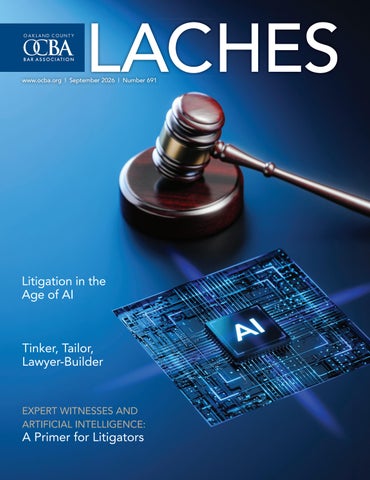
LACHES
www.ocba.org | September 2026 | Number 691
Litigation in the Age of AI
Tinker, Tailor, Lawyer-Builder
EXPERT WITNESSES AND ARTIFICIAL INTELLIGENCE:
A Primer for Litigators
LACHES
OAKLAND COUNTY BAR ASSOCIATION 1760 S. Telegraph Road, Suite 100 Bloomfield Hills, Michigan 48302-0181 (248) 334-3400 • FAX (248) 334-7757 www.ocba.org
2026-2027 BOARD OF DIRECTORS
CONTENTS SEPTEMBER 2026 FEATURES Litigation in the Age of AI Stop viewing AI as a shortcut. The lawyer who understands its true advantage gains a new type of leverage. By John Mohyi 8 Tinker, Tailor, Lawyer-Builder Why shop for AI when you can build it? Explore how lawyers who build are reshaping the legal tech market and why orchestration will be the defining skill of the next decade. By Andrew Mast, Roger Meyers, and Mahde Abdallah 12 Expert Witnesses and Artificial Intelligence: A Primer for Litigators AI is here to stay. The key is learning how to manage, document, disclose, defend, and even challenge its use. By Brad Sargent 17
PRESIDENT Aaron V. Burrell
SECRETARY Julie L. Kosovec
DIRECTORS Jennifer L. Lord Emily E. Long Moheeb H. Murray Kimberley Ann Ward Layne A. Sakwa Silvia A. Mansoor Stephen T. McKenney James A. Martone Jennifer J. Henderson Matthew P. Allen
EXECUTIVE DIRECTOR Jennifer Quick
ABA DELEGATE James W. Low
LACHES EDITORIAL BOARD Lanita L. Carter Syeda F. Davidson Victoria B. King Coryelle E. Christie
Thamara E. Sordo-Vieira Xavier Jay Donajkowski Vincent C. Sallan
PRESIDENT-ELECT Kari L. Melkonian VICE PRESIDENT Victoria B. King TREASURER Syeda F. Davidson
THE MISSION OF THE OAKLAND COUNTY BAR ASSOCIATION IS TO SERVE THE PROFESSIONAL NEEDS OF OUR MEMBERS, IMPROVE THE JUSTICE SYSTEM AND ENSURE THE DELIVERY OF QUALITY LEGAL SERVICES TO THE PUBLIC. Articles and letters that appear in LACHES do not necessarily reflect the official position of the Oakland County Bar Association, and their publication does not constitute an endorsement of views that may be expressed. Readers are invited to address their own comments and opinions to: LACHES | Oakland County Bar Association 1760 S. Telegraph Rd., Ste. 100 Bloomfield Hills, MI 48302-0181 Publication and editing are at the discretion of the editor. LACHES (ISSN 010765) is the monthly (except July and December) publication of the Oakland County Bar Association, a Michigan nonprofit corporation, 1760 S. Telegraph, Ste. 100, Bloomfield Hills, MI 48302-0181. Copyright © 2026 Oakland County Bar Association. The price of an annual subscription ($20) is included in member dues. Periodical postage paid at Bloomfield Hills, MI 48304 and additional entry offices. Postmaster: Send address changes in writing to Oakland County Bar Association, 1760 S. Telegraph, Ste. 100, Bloomfield Hills, MI 48302-0181.
28 June 3 was the perfect evening for a strolling reception on The Community House’s terrace following the 92nd Annual Meeting and Awards Ceremony.
DEPARTMENTS
President’s Page E.D.itorial OCBA Calendar of Events Professional Development and CLE OCBA at Work On the Circuit Jury Trials and Utilization Membership Foundation New OCBA Members OCBA Staff Directory Adjourned
2 4 6 7 20 22 23 24 26 27 27 28
PUBLISHING PARTNER
5750 New King Drive, Ste. 100 Troy, MI 48098 Phone: 248.691.1800 / Fax: 248.691.4531
LACHES is published exclusively for the Oakland County Bar Association by Hour Custom Publishing, a division of Hour Media, L.L.C. Copyright © 2026. All rights reserved. No portion may be copied or published without the express written consent of the publisher. The views expressed in this publication are not necessarily those of OCBA or Hour Media.
www.ocba.org
1
PRESIDENT’S PAGE
Bar Associations as Defenders of the Rule of Law By Aaron Burrell
T
hroughout history, bar associations have led the way in upholding the rule of law. Whether through public statements, advocacy, or direct action, bar associations have protected the core tenets of our justice system, including judicial independence, equal access to justice, equality, and separation of powers. The examples of bar associations defending the rule of law are numerous. In the early 1920s, the National Bar Association emerged as a powerful voice for African American lawyers, fighting segregation and discrimination.1 Many of its members made an indelible impact. For example, in 1919, NBA member R.D. Evans challenged racial exclusion in Texas primaries. Similarly, James A. Cobb, T. Gillis Nutter, and Ashbie Hawkins litigated landmark segregation cases in Louisville and Washington, D.C. Moreover, the NBA pioneered free legal clinics and pro bono work before the creation of federal legal aid programs. For that reason, the NBA is known as “America’s legal conscience.” Similarly, the New York Bar Association was among the first bar associations to publicly back major civil rights legislation.2 To that end, the New York Bar strongly supported the Civil Rights Act of 1964 and the Voting Rights Act of 1965. The New York Bar was also the first in the country to host Rev. Dr. Martin Luther King Jr. On April 21, 1965, Dr. King delivered an address entitled “The Civil Rights Struggle in the United States Today” to a large and enthusiastic audience of New York lawyers. In recent years, bar associations have played a lead role nationally. The most prominent example is the American Bar Association, which adopted a “Statement of Principles to Preserve, Protect, and Defend the Constitution, the Rule of Law, and American Democracy” in 2024. And 2025-2026 ABA president Michelle Behnke has declared that the ABA “will continue
2 LACHES MAGAZINE
to use its position to advocate for the legal profession and the judiciary” and “will fight for the rule of law both at home and around the world.”3 The OCBA follows this example. Our mission statement calls us to, among other things, “improve the justice system.” Our purpose statement notes that we are to “educate the public about the law, the role of lawyers and the administration of justice,” “promote a positive image for the profession and the justice system and respond, where appropriate, to unfair criticism,” and “promote access to quality legal services for all, regardless of the ability to pay.”
“Rule of law ensures that our legal system in the judicial branch of government operates with fairness, stability, and predictability, affording all individuals equal access to justice under established legal principles.” Consistent with our mission, in April 2025, the OCBA board adopted and “fully support[ed]” the State Bar of Michigan’s statement on unprecedented threats to the rule of law. That statement reinforced the state bar’s commitment to “promoting the administration of justice and upholding the rule of law — core principles that are essential to the proper functioning of our democracy comprised of three co-equal branches of government.”4 The statement noted that the “rule of law ensures that our legal system in the judicial branch of government operates with fairness, stability, and predictability, affording all individuals equal access to justice under established legal principles.” The statement also emphasizes that lawyers must be able to “advocate for clients, even when those clients and their causes may be
difficult or controversial.” In the OCBA’s statement of support, we invited “all the members of our legal community and those who depend on it — to unite with us in reaffirming the core principles that uphold our courts, our profession, and the communities we are dedicated to serving.” Although I have always been proud of the OCBA, adopting that statement marked a particularly profound and impactful moment. The circumstances that inspired us to take a stand in support of justice and the rule of law last year are still possible today. Bar associations have historically been prominent defenders of justice in the U.S. That legacy has allowed our country to make tremendous strides in civic engagement, civil rights, and access to justice. In 1787, Elizabeth Willing Powel asked Benjamin Franklin, “Well, doctor, what have we got, a republic or a monarchy?” Franklin purportedly replied, “[A] republic, if you can keep it.”5 I have tremendous hope that we can “keep it.” This is no time to retreat. As a bar association, we must continue to vigilantly monitor for any effort to infringe on the principles inherent in the rule of law and administration of justice. If we can do so, I have no doubt we will continue our long but determined journey toward a more perfect union. Aaron Burrell is the president of the Oakland County Bar Association. Footnotes: 1. HISTORY | National Bar Association 2. The Civil Rights Movement and the City Bar | New York City Bar Association 3. ‘Now is not the time to walk back the progress that we have made,’ ABA President Michelle A. Behnke says at Midyear Meeting | American Bar Association 4. OCBA Board of Directors Statement Upholding Rule of Law | Oakland County Bar Association 5. September 17, 1787: A Republic, If You Can Keep It | National Park Service
and Other Privacy Law Compliance
LEVEL THE PLAYING FIELD WITH INSURANCE COMPANIES.
Insurance Coverage Coverage Firm Firm Insurance
KUTINSKY.COM KUTINSKY.COM KUTINSKY.COM (248) 712-1049 (248) 712-1049 712-1049 (248)
HEALTHCARE HEALTH HEA RE LAW LA W FIRM FI
S E R V I N G
H E A LT H C A R E
F O R
O V E R
3 0
P R O V I D E R S
Y E A R S
Wachler chler & Assoc ciates represents nts hea healthcare providers, provide rs, suppliers, su liers, and an other er entities and a individua duals ls in Michi Mi higan and nationwi tionwide in all areas of he health alth law includin i ng, bu but not limited limite d to:
• Healthcare Corporate and Transactional Matters, including • Healthcare Corporate and Contracts, Corporate Formation, Transactional Matters, including Mergers, Sales/Acquisitions, and Contracts, Corporate Formation, Joint Ventures Mergers, Sales/Acquisitions, and • Joint Medicare, Medicaid, and Other Ventures Third-Party Payor Audits and • Medicare, Medicaid, and Other Claim Denials Third-Party Payor Audits and • Licensure, Staff Privilege, Claim Denials and Credentialing Matters • Licensure, Staff Privilege, • and Provider ContractsMatters Credentialing • and Reimbursement Issues • Billing Provider Contracts
• Statute (AKS), • Stark BillingLaw, andAnti-Kickback Reimbursement Issues and Fraud & Abuse Law Compliance • Stark Law, Anti-Kickback Statute (AKS), • Physician Physician Issues and Fraudand & Abuse LawGroup Compliance • Physician Regulatory Compliance • and Physician Group Issues
• of Medicine Issues • Corporate RegulatoryPractice Compliance • Participation/Termination • Provider Corporate Practice of Medicine Issues Matters • Provider Participation/Termination • Healthcare Litigation Matters • • Healthcare Healthcare Investigations Litigation • Civil and Criminal Healthcare Fraud • Healthcare Investigations
• and Medicaid Suspensions, • Medicare Civil and Criminal Healthcare Fraud Revocations, and Exclusions • Medicare and Medicaid Suspensions, • Revocations, HIPAA, HITECH, CFR Part 2, and42 Exclusions and Other Privacy Law Compliance • HIPAA, HITECH, 42 CFR Part 2, and Other Privacy Law Compliance
S E R V I N G
H E A LT H C A R E
P R O V I D E R S
F O R O V E R 3 0 Y E A R S S E R V I N G H E A LT H C A R E P R O V I D E R S F O R
WachlerAssoc_OCBA_HalfPgV_ND20.indd 1
O V E R
3 0
Y E A R S
11/11/20 3:11 PM
E.D.ITORIAL
The Value of Belonging By Jennifer Quick
O
n June 3, the Oakland County Bar Association held its 92nd annual Meeting and Awards Ceremony. The event recognized individuals who have made significant contributions to the association, the legal profession, and the community. It also honored members who have practiced law in Michigan for 40 years and those who have maintained OCBA membership for 50 consecutive years. It is a privilege to celebrate these individuals and reflect on their impact. They are a big part of why I love my job.
The day after this year’s event, I received an email from 40-year honoree Akiva Goldman. Although he addressed it to the OCBA’s officers, trustees, committee members, and volunteers, I felt it deserved to be shared with our entire membership. His words capture not only the spirit of volunteerism but also the importance of belonging to a professional community dedicated to advancing the legal profession. Following is Akiva’s email as I received it.
Akiva Goldman at the 92nd Annual Meeting and Awards Ceremony.
A Note, Not of Regret but of Gratitude To the Officers, Trustees, Committee Members, and Volunteers of the Oakland County Bar Association: Last evening, I had the privilege of attending the Oakland County Bar Association event honoring, among others, those of us who have been members of the bar for 40 years. In addition to recognizing this milestone, the event also honored individuals who had been specially selected for recognition based on their exceptional service and contributions to the association. As I reflected upon these honors, I found myself thinking back to the first Oakland County Bar function I ever attended four decades ago and to the many people I met there who dedicated their time and talents to the association. Throughout the evening, I was reminded of the extraordinary amount of work that goes into sustaining an organization such as the Oakland County Bar Association. We heard about trustees, committee members, officers, mentors, volunteers, and countless others who, in addition to maintaining busy legal practices, devote substantial time to serving the profession, mentoring younger attorneys, improving the administration of justice, and providing meaningful service to the public. Their efforts have strengthened both the bar and the legal community in ways that often go unseen. As I listened, I found myself wondering whether I should have done more over the course of my career to become actively involved in the association’s leadership and programming. Perhaps I could have chaired a committee, served on a board, participated more actively in its initiatives, or devoted additional time to mentoring and professional service. Yet upon reflection, I realized that the legal profession is strengthened by many different forms of service. Just as not every attorney is called upon to be a judge, a legislator, or a public official, not every attorney is positioned to devote substantial time to bar leadership. During much of my career, I was focused on building a practice, serving clients, raising a family, and being present for my children. The limited time that remained was often devoted to those responsibilities. Looking back, perhaps there might have been a better way to strike the balance. Life presents each of us with choices, and there are only so many hours in a day. While I may not have contributed to the bar in the same way as many of the remarkable individuals recognized last evening, I have tremendous admiration for those who did. I also came away with a renewed appreciation for the spouses and families of these volunteers. Behind every attorney who dedicates evenings, weekends, and countless hours to professional service is often a spouse or family member who willingly shares in that commitment. Their sacrifices and support deserve recognition as well, for they too have contributed to the growth and success of this association. So rather than dwelling on what I did or did not do, I simply wish to express my gratitude. Gratitude to those who chose to serve, to lead, to mentor, and to build institutions and strengthen their profession. Their efforts have enriched the Oakland County Bar Association, strengthened the legal community, and benefited every attorney who practices within it. Last evening’s program was a powerful reminder that while legal careers may take different paths, we all benefit from those willing to devote themselves to the service of others.
4 LACHES MAGAZINE
2026–2027 Thank you for honoring those who have reached this milestone and thank you even more for recognizing those whose volunteerism and commitment continue to sustain this important organization.
Elite Supporters PLATINUM $10,000+
Respectfully, Akiva Goldman Goldman & Associates
Below is my response to Akiva.
GOLD
$7,500–9,999.99
Thank you for taking the time to write such a thoughtful note. We were honored to recognize you at the event, and I am so glad you were able to join us for the celebration. I especially wanted to thank you for recognizing the tremendous contributions of our volunteers. The Oakland County Bar Association is fortunate to have so many dedicated members who generously give their time, energy, and expertise to strengthen our profession and legal community. Quite frankly, I could not do my job without them. That said, I wholeheartedly agree with your conclusion that you should not look back with any regret about not being more involved in the association’s volunteer leadership. As you noted so eloquently, every attorney’s career follows a different path, and the opportunity to volunteer at that level does not always align with a person’s professional and personal responsibilities. Building a practice, serving clients, and raising a family are meaningful commitments that deserve just as much respect. While we are always eager to welcome new volunteers, the truth is that you have contributed to the OCBA every day simply by being a member. Organizations like ours depend not only on volunteers but also on the collective support and engagement of our membership. Members who encourage colleagues to join and participate help sustain and grow the association, extending its impact far beyond what volunteers alone could accomplish. Your note was a wonderful reminder that there are many ways to support and advance the profession. Thank you again for your kind words, for your 33 years of OCBA membership, and for allowing us the opportunity to celebrate your important milestone with you.
Akiva’s letter also serves as an important reminder of what it means to belong to the OCBA. Membership is about far more than the programs you attend or the benefits you receive. It is about being part of something bigger than yourself. Your membership supports the work of volunteers who mentor the next generation of lawyers, improve the administration of justice, provide legal resources to the public, strengthen professionalism and civility, and create opportunities for attorneys to build successful practices and meaningful professional relationships. With annual dues ranging from just $75 to $265, membership is one of the most meaningful investments an attorney can
make — not only for their own career but also for the future of our profession and our community. As with charitable contributions, every member helps make this work possible. Whether you serve on a committee, attend an event, mentor a young lawyer, or simply renew your membership each year, you help ensure that the OCBA remains a strong, vibrant organization that benefits us all. Together, we are building a stronger legal profession for the next generation, and every OCBA member should be proud of that. Jennifer Quick is the executive director of the Oakland County Bar Association.
SILVER
$5,000 –,7,999.99
BRONZE
$2,500–4,999.99
The Sargent Consulting Group, LLC
“Elite Supporters” consist of distinguished firms whose sponsorship of 2026 OCBA events total $2,500 or more. There are four supporter levels. If you’d like more information on this program, contact Jennifer Quick at jquick@ocba.org.
Leading Law Professionals www.ocba.org
5
CALENDAR OF EVENTS Please Note: The dates listed below were sent to the publisher on July 1. It is possible that some of these events have since been altered. Please check ocba.org/events for the most up-to-date schedule.
SEPTEMBER
7 OFFICE CLOSED IN OBSERVANCE OF LABOR DAY SUSTAINING MEMBER RECEPTION OCBA Sustaining Members are cordially invited to this special event at Fleming’s in Birmingham to honor their dedication to the association. This reception is by invitation only and is free for Sustaining Members. To learn more about the Sustaining Member program, visit ocba.org/sustaining or contact Katie Tillinger at ktillinger@ocba.org.
30
24
51ST DISTRICT COURT JUDICIAL CANDIDATE FORUM Voting for a judge to rule on cases and issue judgments should be an informed decision. To help with that decision, the OCBA is partnering with the League of Women Voters of Oakland, the Oakland County Legal News, and the Oakland County Times to host judicial candidate forums for all judicial races in Oakland County with contested seats. Join us at 7 p.m. at Waterford Township Hall for the 51st District Court’s candidate forum. Find more information on the forum and candidates at ocba.org/51stforum.
OCTOBER TASTE OF DIVERSITY
15
Join colleagues within the OCBA and local affinity bars for the biennial Taste of Diversity cocktail reception — a celebration of the rich diversity and multiculturalism within our legal community. Enjoy an evening of festive camaraderie, delicious hors d’oeuvres, and meaningful recognition. The event will also feature the presentation of the Leon Hubbard Community Service Award and the Michael K. Lee Memorial Award, honoring individuals who have made outstanding contributions to advancing diversity in the legal profession. Don’t miss this inspiring and lively evening — register today at ocba.org/2026diversity.
29 6 LACHES MAGAZINE
PATHWAY TO THE JUDICIARY TOWN HALL The OCBA is proud to co-host a special program designed for attorneys who are interested in pursuing a judicial appointment or election. The program offers valuable insight into the path to the bench and the qualities and qualifications considered throughout the process. Hear firsthand from both appointed and elected judges as they share their experiences and discuss the realities of seeking a judgeship. To learn more and register, visit ocba.org/events.
PROFESSIONAL DEVELOPMENT & CONTINUING LEGAL EDUCATION Expand Your Knowledge with These Great Seminars!
SEPTEMBER
15 17 24 30
– 1 p.m.) s Stories (Noon stigators: Succes ve In d Public an rts l pe Oakland County Using Ex ed counse n, Deputy Chief, l defense appoint so m ina ra im cr Ab r P. fo r ay ina ds A sem ief, and Lin tte M. Loftin, Ch estigators can Presenters: Paule ter experts and inv at m t ec bj su ce of ffi e Defender’s O e strategic us r explores how th outcomes. This Zoom semina ce, and improve en id ev l ca iti cr sel r ve co un appointed coun strengthen cases, ining credit for tra al in im cr of p.m.) Worth 1 hour nts (Noon – 1:30 High-Stress Clie th wi ly ive ct fe es for Working Ef Practical Strategi inted counsel llaborative inal defense appo im cr r fo r rstand client ina m an Counseling Co se ig A ich M , SW ies to better unde LM , eg ey at sk str La n ed no rm an fo stress, mistrust, evidence-in Presenter: Sh ents experiencing ovides practical, cli pr ge ng ga ini en tra to s om ue This Zo ns. tion techniq ey-client interactio fective communica productive attorn to s behaviors and ef er rri ba r l he counse lation, or ot it for appointed emotional dysregu inal training cred im cr of s ur ho 5 Worth 1. – 1 p.m.) d d Dating (Noon mittee Wright PLLC; an Immigration Spee velopment Com De l Sukkar, Dickinson na K. sio e es nn of za Pr e Su th c.; m In A seminar fro , Questyme USA, b Boxwala, CEO m Presenters: Zaina Fir w rt, The Siewert La luding criminal, Abril Valdes Siewe practice areas, inc ed n lat so re d ith an Sm le law n Moderator: Nico tween immigratio l connections be inar. m se om Zo Explore the critica ely is tim ork oyment law, in th urt’s New Framew family, and empl igan Supreme Co ich M e th g in nd Understa city in Michigan: Diminished Capa ’s Office (Noon – 1 p.m.) inted counsel Public Defender city inal defense appo Oakland County , ief a diminished capa Ch ng A seminar for crim ty izi pu gn De co n, re so n m io ra cis tions Ab de ica t P. pl ur ay actical im preme Co Presenter: Linds blished and its pr cent Michigan Su ta re es a it s ds ine ar am nd ex sta al This program , including the leg ific-intent crimes defense for spec sel titioners. appointed coun for criminal prac ining credit for tra al in im cr of Worth 1 hour
OCTOBER
8 13 20
30 a.m. – 1 p.m.) Juvenile Law (11: of e at St e th Update on ed counsel l defense appoint ina im cr nual update r fo r ina A sem comprehensive an is Elliot Parnes PLLC th H. g , rin es du rn Pa t law lio ar. Presenter: H. El pments in juvenile from the past ye the latest develo s, and key case law ge an ch l le se ru Stay up to date on t un ur co n, co inted nificant legislatio g credit for appo that will cover sig d juvenile trainin an al in im cr of s Worth 1.5 hour (Noon – 1 p.m.) ent After Chatrie dm en Am th ur The Fo a PLLC Digital Dragnet: ed counsel yne Ashley Sakw l defense appoint yne A. Sakwa, La ina La im d cr d seizure law, r an an , fo r ch an ar ig ina se m ich A se Amendment n, ACLU of M th so ur vid Fo ence Da in F. ts a en ed developm its the use of geof Presenters: Sy the most current States, which lim d ine ite am Un ex v. ll wi rie r at ina Ch This sem cent decision in tion data. preme Court’s re ns for digital loca tio ec ot including the Su pr l na io ut tit ns sel co un s co ce d or r appointe warrants and reinf training credit fo al in im cr of ur Worth 1 ho 0 – 6:45 p.m.) ion Practice (5:3 ot M in s as Cl r cacy: A Maste mittee PLLC Persuasive Advo velopment Com rsby, Flood Law ’s e Professional De th and Maura Batte m , LC me of the region PL so ht in rig Jo W A seminar fro uick, Dickinson long before trial. Q se d D. ca l an a t nie ar of Da e ry : th to rs on Presente e the trajec program focused practice can shap A for an advanced CB O Effective motion e th at s or at actice. commercial litig d oral motion pr most respected cacy in written an vo ad ive as rsu strategy of pe
Learn more and register at ocba.org/events www.ocba.org
7
FEATURE | Litigation and AI
Litigation in the Age of AI By John Mohyi
A
I empowers the individual lawyer to become far more vertically integrated and shifts competitive advantage to lawyers who can run disciplined, digital-first case pipelines. As ESI volumes expand and processing power increases, litigation starts to look less like “document review” and more like intelligence work: collection, processing, analysis, and production. The lawyer becomes the strategist and verifier, steering an AI co-counsel that can rapidly synthesize records, test theories, build timelines, and accelerate motion practice. The downstream effects are material: deeper discovery (because it’s finally economical to mine the record), more aggressive dispositive motion practice, and lower resource barriers to trial.
8 LACHES MAGAZINE
Litigation and AI | FEATURE Litigation has always been intelligence work. Litigators interview sources, collect records, test narratives, identify gaps, pressure the other side for documents, map relationships, find contradictions, and convert raw information into a theory that can survive contact with a judge or jury. They typically describe that work in more familiar legal language: intake, discovery, research, motion practice, and trial preparation. Artificial intelligence does not change the core mission. It changes the operating model. The lawyer who understands that shift gains a new kind of leverage. The mistake is to think of AI as a brief-writing shortcut. That is the most primitive application. A chatbot can draft a motion, but a motion is not the true litigation advantage. Robert Greene’s The 48 Laws of Power provides the optimal use case. Law 29, titled “Plan All the Way to the End,” teaches the core principle that “[t]he ending is everything. Plan all the way to it, taking into account all the possible consequences, obstacles, and twists of fortune that might reverse your hard work and give the glory to others.” It follows that AI’s true power lies in its unprecedented ability to simulate multiple futures. It allows lawyers to think beyond the present moment to anticipate obstacles and chart the best course of action before firing a shot. That cannot happen in the analog world. One unlocks this advantage only by building a disciplined, digital-first pipeline that takes in information cleanly, processes it quickly, and analyzes it repeatedly as the case evolves. A fully digital ecosystem enables lawyers to swiftly transform raw data into critical insights and quality work product. When done correctly, the entire litigation process becomes turnkey. For some though, this new ecosystem requires a substantial sacrifice. A digital-first pipeline is, by nature, a paperless one. For many lawyers, giving up their paper goblin ways is a bridge too far, but it is a small price to pay for a digital multiplier. A lawyer with a clean digital workflow can accelerate the intake process, organize and search vast amounts of electronically stored information, identify factual weaknesses, generate focused discovery, build a record chronology, draft motions, and prepare deposition and trial materials at a level that previously required a much larger team. The old leverage model depended heavily on staff, associates, vendor budgets, and time. The new leverage model depends on process. The workflow starts by adding a digital layer to the very first client interaction. The initial meeting should not be treated as a casual intake but as the foundation of the entire case. In practical terms, that means beginning
with a recorded AI-transcribed interview and questioning the client with the discipline of a deposition. Lawyers should depose their own client before anyone else does. Every question generates context. Every answer gives the AI more factual terrain to map. Because AI systems are conversational by design, a thorough question-and-answer transcript gives the model a much richer foundation than a lawyer’s notes or a client’s self-written narrative. From there, run an internal pre-discovery process. Extract text messages, emails, and other relevant ESI in their native digital form before formal discovery begins. The AI can then use the client interview as a baseline and search the record for corroboration, contradictions, gaps, and timeline problems. That analysis drives targeted follow-up questions, clarifies inconsistencies, and tests whether the facts support the theory of the case. Only after completing that process should the lawyer move to claim analysis and, eventually, a polished complaint. Once the complaint is built on a disciplined factual foundation, the rest of the litigation process becomes less reactive and more operational. The pleadings are no longer stand-alone documents. They become the first structured layer of the case file. When the defendant’s answer, affirmative defenses, initial disclosures, and early productions arrive, they should be uploaded into the case’s working context for comparison against the client interview, ESI record, timeline, and claim analysis. The AI can then quickly identify the pressure points: meaningful admissions, evasive denials, unsupported defenses, missing witnesses, unexplained documents, and factual disputes that need to be pinned down. Discovery stops being a template exercise. Instead of serving broad boilerplate and hoping the useful evidence eventually appears, the lawyer can draft discovery aimed directly at the opposing narrative’s weaknesses. Each interrogatory, request for production, and request for admission becomes part of a deliberate intelligence-gathering plan. The goal is not simply to “do discovery.” The goal is to convert the pleadings and early disclosures into a map of what must be proven, what can be disproven, and where the case can be won. The next advantage comes when discovery responses and document productions arrive. This is where the document begins to speak for itself, literally. In the old workflow, the lawyer or staff member reviewed the production, flagged important documents, summarized what mattered, and hoped nothing critical was missed. In an AI workflow, the production becomes a searchable, conversational evidence base. The lawyer can ask the record what happened, who was involved, what changed over time, which
documents support a claim, which documents undermine it, and where the other side’s story breaks from the paper trail. That does not eliminate legal judgment. It concentrates it. Lawyers no longer spend the bulk of their time hunting for the needle. They test whether the needle matters, whether it can be authenticated, whether it fits the theory of the case, and whether it can turn into leverage. Following this process, AI changes discovery from document management into intelligence analysis. The practical output should not be a stack of AI summaries. Summaries are useful, but they are not the destination. The destination is a working case architecture: a chronology keyed to source documents, an issue map, a witness map, an element-by-element proof chart, a list of missing evidence, and a running inventory of admissions, contradictions, and impeachment material. With those resources, AI starts to compound. The lawyer can test each new document, discovery response, and deposition transcript against the existing structure. Does it confirm the timeline? Does it move a fact from disputed to admitted? Does it expose a witness problem? Does it reveal a missing document? Does it support a motion to compel, a targeted subpoena, or a dispositive motion? Done correctly, the case file transforms from a folder of documents into a living model of the dispute. The same structure changes deposition practice. A deposition outline should no longer rely on memory, a few highlighted documents, and a recycled template from the last similar case. By the time a witness sits down, the lawyer should already have a witness-specific file: every document tied to that witness, every communication involving that witness, every fact the witness can authenticate, every inconsistency between that witness and the written record, and every admission needed for summary judgment or trial. Though AI can help assemble that file quickly, the value lies not in a longer outline but a sharper one. The lawyer can move from broad background questions to targeted examination built around documents, elements, defenses, and impeachment points, resulting in a less exploratory, more deliberate deposition. Lawyers should not wander through the record hoping the witness says something useful. They should use the record to box the witness into the facts that matter. The same discipline carries directly into motion practice. The point of timelines, proof charts, and witness files is not to make the case file look organized but to shorten the distance between evidence and relief. After each deposition, the transcript can enter the working record to be tested against the pleadings, discovery responses, documents, and existing case theory. www.ocba.org
9
FEATURE | Litigation and AI AI can identify admissions, contradictions, evasions, authentication points, and testimony that supports or undermines each element of a claim or defense. That makes motion practice not just faster but, importantly, finer tuned. Specific evasions rather than general complaints can build a motion to compel. A clean chain of documents and admissions can help develop a summary judgment motion. A motion in limine can relate to the evidentiary problems that have been apparent since discovery. The lawyer must still decide what is worth filing, what may persuade the judge, and what risks overplaying the record. But the mechanical work of connecting facts, testimony, exhibits, and legal standards becomes far less expensive. AI changes the eco-
10 LACHES MAGAZINE
nomics of litigation, not by replacing advocacy but by making high-quality advocacy easier to assemble, test, and deploy. The approach extends through trial preparation. Trial should not begin when the dispositive motions are denied. It should begin when the first facts are collected. If lawyers build a case correctly, they will not scramble at the end to figure out what the evidence means. They already have a tested chronology, witness files, exhibit lists, proof charts, admissions, impeachment points, and a clear sense of which facts actually move the case. AI can help convert that structure into the materials needed for trial: direct examinations, cross-examinations, exhibit sequences, motions
in limine, jury instructions, verdict forms, demonstratives, and opening and closing themes. The key is that AI does not create those materials from scratch in the final weeks before trial. It generates them from a case file the lawyer has built, tested, and refined from the beginning. That changes the economics of trial preparation. A lawyer who has maintained a disciplined digital workflow can prepare for trial with a level of organization and speed that used to require a much larger team. The next frontier is not just faster drafting but better presentation. With the case built in a clean digital structure, the same record can be used to generate visual timelines, issue maps, witness relationship charts, exhibit sequences, demonstratives, and short explanatory videos. That matters because judges and juries do not experience a case as a document database. They experience it as a story unfolding through people, dates, decisions, and consequences. AI can help translate a dense record into formats that make the dispute easier to understand without sacrificing precision. A timeline can link each event to the exhibits that prove it. A demonstrative can be generated from the same proof chart used for summary judgment. A cross-examination outline can track directly to impeachment clips, text messages, emails, or deposition excerpts. The lawyer’s job is to make sure the presentation remains accurate, admissible, and anchored to the record. But the ability to move from raw evidence to polished visual advocacy will become one of the biggest practical advantages of a digital-first litigation workflow. If the courtroom remains analog, that advantage has a ceiling. Creating clean digital case files means little if the trial system forces those files back through binders, thumb drives, exhibit notebooks, and improvised courtroom technology. If litigation becomes digital from intake through trial preparation, the court infrastructure must match the format of the record. A digital-first litigation system should not require trial binders, witness binders, exhibit notebooks, thumb drives, or last-minute fights with courtroom equipment. Courts should have a secure exhibit cloud that accepts the forms evidence actually takes: PDFs, native files, emails, text-message extractions, images, audio, video, deposition clips, timelines, demonstratives, and other structured exhibit files. Exhibits should be uploaded, marked, objected to, ruled on, admitted, rejected, and tracked in one system, with the status visible to the court and counsel in real time. Litigators should integrate recorded depositions the same way, with designations, objections, rulings, edits, and approved clips handled before trial whenever possible.
The goal is a cleaner trial presentation, not a crude playback of disconnected files. AI transcripts do not need to be official to be useful. Courts are right to require human review before an AI-generated transcript becomes the official record. But when a judge rules from the bench and directs the parties to draft and stipulate to an order, a rough AI transcript can eliminate much of the guesswork. Combined with the motion papers, exhibits, docket entries, and hearing recording, it can quickly generate a detailed first draft of the post-hearing order: the ruling, the court’s reasoning, concessions made on the record, deadlines, and next steps. Counsel can then review, correct, and stipulate while the hearing is still fresh. The current restrictions on recording hearings make that harder than it needs to be, but permitting the court to control the recording in a secure cloud environment is a potential solution that protects the integrity of the record while still allowing the parties to turn the oral ruling into a clear, accurate written order instead of a generic “for the reasons stated on the record,” which forces everyone to reconstruct the ruling later. With the commoditization of execution, the strategist emerges with the central competitive advantage. Even with superintelligence at our fingertips, the human brain still has a unique ability to map problems, perceive angles, and recognize when the obvious path is not the best path. That advantage begins with asking better questions. In litigation, the question is often the highest form of intelligence. A good question is not merely a request for information; it is a compressed theory of relevance. To formulate one, the lawyer must understand the facts, the law, the burden of proof, the opponent’s likely response, the missing evidence, the weak link in the chain of logic, and the practical consequence of the answer. That is a computationally intensive task. The mind has to sort signal from noise, move between levels of abstraction, test
competing theories, and decide where to apply pressure. AI can process enormous amounts of information, but it can still become trapped inside the assumptions of the prompt or produce a polished answer to an incomplete question. The lawyer must probe the digital mind: What assumption is doing the most work? What fact would change the conclusion? Where does the chain of logic break? The best use of AI is not to accept its output but to cross-examine it until the conclusion withstands scrutiny. The machine can construct the chain of logic. The lawyer still has to know whether the chain holds. The point is not that AI will try cases for us. The point is that litigation is becoming a digital operating system, and the lawyers who adapt to that reality will have a decisive advantage. From the first client interview to the complaint, from discovery to depositions, from motion practice to trial presentation, every stage of the case can now feed the next. The work product compounds. The record gets cleaner. The questions sharpen. The chain of logic gets tested earlier and more often. That does not make judgment less important. It makes judgment the scarce resource. AI can process the record, surface patterns, draft documents, build timelines, and help convert oral rulings into usable orders, but the lawyer still decides what matters, what holds up, and where to apply pressure. Courts should modernize around that reality with paperless exhibits, digital trial workflows, usable AI transcripts, secure recordings, and infrastructure that treats evidence as digital from the start. But lawyers should not wait for the system to catch up. The practical advantage is available now. The future does not belong to the lawyer who uses AI as a shortcut. It belongs to the lawyer who builds a disciplined pipeline, asks better questions, verifies the output, and quickly turns raw information into a tested chain of logic that can carry the case. John Mohyi is a Michigan business attorney at Mohyi Law, PLC, whose practice spans litigation, contracts, business law, zoning, trademarks, copyrights, and emergingtechnology matters. He is a graduate of Michigan State College of Law with honors degrees in economics and psychology from Wayne State University. He brings a firstprinciples, data-driven approach to complex legal problems and the responsible use of AI in law. As an inventor, he holds a patent for an impeller-based propulsion system.
REAL THERAPY. REAL results. A more focused, in-depth approach to therapy for individuals seeking
substantive, lasting change.
LICENSED PSYCHOLOGIST AND ASSOCIATES Private Pay
Exceptional Care
In-person Birmingham, MI
DrLenaagree.com
Lena@DrLenaagree.com
Call/Text 248-219-2548
www.ocba.org
11
FEATURE | Lawyer-Builders
TINKER, TAILOR, LAWYER-BUILDER:
How We Stop Shopping for AI and Start Building It By Andrew Mast, Roger Meyers, and Mahde Abdallah I. THE WEEKEND PROTOTYPE
I
he Zoom calls all ended the same. We came away thinking, “Guess we’ll keep looking. Or maybe do it ourselves.” Throughout 2024 and 2025, we spent untold hours on calls with legal AI vendors. The vendors and our firm pitched each other. We explained our firm’s specific needs. Vendors described what they could offer. The off-the-shelf products — Harvey AI, Spellbook, and their peers, as well as dozens of e-discovery tools infused with AI — were often impressive. In a generic way. “Our AI tool can read and summarize your documents. It can also review contracts and point out potential pitfalls in the language.”
12 LACHES MAGAZINE
Lawyer-Builders | FEATURE Neat — except ChatGPT could probably do the same thing but cheaper and maybe better. True, those early tools boasted enterprise-grade security and confidentiality (a rarity in those days and necessary for legal work) and could answer a complaint or respond to a set of discovery requests often decently, if generically. However, our firm recognized that we needed it done our way. A large part of our work focused on discovery, serving large-volume clients’ specific and detailed requirements for their discovery responses. Over many years, our team had developed something no vendor could provide: a library of fine-tuned discovery requests and responses, with technical language, internal rules, and other conventions refined case by case and approved by the client. Generic would not do. Adopting AI would require tinkering and tailoring, likely to the tool itself and not just its outputs. This is the story of that shift — how the barrier to building collapsed twice, how lawyers who build are reshaping the legal tech market, and why the defining skill of the next decade is not coding (or even “vibe coding”) but orchestration: directing AI the way a partner directs an associate.
II. TWO BREAKTHROUGHS
Permit a crude historical analogy: The Berlin Wall’s collapse presaged the Cold War’s end. Likewise, AI’s breakthrough — the collapse of the barrier of entry to coding — presaged the end of the “learn to code” era, during which coding was briefly the quintessential future-proof skill. With that barrier down, “knowledge jobs” will change forever, including both law and the software industry as we know it. The barrier between software design and ordinary people fell in two stages: vibe coding (2025) and agentic harnesses (2026). A. Vibe Coding In 2024 and 2025, we ran a two-track plan to achieve better custom AI workflows in our practice. Track one: Keep talking to vendors. Track two: Try creating a workflow ourselves. One weekend in March 2025, track two started to win. Using an AI coding assistant, we built a working prototype that read an incoming discovery request, searched a library of our past responses for the closest precedents, and drafted an answer in the client’s established style: standard objections, approved language, correct(ish) format. For confidentiality, the AI model at its core ran locally on a firm laptop rather than in the cloud. We never wrote a line of code. Rather, we described what
we wanted in plain English, and the AI coded the tool. How well did this early-2025 discovery response tool work? Poorly. It took 10 minutes to reply to a single discovery request, resulting in a half-good response and objection at best. But we knew it could improve, and slowly, it did. The vibes were good, even if the product was not — yet. At the time, “vibe coding” was a brandnew term, coined by AI researcher Andrej Karpathy in an X post on February 2, 2025. By year’s end, it was the Collins English Dictionary’s Word of the Year.1 A few lawyers took to vibe coding quickly — at global firms, in communities like vibecode.law, and even in law school. Case Western now requires its 1Ls to vibe-code working prototypes.2 Lawyers elsewhere developed small, concrete applications of their own: a tool to organize and rename discovery exhibits, a clause-checker for draft contracts, a court-deadline calculator, and so on. The motto of the first breakthrough: The AI does the coding, but you — or a fixed set of logic rules — still do the thinking. These early vibe-coded tools could prove useful, but for most nontechnical professionals, they were not yet practical. You still had to play developer — install, debug, maintain — and a weekend prototype could take months to become a tool colleagues would trust. Most lawyers, reasonably, didn’t bother. B. Agentic Workflows The first breakthrough came in 2025. In 2026, the game fundamentally changed again, as agentic tools made custom AI workflows drastically more accessible. One indicator of that change: On May 28, Bloomberg Law reported that Kirkland & Ellis would commit $500 million over the next three to four years — the largest technology investment a law firm has ever made — to build a proprietary AI platform for its more than 4,000 lawyers.3 What matters for the rest of us, whether we budget $500 or $500 million toward AI, is that the tools inspiring that investment are the same general-purpose platforms available to any practitioner with a modest AI subscription and a free weekend. The difference isn’t access to highly expensive, custom tech. It’s the ambition to tinker with AI workflows to make them your own. The second breakthrough eliminated the need to play developer at all. Beginning in 2026, user-friendly “harnesses” arrived. These apps wrangle the underlying models toward real work through configurable skills, plugins, and workflows, not just question and
answer. Anthropic’s Claude Cowork reached general availability on April 9; OpenAI expanded Codex into a general-purpose workspace a week later.4 The models underneath became more agentic, too. Pointed at real documents and real systems, they could now do the work itself rather than merely generate code for novel, one-trick apps. If 2025 centered on vibe coding, 2026 has centered on what one might call “workflow vibing.” The markets noticed first: Anthropic’s release of free, open-source legal workflow plug-ins erased roughly $285 billion in market value from software and legal-information stocks within days in a rout that began on February 3, dubbed the “SaaSpocalypse.”5 Building with AI after the second breakthrough looks even less like coding and more like training an assistant. A lawyer prompts the AI tool to write a “skill” — a text file containing instructions — in natural language, teaching the AI to perform a task the way that lawyer would. The lawyer connects plug-ins that bundle domain expertise, connectors that reach firm systems, and scheduled automations. The path is humbler than it appears. You do the work once with AI conversationally, correcting it as you go. When the result finally looks right, you tell the tool, “Make this into a skill so we can do it this way every time.” In practice, skills accumulate as precedents do, building on each other. One skill knows all of the client’s billing requirements. Another converts voice memos into formatted billing entries. A different skill creates, monitors, and modifies budgets based on the previous two. Still others map statutory research across all 50 states or assemble litigation holds tailored to specific clients. The only “coding” is natural language instruction or conversation with the AI. The architecture is workflow design. All of this is portable: The skills themselves are just text files, and a common agent skills specification now spans the major platforms. If you change your agentic AI provider (Anthropic to OpenAI, for instance), porting a skill to the new platform is usually as simple as telling one platform to adapt it for another.6 The models themselves are increasingly interchangeable commodities, so there is little vendor lock-in.7 This is one reason the SaaSpocalypse hit specialized legal software — with considerable vendor lock-in — so hard. Our discovery tool from 2025 tells the story in miniature. In early 2026, we scrapped the 2025 prototype and rebuilt it from scratch: a frontier cloud model in place of the limited local one, a real database of thousands of historical responses in place of the original few dozen documents, and a full web application www.ocba.org
13
FEATURE | Lawyer-Builders
with audit logging, confidence scoring, and a source annotation on every generated line. The AI wrote the code, fixed the bugs, ran the tests — even drove a web browser through the finished interface to verify each feature — then generated the user manual. The expensive part of software development, the rewrite, had become cheap.8 Set those weekend experiments beside Kirkland’s $500 million investment. Some 250 Kirkland lawyers helped design the firm’s platform; the other 4,000 will receive it as “customers.” In contrast, the agent-platform approach is bottom-up. Solo or small-firm lawyers design the workflow themselves, encoding their own judgment and calibrating to their own practice to create a deeply personalized tool. Linklaters split the difference, pairing data scientists with lawyers to build bespoke workflows for specific clients and matters.9 All are valid paths. Most are not hugely expensive. We lawyers are unusually suited to this workflow vibing. Though often nontechnical, our job nevertheless requires systematic thinking — outlines, checklists, elements, authorities, and so on. A “skill” simply distills the lawyer’s systematic approach to a problem, processed through the AI and written down for next time.
14 LACHES MAGAZINE
Scholars describe AI adoption as a threerung ladder: Use AI to assist an existing workflow, replace tasks within that workflow, and redesign the workflow around what AI can do.10 Most lawyers are at step one; vibe coding is step two. Agent orchestration — the redesign stage — is step three. Even the experts are still wrapping their heads around this step; the rest of this article is about taking it.
III. THE $285 BILLION WARNING SHOT
Let’s return to the SaaSpocalypse sell-off in numbers.11 On February 3, Thomson Reuters shares fell more than 15%, their worst day on record, and shares of LegalZoom, RELX, and Wolters Kluwer dropped 13% to 20% each. Jefferies analysts gave the rout its name.12 The sell-off exposed a vulnerable business model based on a general-purpose AI wrapped in legal prompts and a polished interface sold at six-figure subscription prices. If a motivated lawyer with a free weekend can configure a $20-per-month, general-purpose AI product to do the same work, where is the moat, the competitive advantage that justifies the price? Clients are asking, too. In-house AI adoption more than doubled in a single year — from 23% in 2024 to 52% in 2025 — and 64% of in-house legal teams expect to rely less
on outside counsel in the future.13 The largest firms have confirmed the market’s verdict. Three months after the SaaSpocalypse, Kirkland announced its $500 million build. Fried Frank rolled out an internally built AI platform; Littler Mendelson created a new C-suite position to steer an in-house tool.14 Industry leaders have concluded that the future is building, not just buying. The remaining barrier to customized, effective AI for legal work, in other words, is not fundamentally technological. Rather, it is inertia and institutional habit. Even now, about a third of firms report having no plans to adopt agentic AI.15 This may be because the idea of adoption seems more daunting than the reality. A fitting analogy is how the internet changed retail. Store owners may not have the vast resources needed to create Amazon today, but they almost certainly have the means to create their own small, online storefront and will benefit greatly from doing so. Workflow-building compounds. Consultants who redesign corporate workflows around AI report a snowball effect: The first redesigned process opens the door to every adjacent process.16 Automate client intake, and you quickly affect pleadings, discovery review, and trial preparation. Caution: None of this argues for ripping out enterprise software entirely. Custom workflows excel at firm-specific processes and institutional knowledge; enterprise platforms still win on compliance, security, and scale. But the vendors’ pitch is already evolving from “we built the workflow for you” to “we provide the platform for the workflows you build.” For practitioners, that is not a threat. It is leverage.
IV. MANAGER OF THE NEW ASSEMBLY LINE
Reassuring news emerges amid the disruption: You can remain nontechnical. But you cannot remain unsystematic. The lawyer-builder’s job is not engineering. It is management. Your workflows behave like assembly lines, with discrete stations, defined inputs and outputs, and quality checkpoints. As the line manager, your attention stays on the work.17 Practice the useful habit of sorting each step of a workflow into three buckets. What can the agent do alone (records retrieval, first drafts)? What does it do collaboratively, subject to attorney review (research synthesis)? And what stays human-led (novel legal questions, strategy, client relationships)? The sorting tells you where to keep your hands on the wheel. Be honest when you sort: The human-led list is shorter than most of us
Lawyer-Builders | FEATURE
want to believe, and it is shrinking. Once the line runs, managing it feels familiar. You scope an assignment, specify the deliverable, review with intensity calibrated to risk, and take professional responsibility for the result. Substitute “agent” for “associate,” and that is orchestration. Antti Innanen observes that these are “primarily judgment skills, not technical skills.”18 Prompting was the 2024 skill. Orchestration is the 2026 skill. Workflow orchestration also serves as the ethical high ground, beginning with competence. Comment 8 to ABA Model Rule 1.1 has required technological competence for more than a decade, and Michigan’s ethics guidance says the same. Lawyers have “an ethical obligation to maintain competence with … advancing technology, including but not limited to artificial intelligence.”19 The sanctions cases that haunt this subject — the hallucinated citations of Mata v. Avianca, the $31,100 in sanctions in Lacey v. State Farm, a Rule 11 order in the Eastern District of Michigan — have one thing in common: lawyers using AI they appear not to understand well enough to
check its work or understand its shortcomings.20 Building helps bridge the divide between lawyers and technology. A lawyer cannot successfully configure a workflow without actively learning, concretely, what the technology does well and where it falls short. The stakes run profession wide. By early 2026, 83% of legal professionals reported broad access to generative AI at work — up from 61% a year earlier — and 43% now run a firm-wide AI tool, nearly triple the 2024 share. Yet fewer than 1 in 5 organizations even measure what the technology returns.21 And if AI compresses a 10-hour task into a two-hour one, the billable hour bends until it breaks. Firms that build their own tools will see that coming and price ahead of it.
V. THE WEEKEND AHEAD
The vendor calls still come. We take fewer of them. You do not need to become a software developer. That was last year’s anxiety, and it expired with last year. What the next decade asks of you is the judgment to design a work-
flow, the precision to specify what you want, and the professional responsibility to own what comes back. You have spent your whole career building exactly those muscles. Sit with one question: What will you be doing three years from now that AI will not do as well or better? The honest answer: judgment, relationships, strategy, accountability. Build workflows around those. Start small and start now. Pick one repetitive workflow, such as preparing an intake memo, a status report, or a discovery index. Open an agent platform. Describe the workflow in plain English, the way you would brief a new associate. See what it creates. You will learn more in 30 minutes of building with AI than in 30 hours of reading about what AI can do. Step back, and the trajectory is plain: AI began as an assistant, then started replacing discrete tasks, and has now reached the point where the old structure itself needs rethinking. That uncomfortable truth is the biggest opportunity this profession has seen in a generation.
www.ocba.org
15
FEATURE | Lawyer-Builders
Lawyers who start building and tailoring their own workflows now are not just saving hours. They are building the institutional muscle that will define the next decade of practice. Mahde Y. Abdallah, a senior associate at BSP Law, litigates complex commercial, tort, and class-action cases in federal and state courts for clients ranging from global manufacturing companies to private individuals. Michigan Super Lawyers has recognized Abdallah as a “Rising Star” since 2020, and Best Lawyers in America included him in its 2025 list of insurance litigation attorneys. Drew Mast, a partner at BSP Law, focuses on product liability and complex discovery matters, with a proven record of litigating major automotive product liability and class-action cases. Known for his innovation in e-discovery, he serves as BSP Law’s strategic AI partner, writing and contributing content on AI advancement in legal workflows. Best Lawyers in America: Ones to Watch has recognized Mast for product liability litigation, and Michigan Lawyers Weekly named him a Leader in the Law in 2025. He has been a member of the Defense Research Institute’s Product Liability and Litigation Skills committees and has published on e-discovery costshifting and phantom defect claims. Roger P. Meyers, a member at BSP Law, leads the firm’s complex business and commercial litigation practice. He routinely handles disputes involving business ownership, corporate acquisitions, commercial contracts, director and officer liability, business torts, class actions, healthcare, and trade secret matters. Michigan Super Lawyers has repeatedly recognized him as a “Super Lawyer,” and he is a member of the OCBA’s Business Court and Counsel Committee. Meyers also serves on the board of directors for the Detroit Bar Association and the Michigan Science Center and is a frequent writer and presenter on business litigation topics.
2. Jamie Tso Interview: Vibe-Coding Your Own Legal AI
ments (October 14, 2025), acc.com/about/newsroom/
er.com/2026/01/05/jamie-tso-interview-vibe-coding-
news/acc-genai-report-corporate-law-departments-
your-own-legal-ai-tools; Vibe Coding Taught 1Ls as
ai-use-everlaw (surveying 657 in-house professionals
Much About AI Limits as AI Potential, Bloomberg Law (2026), news.bloomberglaw.com/legal-exchange-
Rolls Out Proprietary AI Platform for Asset Manage-
much-about-ai-limits-as-ai-potential.
ment Tasks, Law.com Legaltech News (May 28, 2026),
3. Kirkland & Ellis Investing $500 Million to Build AI
law.com/legaltechnews/2026/05/28/fried-frank-rolls-
Platform, Bloomberg Law (May 28, 2026), news.
out-proprietary-ai-platform-for-asset-management-
bloomberglaw.com/business-and-practice/kirkland-
tasks; Press Release, Littler, Stephanie Goutos Joins
ellis-investing-500-million-to-build-ai-platform (a
Littler as New Chief AI Officer (2026), littler.com/
three-to-four-year investment financed from firm
press/press-release/stephanie-goutos-joins-littler-
profits). 4. Anthropic, Claude Cowork general-availability
vices Report (February 2026), thomsonreuters.com/
gelog: general-purpose workspace expansion (April
en/reports/2026-ai-in-professional-services-report
16, 2026), developers.openai.com/codex/changelog.
(35% of law firms report no plans to adopt agentic
5. “SaaS” (software as a service) is the subscription
AI).
model behind most legal-technology products; com-
16. Kruhse-Lehtonen and Hofmann, supra note 10.
mentators named the rout the “SaaSpocalypse” for
17. DAIN Studios, The A.G.E.N.T. Framework, dainstu-
the threat it implied to those subscription businesses. 6. Agent Skills Specification, github.com/agentskills/ agentskills (open standard released December 18,
dios.com/services/agent-framework (Audit, Gauge, Engineer, Navigate, Track). 18. Antti Innanen, Claude Cowork + The DIY Revo-
2025; adopted by Claude Code, Codex, Cursor,
lution in Law, Artificial Lawyer (January 27, 2026),
Gemini CLI, and GitHub Copilot).
artificiallawyer.com/2026/01/27/claude-cowork-the-
7. Menlo Ventures, The State of Generative AI in the Enterprise (November 20, 2024), menlovc.com/2024the-state-of-generative-ai-in-the-enterprise (enterprises deploy an average of three foundation models, switching between them by task). 8. Claude Code Gives Anthropic Its Viral Moment, Fortune (January 24, 2026), fortune.com/2026/01/24/
diy-revolution-in-law (orchestration: scoping, task specification, output verification, intervention timing, ethical compliance). 19. ABA Model Rule of Prof’l Conduct 1.1 cmt. 8; State Bar of Michigan, Ethics Op. JI-155 (October 27, 2023), michbar.org/opinions/ethics/numbered_opinions/ JI-155; State Bar of Michigan, Artificial Intelligence
anthropic-boris-cherny-claude-code-non-coders-
FAQs, michbar.org/opinions/ethics/AIFAQs.
software-engineers (reporting that Anthropic built
20. Mata v. Avianca, Inc., 678 F. Supp. 3d 443 (S.D.N.Y.
Claude Cowork in roughly 10 days using its own
2023); Lacey v. State Farm Gen. Ins. Co., No. 2:24-cv-
coding agent).
05205 (C.D. Cal. May 6, 2025) ($26,100 in special-
9. Bloomberg Law, supra note 3; Press Release,
master fees plus $5,000 in defense costs; nine of 27
Linklaters, Linklaters Launches Applied Intelligence
citations flawed); Seither & Cherry Quad Cities, Inc.
to Bring Bespoke AI Solutions to Clients (May 5,
v. Oakland Automation, LLC, No. 4:23-cv-11310 (E.D.
2026), linklaters.com/en/about-us/news-and-deals/
Mich. July 28, 2025) (Rule 11 sanctions even absent
news/2026/may/linklaters-launches-applied-intelligence. 10. See Ulla Kruhse-Lehtonen and Dirk Hofmann, The
bad faith). 21. Legal AI Access at 83%, But Trust Issues Remain, Artificial Lawyer (March 23, 2026), artificiallawyer.
Agent-Centric Enterprise: Why 2–10× Productivity
com/2026/03/23/legal-ai-access-at-83-but-trust-issu-
Gains Demand Radical Workflow Redesign, 8 Harv.
es-remain (ALSP Factor data); Thomson Reuters Inst.,
Data Sci. Rev. (January 30, 2026), hdsr.mitpress.mit.
supra note 15 (43% of firms now report a firm-wide
edu/pub/0mrfxamu; D. James Greiner and György
AI tool, up from 14% in early 2024; fewer than 20%
Paizs, From Intake to Autonomous Legal Service Deli-
measure AI return on investment).
very, Harvard Data Science Initiative (May 26, 2026). 11. See Claude Crash Impact on Thomson Reuters + LexisNexis Is Irrational, Artificial Lawyer (February 4, 2026), artificiallawyer.com/2026/02/04/claude-crashimpact-on-thomson-reuters-lexisnexis-is-irrational. 12. SaaSpocalypse Now, Law Gazette (2026), lawgazette. co.uk/features/saaspocalypse-now/5126044.article; The SaaSpocalypse: $285B Wiped, AI Agents Rising, Taskade (February 2026), taskade.com/blog/saaspo-
16 LACHES MAGAZINE
new-chief-ai-officer-lead-ai-strategy-across. 15. Thomson Reuters Inst., 2026 AI in Professional Ser-
announcement (April 9, 2026); OpenAI, Codex chan-
1. Collins English Dictionary, Word of the Year 2025: com/woty.
across 30 countries). 14. Bloomberg Law, supra note 3 (Kirkland); Fried Frank
insights-and-commentary/vibe-coding-taught-1ls-as-
Footnotes: “Vibe Coding” (November 6, 2025), collinsdictionary.
Growing Strategic Value for Corporate Law Depart-
Tools, Artificial Lawyer (January 5, 2026), artificiallawy-
calypse-explained (crediting Jefferies). 13. Ass’n of Corp. Counsel and Everlaw, Generative AI’s
Expert Witnesses | FEATURE
EXPERT WITNESSES AND ARTIFICIAL INTELLIGENCE:
A Primer for Litigators By Brad Sargent
A
rtificial intelligence has evolved from an emerging technology into a routine topic of discussion in litigation. Conversations that once focused primarily on electronic discovery and data management now frequently involve questions regarding AI tools, data security, and expert workflows. We live in a time when data centers populate the countryside while evening news prognosticators proclaim, “We have to reign in AI now.” In the world of litigation, AI increasingly impacts discovery workflows, expert analyses, demonstratives, forensic tools, valuation models, damages calculations, and expert report narratives. The real question for litigators is no longer whether AI will influence expert work but how experts should manage, document, disclose, defend, and even challenge its use.
www.ocba.org
17
FEATURE | Expert Witnesses The answer begins with a familiar common-sense axiom: AI can assist an expert, but it cannot substitute for the expert’s independent judgment, experience, and accountability. The expert must still be able to explain the facts considered, the methods applied, the assumptions tested, and the professional judgment exercised. An increasingly relevant issue is whether the facts considered are truly factual — not AI “misses.” If AI contributes to the workflow, counsel should be prepared to show that the expert used the technology responsibly and that the final opinion remains the expert’s own. Federal courts still analyze AI-assisted expert testimony under Federal Rule of Evidence 702 and the Daubert standard. The 2023 amendment to Rule 702 clarified that the proponent of expert testimony must demonstrate admissibility by a preponderance of the evidence. That includes showing that the testimony is based on sufficient facts or data, is the product of reliable principles and methods, and reflects a reliable application of those principles and methods to the facts of the case. Judges who evaluate expert testimony are
18 LACHES MAGAZINE
unlikely to create a separate standard for AI-assisted work; instead, they will likely examine whether the expert can explain the methodology with the same rigor expected of any other analytical process. If an expert relies on AI in a way that materially informs the opinion, counsel should expect questions about the tool, the inputs, the assumptions, the validation steps, the limits of the technology, and the expert’s independent review. Even a well-written report may be vulnerable if the expert cannot clearly explain how information moved from source materials to final conclusions. The American Bar Association’s recent guidance on generative AI underscores that existing duties — competence, confidentiality, communication, supervision, candor, and reasonable fees — apply with full force when lawyers use AI tools. The same principles should inform how counsel instructs and supervises retained experts who may use AI in litigation-related work. For lawyers, an expert’s AI use also includes familiar professional duties. Competence requires counsel to understand enough about the technology to evaluate its bene-
fits and risks. From a practical standpoint, attorneys who do not understand how an expert uses AI may find it difficult to evaluate confidentiality risks or respond effectively to discovery challenges. Confidentiality requires careful attention to what case materials may be entered into an AI system under what safeguards. The material use of AI may require discussion with the client, particularly when it affects strategy, cost, confidentiality, or risk. AI-related challenges usually arise when the technology becomes a substitute for expert judgment rather than a support tool. Common vulnerabilities include unclear inputs, unverified outputs, opaque or proprietary model logic, unsupported assumptions, biased or incomplete data, and failure to preserve a record sufficient to explain the workflow. Generative AI presents a particular concern because it can produce polished and convincing content that may nevertheless contain factual errors. In expert practice, those errors may appear as nonexistent authorities, inaccurate quotations, misstated technical literature, flawed summaries, or unsupported factual assertions. A
Expert Witnesses | FEATURE simple error from AI can bring credibility into question if it finds its way into an expert report or deposition testimony. Confidentiality is another recurring concern because experts often review sensitive business records, medical information, source code, financial data, trade secrets, and attorney work product. Uploading that information into a public or inadequately controlled AI platform may create avoidable ethical, discovery, privilege, and protective-order issues. AI use can be appropriate to help with organization, issue spotting, preliminary analysis, quality control, or communication — but not as the source of the opinion. Examples may include indexing large document sets, preparing chronologies, checking calculations, generating preliminary summaries for human review, or translating complex subject matters into clearer language. Counsel should address AI expectations at the beginning of the engagement and document or have the expert document those expectations in writing whenever practical. The goal is not to eliminate technology from expert work but to ensure that experts can explain and defend the use of any technology. Consider the following necessities: • Address AI use in the engagement letter or written expert instructions. • Confirm whether court orders, protective orders, client instructions, or professional rules restrict AI use. • Require the expert to identify any AI-assisted workflows before substantive analysis begins. • Conduct periodic verification reviews during the engagement rather than waiting until a final report is complete. • Prohibit entry of confidential, privileged, or protected material into public AI tools unless specifically authorized and safeguarded. • Require the expert to preserve enough information to describe the workflow if challenged. • Independently verify citations, quotations, calculations, summaries, and factual assertions. • Decide in advance whether, when, and how experts should disclose AI use. If AI plays a meaningful role in the expert’s work, opposing counsel may explore it in written
discovery, deposition, or a Rule 702 challenge. Questions may focus on which tools the expert used, what information they entered, whether they understood the tool’s limitations, what outputs they retained, whether they exposed protected information, and what steps they took to verify the results. At deposition, opposing counsel may focus less on the technology itself and more on whether the expert understood and verified the technology’s output. The expert should be able to explain the independent methodology, identify the facts supporting the opinion, and describe AI as one part of a controlled and verified process. Counsel defending the expert should prepare for those questions before the deposition begins. Experts should be able to distinguish between information generated by AI and conclusions reached through professional judgment. Before retaining an expert, counsel should consider a short AI checklist. The checklist does not need to be elaborate, but it should be clear enough to protect confidential information, preserve the expert’s independence, and create a defensible record if AI use becomes an issue. 1. Ask whether the expert uses AI tools in ordinary professional work. 2. Identify which AI uses are permitted, restricted, or prohibited in the matter. 3. Confirm confidentiality, data security, and protective-order compliance before the court processes any case material. 4. Require independent verification of AI-assisted work product. 5. Preserve enough information to explain the role of AI without creating unnecessary confusion or privilege disputes.
6. Prepare the expert to distinguish between AI assistance and expert judgment. AI is not inherently inconsistent with reliable expert testimony, but its increasing use makes documentation and transparency more important than ever. When used correctly, it can improve efficiency, organization, and clarity. But the core requirements — sufficient facts, sound methods, reliable application, and independent expert judgment — remain unchanged. In the years ahead, courts are likely to focus less on whether experts use AI and more on whether they can demonstrate a reliable, understandable, and independently verified process for its use. For litigators, the best practice is to address AI early, document its role, verify its outputs, protect confidential information, and prepare the expert to explain the process in plain language. As founder and managing member of the Sargent Consulting Group, Brad Sargent assesses clients’ challenges and identifies solutions in a quick, costeffective manner. He focuses on “defining a win” for clients in every situation, ranging from $100 million-plus judgments in federal court to reduced jail time in criminal convictions. Sargent’s candor and competency help him create enduring relationships with clients, who frequently seek him out in times of crisis, when a trusted advisor can make the greatest impact. Sargent loves distilling complicated financial information into a compelling, simple story. He’s been recognized as an expert witness in multiple venues and is a highly sought-after guest lecturer and speaker. At his firm, he’s created a culture that treats every matter the same regardless of size, does not take itself too seriously (the work is serious enough), and looks to laugh out loud every day. www.ocba.org
19
OCBA AT WORK Below are recent examples of the OCBA at work in service to the bar and the community.
New Lawyer Boot Camp On June 12, the OCBA, in collaboration with the Oakland County Circuit and Probate courts, presented an intensive, full-day training program at the Oakland County Circuit Court for law students and attorneys in practice for less than five years. More than 70 participants learned how to navigate the court system and effectively represent clients. Led by judges, judicial staff, and experienced attorneys, the 10 dynamic sessions covered an introduction to Oakland County’s five courts; court operations and logistics; motions, pleadings, and citations; legal technology best practices; the fundamentals of civil litigation; persuasive oral argument; trial preparation; effective trial presentation; and civility and courtroom etiquette.
Employment Law “Year in Review” Seminar On June 9, attendees of the Employment Law Committee’s annual seminar gained insight into recent developments under the NLRA; looked at AI’s impact on business operations and examples of real-world uses, cases, and productivity tips; and explored the practical and legal benefits of documenting employee performance. Speakers included Dustin Frigy, Oakland County; Craig Schwartz, Butzel Long PC; Catrina Farrugia, Bloomfield Legal PLC; and Katie McVoy, Cleveland Metroparks. Former committee chair Rich Lynch moderated the seminar.
20 LACHES MAGAZINE
OCBA AT WORK
Oakland County Judicial Candidate Forums Choosing a judge to rule on cases and issue judgments should be an informed decision. The OCBA partnered with the League of Women Voters of Oakland, the Oakland County Legal News, and the Oakland County Times to conduct three candidate forums for contested judicial races featured in the August primary: June 17 — Oakland County Probate Court; June 24 — Oakland County Circuit Court; and June 30 — 47th District Court. During the forums, two panelists asked each of the candidates questions, and local citizens in attendance submitted questions. A representative of the league moderated each forum. Find recordings of the forums at ocba.org/judicial_candidates.
www.ocba.org
21
ON THE CIRCUIT
For Want of a Juror, a Nation Was Lost? By Richard Lynch
E
arlier this year, an attorney on a Listserv that I follow asked how to get a client out of jury service. Long story short, the possibility of being called in to serve would force the client, a medical professional with a solo practice, to close the office and avoid scheduling patients for at least the day of initial service. As a result, the practice could not pay staff or see patients that day. A few attorneys offered insights into what had worked for them or their clients in the past. No one argued on behalf of serving. Admittedly, I stayed quiet, as I did not wish to provoke an argument. Still, this issue has gnawed at me. If I had spoken up, I would have made the case for the importance of jury service, the minimal inconvenience it poses to one’s life, and the value of a diverse jury pool in the administration of justice. I would have stressed the generally positive responses we receive from those who serve. I could have highlighted the fact that while nearly every juror approaches the process with feelings of dread, most leave with a new appreciation for the legal system, the roles that various stakeholders play, and their own role in the process. Indeed, many jurors speak about their service with pride. In July, we celebrated our nation’s semiquincentennial, the United States’ 250th birthday! At the time, the U.S. men’s national soccer team had advanced to Round 16 in the World Cup. We were in the midst of a heat dome that was baking us day after day. We enjoyed time with friends and family over the long holiday weekend. This celebration of liberty did not ask anything of us. While we may debate the merits of the Supreme Court’s various late-term opinions, the Michigan Legislature’s failure to adopt a budget by July 1, whether we want a data center in our neighborhood, or the current cost of groceries or gas, I doubt that anyone currently expresses concerns about troops quartered in their homes, the removal of trials across the land or ocean, or the suspension of our legislatures. Judging by the campaign ads released during the primary cycle, we retain the power to air grievances, even outside of Festivus. Simply put, while the state
22 LACHES MAGAZINE
of politics may spark sharp debates, we retain a level of freedom derived from our founders that remains the envy of the world. However, when our government calls us to serve as jurors, all too often we ask how we can avoid this terrible burden. Jury service and voting offer great examples of this response. You may recall that the impetus for 2004 P.A. 12, which changed the selection source for Michigan’s first jury list from voter registration lists to a combined driver’s license and personal identification cardholder list, arose from the desire to encourage people to register to vote rather than bypass registration in an effort to dodge jury service. I struggle with the irony of citizens waiving their right to vote to avoid the inconvenience of being called to jury service. Alexis de Tocqueville opined in his classic Democracy in America, Now the institution of the jury raises the people itself, or at least a class of citizens, to the bench of judicial authority. The institution of the jury consequently invests the people, or that class of citizens, with the direction of society.1 Perhaps it is only my friends and family, but I find that nearly everyone I know has opinions, often rather strong ones, about any number of things, events, and policies in our nation, state, or local government that they believe require change or need improvement. I suspect I am not alone in this observation. If so many of us have such strong opinions about the shape, size, and operation of our government and our society, why do we work so hard to avoid having a voice when opportunities arise for us to use it? As de Tocqueville went on to write, “The system of the jury, as it is understood in America, appears to me to be as direct and as extreme a consequence of the sovereignty of the people as universal suffrage.”2 Will we throw
away the rights our founders fought a truly revolutionary war for to avoid the obligations of our sovereignty and liberty? When I observe the effort people go through to evade jury service, I think of Norm Crosby’s disparaging line: “When you go into court, you are putting your fate into the hands of 12 people who weren’t smart enough to get out of jury duty.” As members of the bar, we possess special knowledge and enjoy special privileges, including the right to practice law. Indeed, many of us depend upon jurors to decide the cases that we handle. So what motivates us to assist otherwise qualified people in avoiding jury service? If we believe in the profession we practice, it seems worthwhile to support rather than undercut the system we serve. As a critical stakeholder in our legal process, I encourage you to support jury service and the role that it plays in our legal system and society. Richard Lynch is the court administrator for the Oakland County Circuit Court. References: 1. De Tocqueville, Democracy in America (New York, Bantam Classics, 2000), p. 327. 2. Id.
DATE STARTED
JUDGE
CASE NUMBER CASE NAME
ATTORNEYS
TYPE OF CASE
DISPOSITION
JURY DAYS
6/2/2026
Cohen
2025-213344-NI Derek Haddad v. Progressive Insurance
Solomon Radner Martin Radner Mark Williams
Personal Injury/Auto Negligence
Verdict for Plaintiff $608,000.00
2
6/15/2026
Cunningham
2019-173257-NH Valerie Fenwick v. Louis Sobol
Euel Kinsey J. Scott Fanzini
Medical Malpractice
No Cause
3.5
6/29/2026
O’Brien
2023-284421-FH People v. Cathey*
Lydia Mikail Jordan Zuppke
Ct. 1 Felon Poss. Firearm, Cts. 2, 4 Weapons Felony Firearm, Ct. 3 Felonious Assault
In Progress
1.5
6/29/2026
O’Brien
2023-285134-FC People v. Cathey*
Lydia Mikail Jordan Zuppke
Cts. 1-5 1st Degree CSC (Relation)
In Progress
1.5
6/23/2026
Rowe
2025-294071-FC People v. Franklin
Devon Shulz David Jones
Cts. 1, 3 Murder 1st Deg. Premed., Cts. 2, 4, 6 Weap. FF, Ct. 5 Weap. FA Poss. by Prohib. Person
In Progress
4.5
6/22/2026
Valentine
2026-296602-FH People v. Gibbs
Andre Hage Benjamin Williams
CSC 3rd Degree (Incapacitated Victim)
Not Guilty
2.5
5/11/2026
Warren
2024-291643-FC People v. Giacchina
Sarah Greene Jerome Sabbota
Open Murder, Child Abuse 1st Deg., Weap. FA Poss. by PP, Weap. FF, Weap. Ammo Poss. by PP, Lying to PO
Guilty as Charged
1.5
6/15/2026
Warren
2025-296042-FH People v. Cooper
Laura Camaj Marc Lakin
Assault w/ Dangerous Weapon
Not Guilty
1.5
6/1/2026
Alexander Visiting Judge
2024-208738-NH Wardlaw Channon v. Racheed Atassi
Alyson Oliver J. Mellon V. Lehman D. Occhiuto
Medical Malpractice
No Cause
3.5
6/15/2026
Alexander Visiting Judge
2025-212027-NF Christine Butcher v. Secura Insurance
Nicholas Andrews Meagan O’Donnell M. McDonald M. Cole K. Cramer
No-Fault Auto Insurance
Verdict for Plaintiff $247,192.26
4
6/1/2026
Potts - Visiting Judge
2024-290870-FH People v. Travis*
Rebecca Kelley Michael McCarthy
Prostitution/Transport Person, Prostitution/Accepting Earnings, Human Trafficking Enterprise
Plea - Mid-Trial
2.5
6/1/2026
Potts - Visiting Judge
2025-292312-FH People v. Travis*
Rebecca Kelley Michael McCarthy
Cts. 1-3 Bribery of Witness
Plea - Mid-Trial
0
6/9/2026
Ronayne Krause - Visiting Judge
2023-284527-FH People v. Huntley Jr.*
Danielle Librandi Jeffrey Quas
Home Invasion 2nd Degree, Possession of Burglary Tools
Ct. 1 Guilty of Lesser Attempt Home Invasion 2nd Deg., Ct. 2 Guilty
3
6/9/2026
Ronayne Krause - Visiting Judge
2024-288333-FH People v. Huntley Jr.*
Danielle Librandi Jeffrey Quas
Home Invasion 2nd Degree, Safe Breaking
Guilty as Charged
0
6/9/2026
Ronayne Krause - Visiting Judge
2024-290087-FH People v. Huntley Jr.*
Danielle Librandi Jeffrey Quas
Home Invasion 2nd Degree, MV Unlawful Driving Away
Guilty as Charged
0
6/23/2026
Ronayne Krause - Visiting Judge
2025-212683-NI Sadhana Mistry v. Progressive Marathon Ins.
Ibrahim Hammoud M. Olcese G. Koki J. Bullard
Personal Injury/Auto Negligence
No Cause
3
6/15/2026
Young - Visiting Judge
2024-208314-NI Sheryl Bentzley v. Adrienne Stevens
M. Morse M. Mendelson L. Melfi Carol Smith
Personal Injury/Auto Negligence
Verdict for Plaintiff $650,000.00
4
* Cases Tried Together
June 2026
JURY TRIALS & UTILIZATION
MEMBERSHIP
PRACTICE BEING HUMAN:
The OCBA as a Catalyst for Connection and Growth By Ryan C. Plecha
I
graduated from law school and entered the legal profession in 2008. The legal job market was less than ideal. What began as an unexpected journey as a solo practitioner quickly became a lesson in the importance of professional relationships and community. Throughout that journey, the Oakland County Bar Association served as a constant source of opportunity to connect, especially through Inns of Court, Bench/Bar Conferences, committees, and numerous networking events. Looking back, I have come to appreciate that many of the skills that shape successful lawyer communication, including confidence, judgment, and authenticity, develop through human interaction. In a profession increasingly conducted through screens and digital platforms, that lesson matters more than ever. Undeniably, the practice of law has changed dramatically in recent years. In-person hearings, informal courthouse conversations, and impromptu networking have increasingly given way to emails, text messages, Zoom meetings, virtual depositions, and other digital tools. These technologies are useful, but they cannot fully replace the human interaction that helps lawyers strengthen their judgment, confidence, communication skills, and professional identity. For many lawyers, particularly newer lawyers, opportunities to cultivate an authentic professional identity have become more limited. The ability to communicate persuasively, listen attentively, read a room, and build genuine relationships cannot form through a screen alone. These skills require practice, observation, and meaningful human connection. For me, the Oakland County Bar Association has provided the perfect environment for growth.
1. THE CHALLENGE OF VIRTUAL COMMUNICATION
Virtual communication and digital platforms offer flexibility and efficiency, but they often lack the richness of in-person communication. Video conferences, remote work, and written exchanges can make it harder to observe non-
24 LACHES MAGAZINE
verbal cues, build rapport, engage in spontaneous conversation, and develop the comfort that comes from being physically present with other people. Research confirms what many lawyers instinctively understand: Face-to-face interaction remains essential to relationship-building and effective communication. For example, videoconferencing tools like Zoom can lead to what is now referred to as “Zoom fatigue,” a phenomenon characterized by emotional exhaustion, social isolation, and anxiety due to the unique characteristics and cognitive overload of engaging in virtual communication.1 Not that we don’t all enjoy the frozen-mid-sentence faces, the chorus of “you’re on mute,” and the colleague who forgot their camera was on. Nonetheless, remote work is linked to declining social skills, with many professionals reporting struggles with eye contact, small talk, and authentic conversations. Verbal and nonverbal cues work together in ways that make in-person exchanges more dynamic, nuanced, and memorable than communication mediated entirely by technology.2 These challenges do not mean that technology has no place in the profession. But they do remind us that lawyers must intentionally preserve the interpersonal skills that remain central to all aspects of good lawyering.
2. T HE OCBA AS A COMMUNITY FOR CONNECTION AND GROWTH
The OCBA offers lawyers a place to connect, learn, serve, and grow. Through its committees, continuing education seminars, mentoring opportunities, publications, and events, the OCBA creates practical opportunities for lawyers to engage with one another in meaningful ways. Committee involvement gives members a forum to discuss developments in their practice areas, collaborate with colleagues, and participate in the broader legal community. I’ve found those opportunities invaluable. My involvement in the OCBA has helped
me refine my professional voice, strengthen my communication skills, and build lasting relationships with lawyers I respect and admire. In an era when messages often replace conversations, the OCBA continues to remind us that the practice of law is, at its core, a human profession.
3. AUTHENTIC ENGAGEMENT AND COMMUNICATION
For lawyers, communication is not a secondary skill. It is central to the work we do. We persuade judges and juries. We counsel clients through difficult decisions. We negotiate settlements. We build referral networks based on trust and reputation. Technical proficiency alone rarely determines success in law; it often depends on our ability to communicate effectively with other human beings. Practice hones that ability most effectively. Communication skills develop through speaking with colleagues, listening carefully, asking questions, participating in professional organizations, and becoming comfortable enough to interact in a way that is both effective and unique to you. I often tell younger lawyers that one of the most important parts of professional development as a lawyer is becoming comfortable in your own skin. Lawyers frequently enter the profession believing they must emulate someone else’s style, whether it be a booming courtroom voice or professorial presence, whether or not either fits them. Real growth occurs when you discover how to advocate, communicate, and lead in a manner consistent with your own personality and strengths. The experiences and relationships I developed through OCBA involvement played a significant part in shaping my own journey from solo practitioner to boutique firm partner to shareholder at a larger firm. Authenticity feels freeing and powerful.
4. REDISCOVERING THE HUMAN ELEMENT OF LAW PRACTICE
One of the most rewarding aspects of OCBA
MEMBERSHIP membership is the opportunity to rediscover the human element of practicing law. Through committee meetings, networking events, seminars, publications, and informal conversations, the OCBA creates spaces where lawyers can connect on a personal level. Those interactions reinforce the importance of empathy, authenticity, collegiality, and mutual support. Those connections also help lawyers build resilience and confidence. The profession can be demanding, isolating, and stressful. Having a community of peers, mentors, and friends makes those challenges easier to navigate. The OCBA provides that community and encourages lawyers to remain engaged, visible, and connected to the people who make the profession meaningful.
5. A CALL TO PRACTICE BEING HUMAN
As we continue to practice in an increasingly digital world, the OCBA stands as a catalyst for connection, growth, and community. Its programs and initiatives give lawyers the chance to sharpen their skills, build authentic relationships, and develop both their professional voices
and their listening ears. For those who have not yet joined or actively participated, consider this your friendly nudge to take the leap. Contribute to LACHES. Join a committee. Attend a seminar. Volunteer. Show up. The OCBA helped me find my professional voice at the beginning of my career. It introduced me to mentors, colleagues, and friends whose influence still impacts me today. Most recently, it reminded me that while technology may change how we practice law, it should never replace the human relationships and interpersonal skills that remain critical to our success. I am grateful for the OCBA and its role in my professional journey. It has helped me navigate the challenges of a changing profession while reinforcing the enduring value of human connection. Together, we can ensure that the human element of practicing law remains alive and well in the virtual age, especially as some courts transition back to in-person proceedings.
Ryan C. Plecha, a shareholder in Butzel Long’s Troy office, represents clients in complex, highstakes commercial disputes. His practice includes shareholder and member conflicts, construction matters, and contract disputes. Plecha provides strategic, service-oriented counsel grounded in strong advocacy, practical business judgment, and a clear understanding of the human dynamics that drive disputes. He currently serves as chair of the OCBA Membership Committee, a member of the OCBA Advisory Board, and an OCBF trustee. Footnotes: 1. Queiroz, A.C.M., et al. (2023). Too Tired to Connect: Understanding the Associations Between Video-Conferencing, Social Connection and Well-Being Through the Lens of Zoom Fatigue. Computers in Human Behavior; Li, B.J., Zhang, H., and Montag, C. (2024). Too Much to Process? Exploring the Relationships Between Communication Overload and Videoconference Fatigue. PLOS ONE. 2. Hamilton, A.F. de C., and Holler, J. (2023). Face2face: Advancing the Science of Social Interaction. Philosophical Transactions B, The Royal Society.
altiorlaw.com KENNETH NEUMAN, JENNIFER GRIECO, STEPHEN MCKENNEY, MATTHEW SMITH, DAVID MOLLICONE
www.ocba.org
25
FOUNDATION
Reflecting on Our Signature Event — and Looking Ahead By Robert Levine
A
few months have passed since the Oakland County Bar Foundation’s Signature Event, and I would like to take this opportunity to reflect on the extraordinary evening. Nearly 350 members of our legal community gathered to celebrate the foundation’s work. Through the generosity of our guests and sponsors, we raised nearly $210,000 in support of our objectives. Remarkably, close to 80% of that total came from sponsorships, a testament to our partners’ deep institutional commitment to the foundation’s mission. For those less familiar with our work, the foundation exists to ensure access to justice and promote a broader understanding of the law throughout Oakland County. We pursue that goal year-round through our fundraising and grant-making activities, but at the Signature Event, it all comes into focus when the community we serve and the colleagues who sustain it gather in one room. The evening is at once our largest source of support and our best opportunity to tell the foundation’s story. It also provides us with a unique opportunity to take the pulse of our donors, sponsors, and grant recipients, as well as the broader Oakland County legal community. This year, at the suggestion of the Nonprofit Spot, our public relations consultant, we tried something new. Following the event, we sent a survey to attendees. Our team is still analyzing the full results, but several initial findings have proven very interesting. They offer a candid look at what we do well and where we have room to grow. Here are some of the key insights:
Reasons for Attending the Signature Event
When we asked guests why they attended, two answers rose above the rest, accounting for more than 85% of responses: to support the OCBF’s mission and to connect with their peers. Those answers track with
26 LACHES MAGAZINE
what many of us have long observed — the Signature Event draws people who value an evening among like-minded colleagues who stand united behind the foundation’s mission.
Awareness of the OCBF and Understanding of Its Mission
The responses on awareness gave us something to think about. An encouraging 95% of respondents were familiar with the OCBF’s mission before attending the event. Yet when asked how clearly they understood that mission after attending the event, fewer than 80% described it as “very clear,” with the remaining respondents calling it “somewhat clear” or “not clear.” Ninety percent understood the distinction between the Oakland County Bar Association and the Oakland County Bar Foundation. However, judging by anecdotes in conversation and even a few social media hashtags from the event, distinguishing the two remains an area for improvement. The OCBA and the OCBF are complementary but distinct. The ongoing effort to help our community appreciate that difference deserves its own President’s Column. We also asked how effectively the event communicated the foundation’s impact on the community. The majority answered “somewhat effectively.” We welcome honest feedback. Each year, we ask ourselves what promotional materials and adjustments to the program might sharpen our message. The challenge is one of balance. Guests attend primarily to network and support the foundation, and we want to honor those motives while still sharing the good we do, including the grants we fund, the programs we sustain, and the people whose access to and understanding of our legal system depends on our work.
Engagement with the Oakland County Legal Community
Our survey included several questions gauging attendees’ interest and level of involvement with the OCBF. Fewer than 70% of respondents are currently OCBF Fellows, meaning many attendees in the room could help us grow the Fellows program. When asked about their interest in serving on an OCBF committee in the future, nearly two-thirds of respondents expressed a willingness to do so. That kind of involvement strengthens the foundation and builds the relationships that hold our community together. If you’re interested in getting involved, please reach out. I also want to recognize everyone who shared their name and contact information and asked to hear about future OCBF opportunities. We welcome your engagement and hope to talk with you about how to deepen it. These survey results reinforce the simple truth that the foundation’s strength comes from its people. The dollars raised matter enormously, but so does every new Fellow, volunteer, and guest who leaves the evening understanding a little more about what we do and why it matters. Above all, the survey confirmed what the energy in the room already suggested: An overwhelming majority of guests were very satisfied with the Signature Event, and nearly all said they would attend again and recommend it to a colleague. That is a testament to the tireless work of Jennifer Quick, Katie Tillinger, and every member of the board who made the evening possible. On behalf of the foundation, thank you. We are already hard at work planning the 2027 Signature Event, and I hope to see all of you there. Robert Levine is the president of the Oakland County Bar Foundation and managing director at Stout Risius Ross, LLC. His practice focuses on providing expert forensic accounting and economic damages advisory services to clients and their counsel in various disputes.
OCBA PEOPLE
ASSOCIATION STAFF Executive Director Jennifer Quick (jquick@ocba.org) Deputy Director Katie Tillinger (ktillinger@ocba.org) Finance Director Susan Maczko (smaczko@ocba.org) Programs Manager Cristin Doble (cdoble@ocba.org) Court and Public Services Manager Janise Thies (jthies@ocba.org) Marketing Communications Specialist MB Cairns (mcairns@ocba.org) Marketing Associate Alexa Enders (aenders@ocba.org) Bookkeeper Mayly McRae (mmcrae@ocba.org) Laches and Foundation Administrator Lori Dec (ldec@ocba.org) Court and Public Services Administrator Melak Mardo (mmardo@ocba.org) Administrative Assistant Beatriz Rivard (brivard@ocba.org) Unless otherwise indicated, please call (248) 334-3400 for assistance.
Address Changes........................................................ Mayly McRae Billing........................................................................... Mayly McRae Board of Directors..................................................... Jennifer Quick Case Evaluator Applications.......................................... Janise Thies Committees.................................................................Katie Tillinger District Court Case Evaluation....................................... Janise Thies Event Photos.................................................................... MB Cairns Finance....................................................................... Susan Maczko Judicial Candidate Fora..............................................Beatriz Rivard Laches Magazine........................................................ Jennifer Quick Lawyer Referral Service – (248) 338-2100.................... Melak Mardo Member Illness & Death Notification..........................Katie Tillinger Membership................................................................Katie Tillinger New Lawyer Admissions..............................................Katie Tillinger News Releases.................................................................. MB Cairns Oakland County Bar Foundation.................................Katie Tillinger OCBA Inns Academy....................................................Cristin Doble OCBA Mediation Service.............................................. Janise Thies OCBA Policies........................................................... Jennifer Quick Pro Bono Mentor Match Program................................. Janise Thies Professional Development/CLE....................................Cristin Doble Room Rental Reservations........................................... Mayly McRae Speakers Bureau............................................................ Janise Thies Volunteer Opportunities................................................ Janise Thies Website..................................................................... Jennifer Quick
NEW MEMBERS in JUNE David Kyle Bierlein Joshua Boctor Karie Holder Boylan Christopher Calandro Kathryn Chirdon Frederick Frank Juliet Anne-Horrigan Happy Eric J. Hedman Matthew Wayne Miller Natalie Muehlschlegel Derek R. Mullins Elizabeth J. Nacy Jacob Michael Packard Megan R. Ploetz Leanne Prich Sarah Elizabeth Tamm Anony Walton Payton Wells Shaun Whitehead Basil Williams Cooper Scott Woodruff Sheila C. Worthy-Williams
www.ocba.org
27
ADJOURNED
92nd Annual Meeting and Awards Ceremony On June 3, the OCBA hosted its 92nd Annual Meeting and Awards Ceremony at The Community House in Birmingham. The sold-out event celebrated the accomplishments of the legal community while honoring 2026 OCBA award recipients, recognizing members who have completed 40 years of legal practice in Michigan, and paying tribute to those who have maintained OCBA membership for 50 consecutive years. The evening also featured the ceremonial passing of the gavel as outgoing OCBA president Sarah E. Kuchon transferred leadership to incoming president Aaron V. Burrell. Sworn in as the OCBA’s 94th president, Burrell shared his vision for the year ahead. More than an awards program, the annual meeting served as an opportunity to reconnect with colleagues, build new professional relationships, and celebrate the strength of Oakland County’s legal community. Guests enjoyed an evening of camaraderie, conversation, and recognition, capped off with a strolling dinner.
Aaron Burrell’s family and friends proudly look on as he delivers his inaugural speech.
Outgoing president Sarah Kuchon passes the gavel to incoming president Aaron Burrell.
Brian Einhorn accepts his Distinguished Career Achievement Award from Aaron Burrell and Sarah Kuchon.
2025-2026 40-year honorees in attendance.
The S. Gerald Gorcyca Meritorious Service to Veterans Award recipients — Tom Kallas, dogs Kevin and Steve, and the dogs’ handler — pose with Michael Schloff and Hon. David Lawson.
The Diversity in the Legal Profession Scholarship winners, Joelle Gadou and Austin Edwards, pose with incoming OCBA president Aaron Burrell, Lanita Carter, Donna Pearson, and Matthew Allen.
From left to right: Elle Kersten, Colby Zurbay, Phillip DeRosier, Gage Wakula, Kaitlyn Elias, Aaron Burrell, Elizabeth Luckenbach, and Davina Bridges.
28 LACHES MAGAZINE
2025-2026 50-year member honorees in attendance.
From left to right: Syeda Davidson, Elizabeth Baker, Jennifer Cupples, State Bar of Michigan president Lisa Hamameh, and Nicholas Nahat.
Michigan’s Premises
Liability Guru
Serious slip-and-fall and premises liability cases require immediate investigation and experienced litigation strategy. Our firm handles complex retail, commercial, residential, and snow-and-ice claims while keeping both you and your client protected throughout the process.
MILLIONS IN REFERRAL FEES paid consistent with Michigan ethical rules
248-744-5000 | tjslawfirm.com
Your occupation is Our occupation Sam Morgan & Greg Jones have a team of Employment Lawyers with decades of experience providing advice, counsel and representation to Employees and Employers in a wide variety of occupations, for: • Wrongful discharge cases, including breach of employment contract, discrimination, harassment and retaliation • Non-payment of compensation disputes, including commission, bonus and incentive compensation arrangements, and FLSA violations • Enforcement of equity award agreements and minority shareholder rights • Defending against mobility-killing non-compete and non-solicitation contracts • Separation agreement reviews and severance negotiations • Drafting employment contracts • HR counseling, defending against government investigations • Serious workplace injury and death cases
Greg Jones
Sam Morgan
2025 Michigan Super Lawyers Rising Stars Honoree
2006 to 2025 Michigan Super Lawyers Honoree
Our team includes Senior Associates Barbara Urlaub and Steven Cole, and Of counsel attorneys David Kotzian*, Donald Gasiorek*, Raymond Carey*, and Paul Hines. *
2025 Michigan Super Lawyers Honorees
Toll Free Phone: 888.421.9704 | Local: 248.865.0001 www.work-lawyers.com Sam Morgan David Kotzian Donald Gasiorek Ray Carey Paul Hines
Sam Morgan David Kotzian Donald Gasiorek Ray Carey Paul Hines
Sam Morgan David A. Kotzian Donald J. Gasiorek
Morgan & Jones L AW Y E R S
F O R
T H E
W O R K P L A C E
Number 691 | September 2026
LACHES
Oakland County Bar Association 1760 S. Telegraph, Suite 100 Bloomfield Hills, Michigan 48302-0181
If you are receiving duplicates of this magazine, please call the OCBA at (248) 334-3400.
We are trial lawyers who pursue justice for those whose lives have been shattered by the misconduct and malpractice of others.
> Catastrophic injury cases > Malpractice litigation > Auto claims
248-540-3333 www.googasian.com The Googasian Firm, P.C. 6905 Telegraph Road, Suite 140 Bloomfield Hills, Michigan 48301 (248) 540-7213 (fax) contact@googasian.com
Nearly all our clients come to us at the recommendation and referral of another lawyer or one of our own clients. We work hard each day to earn and keep our reputation as lawyers who honor referrals and take superb care of other lawyers’ clients, family members, and friends in times of crisis and need.
The Googasian Firm, P.C. Craig M. Weber • George A. Googasian Thomas H. Howlett • Dean M. Googasian