
www.ocba.org | June/July 2026 | Number 689



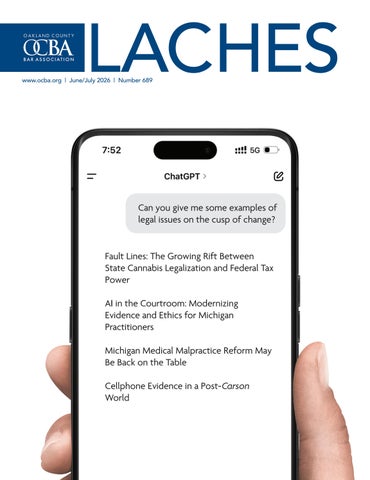
Can you give me some examples of legal issues on the cusp of change?
Fault Lines: The Growing Rift Between State Cannabis Legalization and Federal Tax Power
AI in the Courtroom: Modernizing Evidence and Ethics for Michigan Practitioners
Michigan Medical Malpractice Reform May Be Back on the Table
Cellphone Evidence in a Post-Carson World










OAKLAND COUNTY BAR ASSOCIATION
1760 S. Telegraph Road, Suite 100
Bloomfield Hills, Michigan 48302-0181
(248) 334-3400 • FAX (248) 334-7757 www.ocba.org
PRESIDENT
Sarah E. Kuchon
PRESIDENT-ELECT
Aaron V. Burrell
VICE PRESIDENT
Kari L. Melkonian
TREASURER
Victoria B. King
SECRETARY
Syeda F. Davidson
EXECUTIVE DIRECTOR
DIRECTORS
Julie L. Kosovec
Emily E. Long
Jennifer L. Lord
Moheeb H. Murray
Kimberley Ann Ward
Layne A. Sakwa
Silvia A. Mansoor
Stephen T. McKenney
James A. Martone
Jennifer J. Henderson
Jennifer Quick ABA
LACHES EDITORIAL BOARD
Victoria B. King
Syeda F. Davidson
Coryelle E. Christie
Lanita L. Carter
James W. Low
Thamara E. Sordo-Vieira
Xavier J. Donajkowski
Vincent C. Sallan
THE MISSION OF THE OAKLAND COUNTY BAR ASSOCIATION IS TO SERVE THE PROFESSIONAL NEEDS OF OUR MEMBERS, IMPROVE THE JUSTICE SYSTEM AND ENSURE THE DELIVERY OF QUALITY LEGAL SERVICES TO THE PUBLIC.
Articles and letters that appear in LACHES do not necessarily reflect the official position of the Oakland County Bar Association, and their publication does not constitute an endorsement of views that may be expressed. Readers are invited to address their own comments and opinions to:
LACHES | Oakland County Bar Association 1760 S. Telegraph Rd., Ste. 100 Bloomfield Hills, MI 48302-0181
Publicationandeditingareatthediscretionoftheeditor.
JUNE/JULY 2026
Fault Lines: The Growing Rift Between State Cannabis Legalization and Federal Tax Power
Federal tax enforcement under IRC § 280E may require reform as cannabis legalization becomes more widespread. ByArjanMalushi,VenarAyar,andDavidSenawi 10
Michigan Medical Malpractice Reform May Be Back on the Table
Two unpassed House bills offer a clear look at where the future of Michigan’s malpractice framework may be headed. ByPaulIndyk 13
Cellphone Evidence in a Post-Carson World Technological advances and AI raise questions about the balance between public safety and personal privacy.
ByBrandonRobertBarlog 16
AI in the Courtroom: Modernizing Evidence and Ethics for Michigan Practitioners
How will the justice system responsibly integrate AI to increase efficiency without undermining integrity?
ByAlecTorigian 18

Send address changes in writing to Oakland County Bar Association, 1760 S. Telegraph, Ste. 100, Bloomfield Hills, MI 48302-0181.

One of the biggest challenges I have faced as president has been finding a topic to write about each month. As my term comes to a close and I write this final article, I keep returning to the phrase “live long and prosper.” Most of us recognize it as a pop-culture catchphrase, but it carries a deeper meaning.
Phrases like this one endure for a reason. On its face, “live long and prosper” is a wish for longevity and success. It is the kind of phrase that can greet, say goodbye, and bless all at once, making it especially fitting for my final article as president.
I have been a member of this bar for 25 years. I have been active for most of that time. I have served on the board for more than a decade, and this year, I had the privilege of serving as president. Yet there are still moments when I walk into a room and feel like I do not quite belong.
That is not a new feeling for me. I have experienced it for most of my life, and if I am being honest, I do not fully understand it. Even now, I can find myself in a room full of colleagues feeling peripheral, anxious, and full of self-doubt. The story in my head starts: You do not fit in. You are an imposter. You have no place here.
If this is my experience after 25 years of service and a year as president, then I find myself wondering what other members of the bar may experience. The answer matters, not only because of what it may mean for individual members but because of what it may mean for the future of this organization.
An organization comes into existence through articles of incorporation, a name, and a set of bylaws, but those things alone do not make it alive. The bar lives through its people. In our bar, those people are our members,
By Sarah E. Kuchon
volunteers, staff, and leaders. Our members sustain us. Our leaders help shape our vision. Our staff and volunteers are our backbone. Together, we shape what this bar becomes.
Over the years, I have seen firsthand the dedication of our members. Our volunteers give their time to committees, plan events, mentor, and step into leadership roles. I have also seen our staff’s hard work, often behind the scenes. That is how an organization moves from existing to living, through the people who show up, engage, and invest in it.
Belonging is a fundamental human need. It is the experience of feeling accepted, included, and valued by others. It is more than just fitting in. It is about finding a space where you feel comfortable being your authentic self.
For an organization, belonging matters because its longevity and prosperity depend on whether its people feel connected and invested in it. People are less likely to stay, engage, or invest where they do not feel they belong. Our sense of belonging is shaped internally by what we carry into the room and externally by how the room receives us.
For me, few films capture the social ache of not quite belonging as well as Pretty in Pink It is a coming-of-age story about Andie Walsh, a bright, creative, working-class teenager living on the social margins of her high school. The film is not just about teenage love. It is also about social hierarchy, exclusion, insecurity, and the pain of being invited into a world that still does not fully



feel like yours. at feeling is echoed in the lm’s amazing soundtrack, including Suzanne Vega’s “Left of Center,” which gives language to the feeling of being “in the outskirts and in the fringes.”
I have felt like Andie more times than I would like to admit. It would be easy to blame the room and focus on how others should change, but I have said again and again that we cannot control others. We can only control ourselves. So I keep showing up. I keep pushing myself out of my comfort zone. I keep leaning on what Brian Little calls my “free traits.” Is it easy? No. Is it exhausting? Yes. Do I still have to rumble with the story I tell myself afterward? Absolutely.
Part of belonging begins within. It requires a willingness to remain connected to yourself, even in rooms where you feel uncertain. But it does not end there. Belonging is shaped not only by what we carry in but by how the room receives us.
Our bar has made real e orts to create opportunities, extend invitations, and open the door. ose e orts matter. But belonging is not created by structure alone. It is shaped by people — by how we receive one another, whether we notice who is standing alone, and the small choices that make a room feel more or less human.
Early in my career, when I was a brandnew lawyer and had just joined the bar, I
attended my rst event. I walked in scared, alone, and insecure about how I would be received. A woman approached me, introduced herself, and took the time to bring me into conversations and introduce me to others. She made all the di erence. She gave me an anchor. She made the room feel di erent. at di erence kept me in the organization. It was a small act, one kind gesture from another human being, but it mattered. It reminded me that while organizations create the opportunity for connection, it is often the people in the room who help turn that opportunity into belonging.
I have spent a lot of time thinking about leadership this year. My belief has always been that leadership is not about titles but about how we show up through our actions, presence, and engagement with others. It is something we model, not something we simply say. We are individuals, and we bring our own histories, personalities, and experiences into every room we enter. Some of us walk in with ease. Others walk in with hesitation. Some nd connection quickly. Others take more time. Some may never get there.
ere is no single way to solve that, but I believe we all play a role in shaping the experience of this organization. It is not solely the bar’s responsibility to create belonging, and it is not solely the individual’s responsibility to nd it. It exists somewhere in between, in the space where we meet each other, receive one another, and choose how we will show up.
As I move from president to past president, I nd myself returning once more to that phrase: “Live long and prosper.” I hope this bar continues to grow and evolve, remains strong and relevant, and lives long. But more than that, I hope it prospers in a way that cannot be measured by numbers alone. I hope it is a place where people feel seen, welcomed, and like they belong, however that may look for them. And I hope that each of us, myself included, continues to re ect on the role we play in creating that experience for others. Because in the end, this organization is not de ned only by its structure or its programs. It is de ned by us and how we choose to show up for ourselves and one another.

Sarah E. Kuchon is the president of the Oakland County Bar Association.


















By Jennifer Quick

From time to time, I enjoy introducing readers to the OCBA staff I have the privilege of working with each day. Since my last article on this topic 13 months ago, we have experienced some changes and shifts in responsibilities. I welcome the opportunity to acquaint you with our newest team members and reconnect you with those who have been with the OCBA for several years.
First and foremost, I want to express my deep appreciation for the dedication, tenacity, and creativity of our staff. They are an integral part of what makes my job so fulfilling. This team works incredibly hard each week in service to the OCBA. In preparing this article, I asked each team member to share their favorite way to spend a free Saturday.
Katie Tillinger serves as deputy director, overseeing membership and the foundation, in addition to acting as my right hand. Katie has been with the OCBA for nearly 19 years and is often one of the first faces a new member sees. She is the staff liaison to the Membership, New Lawyers, Circuit Court, Golf Outing, and Diversity, Equity and Inclusion committees. On Saturdays, Katie enjoys playing sports with her three kids, sharing a home-cooked meal, and binge-watching a good TV show with her family.

Sue Maczko is our finance director, managing financial accounting, reporting, and support for both the OCBA and OCBF. She is the staff liaison to the Business Court and Counsel, Veterans Law, Lawyers of a Certain Age, and Employee Benefits committees. Sue has been with the OCBA since June
2011. Her ideal Saturday includes swimming, visiting the Detroit Zoo, exploring downtown Detroit or Somerset Collection, or watching a Disney movie with her grandchildren. She also enjoys dinner and a movie with friends.
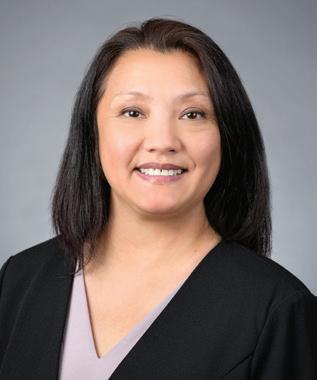
Mayly McRae serves as our bookkeeper, assisting with seminar and event registrations, member profile updates, and case evaluation and mediation collections. She is the staff liaison to the Family Court, Probate, Estate and Trust, and Debtor/Creditor committees. Mayly has been with the OCBA for more than eight years. Her favorite Saturdays include a nature walk with her husband followed by a relaxed meal at a new restaurant. If her two college-aged sons join them, the day is even more special.

Lori Dec serves as a part-time administrative assistant, coordinating all Laches matters and assisting with the foundation, including the OCBA/OCBF Diversity in the Legal Profession Scholarship Fund. She is also the staff liaison to the Employment Law and Tax Law committees. When weather permits, Lori spends her Saturdays working in her yard and attending fitness classes, unless she is visiting her grandchildren in Maryland. She enjoys ending the day with an outing with family or friends, along with a glass of wine.
Janise Thies was promoted this past year to managing OCBA court services, including case evaluation and mediation. She also works with the Law-Related Education and Providing Access to Legal Services committees to develop and present public service programs
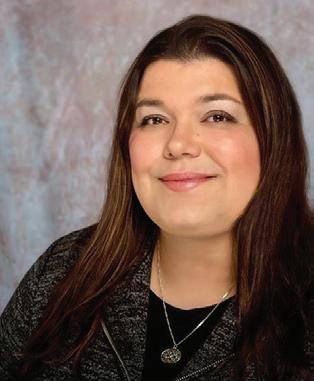
such as the Youth Law Conference and Senior Law Days. Janise joined the OCBA in January 2022 after several years at the Oakland County Courthouse law library. On a free Saturday, she enjoys binge-watching a mystery or thriller series while curling up with her cats.

MB Cairns has been the OCBA’s marketing communications specialist since April 2023. She is a talented artist and graphic designer who creates our online graphics, event signage, and marketing materials. MB is the staff liaison to the Lawyer Well-Being, Paralegal, and Energy, Sustainability and Environmental Law committees. Her favorite Saturdays are spent with her partner, Arden, making breakfast while singing songs from the musical Falsettos. The day may also include antiquing, enjoying a treat, or working on a craft project.

Cristin Doble joined us in October 2024 and quickly made an impact. She was promoted to programs manager and oversees all OCBA professional development and continuing education programs, including seminar planning, Inns of Court, and bench/bar conferences. She also assists with court services programs and serves as staff liaison to the DCCE, CCCE, ADR, Juvenile Law, Criminal Law, and Professional Development committees. In warmer weather, Cristin enjoys taking her toddler son to the
park with her husband and exploring new activities with her family.

Alexa Enders has been with the OCBA since September 2025 and serves as our marketing associate. She leads much of our email communications and social media presence, including highlighting members who are doing outstanding work. Alexa is the sta liaison to the Municipal Law and Medical/Legal committees. Her ideal Saturday blends rest, activity, and time with loved ones, from sleeping in to taking a Pilates, cycling, or yoga class; trying a new restaurant; or playing games with friends or family. Some days, she prefers to unwind with a good movie or book.

Melak Mardo is approaching six months with the OCBA and works part-time as our Lawyer Referral Service and court services administrator. She is in her second year of
the University of Detroit Mercy’s accelerated six-year law program. On Saturdays, she exercises in the morning and spends the rest of the day with family or friends.

Beatriz Rivard is the newest addition to the OCBA, having joined us in March. She serves as a part-time administrative assistant supporting several areas, including LRS on Mel’s days o , as well as assisting with CLE programs and providing administrative support to Katie and me. Bea enjoys Saturdays outdoors with her Siberian husky, often taking long walks on local trails with her husband. She also enjoys gardening, reading, watching a good show, practicing piano, and spending time with friends and family.
As for me, I have been with the OCBA for nearly nine years, overseeing daily operations and ensuring that our team has the necessary resources to work e ciently. I work closely with both the OCBA Board of Directors and the OCBF Board of Trustees to develop and implement strategic initiatives. I also serve as sta liaison to the Legislative, Real Estate, and Solo/Small Firm committees. Most
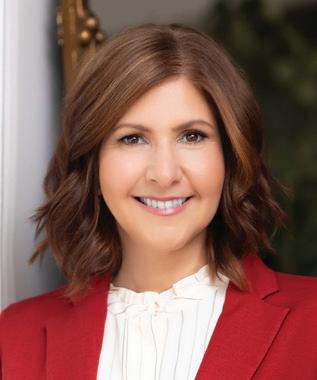
Saturdays start with a 3-mile walk with my Siberian husky. In warmer months, I enjoy heading to downtown Birmingham for brunch or lunch, attending a sporting event, spending time in downtown Detroit, or trying a new restaurant with my husband. It is especially meaningful when my daughter is home from school and joins us.
During the week, I value the opportunity to work alongside this incredible team. Each person brings something unique and essential to the table. While it is di cult to fully capture their contributions here, they each play a vital role in making the OCBA the premier voluntary bar association in the state.
I encourage you to reach out to any of us. You can nd our contact information at ocba.org/sta . Your feedback on our member programs is always welcome as we continue to improve and better serve you.

Jennifer Quick is the executive director of the Oakland County Bar Association.

Please Note: The dates listed below were sent to the publisher on April 2, 2026. It is possible that some of the events listed below have since been altered. Please check ocba.org/events for the most up-to-date schedule of events.
Join the OCBA as we salute outstanding leaders in law and celebrate another amazing year. Spend time with judges, OCBA leadership, and other OCBA members at this annual celebration.
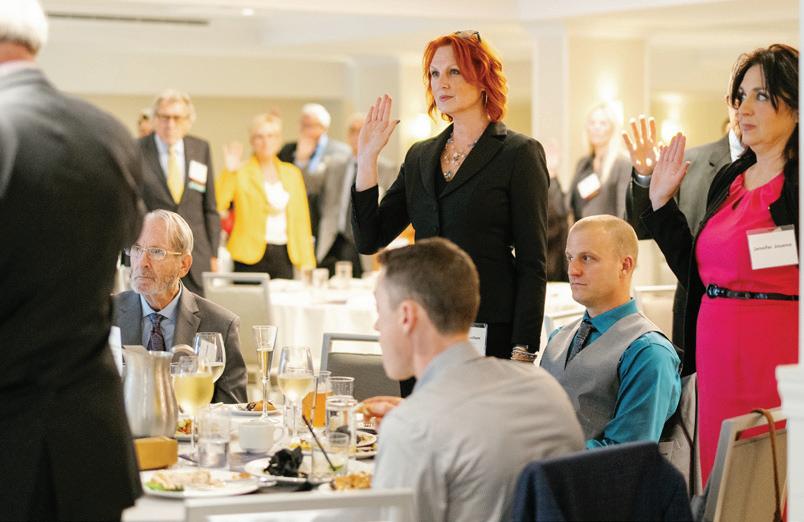
During the event, we will recognize the 2026 OCBA award recipients, members celebrating 40 years of legal practice in Michigan, and those who have been members of the OCBA for 50 years. Plus, outgoing OCBA President Sarah E. Kuchon will pass the gavel to incoming President Aaron V. Burrell, who will be sworn in as the bar’s 94th president. The ceremony will be followed by a strolling reception on the beautiful terrace of the Community House in Birmingham. Tickets are now on sale at ocba.org/annual-meeting
Join the OCBA and Oakland County Circuit and Probate courts for an extensive full-day boot camp covering everything new Oakland County attorneys need to know to get a jump start on their practice. Breakfast and lunch will be provided. The boot camp is open to attorneys who have been practicing for five years or less, as well as law students. To learn more or register, visit ocba.org/bootcamp
Want to get more out of your OCBA membership? Hoping to expand your professional network? Then join us at 8:45 a.m. at the OCBA. Our staff will show you how to get the most value for your money and how your membership can help you grow professionally. Plus, we’ll leave you plenty of time to meet and network with your fellow members. RSVP at ocba.org/events
Join your colleagues and treat your clients to a fun day at the beautiful Knollwood Country Club. Registration includes 18 holes of golf on this upscale private course, as well as course contests, a boxed lunch, drinks, dinner, and prizes. Early-bird pricing runs through June 29! Don’t golf? You can still register for dinner and prizes only. Sign up at ocba.org/golf
Join us from 5:30 to 7:30 p.m. for another great opportunity to mix and mingle with fellow bar members while enjoying appetizers and a cash bar. This event is free for OCBA members, and space is limited, so register today at ocba.org/events








Wachler & Associates represents healthcare providers, suppliers, and other entities and individuals in Michigan and nationwide in all areas of health law including, but not limited to:
•Healthcare Corporate and Transactional Matters, including Contracts, Corporate For mation, Mergers, Sales/Acquisitions, and Joint Ventures











•Healthcare Corporate and Transactional Matters, including Contracts, Corporate For mation, Mergers, Sales/Acquisitions, and Joint Ventures
•Medicare, Medicaid, and Other Third-Party Payor Audits and Claim Denials
•Medicare, Medicaid, and Other Third-Party Payor Audits and Claim Denials
•Licensure, Staff Privilege, and Credentialing Matters
•Provider Contracts
•Licensure, Staff Privilege, and Credentialing Matters
•Billing and Reimbursement Issues
•Provider Contracts
•Billing and Reimbursement Issues
•Stark Law, Anti-Kickback Statute (AKS), and Fraud & Abuse Law Compliance
•Physician and Physician Group Issues
•Stark Law, Anti-Kickback Statute (AKS), and Fraud & Abuse Law Compliance
• Regulatory Compliance
•Physician and Physician Group Issues
•Corporate Practice of Medicine Issues
• Regulatory Compliance
•Provider Participation/Ter mination Matters
•Corporate Practice of Medicine Issues
•Provider Participation/Ter mination Matters
• Healthcare Litigation
• Healthcare Investigations
• Healthcare Litigation
•Civil and Criminal Healthcare Fraud
• Healthcare Investigations
•Civil and Criminal Healthcare Fraud
•Medicare and Medicaid Suspensions, Revocations, and Exclusions
•Medicare and Medicaid Suspensions, Revocations, and Exclusions
•HIPAA, HITECH, 42 CFR Part 2, and Other Privacy Law Compliance
•HIPAA, HITECH, 42 CFR Part 2, and Other Privacy Law Compliance

Expand Your Knowledge with These Great Seminars!

2026 Employment Law Year in Review (9 – 11:30 a.m.)
A seminar from the Employment Law Committee
Presenters: Catrina Farrugia, Bloomfield Legal, PLC; Dustin Frigy, Oakland County Executive Office; and Craig S. Schwartz, Butzel Long, P.C.
Moderator: Richard M. Lynch, Esq., Court Administrator, Sixth Judicial Circuit Court

18 20 9 25
This annual Zoom seminar will spotlight the most significant new developments in employment law, equipping attorneys with timely insights to better advise and protect their clients. This year’s program will focus on recent developments under the NLRA; an exploration of AI’s impact on business operations, plus productivity tips and real-world use cases; and a panel dicussion on general employment law updates — delivering practical guidance you can put to use right away.
Update on the State of Criminal Law — Midyear 2026 (11:30 a.m. – 1 p.m.)
A seminar for criminal defense appointed counsel
Presenter: Alona Sharon, Alona Sharon PC
This Zoom seminar will deliver a timely overview of the most recently published Michigan Court of Appeals decisions, with a focused look at key sentencing rulings. Gain practical insight into how these opinions are shaping criminal practice and walk away with concrete strategies, emerging trends, and real-world practice pointers you can apply immediately. Worth 1.5 hours of criminal training credit for appointed counsel

Making Sense of Cellphone Data in Litigation: Inside and Out (Noon – 1 p.m.)
A seminar for criminal defense appointed counsel
Presenter: Detective Sam Hannum, Southfield Police Department
This Zoom seminar will equip attorneys with a practical understanding of how mobile data can shape modern cases. The session will break down the types of information generated by cellphones — from call detail records and text logs to location data and app activity — and explain how that data is collected, preserved, and analyzed. Whether you’re new to digital evidence or looking to sharpen your approach, this session offers a clear, accessible roadmap for navigating both internal and external cellphone data with confidence.
Worth 1 hour of criminal training credit for appointed counsel

Time Matters: What New Attorneys Need to Know about Billing and Communication
(Noon – 1:00 p.m.)
A seminar from the Professional Development Committee
Presenters: Mary C. Aretha, Michigan Court of Appeals, and Paul Shkreli, Shkreli Legal PLLC
Frustrated with billable hours? Confused about document management? Looking to increase your productivity? For most lawyers, success in legal practice requires more than strong legal analysis — it also involves time-tracking and robust documentation. Unfortunately, most new lawyers are not taught these vital skills in law school. In this virtual program, two experienced law-firm billers will teach the basics, including how to bill your time, meet and maximize your billable hours, communicate with partners and clients, and handle documenting in case files.
and









• Wrongful discharge cases, including breach of employment contract, discrimination, harassment and retaliation
• Non-payment of compensation disputes, including commission, bonus and incentive compensation arrangements, and FLSA violations
• Enforcement of equity award agreements and minority shareholder rights
• Defending against mobility-killing non-compete and non-solicitation contracts
• Separation agreement reviews and severance negotiations
• Drafting employment contracts
• HR counseling, defending against government investigations Serious workplace injury and death cases
Sam Morgan & Greg Jones have a team of Employment Lawyers with decades of experience providing advice, counsel and representation to Employees and Employers in a wide variety of occupations, for: Our team includes Senior Associates Barbara Urlaub and Steven Cole, and Of counsel attorneys David Kotzian*, Donald Gasiorek*, Raymond Carey*, and Paul Hines.
Michigan Super Lawyers Honorees





By Arjan Malushi, Venar Ayar, and David Senawi
The rapid expansion of state-legal cannabis markets has created one of the most persistent tensions in modern American law: the divide between state legalization and continued federal tax enforcement under Internal Revenue Code § 280E.1 Enacted at the height of the federal government’s war on drugs, § 280E denies all ordinary and necessary business deductions to any taxpayer engaged in “trafficking” a Schedule I or II controlled substance within the meaning of the Controlled Substances Act (CSA).2
The statute was enacted in 1982 after the United States Tax Court permitted a convicted cocaine trafficker to deduct certain business expenses under § 162 of the Internal Revenue Code.3 Congress responded by creating a narrow public-policy exception designed to prevent criminal enterprises from using the tax code to subsidize illegal activity. At the time, marijuana was classified alongside heroin and LSD as a Schedule I substance, and federal law treated all marijuana activity as categorically unlawful.2
Four decades later, the legal landscape has changed dramatically. Most Americans now live in states that authorize marijuana for medical use, and many states have legalized cannabis for adult-use markets subject to extensive regulatory oversight.4 Despite this transformation, federal tax law continues to treat state-licensed cannabis businesses as criminal traffickers for purposes of § 280E.1
The consequences are severe. Because § 280E disallows deductions for ordinary business expenses while permitting only cost-ofgoods-sold adjustments, cannabis businesses are frequently taxed on income far exceeding their economic profit. Courts have repeatedly enforced this framework.5 In Californians Helping to Alleviate Medical Problems, Inc. v. Commissioner, the tax court held that § 280E disallowed deductions attributable to cannabis sales while allowing deductions associated with separate caregiving services.6 Later decisions narrowed this reasoning. In Olive v. Commissioner, the Ninth Circuit held that a dispensary could not divide its operations into separate businesses to avoid § 280E.7 The tax court’s decision in Patients Mutual Assistance Collective Corp. v. Commissioner, commonly known as the Harborside case, further reinforced the strict application of § 280E to state-licensed cannabis enterprises.8
The result is a tax regime in which businesses operating transparently under state law may owe federal income tax even when their actual profits are minimal. Justice Clarence Thomas has recognized the resulting contradiction. In Standing Akimbo, LLC v. United States, he observed that federal marijuana policy has become “contradictory and unstable,” noting that the federal government now simultaneously “tolerates and forbids” cannabis activity.9
This tension reflects a broader structural problem within federal law. Cannabis businesses operate openly under state regulatory systems governing licensing, taxation, employment, and public safety, yet the federal tax code continues to treat them as criminal enterprises. The result is a regulatory paradox in which state governments encourage transparency and compliance while federal tax policy penalizes the same behavior.
Michigan provides a particularly vivid illustration of the conflict between modern cannabis regulation and legacy federal tax law.
In 2018, Michigan voters adopted the Michigan Regulation and Taxation of Marihuana Act (MRTMA), establishing a comprehensive regulatory framework for adult-use cannabis and imposing a 10% excise tax on retail sales.10 Crucially, Michigan rejected the punitive logic of § 280E by allowing cannabis businesses to deduct ordinary and necessary business expenses for state income tax purposes.10
Michigan’s approach reflects a deliberate policy choice. Rather than importing the federal prohibition-era framework, the state aligned its tax system with the economic realities of regulated commerce.
Yet Michigan now faces its own constitutional dispute. The Michigan Constitution provides that laws enacted by voter initiative may not be amended or repealed except by a three-fourths vote of each legislative chamber.11 Legislative efforts to modify cannabis taxation without satisfying this requirement have triggered debate over whether the state may impose additional cannabis-specific taxes without violating Article IV, Section 27.11
The dispute illustrates a broader tension: When governments legalize cannabis but later impose punitive taxation inconsistent with voter intent or regulatory design, they risk undermining both democratic legitimacy and economic stability.
To understand the modern conflict surrounding cannabis taxation, it is necessary to examine the origins of § 280E.
The statute was enacted in response to Edmondson v. Commissioner, in which the tax court allowed a cocaine trafficker to deduct ordinary business expenses under § 162.12 Congress reacted swiftly, enacting § 280E to deny deductions for businesses engaged in trafficking Schedule I or II controlled substances.1
At the time, federal drug policy reflected a regime of comprehensive prohibition. Marijuana was classified as a Schedule I substance under the CSA, grouped with heroin and LSD, and federal enforcement was both aggressive and uniform.2 No state had adopted a comprehensive legalization framework.
Within this context, § 280E functioned as a narrow public-policy exception designed to prevent criminal enterprises from claiming tax benefits associated with legitimate commerce.
It was not drafted with state-regulated cannabis markets in mind.
Over the past decade, federal cannabis policy has evolved into what Justice Thomas described as a “half-in, half-out” regime.13 Since 2014, Congress has enacted and repeatedly renewed appropriations riders prohibiting the Department of Justice from using federal funds to interfere with state medical marijuana programs.14 Federal courts have interpreted these provisions to bar prosecution of individuals and businesses acting in compliance with state law.15
At the same time, state governments have constructed sophisticated regulatory systems governing cannabis production and distribution. These regimes include licensing requirements, product-testing mandates, inventory reconciliation procedures, and seed-to-sale tracking systems designed to prevent diversion into illicit markets.
These regulatory frameworks did not exist when Gonzales v. Raich was decided in 2005. In Raich, the Supreme Court upheld Congress’s authority to prohibit even intrastate marijuana activity authorized under state law, reasoning that marijuana was a fungible commodity that could easily enter interstate markets.16 The court’s analysis relied heavily on the aggregation principles articulated in Wickard v. Filburn, which held that Congress may regulate local activity that, when aggregated, could substantially affect interstate commerce. Modern state regulatory systems directly challenge the factual assumptions underlying that reasoning.17
For decades, courts evaluating federal regulatory statutes relied on the Chevron doctrine, which required judicial deference to reasonable agency interpretations of ambiguous statutes.18 In Loper Bright Enterprises v. Raimondo, however, the Supreme Court rejected Chevron deference and held that courts must independently determine the best interpretation of federal statutes.19
This shift has potentially significant implications for cannabis taxation. Section 280E applies only to substances “within the meaning of” Schedule I or II of the CSA. The statutory language is notable. Congress did not provide that § 280E applies to substances “listed on” Schedule I or II but instead tied its application to whether a substance falls “within the meaning of” those schedules. When Congress
employs different wording within related statutory provisions, courts presume that the difference is intentional.20
Historically, courts applying § 280E assumed that marijuana’s placement on Schedule I was dispositive. That assumption often rested on judicial deference to agency interpretations of the CSA. Following Loper Bright, however, courts must independently interpret statutory language without deferring to agency classifications.19
If courts are required to determine the best interpretation of § 280E independently, they must confront a question that earlier decisions largely avoided: whether marijuana truly falls “within the meaning of” Schedule I or II under the statutory criteria established by Congress. Those criteria require a high potential for abuse, no currently accepted medical use, and a lack of accepted safety for use under medical supervision.21
Recent litigation reflects a strategic shift in how cannabis businesses are approaching this issue. Rather than mounting direct constitutional challenges to federal prohibition, some businesses are focusing on statutory interpretation arguments concerning the meaning of § 280E. For example, the multistate operator Trulieve has filed amended returns seeking substantial refunds, while New Mexico Top Organics, Inc. v. Commissioner, currently pending in the United States Tax Court, raises the question of whether state-licensed cannabis activity constitutes “trafficking” within the meaning of § 280E.22 These cases do not ask courts to overturn Raich. Instead, they invite courts to interpret the statutory language of the Internal Revenue Code in light of changed legal and factual circumstances.
Recent federal scientific findings have further complicated the legal framework surrounding cannabis regulation.
In 2023, the Department of Health and Human Services conducted an extensive scientific review of marijuana and formally recommended rescheduling the substance to Schedule III under the CSA.23 HHS concluded that marijuana possesses accepted medical uses and does not exhibit the abuse potential required for Schedule I classification.
Following that recommendation, the Department of Justice initiated rulemaking proceedings to implement rescheduling under the CSA.24 On December 18, 2025, the president issued an executive order directing federal agencies to expedite research into marijuana and cannabinoid-based medical treatments.
Although these developments do not themselves amend § 280E, they significantly under-
mine the factual premises underlying marijuana’s historical classi cation as a Schedule I substance.
Michigan’s cannabis regime illustrates how these national developments intersect with state constitutional law.
MRTMA was enacted by voter initiative and re ects a deliberate policy choice balancing regulation, taxation, and economic viability.10 Article IV, Section 27 of the Michigan Constitution prohibits legislative amendment of voter-initiated statutes absent approval by three-fourths of each legislative chamber.25 is constitutional safeguard re ects the principle of voter sovereignty. When voters adopt regulatory frameworks through direct democracy, the legislature’s ability to alter those frameworks is intentionally constrained.
e resulting tension mirrors the broader federal con ict. When governments accept legalization but subsequently impose punitive taxation inconsistent with the regulatory framework adopted by voters, they risk undermining both economic stability and democratic legitimacy.
Ultimately, the tension between state cannabis legalization and federal tax enforcement re ects a deeper structural con ict that is now approaching a point of resolution. Section 280E, enacted during an era of comprehensive federal prohibition, has become increasingly di cult to reconcile with a regulatory environment in which most Americans live in states that permit some form of lawful cannabis activity. Justice omas’s observation that federal marijuana policy has become “contradictory and unstable” captures the central dilemma: e federal government simultaneously tolerates and forbids the same conduct depending on the legal context.9
Michigan’s experience demonstrates both the promise of state innovation and the risks that arise when taxation and regulation drift from the constitutional and statutory frameworks that authorized legalization. Whether through judicial interpretation, congressional reform, administrative rescheduling, or state constitutional litigation, the legal framework governing cannabis taxation appears increasingly likely to evolve.
Until that transition occurs, however, the divide between state legalization and federal tax enforcement will continue to shape cannabis law and policy nationwide. Businesses operating in this space must navigate a legal environment in which regulatory legitimacy and federal tax treatment remain fundamentally misaligned. Ultimately, meaningful resolution may
require congressional reform of § 280E to align federal tax policy with the regulatory reality that now exists across the majority of American states.
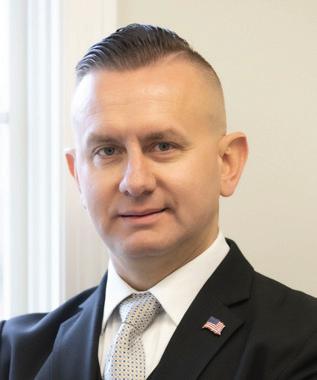
Arjan Malushi is an attorney focusing on federal and state tax controversy, IRS collection defense, and administrative litigation at Ayar Law. He earned his J.D. from Cooley Law School in 2025, is admitted to the State Bar of Michigan, and is currently completing an LL.M. in taxation at Villanova University. Malushi represents individuals and businesses in audits, penalty abatements, employee retention credit matters, and IRS collection alternatives. He is known for his meticulous research, practical problem-solving, and growing contributions to legal scholarship and community initiatives.

Venar Ayar is the founder and principal attorney of Ayar Law, a leading tax controversy rm based in Michigan. He represents individuals and businesses in IRS audits, criminal tax investigations, o shore disclosure matters, and complex collection cases. Known for his strategic, client-focused approach, Ayar has built a statewide reputation as a top tax defense lawyer. He frequently lectures on tax law, appears in media interviews, and mentors young attorneys entering the eld.
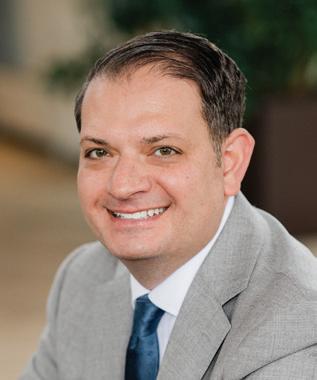
David S. Senawi concentrates his practice on complex commercial litigation of all types. His notable cannabis law cases involve receiverships, licensing challenges against local municipalities, shareholder disputes, and secured transactions. He also serves as outside general counsel to many of Michigan's leading cannabis companies. Michigan Lawyers Weekly named him as one of only six attorneys on its inaugural 2024 Go-To Power List for Cannabis Law.

Footnotes:
1. 26 U.S.C. § 280E.
2. 21 U.S.C. § 812.
3. Edmondson v. Commissioner, T.C. Memo 1981-623.
4. National Conference of State Legislatures, State Medical Cannabis Laws, ncsl.org
5. Patients Mut. Assistance Collective Corp. v. Comm’r, 151 T.C. 176 (2018); Olive v. Comm’r, 792 F.3d 1146 (Ninth Cir. 2015).
6. Californians Helping to Alleviate Med. Problems, Inc. v. Comm’r, 128 T.C. 173 (2007).
7. Olive v. Commissioner, 792 F.3d 1146 (9th Cir. 2015).
8. Patients Mutual Assistance Collective Corp. v. Commissioner, 151 T.C. 176 (2018) (commonly known as the Harborside case).
9. Standing Akimbo, LLC v. United States, 141 S. Ct. 2236, 2237 (2021) (Thomas, J., respecting denial of certiorari).
10. Michigan Regulation and Taxation of Marihuana Act, Mich. Comp. Laws §§ 333.27951-333.27967 (2018).
11. Mich. Const. art. IV, § 27.
12. Edmondson, T.C. Memo 1981-623.
13. Standing Akimbo, 141 S. Ct. at 2237 (Thomas, J., respecting denial of certiorari).
14. See, e.g., Consolidated Appropriations Act, 2015, Pub. L. No. 113-235, § 538, 128 Stat. 2130, 2217 (2014).
15. United States v. McIntosh, 833 F.3d 1163, 1175–78 (Ninth Cir. 2016).
16. Gonzales v. Raich, 545 U.S. 1 (2005).
17. Wickard v. Filburn, 317 U.S. 111 (1942).
18. Chevron U.S.A. Inc. v. Natural Resources Defense Council, 467 U.S. 837 (1984).
19. Loper Bright Enters. v. Raimondo, 603 U.S. ___ (2024).
20. Ratzlaf v. United States, 510 U.S. 135, 143 (1994).
21. 21 U.S.C. § 812(b).
22. New Mexico Top Organics, Inc. v. Commissioner, U.S. Tax Court Docket No. 19661-24 (pending).
23. U.S. Department of Health & Human Services, Basis for the Recommendation to Reschedule Marijuana into Schedule III of the Controlled Substances Act (Aug. 29, 2023).
24. Schedules of Controlled Substances: Rescheduling of Marijuana, Notice of Proposed Rulemaking, 89 Fed. Reg. (proposed May 21, 2024).
25. Mich. Const. art. IV, § 27.

By Paul Indyk
The basic structure of medical malpractice actions in Michigan has been in place for decades. There are pre-suit requirements that make filing a malpractice case more complicated than an ordinary negligence action. There are expert qualification rules and requirements to consider. And, of course, there are statutory caps on noneconomic damages, which affect the way malpractice litigation is evaluated, defended, and resolved in this state.
But in fall 2024, two House bills proposed to significantly alter the established framework. Neither bill passed, but the proposals offer a clear look at where future reform efforts may be headed. If enacted, they would have increased potential exposure, changed settlement incentives, and expanded the categories of damages available in wrongful death cases.
To understand why those bills mattered, it helps to look at the system they were trying to change.
Michigan’s malpractice reform laws were adopted as part of an effort to control malpractice litigation and make liability exposure more predictable. The Legislature enacted a package of reforms designed to limit questionable claims, reduce litigation costs, and create stability for health care providers and insurers. That included several features that are now part of the normal malpractice landscape in Michigan.
A plaintiff generally cannot file suit the moment a malpractice claim is identified. Instead, the plaintiff must first comply with the notice of intent requirement under MCL 600.2912b, which generally requires serving notice and waiting 182 days before filing. The complaint must also be accompanied by an affidavit of merit signed by an appropriate health professional under MCL 600.2912d. These are important procedural issues that impact the timing, cost, and viability of malpractice claims.
The reforms also addressed the damages available to injured parties in malpractice actions. Public Act 78 of 1993, codified in MCL 600.1483, created a two-tier noneconomic damages cap: a lower cap that applies in most cases and a higher cap that applies only in a narrower category of especially serious injuries. The caps were initially set at $280,000 and $500,000 and are adjusted every year for inflation by the state treasurer. For 2026, the adjusted figures are $596,400 for the lower cap and $1,065,000 for the upper cap.
Those numbers matter in practice because they often define the upper range of noneconomic exposure in a case, especially where the plaintiff’s economic damages are limited or where the case turns heavily on allegations of pain and suffering.
Just as important as the dollar amounts, though, is how the statute applies the cap. Under MCL 600.1483, the cap applies to “all plaintiffs” and “all defendants.” In other words, the noneconomic cap is not multiplied simply because there are multiple defendants or multiple claimants. That aggregate approach has been one of the major features of Michigan’s malpractice system. It helps create some predictability in cases involving hospitals, physician groups, vicarious liability claims, and wrongful death beneficiaries.
The statute further defines “noneconomic loss” to include pain and suffering, inconvenience, physical impairment, physical disfigurement, loss of society and companionship, and loss of consortium. The upper cap, however, is limited to specific circumstances. It is not enough that the injury is serious, life-changing, or even fatal. The statute reserves the higher cap for catastrophic injuries, including certain paral-
ysis cases, permanent impairment of cognitive capacity, and permanent loss of or damage to a reproductive organ resulting in an inability to procreate. That narrow upper-cap structure has been a major defense feature in Michigan malpractice litigation and a hurdle that plaintiffs must account for when evaluating a case.
When medical malpractice causes death, the claim proceeds under Michigan’s Wrongful Death Act, MCL 600.2922. The estate, through the personal representative, can seek damages that the statute permits, including medical and funeral expenses, the decedent’s conscious pain and suffering, and the loss of financial support, society, and companionship experienced by the survivors.
Importantly, death cases are not automatically subject to the upper cap. Unless the decedent’s injuries independently satisfied one of the MCL 600.1483(1)(a)-(c) conditions before death, the lower cap governs noneconomic damages available to the estate. That can matter a great deal in cases involving a rapid death or a short survival period.
The scope of recoverable damages under the Wrongful Death Act became even more important after the Michigan Supreme Court’s 2024 decision in Daher v. Prime Healthcare Services-Garden City, LLC, 515 Mich. 254. In Daher, the court addressed whether wrongful death damages include lost future earnings or lost earning capacity simply because the decedent would have earned income in the future. The court held that those categories are not independently recoverable unless tied to the support a beneficiary would have actually received. In doing so, the court reaffirmed earlier case law and made clear that the statute does not allow a more open-ended recovery for the decedent’s future earning power as such.
That ruling was important because it narrowed one of the more expansive damages arguments sometimes advanced in wrongful death cases.
House Bill 6085 took direct aim at Michigan’s noneconomic damages cap statute. If enacted, it would have dramatically changed the noneconomic damages available to malpractice claimants.
First, it would have increased the cap amounts. The standard noneconomic cap would have been raised from its existing statutory baseline to $1,000,000, and the upper cap would have risen to $3,000,000 with future inflation adjustments. That alone would have
affected settlement analysis, mediation posture, and trial valuation from the outset of a case.
Second, the bill would have expanded the circumstances under which the upper cap applied. The proposal added categories including death, permanent injury, substantial disfigurement, and serious impairment of an important bodily function. In practical terms, it would have swept many more cases into the upper-cap category than current law allows.
The bill also proposed eliminating the caps entirely if the trier of fact found certain aggravating circumstances by a preponderance of the evidence, including gross negligence, intentional misconduct, fraudulent conduct, reckless disregard of rights, misconduct involving medical records, intoxication, lack of liability insurance, or prior malpractice history. The prior-liability trigger in particular would have been a significant expansion of exposure. A physician with any prior malpractice settlement or finding of liability could have unlimited noneconomic exposure in a later case. As a practical matter, that would have made prior claim history a major litigation battleground with enormous financial consequences.
Third, and perhaps most significantly, the bill would have changed the way the cap applied. Instead of one cap applying collectively to all plaintiffs and all defendants, HB 6085 proposed a per-plaintiff, per-defendant structure. It would have fundamentally altered exposure analysis in multidefendant and wrongful death cases. In a hospital case involving several providers, vicarious liability theories, and multiple beneficiaries, the numbers could have escalated very quickly.
That shift also would have changed litigation behavior. Plaintiffs’ counsel would have had a stronger incentive to name multiple defendants and structure cases to maximize cap exposure. Defense counsel would have had to evaluate not just liability and causation but also the multiplication effect created by party structure. Settlement discussions would have become more difficult because the exposure ceiling would have been less predictable.
If HB 6085 was about expanding noneconomic exposure, HB 6086 was about expanding economic damages in wrongful death cases.
The bill was introduced after Daher and plainly responded to the issue the Supreme Court had just decided. It proposed amending the Wrongful Death Act to allow recovery for lost earning capacity and add household services as a recoverable item of damage. In other words, it would have legislatively reopened categories of loss that Daher had effectively closed
o under the current statutory language. at proposal re ected a recurring argument in wrongful death litigation: e traditional economic model does not always capture the full value of what was lost. at is especially true for cases in which the decedent was retired, a child, a stay-at-home parent, or someone whose contributions were real but not re ected neatly in wage records. Supporters of HB 6086 would argue that the law should better account for those losses. Opponents would say that expanding those categories invites more speculative damages and pushes the system away from predictability.
Neither bill became law, so Michigan’s current system remains intact. e higher cap remains limited to the existing statutory categories, and Daher remains the law on wrongful death damages.
However, what these bills really showed is that Michigan’s malpractice framework is no longer beyond debate. For years, the basic architecture of the system was relatively stable. HB 6085 and HB 6086 signaled a willingness to
revisit that structure in a serious way. ey also identi ed the issues most likely to be targeted in the future, including the size of the caps, the breadth of upper-cap eligibility, the question of whether caps should apply globally or separately by party, and the scope of wrongful death damages after Daher. e same bills, or close variants, could easily resurface in a future legislative session.
e cap-elimination triggers in HB 6085 also o er a preview of the kinds of arguments plainti s may continue to press, even outside of the legislative context. Allegations involving gross negligence, reckless disregard, fraud, or record alteration now carry an added dimension. Even though those allegations do not currently remove the cap, the 2024 proposal made clear that they are viewed by some reform advocates as grounds for uncapped exposure.
ere is also still a constitutional cloud to the issues. In In re Certi ed Question from United States Dist. Court for E. Dist. of Michigan, 21 NW3d 918 (Mich. 2025), the Michigan Supreme Court declined to answer a certi ed question asking whether MCL 600.1483 violates the Michigan Constitution. at means


the constitutional question was not resolved on the merits, and the statute remains in force for now. If the right case returns in a di erent posture, the challenge could resurface.
e practical e ects of reform attempts like these are broad. ey a ect case valuation, pleading strategy, reserve setting, settlement posture, and trial risk. ey may a ect whether some cases are brought at all and whether others are defended more aggressively or resolved quicker. For now, Michigan’s malpractice framework remains intact. But the 2024 bills make clear that the debate over reform is ongoing.
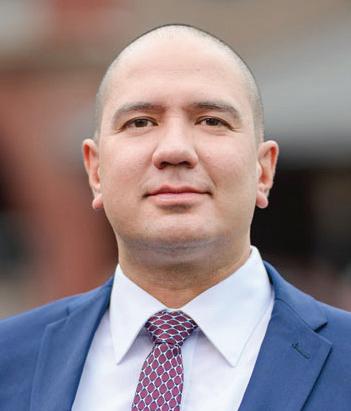
Paul Indyk is a member of Kerr Russell and Weber, PLC, and focuses his practice on medical malpractice defense and health care litigation throughout Michigan. He represents hospitals, physicians, and other health care providers in complex cases and works extensively on case strategy, expert development, discovery, and trial preparation.

















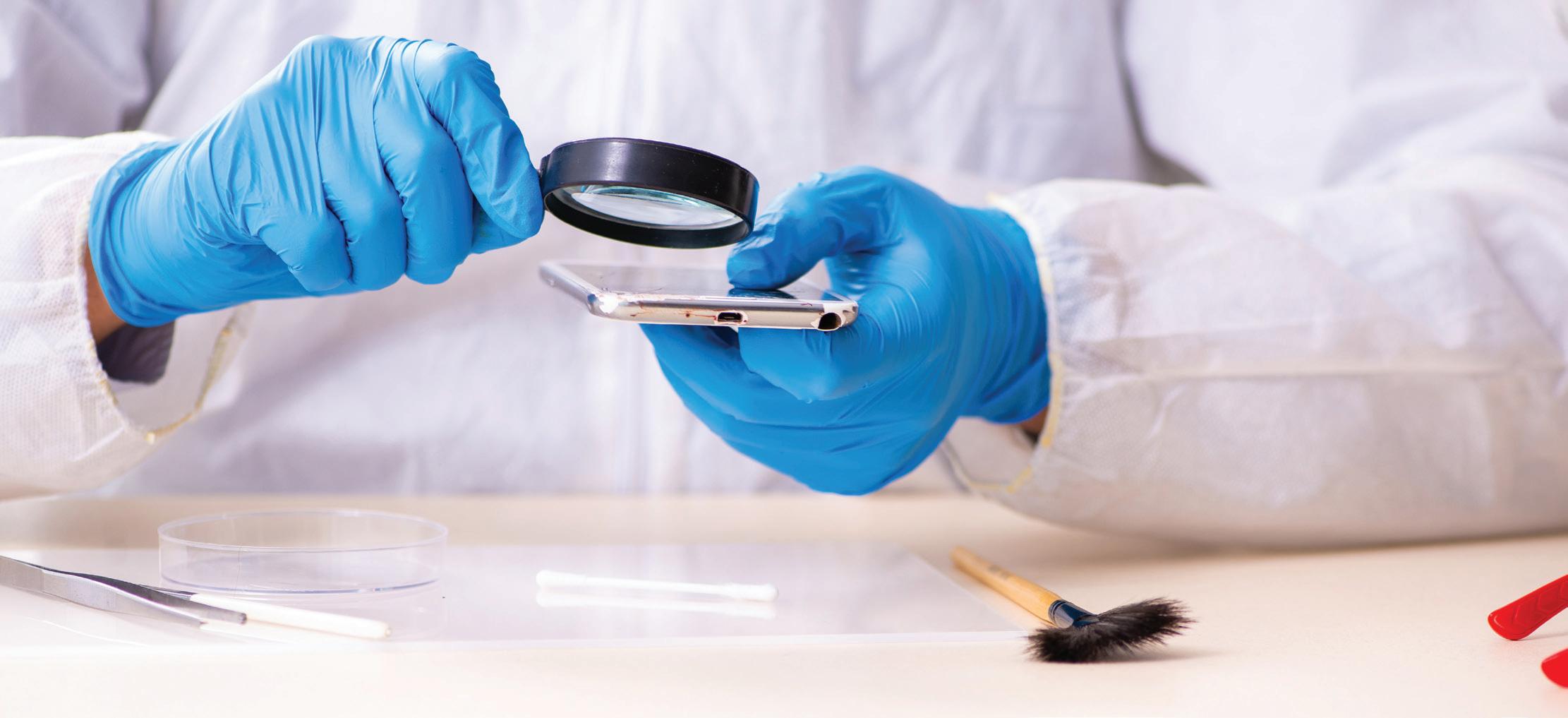
By Brandon Robert Barlog
The advancements in cellphones and other electronic-device technology seem to be changing by the minute. Today, with the increasing incorporation of artificial intelligence (AI) in many platforms, new ways to access and store data on these devices raise legitimate privacy concerns, especially regarding a device owner’s personal information. It has been nearly 12 years since the U.S. Supreme Court issued its opinion in Riley v. California, 573 U.S. 373 (2014). In Riley, the Supreme Court held that the police generally may not search digital information on a cellphone seized from an arrested individual without a warrant. As the court noted, “Modern cell phones are not just another technological convenience. With all they contain and all they may reveal, they hold for many Americans the privacies of life. The fact that technology now allows an individual to carry such information in his hand does not make the information any less worthy of the protection for which the Founders fought.” Riley, 573 U.S. at 403 (internal quotations and citations omitted). In fact, the court made the following observation: “The term ‘cell phone’ is itself misleading shorthand; many of these devices are in fact minicomputers that also happen to have the capacity to be used as telephones. They could just as easily be called cameras, video players, rolodexes, calendars, tape recorders, libraries, diaries, albums, televisions, maps, or newspapers.” Id. at 393.
To that end, perpetrators of crime use cellphones to further their criminal activities. For instance, a drug dealer may text a co-conspirator with the meetup location for a drug buy. A high school student could use Snapchat to record himself holding rearms and making threats against a school. In the worst case, a predator may capture pictures of nonconsenting individuals. Sadly, the possibilities are endless. It has now become second nature for law enforcement o cers to secure warrants to search electronic devices, speci cally cellphones. Failure to do so is essentially police malpractice. Since Riley, Michigan courts have grappled with how much phone data law enforcement agencies can access after obtaining a search warrant.

text messages between the defendant and another person discussing theft.
On July 31, 2025, the Michigan Supreme Court issued its opinion in People v. Carson, __ Mich. __ (2025) (Docket No. 166923). In Carson, the police obtained a warrant to search the contents of the defendant’s cellphone in connection with an investigation into the crimes of larceny in a building and safe-breaking. e four corners of the search warrant commanded law enforcement to search, in relevant part, “[a]ny and all records or documents pertaining to the investigation of Larceny in a Building and Safe Breaking … [and] [a]ny and all data including text messages, text/picture messages, pictures and videos, address book, any data on the SIM card if applicable, and all records or documents which were created, modi ed, or stored in electronic or magnetic form …” Carson Mich. at __; slip op. 13-14. During the execution of the search, police discovered incriminating
e Michigan Supreme Court held that the aforementioned language violated the Fourth Amendment’s particularity requirement. e court held that it could not “conclude that a practical reading of the search warrant at issue would su ciently inform an executing o cer how to reasonably conduct a limited and constitutionally particular search.” Carson __ Mich. at __; slip op. 18. e search warrant language, as presented, placed no temporal nor content-specic restraints on the search. “Requiring additional speci city in the text of a warrant ensures that executing o cers ‘reasonably direct’ their search ‘at uncovering evidence related to the criminal activity identi ed in the warrant …’” Id. at __; slip op. at 23 (citations omitted).1
As of March 2026, the only published case discussing the implications of the legal principles outlined in Carson is People v. Bogucki, __ Mich. App. __ (2025) (Docket No. 372629). In Bogucki, the defendant’s cellphone was seized during an

investigation of a homicide in which the victim was found bound by duct tape in a burning house. e police obtained a search warrant; its language contained many of the same “any and all electronic data” terms as the search warrant in Carson. A year later, after reviewing litigation in the Court of Appeals, police obtained a new search warrant for evidence in the defendant’s phone. e new warrant contained more particularized language and temporal guardrails. More importantly, the a davit for the new search warrant included new information, completely independent of the information from the prior warrant.
e Court of Appeals held that the new search warrant “was valid pursuant to the independent source doctrine because it drew from sources independent of the [prior] warrant, and therefore any property seized under that warrant does not harken back to the purportedly invalid [prior] warrant as its source.” Bogucki, __ Mich. App. at __; slip op. at 7. e court noted that “of all the facts contained in the [new] warrant, not a single one appears to have been obtained via the earlier search of defendant’s phone.” Id. at __; slip op. at 10.
As a result of Carson and Bogucki, there will undoubtedly be more litigation in the criminal law eld regarding the legality of search warrants for electronic data stored on cellphones and other digital devices. With the rise of AI and the seemingly limitless use of technology, questions remain about the balance between public safety and personal privacy. e answers to these questions will come in time.
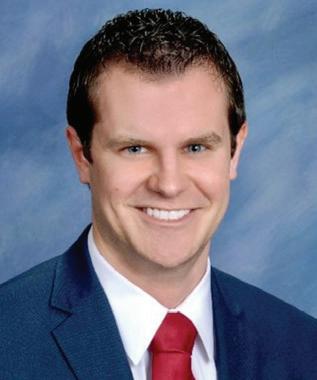
Brandon Barlog is currently the chief of the Appellate Division at the Oakland County Prosecutor’s O ce. Before becoming chief, Barlog served as an assistant prosecutor in the Circuit Court Division, where he handled many jury trials. He has been a member of the State Bar of Michigan since 2017. He is a graduate of the University of Michigan in Ann Arbor and Wayne State University Law School. You may reach him by email at barlogb@oakgov.com.
Footnote:
1. The Michigan Supreme Court remanded the case back to the Michigan Court of Appeals on an issue not relevant to this article.

By Alec Torigian
The legal profession is experiencing a fundamental shift driven by unprecedented access to artificial intelligence (AI). In a profession once constrained by research in legal libraries, paper files, fax machines, Dictaphones, and in-person communications, lawyers today operate in an environment in which vast bodies of legal information, analytical tools, and drafting assistance are available instantaneously. AI-enabled platforms provide newfound support to lawyers by increasing the efficiency of legal research, contract analysis, litigation strategy, forensic review, and practice management. These tools have allowed attorneys to work with greater speed and precision, scaling the practice like never before.
While the expanding ecosystem of technology cannot replace human legal analysis, it significantly augments it. Technological developments are reshaping efficiency, accessibility, and competitiveness across law firms and courts alike. The critical question is not whether AI will affect the justice system. Instead, the question is how courts and practitioners will regulate, authenticate, and responsibly integrate these tools into litigation and courtroom administration to drive innovation in legal practice.
Artificial intelligence refers to computer systems designed to perform tasks that normally require human intelligence. AI is capable of completing tasks that include pattern recognition, language processing, predictive analysis, and decision analysis. Over the past decade, AI has advanced rapidly, with organizations developing systems that can operate at a high degree of independence and assist with complex work. Today, AI-powered tools use machine learning and generative models that can analyze complex datasets, generate written or visual content, perform speech-to-text conversion, and identify patterns in forensic materials.1 In the legal field, AI tools are used to conduct research, draft documents, analyze contracts and case law, generate summaries and strategic analysis, enhance video and audio evidence, perform speech recognition, and assist in pattern-based forensic analysis. As the technologies become embedded in litigation and court administration, the legal implications become unavoidable. As the use of AI in the legal profession becomes more widespread, AI will be used to generate, enhance, or interpret forensic evidence in litigation. While tools can improve clarity and efficiency, they also raise foundational evidentiary questions on reliability, authentication, transparency, and admissibility.
Michigan Rule of Evidence 702 requires expert witnesses and testimony to use reliable principles and methods obtained by the person’s knowledge, skill, experience, training, and/or education.2 AI systems complicate this analysis. Many AI tools rely on proprietary algorithms that are not fully transparent and are subject to confidentiality. Courts and counsel may lack access to information regarding how the AI systems are trained and how the algorithms are employed, as well as errors, bias, or validation studies. Without transparency, it becomes difficult to assess whether system outputs meet reliability standards that the Michigan Rules of Evidence require of experts under MRE 702.
Further complicating matters is the distinction between enhancement and alteration. For example, an AI-enhanced video may clarify blurred footage, but it may also generate approximations. At what point does enhancement become reconstruction? If AI “fills in” gaps, is the output still real evidence, or does it become demonstrative? At its core, many AI systems generate probability-based outputs from pattern recognition rather than direct observation. For example, blurred black-and-white security camera footage of a suspect wearing a mask could be enhanced to provide insight into a suspect’s actual facial features based on limited exposure, but does this provide a reliable piece of evidence, or is it simply a guess based on millions of inputs and outputs through proprietary algorithms trained on extensive datasets? The answers to these questions are vital to accessing probative value and admissibility of evidence.
The “expert” level review adds a new analysis for the courts. Courts must determine whether AI outputs are substantive admissible evidence, whether they are a demonstrative aid or hearsay, and whether there is any ability for opposing counsel to cross-examine on the evidence. These tools are being utilized in the judicial system, and they present a difficult challenge striking at the heart of evidentiary integrity. Before we can permit the use of AI tools, we must reevaluate our ethical and procedural rules.
Beyond the reliability concerns of MRE 702, AI raises equally complex concerns under traditional
evidentiary safeguards such as authentication, chain of custody, and disclosures.
Authentication: AI introduces new complexities into traditional evidentiary safeguards. The Michigan Rules of Evidence, specifically MRE 901, require “authenticating or identifying an item of evidence, which the proponent must produce evidence sufficient to support a finding that the item is what its proponent claims it is.”3 When AI tools are used, authentication becomes more complex. There are additional questions that must be asked: What created the evidence? Can a computer-generated output be authenticated? Must the proponent produce evidence on the reliability of the AI tool or algorithm? There is an endless list of questions that courts and lawyers could ask for purposes of authentication, and courts will need to evaluate the answers for purposes of evidentiary issues. As legal professionals, we must be in front of these issues. The Michigan Judicial Council, judges, lawyers, and Michigan Rules Committees will need to evaluate and adopt heightened authentication standards for the use of AI, especially when using tools for generative purposes.
Chain of Custody: AI-enhanced or AI-generated forensic materials require careful documentation. The chain of custody must now account for the tools used, versions, processing, human inputs or prompts used, and storage of the analysis. Without this information, reliability challenges will be frequent. In a profession centered on ethics and transparency, the judicial system may need to impose additional disclosure requirements for presentations of evidence.
Disclosures: To ensure fairness and trans-
parency, courts may require expanded pretrial disclosures — including disclosure of whether AI has been used, sign-off on acknowledgments of errors and limitations, and disclosure and documentation of any generative AI analysis. Currently, the Michigan Court Rules and Michigan Rules of Evidence do not address these concerns, but Michigan courts may consider formal guidance or rule amendments to standardize these disclosures. However, Michigan judges have already been openly skeptical about requiring disclosures due to enforcement concerns, so expect these conversations to be at the forefront of committee meetings.4
AI’s impact is not limited to evidentiary disputes. It is also reshaping how courts operate procedurally and administratively.
Remote Proceedings: AI is not limited to evidentiary issues. It also affects court operations. Since COVID, remote and hybrid proceedings have been part of our daily routine. The pandemic accelerated this process, and now these are permanent features of the Michigan judicial system. AI tools can be used to support real-time transcription, scheduling, case flow, and evidence presentation. However, for nonadministrative matters, standards must be adopted to ensure reliability.
Speech-to-Text
Shortages: Michigan, like many jurisdictions, faces a shortage of court reporters. AI-powered speech-to-text systems may offer partial solutions by generating real-time transcripts. Yet challen-

ges remain. ere are accuracy issues in multispeaker environments, dialect and accent bias, technical terminology errors, and veri cation and certi cation standards. If AI transcription tools are adopted, clear standards must de ne how transcripts are reviewed, certi ed, and preserved.
Cybersecurity: As courts adopt AI-driven tools, cybersecurity risks increase. Sensitive case data processed through AI systems may be vulnerable to data breaches, unauthorized data retention, cloud-based exposure, and third-party risk. Courts and law rms must implement robust cybersecurity policies, vendor vetting procedures, and data governance protocols to avoid exposure to unauthorized disclosure.
What Michigan Lawyers Need to Know e Michigan Rules of Professional Conduct require lawyers to maintain the requisite knowledge and skill regarding “existing and developing technology” that are “reasonably necessary to provide competent representation for the client.”5 Michigan lawyers must understand how to comply with ethical rules while using AI. At the end of the day, the lawyer is responsible for the technology used in representation, including the consequences. Michigan lawyers must educate themselves to understand the capabilities and limitations of AI, verify AI outputs, ensure con dentiality is protected, avoid blind reliance on automated analysis, and supervise AI usage consistent with their ethical duties. It is the lawyer who remains responsible for the representation, not the computers. e State Bar should consider continuing legal education and judicial webinars to ensure that Michigan attorneys are technologically competent.
Practical Implications for Experts
Forensic experts using AI-assisted tools should anticipate heightened scrutiny. Courts may increasingly require detailed methodological explanations, validation documentation, transparent discussion of limitations, expanded voir dire on AI methodologies, and pretrial admissibility hearings to avoid bias. Having an expert who can clearly explain how AI tools operate without overstating their reliability will better position parties to withstand evidentiary challenges. Courts may also bring in court-appointed experts to provide a neutral disclosure to juries on complex AI-related admissibility disputes.
Access and Equity Considerations e integration of AI raises broader legal concerns, such as widening disparities for smaller rms or underserved communities. Michigan Courts have acknowledged access concerns, and Harvard Law School has been at the forefront of accessibility issues.6 “One of the key challenges in all of this is going to be that access to the
kinds of legal tools that AI can provide are not going to be equally available.” While AI has the potential to improve access, the most sophisticated (and most expensive) tools will likely remain in the hands of well-resourced parties, allowing them to leverage technology for an even greater advantage.7
If smaller rms or underserved communities lack access to comparable technology, there will be a fundamental equity issue created by the use of these systems. If we choose to adopt these systems, we must ensure equitable access to court technology, provide resources for underserved jurisdictions, and avoid technological barriers that disproportionately impact litigants. AI tools should be used to enhance the justice system, not favor certain parties or restrict access to justice.
e Michigan Judicial Council has authored a report and recommendations for generative AI in the courts8 with the goal of exploring how AI technology has entered the legal practice and the growing need for it. Michigan courts are already grappling with the authenticity and reliability of AI-in uenced evidence.
e Michigan Court Rules and Michigan Rules of Evidence were not drafted with AI in mind. As AI-generated or AI-assisted evidence becomes more common, the Michigan Court Rules and Rules of Evidence will require modernization. e State Bar of Michigan should consider whether AI-generated evidence should be admissible at all, whether courts should adopt standards for AI reliability, whether AI outputs constitute hearsay, and whether Michigan should adopt forward-looking evidentiary rules speci c to AI. e current landscape of AI tools is only the beginning. ese technologies are here to stay. e profession must either adapt thoughtfully or risk falling behind evolving practice standards.
e State Bar can take a forward-looking approach, which may include clarifying standards for AI, mandatory disclosures, uniform authentication protocols, and limitations on AI’s use in trials or evidentiary proceedings compared to its use in preparation. Without uniform guidance, our profession risks having inconsistent standards and rulings across jurisdictions within the state of Michigan.
Arti cial intelligence is not a future issue for Michigan courts but a present reality. From AI-enhanced forensic evidence to courtroom transcription systems and remote proceedings, the justice system stands at a technological in ection point. e challenge is not whether to adopt AI
but how to integrate it responsibly. Courts must safeguard reliability, transparency, authentication, and due process. Rulemakers must evaluate the Michigan Rules of Evidence and Court Rules to re ect forward-looking standards. Lawyers and experts must embrace both innovation and accountability.
AI o ers powerful tools to improve e ciency and analytical capacity within the justice system. However, without careful regulation, disclosure, and judicial oversight, those same tools could undermine evidentiary integrity and the judicial system. e path forward requires thoughtful rulemaking, professional education, and a commitment to balancing innovation with fundamental fairness.
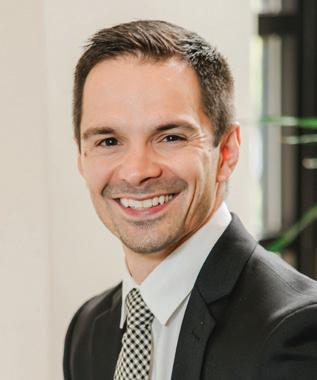
Alec Torigian is a partner at Paesano Akkashian, PC, where he focuses on complex business and commercial litigation. He litigates high-stakes disputes in state and federal courts, including matters involving expert testimony, digital evidence, and complex procedural challenges. Torigian has a particular interest in emerging technology and evidentiary standards, including forensic and AI-related issues. He has been recognized by Michigan Lawyers Weekly as a “Go To Lawyer” for business litigation, as well as a Michigan Super Lawyers Rising Star.
Footnotes:
1. Marr, Bernard. “The Vital Difference Between Machine Learning and Generative AI.” Forbes, June 25, 2024. forbes.com/sites/bernardmarr/2024/06/25/the-vitaldifference-between-machine-learning-and-generative-ai
2. Michigan Rules of Evidence, Rule 702.
3. Michigan Rules of Evidence, Rule 901.
4. Michigan Judicial Council. Generative AI and the Courts Workgroup Report and Recommendations Michigan Courts, October 2024. courts.michigan. gov/4aec3b/siteassets/committees-boards-specialinitiatves/michigan-judicial-council/2024-genai-wgreport.pdf
5. Michigan Rules of Professional Conduct, Rule 1.1.
6. Michigan Judicial Council. Generative AI and the Courts Workgroup Report and Recommendations Michigan Courts, October 2024.
7. Neal, Jeff. “The legal profession in 2024: AI, Havard Law Today” (February 14, 2024) hls.harvard.edu/today/ harvard-law-expert-explains-how-ai-may-transformthe-legal-profession-in-2024 (accessed November 4, 2024).
8. Michigan Judicial Council. Generative AI and the Courts Workgroup Report and Recommendations Michigan Courts, October 2024.
e mission of the Oakland County Bar Association is to serve the professional needs of our members, enhance the justice system, and ensure the delivery of quality legal services to the public. We ful ll our mission through our 30 committees, regular networking events, and numerous educational programs for both OCBA members and the public. We work hand in hand with the OCBA volunteer board directors and members, and we partner closely with the courts.
Below are recent examples of the OCBA at work in service to the bar and to the community.
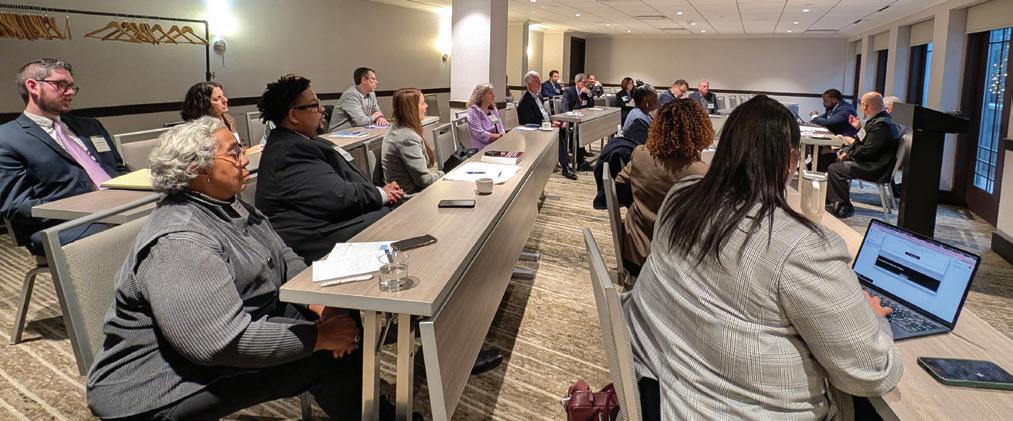
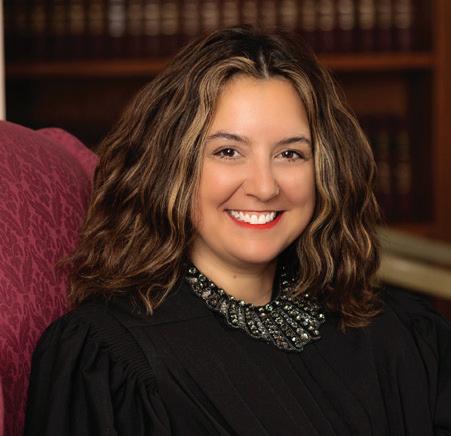
On March 12, the OCBA hosted its latest Luncheon Limine, an exclusive, behind-the-bench conversation with three visiting judges from the Sixth Judicial Circuit Court. Hon. James M. Alexander (ret.), Hon. Amy Ronayne Krause (ret.), and Hon. Wendy L. Potts (ret.) presented rsthand tips, insights, and preferred courtroom practices. Victoria King moderated the virtual event while several of the nearly 50 participants asked questions in this open, informal discussion of real-world legal issues and advocacy strategies.

ree judges from the Michigan Second District Court of Appeals — Hon. Sima G. Patel, Hon. Christopher M. Trebilcock, and Hon. Adrienne N. Young — shared practical, candid insights into what makes written and oral appellate advocacy e ective. More than 35 OCBA members attended this lunchtime virtual seminar on March 25, moderated by Sam G. Lamrock of Collins Einhorn Farrell. Participants gained concrete, actionable guidance on improving issue selection, brief writing, and oral arguments to strengthen their overall appellate practice.


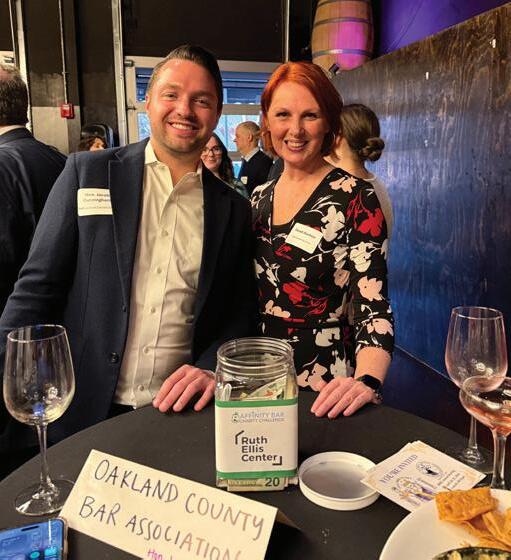
Nearly 80 members of the OCBA, the Oakland Women’s Bar Association, and seven other a nity bars, along with “guest” judges, raised money for various charities on March 19 at Pop’s for Italian in Ferndale. Each bar association represented a charity, and attendees cast votes for their favorite bar association by donating cash “tips” to the association’s “tip jar,” all while networking and enjoying delicious food. e bar association that received the most tips won the challenge and received an additional donation to its charity. e winning bar association, Women Lawyers Association of Michigan (Macomb), raised the most for its charity, Turning Point Macomb, with nearly $3,000. e OCBA raised nearly $1,300 for its charity, Ruth Ellis Center. A total of $8,863 was raised and distributed to nine charities.


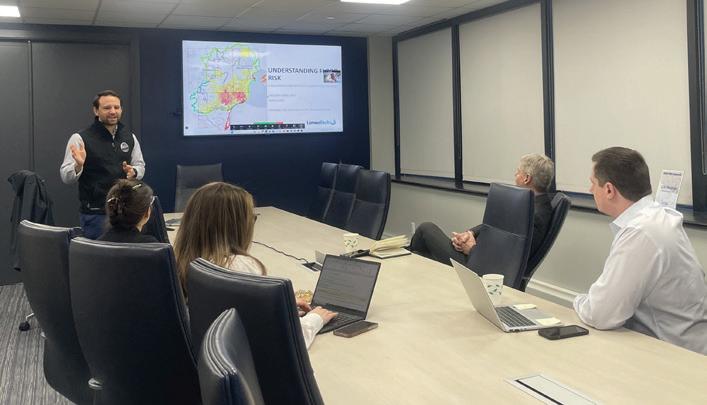
At the Energy, Sustainability and Environmental Law Committee’s March 18 meeting, Dr. Gregory Ewing, Ph.D., of LimnoTech presented on “Understanding Flood Risk” from a qualitative perspective. Dr. Ewing, a civil and hydroinformatics engineer, discussed the types of ooding engineers consider, how risk metrics are developed and communicated, and key assumptions and caveats — all important for understanding where opportunities for mitigation may exist. He also talked about emerging data, tools, and scienti c advances shaping the assessment of ood risks.
Aturkey chased me in the parking lot this morning. It wasn’t the rst time, but it only happens in the spring. ere are other signs of spring, such as other birds — much nicer birds — singing their prettiest songs. e grass is getting greener, and the temperature is on the rise. But squaring o with a longbeard at 7 a.m. while my hands are full has a way of getting my attention. He saw an opportunity, and he took it; I’ll give him that. My early-morning confrontation with that mean ol’ tom got me thinking: Are there opportunities at the Probate Court that you are not taking? e opportunities I have in mind are court appointments as attorney on contested matters, as guardian ad litem (GAL) on various probate matters, and as special duciary when the occasion arises. Here, I will review the payment processes for each in hopes that you will ask for these appointments in the future, if you don’t already. ey are a great way to acquire experience, gain familiarity with the court, and build relationships with attorneys you will inevitably see on future matters. Appointed attorneys or GALs submit a Statement of Service and Order for Payment form, also commonly termed a “voucher,” to the court business o ce for payment. Vouchers must be submitted via email to voucher@oakgov.com . Paper vouchers are no longer accepted. Please ensure that the business o ce can verify the services you rendered through the report you submit and the hearing you attend — or, if one of those is missing, the judge’s order. If you did all that was required of you, but you didn’t submit a report or appear at a hearing, you should make the judge or a member of the judge’s sta aware so they can include payment instruction to the business o ce by way of the order or disposition sheet. If you have any questions or payment issues, please feel free to email me at huttone@oakgov.com . Whether to bill the county or estate often causes some confusion, especially
By Edward A. Hutton III
when asking for extraordinary fees. Sometimes it is too close a call for the appointed attorney or GAL to make. I will use a GAL appointment as an example to walk through the process. Anything in bold in this article indicates an area in which mistakes are commonly made.
Generally speaking, the court will pay a basic $250 fee for a typical GAL appointment on a matter involving an estate with insu cient funds to pay fees. At the very least, this payment covers a reasonable number of telephone calls to and from the interested and necessary persons, a visit to the ward or proposed ward, a timely led GAL report, and an appearance at the appropriate hearing. ere may be some additional minor action required, but this is, more or less, the most common sequence of events for a typical GAL appointment.
which is where the completed forms should be submitted. ese invoices must be submitted within 60 days after the case is closed or the appointee is dismissed. e court will pay an excess travel payment if you drove 50 or more miles in the execution of your duties on one court matter. e court’s address is considered your starting and ending point for calculating mileage. If you drove 50 to 74 miles, you will receive an excess mileage payment of $25; 75 to 99 miles, an extra $37.50; and 100 or more miles, an additional $50. If you request excess travel pay, you must include a map showing your route and distance traveled along with your payment voucher. No map, no excess mileage payment.
Once the GAL has completed their duties, and if the estate lacks the funds to pay fees, the appointee may invoice the county using the appropriate form. Attorneys on mental health matters must submit the form PEMH 1092a, Statement of Services and Order for Payment — Mental Health. All other attorneys and GALs on non-mental health matters must submit the form PEMH 1092, Statement of Services and Order for Payment — General Probate. Both forms can be found on our website under “Resources,” then “Doing Business with Probate.” Blank copies of these forms are also available in the business o ce,
Finally, this brings me to billing for extraordinary fees, where most of the confusion lies. From time to time, an appointee may be appointed on a matter that is much more labor intensive than normal. Minor guardianships come to mind. ey often involve much more work and time than a typical adult guardianship or conservatorship. If the judge orders that the GAL can bill the court for extraordinary fees, the GAL can bill for services rendered at a rate of $75 per hour. e GAL must provide an itemized invoice. is part is important — the appointee may only bill at a rate of $75 per hour for services rendered above those anticipated in a typical appointment (i.e., all the stu that the normal $250 covers). Each service rendered beyond that should be individually itemized using tenths of an hour. e total should be calculated starting with the $250, then extraordinary fees plus any excess travel payment due.
It is important to note that the judge reviews requests for extraordinary fees and may pay, reduce, or reject them.
Hopefully this article helps. If you have questions, please call the court, and someone will be happy to assist you.
Edward A. Hutton III is the Oakland County Probate Court administrator.
3/23/2026
3/9/2026
3/16/2026
O'Brien
2024-208611-NH
David Legrone v. Family Foot & Ankle Specialists
Anderson
Brennan
Matis
Matis
Valentine
2024-210811-NO
Sherri Moss v. Lakeview Apartments
2024-291283-FC
People v. Harris
2025-295211-FC People v. Anderson
2025-292657-FH People v. Carmisino
2025-295919-FH
People v. Rivera-Baez
3/9/2026
Warren
2025-295325-FH
People v. Moore Jr.
3/23/2026
Warren
2024-291644-FC
People v. Jennings
3/24/2026
AlexanderVisiting Judge
3/23/2026
Brian McKeen
Jared Trust
Lawrence Falzon
R. Carl Lanfear
Andrew McGarrow
Mitchell Ribitwer
Mahira Musani
Jeffrey Quas
Mahira Musani
Neil Rockind
Andrew Starr
Leonard Ballard
Alec D'Annunzio
Dany Batti
Sarah Greene
Jordan Zuppke
2024-210821-NI
Daril Williams v. Linda Kolar
Ronayne KrauseVisiting Judge
2025-292803-FC
People v. Payne
Marc Mendelson
Allison Lazette-Magnan
Ashley Jargis
Mark Williams
Endrit Topalli
Nicole Blank Becker
Medical Malpractice
Personal Injury
as
Ct. 1 Carjacking, Ct. 2 Agg. Assault, Ct. 3 DWLS, Ct. 4 Larceny from Person
M/V Intent to Pass False Title, Stolen Property R/C $1k -$20k
Ct. 1 Breaking & Entering, Cts. 2, 4, 6 Weapons - FF, Ct. 3 Fel. Aslt, Ct. 5 Weap. FA - Poss. by Prohib. Per.
Police Officer - Fleeing4th Degree, Operating w/ out License - Second or Sub. Off., Reckless Driving
Open Murder, Child Abuse 1st Degree, Weapons FA Poss. by Prohib. Pers., Lying to Peace Officer
Personal Injury/Auto Negligence
Ct. 1 AWIM, Cts. 2, 4, 6 Weapons FF, Ct. 3 Weap.FA Discharge from MV, Ct. 5 Weap. - FA Poss. by PP, Ct. 7 CCW Armed Robbery
Cts. 1, 4 Not Guilty, Cts. 2, 3 Guilty
Guilty In Progress
Ct. 1 Guilty of 1st Degree Felony Murder, Cts. 2, 3 Guilty In Progress


July 4, 2026, marks the 250th anniversary of the Declaration of Independence. Unique in world history, the declaration not only establishes a new nation but also announces a governing philosophy for the entire world to see. In nearly magical words, the document declares the following as self-evident truths:
… that all men are created equal, that they are endowed by their Creator with certain unalienable Rights, that among these are Life, Liberty and the pursuit of Happiness.--That to secure these rights, Governments are instituted among Men, deriving their just powers from the consent of the governed,--That whenever any Form of Government becomes destructive of these ends, it is the Right of the People to alter or to abolish it, and to institute new Government, laying its foundation on such principles and organizing its powers in such form, as to them shall seem most likely to effect their Safety and Happiness.
The declaration eternally transforms our understanding of equality, liberty, and the proper role of government. Its revolutionary philosophi-
By Judge Michael Warren
cal framework is the bedrock of the Constitution and our system of self-government. America was birthed on the founding First Principles of the rule of law, unalienable rights, limited government, the social compact, equality, and revolution (the right to alter or abolish an oppressive government).
There is little question that despite its importance, the declaration is only superficially taught and understood. This is especially true of its grievances against the king and Parliament. Without the grievances, the rest of the declaration is just a beautiful, empty shell of wonderful poetry. Most people can identify only a couple of grievances, such as taxation without representation and the quartering of troops. In reality, there are 28 grievances (and like interrogatories, there are many subparts), and they are all vitally important. Americans rebelled against a bloody tyranny, and the grievances explain why. Many issues that the founders confronted in 1776 echo throughout the ages — including today.
I will not review each grievance here (you will have to buy my book for that), but a few highlight what is at stake, demonstrate how complicated the founders are, and reveal historical complexities that nearly no
Americans understand.
Grievance 1: He has refused his Assent to Laws, the most wholesome and necessary for the public good. In the British Empire, colonial legislation required the consent (assent) of the king. King George III refused to approve colonial legislation that was vital to the colonists’ welfare. Surprising to modern ears, a key complaint regarded the king’s refusal to approve colonial laws, including in Virginia, to suppress the slave trade. The trade’s benefits to the Empire compelled the king to refuse to approve these laws. Slavery is hardly the only topic of refusal. The king withheld assent to colonial legislation addressing the naturalization of immigrants, issuance of bills of credit, compensation of victims of the Stamp Act riots, payment of government officials’ salaries, emission of colonial paper currency, immigration of convicts to the colonies, colonial representatives to Parliament, and even divorce. King George III subverted self-government.
Grievance 8: He has obstructed the Administration of Justice, by refusing his Assent to Laws for establishing Judiciary powers. Unlike the courts of today, colonial courts required periodic legislation to continue operations. While considering such legislation, the North Carolina Legislature determined to continue foreign creditors’ ability to collect judgments against property in North Carolina. The king refused to assent to this legislation, and the North Carolina courts shut down in 1773. They would not reopen until after the declaration. The king eviscerated justice and colonial self-rule by forcing the courts to permanently close.
Grievance 18: For depriving us in many cases, of the benefits of Trial by Jury. Britain repeatedly subverted this fundamental right in the Sugar Act of 1764, the Stamp Act of 1765, and the Vice Admiralty Act of 1768, which eliminated the sacred right to the jury. As the British imposed oppressive measures, they enforced them before judges who were accountable to the king and served solely at his pleasure. The empire quashed the jury, a bulwark against tyranny and a safeguard of justice.
Grievance 13: He has combined with others to subject us to a jurisdiction foreign to our constitution, and unacknowledged by our laws; giving his Assent to their Acts of pretended Legislation. Parliament’s Declaratory Act issued in the wake of the Stamp Act crisis claimed its authority to legislate for the colonies in all cases whatsoever. e colonial legislatures mattered not a whit so long as Parliament determined to impose its will. And it did. Self-government in the colonies was annihilated.
Original Grievance 27: He has waged cruel war against human nature itself, violating its most sacred rights of life & liberty in the persons of a distant people who never o ended him, captivating & carrying them into slavery in another hemisphere, or to incur miserable death in their transportation thither. is piratical warfare, the opprobrium of in del powers, is the warfare of the CHRISTIAN king of Great Britain. Determined to keep open a market where MEN should be bought & sold, he has prostituted his negative for suppressing every legislative attempt to prohibit or to restrain this execrable commerce: and that this assemblage of horrors might want no fact of distinguished die,
he is now exciting those very people to rise in arms among us, and to purchase that liberty of which he has deprived them, & murdering the people upon whom he also obtruded them; thus paying o former crimes committed against the liberties of one people, with crimes which he urges them to commit against the lives of another. In a move steeped in deep irony, slaveholding omas Je erson’s original draft vehemently condemned the slave trade. To its shame, the Second Continental Congress rejected this remarkable passage at the behest of South Carolina and Georgia.
All 28 grievances are similarly striking. ey also constitute the bulk of the declaration. Still, most are ignored.
Indeed, America’s most important document is largely forgotten, misunderstood, and even attacked. e di cult reality is that K-12 schools hardly teach the declaration — and it is too often taught poorly. America’s social studies scores are stubbornly abysmal. Universities obsess over politically correct historical narratives and perspectives while generally ignoring, distorting, or attacking the declaration. Large swaths of
citizens are ungrounded in our common heritage — or worse, despise it.
Ignorance and disdain are fueling a crisis in the American spirit that threatens the nation’s very survival. We are fools to think we can survive as a free nation without understanding our foundation.
e declaration is a spectacular guide to better understanding our place in the universe (for example, that we are endowed by the Creator with unalienable rights) and improving ourselves and those around us. If we are to become the best people we can be, the declaration is a wondrous, vital pathway. If we are to preserve our republic, it is the only way.
Hon. Michael Warren has served on the Oakland County Circuit Court for more than 23 years. He is the co-founder of Patriot Week (patriotweek.org) and the author of e Revolutionary Words that Forged America: e De nitive Guide to the Declaration of Independence (Republic Books, 2026).





Like so many things, my term as the Oakland County Bar Foundation’s president came and went faster than I anticipated. From the beginning through the end of the one-year term, I felt humbled to serve in a leadership position of such a respected organization within our legal community.
For my last contribution to LACHES in this space, I had little desire to write about my own experience (I merely tried to continue the pattern of service, stewardship, and care of my predecessors) and instead wanted to think

The Oakland County Bar Foundation’s mission is to ensure access to justice and an understanding of the law in our community. It is dedicated to:
— Improving and facilitating the administration of justice in Oakland County and throughout the state of Michigan;
— Ensuring to the fullest extent possible that legal services are made available to all members of the public;
— Promoting legal research and the study of law as well as the diffusion of legal knowledge;
— Promoting the continuing legal education of lawyers and judges; and
— Educating the public as to their legal rights and obligations, and fostering and maintaining the honor and integrity of the legal profession.
If you know an organization that could use assistance to pursue these goals within Oakland County, please refer them to ocba.org/ocbfgrants, where they can find information about applying for a grant from the foundation.
By Andrew M. Harris
about the principle of service, along with the timeless impact of ideals in the law. As is often the case, the content connecting this theme to an article did not come easily. is time, it came to light only after I navigated toward the end of Ken Burns’s six-part series on the Revolutionary War, which aired on PBS several months ago (and which I nished only recently due to the convenience of DVR).
I would be remiss if I did not rst convey my deep admiration for Ken Burns. Whether he’s documented the Civil War, baseball (my favorite), jazz, World War II, the Revolutionary War, or another richly American theme, I appreciate the level of detail, the reliable content, the musical backdrops, and the methodical pace of his great contributions to our culture. Frankly, I worry that our current methods of content consumption and shortening attention spans caused by our addictive phones create an environment in which people see Burns’s work less often. I will, however, leave these “Dad laments” for another time.
So many aspects of Burns’s Revolutionary War series resonated with me. First, I was struck by how little I actually knew about the war — the sometimes sanitized versions we learned in school or read elsewhere barely scratch the surface of the multifaceted aspects of the war. Some of the complexities the series covered involved internecine con icts among the colonists — some wanted to stay loyal to England, while others wanted to pursue independence. I learned more about the roles Native Americans ful lled for the Revolutionary army, the circumstances surrounding France’s involvement, the Hessians hired by England, and so much more told from many di erent perspectives. Stories of the horrible violence, su ering, disease, and death of war o ered a healthy (albeit unpleasant) reminder of what others su ered for our country.
I have to admit that the most intellectually stimulating aspect of the series was the almost unexplainable con ict between the burgeoning American ideals of democracy (even if our government wasn’t yet formed) pitted against
many of our founders’ contradictory behavior. For example, it perplexes me — and, I am sure, countless others — that the author of our Declaration of Independence could own slaves.
In 2026, the idea that someone could enslave another human being is, for any decent person, entirely revolting. We should all be grateful for those who sacri ced so much during the Civil War to put a legal end to this abhorrent practice (via the 13th Amendment), those who fought in the following century throughout the Civil Rights Movement, and all those who continue the ght today for equality and social justice.
And while much needed to change on this issue from nearly 250 years ago, a common thread remains, a connection that — even with our driverless cars, at-screens, phones, air travel, Zoom hearings, and rapidly rising use of AI — remains timeless. It is the idea of a government for the people run by the people — a system of justice, due process, and equality under the law.
ese themes propelled me to law school 26 years ago and fuel me more than anything else in this profession. Yes, much of the workday for me and many others is devoted to satisfying commercial clients’ needs, handling administrative matters at the o ce, and entering billable time.
ese tasks are incredibly important, and the best in our profession accomplish them seriously and professionally. When we take a step back and re ect, however, we realize this work ows from our system of government and, while at times attenuated, remains inextricably linked to the rule of law in our constitutional democracy.
I am grateful that the foundation is so closely aligned with extending the ideals of government to those who are left behind far too often. Unfortunately, many factions of our society are either uninformed or denied access to justice, but in ful lling our mission, the countless hours of our attorney (and non-attorney) volunteers, our dedicated sta , generous donations, and the noble work of our donees all help form a more perfect union.
It has been an honor to be the president of such a worthwhile organization. e work brought me closer to so many of you and, more importantly, brought so many others closer to the ideals fought for during the Revolutionary War. ank you once again to Ken Burns for your good work.
Andrew M. Harris is a shareholder with Maddin, Hauser, Roth & Heller P.C. in South eld, where his practice includes business litigation, commercial real estate, estate planning, probate work, and property tax services. Harris is also a licensed civil mediator. He lives in Birmingham (where he was once mayor) with his wife (Ti any), two teenage sons (Roger and Russell), and two dogs (Maizey and Blue).
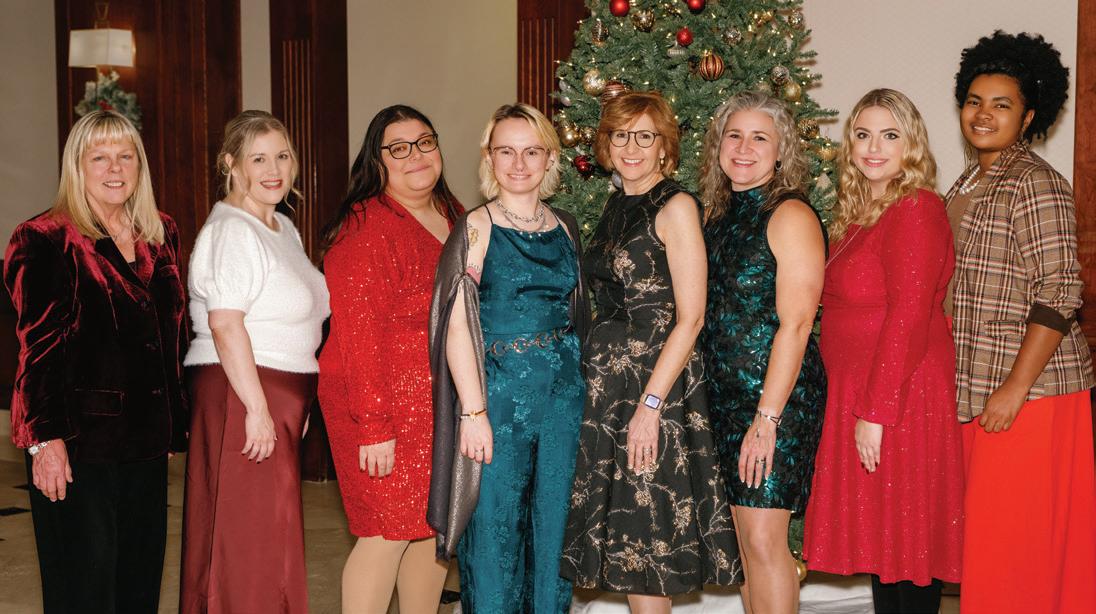
Executive Director
Jennifer Quick (jquick@ocba.org)
Deputy Director
Katie Tillinger (ktillinger@ocba.org)
Finance Director
Susan Maczko (smaczko@ocba.org)
Programs Manager
Cristin Doble (cdoble@ocba.org)
Court and Public Services Manager
Janise Thies (jthies@ocba.org)
Marketing Communications Specialist
MB Cairns (mcairns@ocba.org)
Marketing Associate
Alexa Enders (aenders@ocba.org)
Bookkeeper
Mayly McRae (mmcrae@ocba.org)
Laches and Foundation Administrator
Lori Dec (ldec@ocba.org)
Court and Public Services Administrator
Melak Mardo (mmardo@ocba.org)
Administrative Assistant
Beatriz Rivard (brivard@ocba.org)
Unless otherwise indicated, please call (248) 334-3400 for assistance.
Address Changes
Billing
Board of Directors
Case Evaluator Applications
Committees
District Court Case Evaluation
Event Photos
Finance
Inns of Court
Judicial Candidate Fora
Laches Magazine
Lawyer Referral Service – (248) 338-2100
Member Illness & Death Notification
Membership
New Lawyer Admissions




Alexis Amy
McKenna H. Balian
Zainab Boxwala
Carmen DeFranco
David M. Dell
Thomas P. Forgione
Katherine Gordon
Laila Hamad
Mayly McRae
Mayly McRae
Jennifer Quick
Janise Thies
Katie Tillinger
Janise Thies
MB Cairns
Susan Maczko
Cristin Doble
Janise Thies
Jennifer Quick
Melak Mardo
Katie Tillinger
Katie Tillinger
Katie Tillinger
News Releases .................................................................
MB Cairns
Oakland County Bar Foundation ................................Katie Tillinger
OCBA Mediation Service
OCBA Policies
Pro Bono Mentor Match Program
Professional Development/CLE
Room Rental Reservations
Speakers Bureau
Volunteer Opportunities
Website
Janise Thies
Jennifer Quick
Janise Thies
Cristin Doble
Mayly McRae
Janise Thies
Janise Thies
Jennifer Quick
Danielle J. Heinz
Kevin B. Hirsch
Rola I. Khanafer
Donna M. MacKenzie
Michael C. McDaniel
Olivia Mihajlovski
Brenda K. Ohryn
Nathan Robbins
Paige Ryterski
Anthony J. Scalise
Loren S. Shevitz
The Oakland County Bar Association’s 2026 District Court Bench/ Bar Conference, held on March 20, brought together nearly 90 attorneys and judges for a dynamic half day of learning, collaboration, and connection. The program focused on practical insights for district court practitioners, offering a well-rounded mix of substantive legal education and real-world perspective from the bench. Attendees engaged in thoughtful discussions on emerging issues, courtroom practice, and procedural nuances — including a session on the growing role of artificial intelligence in legal practice that explored useful applications alongside ethical considerations — all designed to strengthen day-to-day effectiveness and elevate the quality of advocacy.
Beyond its educational value, the conference provided meaningful opportunities for interaction between members of the bench and bar, from the two open networking segments to the engaging presentations and informal conversations throughout the morning.
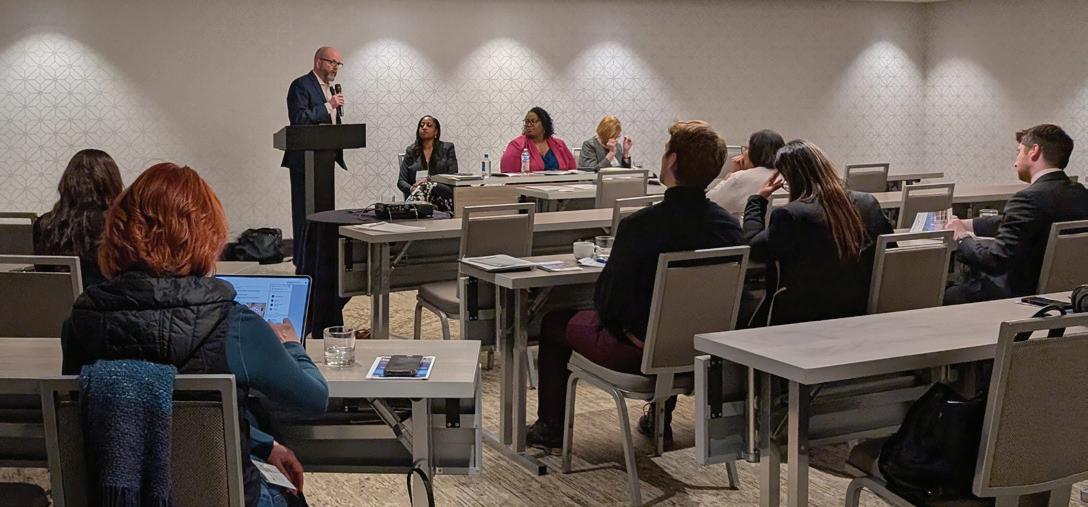
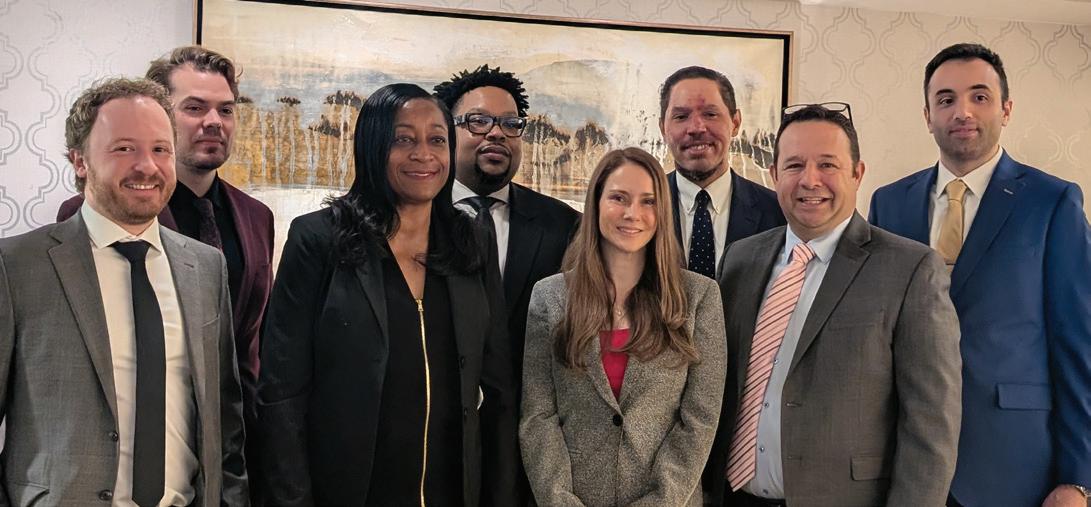
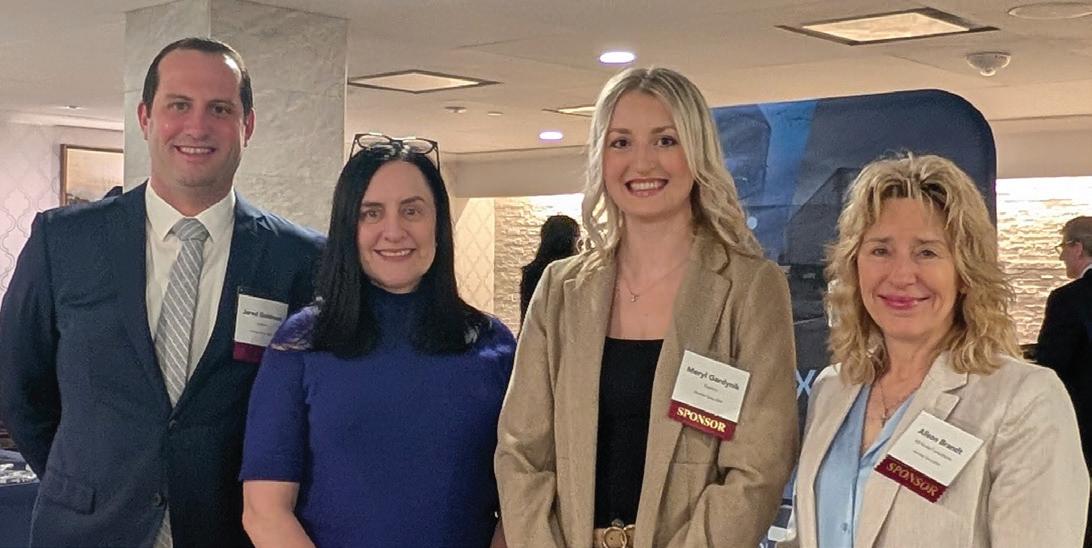
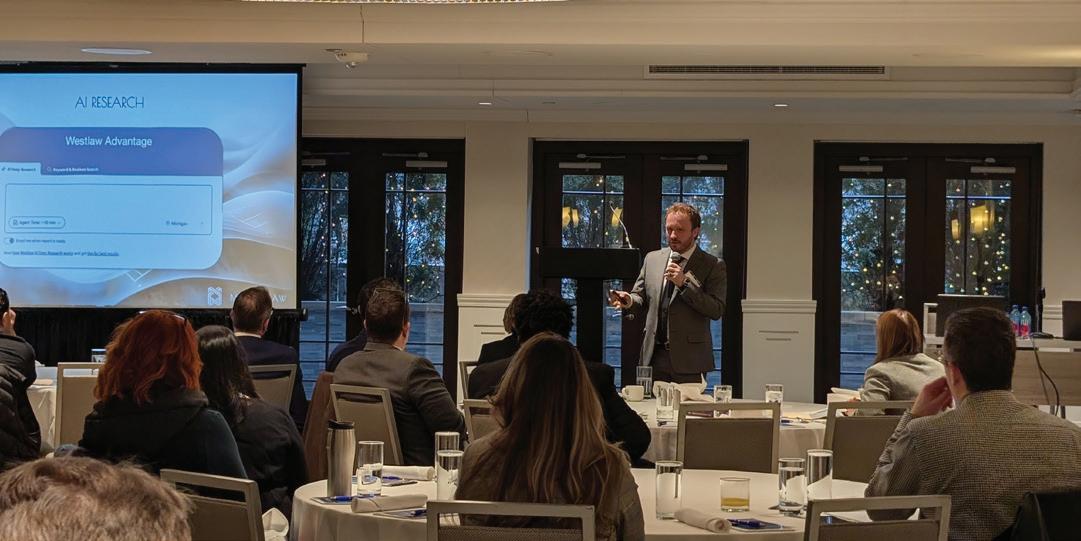
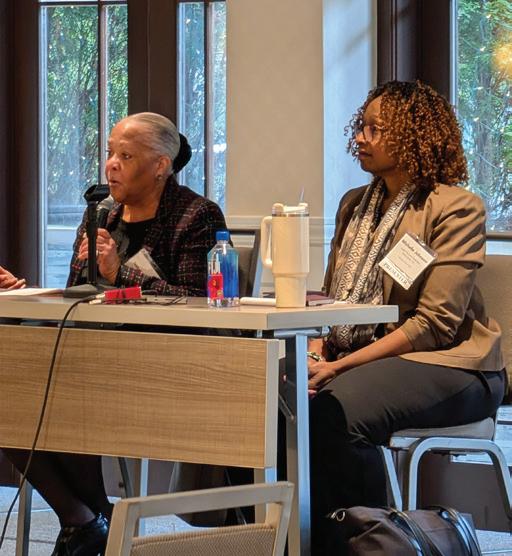
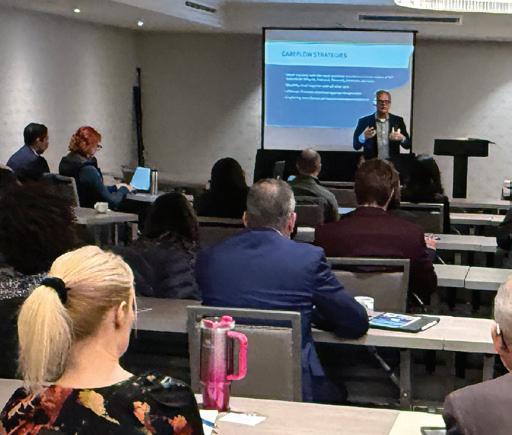
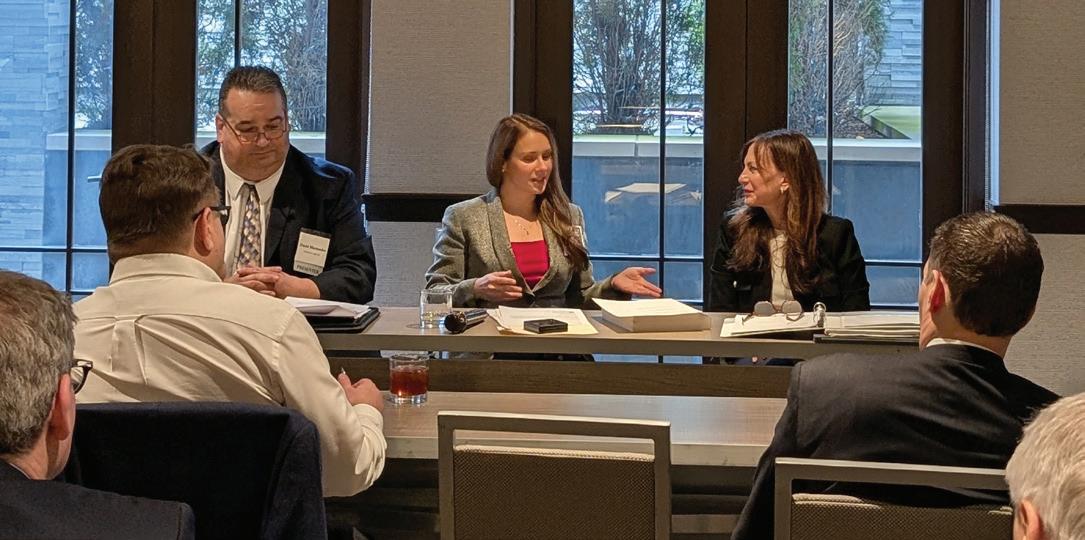

Judge