DTE helps to brighten up a second-generation St. Clair jewelry store
Enter to win! $5,000 in energy efficiency improvements could be yours
30
PRESIDENT’S LETTER
A CLOSER LOOK DTE offers rebates and bonuses that stack up for affordability.
5 QUESTIONS Stay safe by contacting MISS DIG before breaking ground on outdoor projects.
DID YOU KNOW? Make sure your cooling equipment is summer ready with DTE.
FEATURES
LIGHTING DTE is helping to illuminate Sakura Novi in each phase of development.
SMARTER BUILDS Rebates can offset costs of new construction and major renovations.
SCHOOLS Southfield’s district is creating a greener future with an on-site energy manager.
MEET THE TEAM DTE energy advisors help Michigan businesses save.
AGRICULTURE Through DTE, indoor growers can cut energy use and tap into rebates.
NONPROFIT Smart financing allowed MexicantownCDC to make efficiency upgrades.
ON THE COVER CONTEST Win an energy efficiency makeover from DTE. (We’re not horsing around!) 22 8
ENERGY JOURNEY
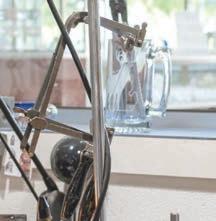
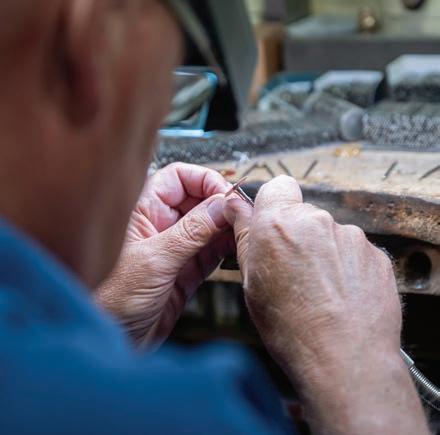
Efficiency upgrades from DTE brighten up a St. Clair jewelry store.
A FREE subscription to EnergySmarts for Michigan Business magazine awaits you online at dteenergy.com/subscribebiz.
4 12 14 17 20 24 26 5 6 28 INDUSTRY INSIDER DTE’s annual energy efficiency conference highlights new developments.
IMPROVING RELIABILITY YEAR AFTER YEAR
As business leaders, you know how much reliable power matters. It keeps your doors open, your teams productive and your customers taken care of. We take that responsibility seriously, and every day, our team is focused on delivering the dependable energy you expect — and making smart, long-term investments to keep improving.
I’m proud to share that this work is driving real results for your business. 2025 was the most reliable year for DTE electric customers in nearly two decades.
We reduced the time customers spent without power by 60% in 2025, building on a 70% improvement the year before. Fewer outages and faster restoration mean less disruption, more certainty and more time focused on your customers, not your backup plans.
These results come from years of deliberate, sustained investment and disciplined execution.
In 2025, we:
• Prevented thousands of outages using technology that can detect and address issues before they impact customers.
• Trimmed thousands of miles of trees — the leading cause of power interruptions — to reduce risk before storms arrive.
• Rebuilt aging infrastructure, replacing poles, power lines and substations to strengthen the system from the ground up.
Together, these steps are helping us move from simply reacting to problems to now anticipating and preventing them. And when outages do occur, we’re restoring power faster. Our improved processes — from using drones to advanced mapping — help crews quickly get to the right place with the right equipment so they can restore service more efficiently and safely.
We know there’s more work ahead, and we’re committed to continuing these improvements to keep up with a growing economy, new technology and an increasingly electric future. We’re excited to be your partner in that future — helping provide the reliable energy foundation your business needs to grow and thrive here in Michigan.
Sincerely,
Matt Paul President and Chief Operating Officer, DTE Electric
EDITOR
Anne Santori
EnergySmarts for Michigan Business welcomes your comments. Send inquiries, questions or comments to: EnergySmarts for Michigan Business 1590 WCB
Energy One Energy Plaza Detroit, MI 48226-9952 or email EnergySmartsMI@dteenergy.com
PUBLISHING
GENERAL MANAGER Edward J. Peabody
MANAGING
Paris Giles Jordan Jewell Becky Kalajian Wensdy Von Buskirk
For a free subscription to EnergySmarts for Michigan Business, subscribe online at dteenergy.com/subscribebiz.
Stacking up to bigger savings
DTE customers can access rebates and bonuses that help make efficiency projects affordable.
Energy efficiency can help Michigan businesses lower operating costs, improve equipment performance and make smarter long-term investments. Often, the challenge is knowing where to start. DTE’s Energy Efficiency Program for Business helps simplify the process by connecting customers with rebates and guidance from start to finish.
“DTE’s Energy Efficiency Program for Business helps commercial, industrial and institutional customers reduce energy use and operating costs through technical support and financial rebates,” says Wes Maharas, a DTE energy advisor. “The program serves small, medium, and large businesses, with offerings scaled to project size and complexity.”
A neighborhood business upgrading lighting may follow a simple, set path, while a large manufacturer pursuing complex system improvements may receive deeper engineering support and custom rebates. In both cases, the goal is the same: to identify energy-saving opportunities and help businesses take advantage of them.
What upgrades qualify?
The program offers rebates for a wide range of upgrades, including variable frequency drives, LED lighting and networked lighting controls. Additional rebates may be available for web-enabled energy management systems, optimal start
controls and other advanced measures. For projects that don’t fit a standard category, custom rebates can help capture sitespecific savings.
Businesses can also benefit from applicable bonus rebates. “Each energyefficient measure is eligible for only one base rebate — customers can’t receive multiple base rebates for the same measure through different program pathways,” Maharas says. “However, for example, if a customer purchases discounted lighting through the DTE Instant Discount program, they may also qualify for additional rebates and bonuses through other DTE energy efficiency offerings. Your DTE energy advisor will help make sure you’re maximizing available rebates.”
Applicable bonuses — such as school or participating contractor bonuses — may be combined with standard rebates. Customers completing multiple upgrades at one site can submit qualifying projects together through DTE’s online portal. For projects that need financing, DTE also partners with Michigan Saves, which may help eligible customers access lower interest rates.
How rebates are calculated
There are several rebate structures. Prescriptive projects typically pay a set amount per unit installed, while custom projects are based on verified energy savings. New-construction rebates are often
based on energy use compared to code, and retrofit rebates depend on the amount of energy reduced.
For example: A school replacing 100 T12 fluorescent fixtures (100 watts each) with 100 LED fixtures (40 watts each) would reduce connected load by 6,000 watts. Based on the measures selected, that lighting retrofit could qualify for an estimated $1,080 standard rebate. Because the project is at a school, an additional bonus may apply — helping to shorten payback time.
Know the limits — and plan ahead
Businesses should also be aware of caps and program limits. Large-business customers have rebate caps of $2 million for electric projects and $500,000 for gas projects per site, per calendar year. Small- and midsize-business customers are subject to measure-level caps and annual program funding limits.
The best first step is simple: connect early. “By involving an energy advisor before upgrades begin, customers can confirm eligibility, identify additional savings opportunities and ensure projects are properly documented for maximum rebate capture,” Maharas says.
Call 855.748.2525 or email saveenergy@dteenergy.com to get started. TOOLBOX
Lighting the way
DTE is helping to illuminate Sakura Novi in each phase of development.
A new development wouldn’t be complete without outdoor lighting creating a welcoming and safe atmosphere. DTE’s Community Lighting department is here to help developers from the first step.
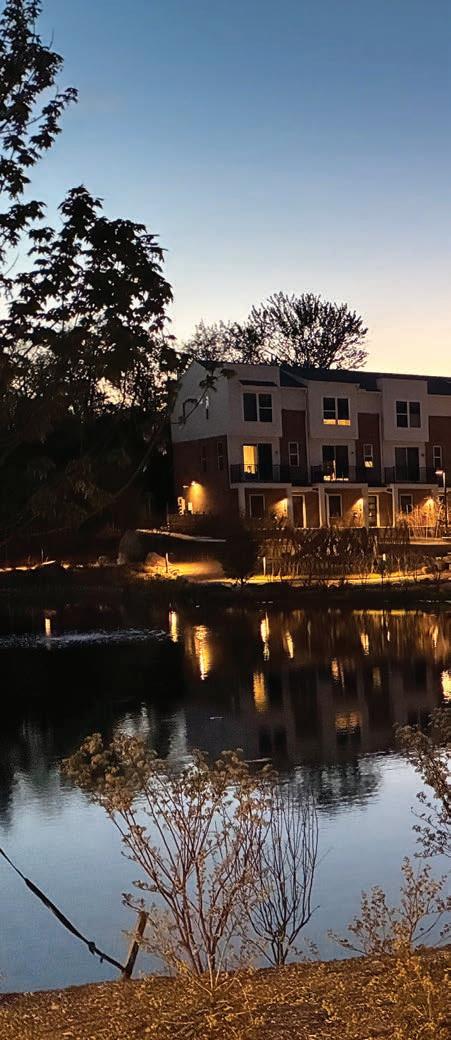
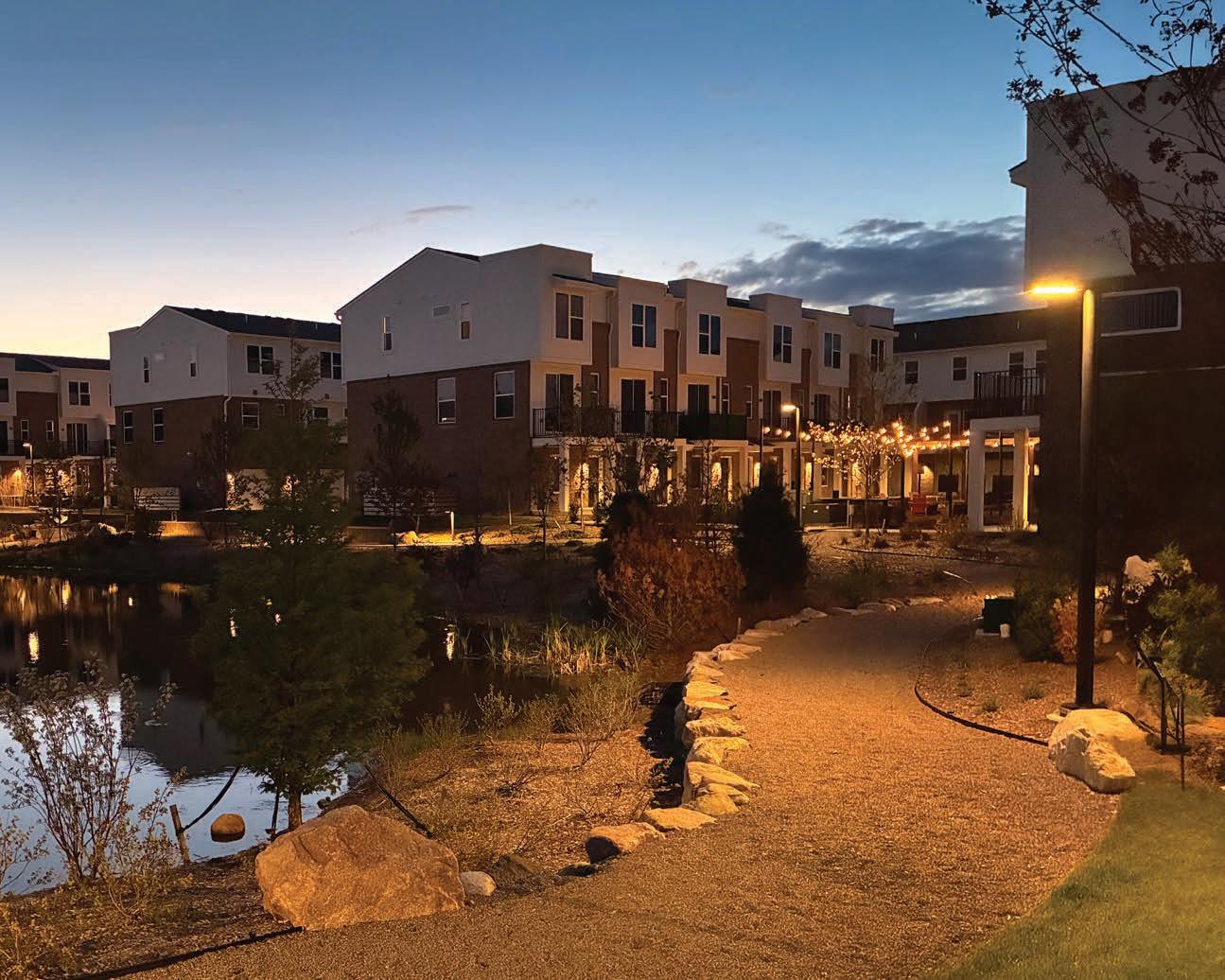
Back in 2022, the Sakura Novi development team and Robertson Homes contacted DTE Community Lighting about outdoor lighting for a new project, ambitious but rife with potential. Sakura Novi (sakura is the Japanese word for cherry blossoms) is a mixed-use, Asian-themed development in downtown Novi boasting restaurants, retail, office space and luxury townhome apartments.
“The site was basically only on paper,” explains Glenn Roland, principal marketing specialist for DTE Community Lighting. “They were putting together a site plan, and they approached us about installing lighting in this development under our Outdoor Protective Lighting program.”
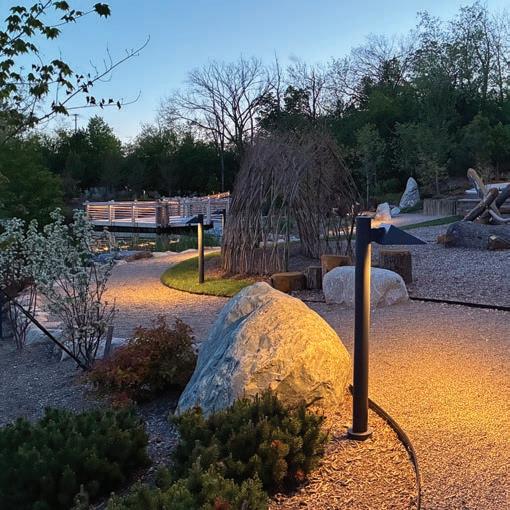
It’s been a yearslong, multiphase project and a first of its kind for the area. One recently completed feature is Sakura Gardens, which includes a community pond surrounded by a winding walkway with a nearby play area.
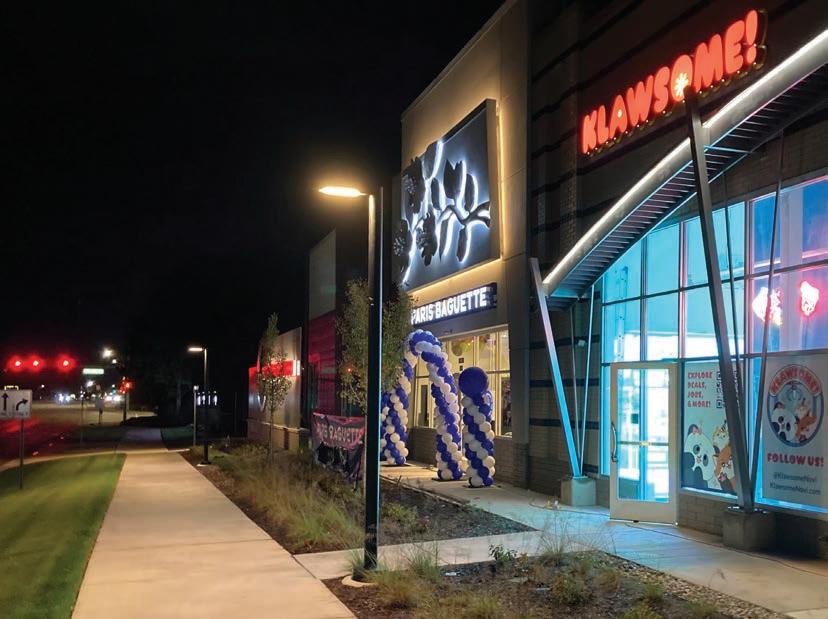
Roland notes that more phases are to come, including more apartments. As of this writing, the team has installed 58 post-mounted area lights and 34 bollards, ground-protruding fixtures usually used to light pedestrian walkways.
The bollards were a first for Community Lighting and required some technical imagination; Roland says the team had to adjust its construction methodology. Open communication with Robertson Homes was also key.
“On a large site project in which you’re building 15 to 20 large apartment buildings, plus adding a half dozen restaurant buildings and so forth, site conditions change constantly,” Roland says. “At DTE, we try to be seamless and fit in with all the other contractors that are on-site and doing work. So we worked closely with the site project manager to ensure that when we were working, the site was ready for us and also that we were meeting customer expectations.”
The way the Outdoor Protective Lighting (OPL) program works is that DTE owns the lights, which are fed underground, and the customer shares the installation costs and pays their monthly electrical bill, Roland explains. And because DTE owns the lights, it also handles maintenance.
“That’s the beauty of our program: DTE is responsible for maintaining the lights,” he says. “So the customer can advise us if a light has been damaged or is not working, and then we respond accordingly in terms of repairing or replacing to bring that lightpost fixture operational again. We have an outage team that responds to those types of notifications, but the customer is not responsible for any of the maintenance at all.”
For other developers or owners looking
to take on a large-scale project like Sakura Novi, Roland recommends connecting with DTE early on.
“We started having conversations with the customer in 2022, and we did not actually install the lights until almost three years later. [Connecting early is] helpful in the sense that we can coordinate and provide additional services.”
He says the Community Lighting team can also help with plan approvals, photometric designs and the like. And the OPL program isn’t only for new-build developers. The
“At DTE, we try to be seamless and t in
with all the other contractors that are on-site and doing work.
So we worked closely with the site project manager to ensure that when we were working, the site was ready for us and also that we were meeting customer expectations.”
—GLENN ROLAND, PRINCIPAL MARKETING SPECIALIST FOR DTE COMMUNITY LIGHTING
team will work with operators of existing properties, even simple setups like parking lots, to determine whether it makes sense for DTE to acquire their already-installed lighting and enroll them in the program; that option may be cheaper for the customer.
About Sakura, Roland says, “It was a large installation for us but one that we were easily able to handle. We enjoyed working with the customer — who we’ve done other projects with in the past — and we look forward to working with them on a second phase.”
For more information on the Outdoor Protective Lighting program, visit dteenergy.com/opl. TOOLBOX
DTE installed 58 postmounted lights and 34 bollards at Sakura Novi, an ambitious mixed-use development that will include apartments, restaurants, retailers and o ces.
Brilliant upgrades
Winning an energy e ciency makeover from DTE brightens up a second-generation St. Clair jewelry store.
Coughlin Jewelers owner Tim Coughlin says new LEDs purchased with the prize money from DTE maintain top-tier lighting quality while saving energy and money.
“We’ve always evolved by making small improvements over time. Those small changes really do add up to big changes.”
—TIM COUGHLIN, OWNER OF COUGHLIN JEWELERS
Like a ne piece of jewelry, a small-town, family-owned business in St. Clair has been designed to last generations.
That philosophy helped Coughlin Jewelers win one of three grand prizes in DTE’s annual Small Business Energy E ciency Makeover Contest. Each winner receives media exposure, an on-site energy assessment and $5,000 in e ciency upgrades to help them reduce their energy use.
Second-generation owner Tim Coughlin says the recognition re ects both the business’s past and its future.
“We’ve always evolved by making small improvements over time,” Coughlin says. “Those small changes really do add up to big changes.”
Founded 34 years ago by his parents, Coughlin Jewelers has been a xture in Michigan’s Thumb since its beginnings in a modest strip mall. The business has grown steadily, rst expanding to a larger storefront and eventually moving in 2008 to a former car dealership at the corner of Clinton Avenue and Riverside/M-29.
The full-service store specializes in diamond jewelry, engagement rings, watches and custom work, employing two full-time jewelers who specialize in engraving, repairs and design services.
Though he once aspired to a di erent career path, Coughlin o cially purchased the business from his parents in 2022.
“When you grow up in a family business, it becomes a part of you,” he says.
As a child, Coughlin wrapped gifts during the holidays, swept oors and helped wherever he was needed. By sixth grade, he was doing engraving work. Still, he says, taking over the business was not always the plan.
“I actually wanted to be a patent attorney,” Coughlin says.
While studying in college, he decided business classes aligned better with his interests. A summer spent building a website for the store prompted a fresh look at the family business.
“I grew up around the customers,” Coughlin says. “The jewelry is beautiful and emotional, and pairing it with the business side is what really drove me to carry it on.”
Eyes on the prize
The store’s current building is a structure with high ceilings and large windows. Prior to the contest, it also relied heavily on metal halide lighting, long favored in jewelry stores for bright, crisp light.
The Coughlins’ large number of xtures consumed signi cant energy, generating heat in the summer and driving up costs.
ENERGY JOURNEY, continued on page 10
Coughlin Jewelers had already updated lighting and appliances in its on-site workshop before entering DTE’s contest.
Bright, targeted lighting in the jewelry business, however, is nonnegotiable.
“If the light isn’t right, it a ects how jewelry presents in the case,” says Coughlin, who estimates the store had between 60 and 70 halide lights in its roughly 3,000-square-foot showroom.
In time, more-e cient diamond-grade lighting became available, so Coughlin kept his eyes open. Last fall, he learned about DTE’s Small Business Energy E ciency Makeover Contest from a postcard. He entered, noting his energy e ciency e orts both at his home and in the store, where he had already upgraded the back-of-house appliances and lighting.
But he knew he could do better, especially with respect to the halide lights.
“I really wanted some direction from experts,” he says. “I wanted to improve e ciency without sacri cing the quality of light.”
After submitting a simple online application and receiving a site visit from DTE, Coughlin was named a nalist. A subsequent energy assessment con rmed what he already suspected: The showroom lighting was the biggest opportunity for improvement.
“It was extremely exciting,” he says.
The prize money was used to remove the old metal halide xtures, replacing them with diamond-grade LED lighting. While the $5,000 grand prize did not cover the full cost, Coughlin committed to completing the project.
The upgrades have improved comfort for sta and customers while also reducing energy consumption and cooling needs, a win-win for the business.
“Sustainability is socially responsible, but there’s also cost savings,” Coughlin says. “It was important from a business standpoint.”
Small steps make a big impact
Making small changes at the right time is a mindset rooted in his parents’ way of running the business.
“You’re constantly making small improvements,” Coughlin says. “Every time you redo an area, you do it the right way.”
Coughlin says he will continue his energy e ciency journey and is open to exploring additional DTE programs, including MIGreenPower, which attributes a business’s energy usage to Michigan solar and wind power.
He encourages other small businesses to enter this year’s energy e ciency
contest, especially if they face lighting concerns as he did.
“For a jeweler, lighting is essential but upgrading to new and more-e cient lighting can pose several challenges,” he says. “Winning the contest helped us upgrade to advanced LED lighting that now provides the brightness and clarity our customers expect, while using signi cantly less energy and lowering costs.”
His advice to fellow business owners is simple.
“Just start small,” Coughlin says. “Every improvement you make adds up. Eventually, you look around and realize your business is exactly where you want it to be.”
DTE’s 2026 Small Business Energy Efficiency Makeover Contest kicks off Aug. 12 and runs through Oct. 7. Visit dteenergy.com/makeover to enter. TOOLBOX
Powering smarter builds
DTE helps offset costs of new construction and major
If you’re planning a new building or making major upgrades to an existing one, DTE can help you build smarter — starting with substantial rebates that can reduce up-front costs and accelerate your return on investment.
“High-efficiency design can reduce energy use in new commercial buildings by 25% or more, delivering significant long-term savings,” says Kevin Salatrik, program lead for DTE’s Energy Efficiency Program for Business. “Our goal is to be involved early — ideally in the planning phase — to help you qualify for rebates and avoid costly missteps.”
renovations.
control systems or high-efficiency manufacturing equipment, DTE is ready to partner with you to find the best fit for your needs and budget.
Design rebates that fit your project
DTE offers two main tracks to assist with energy-efficient design based on the complexity and timeline of your project:
The New Construction and Major Renovations program offers rebates for a wide range of projects — from brand-new facilities to adaptive remodels of older spaces. Whether you’re upgrading chillers, boilers, lighting,
• LEED Whole Building Design Rebates are designed for buildings pursuing Leadership in Energy and Environmental Design certification. This option supports highperformance, sustainable designs that meet rigorous efficiency benchmarks.
• Systems Approach Rebates offer a more flexible option that doesn’t require LEED certification. DTE analyzes your construction documents and compares proposed equipment to standard baseline models. Rebates
Eligible projects could receive up to 40% in bonus rebates from DTE
“We help ensure customers’ projects aren’t just code-compliant but that they’re operating as e ciently as possible.”
—KEVIN SALATRIK, DTE PROGRAM LEAD
are awarded for anything that goes above and beyond minimum energy-efficiency requirements.
“In either track, we work closely with your team to analyze lighting schedules, HVAC specs and production equipment,” Salatrik explains. “We’ll do a full review to identify where energy savings can be found and what rebates apply.”
Rebates in action
Rebates can make a measurable difference on projects across many industries. For example, DTE has seen significant growth in the indoor agriculture sector, where even small warehouse growers can qualify for rebates for LED lighting, dehumidification and more.
“We provide the same concierge-level support,” Salatrik says. “We help ensure customers’ projects aren’t just codecompliant but that they’re operating as efficiently as possible.”
Manufacturing facilities are another hot spot for energy savings. Companies investing in advanced production equipment — such as high-efficiency plastic injection molding machines — may qualify for rebates if the equipment exceeds typical energy performance standards.
School districts also can benefit tremendously from DTE’s hands-on guidance, particularly during summer renovation seasons.
“We’re doing more to educate not just contractors but decision-makers in school districts so they know to reach out before installing HVAC or lighting systems,” Salatrik adds. “That one step could make all the difference in capturing available rebates.”
Bigger bonuses for long-term gains
In addition to standard rebates, DTE is offering a 20% bonus on all qualifying measures, plus an additional 20% bonus for “long-life” measures such as chillers, boilers and major production equipment. That means eligible projects could receive up to 40% in bonus rebates.
“These bonuses are a game changer for large-ticket items,” Salatrik says. “It’s our way of encouraging customers to invest in durable, energy-saving systems that deliver long-term value.”
Michigan Saves, a nonprofit green bank, has also partnered with DTE to offer loans with interest rates as low as 0% to help cover any remaining costs of qualifying energy efficiency projects.
Easy process with DTE
Getting started is simple. DTE provides support to contractors and customers alike, walking them through everything from paperwork to submission. With permission, the DTE team can even pull data directly from your construction database to build and review your rebate application.
“Our job is to eliminate the confusion,” Salatrik says. “We’re not here to sell anything. We’re here to give money back to customers who are doing the right thing by building smarter.”
TOOLBOX
To learn more about rebates and bonuses, visit dteenergy.com/rebateprograms or email saveenergy@dteenergy.com. Visit michigansaves.org to learn more about financing options.
Smarter support
South eld Public Schools is building a sustainable future with a DTE on-site energy manager.
South eld Public Schools is in the midst of a transformation. Backed by a $345 million capital improvement bond — the largest in the district’s history — SPS is reimagining its schools from the ground up. Construction and renovations are underway across every building, bringing upgraded facilities and new opportunities for students.
Alongside these improvements is a focus on building smarter, more energy-e cient schools. A partnership with DTE is helping to make that vision a reality. From the earliest planning stages, DTE has worked alongside district leaders to ensure energy e ciency is embedded in every project.
Building efficiency
Through its on-site energy manager (or OSEM) program, DTE provides dedicated, hands-on support to schools, guiding them through energy-saving upgrades while connecting them to valuable rebate opportunities.
“DTE provides a part-time energy manager to locations that may not be able to a ord to have their own,” says Kevin Gast, a certi ed
energy manager with DTE. “We help advise them to make smart decisions on energy and to upgrade their buildings.”
About 20 customers currently take advantage of the o ering, from small school districts to large college campuses.
Turning upgrades into savings
“We make sure customers are getting the most out of our programs and help them maximize their savings and rebates,” Gast says.
South eld’s 2022 bond included funding for HVAC systems, energy-e cient boilers, LED lighting, upgraded windows, new roofs and modernized building controls in several buildings.
REBATES
In South eld, DTE customer service representative Rhonda Daniels rst introduced the program to the school district just as bond work was getting underway.
“She approached the district about two years ago, and we started working immediately with DTE on this,” says James Jackson, chief of sta for South eld Public Schools. “It came at the perfect time since we are in the midst of a major construction program. This gives us the opportunity to really focus on how we make our buildings more energy e cient.”
“These projects will earn us tens of thousands of dollars in rebates from DTE,” Jackson says. “We’ve also seen a 30% reduction in energy costs in our renovated schools already.”
According to Gast, DTE helped South eld Public Schools save 312,841 kilowatthours over two years, the equivalent of over 30 homes’ electricity use for a year, per the EPA’s greenhouse gas equivalency calculator.
Collaborating at every step
DTE’s OSEM team starts by conducting on-site assessments across school buildings. During these walk-throughs, the team evaluates systems like lighting and
SCHOOLS, continued on page 16
Kevin Gast
“We try to be a resource for anything [customers] need. It’s about making the process smoother and ensuring they’re capturing every available bene t.”
—KEVIN GAST, DTE CERTIFIED ENERGY MANAGER
“These projects will earn us tens of thousands of dollars in rebates from DTE. We’ve also seen a 30% reduction in energy costs in our renovated schools already.”
—JAMES JACKSON, CHIEF OF STAFF FOR SOUTHFIELD PUBLIC SCHOOLS
Southfield Public Schools has saved 312,841 kWh over two years
HVAC, identi es potential improvements and outlines projected savings.
“We’ll go through a building and look at everything that could be upgraded,” Gast explains. “Then we provide a road map that includes estimated energy savings, project costs and available rebates.”
After that, the team meets with school leaders on a regular basis to keep projects on track. That level of guidance is especially valuable for school districts, which often face tight budgets and compressed project timelines.
Designing for the future
As South eld Public Schools continues its transformation, energy e ciency remains central to renovations as well as new construction. The district is preparing to break ground on a new K–12 campus, where energy e ciency will be incorporated from day one.
Sustainability e orts are also extending beyond school buildings. This fall, the district will begin rolling out electric buses, supported by new charging infrastructure developed in collaboration with DTE.
“Funding is always a challenge,” Gast says. “Even when districts have resources, they still have to be strategic about how they spend it. On top of that, most of their major work has to happen during the summer when students aren’t in the buildings.”
By maintaining consistent communication and planning ahead, the OSEM team helps districts navigate these constraints while keeping projects on schedule.
“We try to be a resource for anything they need,” Gast says. “It’s about making the process smoother and ensuring they’re capturing every available bene t.”
Throughout all the work being done, Jackson says DTE has helped the district remain a good steward of taxpayer funds.
“We’d advise other schools and businesses to take part in this program,” Jackson says. “The DTE team made it very easy. It’s been a great partnership.”
To learn more about on-site energy managers for schools, reach out to Kevin Gast at kevin.gast@dteenergy.com. TOOLBOX
Meet the team
DTE energy advisors help Michigan businesses save.
When it comes to improving energy efficiency, many Michigan businesses know they should start somewhere — they just aren’t always sure how.
Should they upgrade lighting? Replace HVAC equipment? Improve refrigeration systems? Invest in better controls? And perhaps most importantly, will the savings justify the cost?
That’s where DTE’s energy efficiency team steps in.
Behind DTE’s rebates, assessments and incentive programs is a dedicated crew of energy advisors helping businesses of every size identify opportunities, reduce energy use and maximize savings. Whether it’s a small neighborhood convenience store or a large industrial manufacturing
ADVISORS, continued on page 18
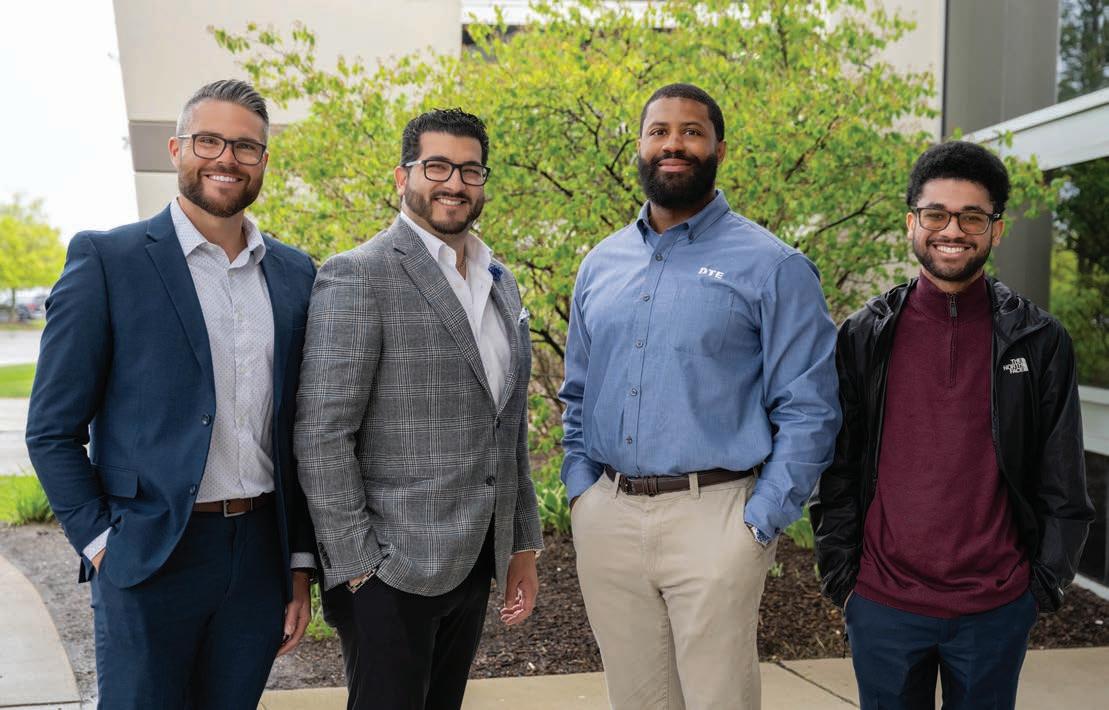
Business Energy Account Management team members (from left): Christopher Roose, Giovanni Calandrino, E ong Eniang and Justin Bettie.
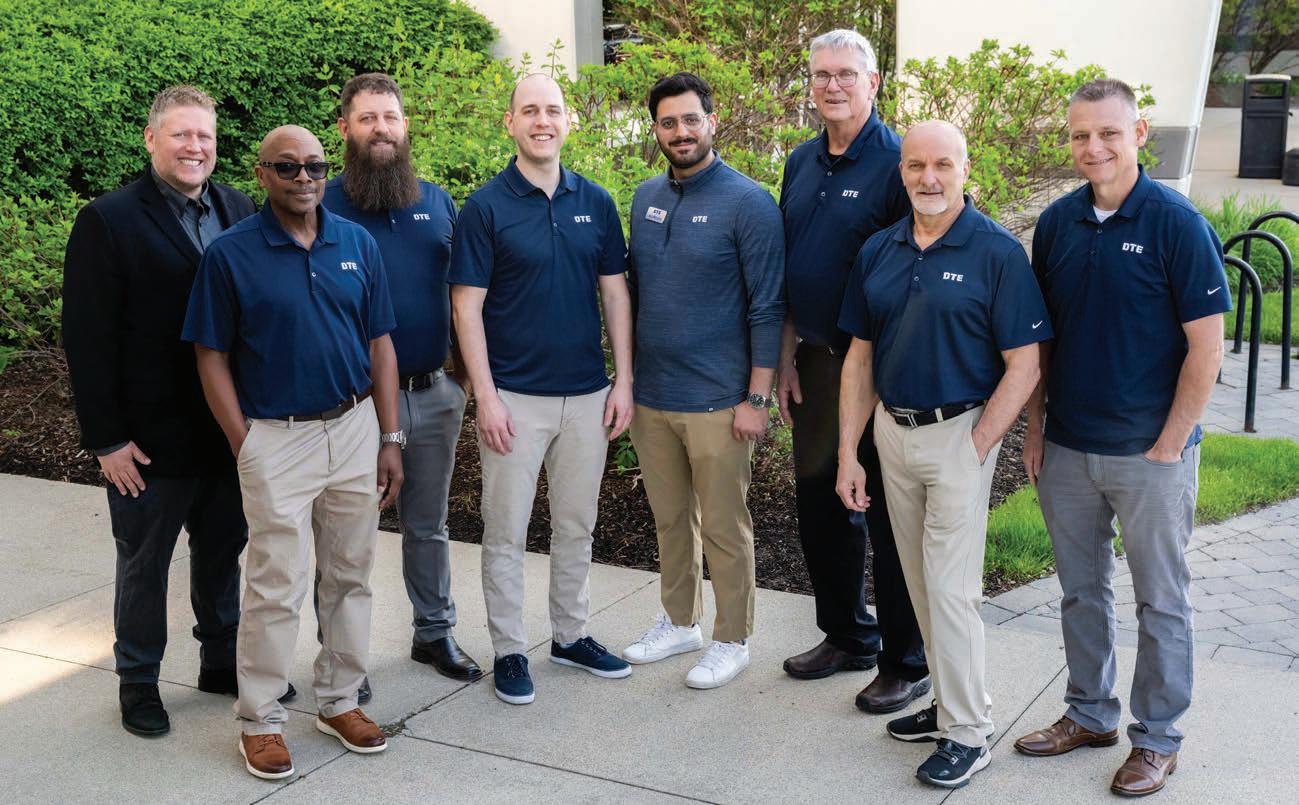
Small Business Program team members (from left): Joe Bickham, Dennis Howard, Mike Barck, Eric Anderson, Anas Muslmani, John Nametz, Rory Sayers and Andrew Rickard.
plant, DTE’s advisors serve as guides through the process, helping each customer find the right path to greater efficiency.
“They are that single point of contact who will help through questions all the way to getting the payment for the rebates,” says Joe Bickham, program manager for DTE’s Energy Efficiency Program for Business.
Small and medium businesses
Small-business owners manage countless tasks and rarely have dedicated energy staff. Because of this, DTE’s Small and Medium Business Program starts with an energy assessment — making it easy to discover opportunities to save without in-house energy expertise.
DTE advisors visit in person, identify ways to save energy and often install complimentary energy-saving products during their initial assessment.
Direct-install products vary based on whether a customer receives DTE electric or gas service or
both. These products may include, but are not limited to, LEDs, faucet aerators, pipe wrap and programmable thermostats.
After the visit, the business receives a customized report outlining completed upgrades, estimated energy savings and recommendations for future projects. If larger improvements — such as a full lighting retrofit or HVAC replacement — are recommended, advisors can connect customers with rebate opportunities.
That first interaction is often the starting point for longterm savings.
“[The energy assessments] get people excited and get them interested in the program, and it can lead to bigger projects in the future,” Bickham says.
Large businesses
For larger businesses, the projects become significantly more complex. Unlike small businesses, large customers depend on sophisticated equipment and processes,
making tailored support essential.
DTE’s Large Business Program includes 24 energy advisors who support customers ranging from universities and hospitals to automotive plants and industrial facilities.
These advisors are highly specialized. Some are experts in industrial systems such as compressed air, boilers and steam. Others focus on schools, healthcare facilities, agriculture or new-construction projects.
Large-business customers have a much broader range of energy efficiency needs due to their size and operational complexity. The program is designed to accommodate any and all of these needs, offering access to hundreds of prescriptive and custom rebates for improvements spanning lighting, HVAC, industrial systems and beyond.
“We’re meeting customers where they are,” Bickham says. “We want to be there to help them understand what’s available.”
Rather than relying solely on phone calls or emails, energy advisors actively seek out opportunities to connect with customers in person.
Advisors attend conferences and industry events across Michigan to connect directly
Joe Bickham
“We’re meeting customers where they are. We want to be there to help them understand what’s available.”
—JOE BICKHAM, PROGRAM MANAGER FOR DTE’S ENERGY EFFICIENCY PROGRAM FOR BUSINESS
with business leaders and facility managers.
To ensure they can provide the best support and advice, many large-business advisors continue to expand their knowledge by pursuing professional certifications such as certified energy manager or certified energy auditor credentials through the Association of Energy Engineers. These ongoing efforts help advisors stay current with industry developments so they can better assist customers in navigating the evolving energy landscape.
The full package
No matter the business size, one of the biggest advantages of working with an energy advisor is having a single point of contact.
Bickham describes it as a “concierge approach.”
Energy advisors help businesses understand rebate eligibility, complete applications, track project status and avoid costly mistakes, such as purchasing equipment that doesn’t meet efficiency requirements for incentives.
Advisors also help businesses recognize upgrade benefits they may not have considered, such as improved workplace
safety or a better customer experience.
“We’ve had customers say that after installing LED lighting, their store felt brighter, more inviting, and they actually saw more business,” Bickham says. “Those nonenergy benefits can be just as important.”
The first step
The easiest way for businesses to connect with an energy advisor is through DTE’s website.
Small businesses can schedule an assessment online using a built-in scheduling tool, while larger businesses are encouraged to call or email the program team to discuss project plans early in the process.
“From a customer’s perspective, it’s important to work with [DTE] as early as possible to maximize the rebates and energy efficiency,” Bickham says.
For Michigan businesses looking to reduce energy usage, improve facilities and invest in long-term efficiency, DTE’s advisors are ready to help, one project at a time.
Growing green
Through DTE’s programs, indoor growers can cut energy use, boost yields and tap into rebates.
“Lighting and dehumidi cation are the two biggest [improvement] measures we see. When you upgrade lighting, you’re also reducing the load on HVAC, so you’re saving in multiple ways.”
—KEVIN SALATRIK, MANAGER OF STRATEGIC SEGMENTS FOR DTE
Indoor agriculture is transforming how plants are grown across Michigan, from leafy greens and flowers to cannabis and other crops. Through DTE’s Energy Efficiency Program for Business, facilities can access rebates and expert guidance to make energy-efficient upgrades more affordable.
A high-energy industry
Indoor agriculture requires precise environmental control to optimize plant growth. That means replicating sunlight, managing humidity and maintaining consistent temperatures.
additional energy savings.
DTE offers rebates for lighting upgrades, including newer technologies like dimmable lighting systems that adjust intensity throughout growth cycles, under-canopy lighting that improves plant exposure and increases yield per square foot, and lighting controls and scheduling systems that reduce unnecessary runtime.
its Energy Efficiency Program for Business. A dedicated team of energy advisors, engineers and program staff works directly with growers and contractors to streamline projects and identify opportunities to save.
“It takes a large amount of energy to produce the plant,” says Kevin Salatrik, manager of strategic segments for DTE. “We really treat indoor agriculture more as a process, like manufacturing a product, because of how controlled and equipmentdriven it is.”
As a result, even incremental improvements can deliver meaningful savings. In many cases, facilities can reduce energy consumption by 20% to 50% depending on the upgrades.
Lighting
Lighting is one of the biggest opportunities for efficiency. Traditional high-pressure sodium systems are being replaced with advanced LED grow lights designed to deliver the specific light spectrum plants need.
“These aren’t your typical LED lights,” Salatrik says. “They’re engineered to optimize plant growth, and they use less energy while producing less heat.”
That reduction in heat has a ripple effect. HVAC and dehumidification systems don’t have to work as hard, leading to
While under-canopy lighting may slightly increase electricity use, it often leads to higher yields without expanding facility size, making it a strategic investment for growers looking to boost their production.
Dehumidification and HVAC
Beyond lighting, dehumidifiers and HVAC systems are critical to maintaining optimal growing conditions. High-efficiency equipment in these areas can significantly reduce energy use.
“Lighting and dehumidification are the two biggest [improvement] measures we see,” Salatrik says. “When you upgrade lighting, you’re also reducing the load on HVAC, so you’re saving in multiple ways.”
In addition to lighting rebates, DTE offers incentives for eligible HVAC and dehumidification improvements, helping to offset the initial investment costs and expedite energy savings. These rebates are designed to encourage the adoption of high-efficiency systems, allowing businesses to enhance operational performance while achieving a faster return on investment.
Concierge service
Recognizing the unique needs of indoor agriculture businesses, DTE has developed a specialized “concierge” approach within
“We created this approach to shorten communication lines and move projects faster,” Salatrik says. “It also helps us stay on top of emerging technologies so we can continue to support what’s new in the market.”
Support starts with an on-site energy assessment that results in customized recommendations. The DTE team helps identify equipment that is eligible for rebates, then assists in completing and submitting required applications.
Getting started
Indoor agriculture businesses can work directly with DTE or through a contractor of their choice.
“Talk to your contractor or distributor,” Salatrik advises. “Many of them will help submit the rebate and make sure you’re taking advantage of the program.”
Starting the process is simple. Growers can contact DTE to schedule a consultation, discuss current operations and explore upgrade options. From there, the program team helps map out a plan that aligns with the facility’s goals, budget and timeline.
With the support of DTE’s Energy Efficiency Program for Business, Michigan’s indoor agriculture sector can continue to grow — smarter, more sustainably and more profitably.
To learn more about energy efficiency for indoor agriculture, call 855.748.2525 or email saveenergy@dteenergy.com. TOOLBOX
Kevin Salatrik
Win an energy efficiency makeover!
$5,000 in improvements could be yours.
The challenges of running a small business or nonpro t are never-ending, but DTE is in your corner.
DTE’s annual Energy E ciency Makeover Contest helps small businesses and nonpro ts make lighting, HVAC and other improvements that might otherwise be out of reach.
This year, the contest runs from Aug. 12 through Oct. 7. A short application will prompt you to share the steps you’ve already taken toward energy e ciency and the upgrades you’d like to make. Five nalists will receive a free professional energy assessment, and three grand-prize winners will also be awarded special media exposure and $5,000 in energy e ciency improvements.
The program is designed to help business owners identify gaps and take the next step toward creating more comfortable, coste ective and environmentally responsible spaces for employees and customers.
“Running a small business means every expense matters,” says Ti any Wendling, one of the three 2025 grand-prize winners and owner of Ti any’s Show Horses.
Small changes that add up
The 2025 winners also say the impact goes beyond nances.
Tim Coughlin, owner of Coughlin Jewelers, says incremental upgrades were already part of his business plan but the contest helped accelerate those e orts.
“We’ve always evolved by making small improvements over time,” Coughlin says. “Those small changes really do add up to big changes.”
Coughlin says his store relied heavily on outdated metal halide lighting, which consumed large amounts of energy and generated excess heat. After entering the contest, he received an energy assessment that con rmed lighting upgrades as a key opportunity.
A horse farm, a jewelry store and a church each won $5,000 in energy e ciency upgrades from DTE in last year’s contest.
“E ciency creates opportunity. Every dollar saved strengthens our ability to serve.”
—PASTOR RICHARD THOMAS OF UNION SECOND BAPTIST CHURCH
“I really wanted some direction from experts,” Coughlin says. “I wanted to improve e ciency without sacri cing the quality of light.”
With the prize funding, he transitioned to diamondgrade LED lighting, improving both energy use and customer experience.
“Sustainability is socially responsible, but there’s also cost savings,” Coughlin says.
Knowledge is power
Similarly, leaders at Union Second Baptist Church in River Rouge say the contest helped them better understand how energy e ciency aligns with their mission.
Pastor Richard Thomas says caring for their historic building is an extension of stewardship.
“For us — having such a historic building — improving energy e ciency is part of honoring that legacy,” Thomas says. “Investing in the building’s future ensures it can continue serving generations to come.”
Thomas says the energy assessment revealed issues the congregation had not fully recognized, from drafts near stained-glass windows to ine cient lighting systems.
“The assessor really opened our eyes,” Thomas says.
The church is using its $5,000 award to upgrade lighting. Leadership is also planning future HVAC improvements, ultimately aiming to reduce costs and redirect savings into community programs.
“E ciency creates opportunity,” Thomas says. “Every dollar saved strengthens our ability to serve.”
‘Saying yes to the opportunity’
The winners emphasize that the contest is not just for businesses that already have a plan. It’s also for those who are just getting started.
“Just start small,” Coughlin says. “Every improvement you make adds up.”
Wendling echoes that sentiment, outlining the various ways that incremental changes have mattered to her business.
“The funding [allowed] us to replace outdated lighting with energy-e cient LEDs, [add] timers and controls to better manage how long lights and ventilation systems run each day, and update ventilation and appliances to energy-e cient models to help us keep costs down while maintaining a healthy environment for our horses and clients year-round,” she says.
Thomas says that entering the contest was akin to an act of faith.
“Sometimes the rst act of stewardship is simply saying yes to the opportunity.”
The 2026 Small Business Energy Efficiency Makeover Contest kicks off Aug. 12 and runs through Oct. 7. Visit dteenergy.com/makeover to enter.
Savings await
Smart financing helped MexicantownCDC upgrade without up-front costs.
Timing can make or break a nonprofit. Aging infrastructure, rising energy costs and limited capital often collide, forcing organizations to delay critical upgrades.
For Ray Lozano, executive director of the nonprofit Mexicantown Community Development Corporation in Detroit, the pressure was mounting with a twobuilding campus that was 20 years old.
“We’re always raising money, always dealing with community issues,” he says. “Making sure we have enough revenue to pay rising bills is always a challenge.”
Signs of wear appeared last fall in the
heating and cooling system when two rooftop HVAC units failed without warning.
“We went through the summer not knowing they weren’t operating properly,” Lozano says. “Then suddenly, we’re heading into heating season, and we needed to replace them. That’s a real challenge.”
Complicating matters, the campus sits near the Ambassador Bridge and Interstate 75, where heavy truck traffic accelerates wear on building systems.
“The diesel fuel … tends to pit the metal and eat the wires,” Lozano says. “Things corrode quicker here than in other locations.”
Providing a way forward
Replacing HVAC units — along with upgrading outdated fluorescent lighting — would typically require significant up-front investment. For MexicantownCDC, that
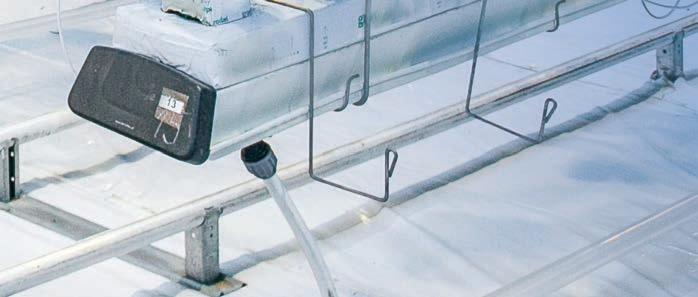
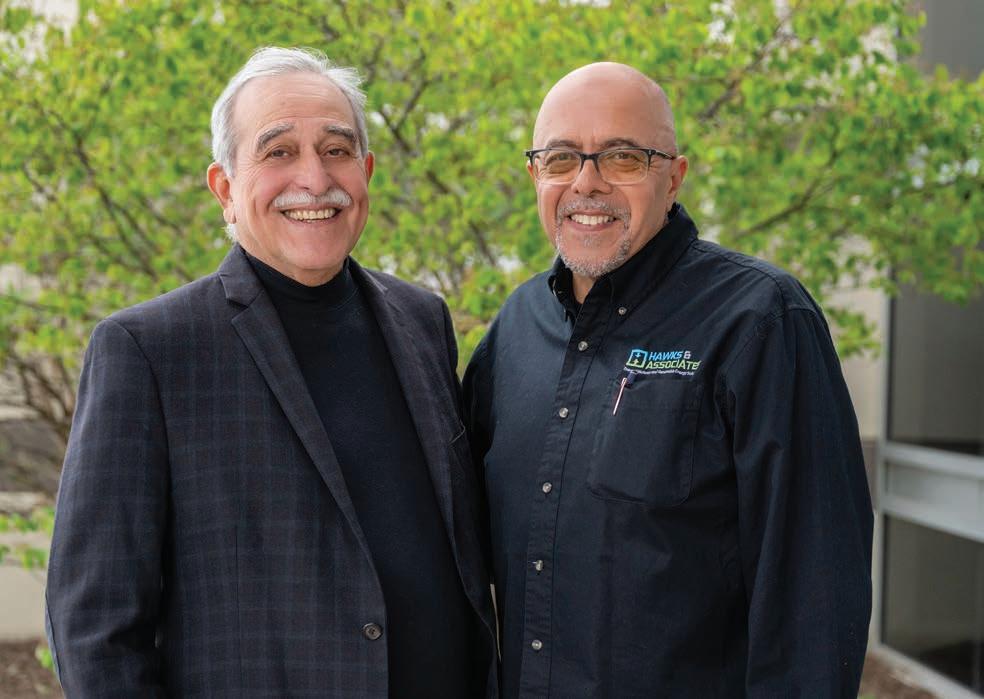
Left: Ray Lozano (left), executive director of MexicantownCDC, and K. Dwight Hawks, founder of Hawks & Associates. Below: MexicantownCDC upgraded to high-e ciency rooftop HVAC units.
could have meant dipping into alreadytight reserves or raising rents for tenants.
Instead, the organization used a combination of Michigan Saves financing and a DTE interest rate buydown to receive loans with 0% interest, paired with available rebates.
“That gave us a way to move forward,” Lozano says. “Without it, we would have had to really dent our budget or delay the project.”
K. Dwight Hawks, a contractor specializing in this financing combination, says Lozano’s concerns are common.
“Nonprofits typically don’t have a lot of capital lying around,” Hawks says.
0% loans, no contractor fees
This year, both large and small businesses and nonprofits are eligible for 0% interest loans. DTE also pays the
contractor fees, Hawks says.
“Financing gives them a mechanism to move a project from an idea to ‘OK, we can actually do this.’”
Hawks explains that the structure allows organizations to leverage projected energy savings to offset project costs.
“The elevator pitch is simple: You take the monthly savings and use that to pay for the project,” Hawks says. “It becomes cash flow positive.”
Delivering the biggest impact
MexicantownCDC’s project began with a detailed energy assessment led by Alexus Ford, a colleague of Hawks.
“We completed a walkthrough of the site and looked at lighting, utility bills and overall usage,” Ford says. “You could immediately tell there was room for improvement. Lights were out; spaces weren’t as bright as they should be.”
Ford says upgrade prioritization focused on two key factors: energy savings potential and return on investment.
“Because this is a nonprofit, it’s really important to identify where they can save money,” she says. “We looked at what would deliver the biggest impact.”
The solution included upgrading to high-efficiency rooftop HVAC units and replacing fluorescent lighting with LEDs throughout much of the 40,000-squarefoot campus.
Savings all around
The upgrades are projected to save the organization nearly $11,000 annually, an impact that extends far beyond the energy bill.
“For us, that’s huge,” Lozano says. “We didn’t have to borrow money or raise rents for our tenants.”
Those tenants include a mix of government offices, nonprofits and small businesses, as well as the Detroit City Football Club’s ticketing and merchandising operations.
“Anytime we can keep our tenants stable and not raise costs, that’s beneficial for everyone,” Lozano says.
Ford says the projected savings align closely with expectations based on similar projects.
“We estimated somewhere between $9,000 and $12,000 annually, so landing around $11,000 is right on target,” Ford says.
Beyond cost savings, the upgrades improve day-to-day comfort and reliability.
“You’ll see more-consistent temperatures, better lighting quality and fewer maintenance issues,” Ford says. “That improves the overall performance and longevity of the building.”
One-stop shop
be hesitant to take on complex projects like installing energy-efficient lighting, HVAC systems, building insulation or refrigeration.
“When nonprofits first hear about this, their reaction is usually ‘Where do I sign?’” Hawks says. “It’s a no-brainer.”
He adds that many organizations delay upgrades for years when they lack access to financing.
“It’s very common,” Hawks says. “Without the right financing, projects just don’t happen.”
A model for other organizations
For nonprofits and small businesses facing similar challenges, Lozano offers simple advice: Don’t assume upgrades are out of reach.
“We wouldn’t have been able to do this without the support,” Lozano says. “The savings are tremendous, and the process made it possible.” Energy-efficient upgrades could save MexicantownCDC nearly $11,000 a year
For Lozano, one of the biggest surprises was how straightforward the process was.
“These projects can feel like pie-in-the-sky ideas,” Lozano says. “But this experience showed us they’re doable.”
Hawks emphasizes both the financial and environmental benefits.
“It’s the right thing to do,” Hawks says. “You reduce operating costs and become a better environmental steward at the same time.”
Ultimately, the MexicantownCDC project demonstrates how the right combination of financing and incentives can remove barriers and unlock meaningful change.
“LED lighting lowers electricity consumption and reduces maintenance because the bulbs last longer,” Ford says. “With the new HVAC units, you achieve the same heating and cooling performance but much more efficiently and reliably.”
“Once we connected with the contractor, it was really a one-stop shop,” Lozano says. “It was painless compared to what we’re used to.”
That simplicity is key, Hawks says, especially for organizations that may
Michigan businesses and nonprofits can pair Michigan Saves financing with DTE incentives and rebates. In 2026, receive 0% financing. For more information, visit michigansaves.org.
“Customer safety is our top priority at DTE. After a MISS DIG 811 call is placed by a customer, DTE responds with quali ed technicians to temporarily locate, mark and ag our underground natural gas lines. This allows homeowners and/or contractors to safely complete their projects that require any digging.”
—CHRISTOPHER TRUANT, MANAGER OF GAS OPERATIONS AT DTE
Inset: DTE’s E ciency DEN exhibit features this informational MISS DIG tag. Right: A DTE gas staker marks utility lines.
Call 811 before you dig
Stay
As the weather heats up this summer, so do many DTE customers’ home and business renovation projects. Whether you’re planning to add a new deck to your backyard or uproot a dying tree that is blocking your business, engaging in safe digging practices is crucial. Contacting MISS DIG at 811, Michigan’s utility safety noti cation system, before you start any excavation is one of the rst steps.
“Customer safety is our top priority at DTE,” says Christopher Truant, manager of gas operations for DTE. “After a MISS DIG 811 call is placed by a customer, DTE responds with quali ed technicians to temporarily locate, mark and ag our underground natural gas lines. This allows homeowners and/or contractors to safely complete their projects that require any digging.”
Through its work with MISS DIG 811, DTE hopes to prevent damage to gas lines that can result from irresponsible digging practices. Here, Truant answers ve questions about DTE’s goals in this collaboration, as well as what customers need to know before they break ground on their newest outdoor projects.
1.
How does the MISS DIG 811 program work?
MISS DIG 811 is a not-for-pro t organization. State laws require anyone planning to do any type of digging to have the utility lines at their site marked before they begin their project. This service is completely free and for your safety. MISS DIG requests provide information such as
the type of work being done, date of the project and location where the work will be performed, and this can be lled out online or over the phone by calling 811.
Once a request is submitted, MISS DIG references its mapping information and reaches out to utility owners in the area, like DTE, Consumers Energy and AT&T. Then it is the company’s responsibility to go to the site and mark where its lines are.
2.
What are the dangers of damaging a natural gas pipeline?
A simple example is when someone is doing a project and they go out with a shovel and just start digging. They don’t know what’s down there, and if they puncture a line, now there could be a very dangerous situation with a gas leak.
Even if the line isn’t directly punctured, digging can disrupt the protective coating on the natural gas pipeline, causing a more rapid deterioration of the equipment. When minor damage occurs to the line and is then covered up, it can cause a slow underground leak. Gas will follow the path of least resistance as it travels and potentially leak back into a building if a line gets damaged.
3.What types of projects require contacting MISS DIG?
As a rule, anything that disturbs the ground. For homeowners, this could mean replacing a fence line, repositioning posts, installing a new mailbox and more. For business owners, this could mean removing an
old tree, planting a new one, maintenance and more. Any project that requires digging should involve contacting MISS DIG.
Another instance that often gets overlooked is event planning. When someone hosts an event that requires a tent, the stakes that go into the ground can go very deep. Even if you have a near miss when putting the spike in the ground, when you pull the stake out, it’s easy to puncture a line.
4.
What are the consequences of not calling MISS DIG at 811?
The responsibility if damage occurs falls on who is holding the shovel, whether it’s a homeowner doing a project or an excavator. The ne for this type of damage would be a repair bill from DTE. We’d bill for the crew, for the repairs needed and to get the property back to its previous state after the repair is made.
5.
Why is the MISS DIG program so important?
Safety is a top priority, which is why we encourage people to use this service. Even though it’s the responsibility of whoever is doing the digging, the homeowner or business owner should be equally concerned about safety. And even if you think you remember from a prior MISS DIG visit where the lines may be, you should always request a new visit. Even if your memory is somewhat accurate, if you’re a few inches o , the results can be dangerous.
Making a request with MISS DIG is quick, simple and free, 24/7! Filling out and submitting the form only takes about a minute. Tickets should be submitted at least three business days before the digging project begins and can be submitted at missdig811.org or by calling 811.
The energy of the future
The annual Michigan Energy Efficiency Conference highlights new developments — including AI — moving the industry forward.
It’s one thing to read about energy efficiency and ways to save. It’s another to spend the day learning from and interacting with some of the best in the energy business and experiencing new technology firsthand.
Since 2000, the Michigan Energy Efficiency Conference and Exhibition, hosted by DTE and The Engineering Society of Detroit, has provided an environment that encourages networking and fosters hands-on learning among businesses interested in technology, products and services that can improve energy efficiency.
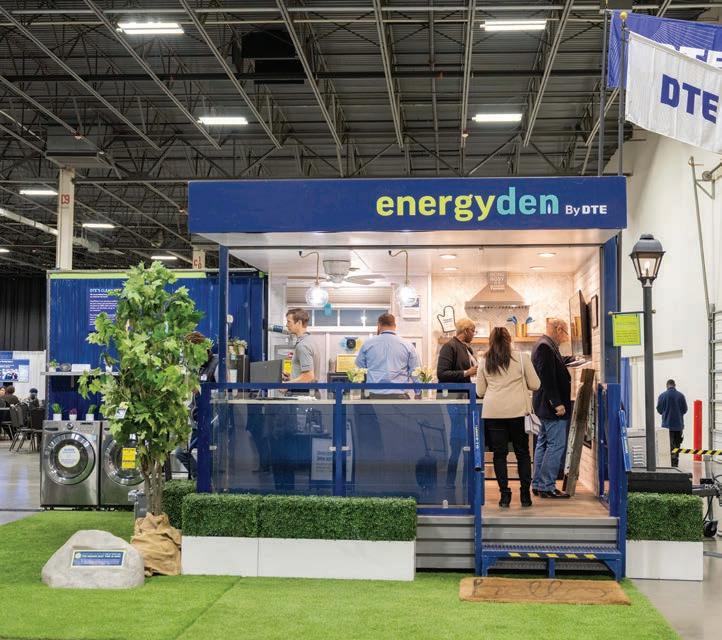
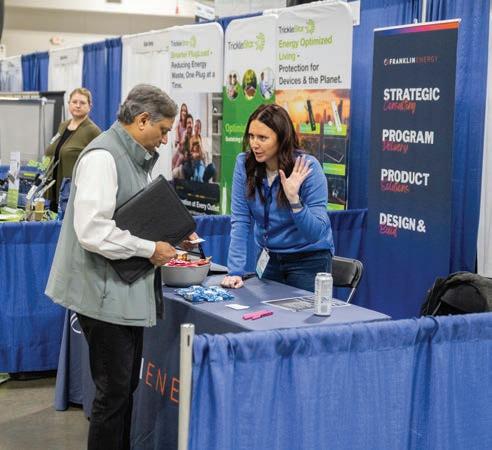
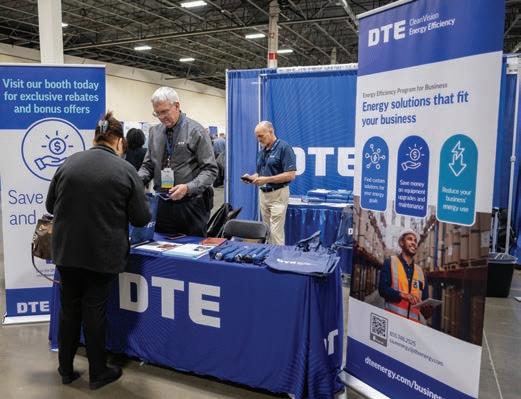
The 27th annual conference, which took place in Novi on May 5, featured 20 breakout educational sessions and 54 exhibitor booths, along with a demonstration area and the Efficiency DEN/ HUB, which included a scavenger hunt that aimed to teach DTE customers about ways to reduce their energy use.
This year, the keynote session was joined by a morning general session — a first for the conference.
“We’ve been trying to add in new [features],” says Kevin Gast, a certified energy manager for DTE. “Based on attendee feedback and attendance at other conferences, we decided to add a morning general session to set the tone of the day.”
The morning kicked off with the new general session tackling a hot topic: artificial
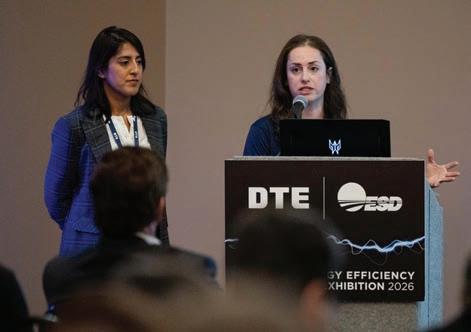
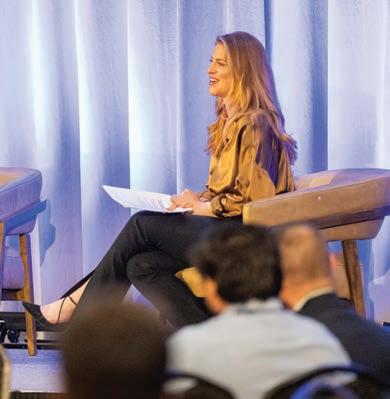
intelligence. Knox Cameron, director of major account services for DTE, moderated a panel of experts comprising John Ko, president of KenergyAI; Eric Wall, vice president of technology, delivery and support for Franklin Energy; and Bryce E. King, energy infrastructure AI lead at Leidos.
The panelists answered questions from Cameron and the audience about how AI can be used in energy efficiency. King highlighted AI’s potential as a “tool in the hands of experts.” AI can cut out the middleman who translates experts’ ideas into code, she said.
Ko advised the audience to view AI as an eager but completely inexperienced intern. No matter the use, “humans provide the wisdom.” The session concluded with the panelists’ tips and tricks for implementing AI to improve workflow.
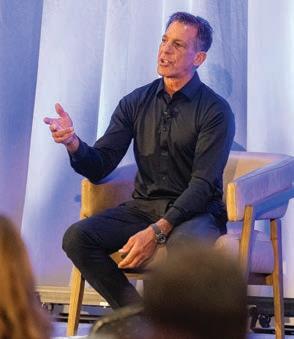
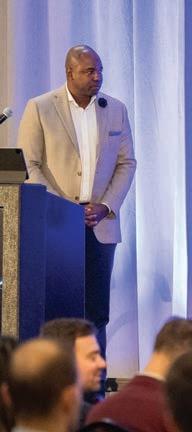
The keynote speakers took the lunchtime session in a completely different direction. Attendees cheered as Chris Chelios — NHL Hall of Famer, three-time Stanley Cup winner, and Detroit resident for 20 years — and his daughter Caley Chelios, a studio analyst and reporter for the Big Ten Network and ESPN, took the stage.
More than 700 people attended the 27th annual Michigan Energy E ciency Conference and Exhibition, which included two general sessions, 20 educational breakout sessions, 54 exhibitor booths, a demonstration area and the E ciency DEN/HUB.
The two emphasized their strong connection to Detroit and shared memories with the audience, including what it was like for Chris to be teammates with Detroit legends like Steve Yzerman. Chris also dispensed hard-won lessons from his hockey career and time running a small business in Detroit, such as the importance of culture at every organization.
Robert Magee, executive director of The Engineering Society of Detroit, notes how special it was to have a “hometown hero” for the keynote presentation.
“He’s not only a celebrated athlete, but he’s also a business owner,” Magee says. “He has some interesting perspectives on where the future is headed, and it sounds like he is very in tune with multiple generations.”
The sessions continued throughout the day, following a variety of tracks: energy optimization, codes and small/medium business, AI and data centers, financing, and new technology and studies. Each offered an opportunity for attendees to hear real-world examples of businesses that improved their energy efficiency.
The more than 700 people in attendance also mingled in the exhibit hall, making connections across industries.
“DTE is all about making sure that their company relationships, their partner relationships and their consumer relationships are all very strong — and this conference brings all those things together,” Magee says. “There are so many things that make DTE unique, but the thing that is most unique, and it permeates from year to year to year, is their commitment and their support for communities.”
Heating up
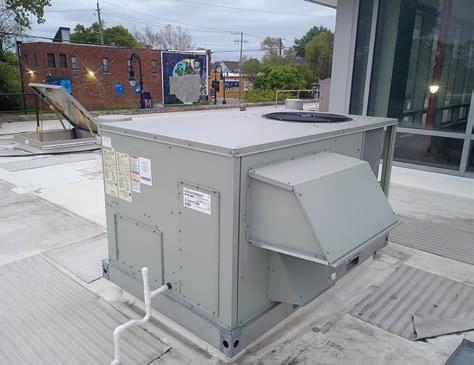
Make sure your cooling equipment is summer ready with DTE’s help.
As temperatures rise, keeping your cooling systems in tip-top shape becomes more and more important. For many facilities, that means taking a closer look at chillers, rooftop units and other HVAC equipment before they are pushed to perform under the hottest conditions of the year.
“Evaluating systems early allows customers to address performance issues, aging equipment or control limitations without the pressure of emergency repairs during the hottest months,” says Eric Anderson, program manager for DTE’s Energy Efficiency Program for Business.
During summer, cooling systems often run harder and longer to keep up with higher loads. That added demand can reveal issues that were not obvious in milder weather.
“Extended runtimes can expose underlying issues like declining efficiency, refrigerant leaks, control drift or poor sequencing between equipment,”
Anderson says. “We often see ‘first hot day’ failures, where a system that hasn’t been fully tested under peak load struggles or fails when demand spikes.”
Those problems can increase energy use, raise operating costs and create reliability risks when businesses can least afford downtime.
For some DTE customers, the warning signs may point to a need for equipment replacement rather than continued repairs. Rising energy bills despite steady usage, frequent service calls, hard-tofind replacement parts or equipment that is 20 years old or older may indicate it is time to consider an upgrade.
“This can include cleaning heat exchangers, verifying refrigerant levels, calibrating sensors, optimizing schedules or improving sequencing so equipment isn’t running harder than necessary,” Anderson says.
DTE can help business customers assess their cooling equipment and identify efficiency opportunities. Through DTE’s Energy Efficiency Program for Business, customers can connect with an energy advisor to discuss project ideas, review eligibility requirements and navigate the rebate process.
“DTE offers rebates for qualifying highefficiency cooling equipment such as chillers, rooftop units and other HVAC upgrades through our programs,” Anderson says. “These incentives can significantly reduce up-front costs.”
DTE has also partnered with Michigan Saves to offer limited-time financing as low as 0% APR with terms up to 36 months for projects up to $250,000.
“If maintenance costs are increasing and performance is unpredictable, replacement can often be the more cost-effective option, especially when rebates and financing are factored in,” Anderson says.
Customers who are not ready to replace equipment can still take short-term steps to improve performance. Preventive maintenance and controls optimization can help reduce waste and boost reliability.
Before contacting DTE, businesses should gather basic details such as equipment age and type, current efficiency concerns, recent energy bills and whether a contractor is already involved.
The next step is simple: Visit dteenergy. com/business or speak directly with one of DTE’s energy advisors to explore rebate opportunities and receive personalized guidance.
To get in touch with a DTE energy advisor, call 855.748.2525 or email saveenergy@dteenergy.com. TOOLBOX