20 YEAR ANNIVERSARY
INSIDE: BIG 3 AUTO EXECS | RX TRANSPARENCY | GOV’T IMMUNITY
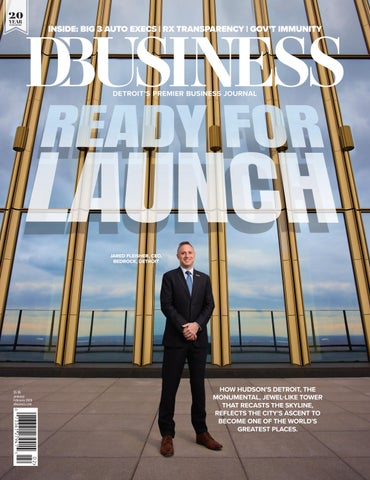
JARED FLEISHER, CEO, BEDROCK, DETROIT
$5.95 January/ February 2026 dbusiness.com
HOW HUDSON’S DETROIT, THE MONUMENTAL, JEWEL-LIKE TOWER THAT RECASTS THE SKYLINE, REFLECTS THE CITY’S ASCENT TO BECOME ONE OF THE WORLD’S GREATEST PLACES.
This digital edition of DBusiness is brought to you by
Refresh Your Look with Eyelid Surgery – A Youthful Transformation Awaits!
Tired eyes can make you look older than you feel. Eyelid surgery, forehead and brow lifting, and under eye “bag” treatment are popular cosmetic procedures which rejuvenate the appearance of your face. Our minimally invasive procedures will give you a more youthful and refreshed look with natural, lasting results. Performed by our experienced board-certified surgeons, eyelid surgery is an effective way to enhance your natural beauty. With seven locations across mid and southeast Michigan, scheduling a consultation is easy. Let’s work together to create positive changes.
248-245-8075
•
eyelidpros.com
Left to right: Ryan Sullivan (Sr. VP/Team Lead), Mike Dolson (Sr. VP), David Mannarino (Market President & Regional Commercial Executive), Paul Whalen (Sr. VP), John VandenBrink (VP)
Strategic solutions are our business. No matter what your industry, ESOPs of all sizes rely on our capital corporate services and expertise to ensure their success. We offer commercial payments and investment banking as well as employer from our industry experts. Take advantage of our local team: David Mannarino KeyBank Market President 4000 Town Center, Suite 1260 • Southfield, MI 48075 Phone: 248-204-6550 David_Mannarino@keybank.com key.com/commercial
Securities products and services such as investment banking and capital raising are offered by KeyBanc Capital Markets Inc., Member FINRA/SIPC. KeyBanc Capital Markets Inc. and KeyBank National Association are separate but affiliated companies. Securities products and services: Not FDIC Insured • No Bank Guarantee • May Lose Value All merchant services, credit, loan and leasing products are subject to collateral and/or credit approval, and terms of service. SBA Preferred Lender. Banking products and services are offered by KeyBank National Association. Key.com is a federally registered service mark of KeyCorp. ©2024 KeyCorp. KeyBank Member FDIC. 220601-1597429
Congratulations to all the Top Corporate Counsel Nominees and Honorees!
Appellate Asbestos/Mass Tort Auto/PIP/Transportation Birth Trauma Defense Business and Commercial Construction and Real Estate
Corporate and Regulatory Employment and Labor Estate Planning & Probate Healthcare Business/ Regulation Immigration - U.S. & Canadian Insurance
Intellectual Property Medical Malpractice Professional Liability Senior Living Workers' Compensation
Kitch Attorneys Counselors &
www.kitch.com
CONTENTS
01-02.26
COURTESY BEDROCK
49
28 Shifting the
Burden
FOCUS: Solutions exist to control the rising costs of pharmaceuticals in employee-funded health insurance plans, but long-entrenched hurdles are in the way. By Tim Keenan
32 Delay, Deny,
Defend
PERSPECTIVES: Michigan’s governmental immunity laws have long stymied families of victims, while homeowners battle for property damages caused by public officials. By Norm Sinclair
6 DBUSINESS || January - February 2026
36 Big Three Exec
Listings
Our annual listing of Big Three auto executives and officers. Assembled by Tom Beaman Plus: Top 25 Tier 1 automotive suppliers.
49 Ready for
Launch
How Hudson’s Detroit, the monumental, jewel-like tower that recasts the skyline, reflects the city’s 30-year ascent to become one of the world’s greatest places. By Bill Dow
WHERE EVERY EVENT FEELS
GRAND
With unique lounges, a resort-style spa, signature restaurants, a luxury 400 room hotel and 30,000 square feet of flexible event space, we make the attendee experience G R A N D . mgmgranddetroit.com
© 2026 MGM Grand Detroit. Excludes Michigan Disassociated Persons. 21+
Scan to learn more
01-02.26
Foreword 10
LETTER FROM THE EDITOR
10
READERS' LETTERS
12
CONTRIBUTORS
CONTENTS
Commentary 16 LEFT BEHIND The auto industry has brought forward multiple innovations since the early 1900s, but in recent decades there has been a dearth of big ideas coming from the Detroit automakers and their suppliers. 16 CENTRAL PLANNING Ever since Gov. Gretchen Whitmer took office in 2019, Michigan’s economy has fallen farther and farther behind. With her second, and last, term coming to a close at the end of the year, the next governor will have the unenviable position of reversing the state’s dismal fortunes.
18 COMPENDIUM How outsiders view Detroit.
The Ticker 22 SLATED FOR COMPETITION Slate Auto, a Troy startup, is developing a back-to-basics universal vehicle. Ford responds with a contender. By Ronald Ahrens 23 DOWN ON THE FARM Taking the pastoral road to success, Tom Bennett traded in his day job to raise cows, hogs, chickens, turkeys, and ducks. By Seth Schwartz 23 FOR SPARTA Michigan State University has launched the $1 billion FOR SPARTA: The Capital Initiative for MSU Athletics campaign, designed to elevate facilities, enhance the student-athlete experience, and secure the institution’s position as a leader in college athletics. By Tim Keenan 24 BINDING BELIEFS Preserving classic and sentimental literature is a family legacy at Tessmer Book Bindery in Mount Clemens. By Tim Keenan
24 24 PDA Q&A Matt Webber, vice president of business development, Conifer Insurance Services, Troy. By R.J. King 26 BEE NATURAL Two sisters from west Michigan have used their beehives to create a national business. By Seth Schwartz
Exec Life 62 BACK TO THE FUTURLINER Clinton Township custom slot car track-maker recreates diorama for coast-to-coast GM Futurliner restoration. By Tim Keenan 64 RETURN ON INVESTMENT Quick Study: Brandford Jones, who grew up in Bloomfield Hills, today is at the forefront of AI and venture capital. By Tom Murray
8 DBUSINESS || JANUARY - FEBRUARY 2026
JOSH SCOTT
16 UP IN SMOKE Michigan’s cannabis industry is expected to lag as the state Legislature and the Whitmer administration reached a 2026 FY budget agreement that includes an additional 24 percent tax on wholesale marijuana, effective Jan. 1, 2026. The new levy is expected to negatively impact small businesses that are directly active in or service the industry. It also is projected to boost sales on the black market.
66 PATENTS AND INVENTIONS Born Inventor: Raised on a farm, industrialist Henry Ford never seemed to stop creating products and systems that served to change the world. By Norm Sinclair 68 OPINION AI for Business: Companies and organizations can tap artificial intelligence to grow and enhance their operations by taking small steps and building wins. By Vladimir Gendelman 69 THE CIRCUIT Our party pics from exclusive events.
Et Cetera 72 FROM THE TOP Top Hotels in Metro Detroit, Top Corporate Counsel. 74 CLOSING BELL Live Steam: Frank E. Kirby came to Detroit in 1870 and designed at least 150 ships for Great Lakes service, becoming America’s greatest naval architect. By Ronald Ahrens ON THE COVER Photo by Matthew LaVere
Recognized as Michigans ‘Go-To Business Litigators’ Our team protects your company’s interests with precision, creativity, and results that speak for themselves. From complex litigation to strategic counsel, we’re the legal partner high-performing businesses trust.
(248) 792-6886 www.palawyers.com
7457 Franklin Road, Suite 200 Bloomfield Hills, MI 48301
Letters
Grand Scale
T
he former Packard Motor Car Co. is back in the spotlight. Rather than the prospect of another round of restorative hope for the Packard Plant on Detroit’s east side, which ceased operations in 1958, a concrete redevelopment plan has finally emerged. A community-focused industrial project, a concept never before utilized in Detroit on such a grand scale, seeks to transform what officials refer to as the “largest and most R.J. KING notorious ruin” in the city. By all accounts, it’s the last of an ill-fated breed. In December, the city, which owns and recently demolished most of the 40-acre site that spans the north and south sides of East Grand Boulevard near Mount Elliot Street, signed a letter of intent with a development team to redevelop 28 acres of the parcel. Now poised for action, the startup effort mirrors, in some ways, the early struggles of the Packard automotive operation. The original factory, built in 1902 by a group of investors led by Henry Bourne Joy, sat vacant for more than a year. The challenge then was that James Ward Packard, who co-founded what became Packard Motor Car Co. with his brother, William, among others, wouldn’t commit to moving the fledgling auto company to Detroit from Warren, Ohio. While Packard had agreed to be part of the new enterprise, a buyer for his separate electric company refused to go through with the sale unless the inventor stayed put in Ohio. Exasperated, and under intense pressure to monetize what was the largest automotive plant of its time, Joy detailed the operation’s dire straits years later in a letter to Russell A. Alger, one of the
original Packard investors (his estate along Lake St. Clair in Grosse Pointe Farms is now part of The War Memorial). “I remember well the depths of difficulty in which we were sunk, when after we built our carefully planned factory on the Boulevard and were ready to welcome Mr. Packard to move the factory from Warren and take charge of the institution here, he announced to us that he could not move,” Joy wrote Alger. After months of trying to find a solution, Joy hired a few of Packard’s key employees, and the Detroit plant began to mass-produce cars after multiple attempts. It went on to become one of the most celebrated luxury auto companies in the world. Today, new ground is literally being broken at the site on several fronts. Packard Park, to be located on the south side of the boulevard, will include a new 393,000-square-foot, Class-A industrial building, as well as a renovated four-story, 117,000-square-foot structure that originally was designed by noted architect Albert Kahn. The redevelopment by a Public-Private-Philanthropic Partnership that includes Packard Development Partners — along with the City of Detroit, the Detroit Economic Growth Corp., the Albert Kahn Legacy Foundation, and Detroit Regional Partnership — will offer 42 apartments, community programming areas, recreational spaces, and a 2-acre community park. Led by urban developers Mark Bennett and Oren Goldenberg, Packard Park is expected to open in 2028. Meanwhile, to the north, the city is actively marketing the remaining 12 acres of the site, which includes Packard Motor Car Co.’s original administrative offices. If the two projects are successful, Detroit will finally shed itself of the last of its “ruin porn” sites and replace it with a future built on imagination, repurpose, and community support.
R.J. King rjking@dbusiness.com
LITTLE VILLAGE REVITALIZATION
I was sitting in my doctor’s office recently when I saw the September-October 2025 DBusiness cover photo depicting the revitalization of Little Village on Detroit’s east side. I love that the photo includes the mirrored image of the artist. I find it inspirational. It also reminds me of a painting of Norman Rockwell done by himself, of himself (not of a group of people, as in the Nick Hagen photo) because that painting also has a mirror image of the artist at work. Thank you for doing a cover story about Progressive Art Studio Collective, and the people and organizations featured in the article.
Kathleen M. Mutch Novi
HOME TEAM
I’m feeling grateful for the thoughtful feature by DBusiness magazine and R.J. King on our work bringing estate planning and care coordination together. It’s an honor to be recognized among professionals who care deeply about helping families plan with compassion and clarity. Thank you for shining a light on what we do and the values that guide us every day.
Dawn Schluter Bloomfield Hills
EMAIL US AT: editorial@dbusiness.com SEND MAIL TO: Letters, DBusiness magazine, 5750 New King Drive, Ste. 100, Troy, MI 48098 Please include your city of residence and daytime phone number. We reserve the right to edit letters for length and content.
10 DBUSINESS || JANUARY - FEBRUARY 2026
Get the Plunkett Cooney Perspective
™
Business leaders say they trust the attorneys of Plunkett Cooney to anticipate legal pitfalls, to resolve high-stakes litigation and to craft contracts they can sign... with confidence. See your business differently. Get the Plunkett Cooney perspective.
Appellate Law n Banking, Bankruptcy & Creditors’ Rights n Business Transactions n Cannabis Law n Commercial Litigation n Estate Planning & Business Succession n Foodservice & Hospitality Law n Government Relations & Public Policy n Health Care Law n Labor & Employment Law n Mergers & Acquisitions n Nonprofit Law n Real Estate Law n Tax Law n Zoning, Planning & Permitting n
ATTORNEYS & COUNSELORS AT LAW Jeffrey C. Gerish President & CEO
®
Michigan
|
Ohio
|
Indiana
| Illinois
248.901.4000 | jgerish@plunkettcooney.com |
www.plunkettcooney.com
Contributors
CONTRIBUTORS DETROIT’S PREMIER BUSINESS JOURNAL
VOLUME 21 • ISSUE 2 PUBLISHER Jason Hosko EDITORIAL EDITOR R.J. King MANAGING EDITOR Tim Keenan COPY EDITOR Anne Berry Daugherty
BIJOU KARMAN
Bijou Karman is a fashion-focused multidisciplinary artist based in Los Angeles whose practice integrates painting, illustration, and graphic design. Her work has appeared in a variety of printed formats, including the Atlantic, Fast Company, The New York Times, Rolling Stone, Time, and Vanity Fair, as well as in galleries, for campaigns, and on buildings. For this issue, she created the opening image of Perspectives. CONTRIBUTION: Artist, Perspectives | SEE IT HERE: Page 32
DESIGN CREATIVE DIRECTOR Lindsay Richards ART DIRECTOR Justin Stenson ASSOCIATE ART DIRECTOR Steven Prokuda Stephanie Daniel SALES MEDIA ADVISERS Samantha Alessandri, Cynthia Barnhart, Hannah Brown, Karli Brown, Sarah Cavanaugh, Danielle Elliott-Smith, Cathleen Francois, Donna Kassab, Lisa LaBelle, Mary Pantely & Associates PRODUCTION PRODUCTION MANAGER Crystal Nelson PRODUCTION ASSISTANT Alessandra Taranta ACCOUNT MANAGER Elizabeth Kowalik
TOM BEAMAN
Tom Beaman has written for DBusiness since 2007, covering topics ranging from aviation to the dairy industry and Michigan’s Native American community. He worked as a news anchor and a reporter at WDET and WOSU in Columbus, Ohio, and has contributed stories to NPR’s “All Things Considered.” Beaman also worked as a science writer at the General Motors Research Laboratories and as manager of product communications for Pontiac, Saab, and Vauxhall Motors Ltd. He enjoys mentoring journalism and public relations students at his alma mater, Ohio State University. In this issue, Beaman compiled the bios of the Detroit Three executive officers.
CONTRIBUTION: Writer, Big Three Auto Execs | SEE IT HERE: Page 36
SPECIAL PROJECTS EDITORS Morgan Brown, Olivia Sedlacek DIGITAL DIRECTOR OF DIGITAL STRATEGY Travis Fletcher DIGITAL DEVELOPMENT MANAGER Matt Cappo SENIOR DIGITAL DEVELOPMENT SPECIALIST Luanne Lim DIGITAL DEVELOPMENT SPECIALIST Brian Paul IT IT DIRECTOR Jeremy Leland CIRCULATION CIRCULATION MANAGER Riley Meyers CIRCULATION COORDINATORS David Benvenuto, Cathy Krajenke, Rachel Moulden, Michele Wold MARKETING AND EVENTS MARKETING AND EVENTS MANAGER Regan Wright MARKETING AND EVENTS COORDINATOR Puja Trivedi MARKETING AND EVENTS ASSISTANT Kayla Yucha MARKETING RESEARCH MARKETING RESEARCH DIRECTOR Sofia Shevin MARKETING RESEARCH COORDINATOR Kristin Bestrom MARKETING RESEARCH SALES COORDINATOR Alexandra Thompson
NORM SINCLAIR
Norm Sinclair has been a contributing writer for DBusiness for more than a decade, during which time he’s produced a variety of cover stories including the demise of Art Van Furniture, the Flint water crisis, the Midland floods, and a profile of Detroit Emergency Manager Kevyn Orr. A Michigan State University graduate, Sinclair spent 34 years at The Detroit News, where he was an investigative reporter covering criminal justice and white-collar crime. A Pulitzer Prize finalist, he was elected to the Michigan Journalism Hall of Fame in 2008. In this issue, he explores Henry Ford’s patents on automotive mechanisms. CONTRIBUTION: Writer, Patents and Inventions | SEE IT HERE: Page 66
CONTRIBUTING WRITERS Ronald Ahrens, Tom Beaman, Bill Dow, Tom Murray, Seth Schwartz, Norm Sinclair CONTRIBUTING ARTISTS Neil Blake, Patrick Gloria, Bijou Karman, Matthew LaVere, Jimmy Naprstek, Josh Scott, Monika Wisniewska, James Yang
12 DBUSINESS || January - February 2026
MARKETING RESEARCH SALES ASSISTANT Theresa Lowery GRAPHIC DESIGNER Kendra Okamoto MARKETING RESEARCH ASSISTANT Abby Galanty MARKETING RESEARCH INTERNS Rachel Randazzo, Keerthana Reddy, Gwen Zych BUSINESS CEO Stefan Wanczyk PRESIDENT John Balardo DIRECTOR OF BUSINESS OPERATIONS Kathie Gorecki MEDIA ASSOCIATE Lachlan O’Neill SENIOR ACCOUNTING ASSOCIATE Andrew Kotzian ACCOUNTING ASSOCIATES Jenna Glod, Austin Schmelzle DISTRIBUTION Target Distribution, Troy
Postmaster: Send address changes to DBusiness, 5750 New King Drive, Ste. 100, Troy, MI 48098 For advertising inquiries: 248-691-1800, ext. 126 To sell DBusiness magazine or for subscription inquiries: 248-588-1851 DBusiness is published by Hour Media. Copyright © 2026 Hour Media. All rights reserved. Reproduction in whole or in part without permission is prohibited. DBusiness is a registered trademark of Hour Media.
JUNE 2026
F O R A G E N D A A N D S P E A K E R R O S T E R , P L E A S E V I S I T:
P O W E R CO N N E CT I O N S CO. CO M
JAMES YANG
01-02.26
COMMENTARY
16 “ANYONE WHO STOPS LEARNING IS OLD, WHETHER AT 20 OR 80. ANYONE WHO KEEPS LEARNING STAYS YOUNG. THE GREATEST THING IN LIFE IS TO KEEP YOUR MIND YOUNG.”
p. 16
p. 18
Left Behind
Compendium
Central Planning Up in Smoke
— HENRY FORD, FOUNDER, FORD MOTOR CO. JANUARY - FEBRUARY 2026 || DBUSINESS.COM 15
Commentary
TECHNOLOGY
Left Behind
T
INSIDE THE NUMBERS TERAWATTHOURS
4,151
Amount of electricity the U.S. generated in 2024
GIGAWATS
473
Terawatt-hours of electricity divided by annual hours (8,760) in 2024
GIGAWATS
300
Amount of electricity that could be produced annually via solar-powered AI satellites
Sources: Federal Energy Regulatory Commission, Elon Musk
he auto industry has brought forward multiple innovations since the early 1900s, including Henry Ford’s Model T and the moving assembly line, General Motors’ electric self-starter and the automatic transmission, and Chrysler’s four-wheel hydraulic brakes and the minivan. But in recent decades, there has been a dearth of big ideas coming from the Detroit automakers and their suppliers. Today, the Detroit Three have largely circled their collective wagons around building large trucks, SUVs, and luxury vehicles. That’s a sound strategy when the economy is doing reasonably well, yet during a recession like the 2008 global financial crisis, consumer demand for expensive products like large pickups and SUVs fell drastically. That’s one of the major reasons why GM and Chrysler each needed a federal infusion of millions of dollars to survive the 2008 downturn. Such myopic strategies limit the potential for new ideas and risk-taking. The fear of an inward strategy likely means the next big idea will come from someone else. In that unenviable position, the Detroit Three could be wiped out, severely downsized, or become ripe for a hostile takeover (lagging stock values don’t help the situation). Consider: The next innovations in the auto industry and the overall global economy are coming from inventors like Elon Musk. A self-described risk-taker, Musk has made major contributions to the future of transportation, IT, and health care — Tesla, Hyperloop, Boring Co., SpaceX, Starlink, Neuralink, xAI, and more. The Detroit Three, not so much. Two of Musk’s most recent and practical ideas involve the concept of harnessing existing technologies in new ways. Rather than building expensive data centers, which require immense power and the related cooling equipment to keep large servers from overheating, Musk has proposed the creation of “distributed inference AI” from idle vehicles. “If you’re able to run a kilowatt of inference on a 100-million car fleet, now you’ve got 100 gigawatts of distributed inference, with built-in cooling and power electronics and distributed power,” the inventor recently explained at Tesla’s 2025 shareholder meeting. He continued, “If you’ve got distributed inference AI, and you’ve got the power and the cooling — which is very difficult to do, the power and the cooling — 100 gigawatts is a lot. The average power consumption in the U.S. is around 460 gigawatts for the entire country. That’s the entire electrical consumption of the U.S. So, if you did 100 gigawatts, that would be a pretty big number.” With all those vehicle systems operating collectively, it reduces the demand for expensive data centers. In turn, Musk has proposed using his Starship rocket to carry scores of gigawatt solar-powered AI satellites to outer space each year. Referring to the orbital network, he states: “At 300 gigawatts per year, AI in space would exceed the entire U.S. economy just in intelligence processing every two years.” Such a network also solves the expensive power and cooling requirements of today’s land-based data centers. If Musk is successful in bringing distributed inference AI to market, whether powered by vehicles or satellites, or both, he and his various companies will control a substantial portion of the overall network. Not to be left behind, Jeff Bezos is backing a new startup, Project Prometheus, as a “copycat” to Musk’s satellite plans. As for the Detroit Three, innovation and risk-taking have fallen by the wayside as the respective companies focus on protecting their diminishing position in the overall transportation industry.
16 DBUSINESS || January - February 2026
EMPLOYMENT
CENTRAL PLANNING
EVER SINCE GOV. GRETCHEN WHITMER took office in 2019, Michigan’s economy has fallen farther and farther behind. With her second, and last, term coming to a close at the end of the year, the next governor will have the unenviable position of reversing the state’s dismal fortunes. According to an outlook released in November by the University of Michigan in Ann Arbor, the U.S. economy is expected to grow modestly over the next several quarters, while Michigan has hit a growth pause that isn’t expected to resume until 2027. Overall, the state’s economy has been treading water. During Whitmer’s first six years in office, 13,079 jobs were created, according to Bridge Michigan. By contrast, at the end of Gov. Rick Snyder’s second term (2011-2019), the private sector had added around 560,000 jobs, led by gains in manufacturing and professional and business services. To reverse the tide, John Mozena, president of the Center for Economic Accountability, told CapCon in an email that the road to recovery will come from “reforms like getting kids out of failing schools, fixing crumbling roads, encouraging cheap and reliable energy, repealing counterproductive regulations, restoring Right-to-Work, and addressing other barriers that currently make Michigan unattractive to good businesses that create good jobs.” CANNABIS
UP IN SMOKE MICHIGAN’S CANNABIS INDUSTRY is expected to
lag as the state Legislature and the Whitmer administration reached a 2026 FY budget agreement that includes an additional 24 percent tax on wholesale marijuana, effective Jan. 1, 2026. The new levy is expected to negatively impact small businesses that are directly active in or service the industry. It also is projected to boost sales on the black market. Whether the new state law holds up is another matter, as the Michigan Cannabis Industry Association filed a complaint soon after Whitmer signed the new budget in early October. The association argues the new law wrongly alters the initial legislation approved by voters that legalized consumer sales of cannabis in 2018. One way the state could assist homegrown marijuana producers is to allow for interstate sales or impose license caps. Another option is to reduce the state budget by moving to a part-time legislature, right-sizing and fixing public education, and ending the practice of handing out billions of dollars in corporate subsidies. Consider, the total state budget for Michigan was approximately $58.5 billion in the 2019-2020 fiscal year, when Whitmer took office. For the 2026 fiscal year, the total budget signed into law is $81 billion. That’s around a 40 percent boost for a state economy that’s stuck in the mud.
Graduate Fast. Lead Faster.
100% Online 10 Months Long 30 Credit Hours Learn more about our online MBA Programs at baker.edu
Commentary
COMPENDIUM: HOW OUTSIDERS VIEW DETROIT DETROIT IS BACK FROM THE DEAD. BUT NOT EVERYONE IS FEELING IT.
CNN NOV. 5, 2025 BY NATHANIEL MEYERSOHN AND MATT EGAN New York — Hudson’s Detroit, the Motor City’s first new skyscraper in nearly half a century, is a symbol of Detroit’s transformation from bankruptcy to boomtown. The $1.4 billion project includes a recently opened office building as well as retail on the site of the former J.L. Hudson’s department store and a skyscraper that will eventually feature high-end condos and a five-star hotel. Detroit “was probably at the bottom of the barrel in this country — from crime and unemployment to everything in between,” Dan Gilbert, the billionaire who has helped catalyze Detroit’s revival, said in an interview with CNN. “It’s been a 180-degree comeback.” Gilbert’s real estate company developed the complex at the former Hudson’s, a shopping mecca for generations that closed in 1983. Detroit’s population is growing for the first time in nearly 60 years. General Motors is moving its headquarters to Hudson’s. JPMorgan is moving there too, having announced a big push to invest $100 million in the city more than
a decade ago. On Wednesday, JPMorgan said its investment in Detroit had surpassed $2 billion. But Detroit’s improbable comeback remains incomplete. Its downtown has made a remarkable recovery from the city’s 2013 bankruptcy — the largest municipal bankruptcy in American history. Meanwhile, some parts of the city have been left behind. ... Detroit was once the fourth-largest city in the country, home to America’s automobile industry. ...
DETROIT CAR CLUB SAVES SUBURBAN COFFEE SHOP FROM FORECLOSURE DURING COVID-19 LOCKDOWNS FOX NEWS DIGITAL NOV. 29, 2025 BY JOSHUA Q. NELSON
When car enthusiasts in Detroit gather to show off their flashy vehicles, sometimes it has a ripple effect in the community. During August, Fox News Digital attended Drift Indy, M1 Concourse and the Woodward Dream Cruise events in the Detroit suburbs to ask car enthusiasts and attendees whether they face challenges in building a community. Due to the rise of technology and the decline of various social activities such as bowling leagues, Rotary clubs and church attendance, reports of loneliness have been on
18 DBUSINESS || January - February 2026
the rise. “This is actually a great opportunity for you to come out and just socialize with people. This group is honestly nothing but chill vibes and just a good community,” Elie El-Haddad said. Many find community in loving cars. But, among the experiences car enthusiasts shared with Fox News Digital, one story transcended beyond personal bonding. El-Haddad started Eurotic of Detroit about a decade ago, becoming the eighth chapter nationwide. Eurotic focuses on European-made cars like BMW, Jaguar and Mercedes. The chapter meets weekly in the parking lot at the DayCap Café based in Birmingham, Mich., a suburb of Detroit. Sometimes the chapter meets in Royal Oak and downtown Detroit. The Eurotic of Detroit chapter brought monetary value to a small business, El-Haddad touted. “This is what the car community is all about. You just come out, have fun, introduce yourself to new people, interact with new people and then, at the end of the day, we all love cars — we all have one hobby,” El-Haddad said. Svenska Café was on the cusp of bank foreclosure during the coronavirus pandemic while businesses and schools were locked down. … As Eurotic car shows were allowed to host
events while practicing social distancing, El-Haddad and then-Svenska Café owner, Christina Bakalis, worked together while the coffee shop provided curbside pick-up for customers’ orders. …
DETROIT ELECTS FIRST FEMALE MAYOR AS CITY COUNCIL PRESIDENT MARY SHEFFIELD DEFEATS MEGACHURCH PASTOR FORTUNE • NOV. 5, 2025 • BY COREY WILLIAMS
City Council President Mary Sheffield will be Detroit’s newest mayor and the first woman to lead the city. Sheffield defeated popular megachurch pastor the Rev. Solomon Kinloch in Tuesday’s general election. She will take office in January and succeed three-term Mayor Mike Duggan, who announced last year that he would not seek re-election. Duggan is running for Michigan governor as an independent to replace term-limited Democrat Gretchen Whitmer. Sheffield thanked voters in her victory speech Tuesday night, addressing those who voted for her and those who didn’t. “I am here to listen to you, to fight for you and to serve you,” she said. “Because, at the end of the day, we all want the same thing, a Detroit that works for everyone.” Sheffield will inherit a city that continues to improve following Detroit’s 2014 exit from the largest municipal bankruptcy in U.S. history. Duggan was elected in 2013 and took office in January 2014. Under his watch, Detroit has dramatically improved city services, including shorter police response times, public lighting and blight elimination. Detroit has had 12 consecutive years of balanced budgets and the city has been showing historically low violent crime numbers. Its population also has grown following decades of losses. Earlier this year, the U.S. Census estimated Detroit’s population at 645,705 — a gain of 12,487 residents since a May 2024 estimate, according to the city. Detroit’s population reached 1.8 million people in the 1950s. Sheffield and Kinloch, both Democrats, advanced to
Tuesday’s election after finishing with the most votes in the city’s nonpartisan August primary. Sheffield, 38, first was elected to the City Council in 2013 at age 26 and has been council president since 2022. Sheffield has said that focusing on educating Detroit’s children, and continuing to improve public safety and life in the neighborhoods will be among her priorities if elected mayor. “My commitment, Detroit, is to build on the foundation that has been laid working with Mayor Duggan and our council … by expanding opportunities, strengthening our neighborhoods and making sure that Detroit’s progress reaches every block and every family of this city,” Sheffield said alongside Duggan at a September campaign event. Duggan endorsed Sheffield. “Our city’s progress is in very good hands and I know she and her team will make sure it not only continues, but expands,” he said in a statement following her victory. Kinloch conceded the election in a short speech to his supporters Tuesday night. He reiterated what he said throughout the campaign, that all of Detroit has to share in the city’s revival. “You can’t make all of the investments downtown,” Kinloch said. “It has to reach the whole town.” Kinloch also said he hopes the campaign shows people they need to stay involved in their city government, and repeated his campaign themes of pushing for more action on affordable housing, crime and support for Detroit neighborhoods. ...
Commentary
WHY I FINALLY CAVED TO THE CARHARTT DETROIT JACKET — AND YOU SHOULD, TOO GQ • NOV. 5, 2025 • BY LEON HEDGEPETH
Carhartt’s Detroit Jacket has become the reigning (sometimes controversial) king of workwear: tough enough to handle the actual blue collar work it was designed to tackle but worn by Hollywood heartthrobs and hunted down in vintage shops across America. Carhartt’s signature Dearborn canvas — a brawny cotton that can block a lake-effect winter gale and shrug off a quick slide under a Ford F-150 — is the star, with a corduroy collar, zip chest pocket, and an of-the-moment boxy-and-cropped fit filling out the ensemble cast. The Detroit jacket is functional, flattering on almost everyone, and brings just the right amount of f–k around and find-out attitude. It’s also everywhere. For the longest time, I resisted the siren song of the Detroit jacket, having my feed saturated by citified Carhartt bros. But when designer labels from all across the spectrum (and globe) started making their own homages, I cracked. The Detroit had gone from insider, to obvious, to oversaturated, and then back to a sweet spot: so ubiquitous as to have become a staple. So I bought one. Well, okay, confession: I bought Carhartt’s Work in Progress (WIP) version of the Detroit … which costs about twice as much as the mainline version. I can already see the side-eyes coming my way. But hear me out: the Detroit made by Carhartt’s higher-end, more fashion-forward sublabel hits just the way I want. The mainline Carhartt Detroit jacket, dropped in 1954 and still going strong, is typically blanket-lined (sometimes quilted) and even comes in a stretch option. The sizing is straight out of the ’50s, from when massive Cadillacs with tailfins roamed the Earth, and ranges from small to 5XL (plus tall versions). But the small, which I need, made me look like a kid in his dad’s work coat. Don’t get me wrong, it’s not a bad jacket. But “hand me the 5/8ths wrench, champ,” isn’t the look I’m going for. So yeah, I grabbed the spring version of the Work in
Progress Detroit — a size small, black, unlined, but still a hefty 12-ounce cotton canvas. The WIP Detroit still brings that old-school Carhartt toughness with the boxy silhouette, but the sizing (XS to XXL) matches up with modern sizing. The winter one (the OG Detroit, in Carhartt WIP’s words) is thicker (13.5 oz.) and quilted for warmth, but I love how mine layers easily. The collar lies flat even when zipped up, and with a hoodie underneath, it’s cozy without feeling suffocating. … Since getting my WIP Detroit jacket, I’ve fully leaned into my lunch-pail stolen valor aesthetic (hey, I live in the Midwest — let me cook). My go-to look: a heavy tee over a thermal, some Richard Gere-approved charcoal jeans, and a pair of engineer boots. It’s one of those rare jackets that’s both a workwear essential and a life lesson: it’s okay to sleep on a trend that feels like it’s being shoved in your face. If it survives the gauntlet — in this case, somewhere between 71 years and a million paparazzi shots of Austin Butler looking great — you can always jump in then. ...
ELECTRICITY PRICES JUMP AFTER TRUMP REJECTS DISASTER AID FOR MICHIGAN UTILITIES
POLITICO NOV. 30, 2025 BY THOMAS FRANK ONAWAY, Michigan — A recent decision by President Donald Trump to deny disaster aid to two electric utilities in rural northern Michigan could cost residents tens of millions of dollars. The Oct. 22 denial is a
striking example of how Trump’s cuts to disaster aid — and his vow for deeper reductions next year — threaten to shift billions of dollars in costs from federal taxpayers to households struggling to rebuild. In this case, it would hit a working-class region that voted overwhelmingly for the president last year, helping him win the crucial swing state. Those households could now face thousands of dollars apiece in rate hikes to make up for the costs of rebuilding their communities’ electric grids after a three-day ice storm in March, utility officials and lawmakers warned. The denial came after the Trump administration documented $90 million in damage to utility infrastructure, according to records obtained by Politico’s E&E News. The amount is nearly five times the federal threshold to qualify for disaster aid. But in its October denial letter, the Federal Emergency Management Agency told Democratic Gov. Gretchen Whitmer that assistance to the utilities “is not warranted.” “It could be tens of millions of dollars left on the backs of the members,” said Allan Berg, the CEO of Presque Isle Electric & Gas, known as PIE&G, in northeastern Michigan. The other utility, Great Lakes Energy in northwestern Michigan, said on its website that “all storm-related costs not reimbursed by state or federal disaster aid will be paid for by the cooperative’s entire membership.” Both utilities are nonprofit electric cooperatives, which serve rural areas and are owned by customers — unlike the for-profit, investor-owned
utilities that electrify most of the United States. They collectively serve 160,000 households and businesses in this heavily wooded region. …
WHAT MAKES MIDLAND, MICHIGAN, THE BEST PLACE TO RETIRE?
U.S. NEWS & WORLD REPORT • NOV. 4, 2025 • BY ALI FOLLMAN Midland, Michigan, earned the No. 1 ranking in U.S. News & World Report’s Best Places to Retire for 2026. It’s one of 11 Michigan cities in the top 100. Seniors in Midland are in good company: 23 percent of its residents are over the age of 45 and 20 percent are over 65. … The most heavily weighted factor in the retirement score for each city is quality of life, accounting for more than a quarter of the overall score. “I was won over by the quality of life in Midland,” Steven Arnosky, retired city councilman for the city of Midland, said in an email. He is not a Michigan native but came to Midland to work for The Dow Chemical Co., which is headquartered there. He worked for Dow for 32 years before retiring with his wife and staying in Midland, though their family doesn’t live nearby. AFFORDABLE AND TAX-FRIENDLY The city ranks No. 11 for affordability, which is partly thanks to its median home value of $206,142 — much lower than the national average of $370,489. Midland’s median household income of $76,166 is only slightly lower than the national median household income of $79,466. … ACCESSIBLE RECREATION Part of the Great Lakes Bay Region, Midland is for nature lovers. The community’s Dow Gardens features thousands of flowers each spring and a 1,400-foot-long canopy walk in the estate’s Whiting Forest. Nearby, the Chippewa Nature Center has 19 miles of trails and exhibits about local wildlife and ecosystems, and the Little Forks Conservancy promotes protecting the land while educating the community. … GREAT QUALITY OF LIFE Midland ranks No. 8 for quality of life, an index encompassing crime rates, weather temperateness, environmental risk from extreme weather, culture and leisure accessibility, air quality and walkability. …
JANUARY - FEBRUARY 2026 || DBUSINESS.COM 19
Train Your Finances Like Your Body: Build Strength for a Secure Future!
Michigan’s Advocates for the Injured
Sinas Dramis Law Firm are EXPERTS in auto accident laws. If you are looking for an understandable explanation of the Michigan Auto No-Fault Insurance Law and how it works, need someone to explain your rights and discuss how to best proceed under your circumstances, and/or looking for representation, I would HIGHLY suggest Sinas Dramis Law Firm! ~ Past Client
SinasDramis.com | 866.758.0031 SERVING ALL OF MICHIGAN
Congratulations BRIAN MCKENNA!
JOSH SCOTT
01-02.26
THE TICKER
24 PRINT STOCK Classic and historic literature is preserved at Tessmer Book Bindery in Mount Clemens, which also is home to printing presses and equipment from yesteryear.
p. 22
p. 24
p. 26
Slated for Competition
Binding Beliefs
Bee Natural
For Sparta
PDA Q&A
Down on the Farm January - February 2026 || DBUSINESS.COM 21
Slated for Competition
NEW KID IN TOWN Slate Auto in Troy is developing a compact EV pickup that it plans to start selling by 2027. The target price for the modular vehicle is $27,500, with sales to be conducted online.
because everyone needs a safe truck,” says Eric Keipper, Slate’s head of engineering. The truck is built around a stout steel cage that sits on an EV “skateboard” containing the battery pack. Polypropylene body panels colored slate gray attach to the chassis, somewhat recalling the late Saturn’s approach to vehicle assembly. Forward-collision warning and active emergency braking are included among the suite of safety features, along with up to eight airbags. On-road performance is projected to match contemporary standards. “The Slate truck is the first new vehicle that’s designed to be wrapped,” says Tisha Johnson, Slate’s head of design. Easy-to-apply vinyl wrap kits fit along the truck’s coachlines, allowing for individualized colors and patterns. The interior excludes hardwired infotainment gear; instead, one can mount a phone or a tablet, along with a speaker. Windows are hand-cranked, and simple knobs control the climate system, as in the 1960s. Accessory flat-pack kits allow the Blank Slate to be reconfigured into a fiveseat SUV in two styles, each with rear side-curtain airbags. Scores of other accessories will be offered, and a line of apparel extends the lifestyle aspects as Slate banks on creating a niche appeal. An unused factory in Warsaw, Ind., northwest of Fort Wayne, is being adapted to build a single model in a simplified process that eliminates traditional stamping and paint operations. Meanwhile, last August Ford Motor Co. announced its Universal EV Platform, with the first derivative, a $30,000 midsize pickup, intended for 2027. To meet that price point, a skunkworks team prescribed a build process that ditches the moving assembly line pioneered long ago by Henry Ford. Instead, Jim Farley, Ford’s CEO, has spoken of an “assembly tree,” with modular subassemblies being fitted together for rapid construction. Fewer parts and workstations will be required in the plant, yet Farley promises a fun-to-drive truck with a “quite different” digital experience that’s new in the marketplace. “I think this first product is quite revolutionary,” Farley says.
Emagine Entertainment Sells to Belgian Theater Operator Emagine Entertainment in Troy has agreed to sell its operations to Belgiumbased theater operator Kinepolis Group for between $105 million and $120 million, depending on 2025 box office receipts.
Waymo to Bring its Autonomous Vehicle Service to Metro Detroit Waymo is planning to bring its autonomous taxi service to Detroit in 2026, following testing on the city’s streets and in other areas around the region. Waymo has been operating an engineering team in Novi.
Slate Auto, a Troy startup, promises a backto-basics universal vehicle. Ford responds with a contender. BY RONALD AHRENS
A
fter three years in stealth mode, Troybased startup Slate Auto hosted a brand launch and revealed its compact EV pickup last April, amid officials’ bold claims of reinventing the auto industry when sales start in late 2026. The spirited event at the Long Beach Airport, near Slate’s California design center, opened the door to the emergence of new low-cost vehicles. “The idea for Slate goes back to 2022 when several visionary thinkers asked, ‘Could we build a radically affordable and simple new car?’ ” says Chris Barman, CEO of Slate. Backed financially by Jeff Bezos, a target price of $27,500 puts the truck within reach of disenfranchised buyers. Incentives in some states would drive the price down further. Sales will be conducted online. “We knew from the very beginning that we needed to be a U.S. NCAP five-star-rated vehicle,
DBUSINESS DIRECT
JPMorganChase Unveils Plans for Hudson’s Detroit Office JPMorganChase has unveiled plans for a downtown office and conference center at Hudson’s Detroit. The new space is slated for completion in 2026. It will serve as a space for collaboration, innovation, and community partnerships.
22 DBUSINESS || January - February 2026
Bloomfield Hills’ TriMas to Sell Aerospace Business for $1.45B Bloomfield Hills-based TriMas has agreed to sell its aerospace business to an affiliate of Tinicum L.P. in an transaction worth $1.45 billion. Tinicum manages a group of manufacturing, industrial technology, and specialty infrastructure companies.
Trinity Health Ann Arbor Announces $60M Emergency Department Project Trinity Health Ann Arbor has announced plans for a multiphased, three-year, $60.5 million renovation and expansion of its Emergency Department. Construction of the new space is expected to be completed in late 2028.
COURTESY SLATE
The Ticker
The Ticker
COURTESY TOM BENNETT
FOR SPARTA
MICHIGAN STATE UNIVERSITY in East Lansing has launched the $1 billion FOR SPARTA: The Capital Initiative for MSU Athletics campaign, designed to elevate facilities, enhance the student-athlete experience, and secure the institution’s position as a leader in college athletics. “FOR SPARTA sets a bold course for the future of Michigan State athletics,” says Kevin M. Guskiewicz, president of MSU. “By investing in world-class facilities and experiences for our student-athletes, we are positioning MSU to lead in an increasingly competitive landscape. “This initiative reflects our commitment to modernize our athletics program, and I look forward to seeing the impact it will have on Spartans today and for generations to come.” FOR SPARTA is expected to provide Michigan State athletics with the strategic resources needed for facilities and overall program investment to compete at the highest levels. In modernizing facilities throughout the department, MSU intends to provide student-athletes the optimal spaces in which to compete and train. In addition, improvements will be made to elevate game-day experiences such as new premium spaces for donors. It’s an approach that will include several sport-specific facility improvements, as well as shared spaces like a student-athlete dining facility. “This is the most ambitious initiative in Michigan State Athletics history,” says J Batt, vice president and director of athletics at MSU. — By Tim Keenan
Grand Rapids Civic Leaders Reveal Plans for Commerce Club A group of civic leaders unveiled plans for the Commerce Club in Grand Rapids, a private destination for professionals and community leaders that’s expected to begin a new era of connection, collaboration, and capital.
Down on the Farm Taking the pastoral road to success, Tom Bennett traded in his day job to raise cows, hogs, chickens, turkeys, and ducks. BY SETH SCHWARTZ
W
hile he was serving in the U.S. Marines, Tom Bennett pictured one day owning and operating a small farm where he could raise chickens, turkeys, cattle, and hogs. Following 10 years in the service, in 2010 he returned to Edwardsburg, located 30 miles south of Kalamazoo, and began working at Gordon Food Service. Soon after, he started a 20-acre farm and began supplying pasture-raised meat, poultry, and dairy products to around 50 nearby families. By 2016, he was selling his products at a farmers market in Sturgis. Two years later, Bennett Farms was in 12 markets. With the business growing rapidly, and now married with six children, in 2018 Bennett retired from Gordon Food Service to farm full time. He also added an online store, where clients can customize their orders. “I had confidence I would succeed because of my training in the U.S. Marines,” Bennett says. “People know they’re getting a product that’s non-GMO and as good as it gets — but they like to have a relationship with us, as well. “We’re like family,” he continues. “When our customers call, I answer the phone. If they email, I’ll respond in five minutes. They know our animals are raised right.” Sales have doubled every year since 2018. Last year, the farm processed 18,000 chickens, 450 hogs, 18 cows, 500 turkeys, and a few hundred ducks. Rotating FARM LIVING Tom Bennett traded in his the animals onto fresh pastures helps ensure day job to run Bennett they have a healthy diet. Farms in his hometown of Today, 80 percent of the products from Edwardsburg, located 30 Bennett Farms are sold through 29 farmers miles south of Kalamazoo markets, while 20 percent are online orders. near the Indiana border.
Hotel David Whitney Converting 79 Apartments into Condos The residential apartments at the Hotel David Whitney in downtown Detroit, owned by The Roxbury Group, are being converted into 79 condominiums. The announcement marks the next chapter for the David Whitney Building.
Ford Unveils New World Headquarters in Dearborn Ford Motor Co. in Dearborn has opened its new world headquarters, moving from its iconic Glass House along Michigan Avenue to the Henry Ford II World Center campus along Oakwood Boulevard.
Bedrock, GM Reveal $1.6B Plan for Redeveloping Ren Center Bedrock and General Motors Co. are planning a $1.6 billion project to transform the Renaissance Center, a largely empty, obsolete complex, with a revitalized hotel and conference center, housing, and public spaces for events and activities.
Bennett is responsible for 800 monthly deliveries in southwest Michigan, northern Indiana, and metro Chicago. In 2025, Bennett Farms serviced more than 60,000 customers, including Dean’s Barbecue and Restaurant in Granger, Ind. Every two weeks, the eatery receives a 225-pound pig that’s split in half. “When we get the pig, it takes us two hours to break it down,” says Phil Gulis, owner of Dean’s Barbecue. “It’s so fresh, there’s never any blood in the pan. The meat is so good we don’t need to do much with it. “We make pork chops, pulled pork and brisket sandwiches, burgers, and cornbread toast, and we use the bones for soups. We could get a pig for cheaper, but it’s not the same. Our customers always give us compliments about the quality of the meat.” Jennifer Stone and her husband, executive chef Michael Stone, who together own Early Bird Eatery in South Bend, Ind., order 120 dozen eggs weekly. “We get grade A large eggs,” Jennifer says. “The flavor is great, the yolks are more colorful, and they also have incredible flavor. We know they haven’t been on the shelf for months, which is what you have when you deal with bigger chain companies.”
Detroit City FC Lands City Council Approval for New Stadium The Detroit City Council provided the Detroit City Football Club with the necessary approvals to move forward on the development of the 15,000-seat AlumniFi Field at Michigan Avenue and 20th Street in southwest Detroit.
For full stories and more, visit dbusiness.com/daily-news to get daily news sent directly to your email.
January - February 2026 || DBUSINESS.COM 23
The Ticker
Binding Beliefs
Preserving classic and sentimental literature is a family legacy at Tessmer Book Bindery in Mount Clemens. BY TIM KEENAN |
C
JOSH SCOTT
olleen Dickey, owner of Tessmer Book Bindery in Mount Clemens, says her shop is a treasure in itself. The business, founded by her great-grandfather, Herman Tessmer, and her grandfather, Melvin Tessmer, has been operating in the same place since the late 1920s or early 1930s. Records from the period are unclear. Most of the equipment in the shop is much older than that. A large card-cutting machine carries a date from the 1800s. It doesn’t work any longer, but it’s much too large to move. Other pressing and cutting machines, which still function, don’t have a date attached to them but appear to be equally as ancient. “They look like they belong in The Henry Ford,” Dickey says with a chuckle, surveying her time capsule of a shop. The business has been handed down from generation to generation. Dickey’s father, James, was next in line after Herman and Melvin. Then it was passed into Dickey’s care. “I worked with my dad and took over the business when he passed away,” she says. “I do it because I love the work and because it’s part of my family legacy.” Tessmer Book Bindery does book repair and periodical binding for libraries, historical societies and other organizations, government entities, and private citizens. She also binds new books, often for people who have put together family histories. Among the notable jobs Dickey has been involved with is a set of 14 original “Wizard of Oz” books by L. Frank Baum that
LITERARY HISTORY Above: Colleen Dickey in the workshop at Tessmer Book Bindery in Mount Clemens. Right: Larry Gardner, owner of Lawrence Gardner Associates in Troy, with his historic books.
she worked on for a lady from Ohio. “I didn’t even know there was an entire set of ‘Wizard of Oz’ books,” Dickey says. She’s also repaired a set of old Aesop’s Fables books, and bound a volume of books for the Archdiocese of Detroit that was sent to the Vatican. The vast majority of the work that comes into the shop — 75 percent — is family Bibles. “I really enjoy preserving the family history that these Bibles hold,” Dickey says. “Everyone has a story and a reason why they want their particular book repaired. I do a lot of books with sentimental value.” One regular customer is Larry Gardner, principal of Lawrence Gardner Associates, a financial and managerial consultancy in Troy. He has a collection of historic business books that have been tended to by the Tessmer team.
PDA Q&A: THE E-INTERVIEW
DB: WHERE ARE YOU?
MATT WEBBER
Vice President of Business Development Conifer Insurance Services Troy
MW: I’m in San Diego at the Wholesale & Specialty Insurance Association. It’s an annual event they host to bring members together for educational, business, and networking sessions. DB: WHAT ARE THE BENEFITS?
MW: We meet our wholesale trading partners and reinsurance brokers. It’s a good opportunity to strengthen the relationships
24 DBUSINESS || JANUARY - FEBRUARY 2026
with the people who sell our programs. DB: HOW’S THE BUSINESS DOING?
MW: We’re a program administrator that provides niche programs for select industry groups like cannabis; food and beverage for restaurants, bars, and taverns; (and) a student housing program for the buildings themselves. We also serve main street retailers,
specialty retailers, and smoke shops.
DB: WHAT’S THE CANNABIS MARKET LIKE?
MW: Cannabis is a national focus, and we’re in every state with a legal market. We provide general liability, product liability, and property insurance for dispensary owners and growers, manufacturers, and testing facilities. The industry has come a long way in a short period, and
“It’s amazing how these skilled workers are able to successfully repair books with antiquated equipment that goes back to the family member who started the company,” Gardner says. “One of my repaired business books goes back to the early 1800s. The wait is often four to six months, but it’s worth the wait.” Gardner was lucky. The waiting list these days is two years. “Right now I’m quite busy,” says Dickey, who isn’t sure who the next member of the family to continue the business will be. “There are seven in the generation after me,” she says. “The youngest one is quite artistic, so my hope is on her, but you never know. I’m not too worried about it. I can keep things going until one of them decides they would like to take it over.”
now it’s become very competitive. The biggest challenge is there’s been so much consolidation in recent years.
DB: WILL THAT CONTINUE?
MW: Yes. Multistate operators have been scooping up the smaller players as the market and pricing have matured. As prices have come down, margins have become pressed. To help offset that, some larger companies are
looking to reduce costs via consolidation.
DB: IS CONIFER EXPANDING?
MW: Yes. The student housing market for general liability and property insurance (for buildings) is a new program for us. We started it last summer (2024) as a dedicated market. We did a little of that before, but now we’re very active in Michigan, Indiana, and Ohio. — R.J. King
Congra MOJO
ON YOUR 2025 INDUCTION TO THE RADIO HALL OF FAME!
The Ticker
Bee Natural
Two sisters from west Michigan have used their beehives to create a national business. BY SETH SCHWARTZ
26 DBUSINESS || JANUARY - FEBRUARY 2026
Based on positive feedback, the siblings opened a small store in downtown Ludington in 2018. Today, they offer 18 different lip balm flavors. A single lip balm retails for $5, while sets of three cost $13. Partnering with a local beekeeper to meet demand for Sister Bees products, Ambrose says she buys 50 barrels of honey annually. She notes that each barrel holds 55 gallons. The product line for lip balms includes lavender lemonade, which is their best-seller and accounts for 10 percent of annual sales. Their customers’ second favorite is chai latte. Bonnema, a Zeeland resident, handles a line of infused honey products. Seventy-five percent of those sales come from Michigan, with the remainder spread across the country. The honey offerings include bourbon, tequila and lime, American cherry whiskey, lavender, buckwheat, and hot honey. There are also creamed honeys in flavors like cinnamon, spiced chai, and blueberry crumble, along with a line of skin care. Victoria’s Jewelry in downtown Ludington, owned by Vicki and Mike Drzik, has become a dedicated customer. “The lavender honey is really good, and I put it in tea,” Vicki says. “The blueberry honey has a
HONEY HOUSE Kelly Bonnema and Kim Ambrose launched Sister Bees in Ludington in 2018. Today, the company offers a line of infused honey products, lip balm, and skin-care items.
great flavor. I put it on my bagels and toast. I enjoy all the lip balms, and they work well. I also send the lip balms to friends, and I’ve used some of the skin-care items.” A Ludington resident for 40 years, Marie Fay has been a customer since Sister Bees opened. “The raw wildflower honey is superb,” she says. “It’s not pasteurized, and it’s anti-inflammatory. I use the honey tonic in the winter. I also use a teaspoon of honey on my toast every morning. The nutrients go a long way. I like buying local, but I’m buying their honey because it’s the best.”
COURTESY SISTER BEES
I
n their 3-acre backyard in Ludington, Kim and Richard Ambrose set up three beehives that were intended to be for their personal use. Soon after, Kim realized there was a market for creating and selling lip balm made from beeswax. Before long she was looking to expand her business, and tapped her sister, Kelly Bonnema, to join the venture. “We went to our favorite stores around town and passed out samples,” Ambrose says, “but the merchants told us we needed to refine our products more.” After making a few adjustments, the sisters began sharing the new version of their lip balms with family and friends, and asked for feedback. In 2018, the pair spent several months preparing for a local entrepreneur contest. They wound up winning the competition and were awarded $50,000. Soon after, they hired a few people and began to work on branding and packaging their products, which they called Sister Bees. From there, they visited different boutique shops along Michigan’s western coastline and found a receptive market. “We went to local stores and farmers markets in Holland, Grand Rapids, Traverse City, and even on the northeast side, in Mackinaw City, and we knocked on a lot of doors with samples,” Ambrose says.
This holiday season, we send our best wishes to you and yours for a prosperous and healthy New Year. Andrew Howard Senior Vice President Financial Advisor 130 Kercheval Avenue Grosse Pointe Farms, MI 48236 313-343-8471 andrew.howard@morganstanley.com
© 2023 Morgan Stanley Smith Barney LLC. Member SIPC.
© 2023 Morgan Stanley Smith Barney LLC. Member SIPC.
HOL003 CRC 6005455 10/23 HOL003 CRC 6005455 10/23
Focus
Shifting the Burden Solutions exist to control the rising costs of pharmaceuticals in employee-funded health insurance plans, but long-entrenched hurdles are in the way.
A
nyone who buys prescription medications at a corner pharmacy or makes health-care decisions at a company is well aware of the costs involved. The brunt of what have become ever-rising costs is being felt by employer-provided health insurance companies and their members, at the expense of others who pay less. There are solutions that would serve to level the playing field, but getting there is fraught with complexity and greed. Between 1985 and 2024, the cost of pharmaceuticals in the U.S. has increased three times more than the rate of inflation, according to the Federal Reserve Bank of St. Louis. But all pharmaceutical costs, both here and globally, aren’t created equal. Consumers covered by Medicare and Medicaid government-funded plans pay less than others for similar medications. Cash customers who buy from Amazon, Mark Cuban’s Cost Plus Drug Co. outlet, and President Donald Trump’s proposed TrumpRx.gov also pay less — or will soon have access to less-costly prescriptions. International customers also pay less, because governments can negotiate prices with drugmakers. That leaves the pharmaceutical industry to make up the difference by charging higher rates to domestic employer-funded health insurance plans. This is where the lack of price regulation and competition in the U.S., in which drug 28 DBUSINESS || January - February 2026
LION’S SHARE Domestic employer-funded health insurance plans are being charged more for medications by the pharmaceutical industry, especially when creating new specialty and biologic drugs.
manufacturers frequently charge exorbitant prices when creating new specialty and biologic drugs, ramps up the overall average costs to employer-funded plans. Another reason for the exploding cost of medicine in employer-funded health insurance is greed in the supply chain, according to Elaine Coffman, executive vice president of Lockton Cos., a global insurance company with an office in Troy as well as locations across Michigan. “Within our system, there are a lot of hands in the pot that make a lot of money in the pharmacy sector,” says Coffman, who has more than 35 years of experience in the field. “There are publicly traded companies, health systems, clinics, private equity money, and pharmacy benefit managers (PBMs) that add cost to the whole supply chain.” In a typical supply chain, manufacturers set a list price for a product. The product is shipped to a retailer, which then sets the price for the customer. The customer pays the retailer, who then pays the manufacturer. The pharmaceutical industry follows a similar process, with a twist. Drug manufacturers set a list price for a medication, which is distributed by wholesalers to pharmacies. Customers pay their copay to the pharmacy, and the pharmacy bills the customer’s insurance company for the remaining cost of the medication. PBMs act as intermediaries between the manufacturers and the insurance companies, and at the same time negotiate rebates from the drug manufacturers. The practice lowers the cost that insurance companies must pay for medications. The rebates go to employers in employee-funded health plans and insurance companies when a patient is covered by a standard health insurance company. “Rebates used to be 5 percent. Now they can be as high as 35 percent,” Coffman says. “It’s become another aspect of the system that isn’t in alignment with a customer’s best interests. It didn’t happen overnight, but it’s where we are now, and insurance companies are addicted to it.”
MONIKA WISNIEWSKAVIA ADOBE STOCK
BY TIM KEENAN
Focus
The rebates also play a role in the placement of medications on lists of preferred drugs, called formulary lists, which are organized into tiers. Moving a medication up reduces the copay patients are responsible for, thereby driving higher sales. The higher the rebate paid by the drug company, the higher up on the formulary the medication is moved and the more likely it is that patients will fill their prescriptions for the medication. However, a major issue with the rebate system is that it’s not transparent. “It’s one of the least transparent parts of the medical industry,” Coffman says. “Even disclosure by itself would be a meaningful improvement on the employer side. Washington, however, hasn’t been able to do anything about that because of how strong the pharmaceutical lobby is.” A result of the current system is that the cost of infusions — and the price of specialty treatments, in particular — have become astronomical for employer-funded insurance plans, as drug manufacturers use the market to recoup their development costs and boost profits. Coffman uses the example of Stelara for plaque psoriasis, which can cost $60,000 to $140,000 per year. Medications for conditions such as cancer, multiple sclerosis, rheumatoid arthritis, and Crohn’s disease also can carry extremely high price tags. Coffman says the new class of drugs for diabetes and weight loss called GLP-1s — Ozempic, Wegovy, and Zepbound — are running $1,500 per month on employer plans. “A huge percentage of drugs cost less than $10,” Coffman says. “A majority of drugs cost less than $5 for a month prescription. That’s why Cost Plus and Meijer can have $3 or free drugs that waive the co-pay, because they’re a loss leader to bring you in. “It’s the higher-cost generic and brand-name drugs, the specialty drugs. And within the medical plan, there are infusion drugs that treat things like cancer; Keytruda would be an example. Those are the higher-end drugs that are driving up the costs.” According to the American Hospital Association, unchecked drug price increases aren’t sustainable, and are a serious economic threat to patients and communities.
SOURCE: Federal Reserve Bank of St. Louis
“They not only threaten patient access to drug therapies, but challenge providers’ abilities to provide the highest quality of care,” the AHA said in a statement. Continued price hikes by manufacturers are forcing hospitals to make “significant” decisions like downsizing staff, delaying capital investments, and employing alternative therapies to cope with the high cost of drugs, the association says. Hospitals, in addition to employer-funded health plans, bear a heavy financial burden when the cost of drugs increases. They aren’t only major purchasers of drugs, but patients often end up in the hospital when they can’t afford to take their medications as prescribed. Finding solutions to the issue of high pharmaceutical costs is seemingly as difficult as NASA’s efforts to land a manned crew on Mars. The AHA is a founding member of the Campaign for Sustainable Rx Pricing — a coalition of doctors, hospitals, pharmacists, employers, health plans, seniors, patients, and consumers coming together to find common ground and solutions. The coalition has not yet been published any of its findings. Uninsured people and those covered by employee-funded health plans who are willing to go outside the system to access less expensive medicine have more options than those who are tied to their health insurance. “There’s the cash buyer that’s paying cash at the pharmacy or through Good Rx, Amazon, Mark Cuban’s Cost Plus, or the platform Trump has announced,” Coffman says. “The prices tend to be more affordable for those cash buyers than other buyers in the system.” In 2022, Cuban and Alexander Oshmyansky founded Mark Cuban Cost Plus Drugs Co., which offers prescription medications at a fraction of the cost of traditional medications. It does so by cutting out PBMs entirely. It negotiates directly with drug manufacturers to purchase generic medications at low list prices. The cost is then marked up by 15 percent to cover business operations, with an additional $5 fee for pharmacy labor and a $5 shipping fee. “Mark Cuban found out that he could buy a high-cost therapy drug for a friend direct from the manufacturer for a tenth of the cost,” Coffman says. “The top 10 PBMs will not use his service because of the margin loss, but some do.” Cost Plus Drugs currently only accepts a limited number of health insurance plans. Most patients are responsible for paying the full Cost Plus Drugs price for their medication, and this expense will not count toward any insurance deductibles or out-of-pocket maximums. For example, the list price for a one-month supply of imatinib, a chemotherapy drug used to treat leukemia and other types of cancer, is approximately $2,500 at various pharmacies. At Cost Plus Drugs, it’s $13.40. The company hopes to expand insurance partnerships in the future. JANUARY - FEBRUARY 2026 || DBUSINESS.COM 29
Focus
30 DBUSINESS || January - February 2026
WE REALLY NEED HELP ALLOWING EMPLOYERS WITH HIGH-DEDUCTIBLE HEALTH PLANS TO GET ACCESS TO THESE LOWER-COST OPTIONS.” — ELAINE COFFMAN
MIND-MELD A recent panel discussion about rising drug prices included John Tackman, director of strategic partnerships at MedOne Pharmacy Benefit Solutions (left); Elaine Coffman, executive vice president at Lockton Cos.; Matt Jarvis, PharmD vice president, pharmacy practice at Lockton; Mark Cuban, founder and president of Cost Plus Drug Co.; and Wes Hartig, CEO of MedOne Pharmacy Benefit. Solutions.
“We really need help allowing employers with high-deductible health plans to get access to these lower-cost options,” Coffman says. “Many manufacturers working with alternative outlets that cater to cash buyers require buyers to not be covered by employer health plans.” Close to 50 percent of the country is covered by commercial insurance. That percentage is paying the way for the rest of the system to exist, Coffman says. “Even the Biden plan for $30 for diabetes drugs didn’t touch the employer plans,” she says. “That was only for government plans.” In an effort to help employers, Coffman’s Lockton Cos. has organized Simplify Medical & Rx, which is based locally in Birmingham. It’s not an insurance carrier or even a company, but a medical and pharmacy plan. Through collaboration between Lockton Cos., Allied Benefit Systems in Chicago, and several other vendors, a comprehensive plan has been designed that capitalizes on a variety of savings opportunities to bring low-cost, quality health care to the marketplace. Simplify Medical & Rx is for self-funded employers that use a national preferred provider organization network to manage the big drug spend. “We’re in the process of shifting thinking about how we buy prescriptions — for employers, from this discount/rebate-driven system, to a lowest-netcost system — but it’s difficult because of how entrenched we are and how much money is being made on the current system,” Coffman says. “We’re basically carving out infusion drugs and specialty drugs from the medical plan, which are only 6 percent to 20 percent of all claims,” she says. “We have a vendor in the mix whose sole purpose is to get the member on the right medication at the right price.” Coffman says Simplify Medical & Rx is seeing a 50-percent reduction in spending for infusion and specialty drugs, and about a 20-percent reduction in regular retail and mail drugs. “We’re doing it by creating transparency and having partners that are focused on lowest net cost instead of discounts and rebates. It’s hard to do.”
JIMMY NAPRSTEK, KODIAK CREATIVE
In addition to lowering the prices of medications, Cost Plus Drugs also is jumping into manufacturing. In March 2024, it opened a 22,000-square-foot manufacturing plant in Dallas. The facility is producing epinephrine, the medication used to treat severe allergic reactions, and norepinephrine, used to treat severe low blood pressure and certain types of heart failure and shock, and the injectors that deliver them. Both of these medications have had shortages in the past decade. While Cost Plus Drugs currently only offers generic medications, it says it hopes to expand to include brand-name drugs in the future. With no marketing budget, Cost Plus Drugs relies entirely on word-of-mouth and media coverage to reach new customers. President Trump’s response to high drug prices includes negotiating with manufacturers like Pfizer and AstraZeneca to bring American drug costs in line with the lowest prices paid by other developed nations (known as the most-favored-nation price, or MFN). The agreement with AstraZeneca requires the company to repatriate increased foreign revenue on existing products that AstraZeneca realizes as a result of Trump’s America First U.S. trade policies for the benefit of American patients. It requires AstraZeneca to offer medicines at a deep discount off the list price when selling directly to American patients. “The agreement ensures foreign nations can no longer use price controls to free-ride on American innovation by guaranteeing MFN prices on all new innovative medicines AstraZeneca brings to market,” according to a White House statement. The affected products include Bevespi Aerosphere, an inhaler used to treat chronic obstructive pulmonary disease, and Airspura, an inhaler used to treat asthma symptoms and attacks. Both products will be available at more than 95 percent off the list price under Trump’s plan. Another national development regarding prescriptions is the September 2025 U.S. Department of Health and Human Services announcement that, as of Oct. 1, 2025, millions of Americans for the first time are now able to compare drug prices, view out-of-pocket costs, and access prior authorization requirements. HHS’ final rule reportedly ensures health care providers using certified health IT systems are able to submit prior authorizations electronically, select drugs consistent with a patient’s insurance coverage, and exchange electronic prescription information with pharmacies and insurance plans. But it’s the employers who are bearing most of the cost burden that’s getting passed along to consumers.
PROMOTIONAL CONTENT
T RUST E D A DV IS O R S Q: What qualities should clients look for in legal counsel? A: One of the best qualities you can find in your own counsel is an attorney who has a variety of clients and a diverse caseload. There is an emphasis in the legal industry to overly specialize in one area. Most attorneys identify themselves by one specific practice area, and while there are some benefits to specialization, I’ve found over my career that it can lead to a number of blind spots. While it may sound counterintuitive, finding an attorney who has represented the other side of your issue (whether it’s litigation or transaction) can provide you with an edge. At Paesano Akkashian, I’ve done my best to try to keep a diverse clientele, from large companies in need of transactional guidance to individuals in need of efficient but effective litigation guidance. This is the biggest lesson I try to instill in law students, as it has paid dividends in my practice.
Paesano Akkashian Devin W. Bone, Partner 7457 Franklin Road, Suite 200, Bloomfield Hills, MI 48301 248-792-6886 | dbone@palawyers.com | palawyers.com
Perspectives
Delay, Deny, Defend Michigan’s governmental immunity laws have long stymied families of victims who have been killed by law enforcement officials, while homeowners face an uphill battle in their fight for property damages allegedly caused by public officials.
BY NORM SINCLAIR ILLUSTRATION BY BIJOU KARMAN
32 DBUSINESS || JANUARY - FEBRUARY 2026
T
he gruesome deaths of two unarmed young men fleeing police on foot in the Grand Rapids area in April 2024 — one was pinned against a wall by a police vehicle, while the other was hit and run over — are among numerous cases pending in state courts challenging a decades-old law protecting local government, tribal agencies, and their employees from civil lawsuits. Governmental, or sovereign, immunity is a legal concept that frequently blocks civil lawsuits against government authorities that arise from actions they take in carrying out official functions. In turn, a subset of the law — qualified immunity — is often more specific to individual officials, mainly those in law enforcement. The overall immunity privilege has, for decades, been a controversial issue among state lawmakers, the courts, and plaintiff lawyers seeking recourse for victims who they say were harmed or killed by government incompetence or neglect. Consider, governmental immunity was the central issue and protective shield for school administrators accused of negligence by survivors and their lawyer in the tragic November 2021 mass shooting at Oxford High School in Oxford Township, where a 15-year-old student, Ethan Crumbley, opened fire with a handgun and murdered four classmates and wounded seven others. More than a dozen civil cases alleging negligence by school administrators were filed by a handful of lawyers, including Ven Johnson Law in Detroit, on behalf of the victims and their families. In quick order, two lower courts cited governmental immunity in rebuffing the firm’s lawsuits. In May 2025, the Michigan Supreme Court, in a two-sentence order, declined to hear appeals of those rulings, ending further legal action. “After all these years, the Michigan Supreme Court decided to kick out the cases without even issuing a formal opinion on why,” says Ven Johnson, principal of Ven Johnson Law. “There’s no better example of the travesty of justice that governmental immunity imposes on all of us than this case. “It’s a textbook example of what’s wrong with our state jurisprudence system. My clients not only did not get their day in court and did not get their right to a jury trial, but their case was thrown out by judges on three levels.” Johnson represents the families of two deceased students and several other wounded survivors. His firm also is taking on governmental immunity defenses in cases as varied as police-related deaths involving fleeing unarmed suspects and allegations of negligence in widespread destruction of property caused by massive flooding incidents in the Midland area and Wayne County. As for the two young men killed in Grand Rapids in 2024, Johnson and nationally known civil rights lawyer Ben Crump, of Florida, represent the families of Samuel Sterling, 25, and Riley Doggett, 17, who were crushed by police vehicles in separate incidents.
COURTESY VEN JOHNSON LAW AND NEIL BLAKE/THE GRAND RAPIDS PRESS VIA AP
Perspectives
Soon after, Michigan Attorney General Dana Nessel intervened in the Sterling case and charged State Police Sgt. Brian Keely with second-degree and involuntary murder. Because Keely was working with a federal fugitive task force, his lawyers succeeded in getting the case transferred to U.S. District Court in Grand Rapids, where a judge granted Keely immunity under federal law and dismissed the state’s murder charges, an action Nessel immediately appealed. Despite the dismissals of criminal charges, however, the civil court lawsuits continue against the officers and their government employers. Supporters of the law backing governmental immunity argue government agencies need protection from threats of frivolous lawsuits that would hamper officials in carrying out their duties. They say the threat of legal action against police officers, for instance, would foster a reluctance by law enforcement to make tough, but necessary, split-second decisions that could later result in lawsuits against them. What’s more, without immunity protection for officers, police departments would have a harder time recruiting applicants to fill their ranks, they say. In 1964, the Michigan Legislature enacted the Governmental Liability Act that spelled out total immunity protection for all state agencies, including counties and school districts. Municipal corporations — cities, villages, and townships — were also immune when engaged in governmental functions. The Act also created four exceptions for governmental liability: failure to keep highways in reasonable repair; negligent operation of government-owned motor vehicles; dangerous or defective conditions in public buildings; and for any damage resulting from proprietary or nongovernmental functions. Later, more exceptions were added making government employees legally responsible for negligence in police brutality cases, jail deaths, and failure to provide medical care by state-owned hospitals. The exemptions, though, haven’t satisfied plaintiffs’ lawyers like Johnson, who maintain that narrow interpretations of the exceptions by judges make it extremely difficult for plaintiff cases to succeed in court. “They’ve made these exceptions so narrow that they make it virtually impossible for us to sue them,” Johnson says. “If I sue a cop under the government vehicle exception, all I should have to do is sue the State of Michigan saying you own that vehicle, and this guy drove the vehicle negligently. “But again, because of the interpretations of governmental immunity, I must allege that the cop was not just negligent; I have to prove that that cop was grossly negligent and was the ‘proximate cause’ of a death.” Kent County Prosecutor Chris Becker declined to charge State Police Sgt. Keely, the driver of the police vehicle that pinned Sterling against a wall, and absolved Kent County Deputy Josiah McMains of wrongdoing after he ran over Doggett. Johnson and Crump also represent Patrick Lyoya, a Congolese immigrant and father of two, who in 2022 was fatally shot in the back of the head after he was tackled while running away from a traffic stop. In the shooting of Lyoya, 26, the prosecutor brought second-degree murder charges against Grand Rapids Police Officer Christopher Schurr, who was fired from the department six months after he shot the victim. Johnson says his team’s civil lawsuit filed against Schurr should go to trial in January 2026 in the U.S. District Court in Grand Rapids. That lawsuit initially named the City of Grand Rapids and Schurr as defendants. Soon after, a judge dismissed the City from the lawsuit while rejecting Schurr’s claim of qualified immunity. His appeal in the Sixth Circuit Court of Appeals was similarly rebuffed.
VICTIM ADVOCATE Ven Johnson, founder, attorney, and counselor at Ven Johnson Law in downtown Detroit, has long represented individuals and families in personal and property cases against local, state, and federal government entities.
FACING CHARGES Former Michigan State Police trooper Brian Keely, center, appears with his lawyers for his preliminary hearing at the Kentwood District Court in Kentwood, located near Grand Rapids, on Aug. 12, 2024.
Lyoya and a male friend were driving thorough a residential neighborhood just after 8 a.m. on April 4, 2022, when Schurr passed them driving in the opposite direction. The officer instantly made a U-turn, activated the emergency light on the patrol car, and pulled Lyoya over. The patrol car’s dash camera showed Lyoya stepping out of his car and standing by the door as Schurr yelled at him to get back in the vehicle. As Schurr approached him, Lyoya took off running across residential lawns with Schurr, 34, chasing him. Schurr fired his taser weapon twice before tackling Lyoya to the ground. Cellphone video shot by Lyoya’s passenger and by nearby residents showed the officer pinning Lyoya face-down on the ground, pulling out his gun, placing it at the base of Loyola’s head, and firing one shot that killed him. Earlier this year, Schurr’s lawyers and witnesses who testified in the case convinced enough jurors the shooting was justified, because Schurr was fearful for his life as Lyoya repeatedly tried to grab the taser. A mistrial was declared when jurors were unable to reach a verdict, and Schurr was set free. Becker, the prosecutor, decided not to retry him. Johnson says racial profiling of the two Black men, not an invalid license plate on their car, was the reason Shurr pulled them over. “He initially passed them going in the opposite direction and couldn’t have seen the license plate,” Johnson points out. “This case has now been on appeal for nearly three-and-a-half years. It’s taken three years just for us to overcome sovereign immunity. The strategy in these immunity cases is all about delay, deny, and defend.” As for Doggett and Sterling, who died after being hit by separate police vehicles, the officers involved faced vastly different consequences. Keely was charged with second-degree murder and involuntary murder in Sterling’s death, while McMains wasn’t charged with a crime. On April 17, 2024, Keely was participating in a Grand Rapids-area police fugitive task force of undercover federal, state, and local police looking to apprehend Sterling. He was a probation
January - February 2026 || DBUSINESS.COM 33
Perspectives
absconder, previously convicted of weapons charges and possession of a stolen credit card. He also had several outstanding warrants against him. Sterling had eluded police in previous highspeed chases and officers were told not to try to apprehend him unless he was out of his vehicle. Police believed he might be armed, citing a bulge previously seen in a pants pocket and online videos showing him posing with weapons. That Wednesday before noon, Sterling was spotted at a gas station in Kentwood putting air in the tires of his car. Officers, including Keely, who was driving an unmarked State Police SUV, closed in on him. Sterling ran away with officers chasing him on foot. Keely followed in the SUV, watching Sterling as he ran into a nearby strip mall and into the drivethrough lane of a Burger King restaurant. In a statement made later to State Police commanders, Keely said he deduced that Sterling was trying to get to a side door of the restaurant, where it would have been dangerous for police and patrons if officers tried to arrest him inside. He said he tried to block the door with his vehicle as Sterling ran toward the SUV’s right front. Keely said he hit the brakes but the vehicle slid, causing him to lose control. He recalled seeing Sterling by the wall near the vehicle’s front right end, but wasn’t sure if he hit him. Sterling died of multiple injuries five hours later in a local hospital. In the Doggett case, the Johnson/Crump lawsuit filed against McMains and his employer, Kent County, cites the motor vehicle exception for governmental immunity. The lawyers accuse McMains of using excessive force, gross negligence, and willful and wanton misconduct. Becker, the county prosecutor, said he couldn’t find evidence of intent to kill or commit great bodily harm, gross negligence, or reckless driving when McMains hit Doggett and ran over him. That incident, which happened right around the same time as the Sterling case, involved a stolen Range Rover SUV driven by a 17-year-old in which Doggett, also 17, was a passenger. Police in Holland had chased the vehicle at speeds of up to 120 miles per hour before breaking off the chase. McMains was on patrol in his police SUV in nearby Wyoming when he spotted the Range Rover. After five minutes of harrowing pursuit, where the Range Rover sideswiped two cars and reached speeds of up to 90 miles per hour on residential and commercial streets, the stolen vehicle turned into a car dealer’s lot. Doggett and the driver bailed out and ran in opposite directions. McMains continued after Doggett and pulled alongside him. In a statement to investigators, he said he was trying to block Doggett’s path when his vehicle made contact with Doggett. The county medical examiner concluded the collision with the SUV didn’t kill Doggett; instead, it was the impact of his head hitting the ground when he fell that caused his injuries and death. 34 DBUSINESS || January - February 2026
WELCOME TO GOVERNMENTAL IMMUNITY AND THEIR INCREASED APPELLATE RIGHTS THAT THEY HAVE OVER PEOPLE. YOU AND I WOULD NEVER HAVE THIS RIGHT, BUT THEY DO ...” — VEN JOHNSON
Johnson strenuously disagrees. He points out McMains drove up and over a median before pointing his vehicle at Doggett. “He absolutely intentionally made a drastic right turn, then ran over Riley and killed him,” Johnson says. Doggett suffered head and brain injuries, a broken hip, and other injuries. He died in a hospital a month later. The motor vehicle exception also is the basis for a lawsuit Johnson filed in January 2019 in the Michigan Court of Claims on behalf of a snowmobiler, Mark Goss, who was involved in a horrific crash with a Michigan Department of Natural Resources all-terrain vehicle on a trail in Sault Ste. Marie. Goss was riding through an intersection on a snowmobile trail in February 2018 when he collided with the DNR all-terrain vehicle, which was pulling a grooming rake behind it. On impact, the vehicles exploded into a fireball. The DNR ranger, Roy Pederson, 65, was pinned under his vehicle and burned to death. Goss was thrown from his snowmobile and suffered severe burns, the loss of fingers, and other injuries. There were no witnesses to the collision, and Goss remembers nothing of the crash. Johnson’s lawsuit, filed in the Michigan Court of Claims in Lansing, blames the accident on negligence by Pederson and holds his employer, the DNR, responsible. The state moved to dismiss the case based on government immunity, arguing that the all-terrain groomer wasn’t a “motor vehicle,” as specified by the law. A Court of Claims judge ruled in Goss’ favor, prompting the state to appeal to the Michigan Court of Appeals. In May 2024, in a 2-1 vote, the appeals court reversed that decision and ordered the case dismissed on government immunity grounds. The judges also said the all-terrain vehicle didn’t qualify under the motor vehicle exception to the governmental immunity statute. Johnson appealed the ruling to the Michigan Supreme Court and won a reversal of that decision, and the case was sent back down the judicial ladder to the Court of Claims for trial, where the state is preparing yet another appeal. “This would be the sixth time they’ve appealed in this case. This case has been pending for over six years and hasn’t even gone to trial yet,” Johnson says. “Welcome to governmental immunity and their increased appellate rights that they have over people. You and I would never have this right, but they do because they’re governmental entities and get to appeal anytime they want. It’s a complete travesty of justice.” In the case of the Oxford High School shootings, Johnson and lawyers for the victims and survivors maintain that negligence by school administrators contributed to the tragedy. Just hours before the shootings, Crumbley’s teacher was frightened when she saw what appeared to be violent sketches he was drawing, including one of a gun and someone with two bullet wounds, bleeding from the mouth. He also doodled, “The thoughts won’t stop. Help me.” Another drawing was a laughing face with tears. “My life is useless” and “The world is dead” were written below the face. School officials summoned his parents, showed them the sketches, and urged them to immediately take their son to get medical help. The parents declined to do so. They also failed to disclose they had recently bought their son a gun as an early Christmas present. Following the meeting, school officials returned Crumley’s backpack and allowed him to go back to class. But they didn’t check the heavy
COURTESY VEN JOHNSON LAW
Perspectives
backpack, which contained a loaded 9-millimeter handgun and 48 rounds of ammunition. “You have this kid with a gun at school in his backpack, he’s drawing pictures in class and is basically trying to tell everybody that he’s going to do something bad, and no one does anything about it,” Johnson says. “They give him back the backpack and don’t even search it. They search backpacks and lockers every day for vaping and pot and all that stuff. And these people (school officials) have allegedly no, no, no accountability (because of governmental immunity). That’s just wrong.” The proximate cause requirement was a key factor in Circuit Court and Appeals Court rulings against Johnson and other plaintiff lawyers. Parallel lawsuits filed in federal court also were rejected. Those decisions are particularly galling to Johnson and the other lawyers, considering an internal investigation commissioned by the Oxford School District agreed with their argument. A 500-page report by the third-party investigative firm, Guidepost Solutions, for which the district paid more than $300,000, highlighted examples of “collective failure” by administrators and staff to prevent the shooting. “Their own internal investigation, albeit two to three years too late, blamed the school district and said they played a role in (the shootings),” Johnson says. The report found the school was negligent in handling the threat posed by Crumbley by failing to follow its own threat assessment policy, which would have red-flagged his concerning behavior and bizarre drawings leading up to the shootings. “There’s no better example of the travesty of justice that governmental immunity imposes on all of us,” Johnson says. “In this case it’s textbook for what’s wrong with our state’s civil jurisprudence system. “Under the law, everyone should be treated the same. No one should have more rights than others just because they work for the government. If this shooting had happened at a private school, this case would have gone to trial and none of these (governmental immunity) defenses would exist.” Last summer, the school district and two of its former administrators settled cases brought by the families of two of the slain students for $500,000 each. The families of the other two deceased students rejected the same offers. Governmental immunity defenses also have stalled litigation in two massive flooding events — the May 2020 failures of the Edenville and Sanford dams in mid-Michigan, and the June 2021 Wayne County flood that swamped parts of Detroit, Inkster, Grosse Pointe, and Dearborn. Damage to homes and property in Gladwin and Midland counties exceeded $200 million, while in Wayne County the estimate is $100 million. Nearly five years after the first lawsuit was filed in Midland County Circuit Court, property owners are no closer to settlements, as the owner of the dams
DELUGE AND DAMAGE After state officials orderd the opening of the Edenville Dam in Midland in April 2020, a subsequent torrential rain caused damages to properties across several mid-Michigan communities.
filed for bankruptcy and their cases against the state and its regulatory agencies are stymied by governmental immunity firewalls. In June 2020, Johnson sued the dams’ owner, Boyce Hydro, and the State of Michigan, the regulator of the dams’ activities, on behalf of 300 property owners victimized by the dams’ collapse. Soon after the catastrophe, Boyce Hydro declared bankruptcy. The lawsuit in Midland Circuit Court asserts state regulators were aware that the history of unaddressed safety violations by the previous owner posed a risk to the 100-year-old Edenville Dam. The earthen embankment dam reached nearly 55 feet high and spanned 6,600 feet across the Tittabawassee and Tobacco rivers in Midland and Gladwin counties. It created a 2,600-acre reservoir, Wixom Lake, that was surrounded by waterfront vacation and retirement homes. During record rainfall on May 19, a spillway gave way — emptying out the lake and forcing the evacuation of 10,000 people. The floodwater rushed downriver, where the Sanford Dam also was breached. The Sanford community and downtown Midland were flooded as water from the Tittabawassee River crested at 24 feet. An estimated 2,500 homes and buildings were impacted. In the summer of 2025, the Michigan Court of Claims approved setting up a class action case for residents, property owners, and business owners who argue state agencies ignored warning signs leading to the dams’ failure. “What I think the judge is doing is organizing the cases because there are so many of them,” Johnson says. “As of right now, this case is set for trial in January 2026. They (the State) have used their appellate rights and appealed this case four times in the last four years. “It’s another gross example of increased appellate rights afforded to the government, as opposed to the people who put government in place.” As for the 1,200 homeowners who were victimized by the June 2021 floods in Detroit, Grosse Pointe, Dearborn, and Wayne County, the plaintiffs argue three city-owned pumping stations broke down as a result of the floods, exacerbated the situation, and caused more than $100 million in damage. As in the Midland flood, the case has bounced up and down the appellate system as various judges have agreed with, or rejected, the State and City governmental immunity defenses. “In a normal case, you don’t have an automatic right of appeal if you lose, but the government does. They can keep appealing every time they lose — and so, again, we have delay, deny, and defend,” Johnson says. “We’re putting the government above the normal rights of its people, and it’s therefore virtually impossible to hold them responsible for their screw-ups when they hurt people.”
January - February 2026 || DBUSINESS.COM 35
Feature || GM - BIG THREE AUTO EXECUTIVES
THE BIG THREE AUTO EXECUTIVES LIST COMPILED BY TOM BEAMAN
List complete as of Dec. 9, 2025.
GM
MARY T. BARRA Chair and CEO Barra became the first female chief executive to lead a major automaker when she was named CEO in January 2014. She was elected chair of the GM
GRANT DIXTON Executive Vice President, Chief Legal and Public Policy Officer Dixton serves as corporate secretary, while also overseeing the company’s global
Executive Vice Presidents Board of Directors in January 2016. Under Barra’s leadership, GM envisions a world with zero crashes, to save lives; zero emissions, so future generations can inherit a healthier planet; and zero congestion, so customers get back a precious commodity — time. She’s focused on improving the customer experience and strengthening GM’s core vehicle and services business, while also working to lead the transformation of mobility. legal, compliance, corporate governance, privacy, and public policy functions. He assumes the role held by Craig Glidden, who moved to Cruise. Before joining GM, Dixton was chief legal officer at Activision Blizzard. He also served as general counsel and corporate secretary at Boeing, where he provided strategic counsel on governance, litigation, intellectual property, and labor matters.
MARK REUSS President Reuss leads GM’s strategic initiative to offer customers the best and broadest product portfolio in the business, including a range of EVs and internal
RORY HARVEY Executive Vice President and President, Global Markets Appointed in January 2024. Harvey leads the commercial strategy for General Motors: to deliver
combustion vehicles across segments and price points, created with a sharp focus on design excellence, engineering innovation, and manufacturing execution. Reuss also directs global product programs and safety; battery strategy including development and procurement, research, and development; manufacturing and product engineering; purchasing and supply chain; design; motorsports; and regional markets. a leading purchase and ownership experience for customers in North America, China, and international markets. He’s focused on bringing to market the right vehicles, software, and technology across GM’s full portfolio of automotive and connected services brands, including Chevrolet, Buick, GMC, Cadillac, OnStar, ACDelco, and GM Genuine Parts. Prior to this position, Harvey led GM sales, service, and marketing for North America.
STERLING ANDERSON Executive Vice President, Global Product and Chief Product Officer Appointed in June 2025. Anderson oversees the end-to-end product life cycle for both gas- and
PAUL JACOBSON Executive Vice President and Chief Financial Officer Before joining GM in December 2020, Jacobson served as CFO of Delta Air Lines Inc.,
electric-powered vehicles, including hardware, software, services, and user experience. In October 2025, he added responsibility for vehicle software engineering, succeeding Dave Richardson, who left the company. Before joining GM, Anderson co-founded Aurora, where he launched the world’s first commercial, fully driverless trucking service. Before Aurora, he led the design, development, and launch of the Tesla Model X. which he helped transform into one of Fortune magazine’s Top 50 Most Admired Companies for six consecutive years. He was named the airline industry’s best CFO eight times by Institutional Investor magazine’s poll of Wall Street analysts and investors. Jacobson graduated from Auburn University with a bachelor’s degree in aviation management, and later received an MBA from Vanderbilt University.
Senior Vice Presidents
DUNCAN ALDRED Senior Vice President, President, GM North America Aldred has a clear mandate to build on GM’s sales momentum, to continue to leverage the
industry’s most comprehensive vehicle portfolio, and to respond with agility to a rapidly changing external environment. Previously, as VP, global commercial growth strategies and operations for global markets, he provided senior leadership and strategic direction for Buick and GMC sales, service, and marketing. Earlier, Aldred was acting VP of sales, marketing, and aftersales for Opel and Vauxhall, based in Germany.
36 DBUSINESS || JANUARY - FEBRUARY 2026
SHILPAN AMIN Global Chief Procurement and Supply Chain Officer Appointed in April 2025. Amin leads the development and implementation of GM’s long-term purchasing
and supply chain strategy, driving innovation and efficiency while ensuring integration with GM’s industrial footprint. Prior to this role, Amin was senior vice president and president, GM International, responsible for delivering profitable growth in GM’s operations outside of North America and China. Amin also served as vice president, GM global purchasing and supply chain.
BARIS CETINOK Senior Vice President, Software and Services Product Management, Program Management and Design Appointed in June 2024. Cetinok and his team are responsible for software
strategy, and driving product and engineering teams toward delivery for GM’s products and connected devices. He joined GM in 2023 as vice president of product in the software and services organization, where he led a team-building future strategy for connected vehicles. Cetinok has more than 25 years of experience in product, engineering, and design at Microsoft, Amazon, and Apple, where he launched Apple Pay and iCloud services.
GM - BIG THREE AUTO EXECUTIVES || Feature
NORM DE GREVE Senior Vice President and Chief Marketing Officer De Greve is shifting GM’s marketing efforts from a reliance on traditional marketing to a strategy that drives its
KEN MORRIS Senior Vice President, Product Programs, Product Safety and Motorsports Morris leads the global team of executive chief engineers and program
MIKE TREVORROW Senior Vice President, Global North America Manufacturing Effective June 2025. Trevorrow leads the global manufacturing and manufacturing
JIM CAMPBELL Vice President, Performance and Motorsports Commercial Operations Effective July 2025. Campbell oversees commercial operations
leadership position in electrification and autonomous driving, and builds demand for electric vehicles, and trucks and SUVs. De Greve joined GM from CVS Health, where, as chief marketing officer, he helped transform the company from America’s corner drug store to the largest consumer health care company in the country, moving it to sixth place on the Fortune 500.
managers who oversee GM’s electric, autonomous, and fuel cell vehicle programs; electric drive units; battery systems; and fuel cell systems from inception to launch and beyond. He’s also responsible for the initiatives associated with the commercialization of EVs and AVs. Previously, Morris was vice president of global product programs, leading the global team that oversees conventional GM vehicle, engine, and transmission programs.
engineering teams, which include more than 95,000 team members across 110 sites in 11 countries on four continents. He maintains his previous responsibilities as vice president of global manufacturing engineering. Trevorrow’s appointment strengthens the alignment between manufacturing and the product development life cycle. His appointment helps GM integrate advanced manufacturing technologies.
for GM’s motorsports programs, with a strategic focus on leveraging the Cadillac Formula 1 Team to elevate the Cadillac and GM brands. He will continue to work closely with GM’s global motorsports competition, engineering, purchasing, design, Cadillac, and Chevrolet teams. Campbell most recently served as chief product officer, GM China, and was president of the Durant Guild.
STEVE J. HILL Senior Vice President and President, GM China Appointed in June 2024. Based in Shanghai, Hill oversees all of GM’s operations in China. Prior to his move to China, he
JEFFREY (JEFF) MORRISON Senior Vice President, Global Chief Procurement Officer Morrison, appointed in April 2022, is responsible for the strategic direction of GM’s worldwide purchasing, supply chain,
LIN-HUA WU Senior Vice President and Chief Communications Officer Wu is responsible for the overall company communications strategy in support of
AARON FEINBERG Vice President of Tax and Customs; Chief Tax Officer Feinberg joined GM in December 2014 and took on these roles in July 2023. He replaced
was VP, global commercial operations, leading cross-brand activities that strengthened GM’s brands and position in the U.S. His team also helped with the assessment and commercialization of future business opportunities that support the company’s revenue growth commitments. Hill began his career with General Motors in 1983 as a district sales manager at Cadillac Motor Car Division.
and logistics operations. His team collaborates with more than 19,000 global suppliers to deliver exceptional vehicle quality, innovation, and value to GM customers, along with a commitment to achieving long-term sustainability and accelerating diversity and inclusion in the supply base. Under Morrison’s direction, GM is building a strong, resilient, and scalable EV supply chain to support its goal of electrification.
GM’s transformation to an all-electric future. She reports to GM Chair and CEO Mary Barra. Before joining GM in 2023, Wu served as vice president of global communications and public affairs at Google, supporting research, advertising, maps, assistant, board, news, commerce, payments, and the global business organization. She worked at Dropbox from 2016 to 2021, including serving as chief communications officer.
Margaret Curry, who left the company. Before joining GM, Feinberg was a tax attorney at Skadden, Arps, Slate Meagher & Flom in Washington, D.C., where he represented clients in cross-border mergers and acquisitions, and restructuring transactions, capital markets activity, and tax controversy matters. He also led the M&A tax practice in Detroit for KPMG LLP.
ARDEN HOFFMAN Senior Vice President and Chief People Officer Appointed in January 2023. Hoffman previously served as Cruise’s chief people officer, driving the company’s people
JOSH TAVEL Senior Vice President of Energy Storage and Propulsion, R&D and Manufacturing Engineering Tavel leads a team that’s responsible for closely integrating GM’s products
Vice Presidents
SCOTT BELL Vice President, Global Chevrolet Since being named vice president of Global Chevrolet in 2022, Bell has presided over the introduction of key
CHRISTOPHER T. HATTO Vice President, Global Business Solutions and Chief Accounting Officer Hatto manages a global team charged with optimizing GM business processes to improve
strategy. Her team supported Cruise’s mission to build the most advanced self-driving vehicle by creating a high-performance culture where Cruisers could do their best work. Before Cruise, Hoffman was VP of People at Dropbox, where she was responsible for building and scaling the company and culture across its 12 global offices. Her leadership guided the company from a private startup to a publicly traded company.
and systems during the vehicle development process, including all battery development and battery manufacturing activities. With his deep experience pioneering EV engineering programs, coupled with his vast knowledge of the EV customer experience, Tavel’s focus is on delivering a more streamlined approach to technology development, unlocking faster implementation of new programs.
vehicles including the Chevrolet Trax, Colorado, and Silverado EV, among others, and has logged thousands of miles traveling to meet with hundreds of dealers across the country. During his first year in this role, Chevy Silverado was the No. 1 best-selling retail full-size pickup for the first time on record. Bell previously served as president and managing director of GM Canada, which produced 10 million masks during COVID-19.
service quality and customer experience, and reduce complexity and costs. He continues to serve as chief accounting officer, and is responsible for global leadership and oversight for external reporting, technical accounting matters, the development of new accounting policies, internal controls, and the consolidations process. He’s also responsible for reporting financial results to senior leadership and the board of directors.
Feature || GM - BIG THREE AUTO EXECUTIVES
KURT KELTY Vice President, Battery Propulsion and Sustainability Kelty has more than three decades of experience in the battery industry. He’s responsible for GM’s
JACLYN McQUAID Global Vice President, Buick and GMC Appointed in August 2024. McQuaid was president and managing director at General Motors Europe,
MARCOS PURTY Vice President, Global Quality, Supplier Quality and Operational Excellence Purty came to GM from Amazon, where he was vice president, North
battery cell strategy and a new end-to-end approach, including the use of raw materials, research, developing and investing in new technology, the commercialization of cells and packs, and end-of-life opportunities. Prior to coming to GM, Kelty was the vice president of commercialization at Sila Nanotechnologies Inc. He led the battery development team at Tesla for 11 years.
responsible for launching an EV startup business in Europe and leveraging GM’s global growth investments in the electric vehicle space, to disrupt traditional business models and in order to transform the customer experience. Before moving to Europe, McQuaid spent more than six years in product development, most recently in the global leadership position of executive chief engineer for full-size trucks.
America fulfillment, Amazon robotics sortable operations. He succeeds Jim Glynn, who retired. Purty spent the first 25 years of his professional career with GM, beginning in 1994 at GM’s former Pontiac assembly plant. In his last assignment at GM as executive director, global manufacturing strategy and planning, he directed GM manufacturing’s footprint in cost and profitability, and spearheaded new product allocation.
ZACH KIRKMAN Vice President, Strategy and Corporate Development Kirkman succeeds Alan Wexler, who retired in October 2025. Kirkman joined GM as vice
BRYAN NESBITT Vice President, GM Global Design Effective July 1, 2025. Nesbitt succeeded Michael Simcoe, who retired. Nesbitt has been executive director, global
JOHN ROTH Vice President, Global Cadillac Effective in June 2023. With his appointment as vice president of Global Cadillac, Roth returns to a brand that has been
Presidents and other C-suite officers
STEVE DUMONT President, GM Defense, LLC DuMont leverages GM’s advanced technologies, world-class manufacturing capabilities, and global supply chain for global
defense and government customers. He joined GM Defense in 2021 after a 13-year stint at Raytheon Intelligence & Space, a business of Raytheon Technologies, where he led and implemented a focused strategy for global growth. Earlier in his career, duMont supported flight test, systems engineering, and business development within Boeing and BAE Systems. Prior to entering the private sector, duMont served in the U.S. Army.
38 DBUSINESS || JANUARY - FEBRUARY 2026
CASSANDRA GARBER Chief Sustainability Officer Garber leads GM’s global sustainability strategy, focusing on environmental responsibility, social impact, and ethical
president, global corporate development, in January 2023. Previously, as president of GM Ventures, he supported GM’s overall growth strategy through investments, joint ventures, and partnerships. He joined Tesla in 2016 to co-establish its corporate development team, and was responsible for assessing and executing M&A, evaluating and managing investments, and evaluating unique supply chain situations.
Cadillac design, since 2022. He joined General Motors in 2001 and has served as executive director of global advanced design and architectures. Nesbitt was also GM China design vice president; vice president, GMIO design; vice president, GM North America design; and vice president, GM Europe design. He’s an honors graduate of the Art Center College of Design.
interwoven throughout his 32 years with GM. He was previously the global VP of customer care and aftersales, tackling industry growth, reimagining fulfillment, and preparing for the future of mobility. Roth has also served as president and managing director of Africa and Middle East operations, and VP of GM Canada marketing, sales, and service. He began his career with General Motors in 1991.
business practices, guiding the company toward its vision of a world with zero crashes and zero congestion. She and her team are committed to advancing a zero-emissions future by promoting circular economy solutions that minimize costs and material waste. Garber has spent more than two decades leading sustainability and ESG programs at companies such as McKesson, 3M, Coca-Cola, and Dell.
STACY LYNETT Vice President, Information and Digital Technology Lynett leads approximately 9,000 technology professionals responsible for information
MIKE PEREZ Vice President, GM North America Labor Relations Perez and his team of 30 labor professionals engage with various unions across North America to reach
OMAR VARGAS Vice President and Head of Global Public Policy Vargas leads GM’s global engagement of government officials and public policy. Prior to joining GM, he held senior
FRANCISCO GARZA President and Managing Director, GM de Mexico, Central America and the Caribbean Garza is responsible for General Motors de Mexico’s export and
technology and software engineering products that support the company’s core internal business and digital functions. Prior to this role, she was the executive director and CIO for the global product group, innovating on technology to support the designers and vehicle and quality engineers building GM’s world-class vehicles. Earlier, Lynett focused on the transformation of human resources, leveraging the Workday solution set.
agreements that support the company’s manufacturing team members and enable GM to achieve strong business results. Prior to this, he was the executive director of manufacturing planning and strategy, responsible for the product allocation strategy as well as new site selection. Perez played a critical role in developing the strategy to support manufacturing’s transition to GM’s all-electric future.
government relations roles with 3M, Praxair, and PepsiCo. In the early 2000s, Vargas was an appointee of President George W. Bush to the U.S. Department of Justice, where he served in a variety of capacities. His portfolio includes a broad range of law enforcement, civil rights, national security, and immigration policy matters, including violence against women and human trafficking victim services programs.
domestic market operations. Previously, he was vice president, vehicle sales, service, and marketing for GM de Mexico, with responsibility for developing and implementing go-tomarket strategies for Chevrolet, Buick, GMC, and Cadillac, and for managing and maintaining close relationships with dealers in Mexico, Central America, and the Caribbean. He also served as managing director of Ally Credit Mexico.
GM - BIG THREE AUTO EXECUTIVES || Feature
CRAIG GLIDDEN President and Chief Administrative Officer, Cruise At Cruise, Glidden is responsible for legal, government affairs,
KRISTEN PUCHEK Chief Diversity, Equity, and Inclusion Officer Effective in July 2023. Puchek leads GM’s office of diversity, equity, and inclusion, which is focused on defining the company’s overarching vision and
finance, communications, and human resources, and will support Marc Whitten, who joined Cruise as its new CEO. In 2015, as general counsel, Glidden successfully oversaw the conclusion of litigation and oversight related to the ignition switch recall, and helped create processes where employees are encouraged to raise potential customer safety issues and recommend product safety improvements. strategy to be a diverse, equitable, and inclusive organization globally. She also sits on GM’s inclusion advisory board. Puchek has more than two decades of experience advising senior executives and organizations in corporate and individual purpose, DEI, talent strategies, cultural transformation, and responsible business practices. She holds an MBA from Thunderbird School of Global Management.
SHENAN REED GOLIMBU Global Chief Media Officer Effective as of January 2024. Reed is responsible for building a leadingedge global media team that accelerates
SUSAN SHEFFIELD President and CEO, GM Financial Appointed in April 2025. Sheffield previously served as executive vice president and chief
GM’s media approach into the future. She joined GM from L’Oréal, where she was senior vice president and head of media, responsible for elevating the quality of consumer connections for the L’Oréal USA brands. Reed has more than 20 years’ experience in the digital media, advertising, analytics, and entrepreneurial space. Her past clients include The New York Times, Neiman Marcus, and Tiffany & Co.
MIKE MacPHEE President EMEA and ANZ Effective November 2025. In this new role, MacPhee will work closely with GM teams
in Africa, the Middle East, Europe, Australia, and New Zealand to deliver commercial growth strategies. Previously, as director of Chevrolet sales operations, he was instrumental in moving Chevrolet to second place from ninth in U.S. EV sales, as well as achieving Chevrolet annual market share growth for the past three years. MacPhee began his GM career in Canada.
financial officer since April 2018. Before that, she served as executive vice president and treasurer (beginning in 2014), and executive vice president, corporate finance (beginning in 2008). Sheffield joined GM Financial’s legacy company, AmeriCredit, in 2001 as part of its investor relations department. She also worked in corporate and commercial banking, primarily for JPMorgan and Wells Fargo Bank.
THE GENERAL Mary Barra, chair and CEO of General Motors, has a strong record of growing the company. In the third quarter of 2025, GM reported revenue of $48.6 billion, beating analyst projections.
MARY T. BARRA Chairman and CEO, General Motors Co. WESLEY G. BUSH Retired Chairman and CEO, Northrop Grumman Corp. JOANNE C. CREVOISERAT CEO, Tapestry Inc.
JOSEPH JIMENEZ Retired CEO, Novartis AG ALFRED F. KELLY JR. Retired CEO and Chairman, Visa Inc. JONATHAN MCNEILL Co-founder and CEO, DVx Ventures
JUDITH MISCIK Senior Adviser, Lazard Geopolitical Advisory
JAN TIGHE Retired Vice Admiral, United States Navy
PATRICIA F. RUSSO Chair, Hewlett-Packard Enterprise Co.
DEVIN N. WENIG Co-founder and CEO, Symbolic.ai
MARK TATUM Deputy Commissioner and COO, National Basketball Association
To view GM’s Board of Directors, please visit: gm.com/company/leadership/ board-of-directors.html)
JANUARY - FEBRUARY 2026 || DBUSINESS.COM 39
COURTESY OF GM
GENERAL MOTORS CO. BOARD OF DIRECTORS
Feature || FORD — BIG THREE AUTO EXECUTIVES
FORD
WILLIAM CLAY FORD JR. Executive Chairman, Chairman of the Board of Directors Ford has been a member of the company’s board of directors since 1988 and has been chairman since
Presidents
MIKE ARAGON President, Integrated Services Effective March 2025. Aragon leads the teams responsible for building out and marketing a
ANDREW FRICK President, Ford Blue and Model e; Interim Head, Ford Pro
Frick added responsibility for Model e in February 2025, with oversight of go-to-market initiatives
Jan. 1, 1999. Under his leadership, Ford Motor Co. has taken aggressive steps to improve the efficiency and focus of its traditional automotive business. At the same time, it is accelerating its efforts to be the most trusted provider of smart vehicles and mobility services. Ford serves as chairman of the board’s Finance Committee and was CEO from 2001 to 2006. During that time, he took the company from a $5.5 billion loss to profitability.
suite of services and experiences across Ford Pro, Ford Blue, and Ford Model e to capture high-margin revenue and increase customer satisfaction and loyalty. Before joining Ford, he was CEO of Mirror and Lululemon Digital Fitness at Lululemon Athletica Inc., where he led the strategic transformation of digital fitness from a hardware-focused business to a digital-first platform.
and sales, revenue, and profit growth. In November 2025, he took on additional responsibilities for the Lincoln Motor Co. As a result, the company’s global retail business units for gas, hybrid, and electric vehicles, including Lincoln, are all under one leader. Joaquin Nuño-Whelan will continue in his role as president of Lincoln, reporting to Frick.
JAMES D. FARLEY JR. President and CEO; President, Ford Model e Farley is focused on transforming Ford to lead the digital and electric revolution in the automotive industry
JIM BAUMBICK President, Ford of Europe Effective Nov. 1, 2025. Baumbick leads the strategic direction for the company’s
BEV GOODMAN President and CEO, Ford Motor Co. of Canada, Ltd. Goodman leads Ford of Canada’s operations across the country, including a national
through the deployment of the ambitious, customerfocused Ford+ plan. The plan includes building a more resilient company that thrives at the intersection of great vehicles, iconic brands, innovative software, and high-value services. Under his leadership, Ford reorganized its business into distinct automotive segments: Ford Blue, for gas and hybrid vehicles; Ford Model e, for EVs; and Ford Pro, for commercial vehicles.
European business unit, driving stronger alignment with key stakeholders in the region, developing products relevant for European customers, and driving faster, more efficient execution. He reports to Ford Vice Chair John Lawler. Baumbick has served in a variety of roles at Ford, including vice president, advanced product development, cycle planning, and programs.
headquarters, three regional offices, three vehicle assembly and engine manufacturing plants, two parts distribution centers, two R&D sites, and three connectivity and innovation centers. Ford employs approximately 7,000 people in Canada, while an additional 18,000 people are employed in the more than 400 Ford and Ford-Lincoln dealerships across the country.
JOHN LAWLER Vice Chair and Chief Financial Officer Lawler focuses on building a more resilient global business and enabling profitable growth by
MARY CULLER President, Ford Philanthropy Culler oversees Ford’s philanthropic investments through community partnerships and programming in more
JOAQUIN NUÑO-WHELAN President, Lincoln Effective May 1, 2025. Nuño-Whelan is responsible for leading the brand’s global operations and for the continued
providing leadership on strategic choices and partnerships, and by working with policy leaders around the globe. He has been CFO since October 2020, with overall responsibility for Ford’s finance functions including accounting, financial planning and analysis, treasury, tax, investor relations, economics, and audit, as well as the Ford Credit business. Lawler previously was CEO, Ford Autonomous Vehicles, and VP, Mobility Partnerships.
than 40 countries. She is also the chair of Ford’s Michigan Central Station project, overseeing the strategic direction of the historic train station redevelopment and other Ford properties in Detroit’s Corktown neighborhood. Previously, she served as Bill Ford’s chief of staff for eight years and was director of U.S. state and local government relations, where she managed Ford’s engagement with policymakers nationwide.
evolution and growth of Lincoln as a world-class luxury brand. He succeeds Diane Craig, who left the company. Nuño-Whelan continues to advance the brand’s global product portfolio and develop differentiated, connected experiences for Lincoln customers. He brings more than 25 years of global vehicle development experience to his role and was the senior vehicle line director for new programs at Rivian.
C-Suite
CATHY O’CALLAGHAN President and CEO, Ford Motor Credit Co. Effective February 2024. O’Callaghan is leading Ford’s financial services company through a modernization that will
transform the way Ford serves customers and dealers worldwide. She previously was vice president, controller, and chief accounting officer for Ford, where she led a significant change to the company’s financial reporting based on new business segments: Ford Pro, Model e, and Ford Blue. She also held key leadership positions at Ford South America and Ford of Europe.
40 DBUSINESS || JANUARY - FEBRUARY 2026
SAM WU President and CEO, Ford China and International Markets Group Wu joined Ford Motor Co. in 2022 as the managing director and chief operating officer of
Ford China. In these roles, he managed engineering, manufacturing, quality, and purchasing for Ford China, and oversaw the company’s in-country commercial vehicle division. Before joining Ford, Wu was president, Asia Pacific, for Whirlpool Corp. Prior to that, he was vice president and regional general manager for Honeywell Process Solutions in greater China.
ERNEST ADAMS Chief Diversity, Equity and Inclusion Officer Adams joined Ford in March 2023. He leads the strategic vision, direction, and oversight of the
global DEI office, collaborating across functions to better enable the company to focus on a renewed, refreshed, and holistic approach to the employee experience into which diversity, equity, and inclusion are woven. Previously, Adams was the senior VP of global talent and human resource business partnerships for Ralph Lauren and DEI officer at Danaher Corp.
FORD — BIG THREE AUTO EXECUTIVES || Feature
MIKE AMEND Chief Enterprise Technology Officer Amend leads Ford’s Technology and Software Platform, comprising Information Technology
DOUG FIELD Chief EV, Digital, and Design Officer Field drives innovation in developing electric vehicles, creating digital platforms and software for Ford’s entire product
MARIN GJAJA Chief Strategy Officer Appointed in March 2025. Previously, as chief operating officer for Ford Model e, Gjaja was responsible for the unit’s market-facing
and Global Data and Analytics. His team helps Ford use data, software, and technology to drive growth and create value for customers and other stakeholders. Amend came to Ford from Lowe’s, where as president, Online, he and his team revolutionized the home-improvement retailer’s online business, nearly tripling sales over three years. Previously, he held similar roles at JCPenney and The Home Depot.
lineup, and leading the company’s vehicle and digital design studios. His team is responsible for delivering seamless, always-on experiences, with responsibility for infotainment, navigation, driver-assist technology, connected services, and vehicle cybersecurity. Field also leads the relationships with key technology partners and Ford’s digital developer ecosystem. Previously, he was vice president, Special Projects, at Apple
organization, including profit and loss management, marketing, sales, distribution, customer experience, service, charging, and the product derivatives plan. He was part of the founding team at Ford Model e, working with Ford dealers globally to develop and deploy all aspects of the new customer experience for Ford’s electric vehicle portfolio. Gjaja joined Ford from Boston Consulting Group.
investment in building Model e. He has more than 20 years of experience as a tech industry veteran responsible for building global teams, driving change, and instituting operational efficiency. MIKE Keogh came to Ford from KEOGH Bright Machines, a Chief Financial Officer, startup providing Ford Model e software and automation solutions for manufacturing, where he was CFO. He Keogh leads the finance has also held senior team responsible for financial planning, strategy, finance roles at Apple and Intel. capital allocation, and
STEVEN CROLEY Chief Policy Officer, General Counsel Croley guides the company as it leverages and builds on its strengths in government relations, sustainability, safety, legal,
ELENA A. FORD Chief Dealer Engagement Officer Since September 2023, Ford has worked closely with the automaker’s 10,000 dealers worldwide to help effect their
SHERRY HOUSE Chief Financial Officer House has overall responsibility for Ford’s finance functions, including accounting, financial
LISA MATERAZZO Global Chief Marketing Officer Materazzo joined Ford in September 2023, reporting to Jim Farley. She leads advanced product planning
and privacy matters. Before coming to Ford, Croley was a partner in the Washington, D.C., office of Latham & Watkins, where he assisted clients with legal policy and regulatory compliance, with an emphasis on energy and the environment. From 2014 to 2017, he served as general counsel for the U.S. Department of Energy. Croley spent the previous four years in the White House, and was a special assistant to President Barack Obama.
LIZ DOOR Chief Supply Chain Officer Door is responsible for leveraging the supply chain to improve quality, reduce costs, and help
realize the full potential of the Ford+ plan. Prior to joining Ford, She was executive vice president of global strategic sourcing at home-appliance maker Whirlpool Corp. and was a member of the company’s executive committee. She also led North America procurement, which placed her in the middle of Whirlpool’s reimagining and the development of smart, networked kitchen and laundry products.
manufacturing, with objectives to deliver fantastic products by maximizing quality and minimizing costs and complexity. Previously, Galhotra was president, Ford Blue, and before that, he was president of Ford Americas and the company’s International Markets Group, with responsibilities including profitability of those business units. He has also served as president, North America, leading all aspects of Ford’s business.
transformation into a competitive differentiator. She’s focused on increasing the consistency and efficiency of the global dealer council’s governance, improving global retail facilities, modernizing training and development, leading dealer diversity, and expanding community engagement. Ford was twice named to the Automotive News list of 100 Leading Women in the NA Auto Industry.
Galhotra leads Ford’s global industrial system, spanning all product development and cycle planning, supply chain management, and
planning and analysis, treasury, tax, investor relations, economics, and audit, as well as Ford Credit. Previously, as Ford’s VP, Finance, from June 2024 to February 2025, she oversaw financial planning and analysis as well as the finance organizations for Ford Blue, Ford Pro, and Ford Model e. House joined Ford from Lucid Motors, where she was CFO from 2020 to 2023.
and key stakeholders to establish and maintain robust privacy processes and policies. She’s instrumental in developing comprehensive data protection strategies to safeguard KRISTIN J. JONES customer and connected Chief Privacy Officer and vehicle data, ensuring Associate General Counsel compliance with privacy regulations such as GDPR for Data and Privacy and CCPA, and integrating privacy-by-design Appointed in September principles into new 2024. Jones oversees automotive technologies. Ford’s global privacy team, working cross-func- Jones joined Ford from CVS Health. tionally with leadership
and marketing activities across Ford Blue, Ford Model e, and Ford Pro, and also oversees Ford Performance, the company’s high-performance motorsports and racing division, and Lincoln. Before coming to Ford, Materazzo was group vice president, Toyota Marketing, where she was responsible for market planning, advertising, digital platforms, experiential marketing, motorsports, and the Toyota Dealer Association.
planning, analysis, accounting, and capital strategy. She works closely with the Ford Motor Co. Treasury team on funding and liquidity initiatives, and maintains relationships with financial analysts and rating agencies. Okamura previously was director of automotive strategy, risk and agile finance, for Ford Treasury. She joined Ford in 1995 in Brazil.
KUMAR GALHOTRA Chief Operating Officer
ELIANE OKAMURA Chief Financial Officer, Treasurer, and Executive Vice President, Strategy, Ford Motor Credit Co. Okamura is responsible for Ford Credit financial
JANUARY - FEBRUARY 2026 || DBUSINESS.COM 41
Feature || FORD — BIG THREE AUTO EXECUTIVES
SAMMY OMARI Executive Director, Advanced Driver Assist Systems and In-Vehicle Infotainment; CEO of Latitude AI, a Ford subsidiary
LYNN ANTIPAS TYSON Chief Investor Relations Officer Tyson leads all of Ford’s investor relations initiatives, including representing the company to equity and fixed-income
KIERAN CAHILL Vice President, Industrial Operations, Europe and International Markets Group Cahill, appointed to this position in March 2022, reports to Kumar Galhotra,
MIKE FITZSIMMONS Vice President, Global Labor Appointed Oct. 20. Fitzsimmons has more than two decades of experience in labor relations, employment
Omari is responsible for a cohesive digital experience for Ford and Lincoln customers by converging ADAS technologies with IVI, as well as shaping and delivering differentiated, cost-effective ADAS and IVI products globally. As CEO of Latitude AI, Omari oversees a team of machine learning, robotics, software, sensors, systems engineering, and operations talent developing a new automated driving technology platform.
investors and rating agencies, and providing strategic counsel to support value creation and risk mitigation. Her career spans more than 25 years of leadership roles in treasury, international corporate finance, corporate communications, and investor relations, and she has served in senior-level positions at PepsiCo and Dell. Tyson’s areas of specialization include leveraging investor relations as a competitive advantage.
president of Ford Blue. Prior to this role, he was vice president, manufacturing, Ford of Europe, and was named board chair for Ford Motor Co. Ltd. Cahill also served as director, manufacturing, strategic projects, Ford of Europe, and director, manufacturing, U.K. and Romania. He was director, Ford of Europe powertrain operations. Cahill has bachelor’s and master’s degrees in engineering from the University of Hertfordshire.
law, and HR policy across prominent global corporations. Most recently, he led Boeing’s worldwide labor relations, including managing collective bargaining and contract administration for contracts covering over 60,000 unionized employees. Fitzsimmons has also held labor, legal, and HR roles at Microsoft Corp., Sikorsky Aircraft Corp., and Dow Jones & Co. Inc. He succeeds Kevin Legel, who recently retired.
42 DBUSINESS || JANUARY - FEBRUARY 2026
CHRISTOPHER SMITH Chief Government Affairs Officer Smith leads a global team that promotes legislation, regulations, and policies with governments around
the world to advance the Ford+ plan for growth and value creation. Policy priorities include connectivity, critical minerals, electric vehicles, and digital services, and are intended to benefit customers, society, and the environment. He reports to Steven Croley, Ford’s chief policy officer and general counsel. Smith previously served in the U.S. Department of Energy as assistant secretary for fossil energy.
MARK TRUBY Chief Communications Officer Truby leads Ford’s global communications and public relations activities, including building the company’s reputation
Vice Presidents
JENNIFER WALDO Chief People and Employee Experience Officer Appointed in April 2022, Waldo contributes to the global deployment and success of the Ford+
BRYCE CURRIE Vice President, Americas Manufacturing and Chief Manufacturing Officer Currie is responsible for the company’s largest industrial footprint. In the expanded role of chief
MATT GODLEWSKI Vice President, International Government Affairs; Vice President, Government & Community Affairs, Ford of Europe Godlewski oversees a global team responsible
strategic plan for growth and value creation by leading the development of a high-performance culture, recruiting people with additional and needed new kinds of talent, and boosting overall organizational capability, especially in technology and innovation. She reports to Ford President and CEO Jim Farley. Before joining Ford, Waldo led change in highly regarded companies, spending 10 years in Silicon Valley.
manufacturing officer, he assumes oversight of global manufacturing and safety. Currie joined Ford in January 2023 from Johnson Controls, where he was VP, global products operations, and then chief manufacturing officer. Currie deployed lean manufacturing principles and digital management tools at Johnson Controls, to transform an operation spanning nearly 90 plants and 120 distribution centers globally.
for advancing the Ford+ plan outside of the U.S. through governmental relationships and policy expertise. He manages Ford’s global trade policy strategy and international political risk portfolio. Godlewski is also responsible for shaping evolving policy priorities and negotiating investments with key European governments to support the business plans of Ford Model e, Ford Blue, and Ford Pro.
SAM BASILE Vice President, Advanced Product Development, Cycle Planning and Programs Basile joined Ford in October 2025 and is responsible for the
LISA DRAKE Vice President, Technology Platform Programs and EV Systems Drake leads the industrial plan for batteries and electric propulsion engineering.
KAY HART General Manager, Ford Model e Hart is focused on delivering a profitable electric vehicle business, launching next-gen vehicles, and
globally among customers, employees, dealers, suppliers, news media, communities, governments, and policymakers. He reports to Jim Farley, Ford CEO. Truby joined Ford in 2007 as director of global corporate communications. He has also served as communications director for Bill Ford; VP, communications, Ford Europe, Middle East, and Africa; and, most recently, vice president, communications, Ford Asia Pacific.
development and delivery of all Ford Blue internal combustion engine products. He leads cycle planning, vehicle development engineering, and product development operations for all of Ford, partnering closely with Doug Field, chief EV, digital, and design officer, on the broader development of Ford vehicles. Previously, he served as EVP of SAIC-General Motors in China.
She also oversees the delivery of electrical and software platforms into Ford’s cycle plan. Previously, Drake was vice president of EV programs and energy supply chain, where she oversaw the development and delivery of electric vehicles for Model e and Ford Pro. She also has been responsible for manufacturing engineering for Ford’s electric vehicles.
solving the needs and experiences of electric vehicle customers and dealers. From February 2023 through January 2025, she was president, International Markets Group. Before that, Hart led Ford’s global van and bus programs in Model e, based in the U.K. She also led Ford’s commercial vehicle global alliance with VW and was president and CEO, Ford Australia and New Zealand.
FORD — BIG THREE AUTO EXECUTIVES || Feature
BOB HOLYCROSS Vice President; Chief Sustainability, Environment and Safety Officer Holycross leads a global team responsible for developing and implementing the
JAE PARK Vice President, Digital Product Design for Electric Vehicles Digital and Design Park leads a team of cross-functional product designers to deliver
DOUG POWER Vice President, Corporate Development Power’s team is responsible for identifying and executing strategic, high-impact
DAVE WEBB Vice President, Treasurer Webb is responsible for Ford’s global treasury strategy and operations. He reports to John Lawler, Ford’s CFO. From June 2017 to December 2018,
company’s sustainability strategy. He’s responsible for Ford’s global policies and performance related to the environment, human rights, and product safety. Holycross plays a key role in helping the company reach its goal to lead the electric vehicle revolution and achieve carbon neutrality across its vehicles, facilities, and supply chain by 2050. Prior to this, he was Ford’s director, sustainability, homologation and compliance.
Ford’s future digital product strategy. He came to Ford from Google, where he served as vice president for Google Workspace UX, inspiring the organization to reimagine what connecting, creating, and collaborating could become for the future of work. He also served as principal creative director at Microsoft, notably inventing Metro design for Windows Phone 7.
acquisition, investment, and partnership transactions with companies with the technology, capabilities, talent, and expertise to advance the Ford+ plan for growth and value creation. He has 25 years of experience in strategy and M&A leadership roles. Prior to joining Ford, Power spent 10 years with General Mills, most recently as the VP and global head of M&A and corporate strategy.
he served as assistant treasurer for Ford and had responsibility for Ford’s global capital markets, banking, capital strategy, affiliate finance, risk management, and treasury operations. Before this, as director of funding, he was responsible for Ford and Ford Credit’s global funding programs and issuance strategy. This included managing Ford Credit’s unsecured commercial paper and financing programs.
DANIEL JUSTO Vice President, Ford Customer Service Division Since Oct. 1, 2024. Justo has led the team that handles parts, services, accessories,
GRAHAM PEARSON Executive Director, Asia Pacific Product Development Based in Shanghai, China, Pearson is responsible for the development and
WERNER PUETZ Vice President, Purchasing, Ford of Europe Puetz oversees purchasing for the Ford brand throughout Europe, the Middle East,
TODD WILLING Head of Ford Design Willing leads worldwide design for Ford and Lincoln vehicles. He previously was global
and vehicle customization for Ford dealers and customers worldwide. He reports to Andrew Frick, president, Ford Blue and FCSD, and interim leader of Ford Pro. Previously, Justo was CFO of Ford Blue, where he led the finance functions for Ford’s ICE, hybrid, and manufacturing segment. He has also served as president, Ford South America, and CFO, Ford South America.
introduction of key nameplates to deliver on Ford’s aggressive plan to bring more than 50 new vehicles to China, while also overseeing the company’s Asia Pacific-led vehicle programs and product development facilities in China and Australia. Previously, Pearson served as vehicle line director, cars and SUVs, for Ford Asia Pacific, where he managed all car/SUV business in the Asia Pacific region.
and Africa. He previously served as director, global interior purchasing. From 2008 to 2012, Puetz was director, global chassis purchasing, and was also a member of the board at automotive suppliers Tedrive and Tekfor. From 2004 to 2008, he was director, pan brand purchasing, for the Volvo/ Jaguar/Land Rover/Ford, Powertrain/Drivetrain Division. Puetz joined Ford of Germany in 1983 as a trainee in manufacturing.
LAUREN MORE Vice President of Communications for Ford Motor Co. of Canada, Ltd. More leads multiple media relations, employee communications, and social media programs
WILL PERIAM Vice President, Finance and Transformation, Europe Periam served as CFO for Ford of Europe for seven years and was responsible for Ford’s
ELVIRA SCHACHERMEIER Vice President, Communications and Public Affairs, Ford of Europe Schachermeier leads all internal and external communications
and serves as a company spokesperson on a number of topics, including corporate news, manufacturing and assembly operations, environment and safety, human resources issues, and crisis communications. She has 25 years of experience as a communications professional and daily newspaper reporter. Before joining Ford, More held a variety of positions at Toronto-based public relations agencies.
business partnerships in the region. He earlier served as deputy general manager and was a member of the board of directors of Ford Otosan, Ford’s joint venture in Turkey. Periam also held multiple senior managerial positions at Ford in the finance, credit, business development, and business strategy departments in the U.S., Germany, Brazil, and China.
initiatives for the region. She joined Ford of Europe after having served nearly 20 years at Visa Inc. in the U.S. and Europe, most recently as chief communications officer, Europe Region. In that role, she was responsible for developing Visa’s communications strategy and leading all related internal and external communications functions including corporate, brand, product, client, and employee communications.
design director for Ford Model e, and succeeds Antony Lo, who left the company. His automotive journey began in high school as part of a work experience program offered by Ford’s Australian design studio. Willing was exterior chief designer on the 2017 Ford GT, and he led the Ford Asia-Pacific design studio in Melbourne, Australia. He was exterior chief designer on the 2017 Ford GT.
JANUARY - FEBRUARY 2026 || DBUSINESS.COM 43
Feature || FORD — BIG THREE AUTO EXECUTIVES
QUALITY IS JOB 1 Ford Executive Chair Bill Ford (left), former Ford CEO Jim Hackett, and Ford President and CEO Jim Farley pose in front of the company’s new world headquarters on Nov. 16, 2025.
FORD MOTOR CO. BOARD OF DIRECTORS WILLIAM CLAY FORD JR. Executive Chairman and Chairman of the Board of Directors KIMBERLY A. CASIANO President, Kimberly Casiano & Associates ADRIANA CISNEROS CEO, the Cisneros Group
WILLIAM E. KENNARD Non-Executive Chairman and Co-founder of Velocitas Partners
HENRY FORD III Member, Board of Directors, Ford Motor Co.
JOHN L. THORNTON Chairman, Barrick Gold Corp. Lead Independent Director
JOHN C. MAY Chairman and CEO, Deere & Co.
WILLIAM W. HELMAN IV General Partner, Greylock Partners
BETH MOONEY Chairman and CEO, KeyCorp
JOHN VEIHMEYER Former Chairman, KPMG International
JON M. HUNTSMAN JR. Former U.S. Ambassador to Russia
LYNN VOJVODICH RADAKOVICH Former Executive Vice President and Chief Marketing Officer, Salesforce
JOHN S. WEINBERG Former Vice Chairman, Goldman Sachs Group Inc. Ford Motor Co.’s Board of Directors can be viewed at: corporate.ford.com/about/ leadership.html. COURTESY OF FORD
ALEXANDRA FORD ENGLISH Director, Global Brand Merchandising, Ford Motor Co.
JAMES D. FARLEY JR. President and CEO
44 DBUSINESS || January - February 2026
STELLANTIS — BIG THREE AUTO EXECUTIVES || Feature
STELLANTIS
JOHN ELKANN Chairman, Executive Director Elkann is chairman and executive director of Stellantis. He became chairman of the Interim Executive Committee
XAVIER CHÉREAU Human Resources, Sustainability, and Information Technology Chéreau has built his career in the HR field and has alternated between
NED CURIC Product Development and Technology Previously, Curic was vice president, Alexa Automotive at Amazon, spearheading automotive efforts. He started his
MONICA GENOVESE Purchasing Genovese has global responsibility for direct material purchasing for chassis and adaptation and powertrain. She joined Fiat Group in
Global Leaders running the company when Carlos Tavares resigned as CEO on Dec. 1, 2024. Elkann is a member of Italy’s Agnelli family, which founded Fiat. He worked at various FCA companies while in college and joined the Fiat S.p.A. board in 1997, before serving as vice chairman, then chairman. He became chairman and executive director of FCA in 2014, followed by Stellantis in 2021. He started his career with General Electric.
the head office and operations activities at different sites and divisions, including R&D, manufacturing, support functions, and the prototype activity. He joined Groupe PSA in 1994 and subsequently held the position of employment and mobility manager for Europe. He has served as senior vice president, industrial and R&D division human resources, and director of human resources development.
career in 1996 in engineering systems at Northrop Grumman, an American multinational aerospace and defense technology company. After a short stint in the financial industry, Curic joined Microsoft in 2000, where he held various roles in consulting, product, security, and advisory. He entered the automotive sector in 2013 as group vice president and CTO at Toyota North America.
1995, working in manufacturing and purchasing, and took on roles of increasing responsibility. Genovese joined the parts and services division in 2006, and was named parts supply chain operations director in 2008 with responsibility for Europe, South America, and Asia. She later became head of parts supply chain operations and purchasing for Fiat’s EMEA region.
ANTONIO FILOSA CEO and Executive Director, North America and American Brands Effective June 2025. Filosa succeeds Carlos Tavares, who resigned as CEO in December 2024.
SAMIR CHERFAN Head of Middle East and Africa, and Micromobility Cherfan has broad experience across the automotive value chain including R&D, manufacturing, product
GIORGIO FOSSATI General Counsel; Secretary of the Board of Directors Fossati strengthens his legal contribution in the demanding regulatory context of the automotive
RALPH GILLES Global Head of Design Effective October 2025. Previously, Gilles had design responsibility for Chrysler, Dodge, Jeep, Ram, Maserati, and Fiat
He’s also responsible for North America and American brands. Filosa has led Stellantis in both North and South America, as well as in global quality, and has served as CEO of the Jeep brand. He has extensive experience in purchasing and manufacturing operations, as well as overall business management and strategy.
and program management, and sales and marketing for various automotive groups. He previously served as brand CEO, Free2Move. Cherfan began his career with Renault Group in 1992, worked in the program management department for seven years, and became program director of mid-range models designed for international markets. In 2010, he was named managing director of the eastern Paris retail network at Renault.
industry, while continuing to successfully sustain the company’s efficient governance with his support of the board of directors. He previously worked in the legal departments at Fiat S.p.A. and Iveco S.p.A. Fossati also served as general counsel for Fiat Chrysler Automobiles; FCA’s Europe, Middle East and Africa region; and Fiat Group Automobiles S.p.A. He holds a master’s degree from the University of Turin School of Law.
Latin America. He joined Chrysler Corp.’s design office in 1992 and was appointed vice president, interior design Jeep/truck and specialty vehicles, in 2006. He served as president and CEO, Motorsports; president and CEO, SRT brand; and president and CEO, Dodge brand for FCA US, LLC. Gilles was named vice president of design in September 2008 and also led the FCA-North America product design office.
EMANUELE CAPPELLANO Head of Enlarged Europe and European Brands, Stellantis Pro One Commercial Vehicle Business Unit Effective October 2025. Since 2023, Cappellano
FRANCESCO CIANCIA Global Head of Manufacturing Effective November 2025. Ciancia succeeds Arnaud Deboeuf, who left the company. Ciancia has more than two decades of
OLIVIER FRANÇOIS Brand Chief Executive Officer, Fiat, Abarth, and DS Automobiles; Global Chief Marketing Officer François has extensive experience in business operations, sales and
CLARA INGEN-HOUSZ Corporate Affairs and Communications Before joining Stellantis, Ingen-Housz served as chief ethics, compliance, and privacy officer and
had led Stellantis South America, following two years as North America CEO. Prior to that, he was group strategy and corporate development leader at eyewear firm Marcolin, and he served as CFO and head of financial services of Stellantis South America. Cappellano participated in the Fiat-Chrysler merger as well as the merger between FCA and Groupe PSA, which led to the creation of Stellantis.
global leadership experience in manufacturing engineering, plant management, and lean production system application. He rejoins Stellantis from Mercedes-Benz, where he served as head of Mercedes-Benz Vans operations in Stuttgart, Germany, successfully initiating the transformation of its production network. Ciancia worked at Fiat Chrysler Automobiles and Stellantis beginning in 2001.
marketing, brand development, and strategic positioning. From 2009 to 2013, he was the head of brand marketing communication at Fiat Chrysler Automobiles, with responsibility for coordinating communication activities for all brands. Before joining Fiat in 2005, François worked at Citroën and was the lead executive for the Lancia brand beginning in September 2005. He holds a degree from Dauphine University in Paris.
group legal counsel for competition law, anticorruption, and economic sanctions at French multinational company Saint-Gobain. From 2010, she was based in Hong Kong where she led Linklaters’ Asia Pacific competition law practice. Previously, she practiced law in New York for 10 years at Sullivan & Cromwell and Simpson Thacher & Bartlett, focusing on antitrust and international arbitration.
JANUARY - FEBRUARY 2026 || DBUSINESS.COM 45
Feature || STELLANTIS — BIG THREE AUTO EXECUTIVES
SÉBASTIAN JACQUET Quality Jacquet is a seasoned automotive engineering professional with more than two decades of experience at Groupe PSA and Stellantis. He has
TREVOR LONGLEY President, Stellantis North America Effective October 2025. Longley oversees the company’s overall operations across Canada. With more than two
SCOTT THIELE Supply Chain Effective October 2025. Previously, Thiele served as senior vice president, North America commercial performance,
CHRISTINE FEUELL Brand Chief Executive Officer, Chrysler and Alfa Romeo North America Feuell is a senior marketing executive with extensive experience in automotive, supply chain,
made significant contributions to the international expansion of Groupe PSA, particularly in China, where he worked at two automotive joint ventures. Jacquet’s expertise spans automotive engineering, project management, and global leadership. He has held key positions including deputy to the chief engineering and technology officer, and cross-car line and project engineering at Stellantis in France.
decades in the Canadian automotive industry, he joins Stellantis after 10 years with Nissan Motor Corp., where he most recently served as president of its Canadian operations. Recognized for his leadership and expertise in strategic planning, sales, and marketing, he held senior roles in retail, aftersales, and dealer network management, driving improvements in customer satisfaction and operational performance.
cost, and supply chain. He began his career at Whirlpool Corp., where he held a number of positions in purchasing and engineering, becoming a global procurement leader overseeing the development of global commodity strategies. Thiele joined Chrysler Group in 2007 as lead purchasing executive for raw materials and stamping, and subsequently held leadership positions in finance and purchasing.
automation systems, and advanced building technologies industries. Her career has included sales, marketing, strategic planning, product management, and profit and loss leadership at Ford Motor Co., Johnson Controls, and Honeywell, and she has a strong track record of delivering profitable growth through integrated products, software, and services. For a short time, after Tim Kuniskis’ retirement, she was CEO of Ram.
46 DBUSINESS || JANUARY - FEBRUARY 2026
ALISON JONES Chief Parts and Services Officer Appointed in February 2025. From 2021 to 2023, Jones served as president of the Society of Motor Manufacturers
DAVIDE MELE Product Planning Appointed in October 2025. Prior to June 2025, Mele was head of programs and product planning. In 2022, he
HERLANDER ZOLA Head of South America Region Prior to this assignment, Zola was the head of commercial operations for Stellantis Brazil and
JEFF HINES Senior Vice President, North America Fleet Solutions Effective October 2025. In this newly created role, Hines will oversee the company’s fleet strategy,
and Traders in the U.K. Before that, she was group managing director for Stellantis U.K. as well as group managing director U.K. and senior VP at Groupe PSA. Over her 30-year career, Jones has held a variety of senior management positions, including Volkswagen MD U.K., Audi sales director, and Volkswagen group aftersales and customer quality director.
was made head of global parts and services, having served as deputy COO for enlarged Europe since the creation of Stellantis in January 2021. Mele joined Fiat Group in 2001 as a senior auditor and held various roles of increasing responsibility in Europe, North America, and LATAM, where he served as head of group and North America platform finance.
light commercial vehicles for South America. He began his career at Volkswagen Brazil in 2000 and later held senior marketing positions at both BMW and Audi in Brazil. Zola joined Fiat Chrysler Automobiles in 2017, with responsibility for the Fiat brand in Latin America. One year later, he added responsibility for the brand’s commercial operations in Brazil.
focusing on connectivity, customer-centric innovation, and technology solutions for fleet and commercial customers. He joined Stellantis in March 1997 and has held a series of regional, national, and brand positions, including most recently as president of Canada operations. Hines has a deep understanding of the automotive industry with a strong background in product, sales, and the dealer network.
JOAO LARANJO Chief Financial Officer Laranjo is responsible for financial services, mergers and acquisitions, and joint ventures. He also serves as CFO
GREGOIRE OLIVIER Head of China and Asia Pacific Effective October 2025. Prior to this role, Olivier was head of China strategy. He was
Brands
BOB BRODERDORF Brand Chief Executive Officer, Jeep Appointed February 2025. Broderdorf previously served as senior vice president and
TIMOTHY KUNISKIS Brand Chief Executive Officer, Ram Kuniskis joined the former Chrysler Corp. in 1992 and held a series of positions in the
for Stellantis North America, having rejoined Stellantis in early 2025 under the company’s new management. Laranjo began his career at General Electric in 2001 and served as associate auditor and controller for GE Healthcare in South America. In 2009, he joined FCA as chief accounting officer for Latin America, where he rose to CFO for the region.
previously also responsible for the Stellantis Liaison Office to Leapmotor, and COO for China. Olivier began his career as a civil servant in the French Ministry of Industry in 1984 and was appointed adviser to the prime minister for industry and environment in 1990. From 1992 to 1998, he worked for French aluminum firm Pechiney. He started at PSA in 2006.
head of Jeep brand for North America, the brand’s most significant region for volume and revenue. He has more than 25 years of experience driving growth and profitability, both globally and in the United States, for leading Stellantis brands including Ram, Dodge, and Jeep. Prior roles have included senior vice president of Ram global operations and Dodge sales operations.
company’s business center and marketing organizations. He became a member of FCA’s Group Executive Council in October 2015 and represented the Chrysler and Dodge brands on the GEC. He served as president and CEO, Dodge and SRT brands, FCA North America; and was head of Fiat brand, North America and head of Jeep brand, North America.
STELLANTIS — BIG THREE AUTO EXECUTIVES || Feature
MATT McALEAR Brand CEO, Dodge Appointed in June 2024. McAlear had been senior vice president, Dodge brand global sales and
marketing, since August 2023. He had also served as head of Dodge brand sales operations and head of Maserati field sales operations. McAlear joined the company in 2000 and returned in 2013, serving in positions of increasing responsibility focused on the company’s product, marketing, and sales operations. He holds a bachelor’s degree from the Kelley School of Business at Indiana University.
ANDREW WATERHOUSE Brand Chief Executive Officer, Fiat Effective April 1, 2025. Waterhouse joined the company in 2011 as a marketing specialist for the Fiat brand and has
held positions of increasing responsibility within the sales organization, including head of the Midwest business center. In addition to his Fiat responsibilities, he will continue in his current role in sales planning and programs. Waterhouse holds a bachelor’s degree in government and public administration from Oakland University and an MBA from Michigan State University.
COMEBACK TRAIL John Elkann, chairman and executive director of Stellantis (center), and Antonio Filosa, CEO and executive director, North America and American brands, have led a drive to bring back gasoline-powered and hybrid vehicles to the global lineup.
STELLANTIS BOARD OF DIRECTORS JOHN ELKANN Chairman Executive Director
COURTESY OF STELLANTIS
ANTONIO FILOSA Chief Executive Officer Executive Director ROBERT PEUGEOT Vice Chairman Non-executive Director Remuneration Committee Member
HENRI DE CASTRIES Senior Independent Director Chairperson, Environmental, Social and Governance Committee Audit Committee Member Remuneration Committee Member FIONA CLARE CICCONI Non-executive Director Chairperson, Remuneration Committee Environmental, Social and Governance Committee Member
NICOLAS DUFOURCQ Non-executive Director Environmental, Social and Governance Committee Member ANN FRANCES GODBEHERE Non-executive Director Chairperson, Audit Committee CLAUDIA PARZANI Non-executive Director Environmental, Social and Governance Committee Member Audit Committee Member
DANIEL RAMOT Non-executive Director Remuneration Committee Member BENOÎT RIBADEAU-DUMAS Non-executive Director Environmental, Social and Governance Committee Member Remuneration Committee Member ALICE DAVEY SCHROEDER Non-executive Director Audit Committee Member
The Stellantis Board of Directors can be viewed at: stellantis.com/en/company/governance/board-of-directors
JANUARY - FEBRUARY 2026 || DBUSINESS.COM 47
Feature || AUTO SUPPLIERS
Tier 1 Auto Suppliers 2025
In metro Detroit, ranked by global revenue
2026 RANK
COMPANY
MICHIGAN ADDRESS/PHONE
TOP EXECUTIVE
REVENUE*
PRODUCTS
2025 RANK
1
Robert Bosch
38000 Hills Tech Dr. Farmington Hills 248-552-9000
Paul Thomas, President
$103.7B Global $18.6B North America
Gasoline, diesel, chassis control, electrical drives, automotive electronics, starter motors, generators, infotainment, battery technology.
1
2
BASF
1609 Biddle Ave. Wyandotte 734-324-6000
Heather Remley, CEO North America
$70.6B Global $19.7B North America
Coatings, catalysts, performance chemicals and materials, lightweight components, 3-D printing, fuels, lubricants.
2
3
ZF Group
15811 Centennial Dr., Northville 734-416-6200
Holger Klein, CEO
$47.2B Global, $12.8B North America
Components for autonomous driving, electric mobility, integrated safety, vehicle motion control, digitalization, software.
3
4
Denso International America
24777 Denso Dr. Southfield 248-350-7500
Kenichiro Ito, CEO
$47.2B Global $12.5B North America
Heating, ventilation, and air conditioners; radiators; driving control and safety; fuel pumps; instrument clusters; electronic fuel injection.
4
5
Magna International Inc.
750 Tower Dr. Troy 248-631-1100
Seetarama Kotagiri, CEO
$42.8B Global $20.5B North America
Body, chassis, exterior, seating, powertrain, electronics, vision, closure and roof systems, modules.
6
6
Aisin World Corp. of America
15300 Centennial Dr. Northville Twp. 734-453-5551
Scott Turpin President & CEO
$33.9B Global $6.4B North America
Body, brake and chassis systems, drivetrain and engine components, information/electronic systems.
7
7
FORVIA
2800 High Meadow Circle Auburn Hills 248-724-5100
Martin Fischer, CEO
$30.9B Global $9.2B North America
Sustainable materials, instrument panels, central consoles, door panels, hybrid cross-car beams.
8
8
Lear Corp.
21557 Telegraph Rd. Southfield 248-447-1500
Raymond E. Scott President & CEO
$23.3B Global NA North America
Seating and electronic management systems.
9
9
Aumovio
1 Continental Dr. Auburn Hills 248-393-5300
Aruna Anand CEO North America
$22.5B Global NA North America
Brakes, components for powertrains and chassis, instrumentation infotainment solutions, electronics, tires, technical elastomers.
5
10
Aptiv
5820 Innovation Dr. Troy 248-813-3005
Kevin P. Clark CEO & Chairman
$19.7B Global NA North America
Body and security, driver interface, active safety, powertrain systems, electrical and electronic architecture.
10
11
Yazaki North America
6801 N. Haggerty Rd. Canton Twp. 586-268-4393
Ryosuke Yazaki President & CEO
$17.4B Global NA North America
Wiring harnesses, connectors, junction and power distribution boxes, instrumentation, high-voltage systems.
15
12
Tenneco Inc.
27300 W. Eleven Mile Rd. Southfield 248-354-7700
Jim Voss, CEO
$16.78B Global NA North America
Engine emission control and acoustic performance, engine components, NVH management components, aftermarket parts.
11
13
Adient
49200 Halyard Dr. Plymouth Twp. 734-254-5000
Jerome Dorlack, President & CEO
$14.7B Global NA North America
Automotive seating components and systems.
12
14
BorgWarner
3850 Hamlin Rd. Auburn Hills 248-754-9200
Frederic B. Lissalde President & CEO
$14.08B Global NA North America
Battery systems, inverters, electric motors, integrated drive modules, thermal management, boosting technologies.
13
15
Mahle Industries Inc.
23030 Mahle Dr. Farmington Hills 248-305-8200
Arnd Franz Chairman & CEO
$12.6 Global NA North America
Engine components, filter systems, vehicle air conditioning, engine cooling.
14
16
Marelli
26555 Northwestern Hwy. Southfield 248-403-2033
David Slump President & CEO
$10.49B Global, NA North America
Lighting, powertrain, transmissions, electronics, suspension systems, shock absorbers, exhaust systems, plastic systems and components, aftermarket motorsports.
25
17
Autoliv Americas
1320 Pacific Dr., Auburn Hills 248-475-9000
Mikael Bratt President & CEO
$10.39B Global, $3.11B North America
Airbags, seat belts, steering wheels, passive safety products.
17
18
Dana Holding Corp.
30800 Telegraph Rd. Bingham Farms 248-594-6227
R Bruce McDonald President & CEO
$10.2B Global NA North America
Drivetrain products (axles, transmissions), sealing products, thermal management technologies, fuel cells.
16
19
Benteler Automotive Group
4440 N. Atlantic Blvd. Auburn Hills 248-377-9999
Ralf Gottel, CEO
$9.39B Global $2.44B North America
Chassis systems, structures, exhaust and engine applications, engineering services.
18
20
Nexteer Automotive
1272 Doris Rd. Auburn Hills 989-757-5000
Zili Lei Chairman & CEO
$4.3B Global $2.2B North America
Electric and hydraulic power steering, steer by wire, steering columns and intermediate shafts, driveline systems, e-drive, software solutions.
20
21
Visteon Corp.
1 Village Center Dr. Van Buren Twp. 734-627-7383
Sachin Lawande President & CEO
$3.87B Global NA North America
Vehicle cockpit electronics.
21
22
IAC Group
28333 Telegraph Rd., Southfield 248-455-7000
Kevin Baird, CEO
$3.81B Global NA North America
Door and trim systems, instrument panels, console and cockpits, flooring and acoustic systems, headliners and overhead systems, other interior and exterior products.
19
23
Cooper Standard
40300 Traditions Dr., Northville Twp. 248-596-5900
Jeffrey Edwards Chairman & CEO
$2.73B Global $1.6B North America
Sealing systems, fuel and brake delivery systems, fluid transfer systems, anti-vibration systems.
23
24
Inteva Products
1401 Crooks Rd. Troy 248-655-8886
Gerard Roose President & CEO
$2.8B Global $2B North America
Interior systems, roof systems, closure systems, motors, electronics.
22
25
Bridgewater Interiors
4617 W. Fort St. Detroit 313-842-3300
Ron Hall President & CEO
$2B Global NA North America
Automotive seating components and systems.
24
SOURCE: DBUSINESS RESEARCH
48 DBUSINESS || January - February 2026
Cover Story
Ready for Launch How Hudson’s Detroit, the monumental, jewel-like tower that recasts the skyline, reflects the city’s 30-year ascent to become one of the world’s greatest places. BY BILL DOW |
E
ver since the celebrated Hudson’s department store was imploded in 1998 after sitting vacant for 15 years, an entire empty city block on Woodward Avenue was a large hole in the heart of downtown Detroit. Built in phases from 1911 to 1946, the flagship J.L. Hudson department store, once the second largest retailer in the world, had been a cherished destination for shoppers. It was fondly remembered for hosting Santa Claus in the 12th-floor toy department, the Thanksgiving Day parades it sponsored, and for annually displaying the world’s largest American flag, which it draped on its façade for Veteran’s Day. Eight years after ground was broken in 2017, Dan Gilbert and his real estate company, Bedrock, have filled the void with the aptly-named Hudson’s Detroit. The development comprises a 12 story multiuse building, now home to the world headquarters of General Motors Co. and other businesses across 400,000 square feet of Class A office space. Dubbed “The Block,” one of its highlights is a state-of-the-art event space called The Department of Hudson’s, and street-level stores such as ALO, a wellness-focused apparel brand, and Tecovas, a modern Western outfitter (more retail tenants will be added). Next door, to the south, is the 685-foot tall, 45-story Hudson’s Detroit tower, the second-tallest building in Michigan and the first skyscraper built downtown in decades. It’s scheduled to open in
DÉJÀ VU What was the J.L. Hudson department store along Woodward Avenue has been replaced by Hudson’s Detroit, a gleaming tower and midrise structure developed by Dan Gilbert, founder of Bedrock.
MATT LAVERE
2027 and will include the five-star, 227-room Detroit EDITION hotel and 96 luxury condominiums named The Residences at the Detroit EDITION. The two structures have underground parking and are separated by Nick Gilbert Way, a public plaza that runs from Woodward Avenue to Farmer Street and is named in honor of Dan and Jennifer Gilbert’s son, who passed away in 2023. The community space offers seasonal décor, events, retail pop-ups, and Un Deux Trois, a French-inspired coffee truck from Midtown-based Café Sous Terre. The selections include pastries, coffee, and espresso. Designed by SHoP Architects of New York City, in collaboration with others including Hamilton Anderson Associates in Detroit and Kendall/Heaton Associates in Houston, Hudson’s Detroit was built by Barton Malow of Southfield at a cost of $1.5 billion. At any given time, more than 3,500 skilled trades professionals worked on the development. “I’m incredibly excited about this revitalization of an historic site, which is an amazing addition to our skyline and downtown,” says Eric Larson, president and CEO of the Downtown Detroit Partnership. “It’s (the type of) world-class architecture that the city deserves, and it offers a mix of uses that are responsive to our community and tremendously timely. The ability to have a five-star hotel, an office building that retains GM’s world headquarters in Detroit, along with retail on our main street, is very exciting.” Jared Fleisher, CEO of Bedrock, which borders Woodward Avenue a few blocks south of the development, says, “Hudson’s Detroit literally and figuratively symbolizes the rise of Detroit and the comeback of the city. “It’s a physical manifestation of Dan (Gilbert’s) crowning achievement, in what he has accomplished in transforming the urban core. But if you asked him, he would say the achievement has been how Detroit has come back economically and socially.” Remarkably, Hudson’s Detroit was a speculative project without signed leases before construction commenced. Leading up to construction, the nation’s office market was still recovering from stay-at-home work policies and an uneven economy. January - February 2026 || DBUSINESS.COM 49
Cover Story
(DAN GILBERT) SAID HUDSON’S DETROIT WILL NEVER MAKE A PROFIT IN HIS LIFETIME.” — JARED FLEISHER
And that issue hasn’t gone away; in November, CoStar reported a 14.1 percent office vacancy rate among the 12 largest markets it tracks across the country. “Some of the biggest developers in America told me, ‘I would never do this,’ ” says Jonathan Mueller, senior vice president of development at Bedrock. Gilbert is clearly different. “Most real estate investors don’t like risk and they want to make short-term, highly profitable investments, but Dan is the opposite. It’s about, ‘How can I make the biggest impact?’ ” Fleisher shares. “He said Hudson’s Detroit will never make a profit in his lifetime. What other real estate developer does that?” Dan Pitera, dean and professor of architecture and community development at the University of Detroit Mercy, says Hudson’s Detroit figuratively and symbolically represents a tipping point in the central business district. “Approximately 90 percent of Detroit’s tall buildings were built from 1925 to 1929, and then you had the Renaissance Center trying to completely break from them (in 1977),” Pitera says. “I feel the Hudson’s Detroit buildings create a wonderful balance of looking back and looking forward.” Bill Sharples, a founding principal of SHoP Architects, the lead design company that began working closely on the project with Gilbert in 2013, says the vision for the future of the Hudson’s site began while Detroit was in the midst of the largest municipal bankruptcy in the nation. “Dan emphasized that the new building needed to reimagine what Hudson’s had meant to Detroiters and serve as a catalyst for bringing people back — not just to the site, but to the city as a whole,” Sharples says. 50 DBUSINESS || January - February 2026
CLOUD LIVING The top half of the 45-story tower at Hudson’s Detroit offers 96 luxury condominiums called The Residences at the Detroit EDITION. Set to open in 2027, some of the units offer large terraces.
“Dan was deeply involved in the design process, and we went through multiple iterations before arriving at the right program for the site. Seeing a client dedicate that kind of time and care to getting it right was truly inspiring.” During the early design process, Sharples says Gilbert asked the team at SHoP Architects to visit various downtown structures, including One Woodward Avenue (designed by Minoru Yamasaki) and the Guardian Building (designed by Wirt C. Rowland). “They were big influences,” Sharples says. “For example, when you look at ‘The Block,’ the veil (exterior) references a lot of Yamasaki’s details from One Woodward, and the chevrons (V-shaped patterns) call out the Guardian’s lobby. “The use of terra cotta, which is a common material found along Woodward, was adopted for the tower. It wasn’t so much about designing any particular style; it was more about referencing elements that are uniquely Detroit and bringing (them) into the 21st century.” Gilbert’s commitment to investing in Detroit had its genesis 40 years ago, in 1985, two years after
Cover Story
the downtown Hudson’s closed. Then a 23-year-old graduate of Michigan State University in East Lansing and Wayne State Law School in Detroit, he co-founded Rock Financial in a small office in Bingham Farms. Although others, like the Ilitch family and Peter Karmanos Jr., had previously moved their businesses and made substantial investments in downtown Detroit, Gilbert relocated Quicken Loans and five sister companies from the suburbs to the Compuware Building in 2010 (which he later purchased and renamed One Campus Martius). In 2011, he founded Bedrock and began acquiring and renovating downtown Detroit structures including the Madison Theatre Building, Chase Tower, the First National Building, 1500 and 1528 Woodward Avenue, 719 Griswold, and two garages. A year later, he broke ground on his first development, a specialty retail and parking structure known as The Z Garage, and continued in subsequent years to acquire numerous other buildings on Woodward Avenue. Other notable acquisitions include One Campus Martius (2014), the Globe Building (2014),
One Detroit Center (2015), the David Stott Building (2015), Book Tower (2015), the Detroit Free Press building (2016), and the Buhl Building (2017). In the meantime, as his empire was growing, Gilbert also acquired and developed properties in downtown Cleveland. Today, the Rock Family of Cos. is a diverse collection of more than 100 entities that are connected by ROCK, the Gilbert Family Office based in Detroit and Cleveland. However, of all of Gilbert’s Detroit real estate projects and acquisitions, Hudson’s Detroit is the “pièce de resistance” and “the absolute biggest win,” according to Claude Molinari, president and CEO of Visit Detroit, a nonprofit organization that works to bring conventions, events, and visitors to the city. “To have this empty hole in the ground for decades and then flip the script where I see, from my 10th-floor office (at the 211 W. Fort Street building), Hudson’s Detroit, these state-of-the-art, spectacular, and beautiful buildings that address three major problems — the lack of hotel rooms, residential living, and retail space — is an amazing transformation,” Molinari says. After ground for the Hudson’s Detroit project was broken eight years ago, progress appeared very slow to observers passing by the site. As it turns out, there were plenty of unexpected challenges beneath the surface, according to Jared Fleisher of Bedrock. “We had to tear out the underground garage the Detroit Building Authority had built in the early 2000s and, when that (was) gone, we had to excavate to the bedrock — no pun intended — and put in the deep foundations,” Fleisher says. “You’re digging and thinking you have a clear path and, the next thing you know, we run into buried debris from the Hudson’s demolition, the buried foundations, and elevator pits going back to 1911. “So, from 2017 through 2019 we were excavating and doing the foundations; we didn’t start going vertical until 2020. Then the pandemic hit, and there were several challenges including steel tariffs, so there was a lot to persevere through. But at the end of the day, it was worth every minute of it.” Nearly seven years after the project got started, during a six-day span in April 2024, Bedrock made three significant announcements. Four days after the final beam of the tower at Hudson’s Detroit was lifted into place, GM announced it was moving its world headquarters from the Renaissance Center to the top floors of The Block, and Bedrock revealed that based upon a partnership with EDITION, Marriott International’s global luxury lifestyle brand, the 45-story tower would include the five-star Detroit EDITION hotel and The Residences at the Detroit EDITION. “It was very important to have GM as the anchor tenant of the office building, and it wasn’t a foregone conclusion that they would always be headquartered in Detroit,” says Fleisher, who points out that GM occupies the top four office floors of The Block and has a dedicated lobby, retail space, and showroom at “Entrance One” on the building’s south side along Nick Gilbert Way. Last March, Bedrock opened a portion of the office building when thenMayor Mike Duggan delivered his final state of the city address. It was the first large event held at the Department of Hudson’s — a 56,000-square-foot customizable space for seated or strolling events including conferences, product reveals, weddings, symposiums, and corporate meetings — that’s located on floors 2 and 3. Since that time, other events have been held at the Department of Hudson’s. The Department can accommodate up to 2,000 guests and, thanks to a freight elevator, up to 52 vehicles can be displayed there if need be. Troy-based Forte Belanger, a leading special event design and catering firm, is the exclusive food and beverage provider at The Block. Large windows and a spacious outdoor second-floor balcony provide guests with a view of Woodward Avenue, similar to the vantage point Santa Claus had when he received the key to the city from the mayor at the Hudson’s Thanksgiving Day parades (today America’s Thanksgiving Parade Presented by Gardner White). “The Department at Hudson’s is a fantastic, multi-use facility with all the modern technology that an event and meeting planner needs, and it’s another arrow in our quiver as we hunt for more business,” Molinari says. “We already have clients booking into the future.” January - February 2026 || DBUSINESS.COM 51
Cover Story
L
52 DBUSINESS || JANUARY - FEBRUARY 2026
RIVER OASIS A rendering shows how the Renaissance Center and mostly vacant properties to the east would look like with two of the towers removed. They would be replaced with a large plaza, housing, stores, and eateries.
A few state legislators voiced opposition to public subsidies for the proposed project, while Preservation Detroit and the Michigan Historic Preservation Network opposed any demolition, calling the RenCen a landmark, postwar modernist building eligible for historic landmark status and historic tax credits. Last March, Bedrock said the public contribution could be $100 million less, while in November the Downtown Development Authority voted unanimously to commit to providing $20 million to reimburse Bedrock for the future cost of demolishing the RenCen “podium,” and, later, $55 million for the cost of building out the civic space. However, the DDA commitment is dependent on the state Legislature approving the extension of the Transformation Brownfield program by a March 31, 2027, deadline. Jared Fleisher, CEO of Bedrock, remains optimistic and believes the brownfield expansion will be approved before the deadline. “Since we first announced the plans a year ago, people have become even more convinced of the importance of this project,” Fleisher says. “There are massive obsolete office buildings across the country that cannot survive, and the Renaissance Center is bigger and more complicated than pretty much all of them. “There are other brownfield projects in the state, from Macomb County to Muskegon, that need public support, so I’m optimistic that, ultimately, working together the state partnership will be there because it’s the right thing to do — and in the state’s best interest to build a thriving Michigan.” Claude Molinari, president and CEO of Visit Detroit, who leads the charge in bringing events, conventions, and visitors to the region, says it is critical the center is redeveloped. “The fact that Dan Gilbert and Jared Fleisher are committed to making this work gives me an incredible amount of confidence, and I think it will spur further development along the riverfront,” says Molinari, who adds that Detroit is
still short of the number of hotel rooms it needs to bring large events to the city. “Although in 2027, the JW Marriott Detroit Water Square hotel will be connected to Huntington Place, the NoMad Detroit hotel inside Michigan Central, and the Detroit EDITION (opening at Hudson’s Detroit) are all coming online, we can’t lose the Marriott in the RenCen for an extended period of time or we’ll be taking steps backward.” Eric Larson, CEO of the Downtown Detroit Partnership and founder, president, and CEO of Larson Realty Group in Bloomfield Hills, who has developed, financed, owned, and managed more than $3 billion in metro Detroit real estate, also is bullish in supporting the redevelopment of the RenCen. “It’s imperative that there’s a right-sizing of the RenCen complex, opening up the ground floor, and creating more public space,” Larson says. “Being able to reconnect downtown across Jefferson Avenue in a meaningful way at the Renaissance Center, which has always been a very challenging site, is sort of the last piece of the 5.5-mile Riverwalk.” Dan Pitera, dean and professor of architecture and community development at the University of Detroit Mercy, says that resizing the RenCen is a “logical evolution.” “All around the country people are rethinking buildings without removing them entirely, and instead reusing them,” Pitera says. “When the RenCen was built, we had a working waterfront with (cement) silos and industry, but it has since transformed into a vibrant riverfront where people live, recreate, and work. Now, the next phase should be to connect the complex more to the riverfront.” Former Mayor Mike Duggan says, “There’s a lot of excitement still to come. “What Dan (Gilbert) has done has changed this city, and if he pulls off what he says he’s going to do at the Renaissance Center, it will have the greatest impact of all.” — Bill Dow
RENDERING COURTESY BEDROCK
ast April when Mary Barra, chair and CEO of General Motors Co., made the headline-grabbing news the company was moving its world headquarters to the 12-story Hudson’s Detroit mixed-use office building from the Renaissance Center, it marked a major win for Dan Gilbert and his real estate development company, Bedrock. At the same time, the announcement raised concerns about the future of the massive waterfront complex that has defined the city’s skyline for half a century. Thirty years ago, GM purchased the Renaissance Center, consisting of a 73-story hotel tower and four attached 39-story towers, for $73 million — moving from the Neoclassical Albert Kahn-designed headquarters on West Grand Boulevard in New Center (now known as Cadillac Place and owned by the State of Michigan). Conceived in 1971 by a group of 26 business and civic leaders, led by Henry Ford II and funded by a consortium consisting of Ford Motor Co. and around 50 other investors, the $350 million Renaissance Center complex saw its first tower open in 1976. A hotel, at the time the tallest in the world, opened a year later. Today it’s the Marriott Center at the Renaissance Center. The Renaissance complex was named in the hopes it would spur urban renewal and a Detroit rebirth following the 1967 civic uprising. At the time, it was reportedly the world’s largest privately-invested real estate development. Later, in a separate development, two smaller RenCen office buildings — towers 500 and 600 — were added in 1991. Today, the 500 Tower is occupied by Blue Cross Blue Shield of Michigan, while the other structure is privately owned. Often described as a “symmetrical fortress” and “a city within a city,” the original five-tower RenCen was constructed to intentionally and “safely” separate it from the streets of downtown. A common criticism by visitors was that it was easy to get lost inside and hard to find the way out. Coupled with economic forces during subsequent decades, the original complex never created the renaissance planners had expected. GM, which still owns the five-building complex, invested more than $1 billion over the years to improve the site. The work included removing the concrete berms, enhancing interior wayfinding, building the “Wintergarden,” a five-story retail and exhibit space, and constructing the start of the now award-winning Riverwalk. During her announcement, Barra said GM would partner with Bedrock, the City of Detroit, and Wayne County to “plot a new path forward” for the RenCen. A team of urban planners, architects, and engineers subsequently analyzed several opportunities and, six months later, a conceptual plan to “right-size” the complex and develop 27 acres along the riverfront was revealed. The plan called for, in part: • Removing the low-rise base of the complex and the two office towers (300 and 400) nearest the river to create 6 acres for a riverfront park. • Converting Tower 100 to residential, while Tower 200 remains office space. • Converting the top 20 floors of the central-tower Marriott hotel into luxury apartments, which will reduce the room count to 850 from 1,200. • Building an observation deck. As reported in November 2024, the $1.6-billion proposed project sought $250 million in taxpayer subsidies from the State of Michigan through brownfield incentives and financial support from Detroit’s Downtown Development Authority. Bedrock would contribute $1 billion and GM would cover another $250 million.
COURTESY BEDROCK
Cover Story
Trina Anthony, director of sales and marketing for The Department at Hudson’s and The Detroit EDITION, says today’s meetings and events are more than just tables set up in a ballroom. “It’s about bringing people together in an innovative, meaningful, and impactful way,” she notes. During a recent tour of The Department, Anthony pointed out the guillotine doors that can open and keep the space flowing. They also can be quickly closed, to create up to five different areas for hosting events. “The Department at Hudson’s gives us a completely new playbook of opportunities, from incredible design to technology, and remarkable food and beverage,” Anthony says. “The sonic capabilities in this building are amazing. We had an event with a deejay in one area and an eightpiece band in another and there was no competing sound. It was incredible.” Anthony also showed off the third floor, a “pre-function space” of 19,000 square feet that has nine rooms ranging from a six-table boardroom to one that can hold 150 people, each equipped with state-of-the-art audio-visual capabilities. “It provides a good, wide range that complements our second floor nicely and allows for one to step away and have more of an executive experience for smaller, intimate gatherings,” she says. While GM occupies floors 8 through 11, the remaining Class A office space is now “substantially leased and going through interior build-outs,” Fleischer says. As of early December, other signed tenants were Accenture, Ven Johnson Law, ROCK (the Gilbert Family Office), and the Gilbert Family Foundation. This past November, it was announced that JPMorgan Chase plans to relocate its corporate offices from Chase Tower, owned by Bedrock, to the fourth floor of The Block.
RENDEZVOUS The Department at Hudson’s offers a large gathering space for business and social events. The venue includes an outdoor balcony that overlooks Woodward Avenue to the north and the south.
“It really is the pre-eminent office space in Michigan,” Fleischer says. “I challenge anyone to find a more inspiring office building in the Midwest.” Still, even as the building was under construction, the future and viability of large office buildings was uncertain. “We had no tenants (at the start), and we weren’t sitting in a good position,” says Mueller, of Bedrock. “This was about convincing prospective tenants that the building and amenity space would help attract and retain employees who were used to working remotely.” Part of The Block includes an amenity space on the fifth floor, highlighted by a seven-story atrium filled with natural light capped off by a skylight that looks like the metal headlight cover of a 1954 Chevrolet Corvette. The atrium includes natural plants; spacious lounge areas with plush, comfortable seating; and a café with hot and cold beverages, grab-and-go meals, and a television. Walking to the back of the floor, one enters a reception area that will be staffed with concierge services. “If you need a dinner reservation, perhaps a pair of pants to go to the Detroit Athletic Club because you wore jeans to work that day, or need a grocery delivery, they will provide hotel-level concierge services,” Mueller says. Behind concierge services is “The Rec Room,” designed by Detroit-based Pophouse. The firm also crafted the atrium’s café and furniture. There’s a living room and library with an attached kitchenette, a locker room, a pickleball court, a room with a sports simulator for golf and eight other sports, and a spacious fitness area filled with the latest workout equipment. Exercise trainers are available, as well. “(You won’t) have to stop at a gym on your way to work,” Mueller says. The building features a 12th-floor terrace balcony with its own dedicated street-level access, and a future rooftop dining venue to be open to the public and operated by acclaimed restaurateur Danny Meyer, a 28-time James Beard Award-winner who founded Union Square Hospitality Group in New York City. Turning to the Hudson’s Detroit tower, the Detroit EDITION hotel will occupy floors 1 through 25, while The Residences at the Detroit EDITION’s 96 luxury private condominiums will span floors 26 to 45 (offering incredible views of the skyline, the Detroit River, and Canada). EDITION is the global luxury lifestyle hotel brand conceived by Ian Schrager, in partnership with Marriott International. Its hotels are found in 19 cities around the globe, including London, Tokyo, New York City, Miami Beach, and Rome.
January - February 2026 || DBUSINESS.COM 53
The Detroit EDITION is the brand’s first foray into the Midwest. “We’re extremely excited about the hotel,” Fleischer says. “It was selected because it best fit the ethos of Detroit. It’s their more hip and prestigious brand, and we wanted that kind of energy here in Detroit. “I was giving a tour recently and I took some visitors up to a vantage point, and they said, ‘You’d think you were in New York or London and the (other) greatest cities of the world.’ And that’s Detroit’s trajectory, a trajectory of greatness.” The hotel plans to offer four diverse food and beverage outlets, a pool, a large outdoor terrace, a fitness center, spa, and more than 16,000 square feet of event space. Hamilton Anderson Associates served as the executive architect for the interior build-outs for the tower, working with world-renowned designers Ian Schrager and Yabu Pushelberg on the hotel and luxury branded condos. The firm also collaborated with Surfacedesign Inc. on the landscape, at-grade improvements, and Nick Gilbert Way. “The entire approach for the interiors was to do something contemporary, but also make it timeless, not trendy, and very straightforward,” says Rainy Hamilton Jr., principal-in-charge and president of Hamilton Anderson. “Looking at the skin (of the building), it’s very elegant, and I think it will age gracefully. The scale and proportions are right for Detroit. For us, it was an honor to be part of this landmark project that demonstrates to the world that Detroit has returned to its glory.” This past fall, Bedrock started selling the Residences at the Detroit EDITION, which range from one- to four-bedroom luxury condos with 10-foot ceilings, complemented by a private lobby. The prices for the condos will be around $1,000 per square foot. Future residents will have sweeping 360-degree views of downtown and the Detroit River, and enjoy 14,000 square feet of exclusive, residents-only indoor and outdoor amenities, as well as shared services at the Detroit EDITION. “There’s been a tremendous interest in the residences because they’re truly a differentiated product in the state when you consider the location, views, the quality of construction finishes, and all the amenities that come with them,” Fleisher says. In early November, Nick Gilbert Way, the public plaza between the two 54 DBUSINESS || January - February 2026
TÊTE-À-TÊTE The seven-story atrium located on the fifth floor of the office building, known as The Block, offers multiple spaces for networking, meetups, and events. The large steel structure hanging in the center of the atrium, called “The Bronze Screen,” was created by artist Harry Bertoia and originally hung in the Hudson’s store at the former Northland Mall in Southfield.
Hudson’s Detroit buildings that extends from Woodward Avenue to Farmer Street, opened with a holiday theme tied to the legacy of the Hudson’s department store. At the dedication ceremony, Gilbert said, “For decades Detroiters and people from all over the state came downtown to Hudson’s, and now they will do so again. It’s not just physical buildings that we’re bringing back but, more importantly, it’s the spirit and energy that’s returning.” While a skywalk could have been added to connect the two structures, Pitera, from the University of Detroit Mercy, says, “It was important that the buildings aren’t connected above ground, and that you have to go on the street to go to the other building. “It sounds small, but it’s very important that Hudson’s Detroit engages the street, and it does it in a wonderful way with Nick Gilbert Way.” In 2009, a year before Gilbert moved his businesses downtown from the suburbs, and five years before Detroit completed its 16th month bankruptcy, Time magazine published a cover story — “Detroit: The Death and Possible Life of a Great City” — that stated, in part, that the city was a “disaster” and on “life support.” Fast-forward to 2022, when Time declared Detroit was one of the “Top 50 Places in the World to Explore.” “In 2006, when the Super Bowl was here, storefronts on Woodward Avenue were empty and an effort was made to obscure the vacancies (by putting up first-floor window displays),” Fleisher says. “I don’t think you can express enough how profound a transformation it has been.”
COURTESY BEDROCK
Cover Story
SPONSORED CONTENT
I
THE READING CRISIS IS NOW.
SO IS THE SOLUTION.
n Detroit, a reading crisis threatens the future of an entire generation of children. In the 2024-25 school year, only 13% of third grade students in the city met or exceeded proficiency in reading. But this is a crisis beyond one grade level, and it has been a long-standing one — lasting more than two decades. Too many children are falling behind others with whom they will compete in the world for jobs and opportunity. The consequences of this crisis are far-reaching in the lives of the children. Detroit’s long-term vitality is likewise at risk. Changing this reality is a matter of doing what is right as a part of the American promise. Detroit’s Cornerstone Schools is determined to change that reality for its own
students and hopefully for others as well. With an ambitious three-year initiative, this small Detroit charter school network aims to develop the best readers in the city by 2028. “This is a defining moment,” says Clark Durant, CEO of Cornerstone Schools. “If we want Detroit to flourish, if we want lives to flourish, we must ensure children can read. That’s why we are going all in — with the people, programs, and partnerships that give every student the opportunity to succeed. No excuses.” In partnership with the nationally recognized Success for All Foundation, Cornerstone is implementing a proven reading program across its K-8 campuses. Backed by decades of research, the program provides a structured schoolwide system that equips
teachers, supports struggling readers, and tracks student progress over time to deliver measurable results. Certain signs are promising. “The gains we are seeing are incremental and encouraging, but it is still early,” says Madison-Carver Academy Principal Markisha Stovall. “We did just celebrate, though, the progress of 50 students.” In November 2025, Business Leaders for Michigan published Michigan in a New Era, a blueprint calling for transformative investment in education. As civic and business leaders rally to reimagine opportunity, Cornerstone is modeling what might be possible — with urgency, courage, and a willingness to take risks. The reading crisis is real. Join Cornerstone in trying to solve it now. CORNERSTONE 1
SPONSORED CONTENT
DRIVING CHANGE.
A A LEADER FOR
ACHIEVEMENT
W
hen Taiwo Da-Silva recently stepped into the role of superin-
tendent of schools, she brought more than two decades of educational leadership and a decade of deep service to Cornerstone. A former teacher and director of special education, Da-Silva has built her career around a single purpose: ensuring every child can succeed. She led a districtwide initiative that expanded inclusive practices to integrate students with special needs into general education classrooms, and she received a national award for advancing high academic achievement. Da-Silva’s leadership is already shaping Cornerstone’s new reading initiative. Last summer, she joined 16 Cornerstone educators as they prepared for the year ahead at their schools. Though classrooms stood quiet, the restored 1920s building buzzed with purpose, as principals, deans, and lead teachers all had just returned from an intensive Success for All training in Baltimore. Supported by academic coaches, they spent their summer sharpening skills to ensure Cornerstone’s K-5 students become Detroit’s strongest readers. “We are not just teaching students to read,” Da-Silva says. “We are building futures.”
2 CORNERSTONE
DELIVERING RESULTS.
s Cornerstone pursues its reading goal, the leaders of its schools will seek to turn that ambitious objective into measurable gains for every student. At the heart of every campus is a principal who leads with vision, passion, and purpose. With diverse backgrounds and decades of collective experience, they bring unique strengths to their schools but share a common goal: to take on the challenge to prepare all students to read.
MARKISHA STOVALL Madison-Carver Academy
Detroit native Markisha Stovall brings over 12 years of experience and a passion for inclusive, innovative education. Widely recognized for her community service and leadership, she inspires students by reminding them that “greatness is in their DNA,” instilling confidence at every step.
KEENAN M. PENN SR. Adams-Young Elementary School
CHRISTINA GAINES Washington-Parks Academy (K-5)
ARTINA TYUS Adams-Young Middle School
DEVON GRAHAM Washington-Parks Academy (6-8)
Known as “Principal K,” Keenan Penn brings 14 years of experience and a leadership style rooted in community, discipline, and character. He cultivates a nurturing yet rigorous K-5 environment where students and families feel seen, supported, and empowered to excel.
With more than 12 years of experience, Artina Tyus leads as both an educator and a proud Detroiter. She builds strong teacher development, fosters family partnerships, and ensures students are challenged and supported as they prepare for high school.
MONICA THOMPSON Jefferson-Douglass Academy
The longest-serving Cornerstone principal, Monica Thompson has more than 25 years in education as a teacher, counselor, and administrator. A Detroit native honored as both a Michigan Chronicle Woman of Excellence and a Detroit Educator of the Year, she leads with integrity, resilience, and a deep belief in every child’s potential.
A dedicated Cornerstone educator for more than a decade, Christina Gaines has served as a teacher, mentor, and dean of students. Now, as principal, she is known for her ability to meet students where they are, guiding them to grow as thinkers while building resilience and character.
With more than 15 years in education, DeVon Graham leads grades 6-8 at Washington-Parks Academy, bringing a vision rooted in Dr. King’s call for intelligence and character. A former teacher turned instructional leader, he emphasizes collaboration, data-driven instruction, and family engagement to help students thrive academically and personally.
ANDY ANUZIS Lincoln-King High School
Since 2020, Andy Anuzis has guided Lincoln-King High School with decades of leadership experience and “relentless positivity.” He has expanded dual enrollment, college partnerships, and career pathways, building a culture that prepares students for both higher education and the workforce.
CORNERSTONE SCHOOLS
SPONSORED CONTENT
THE POWER
E
OF A PARTNER
very year, classrooms at Jefferson-Douglass Academy buzz with excitement as corporate and community leaders step into the role of storyteller for Partner Reading Day. It’s a beloved Cornerstone tradition, started by Cornerstone Senior Development Officer David Bologna, that brings volunteers from across metro Detroit together to read aloud to students — proving that a few shared stories can open countless doors. “Our friends Evan and Laurie Lyall, Kelly Walsh at Ally Financial, and many others have made this all possible,” Bologna says. Engaging partners through reading has long been part of Cornerstone’s efforts. Many partners return year after year, drawn by the joy on students’ faces and the chance to make a lasting impact. “Reading to students as part of Partner Reading Day allowed me to connect with our community and my Ally teammates in a different setting,” says Sean Ireland, a volunteer from Ally Financial. “It’s experiences like these that remind me how our community efforts — both within our team and beyond — play a crucial role in shaping the next generation of readers and thinkers. Supporting early literacy is one of the most impactful ways we can create lasting change.”
Tim Bearden (above left) of Stonebridge Financial Partners and Laurie Lyall (top right) are among the dedicated partners giving their time to read to students. Kelly Walsh (middle right) also brought a team from Ally Financial to read.
These community and business partners embody a powerful truth: When individuals step forward to champion reading, they help unlock a lifetime of success for students. Their time, talent, and presence ensure that Cornerstone students don’t just learn to read — they discover the worlds and possibilities that reading makes real. According to Principal Monica Thompson, these moments enrich the learning experience in profound ways. “Having partners come in and read to students provides increased engagement and exposure to diverse perspectives,” she says. “It fosters a love for reading and promotes a more inclusive and enriching learning environment.” These business and community leaders illustrate the collective power of uniting behind education — one story, one student, and one connection at a time.
Be Part of the STORY Big change starts with small acts — and yours can make a difference! To get started on your donation and/or volunteer journey with Cornerstone Schools, contact David Bologna at david.bologna@cegschools.org. You can help Detroit’s young readers turn the page to a brighter future. CORNERSTONE 3
SPONSORED CONTENT
DRIVEN
BY PURPOSE
Choir students perform at Lear’s Black History Month celebration.
F
Lear engineers join students for a seat design competition.
or more than three decades, Lear Corporation has stood alongside Cornerstone in transforming the lives of Detroit students. Leading the charge is Jason Cardew, Lear’s senior vice president and chief financial officer, who has served on Cornerstone Schools’ board since 2014. His vision underscores Lear’s belief that Detroit’s future depends on cultivating young talent through opportunity, innovation, and mentorship. “Cornerstone’s mission resonates with me because it represents the best of Detroit: resilience, creativity, and potential,” Cardew explains. “At Lear, we believe that when we invest in education, we are helping students see what’s possible. Helping young people discover their talents — whether through design challenges, Tech Talks, or tutoring — is both inspiring and a reminder that our greatest return comes from empowering the next generation.” Lear’s impact can be seen across Cornerstone’s network. Employees dedicated more than 200 hours to Cornerstone’s Little Readers Tutoring Program, providing one-on-one, phonics-based literacy support for third graders. At Madison-Carver Academy, a Shark Tank-style design challenge invited students to pitch car seat innovations before a panel of Lear engineers, blending creativity, entrepreneurship, and confidence-building. At Lincoln-King High School, Lear professionals host Tech Talks that immerse students in automotive innovation through sessions on computer-aided design modeling, cybersecurity, and next-generation mobility, while high school internships and cultural experiences, like student choir performances at Lear’s headquarters, connect learning to real-world opportunity. 4 CORNERSTONE
FUTURE TAKES FLIGHT
I
“
Ambassador Andrew J. Young, Cornerstone Schools Co-Founder Clark Durant, Delta Air Lines CEO Ed Bastian, and a Cornerstone student.
see the future of our world being developed here,” remarked Delta Air Lines CEO Ed Bastian as he spoke about Cornerstone’s mission and its students during the dedication of the Andrew J. Young Cornerstone Center for the Complete Life in October 2021. Standing before a vibrant mural of American founders and civil rights leaders at Lincoln-King High School, Bastian reflected on Delta’s philosophy: “We like to say, ‘To connect the world, we must reflect the world and be part of it.’” He then pointed to a specially designed Delta poster that now hangs with images of the historic mural at all six Cornerstone campuses. “I hope this picture will inspire many Cornerstone students to grow into the aviation sector and continue not just to serve the great city of Detroit but also to serve our world with great honor.” As the lead sponsor of the center, Delta has been instrumental in helping the Lincoln-King Adams-Young Academy’s buildings reflect Delta excellence and telling the story of the American promise to make it available to all. Ambassador Andrew Young; his son, Bo; and his daughter Paula have all visited these K-12 schools and have spoken multiple times to students, teachers, and principals. Bastian welcomed a group of Cornerstone high school students at a Detroit Economic Club luncheon, where they had the opportunity to meet with him and network with other business leaders. Andy Anuzis, the principal of the high school, says, “Delta’s partnership inspires our kids. It is that simple.”
Students join Ed Bastian at the Detroit Economic Club.
CORNERSTONE SCHOOLS
SPONSORED CONTENT
A LEGACY OF LEARNING
TURNING POINT, TIMELESS IMPACT
Celebrating two decades of the Turning Point Invitational. Over those years, more than $15 million has been raised to benefit Cornerstone students.
A FUTURE 1
2
M
OF PROMISE
3 4
“My heart leapt when I read the archbishop’s talk. It was God’s call to build a school and to invite others to help.”
ore than three decades after opening its first campus, Cornerstone Schools — Clark Durant has become a fixture in Detroit’s educational landscape. Cornerstone’s story began Archbishop Adam Maida (above That philosophy came to life in left) with students at the newly with the call “to make all things opened Cornerstone Schools. October 2021 with the dedication 5 new” by Detroit’s new Arch- Above right: Cornerstone CEO Clark of The Andrew J. Young CornerDurant with civil rights leader bishop, Adam Maida, (later Car- Ambassador Andrew Young. stone Center for the Complete Life. dinal Maida) at the Economic Ambassador Young is among the 1. Club of Detroit in October 1990. Inspired by civil rights leaders whose names are paired his words, Clark Durant, with others, with an American founder on the school launched the first Cornerstone school the buildings: Lincoln-King, Adams-Young, Washfollowing year, enrolling 167 children. Today, ington-Parks, Jefferson-Douglass, and Madisix tuition-free public charter schools serve son-Carver. “This naming convention serves 2. nearly 3,000 Detroit students from kinder- as a daily reminder of the unfolding story of garten through 12th grade. the American Promise,” Durant explains. “Let At the heart of Cornerstone’s mission is a the Promise now be: All kids learn to read 3. commitment to what the Rev. Dr. Martin good things well.” 4. Luther King Jr. called the three dimensions of Thirty-five years after its founding, Cornerthe “Complete Life” — length (to live for a stone, with the help of many, still seeks to purpose, born), breadth (to be a person for make all things new again for the children, others), and height (to know God). families, and city it serves.
The 2004 Arnold Palmer Turning Point Invitational celebrated Palmer’s 50th anniversary of winning the U.S. Amateur Championship at the Country Club of Detroit in 1954. In its inaugural year, the tournament raised over $6 million to benefit Cornerstone students. Palmer sought to create “turning points” for students. In 2016, Fred Ridley, Partner at Foley & Lardner LLP, invited Jack Nicklaus to join the effort. Both are former U.S. Amateur champions.
6 5.
6.
Nicklaus’s participation helped make possible the Adams-Young K-5 Academy. In 2025, Ridley, on the 50th anniversary of his own U.S. Amateur title, recruited sportscaster Mike Tirico to be an honorary co-chair with him. Left to right: Tirico, Ridley, Durant, and Bo Young, son of Ambassador Young.
CORNERSTONE 5
SPONSORED CONTENT
THE COMPLETE LIFE
IN ACTION
THE MEASURE
T
OF A LIFE
he Rev. Horace Sheffield III is a longtime pastor, media personality, and author as
well as the CEO of the Detroit Association of Black Organizations. But to Cornerstone students, he is a mentor and champion. As chairman of the board at Cornerstone’s Lincoln-King Adams-Young Academy, Sheffield has become a steady presence, urging young people to measure their lives not by what they gain but by what they give. Sheffield recently delivered a powerful commencement address at Lincoln-King High School and helped launch the school’s football program, giving students opportunities to grow on and off the field. In 2023, when he was inducted into the inaugural National High School Football Hall of Fame class alongside other notable players including Eli Manning, Peyton Manning, and Jim Brown, he brought the high school football team with him. For those young athletes, it was more than a trip; it was proof that their own futures could be just as bright. Sheffield’s roots in Detroit run deep. His family arrived in the city in 1918, beginning a legacy of faith, leadership, and service that he proudly carries forward. That legacy now spans generations with his daughter, Mary Sheffield, recently elected as the new mayor of Detroit, a milestone that underscores the family’s enduring commitment to the city’s progress and its people. Today, he remains a guiding light for the Cornerstone schools and for the community he has devoted his life to uplifting. 6 CORNERSTONE
S
tep into any Cornerstone school, and you’ll likely find the brothers and sisters of Pro Ecclesia Sancta in the middle of the action — cheering from the sidelines, guiding a student through a reading assignment, or simply offering a word of encouragement in the hallway. Their presence is felt everywhere. On the field, the brothers bring passion and teamwork. In the classroom, the sisters patiently nurture
students as they learn to read, building both skill and confidence. In big and small ways, the brothers and sisters model compassion, perseverance, and love, virtues our students recognize and strive to practice themselves. Walking alongside staff and students as trusted partners, they support the three dimensions of the “Complete Life,” encouraging students to seek to live for a purpose, born; to be a person for others; and to know God.
Beyond THE BELL
A
t Cornerstone, learning doesn’t stop when the school day ends. With a relentless focus on literacy, character formation and opportunities that broaden horizons, Cornerstone is equipping Detroit students with the skills, confidence, and resilience to succeed in school, their community, and their future. The Dawn-to-Dusk program is a powerful example. Offered at no cost to families, it is far more than a traditional latchkey experience. Families have a reliable, safe place where their students can choose from more than 30 clubs and activities ranging from computer coding, robotics, and e-gaming to basketball, healthy cooking, and fashion design. For many, it’s the first time they’ve had access to enrichment experiences that ignite passions. Parents gain peace of mind knowing their children are safe, supported, and thriving while they finish their workday. As one Cornerstone
parent shared, “My third grader loves it. … He gets to try new things, meet different kids, and finish homework. It’s been so helpful for our family.” At Cornerstone, the day may end, but preparation for life continues.
EXEC LIFE
COURTESY GM
01-02.26
62 FORWARD MOTION From 1939 to 1956, General Motors personnel toured the country in 12 Futurliners. The so-called Parade of Progress brought the latest technologies and urban designs to a mostly rural audience.
p. 62
p. 64
p. 66
p. 68
p. 69
Back to the Futurliner
Return on Investment
Patents and Inventions
Opinion
The Circuit
JANUARY - FEBRUARY 2026 || DBUSINESS.COM 61
Exec Life
Back to the Futurliner Clinton Township custom slot car track-maker recreates diorama for coast-to-coast GM Futurliner restoration. BY TIM KEENAN
62 DBUSINESS || January - February 2026
HIGH LINE David Beattie of Slot Mods in Clinton Township, left, and Rob Ida stand in front of a Futurliner under restoration at Rob Ida Concepts in New Jersey. Once completed, the Futurliner will be on display at the Peterson Automotive Museum in Los Angeles and eventually the GM Heritage Center in Grand Blanc.
“I specialize in weird,” says Katz, who has more than 70 cars in his collection, including a pair of Oldsmobile Aerotech concept cars, the Colani Horch Mega-Roadster, a Ferrari 812, a McLaren Speedtail, and a Shelby Cobra Mk1. “There are cars in my collection that I dreamt of having growing up, and there are others that other people dreamt of making.” The uniqueness of the Futurliner attracted Katz to acquiring it for his collection, although he plans to loan it to the Peterson Automotive Museum in Los Angeles and the GM Heritage Center in Grand Blanc when it’s completed. Once the purchase was finalized, the Futurliner was driven to Ida’s shop in New Jersey, which had to be altered to accommodate the giant vehicle. The facility needed a custom door to get the big bus inside, an overhead crane to lift the large body panels, and scaffolding so Ida and his two co-workers could access its upper reaches. “We’ve been working on it now for nine or 10 months, and have made tremendous progress. It needed way more work than we thought, as is always the case,” says Ida, who has restored the world’s fastest motorcycle, the Gyronaut X-1; several Tuckers, including one owned and driven by Preston Tucker himself; and a 1963 Holman-Moody Ford Falcon race car, among others. “This isn’t like restoring a ’57 Chevy,” Ida says. “It’s like an archeological dig. As you peel a layer off, information gets revealed. Once we got it stripped down, we ended up re-bodying the entire thing.” In addition to creating new body panels, Ida and his team needed to fabricate a plastic dome to cover the driver’s compartment, which is accessible by a set of spiral stairs. “The project went from more of a restoration to lots of engineering and lots of fabrication, and making things that are absolutely impossible to get,” Ida says. Each side of the completed Futurliner will have 16-foot-long clam shell doors that open automatically. From there, a diorama will fold down, exposing a 6-by-12-foot city of the future envisioned by GM engineers in the late 1930s on one side, complete with tiny moving cars operated by magnets below the “streets.” On the other side will be a scene from the bygone Parade of Progress. That display will include a fleet of moving 1/43rd-scale, custom-made Futurliner slot cars.
COURTESY SLOT MODS
D
avid Beattie, owner of Slot Mods in Clinton Township, typically creates elaborate, seemingly impossible, custom slot car tracks. Now, he’s helping a California car collector and a New Jersey restoration expert resurrect a vehicle that once traveled the country educating people about what was possible. The vehicle is one of 12 Art Deco-inspired GM Futurliners designed by the legendary Harley Earl and built on the automaker’s bus assembly line in Pontiac in 1939. These 33-foot-long, 9-foot-wide, 11-foot-tall, 15-ton behemoths comprised GM’s Parade of Progress. The exhibit, which rolled across America in the days before television, was a caravan that motored from town to town to show people what the future might hold. It included some of the exhibits from GM’s Futurama display at the 1939 World’s Fair in Queens, New York City. After different iterations of the Parade of Progress and two versions of the Futurliner — the original had a bubble top over the driver, and the next one had a flat metal roof covering the cockpit — the program came to an end in 1956, and the vehicles were relegated to history. The original 1930s Harley Earl design got a facelift in 1953 when the bubble top was replaced. It also got a redesigned nose, a new rear body, and more modern hub caps. “The Harley Earl version of the Futurliner was very striking in design,” says Rob Ida, a restoration specialist. “Our plan is to bring this thing back to the original design.” Only one GM Futurliner is currently on public display. It can be seen at the National Auto & Truck Museum in Auburn, Ind., just north of Fort Wayne. Another soon will be on view thanks to Ida, Beattie, and Matt Katz, owner of the Caretakers Collection in Beverly Hills, Calif., who purchased one of the remaining Futurliners a year ago from Massachusetts-based Peter Pan Bus Lines. The vehicle was advertised “as is” on Facebook Marketplace for $975,000 — and the price wasn’t negotiable.
COURTESY GM, SLOT MODS
Exec Life
The fold-down displays and slot car track also had to be created from scratch, which is where Slot Mods entered the picture. Beattie, who is wellknown in the collector car community, was brought to the project from the very beginning. “When I bought (the Futurliner), I was wondering if I should go to a Hollywood company to recreate the diorama that was in it,” Katz says. “Then I remembered seeing Dave’s work and called him. “The reason why I chose Dave instead of a Hollywood designer is the interaction. It’s really important to me that wherever this ends up, that a kid gets to hold the slot car controller and (gets to) be interactive with it.” The Parade of Progress diorama also will show a miniature version of the portable tent GM called “the Aer-O-Dome,” which could seat up to 1,500 people. The tent, which had no internal supporting poles, was used for lectures and demonstrations of the latest scientific wonders. GM called it “the tent of tomorrow.” In addition, Beattie is creating small versions of the displays the rest of the Futurliner fleet carried on its tours across the country in the 1940s and ’50s. “(Katz) wanted me to recreate what was in the trucks originally,” says Beattie, who figures to bill between $300,000 and $500,000 for the work he’s doing on the project, which includes R&D, design, fabrication, and installation. “We watched hours and hours of YouTube videos studying how this thing worked,” he explains. “Each step has been very time-consuming. It will take me over a year to do what I’m doing for the Futurliner.” Once finished, the displays will be trucked to New Jersey and installed in the fully restored Futurliner. When the total project is finished, perhaps in late January or early February, it will be shipped via flat-bed truck to Los Angeles. The original plan was to have it completed by December so Jay Leno could drive it to the Peterson Museum to be part of a related exhibition. Those plans had to be shelved for the time being. Ultimately, the restored GM Futurliner and its Slot Mods-made interactive displays will spend time at the Peterson and the GM Heritage Center in Grand Blanc. Katz, who made his fortune selling the fintech company he founded, Verify, to Visa, wants as many people as possible to see his latest acquisition. He says he’d like to drive it from L.A. to Grand Blanc, with pre-planned stops along the way, so people can see it for themselves — not unlike the original Parade of Progress. “I think my jaw’s going to drop when I see it finished,” Katz says. “It’s such a gorgeous design. The decision to go back to the bubble top of the original version really makes the energy and the uniqueness of the bus. “I think it’ll make me smile when I see it and when I drive it. And when I drive it, it will make other people smile.”
MOTOR PAGEANT Americans were captivated by the original Futurliners that toured the country before and after World War II. Today, Slot Mods, which created a future cityscape, or diorama, for a redesigned Futurliner, has joined a team of restoration experts on the project.
January - February 2026 || DBUSINESS.COM 63
Exec Life
RETURN ON INVESTMENT
Quick Study Bradford Jones, who grew up in Bloomfield Hills, is at the forefront of AI and venture capital. BY TOM MURRAY
E
ntrepreneur and venture capitalist Bradford Jones is just 29 years old, but he’s already earned a reputation as an extremely quick study with an uncanny ability to overcome most any challenge facing him. It’s possible the first time Jones recognized this trait was when he was 9 years old, in the swimming pool at the Fox Hills community, near his boyhood home in Bloomfield Hills. “I jumped in the deep end and came close to drowning,” he recalls. “I got pulled out, but right then and there, my mom said, ‘Nope, we’re not doing this anymore. We got to get you some swim lessons.’ ” Years earlier, when she was working in a lab in the biology department at Wayne State University in Detroit before enrolling in medical school, she met Jones’ father. Her future husband graduated and focused on family medicine, but the couple eventually separated and Angelia Johnson Jones never finished medical school, turning her attention to her son as she pivoted to what has become an ongoing, decades-long career as a science teacher in the Detroit Public Schools Community District. “My mom is deeply passionate about STEM and has had a tremendous impact on students in Detroit,” Jones says. “A lot of my life was her pushing me to read and do a lot of high-end learning. At the same time, she comes from a sports family with big athletes, so she pushed me into sports.” Jones’ talent as a quick study kicked in during those swimming lessons at Fox Hills. He didn’t just learn how to swim; he mastered it. After his first year of lessons, Jones was faster than anyone else in the pool, breaking records in multiple events before joining the North Oakland Family YMCA team and competing in the Junior Olympics in 2006. There was just one problem. “I hated swimming. I did not want to do the sport. It was like I was forced to do it,” Jones
64 DBUSINESS || January - February 2026
reveals. “I was obsessed with football, basketball, baseball — and then, when I was in middle school, I played every sport you can imagine. “My parents didn’t want me doing tackle football, so I did flag football until eighth grade, when I finally played my first year of tackle for East Hills Middle School. I was scoring something like four touchdowns a game and was supposed to play varsity football as a freshman at what used to be called Lahser High School (today Bloomfield Hills High School).” But Jones’ mother had her own ideas about where she wanted her son to attend high school. “My mom tricked me into going to Brother Rice,” Jones says, with a wry grin. “She randomly drove me to the Brother Rice parking lot in August, during midsummer conditioning, introduced me to the football coach, and said, ‘Hey, you’re going to school here now as a freshman.’ My heart was broken. All my friends were at Lahser, so I was going through a really difficult time.” Making the circumstances even more difficult for Jones was the battle his mother was fighting against cancer. Jones persevered through the challenges, and played on the varsity football team as a freshman at Brother Rice. “I was a safety, and was 6 feet and probably 190 pounds, so I was very big,” he says. “But with my mom being sick, it really set me off in a way that I didn’t want to play football anymore. I didn’t want to play any sports at all. I ended up asking my mom to transfer me back to Lahser, where all my friends were.” It was at this point that Jones’ life became unsettled, even chaotic. The transfer back to Lahser did, indeed, reunite Jones with his friends, but the move came at a significant cost: He’d planned on playing varsity football and basketball, but he had to sit out because transfer students were not allowed to play sports. And then he quickly became
disillusioned with the educational environment at Lahser. “I looked at all the seniors that were going to college, and I saw nobody on that list that looked like myself, African-American, and none of them were going to schools that I thought were respected,” he says. “That was the moment life hit me and I was like, Hey, this isn’t a competitive school for me. I gotta get out of here.” Jones returned to Brother Rice, which also had a ban on playing sports for any students who transferred schools, and his anxiety increased exponentially over how he could pay for college without an athletic scholarship. That’s around the time Jones crossed paths with Craig Doescher. “He was one of the youth group leaders in my Bible study group at Kensington Church, and he was starting a company,” Jones says. “We got a chance to know each other and he started mentoring me. “I did an internship with him, and he walked me through his warehouse, let me sit with the engineers, and showed me what it was like to actually work on the management side of a business.” Doescher currently helms a financial consulting firm in Clarkston, but when he first met Jones he was immersed in the process of launching a startup medical device company. He says what most impressed him about Jones was the young man’s charisma. “It was crazy,” Doescher says. “He was friends with the cooks in the kitchen at Leo’s Coney Island (in Birmingham), but he could also connect with these elite Brother Rice families. I pushed him heavily toward a business career because his people skills would be on display, and a big part of investing is building relationships.” Prior to meeting Doescher, Jones thought he wanted to pursue a career in medicine. That goal quickly changed, though. “The moment I did my
COURTESY BRADFORD JONES
MAIZE AND BLUE Bradford Jones, an entrepreneur and venture capitalist, grew up in Bloomfield Hills. After graduating from Brother Rice High School in Bloomfield Township, he attended the University of Michigan in Ann Arbor.
Exec Life
COURTESY BRADFORD JONES, CRAIG DOESCHER
internship with him, I got obsessed about entrepreneurship,” he says. Once Jones was cleared to compete in sports at Brother Rice, he decided to focus entirely on swimming, where he had first made his mark as an elite athlete. That led to another crazily circuitous sports odyssey for Jones, who was recruited to swim for a small college in Kentucky. But when his mother’s cancer returned, Jones transferred to the University of Michigan in Ann Arbor to be closer to her. “The U-M swim coach told me, ‘Hey man, you’re fast, but our roster’s packed,’ ” Jones says. Surmising the situation, he played the last sports card he had. “I hadn’t touched a football since freshman year of high school, but I started training three times a day — lifting, running, and doing routes and footwork to walk onto the Michigan football team. “The first day of tryouts, I’m competing with a bunch of other kids, and I literally raised my hand to play every position on that team for Jim Harbaugh,” Jones says. “They wanted me to play linebacker, I played linebacker. They wanted me to play safety, I played safety. They wanted me to play receiver, I played receiver. I just raised my hand for anything, trying to prove myself. “And then Coach Harbaugh walks right up to me and says, ‘You’ll be a linebacker,’ and that’s how I literally got on the team. That was the best thing that could have happened to me, (and) the hardest training I ever had playing on that football team and being part of what we consider being a Michigan man.” Jones earned a letter on the 2017 team. “The greatest memory of the whole experience was seeing my mother in the stands at the Big House.” Almost equally important was being listed as an Academic All-Big Ten honoree, which came soon after another interaction with Harbaugh. “My nickname on the team was ‘Wall Street,’’’ Jones says, grinning, “because after I made the team in the spring, I got an offer to do an internship for a venture capital firm based in New York.
THEN AND NOW Jones and Craig Doescher met at Kensington Church in Birmingham. Today, the two friends are professionals in different industries who share common strategies and goals to grow their respective businesses.
“I told Coach Harbaugh, and he looked at me and said, ‘Venture capital? Man, I always wanted to do that. You should totally take that opportunity. Go work on Wall Street and come back in time for summer camp.’ ” Jones not only made it back for football camp, but he was right back on Wall Street after graduating from U-M in 2019, working fulltime as one of two people recruited directly from the university. “I worked at Insight for three-and-a-half years, and had an amazing run as a software investor, deploying over $600 million of equity in a bunch of software companies,” Jones says. “After that, SignalFire, a very innovative AI-native venture firm out of Silicon Valley, was looking to build their New York office. It was a bunch of Google engineers who came together and took the concept of Google search into searching for talent to invest in. They brought me on as a principal in 2023, and my job was to find founders and CEOs and help them build AI companies from scratch.” During his two-year tenure at SignalFire, Jones headed the New York office while overseeing investments in startups like Tofu, Shade, Joist.ai, and Invoke.ai. HAIL TO THE VICTORS Jones made the University of Michigan football team in 2017 as a walk on. He played various positions, including linebacker and tight end. In 2019, he graduated with a bachelor’s degree in economics, biology, and engineering.
He also secured positions on the boards of Harvard Business School’s Rock Summer Fellows entrepreneurial program and UpRound Ventures, the VC firm operated by students at U-M. Soon after, Jones made his biggest move yet as the founder and CEO of his own yet-to-be-named company in his hometown. “The aim is to build on the momentum of the New York City ecosystem I’ve been part of, while also contributing to Detroit’s growing venture and technology community,” says Jones, who is currently spending time in both cities. “The venture will involve prominent people from Detroit, both those leading in the city and others in New York and Silicon Valley. The focus is not only on building something successful, but also on making it intentionally impactful.” With the emergence of artificial intelligence and his experience in high-tech companies, Bradford believes he’s got an investment that addresses something that’s not currently being done in the market, says Doescher, who adds that the necessary capital for the venture was raised by Jones in record time. “The common wisdom is you’ve got to hit the ground for months at a time in order to do this, but he was able to raise his seed capital with a couple phone calls,” Doescher says. “Brad just has a very unique talent, and has always inspired people to follow him and build relationships around an idea.” Jones is confident his idea will have a significant impact in Detroit, and far beyond. “I want to continue my connections to Silicon Valley and Wall Street, but I want to bring something back to my city, man, because Detroit has been everything to me,” says Jones, who will soon announce plans for his next venture. “My family’s from there, my closest community is there, and I think there’s really great talent in Detroit. The tough part about Detroit is all the great talent leaves. So if I can start setting a trend to get folks back who are great young talent and actually starting to build in the city, I think that can be a positive trend (in the) long term.”
January - February 2026 || DBUSINESS.COM 65
Exec Life
PATENTS AND INVENTIONS
Born Inventor Raised on a farm, industrialist Henry Ford never seemed to stop creating products and systems that served to change the world. BY NORM SINCLAIR
66 DBUSINESS || January - February 2026
STRIKING MOMENT Automotive pioneer Henry Ford uses an axe to strike the trunk lid of his personal car, which was made with plastic he developed from soybeans in the 1930s.
soybean car was the disappearance of the formula Ford and his team of scientists used to make its plastic panels. His vision for a mass-produced, plastic-bodied vehicle came back to life a dozen years later when Chevrolet introduced the 1953 Corvette. No such mystery surrounds Henry Ford’s achievements in the traditional auto industry. The inventor was the oldest of six children born to William and Mary Ford on a farm near Dearborn on July 30, 1863. William, a native of County Cork, Ireland, came to America in 1847 and took up farming in Wayne County. From an early age, the young Henry Ford showed an aptitude for mechanics. His father gave him a pocket watch in 1875 and the 12-year-old took it apart to see how it worked — it was his earliest exposure to the basics of engine design. That same year, he marveled at a steam engine powering a farm machine. It was the first vehicle he ever saw that wasn’t drawn by horses. Ford began spending much of his time in a small workshop he set up at home. He earned a reputation as a watch repairman, and fixed timepieces for family members, friends, and neighbors. At age 15, he built a functioning steam engine. He also was dyslexic, a condition that prompted him to leave school in 1879 after completing eighth grade. Instead of furthering his schoolbased education, he became a machinist apprentice, then got a job working on steam engines for Westinghouse around southern Michigan. With a year’s experience, he returned home and made a living servicing small steam engines for farmers, while also working odd jobs in factories in Detroit.
In 1888, Ford married a neighbor’s daughter, Clara Bryant. Three years later, the couple had their only child, Edsel Bryant Ford. They moved from Dearborn to Detroit, where Ford took a job as an engineer with Edison Illuminating Co., even though he knew very little about electricity. The job made a lasting impact on his life as he was introduced to another great inventor, Thomas Edison, who would become Ford’s lifelong friend and mentor. Ford quickly earned a promotion to chief engineer at the main Detroit Edison plant, where he oversaw maintaining electric service to the city around the clock. He didn’t have set work hours, since he was always on call — a perk that allowed him to spend all his free time in his workshop along Bagley Street near Grand Circus Park (the family lived on the second floor). By the end of 1893, Ford had built a functioning gasoline engine. Three years later, he rolled out his first horseless carriage, the Quadricycle, a four-horsepower vehicle built on a buggy frame with four bicycle wheels equipped with larger tires. The vehicle, which borrowed components from Charlie Brady King’s car — King was the first to drive a motor vehicle in Detroit — weighed 500 pounds, and the two-cylinder engine ran on ethanol fuel. With two forward gears and no reverse, it had a top speed of 20 miles per hour and was steered with a tiller adapted from a boat. The next few years were rather turbulent ones for Ford. With the backing of several investors, he founded the Detroit Automobile Co. in 1889, only to declare bankruptcy 18 months later. Ford quarreled with his investors, who couldn’t get vehicles to market as quickly as they wanted, since Ford constantly stalled for more time to perfect them.
COURTESY THE HENRY FORD
O
f the 161 patents credited to pioneering automobile industrialist Henry Ford, a mostly forgotten and quirky one issued to him on Jan. 13, 1942, highlights the rare genius of Michigan’s most famous inventor. The patent was for a revolutionary automobile, referred to as the soybean car, with body panels made from soybean-based plastic panels. Twelve years in the making, the car was assembled by attaching 14 molded plastic panels, each 3/8-inch thick, to a welded tubular steel frame. The side windows, the windshield, and the rear window were made from acrylic sheets, rather than heavier glass. The “green” vehicle weighed 2,000 pounds, which gave it a distinct fuel economy advantage over steel-bodied cars, which were up to 1,000 pounds heavier. Ford unveiled the white, two-door coupe-styled car at the Dearborn Days community festival on Aug. 13, 1941. It was powered by Ford’s 60-horsepower flathead V-8 gasoline engine that was popular in other company models of the time. The car was, at times, referred to as the hemp car because hemp was added to the soybean plastic formula to provide additional strength. Henry Ford touted his agricultural-based vehicle as cheaper to manufacture, due to sourcing renewable crops, and safer than traditional ones made with steel. A news film clip and photographs from that time show Ford swinging a heavy axe and smacking the black trunk lid of his personal car without doing any damage. The lid was made from the same plastic panels Ford used on the soybean car. Ford staged that media demonstration to back up his claim that a car made of soybean panels could withstand a rollover accident without being crushed. By 1935, Ford Motor Co. opened its own soy processing plant and had more than 12,000 acres of soybeans under cultivation. As a second car went into production, World War II intervened and the soybean project was put on hold, then abandoned after the war. The original car and the one under construction were later destroyed. Adding to the mystique of the
COURTESY U.S. PATENT OFFICE
Exec Life
In 1901, he founded his second car company, Henry Ford Co., but similar disagreements with investors prompted him to leave the business that later would become Cadillac Motor Car Co. Because wealthy investors were wary of him, Ford rounded up 12 friends who collectively chipped in $28,000 to form Ford Motor Co. on June 16, 1903. Initially, Ford owned 25.5 percent of the stock. On July 15, the new Ford Motor Co. sold its first car. Three years later, Ford was president and controlling owner of the company. He became his new company’s best pitchman as he generated national publicity competing in auto races in vehicles he designed and built. In 1904, he drove a Ford racer, the 999, to a world record time of 39.4 seconds for 1 mile on a track on ice on Lake St. Clair. “I will build a motor car for the great multitude,” Ford declared in 1908, announcing the launch of the Model T, the vehicle that’s credited with putting the American public on wheels. The new company immediately ran afoul of the powerful Association of Licensed Automobile Manufacturers, a group that controlled the fledging auto industry. They based their licensing authority on an 1877 patent they held for a rudimentary gasoline engine that was never mass-produced. Ford eagerly accepted their court challenge. In 1911, an appeals court ruled decisively in his favor, a momentous decision that burnished Ford’s national profile and threw open the American auto industry to widespread competition and innovation. By this time, Ford had opened a large new plant in Highland Park, where innovations he introduced would revolutionize factory work worldwide. Ford had been studying the best practices of makers of watches, clocks, guns, sewing machines, and meat processors, as well as an early assembly line patented in 1901 by his competitor, Ransom E. Olds. Drawing on those experiences, in 1913 he introduced a moving assembly line to mass-produce automobiles. Ford’s assembly line dramatically reduced the time it took to build each vehicle to 90 minutes from 12 hours. The speed and stress of the repetitive work on the assembly line, however, forced Ford workers to quit in droves. To counter their complaints, Ford made what historians say was his boldest move ever — he doubled the daily pay of his assembly workers to $5. In a corresponding move, he created the 40-hour workweek by limiting each worker’s shift to an eight-hour day, five days per week. By ratcheting up the pay scale, Ford also created a new market for his cars, as his workers could now afford to buy the products they made. His personal experience with dyslexia made
him and his company pioneers in hiring disabled workers and paying them the same wage as other employees. Soon, Ford’s mass-production initiatives left his competitors behind, as their business models were based on paying the lowest possible wage and charging the highest market prices for their product. By the end of its run in 1927, more than 15 million Model Ts accounted for half of the cars on American roads. Millions more were sold abroad. The efficiency of scale allowed Ford to fulfill his pledge to build a car for the multitudes. The Model T that cost $950 in 1908 sold for $290 in 1927. The success of the Model T made Ford one of the world’s richest men. In 1919, he became the sole owner of the company after paying $127 million to buy out minority stockholders and reorganize the company under a Delaware charter. All shares were owned by Ford, making him the first person ever to have solo control of such a massive operation. With the freedom to execute his ambitious agenda, Ford drew up plans for a colossal complex that would vertically integrate all aspects of manufacturing, from raw materials for production to assembly and transportation. To that end, he bought controlling interest in 16 coal mines in Kentucky. He also acquired 700,000 acres of timberland, a glassworks factory, a railroad, and a fleet of Great Lakes freighters to ferry ore from his iron mines in northern Michigan and Minnesota to a new plant he envisioned on the Rouge River in Detroit. The Rouge Plant opened in 1927. Every morning, just the right amount of iron ore needed for that day’s production arrived from Ford mines in Michigan and Minnesota on Ford freighters, was moved by conveyors to the blast furnaces, and made into steel with heat from coal extracted from Ford’s Kentucky mines. The process continued through foundry molds and stamping mills. Similar systems at the plant would convert Ford-owned lumber into floorboards, processed rubber for tires, glass, and other parts. Twenty-eight hours after a shipment of ore arrived on the Rouge docks, it came off the assembly line as a finished automobile. The company’s supply chain holdings at one time stretched from iron mines in northern Michigan to Brazil, as Ford operated in 33 countries around the world. Even more amazing, Henry Ford never borrowed money to finance his empire, as he paid for it with profits earned by the Model T. His authoritarian leadership style, however, served to squelch dissent, stifle creative ideas from subordinates, and eventually led to a sagging of the company’s fortunes. Ford ignored pleas from top executives, including Edsel Ford, to modernize the utilitarian Model T, from his “any color as long
as it’s black” dictum to its underpowered four-cylinder roots. By the time Henry Ford relented and introduced the Model A in December 1927, Ford was third in sales behind General Motors’ Chevrolet and Chrysler’s Plymouth. Even his unveiling of a revolutionary V-8 engine in 1936 didn’t reverse that slide. Despite his pacifist views, Ford Motor Co. produced engines, aircraft, and vehicles for the U.S. military during World War II. In the early 1940s, Edsel directed the building of a gigantic factory and assembly line on the site of one of his father’s soybean farms at Willow Run Creek. The Willow Run facility in Ypsilanti Township produced the legendary B-24 Liberator bomber, a crucial aircraft in winning the global conflict. By war’s end, the Willow Run plant had rolled out 8,685 of the bombers, building to a record rate of one every 55 minutes. After Edsel Ford’s life ended prematurely in 1943 when he died of stomach cancer at age 49, Henry Ford, at age 80 and infirm, ran the company for two more years before retiring and naming his grandson, Henry Ford II, as his successor. Henry Ford was 83 years old when he died on April 7, 1947, at his home in Dearborn. Today his former residence is known as Fair Lane: Home of Clara and Henry Ford (it’s currently nearing the end of a years-long renovation). James Couzens, Ford’s former business manager and vice president, and a future mayor of Detroit, once said of his old boss: “You cannot analyze genius, and Ford is a genius.”
PASSION PROJECT The patent for Ford’s “soybean car” that he was awarded on Jan. 13, 1942, never saw commercial success because the automaker adandoned the project following the end of World War II.
JANUARY - FEBRUARY 2026 || DBUSINESS.COM 67
Exec Life
OPINION
AI for Business
Companies and organizations can tap artificial intelligence to grow and enhance their operations by taking small steps and building wins. BY VLADIMIR GENDELMAN
For example, a 9x12 presentation folder is mapped to the products it holds — letter-size stepped inserts, sales sheets, stitched brochures, and everything it’s held by, including large mailing envelopes, presentation boxes, or three-ring binders. The results have included fewer mistakes, smoother orders, and increased order value. The best way to get started on any task is to ask the right question. What problem do we need AI to solve? The answer determines everything — the data you collect, the tools you choose, and how you train people. The same capability can be used differently by two firms, and both can win. For specific examples, there are: Retail: Use AI to turn POS and web data into practical actions. It can put the right items in the right stores based on local demand, suggest “complete the set” add-ons at checkout, and provide staffing tips informed by foot-traffic patterns. A small shop can run this weekly and act on the top recommendations. Professional services: Build a smart intake assistant that classifies inquiries, creates proposal drafts, and flags risky clauses. Pair it with a searchable knowledge base or a custom GPT so partners can pull up relevant precedents in mere seconds instead of hours. Light manufacturing: Let AI read specs, generate work orders, and simulate production times. Feed it maintenance logs so it predicts when a machine needs attention before it causes unexpected downtime. E-commerce: Recommend products based on browsing and purchase history, and personalize search results so shoppers see the most relevant items first. In addition, send email reminders for abandoned carts. Food and beverage: AI can use POS, reservations, and delivery data to forecast demand, create prep lists, optimize staffing, and guide servers using mobile apps on
tablets or smartphones that recommend pairings, check allergens, and adjust menu suggestions in real time. Overall, treat AI as a flexible framework for teams, processes, and customers. Along the way, expect and manage the challenges. Common hurdles like cost, integration, and staff adoption certainly exist and are very real. They also mirror every important investment you’ve made in marketing platforms, branding projects, and infrastructure upgrades. Expect messy edges at first. Scope projects that are small enough to deliver value in weeks, not quarters, and tie them to visible outcomes people care about. AI augments people and doesn’t replace the direction, relationships, creativity, or human instinct that make a business. Here’s a starter plan: First, pick one revenue-linked use case with a clear owner on your team. Second, map the minimum data and guardrails you need like sources, privacy boundaries, and what the model is allowed to do. Third, run a 60- to 90-day pilot with measurable key performance indicators. Review weekly, adjust, and either expand or stop. Ship, measure, learn, repeat.
VLADIMIR GENDELMAN
is founder and CEO of Company Folders Inc. in Pontiac, a boutique print shop specializing in custom presentation folders, binders, and packaging. Gendelman recently introduced AI into his company’s workflows, highlighting its potential to help small businesses grow.
68 DBUSINESS || January - February 2026
COURTESY VLADIMIR GENDELMAN
L
eaders don’t need another sermon about artificial intelligence. Most already believe it matters. The challenge is putting it into practice. The gaps show up in small ways — reps retyping quotes, marketers guessing which offer to send, and operations chasing spreadsheets. Meanwhile, competitors that systematize AI are pulling ahead. AI is no longer a moonshot for big budgets. It’s a toolkit that can be plugged into workflows to cut friction and build momentum. For clarity, we’ll skip the buzzwords and focus on what works — clear use cases, realistic steps, and examples that can be applied right away. Consider the opportunities: Customer engagement: Use AI chat to answer routine questions and route complex ones to humans with context. Pair it with simple personalization in the form of dynamic FAQs, customized reorder reminders, or content that reflects an online visitor’s behavior. These steps will improve the customer experience and reduce back-andforth time. Sales: Feed past quotes, closed deals, and product attributes into models that predict the next best offer. Automate upsell and cross-sell prompts in the cart or in your quoting tool, such as recommending accessories that match the spec or suggest a higher-value bundle when the timing is right. Operations: Automate repetitive workflow steps like file checks, data entry, and status updates, and generate dashboards that explain what changed and why. Use demand forecasts to set smarter follow-ups and inventory decisions. These are real-world applications that can be acted on today, not ideas for the future. At my company, Company Folders Inc. in Pontiac, we first applied AI to prepress graphics to check files for layout issues, flag bleed problems, and help prepare print-ready artwork. Design work that used to take hours now moves much faster. Our prepress specialists can now spend more time solving unique design challenges instead of being bogged down by repetitive technical checks. Since January 2025, we’ve expanded AI into customer service. Our developers built a simple “holds/held by” feature into the rep’s quote screen on the back end of our website, where AI uses product specs to suggest compatible items.
Exec Life
HOB NOBBLE PATRICK GLORIA
1 3
The Parade Co. hosted its annual Hob Nobble Gobble, presented by Ford, on Nov. 21 at Ford Field in downtown Detroit. The event, which supports America’s Thanksgiving Day Parade, featured a wide array of food selections, carnival rides, games, prizes, dancing elves, and pictures with Santa Claus. Live music included performances by Your Generation in Concert, the Honolulu Blue Drumline, and Uncle Kracker.
2
4
5
1. Anne Mervenne, Tricia Keith, Luanne Thomas Ewald 2. Bryan and Rian Barnhill, Riley Barnhill, Britton Barnhill 3. Mark and Tracie Hackel, Ashley and Joe Schotthoefer 4. Sandy and Bob Riney 5. Wendy and Lomas Brown, Mel Owens, Peg Munson
WINE AND DINE PATRICK GLORIA
Cure Multiple Myeloma Corp. in Novi hosted its annual Wine & Dine in the D fundraiser on Oct. 30 at the Westin Book Cadillac Detroit. The event began with a multiple myeloma educational panel discussion with prominent myeloma doctors, and a wine-tasting experience. Following the program, more than 400 community members, patients, caregivers, and key opinion leaders in the myeloma community enjoyed food and beverages from some of Detroit’s finest restaurants.
6 8
9
7 10
6. Cherise Siebert, Kim Moceri, Jade Siebert 7. Janelle Mansour Baines, Jerry Ruggirello 8. Kim and Nick Banda 9. Linda Raithel, Jordan Shand, Ashton Wayne 10. Lori Leach, Ashley Block
CASINO ROYALE PATRICK GLORIA
11 13
14
The Rugiero Promise Foundation hosted its Casino Royale Spectacular on Nov. 1 at Saint John’s Resort in Plymouth Township. The event was chaired by George and Tiffany Stolzenfeld, and themed Fabulous Las Vegas. A record 700 people gathered to support groundbreaking diabetes research and care at Michigan Medicine at the University of Michigan. Guests enjoyed curated cocktails, a strolling supper, upscale casino games played for prizes, live and silent auctions, and live entertainment. Overall, more than $500,000 was raised at the event.
12 15
11. Anthony Rugiero, Tiffany and George Stolzenfeld 12. Christine Ferrantino, Tom and Vicki Celani, Antoinette Kowalski 13. Ellianna Stolzenfeld, George Stolzenfeld, Lillian Stolzenfeld 14. Rita Rugiero, Julianna Rugiero 15. Rob and Linda Canzano, Mary and Rob Hunter January - February 2026 || DBUSINESS.COM 69
DETROIT AUTO SHOW CHARITY PREVIEW GALA Jan. 16, 5 to 10 p.m. detroitautoshow.com
You’re invited to walk the red carpet at the 2026 Detroit Auto Show Charity Preview on Friday, Jan. 16, from 5 to 10 p.m. at Huntington Place in Detroit. For one magical night, this black-tie fundraiser benefits six amazing children’s charities and gives its guests an exclusive preview of stunning cars and a headline performance by international superstar and five-time Grammy Award nominee Robin Thicke. Beneficiaries for the Charity Preview include the Boys & Girls Clubs of Southeastern Michigan, The Children’s Center, the Children’s Foundation, the Detroit Auto Dealers Association Charitable Foundation Fund, Detroit PAL, and University of Michigan Health C.S. Mott Children’s Hospital. Tickets are $400 each or $700 a pair and available at detroitautoshow.com.
AUTOGLOW 2026: DRIVEN TO BE HEARD Jan. 16, 4:30 p.m. to midnight thechildrenscenter.com
AutoGlow 2026: Driven to Be Heard will return to Michigan Central for an evening celebration hosted by Lisa and Bill Ford and Lia and Jim Farley. The annual event benefits The Children’s Center, a Detroit nonprofit that serves as a beacon of hope for children and families across the city. Each year, more than 4,000 children and families turn to the organization for behavioral health services, child welfare support, and community engagement and advocacy programs. Through its mission to heal children and strengthen families, The Children’s Center works to build resilience and create a brighter future for Detroit’s youth — because when children heal, Detroit heals.
COTS’S SOUP CITY: THE DETROIT EDITION
Jan. 22, 6 to 10 p.m. cotssoupcitydetroitedition.funraise.org
On Jan. 22, COTS will host Soup City, a beloved Detroit tradition that brings together the region’s restaurants, artists, and community champions for an unforgettable night of flavor and purpose. Presented by the Lineage Foundation for Good at the iconic Roostertail, the event features a variety of culinary partners serving signature soups, small plates, desserts, and warm drinks, each crafted to celebrate Detroit’s rich food culture. Guests will enjoy live entertainment, art, a vibrant silent auction, and the joy of gathering in support of families overcoming homelessness.
KIDSGALA ANNUAL CHARITY EVENT Jan. 31, 6 to 11:30 p.m. kidsgala.org
KIDSgala was founded in 2013 by David C. McKnight, owner and founder of Emerald City Designs, with the goal of celebrating the life of children with life-altering illnesses and disabilities. After learning that his dear friend’s 9-year old daughter had been diagnosed with leukemia, McKnight recognized the importance of celebrating the outstanding courage of children. Since 2013, McKnight and his hardworking team have raised thousands of dollars through fundraising events.
8TH ANNUAL STATE BAR OF MICHIGAN BUSINESS LAW SYMPOSIUM Feb. 12, 4:30 to 8:30 p.m. bizsymposium.com
The State Bar of Michigan will host its eighth annual Business Law Symposium, “The Business of the Lawsuit,” on Thursday, Feb. 12, at the Gem Theatre in downtown Detroit from 4:30 to 8:30 p.m. The program will feature a strong slate of attorneys and new formats designed to encourage debate, conversation, and interaction with the audience. Presenters include retired Judge Victoria Roberts, retired Judge Gerald Rosen, Michael Molitor, E. Powell Miller, T. Maxwell Carey, Daniel Quick, I.W. Winsten, Ian Williamson, Pat Lannen, Mike Weaver, Paul Mersino, Chuck Bullock, James Allen, Sara MacWilliams, Ben Aloia, Joe Duffy, Ryan Plecha, H. Joel Newman, Noah Mathews, Linda Oszust, and Mark Rossman.
ACG DETROIT’S 2026 INSPIRE & IGNITE LUNCHEON March 6, 11 a.m. to 1:30 p.m. acg.org
The Association for Corporate Growth Detroit invites you to celebrate women’s growing contributions to Detroit’s M&A community with a Champagne lunch. The event will acknowledge their achievements, honor this year’s Inspire & Ignite Award winners, and feature a fireside chat with keynote speaker Alaina Money-Garman, founder and former CEO of Garman Homes. Money-Garman has inspired bold moves and ignited new paths in her field and will dive into her story of leadership, impact, and giving back. Bring your team or tag along with friends for this informative and celebratory occasion.
ADV E RTI SE ME NT
CONGRATULATIONS TO DEREK ADOLF Honored as one of DBusiness Magazine’s
TOP CORPORATE COUNSEL
We proudly celebrate Derek Adolf for his exceptional leadership and legal expertise. His commitment to integrity and strategic guidance strengthens Soave Enterprises and drives our continued success.
Vice President, Legal
Congratulations, Derek, on this well-deserved recognition.
SOAVE ENTERPRISES
Soave Enterprises Building success with vision and integrity.
We are proud of the recognition you’ve received and the exceptional work it represents.
Congratulations, Rachel Baxter!
Congratulations, Gina Capua!
Gina Capua, EVP, General Counsel at Clarience Technologies has been recognized on DBusiness Magazine’s list of Top Corporate Counsel 2025. Her experience in mergers and acquisitions and general corporate law
From all of your friends and colleagues at
www.williams-int.com
have been an essential part of our success as a company.
clariencetechnologies.com
© 2025 Clarience Technologies, LLC. All rights reserved.
From the Top
TOP HOTELS IN METRO DETROIT
(SELECTED BY AAA AND DBUSINESS FOR HOSPITALITY EXCELLENCE) ANN ARBOR GRADUATE ANN ARBOR 615 East Huron St. Ann Arbor 734-769-2200 graduatehotels.com/ann-arbor/ Rooms: 207 Meeting Rooms: 4 Dining: The Allen Rumsey Supper Club, Poindexter Coffee Meeting Capacity: 7,700 sq. ft. Amenities: Business-friendly; catering; fitness center; complimentary pass to nearby recreation building for racquetball, basketball, weight-lifting; complimentary Wi-Fi; complimentary bicycle rental; valet; pet-friendly rooms
BIRMINGHAM DAXTON HOTEL 298 S. Old Woodward Ave. Birmingham 248-283-4200 daxtonhotel.com Rooms: 151 Meeting Rooms: 7 Dining: Madam, Café Dax, Geode Bar & Lounge, Daxton Delights (summer) Meeting Capacity: 6,852 sq. ft. Amenities: Lobby bar, more than 400 pieces of art curated by Saatchi Art, fitness center and health club, bedside wireless charging pads, valet parking, free Wi-Fi, laundry and dry cleaning, pet-friendly THE TOWNSEND HOTEL 100 Townsend St. Birmingham 248-642-7900 townsendhotel.com Rooms: 150 Meeting Rooms: 7 Dining: Rugby Grille, The Corner Bar, afternoon tea, 24-hour room service Meeting Capacity: 17,590 sq. ft. Amenities: Business-friendly, iPod docking stations, ATM/banking, coffee in lobby, complimentary newspapers, event catering, fitness center, concierge services, multilingual staff, seasonal outdoor seating offered by Rugby Grille and The Corner, pet-friendly environment, wedding services
BLOOMFIELD HILLS THE KINGSLEY 39475 Woodward Ave. Bloomfield Hills 248-644-1400 thekingsley.com Rooms: 144 Meeting Rooms: 9 Dining: Zalman’s Delicatessen serves breakfast, lunch, and entrees; The Bake Shop; The Duke Lounge; Joe Muer Seafood Meeting Capacity: 15,405 sq. ft. Amenities: Business-friendly, plush pillow-top bedding, RFID card or
smartphone door locks, in-room laptop safes, balcony suites, complimentary Wi-Fi, modern furnishings, luxuriously appointed guest rooms, serene courtyard, large flat-screen HDTVs, premium cable, mini fridge, coffeemaker with Starbucks coffee refilled daily, 24-hour fitness facility, on-site business center, shuttle service, valet and self-park, indoor saltwater pool
DEARBORN DEARBORN INN, A MARRIOTT HOTEL 20301 Oakwood Blvd. Dearborn 313-271-2700 marriott.com/en-us/hotels/ dtwdi-the-dearborn-inn-a-marriott-hotel/ overview/ Rooms: 229 Meeting Rooms: 12 Dining: Clara’s Table, Four Vagabonds, private dining room, Grab-and-Go market, room service Meeting Capacity: 16,254 sq. ft. Amenities: Business-friendly, messenger service, notary public, overnight delivery/pickup, seasonal outdoor pool, fitness center. Guest rooms have plug-in technology for iPods, cameras, game systems, etc. THE HENRY, AUTOGRAPH COLLECTION Fairlane Plaza 300 Town Center Dr. Dearborn 313-441-2000 behenry.com Rooms: 308 Meeting Rooms: 7 Dining: TRIA, 24-hour room service Meeting Capacity: 24,563 sq. ft. Amenities: Business-friendly, shoe-shine services, fitness center, indoor pool with whirlpool, concierge services, wedding accommodations, notary public, AV equipment, messaging services, overnight delivery/pickup, pet-friendly, post/parcel service
DETROIT AC HOTEL DETROIT AT THE BONSTELLE 10 Eliot St. Detroit 313-346-9200 marriott.com/en-us/hotels/ dtwac-ac-hotel-detroit-at-the-bonstelle/ overview/ Rooms: 154 Meeting Rooms: 2 Meeting Capacity: 1,000 sq. ft. Dining: The Conservatory Amenities: Fitness center, complimentary Wi-Fi, pets welcome, valet, daily housekeeping, full complimentary breakfast ATHENEUM SUITE HOTELS 1000 Brush Ave.
72 DBUSINESS || January - February 2026
Detroit 313-962-2323 atheneumsuites.com Rooms: 174 Meeting Rooms: 11 Dining: Pegasus Taverna, Symposia, Fishbones, A-Bar, 24-hour room service Meeting Capacity: 26,719 sq. ft. Amenities: Business-friendly, wedding accommodations, hotel shuttle service, health and fitness facilities, catering services BOOK TOWER (ROOST APARTMENT HOTEL) 1265 Washington Blvd. Detroit 844-431-1100 myroost.com/extended-stayhotel-detroit-michigan Rooms: 117 Meeting Rooms: 3 Dining: Le Suprême, Bar Rotunda, Kamper’s, Hiroki-San, Sakazuki, Conservatory Ballroom (the latter can be booked for events) Meeting Capacity: NA Amenities: Fully equipped kitchen, complimentary Wi-Fi, smart TV, Sonos speakers, hardwood floors, living plants, vintage rugs, handpicked artwork, blackout shades, on-site maintenance, washer and dryer (in unit), fitness center, weekly housekeeping, in-suite safe, same-day dry cleaning and laundry services (some fees apply) CAMBRIA HOTEL DOWNTOWN DETROIT 600 W. Lafayette Blvd. Detroit 313-733-0300 choicehotels.com/michigan/detroit/ cambria-hotels/ Rooms: 154 Meeting Rooms: 6 Dining: Cibo Detroit, Cielo Rooftop Lounge, 5 Iron Golf, Beve Bar, A.M. Buzz Meeting Capacity: 15,635 sq. ft. Amenities: Cibo Detroit on-site restaurant, Beve Detroit lobby bar, free high-speed wireless internet, 24-hour fitness center, valet parking, business center, Cielo rooftop lounge (seasonal), duckpin bowling, 5 Iron Golf, A.M. Buzz coffee shop, catering, event services COURTYARD BY MARRIOTT DETROIT DOWNTOWN 333 E. Jefferson Ave. Detroit 313-222-7700 marriott.com/en-us/hotels/ dtwdc-courtyard-detroit-downtown/ overview/ Rooms: 260 Meeting Rooms: 4 Dining: Courtyard Café and Bar, Applebee’s, IHOP Express Meeting Capacity: 6,468 sq. ft. Amenities: Business center, fitness center, Wi-Fi, pool
DETROIT CLUB 712 Cass Ave. Detroit 313-338-3222 thedetroit club.com Rooms: 21 Meeting Rooms: 5 Dining: Bohemia, Library Bar, Uralli Cigar, Soak Spa Meeting Capacity: NA Amenities: Private and semi-private dining, fitness center, free Wi-Fi, valet parking, underground garage DETROIT FOUNDATION HOTEL 250 W. Larned St. Detroit 313-800-5500 detroitfoundationhotel.com Rooms: 100 Meeting Rooms: 4 Dining: The Apparatus Room Meeting Capacity: 6,566 sq. ft. Amenities: Business-friendly, fifth-floor event space, complimentary Wi-Fi, 24-hour fitness center with complimentary workout classes, same-day laundry and dry cleaning, complimentary Detroit Bikes rental, pet-friendly DETROIT MARRIOTT AT THE RENAISSANCE CENTER Renaissance Center 400 Renaissance Dr. Detroit 313-568-8000 marriott.com/en-us/hotels/ dtwdt-detroit-marriott-at-therenaissance-center/overview/ Rooms: 1,328 Meeting Rooms: 41 Dining: Starbucks, Motor City Pantry, FUELL Meeting Capacity: 96,104 sq. ft. Amenities: Business-friendly, overnight delivery/pickup, secretarial services, translator, on-site car rental, fitness center DOUBLETREE SUITES BY HILTON HOTEL DETROIT DOWNTOWN – FORT SHELBY 525 W. Lafayette Blvd. Detroit 313-963-5600 hilton.com/en/hotels/dttlfdtdoubletree-suites-detroitdowntown-fort-shelby/ Rooms: 203 Meeting Rooms: 19 Dining: Motor City Kitchen and Round Bar, room service Meeting Capacity: 18,535 sq. ft. Amenities: Business-friendly, complimentary coffee or tea, audio/ visual equipment rental, 24-hour business center, complimentary printing service, express mail, secretarial services, video conferencing, catering menus, fitness center ELEMENT DETROIT AT THE METROPOLITAN 33 John R St. Detroit 313-306-2400 marriott.com/en-us/hotels/ dtwel-element-detroit-at-themetropolitan/overview/ Rooms: 110 Meeting Rooms: 3 Dining: RISE, The Monarch Club, The Lone Goat
Meeting Capacity: 2,817 sq. ft. Amenities: Fitness center, bike rentals, pet-friendly, in-room kitchens, complimentary Wi-Fi, convenience store, The Monarch Club (indoor/outdoor on rooftop), complimentary full American breakfast FORT PONTCHARTRAIN, A WYNDHAM HOTEL 2 Washington Blvd. Detroit 313-965-0200 hotelpontchartrain.com Rooms: 367 Meeting Rooms: 23 Dining: Tabacchi Lounge Café, Urban Cellars Meeting Capacity: 32,000 sq. ft. Amenities: Business-friendly; wedding accommodations; pool, spa, sauna, fitness center; catering services; business center; valet; short walk to Huntington Place THE GODFREY DETROIT 1401 Michigan Ave. Detroit 313-385-0000 hilton.com/en/hotels/dtwktqq-thegodfrey-detroit/ Rooms: 227 Meeting Rooms: 4 Dining: Hamilton’s, I/O, Lobby Bar Meeting Capacity: 6,292 sq. ft. Amenities: Multilingual staff, paid on-site parking, common area internet access, pet-friendly HILTON GARDEN INN DETROIT/ DOWNTOWN 351 Gratiot Ave. Detroit 313-967-0900 hilton.com/en/hotels/detdhgi-hiltongarden-inn-detroit-downtown/ Rooms: 198 Meeting Rooms: 6 Dining: The Chrome Bar and Grille, The Garden Grille and Bar, room service Meeting Capacity: 3,456 sq. ft. Amenities: Business-friendly, audio/ visual equipment rental, complimentary printing service, gift shop, express mail services, ATM machine, wedding accommodations, multilingual staff, secretarial services, fitness center, pool HOLLYWOOD CASINO AT GREEKTOWN 555 E. Lafayette Blvd. Detroit 313-223-2999 hollywoodgreektown.com Rooms: 400 Meeting Rooms: 11 Casino Tables: 61 Poker Tables: 13 Dining: 313 Burger Bar, Rock Bar, Prism, Urban Cocktail, ESPN BET Restaurant, Red Lotus Asian Kitchen Meeting Capacity: 20,000 sq. ft. Amenities: Business center, fitness center, valet, in-room dining, wireless internet, state-of-the-art meeting/audio/ visual equipment, concierge services HOTEL DAVID WHITNEY, AUTOGRAPH COLLECTION One Park Ave. Detroit 313-237-1700 marriott.com/en-us/hotels/ dtwkd-hotel-david-whitney-autograph-collection/overview/
Rooms: 160 Event/Meeting Rooms: 3 Breakout Rooms: 8 Dining: Presley’s Kitchen + Bar, Capper & Capper Market, The Library Bar Meeting Capacity: 5,692 sq. ft. Amenities: Pet-friendly, complimentary Wi-Fi, valet parking, beauty shop and barber shop, on-site laundry and dry cleaning HOTEL INDIGO DETROIT 1020 Washington Blvd. Detroit 313-887-7000 indigodetroit.hotelplanner.com Rooms: 241 Dining: Trolley Room Bar & Grill, Clique Meeting Rooms: 2 Meeting Capacity: 1,752 sq. ft. Amenities: Health club, business center, pet-friendly HOTEL ST. REGIS 3071 W. Grand Blvd. Detroit 855-408-7738 hotelstregisdetroit.com Rooms: 124 Dining: St. Regis Room, The Whitney (off-site) Meeting Rooms: 3 Meeting Capacity: 8.580 sq. ft. Total Exhibit Space: 325,000 sq. ft. Amenities: Health spa, shopping mall/ area, paid on-site parking, business center THE INN @ 97 WINDER 97 Winder St. Detroit 313-832-4348 theinnat97winder.com/ Rooms: 10 Meeting Rooms: 1 Dining: None on-site Meeting Capacity: NA Amenities: Continental breakfast, antique furnishings, spa, private fenced parking, European-style garden and walkways, high-speed Wi-Fi MGM GRAND DETROIT 1777 Third Ave. Detroit 877-888-2121 mgmgranddetroit.com Rooms: 400 Meeting Rooms: 6 Casino Tables: 140 Slots: 3,500 Dining: Detroit Central Market, Breeze Dining Court, Tap at MGM Grand Detroit, D.PRIME Steakhouse, Topgolf Swing Suite, Palette Dining Studio, The Roasted Bean, room service, complimentary food and nonalcoholic beverages on the concierge level Meeting Capacity: 30,000 sq. ft. Amenities: Business-friendly, built-in video and teleconferencing services, fitness center, indoor pool, distinct lounges, meeting and event planning, concierge service, shoe-shine, hotel sundry store, IMMERSE Spa, AXIS Lounge, V Nightclub, Iridescence (private event space) MOTORCITY CASINO-HOTEL 2901 Grand River Ave. Detroit 866-782-9622 motorcitycasino.com Rooms: 400 Meeting Rooms: 16
From the Top
Casino Tables: 59 Dining: Revel Steak, The Lodge Diner, Grand River Deli & Burgers, Red Lantern, Little Caesars, Sweet Ride, 24-hour room service Meeting Capacity: 67,500 sq. ft., including 19,604 sq. ft. of pre-function space Amenities: Business-friendly, complimentary printing, 24-hour fitness center, concierge services, wedding accommodations. Smoking is only allowed on the casino gaming floor. The smoke-free gaming area is located at the main casino entrance (a 17-table smoke-free poker room is available).
iPod docking station, high-speed internet
ROBERTS RIVERWALK URBAN RESORT HOTEL 1000 River Place Dr. Detroit 313-699-1233 Rooms: 106 Meeting Rooms: 1 Dining: Roberts Riverwalk Bistro & Bar Meeting Capacity: 12,000 sq. ft. Amenities: River views, business center, fitness center, outdoor swimming pool, high-speed Wi-Fi, parking, outdoor tennis
LIVONIA
SHINOLA HOTEL 1400 Woodward Ave. Detroit 313-356-1400 shinolahotel.com Rooms: 129 Meeting Rooms: 3 Dining: Penny Red’s, San Morello, The Brakeman, Evening Bar Meeting Capacity: 16,150 sq. ft. Amenities: Wi-Fi, Parker’s Alley shopping, HDTV, fitness center, pet-friendly, mini bars, Shinola turntables and record library in select rooms THE SIREN HOTEL 1509 Broadway St. Detroit 313-277-4736 ash.world/hotels/the-siren/ Rooms: 106 Meeting Rooms: 3 Dining: The Siren Café, Bar Chenin, Candy Bar, Gold Request Room Meeting Capacity: NA Amenities: Social Club Grooming, Paramita, The Siren Shop, concierge, free newspaper, flower arrangement service, fitness center, bicycle rentals, pet-friendly rooms THE WESTIN BOOK CADILLAC DETROIT 1114 Washington Blvd. Detroit 313-442-1600 marriott.com/en-us/hotels/ dtwcw-the-westin-book-cadillac-detroit/ overview/ Rooms: 453 Meeting Rooms: 19 Dining: Sullivan’s Steakhouse, Haus of Brunch, Boulevard Room, Motor Bar, Starbucks Reserve Café Meeting Capacity: 36,658 sq. ft. Amenities: Meeting and catering services, wedding specialist, AV and production services, video conferencing, Service Express, concierge desk, WestinWorkout Studio, heated pool, Spa Book Cadillac, complimentary daily national newspaper, laundry/dry cleaning, shoe-shine, luggage storage, in-room
FARMINGTON HILLS DELTA HOTELS BY MARRIOTT DETROIT NOVI 37529 Grand River Ave. Farmington Hills 248-653-6060 marriott.com/en-us/hotels/ dtwdf-delta-hotels-detroit-novi/overview/ Rooms: 139 Meeting Rooms: 3 Dining: Founders Tavern Meeting Capacity: 4,284 sq. ft. Amenities: Indoor pool, fitness center, free Wi-Fi, coffee shop, hot tub, laundry DETROIT MARRIOTT LIVONIA 17100 Laurel Park Dr. North Livonia 734-462-3100 marriott.com/en-us/hotels/ dtwli-detroit-marriott-livonia/overview/ Rooms: 224 Meeting Rooms: 5 Dining: FINS Kitchen and Bar Meeting Capacity: 5,769 sq. ft. Amenities: Business-friendly, coffee in the lobby, indoor pool and whirlpool, concierge services, 70+ retailers and restaurants (hotel is attached to Laurel Park Place Mall), fitness center, overnight delivery/pickup, wedding accommodations, post/parcel services
NOVI THE BARONETTE RENAISSANCE DETROIT – NOVI HOTEL 27790 Novi Rd. Novi 248-349-7800 marriott.com/en-us/hotels/ dtwdn-the-baronette-renaissancedetroit-novi-hotel/overview/ Rooms: 155 Meeting Rooms: 6 Dining: Toasted Oak Grill & Market, room service Meeting Capacity: 8,213 sq. ft. Amenities: Business-friendly; data port in each room; concierge services; fitness center; ATM; outdoor garden terrace; wedding accommodations; near Twelve Oaks Mall, West Oaks, and Fountain Walk
PLYMOUTH TOWNSHIP SAINT JOHN’S RESORT 44045 Five Mile Rd. Plymouth 734-414-0600 saintjohnsresort.com Rooms: 118 Meeting Rooms: 22 Dining: Five Steakhouse, Doyles Irish Pub, The Wine Grotto, Saint John’s To-Go Meeting Capacity: 100,000 sq. ft. Amenities: The Monarch Room, 18-hole championship golf course, heated driving range and retail outlet at Carl’s Golfland, fitness center, complimentary weekday newspaper, Jacuzzi, wedding accommodations, chapel, food and beverage services, indoor pool with waterfall and bubble lounge
PONTIAC AUBURN HILLS MARRIOTT PONTIAC AT CENTERPOINT 3600 Centerpoint Pkwy. Pontiac 248-253-9800
marriott.com/en-us/hotels/ dtwpo-auburn-hills-marriott-pontiac/ overview/ Rooms: 290 Meeting Rooms: 13 Dining: Woodward’s, Starbucks, room service Meeting Capacity: 23,283 sq. ft. Amenities: Business-friendly, messenger service, overnight delivery, translation services, wedding accommodations, indoor and outdoor pools, cocktail terrace, fitness center
ROCHESTER ROYAL PARK HOTEL 600 East University Dr. Rochester 248-652-2600 royalparkhotelmi.net Rooms: 143 Meeting Rooms: 19 Dining: Park 600, Royal Tea, 24-hour room service, seasonal outdoor seating on the terrace Meeting Capacity: 17,486 sq. ft. Amenities: Business-friendly, audio/ visual services, bicycle rental, wedding accommodations, seasonal fly-fishing equipment rental, putting green, 24-hour fitness center, spa services, outdoor bocce and croquet courts, concierge services, 21 miles of jogging trails
ROMULUS THE WESTIN DETROIT METROPOLITAN AIRPORT 2501 Worldgateway Pl. Detroit 734-942-6500 marriott.com/en-us/hotels/ dtwma-the-westin-detroitmetropolitan-airport/overview/ Rooms: 404 Meeting Rooms: 35 Dining: Reflections Restaurant & Lounge, 24-hour room service Meeting Capacity: 28,844 sq. ft. Amenities: Lobby access to the McNamara Terminal’s 90 shops and services, 24-hour shuttle service to the North Terminal, complimentary fitness center, indoor heated pool, hot tub
SOUTHFIELD DETROIT MARRIOTT SOUTHFIELD 27033 Northwestern Hwy. Southfield 248-356-7400 marriott.com/en-us/hotels/ dtwsl-detroit-marriott-southfield/ overview/ Rooms: 226 Meeting Rooms: 4 Dining: Fire Iron Grill, Lobby Lounge, room service Meeting Capacity: 4,283 sq. ft. Amenities: Business-friendly, overnight delivery/pickup, wedding accommodations, indoor pool, full-service bar, concierge services, fitness center RADISSON HOTEL SOUTHFIELD – DETROIT 26555 Telegraph Rd. Southfield 248-358-7600 radissonhotelsamericas.com/en-us/ hotels/radisson-southfield Rooms: 206 Meeting Rooms: 12
Dining: SALT KO (on-site) Meeting Capacity: 20,057 sq. ft. Amenities: Complimentary full breakfast, hot tub, exercise facility, wedding services, free Wi-Fi, 24-hour business center
environment, indoor heated pool, whirlpool, hot tub, fitness center
TROY
THE WESTIN SOUTHFIELD DETROIT 1500 Town Center Southfield 248-827-4000 westinsouthfielddetroit.com Rooms: 388 Meeting Rooms: 31 Dining: Jamocha’s Coffee Shop, Tango’s Restaurant, Level 1 Lounge, 24-hour room service Meeting Capacity: 47,718 sq. ft. Amenities: Business-friendly, wedding accommodations, allergy-friendly rooms, concierge services, pet-friendly
DETROIT MARRIOTT TROY 200 W. Big Beaver Rd. Troy 248-680-9797 marriott.com/en-us/hotels/ dtttt-detroit-marriott-troy/overview/ Rooms: 350 Meeting Rooms: 11 Dining: 200 West Restaurant and Lounge, room service Meeting Capacity: 20,284 sq. ft. Amenities: Business-friendly, catering, concierge lounge, indoor pool, safety deposit boxes, complimentary daily newspapers, shuttle within 5-mile radius of hotel, post/parcel services, fitness center
EMBASSY SUITES BY HILTON DETROIT TROY – AUBURN HILLS 850 Tower Dr. Troy 248-879-7500 hilton.com/en/hotels/dtttres-embassysuites-detroit-troy-auburn-hills/ Rooms: 251 Meeting Rooms: 3 Dining: Atrium Grill & Bar, Atrium Lounge, room service Meeting Capacity: 12,033 sq. ft. Amenities: Complimentary breakfast, digital key, EV charging on-site, indoor pool, fitness center, pet-friendly rooms, business center Sources: AAA and DBusiness research
TOP CORPORATE COUNSEL 2026 DEREK S. ADOLF Soave Enterprises
KENNETH GOLD General Motors Co.
JACK PETROSKEY FANUC America Corp.
SUSAN ALLEN FCA US (Stellantis)
MICHAEL GRUSKIN General Motors Co.
MICHELLE CARTER PIERCE Centria Healthcare
REBECCA S. AUSTIN Princeton Management
GLORIA HAGE University of Michigan
KEVIN PLUMSTEAD General Motors Co.
RACHEL G. BAXTER Williams International
JENNIFER J. HENDERSON Road Commission for Oakland County
PAUL POLES Mitsubishi HC Capital America
ERIN BEHLER Rocket
BETH T. HILL FordDirect
AMANDA PONTES Lear Corp.
TIM BLANCH Visteon Corp.
MONICA HOWARD Learning Care Group
MICHAEL QAQISH IAC Group
PETER E. BOIVIN General Motors Co.
WARREN HUNT Magna International
JANE L. REGAN Ford Motor Co.
BRANDON BOOTH Barton Malow Holdings
ANNA M. INCH Carhartt Inc.
ERIC ROGERS AGC Automotive Americas
SAMANTHA BORDEN PANTHERx Rare Pharmacy
DAN ISRAEL Goldfish Swim School Franchising
ANTHONY J. SCALISE American Rheinmetall
JONATHAN BURLEIGH Eli Lilly and Co.
BARRY JENSEN Walbridge
AMANDA SHAUGHNESSY Walbridge
DANIEL BYRNE Ford Motor Co.
PAULA M. JOHNSON-BACON DTE Energy
KIRSTEN SILWANOWICZ Detroit Housing Commission
GINA CAPUA Clarience Technologies
STEPHANIE JONES General Motors Co.
ANDREW F. SMITH Princeton Management
CAROLYN RUSKIN COHEN Princeton Management
HARRY A. KEMP Lear Corp.
JAMI A. STATHAM NN Inc.
MATT C. COHN CDW
HOWARD M. KLAUSMEIER Ameriprise Financial Inc.
ANTHONY SUKKAR Brose North America Inc.
KIRSTEN DEVOTO DTE Energy
KILEY LEPAGE Exabeam
SATYAM TALATI Mahindra Group
JEFF DOBSON ITC Holdings Corp.
KIMBERLEE LEVY General RV Center
MICHELLE JOHNSON TIDJANI CommonSpirit Health
CHERYL SCOTT DUBE MotorCity Casino
LANCE LIS Inteva Products
GABRIEL B. VALLE ITC Holdings Corp.
DYLAN DUVALL Cision
ERIN MARTIN Little Caesar Enterprises Inc.
ROBERT M. VISCONTI Princeton Management
MICHAEL FARLEY Daifuku North America Inc.
CHRIS MAZZOLI Lear Corp.
SARA VON BERNTHAL FCA US (Stellantis)
ROSANA MOURA GARBACIK Piston Group
GEORGE NETSCHKE
MICHAEL VUKICH Lear Corp.
STEFANY L. FREEMAN Princeton Management
Progressive Mechanical Inc. GREG OBLOY Crown Enterprises
EDWARD A. WALTON Ameriprise Financial Inc.
January - February 2026 || DBUSINESS.COM 73
Closing Bell
Live Steam Frank E. Kirby came to Detroit in 1870 and designed at least 150 large ships for Great Lakes service, becoming America’s greatest naval architect of his time.
74 DBUSINESS || January - February 2026
BULK CARGO Before major bridges were built, trains and passengers shared quarters on large ships like the Chief Wawatam. Designed by Frank E. Kirby in 1911, the vessel provided service to and from waterfront communities across the Straits of Mackinac.
One of Kirby’s ship designs was the Chief Wawatam of 1911. Based at St. Ignace, this train-and-passenger ferry was built in Toledo, with icebreaking capability for winter crossings of the Straits of Mackinac. Stretching 338 feet in length, with a 62-foot beam, the Chief may have been the largest ice crusher at the time. It could carry up to 26 rail cars at once; back-and-forth crossings brought the total to more than 30,000 cars per year. A bow propeller drew the boat forward and sloshed water from beneath the ice, which crumbled beneath the heavy hull. There also were two stern props. Although the 5-mile crossing could take hours, passengers endured the journey in a commodious lounge before docking at Mackinaw City. The Chief remained in service until 1984, and Wawatam Park in St. Ignace preserves its memory. In Detroit, Kirby’s legacy extended to excursion steamers. The 306-foot Tashmoo carried up to 4,000 passengers to Tashmoo Park on Harsens Island. Launched on New Year’s Eve of 1899, it continued in service until being disabled following a 1936 accident. More recent and longer-lived were the Bob-Lo boats that served the amusement park of that name on Bois Blanc Island. The Columbia (1902) steamed away on a moonlit July night for its maiden voyage, and passengers waltzed on a dance floor that spanned more than 5,600 square feet. Sensational publicity came later, when the Columbia raced the Frank E. Kirby, a self-titled nautical work that usually operated between Detroit, Sandusky, and Put-in-Bay. After being “stimulated with all the ginger in their makeup,” according to a local reporter, the Columbia claimed victory by 200 feet. A decade later, the Ste. Claire came along to help carry up to 500,000 Bob-Lo passengers each season. Kirby’s papers at the Detroit Public Library show he invented an unsinkable lifeboat. He also supervised assembly-line production of the Eagle-class patrol boats produced by Ford Motor Co. on the River Rouge during World War I. Another contribution to the United States Navy was the 1942 conversion of his Greater Buffalo excursion steamer to an aircraft-carrier training vessel. One aviator who qualified for carrier service was George H.W. Bush, who would extend his own legacy in 1988 as president of the United States.
DETROIT PUBLIC LIBRARY, BURTON HISTORICAL COLLECTION
W
hen they desired a smoke in the spring of 1912, gentlemen passengers aboard the new City of Detroit III sought out the vessel’s Gothic Room. The sanctuary’s ornate woodwork was one of naval architect Frank E. Kirby’s great flourishes in designing the massive steel-hulled, side-wheel steamer that launched from the Detroit Shipbuilding Co. yard in Wyandotte. “Ample provision has been made for timorous males who prefer the society of their own,” a newspaper reported. “There is the lounge, located on the upper deck at the stacks, where English oak has been wrought in gothic style with consummate skill. Five panels of Tiffany stained glass exemplified a ‘heraldic design.’ ” The City of Detroit III was the ultimate in Kirby’s series of “night boats” for Detroit and the Cleveland Navigation Co. It whisked 1,500 passengers at 22 miles per hour down the darkened Detroit River and across inky Lake Erie to Cleveland or Buffalo for business meetings in the morning. Born in Cleveland in 1849, Kirby watched his shipbuilder father at work there and in Saginaw, where the family moved. While still in his youth, he worked for Allaire Works, a producer of steam engines in New York. During a return trip to Michigan in 1870, he met with industrialist and shipbuilder Eber Brock Ward, which resulted in Kirby and his brother, Fritz, accepting an offer to supervise Ward’s Wyandotte shipyard. Their first effort, an iron-hulled tug, proved successful.
BY RONALD AHRENS
Where Detroit’s Detroit’s Iconic Iconic History History Meets Meets Modern Modern Business Where Business Experience the results of a $23 million transformation. The historic Westin Book Cadillac Experience the results of a $23 million transformation. The historic Westin Book Cadillac Detroit offers meeting and event spaces thoughtfully redesigned for every occasion, from Detroit offers meeting and event spaces thoughtfully redesigned for every occasion, from intimate board meetings to large-scale conferences and sophisticated celebrations. Discover intimate board meetings to large-scale conferences and sophisticated celebrations. Discover all-new guestrooms and suites, and impress clients or colleagues with a dining experience all-new guestrooms and suites, and impress clients or colleagues with a dining experience at Sullivan’s, our brand-new steakhouse. Steps from major corporate headquarters and at Sullivan’s, our brand-new steakhouse. Steps from major corporate headquarters and downtown attractions, our location puts Detroit’s best right at your doorstep. downtown attractions, our location puts Detroit’s best right at your doorstep.
THE WESTIN BOOK THE WESTIN BOOK CADILLAC DETROIT CADILLAC DETROIT 1114 Washington Blvd, 1114 Washington Detroit, MI 48226Blvd, Detroit, MI 48226 (313) 442-1600 westin.com (313) 442-1600 westin.com
Connect with a meeting specialist today at 313-442-1616 or visit westinbookcadillac.com. Connect with a meeting specialist today at 313-442-1616 or visit westinbookcadillac.com.
SCAN TO LEARN MORE
SCAN TO LEARN MORE
ALL IN ME OLIVIA COOKE PHOTOGR APHED BY C AMILL A ÅKR ANS