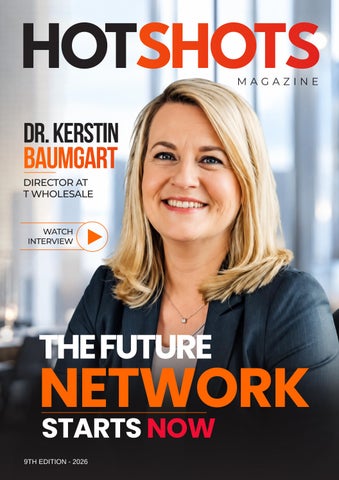
HOTSHOTS MAGAZINE
Dr. Kerstin
Baumgart DIRECTOR AT T WHOLESALE
WATCH INTERVIEW
THE FUTURE
NETWORK STARTS NOW
9TH EDITION - 2026
CONTENTS LEADERS IDEAS unity CHANGE Welcome to the ninth edition of HOTSHOTS! AI is changing the rules, networks are evolving, and new voices are challenging the status quo. But behind every big shift are the people making it happen. This edition brings their ideas, insights and stories to life. Dive in, click through and hear what they have to say. Enjoy the issue! Shelley Wright Head of Content and Marketing HOT TELECOM
2
HOTSHOTS MAGAZINE
Features
06
20
AI agents are transforming voice, creating new opportunities for carriers through HD voice, trusted routing and innovation.
MICHAEL GLYNN COO AT ACTIVEPORT
08
14 REBECCA NOTTINGHAM
JEFF KIGHT CFO AT XTERA
18
The next billion voice customers
TRUSTEE AT SUBOPTIC FOUNDATION (UK)
26
LORELLA SCALCIONE
CIO AT SPARKLE
30 ANDY PALMERFELGATE
CHAIR OF THE PROGRAMME COMMITTEE AT SUBOPTIC
SUBMARINE CABLE
LAURENT GRIMALDI
PRESIDENT AT TELSAM
24
What’s HOT and What’s NOT
Discover what’s rising, falling and reshaping telecom as AI, trust, energy and changing economics redefine the industry.
25
Voice AI Summit
Join MEF’s Voice AI Summit in London to explore how AI is transforming calls and unlocking telecom opportunities.
36
HOTShort interviews
Explore 60-second HOTShorts featuring telecom leaders, fresh perspectives and candid conversations about industry change.
Plus, watch many more interviews with industry superstars! www.hottelecom.com
3
The Evolution of Telecom Wholesale Kerstin Baumgart explores three decades of wholesale evolution and AI’s transformative impact on the telecom industry
4
HOTSHOTS MAGAZINE
W
atch Dr. Kerstin Baumgart, Director at T Wholesale, discuss how telecom wholesale has evolved over three decades and why AI is driving a new era of change. Kerstin reflects on the industry’s shift from a voice and regulation-driven business towards greater collaboration and partnership. Looking ahead, she highlights a changing customer landscape, the growing importance of partnerships and AI’s increasing impact across customer processes and networks. She shares real-world AI applications already emerging in wholesale, from automating customer claims and support to financial processes and AI-native network building. However, she also highlights challenges, including new interactions between
“The more AI usage we are seeing, the more physical infrastructure becomes relevant.”
humans and AI agents, as well as the need for resilient networks and infrastructure capable of handling rapidly increasing traffic and capacity demands. As AI adoption accelerates, Kerstin believes physical infrastructure will become even more critical, creating both challenges and opportunities for the wholesale industry. Watch Kerstin explore how AI is reshaping wholesale and what this new era could mean for the industry.
Watch Kerstin’s interview
DIRECTOR AT T WHOLESALE
Dr. Kerstin Baumgart Director at T Wholesale www.hottelecom.com
5
Mic orc
F
r a G how a
Micha are in across partne enabli where As Ne traffic is be servic
The Race to Real-Time Automation Can automation finally make complex networks simpler to manage? 6
HOTSHOTS MAGAZINE
He h centre that a betwe loops enviro softwa ecosys multidata produ
Micha acts techn custom lifecyc provis
Watch and netwo
chael Glynn explores how automation and chestration are transforming networks
rom hardware to cloud, networks are becoming ecosystems. Michael Glynn, COO at ActivePort, explores automation can bring it all together.
ael explains how network providers ncreasingly automating services s their networks, cloud on-ramps, er interconnects and data centres, ing customers to move traffic ever and whenever it is needed. etwork as a Service and AI-driven c continue to grow, automation ecoming essential for delivering ces on demand.
highlights how carriers and data es are launching native platforms allow customers to better connect een data centres, automate local and reach cloud services and edge onments. ActivePort provides the are layer that brings these complex stems together, orchestrating -vendor hardware, cloud on-ramps, centres, local loops and security ucts through a single platform.
ael highlights how ActivePort as the “glue” connecting these nologies, enabling providers and mers to manage the full-service cle, from pricing and ordering to sioning and monitoring.
h Michael explore how automation orchestration are transforming orks and shaping what comes next.
MICHAEL GLYNN COO AT ACTIVEPORT
“Some of the tier 1 and tier 2 opeRAtors are now launching their ondemand platforms. Watch Michael’s interview www.hottelecom.com
7
XTERA’S NEXT CHAPTER Jeff Kight explores how Xtera’s acquisition by Prysmian combines technology, scale and infrastructure to unlock growth and deliver greater customer value.
W
atch Jeff Kight, CFO at Xtera, discuss how the company’s acquisition by Prysmian is creating new opportunities for growth and customer value. Jeff explains that Xtera has competed in a highly concentrated market through entrepreneurial efficiency, advanced technology and flexibility, building strong relationships with customers through complex turnkey projects.
term position, particularly as subsea infrastructure projects are designed to operate for 20 to 30 years. Jeff also highlights Xtera’s recent growth and the significant investment required to expand independently. By combining with existing cable manufacturing and vessel infrastructure, the new group can scale more efficiently while strengthening its ability to deliver projects.
With the combined business positioned The acquisition brings those strengths as one of the largest in the industry, together with the scale, vertical Jeff sees an exciting future for Xtera, its integration and infrastructure of customers and the wider subsea market. Prysmian and Fincantieri. For customers, this means greater cost efficiencies and Watch Jeff explain what the acquisition increased confidence in Xtera’s long- means for Xtera and its customers. 8
HOTSHOTS MAGAZINE
Watch Jeff’s interview
“One of the great things about bringing these companies together, is that we will actually be ONE OF the largest companIES in the industry.”
JEFF KIGHT CFO AT XTERA www.hottelecom.com
9
COMMUNICATIONS
MADE SIMPLE
Peter McGrath explores global communications growth and opportunities as multinationals adopt unified solutions across complex markets.
Where will the next wave of global growth come from?
W
atch Peter McGrath, CEO at Comms Group, discuss the growth opportunities emerging as multinational businesses seek consistent communications services across increasingly complex global markets. Peter explains that multinationals are only now beginning to adopt unified communications solutions at scale, creating a significant long-term opportunity for players such as Comms Group. As a result, the company focuses on supporting these businesses through partners, helping deliver consistent platforms across multiple countries. He highlights the importance of securing licences in challenging markets, including Vietnam, the Philippines and Japan, allowing Comms Group to provide reliable
10 HOTSHOTS MAGAZINE
services while navigating local regulatory requirements. Comms Group combines services including SIP Trunking, Microsoft Teams Calling and Cisco Webex Calling with coverage across around 65 countries. Its white-glove approach, including account management and technical support, removes complexity while enabling partners to deliver services under their own brand and create additional revenue opportunities. With strong growth already achieved and further expansion ahead, Peter sees an exciting future for Comms Group and its partners. Watch Peter explore where global communications growth is coming from and the opportunities ahead.
PETER MCGRATH
CEO AT COMMS GROUP
“We see significant growth coming from multinationals who really want to be out there in the market.” Watch Peter’s interview
www.hottelecom.com
11
Building Resilient AI Networks Fergus Innes and Martin Reilly explore how AI is reshaping connectivity, driving new fibre demands and transforming network infrastructure requirements. Can today’s fibre infrastructure keep pace with the exploding demands of AI?
FERGUS INNES CCO AT CROSSLAKE FIBRE 12 HOTSHOTS MAGAZINE
MARTIN REILLY DIRECTOR OF GLOBAL MOFN AT CIENA
A
I is changing not only what networks carry, but how they need to be built. Fergus Innes and Martin Reilly explore the growing fibre demands and infrastructure challenges emerging as AI reshapes connectivity. Martin explains that the rapid growth of GPU clusters and distributed AI workloads is creating huge demand for fibre and connectivity, making networks both a potential inhibitor and a critical enabler of AI growth. Fergus highlights the challenge of connecting large machine learning clusters that increasingly sit outside traditional network footprints. For Crosslake Fibre, this means understanding changing capacity requirements, extending network reach and developing fit-for-purpose subsea and terrestrial solutions. Martin also discusses how networks must evolve to support AI inference and content delivery closer to users, with limitations around space, power and existing infrastructure, driving the need for more efficient solutions. Both highlight the importance of collaboration between fibre operators, technology providers, hyperscalers and carriers to develop resilient, scalable infrastructure capable of meeting unpredictable AI demands. Watch Fergus and Martin explore how AI is reshaping connectivity and what it means for the networks of tomorrow.
Watch the interview
www.hottelecom.com
13
W
educatio of dev submar
Rebecc governm Founda the De England across t and skil
She als created collabor of Geno level p infrastru
Looking the ind collabor underst submar to join of comb and exp strong f
Building future subsea talent
Rebecca explores how education, collaboration and new skills initiatives can develop the next generation of submarine cable professionals. 14 HOTSHOTS MAGAZINE
Watch R generat next for
REBE TRUS FOUN
W
atch Rebecca Nottingham, Trustee of the SubOptic Foundation UK, discuss ion, collaboration and the importance veloping the next generation of rine cable professionals.
ca explains how she is bringing her ment and security background to the ation, supporting collaboration with epartment for Education and Skills d, while working with organisations the industry to strengthen education lls development.
so reveals an exciting new initiative d by the SubOptic Foundation UK, in ration with Sparkle and the University oa, which will introduce a Master’sprogramme in digital submarine ucture in November 2026.
“I really hope that we can carry on building on the successes we’ve already achieved and have really strong collaboration.”
g ahead, Rebecca hopes to build on dustry’s successes through greater ration, ensuring future generations tand the opportunities within the rine cable sector and are encouraged it. She emphasises the importance bining existing industry knowledge perience with fresh talent to create a foundation for the future.
Rebecca share her vision for the next tion and discover what’s coming r subsea education.
Watch Rebecca’s interview
ECCA NOTTINGHAM STEE AT SUBOPTIC NDATION (UK) www.hottelecom.com
15
FRANCK MORALES CO-CEO AT MPLIFY Watch the interview 16 HOTSHOTS MAGAZINE
DANIELE MANCUSO CO-CEO AT MPLIFY
Reshaping digital ecosystems with AI W
atch Franck Morales and Daniele Mancuso, Co-CEOs of Mplify, discuss how AI is reshaping connectivity and driving a new vision for the industry. Franck highlights AI’s growing impact on capacity demand and the need for a new digital supply chain capable of supporting connectivity, identity and transactions across an increasingly autonomous ecosystem. Daniele explains how Mplify is evolving beyond its traditional standards role to become a strategic industry body focused on helping members adapt to the AI economy. Key priorities include accelerating AI connectivity, enabling agent-driven discovery and connection, and building a federation that can match demand with the right service providers. Looking ahead, Mplify aims to establish itself as a central force in the AI economy, with a functioning federation, interconnected use cases and a more AI-native way of working. The organisation is also adopting faster, sprint-based approaches to turn strategy into action. Watch Franck and Daniele share their vision for Mplify and discover how the organisation is preparing the industry for the AI era.
WHAT WILL IT TAKE TO BUILD A TRULY AI-NATIVE DIGITAL ECOSYSTEM? www.hottelecom.com
17
Securing the Age of AI Agents How do you secure a network built for AI-to-AI communication? Lorella Scalcione explores how AI agents are reshaping networks, requiring secure, trusted and traceable agent-to-agent communication.
LORELLA SCALCIONE CHIEF INFORMATION OFFICER AT SPARKLE
Watch Lorella’s interview
18 HOTSHOTS MAGAZINE
5 Things to know 1. AI AGENTS Communicate intent & context
2. AGENT-TOAGENT
T
he AI era is changing the network. Lorella Scalcione, Chief Information Officer at Sparkle, explores why securing agent interactions will be critical. Lorella explains that unlike traditional applications, AI agents communicate intent and context rather than simple commands, creating richer exchanges containing sensitive customer and business information. As agents increasingly communicate with one another, networks will need to secure not just connectivity, but the dialogue itself. She highlights how service providers and carriers alike must evolve from supporting application-to-application interactions to enabling trusted, secure agent-to-agent communication. Sparkle is developing solutions to address these emerging requirements,
The next network interaction building on its Quantum Safe Interconnect technology. Lorella discusses Sparkle’s work, combining quantum-safe security with AI-to-AI connectivity, including a solution currently in proof-of-concept that aims to secure agent dialogue and verify agent identities. As AI agents become more widespread, trust, security and traceability will be essential to enabling safe communication between them. Watch Lorella explain how networks must evolve to secure the future of AI-driven communication.
3. QUANTUMSAFE Security for the AI era
4. SECURE dialogue Protecting more than connectivity
5. AGENT identity Knowing who is communicating
“Trust, security and traceability will be essential.” www.hottelecom.com
19
MEF Market Insight
The Next Billion Voice Customers Will Not Be Humans During a recent MEF CONNECTS Connectivity & Wholesale Interest Group call, MEF Programme Lead Isabelle Paradis, was joined by Vonage founder Jeff Pulver, who led a discussion exploring how AI is reshaping the voice landscape. The conversation considered emerging opportunities and challenges for the wholesale voice industry as new types of customers and use cases begin to take shape.
Why AI agents are turning HD voice, low latency and trusted routing into wholesale’s next big thing Voice is about to get busier, but not because humans have suddenly fallen back in love with phone calls. The next surge will come from AI agents making, answering and understanding conversations at scale. That shift will drastically change the economics of wholesale voice. For years, voice has been treated as a mature, squeezed and increasingly commoditised business. Essential, yes. Strategic, occasionally. Exciting, rarely. The industry trained itself to compete on price, route efficiency and volume, while much of the innovation and margin moved elsewhere. AI is now giving high quality voice a new life. When the endpoint is no longer always a human ear, voice becomes more
ISABELLE PARADIS DIRECTOR, CONNECTIVITY & WHOLESALE INTEREST GROUP 20 HOTSHOTS MAGAZINE
than a minute. It becomes an input for intelligence. A signal to be interpreted. A workflow trigger. A way for AI agents to speak to customers, answer questions, book appointments, chase updates, authenticate users and eventually interact with other AI agents. That was the central provocation in our MEF Connectivity & Wholesale Interest Group discussion with Jeff Pulver, founder of Vonage and one of the pioneers of IP communications. His message to carriers was blunt: infrastructure is becoming strategic again. Or, as Jeff put it, “the empire strikes back.” For wholesale voice, that is the real story. Voice AI changes what voice needs to deliver as AI agents need clean audio, low latency, trusted routing, reliable numbers and enough quality for machines to understand, process and act on conversations in real time.
The old race to the bottom is badly suited to these new requirements.
Cheap voice is the wrong product for intelligent calls As a complete opposite to person to person voice calls, AI does not judge a call by whether it connects. It judges whether the signal is clear enough, fast enough and stable enough to produce the right outcome. A person can often survive a bad-quality call. They repeat themselves, guess the missing word, read the context and tolerate a little delay. AI has less room for forgiveness. If the audio is degraded, if latency is too high, if transcoding strips out too much detail, the model can misunderstand the caller, respond badly or fail the workflow altogether. Jeff was clear about what AI agents need: “low latency” and “the highest quality signal.” Those are performance requirements.
www.hottelecom.com
21
That puts carriers and wholesalers in a stronger position than they have had for years. Over-the-top players can build clever applications, but they do not control every layer of the voice path. Carriers control routing, numbering, codecs, interconnection and quality. That is the rather delicious irony, as AI is making the boring bits of voice valuable again.
The hidden asset is already in the network The opportunity is almost awkwardly simple: wholesalers may already have the thing voice AI companies need. Years ago, many operators invested in HD voice, wide-band codecs and better voice quality, but were never able to monetize the higher voice quality. In many markets, HD voice became a technical feature rather than a commercial story. It existed inside the network, but it was not packaged, promoted or priced as a distinct value layer. AI changes that. Voice AI companies need exactly what those networks were built to deliver: higher-quality audio, lower latency, fewer unnecessary conversions and more predictable routing. Their applications may work beautifully in the lab, but real-world performance depends on what happens when calls move across networks, codecs, routes and geographies. This means HD voice is no longer an old engineering achievement looking for a commercial story. It is becoming part of the infrastructure AI voice needs to work in production.
22 HOTSHOTS MAGAZINE
The challenge is that many AI companies do not want to become telecom experts. They do not want to navigate numbering, routing, codec support, interconnection and international voice complexity. They want their applications to work across markets. That is where wholesalers can become far more than suppliers of minutes. They can become the bridge between AI companies that need high-quality voice and the carrier infrastructure that can deliver it. This also changes the buyer. Jeff called this new buyer the “premium voice customer,” and that phrase matters because it gives wholesale a better commercial story. Importantly, these customers are not really buying minutes but outcomes. A company deploying AI agents needs a voice environment that helps the AI perform properly: HD voice, low-latency routes, reliable inbound numbers, outbound capability, trusted identity, authentication, fraud controls, compliance support and fewer surprises between testing and realworld deployment. As a result, the old question was: what is the cheapest route? The new question is: what does this AI workflow need to succeed? That opens the door to margin, as it allows carriers to sell quality, reliability, trusted routing and AI-ready infrastructure rather than dragging every conversation back into a commodity minute. Therefore, the value is not in extra traffic alone. It is in what that traffic enables: a better AI agent, a call centre that resolves issues faster, a healthcare provider that
reaches patients more effectively, a logistics company that updates customers without manual chasing, a business that turns conversations into actions instead of forgotten notes.
MEF Voice AI Lab: proving what AIready voice needs That is why MEF is launching the Voice AI Lab. The aim is to create a neutral industry space where carriers, AI voice companies, vendors and other ecosystem players can test what AI-ready voice actually needs before the market hardens around someone else’s model. The first questions are practical. What level of HD voice is needed for AI agents to perform reliably? How much does latency affect customer experience? What happens when calls move across multiple networks, routes and codecs? How should trusted numbers, agent identity, fraud controls, consent and compliance be built into the service from the start? The lab is about connecting HD Voice networks to create a global Voice AI fabric testbed, while turning the industry’s collective knowledge into a clearer blueprint for premium voice in an AI world: better quality, better routing, stronger trust and commercial models that allow carriers and wholesalers to capture more of the value they help create. Companies interested in AI-ready voice, HD voice, trusted routing, compliance and voice AI use cases are invited to get involved in the MEF Voice AI Lab initiative through the MEF Connectivity & Wholesale Interest Group. Reach out to us if you want to know more.
Wholesale has to choose its place in the stack AI will not automatically save wholesale voice, as it could create more low-margin traffic, more fraud risk and more pressure on networks still priced and managed for yesterday’s market. But handled properly, it gives carriers and wholesalers a rare chance to move back up the value chain. Jeff ended the session with the question wholesalers should take seriously: “Will wholesalers simply transport AI generated traffic or will you help create the trusted, compliant, high-quality and intelligent communications layer that AI requires?” That is the decision, as the next billion voice customers will not be humans but they will still need the network.
“AI will not automatically save wholesale voice, as it could create more fraud risk and more pressure on networks still priced and managed for yesterday’s market. But handled properly, it gives carriers and wholesalers a rare chance to move back up the value chain.
www.hottelecom.com
23
What’s
HOT
AI Calls AI The next wave of voice traffic may come from machines calling machines. Suddenly, latency, clarity and trust matter more than the cheapest minute.
Network = Password
What’s
NOT
The OTP Cash Cow SMS authentication has been easy money. Rising prices, fraud and silent network authentication are starting to break the model.
Cheap Costs More
Forget the text code. The network already knows the SIM, device and number—and can verify them silently.
The cheapest route can destroy an AI conversation in seconds. Poor voice quality is becoming a very expensive saving.
Networks on Autopilot
The Meter Is Broke
Networks are learning to detect failures, reroute traffic and fix themselves before a human even sees the alarm.
Power Picks Winners Fibre no longer decides where the next digital hub gets built. Megawatts do.
YOUR CALL
Minutes, messages and megabytes measure usage. Customers increasingly want to pay for quality, trust and outcomes.
The Old Boys’ Club More diverse leaders and talent from AI, energy and software are changing who gets heard.
What’s your hottest take?
24 HOTSHOTS MAGAZINE
VOICE AI SUMMIT When AI starts making calls Register now
Town Hall Spaces Bidborough St London WC1H 9AU
18 November, 9am - 5pm
www.hottelecom.com
25
Subsea’s Strategic New Era How is the changing role of subsea connectivity reshaping the market? Laurent Grimaldi explores how rising demand for resilient subsea connectivity is driving Telsam’s global expansion.
S
ubsea connectivity is becoming more than infrastructure. Laurent Grimaldi, President at Telsam, explores how its evolving role is changing customer expectations and driving new investment. Laurent explains that subsea networks are no longer simply a utility but a strategic asset, making global coverage, availability and reliability increasingly important. As customers and partners become more demanding, service providers must invest in both technology and people to deliver the resilience and security the market expects.
NETWORK RESILIENCE GLOBAL CONNECTIVITY 26 HOTSHOTS MAGAZINE
He highlights growing demand for redundancy, reliability and always-on connectivity, requiring Telsam to expand its global reach while maintaining its commitment to operational excellence. Laurent explains that Telsam’s strategy is not about changing its DNA, but scaling it to support increasingly global customers and partners. This includes expanding its service footprint and announcing new locations to meet growing demand. As subsea connectivity becomes increasingly critical to global infrastructure, Laurent sees significant opportunities ahead for Telsam and its customers. Watch Laurent explore how Telsam is scaling its capabilities to meet the changing demands of the subsea market.
TELSAM INTERVIEW
“We don’t want to change our DNA. We just want to put it at scale.” LAURENT GRIMALDI PRESIDENT AT TELSAM
Watch Laurent’s interview
www.hottelecom.com
27
Scaling APIs with intelligence Raman Mistry explores how network APIs are moving towards commercialisation, with enterprise adoption, channel partnerships and AI creating new opportunities.
W
atch Raman Mistry, Channel Partner Engagement Lead, Open Gateway at GSMA, discuss the evolution of network APIs and the next phase of enterprise adoption. Raman explains that GSMA Open Gateway has grown to more than 300 networks representing over 80% of mobile connections. With technical enablement established, the focus is now shifting towards commercialisation, monetisation and expanding routes to market. He highlights the importance of bringing trusted network capabilities, such as identity and Quality on Demand, into enterprise workflows, while AI and emerging technologies like MCP are
28 HOTSHOTS MAGAZINE
creating new opportunities across the ecosystem. Raman also discusses GSMA Fusion, a demand-side initiative working with industry verticals including aviation, automotive, and media and entertainment to identify valuable network API use cases. Channel partners are equally important, with more than 70 signed up to Open Gateway, ranging from technology providers to hyperscalers. As the ecosystem develops, collaboration between enterprises, channel partners and operators will be key to turning network APIs into commercial value. Watch Raman explore what’s next for Open Gateway and the growing opportunity for network APIs.
Watch Raman’s interview
“The next phase is really around the commercialization and how do you actually obtain value from that initiative.” RAMAN MISTRY, CHANNEL PARTNER ENGAGEMENT LEAD OPEN GATEWAY AT GSMA www.hottelecom.com
29
Creating the SubOptic 2028 Experience Andy Palmer-Felgate reveals the plans for SubOptic 2028 in Cape Town and invites industry professionals to shape the programme. What will it take to create a SubOptic experience the industry won’t forget?
W
atch Andy Palmer-Felgate, Submarine Cable Engineer at Meta and Chair of the Programme Committee at SubOptic, discuss the plans for SubOptic 2028, for the first time being held in Africa. Andy reveals that the conference will take place in Cape Town from 13–16 March 2028, marking an exciting milestone for the global submarine cable community. As the newly appointed Programme Committee Chair, his priority is to create a diverse and engaging programme that showcases the breadth of innovation and expertise across the industry. He explains that the work ahead includes building a strong organising committee, encouraging submissions of compelling abstracts, selecting papers and developing an engaging programme covering presentations, posters and social events.
30 HOTSHOTS MAGAZINE
Andy also encourages industry professionals to get involved by joining the programme committee and contributing to the organisation and review process. He and the wider team are keen to hear from anyone interested in helping shape the event. Watch Andy share his vision for SubOptic 2028 and find out how you can get involved.
“The conference is go Cape Town from the 1 of March, 2028.”
ANDY PALMER-FELGATE SUBMARINE CABLE ENGINEER AT META AND THE CHAIR OF THE PROGRAMME COMMITTEE AT SUBOPTIC
oing to be held in 13th to the 16th Watch Andy’s interview www.hottelecom.com
31
The AI network evolution
MARK BENNETT
HEAD OF SDN PRODUCTS AT VODAFONE BUSINESS
M
ark Bennett, Head of SDN Products at Vodafone Business, and Joe Attwood, Senior Analyst at Analysys Mason, explore how AI is reshaping enterprise networks and driving the need for greater flexibility. Joe explains that as AI moves from experimentation into production, enterprises will face new requirements around security, latency, throughput and reliability, while increasingly distributed AI and agents will add further complexity.
32 HOTSHOTS MAGAZINE
Watch the interview
“The last part of the jigsaw really is the network. It can’t be static anymore. The network needs to be highly elastic and on-demand.”
JOE ATTWOOD SENIOR ANALYST AT ANALYSYS MASON Mark highlights the impact on network infrastructure, with AI workloads demanding significant bandwidth, low latency and more dynamic connectivity. He explains why Network as a Service (NaaS) is becoming essential, allowing networks to become programmable, elastic and responsive to changing AI requirements.
APIs and agents. Both highlight the need for embedded security, stronger visibility and more sophisticated access controls.
Security is another major concern, with AI expanding the attack surface through new workloads,
Watch Mark and Joe explore what AI means for the future of enterprise networking.
Looking ahead, they expect NaaS, AI agents, GPU-as-aService and AI-ready security to become increasingly important as enterprises adapt to a more dynamic digital environment.
www.hottelecom.com
33
Supporting the Next Generation Rachel Archer explores how attracting and developing diverse new talent can strengthen the submarine cable industry for future generations.
34 HOTSHOTS MAGAZINE
W
atch Rachel Archer, Marine Maintenance APM at ASN, discuss the importance of attracting, developing and supporting the next generation of submarine cable professionals. As co-chair of the European Submarine Cable Association’s Next Gen subgroup, Rachel explains how the initiative supports newcomers through STEM sessions, career fairs, industry tours, mentorship and skills development. The aim is to introduce young people and those entering the industry from different careers to the wide range of opportunities available. Rachel highlights that there is no single skill required to succeed in the submarine cable industry. With such a broad range of knowledge and expertise needed, the
sector benefits from people with diverse backgrounds, while skills can continue to be developed throughout their careers. She also stresses the importance of knowledge transfer. With many industry professionals bringing decades of experience, attracting younger talent is essential to ensuring that valuable expertise is passed on and the industry remains strong for the future. Watch Rachel explain why investing in the next generation is vital to the future of the submarine cable industry.
RACHEL ARCHER
MARINE MAINTENANCE APM AT ASN
Watch Rachel’s interview
“It’s an industry that is built on knowledge, and IT needs to be passed on to the next generation.” www.hottelecom.com
35
HOTSHOTS MAGAZINE PRESENTS
HOTSH RT INTERVIEWS REAL TALK. BIG IMPACT.
60-second highlights from our exclusive HOTShot interviews
REAL PEOPLE. BUILDING TRUST 36 HOTSHOTS MAGAZINE
REAL Talk.
THE DIGITAL WORLD
INNOVATION
CLICK TO WATCH.
GET INSPIRED. SHARE THE CONVERSATION.
RESHAPING TRUST
IT RESILIENCE
AI INFRASTRUCTURE
Want to be featured? Book your HOTSHOT interview NOW! www.hottelecom.com
37
We are creative We are provocative We are HOT TELECOM