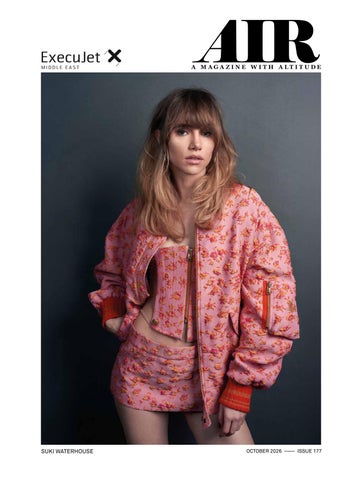
SUKI WATERHOUSE
OCTOBER 2026 –––– ISSUE 177
Brand Licensing Notice: Four Seasons Private Residences Abu Dhabi at Saadiyat Beach are not owned, developed or sold by Four Seasons Hotels Limited or its affi liates (Four Seasons). The developer, Al Ain Asset Management LLC SPC or its affi liates, uses the Four Seasons trademarks and tradenames under a license from Four Seasons Hotels Limited. The marks “FOUR SEASONS,” “FOUR SEASONS HOTELS AND RESORTS,” any combination thereof and the Tree Design are registered trademarks of Four Seasons Hotels Limited in Canada and U.S.A. and of Four Seasons Hotels (Netherlands) B.V. elsewhere.
At Home on Saadiyat’s Shore
+971 800 1144 ׀alainam.com
Showrooms:
Contacts:
Social Media:
The Dubai Mall
+971 4 2262277
mahallatiJewellery
Dubai Marina Mall
retail@mahallatijewellery.ae
mahallatiJewellery
Mall of the Emirates
www.mahallatijewellery.ae
Mrs.Mahallati
Gold Souk
OCTOBER 2026 –––– CONTENTS –––– ISSUE 177
AIR –––– 8
FEATURES Thirty Eight
Model, actress, musician; Suki Waterhouse on her myriad personas.
Why the 90s birthed an exciting generation of new creatives whose influence is still felt globally.
The Girl With All The Gifts
Creative Forces
Forty Eight
The Man Who Made The Stars Shine How Paris-born couturier Jean Louis created the Hollywood bombshell.
48
Credit: Rita Heyworth in Gilda (1946). Photo by Edward Cronenwerth, Colombia Pictures
Thirty Two
REGULARS
28
Sixteen
RADAR
Patek Philippe’s Watch Art Grand Exhibition rolls into Milan. Eighteen
OBJETCS OF DESIRE The latest luxury items we’re currently coveting. Twenty
ART & DESIGN
54
The imaginative world of famed artist and set designer Es Devlin is yours to explore in a major exhibition. 16
Twenty Four
JEWELLERY
18
Ara Vartanian on his life-long inspiration, challenging himself, and thinking differently. Twenty Eight
58
TIMEPIECES
Dominique Renaud has built his name on challenging accepted norms in the world of watchmaking – his appetite for risk remains. Fifty Four
MOTORING
Czinger blows the roof off its groundbreaking 21C. Fifty Eight
GASTRONOMY
As two Michelin-starred Gymkhana extends its global footprint to Dubai, its co-founder, Karam Sethi, details his group’s recipe for success.
20 24
62
EDITORIAL Editor-in-Chief & Co-owner
John Thatcher
john@hotmedia.me
COMMERCIAL Managing Director & Co-owner
Victoria Thatcher victoria@hotmedia.me
Sixty Two
NEW BEGINNINGS
The wraps come off a multi-milliondollar facelift for a grand dame hotel in Bangkok, while elevated luxury arrives in Zambia.
PRODUCTION Digital Media Manager
Muthu Kumar
muthu@hotmedia.me
Sixty Four
WHAT I KNOW NOW
Milka Karaağaçlı İnce, Founder and Creative Director of Kismet by Milka.
Reproduction in whole or in part without written permission from HOT Media is strictly prohibited. HOT Media does not accept liability for any omissions or errors in AIR. Published in Dubai, UAE.
OCTOBER 2026 –––– WELCOME –––– ISSUE 177
AIR –––– 11
WELCOME ON BOARD At ExecuJet, we redefine the experience of private travel into an art of unparalleled luxury. From the moment you arrive, we are dedicated to perfecting every detail, anticipating every need, and elevating every moment from takeoff to touchdown, ensuring a journey as effortless as it is extraordinary. Since we established ourselves in the Middle East in 1999, we’ve had the privilege of seeing travel redefined – one journey, one client, and one tailored experience at a time. Now part of the prestigious Luxaviation Group, we’ve earned a reputation for innovation, precision, and the kind of personal care that truly sets us apart. Stepping into our world-class facilities is an experience that speaks for itself, with every element carefully designed to enrich your journey. It’s in the discreet checkins and the ease of immigration. It’s the luxurious private suites, where every element has been curated with your comfort in mind. It’s the rejuvenating wellness spaces and the bespoke cocktail and cigar lounge that invite you to unwind. These aren’t amenities – they are reflections of detail and care, designed with you in mind. Our services – whether bespoke charter flights, meticulous aircraft management, or state-of-the-art hangarage – reflect our commitment to connection. To your time, your needs, and your expectations. We don’t just deliver luxury. We live and breathe it.
Dumani Ndebele
Regional FBO Director, Middle East
execujet.com
Cover: Suki Waterhouse by David Slijper/AUGUST
OCTOBER 2026 –––– WELCOME –––– ISSUE 177
THE FUTURE OF ARRIVAL How ExecuJet ensures that your journey begins on the ground
AIR –––– 12
As Dubai continues to strengthen its position as a global hub for private aviation, ExecuJet Middle East is redefi ning the ground experience for private travellers. In a market where time, discretion, and efficiency are paramount, the experience on the ground has become as defi ning as the journey itself. Across the region, private aviation is entering a new phase, shaped not only by demand and connectivity, but by evolving expectations. Travellers today seek more than seamless movement, they look for environments that anticipate their needs with precision and subtlety. Within this landscape, ExecuJet has created a setting where every element is designed to feel considered and effortless.
At Al Maktoum International Airport, the company’s flagship terminal is conceived as a place to settle into. The space is shaped by a sense of quiet familiarity which creates an atmosphere that feels natural and at ease. Subtle textures, curated artworks, and carefully selected furnishings contribute to an environment that is both refi ned and effortlessly comfortable. This sense of ease continues throughout the experience. Private spaces are thoughtfully arranged to offer moments to rest, work, or recalibrate between journeys, while wellness elements are integrated in a way that feels seamless and intuitive. Each detail is considered to support a sense of calm and privacy, creating
OCTOBER 2026 –––– WELCOME –––– ISSUE 177
‘
AIR –––– 14
ExecuJet has created a setting where every element is designed to feel considered and effortless
an environment where comfort and discretion remain at the forefront. Beyond the physical environment, what defines the experience is a sense of continuity. In an ever-moving world, consistency becomes a form of reassurance. At ExecuJet, this is shaped through experienced teams, considered processes, and an attention to detail that allows each journey to unfold with clarity and ease. The experience is defined by a quiet sense of control, where every detail is anticipated and managed with precision. This, combined with an unwavering focus on safety and privacy, allows guests to move through the space with complete confidence. In a city known for setting global standards, ExecuJet is redefining the moment of arrival with calm, consistency and a sense of reassurance that stays with clients well beyond their journey.
’
The Maldives’ Largest 3 Bedroom Residence Set within untouched jungle and fronted by a private stretch of beach, this is the most expansive 3-bedroom residence in the Maldives — a private world of its own within JA Manafaru. Three generously proportioned bedrooms open onto a private pool and sundeck, surrounded by lush greenery, with direct beach access just steps away. Designed for families and groups seeking space, privacy, and total exclusivity, it’s a residence built for moments that matter. For reservations, please contact us at +960 6500 456 or email: reservations.manafaru@jaresorts.com A MEMBER OF
SCAN HERE TO LEARN MORE
OCTOBER 2026 –––– RADAR –––– ISSUE 177
P
atek Philippe’s Watch Art Grand Exhibition rolls into Milan this month for its first staging since 2023, bringing with it more than 500 timepieces – including the most prestigious in its storied history – and rare objects that illustrate a wealth of expertise. One such piece is the ‘Burano’ pocket watch. Featuring hand-executed cloisonné, flinqué and paillonné enamel, as well as hand-engraving, the unique piece pays tribute to the Venetian island of Burano, known for its canals lined with brightly coloured houses. The exhibition will be accompanied by the launch of various limited editions. Patek Philippe Watch Art Grand Exhibition, CityOval, Milan, October 2-18
AIR –––– 16
objects of
desire Set the tone as a true tastemaker with these coveted items
CHANEL
SIGNES & SYMBOLS It was by chance that Gabrielle Chanel acquired the star sign of Leo, but it was her creative endeavour that ensured the lion became an enduring symbol of the house. It formed part of her design vocabulary as far back as the 1930s,
18-19 AIR_OOD_Supplement_OCT26.indd 1
but it wasn’t until 2012 that the lion debuted in high jewellery. It makes a spectacular appearance in Chanel’s latest 85-piece high jewellery collection as the Imprimé Lion necklace, which features a sapphire of 20.66cts.
25/09/2026 2:29 PM
A Z Z A FA H M Y
TA L E S O F T H E N I L E A series of intricately crafted, highly elaborate necklaces form the bedrock of Azza Fahmy’s second chapter of Tales of the Nile, the house’s latest high jewellery collection. For the Rubellite Tutankhamun necklace, designer Amina Ghali has set a large rubellite among
18-19 AIR_OOD_Supplement_OCT26.indd 2
a ring of diamonds, evoking the treasures unearthed on the opening of Tutankhamun’s tomb. Drawing on the same iconography, a magnificent 18ct gold choker features a pearshaped emerald within a diamond frame, from which a detachable tassel unfolds.
25/09/2026 2:29 PM
C H O PA R D
L . U . C 1 96 3 H E R I TA G E C H R O N O G R A P H Issued in a numbered 25-piece limited edition, Chopard’s own manual flyback chronograph calibre powers this new version, notable for its ‘Prussian blue’ colour, a nod to the Canton of Neuchâtel, where Chopard established its Fleurier Manufacture 30 years ago and which,
18-19 AIR_OOD_Supplement_OCT26.indd 3
centuries previously, was simultaneously under the sovereignty of the Kingdom of Prussia while also a Swiss canton – a status unique in Europe. It was during that period that the blue hue which decorates this piece’s dial was widely used.
25/09/2026 2:29 PM
18-19 AIR_OOD_Supplement_OCT26.indd 4
25/09/2026 2:29
BROA D A R ROW AUC T IONS
2019 MCL AREN SENNA A triple F1 title winner with McLaren, Ayrton Senna was later honoured with the building of this, the lightest road car McLaren had produced since the F1. Each door weighs just nine kilograms; the seats, constructed largely from carbon fibre with minimal cushioning,
18-19 AIR_OOD_Supplement_OCT26.indd 5
weigh approximately 3.35 kilograms apiece. Behind the driver sits a 4.0-litre twin-turbocharged V8 that roars to 100 km/h in 2.8 seconds. Up for auction next month in Zurich with an estimate of CHF1.1-1.4m, this is Senna number 181 of just 500 examples produced.
25/09/2026 2:29 PM
A . L A N G E & S Ö H N E
1 8 1 5 U P/ D O W N The epitome of quiet luxury, the 1815 Up/ Down – the year a reference to the birth of Ferdinand A. Lange, the founder of A. Lange & Söhne, and the directions a pointer to the power-reserve indicator – is designed to evoke the pocket watches
18-19 AIR_OOD_Supplement_OCT26.indd 6
made during the founder’s era. This pink gold version was one of two new versions (the other white gold) presented at last month’s Concours of Elegance at England’s Hampton Court Palace, both of them limited to 300 pieces.
25/09/2026 2:29 PM
S U N R E E F YA C H T S
B R A B U S U LT I M A 5 5 The much-anticipated first product to emerge from a series collaboration between Sunreef Yachts and Brabus sets a high benchmark. Capable of hitting speeds exceeding 40 knots, thanks to its use of foil-assisted technology, this luxury catamaran sees Brabus add its signature
18-19 AIR_OOD_Supplement_OCT26.indd 7
touch throughout, from the shapely, carbonfibre exterior through to the bespoke interior. “We asked ourselves what a modern highperformance luxury catamaran should look and feel like. The Brabus Ultima 55 is our answer,” said Constantin Buschmann, CEO and owner of Brabus.
25/09/2026 2:29 PM
PI AGE T
GLOW Celebrating the radiance of gold and diamonds, Piaget Glow is a capsule of three decorative rings that express the maison’s time-honoured artistry. The first, rose gold and diamonds, features Piaget’s signature engraving technique, developed in 1961
18-19 AIR_OOD_Supplement_OCT26.indd 8
and inspired by the guilloché technique in watchmaking. A yellow gold option has a textured, scales-like motif, while the white gold piece is adorned with asymmetrical undulating curves and liberally scattered with diamonds.
25/09/2026 2:29 PM
OCTOBER 2026 –––– ART & DESIGN –––– ISSUE 177
AIR –––– 20
WORDS: PAUL JAMES
Devlin In T
The imaginative world of famed artist and designer Es Devlin is yours to explore
he Details
Opening pages: Es Devlin This page: Memory Palace, by Es Devlin (2019) Opposite page, from top to bottom: Nevada Ark, by Es Devlin with U2. Photo by Ric Lipson; Library of Light, by Es Devlin (2025). Photo by Es Devlin
E
ven if you’re not familiar with the name, it’s almost certain you’d have seen the work of artist and designer Es Devlin. Across a 30-year career, Devlin’s genre-defying practice, which sees her move between the likes of art, architecture, theatre, opera and music, has delivered a vast range of projects that have scooped multiple prestigious awards, including a Tony, an Ivor Novello and three Olivier awards, and earned royal approval – Devlin appointed CBE (Commander of the Order of the British Empire) in 2002 for her services to design. That was the year Devlin designed one of her largest ever productions – the landmark Super Bowl halftime show featuring Dr. Dre, Snoop Dogg, Eminem, Mary J. Blige and Kendrick Lamar. Devlin also helped U2 create a unique visual spectacle through one of the most technologically ambitious performance spaces ever built at the Sphere in Las Vegas; designed the spectacular stage environment for the closing ceremony of the 2012 Olympics; conceived the entire physical world and architecture for Beyoncé’s Renaissance world tour; and, regionally, became the first female
architect of the UK Pavilion at a World Expo when her Poem Pavillion at Expo 2020 Dubai – a dramatic 21-metrehigh cone-shaped structure – asked visitors to contribute a word that would describe life on earth to an extraterrestrial, the words then turned into poetic lines by AI and displayed in lights on the pavilion’s exterior. This month, a major exhibition invites visitors to explore the expansive vision behind such groundbreaking work when Es Devlin: Other Worlds opens at London’s Design Museum. “Our exhibitions at the Design Museum often explore what might best be called ‘design in an expanded field’, a multi-faceted, interdisciplinary approach which breaks down many of the boundaries around creative practice. Es Devlin shares this ethos,” says Tim Marlow, Director and CEO of the Design Museum. “Her remarkable boundary-blurring work across art, activism, poetry, sculpture, music and architecture is the embodiment of enlightened design thinking, and her emphasis on collective experience and audience participation makes this exhibition one of the most exciting and ambitious to be staged in our galleries.”
London-born Devlin honed her craft creating theatre sets, but it was a call from Kanye West in 2005 that saw her career skyrocket. Connected by a mutual friend, Kanye needed a new stage designer, having fired his just two weeks prior to his tour opening. In just ten days, Devlin masterminded a stunning visual environment that was far more theatrical than a conventional rap concert, earning lavish praise and beginning a near decade-long creative relationship with Kanye. “Designing that tour took me to another level,” she recalled years later.
V
isitors to the Design Museum will begin their journey in Devlin’s world by being welcomed into a replica of her South London studio. Shelves will be filled with her books, objects and maquettes, and her desk will be covered with drawings, tools and paints. The room will come to life with a projection-mapped film narrated by Devlin, before visitors are invited to enter the exhibition to explore many of the projects that have come to life after their inception in this studio. The first of such projects they’ll encounter is 2002’s Come Home Again. Commissioned by Cartier, it featured a
cross section of the dome of St Paul’s Cathedral with brilliantly illuminated cut-out sketches of endangered moths, birds, beetles, wildflowers, fish and fungi, and will be redisplayed in a new constellation that speaks to Devlin’s desire to craft ever-evolving atmospheres and landscapes. In a section called Archive Unboxed, which runs the length of the gallery walls, visitors will view early sketches, paintings, collages, diaries and prints which Devlin produced at school, university and art college – and which she has continued to create throughout her practice – demonstrating Devlin’s love of drawing and how all her projects originate from this art form.
A
“newly conceived display, 30-Year Desk, will see a series of concentric circular desks filled with archival items that explore some of Devlin’s most ground-breaking projects from around the world. Created as an art installation, hundreds of items will be displayed, including 30 intricate models from Devlin’s design phases, or maquette-scale recreations. Striking and detailed, they trace the evolution of her mammoth projects and ambitious kinetic stage sculptures for concert tours by the world’s most celebrated musicians. “I am moving my studio and practically my entire 30-year archive into the Design Museum for this show”, says Devlin. “It’s an immense privilege to have this opportunity to share my working process and practice with visitors and to create a new large-scale installation.” Es Devlin: Other Worlds, the Design Museum, London, October 2, 2026–April 4, 2027
‘Devlin’s remarkable boundary-blurring
work is the embodiment of enlightened design thinking’
OCTOBER 2026 –––– JEWELLERY –––– ISSUE 177
WRITTEN IN STONES
Ara Vartanian on his life-long inspiration, challenging himself, and thinking differently
WORDS: JOHN THATCHER
AIR –––– 24
OCTOBER 2026 –––– JEWELLERY –––– ISSUE 177
AIR –––– 26
‘I am constantly curious. I like to infuse playfulness in my creativity’
I
nspiration is everywhere. When a child, Ara Vartanian found it on the floor, crawling on all fours of the office in the jewellery atelier owned by his parents. “There were always little stones that I would find on the floor that I would collect and keep in a small box. That is a very strong, memorable moment of my life.” Ara now makes moments memorable for others. Founded in São Paulo, to where his family emigrated from Beirut, his eponymous brand creates beautiful jewels laced with emotion. But whatever he designs, the creative process always begins with what first captivated him. “Totally with the stone. It has been that way since the beginning. I put the stone in front of me and challenge myself to find the best constructive way to design the piece around it. For example, when I have two pear-shaped emeralds, diamonds, or tourmalines, where they would usually sit in an earring, I put the pair in a necklace instead. I am constantly curious, asking myself, ‘What will happen if I try this?’ I like to infuse playfulness in my creativity.” Thinking outside of the box, forever questioning how things are done, led Ara to create his signature design – inverted diamonds. “Since my father was a diamond dealer, when he saw me inverting diamonds it looked like a rebellious move to him. To me, it was not rebellious at all. The idea that you can also wear diamonds inverted was more of a love story. I use diamonds both ways, so I was giving the diamond another opportunity to shine in a different way. It is funny. My father would question me. But, for me, I was looking past the value or the way the industry traditionally sets diamonds and, by inverting them, I allowed the stone to shine in a different way.”
Stones define Ara’s latest high jewellery offering, the Empirea Collection, a blissful marriage of architectural structures, artisanal mastery, and the stark contrast of gemstone tones. “The piece that comes to mind is a 40-carat Paraiba tourmaline from Mozambique that I bought years ago, when we did not yet know the importance of a green Paraiba tourmaline,” says Ara when I ask which piece best characterises the collection. “I recut and repolished the stone, and it took on a completely different life, because when I bought it, it was dull and not interesting. After the recut, the strong green came out, and I set it into a bracelet. That piece carries a particular emotion and story, and I think that counts for a lot in jewellery.” Is it always his intention for each of his pieces to tell a story or convey a particular emotion? “I just create, and the story comes after. Some pieces have stronger stories due to the challenge of acquiring the stone, particularly with high-value stones. The rarer the stone, the more responsible you are for creating something unique. For me, all stones are gifts of nature. So if I am going to design something with a particularly rare stone, it is my duty to do it justice. Since we took the stone from nature and it was cut and manipulated, it is an immense honour for me to design something with it, so I have to do the best possible job I can to honour that particular stone.”
T
he unusual, the imperfect, is what attracts Ara’s eye. “I am always drawn to stones that have different inclusions. I do not see an inclusion as a negative. Inclusions are like scars, and a scar on the body can be viewed as beautiful and what makes the body unique.” In turn, it is Ara’s eye that attracts the countless celebrities who wear his pieces, among
them Madonna, Penélope Cruz, Angelina Jolie and Kate Moss, with whom he co-designed an entire collection. But Ara’s love of stones goes beyond their visual appeal. In 2018, he launched Conscious Mining, a responsible-sourcing initiative for coloured gemstones that tasks mines to demonstrate such things as investment in employee training and wellbeing, support for the surrounding communities, and strict recycling programmes. “The impact was immediate, because it opened conversations the industry was not having,” says Ara. “At the time, I remember stone dealers asking why I was giving so much importance to the Cruzeiro mine [one of Brazil’s most important sources of tourmaline], and there was a certain ignorance around it. One of those same dealers sat in front of me yesterday and told me how important it is that we can now identify which mines the Paraiba tourmalines come from, whether they are sourced from the mines in Africa or mines in Brazil, and what that means for the stones and for the market. Hearing that from him mattered, because it is the industry itself now insisting on provenance. We planted the seeds and are now picking the fruit. The industry is in a better place, and it is going in the right direction.” Having just turned 51, Ara is also on course to embrace a new chapter of creativity. “I know a lot more than I did at 40 or at 30. I play a lot with the conscious decision to challenge myself and work on new ideas. Since the summer, my creativity came back with real strength. You cannot control when it comes and goes.” In Ara Vartanian’s case, however, you can guarantee that it will lead to something beautiful.
OCTOBER 2026 –––– TIMEPIECES –––– ISSUE 177
AIR –––– 28
Running against the clock
Dominique Renaud has built his name on challenging accepted norms in the world of watchmaking. As he launches his eponymous brand and debut watch, his appetite for risk remains
WORDS: JOHN THATCHER
OCTOBER 2026 –––– TIMEPIECES –––– ISSUE 177
D
ominique Renaud was destined for the world of watchmaking. Both of his parents were watchmakers, as were his grandfather and great-grandfather, a lineage that, on his mother’s side, also stretches back to the historic LeCoultre family. Yet Dominique was similarly fated to do things differently – launching his eponymous brand earlier this year after four decades of masterminding some of the industry’s most celebrated movements. In 1986, along with Giulio Papi, he founded Renaud & Papi. “We believed one thing was possible: to serve the great houses with total rigour while keeping a fully independent creative mind.” Their groundbreaking work was renowned throughout the industry and saw many talents pass through their workshop, including the likes of Robert Greubel, Stephen Forsey, Carole Forestier and the Grönefeld brothers. “If that environment helped nurture their vision, I am genuinely honoured. But I resist taking too much credit for it. A great watchmaker is born of their own curiosity.” Come the year 2000, at the height of Renaud & Papi’s success, Dominique decided to call it quits. “When you sit at the centre of that kind of success, it becomes very hard to look at mechanics with a truly free eye,” he reflects. “Market expectations, the weight of technical habit, tradition itself – all of it quietly builds an invisible frame around your thinking.” He moved to the south of France, close to nature, close to the sea and the Cévennes, which he says has always been an essential source of his creativity. “It was a long breath before I could finally express myself under my own name. I will admit there was a touch of madness in it too: the desire to explore other paths in watchmaking with total freedom, bound by nothing but the mechanics themselves. That became the DR01 [an unconventional ‘laboratory on the wrist’, released in 2016] and now, the Pulse60.” The name of the watch refers to its
AIR –––– 30
defining feature: the movement beats at just 1 Hz – 60 oscillations per minute, roughly the rhythm of a resting human heart. That is extraordinarily slow for a modern mechanical wristwatch. To fully harness this low frequency, the movement relies on a very large 20mm balance wheel with high inertia. In a conventional watch, the balance is limited in how far it can rotate before components begin to interfere. Dominique redesigned the regulating system so the balance can operate at more than 360 degrees of amplitude without this problem. “The technical consequence is considerable,” says Dominique. “We gave this balance a theoretical maximum amplitude of around 600 degrees before it would flip over, while its real working zone sits at 450 degrees, well clear of that threshold. Getting a mechanism to run safely and consistently that far from its own breaking point, while keeping the case and the finishing at the level our name demands, was the true engineering fight. Precision, here, does not come from rapid repetition. It comes from structural stability, and that had to be earned, degree by degree.”
W
ith his name carrying considerable weight within watchmaking, did that legacy feel liberating or intimidating when developing the Pulse60? “Neither, in the way you might expect. The fundamentals of watchmaking became a kind of second nature to me long ago. I grew up with them, worked with them and passed them on, and that deep rooting is precisely what allows me to move their lines today with a steady hand rather than a nervous one. What weighs on a watchmaker is never a name; it is the accumulation of certainty, the sense that a problem has already been solved and does not need to be asked again. “So the real discipline with the Pulse60 was not living up to a reputation, it was the opposite: forgetting what I already knew well enough to see it differently. To invent, you first have to unlearn. My name gave me the freedom to take the risk of exploring in a state of uncertainty.
‘Intuition is born in one individual, but
invention only takes shape in the encounter’
This page: Dominique Renaud Other pages: Pulse60
“Watchmaking has to move people. A watch that only measures with exactness misses, in my view, the essential part of its mission. Precision is necessary, but it is not sufficient. I put a great deal of myself into this watch, my own relationship with time, my conviction that time lived and time measured are not the same, and that the mechanical watch is one of the rare objects capable of reconciling the two. That large balance is not only a regulating organ. It is a gesture, almost a breath.”
D
ominique’s work has long questioned conventional wisdom. But is disrupting an instinct, or is it something he consciously pursues? “Both, and I would say the two cannot really be separated. There is an instinct in me that resists a solution simply because it has existed for two centuries. But that instinct only becomes useful once it is disciplined into a method. Taking a problem by its
exact opposite, as I did by moving from very high frequency to 1 Hz, is not an accident of temperament. It is something I do deliberately, almost systematically, whenever a field feels settled. “Watchmaking has built its prestige on technical innovation while developing an almost religious relationship with tradition, to the point where the two have become confused with one another. That is not a criticism; the major houses were right to defend their heritage, but that conservatism has a cost: it has steadily narrowed the space available for genuine rupture. What I try to do, consciously, is keep proving that space still exists – and that it is far larger than the industry assumes.” Also intentionally, Dominique doesn’t work alone. “Because intuition is born in one individual, but invention only takes shape in the encounter. I share, I listen, and what I start only becomes real through dialogue. I now work
with physicists, architects, biologists and philosophers. Watchmaking has far more to learn from a kingfisher, from marine chronometers, or from the physics of oscillators, than it does from constantly looking at itself.”
T
his is Dominique’s vision for his eponymous brand – in permanent dialogue with the artisans, engineers and thinkers, where invention lives. To that end, the Pulse60 is conceived as the first chapter of a series, not a single statement. A series that will pursue the same risk: “choosing an unexplored mechanical territory and building the entire architecture of a movement around it, rather than grafting a clever idea onto something that already exists. “Ten years from now, I would like a Dominique Renaud watch to still be recognised first for the question it dares to ask, and only second for the name on the dial.”
AIR
OCTOBER 2026 –––– SUKI WATERHOUSE –––– ISSUE 177
AIR –––– 32
The Girl With All The Gifts Model, actress, musician; Suki Waterhouse on being kind to her old self, life on the road with Robert Pattinson, and the marvel of motherhood WORDS: LISA WRIGHT
OCTOBER 2026 –––– SUKI WATERHOUSE –––– ISSUE 177
AIR –––– 34
F For an international model, whose 1970s blonde shag cut has graced the cover of Vogue in five different countries, Suki Waterhouse is a remarkably casual presence to share a Zoom call with. Popping up on the screen with wet hair fresh from the shower, phone in hand, she proceeds to pace around her Los Angeles home for the next hour. The 34-year-old might have 4.4 million Instagram followers but she’s also a mum with a lot to do in a short space of time. It’s 9am in California and Waterhouse has already been up and at ‘em for a while, ticking off a “20-minute quick workout” and looking after her twoand-a-half-year-old daughter, her first child with actor Robert Pattinson. Parenthood has inevitably shifted London-born Waterhouse’s worldview, but you get the sense that the multihyphenate artist was probably never the precious type to begin with. Alongside her hefty catwalk credentials, Waterhouse has established an acclaimed parallel career as an actor, most notably for her portrayal of keyboardist Karen Sirko in the 2023 TV adaptation of Daisy Jones & The Six. But it’s music that was her first love. Her teenage days were spent “writing with anyone I could find and playing little shows around Camden [London]”, while it’s her rapidly escalating status as pop’s premier retro-styled lovergirl that’s steadily becoming her most successful creative prong yet. In the summer, Waterhouse released
her third album, Loveland: a swoony, playful ode to romance in all its forms, from the lushly produced doe eyes of ‘Back in Love’, through to the 1950s girl-group sass of ‘Jukebox’ and the Fleetwood Mac-like melodies of ‘Morals’ (featuring Mick Fleetwood himself on drums). “When I thought of Loveland, it was this love heart that was wonky and very imperfect and trying to figure itself out,” she suggests. “All the things that make up my reality – the rituals and the ways that I’ve been able to stay human and the things that have resonated with me – I wanted to keep them close so my future self, whenever I’m in trouble, will always have this. This record will be the thing I look back on.”
Y
ou can see why Waterhouse’s third album (and her first via a major label, Island Records) could act as a time capsule of sorts. Written during the early stages of life as a new parent, it was created during a period of “losing myself and also finding myself at the same time. Everything felt incredibly juxtaposed,” she continues. “I’ve never felt smarter, but sometimes I’ve never felt stupider. Everything I decided about myself would then be flipped on its head.” The way that the world views Waterhouse has constantly shifted, too, ever since she was first scouted at 16, quickly becoming part of young London’s new fashion glitterati alongside her friends Alexa Chung and Cara Delevingne.
As a teenage model, Waterhouse, who was born in Chiswick, moved to north London, down the road from Liam Gallagher. “I had a boyfriend who was friends with him. It was great, really fun,” she chuckles. Jukebox, with its coy flirtations (“If you fall too hard for me, not my fault…”), finds the singer harking back to that era of adventure and infinite possibility. “I was channelling that version of myself that was wearing my Doc Martens and being in some cool little bar in Islington with the Arctic Monkeys, just dancing and being dressed up,” she remembers. “I used to go around looking like I was in fancy dress, in mod attire wearing a John Smedley turtleneck.”
M
eanwhile, the flat that she lived in for the majority of her twenties as her career really began to pick up speed is eulogised in ‘Notting Hill’. “It was one of those flats that raise you, and you have some of the worst nights of your life and some of the best; it was a place where I had a lot of solitude and joy and destruction, a lot of coming into myself,” she nods. “And then it just takes you by surprise that one day, you’ve suddenly grown out of that place and you’re living in another country, about to have a baby. Now that whole period is in a storage box somewhere.” Growing up in public has forced Waterhouse to be somewhat kinder to her younger self. “As I get older, I just see everything with a lot of fondness and I don’t feel as embarrassed about it as I used to. It was just really fun, I was doing what I should have been doing in my twenties,” she says of her time spent popping up in the tabloids alongside former rock star boyfriends Miles Kane and Luke Pritchard of The Kooks. What in particular did she find embarrassing? “Oh, everything’s embarrassing…” she jokes. “I find it easy to be embarrassed about myself, there are many things that can make me an embarrassing figure.” Back then, Waterhouse was frequently labelled an It Girl. “Well there we go, that’s something that sounds embarrassing,” she points out. “But then I also think of being a 90-year-old woman and talking to my grandchildren about what it was like to be in my twenties and my teens in London, and I think that’ll be a fun little tidbit to throw in…”
OCTOBER 2026 –––– SUKI WATERHOUSE –––– ISSUE 177
AIR –––– 36
‘Becoming a mother just absolutely
broke open my heart. I think it’s made me marvel at our humanness’
If the capital is where the singer cut her teeth, however, then LA is the city that accepted her as a musician. She’s sanguine about her relationship with the British press, but recalls being mauled in one article when her 2016 debut single, Brutally, failed to chart. “I’d made about 200 or 300 songs by that point, and that was the first one where I felt I’d found this sound and actually made something to really be proud of, and then there was this piece saying that it was a chart disaster,” Waterhouse recalls. “It was an acoustic song, just a guitar, with no publicity or anything that actually ended up streaming really well in the end. But I felt for a long time that there was a push back [against my music career] that I think can happen in England.” A decade on, and the perception of Waterhouse couldn’t be more different. Far from just another model-to-musician pivot, she’s established herself as a genuine contender among pop’s top tiers. With a vibrant sonic palette that matches her 1960s and 1970s-influenced, Almost Famous-nodding aesthetic, Waterhouse might look and sound like a superstar but she’s also got the work ethic to match. Just six weeks after giving birth, she was on stage at Coachella; a few months later, she was out promoting her second LP, Memoir of a Sparklemuffin, and supporting Taylor Swift at Wembley stadium. “The Eras Tour, I definitely remember very clearly of course,” she enthuses. “What I took away from that particular experience was just how special [Swift]
makes you feel. There’s a letter waiting for you; she’ll always come in and thank every single person on your team and in your band, she always takes the time to make everyone feel important and included. She does things that she doesn’t need to do or that wouldn’t be expected of her all the time.” But, she continues, “it’s hard to even remember [some of those post-partum shows] happening. It all feels very tender. It wasn’t easy doing them in any way. I definitely feel like it was difficult to be healing and be in public at the same time.”
W
aterhouse met Pattinson at a games night in LA in 2018, and their relationship is written all over Loveland. It’s there in the album’s opening moments, as ‘Back in Love’ speaks of forging a new kind of closeness as parents, and there dancing its way through the familiar everyday ups and downs of ‘Tiny Raisin’ – “He’s all mine, and I hate his guts at the same time,” the track declares with an audible wink. “It’s funny, that song to me has unlocked another level of love song where you’ve been with someone for such a long time that you get to be playful in that way and say little cheeky things and it’s all with so much love,” she says. “It was fun for me to be able to do that.” But it’s Waterhouse’s connection with her daughter that has clearly changed her life irreversibly. When she speaks of becoming a mother, it’s as though she still can’t quite compute
the enormity of it all. “I think it’s made me marvel at our humanness. It’s so funny, even just your kid getting a fever – watching a little body recover from that, it’s brought me down to what it is to be alive and I really love that. It feels very survivalist and medieval in a way – especially birth, birth is medieval,” she nods, with a knowing flinch. “I’m almost two and a half years in now, but when she was first born, I remember thinking that I can’t believe everybody does this and I can’t believe how vulnerable I feel. I was crying all the time. It makes me cry now thinking about it. It was just... shocking,” she says, with visible tears in her eyes. Waterhouse takes a moment to gather herself. “It’s so weird! I’m not a cryer! I’m so not an emotional person, I’m such a Capricorn. But being a mum just f***ed me up in such a sweet way. It just absolutely broke open my heart, and I’m just madly in love and – despite my crying right now – I enjoy it so much and I’m so taken by my daughter and so in love with doing it with my partner and I just feel the preciousness of it very much.” There is real, evident candidness to the way that Waterhouse carries herself, but there is also a steely determination to it all too. When we speak, she’s starting rehearsals for an extensive US tour later that day. Though her daughter has been on the road with her before, this next run marks a more evolved and exciting chapter for the young family. “We were looking at a book about our
favourite jobs the other day and I said, ‘What job is mummy?’ And she pointed to a girl with a microphone on stage, so she does know,” Waterhouse smiles. “We have the baby bus that we decorate, and she runs around backstage and has a little scooter. She’s the absolute queen of the tour. But she’s definitely into saying ‘no’ a lot at the moment, so I’m hoping that what everyone calls the terrible twos doesn’t just hit us very strongly in the middle of Wisconsin or something…” With Pattinson “filming a lot in the last couple of years” (most recently in London for The Batman: Part II), the trio are used to moving around and being in transit: “Being kind of everywhere, trying to stay together as much as possible but never being anywhere for that long.”
Credit: The Standard/The Content Exchange
L
oveland’s cinematic, Lana Del Reyesque final track, ‘Weirdo’, sweetly documents the difficulties of being in a creative power couple: “You’re on a set, is that Ancient Rome? / Now I’m on a drive, you’re out on the road… I’m missing my favourite weirdo.” “Obviously my favourite place in the world is to be together, but there’s also so much enjoyment and fulfilment that both of us get from doing what we love and sometimes, if that means being apart, it’s OK,” she says pragmatically of its internal conflict. “Just thank god for FaceTime!” There’s an awful lot to juggle right now, but for Waterhouse – musician, actor, model, mother – it’s a challenge she seems well-equipped to face. “[The last years] were definitely insane but I kept thinking that this would never have been an option for so many women before,” she says. “I felt so insanely lucky that I had one of the most incredible female artists in the world sharing her stage with me, and I’ve been able to have a baby, and I’m so surrounded by love and support. This wouldn’t have been an option for so many artists or felt like it was even on the table [before]. “I was talking to a friend of mine the other day who’s a musician and has started acting, and she was saying, ‘I’ve been doing music for so long and I’m so desperate to just show up and be part of a crew and not be the one in charge of everything.’ Whereas I’m so happy to be doing the opposite,” Waterhouse smiles as her daughter bursts into the room, just out of shot. “I’m so amazed I get to be able to keep making records, and I just want to keep doing it all.”
AIR
OCTOBER 2026 –––– THE 90 s –––– ISSUE 177
AIR –––– 38
Creative Forces A major exhibition reflects on the 90s, a decade that birthed an exciting new generation of creatives whose influence is still felt globally WORDS: JOHN THATCHER
OCTOBER 2026 –––– THE 90 s –––– ISSUE 177
AIR –––– 40
It was the face that launched a decade. That of a freckled teenager mid-laugh, her natural, make-up-free look – so at odds with the polished style of fashion imagery that defined the preceding decade – captured during a distinctly grey day on a windswept beach on England’s south coast in 1990. It was photographed by Corinne Day, who would also find fame in the 1990s, and would feature on the cover of The Face, a magazine hugely influential in shaping the visual culture of its time.
Opening pages: David Toole by Nick Knight, 1998, printed 2016. Image courtesy of Nick Knight SHOW Studio This page: Young Pink Kate, by Juergen Teller London, 1998 © Juergen Teller. All Rights Reserved
Certainly, the then 16-year-old Kate Moss, the subject of Day’s photograph, did become the face of the 1990s. “She was a beauty, but there was also something quite ordinary about her: her hair was a bit scraggy, and with no make-up she just looked like the girl next door,” remembered Day, who passed in 2010. “I encouraged her to be natural. I’d chat to her and then take the pictures in the middle of the conversation. I was trying to get the person to just bring themselves to the camera.” Throughout the following decade, it was the cameras that were brought to Moss. There was the Herb Ritts shoot for Calvin Klein underwear, in which she appeared fragile and waif-like alongside a ripped and shirtless Mark Wahlberg; the Vogue shoot in Nepal, where Moss holds the trunk of an elephant; and Juergen Teller’s 1998 photograph Young Pink Kate, Moss lying in bed, wrapped in white bedding, her fluorescent pink hair fanned across the pillow. “An iconic image,” stated Miuccia Prada. It’s one of the photographs to feature in The
90s: Art and Fashion, a show curated by Edward Enninful which opens this month at London’s Tate Britain. But if Moss was the defining face of the decade, she was supported by a rich cast of diverse artistic talent that not only reshaped Britain’s cultural identity but also sent waves around the world. Featuring nearly 70 artists, photographers and designers, the show throws a spotlight on the emergence of this game-changing generation. “This moment galvanised an exciting new generation of creatives to produce era-defining works across art, fashion and photography, so impactful it redefined the very notion of Britishness,” says Celeste McEvoy, Assistant Curator, Contemporary British Art, Tate Britain. “Now, 30 years on, is the perfect time to reflect on this historical art moment during which some of Britain’s most celebrated artists and designers first emerged and who continue to influence contemporary art produced today.” Moreover, the exhibition offers “an important moment to explore the
OCTOBER 2026 –––– THE 90 s –––– ISSUE 177
AIR –––– 42
These pages: Alexander McQueen, AW98. Photo by Guy Marineau, Vogue © Condé Nast Next pages, from left to right: The Swing (after Fragonard), 2001, by Yinka Shonibare © Yinka Shonibare; Untitled, Afro Hair and Beauty Show, 1998, by Eileen Perrier. © Eileen Perrier. All right reserved, DACS 2026; Naomi Campbell models in Vivienne Westwood AW94. Photo by Guy Marineau, Vogue © Condé Nast
‘The pre-digital
age offered a particular kind of freedom, a cultural moment when makers expressed their unbounded creativity’
OCTOBER 2026 –––– THE 90 s –––– ISSUE 177
AIR –––– 44
No Woman, No Cry. “Another of my highlights will be Sarah Lucas’s sculpture 1-123-123-12-12 from 1991, emblematic of her mischievous, razor-sharp wit,” says McEvoy. “I’m also really excited that the exhibition will bring together some really recognisable pieces from fashion history in the exhibition, from Vivienne Westwood’s complex homage to Britishness in her 1993 Anglomania collection, to the dress from Stella McCartney’s graduate collection worn by Kate Moss and Hussein Chalayan’s iconic transforming Table Skirt.”
T cross-pollination that existed between art and fashion. It will consider the social, political and economic challenges and influences to which artists responded.”
C
oming off the back of a decade of economic uncertainty, 1990 was a “moment of transition”, Enninful told The Guardian. “London at the time wasn’t the polished global capital it is today – it was raw, unstable and full of possibility. There was a sense that something was shifting, even if we didn’t have the language for it. “The 1990s established conditions that are still with us. The merging of high and low culture, the politicisation of fashion and image and the emergence of diversity as a creative force. And perhaps, most importantly, it reminds us that the questions we were asking then remain urgent now – questions of
visibility, access and who gets to be seen.” A renewed sense of optimism among young people led to the birth of new subcultures and a thriving club scene, captured in the show through film and photography. “My highlight is going to be the room in the exhibition devoted to nightlife and club culture,” enthuses McEvoy. “Expect to see photography capturing the drum and bass, jungle and rave scenes, with photographs capturing the energetic (and sometimes hedonistic) music scenes and clubs across the UK, as well as the quintessential 90s rave fashion.” Beyond the dancefloor, the show will also bring together iconic examples of British art made in the 90s, from Tracey Emin’s neons and Damien Hirst’s formaldehyde sharks to Chris Ofili’s Turner Prize-winning painting
he show is staged at a time when many of the aesthetic and cultural trends of the 1990s have made a comeback. To what does McEvoy attribute today’s fascination with that decade? “The 90s represent a fascinating moment before the internet redefined our world. Today we are seeing a resurgence of analogue media such as film, photography and magazines, the original tools for expressing and disseminating style, before the rise of social media. Tate’s exhibition explores this shared DIY ethos that artists and designers alike embraced, capturing the energy of this effervescent moment. “The pre-digital age offered a particular kind of freedom that people are increasingly drawn to today, a cultural moment when makers expressed their unbounded creativity, whether that be the early collections of Alexander McQueen or the confessional work of Tracey Emin.” It was a relentless energy Tate Britain’s exhibition will explore in its full complexity. The 90s: Art and Fashion, Tate Britain, October 8, 2026-February 14, 2027
1198_Maserati_MEA_x_AIR_Booklet_2026_EN_v9_Final_V2.pdf
1
17/09/2026
9:25 AM
A CENTURY DRIVEN BY EXCELLENCE
Mase.indd 1
17/09/2026 9:35 AM
1198_Maserati_MEA_x_AIR_Booklet_2026_EN_v9_Final_V2.pdf
2
17/09/2026
9:25 AM
Some brands are
created .
Others redefine what driving can be.
Since 1914, Maserati has pursued a singular vision: to unite racing spirit with Italian craftsmanship, creating automobiles that stir emotion as much as they deliver performance. Founded in Bologna by Alfieri Maserati, together with his brothers, the company was born from an obsession with mechanics, speed and innovation.
02
Mase.indd 2
17/09/2026 9:35 AM
Maserati Through the Decades
1910s
1920s
The Beginning
The First Victories
In 1914, Officine Alfieri Maserati was founded in Bologna. Inspired by a passion for engineering and motorsport, the brothers laid the foundations for a marque unlike any other.
The Tipo 26 marked Maserati’s arrival in racing with victory at the Targa Florio, while also becoming the first Maserati to wear the iconic Trident badge designed by Mario Maserati. Soon after, the revolutionary V4 set a new world speed record, further proving the marque’s relentless pursuit of performance.
03
Mase.indd 3
17/09/2026 9:35 AM
1198_Maserati_MEA_x_AIR_Booklet_2026_EN_v9_Final_V2.pdf
3
17/09/2026
9:25 AM
A6 1500 Grand Tourer
1930s
1940s
Building a Reputation
Racing Meets the Road
Despite the loss of founder Alfieri Maserati, the company continued to flourish. With drivers like Tazio Nuvolari behind the wheel, Maserati collected victories across Europe's greatest racing circuits and established itself among motorsport's elite.
Following the historic Indianapolis 500 victories, Maserati entered a new chapter with the A6 1500 Grand Tourer. Combining beauty, comfort and racing-inspired engineering, it introduced a philosophy that continues to define every Maserati today.
04
Mase.indd 4
17/09/2026 9:35 AM
1950s
1960s – 1980s
A Golden Era
Icons of Italian Design
Juan Manuel Fangio and Stirling Moss helped write one of motorsport's greatest chapters behind the wheel of the legendary 250F, while the elegant 3500 GT established Maserati as a creator of extraordinary grand touring cars.
From the Quattroporte and Ghibli to the Bora, Merak, Khamsin and Biturbo, Maserati introduced some of the most celebrated automobiles of their generations.
The decade also saw Maria Teresa de Filippis become the first woman to compete in Formula One driving a Maserati.
Each combined performance, craftsmanship and unmistakable Italian character, expanding the brand's reputation far beyond the racetrack.
250F
Ghibli
Bora
05
Mase.indd 5
17/09/2026 9:35 AM
1198_Maserati_MEA_x_AIR_Booklet_2026_EN_v9_Final_V2.pdf
4
17/09/2026
9:25 AM
Quattroporte
Levante
MC12
MC20
1990s – 2000s
2010s
A New Renaissance
Evolution in Motion
The arrival of the 3200 GT signaled a bold new era.
Maserati entered a new era of expansion, opening its Grugliasco plant and introducing a new generation of models led by the Quattroporte and Ghibli. The decade also marked the Kubang concept, which would evolve into the Levante, the marque’s first SUV.
Soon after, the award-winning Quattroporte and GranTurismo redefined modern luxury, while the MC12 returned Maserati to international racing glory, collecting championships and reaffirming the marque's competitive spirit. 06
Mase.indd 6
17/09/2026 9:35 AM
2020s
Tomorrow
The Racing Spirit Returns
The Next Chapter
With the MC20 and its in-house Nettuno engine, Maserati reignited its racing spirit and uncompromising pursuit of performance. That legacy entered a new era as Maserati embraced electrification and became the first Italian marque to compete in Formula E.
More than a century after its founding, Maserati continues to evolve. From the MCPURA and GT2 Stradale to the GranTurismo, GranCabrio, Grecale and Folgore range, every Maserati carries forward the passion for innovation, craftsmanship and performance that began in 1914. As Maserati celebrates 100 years of the Trident, a new chapter begins, driven by the same ambition that started it all: the art of Italian performance.
Grecale
GranTurismo
MCPURA
MCXtrema
07
Mase.indd 7
17/09/2026 9:35 AM
1198_Maserati_MEA_x_AIR_Booklet_2026_EN_v9_Final_V2.pdf
5
17/09/2026
9:25 AM
maserati.com
Mase.indd 8
17/09/2026 9:35 AM
OCTOBER 2026 –––– JEAN LOUIS –––– ISSUE 177
AIR –––– 48
The Man Who Made The Stars Shine How Paris-born couturier Jean Louis created the Hollywood bombshell
WORDS: JOHN THATCHER
OCTOBER 2026 –––– JEAN LOUIS –––– ISSUE 177
AIR –––– 50
Opening page: Jean Louis Opposite page: Rita Hayworth in Gilda (1946). Photo by Edward Cronenwerth. Colombia Pictures
The direction of a person’s life sometimes changes by accident, a twist attributed to fate. Sometimes, however, it changes because of an accident. When Jean Louis, then a young sketch artist at Agnès-Drecol, the Paris couture house formed by the merger of Christof von Drécoll’s maison and Jeanne Havet’s influential Agnès, was hit by a taxi and sidelined for months, it provided pause for him to think of his future. Awarded a financial settlement by the taxi firm, Louis was convinced by friends to spend the sum joining them on a trip to New York, a city where, in contrast to Depression-era Paris, opportunities abound in fashion and theatrical costume design. There he stayed, the return leg of his ticket never used. Though Hattie Carnegie was not a couturier, she was one of the most powerful figures in American fashion in the first half of the 20th century, a tastemaker and talent spotter who would launch stellar careers. It was with Carnegie that Louis left sketches of his work, hoping to be noticed. But it wasn’t Carnegie who noticed them. Instead, it was Hollywood actress Irene Dunne who, on viewing the sketches, promptly ordered three evening gowns, her enthusiasm convincing Carnegie that Louis was a talent worth investing in.
F
or the next seven years, Louis was one of the designers who created clothes for prominent figures like Wallis Simpson, Joan Crawford and Katharine Hepburn; Carnegie’s name on their labels. Yet Louis’ work did not go unnoticed, catching the eye of Joan Cohn, wife of Harry Cohn, the head of Columbia Pictures. Looking to ramp up the glamour at his film studio, Cohn decided Louis was the man he needed to dress his leading ladies, not just granting him a starring role but a first-of-its-kind screen credit – ‘Gowns by Jean Louis’ appearing at the start of each film Louis worked on.
Bringing couture’s time-honoured techniques to Hollywood, Louis was an instant hit with its biggest stars, none more so than screen siren Rita Hayworth, Columbia Pictures’ most valuable asset. Of the many films for which Louis designed her costumes, Gilda (1946) was the one that stole the spotlight. In one memorable scene, Hayworth sings ‘Put the Blame on Mame’ while wearing a now iconic strapless black satin dress that was extremely fitted through the torso, with a dramatic bow and long black gloves. Its design was based on John Singer Sargent’s famous 1884 painting, Portrait of Madame X, considered shocking at the time of its unveiling due to the daring nature of the satin dress its subject wore. “Louis’s expertise as a designer is concealed beneath the gown’s apparent simplicity,” says Roger Padilha and Mauricio Padilha, authors of a new book published by Rizzoli, Jean Louis: Hollywood’s Bombshell Designer. “A hidden grosgrain harness was engineered to secure the bodice, and a moulded plastic interfacing was sewn into the neckline to prevent the dress from riding up or shifting during the provocative performance.” Instantly enthralled by the image of Heyworth in the dress, the public would forever associate her with it, the perception of Heyworth as a ‘bombshell’ made real when scientists conducting atomic tests in 1946 named the first of two bombs ‘Gilda’, her character stencilled on the side of the bomb’s shell, much to Heyworth’s anger. “It was the most famous dress I ever made,” said Louis.
When Cohn was looking for Heyworth’s heir, he turned to starlet Kim Novak, whose career highlights include Hitchcock’s Vertigo (1958). Louis dressed Novak extensively during her Columbia years, including for Bell, Book and Candle (1958), for which he received an Oscar nomination for Best Costume Design, one of 14 he would garner across his career. “He didn’t design costumes for me so much as he designed them on me. We would spend hours together – fitting, moving, sitting, walking, living in the clothes – because it mattered to both of us that they were as functional as they were beautiful. He wanted to know how a dress behaved when you turned or sat down, how it flowed when emotion took over. He built clothes for a person, not a mannequin,” said Novak in the forward she wrote for Jean Louis: Hollywood’s Bombshell Designer.
N
ovak’s words speak of a designer that was devoted to making the actress, not just the dress, appear extraordinary, favouring fluid fabrics, sculpted bodies and plunging necklines. Little wonder, then, that he designed for roughly 200 actresses, Judy Garland and Elizabeth Taylor among them. Leaving the studio behind to open his own Beverly Hills salon, Louis continued to design costumes for films, building a particularly fruitful relationship with Marlene Dietrich, who came to Jean Louis as a private client. For her cabaret performances, Louis designed formhugging gowns in a virtually transparent flesh-coloured chiffon that he covered with thousands of beads and crystals. It was a style that paved the way for another of Louis’ spellbinding dresses. In 1961 he designed a wardrobe for Marilyn Monroe to wear in The Misfits (1961), recounting that “One day Marilyn came down her stairs in a dressing gown and stopped in front of me. She said, ‘Jean, if you’re going to make clothes for me you should see what I look like.’
OCTOBER 2026 –––– JEAN LOUIS –––– ISSUE 177
AIR –––– 52
This page, from top to bottom: Patricia Knight promotional image for Shockproof (1949); Lizabeth Scott promotional image for Dead Reckoning (1950) Opposite page: Promotional photo for Marlene Dietrich cabaret shows. Photo by John Engstead, courtesy Archivia London
She pulled open her dressing gown and there she was – wearing absolutely nothing.” A year later, Louis would dress Monroe in a gown that created the illusion of nakedness beneath the thousands of glittering crystals stitched to it. Famously, she’d wear it to sing ‘Happy Birthday’ to President John F. Kennedy at Madison Square Garden, and decades later it would sell at auction for $4.8 million and be worn by Kim Kardashian to the 2022 Met Gala. “Jean Louis is the best designer in the world,” stated Marlene Dietrich. And for the women of Hollywood whom he turned into ‘bombshells’, he was exactly that.
Jean Louis: Hollywood’s Bombshell Designer, is out now, published by Rizzoli.
‘He built clothes for a person, not a mannequin’
OCTOBER 2026 –––– MOTORING –––– ISSUE 177
AIR –––– 54
ALONG CAME A SPYDER Czinger blows the roof off its groundbreaking 21C WORDS: PAUL JAMES
OCTOBER 2026 –––– MOTORING –––– ISSUE 177
AIR –––– 56
‘Own one, at a cost of $2.75 million, and you’ll be just one of thirty people globally to do so’
A
s debuts go, Czinger’s 21C Spyder made quite the impression. Unveiled during Monterey Car Week in August, the third version of the 21C – the world's first human-AIdesigned and 3D-printed hypercar – has done a lot more than simply shed its roof (which, incidentally, is a carbon fibre panel that adds a weight of just 22 pounds to its static-roofed sibling). Building on its pioneering engineering achievements, Czinger has fitted the 21C Spyder with two world-first technologies: BrakeNode, an integrated brake and suspension component that cuts stopping distances by up to 15 percent, and NeuralNode, a 3D-printed cockpit structure that merges the instrument panel, air vents and controls into a single lightweight assembly. Created using 3D printing, BrakeNode combines the brake calliper, suspension upright and internal hydraulic passages into a single aluminium component (the traditional brake setup includes separate components), a system that curves around carbon-ceramic rotors – 16.1-inch at the front and 15.3-inch at the rear – and increases the amount of pressure applied to the pad while reducing unsprung mass. A reinvention of the brake and suspension architecture simultaneously (the engineering feat on show through open wheels), it's a structure that Czinger believes traditional manufacturing methods could never have produced. It’s also a structure that took time to perfect.
“This is not a small project to do a full braking system,” Czinger co-founder Lukas Czinger told Forbes. “Twoplus years of R&D, two-plus years of validation, basically since the very start of Czinger, this project has been ongoing. We're all for being a bit of cowboys in terms of moving fast and innovating, but that's the system where we said, if anything, we should be a bit cautious and test for all the corner cases.” Czinger also decided to do away with the traditional multi-part setup in the single-seat cockpit (the passenger sits in line, directly behind the driver), which draws on the ergonomics of a fighter jet pilot's experience. NeuralNode replaces the conventional dashboard with a single exoskeletal system built entirely around the driver. From it, two arms extend either side, mounting key vehicle controls – start button, drive modes and climate controls – at a perfectly judged distance from the redesigned, 3D-printed steering wheel.
E
stablished in 2019 in Los Angeles, by father and son Kevin and Lukas Czinger, their eponymous brand launched with a mission to not only create cars that deliver an industry-disrupting performance, but pioneering vehicles that fundamentally changed how cars are designed and manufactured – optimised by algorithms, shaped by data. To do so, they lean on their own parent company, Divergent, an end-to-
end design and manufacturing platform, which integrates artificial intelligence, advanced material science, and 3D printing. In a relatively short space of time, Czinger’s cars – other variants of the 21C include the top-speed focussed VMax and track-focused HDF – have pushed the boundaries of manufacturing, proved peerless in performance, claiming the production record on Austin’s F1 circuit and the hill climb record for a production car at Goodwood Festival of Speed, and are visually stunning to boot. The Spyder retains those good looks, along with the 2.88-litre twin-turbo V8 and three-electric-motor hybrid system that Czinger created in-house for the original 21C, which allows for you to drive on electric power from the get-go and pushes the overall horsepower to a mark of 1,250. Its top speed is slower than its VMax stable mate, but at 309 km/h it’s not to be sniffed at, matching the VMax in a sprint by hitting 0-100 km/h in little over 1.9 seconds. Own one, at a cost of $2.75 million, and you’ll be just one of thirty people globally to do so. But like other hypercars in this price bracket, Czinger will build your Spyder to meet your personal preferences – interior materials can be fully customised, while bespoke paint and colours can be applied to not only the carbon fibre bodywork but to the numerous 3D printed parts across the car – ensuring that your model is as uniquely attired as it is built.
OCTOBER 2026 –––– GASTRONOMY –––– ISSUE 177
AIR –––– 58
As two Michelin-starred Gymkhana extends its global footprint to Dubai, its cofounder, Karam Sethi, details his group’s recipe for success
Spreading The Love WORDS: JOHN THATCHER
A
OCTOBER 2026 –––– GASTRONOMY –––– ISSUE 177
Although the opening of international outposts of beloved restaurants has been commonplace for a long time now, simply repeating the recipe for success doesn’t always go to plan. At JKS Restaurants, which has just opened the doors to Gymkhana Dubai, two years after its original London location scooped the second of its two Michelin stars, there’s a belief that to achieve success, the ingredients must be weighed to a particular ratio. “We work to an 80/20 approach, so there is enough familiarity for someone who knows Gymkhana in London, but also space to create dishes that respond to a new city. That balance is what allows each restaurant to evolve naturally without simply replicating London,” outlines Karam Sethi, one of the trio of siblings who founded JKS in 2008. “The first priority is understanding what people love about the original restaurant and being very disciplined about protecting those elements. With Gymkhana, the cooking, quality of ingredients, service and overall sense of hospitality all have to meet the same standard, regardless of where the restaurant is. Creativity comes once those foundations are in place.” Dubai, however, gave Karam, who serves as the group’s Food and Creative Director, the reason to be creative from the get-go. “Dubai has an incredibly knowledgeable audience when it
comes to Indian food, which gave us the confidence and ambition to push the menu further and introduce more location-exclusive dishes,” he says, highlighting the likes of imli black cod with peanut podi, and wagyu beef sukka with bone marrow. “Each has been developed to complement the existing Gymkhana menu. The idea was never to change the restaurant for Dubai but to use the opening as an opportunity to expand what the menu could be for an audience that is very open to new experiences.” Heading up the Gymkhana kitchen in Dubai is Rahul Rana, who helped the city’s vegetarian Indian restaurant, avatāra, achieve Michelin-star status. “Rahul has over a decade of experience working in Dubai, which was a real strength. He understands the city, how the dining scene has evolved, its diners and the level at which the restaurant needs to operate here. He brings real precision and discipline to the kitchen, alongside a strong understanding of the flavours and techniques that are central to Gymkhana. That combination made him a natural choice.”
K
aram has previously described Gymkhana as distinct from more contemporary interpretations of Indian cuisine. Why was that distinction important? “Indian cuisine has such extraordinary breadth that we never
AIR –––– 60
felt it needed to be modernised for it to be exciting. There are centuries of regional traditions, techniques and ingredients to draw from, and that gives us an enormous amount to explore. “With Gymkhana, the focus has always been on the food itself. We want the flavours to be bold, the spicing to have depth and the cooking to be precise, but ultimately it should still feel generous, familiar and comforting. There is refinement in the execution without losing the soul of the food.” Growing up in London, where Indian has long been established among the most popular cuisines, gave Karam an invaluable perspective. “I grew up in a British Indian household where Indian food, hospitality and culture were a big part of everyday life. We spent our summers in Delhi with family, and some of my earliest memories are of being in my grandmother’s kitchen or sitting around large dinner parties at home. “What growing up in London gave me was a different perspective on how Indian cuisine was understood outside India. Spending time in India gave me a deep appreciation for the quality, regionality and diversity of the food, while growing up in the UK made me aware of how often that richness was condensed into a much narrower narrative. “A lot of what we’ve tried to do through our restaurants is celebrate the breadth of Indian cuisine and the stories behind it, while staying true to the authenticity, hospitality and generosity that I experienced growing up.” Those restaurants now number close to 30 across the world and include Michelin-starred Spanish and European eateries. Not that making a global footprint was always the plan. “When we opened Trishna in 2008, there wasn’t a detailed blueprint for what JKS would eventually become. The focus was simply on opening one restaurant we believed in and doing it properly,” says Karam. “What has remained completely consistent is our belief in quality, hospitality and backing talented people. That’s still the foundation of everything we do. What has evolved is the scale and diversity of the business. We’ve had the opportunity to work across different cuisines, different formats and now different countries, which is
probably something none of us could have imagined at the beginning. “The principle, though, hasn’t changed: we’re still looking for original ideas, great people and opportunities to create something distinctive.”
W
hat excites Karam and his siblings is authenticity. “The ideas tend to be rooted in a genuine cultural story, whether that’s a regional cuisine, a specific style of hospitality or a personal experience that we feel deserves a platform. We’re drawn to concepts that feel authentic, distinctive and capable of standing on their own. “People sometimes assume JKS is defined by Indian food, but we’ve always thought of ourselves as a home for great concepts and talented people. If something feels original, has a clear identity and creates a
memorable guest experience, that’s usually a good starting point for us.” The family dynamic at JKS Restaurants has both advantages and disadvantages. “The biggest benefit is trust,” says Karam assuredly. “We’ve known each other our entire lives, so there’s a shared understanding of values, standards and what we’re trying to achieve. “We’re also fortunate that we have very different strengths. From early on, we naturally gravitated towards different areas of the business, which has allowed us to build something together without constantly overlapping.” Karam’s brother, Jyotin, is CEO; his sister, Sunaina, is People Director. “Of course, when work and family are closely connected, it can be difficult to switch off. Conversations about restaurants don’t necessarily stop when you leave the office. But there’s
also a level of honesty that comes with working with family. There’s very little politics, and people tend to say exactly what they think. “Ultimately, we’re building something for the long term, and having that shared history and trust has been one of the biggest reasons we’ve been able to do it.” In his own role, Karam explains how he looks for details that seem insignificant in isolation but completely change how a restaurant feels. “I notice those things because the best restaurant experiences should feel effortless to the guest. They might never know why a room felt right or why they felt particularly well looked after, but usually it is the result of hundreds of small decisions coming together.” And with Gymkhana Dubai proving an instant success, things seem to be coming together very nicely.
OCTOBER 2026 –––– TRAVEL –––– ISSUE 177
CONCIERGE
New Beginnings
The wraps come off a multimillion-dollar facelift for a grand dame hotel in Bangkok, while elevated luxury arrives in Zambia
A
$50m facelift has not only brought a freshness to the decades-old Anantara Siam Bangkok Hotel but a slew of new additions. Among them are the Anantara Garden Pool Suites and Villas. Set within tropical gardens, these one- and-two-bedroom urban nests pair private pools with indoor and outdoor living spaces, granting guests the intimacy of an individual residence in the heart of the bustling city. Also brand new is the Jim Thompson Explorer Suite. Inspired by a Thai summer home, it features polished teak floors, painted panelled walls, curated artwork and a library. Remaining resolutely untouched amid all the change is the hotel’s garden-like (koi pond included) bar, Aqua, which earlier this year was voted one of Asia’s 50 Best Bars. Anantara has also been busy elsewhere, opening the brand’s first tented safari camp in Zambia. With just 13 lodgings nestled within a major conservation landscape, Anantara Tented Camp Kafue River is raised on timber platforms to maintain wildlife movement and provide unbroken views of the Kafue River. Higher still – at a little over 14 metres from the ground – are the camp’s three Horizon Terrace Suites, which are accessed by a glass elevator and boast upper-level ‘star beds.’ Also primed to bestow fine views is the single Presidential Villa, which offers exclusive boat access and a private spa zone.
AIR –––– 62
Opposite page: Anantara Siam Bangkok Hotel This page: Anantara Tented Camp Kafue River
OCTOBER 2026 –––– WHAT I KNOW NOW –––– ISSUE 177
AIR –––– 64
WHAT I KNOW NOW
MILKA KARAAĞAÇLI İNCE FOUNDER AND CREATIVE DIRECTOR OF KISMET BY MILKA
Trust your instinct. I’ve always been someone who follows a feeling, even when I can’t completely explain it. That’s probably how I ended up leaving advertising in 2009 and starting a jewellery brand in Istanbul. At the time, I didn’t have a five-year plan or a big strategy. I just knew I wanted to do something of my own. Looking back, I think that instinct has been one of my best guides. Building something that has lasted is my greatest achievement. When I started Kısmet by Milka, I never imagined that years later we would have stores in different cities and that people would recognise the brand and genuinely love it. The business has changed so much over the years, but that feeling has stayed. I’m particularly proud of how much we have grown from Istanbul while keeping our own character. Seeing people come into a store and get excited about what we’ve created is still a wonderful feeling. A lesson I learnt the hard way was that I don’t have to do everything myself. In the early days, I wanted to be involved in absolutely everything – the design, the store, the smallest details. I still like knowing what is going on, but I’ve learnt that having the right people around you only makes you stronger. Some of my best work has come from giving someone else space to bring their own idea to the table. The best compliment I’ve ever received is that Kısmet by Milka feels like a brand with a personality. I loved hearing that because I never wanted it to feel too polished or distant. Jewellery is very intimate; you live in it, you sleep
in it, and you add to it. I especially love seeing someone mix our designs. That’s when it really becomes theirs.
excitement with my team. It’s a full life, surrounded by the people and things I love, and I feel very lucky to have it.
If I could change one thing about myself I’d probably worry less. I have a very excitable and impatient nature, which can sometimes make me anxious about what comes next. But life and business don’t always move at the pace you expect them to. I’ve learnt that when I make my plans, I should trust the process and take the right action at the right moment, as things usually find their way. I’d like to remind myself of that more often and let go of some of the unnecessary worry.
I’d advise my younger self to set your goal, believe in it and keep working towards it – the rest will come. You don’t need to know exactly how everything will unfold or worry about every possibility along the way. If you stay committed, take the right steps and trust yourself, the path has a way of revealing itself.
I actually think my ordinary life in Istanbul comes very close to perfect happiness. Waking up and having my Turkish coffee – which is nonnegotiable – getting the children ready for school, and spending time with my dog, Bambu. Then going to the office and sharing the energy, new projects and
My greatest extravagance is the combination of discovering something new and staying connected to the past. I love travelling to places I haven’t seen before, meeting new people and collecting new stories. At the same time, I’m drawn to old connections, objects with history and antiques that carry stories of their own. That mix of discovery and nostalgia feels like one of life’s greatest luxuries.