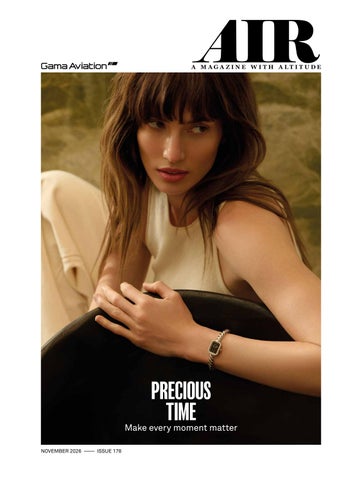
PRECIOUS TIME
Make every moment matter NOVEMBER 2026 –––– ISSUE 178
Brand Licensing Notice: Four Seasons Private Residences Abu Dhabi at Saadiyat Beach are not owned, developed or sold by Four Seasons Hotels Limited or its affiliates (Four Seasons). The developer, Al Ain Asset Management LLC SPC or its affiliates, uses the Four Seasons trademarks and tradenames under a license from Four Seasons Hotels Limited. The marks “FOUR SEASONS,” “FOUR SEASONS HOTELS AND RESORTS,” any combination thereof and the Tree Design are registered trademarks of Four Seasons Hotels Limited in Canada and U.S.A. and of Four Seasons Hotels (Netherlands) B.V. elsewhere.
An Address of Rare Distinction
+971 800 1144 ׀alainam.com
Showrooms:
Contacts:
Social Media:
The Dubai Mall
+971 4 2262277
mahallatiJewellery
Dubai Marina Mall
retail@mahallatijewellery.ae
mahallatiJewellery
Mall of the Emirates
www.mahallatijewellery.ae
Mrs.Mahallati
Gold Souk
NOVEMBER 2026 –––– CONTENTS –––– ISSUE 178
AIR –––– 8
FEATURES Thirty Six
Forty
Forty Eight
The Odyssey star Himesh Patel on the perils of celebrity, casting issues, and uncomfortable working conditions.
How Azzedine Alaïa’s devotion to timeless beauty and the female form shaped fashion.
The photographer who tore up the rulebook to capture the chaos and beauty of everyday life.
The Last Emperor of Couture
The Provocateur
48
Credit: Dorothy + White light stripes, 1962 (Vogue) © William Klein Estate / Courtesy of HackelBury Gallery
The Reluctant Star
REGULARS
16
32
Sixteen
RADAR
Richard Mille’s The Present Tense puts contemporary Arab art in the spotlight. Eighteen
OBJECTS OF DESIRE
18
The latest luxury items we’re currently coveting. Twenty
ART & DESIGN
54
Deeply rooted in the traditions of Milanese design, Valextra’s elegant leather handbags fuse functionality with expert craftsmanship. Twenty Six
JEWELLERY
While finding inspiration for her new collection in Botswana’s diverse landscapes, Valérie Messika also unearthed the country’s largest ever stone.
58
Thirty Two
TIMEPIECES
A. Lange & Söhne celebrates twenty years of its Datograph Perpetual, a gem of watchmaking artistry, by adding a little sparkle. Fifty Four
MOTORING
The one time darling of British motoring is back and ready to fly. Fifty Eight
GASTRONOMY
20 26
Imbued with a profound appreciation for the connection between land, produce and the dining table, Stephanie Haywood is serving up something special at her new restaurant. Sixty Two
NEW BEGINNINGS
62
EDITORIAL Editor-in-Chief & Co-owner
John Thatcher
john@hotmedia.me
COMMERCIAL Managing Director & Co-owner
Victoria Thatcher victoria@hotmedia.me
PRODUCTION Digital Media Manager
Muthu Kumar
muthu@hotmedia.me
How Brown’s Hotel sets the standard for seasonal stays. Sixty Four
WHAT I KNOW NOW
Andrée Deissenberg, Chief Creative & Brand Officer of Crazy Horse Paris.
Reproduction in whole or in part without written permission from HOT Media is strictly prohibited. HOT Media does not accept liability for any omissions or errors in AIR. Published in Dubai, UAE.
D-MARIN MARSA AL ARAB MARINA
Where the World’s Finest Yachts Dock in Dubai
Set at the tip of Dubai’s exclusive golden peninsula, D-Marin Marsa Al Arab Marina is the city’s definitive superyacht address, offering 82 exclusive berths for yachts up to 61 metres, framed by the iconic Jumeirah Burj Al Arab and Marsa Al Arab. Here, the superyacht experience extends far beyond the dock. More than a marina, it is an ultra-luxury lifestyle destination, offering exclusive member privileges and access to beach, pool, leisure, wellness, and dining experiences across Jumeirah’s beachfront hotel portfolio in Dubai.
Outstanding Emerging Marina Gold Winner Abu Dhabi Maritime Awards 2025
NOVEMBER 2026 –––– WELCOME –––– ISSUE 178
AIR –––– 11
WELCOME ON BOARD Hospitality is often judged by the experience created for the person travelling. I believe its truest measure is broader: how thoughtfully we care for everyone who contributes to making that journey possible. That includes pilots and cabin crew. When they spend time at one of our FBOs, our role is not to presume what matters to them, but to listen, understand and respond with the spaces, support, and personal care they need. When a crew welcomes passengers with warmth and confidence, that composure has been earned through preparation, professionalism, and the opportunity to pause and recover. For me, crew experience is an essential part of client experience. To help the people responsible for our passengers be at their best, we must also care for them. Gama Aviation provides charter, aircraft management, maintenance and FBO services across the UK, Europe and the Middle East. Everyone involved influences how the journey feels. The Red Thread, client-centric training programme, connects our people, culture, and client interactions. Through the Red Thread Academy, we equip colleagues with the skills, behaviours, mindset and leadership to understand another person’s perspective, recognise what matters and act with confidence. That includes welcoming pilots and cabin crew as clients in their own right. They may need rest, somewhere quiet to work, support or simply a fresh coffee after a demanding sector. Sometimes, as one Jersey crew member reminded us, what matters is finding a Freddo in the crew room. Across our FBOs in Sharjah, Glasgow, Jersey and London RAF Northolt, the facilities differ, but the welcome should feel personal. Every crew member should feel comfortable, understood and looked after before their next departure. In this issue, we step behind the passenger journey to explore those spaces and the details within them. Exceptional experience is not defined only by what happens in view. Often, it is shaped through quieter moments of care. Wherever you are reading this, I hope you enjoy the issue. If you are travelling with us, thank you for choosing Gama Aviation. If you are a pilot or crew member, thank you for trusting our teams and for everything you do to make each journey exceptional. We look forward to welcoming you soon.
Evie Freeman Group Director of Client Experience Gama Aviation About Evie Freeman Evie Freeman is Group Director of Client Experience at Gama Aviation and the creator of the Red Thread Academy. With a business aviation career spanning more than three decades, her experience includes owning and operating the FBO at London Gatwick Airport before selling to Signature Aviation where she later served as Managing Director EMEA before leaving in 2019 to lead client experience at Jet Aviation. Since joining Gama Aviation in 2025, Evie has established the Group’s client-centred strategy and launched the Red Thread Academy, embedding the skills, behaviours, mindset, and leadership that create consistently exceptional experiences across the organisation.
gamaaviation.com
Cover: Model wears Première Galon watch in white gold with diamonds with rigid braid motif bracelet, Chanel Watches Photographer: Fouad Tadros
NOVEMBER 2026 –––– WELCOME –––– ISSUE 178
AIR –––– 12
GOING THE EXTRA MILE
Why ensuring the comfort of its crew is vital to Gama Aviation’s superior service
The calm experienced on board begins long before passengers arrive. Across Gama Aviation’s FBO network, considered spaces and attentive teams help crew rest, reset, and prepare for whatever comes next. For passengers, a journey begins when they step aboard. For crew, it may have begun several sectors, time zones, and operational decisions earlier. The composure of the cabin, the confidence of the welcome and the sense that every detail is under control do not happen by chance. They are created by people whose responsibility begins before the first passenger arrives and continues long after the last has left. Between those moments lies a part of private aviation passengers rarely see. It is where pilots prepare, cabin crew anticipate the next journey, and a few uninterrupted hours of sleep can be more valuable than almost any other luxury.
For Gama Aviation, caring for the passenger journey means caring for the people entrusted with delivering it. That belief sits naturally within the Red Thread, Gama Aviation’s client-centred culture. Every interaction matters, including those behind a closed crew-room door. Pilots and cabin crew are clients whose needs deserve the same attention, understanding and care. Across Gama Aviation’s FBO locations in Sharjah, Glasgow, Jersey, and London, that care takes different forms. The philosophy remains constant: allow crew to step away from the operation, use their time as they choose and return to the aircraft supported and ready. At the Gama Aviation Business Aviation Centre in Sharjah, the transition begins upstairs. A quiet corridor leads to three purpose-built crew sleep rooms; each designed as a private bedroom rather than
somewhere to fill the hours between flights. Complete blackout allows the intense daylight to disappear. Carefully considered interiors create calm, while a large shower room nearby is prepared with robes, towels, slippers, and toiletries. Together, the spaces provide something difficult to find during an operating day: permission to stop. Rest, however, is personal. Not every crew member wants to sleep and not every pause is free from responsibility. The adjacent crew lounge offers a different rhythm. Its scenic dramatic windows preserve a view across the apron and airfield without sacrificing comfort. Sofas and chairs offer space to relax, with food, snacks, and hot and chilled drinks available. For those still working, a desk, computer and printer provide a practical place to prepare for the next sector. The Gama Aviation operations team is located immediately alongside.
Whatever Whatever your your mission mission – fly, – fly, manage, manage, maintain, maintain, or arrive or arrive – – Gama Gama Aviation Aviation is your is your trusted trusted partner partner in Business in Business Aviation. Aviation.
YourYour mission, mission, our passion. our passion. gamaaviation.com gamaaviation.com
AIR –––– 14
NOVEMBER 2026 –––– WELCOME –––– ISSUE 178
‘
What makes an experience personal is the ability to recognise the detail that matters to one individual
Assistance is close enough to be effortless, but the lounge remains unmistakably the crew’s own space. In Glasgow, the atmosphere is deliberately softer. Two ensuite sleep rooms offer privacy, quiet and complete blackout, allowing night to be created at any hour. It is a simple idea with considerable value when working patterns are shaped by flight schedules rather than clocks. Low lighting and deep armchairs give the crew lounge the character of a private retreat. A workstation supports the practicalities between flights. There is a flight simulator on a gaming system, a playful detail for those to whom aviation is both a profession and a fascination. Jersey and London RAF Northolt do not have dedicated sleep rooms, but their crew lounges offer comfortable seating, coffee, snacks, and space to pause or work. Here, as across the network, the most important element cannot be specified on a facilities list. It is the attentiveness of the people in the room. That care is often expressed in small, intuitive ways: a fresh coffee offered before it is requested, a quieter seat found, or a familiar preference quietly remembered from an earlier visit. Sometimes, that attentiveness is revealed by the smallest request.
’
After visiting our Jersey FBO, Captain Peter Richards completed a client experience survey praising the team’s welcome, communication, and proactive support. There was, however, one omission: the complimentary Cadbury Dairy Milk Freddo bars had disappeared from the crew room. For Peter and his fellow crew members, the 18-gram chocolate frog had become an unlikely ritual after long sectors involving weather, air traffic delays, and paperwork. Its disappearance had left what he described as a “chocolateshaped hole in the crew room”. The Freddos returned to Jersey, and to Gama Aviation’s other UK FBOs. The Jersey team also sent a box directly to Captain Richards. The story is light-hearted, but the principle is not. What makes an experience personal is the ability to recognise the detail that matters to one individual, however modest it may appear to everybody else. It also demonstrates why listening must lead somewhere. Feedback is valuable only when it changes what happens next. That idea is central to the Red Thread Academy, through which Gama Aviation colleagues develop the skills, behaviours, mindset, and leadership
to understand the experience from another person’s perspective. The objective is not to script every welcome or anticipate every possible request. It is to give people the confidence and autonomy to notice, listen and act. For crew, the result might be a sleep room protected from interruption, refreshments ready after a demanding sector, help resolving an operational request or the quiet recognition that conversation can wait until they have had time to breathe. Passengers may never visit these spaces or witness the details unfolding within them. They experience their value differently: in a crew who return to the aircraft composed, prepared and able to give the journey their complete attention. That is the significance of the time between flights. Rest becomes readiness. A lounge becomes part of the operation. Hospitality becomes the assurance that while crew are responsible for everybody on board, somebody is also thinking about them. And sometimes, before the next departure, that thoughtfulness is expressed through a quiet room, a strong coffee or 18 grams of chocolate waiting in exactly the right place.
A world of your own making The most bespoke private island experience A collection of 26 immensely private beach and ocean houses and residences exist beyond the bounds of time; where nothing is fixed, and anything is possible. Where you are free to set your own beat. Free to do – and to be – as you please. www.thenautilusmaldives.com
NOVEMBER 2026 –––– RADAR –––– ISSUE 178
T
hrough its annual Art Prize, Art Here exhibition, and heavyweight Art Book, Richard Mille has done much to spotlight and champion contemporary art from the Arab world. The Present Tense is the third volume of the latter, a beautifully assembled tome of noted works from practising artists in the Gulf, the Levant, North Africa and Türkiye. Curated by Dr Ridha Moumni, Chairman of Christie’s Middle East and Africa, the bilingual tome is themed around the idea of what these artists make of the individual histories they carry and is presented with four cover options, each created by a different artist.
Present Tense, Volume III of the Richard Mille Art Book, is out now
AIR –––– 16
objects of
desire Set the tone as a true tastemaker with these coveted items
C A RT I E R
LOVE UNLIMITED Inspired by New York’s industrial architecture and a fondness for hardware, Italian-American designer Aldo Cipullo created the LOVE bracelet for Cartier New York in 1969, its screws symbolic of locking-in love. To commemorate its enduring appeal, Cartier
18-19 AIR_OOD_Supplement_NOV26.indd 1
has created a small range of new pieces – bracelets, rings and necklaces – in shades of gold. By way of celebration, diamonds are a new addition to the rings and bracelets, while the latter can be attached in pairs thanks to an invisible clasp.
26/10/2026 3:36 PM
D AV I D M O R R I S
T R I O L E T T E B Y C E C I LY M O R R I S Cecily Morris, daughter of David Morris MD Jeremy, launched her debut designs for the brand last year, its first fine jewellery collection. Building on it, Cecily has expanded Triolette with the introduction of studs and pendants, the former inspired by her own curated ear
18-19 AIR_OOD_Supplement_NOV26.indd 2
piercings. “I’ve always liked the idea of adding to your jewellery over time,” says Cecily. “Expanding Triolette with pendants and individual studs felt like a natural next step because it allows the collection to be worn in even more personal ways.”
26/10/2026 3:36 PM
DER EK ROSE
ONE COLLECTION Derek Rose celebrates its centenary with the One Collection, a milestone in luxury loungewear. Standout pieces include the bailey silk pyjamas and duke cashmere gown from the menswear collection, a piece crafted entirely by hand and lined with silk, and the verona
18-19 AIR_OOD_Supplement_NOV26.indd 3
silk jacquard gown for women, reviving a rose pattern from the brand’s archive. Thirdgeneration CEO Sasha Rose explains: “Looking good is easy, it’s feeling good that takes thought.” A century on, the family’s obsession with detail remains at the heart of the British luxury house.
26/10/2026 3:36 PM
18-19 AIR_OOD_Supplement_NOV26.indd 4
26/10/2026 3:36
JAGUA R
T YPE 01 After all the fuss and fury when the prototype of this car was released in 2024, Jaguar could well have been forced into a hasty rethink of its design. Yet to their credit they never buckled, promising that everything would make
18-19 PM AIR_OOD_Supplement_NOV26.indd 5
sense once the Type 01 was released. They were right to stick to their guns, ultimately delivering a marvellously designed car, the most powerful Jaguar ever, that is all the better for looking different – this time in a good way.
26/10/2026 3:36 PM
IDEA BOOKS
K AT E B Y M A R C During the Noughties, British artist Marc Quinn created a series of works devoted to the celebrity of supermodel Kate Moss, one a bronze sculpture called Sphinx (2006), and the other, Siren (2008), a life-size casting in 18-carat gold. Both depicted Moss in the
18-19 AIR_OOD_Supplement_NOV26.indd 6
same contorted yoga position, her hands and feet behind her head. This new book unveils Quinn’s creative process from start to finish, featuring collages, sketches, intimate Polaroids and a behind-the-scenes peek into his studio.
26/10/2026 3:36 PM
J E SSIC A MCCOR M ACK
BOW RING
Bows have long been considered conventionally pretty, but Jessica McCormack’s latest collection finds their edge, proving playful in the tension between ‘pretty’ and ‘powerful’. Spanning three distinct designs and a combination of diamonds, pearls and coloured
18-19 AIR_OOD_Supplement_NOV26.indd 7
stones, the brand’s signature blackened gold is a common feature throughout, the bows bunched, looped and twisted or, as with this ring, seemingly tied by a characterful conch pearl knot, its irregular surface a contrast to the ordered setting of the baguette diamonds.
26/10/2026 3:36 PM
MB&F
S P O NE PAV É E “We asked ourselves: what if we did what no one expected – an elegant, classical watch?” remembers MB&F owner Maximilian Büsser of the conversation that would ultimately lead to the creation of the SP One, the brand’s slimmest and smallest watch which debuted
18-19 AIR_OOD_Supplement_NOV26.indd 8
last year, showcasing a trio of floating elements – the barrel, balance wheel and dial – beneath a sapphire dome. This new version is crafted from 18 carat white gold with a diamond-set case, crown and buckle, along with a diamond-set rhodium-plated bevelled flange.
26/10/2026 3:37 PM
NOVEMBER 2026 –––– ART & DESIGN –––– ISSUE 178
The Quiet Ones
AIR –––– 20
Deeply rooted in the traditions of Milanese design, Valextra’s elegant leather handbags
fuse functionality with expert craftsmanship
WORDS: TAMARA ABRAHAM
NOVEMBER 2026 –––– ART & DESIGN –––– ISSUE 178
a V-shaped notch, say, or a neat rectangle clasp. The true hallmark, though, is in the construction of the bags themselves. While the familiar Tuscan style of handbag manufacture hides the edge of the leather by turning it inside out, Valextra employs the Milanese approach, which leaves the edges of the leather exposed. These are then lacquered in glossy black ink to create the brand’s signature ‘Costa’. When we meet at the Valextra atelier in Milan, Rougeaux is wearing a sleek pocket crossbody and carrying a MyLogo bowling bag, both strung with an assortment of playful leather charms. The way he uses them expresses a key element of the brand’s identity. They’re luxury products intended for regular use, not saved for best. It’s been the Valextra philosophy since 1937, when Giovanni Fontana, a former engineer and leather goods agent, established
the company brand with the mission of creating extraordinary luggage. Fontana was a problem-solver, observing how people would carry and use their bags so he could build solutions into his elegant designs. Every feature had a purpose and nothing was purely ornamental – still a tenet of the brand’s approach today. He was also canny when it came to securing patents for his locking mechanisms, and the house has continued this forward-looking ethos. Rougeaux insists that Valextra is “not a heritage brand”; instead, it’s something best translated as “present continuous.” “This idea of something that is relevant for now,” he explains.
T
he Valextra atelier today is no longer on Milan’s Piazza San Babila, where Fontana and his artisans were once based, but is located 20 minutes away from the city centre on the Metro. It means that the designers can still benefit from that all-important peoplewatching in their daily lives. To reach the atelier, you walk through the archive, where you can see the gentle evolution from Fontana’s original products to the current creations. There are some updates. The Tric Trac, for instance, inspired by a London cab driver’s money pouch, now has a crossbody strap and almost invisible strap clips, tripling sales. But the oldest pieces are remarkably untouched by time. In the workshop itself, staff are clad in lab coats as pristine as the leather with which they work. Andrea Annibale, who shows me around, is head of modelling and prototyping, and comes from a family of leather artisans. “I was born in the workshop”, he says. By the age of six, he had made his own school pencil case. Today, his time is occupied by Valextra’s Iside handbags. The top-handle style is the most familiar, but its new Iside Editor, with an elongated shape and softer silhouette, is fast emerging as the trophy piece. For a brand that doesn’t do anything for the sake of newness, its launch is a big deal. “It’s a homage from us to journalists,” says Rougeaux. “You can wear it in a cooler way. Women wanted something that was crossbody, and in the evening, you can wear it as a clutch.” The pattern is the starting point for any bag. The first iteration is made in a felt-like material, the leather goods equivalent of the calico toile used in
Credit: © Tamara Abraham/ Telegraph Media Group Holdings Limited 2026
T
here is always something alluring about the idea of a person or brand that ‘doesn’t do logos. Even in a post-quietluxury era, it suggests someone with taste, for whom exceptional craftsmanship carries greater value than a designer logo. It’s a concept that is deeply Milanese, where tastes are exacting and sophisticated. Locals cycle everywhere, requiring certain style practicalities, yet only the tourists walk around in trainers. It’s an attitude that is at the very core of Valextra, maker of suitcases and handbags for the global elite, which was founded in the city almost 90 years ago. “Perfection is our logo,” says French-born CEO Xavier Rougeaux, who has been at its helm since 2021. For the informed, there are a couple of ‘if you know, you know’ signifiers:
AIR –––– 22
dressmaking. Once they’re happy with the proportions, a sample is made in leather. “Here, we see how it handles,” explains Annibale. “We can make it softer or harder.” The next step is the cutting. A hide of ivory leather is examined under bright lights before the process begins. The shade is ‘Pergamena’ (‘parchment’ in Italian) – another house signature. The grain, which provides durability, is also checked. It’s designed to catch the light, so it almost seems to glow. This is the domain of Alberto Bertemati, senior modelist and longtime member of the workshop team, and Ricardo Cavaliere, a young cutting specialist. “We check if the leather meets our standards in terms of consistency, and which areas we are going to be cutting or not,” says Cavaliere. The two men also carefully plan which areas of the hide will be allocated to each piece of the pattern, as well as considering the direction of the grain, so that when the pieces are stitched together, they look cohesive. The leather is then moved across to a precision cutting machine, which contains all of the patterns for Valextra’s bags. A laser is positioned over the appropriate area of the leather and that will become the exterior of the bag. Next, Annibale guides me to the splitting machine, a device which shaves micromillimetres off the leather, which is naturally quite thick – around 1.5mm. “All pieces have a different measurement, he says. We split less than Imm, 0.9, 0.5, 0.6 – it depends where on the bag.” This is because some areas of the bag will have reinforcements layered between the outer leather and the lining. “It’s important for the quality of the bag in the future, keeping its shape and strength. We test for shock, climate, so you can take the bag [somewhere that is] -20C, or you can go to Japan, where it is 90 per cent humidity, or to the Sahara,” says Annibale. “If you want to see the same weight on the ‘Costa’ you need to skive every piece perfectly. The mind boggles at the precision.
I
f the bag were a cake, then the Costa finishing and the edges would be the cherry on top. It’s a symbol of Valextra’s relentless pursuit of perfection because the glossy sheen, in contrast with the grain, is unforgiving. “Any
imperfection is extremely visible, it’s almost focused,” says Rougeaux. First, the edges of the leather are sealed, so that the ink doesn’t bleed into it. Then it gets several coats of matt ink, before a final glossy lacquer is applied. This is a high-risk manoeuvre: one slip and that pristine leather is ruined. No wonder it requires around two years of training. Artisans sit before a spinning wheel of black ink and glide the edges of half-made bags over it in swift, fluid motions – it’s mesmerising to watch. Anyone who visits the workshop is invited to attempt a ‘China’ (pronounced ‘key-na’), a version of the Costa on small leather goods in which a black line is hand-drawn on top of the leather at the edge of each piece. Claudia Conforti, a leathergoods specialist, who has been wielding this 2mm nib at Valextra for 24 years, gestures for me to take her seat. No pressure. It
takes all of a millisecond to appreciate that the deftness with which she inks each piece takes years to learn. Valextra may have no logo, but each bag that comes out of the workshop is stamped with its own individual serial number. That number is also logged in a book so that all the vital information, such as the leather used, is kept in case the bag is returned for repair. Finally, the bag is stitched together, again, all by hand. Even the finicky job of making the leather-covered tops of press studs is done by an artisan, who glues the leather to the top of the stud. then tightly wraps it around the back with cotton thread. They dry in little rows before the excess leather is cut off. Why the effort? “It’s better to do it by hand,” an artisan informs me, “because sometimes the machine is not perfect.” Giovanni Fontana himself could not have delivered a more on-brand answer.
A M A T T E R O F T I M E Golden moments for self-expression
Photographer: Fouad Tadros Creative Director: Kate Hazell Make-up artist: Michel Kiwarkis Hair stylist: Ivan Kuz Location: Studio Julie Lemke
65 24-25 AIRxChanel_PS_V5.indd 2
27/10/2026 5:48 PM
AIR 66 24-25 AIRxChanel_PS_V5.indd 3
27/10/2026 5:48 PM
24-25 AIRxChanel_PS_V5.indd 4
27/10/2026 5:48 PM
AIR 24-25 AIRxChanel_PS_V5.indd 5
27/10/2026 5:4
48 PM 24-25 AIRxChanel_PS_V5.indd 6
27/10/2026 5:48 PM
24-25 AIRxChanel_PS_V5.indd 7
27/10/2026 5:48
24-25 AIRxChanel_PS_V5.indd 8
27/10/2026 5:48 PM
AIR 72 24-25 AIRxChanel_PS_V5.indd 9
27/10/2026 5:48 PM
73 24-25 AIRxChanel_PS_V5.indd 10
27/10/2026 5:48 PM
AIR 74 24-25 AIRxChanel_PS_V5.indd 11
27/10/2026 5:48
24-25 PM AIRxChanel_PS_V5.indd 12
75 27/10/2026 5:48 PM
24-25 AIRxChanel_PS_V5.indd 13
27/10/2026 5:48 PM
Page 1 Première Sound watch with earphones in steel and yellow gold with black-lacquered dial, Chanel Watches; Coco Crush bracelet in beige and white gold with diamonds, Chanel Fine Jewellery Page 2 Première Gourmette chain watch in steel and black-lacquered dial with diamonds, Chanel Watches; Coco Crush necklace and ring in white gold with diamonds, Chanel Fine Jewellery Page 3 Première Galon watch in yellow gold rigid braid motif bracelet, Chanel Watches Page 4 Première Ribbon diamonds watch in white gold and diamonds, Chanel Watches; Coco Crush rings in beige, yellow and white gold with diamonds, Chanel Fine Jewellery Page 5 Première Iconic Chain necklace watch, limited edition, Chanel Watches; Coco Crush hoops in white gold with diamonds, Chanel Fine Jewellery Pages 6 & 7 Première Iconic Chain necklace watch in steel and yellow gold, limited edition, Chanel Watches; Coco Crush bracelets and rings in yellow and white gold with diamonds; Toi Et Moi ring in white and beige gold with diamonds, Chanel Fine Jewellery Page 8 Première Iconic Chain double row watch in steel and white gold with black-lacquered dial, Chanel Watches Page 9 Eternal N°5 hoop earrings in white gold and diamonds, Chanel Fine Jewellery Pages 10 & 11 Coco Crush hoops, bracelets and rings in white, yellow and beige gold with diamonds; Toi Et Moi ring in beige gold with diamonds, Chanel Fine Jewellery Page 12 Première Galon watch in white gold with diamonds with rigid braid motif bracelet, Chanel Watches.
NOVEMBER 2026 –––– JEWELLERY –––– ISSUE 178
AIR –––– 26
While finding inspiration for her new collection in Botswana’s diverse landscapes, Valérie Messika also unearthed the country’s largest ever stone
THE LAND OF PLENTY WORDS: JOHN THATCHER
This page, clockwise from top left: Okavango Blue; Delta Sacré; Python Rubellite; Règne
Valérie Messika is certainly no stranger to significantly sized stones. Within the past few years she has worked with the 33-carat Akh-Ba-Ka, an internally flawless cushion-cut diamond that was fashioned from a 110-carat rough stone; the exceptional yellow 35-carat Solar Diva, the shining light of her Midnight Sun high-jewellery collection; and, as recently as last year, there were all 34.92 carats of the Kalahra, the feature radiant-cut diamond of the Terres d’Instinct collection. But there was always something different about the Okavango Blue. “Honestly, I was moved,” says Valérie, recalling the moment she first laid eyes on the mesmerising stone. “This is a 20.46-carat blue diamond, the largest ever found in Botswana. And in Botswana it's considered a national treasure. So the moment I had it in front of me, I understood this wasn't just an exceptional stone; it was a piece of the country’s national heritage. That's a lot to hold in your hand.” To paraphrase a popular quotation, with great stones comes great responsibility. “When you're given a stone like the Okavango Blue, you know immediately that nature already did the hard part. There's excitement but also humility – you have to know when to add and when to take a step back. What I didn’t want is a design that exists just to show off craftsmanship or complexity. I didn't want to design on it. I wanted to design around it, almost in service of it. The real challenge is finding the idea that feels obvious for that specific stone.” That idea finally presented itself: a centrepiece necklace. “I combined two things I love in high jewellery – the structure of a medallion and the fluidity of a rivière – and built everything so your eye keeps going back to the blue. It looks simple in the end, but that simplicity took a lot of work to get right.”
‘I never liked the idea of diamonds sitting stiff on a woman’
NOVEMBER 2026 –––– JEWELLERY –––– ISSUE 178
AIR –––– 30
These pages, from left to right: Jacaranda; Groove Tsavorite; Serti; Flamboyance
I
ndeed, Valérie worked through 30 iterations of the medallion before settling on the final version. “We were chasing something quite precise – it was about finding the right balance between light, proportion and movement. With a blue this intense, even a tiny change in the setting changes what you perceive. So we kept adjusting the volume of the medallion, how the diamonds around it graduate, and how the stone actually sits. I wanted every diamond around the blue to push light toward it, not take attention from it. Thirty versions sound like a lot, and it is – but you don't notice the work when you look at the final piece; you just feel that it's right.” Routing additional light to this most vividly hued of stones, the rivière has been engineered to behave almost like drapery, the idea of movement long
imbedded in the ethos of the house. “This has been true since day one for me,” says Valérie. “I never liked the idea of diamonds sitting stiff on a woman, disconnected from her. A jewel should move when she moves. “For the Okavango Blue, our atelier worked the gold so the rivière has an almost fabric-like flexibility. Even though it is made of more than 500 diamonds, it still follows the curve of the neck like a second skin. That is what I still love and find exciting after twenty years: the contrast of a stone so precious that also feels completely weightless to wear.” Such contrasts underpin Terres de Contrastes, Messika’s latest high jewellery collection, which draws inspiration from the diverse landscapes of Botswana, builds on the colour-rich, landscape-specific Terres d’Instinct, and
sees Valérie’s design aesthetic confidently move into the realm of the enthralling. “Contrast gives energy to a piece, and tension is what makes it feel alive instead of decorative,” says Valérie. “Botswana made that so clear to me. The landscapes change so much. You go from the dry, strong tones of the Kalahari to the deep blues and greens of the Okavango Delta, then to the almost endless white of Makgadikgadi [salt pans]. “I translated that into jewellery through unexpected combinations: colour next to diamond, polished gold next to pavé, strong volumes next to fluid movement. What interests me is the moment when two very different things suddenly work together. That's usually when a design gets interesting.”
T
he Delta Sacré necklace sees 600 diamonds weave towards a pearshaped emerald of 12.81 carats. To simulate a majestic sunset, a 13.54-carat oval-cut rubellite sits in contrast to the salt-desert white of five synchronised
rows of marquise-cut diamonds, forming the Python Rubellite. While onyx is used to reimagine the spots and footprints of a leopard on the prowl in the Kalahari for the Règne necklace, from which hangs a 15.18 carat spectacularly coloured stone. Which was the most challenging of Botswana’s landscape to translate into high jewellery? “I'd say the Makgadikgadi salt pans, because they look so minimal. With the Okavango Delta, you immediately have colour, movement and life. Makgadikgadi is almost the opposite. It’s vast, white, quiet, seemingly empty. The challenge was translating that feeling of infinity without making the jewellery feel cold or still. It pushed me to think about light, texture and small variations instead of just colour. Sometimes, the landscapes that look the simplest end up being the hardest to interpret, because every little detail shows.” Ever since Messika launched in 2005, the house has spoken in the language
of diamonds. Colour now adds another dimension, opening a door to new ideas. “With colour, I'm not just thinking about brilliance anymore. I'm thinking about depth, tone, even the small imperfections that give a stone personality, and I like the idea of contrasting them with the clear light of diamonds. Terres d'Instinct started that conversation, and Terres de Contrastes let me push it further. But the diamond hasn't left – colour just gave it something new to talk to.”
D
iamonds most certainly have not left. The new collection contains pieces with enormous quantities of them, and yet the designs remain relatively clean. Is restraint becoming more important to Valérie as the scale of the jewellery increases? “I think the more exceptional the materials, the more discipline you need as a designer. High jewellery doesn't need to prove its value through complexity alone.
“For me, restraint isn't about making something less spectacular. It's about knowing exactly where a piece's strength should come from and understanding the stone you have to work with. You can have hundreds of diamonds and incredible craftsmanship, but the eye still needs to understand the jewel right away.” It’s also important to keep pushing boundaries. “It's essential,” states Valérie. “High jewellery should be a place where you can ask, ‘What if we tried this?’ even before you know if it's technically possible. I rely a lot on my dearest atelier team, but there's a real narrative between us. Sometimes I come in with an idea that pushes what gold or a setting is supposed to do, and their skill helps take it even further. The most interesting designs usually come from that tension between instinct and technical limits.” In Messika’s case, those designs are also just as likely to be magnificent.
NOVEMBER 2026 –––– TIMEPIECES –––– ISSUE 178
AIR –––– 32
DIAMONDS ARE FOREVER
A. Lange & Söhne celebrates twenty years of its Datograph Perpetual, a gem of watchmaking artistry, by adding a little sparkle WORDS: JOHN THATCHER
A
A. Lange & Söhne has a fascinating history, the foundations for which – including its duty to precision watchmaking – were laid way back in 1845, the founder’s acclaimed pocket watches still coveted to this day. So it’s perhaps no surprise that when an opportunity to champion a noted achievement from its past presents itself, Lange is keen to do so. Such opportunity knocks in the form of the remarkable Datograph Perpetual, which this year marks its twentieth anniversary with the release of a new version. With its movement consisting of 556 parts, it’s a timepiece that combines two sophisticated complications: a chronograph with a flyback function and a precisely jumping minute counter, as well as a perpetual calendar with the Lange-typical outsize date. “A very special timepiece,” says Wilhelm Schmid, CEO of A. Lange & Söhne, who, though aware that part of the Datograph Perpetual’s appeal is its characteristic, timeless design, was also keen to do something a little different for the new version. “It’s very important for us to surprise our collectors. To get them excited about something they didn’t see coming.” That would be the hand-applied diamonds, eleven of which serve as hour
markers against a black dial, while the case and bracelet are platinum. “A real gem yet understated enough to retain its timeless appeal,” adds Schmid.
U
nderstated it certainly is. A complex watch, yet its dial remains remarkably calm and legible. How difficult is it to make complexity look effortless, I ask? “Complexity is never effortless. I very much hope that people will recognise how much time and effort goes into making our watches,” states Schmid. “At A. Lange & Söhne, the quality we value most in a watch is logic and legibility. This stems from a well-balanced combination of design and functionality. For instance, the outsize date significantly influences the design of the calendar. The day and month indications are integrated into their respective sub-dials in order to preserve the watch’s character. This approach ensures a clear hierarchy of information and a distinctive Lange aesthetic. Ideas like this result from designers and watchmakers working closely together throughout the development process.” The task of the watchmakers is arduous. “The individual adjustment of a chronograph mechanism and a perpetual calendar already pose quite a challenge, yet the level of
difficulty increases immensely when both complications are juxtaposed in one watch and must be harmonised with each other. This feat requires our watchmakers’ utmost technical expertise and artisanal virtuosity.” Their skill is widely appreciated by an ever-growing number of watch collectors. “Many watch collectors have made A. Lange & Söhne their first choice because they identify with our approach to fine watchmaking,” says Schmid. “Our timepieces fulfil their desire for distinction, timeless beauty and lasting value. To ensure the highest possible level of quality, every single movement, be it a three-hand calibre or a complication, is assembled twice. The twofold assembly and the fact that every component is meticulously finished, whether it’s visible through the sapphire-crystal case back or not, are features that are very much appreciated by our customers.” The other element that attracts collectors is the scarcity of A. Lange & Söhne’s pieces. Only a few thousand wristwatches are created each year, predominantly in gold or platinum, while the movements are all made – and hand assembled – in house. Since the brand’s rebirth in 1990, it has produced 77 calibres. “We have certainly gained a lot of momentum with people that love fine watchmaking, but we decided very early on not to change our way of designing, developing and manufacturing watches. The number of watches we can produce is naturally limited and ultimately depends on the number of qualified watchmakers in our manufacture. Our watches are handmade, and it takes highly trained people to make them. We work in a very specialised field that depends on expert training and a high level of experience – two aspects that involve a great deal of time. Every Lange watch is distinguished by an incredibly high level of manual labour that is impossible to rush.” This commitment to quality does not come at the expense of ambition, however. “Achieving sustainable growth with limited production capacity is a
‘Our timepieces fulfil our collectors’ desire for distinction, timeless beauty and lasting value’
challenging but essential task,” outlines Schmid. “This is particularly true if you do not want to compromise on quality. Our watches are at the heart of everything we do. Therefore, our most important strategy is to protect and preserve the way we craft our timepieces. This is what A. Lange & Söhne is being appreciated for. In this respect, it is our great responsibility to invest in the people who work in our manufacture in Glashütte: our product development team, our watchmakers, finishers, and all other skilled and highly trained craftspeople involved in creating and producing our timepieces.”
T
he A. Lange & Söhne story has two distinct chapters. The first, written by founder Ferdinand Adolph Lange, ended when the German watchmaker was expropriated after WWII. The second continues to be written; Ferdinand Adolph Lange’s greatgrandson, Walter Lange, relaunching the brand in 1990. Does, then, Schmid see Lange as continuing a 181-yearold tradition, or as a relatively young modern watchmaker that happens to have an extraordinary historical foundation? “This unique heritage is reflected in our timepieces and the typical traditional elements that you can see in every single movement,” he says. “You only need to look through the sapphire-crystal caseback to see the gold chatons, blued screws, threequarter plate and the hand-engraved balance cock. These hallmarks were also featured in Ferdinand Adolph Lange’s pocket watches. “Preserving our legacy means honouring the principles that define our timepieces: precision, craftsmanship, and timeless elegance. At the same time, it is important for us to stay true to our philosophy of never standing still by testing the limits of mechanical horology. Innovating while staying true to tradition is a delicate balancing act, and I am proud of our watchmakers for having the prudence, expertise, and passion to take on this challenge.”
S
chmid believes both Ferdinand Adolph and Walter Lange were the “very embodiment of a passion for fine watchmaking.” If he had the chance to hand them one of the manufacturer’s modern-era pieces to show how their principles live on, which would he
choose? “An intriguing question. I’d love to let them choose for themselves, as I’d be very curious to see what they’d go for. Otherwise, I would offer Ferdinand Adolph Lange a model from our 1815 watch family, as it is named after the year he was born and features many references to the historic Lange pocket watches. As for Walter Lange, I’d be very interested to know what he’d think of the Odysseus. Launched in 2019, two years after his death, it is our latest watch family, and I am sure that this sporty yet elegant watch would have suited him very well.” While both men would likely be pleased with what they saw, they’d be happier still to know that their story continues to be told and celebrated by the people who now embody their pure passion for expert watchmaking.
Below: Wilhelm Schmid
AIR
NOVEMBER 2026 –––– HIMESH PATEL –––– ISSUE 178
AIR –––– 36
The Reluctant Star Himesh Patel on the perils of celebrity, modern casting, and Christopher Nolan’s uncomfortable working conditions WORDS: MELISSA TWIGG
NOVEMBER 2026 –––– HIMESH PATEL –––– ISSUE 178
T
he six-month shoot took him to Greece, Scotland, Italy and Iceland – a serious undertaking for a married man with two very young daughters. It also pushed Patel, Damon and the assembled Greek soldiers to their limits: Nolan refuses to mollycoddle his cast – phones are banned, there are no cushy trailers, and even foldup chairs are frowned on. “I spent a lot of time between takes sitting on rocks,”
says Patel. “Chris strips away an element of everyone’s ego, and there’s something really satisfying about us all being on the same level, without that hierarchy.” In Iceland last summer, they were shooting at night to capture the eerie twilight of the underworld. It was freezing and raining, and Patel turned to Damon and said, “Are these the worst conditions you’ve ever filmed in?” Matt replied, “I don’t know, but if it’s not the worst, then whatever the worst was, you were there with me for it.”
T
he physical challenge of scrambling into boats from the sea, sprinting up hills and running through forests was so great that at times Patel questioned whether he should even be there. “Not to the point where I thought, ‘I’m going to walk off set,’ but it did make me think about fitness. I was surrounded by a lot of guys who really look after themselves, and there were moments when I thought, ‘Oh God, I’ve been wildly miscast here. I’m not up to this.’” The film has become a billion-dollar global talking point in a way that is rare for any piece of culture these days. But it has also been controversial. Patel himself was largely praised by critics and cinema-goers for his performance as the pragmatic, anxious Eurylochus, but there was a backlash against some of Nolan’s other casting choices – notably, Elliot Page, a transgender actor, as the Greek soldier Sinon, and KenyanMexican Lupita Nyong’o as Helen of Troy. “It’s got a Cyclops in it,” says Patel with a deadpan expression when I ask about this. “The Odyssey has belonged to the world for 3,000 years. If you’re telling that story in the modern world, why wouldn’t the cast reflect the modern world?” It’s a topic that bothers him, as he returns to it a few times. “On one level, the criticism feels incredibly silly,” he says. “On another level, it points to something much more worrying about where society is. I can’t speak for Chris’s intentions, but his casting choices do feel like a rebuttal of certain forces in the world.” Nolan has also courted controversy by choosing to have the actors speaking with modern American accents. (“Ten years on this f—king beach,” drawls Damon in one scene.) Again, Patel agrees with Nolan’s choices, arguing that the director is not only making Greek mythology more visually diverse, but also stripping away the old signals that these stories belong to a certain class or culture. “I’ve always thought that when you ask actors playing these roles to speak with a particular sort of English accent, it’s just
another way of gatekeeping the classics,” he says. He notes that the British in particular still tend to think of epic poems such as The Odyssey as being the preserve of highly educated people who went to Oxbridge. “But that’s just not true,” he says. “They’re for all of us, but to make them for all of us, you have to make them accessible.” Patel is now a staple of prestige film and television – he has landed major roles in acclaimed series such as Station Eleven and Enola Holmes, and has played the leading man in Danny Boyle’s 2019 film Yesterday alongside Lily James – but his journey to the top has been an unusual one.
B
orn in 1990 in Cambridgeshire, England, Patel grew up in the quiet village of Sawtry near Huntingdon. His childhood was largely happy: his mother moved to Britain from India in her early 20s and his father came from Kenya as a teenager, and together they built a stable environment for Patel and his sister, running the local newsagent and fostering a strong work ethic in their two children. Even though the area they lived in was predominantly white, the Patels felt welcome – and much of his love for Britain comes from his immigrant parents. “They’re still incredibly loved in our village,” he says. They are also, naturally, proud of their son. A few days before we meet, Patel bought them tickets to see The Odyssey at the Imax – of course, they loved it. Increasingly, he also appreciates the village upbringing that they gave him. “It helped me understand prejudice in a way I’m not sure I would have done in London – I know now that sometimes you’ve just experienced the world differently, and I think that’s made me a little more forgiving. What looks like malice is often simply ignorance.” Perhaps because he was something of an outsider, Patel enjoyed slipping into other roles during his childhood – he spent one entire summer pretending to be an American called Mike after making a new group of friends – and it was a teacher at primary school who spotted his talent and urged his parents to apply for a holiday place at the Key Youth Theatre in Peterborough. This eventually translated into classes at the Young Actors Company in Cambridge. Urged to audition for a few roles, he then landed a plum part at just 16, when he was asked to play Tamwar Masood in the long-running UK soap EastEnders. Saying yes meant major upheaval: leaving school after his GCSEs and moving to London alone, but Patel took
Credit: © Melissa Twigg / Telegraph Media Group Holdings Limited 2026
H
imesh Patel does not behave like a Hollywood star. He wanders into the Fitzrovia restaurant where we’re meeting for lunch a few minutes before the allotted hour, wearing an unremarkable baseball cap, T-shirt and jeans – and nobody bats an eyelid as he walks across the room. Given that Patel has just starred in The Odyssey – arguably the most hyped film of Christopher Nolan’s already dazzling career – with a string of other high-profile hits to his name, this is surprising. And I can’t blame it on the phlegmatic nature of Londoners, as a relatively minor UK TV star sitting near us is approached twice for a photograph. “I’ve never courted fame, and so far it’s been absolutely manageable,” says Patel, 35, after he laughs off my suggestion that overeager fans might have made the Tube journey from his house in north London difficult. “Although it’s hard for me to know how much of that is a conscious choice not to lean into celebrity, and how much is simply that people don’t really see me in that way. Maybe I’m just not that interesting as a personality. I honestly don’t know. There are people who are staggeringly handsome and seem to have the whole package, and I’ve never pretended to be one of them.” It is hard to imagine the Leo Woodalls or Callum Turners of the world describing themselves as neither particularly interesting nor handsome – but modesty hasn’t hindered Patel’s rise in the industry, and he has a more exciting career than many of the British millennial men invading Hollywood alongside him. This summer, his face was on every cinema screen across the country as Eurylochus, Odysseus’s doomed right-hand man, who serves under (and at times against) the beleaguered hero on their 10-year journey home from Troy. Patel had already worked with Nolan on the 2020 film Tenet, and didn’t have to audition for the part – one that placed him at number two on the call sheet after Matt Damon. “I was standing on the street when I got the call and I said, ‘Are you f--king kidding me?’”
AIR –––– 38
the plunge and stayed on the show for nearly a decade, describing the experience as “incredible training”. This is why he laments the people in Britain fail to take soap stars seriously, preferring their big-name actors to come from the likes of Rada. In Australia, Margot Robbie, Heath Ledger and Guy Pearce all cut their teeth on shows such as Neighbours and Home and Away, but in the UK it remains rare for anyone to make that leap. “We create these class boxes for actors,” Patel says, “and by doing so, we’re handicapping ourselves as an industry. There are brilliant actors working on soaps from every kind of background. Some are perfectly happy staying there, but for those who want to move on, they’re often told, ‘Don’t expect too much.’ And if you’re told you should stay in your lane, you believe that.”
H
appily, Patel ignored the warnings – and today his career is going from strength to strength. He is currently a friend of the house for Cartier, and his next project is another globally known adaptation, albeit of a cult 1990s show rather than an epic poem. In spring this year, he filmed the pilot of a reboot of The X Files, alongside Danielle Deadwyler, who is African American (they don’t play Mulder and Scully, but different characters in the same world). Again, the casting of non-white leads has been controversial. “It’s a television show about aliens,” says Patel, with a sigh. “I genuinely don’t know what else to say, but it does depress me. Although I still believe the overall direction of society is moving the right way, even if there are forces trying to pull it backwards.” To try to get to grips with some of this, Patel is working with Nikesh Shukla, the writer, on a screenplay based on Shukla’s memoir Brown Baby, about bringing up children in Bristol and teaching them how to deal with racism – something that has struck a chord, as Patel’s own daughters are just 5 and 3. “I honestly don’t know how I’m supposed to explain those things to them. At the moment, they’re completely innocent. There’s just joy. It’s depressing to know that one day you’ll have to tell them that somebody might dislike them because of the colour of their skin.” For now, family life in north London (he prefers not to share the name of his wife) feels like the antithesis of his Hollywood ascent – even if, like many young parents in the industry, he struggles to find time for the demands of both. “Being away from my children is really hard,” he says. “It’s hard for my partner too. You can have a nanny, but it’s still difficult. They’re so young that you can’t always have a proper conversation with them over the phone – my younger one just gets excited, presses the red button and hangs up on me.” Luckily, Patel has a chunk of time off, and after repeatedly offering to pay his share for lunch and tentatively embracing me goodbye, he disappears into London streets exactly as he arrived: unnoticed, anonymous and quite happy to keep it that way.
AIR
NOVEMBER 2026 –––– AZZEDINE ALAÏA –––– ISSUE 178
AIR –––– 40
The Last Emperor of Couture Spurred by his devotion to timeless beauty and accentuating the female form, Azzedine Alaïa brought couture back to the catwalk. A new book and major retrospective honour his legacy WORDS: JOHN THATCHER
The American fashion photographer and journalist Bill Cunningham achieved legendary status within the industry for his ability to spot emerging trends. Rather than be informed by what was coming out of the fashion houses, he’d position himself ahead of the curve, hitting the streets of New York on his bicycle in his trademark blue French workman’s jacket to document changing styles. Cunningham’s eye mattered. So when, on November 23, 1981, he reported for Women’s Wear Daily that “a new, low-key fashion story quietly unfolded this season in the form of superbly cut black dresses,” everyone was keen to know to whose dresses he was referring. Azzedine Alaïa had commanded Cunningham’s attention. Cunningham elaborated that Alaïa “might well be responsible for re-establishing the authority of understated Paris elegance,” and that he was turning his talent to “putting women back in clothes designed to illuminate the curves of the female.” This desire, this ability to shape, to amplify natural beauty, saw the Alaïa aesthetic define the fashions of the 1980s.
I
f it was a copy of Vogue, given to him by a French friend of his mother, that sparked Alaïa’s passion for fashion, it was the École des Beaux-Arts in Tunis, the city of his birth in 1935, that moulded it. “His training as a sculptor – of which he said, ‘It comes from there, my interest in the curves of the body’ – instilled in him a knowledge of anatomy and informed how he manipulated fabric as a couturier: draping, cutting, and pinning fabrics directly onto forms and models,” says Laura L. Camerlengo, Curator in Charge of Costume and Textile Arts at Fine Arts Museums of San Francisco, which this month hosts Azzedine Alaïa: Sculpting Fashion, a major retrospective that also sees Rizzoli publish an accompanying book of the same name.
Alaïa’s designs could be intensely sensual while remaining extraordinarily disciplined in their construction. How did he strike that balance between technical precision and emotional impact? “Alaïa’s mastery of form came from women; he worked directly on models’ bodies when making his clothes,” says Laura. “His work, in the 1970s, dressing the burlesque dancers at Crazy Horse Paris, also informed how he designed and taught him how to fashion a ‘second skin.’” This idea of designing a second skin, clothing that fits the body so closely it almost feels like an extension of it, was central to Alaïa’s work. He experimented with materials that hugged, including stretch jersey and knitted fabrics, would use seams, panels and precise cuts that shaped the silhouette without relying on heavy structure, and emphasised the waist, hips and curves; the beauty of the body. “Many, many designers in that period were creating simplified clothes in response to less formal lifestyles,” writes Cathy Horyn in the Rizzoli book. “Alaïa’s jersey dresses and knits had an outward simplicity, but everything was about the silhouette – and what that line did to your body. Today it may be hard to believe how wildly new that style was since we’re so used to seeing little black stretch dresses, or leggings. But back then, nothing else looked like that.” Back then was also the era of the supermodels, who visibly embodied Alaïa’s idea of femininity. In turn, the likes of Naomi Campbell, Linda Evangelista, Christy Turlington, Cindy Crawford and Claudia Schiffer were not only taken with how Alaïa’s clothes would flatter their figures – they were equally enamoured with how he made them. “I don’t care how long I have to stand to be pinned into one of his dresses, because watching him create is mind-blowing,” said Campbell.
NOVEMBER 2026 –––– AZZEDINE ALAÏA –––– ISSUE 178
AIR –––– 44
S
uch skill also proved revolutionary to other cultural icons of that time. “American singer-songwriter Tina Turner’s discovery of Azzedine Alaïa in the 1980s sparked a transformative partnership,” says Laura. “After enduring years of physical and emotional abuse by her ex-husband, including control over the ensembles she wore, Turner embraced Alaïa’s designs as a profound act of liberation, acknowledging the fierce confidence and freedom of movement she found in his clothing. Alaïa’s designs for Turner defined her Private Dancer comeback tour in 1985 and a now-famous photo shoot with German photographer Peter Lindbergh in 1989, in which Lindbergh captured Turner wearing this Alaïa dress, radiating newfound independence and unapologetic strength.” While Bill Cunningham was fascinated by trends, Azzedine Alaïa shunned them, steadfast in his belief that his clothes were timeless. In the true spirit of couture, he devoted the necessary time to the making of beautiful clothes, constructing patterns with mathematical precision. “This idea of timelessness was deeply rooted in his creative ethos,” explains Laura. “Alaïa exited the official fashion calendar in the late 1980s, lamenting that its cyclical nature ‘scorns creation in favour of productivity.’ Rather than make seasonal changes to his clothes, he deepened his understanding of his art form, honing his technical mastery to perfect his designs and adapting new materials through research and experimentation.” But like Cunningham, whom Alaïa always credited with boosting his profile, he was able to anticipate what lay on the horizon. “Azzedine Alaïa’s focus on meticulous craftsmanship and intentionality in design, and his thoughtful criticality of the overproduction and consumption of fashion, anticipated the conversations we are having today about value and sustainability. This is yet another way that he was visionary,” says Laura. In this era of accelerated production, countless shows and rapidly changing fashion trends, a focus on Alaïa’s practice could not have been more perfectly timed. Azzedine Alaïa: Sculpting Fashion is at the Legion of Honor museum in San Francisco from November 21, 2026– April 11, 2027. The accompanying book, published by Rizzoli, is out November 24
Opening pages: Azzedine Alaïa and Tina Turner, Paris, 1989. Photograph by Peter Lindbergh. Courtesy of the Peter Lindbergh Foundation, Paris Previous pages: Portrait of Azzedine Alaïa. © Gilles Bensimon. Courtesy of Fondation Azzedine Alaïa and the Fine Arts Museums of San Francisco Opposite page, clockwise from top: Veronica Webb for Azzedine Alaïa, bustier dress with pins, 1987. © Jean-Baptiste Mondino; Azzedine Alaïa (1935–2017), Spring/ Summer 1986 Haute Couture. Courtesy of Fondation Azzedine Alaïa. Photograph © Andrea & Valentina; Azzedine Alaïa (1935–2017), Spring/Summer 1990 Haute Couture. Courtesy of Fondation Azzedine Alaïa. Photograph © Andrea & Valentina This page: Azzedine Alaïa adjusting dress beads, Paris, 1989. Photograph by Peter Lindbergh. Courtesy of the Peter Lindbergh Foundation, Paris
Timepieces NOVEMBER 2016 : ISSUE 66
AIR
FEEL THE THRILL
A potent blend of exhilarating performance, supreme styling and roof-off romance, the Ferrari Amalfi Spider is driven by emotion 64
65 46-47 AIRxFerrari_Photoshoot_NOV2026_5.indd 2
26/10/2026 3:52 PM
AIR 66 46-47 AIRxFerrari_Photoshoot_NOV2026_5.indd 3
26/10/2026 3:534
46-47 AIRxFerrari_Photoshoot_NOV2026_5.indd 4
26/10/2026 3:53 PM
46-47 AIRxFerrari_Photoshoot_NOV2026_5.indd 5
26/10/2026 3:53 PM
46-47 AIRxFerrari_Photoshoot_NOV2026_5.indd 6
26/10/2026 3:53 PM
AIR 46-47 AIRxFerrari_Photoshoot_NOV2026_5.indd 7
26/10/2026 3:534
46-47 AIRxFerrari_Photoshoot_NOV2026_5.indd 8
26/10/2026 3:53 PM
46-47 AIRxFerrari_Photoshoot_NOV2026_5.indd 9
26/10/2026 3:53 PM
Ferrari Amalfi Spider Page 1 The front end is defined by a large air intake and a long, sculpted bonnet that houses the 640 hp turbocharged V8, which propels the car to a top speed of 320 km/h. Pages 2-3 The tailor-made or technical-fabric soft top opens in just 13.5 seconds at speeds of up to 60 km/h. Pages 4-5 The 2+ configuration enhances practicality; a new steering wheel marks a return to tactile controls; while the central tunnel adopts a pure, essential form – a suspended bridge machined from solid aluminium houses the primary controls. Pages 6-7 The 20” wheels were selected to maintain the harmonious proportions consistent with the car’s design language. Page 8 At the rear, the integrated active spoiler contributes to high-speed stability, while carbon fibre details complete a sporty and sophisticated aesthetic.
NOVEMBER 2026 –––– WILLIAM KLEIN –––– ISSUE 178
The Provocateur William Klein tore up the rulebook, capturing the chaos and beauty of everyday life. Now a new exhibition celebrates his legacy WORDS: SARAH BAILEY
AIR –––– 48
NOVEMBER 2026 –––– WILLIAM KLEIN –––– ISSUE 178
“William was all about being in your face. He was going to attack everything,” says gallerist Marcus Bury, speaking of William Klein, the photographer, artist, filmmaker and all-round provocateur, who was dismissed from his job at American Vogue shortly after his 1966 film Who Are You, Polly Maggoo?, which skewers the fashion industry, was released. “His photographs are very confrontational. Any pillar of anything, he was going to tear it down,” Bury says. From now through to February 2027, HackelBury London, the gallery co-founded by Bury and his wife, Sascha Hackel, hosts Klein: 100, an exhibition of photographs marking the centenary of the artist’s birth, in collaboration with Studio William Klein. Klein, who died in 2022 aged 96, was born in New York, but spent much of his working life in Paris, where one can only assume he felt more at home as a rebellious polymath. Notoriously, his seminal 1956 documentary photo book, Life Is Good & Good For You in New York, failed to find a publisher in America for over 30 years (deemed too raw, unsettling and unpatriotic). It was, however, published in France, to great critical acclaim.
C
ut to 2026, inside HackelBury’s bijoux London premises in Kensington, where the gallerists are preparing for the retrospective, unwrapping Klein’s luscious black and white prints from their bubblewrap cocoons. Among them are Klein’s early, lesser-known painterly abstracts, the swaggering, in-your-face street reportage and, of course, the elegantly mischievous, wildly inventive fashion photography. Bury points out a shot of a woman with a cigarette, Smoke and Veil (1958), an image that adorns one of Klein’s most iconic photo books, In & Out of Fashion. “That was the cover of Vogue… in the 1950s… showing a woman smoking like that without a cigarette holder, without gloves… It was like putting a prostitute on the cover of Vogue,” he says. Another, Barbara and Black Flower Snack, Paris (for Vogue), from 1956, depicts an apparently decorous portrait of a model, who on closer inspection
appears to possess a rather leering and ravenous expression. This shot is framed against a red board of the precise visceral hue as the paint that Klein used on his contact sheets to denote his exact chosen shot. Over the years Klein’s signature, paintdaubed contacts, which pulse with the attacking energy of an expressionist painting (“He wouldn’t let anyone else paint on his contact sheets,” says Bury), have attained their own iconic status: displayed on gallery walls and spawning dozens of imitators along the way. “William Klein shot his camera like a gangster fired a gun – fast, fearless and often furious,” says Glenda Bailey, the former editor in chief of Harper’s Bazaar US, speaking to me over the phone. She is recounting how, in 2006, she persuaded Klein to shoot an extensive fashion portfolio for the pages of Bazaar – quite the publishing coup, to lure the renegade maestro back into the fashion spotlight, 40 years after the Maggoo debacle. The courtship, explains Bailey, was conducted over tea and biscuits, every time she attended the Paris collections (“As the years passed, the biscuits got more and more stale and brittle, but I was just determined, and it was his will or mine”). Gradually, then suddenly, Klein accepted the proposal. His idea? To invite all the great fashion designers of the day to sit for a studio portrait with the people who most inspired them. “Alber Elbaz [of Lanvin] hired a bus and brought everyone in the organisation, from the president all the way through to the cleaner, and then Mrs Prada arrived on her own.” Throughout his career, Klein’s insider/ outsider status gave his photography bite. His was a rough-and-tumble childhood, toughing it out as a
AIR –––– 50
Jewish child in an impoverished Irish neighbourhood in 1920s Manhattan. However, after the Second World War he was able to secure a place to study art at the Sorbonne (taking advantage of the GI bill which allowed former servicemen to study abroad). There he was tutored by the modernist painter Fernand Léger – another anti-establishment contrarian – who urged him to take inspiration from life as it was really lived, on the street.
K
lein’s situation pivoted dramatically when he was hired by American Vogue in 1954. “It shows what a brilliant creative director Alexander Liberman was, he spotted this young man, who was obviously passionate, taking these really raw photographs,” says Bailey. Klein brought his revolutionary approach to fashion photography, taking the models out on to the street to shoot among the hubbub of the crowd. But the Vogue years also allowed him to hone his studio techniques and incorporate some of his early abstract expressionist experiments. A centrepiece of the HackelBury London show is a series known as “Dorothy playing with the light”, taken from a 1962 Vogue shoot that covered several spreads in the magazine. In the images, model Dorothy McGowan, a Klein favourite (who, like him, grew up in New York on the wrong side of the tracks), appears to be blasting a spray gun of light. Picture, if you can, an impeccably dressed graffiti artist drawing in the darkness with a blazing flare. Technically and artistically ingenious, the images were achieved through double exposures, shot in a black velvet-clad studio. First McGowan would hold a pose, then the lights were turned off and an assistant (dressed all in black) moved a flashlight around to “draw” cartoon-like symbols in the air. That the Dorothy series is available to be seen on the gallery wall by modern audiences is down to a stroke of luck and the doughty determination of Bury, who happened upon the hidden trove of imagery at Klein’s Paris HQ one day while working on another project. “He said they were ‘pop-sy’ and that he wasn’t interested… too light, I suppose,”
Opening pages: Smoke + Veil, 1958 (Vogue) These pages: Nina + Simone, Piazza di Spagna,1960 (Vogue) Next pages, from left to right: Dorothy + Light Dog, 1962 (Vogue); Dorothy Juggling White Light Balls, 1962 (Vogue); Dorothy + White Light Stripes,1962 (Vogue). All images © William Klein Estate / Courtesy of HackelBury Gallery, London
explains Bury, who has worked with Studio William Klein for over 25 years. “But look, you had to give him ideas and then he would fight back. William loved a fight and you had to meet him head on.”
A
photograph that Klein much preferred, and one on display at HackelBury London, is Nina + Simone, Piazza di Spagna (1960), featuring two elegantly coiffed models, passing on a zebra crossing. Shot by the Spanish Steps in Rome, the image fizzes with the febrile atmosphere of the street. Serendipity or choreography? That’s the question I ask Pierre-Louis Denis, Klein’s longtime studio assistant, who continues to run Studio William Klein in Paris, when we speak over a video call. Denis explains that the image was captured with a very long lens, balanced on a tripod, so that Klein could stand back and observe what was going on around him:
“Creating the possibility,” as Denis puts it, with a smile. “And waiting.” “He thrived on the energy of having a mass of people around,” says Bury. “In Piazza di Spagna he liked the fact that those models were being semi harassed by the pedestrians… that people are looking back, knocked off centre because they are being caught off guard by these elegantly dressed women.” In the last decades of Klein’s life, his body was not the agile machine it had once been (he was a boxer in his youth, which goes some way to explain how he connected with a baby-faced Muhammad Ali, when directing one of the most revealing, thrilling – and seldom-seen sports documentaries of all time, Muhammad Ali, The Greatest, from 1974). But even as he battled the physical challenges of old age, Klein craved the thrill of street photography. Hackel recalls that in 2011 when Klein
AIR –––– 52
was in London preparing for the landmark Tate Modern retrospective (which paired his work with that of Japanese photographer Daido Moriyama) he was determined to shoot William and Kate’s wedding, from the perspective of the crowd. “He couldn’t really walk, so we got him a rickshaw, and he just went round photographing from his rickshaw for the day,” says Hackel. “He was in Hyde Park, and the photographs that he took are really quite amazing, really kind of in your face, he just captured the sort of mood of the thing,” continues Bury. “It wasn’t like he was able to run around, but he made a whole lot of friends.” May William Klein’s maverick legacy continue to dazzle and disarm. William Klein: 100, presented in collaboration with William Klein Studio, runs till February 2 2027, at HackelBury, London
Credit: © Sarah Bailey / Telegraph Media Group Holdings Limited 2026
NOVEMBER 2026 –––– WILLIAM KLEIN –––– ISSUE 178
‘William Klein shot his camera like a gangster fired a gun – fast, fearless and often furious’
53
NOVEMBER 2026 –––– MOTORING –––– ISSUE 178
AIR –––– 54
FIGHTING
BACK BACK
The one time darling of British motoring is back and ready to fly WORDS: PAUL JAMES
NOVEMBER 2026 –––– MOTORING –––– ISSUE 178
T
he story of Bristol Cars has many twists and turns and begins at the end of WWII. Founded as an offshoot of the Bristol Aeroplane Company, its first car, the 400, leaned heavily into the marque’s aeronautic heritage, mixed it with a BMW-derived mechanical package – courtesy of BMW’s pre-war engineer Dr Fritz Fiedlerand – and added a dash of hand-built British luxury. An expensive and exclusive car that was built in small numbers, it was heralded by Autocar magazine as “a connoisseur’s car, attractive to look upon, comfortable to ride in and a constant delight to handle.” The following decade saw Bristol flex its engineering muscle, building the remarkable looking 450 – its distinctive three-seat configuration designed to improve weight distribution and aerodynamic efficiency – a thrillingly fast two-litre endurance racer that secured a rare first, second and third in its class at the 24 Hours of Le Mans in both 1954 and 1955. It was a notable feat which suggested Bristol was racing into a bright future. But just one year on from that success Bristol suddenly stopped racing, a decision that would prove far more prophetic.
The marque collapsed in 2011; an attempt to resuscitate it in 2016 with the Bristol Bullet, a gorgeous open two-seater that never entered series production, was ultimately aborted, and by 2022 Bristol was declared dead. But, like every good story, there’s a twist in the tale. Bristol is back, and very much alive. “Bringing Bristol Cars back is about far more than reviving a name; it is about bringing back the spirit of a marque that has always stood apart. Bristol has a remarkable story, from its roots in aviation and engineering to the extraordinary and exclusive cars it crafted. We want to honour that heritage while giving Bristol a future that is every bit as distinctive,” says Paul King, Director of Bristol Cars.
I
ts first new model is certainly distinctive. Debuted at Salon Privé last month, the Bristol Fighter is a gullwinged, two-seat supercar powered by an 8.0-litre V10 producing a standard 525 bhp or optional 600 bhp, with a top speed of up to 210 mph (337 km/h). It isn’t, however, a strictly new car. Originally conceived in the early 2000s, the Fighter was Bristol’s final production
AIR –––– 56
model before manufacturing ceased in 2011. Today, there are as few as 15 known Fighters around the world. Long, low and defined by those dramatic doors, its design was shaped as much by Bristol’s aviation roots as by its performance ambitions, with every element engineered with obsessive attention to detail and for purpose rather than show. The newly completed new-era Fighter, shown at Salon Privé in a bold black over tan configuration, is based on one of five remaining original chassis and drawings. The other four chassis remain in the wings, awaiting their owners’ desired specification. The people now behind Bristol are adamant the marque’s rebirth is no false dawn. They include, as chairman, Richard Hackett, who was right-hand man to former Bristol boss Tony Crook during the original Fighter era. “Bristol has always been about doing things differently. It was never a mass-market manufacturer. It built exceptional cars in small numbers for people who appreciated their individuality, engineering and character,” he said, going on to say how the Fighter is the foundation for the marque’s future ambitions.
NOVEMBER 2026 –––– GASTRONOMY –––– ISSUE 178
My Goodness Imbued with a profound appreciation for the connection between land, produce and the dining table, Stephanie Haywood is serving up something special at her new restaurant
WORDS: JOHN THATCHER
AIR –––– 58
NOVEMBER 2026 –––– GASTRONOMY –––– ISSUE 178
T
o indulge her passion, to hone her craft, Stephanie Haywood had to venture far beyond her rural home in the English countryside, from a childhood she remembers fondly for one thing in particular – food. “Every Sunday, we would gather for a traditional roast lunch, often using ingredients from the land around us, whether it was apples from our orchard for homemade apple sauce or berries from the garden for a freshly baked crumble. I particularly loved picking blackberries on the farm and discovering what was growing with each changing season. Those experiences instilled in me an appreciation for fresh, seasonal ingredients and taught me that when you have beautiful produce, you often don’t need to do very much to it.” That belief became entrenched once Stephanie had spent time in the Nordic countries, where an emphasis on local, seasonal, organic and foraged ingredients led to global acclaim for restaurants like Denmark’s Noma, Sweden’s Frantzén, and Norway’s three-Michelin-starred Maaemo, where Stephanie worked following a stint at the two-starred Fäviken Magasinet in Sweden, the pair among six restaurants listed on The World’s 50 Best Restaurants where she learnt her craft.
That’s a lot of knowledge to eat up, and it instilled a genuine respect for ingredients at every stage of their journey. “From sourcing and foraging to preparation, cooking and seasoning, every detail matters. Working at that level gave me access to exceptional produce and taught me the importance of precision and restraint. Often, the finest ingredients need very little intervention, and the real skill lies in knowing when to let their natural flavours speak for themselves. It’s a philosophy that continues to guide how I approach cooking today.”
I
t’s an approach that also underpins the ethos at 1206, the newly opened restaurant at Jumeirah Marsa Al Arab which Stephanie helms and where her innate respect for produce birthed the idea of a menu based on wholeingredient cooking. “It’s also about recognising the time, care and resources that go into bringing it to our kitchens,” says Stephanie. “So much effort goes into raising, growing and sourcing exceptional produce, and I believe we have a responsibility as chefs to honour that by making the most of everything we use, rather than allowing it to go to waste. It’s also one of the things I find most exciting about cooking
AIR –––– 60
at 1206 – it pushes us to be more creative. Whether that’s preserving the flavours of seasonal harvests using fermentation to enjoy long after their peak, or finding new ways to transform overlooked cuts, shells and trimmings into something delicious. There’s often incredible potential in ingredients that might otherwise be discarded. For me, that’s what makes whole-ingredient cooking so rewarding. It’s about being more responsible with our resources while discovering unexpected flavours and possibilities along the way.” At 1206, the best example of this whole-ingredient approach is the grilled langoustine tail, which Stephanie serves with fermented honey, aromatic bisque and local grains. “It’s a dish that brings together ingredients and influences from different places. The langoustines come from Norway, a beautiful shellfish I’ve worked with extensively throughout my career. We carefully remove the tails from their shells, which we then use to create a rich, aromatic bisque infused with a selection of Emirati spices. Rather than discarding the shells once we’ve extracted their flavour, we also share them with our bar team, who have developed a distinctive langoustine cocktail designed to complement the dish. We bring in a sense of
‘The real skill lies in knowing when to let natural flavours speak for themselves’
place through regional ingredients, including Sidr honey, which is native to the region, and salted lemons. “I particularly love how the different elements come together, from the natural sweetness of the langoustine to the warmth of the spices and the depth of the bisque. I think it captures much of what we’re trying to achieve here: bringing together exceptional ingredients, different culinary influences and a thoughtful approach to using every part of the produce, while creating something that feels entirely our own.” The development of farming in the UAE is a boon for Stephanie’s approach. “It’s been particularly exciting, especially considering the challenges of growing in a desert climate. We’re seeing greater variety in what’s being cultivated locally, alongside innovative techniques such as hydroponics and vertical farming. Smaller, independent farms often have a more personal connection to what they grow, and that passion and attention to detail can make a remarkable difference to the final product, so there’s something quite special about working with produce that has been harvested close to home. Also, the flavour and freshness of an ingredient straight from the soil is difficult to compare with something
that has travelled long distances and passed through various stages of refrigeration and transportation before reaching the kitchen.”
B
eing tasked with creating the culinary identity of a restaurant is exciting but naturally challenging, particularly in a city as competitive as Dubai. The Michelin Guide Dubai 2026 features 122 restaurants, 20 of which are starred. Yet Stephanie is far from fazed, describing how she’s loving the freedom to be creative and build something that feels personal to her. “Dubai is especially exciting because there’s such an incredible mix of cultures and food traditions, alongside its own rich Emirati heritage. At 1206, I have the opportunity to bring those influences together, experiment with different techniques and ingredients, and create dishes that tell a story.” And is the hope that her own story will soon include a chapter on Michelin recognition? “Earning a Michelin star has always been one of my dreams, and it’s certainly something I would be incredibly proud to achieve. Having worked in Michelin-starred kitchens throughout my career, I understand the dedication, consistency and attention to detail that goes into reaching
that level. That said, I don’t believe recognition should ever be the only meaningful measure of success. What matters most is creating a restaurant that people genuinely enjoy coming to, where guests leave happy and want to return. Seeing a full dining room, receiving positive feedback and knowing that we’re consistently delivering an experience people appreciate is incredibly rewarding in itself.” Should a Michelin inspector walk into 1206, Stephanie would at least be well prepared. “I remember during my first job as a chef, we had a guest arrive for lunch who we suspected might be a Michelin inspector. They ordered the tasting menu, and it was only as service got underway that I realised I’d overlooked a crucial part of the preparation. Our sous chef had to step in at the last minute, and what followed was a rather stressful service. It was a lesson in how quickly things can unravel in a busy kitchen when you’re not properly prepared. Since then, I’ve always placed great importance on anticipating what might be needed, staying organised and thinking several steps ahead. It’s something that has shaped the way I work to this day.” And something that we think will take Stephanie to the very top.
NOVEMBER 2026 –––– TRAVEL –––– ISSUE 178
AIR –––– 62
How Brown’s Hotel sets the standard for seasonal stays “There is something quite magical about London as autumn gives way to winter. The galleries come alive, the theatres fill, the parks turn gold and, almost overnight, Mayfair begins to sparkle,” says Richard Cooke, Rocco Forte Hotel’s Managing Director for the UK and Northern Europe, a man who knows how to make the season shine. For though a slew of new, glitzy, attention-hogging hotels have opened in London in recent years, nowhere comes close to capturing seasonal spirit in quite the same way as Brown’s Hotel, the city’s oldest, founded way back in 1832. It’s why my own daughters, who spent their first festive season at Brown’s when knee-high and angelic – helping the fashion designer Lulu Guinness hang ornaments on the hotel’s Christmas tree – still crave our annual return, even though they are now apathetic adolescents. Brown’s exudes a seasonal warmth that makes it special – so special that in 2024 it was the subject of a TV show, A Very British Hotel at Christmas, that detailed its meticulous preparations for the festive season. This year, those preparations began in earnest with the launch of the Dahlia Season, a series of exclusive cultural and festive experiences the hotel has created with Laurent-Perrier. A new ‘cultural concierge’ is now on hand to deliver the former, granting guests privileged access to London’s buzzing creative scene by offering everything from visits to artists’ studios and private museum tours to opportunities to commission portraits and take art walks with artists. While every
Thursday till the end of the year, the hotel’s period Drawing Room will host live performances from leading names on London’s thriving jazz scene. Brown’s has a remarkable literary heritage – Rudyard Kipling completed The Jungle Book when staying at the hotel and has a suite named in his honour; Agatha Christie’s novel At Bertram’s Hotel drew heavily on her experiences at the hotel; while Stephen King drafted Misery here – and that storied past features prominently throughout the season, with a Stephen King book launch and panel discussion, alongside a special Agatha Christie evening exploring the author’s connection to Brown’s. The annual Brown’s Festive Fair returns on November 18-19, at which independent makers and artisans sell their seasonal wares, before guests are given the opportunity to enjoy the always brilliant Carols at the Royal Albert Hall (a family favourite) from the comfort of the hotel’s own, fully serviced private box – a luxury also available for the English National Ballet’s performance of The Nutcracker at the London Coliseum. Carriage rides through the Royal Parks, horse riding through Hyde Park from London’s oldest riding stable, ice skating at Somerset House and Champagne afternoon tea served by the warmth of a roaring fire – Brown’s is laden with seasonal gifts, including bringing in one of London’s finest chefs, two-Michelin-starred Andrew Wong, for his first ever breakfast residency. “The Dahlia Season is our invitation to experience those moments in a way that feels uniquely Brown’s – sometimes behind a gallery door, sometimes from a private box, sometimes on horseback through Hyde Park,” says Cooke. “We want our guests to feel that London is not simply outside their door but part of their stay.” A stay that will likely become a family tradition. JT
CONCIERGE
Growing Gains
Malta’s Iniala Valletta expands to welcome a restored palazzo A beautifully restored Maltese palazzo is the atmospheric setting for Solis, the new ninesuite addition to Malta’s two-Michelin-key Iniala Valletta, where you’ll also find the two Michelin-starred ION Harbour by Simon Rogan. Overlooking the Grand Harbour skyline, Solis has been designed according to the principle of ‘excavated architecture’, whereby contemporary spaces are carved into the building’s centuries-old limestone structure, rather than simply layered over the historic fabric. The Solis Grand Suite is the draw card, with its distinct living and dining areas, walk-in wardrobe and dual balconies overlooking the surrounding city – a fabulous view you can also drink in from the rooftop pool.
NOVEMBER 2026 –––– WHAT I KNOW NOW –––– ISSUE 178
AIR –––– 64
WHAT I KNOW NOW
ANDRÉE DEISSENBERG CHIEF CREATIVE & BRAND OFFICER OF CRAZY HORSE PARIS
never taking the obvious path simply because it is the obvious one. If I could change one thing about myself, I would worry less about fitting in or disappointing people. I would like to feel more comfortable being instinctive, passionate and spontaneous, and less concerned about keeping everyone happy.
Some of the best advice I’ve ever received has been very simple – stay calm, listen and observe before you react. I’m not always very good at following it (I can be passionate and impatient), but I’ve learnt how powerful it is to take a step back, really look and really listen before deciding how to act. Keeping Crazy Horse Paris true to its heritage while relentlessly keeping it relevant is my greatest achievement: to make it evolve without ever losing its DNA and authenticity. It’s about finding the balance between what people expect from us and mixing it with unexpected ideas, staying curious, and keeping a finger on the pulse of the moment. My idea to invite Lisa from Blackpink to perform at Crazy Horse Paris is a good example. She performs in front of thousands of people in some of the world’s biggest stadiums, yet I saw an opportunity to bring her extraordinary talent into a different setting. Through this collaboration, I saw that we can still surprise people, create new connections, and
remain relevant without becoming something other than ourselves. For the longest time, I thought grey zones meant freedom: creative and personal freedom. But I was wrong. Operational and organisational grey zones are detrimental to any business. I’ve learnt that as spontaneous and instinctive as a creation can and should be, the organisation around it needs to be clear. Good processes, clear responsibilities and strong governance don’t constrain creativity; they create the conditions for it to flourish. The companies and teams that understand this, and actually put it into practice, are the ones that ultimately win. Someone once called me a ‘Querdenker’, a German word for someone who thinks differently, makes unexpected connections and isn’t afraid to look at things from another angle. I took it as a great compliment because that is very much how I am. I think it is probably the quality I value most in myself:
Freedom is my idea of perfect happiness. Creative and financial freedom, and freedom from judgement. To me, freedom doesn’t mean not being responsible, quite the contrary. Freedom comes with responsibility and obligations. I feel extremely responsible and deeply dedicated to my friends, family and what I do, but I want to feel that I have the freedom to choose, to create, to take risks, to follow my instincts and to be myself. Freedom is what gives me energy. It is what makes me feel alive, and ultimately, it is the source of my happiness. I would advise my younger self to trust yourself and your instincts. Don’t wait for permission or absolute certainty, and don’t spend too much time trying to fit into someone else’s idea of who you should be. Protect your curiosity, your fragility and your passion. They are not weaknesses; they are part of what makes you who you are. Beauty is my greatest extravagance. I can be extravagant when something captures my curiosity or imagination: a beautiful object, an extraordinary journey or an unforgettable evening. I love things that have a sense of beauty, surprise or magic. But ultimately, my greatest luxury is freedom: being able to follow an impulse, discover somewhere new and surround myself with things and people that continue to inspire me. Crazy Horse Paris: The Dubai Edition opens November 12.
RM 43-01 FERRARI Manual winding tourbillon movement 70-hour power reserve (±10%) Baseplate and bridges in grade 5 titanium and Carbon TPT® Split-seconds chronograph Power-reserve, torque and function indicators Case in Carbon TPT® Limited edition of 75 pieces
A Racing Machine On The Wrist