Issue 1 | 2026
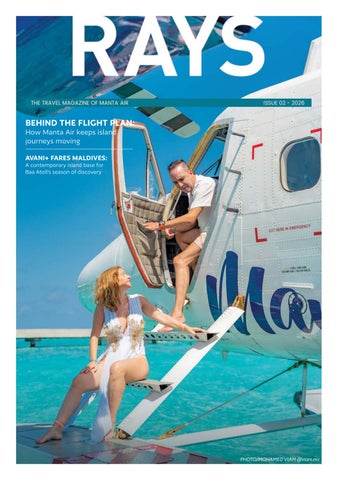
BEHIND THE FLIGHT PLAN: How Manta Air keeps island journeys moving AVANI+ FARES MALDIVES: A contemporary island base for Baa Atoll’s season of discovery
1
PHOTO/MOHAMED VIAM @viam.mv
R AY S
2
Issue 1 | 2026
3
R AY S
Dear Traveller, Welcome aboard Manta Air, and to the Content Director
July–December 2026 edition of RAYS.
Ali Naafiz The Maldives is often described through Writers / Contributors
images of stillness: calm lagoons,
Ali Naafiz
quiet beaches and islands suspended
Ibrahim Mahudhee
between sea and sky. Yet these months
Moobeen Jaleel
reveal a destination in constant motion.
Mariyam Saaliya Mohamed
The southwest monsoon reshapes the rhythm of the islands, marine life gathers in remarkable numbers,
Creative Direction
communities continue traditions passed down through generations,
Perspective Pvt Ltd
and travellers discover new ways to connect with the country.
Layout and Design
This issue follows that movement.
Ciao Advertising In Baa Atoll, we explore Hanifaru Bay during the season when manta Sales and Marketing
rays gather beneath the surface, creating one of the Maldives’ most
Ibrahim Mahudhee
extraordinary natural spectacles. Nearby, Avani+ Fares Maldives
Abdulla Nadhir
offers a contemporary base from which to experience the atoll,
Maaish Mohamed
while the story of Your Paradise Maldives captures how music, place and community came together to give the island its own beat.
Photography Lightsout Studios
We also travel to Thulhaadhoo, where lacquerwork remains an expression
Fuvahmulah City Council
of colour, precision and patience. Further into the past, we revisit
Resort photos: courtesy of the
the history of cowrie shells and the role the Maldives once played
respective resort
in trade networks that extended far beyond the Indian Ocean.
Cover Photo
The ocean remains central throughout this edition. We look at new ways
Mohamed Viam (@viam.mv)
of seeing beneath the surface at Six Senses Kanuhura and visit Nova Maldives, where diving, connection and a relaxed approach to island living
For advertising with us
shape the guest experience. We also examine the southwest monsoon
please contact us on
itself and how it influences daily life, travel and the natural environment.
+960 788 7223 sales@hoteliermaldives.com
At Manta Air, movement is our responsibility. Behind every journey is a network of people, systems and decisions working together to keep flights
Published By
operating across the islands. In this issue, we take readers behind the
Perspective Pvt Ltd
flight plan to show how our teams coordinate each journey and respond
4th Floor, M. Kaneeru Villa
to the demands of operating in a geographically dispersed nation.
Orchid Magu, Male’ 20212, Republic of Maldives
Whether you are travelling home, beginning a holiday or
Tel: 960 7246292 | 960 7910805
continuing your exploration of the Maldives, we hope this
mail: sales@hoteliermaldives.com
edition adds context and meaning to the journey. Thank you for choosing Manta Air. We are pleased to have you with us. Mohamed Khaleel Chief Executive Officer
4
Issue 2 | 2026
12 23
06
38
CONTENTS 06
12
18
Avani+ Fares Maldives: A contemporary island base for Baa Atoll’s season of discovery
Hanifaru Bay: Inside the season when the Maldives moves with the mantas
Thulhaadhoo lacquerwork: The Maldivian art of colour, line and patience
23
30
38
Nova Maldives: A soulful island escape shaped by connection, diving and contemporary ease
Behind the flight plan: How Manta Air keeps island journeys moving
Beneath the surface: A new way of seeing the ocean
42
48
52
Cowrie currency: When the Maldives helped shape the trade routes of the world
The southwest monsoon: How the season reshapes the Maldives
The island found a beat: Your Paradise Maldives at Avani+ Fares
58 Kandima Maldives: Your Kind of Island Adventure Awaits
5
R AY S
Arrival at Avani+ Fares Maldives. (PHOTO/AVANI)
6
Issue 2 | 2026
AVANI+ FARES MALDIVES: A contemporary island base for Baa Atoll’s season of discovery Some resorts in the Maldives are designed around seclusion. Others are built around spectacle. Avani+ Fares Maldives stands out because it feels shaped around a different idea: energy. Set within Baa Atoll, a part of the country that carries both environmental importance and strong traveller appeal, the resort offers a style of island living that is contemporary, sociable and tuned to discovery. It is a property that understands the modern traveller not as someone seeking only stillness, but as someone interested in movement between moods: relaxed mornings, active afternoons, marine exploration, family time, good food, moments of privacy and spaces that feel alive. That makes Avani+ Fares especially relevant to the middle months of the year, when Baa Atoll enters one of its most compelling seasonal chapters. This is the period when marine narratives intensify, when mantarelated travel gathers momentum, and when the atoll’s wider identity as a place of reef life, current movement and ocean experience becomes especially vivid. A resort in this setting must do more than provide comfort. It must help guests engage with place. Avani+ Fares does this by presenting itself
not only as an accommodation offering, but as a contemporary base from which Baa Atoll can be read, explored and enjoyed. The first impression is one of freshness rather than formality. The design language feels open, light and current. There is a confidence to the spaces that avoids unnecessary stiffness. Public areas encourage flow, and the accommodation has a clean, modern sensibility that suits travellers who value style without wanting their holiday to feel overly ceremonial. The resort understands that luxury can be relaxed. It does not need to announce itself loudly when the setting already does much of the work. This is important because Baa Atoll itself is a destination of texture. Guests do not come here only to stay inside a villa. They come for the broader ecology of the atoll: reef encounters, boat journeys, changing light, seasonal wildlife, island-hopping imagination and the sense that the environment outside the
7
room matters as much as the room itself. Avani+ Fares seems comfortable with that expectation. It positions itself as part of the experience rather than as a barrier between guest and destination. For couples, the appeal lies in balance. The resort offers the familiar Maldivian pleasures of privacy, sea views and slow time, but it also feels socially intelligent. There are places to retreat and places to engage. Days can be shaped around marine activities and then softened by long lunches, sunset drinks or quieter evenings back at the villa. The property does not force a singular rhythm. Instead, it allows guests to decide whether their holiday will lean more towards ease, exploration or a mix of both. For families, that flexibility becomes even more valuable. Baa Atoll can be one of the most rewarding regions of the Maldives for multigenerational or family travel because it offers meaningful interaction with nature alongside resort comfort. Avani+ Fares fits naturally into this context.
R AY S
Guest facilities at Avani+ Fares Maldives. (PHOTO/AVANI)
Its atmosphere feels welcoming rather than intimidating, and its programming can support the fact that children and adults often seek different kinds of engagement from the same destination. A successful family resort in the Maldives is not simply one with space for children. It is one where the destination itself becomes shared territory. The resort’s setting in Baa makes that easier, because marine life and outdoor experiences provide common ground across age groups. Dining is another area where contemporary resorts distinguish themselves, and Avani+ Fares
benefits from understanding that food now plays a central role in how guests evaluate island life. Travellers increasingly want variety without excess, quality without ritual heaviness and spaces that feel appropriate to different moods across the day. In a resort environment, this means breakfast that feels unforced, lunches that can be social or casual, evenings that offer contrast and enough range to sustain longer stays without repetition becoming a problem. The strongest dining programmes are never just about menus. They are about rhythm, atmosphere and the simple pleasure of choice.
8
Marine experience, however, remains the defining context. To stay in Baa Atoll during the middle of the year is to be close to one of the Maldives’ richest seasonal marine stories. Even when guests do not build their entire itinerary around manta encounters, the idea of the atoll as an active ocean environment shapes expectations. Avani+ Fares benefits from this because it occupies a destination that has meaning beyond its shoreline. The resort becomes a place from which guests can move towards channels, reefs, snorkelling sites and seasonal wildlife experiences that deepen the value of the stay.
Issue 2 | 2026
appear to rely on ecology alone. Its strength lies in combining destination depth with a contemporary resort personality. This matters because some travellers want the Maldives to feel polished but not solemn. They want excellent surroundings, yes, but also a holiday that feels open to spontaneity. A resort with a more current, lifestyle-oriented tone can meet that demand effectively. It suggests that serious beauty and serious comfort do not require excessive seriousness in mood.
Guest facilities at Avani+ Fares Maldives. (PHOTO/AVANI)
Baa Atoll can be one of the most rewarding regions of the Maldives for multigenerational or family travel because it offers meaningful interaction with nature alongside resort comfort.
The best island resorts understand that access to such experiences should not feel transactional. It should feel interpretive. Guests remember more when they understand what they are seeing. They value an excursion more when it is presented not simply as entertainment but as entry into a local marine system. In Baa Atoll, this is especially important. The marine environment is not generic. It is one of the reasons the atoll has achieved its wider international profile. A resort that helps guests connect with that reality gains substance. Yet Avani+ Fares does not
9
There is also a strategic advantage in being located within an atoll that has both strong resort identity and wider travel resonance. Baa Atoll appeals to return visitors and first-timers alike. For the former, it offers depth and seasonality. For the latter, it offers a version of the Maldives that quickly feels iconic: strong marine possibility, clear island beauty and a sense of place that extends beyond one property. Avani+ Fares sits comfortably within that positioning. It feels like a resort made for travellers who want to enjoy the atoll rather than simply occupy it. The property is compelling because it speaks directly to our mid-year editorial direction. It connects naturally to themes of movement, seasonality and access. It is not difficult to imagine the reader seeing the atoll from above, landing in the region and then moving into a resort experience built around contemporary comfort and marine curiosity. The narrative holds because the resort and the destination reinforce one another. Another part of the appeal lies in
R AY S
emotional tone. Some Maldivian resorts still project exclusivity in ways that can feel remote. Avani+ Fares seems to project confidence without distance. That distinction matters. It broadens the audience. Honeymooners can enjoy the romance of the setting. Families can appreciate the ease. Active travellers can use it as a launch point for exploration. Those simply wanting a stylish island holiday can settle into its rhythm without feeling that the property is demanding a particular kind of performance from them. In the end, what makes Avani+ Fares notable is not any single element taken alone. It is the way the pieces combine: a strong atoll location, a timely seasonal context, a fresh design sensibility, social energy, practical flexibility and an environment
that encourages guests to move between comfort and curiosity. In an era when travellers increasingly value experiences that feel both polished and alive, that combination has real strength. Baa Atoll during the middle of the year is a destination defined by marine possibility and changing light. To stay well here requires more than a good room. It requires a resort that understands the moment and gives guests the tools to inhabit it fully. Avani+ Fares Maldives does precisely that. It offers a version of island life that feels current, well-paced and connected to the surrounding sea. For travellers seeking a contemporary base in one of the Maldives’ most engaging atolls, it makes a persuasive case for how modern resort living can meet seasonal discovery.
In the end, what makes Avani+ Fares notable is not any single element taken alone. It is the way the pieces combine
Spa at Avani+ Fares Maldives. (PHOTO/AVANI)
10
Issue 2 | 2026
Guest facilities at Avani+ Fares Maldives. (PHOTO/AVANI)
11 Guest facilities at Avani+ Fares Maldives. (PHOTO/AVANI)
R AY S
HANIFARU BAY: Inside the season when the Maldives moves with the mantas
12 Mantas at Hanifaru Bay. (PHOTO/THE NAUTILUS MALDIVES)
Issue 2 | 2026
Mantas at Hanifaru Bay. (PHOTO/TOBIAS FRIEDRICH)
There are places in the Maldives that impress immediately from the air: rings of bright reef, islands edged with white sand, lagoons in shades that seem almost invented. Then there are places that reveal themselves more slowly, through timing, tide and patience. Hanifaru Bay belongs firmly in the second category. For much of the year it is a beautiful corner of Baa Atoll, calm and self-contained, a protected inlet within one of the country’s most celebrated marine environments. But when the southwest monsoon begins to shape the currents of the archipelago, Hanifaru Bay changes character. Water movement, plankton concentration and reef topography combine to create one of the most remarkable wildlife experiences in the Maldives: the gathering of manta rays. To describe Hanifaru simply as a place where mantas can be seen is to miss the point. The bay is not a stage and the rays are
not performers. What makes the season so compelling is the sense that a natural system is briefly revealing itself in full. Visitors do not come merely to watch animals pass through open water. They come to witness a chain of events in which wind, tide, microscopic life and large marine species align. In that alignment, the Maldives appears not just as a holiday destination but as a living ocean landscape, governed by rhythms far older than tourism and far larger than any itinerary. The season generally associated with Hanifaru Bay coincides with the southwest monsoon, when currents bring nutrient-rich water into the atoll system and create the conditions in which plankton can build up in concentrated areas. Hanifaru’s shape matters here. Its enclosed geography and funnel-like dynamics help gather the food source that attracts manta rays in large numbers. What follows can be extraordinary: rays
13
circling, gliding and sometimes feeding in chains, mouths open, cephalic fins unfurled, moving in a choreography that looks effortless even though it is driven by intense biological purpose. For travellers, there is something deeply affecting about seeing a creature so large move with such economy. Mantas do not rush. Even when feeding activity is high, there is an elegance to their motion that changes the emotional register of the encounter. In a country often marketed through stillness and serenity, Hanifaru offers a different kind of wonder: movement without noise, energy without aggression, scale without threat. The spectacle is dramatic, yet the feeling it leaves is often contemplative. That atmosphere depends on restraint. Hanifaru Bay’s value lies not only in what can be seen there, but in how the place is managed.
R AY S
Anyone fortunate enough to visit quickly learns that the experience is built around rules designed to protect the very phenomenon that draws people in. Numbers are controlled. Behaviour in the water matters. Distance matters. Patience matters. The best encounters are rarely the result of chasing action. They happen when visitors understand that they are entering an active habitat rather than consuming a pre-arranged attraction. In practical terms, this means listening carefully to guides, entering the water quietly, maintaining space, and letting the animals determine the flow of the experience. This discipline is not a limitation; it is part of the bay’s identity. Hanifaru reminds us that meaningful travel in the Maldives increasingly depends on environmental intelligence. Luxury and access still matter, of course, but so do stewardship, interpretation and respect. The strongest marine experiences are no longer simply about getting close to wildlife. They are about learning how to be present without being disruptive. In that sense, Hanifaru is also a classroom. It teaches visitors that the ocean’s most memorable moments are often inseparable from the systems that protect them. Baa Atoll is the ideal setting for such a lesson. The atoll has become central to the Maldivian marine imagination because it offers more than postcard beauty. It carries ecological weight. Reefs, channels and feeding grounds combine with a growing culture of conservation-aware tourism. Resorts and marine centres in the atoll often play an important role in helping guests understand
Mantas at Hanifaru Bay. (PHOTO/TOBIAS FRIEDRICH)
what they are seeing, why seasonality matters, and why marine encounters are shaped as much by invisible processes as by obvious scenery. A manta sighting is never just about the ray itself. It is also about current direction, water quality, plankton density, reef health and the broader resilience of the atoll environment. That is one reason why the approach to Hanifaru season often begins before anyone gets in the water. It starts during the journey. From above, passengers crossing the Maldives see how fragmented and connected the country is at the same time: scattered islands, reef shelves, channels and atolls linked by air and sea. This aerial perspective prepares the imagination for Hanifaru because it reveals the architecture of the seascape. The bay is not an
14
Issue 2 | 2026
isolated wonder. It is part of a wider marine geography in which movement is constant. Fish move. Plankton moves. Water moves. Travellers move. Understanding the bay means understanding that nothing in the Maldives is static, not even paradise.
Mantas do not rush. Even when feeding activity is high, there is an elegance to their motion that changes the emotional register of the encounter.
Yet the appeal of Hanifaru is not only ecological. It is emotional and cultural too. For many visitors, the manta season becomes the defining memory of a Maldivian holiday not because it is the most luxurious element of the trip, but because it feels the most alive. Beaches can be perfect. Villas can be beautifully designed. Dining can be exceptional. But a morning in the water with manta rays offers something those experiences cannot fully replicate: a brief sense of participation in the natural tempo of the islands. It strips away the idea that the Maldives exists only for leisure and reminds travellers that these islands are part of an ocean world of constant exchange. The best Hanifaru experiences are often framed by contrast. The journey out may begin with still water and soft skies. The boat ride can feel almost uneventful. The briefing may seem calm, even procedural. Then the bay opens into action: dark shapes below the surface, the first sudden glide of a ray beneath a snorkeller, the growing realisation that one manta is followed by several more. Time behaves strangely during such encounters. Minutes feel longer. Awareness narrows. The mind becomes occupied by motion, spacing, breath and the silent astonishment of proximity. Even afterwards, Hanifaru lingers. Travellers return to their resorts
15 Mantas at Hanifaru Bay. (PHOTO/THE WESTIN MALDIVES)
R AY S
with a different relationship to the sea outside their villa or beach. The lagoon is no longer just beautiful; it is connected to offshore systems, deep channels and marine lives that remain largely unseen. A sandbank excursion, a sunset cruise or a simple swim can feel subtly recontextualised. The Maldives becomes less ornamental and more legible. That shift may be Hanifaru Bay’s greatest gift. It does not merely entertain. It sharpens perception. Hanifaru is also an ideal story because it captures the spirit of movement that defines travel in the Maldives during the middle of the year. It is seasonal, but not superficial. It is visually spectacular, yet rooted in
ecological reality. It speaks to both the traveller seeking wonder and the destination seeking to define itself through more thoughtful, place-based narratives. In a magazine shaped by air travel, it is fitting that one of the strongest features should be about what happens when movement in the sky meets movement in the sea. There are no guarantees at Hanifaru Bay. Wildlife never owes anyone a performance, and that uncertainty is precisely what gives the place its dignity. Some days are quieter. Some encounters are brief. Some conditions are better than others. But that is what makes the experience authentic. Hanifaru is not memorable because it is predictable. It is memorable
because it remains fundamentally wild within a country that is often framed through control, comfort and curated luxury. In the end, the season of manta rays is a reminder of what the Maldives does best when it is understood on its own terms. It offers not just scenery, but systems; not just escape, but encounter. Hanifaru Bay distils that truth into one inlet, one season, one gathering of extraordinary animals moving through water shaped by monsoon breath. To see it well is to leave with more than photographs. It is to leave with a clearer sense that the Maldives is at its most powerful not when it stands still for us, but when we learn to move with it.
Mantas at Hanifaru Bay. (PHOTO/THE WESTIN MALDIVES)
16
Issue 2 | 2026
26 USD Adult
22 USD Children
65 USD
13 USD
15 USD
15 USD
Blue & White
26 USD
Ask the crew to learn how to get your collections 17
R AY S
THULHAADHOO LACQUERWORK: The Maldivian art of colour, line and patience Every culture has objects that carry more meaning than their size suggests. They may sit on a shelf, pass through a household, be given as gifts or appear in ceremonial settings, yet they contain within them entire histories of labour, memory and place. In the Maldives, lacquerwork from Thulhaadhoo is one of those objects. At first glance it appears decorative: polished surfaces, bold colour contrasts, carefully incised rings and repeating bands that catch the eye through precision rather than excess. Look longer, however, and the work begins to read differently. It becomes a record of craft knowledge, island identity and the human ability to turn simple materials into something that feels both useful and ceremonial. Thulhaadhoo, in Baa Atoll, has long been associated with the Maldivian lacquer tradition known locally as Laa Jehun. The island’s name is inseparable from the craft because the work that emerged there achieved a recognisable standard and style over generations. In a country where so much cultural attention is directed towards sea, reef and resort imagery, Thulhaadhoo lacquerwork offers an important
reminder that Maldivian identity has also been shaped by the hand, the lathe, the tool and the discipline of repetitive making. The beauty of the craft begins with its modesty. Lacquerwork is not dependent on rare materials or monumental scale. Its significance lies in technique. Traditionally, artisans turn wood into forms such as boxes, containers, vases, bowls and ornamental pieces. These forms are then built up through successive layers of coloured lacquer before being cut back with great care to reveal patterns beneath the surface. The process rewards steadiness and punishes haste. Every clean line depends on preparation. Every finished piece depends on patience. What distinguishes Thulhaadhoo lacquerwork is not just its finish, but its control. Colours are typically bold and clearly separated, often working with strong reds, yellows, blacks and warmer earth tones. Yet the overall effect is rarely loud. The geometry gives the piece order. Rings, stripes and symmetrical motifs impose rhythm. Even when the object is small, it carries a sense of structure that makes it feel substantial. It is 18
this balance between colour and restraint that gives the work its enduring visual authority. As with many traditional crafts, the real story lies in the process. To appreciate lacquerwork fully, one must understand how much unseen labour supports the final shine. The wood must be selected and shaped well. Surfaces must be prepared carefully. Layers must be applied with consistency. Drying and handling require judgement. Then comes the incision stage, where the artisan’s confidence is tested most clearly. Cutting through the surface to reveal the colours below is an act of both planning and touch. There is little room for correction. One uncertain movement can disrupt the whole composition. This is why traditional crafts often produce a distinctive kind of respect. They reveal expertise not through spectacle but through control. The viewer may not immediately understand every step, but instinctively recognises that the finished object could not have been made casually. It belongs to a lineage of repetition, correction, observation and inherited method. Thulhaadhoo’s lacquer tradition
Issue 2 | 2026
Lacquer works. (PHOTO/MVLACQUER)
19
R AY S
exemplifies this. The pieces may be compact, but the knowledge behind them is expansive. Historically, such craftsmanship had a place in everyday Maldivian life that extended beyond ornament. Handcrafted objects moved through homes, ceremonies, exchanges and systems of social value. They were not separate from life in the way museum pieces can sometimes seem to be. They were used, displayed, gifted and recognised. In that sense, lacquerwork was part of a wider island economy of meaning in which materials from the environment were transformed
into objects that marked taste, care and cultural continuity. Today, that relationship has changed. Like many heritage crafts in the Maldives, lacquerwork exists in a different economy from the one that originally sustained it. Modern manufacturing, imported goods, changing household habits and shifts in employment patterns have all altered the place of handmade objects in daily life. The question is no longer whether lacquerwork is beautiful or culturally valuable. The question is whether it can continue as a living craft rather than surviving only as a souvenir
The island’s name is inseparable from the craft because the work that emerged there achieved a recognisable standard and style over generations.
Lacquer works. (PHOTO/MVLACQUER)
20
Issue 2 | 2026
category or heritage symbol. That distinction matters. A living craft is one in which technique remains active, skills are transmitted, variation is still possible and artisans continue to work with agency rather than simply reproduce a standard product for the tourist market. Once a craft becomes detached from process and reduced only to merchandise, something important is lost. The object may continue to sell, but the culture of making begins to thin. The challenge for Thulhaadhoo, as for many craft centres around the world, is therefore not only preservation but meaningful continuity. There are reasons for optimism. Traditional craftsmanship retains strong appeal precisely because it offers what mass production cannot: evidence of time. In an era dominated by speed, handmade objects feel different in the hand because they embody slower attention. Travellers increasingly value this distinction. They are drawn to pieces that carry local specificity and visible labour rather than anonymous polish. Thulhaadhoo lacquerwork fits naturally into that shift, especially when buyers understand the island story behind the object. A lacquered box purchased in the Maldives can become more than a keepsake when the purchaser knows where it comes from, how it was made and why the technique matters.
Lacquer works. (PHOTO/MVLACQUER)
This suggests that the future of the craft may depend as much on storytelling as on production. Artisans need markets, certainly, but they also need context around the work. When resorts, galleries,
Lacquer works. (PHOTO/MVLACQUER)
21
R AY S
cultural organisations and publishers present lacquerwork not merely as décor but as heritage in active form, they help create better conditions for appreciation. A visitor who watches a demonstration, hears about the stages of production and learns why Thulhaadhoo became associated with the craft is far more likely to value the object properly. There is also space for innovation, provided it is respectful. Tradition does not remain alive by being sealed off from change. New forms, contemporary applications and thoughtful collaborations can all help keep a craft relevant. The challenge is to innovate without flattening the identity of the work. Thulhaadhoo lacquerwork should not be pushed into novelty for its own sake. Its strength lies in its
grammar: turned form, layered colour, incised pattern, controlled finish. Modern designers, retailers and cultural curators who work with the craft should do so by understanding that grammar rather than replacing it. What makes the lacquer tradition especially resonant within the Maldivian context is that it reflects a broader truth about island culture. The Maldives has always required skill in using what is available: wood, fibre, coral stone in older architecture, reed, sail, rope and hand tools. Craft traditions emerged not from abundance in the conventional sense, but from the disciplined use of limited materials. The resulting objects often appear elegant because necessity sharpened invention. Thulhaadhoo lacquerwork belongs to that
same history of ingenuity. For travellers, the craft offers a valuable counterpoint to the Maldives seen through beaches and marine life alone. It reveals another way of understanding place: through the marks left by hands rather than the impressions left by waves. In a destination where nature is visually dominant, cultural encounters of this kind matter because they prevent the country from being reduced to scenery. They remind visitors that the Maldives is not only a seascape but a society, shaped by makers as well as by currents. There is a quiet dignity in lacquerwork that feels especially suited to the pages of an inflight magazine. It is portable yet rooted, refined yet unpretentious, colourful yet controlled. It photographs well, certainly, but its real strength lies in what it represents: continuity through skill. In every carefully cut line there is evidence of a tradition that has survived not through grandeur, but through repetition, discipline and care. Thulhaadhoo’s lacquer artisans may not always receive the same visibility as the luxury brands or marine icons that dominate international perceptions of the Maldives. Yet their work carries something equally important: proof that cultural value can be held in small objects, on domestic surfaces, in patterns passed quietly from one generation to the next. To pick up a piece of lacquerwork is to hold a fragment of island time. One sees colour and polish first. Then one begins to see the patience inside it. That is where the true beauty lies.
Lacquer works. (PHOTO/MVLACQUER)
22
Issue 2 | 2026
NOVA MALDIVES: A soulful island escape shaped by connection, diving and contemporary ease
23
Guest facilities at Nova Maldives. (PHOTO/NOVA MALDIVES)
R AY S
Guest facilities at Nova Maldives. (PHOTO/NOVA MALDIVES)
The Maldives has long been associated with privacy, romance and the language of escape. Yet not every traveller arrives wanting distance in the same way. Some want intimacy without isolation, style without stiffness and a resort that feels contemporary not only in design, but in spirit. Nova Maldives, in South Ari Atoll, speaks directly to that traveller. It is a property that presents island life through a more social, more relaxed and more emotionally open lens, while still delivering the essential pleasures that make the Maldives enduringly desirable: bright lagoon, marine access, good hospitality and the rare feeling of having stepped into a
place where time loosens its grip. What immediately sets Nova apart is tone. Many resorts in the Maldives define themselves through seclusion or ceremony. Nova seems more interested in ease and connection. The result is not a less luxurious experience, but a different kind of one. Guests are invited to settle in quickly, to move naturally between solitude and sociability, and to experience the island less as a performance of exclusivity than as a wellconsidered community of leisure. This gives the resort a freshness that feels aligned with changing travel preferences. Increasingly, guests want places that are 24
beautiful but also emotionally legible. They want to feel welcome rather than impressed into silence. South Ari Atoll is an ideal setting for that proposition. The atoll is one of the strongest marine destinations in the country, known for diving, snorkelling and encounters that draw travellers back repeatedly. Even guests with no serious diving background tend to recognise that this is an ocean environment with real substance. Reefs, channels and marine routes give the atoll a reputation that extends far beyond generic tropical imagery. To place a contemporary, open-hearted resort here is a smart move
Issue 2 | 2026
Guest facilities at Nova Maldives. (PHOTO/NOVA MALDIVES)
Guest facilities at Nova Maldives. (PHOTO/NOVA MALDIVES)
because it allows the property to balance relaxed island living with genuine destination depth. Marine experience is central to Nova’s appeal. A resort in South Ari cannot afford to treat the ocean as mere backdrop, and Nova does not appear to do so. Instead, the surrounding sea feels like part of the daily structure of the stay. Guests can build their holiday around snorkelling, diving, boat trips and wider marine exploration, or they can engage more lightly through occasional excursions and shoreline immersion. Either way, the sense of being somewhere connected to the living ocean remains strong.
Many want emotional flexibility: the ability to drift between quiet and company as the day requires.
25
Guest facilities at Nova Maldives. (PHOTO/NOVA MALDIVES)
This matters especially because contemporary travellers are often looking for substance behind beauty. They still want the Maldives to look beautiful, of course, but they also want stories, encounters and a reason to remember one island over another. In South Ari Atoll, the reason often comes from the water. A good dive, a memorable snorkel, the surprise of seeing larger marine life, or simply the awareness that the reef outside the villa belongs to a wider and more active system can transform a stay. Nova benefits from being positioned within that kind of destination logic.
R AY S
The resort’s design and atmosphere support this well. There is a clear preference for spaces that feel current, comfortable and unforced. Rather than leaning on heavy formality, the property seems to favour an easy visual language in which guests can feel stylishly at home. This is increasingly important in hospitality. The most successful resorts are not necessarily those with the most elaborate design statements, but those whose environments people genuinely enjoy inhabiting over several days. Nova appears to understand that comfort is not a lesser ambition than luxury. Done properly, it is one of luxury’s most persuasive forms. Accommodation in the Maldives always carries enormous emotional weight because the room is rarely just a room. It is part of the destination fantasy: where one wakes to the sea, reads in the afternoon, changes after a swim, watches the light fall and measures the mood of the trip. Nova’s appeal lies in making these experiences feel contemporary and approachable. The accommodation appears designed not as a stage set, but as a living environment in which guests can move easily between interior calm and outdoor immersion. Food and beverage form another important part of the resort’s identity. On islands where guests remain for several days, dining is not simply about quality; it is about sustained pleasure and social rhythm. Guests want meals that match the changing tone of the day: breakfast that restores, lunches that can be casual or convivial, evening dining that feels worthy of the
Guest facilities at Nova Maldives. (PHOTO/NOVA MALDIVES)
setting without becoming heavy. A resort with a more modern and social personality has an advantage here, because it can create dining spaces that feel lively without sacrificing comfort. The most memorable meals in the Maldives are often those in which atmosphere and timing feel perfectly aligned. Nova also appears well suited to a broad guest profile. Couples can find romance in the island’s beauty and relative simplicity. Friends travelling together can enjoy the resort’s lighter social energy. Solo travellers who want the Maldives without excessive isolation may also find the mood appealing. This breadth matters because the market for Maldivian travel is changing. Not every guest wants hyper-seclusion or
26
traditional notions of formality. Many want emotional flexibility: the ability to drift between quiet and company as the day requires. That emotional flexibility is arguably the resort’s strongest quality. Some islands in the Maldives are magnificent but can feel overly programmed. Others offer privacy but risk becoming emotionally flat after several days. Nova’s “soulful” positioning is effective because it suggests a middle ground: an island where people can restore themselves without withdrawing entirely from the pleasure of shared experience. The sea remains the centrepiece, but the social mood is part of the memory. Nova fits well because it adds a contemporary lifestyle dimension
Issue 2 | 2026
Guest facilities at Nova Maldives. (PHOTO/NOVA MALDIVES)
to the issue’s broader themes of movement and connection. Readers moving through the Maldives by air are often deciding not only where to stay, but what kind of mood they want their holiday to hold. Nova answers that question clearly. It offers an island experience shaped less by distance and more by resonance. Guests are not asked to disappear. They are invited to feel present. South Ari Atoll deepens this further because it is one of those parts of the Maldives where marine reputation carries real weight. To stay here is to be close to diving and snorkelling stories that extend beyond a single resort. The atoll has identity. Nova benefits from that identity while presenting it through a guest experience that feels informal,
current and emotionally intelligent. That combination is powerful. It ensures that the holiday is not only beautiful, but distinct. There is also something timely about a resort that embraces connection as a positive value. Modern luxury travel has moved beyond the old assumption that exclusivity alone is enough. Travellers want authenticity, atmosphere and a sense that the place they have chosen matches how they actually wish to live when they are away. Some want stillness. Others want light conversation at sunset, a welcoming dining scene, access to strong marine adventure and the sense that they are part of an island’s daily mood rather than isolated from it. Nova seems to understand that instinctively.
27
In the end, the resort’s strength lies in its clarity. It knows what kind of island it wants to be. It does not imitate the most formal version of Maldivian luxury, nor does it abandon sophistication in pursuit of casualness. Instead, it creates a coherent personality around contemporary ease, marine richness and emotional warmth. That makes it memorable. For travellers heading to South Ari Atoll in search of an island stay that is stylish, open-hearted and well connected to the sea, Nova Maldives makes a convincing case. It offers the Maldives not as a distant dream, but as a lived, shared and vividly present experience. In a destination built on beauty, that additional sense of soul can make all the difference.
R AY S
The Nautilus Maldives
creators of extraordinary experiences
www.pulseresorts.com 28
Issue 2 | 2026
Kandima Maldives
Nova Maldives
29
R AY S
BEHIND THE FLIGHT PLAN: How Manta Air keeps island journeys moving
30
Issue 2 | 2026
For most travellers, air travel is experienced in visible moments. Check-in. Boarding. Take-off. The first aerial glimpse of reef and lagoon. Landing. A transfer that continues the journey from airport to island. These are the parts of travel that live in memory, because they are the parts passengers see. Yet in an island nation such as the Maldives, where distance is measured not only in miles but in logistics, weather windows and inter-island coordination, every smooth journey depends on a less visible system working constantly in the background. The flight itself may last only a short time. The planning behind it begins long before passengers arrive and continues long after they disembark. This is the world behind the flight plan.
Manta Air operations. (PHOTO/MANTA AIR)
31
In the Maldives, aviation is not simply a matter of moving aircraft from one runway to
R AY S
Manta Air operations. (PHOTO/MANTA AIR)
another. It is a choreography of timing, communication and adaptation. Airlines serve travellers whose itineraries may include international arrivals, domestic transfers, seaplane connections, resort coordination, baggage movement and weather-sensitive scheduling across multiple atolls. The margin for error is narrow because each stage of the journey affects the next. A delayed inbound flight, a change in sea conditions, a revised resort transfer time or a shift in weather can all ripple through the day. What matters, therefore, is not only planning but the ability to re-plan quickly and well. This is where the operational side of Manta Air becomes essential. Passengers may experience the airline through cabin service, aircraft comfort or the simple
relief of an efficient connection, but those outcomes depend on teams whose work is largely invisible: dispatchers, operations controllers, ground staff, crew planners, coordinators and others who spend their day monitoring information, making decisions and keeping multiple moving parts aligned. Their task is straightforward to describe and complex to perform. They must keep journeys flowing in a country where movement is everything. “The guest may only see the aircraft and the crew on board, but behind every departure there is a much wider operation working to make that journey seamless,” says Ahmed Maumoon, Deputy Chief Executive Officer at Manta Air. “In the Maldives, connectivity is not a simple pointto-point exercise. Every flight
32
is part of a larger chain, and our responsibility is to make sure each link in that chain holds strong.” The idea of a flight plan can sound rigid, as though each route is fixed once paperwork is complete. In reality, the best flight operations are defined by flexibility within structure. Aviation demands discipline, but island aviation also demands responsiveness. Forecasts are monitored carefully. Aircraft rotation has to make sense across the day. Crews need the right rest and reporting patterns. Resort and airport teams need accurate information. Guests need to be moved with efficiency but also with reassurance. None of this happens by chance. In the Maldivian context, timing is especially sensitive because transport systems overlap. A
Issue 2 | 2026
Manta Air operations. (PHOTO/MANTA AIR)
traveller may arrive internationally, move to a domestic terminal, connect onward, and then continue by road, boat or seaplane. Another may move between islands mid-stay. Another may be travelling home from an atoll after a weather interruption elsewhere in the system. For the airline, each passenger represents not just a seat, but a wider itinerary. Operational thinking therefore has to extend beyond aircraft doors. It must account for the full journey environment.
Manta Air operations. (PHOTO/MOHAMED VIAM @viam.mv)
33
This is one reason why communication is so important. The operational success of an airline in the Maldives depends not only on internal coordination but on the quality of information shared with external partners. Resorts need to know when guests are arriving. Transfer
R AY S
teams need updated timings. Ground handlers need to prepare efficiently. Front-line staff need accurate briefings so that passengers are not left navigating uncertainty alone. A well-run day is often the result of clear, repeated and timely communication rather than dramatic last-minute heroics. “As an airline serving a dispersed island geography, communication is one of our most important operational tools,” Maumoon says. “We have to stay closely aligned not only within our own teams, but also with airports, resorts, transfer providers and all the partners involved in the passenger journey. When information moves well, the journey moves well.” Of course, heroics do occur in aviation, though they are seldom visible in the way people imagine. More often they take the form of calm adjustments under pressure. A team notices an emerging bottleneck early. A rotation is revised. A transfer sequence is reordered. A guest connection is protected. Weather information is interpreted quickly and prudently. What passengers experience as a smooth recovery may in fact be the outcome of dozens of small professional decisions taken in sequence. In that sense, operational excellence is rarely theatrical. It is quiet competence multiplied across the day. Weather deserves special attention because, in the Maldives, it is never just background. Aviation teams do not treat the atmosphere passively. They read it, anticipate it and plan around it. Wind, visibility, rain and shifting conditions all matter, especially in a country where flights connect dispersed islands
across open water. During more variable periods of the year, operational discipline becomes even more important. Safety remains absolute, but within that framework the task is to preserve continuity wherever possible. Guests may not see the monitoring involved, yet they feel its effects in the reliability of the system. “Safety is the foundation of everything we do, and from that foundation comes reliability,” says Maumoon. “Operating in the Maldives means respecting the environment we fly in and planning with discipline. Weather, timing and coordination are all part of that equation, and our teams work every day to ensure that passengers can travel with confidence.” Equally important is the relationship between flight operations and service culture. In many destinations, aviation and hospitality remain separate domains. In the Maldives, they overlap closely. The guest does not mentally divide the journey into aviation and resort phases; the journey is one experience. That means the airline’s operational philosophy must accommodate not only punctuality and safety, but also the emotional quality of travel. A delayed connection can affect the start of a honeymoon. A poorly communicated change can unsettle a family holiday. A smooth handover can turn a long travel day into a pleasant one. The operational side of aviation is therefore inseparable from guest experience. Manta Air’s role within this landscape is especially interesting because it sits at the intersection
34
As an airline serving a dispersed island geography, communication is one of our most important operational tools Ahmed Maumoon, Deputy Chief Executive Officer, Manta Air
Issue 2 | 2026
Manta Air operations. (PHOTO/NAWAZ IBRAHIM)
35 Manta Air operations. (PHOTO/MANTA AIR)
R AY S
of tourism connectivity and national movement. Airlines in the Maldives are not moving anonymous traffic between generic points on a map. They are connecting people to specific islands, resorts, communities and experiences. A flight is often the first close contact a traveller has with the country beyond the international terminal. That gives every operational decision a broader significance. Getting a journey right is not merely a logistical win. It is part of how the destination presents itself. The same can be said of baggage, often overlooked until something
goes wrong. In a multi-stage island journey, baggage handling is about more than luggage. It is about continuity. Dive gear, family essentials, celebration outfits, business materials and personal items all need to move through the system alongside passengers. Ensuring that they do so reliably requires process discipline at every point of transfer. It is one of the many invisible elements that make travellers feel that their journey has been handled with care. Then there is the partnership between operations and maintenance. A flight plan works
only when aircraft availability, engineering discipline and operational scheduling support one another. The safest, most efficient flight network is built not on isolated teams but on interdependence. Controllers need confidence in aircraft readiness. Engineers need accurate operational information. Crew and ground staff need coordinated expectations. In well-functioning airlines, this collaboration is constant rather than exceptional. The story behind the flight plan matters because it gives depth to the passenger experience. Travellers enjoy the aerial beauty
Manta Air operations. (PHOTO/MANTA AIR)
36
Issue 2 | 2026
of the Maldives, but beauty alone does not create connectivity. Behind every on-time departure and well-managed arrival is a professional ecosystem that balances regulation, service, timing and environmental awareness. To understand island aviation properly is to appreciate not only the aircraft in motion but the network of decisions that made that motion possible. There is also a broader national significance here. In the Maldives, connectivity is development. It enables tourism, certainly, but it also strengthens relationships between islands, supports livelihoods and reduces the practical remoteness that geography can impose. Airlines help make an archipelago feel coherent. Their operational resilience is therefore tied not only to company performance but to the lived reality of movement across the country. Passengers may never hear the discussions that unfold behind the scenes, never see the screens where timings are tracked, never know how many variables were considered before their aircraft pushed back or their transfer aligned. That invisibility is part of the achievement. The best operational work feels effortless from the outside precisely because it has been handled with foresight inside. “Behind every smooth journey is a team making hundreds of decisions that passengers may never see,” Maumoon says. “That is exactly how it should be. Our goal is to let guests experience the ease of travel while we manage the complexity in the background.”
Manta Air operations. (PHOTO/MANTA AIR)
In the end, the flight plan is more than a document. It is a promise that an intricate journey can still feel simple. In a destination as dispersed and weather-shaped as the Maldives, keeping that promise requires skill, judgement and collaboration at every stage. Manta Air’s passengers see the sky, the sea and the islands below. What they do not always see is the quiet intelligence that keeps those journeys moving. Yet it is there in every smooth connection, every well-timed arrival and every sense that, even in a nation of scattered islands, travel can still feel seamless.
37
Behind every smooth journey is a team making hundreds of decisions that passengers may never see Ahmed Maumoon, Deputy Chief Executive Officer, Manta Air
R AY S
Marine life at Six Senses Kanuhura. (PHOTO/SIX SENSES)
38
Issue 2 | 2026
BENEATH THE SURFACE: A new way of seeing the ocean At Six Senses Kanuhura, marine conservation moves beyond observation, combining science, technology, and local partnerships to better understand, protect, and restore the ecosystems that shape life in the Maldives.
Beyond the shoreline lies a world in motion. At Six Senses Kanuhura, the ocean is seen not as a backdrop, but as a living system that sustains, shapes, and connects everything around it. Marine conservation at the resort is approached with intention, guided by science and shaped by a desire to understand before acting. At the centre of this effort is an in-house marine biologist, whose work bridges research, education, and guest experience, bringing the underwater world closer to those who encounter it. A defining step in this journey is the launch of the Kanuhura Coral Census, a long-term 3D reef monitoring programme that redefines how coral ecosystems are studied. Developed in collaboration with leading scientists from Newcastle University and University College London, the initiative introduces a level of accuracy and scale not previously seen within the hospitality space. Using advanced 3D modelling and AI analysis, entire sections
of reef are mapped in high resolution, capturing structural detail down to a fraction of a millimetre. These digital replicas allow the team to observe change over time with clarity, from coral growth and recruitment to signs of stress or bleaching. This approach shifts conservation from estimation to evidence. With consistent, repeatable data, the team can identify patterns, understand resilience, and shape restoration efforts with greater precision. It is a move toward a more informed, accountable way of caring for coral reefs, where decisions are grounded in insight rather than assumption. While the technology is advanced, its purpose remains clear: to protect what lies beneath by understanding it more deeply. This understanding extends to the protection of sea turtles, a species closely connected to the health of the reef and surrounding ecosystems. In partnership with the Atoll Marine Centre, research is conducted using photo identification, with
39
each sighting contributing to a global database overseen by the Olive Ridley Project. This growing body of data helps build a clearer picture of turtle populations and behaviour in the region. The impact of this work is seen along the island’s shores. In 2024, nine sea turtle nests were recorded, eight from green turtles and one from a hawksbill turtle. From these nests, 420 hatchlings reached the ocean, with an 86 percent hatching success rate. Behind these numbers is a collective effort. Resort hosts volunteer their time to monitor nests as they near hatching, while the marine biology team ensures each hatchling begins its journey safely. A dedicated turtle biologist from the Atoll Marine Centre is also based on the island, strengthening the program with ongoing expertise. Seagrass conservation forms another essential part of the ecosystem. Often overlooked, these underwater meadows support marine life, improve
R AY S
water quality, and store significant amounts of carbon. At Six Senses Kanuhura, they are not removed for aesthetics, but actively protected. Since opening in 2023, the resort has removed over 3,000 kilograms of plastic sheeting from the seabed, materials commonly used elsewhere to prevent seagrass growth. In their absence, the ecosystem has been allowed to recover naturally, with increasing marine sightings reflecting its importance as a habitat. Direct intervention also plays a role. Ghost nets, abandoned fishing gear that drifts through the ocean, are periodically identified and removed to prevent harm to marine life. These efforts, though less visible, are critical in maintaining the balance of the surrounding waters. Education remains central to this work. Marine biology presentations invite guests to understand the ecosystems they are immersed in, offering insight into coral, turtles, and seagrass in a way that feels accessible and engaging. What begins as information often becomes awareness, and, in many cases, a lasting connection. This sense of shared responsibility extends beyond the island. Six Senses Kanuhura serves as the main sponsor of the Lhaviyani Turtle Festival, an annual gathering that brings together local organisations, communities, and conservation groups. In 2024, the event welcomed over 3,000 attendees and more than 16 organisations, all united by the need to protect sea turtles and the wider marine environment.
Marine life at Six Senses Kanuhura. (PHOTO/SIX SENSES)
from scientific research to community engagement, each element contributes to a broader understanding of the ocean and its needs. There is a quiet confidence in this approach. It does not seek to simplify complexity, but to make it visible, to translate data into understanding, and understanding into action. For those who experience it, the result is a deeper awareness of what lies beneath the surface. Not just as something to be observed, but as something to be respected, protected, and, ultimately, sustained.
With all five species of sea
40
turtles in the Maldives facing increasing pressure from human-related impacts, the importance of collective action continues to grow. Through collaboration and education, the festival creates a platform for awareness that reaches far beyond the island itself. What defines marine conservation at Six Senses Kanuhura is not any single initiative, but the way each effort connects. From advanced reef mapping to species protection,
Issue 2 | 2026
Marine life at Six Senses Kanuhura. (PHOTO/SIX SENSES)
What begins as information often becomes awareness, and, in many cases, a lasting connection.
41
Marine life at Six Senses Kanuhura. (PHOTO/SIX SENSES)
R AY S
COWRIE CURRENCY: When the Maldives helped shape the trade routes of the world
Cowrie shells. (PHOTO/GETTY IMAGES)
42
Issue 2 | 2026
Cowrie shells. (PHOTO/GETTY IMAGES)
The Maldives is usually imagined through the lens of water and light: lagoons, beaches, reefs, villas and the many shades of blue that have made the country one of the world’s most recognisable travel destinations. Yet long before it became associated with modern tourism, the archipelago played a striking role in systems of exchange that stretched far beyond the Indian Ocean. One of the most remarkable symbols of that role was something so small that it could easily be overlooked on the shore: the cowrie shell. Smooth, pale and modest in size, cowries from the Maldives once travelled across continents and helped shape commercial life in places far removed from the islands where they originated. The idea of shells functioning as currency can sound quaint or symbolic. In reality, cowries were part of serious economic history. For centuries they circulated as recognised units of value in trade networks reaching across South Asia, the Middle East
and large parts of Africa. Their portability, relative durability and recognisable form made them useful as a medium of exchange, especially in systems where coinage was scarce, impractical or reserved for higher-value transactions. The Maldives became central to this story because the islands were one of the principal sources of the shells most desired for monetary use. This fact alone changes how the Maldives can be understood. The islands were not merely remote points in the ocean occasionally visited by merchants. They were active participants in transoceanic exchange. Their importance did not depend on territorial scale or military power. It depended on strategic location, maritime linkage and access to a resource that global markets valued. In that sense, cowries offer a fascinating example of how small island societies could exert influence in pre-modern trade without resembling empires in the conventional sense. 43
The shell itself is deceptively simple. Its clean, glossy surface and natural opening made it distinctive, easy to recognise and difficult to counterfeit convincingly in earlier eras. These qualities matter in any currency. Value is not only about scarcity; it is about trust and recognisability. Cowries acquired economic significance because communities far from the Maldives agreed, over time, that these shells could be counted, exchanged, stored and used in everyday transactions. Once such confidence is established, even an object as ordinary as a shell can become part of vast commercial systems. For the Maldives, this meant participation in an outwardfacing economic world long before modern aviation linked the country to global tourism. Traders moving through the Indian Ocean carried goods, stories, technologies and beliefs between ports and island societies. In these networks, the Maldives
R AY S
was known not only for location and seafaring relevance, but for cowries. The shells left the islands in quantity and entered circulation elsewhere, where they might be used in local markets, tribute systems, household trade or larger regional exchange structures. What makes this history especially compelling is the scale of imagination it invites. To hold a cowrie shell from the Maldives and think of it arriving centuries ago in a market thousands of miles away is to grasp the reach of premodern connectivity in a tangible form. The shell becomes evidence that the oceans were not barriers but routes. Long before the current language of globalisation, objects were already moving between worlds, and the Maldives was part of that movement.
Cowries also illuminate an important economic principle: value can emerge from context rather than intrinsic worth. A shell is not gold or silver. It does not carry obvious material richness. Its monetary power came from social acceptance and trade integration. This makes cowries intellectually fascinating, because they remind us that money has always depended on collective belief. Modern currencies, digital transactions and central banking systems may seem far removed from shells on a shore, but all monetary forms require confidence, recognition and networks of exchange. In that sense, cowries are not a primitive curiosity. They are part of the long human history of assigning value. The Maldives’ role in that history
44
Smooth, pale and modest in size, cowries from the Maldives once travelled across continents and helped shape commercial life in places far removed from the islands where they originated.
Issue 2 | 2026
powers, but it possessed something equally consequential: strategic integration into ocean routes. Cowries help us see that integration clearly. They demonstrate that the islands were known, desired and economically relevant in ways that challenge modern assumptions of remoteness. There is also poetry in the fact that a country now famous for luxury travel once influenced world trade through something gathered from the sea. The same marine environment that today supports tourism, fishing and ecological value once generated a form of export that entered everyday transactions in distant lands. It is a reminder that the ocean has always been the Maldives’ greatest asset, though its economic meanings have changed over time.
had cultural as well as economic implications. External demand for cowries helped tie the islands into broader maritime circuits that linked East Africa, Arabia, India and beyond. Trade rarely moves goods alone. It also moves language, religion, ideas, social practices and diplomatic contact. The Maldives’ visibility within the Indian Ocean world was therefore reinforced by the circulation of the shells themselves. In other words, cowries were not merely exported objects. They were part of the country’s early interface with global systems. It is easy to underestimate how powerful such an interface could be for a geographically dispersed island nation. The Maldives may have lacked the territorial size of continental
45
For travellers, this history offers a richer frame through which to view the islands. A beachcombed shell may seem incidental, but within the right story it becomes a portal into centuries of movement. The Maldives is often marketed as a place apart, a realm of retreat and escape. Cowrie history argues the opposite. The islands have long been connected. They have sent things into the world and received the world in return. Their position in maritime history is not marginal. It is active and layered. The cowrie story also resonates because it collapses the distance between local environment and global consequence. Many of the most important historical forces are hard to visualise because they involve abstract systems: trade balances, political alliances, shipping routes, market structures.
R AY S
Cowries make those systems visible. They are small enough to hold, count and pass from hand to hand. Through them, one can imagine commerce not as an impersonal machine but as a sequence of human acts: gathering, sorting, carrying, bargaining, exchanging. In the present day, shells no longer circulate as currency in the way they once did, but their historical role remains powerful.
For museums, historians and cultural storytellers, cowries offer an accessible way to explain the Maldives’ deep participation in Indian Ocean exchange. For historians and enthusiastic travellers, they offer something equally valuable: a way to connect contemporary travel with older patterns of movement. Today’s passengers cross the atolls by air in search of leisure, discovery and connection. Centuries ago, traders crossed those waters for
commerce, resource exchange and strategic contact. The vehicles have changed, but the logic of movement remains. Cowries also encourage humility in how economic history is told. They remind us that influence does not always come in large forms. Empires mint coins, build ports and issue decrees, but smaller societies can matter profoundly through special resources, strategic positioning and participation in networks that larger powers depend on. The Maldives, through cowries, is a clear example of that truth. Ultimately, the story of cowrie currency is a story about how the Maldives entered world history on its own terms. Not through conquest, not through industrial scale, but through the sea and what it yielded. A shell washed by island waters became an instrument of exchange in distant economies. That transformation is extraordinary not because the object changed, but because human systems invested it with value. The Maldives supplied the shell. The world supplied the network. Together they created a trade story far larger than the object itself. To think about cowries today is to see the Maldives differently. The islands are not only destinations of beauty. They are also historical participants in the circulation of goods, meanings and value across oceans. On a beach they may still seem small and easily missed. In the history of trade, they were anything but.
Cowrie shells. (PHOTO/GETTY IMAGES)
46
Issue 2 | 2026
Connecting Dream Destinations! SEAPLANE CUSTOMERS
DOMESTIC CUSTOMERS
HAA DHAALU ATOLL Soneva Secret
AIRPORTS WE FLY TO Velana International Airport Dhaalu Airport Dharavandhoo Airport
RAA ATOLL InterContinental Maldives Dhigali Maldives Ifuru Maldives Island Raaya by Atmosphere
via DHARAVANDHOO AIRPORT RAA ATOLL InterContinental Maldives Dhigali Maldives Furaveri Maldives Reethi Faru Resort
NOONU ATOLL Soneva Jani LHAVIYANI ATOLL Six Senses Kanuhura Meyyafushi Maldives
BAA ATOLL Anantara Kihavah Maldives Villas Amilla Maldives Milaidhoo Maldives The Nautilus Maldives NH Collection Maldives Reethi Resort Dhigufaru Island Resort Soneva Fushi Avani + Fares Maldives The Westin Maldives Miriandhoo Resort Dreamland Dusit Thani Maldives
BAA ATOLL Amilla Maldives Anantara Kihavah Maldives Villas AU:RA Maldives Avani + Fares Maldives Dhigufaru Island Resort Milaidhoo Maldives Soneva Fushi The Nautilus Maldives KAAFU ATOLL Eri Maldives
via DHAALU AIRPORT
ARI ATOLL Nova Maldives Nika Island Resort and Spa Kaani Haven Beach, Ukulhas
DHAALU ATOLL The St. Regis Maldives Vommuli Resort Niyama Private Islands Maldives Kandima Maldives Hotel Riu Palace Maldivas Hotel Riu Atoll Sun Siyam Vilu Reef Maldives Sun Siyam Iru Veli
VAAVU ATOLL NOOE Maldives Kunaavashi DHAALU ATOLL Niyama Private Islands Maldives Kandima Maldives Hotel Riu Palace Maldivas Hotel Riu Atoll THAA ATOLL COMO Maalefushi
47
w flymantaair
mantaair
mantaair.mv
R AY S
THE SOUTHWEST MONSOON: How the season reshapes the Maldives The Maldives is often described as if it exists in a permanent state of tropical calm: glassy lagoons, steady sunshine, placid horizons and days that unfold with predictable softness. The image is powerful, but incomplete. The islands are not static. They are shaped, season after season, by winds, currents, cloud patterns, rainfall, wave energy and the broader atmospheric systems of the Indian Ocean. To understand the Maldives properly, one must understand its monsoons. Of the two, the southwest monsoon is perhaps the most misunderstood by travellers. Too often it is reduced to a shorthand for rain or “off-season” travel. In reality, it is one of the most important forces in the country’s environmental and experiential life. The southwest monsoon does not simply alter the weather. It changes the mood of the seascape, the movement of marine life, the texture of travel and the visual grammar of the islands. It makes some parts of the Maldives feel more dramatic, more kinetic and, in many cases, more alive. For travellers willing to look beyond the simplistic equation of sunshine with quality, this season reveals a deeper, more dynamic version of the archipelago.
At its most visible, the monsoon announces itself through the sky. Light shifts. Cloud forms become more layered and expressive. Rain arrives in bursts, sometimes brief, sometimes lingering. The horizon gains contrast. Water darkens in places and brightens in others. The familiar palette of the Maldives remains, but it becomes more textured. The still postcard gives way to something more cinematic. Palm fronds move harder in the wind. Channels show more surface activity. On some days the sea seems to breathe with greater force.
Its winds and currents help reorganise the marine environment. Water movement affects nutrient flow, visibility, surf conditions and animal behaviour. In some atolls, plankton-rich conditions can increase the chances of seeing larger pelagic species or filter feeders. In others, current patterns alter where divers and snorkellers are most likely to find active reef life. Fish behaviour changes. Cleaning stations become more relevant. Channel dives feel different. The sea is not merely a backdrop during this season; it is a system in motion.
This atmospheric change influences how the islands are experienced from the first moment of arrival. A flight over the atolls during the southwest monsoon can be especially striking. Sunlight may break through moving cloud in sudden panels, illuminating one lagoon while leaving another under shadow. Reefs appear and recede. Sandbanks shift in tone. The geometry of the Maldives becomes more legible because the light is less uniform. In visual terms alone, the season offers some of the most compelling views of the year.
For that reason, the southwest monsoon is central to some of the Maldives’ best-known wildlife experiences. Seasonal manta gatherings, increased marine feeding activity and strong currents that energise reef systems are all part of the wider picture. Travellers who arrive during this period often discover that the islands offer a different kind of richness from the dry months. Visibility may vary, and there may be more unsettled days, but the tradeoff can be exceptional marine drama. The ocean becomes less decorative and more expressive.
But the monsoon’s significance runs far deeper than appearance.
Surfers have long understood this. For them, the southwest
48
Issue 2 | 2026
Monsoon rains in Maldives. (PHOTO/NEXT MEDIA GROUP)
49
R AY S
Monsoon rains in Maldives. (PHOTO/NEXT MEDIA GROUP)
monsoon is not a compromise but an opportunity. Swell direction, wind conditions and reef breaks across parts of the Maldives align in ways that make this a prized season for wave riders. What appears to one traveller as a windy afternoon may appear to another as a near-perfect day. This difference in perception is important because it reminds us that seasonality in the Maldives is not about simple good-orbad categories. It is about suitability. Different travellers seek different conditions, and the monsoon expands the range of what the islands can offer. The season also changes daily life on the ground. Island communities respond to weather intuitively. Boat schedules, fishing plans, construction work, school routines and household rhythms all adjust around conditions. Resort operations do the same, even when guests barely notice. Excursions are re-timed, routes are reconsidered, back-up plans
The southwest monsoon does not simply alter the weather. It changes the mood of the seascape, the movement of marine life, the texture of travel and the visual grammar of the islands.
are activated and teams stay alert to changing forecasts. In aviation, marine transfer and hospitality, this adaptability is part of professional discipline. The Maldives may look effortless from the guest perspective, but monsoon season reveals how much thoughtful coordination underpins that experience. There is, in fact, something admirable about how the Maldives functions during this part of the year. It demonstrates a national fluency in environmental change. The country has never been separate from the ocean’s moods. Wind and rain are not interruptions imposed from outside; they are part of island logic. To travel during the southwest monsoon is to see that logic more clearly. Guests become aware, often subtly, that flexibility is not a flaw in the system but a sign that the system is alive. This has implications for how holidays are valued. The best
50
Issue 2 | 2026
monsoon trips are rarely those that demand absolute control from the destination. They are those in which travellers allow for variation and discover that variation can be rewarding. A rainstorm over lunch may clear into a remarkable sunset. A postponed excursion may lead to a better one the next morning. A cloudy day may produce the most atmospheric photographs of the trip. The season invites a looser form of travel, one shaped less by rigid expectation and more by responsiveness. There is also a sensory richness to the southwest monsoon that deserves more attention. Rain on tropical foliage sounds different from rain in a city. Wet sand carries a different scent. A breezier evening changes how a jetty walk feels, how dinner outdoors unfolds, how the sea can be listened to from a villa deck. Monsoon weather gives the Maldives texture. It complicates the idea of paradise in useful ways, replacing passive perfection with active atmosphere. For those interested in ecology, this is one of the most revealing times to be in the islands. One sees more clearly how the country depends on balance: between reef and current, development and protection, access and restraint. The monsoon exposes these relationships because it redistributes attention. Travellers begin to look at lagoon orientation, reef edges, breakwaters, channels and marine forecasts. They start to notice that no island exists independently of the water around it. The environment becomes not just beautiful, but legible.
a place where tourism imagery can sometimes flatten reality. The Maldives is not a screen saver. It is a climate-sensitive, ocean-formed nation with its own cycles, adaptations and vulnerabilities. The southwest monsoon reminds us of that with quiet persistence. It shows that beauty here is inseparable from process. Sand shifts because currents move. Wildlife gathers because food pathways change. Travel plans hold because teams observe, interpret and adjust. For travellers, the monsoon offers a valuable narrative opportunity because it sits at the intersection of travel, environment and movement. It is a season experienced by guests, pilots, boat crews, dive guides, island residents and resort teams alike, but each experiences it differently. For one person it is the season of manta rays. For another it is the season of better surf. For another it is the season when skies become dramatic and resorts feel more intimate. The southwest monsoon does not impose a single story on the Maldives. It multiplies the available stories.
Perhaps its greatest contribution is that it deepens the destination. It invites visitors to engage with the Maldives not only as a place of easy beauty, but as a place governed by rhythms worth learning. In an era when meaningful travel increasingly depends on context, that matters. Travellers do not necessarily need constant sunshine to feel fulfilled. They need atmosphere, character, distinctiveness and the sense that what they are experiencing belongs to the place. The southwest monsoon provides all of these. To travel in the Maldives during this season is to encounter the islands in motion. The sky gathers and clears. The sea roughens and softens. Wildlife responds. Human routines adjust. Journeys continue. Nothing stands still for long, and that is precisely what makes the season memorable. The southwest monsoon does not diminish the Maldives. It reveals the archipelago as a living system, beautiful not in spite of change, but through it.
This is especially important in
51 Monsoon rains in Maldives. (PHOTO/NEXT MEDIA GROUP)
R AY S
The Your Paradise Maldives music festival at Avani+ Fares Maldives. (PHOTO/AVANI)
52
Issue 2 | 2026
THE ISLAND FOUND A BEAT: Your Paradise Maldives at Avani+ Fares At Avani+ Fares Maldives Resort, a six-day boutique music festival showed how the Maldives can move from a place of stillness to a stage for shared experiences. From the window of an aircraft, the Maldives appears almost silent. Islands float in rings of blue, reefs draw pale patterns beneath the surface, and sandbanks seem to drift between sea and sky. It is a view that prepares travellers for calm: for slow mornings, warm water, quiet villas and the familiar promise of escape. Yet in May 2026, on the natural island of Fares in Baa Atoll, that calm found a new rhythm. Your Paradise Maldives, held from 11 to 16 May 2026 at Avani+ Fares Maldives Resort, brought a different kind of island energy to the country’s resort landscape. The six-day festival marked the Maldives debut of Your Paradise, the boutique destination music festival brand known for its earlier editions in Fiji, and also became the first music festival hosted by Avani+ Fares Maldives Resort. Now that the final set has ended and the island has returned to its usual pace, the festival leaves behind more than memories of music by the lagoon. It offered a glimpse of how the Maldives, long defined by romance, privacy and natural beauty, can also become
a setting for carefully curated cultural and lifestyle experiences. This was not a festival transplanted into the Maldives without context. It was designed around the island itself. At Avani+ Fares, music was not confined to one stage or one moment of the day. It moved with the light, from daytime gatherings to sunset sessions, from beachside energy to after-dark performances. The result was a programme that did not try to compete with the Maldives’ natural setting, but instead used that setting as part of the experience. The distinction matters. Large music festivals are often built on crowds, volume and scale. Your Paradise Maldives took another route. It was boutique and destination-led, shaped for guests who wanted the atmosphere of a festival without losing the ease of a resort holiday. The experience unfolded across open-air spaces, social corners and beachfront settings, allowing guests to drift between music, dining, wellness, the ocean and the comfort of their villas. For travellers used to the Maldives
53
as a private retreat, the festival offered something more social. For music lovers, it offered something more intimate than a conventional event. For the resort, it became a way to show that island hospitality can be active, contemporary and experience-driven while remaining rooted in place. The line-up reflected that balance. International electronic artists including Ayybo, Arielle Free, Coco & Breezy, Double Touch, Jordan Brando, William Kiss, Low Steppa, Melé, Niiko x Swae, Sarah Story, Sasha Spielberg, Tom & Collins and Tori Levett brought a range of house, electronic and dance sounds to the island. The music moved from relaxed daytime grooves to deeper evening sets, creating a progression that suited the tropical setting. Rather than a rush from act to act, the programme encouraged guests to settle into the island’s flow. That rhythm is part of what made the festival feel Maldivian, even with an international line-up. Mornings could begin slowly, with the soft light over the reef and the sound of waves beyond the villa deck. Guests could swim, snorkel, visit the beach or take time for
R AY S
The Your Paradise Maldives music festival at Avani+ Fares Maldives. (PHOTO/AVANI)
recovery after the previous night. As the day warmed, the social energy grew. Music returned, conversations carried across the sand, and the lagoon became part of the festival’s visual language. By sunset, the island changed again. The Maldives has always been known for its evening light, but during Your Paradise Maldives, sunset became more than a photo opportunity. It became a transition point. The colours of the sky, the sound of the ocean and the anticipation of the night ahead formed a natural prelude to the performances. Guests gathered not in a concrete venue, but in an island environment where the horizon itself felt like part of the stage.
Avani+ Fares was well suited to this format. Located on the western edge of the Baa Atoll UNESCO Biosphere Reserve, the resort combines the familiar elements of a Maldivian escape with a more lifestyle-led personality. Its accommodation mix, from beach and overwater villas to larger pavilions and residences, allowed the festival to welcome solo travellers, couples and groups of friends. For those travelling together, the resort’s multi-bedroom options turned the festival into a shared island stay rather than a single-night event. Between performances, the island offered the kind of experiences that make the Maldives distinct. Guests could explore the house reef, try watersports, dive into 54
Baa Atoll’s marine world or simply return to the water between sets. The resort’s wellness offering added another layer, with yoga, meditation and spa recovery giving the programme a softer counterpoint to the music. In this sense, Your Paradise Maldives was not only about what happened at night. It was about how a festival could occupy an entire stay. That is where the event’s wider significance becomes clear. The Maldives has no shortage of beautiful resorts. Its global appeal has been built on overwater villas, reefs, beaches and service. But travellers are changing. Many now look for journeys that come with a story, an occasion or a community. They want to return home not only with images of a
Issue 2 | 2026
The Your Paradise Maldives music festival at Avani+ Fares Maldives. (PHOTO/AVANI)
destination, but with the feeling that they were part of something. Your Paradise Maldives responded to that shift. It gave guests a reason to plan travel around a specific date, to gather with like-minded people and to experience the Maldives through a shared programme rather than only through private retreat. That does not replace the traditional Maldives holiday. Instead, it expands it. For repeat visitors, this is especially important. Many travellers who have already experienced the classic resort stay are looking for new reasons to return. A boutique festival creates that reason. It turns an island into a temporary meeting point for
music, wellness, food, ocean life and social connection. It gives the destination a new seasonal pulse. For first-time visitors, the festival also reshaped expectations. Those who arrived for the music found themselves surrounded by the full sensory experience of the Maldives: the colour of the reef, the warmth of the sea, the pace of island service and the quiet that returns after the last track fades. In that contrast between energy and calm, the festival found its identity. There was also something symbolic in bringing Your Paradise to Baa Atoll. This is one of the Maldives’ most environmentally significant regions, known for its marine biodiversity and proximity 55
That rhythm is part of what made the festival feel Maldivian, even with an international line-up.
R AY S
programming. Hosting a boutique international music festival added another dimension, placing the resort within a growing conversation about how hospitality brands can use events to create stronger emotional connections with guests. What remains after a festival is often difficult to measure. There are photographs, videos, playlists and shared stories. There are guests who remember where they stood when the sun went down, who they met by the beach, which track played as the sky changed colour, and what it felt like to dance barefoot on a Maldivian island. These are not standard hotel memories. They are destination memories.
The Your Paradise Maldives music festival at Avani+ Fares Maldives. (PHOTO/AVANI)
to Hanifaru Bay, a celebrated manta ray hotspot. Hosting a music-led event in such a setting required a softer understanding of place. The success of the format lay in keeping the island recognisable: not overwhelming it, not turning it into something else, but allowing music to sit within the landscape. That approach reflects a broader evolution in Maldivian tourism. Resorts are increasingly becoming platforms for experiences, not just places to sleep and dine. Culinary residencies, wellness
festivals, sporting camps, marine conservation programmes and cultural activations are now part of the way properties differentiate themselves. Your Paradise Maldives joined that movement, but with a distinct sound and identity. For Avani+ Fares, the event also strengthened its positioning as a resort willing to explore a more social and dynamic side of island life. Since opening, the property has built recognition around diving, beach experiences, accommodation and lifestyle
56
That is why Your Paradise Maldives matters. It showed that the Maldives can hold both silence and sound, both retreat and celebration. It showed that a resort island can be a place for rest in the morning, discovery in the afternoon and music at night. It showed that the country’s appeal is not fixed, even if its natural beauty remains the foundation. As travellers continue to look for holidays with meaning, movement and connection, events like this may become an important part of the Maldives’ next chapter. The lagoon, the reef and the villa will always remain central to the destination’s identity. But at Avani+ Fares in May, the island also became a dance floor, a meeting place and a stage. For six days, paradise had a beat. And long after the music ended, the rhythm it introduced still feels like a sign of where Maldivian travel can go next.
Issue 2 | 2026
The Your Paradise Maldives music festival at Avani+ Fares Maldives. (PHOTO/AVANI)
57 The Your Paradise Maldives music festival at Avani+ Fares Maldives. (PHOTO/AVANI)
R AY S
KANDIMA MALDIVES: Your Kind of Island Adventure Awaits From creative summer escapes and active family holidays, to October-packed island adventures, and a showtime-inspired festive season, Kandima Maldives brings six months of events, sport, art, movement, music, dining and sun-kissed feel-good island energy to Dhaalu Atoll. There are many ways to experience the Maldives. Some come for the turquoise lagoon, long barefoot days and the romance of a private island escape. At Kandima Maldives, guests come for a holiday with more spark, more movement and more ways to make the island their own.
comes with more to discover.
Set in Dhaalu Atoll, Kandima is a 3km island destination with its own rhythm. Bold, colourful and full of social energy, it is designed for travellers who want their Maldives holiday to feel alive from morning to night. This is a resort made for movement, colour and discovery from sunrise to after dark.
At the heart of the summer story is PlaySpace, Kandima’s social home of gaming, sport and entertainment. With World Cup games, casual bites, drinks and a lively atmosphere, PlaySpace brings guests from around the world together for the season’s biggest sporting moment. Football-inspired activities, family games and social evenings create a space where guests of all ages can gather, cheer, compete and connect.
Across the next six months, Kandima brings this spirit to life through a seasonal journey of island-wide experiences, beginning with Summer Kamp, moving into October Island Adventures, and culminating in the resort’s showtime-inspired festive season. Together, these programmes tell one clear story: Kandima is the Maldives’ best active-lifestyle destination, where every stay
Summer Kamp: a summer made to play, create and move Kandima’s famous Summer Kamp, running into September, sets the pace for the 2026 season with a playful island programme built around activity, creativity and connection.
Across the island, guests can start the day with the Kandima Running Club along mapped routes, join tennis sessions, stretch in morning yoga, recover with beachside breathwork, or head out on the water with Aquaholics for diving, snorkelling, dolphin watching, turtle quests and Jet 58
Ski excursions. Fast Track keeps the rush going with e-go-kart racing on the island’s full asphalt circuit overlooking the ocean. Summer also brings creativity into the spotlight through the KULA Art Initiative. Dhirun: Art for Biodiversity x KULA exhibition, developed in partnership with UNDP, adds purpose and cultural relevance to the season, inviting guests to engage with art, nature and environmental storytelling rooted in the Maldives and the biodiversity of the Indian Ocean. Following the exhibition opening in July, a resort-wide art trail will invite guests to discover creative works across the island, while artist-led workshops and familyfriendly creative activities bring the experience to life throughout August and September. Music adds another layer to the season, with kids’ music lessons and performances giving younger guests more ways to express themselves. The result is a summer that feels active, creative and social, while keeping the easy island vibe that makes Kandima your kind of place.
Issue 2 | 2026
Guest facilities at Kandima Maldives. (PHOTO/KANDIMA MALDIVES)
59
R AY S
Guest facilities at Kandima Maldives. (PHOTO/KANDIMA MALDIVES)
For families, Summer Kamp offers something especially valuable: a holiday where children and teens have more to do, while parents can still unwind. Kandiland, the biggest kids’ club in the Maldives, PlaySpace with bowling, VR gaming and arcade experiences, pool games, beach activities, music, art, sport and evening entertainment create a family holiday filled with freedom, shared experiences and new discoveries. October brings Island Adventures for the whole family As summer moves into October, Kandima shifts into a new chapter with October Island Adventures,
a month-long school holiday programme shaped around family fun, active experiences and Saturday hero events that bring the island together. The October programme combines poolside energy, beach games, sports, creative workshops, entertainment, dining experiences and playful island activations featuring visiting international talent. Each week gives guests a fresh reason to join in, with Saturdays reserved for the biggest events, live entertainment and after-dark fun. The opening weekend begins
60
The island has space for families, couples, solo travellers, active adventurers, relaxed holidaymakers, guests who want to do everything and those seeking a seriously stylish island escape.
Issue 2 | 2026
bringing guests together by the pool, beach and bar.
Guest facilities at Kandima Maldives. (PHOTO/KANDIMA MALDIVES)
Guest facilities at Kandima Maldives. (PHOTO/KANDIMA MALDIVES)
with Oktoberfest-inspired beach fun and games at Breeze Beach. Expect a Kandima take on Bavarian energy with music, food, drinks and a social sunset designed for guests to enjoy by the lagoon. From there, the month builds through sport, racing, music, mixology, art and beach games. Guests can move between yoga, running, tennis, beach volleyball, football, watersports, fitness sessions, family games and PlaySpace activities, while themed pop-ups and social evenings bring extra flavour to the season. A key part of October Island Adventures is that the month is
not built around one single event. It is a journey, no matter when guests arrive. Each week adds another layer of island activity, leading to the grand finale on 31 October: a one-of-a-kind haunted celebration for Halloween. Set around Breeze beach, Halloween comes to Kandima in a family-friendly way. Think spooky carnival games, beach activities, playful décor, themed food and drinks, roaming entertainment and a day-to-night atmosphere that moves from family fun into evening dance floor energy. It’s Halloween with Kandima’s out-there personality,
61
The greatest festive show takes centre stage at Kandima The festive programme will transform Kandima into a bold island-wide celebration of colour, music, play and imagination. The show begins with festive tree lighting and live music under the stars, followed by roaming performers, pool parties, creative workshops, games, competitions and dining experiences throughout the season. It all builds towards a New Year’s Eve celebration designed to be an unforgettable show. The festive season brings together everything Kandima does best. It is active, playful, creative and full of personality. Guests can expect a festive calendar where every day feels like a new act, from visiting talent and celebrities to beachside entertainment, family adventures, sporting challenges, creative pop-ups, sunset performances, food carts, gala dinners, cocktail events and celebratory evenings across the island. The programme runs from mid-December through to the start of January. For families, the festive season at Kandima brings Santa’s arrival, creative workshops, beach parades, kids’ entertainment, high-energy fun at PlaySpace, and plenty of little surprises for younger guests in Kandiland. For adults, there will be live music, DJ-led evenings, cocktails, beach dining, late-night celebrations and adults-only moments at Forbidden Bar. Dining is central to the festive experience. Kandima’s restaurants and bars bring the season to
R AY S
life through Christmas Eve and New Year’s Eve celebration dinners, beach brunches, streetfood-style pop-ups, Maldivianinspired flavours, seafood dinners, cocktail experiences and Orthodox Christmas moments. Festive dining here feels like a full-island celebration, with different flavours, venues and moods across the programme. New Year’s Eve will be the grandest moment of the season, building towards a colourful countdown celebration with music, entertainment, street performers and an atmosphere made for seeing out the year in
true island (desti)nation spirit. Dress up for the occasion with sequins, sparkle and shimmer for a spectacular show under the stars. More than an iconic lagoon What connects each season is Kandima’s active-lifestyle spirit. Summer Kamp, October Island Adventures and the festive season each have their own identity, yet they all reflect Kandima’s belief that a Maldives holiday can go far beyond beautiful lagoon views and quiet days. Here, the lagoon is only the beginning. Guests can race, run, dive, paint, dance, join
games, learn something new, enjoy live bands, celebrate with family, dine under the stars and still find time for spa recovery and slow island moments. This mix gives Kandima its personality and makes it the uber-kool island (desti)nation it is. The island has space for families, couples, solo travellers, active adventurers, relaxed holidaymakers, guests who want to do everything and those seeking a seriously stylish island escape. This is Kandima Maldives. And it’s anything but ordinary.
62
Guest facilities at Kandima Maldives. (PHOTO/KANDIMA MALDIVES)
Issue 2 | 2026
Experience the Maldives with your five star airline Flying in the Maldives has never felt this good
LEAVE US A REVIEW ON
63
R AY S
64