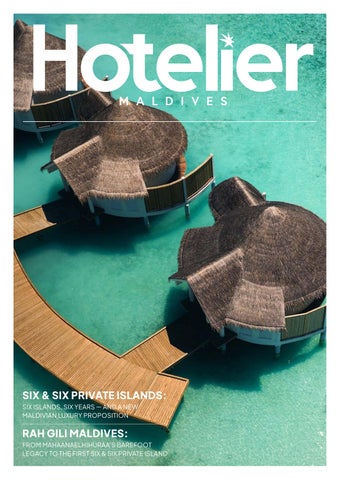
SIX & SIX PRIVATE ISLANDS: SIX ISLANDS, SIX YEARS — AND A NEW MALDIVIAN LUXURY PROPOSITION
RAH GILI MALDIVES: FROM MAHAANAELHIHURAA’S BAREFOOT LEGACY TO THE FIRST SIX & SIX PRIVATE ISLAND
3
WHEN ROOFTOPS AREN’T ENOUGH
For island resorts, available roof space can limit how far solar can go. True Floating Solar changes that equation, turning the surrounding water into an opportunity for significantly greater renewable energy generation, without consuming valuable island space. Atoll Solar, in collaboration with Ocean Sun, brings a new approach to expanding solar capacity for Maldivian resorts
sales@atollsolar.com
+960 9716616
4
hoteliermaldives.com
HOTELIER MALDIVES Volume 26, Issue No: 79 Sept/Oct 2026
EDITORIAL Ismail Faseeh, Editorial Director Ali Naafiz, Editor naafiz@hoteliermaldives.com Ibrahim Mahudhee, Managing Editor mahudhee@hoteliermaldives.com
CONTRIBUTING WRITERS Thoiba Riyaz, Maha Rasheed, Moobeen Jaleel, Maaish Mohamed, Mariyam Saliya Mohamed, Malik Mohamed, Mohamed Aleem and Ibrahim Latheef
LAYOUT DESIGN
Editor’s Note The Maldives hospitality industry continues to evolve at a pace that reflects both the strength of the destination and the demands of a changing global travel market. New investments, emerging brands, regulatory developments and shifting guest expectations are reshaping the environment in which resorts operate, while the people behind the industry remain central to its continued progress. In this September-October edition of Hotelier Maldives, our cover story explores SIX & SIX PRIVATE ISLANDS and its plans to introduce six distinct island experiences over six years. We also look at RAH GILI Maldives, tracing the island’s journey from the legacy of Mahaanaelhihuraa to a new chapter as the first property under the SIX & SIX portfolio. People and leadership remain an important focus throughout this issue. In GM’s View, Mohamed Mausoom reflects on his journey to becoming a Maldivian leader at Velaa Private Island. Our profiles highlight equally compelling stories from across the industry: Fathimath Umar’s contribution to hospitality through food, education and leadership; Ali Shareef’s 25-year progression through procurement and materials management; and the award-winning approach of Krakengiri Kids’ Club at Hilton Maldives Amingiri. We also examine how resorts are redefining wellness for today’s traveller, moving beyond conventional spa experiences towards more integrated approaches to wellbeing.
PHOTOGRAPHY Courtesy of the respective resorts
SALES Abdulla Nadir nadhir@hoteliermaldives.com sales@hoteliermaldives.com
PUBLISHER Perspective Pvt. Ltd. 4th Floor, M. Kaneeru Villa, Orchid Magu, Male’, Republic of Maldives, PO Box No. 20212 +960 7246292, +960 7910858
Meanwhile, the Maldives’ development pipeline continues to expand, with Hilton preparing to introduce its Tapestry Collection and Maxx Royal announcing plans for a 2027 debut. Alongside this growth, the industry is navigating significant policy and regulatory changes, including new GST requirements for overseas tourism platforms and amendments to the Foreign Exchange Act. Together, these stories illustrate an industry balancing expansion with adaptation, and international investment with the growing contribution of Maldivian talent. As always, we hope this edition provides useful insight into the people, businesses and ideas shaping the next chapter of Maldivian hospitality. Ali Naafiz Editor
Contents
Contents 06
Mohamed Mausoom: Making of a Maldivian leader at Velaa Private Island
11
Beyond relaxation: How Maldives resorts are redefining wellness for the modern traveller
14
From billing clerk to materials manager: Ali Shareef’s 25year journey in procurement, learning at Angsana Velavaru
20
SIX & SIX PRIVATE ISLANDS: Six islands, six years — and a new Maldivian luxury proposition
30
New Resorts
33
GAGE Technology: Smart, safe technology solutions for modern hospitality in Maldives
36
RAH GILI Maldives: From Mahaanaelhihuraa’s barefoot legacy to the first SIX & SIX private island
43
Beyond equipment: How INEO builds operational systems for Maldives resorts
51
BBM, American Specialty bring foodservice training and demonstrations to Maldivian kitchens
56
Alia: Boat Operator’s Training 2026
58
Where play shapes the journey: Krakengiri Kids’ Club’s award-winning approach at Hilton Maldives Amingiri
66
Fathimath Umar: Shaping Maldivian hospitality through food, teaching and leadership
74
Industry Highlights
80
Appointments
5
6
hoteliermaldives.com
Mohamed Mausoom: Making of a Maldivian leader at Velaa Private Island By Ali Naafiz
At Velaa Private Island, Mohamed Mausoom’s appointment as General Manager is more than a promotion. It is the continuation of a journey that began long before titles, long before the resort established itself among the Maldives’ most exclusive addresses, and long before the industry began speaking about local leadership in ultra-luxury hospitality with the urgency it does today. For Velaa, his elevation marks continuity. For the wider industry, it marks a milestone: Mausoom is the first Maldivian to hold the role of General Manager at the resort.
institutional memory. Few people understand Velaa from the inside out in the way Mausoom does.
That distinction matters. But for Mausoom, the story appears to be less about symbolism and more about stewardship.
It is a view forged through experience rather than abstraction. Growing with Velaa, he says, has been “more than a career — it’s been a very personal journey”. He has seen the island evolve “from a vision into what it is today”, and that long view appears central to how he understands both people and place. The lesson that has stayed with him most is simple but decisive: “our greatest strength is always our people — their passion, commitment, and pride in what they do.”
Having joined Velaa in 2012 as part of the founding team, he has grown with the property through its formative years, its operational refinement, and its evolution into one of the best-known private island resorts in the country. Along the way, he moved through a series of leadership positions, from Front Office Manager to Rooms Division Manager, then Resident Manager, before assuming the top operational role. The arc of that progression reflects not only longevity, but a rare degree of
For him, that perspective has shaped a leadership philosophy rooted not in hierarchy, but in proximity. “Leadership really begins with listening,” he says. “For me, leadership isn’t about standing above others, but standing beside them. It’s about supporting the team, making decisions when they matter, and creating an environment where people feel trusted and empowered.”
That emphasis on people is significant at a resort like Velaa, where service is inseparable from identity. Since its opening, the property has built its reputation not around scale or brand
GM’s View: Mohamed Mausoom
Our greatest strength is always our people — their passion, commitment, and pride in what they do.
Mohamed Mausoom. (PHOTO/VELAA PRIVATE ISLAND)
7
8
hoteliermaldives.com
Villas at Velaa Private Island. (PHOTO/VELAA PRIVATE ISLAND)
affiliation, but around discretion, detail and personalisation. In fact, one of the defining features of Velaa’s early journey was precisely the absence of an established brand framework. “Velaa began with a very personal vision from the owner,” Mausoom recalls. “There was no brand template or established formula — the goal was simply to create something truly special in the Maldives, a place that offered the variety, service, and atmosphere they felt was missing elsewhere.” That freedom came with challenges. Building an ultra-luxury resort from the ground up without the support of a global brand meant the team had to establish standards, culture and trust in real time. Mausoom notes that some aspects of the initial construction did not meet the level expected, requiring substantial work behind the scenes to ensure the resort ultimately reflected the standards the owners envisioned. At
Consistency comes from shared values, while personalisation comes from listening carefully to each guest Mohamed Mausoom, General Manager, Velaa Private Island
the same time, Velaa was developing its service culture from scratch. “We wanted the team to understand that luxury at Velaa isn’t about formality — it’s about genuine care, intuitive service, and real human connection,” he says. That idea still sits at the core of how he defines luxury today. For Mausoom, true luxury is not first about architecture, hardware or spectacle. It is about emotional ease.
“Luxury is when everything feels effortless — when needs are anticipated, service is natural, and guests can completely relax knowing that every detail is taken care of,” he says. Such effortlessness, of course, is highly structured behind the scenes. Mausoom speaks of clear communication, attention to detail, strong teamwork and a culture in which people take pride in their role. “Consistency comes from shared values, while personalisation comes from listening carefully to each guest,” he says. “When those two elements come together, the experience becomes truly special.” If Velaa gave Mausoom the platform on which to build his career, his preparation for that challenge began earlier. Prior to joining the resort, he was part of the pre-opening team at Huvafen Fushi, where he started as a Butler Assistant and later progressed to Head Butler. That early experience proved important, not only
GM’s View: Mohamed Mausoom
because it introduced him to the mechanics of luxury operations, but because it taught him the value of empathy in leadership.
remained dominated by expatriate appointments. Mausoom’s rise does not erase that imbalance, but it does offer a visible counterpoint.
“That experience taught me how much attention to detail and coordination goes into creating a seamless luxury experience,” he says. “It also helped me understand the importance of empathy when leading teams, because I’ve experienced many of those roles myself.”
“Being appointed the first Maldivian General Manager at Velaa is something I feel very humbled and proud about,” he says. “It reflects not only my own journey, but also the trust the owners have placed in me and the support of many colleagues along the way.”
That grounding seems to explain much about his management style today. Mausoom is not a leader speaking from a distance. He has worked through departments, seen both front-of-house and back-of-house realities, and understands the resort not as a concept, but as a living operation shaped by hundreds of daily decisions. It is also why he places such emphasis on internal growth.
says. “With dedication, curiosity, and patience, it’s possible to build a very rewarding career. Leadership isn’t just about a title — it’s about integrity, responsibility, and helping others grow along the way.”
He is careful, though, to frame the milestone as something bigger than himself. “For me, it also represents the potential of Maldivian talent in the hospitality industry,” he says. “The Maldives is known worldwide for its tourism, so it’s important that local professionals continue to grow into leadership roles.”
That combination of humility and clarity may prove useful as Velaa navigates the next phase of its evolution. Ultra-luxury travel is changing. Guests are more experienced, more informed, and increasingly drawn to properties that can combine exclusivity with authenticity, privacy with purpose, and service with substance. Mausoom is aware of that shift. He points to deeper personalisation, wellness and sustainability as areas where expectations are evolving, but insists that adaptation must be disciplined rather than reactive.
His message to young Maldivians is measured and direct. “Hospitality offers incredible opportunities,” he
“The key is to adapt thoughtfully,” he says. “We evolve where it adds value for the guest, but
“Having grown within Velaa myself, I strongly believe that long-term development of people is essential to maintaining excellence,” he says. “When you invest in your team — through mentoring, training, and clear opportunities to grow — you build loyalty and consistency.” At Velaa, he notes, many colleagues have been with the resort for more than a decade. In an industry where turnover can be high and continuity difficult to preserve, that kind of tenure is not incidental. It helps sustain a culture in which service standards are understood instinctively and delivered with authenticity. “Experienced team members can deliver service that is both highly professional and genuinely personal,” Mausoom says. “Ultimately, great hospitality always comes back to people.” His own appointment also carries wider meaning for the Maldives. For years, the industry has celebrated Maldivian hospitality as part of the destination’s appeal, while senior leadership at the highest levels of luxury operations has often
Villas at Velaa Private Island. (PHOTO/VELAA PRIVATE ISLAND)
9
10
hoteliermaldives.com
without losing the essence of what Velaa was created to be.” That balancing act — between preservation and progression — may define his tenure. Having worked closely with the owners from the beginning, Mausoom has unusual insight into what he calls the qualities that “truly define Velaa — privacy, authenticity, and genuine care for our guests”. His role now is not to reinvent that identity, but to protect it while ensuring it remains relevant.
Villas at Velaa Private Island. (PHOTO/VELAA PRIVATE ISLAND)
His priorities are clear: continued investment in people, maintaining standards across the resort, and developing experiences that keep Velaa compelling for returning guests. Sustainability and community engagement will also remain part of the agenda, including the continued growth of the resort’s Fehikuramaa programme. Personally, he describes his role in terms that feel less corporate than custodial. “I see my role as a guardian of the vision — protecting the culture, values, and philosophy that define Velaa, while guiding the resort forward in a thoughtful and responsible way,” he says.
Mohamed Mausoom. (PHOTO/VELAA PRIVATE ISLAND)
Villas at Velaa Private Island. (PHOTO/VELAA PRIVATE ISLAND)
That may be the most revealing line of all. In an industry often drawn to the language of disruption, guardianship suggests something steadier: a belief that leadership at the highest level is not only about strategy and performance, but also about memory, meaning and care. In Mohamed Mausoom, Velaa Private Island has chosen not simply a manager, but someone who has lived the resort’s story from the beginning and now carries responsibility for its next chapter. For a property built on a personal vision, that continuity may be one of the strongest statements it could make. And for Maldivian hospitality, Mausoom’s appointment offers something equally valuable: proof that local leadership, developed over time and grounded in experience, can stand at the very centre of ultra-luxury excellence.
Beyond relaxation
Beyond relaxation: How Maldives resorts are redefining wellness for the modern traveller By Maha Rasheed
As the world observes Global Wellness Day, the global focus on wellbeing has never been stronger.
A spa at a resort in Maldives.
11
12
hoteliermaldives.com
A spa at a resort in Maldives.
Travellers today are seeking more than beautiful destinations and luxurious accommodation; they are looking for experiences that restore balance, improve health, and create meaningful connections with themselves, nature, and local cultures. Few destinations are as naturally suited for this evolution as the Maldives. With its turquoise lagoons, secluded islands, abundant marine life, and peaceful surroundings, the archipelago has become one of the world’s most sought-after wellness destinations. Across the country, resorts are expanding beyond traditional spa treatments to offer holistic wellness journeys that combine ancient healing practices, modern science, nutrition, fitness, mindfulness, and environmental connection.
The rise of holistic wellness in paradise
Maldives resorts have long been associated with relaxation, especially through overwater spas
and ocean-inspired treatments. However, the concept of wellness has evolved significantly. Today’s luxury travellers are seeking personalised programmes that support physical, mental, and emotional wellbeing. Leading resorts are responding with integrated wellness offerings that include yoga retreats, meditation sessions, breathwork, fitness programmes, sleep enhancement therapies, nutritional consultations, and immersive nature experiences. The natural environment itself has become a central element of the Maldives wellness proposition. Sunrise yoga overlooking the Indian Ocean, meditation surrounded by tropical gardens, and mindful walks along untouched beaches allow guests to reconnect with nature in ways that are increasingly valuable in a fast-paced world.
Spa experiences inspired by island traditions
The Maldives’ wellness identity
Across the country, resorts are expanding beyond traditional spa treatments to offer holistic wellness journeys that combine ancient healing practices, modern science, nutrition, fitness, mindfulness, and environmental connection.
is deeply connected to its island heritage. Many resorts incorporate traditional healing practices and locally inspired ingredients into their spa experiences, creating treatments that reflect the destination’s culture. From coconut-based therapies and marine-inspired rituals to botanical treatments using tropical ingredients, resort spas are increasingly highlighting the relationship between wellness and
Beyond relaxation
the natural resources of the islands. Luxury wellness facilities such as One&Only Reethi Rah, JOALI BEING, and other leading island resorts have positioned themselves at the forefront of immersive wellness, offering dedicated programmes designed around physical rejuvenation, emotional balance, and personal transformation.
The growth of dedicated wellness retreats
One of the biggest trends in Maldivian tourism is the emergence of resorts where wellness is not simply an additional offering but the core of the guest experience. JOALI BEING represents this new generation of wellness-focused hospitality, combining sciencebased therapies with traditional practices. Its approach centres around four pillars: mind, skin, microbiome, and energy, offering guests personalised pathways to improve overall wellbeing. Other resorts are also developing specialised wellness escapes, including women’s retreats, fitness journeys, detox programmes, and mindfulness-focused stays. These experiences appeal to travellers who view holidays as an opportunity for self-improvement and long-term lifestyle changes.
creating unique experiences that attract repeat visitors and wellness-focused travellers.
Sustainable wellness: Healing through nature
Wellness in the Maldives is increasingly linked with sustainability. Guests are becoming more conscious of how their travel choices affect the planet, and resorts are responding by connecting environmental responsibility with personal wellbeing.
Many culinary teams are collaborating with wellness specialists to create dining experiences that support energy, immunity, and overall wellbeing without compromising on luxury or flavour.
Marine conservation activities, coral adoption programmes, reef restoration experiences, and guided snorkelling excursions offer guests opportunities to experience the healing power of nature while contributing to conservation.
The global wellness tourism market continues to expand, and the Maldives is uniquely positioned to capture this growing demand. The destination’s combination of natural beauty, privacy, luxury hospitality, and cultural heritage provides the ideal foundation for transformative wellness experiences.
The connection between a healthy ocean and human wellbeing is particularly meaningful for the Maldives, where the environment is inseparable from daily life and tourism.
The role of food in wellness journeys
Nutrition has become another important pillar of resort wellness strategies. Maldives resorts are introducing healthier dining concepts focused on fresh, locally sourced, and sustainably produced ingredients.
Wellness through movement and mindfulness
Fitness and movement have become essential parts of the modern resort experience. Maldives properties are introducing innovative ways for guests to stay active while enjoying the island environment. Activities such as paddleboarding, ocean swimming, cycling, guided nature walks, functional fitness sessions, and beachfront yoga allow guests to combine exercise with exploration. Many resorts now invite internationally recognised wellness experts, yoga instructors, and fitness coaches to host special retreats,
Wellness menus increasingly feature plant-based cuisine, seafood sourced responsibly, organic produce, functional beverages, and personalised nutrition plans.
A spa at a resort in Maldives.
A future built around wellbeing
For resorts, wellness is no longer just a spa offering—it is becoming a complete philosophy that influences accommodation design, dining, activities, sustainability initiatives, and guest engagement. As World Wellness Day highlights the importance of healthier lifestyles and mindful living, Maldives resorts continue to demonstrate that paradise can be more than a place to escape. It can be a place to recharge, reconnect, and return home renewed.
13
14
hoteliermaldives.com
From billing clerk to materials manager: Ali Shareef’s 25year journey in procurement, learning at Angsana Velavaru By Mariyam Saliya Mohamed
Ali Shareef speaks in his exclusive interview. (PHOTO/HOTELIER MALDIVES)
Ali Shareef’s 25-year journey
Ali Shareef speaks in his exclusive interview. (PHOTO/HOTELIER MALDIVES)
Procurement rarely takes place in view of the guest. It operates through purchase orders, supplier negotiations, quality checks, stock controls, delivery schedules and the movement of goods between Malé and resort islands. Yet almost every part of a resort operation depends on it. At Angsana Velavaru, the responsibility for coordinating this process rests with Materials Manager Ali Shareef, the recipient of the Procurement Personality of the Year award at the Hotelier Maldives Awards 2026. Ali oversees the purchasing requirements of the 113-room resort in Dhaalu Atoll. From food supplies and operational equipment to spare parts and project materials, every item that enters the resort passes through a process managed by him and his team. His role today is the result of a career built through a succession
Everything that comes here, from a single screw to a project, I am in charge of it. Ali Shareef , Materials Manager, Angsana Velavaru
of positions at the same property. Ali joined the resort when he was around 16 years old, arriving from the nearby island of Dhaalu Meedhoo without prior knowledge of the hospitality sector. His home island, which he says had a population of about 900 people at the time, can be seen from Angsana Velavaru. Although the distance between the two islands was not great, the working environment he entered was different from the community in which he had grown up. “When I joined, I was very nervous
because I did not know the people,” he recalls. “I came from a small island, and when I joined here, I saw so many people from different countries. There was a diverse team.” The change was enough to make him reconsider his decision almost immediately. “On the second day, I wanted to leave because I did not have confidence at that time,” Ali says. Support from colleagues, including people from his own island and neighbouring communities, helped him remain at the resort. They guided him through the first stage of his employment and gave him the confidence to continue. He started as a billing clerk at the resort’s main bar. The position introduced him to hotel systems, cashiering and the relationship between front-of-house services and financial controls.
15
16
hoteliermaldives.com
“At that time, I did not know what the hotel industry was,” he says. “Gradually, I was learning, studying and asking questions from different people. Within three or four months, I gained confidence and became comfortable with the job.” His willingness to learn brought his first promotion within six months. Management asked him to move to the front office as a night auditor while continuing to handle cashiering duties. The schedule required him to begin work at around 5pm. After completing the evening cashiering responsibilities, he would move into the night audit function at approximately 11pm or midnight. His shift continued until around 7am, when he also assisted with the departure of early-morning guests. “I had to do cashiering and then come to the night audit,” he says. “By the time I finished, it was around seven in the morning, and I had to handle the early departures. It was a long working hour, and I was around 17 years old.” Ali remained in the combined role for about a year. He was then promoted to accounts assistant, adding another area of hotel operations to his experience. Although his early positions were not directly connected to procurement, they provided a foundation in revenue handling, reconciliation, documentation and control. They also allowed him to understand the way departments depend on one another. His route into procurement began when he became a storekeeper. “Procurement starts from the store,” Ali says. “As a storekeeper, I started learning the store operation. We had a good team, and I was learning from them.” The store is where purchasing decisions meet resort operations. Orders must correspond with
Ali Shareef at Hotelier Maldives Awards 2026. (PHOTO/HOTELIER MALDIVES)
stock levels, consumption patterns and departmental requirements. Deliveries must be checked, recorded, stored and issued. Errors in purchasing can result in shortages, waste or added transport costs. After about a year as storekeeper, Ali was promoted to purchasing coordinator. He subsequently progressed through the positions of assistant purchasing manager and purchasing manager before taking responsibility as materials manager. Each move expanded his understanding of the supply chain, from receiving and storage to sourcing, purchasing and project requirements. “I achieved the position of materials manager by going through many positions,” he says. “When I look at the journey, coming from a small island and overcoming these stages is one of the things that
remains most memorable to me.”
Managing the island supply chain
Procurement at an island resort requires planning around distance, transport capacity and the availability of products in the Maldives. Angsana Velavaru receives its main supply shipment once a week. Ali must ensure that departmental orders are confirmed, sourced and placed on the scheduled boat. Missing an item can affect operations for several days and may require another method of transport. “We are far from Malé, and we have to buy almost everything from Malé,” he says. “We can obtain some items from nearby islands, but it is limited.” Produce such as bananas and watermelons may be available from local communities, depending
Ali Shareef’s 25-year journey
on the season and supply. Most food products, engineering materials, housekeeping supplies, guest amenities and project items, however, must travel from Malé or be imported through suppliers based there.
“When I started, it was difficult because I was learning,” he says. “I studied and overcame the challenges. Now it is easier for me to handle because I understand the operation and I am the person doing the purchasing.”
deadlines and guest expectations. The lowest quotation does not always provide the required value, particularly when product quality, shelf life, transport conditions or replacement costs are taken into account.
“I have to be careful about what is coming to the hotel,” Ali says. “Every week, I have to make sure that everything is on that boat. When something is missing, it becomes a challenge because we cannot always get it from a nearby island.”
Quality, value and control
Ali says suppliers must follow the resort’s purchasing requirements rather than sending substitutes or items that do not meet the specifications.
Sending supplies by seaplane is not a routine alternative. Space, weight, handling requirements and restrictions on particular items limit what can be transported. “There may sometimes be a possibility of bringing something by seaplane, but there are many challenges,” he says. “We have to make sure the items come on the supply boat, that they are checked on time and that we deliver what the respective head of department has requested.”
A resort purchasing department is expected to balance cost, product specifications, operational
There are opportunities to grow. Working in stores, purchasing or finance can provide a career, and the salary can also be good. Take the challenge and show that we can do it. Ali Shareef , Materials Manager, Angsana Velavaru
“They cannot just send whatever they want,” he says. “We have procedures and policies they have to follow. When we order something, they have to follow our guidance.” Inspection at the receiving stage is one of the controls used to maintain standards. This is particularly relevant for fruit, vegetables and other products whose condition can change during transport.
Ali is the only employee dedicated to purchasing at the resort. He works with a senior storekeeper and a receiving clerk, while retaining oversight of purchasing, receiving and stores. “On top of purchasing, I have to handle receiving and the store as well,” he says. “Basically, I have three responsibilities.” The size of the team means that coordination and record-keeping are part of his daily work. Requests must be assessed against stock, operating needs and budgets. Suppliers must be contacted, quotations reviewed and delivery arrangements confirmed. Once goods arrive, the team must inspect them, verify quantities and issue them to the relevant department. Ali says the workload became more manageable as his knowledge of the resort, its consumption patterns and its suppliers developed.
Ali Shareef at Hotelier Maldives Awards 2026. (PHOTO/HOTELIER MALDIVES)
17
18
hoteliermaldives.com
“We have to check whether what they deliver meets our quality and our standard,” Ali says. “Sometimes, a supplier may send an item that is not of the required quality. We have to reject it at the same time and address it.” He notes that the resort generally receives products that meet its requirements. The larger challenge is often availability within the Maldives, where many goods must be imported and suppliers may have limited stock. “The main issue is the limitation of the country,” he says. “Sometimes it is difficult to get the item. Quality matters because guests expect the service and product they have paid for. We have to deliver according to that expectation.” Company policies also guide purchasing decisions and controls across the operation.
Ali considers adherence to these procedures one of the main requirements of his position.
occasions. His latest recognition under the programme came during the first quarter of 2025.
“We have policies and procedures implemented for the whole group,” he says. “As a purchasing manager, it is important that I commit to them and work according to the company’s procedures.”
“When you are recognised and appreciated for what you do, it is an achievement,” he says. “Among different managers, your work is highlighted and appreciated. I believe my work and contribution were recognised, and it was a happy moment.”
This includes maintaining documentation, obtaining the required approvals, comparing suppliers and ensuring that goods received correspond with what was ordered. Such controls support financial accountability while reducing the risk of overordering, unauthorised purchasing or stock discrepancies.
Recognition built over time
Before receiving the Procurement Personality of the Year award, Ali had been named Manager of the Quarter at Angsana Velavaru on four
The Hotelier Maldives Awards 2026 extended that recognition beyond the resort. For Ali, the award represented acknowledgement of work carried out over 25 years, much of it away from areas normally associated with the guest experience. “I have been working here for 25 years, and I was very happy that I received this award because what I am doing was appreciated across the Maldives,” he says. “When you do something, appreciation and recognition are important.” He credits the resort’s management and his colleagues for supporting his development. Ali thanked General Manager Ahmed Zahir, Financial Director Sena Senaratne, his procurement colleagues and the wider Angsana Velavaru team for their role in his career. “During my whole journey, from the time I joined this hotel, they have helped me a lot,” he says.
A route for Maldivian talent
Ali believes procurement, stores and finance provide career opportunities for Maldivians, although these departments receive less attention than guest-facing roles. “Back-of-house jobs are limited in the Maldives, and sometimes people may not want to sit in an office,” he says. “It depends on what you are interested in. Some people are interested in the front line and some in the back office.”
Ali Shareef at Hotelier Maldives Awards 2026. (PHOTO/HOTELIER MALDIVES)
He encourages young people to consider roles in purchasing,
Ali Shareef’s 25-year journey
Decking
stores and finance, where they can develop technical knowledge and move into management. “There are opportunities to grow,” he says. “Working in stores, purchasing or finance can provide a career, and the salary can also be good. Take the challenge and show that we can do it.” The main lesson from his own career, he says, is the need to move beyond familiarity. His progression did not come through one fixed career plan. It came through accepting positions, learning new systems and taking responsibility when opportunities arose.
Structural Timber Marine Treated timber Kitset Design/Supply Fastenings
Your treated pine timber specialists Providing proven cost effective timber solutions to the Maldives
“Do not try to remain in your comfort zone,” Ali says. “Come out, challenge yourself, learn and grow. Some people want to stay in the same place, but my advice is to take different roles. Do not sit in the same chair all the time.” For Ali, learning remains a daily part of hotel operations, even after 25 years.
From the day we are born, we have to learn. Every day is a journey in which we learn. Ali Shareef , Materials Manager, Angsana Velavaru
His career began with uncertainty during his second day at the resort. It continued through billing, night auditing, accounts, stores and purchasing. Today, the teenager who once considered returning home manages the flow of supplies that allows Angsana Velavaru’s departments to operate. The work may remain behind the scenes, but its effect is present across the resort — in every room, restaurant, maintenance task and operational project.
fluidwoodproducts.co.nz +64 9 550 3125 Auckland, New Zealand sales@fluidwoodproducts.co.nz
19
20
hoteliermaldives.com
A villa at DON MAAGA MALDIVES. (PHOTO/SIX & SIX PRIVATE ISLANDS)
SIX & SIX PRIVATE ISLANDS
SIX & SIX PRIVATE ISLANDS: Six islands, six years — and a new Maldivian luxury proposition By Ali Naafiz
When RAH GILI Maldives opened its doors on 17 February 2026, it did more than add another new address to the country’s resort map. It marked the first public expression of a hospitality idea that has been taking shape quietly— and deliberately—since SIX & SIX PRIVATE ISLANDS launched in 2024: a brand with the stated ambition of opening six private island resorts in the Maldives in six years, without turning any of them into a carbon copy of the last. That ambition matters in a destination where expectations are exceptionally high, and where seasoned travellers often feel they understand the “Maldives version” of luxury before they even arrive. For more than two decades the country has set the global benchmark for private island hospitality. Yet success can bring its own form of predictability. Many resorts deliver extraordinary hardware— expansive villas, flawless beaches, and remarkable marine life—while
still following a familiar formula. SIX & SIX appears determined to challenge that familiarity. The brand speaks openly about individuality, lifestyle, and island character. Rather than building a uniform portfolio, the intention is to create a collection: six private islands, each with its own mood, cultural interpretation, and creative direction. The underlying philosophy connects them, but the guest experience on each island is expected to feel distinct. With RAH GILI now open and welcoming its first guests, the conversation around SIX & SIX can move beyond ambition. The brand is no longer simply a concept or a promise. It is something tangible—an island you can land on, walk through, taste, and experience firsthand. For the Maldivian hospitality industry, the question is no
21
22
hoteliermaldives.com
This balance—privacy when desired, atmosphere when welcomed—places SIX & SIX within a growing category of modern luxury brands that recognise changing guest expectations.
A villa at DON MAAGA MALDIVES. (PHOTO/SIX & SIX PRIVATE ISLANDS)
longer what the brand hopes to build, but whether its approach represents a meaningful shift in how luxury hospitality in the destination might evolve.
A collection, not a chain
At the centre of the SIX & SIX proposition is a deliberate strategic choice: the brand does not intend to behave like a traditional hotel chain. Instead, the leadership team consistently describes the portfolio as a collection of islands connected by philosophy rather than by a fixed operational template. The distinction may sound subtle, but in hospitality terms it carries significant implications. Standardised brands achieve efficiency through repetition. Architecture, service structure, and programming are designed to scale. Guests recognise the product instantly, and operators benefit from consistency. SIX & SIX is choosing a more complex route.
Laith Pharaon, CEO and CoFounder, describes the philosophy simply: “We didn’t want to create a brand that repeats itself. The Maldives is too diverse for that. Each island has its own energy. Our job is to respect that and build around it.”
often return to the Maldives looking for variety rather than familiarity. If SIX & SIX can successfully maintain individuality across multiple islands while preserving a recognisable brand identity, it may tap directly into that behaviour.
In practice, that means resisting the instinct to replicate design formulas across properties. Instead, each island is expected to develop its own identity—from architecture and dining concepts to music programming, wellness philosophy, and the rhythm of daily life.
The Maldives through a lifestyle lens
Laith explains the operational thinking: “We want guests to feel the brand’s DNA but never feel like they’ve already stayed here before. The portfolio behaves like a collection—connected by philosophy, not by a fixed formula.” For the Maldives, this approach could prove particularly relevant. Repeat visitation to the destination is high but repeat visits to the same resort are less common. Travellers
The brand frequently describes itself as operating within the space of lifestyle hospitality. While the term is widely used in global travel marketing, its application in the Maldives carries specific meaning. Historically, Maldivian luxury has been defined by serenity, seclusion, and architectural drama. The archetypal image is one of stillness: a private pool villa suspended over water, uninterrupted ocean views, and the gentle rhythm of island life. SIX & SIX does not reject that tradition—but it expands it. In the brand’s interpretation, lifestyle hospitality introduces energy and fluidity into the private island experience. Guests can come to
SIX & SIX PRIVATE ISLANDS
the Maldives to retreat, but they can also find moments of connection and movement throughout the day.
who understands how each guest wishes to experience the island and quietly helps that experience unfold.
RAH GILI offers the first glimpse of how that philosophy might take shape. The resort’s atmosphere leans toward what the brand describes as a modern barefoot spirit—relaxed, playful, and intentionally informal.
Laith explains why the distinction matters: “In many resorts, service can become a performance of luxury—very polished, very present. Edhurun is the opposite. It’s about awareness. Knowing when to step in and knowing when to step away.”
The island encourages guests to move through its spaces rather than remain anchored in one. Dining venues, social bars, wellness spaces, and beachfront settings are designed to create a natural day-to-night rhythm.
For a brand planning rapid expansion across several islands, service philosophy becomes one of the most powerful tools for maintaining identity. Design may change from property to property. Dining concepts may evolve. But
service culture is what guests feel most personally. By establishing Edhurun early in the brand’s development, SIX & SIX is signalling that its ambition is not only to scale product—but also to scale culture.
In the brand’s interpretation, lifestyle hospitality introduces energy and fluidity into the private island experience.
Laith describes the approach in characteristically straightforward terms: “We’re not trying to ‘produce’ luxury. We’re trying to remove friction so guests can live the island naturally—whether that means disappearing into privacy or stepping into the social energy when it feels right.” This balance—privacy when desired, atmosphere when welcomed— places SIX & SIX within a growing category of modern luxury brands that recognise changing guest expectations. Today’s travellers are not always looking for a perfectly scripted stay. Many want the freedom to shape their own rhythm: to be spontaneous, to discover spaces organically, and to experience both quiet and social energy within the same day.
Dolphins at RAH GILI MALDIVES. (PHOTO/SIX & SIX PRIVATE ISLANDS)
A Maldivian approach to service: Edhurun
If there is one concept that most clearly signals the brand’s cultural ambition, it is Edhurun—SIX & SIX’s interpretation of the butler role. Rather than presenting butler service with a different title, the company frames Edhurun as a distinct service philosophy rooted in Maldivian hosting traditions. The aim is to move away from transactional service structures toward something more intuitive and relational. The Edhurun is positioned less as a formal attendant and more as a guide—someone
A villa at DON MAAGA MALDIVES. (PHOTO/SIX & SIX PRIVATE ISLANDS)
23
24
hoteliermaldives.com
The concept also resonates strongly with the Maldives itself. At its best, Maldivian hospitality has always been defined by warmth and generosity rather than theatrical formality. Edhurun can be read as an attempt to formalise that instinct while preserving its authenticity.
Design-forward, but rooted in place
SIX & SIX has often been described as design-forward, but the opening of RAH GILI suggests that design is not intended as spectacle. Instead, it functions as a form of storytelling. The goal appears to be creating islands that feel contemporary without feeling anonymous spaces that carry global refinement while remaining rooted in the context of the Maldives. This matters because the destination no longer lacks luxury infrastructure. The Maldives already offers extraordinary architecture, expansive villas, and ambitious
engineering. What the market increasingly demands is identity. Laith describes the design ambition as a balance between modernity and place: “Modern doesn’t have to mean detached. We want guests to feel the island— the people, the materials, the culture—without it being staged. The story should be present, but it should never feel like a display.”
We want guests to feel the brand’s DNA but never feel like they’ve already stayed here before. The portfolio behaves like a collection—connected by philosophy, not by a fixed formula. Laith Pharaon, CEO and Co-Founder, SIX & SIX
A villa at DON MAAGA MALDIVES. (PHOTO/SIX & SIX PRIVATE ISLANDS)
The most compelling island experiences in the Maldives tend to be those that allow the destination itself to remain visible. Culture, marine life, and local influence enrich the guest journey when they are integrated naturally rather than presented as scheduled entertainment. SIX & SIX appears to be building toward that approach—where the Maldives is not simply a backdrop, but an active part of the narrative.
What guests can expect from the SIX & SIX experience
Although each island will be developed independently, several themes are likely to appear consistently across the portfolio. 1. Islands with personality: Each resort is intended to carry its own character, pacing, and creative language. The portfolio is designed for travellers who return to the Maldives repeatedly and seek new interpretations of the destination.
SIX & SIX PRIVATE ISLANDS
2. Choice without complication: Lifestyle hospitality functions best when variety feels effortless. Guests should be able to move between quiet and social settings, wellness and dining, beach and bar, without needing to plan their days in advance. 3. Dining as a central narrative: Food and beverage are positioned as key drivers of the guest experience. Rather than supporting the stay, dining becomes a discovery process—different settings, different atmospheres, and different flavours shaping the rhythm of the island. 4. Integrated wellness: Wellness is not confined to a spa visit. It becomes part of the island’s overall environment, whether through treatments, movement, water experiences, or simply spaces designed to encourage rest and balance.
A villa at DON MAAGA MALDIVES. (PHOTO/SIX & SIX PRIVATE ISLANDS)
5. Connection with the Maldives itself: The guest experience is expected to remain connected to the destination—its marine ecosystems, its cultural identity, and its people—rather than isolating guests within a purely constructed environment. Laith summarises the philosophy briefly: “We want guests to feel the Maldives as it is—just shaped with intention. Our role is to curate, not to over-direct.”
Six resorts in six years: ambition with a purpose
The phrase “six islands in six years” is bold, and intentionally so. Building resorts in the Maldives is neither simple nor quick. Logistics, environmental responsibility, infrastructure development, and operational readiness require careful planning. Attempting to do so at speed introduces additional complexity. Yet the ambition becomes easier to understand when viewed through the lens of portfolio identity.
Guest facilities at RAH GILI MALDIVES. (PHOTO/SIX & SIX PRIVATE ISLANDS)
Culture, marine life, and local influence enrich the guest journey when they are integrated naturally rather than presented as scheduled entertainment. SIX & SIX appears to be building toward that approach—where the Maldives is not simply a backdrop, but an active part of the narrative.
SIX & SIX is not simply adding properties. It is attempting to establish a new Maldivian hospitality brand at scale—a network of private islands distinct enough to encourage repeat exploration, yet unified enough to create long-term loyalty. There is also a broader destination narrative embedded in this strategy. The Maldives has become one of the most recognised luxury resort markets in the world. But as the number of high-end properties continues to grow, differentiation will increasingly depend on more than hardware. Villa size and pool length will always matter. But the next generation of luxury hospitality
25
26
hoteliermaldives.com
A villa at DON MAAGA MALDIVES. (PHOTO/SIX & SIX PRIVATE ISLANDS)
may be defined more by cultural intelligence, lifestyle relevance, and emotional connection. Laith captures that idea directly: “The Maldives doesn’t need more luxury. It needs more meaning. If we can create islands that feel different, that feel emotionally real to guests, then we’re adding something valuable to the destination.”
A beginning that feels like a statement
With RAH GILI Maldives now open, SIX & SIX PRIVATE ISLANDS has moved from promise to presence. The first island offers a clear signal of intent: a brand that seeks to reinterpret Maldivian luxury through a lifestyle lens— curated, culturally grounded, and designed for travellers who want both privacy and pulse. The more important story, however, lies ahead. Over the next six years, SIX &
SIX will face the real test of its philosophy: protecting individuality as the portfolio grows, building culture as new islands open, and ensuring each resort feels like it belongs exactly where it stands. If that balance is maintained, the Maldives will gain more than six new resorts. It will gain a new way of imagining what a Maldivian hospitality brand can be.
The Maldives doesn’t need more luxury. It needs more meaning. If we can create islands that feel different, that feel emotionally real to guests, then we’re adding something valuable to the destination. Laith Pharaon, CEO and Co-Founder, SIX & SIX
SIX & SIX PRIVATE ISLANDS
Direct or 1 stop
Always fly direct or maximum 1 stop to destination on all scheduled flights
Total solution
with seaplane & wheelbase domestic operation
Safety | at the core of our operations
Our aircrafts including seaplanes are equipped with next generation Garmin avionics with glass cockpit safety for weather rader, traffic awareness & mapping smooth flight paths
Advance booking
Book in advance on self-booking platform & provide seaplane/domestic flight details at the time of resort booking
Pre-published flight schedules
for both domestic & Seaplanes removing uncertainty on flight timings
w flymantaair
mantaair
mantaair.mv
27
28
hoteliermaldives.com
29
Download now
30
hoteliermaldives.com
New Resorts Hilton adds fifth brand to Maldives portfolio with Tapestry Collection; Coco de Mer Maldives to open in 2027 Hilton has announced the signing of Coco de Mer Maldives, Tapestry Collection by Hilton, marking the lifestyle brand’s planned entry into the Maldives. commitment to bringing the right brands to the right markets, as we continue to grow our lifestyle presence across key destinations.” Coco de Mer Maldives will broaden a Hilton portfolio in the country that currently comprises four resorts operating under four of the group’s brands: Conrad Maldives Rangali Island, Waldorf Astoria Maldives Ithaafushi, Hilton Maldives Amingiri Resort & Spa and SAii Lagoon Maldives, Curio Collection by Hilton. Based on the existing portfolio, the new property would increase Hilton’s Maldives presence to five resorts and introduce a fifth Hilton brand to the destination. Scheduled to open in June 2027, the 75-key resort will be located 25 minutes by speedboat from Velana International Airport. Hilton said the property would combine premium resort experiences with access from the country’s main international gateway. The resort will feature a selection of dining concepts, a wellness centre, a sea sports centre, pickleball courts and other recreational facilities. Hilton said the property would reflect Tapestry Collection’s focus on independently designed hotels with experiences connected to their destinations. The signing forms part of Hilton’s expansion of its luxury and lifestyle portfolio in South East
Asia. It was announced alongside two properties in Thailand: Andamanda Voyage, Curio Collection by Hilton in Phuket and the first Tapestry Collection by Hilton property in Chiang Mai.
Conrad Maldives Rangali Island represents the Conrad Hotels & Resorts brand, while Waldorf Astoria Maldives Ithaafushi operates under Hilton’s Waldorf Astoria Hotels & Resorts luxury brand.
“Thailand and the Maldives have long been lifestyle powerhouses in South East Asia, and these signings provide new opportunities to showcase our independentspirited brands,” Alexandra Murray, vice-president and regional head of South East Asia at Hilton, said.
SAii Lagoon Maldives, located at CROSSROADS Maldives, introduced Curio Collection by Hilton to the destination. Hilton Maldives Amingiri Resort & Spa subsequently marked the arrival of the company’s flagship Hilton Hotels & Resorts brand when it opened in 2022.
“Tapestry Collection and Curio Collection are a natural fit for these destinations where guests seek not just accommodation, but experiences rooted in place. These signings reinforce our
The addition of Tapestry Collection would give Hilton another lifestyle offering in the Maldives alongside Curio Collection. Tapestry Collection comprises independently operated hotels
New Resorts
that retain their individual identities while participating in Hilton’s distribution and loyalty platforms.
lifestyle portfolio in South East Asia as demand grows for hotels offering destination-focused experiences.
Hilton announced in June that both Tapestry Collection and Curio Collection had surpassed 200 hotels globally, as the company continued to expand the two collection brands in resort and urban destinations.
“We continue to see strong interest from owners in South East Asia for lifestyle brands, supported by solid market fundamentals and evolving traveller demand,” Maria Ariizumi, vice-president of development for South East Asia at Hilton, said.
The Maldives signing also supports Hilton’s target of exceeding 250 luxury and lifestyle properties across Asia Pacific. The company plans to more than double its luxury and
“These signings allow us to broaden our presence in high-demand destinations, where we see clear opportunities to scale our
award-winning brands alongside trusted local partners and unlock new opportunities in both resort and cultural destinations.” Coco de Mer Maldives will participate in Hilton Honors, Hilton’s guest loyalty programme. Members booking through Hilton’s direct channels will be able to access benefits including member rates, points and money payment options, complimentary standard Wi-Fi and digital services through the Hilton Honors mobile application.
Türkiye’s Maxx Royal announces Maldives resort for 2027 opening Maxx Royal, known for its celebrated resorts in Türkiye, will bring the brand’s distinctive philosophy of hospitality to the Maldives, one of the world’s most extraordinary island settings, next year. experience. Villas unfold within tropical gardens or above the lagoon, all connected to the heart of the resort, where restaurants, beachside terraces and social spaces create a gentle rhythm of life. Together, they offer a setting that moves effortlessly between moments of privacy and a vibrant, social atmosphere.
Maxx Royal Maldives, which is expected to open in autumn 2027, will offer a new level of refined luxury to guests visiting the beautiful island setting in the Indian Ocean. Situated across the turquoise waters of the Kaafu Atoll, Maxx Royal Maldives brings the brand’s distinctive philosophy of hospitality to one of the world’s
most extraordinary island settings. Known for its refined approach to service, gastronomy and design across its celebrated resorts in Türkiye, Maxx Royal now reimagines that experience within the natural beauty of the Maldives. The resort reveals itself as a layered destination, where each island forms part of a singular, cohesive
At Maxx Royal Maldives, this setting evolves into an unparalleled expression of hospitality. This distinctive approach invites guests to experience the island in their own way, whether embracing the energy of social spaces or retreating into complete seclusion. Each stay flows naturally between connection and calm, shaped entirely by personal rhythm and the intuitive service that defines the Maxx Royal experience.
The art of personalised service Service has always been central to the identity of Maxx Royal and in the Maldives, it takes on an even more personal dimension.
The guest journey begins before
31
32
hoteliermaldives.com
arrival, with Maxx Assistant coordinating every detail in advance, from individual inclinations and dining arrangements to the overall flow of the stay. Throughout the resort, this intuitive service continues to accompany guests, allowing each day to unfold naturally, whether shaped around social experiences or moments of complete seclusion. On Thari Island, this experience evolves further through Kiaya, a dedicated butler service. Reflecting the unique scale and privacy of the setting, Kiaya introduces an exceptional level of personalisation, where every detail is carefully curated around the guest. From pillow preferences to the precise balance of flavours in each dish, every element is thoughtfully shaped to individual needs, often anticipated before they are even expressed. Together, these layers of service create a fluid hospitality experience,
one that adapts seamlessly to each guest, rather than following a fixed structure. The result is a style of hospitality that feels intuitive rather than orchestrated.
The Maxx way of living
Accommodation at Maxx Royal Maldives has been conceived as a collection of villas shaped by their relationship with the surrounding ocean. Located just 30 minutes by boat from Malé, the resort is among the closest island destinations to the international airport, offering both ease of access and a sense of continuity from the moment of arrival. Every villa within the resort features a private pool, extending the sense of space and openness that defines the experience. All villas are positioned to maintain privacy while still allowing a sense of presence and connection. Rather than facing vast, uninterrupted horizons, the setting creates a more balanced
environment, one that feels open yet never remote, calm yet never solitary. Positioned within immediate reach of the Maldives’ vibrant marine life, each villa makes the ocean an integral part of everyday living. Architecture at Maxx Royal Maldives follows a calm and consistent language. Natural materials, generous proportions and expansive indoor–outdoor spaces allow the surrounding landscape to remain the focus. For families and groups travelling together, larger multi-bedroom villas offer extended living spaces while preserving the same sense of tranquillity. At the most secluded end of the archipelago, a limited collection of villas forms an entirely private island retreat with its own beach, wellness facilities and dedicated service team.
GAGE Technology
GAGE Technology: Smart, safe technology solutions for modern hospitality in Maldives
33
34
hoteliermaldives.com
The expectations of modern hospitality continue to evolve. Beyond exceptional guest experiences, today’s resorts and hotels are expected to deliver the highest standards of safety, operational efficiency, and connectivity. Meeting those expectations increasingly depends on technology that works intelligently behind the scenes. From luxury island resorts to hotels and residential developments, operators are increasingly adopting integrated technologies that provide greater visibility, stronger operational control, and smarter ways of managing their properties. This evolution extends beyond security alone. It reflects a broader shift towards connected environments, where multiple systems work together to support the day-to-day operation of a property. GAGE is helping drive this
transformation by delivering integrated smart technology solutions that bring together security, communication, and operational infrastructure into one unified system.
As hospitality operations continue to evolve, so too does the way technology is adopted.
Beyond Traditional Security
For many years, property security centred on individual systems such as CCTV and access control. While these remain fundamental, modern hospitality demands a more intelligent approach—one where systems communicate with each other, automate routine processes, and provide realtime visibility across multiple
operational functions. GAGE delivers a comprehensive portfolio of solutions designed for hospitality and enterprise environments, whether as fully integrated platforms or standalone systems tailored to individual operational requirements. Its capabilities span intelligent surveillance, AI-powered CCTV, intruder alarm systems, smart access control, smart door locks, visitor and key management, video intercom systems, remote monitoring, emergency communication, fire detection and life safety systems, enterprise networking, and scalable Wi-Fi infrastructure. Complementing these are Command & Control Centres that provide centralised operational visibility, allowing multiple systems to be monitored and managed through a single interface. For specialised environments, GAGE also delivers underwater monitoring systems,
GAGE Technology
destinations, expectations around safety, connectivity, and operational performance continue to rise.
extending situational awareness where conventional monitoring solutions may not be sufficient. Together, these technologies provide the foundation for safer, smarter, and more responsive hospitality environments.
Supporting Operational Excellence
The value of integrated technology extends well beyond security. When critical systems are connected, properties benefit from improved coordination, faster response times, and greater visibility across departments. This enables teams to make informed decisions more quickly, reduce manual processes, and maintain smoother day-to-day operations. For large-scale resorts in particular, where multiple departments operate across expansive environments, integrated technology helps create a more coordinated operational rhythm while allowing staff to focus on delivering exceptional guest experiences.
A Flexible Approach to Technology
As hospitality operations continue to evolve, so too does the way technology is adopted. Rather than requiring significant upfront capital investment, GAGE offers selected solutions through flexible subscription-based models, enabling properties to access advanced technologies in a more scalable and cost-effective way. This approach allows hotels and resorts to expand their technology infrastructure as operational requirements change, while benefiting from ongoing support, system updates, and predictable operating costs.
Shaping the Future of Hospitality
As the Maldives continues to strengthen its position as one of the world’s leading luxury hospitality
The industry’s future lies in environments where technology works intelligently behind the scenes— connecting systems, supporting operational excellence, and enabling exceptional guest experiences.
The industry’s future lies in environments where technology works intelligently behind the scenes—connecting systems, supporting operational excellence, and enabling exceptional guest experiences. Through integrated smart technology solutions, GAGE is helping hospitality operators build environments that are not only safer and more efficient, but also better prepared for the evolving demands of tomorrow.
35
36
hoteliermaldives.com
Guest facilities at RAH GILI MALDIVES. (PHOTO/SIX & SIX PRIVATE ISLANDS)
RAH GILI Maldives
RAH GILI Maldives: From Mahaanaelhihuraa’s barefoot legacy to the first SIX & SIX private island Some islands in the Maldives seem destined for immediate recognition. Others build their reputation slowly—through repeat guests, sun-faded memories, and the kind of honest hospitality that becomes part of a traveller’s personal history. By Ali Naafiz
For many years, the island locally known as Mahaanaelhihuraa belonged firmly to the latter category. It developed a quiet reputation as one of the Maldives’ original barefoot-style escapes: an uncomplicated island stay where the rhythm of the day was set by sea breeze, saltwater swims, and a relaxed atmosphere that never tried too hard. That spirit still lingers today, even though the name on the map has changed. On 17 February 2026, the island reopened as RAH GILI Maldives, becoming the debut resort of SIX & SIX PRIVATE ISLANDS. With that reopening, Mahaanaelhihuraa entered a new chapter—one that places it within a broader conversation about modern Maldivian luxury, lifestyle hospitality, and the emergence of a brand determined to open six private island resorts in six years.
The central question, however, remains simple: can an island with such a relaxed, barefoot heritage evolve without losing the character that made it memorable in the first place? RAH GILI’s early answer suggests that it can. The transformation does not attempt to erase the past. Instead, it reframes it. Bare feet are still welcome. The sense of ease remains intentional. But the island is now interpreted through a more contemporary design lens, a broader dining and wellness offering, and a lifestyle sensibility that feels modern without becoming overstated.
The transformation: not a replacement, but a reinterpretation
Anyone who has stayed on a traditional barefoot island will recognise the appeal immediately. The atmosphere encourages guests to slow down. Nothing feels
37
38
hoteliermaldives.com
Guest facilities at RAH GILI MALDIVES. (PHOTO/SIX & SIX PRIVATE ISLANDS)
overproduced. The Maldives, in its most natural form, does not require elaborate embellishment. For many years, Mahaanaelhihuraa embodied that philosophy. Travel listings and resort platforms frequently described the island as an “iconic barefoot escape,” associated with simplicity, familiarity, and a loyal community of returning guests. RAH GILI Maldives builds on that foundation while expanding the experience. The resort’s own positioning describes the concept as “barefoot luxury with a playful soul.” The phrase signals a clear intention: the island is not attempting to become overly formal or conventionally polished. Instead, it aims to remain relaxed while introducing layers of design, dining, and programming that feel contemporary and expressive. In practice, this means creating a resort that feels alive. Music carries through the day. Dining spaces encourage gathering.
The marine environment remains central to the island experience. Rather than treating the Maldives merely as scenery, RAH GILI brings the surrounding ecosystem into the narrative of the stay.
First impressions: a private island with a pulse
RAH GILI sits in South Malé Atoll, reachable by speedboat from Velana International Airport. The island lies close to a protected marine sanctuary, and the surrounding waters are well known for dolphin encounters—an experience the resort highlights as part of its connection with the natural environment. Yet the defining impression of the island is not just its location. It is its rhythm. From morning through evening, the resort is designed to shift naturally between moments of quiet and moments of social energy. Music, dining spaces, and open gathering
The Maldives, in its most natural form, does not require elaborate embellishment. For many years, Mahaanaelhihuraa embodied that philosophy.
areas create a subtle day-tonight progression that reflects the brand’s lifestyle philosophy. Laith Pharaon, CEO and CoFounder of SIX & SIX PRIVATE ISLANDS, describes RAH GILI as setting the emotional tone for the entire portfolio: “We wanted our first island to feel emotionally familiar—barefoot, light, unforced—but elevated in the details. RAH GILI isn’t meant to feel formal. It’s meant to feel like freedom, with intention behind it.”
RAH GILI Maldives
The idea is simple: guests should feel able to shape their own experience. The island can be quiet when privacy is desired, but it can also offer energy and connection when guests are in the mood for it.
74 private pool villas and a sense of space
The resort comprises 74 private pool villas, including 37 overwater villas, marking a significant evolution from the island’s earlier incarnation. The numbers alone indicate the scale of the transformation. Yet what matters more is what those villas represent: privacy, flexibility, and a range of experiences suited to different travellers.
shift from beachfront evenings to intimate garden spaces, and bars that encourage guests to linger long after sunset. Within the portfolio, there is a flagship all-day dining venue described as the island’s “heart,” alongside a spice-driven Indian concept inspired by traditional tiffin dining, an interactive teppanyaki experience, and a Maldivian seafood concept rooted in the flavours of the surrounding ocean. That Maldivian influence is most visible through Maakeyolhu Restaurant, the island’s interpretation of the traditional head fisherman’s table. The concept
draws inspiration from the cultural rhythm of island communities, where fishermen returned with the day’s catch and the evening meal became a moment of gathering, storytelling, and shared experience. At RAH GILI, Maakeyolhu reimagines that tradition for a contemporary setting. Reef fish, yellowfin tuna, octopus, lobster and other local ingredients form the foundation of a dining philosophy that honours Maldivian seafood heritage while presenting it with modern culinary expression. The intention is not simply to provide variety. It is to build identity.
Villa categories span both beach and overwater settings, with layouts designed for couples, families, and multigenerational groups. Sunsetfacing villas, family configurations, and spacious outdoor living areas suggest that the island is positioning itself as a versatile destination rather than a single-segment retreat. Laith explains the intention behind the approach: “We wanted to create a modern private-island experience without the stiffness that sometimes comes with new luxury openings. Guests should be able to experience the Maldives however they choose—quiet, social, active, or slow. The island adapts to them, not the other way around.”
Guest facilities at RAH GILI MALDIVES. (PHOTO/SIX & SIX PRIVATE ISLANDS)
This philosophy reinforces the brand’s broader positioning around lifestyle hospitality— where choice and flexibility are central to the experience.
Dining as narrative
If RAH GILI is intended to introduce the character of SIX & SIX, the resort’s culinary landscape provides one of the clearest insights into that character. The island features six restaurants and four bars, forming a dining structure that encourages exploration rather than routine. The language used to describe the venues reveals the intended atmosphere: plates designed to spark conversation, settings that
Guest facilities at RAH GILI MALDIVES. (PHOTO/SIX & SIX PRIVATE ISLANDS)
39
40
hoteliermaldives.com
Laith explains: “Dining is where an island becomes a community. Guests can easily disappear into their villas in the Maldives—and that privacy is wonderful—but we also wanted spaces that naturally bring people together. Food and music have always done that.”
The lifestyle layer: activity, exploration, and choice RAH GILI is also notable for the breadth of experiences available across the island.
In addition to villas, dining venues, and wellness spaces, the resort includes a gym, kids club, cinema, dive centre, sports facilities, water sports programming, and boutique retail. The range signals that RAH GILI is designed to welcome more than couples seeking a secluded retreat. Families, groups of friends, and travellers who enjoy active itineraries will find a wide spectrum of options. Yet the brand consistently emphasises freedom rather than structure. Guests are not expected to follow a fixed programme. The island simply provides the environment within which each traveller can shape their own rhythm. This balance—activity without obligation—captures the essence of the brand’s lifestyle positioning.
Sustainability: infrastructure, commitment, and longterm responsibility
Sustainability messaging has become standard across new Maldivian resort developments. What increasingly differentiates properties is whether those commitments appear structural or symbolic. At RAH GILI, sustainability has been positioned as part of the island’s operational foundation rather than a separate narrative. The resort integrates solar energy systems supported by battery storage infrastructure, reducing reliance on diesel-powered generation. Water desalination and bottling facilities limit imported plastic consumption, while waste segregation and composting programmes are designed to minimise landfill impact. Construction materials and interior elements also prioritise environmentally responsible sourcing where possible. The property is currently working toward EarthCheck certification, one of the hospitality industry’s most recognised environmental benchmarking frameworks. Achieving certification requires comprehensive monitoring across energy, water, waste, and community impact metrics, reinforcing the resort’s intention to operate with
measurable accountability. Laith describes the philosophy in practical terms: “A private island in the Maldives is a privilege. If we’re building a portfolio for the future, sustainability must be part of how these islands function— not something decorative.”
Community and local connection
For a destination built almost entirely around private islands, maintaining meaningful connections with Maldivian culture and communities’ remains an ongoing conversation within the industry. RAH GILI approaches that connection through a combination of cultural integration and community engagement initiatives. Elements of Maldivian identity appear throughout the guest journey—from culinary traditions such as Maakeyolhu to storytelling around the island’s marine environment and the people who have historically lived alongside it. The resort also intends to develop community-focused outreach programmes with neighbouring islands, including educational initiatives and environmental awareness activities. These programmes aim to ensure that tourism development continues to create positive local impact alongside economic growth. Laith emphasises that the brand’s responsibility extends beyond the boundaries of the island itself. “When you operate in the Maldives, you’re not just building a resort—you’re becoming part of an ecosystem that includes communities, traditions, and fragile marine environments. Our responsibility is to respect that relationship and ensure the islands we build contribute positively to the place they belong to.”
Guest facilities at RAH GILI MALDIVES. (PHOTO/SIX & SIX PRIVATE ISLANDS)
For the leadership team, these initiatives are not framed as isolated CSR campaigns but as part of a broader commitment to operating responsibly in a destination whose
RAH GILI Maldives
When you operate in the Maldives, you’re not just building a resort— you’re becoming part of an ecosystem that includes communities, traditions, and fragile marine environments. Laith Pharaon, CEO and Co-Founder, SIX & SIX
Guest facilities at RAH GILI MALDIVES. (PHOTO/SIX & SIX PRIVATE ISLANDS)
natural and cultural heritage remains its greatest asset.
Setting the tone for the SIX & SIX portfolio
From the beginning, SIX & SIX PRIVATE ISLANDS has insisted that each resort will be unique. That raises an interesting challenge: how can the first island establish the brand without becoming the blueprint for everything that follows? RAH GILI appears to answer that question through principles rather than patterns. The resort demonstrates several ideas that are likely to recur across the portfolio: • Barefoot spirit with elevated detail – relaxed, playful energy supported by contemporary luxury infrastructure. • Lifestyle hospitality as lived experience – music, dining, and social spaces integrated into
the daily rhythm of the island. • Choice as quiet luxury – an environment that supports different guest personalities without forcing a schedule. • Nature as a central narrative – marine ecosystems and the surrounding environment actively shaping the guest experience. Laith summarises the island’s role within the brand’s evolution: “If someone understands RAH GILI, they’ll understand what SIX & SIX is about—but they won’t be able to predict our next island. That’s exactly the point.”
A new name, the same island magic
The most compelling aspect of RAH GILI Maldives is not simply that Mahaanaelhihuraa has changed. Change is inevitable in the Maldives, where islands evolve with each generation of hospitality development.
What matters is how that change has been approached. RAH GILI does not attempt to preserve the past as nostalgia, nor does it pursue a sterile version of modern luxury. Instead, it occupies a thoughtful middle ground: a private island experience that feels contemporary, culturally aware, and easy to inhabit. Guests can still walk barefoot through the sand. Yet every detail—from architecture to dining to service philosophy—has been reconsidered with intention. For SIX & SIX PRIVATE ISLANDS, the island represents a confident opening statement. For the Maldives, it offers a reminder that even in a destination renowned for luxury, there is still space for new interpretations—especially when they honour the spirit of the islands that came before them.
41
hoteliermaldives.com
R O O F I N G A C C E S S O R I E S , B U I LT T O L A S T
Only available from STO and Rainbow outlets.
42
| msp.com.mv
+960 301 2638
+960 334 0404 +960 735 4466
Beyond equipment
A setup by INEO. (PHOTO/INEO)
Beyond equipment: How INEO builds operational systems for Maldives resorts By Mariyam Saliya Mohamed
For guests arriving at a resort in the Maldives, the experience is defined by its visible elements: the setting, accommodation, dining, service and activities. Behind these, however, is an extensive operational network that must function
consistently despite the logistical and environmental challenges of operating on a remote island. Commercial kitchens, cold rooms, refrigeration systems, ventilation, laundries, bars and other back-of-
house facilities form part of this network. Their design, installation and maintenance can influence food quality, staff efficiency, operating costs and a resort’s ability to maintain service standards.
43
44
hoteliermaldives.com
Susan Chan, Founder and Managing Director of INEO. (PHOTO/HOTELIER MALDIVES)
GuangDong GFD Commercial Technologies Co., Ltd., known as INEO, has positioned itself as a hospitality solutions provider that works across this operational lifecycle. The company supplies commercial kitchen equipment while also providing design, manufacturing, logistics coordination, installation, commissioning, training and after-sales services. Susan Chan, Founder and Managing Director of INEO, says the company’s work in the Maldives has helped it develop an understanding of the requirements that distinguish island resorts from mainland hospitality projects. “In the Maldives, a resort typically has only eight to 10 months from the decision to renovate its kitchen to the day equipment needs to be operational,” Susan says. “Completing design, procurement, logistics and installation within that window is
what INEO does every day.”
From equipment supplier to solutions partner
INEO has more than 20 years of international experience and has completed over 2,500 projects across 148 countries. Its portfolio in the Maldives includes more than 120 island resort projects, ranging from boutique properties to resorts operated by international hotel brands. The company’s services cover commercial kitchens, cold storage and refrigeration, ventilation and exhaust systems, bar and beverage equipment, laundry facilities, tableware and diningware. According to Susan, INEO’s approach is based on the view that these facilities should be treated as connected operational systems rather than as separate collections of equipment. “What makes INEO different is that
Project completion does not mean the end of the relationship. It is the beginning of a longterm partnership. Susan Chan, Founder and Managing Director, INEO
we do not see ourselves as only an equipment supplier,” she says. “For island resorts, the kitchen is not simply a collection of equipment. It is a critical operational system that directly affects food quality, labour efficiency, energy consumption, guest experience and long-term operational stability.” The company works with resort owners, operators, consultants, chefs and engineering departments from the early planning stages
Beyond equipment
of a project. Its involvement can begin with concept development and kitchen design before moving through manufacturing, logistics, installation, commissioning and staff training. After a property opens, INEO continues to provide technical assistance, maintenance guidance, spare parts support, inspections and follow-up services. “Project completion does not mean the end of the relationship,” Susan says. “It is the beginning of a long-term partnership.” INEO’s clients in the Maldives include Universal Resorts, Pulse Hotels & Resorts, Crown & Champa Resorts, Villa Hotels & Resorts, Atmosphere Core and Emerald Collection. It also works as a service partner for properties operating under brands including Hilton, Sheraton, IHG and Marriott.
INEO reviews the resort concept, guest capacity, menus, food production requirements, available space, kitchen workflow and anticipated future needs. “Every island has different operational needs,” Susan says. “Our goal is not simply to deliver equipment, but to create a system that supports smooth daily operation.” Kitchen planning can be particularly important for premium resorts, where several dining concepts may need to operate simultaneously while maintaining separation between food preparation, storage,
cooking, service and cleaning areas. Poorly planned kitchens can create unnecessary movement, increase labour requirements, restrict production and make maintenance more difficult. Effective planning, by contrast, can reduce congestion and enable teams to use limited space more efficiently. “A successful kitchen starts with professional planning,” Susan says. INEO’s design services cover kitchen layouts, workflow optimisation, equipment configuration, space utilisation and mechanical, electrical and plumbing coordination.
Susan says repeat appointments from hospitality groups have been an important part of INEO’s growth in the market, with several clients selecting the company for multiple developments or renovation projects.
Designing for island operations While commercial kitchen equipment may perform the same fundamental function in different markets, Susan says the planning behind an island resort kitchen requires a distinct approach.
INEO employees at a work site in Maldives. (PHOTO/INEO)
Resorts in the Maldives must consider limited land and back-of-house space, sea transportation, restricted access to technical personnel, project opening schedules and exposure to humid, saline conditions. Every resort also has its own operational model. The requirements of a boutique property will differ from those of a large resort serving several restaurants, bars, staff facilities and event spaces. Before developing a proposal,
INEO employees at a work site in Maldives. (PHOTO/INEO)
45
46
hoteliermaldives.com
and shorten the operating life of unsuitable equipment. Transportation is also a factor. Equipment must often travel by sea after reaching the Maldives, while access to islands may depend on cargo boats, landing craft or other vessels. Large or specialised items therefore need to be specified with transportation, installation and future servicing in mind. INEO considers material selection, equipment configuration, maintenance access and expected long-term performance when designing systems for island properties.
INEO employees at a work site in Maldives. (PHOTO/INEO)
“The Maldives is one of the world’s most beautiful hospitality destinations, but the island environment also creates unique technical challenges,” Susan says. “A successful solution should not only perform well on the first day of opening, but continue supporting resort operations for many years.” This focus on operating life also shapes the company’s approach to procurement. Susan says the lowest purchase price may not provide the lowest overall cost, particularly when equipment is installed at a remote property where breakdowns can disrupt service and replacement parts may take time to arrive.
INEO employees at a work site in Maldives. (PHOTO/INEO)
Its team draws on international hospitality design practices, including approaches used in Singapore and the United Kingdom, while considering the practical engineering requirements of the property. Susan says the objective is to balance functionality, efficiency, aesthetic expectations and hospitality standards. “For resorts, this means creating kitchens that are not only visually impressive, but also practical and efficient,” she says.
A successful kitchen starts with professional planning. Susan Chan, Founder and Managing Director, INEO
Adapting equipment to the marine environment
The tropical and marine environment of the Maldives creates another set of considerations. High humidity and salt in the air can accelerate corrosion, affect components
INEO encourages operators to consider total cost of ownership, taking into account durability, energy efficiency, maintenance frequency, spare parts, replacement costs and the operational consequences of equipment failure. “For island properties, the lowest initial purchase price does not always represent the lowest operational cost,” Susan says. “The real value comes from long-term reliability.” A reliable system can reduce unexpected breakdowns, interruptions and repeated replacement expenses. It can also help a resort maintain food
Beyond equipment
service during periods of high occupancy, when equipment downtime can place pressure on chefs, engineers and service teams. “Choosing the right equipment and specifications at the beginning can significantly improve reliability and protect the resort’s longterm operation,” she says.
Supporting resorts before and after opening
The pre-opening stage is among the most important periods in a resort development. Equipment must be installed, connected, tested and adjusted before kitchen teams begin full production. INEO supports installation supervision, commissioning, system testing, chef training and engineering guidance during this phase.
support, annual inspections and preventive maintenance visits. The company has also developed support capabilities in the Maldives, including a local technical team and spare parts inventory. Susan says having resources available in the country allows for faster communication and response than would be possible if every technical requirement had to be handled from overseas. “Unlike suppliers who only deliver equipment and leave after installation, INEO provides continuous support throughout the operational journey,” she says. “For island properties, having a trusted partner nearby significantly reduces operational concerns and improves long-term confidence.”
A reliable system can reduce unexpected breakdowns, interruptions and repeated replacement expenses.
Integrating kitchens, bars and laundries
Although commercial kitchen systems remain a central part of INEO’s work, its services extend into other resort operational areas. The company provides refrigeration systems, cold rooms, ventilation systems, bars, beverage equipment, laundry facilities, tableware, diningware and other
Susan says collaboration is required because kitchen systems involve several disciplines. Equipment installation must be coordinated with power supplies, water, drainage, ventilation, fire and safety systems, gas connections and the overall construction programme. Once equipment is operational, INEO works with chefs to explain its functions and with engineering teams to provide maintenance knowledge. “We believe knowledge transfer is extremely important,” Susan says. “Our goal is not only to install equipment, but also to help resort engineering teams understand how to operate and maintain systems effectively.” This process is intended to reduce operating errors, improve preventive maintenance and allow resort teams to identify potential issues before they result in equipment failure. After opening, INEO provides technical support, maintenance guidance, spare parts assistance and regular follow-up. During the warranty period, the company offers complimentary on-site
Susan Chan, Founder and Managing Director of INEO. (PHOTO/HOTELIER MALDIVES)
47
48
hoteliermaldives.com
A long-term role in Maldives hospitality
As resort operators continue to renovate existing properties and develop new concepts, Susan expects operational efficiency, equipment reliability and lifecycle costs to receive greater attention. Resorts are also managing rising expectations surrounding energy consumption, space use, staff productivity and sustainable operations. Decisions made during the design and procurement stages can therefore affect operating performance for years after a property opens. INEO intends to continue expanding its role as an integrated partner for resort owners and operators, while building on its experience from more than 120 projects in the Maldives. “The Maldives is not only an important market for us,” Susan says. “It is where we have built deep experience, strong relationships and a clear understanding of island hospitality operations.” Susan Chan, Founder and Managing Director of INEO. (PHOTO/HOTELIER MALDIVES)
back-of-house solutions. Susan says this integrated model can help operators reduce the number of parties involved in a project. Working with several suppliers can create additional technical interfaces, contractual arrangements, delivery schedules and communication requirements. “Modern resorts require coordination between many different systems,” she says. “Working with multiple suppliers can increase communication complexity and project risks.” By placing several systems under one provider, operators may be able to simplify procurement, coordination and accountability. The model can also allow equipment selection and infrastructure planning to be considered together rather than being managed as separate packages.
Our goal is not only to install equipment, but also to help resort engineering teams understand how to operate and maintain systems effectively. Susan Chan, Founder and Managing Director, INEO
INEO summarises this approach through the principle: “One Partner. One Contract. Full Responsibility.” For Susan, the phrase reflects the company’s intention to remain accountable across the project, from planning and production to installation, training and after-sales support.
She believes the value of a hospitality supplier should ultimately be measured by how well the systems continue to support a resort after construction teams have left and the property has entered daily operation. “INEO is not only supplying equipment. We are helping island resorts build reliable operational systems,” Susan says. “From design and installation to training and after-sales support, INEO aims to help resorts create reliable, efficient and sustainable operations. Every resort that chooses INEO today should continue to see value from the partnership for many years into the future.”
Beyond equipment
49
50
hoteliermaldives.com
Longest battery life Last up to 5 years
Tork PeakServe® sets the gold standard for reliable, high-capacity hand towel dispensing - even when washrooms are busy. Serve up to 600 more guests between refills1 and reduce run-outs. Simplify maintenance by using ONE refill in various dispensers across your facility. New Tork PeakServe Automatic offers the longest battery life2 - one battery set lasts up to five years3 and dispenses at least 500,000 towels.4 Better hygiene, better business. torkglobal.com/in/en 1. Based on each guest using two towels. Compared to Tork Universal refills and folded-towel dispenser 562000. 2. Compared to the Kimberly-Clark lcon and Kimberly-Clark Professional Electronic Rolled Hand Towel Dispenser 5950 dispensing 150,000 towels and the Katrin System Electronic Paper Towel Dispenser dispensing 150 rolls per battery set (78,000) 25.4 cm towels). The Tork PenkServe Automatic dispenses at least 500.000 paper hand towels per battery set using refill article 100585. 3. Based on refill consumption of two cases of refill article 100585 annually using alkaline batteries. 4. Based on third-party tests.
BBM, American Specialty bring foodservice training
BBM, American Specialty bring foodservice training and demonstrations to Maldivian kitchens By Maaish Mohamed
Vijay Anand. (PHOTO/BBM)
51
52
hoteliermaldives.com
A training session conducted by Vijay Anand. (PHOTO/BBM)
When Vijay Anand arrived in the Maldives for a three-day market visit, his objective was not only to introduce products, but also to understand how chefs, F&B teams and foodservice operators work across one of the region’s most logistically complex hospitality markets. Anand works with American Specialty, a US-based company with its corporate office in New York. The company has operated through its regional office in Dubai for the past 14 years, using the city as a base to serve markets across the Middle East, Asia and Africa. “Dubai was selected because it is a strategic regional hub, allowing us to connect more easily with markets such as the Maldives,” Anand said. “Having a regional base in Dubai allows us to conduct market research, understand business needs, and respond to opportunities much faster.” American Specialty has been
present in the Maldives market for almost four years through its authorised distributor, Bestbuy Maldives (BBM). The relationship began with mayonnaise, which remains the company’s primary SKU in the country, and has since expanded into a wider basket of foodservice products, including cheddar cheese sauce, jalapeños, pickles, tortilla wraps, salsa, nacho chips, sun-dried tomatoes, mustard, barbecue sauce and ketchup. For Anand, the visit provided an opportunity to engage directly with the market beyond trade shows and business meetings. He first visited the Maldives two years ago during Hotel Asia, but said that trip was limited to the exhibition. This time, together with BBM, he was able to meet chefs, conduct product tastings and observe how the market functions across resorts, hotels, restaurants and the main island segment. “The Maldives is made up of multiple islands, which makes
logistics a major challenge,” he said. “BBM has a strong supply chain network and is able to reach a wide range of customer segments, including resorts and properties across different islands.” The visit included training sessions with BBM’s sales team, product touchpoints, customer meetings and demonstrations. Anand said the team visited several resorts, restaurants and hotels over the three days, using the sessions to introduce chefs and F&B teams to American Specialty’s portfolio. “American Specialty has been given a strong opportunity because of BBM’s market presence, communication, and relationships,” he said. “This has allowed us to introduce and present our product portfolio to customers, conduct proper tasting sessions, and receive valuable feedback.” A major focus of the visit was mayonnaise, the product BBM is currently positioning strongly
BBM, American Specialty bring foodservice training
in the Maldives market. Anand said the tastings allowed chefs to compare American Specialty mayonnaise with products already in use in their kitchens.
with international principals to bring product knowledge, technical demonstrations and training opportunities directly to chefs and F&B teams.
“Starting with mayonnaise, many of them were happy with the taste, texture, creaminess, thickness, consistency, and overall quality profile,” he said.
Through collaborations with brands such as American Specialty, BBM enables local teams to engage directly with product specialists, understand application methods, compare quality profiles and explore menu uses. This model supports both product adoption and professional development by giving chefs, purchasing teams and sales teams access to practical knowledge from manufacturers.
He added that mayonnaise requires a more careful tasting process than many other condiments because its flavour profile can vary significantly between brands. “Mayonnaise is not always an easy product to conduct tastings for,” Anand said. “Some regular mayonnaise products can have a sour, salty, or disturbed taste profile. However, when customers tasted our mayonnaise, many of them took one scoop first, then returned for a second tasting after a few minutes. That response clearly showed the difference between our product and the products they are currently buying and using in their kitchens.” For BBM, such activities form part of a wider approach to supporting the hospitality industry beyond distribution. As one of the Maldives’ key suppliers to resorts and foodservice operators, BBM regularly works
The approach also strengthens BBM’s internal capability. During Anand’s visit, training began with BBM’s own sales managers and
BBM has a strong supply chain network and is able to reach a wide range of customer segments, including resorts and properties across different islands. Vijay Anand, American Specialty
executives before the team went into the market. This ensured that the team was equipped to explain product features, answer technical questions and support chefs during tastings and follow-up discussions. According to Anand, BBM’s commitment to maintaining stock and servicing customers has been central to growing American Specialty’s presence in the Maldives. “With the inventory BBM is carrying and its commitment to customers, we believe the business is moving in the right direction,” he said. The visit also introduced customers to American Specialty’s cheddar cheese sauce dispensing concept, which Anand described as a practical solution for kitchens seeking improved hygiene, efficiency and consistency. The system uses a sealed disposable pouch, which is inserted directly into the machine. The cheese sauce can then be dispensed without direct handling. “This solution is designed to dispense cheese sauce without direct human contact, helping to minimise handling and reduce the risk of contamination,” he said. “With a simple press, the machine dispenses the product efficiently, while the packaging is designed as a disposable, use-
53
54
hoteliermaldives.com
and-throw pouch system.” Anand said the system reduces several steps involved in traditional dispensing methods, including opening cans, transferring product into a machine, heating it, dispensing it during service and cleaning equipment and nozzles at the end of the day. “Our pouch-based system eliminates many of these steps,” he said. “The product arrives ready to use in a sealed pouch. Staff simply insert the pouch into the machine, and within a short time the product is ready for dispensing. There is no direct handling of the cheese sauce, making the process cleaner, faster, and more efficient.” The cheese sauce can be used across several menu applications, including loaded fries, dynamite shrimp, dynamite chicken, meatballs, fish dishes and pasta. Anand said the demonstrations received strong
Companies like BBM, with a strong market presence and commitment, are better positioned to continue supporting customers and sustaining business growth Vijay Anand, American Specialty
interest from hotels, restaurants and foodservice operators. “Many customers viewed the concept as something new and innovative for the market and expressed strong interest in adopting it,” he said. While the outlook is positive, Anand
A training session conducted by Vijay Anand. (PHOTO/BBM)
also acknowledged market-specific factors that foodservice suppliers must navigate. He said pricing has become a key consideration, particularly as tourism and hotel F&B operations have faced pressure since March 2026. “Customers are more focused on securing the best balance between product quality and pricing,” he said. He noted that importers such as BBM face additional costs in bringing products into the Maldives and distributing them across the country’s island-based hospitality network. At the same time, American Specialty is reviewing support on a case-by-case basis to help grow its products in the market. Supply chain disruption remains another consideration. Anand said regional supply chains across the Middle East and Asia may take time to stabilise, adding that product availability and cash
BBM, American Specialty bring foodservice training
flow pressures can be difficult for smaller and mid-level players. “Companies like BBM, with a strong market presence and commitment, are better positioned to continue supporting customers and sustaining business growth,” he said. American Specialty’s longer-term plan is to expand its portfolio to around 20 categories and 650 products over the next five to ten years. At present, the company has around 60 to 70 products across six to seven categories. For the Maldives, Anand said the immediate focus is to build on the response from chefs and F&B teams, convert tasting sessions into new customers and grow the portfolio through BBM’s market network. “Overall, I believe the visit has been productive,” he said. “We were able to meet customers, conduct tastings, engage with chefs, and
A training session conducted by Vijay Anand. (PHOTO/BBM)
strengthen our understanding of the Maldives market. The response has been positive, and we look forward to building on this momentum in the coming months.” Through this collaboration, BBM and American Specialty are combining
distribution strength with technical product engagement, helping chefs and foodservice teams in the Maldives access new products, application knowledge and practical solutions suited to the needs of resort and hospitality operations.
55
56
hoteliermaldives.com
BOAT OPERATOR’S TRAINING 2026
INVESTING IN THE PEOPLE BEHIND EVERY JOURNEY BUILDS A SAFER, STRONGER MARITIME FUTURE
Alia Continues to Champion Maritime Safety Alia Investments, in collaboration with the Maldives Institute of Technology (MIT), successfully conducted the Boat Operators Training (BOT) Program 2026, continuing a long-standing initiative dedicated to enhancing maritime safety and strengthening operational proficiency within the Maldives' marine transport industry. Held over three days in July, the program brought together boat captains from resorts, marine transport operators, and government institutions for comprehensive training that combined theoretical sessions with practical, hands-on exercises. Participants received training in maritime regulations, navigation safety, emergency response procedures, first aid, fire safety, and best practices in vessel operations. A key component of the program was practical training on Yamaha outboard engine maintenance and troubleshooting. These sessions equipped participants with valuable technical knowledge to improve operational efficiency, minimize downtime, and make informed decisions while at sea.
57
The program commenced with an opening ceremony attended by Captain C.R. Rejith, General Manager of Gulf Craft Maldives, who highlighted the vital role of skilled and responsible boat captains in ensuring safe and reliable marine transportation across the country. Throughout the program, representatives from Alia and MIT also emphasized the importance of continuous professional development in maintaining high standards of safety and service within the maritime At the closing ceremony, participants were awarded certificates in recognition of their successful completion of the training. As the sole distributor of Yamaha outboard engines in the Maldives for over five decades, Alia continues to invest in initiatives that support knowledge sharing, technical excellence, and safer marine operations. Through long-standing partnerships with organizations such as MIT, Alia remains committed to contributing to the sustainable growth and long-term development of the nation's maritime industry.
58
hoteliermaldives.com
The Krakengiri Kids’ Club at Hilton Maldives Amingiri Resort & Spa. (PHOTO/HOTELIER MALDIVES)
Krakengiri Kids’ Club
Where play shapes the journey: Krakengiri Kids’ Club’s award-winning approach at Hilton Maldives Amingiri By Mariyam Saliya Mohamed
At a resort, a children’s club is often viewed as one part of a wider guest programme. For families, however, it can influence the rhythm of the entire stay. It determines whether children feel settled, whether parents feel comfortable spending time apart and, in many cases, whether a family chooses to return. At Hilton Maldives Amingiri Resort & Spa, Krakengiri Kids’ Club approaches this responsibility through teamwork, patience and an understanding that each child and family requires a different form
of engagement. That approach earned the team the Support Team of the Year title at the Hotelier Maldives Awards 2026. For Krakengiri Kids’ Club Manager Gesta Pattiasina, the award represents recognition of work that is not always visible beyond the families who experience it. “This award means more than a trophy for us because it is a validation of the countless hours we put into creating experiences for guests,” she says. “We create
memories, we create experiences, and we create joy for children and their families. When we receive recognition as significant as this, it becomes a celebration of everything we have done so far.” The award also places attention on the role children’s club teams play within resort operations. Their work extends beyond organising games or supervising a play area. They must build trust, understand behaviour, manage safety, respond to different age groups and create programmes that allow children
59
60
hoteliermaldives.com
The Krakengiri Kids’ Club at Hilton Maldives Amingiri Resort & Spa. (PHOTO/HOTELIER MALDIVES)
to participate at their own pace. At the same time, the team’s performance affects the experience of parents. When children feel safe and engaged, parents can use other resort facilities with confidence. The children’s club therefore contributes to both family time and time spent apart, giving each member of the family space to experience the resort in a way that works for them.
A team built around different skills
Krakengiri operates with a team of eight members representing six nationalities. While it is among the smaller departmental teams at the resort, its range of skills allows it to respond to children with different interests, languages and ways of communicating. “In the kids’ club, each member brings a different experience, area of expertise and skill,” Gesta explains. “Someone may be good at art, while someone else is good
at sport. Because of this, we can create a complete experience for children and families.” The team’s mix of backgrounds is reflected in how activities are planned and delivered. Rather than expecting every team member to work in the same way, Krakengiri uses individual strengths as part of a shared programme. A team member with an interest in art may take the lead on a creative session, while another may guide physical games or group activities. For Gesta, the role of leadership is to ensure that these differences support one purpose. “Everybody has a different background and different experience that they bring to the team,” she says. “The goal is to share the same vision. When the goal is clear for everyone, everybody contributes. It makes my job easier as a leader when everybody is walking towards the same vision.”
We believe in interdependence. Each and every person is as important as everybody else, so everybody helps each other. It becomes effortless. Gesta Pattiasina, Krakengiri Kids’ Club Manager, Hilton Maldives Amingiri Resort & Spa
This structure also encourages team members to support one another rather than work only within their own areas. Gesta describes the team’s approach as one of interdependence, in which each person’s contribution carries the same importance. “We believe in interdependence. Each and every person is as important as everybody else, so everybody helps each other. It becomes effortless.”
Krakengiri Kids’ Club
That principle is particularly relevant in an environment where plans can change according to attendance, weather, guest requests or the needs of an individual child. Team members must be able to step into different roles while maintaining continuity in the experience.
Trust begins at the door
For children’s club teams, trust cannot be assumed. A family may be entering the space for the first time, while a child may be in an unfamiliar country, surrounded by new people and separated from their parents. Krakengiri begins the trustbuilding process from the family’s first visit. Rather than focusing only on registration or explaining the activity schedule, the team introduces the environment and the people responsible for caring for the children.
says. “We give them time to settle because every child and family has their own pace, especially younger children. The main thing is to give them as much time as they need to feel comfortable and safe.”
The value of a “double win”
This patient introduction sets the foundation for the rest of the stay. Once children begin to associate the club with familiar team members, activities and routines, the transition becomes easier.
The first benefit is that children have a part of the resort designed around their interests. The second is that parents can spend time elsewhere on the island without concern about whether their children are settled.
“After that, the kids’ club becomes the place they do not want to leave,” she says. “Happy children, happy parents.”
“With the experience we give to the children and family, the kids’ club becomes valuable for the parents,” Gesta says. “It is not only that the children are happy in the
The influence of the kids’ club extends beyond its doors. For parents, knowing that their children are safe and engaged creates what Gesta calls a “double win”.
“The trust starts to build when they first enter the kids’ club,” Gesta says. “When a family first visits, we give them a tour. We do not only introduce the space, facilities and activities; we also introduce the team members.” This introduction works in both directions. The team learns about the child, while the family learns who will be spending time with them. Language skills are also explained so that parents and children know whom they can approach.
The Krakengiri Kids’ Club at Hilton Maldives Amingiri Resort & Spa. (PHOTO/HOTELIER MALDIVES)
“It is not only about us getting to know the children. It is also about the children and the family getting to know us,” she says. “We introduce the team and explain, for example, who speaks Russian, who speaks Arabic, and who each person is.” The team does not expect parents to leave immediately after arriving. Children are given time to observe, explore and decide when they are ready to participate. Parents can remain until both they and the child feel comfortable. “We never rush the family to leave the children straight away,” Gesta
The Krakengiri Kids’ Club at Hilton Maldives Amingiri Resort & Spa. (PHOTO/HOTELIER MALDIVES)
61
62
hoteliermaldives.com
The team at the Krakengiri Kids’ Club, Hilton Maldives Amingiri Resort & Spa. (PHOTO/HOTELIER MALDIVES)
kids’ club. The parents feel safe and happy because they can enjoy the resort while the children are having fun and are safe with us.” This outcome depends on more than a full schedule. Parents must believe that the team understands their children and can respond when a child is tired, hesitant, excited or in need of individual attention. Based on guest feedback, Gesta believes this balance is one of the reasons families return to Hilton Maldives Amingiri Resort & Spa. “We created a feeling of a double win for parents,” she says. “They can enjoy their time on the island, but they also know their children are safe and happy with us. They can say, ‘I am happy to leave my children because I know they are also happy in the kids’ club.’ When we create that sense of safety and comfort, it is priceless.”
Activities designed around development
Krakengiri’s daily programme is developed with the age and developmental stage of participating children in mind. Some team members have backgrounds in education, including early childhood education, which contributes to the planning process. “The programme is created based on developmental stages,” Gesta explains. “We design the activities to be inclusive. Even when an activity has the same name, the way we execute it can be different.” This flexibility allows the team to adapt one activity for several ages rather than limiting participation to a narrow group. A younger child may complete a task with more guidance, while an older child may be given greater independence or a more complex version of the same activity.
The aim is not only participation but also a sense of achievement.
“We make sure children of different ages can enjoy the activities, have fun with us and feel a sense of success when they complete something,” she says. The programme is reviewed according to guest profiles, seasons and resort events. Rainyday options are prepared, while activities are also adapted for Christmas, Easter, Eid and other periods in the resort calendar. “We always update and refresh the activities depending on the market and the season,” Gesta says. “We have rainy-day activities and regular activities. During Christmas, Easter and Eid, we make sure the programme aligns with the celebration.” The team’s emphasis on inclusion also means avoiding a single
Krakengiri Kids’ Club
Krakengiri begins the trust-building process from the family’s first visit. Rather than focusing only on registration or explaining the activity schedule, the team introduces the environment and the people responsible for caring for the children.
measure of success. For one child, success may mean completing an art project. For another, it may mean joining a group for the first time or spending an hour away from a parent without feeling distressed. This need for personalisation is one reason Gesta says the work cannot be managed only through procedures. “Working with children is something
that requires personalisation all the time,” she says. “It is not all in a handbook. A handbook can explain how to greet someone, but what works with one child or family may not resonate with another family.”
Planning across departments
Festive periods place further demands on the team. They involve larger programmes, decorations, events and coordination with departments across the resort. “Festive is always a big project for us,” Gesta says. “It is the busiest time, but it is also a time when we work together, not only within the kids’ club. We collaborate with many departments to create the festive programme.” Planning begins well before guests arrive. Once one festive period ends, discussions for the next often begin. The process includes choosing themes, evaluating previous activities and considering how to offer something
The Krakengiri Kids’ Club at Hilton Maldives Amingiri Resort & Spa. (PHOTO/HOTELIER MALDIVES)
different for repeat guests. “As soon as we finish one festive period, we are already brainstorming the next theme and what we want to provide,” she says. “We have many repeat guests, so we want to make sure that we always offer something new.” Every member of the Krakengiri team is included in this process. Ideas are discussed collectively, while previous programmes are reviewed to identify what worked and what should be changed. “I involve all the team members in contributing ideas and evaluating what worked and what did not,” Gesta says. “From there, we decide what we want to offer and create.” Although the children’s club has a defined audience, its festive contribution is not limited to children. The team also considers how activities can involve parents, families and couples, allowing
63
64
hoteliermaldives.com
the programme to form part of the resort-wide experience. “During festive periods, we want to involve all guests,” she says. “Even if they are not travelling with children, we want couples and other guests to enjoy the celebrations.”
Bringing families back
Within hospitality, repeat business is often discussed through commercial performance, loyalty programmes and brand relationships. At the operational level, however, a return visit can begin with a child asking to go back to a place where they felt recognised. Gesta measures the team’s work through these moments. Awards matter, but so do the smaller signs that a family has formed a connection with the resort. “I celebrate every achievement, not only an award or something big,” she says. “The most rewarding part is when a family is happy
and when a family returns.” She recalls a message often shared by the resort’s commercial team: the commercial function may bring a guest for the first stay, but the operational teams help bring them back for the second. “When a family comes back, or when they are still at the resort and already planning their second stay, that is the most rewarding part,” Gesta says. “When a guest says, ‘We are leaving tomorrow, but we are coming back in December,’ that is priceless for me.” The children’s club contributes to this return by maintaining relationships throughout a stay. Children become familiar with the team, learn the activity programme and begin to treat the space as part of their daily routine. For parents, that familiarity reduces the uncertainty involved in leaving a child in someone else’s care. Years later, Gesta hopes families
Gesta Pattiasina during her exclusive interview. (PHOTO/HOTELIER MALDIVES)
will remember the experience through one simple thought: “The best holiday ever.”
Working with patience and purpose
Managing a team of eight people from six nationalities brings different cultures, communication styles and professional experiences into one department. Gesta acknowledges that this requires effort, but says the work itself gives the team a common point of connection. “It is never easy to work with different cultures or different backgrounds,” she says. “But when you work with children, it does not matter where you are from. You work with love.” Patience is an expected part of children’s club work, but Gesta believes patience alone is not enough. Team members must care about the children, the families and each other. They must also understand that each interaction contributes to the
Krakengiri Kids’ Club
family’s view of the resort. “People always say, ‘You work with children, so you must be very patient.’ Yes, that is true, but you cannot work with children if you do not work with love,” she says. For Gesta, the Hotelier Maldives Awards recognition confirms that the team’s work is being felt beyond the department. “This award proves once again that the Krakengiri Kids’ Club team always works with love, and that is reflected in the result,” she says. “The guests are happy, the team is happy, and I am proud of my team.”
The Krakengiri Kids’ Club at Hilton Maldives Amingiri Resort & Spa. (PHOTO/HOTELIER MALDIVES)
We create memories, we create experiences, and we create joy for children and their families. When we receive recognition as significant as this, it becomes a celebration of everything we have done so far. Gesta Pattiasina, Krakengiri Kids’ Club Manager, Hilton Maldives Amingiri Resort & Spa
The Support Team of the Year award recognises a department with a small number of people but a role that reaches across the family journey. Through its approach to trust, inclusion, teamwork and personalisation, Krakengiri Kids’ Club helps children find their own place within the resort while giving parents the confidence to experience theirs.
Gesta Pattiasina at Hotelier Maldives Awards 2026. (PHOTO/HOTELIER MALDIVES)
For the team, that is the work behind the trophy: children who do not want to leave the club, parents who can enjoy the island without worry, and families who begin planning their return before the first holiday has ended.
The team at the Krakengiri Kids’ Club, Hilton Maldives Amingiri Resort & Spa. (PHOTO/HOTELIER MALDIVES)
65
66
hoteliermaldives.com
Fathimath Umar: Shaping Maldivian hospitality through food, teaching and leadership By Ali Naafiz
In every industry, there are professionals whose careers extend beyond their own job titles. They help build people, raise standards and widen the path for those who come after them. In Maldivian hospitality, Fathimath Umar is one of those figures. Known to many across the industry as Chef Fathun, she has spent decades contributing to hospitality in ways that stretch far beyond the kitchen. Her career has moved through resort operations, culinary practice, hotel management, higher education and professional judging, giving her a perspective that few in the industry can match. Today, as Senior Lecturer in Culinary Arts at Villa College and an executive chef, she remains deeply involved in developing the next generation of Maldivian hospitality professionals. Her service on the judging panels of the Hotelier Maldives Awards in both 2025 and 2026 is a continuation of that wider contribution to the industry. In 2024, that contribution
was recognised nationally when she received the National Award of Recognition in the culinary arts sector for her efforts to train and develop technical professionals. Now that the Hotelier Maldives Awards 2026 has concluded, it is fitting to look more closely at Fathun’s journey, not simply because she has helped assess excellence in the industry, but because her own career reflects many of the same qualities the awards are designed to recognise: commitment, growth, service, technical knowledge and an investment in people. What makes Fathun’s story especially compelling is that her path was never confined to one lane. She did not begin in the kitchen, nor did she arrive in leadership through a conventional route. Instead, her career developed through persistence, curiosity and a willingness to keep learning, even when the path ahead was not always clear.
Women in Hospitality: Fathimath Umar
I love cooking, and everything to do with the kitchen. And I wanted to explore new things as a foodie.
Fathimath Umar at Hotelier Maldives Awards 2026. (PHOTO/HOTELIER MALDIVES)
67
68
hoteliermaldives.com
Fathimath Umar receives the national honour. (PHOTO/PRESIDENT’S OFFICE)
In an interview with Hotelier Maldives, Fathun recalled that when she was younger, she had other ambitions in mind. “I was not ready for a job by the time I finished my secondary education. I was simply not done with studies, either,” she said. “Hotel School was recently opened at the time, and since I always had a love for the culinary arts, it sounded like a good choice.” That decision would shape the course of her professional life. After completing her certificate in General Hotel Services, Fathun entered the tourism industry through Bandos Maldives, where she began not in food production, but in front office operations. It was an important start. Working at the front desk placed her at the centre of the guest experience and gave her an early understanding of how hospitality works as a complete system rather than a single department.
A turning point came when I was offered a teaching position at the Faculty of Hospitality and Tourism Studies (FHTS). Fathimath Umar, Senior Lecturer in Culinary Arts, Villa College
But those early years also came with challenges. Resort work in the Maldives was far less accessible to women then than it is today, and Fathun belonged to a generation that entered the industry when female representation was still limited. Looking back on that period, she said, “Only a handful of women were working in the hospitality industry back in the day.” She added: “It was very challenging, especially since I was the only female working in Bandos at the time.”
Those comments offer more than a glimpse into her early working life. They place her among the Maldivian women who entered hospitality at a time when the industry was still defining who belonged within it. That matters, because careers like hers helped change expectations. They helped make it possible for more women to see hospitality, and particularly culinary arts, as a serious long-term profession. Her early career then took a pause after marriage, when social expectations made resortbased work difficult to continue. Fathun explained, “At the time, it was not fitting for a newly-wed to be working away from home. But that was not to be the end of my career in hospitality.” It was not the end. It was a turning point. Back in Malé, she worked in reservations at Sunland Travels, expanding her understanding of
Women in Hospitality: Fathimath Umar
hospitality from another angle. Later, while raising her children, she began a home-based catering business focused on children’s birthday parties. That stage of her career may appear modest compared with later leadership roles, but it speaks to something essential in Fathun’s professional identity: she kept building, even when she was outside the formal structures of resort employment. Her return to the kitchen came into sharper focus in the early 2000s. She explained that from 2003 to 2005 she worked at Nasandhura Palace Hotel (now Barceló Nasandhura Malé), first as a commis chef and later as junior sous chef. She described the experience as formative, noting that the hotel was then one of the Maldives’ main venues for large events and that working there gave her valuable experience not only in cooking, but also in managing teams.
development: “A turning point came when I was offered a teaching position at the Faculty of Hospitality and Tourism Studies (FHTS). Around the same time, I pursued higher education abroad, earning my Higher Diploma in Culinary Arts in Switzerland and later a Bachelor’s degree in Hospitality and Culinary Arts in Manchester, UK. Even while studying, I made sure to gain practical experience by working in 3-star rosette fine dining restaurants including a Michelinstarred restaurant in Oxford.” That progression is better understood not simply as a list of qualifications, but as the shaping of a professional philosophy. Fathun did not separate theory from practice. She studied while working. She trained while teaching. She built expertise in formal academic settings while also gaining exposure to demanding restaurant environments abroad.
This period helped establish the practical backbone of her culinary career. It grounded her in production, pressure, teamwork and discipline, all of which remain central to professional kitchen work. It also laid the groundwork for what would become one of the defining features of her career: the ability to combine operational know-how with academic and professional development. Fathun has always spoken about food with clarity and conviction. In the Hotelier Maldives interview, she said, “I love cooking, and everything to do with the kitchen. And I wanted to explore new things as a foodie. But I also wanted to study further. To be a good chef, one must work hard, and continue to learn.” That commitment to continued learning became a major force in her career. Rather than remaining within the boundaries of local experience alone, she pursued higher education abroad while continuing to strengthen her practical foundation. She described a period that marked a major shift in her professional
Fathimath Umar attends a forum.
The result is a professional profile rooted in both discipline and range. Her academic path also continued beyond those early overseas qualifications. Hotelier Maldives reported that she later completed a Master’s in International Hotel and Tourism Management at Oxford Brookes University, strengthening the management and strategic side of her hospitality background. The same profile also noted that she played a key role in designing programmes at the Faculty of Hospitality and Tourism Studies, including undergraduate offerings in culinary arts. After completing her master’s, Fathun returned to resort operations and moved into senior management. She served as F&B Manager at Bandos Maldives, providing strategic direction to the department and overseeing its contribution to guest experience, operational standards
69
70
hoteliermaldives.com
in culinary roles when she first joined the industry, and wanted to help change that by nurturing local talent and encouraging more young people to pursue the profession. She said that watching Maldivian students succeed in the field has been one of the most rewarding parts of her work. That sense of responsibility runs through her career. She is not simply interested in culinary arts as a craft; she is invested in who gets to build a future within it. She said, “I love training and developing people. I would love to see more locals working in the tourism industry.” She also noted with pride that more women were studying culinary arts, including at established institutions abroad.
Fathimath Umar attends a forum.
I love training and developing people. I would love to see more locals working in the tourism industry. Fathimath Umar, Senior Lecturer in Culinary Arts, Villa College
Fathimath Umar attends a forum.
and the resort’s performance. Yet her strongest pull remained the kitchen. She later joined Royal Island Resort & Spa as Executive Chef, becoming the first Maldivian woman to hold an executive chef position. The role placed her at the head of a resort culinary operation, with responsibility for guest satisfaction, team leadership, staff training, quality control and budget management. These roles demonstrated that higher education had not taken her away from resort operations; it had expanded her capacity to lead them. Her progression from front office and kitchen posts to food
and beverage management and executive culinary leadership also marked an important milestone for Maldivian women seeking senior careers in hospitality. That contribution to education is central to understanding Fathun’s place in the industry. Many hospitality professionals build strong individual careers. Fewer help shape the systems that will produce future talent. Fathun has done both. In her own words, teaching grew out of both passion and purpose. About how she entered the academic field, she said she had seen very few Maldivians working
Those remarks are particularly relevant today. As Maldivian tourism continues to expand and diversify, the development of local talent remains one of the sector’s most important longterm priorities. Fathun’s career has addressed that need directly, through teaching, curriculum development and mentorship. Her contribution was formally recognised on 4 September 2024, when President Dr Mohamed Muizzu conferred on her the National Award of Recognition in the culinary arts sector for her efforts to train and develop technical professionals. The honour acknowledged the reach of her work across classrooms, kitchens and professional development, as well as the
Women in Hospitality: Fathimath Umar
role she has played in preparing Maldivians to take up technical and leadership positions in hospitality. Her move to Villa College added another significant chapter to that work. She said, “Later I moved on to work again at the Faculty of Hospitality and Tourism Studies. Then, I joined Villa College as a senior lecturer to establish a culinary programme there.” That sentence may be brief, but its implications are substantial. Establishing a culinary programme is not just about teaching classes. It means helping to create an academic structure, define standards, guide students and connect education to real industry needs. In a country where hospitality is central to the economy, that kind of contribution carries long-term value. Fathun’s influence also extends to how Maldivian cuisine itself is understood. She made clear that her
Fathimath Umar attends a forum.
favourite cuisine remains Maldivian food and spoke about the need to present it more authentically within the tourism sector. She argued that local cuisine is not always presented in its true form, particularly in resorts, and that while presentation may evolve, the taste should remain rooted in its origins. That view reflects another important side of her contribution. She is not only concerned with culinary standards in an international sense; she is also concerned with cultural integrity. In a destination where food can be a powerful expression of place, her advocacy for authentic Maldivian cuisine speaks to a broader hospitality question: how can the Maldives strengthen its identity through what it serves? Professionally, Fathun’s standing is reinforced by her work as a judge and evaluator. She is a World Chef-certified judge in both culinary arts and pastry arts, underlining the professional trust
placed in her technical judgement. Hotelier Maldives has also referred to her as part of the industry’s leadership ecosystem through her role in culinary education and professional assessment. That makes her role in the Hotelier Maldives Awards especially fitting. She served on the judging panel for the 2025 edition, where she
Fathun’s influence also extends to how Maldivian cuisine itself is understood. She made clear that her favourite cuisine remains Maldivian food and spoke about the need to present it more authentically within the tourism sector.
71
72
hoteliermaldives.com
In many ways, her career tells a larger story about the Maldivian hospitality industry itself: how it has grown, professionalised and become more ambitious over time.
Fathimath Umar at Hotelier Maldives Awards 2025. (PHOTO/HOTELIER MALDIVES)
was identified as a senior lecturer in culinary arts at Villa College and executive chef. She returned again for the 2026 awards, with Hotelier Maldives noting that she was among the judges bringing expertise in culinary arts and broader hospitality practice. The 2026 panel was described as a multidisciplinary group with experience across hospitality operations, leadership development, culinary arts, destination marketing and industry media. Her contribution to the awards goes beyond the symbolic value of being named on the panel. Awards programmes depend on credibility, and credibility depends on judges who understand skill, performance, consistency and professional growth. Fathun brings all of those lenses. She has worked in operations. She has led kitchens. She has studied internationally. She has designed programmes and trained students. She understands excellence not
as an abstract concept, but as something built through effort and sustained over time. That perspective is also reflected in the advice she gives to younger chefs. She emphasised that culinary arts demand discipline and patience, and that success in the field depends on both formal education and practical training. It is a grounded view, shaped by experience rather than glamour. Perhaps that is what makes Fathun such a compelling profile subject after the Hotelier Maldives Awards 2026. She represents not only achievement, but substance. She has helped expand opportunities for women, supported the training of Maldivian talent, led resort food and beverage and culinary operations, strengthened culinary education and contributed her expertise to one of the country’s leading platforms for recognising resort professionals. Her National Award of Recognition reflects the wider value of that
contribution to the industry. In many ways, her career tells a larger story about the Maldivian hospitality industry itself: how it has grown, professionalised and become more ambitious over time. But it also shows that progress depends on individuals who are willing to learn continuously, lead quietly and invest in others. Fathimath Umar has done that across decades. Through food, through teaching and through service to the industry, she has helped shape the people and standards that continue to move Maldivian hospitality forward.
Women in Hospitality: Fathimath Umar
73
74
hoteliermaldives.com
Industry Highlights Visit Maldives partners with Hey Travellers to promote destination through gaming and tourism-focused gameplay.
Visit Maldives Corporation and Hey Travellers Private Limited have partnered to promote the Maldives as a leading virtual destination through the Loopcraft gaming platform. Hey Travellers is a Maldivian digital and gaming company and is the developer of the Hey Travellers gaming application, created with the support of Loopcraft, a platform that combines virtual destination experiences with interactive tourism-themed gameplay. The partnership agreements were signed by CEO and Managing Director of Visit Maldives Corporation, Ibrahim Shiuree and Nasru Dean, Managing Director of Hey Travellers Pvt Ltd. The highly interactive travel simulation game allows users to explore real Maldivian resorts, complete quests, earn points and stand a chance to win resort stays. Featuring immersive gameplay, users can create customised avatars, explore authentic resort environments and design their own dream island resort. The integration of Visit Maldives branding within the gaming platform will support destination promotion across emerging digital channels, leveraging interactive experiences and innovative technologies to enhance the Maldives’ visibility among global audiences. The collaboration will also create new opportunities to engage users through virtual exploration
Through this partnership Hey Travellers Pvt Ltd will provide regular analytics and engagement reports, including data on user interactions, audience reach, application downloads, and campaign performance. The insights generated through these reports will contribute to measuring the effectiveness of the initiative and support data-driven approaches to future digital tourism promotion efforts. In regards to this partnership, CEO and MD of Visit Maldives, Ibrahim Shiuree says that, “An innovative initiative such as this, opens up an entirely new and dynamic audience segment for the Maldives, one that caters to the younger generation and solo travellers that seek meaningful travel experiences through digital platforms. With global reach via digital channels, we are able to engage potential travellers in a more immersive and meaningful way, allowing them to experience the destination in a new approach that resonates with how the younger generation consumes content today. This approach not only strengthens destination visibility among digital-first audiences but also creates new pathways for inspiration and travel consideration that extend beyond traditional marketing channels.” The agreement also outlines opportunities for future collaboration on events and marketing activities, as well as the designation of Visit Maldives as the exclusive destination partner within the loopcraft application, providing a dedicated platform to showcase the Maldives through interactive digital experiences and virtual tourism initiatives.
An innovative initiative such as this, opens up an entirely new and dynamic audience segment for the Maldives, one that caters to the younger generation and solo travellers that seek meaningful travel experiences through digital platforms. Ibrahim Shiuree, CEO and MD, Visit Maldives
Industry Highlights
Visit Maldives campaign generates 160 million digital impressions in one month
Visit Maldives Corporation has announced exceptional results from its latest month-long digital marketing campaign promoting the Maldives across YouTube, Instagram, Google and Yandex. In just one month, the campaign generated more than 160 million digital impressions, over 22 million video views and more than 600,000 sessions on the Visit Maldives website. It also reached over 10 million people worldwide, while website sessions from targeted geographical markets increased by as much as 54%. The results demonstrate the extraordinary global appeal of the Maldives and the effectiveness of Visit Maldives’ increasingly data-driven approach to destination marketing. By combining inspirational destination content with advanced audience targeting, search advertising and remarketing, the campaign engaged travellers throughout the decisionmaking journey, from discovering and dreaming about the Maldives to actively researching and planning their holidays. The campaign utilised the respective strengths of YouTube, Instagram, Google and Yandex to connect with carefully selected audiences across key source markets. The significant growth in website traffic from targeted markets demonstrates that the campaign went beyond creating awareness and successfully encouraged potential travellers to actively explore the Maldives as their next holiday destination.
“Achieving more than 160 million impressions and 22 million video views within a single month is an outstanding result for the Maldives. More importantly, the campaign generated 600,000 website sessions, showing that audiences were not simply viewing our content, but were actively engaging with the destination and considering travel to the Maldives,” said Ibrahim Shiuree, CEO and MD of Visit Maldives Corporation. “These results reflect our commitment to making every marketing investment more targeted, measurable and impactful. At a crucial time for the tourism industry, we are ensuring that the Maldives remains highly visible, competitive and desirable within the global travel marketplace.” The campaign forms part of Visit Maldives’ wider efforts to stimulate demand through targeted digital advertising, high-intent search activity, video storytelling and remarketing. It focused on markets with strong connectivity, resilient demand and significant potential for visitor growth. “This campaign was built around performance, precision and continuous optimisation,” said Ibrahim Shiuree, CEO and Managing Director of Visit Maldives Corporation. “The scale of the impressions and video views has strengthened destination awareness, while the growth in website sessions demonstrates genuine travel interest. The increase of up to 54% in sessions from targeted markets is particularly encouraging and confirms that our strategy is reaching the right travellers at the right time.” Visit Maldives will continue to analyse audience behaviour, market response and campaign performance to optimise future activities, increase qualified website traffic and convert global interest in the Maldives into stronger travel demand.
This campaign was built around performance, precision and continuous optimisation. The scale of the impressions and video views has strengthened destination awareness, while the growth in website sessions demonstrates genuine travel interest. Ibrahim Shiuree, CEO and MD, Visit Maldives
75
76
hoteliermaldives.com
Maldives, Ethiopia sign air services agreement
The Maldives and Ethiopia have signed an air services agreement aimed at establishing scheduled air links between the two countries. The agreement was signed in July at the Ministry of Tourism and Civil Aviation by Minister of Tourism and Civil Aviation Mohamed Ameen and Director General of the Ethiopian Civil Aviation Authority Yohannes Abera Belete.
According to the ministry, the agreement provides the framework for operating air services between the two countries. It would allow Ethiopian Airlines to operate flights to the Maldives and Maldivian to operate services to Ethiopia.
Maldives and Ethiopia.
Speaking at the signing ceremony, Ameen said Ethiopia had become the sixth African country with which the Maldives has signed an air services agreement.
“Ethiopia is one of the fastestgrowing economies on the African continent,” Ameen said. “Ethiopian Airlines is the largest airline in Africa and operates the most extensive air network on the continent.”
The Maldives has previously signed similar agreements with Egypt, Mauritius, Rwanda, Seychelles and South Africa. Ameen said the agreement creates the framework for launching scheduled flights between the
He added that Ethiopian Airlines has expressed interest in operating direct flights between Addis Ababa and the Maldives.
According to Ameen, the agreement forms part of the Maldives’ efforts to expand its international air transport network and strengthen economic connectivity.
Visitor survey shows Gen Z driving change in Maldives tourism and below represented 20 per cent. The survey found that younger visitors were more likely to make travel decisions shortly before departure. Around 31 per cent of visitors under the age of 20 and 28 per cent of those aged 21 to 28 booked their trips less than a month before travelling. The Maldives is attracting a growing number of Generation Z travellers, whose travel habits are reshaping the country’s tourism market, according to the Maldives Visitor Survey 2025 published by the Ministry of Tourism. The survey found that 73 per cent of visitors were travelling to the Maldives for the first time, while 25 per cent had previously visited the country. When asked to describe their holiday in a single word, the response most frequently given was “Beautiful”.
Gen Z emerging as a growing market Millennials accounted for the largest share of respondents at 47 per cent, while Generation Z travellers aged 28
Social media also played a larger role in travel planning among younger visitors. It was the main source of information for 46 per cent of travellers aged 21 to 28 and 36 per cent of those under 20, compared with seven per cent of Baby Boomers aged 61 to 79. The survey also found that guesthouses on inhabited islands were more popular among younger travellers. Guesthouses were the sole accommodation choice for 36 per cent of visitors under 20 and 27 per cent of those aged 21 to 28. Among travellers under 20, 17 per cent said they visited the Maldives primarily for luxury experiences, the highest proportion recorded
Maldives Visitor Survey 2025
73% First time travellers
25% Return travellers
47% Millenials
28% Gen Z
Industry Highlights
among the age groups surveyed.
Travel and spending patterns
Visitor satisfaction remains high
The survey also highlighted changes in how visitors book their holidays.
The survey found high levels of visitor satisfaction. Some 57 per cent of respondents rated their holiday 10 out of 10, while 42 per cent said their experience exceeded their expectations. When asked whether they would recommend the Maldives as a holiday destination, 70 per cent gave the maximum score of 10 out of 10. In addition, 60 per cent said they were certain they would return to the Maldives in the future.
Around 51 per cent booked flights and accommodation separately, while 45 per cent purchased package holidays. Snorkelling was the most popular activity, chosen by 67 per cent of respondents, followed by relaxation at 63 per cent. Wildlife experiences, including viewing manta rays, sharks and dolphins, were undertaken by 54 per cent of visitors.
However, 42 per cent believed souvenirs were expensive, while 40 per cent expressed the same view about spa services. The findings indicate that younger travellers are becoming a larger segment of the Maldives tourism market, with social media, guesthouse accommodation and independent travel planning playing an increasing role in visitor behaviour. Despite the growth in repeat visitors, nearly threequarters of tourists surveyed were visiting the Maldives for the first time.
Most respondents considered accommodation (58 per cent) and food and beverage services (57 per cent) to offer good value for money.
Holiday Inn Resort Kandooma rebrands as Kandooma Maldives under HPL Hotels & Resorts guest experience and market positioning while retaining the authentic island spirit that has made Kandooma a favourite among families, divers, surfers and returning guests from around the world.
A new chapter is about to begin for one of the Maldives’ most recognised island resorts, with the management agreement between Hotel Properties Limited (HPL) and InterContinental Hotels Group (IHG) concluding on 30 September 2026. From 1 October 2026, the resort will commence a new chapter as Kandooma Maldives, managed by HPL Hotels & Resorts, a subsidiary of Hotel Properties Limited (HPL). The transition represents a significant milestone in the resort’s evolution, with Kandooma becoming the 13th property in the HPL Hotels & Resorts collection and the group’s second Maldivian destination, joining Gili Lankanfushi Maldives. The transition follows years of operation under the Holiday Inn Resort Kandooma Maldives banner, reflecting HPL’s longterm vision to evolve the resort’s identity,
Supporting the transition is Kandooma Next Chapter, a carefully planned enhancement programme that will introduce refreshed all-villa accommodation, upgraded guest facilities and new experiences across the island. Importantly, the improvements are being delivered through a phased approach designed to ensure guests continue to enjoy the relaxed island holiday experience for which Kandooma is known. Returning General Manager Andrew Drummond, who previously led the resort and has a long-standing connection with Kandooma, has been appointed to oversee the transition and future upgrade of the property. “Kandooma has always had a strong identity and loyal following. The changes now underway have been carefully considered to enhance what guests already love about the resort
Kandooma has always had a strong identity and loyal following. The changes now underway have been carefully considered to enhance what guests already love about the resort while introducing new elements that will strengthen its appeal for years to come. Andrew Drummond, General Manager, Kandooma Maldives
77
78
hoteliermaldives.com
while introducing new elements that will strengthen its appeal for years to come,” said Andrew Drummond.
remain enjoyable and uninterrupted.”
Drummond said guest comfort and experience remain the resort’s highest priority throughout the transition period.
“Guests can continue to expect the warm hospitality, genuine service and memorable experiences that have become synonymous with Kandooma.” he added.
“The enhancement programme has been designed around the guest journey. Work is being undertaken in stages, with careful planning around resort operations, quiet zones and guest spaces to ensure holiday experiences
As part of the upgrade works, the resort’s inventory will evolve from 154 villas to 146 villas, creating opportunities for larger accommodation categories, enhanced facilities and improved guest experiences.
While many of the details of the new brand experience will be unveiled in the coming months, the new Kandooma Maldives brand will draw inspiration from the island’s natural environment, social spirit and ocean lifestyle, celebrating the experiences that have long defined the destination. “Kandooma has earned a reputation as one of the Maldives’ leading family, surf and diving resorts, and those strengths will continue to be at the heart of the brand,” Drummond added.
GST rules for overseas tourism platforms to take effect in October As these businesses operate outside the country, the Maldives Inland Revenue Authority (MIRA) will introduce registration and tax filing arrangements for non-resident businesses to comply with the requirements.
President Dr Mohamed Muizzu had in August ratified amendments to the Goods and Services Tax (GST) Act applying the destination principle to services provided by offshore booking platforms, foreign travel agents and overseas tour operators selling tourism services in the Maldives. The amendment was published in the Government Gazette following a ratification ceremony at the President’s Office and has entered into force. Tax collection under the new provisions will begin in October. The changes are intended to apply GST based on where a service is consumed rather than where the service provider is established. Under the amended law, overseas travel agents, tour operators and booking platforms selling Maldives tourism products will be brought within the country’s GST framework even if they do not have a physical presence in the Maldives.
Collection of GST under the new framework is scheduled to begin in October. The government expects the changes to generate about MVR 1.6 billion in additional revenue annually.
raised concerns over the structure and implementation of the amendments. MATATO has said it supports taxation of tourism services where appropriate but has called for consultation with the industry, a transition period and measures to address compliance requirements for overseas businesses. The association has also raised concerns about the potential impact on local travel agents and destination management companies that work with foreign partners.
Of this amount, MVR 299.3 million is expected to be collected from overseas travel agents, while about MVR 1.3 billion is projected to come from foreign tour operators. The amendment has raised concerns among businesses involved in selling Maldives tourism products overseas. Foreign travel agents and tour operators have launched an online petition calling for changes to how the new tax requirements are applied. The petition argues that commissions, margins and service income generated through operations outside the Maldives should not be treated in the same manner as tourism services supplied within the country. The Maldives Association of Travel Agents and Tour Operators (MATATO) has also
Foreign travel agents and tour operators have launched an online petition calling for changes to how the new tax requirements are applied.
Industry Highlights
Foreign Exchange Act amendments ratified, 40% conversion rule in effect transactions outside rates or trading bands determined by the MMA. Selling or attempting to sell foreign currency above the permitted rates or bands can result in fines ranging from MVR 25,000 to MVR 1 million.
President Mohamed Muizzu had in August ratified amendments to the Foreign Exchange Act requiring resorts to convert 40 per cent of their monthly foreign currency revenue through local banks. The amendments took effect on 1 September, and also introduce penalties for selling foreign currency above rates or trading bands set by the Maldives Monetary Authority (MMA), as well as for advertising or promoting unauthorised exchange rates. Under the amended law, resorts will be required to convert 40 per cent of their monthly foreign currency revenue through banks before the 28th day of the following month. The previous option allowing resorts to meet their conversion requirement by exchanging USD 500 per tourist has been removed. Tourist hotels and guesthouses will be required to convert either USD 25 per tourist or 20 per cent of their monthly foreign currency revenue. The law also extends foreign currency conversion requirements to businesses outside the tourism and financial sectors that earn at least USD 15 million annually in foreign currency. The general conversion requirement for these businesses is 40 per cent. For businesses that are fully Maldivianowned and fall within the relevant foreign currency revenue requirements, the conversion rate is set at 7 per cent of monthly foreign currency earnings. The amendments also introduce penalties for foreign currency
Advertising or promoting exchange rates outside those set by the MMA through digital platforms or other public channels can result in fines ranging from MVR 25,000 to MVR 500,000. Legal entities and registered businesses that publish or disseminate unauthorised foreign currency exchange rates can face fines ranging from MVR 100,000 to MVR 5 million. The amended law also requires businesses providing foreign currency exchange services to obtain a licence from the MMA. Foreign currency revenue subject to the law must be deposited into accounts maintained with banks authorised by the central bank. The changes come amid concerns from the tourism industry over the 40 per cent conversion requirement. The Maldives Association of Tourism Industry (MATI) has said the requirement would place pressure on resort operations, noting that resorts have foreign currency expenses including fuel, supplies, salaries, service charges, logistics, taxes, land rent and loan repayments. The official exchange rate for the US dollar is MVR 15.42, while the currency has been traded at rates above MVR 22 in the parallel market. President Muizzu has defended the government’s foreign exchange policies, saying the measures were introduced following research, consultation and technical assessments aimed at addressing the country’s foreign currency shortage.
The changes come amid concerns from the tourism industry over the 40 per cent conversion requirement. The Maldives Association of Tourism Industry (MATI) has said the requirement would place pressure on resort operations, noting that resorts have foreign currency expenses including fuel, supplies, salaries, service charges, logistics, taxes, land rent and loan repayments.
79
80
hoteliermaldives.com
Appointments Ali Nafih
Sinta Herna Septiana
Human Resources Manager at Meyyafushi Maldives
Spa Manager at The Westin Maldives Miriandhoo Resort
The BeKind has appointed Ali Nafih, known as Nappe, as Human Resources Manager at Meyyafushi Maldives. Nafih brings more than eight years of experience in human resources within the Maldivian hospitality sector. In his new role, he will oversee the resort’s human resources operations, including recruitment, employee relations, performance management and team development.
Abnash Kumar General Manager at OZEN RESERVE BOLIFUSHI In a strategic appointment that signals a new chapter of operational refinement and sustainable innovation, THE OZEN COLLECTION welcomes Abnash Kumar as General Manager of its ultra-luxury sanctuary, OZEN RESERVE BOLIFUSHI. Abnash arrives with more than two decades of distinguished leadership across some of the world’s most iconic hospitality destinations—from a legendary hotel in New York to the pristine shores of the Maldives. His career traverses the United States, South Africa, India, and the Maldives, offering a rare synthesis of global perspective and hands-on operational mastery.
Ahmed Shujau Director of Food & Beverage at Taj Coral Reef Ahmed Shujau has been promoted to Director of Food & Beverage at Taj Coral Reef Resort & Spa Maldives, marking the latest step in a hospitality career spanning more than two decades. In his new role, Shujau will lead the resort’s food and beverage division, overseeing its restaurants, bar, in-villa dining and banqueting operations. His responsibilities include operational planning, financial performance, service standards, revenue development and the training and development of the resort’s F&B team.
The Westin Maldives Miriandhoo Resort has appointed Sinta Herna Septiana as Spa Manager at Heavenly Spa by Westin, bringing her back to the Maldives more than a decade after she began her hotel spa career in the country. Originally from Indonesia, Sinta started her professional wellness journey in the Maldives in 2015 as a Spa Therapist with Atmosphere Hotels & Resorts. During her two years in the role, her responsibilities covered treatment delivery, guest enquiries, appointments, spa service and retail promotion, and other areas of spa operations.
Afrah Abdulla Commercial Director at Hilton Maldives Amingiri Resort & Spa Hilton Maldives Amingiri Resort & Spa has announced the appointment of Afrah Abdulla as Commercial Director, effective 1st August, 2026. In this role, he will oversee the resort’s commercial department, including revenue management, sales and marketing, while leading strategies that strengthen market positioning, drive sustainable growth and enhance overall business performance.
Keith Johnson Cluster Director of Food and Beverage at Anantara’s South Malé Atoll resorts Anantara Hotels & Resorts has appointed Keith Johnson as Cluster Director of Food and Beverage in the Maldives, overseeing F&B operations across Anantara Dhigu Maldives Resort, Anantara Veli Maldives Resort and Naladhu Private Island Maldives. Johnson took up the position in August 2026, bringing more than a decade of experience in restaurant and hotel food and beverage operations across the United Kingdom, the United Arab Emirates and Kuwait. His career has covered hotel operations, restaurant management, pre-openings, concept development and multi-property F&B leadership.
Appointments
Pierre Leif Edlund
Ahmed Yooh
General Manager at ananea Madivaru
Front Office Manager at Fushifaru Maldives
ananea Madivaru Maldives has appointed Pierre Leif Edlund as General Manager, marking his return to the Maldives after two years in Bangkok and the continuation of a hospitality career that has included senior leadership roles at several resorts across the country. Edlund took up the position in July 2026, returning to the Maldives for what he describes as his ninth year working in the destination. Originally from Sweden, he has built an international career spanning Europe, the Middle East, Thailand and the Maldives, with a focus on luxury resorts and lifestyle hospitality.
Ibrahim Naeem Cluster Executive Chef at Hulhule Island Hotel Hulhule Island Hotel has announced the promotion of Ibrahim Naeem from Executive Chef to Cluster Executive Chef, recognising his culinary expertise, strong leadership and continued contribution to the organisation. In his expanded role, Ibrahim will provide strategic culinary leadership across Hulhule Island Hotel and other food and beverage outlets managed by the hotel. His portfolio will include the seaplane lounge and the outlets operating at Velana International Airport’s new international passenger terminal.
Mohamed Nisham Chief Financial Officer at MIC Group
Maldives Inflight Catering (MIC) Group has announced the promotion of Mohamed Nisham from Chief Financial Controller to Chief Financial Officer. Nisham joined MIC Group as Chief Financial Controller in February 2025, bringing extensive experience in financial leadership within the Maldivian hospitality industry. Since joining the Group, he has played an important role in strengthening financial discipline, supporting operational efficiency and advancing a more strategic approach to financial management across its business units.
The BeKind has promoted Ahmed Yooh to Front Office Manager at Fushifaru Maldives, continuing his progression through the resort’s front office operation. Yooh has spent more than seven years at Fushifaru across two periods, beginning as a Welcome Agent before progressing through positions including Island Host, Front Office Supervisor and Assistant Front Office Manager.
Mohamed Mansour General Manager at OBLU XPERIENCE Ailafushi and OBLU SELECT Lobigili Atmosphere Core has announced the appointment of Mohamed Mansour as General Manager of OBLU XPERIENCE Ailafushi and OBLU SELECT Lobigili, strengthening the leadership of two distinctive island resorts within the COLOURS OF OBLU portfolio. With more than 21 years of extensive experience in the hospitality industry, Mansour brings a wealth of operational expertise, strong leadership capabilities, and a deep understanding of guest-centric service.
Ahmed Shifan Group Director of Procurement at MIC Group Maldives Inflight Catering Group has announced the promotion of Ahmed Shifan from Corporate Head of Procurement to Group Director of Procurement. Shifan joined MIC Group in December 2025 as Corporate Head of Procurement, bringing more than 20 years of experience within the Maldivian hospitality industry. Since joining the Group, he has provided strategic leadership across procurement operations, contributing to the strengthening of sourcing practices, supplier management, cost controls and procurement processes.
81
82
hoteliermaldives.com
A t Ve l a n a I n t e r n a t i o n a l A i r p o r t
Personalized Welcome Fast-Track & Prioritized Immigration Baggage Collection & Delivery
Pre-book private executive cabins Exclusive vehicle transfer to and from aircraft
LEADING THE
ENERGY
FUTURE
For inquiries, please contact
energysales@sto.mv
sto.mv/energy
10 th Edition
Presented by