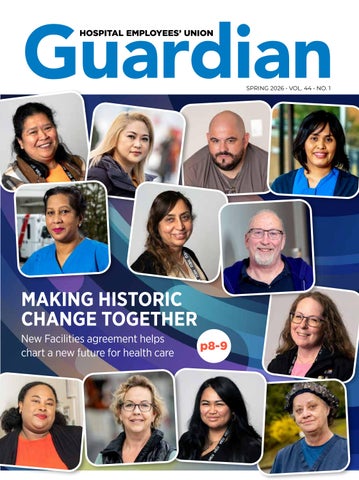
Historic FBA agreement sees historic gains and key improvements | 8
NEWS
Birth of a local
How HEU is organizing in private seniors’ care | 3
Back to the table
Wage levelling ends for fully private sites | 7
A rocky road
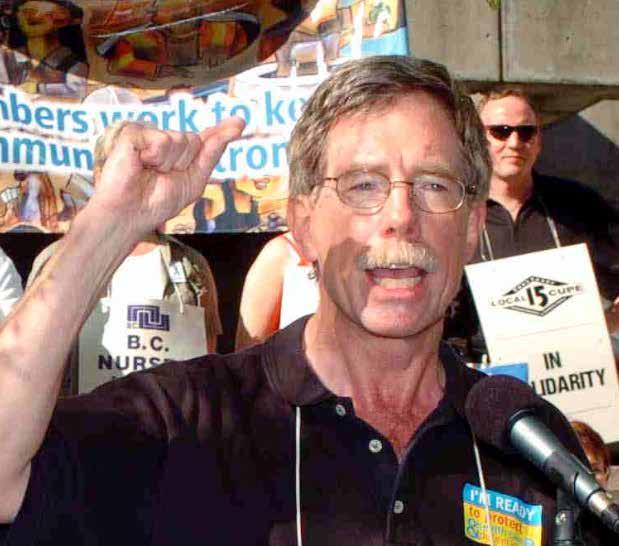
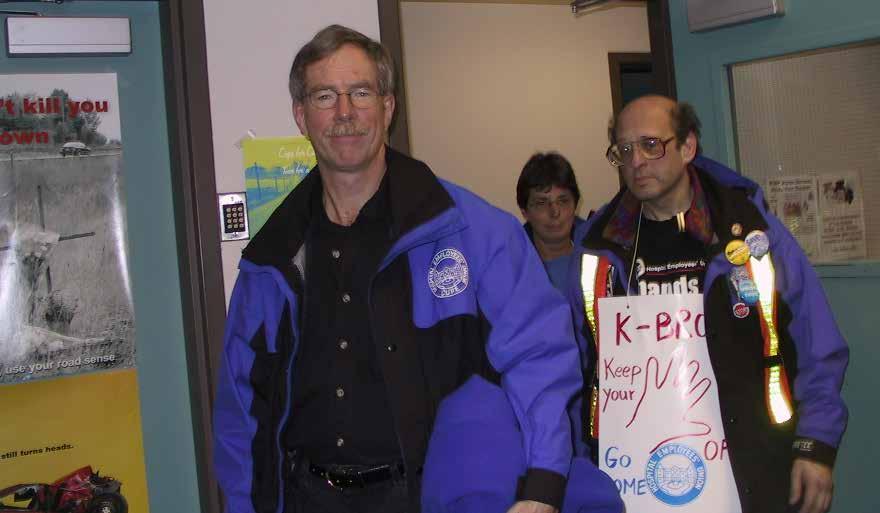
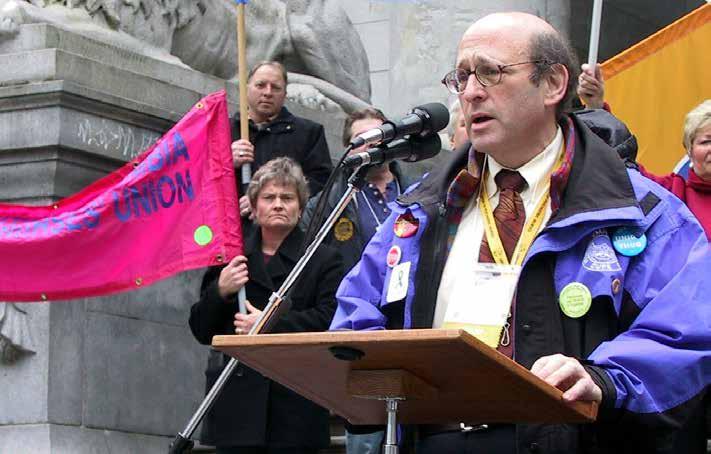
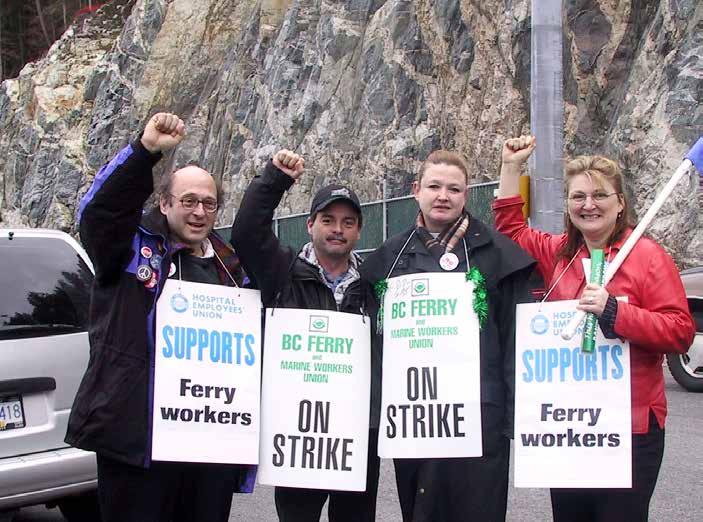
Two HEU leaders navigated tough challenges | 10-11
COLUMNS
Viewpoint
Seniors’ care agreement is real progress at last | 6
President’s Desk
Now is the time to deepen our union’s strength | 6
Hands off!
Government interventions weaken collective bargaining | 12
Repairing seniors’ care
ABOUT 5,000 HEU members working in private sector seniors’ care are expected to be brought into public sector contracts over the next two years, as part of the new Facilities collective agreement ratified in December.
Under this new agreement, operators of eligible privatelyrun care facilities that receive public funding will be required to join the Health Employers’ Association of BC – and workers at these sites will join a multiunion bargaining association.
“This change reflects years of organizing and bargaining by workers determined to fix a fractured system,” says Lynn Bueckert, secretary-business manager of HEU and lead negotiator for the Facilities Bargaining Association (FBA). “Workers stood together and refused to accept a broken system as normal.”
Most of the workers affected by this change will join the Facilities agreement, a key step toward rebuilding a more unified and stable seniors’ care system.
For workers, this means stronger job security, better wages and access to public sector benefits and pensions. For seniors and families, it means more consistent care from workers who can stay in their jobs long term.
That stability has been miss-
ing for decades. In the early 2000s, the BC Liberals aggressively privatized seniors’ care and contracted out services across the province.
Contracts were torn up, wages cut and thousands of workers, mostly women and many racialized, lost access to pensions and benefits. Many were rehired at far lower pay with fewer protections, while others were forced out of the sector.
Contracted seniors’ care workers have spent decades doing publicly funded work with far fewer benefits than their public sector counterparts, in some cases with as few as six paid sick days a year, limited extended health coverage and no pension.
“These are workers doing the same work, caring for seniors, but without the basic protections others have,” says Bueckert. “This change starts to address that injustice.”
Under the agreement, ratified by FBA members on December 19, workers will gain access to public sector wages, benefits and pension plans over a two-year transition. Bringing more seniors’ care workers under public sector agreements reduces fragmentation and raises standards.
“When workers are divided, standards fall,” Bueckert says.
“When workers stand together, conditions improve. That is the power of solidarity.”
Stable jobs are critical to quality care. Seniors benefit when the same workers are there day after day and when staff are not forced to leave for better conditions elsewhere.
“These are workers doing the same work, caring for seniors, but without the basic protections others have,” says Bueckert.
“You cannot deliver consistent, dignified care in a system built on instability,” Bueckert says. “Good care depends on workers being able to stay.”
While this change is a major step forward, it does not include every seniors’ care worker in B.C. Some publicly funded sites remain outside the current transition.
“This framework will improve life for about 5,000 workers, and that matters,” Bueckert says. “But there are still seniors’ care workers doing publicly funded work who are not covered. HEU will keep pushing until that changes.”
SARA ROZELL
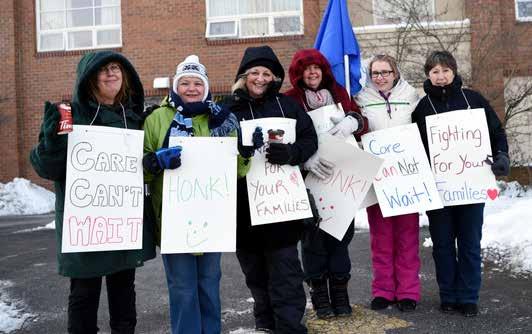
KEEP IT GOING | Seniors’ care workers are the latest group to return to the public sector, a goal HEU members have been supporting since the union’s Care Can’t Wait campaign launched in 2016.
COMMENT
Lynn Bueckert | Secretary-Business Manager
Bargaining this latest FBA agreement gave us new tools to make health care better for members and the people you care for. Now we need to keep pushing forward together.
Major breakthroughs, but much more to do
LAST May, as talks for a new contract entered month four, I wrote to HEU Facilities members and outlined the bargaining committee’s key priorities.
Better compensation, including building on recent efforts to restore pay equity losses. Changes to working conditions by addressing staffing shortages, workload and workplace health and safety. And additional supports for our diverse membership to make workplaces more inclusive.
With these three priorities in mind, your bargaining committee then negotiated hard with health employers for another half year.
By month ten, the committee believed it had secured the best package for members possible. Then came the vote just before Christmas.
The results were close, with 54.2 per cent of Facilities Bargaining Association (FBA) members and two-thirds of HEU locals voting in favour. But that meant 45.8 per cent of FBA members and nearly onethird of HEU locals rejected the package.
What does this outcome tell government, health employers and your bargaining committee?
It says, FBA members know they face challenging times – with demanding jobs and rising household costs. The question is what are we – sisters, brothers, siblings and friends – going to do about it?
Well, first let’s celebrate the major successes achieved.
We have a multi-agreement wage restoration fund worth hundreds of millions of dollars for permanent and ongoing wage increases.
Plus, thousands of HEU members in long-term care who currently have no pension or FBA extended benefits plan will become full members of the Facilities subsector.
Both these changes are generational achievements. Yet there is still much more to do.
Health care remains the most dangerous workplace – five times that of the B.C. average.
Our main option for fighting back is by collectively enforcing the new agreement’s existing and enhanced provisions.
At the same time, too many members struggle with clothing, housing and food costs.
The good news is that government policy is changing. There is recognition for the need for a fair balance between the wages of government and health care workers.
Bargaining this latest FBA agreement gave us new tools to make health care better for members and the people you care for.
Now we need to keep pushing forward together. Advancing workers’ rights and defending public health care.
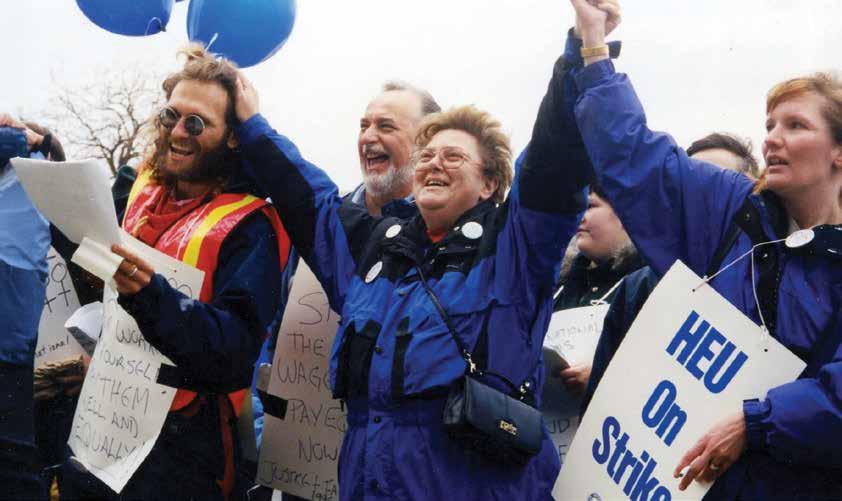
On International Women’s Day in March 1999, 10,000 B.C. community social service workers launched a province-wide strike that would last 11 weeks, demanding an end to wage and benefit discrimination and pay equity with health sector workers. When job action finally ended with a mediated agreement, the wage divide between community social service workers and those working in similar or equivalent jobs in the health care sector was removed. To this day, the community social services job action remains the longest public sector strike in B.C. history.
HEU ORGANIZING
NEWS
Your union. Your paper.
From a whisper to a roar
Seniors’ care sites unionize to give workers a voice.
B.C.’s largest health care union is steadily growing, adding 18 seniors’ care locals in the last year.
Over the past five years, more than 5,000 workers at 75 new worksites chose HEU as their union.
Most new locals are in privatelyoperated long-term care facilities, along with a growing number of assisted and independent living sites.
These workplaces are small, many with fewer than 100 employees. Most work as care aides or in support services, alongside other staff including licensed practical nurses, activity workers, and concierges.
Typically, an employee will connect with an HEU organizer and quietly begin gathering support from their co-workers.
Improvements in wages, extended benefits and sick time are always key. But just as frequent are complaints of management favouritism – being excluded from good shifts, new postings for regular hours and overtime at the whim of the owner or manager.
Pro-union workers move carefully. Meetings are held outside the workplace. They approach colleagues discreetly and help HEU organizers build a contact list of supporters. Membership cards are signed confidentially and collected by the union.
Union certification is granted by the Labour Relations Board (LRB),
YOUR UNION
HEU convention 2026 dates set
HEU’s 35th biennial convention takes place November 1 to 6 in Vancouver.
Each HEU local is eligible to send at least one delegate (depending on local size) and may submit proposed resolutions and constitutional amendments.
Delegates must be elected by their local at a local meeting with quorum and have attended at least half of regular local meetings in the previous 12 months.
Find out more at heu.org/howget-convention
who verify membership sign-ups, hold a vote if needed, and ensure labour laws have been followed during the organizing period.
The best outcome, organizers say, is to achieve an automatic certification.
Thanks to B.C.’s new “card check” system instituted in 2022, if more than 55 per cent of employees sign cards, the LRB awards certification, and they become a bargaining unit.
If between 45 and 55 per cent of employees sign cards the union can still apply for certification, but a general vote must be held.
There are labour law protections in place for workers during a union drive, but employers can apply
pressure in many ways.
Some claim they will go out of business, if workers organize. Others may announce raises to match union rates, quickly hire new casuals to dilute union support, or even threaten employees with termination.
Still, it is rare for a vote to fail, HEU organizers say. Union activists at a worksite usually have their ear to the ground, and know when their co-workers are ready to “vote union.”
Once certification is awarded, a first local meeting is held and a local executive elected. The next step is to bargain a first contract –only when that’s done, do workers
Welcome new members
The union welcomes more than 900 new members at 12 locals who made HEU their union of choice since last summer.
HEU now represents 21 workers at Harmony House in Vancouver, six new members at Beulah Gardens Adult Day Centre in Vancouver, and 15 rehabilitation assistants and support workers with Cheshire Homes in Langley.
We give a shout out to 110 care aides, along with nursing team members working for CareCorp at AgeCare Sun Rivers in Kamloops, and another 28 work-
ing for Aramark at the same site in housekeeping, the laundry and food services.
Chartwell Vista in Esquimalt brings 42 care aides, nursing and concierge workers. At Sunrise of Killarney in Vancouver, 88 new members work as care aides, activity aides, servers, dishwashers, cooks, room attendants, concierges and on the nursing team.
From Hilton Villa Seniors Community in Surrey, we welcome 151 employees working as care aides, activity workers, rehabilitation assistants, and on the nursing team.
At the Mayfair in Abbotsford, 120
have the rights and benefits of a collective agreement.
HEU holds about 140 independent contracts, covering about 13,500 members – each one representing a hard-fought campaign by determined workers.
But there are changes coming to this sector, as part of the new Facilities collective agreement ratified in December. About 5,000 HEU members working in private sector seniors’ care are coming into public sector contracts over the next two years. You can read more about this agreement on page one of this Guardian.
ELAINE LITTMANN
new members of SureCare Staffing work as care aides, as well as in nursing, recreation, food services, housekeeping and the laundry.
CK Staffing Services Ltd. at The Madison Care Centre and Lakeshore Care Centre brings 50 employees working in housekeeping, food services and recreation.
Sunrise of Vancouver sees 139 new members working in food services, maintenance, activities, and sales.
And finally, at Hamlets at Penticton we welcome 150 new care aides along with staff in nursing, housekeeping, recreation, food services and maintenance to the HEU family.
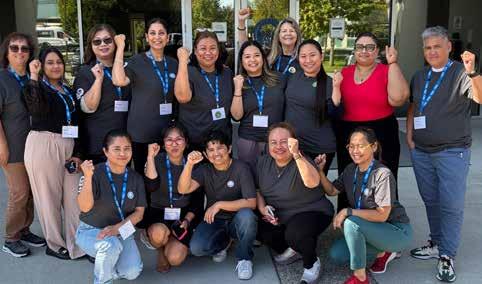
PULLING TOGETHER | HEU bargains 140 independent contracts, covering about 13,500 members. Each agreement represents a hard-fought campaign by determined workers, like these brand-new members at Hilton Villa in Surrey.
Employment standards may not apply to all
A B.C. labour arbitrator has ruled that in a unionized workplace, a collective agreement must “meet or exceed” the minimum standards for working conditions set by the Employment Standards Act (ESA) for the bargaining unit as a whole – not for individuals or groups of employees.
This decision means that the standards in the ESA, which are generally considered to be the “floor” for working conditions and provide a minimum level of protection for all employees, may not apply to some workers in a bargaining unit. Those workers, often temporary or casual employees, may not enjoy the same rights and protections as others working under the same collective agreement.
The decision was made in the context of a group grievance brought by the BC Ferry and Marine Workers’ Union, which argued that the collective agreement’s scheduling and overtime provisions for BC Ferries’ casual and seasonal employees resulted in those employees working longer hours and longer work weeks without overtime – which the union argued was contrary to the ESA. The arbitrator disagreed, and concluded that the ESA does not require that its standards apply to every employee at all times.
This decision is an important reminder for HEU members to review their collective agreements carefully to understand their rights, especially with respect to hours of work, vacation pay, statutory holidays, overtime, and job security.
NOA MOSES
Measuring up
Benchmarks describe general job requirements
BENCHMARKS are a way of classifying all jobs in the Facilities Bargaining Association to determine a standard wage grid.
Every job is assigned to a benchmark, but the benchmark is not a job description – it is a broad measure of the level of responsibility, qualifications and skills required. It is not a measure of the value of the person doing the job, or how hard or how well they work. And although benchmarks determine pay grid, benchmarks are not changed or added in order to increase wages.
The only way to make a case for a new benchmark is to prove that the level of responsibility, or the required qualifications or skills for a job have changed.
HEU’s current benchmark system was bargained into the FBA collective agreement in 1987, through negotiations between the union, the employer and an outside arbitrator.
Requests for a benchmark review usually begin with a bargaining proposal submitted by a local. This must be passed at the bargaining conference, and then taken to the bargaining table for negotiation with
the employer.
An option for members who feel their job description does not match its benchmark is to initiate a job review request. This process does not change the job classification system – it is a request to move you as a worker to a higher benchmark, such as moving from Assistant II to Assistant III. Start this process by talking to your shop steward.
You will need to get a copy of your current job description and the benchmark the employer has matched you to. Make a list of ongoing and required duties that you consistently perform that exceed your current benchmark.
You will also need to match the duties you believe exceed your current benchmark to a higher benchmark in the same job family and class series. Pay particular attention to the “Level” definition, which often describes supervisory duties.
FBA members can find their benchmarks on the HEU website heu.org/collectiveagreements/facilities
ELAINE LITTMANN
New commissioner for HEU ethics office
The Hospital Employees’ Union has appointed Jess Hadley as its new Ethics Commissioner.
The HEU Ethics Commissioner, who is an independent officer in a two-year term, plays a pivotal role in shaping the union’s Ethics Office by building the foundational systems, strategies and relationships needed to support this critical work.
The HEU Code of Conduct sets out standards and expectations of members on HEU’s Provincial Executive and provides a process
for Provincial Executive members, HEU members, and HEU employees to make confidential requests and formal complaints regarding potential breaches of the Code.
Hadley is an experienced labour and employment lawyer, mediator and investigator who specializes in resolving workplace issues of discrimination, bullying, harassment, and other misconduct.
Hadley replaces Ritu Mahil, who recently accepted a vicechair position at the B.C. Labour Relations Board.
Find out more at heu.org/heuethics-commissioner-office
NOW ON TO BARGAINING | At the Mayfair seniors’ home in Abbotsford, 120 new members joined HEU last September, working as care aides and in nursing, recreation, food services, housekeeping and laundry.
HEALTH AND SAFETY
Workers bring safety solutions
IN Josephine’s Cayabyab’s longterm care facility in Kelowna, coworkers came to her with a health and safety concern involving how residents were transported to meals.
Josephine is a joint occupational health and safety (JOHS) committee worker representative, as well as a shop steward and vice-chair at her Spring Valley local. And she had just completed an HEU occupational health and safety training, so she saw a chance to use some of the tools she learned.
Each meal time, care aides help residents down to the dining room on the main floor, and then back up to their rooms.
But several residents were in Broda chairs – a type of heavy-duty medical wheelchair that can weigh
up to 100 pounds.
Care aides told Josephine they were getting hurt navigating the heavy chairs, and were looking for a better way – especially when one of the two elevators was out of service.
Josephine started with two steps she’d learned in the workshop –body mapping and hazard mapping.
Body mapping identifies where on the body injuries typically show up. This helps understand which parts of a task, like pushing, pulling or lifting, are hazardous.
Hazard mapping identifies where in the workplace these occur.
With this documentation done, Josephine and her colleagues suggested creating a small meal area on the second floor.
Residents would still eat in a social setting, and one care aide could stay while the other brought meals from the dining room. They scoped out rooms that could work, and brought this proposal, along with the hazard maps, first to their supervisor, and then to the JOHS committee.
The best way to success, Josephine says, is “to come with a solution. Workers know what they need and the best way to do the work.”
The manager agreed to trial the new plan for a week, and ended up doing it for several months. There are now fewer residents in the heavy chairs, she says, so they are thinking of going back to the earlier system.
But the good news is that the
workers’ solution is now written into the workload plan, so it exists as a permanent option for the future.
“If care aides are safe, we can provide good quality care, and have more time to spend with residents,” she says.
Josephine has worked at Spring Valley for 16 years, and helped unionize the site in 2023. She has since seen a big change in workers’ willingness to speak up about safety issues.
“Before, it was harder to speak out about our concerns. But now, we feel we have a voice,” she says.
She also makes sure other members on the JOHS committee get the training they are entitled to – eight hours of education for all new representatives, and then eight hours per year.
“If we are not going to educate ourselves, how can we advocate for others?”
Find out more about JOHS committees, and how to become a worker health and safety representative at heu.org/johs-committees online.
Workers rights
Wednesday webinars
HEU has a free webinar series to share important information about worker rights, how the union works, and where to go for help when issues arise. And you’re invited!
This series of one-hour webinars is open to all HEU members, especially workers who joined the union recently. These are meant to be attended outside work hours, and are not eligible for paid education leave.
Find out more at heu.org/education/workshops/workers-rightswednesday
Regional meetings set
HEU members will have an opportunity to gather closer to home and meet with their regional vicepresidents this spring and early summer.
Coastal members will meet in Burnaby April 27 and 28, Island members in Nanaimo May 4 and 5, while Fraser gets together in Surrey May 26 and 27.
Members in the Interior will meet June 2 and 3 in Kamloops, and in the North the regional meeting is June 9 and 10 in Prince George.
ELAINE LITTMANN
WORKING TOGETHER | Workplace joint OHS committees are one of the most important ways the union can ensure employers are meeting their health and safety responsibilities.
A FORCE FOR GOOD | Active stewards came together at the Provincial Office in September for the union’s Shop Steward Level 2 workshop, to build their skills and practice problem solving.
Josephine Cayabyab
GETTING THE WORD OUT
OUR communications team works to connect members with HEU’s services and supports, through membership communications and outreach, creating resources and educational materials, connecting members with leaders, supporting bargaining and organizing, building campaigns, event planning and much more. Plus they help connect HEU with the world through media relations, advertising and news. They’re also an ever-ready resource for other departments, including OH&S, research, equity and education.
Betty Valenzuela | Financial Secretary
VIEWPOINT
This agreement reflects years of organizing, bargaining and solidarity by workers who refused to accept a broken system as normal.
I OFTEN say that strong public health care depends on one thing above all else: people.
When health care workers have stability, fair wages and real protections, they are able to stay in their jobs. And when long-term care workers stay, seniors receive better, more consistent care from familiar faces who know their needs, routines and stories.
That is why the new long-term care agreement reached through the Facilities Bargaining Association is so important.
This agreement is historic.
It sets out a clear path to bring approximately 5,000 seniors’ care workers at eligible publicly funded contracted sites back into public sector collective agreements over the next two years.
For workers, this means greater stability and improved working conditions. For seniors and families, it means better care.
Living with constant uncertainty
The privatization of seniors’ care under the former B.C. Liberal government created deep instability across the sector.
Workers doing the same demanding jobs as those in public care homes were paid less, had fewer benefits and lived with constant uncertainty. Many were pushed out of the sector altogether.
The result was chronic understaffing, high turnover and a system stretched beyond its limits.
For years, fairness was out of reach for many seniors’ care workers.
Even though their work was publicly funded, contracted operators were not required to be part of the Health Employers Association of BC (HEABC). That meant workers providing the same essential care did not always have access to the same fair wages, benefits, pensions and job security.
Refusing to accept a broken system
This agreement begins to repair damage that took decades to create. It reflects years of organizing, bargaining and solidarity by workers who refused to accept a broken system as normal.
What matters most to me is that this progress was not achieved by individuals acting alone. It happened because workers stood together and bargained not only for themselves, but for their co-workers and for the future of care in this province.
There is still more work to do. But this is real progress.
Four years gives space to implement, build, and enforce. And space to make sure the words on paper become real improvements on the floor.
IN THE seven plus years I have been your president, I can’t think of a more pivotal and promising time ahead for our union, filled with both opportunity and hard truth.
As the saying goes, may you live in interesting times. In working class life, “interesting” usually means expensive, exhausting, and unfair. So let me say this plainly. I see what you are carrying.
You are dealing with a cost-of-living crisis as groceries get more expensive.
Rent and gas climb while your workload rises with them.
You are navigating short staffing, burnout, and constant pressure to “make it work.”
Then there are the external challenges we collectively face as an organization that builds power with and for working-class people.
Time to deepen our strength
Conservative politicians and governments continue to wreak havoc in public health care every day. Corporations continue to push privatization. And anti-labour influencers seek to divide union members.
Despite all these obstacles, I believe now is the time to deepen our strength as a union.
First, with a landmark four-year contract that covers more than 80 per cent of HEU members in hand, we have something working people rarely get — breathing room.
There is space to implement, build, and enforce. And space to make sure the words on paper become real improvements on the floor.
Second, there is no planned federal or provincial election between now and the fall of 2028 that we need to mobilize around.
And third, we have a provincial executive that is united around delivering on HEU’s five-year strategic plan.
Now we get down to business
Our union can now double down on HEU’s core business.
More education for stewards and activists. Helping locals feel supported, connected and confident. Enforcing the rights we fought for.
It also means building community inside our union. Where we talk to each other, show up for each other, and disagree without turning on each other.
In divided times, unity is not a vibe, it is a strategy. It’s how we stay effective, credible, and unshakeable when pressure hits.
I see a bright future for B.C.’s oldest and largest health care union.
The next chapter of HEU is not something that happens to us. It’s something we build, together.
Barb Nederpel | President PRESIDENT’S DESK
Michelle Fournier
PHOTO
SENIORS’ CARE
Fully private sites lose wage levelling
AFTER the province announced last summer that wage levelling at fully private seniors’ care sites would end December 31, HEU moved quickly. Within weeks, approximately 2,000 HEU members at 31 affected long-term care and assisted living worksites engaged in wage reopener negotiations using collective agreements protections to mitigate potential wage losses.
“For five years, members delivering care at fully private seniors’ care homes depended on wage levelling,” says Lynn Bueckert, HEU’s secretary-business manager. “When we learned it was ending, HEU acted quickly to protect those workers and negotiate better wages to offset the difference.”
Wage levelling was introduced in the spring of 2020, at the start of the COVID-19 pandemic, as part of the province’s public health response.
At the time, many seniors’ care workers held multiple jobs at different facilities to make ends meet. When the province restricted workers to a single site to reduce the spread of COVID19, wage levelling ensured they would not lose income.
Under the policy, wages at both fully private and publicly contracted care homes were raised to match public sector collective agreement rates.
“Wage levelling helped stabilize a deeply fractured system at a critical moment,” says Bueckert. “It protected workers’ livelihoods, supported continuity of care for seniors and showed what’s possible when the same work is valued equally across the system.”
HEU brought in long-time mediator Vince Ready to support wage reopener discussions and full-scale renewal collective bargaining through mediation at critical tables. His involvement helped locals navigate what was often a complex and uneven landscape, particularly at sites where employers had resisted meaningful wage bargaining for years.
During the five years wage levelling was in
YOUR UNION
You’ve got mail
Coming this March, members should be sure to check their mailbox for a special package from HEU.
Inside the mailing members will find the HEU 2026 Priorities report, outlining the union’s strengths and key gains since 2023. As well, members can read a high-level update on the HEU’s 2023-2028 strategic plan – what’s been accomplished and what more needs to be done.
Members are encouraged to complete the enclosed Member Experience Survey to provide
SAME WORK, SAME PAY | The union’s long-term goal remains clear: wages at all privately funded sites should be equivalent to public sector wages.
place, many employers refused to negotiate wage grids. With limited wage progress, HEU secured improvements in sick leave, extended health benefits, shift premiums and retirement savings plans.
Through wage reopener negotiations, many locals were able to reduce the impact of the end of wage levelling, albeit with some regrettable wage reductions. Bargaining committees took action to make the best of a challenging situation. In some cases, employers agreed to maintain Facilities Bargaining Association (FBA) equivalent wage rates even after wage levelling ended. As with all collective bargaining, outcomes varied from contract to contract, reflecting differences in employers and bargaining history.
The union’s long-term goal remains clear:
valuable feedback on how you engage with the union. Members can either complete and mail back the paper version provided, using the postage-paid envelope, or submit their answers online.
“We need all members to be part of making our union even stronger and more united as we take on the big challenges – and opportunities – coming over the next couple of years,” says HEU secretary-business manager Lynn Bueckert.
wages at all privately funded sites should be equivalent to public sector wages.
“Same work should mean the same pay, no matter who owns the building,” says Bueckert.
Most affected locals are expected to return to bargaining this year or next with a renewed focus on improving wages. At the same time, wage levelling continues at sites that receive a majority of their funding from public sources and is guaranteed until March 31, 2027.
Looking ahead, it is estimated that more than 50 HEU seniors’ care sites will transition back into public sector collective agreements under the seniors’ care framework recently negotiated as part of FBA bargaining (see story on page one), further advancing the goal of stable, fair wages across the sector.
SARA ROZEL
DEMOCRACY IN ACTION | Members at Vanderhoof local at St. John Hospital in Northern Health celebrate their new elected local executive. Local elections are held every year between January and April.
A HISTORIC FBA AGREEMENT
Coming out of one of the longest rounds of Facilities bargaining in a generation, the new 2025-2029 collective agreement addresses past injustices while making health care better for workers, patients and residents
Wage restoration agreement confirms $245 million in new funding for wage increases
It’s been a long time coming.
With this Facilities agreement, nearly a quarter billion dollars in new provincial investments to support wage increases for members are now committed. And with this funding in place, the goal of restoring pay equity in health care in B.C. just took a giant leap forward.
To recap, in 2004, the B.C. Liberal government cut wages to members covered by the Facilities agreement, as part of back-to-work legislation. This was through an 11 per cent wage cut and an unpaid increase to weekly hours equivalent to a four per cent cut – for a total wage cut of 15 per agreecent.
When they were introduced, those cuts erased years of progress toward achieving pay equity and comparability in the Facilities subsector stretching back to the 1970s.
In the last round of Facilities bargaining during 2022, the Facilities Bargaining Association (FBA) secured an unprecedented agreement with health employers and government to review the impact of these historic wage cuts, and especially their effect on previous pay equity and comparability adjustments. The agreement at the time also secured a down payment to address these cuts.
Flash forward to last August, when the framework outlining the BCNDP government’s wage restoration commitment was released, Minister of Health Josie Osborne stated “the pay cut in 2004 was unjustified.”
Moreover, Minister of Finance Brenda Bailey affirmed in the same announcement that Facilities workers “deserve to be compensated appropriately.”
By the time the FBA secured a tentative agreement in late November, health employers and government – as
MAKING CHANGE | HEU bargaining committee representatives Seema Loodu and Barb Owen discuss bargaining strategy during talks with other FBA members (right), FBA committee chair and HEU care aide Chena Binns oversees the nine-union bargaining association during the 10-months of talks.
part of a commitment to fairness and justice for Facilities members – agreed to continue wage restoration over the next three collective agreements.
“Building on the breakthrough wage restoration work of the last contract, the Facilities Bargaining Association (FBA) secured significant commitments to fund permanent and ongoing wage increases in each year of this collective agreement,” says FBA lead negotiator and HEU secretary-business manager Lynn Bueckert.
“Moreover, these wage adjustments are over and above members’ annual general wage increases.”
For the 2025-2029 FBA agreement, the government is allocating $60.5 million to fund permanent and ongoing wage increases in each year of the contract. When this contract expires, the government will have invested more than $245 million between 2023 and 2029 to ensure FBA members’ wages keep up with B.C. government workers doing similar jobs.
But the good news continues beyond 2029.
“In the following two collective agreements, the government has also agreed to provide additional funding for future wage adjustments,” says Bueckert.
“On top of these economic improvements, the Minister and this government have stated repeatedly what was done to HEU members and public health care in 2004 was wrong,” says Bueckert. “And while we can never make up for the impact of the BC Liberals’ disastrous policies, moving forward with this renewed wage restoration plan continues healing these deep wounds.”
NEIL MONCKTON
Highwire talks: Securing historic gains in tough economic times
For HEU’s secretary-business manager Lynn Bueckert, when ballots were tallied on December 19 in one of the closest ratification votes in recent memory, the outcome told two distinct tales.
“Throughout the bargaining process, members were steadfast about their priorities for what bargaining needed to achieve in this round,” says Bueckert, who also led negotiations for the 67,500 Facilities members. “Members were clear from the get-go that keeping and attracting health care workers is the best investment B.C. can make to improve health care.”
“At the same time, the closeness of the vote in B.C.’s largest public sector bargaining association also shows government and health employers that far more needs to be done to support our members so they can deliver the care British Columbians want and need,” says Bueckert.
Effective April 1, 2025, the four-year Facilities Bargaining Association (FBA) agreement includes general wage increases of three per cent each year, along with important gains that support recruitment, retention and safer, more sustainable workplaces.
The ratification of the contract also secured a multi-agreement wage restoration plan to continue repairing the damage caused by the BC Liberals’ vicious 2004 wage rollbacks.
“Considering the challenging economic times we face in B.C and across Canada, the wage restoration plan is a landmark victory for health care workers,” says Barb Nederpel, HEU president and FBA bargaining committee member. “This plan recognizes historic wrongs and continues to advance work to ensure members’ pay keeps pace with comparable public sector jobs.”
“And this is not just for this agreement –health employers and government committed to extending restoration measures beyond 2029, in permanent and ongoing wage adjustments over the following two agreements,” says Nederpel.
Another major gain of the agreement takes a significant step toward fixing the fractured seniors’ care system. This deal begins reversing
years of privatization that led to wage reductions and high staff turnover across long-term care and assisted living.
“Previous conservative-leaning governments brought in policies that created a surge in staff turnover as employers chased cheaper labour,” says Betty Valenzuela, HEU financial secretary and FBA bargaining committee member. “Many new workers left as soon as they arrived, not because they didn’t care, but because they couldn’t afford to stay.”
By September 30, 2028, government will restore common wages, benefits and working conditions for several thousand unionized workers in privately operated long-term care and assistedliving worksites currently excluded from the FBA (see page one for a full story).
“It was 10 months of challenging negotiations, but all 13 HEU members on the FBA bargaining committee worked hard to secure the best deal possible for our members,” says Chena Binns, FBA bargaining committee chair and HEU care aide. “In the end, I am gratified to know members supported our recommendation to adopt this historic agreement.”
The majority of FBA members from across the nine-member union bargaining association -- 54.2 per cent – voted to accept the tentative collective agreement. Moreover, as per HEU’s constitutional requirement, members in two-thirds of the union’s 161 Facilities locals were in favour.
“With ratification of the 2025-2029 agreement in the rearview mirror, work is now underway with the Health Employers’ Association of BC (HEABC) to implement the 80-plus provisions of this renewed collective agreement as quickly as possible,” says Bueckert.
Until the new collective agreement is available, members can read the comprehensive report for full details on the 2025-2029 FBA collective agreement at heu.org/facilities-comp-report online.
General wage increase of 3% each year for a total of 12% over the four-year term.
Multi-agreement wage restoration plan
Enhanced bereavement and special leaves.
Premium increases for weekend, evening and night shifts and trades qualification holders.
New benchmarks and rates of pay for porters and porter supervisors.
Continued funding for the FBA Education Fund, Enhanced Disability Management Program, and employeeinitiated rotation proposals.
Improved health and safety language.
New measures to support job sharing, make improvements to mobility and portability, and establish a working group on regularizing positions.
More dedicated shop stewards in our largest work sites and two new occupational health and safety advocates.
Added supports for Indigenous workers.
New pilot to provide flexibility and time off for cultural celebrations.
Extending FBA agreement to thousands of HEU members working at privately operated long-term care and assistedliving facilities.
OVERCOMING PAY INEQUITY: | Looking back at Facilities’ general wage increases (GWI) since 1993, it’s clear members’ current economic concerns are firmly rooted in the 15 years of wage stagnation under former B.C. Liberal governments. That’s why the current BCNDP government’s commitment to a new multi-agreeement wage restoration fund is key for FBA members, providing a clear path for ongoing and permanent wage adjustments in addition to the annual GWI.
NEIL MONCKTON
A leader in HEU’s toughest times
Fallout from Bill 29 marked biggest challenge for secretary business-manager Chris Allnutt
IT has been said that the greatest heroes are those who remain unsung. Chris Allnutt, former HEU secretary-business manager, qualifies. After suffering from Parkinson’s Disease for more than 15 years, he opted for MAID – medical assistance in dying – last September 21, at age 74.
Chris joined HEU staff as a researcher in 1989, before taking on the secretary-business manager position in 1996.
“I love HEU and I love the labour movement,” he said in an interview last September.
As a Toronto University graduate, Chris began doing research for small labour unions and moved to B.C. in the early 1980s.
His first big challenge was the closure of the Shaughnessy Veterans Hospital in 1993, when the new BCNDP government began to implement a more community-focused public health care service model.
This approach changed seniority rights based on each facility to a province-wide model, and involved retraining and re-assignment. “It was the first time in Canadian labour history that anything like this had been done,” Chris said.
“It was the beginning of the BC Health Accord, but they didn’t know how to do it,” Chris said. “They hadn’t discussed anything with health care workers – we had to show them how.”
But his biggest challenge took place in 2004, under the BC Liberal regime with its unpopular
thousands of workers, along with a 15 per cent wage cut.
“We were leaked a list of hospitals to be closed, including the loss of over 20,000 jobs, along with the consolidation of smaller facilities in rural areas that would leave entire communities without any health care support,” Chris said. “We tried to work with the government to come up with some kind of compromise – that wouldn’t end up happening.”
That bargaining impasse forced members out on a province-wide strike. The government imposed a back-to-work order – which members defied.
He knew the union membership could not afford such a drastic pay cut. But the bargaining committee managed to win a cap on contracting out and severance for displaced workers. Chris recommended the HEU executive accept this deal. It narrowly passed.
“I asked ‘what would we have gotten if we had stayed out,’” he said. “What kind of reaction would there be, if any worker had been fired? I knew we had a good legal case. Taking them to
court made sense.”
In a landmark 2007 decision, the Supreme Court ruled Bill 29 as unconstitutional.
But this history-making ruling came too late for Chris. The union’s anger over the pay cut, and accusations the leadership had been too timid, caused the executive to terminate him after the union voted to accept the deal.
However, many HEU members and colleagues remember Chris with fondness and respect.
“He was an outstanding human being,” says former HEU secretary-business manager Carmela Allevato. “Chris was kind, brilliant, strategic and he cared deeply for HEU members. It was an honour to have worked with him.”
Chris went on to join Rainforest Solutions Project as its project director and helped develop protected areas and more sustainable logging practices on B.C.’s central coast. That resulted in a tripartite agreement between the provincial government, First Nations and corporate interests in 2016. It has been heralded as a breakthrough in land use and shared futures.
A deep commitment to fairness
Popular president Fred Muzin stood up for pay equity and private sector health care workers
HEU members also said good-bye to longtime union president Fred Muzin, who passed away at his home on Vancouver Island last September 5.
He first helmed the presidency in 1993 and served for eight terms until his retirement in 2008.
Fred focused his efforts on winning pay equity, staunchly promoting universal public health care and achieving the Health Accord with the new BCNDP government. He also strongly promoted organizing health care and other support workers in the growing private care sector.
“A health care worker is a health care worker, regardless of where they work,” he said in an interview on the community Co-op Radio program Union Made while serving as the HEU president. Fred explained further:
“We [the union] say that universal public care is the best way to go. But that doesn’t mean forgetting about workers in the private care sector. No one ever asked their views. They are out there doing the best they can. And if they’re good enough to be providing care to people, they’re good enough to deserve union representation and win some rights and benefits.”
Fred graduated from McGill University in Montreal, where he got involved in social justice activism before coming to B.C. in the late 1970s. He worked as a biomedical engineer at St. Paul’s Hospital where he first joined HEU.
His biggest challenge was standing up against the B.C. Liberal government’s move to dismantle public health care across the province in the early 2000s.
Along with HEU secretary-business manager Chris Allnutt and financial secretary Mary LaPlante, Fred led the union through the layoffs and wage cuts, a province-wide strike, a back-to-work order and the controversial settlement
that followed.
All three were arrested in 2002 during a blockade at Chilliwack Hospital protesting the trucking of dirty laundry to Alberta under the BC Liberals’ privatization scheme.
While Chris, in his appointed position as secretary-business manager, was terminated by the HEU provincial executive after the strike, Fred was re-elected by HEU members and continued as president until he retired in 2008.
He drove a community shuttle as a member of the Canadian Auto Workers (now Unifor) for four years before mov ing to Courtenay with his wife, stepchil dren and grandchildren. He was 75.
GOOD TO GO | “Today we have a strong and stable union because our members have shown solidarity and resilience in the face of adversity,” Muzin said in 2008, at the end of his 15-year run as HEU president.
LABOUR
JOB ACTION
Get your hands off our strike!
How government intervention is weakening collective bargaining
SEVERAL major strikes have made headlines recently for all the wrong reasons.
In the last few years, the federal government has intervened when railway, port, airline and postal workers engaged in job action.
While government intervention isn’t new, there’s a concerning change in the strategies being used and how they’re shifting the balance of power in labour disputes.
Typically, governments relied on legislation to end strikes. This meant introducing a back-to-work order as a bill which had to be debated and passed. Increasingly, however, governments are using tools that allow them to act quickly and without debate or public feedback.
By invoking section 107 of the Canada Labour Code, the federal
Increasingly, governments are using tools that allow them to act quickly and without debate or public feedback.
Minister of Labour can order the end to any job action by federal workers.
Recently, it was used to force Canada Post and Air Canada workers back to work. But it proved to be unenforceable when Air Canada employees refused to return to
work and CUPE National president Mark Hancock ripped up the order in defiance.
At the provincial level, Alberta made history in October by invoking the notwithstanding clause from the Canadian Charter of Rights and Freedoms in its Back to School Act to end the teachers strike. Never used in this context before, the clause overrode the Charter’s freedom of association and stripped teachers of their right to strike.
“Workers have one tool at their disposal, which is the power to withdraw their labour,” labour and social movement expert Barry Eidlin told CBC. “If you undermine that power, that tilts the playing field and makes it much harder to reach an agreement at the bargaining table because it removes the incentive of the employer to actually come to the table.”
During the 2025 strike, Air Canada CEO Michael Rousseau admitted the company had not prepared for major disruptions because it expected the government would step in.
HEU members know the lasting consequences of back-to-work orders all too well. During the 2004 Facilities Bargaining Association strike, the B.C. Liberal government passed Bill 37, forcing members back to work and imposing binding arbitration that included a 15 per cent wage rollback. It wasn’t
Air Canada flight attendants at Vancouver Airport in Richmond joined their union’s actions across the country, defying the federal government’s back-to-work order last August.
until 2022 that members started to see wage restoration under the BCNDP government.
Unions such as the Teamsters and Canadian Union of Postal Workers are arguing in court that the repeated use of Section 107 violates the Charter protected right to strike and weakens the collective bargaining process. The Canadian Labour Congress and unions across the country are making their voices heard as well, calling the use of Section 107 unconstitutional and for it to be removed from the
Canada Labour Code.
The Alberta Teachers’ Association has filed a constitutional challenge against the Back to School Act and applied for an injunction to reverse the back-to-work order. If successful, it could put the teachers back in a position to strike by March.
Staying informed, standing in solidarity and speaking out when rights are threatened are ways every worker can help protect collective bargaining rights.
MAIA SAMPSON
Care aides honoured
Two HEU care aides have been honoured by different health care agencies for their outstanding performance.
Kulvie Sidhu from Yucalta Lodge in Campbell River was lauded as an “Everyday Champion” by Health Quality BC for her “quiet yet powerful leadership, and unwavering commitment to resident-centred care.”
“Kulvie leads by example, demonstrating strong leadership and a solutions-focused mindset while empowering others,” says Kulvie’s Island Health manager.
Lindsey Vukicevic, a care aide in the Surrey Memorial emergency room, was bestowed an “Above and Beyond” award from Fraser Health for her calm and compassion in a challenging job.
The award announcement called her “a pillar of positivity, she is known for leading by example with a compassionate ear and a reassuring smile. She is a true role model of patient-centred care and her passion for helping others is contagious.”
“I am so proud to represent all the care aides, and the HEU,” Lindsey says.
Former SBM pens memoir
Former HEU secretary-business manager Judy Darcy has published a memoir of her life and career called Leading from the Heart: The Battles of a Feminist, Union Leader and Politician
Originally a library worker, Judy rose to national president of the Canadian Union of Public Employees. She led HEU from 2005–2011, and then served as an NDP MLA from 2013–2020, eventually appointed as Minister of Mental Health and Addictions.
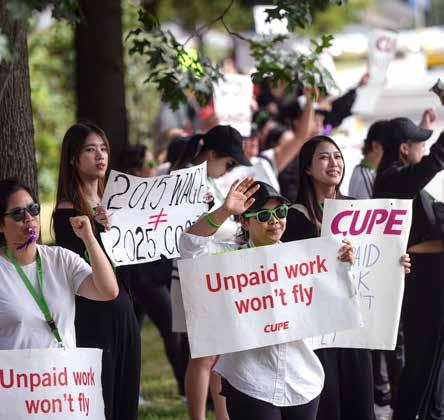
UNPAID WORK WON’T FLY |
Canadian Press / Darryl Dyck PHOTO
ABOVE AND BEYOND | Surrey Memorial care aide Lindsey Vukicevic accepts Fraser Health Hero award.
STANDING UP ALWAYS
During her early years in Fiji, Suman Edwards spent many hours swimming and climbing trees with her brothers and cousins.
“If they were doing it, I was doing it too,” says the 58-year-old HEU member and local activist. “I am not one to sit on the sidelines and watch.”
In 1978, as a child she immigrated to Canada with her family. In adulthood, her diverse career path and experience as a family caregiver led her to work in long-term care.
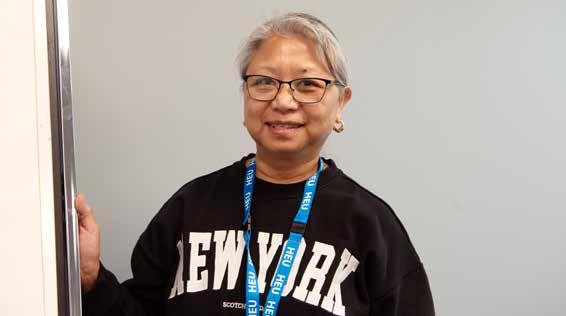
“It was a natural fit,” says Suman. She was instrumental in organizing the certification of Rosewood Manor in Richmond, where she works in support services. She has been a union member since 2023 and a shop steward since 2025.
From organizing rallies and supporting election campaigns to her involvement with the Canadian Labour Congress, Suman sees it all as “part of strong local building that supports members, because no workplace is without its challenges.”
A highlight of her work day is talking with residents, as she finds that “sometimes a smile or a hand on a shoulder brings them comfort.”
Suman approaches local building similarly.
“I will always stand up for members,” she says.
SHAHEEN SHIVJI
FBA members see benefits improvements
HEU members in the Facilities Bargaining Association (FBA) will see improved extended care benefits for vision, hearing, orthotics, and preventative vaccines, along with renewed access to a pilot project for mental health and wellness support.
The mental health program, which is extended until the end of 2027, covers a wide range of registered counselling services in person or online, with a combined annual limit of $1,500 per person.
At work in Vancouver’s Downtown Eastside, Megan Johnson draws from her own experience to support those struggling with addiction.
Getting through it together
ON THE JOB
It’s Monday morning.
Megan Johnson is walking down East Hastings Street on her way to work as a pharmacy technician at Providence Crosstown Clinic in Vancouver’s Downtown Eastside.
With her breakfast in hand, she stops to chat and share her granola bars with familiar faces she affectionately refers to as “street friends.” After eight years working in the area, this is still her favourite part of the day.
As someone who struggled with addiction for 20 years, Megan knows recovery doesn’t happen in isolation, and draws from her own experience to support her clients every day.
“I have to take my gift of recovery and help as many people as I can,” says Megan. “That’s what being a human is about – it’s about giving the love that was given to me.”
Megan credits her career path to a past manager who saw her potential.
“I would never have known about pharmacy technicians, if it wasn’t for him,” she recalls. “He was instrumental in helping me get sober, maintaining my sobriety and then actually finishing college.”
Now, working at a safe supply site, Megan offers clients not only safer drug alternatives, but the care and understanding that once helped save her.
“I know what it’s like to struggle with addiction and have people look down on you and shame you,” she shares. “One of the main reasons I kept relapsing was because I just kept shaming myself for being such a bad person.”
“I have to take my gift of recovery and help as many people as I can. That’s what being a human is about — giving the love that was given to me.”
“I always tell clients that ‘I’m here for you, you can’t get through this alone – you can only get through it together,’” she says. “There’s no medication to cure addiction – you need a community.”
And when Megan needs support at work, she knows her union is in her corner.
“HEU is there for us,” she says. “Like having a health care worker there when you’re struggling with addiction, it’s the same as how the union is here to protect us.”
MAIA SAMPSON
For members in the FBA, extended health benefits have been managed and administered by the Joint Facilities Benefit Trust (JFBT) since 2017.
The trust is governed jointly by an equal number of representatives of the employer and FBA member unions, and manages extended health, dental, group life insurance, accidental death and dismemberment insurance, and long-term disability benefits.
Learn more about FBA benefits at jfbt.ca.
Ontario starves health budget
The Ontario Council of Hospital Unions (OCHU) is sounding an alarm on health care budget cuts in the province, warning of longer wait times, rushed care, and overcrowded facilities.
The Ontario Conservative government recently directed hospitals to plan for two per cent annual funding increases until 2027–28 – far less than the six per cent average in recent years, and not enough, the council says, to maintain existing services.
At least 1,000 jobs are being eliminated in hospitals in North Bay, Hamilton, Ottawa, Niagara and the Greater Toronto area.
In a report released January 2026, the unions predict government cuts over the next few years will cause over 10,000 job losses and a shortfall of 4,080 beds.
The OCHU is the hospital division of the Canadian Union of Public Employees, representing about 50,000 workers, including registered practical nurses, personal support workers, housekeeping, trades and clerical staff.
Maia Sampson PHOTO
COFFEE BREAK
On your side
With thanks to the New York Times, here’s a new Coffee Time puzzle for members.
1. You must use all letters.
2. For this puzzle, there are four theme words you must find to fill most of the board.
• Circle each theme word. Once a letter is used it can’t be used again
• Theme words fill the board entirely. No theme words overlap.
3. Find the one “spangram.”
• The spangram describes the puzzle’s theme and touches two opposite sides of the board. It may be one or more words.
• For example, for the sample Strands puzzle on the right, the spangram would be FRUIT with corresponding three theme words LIME, BANANA, and APPLE.
Who can help you at work?
Members attended HEU’s Workplace Stress Roundtable and Mental Health First Aid workshop in November, to discuss their experiences, problem-solve, and build mental-health awareness.
Sueren and Perlie are care aides from Glenbrook local in Burnaby, where they helped organize their site to join HEU in 2023. Sueren is vice chair and Perlie is a shop steward. Managing work and stress can be overwhelming, Sueren says. They attended to learn more about finding balance and share their own insights.
Courtenay and Ian work for Coast Mental Health, where Ian is a shop steward, while Courtenay is co-chair of the JOHS Committee. She says she came for the workshop because “I am interested in the wellbeing of my clients and coworkers, and hopefully myself!”
Paz is a care aide at Nicola Lodge, lead steward and JOHS Committee member. She’s worked in health care since 1993. She took the workshop to share her experiences and hear from other members about how they cope.
Miho Shimamura PHOTO
HEU PEOPLE
RETIREMENTS
Cheryl Dean retired in December from Langley Memorial Hospital, where she worked since 2013 as a rehabilitation assistant at Maple Hill and Cedar Hill long term care.
Cheryl says she enjoyed “the interaction with the residents (listening to their wonderful stories and sometimes their surprising comments on life), and the caring and truly patient-centered staff that I work with. I also really enjoy running the exercise groups.”
Outside of work, Cheryl dedicates time to the Guillain-Barré Syndrome/Chronic Inflammatory Demyelinating Polyneuropathy Foundation of Canada, fundraising, hosting support group meetings, and raising awareness, a cause she’s worked for since 2008.
She also organized food and clothing drives at the hospital for the food bank and homeless shelters, and served as conductor in her HEU local executive.
In retirement, she would love to travel to Portugal, Spain, Italy, Greece and back to Ireland and Scotland, and looks forward to playing and spending time with her soon-tobe seven year-old grandson.
Baljeet Kambo was an HEU member for 30 years, retiring from the Belvedere Care Centre in Coquitlam last September, where she worked as a care aide.
Baljeet enjoyed working with her colleagues, and helping residents with their needs. She will miss her co-workers the most.
She looks forward to travel with her family, and plans to take golf and swimming lessons.
CHECK OUT OUR ONLINE STORE!
Our online store makes it easy to shop for HEU-branded T-shirts, jackets, travel mugs, baby onesies, and much more. Visit heustore.org to see the latest items and start shopping today!
IN MEMORIAM
60,000 members in 296 locals
Sadly, Stephanie Vernon passed away last June. She had worked as a dietary aide at Arrowsmith Lodge since 2007. Stephanie loved her work, embraced life and saw joy and beauty everywhere.
“I’m going to miss having her around and seeing her bright smile,” says a co-worker. “She was always so pleasant and happy. Nothing ever seemed to get her down.”
Stephanie was proud to be a mother and was a great role model. Her young twin sons suggested the roses received at her celebration of life be donated to the women at the care home where she worked. They placed one rose in the hand of each female resident at Arrowsmith Lodge. Stephanie would have been so proud of her boys.
MOVED?
Please notify us of your change of address online: www.heu.org/ change-contact-information
Equity matters
Did you know that HEU has six equity standing committees? Working with HEU’s equity officer, they provide outreach and advocacy to HEU members, and work in solidarity with other social justice groups. To learn more, please email inclusion@heu.org.
Ethnic Diversity • Indigenous Peoples • Older Persons • Pink Triangle • People with Disabilities • 2-Spirit, Women and Non-Binary • Young Workers
“In humble dedication to all those who toil to live.”
EDITOR
Neil Monckton
MANAGING EDITOR
Elaine Littmann
GRAPHIC DESIGNER
Elaine Happer
PRINTING
Mitchell Press
PROVINCIAL EXECUTIVE
BARB NEDERPEL President
LYNN BUECKERT
Secretary-Business Manager
BETTY VALENZUELA
Financial Secretary
BILL MCMULLAN 1st Vice-President
TALITHA DEKKER 2nd Vice-President
CHARLOTTE MILLINGTON 3rd Vice-President
CHRIS BATTING Senior Trustee
OLIVIA BURGON
Senior Trustee-Elect
LISA KREUT
Trustee
BONNIE HAMMERMEISTER
Regional Vice-President
Fraser
DIANE TOMEI
Regional Vice-President
Fraser
SHIVONNE ST. PIERRE
Regional Vice-President
Fraser
BARBARA SHUKIN
Regional Vice-President
Interior
BALJIT SANDHU
Regional Vice-President
ANNA CALDWELL
Regional Vice-President
Vancouver Island (South)
PHIL HENDERSON
Regional Vice-President
Vancouver Island (North)
LYNN SERHAN
Diversity Vice-President
Indigenous Peoples
CORA MOJICA Diversity Vice-President
Ethnic Diversity
DARLENE BOWN Diversity Vice-President
Pink Triangle
BELINA FERNANDEZ
Diversity Vice-President 2-Spirit, Women and Non-Binary
JOVITO ESPINOZA Diversity Vice-President People with Disabilities
LEANNE LA GUARDIA Diversity Vice-President Young Workers
HEU OFFICES
PROVINCIAL OFFICE
5000 North Fraser Way Burnaby V5J 5M3 604-438-5000 1-800-663-5813
EMAIL heu@heu.org
WEB www.heu.org
REGIONAL OFFICES
Vancouver Island
VICTORIA 201-780 Tolmie Avenue Victoria, V8X 3W4 250-480-0533 1-800-742-8001
Interior
KIM MCILRAVEY
Regional Vice-President
Interior
LISA CREMA
Regional Vice-President
North
TAMMY MEISE
Regional Vice-President
North
MARIA LUGS
Regional Vice-President
Vancouver Coastal
RANJIT UPPAL
Regional Vice-President
Vancouver Coastal
ETHEL PURUGGANAN
Regional Vice-President
Vancouver Coastal
COMOX 6-204 North Island Highway Courtenay, V9N 3P1 250-331-0368 1-800-624-9940