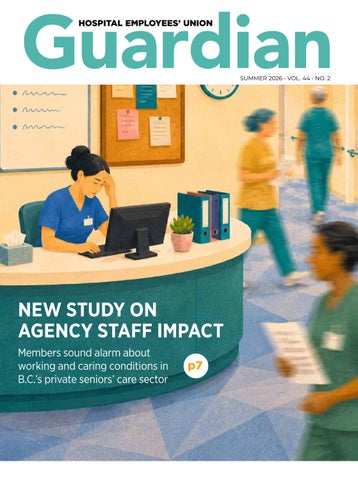
Members sound alarm about working and caring conditions in B.C.’s private seniors’ care sector
FEATURE
Short-term thinking in long-term care
Staff from hiring agencies can cover a shift, but residents and regular staff pay a price | 7
NEWS
Community deal reached
New CBA agreement closes the historic wage gap | 3
An uncertain future
Immigration cuts reduce needed health care workers | 5
Cool, calm and collected
HEU members acted fast when fire broke out in a seniors’ home | 11
COLUMNS
Viewpoint
Having faith in solidarity | 6
President’s Desk
Ottawa must stand up to Alberta’s assault on public health care | 6
REGIONAL MEETINGS | Hundreds of HEU members from across British Columbia gathered over spring at the five regional meetings held in Burnaby, Nanaimo, Surrey, Kamloops and Prince George. From a report on wins, challenges and next steps from HEU’s leaders to a workshop on how to combat online disinformation dividing communities, members spent the two days learning, sharing and building solidarity across the many locals in attendance.
Service consolidation begins
Protecting members’ rights during transition
AS THE Ministry of Health moves ahead with the first phase of its shared services implementation plan this summer in the Facilities health subsector, HEU is taking action to safeguard members’ jobs and ensure health employers meet their obligations.
“Given B.C.’s history of health service consolidation, we know this announcement will create anxiety and uncertainty for members,” says HEU secretarybusiness manager Lynn Bueckert.
“Our focus is protecting job security, ensuring fair processes, and enforcing the protections we’ve negotiated in the Facilities Bargaining Association (FBA) collective agreement.”
The BC Shared Health Services (BCSHS) agency was established on April 1 to centralize certain corporate and administrative functions across the province’s health system. The Ministry says the intent is to improve coordination so health authorities can stay focused on frontline services, while shared functions are organized provincially.
Service consolidation will occur in phases starting this summer. In the first phase, several services will begin transferring to the new agency including:
• Information management and information technology (excluding clinical informatics
and biomedical engineering)
• Supply chain
• Finance services related to accounts payable and accounts receivable
• the BC Health Workday initiative that works on systems for human resources.
“BCSHS will be part of the Health Employers Association of BC (HEABC), which means the transition will be governed by existing public sector health care collective agreements and labour legislation,” says Bueckert.
“In HEU’s conversation with Ministry representatives, we were assured there will be no layoffs during the initial consolidation phase, and that impacted members will continue to receive the same pay, benefits and time off they currently have.”
The union will be enforcing Article 17 (Technological, Automation and Other Changes) of the FBA collective agreement, along with other relevant contract language and labour statutes. Together, these provide HEU with the tools to preserve job security, stabilize employment and protect members, if operational changes lead to future restructuring.
“In our first meeting under Article 17 on May 7, we pressed HEABC to be upfront about what services may be considered for transfer during this first phase
and beyond,” says Bueckert. “We also highlighted areas where we would be pushing for improvements to members’ existing rights in the collective agreement.”
In this initial meeting, the union also notified employers of its plans to create a committee of HEU members with representation from each employer group to take part in future discussions. Looking ahead, HEU and employers have scheduled bi-weekly meetings to continue discussions.
“As the new agency rolls out each transition phase, we will
We have a strong staff team with expertise in this area assigned to this transition work, and HEU is very familiar with these transfers.”
share updates as they become available and continue advocating for staffing stability,” says Bueckert. “We have a strong staff team with expertise in this area assigned to this transition work, and HEU is very familiar with these transfers and has successfully protected members’ rights in the past.”
If you have been advised, or believe you may be part of a transfer, contact your shop steward as soon as possible. For more information, visit heu.org/faq-shared-services.
COMMENT
Lynn Bueckert | Secretary-Business Manager
If WCB consistently enforced these standards, we would see fewer injuries, lower costs for employers, and more workers able to stay in the system.
WCB needs to stop injuries before they happen
ON paper, B.C. has some of the strongest health and safety laws in the country.
But in practice, the system is not working the way it should.
Health care has had the highest injury rate of any sector in B.C. for over a decade, with care aides having the highest rates of injuries overall.
When HEU’s provincial executive went to Victoria this past April to speak with the Premier, the Minister of Health and dozens of government MLAs, we hammered that message home.
We also told them that the most common injuries in health care are overexertion leading to musculoskeletal damage, exposure to hazardous substances and workplace violence.
In 2024, nearly 500,000 workdays were lost to injuries. That’s the equivalent of removing 1,800 workers from the healthcare system for an entire year.
And these injuries come with a hefty price tag – $90 million in claims.
But the bigger cost, we explained, is what this state of health and safety is doing to workers. And to the health care system.
It’s leading to real strain on recruitment and retention. And when workers leave, the system loses experience, continuity, and capacity.
Yet the root causes of injuries are not being properly addressed, and these unsafe conditions remain unresolved even after injuries have occurred.
We explained to B.C.’s elected leaders that WCB must ensure that when a worker is injured, the hazard that caused it is actually fixed. That way, it can’t happen again. There is no excuse for the same hazard harming multiple workers.
From where I sit, the gap between policy and practice is the problem we need to solve. We need known hazards that are causing injuries to be actively controlled in the workplace.
To do that, WCB must engage directly with workers to understand real workplace conditions. It must strengthen prevention efforts to stop injuries before they happen.
It must enforce existing regulations by holding employers accountable to their obligations. And, WCB must take stronger action on repeat violations and conditions that lead to repeat injuries, including levying higher penalties.
If WCB consistently enforced these standards, we would see fewer injuries, lower costs for employers, and more workers able to stay in the system.
And ultimately, that means better care for patients, fewer service disruptions, and a more stable health care workforce.
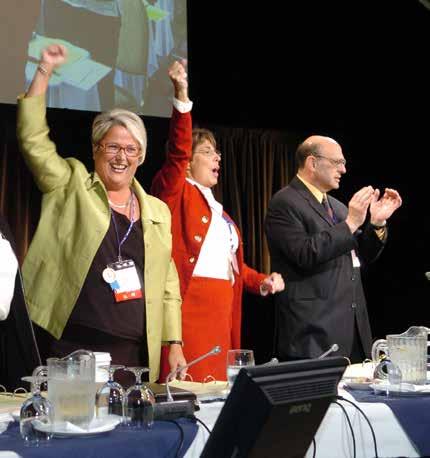
Judy Darcy helped lead HEU through one of its stormiest eras, following the BC Liberals assault on public health care and the union in the early 2000s. In her new autobiography, the former secretary-business manager describes the mood.
“The union was reeling. The provincial executive fired the secretary-business manager, the chief negotiator and the chief spokesperson. Then they looked for someone to win back members’ confidence … and lead
the union through their toughest period.”
From 2005 to 2011, Judy worked with members and leadership to re-organize workers, negotiate a crucial new FBA agreement, and celebrate HEU’s legal victory that established collective bargaining as a Charter right.
A regular guest at HEU events over the years, this spring Judy visited several regional meetings to meet members and sign her book, Leading from the Heart.
NEWS
Your union. Your paper.
New gains in community health
Renewed contract delivers steps to pay parity
AFTER a year of negotiations, community health workers across B.C. ratified a new collective agreement in March, bringing major improvements for workers and the people they care for.
The four-year deal covers more than 26,000 workers in the Community Bargaining Association (CBA), including close to 2,300 HEU members. It delivers wage increases, better premiums, stronger health and safety protections and important gains in fairness across the sector.
“This is a big moment for our members working in community health,” says HEU secretarybusiness manager Lynn Bueckert. “Workers stood strong and fought for the respect they deserve.”
Members will receive a three per cent wage increase each year, for a total of 12 per cent over the life of the agreement. Many will also receive extra increases through targeted low-wage redress. And, in the first year, workers at step three will reach pay parity with similar jobs in the Facilities subsector.
The agreement also increases weekend and afternoon shift premiums, expands overtime rights, strengthens workplace safety language and protects benefits for the future.
At the CBA bargaining table, Nicole Russell, Lisa Bouma and Donna Zmaeff represented HEU’s community health members, and
YOUR UNION
Bursary applications open now
HEU offers bursaries up to $1,000 for post-secondary education. HEU members, their spouses and children may apply.
Administered by a bursary committee under the direction of the Provincial Executive, bursaries can be used at any post-secondary institution and are awarded to students who need financial assistance and demonstrate satisfactory academic standing.
Applications open until July 24 at heu.org/bursaries.
of underfunding and unequal standards across employers under the BC Liberals made progress challenging.
they were supported by servicing representatives Brenda Brown and Tasha Whenham.
Gains a long time coming
Community health workers have spent decades fighting for fair wages and better working conditions.
In the mid-1990s, under the BCNDP, the province created separate public sector bargaining tables, including the CBA, to bring many different contracts under one umbrella.
Before that, workers were covered by separate agreements with different wage grids, benefits and workplace rules. Members doing similar jobs were often paid very differently depending on where they worked.
Nominate a member for convention awards
Nominations are open now for HEU’s 2026 Convention Awards. You can celebrate a co-worker for outstanding contributions to their union, communities or a cause.
Awards are in four categories – social justice, disability rights, Indigenous reconciliation, and gender equity.
Awards will be presented onstage at convention this November.
The deadline to submit nominations is August 4. Nomination forms can be found at heu.org/ heu-convention-awards-2026.
In 2001, major advances were made when the BCNDP government at the time passed legislation aimed at closing the compensation gap between workers in long-term care, acute care and community health by bringing wages and benefits closer together.
However, that pivotal change ended abruptly later that same year, when the newly elected BC Liberals repealed the law before it took effect. Even worse, Premier Gordon Campbell’s government introduced new legislation further weakening job security, as well as expanding contracting out and privatization.
Since then, workers kept fighting and made steady gains. But years
Supportive housing and community services suffered, and workers carried the burden through lower pay, uneven benefits, heavier workloads and fewer protections.
But each round of bargaining brought progress, particularly over the previous two under the BCNDP since 2018. And now, with this latest collective agreement ratified, CBA members have a much brighter future ahead.
“This deal finally closes the gap with other health care workers,” says Bueckert. “It means fairer pay, better protections at work and a stronger community health system for everyone.”
SARA ROZELL
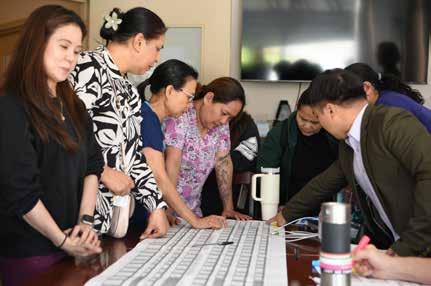
BRIGHTER FUTURE | Workers in the community health sector, seen here at the HEU bargaining conference in 2024, achieved solid gains in their renewed agreement.
Kim Bellavance PHOTO
FACE TO FACE | Provincial Executive members met with B.C. MLAs in Victoria April 24 to talk about health and safety and share their reallife workplace experiences. Between meetings, they enjoyed a visit to the offices of House Speaker and former HEU head of bargaining Raj Chouhan.
New leave available for B.C. employees
A NEW Employment Standards Act (ESA) provision on serious illness or injury leave (SIIL) now provides up to 27 weeks of unpaid leave per 52-week period to employees.
To qualify, the employee must be unable to work for at least one week and have provided their employer with a medical note confirming their inability to work and the estimated length of their absence.
Because the ESA takes priority over collective agreement provisions unless the agreement meets or exceeds the ESA, a worker on SIIL will likely be covered by employer-paid benefits.
They will also continue to accrue service for the calculation of vacation entitlement – even if their collective agreement would pause that accrual.
For example, under the Facilities Bargaining Association collective agreement Article 34.01, HEU members are only covered by employer-paid benefits for the first 21 days of an unpaid leave.
So if an FBA member took leave under SIIL, they would likely have access to their full employer-paid pension and medical benefits for the entire length of the leave.
This is a step in the right direction toward improving job security for B.C.’s injured or ill workers. Any worker on a SIIL cannot be terminated due to that leave, and they must be returned to either their pre-leave job or a comparable position.
For questions about how a leave may affect your benefits, please contact your shop steward. That way, they can give you advice tailored to your workplace and collective agreement.
JESSE GUENTHER
Better protections
Employment standards improved for non-unionized workers
MOST HEU members work a single job. However, past membership surveys show that roughly one in six work for more than one employer.
Many of these members hold additional unionized positions – either within HEU or another union – but some also work in nonunion workplaces, where they do not have the protections of a collective agreement or the B.C. Labour Code.
For those workers, the province’s Employment Standards Act sets out minimum requirements for working conditions, pay, and other basic rights.
Since the BCNDP formed government in 2017, protections for non-unionized workers have steadily improved, including the introduction of stronger child employment rules, expanded unpaid job-protected leaves and ending the requirement for workers to use a “self-help kit” to confront employers before filing a complaint.
More recently, the province has taken new steps to expand protections and enhance enforcement through the Employment Standards Branch (ESB) that better support non-unionized workers who are owed wages by their employers. Amendments introduced this spring would make it easier to resolve straightforward complaints more
YOUR UNION
Support to tackle work-life balance
quickly and improve how workers recover unpaid wages.
“The [ESB] ensures that employees in B.C. receive minimum standards of compensation and conditions of employment, helping protect workers from exploitation,” said Minister of Labour Jennifer Whiteside when introducing the amendments in April. “These proposed changes are steps toward improving the process, helping people get to resolution sooner.”
For example, the amendments would speed up the return of unpaid wages by streamlining transfers through the province’s designated non-profit agency. Employers would also be required to deposit any outstanding wages before appealing an ESB decision.
In addition, the ESB would gain more flexibility to resolve complaints more quickly, including greater discretion over when a written investigation report is required and the ability to use early resolution meetings for straightforward cases.
For more information about employment standards in B.C. and the protections they offer to non-unionized workers, visit gov. bc.ca/gov/content/employment-business/ employment-standards-advice/employment-standards online.
HEU members at Adanac Park Lodge knew their schedule wasn’t working.
Many were frustrated by frequent six-day blocks that made work-life balance difficult and left little time to recharge.
Rather than settling for a rotation that wasn’t meeting their needs, members reached out to HEU’s rotation specialists – a team created through Facilities bargaining to support better scheduling for members.
Through rotation support, work-
ers can initiate schedule changes as a group, while employers are required to provide information needed to explore new options.
“When members are involved in designing schedules, the result is often a rotation that better supports workers’ lives, while also meeting operational needs,” says HEU rotation specialist Deanna Gill.
Think your schedule could work better? FBA members interested in exploring rotation support at their local can start by emailing rotationsupport@heu.org or contacting their shop steward.
KNOW YOUR RIGHTS
MIGRANT WORKERS
Facing an uncertain future
WHEN 27 HEU members were at risk of losing their work permits at HEU’s Oceanside Care Campus Local in Parksville earlier this year, chair Cecile delos Reyes felt compelled to take action to support her co-workers.
“It is heartbreaking,” says delos Reyes. “These workers have been at our site for a number of years. They’re part of our family. The residents and their co-workers rely on them.”
Delos Reyes organized a letter writing campaign and held a meeting earlier this year between the workers and their provincial and federal government representatives.
She was moved to act because she was once a migrant worker. Now a Canadian citizen, she wants to help those who have been contributing to Canada’s health care system stay in the country.
Migrant workers in Canadian health care
Like many provinces, B.C. increasingly relied on migrant workers to fill staffing shortages in health care over the last two decades.
Migrant workers are employed through various immigration initiatives like the federal temporary foreign worker (TFW) program, and permits available to international students during their studies or post-graduation. Still other migrant workers apply through spousal work permits.
Workers with temporary work permits at HEU sites are union members and covered by their workplace’s collective agreement.
Welcome new members
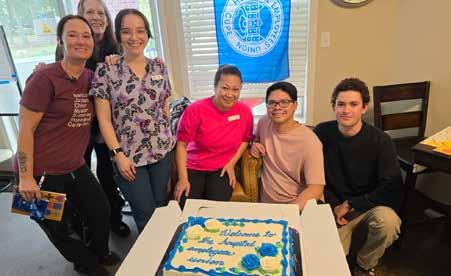
The union welcomes almost 650 new members who made HEU their union of choice at nine worksites since February.
On Vancouver Island, HEU now represents 62 cooks, dietary aides, housekeepers and care aides at Woodgrove Manor in Nanaimo, and 34 members working in mental health support services for Integra at Duncan.
We also welcome 21 new members working as servers and housekeepers for Compass at Chartwell Vista in Esquimalt, who join the HEU care aides, nursing
They enjoy the same labour protections as other members who are Canadian or permanent residents.
To hire TFWs, employers must have an approved labour market impact assessment (LMIA), to demonstrate that no Canadian or permanent resident worker is available. TFWs must also work for a specified employer, within the time limits and location of the work permit.
Workers with post-graduate or student permits have more flexibility, and may move between employers or regions. Employers do not need permission to hire workers with these types of permits.
Often, those with temporary permits apply to become permanent residents in Canada through
the provincial nominee program (PNP), an economic immigration program offered to workers in certain sectors.
Impact of changing government policies
During the nationwide labour shortage after the pandemic, the federal government temporarily enhanced immigration programs. It extended TFW and post-graduate work permits and allocated more PNP spots to provinces.
These immigration measures have meant that today, many migrant workers will have delivered health care in B.C. for years. However, since 2024, the federal government has drastically scaled back its immigration levels.
PART OF OUR FAMILY | HEU members from Oceanside Care Campus local in Parksville rallied to support the migrant workers at their site, inviting local MLA Stephanie Higginson to meet and share their concerns.
For HEU members with temporary work permits, the sudden change in policy has come as a blow, as many have established roots in the province.
The cuts to immigration programs also mean that B.C. is at risk of losing many hundreds of highly experienced and trained health care workers. And many of these workers are employed at health care sites already experiencing staffing shortages.
For delos Reyes, the way forward is clear – the federal government needs to restore pathways to citizenship for health workers like those HEU members at her workplace.
“They deserve a chance to stay, given how much they’ve worked to provide care,” says delos Reyes.
and concierge workers who organized at the same site last year.
On the mainland, Clayton Heights Care Community in Surrey joins us with 128 members working in care aide, LPN and recreation assistant positions. Casa Mia long-term care home in Vancouver became part of the HEU family in April, with 114 members working as care aides and recreation assistants.
In the north, the union welcomes 26 new members at Birchview Residences in Prince George, a long-term care site employing care aides, LPNs and staff in support positions.
RIDING THE WAVE | After certifying as a new HEU local in February, activists at Woodgrove Manor in Nanaimo prepare to get down to business and bargain their first collective agreement.
A STEADY HAND
OUR Enhanced Disability Management Program (EDMP) staff provide guidance, mentorship and support for the 25 HEU members working as EDMP stewards across B.C. Team leads Jose and Wendy, ably supported by administrative assistant Mark (left), advocate for members to ensure their rights and privacy are protected, and work with EDMP administrators in other health care bargaining associations. EDMP is an employee-centred program designed to help Facilities Bargaining Association members who are absent from work, or struggling at work due to illness or injury.
Betty Valenzuela | Financial Secretary
VIEWPOINT
Barb Nederpel | President
PRESIDENT’S DESK
My faith, community and union solidarity are deeply connected, and strengthen my commitment to stand with members and fight for dignity.
MY church has always been an important part of my life, helping shape who I am from childhood to today.
The community, care and sense of purpose I find there are also what I value most in HEU.
As a trade union activist who rose through my HEU local to become financial secretary of B.C.’s biggest health care union, I draw inspiration and hope from our members every day.
That is why a local meeting I attended earlier this year at a Vancouver church stayed with me.
Accompanied by Vancouver Coastal regional vice-president Maria Lugs, I was there to meet members and support the work of the local.
The meeting was held in a church room, not at the worksite, because the employer would not provide space for members to conduct union business.
Private-sector members face unique challenges
These members work in the private sector at an independent- and assisted-living seniors’ residence, where union activity often gets less support than at publicly run facilities.
Many members in the for-profit sector also have less compensation, fewer benefits and weaker protections than HEU members employed in the public sector.
They also lack the full strength of the public sector collective agreement rights won through decades of bargaining and job action.
That is why I was at this local meeting. As your financial secretary, I am responsible for the union’s resources.
Stronger locals, more power for members
I want to help locals make the best use of HEU’s funds and support available to protect and expand members’ gains, no matter who the employer is.
Whether we meet in a church basement, a union hall, a temple langar or a mosque classroom, what matters is that members come together with the HEU’s full backing to fight for better wages, stronger rights and better working conditions.
Walking out of that Vancouver church after the meeting into the spring evening, I felt something I often feel after Sunday service.
What stayed with me was a renewed sense of solidarity and a reminder that, wherever members work, HEU stands with them in the fight for a better working life.
We can’t let Alberta unilaterally destroy Medicare — or let Ottawa off the hook when it comes to defending it.
ONCE again, forces are trying to tear Medicare apart and turn suffering into profit.
Our health system rests on five principles in the Canada Health Act: universality, comprehensiveness, portability, accessibility, and public administration.
Six words that add up to one promise: if you are sick, the door is open. You walk through it. You get care.
In the United States, far too many people live one illness – or one broken bone – away from financial ruin.
That is what health care built around profit looks like.
Now, I know our system is not perfect. Canada is facing a health care staffing crisis.
A crisis created by decades of health spending cuts, wage suppression, and workloads that grind people down until they have nothing left to give.
But that’s how the privatization playbook works.
You underfund a system. You suppress wages. You let the cracks grow.
Then one day a conservative or liberal politician will stand up at a podium and say: the public system is failing – we have no choice but to privatize.
And it’s happening right now next door in Alberta.
Federal government must step up and take action
Last fall, the United Conservative premier of our neighbouring province passed legislation opening the door to U.S.-style profit-taking in health care, putting the future of Medicare in this country at risk.
But, you say, the federal government must take action to push back firmly on Alberta and uphold the Canada Health Act.
Provinces can’t just be allowed to dismantle Canada’s hallmark social program on their own.
Ottawa must back its promise of Medicare for all Canadians with real funding and real enforcement.
Well, I have some bad news to share.
The federal Liberal health minister said they recently cautioned Alberta about its reckless action.
But nothing has changed. And the new law is still in effect.
And to make matters worse, Prime Minister Carney’s government committed to cutting federal health transfers to the provinces by $400 million annually starting in 2028.
We can’t let Alberta unilaterally destroy Medicare – or let Ottawa off the hook when it comes to defending it.
Together, we have built a health system that is at the heart of what it means to be Canadian – and we are going to keep fighting like hell to protect it.
Elaine Littmann PHOTO
Short-term fix, long-term pain
After the B.C. government ended pandemic-era funding for private agency staffing in fall 2025, HEU surveyed local executive and nurse members in 60 HEU-organized private longterm care and assisted living sites between October and January.
The research captured a familiar reality: private agencies can offer shortterm relief, while deepening burnout, weakening collective agreement rights, and disrupting continuity of care for residents.
Reliance on agency staff in private seniors’ care fuels cycle of burnout
How
a stop-gap
solution became standard
In private long-term care and assisted living, agencies and overtime have become the stop-gap response to chronic staffing shortages.
Agency staff are employed by private companies – staffing agencies – that supply employers with temporary, contracted workers. The health employer signs a contract with the agency and pays a fee, and from that fee the agency pays wages and benefits to the workers.
While agency staff at HEU sites work alongside regular employees, they are not covered by the union’s collective agreement.
Government funding for hiring agency staff began as an emergency measure during the pandemic, along with wage levelling, to maintain stability in the long-term care sector. But in many private seniors’ care sites, the “emergency” became routine.
In 2025, CTV News reported that public spending on for-profit staffing agencies
in British Columbia increased from $8.7 million in 2018-19 to $271.9 million in 202425. Most of this goes to nursing staff. Some local members reported that agency staff were almost the entire nursing workforce in their facilities for long periods of time.
An HEU activity worker from the Interior describes the situation in her facility:
For a whole year we only had two to three regular nursing staff and all the other nurses were agency. Throughout one-and-a-half years the facility probably had close to 25 to 30 different nurses come through. A lot of our regular staff and casual nurses weren’t getting hours because they wanted to give the hours to agency staff. Casual nurses left to find work elsewhere.
After the government funding ended in 2025, HEU members say reliance eased in many places – but not all.
In a series of follow-up interviews with nine locals in early 2026, three said agencynurse use had fully or mostly ceased, but the others reported no change.
One site reported agency nurses still working in roughly two-thirds of nursing positions.
Care aide agency use was reported as easing in some places as graduates from the Health Career Access Program came on board.
The funding cut meant many employers have become more selective about calling agencies, often using them as a last resort. But this puts more strain on regular staff, including excess overtime, working short, and difficulty scheduling vacations.
Almost every HEU local interviewed reports challenges retaining nurses in particular.
“Members described a trend with new and inexperienced nurses being hired at private facilities,” says HEU researcher Iulia Sincraian. “They quickly realize the workload and responsibility are far too heavy, and in typically less than a year they leave to work for the health authority – once they have enough experience and seniority.”
That churn is costly in every direction –draining mentorship capacity, weakening continuity of care, and keeping the remaining staff in a permanent cycle of orientation and catch-up.
Agency staff in unionized worksites
Because employers entered into contracts with agencies, some began to use agency staff to fill vacant shifts at the expense of regular staff and in violation of seniority provisions in collective agreements.
One local executive member in Interior
Health says this practice contributed to the turnover of regular staff:
With the employer not giving the call-in shifts to regular staff, some of the regular staff left to look elsewhere for work. Some went to work at Interior Health, some went to work for the staffing agency itself. That created a cycle where the employer then needed to contract with more agency staff.
Some members also flagged potential conflicts of interest, where there may be connections between an employer and the private staffing agency it contracts with.
While some grievances have been filed and won, hiring agency staff does not in itself violate the collective agreement.
Where HEU has successfully advocated for members is in keeping work within the bargaining unit when possible, including offering overtime to regular employees and casual work opportunities for casuals.
When staffing continuity breaks, residents feel it first
In interviews, members spoke about the difference between showing up for a shift and being part of a care team.
Some felt agency work can put the focus on “getting through the assignment,” rather than building the long-term knowledge that residents rely on. They emphasized that the biggest impact of agency reliance is on the continuity and quality of care.
“It’s clear that constant turnover makes it hard to build consistent care practices,” adds Sincraian.
“Agency staff might not know residents,
their histories and routines, or the workplace procedures. They can also have varying experience or competence. And for employers, accountability and performance management can be difficult when staff are actually working for the agency, not them.”
Local executive members described situations where, in their view, some agency staff were unfamiliar with basic care tasks, left work incomplete, or missed changes in residents’ condition.
A local executive member in a private site in the Interior described the impact on regular staff morale:
It turned into us versus them. It divided everyone. Regular staff started refusing to work with [agency staff] because they would have to pick up the slack. We had staff call in sick more often, go on sick and medical leaves due to the stress and not wanting to be at work.
Members also reported gaps in following worksite policies and in documenting and communicating concerns – a situation that can become dangerous when residents’ needs change quickly.
The hidden cost: regular staff doing two jobs
Regular staff often spend extra time orienting new agency workers and answering questions – then “cleaning up” afterward by completing missed tasks, correcting errors, and following up on issues that weren’t charted or communicated.
An HEU care aide from Interior Health describes the impact on residents:
For [agency staff], they’re bouncing in and out from one facility to another. There is no shared responsibility of owning the work and taking care of the people. No consistency, no heart in it. They don’t care – they are only there temporarily. I am on shift after [agency staff] and see people out in the dining room not properly dressed, hair not combed, teeth not brushed….Their heart is not there. They are just working for hours. If something happens, they can run away to another facility.
Over time, that strain shows up in sick time, leaves, and resignations – fueling the shortages that made employers reach out for these private agencies in the first place.
It’s a cycle that can only be broken by rebuilding stable, quality jobs in the sector.
And concerns about agency staffing aren’t coming just from frontline health care workers.
Organizations like Healthcare Excellence Canada and the Canadian Health Coalition note that agencies may help keep services running, especially in rural communities, but that rising costs and growing reliance raise questions about sustainability, quality, and long-term workforce planning.
What needs to happen next
Even where agency staffing has been reduced, the underlying crisis remains: recruitment and retention, burnout-driving workloads, and working conditions that push experienced workers out of seniors’ care.
Solutions need to be found on all levels – improved training, recruitment and retention strategies, and a commitment from the health care system to build and support a sustainable workforce.
For HEU secretary-business manager Lynn Bueckert, this report confirms the need for improvements HEU has been working towards in bargaining, and through its Care Can’t Wait campaign.
“The only solution to staff shortages is to improve recruitment and retention, and a key part of that is establishing common sector-wide standards for wages, benefits and working conditions. The historic agreement with the B.C. government to bring 5,000 HEU members into the public sector over the next two years is an important step toward restoring a level playing field for working conditions and quality of care.
“We also need to strengthen and expand training pipelines and programs, so new workers can build careers in seniors’ care. We need to increase and enforce hours-per-residentday levels, and commit to building nurse-to-resident ratios in long-term care.
“And we need to look at creating sustainable staffing models, such as float pools operated by health authorities, job-sharing options, and healthy, predictable scheduling.”
“Finally, as a union we need to defend our members’ collective agreement rights. That means developing strong language to protect seniority, ensure fair access to shifts, and limit agency use to truly exceptional circumstances,” she says.
The bottom line
Agency staffing can cover a shift. What it can’t replace is the familiarity and knowledge that helps keep residents safe: who is at risk of a fall, who needs reassurance, who is showing early signs of infection.
When care relies on a rotating workforce, the burden shifts onto the people who remain – until they, too, are forced out by exhaustion and unfairness.
HEU members are pointing to the path forward: enforceable staffing standards, real investment in recruitment and retention, and collective agreement protections that stop agencies from becoming the default.
ELAINE LITTMANN
BETTER CARE | Residents need more than a body on the floor — they need caregivers who know them, protect them, and notice when something is wrong. When care is reduced to a revolving door of agency staff, everyone pays the price. Workers are pushed past the breaking point, and residents lose the stability they deserve. It doesn’t have to be this way.
KICKING THE AGENCY ADDICTION
Two publicly-operated staffing initiatives in B.C. could point the way to developing alternatives to private agencies.
About 250 health care workers, mostly HEU care aides and LPNs, are part of Fraser Health’s floating Intensive Support and Stabilization Team (ISST).
Originally developed during the pandemic and called the Deployment Team, the group was a way of delivering staff to sites working shorthanded.
Now it delivers short-term care at home for patients discharged from hospital, many who are waiting for a place in long-term care. This frees up needed beds in hospitals, and lets seniors be more comfortable in their familiar homes.
The team members include nursing staff, who administer medication, while the care aides do personal care and some light meal prep.
HEU care aide Ram Hundal has been on the ISST since 2023. She likes the variety, and although she sometimes misses the fast-paced demands of a long-term care facility, “I love having time to develop a rapport with someone for the day.”
Client homes can be anywhere in the Fraser region. “Driving throughout the Lower Mainland is a requirement of the position, but the team tries hard to put everyone as close to home as possible,” she says.
GoHealth is operated by the Northern Health Authority to recruit travel nurses and medical lab technicians to rural and remote locations in the north, Interior and Vancouver Island. Launched in 2023, it’s a collaboration between the regional health authorities, the BC Nurses Union and the Health Sciences Association.
GoHealth employees become union members and are eligible for collectively bargained benefits, pension, vacation and sick time.
ELAINE LITTMANN
LABOUR
The mind-body safety connection
Lower injury rates found when workers feel their workplace prioritizes their wellbeing
A NEW study of B.C. workers published this past February suggests workplaces can reduce both mental and physical injuries when employers visibly prioritize workers’ wellbeing and pair that commitment with strong protections from physical hazards.
“[A] positive psychosocial environment, where workers feel like their wellbeing is prioritized, results in lower stress and better mental health,” says Dr. Peter Smith, president and senior scientist at the Institute for Work and Health. “Working in physically dangerous environments is also seen as a psychosocial stressor, [so we wanted to know] whether psychosocial stress, when combined with physical hazards, affects workers’ injury risk.”
A team of researchers from the institute conducted a survey of 1,000 workers and first asked them about the psychosocial safety environment at their workplace.
To do this they probed workers about existing occupational health and safety protections to prevent injury from those hazards including workplace policies and procedures, occupational health and safety awareness, and empowerment to participate in injury prevention activities.
The researchers then asked these same workers about exposures to hazards, such as working in awkward postures, carrying heavy
loads, exposure to hazardous chemicals, working with poorly maintained equipment and other dangers that make workers vulnerable to injury.
Finally, they were then asked about any absences from work due to a psychological or physical work-related injury or illness in the last 12 months.
From their analysis, researchers concluded workplace psychosocial safety is rooted in workers believing employers will prevent harm, listen, and act when it comes to ensuring their mental health and wellbeing. Moreover, it is a core
part of overall safety performance in a workplace.
Researchers also found that workers with a strong psychosocial safety climate at work and low vulnerability to injury had the lowest risk of either physical or psychological injury.
Workers with both poor psychosocial safety and high vulnerability to injury had the highest risk of injury – 10 times more likely to suffer a psychological injury and almost five times more likely to experience a physical injury.
Worksites that pair strong hazard controls (e.g., training, supervision,
equipment, and the ability to speak up) with clear leadership commitment to mental wellbeing and staff input will find that protections are not only trusted by workers, but also put to better use in the workplace, making them more effective.
“Our findings emphasize the link between workers’ mental health and their risk of injury,” says Smith. “Addressing psychosocial safety and physical safety together can help to prevent both physical and mental health injuries.”
NEIL MONCKTON
In Kelowna, we’re joined by 168 members working as care aides, recreation aides, housekeepers, dietary staff and nursing positions at Mission Creek Landing, along with 50 care aides at Chartwell Chatsworth’s assisted- and independent-living facility.
And in Kamloops, 47 care aides and servers at Renaissance Retirement Residence assisted and independent living are now part of the HEU.
The next step for these new members is to sit down with their employer and bargain their first collective agreement, with the help of HEU’s bargaining professionals.
Survey says!
More than 9,000 members completed their personal copy of the biennial Membership Experience Survey that HEU mailed out earlier this spring.
“Your experience on the front lines of B.C.’s health care system gives you insight that no report, meeting, or statistic can replace, so thank you for taking part,” says Lynn Bueckert, HEU’s secretary-business manager. “Your perspective is critical to the future of your work and public health care itself.”
THUMBS UP | Members at Hilton Villa Seniors Community in Surrey voted “yes” in April to ratify their first collective agreement, after joining HEU last November.
Together through the smoke
HEU members leap into action when fire breaks out at Mission seniors’ home
IT was dinnertime on March 9, when HEU food service worker Allison May glanced out the dining room window of Carrington House in Mission and noticed something floating past.
The smoke outside the senior’s care facility was faint at first. In fact, it was easy to mistake it for dust drifting on a windy evening, says Allison.
She carried on serving in the dining room. The residents continued chatting. Ten minutes later, the fire alarm went off.
Allison – a shop steward at her local –and the other staff jumped into action. What followed was an urgent evacuation by HEU members of 120 elderly residents, many in wheelchairs or using walkers. And members didn’t just follow the evacuation plan – they led it.
One member ran downstairs to retrieve keys for locked spaces and, when the halls went dark, reminded other staff to use their phone flashlights. Another member calmly and steadily evacuated three residents, two in wheelchairs, until help arrived.
During the dining room evacu-
ation, Allison kept telling herself to focus on one table at a time so as not to cause another emergency. Once it was cleared and residents were outside, she returned to the building, climbing to the third floor to guide others to safety.
“In an emergency, your job title doesn’t define the scope of what you may be called to do,” observed Allison. “It was quite a nice thing to see how many of our members decided to show up – not even on shift but to support their teammates and the residents they care for.”
Outside the independent and assisted-living facility, HEU members helped frantic families searching for loved ones. They also handed out blankets and served coffee and hot chocolate at the Mission Leisure Centre, where residents eventually relocated to shelter as the winter evening deepened.
Some residents were taken to hospital for smoke inhalation, while many HEU members suffered injuries stemming from the fire. Currently, several members remain on leave from their jobs and are receiving workers’ compensation.
Carrington House is made up of two adjoining buildings connected by a breezeway. One side has since reopened, but the other remains closed. As a result, more than half of the facility’s HEU members are out of work.
NEWSBITES
Private health care comeback
Alberta has become the first province to legislate two-tier health care and private health insurance for medically necessary services, a move health care advocates say likely violates the Canada Health Act.
Bill 11, the Health Statutes Amendment Act passed in December 2025, allows doctors to work in both the publicly funded and private-pay market at the same time.
Doctors in Alberta can now bill the government for public patient
care, while offering privatelyfunded out of pocket procedures to patients willing to pay to skip the waitlist.
The bill also establishes a legal framework for expanded workplace and private health insurance plans to cover medically necessary care.
The Canadian Centre for Policy Alternatives explains the potential impact of involving private insurers in the provision of basic health care.
“The public insurance plan must pay increasingly more to doctors
Under a one-year recall agreement secured by HEU, these members are eligible to return when repairs are completed, as employer operations resume. The parties also agreed to review the list of members still on recall and consider a possible future extension of the agreement.
In addition, the Carrington HEU local set up information sessions for members about accessing the union’s education opportunity and
access fund (EOAF) in the wake of this tragic event. This fund is available for all local members to upgrade job skills through funded training opportunities. It also ensures members have a path to secure new work in health care.
For Allison, after the end of a very long night, the image that stays with her was “people showing up for each other.”
SHAHEEN SHIVJI
LEADING THE WAY TO SAFETY | HEU care staff began the evacuation as first responders rushed to the scene of fire that tore through a seniors’ home in Mission in March.
Allison May PHOTO
Yvonne Hanson PHOTO
LABOUR
PUBLIC SECTOR BARGAINING
Community social services ratify
FOLLOWING 18 months of talks, 23,000 community social service workers, including 1,500 HEU members, ratified a four-year collective agreement with health employers in May.
Led by the BC General Employees’ Union, negotiations between the multi-union Community Social Services Bargaining Association (CSSBA) and health employers were overshadowed by the turbulent global economy and its impact on provincial finances.
Yet despite these fiscal challenges, like other contract settlements in B.C.’s public sector, the CSSBA secured general wage increases of three per cent each year, totalling 12 per cent over four years.
Better still, the new agreement made historic gains by continuing nearly 30 years of advocacy focused on bringing wages for CSSBA members in line with members in the Facilities Bargaining Association (FBA).
“Community social service workers have long provided care in the community similar to their FBA counterparts, and yet their wages are lower,” says Bueckert. “While there’s more work to do, this contract secures additional wage increases for many members – over and above the general increase – to close this unfair compensation gap.”
Specifically, CSSBA members who are at Grid 10 will receive the same wage rate as FBA members in comparable positions. Many HEU
members are at Grid 10 so closing this gap will mean an additional wage boost of about seven per cent, effective six months after ratification.
“But the pay equity gains in this agreement don’t stop there,” says Bueckert. “A new $10.5 million fund has been established to support additional compensation improvements over the life of the agreement, benefiting even more CSSBA members.”
Other major gains
Progress on other monetary items and collective agreement gains were also achieved in the renewed 2025-2029 contract.
For the first time in community social services bargaining, language on shift differentials were added to the collective agreement. To support their implementation, a $5.5 million fund has been created to implement sector-specific shift premiums by September 2028.
“In every bargaining round, HEU members have identified premiums as a bargaining priority because of the night and weekend shifts that many are required to work,” said David Huespe, CSSBA bargaining committee member. “Having this language is a good foundation, and provides possibilities for expanding this provision in the future.”
There are also new rules in the agreement on how employers conduct transfers and schedules changes, provisions also identified by HEU members as priorities dur-
ing the November 2024 pre-bargaining conference.
In addition to these new measures, a retention incentive fund has been established to encourage workers to stay in this sector at regular positions, there is new contract language regarding gender-affirming care for members – including a fund dedicated to supports and education – and enhancements made to some health and welfare benefits.
“In 1999, the CSSBA held B.C.’s longest public service strike to secure landmark economic gains – including a commitment to pay equity,” says Bueckert. “Flash forward to today, the solidarity and steadfastness of the CSSBA’s multiunion bargaining association in this round has built on that legacy, forging a brighter future for social service workers in B.C.”
and investor-owned facilities where they perform services because the cost of the same basket of services is bid up by increasing profits, often disguised as ‘administrative costs.’ The result is that health care costs rise rapidly for the government (the public insurance plan), placing a greater burden on public finances.… It’s a race to the bottom.”
The Canada Health Act establishes criteria for provincial health insurance plans that provinces must maintain in order to receive federal health funding,
including public administration, comprehensiveness, universality, portability, and accessibility.
At a BC Health Coalition rally in Vancouver, Liberal MP Hedy Fry – chair of the parliamentary committee on health – publicly declared, “there is no doubt that Alberta’s Bill 11 absolutely contravenes the Canada Health Act.”
Health care unions and public health care supporters across Canada are calling on the federal government to enforce their own legislation, and stop the dismantling of our universal health care system.
Wage-levelling loss impacts HEU members
More than 2,000 members working at fully private long-term care and assisted-living sites are facing wage cuts following the end of the provincial wage-levelling program for those facilities in December 2025, according to a recent survey of wage settlements by HEU.
HEU had previously negotiated language into many of these collective agreements requiring the parties to reopen wage talks, if wage levelling ended during the term of the contract.
While HEU bargaining committees were able to avoid the worst case scenario at some impacted sites, some workers still saw their annual income drop by five to 21 per cent compared with the wage-levelling period.
“HEU members working in seniors’ care deserve fair wages and respect,” says HEU secretarybusiness manager Lynn Bueckert. “We will continue fighting to close wage gaps and support members as bargaining continues across the sector.”
HERE FOR EACH OTHER | Members at HEU’s Community Social Services bargaining conference in fall 2024 hammered out the key proposals to take forward to the table.
IT’S A FIT
The annual Women’s Clothing Event in Lillooet began with HEU care aide Niomi Wright browsing her closet wishing she had something new to wear. And she thought about how life transitions like a new job or weight change can make buying clothes a necessity –but an expensive one.
“I figured if I had clothing I no longer wanted, other women in Lillooet must be the same.”
The event has grown since 2023 to fill the local curling club with people coming from Lytton, Seton Portage and even Kamloops. “There was a lineup that wrapped around the building and we raised $1,040 plus food donations for the food bank.”
Donations are dropped off at Niomi’s home, where with the help of a team of volunteers, clothing is sorted by size and category.
At the event, people come and take whatever they want, for free. Clothes left over are donated to a community service agency.
Niomi works at Mountain View Lodge and has been active in her Lillooet/Lytton local in many positions, including seven years as chairperson. She credits her community for the generous donations and support that make the event a success.
Fueled by passion and determination, community support worker Damon Roth locks up his childhood dream of becoming a pro wrestler
Stepping into the ring
AFTER THE SHIFT
Ever since his great-grandmother brought him to wrestling matches at the Calgary Stampede as a child, Damon Roth dreamed of stepping into the ring himself.
But after a workplace injury left him with chronic migraines and a permanent disability years later, his dream felt out of reach.
“I thought I was never going to be able to wrestle,” Roth recalls. But when he started filming matches and providing commentary for the Victoria-based organization 365 Pro Wrestling, his passion was noticed.
The owner of 365 Pro Westling had been watching Roth teach himself wrestling moves on the side of matches. Seeing Roth’s potential, he offered to train him. That is when Ramone Carlton, Roth’s larger-than-life wrestling persona, was born.
Flash forward to the present day and Roth has over two years of wrestling under his belt. He is known and loved for the joy and stories he brings to the ring.
As a wrestler with invisible disabilities, Roth wanted to inspire others to find their passions and pursue them while embracing their strengths and advocating for the support they need.
“Much like the union, wrestling knows about my disability, and they’ve accommodated everything,” says Roth.
“I’m a guy in the ring that’s not supposed to be there, and I get to show people that anybody can do anything,” he says. “You just have to find a different path there.”
“I’m a guy in the ring that’s not supposed to be there, and I get to show people that anybody can do anything. You just have to find a different path there.”
The same sense of purpose shapes Roth’s work as a community support worker at Community Living Victoria where he spends his days helping people live independent and fulfilling lives. To Roth, the best part of the job is “seeing folks having fun, just being themselves and being able to live.”
In both his wrestling and work, Roth believes “if you want to be able to keep saving the world, you have to save yourself first.” For him, that means advocating for yourself, making space for joy and remembering to be kind to yourself.
MAÏA SAMPSON
PRRI extended again
HEU members working in rural and remote communities will continue to receive support from the provincial recruitment and retention incentives (PRRI) program, after the B.C. Ministry of Health confirmed another extension of the initiative this spring. With the last extension set to end in March, more than 1,000 HEU members sent letters to Health Minister Josie Osborne, urging her to continue the program. This renewal will continue through September 30, 2026, in the 76 communities.
Eligible workers in the Facilities and Community Health agreements can receive up to $2,000 each quarter, with a maximum of $8,000 annually through September 30, if they keep regular employment status at the end of each quarter.
“Looking ahead, HEU will continue pushing the province to make this much-needed incentive program permanent for workers living in rural and remote communities,” says Lynn Bueckert, HEU’s secretary-business manager.
New immigration spots for B.C. health care
A one-time initiative by the B.C. government will see 250 provincial nominee program (PNP) spots made available to migrant workers in key health care support roles.
When the Canadian government reduced immigration levels in 2025, it cut spaces in B.C.’s PNP by half, restricting pathways to permanent residency for many migrant workers, including HEU members.
This initiative, announced in April, will provide permanent
residency for up to 250 workers already employed by health authorities as cleaners and security guards in rural and remote communities.
Registrations will be submitted through B.C.’s PNP’s expression of interest system, with invitations to apply issued to the highest scoring candidates.
HEU will continue to monitor these developments closely and advocate for fair pathways to permanent residency, strong protections for workers, and stability in our health care system.
ELAINE LITTMANN
Ho PHOTO
COFFEE BREAK
Union made
Want to play? Here’s what you need to do to solve the puzzle.
1. You must use all letters.
2. For this puzzle, there are five theme words you must find to fill most of the board.
• Circle each theme word. Once a letter is used it can’t be used again
• No theme words overlap.
3. And there is one “spangram.”
• The spangram describes the puzzle’s theme and touches two opposite sides of the board. It may be one or more words.
• For example, in the sample on the right, the spangram would be FRUIT with corresponding three theme words LIME, BANANA, and APPLE.
What’s in it for you?
Members at Yuculta Lodge, a long-term care facility near the Campbell River Hospital, are among the almost one-quarter of HEU members who live and work on Vancouver Island.
‘I’ve had the privilege of
Care aide Nerisa has worked at Yuculta Lodge for 18 years. “Whether it is a helping a resident with a meal, communicating with nursing staff, or simply offering emotional support,” she says, “I consistently approach my work with empathy and a positive attitude.”
Local chair Rebecca has been a care aide for 24 years – 15 at Yuculta Lodge – and is a health and safety representative at her site. “Over the years, I’ve come to believe that while care may be delivered in different ways, it’s compassion that makes it truly felt, no matter where you are.”
working alongside wonderful colleagues, forming lifelong friendships, and caring for some truly remarkable and inspiring residents,” says local chair Rebecca (left), joined by a few of Yuculta Lodge’s 150-strong care staff.
HEU PEOPLE
RETIREMENTS
Susan Pynn retires in June from the Royal Columbian Hospital, where she worked in dietary services as a clinical nutrition technician. Susan joined HEU in February 1989.
She is active in her community as a member of the Meadow Ridge Rotary Club, and a volunteer for local events and fundraisers.
At her job, Susan liked engaging with patients and knowing that she helped them and will miss her co-workers.
Her travel plans include volunteering more, travelling to Egypt soon and “doing what I want, when I want.”
Mary Wierzejski retired last August from her job as a health records clerk at St. Paul’s Hospital.
Mary started her career in health care in October 1994 and contributed more than 30 years of service. In addition to her time at St. Paul’s, she also worked at Children’s and Women’s Hospital, Peace Arch Hospital and the Vancouver Cancer Centre.
“Every day brought a new challenge, or a problem to be solved,” says Mary. “I liked knowing I made a difference in the lives of patients and workers.”
Mary will miss her co-workers and being involved in union events. She was active in her HEU local, serving as site representative,
60,000 members in 311 locals
secretary-treasurer and trustee at Children’s and Women’s, and as shop steward and lead shop steward at St. Paul’s.
She was also involved in the Vancouver and District Labour Council’s Women and Gender Rights Committee, as well as in provincial and municipal politics. Plus, she volunteers with Big Sisters of B.C.
In retirement, Mary plans to get organized, enjoy the extra time to do committee work, rest, travel, and spend time with friends.
Pushpa Prakash retired in April from Pinegrove Place Care in Richmond, where she worked since 2022 as a dietary aide.
“I always looked forward to seeing my residents,” Pushpa says. “I will miss my job and all my lovely co-workers.”
Pushpa served as a trustee on her HEU local executive, and volunteered at her community temple.
She plans to relax for the first couple of months of retirement, and then may return to working as a casual and as a volunteer.
“I will also make travel plans to go back home,” she says.
After a long career in labour relations, with the last 26 years at HEU, Erin Paul retired from HEU’s Vancouver Island servicing team in April 2025. HEU wishes Erin all the best in her retirement!
Equity matters
Did you know that HEU has seven equity standing committees? Working with HEU’s equity officer, they provide outreach and advocacy to HEU members, and work in solidarity with other social justice groups. To learn more, please email inclusion@heu.org.
Ethnic Diversity • Indigenous Peoples • Older Persons • Pink Triangle • People with Disabilities • 2-Spirit, Women and Non-Binary • Young Workers
HELP CELEBRATE RETIRING MEMBERS!
Is your colleague retiring from their HEU job? If you’d like to give them a shout-out for their hard work, their joyful spirit, their fun office pranks — or just for being their lovely selves — help us feature them on the HEU Guardian People page.
Please send us a photo too!
Scan the QR code, use our online form — www.heu.org/form/member-retirement-information — or, send their name and local to commsassist@heu.org, and we’ll reach out.
* We also publish memoriams for HEU members.
MOVED? Please notify us of your change of address online: www.heu.org/change-contact-information