Serie Documentos
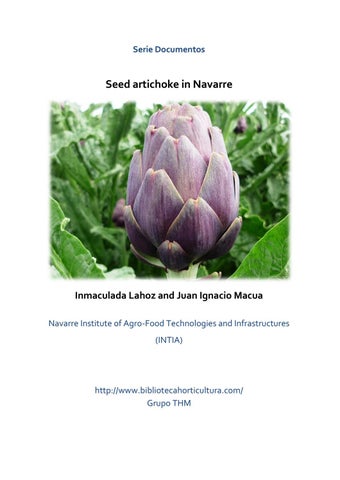
Seed artichoke in Navarre
Inmaculada Lahoz and Juan Ignacio Macua Navarre Institute of Agro-Food Technologies and Infrastructures (INTIA)
http://www.bibliotecahorticultura.com/ Grupo THM
Serie Documentos
Alcachofa de semilla
Seed artichoke in Navarre
Inmaculada Lahoz Juan Ignacio Macua
Navarre Institute of Agro-Food Technologies and Infrastructures (INTIA)
Index Abstract
Pg. 3
-
Introduction
Pg. 4
-
Material and Methods
Pg. 5
-
Results and Discussion………………………………….
Pg. 6
-
Varieties
Pg. 10
Literature Cited
Pg. 13
http://www.bibliotecahorticultura.com/ Grupo THM 2
Serie Documentos
Alcachofa de semilla
Abstract Artichokes are an important crop in Navarre and are grown for both the fresh produce market and the agro-food industry (canning and freezing). The main cultivar cultivated in Navarre is the traditional vegetative propagated Blanca de Tudela, which is characterised by its extreme precocity. Traditionally, the cuttings for new plantations in the major artichoke-producing regions of Spain, located along the Mediterranean coast, have come from annual crops grown in Navarre.
Recently, however, seed cultivars have been introduced in these regions and, due to their low level of precocity, gibberellic acid is applied in order to stimulate more rapid growth. In cold regions such as Navarre, where there is a risk of frost, the application of this phytoregulator fails to produce the desired results. Given the importance of the Blanca de Tudela artichoke cultivar in Navarre, due to its twofold use: heads and cuttings, INTIA has taken a special interest in analysing the agronomic adaptation and behaviour of seed cultivars in our agroclimatic conditions. Since 1999, INTIA has tested 58 cultivars of seed artichokes, and this paper presents the morphological characteristics of those tested over the course of more than five years.
It also analyses the precocity and yield of seven seed cultivars tested over the course of the last two seasons (2012-2013 and 2013-2014), in comparison with Blanca de Tudela: Lorca, Madrigal, N-4011, N-4146, Opera, PS-3779 and Symphony. Blanca de Tudela, a vegetative propagated cultivar, was the earliest cultivar of those tested, and the only one with an autumn yield. All the seed cultivars were characterised by a late harvest as well as, in some cases, a high harvest concentration. Madrigal was the latest cultivar, but also the one with the highest yield.
http://www.bibliotecahorticultura.com/ Grupo THM 3
Serie Documentos
Alcachofa de semilla
Introduction Ever since seed cultivars of artichoke came onto the market, ITGA (currently INTIA) has taken a special interest in studying their morphological characteristics and agronomic behaviour in the agroclimatic conditions of Navarre, the cradle of Blanca de Tudela. Since 1999, INTIA has tested a total of 58 different seed artichoke cultivars.
Spain is a major producer of artichokes, with a surface area of 15,000 hectares dedicated to this crop. Within Spain, the main production regions are located along the Mediterranean coast, with a second nucleus in the Ebro Valley (Navarre and La Rioja). During the 2014 season, 957 hectares of artichoke were grown in Navarre, giving a yield of 14,159 tons (Coyuntura Agraria Navarra, 2014). Artichoke production is almost exclusively based on a single clonal propagated cultivar called "Blanca de Tudela".
Seed propagation offers a series of advantages over vegetative propagation by cuttings, including lower plantation costs, greater homogeneity during the initial growth phases, fewer crop failures and a better sanitary guarantee. Nevertheless, artichoke plantations may end up being extremely heterogeneous if the cultivar is not selected properly, and the resulting crop may present a wide cultivar of different head shapes throughout the course of the production cycle (Macua, 2003). While some seed cultivars on the market offer high yields and good uniformity (Calabrese et al., 2003), their main drawback is that they are a very late crop, especially in comparison with artichokes propagated from Blanca de Tudela. For this reason, much of the work currently being carried out with these cultivars is related to planting dates and the application of gibberellic acid, etc. In Navarre, a region in which the risk of frost is high, the application of this phytoregulator does not produce the desired results, since plants treated with gibberellic acid are more sensitive to frost damage.
Given the importance of artichokes in Navarre, which is the main supplier of propagation material for other artichoke-producing regions in Spain, and in light of the introduction of different seed cultivars onto the market, it is vital to understand how these cultivars adapt to our specific conditions.This paper analyses the precocity and yield of different cultivars of seed artichoke in comparison with crops grown by means of vegetative propagation from Blanca de Tudela cuttings, during the 2012-2013 and 2013-2014 seasons. It also analyses the morphological characteristics of the seed cultivars tested by INTIA over the course of more than five years.
http://www.bibliotecahorticultura.com/ Grupo THM 4
Serie Documentos
Alcachofa de semilla
Material and Methods The tests, which were carried out in INTIA's Experimental Farm in Cadreita, on a plot with clayey loam soil, included 7 seed propagated cultivars: Lorca (Ramiro Arnedo), PS-3779 (Shamrock) and Madrigal, N-4011, N-4146, Opera and Symphony (Nunhems). The ITGA-selected vegetative propagated cultivar Blanca de Tudela (propagation by cuttings) was used as a control. The tests were conducted over the course of two seasons: 2012-2013 (2013) and 2013-2014 (2014).
Sowing took place on 11 June in 2012 and on 26 June in 2013, and planting on 21 and 25 August in 2012 and 2013 respectively, at a planting density of 8,928 plants per ha-1, with a 1.40m interval between lines and a 0.80m interval between plants, with black plastic mulching and drip irrigation.
Fertiliser was applied at rates of 60-150-200 kg ha-1 (base dressing) and 150 kg ha-1 (top dressing) of N, in four fertirrigation applications. The crops were cultivated in accordance with the Regulations for Integrated Artichoke Production in Navarre (Navarre Government, 2012).
The experimental design included random blocks with three repetitions. The sample plots contained 18 plants and measured 21.60 m². The statistical analysis comprised a general analysis of variance, and the significant differences were calculated using Duncan's test (P<0.05).
Harvesting was carried out weekly. The heads harvested from each sample plot were counted and weighed. Plant failure percentages were monitored, along with total commercial yield, yield per plant and mean head weight. Also, the number of days to certain harvest percentages (5, 10, 20, 50 and 80%) were counted, in order to establish the harvest calendar.
The characteristics analysed for the description of the heads corresponding to the cultivars tested for at least 5 years out of all the cultivars studied by INTIA since 1999 (Table 1) were: colour, shape, height/diameter ratio and mean thickness of the hearts.
http://www.bibliotecahorticultura.com/ Grupo THM 5
Serie Documentos
Alcachofa de semilla
Table 1. Seed artichoke varieties tested during different seasons at INTIA, since 1999 Cultivar Company Years A-106 Agriset 12 A-107 Agriset 2 A-108 Agriset 1 A-109 Agriset 3 A-110 Agriset 4 A-115 Agriset 1 AKX-533 Akira seeds 1 AKX-534 Akira seeds 1 AKX-537 Akira seeds 1 Alberca Intersemillas 4 AR-11 Shamrock 1 AR-12 Shamrock 1 AR-2 Shamrock 2 AR-4 Shamrock 2 AR-9903 R. Arnedo 1 Bisnes Diamond 2 Concerto Nunhems 6 DGA 6-121 DGA 2 DGA 6-97 DGA 1 Emerald Semar 2
Cultivar Company Years Cultivar Company Years Harmony Nunhems 8 N-9437 Nunhems 1 Imperial Semar 6 Negra Agricultor 1 Star Lorca R. Arnedo 14 Opal Nunhems 4 Madrigal Nunhems 9 Opera Nunhems 6 N-4245 Nunhems 1 Prelude Nunhems 2 N-4330 Nunhems 1 PS-3713 Shamrock 1 N-611683 Nunhems 1 PS-3779 Shamrock 2 N-3007 Nunhems 1 PSI.25000 Petoseed 2 N-3033 Nunhems 3 Pyrennes Voltz 1 N-4011 Nunhems 5 Red Day Diamond 3 N-4106 Nunhems 2 RS-2347 Royal Sluis 1 N-4111 Nunhems 3 Sambo Nunhems 1 N-4126 Nunhems 1 Symphony Nunhems 7 N-4146 Nunhems 2 Tempo Nunhems 2 N-4166 Nunhems 1 TF 035 Shamrock 1 N-4235 Nunhems 1 Victoria Diamond 9 Suprem N-6370 Nunhems 1 Violet Queen Diamond 1 N-6371 Nunhems 2 ZAA-101 Hazera 1 N-8546 Nunhems 1 N-9409 Nunhems 3
Results and Discussion Significant differences were found between cultivars and seasons in all the production parameters analysed (Table 2). During the 2013 season, the percentage of plant failures was higher than for the following season in all the cultivars studied, with the exception of Madrigal, for which it was slightly lower. Despite this, however, in general, the yields obtained for the majority of cultivars during the 2013 season were higher than during the 2014 season, with only Blanca de Tudela, Opera and PS-3779 giving lower yields that year (Tables 3 and 4). While in the 2014 season all the seed cultivars had fewer plant failures than Blanca de Tudela, in 2013, Lorca, Opera and PS-3779 had higher plant failure percentages than the control cultivar (poorer rooting).
Table 2. Results of the analysis of variance (probability p of the F and significance level) of the cultivars in relation to yield Variation Yield (t ha-1) Heads per plant Head weight Rooting (%) Cultivar 0.0000 *** 0.0012 ** 0.0000 *** 0.0118 * ******** Year 0.0004 *** 0.0000 *** 0.0014 0.0003 *** Var xYear 0.0021 ** 0.0036 ** 0.0341 * 0.0286 *
http://www.bibliotecahorticultura.com/ Grupo THM 6
Serie Documentos
Alcachofa de semilla
As regards individual plant yield, in 2013, Lorca and Madrigal produced more heads per plant (over 25), while the cultivar with the lowest number of heads was Blanca de Tudela, with just 17.3 (Table 3). Nevertheless, in 2014, the highest number of heads per plant (over 20) was found for PS-3779 (21.8), N-4146 (21.4) and Blanca de Tudela (20.2) (Table 4).
Table 3. Yield of the different cultivars studied during the 2012-2013 season Cultivar Blanca de Tudela Lorca Madrigal N-4011 N-4146 Opera PS-3779 Symphony
Yield (t ha-1) 14.07c ± 0.14 21.88b ± 2.07 31.31a ± 2.40 22.93b ± 1.25 22.13b ± 1.16 14.75c ± 2.39 18.16bc ± 1.23 24.17b ± 3.58
Mean weight (g) 115.8cd ± 0.06 113.2de ± 1.48 138.5a ± 4.17 122.2bc ± 3.37 112.2de ± 4.01 117.2bcd ± 0.98 107.6e ± 3.16 123.6b ± 1.68
Heads per plant 16.2d ± 0.68 29.9a ± 2.04 25.3ab ± 1.26 21.4bcd ± 1.05 22.9bcd ± 2.07 17.7cd ± 2.73 23.2abc ± 3.04 21.9bcd ± 3.45
Rooting (%) 84.1ab ± 1.85 72.2b ± 9.62 100.0a ± 0.00 98.1a ± 1.85 96.3a ± 1.85 79.6ab ± 10.31 81.5ab ± 10.31 100.0a ± 0.00
In each column different letters indicate significant differences according to Duncan's test (p<0.05)
In both seasons, Madrigal proved the most productive cultivar with 31.31 t ha-1 in 2013 (Table 3) and 21.97 t ha-1 in 2014 (Table 4). The second most productive cultivar was Symphony (24.17 t ha-1), followed by N-4011 (22.93 t ha-1) in 2013 and PS-3779 (21.21 t ha-1) and N-4011 (20.88 t ha-1) in 2014. The least productive cultivars were Opera (14.75 t ha-1 in 2013 and 17.71 t ha-1 in 2014) and the control, Blanca de Tudela, with 14.07 t ha-1 and 16.86 t ha-1 in 2013 and 2014 respectively (Tables 3 and 4). In other studies conducted under these same cultivation conditions, no significant differences were found for yield between the ITGA-selected Blanca de Tudela (vegetative propagation through cuttings) and the highest-yield seed cultivars (Macua et al., 2003).
Table 4. Yield of the different cultivars studied during the 2013-2014 season Cultivar Blanca de Tudela Lorca Madrigal N-4011 N-4146 Opera PS-3779 Symphony
Yield (t ha-1) 16.86d ± 0.42 18.64abcd ± 0.74 21.97a ± 0.62 20.88abc ± 0.57 19.70abcd ± 1.09 17.71cd ± 1.16 21.21ab ± 1.65 18.04bcd ± 0.83
Mean weight (g) 99.0d ± 1.44 113.9bc ± 2.19 129.1a ± 3.94 117.3abc ± 1.61 105.2cd ± 2.28 119.3ab ± 8.63 110.9bcd ± 2.61 110.0bcd ± 0.52
Heads per plant 20.2ab ± 0.93 18.7abc ± 1.29 19.4abc ± 0.75 19.9ab ± 0.47 21.4ab ± 1.28 16.6c ± 0.45 21.8a ± 1.17 18.4bc ± 0.95
Rooting (%) 94.4a ± 3.21 98.1a ± 1.85 98.1a ± 1.85 100.0a ± 0.00 98.1a ± 1.85 100.0a ± 0.00 98.1a ± 1.85 100.0a ± 0.00
In each column different letters indicate significant differences according to Duncan's test (p<0.05).
http://www.bibliotecahorticultura.com/ Grupo THM 7
Serie Documentos
Alcachofa de semilla
In relation to the mean weight of the heads, the highest values were obtained for Madrigal, with 138.5 grams in 2013 and 129.1 grams in 2014 (Tables 3 and 4).
Precocity is a highly-valued characteristic in the majority of horticultural products, particularly when said products are destined for the fresh produce market, since in many cases, their economic profitability depends more heavily on this feature than on yield. Blanca de Tudela was the earliest cultivar, with 5% of its yield being ready for harvest 188 days after planting. The latest cultivar was Madrigal, which only obtained this percentage 242 days after planting. No major differences were observed between the other cultivars studied, with a lag of only 5 days between Lorca, the earliest in this group, and Symphony, the latest, which reached 5% readiness 222 and 227 days after planting, respectively.
Although they diminished somewhat, these differences between cultivars were maintained throughout the whole of the production cycle; for example, 50% of the Blanca de Tudela yield was ready to harvest 235 days after planting, while in the case of Madrigal that figure was 264. Madrigal is a very late cultivar with a good harvest concentration: between 20% and 80% of the yield was ready to harvest within a 30-day period. For Blanca de Tudela, on the other hand, that period lasted 62 days (Table 5).
Table 5. Number of days until 5%, 10%, 20%, 50% and 80% of the crop was ready and number of days between 10% and 80% of crop readiness (mean data for the two seasons) Cultivar 5% 10% 20% 50% 80% Days 20-80% B. Tudela 188 194 204 235 266 62 Lorca 222 225 232 253 273 41 PS-3779 223 226 232 252 271 39 N-4011 227 230 236 254 273 36 N-4146 224 227 234 252 270 37 Symphony 227 229 235 253 270 35 Opera 226 229 235 253 272 37 Madrigal 242 244 249 264 279 30 Tables 6 and 7 present some of the characteristics of the heads obtained from the different seed cultivars. Of these cultivars, Symphony's head was most similar to that obtained from Blanca de Tudela (Table 7), making it the cultivar that best adapts to the industrial processing methods used in Navarre, since all existing machinery is adapted to the shape of the Blanca de Tudela artichoke head (Sรกnchez, 1996).
http://www.bibliotecahorticultura.com/ Grupo THM 8
Serie Documentos
Alcachofa de semilla
Table 6. Weight and dimensions of the heads from the different seed cultivars Commercial company
Cultivar Blanca Tudela A-106 Concerto Harmony Imperial Star Lorca Madrigal N-4011 Opera Symphony Victoria Suprem .
Agriset Nunhems Nunhems Semar R. Arnedo Nunhems Nunhems Nunhems Nunhems Diamond
Mean weight (g) 119.2 ± 3.45 132.2 ± 3.25 109.6 ± 5.07 115.0 3.27 120.7 5.38 130.2 ± 2.41 151.4 ± 3.02 137.1 ± 3.48 134.2 ± 2.95 130.6 ± 2.11 126.5 ± 2.46
Height/Diameter ratio 1.26 ± 0.02 1.03 ± 0.01 1.17 ± 0.02 1.14 0.02 1.01 0.03 1.06 ± 0.01 1.09 ± 0.01 1.02 ± 0.01 1.19 ± 0.01 1.20 ± 0.01 1.05 ± 0.02
Mean heart thickness (mm) 11.67 ± 0.49 12.14 ± 0.46 13.33 ± 0.21 10.13 0.32 11.40 0.31 9.16 ± 0.39 13.20 ± 0.55 11.89 ± 0.44 11.48 ± 0.52 10.66 ± 0.36 10.87 ± 0.42
Table 7. Colour and shape of the heads from the different seed cultivars Cultivar B. Tudela A-106 Concerto Harmony Imp. Star Lorca Madrigal N-4011 Opera Symphony V. Suprem
External colour Green Green with violet tones Dark violet with green tones Green Green with violet tones Green with violet tones Green Green Dark violet with green tones Green Green with violet tones
Head shape Oval Spherical (90%), Cylindrical (10%) Ellipsoidal Conical (80%), Spherical (20%) Spherical (90%), Cylindrical (10%) Spherical (90%), Cylindrical (10%) Ellipsoidal (60%), Conical (20%), Spherical (20%) Conical-round Conical (60%), Ellipsoidal (40%) Oval (80%), Conical (20%) Spherical (60%), Cylindrical (30%), Ellipsoidal (10%)
http://www.bibliotecahorticultura.com/ Grupo THM 9
Serie Documentos
Alcachofa de semilla
Varieties
Al-9. A-106 (Agriset) Capítulo 6
Al-9. Concerto (Nunhems) Capítulo 7
Al-9. Lorca (Rasa) Capítulo 6
http://www.bibliotecahorticultura.com/ Grupo THM 10
Serie Documentos
Alcachofa de semilla
Al-9. Madrigal (Nunhems) Capítulo 3 (1)
Al-9. N-4011 (Nunhems) Capítulo2
Al-9. N-4146 (Nunhems) Capítulo 4
http://www.bibliotecahorticultura.com/ Grupo THM 11
Serie Documentos
Alcachofa de semilla
Al-9. Opera (N-4021) (Nunhems) Capítulo 8
Al-9. PS-3779 (Shanrock) Capítulo 1
Al-9. Shynphony (N-4005) (Nunhems) Capítulo 4
http://www.bibliotecahorticultura.com/ Grupo THM 12
Serie Documentos
Alcachofa de semilla
Literature Cited -
Calabrese, N., De Palma, E., Bianco, V. (2003). Yield and quality of new commercial seed grown artichoke hybrids. Acta Horticulturae, 681: 135-142.
-
Coyuntura Agraria Navarra. (2014). www.cfnavarra.es/agricultura/COYUNTURA/coyuntura.htm
-
Navarre Government. Normativa específica de producción integrada de alcachofa en Navarra (2012). www.navarra.es/NR/rdonlyres/AEF4F0FF-7DF3-4489-9CA3C10CB6F37889/307897/NormativaAlcachofa.pdf
-
Macua, J.I. (2003). Evaluación agronómica de variedades españolas y otras europeas de alcachofa (Cynara cardunculus L. var. scolymus (L.) Fiori) en las condiciones del Valle del Ebro. Doctoral thesis, UPNA.
-
Sánchez, L. (1996). La alcachofa en conserva. I Jornadas técnicas de la alcachofa. Tudela; 223230.
http://www.bibliotecahorticultura.com/ Grupo THM 13
Serie Documentos
Alcachofa de semilla
Seed artichoke in Navarre
Inmaculada Lahoz Juan Ignacio Macua
Navarre Institute of Agro-Food Technologies and Infrastructures (INTIA) Avda. Serapio Huici, 20-22 Edificio Peritos 31610 Villava, Navarra
Dr. Manuel Candela, 26 11ª - 46021 Valencia, España Tel +34 – 649 485 677 info@poscosecha.com info@bibliotecahorticultura.com http://www.poscosecha.com
http://www.postharvest.biz
http://www.horticulturablog.com http://www.bibliotecahorticultura.com
http://www.actualfruveg.com
http://www.bibliotecahorticultura.com/ Grupo THM 14