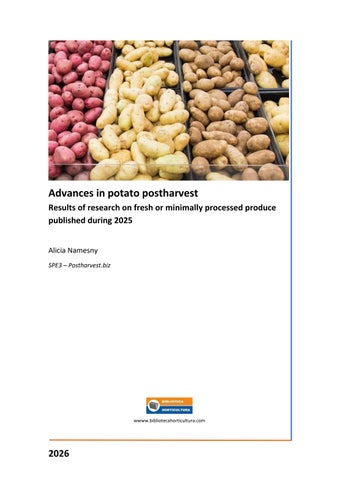
Advances in potato postharvest Results of research on fresh or minimally processed produce published during 2025 Alicia Namesny SPE3 – Postharvest.biz
wwww.bibliotecahorticultura.com
2026
Advances in potato postharvest Results of research on fresh or minimally processed produce published during 2025
Alicia Namesny info@poscosecha.com
Postharvest.biz
Contents 1. Introduction............................................................................................................................... 1 2. Control of postharvest quality and preharvest factors influencing it ....................................... 1 3. Nanotechnology to improve field and postharvest behaviour ................................................. 2 4. Field and postharvest positive effects of Be and Zn combined applied through foliar application ..................................................................................................................................... 3 5. Farmyard manure and optimal phosphorus fertilization can significantly enhance seed potato quality, reduce postharvest losses, and boost marketability............................................ 3 6. Importance of preventing physical damage to potatoes to mitigate the risk of pathogen contamination - Periderm cells, apoplast, and xylem are internalization ways for pathogens.... 4 7. BA activated the cytokinin signaling pathway in potato tubers ............................................... 4 8. Control of Fusarium Dry Rot achieves the best results through biocontrol agents & fungicide ....................................................................................................................................................... 5 9. Fusarium species in Kyrgyztan, with F. sambucinum showig the highest overall virulence ..... 5 10. Overview about potato diseases, and storage in India ........................................................... 6 11. Potato postharvest spoilage predominantly occurs during the wet season .......................... 6 12. Field management in postharvest quality............................................................................... 7 13. Optical propagation and dielectric properties to study quality .............................................. 7 14. Lenticel morphology and spatial distribution determine potato tuber gas exchange ........... 8 15. Potato microbiota potential tool to help sprout inhibition and disease management .......... 9 16. Suppression of sprouting in seed potato ................................................................................ 9 17. Magnetic fields to preserve and increase potato nutritional quality ................................... 10 18. Potato grading ....................................................................................................................... 10 19. Potato starch, basis for a composite film .............................................................................. 11 20. Sodium nitroprusside (SNP) improves storage quality of fresh cut purple potatoes ........... 11 21. Extension in District Okara, Pakistan..................................................................................... 12
Advances in potato postharvest
22. Mitigating postharvest loses in India .................................................................................... 12 23. Valorization options for small non-maketable potatoes ...................................................... 13 24. More research ....................................................................................................................... 13
This work is licensed under a Creative Commons AttributionNonCommercial-NoDerivatives 4.0 International License (CC BY-NC-ND 4.0)
Root vegetables
1. Introduction Potato is one of the pillars of global food security; originating in the Andes, it is now the third most important food crop in the world for human consumption, surpassed only by rice and wheat. Unlike other carbohydrates, it provides vitamin C, potassium, vitamin B6, and a surprising amount of high-quality protein compared to other tubers. It´s an efficient crop; it produces more food per unit of water than most cereals. The cultivation of Solanum tuberosum has evolved dramatically from the Inca terraces to today's precision agriculture. Although we associate the potato with Europe, today Asia is the world's largest producer, with China and India leading the way. China and India are the largest producers by volume, primarily supplying their domestic markets. Northern Europe (Germany, France, the Netherlands, and Belgium) is the heart of commercial and industrial production. The year 2025 saw a 6.9% increase in EU-27 production compared to 2024. This surplus led to a drop in farmgate prices, in some cases falling below production costs. Although the cultivated area grew by 5.5% in Europe, extreme weather conditions in the south (droughts followed by torrential rains) contrasted sharply with the high yields in the center of the continent. Starting many years ago, the consumption evolved from traditional to industrial. Fresh consumption remains stable in rural areas, but is decreasing in urban environments due to preparation time. Processing results in frozen fries, chips, instant mashed potatoes. Potatoes produced in the United States are primarily destined for the processing market (approximately 70%), followed by the fresh market (25%), with the remainder going to seed and animal feed production. Of the processing market, most potatoes are used for frozen french fries, followed by potato chips and shoestrings, dehydrated starch and flour, and other products. Data from USDA-NASS (2023) cited by Ayush K. Sharma et al. The potato is also used to extract starch for the paper, textile, and bioplastics industries. The following are advances in post-harvest handling based on work published during 2025.2025.
2. Control of postharvest quality and preharvest factors influencing it The review by Lakshmi Bala Keithellakpam highlights how pre-harvest (cultivation approaches, agronomic conditions, biotic and abiotic stresses) and post-harvest factors impact tuber’s microbial stability, physiological behaviour, nutritional, functional attributes and frying quality. Quality parameters, such as moisture content, dry matter, starch, sugar, protein, antioxidants, and color, are typically measured using both traditional and modern assessment methods. Advanced non-destructive techniques, such as imaging and spectroscopy, enable rapid, highthroughput quality inspection from the field to storage. The review explores available technology to evaluate different kind of damages (bruises, etc.).
www.bibliotecahortícola.com
1
Advances in potato postharvest
The paper proposes future directions for quality maintenance and enhancement across the field and storage, highlighting research gaps in the pre- and post-harvest linkage.
3. Nanotechnology to improve field and postharvest behaviour Potato (Solanum tuberosum L.) is the third most significant food crop in the world. Still, its Potato yield is limited by climate change, soil erosion, ineffective use of agrochemicals, and multifaceted biotic and abiotic stresses, states Ramasubramanian Sabarivasan et al. Nanotechnology may help. The review synthesizes the up-to-date developments in nanotechnology in potato production, such as nanofertilizers, nano-fungicides, nanoinsecticides, and post-harvest quality improvement. Evidence indicates that nanofertilizers improve nutrient uptake and tuber quality, while nanopesticides offer targeted, eco-friendly crop protection. Post-harvest applications, such as nanomaterials for sprout suppression, smart packaging, and nanosensors, extend shelf life and maintain tuber quality. Although these results are promising, they have not been widely adopted because of the lack of field-level validation, biosafety and environmental risks, high production costs, and unclear regulatory frameworks. It is a need for coordinated research, farmer-focused extension, and policies to facilitate its safe, effective, and sustainable integration into potato-based agri-food systems, contributing to food security and the UN Sustainable Development Goals.
Graphical summary of the work of Ramasubramanian Sabarivasan et al. showing cultivation factors that subsequently influence the postharvest behavior of tubers
2
www.bibliotecahortícola.com
Root vegetables
4. Field and postharvest positive effects of Be and Zn combined applied through foliar application Muhanad A. Ahmad et al research considers the synergistic effects of boron (B) and zinc (Zn) on tuber development, tuber quality, and nutrient status prior to and after storage periods. The introduction of B (50 and 100 mg l⁻¹) and Zn (500 and 1000 mg l⁻¹) levels, applied separately and in combination, examined their effect on growth attributes, tuber yield, firmness, storage quality and nutrient levels. The combination of B (100 mg l⁻¹) and Zn (1000 mg l⁻¹) produced the greatest increase in plant height (33.5%), number of aboveground stems (112.6%), leaf area (60.3%), and tuber yield (128.7%), which was more than each treatment alone and a statistically significant number. In addition, this combination caused minimal weight loss, increased tuber firmness, and lower total soluble solids (TSS) accumulation by the storage period maintained tuber quality. Importantly, the double micronutrient combination increased dry matter by 18% and specific gravity (unless noted before storage 1.14; after storage 1.68), which suggests an opportunity to improve tuber density (quality). Additionally, total starch content also significantly increased by 57.7% after storage. The combined application of B and Zn had a marked positive effect on total tuber B content before and after storage. The results indicate that the application of B and Zn played a beneficial role in tuber nutritional and physiological quality, resulting in improvement in tuber storability, quality, overall health benefits from starch production to yield increase in potato production.
5. Farmyard manure and optimal phosphorus fertilization can significantly enhance seed potato quality, reduce postharvest losses, and boost marketability Preserving potato tubers is vital for marketability and seed use. In subtropical regions, small growers store potatoes at ambient temperatures, requiring storability techniques. Applying exogenous nutrition improves tuber keeping quality. The study by Amanpreet Singh, C. S. et al. examined the impact of nutritional treatments on the quality and postharvest longevity of seed potatoes. Conducted in the autumn seasons of 2019–2020 and 2020–2021 at two locations in Punjab, the experiment employed a split-plot design with three organic treatments: • • •
farmyard manure (FYM) at 50 t ha−1, biofertilizer (Biof) at 10 kg ha−1, and a control.
Five phosphorus levels were tested in subplots. Results indicated that FYM significantly reduced total weight loss, with values ranging from 29.4% to 41.4% at 120 days of storage, compared to higher losses in Biof and Control treatments. Sprouting losses decreased by 3.34% to 6.19% with FYM over Biof and control, achieving the lowest sprouting rates of 85.7% to 93.0%.
www.bilbiotecahortícola.com
3
Advances in potato postharvest
FYM also resulted in the lowest shriveling index (3.8 to 4.2) and improved tuber dry matter and starch content, maintaining higher levels throughout storage. Total phenols were significantly elevated in FYM-treated tubers, with values of 84.7 to 90.7 mg 100 g−1, reflecting a good percentage quality improvement compared to the control. FYM and biofertilizer markedly increased total tuber yields, with FYM achieving a remarkable 30% boost compared to the control. Additionally, phosphorus levels at 125 kg ha−1 resulted in a notable 24% increase. Optimal phosphorus fertilization, particularly P200, further reduced weight loss and improved shriveling, dry matter, and starch content by similar margins. These findings suggest that FYM and optimal phosphorus fertilization can significantly enhance seed potato quality, reduce postharvest losses, and boost marketability.
6. Importance of preventing physical damage to potatoes to mitigate the risk of pathogen contamination - Periderm cells, apoplast, and xylem are internalization ways for pathogens The study by Hyojin Kwon et al. aimed to verify the distribution of Escherichia coli, Listeria monocytogenes, and murine norovirus (MNV) internalized in potatoes using immunochemical analyses and quantify the internalization of these internalized bacteria and viruses. Damaged and intact potatoes were inoculated with pathogens and stored under controlled conditions to assess the internalization process over 14 days. Histological observations revealed that E. coli, L. monocytogenes, and MNV could penetrate potato tissues through the periderm cells, apoplast, and xylem, particularly in damaged potatoes, causing browning, lignification, and biofilm formation. Real-time quantitative PCR confirmed the internalization of pathogens: E. coli, L. monocytogenes, and MNV were detected at levels 1 log genome copy higher in damaged potatoes, respectively. This study also demonstrated hyperplastic activity in the phellogen layer in response to bacteria and viruses. These findings underscore the importance of preventing physical damage to potatoes during cultivation and pre- and post-harvest processes to mitigate the risk of pathogen contamination, potentially reducing foodborne illnesses associated with potatoes.
7. BA activated the cytokinin signaling pathway in potato tubers The paper by Ruirui Yang et al. states that 6-Benzylaminopurine (6-BA) can modulate plant resistance to abiotic stress. However, whether 6-BA regulates potato wound healing and the molecular mechanisms involved remain unknown. The study reveals some of the molecular and physiological mechanisms by which 6-BA promotes wound healing in potato tubers, providing a new alternative strategy for postharvest healing in underground root vegetables.
4
www.bibliotecahortícola.com
Root vegetables
8. Control of Fusarium Dry Rot achieves the best results through biocontrol agents & fungicide The biological control of Fusarium dry rot of potato by a new desiccation tolerant Pseudomonas variant triculture was investigated. Pseudomonads do not form spores, and desiccation tolerance is key to low-cost drying, convenient shelf-storage, and successful application. The triculture, used by Patricia J. Slininger et al. was formulated as an air-dried product on a dispersible carrier, can store long term at 4 C without need of freezing. In this work, the dry triculture powder was rehydrated prior to spraying to potatoes where it dries and protects wounds from pathogen infection. This research compared the efficacy of both fresh liquid and rehydrated air-dried formulations of the desiccation tolerant triculture and assessed their benefit in combination with the chemical fungicide StadiumR (Syngenta, actives azoxystrobin + fludioxonil + difenoconazole). Three years of both laboratory and small-scale pilot trials were conducted on both Russet Burbank and Clearwater Russet potato cultivars to assess efficacy against the pathogen F. sambucinum. Additional controls included no treatment (water), the sanitizer StorOxR 2.0 (hydrogen peroxide + peroxyacetic acid), and Bio-SaveR 10 LP, which is a Pseudomonas syringae-based biological control product that is stored refrigerated or frozen. When all were sprayed in 3.527 mL kg−1 tuber, the air-dried variant triculture reduced disease by 29% on average and performed similarly to the freshly produced triculture (40%) and BioSaveR. Combination of triculture with StadiumR reduced disease severity by 75%, which is below that attainable by StadiumR alone at either full (68%) or one-third strength, and combination treatments of triculture with reduced StadiumR controlled disease as well as StadiumR alone at full label rate.
9. Fusarium species in Kyrgyztan, with F. sambucinum showig the highest overall virulence Fusarium dry rot is a significant fungal disease impacting postharvest potato tubers worldwide, leading to substantial losses in tuber quality, nutritional value, and seed viability. In Kyrgyzstan, where potato is a staple crop, the disease poses a critical threat to food security. This study, by Dana Muratali et al., aimed to identify and characterize Fusarium species associated with dry rot in stored potatoes from the Osh region, a major potato production area facing severe postharvest challenges. Surveys were conducted in 34 potato storage facilities across four districts, and symptomatic tubers were collected. Fifty-four Fusarium isolates were obtained and subjected to a comprehensive characterization approach, including morphological assessments, molecular analyses using iPBS markers based on retrotransposons, DNA sequencing of the translation elongation factor-1 alpha (TEF1) locus, and pathogenicity tests on the ‘Soraya’ potato cultivar.
www.bilbiotecahortícola.com
5
Advances in potato postharvest
Fusarium sambucinum was the most prevalent species (50%), followed by F. oxysporum (~ 17%), F. flocciferum (~ 11%), F. equiseti (~ 9%), F. proliferatum (~ 5%), F. acuminatum (~ 4%), F. solani (~ 2%), and F. venenatum (~ 2%). Morphological identifications were supported by iPBS2395 primer analysis, which revealed distinct DNA fingerprinting patterns among the isolates. Phylogenetic analysis of TEF1 gene sequences further confirmed species identifications, demonstrating strong congruence between morphological, iPBS, and TEF1 data. Pathogenicity tests revealed varying levels of virulence across species, with F. sambucinum exhibiting the highest overall virulence and mean lesion sizes comparable to those of F. flocciferum, while F. equiseti and F. solani showed significantly lower virulence. Except for F. sambucinum, all other Fusarium species represent first reports in Kyrgyzstan, with F. flocciferum being reported globally for the first time as a causal agent of potato dry rot. This study provides a comprehensive assessment of the Fusarium species involved in dry rot in the Osh region, highlighting the dominance of F. sambucinum and the need for enhanced management strategies to mitigate postharvest losses and strengthen food security in Kyrgyzstan.
10. Overview about potato diseases, and storage in India Newly harvested potato tubers, which are 70% water, are prone to rots, galls, and other blemish diseases during harvest, transportation, or cold storage. Potato post-harvest losses were primarily caused by insect pests and infectious diseases that spread as a result of incorrect potato harvesting and handling practices. Both mass and quality are lost as a result of their high moisture content and rapid metabolism. Abiotic, thermal, water (pressure flattening), atmospheric composition (black heart), light (greening). mechanical (skinned tubers), and biochemical stresses are the main causes of these losses. Biological factors include growth responses like sprouting (weight loss), quality changes brought on by pests and diseases, and weight loss from respiration. The review by Kangjam Sonamani Singh et al. gives a general and deep overview of the diseases and pathogenesis of decay fungi related to potatoes, as well as developments in disease prevention and post-harvest management techniques focused on India. Regarding the last, it analyzes storage options of heap, pit, diffused light store, and cold storage.
11. Potato postharvest spoilage predominantly occurs during the wet season The study, by C. T. Senjobi et al., focused on evaluating the incidence of potato postharvest spoilage among local store owners in Ijebu North and Ijebu Ode local governments using a descriptive design methodology. Supermarkets and local store owners in Ijebu North and Ijebu Ode local governments were included as participants, and data was collected using structured questionnaires. A sample size of 150 respondents was used; the collected data were analysed using descriptive statistics in SPSS.
6
www.bibliotecahortícola.com
Root vegetables
The findings of the study indicated that potato postharvest spoilage predominantly occurs during the wet seasons. It was observed that proper handling of potatoes during storage and the use of suitable storage areas can help reduce the incidence of potato rot diseases. In conclusion, Potato rot disease is a significant problem for potato farmers in Nigeria, and it can have devastating effects on their livelihoods. The disease has the potential to reduce crop yields, deteriorate potato quality, and even lead to complete crop failure. Therefore, implementing appropriate measures such as proper handling and proper storage practices are crucial for mitigating the occurrence and impact of potato rot diseases thus promoting food security in Nigeria.
12. Field management in postharvest quality A field study was conducted by Deepanshi Deora et al. during Rabi 2023–24 and 2024–25 at ICAR–CPRI, Regional Station, Gwalior, to assess the postharvest behavior of potato tubers as affected by sowing time, variety and propagation method under ambient conditions. The experiment, laid out in a split-plot design, comprised three sowing times (7th, 17th and 27th November), two varieties (Kufri Kiran and Kufri Sangam) and three propagation methods (apical root cutting, sprout cutting and aeroponics minituber). Early sowing (7th November) recorded the longest dormancy (71.52 days) and delayed rottage (67.89 days), whereas mid-November sowing (17th November) produced the highest sprout number (1.77 tuber⁻¹). Aeroponics minitubers showed the greatest storage resistance (67.26 days to rottage) and sprout cutting enhanced sprouting (2.03 sprouts tuber⁻¹). Varietal differences were negligible. Overall, early to mid-November planting with aeroponic or sprout-cutting propagation improved tuber dormancy, sprouting and storability under ambient storage.
13. Optical propagation and dielectric properties to study quality At present, multimodal detection of agricultural product quality is a hot research topic. Exploring the correlations among the optical, dielectric properties and quality of agricultural products is an urgent issue to be addressed. The study by Hailong Wang et al. systematically characterized the dynamic interplay between textural attributes (firmness, moisture content, cellulose content), optical properties (absorption coefficient μa, reduced scattering coefficient μs'), and dielectric properties (dielectric constant ε′, loss factor ε'') of potatoes during 50-day storage at 4 °C, 10 °C, and 25 °C, complemented by microstructure analysis using scanning electron microscopy (SEM). Results revealed that reduced cellulose content and firmness weakened cell structural integrity, decreasing μs' by altering light scattering interfaces, while moisture loss lowered μa via diminished O-H bond absorption; declines in ε′ and ε'' were closely linked to texture changes, with ε′ reflecting tissue polarizability loss due to cell collapse and ε'' mirroring reduced ionic conductivity from moisture migration.
www.bilbiotecahortícola.com
7
Advances in potato postharvest
Correlation analyses revealed significant relationships between optical and dielectric properties. ε′ showed a significant positive correlation with μa (0.2–0.6, p < 0.05), indicating coupling mechanisms between polar molecule vibrations and light absorption. Conversely, ε′ exhibited negative correlations with μs' (−0.3 to −0.5, p < 0.05), reflecting changes in tissue microstructure affecting light scattering. ε'' demonstrated strong negative correlations with μs', highlighting the impact of ionic conductivity on cell structure integrity. These findings not only address the urgent need to clarify the correlations among optical properties and dielectric properties but also provide empirical support for advancing multimodal detection technology.
14. Lenticel morphology and spatial distribution determine potato tuber gas exchange The application of exogenous gases has been used to suppress sprouting in stored potato tubers. However, their efficacy in extending ecodormancy largely depends on achieving optimal gas exchange between the storage atmosphere and the tuber itself. The study by Lembe S. Magwaza et al. aimed to investigate morphological variations and spatial distribution of lenticels and apical buds and to identify their potential role in tuber respiration rate and sprouting of five potato cultivars (‘Hermes’, ‘Lady Claire’, ‘Lady Rosetta’, ‘Saturna’, and ‘VR808’) during storage. Results revealed a consistent spatial pattern wherein the apical section of potato tubers exhibited significantly higher bud counts compared to lateral and stolon regions. ‘Lady Claire’ stood out as having the highest number of apical buds among the cultivars studied. Digital image analysis showed a seven times higher number of buds surrounding the apical eye and these were generally smaller than those distributed across the skin. ‘Saturna’ displayed double the lenticel density (12 lenticels cm-2) in smaller tubers, suggesting an inverse relationship between tuber size and lenticel density. ‘Lady Claire’ and ‘Saturna’ had respiration rates of 2.75 and 1.9 mL CO2 kg-1 h-1, respectively, and were selected for additional respiration and ethylene efflux analyses. In both cultivars, distinct spatial differences were observed, with the apical section exhibiting a seven-fold increase in lenticel density compared to the lateral and stolon sections. Respiration rate increased five-fold when apical lenticels were blocked, whereas it decreased 30-fold when the apical was the only unblocked section, suggesting differential physiological activity across lenticel locations. The apical sections, with the highest lenticel density, exhibited elevated respiration rates as a stress-induced physiological response upon blockage, compared to the lateral and stolon sections. Lenticels changed their morphology during storage, erupting before bud movement, suggesting lenticel eruption could be used as a pre-symptomatic visual marker of dormancy break. This study highlights the critical role that lenticel morphology and spatial distribution may have in determining potato tuber gas exchange and refining allied storage regimes.
8
www.bibliotecahortícola.com
Root vegetables
15. Potato microbiota potential tool to help sprout inhibition and disease management Potato tubers are stored with minimal cleaning after harvest, carrying a layer of microbiome in tuber tissues from field to storage. The impact of postharvest storage on potato tuber microbiome is mostly unexplored. Thie study by Munevver Dogramaci et al. reports the effects of variable storage temperatures and durations on the potato tuber microbiome and how it influences tuber dormancy and sprouting. After harvest, potato tubers (cv. Russet Burbank) were either stored at 8°C, 21°C, or transferred from 8°C to 21°C 3 days prior to sampling of tuber tissues (primary bud, secondary bud, and tuber flesh) at 8, 12, and 17 weeks of postharvest storage. Sprout growth of the tubers was monitored weekly and different tuber tissues were analyzed for sugar content and the microbiome profile using rDNA (16S for bacteria and ITS for fungi) sequencing. Cold storage at 8°C suppressed tuber sprout growth and resulted in lower reducing sugar content in bud tissues when compared with tubers stored at 21°C. Overall, bud tissues exhibited significantly higher fungal and bacterial diversities compared with the tuber flesh. Storage temperature and duration significantly influenced bacterial and fungal communities and core bacterial species identified in tuber tissues have known beneficial roles in potato, while major fungal species identified in tuber tissues seem to be potentially pathogenic. Identified bacterial species such as Flavobacterium frigidarium and Bacillus coahuilensis can further be explored as potential sprout growth modulator, while Bacillus megaterium, and Arthrobacter sp. can be utilized for potato disease management during postharvest storage.
16. Suppression of sprouting in seed potato Seed potato is not the focus of this review, but we consider interesting the research by Julia Kearabilwe Mashish et al. about sprout suppression. Seed producers may use transient sprout suppressants during post-harvest storage to control sprouting, allowing growth during field planting. Inadvertent exposure to 3-decen-2-one (SmartBlock®) may occur during commercial storage and handling; however, its long-term effect on seed potatoes is unknown. This study aimed to determine the dose effect of SmartBlock® on the emergence percentage and growth of potatoes in a controlled environment (completely randomized design with three replicates). ‘Mnandi’ and ‘Vanderplank’ seed potatoes with sprouts less than 3mm were stored in 9 L plastic containers and treated with 0.100 and 0.135mL/kg SmartBlock® dosages, compared to a control. Emergence percentage, plant height, leaf area, stomatal conductance, CO2 assimilation, chlorophyll, transpiration rate, stem number and diameter and tuber number and weight were measured.
www.bilbiotecahortícola.com
9
Advances in potato postharvest
At the high dosage (0.135mL/kg), emergence percentage significantly reduced (p<.05) in Mnandi cultivar compared to the control. Therefore, this indicated that SmartBlock® can delay and reduce emergence depending on a dosage applied. SmartBlock® significantly (p < .05) reduced stomatal conductance, CO2 assimilation, and tuber weight, with effects observed at specific dosages and differing among cultivars. These results suggest that SmartBlock® may influence photosynthetic processes and yield components in a limited manner, with some variation between cultivars.
17. Magnetic fields to preserve and increase potato nutritional quality A novel technique for preserving potatoes using magnetic fields (MF) was developed as the aim of the study by Francis Gichuho Irungu et al. The effects of sources of magnetic fields: direct current (DC) and alternating current (AC), and magnetic field intensity (1. 2, and 3 mT) on the antioxidants of potatoes after storage in two different stores: control store (a pitch-dark store) and commercial store (one with varying light intensities) were investigated. Double Helmholtz coils were used to generate MF. The coils were supplied with either DC or AC. Potatoes were then exposed to MF and stored in either of the stores. At the end of storage, antioxidants analyses were done using conventional procedures. Exposing potatoes to 3 mT of AC MF and storing them in the control store significantly increased the content of ascorbic acid by 37% in comparison to the fresh tubers. Similarly, exposing potatoes to 3 mT of DC MF with storage in the control store and 3 mT of AC MF with storage in the commercial store resulted in an 11% and 21% increase in carotenoids, respectively. The majority of samples that were exposed to DC MF had antioxidant activities that were not significantly different to that of fresh tubers which were not stored. The results revealed that the use of MF may be a promising approach for the increased production and preservation of antioxidants in potatoes during their postharvest storage.
18. Potato grading Due to the need of a low cost tuber mass estimation and grading system, Ayush K. Sharma et al. investigated imaging technology. They conclude that imaging technology can provide the solution to this problem which can estimate the potato tuber mass and grade them based on the size. The top angle image (2D) which captures the length and width of the tuber can estimate the potato tuber mass and grade them in size when tested on the different cultivars. The volume based ellipsoid models can also estimate the tuber mass along with the image extracted features of tubers like length, width and thickness.
10
www.bibliotecahortícola.com
Root vegetables
19. Potato starch, basis for a composite film Preserving the post-harvest quality of fruits by minimizing microbial contamination is essential for ensuring food safety. In the study by Yang Yun Kyong et al., a novel composite film was developed using carboxymethyl cellulose (CMC) and potato starch (PS), reinforced with tellurium nanoparticles (BP-Te NPs, 93.66 ± 24.43 nm) synthesized from banana peel extract and supplemented with undecanoic acid (UDA). BP-Te NPs demonstrated potent antibacterial and antioxidant activities but only moderate antifungal efficacy. To overcome this limitation, UDA was co-incorporated with BP-Te NPs into the CMC–PS matrix. The resulting CMC–PS–UDA–BP-Te NPs film exhibited excellent UV-blocking and water vapor barrier properties (WVTR: 374.20 ± 2.80 g·mm·m−2·day−1), along with favorable mechanical characteristics, including tensile strength (14.85 ± 0.32 MPa), elongation at break (12.45 ± 3.85 %), and rapid water solubility (>90 % within 6 min). The nanocomposite film also demonstrated strong antibacterial and antifungal activity, maintained >80 % cell viability in NIH3T3 cells at concentrations up to 50 μg/mL, and showed no hemolytic activity up to 1000 μg/mL. Application of the film on cherry tomatoes effectively reduced microbial proliferation, limited weight loss, and preserved key quality parameters such as pH, total soluble solids, and phenolic content over a 7-day period. These findings suggest that the CMC–PS–UDA–BP-Te NPs composite film is a promising and sustainable alternative for post-harvest preservation of tomatoes and potentially other food products.
20. Sodium nitroprusside (SNP) improves storage quality of fresh cut purple potatoes Nitric oxide (NO) can enhance the storage quality of fresh-cut fruit and vegetables. While circular RNAs (circRNAs) have been established as key regulators of plant abiotic stress responses, their molecular mechanisms in mediating NO-induced preservation remain largely unexplored. In this study, by Chaoqi Han et al. et al., fresh-cut purple potatoes (PPs, Solanum tuberosum L.) were treated with 0.1 mmol L−1 sodium nitroprusside (SNP) by immersion for 10 min at 25 °C, followed by 8 d storage at 4 °C. The SNP treatment effectively preserved visual quality and maintained membrane lipid integrity during cold storage. Mechanistic analysis demonstrated that SNP treatment elevated endogenous NO levels via enhanced nitrate reductase (NR) activity, thereby modulating cellular energy metabolism. On day 6 of storage, treated samples had 55 % higher ATP content and 27 % greater energy charge (EC) compared to controls. SNP treatment orchestrated a biphasic modulation of cellular energy homeostasis, stimulating mitochondrial oxidative phosphorylation during early storage to sustain ATP production, while suppressing respiratory burst in the terminal phase to mitigate oxidative stress, concomitant with γ-aminobutyric acid (GABA) shunt activation as a metabolic bypass.
www.bilbiotecahortícola.com
11
Advances in potato postharvest
Collectively, SNP-induced NO synthesis maintained cellular energy balance, activated GABA pathway, and regulated circRNA expression, thereby strengthening defense responses and quality retention in fresh-cut PPs during storage.
21. Extension in District Okara, Pakistan The paper by Waqee Ur Rahman deals about assessing the affectiveness of agricultural extension eervices on potato growers in District Okara, Pakistán, an área in which potato is a main staple food. Overall, the study concludes that agricultural extension services in District Okara play a pivotal role in transferring knowledge, improving farming practices, and enhancing potato production outcomes. However, their impact is constrained by limited staff capacity, weak institutional linkages, and uneven outreach. Strengthening extension delivery requires farmer-focused approaches, increased frequency of field visits, establishment of on-farm demonstration plots, digital integration through mobilebased advisories, and improved access to certified inputs.
22. Mitigating postharvest loses in India The study by Subhashree Sahu et al. investigates the post-harvest losses in India of potatoes (and onion), including the determinants, the status of know-how and adoption of the PHM practices and associated constraints in onion and potato value chains in India, along with the interventions required to mitigate these losses. Data collected from 240 farmers (120 onion and 120 potato) revealed significant gaps between knowledge and adoption of recommended postharvest management (PHM) practices. While most farmers demonstrated awareness of best practices, such as improved cultivars, irrigation systems, and proper storage techniques, actual adoption rates were hindered by factors such as unavailability of resources, high costs, and limited access to market intelligence. The analysis found significant post-harvest losses, with 58.33% of onion farmers and 63.33% of potato farmers experiencing high losses. Post-harvest losses in both crops were primarily attributed to inadequate storage facilities, improper curing methods, and inefficiencies in grading and sorting. The study identified that farm size had no significant effect on potato losses, unlike onions, due to differences in harvesting techniques and storage methods. Knowledge levels, crop variety, timely labour availability, and training on Good Management Practices (GMPs) were significant determinants of the level of post-harvest losses. In onions, training had a greater impact on reducing losses, given the crop's requirement for more complex post-harvest handling, such as curing and sorting. The study identified several critical interventions, with 94% of respondents prioritizing community storage facilities at the local level. Other key recommendations included establishing automatic weather stations, enhancing capacity-building programs, and implementing commodity-specific processing centres to add value to surplus produce.
12
www.bibliotecahortícola.com
Root vegetables
Furthermore, the need for robust market information systems and government interventions, such as setting minimum support prices (MSP) and offering financial support for PHM infrastructure, was strongly emphasized. The findings underscore the importance of a multi-faceted approach involving technical, infrastructural, marketing, and financial solutions to reduce post-harvest losses, improve farmer livelihoods, and ensure food security. These results provide valuable insights for policymakers, agricultural extension services, and stakeholders in the agricultural value chain.
23. Valorization options for small non-maketable potatoes Potato is an important food and cash crop grown by many farmers in Uganda, especially in the highland regions of western and eastern Uganda. However, post-harvest losses due to the high proportion of rejected small size potatoes are a major hindrance to profit maximization among farmers. The study by Abel Atukwase, P. Namutebi, Gaston Ampe assessed the potential of valorising the small unmarketable potatoes into value added food products to reduce postharvest losses and improve farmers’ incomes. Flour and soup powders processed from the small potatoes through boiling, steaming, drying, and milling were profiled for proximate composition, sensory and functional properties. The results revealed no significant differences (p>0.05) in the proximate composition between flour of small and large potatoes. Soup prepared using 100g of instant flour from small potatoes contributed 19.2, 26.7, 13.8, 9.16 and 10% of the recommended daily intakes for energy, carbohydrates, proteins, fat and fibre, respectively, for women of reproductive age (15-49 years). The soup formulations exhibited excellent reconstitution properties due to their high water solubility index (3.05 - 3.80%), swelling capacity (3.70 - 4.54%) and water absorption capacity (271.01 - 652.37%). Sensory evaluation results showed that soups prepared from the small potato powders received ratings between 7 (like moderately) and 8 (like very much), comparable to the scores given to soup made from a commercial instant potato powder. The findings confirmed that the nutrient profile of small potatoes was similar to that of large potatoes. This implies that valorisation of small potatoes into flour presents an opportunity for production of nutritious value added products that in turn can reduce postharvest losses and increase farmers’ incomes.
24. More research Several articles refer to information related to specific regions, such as Nepal (A. Kamana, A. Samrat) and Nigeria (Ifeoluwa Simeon Odesina et al.). Another article also considers technology for smallholder farmers; it describes a single-row potato harvester that achieved a 70–75% reduction in labour time (4.5–5 hours/ha versus 15– 20 hours/ha manually) and demonstrated tuber damage rates of less than 1% under favourable conditions, substantially mitigating the typical post-harvest losses of over 20%
www.bilbiotecahortícola.com
13
Advances in potato postharvest
associated with manual methods. This article is by Martin Mang’eni Nanje, Ayub Njoroge Gitau, and Duncan Onyango Mbuge.
Main picture belongs to https://www.gastronomiavasca.net/es/gastro/glossary/patatas
References A Kamana, A Samrat Evaluation of post-harvest storage techniques of potato adopted y farmers in Baglung District, Nepal Russian Journal of Agricultural and Socio-Economic (2025) https://cyberleninka.ru/article/n/evaluation-of-post-harvest-storage-techniques-ofpotato-adopted-by-farmers-in-baglung-district-nepal Abel Atukwase, P. Namutebi, Gaston Ampe Valorization options for small non-marketable potatoes (Solanum tuberosum L.) as a strategy to reduce postharvest losses and improve farmers’ incomes Makerere University Journal of Agricultural & Environmental Sciences 14(1):1-18 DOI:10.70060/mak-jaes-2025-16 https://www.researchgate.net/publication/393589710 Amanpreet Singh, C. S. Aulakh, Neena Chawla & A. S. Sidhu Suppression of Sprouting and Maintenance of Postharvest Quality of Seed Potato Through Strategic Nutritional Management Potato Res. 68, 3591–3606 (2025) https://doi.org/10.1007/s11540-025-09892-8 Ayush K. Sharma, Lincoln Zotarelli, Alina Zare, Lakesh K. Sharma Automated potato tuber mass estimation and grading with multiangle 2D images Smart Agricultural Technology, Volume 10, March 2025, 100832 https://doi.org/10.1016/j.atech.2025.100832 https://www.sciencedirect.com/science/article/pii/S2772375525000656 C. T. Senjobi, O. F. Togunwa,M. O. Jimoh, and S. O. Bamigboye Investigating Human Perception on Extent of Postharvest Spoilage of Potato in Two LGAs in Ogun State, Nigeria Fulafia Journal of Science and Technology (FJST), Vol. 10 No. 1 (2026), 7 pp https://lafiascijournals.org.ng/index.php/fjst https://doi.org/10.62050/fjst2025.v9n1.458 ISSN (print) 2449-0954 \ ISSN (online) 2636-4972 Chaoqi Han, Wenxiu Wang, Bingxin Suo, Jie Zhang, Qianyun Ma, Jianfeng Sun Sodium nitroprusside affects energy metabolism, gamma-aminobutyric acid branching, and circRNA regulation of fresh-cut purple potatoes Postharvest Biology and Technology, Volume 227, September 2025, 113599
14
www.bibliotecahortícola.com
Root vegetables
https://www.sciencedirect.com/science/article/abs/pii/S092552142500211X https://doi.org/10.1016/j.postharvbio.2025.113599 Dana Muratali, Sibel Derviş, Göksel Özer, Muharrem Türkkan, Tuğba Bozoğlu, Mehtap Alkan & İsmail Erpe Molecular and Pathogenic Characterization of Fusarium Species Associated with Dry Rot in Stored Potatoes in Kyrgyzstan. Potato Res. 68, 3271–3293 (2025) https://doi.org/10.1007/s11540-025-09872-y Deepanshi Deora, Murlidhar J Sadawarti, I.S Naruka, Hemant Kumar Meena, Nilesh Ninama, Tanuja Buckseth, Subhash Katare , Rajendra Kumar Samadhiya, Sp Singh, Abhitej Singh Shekhawat, Abhishek Yadav, Manisha Pathak, Astha, Ramawatar Choudhary Postharvest Behavior of Potato Tubers as Influenced by Sowing Time, Variety and Propagation Method under Ambient Storage Conditions Journal of Advances in Biology & Biotechnology https://hal.science/hal-05376435/ Francis Gichuho Irungu, Chrysantus Mbi Tanga, Francis Gichuki Ndiritu, Simon Gachagua Mathenge & Symon Maina Mahungu Postharvest Exposure to Magnetic Fields Influences the Activity and Quantity of Antioxidants in Potatoes During Storage. Food Bioprocess Technol 18, 9960–9972 (2025). https://doi.org/10.1007/s11947-025-04027-w Gemini, datos generales Hailong Wang, Yingchao Xu, Guangzong He, Xiangyou Wang, Haipeng Liu Multi-parameter characterization of postharvest quality changes of potatoes: insights from texture, dielectric spectroscopy and optical propagation Journal of Stored Products Research, Volume 115, January 2026, 102852 https://www.sciencedirect.com/science/article/abs/pii/S0022474X2500311X Hyojin Kwon, Danbi Yoon, Daseul Yeo, Seongwon Hwang, Dong Jae Lim, Teng Niu, Dong-Un Lee, Changsun Choi Immunohistochemical analysis of the distribution and quantification of internalized Escherichia coli, Listeria monocytogenes, and murine norovirus in intact and damaged potatoes Food Research International, Volume 212, July 2025, 116469 https://www.sciencedirect.com/science/article/abs/pii/S0963996925008075 https://doi.org/10.1016/j.foodres.2025.116469 Ifeoluwa Simeon Odesina, Obaiya Grace Utobolo, Covenant Ije Egbaji, Sylvia Makvereng Satdom, Andrea Zemmi Dama, Diana Unwana Affiah Farmer-Driven Perception for Sustainable Potato Production in Nigeria: An Insight from the Mambilla Plateau Published: 20 October 2025 by MDPI in The 3rd International Online Conference on Agriculture session Crop Production https://sciforum.net/paper/view/24916
www.bilbiotecahortícola.com
15
Advances in potato postharvest
Julia Kearabilwe Mashishi, Sakies Donald Motene, Jacques Berner & Nomali Ziphorah Ngobese (2025) Physiological growth of potato (Solanum tuberosum L.) following postharvest seed treatment with 3-decen-2-one (SmartBlock®), Cogent Food & Agriculture, 11:1, 2562175 DOI: 10.1080/23311932.2025.2562175 https://www.tandfonline.com/doi/full/10.1080/23311932.2025.2562175 Kangjam Sonamani Singh, Parshuram Sail, Wajid Hasan, Pushpendra Pratap Singh, Shubham Yadav, Harsit Tomar, Sachin Kumar Singh, Pragati Pandey and Suneel Kumar Post-Harvest Losses and Disease Management in Potatoes: Challenges and Emerging Solutions European Journal of Nutrition & Food Safety, Volume 17, Issue 12, Page 118-129, 2025; DOI: https://doi.org/10.9734/ejnfs/2025/v17i121918 Lembe S. Magwaza, Antonio J. B. Bernal, Gemma A. Chope, M. Carmen Alamar, Leon A. Terry Morphological changes of lenticels and their role in gas exchange and sprouting physiology of potato tubers during postharvest storage Front. Plant Sci., 11 June 2025, Sec. Crop and Product Physiology, Volume 16 - 2025 | https://doi.org/10.3389/fpls.2025.1595828 https://www.frontiersin.org/journals/plantscience/articles/10.3389/fpls.2025.1595828/full Martin Mang’eni Nanje & Ayub Njoroge Gitau & Duncan Onyango Mbuge, 2025. Design and optimization of a single-row potato harvester for smallholder farmers Current Research in Agricultural Sciences, Conscientia Beam, vol. 12(2), pages 177-192 https://archive.conscientiabeam.com/index.php/68/article/view/4598 Muhanad A. Ahmad, Badran S. Agha, Ahmed I. Y. Alabade, Fathel F. R. Ibraheem, Ayad Hani Alalaf, Ayad T. Shayal Alalam, Ahmed T. Al-Abbasi, Yusra Mohammed Saleh, Esraa AbdAlhuseein Jasim & Heidar Meftahizad Synergistic effects of boron and zinc foliar applications on growth and post-harvest storage attributes of potato (Solanum tuberosum L.) cultivar Argana BMC Plant Biol 25, 1623 (2025). https://doi.org/10.1186/s12870-025-07723-z Munevver Dogramaci, Malick Bill, Evandro A. Fortini, Dipayan Sarkar, Shyam L. Kandel Postharvest storage conditions impact potato tuber microbiome and dormancy progression Postharvest Biology and Technology, Volume 230, December 2025, 113766 https://doi.org/10.1016/j.postharvbio.2025.113766 Lakshmi Bala Keithellakpam, Chithra Karunakaran1, Chandra B. Singh1, Digvir S. Jayas1, and Renan Danielsk A Comprehensive Review on Pre- and Post-Harvest Perspectives of Potato Quality and Non-Destructive Assessment Approaches Appl. Sci. 2026, 16(1), 190 https://doi.org/10.3390/app16010190
16
www.bibliotecahortícola.com
Root vegetables
Lembe S. Magwaza, Antonio J. B. Bernal, Gemma A. Chope, M. Carmen Alamar, and Leon A. Terry Morphological changes of lenticels and their role in gas exchange and sprouting physiology of potato tubers during postharvest storage Front. Plant Sci., 11 June 2025, Sec. Crop and Product Physiology, Volume 16 - 2025 https://doi.org/10.3389/fpls.2025.1595828 Patricia J. Slininger, David A. Schisler, Nora L. Olsen, Maureen A. Shea-Andersh, Lynn K. Woodell, Rabecka L. Hendricks, Jeff S. Miller & Bruce S. Dien Control of Fusarium Dry Rot on Postharvest Russet Burbank and Clearwater Russet Potatoes by Pseudomonas Biocontrol Agents Used Alone and in Combination with a Chemical Fungicide American Journal of Potato Research, Volume 102, pages 232–254, (2025) https://www.researchgate.net/publication/390608959_Control_of_Fusarium_Dry_Rot _on_Postharvest_Russet_Burbank_and_Clearwater_Russet_Potatoes_by_Pseudomon as_Biocontrol_Agents_Used_Alone_and_in_Combination_with_a_Chemical_Fungicide Ramasubramanian Sabarivasan, Selvam Christinal Infanta, Kanagaraj Srimathi, Greeshma Varghese, R Jeevanraj & Shanmugam Gokul Enhancing Potato Productivity, Stress Resilience, and Post-Harvest Quality Am. J. Potato Res. 103, 17–33 (2026). https://doi.org/10.1007/s12230-025-10035-5 https://link.springer.com/article/10.1007/s12230-025-10035-5 Ruirui Yang, Qihui Wang, Ying Wang, Xuejiao Zhang, Zixiong Ye, Chunwei Han, Jiaojuan Wang, Yongcai Li b, Dov Prusky, Yang Bi, Ye Han Cytokinin signaling pathway involved in 6-BA-induced wound healing in potato tubers Postharvest Biology and Technology, Volume 226, August 2025, 113536 https://www.sciencedirect.com/science/article/abs/pii/S0925521425001486 https://doi.org/10.1016/j.postharvbio.2025.113536 Subhashree Sahu, J. P. Sharma, R. R. Burman, Reshma Gills & Satyapriya Mitigating Post-Harvest Losses in Onion and Potato for Sustainable Food Systems Int J Adv Eng Sci Appl Math 17, 366–380 (2025). https://doi.org/10.1007/s12572-02500415-9 https://link.springer.com/article/10.1007/s12572-025-00415-9#citeas Yang Yun Kyong, Lina Zhang, Yuting Lu, Su-Ji Ryu, Kiseok Han, Myeong-Hyeon Wang, Hye-Yong Kim, Anbazhagan Sathiyaseelan Biocompatible carboxymethyl cellulose–potato starch film with biosynthesized tellurium nanoparticles and undecanoic acid for enhanced antimicrobial protection in post-harvest tomato preservation International Journal of Biological Macromolecules, Volume 322, Part 4, September 2025, 146858 https://doi.org/10.1016/j.ijbiomac.2025.146858 https://www.sciencedirect.com/science/article/abs/pii/S014181302507415X
www.bilbiotecahortícola.com
17
Advances in potato postharvest
Waqee Ur Rahman, Tahir Munir Butt, Muhammad Kaleem Ullah, Muhammad Luqman, Muhammad Yaseen, Iftikhar Hussain, Noor Fatima Assessing the Effectiveness of Agricultural Extension Services on Potato Growers in District Okara: Challenges, Adoption, and Opportunities, A Study in District Okara Research Consortium Archive, Vol. 3 No.3 2025 https://rcresearcharchive.com/index.php/Journal/article/download/310/297
18
www.bibliotecahortícola.com
ESPECIALISTES EN SERVEIS PER A LA PRODUCCIÓ EDITORIAL, SL Doctor Manuel Candela 26, 11ª 46021 VALENCIA – ESPAÑA Tel.: +34-649 48 56 77 / info@poscosecha.com NIF: B-43458744
www.poscosecha.com www.postharvest.biz www.bibliotecahorticultura.com www.tecnologiahorticola.com www.actualfruveg.com