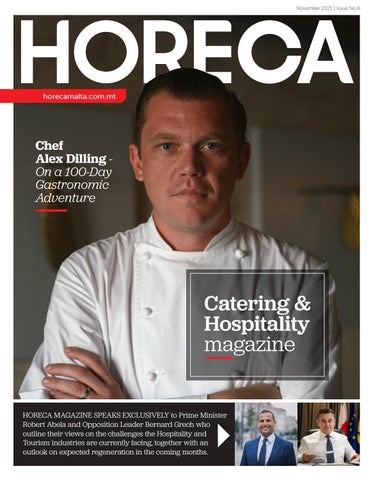
November 2021 | Issue No.6
horecamalta.com.mt
Chef Alex Dilling On a 100-Day Gastronomic Adventure
Catering & Hospitality magazine
HORECA MAGAZINE SPEAKS EXCLUSIVELY to Prime Minister Robert Abela and Opposition Leader Bernard Grech who outline their views on the challenges the Hospitality and Tourism industries are currently facing, together with an outlook on expected regeneration in the coming months.
TAGS & TAG HOLDERS
BREAD BASKETS
BILL PRESENTERS WALL BOARDS
TABLE CHALKBOARDS WWW.INNOVATIVE.COM.MT 229 Triq il-Kungress Ewkaristiku, Mosta, Malta info@innovative.com.mt -
+356 9997 0282 -
f
@menusdisplaysmalta
INFORMATION STANDS
PAVEMENT CHALKBOARDS
INFORMATION DISPLAYS
4/
Publisher Ryan Galea
Editor horecamalta.com.mt
Tonio Schembri editor@horecamalta.com.mt
Contributors
Editorial As we approach the end of a turbulent 24 months for the Horeca Industry, we look forward to a new year where the general expectancy is to return to a certain degree of 2019 figures, at least in some areas and regions. In other territories, the return to preCOVID levels is projected to take up to 2025 or beyond. We are proud to present the latest issue of Horeca Magazine, packed with exclusive content, interviews and features. Our cover story features Michelin Star Chef Alex Dilling, who describes his experience during a 100-day ‘gastronomic adventure’ at ION The Harbour restaurant. Feature articles include reports on the current human resources issue, while we ask restaurant owners for their opinion on vaccinated entry to their premises. As architectural firm AP Valletta celebrates its 30th year of operation, they share their vision and design concepts, especially in hospitality projects.This issue also features exclusive interviews with Carlo Micallef, who relates his journey spanning over two decades at the MTA, and Howard Keith Debono. As president of the Malta Entertainment Industry and Arts Association, Howard assesses the impact of various event cancellations on the Tourism and Hospitality industries. Horeca Magazine also spoke to the leaders of the two main political parties, Robert Abela and Bernard Grech, who share their respective views of the effect of the COVID pandemic on the various Horeca industries, and how they see the trend changing till year end and throughout next year. Apart from the usual contributions from the MTA, MHRA, ITS and ACE, we carry for the first time an article from the Gozo Tourism Association, which presents an interesting analysis with figures and statistics outlining, among others, the importance of staycations for the Gozitan Tourism performance.
Get Social with us... Q E C M @HorecaMalta
Joe Galea Josef Bonello Jo Caruana Laura Bonnici Kris Cassar Dowling David Leone Ganado Michael Iavarrone AP Projects Dr Gavin Gulia – MTA Tony Zahra – MHRA Reuben Buttigieg – ACE Andrew Detattista – ITS Howard Keith Debono – MEIA Joe Muscat – GTA
Sales & Marketing
sales@horecamalta.com.mt
Administration Jennifer Azzopardi Clara Cachia Daniela Sammut
Production and Design Reno Cucciardi (switchpg.com)
Photography Jonathan Borg
Distribution Mailbox
Printing Print it
© Mailbox Ltd 2021. All rights reserved. Reproduction in whole or in part is strictly prohibited without written permission from the publisher or editor. Opinions expressed in Horeca are not necessarily those of the publisher or editor. All reasonable care is taken to ensure truth and accuracy, but the publisher and editor cannot be held responsible for errors or omissions in articles, advertising, photographs or illustrations. While we endeavour to ensure that firms and organisations mentioned are reputable, the publisher or editor can give no guarantee that they will fulfil their obligations under all circumstances.
TABLE OF CONTENTS 12.
22.
34.
38.
44.
48.
On a 100-Day Transforming Gastronomic Adventure Tourism in Malta
Interview with the Prime Minister and the Opposition Leader
The Show Must Go On! Interview with Keith Howard
Features:
72.
Wine Focus: Ta’ Betta Wine Estates
Reflections of a Summer
The Future of Hospitality Success
18. Hospitality architecture 26. The unsteady recruitment issues 30. The impact of COVID-19 on Gozitan tourism 52. Restaurant owners on COVID-19 regulations 56. Development through sustained investment in skills 60. Irrevocable damage in case of third closure 62. Spotlight on traditional Maltese cuisine 66. Representing Mediterranean heritage in Vietnam 78. COVID-19: Accounting for its costs
8/
The Return to a Degree of Normality… What a ride these past months have been! As I write this welcome note for this publication I cannot help but reminisce about what we all had to go through as a result of the COVID-19 pandemic. The Horeca industry was undoubtedly amongst the worst hit, but the resilience of all those involved is what helped us to fight through the hurdles to reach the point that we are at today. Over the past months, the industry has had to adapt business models to cater for the local markets until all the borders were closed to curb the spread of the pandemic as much as possible. News of the vaccine late last year gave us the right dose of hope we all needed to solider through the hundred and one effects of this big unknown. Back in June we were in a position to start welcoming back foreign guests and start feeling free again. We could finally showcase our product again to tourists, showing exactly just how and why there is always more to explore in the Maltese Islands. As an Authority we always felt the need to be the main port of call for the industry, and it is with this in mind that, together with the Ministry for Tourism and Consumer Protection, we launched a comprehensive and holistic Tourism Recovery Plan earlier this year. The plan is divided into different schemes, targeting diversified sectors
and niches which compose the holistic tourism sector of the Maltese Islands. This while also helping business through other schemes such as those for bars and restaurants. Our Recovery Plan fits in as a component of our longerterm Tourism Strategy to 2030 which is based on the three pillars of Recover, Rethink and Revitalise. However, our Recovery effort is not based on a basic wish to turn back the clock to pre-COVID-19 performance but to carry out a Recovery Effort which already bears the hallmarks of our long-term strategic direction. The schemes of the Tourism Recovery plan have in fact proved to be successful and it gave us the right amount of motivation to continue moving forward, embracing a return to a degree of normality as we started welcoming tourists once again, with numbers being much better than we had expected. I can only say that the future is once again looking bright. We have also started to see large-scale events making a long-awaited return to our islands: the Floriana Granaries hosted famed Maltese Tenor Joseph Calleja, Malta’s finest talent in Malta Rocks, the BBC Concert Orchestra and Pete Tong and The Heritage Orchestra. All these events adhered to the COVID-19 protocols which are in place – which were followed by cast, crew and audiences alike. It was a welcoming feeling seeing locals and tourists alike enjoy these concerts and the reaction we had made us just look forward to moving another step closer in this normality. All of this could not have been achieved without everyone’s hard work, determination, and resilience, and for this reason, I find no better way to end this message, other than by thanking you all for your commitment, your drive, your patience and your passion as together, we managed to overcome what can easily be described as a dark cloud, if not the darkest cloud for our industry, which we could only overcome because we all worked together. Dr Gavin Gulia Executive Chairman Malta Tourism Authority
A N E X P E R I E N C E C R E AT E D
E X C L U S I V E LY F O R M A LT A
V 25 T DE 19
Mediterranean Conference Centre, Valletta cirquedusoleil.com//eri
10 /
programme and we have to thank our superb health services that we have managed to get close to 90 per cent of the qualifying population to be vaccinated. This gives one a good deal of protection although there can and still are risks. Given this enormous commitment of resources - both human and capital invested by the government of Malta it must be our duty in the hospitality industry to cooperate fully to ensure strict adherence to protocols for safe entertainment and accommodation.
Living with the Pandemic The current perceived wisdom talks about life after the COVID 19 pandemic - the title is living with the pandemic and for good reason. The pandemic is very much still with us and there is no sign yet as to when it will become history. Indeed there are those who say that the virus that caused the pandemic will always be with us but under control. The hospitality industry must therefore learn and adapt to living with COVID 19 since waiting for the pandemic to end could lead to a slow and painful economic death for anyone involved in the Horeca industry. Clearly it is necessary to ensure that the consumer - our client - has to have the comfort of knowing that the service provider is taking all the precautions necessary to provide a service that will be as free from the virus as is possible. For our industry to move on to a new normal we all need to ensure the highest standards possible of sanitisation. These high degrees of standards and diligence came about some years back with the physical threats of possible terror attacks - we now need to maintain the same level of vigilance as we did then except that the ‘enemy’ is invisible but probably more dangerous. Malta has been extremely diligent with the vaccination
We need to keep up our guard as we cannot afford to revert to high numbers of new cases and another possible lockdown - partial or otherwise. Having said this let’s now look at the current market situation. Prior to the opening of the industry in June, MHRA had commented that it would be considered a success if the numbers of arrivals between June and December 2021 would reach the level of 60 per cent of the numbers from the same period two years ago. The first three weeks of June were superb and we were all thinking we are on our way, but this virus plays tricks and we had to endure harsh new health protocols which practically killed new bookings and even saw cancellations from those already booked. It took some three weeks for the dust to settle and to start seeing some movement forward and we lost a part of July but we recovered somewhat the following month. MIA have confirmed that August saw slightly over 50 per cent arrivals compared to 24months ago when a record number of arrivals was recorded. Figures for September and October seat uptake are encouraging too. If we continue this momentum we stand a chance of achieving the 60 per cent of arrivals that we predicted before the opening in June. It’s going to be tough to accomplish but it can be achieved provided we all learn to live with and respect this virus. Tony Zahra President – MHRA
PORCELAIN
Prokitchen.eu /
GLASSWARE
(+356) 2144 7676
CUTLERY
12 /
From Green to Blue… On a 100-Day Gastronomic Adventure Previously Executive Chef of the two-Michelinstarred restaurant The Greenhouse in London, Alex Dillon completed a 100-day residency at Iniala’s ION – The Harbour. As he tells Jo Caruana, it was a whirlwind of local ingredients, critical team building and gorgeous sea views – and he loved it.
/ 13
Chef Alex Dilling
Alex Dilling smiles as he presents the first of numerous dishes to our table of diners: his marinated caviar with pink shrimp, ginger, and crème cru – all intricately thought out and as pretty as an Instagram sunset. Dilling talks through each aspect of the dish and we look on in awe – wowed by the collective make-up of the food in front of us, the calibre of the chef in conversation, and the marvel of the Grand Harbour view behind us. This is 100 Days – an experience crafted by Dilling, along with dynamic Iniala founder Mark Weingard and the rest of the Iniala team. It is exquisite, and gave Malta the chance to experience Dilling’s trademark creativity and flair on home turf. >
14 /
“When it was announced that The Greenhouse would be closing its doors and not reopening them, I had some time to think about what I wanted to do,” Dilling tells me. “I didn’t want to rush back in. So, as opportunities presented themselves, I held back. I wanted the next thing I did to feel just right.”
patrons, a new, exciting and time-stamped concept can be just what the market needs. “A pop-up is short lived by definition, so it’s great for presenting something new and different,” the chef continues. “I wanted to create something that gave local diners the chance to experience some of my favourites, while also
It was clearly fate, then, that Weingard reached out to the celebrated chef on Instagram – something that won’t surprise those that know him. “I didn’t know what to make of it,” Dilling laughs. “But two days later I was in Manchester to meet Mark, and found I really liked his vision. Two days after that I was in Malta gaining an understanding for his new hotel here and it all happened very quickly. I instantly loved the island and felt excited by the opportunity to work here.”
crafting something new and locally cognisant.” So that’s exactly what he did – by mindfully fashioning a menu that exudes Maltese character yet is imbued with international excitement. Dishes included his Mediterranean hake with colonnata lardo and a ‘sauce Matelote’, his signature ‘Hunter Chicken’ in a sauce Albufera with young lettuce, and his araguani chocolate sourdough, with Gozo sea salt and caramel.
The idea for their collaboration to be a ‘pop-up’ was also an excellent one. On an island where it sometimes feels like eateries outnumber
“I arrived in Malta with some expectations about ingredients here and had already written a menu in my head – but it had to change when I realised it can be tricky to get hold of >
16 /
certain things. Nevertheless, Maltese produce remained the priority; we found the seafood to be abundant and fantastic, and sourced some incredible products like olive oil and sea salt from Gozo. Another touch was to serve local cheese instead of French butter with the bread, which resulted in a thrilling flavour and texture combination.” Of course there were challenges – largely brought about by the intensity of creating and executing such an ambitious plan in such a short period. “Staffing pop-ups is always difficult because you don’t have as much time to train your people as you would when opening another type of restaurant concept,” Dilling continues. “You’re inviting a team into a very complex and complicated operation, and asking them to get up to speed in no time at all. It’s tough! But the team we put together was absolutely fantastic. As ION was already Michelin-starred when I arrived, I knew standards has been set and there was a great base to build on. I am very pleased with what we achieved.” Patrons loved the experience too and, despite its steep price tag, 100 Days was largely sold out across its run. “Admittedly a set menu of this kind isn’t for everyone but, overwhelmingly, our diners embraced and loved it. We’re thrilled with
the results. Of course, the overall atmosphere of Iniala only added to their experience; the design detail is phenomenal and the view unparalleled. The fact our guests could watch fireworks light up the sky most weekends only added to the magic!” Dilling now leaves Malta excited about its future. As pandemic-related closures are lifted, he believes more and more people will come to discover the island, leading to increased opportunities for hospitality entrepreneurs here. “I am so thrilled by everything I have seen and learnt in Malta, and I know others will be too. I can’t wait to tell them all about it. “That said, there’s no escaping the fact that it’s a rough moment for our industry but it is also an opportunity. This is the time to keep learning, and to keep choosing the very best produce so that you can offer your clients the very best too. There is an exhilarating future to look forward to.” Finally, I asked Dilling how he stays so creative. Does he ever worry about that creativity running out, I wonder? “Yes!” he laughs. “But I am pleasantly surprised that it never does. It’s all about staying in the right frame of mind, where clarity and ingredients inspire you. Creativity is endless as long as you are in the right space,” he says.
Jo Caruana is the founder and CEO of the Finesse Group. The Group’s various arms work together to finesse every aspect of the client journey - from content and communications, to customer care training and business etiquette. Jo is also a writer, editor, and presenter.
18 /
HOSPITALITY ARCHITECTURE AP Valletta is thirty years old this year. Can you give us an overview of the firm’s start in 1991 up to its position today? We started in 1991 with the name Architecture Project, a manifesto in the Modernist tradition declaring the urgent need for a project to give new energy to Maltese architecture. At that moment in history, though, Modernism was on its last legs and the isolation of the island started to become a thing of the past. So, while Architecture Project, or AP, began to contribute to the awareness of Architecture which began to flourish again on the island, the context of the original mission was transformed irreversibly. AP has always been prepared for change, and has remained, as a result, fresh and catchy, albeit more ambiguous. ‘The idea of Valletta’ is a central tenet of the story of AP. Valletta as a Renaissance City is an important example of the Architect’s role in designing the ‘Ideal City’ – a city concerned with lasting beauty and functionality, to be enjoyed by all. As a practice we are eager to persevere in this endeavour to (re)develop the model of a Renaissance City into a Model City of the Future, with Valletta as a laboratory for new ideas. With this project
/ 19
in mind, it is fitting that in 2018 we decided to connect the name ‘Architecture Project’ or ‘AP’ directly with that of the city, officially becoming AP Valletta. Can you mention some past and present projects related to Hospitality, locally and abroad. Over the past 30 years we had the privilege to work on some of the most spectacular hospitality sites on the Island, from Xara Palace in the late 90s to the iconic Hotel Phoenicia which is still ongoing. The restoration of the historic building in Mdina deals primarily with the refurbishment of the historic building to create a charming hotel with seventeen suites overlooking both the Maltese rural and urban landscape. Similarly, working on the Phoenicia Hotel was a great challenge for us, especially due to the importance of the historic fabric characterising the building. The project was approached in a holistic manner: the brief aimed indeed at the insertion of this 1930s hotel within the rehabilitation project for the area spanning between City Gate, the ex-bus terminus and the Floriana ex-parade ground. It included the restoration of the facades, the renewal of the back-of-house, the provision of new terraces on the roof of a new wing housing the spa and the requalification of the surrounding gardens and pool area, creating a contemporary experience that pays tribute
to both the art déco structure and the 16th century fortifications. The extension of the stair towers on the facades and the creation of a copper cornice to unify the 1990s additions, whose frontispieces and roof structures were replaced with sky suites, form part of an overall masterplan that envisages the requalification of the hotel’s grounds. This includes a new pool area that restores the legibility of the hotel’s original architecture while drawing the curtain back on the greater city context. An infinity edge blurs the boundary between the pool and the sea beyond, and shallow steps running along the whole length of the pool create the effect of a beach at the foot of the bastions. >
20 /
AP Valletta’s vision statement is to “create architecture that is a place-maker, a container of meaning, a catalyst for the creation of kinship, a fabricator of myth and a producer of narratives.” Tell us how these aspects are kept in mind when designing a hotel, from the general aesthetics to guests’ experience. We see our mission as similar to that of the alchemist whose erstwhile research was aimed at converting lead into gold. Like any other human activity, the ingredients of Architecture are often restrictive and mundane, but our goal is to combine them in such a way that the end result is lifted out of the basic sphere, provides continuity with the valuable Architecture of the past and is invested with the quality of timelessness. We apply the same philosophy to all our projects, including hospitality. Indeed, when we worked on the restoration of the Hotel Phoenicia and its Spa we aimed at creating an architectural language which stems from the re-interpretation of the Art Deco style of the main building, and it results in a clean
repetition of patterns and a distinct linearity, gently promoting the contemporary nature of the intervention. Also, structurally, the complex took on some inconceivable challenges as the presence of large historic ruins was discovered during construction. We chose a neutral, pastel and natural palette that resonates throughout the materiality and creates a homogenous sculptural effect. In this way its emergence from a fortified pre-existent base is enhanced and projected into a timeless dimension. We also attributed significant importance to sustainability principles. Figures from the 2017 Hotel Global Decarbonisation Report have indicated that hotels will need to reduce greenhouse gas emissions per room, per year by 66% from 2010 levels by 2030, and 90% by 2050 to align with the Paris Climate Agreement. Reducing the environmental impact and making hotels self-sustainable is nowadays considered to be a key issue, particularly for the growing
/ 21
number of eco-conscious consumers. What is AP Valletta’ strategy in this regard? As an architecture firm, we have always had environmental considerations and circularity at the core of our projects, always opting for an active approach to the matter. Recently AP Valletta signed an agreement with the Malta Chamber of Commerce to cooperate on an extensive research project, ‘Building Futures’, which will explore how design, together with research, educational and economic measures can shape the future of the built and unbuilt environment in Malta. We strongly believe that circular economy is more about the mindset and the approach. Everything will change when we understand that everything is connected, as a domino effect — design, quality, aesthetic, education, environment, culture. Nowadays there is an abuse of the word ‘sustainability’ — people tend to use it without knowing what it really means and entails. In the case of the Phoenicia Spa, the design considerations were combined with sustainability principles, of which the most tangible outcome is the installation of a green roof on the extension, providing the structure with an alternative cooling system and therefore making it very energy efficient. During the process, we also approached international experts to achieve the ultimate objectives in the best possible way. COVID has brought about the need to create a ‘smart’ hotel room with several new design implementation. These include contactless and touchless room controls, keyless room entry, pop-up dining areas and robotic servers, among others. What is the long term validity of these measures post-pandemic? Society nowadays needs to be re-educated in order to understand the consequences of our pre-covid behaviour. As a result, measures would have to be put into place to maintain and improve the amenities of our hospitality offer order to avoid the spread of the virus. Little do we know about the post pandemic future; however, it is highly
predictable that technology will play an even higher role for the future of hospitality too, with a focus on maintaining environments safe both for the workers and guests. Moving forward, what do you consider to be the main opportunities and challenges facing the Hospitality Architecture industry? Reevaluating our parameters of aesthetics and materiality is one of the greatest challenges of the construction industry in Malta. We know that the building industry contributes heavily to CO2 emissions and we cannot leave it only in the hands of individuals to make the necessary choices, but rather to policy makers who need to re-interpret the abovementioned parameters and to provide tangible and adoptable solutions for the long term. As an office, we are currently exploring new and innovative materials and more eco-friendly ways to design and construct. In this respect, we strongly believe hospitality would be one of the best industries to explore these new trends. It would be fascinating to see how trends related to modes and periods of travel have changed as a result of the pandemic. This will clearly have an influence on the hospitality of tomorrow and might generate new typologies of buildings to accommodate the novel forms
AP Valletta 4 Sappers Street, Valletta 356 21243981 info@apvalletta.eu www.apvalletta.eu
22 /
Transforming Tourism in Malta After 24 years at the Malta Tourism Authority, Chief Marketing Officer Carlo Micallef is an eyewitness to the evolution of the island’s tourism sector. He shares with Laura Bonnici how much has changed during his tenure – and what the future might hold for tourism in Malta. Carlo Micallef - Chief Marketing Officer
/ 23
Travel back in time to 1997, and a visit to Malta would look quite different to the Mediterranean destination we know today. Then, the National Tourism Organisation Malta – destined to later become the Malta Tourism Authority – curated your island adventure. It was that same year Carlo Micallef joined the organisation, starting a journey that would help transform the tourist experience into one that still attracts millions of travellers. “That was a long time ago,” he smiles. “There have been many changes since in the organisation and the industry. At that time, the national airlines and tour operators generally controlled tourism, and it wasn’t very diversified. Around half of all visiting tourists were from the UK, followed mostly by those from Germany and France. When I started as a marketing executive, my first assignment was to open our activity to the emerging Russian market. No one wanted to do it, so it was given to the new recruit!” As well as Russia, Mr Micallef soon took on the UK and Ireland desk, meeting travel agents and journalists visiting Malta from both increasingly busy and demanding markets. With this valuable learning experience, he went on to head the hospitality division, hosting key visitors arriving on pre-planned programmes. Further promotions quickly followed, including a threeyear assignment in Amsterdam to oversee the Scandinavian market, with frequent trips to the Authority’s satellite Belgium and Stockholm offices. “The experience opened my eyes to a world beyond Malta,” he shares. “When I returned to the island, I led a segment for business development and emerging markets, which allowed us to expand our reach beyond Europe and diversify our source markets – and welcome more visitors through the traditional ‘leaner’ months of Malta’s tourism year.” Today, as Deputy CEO and Chief Marketing
“Malta’s high vaccination rate and stricter protocols are reassuring for travellers who are only just considering international trips again.” Officer at the Malta Tourism Authority, Mr Micallef now uses his local and international expertise, garnered over nearly a quarter of a century in the industry, to assist in the Authority’s mission to promote Malta as a go-to destination. “We have created a bespoke marketing approach for each country, which spotlights Malta to targeted audiences and gives the best operation for our overseas partners. We have seen sustained growth in tourist numbers visiting Malta, especially from 2014 until 2019 – and, of course, we all know what happened in 2020.” Indeed, with the many challenges of the COVID-19 pandemic – particularly regarding international travel – 2020 was a difficult year for global tourism. “In the first weeks of the pandemic, few imagined it would hit the world so hard, or last so long,” Mr Micallef recalls. “As the situation evolved, we made sure to keep going by creating online activities to stay engaged with the public.” Quickly pivoting their marketing approach, Mr Micallef describes how his team took to the digital space to offer positivity, stay visible and boost engagement via social media through the Dream Malta Now… Visit Later campaign. “We wanted to find ways to keep Malta’s >
24 /
a revitalised local tourism industry – with an eye towards consistency and safety. “Malta’s high vaccination rate and stricter protocols are reassuring for travellers who are only just considering international trips again,” he says. “People are still adopting a ‘wait-and-see’ attitude, booking their trips within a week or so of their travel date. The country has managed the pandemic well, so now we must avoid relapse by remaining patient and consistent, as restrictions are gradually relaxed. If there aren’t any new variants or spikes, then the positive trend we’ve experienced over summer should continue into winter.”
“Tourism is fragile, but it recovers quickly and remains an important pillar of Malta’s economy for 40 years or more.” unique culture, traditions and history at the forefront of people’s minds, at a time when they couldn’t experience it in person,” he says. “As well as making videos of Maltese chefs sharing local recipes, we teamed with Heritage Malta to showcase our attractions and artefacts digitally, and offered online games for families. We even offered a free short course in the Maltese language and its origin, so that people can order in Maltese when they return!” Having ridden a succession of COVID-19 waves since March 2020, Mr Micallef now hopes for
As well as a more sustainable approach, Mr Micallef also joins the drive towards better quality. “We have used the opportunity to boost quality at every level, from the taxi driver at the airport to hotel staff. Investment by the Government, MTA and various other entities will help elevate everyone and everything across the industry, offering better value for money overall,” he explains, sharing that this investment also extends to addressing the staff shortage now affecting both tourism and hospitality industries. Updated regulation for the accommodation sector is also on Mr Micallef’s radar, with a new law in progress following extensive consultation. “We have recently launched the Forbes project, whereby a ‘mystery shopper’ for the travel industry will visit the country at an unknown time, booking hotels and restaurants and so on, and then offering us feedback on their experience. Their evaluation will help us solidify all the positive changes we have made and reward the incredible resilience of everyone in the industry,” he concludes. “Tourism is fragile, but it recovers quickly and remains an important pillar of Malta’s economy for 40 years or more. Let’s keep working together for the return of a better, stronger, higher quality tourism sector.”
Article written by Laura Bonnici, a writer for the Finesse Group, which creates content and PR for brands in Malta and internationally.
#1 Choice for Team Building Birthdays, Parties and Corporate Events
Ages 8+ Over
Equipment & Protective Gear
Licensed Arena
Minimum Players x10
BOOK YOUR EVENT NOW! +356 9942 7874 / +356 9950 3611 LASERWAR ARENA | Ta’ Qali, Malta.
info@laserwarmalta.com | f @laserwarmalta | www.laserwarmalta.com
26 /
THE UNCERTAINTY OF SERVICE STAFF AND THE UNSTEADY RECRUITMENT ISSUES IN THE HOSPITALITY INDUSTRY Recruitment in the hospitality industry has always been quite a challenge to manage. From filling posts to maintaining them, improving standards for employees and even creating new roles for the welldeserved servers, the hospitality industry cannot thrive alone on the expertise of the kitchen, there are many other factors that add to a diner’s experience, one very important one being the service of a night. When service falls flat, there’s a great chance customers will not return to an establishment, even though the food and atmosphere were delightful.
2021 gave local restaurants a huge, eyeopening peek into the realities of unsteady recruitment and the underlying issues within the hospitality industry. And, as time goes by and restaurants return to practically normal expectations, the service sector is still lagging far, far behind. Let’s look at the reasons behind Malta’s current service staff employment crisis in the hospitality industry as a whole, breaking down the walls and taboos that many seem to tip-toe around, but let’s do this from the employee’s point of view. Facts are facts. The service staff for catering, hotels and the hospitality industry as a whole in Malta is predominantly foreign. And by foreign, we’re referring to residents of Malta, who may have very well lived here for a long time, raised families here and even learned the language, but are not inherently Maltese. The majority of these hospitality workers rent lodging in Malta while working 40+ hours a week for a minimum wage. A feat which is near impossible, but it brings food to the table, shelter for their growing families and distance from their country of origin. All third country nationals are generally set on full-time employment contracts, as work permits are only issued on this basis, but when the havoc and uncertainty of COVID-19 belted down on Mata’s entertainment industry as it did with the rest of the world, no full-time contract could predict the desolation in the hospitality industry. Employees were cut off, given reduced hours, made redundant, offered other work and kept on government benefits, all for lower income and an even more deafening toll on the struggles of survival. The most imminent solution for such hospitality workers: leave Malta. And so they did, with mid 2020 to early 2021 seeing Malta’s greatest exodus of able workers leave the country. With their inability to provide
for themselves and their families, hospitality workers returned to their home countries, where even though life may not be as they had been experiencing in Malta, survival was more realistic with family support eliminating the need for astronomical rental prices and extortionate basic needs such as grocery shopping or amenities, compared to minimum wage earnings for full time work. COVID’s distractions seemed to dull down, mid 2021, just in time for the summer rush, but the workforce never seemed to return. With a peak in hospitality slowly trickling in, how were the entertainment sources in Malta, one of the island’s biggest economic contributors, supposed to jump start and pick up where they left off without any trained staff? There were great setbacks attached to the pandemic, but perhaps, the standstill of restaurants, hotels and other entertainment outlets was the most devastating to the local economy. We spoke to Martin Spiteri, Operations Manager at M Recruitment and Michela Tanti, Acting HR & Training Manager at The Excelsior Hotel, and picked their brains on the recruitment issue from the employer’s point of view. Their first-hand experience and in-depth view of the subject allowed for a thorough and well-mapped out analysis of Malta’s recruitment crisis in the hospitality industry. Here’s what they had to say. >
28 /
Martin Spiteri,
Operations Manager, M Recruitment
What do you think of the current recruitment issue? Why do you think it happened? Could it have been avoided? The issues we are today facing in the recruitment of hospitality staff happened for a number of reasons. Firstly, during the pandemic the country and the industry lost thousands of people. In May, when everything reopened, everyone was short on staff and the travel restrictions across the globe made things a lot more difficult to control. Visa permissions were delayed due to Visa Offices having to close, quarantine for unvaccinated people enforced and other limiting factors which caused recruitment issues across every sector in the country, especially the hospitality industry. We couldn’t ask new recruits to pay for quarantine hotels, for example. This entire scenario would have been incredibly hard to avoid, especially since third country nationals left Malta’s shores when they were left without work. What could have taken place is some planning ahead to mitigate the issues, but even those who tried to think proactively are currently facing the same issues. Nobody ever anticipated that things would take so long to return to ‘normal’. How can employers avoid this crisis? What does the industry need to regularise recruitment in the hospitality industry? At the moment employers have their hands tied. This was all entirely unprecedented. We’ve
made mistakes and learnt from them, but at this point in time some employers are still making the same mistakes. The idea of immediate recruitment is still an issue, employers would rather employ someone ‘now’ rather than wait for the right recruit within a few weeks’ wait. The reality of poaching is also rather prevalent at the moment, with inflated salaries being offered to an unsustainable degree. This is a factor that needs to be addressed with brackets for guidelines within the industry. We do have a major disadvantage in salaries and other benefits when compared to other European countries and currently Malta’s salaries are unrealistic. How does your business, as a recruitment agency, plan to avoid this issue in the future? As an agency, we have not allowed the situation to take us off track. We consider ourselves one of the main players for recruitment within the hospitality industry and believe that it is our core business. Through thick and thin, we still made sure to practice our core values. We invest our time to make sure that the right candidate is picked for the right job and never compromise quality. We look at experience, not nationality or any other factors that in essence do not equal success and retention. This is what we believe will be the golden ticket to the future of the industry.
Michela Tanti,
Acting HR & Training Manager, Excelsior Hotel
What do you think of the current recruitment issue? Why do you think it happened? Could it have been avoided? Recruitment has been a problem for ages, not
/ 29
only because of the pandemic. These shortages at operation level were generally covered by third country nationals as it’s become far easier to outsource labour licenses. The insecurity that came about due to the first lockdown gave third country nationals, especially the Eastern Europeans, a quick call to return home due to the fear of insecurity. We all thought it was a short-term thing, but one of the biggest hits for Malta was when last August, the UK put the country on the red list. From a hotel’s point of view, this was challenging. The hospitality industry was the ‘unstable industry’ in COVID times where many pay cuts happened, causing people to move on and out of the industry in general. The enrollment gap gave these job seekers new possibilities as every department had some sort of gap to fill. As a major rule there is more employment in the public sector, so the private sector suffers greatly as a result. The only thing that employers could have done to alleviate some of the burdens we are facing today, in hindsight, might have been not to let people go, renew contracts and keep paying people in full. But the insecurity made it irresponsible to keep payroll on without the need for work. How can employers avoid this crisis? What does the industry need to regularise recruitment in the hospitality industry? The number of staff has reduced greatly, so this crisis should not happen again. And although that might sound like wishful thinking, we are fully aware and prepared to react accordingly with a clear goal in mind. The only way to avoid this from happening again is to ensure that
your employment measures are sustainable and regularised. The hotel industry is as regularised as it gets - what we need to understand is the influx of guests in and out of the country after the strains of the pandemic. How does your business plan to avoid this issue in the future? We have been working to accommodate the business that we can in line with available staffing and resources. We are also maximising on staff flexibility, and are training them to work in various sections within their departments. The crisis gave us the opportunity to upskill our people, with some situations even resulting in promotions for some of our staff. Ultimately, our goal is to be responsible for the jobs we create, maximising the industry potential as a whole while nurturing our staff in the most inclusive environments possible. All in all, what we need in hopes that the hospitality industry in Malta will continue to thrive as it has always done, is to understand value. The value of a role in a company, the value of a job for a worker, the value of reassurance for a community and the value of living in a country. When value is added to the basic factors in which we live our lives, processes will continue to grow and evolve and even thrive. Malta’s restaurants need to return to their glory days of Summer 2019, when packed venues were the place to be, hotel bookings were unable to keep up and bars were the usual for both weekends and weeknights! But the truth remains… is Malta ready to take on the surge of patrons just yet, or will the industry simply fall to its knees in surrender to the lack of staff?
Kristina Cassar Dowling is a journalist, blogger and writer who focuses on food culture, the arts and sustainable lifestyles - her biggest passions in life. Kristina is a freelance writer who also focuses on human stories, business and other niches.
30 /
The impact of COVID-19 on Gozitan Tourism
/ 31
Tourism is a major component and contributor of the Gozitan economy. It is a sector which not only injects overseas funds in the economy, but due to its high multipliers also creates other job opportunities. The economic benefit of tourism is far more reaching and therefore beneficial to other directly and indirectly related segments, which either depend on tourism activity for their custom or else depend on expenditure generated from tourism for their success. In such a scenario, it is estimated that approximately 50% of the Gozitan Gross Domestic Product (GDP) is generated by the tourism sector.
continues to be one of the sectors hardest hit by the Coronavirus pandemic, and the outlook remains uncertain at least for the remaining months of 2021. Recently the National Office of Statistics (NSO) published a News Release which also covered the Regional Tourism Performance comparative 2018-2020. The published data reveals interesting information on the tourism sector performance in Gozo, especially during 2020 in the thick of the unprecedented COVID-19 pandemic. As expected, the tourists’ arrivals to Gozo were drastically affected, as these were hampered and conditioned with the various travel restrictions imposed by Government to contain the spread of covid-19. These included the closure of the Malta International Airport between 23rd March and 30th June, 2020 as well as the restriction on non-essential travel between Malta and Gozo between 3rd April and 3rd May, 2020. As shown in the table below and as expected, the foreign arrivals were dramatically hit with a registered drop of 141,255 or 78% less during 2020 when compared to 2019. This decrease in arrivals resulted in a loss of 791,408 benights or 70% less in 2020 when compared to the previous year 2019.
Prior to the disastrous consequences due to the rapid global spread of COVID-19, the tourism sector in Gozo was passing through a relatively strong cycle. However, with the global outbreak of COVID-19, this sector was dealt with a big blow. Up to this day, tourism
Arrivals
2019 2020 Variance %
Domestic 215272 348489 133217 61.80% Foreign 180979 39724 -141255 -78% Total 396251 388213 -8038 -2%
Bed Nights
2019 2020 Variance %
Domestic 571500 1040040 468540 82.00% Foreign 1135922 344514 -791408 -70% Total 1707422 1384554 -322868 -19%
32 /
Images courtesy of © viewingmalta.com
As can be predicted such massive decreases in foreign arrivals and bed nights left their mark on the tourism sector in Gozo. Apart from the accommodation units and the catering establishments other direct sectors within the tourism Gozitan composite were affected. These included also the diving establishments as well as the transport operators who totally rely on foreign visitors for their day-to-day operation. On the other hand, the losses from the foreign visitors in the accommodation and the catering establishments were partially mitigated by the domestic visitors. Since the start of this unparalleled pandemic, the Gozo Tourism Association urged its members to focus their attention on the domestic market, as in the circumstances, destination Gozo was the natural choice for domestic tourists to take their respective holidays. As mentioned earlier apart from some weeks in April 2020, when travel restrictions between Malta and Gozo were in force, thousands of Maltese flocked to the sister Island during most of the weekends of 2020, and for extended stays during the summer months.
As shown in the table on page 27, this resulted in an increase of 133,217 or 61.80% more in domestic arrivals in Gozo in 2020, when compared to 2019. Cumulatively during 2020, the number of arrivals from both the domestic and foreign guests saw a drop of 8,038 or 2% less arrivals in 2020, when compared to the previous year. On the other hand, the cumulative bed nights spent by domestic and foreign visitors to Gozo resulted in a drop of 322,868 or 19% less bed nights in 2020 when compared with 2019. It is to be highlighted that the for the first time the number of domestic bed nights surpassed the one million figure and registered 1,040,040 in 2020, translating into an 82% increase in domestic bed nights in 2020 when compared to those achieved in the previous year. These results clearly indicate that the drop in foreign arrivals was partly mitigated by arrivals from the domestic market, closing the gap just short of 2%. The drop in foreign bed nights was partially mitigated, however with a wider gap of 19%. From such data the difference is clearly evident between the length of stay achieved by the domestic market which is based on 2
/ 33
nights (weekend breaks), and the length of stay usually attained by the foreign visitor of approximately 6 nights. It is worth noting that during 2020 the average length of stay for both the foreign and domestic visitor to Gozo increased. In fact, while in 2019 the average length of stay of the domestic tourist was 2.65 nights, the domestic length of stay in 2020 increased to 2.98 nights. On the same trend in 2020 the length of stay of the foreign visitor reached 8.67 nights when compared to 6.27 nights achieved in 2019. Throughout this COVID-19 period, the domestic market proved to be an important component for the Gozitan tourism sector. Let us enhance it and sustain it. There’s no shortage of doable ideas, let us have the will to implement them. On the other hand, the COVID-19 experience is an opportunity to rethink tourism in future. Tourism is presently at a crossroads and the measures applied
today will shape the tourism of tomorrow. The long-term consequences of this pandemic need to be considered, while capitalising on digitalisation and promoting the transformation needed to build a stronger, more resilient and sustainable tourism sector. Finally, the COVID-19 experience also revealed yet another niche market which dovetails perfectly with Gozo’s unique selling propositions. The concept of remote working has now become an everyday reality. During the past months Gozo started experiencing the niche of digital nomads. With improved technologies especially with the introduction of the second fibre optic cable on the Island, Gozo has a potential and ticks all the boxes to attract the market of Digital Nomads. However more needs to be done in order for Gozo to have a competitive edge on other destinations close to us that are already attracting this kind of market. At the end, irrespective of COVID-19, tourism in Gozo needs to continue to develop its touristic offer, in a sustainable and well-planned manner, respecting the same characteristics that destination Gozo is known, sought and visited for.
Joe Muscat Having worked in the Gozitan Tourism Industry since 1979 in one of the leading Gozitan Hotels, Joe Muscat joined the Gozo Tourism Association in 2011 on full-time basis and presently occupies the post of Chief Executive Officer of the same Association. He is one of the founder members of the Gozo Tourism Association, and has served on the Association’s council since its inception in 1999. Throughout these years he has been successively endorsed up to 2010 as General Secretary of this Association which represents the diverse sectors of the tourism industry on the island, ranging from accommodation to catering and other establishments offering various tourist services. As Vice-Chairman of the Gozo Regional Committee (GRC), Joe Muscat currently sits as one of its representative on the Maltese Council for Economic and Social Development (MCESD). Presently Joe Muscat is also a Director on the Malta Tourism Authority (MTA) Board, appointed as the person representing the Gozitan tourism sector, Director on the recently appointed Gozo Regional Development Authority (GRDA) Board and member on the Dwejra Steering Committee.
34 /
Reflections of a Summer This Summer’s revival of travel is significant as it indicates that we are slowly regaining our freedom. The last months have however brought about some notable changes to the industry, and to client behaviour, and only in time will we be able to understand whether this is a one-off situation, or a taste of the “new normal”.
/ 35
Reflection ONE Our first Summer post COVID was a mixed bag for the hospitality industry. In May, when COVID numbers were still spiking, there were many within the industry who were not too optimistic about the upcoming Summer. There was turmoil in most markets with conflicting restrictions, and cumbersome administrative processes for travel, and these were changing on a weekly basis. However now, at the end of Summer, I believe that I share the local industry’s general perception that the overall performance was somewhat better, at least for some players, than what many may have expected. Of course, the numbers in arrivals are still lower than what we were used to up to 2019, and there are sectors of the local industry, particularly in accommodation, that may not have been able to enjoy any significant levels of demand, but at least we have seen an industry reignite.
Reflection TWO Continuously changing restrictions and regulations are not conducive to good business. Many could not plan and many more were not ready to let go of their hard-earned cash to place deposits or make payments for leisure trips. Suppliers responded well and allowed flexible bookings and free cancellation optionality. While this helped generate bookings it also saw a continuously changing inventory log, as there were weeks where cancellations were coming in at a fast rate, normally in response to changed restrictions, but luckily in many cases these were at least being compensated with new bookings. These flexible booking conditions helped to encourage prospective travellers to book, and suppliers quickly learned to live with short notice bookings, high levels of cancellations, last minute changes and no-shows. Today it is an accepted practice that most bookings will not be made earlier than four to five weeks before the date of travel and while this makes planning difficult it may be a trend that will stay as long as consumers know that they can find the right availability and price, even just days prior to departure. >
36 /
Reflection THREE Despite a messy start to Summer when travel was restricted and regulations were unclear and continuously changing, the UK quickly regained its position as the leading market. Of course, this may be due in no small way to the fact that Malta was one of the first Mediterranean destinations on the UK green list. However even when other countries joined the green list, demand from the UK was still strong. A consistent and a somewhat positive performance was reported as well from both France and Germany and many hotels were pleased with the demand coming from these two markets. Certain Valletta hotels even remarked positively about the increase in the US market, and this may be attributed to the first fly and cruise operation to Malta from Viking Cruise Lines, when a number of guests travelled to our islands for a pre-cruise stay. On the other hand, some hotels seem to have been less excited about demand from Italy,
and while certain airlines also appear not to be too ecstatic about loads from there, the numbers were in fact not that low, possibly indicating that these airline passengers were not the typical leisure travellers, but rather Italians working in Malta and their relatives visiting them.
Reflection FOUR I have frequently expressed an opinion to my partners, and also remarked in my published articles, that the situation we were experiencing was in no way related to rates. Of course, clients always prefer a higher value for their money, but price or rate was not the most important factor in this particular situation. Many hoteliers however came to accept this as a fact only as the season progressed. Early price dumping in May and June, in a bid to attract business, did not succeed in luring stronger levels of bookings but later in the season when many hotels were able to charge premium rates, some hoteliers regretted earlier
/ 37
price reductions which led to a lower average room rate. The practice of offering added value to the regular rates continues to be more attractive, sustainable, and profitable, than simply a cheaper rate.
Reflection FIVE Although I have no evidence to confirm this, it seems that the type of visitor we had in Malta this Summer was different, or at least acted differently, from the visitor we typically had in Summer 2019 and in previous years. Many visitors were just happy to be here, enjoying outdoor life and generally not interested too much in sightseeing, particularly if it involved visiting indoor sites or attractions. After long periods of not being able to travel, many of our guests were thrilled to be away from home and in the sun. It may also be that the profile of the visitor was a different one; at least it seems to have been younger, and many of these may have been typical travellers in the past to sun soaked beaches in Turkey, Tunisia and elsewhere, but came to Malta as it was certainly one of the safest places to be.
Reflection SIX A key issue this Summer has been the lack of employees in the sector. Perhaps the industry’s “comeback” was too fast and there was no chance to attract back foreign employees who had returned home during COVID. Demand for employees is high, the supply continues to be low, and wages have gone up because of this. But do not think this is a phenomenon that we only experienced here in Malta. Cases of hotel properties, restaurants, and other suppliers not able to operate due to lack of personnel
have been reported all over Europe and at least as well in the US. There may be cases that employees are looking to work in industries that are not as volatile as tourism and the industry needs to make the effort to promote itself again as an attractive and reliable career option to prospective employees.
REFLECTIONS on the coming months As we come to the end of Summer our thoughts now turn to winter. Media reports continue to fuel concern about the next virus variant, influencing travellers to continue to be cautious with their travel plans. While suppliers need to be prudent in their strategies and pricing, they should take this Summer as an example and steer away from aggressive price led sales and marketing actions. Winter is typically the low season when demand is sluggish, and this year it is not expected to be any different. Going into Summer 2022 we should do so with a sense of cautious optimism as results are widely expected to be better than this year. However, if we have learnt anything from Summer 2021, it is that the situation is continuously changing, and forward planning may for now be difficult but being agile to grab opportunities as they come may make the difference at the end of the day.
Joseph Galea is the founder of JG Tourism Solutions, a consultancy that offers its expertise to the hospitality, tourism and aviation sectors. He was formerly Director of International Marketing at the Malta Tourism Authority and, more recently, Acting Chief Executive of Air Malta.
38 /
There is no denying the negative effect COVID 19 has had on all the Hospitality and Tourism industries. Horeca Magazine spoke to the leaders of the main political parties in Malta for their respective views on the situation and their ideas and plans as a way forward.
DR ROBERT ABELA PRIME MINISTER AND LEADER OF THE LABOUR PARTY How would you rate the performances of the Hospitality/Tourism sectors over the summer months? Is it better or worse than forecasted/ expected? What measures and initiatives does the government have prepared for the shoulder months and beyond? Our country and our people have experienced a challenging year due to the COVID-19 pandemic, with the tourism industry impacted the most as the movement of people across the globe was halted. Until the COVID-19 virus was studied, and vaccines distributed, the tourism industry stood still. We are now on the road to recovery as travel health regulations were issued, the fear of travelling was overcome, and our lives are steadily moving forward due to timely action taken by this government. That said, tourism traffic to the Maltese Islands has progressively improved, week after week. Numbers are growing steadily with an overall positive performance. In relative terms to their
/ 39
pre-pandemic levels, passenger traffic has doubled between June and August and the average length of stay of tourists is much higher than it was pre-pandemic.
online gaming, have continued to employ thousands more and possibly even attracted people who previously worked in the hospitality sector.
This trend shall continue in the coming months as many of the schemes announced earlier in the year will be running until the year’s end with some continuing even in 2022. Malta will also be given due exposure in a marketing campaign spearheaded by the Malta Tourism Authority. Furthermore, domestic tourism has proven to be a success particularly for hotels located in Gozo. In 2020 Malta was one of the few countries in the European Union where domestic tourism increased and is continuing to increase further this year.
The government, in cooperation with other stakeholders, is pushing the idea that a career in hospitality can offer great prospects. We will continue to invest in training facilities for the sector and maintain an employment regime that is conducive to supporting high employment rates. As for imported labour, we are working to streamline the process to employ foreign workers. We will, however, be focusing more on quality as it is crucial to ensure that industry standards are adhered to through a Skills Card Certification. This includes training, such as knowledge of the Maltese Islands and good communication skills, before being permitted to work.
There is a major concern, and not just in Malta, that the hospitality industry is not able to fill all its job vacancies. Costs are expected to rise as the cost of labour will increase and this is already being reported by some local restaurants. What measures would you propose to overcome this current situation which in some cases is even stopping hotels of operating at full capacity? This is a worldwide concern. As a matter of fact, the hospitality industry in Malta is shifting towards operating at limited capacity since staff recruitment is an issue. The European tourism industry, not just the Maltese, is reliant on migrant workers, from outside the EU. As vaccination rates in these countries which supply such labour improve, and vaccination certificates can be read and verified by the Maltese authorities, labour supply is expected to recover, which will lead to higher salary hourly rates. There is no easy or short-term solution to this. The truth is that contrary to other countries, many sectors in Malta continued to progress and increase their demand for labour throughout the pandemic. The manufacturing sector, the information technology sector and
Where do you see the long-term path for our tourism industry? Continued increases in volume may not be sustainable. Some may say that in 2019 we were already suffering the strains of over tourism, at least in some months. Volumes are needed to guarantee air connectivity, different air routes as well as flight frequencies. Volumes are also needed to keep the operation of tourism investments, like hotels and other accommodation establishments, catering establishments, museums, and other venues both feasible and profitable. They are required to keep multiple direct and indirect service providers to the industry in employment all year round. They are crucial for the retail sector, particularly in main tourism zones. The country is still far from reaching 2019 levels once again. In the long term, Malta will need to balance volume with higher yield per tourist. Malta must aim to offer higher value and improved experiences for our visitors whilst implementing the diversification strategy to spread tourism across the islands and throughout the year. Malta will need to concentrate on developing the markets, >
40 / Our economy is heavily reliant on tourism as it is a major earner with a strong multiplier effect. Do you see any risks of being so reliant on an industry that has proven to be so sensitive to external world events, whether it is the weather, political conflicts, or a pandemic?
niches and segments that meet these criteria. The data so far indicates that we may already be reaping some results from our new strategy. The average length of stay of tourists who visited Malta this year is much longer than in previous years. In 2019, the average length of stay of tourists was 6.8 nights. Today, it is 10.3 nights which translates to about one and a half times longer. If we look at spending, we see that per capita, expenditure now stands at €946, as against €737 pre-pandemic. Were these trends to continue, even with 20% less tourists than 2019, we would get the same tourism revenue as we had before the pandemic. With all the airlines that were operating to Malta and are again returning after the pandemic, do you still see a role for AirMalta? Malta’s national airline has and shall continue to have a crucial role for the islands, a role that goes beyond tourism. The national airline is the carrier of the Malta brand, with loyalty to the destination. Many airlines are presently flying to Malta because it is profitable for them to do so. If the Malta route would be less profitable than other destinations, they have no loyalty to the destination, and they will choose to do what is best for their company’s bottom line. A national airline is also very important for meetings, incentives and business travel, as well as cargo transportation. Low cost airlines do not offer such services.
No economy should be overly reliant on any one industry. Over the years our islands’ industry mix changed and evolved. Some industries have vanished, and this happened due to different reasons including lower costs of operation elsewhere, new technologies and changing trends. New industries developed, grew, and took over. Industries such as gaming and finance to mention a few, can be affected by many factors. The new regulations could adversely impact their contribution to Malta’s GDP. Despite all of tourism’s sensitivity to external world events, it has proven to be the one reliant, enduring and important contributor to the Maltese Islands’ economy, with a high propensity to recover quickly from setbacks, enjoying a strong multiplier effect as well as being an industry that injects income very quickly in people’s pockets. The Maltese Government is committed to ensuring that tourism remains one of the key pillars of our economy. In coming years, we want the sector to evolve in line with the rest of our economy, adopting digital technologies more rapidly and reducing its environmental impact through better recycling of waste, less use of polluting transport means and a move towards more energy-efficient and renewable energy.
/ 41
DR BERNARD GRECH LEADER OF THE OPPOSITION AND THE NATIONALIST PARTY
How would you rate the performances of the Hospitality / Tourism sectors over the Summer months? Is it better or worse than forecasted / expected? The performance was good given the context. Unfortunately, until mid–summer it appeared that we did not learn the lessons of 2020 when it comes to handling the pandemic. The late summer season was however a good indicator of the appetite of the industry to dream big again. What measures and initiatives is the Nationalist Party proposing for the shoulder months and beyond? We strongly believe in the Maltese product and in its inherent comparative advantages over the competition in the Mediterranean and beyond. For this reason we published hundred proposals for the recovery of the tourism industry in Malta founded precisely on the strength of >
42 /
the Maltese product, empowering operators to identify and market their offer in niche sectors, encouraging upgrades in hotel facilities, promoting a Maltese ‘National Aesthetic Standard’ to protect picturesque Maltese spots and then opening up to a stronger investment drive with a 7% VAT rate on all Hotel and Restaurant facilities on the purchase and sale side too. There is a major concern, and not just in Malta, that the hospitality industry is not able to fill all its job vacancies. Costs are expected to rise as the cost of labour will increase and this is already being reported by some local restaurants. What measures would you propose to overcome this current situation which in some cases is even stopping hotels of operating at full capacity? There is currently a shortfall of staff in the hospitality industry all over Europe. The sector has been has been hit hard by the pandemic. Malta should employ a two-pronged approach: offering incentives on one front and empowering the industry on the other. We are proposing several incentives, including a reduction of VAT rates as well as introducing flexibility for tax payments to be spread over a prolonged period. This would restore confidence in the sector and send a strong signal to workers that the hospitality industry is a stable employer. The hospitality sector has acquired great experience over its long years of existence in Malta. We have to create the right environment for it to flourish. Let’s empower the industry with tangible and result-oriented measures. Where do you see the long-term path for our Tourism industry? Continued increases in volume may not be sustainable. Some may say that in 2019 we were already suffering the strains of over tourism, at least in some months.
We often speak of quality versus quantity but the key is not to concentrate on one at the expense of the other. We should strive to offer the highest possible quality in a mass market. To achieve this balance of quality and quantity, we need to address the needs of different customer segments and take account of the multidimensional nature of tourism service products. For example, we have to be in tune with the shift in mindset resulting from the greater affluence and accessibility of our era. People are increasingly moving away from visiting a place and ticking the boxes of all the “must-see spots”, and are instead looking for life-enriching experiences in the place. We should have our finger on the pulse of the tourism industry, with an eye for the top market. For example, with more jobs becoming less location-dependent, we have a new phenomenon – digital nomads. Malta should present itself with more conviction as a destination for digital nomads. We should refine and be ready to adapt in real time our e-Residency programmes. Ultimately, the overall success depends on the level of engagement of key stakeholders in the tourism planning process. With all the airlines that were operating to Malta and are returning after the pandemic, do you still see a role for Air Malta? Malta cannot rely solely on the market to ensure our links to the outside world. If anything, the pandemic demonstrated the importance of having the capacity to organise repatriation flights. That does not mean we should not strive for economic viability and downright prosperity. However, there are national and strategic reasons for having a national airline. Air Malta is an insurance policy against our peripheral geographic location. With EU membership we
/ 43
joined a market of 500 million potential tourists. We can’t risk an unreliable connection with that market. Our economy is heavily reliant on tourism as it is a major earner with a strong multiplier effect. Do you see any risks of being so reliant on an industry that has proven to be so sensitive to external world events, whether it is the weather, political conflicts or a pandemic. A wise man does not venture all his eggs in one basket, but many islands have a high level of dependence on tourism. We see economic sectors as complementing each other. Our drive to expand the e-gaming sector for instance into videogaming and e-sports can easily become an important niche sector for Maltese tourism. In our policy making we strive to reach win wins. We are keen to deploy many more win wins once in Government.
44 /
The Show must GO ON Horeca Magazine speaks to Howard Keith Debono, president of the Malta Entertainment Industry & Arts Association, who assesses the impact of various event cancellations on the Tourism and Hospitality industries. The measures and restrictions brought about by the COVID 19 pandemic have had a substantial negative impact not only on the Arts & Entertainment industries, but also on the Tourism and Hospitality sectors. Can you give us a generic overview of the economic situation in the past 24 months. The past 24 months have seen a number of set-backs for our industry. We are primarily a planning industry so events and projects planned to be launched in 2020 would have been initiated beforehand which of course means all expenses would have been incurred. So, the first thing is a direct loss on those entities who were unable to operate due to the immediate threat of COVID since the beginning of 2020. International cross over plans suffered even before that since late 2019. The next setback was a major halt to all plans due to the uncertainty of this unprecedented reality. What followed was every person in our industry needing to stay afloat and survive the negative impact. As a result numerous skilled workers who have been trained throughout this past 10
years left our industry to other industries. This caused an imminent issue as well as serious problems for the years to come. The Malta Entertainment Industry and Arts Association recently expressed its disappointment about the delay in the release of guidelines related to events. The association also mentioned ‘lack of clarity’ in this regard. Can you update us on this? One of the main disappointments was related to the lack of understanding that we are a planning industry. Announcements of guidelines in a press conference were always met with a nightmare packed with unanswered questions the following day with panic driven realities our members had to face. Our industry and various sectors are complex in nature. Eventually we found a way with the Public Health Department to relay the info a bit more effectively. Also worth mentioning was the big mistake of releasing measures too quickly last Summer which we warned was going to have an imminent backlash. MEIA predicted this and we voiced our alarms publicly. Unfortunately it was too late and Q3 of 2020 and the following months were ruined. It was clear that border control was not being managed properly and was weak, whereas ridiculous over the top measures were imposed in areas which could have been avoided. Certainly we could have worked our internal tourism more effectively with bolder incentives during this interim
/ 45
period. The final concern was directly related to the fact that announcing measures required a buffer of at least one month for the industry to respond due to the nature of our business.
also lobbied for a reduced income tax rate for artists and looked at the implementation of the pending manifesto measure for an income averaging mechanism over a 3-year period to help the industry recover and reflect a more realistic picture of how the industry operates.
The Association has issued a number of recommendations for this year’s budget, including a seat compensation scheme amongst others. Can you elaborate on these proposals? We had a very positive outcome of our budget talks with the Ministry of Finance and most of our recommendations were agreed upon by all parties. One of them was the guarantee facility. Producers and promoters need to be incentivised to consider presenting new events within the ongoing changing scenarios that will be created in the coming months. In order to incentivise the production of public events within the period of restrictions and after the recovery period, a guarantee facility would act as an insurance to cover this possible scenario which has now become our reality. The seat utilization scheme was intended for event organizers to be compensated for each seat that cannot be sold due to restrictions. We
What will the sector need for a sustainable recovery? What level of support is the Association expecting from the authorities? And what would you have done differently when it comes to COVID-related measures? We foresee a 3-year recovery period and therefore wanted to address once and for all problems which are not related to COVID but which would have an even greater impact because of the pandemic. The most and foremost common complaint and one which has been resonating for years is related to the private sector constantly in competition with government projects. Not only that, but in doing so there is no level playing field due to the heavily subsidized projects. These are simply not sustainable and the mindset needs to change and change fast. I believe it is also time to start thinking about what we mean by culture. I prefer to use the word creative > Photography by Albert Camilleri
46 /
industry and creative economy. The support we expect is to support the private sector by enabling the tools needed to operate, look at internationalization opportunities and to ultimately work together for the better for our country. Malta has surpassed other countries when it comes to roll out vaccination so we cannot ask for anything better. What we need to do now is take stock of the situation, accept the fact that we still have a couple of years probably with this virus and it cannot get any better in terms of vaccination. It is what it is so it’s time to move on. One thing which cannot be repeated is place a taboo over events as though we are the super spreaders who have contributed to the virus outbreak. We all know that in real life scenarios going to a supermarket, kazin or to indoor home parties was far more dangerous than an organised event. This has unfortunately also left its scars on our industry’s audience and clientele. Can you highlight any unexpected positive effects on the industry during this calamity? Indeed, the first thing that comes to mind is that all the industry was on the same page with no difference being made on sector, genre or status. This helped bring together competitors, people who normally won’t work together to actually find common grounds and concerns. The second, less obvious positive effect, is that it has brought more awareness on our industry in terms of economics as well as general wellbeing. Needless to say on the other end it has also exposed the unfortunate reality of how people generally perceive what is top priority and whilst our industry will never score high in this regard, it has definitely shown us that the quality of life depends on the freedom to let our hair down once in a while.
Some players in the industry claim that the Government actually competes with the Association through various ministries or entities - what is your take on this? I am sure the intentions of the government are never to compete with the private sector but as mentioned already in this interview it is, was and will remain the common rant from most stakeholders. I genuinely believe if there was a time where the public sector and private sector had to work together and help each other it’s now. The authorities have been made aware of this common complaint and it is now time to act. What is the ideal platform for a private - public partnership? I can mention a few. First example is one of the electoral promises to find a space suitable for rehearsal space, creativity etc. This should be facilitated and paid for by the government and managed by an association like ours. Another is award ceremonies. This should be encouraged and facilitated but managed by the stakeholders, or an association representing the stakeholders. The other is lobbying for better fund allocations and management of distribution. We are here to work with the authorities, lend our experience to explain better how the industry operates and its needs. Internationalisation is another area where private and public sectors should work hand in hand. I have been to several industry conferences and this approach has been adopted by the UK, Australia, Canada etc - so I see no reason why we shouldn’t join forces on this. Having reps from trade associations on all matters concerning our industry is healthy, inclusive and ultimately will ensure good decisions are being made that reflect a better snapshot of our interests and needs.
48 /
The Future of Hospitality Success? Driving Sustainable Change
/ 49
It’s been a challenging time for the hospitality industry but, with the right approach, the future can look very bright. Here, Neal Debono, the recently appointed Group CEO of the Xara Collection, spells out what lies ahead for the luxury brand as it seeks to renew its core values and keep sustainability at its core. The Xara Collection has long since established itself as a leader in quality and luxury. Now, with the appointment of Neal Debono as its new Group Chief Executive Officer, the brand is preparing to embark on an exciting process of renewal, change and growth at a time when, emerging from the challenges brought about by the pandemic, the industry as a whole is looking for new opportunities and ways of doing things. “We have heard a lot about the negative impact that COVID has had on our industry: in the last few months it has been the subject of many discussions and a change instigator for strategy,” Debono says. “I feel COVID gave the hospitality industry an opportunity to look back and reflect on where it needs to be. It gave us the time to realign and become comfortable with being uncomfortable and, in doing so, we can see great ideas coming to life.” Debono joins Xara with an extensive pedigree in the five-star and luxury hotel business. He most recently led the InterContinental Malta
and Holiday Inn Express Malta team, prior to which he was Director of Operations at the then Le Meridien Malta, where he helped grow the company portfolio and developed brands such as The Villa and Taro, while contributing to the design stage of the first Malta Marriott. Taking on his new role at the Xara Collection at such a pivotal moment, Debono believes the Xara brand has already built a lasting reputation for remaining truthful to the values of true hospitality, as it has grown steadily into a hallmark for fine dining and boutique living while extending into the realm of bespoke events and weddings. It is not dramatic change that is needed, he says, but a renewal of commitment towards the values that have made the brand unique. “The Xara Collection is at a crossroads,” he explains. “We have taken the bold decision to refocus and strengthen our resolve to offer superior quality in whatever we do. Sustainability and the value proposition have become pivotal to many decisions, and one should expect to see Xara driving significant change in the way we approach hospitality in Malta.” Debono believes that opportunities in recent years have seen the hospitality industry drive volume, which allowed it to fill beds, and stretch its resources and infrastructure. However, in a post-pandemic environment, he suggests that a volume-driven strategy may no longer be the opportunity it once was. “We should seek opportunities by focusing on quality as a culture and not as a catchy word,” he says. >
50 /
packaging, avoiding plastic and reusing where possible are all actions that can be undertaken by many. Guests nowadays want to be associated with brands that have a conscience and they are driving a shift in the way they consume and do things.” Debono sees his own role within this shift as that of a facilitator, saying he feels lucky to be surrounded by some of the best professionals he has worked with in the last decade. He also welcomes the opportunity to support the necessary culture changes, investments and opportunities that the near future holds.
Sustainability – and its implementation in the luxury sector – is at the centre of how he sees the brand’s operations going forward. “Sustainability has become vital and, whether we like it or not, businesses are being held accountable by their markets on sustainable operations. The Xara Collection’s current and upcoming projects will see a significant sustainability focus,” he promises.
“For us, any new project is an opportunity to convey our passion,” he says. “A number of our projects will not necessarily be revenue-driven, but rather will complement our core values and position the brand within the market. Being affiliated to the Relais & Chateaux gives us an opportunity to collaborate with some incredible world class talent. We will surely remain truthful to our beliefs in true hospitality,” he concludes.
What does that mean in practice? “From the outset any product that we produce needs to be designed with sustainability at its heart,” Debono says. He highlights initiatives to support local businesses with developing bespoke products that do not need high-end packaging or transportation. The Group will also use its properties to grow its own crops and is investing in hydroponic technology that will see it recycle and reuse food waste from all its outlets. “We feel responsible for our carbon footprint and, already, our market is showing that they expect us to value sustainability as a core value,” he says. “Not every business can afford the same level of investment towards becoming as sustainable as possible, but, supporting local, avoiding
Jo Caruana is the founder and CEO of the Finesse Group. The Group’s various arms work together to finesse every aspect of the client journey - from content and communications, to customer care training and business etiquette. Jo is also a writer, editor, and presenter.
Subscribe to the HORECA Newsletter And win a
€20 Voucher
redeemable at
€100 Voucher
redeemable at
€75 Voucher
redeemable at
SCAN TO SUBSCRIBE
Stay updated on the latest Hospitality news and developments. Visit horecamalta.com.mt and SUBSCRIBE NOW!
52 /
THE RESTAURANT’S VOICE:
HOW DO LOCAL RESTAURANT OWNERS FEEL ABOUT MALTA’S COVID REGULATIONS 2020 gave the entire culinary world a lot to think about. From major business shutdowns to the overhaul of home deliveries, Malta’s culinary climate had quite a tough pill to swallow. But triumphant as they were, a number of establishments used their low-time to hone in on their craft, developing new concepts and fine tuning their menus and eateries until re-opening day beckoned. Amidst all the changes and developments in COVID-19 regulations, the hospitality industry till today still faces a great amount of uncertainty. Not with their ability to function and adapt to the new normal that seemed to present itself, but with the ever changing guidelines that add an extra strain and sense of responsibility on the restaurant, cafe, bistro and
bar industry. Updated COVID Regulations for Restaurants, Snack Bars, Bars and Clubs came into effect on October 9th 2021, stating that restaurant owners could return to pre-COVID service should they be willing to accept only fully vaccinated patrons. These new standards would require all guests of the abiding restaurants to present a certification of full vaccination that would be verified by restaurant staff before entry. Children aged 12 or under would be exempt from checks provided they’re dining with vaccinated parents or guardians. Furthermore, all food handlers would be required to be fully vaccinated also. Restaurant owners would also be required to provide alcohol rub dispensers throughout the restaurant, conduct temperature checks, keep a log of attending patrons and have the right to refuse entry to any guests – even if they have a valid certificate. Looking at the situation from a holistic point of view, non-restaurant owners can see the situation from two angles. The first, standing firm to the idea that vaccination is the only way to regenerate our economy, get things going back to normal and a fair limitation on those who do not wish or cannot get vaccinated. The other point of view is that seeing as entry into supermarkets, shopping centres, cinemas, buses and other public places is generally subject to temperature check, alcohol rub and mask for unsupervised admission to a highly oversaturated area; restaurants are one of the only safe places to visit; vaccinated or not. When entering a restaurant, post temperature, alcohol, mask and tracking checks, patrons, more often than not, sit peacefully at their assigned table, order their meal off a disposable menu, pay via contactless solutions and head off on their merry way. The possibility of a trip to the restrooms comes into play, but this is tied with mandatory wearing of masks and, to general hygiene’s standards, a thorough
/ 53
washing of the hands. Local restaurant owners, chefs, directors and managers shared their opinions on the matter with Horeca Magazine, allowing us to fully understand where they’re coming from and why they’re hesitant to the new regulations. The general understanding from all interviewed restaurateurs is that the regulations suggested for the industry are outright discriminatory and will cause more future issues should restaurants choose to opt for this regulatory procedure. A secondary issue that the majority of restaurant owners explained is that, keeping in mind that most restaurants are understaffed due to the current recruitment issue in the hospitality industry, forfeiting an able server, bar person, runner or take-away packer to tend to the influx of patrons, simply to check if they hold a valid vaccine certificate is a mismanagement of staff and entirely unsustainable for the business.
Andrea Cassar, Director at Cargo Restaurant commented; “Our choice not to discriminate leaves us with the reality of covering less tables, but we’d rather not discriminate, since we do not see the relevance.” The ‘relevance’ that Andrea is talking about is in relation to the new table sizes that the optional regulations suggest. “Seating 6 at a table makes no difference from seating 8, the virus travels either way, from unvaccinated to vaccinated and vice versa. We will be accpeting both vaccinated and unvaccinated guests at Cargo. “Seeing as we all congregate with families and friends, head to packed supermarkets and carry on with our daily lives, I do not see why the restaurant industry is any different. At Cargo, we have not changed our protocols, we will remain functioning with the existing restrictions
and cover fewer tables as a result. But we’d rather do this than refuse clients.” With logical interpretations of the social dynamics of the vulnerable, we can only assume that those who might be more susceptible to contract the virus and experience it at its worst will stay home and stay safe. But with all the standards and improvements in the restaurant industry, how will we find a balance that measures safety?
Chef Patron at Uncle Matt’s Kitchen, Matthew Pace, believes that the 93% herd immunity is the golden root that should have allowed Malta to return to business as usual, but unfortunately what has taken place is a ploy where restaurants are given the choice to discriminate against their patrons and their staff. “The public is making it plain and simple that they will boycott restaurants who choose such discriminatory actions. In turn, this suggestion in regulations is making restaurants turn down bookings. If a restaurant, after their long dry spell and period of uncertainty, is made to refuse a table of 6 simply because one of the guests above 12 years of age is unvaccinated, they’ve essentially lost the entire booking. This is not feasible or sustainable for restaurants anymore. “Neither can we let staff who are unvaccinated go, the current recruitment nightmare is already leaving us under-staffed, which in turn reduces the overall customer experience within our restaurant.” Uncle Matt’s Kitchen will be accepting both vaccinated and unvaccinated patrons to their restaurants, while hoping that a glance of the future and an improvement in regulations will help to keep determined restaurants alive, as they did during the long and cruel lockdown phase. >
54 /
Il-Bacino’s Restaurant Manager, Norbert, commented that he has mixed feelings about what would be the right choice. It’s clear to him that the newest proposed measures are discriminatory and that Il Bacino will continue to serve both vaccinated and unvaccinated patrons. Choosing to follow the Vaccinated Only regulations will make “customers feel that restaurants are selecting their patrons - this is not a customer-friendly way! “We will accept all patrons and maintain the high regulation standards as we have done since re-opening, turning down bookings and managing staff to conduct checks would cause too much struggle for the business. We are already accepting less patrons, so we need to make sure our team and our tables are optimised at all times.” Norbert also shared his opinions, proposing that fully vaccinated staff should be able to remove their masks and conduct their service in a friendlier and more professional manner.
Chef Rafel Sammut at Briju also commented that in order to give the industry the boost it needs from the turmoil it’s just been through, regulations should now start to dwindle down for restaurants. “It’s about time
we went back to our pre-COVID ways and got things back to normal”, he commented, “and if there is need for some sort of regulation, the current ones need to be tweaked on factors relating to table distance and maximum table seating.” Chef Rafel also commented that for the time being they will be accepting both vaccinated and unvaccinated patrons at Briju, while doing their best to maximise on staff and their availability in the restaurant. “The financial benefit is still affecting restaurants. With the reduction in table sizes and covers available in smaller restaurants, the last thing we can do is restrict our employees based on vaccination. It’s a very difficult subject to approach and handle.”
So what is the solution? From the feedback we received, there seems to be a general consensus that restaurants are not at all willing to discriminate against the patrons who support them, and in essence keep them alive. Restaurant owners are in a state of flux, wondering what will change and when their livelihood will return to normal. With the opening of borders and the arrival of tourists to our shores, will Malta soon pick up where it left off, with restaurants packed at the seams, servers swept off their feet and patrons happily toasting to a weekend of fine dining, casual restaurant meals and night caps at the local bars?
Kristina Cassar Dowling is a journalist, blogger and writer who focuses on food culture, the arts and sustainable lifestyles - her biggest passions in life. Kristina is a freelance writer who also focuses on human stories, business and other niches.
Advertise on
Magazine
WHO ARE THE READERS OF HORECA MAGAZINE?
4
PRINT CIRCULATION
9,650
Horeca Magazine is Malta’s number one platform for the Hospitality and Tourism industries. It is the leading publication for the relevant sectors, showcasing hotels, restaurants, catering establishments and companies - whilst also giving exposure to latest products and services on the market, including equipment, furniture, tableware, cutlery, booking apps, payment systems and much more.
ISSUES PER YEAR
PRINT & DIGITAL READERSHIP
30,000+
Distribution Reach 34%
29%
Restaurants, Fast-Foods & Bistros
Hotels, Boutiques & Resorts
Key establishments covered by Horeca Magazine include hotels, restaurants, pizzerias, clubs & lounges, cocktail bars, bistros, supermarkets, deli houses, butchers, wines & spirits merchants and more. Horeca Magazine is exclusively hand delivered making it the perfect medium to promote your related services to a readership of more than 30,000 industry professionals and decision makers - including Establishment Owners, CEOs, Directors, Purchasing Managers, Executive Chefs, Food and Beverage Managers, General Managers and more.
5%
Bars, Clubs & Lounges
Exclusive interview with the Minister for Tourism and Consumer Protection, Clayton Bartolo
Opportunities Arise in Pandemics Too The arguments against a doom and gloom scenario
Food Stores, Gourmet & Deli Shops and other Horeca companies.
horecamalta.com.mt features all the latest news from the world of hospitality, catering and foodservice, together with feature articles including information on latest trends, product launches, manufacturers and trade fairs.
horecamalta.com.mt
Revenge Travel When new buzzwords become part of our daily lingo
Retail, Offices & Gaming
Government Ministries & Constituted Bodies
18%
DIGITAL PRESENCE
June 2021 | Issue No.5
Catering & Hospitality magazine
7%
8%
Post-Pandemic Travel Trends How will we react when we can travel again?
Contact the Horeca Sales team on 9956 9997 or 9942 7874 or send an email to info@horecamalta.com.mt
56 /
DEVELOPMENT THROUGH SUSTAINED INVESTMENT IN SKILLS. Various factors impact how an organization evolves and performs throughout its change cycle. There is typically a mix of both internal (eg organizational characteristics and individual choices) and external (eg economic, social, and political) factors that push and pull organization executives and management to adjust, adapt and maintain the organizational momentum. The reasons for organisational evolution vary, and may be related to market adaptation, penetration to new markets, or to better an organisation’s operational effectiveness (Brown & Eisenhardt, 1997; Kotter & Schlesinger, 1979). Executives may elect both structured and unstructured changes that will guide the organisations to the desired positioning (Yair, et.al., 2015; Mintzberg, et.al., 1976). Organisational change is a phenomenon that exists within all types of organisations, big or
small. Choosing to manage or neglect it will not stop the occurrence, which is why businesses are better off with choosing to manage it, in a way that the change will bring with it new opportunities (Krajewski, et.al, 2016). Many are aware of the factors affecting our economics, particularly the supply and demand equilibrium, which is an important tool to conceptualise the economic environment in which a business works. In the case of travel, tourism, hospitality and catering, one notes that on the one hand, many changes are coming from the supply side of development. Such aspects are made up of new technologies, ranging from basics such as the internet, to more recent and complex solutions in Artificial Intelligence, Augmented Reality, and the Internet of Things amongst others.
/ 57
Other innovations are coming from the pursuit of diminishing the dependence on fossil fuels, through the increase of use of Solar and Wind energy harvests, or the tackling of freshwater provision, and the re-usability of goods. These innovations have brought with them an intrinsic change in the shaping of organisations, which is also impacting the demand side (Mariani, et.al., 2016). Although organisations may not aim to adapt to all such changes, what is certain is that each organisation must seek to evolve, and remain relevant in the market, no matter what its set of priorities are. It is not only technology and environmental changes that induce the need for change, but also the availability of skilled labour that effects the investments required within organisations. The recent global phenomenon of loss of personnel from the sector, from the United States, United Kingdom, Switzerland, to Malta amongst many others, has impacted the service provision of tourism organisations. Tourism is resilient. This can be seen through the various timelines of crisis (war, financial, pandemic etc), and how the sector has recovered. The ‘exodus’ of skilled labour in the segment does not augur well as it brings with it an increased strain on the present operations. One must consider however, that the motivations for people to travel remain various, with leisure, recreation and holidaying being the top motives. These experiences not only contribute towards an important socio-economic activity, but also, necessitate the creation of moments of truth, on which memorable experiences at the destination are amplified. Although the adaptation of technology in making travel logistics more
efficient is key, the person to person contact throughout the travel cycle remains crucial. The adaptation of new technologies is likely to be more evident in the coming years, through the integration of new technologies and services that are more sustainable and greener in nature, in-line with the European Digital Strategy as well as the European Green Deal. In spite of this, staff development will be even more pronounced, as personnel will need to upskill and re-skill, to adapt for the constantly changing environment. In view of this, embracing change is key for every business, and finding the right people with whom to walk these important phases is crucial. In its endeavours to support the segment, the Institute of Tourism Studies (ITS) has developed a bespoke approach to training and education, to meet the demands of the respective organisation, and collaborate closely with it, to meet its aims and objectives - the provision of which ranges from non-accredited to accredited courses, utilising both traditional in class or the use of technology, to reflect the segments’ needs and operating hours. More importantly is that the Institute may go to the premises of the respective collaborator to facilitate the logistical challenges which a work schedule may have on the operation. This training and education is thoroughly supported financially, through the various training schemes managed by different public bodies, which acknowledge the work of licensed and established education Institutes such as ITS.
For more information reach out to our team at business@its.edu.mt.
Andrew Debattista is the Senior Manager in Academia & Business Development at the Institute of Tourism Studies (ITS). He brings with him a wealth of experience from both the local market and overseas, where he served in different roles in Europe, Africa and the Middle East. At ITS, together with the team, Andrew works hand in hand with the industry to prepare specialised and tailor-made courses, as well as coordination for the International business affairs. Andrew holds a Master of Science degree in International Hospitality & Tourism Management, as well as a Masters in Business Administration.
58 /
Promo - Products & Services Highlights
A decade after its founding in 1995, AGPS seized the opportunity to represent a world-renowned, US-based brand of Food Service Equipment (FSE), while offering professional preventative maintenance and after-sales service, when required. Representing this brand was well-timed, as numerous Quick Service Restaurants were establishing multiple outlets across the Maltese Islands. Today, we offer a fully-fledged FSE range of the world’s most high-end brands. AGPS has since been rebranded to AGP Systems Limited and now operates two main divisions, namely: Food Service/Packaging and Industrial Laundry Equipment. In 2012, AGP Systems Limited became a major player in the field of Industrial FSE having been awarded a state-of-the-art kitchen contract at a leading hotel and a national contract including two restaurants, a main CPU kitchen and cold rooms. For more information, contact Zamco Group on Tel: +356 9985 3227 | Email: karl@zamco.net
A GIFT FROM THE MOUNTAINS... Created by nature, Levissima mineral water regenerates and flows uncontaminated at a temperature of 4.9°, from high altitude springs at the heart of the Central Italian Alps. A gift from the mountains to be respected, protected and preserved as it is: fresh, pure and light. Levissima mountain water is now also available in Malta with the launching of new Retail and Out of Home (Foodservice) formats. These include PET 50CL, 100CL, 150CL natural and sparkling. Levissima water is imported by Nestlé Malta Ltd, for further details, feel free to reach out on customercare@mt.nestle.com or +356 2338 9000.
Fresh to Go Foods Ltd was established in 2019 as a company dedicated to the processing of fresh produce. The fruit and vegetables go through a manufacturing process which are then distributed to our customers. The company also manages the importation and exportation of fresh fruit and vegetables. Fresh to Go Foods supplies its packaged products to various retailers, some of which include restaurants, hotels, marine and corporate offices. The company prides itself in operating a sustainable Farm to Fork process which requires the highest of standards throughout the entirety of the supply chain. Fresh to Go Foods has excelled in various audits which were conducted by a selection of reputable international food chains. For more information please contact Fresh to Go Foods on: T: +356 7707 4455 / +356 7970 1411 | Email: orders@freshtogofood.com.mt
Trust Payments enable your hotel, restaurant, takeaway, or bar guests to pay online, in-app, or by in-person payment methods. They understand you strive to provide first-class customer experiences, so their payment solutions are designed to deliver fast and seamless payment experiences every time. The unified payment solutions help you to optimise sales and increase customer satisfaction. Guests can relax knowing their transactions are processed securely, and you can focus on providing your guests with a 5-star experience. The secure online portal ensures you can access all transactions from multiple venues. Hassle-free payments, so you can focus on what really matters. For more information, contact Trust Payments Tel: +44 333 240 6000 | Email: marketing@trustpayments.com
Promo - Products & Services Highlights
DARK, DRAMATIC AND TACTILE; CHURCHILL STONECAST RAW Inspired by earthy materials and stripped back industrial designs, Raw is the latest addition to Churchill’s popular Stonecast collection. The dark organic tones of Stonecast Raw pair with the semi-matte Vellum glaze for a muted and tactile finish. Launching in two key colours, Black and Brown, available across core rounds and feature piece triangles and oblongs, Stonecast Raw is the perfect canvas for premium food presentation. The innovative semi-matte glaze is specially formulated to meet key British, European and global standards for the hospitality industry, ensuring food safety. Exclusively from The Catering Centre in Malta +356 2157 7305 | info@cateringcentre.com
GLOBAL PAYMENTS - FLEXIBLE POINT OF SALE PAYMENT SOLUTIONS THAT SUIT YOU AND YOUR CUSTOMERS For more information on how your business can start accepting card payments with the best value for your money, contact the Global Payments Sales Team on +356 2226 5650 or send an email to sales.malta@globalpay.com Global Payments - Innovation that Delivers
/ 59
Exacting standards are demanded of fridges and freezers in the restaurant, hotel and catering business. With a Liebherr appliance, you opt for reliable operation, innovative premium quality – and for top design. Liebherr offers all the advantages that matter in professional applications: high-quality components and maximum net volume, efficient refrigerating capacity, reliable temperature consistency and very easy cleaning. Most of all, Liebherr appliances stand out due to their low power consumption and maximum efficiency. The appliances are designed for integration in a HACCP concept and comply with the requirements for optimum food hygiene. You can rely on Liebherr professional models – 24 hours a day, 365 days a year. For more information, contact the Flamingo Commercial Division Tel: +356 2279 4205 | Email: sales@flamingo.com.mt
AFS offer a wealth of experience in providing a solution oriented approach to water handling products & services, including pumps, pipe systems, water storage and waste water handling. We pride ourselves in being able to offer the highest efficiency pumps & motors to optimise operating expenditure in your hotel or catering establishment. Our team of dedicated engineers and technical professionals are available to assist in furnishing you with the best advice and solutions on the market, coupled with an unparalleled aftersales service. For more information, contact AFS at Mdina Road, Attard. Tel: +356 2258 6100 Email: info@afs.com.mt
60 /
Irrevocable damage in case of third closure Most catering establishments claim that with the COVID-19 Government voucher scheme they have maintained revenues, if not increased, during the summer period. There is a minority who claims otherwise and the odd few that did not accept the vouchers. Others have been creative and added loyalty and discount schemes to the vouchers issued by the Government. A number of members of the Association of Catering Establishments participated in an additional voucher scheme complementing the Government vouchers. To assist further the Government have continued to issue the wage supplements.
/ 61
It would have been an extremely good summer should the 11 July 2021 panic measures have not occurred. Indeed, the number of tourist reservations was encouraging, until then, given the circumstances - thanks to the excellent work done by the Malta Tourism Authority and stakeholders at large. In spite of all, Malta has still recorded a considerable number of visitors with September showing positive statistics. To a certain extent one may say that a larger number of tourists may have damaged Malta’s reputation given that the hospitality industry has not recovered in terms of number of staff leaving the industry or leaving Malta. It is estimated that approximately 30,000 persons left the hospitality sector. Therefore, many hotels and catering establishments ended up with skeleton staff and could not serve a larger number of customers. The challenge is still here - even due to travelling restrictions. During the last two years Malta has lost some 20 percent of catering establishments in spite of the positive measures aforementioned. Businesses take decisions on a longer term than the three Summer months. Many catering establishments had – and still have - exorbitant rents whereby many landlords failed to recognise the unprecedented circumstances. Furthermore, there are other fixed costs throughout the year and also during the closure of restaurants or when people were afraid to go out to dine. Consequently, some had to call it
a day and close shop in order to mitigate the damages. Needless to say most of those who survived did so predominantly thanks to the voucher scheme and also to the wage supplements. A common concern now is what will happen post-September, when the effect of vouchers has been diluted and the low season kicks off. Will the sales be maintained to cover the costs and the effects of the months of closure? Moreover, what will happen in January 2022 when the wage supplements will be stopped? The main concern however, is what will happen if there is a strong third wave. Most catering establishments cannot sustain a third closure. The Health Authorities cannot but consider this important factor and perhaps refrain from taking decisions which are not based on scientific research. For a number of months the Association of Catering Establishments has been calling for scientific evidence that the virus is transmitted aggressively in catering establishments. Despite this not being provided, catering establishments were for various months the sacrificial lamb and were imposed significant measures and two long closure periods. It is time to reduce measures further given the 91% vaccination rate. A third closure cannot happen as certainly there will be irrecoverable long term damage to the industry.
Reuben Buttigieg is the President of the Association of Catering Establishments, Managing Director of Erremme Business Advisors and President of the Malta Institute of Management.
62 /
ARTE TV puts the spotlight on traditional Maltese cuisine through 7 recipes
/ 63
Audiences in France and Germany are being invited to enter a Maltese kitchen through the documentary “Papilles” broadcast during the programme “Invitation au Voyage” on ARTE TV. Through 7 episodes (see schedule on page 64), audiences are invited to discover 7 typical and traditional Maltese recipes, both sweet and savoury. The episodes take the audience through the whole experience, starting off with the choice of ingredients, moving on to amateur and expert advice from professional chefs, as well as presentation ideas.
Videos of all the episodes will be available for viewing on the ARTE TV website, www.arte.tv “It is no secret that Malta and Gozo are wellknown for the great and tasty food which tourists can find at every corner of the archipelago. The Malta Tourism Authority’s support in facilitating these episodes is just another part of our strategy to always show our prospective visitors just how much more there truly is to explore. In a bid to honour our heritage and the culinary diversity of the archipelago, the MTA promotes local and sustainable gastronomy, and welcomes the use of traditional skills in an increasingly modern and innovative culinary scene,” Carlo Micallef, MTA Deputy CEO and Chief Marketing Officer said. >
64 /
The following culinary delights will be featured during Papilles on ARTE TV:
Tuna Fish
1st broadcast: Wednesday 10th November at 16.55 in France and 13.00 in Germany 2nd broadcast: Thursday 11 November at 8.30 in France and in Germany
Bragioli
Maltese Trifle
1st broadcast: Thursday 14th October at 16.55 in France and 13.00 in Germany 2nd broadcast: Friday 15th October 2021 at 8.30 in France and in Germany
1st broadcast: Tuesday 19th October at 16.55 in France and 13.00 in Germany 2nd broadcast: Wednesday 20th October at 8h30 in France in Germany
Kusksu bil-Ful
Stuffat tal-Fenek
1st broadcast: Wednesday 17 November at 16.55 in France and 13.00 in Germany 2nd broadcast: Thursday 18th November at 8.30 in France and in Germany
1st broadcast: Tuesday 23rd November at 16.55 in France and 13h in Germany 2nd broadcast: Wednesday 24th November at 8.30 in France and in Germany
Scan this QR Code to view the featured recipes:
Pastizzi et Qassatat
1st broadcast: Wednesday 1st December at 16.55 in France and 13.00 in Germany 2nd broadcast: Thursday 2nd December at 8.30 in France and in Germany
Pumpkin Pie
1st broadcast: Tuesday 7th December at 16.55 in France and 13h in Germany 2nd broadcast: Wednesday 8th December at 8.30 in France and in Germany
This information was brought to you by:
Stand Out in Community!
Classified Paparazzi Opening a new establishment - or are you hosting a launch in your hotel or restaurant? Send us all the snaps from your event to be listed in our ‘Paparazzi’ section, to be seen by the who’s who crowd in the Horeca industry! You can get listed on Horeca Magazine, Website and social media pages for the best targeted exposure in Malta. All listings are included on our Paparazzi pages completely FREE of charge!
Recruitment:
From the multinational chain of hotels to the smallest gourmet restaurant, it is people who make the Hospitality industry. Advertise your job openings on the various Horeca channels, for the best targeted exposure.
Used Catering Equipment: Time
to change the catering equipment in your establishment? Need to sell quick? Then send us all the information, including detailed description and photos to be listed in the Classified sections on the various Horeca channels.
Directory Do you offer a Horeca related service, or sell products related to the Hospitality industry? Add your company name and details for free on the A-Z Horeca Malta Directory Listings and be seen by key decision makers in the business. You can get listed on Horeca Magazine, Website and social media pages for the best targeted exposure in Malta. All listings are included on our Directory pages completely FREE of charge!
Contact the Horeca Editorial team on 9956 9997 or send an email to info@horecamalta.com.mt
66 /
REPRESENTING MEDITERRANEAN HERITAGE IN VIETNAM. MICHAEL IAVARONE’S HORECA TRAVELS ‘Sake meets Spain’ Team from left to right; Chef Pedro Goizueta, Michael Iavarone & Baku Takahashi
/ 67
WHERE IT ALL STARTED My father worked for many years in 5-star hotels in Malta, so from a very young age, I was exposed to the world of hospitality. When I was 16 years old (ready to start my Banking studies and career), I got a summer job as a bartender at the Radisson St. Julian’s, and very quickly I realised that food & beverage and hospitality industry is where I truly belong. I absolutely loved the thrill of it all! I changed completely my direction of studies and focused on Hotel Management. At the age of 18, I got the opportunity to join the Radisson St. Julian’s as Food & Beverage Coordinator and after eighteen months, due to my dedication and hard work, I was promoted to Assistant Food & Beverage Manager. I was lucky to work alongside some of the best chefs and managers on the island, who gave me the solid foundation to my successful future ahead.
LONDON I was always very ambitious and determined to broaden my horizons and in 2004, at the age of 21, I moved to the magnificent city of London, one of the best cities in the world for culinary and hospitality. I started working for the Hilton Group then moved with one of the most prestigious food & beverage/hospitality services company in London, BaxterStorey, where I worked with some of the most talented people I met in my career. With BaxterStorey, I managed multiple operations from high-end events, corporate hospitality, fine dining alongside Michelin starred chefs, catering sub-contracting and retail food services. London was a challenging yet very rewarding experience where the standards and expectations are like no other. London will always be very close to my heart.
BACK TO MALTA After an amazing decade working in this incredible city, I had the opportunity to move back to Malta in 2015 as the COO for Catermax, part of the Corinthia Group. As part of my role, and due to the experience I gained in London, I was responsible
‘Taste of the Mediterranean’, Hanoi
for managing a number of sub-contracting catering projects including the Food Faculty brand at the University of Malta where we truly enhanced the overall quality and food culture in one of the busiest and important operations in Malta. During that time, I also used to travel to Asia a lot and that’s when I really fell in love with this region, the culture, the way of life, and of course the amazing food!
THE JOURNEY TO VIETNAM In early 2018 I came across a great opportunity to join the Spanish chain of hotels Meliá Hotels International as their Director of Food & Beverage in Hanoi, Vietnam, one of their flagship properties in the region, which was the bridge to my hospitality experience in Asia. Vietnam is a beautiful country, full of history and very strong traditions, also one of the fastest growing economies in South East Asia. Locals, especially the younger generations are >
68 /
Sake meets Spain, Saigon
Jamón Ibérico to the global popularity of Tapas, Spain produces some of the best food in the world so I was so excited to lead this project in Vietnam. The response was great but one requires a lot of energy and dedication to really obtain the engagement with the locals to such a diverse type of cuisine. I also believe that in a way, there are great similarities as both cultures have the ‘sharing food culture’ which I strongly feel will be the future of dining, moving away from less rigid dining to ‘fun-sharing dining’. It was so rewarding to mentor young driven Vietnamese chefs and front of house staff and to see the brand becoming one of the best dining destinations in the city for authentic, high-quality Spanish-Mediterranean cuisine. Jamón ibérico Launch, Casa España
extremely open to learn more about Europe and the diversity of its culture, which brings our culinary and hospitality style as the new trend in their daily lives. After Meliá, I was offered to take over the role of Business Development Director/CEO for a new startup project, Casa España in Hanoi, focusing on the import and distribution of highend Spanish food products and dining concepts, with the primary focus to bring the Spanish and Mediterranean culture of food and beverage to the whole of Vietnam. From the world famous
SAKE MEETS SPAIN Another passion of mine is Japanese food and Sake where I have recently started my WSET studies on this century old tradition. It was from here that I wanted to create a concept where different types of amazing Japanese Sake can be paired with western cuisine, which was never really done before in Asia. In November 2020, I was involved in the launch of the first ever ‘SAKE meets SPAIN’. This was done with the help of my two good friends: Baku Takahashi from TokyoJapan, undoubtedly one of the most renown experts and pioneers in Sake education >
BU
SI
NE
EXPRESSION OF INTEREST
SS
OP
PO
FOR A CONCESSION OF A CATERING ESTABLISHMENT An excellent business opportunity has arisen for a catering company to take over the catering concession at a centrally located family adventure venue which will open shortly. The venue will be Malta’s biggest and most exciting adventure park, including various aerial adventures and fun activities on the ground for everyone including kids, families, couples and groups. Activities at the park will range from single day outdoor adventure activities and events to a family or team building outdoor experience. The venue, which has ample parking facilities, will operate 7 days a week and provides an opportunity for an experienced catering provider to optimise these facilities for maximum return. A full commercial kitchen is already in place and installed. The preferred culinary characteristic is that of a steakhouse and outdoor grill dining.
Interested parties are to submit a letter of interest, together with a detailed company or personal profile listing relevant experience in catering and facility management. A selection panel will review all submissions with strict confidence, following which a short list and the eventual winning bid is identified.
Material can be sent via email to info@horecamalta.com.mt or by post to: Horeca Malta 229 Eucharistic Congress Road Mosta MST 9038 For further information please call on 9942 7874.
RT
UN
IT
Y
70 /
operation in Vietnam and support them in rebranding and re-launching of the Italian coffee culture and coffee equipment. Boncafe’ is owned by Massimo Zanetti Beverage Group, the founders of Segafredo Zanetti in Italy. Coffee culture was always part of my food & beverage career and having Italian roots and true passion for coffee, I moved to Saigon where the head office is based, excited to join and start this journey representing a global icon for Italian coffee in Asia. Vietnam is the second largest producer of coffee in the world behind Brazil. Vietnamese are very loyal in preserving the coffee culture. My role is to ‘bridge’ the Italian style roasting traditions whilst supporting local coffee bean farmers. I am lucky that our group have a dedicated roasting plant in Vietnam so we work closely with the best local farmers and choose best coffee beans for selective blends of coffee. This gives me the perfect opportunity to offer a diverse range of coffees starting from Vietnamese style to the more classic Italian Espresso blends. The coffee culture is evolving quickly in Vietnam and, in a truly ‘East meets West’ transition, we can now see Vietnamese coffee served using traditional espresso machines.
Boncafé Vietnam, Saigon
in Vietnam and Chef Pedro Goizueta, responsible for some of the most innovative Spanish culinary fusions in Saigon. We launched the first ever ‘SAKE meets SPAIN’, an event which sees the pairing of various exquisite Sake with outstanding Spanish gastronomy. We held events in both Hanoi and Saigon and everyone was impressed to see how Sake and Spanish food harmonize together!
Another important aspect in my role with Boncafe’ & Segafredo Vietnam is coffee education. In fact, I am currently working on an exciting project to be launched later this year in collaboration with one of the best Barista Schools in Vietnam. The project involves the promotion of the coffee and barista culture and attracting the young Vietnamese generation to the creative world of coffee.
BONCAFE’ & SEGAFREDO VIETNAM
I feel extremely lucky and proud to be a Maltese living and working in Asia, representing our Mediterranean/European heritage, sharing my true passion and dedication in this amazing country.
After the setup of this Casa España project, I was approached earlier this year by Boncafe’ Vietnam to take over the General Manager role for their
I truly encourage young Maltese professionals to follow my steps and embark into such a life and career changing experience!
/ 71
Horeca Trade Shows International Fairs Calendar 2022 JANUARY 2022 10 - 13 January HORECAVA RAI Amsterdam Amsterdam, Holland 18 - 21 January ANFAS HOTEL EQUIPMENT Antalya Expo Center Antalya - Turkey 2
2 - 26 January SIGEP Rimini Expo Centre Rimini, Italy 26 - 29 January DANUBIOS GASTRO Incheba Exhibition Ground Bratislava - Slovakia 27 January HOSPITALITY TECH & INNOVATION FORUM Hilton London Canary Wharf London - UK 31 January - 1 February NORD GASTRO & HOTEL Messe Husum & Congress Husum - Germany 31 January - 3 February HOSPITALITY - ITALIAN TRADE FAIR Riva del Garda Congressi Riva del Garda - Italy
FEBRUARY 2022 6 - 9 February AGECOTEL EXHIBITION Palais des Expositions Nice, France 19 - 23 February INTERGASTRA Tuyap Fair Convention and Congress Center Istanbul - Turkey 13 - 15 February GASTRO IVENT Bremen - Germany
13 - 17 February GULFOOD Dubai World Trade Centre Dubai - UAE
29 - 31 March IFEX Titanic Exhibition Centre Belfast - Ireland
23 February HOTEL REVENUE FORUM Palazzo delle Stelline Milan - Italy 26 February - 2 March GOLOSITALIA Centro Fiera Montichiari - Italy
APRIL 2022
28 February - 3 March HOTEL, RESTAURANT & CATERING ExCeL London London - UK
MAY 2022
28 February - 3 March INTERNATIONAL FOOD, DRINK AND HOSPITALITY EXHIBITION (IFE) ExCeL London London - UK
MARCH 2022 6 - 9 March BALNEARIA Carrarafiere Srl Marina di Carrara - Italy 9 - 10 March LAKES HOSPITALITY TRADE SHOW J36 Rural Auction Centre Kendal, UK 16 - 17 March INDEPENDENT HOTEL SHOW RAI Amsterdam Amsterdam, Holland
25 - 27 April FOOD & DRINK EXPO NEC, Birmingham - UK
24 - 26 May THE HOTEL SHOW DUBAI Dubai World Trade Centre Dubai - UAE
JUNE 2022 2 June FORUM HOTEL & SPA Four Seasons Hotel George V, Paris - France 22 - 23 June THE HOSPITALITY INTERIORS SHOW Ricoh Arena Coventry - UK
JULY 2022 5 - 6 July INTERNATIONAL CONFERENCE ON TOURISM AND HOSPITALITY Online Event
18 - 21 March GASTRO VISION Empire Riverside Hotel Hamburg - Germany
SEPTEMBER 2022
22 - 24 March SIRHA Hungexpo Fair Center Budapest - Hungary
9 - 13 October ANUGA Carrarafiere Srl Marina di Carrara - Italy
18 - 20 May HOREX CAUCASUS Baku Exhibition & Convention Center Baku - Azerbaijan
16 - 18 March GASTRO Messukeskus Expo & Convention Centre Helsinki - Finland
18 - 22 March INTERNORGA Hamburg Messe und Congress GmbH Hamburg - Germany
OCTOBER 2022
10 September HOTEL & TOURISM FORUM Milan - Italy 14 - 15 September FASTFOOD & CAFÉ & RESTAURANT EXPO Tampere Exhibition and Sport Center Tampere - Finland
15 - 19 October SIAL Parc des Expositions de Paris-Nord Villepinte Paris - France 23 - 26 October ZAGG EXHIBITION FOR HOSPITALITY, HOTEL & CATERING Messe Luzern Lucerne - Switzerland
NOVEMBER 2022 6 - 10 November EQUIPHOTEL PARIS Paris Expo Porte de Versailles Paris - France
72 /
Wine Focus
TA’ BETTA WINE ESTATES Astrid and Juanito Camilleri gave life to the Ta’ Betta project in 2002. Together with Sicilian winemaker Vincenzo Melia and a small, dedicated team they embarked on a journey to realise a dream: that of creating fine wines with personality and aging potential which embody the terroir of their estate in Siġġiewi, Malta. The choice of name for their brand reflects the passion that drives them. The estate is named after Bettina their daughter born only months earlier while its logo depicts a girl reaching out to a vine. Ta’ Betta Wine Estates cover 4 hectares of terraced land situated circa 200 metres above sea-level in an area known as the Contrada ta’ Brija in Girgenti and comprise of around 15,000 vines surrounded by over 200 olive trees apart from fig trees, carob trees and miscellaneous indigenous flora. The portfolio is currently made of four wines: a white, a rosé and two reds, all sharing similar levels of intensity and character.
/ 73
Jean Parisot The Tenacious
Inspired by Fra’ Jean Parisot de Valette, a French nobleman and 49th Grand Master of the Order of Malta from 1557 to his death in 1568, Ta’ Betta’s oak-fermented Chardonnay is a complex, big wine which in some years exceeds 14% vol. The decision to include a white in this boutique estate’s repertoire was one which took much debate and thinking. It was unclear whether in such a hot climate it could produce a notable white wine with aging potential following the estate’s philosophy. Today, the decision to plant some two thousand five hundred vines of Chardonnay on the last tract of land available on the estate has proven to be one of the most rewarding decisions taken as the results have been surprisingly pleasing albeit seemingly against the odds. Grand Master La Valette himself defended the Maltese islands and defeated the Ottomans against all odds at the Great Siege of Malta in 1565.
Isabella Guasconi The Flirtatious
The Isabella Guasconi Rosé is dedicated to the young love-daughter of Grand Master de Valette, known for her exceptional beauty and whose murder at the hands of her jealous husband was the cause of Jean Parisot de Valette’s own demise from a broken heart. This rich dry Rosé displays a deep brilliant coral hue with a distinct copper shine and is produced from Syrah vines mostly planted in 2003 with a restricted yield of up to 1.8 kg per vine. To preserve additional freshness and acidity, the grapes are harvested somewhat earlier than the Syrah intended for the red, pressed at cold temperature and fermented in cast stone vats. This is followed by a light passage through 500-litre oak tonneaux previously used for the red, enhancing its presence and giving it its flirtatious personality, making it ideally-suited to match refined Mediterranean cuisine.
74 /
Antonio Manoel The Opulent
Antonio Manoel de Vilhena, a Portuguese nobleman who was the 66th Prince and Grand Master of the Order of St. John of Jerusalem from 1722 to his death in 1736 lends his name to one of Ta’ Betta’s full reds. He was a benevolent and sophisticated man, popular with the Maltese people, and mostly remembered for the founding of Floriana, the construction of Fort Manoel and the Manoel Theatre, and the renovation of the city of Mdina. This opulent blend of Merlot (60%) and Cabernet Sauvignon (40%) shows exceptional charm and is extremely approachable, much like its namesake. It typically conveys cassis, strawberry and other red forest-fruit both on the nose as well as on its palate, with undertones of chocolate and caramel. The complexity and intensity of this wine tends to vary from year to year depending on the extent the weather permits the Cabernet Sauvignon grapes to ripen, given that they are the last to mature before the typical September storms in Malta.
Philippe Villiers The Robust
Inspired by Philippe Villiers de l’Isle Adam, the hardy French Grand Master warrior-knight who took over Malta in 1530 after the loss of Rhodes to the Ottoman Empire, the more robust red is a blend of Syrah (70%) and Cabernet Franc (30%) which typically conveys forest-fruit on the nose with undertones of tobacco, black and bell pepper. This wine is all about power and intensity, expressing its statement in a highly refined and elegant fashion.
Today, after more than twenty years of painstaking planning and attention to detail, Ta’ Betta is proud to bring four wines to your discerning palate which embody Astrid and Juanito’s philosophy based on authenticity and sincerity, allowing the wine to speak for itself, of this terroir, of their story, their school of winemaking, of their heritage… it also speaks volumes of themselves. Joséf Bonello Anointed by the god Bacchus himself as one of his most loyal prophets, Joséf was entrusted with the sacred mission of bringing wine to people very early on in his adult life. Spreading his mantra that age improves with wine, he has now been delivering the good news for almost three decades, saving many a poor soul from being lost to meagre pleasures of other earthly potions by helping them see the light eternal, as seen through a gleaming goblet of wine of the finest.
BUND
OFFELRE
€20
70%
Ethanol Alcohol
FREE DELIVERY
BUNDLE
OFFER
FOR ORDERS OF €30 OR MORE
€58
BUNDLE
OFFER
€24
3X HAND SANITIZER GEL (5LTRS) + FREE MANUAL DISPENSER 8 WAS €1
NOW
€14
X6 HAND SANITIZER GEL 500ML
Kills
99% of Germs
WAS € 11
NOW
€8
EFFECTIVE
SPECIAL
OFFER
FOR 10 DAYS
€17
BUNDLE
OFFER
€22
6X ALL IN ONE SURFACE DISINFECTANT
info@greenturtle.mt FOR LARGE VOLUME PRICING OR WHOLESALE KINDLY CONTACT US TODAY. +356 7972 9609 LIMITED STOCKS AVAILABLE! f greenturtlemt ALL OUR PRODUCTS ARE FULLY CERTIFIED
All products can also be purchased seperately and not as a bundle.
HAND SANITIZER GEL 5LTRS + FREE MANUAL DISPENSER
76 /
COVID-19: acCOUNTING for ITS COST I am sure that we all remember a time when social distancing, face masks and staying at home (perhaps being unable to trade or work), were the stuff of waking up in a sweat in the middle of a nightmare. Sadly, that nightmare became a reality for way longer than we would care to admit, and the pandemic’s impact on our lives and livelihoods requires no further introduction. COVID-19 impacted us all, with the hospitality sector arguably being impacted more than any other. One aspect of the pandemic which did not make the headlines is the accounting implications for entities that are required to prepare statutory financial statements. Those implications are many, and we will focus on two of them in this article.
/ 77
Perhaps the most critical impact is the assessment of whether an entity is a going concern. Both accounting frameworks available in Malta (IFRS and GAPSME) are based on a fundamental presumption that an entity is a going concern, i.e. the entity is expected to continue to operate for at least twelve months from the financial year end. Why is this important? Financial statements’ purpose is to enable stakeholders (‘users’) to make decisions, whether those decisions are investment decisions (buy, hold or sell), lending decisions (such as whether to lend money to an entity, or to grant it credit), or other decisions. In order to make those decisions, users need to know whether an entity is expected to still be in business within twelve months from the financial year end. Amongst others, the closures and disruptions to entities operating within the hospitality sector, together with low occupancy rates or patronage, and difficulties meeting loan repayments and complying with debt covenants, have combined in a way that continuing to operate for a period of twelve months is not necessarily a certainty. Preparers of financial statements are therefore obliged to make a formal, realistic and unbiased assessment of whether the entity is a going concern, and the financial statements should only describe the entity as a going concern if it is so. Material uncertainties about this judgement must be disclosed so that users of the financial statements can make informed decisions. On the other hand, if it is determined that an entity is not a going concern, the financial statements should disclose this fact, together with the basis on which they have been prepared. For instance, if as a result of not
being a going concern it is anticipated that the company’s assets will be sold off, then one would expect those assets to be measured within those financial statements at the net proceeds expected from a sale, and information on this measurement basis will need to be provided to users of the financial statements through appropriate disclosures. All is however not necessarily well even if it is determined that a company is a going concern. This is because preparers of financial statements must also be aware that they will likely need to test their assets for impairment. In simplistic terms, ‘assets’ are resources that are controlled by an entity, and from which the entity will obtain benefits either from selling the assets, or from using them in the process of generating returns. ‘Assets’ need not necessarily be owned, as they could, amongst others, be leased (in which case the ‘asset’ is a contractual right to use someone else’s resource). Food items are assets, as they will be sold to earn a return; a hotel is likewise an asset, as it will typically be operated to earn a return. The concept of impairment is perhaps best understood by making reference to a couple of plain English words (‘existence’ and ‘valuation’) and using an analogy. If an entity owns a machine which was purchased recently for €25,000 and which has, unfortunately, suffered significant damage, then saying that the company has a machine (i.e. ‘existence’) is factually correct and is not in itself an issue. However, users have a right to assume that, in its current state, the machine can earn a return – either through sale or through use – of at least the amount at which it is presented in the financial statements. Showing the significantly damaged machine at a value of €25,000 is, at best misleading, and at worst >
78 /
fraudulent, if in its current state it cannot earn that amount through sale, and neither through use. Indeed, an asset is impaired if the amount at which it is measured is more than can be earned from selling or operating it. Preparers of financial statements are required to test some assets for possible impairment on an annual basis; most other non-current assets must be tested whenever there is anything to indicate that the asset may be impaired. Indicators that an asset may be impaired could be internal, such as damage to the asset, or a decision to retire it from use, and they could also be external, such as factors impacting the wider economy or the specific sector. There is no doubting that within the hospitality sector, COVID-19’s impacts are generally an external indicator that assets may be impaired. If it is determined that an asset is impaired, then its value within the financial statements (i.e. its ‘measurement’) must be reduced to the amount which can be earned through sale or use, whichever is higher. The reduction in value is generally recognised in the income statement. Following an impairment, users will correctly be able to assume that the assets can at least earn the amount at which they are measured.
testing a hotel, one must look not only at future operating revenues, but also at future operating costs); • test the asset in its current state (uncommitted upgrades or refurbishments cannot be reflected); and • cash flows will need to be discounted to present value (this is a concept that cash flows earned in the future are worth less today, given that earning cash flows today would allow the recipient to invest them and earn a return).
In the case of a hypothetical sale, one should however consider net proceeds (after deducting any selling costs such as duty or brokerage). Meanwhile, in the case of using the asset, one needs to:
COVID-19’s accounting implications are far reaching, and this article is intended to give an overview of two of them. As the saying goes, however, the devil is in the detail, and even within the two areas of this article’s focus, the accounting requirements can get very complex. As needed, readers are encouraged to seek an accounting expert’s guidance.
• consider the net cash flows that can be earned from using the asset (for instance, when
It is also important to note that because some assets do not earn separately identifiable cash flows – for instance, the oven in a restaurant – they need to be grouped up with other assets which, together, have separately identifiable cash flows. Thus, it may very well be determined that a restaurant needs to be tested for impairment as a whole. If an asset was previously impaired, then one should be on the lookout for indicators that the matter which originally gave rise to the impairment may no longer exist. For most assets, a reversal of previous impairment charges is possible.
David Leone Ganado: Having joined a Big 4 firm in 2000, David carried out external audits – both locally and abroad – until 2008, when he took on a full-time position specialising in, and providing advice on, technical accounting matters under IFRS and Maltese GAAP. In 2020, David left the Big 4 firm, where he most recently held the position of Director of Accounting Advisory Services, to set up his own practice, ‘Accounting Advice by David Leone Ganado’. He sits on the MIA’s Financial Reporting Committee, and has contributed significantly to the MIA’s development of Maltese GAAP (‘GAPSME’), as well as to its guidance note on the accounting implications arising from the Consolidated Group (Income Tax) Rules. He is a fellow of the MIA and ACCA, holds a CPA warrant, and has more than 14 years of experience in delivering seminars on financial accounting.
directory / 79
Horeca directory HOTEL EQUIPMENT SUPPLIES JMP & C G1 Triq tal-Handaq Tal-Handaq, Qormi Malta QRM 4000 T: 21 413 154 jmpmalta.com FRENDO ENTERPRISES CO LTD 65 Triq Joe Sciberras, Hamrun Malta HMR 1552 T: 21 237 728 frendoent.com MENSIJA TRADING CO LTD Triq il-Wasliet, Swieqi Malta SWQ 3112 M: 79 431 509 mensijatradingmalta.com KOLS LTD c/o Mount Carmel Hospital Triq l-Imdina, Attard Malta ATD 9033 T: 21 438 762 kolsltd.com C & H BARTOLI 9 Triq l-Istadju, Gzira Malta GZR 1300 T: 23 458 888 chbartoli.com THE CATERING CENTRE 8 Triq il-Mosta, San Pawl Il-Bahar Malta SPB 3111 T: 21 577 305 cateringcentre.com CONTINENTAL PURCHASING CO LTD 53, Mediterranean Bldg, Grd Level Triq l-Abate Rigord, Ta’ Xbiex Malta XBX 1122 T: 21 377 238 cpc.com.mt HOTEL LINE LTD Triq it-Tliet Knejjes, Balzan Malta BZN 1300 T: 23 458 888 hotellinemalta.com PROKITCHEN 92, Balzan Valley, Balzan Malta BZN 1406 T: 21 447 676 prokitchen.eu MATTRESS COLLECTION Triq l-Imdina, Zebbug Malta T: 21 461 961 mattresscollection.com.mt LONGBOW LTD Triq l-Ahwa Zammit, Qormi Malta QRM 3425 T: 21 488 268 longbowmalta.com OK HOME Triq D’Argens, Gzira Malta GZR 1366 T: 21 343 865 okhome.com.mt
R P L ENTERPRISES 81 Triq San Pawl, Naxxar Malta NXR 4016 M: 99 499 066 INFRARED HEATING MALTA Triq il-Kappella tal-Mirakli, Attard Malta M: 77 991 381 POTTERWARE LTD 160 Crafts Village Ta’ Qali, Attard Malta ATD 4000 T: 21 414 773 SOLUTION - L LTD Triq il-Kappella tal-Mirakli, Attard Malta M: 77 991 381 VALIMEX T: 9945 2972 info@valimexmalta.com www.valimexmalta.com
RESTAURANT EQUIPMENT SUPPLIES BAKETECH SUPPLIES & SERVICES LTD Triq ilBelt Valletta, Qormi Malta QRM 3619 T: 21 446 908 baketechmachinery.com C & H BARTOLI 9 Triq l-Istadju, Gzira Malta GZR 1300 T: 23 458 888 chbartoli.com FRENDO ENTERPRISES CO LTD 65 Triq Joe Sciberras, Hamrun Malta HMR 1552 T: 21 237 728 GRECH CATERING SUPPLIES LTD Mira Bldg, Level 2 Triq Kan K Pirotta, B’Kara Malta BKR 1114 T: 21 443 307 gcs.com.mt LONGBOW LTD Triq l-Ahwa Zammit, Qormi Malta QRM 3425 T: 21 488 268 longbowmalta.com MENSIJA TRADING CO LTD Triq il-Wasliet, Swieqi Malta SWQ 3112 M: 79 431 509 mensijatradingmalta.com
RENOVA CO LTD Factory M 10 Triq ilFurnara Qasam Industrijali, Mriehel , B’Kara Malta BKR 3000 T: 21 448 174 renovamalta.com THE ART COLLECTION 246 Vjal l-Indipendenza, Mosta Malta MST 9022 T: 21 438 530 THE LEATHER HOUSE BY PINS & NEEDLES 25 Crafts Village Ta’ Dbiegi, Gharb-Gozo Gozo GRB 1143 M: 99 823 638
CATERING EQUIPMENT 360 RETAIL SUPPLIES LTD Triq l-Imdina, Zebbug Malta ZBG 9015 M: 79 313 233 360retailsupplies.com ACLASS CATERING 17 Triq ir-Rifugjati talGwerra, Mosta Malta MST 4000 M: 99 875 503 AVIFILM EXPORT CORPORATION LTD 60 Triq Nofs In-Nhar, Valletta Malta VLT 1103 T: 21 244 525
ECB HOTEL & CATERING EQUIPMENT LTD 40 Triq ixXatt, Pieta’ Malta PTA 9041 T: 21 243 440 EDGAR CIANCIO CATERING EQUIPMENT SUPPLIERS Triq K Darmanin, Pieta’ Malta PTA 1471 T: 21 230 508 FAVA TRADING Triq Mro Giuseppe Camilleri Tal-Handaq, Qormi Malta QRM 4000 T: 21 376 929 LONGBOW LTD Triq l-Ahwa Zammit, Qormi Malta QRM 3425 T: 21 488 268 longbowmalta.com FM ENVIRONMENTAL (MALTA) LTD A 15 B Water Technology Hse Qasam Industrijali, Marsa Malta MRS 3000 T: 21 226 172 fmenvironmental.com FRIZOLL 12a Telghet Rahal Gdid, Paola Malta PLA 1703 T: 21 806 866 frizoll.com GRECH CATERING SUPPLIES LTD Mira Bldg, Level 2 Triq Kan K Pirotta, B’Kara Malta BKR 1114 T: 21 443 307 gcs.com.mt
BAKETECH SUPPLIES & SERVICES LTD Triq il-Belt Valletta, Qormi Malta QRM 3619 T: 21 446 908 baketechmachinery.com
HOTELS & HOMES LTD. Merola Showroom Triq il-Wied, B’Kara Malta BKR 9027 T: 21 318 130
C & H BARTOLI 9 Triq l-Istadju, Gzira Malta GZR 1300 T: 23 458 888 chbartoli.com
JOEM AUTO PARTS LTD 67 Triq Birkirkara, San Giljan Malta STJ 1301 T: 21 337 074 joemautoparts.com
CONTINENTAL PURCHASING CO LTD 53, Mediterranean Bldg, Grd Level Triq l-Abate Rigord, Ta’ Xbiex Malta XBX 1122 T: 21 377 238 cpc.com.mt CRC GROUP Tilio’s Bldg Triq San Pawl, Naxxar Malta NXR Malta M: 77 419 400
MENU MAKER 17 Portico Mansions, Block E P5 Triq San Pawl, Naxxar Malta NXR 4018 M: 99 428 951
DE VALIER CO LTD Commercial & Industrial Solutions Triq San Gwakkin Qasam Industrijali, Mriehel, B’Kara Malta BKR 3000 M: 77 419 400
PROKITCHEN 92, Balzan Valley, Balzan Malta BZN 1406 T: 21 447 676 prokitchen.eu
DI ROCCO TRADING LTD Di Rocco Business Complex Triq il-Princep Albertu Albert Town, Marsa Malta MRS 1045 T: 21 227 344 diroccotrading.com
K C TRADING LTD K 1a Qasam Industrijali, Kordin, Paola Malta PLA 3000 T: 21 696 987 kcmalta.com LONGBOW LTD Triq l-Ahwa Zammit, Qormi Malta QRM 3425 T: 21 488 268 longbowmalta.com M B F & CO 5b Adonis Triq Dun Karm Psaila, Zebbug Malta ZBG 3527 M: 99 842 236 MONTDIAC COMPANY LTD Hostel Jones Triq Sir Adrian Dingli, Sliema Malta M: 99 706 003 MULTIVEND SERVICES LTD Triq in-Naggar, Mosta Malta MST 1761 T: 21 470 153 multivendservices.com
80 /
directory
PACE PITTSFORM PRODUCTS 96 Triq Sant’ Ubaldeska, Paola Malta PLA 1408 T: 21 662 959 PHILIP PACE & SONS LTD Triq l-Imdina, Attard Malta ATD 9039 M: 99 424 646 shelvingmalta.com PORTELLI WEIGHING SYSTEMS 88, 89 Triq San Pawl, Rabat Malta RBT 1240 T: 21 459 735 ivportelli.com POTTERWARE LTD 160 Crafts Village Ta’ Qali, Attard Malta ATD 4000 T: 21 414 773 PREMIERE CUISINE LOCATION CATERING Triq il-Foss , Paola Malta PLA T: 99 821 754 premierecuisinemalta.com PROKITCHEN 92, Balzan Valley, Balzan Malta BZN 1406 T: 21 447 676 prokitchen.eu REFPRO REFRIGERATION 300 BT Buildings Triq San Tumas, Tarxien Malta TXN 1602 T: 23 956 000 refprorefrigeration.com RS STEEL Ent 4, Door 12 Triq Valletta, Luqa Malta LQA 6000 T: 99 462 824 SPITERI CATERING EQUIPMENT & SUPPLIES Triq l-Arcisqof Pietru Pace, Victoria-Gozo Gozo VCT 2552 T: 21 560 779 SUGAR CRAFT 99 Triq Mons Arturo Bonnici Swatar, Msida Malta MSD 2250 M: 99 804 431 THE CATERING CENTRE 8 Triq il-Mosta, San Pawl Il-Bahar Malta SPB 3111 T: 21 577 305 cateringcentre.com TKS - THE KITCHEN STORE 82 Triq in-Naxxar, San Gwann Malta SGN 9032 T: 22 587 420 tks-onlinestore.com WORLDWIDE CO LTD Worldwide Bldgs Triq il-Belt Valletta, Qormi Malta QRM 3617 T: 21 447 904 worldwide.com.mt
MENUS COLOUR FOCUS DESIGN AND PRINT STUDIO
Crown Court Basement Level 2 Triq it-Tamar Qawra, San Pawl Il-Bahar Malta T: 21 443 553 colourfocus.com.mt
ANDREW AZZOPARDI DESIGN CONSULTANT Vjal il-Wiehed U Ghoxrin Ta’ Settembru, Naxxar Malta NXR 1017 T: 21 420 472
GOZOCREATIONS Triq l-Ewropa, Victoria Gozo VCT 2737 M: 99445708 gozosigns.com
ANTHONY BEZZINA BE&A(HONS) 18 Triq Cikku Portanier, Sta Venera Malta SVR 1732 M: 99 430 012
INNOVATIVE SOLUTIONS 229 Triq il-Kungress Ewkaristiku, Mosta Malta MST 9038 T: 21 423 572 innovative.com.mt
ANTOINETTE INTERIOR DESIGN A & D Studio Triq il-Pitkali, Attard Malta ATD 2216 T: 21 421 867 antoinetteinteriordesign.com
LOGOGRAFIX EXPRESS 198 Triq Birkirkara Kappara, San Gwann Malta SGN 4196 T: 27 498 829 fb.com/logografixexpress MENU MAKER 17 Portico Mansions, Block E P5 Triq San Pawl, Naxxar Malta NXR 4018 M:99 428 951 fb.com/122190197832804 PIXEL SERVICES LTD Digital Press Triq Victor Denaro, Msida Malta MSD 1604 T: 21 347 432 pixelmalta.com PRINT RIGHT LTD Triq l-Industrija, Qormi Malta QRM 3000 T: 21 250 994 THE LEATHER HOUSE BY PINS & NEEDLES PRINT RIGHT LTD 25 Crafts Village Ta’ Dbiegi, Gharb Gozo GRB 1143 M: 99 823 638
INTERIOR DESIGN A SCICLUNA INTERIOR DESIGN 115 Triq l-Oratorju, Bormla Malta BML 1509 M: 99 887 856
AP VALLETTA 4 Triq l-Inginieri, Valletta Malta VLT 1320 T: 21 243 981 ap.com.mt APTC - ARSENIO PROJECTS Warehouse A.P.T.C Ltd Triq il-Ghajn Mriehel, B’Kara Malta BKR 3000 T: 21 660 850 gypsumworksmalta.com ARCO DESIGN STUDIO 149 Triq il-Kanonku Bonnici, Sta Venera Malta M: 79 069 110 ARCSTUDIO LTD FAFNER House Level 3, Suite 7 Triq Nazzjonali Blata L-Bajda, Hamrun Malta HMR 9011 T:21 228 257 ATMOSPHERE 272 Triq tas-Sliema Kappara, San Gwann Malta SGN 4412 M: 99 452 934 BENCINI & ASSOCIATES Design Centre, Level 1 Triq itTorri Swatar, B’Kara Malta BKR 4012 T: 21 255 001
DANIEL SCERRI PERITI (DSP) 14 Vjal De La Salle, Gzira Malta GZR 1531 M: 99 822 635 DAPHNE FENECH BE&A (HONS), MSC, CONS.TECH (MELIT), 75 CREAID Triq San Gorg , Naxxar Malta NXR 2549 M: 79 092 883 DAVID CARUANA INTERIOR DESIGN WORKS Sculptura Triq Alfred Gerada, Iklin Malta IKL 1681 M: 99 854 234 DEREK MIFSUD 23 Catang Triq id-Dahla Ta’ San Tumas, M’Skala Malta MSK 4026 M: 79 002 245 DESIGN PRINCIPLE 5 Triq Sir Joseph Carbone, San Giljan Malta STJ 1320 T: 27 041 800 DFAB.STUDIO Capital Business Centre, Ent A, Level 2, Triq taz-Zwejt, San Gwann Malta SGN 3000 T: 20 103 322 ELAINE SANCHEZ MICALLEF 43 Sqaq No 2 Triq Preziosi, Lija Malta LJA 1195 M: 79 064 088 ELIZABETH SAGUNA The Haven Triq F Assenza, Swieqi Malta SWQ 2321 M: 79 557 755 FORSITE F S DESIGN LTD Ivy Mansions Triq il-Qasam, Swieqi SWQ 3027 T: 21 383 211 forsitefsdesign.com
BLOW 82 Triq in-Naxxar, San Gwann SGN 9032 T: 22 587 417 studiomodagroup.com
GODWIN ZAMMIT & ASSOCIATES 90 Misrah San Alwigi, B’Kara BKR 1472 T: 21 440 068
ADRIAN MICALLEF DESIGN (AM DESIGN) Triq Giuseppe Briffa ,San Gwann Malta M: 99 463 557
BUILDING & DESIGN CONSULTANTS Dolores Bldg Triq Nazzjonali Blata L-Bajda, Hamrun HMR 9011 T: 21 246 145 bdc.com.mt
GRETA DESIGN 3 Triq Massimiliano Debono, Lija LJA 1932 T: 21 422 281 greta-design.com
ALEXANDER CUTAJAR BE&A(HONS), PG DIP (BLDG CONS TECH) 2A AJ Maison Triq Mile End, Hamrun Malta HMR 1718 M: 99 824 232
CAMILLERI BURLO ARCHITECTS & DESIGNERS 20 Triq il-Wizna, Swieqi Malta SWQ 2300 M: 79 827 534
IDESIGN - INTERIORS PH 4 Sapphire Court Triq il-Barriera, Balzan Malta BZN 1201 M: 99 009 198
CARLOS MAGRO INTERIOR DESIGN 22 Sqaq San Vincenz, Zabbar Malta ZBR 1492 M: 99 459 796
IMPACT DESIGN 56 Triq il-Vittmi tal-Gwerra Swatar, B’Kara Malta M: 79 049 031
ANDRE PIZZUTO BE&A(HONS) MA PLANNING (LONDON) A&CE 5 Design Principle Triq Sir Joseph Carbone, San Giljan Malta STJ 1320 M: 79 603 096
DANIEL BORG BE&A (HONS), A&CE, MSC PROJ MNGT(MELIT) Triq il-Barrieri, Mosta Malta M: 79 280 889
IVAN ATTARD 9 Chamonelle Vjal il-Wiehed U Ghoxrin Ta’ Settembru, Naxxar NXR 1017 M: 99 497 598
directory / 81
KZDESIGN STUDIO 7 Row E3 Triq Olaf Gollcher Ta’ Paris, B’Kara Malta M: 79 421 402
MATTHEW BRIFFA L-Ufficcju Triq Hal Kbir , Siggiewi Malta SGW 3090 M: 79 257 907
PAUL STELLINI DESIGNS 106 Triq l-Imgarr, Ghajnsielem Gozo GSM 9017 M: 99 471 741
LAWRENCE MONTEBELLO & ASSOCIATES 40 Beaumont Place, Flt 1 Triq il-Kbira, Balzan Malta BZN 1259 T: 21 491 144
MEDISTONE Vjal Sir Paul Boffa, Paola Malta PLA 9024 T: 22 482 000 medistone.com.mt
PIPPA TOLEDO DESIGN STUDIO Garden Terrace Court Triq il-Baltiku The Village, San Giljan Malta STJ 1881 M: 21 341 367 pippatoledo.com
MANIERA GROUP 80 Triq it-Torri, Mosta Malta MST 3502 T: 21 411 790 MARCO GALEA ZAMMIT 115 Triq il-Hemel, Swieqi Malta M: 99 471 730 MARITA XUEREB INTERIOR DESIGN Triq Mons F X Zahra, Balzan Malta BZN 1153 M: 79 210 192 MARK MIFSUD BONNICI Aliki Triq il-Fortizza tal-Mosta San Pawl Tat-Targa, Naxxar Malta NXR 2303 M: 99 423 212 MARTINA MICALLEF Med Vista Bldgs, Flt 6B Triq San Mark, San Giljan Malta M: 79 300 186
MICALLEF, VERONICA, BE&A(HONS), MSC(EDINBURGH), A&CE 25 Triq il-Merhba, Fgura Malta FGR 1830 M: 79 691 341 MICHAEL ANASTASI BE&A(HONS), MSC(LOND), DIC FORSITE F S DESIGN LTD Triq il-Qasam, Swieqi Malta SWQ 3027 M: 79 000 930 MMP STUDIOS/MANGION, MANGION AND PARTNERS 37 Dolphin Court, Blk C, Apt M Triq l-Ambaxxati, Ta’ Xbiex Malta XBX 1073 T: 21 336 704 NORITA FORMOSA 85 La Hoya Triq tal-Hamrija, M’Skala Malta MSK 3573 M: 99 449 241 PAUL CAMILLERI & ASSOCIATES 127 Triq l-Arcisqof, Valletta Malta VLT 1444 T: 21 224 889
RANDOLPH CARL BORG A&CE, BE&A(HONS), MSC(PAVIA) 98 Mirabell Triq id-Dawr, Mosta Malta MST 4316 M: 79 730 211 SANDY BONNICI INTERIORS B6 Upper Crust Suites Triq il-Keffa L-Ibrag, Swieqi Malta SWQ 2256 M: 79 594 722 sandybonnici.com SYMPHONY DESIGN HOUSE Cotswolds Close No 4 Triq Dom Mawru Inguanez, B’Kara Malta BKR 4813 M: 99 446 028 symphony.com.mt TANTI INTERIORS Triq il-Wied ta’ l-Imsida, Msida MSD 9022 T: 20 601 107 tanti-interiors.com
THEHOUSESHOP INTERIORS Marina Business Centre Triq l-Abate Rigord, Ta’ Xbiex XBX 1127 T: 21 334 226 thehouseshop.com.mt VITRUVIAN HOME Sea star Triq il-Qawra, San Pawl Il-Bahar Malta SPB 1905 M: 99 636 915
FLOORING 240 LTD - PROJEKTE GLOBAL LTD 13 T/G fi triq Valletta, Luqa Malta LQA 6000 T: 23 676 100 projektesports.com A DIFESA SEAMLESS 28 Triq in-Nassab, Qormi Malta QRM 3543 M: 79 452 975 www.facebook.com/ adifesaseamlesssurfaces AGIUS MARBLE WORKS LTD Triq il-Belt Valletta, Mqabba Malta MQB 9019 T: 21 640 202 agius.com.mt ANDREW VASSALLO GENERAL TRADING LTD Triq Hal Tarxien, Gudja Malta GDJ 1905 T: 79591338 andrewvassallo.com
HOTEL ROOM SERVICE FACILITIES NESPRESSO
NAGGAR STREET, MOSTA MULTIVEND SERVICES LTD
21470153
INFO@MULTIVENDSERVICES.COM
MULTIVEND_SERVICES
82 /
directory
ANTI SLIP SOLUTIONS 39 Triq Efesu, San Pawl IlBahar Malta M: 99 990 247 antislip.com.mt BATHROOM DESIGN LTD 358 Triq in-Naxxar, B’Kara Malta BKR 9040 T: 21 441 328 bathroomdesign.com.mt BC BATHROOMS Triq Dun Karm B’Kara By Pass, B’Kara Malta BKR 2940 T: 27 495 590 bc-bathrooms.com B&M SUPPLIES LTD Triq Dun Karm B’Kara By Pass, B’Kara Malta BKR 9035 T: 21 440 710 bmsupplies.com BUGEJA MARBLES Triq San Gwakkin Mriehel, B’Kara Malta BKR 3000 T: 21 448 012 bugeja-marbles.com
FLOCK IMAGE CO LTD 593 Triq San Pawl, San Pawl Il-Bahar Malta SPB 3418 T: 21 572 759 flockimage.com
M R C D LTD Triq Karmenu Camilleri, Qormi Malta QRM 4631 T: 21 468 770 mrcd.com.mt
FLOORS OF STONE 115 Triq il-Wied Ta’ L-Imsida, B’Kara Malta BKR 9021 T: 21 496 742 floorsofstone.com.mt
PARQUET WAREHOUSE LTD 230 Vjal il-Wiehed U Ghoxrin Ta’ Settembru, Naxxar Malta NXR 1012 M: 79 496 475 www.facebook.com/ parquetwarehouse/
G R F 117 Triq l-Assemblea Nazzjonali, San Gwann Malta SGN 3034 | T: 79 424 422 grfmalta.com HALMANN VELLA LTD The Factory Triq il-Mosta, Lija Malta LJA 9016 T: 21 433 636 halmannvella.com HMK INTERNATIONAL The Factory Triq il-Mosta , Lija Malta LJA 9016 M: 79 499 456 hmkint.com
CAMILLERI MARBLE WORKS LTD Triq Hal Tarxien, Gudja Malta GDJ 1905 M: 99 468 711 camillerimarbleworks.com
IDEAL BATHROOMS LTD Triq il-Kostituzzjoni, Mosta Malta MST 1137 T: 21 423 039 idealbathrooms.com.mt
CAMRAY MARBLE WORKS LTD KW 4 Qasam Industrijali, Kordin, Paola Malta PLA 3000 M: 79 993 149 camraycoltd.com
JGC LTD BLB051 Qasam Industrijali, Bulebel, Zejtun Malta ZTN 3000 T: 21 824 101 jgcplayon.com
COLEIRO GENERAL SUPPLIES LTD Triq il-Wied, B’Kara Malta BKR 9023 T: 21 492 082 coleiro.com
MARK SCHEMBRI & SONS LTD 44 Triq Santa Venera, Msida Malta MSD 1907 21 250 112 info@msa.com.mt
CUSTO BATHROOMS Triq Joe Sciberras, Hamrun HMR 1550 | M: 79 425 175 custobathrooms.com DE VALIER CO LTD COMMERCIAL & INDUSTRIAL SOLUTIONS Triq San Gwakkin Qasam Industrijali, Mriehel, B’Kara Malta BKR 3000 T: 21 491 111 devalier.com.mt DESANA MARBLES Triq il-Buskett, Dingli Malta DGL 2709 T: 21 451 350 desanamarbles.com DEX Triq l-Imdina, Qormi Malta QRM 9011 T: 22 773 000 dex.com.mt EVOLVE BY RS GROUP Triq l-Imdina, Zebbug Malta ZBG 9018 T: 21 805 486 evolve.com.mt
MELI BUGEJA LTD Triq il-Mithna, Qormi Malta QRM 3102 T: 21 444 348 melibugeja.com.mt MELVIN BORG CONCRETE WORKS LTD 5 Triq l-Ibjar, Paola Malta PLA 1540 M: 79 456 444 mbcwmalta.com MCS BUILDING SOLUTIONS 6 T/G fi triq l-Imdina, Zebbug Malta ZBG 9051 M: 79 473 038 mcsmalta.com MELVIN BORG CONCRETE WORKS LTD 5 Triq l-Ibjar, Paola Malta PLA 1540 M: 79 456 444 mbcwmalta.com MODERN BATHROOMS LTD 396 Triq Fleur De Lys , B’Kara Malta BKR 9063 T: 21 441 689 modernbathroomsltd.com
PM HOBBY DIY HOME SOLUTIONS Mriehel Bypass, B’Kara Malta BKR 3000 T: 22 988 000 pmhobby.com.mt PROJECT TECHNIK Triq il-Kanun, Qormi Malta QRM 9032 T: 21 470 988 project-technik.com RGP MARBLE WORKS Triq Gharram, Zebbug Malta ZBG 2851 M: 99 496 421 rgpmarblemalta.com R LAUTIER NATURAL STONE WORKSHOP 146 Triq it-Torri, Msida Malta MSD 1821 T: 21 340 394 rlautier.com RM FLOORING MALTA 83 Triq Hal Warda, Attard Malta M: 79 470 755 SEAMLESS SOLID SURFACES 4 Triq Guze’ Duca, Qormi Malta QRM 9088 T: 21 440 404 seamless.com.mt STONEAGE Triq San Silvestru, Mosta Malta MST 3702 M: 99 526 254 stoneage.com.mt TESSERA Triq il-Kanun, Sta Venera Malta SVR 9031 T: 27 490 100 tessera.com.mt THE TILE Triq Bella Vista, San Gwann Malta SGN 2690 T: 21 371 891 the-tile.com THREE EIGHT NINE (389) LTD 2, 26 Triq Dun Xand Cortis, B’Kara Malta BKR 1531 T: 21 445 152 389.com.mt
T: 21 424 990 / 21424991 vellmann.com VELLA FALZON HOME Triq il-Wied ta’ l-Imsida , Msida Malta MSD 9022 T: 21 445 165 vellafalzon.com XMUN PROJECTS LTD Bersim Triq Il-Qalb Ta’ Gesu’, Fontana-Gozo Gozo FNT 1030 M: 79 064 535 xmunprojects.com M-QUIP CO LTD 137 Triq Il-Madonna tal-Gebla, Gzira Malta T: 21 320 410 ABELA EMANUEL (TAL-POWERFLAUT) 3 Ritman Triq l-Ghasir, Zebbug Malta ZBG 1500 M: 99 475 655 A DIFESA SEAMLESS 28 Triq in-Nassab, Qormi Malta QRM 3543 M: 79 452 975 www.facebook.com/ adifesaseamlesssurfaces CHAR CONSTRUCTION Plot 10, Mon Cherie Triq Mons Pietru Pawl Saydon, Iklin Malta IKL 1331 M: 99 424 169 MELVIN BORG CONCRETE WORKS LTD 5 Triq l-Ibjar, Paola Malta PLA 1540 M: 79 456 444 mbcwmalta.com FRANKIE GRECH Frankie House Triq il-Kileb, Mqabba Malta MQB 1170 M: 79 425 302 FIRM LORENZO CUTAJAR 60 Triq Sant’ Anna, Floriana Malta FRN 9011 T: 21 244 189 SCHEMBRI BARBROS LTD Triq tal-Barrani, Ghaxaq Malta T: 21 808 876
BATHROOM AMENITIES VALIMEX T: 9945 2972 info@valimexmalta.com www.valimexmalta.com
VELLMANN LTD Pantar Estate Triq Pantar, Lija Malta LJA 2023
Do you want to get listed in HORECA’s Directory? Contact us on info@horecamalta.com.mt
MENUS & DISPLAYS
Leather menus and accessories for hotels and restaurants created with style
menucover
CHEF line
rata c
tificata
pe
ne
er
lle rig e
SANATISABLE WASHABLE EXTREMELY RESISTANT TO STAINS AVAILABLE IN 8 COLOURS
washable durable - ecological
REAL REGENERATED LEATHER WITH CERTIFIED ANTI-STAIN TREATMENT
Innovative Solutions, 229 Triq il-Kungress Ewkaristiku, Mosta, Malta. info@innovative.com.mt -
+356 9997 0282 -
Visit our website on www.innovative.com.mt
f
@menusdisplaysmalta