HORDERN HOUSE
RARE BOOKS · MANUSCRIPTS · PAINT INGS
HORDERN HOUSE
RARE BOOKS · MANUSCRIPTS · PAINT INGS
Whitmont Collection
with a few additions
More images & descriptions will be found on our website by clicking the symbol or by searching the 7 digit reference number at hordern.com
Anne McCormick anne@hordern.com +61 416 299 021
Derek McDonnell derek@hordern.com +61 416 299 022
Front cover: James Atkinson, An Account of the State of Agriculture & Grazing in New South Wales…1826 (Item 1)
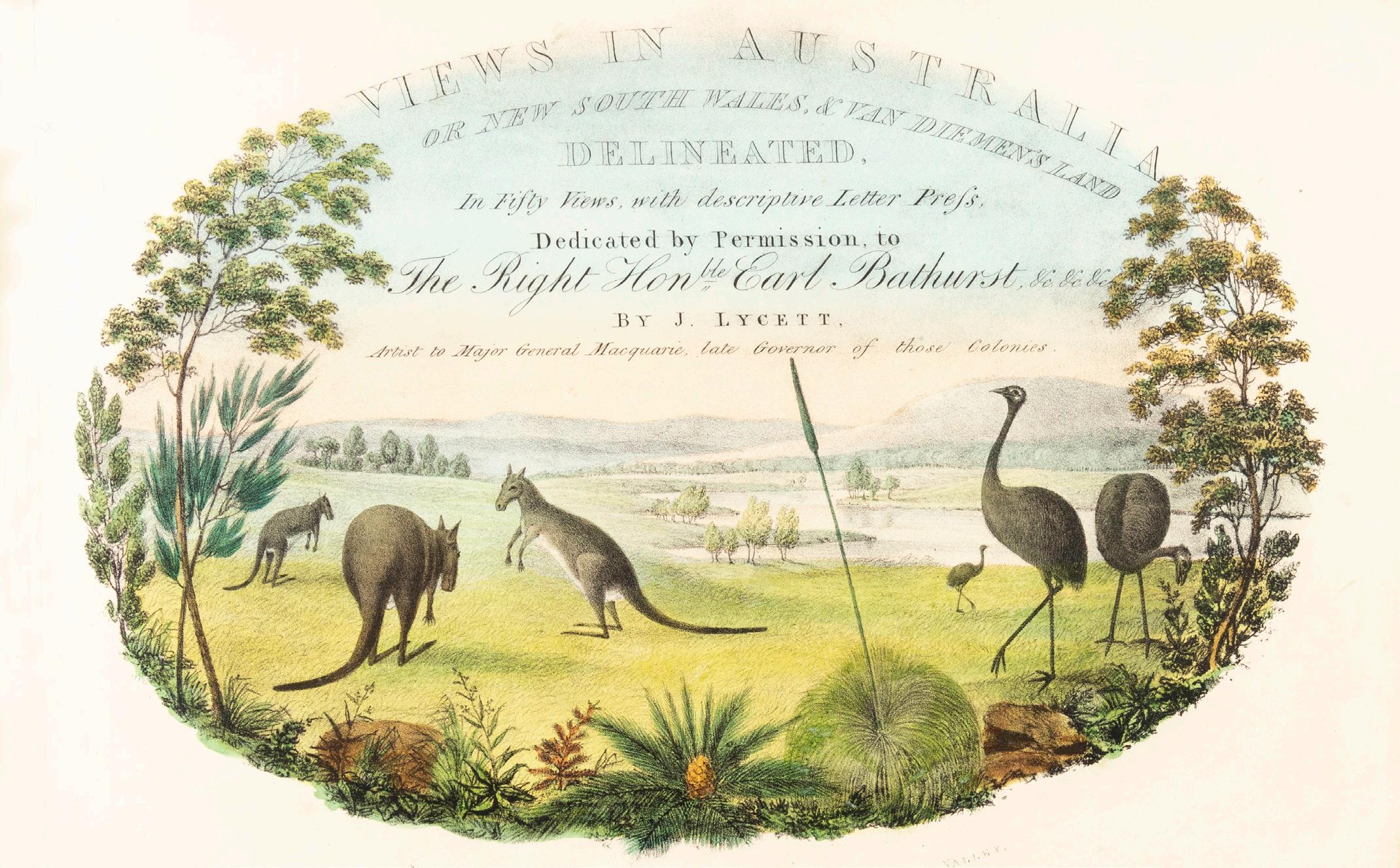
Back cover: Joseph Lycett, Views in Australia...1825 (Item 26)
Please note that all prices are in Australian dollars.


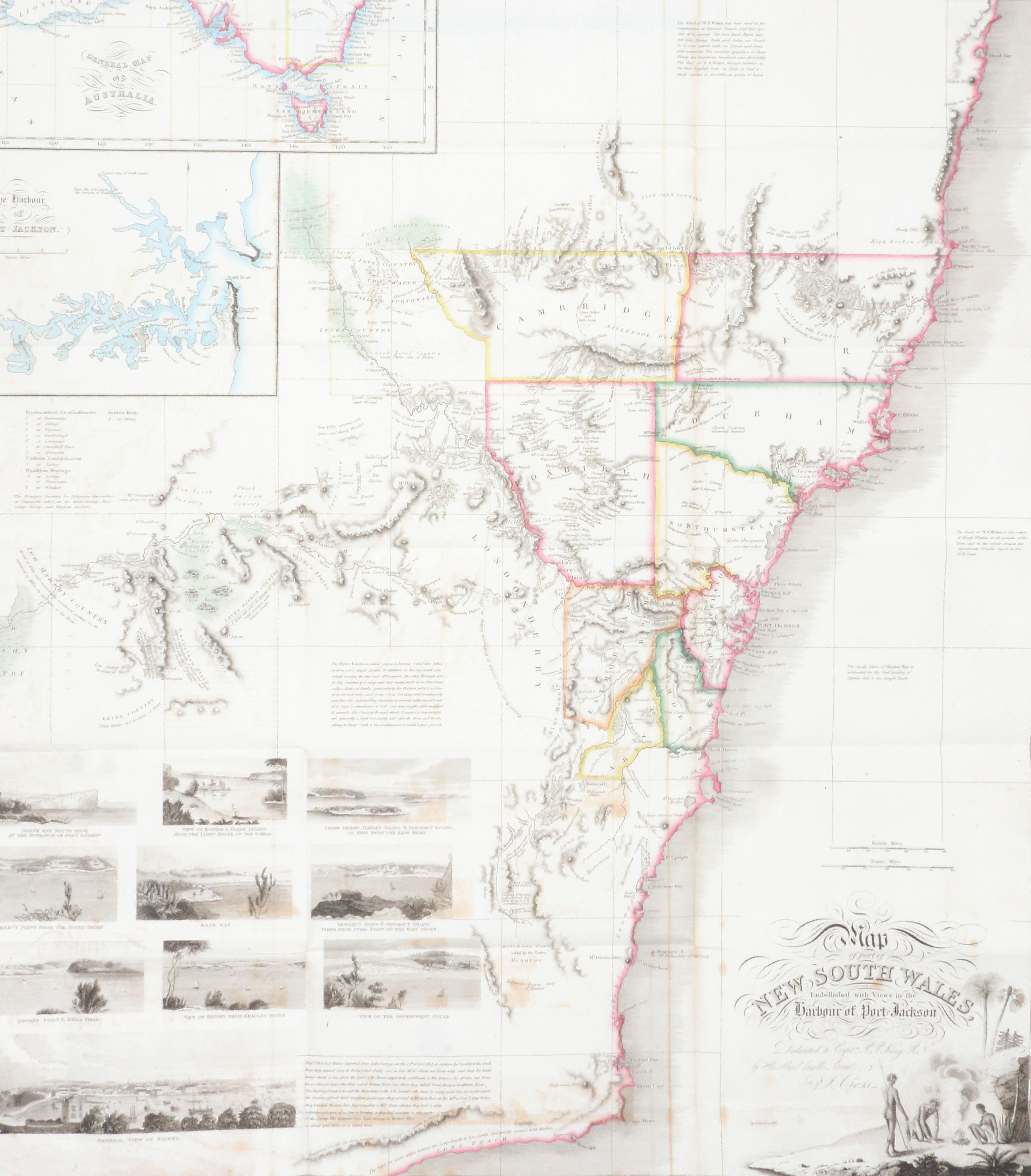
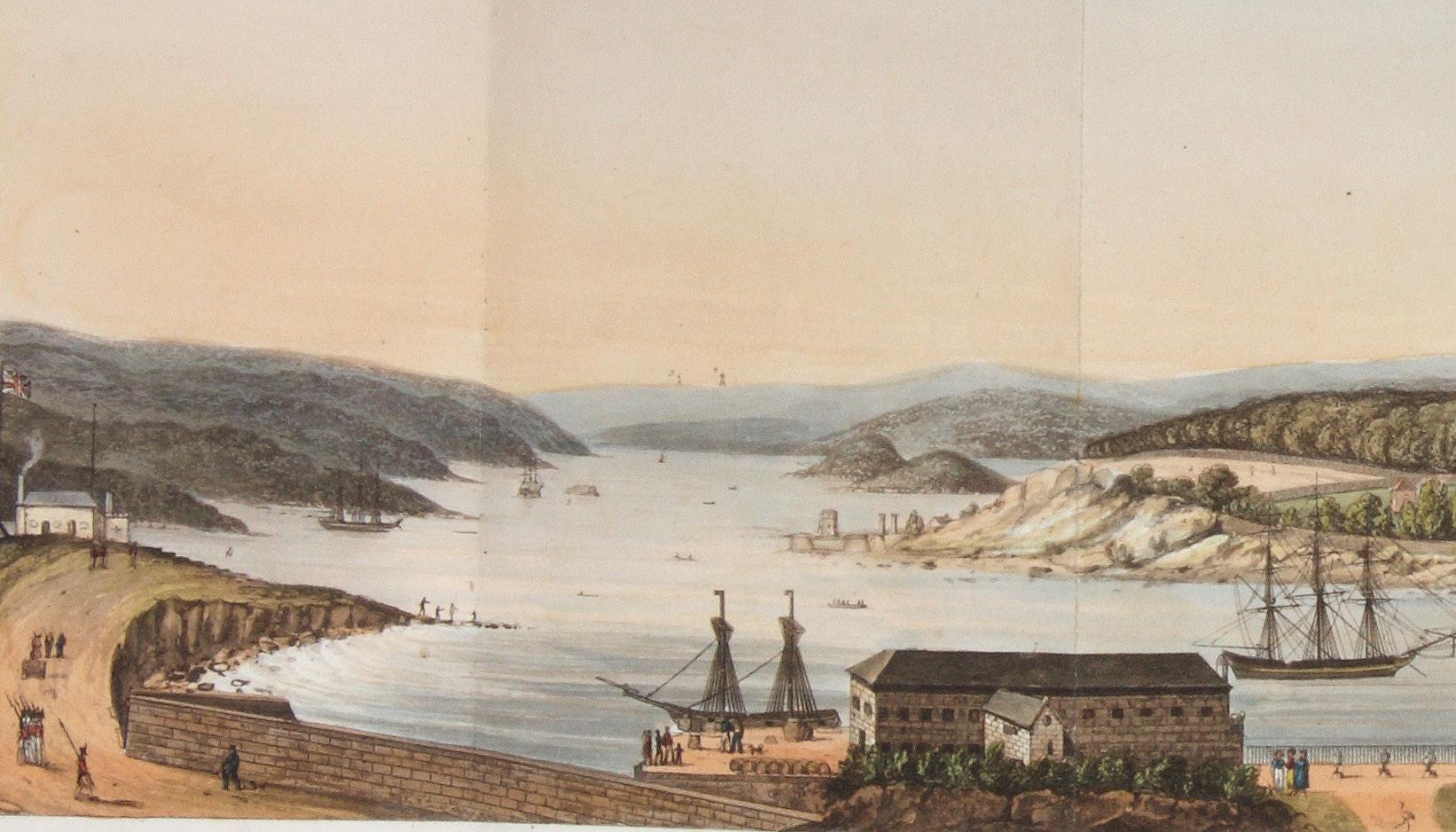
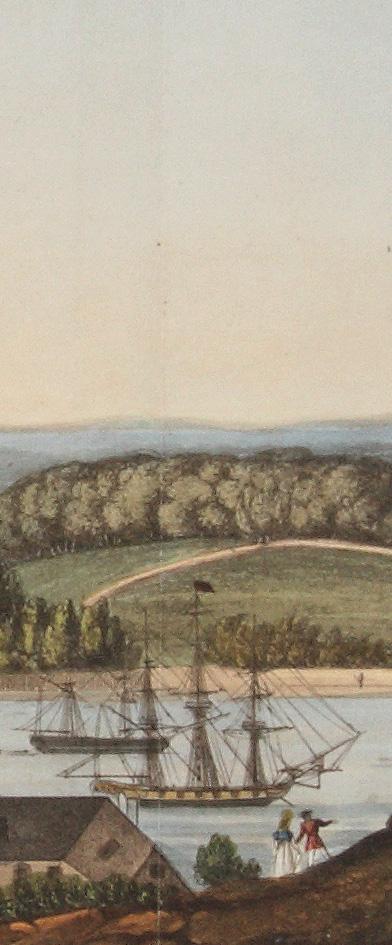
WITH THE RARE SYDNEY PANORAMA AND FOLDING MAP
1. ATKINSON, James.
An Account of the State of Agriculture & Grazing in New South Wales…
Tall octavo, with the rare coloured folding frontispiece and four aquatint plates (three in colour), & large folding map by J. Cross, halftitle, an excellent copy in the original full calf binding with the gilt stamp of the prestigous Signet Library on front cover. London, J. Cross, 1826.
A famous rarity: one of very few early colour-plate books on Australia, and an especially good copy, this is the special issue complete with the extra large folding map and the panoramic coloured view of Sydney. Copies were available with or without these (expensive) additions. The highly decorative map is dedicated to Captain Phillip Parker King, who had just completed his cartographic work on the vessels Mermaid and Bathurst
The first book on Australian agriculture, it was written by a noted early settler, father of the novelist Louisa Atkinson, and first husband of Charlotte Barton, author of the first Australian children’s book. Atkinson’s account of the agricultural and pastoral frontier, based on several years’ personal experience, is at once a practical guide and a descriptive survey of the agricultural districts and large establishments.
A remarkably attractive book, it is well illustrated with aquatints of very fine quality. The splendid folding frontispiece, one of the best early printed views of Sydney, is probably based on the painting by Richard Read now in the National Library of Australia. Another of the plates is important as the earliest published ground-plan of an Australian house, offered by Atkinson as appropriate to the requirements of a pioneering agriculturist. Broadbent (The Australian Colonial House) suggests that Atkinson’s design was modelled on Oldbury, the house that he had built in the early 1820s. Rebuilt in 1828, it is now the oldest surviving house in the Southern Highlands of New South Wales. The other three hand-coloured aquatints show scenes from an “exploring party” of two settlers and three Aborigines, one of the latter in European clothes.
Few people of this period were actively promoting farming in Australia. In 1826 Atkinson accompanied Charles Macarthur to Saxony to buy sheep - and he anticipated “some future and not distant period, when these vast and in many places fertile plains, shall be covered by productive flocks and herds, and enlivened by the presence and industry of civilised men(An Account, p.7).
Through his own farming endeavours as well as his writing — in particular this seminal work — Atkinson was “trying to raise the efficiency of farming in New South Wales; ploughing competitions, stock breeding, cheese making and dingo eradication all claimed his attention… The Agricultural and Horticultural Society regarded it as a judicious and ably written treatise, and awarded him a gold medal” (ADB).
Provenance: Signet Library, Edinburgh, with gilt stamp and internal shelf marking.
Abbey, Travel, 572; Ferguson, 1054.
$37,500 [6000009]
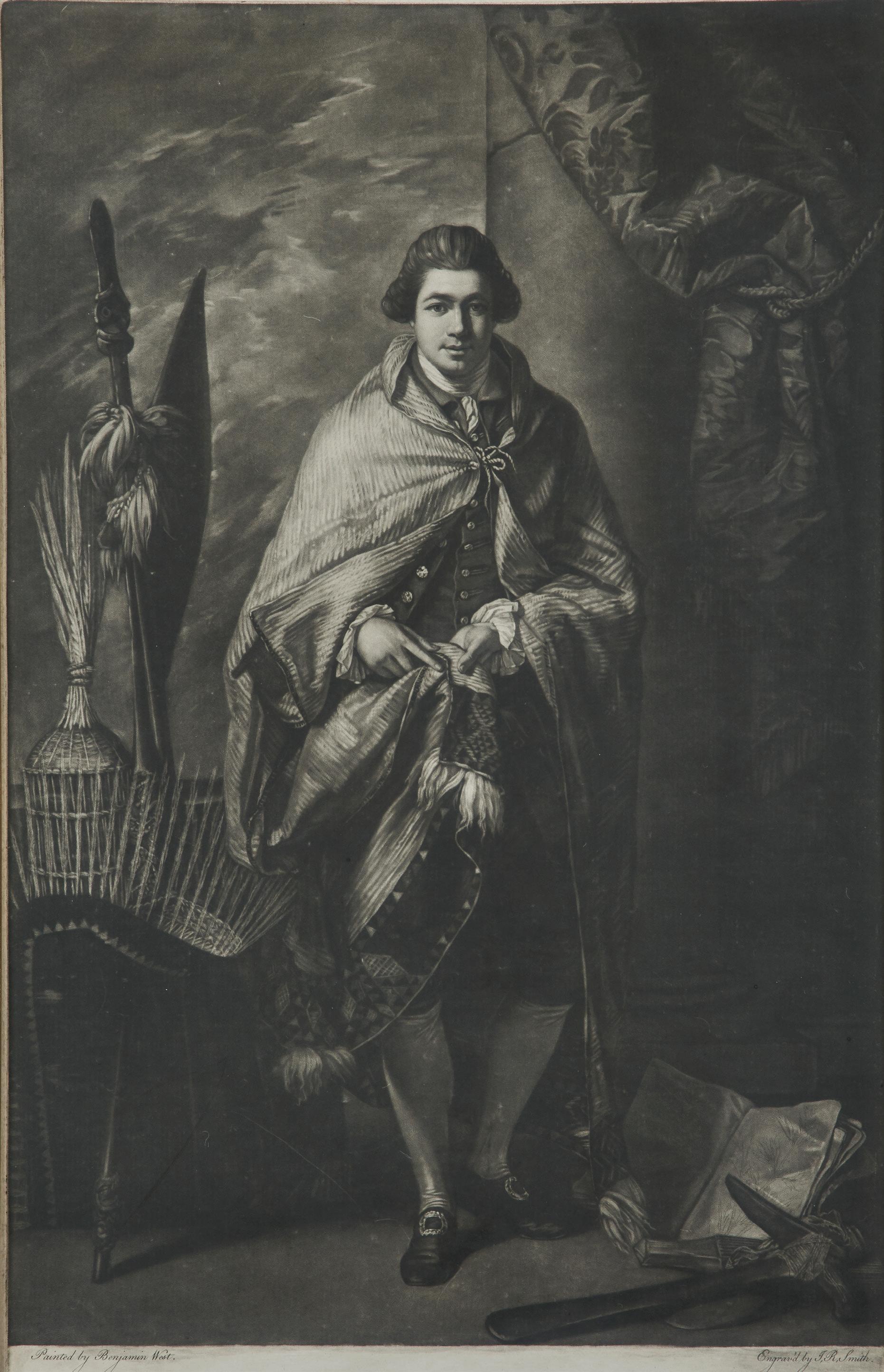
SIR JOSEPH RESPLENDENT WITH HIS PACIFIC CLOAK AND ARTEFACTS
2. [BANKS] WEST, Sir Benjamin, engraved by John Raphael SMITH.
Sir Joseph Banks Bt.
Mezzotint, 573 x 380 mm. (plate size); a clear fine impression, beautifully mounted in an attractive pedestal frame of Hawaiian Koa. London, Molteno, Colnaghi & Co., 1 May 1788.
Splendid mezzotint portrait of Joseph Banks after the famous original by Benjamin West.
In December 1771, only four months after his triumphant return to England from Cook’s Endeavour voyage, Banks sat for a full-length portrait by the American history painter Benjamin West, P.R.A. (1738-1820). Painted when he was twenty-nine years of age, it was the first “authentic” portrait of Banks, and remains one of the best of all subsequent likenesses of him. Appropriately, West depicted him draped in a native cloak and surrounded by all manner of Polynesian artefacts which Banks had collected during the voyage including clubs, a paddle and a feather-handled basket. Often overlooked among all the riches is an enormous folio botanical book open on the floor beside him, a very rare pictorial representation of the project which was dearest to Banks’s heart.
The whereabouts of the original West oil was for a long time a mystery, but it was rediscovered several decades ago and now hangs in the Usher Gallery in Lincolnshire. John Raphael Smith, a young engraver, created this mezzotint from West’s original painting; Banks himself regarded it as one of only three satisfactory likenesses of him to be printed.
This is a particularly fine and rich impression of the Molteno/Colnaghi issue of the image, published in 1788 with the caption revised to read “Sir Joseph Banks Bt.” (Banks was knighted in 1781). Previously issued by Hooper and Smith in 1773, both versions of this portrait are extremely rare, with this much the rarer of the two: in fact we have not been able to find any record of this issue offered for sale in many decades. It dates from the earliest years of the publishers’ careers, and it is possible that they located copies of the first issue and updated them with a new caption and imprint.
This rare version of the print, unknown to Nan Kivell and Spence, was recorded by Beddie only from the copy in the Dixson Library.
Beddie, 4229; Carter, Sir Joseph Banks 1743-1820, Paintings - engraved, no. 2; not in Nan Kivell and Spence, (but see illustration of 1773 issue, p. 78).
$48,000
[5001009]
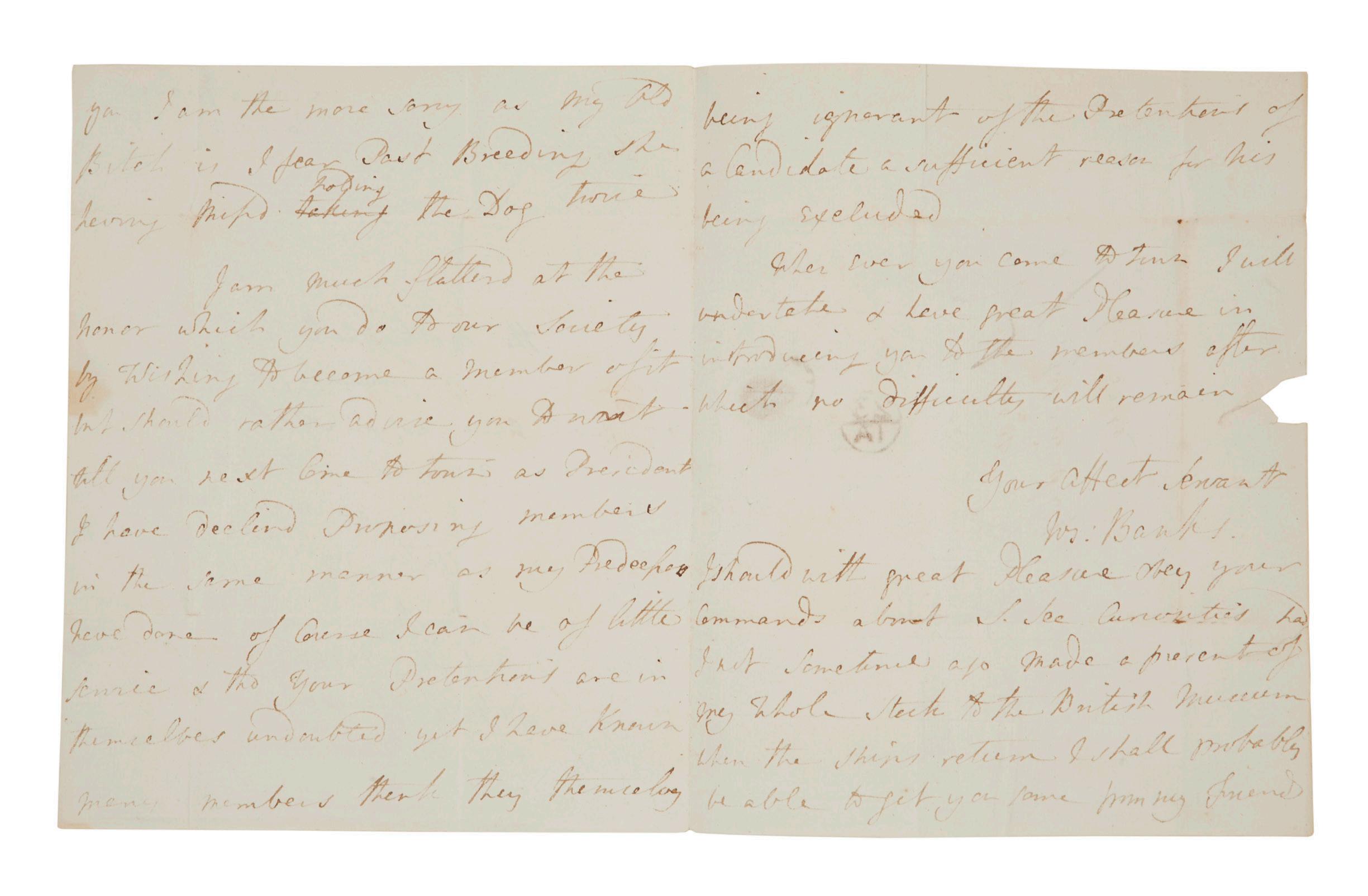
BANKS’S “S SEE CURIOSITIES” AND THE BRITISH MUSEUM
3. BANKS, Sir Joseph.
Autograph letter signed, to Richard Parry Price F.R.S.
Three pages, quarto, manuscript on paper, integral address leaf with postmarks and Banks’s wax seal (St. George Cross with fleur-de-lys in quarters on shield); signed “Your affect Servant/ Jos: Banks.”; tipped into a quarter morocco volume with two early engraved portraits of Banks. Soho Square, London, 23 January 1779.
A very fine and early letter from Banks explicitly referring to his collection of South Seas “curiosities”, the expected return of Cook from his third voyage and the Presidency of the Royal Society.
The letter also sheds important light on the otherwise little-known collections of the addressee, Richard Parry Price FRS (1736-1782). Price, an antiquary connected to major figures like John Latham and Sir Ashton Lever, had clearly approached Banks regarding the substantial private museum, menagerie and “fine collection of birds” (Pennant) he was curating at his house Bryn-y-Pys. Price was close to Banks’s particular friend and correspondent John Lloyd, both of the Welshmen being associated with Sir Watkin Williams Wynn of ‘Wynnstay,’ the great house known for its amateur theatrics (and, rather incredibly, for having employed Watkin Tench’s father).
The letter is a relatively uncommon example of Banks explicitly referring to living animals in his purview, particularly mentioning his proposed gift to Price of a living American Agouti (a large rodent), making the endearing comment that he has no fear of it getting to Price alive “as my servants are very fond of it & take much care of it.” This in itself is a tantalising lead, as it is not immediately clear where and from whom Banks had such an exotic beast.
Of the greatest importance is Banks’s explicit reference to his own collection of South Seas artefacts, made by him on the Endeavour and later expanded by colleagues like the Forsters. Price had evidently made a request for natural history and ethnographic specimens, to which Banks replies: “I should with great pleasure obey your commands about S. See [sic]. curiosities had I not some time ago made a present of my whole stock to the British Museum. When the ships return I shall probably be able to get you some from my friends…”. The returning ships that he mentions are of course the Resolution and the Discovery, at this time at anchor in Kealakekua Bay, just three weeks before Cook’s death.
Allowing for a degree of reticence or even exaggeration on his part, it is intriguing that Banks is clearly suggesting that he had already given the “whole” of his existing collection to the Museum by gift in late 1778. That gift to the Museum is certainly known, Chambers describing it as a “timely personal gesture just before standing as President of the Royal Society,” adding that it caused Banks some angst with other collectors, grumpy that they had been overlooked. However, the exact dimensions of the gift are only poorly recorded, this letter to Price therefore providing new evidence that it was perhaps more total than has hitherto been understood.
$15,500 [5001007]
Chambers, Sir Joseph Banks and the British Museum (2007); Dawson, The Banks Letters, pp. 546-555; Latham, A General Synopsis of Birds (1781); Pennant, A Tour in Wales (1778); SLNSW.
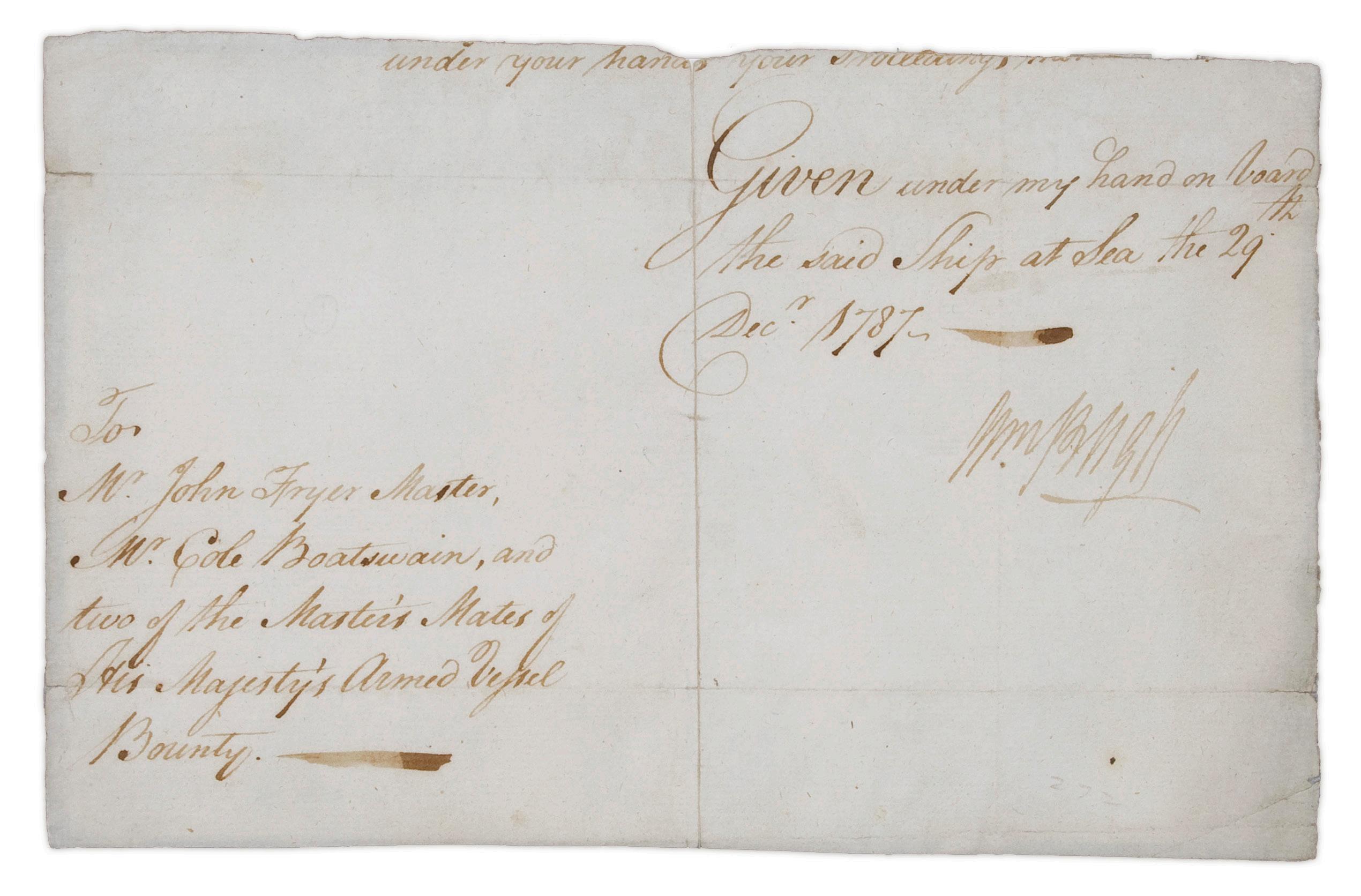
A FAMOUS RELIC: SIGNED BY BLIGH ABOARD THE BOUNTY
4. BLIGH, William.
Manuscript fragment written on board HMS Bounty…
Partial document, 130x210 mm., laid paper with watermark, evidence of old folds; neatly torn along edges; well framed in Hawaiian koa wood. At sea, 29 December, 1787.
A famous Bligh signature, and one of only a handful of manuscript items known to have been signed by him while he was in command of the Bounty.
The original document was clearly some sort of requisition or order and would have been drafted by Bligh’s clerk John Samuel. It is addressed to “Mr. John Fryer Master, Mr. Cole Boatswain, and two of the Master’s Mates of His Majesty’s Armed Vessel Bounty”. Otherwise, there is a tantalising fragment of text reading “…under your hands your…”, before it is signed off “Given under my hand on board the said Ship at Sea the 29th Decr. 1787 - Wm. Bligh”.
The Bounty had only just sailed at the time this was written, as Bligh had been held up at Spithead and the Isle of Wight by bad weather and the necessity to replace a worn bower cable. These problems only compounded Bligh’s frustration at what he would later criticise as the cavalier attitude of the Admiralty towards his expedition, as delays before sailing were responsible for him arriving at Cape Horn too late in the season, forcing him to make the longer voyage east instead. The Bounty had finally taken a pilot on board on 23 December 1787 in order to negotiate the Needles at the west end of the Isle of Wight. The voyage proper had begun, but was marked by a continued run of poor luck, as the ship was pounded by a fierce Atlantic gale for some three days: “we were an entire Sea on Deck”, he noted in his log for 27 December. The day that this fragment was written, the 29th, saw the weather continue to abate, and Bligh was much occupied in ordering repairs to any damage to the Bounty and especially to their small boats, and was disappointed that quantities of bread had been irreparably damaged. There are, of course, many important manuscript sources for the story of Bligh and the Bounty, but they are tucked safely into important international collections (with a high number in the Mitchell Library collection, for instance). As a result, Bligh manuscript material dating from this turbulent period is of the greatest rarity, and this is one of only a few such fragments from the actual Bounty voyage known to have been offered in several decades. This piece has an excellent provenance, having been sold as part of Dame Mabel Brookes’ collection in Melbourne in 1968.
Provenance: Dame Mabel Brookes (Melbourne collector and society figure, collection sold 1968); Robert Parks (US collector, his Bligh collection sold Hordern House 2008); Whitmont family collection.
$76,500 [5001020]
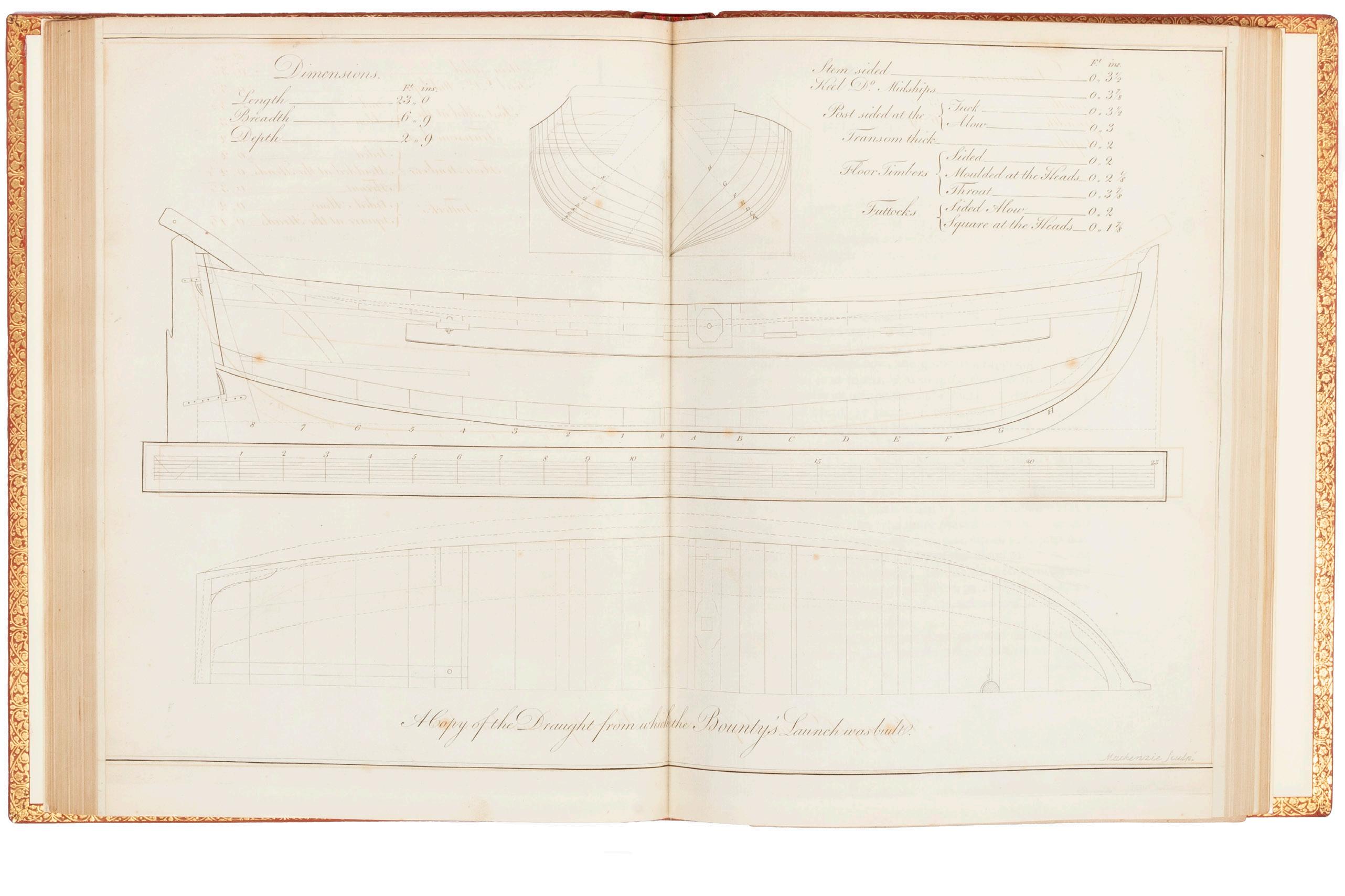
GREAT CLASSIC OF THE LITERATURE OF THE SEA
5. BLIGH, William.
A Voyage to the South Sea, undertaken by Command of His Majesty, for the purpose of conveying the Bread-fruit Tree to the West Indies, in His Majesty’s Ship the Bounty… including an account of the mutiny on board the said ship, and the subsequent voyage of part of the Crew, in the Ship’s Boat, from Tifoa, one of the Friendly Islands, to Timor, a Dutch settlement in the East Indies.
Quarto, with frontispiece portrait, an engraving of the breadfruit, and six plans and charts; handsome modern binding of polished calf, spine ornately gilt in compartments between raised bands, double labels. London, George Nicol, 1792.
First edition of one of the most famous of all voyage books: the official narrative of Bligh’s voyage in the Bounty and the mutiny. At the time of publication Bligh was on his second breadfruit voyage, and the work was edited by James Burney, with the assistance of Sir Joseph Banks, both of whom had, like Bligh himself, sailed with Cook. This is the full account of the voyage, and contains a slightly altered version of Bligh’s account of the mutiny, which had been separately published two years earlier. The mutiny and its ramifications would haunt Bligh always, although his reputation was redeemed by the epic open-boat journey across 4000 miles of the Pacific, and later by the part he played in the battle of Copenhagen alongside Nelson. His inglorious career as governor of New South Wales would later ruin his reputation again.
The Bounty voyage was commissioned by the Admiralty, on the instructions of George III, to collect breadfruit plants (“the Merchants and Planters interested in His Majesty’s West India Possessions have represented that the Introduction of the Bread Fruit Trees into the Islands in those Seas to constitute an Article of Food would be a very essential Benefit to the Inhabitants …”). The mutiny of 28 April 1789 resulted in Bligh and 18 others being cast adrift in an open-boat — certainly the most infamous mutiny in maritime history.
His achievement in charting large sections of the Australian coast under conditions of terrible hardship partly completed the work of Cook himself on the Australian east coast. Bligh was justifiably proud of his achievements in mapping and charting during his travails, and each of the printed charts features his name prominently: the sketch of Matavai Bay in Tahiti even features his signature in facsimile.
Ferguson, 125; Hill, 135; Kroepelien, 93; O’Reilly-Reitman, 550; Wantrup, 62a.
$12,500
[5000660]
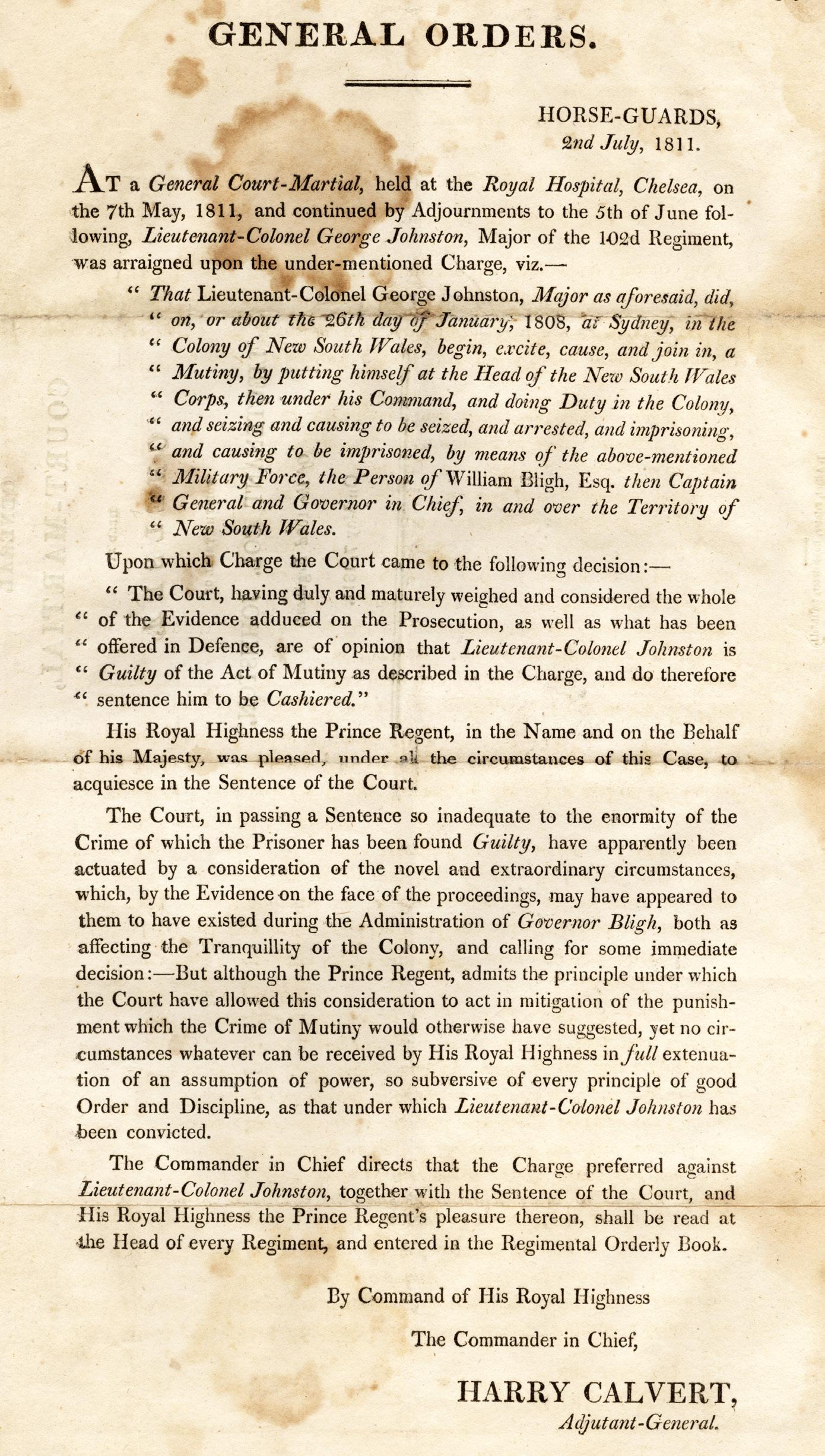
GEORGE JOHNSTON’S VERDICT: BLIGH SEEKS TO VINDICATE HIMSELF
6. [BLIGH: RUM REBELLION] [JOHNSTON]
Printed notice of the ‘General Court-Martial, held at Chelsea, for the trial of Lieutenant Col. Johnston, Of the 102d Regiment, On May 7, 1811’ [docket title].
Foolscap broadside (verso with imprint and docket title only); a very good copy. London, July 1811.
Extremely rare: the ephemeral record — prepared on the instructions of Bligh himself — of the verdict and sentence of the court martial of George Johnston for deposing Bligh as Governor of New South Wales. This printed document was “privately printed and distributed in a few copies by Captain William Bligh” (Ferguson): he had been vexed and alarmed by reports in the newspapers that although the Duke of York had accepted the guilty verdict of the court, he had added words to the effect that Johnston’s conduct had been mitigated by Bligh’s oppressive conduct. As a result, Bligh not only rushed to reassure some of his friends that no such criticism existed but personally distributed this printed announcement among his friends and supporters. It is known to be of surpassing rarity and is now considered a highlight of any Bligh collection. Over the last forty years Hordern House have handled only this example and have seen it move through two other private collections before joining the original Warrant in the Whitmont collection (item 22 in our Catalogue II of the Whitmont collection: search 5001023 at hordern.com).
“Lieutenant-Colonel Johnston is Guilty of the Act of Mutiny as described in the Charge, and [we] do therefore sentence him to be Cashiered.” This sheet is one of the rarest and most significant of all pieces associated with William Bligh. In modern times the Davidson copy has been sold, but Ferguson was initially unaware of this broadside; several years into publication of his Bibliography he was able to record the then unique Mackaness copy at the end of his fourth volume — and that copy is still the only one recorded in the 1986 Ferguson Addenda (it was sold in 1968 from the second Mackaness catalogue for A$1250, three times the price of Bligh’s Voyage in the same catalogue). Copies remain very rare indeed, although it is now recorded in the catalogues of the SLNSW, NLA, and the Sutro Library (California).
Ferguson, 511a; Wantrup, 33b and, pp. 99-101; not recorded by Spence’s Bligh bibliography.
$74,500 [5000997]
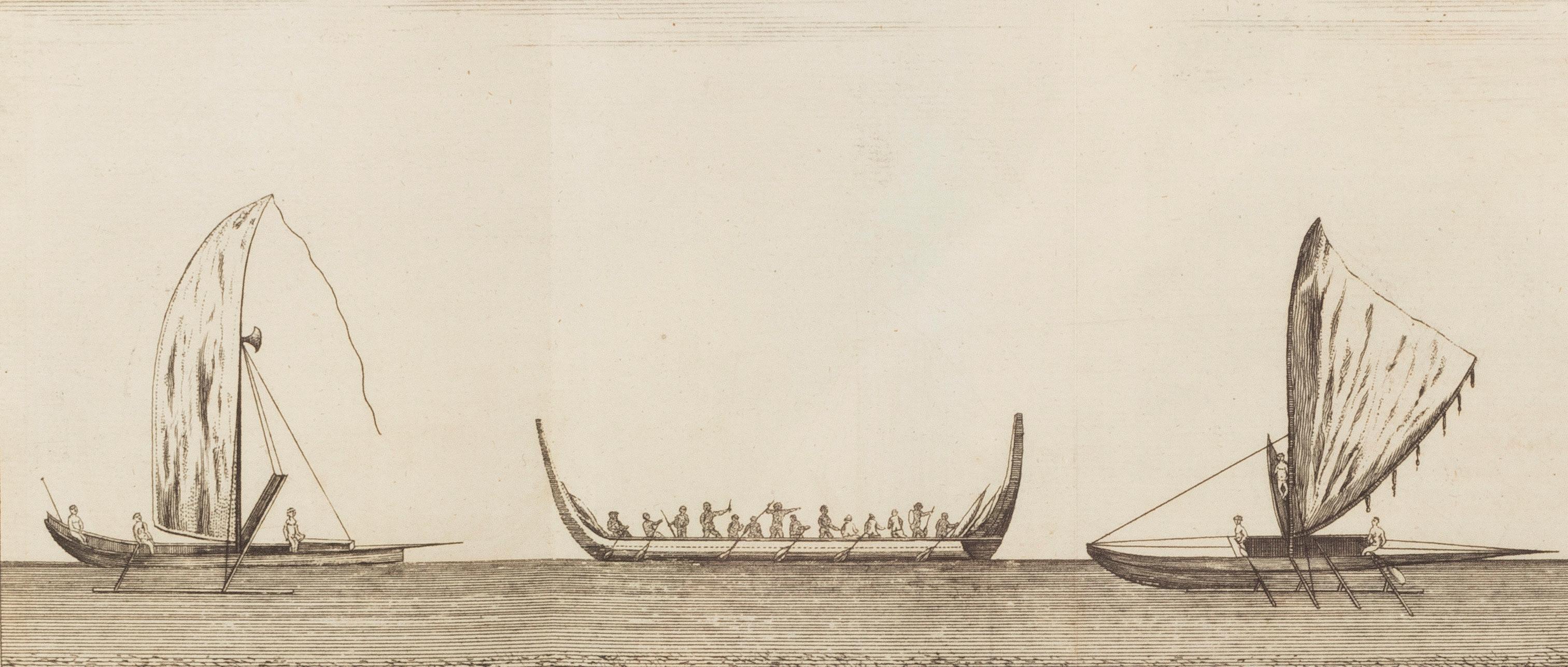
THE FIRST FRENCH CIRCUMNAVIGATION
7. BOUGAINVILLE, Louis Antoine de. [FORSTER, Johann and Georg, probable translators].
A Voyage round the World. Performed by Order of His most Christian Majesty, in the Years 1766, 1767, 1768, and 1769… in the Frigate La Boudeuse, and the store-ship L’Etoile.
Quarto, with five folding maps and a folding plate of canoes; an excellent copy in a pale polished calf binding by Aquarius, spine gilt. London, Printed for J. Nourse and T. Davies, 1772.
The first English edition of the first French circumnavigation, the great French voyage of the Cook period, in many ways responsible for the pervasive notions of tropical paradise and the noble savage. This English version was translated by Johann Reinhold Forster and has an introduction by him (according to the preface, although the translation at least is now thought to have been the work of Forster’s son Georg). Forster senior calls the voyage “a work written by a learned, intelligent, and judicious traveller, which abounds with remarkable events and curious observations…”, and says that he has edited “and partially vindicated the British nation where we thought the author had been unjustly partial”.
The publication of Bougainville’s narrative did a great deal to build the notion of a romantic paradise in the South Seas. Bougainville showed the influence of Jean-Jacques Rousseau in naming Tahiti “Nouvelle Cythère” after Kythera, the small island off the coast of southern Greece which, in Greek mythology, provided a sanctuary for Aphrodite, goddess of love. The reality was less sublime: he took Aoutourou back with him from Tahiti to Paris, giving him lessons in French for the remainder of the voyage, but the uprooted Tahitian just didn’t get it: Forster with typical arrogance dismissed him as “stupid”. He was allowed to go home on a subsequent voyage but died of smallpox on the way, another tragic minor player in the history of discovery and colonisation.
Bougainville headed into the Pacific, discovering the Tuamotos before in April sighting and claiming possession of Tahiti, unaware of Wallis’s visit less than a year before. He continued on, finally reaching the New Hebrides and ‘La Austrialia del Espíritu Santo’, discovered by Quirós in 1606 and believed to be part of the supposed Southern Continent. The only way to determine this, Bougainville resolved, was to head further to the west in the hope of sighting the eastern coast of New Holland. ‘This he did, only to be impeded by the Great Barrier Reef and, although several of his crew claimed to have sighted land, this was not confirmed and the ships were headed to the N. Nevertheless, Bougainville concluded that he was close to some extensive land and, in running westwards from Espíritu Santo, he had dared to face the risk of the legendary lee-shore of New Holland and New Guinea, even though prudence, shortage of food and the condition of his vessels would have justified his heading northwards at an earlier date’ (Colin Jack-Hinton, The Search for the Islands of Solomon, p. 256); G. A. Wood (The Discovery of Australia, pp. 369-79), observes that had Bougainville persevered ‘he would have come to the Australian coast near Cooktown, and would, likely enough, have been wrecked where Cook was wrecked two years later’.
Borba de Moraes, p. 115; Davidson, ‘A Book Collector’s Notes’, pp. 96-7; Hill, 165; Kroepelien, 113; O’Reilly-Reitman, 285.
$7850 [5001027]
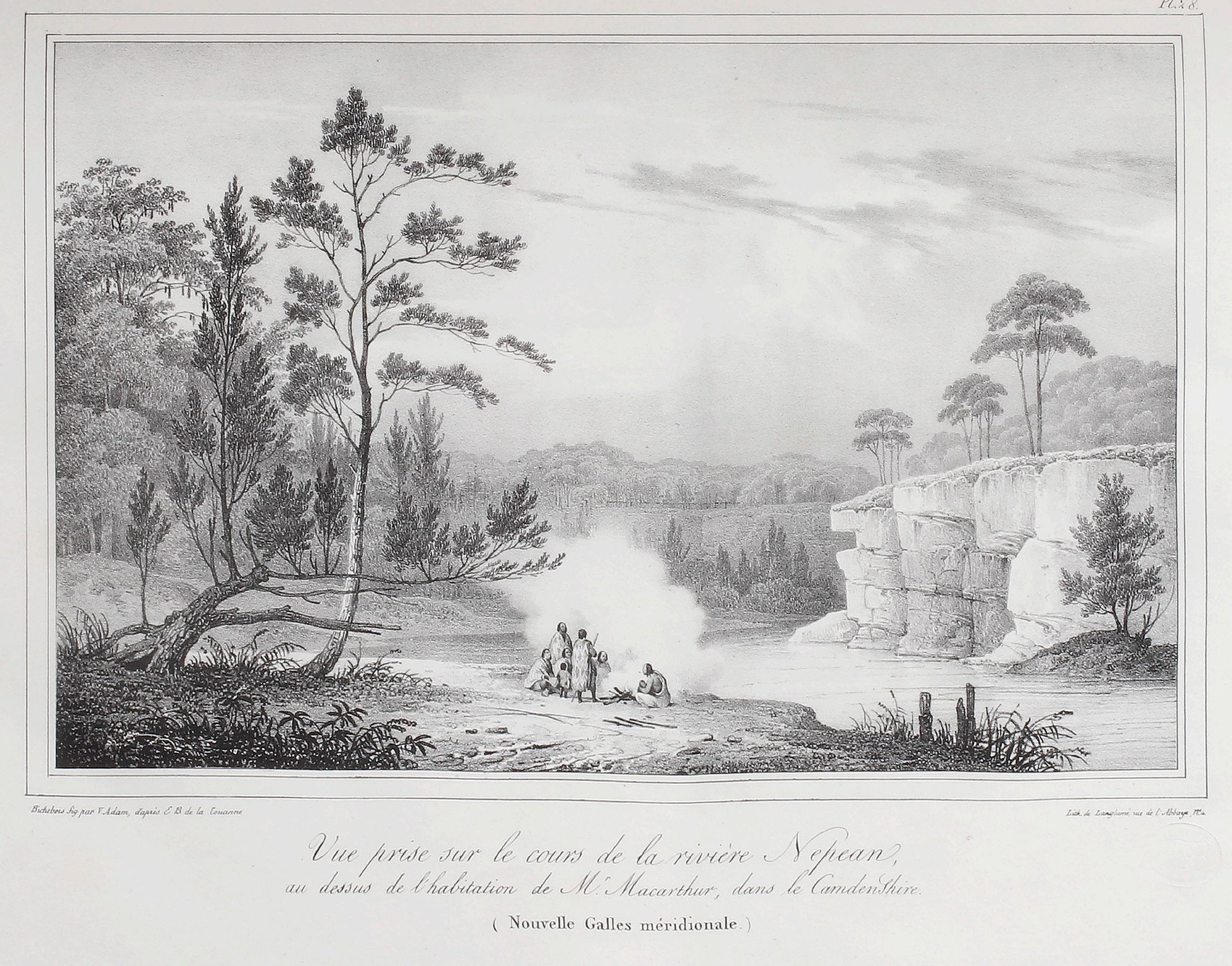
FIRST PUBLICATION OF THE THÉTIS VOYAGE, WITH SUPERB LITHOGRAPHS
8. [BOUGAINVILLE, Hyacinthe Y.P.P. de] TOUANNE, Vicomte de la.
Album pittoresque de la frégate La Thétis et de la corvette l’Espérance. Collection de dessins relatifs à leur voyage autour du monde en 1824, 1825 et 1826, sous les ordres de M. le Baron de Bougainville.
Large folio, half-title, title-page, and 44 pp text (with seven vignettes in the text) followed by the series of 35 lithograph plates; a fine copy in quarter calf and marbled boards, spine panelled in gilt in romantique style between raised bands, marbled boards and endpapers. Paris, chez Bulla, 1828.
This fine series of views with accompanying text was the first published account of the important voyage of Hyacinthe de Bougainville in the Thétis (1824-26), separately issued some nine years before the official account of this voyage. Edmond de la Touanne, a friend and protégé of Bougainville (and referred to in Bougainville’s journal as “faithful companion of my travels”), sailed on the expedition as lieutenant de vaisseau. Because of the haste with which the expedition was manned, no official artist was sent; as Bougainville remarks, no pictorial record of the expedition would have survived but for de la Touanne’s sketches.
A rare and beautiful voyage album, it has considerable Australian textual content, as well as the three famous views of the Nepean River that resulted from their inland travels: a view of the Nepean where it is joined by Glenbrook Creek, with kangaroos on the river bank and a group of First Nations people in the middle distance; a view of the Norton Waterhole on the Nepean River with members of the expedition being rowed across the river in two boats watched by a group of Aboriginal people; and a view of the Nepean Gorge below Macarthur’s house Camden Park, with a group of First Nations people around a fire on the shore. There is also a fine engraved vignette of the expedition’s ships under sail south of Tasmania, in the heavy seas which forced them to abandon their visit to Hobart and continue directly to Port Jackson.
Hyacinthe de Bougainville, son of the great eighteenth-century navigator, sailed as an eighteen-year-old ensign on the Baudin voyage. After distinguished service in the Napoleonic Wars, he was given command of the Thétis, only the second French frigate to be commissioned for a circumnavigation, the first having been his father’s ship the Boudeuse. The expedition’s most important visit was to Sydney where they stayed three months. Having been given secret orders to report on the defence capabilities of British settlements, the French officers travelled as widely as possible within the colony. Their investigations of Botany Bay, Camden, the Warragamba River and the Blue Mountains are well recorded in Bougainville’s diaries (translated by Marc Serge Rivière as The Governor’s Noble Guest, Miegunyah Press, 1999).
Provenance: Rubén J. Dussaut, with bookplate.
Dictionary of Australian Artists Online, Touanne; Ferguson, 1204; Hill, 161; Sabin, 6874.
$22,500 [5000819]
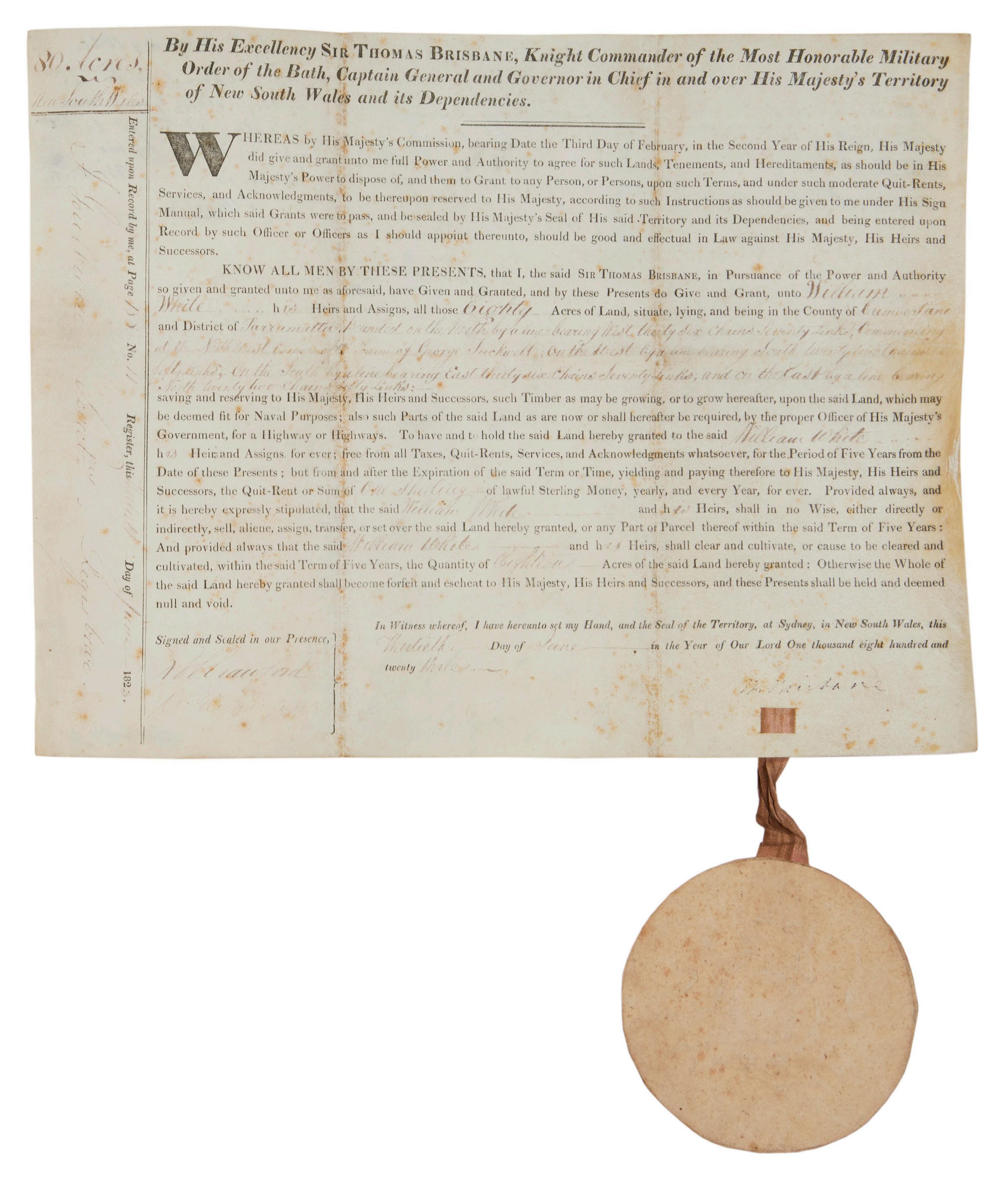
PARRAMATTA LAND GRANT SIGNED BY THE SIXTH GOVERNOR
9. BRISBANE, Sir Thomas Mackdougall.
Land grant to William White of 80 acres in Parramatta.
Oblong folio, partly printed and completed in manuscript, on vellum, with a good paper seal; in a brown half morocco binding by Collins & Newbold. Sydney, 30 June 1823.
Grant of land in Paramatta signed by the sixth governor, Brisbane, witnessed by Robert Crawford and another (illegible). William White (c. 1790-1871) came out from England as a free settler in 1803 on the Glatton with his mother and stepfather Isaac Knight. He and Maria Batman (1793–1835) were married by Rev. Samuel Marsden at St John’s Parramatta. In the 1828 Census he was listed as a Wheelwright, age 38, at Parramatta, with his wife Maria, and their children Elizabeth, Isaac, Rachel, Maria, Thomas, and John. They had three apprentices, two servants, and a convict, Thomas McCarty, who worked as a nailer. William’s 80 acres granted in this document had become ‘Brush Farm’, twenty acres of which had been cleared by the time of the Census, which recorded four horses there, as well as the fact that he also had sixty horned cattle at Hunters River.
Sir Thomas Brisbane (1773-1860) succeeded Macquarie as governor of New South Wales, and held office from 1821 to 1825. Much of his work as governor was to reform the system of land grants which had mushroomed under Macquarie leaving confusion and boundary disputes prevailing among grantees. Brisbane instituted proper surveys and reformed the whole system of grants, ensuring that only those who were both willing to improve the land and had the capital to do so were successful in obtaining grants.
$5500
[5001030]
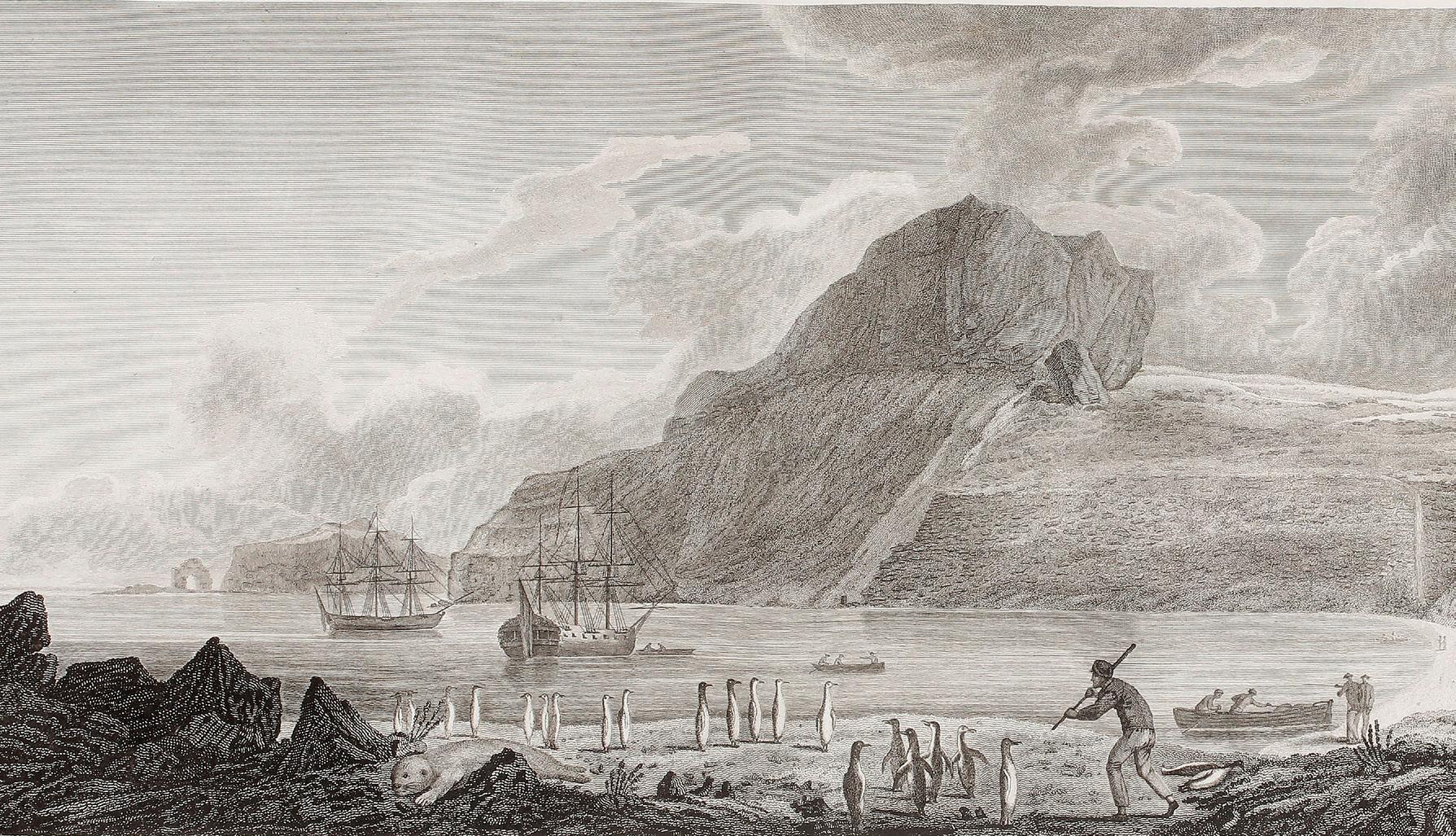
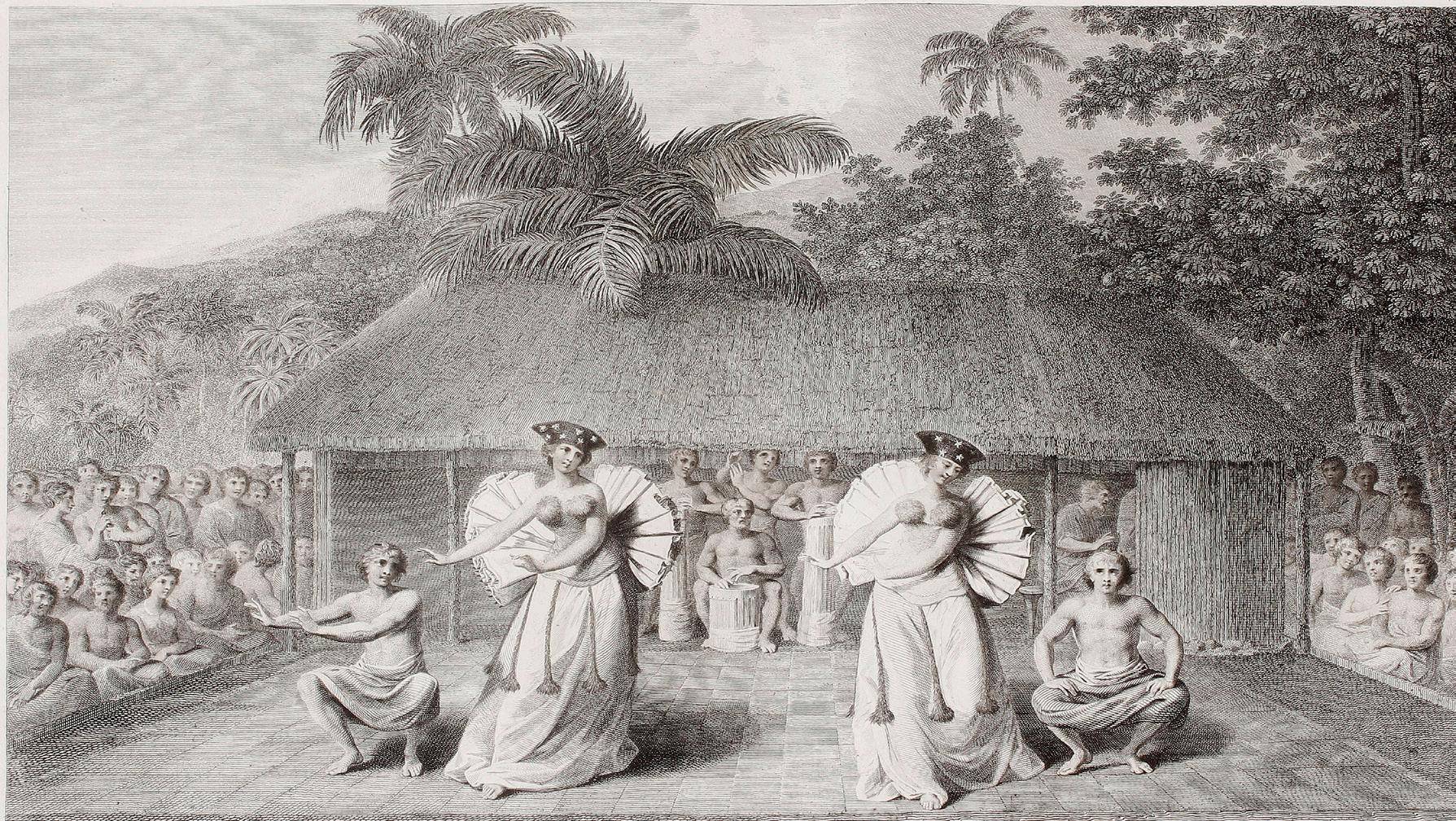
COOK’S THREE VOYAGES: THE OFFICIAL ACCOUNTS
10. COOK, Captain James.
A complete set of the three official voyage accounts.
Together eight volumes, quarto, and folio atlas; a good set in old half calf and marbled boards, double labels. London, Strahan & Cadell; Strahan & Cadell; H. Hughs for Nicol & Cadell, 1773/1777/1785.
The full series of the official narratives of Cook’s voyages — the cornerstone of any collection of books relating to Australia or the Pacific. Each of the three narratives is illustrated with marvellous engravings based on the work of the official artists on the voyages, including Parkinson, Hodges, and Webber, and the series stands as the great monument to Cook’s achievements.
These were the best-sellers of the second half of the eighteenth century; very expensive when published, the first editions were sold out within a few days of publication. Their popularity meant that many copies were almost literally read to pieces; as a result, good uniform sets of the voyages are fairly scarce.
This set comprises the first edition of the first voyage in its first issue form; the unchanged second edition of the second voyage; and the preferred second edition of the third voyage. Sets of the voyages are seen in many combinations of editions: this particular combination, generally regarded as a good way to have the set, is one of those seen with some regularity.
For full details see our analysis online. Briefly. the set is made up as follows:
First voyage. HAWKESWORTH, John. An Account of the Voyages… for making Discoveries in the Southern Hemisphere…
First edition, first issue. Three volumes, quarto, 51 engraved plates and maps. London, 1773.
Second Voyage. COOK, James. A Voyage towards the South Pole, and Round the World…
Second edition. Two volumes, quarto, 64 engraved plates and maps, many folding. London, 1777.
Third Voyage. COOK, James and James KING. A Voyage to the Pacific Ocean…
Second (preferred) edition. Three volumes, quarto, with 24 engraved maps and profiles; separate folio atlas, containing two charts and 62 engraved plates. London, 1785.
Beddie, 648; Hill, 782; Holmes, 5n; Kroepelien, 535.
$36,000 [5000614]
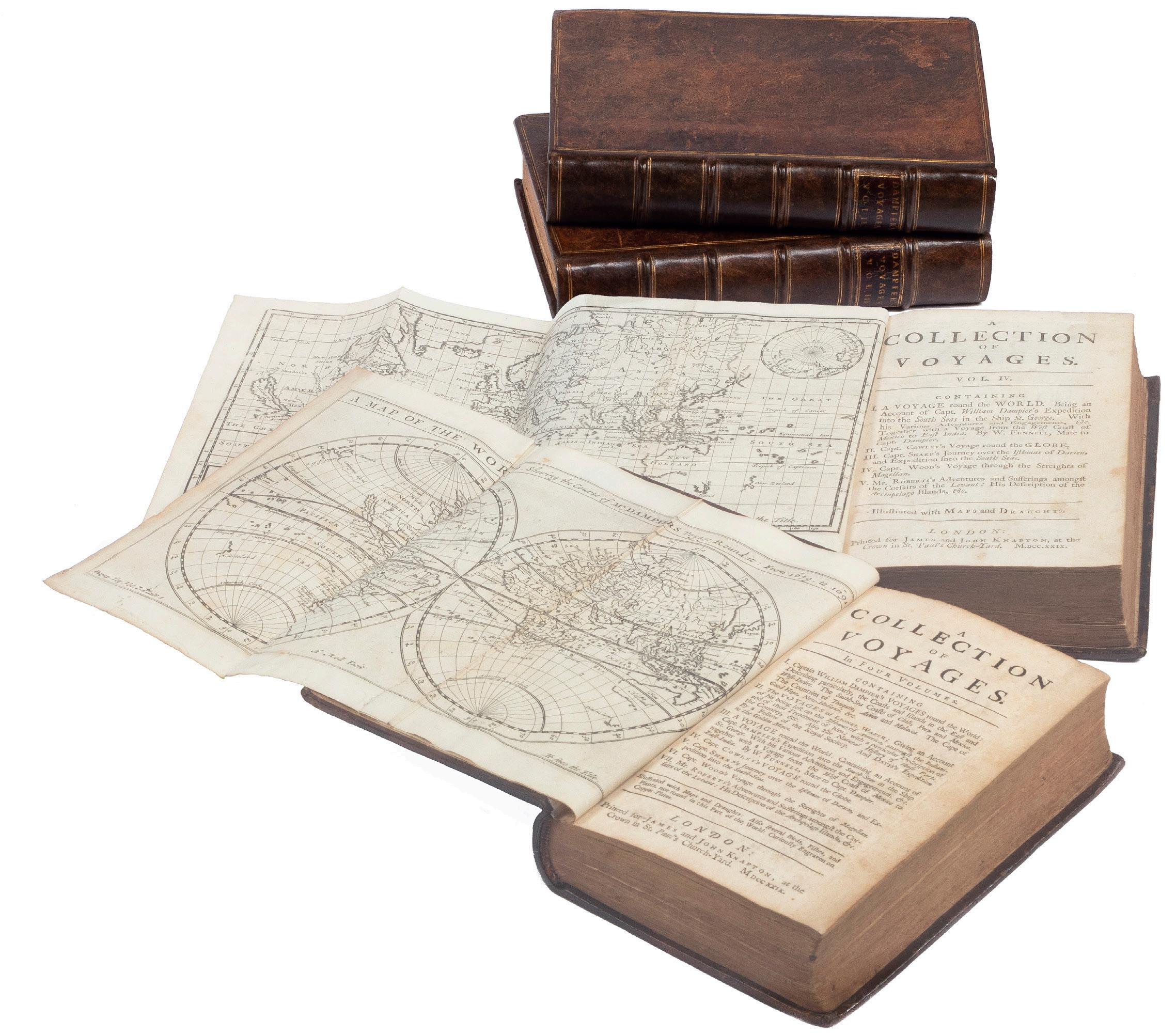
THE FIRST ENGLISHMAN ON THE AUSTRALIAN CONTINENT
11. DAMPIER, William.
A collection of voyages. In four volumes. Containing I. Captain William Dampier's voyages round the world. II. The voyages of Lionel Wafer; giving an account of his being left on the isthmus of America. III. A voyage round the world: containing an account of Capt. Dampier's expedition into the South-Seas in the ship St. George by W. Funnell, mate to Capt. Dampier. IV. Capt. Cowley's voyage round the Globe. V. Capt. Sharp's journey over the isthmus of Darien, and expedition in the South-Seas. VI. Capt. Wood's voyage through the streights of Magellan. VII. Mr. Roberts's adventures and sufferings amongst the Corsairs of the Levant. Illustrated with maps and draughts: also several birds, fishes, and plants, not found in this part of the world; curiously engraven on copper-plates.
Four volumes, octavo, with a total of 63 engraved plates (19 folding), including 19 maps; original calf bindings, spines exceptionally skilfully renewed and old labels preserved, a fine set. London, Printed for James and John Knapton, 1729.
The “best” edition of Dampier: the complete collected edition of the exciting travels of the English explorer, pirate, privateer, navigator, and naturalist William Dampier (1651-1715). He was the first person to make three circumnavigations, and the most significant explorer between Drake and Cook, borrowing bravado from Drake and anticipating Cook’s methods of inquiry.
Dampier was of course the first Englishman to land on and explore any part of the Australian continent: the first volume here includes his recollection of how, in 1688, “being now clear of all the Islands, we stood off South, intending to touch at New Holland, a part of Terra Australis Incognita, to see what the country would afford us… New Holland is a very large tract of Land. It is not yet determined whether it is an Island or a main Continent; but I am certain that it joyns neither to Asia, Africa, nor America…”. Along with his interesting observations on Shark Bay and the northwest coast of Australia his books are particularly good on the flora and fauna of the region: he was effectively Australia’s first natural historian, and many of his bird, fish and flower discoveries are illustrated with charming woodcut illustrations.
Dampier’s books, as well as directly inspiring the stories of both Swift and Defoe, were all but devoured as thrilling narratives by an enthusiastic reading public, accounting for present-day scarcity of both the original editions and this collected version. His first book was published in 1697, an account of his early voyaging in the Pacific and Indian Oceans, while his account of the famous voyage of HMS Roebuck appeared in two parts in 1703 and 1709. All of his works were issued by Knapton, who also issued the narratives of other buccaneers, many of whom were colleagues of Dampier. As a result, in 1729, with interest in Dampier unabated, Knapton decided to issue this collected edition, with three volumes devoted to Dampier himself, and a fourth containing Funnell’s critical account of the Dampier voyage as well as the narratives of Cowley, Sharp, Wood and Roberts. The work includes the narratives of Wafer and Funnell as well as the whole book of William Hacke.
Provenance: With Maggs Bros London in 1959 (old collation note).
Borba de Moraes, I:206n; European Americana, 729/69; Hill, 422; JCB, 729/69; Sabin, 18373.
$21,500 [5000658]
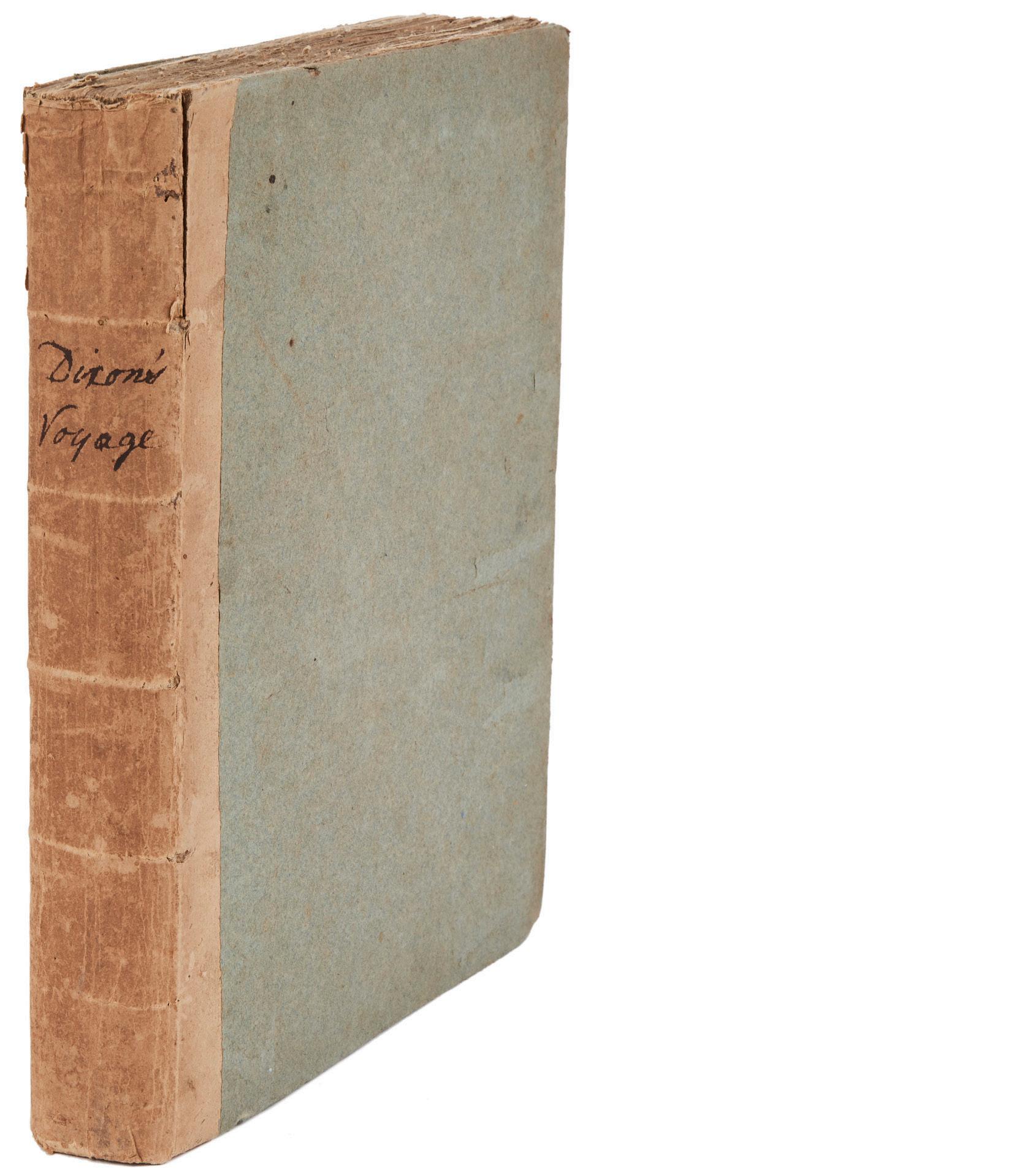
DIXON TO THE NORTHWEST COAST: IN THE ORIGINAL BOARDS BINDING
12. DIXON, Captain George.
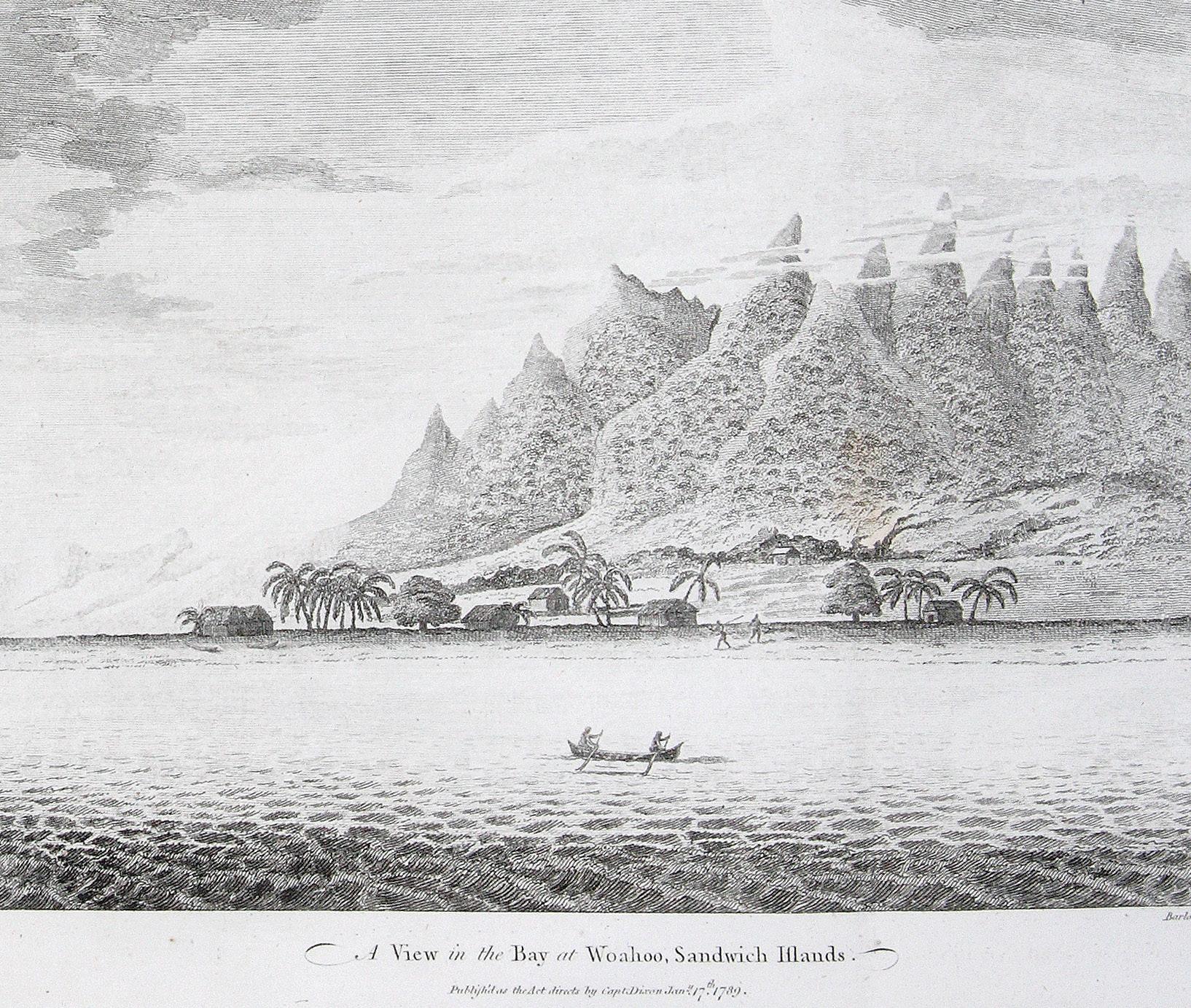
A Voyage Round The World; but more particularly to the North-West Coast of America; performed in 1785, 1786, 1787, and 1788, in the King George and Queen Charlotte, Captains Portlock and Dixon. Dedicated, by Permission, to Sir Joseph Banks, Bart.
Quarto, with 23 engraved maps and plates, including nine folding and seven of natural history subjects plates, with the half-title; a fine uncut copy with generous margins in the original boards, preserved in a bookform box. London, George Goulding, 1789.
First edition: a remarkable copy in fine original condition.
Dixon’s account of his voyage in the Queen Charlotte is dedicated to Joseph Banks, and is a companion to Portlock’s account of the same voyage; both men had voyaged with Cook, Dixon as armourer aboard Discovery. They sailed together as far as Prince William Sound, Dixon then following the coast making a series of landfalls. He discovered and closely observed Queen Charlotte’s Island, and entered Dixon’s Straits, before ultimately arriving at Nootka where he joined both Portlock and Meares. The book is “an excellent authority for the early days of fur trading on the northwest coast…” (Streeter).
“Dixon’s voyage is important as a supplement to Captain Cook and for its contributions to the natural history of the Pacific Northwest… The work previously done by Cook along the northwest coast of America was mapped more definitely by Dixon, who discovered the Queen Charlotte Islands, Port Mulgrave, Norfolk Bay, and Dixon Entrance and Archipelago while continuing down the coast and trading with the Indians” (Hill).
The Queen Charlotte made visits to Hawaii in 1786 and 1787, trading at Oahu and Kauai. The book also includes a long account of commercial transactions at Canton. Though often catalogued as the work of William Beresford, whose letters to a friend signed W.B. form the basis of the work, Dixon added substantially to the text and edited the whole.
Provenance: Original bookseller’s ticket of Thomas Hookham, bookseller and publisher with premises on the corner of New Bond Street and Bruton Street, London.
‘Hawaii One Hundred’, 8; Forbes, ‘Hawaiian National Bibliography’, 161; Hill, 117; Judd, 53; Kroepelien, 300 (German edition only); Lada-Mocarski, 43; Wagner, I, p. 207 etc., II, 732-735.
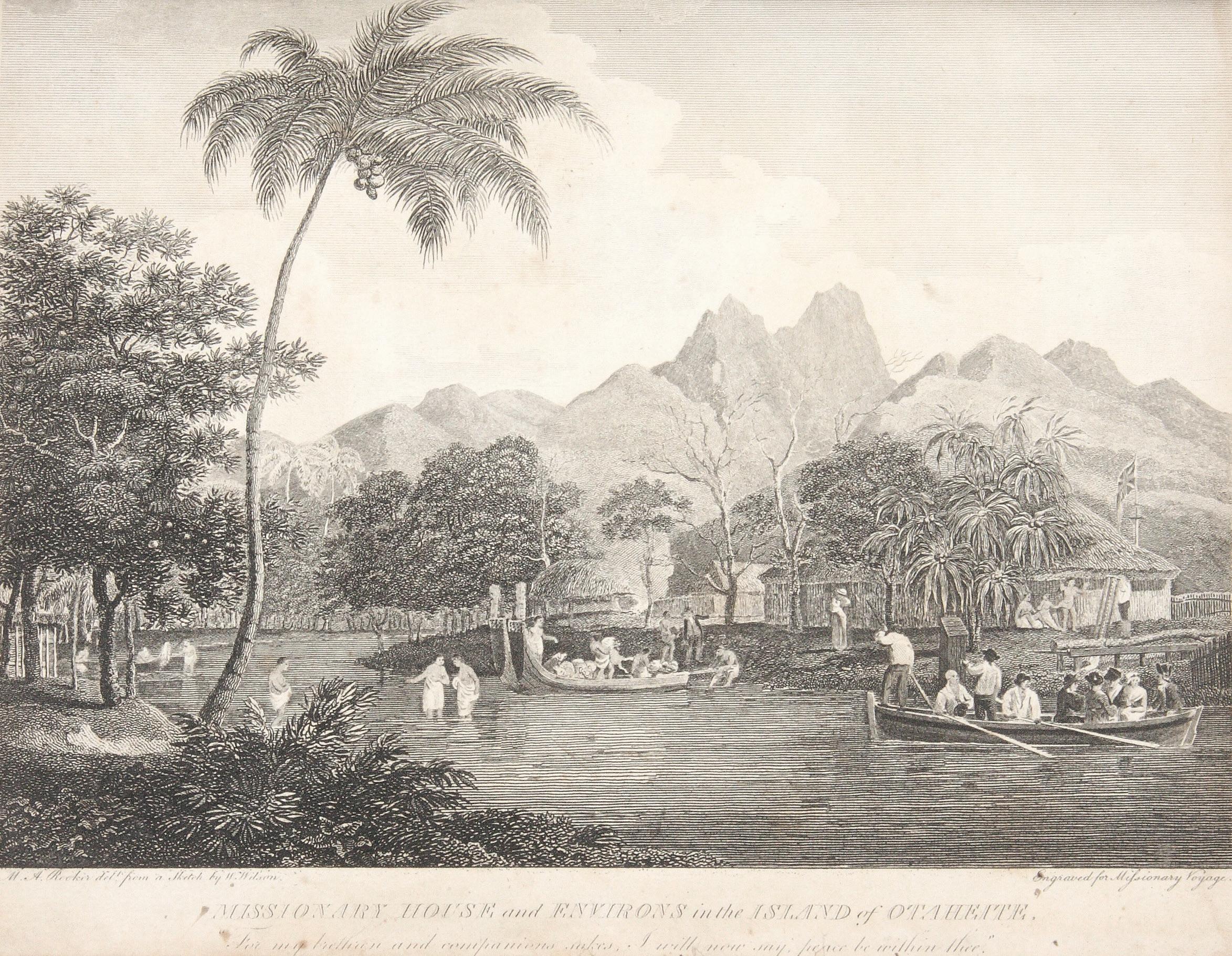
AN 18TH-CENTURY “GREATER AUSTRALIA”, WELL BEFORE FLINDERS
13. [DUFF VOYAGE] WILSON, Captain James; HAWEIS, Thomas, editor.
A Missionary Voyage to the Southern Pacific Ocean, performed in the years 1796, 1797, 1798, in the Ship Duff, commanded by Captain James Wilson. Compiled from Journals of the Officers and the Missionaries…
Quarto, with six plates and seven maps, mostly folding; a fine uncut copy in full calf with marbled endpapers. London, Printed by S. Gosnell for T. Chapman, 1799.
First edition, an attractive large paper copy of the full official account of the first missionary voyage to the South Pacific. The Duff set out for Tahiti in 1796, but visited many island groups, including particularly Tonga and the Marquesas. A new group of islands, the “Duff Group”, was discovered among the Santa Cruz Islands. The maps here include a large chart of the Fiji Islands as well as charts of Tongataboo, the Gambier Islands, the Marquesas, Tahiti and the Duff Group; the plates include an engraved view of Rio de Janeiro. Wilson is identified as the author of the main body of the work in the Advertisement, which explains that he put it together from the captain’s papers as well as his own, and from the missionaries’ reports. The Hill catalogue notes that “the long ‘preliminary discourse’ was anonymously written by Samuel Greatheed, using the then-unpublished narrative of James Morrison, one of the pardoned Bounty mutineers. Morrison’s manuscript was also the source for the extensive appendix on Tahiti. Indeed, William Wilson and James Morrison may be called co-authors of this book…”.
According to the map expert Dorothy F. Prescott, “the Wilson book contained a map that actually used the words ‘Greater Australia’ — taking in Captain Cook’s map of the south and east coasts of Van Diemens Land… this map would have influenced Matthew Flinders…”. Flinders is traditionally said to have been the first to use the term “Australia” in a voyage context: the Duff account appeared about fifteen years earlier.
There is much of Australian interest in the account of the voyage including a mention of escaped Botany Bay convicts, and the flight of several missionaries from Tonga, where three were killed, to Sydney. Some of the missionaries made their homes in Sydney and founded families later to become important in Australian history. Ferguson, 301; Hill, 1894; Kroepelien, 528.
$7000 [5001049]
THE GLORIOUS PRINTING OF BANKS’S GREAT PROJECT: ONE OF 100 COPIES
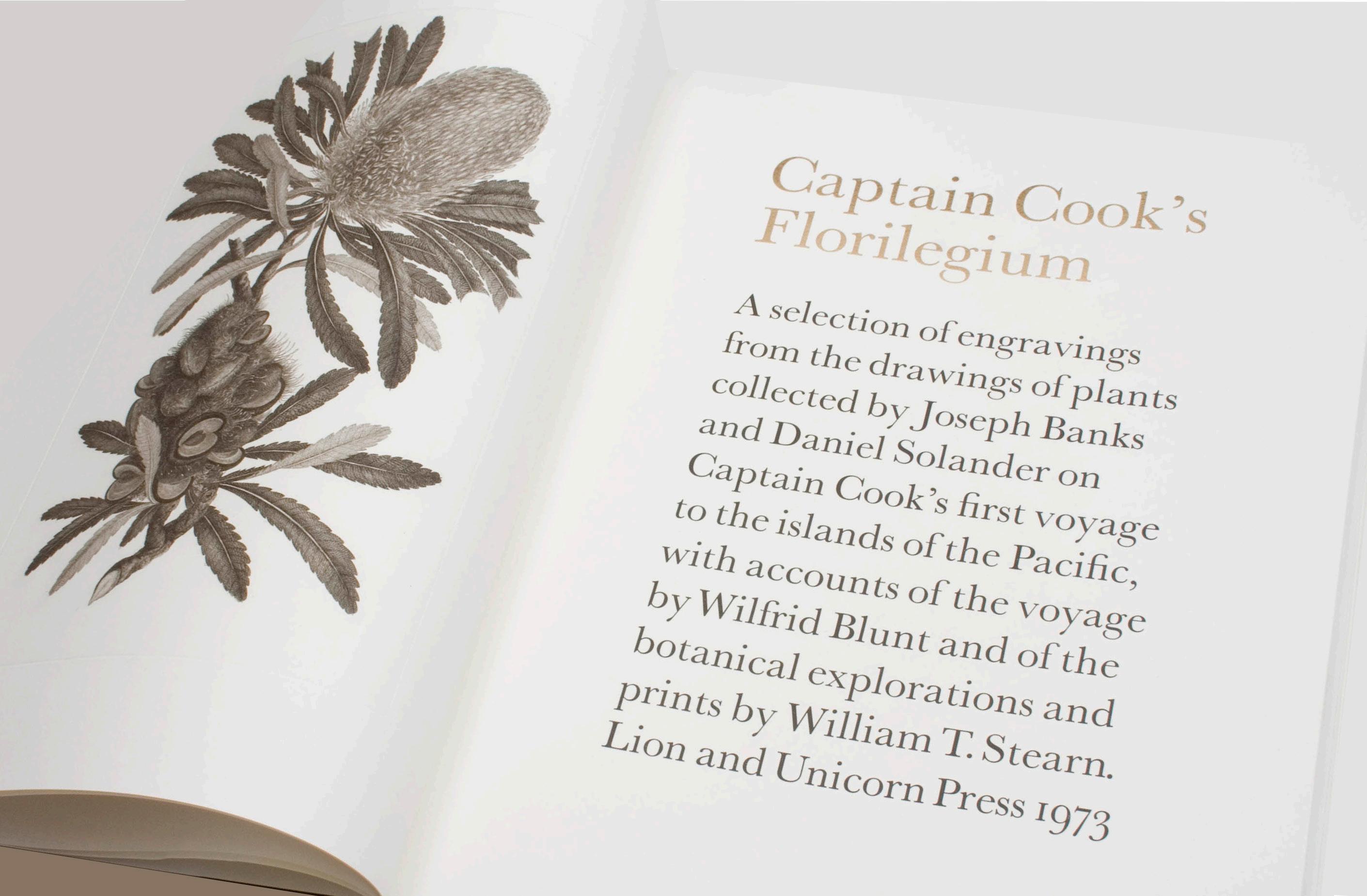
14. [ENDEAVOUR VOYAGE] BANKS, Sir Joseph & Daniel SOLANDER.
Captain Cook’s Florilegium. A selection of engravings from the drawings of plants collected by Joseph Banks and Daniel Solander on Captain Cook’s first voyage to the islands of the Pacific, with accounts of the voyage by Wilfrid Blunt and of the botanical explorations and prints by W.T. Stearn.
Large folio, with 30 plates after drawings by Sydney Parkinson, the title printed in black and gold, the text in various colours; original quarter morocco over silk boards with morocco edge, felt lined box, by Zaehnsdorf; with the original List of Subscribers. London, [Royal College of Art], Lion and Unicorn Press, 1973.
The botany of the Endeavour voyage: this magnificent printing by the Royal College of Art in London from original eighteenth-century copper-plates appeared in an edition of only one hundred copies, on a specially hand-made paper, in a superb binding commissioned from Zaehnsdorf of London; the edition was fully subscribed long before it was completed.
When Cook’s first voyage returned to London, the original botanical drawings were made into detailed and accurate paintings under Banks’ supervision, with reference to the collection of actual specimens. Following this they were engraved, and we know that Banks intended to oversee full publication of the collection of engravings. In fact, only a proof impression was made and the undertaking abandoned. The British Museum (Natural History) holds the original copper-engraved plates, as well as the drawings and specimens themselves, and a set of the proof impressions made from the copper-engravings.
Between 1900 and 1905 lithographic copies were made of 318 of these proof impressions and published as “Illustrations of Australian Plants collected in 1770”, a most important but rather dismal production. The copperplates themselves remained unused, until in 1960 it was decided that the Royal College of Art should print a selection of the most beautiful. The result, after thirteen years of planning and trials, was this splendid production, which for the first time showed the extraordinary strength of the images. Perfectly printed, rich impressions in strong black ink, they show the important botany of the Cook voyage to great advantage, and at the same time make it a matter for regret that no eighteenth-century edition appeared.
A later printing by Alecto from all the plates, with colour applied during the process, while splendid, was arguably less consistent with Banks’s original intentions.
$17,500 [6000017]
BOTANY BAY FOR FIRST FLEETERS
15. [FIRST FLEET: EDEN] ANONYMOUS.
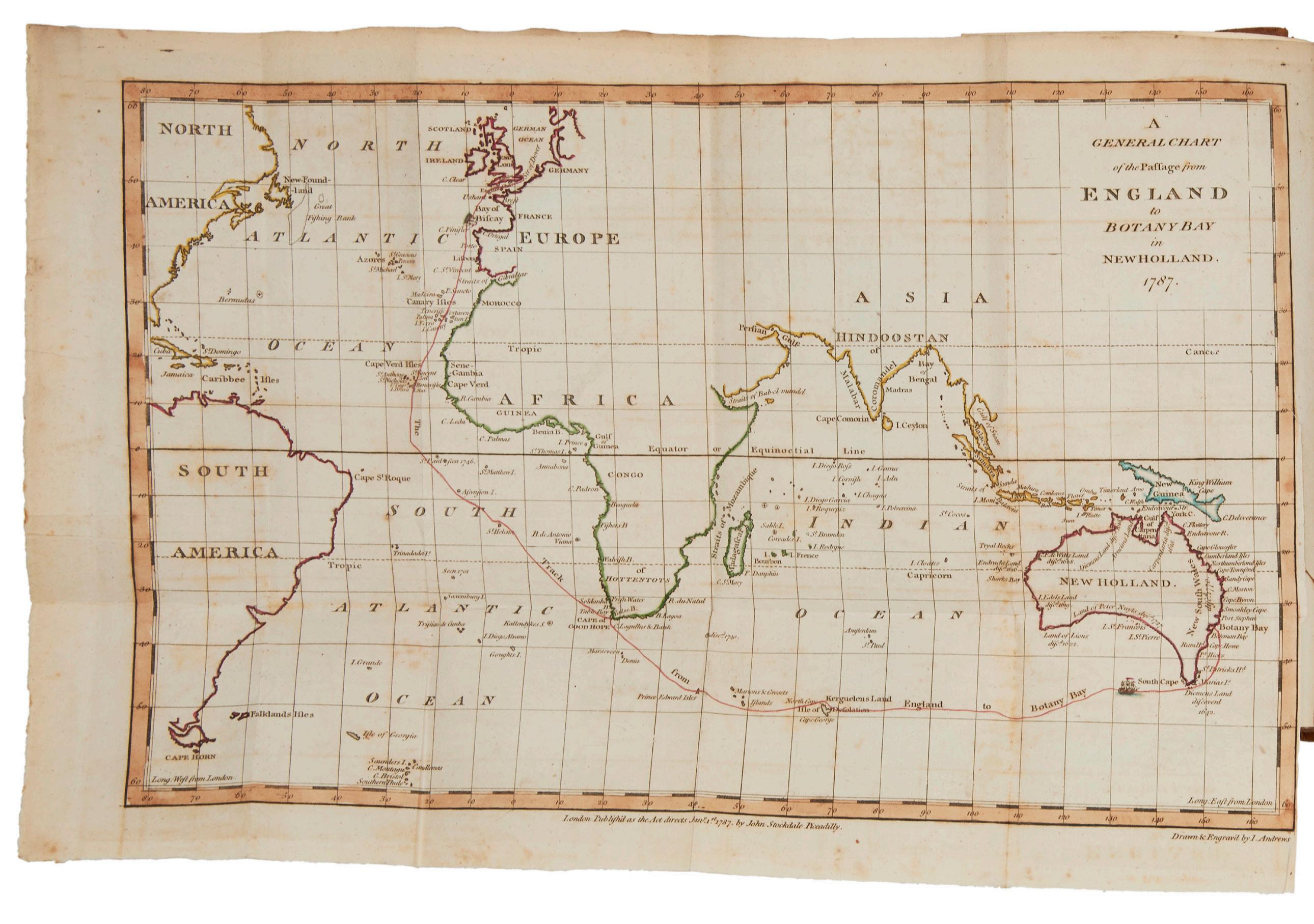
The History of New Holland, from its first discovery in 1616, to the present time. With a Particular Account of its Produce and Inhabitants; and a Description of Botany Bay: Also, a List of the Naval, Marine, Military, and Civil Establishment to which is prefixed, An Introductory Discourse on Banishment, By the Right Honourable William Eden.
Octavo, with two folding maps hand coloured in outline; a very good copy, edges uncut, in contemporary calf, gilt, spine neatly repaired. London, John Stockdale, 1787.
An important book, and a sometimes neglected precursor to the Australian First Fleet: this was one of the earliest descriptions of Australia, published to coincide with the departure from England of the First Fleet. “It is an extremely interesting work and an essential inclusion in all comprehensive collections” (Davidson). In discussing the fleet’s imminent departure the anonymous compiler lists numbers and equipment as well as the principal officers, and there is also material in both preface and text about transportation, as well as an “Introductory Discourse” on the subject by William Eden which has often led to the misattribution of the whole book to him.
This is an example of the important second edition, published the same year as the first and after parliamentary approval of the Botany Bay plans, and with a very significant new section: an additional ten prefatory pages appear for the first time in this edition, discussing in detail the hopes for the new settlement. The anonymous writer reports that many of the convicts awaiting transportation have embraced the idea with excitement: “strange to tell! there have not been wanting voluntary candidates for banishment to that remote shore…”.
The “Eden”, as it is often called, was written “to present at one view a connected description of the whole country of New Holland”. The book is clearly aimed at a public eager for information on the new colonial venture, and for details of Botany Bay itself, which is here described at length. This is the form in which many of the participants in the First Fleet must have absorbed what little information existed about conditions in Australia. The maps show the continent, Botany Bay and most interestingly the “passage from England to Botany Bay in New Holland 1787”, highlighting the route that the fleet must take.
The book is of some importance too for its Cook material: as Cook’s bibliographer Holmes points out, “the greater part of the book is devoted to Cook’s discoveries…”. His charting of the east coast of Australia is here put into context in a form anticipating the actual settlement of the new coastline.
Ferguson, 25;Beddie, 28; Davidson, ‘A Book Collector’s Notes’, pp. 79-81; Holmes, 66 (the first edition); not in the Hill collection. $6800
FLINDERS ON WRECK REEF
16. [FLINDERS] [PURDIE, Robert]
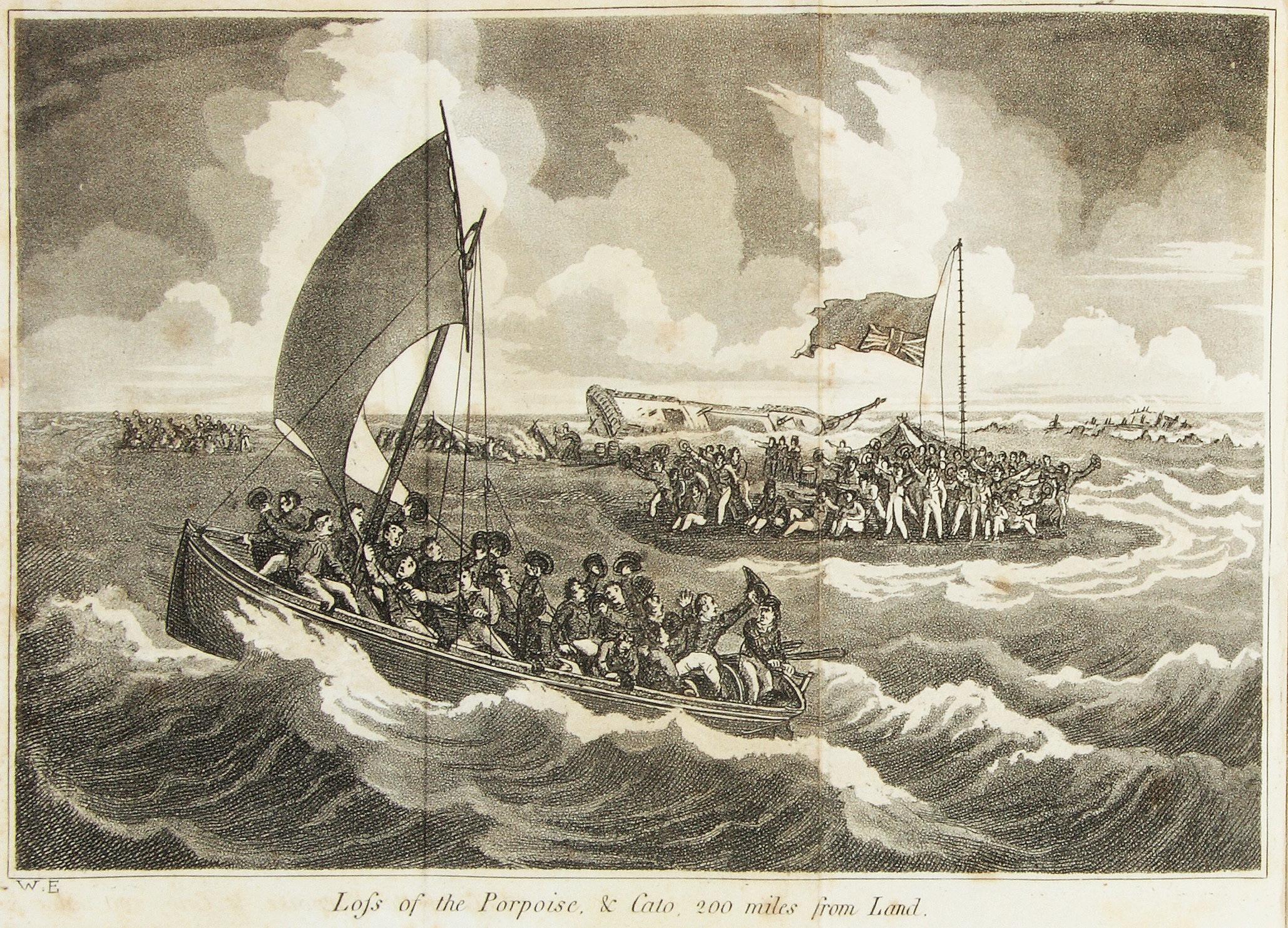
Interesting Narrative of the Loss His Majesty’s Armed Vessels the Porpoise and Cato, of London, upon Wreck Reef, on their passage from New South Wales to China; interspersed with Occasional Remarks on New South Wales, its Productions, Inhabitants, &c. By an Officer of the Porpoise, Never before published. Also the Loss of the Doddington, East Indiaman.
Duodecimo,[ii], 7-28 pp. (as issued), with a folding engraved frontispiece of the wreck of the Porpoise and Cato, signed “W.E.” in the plate; a few defects but a good uncut copy in original condition in (probably original) plain blue paper wrappers; preserved in a quarter morocco bookform case by Aquarius. London, Thomas Tegg, 1808.
Very scarce London chapbook recounting the dismal wrecking off the Great Barrier Reef of the ships Porpoise and Cato bound from New South Wales to China in August 1803. Published anonymously, only in recent times has Dr Fishburn established Purdie’s authorship of the narrative beyond doubt.
The text was first published as an anonymous eight-part serial in the Naval Chronicle for 1806 and 1807. Other than a brief account in the Sydney Gazette (18 September 1803), the only other published eyewitness account of the wreck appeared in Matthew Flinders’ own great work, the Voyage to Terra Australis of 1814. Purdie’s narrative is in fact the earliest full account of an Investigator officer and the only published account of life on the reef, marking it out as an important contribution to the history of Flinders’ expedition.
The wreck was the beginning of what was to be a disastrous voyage back to England for Matthew Flinders who shipped with the Porpoise after completing his circumnavigation. The Investigator had been damaged, apparently beyond repair, and he chose to go back to England in search of a seaworthy ship. The Porpoise left Port Jackson on 10 August 1803, taking the route via Torres Strait; on 17 August she went ashore on Wreck Reef, in open ocean about 740 miles NNE of Sydney. Two merchant vessels were with her; one, the Cato, was wrecked a short distance away, and the other, the Bridgewater, disappeared and was never heard of again.
Flinders made a camp on the reef, organised the refugees, and made the journey back to Sydney in a ship’s cutter, returning with rescue vessels. One of them, the Cumberland, took him and ten chosen men onwards — on a terrible voyage, the final humiliation of which would be Flinders’ imprisonment on Mauritius.
The publisher, Thomas Tegg, was a prolific publisher of chapbooks in London; his son later emigrated to become a significant early Sydney printer.
Ferguson, 474; Wantrup, 69; Fishburn, Matthew, ed., “Narrative of the Wreck of HMS Porpoise”, Hordern House, 2014. $4850
THE LATER CAREER OF THE SURGEON’S MATE OF HMS INVESTIGATOR
17. [FLINDERS] PURDIE, Robert.
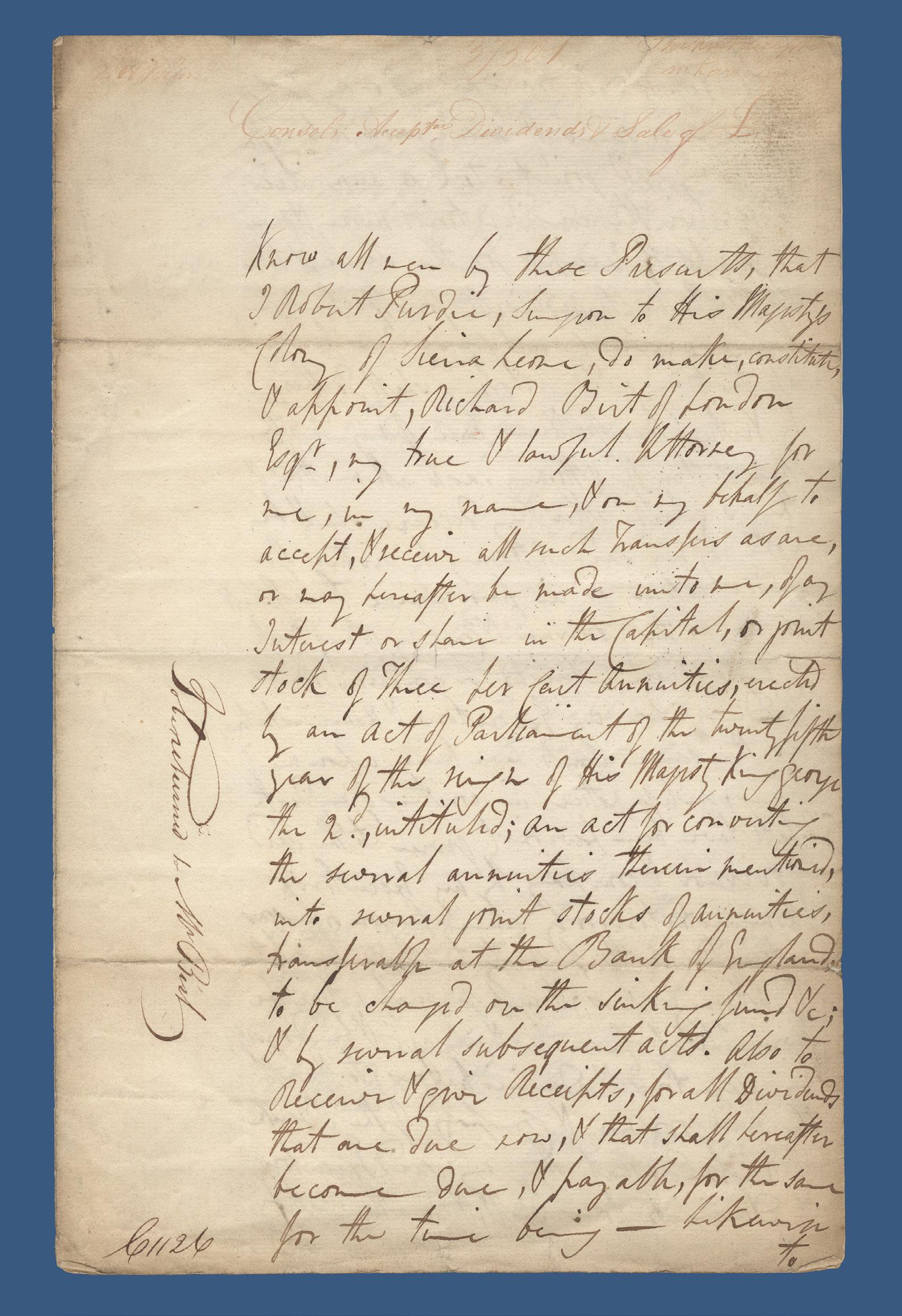
Manuscript power-of-attorney written and signed by Purdie, former surgeon’s mate on HMS Investigator, while serving in Sierra Leone.
Folio manuscript of three pages (two leaves measuring 322 x 205 mm.), laid paper watermarked 1812, with paper seal; folded to docket size. Freetown, Sierra Leone, 12 April 1814.
A veteran of HMS Investigator in later life: a power of attorney written and signed by Robert Purdie, who was appointed in 1801 as surgeon’s mate with Flinders, and who remained on board for the entire expedition. The manuscript, written in 1814 and witnessed by the Sierra Leone governor Charles W. Maxwell, represents a rare opportunity to glimpse a few details of his controversial later life and career. Of course, any manuscript material relating to any of Flinders’ crew is most uncommon. Purdie was the earliest writer to publish any detailed account by an Investigator officer in his early account of the wreck of the Porpoise and Cato, and of shipwrecked life on the reef.
Purdie (1780-1815) was a native of Calder, Midlothian in Scotland. Although a relatively young medical officer for such an arduous voyage, he served with some distinction, and Flinders named Purdie Islands (off the South Australian coast near Ceduna) for him in 1802, not far from Point Bell (Flinders obviously had his crew very much in mind at the time, because the latter point was named for the senior surgeon, Hugh Bell). Purdie was one of those who wrecked on board the Porpoise in 1803, remained with the survivors until they were picked up by the Rolla, and returned to England. He must be the surgeon of that name who served on the Argo from July 1806 (at the latest), in which service he sailed to Africa and the West Indies, and next appears in Sierra Leone as secretary to the British colony under Governor Maxwell, a role which saw him caught up in criticism over the treatment of captured slaves. Purdie died in Sierra Leone in 1815.
Most significantly, Purdie has recently been proved to be the author of a long account of the wreck of the Porpoise and Cato and life in New South Wales (see previous item).
$5250 [6000046]
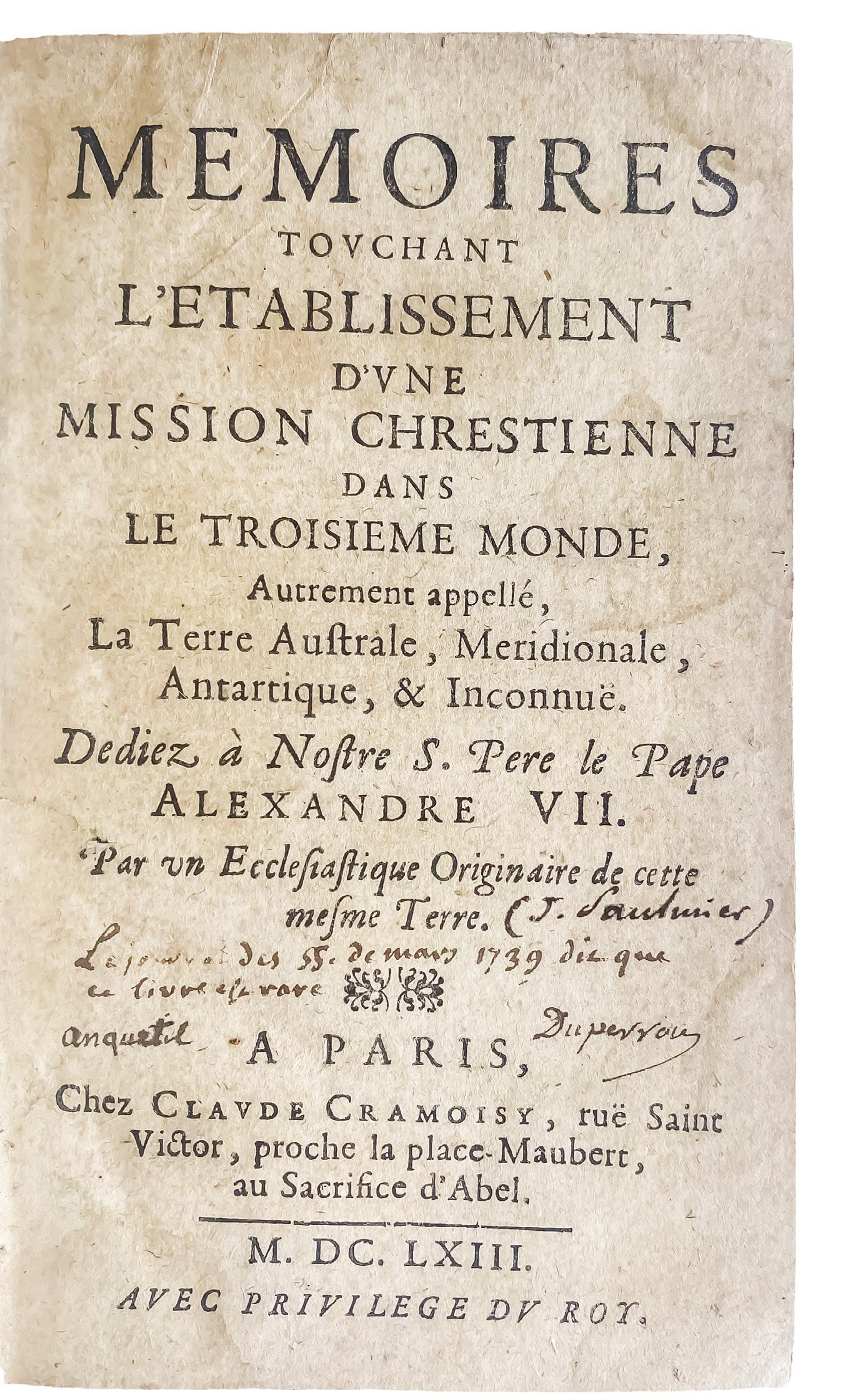
“ONE OF THE RAREST ITEMS OF EARLY AUSTRALIANA”
18. GONNEVILLE, Jean Paulmier de Courtonne, de.
Mémoires touchant l’Etablissement d’une Mission Chrestienne dans le Troisième Monde, autrement appellé, La Terre Australe, Méridionale, Antarctique, & Inconnuë. Dediez à Nostre S. Père le Pape Alexandre VII. Par un Ecclesiastique Originaire de cette mesme Terre [Memoirs Concerning the Establishment of a Christian Mission in the Third World, otherwise known as the Austral Land, Southern,Antarctic, and Unknown. Dedicated to his Holiness Pope Alexander VII. By an ecclesiastic comng from that very land].
Duodecimo, pp. [,vi], 216; original simple binding of speckled vellum, unlettered. Paris, chez Claude Cramoisy, 1663.
Exceptionally rare: the elusive narrative of an early sixteenth-century voyage from France to the Terre Australe or southern continent and a proposal to settle, colonise and evangelise the South Land. Of two or possibly three issues that appeared at around the same time this is an example of the fullest with additional prefatory material.
This is the narrative of the French navigator Binot Paulmyer sieur de Gonneville’s early sixteenth-century voyage, sailing from the Normandy seaport Honfleur in 1503, with two Portuguese pilots aboard. Heading for the East Indies, they struck a terrible storm somewhere near the Cape of Good Hope which took them off course and led to their accidental discovery of the “great Austral land”, which de Gonneville also referred to as the “Indes Meridionales”. They stayed six months in what he described as an idyllic land of plenty where no-one needed to work, and which he said was about six weeks’ sailing east of the Cape of Good Hope.
Returning to France on his ship the Espoir in 1505, he brought back with him Essomeric, a native of the land he had discovered. Essomeric settled in Normandy and was quickly assimilated into Norman society, taking de Gonneville’s name, and marrying his daughter. Paulmier de Courtonne de Gonneville, who was responsible for this first publication of the narrative, was his great-grandson and a pillar of the establishment as the canon of Lisieux cathedral. The younger de Gonneville argues in an accompanying address here to the Pope –rather as de Quirós did in his memorials to the King of Spain – for the colonisation of the southern continent by means of a mission there to convert the native inhabitants of “La Terre Australe”.
De Gonneville’s supposed discovery of the southern continent took place a century before that of de Quirós, and yet it has received little historical attention (the slender literature is listed in Howgego, Encyclopedia of Exploration to 1800, G71). De Gonneville’s account has never been published in English apart from brief extracts.
A longer analysis of this work appears on our website.
Provenance: Abraham Hyacinthe Anquetil-Duperron (1731-1805, French orientalist, with his ink ownership inscription on title-page, and note that “Le Journal des SS. de mars 1739 dit que ce livre est rare”); J. Morel (bookplate with initials, and notecard of Servane Morel).
Brunet, 3/1595; Church, 581; JCB, 3/91; Leclerc, 1628 and 2588; Mackaness, ‘The Art of Book-Collecting’, pp. 67-8; Robert, 1651. See also Margaret Sankey, “The Abbe Paulmier’s Memoires and Early French Voyages in Search of Terra Australis” (in John West-Sooby, ed., Discovery and Empire: the French in the South Seas (Adelaide, 2013); and http:// www.australiaforeveryone.com.au/files/maritime-gonneville.html.
$68,500 [5000981]
WITH THE BASS STRAIT CHART SHOWING NEWLY DISCOVERED VICTORIAN COASTLINE
19. GRANT, James.
The Narrative of a Voyage of Discovery, performed in His Majesty’s Vessel The Lady Nelson, of sixty tons burthen, with sliding keels, in the years 1800, 1801 and 1802, to New South Wales…
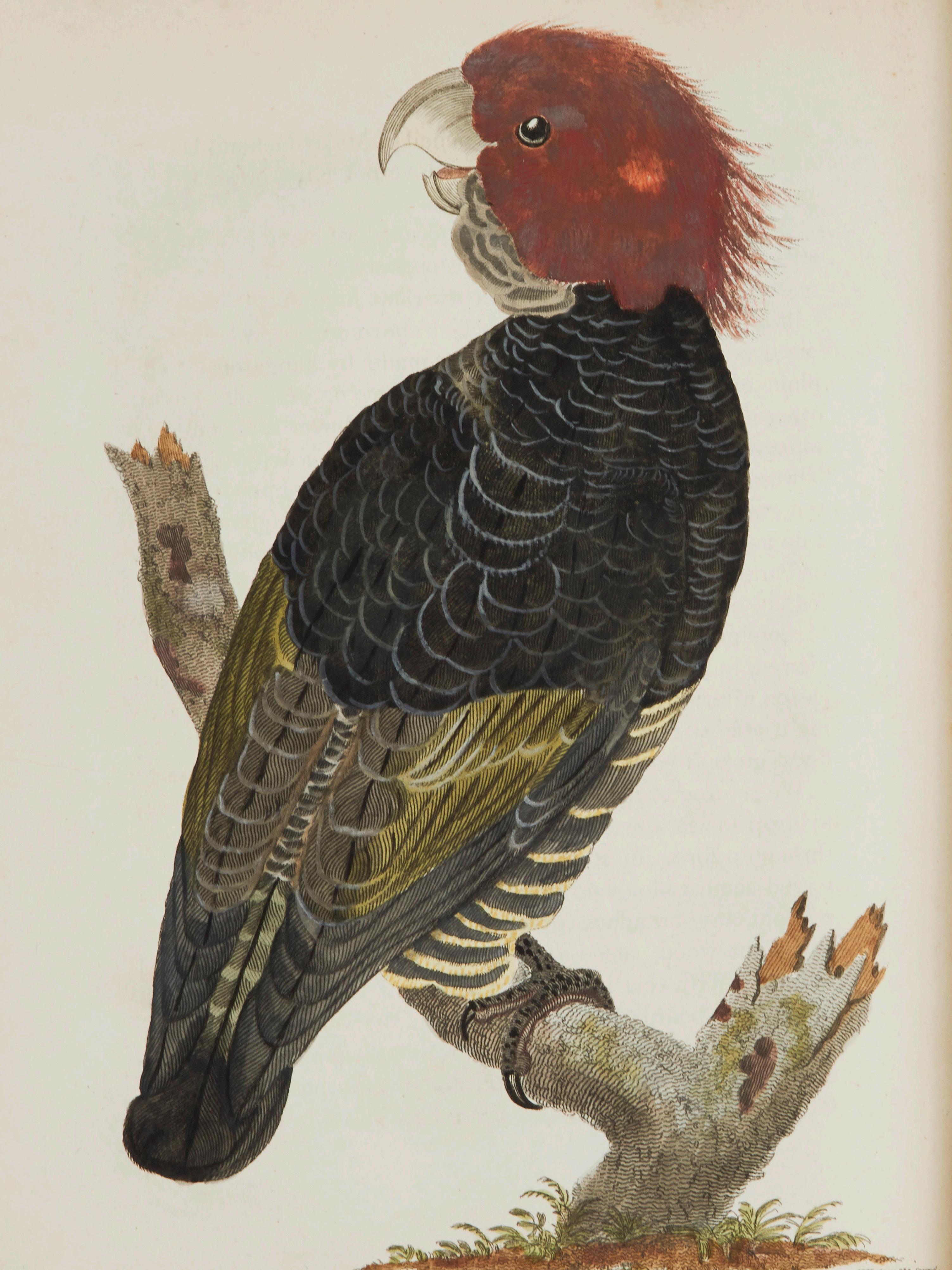
Quarto, with a large folding plan, chart, coloured plate of a cockatoo and five other engravings including a portrait of Bennelong; complete with the rare “List of the Encouragers”; in a good old binding of half calf. London, C. Raworth, 1803.
First edition: one of the most important of the early Australian coastal voyages. The Lady Nelson was the first ship to be built with sliding keels to allow closer exploration of shallow coastal waters. James Grant was born in Scotland in 1772; in 1800 as a lieutenant in the Royal Navy he brought the Lady Nelson to Australia in company with HMS Porpoise. He sailed the unusually designed ship through Bass Strait, the first to do so from the west and, on arrival at Sydney, discovered that he had missed Flinders, to whom he was to deliver the ship, and was sent back to survey the south-western coast of the continent, assisted by Francis Barrallier. However, because of the lateness of the season, the survey, which took place from March to May 1801, concentrated on Bass Strait and the Victorian coast instead. The chart of Bass Strait here was the first to be published of the newly-discovered Victorian coast.
Over the next two years Grant made several voyages of discovery along the New South Wales coastline but is best remembered for his work in the Hunter River area which resulted in the establishment of Newcastle. Two engravings in this book illustrate the Lady Nelson’s exploration of the Hunter River: they were probably engraved after sketches by the colony’s first professional artist, John William Lewin, who accompanied the expedition. The beautiful hand-coloured plate depicting the “Fringe Crested Cockatoo” is present here in particularly fine condition. There are also portraits of the Aborigines Pimbloy (an alternative spelling of Pemulwuy, the great warrior) “in a canoe of that country” and Bennelong.
Ferguson, 375; Davidson, ‘A Book Collector’s Notes’, pp. 125-6; Hill, 718; Wantrup, 75.
$13,500
[5001069]
VOYAGES TO AUSTRALIA AND THE SOUTH SEAS
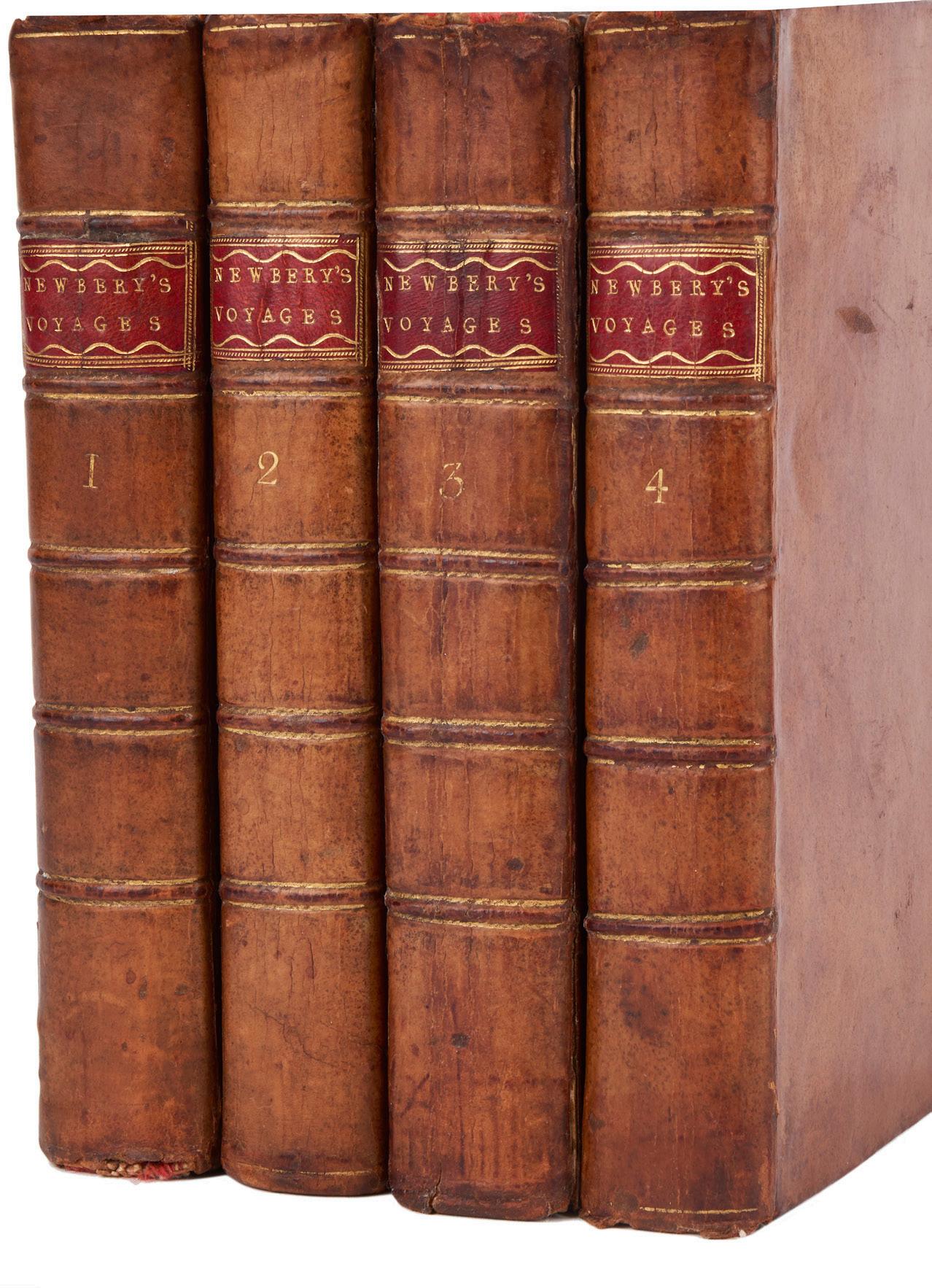
20. HENRY, David.
An Historical Account of all the Voyages round the World, Performed by English Navigators… Faithfully Extracted from the Journals of the Voyagers…
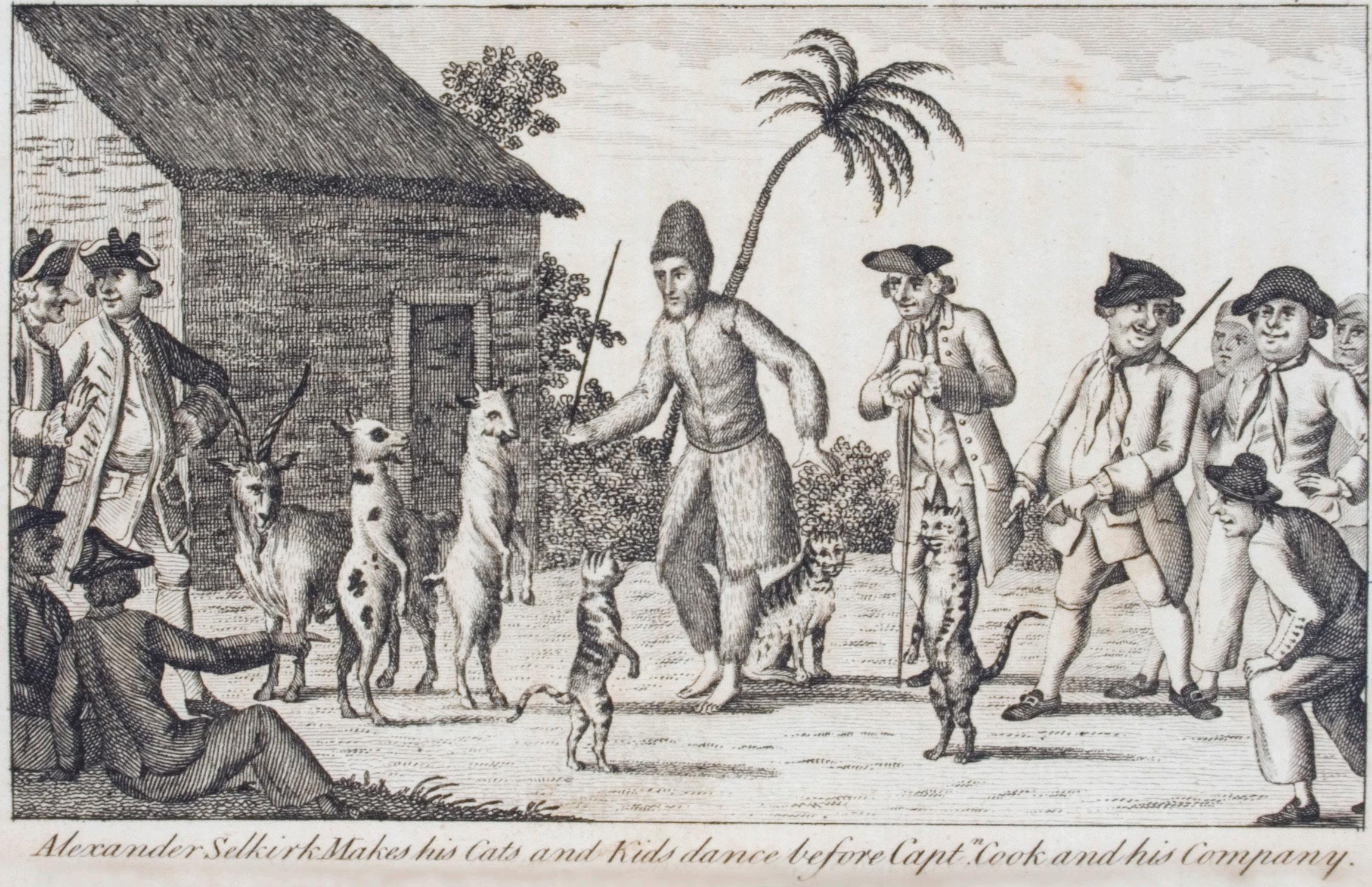
Four volumes, octavo, with four maps and 45 engraved plates, several folding; original period binding of lightly sprinkled polished calf with red leather labels, a fine, fresh and attractive set. London, Printed for F. Newbery, 1773-1774.
First edition of this important collection of voyages, largely relating to Australia and the South. Seas. The last two volumes contain an account of Cook’s first voyage round the world, mostly based on Cook’s own journal and that of Sydney Parkinson, the official artist who died during the course of the voyage. Other voyages described in the collection include those of Drake, Cavendish, Cowley, Dampier, Edward Cooke, Rogers, Clipperton and Shelvocke, Anson, Byron, Wallis, Carteret and Bougainville, while the long Appendix contains the Journal of a Voyage to the North Pole by Phipps.
The early 1770s were a most important and prolific period for the English explorers, and the date of publication of this collection coincides with one of the high points for the London publishers of travel accounts. As a result, several of the narratives in this collection are of particular interest as being strictly contemporary accounts rather than later abridgements by hack-writers. The Cook material, for instance, is published here in the same year as the official account itself of the voyage first appeared; the same is true for the accounts of Wallis and Carteret, while Bougainville’s description of his remarkable circumnavigation and the discovery of Tahiti appeared for the first time in English only the previous year. The narrative of Phipps’s “Voyage to the North Pole” did not appear independently until a year after publication here.
The two most important English expeditions to Australia — Dampier and Cook, respectively the first Englishman to reach Australia, and the discoverer of the east coast — are fully treated here, and the collection as a whole gives a clear picture of English activities in the South Seas with Australia as the central achievement.
“Henry was for many years a voluminous contributor to the Gentleman’s Magazine. This set of collected voyages is introduced by an admirable summary of all the voyages, undertaken for discovery only, in both the southern and northern hemispheres in the Pacific and Atlantic Oceans. The work is especially important for its inclusion of the early circumnavigators who had not published their own accounts…” (Hill).
Beddie, 655; Hill, p. 142.
$7500 [5001115]
A FAMILY MEMENTO OF HMS RESOLUTION FROM THE GREATEST ANTARCTIC VOYAGE
21. HODGES, William (1744-1797).
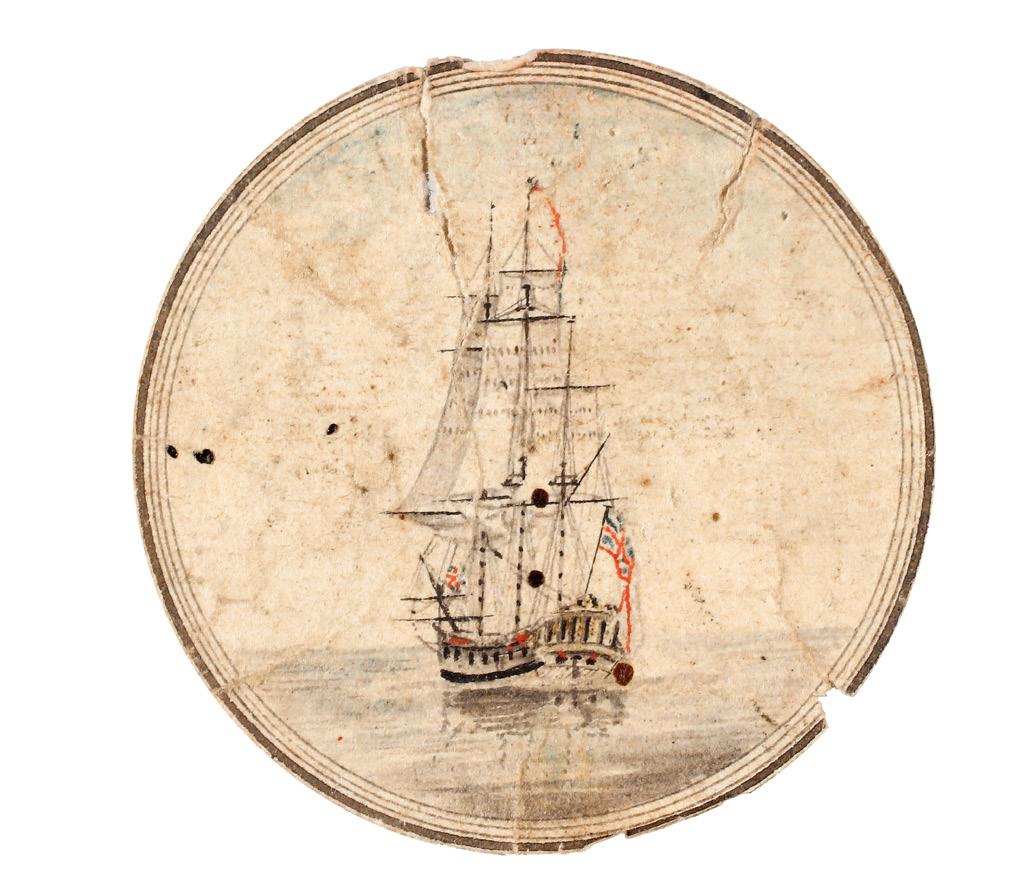
Original drawing with watercolour highlights of HMS Resolution.
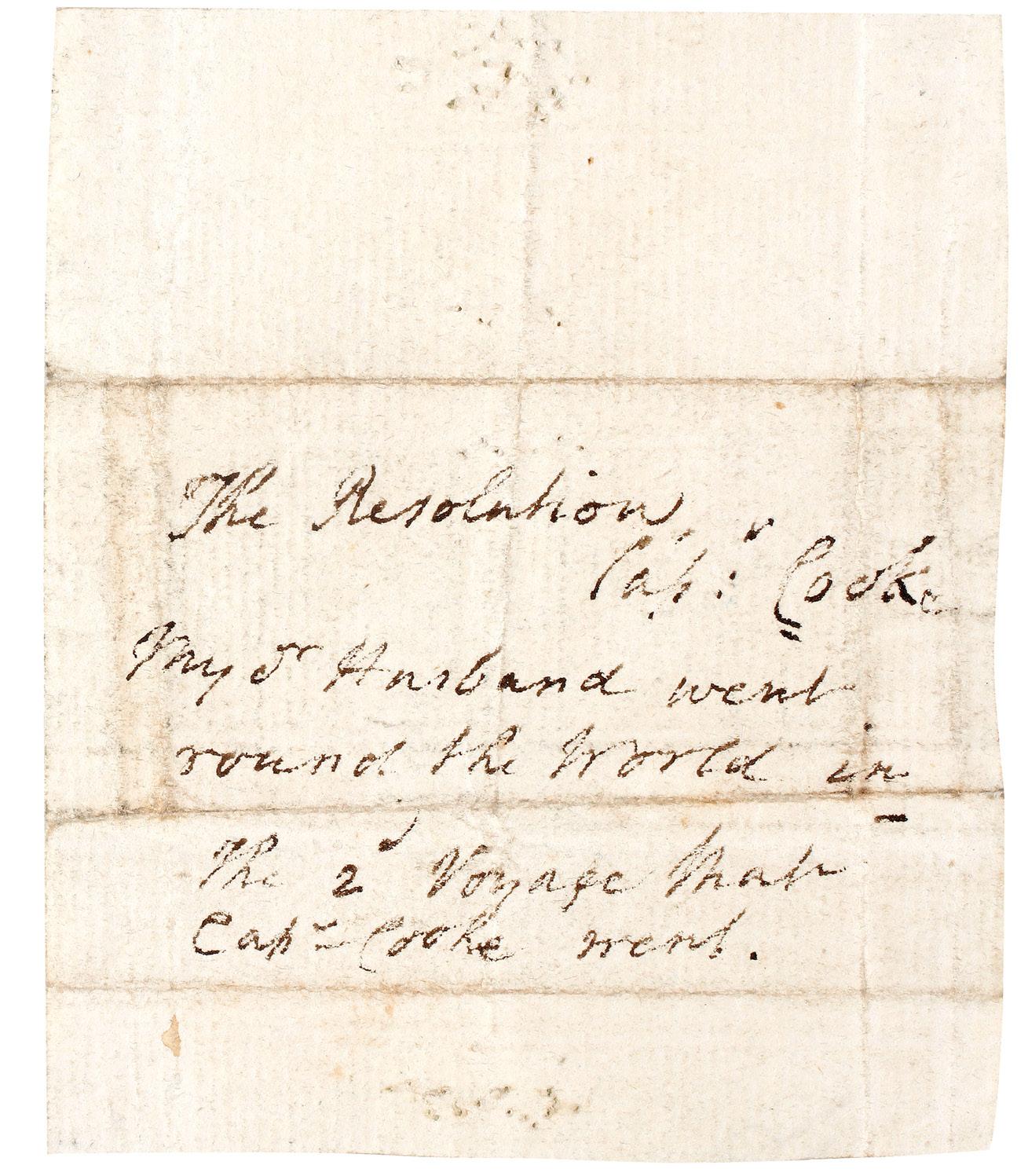
Drawing on paper with watercolour highlights, border of concentric circles (45 mm diameter); with associated note of provenance, ink on paper (95 x 75 mm); well framed together. HMS Resolution, at sea, c. 1773.
A lovingly preserved memento from Cook’s second voyage to the Pacific; a delicately rendered drawing of HMS Resolution under sail sketched from astern, the White Ensign clearly visible, with a streamer flying from the main mast and a jack at the bow. It is firmly attributed to William Hodges, who accompanied Cook as voyage artist. The shape and intricate detail in this remarkable drawing suggest it may have been intended as a cameo keepsake.
The watercolour’s first owner, Richard Grindall, joined the Resolution as an able seaman, despite having passed his lieutenant’s examination. “He messed with the midshipmen during the voyage, and [fellow midshipman]
John Elliott described him as ‘a Steady Clever young man’. Immediately, at the end of the voyage and to the great surprise of the rest of the crew, Grindall accompanied Cook from Portsmouth to London. According to Elliott, ‘The same day Captn Cook with Messrs Forster, Wales, Hodges, and my Messmate Grindal set out for London. The latter we now found (and not till now) had Married a very handsome young Lady, and left her, within an hour after, on our leaving England’…” (Captain Cook Society website). That “very handsome young Lady” was Katherine Festing (1759-1831), who came from a musical background, both of her grandfathers being celebrated violinists and composers. It is presumably her note that accompanies the drawing: “The Resolution, Capt. Cook. My dr. [dear] Husband went round the World in the 2nd Voyage Capt. Cooke [sic] went”. The National Maritime Museum in Greenwich holds an intimate family portrait of Grindall in later career, pictured with Katherine and their sons. Cook’s great second voyage saw the first crossing of the Antarctic circle, “arguably the greatest, most perfect, of all seaborne voyages of exploration. In his three years away he disposed of the theory of a great southern continent, reached closer to the South Pole than any other man, and touched on a multitude of lands — New Zealand and Tahiti again, and for the first time Easter Island, the Marquesas, the New Hebrides and New Caledonia” (Marshall & Williams, p. 276).
Talented official artist on the voyage, William Hodges was one of the three Cook voyage artists who are recognised as the most important painters to visit the Pacific in the eighteenth century, the others being Sydney Parkinson on the first voyage and John Webber on the third.
Provenance: Vice-Admiral Sir Richard Grindall (1750-1820, able seaman on the second voyage favoured by Cook); thence by direct descent through his family.
$65,000 [5000757]
RARE EARLY LAND GRANT, SIGNED BY THE SECOND GOVERNOR
22. HUNTER, John.
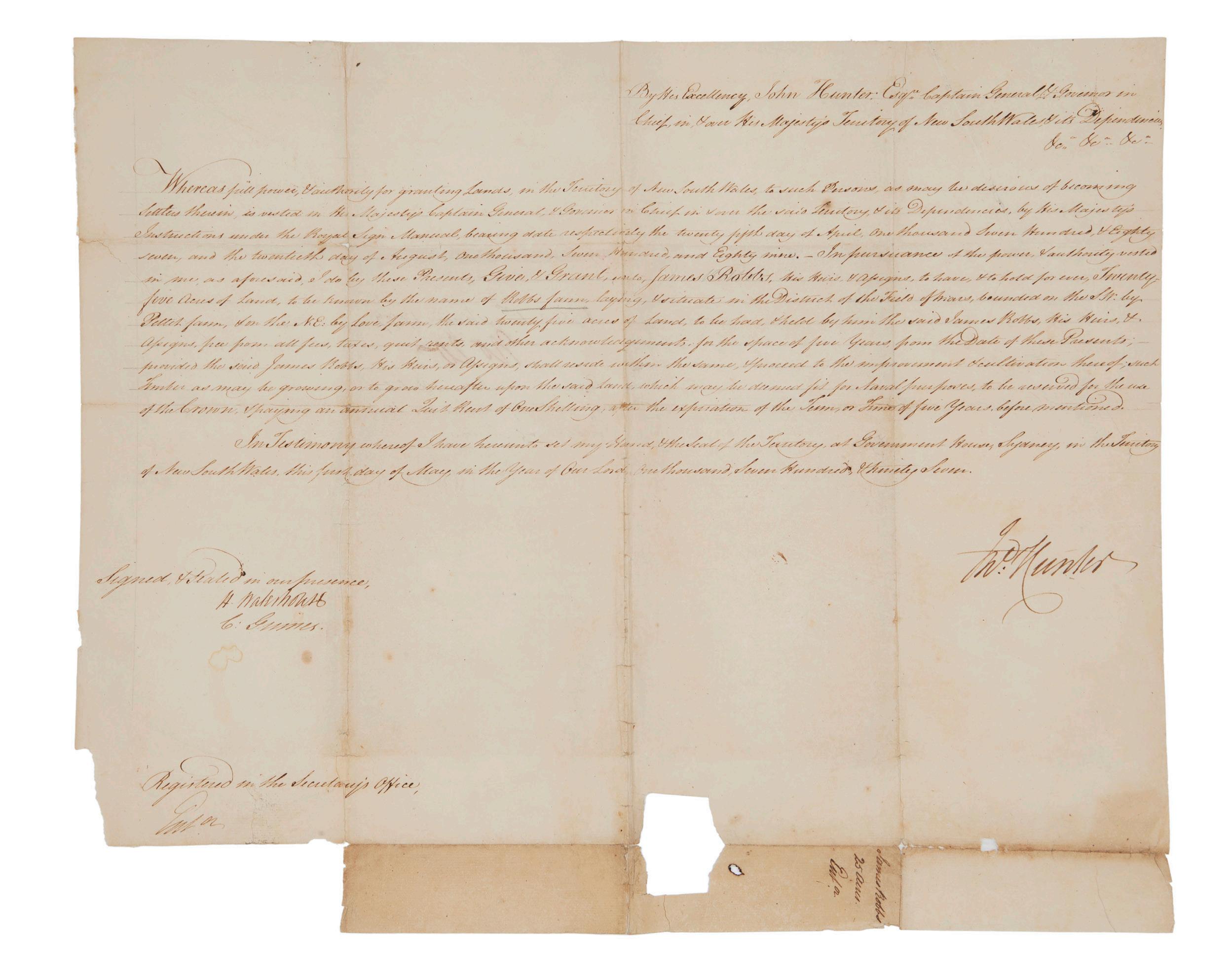
Land Grant to James Robbs of twenty-five acres in the Field of Mars..
Folio, manuscript in ink on paper, 380 x 465 mm.; defective lower margin without loss of text, section missing where seal and ties have been removed; otherwise in very good original condition; preserved in a solander case. Government House Sydney, 1 May 1797.
Rare and fragile early land grant, signed by John Hunter (1737-1821), the second governor of the Colony of New South Wales, and witnessed by Henry Waterhouse and Charles Grimes. as well as Henry Scott. This grant of twenty-five acres in the Field of Mars (present-day Ryde) was to James Robbs, and was known as Robbs Farm.
The first land grants had been located near Parramatta, in places where the soil was considered by Governor Phillip to be superior. One of these six chosen areas was the Field of Mars. Even with this carefully plotted settlement of land, many farms failed and on Hunter’s arrival in the colony in September 1795 he discovered that much of the early land granted to settlers had been abandoned. “A great number are settled on farms without any means being adopted to ascertain the quality of the soil that is to be cultivated, the consequence of which is, that after a year’s labour has been expended it is discovered there is no prospect of such land ever supporting its owner” (Macarthur to Portland 15 September 1796). As these smaller holdings were abandoned, they were often incorporated into bigger estates; and by 1804 most of the land within the favoured Cumberland Plain was under occupation.
Hunter is credited with having regularised the grants system in New South Wales; he issued titles for approximately 200,000 acres. In this grant, James Robbs received twenty-five acres, for a rent of one shilling per year beginning after five years. A witness to the grant is Captain Henry Waterhouse, who also took up land in the district in October of the same year.
Waterhouse was a First Fleeter who accompanied Phillip on many excursions into the country, including the landing at Manly where Phillip was speared. He imported the first merino sheep into the colony from the Cape of Good Hope, and supplied sheep to both John Macarthur and Samuel Marsden. He left Australia in 1800 to return to England.
The other signatory, Charles Grimes, the colony’s first surveyor, was also a magistrate and superintendent at Parramatta. In 1796 he had surveyed all the settlements of the newly-opened Cumberland Plains, including the Field of Mars. In 1802 whilst on the Buffalo exploring King’s Island and Port Phillip he discovered the Yarra River. Ryan, Land Grants 1788-1809, no. 726.
$18,000 [5001073]
“BEING…, I THANK GOD, IN PERFECTLY SOUND AND DISPOSING MIND…”
23. HUNTER, John.
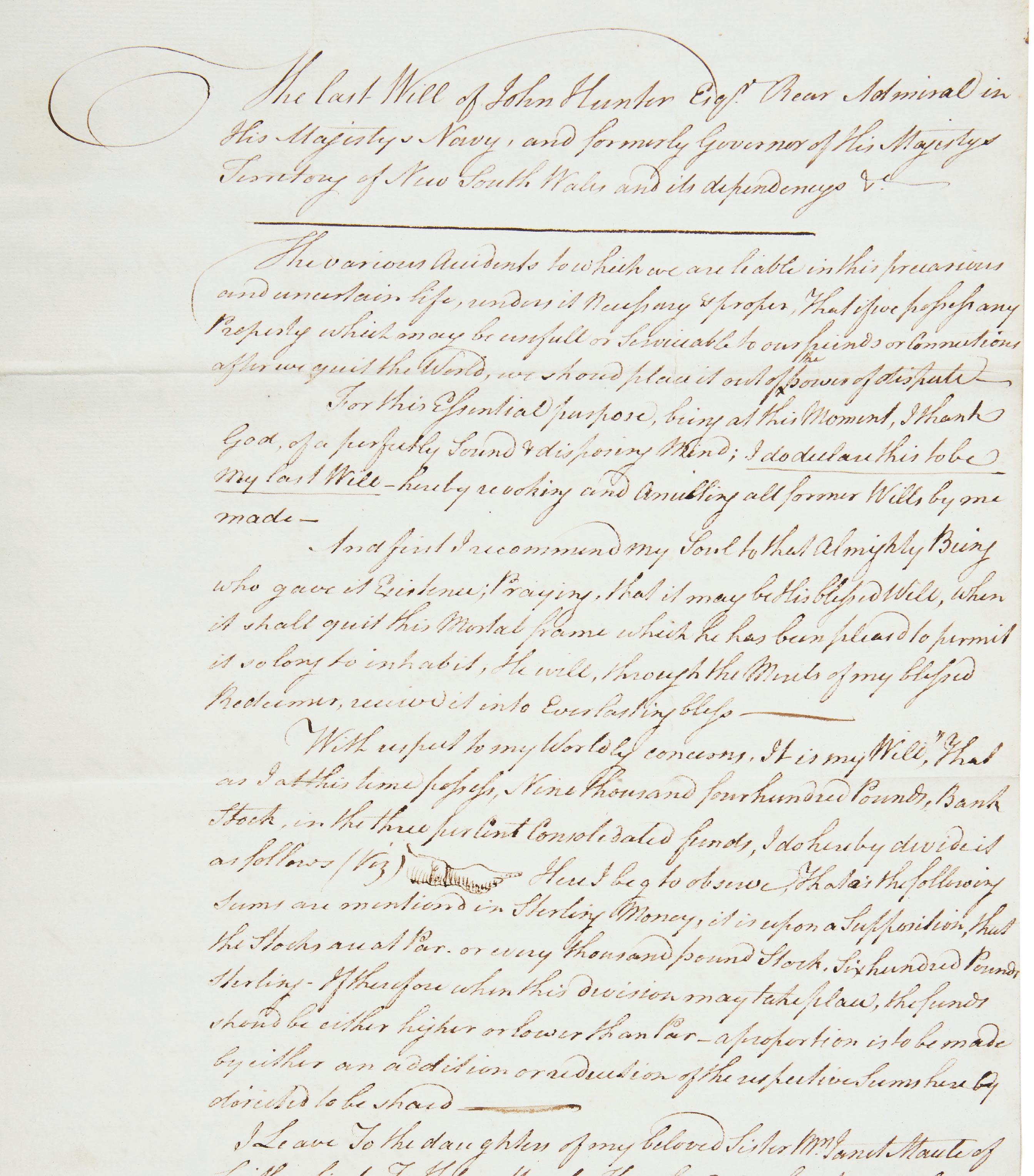
A group of original manuscript Wills…
Three folio-sized manuscript will documents on laid paper, mounted in a special solander case; portrait of Hunter loosely inserted. London, 1810-1821.
A moving group of manuscripts, shedding light on the later life of Vice-Admiral John Hunter, the captain of the Sirius in the First Fleet and the second Governor of New South Wales. This series of revised wills covers most of the period when Hunter was effectively retired, 1810-1821, a period when he was splitting his time between his house on Judd Street in Hackney, London and his Georgian terrace on Leith Walk in Edinburgh.
All three versions of his will are unusually full and detailed. Quite apart from giving an excellent account of his financial standing (most of his money was held in the famous “three per cents,” totalling more than £11,000 by the time of his death) the detailed accounting of a score or more different bequests gives not only a revealing snapshot of his extended family, but also a barometer of his feelings about the different branches. Not least, he singles out the daughter of his nephew Henry Kent RN, Penelope Percival Kent, for her “kind and affectionate attention to me when ill” and also the daughters of his sister Janet Maule, to whom he leaves larger sums as well as his house in Leith – a reminder that he spent a lot of his time in the town of his birth and remained deeply connected to Scotland.
It is interesting to see how many of his family served in the Royal Navy, not least his nephew Capt. William Kent who came out to New South Wales with Hunter in 1795 and stayed on until 1805, but sadly predeceased his uncle: indeed, one of the sadder moments in the trajectory of the wills is the way that Hunter’s gold chronometer was initially left to Kent, but ended up being listed among his general chattels to be sold. Kent’s death also means that one of Hunter’s prized possessions, a portrait bust of his great patron Lord Howe, effectively goes missing from the inventory.
However, the real recurring theme is Hunter’s fretfulness about the daughters of his many siblings, writing at one point that the “great number of female relatives which my Brothers and Sisters have left wholly unprovided for make it rather difficult for me to divide that small sum so as to satisfy all, I am well aware that my conduct in this respect will by some of them be much censur’d…”.
$24,500
[5001074]
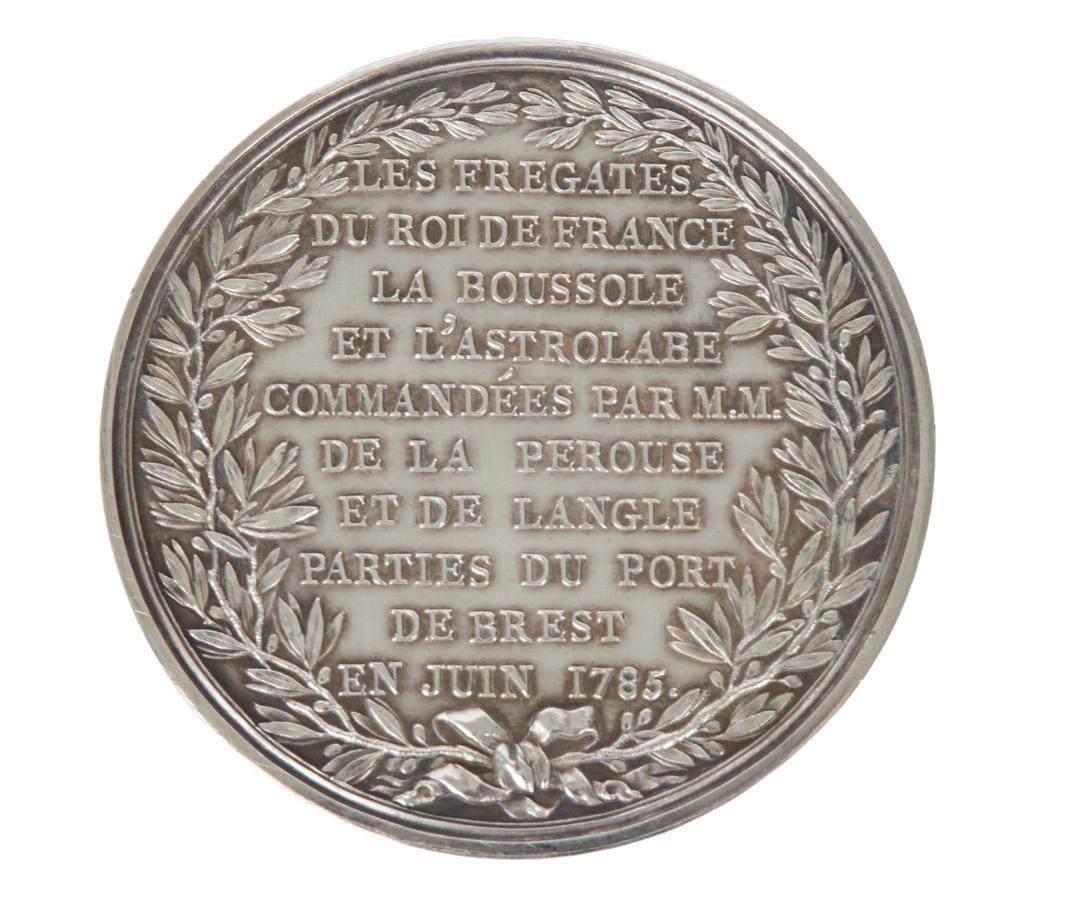
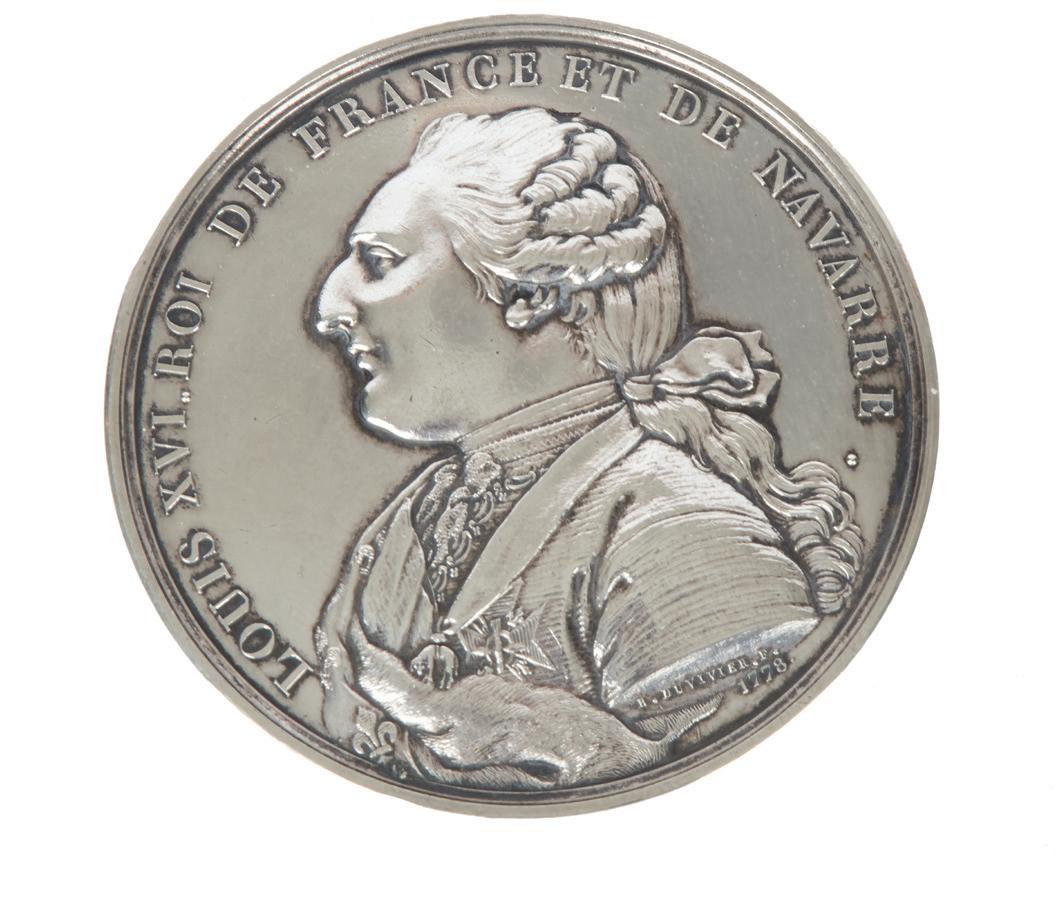
THE RARE SPECIAL ISSUE OF THE EXPEDITION MEDAL, IN SILVER
24. [LA PEROUSE] DU VIVIER, Benjamin,
Commemorative medal for the La Pérouse expedition.
Silver medal, 60 mm., a few tiny marks, especially to the rim, but extremely fine. Paris, Benjamin Duvivier, 1785.
A fine and rare silver La Pérouse medal, from the very scarce issue with the extended inscription. With its high surfaces and fine detail, this medal is more commonly seen with significant wear. The medal was designed by the celebrated Benjamin Duvivier, chief engraver at the French mint until 1791. Only one hundred such examples were minted for the sailing of La Pérouse in June 1785, some in bronze and some silver: although the actual number of each is still open to speculation, the silver issue of this particular medal was evidently very small, perhaps fewer than fifty.
On the obverse is a bust of Louis XVI; on the reverse, within a laurel wreath, “LES FREGATES / DU ROI DU FRANCE / LA BOUSSOLE / ET L’ASTROLABE / COMMANDÉES PAR M.M. / DE LA PEROUSE / ET DE LANGLE / PARTIES DU PORT DE BREST / EN JUIN 1785”.
Although the voyage was primarily one of scientific discovery, it also had explicit “Political and Commercial Objects” (Spate, Paradise Found and Lost, p. 157); thus the minting of medals for trade with the South Sea islanders was obviously thought to be expedient. Indeed, the official accounts of the voyage include a staggering array of goods and baubles, taken along as gifts or for exchange. It includes a total of 700 medals, the first 600 simple medals in bronze or silver with only the effigy of the king, and 100 more of the elaborate medals, detailing the voyage, as here. They are listed as “Médailles d’argent ou de bronze, à effigie du roi, avec l’inscription portant les noms des bâtiments et l’époque du voyage, les unes avec des chaînes de même métal, les autres sans chaînes, 100”.
The appearance of the two silver and bronze versions is effectively identical. Having said that, there are small discrepancies in Duvivier’s name beneath the bust: here, “B. Duvivier F.” appears to have been newly lettered when compared with an example of the bronze issue that we have examined. It would also seem that the date “1778”, the apparent date that the bust was struck, has been removed from either the die or the medal itself. It would be interesting to find out more details about the exact history of the minting of this medal, but suffice to say that this is a model examplar of a very rare piece.
Milford Haven, ‘Medals of Foreign Countries’, France, 170; Nan Kivell & Spence, p. 170 (bronze medal only).
$27,500 [5001091]
SEARCHING FOR LA PÉROUSE: FIRST ACCOUNT OF THE D’ENTRECASTEAUX EXPEDITION
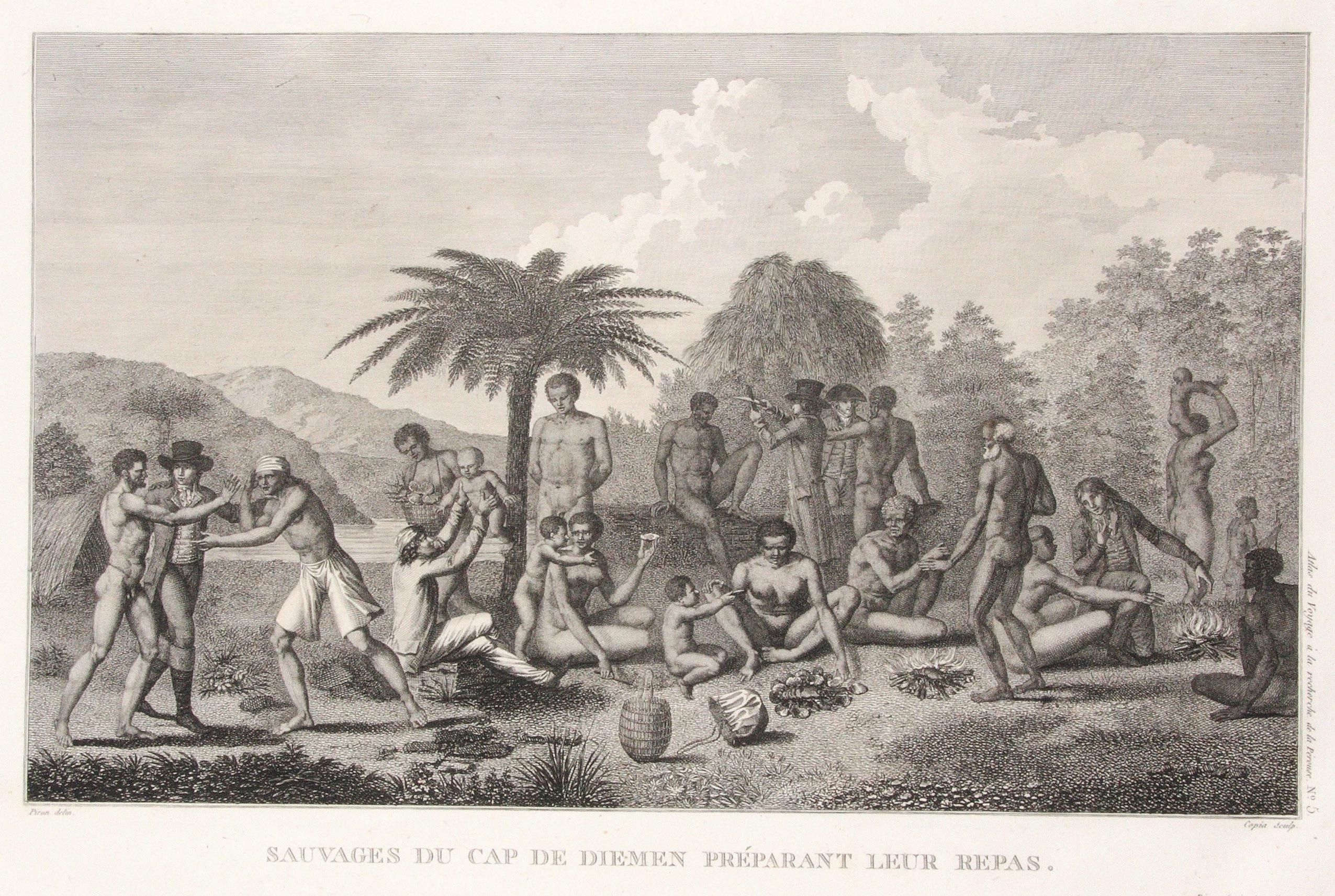
25. LABILLARDIERE, Jacques Julien Houtou de.
Rélation du Voyage à la Recherche de La Pérouse, fait par ordre de l’Assemblée Constituante, pendant les annees 1791, 1792, et pendant la 1ere et la 2de anneé de la République Française.
Two volumes, quarto, and folio atlas; text volumes uncut; the atlas with engraved title, folding chart of the voyage and 43 engraved maps, and plates; text in marbled papered boards, atlas in period quarter calf with marbled paper sides. Paris, H. J. Jansen, 1800 [Atlas volume dated 1817 on title-page].
The superbly illustrated narrative by the naturalist on the d’Entrecasteaux expedition, in which Australia was fully circumnavigated, if sometimes at a distance, and the islands surrounding investigated for traces of La Pérouse.
Jacques-Julien Houtou de Labillardière (1755-1834), was a botanist and doctor of medicine, who had travelled widely in the Middle East: he was just finishing up his important botanical study of Syria when he was appointed to the d’Entrecasteaux voyage. He remains an important figure in early Australian science as the author of the first extensive monograph on Australian botany.
The voyage spent many months on the coasts of Western Australia, just a year after Vancouver’s visit, and made two long visits to Tasmania, charting, botanising and exploring the coasts. The visits are remembered in numerous place names, most notably Recherche Archipelago and Recherche Bay, named for the expedition’s ship. Labillardière’s account is one of very few eighteenth-century accounts of Australian exploration, and the only major French account of the continent in the early settlement period to be published in the same century. The important narrative based on the commander d’Entrecasteaux’s papers did not appear until 1808, once the First French Republic had been well established.
In this set the Atlas volume is present in the 1817 reissued version, from the same printing as its appearance in 1800 but with a new title-page. Published on its own, it may well have been produced to accompany text volumes that remained in print from the earlier edition. The publication is noted (without particular comment) by the McLaren bibliography and recorded by Ferguson from copies in the Mitchell Library and the Tasmanian parliamentary library.
Ferguson, 307 & Atlas 682; Hill, 954; Kroepelien, 697; McLaren, ‘Lapérouse in the Pacific’, 51, & Atlas 67.
$9500
[2601979]
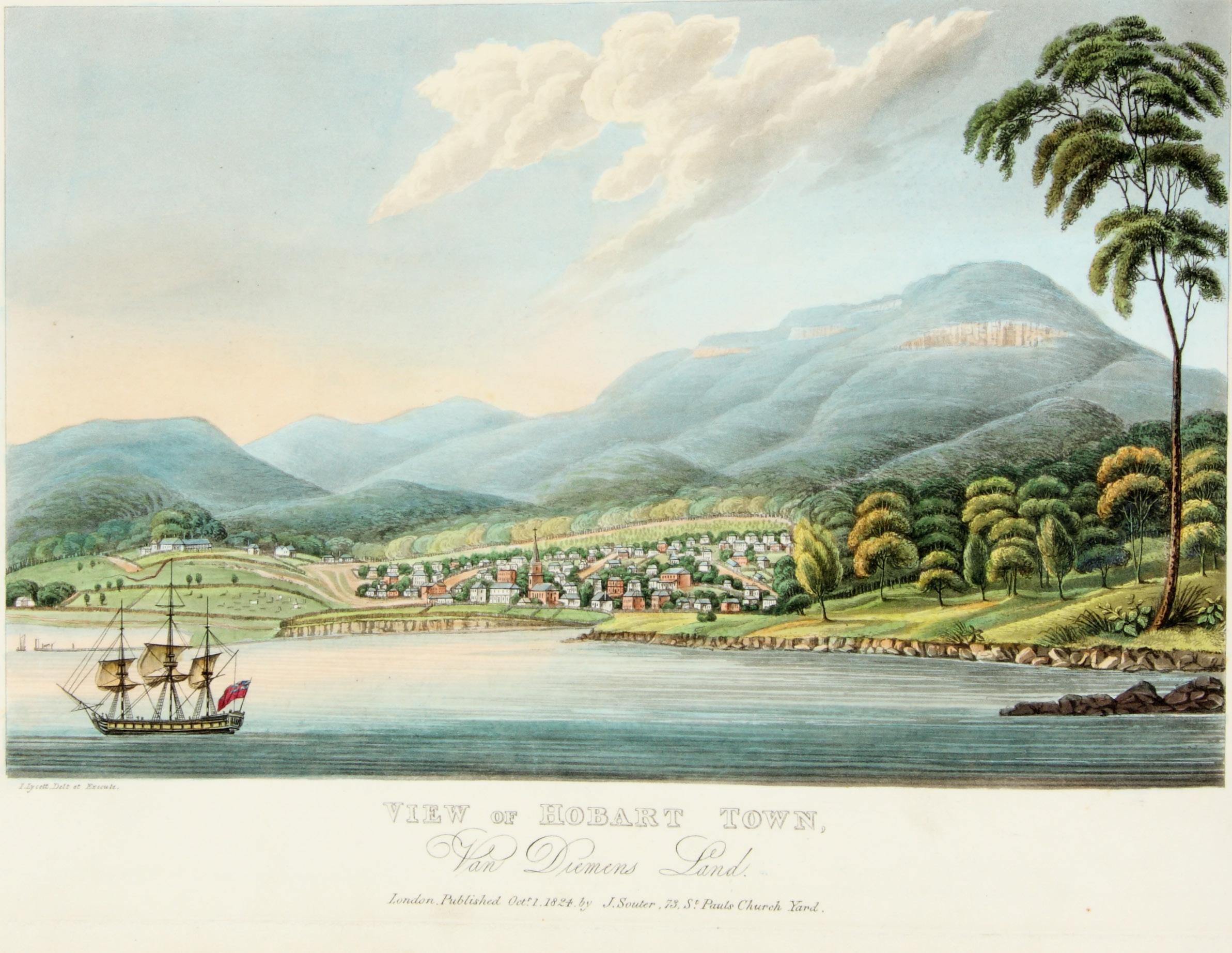
A PIVOTAL WORK IN AUSTRALIAN LANDSCAPE ART: “POSTCARDS FROM ANOTHER PLANET”
26.
LYCETT, Joseph.
Views in Australia, or New South Wales and Van Dieman’s Land Delineated…
Oblong folio, pictorial lithographed title and 48 coloured aquatint views and one lithographed illustration after drawings by Joseph Lycett, with descriptive text, two folding maps; half red calf, marbled end papers and all edges gilt. London, J. Souter, 1825.
A specially desirable copy of the great Australian colourplate book, the most important collection of antipodean landscapes and a landmark in the development of Australian illustrated books.
Image one, “North View of Sydney, New South Wales” is found here in two states; the usual aquatint illustration and the very rare lithographed version. Lycett, a competent lithographer produced only two Australian images in lithography; one of Sydney and one of Hobart. It was originally planned that all the illustrations in “Views…” would be hand coloured lithographs, but as the prints when taken from the stone soon lost definition the publishers turned to aquatints, “in order that the accurate and highly finished drawings by Mr. Lycett might be presented ‘with that full and complete effect of light and shade allowed by engraving’…”.
Lycett’s charming, highly-coloured views, justly famous for providing such a remarkable visual record of Australia in the early colonial period, not only offer an historical snapshot of New South Wales and Tasmania in the early decades of settlement, but from the point of view of colonial architecture they provide a significant record of some of the colony’s most important houses and country seats, and an invaluable contextual record of many lesser-known buildings and indeed building types.
Lycett had arrived in New South Wales as a convict in 1814. Trained as a portrait and miniature painter in Staffordshire, his services as a professional artist were much in demand and he was soon working for the publisher Absalom West. He was appointed artist to Major-General Macquarie, the governor of New South Wales. Impressed with Lycett’s talents, Macquarie sent three of his drawings to Earl Bathurst, Secretary of the Colonies (the dedicatee of the Views) who, it is supposed in payment, granted a pardon to the artist.
Lycett’s work (his “enticing book”) was memorably celebrated by the late Edmund Capon in the ABC documentary “Art of Australia”, commenting that “when these pictures were first seen in Britain, it was something of a revelation, a little bit like receiving postcards from another planet”.
Provenance: F.G. Coles (mid-century Australian collector, with bookplate).
Wantrup, 218b.
$55,000 [5000652]

James Mario Magra, later Matra (1746-1806)
A rare survival: the following three pieces in this catalogue concern the sometimes neglected Cook veteran, first chronicler of the Endeavour voyage, who advised government as a promoter of the First Fleet and a settlement at Botany Bay, and whose ambitions to lead the colonial expedition were thwarted with a diplomatic career taking their place.
James Magra was a remarkably important figure in the earliest history of European Australia. He sailed as one of six midshipmen on Cook’s Endeavour voyage, was one of those who came ashore at Botany Bay and wrote the first account of the voyage to be published, the Journal of a Voyage round the World (1771). On his return to England, while reverting his name to its original version of Matra in order to claim an inheritance, he became a major proponent of the scheme to colonise New South Wales by transporting convicts to Botany Bay. His Proposal for Establishing a Settlement in New South Wales of 1783 was the “immediate forerunner of the official and semi-official plans resulting in the foundation of the first Australian colony” (ADB).
Part of a small group of intelligent men who coalesced around Joseph Banks, he was already a friend from the time of the Endeavour voyage, and in succeeding years Banks and he were the two men leading the push towards forming a settlement in New South Wales. As one of very few Europeans then alive who had actually visited the east coast and examined Botany Bay, which fact proved greatly persuasive, Matra testified to the House of Commons committee enquiring into the resumption of transportation in May 1785. His important testimony to various committees followed from his influential Proposal, which stressed the need for a component of free settlers to be included from the very beginnings of settlement of New South Wales. His glowing reports of Botany Bay itself, also espoused by Banks, were the reason for the attempted establishment there before the First Fleet’s move to Port Jackson.
With Banks’s support Matra had serious and plausible hopes to be appointed the colony’s first governor. Disappointed in that ambition he nonetheless remained close to the political establishment,
close enough that he was eventually appointed, again with support from Banks, to the then significant position of British consul to Morocco and Algeria, taking up his post in Tangier at about the time that the First Fleet sailed for Botany Bay: this posting would occupy him for the remainder of his life.
The passionate proponent of colonisation of New South Wales, persuasive witness to parliamentary enquiries and one of only two men consulted by government who had actually set foot at Botany Bay (the other being Joseph Banks), Matra was “Disappointed in his hopes for a post in his proposed colony. In July 1786 Matra accepted the appointment of consul at Tangier, Morocco, where he was to remain (with some respites at Gibraltar when the plague ravaged North Africa) until his death. His later life exemplified the common lot of American Loyalists who, displaced and poverty-stricken, had to eke out precarious existences. 'I occupy but a small place on this Globe', he wrote plaintively in 1781, '& yet there is not room on it for me’...” (Frost).
Matra’s life has prompted a considerable literature, with multiple studies of his career and importance including those by G.B. Barton, George Anthony Wood, James Watson (who christened him the “Father of Australia”, an accolade more often awarded to Joseph Banks), and more recently Antonio Giordano (who has him as “Australia’s Spiritual Father”) and Andrew Tink. A major study by Alan Frost published in 1995 is entitled “The Precarious Life of James Mario Matra: Voyager with Cook; American Loyalist; Servant of Empire”.
No original material by Matra is held in any Australian library. His official despatches from his consular career are held mainly at the Public Record Office in London and show him in continuous communication with the political figures to whom he had become close during the period of planning the colony of New South Wales: Sydney, Nepean, Portland, Castlereagh and Palmerston among others, while some of his correspondence with his friend, mentor and supporter Joseph Banks is preserved in Banks Papers. Some of these, as well as the important text of his Proposal for Establishing a Settlement, form the important first part of Owen Rutter’s “The First Fleet” (Golden Cockerel Press, 1937).
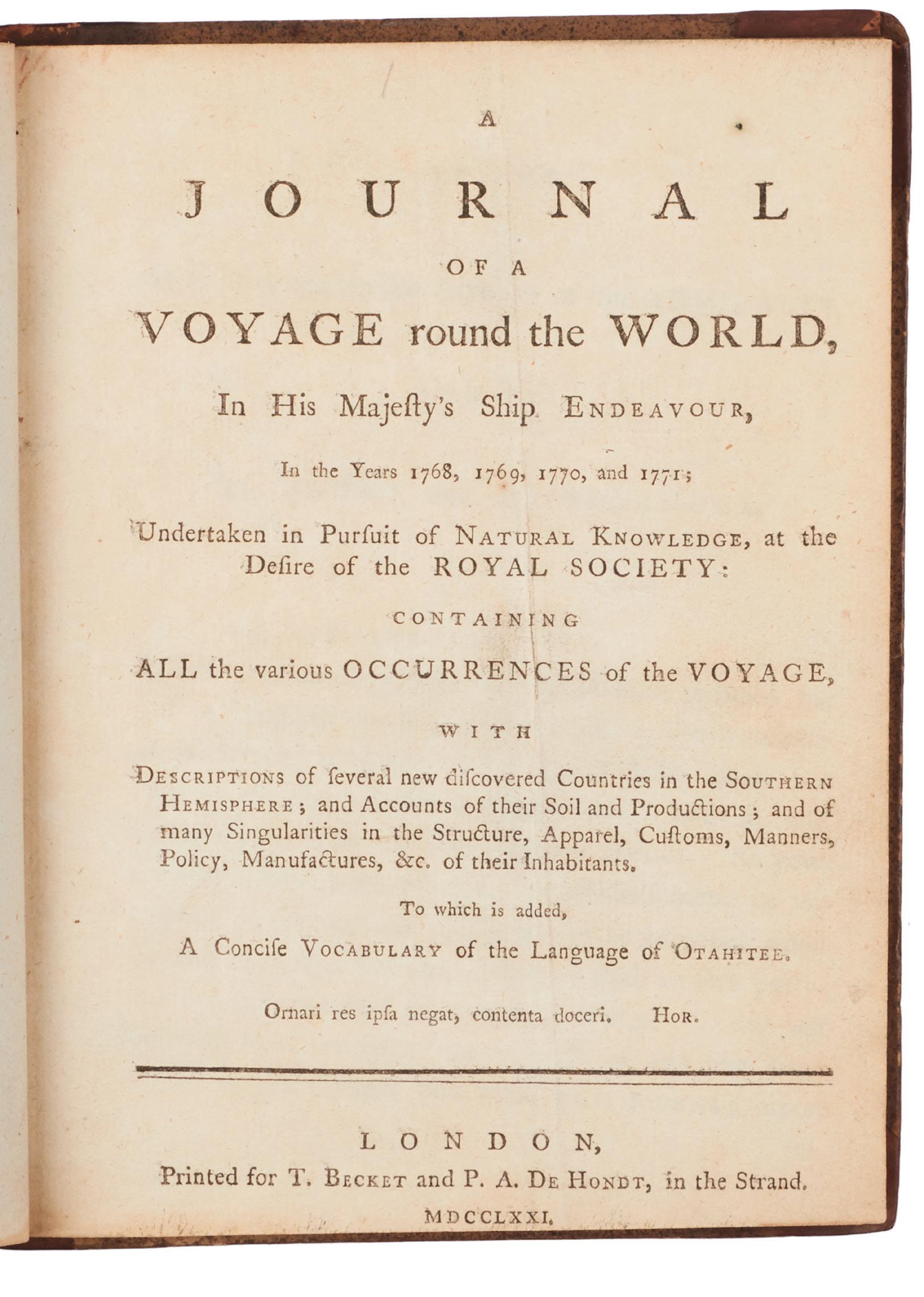
THE EARLIEST PRINTED DESCRIPTION OF THE EAST COAST OF AUSTRALIA
27. MATRA, James Mario (formerly MAGRA, 1746-1806).
A Journal of a Voyage round the World in His Majesty’s Ship Endeavour, in the years 1768, 1769, 1770 and 1771; Undertaken in Pursuit of Natural Knowledge, at the Desire of the Royal Society: containing All the various Occurrences of the Voyage, with Descriptions of several new discovered Countries in the Southern Hemisphere; and Accounts of their Soil and Productions; and of many Singularities in the Structure, Apparel, Customs, Manners, Policy, Manufactures, &c. of their Inhabitants.
Quarto; original period binding of half calf and speckled boards, with the royal cipher of King George III in gilt on both covers, housed in a specially made solander case. London, Printed for T. Becket and P.A. De Hondt, in the Strand, 1771.
First edition of the earliest published account of Cook’s first voyage to the Pacific: the rare first issue, with the leaf of dedication to “The Right Honourable Lords of the Admiralty, and to Mr. Banks and Dr. Solander” inserted by the publishers to add authenticity. This was the first of a series of so-called “surreptitious accounts” of Cook’s various voyages to appear in print: the Admiralty found it practically impossible to enforce their ruling that no unofficial publications should pre-empt the official and lengthier accounts of the voyages, naturally much slower in the press. In this case, however, legal action was taken against the publisher for using an unauthorised dedication, forcing removal of the leaf during publication. “It is accordingly of the greatest rarity, and copies of the book containing the dedication are far more valuable than those without it…” (Davidson).
The British public’s eagerness for news of the voyage needed more than newspaper accounts, while the officially sanctioned narrative would be a long time coming. Published anonymously some two months after the return of the Endeavour and nearly two years before Hawkesworth’s official account, the Cook scholar Beaglehole demonstrated that the sailor James Magra was the author. His illicit sale of his journal to the publishers might well have confirmed Cook’s opinion of him: “one of those gentlemen, frequently found on board Kings Ships, that can very well be spared, or to speake more planer good for nothing…”. He was a New Yorker and a loyalist. Whatever his skipper and the authorities may have thought of him, it was Magra who got the first description of the voyage into print — the earliest printed account of the east coast of Australia, published even before acceptance of the name Botany Bay, here called Sting-ray Bay as Cook originally christened it.
Provenance: This intriguing copy has a remarkable provenance, with the arms of George III on both boards, later in the Victorian-era collection of Thomas Harman Brenchley (armorial bookplate); more recently Commander Ingleton (who noted that the boards have the “royal cipher of King George III on both sides in gilt”, sale catalogue no. 6351).
Bagnall, 3324; Beaglehole, I, pp. cclvi-cclxiv; Beddie, 693; Davidson, ‘A Book Collector’s Notes’, pp. 53-4; Hill, 1066 (the second issue without dedication leaf); Hocken, p. 9; Holmes, 3; O’Reilly-Reitman, 362.
$58,500 [5001109]
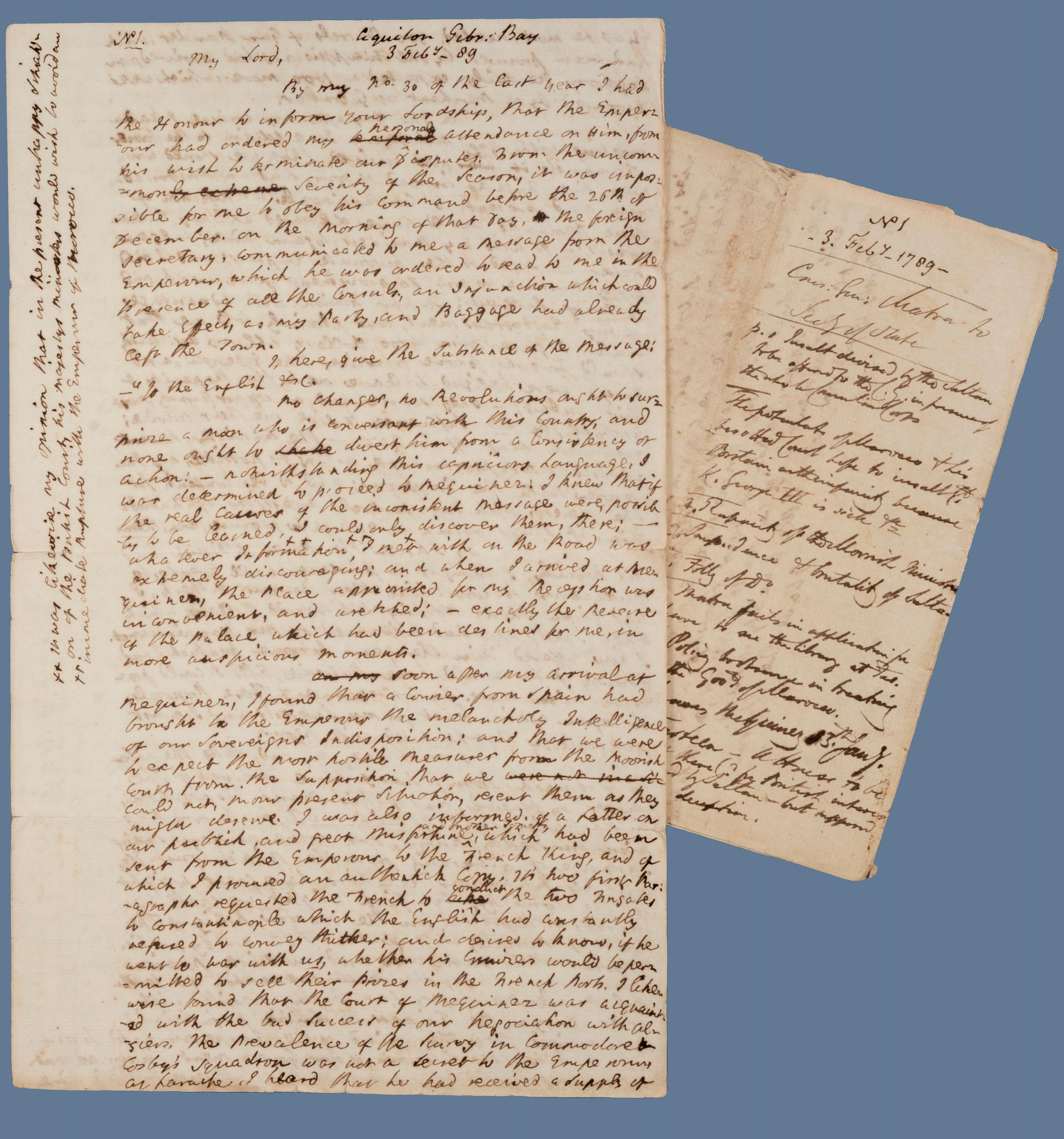
UNRECORDED: MATRA’S ORIGINAL MANUSCRIPT DESPATCH ON MOROCCO
28. MATRA, James Mario (formerly MAGRA, 1746-1806).
The autograph manuscript draft of his diplomatic despatch to London as consul regarding events in Morocco and his dealings with the capricious Emperor
Manuscript in ink on paper, 4 pp. folio on a bifolium and a fifth page on a single leaf, the verso of which serves as a docket-title with summary of contents. HMS Aquilon, Bay of Gibraltar, 3 February 1789.
This original 18th-century manuscript written by Matra is a diplomatic despatch of fascinating content providing a first-hand account of intrigue at the imperial court of Morocco. While Matra’s official consular despatches are chiefly held in the Public Record Office (see extensive notes on this subject in Frost) no manuscript held there corresponds to this text, while the report of nearest date (Frost, note 54) deals with a different subject.
Some twenty manuscript corrections in the process of writing demonstrate that this would have been the draft of a despatch to London and perhaps the retained copy if such a despatch was in fact sent, or an unsent original. A comparison with the handwriting of his manuscript Proposal of 1783, reproduced by Rutter (The First Fleet, facing p.8), shows that he did not have the benefit of a clerk, writing his lengthy reports in longhand himself.
Addressed to “Your Lordship” this would likely have been intended for either the Duke of Leeds, Foreign Secretary in Pitt’s first ministry from 1783 to 1791, or Lord Sydney, Home Secretary from 1783 until mid-1789, with whom Matra had numerous dealings earlier in the decade.
Running to approximately 2000 words, Matra’s report is dated 3 February 1789 and was written aboard HMS Aquilon in Gibraltar Bay, and thus on British territory across the straits from Tangier. A full description of the contents is available on request.
Matra describes diplomatic wheeling and dealing, advancing the British cause in Mequinez (Meknes) with the Moroccan Emperor, Mulay Suleiman (1766-1822, Sultan from 1792), whom he characterises as capricious and venal; Matra has succeeded in gaining the support of the Empress; the Emperor’s sense that he should be more rewarded for the rescue of British sailors at some earlier date, perhaps with gifts some of which he specifies – sweet tea from China, toys, a watch; dealing with the French and Spanish; access to large quantities of gunpowder; threats and ultimately an agreement that the Emperor should write an apology to King George (at this time beginning his descent into madness), which he duly does “adjusted with at least some improvement in point of propriety. It was signed by the Emperour and… I believe it contains the only apology that the Emperour of Morocco ever made”.
Please see our website for a fuller description and a select bibliography.
$38,500 [6000047]
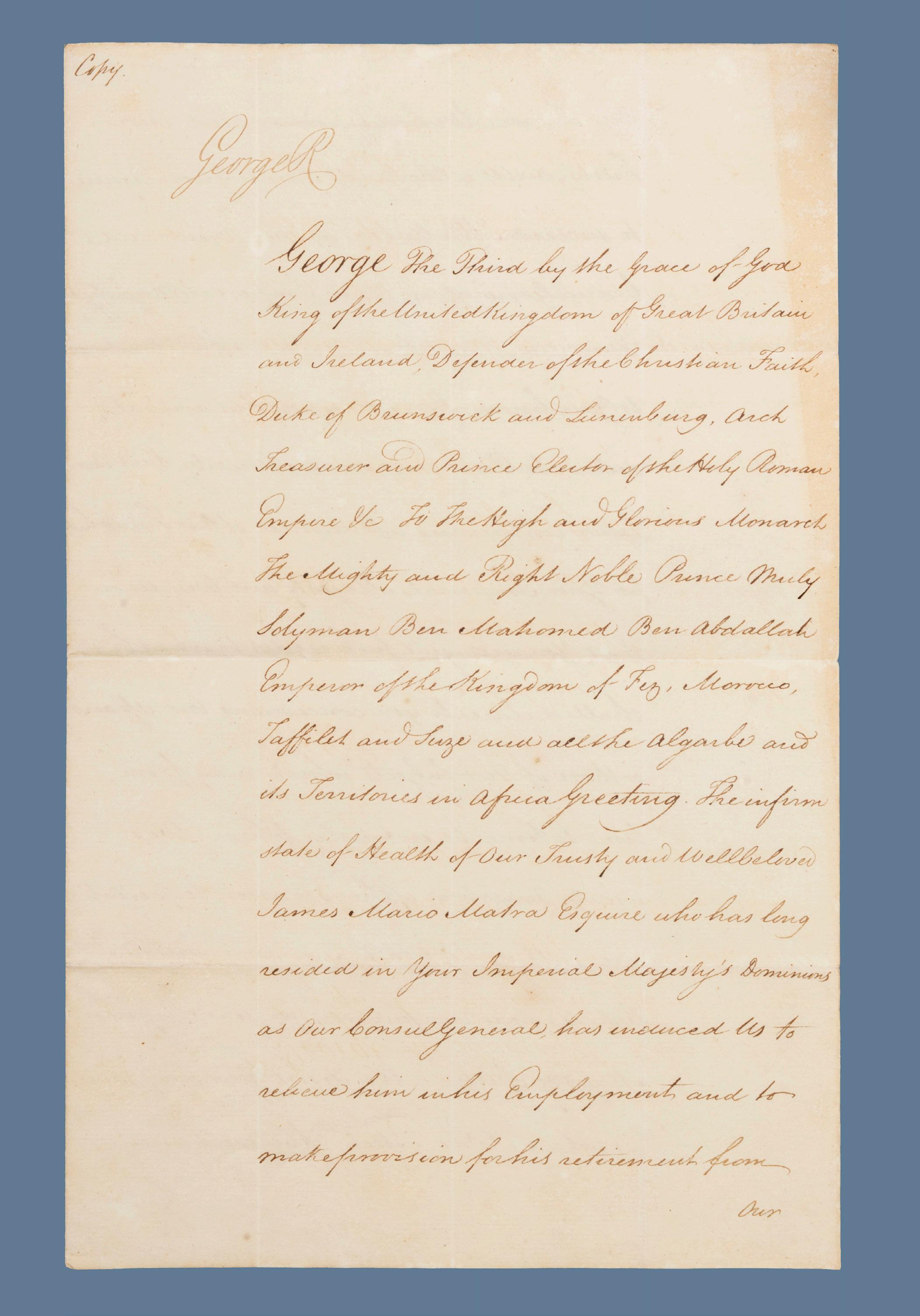
THE LAST ACT: GEORGE III RELIEVES MATRA FROM CONSULAR SERVICE
29. MATRA, James Mario (formerly MAGRA, 1746-1806). [GEORGE III (reigned 1760-1820)].
Original official manuscript document, a formal copy of a letter of credence (over the signature of King George III) to Prince Muly Solyman, Emperor of Morocco.
Folio, manuscript in ink on paper in a formal hand; three pages of a bifolium, the fourth page later docketed with title. London, originally signed at the Court at Saint James, 12 March 1806.
Official copy retained by James Matra of the royal document relieving him from his post as British consul to Morocco and Algeria and appointing his replacement. The document in a striking formal hand starts and finishes with a secretarial signature of King George III and is endorsed with the secretarial countersignature of William Windham (1750-1810, Secretary of State for War and the Colonies in Lord Grenville’s “Ministry of All the Talents” following the death of Pitt).
The passionate proponent of colonisation of New South Wales, persuasive witness to parliamentary enquiries and one of only two men consulted by government who had actually set foot at Botany Bay (the other being Joseph Banks), Matra was “Disappointed in his hopes for a post in his proposed colony. In July 1786 Matra accepted the appointment of consul at Tangier, Morocco, where he was to remain (with some respites at Gibraltar when the plague ravaged North Africa) until his death. His later life exemplified the common lot of American Loyalists who, displaced and poverty-stricken, had to eke out precarious existences. ‘I occupy but a small place on this Globe’, he wrote plaintively in 1781, ‘& yet there is not room on it for me’.
“In his letters from North Africa, Matra reported informatively on the geography and peoples of the region. He supplied Banks with curiosities; and he assisted travellers sent by the Association for the Exploration of the Interior Parts of Africa. Through the long years of war with revolutionary France, he saw that the British had the food supplies they needed to maintain their garrison at Gibraltar and to keep their Mediterranean squadron at sea” (Alan Frost in the ADB).
After a remarkable consular career (following a remarkable life) which has been well written up by Alan Frost (“The precarious life of James Mario Matra: voyager with Cook, American loyalist, servant of Empire”, Miegunyah Press, 1995), Matra died on 29 March 1806, just seventeen days after the date of the letter announcing his relief. James Green (1772-1840), appointed by this letter, replaced Matra and served as the British consul to Morocco until 1817.
As well as the formalities of address and diplomatic courtesies and flourishes, the letter notes that “The infirm state of Health of Our Trusty and Wellbeloved James Mario Matra Esquire who has long resided in Your Imperial Majesty’s Dominions as Our Consul General has induced us to relieve him in his Employment and to make provision for his retirement from Our Service. We have nominated Our Trusty and Wellbeloved James Green Esquire to succeed Mr. Matra… He will, upon his arrival, deliver to Your Imperial Majesty this Our Letter containing assurances of Our Friendship… and we desire that you will give full credit to what he shall declare to you concerning Our Affairs… We avail Ourselves of this occasion to present you with some Cloth and some curious Articles made on purpose for your Imperial Majesty”.
$18,500 [6000053]
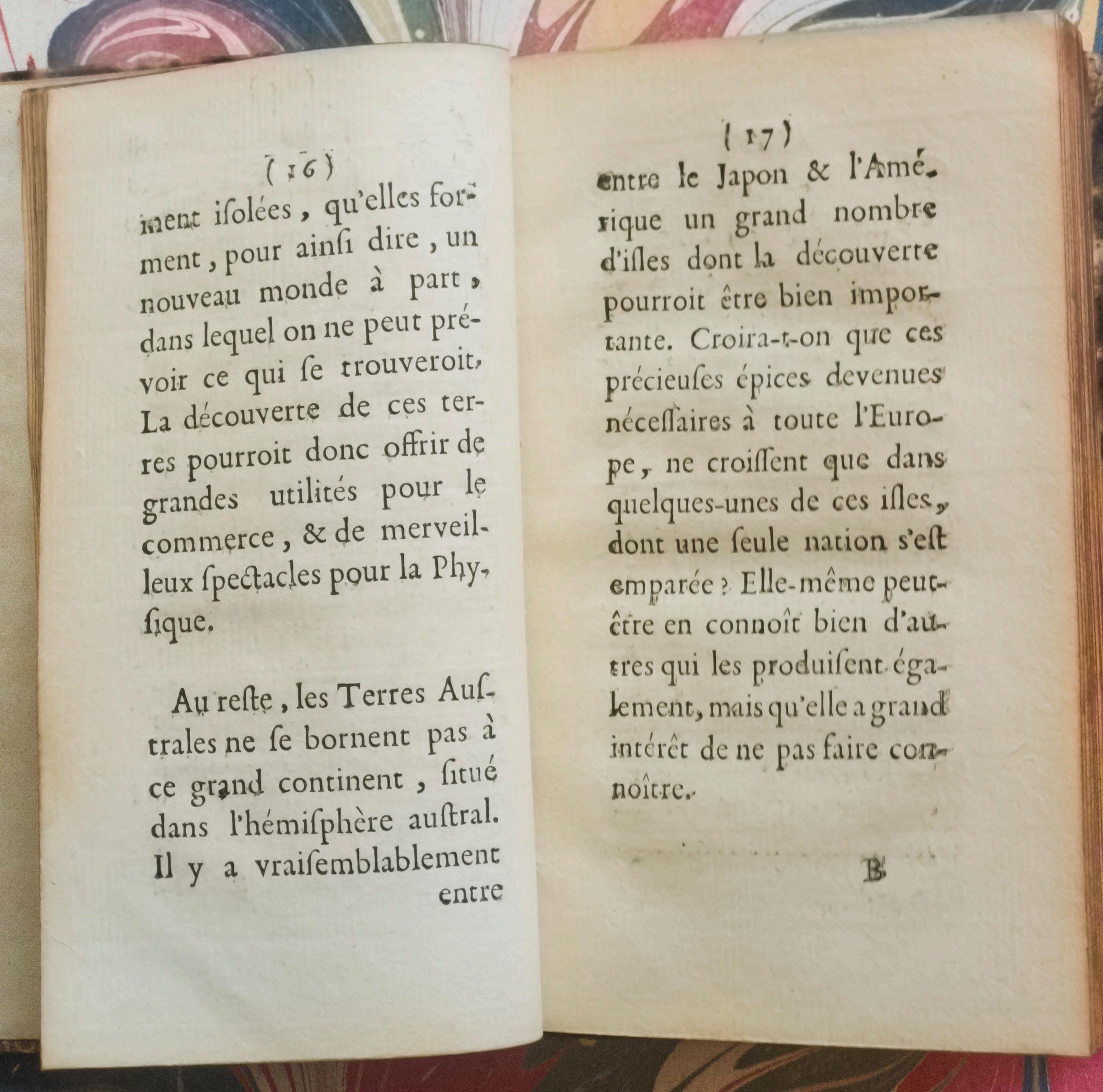
THE TERRES AUSTRALES, SIEUR DE GONNEVILLE & BOUVET DE LOZIER
30. MAUPERTUIS, Pierre-Louis Moreau de.
Lettre sur le progrès des sciences.
12mo, [4], 124 pp., a fine copy in nineteenth-century quarter calf and marbled boards, red edges. N.P. [Berlin?], 1752.
“Dans l’hémisphère méridonal il y a un espace inconnu, où pourrait être placée une nouvelle partie du monde, plus grande qu’aucune autre…” (“in the southern hemisphere there is an unknown space, where a new part of the world could be placed, larger than any other”). This is the rare first edition, first issue, of a fundamental proposal to discover and colonise the supposed Southern Continent.
Evidently produced in very small numbers and printed on thick paper in a notably generous arrangement of type, this rare collection of essays includes as its major part the influential “Terres Australes” essay by Maupertuis.
Pierre Louis Moreau de Maupertuis (1698-1759), one of France’s most eminent Enlightenment scientists, published this collection during a long dispute on scientific matters with the German mathematician Koenig. Other than the main piece, articles on various subjects include thoughts on navigation, including rounding the Horn of Africa and speculating on the existence of the northwest passage; the “giants” of Patagonia; Africa; Astronomy; the use of convicts’ bodies for medical research; Japanese surgical methods: natural history collections; the burning mirror; and, fancifully, squaring of the circle. Voltaire criticized the scientific aspects of the publication at the time, but subsequent advances would prove him right in many cases.
However, the section of greatest interest, and the largest, concerns discovery and exploration rather than science in the form of a lengthy account of French exploration of and ambitions for the “Terres Australes”, with a focus on the 1739 voyage to the southern regions by Bouvet de Lozier, commander in the French East India Company, whose interest in the Great South Land was stirred by the Memoires of Binot Paulmier, sieur de Gonneville (1603), who was said to have discovered the “great austral land” on his 1503 voyage.
Taking the Gonneville and Bouvet voyages as his point of departure, Maupertuis argues the case for royal support and patronage for French exploration of hitherto unknown parts of the globe and, above all, to the Austral Lands. The influence of the “Terres Australes” article was profound, and it proved to be a powerful stimulus to the later voyages of Bougainville, La Perouse, D’Entrecasteaux and other French explorers in the advancement of the French pursuit of trade, scientific research, and colonisation in the southern hemisphere
$11,000 [6000006]
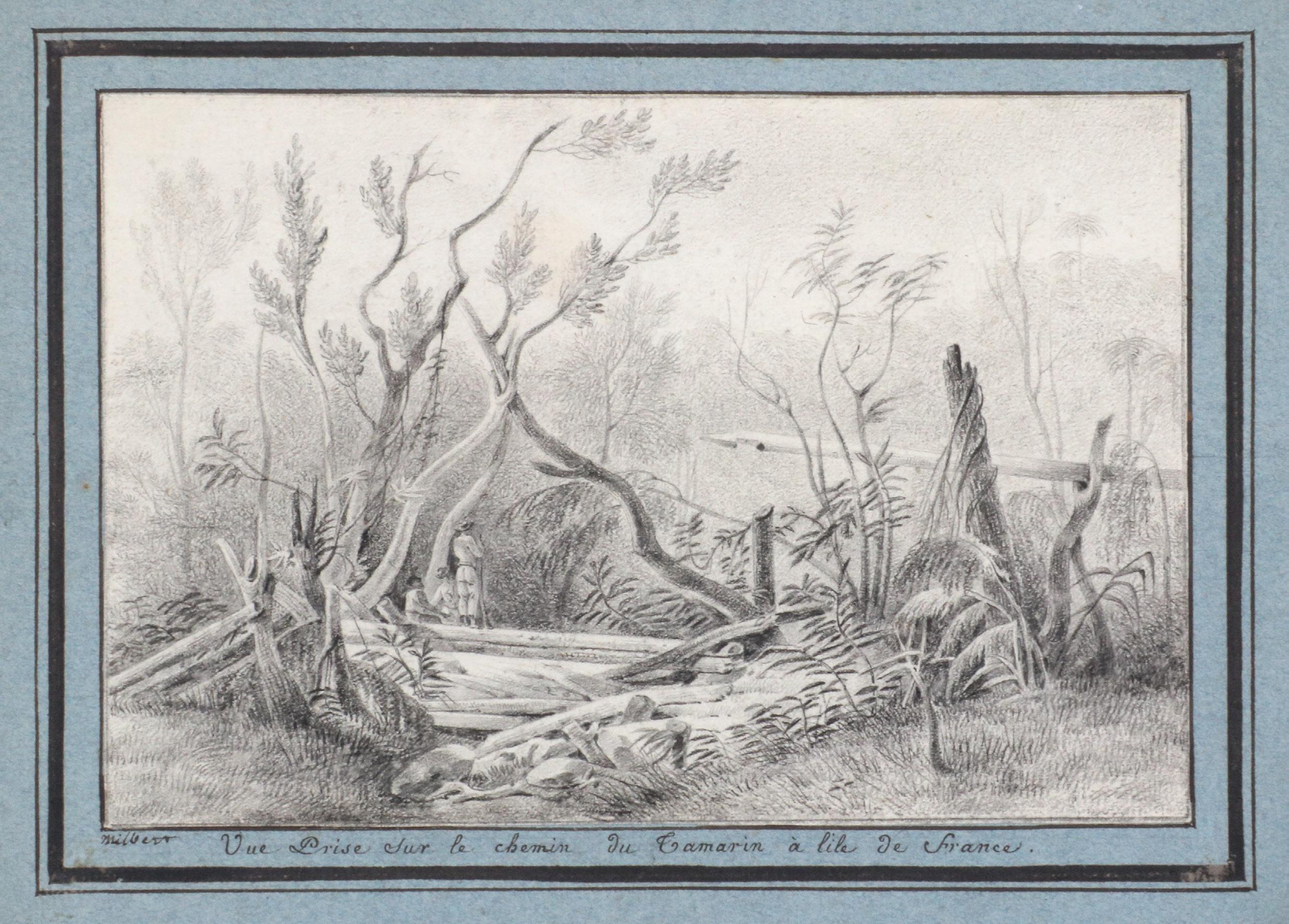
RARE ORIGINAL VIEW IN MAURITIUS BY ONE OF BAUDIN’S ARTISTS
31. MILBERT, Jacques Gérard.
Original drawing of a scene in Mauritius: “Vue prise sur le chemin du Tamarin à l’ile de France”.
Pencil sketch, 135 x 195 mm.; laid down on the original blue-paper mount, signed on the lower left of the mount and captioned. Mauritius, 1801-1803.
A striking pencil sketch by the Baudin voyage artist Milbert, done in the south-west of Mauritius after he had jumped ship from the Géographe on Baudin’s expedition to Australia and the Pacific in 1801.
Jacques-Gérard Milbert (see following item) joined the Baudin expedition as one of the official artists; back in France, he was given the task of overseeing the publication of the plates for Péron and Freycinet’s official account (1807-1816), and in his own account, the Voyage Pittoresque of 1812, described himself both as a Baudin artist and as the “directeur” of engravings.
In his book he wrote that during his time on Mauritius he made two long expeditions in the south-east, and was overawed by the rugged wonders of the landscape, particularly in the locality of the present scene, along the small and remote Rivière du Tamarin with its “plusieurs cascades magnifiques.” He poetically recounted how in the region one travelled to the sound of the blows of the axes clearing a path through the liana which enveloped the trees, and how many of the larger trees appeared to have been thrown down by nature to serve the weaker and parasitic vegetations, and to nourish them in the otherwise barren earth: as a description of the present scene this could scarcely be bettered.
The sketch showcases Milbert’s particular skill in rendering botanical scenes and makes an important addition to the rather slender group of known works by him, particularly relating to his time in the Indian Ocean. Of the three men in the clearing, the seated figure at far left in a hat is likely to be Milbert himself, given that a similar figure with a palette also appears in many of his finished engravings. On an intimate scale and full of botanical detail, this sketch makes a fascinating counterpoint to the great engraved views of his book, most obviously one showing the main waterfall at the nearby “Cascade du Tamarin”, but also to several others which show slaves labouring to fell trees and mill logs.
Provenance: North American source, believed to have been among the archive left in America by Milbert.
$12,500 [4504851]
Nicolas Baudin, The Journal of Post Captain Nicolas Baudin (Adelaide, 1974); Jacques Gérard Milbert, Voyage pittoresque à l’Ile de France (Paris, 1812).
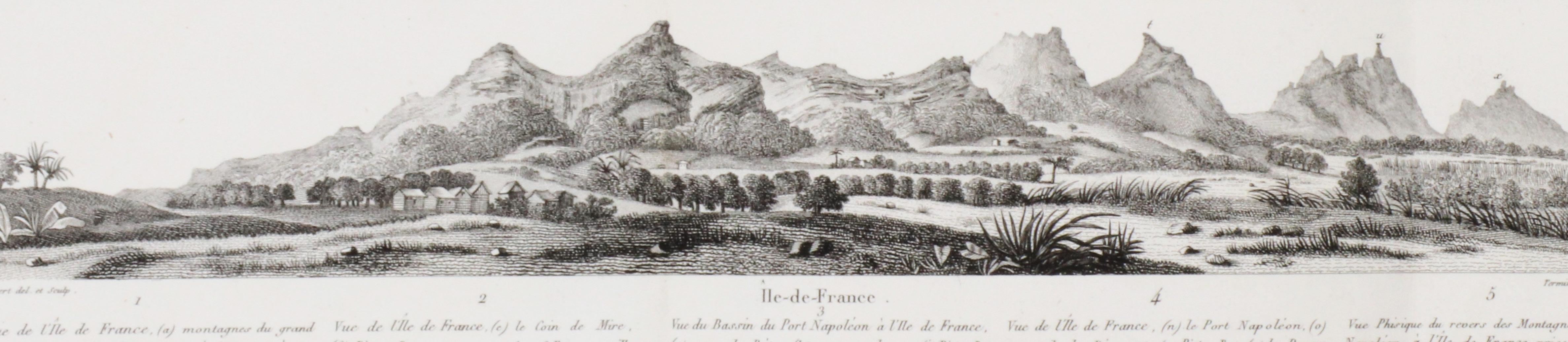
32. MILBERT, Jacques Gérard.
Voyage pittoresque à l’Ile-de-France, au cap de Bonne-Espérance, et à l’île de Ténériffe…
Two volumes octavo of text, with small folio atlas of 45 plates and charts (five folding); the text volumes in original quarter calf bindings, spines gilt with double labels, the atlas completely unbound and the loose plates contained in a matching bookform case. Paris, A. Nepveu, 1812.
A significant and well-illustrated “alternative” account of a portion of the Baudin voyage to the southern lands, documenting the early stages of the voyage aboard the Géographe, but chiefly detailing life and conditions at Mauritius.
Jacques-Gérard Milbert (1766-1840), French naturalist and artist, was invited by Bory de Saint Vincent to join the Baudin expedition as one of the official artists but took advantage of an illness to be left in Port Louis when the ships sailed for New Holland (several of his shipmates commented that the artist
had seemed depressed and anxious about the voyage). Unlike most of the many sailors and scientists who jumped ship after the voyage’s quarrelsome beginnings he seems to have gone in good faith, charged with investigating the natural history of the island in the absence of the two ships: certainly he happily returned on board the Géographe for the return voyage to France in 1804, overlapping with the arrival of Flinders at the end of 1803 and the beginning of the Englishman’s long involuntary residence on the island.
The fine series of illustrations includes a magnificent depiction as well as one of the most detailed charts of the harbour and township of Port Louis, a “Vue des Plaines de Wilhems” (the area where Flinders passed much of his imprisonment), and a “Vue de l’habitation de Mr. Céré aux Pamplemousses” (the Céré family was well known to Flinders, and Céré himself was the superintendent of the Gardens which are also depicted).
Mendelssohn, II, p. 13.
$7200 [4504933]
THE INDIAN OCEAN BY A BAUDIN VETERAN
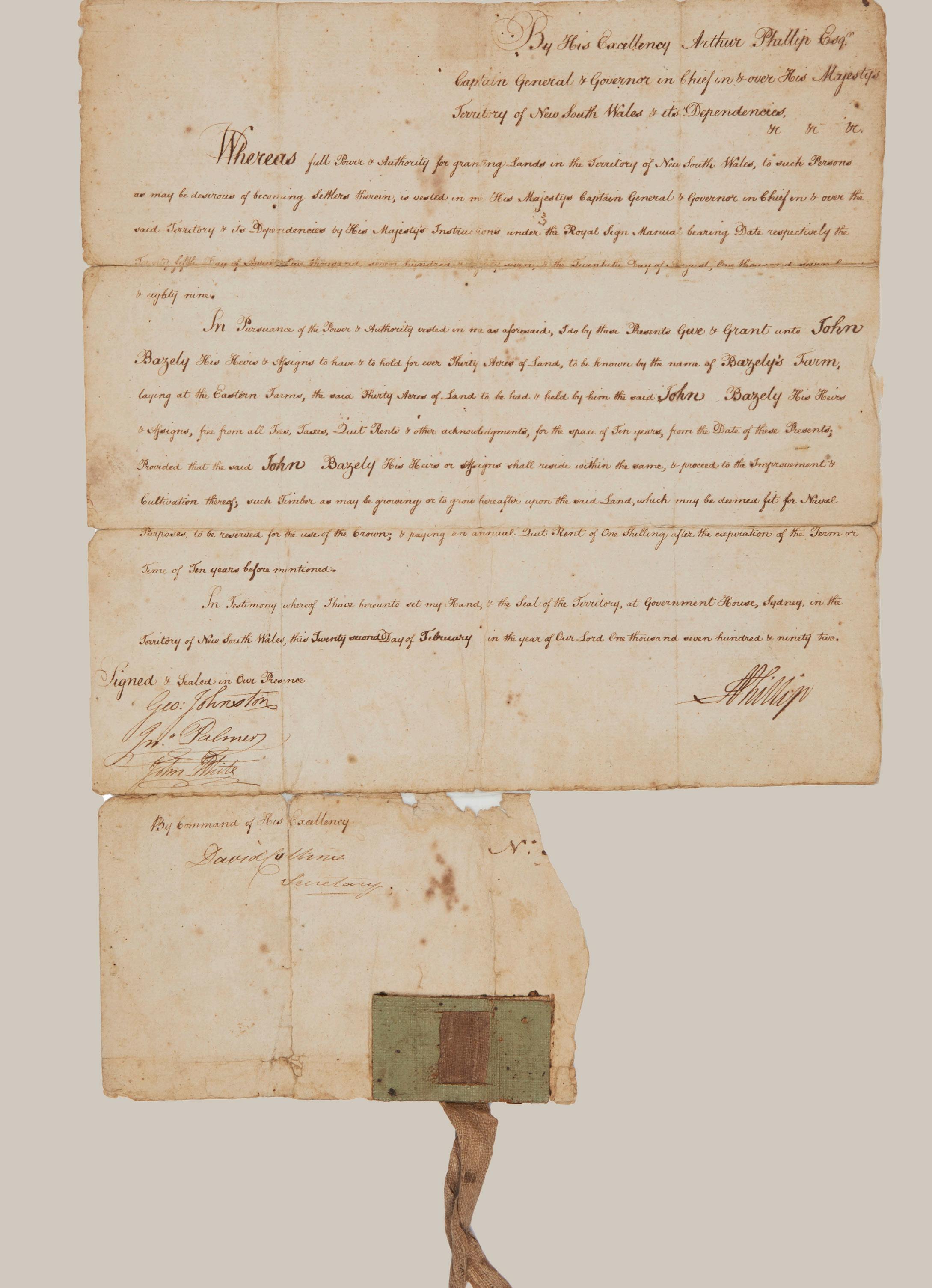
EXTREMELY RARE EARLY LAND GRANT SIGNED BY AUSTRALIA’S FOUNDING GOVERNOR
33. PHILLIP, Governor Arthur.
Land Grant of thirty acres to John Bazely at Eastern Farms.
Folio manuscript in ink on paper, 380 x 280 mm.; with original hemp cord and strengthening patch of canvas affixed to lower edge, lacking seal; quarter red morocco case. Sydney, 22 February 1792.
Land grant signed by Phillip as governor of New South Wales and witnessed by an important circle of First Fleeters: George Johnston, reputedly the first man ashore at Port Jackson in 1788; John Palmer, the purser on Phillip’s flagship the Sirius; John White, the colony’s surgeon; and David Collins, who inscribes the document as secretary to the governor.
Phillip arrived in Port Jackson with instructions from George III to grant every emancipated convict thirty acres of land, or fifty acres should they be married. It was not until 1791 that the first request was received; by the time Phillip’s governorship came to an end, he had made only ninety-five grants. Very few of the original ninety-five manuscript grants have survived intact, and this grant of thirty acres to John Bazely at Eastern Farms (now Ryde) is of considerable rarity. It is dated the same day as one made to the colony’s first farmer James Ruse (which formalised Ruse’s farm near Parramatta that had actually been set up in late 1789).
The grantee here was the First-Fleeter and former mariner John Bazely, who had been tried at Exeter and transported on the Charlotte for seven years for stealing a coat and a pair of breeches. At Port Jackson he served as an assistant to the provost marshal in 1788. He was granted this land — to be known as Bazeley’s Farm — in February, and by October he had one and a quarter acres of maize planted and a further acre cleared.
Within two years, however, he prepared to leave the colony, and on 20 April 1794 he transferred his land holding to James Squires “in consideration of twenty pounds sterling and a free passage to any port from Port Jackson to England”. Bazeley sailed on the Indispensable for Bengal on 9 July 1794. The transfer of title is carefully executed on the reverse by convict Charles Peat and signed by three other convicts, including Henry Kable, an entrepreneurial first-fleeter with dealings in shipping and the rum trade, and John Bazely, dated 20 April, 1794. Squires was the first in the colony to cultivate the hop plant and subsequently built the first brewery in New South Wales.
In Australia, the ownership of land has always had a magic ability to fuel both fortune and financial ruin. This simple document represents the beginning of the colony’s frantic rush towards land ownership that saw over 200,000 acres transferred to individuals within the first two decades.
Ryan, Land Grants 1788-1809, no. 60.
$55,000
[5001124]
SUPERB REISSUE OF THE ORIGINAL CHINESE PUNCHBOWL: ONE OF ONLY 25 EXAMPLES
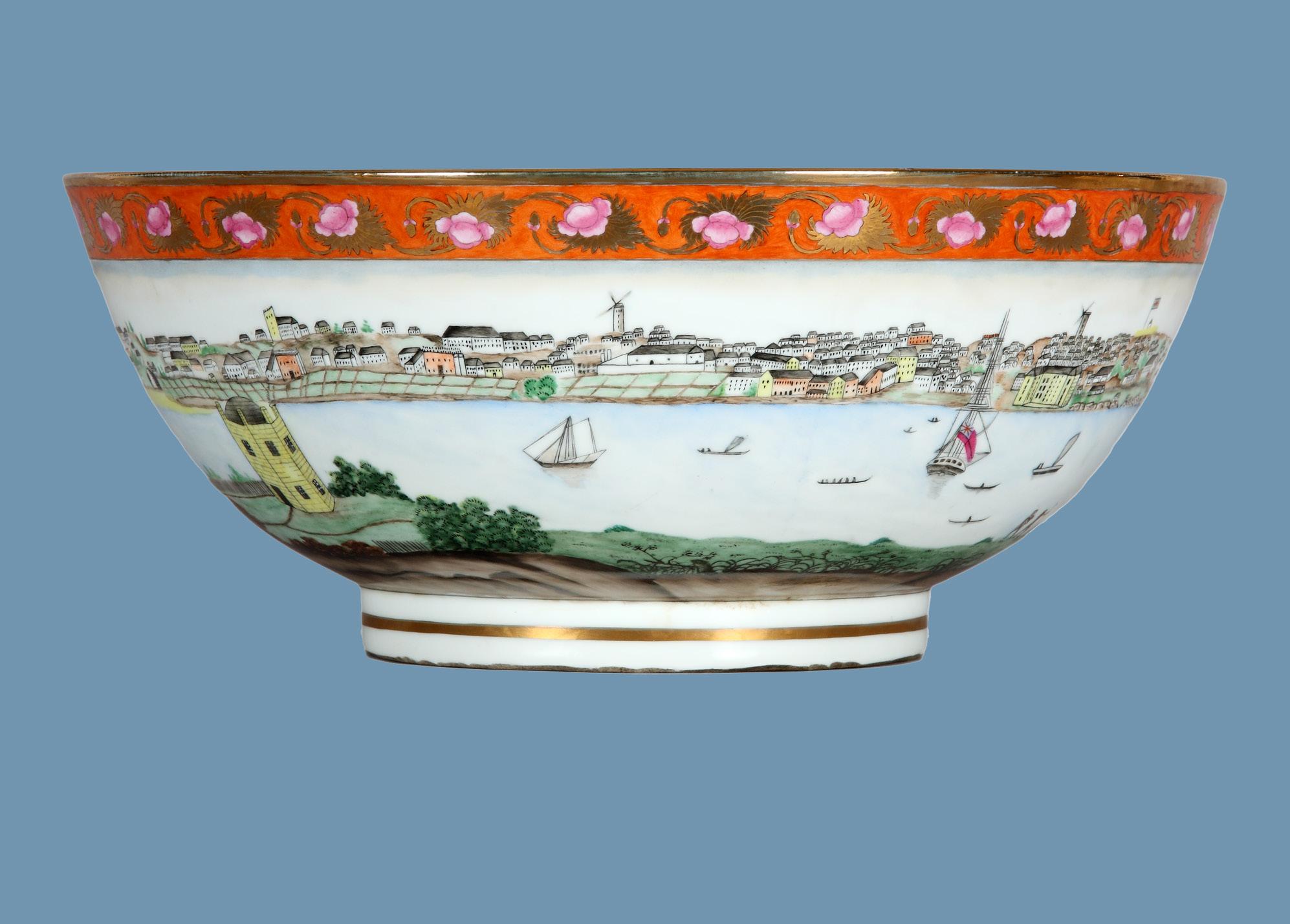
34. SYDNEY PUNCHBOWL
A handmade replica of the precious original “Sydney Punchbowl”, the antique Chinese porcelain bowl in the State Library of New South Wales.
Hand-cast and hand-painted porcelain punchbowl, 170 mm height, 450 mm diameter; accompanied by a limited edition scholarly book by Elizabeth Ellis. Jingdezhen, handmade for Hordern House, 2014.
A fine example in perfect condition of this highly-regarded replica of the celebrated and rather mysterious Chinese bowl, one of the treasures of the Mitchell Library. Prepared in a long project finally completed in 2014, the edition was limited to just twenty-five replica bowls. Examples can be seen in Government House Sydney, the State Library of New South Wales, the Australian National Maritime Museum, and the Australian Club among other locations.
Although the original edition has sold out, this example is now available as part of a collection that we have been commissioned to disperse.
The recreation of the famous punchbowl in the State Library was achieved by the traditional craftsmen of the most famous of all porcelain centres, where the original fine large porcelain “Sydney Punchbowl” (as it has been named in modern times) must have been created around 1820. The bowl is decorated with a panoramic scene of Sydney Cove around the outside and a group of Aboriginal figures on the inside and finished with exquisite floral and gilded banding.
Hand-made for Hordern House by Chinese craftsmen in the so-called “porcelain city” of Jingdezhen, the design, shape and hand-painted colours and gilding are as true and accurate a representation of the unique and beautiful original as is possible. The State Library’s example of the replica has often been displayed beside the original and a comparison of the two is satisfying.
Accompanying each bowl is a finely produced monograph on its history by Elizabeth Ellis OAM (former Mitchell Librarian) in a special limited edition.
More descriptive material and many photographs can be seen on our website.
$16,500 [404042]
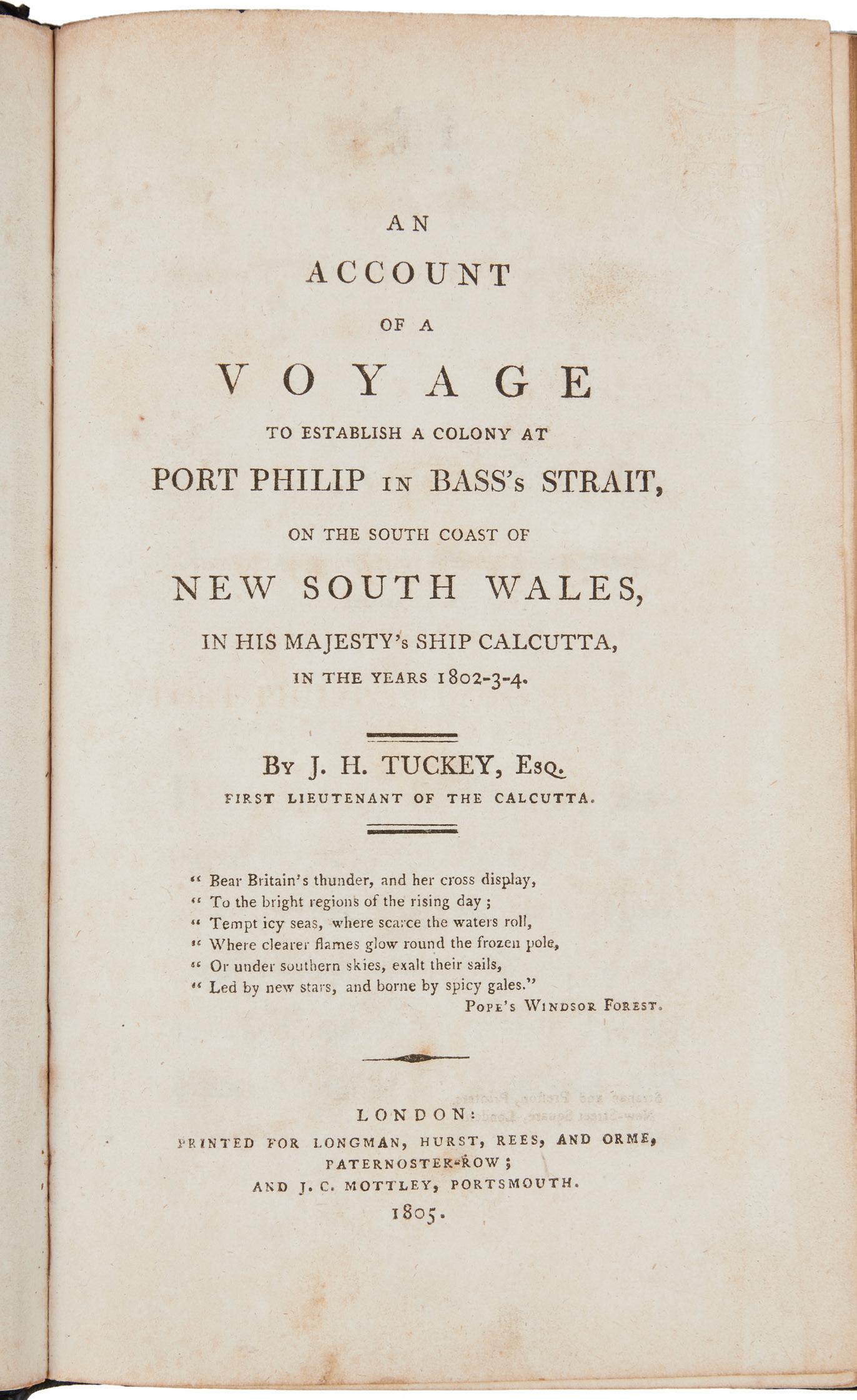
TASMANIA’S FIRST FLEET
35. TUCKEY, Lieutenant James Hingston.
An Account of a Voyage to Establish a Colony at Port Philip in Bass’s Strait, on the south coast of New South Wales, in His Majesty’s Ship Calcutta in the years 1802-3-4.
Octavo, bound with the often absent half-title; modern half black morocco with marbled boards. London, Longman, Hurst, Rees and Orme, 1805.
First edition: the only contemporary publication describing Victoria’s abortive and Tasmania’s successful First Fleet. The Calcutta sailed from England in 1802, with the intention of establishing a settlement at Port Phillip under the command of Lieutenant Governor Collins. The hostility of the natives, the lack of water, and other problems of environment caused the abandonment of the settlement after some months, and part of the expedition continued to found Hobart.
Tuckey, first lieutenant on the Calcutta, was one of those who continued from Port Phillip onto Hobart then to Sydney before returning to England. He gives a highly lucid narrative description of the events of the voyage and of life on the short-lived Port Phillip settlement. Port Phillip was not settled for more than twenty years as a result of the expedition’s failure, and was used only occasionally as a harbour by the whalers and sealers of Bass Strait, until the military settlement of Western Port — once again abortive — in 1826.
“An important addition to any collection of Australian books or of books relating to coastal discovery and essential to any collection dealing with the settlement of Victoria or Tasmania…” (Wantrup).
Provenance: Various blind library stamps (old); Commander Geoffrey Ingleton (with his bookplate and shelfmark).
Australian Rare Books 22; pp.83-84; Ferguson, 418.
$9000
[5001135]
HORDERN HOUSE
Anne McCormick +61 416 299 021
Derek McDonnell derek@hordern.com +61 416 299 022
Rachel Robarts anne@hordern.com rachel@hordern.com rogerio@hordern.com
Rogerio Blanc-Ramos
Matthew Fishburn (consultant)
Anthony Payne (UK representative)
Mike Garabedian (US representative)