Charles-Gaëtan Noury The lithographed Album Polynésien (1861): ethnography of the Marquesas, with a famous royal Tattoo
Hordern House Occasional Papers
Rare and beautiful study of tattooing in the South Pacific NOURY, Charles-Gaëtan. Album Polynésien de M. C. Noury, Capitaine de Vaisseau. Folio (390 x 260 mm), 17 leaves in all, untrimmed and unbound as issued, with lithographed title-page and single sheet of description, and 15 lithographed plates, seven of which are coloured and eight in black on a tinted background, on paper watermarked either “Rives” or “D & C Blauw”; in a modern full morocco fitted case. Nantes, Olivier Merson, 1861. An exceptionally rare illustrated study of Marquesan tattooing, decorative carving and material culture, providing one of the earliest substantial ethnographic records of the islands following the establishment of French authority at Nuku Hiva. Compiled from the observations and collections of Charles-Gaëtan Noury during his service as commandant of the French settlement, it records objects, customs and artistic traditions at a formative moment in the history of the archipelago, when sustained European administration was still
in its infancy. Described by O’Reilly as “d’un grand intérêt ethnographique”, it combines careful personal observation with finely executed lithography to preserve a visual record of Marquesan life that was already beginning to transform under French administration. Produced by a small lithographic press in the author’s native Nantes, the work survives in remarkably few copies and has seldom appeared on the market. Its nine lithographic plates, after original drawings by B. de Girardot, Bourgerel and Alfred Clericeau and printed principally by Olivier Merson, possess an unusual freshness and delicacy that preserve the immediacy of the artists’ sketches. They illustrate a remarkable range of Marquesan artefacts, including surgical instruments, tapa-making implements, a coconut-shell cover used after trepanning, carved whale teeth, canoe idols, ornaments, jewellery, pipes, fishhooks, clubs, puzzles, a ceremonial conch and numerous examples of sculptural and decorative carving. Together they constitute one of the most comprehensive visual records of traditional Marquesan craftsmanship published during the nineteenth century. Although modest in scale, the work occupies an important place within the earliest French ethnographic literature on the Marquesas. Rather than presenting picturesque scenery or the familiar imagery of Pacific travel, the plates concentrate upon objects and practices, recording tools, ornaments, carvings and tattooing with unusual precision. Produced only a few years after the French occupation of the islands, they preserve aspects of Marquesan material culture before missionary influence and colonial administration had substantially altered many traditional artistic practices.
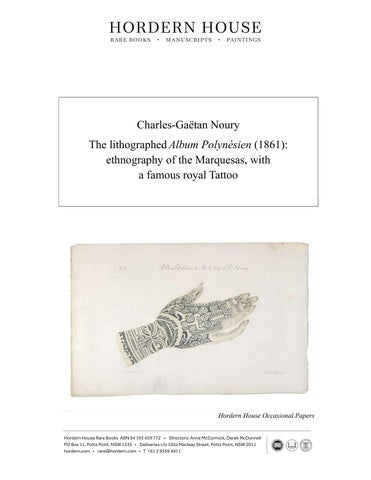
The most celebrated plate depicts the tattooed hand of Queen Vaekehu (1823–1901), wife of King Moana and one of the best-known historical figures of the Marquesas. Reproduced by Karl von den Steinen in his monumental Reise nach den Marquesas (1897), it became the standard nineteenth-century representation of Marquesan tattooing and one of the principal visual documents of Polynesian body art. The authority of the image extended well beyond its original publication. During a visit in 1886, Albert Davin questioned Queen Vaekehu about her tattoos and recorded her vivid recollection of the ordeal. Through an interpreter she recalled: “Oh I suffered cruelly. I cried much… For several days my hands stayed large as breadfruits… It was necessary that the tattooing of my hands and arms to my shoulders, of the feet and the knees, of the mouth and the ears, reveal my noble origin…”. Davin further recorded that the work had been carried out by tattooists from Ua Pou, then regarded as the finest practitioners in the archipelago, whose remarkable consistency gave the impression of a single master hand. The authority of the image extended well beyond its original publication. During a visit in 1886, Albert Davin questioned Queen Vaekehu about her tattoos and recorded her vivid recollection of the ordeal. Through an interpreter she recalled: “Oh I suffered cruelly. I cried much… For several days my hands stayed large as breadfruits… It was necessary that the tattooing of my hands and arms to my shoulders, of the feet and the knees, of the mouth and the ears, reveal my noble origin…”. Davin further recorded that the work had been carried out by tattooists from Ua Pou, then regarded as the finest practitioners in the archipelago, whose remarkable consistency gave the impression of a single master hand. Together,
Davin's testimony and the Noury–Girardot plate preserve both the appearance and the lived experience of one of Polynesia's most celebrated tattoo traditions.
Baron de Girardot Of the three artists, Auguste Théodore, Baron de Girardot (1815–1883), was responsible for plates 1–2, 5 and 7–9. An archaeologist, antiquary and prolific lithographer based in Nantes, he published extensively on archaeological material, employing a graphic style closely comparable with that seen here. As Anna Andruszkiewicz has shown, several of his
publications were, like the present work, printed by Olivier Merson, suggesting a wellestablished working relationship between artist and printer. His role in the publication appears to have been more substantial than the title-page alone suggests. The wording of the title is sufficiently ambiguous that it may refer primarily to Noury's collection rather than identifying him as the creator of the work itself. Certainly Girardot's involvement was close. The copy in the Mitchell Library, for example, bears a presentation inscription from him, while the consistent style and execution of the lithographs point towards careful editorial supervision. Although the precise division of responsibilities cannot now be reconstructed with certainty, the surviving evidence suggests that Girardot played a central editorial role in transforming Noury's collections and observations into a coherent publication. Seen in this light, the work represents a collaboration between a naval officer who assembled and documented the material in the Marquesas and an accomplished Nantes antiquary who gave it its published form. Charles Noury Charles-Gaëtan Noury (1809–1869) was a French naval officer born in Nantes, the son of Gabriel Noury, first Baron Noury. Promoted capitaine de corvette and appointed second-incommand of the Sirène in 1846, he sailed for the Pacific under Captain Lavaud. The vessel reached Papeete in May 1847, where Lavaud assumed the French command ashore, leaving Noury in command of the Sirène. Shortly afterwards Noury served for about a year as commandant of Nuku Hiva, the principal French settlement in the Marquesas. During this period he devoted particular attention to Marquesan customs, especially tattooing, language and ritual, while assembling what appears to have been a substantial collection of local artefacts. An 1849 letter preserved in the Mitchell Library discusses his records of ritual chants associated with human sacrifice, while more than 1,200 shells collected in Tahiti and the Marquesas were presented by his descendants to the Nantes Museum in 1904. The breadth of these interests is reflected throughout the present publication, whose illustrations favour objects of daily life, ceremony and craftsmanship over picturesque scenery. Following four years in the Pacific, the Sirène returned to France and Noury continued his naval career until retiring in 1864. Back in Nantes he pursued his interests in Polynesian natural history and linguistics while arranging and documenting the collections he had assembled during his service. Given the date of publication, and the fact that the lithographs derive from drawings by professional artists rather than by Noury himself, it seems likely that the plates record objects from his own Marquesan collection. The subsequent history of that collection, however, remains uncertain. Although Noury himself has attracted comparatively little attention, Father O'Reilly included a useful biographical account in Tahitiens (1975). His importance has also been recognised through the publication of his illustrated manuscript journal devoted to the natural history of Tahiti and the Marquesas. Rediscovered after more than a century and a half, it finally appeared in 2017 as Voyage en Polynésie (1847–1850). Le bestiaire oublié du
capitaine Noury, edited by Michel Jangoux for the Royal Academy of Belgium, revealing another aspect of the curiosity and powers of observation already evident in the present work. Nuku Hiva Nuku Hiva was first visited by the American navigator Joseph Ingraham aboard the Hope in 1791, while the Marquesas were claimed for the United States by Commodore David Porter in 1813, a claim that was never ratified. France formally annexed the archipelago in 1842 and established its principal settlement on Nuku Hiva, where Noury served following his arrival from Tahiti in 1847. Although the original colony was abandoned in 1859, French authority was re-established in 1870, and the islands were later incorporated into French Polynesia. The present work belongs to this brief and formative phase of French occupation. It records the material culture of the Marquesas at a moment when sustained European administration was still in its infancy and before many traditional artistic practices had undergone the profound changes of the later nineteenth century. In this respect it complements the earliest French administrative and scientific accounts of the islands while preserving a uniquely visual record of Marquesan craftsmanship. Material relating to the first phase of French settlement at Nuku Hiva is exceptionally scarce. Only three institutional copies of the present work have been located: the Koninklijke Bibliotheek, The Hague; the Mitchell Library, Sydney; and the Alexander Turnbull Library, Wellington. The Mitchell copy was acquired by David Scott Mitchell himself. We know of one further copy in private hands in Europe. Taken as a whole, this modest Nantes publication preserves one of the earliest and most accomplished visual surveys of traditional Marquesan material culture produced under French rule. Its significance lies not simply in its rarity, but in the precision with which it records objects, artistic practices and tattooing at a moment of profound cultural transition. Combining Noury's informed collecting with Girardot's accomplished lithography and Merson's fine printing, it remains among the most important nineteenth-century ethnographic publications devoted to the Marquesas, preserving with unusual fidelity a visual record of artistic traditions that were already beginning to disappear. Bibliography: O'Reilly-Reitman, 5289a; R. Teissier. Tahitiens: répertoire biographique de la Polynésie française, p. 415. See also M. Jangoux. Voyage en Polynésie (1847-1850). Le bestiaire oublié du Capitaine Noury. Académie royale de Belgique (2017); Anna Andruszkiewicz, “Auguste Théodore, baron de Girardot (1815-1883), antiquaire de province. Sa collection et ses publications”, Art et histoire de l’art, (2014). 5000260 at hordern.com