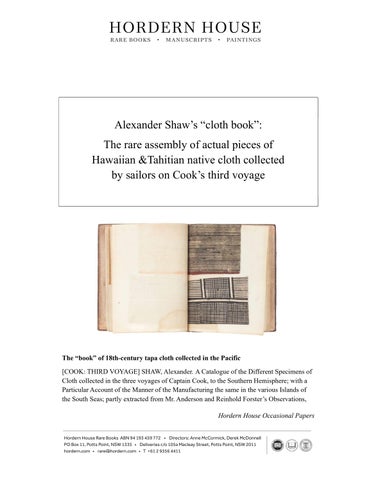
Alexander Shaw’s “cloth book”: The rare assembly of actual pieces of Hawaiian &Tahitian native cloth collected by sailors on Cook’s third voyage
The “book” of 18th-century tapa cloth collected in the Pacific [COOK: THIRD VOYAGE] SHAW, Alexander. A Catalogue of the Different Specimens of Cloth collected in the three voyages of Captain Cook, to the Southern Hemisphere; with a Particular Account of the Manner of the Manufacturing the same in the various Islands of the South Seas; partly extracted from Mr. Anderson and Reinhold Forster’s Observations, Hordern House Occasional Papers
and the verbal Account of some of the most knowing of the Navigators: with some anecdotes that happened to them among the natives. Quarto, eight pages printed text, followed by original blank leaves separating the 36 actual cloth specimens, several full page as well as many smaller; original calf binding, neatly lettered and decorated spine. London, Alexander Shaw, 1787.
This rare and exotic publication of original Pacific artefacts is perhaps the most remarkable of all books associated with Cook’s voyages. Rather than merely illustrating or describing the objects brought back from the South Seas, it incorporates original eighteenth-century specimens of tapa cloth collected in the Pacific, principally in Hawaii, Tahiti and Tonga, transforming the volume itself into a cabinet of authentic ethnographic material. Published only a few years after Cook’s third voyage, it is now recognised as one of the great rarities of Pacific exploration and one of the most unusual productions of the eighteenth-century book trade. This copy belongs to the first issue and bears the contemporary bookplate of Sir Corbet D’Avenant (1752–1823), Baronet of Stoke and Adderley, whom Donald Kerr has suggested was probably an original subscriber. Little is known of the publisher Alexander Shaw, although recent research has illuminated his activities. The edition must always have been extremely small, constrained by the limited quantity of original bark cloth available. Donald Kerr’s census recorded only sixty-six surviving copies in institutions and private hands, a figure embracing all issues published until about 1806. No standard collation is possible because Shaw continued to assemble copies from whatever material remained available. His dedication refers ambiguously to both thirty-nine and forty specimens, while surviving copies differ widely in their contents. Shaw also sold
individual tapa samples and pieces of bark separately from his premises in the Strand, further reducing the material available for the book. This copy contains thirty-six specimens, including many impressive full-page examples that have escaped the clipping suffered by so many copies during the nineteenth century, when collectors created separate “snippet books” by cutting specimens from Shaw’s publication. Their survival allows Shaw’s original conception of the work—as a comparative collection of Pacific bark cloth accompanied by contemporary ethnographic observation—to be appreciated much as it would have appeared to its first subscribers.
Shaw’s publication emerged from the remarkable fascination that tapa aroused in Britain following Cook’s return. Rather than merely illustrating bark cloth, it assembled original specimens gathered during the voyages and arranged them as a comparative survey of the textile traditions of the Pacific. The introductory letterpress draws upon the observations of Cook, Anderson, Forster and an anonymous officer, describing the manufacture and uses of bark cloth before presenting Shaw’s catalogue of the specimens. More significantly, the catalogue preserves information obtained directly from the voyagers themselves. Some entries record only the practical or ceremonial use of a specimen—cloth “wore by the people in the rainy season” or “used at the human sacrifice”. Other notes are considerably longer and almost certainly derive from stories told by the mariners who collected the tapa in the first place, just as the title page proudly claims. Describing specimen number 18, Shaw records: “The very finest of the inner coat of the mulberry; and wore by the chiefs of Otaheite – Some of the seamen were sent ashore to bring fresh provisions on board; and not having an opportunity to return immediately, one of them wandered a little way up country, where he saw some children at play, which to his surprize they all left, and surrounded
him, making many antic gestures; at last a girl, about fourteen years of age, made a leap at him, at the same time endeavoured to seize a few red feathers which he had stuck in his cap, which he directly took out and presented to her; upon which she made off with amazing swiftness, and the rest after her; he then returned to his companions, who were preparing to go on board. It was now the cool of the evening, when she came down to the waterside, and singling him out from the rest, presented him with the piece of cloth from which this was cut. A true sign of the gratitude of those people.”
Whether or not the anecdote acquired some embellishment in the retelling, it preserves the sort of personal exchange through which many of the specimens entered European hands. Read alongside the surviving cloths, such accounts give the volume a documentary value extending well beyond its function as a sample book. The specimens preserve the distinctive fibres, methods of manufacture and decorative traditions of individual island groups, while the accompanying descriptions record contemporary European attempts to understand their production, use and cultural significance. Together they illuminate the encounters through which objects, knowledge and stories travelled between Pacific communities and the crews of Cook’s ships. The significance of Shaw’s Catalogue therefore lies not simply in the rarity of its surviving specimens, but in the way they remain embedded within their original documentary context. The cloths, the accompanying descriptions and the anecdotes preserved from Cook’s crews together record the movement of objects, knowledge and personal encounters between Pacific communities and Europe. Preserved in copies such as the present example, with its specimens remaining substantially intact, the work continues to convey with unusual immediacy the exchanges that lay behind Cook’s voyages and the transmission of Pacific material culture into the cabinets, libraries and intellectual life of Enlightenment Britain.
Provenance: Norton J. Whitmont collection; Kelton Foundation, Los Angeles; original owner Sir Corbet D’Avenant (1752-1823), Baronet of Stoke and Adderley (with armorial bookplate). Corbet d'Avenant was the son of Anne Corbet, daughter of Sir Robert Corbet (c.1670-1740) 4th Bt of Stoke upon Tern. Upon the death of Anne's brother, rector of Adderley from 1735, Sir Henry Corbet, the seventh baronet, on 7 May 1750, the baronetcy became extinct and the family estates passed to his nephew, Corbet D'Avenant, who assumed the name of Corbet, and was created a baronet on 27 June 1786. Upon his death, on 31 March 1823, the second baronetcy also became extinct.
Bibliography: Beddie, 3640; Forbes, ‘Hawaiian National Bibliography’, 139; Hawaii One Hundred, 7; Holmes, 67; not in the catalogue of the Hill collection; Donald Kerr, Census of Alexander Shaw’s ‘Catalogue of Different Specimens of Cloth Collected in the Three Voyages of Captain Cook to the Southern Hemisphere, 1787’ (University of Otago, Dunedin, 2015); Morrison, ‘The Cloth, the Catalogue, and the Collectors’ (2003); Ryan, ‘Alexander Shaw’s Remarkable Enterprise’ (2018).
See also: Sotheby’s Exploration and Discovery, 1576-1939. The Library of Franklin Brooke-Hitching, lot 317 (March 27, 2014); A. L. Kaeppler, ‘Artificial Curiosities’, being an exposition of native manufactures collected on the three Pacific voyages of Captain James Cook, Bishop Museum (Honolulu, 1978); and ‘From the South Seas to the World (via London)’ in Jeremy Coote (ed.), Cook-Voyage Collections of ‘Artificial Curiosities’ in Britain and Ireland, 1771–2015 (MEG Occasional Paper, No. 5, Oxford: Museum Ethnographers Group (2015); H. U. Hall, ‘A book of tapa’, in The Museum Journal XII, (Philadelphia, March 1921); Ian Morrison, ‘The Cloth, the Catalogue, and the Collectors’, Bulletin (Bibliographical Society of Australia and New Zealand), v 27 nos 3 and 4 (2003), pp 48-59; Maryanne Larkin, ‘Tales and Textiles from Cook’s Pacific Voyages’, Bulletin (Bibliographical Society of Australia and New Zealand), v 28, no 4 (2004), pp 20-33; Nat Williams, Erica Ryan, and Crispin Howarth, In Cook’s Wake: Tapa Treasures from the Pacific (National Library of Australia, 2018); Louise Wilson, ‘An investigation into the origin of the Tapa specimens collected by Captain Cook on his three voyages to the Pacific’ (Bulletin of the Bibliographical Society of Australia and New Zealand), v 27, nos 3 and 4, 2003, pp 60-70.
5001042 at hordern.com