Hop
Arts-powered research in action
Fall 2026/ Winter 2027
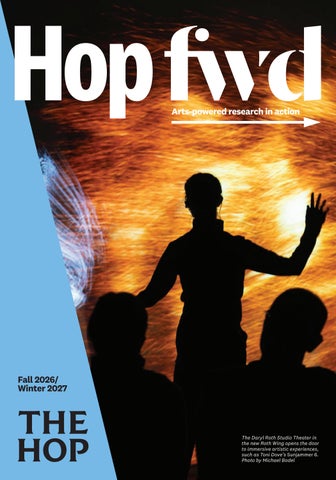
The Daryl Roth Studio Theater in the new Roth Wing opens the door to immersive artistic experiences, such as Toni Dove’s Sunjammer 6. Photo by Michael Bodel
So much has been written about America’s 250th and the anniversary of the Declaration of Independence. Celebrations abound. Exhibitions curated. Lecture series hosted. The list of ways in which we think about recognizing this anniversary continues to leave us with nothing but questions. Marking an anniversary is not an end point; it is a bridge to the future. The artists and creators featured in this
edition are sharing their process with us as part of that journey forward. We are lucky that our community can be a creative playground for new thoughts and ideas. If we are curious enough, the questions continue, but the answers may change with the help of artists “because the artist isn’t afraid, the artist is going to tell the truth” in the words of video
Illuminating Hidden Histories Kronos Quartet’s Three Bones
artist Patty Ortiz. And as Alya Zook ’29 reflects in her essay, “But no matter what appears onstage, I know what I am really experiencing: me.” Mary Lou Aleskie Howard Gilman ’44 Executive Director
The Hop is a proud co-commissioner of Three Bones
By Theodore Levin Arthur R. Virgin Professor of Music As an ethnomusicologist and record producer, I’ve been around world music for decades, but I’d never heard the tsli’edo’a’tl, a one-string Apache fiddle made from the dried flower stalk of the agave plant, until I attended the Carnegie Hall premiere of Kronos Quartet’s multimedia triptych Three Bones last April. Kronos Quartet and a high-spirited group of collaborators bring Three Bones to the Hop this October as the centerpiece of a week-long residency. Named for the ossicles that amplify sound in the middle ear, Three Bones uses newly composed music, video, archival recordings, visual art and environmental sound to amplify the distinctive history and cultural traditions of three groups of Americans: Indigenous peoples; the
Gullah-Geechee community descended from enslaved Africans brought to the coastal regions and barrier islands of the southeastern United States; and Chinese Americans who built San Francisco’s Chinatown. The musical and narrative pastiche that runs through Three Bones is nothing if not eclectic. By the end, a listener has heard the artists move from the Apache fiddle to Inuit throat-singing; from Delta blues to a new piece for string quartet and pipa, the Chinese lute played by its best-known performer, Wu Man, to a poignant arrangement of Kumbaya, which means “come by here” in the creole Gullah language. And that’s just for starters.
In its Carnegie Hall incarnation, I found the work engrossing and moving, both as narrative and as visual and sonic experience. At root, Three Bones is storytelling. Not all its stories are happy ones, but they are compelling and relevant to the times we live in—none more so than the gripping third segment of the triptych, Beyond the Golden Gate, which recounts the saga of Wong Kim Ark, whose 1898 Supreme Court case established the constitutional precedent for birthright citizenship. The Gullah-Geechee section of the triptych, where drummer Quentin Baxter joins Kronos, also offers bittersweet reflection, in this case on the community’s journey from its African roots to the present.
Photos: left by C. Elliott Photography, right by Lenny Gonzalez
Three Bones exemplifies Kronos’s modus operandi. In its 53-year history, the group has forged partnerships with musicians around the world and teamed up with scholars, scientists, poets, filmmakers and public intellectuals to create projects that speak to the urgent issues of our time. I’ve been fortunate to collaborate with both Kronos and Wu Man on recording and performance projects stretching back to the early 1990s. What continually strikes me is their insatiable curiosity about music,
world cultures and history; their fearlessness in approaching artistic terra incognita; and the generosity and inclusivity with which they share their creations. At a time when pluralism and cosmopolitanism have become contentious, Kronos’s work reminds us of the importance of cultural curiosity and empathy, and of music’s inexhaustible power to inspire wonder.
While on campus, the Kronos Quartet and their guests will visit music classes, join a Libraries-hosted discussion on how archival research informs artistic practice, and share dinner and conversation with students from School and North Park Houses.
Arriving at Three Bones By David Harrington Kronos Quartet founder and violinist Here was the question we asked ourselves: could Kronos make a concert that sits at the convergence of three communities which have endured the toughest of times in our country? And what can we learn from what we find in common? Our guiding principle was: whenever something made us say “I had no idea,” we included it in our concert. When I was looking for a title and trying to describe this sprawling idea to poet Nikky Finney, as a form of listening and learning through our ears, she suggested: Three Bones. Eventually we arrived at Ground, At The Sea Islands and Beyond the Golden Gate as the section titles of our triptych. We have been inspired by recordings, books, documentary films, TV shows, exhibits, archives, field trips with scholars, historians, authors, artists, poets and we have had conversations with musicians from many corners of music. Three Bones delves way back into the history of Kronos.
I remember being 10 years old, hearing Link Wray’s Rumble on KJR in Seattle and finding out that in some parts of our country this music was banned from the radio! It’s still the only instrumental piece ever banned from American radio. That was over 65 years ago, just as I was beginning to play violin and way before there was Kronos, but the song had to be part of Three Bones. The sound of early recording technology has been a central character, too, ever since I first encountered the Edison cylinders recorded in San Francisco’s Chinatown 40 years ago. We all love those scratchy, sometimes ghost-like sounds from the distant past. Composer Jack Body and his Three Transcriptions from 1988 had reimagined the string quartet form for Kronos, bringing more of the world into our realm. His Long-Ge had to be a part of Three Bones. We began working with Wu Man in 1992, and met Laura Ortman in 1994 when she first encountered the Apache
violin. And so began a lifetime journey for Laura and us. To tie Three Bones together, I wanted each section to include something from Kronos’s Fifty For The Future— our online, free library of music created to give all musicians access to the process and relationships Kronos has forged with composers. It was John Fenn of The American Folklife Center (AFC) at the Library of Congress who first led us to Gullah work through composer Charlton Singleton. Then Doug Peach of AFC guided us to the first recording of Kumbaya sung by Henry Wylie along with Amelia Dawley’s A Mende Song—the singular song in American music passed down from mother to daughter over generations. Amelia did not know what the words meant or what language she was singing; much later it was learned to be a funeral song in the Mende language of Sierra Leone. On a field trip, Doug also introduced me to Quentin Baxter in Charleston, South Carolina. It was Judith Gray, also of AFC, who
continued
enabled our access to and ethical use of the 1890 recording by Noel Joseph. The fabric of relationships and musical/cultural adventures is so much fun to be a part of. When I think of the network of inspirations for Three Bones, it begins at home. It was my daughter Bonnie Quinn who introduced me to a book she used in her third-grade classroom: I Am An American— The Wong Kim Ark Story. Until reading it, I had no idea that the legal case of birthright citizenship began here in San Francisco. Bonnie also
introduced me to Windy Chien’s The Year of Knots and visual storyteller Ariel Aberg-Riger’s America Redux, which became inspirations for the visuals in Three Bones. Wu Man introduced me to David Lei, who first told us so eloquently about various Chinese American legal cases that are central to freedoms we have in the US. Then there are pivotal experiences like the first visit to the National Museum of African American History and Culture. What an overpowering moment that was! I had only a little idea of the vast enslavement
carefully hidden just beneath years of education. Or the huge room at the National Museum of the American Indian containing scores of broken treaties. And the Broad Museum’s Jeffrey Gibson exhibit! We are so fortunate to be able to piece together music and stories with the huge, inspiring community of people devoted to teaching us more about the world we all get to share. Three Bones was further shaped by Ayane Kozasa, Gabriela Diaz and Paul Wiancko along with visual artist Xuan, lighting designer Brian Scott and sound engineer Scott Fraser.
Left: Kronos Quartet members with guest artists Laura Ortman, Wu Man and Quentin Baxter, photo courtesy of the artists. Right: photo by Stephanie Berger.
Rethinking American History A Conversation with George Emilio Sanchez and Patty Ortiz Interviewed by Samantha Lazar Curator of Academic Programming
In January 2027, George Emilio Sanchez and Patty Ortiz will present their latest theater piece, To E Pluribus Unum, with Love, in the Daryl and Steven Roth Wing. Here they tell us about the inspiration behind the project, its interdisciplinarity and developing the work at Dartmouth.
Samantha Lazar: Your show has been in development for a while. Can you talk about how the idea for it first came to be, and how it’s evolved? George Emilio Sanchez: Statues and monuments were a real foundational beginning. I had done a previous piece involving Columbus. And Patty said, well, what if we presented Columbus’s point of view? And I said, well, I don’t want to present Columbus’s point of view.
Patty Ortiz: So that was the beginning of having a dialogue with historical figures. But even more importantly, we came down to the basic question “Where did our brown skin come from?” And why did we, Latinos particularly—which both of us are, he’s from Ecuador, I’m from South Texas—why did most of our family and descendants abandon our true ancestors, our Indigenous peoples, and instead align with the colonizer? We’d meet all these people from different tribes, and their last name was Vasquez and Garcia.
So we had two things: one was using historical figures to look at the history of this country, the invisible history, and the other was looking at the question of indigeneity and how does that impact the history?
SL: One can frame this play as an interrogation of American history and identity, which are fraught subjects at our current moment. What does this work bring to that ongoing conversation?
SL: This work is interdisciplinary both in subject matter and in form and structure. What are some of the intersections you explore, and why are they exciting for you?
GES: So first of all, we hope people start to reevaluate the use of the word “American.” What does that mean? What does it refer to? I’ve always had an issue with people leaving out the Americas when they say “American.” They think about the United States only. So one thing I hope comes out of it is people reevaluating how we use language and what it really means. Also, the traditional dominant cultural narrative of the US has prioritized the Europeans who arrived, and has consistently invisibilized or erased or completely muddled the reality of the centuries and centuries that Indigenous people were here, and never acknowledged that.
PO: Well, I’m a two-dimensional artist. And George is definitely a three-dimensional artist. That’s the main juggling act. I kept on wanting him to be on the screen. And he resisted it a lot, saying “I can’t see that, the screen’s behind me.” So I was turning him around to see what was behind him and he just naturally started interacting with what was there. Now they’re talking to each other! GES: As a performer, I know what works in a live show, and I also know what possibly might not work live, and that is me as a live performer talking to a recorded figure. It’s almost like death, you know what I mean? But content-wise, it opens things up. What if we could talk to historical figures? And we found a way. I mean, it’s really fantastic. We’re on the very tip of finding out what’s really here with the interdisciplinarity. Ortiz makes up Sanchez who embodies various historical icons, including Columbus, Lincoln, Ginsburg, Orozco and Jesus in To E Pluribus Unum, With Love. Photos by Sofia Pavan Macias and courtesy of the artists
We’re going to present this at Dartmouth. I feel very safe there. But honestly, I know there are places I would have to think twice about being on stage in front of a public. We’re challenging people’s notions of what it means to live in this country and of its history, right? There’s a danger. So it couldn’t come at a better time.
SL: You’ve spent some developmental time with this work at Dartmouth. Can you talk about how that time has shaped the work? GES: We met so many amazing people at Dartmouth. [Professor of Native American and Indigenous Studies] Bruce Duthu has always been a very foundational connection for us there. And Dartmouth has Orozco’s The Epic of American Civilization! The majority of this country doesn’t know anything about that mural or Orozco. PO: For me, the biggest impact was spending time with [Professor of Art History] Mary Coffey at the Orozco mural. She spent so much time with us to talk about that whole mural, and it got to the point where we actually said, Orozco has to be in this piece. Orozco is a character; George is going to be Orozco. It’s all because of her. We decided we needed an artist talking in this piece just telling it like it is, because the artist isn’t afraid, the artist is going to tell the truth. Sanchez and Ortiz developed the work, commissioned by the Hop, during residencies at the Hop in winter and fall of 2026. They used the Daryl Roth Studio Theater and the television studio in the Visual Arts Center for cinematography.
The Art of Watching Others to Watch Yourself By Ayla Zook ’29
In spring ’26 the Hop launched a course that fulfills the college’s wellness credit entitled Performing Arts and Personal Reflection. Students attend and reflect upon six Hop performances over the course of the term. Below is an end-of-term reflection by first-year student Ayla Zook. The lights dim. Around me, bodies make a final shuffle before silence descends. Soon, the stage transforms. Sometimes dancers dressed in beige fly barefoot across the floor to tell stories. Other times, an interactive AI spews prose and strange dance moves to a confused, captivated audience. Sometimes, the only movement is invisible: sound waves radiating through the auditorium, compressing the air and opening an unwieldy world inside our ears and minds. But no matter what appears onstage, I know what I am really experiencing: me. Every performance I attended this past spring transformed the way I see art, Dartmouth and myself. Before this course, “performance” meant school plays, concerts and the occasional musical—art introduced to me by parents or teachers. Then came Being, in the
Daryl Roth Studio Theater, an AI storyteller, and Still/Here, an interpretive dance rooted in stories from the AIDS epidemic. Suddenly, I entered a much larger world of what art could be. And I loved it. At first I felt a bit uncomfortable, uncertain maybe. But in trying to find ways to connect and interact with these works, I always found myself reflecting on my own experiences and preconceptions of the subject matter and medium itself. I learned to approach each performance with new eyes. Even if you’ve seen a hundred plays, each new one can be a completely different experience. And it all boils down to how you choose to reflect: (before) acknowledging your expectations and judgements; (during) letting the mind wander and take in every sense; and (after) writing, talking and remembering—days, weeks or even years later. Connecting with art also means connecting with Dartmouth on a whole new level. What is Dartmouth? Who is Dartmouth? As a ’29, Dartmouth first existed as a milemarker that told my high school senior year self I did it. Then, it started to become real. A place I was going to live now, by myself. Then it was my school and the high school pressure started all over again. With clubs, DOC trips, friends, it slowly transformed into … my home? But, it can’t only be MY home. HanUnder,
Dartmouth performance groups and the Hop showed me how much talent I walk past every day. Dartmouth is an ever-evolving community; my peers—its artists—craft it a little more through what they make, question and share. Dartmouth itself is art. And I fall in love with it every day. In the practice of exploring art at Dartmouth, I began exploring new parts of myself too. Ayla noun: A passionate dreamer, scientist, kid-at-heart and now, art enthusiast. Art has become a way to connect the things I often separate between my academic and personal lives. Like realizing the actual musical applications of birdsong my professor discussed in my writing seminar. Or recalling the limited information in my high school history textbook on the AIDS crisis. And even linguistically analyzing the AI griot Being. Through appreciating art, I’ve become more attentive to my own mind: where it wanders, what it notices, what it loves, and how passionately it reaches for connections. I have learned that reflection is itself a kind of art— one that continues long after the curtain closes. So … hello Ayla. I hope I can keep getting to know you. Keep watching. Keep questioning. Keep loving. And Ayla, I forgot to mention: Enjoy the show.
Alive with Arts The new Hop is pulsing with creativity as students tap into our new spaces, sink their teeth into creative projects and find community.
A n af t er Helen noon in the Deng ’2 St a mb e r 6 sold udent Work e s r ear the ing , Erica Ch ring silver fo hops finds n r e a hand ware plante mmanoor ’2 a t wo -stone r 9 - s aw n doveta during a dro car ving an p il joint by Joh -in workshop n Moli nski ’2 and 6.
d t- curate studen day to d te rs ne devo s. Ever y Thu activit y e , and o t series ) student vib with creative es s e w e n t ak ems rgely O ur what it and (la e Hop te ar tistr y the Top of th ir friends learn usic, dance m , e e f g o evenin ellows and th e showcase a gain th F y do it as Hop ce a lounge -lik ts. Before the r u linar y a to prod rdiscip te in d n a ! g we e k followin
Christine Choi ’30 prepping a Beethoven sonata for her next lesson with pianist-in-residence Sally Pinkas
T h e ate r O r c h a s tu d e n t s d e rd lv audien . Capitalism e into Chek h , c e s aw ait the denial, famil ov ’s Cherr y y fruits o f their drama … labor.
Masters student Yuening Cai surveys Jupiter from the Shattuck Observatory, where she designed an immersive sound installation with support from the Arts Integration Grant. The project translated data derived instruments on NASA’s Parker Solar Probe into a sonic experience that opens our senses to feeling the waves and energetic pulses emanating from our sun.
Photos clockwise by Annie Branch ’97, Michael Bodel, Ben DeFlorio, Nate Lopez ’29 and Robert Gill
usting dancers b ty, st of break ar ge rp un te af yo The Hop Top of the cks and moves in a lo s, op p the Dance inspired by Versa-Style Street oth of Dar yl R e th inversions d ke who pac Company, er. at Studio The
Noli Timere
Fear Is Real Yet the Body Swings On By Zenovia Toloudi Associate Professor of Architecture in Studio Art “Feelings are facts,” Yvonne Rainer wrote; Olafur Eliasson and Ma Yansong exhibited. Yet embracing negative feelings such as fear in our everyday life seems like something we would avoid or ignore—most definitely not play with. In the constructed environment around us, designing risk-free buildings seems a reasonable and responsible thing to do. Safety first. And yet we live in a moment defined by instability—climatic, political, technological— where risk cannot be engineered away. At the same time, there is a chance that we may deprive ourselves of using our ancestral cognitive apparatus, which provides skills and practices essential to survival. What if, in removing friction and danger from our environments, architecture has also removed our capacity to adapt? What if buildings no longer train the body the way a tree does— flexing, bending,
Photo by Julie Lemberger
responding to force, or like the natural challenges of hiking, rock climbing and mountain exploration, which teach us how to respond to uncertainty? Rebecca Lazier and Janet Echelman’s Noli Timere performance offers a different reality. For 60 minutes, the audience experiences a world that is not only beautiful but also offers a unique perspective. The work suggests that architecture’s future may lie not in eliminating risk, but in designing structures that teach us how to move within it. In this world, fear and risk are indeed facts—but one embraces them and even finds pleasure in them. How did it happen? For years, sculptor Echelman and choreographer Lazier have collaborated to put together a show that features a colorful net sculpture and an abstract, tensile, risk-responsive choreography that dances together and co-evolves over time. Eight performers—highly trained dancer-acrobats and aerial practitioners—along with four rope handlers, and a musician join forces, bringing their skills and playful rituals together—to learn how to navigate through fear rather than escape it. They do not conquer instability; they practice it. Their craft relies on calibrated weightshifting, proprioceptive acuity, grip strength, spatial timing and collective trust. One is amazed by all the elements individually—the stunning net, the dance, the sonic experience—but also by the
Left: Zenovia Toloudi (center) conceived Free-See-Saw, 2019, as a free, collective seating space, which needs negotiation and collaborating through motion and body equilibrium to share the open space’s resources. Photo by Dimitris Papanikolaou. Top and right: Crew members hang the nets for Noli Timere in the Moore Theater. Photos by Annie Branch ’97
without users who are ready for it? What if these performers are the new citizens, inhabiting an unsafe and uncertain world with their skills and expertise? They pull the net, they Inhabitable nets are not new to push it, they trigger it and they contemporary architecture; they occupy it. The net’s modular have become extended hammocks structure becomes dense or loosens for reading, structures for playrooms, up; it changes height, position, and exploratory devices in many direction—becoming more or less presentations of modern apartments safe depending on the situation. It and housing. In my own experiments demands users capable of reading and installations, using metal mesh, tension, anticipating oscillation and wood or other rigid materials, I have negotiating instability in real time. explored how playground-like Sometimes they walk, they leap, they micro-architectures—minimizing counterbalance, or they swing away; structure yet allowing movement— they rebound and redistribute force can respond to body interaction, with it. They ride its movements creating opportunities for adaptive and ripple effects, absorbing and engagement, play and risk. redirecting kinetic energy ... The net and its inhabitants, the This net, created by Janet Echelman, structure and the performers, is much more complex as a structure. coexist and coevolve; they are In her words, “it dances;” it is interdependent. Here, structure engineered to allow skillful does not protect from uncertainty; performers to occupy it in it stages it, distributes it and unexpected ways. A question arises: teaches negotiation with it. Can innovative architecture exist synchronization among them. Is this just a dance performance, or a precursor to a possible evolution of architecture in times of uncertainty?
This architecture of rotating safety, changing angles, bodies in all dimensions enables feelings, intuitions and sounds—whether roars, vibrations, or breaths—to take their space (and time) within space, to allow their existence and begin playing. Like prey and predator, they quarrel—but is it a game? They have each other. Perhaps the lesson is not how to design safer buildings, but how to design environments that restore adaptive intelligence—spaces that, like trees, absorb force or like mountains, rocks, and forest trails, push the body and mind to adjust and adapt. The silence, the patience of the citizen-acrobats is palpable. They are not merely performers; they are prototypes.
The Conic Sections of Love
The interactive work brought audiences into the cosmic world of Sunjammer 6. Photos by Michael Bodel and Annie Branch ’97
By Asmaa Abdallah Communications Manager Toni Dove likes to entice people into spending time around ideas they might not normally spend time with. Her latest work, Sunjammer 6: A Tale Blown by a Solar Breeze, is a love story told in the language of mathematics between the ghost of Hypatia—the Hellenistic astronomer and philosopher murdered in 415 CE—and Kepler Redux, a NASA engineer of the future building an off-world solar station. It is staged with 14 speakers, six cameras and three translucent projector screens. There’s also an augmented-reality 3D book. Like many of Dove’s works, timetravel in Sunjammer 6 is both a genre and a metaphor. Hypatia wasn’t part of Dove’s original plan. Her name simply flew into Dove’s head. But the
more she researched the Hellenistic astronomer and philosopher, the more she saw echoes of the present in Hypatia’s world—and in her violent death at the hands of a mob. Her death sent ripples throughout the ancient Greek world, and Dove sees resonance in the present: a moment when higher education and research can be undermined and the value of knowledge diminished in a culture increasingly shaped by fear and the pursuit of profit. “The piece, for me, became very much about the consequences of the fear of knowledge. It’s also a lot about how we think about things that are intangible in some way: abstract systems that human beings create to understand the world, such as mathematics and physics.”
When Hypatia and Kepler meet, they negotiate the space and time between them and attempt to collaborate to push back against an encroaching dark age. But Dove doesn’t tell their story in a single form, or through a traditional plot. Instead, Sunjammer 6 unfolds across three interconnected experiences. In the installation, proprietary AI allows Hypatia to interact with multiple audience members, follow them around the triangular screen structure, respond to them, then losing interest, to talk to somebody else. “The ultrasonic speakers that deliver sound feel like somebody’s whispering in your ear,” Dove explains. In a 40-minute performance, dancers interact with the installation, becoming, in Dove’s
words, “avatars for the audience.” An augmented reality book based on the show extends the story into yet another dimension. Why tell the story this way? Dove, who is a 2026/27 artist resident at Yale Quantum Institute, is an instrument builder who has been working with emerging technologies for over 30 years. She is interested in the technologies that are transforming the world we live in. “The process of working with them is part of what makes me understand how they work, what their impact is, what the thinking is behind them and how I want to engage with them, or how I don’t want to engage with them,” she says. The machines she builds become a way to tell a story and explore how a story can be told. In Sunjammer 6, that means creating myriad ways to encounter the same characters and ideas.
two-dimensional, but can only be fully understood when seen in relation to a third dimension. That idea became part of the way she approached Sunjammer 6: using the theme of mathematics to connect different dimensions of time, perspective and experience. “I pulled this thread through these different moments in time where different mathematical figures—Hypatia, 16thcentury German polymath Johannes Kepler, and the future NASA engineer— have different references to the conic sections,” Dove says. “I wanted the love story to be described in the language of mathematics. So that the two things could wrap around each other.”
But beneath all these technologies is an old-fashioned structure: a love story. Dove built the story around Hypatia’s relationship to mathematics and education, using as its structural arc one of mathematics’ oldest concepts: the conic sections.
In Sunjammer 6, mathematics isn’t simply something the characters study or talk about. It becomes a language for understanding their relationship, for connecting their characters across time—and a way of asking what might become visible when we change our perspective.
A conic section is created when a flat plane slices through a cone. Change the angle of the cut and you get a different curve, an ellipse, a parabola or a hyperbola. Dove was intrigued by the fact that these figures are
As Hypatia says, “There is nothing static about numbers, nothing passionless about gravity or the sun or algebra.”
Through longer residencies, the Hop becomes a creative playground where artists can experiment and develop new work.
Arts Integration
Entangled Ecologies Stitching the Seams Between Technology and Clothing By Sophia Jiang ’28 Music pumps through the speakers as striking blue-green visuals flicker on a big screen. Underneath a student struts down the runway to the beat of the booming bass drum and the audience erupts in cheers. Her dress is made of polyester, collected from old T-shirts, and at the waistline is a loop that hooks onto an actuator, meant to lift the train off the ground. She poses, hand on hip, and covertly reaches into her pocket for a small device. As she pivots to make her return walk, she presses a button, releasing the loop and letting the train flow down behind her. This was one of many pieces in Entangled Ecologies, a collaborative project where Dartmouth students combined fashion and technology, culminating in a fashion show last spring. Funded by the Hopkins Center of the Arts and the Office of the Vice Provost for Research’s Arts Integration Initiative, which covered materials, show production, and other incidentals, the project asked students to infuse technology spanning 3D printing, sensors, lights and motion into fashion garments. They more than exceeded this goal. The idea began with a broader question about how people use clothing and technology to express themselves, says Lorie Loeb, researcher and co-founder of the DALI Lab.
future, we also have to look to the past,” Deng explains. She champions the classic “reduce, reuse, recycle” process, “finding treasure in the trash” and upcycling clothing as much as possible. Deng says she even went so far as to collect fruit peels at the Class of 1952 Commons Dining Hall to make a fruit leather for a dress concept.
The results went well beyond traditional garments. Students “Whether we like it or not, when we experimented with pumping liquid, put on clothing, we’re making a inflatable elements, LEDs and design choice. We’re making choices 3D-printed designs. Projects like this about what feels good on our body, are rare and extremely unique, our emotional state. We’re because, as computer science presenting ourselves to the world,” lecturer Kate Salesin says, each she explains. student spends an entire term developing one substantial piece By the end of the term, Entangled with the freedom to create what they Ecologies boasted 38 pieces, made want. One student purchased a by 43 designers, including 40 discounted wedding dress and students, 2 faculty and 1 staff member. In order to achieve a vision, skillfully attached a tubular ribcage to its exterior, and as the exoskeleton architect and associate professor of studio art Zenovia Toloudi asked her of veins pumps red liquid, the piece architecture students to think about actively begs the audience to ponder about what its design represents. what they are missing in everyday Salesin credits the project’s life, and then wonder how art and interdisciplinary approach—“Many architecture can address that. Her [designers] were engineers, not philosophy on architecture and its necessarily part of the digital arts relationship to fashion is that “the program,” she says, “so, they got a garment becomes an idea when it taste of being able to express proposes a different way of living or themselves artistically and use their experiencing the world, rather than simply being something decorative or engineering skills as well.” purely functional.” Entangled Ecologies returns next spring, with a new call for proposals The name of the project, Entangled Ecologies, suggests a larger purpose. expected at the beginning of winter term. As it continues, the organizers Helen Deng ’26, student artistic hope to push the relationship director who spearheaded the between technology, fashion and the ecological component, delved into environment further, flirting with the the questions surrounding fashion’s possible idea of having it eventually relationship with the environment, take place outdoors. including fast fashion and the reuse of materials. “I wanted to also highlight how, in looking to the
Top L to R: Professor Lorie Loeb models a dress designed by Jemely Robles GR. Jinny Dop ’27 wears Emma Vechik GR’s 3D-printed hand designs, part of a piece meant to symbolize survival in an increasingly changing world. Middle L to R: Tuna Ozturk GR poses in his design. Naaz Valvani ’26, Helen Deng ‘26 and Tavisha Khanna ‘26 wear designs by Deng, Professor Kate Salesin and Alice Lloyd ’27, respectively. Bottom L to R: Aspen Toussaint ’29 smiles in conversation while wearing her design, a dress made from old T-shirts. Naaz Valvani ’26 stuns on the runway in a piece designed by Deng. Dance group Street Soul performs Super Bloom, boasting floral-inspired outfits designed by Luke Cargill GR. Photos by Eli Burakian
Making Theater, Finding Community Inside New York Theatre Workshop’s Residency at Dartmouth By Asmaa Abdallah
Benjamin Benne sits in the back of the theater every time his work is being presented. For one, he gets a little nervous and doesn’t want anyone to notice, but more importantly, that’s where he can feel the energy of the room. The bird’s-eye view allows him to gauge the temperature of the audience and observe what’s happening on stage. A silence, or audience members leaning in, tell him that they are engaged, while laughter, at the right moments of course, means his writing is landing the way he intended. This July, he found a spot at the back of the Hop’s new Daryl Roth Studio Theater as an in-progress showing of his latest work, Los Feliz, was underway. Benne, a writer, was one of three dozen NYTW artists who were in residence at Dartmouth this summer, as part of the partnership’s 35th anniversary. He and director Cat Rodriguez were workshopping the new play, which follows the dynamic between two Latina women and the evolution of their relationship as employee and employer in the affluent neighborhood of Los Feliz in Los Angeles. Benne describes it as an intra-community dialogue on class that also touches on themes of mothering, caretaking, making friends as an adult and the bravery involved moving to a new country. “This is the fifth reading that we’ve done. And through the process,
we’ve continued to ask questions, build, grow and get really curious about what’s on the page and also what could be missing,” says Rodriguez. They’ve asked many questions during their residency, of each other, of actors Liza Fernandez and Emma Ramos, of fellow theater-makers and of Dartmouth students and faculty. “their responses become part of our roadmap,” says Rodriguez. “The questions that we get become a point of reflection; they help us figure out where we go or push us to get more specific.” For example, in one scene a character is offered a big slice of cake and each student responded differently, depending on their cultural backgrounds. “It could be a beautiful, exciting moment, or a difficult position,” says Rodriguez. The range of reactions sent them back into the scene, reconsidering how much weight a single gesture could carry.
The exchange went both ways. “The students also share their work with us and we have the opportunity to respond as part of their development process,” says Benne. Associate artistic director Rachel Silverman describes the residency as a kind of summer camp, and Rodriguez agrees. “That’s so true,” she says. “It’s intense and fun. It’s a rare chance to immerse themselves in creative work without the usual distractions. “It’s great to really have dedicated time and to be surrounded by other artists, too,” Rodriguez says. “Then, on our off time we have meal breaks with fellow artists, learn where they are in their process, share ideas, excitements, discoveries, new learnings, or just connect as humans.” The residency also gives artists the chance to experience the Upper Valley through picnics by the lake or visiting surrounding towns. “When you are in nature, you have a chance to slow down,” Benne says. “To have an epiphany moment or to connect dots that were otherwise flooded by too many stimuli. Their advice to students they met this summer: Get curious. Follow your pleasure, but also don’t be afraid of doing the thing that scares you. And lastly, when you find your people, cling to them.
The creative collaboration of the Los Feliz team—Benne, Rodriguez, Fernandez and Ramos—extended beyond rehearsals. Photos by Annie Branch ’97 and courtesy of the artists.
presents
The Hop Sessions Conversations and Concerts from the Hop
New episodes airing in November. Tune in to NHPR at 7 pm the first Friday of every month, or listen digitally.
New York City
Hop on Location The Hop is popping up around the country, building community with arts lovers beyond campus. We’re gathering around arts experiences to strengthen support for students—launching a student ticket access fund to ensure arts access for all, and creating networking opportunities for students pursuing a creative career. Together, we’re establishing a new model to connect, engage and support.
olles age Aux F ’81 in La C n to g in sh a Sharon W City Center rk at New Yo
San Francisco
Behind the Scenes with Basil Twist, 2025 Ro Artist and puppetr th Visiting y for The Monkey Kin designer g at San Francisco Opera
New York City San Francisco Hop Celebration at Foreign Cinema in San Francisco
group before ton ’81 toasting a Sharon Washing Aux Folles ge Ca La in ce an rm her opening perfo Center at New York City
New York City Hop Celeb ra at National tion with Rachel D ratch ’88 Arts Club in NYC
Presorted First-Class Mail US Postage
PAID
Dartmouth College
6241 Hinman Dartmouth College Hanover, NH 03755
Winter at the Hop
Editor
Asmaa Abdallah Communications Manager
Designer
Ashlee Robinson Marketing and Communications Designer
Contributors Theodore Levin Arthur R. Virgin Professor of Music
David Harrington Kronos Quartet founder and violinist Zenovia Toloudi Associate Professor of Architecture in Studio Art Complexions Contemporary Ballet, performing on 1/8 & 9 Photo by Justin Chao
Ayla Zook ’29 Sophia Jiang ’28
Editorial Board Mary Lou Aleskie Howard Gilman ’44 Executive Director
Michael Bodel Director of External Affairs Terry Duane Senior Marketing Manager Samantha Lazar Curator of Academic Programming