





By Linda Ligon, Family & Kids
It is difficult to watch your child struggle with a learning disability or a mental health issue. However, it is important to recognize the difference between supporting your child as he works through his challenge and enabling your child to avoid the issue or continue to exhibit the undesired behavior.
When trying to discern if your actions are supporting your child and helping him to overcome the challenge or if they are instead enabling your child to avoid the challenge, it is important to first take a deeper look at the characteristics of both types of parenting.
Supportive parenting involves helping your child move forward towards overcoming the challenge and towards more independence.
3 Do some research on your child’s learning disability or mental disorder and the treatment for it so that you can avoid accidentally interfering with the treatment. If your child is currently attending therapy, speak with the therapist and get some ‘homework’ each week that helps support your child’s treatment. Reach out to the therapist if you are not sure if a particular parenting strategy conflicts with his treatment plan and if you need some guidance.
3 After gaining an understanding of your child’s challenge, create a framework of expectations for your child. Provide rules, a daily schedule, positive consequences when your child meets expectations as well as negative consequences, such as loss of privileges, for breaking rules. Discuss the household rules and your expectations with your child at a time when everyone is calm, such as a family meeting. Making sure your child understands your expectations helps to set him up for success.
3 Provide praise when you notice your child successfully takes a step towards overcoming his challenge. Let your child know exactly what he did well and keep the praise genuine. Avoid vague, non-specific praise.
3 Provide emotional support while also teaching your child to cope with strong feelings. Help your child address anxiety or fear about taking on the challenge of overcoming his learning disability or mental disorder. Listen to your child when he shares his feelings, validate them and then, if needed, coach him as he works to overcome fear. Help your child learn resilience and mental self-regulation by modeling how to cope with fear and strong feelings. For example, sharing how you successfully overcame anxiety and discomfort about a challenge you faced is a powerful way to model perseverance.
3 Advocate for your child at his school to ensure he is getting the support he needs to overcome his challenge, such as an IEP.
On the other hand, enabling your child keeps him from overcoming his challenge. Instead of facing the challenge, he avoids addressing it and the undesirable behavior continues. Here are some types of enabling parenting behaviors to avoid.
7 It can be painful to see your child struggle with a learning disability or mental health disorder and see him experience embarrassment and failure. Stepping in and trying to intervene for your child with other adults, such as a sports coach, to help your child avoid disappointment is a common mistake.
7 Attempting to protect your child from the natural consequences of his actions will not help him learn from mistakes and develop resiliency. Examples of this type of enabling would be writing your child’s essay for him because he chose to wait too long to start on it.
7 Some parents enable their child by giving in rather than going through the unpleasant process of enforcing boundaries and expectations they have set for him. This inconsistency destroys the framework of boundaries and expectations the parents have created to guide their child as he works toward overcoming his challenge.




Summer reading programs in Columbus are giving children exciting opportunities to stay engaged with books while earning fun rewards throughout the summer. Local libraries and national businesses are encouraging kids to read more by offering prizes, free meals, and even free books.
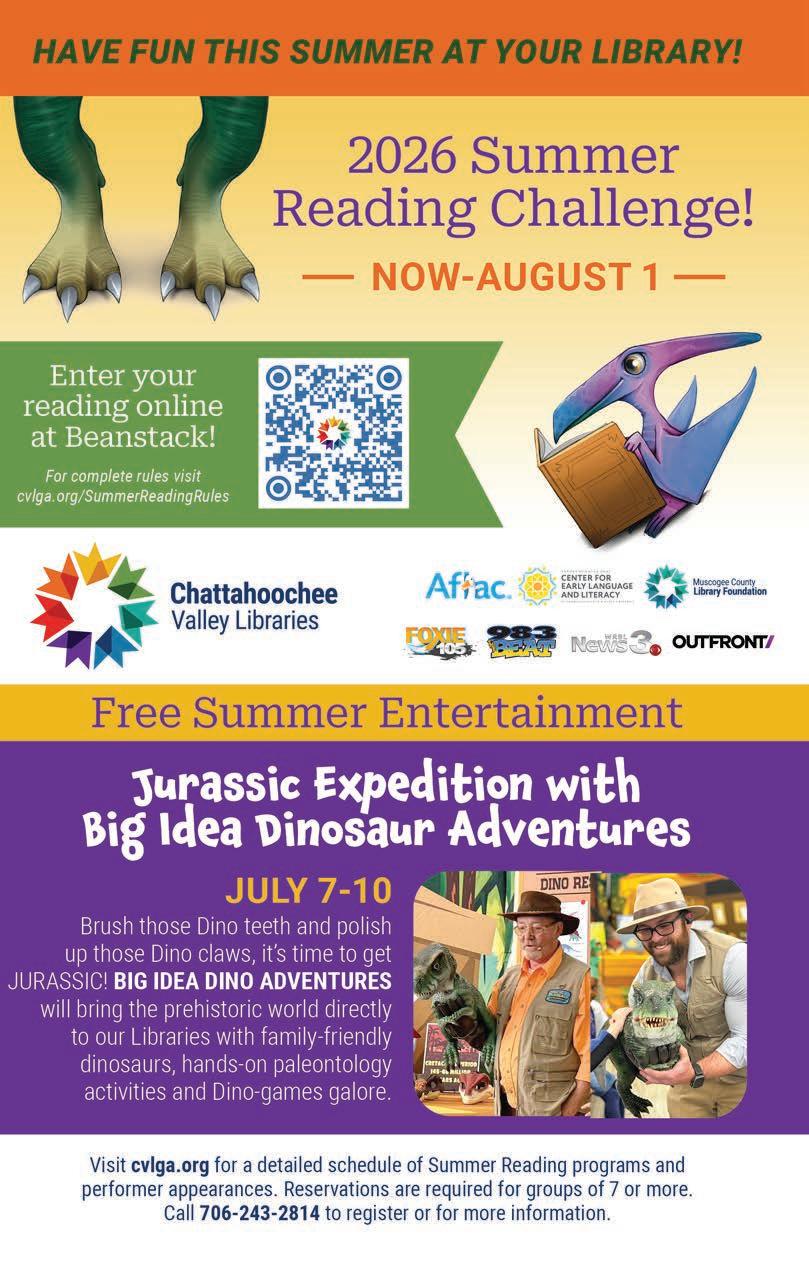
The Chattahoochee Valley Libraries Summer Reading Program is one of the most popular options for local families. Children can register in person at any library branch or through the Beanstack app. After signing up, participants receive a free book and can track their reading by logging books or reading minutes on Beanstack. Kids earn a prize every time they read 10 books or complete 100 minutes of reading. At the end of the summer, additional prizes and raffle drawings will reward dedicated readers.
Barnes & Noble also offers a summer reading challenge for students in grades 1–6. Children complete reading matchups in a journal by reading two books at a time. After each matchup,
they visit a local store to receive an exclusive summer reading sticker and submit a recommendation slip about their favorite book. Once all four matchups are complete, participants earn a Champion sticker and can select a free book from the store’s summer reading list.
Restaurants are also joining the effort to encourage literacy. Panda Express sponsors the “Read With Me” program, where teachers enroll their classes and students work toward reading five books to earn a free kid's meal coupon. Homeschool students may also participate.
Meanwhile, Pizza Hut’s “Summer of Stories” program allows children to earn free Personal Pan Pizzas by meeting monthly reading goals through the BOOK IT app. Kids can earn one free pizza each month through August.
These programs help children build strong reading habits while making summer learning fun and rewarding.
By Linda Ligon, Family & Kids
This summer, the federal government will offer parents a new option for saving money for their child’s future called a Trump Account. Trump Accounts will become active and ready to receive funds on July 4.
A Trump Account is a savings account for a child under the age of 18. Any child with a valid Social Security number is eligible to create a Trump account. The federal government will initially contribute a one-time deposit of $1,000 in the accounts of eligible US citizens born between January 1, 2025 and December 31, 2028. Families with multiple children can open multiple accounts. Parents, grandparents and other authorized individuals can contribute up to $5,000 annually into a child’s account. Parents have control over the account until the account holder turns 18. Funds contributed can be invested in diversified portfolios of low-cost index funds, and an app can be used to track the account balance and the stock performance.
Teens and young adults can start saving money in their Trump Account once they are employed and have income. The good news
is that having a Trump Account does not exclude your child from having other savings accounts such as a Roth IRA.
The funds are locked from withdrawal until the year the account holder turns 18. At this point, the funds in the account are turned over to the account holder. The account holder can choose to use the money for college tuition, to help start a business or for down payments for other large purchases. This is in contrast to 529 plans, which only allow the funds to be used for specific purposes, such as college tuition. The account holder can also choose to leave the money in the account and treat it as a long-term investment.
The initial $1,000 government contribution will not be taxed as family income, and any parent contributions are tax-deferred. The money is not taxed until it is withdrawn from the account by the account holder.
Parents can open a Trump Account for an eligible child through an online portal. See trumpaccounts.gov for more information.

by Leonard Sax
Your child is not your equal. That truth, simple but piercing, sits at the very heart of this book. Sax exposes the silent damage that happens when parents stop being parents and start becoming roommates, besties, or approval-seekers. This book is not about controlling children with fear, it is about rescuing them from confusion. In a generation where everybody wants to “gently parent” but nobody wants to lead, where screens are raising children faster than wisdom can reach them, this book feels like cold water on a sleepy face. It is emotional, uncomfortable, healing, and deeply necessary.
1. Children crave leadership, not negotiation. One of the deepest lessons in this book is that children actually feel safer when parents confidently take charge. Modern parenting has pushed many adults into constantly negotiating with kids over every tiny thing, bedtime, food, schoolwork, respect, even basic discipline, as though a seven-year-old and a grown adult carry the same emotional wisdom. Sax explains that when parents become overly democratic in the home, children often become anxious, insecure, and emotionally exhausted because they are carrying responsibilities they were never built to handle. Listening to him narrate this felt painfully real, especially in today’s culture where many parents fear being called “strict” more than they fear raising confused children. Sometimes love is not endless permission, sometimes love is saying no without guilt. And honestly, in this era where social media keeps shouting “let kids express themselves,” Sax gently reminds us that children bloom best when somebody wiser lovingly leads them.
2. Technology is quietly stealing their childhood. He explains that children today are growing up overstimulated, emotionally detached, and addicted to constant entertainment, while parents unknowingly surrender authority to phones, tablets, gaming systems, and social media. Sax does not just criticize technology, he mourns what children are losing because of it, deep conversations, imagination, patience, eye contact, boredom that sparks creativity, and genuine family bonding. In today’s world where “screen time” has become a survival tactic for tired parents, this message lands heavily. You can almost hear Sax pleading with families to reclaim the dinner table, reclaim storytelling, reclaim human connection before algorithms become the loudest voices shaping our children.
3. The detriment of declining adult disrepect. One painful truth Sax keeps returning to is that many children today no longer view adults as authority figures worthy of respect, and society
often celebrates this collapse like it is progress. He talks about classrooms where students mock teachers openly, homes where children insult parents casually, and cultures where obedience has become almost a dirty word. Modern culture often confuses respect with oppression, when in reality, respect teaches humility, patience, and emotional maturity. A child who never learns healthy respect may grow into an adult who cannot handle correction, commitment, or responsibility. That realization alone is enough to humble anybody.
4. Stop outsourcing your child's influence.
One thing Sax makes painfully clear is that many parents have unknowingly surrendered their role to peers, celebrities, influencers, schools, and internet culture. Children now learn identity from TikTok trends, values from celebrities, confidence from likes, and morality from strangers online. Sax warns that when parents stop intentionally shaping their children’s worldview, something else will gladly take their place. In a world obsessed with hustle culture, soft life, and chasing validation, many children are starving for presence, guidance, and meaningful connection at home. Children remember who truly showed up emotionally, not just financially.
5. Strong families are built through purpose, responsibility, and shared values. Children thrive when they belong to something bigger than themselves. Sax explains that many kids today are drowning in entitlement because they have never been taught responsibility, sacrifice, or contribution to family life. Chores matter, family traditions matter, shared meals matter, accountability matters. Sax paints a picture of families not as entertainment centers where children are constantly pleased, but as communities where everyone learns love through service and responsibility. Honestly, this lesson carried so much warmth because it reminded me that the strongest homes are rarely the loudest or flashiest ones online. They are usually ordinary homes filled with intentional conversations, discipline wrapped in affection, laughter around tables, and parents brave enough to lead with wisdom instead of fear. In this generation where everything feels performative and aesthetic, Sax reminds us that what children truly need cannot be bought, filtered, or trend online. They need anchored parents.










By
This summer, families across the Chattahoochee Valley are joining the adventure with our Summer Reading Challenge: Unearth a Story. While children may be excited about dinosaurs, fossils, and discovery, there’s another treasure waiting to be uncovered at your local library – story time.
For young children, story time is much more than sitting and listening to a book. It’s a chance to build the skills that help them become readers long before they ever enter a classroom.
At Chattahoochee Valley Libraries, our story times are built around five simple practices that parents can use every day: Sing, Talk, Read, Write, and Play. These activities may seem simple, but together they help children develop vocabulary, strengthen communication skills, build confidence, and make connections that prepare them for school and lifelong learning.
When children sing songs, they hear the rhythms and sounds that make up language. When families talk about stories, ask questions, and share ideas, children learn how words work. Reading together introduces new vocabulary and sparks imagination. Writing activities help little hands

HOO’s learning
develop coordination, while play encourages creativity, problem-solving, and social skills.
Just as important, story time helps families connect.
For many parents and caregivers, story time is one of the first opportunities to meet other families with young children. It creates a welcoming place where kids can learn together, caregivers can share experiences, and families can discover resources that support them as their children grow.
Think of it as a weekly excavation site for curious minds. Every song uncovers a new sound. Every story reveals a new idea. Every conversation helps children dig deeper into the world around them.
Finding one is easy. Visit cvlga.org to browse our online Program Guide or Events Calendar, which can be sorted by date, location, age group, and program type. You can also explore upcoming events through our free mobile app.
This summer, while you’re unearthing stories, don’t forget to uncover the power of story time, too. You may be surprised by what your child discovers!


By Linda Ligon, Family & Kids
Parenting in today’s world often seems like a constant effort to keep up with new, trending parenting styles. It can feel easier just to dismiss traditional parenting concepts and start anew, rather than having to mesh the new and the old together. However, here are some time-tested parenting concepts that experts say you should consider making part of your parenting style.
Try to plan as many family meals together each week as possible. Research shows extensive emotional and physical health benefits for kids who participate in screen-free family mealtimes. Family mealtimes help provide structures for your child’s day and strengthens your connection with your child. When she has a difficult day, family mealtime is a comforting experience. Your child knows you will be there to listen to her if she needs to share how her day went.
R Cooking at home means you have more control over the nutritional quality of the food. Preparing meals together is a bonding experience all its own and helps kids learn how to prepare nutritious food for themselves, an important life skill.
R Eating a meal together helps teach your child social skills, such as taking turns when having a conversation and table manners.
Modern family life may require some flexibility to be able to fit in several family meals a week. The meal does not have to be dinner. It could be a special weekend breakfast or a Sunday brunch. A takeout meal can sometimes be substituted for a home-cooked meal when unexpected changes in plans make it difficult to grocery-shop. Although take-out food may not be as healthy as the home cooked meal you had planned, your family still benefits from the time together.
There is great value in allowing kids the freedom to explore the outdoors, within reasonable age-appropriate limits.
R When kids explore the outdoors freely, they are able to build motor skills and physical fitness.
R Natural daylight helps kids increase their vitamin D and exposure to daylight also helps kids set healthy circadian rhythms, leading to better sleep.
R Free play outdoors, without the interference of adults, helps with cognitive development. Kids are free to use creativity and problem-solving skills.
R When kids engage in free play outdoors, it helps build their social skills. It is up to your child to organize her friends during pretend play or help everyone come to an agreement on rules for a new game they created.
R Allowing free play outdoors within limits fosters independence and teaches your child to take responsibility for making her own choices. When kids are over-constrained, they do not have the opportunity to show that they can make responsible decisions.
The job description of a parent does not include being your child’s best friend or peer. Establishing boundaries when it comes to communication teaches your child to respect your decision and teaches her how to handle disappointment when ‘no’ is your answer.
R Communication boundaries set expectations for respectful communication with parents and with other authority figures, such as teachers. These boundaries, when consistency enforced, help cut down on ‘sassy’ backtalk like ‘You can’t make me!’
R Standing firm on your ‘No’ decision consistently greatly reduces whining and endless attempts to negotiate. Help your child learn to process disappointment by saying something like ‘I see you feel disappointed’ and perhaps offer an alternate solution, but do not change your decision.


This is the perfect July baking project. They feature juicy summer blueberries tucked between layers of buttery oat crumble. The bars are sweet enough to feel like dessert, yet wholesome enough to serve as an afternoon snack or special breakfast treat.
Preheat oven to 350°F. Line an 8-inch square baking pan with parchment paper. In a large bowl, combine oats, flour, brown sugar, cinnamon, and salt. Stir in melted butter until crumbly. Press about two-thirds of the mixture firmly into the prepared pan. In a separate bowl, toss blueberries with lemon juice, honey, and cornstarch. Spread the blueberry mixture evenly over the crust. Sprinkle the remaining oat mixture over the top. Bake for 30–35 minutes, or until golden brown and bubbly. Allow to cool completely before cutting into bars.

For the Crumble
• 1½ cups old-fashioned oats
• 1 cup of flour of choice
• ½ cup brown sugar
• 1 teaspoon cinnamon
• ½ teaspoon salt
• ½ cup unsalted butter, melted
For the Filling
• 2 cups fresh blueberries
• 1 tablespoon lemon juice
• 1 tablespoon honey
• 1 tablespoon cornstarch
Blueberries are one of the few fruits native to North America. For centuries, Indigenous peoples gathered wild blueberries and used them in foods, medicines, and natural dyes. Today, blueberries are grown throughout the United States.
One reason blueberries have earned their reputation as a "superfood" is their abundance of antioxidants. These naturally-occurring compounds help protect the body's cells from everyday damage. The deep blue color of the berries comes from antioxidants called anthocyanins, which are responsible for many health benefits.
Blueberries are also packed with nutrients that support overall wellness. They contain vitamin C, which helps maintain a healthy immune system, and fiber, which supports healthy digestion. Best of all, blueberries provide natural sweetness while remaining relatively low in calories, making them an easy choice for healthy snacking. Parents appreciate that blueberries are one of the simplest fruits to serve. There's no peeling, slic-
ing, or special preparation required—just rinse and enjoy. Their small size makes them perfect for little hands, and their sweet flavor often wins over even selective eaters.
Blueberries are also full of fascinating facts:
• Blueberries begin as tiny white blossoms before developing into fruit.
• They change color from green to pink before turning their signature blue.
• Fresh blueberries float in water because they contain small air pockets.
• A mature blueberry bush can produce thousands of berries each season.
• Well-maintained blueberry plants can continue producing fruit for decades.
Whether enjoyed fresh by the handful or featured in a favorite family recipe, blueberries are a delicious way to add nutrition to your day. The next time you reach for a snack, consider a handful of blueberries—a small fruit with a surprisingly big story.
1 Summer Cinema: Unearth A Movie. Families. 2pm. Columbus Library; 706-243-2813
1 A Day in the Life of Little House on the Prairie with Historic Westville. Families. 2pm. North Columbus Library; 706-748-2855
2 Happy Birthday, USA! Families. All day. South Columbus Library; 706-683-8805
2 Movie: The Bad Guys 2 (PG). 11am. Giant Screen Theatre, National Infantry Museum; 706-685-5800
2 Seed to Salsa. 9-11am. $8-$12. Ages 2-17. Columbus Botanical Garden, 706-327-8400
2 Movie: Sonic the Hedgehog (PG). 2pm. Giant Screen Theatre, National Infantry Museum; 706-685-5800
2 Rock ‘N’ Roar! A Summer Discovery Series. Ages 6-11. 3pm. North Columbus Library; 706-748-2855
3 July 4th (America 250) Parade & Drone Show. 6:30pm. Broadway and Synovus Park, Facebook.com
3 Movie: Sonic the Hedgehog (PG). 11am. Giant Screen Theatre, National Infantry Museum; 706-685-5800
3 Movie: The Bad Guys 2 (PG). 2pm. Giant Screen Theatre, National Infantry Museum; 706-685-5800
3 Freedom Celebration & Fireworks. 6:30pm. Opelika High School; opelika-al.gov
3-5 July 4th Star-Spangled Beach Party & Fireworks. All day. Callaway Gardens; 855-885-3841
4 FreedomFest 1776-2026. 10am-5pm. National Infantry Museum; 706-685-5800
4 Independence Day Celebration & Concert. 10am-4:30pm. $7. National Civil War Naval Museum; 706-327-9798
4 July 4th (America 250) Celebration. TBA. Uptown Columbus; Facebook.com
5 706 Day Block Party. 4-8pm. Woodruff Riverfront Park; facebook.com
6
Simple Steps: Play. Ages 0-5. 10am. Mildred L. Terry Library; 706-243-2782
6 Kids Night Cow Appreciation Day Craft. 4-7pm. Chick-fil-A Columbus Park Crossing and Bradley Park Drive; facebook.com
6 Summer Cinema. Families. 10am. North Columbus Library; 706-748-2855
6 Family Fun Night: Unearthing Your Garden. 4pm. Columbus Library; 706-243-2813
7 Little Sprouts. 10am & 2:30pm. Ages 0-5. $5/family. Columbus Botanical Garden; 706327-8400
7 Brick Archaeology: Egyptian Pyramids. Ages 6-11. 2pm. South Columbus Library; 706-683-8805
7 Kid’s Art Studio. Ages 5-12. 4pm. Columbus Library; 706-243-2813
8 Jurassic Expedition with Big Idea Dinosaurs. Families. 11am. Columbus Library; 706-243-2813
8 Summer Cinema: Unearth A Movie. Families. 2pm. Columbus Library; 706-243-2813
9 Jurassic Expedition with Big Idea Dinosaurs. Families. 11am at Mildred L. Terry Library and 3pm at South Columbus Library
9 Rock ‘N’ Roar! A Summer Discovery Series. Ages 6-11. 3pm. North Columbus Library; 706-748-2855
10 A Midsummer Day’s Dream Party. Families. 10:30am. Columbus Library; 706243-2813
10 Jurassic Expedition with Big Idea Dinosaur Adventures. Families. 11am and 3pm. North Columbus Library; 706-748-2855
10 Summer Cinema. Families. 2pm. Mildred L. Terry Library; 706-243-2782
10 Grannycore Summer: Bingo. Families. 4pm. Columbus Library; 706-243-2813
11
Story time at Highside. 10:30am. Highside Market; facebook.com
11 The Flip Trade Show. 11am-6pm. $7. Columbus Convention & Trade Ctr; facebook.com
11 West Point Lake Dragon Boat Race. 8am. Pyne Road Park, LaGrange; wpldragonboatrace.com
11
Honey Harvest. 10am-1pm. RSVP. Oxbow Meadows; 706-507-8550
11 Simple Steps: Play. Ages 0-5. 10am. Columbus Library; 706-243-2813
11 Second Saturday Tours. 11am. $8-$12. Historic Westville Village; 706-221-9330
11 Artful Babies. 1:30am. Ages 6-24mo. Columbus Museum; 706-748-2562
11 Presidential Flyer. 10am. SAM Shortline, Cordele; 1-877-GA-RAILS
13 Summer Cinema. Families. 10am. North Columbus Library; 706-748-2855
13 Unearth A Story: Summer Craft Series. Ages 6-11. 11am. RSVP. Mildred L. Terry Library; 706-243-2782
14 Crafty Kids: Clay Dinosaur Fossils. Ages 6-11. 2pm. S. Columbus Library; 706-683-8805
14 Pony Bead Party. Ages 5-12. 4pm. Columbus Library; 706-243-2813
15 Summer Cinema: Unearth A Movie. Families. 2pm. Columbus Library; 706-2432813
16 Rock ‘N’ Roar! A Summer Discovery Series. Ages 6-11. 3pm. North Columbus Library; 706-748-2855

16
Uno, Dos, Tres Crafts! Ages 4-8. 3pm. RSVP. Mildred L. Terry Library; 706-243-2782
16
Third Thursday Movie Night: Sandlot (PG). 6pm. Highside Market; facebook.com
16-26 How Things Happen in Three: A Musical Comedy. $13.50-$18.50. Family Theatre; 706-431-3752
17 Finger Paint Friday! Ages 1-5. Families. 11am. N. Columbus Library; 706-748-2855
17 Book Binding for Beginners. Families. 4pm. Columbus Library; 706-243-2813
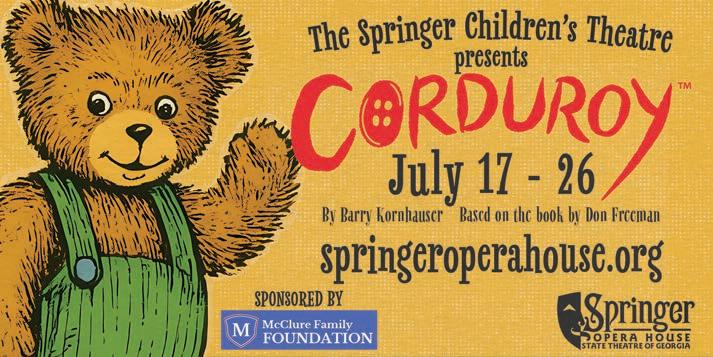
17-19
Corduroy. Times vary. Springer Opera House; 706-327-3688
18 Presidential Flyer. 10am. SAM Shortline, Cordele; 1-877-GA-RAILS
18 Hero for a Day. 9am-Noon. $10-$20. Columbus Convention & Trade Center
20 Simple Steps: Play. Ages 0-5. 10am. Mildred L. Terry Library; 706-243-2782
20 Creative Kids’ Theatre. Families. 4pm. Columbus Library; 706-243-2813
21 Sing-Along Music Bingo. Families. 2pm. South Columbus Library; 706-683-8805
21 Kid’s Art Studio. Ages 5-12. 4pm. Columbus Library; 706-243-2813
22 Summer Cinema: Unearth A Movie. Families. 2pm. Columbus Library; 706-2432813
23 Seed to Salsa. 9-11am. $8-$12. Ages 2-17. Columbus Botanical Garden, 706-327-8400
23 Rock ‘N’ Roar! A Summer Discovery Series. Ages 6-11. 3pm. North Columbus Library; 706-748-2855
24-26 Friends of Libraries Big Summer Book Sale. 10am-5pm. Columbus Library; 706-243-2689
25 Story time at Highside. 10:30am. Highside Market; facebook.com
25 Mini Makers. 10:30am. Ages 2-4. Columbus Museum; 706-748-2562
25-26 Corduroy. Times vary. Springer Opera House; 706-327-3688
29 Seedling Storytime. 10-11am. $7.18. Columbus Botanical Garden, 706-327-8400
29 Back to School Kids Night. 4-7pm. Chick-fil-A Columbus Park Crossing

MONDAY
Simple Steps Storytime: Babies & Toddlers. Ages 0-36 mo. 10am. Columbus Library; 706243-2813
TUESDAY
Simple Steps Storytime. Babies & Toddlers. Ages 0-24 mo. 10am; Preschoolers. Ages 3-5. 11am. North Columbus Library; 706-7482855
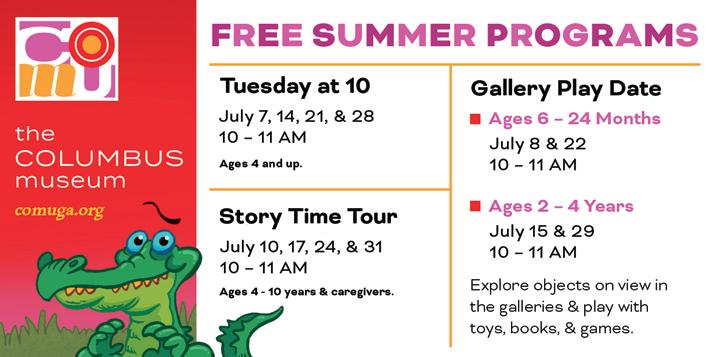
Tuesdays at 10. 10am. Ages 4+. Columbus Museum; 706-748-2562
Get On Board With Board Games: Chess & More. Families. 4:30pm. Mildred L. Terry Library; 706-243-2782
Golden Donut movie day. Noon to 2pm Ages 5-12. RSVP. Wynnton Rd location; grammer. golden@gmail.com or 706-243-1468.
WEDNESDAY
Simple Steps Storytime. Ages 0-5. 11am. Mildred L. Terry Library; 706-243-2782
Storytime with Grammy Trish. 11am. Columbus Bound Bookshop; visitcolumbusga.com
Gallery Play Date. 10-11am. Ages 6-24mo. Columbus Museum; 706-748-2562 (Not 7/1)
Discovery Hub. Ages 3-5. 11am. Columbus Library; 706-243-2813
THURSDAY
LEGOS® in the Library. Families. 4pm. Columbus Library; 706-243-2813
Thursdays Golden Game Day. 1pm-3pm. Bring your board games and have fun. Wynnton Rd location. RSVP. grammer.golden@ gmail.com or 706-243-1468.
FRIDAY
Family FriYAYs. 4-10pm. $8-$12. Columbus Botanical Garden, 706-327-8400
Simple Steps Storytime: Rhythm & Rhyme. Ages 0-5. 10am. Columbus Library; 706-2432813 (Not 3rd, 10th )
Farmstand Friday. 9-Noon. The MercyMed Farm, 3820 2nd Ave, Columbus; 706-5079209
Story time Tour. 10am. Ages 4-10. Columbus Museum; 706-748-2562 (Not 7/3)
Summer Fun. 1-5pm. $8-$12. Historic Westville Village; 706-221-9330
SATURDAY
Summer Fun. 1-5pm. $8-$12. Historic Westville Village; 706-221-9330
Market Days on Broadway. 9am-Noon. 900, 1000 & 1100 blocks of Broadway; uptowncolumbusga.com
Chipley Square Farmers Market. 10am-2pm. McDougal Ave and Broad Street, Pine Mountain; facebook.com
Please call ahead to confirm event dates, times and age appropriateness, in case changes were made after the info was obtained.
Most kids can't get enough of bubbles, but they are so fragile, they can't be enjoyed for long or done indoors without making a mess. These magic bubbles are tough enough to blow one bubble inside an other bubble. Yes, you read that right. We’re talking bubble-ception. And the best part? You probably have everything you need sitting in your kitchen right now.
1. Mix the sugar into the water until the crystals dissolve.
2. GENTLY add the dish soap without frothing it.
3. Spread a thin layer of your bubble solution on a CLEAN table. Any sticky spots or crumbs will sabotage your bubbles!
4. Dip your straw into the bubble solution, then hold it close to prepped surface and blow gently and watch as a perfect bubble forms.
5. Dip your straw back into the solution, then carefully poke it through the wall of your first bubble and blow another bubble in a bubble.

• Challenge your kids to see how many layers they can create, or try to stack them on top of each other and make a tower. Or set a timer and see who can make the most in that time.
• Clean up right after you are done, as the solution dries sticky.
• Why it works? Regular bubbles are just air trapped inside a thin skin of soapy water. They pop so easily because that skin is incredibly fragile. The water in the bubble evaporates quickly, which weakens the skin even more, and pop – your bubble’s gone. The sugar slows down evaporation by making the bubble’s skin thicker and more durable. The sugar molecules get in the way of the water molecules trying to escape, so your bubbles stick around way longer.
• 1 cup water
• 1 tablespoon granulated sugar (this is the secret!)
• 2 tablespoons liquid dish soap
• A straw (one per kid)
• A clean counter or table
Courtesy of: playpartygame.com


Families in Columbus, Georgia, don’t have to travel far to enjoy exciting summer adventures. The area offers plenty of day trips and short vacation options that are perfect for families, couples, and anyone looking for a quick getaway without spending hours on the road.
One of the most popular summer destinations is Callaway Resort & Gardens in Pine Mountain, located about 40 minutes from Columbus. Callaway offers beautiful gardens, walking trails, zip lines, golf, and Robin Lake Beach. Families can spend the day swimming, biking, and exploring nature together.
For outdoor lovers, Providence Canyon State Park is another favorite destination located about 1 hour and 30 minutes away. Often called “Georgia’s Little Grand Canyon,” the park fea-
tures colorful canyon views, hiking trails, and picnic areas. It makes a great day trip for families wanting to enjoy fresh air and scenic scenery.
Families looking for educational fun can visit the National Infantry Museum in Columbus. The museum offers interactive exhibits and historical displays that appeal to both children and adults. Or plan a weekend trip to Atlanta, which is about 1 hour and 45 minutes away. While there, families can enjoy attractions such as the Georgia Aquarium, World of Coca-Cola, Zoo Atlanta, and Six Flags Over Georgia.
Water activities are also popular during the summer months. Whitewater rafting on the Chattahoochee River in Uptown Columbus attracts visitors from across the Southeast. The rafting course includes exciting rapids as well as calmer sections suitable for beginners and families.
For beach lovers, several popular coastal destinations are within driving distance of Columbus. Gulf Shores, Alabama, is about a 4-hour drive and offers beautiful beaches, seafood restaurants, and family-friendly attractions. Florida’s scenic 30A area, known for beach towns like Seaside and Rosemary Beach, is about 4 and a half hours away and is popular for its white sand beaches and bike-friendly communities. Savannah and nearby Tybee Island are about 4 hours away, giving visitors the opportunity to enjoy both historic sightseeing and relaxing beach time during one trip.
Whether exploring nature, visiting museums, enjoying amusement parks, or relaxing by the water, there are many affordable and entertaining summer options near Columbus, Georgia.





















With deals this good, save the mess and dine out!
MONDAY
Sapo’s
5pm until close: free kid's meal with adult entrée, dine in only
tuesday
Denny’s
4-10pm: Up to two free kids entrées with adult entrée for kids 10 and under
The Food Mill
Buy a family meal, get 2 kids meals for free!
Ruby Tuesday
5-10pm: Kids 12 and under eat free with adult entrée
wednesday
Your Pie
Kid's meals half off with adult entrée Crumbl
Free mini cookie with purchase of regular cookie
Chick-fil-A (Bradley Park/ Columbus Park)
Free kids meal with adult meal 4:30-7:30pm on Front Counter App
Does your restaurant have a special offer for kids?!
Let us know and we can promote it here for FREE to 20K parents!
Email it to us at: Tammy@familyandkidsga.com
Thursday
Tuesday's Street Tacos & Burritos
Free kids meal with adult purchase; dine-in only
friday
Denny’s
4-10pm: Up to two free kids entrées with adult entrée for kids 10 and under
Ruby Tuesday
5-10pm: Kids 12 and under eat free with adult entrée
SUNDAY
Vallarta Mexican Restaurant
Free kids' meal with the purchase of adult entrée
everyday
Bruster’s Ice Cream
Kids under 40” get free baby cone
McAlister’s
Kid’s meals are $2.79 with dine-in order
Chick-fil-A (Bradley Park/ Columbus Park)
Free kids meal with adult meal 4:30-7:30pm
All locations are Columbus, GA unless noted. Specials are subject to change without notice, so please verify them directly before dining. Send kids deals to Tammy@FamilyAndKidsGA.com.

By Imani Jones, United Way’s Manager of RCV and The Basics
The timer’s ticking, the pasta water is boiling, and your toddler is tugging at your leg. It would be easy to rush through dinner prep. But what if those messy, chaotic minutes in the kitchen were some of the best learning opportunities of the day?
That’s the idea behind “The Basics,” a set of five simple, science-backed strategies that help families turn everyday moments into brain-building ones. And one of our favorite ways to bring them to life is in the kitchen.
But First, What are “The Basics?”
Science shows that 80% of brain growth happens by the age of three and 90% by the age of five. Your child’s brain grows like a muscle, getting stronger as they connect with you and explore the world. “The Basics” principles are five fun, simple and powerful ways to connect with your child and help them reach their full potential.
MAXIMIZE LOVE, MANAGE STRESS to stay emotionally present for your child. Your support strengthens their emotional health and self-control skills.
TALK, SING, AND POINT to boost your child’s language development and knowledge of the world.
COUNT, GROUP, AND COMPARE to help your child make sense of the numbers and categories all around them.
EXPLORE THROUGH MOVEMENT AND PLAY to encourage curiosity, discovery, and a healthy body.
READ AND DISCUSS STORIES to build your child’s knowledge, reasoning, and early literacy skills.
Using “The Basics” While Cooking Parents, incorporate the principals of “The Basics” while in the kitchen with your kids by pointing to ingredients and naming them as you cook, counting eggs one-by-one into the bowl, or comparing which pile of veggies is bigger. No extra prep time. No fancy toys. Just real life, real meals, and real connection.
So the next time you make dinner, consider using “The Basics.” Here’s some suggestions on how:
• Maximize love & manage stress by making mindful art. Cut a veggie or fruit in a variety of shapes and sizes, stamp them into paint, and you’ve got new artwork!
• The next time you cut a fruit or veggie, count how many times you cut the object to practice…count, group and compare.
• Be silly together and create a song based on the color of each fruit or veggie to practice…talk, sing and point.
• Explore through movement and play by encouraging your child to create funny faces using different fruits and veggies!
• Read and discuss stories by sharing a story about a memory of your favorite food as a child.
Using “The Basics” at The Table
Expand the learning session from the kitchen to the table as you share in a meal together. Get your child talking and thinking with these suggestions.
• If you could be any animal for a day, what would you be and why?
• What is your favorite game to play? What makes you like it so much?
• What is something that makes you really happy? Can you tell me why?
• How do you feel when someone gives you a hug?
“The Basics” remind us that you don’t need more hours in the day — just a few intentional moments. Stirring, setting the table, even washing vegetables all become chances to talk, count, explore, and bond. Because learning happens everywhere — even over a pot of spaghetti.
Basics Insights is a free text messaging program for parents and caregivers of young children that sends science-based tips to boost your child’s learning and brain development. Sign up at cv.thebasics.org/basics-insights/
For more easy tips, printable resources, and local workshops, visit cv.thebasics.org.
Autosomal Recessive Polycystic Kidney Disease (ARPKD) is a genetic disorder that leads to the growth of numerous fluid-filled cysts in the kidney. The growth of the cysts enlarges the kidneys and slowly damages the surrounding tissue. ARPKD is a rare condition, occurring only when both parents are a carriers of the abnormal gene which leads to ARPKD, and the baby inherits the abnormal gene from both parents. It affects about 1 in 20,000 children, making it much less common than the form of PKD, Autosomal Dominant Polycystic Kidney Disease (ADPKD), which mostly affects adults.
ARPKD often causes enlarged kidneys and poor kidney function even before birth. Poor kidney function can lead to breathing problems and issues with lung development for an unborn baby or newborn. About 30 percent of newborns with ARPKD do not survive their first week of life due to the lungs not being able to function well enough to allow the baby to survive.
Babies with ARPKD who survive birth and the first few weeks of life have a good chance of living into adulthood but will need lifelong medical treatment. ARPKD can lead
By Linda, Ligon, Family & Kids
to kidney failure before adulthood, as the kidney enlargement cannot be prevented or reversed. Kidney failure makes either a kidney transplant or dialysis necessary.
ARPKD may have other complications, such as liver scarring, growth failure and high blood pressure. Severe liver issues are sometimes treated with a combined kidney and liver transplant. Growth failure is often treated with prescribed growth hormones, and high blood pressure is treated with medication. Proper treatment of high blood pressure can help delay further damage to the kidneys.
Doctors diagnose ARPKD prenatally or shortly after birth with a combination of imaging tests that provide a view of the structure of the kidneys. Lab tests, such as genetic testing to confirm the presence of the abnormal gene that causes ARPKD, may also assist in diagnosing ARPKD. However, kids with milder cases of ARPKD may not have symptoms and be diagnosed until later in childhood. Symptoms of ARPKD in kids include slow growth, abnormally high blood pressure, a swollen abdomen and excessive thirst.