AUSTRALIA’S ONLY NATIONAL MONTHLY FISHING MAGAZINE
FREE #173 - OCT 2026
SNAPPER ON PLASTICS
BAITING THE GBR
Shallow water reds in Port Phillip Bay.
Bottom bashing the Great Barrier Reef.
CHOOSING THE RIGHT BRAID
TACKLE NEWS
How many strands do you really need?
The latest drops in the tackle word.
SET NEW EXPECTATIONS The NSS® 4 chartplotter and fishfinder redefines what’s possible out on the water.
simrad-yachting.com/NSS-4 With a trio of hybrid controls, a lightning quick Qualcomm® 8-core processor, and dual channel CHIRP sonar, NSS 4 is our premium, all-in-one offering for sportfishing enthusiasts and cruisers.
®
C-MAP® REVEAL® X charts sold separately. Reg. U.S. Pat. & Tm. Off, and ™ common law marks. Visit www.navico.com/intellectual-property to review the global trademark rights and accreditations for Navico Group and other entities.
HOOKED UP MAGAZINE - OCTOBER 2026 - ISSUE #173 HOOKED UP MAGAZINE - OCTOBER 2026 - ISSUE #173
AUSTRALIA ’S ONLY NATIO
NAL MON
THLY FISHI
NG MAGA
ZINE
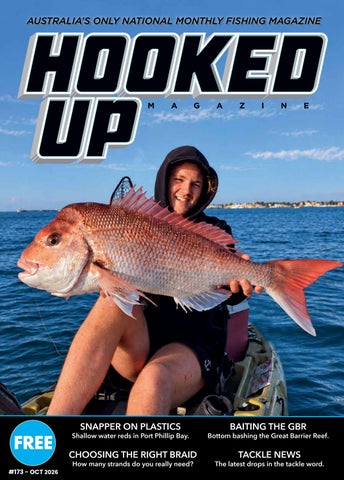
ON THE COVER: Joel Bramble with a big Port Phillip Bay snapper taken in the shallows.
FREE
GET PREPARED Most anglers will relate to this situation. You head out fishing fairly prepared — rods, lures, leader — and you think you’re good to go. You’re not expecting anything crazy to happen. Then the fish are on. Leaders are broken, lures are lost and you’re frantically retying. You run out of the one size and colour of plastic that’s absolutely killing it. Your mate seems to be hooking up more than you. Maybe it’s that rod he bought — the action does seem a bit faster. Then you run out of leader and tie on the heavier stuff you’ve got. Suddenly you’re getting fewer bites. There are tackle trays, lures and gear all over the floor. Something breaks. The drag starts stuttering. The handle is coming loose. So is the reel seat. Eventually the bite stops, the world slows down and you look around at the fish, the mess and the gear scattered everywhere and think, I could have done better. I could have caught more. That feeling is part of what drives the fishing industry, and for good reason.
#173 - OCT
2026
SNAPPER ON
Shallow water
CHOOSING How many
PLASTICS
reds in Port
Phillip Bay.
THE RIGHT
strands do
BRAID
you really need?
BAITIN
Bottom bashing G THE GBR the Great Barrier Reef.
TACKLE NEWS
The latest drops
CONTENTS
6-15 FISHING & TACKLE NEWS 16-23 SNAPPER ON PLASTICS 24-31 BAIT FISHING THE GBR 32-38 A GUIDE TO BRAID
PUBLISHER
The problem was preparation. You’ve probably prepared properly plenty of times before, but all that time spent in the garage, shed or tackle room is often followed by a run of slower sessions. Things gradually become disorganised, tackle doesn’t get replaced and before long you start taking preparation for granted.
Hammerhead Media Pty Ltd
The point is simple: prepare for every trip as though it’s going to be the best session of your life.
SUB EDITOR
As we move through spring, summer and autumn, those epic sessions are going to happen. You don’t want to be caught out on Saturday morning because you had a couple of beers at the pub after work on Friday and didn’t prepare properly for the trip. Take the time now to stock up on the essentials — new trebles, split rings, leader, hooks, bait, terminal tackle and fresh line. Replace anything that’s worn out, and if you need a new rod, reel or lure, buy it before the session where you wish you had. It can be cost-effective to have one outfit covering multiple species and techniques, but where possible, a dedicated outfit for the job will nearly always perform better. And enjoy the preparation. Lay everything out, organise the tackle, respool the reels, change the hooks and get everything ready.
EDITOR IN CHIEF Kosta Linardos kosta@hookedup.com.au
Tim Evans
ONLINE EDITOR Adam Hewson info@hookedupmagazine.com.au
GRAPHIC DESIGN Cassandra Li, Khristian Lloyd
CONTRIBUTORS Dean Linardos, Colby Lesko, Joel Bramble, Sammy Leys, Kozi Sekino, Mitch Chapman,
ADVERTISING info@hookedup.com.au
Prepare for the trip like Rambo gearing up for a revenge mission. It’s part of the fun — and when the fish really turn it on, it pays off big time. Kosta Linardos
www.hookedup.com.au
Editor In Chief
Find Us Online hookedup.com.au
in the tackle
word.
LIGHTWEIGHT REFINEMENT, REDEFINED CI4+ BODY & ROTOR Lightweight, responsive feel. SCAN TO FIND OUT MORE
ONE-PIECE BAIL Smoother, cleaner line flow.
ANTI-TWIST FIN NEW INFINITYDRIVE
Improved line management.
Lighter, easier winding under load.
Lightweight, smooth and responsive performance, with technology inherited from Shimano’s higher-end reels.
5 PREMIUM MODELS Shimano.Fish
shimano.fish
ShimanoAustralia
Check your local Shimano Stockists.
1000 TO C5000 ShimanoAustralia fish.shimano.com/en-AU
@shimanoaustralia
FISHING & BOATING NEWS
BAIT JUNKIE 4-INCH PRAWN Arguably the number one bait source in coastal estuarine systems and inshore waters, the new Daiwa Bait Junkie Prawn opens up fresh possibilities for Aussie anglers, with barely a fish able to resist a well-presented prawn. Developed to mimic a prawn’s natural movement, it’s available in five sizes, with a three-segment body design that aids a natural sink, letting the tail splay and glide gently back to the bottom for a lifelike presentation. The 4-inch model measures 101mm and comes eight colours to a pack, four pieces per pack. Priced at $12.99. daiwafishing.com.au
BLACK MAGIC SPINSECT The new Black Magic Spinsect combines the flash and vibration of a spinner with the casting performance and sink rate needed for serious freshwater lure fishing. A spinning leaf-shaped blade reduces resistance through the air for longer casts and also helps the lure sink quickly into deeper pools and faster-moving water. Its weighted body produces a natural swimming action designed to imitate an injured baitfish, while strong split rings and chemically sharpened trebles complete the package. Available in 5g/45mm, 10g/50mm and 17g/65mm sizes, the Spinsect is built for targeting a wide range of freshwater predators. blackmagictackle.com
MOLIX SWIMSHAD 90 Molix has expanded its popular Swim Shad range with the new Swim Shad 90, a compact ninety millimetre, seven gram swimbait that delivers the same lifelike swimming action anglers have come to expect. Built with a durable Kevlar mesh body, it offers exceptional articulation while maintaining the strength needed to handle hard-fighting fish. An upgraded internal screw secures the harness more effectively, helping prevent pull-outs under heavy load, while twin trebles maximise hook-up rates. Already a proven favourite with barramundi anglers, the new Swim Shad ninety is set to become another versatile addition to the Molix range. ejtodd.com.au
SHIMANO PERFORMANCE FLASHER RIGS Shimano Performance Flasher Rigs make getting rigged and ready simple, combining quality components with plenty of fish-attracting appeal straight from the packet. Each pack contains two complete two-hook rigs, built with quality monofilament and high-tensile carbon hooks for strength and reliable hook-ups. Two UV flasher flies feature full UV skirts, glow resin heads and glow beads to add extra visibility in deep or dirty water. Available in a range of colours and hook sizes, including octopus and circle hook options, they provide an easy ready-tofish setup for a wide variety of species and conditions. Simply tie on, add bait and start fishing. shimanofish.com.au
6 | HOOKED UP | hookedup.com.au
FISHING & BOATING NEWS
MOLIX TWIN TAIL PRAWN 5” Developed exclusively for Australian anglers, the new Molix Twin Tail Prawn 5” delivers an innovative take on the proven prawn imitation. Constructed from durable TPE material and infused with Molix’s prawn scent, it features an active twin-tail design that produces plenty of movement on the retrieve. One of its standout features is a clever hidden jighead system, with the head of the prawn concealing the weight for a more natural presentation than traditional rigging methods. Available in six colours and supplied in packs of four, it’s a unique new addition to the Molix range.
REINS AJIMATA SHAD 3” The Reins Ajimata Shad is a collaboration between Reins and Deps, adapting the proven Sakamata Shad profile into a compact soft plastic designed for lighttackle saltwater fishing. Its soft body and V-tail produce subtle vibration on a steady retrieve or controlled fall, while the side fins help create sharp darting and gliding movements when twitched or worked aggressively. Originally developed for Japanese ajing applications, the Ajimata Shad also suits Australian species including yakkas, slimy mackerel, bream, estuary perch and bass. Available in several compact sizes, it is a versatile option for anglers fishing finesse presentations around structure, open water and pressured fish. gladiatortackle.com.au
SAMAKI REDIC CICADA 42
STRIKE PRO JOINTED SPRAT
The Samaki Redic Cicada range welcomes a new 42mm, 5.6g model, perfectly sized for bream, bass and other light tackle surface predators looking for an easy meal. Designed to replicate the look, sound and movement of a real cicada, it features a tuned internal rattle that produces an authentic insect call to trigger explosive surface strikes. Soft collapsible wings create a lifelike presentation while improving casting distance and accuracy. Fitted with premium Decoy Y-S21 hooks for dependable hook-ups, the Redic Cicada 42 is the ideal choice for finesse topwater fishing around overhanging trees, snags and structure.
The new Strike Pro Jointed Sprat is a compact slow-sinking minnow designed for trout and light estuary work. Measuring 4cm and weighing 4g, its jointed body produces a lively swimming action while the small profile allows for delicate presentations in skinny water. Despite its size, the balanced weight helps deliver good casting distance, making it well suited to small streams, rivers and estuaries. Available in six colours covering both freshwater and saltwater applications, the Jointed Sprat is a versatile little lure for anglers targeting trout and other small predatory species.
samaki.com.au
finaticalfisherman.com.au
hookedup.com.au | HOOKED UP | 7
FISHING & BOATING NEWS
FISHCRAFT HIGH ROLLER The Fishcraft High Roller is a premium paddle-tail swimbait built to deliver maximum action with minimal effort. Featuring a solid PVC body, subtle body roll and an ultra-responsive paddle tail, it produces an enticing swimming action across an exceptionally wide range of retrieve speeds. Available in 6”, 7” and 9” sizes, the High Roller can be rigged on jigheads, weedless hooks or chatterbait-style heads, making it equally effective for barra, Murray cod, mulloway, flathead and more. Finished in a selection of natural baitfish and UV colour patterns, it’s a versatile big-plastic designed to get noticed. fishcraft.com.au
HMKL SHAD 65 SR The HMKL Shad 65 SR is a compact shad-style hardbody designed to perform when conditions get tough. A magnetic centre-of-gravity transfer system shifts almost all of the lure’s weight rearward during the cast, helping achieve excellent distance before returning to position for a balanced retrieve. In the water, the Shad 65 SR produces a tight rolling action and maintains a stable, straight-running profile across everything from slow retrieves to high-speed work. A swivelling hook hanger helps reduce leverage during the fight, improving hook retention. On 4lb line, the SR model reaches a maximum running depth of around 1.5 metres. gladiatortackle.com.au
MOLIX GLIDEBAIT 70 Molix has introduced the new Glidebait 70, a compact version of its hugely popular glidebait that’s perfectly suited to Australian light tackle anglers. Measuring seventy millimetres and weighing nine grams, the slow-sinking lure delivers the same enticing gliding action as its larger counterparts in a bite-sized profile. Fitted with swivel-mounted trebles to help reduce thrown hooks during the fight, it’s built to handle aggressive strikes from hardfighting fish. Available in six proven Molix colours, the Glidebait 70 is an ideal choice for bass, estuary perch, mangrove jack, flathead and a host of other predatory species. ejtodd.com.au
SAMAKI REDIC SKIPPING PRAWN Introducing the Greasy prawn and Pink Prawn into the line up. The Samaki Redic Skipping Prawn is a floating surface lure designed for a dynamic skipping ‘walk-the-dog’ action on the retrieve. Its prawn-like profile mimics fleeing prey and the micro cupface mirrors the spitting sound of a prawn on the surface making it a deadly choice for surface-feeding predators like whiting and bream. Fitted with a Decoy Y-S25 treble hook on the belly and custom-made Decoy twin assist hooks on the rear. samaki.com.au
8 | HOOKED UP | hookedup.com.au
FISHING & BOATING NEWS
DAIWA TANACOM 300 The Daiwa Tanacom S300J joins the Tanacom family to deliver power, comfort and sportiness for deepwater fishing. Its compact but mighty BRITZ motor reels over 600ft per minute, taking the strain out of hand-winding from the depths. The JOG POWER LEVER puts anglers in control of the throttle, letting them fight and play fish just as they would on conventional gear. With a line capacity of PE3/400m and 13kg of max drag, the S300J is built for everything from snapper and pearl perch to deep-water species, nannygai and red emperor. Weighing 540g with a 5.1:1 ratio and 9 bearings, it’s priced at $999. Explore deep reefs and ledges in comfort while enjoying the sporty feel of a hand-held fight with the new Tanacom S300J. daiwafishing.com.au
MCLURES SEA MONKEY BULLET 5.5” Designed in Australia for high-speed pelagic trolling, the McLures Sea Monkey Bullet combines a bullet-shaped resin head with four jet holes to create an enhanced bubble trail. Measuring 6.75 inches overall with a 5.5-inch skirt and weighing 48g, it is designed to run further back in the spread and perform at higher trolling speeds. Most colours feature a UV overskirt, while McLures’ exclusive Luminite underskirt glows in the dark across the range. Head options include glow, tinted and Kauri Shell finishes, complemented by red crystal 3D eyes. Available in eight colours, the Sea Monkey Bullet is aimed squarely at tuna and other fast-moving pelagics. finaticalfisherman.com.au
SHIMANO MIRAVEL The 26 Miravel builds on everything anglers loved about the original, introducing a refined look and a suite of technologies inherited from Shimano’s higher-end reels, resulting in a lighter, smoother and more refined reel than ever before. Constructed with a lightweight CI4+ body and rotor, Miravel delivers an incredibly light rotational feel suited to modern lure fishing, while G Free Body shifts the reel’s centre of gravity closer to the angler’s hand for a better-balanced outfit. Miravel receives Shimano’s Infinitydrive technology, making it easier to wind under load, while a new Anti-Twist Fin and seamless One-Piece Bail improve line control and reduce wind knots. Proven technologies including Hagane Gear, X-Ship, SilentDrive, AR-C Spool and CoreProtect deliver the smoothness and reliability Miravel is known for. Available in five sizes from 1000 through to C5000, Miravel suits freshwater, estuary and inshore applications. shimanofish.com.au
YO-ZURI SUPER BRAID Yo-Zuri Super Braid is designed to deliver strength, durability and sensitivity across demanding freshwater and saltwater applications. Built using Japanese IZANAS PE technology, the blue braid offers excellent visibility above the water along with low stretch and strong abrasion resistance. The 4-strand construction is available from 10–40lb and provides a tough profile suited to fishing around reef, timber, weed and structure, while the smoother 8-strand version covers 50–80lb for heavier applications where improved handling and casting performance are required. Rather than chasing softness alone, Super Braid is engineered as a durable, purpose-built main line for tough Australian conditions. tacspo.com.au hookedup.com.au | HOOKED UP | 9
FISHING & BOATING NEWS
BLACK MAGIC POWER CHUCK The Black Magic Power Chuck is a clever new take on the pulley-style surf rig. Rather than reinventing surf fishing for the sake of it, the design focuses on the things that matter: cleaner casting, better bait presentation and a more effective release system for the sinker. Anyone who regularly casts substantial baits from the beach knows how much drag and instability a poorly arranged rig can create in flight. The Power Chuck packages those problems into a purpose-built system that should make immediate sense to serious surf anglers. blackmagictackle.com
DAIWA BATTLER The new 26 TD Battler is the next evolution of Daiwa Australia’s flagship light-tackle rod series, built to deliver exceptional sensitivity, power and responsiveness across freshwater and estuary techniques. An ultra-premium SVF Compile-X Nanoplus graphite blank delivers an outstanding power-to-weight ratio, while 3DX and X45X Full Shield technologies reduce twist, boost lifting power and maximise energy transfer when casting and fighting fish. Lightweight AGS carbon-fibre guides improve sensitivity and line control, and the ZERO SEAT reel seat delivers a direct connection between angler and rod. Spin and baitcast models run from $749 to $799. daiwafishing.com.au
SALTY CREW LONG RANGE TECH JACKET The Salty Crew Long Range Tech Jacket is a technical waterproof shell designed for serious offshore conditions. Built from 2.5-layer polyester fabric with a DWR coating, it delivers 20K waterproofing and 20K breathability, with fully taped seams adding further protection from wind and spray. The jacket features a three-point hood cinch system, waterproof chest and side pocket zips, a front storm flap with Velcro closure and dual waist adjusters for a secure fit. A utility D-ring provides a handy attachment point for tools or a kill switch, making the Long Range a practical outer layer for demanding days on the water. salty-crew.com.au
SHIMANO ZODIAS Zodias has earned its reputation as one of Shimano’s most popular rod series, delivering premium technology at a favoured price point. In 2026, Zodias returns with an expanded lineup, refreshed cosmetics and refinements that make it more versatile than ever. At its heart is Shimano’s Hi-Power X blank construction, reducing unwanted twist and improving recovery speed for a crisp, responsive feel. The Carbon Monocoque rear grip allows more vibration through to the hand, helping detect subtle bites, while the CI4+ reel seat improves balance. With 17 models spanning lengths and powers, Zodias offers technique-specific options. shimanofish.com.au
1 0 | HOOKED UP | hookedup.com.au
Cover the water column.
New bite sized 42mm Cicada. New SF70LC jerkbait. New Fallprawn 55mm stickbait. New V Prawn solid weight ABS vibe.
CICADA 42
42mm | 5.6g | Topwater
SF70LC
70mm | 6g | 0.5m
FALL PRAWN 55
55mm | 7.5g | Sinking
V PRAWN V PRAWN 32 32mm | 5g | Sinking V PRAWN 42 42mm | 7g | Sinking (Availalable Nov)
samaki.com.au
FISHING & BOATING NEWS
EAGLE CLAW SPLIT RING PLIERS & BRAID CUTTER Following its successful Australian launch last year, Eagle Claw has expanded its tool range for 2026 with a compact split ring plier and braid cutter. Designed for small to medium lures, the fine-tipped beak handles split rings from size #1 through to #6, while an integrated cutter tackles braid, mono and fluorocarbon. A punched hole in the scissor shaft provides a secure point for holding hooks while cinching knots tight. The spring-loaded handles feature a non-slip rubberised grip, with a locking clip protecting the jaws and cutting edge when stored. A Cordura belt sheath is also included. tacspo.com.au
FLAMBEAU 300PCE KIT BOX Flambeau’s Family 300 tackle kit box pairs a tough, weather and bait-proof composite tray with 300 pieces of tackle, including hooks, swivels and sinkers, making it an ideal starter kit for families dipping into the sport. The reliable Drawtite latch and Tip-Guard tray system keep every piece of gear secure rather than lost overboard, while the single oversized tray measures 34 x 20 x 15cm for easy organising and carrying. Proudly made in Melbourne, Australia, it’s a dependable, ready-to-fish package for beginners and seasoned anglers outfitting every family tackle box for the fishing season ahead. jmgillies.com.au
SALTY CREW MARINER LITE UV HOOD
SAMAKI UPF50+ FISHING SHIRTS
The Salty Crew Mariner Lite UV Hooded Sunshirt in Tan Camo is built for warm-weather fishing, combining lightweight comfort with serious sun protection. Made from a recycled polyester, viscose and elastane blend, the four-way stretch fabric offers UPF50+ protection along with moisturewicking and anti-microbial properties. Raglan sleeves allow plenty of freedom of movement, while the three-piece hood features a plastic snap closure for extra coverage when required. Finished with screen-printed artwork across the chest and sleeves, the Mariner Lite is designed for long days spent exposed to the elements.
Samaki has released four new fishing shirt designs for 2026, expanding its popular range of lightweight long-sleeve jerseys. Rated UPF50+ for excellent sun protection, the shirts are made from soft, breathable fabric designed to keep anglers cool and comfortable through long days outdoors. The full-length sleeves and collared design provide plenty of coverage, while a three-button chest and exclusive 3D artwork give each shirt its own distinctive look. Available across kids, youth and adult sizing, the new Samaki fishing shirts are suited to everything from days on the boat to casual wear around town.
salty-crew.com.au
samaki.com.au
1 2 | HOOKED UP | hookedup.com.au
FISHING & BOATING NEWS
REDINGTON BIG GAME FLY ROD Redington’s Big Game series pairs high-stoke, low-stress action across nine models built for a wide spread of species and conditions. Shorter 8’3” lengths in 6wt and 7wt suit pitching bass poppers, swim flies and streamers with precision, while core 9-footers from 6wt to 9wt bring versatile power for murray cod, barramundi and other heavyweights. At the top end, new 11wt and 12wt models offer deep-loading, fast action built for casting the heaviest sinking lines into serious current or wind. All models feature a full-wells cork grip with fighting butt for long days fighting bigger fish. jmgillies.com.au
RESPONSE LEVEL 50 BELT Response’s new Level 50 Waist Belt is a manual inflatable safety device certified to AS4758.1, built around a compact 16-gram CO2 bottle for a lightweight, easyto-use design that stays clear casting or paddling on the water. Ideal for stand-up paddleboarding, kayaking and rock fishing, it gives anglers genuine, unobtrusive buoyancy support without the bulk of a traditional life jacket, making it easy to wear all day without a second thought. A simple, low-profile safety upgrade for anglers who want protection on the water without compromising freedom of movement or comfort during a full day’s fishing. jmgillies.com.au
SALTY CREW TRUCKER AND SNAPBACK Salty Crew has added two new headwear options with the Tarpon Snapback and Snapper 5 Panel Retro Trucker. The Tarpon Snapback in Washed Brown features a structured high-crown profile, flat peak and mid-weight cotton corduroy construction, finished with embroidered artwork, visor rope and a plastic snapback closure. The Snapper Retro Trucker comes in Camo, combining cotton twill with breathable mesh rear panels, a lower-crown fit and a digitally printed front patch with merrowed edging. Both offer classic Salty Crew styling in practical, adjustable designs suited to everyday wear on and off the water. salty-crew.com.au
MELBOURNE TROUT STOCKING Melbourne anglers have another reason to get excited about the new trout season, with the Victorian Fisheries Authority stocking 1,000 trophy-sized rainbow trout into 17 metropolitan lakes. The ex-broodstock rainbows weigh up to 4kg and have been released into popular waters including Albert Park Lake, Karkarook Lake, Lilydale Lake and Yarrambat Lake. The metro “stonker” stockings have become a popular part of Victoria’s trout program since beginning in 2021, giving anglers the chance to target quality fish close to home. The release complements traditional trout season stockings around Eildon and the Goulburn River. vfa.vic.gov.au
1 4 | HOOKED UP | hookedup.com.au
POWER & PRECISION
NUMBERED ONE REVOLUTION DRAG KNOB
Mitch Chapman with a snapper taken on a Molix Paddle Flex.
EARLY SEASON
SNAPPER ON SOFT PLASTICS WORDS & IMAGES: KOSTA LINARDOS
1 6 | HOOKED UP | hookedup.com.au
The Early Season Window
Water temperature is one of the biggest factors influencing snapper activity in Port Phillip Bay. Early in the season the deeper water is still relatively cold, but after a few sunny spring days the shallow margins of the bay can warm considerably faster. That’s where things get interesting. I’ve always found water temperatures somewhere around 15-17°C particularly productive for this style of fishing. During October and into the first half of November, snapper will move onto shallow reef and feed aggressively before the bay warms further and the seasonal patterns begin to change. This creates a relatively short window where casting plastics in just a few metres of water can produce everything from small pinkies through to genuinely big snapper. And when a big fish eats a plastic in five or six metres of water, you’re in for some fun.
Find The Structure
Black Rock and Ricketts Point are obvious examples of productive shallow reef country, but this isn’t something that’s restricted to Melbourne’s eastern shoreline. Similar fishing is available throughout Port Phillip Bay. The western side, northern reaches and southern parts of the bay all contain shallow reef systems capable of holding early-season snapper. Rather than becoming obsessed with one recognised hotspot, the key is finding the right type of ground. You’re generally looking for reef in around four to eight metres of water.
For years there was an old saying around Melbourne that Port Phillip Bay’s snapper season started at the final siren of the AFL Grand Final. Maybe that was once a reasonable marker, but it hasn’t really been true for a long time. These days I consider October 1 the point where you’re genuinely in with a chance of finding a good snapper, while the more consistent fishing generally builds through October before really getting going around Melbourne Cup time and into November. This year could be particularly interesting. Spring has already produced some warm weather and, if that continues, I wouldn’t be surprised to see some very good fish caught well before the traditional Melbourne Cup period. And one of my favourite ways to target those early fish is with soft plastics. Light gear and small paddle tails can be deadly in the shallows. hookedup.com.au | HOOKED UP | 1 7
Joel Bramble with a metro snapper taken on a paddle tail. The good news is that finding it has become incredibly easy. Start with Google Maps and look at the coastline around your chosen launching point. Better still, use detailed marine mapping with relief shading and you’ll quickly identify rocky areas, reef edges, broken ground and transitions between reef and sand. ThePick a launch ramp, find some nearby shallow reef and you’ve got somewhere to start.
Watch The Weather
Some of the best sessions can come when we get those classic Melbourne spring weather patterns. A run of sunny weather and northerly winds can help push warmer water into the shallows and get fish moving onto the reef. Then comes the change. A south-westerly or westerly change bringing cooler conditions can produce a fantastic bite, particularly as that change is arriving. That’s an important distinction. I don’t necessarily want to be fishing a day after everything has cooled down. I want to be there while that weather change is happening and the fish are responding to it. Those rapidly changing spring conditions can make the fishing unpredictable, but when you get the
1 8 | HOOKED UP | hookedup.com.au
timing right they can also produce some spectacular sessions.
Shallow Versus Deep
You’ll certainly find snapper deeper at this time of year. You can head into deeper water, sound around known reef, rubble and other structure and potentially mark plenty of fish, but getting them to eat can be another story. When the bay is still cold and surface temperatures haven’t pushed much beyond that earlyseason range, I’ve found the shallow fish much more responsive. That’s why I concentrate my effort in four to eight metres rather than automatically chasing marks in deeper water. Seeing snapper on a sounder doesn’t mean they’re feeding. I’d rather cast to an area where the conditions are encouraging the fish to actively hunt.
Find The Edges
Once I’ve chosen an area, I’ll use SideScan sonar to search for bait, reef edges and hopefully fish. Obviously, seeing good snapper marks gives you confidence, but I don’t need to see obvious big snapper before I’ll start casting. These fish are moving. You might scan an area and see very little, yet have fish move through
minutes later. If the structure looks right and bait is present, it’s worth giving it some time. The areas I particularly like are the outer edges of the reef where rock meets sand. That could be the outside edge dropping towards deeper water, or an area where a section of reef finishes, turns to sand and then begins again further along. These transitions create natural feeding zones. Bait tends to concentrate around them and snapper seem to patrol these edges looking for an opportunity. Rather than casting randomly across a massive reef system, finding these smaller transition areas gives you something specific to work.
Tide Still Matters
Port Phillip Bay doesn’t have the huge tidal movement anglers experience in some other parts of Australia, but tide still matters when you’re fishing shallow reef. I like fishing around two hours of the rising tide and the first couple of hours of the falling tide. I’m looking for enough water over the reef to give the snapper confidence to move in and feed. I’ll generally allow the boat to drift with the current while casting across and along the reef edge. That lets me cover
GEAR UP FOR
Own the saltwater with Black Magic Tackle. Your only serious rig choice when chasing red legends. Precision Tackle, Proven Results. Available at all great tackle stores!
ground rather than sitting in one position waiting for fish to arrive. When the boat reaches the end of the productive section, simply move back up and repeat the drift.
Keep The Plastics Simple
You don’t need anything particularly complicated. My favourite plastics for this fishing are three- and four-inch paddle tails. I’ve caught plenty of snapper on Keitech Easy Shiners, Berkley Paddle Shads, Daiwa Bait Junkie Minnows and Squidgies Fish, and this season I’m particularly looking forward to trying the new Bait Junkie Herring and Reins S-Cape Shad. The common theme is a relatively small baitfish profile with plenty of tail action at slow speed. I’ll usually match these plastics with a 1/6oz jighead, adjusting the hook size to suit the plastic. I prefer a reasonably heavy-gauge hook. Snapper have plenty of power and I’ve had lighter hooks bend on better fish, so there’s no point creating a weak link simply for the sake of using a finer hook. The jighead still needs to be light enough to fish naturally through the shallow water, which is why 1/6oz is such a good starting point. Wind, current and depth may occasionally require a change, but I don’t want to go heavier than necessary.
A big shallow-water snapper taken on a jerkshad.
Cast Long And Slow Down
The retrieve couldn’t be much simpler. I cast as far as I can, allow the plastic to sink and then begin an ultra-slow roll. That’s basically it. You only need enough speed to get the paddle tail working. There’s no need to rip the lure around or constantly hop it off the bottom; you’re trying to present an easy meal travelling
Jason Linardos with a shallow-water snapper taken on a jerkshad. slowly across the reef or along its edge. Long casts are particularly valuable in shallow water because they keep the lure away from the boat and allow it to stay in the strike zone for longer. The less disturbance around these fish, the better.
Don’t Give Up On The Pinkies
Kozi Sekino with a Port Melbourne snapper taken in heavy structure.
2 0 | HOOKED UP | hookedup.com.au
One thing you’ll quickly discover is that the little fish can be a pain. Pinkies, smaller snapper and big adult fish can all be feeding on exactly the same patch of reef. You’ll get plenty of short strikes and lose a few paddle tails in the process. Sometimes you’ll catch one small fish after another. Don’t automatically leave. Those little fish can be a very good sign, and if they’re actively feeding there may well be larger snapper moving through the same area.
The frustrating thing - or exciting thing - about this style of fishing is that the initial bite from a small pinkie and the bite from a big snapper can feel remarkably similar. Until you set the hook. When you finally lean into a proper snapper, you’ll know about it very quickly.
Light Gear, Big Fish
I deliberately fish relatively light tackle. A quality 3-6kg spin rod, PE1 braid and around 16lb fluorocarbon leader is a great combination for this fishing. It makes casting small plastics easy and turns every decent snapper into a proper fight, but you need to respect the limitations of the gear. A big snapper hooked in five metres of water can take off incredibly quickly and the temptation is to immediately reach for the drag and try to stop it. Don’t. Let the fish run. One of the biggest mistakes anglers make on light gear is increasing the drag halfway through the fight because the fish feels too powerful. If you’ve set your drag correctly, trust it. Use the rod, let the fish take line and gradually wear it down. Unless the fish is heading directly into something dangerous, there is usually no reason to rush. Quality tackle certainly helps here. A good rod will absorb those sudden lunges and quality fluorocarbon gives me confidence when a fish is fighting close to reef. Take your time and eventually the fish will come.
Get In Before The Window Closes
For me, that’s what makes early-season snapper fishing with soft plastics so enjoyable. You’re fishing shallow water,
Jason Linardos with a deep-water snapper taken on a jerkshad. casting relatively light tackle and actively hunting the fish rather than sitting over a bait waiting for something to happen. And it doesn’t last forever. October through to roughly the first half of November is the period when I really concentrate on this style of fishing. As the bay continues to warm and the main snapper season develops, the fish move and their behaviour changes with it. So don’t wait for Melbourne Cup Day because somebody once told you that’s when snapper season starts. Watch the water temperature. Watch the weather. Find some shallow reef, concentrate on its edges and put a small paddle tail in front of them. The snapper might already be there.
Sammy Leys with a river-mouth snapper taken on a Bait Junkie Minnow.
2 2 | HOOKED UP | hookedup.com.au
Apply for permits to supply freshwater yabbies for bait After consultation with fishers and industry, the Victorian Fisheries Authority (VFA) has launched a two-year trial to improve the supply of bait freshwater yabbies for recreational fishing. Love fishing for yabbies? Looking for a way to make some extra cash? Great for kids looking to make some pocket money. The VFA is now inviting individuals interested in collecting and selling freshwater yabbies for bait in Victoria to apply for a permit. Under the trial, permit holders are authorised to collect live freshwater yabbies (Cherax destructor) to fulfill the demand for bait freshwater yabbies from recreational anglers. Permit holders can sell freshwater yabbies to tackle shops or directly to fishers across Victoria, providing they are live and clearly labelled as bait and not for human consumption. Anyone can apply for a permit, including those under the age of 18. Applicants under the age of 18 will be provided with a permit free of charge. So whether you’re a keen angler, live in regional Victoria, or know a young person looking to earn some pocket money, now’s the time to get involved. Learn more about the trial and apply for a permit at www.vfa.vic.gov.au/baityabbies.
Pelagics like amberjack and trevally are caught a lot less on bait compared to lures allowing you to spend more time fishing
BAITFISHING THE GREAT BARRIER REEF WORDS & IMAGES: COLBY LESKO 2 4 | HOOKED UP | hookedup.com.au
catch a feed of reef fish
Spring Windows
As winter gives way to spring, there can be some excellent windows for heading out onto the Great Barrier Reef. The south-easterly trade winds will ease at times, creating those beautiful calm mornings when getting out to the reef becomes much more comfortable. Of course, Queensland weather can change quickly, so a good forecast is still essential. Even if the easterly winds increase in the afternoon, though, this often means a tailwind on the run home. Spring also gives you a great opportunity to spend some serious time sounding at speed and looking for new spots during calm weather. Queensland reef fishers do, however, need to pay particular attention to the annual coral reef fin fish spawning closures. For 2026, Queensland Fisheries lists two five-day closures: 8–12 October 2026 and 6–10 November 2026. These closures apply across the specified Queensland coral reef fin fish closure area, including relevant waters extending to the Great Barrier Reef Marine Park boundary. The exact rules, boundaries and species covered are important, so check the current Queensland Fisheries regulations before every trip. These closures are designed to protect spawning aggregations of reef fish. The periods before and after these closures can also see reef fish feeding hard as they condition before spawning or recover afterwards.
Bait fishing for bottom-dwelling reef fish is one of the most popular forms of fishing in Queensland, and it’s an amazing way to catch a quality feed without overcomplicating things. While lure fishing gets plenty of attention, in my opinion bait fishing is still one of the most effective ways to target bottom-dwelling reef fish in Queensland. The beauty of it is that you don’t necessarily need complicated rigs or a massive spread of rods. Find the right country, get the boat sitting over it, put a good bait in front of a fish and be ready when the rod loads up. For me, the key to successful reef bait fishing isn’t simply dropping a bait to the bottom and waiting. It’s about finding the fish first, positioning the boat properly and only fishing when the sounder tells you there is something worth catching. And when conditions line up, spring can be a fantastic time to get offshore and
The great Barrier Reef is a massive area to explore with hundreds of different reef systems. hookedup.com.au | HOOKED UP | 2 5
Big red bass are a common catch when bait fishing for reef fish and always put up a great fight.
Trust Your Sounder
The sounder is your most important piece of fishing gear. One of the biggest mistakes I see with bottom fishing is arriving at a mark, seeing some reef on the sounder and immediately sending a bait down. I prefer to do the opposite. Spend time looking. Drive over the structure from different directions. Change your range and sensitivity if necessary. Look for bait, arches and larger marks sitting around the reef. A piece of reef might look incredible on the chart but have very few fish on it at that particular stage of the tide. Then you might drive another 100 metres and suddenly see a completely different picture, with the screen loading up with big marks and bait stacked on top of a bommie. This is where you want to fish. Big reef fish will often move around a reef edge or drop-off as the tide and current change. If I’m seeing good fish marks on the sounder, that’s when the baits go down. If the sounder is empty, keep looking. This approach can save an enormous amount of time waiting for fish to find your bait, and quite often results in the bait being eaten within seconds of reaching the bottom.
2 6 | HOOKED UP | hookedup.com.au
Stay On The Fish
Once you’ve found fish, the next challenge is keeping your baits in the strike zone. This is where an electric bow-mount motor with GPS anchoring can be incredibly useful. Instead of dropping an anchor every time you find a patch of fish, you can use the electric motor to hold the boat directly over the mark. It’s fast and effective. If you don’t have an electric motor, you need to become good at anchoring and reading what the wind and current are doing. Position the boat above the fish, anchor up and then drop back on the rope until you’re sitting directly in the zone. By staying right on top of the fish, you can make the most of schools of quality reef fish and sometimes land several in quick succession. When it’s really flat and there’s very little current, you can also drift over the marks and get great results. You need an incredibly slow drift, though, so these conditions don’t occur all that often.
Don’t Wait Too Long
Don’t be afraid to move. Another common mistake is staying on an unproductive mark for too long. You might have caught fish there last month, but that doesn’t mean they’re there today. Reef fish move. Bait moves. Current changes. Water
temperature changes. If you’re sitting over a mark for 10 or 20 minutes without getting bites, I’d rather move and find something better. The Great Barrier Reef is a huge area. You don’t need to catch a fish from every spot you visit. You simply need to find the fish.
Keep Baits Simple
You don’t need an enormous bait box for this style of fishing. Two of my favourites are fresh fish strips and squid. Fish strips are fantastic because you can tailor the size of the bait to the fish you’re targeting. Cut a long, reasonably narrow strip with plenty of skin attached. The skin helps keep the bait together when smaller fish start attacking it, while the long, thin profile helps it cut through the current without spinning. Tuna and mackerel are great choices for strip baits because they have tough skin and oily flesh. Squid is another excellent reef bait, but it can be a little soft at times and may be removed from the hook by smaller fish before a big reefy finds it. Bait size depends on the fish you’re targeting and how long the bait is lasting on the bottom. If you’re using smaller baits around three to four inches long and catching lots of smaller reef fish, try upsizing to something five or six inches long that is more likely to be swallowed by a bigger fish.
Premium Japanese braid engineered for anglers demanding maximum performance across a wide range of inshore fishing applications.
• Advanced 9-strand construction with a core strand and outer 8-strand shell • Smooth, round profile for longer casts and reduced guide friction • Available in PE0.5 to PE4 • 150m, 200m and 300m spool options • Colours: Light Green, Multi Colour and Purple sales@gladiatortackle.com.au
The most important and critical connection between you and the fish is the hook. When you demand the Best, and don’t want to be let down, Insist on the Original Coloured Chemically Sharpened hook! Daiichi ‘The Premium Japanese Boutique Hook Company’
100% Made in Japan
www.finaticalfisherman.com.au hookedup.com.au | HOOKED UP | 2 7
On the other hand, if a bait this size is sitting on the bottom for long periods without getting touched, it can attract sharks and may simply be too big. Adjust your bait size to suit the situation, and keep your baits as fresh as possible. If you’re taking bait specifically for a reef trip, keep it cold and out of direct sunlight.
Simple Rigs Work
Bottom fishing doesn’t need to be complicated. A simple paternoster-style rig or running sinker setup can work extremely well, depending on the depth, current and structure. I generally use a running sinker in water around 20 metres deep or shallower, and a paternoster rig in 20 metres or deeper. The important thing is having enough lead to get your bait down without using so much weight that the presentation becomes unnatural. If the current is ripping, you’ll need more weight. If the current slows down, reduce the weight if you can. The goal is to get the bait down efficiently while still allowing it to fish naturally. You also don’t want to spend all day pulling up unnecessary weight from the bottom.
Coral trout are high on the target list when bait fishing the bottom, due to their excellent eating qualities.
Beat The Sharks
Sharks have become a major problem when fishing the Great Barrier Reef, and you need to get hooked fish up as quickly as possible to reduce the chances of losing them. If I get sharked on a mark, I generally move away from that spot straight away. One shark feeding will often attract more, and it can quickly reach the point where you struggle to land a single fish. Moving is often the best option.
Long nose emperor love a well presented strip bait on the bottom this one from 80ms of water.
Rods And Reels
When fishing the bottom for reef fish, rod preference really comes down to what you’re comfortable using. Some anglers prefer an overhead setup, while I prefer spin gear. Whatever allows you to hook fish and wind them up quickly is the way to go. Generally, a rod around 6ft long with a 50lb or 60lb line rating is perfect for me, matched with a 10,000 or 14,000-size spin reel spooled with 50lb or 60lb braid and around 100lb leader. Braid cuts through the water well and keeps you in good contact with your bait. You generally don’t need the most expensive gear for bait fishing, but good-quality hooks will certainly help you hook and land more fish. Sea bream are a rare catch on lures while a much more common catch on bait, they are excellent eating too.
2 8 | HOOKED UP | hookedup.com.au
MAPSO®, the Lukris® house brand, has previously only been available in Spain and the surrounding areas. Known for their innovative ability and unique quality. Lukris® have been responsible since 1961 for producing some of the World’s best know and most trusted brands. Since 1990 Lukris® made the famous original Rublex® brand under license for Rublex® and in the mid 2000’s it purchased the Iconic brand and now Owns, Makes and Distributes the original Rublex® brand Worldwide. Ideally located in one of Spain’s greenest areas on the banks of the Ebro River, it’s the ideal testing ground for ‘The World’s most Successful Spinning Lures’
The World’s Most Successful Spinning Lures!
www.finaticalfisherman.com.au hookedup.com.au | HOOKED UP | 2 9
Going Deep?
Electric reels can change the game. One of their biggest advantages is obvious: they make deep-water bait fishing much easier. But there is another reason I really like them in areas where sharks are a problem — speed. If you’re fishing deep water and hook a quality fish, the longer it spends between the bottom and the boat, the more opportunity there is for sharks to take advantage of it. Sharks can turn an excellent fishing session into a very frustrating one. An electric reel allows you to get a hooked fish moving upwards quickly, particularly from significant depths. It doesn’t guarantee you won’t lose fish to sharks, but reducing the amount of time a fish spends vulnerable in the water column can certainly help.
Work The Bait
Once you’ve got your bait on the bottom, try to keep your line tight so the sinker doesn’t roll deep into the reef and become snagged. At the same time, you don’t want your bait constantly jumping up and down with the movement of the waves on the surface. I like to hold the rod and keep the line tight by moving the rod tip up and down with the waves while I wait for bites. Usually, reef fish are onto the bait quickly and you’ll feel them hitting it. Wait until the fish has taken the bait and you feel constant weight before setting the hook. Hook shape comes down to personal preference. I prefer J-hooks in shallower water and circle hooks out deep. Generally, a 7/0 to 10/0 hook is adequate, but if you’re chasing big red emperor you may want to upgrade to a set of gangs.
Doubles on big reef fish are common when the bite is hot and you have baits on the bottom.
Work With The Tide
Current can make or break a reef fishing session. Too much current and you’re dragging your bait well away from the fish or needing enormous sinkers just to reach the bottom. I like to target my bottom fishing around slack water and tide changes when fishing deeper, then move into shallower water as the tide really starts to run. You can catch fish on bait at any stage of the tide, but the tide changes will often fish best as reef fish venture out from the structure to feed. Fishing during either the day or night can be effective with bait. I often find defined structure fishes best during the day, while rubble ground can be particularly productive at night. The great barrier reef has some vastly different bottom from hard reef to rubble and sand.
3 0 | HOOKED UP | hookedup.com.au
TWO WORLD LEADING
ANCHOR DESIGNS
SARCA EXCEL
The SARCA EXCEL and SUPER SARCA are certified type approved Super High Holding Power.
SUPER SARCA
Designed and manufactured in Australia www.anchorright.com.au | 03 5968 5014
Anchor Right AustrAliA
Pty
ltd
hookedup.com.au | HOOKED UP | 3 1
When targeting big mulloway in shallow, structure-filled rivers, you need a balance of abrasion resistance, breaking strain and castability. This is where modern eight-strand braids can really shine.
CHOOSING BRAID HOW MANY STRANDS DO YOU REALLY NEED? WORDS & IMAGES: KOSTA LINARDOS
3 2 | HOOKED UP | hookedup.com.au
FOUR-STRAND
Four-strand braid is generally one of the cheapest braid constructions available. Compared with finer multi-strand braids it usually feels slightly coarser between your fingers and can produce a little more noise as it travels through the guides. We don’t need to get too precious about that, though, because for many styles of fishing neither characteristic matters very much. Four-strand braids tend to have relatively large individual fibres and a coarser weave. At comparable diameters, this type of construction can be very durable when constantly rubbing against timber, rocks and other structure. That makes four-strand braid an excellent choice for anglers who regularly throw lures deep into snags, fish around timber or expect their line to come into contact with structure. If you’re casting spinnerbaits into drowned trees for Murray cod, fishing heavy cover or simply want an inexpensive and durable braid, there is often little reason to spend big money on an ultra-fine multi-strand line. It may not feel as silky in the tackle shop, but smoothness isn’t everything.
EIGHT-STRAND
Walk into any tackle shop today and the braid wall can be confusing. Four-strand, eight-strand, 12-strand, 13-strand, 16-strand and, in some cases, constructions using even more fibres are all competing for your attention. At first glance, it would be easy to assume that more strands automatically means a better braid. More strands usually means a higher price, smoother finish and a more sophisticated construction, so surely 12- or 16-strand braid must be better than four- or eight-strand? Not necessarily.
Eight-strand braid has become the mainstream choice for a huge percentage of Australian lure anglers. There are countless eight-strand braids on the market, ranging from inexpensive general-purpose lines through to extremely thin, premium Japanese PE
braids. The basic principle is similar multiple fibres woven together to produce a rounder, smoother line than most fourstrand constructions - but there can still be enormous differences between brands. The fibres themselves matter. The tightness and consistency of the weave matters. The diameter matters. And importantly, the coating applied to the finished braid can have a major influence on how the line behaves. Pick up several braids in a tackle shop and most anglers instinctively gravitate towards the smoothest one. It feels premium, but feeling smooth between your fingers doesn’t automatically tell you how good that braid will be six months later.
WHAT’S IN THE COATING?
Coatings are an important and sometimes overlooked part of braid construction. Depending on the manufacturer and braid, coatings can improve surface smoothness, reduce water absorption, help the fibres maintain their shape and provide some protection against environmental exposure and general wear. They can also dramatically change the way a braid feels straight out of the packet. The catch is that coatings don’t all behave the same way. Some remain effective for a long period, while others gradually wear away with use. A braid that feels extremely slick when new may become noticeably softer or fuzzier after repeated casting. That isn’t necessarily a sign that the braid is bad,
The number of strands in a braid is only one part of the equation. Before choosing a line, anglers need to consider what they are actually going to do with it: lure weight, reel type, fishing depth, structure, current, target species, leader choice and even how aggressively the line is going to be treated. Sometimes the cheaper, rougher-looking braid is actually the better tool for the job.
Modern lines such as Gosen 16 are incredibly refined, but you still need to choose the right braid for the application. hookedup.com.au | HOOKED UP | 3 3
When targeting barra around heavy structure, abrasion resistance can be far more important than an ultra-smooth finish or perfectly round profile. but it demonstrates why judging braid purely by how silky it feels in your hand isn’t particularly useful. What matters is how it performs in the application you’re buying it for.
KNOTTING MATTERS TOO
One thing that often gets overlooked when comparing braids is how they behave when connected to a leader. For the vast majority of lure fishing applications, you’re going to be running some form of shock leader or bite leader, whether that’s fluorocarbon or mono, and this is where some ultra-smooth, heavily coated braids can become a little more difficult. The same coating that makes a braid feel silky through the guides can also affect how well it grips the leader when tying knots such as the FG. The FG knot relies on the braid gripping and biting into the outside of the leader material as the knot is tensioned. With some very slick braids, particularly heavily coated lines, I’ve found they don’t always bite into harder fluorocarbon or stiff mono as cleanly as a slightly rougher braid. This seems to become more noticeable when trying to closely match braid and leader diameters. I’ve also experienced situations
3 4 | HOOKED UP | hookedup.com.au
where very smooth, heavily coated braids seem to damage or even break lighter leaders while the FG is being tensioned. I can’t give you a definitive scientific explanation for exactly why this happens, but it’s something I’ve experienced personally and discussed with a number of Hooked Up contributors
tightens. The FG isn’t simply wrapped around the leader; the braid needs to grip and compress into the leader material. If the braid is extremely slick and the leader is extremely hard, sometimes the two simply don’t work together as well as expected. That doesn’t make either product bad. It simply means the entire system needs to work together.
STIFF VERSUS SUPPLE
Another characteristic worth considering is how stiff or supple a braid feels
who have encountered the same thing. In my experience, going heavier in leader diameter generally reduces the problem. Another solution is to use a softer leader material. Lines such as Sunline NY Shock Leader or Black Magic Supple can work particularly well with very slick braid because the softer nylon gives the braid something to bite into as the FG knot
Another characteristic worth considering is how stiff or supple a braid feels. This is influenced by the fibres, weave, coatings and overall construction rather than strand count alone. On baitcasting gear I generally prefer a braid with a little more body, as it tends to lay neatly on the spool and can be less inclined to dig into itself under load. On spinning gear, many anglers prefer a softer, more supple braid that leaves the spool cleanly during the cast. But there is a limit. An extremely limp braid combined with a very light lure, large spool and loose line management can become more susceptible to loops and wind knots. At the other end of the scale, some tightly woven premium braids can retain more shape or spool memory than anglers expect, particularly
when they’re new. Again, the fishing technique matters.
WHEN THIN REALLY MATTERS
One area where premium, ultra-thin braid makes a genuine difference is vertical fishing. Micro jigging and slow-pitch jigging are perfect examples. When fishing vertically in 40, 80 or 150 metres of water, line diameter has a major effect on how much current pushes against your line. A thinner braid creates less drag, allowing your jig to remain more vertical and making it easier to maintain contact with the lure. At the same time, anglers targeting powerful fish still require considerable breaking strain. This is where highquality, fine-diameter PE braids really shine. They can offer impressive strength for their diameter while producing very little resistance through the water. In this situation, that combination can be far more important than maximum abrasion resistance.
When casting for big pelagics, you need strength, casting distance and excellent knot performance so buy the best you can afford!
WHEN MORE STRANDS MAKE SENSE
Move into premium lines such as Daiwa Saltiga 12 or Gosen 16 and you’re dealing with sophisticated multi-strand constructions designed to produce a very round, fine and smooth braid. These lines can be fantastic. Their tight weave and high-quality fibres allow manufacturers to produce extremely fine lines with impressive strength and excellent consistency. They can also travel through guides beautifully and perform particularly well for jigging, squid fishing and casting medium to heavy lures. But that doesn’t mean they’re automatically the best choice for every
X-Braid manufactures its premium lines in-house, as well as producing braid for other companies. form of light-tackle lure fishing. A tightly woven premium braid can behave very differently from a soft conventional eight-strand line. Take PE0.8 as an example. A PE0.8 premium multi-strand braid might look perfect on paper for bream fishing: the diameter is tiny, the breaking strain is impressive and it feels incredibly smooth. But load it onto a spinning reel and start casting tiny hardbodies or lightly weighted plastics and you can sometimes discover that the line isn’t nearly as forgiving as expected. With very little lure weight pulling against the line, coils or loose wraps can leave the spool together. Add wind, slackline presentations and repeated short casts and suddenly you’re dealing with wind knots. It doesn’t mean the braid is faulty. Its characteristics may simply
For egi fishing, a thinner, relatively stiff braid provides greater control and is less affected by wind and current. hookedup.com.au | HOOKED UP | 3 5
not be ideally suited to that particular combination of reel, lure weight and casting style.
LURE WEIGHT MATTERS
This is something anglers often overlook when selecting braid. It’s easy to concentrate on breaking strain and diameter while ignoring the weight of the lure that will actually be pulling the line from the spool. A squid jig, metal slug, larger hardbody or jig has enough mass to pull braid from a spinning reel under consistent tension. A two-gram bream plastic doesn’t. With extremely light presentations, line management becomes far more important. A softer, forgiving eight-strand braid can often be easier to live with than an ultra-premium tightly woven multistrand line. You can reduce problems by slightly under-filling the spool, maintaining tension while retrieving and regularly checking for loose loops, but ideally the braid should suit the technique from the beginning.
COLOUR ISN’T JUST ABOUT LOOKS
Colour is another area where anglers often make a decision based more on appearance than function. Let’s be honest - some braids simply look great on a reel. There’s nothing wrong with that, but colour can actually be an important part of choosing the right braid for a particular technique. Multi-coloured braid is the obvious example. Those colour changes aren’t there purely for appearance. Most metered braids change colour at regular intervals so anglers fishing vertically can get a reasonable indication of how much
For kingfish jigging, a metred braid provides a real advantage when controlling lure depth and tracking where the fish are holding.
Braid will only perform as well as the reel allows. Even the best braid can cause problems if the reel has poor oscillation or line management; in the case of the pictured Stella, performance is outstanding.
3 6 | HOOKED UP | hookedup.com.au
line they have in the water. For jigging, deep dropping and other vertical techniques, that’s extremely useful. If you’ve marked fish at a particular depth, a metered braid helps you get the lure back into the zone. For general casting, however, that feature offers far less benefit. When I’m casting plastics or lures, I’d generally rather use a bright, highly visible braid. Being able to watch your line can tell you an enormous amount about what the lure is doing. A slight twitch, sudden slackening or line moving sideways can indicate a bite before you ever feel anything through the rod. The same consideration applies when trolling. You want to be able to quickly see where each line is running, particularly when you’re managing several outfits behind the boat. Some blues, whites and subdued multi-coloured lines can become surprisingly difficult to see against blue water or a bright sky. So before choosing a braid because it’ll look good wrapped around your spool, think about how you’re actually going to use it. For vertical fishing, metered braid has a genuine purpose. For lure casting, bright line visibility can help detect bites. And for trolling, choose something you can easily track behind the boat.
DOES THE BRAND MATTER?
There are now an enormous number of braided fishing lines on the market. And here’s something worth understanding: the brand name printed on the box doesn’t necessarily tell you who physically braided the line. Producing high-quality PE braid requires specialised machinery, fibre handling, weaving technology, finishing processes and quality control.
Not every tackle company selling braid owns factories capable of producing it themselves.
Not every tackle company selling braid owns factories capable of producing it themselves. Japan has several specialist line manufacturers that have been producing fishing line for decades. YGK, whose premium braid is sold under the X-Braid name, is one of Japan’s established
fishing-line manufacturers, while Gosen is another company with a long history of producing line and braided products. Specialist manufacturers can also manufacture products to specifications developed for other companies. That doesn’t mean a braid carrying the name of a larger tackle brand is somehow inferior. Far from it. A major tackle company can specify the fibres, construction, weave, coatings, diameter, colour and performance characteristics it wants and work with a specialist line manufacturer to develop the finished product. So the company whose name appears on the spool and the company operating the braiding machine don’t necessarily have to be the same company for the finished product to be outstanding. FINS and Power Pro produce braid in the United States using their own production processes. The important thing isn’t simply the flag printed on the packet. Country of manufacture can give you some useful information, particularly when you’re dealing with established Japanese manufacturers or known specialist producers, but it shouldn’t be the only thing you look at. There are good and ordinary products made everywhere. I’d consider the manufacturer’s
When casting light lures for species such as bream, stiff braids with too much memory can increase the risk of wind knots. Supple four- and eight-strand braids are often the better choice. hookedup.com.au | HOOKED UP | 3 7
history with fishing line, published specifications, consistency of diameter and breaking strain, how the braid knots, how the coating ages and, probably most importantly, how it performs after actually being fished. That becomes particularly important when you’re looking at an unfamiliar brand offering an incredibly thin braid, massive claimed breaking strain and attractive colours at a suspiciously low price. It might be excellent, but you’re also taking more of a punt. And line isn’t somewhere I’m particularly interested in gambling.
DO YOUR HOMEWORK
With so many braids available, there is only so much you can learn from reading the specifications on the packet or running the line between your fingers in a tackle shop. Whenever possible, look for long-term feedback from anglers who have actually fished the braid across different techniques and conditions. At Hooked Up we regularly test braided lines as part of our tackle reviews, and those reviews remain available online at hookedup.com.au. They’re a useful starting point when you’re trying to work out how a particular braid performs beyond the manufacturer’s claims -
how it casts, how the coating holds up, how it knots and how it behaves after months of use. We’re also following this feature with our Braid Buyer’s Guide, where we’ll look at a range of current lines and the applications they’re best suited to. Because ultimately that’s the important question: not which braid has the most strands, not which one feels the smoothest and not even which one costs the most, but which braid is best suited to the fishing you’re actually doing.
MORE ISN’T ALWAYS BETTER
Braid technology has advance enormously and today’s premium lines are genuinely impressive. But there is
A four-strand braid buried deep in a cod snag may be a much smarter choice than a delicate ultra-thin casting braid.
strand. A four-strand braid buried deep in a cod snag may be a much smarter choice than a delicate ultra-thin casting braid. An eight-strand braid might be the perfect compromise for everyday lure casting. A fine 12-, 13- or 16-strand PE braid can offer a major advantage when jigging deep water, chasing squid or casting heavier lures where minimal diameter and exceptionally smooth line flow become important. The trick is to stop choosing braid purely by price, strand count, colour or how silky it feels between your fingers. Think about where you’re fishing, what you’re casting, what reel you’re using, what leader you’re joining to it and what the line is likely to encounter. More strands can certainly mean more refinement, but they don’t automatically mean you’ve chosen the better fishing line. You can catch fish without an expensive rod. You can catch them without an expensive reel. But it’s pretty damn hard to catch them without line.
no universal hierarchy where 16-strand beats 12-strand, 12-strand beats eightstrand and eight-strand beats four-
Broadbill swordfish require braid that is extremely strong for its diameter and capable of handling heat during long fights. In deep open water, these qualities can be more important than outright abrasion resistance.
3 8 | HOOKED UP | hookedup.com.au
S E I R E C-S FROAD F O I SEM GALVANISED METAL CURVED WHEELGUARDS
LOWERED REAR ROLLLER FOR EASY RETRIEVE IN SHALLOW WATER
HEAVY DUTY CROSS MEMBERS ROLLER ROCKER OR EYE TO EYE SUSPENSION
HEAVY DUTY U-BOLTS ON AXLES
SWING AROUND DRAW BAR
SOCKETED SPARE WHEEL FOR BEACH LAUNCHING
FRONT MESH INFILL
HEAVY DUTY CHASSIS
Available in dual and single axle and engineered to suit your boat and the journey.
sales.savagetrailers@gmail.com 03 9708 2970 www.savagetrailers.com.au
MUD TERRAIN TYRES & BLACK ALLOY WHEELS
hookedup.com.au | HOOKED UP | 3 9
BUILT IN AUSTRALIA. BUILT FOR AUSTRALIAN ANGLERS.
Call your local Sportsman dealer VIC - R&M Marine: 03 5986 7788 NSW - Hunts Marine: 02 9546 1324 Sth East Qld - Wynnum Marine 07 3396 9777 Nth Qld - Reef Marine 07 4957 3521 SA/NT/WA - Seabow Marine 03 5986 7788 www.sportsmanboatsaustralia.au 4 0 | HOOKED UP | hookedup.com.au