Issue 620 - 2nd March 2018
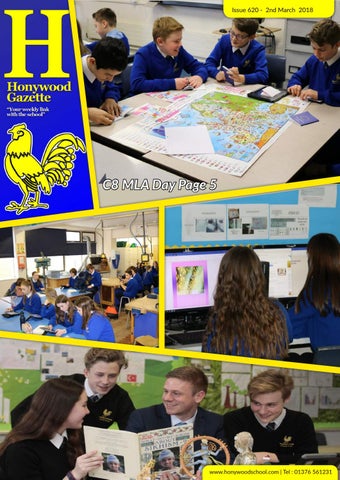
C8 MLA Day Page 5
www.honywoodschool.com | Tel : 01376 561231
Headlines By Acting Head Marc White
Weather The weather this week has certainly been challenging and has made decisions around the opening of the school extremely difficult. I understand the decisions we made and the times in which we made them may have caused inconvenience for some. The safety of staff and youngsters is paramount; however, it is always our aim to have the school open every day that it is safe to do so. Practically this week, with the variable nature of the weather it was not possible to make these decisions until the morning on each day we were closed. Please rest assured that any decisions that were made, were communicated as early as we possibly could. We appreciate the support shown by families already around these decisions and welcome feedback on how we could improve how these decisions are made and communicated in the future. World Book Day Unfortunately due to the weather this week it was not possible to celebrate World Book Day in the way that we had wanted to. We will look for another point in the near future where these events and celebrations can take place. It is important to note that World Book Day is a single point in a whole year and you can experience the joy and wonder that books or poetry can bring all year round. Focused study At this time of year it is typical in schools across the country for youngsters in their final year of GCSE study to be in ‘revision mode’ as they head towards their exams this summer. Certainly this is true of youngsters at our school also; however we would like to think that this mode of thinking has at least been present since the start of the academic year and for most, the notion of focused study has been a key part of their learning at Honywood. This week in assemblies, I have been sharing the importance of revision with youngsters emphasising the need to establish this mindset from the very start of cohort 7 and maintaining this throughout their time at Honywood and beyond. There are few things that I can recite from memory of any considerable length. One is the Lord’s Prayer, learned through drill in weekly assemblies during my time in secondary education. The others are a series of Poems from my time studying English Literature at A-Level, these were learned through careful analysis, self-quizzing and purposeful practice. I have shared one of these with Learners in their assemblies this week; “Dulce et Decorum est” one of the most well known in Wilfred Owen’s oeuvre. This was not only to highlight the ongoing centenary of the First World War and to celebrate poetry as part of World Book Day. I hoped to show how effective certain techniques can be in cementing knowledge and understanding in long term memory that can still be recalled vividly nearly 20 years later. Since the 2011 government curriculum review we have seen an introduction of GCSEs and A-Levels which have increased subject content with a greater requirement for children to be able to recall information. Whilst I certainly would not agree with Michael Gove’s belief from the time that we need a curriculum based on facts, building strong and easily recallable subject knowledge has benefits far beyond the passing of current GCSE and A-Level exams. Consider the following question taken from a sample GCSE English Language exam paper: “Write the opening part of a story about a place that is severely affected by the weather.” (24 marks for content and organisation 16 marks for technical accuracy) [40 marks] This question is worth half of the marks for the paper and sits below an image of a coastal town with waves crashing against the coastal defences and spray arcing over a train. Whilst reviewing the mark scheme there is
no indication that marks should be awarded for geographical knowledge or understanding or the specific effects of weather in different biomes. I think it would be hard to argue that of learners with equally developed creative writing, those with a sound geographical knowledge will find this task easier than those without. If not through their understanding of weather and a wider subject specific vocabulary to draw upon then through the time and cognitive resources saved through not having to think about these things. There is a growing body of contemporary research from educational psychologists about the benefits of building a secure subject knowledge that can be easily recalled. Being able to recall things with little to no strain on our brain is called automaticity and frees up precious cognitive resources for other tasks such as creative processes and problem solving. So how do we build automaticity? There are many things youngsters can start doing right now. Linked to the notion of securing subject knowledge in long term memory; I shared the two images below with many of you this week and set the challenge of considering how often we revisit things we have learned previously. I suggested ways to secure mastery so that you may avoid anxiety overload through trying to cram revision in at the end of Cohort 11.
My challenge to all of you is to consider which journey do you want to take in your learning? How much anxiety do you wish to face at the end of cohort 11 and what are you going to start doing today to ensure that happens. Self-Quizzing Out of the most popular revision techniques, self-quizzing has the highest impact on being able to recall that information at a later date. Other popular techniques such as re-reading and highlighting offer very little effectiveness in comparison. There are many ways to self-quiz; however one of the easiest is through the creation and use of flash-cards. These can be designed to have key-terms, concepts or questions on one side and definitions, explanations or answers on the other side. These can then be used for self-quizzing or quizzing others as part of revision. There are a number of apps available which can create electronic flashcards. I use Quizlet with my classes; it not only allows the creation of flashcards but also offers many ways to self-quiz using them.
Knowledge Organisers Learners studying GCSEs at Honywood will be familiar with the concept of subject audits, which break down what they need to learn into a checklist which they can use to self-assess their understanding of key terms and concepts. To compliment this youngsters can organise their learning into a single sheet which covers a particular topic or area; over time learners can build a body of knowledge from previous learning that can be easily reviewed on a regular basis. Knowledge organisers can also be used to self-quiz. I have included an
example of a knowledge organiser we use in Computer Science to show how these can be structured. I doubt that there could be much contention with the notion that ‘study’ unlocks success beyond examinations and that having the right mind-set and the right techniques really aids study. How did you get on with your study when the snow set in this week? Thanks To Wilf Peeters (7RPh), Basant Sherif (7RPh) and Ethan Skubich (7RFl) for their help with teacher training interviews this week. Notice James Saunders meeting on 9th March 2018, all limited spaces have been filled, we will be organise another meeting after Easter.
Cyber Security Knowledge Organiser Adware
Biometric Security
A form of malware that collects information about the user in order to display advertisements in the Web Browser. Measures unique characteristics of a person, such as voice pattern, the iris or retina pattern of the eye, or fingerprint patterns to allow access to a device or network.
Black box penetration test
Simulates an external hacking or cyber warfare attack.
Blagging (pretexting)
The act of creating and using an invented scenario to engage a targeted victim in a manner that increases the chance the victim will divulge information or perform actions that would be unlikely circumstances.
Brute force attack
A trial-and-error method used to obtain information such as a user password or personal identification number (PIN). Automated software is used to generate a large number of consecutive guesses.
CAPTCHA
A computer program or system intended to distinguish human from machine input, typically as a way of thwarting spam and automated extraction of data from websites.
Computer virus
A type of malware that, when executed, replicates by inserting copies of itself (possibly modified) into other computer programs, data files, or the boot sector of the hard drive. May or may not have a destructive purpose.
Cyber Security
The processes, practices and technologies designed to protect networks, computers, programs and data from attack, damage or unauthorised access.
Malware
An umbrella term used to refer to a variety of forms of hostile or intrusive software.
Misconfigured access rights
When user accounts have been given incorrect permissions. This could allow a normal user to have admin level access. It can be caused by human error or a logical error in software.
Pharming
A cyberattack intended to redirect a website's traffic to another, fake site.
Penetration testing
The process of attempting to gain access to resources without knowledge of usernames, passwords and other normal means of access.
Phishing
A technique of fraudulently obtaining private information, often using email or SMS.
Shouldering (shoulder surfing)
Observing a person's private information over their shoulder eg cash machine PIN.
Social engineering
The art of manipulating people so they give up confidential information.
Spyware
Programs that secretly record what you do on your computer. Its aim is usually to capture passwords, banking credentials and credit card details.
Trojan (Trojan horse)
A type of malware that is often disguised as legitimate software. Employed by cyber-thieves and hackers trying to gain access to users' systems. Once activated can enable cyber-criminals to spy on you, steal your sensitive data, and gain backdoor access to your system.
Unpatched and/or outdated software
Programs or apps that contain security flaws for which an update is not available to fix or an available update has not been applied.
Weak and default passwords
Refers to any passwords that can be easily guessed, either because it's so personal to a person or because it hardly takes any time to find it via the brute-force method.
White box penetration test
Simulates a malicious insider who has knowledge of and possibly basic credentials for the target system.
Social Engineering
Malware
Other Threats
Blagging (pretexting)
Virus
Weak and default passwords
Shouldering (Shoulder surfing)
Trojan
Misconfigured access rights
Phishing
Spyware
Removable media
Pharming
Adware
Unpatched and/or outdated software
Parents’ Time Members of the Leadership Team will be available to see parents without appointment: Monday 9.00am—9.45am Tuesday 7.15am—8.00am Wednesday 3.00pm—3.45pm Thursday 5.00pm—6.00pm Friday 7.15am—8.00am
Cohort 8 MLA Day Tuesday 27th February C8 embarked on their second MLA day of this academic year and their sixth one overall. A scenario based challenge had been carefully designed which enabled the learners to apply and transfer attributes in order to solve specific challenges which they could be faced with within the context of embarking upon a new career. The day complemented the important process the Cohort have started that will culminate in them making their guided choices at the end of March. The cohort was split into six main groups and within each group there were teams of two or three and this helped create a fast paced, competitive day which was overwhelmingly a success. The high standards that we have come to expect were exceeded by the enthusiastic cohort. It was a real privilege to be able to observe the activities and I was delighted to see the way the learners approached it. The challenges they faced were; • Planning the cheapest route possible from Colchester to Barcelona, without air travel. • A philosophical debate on Money Vs Happiness. • How good was their geographical knowledge. • Creating a letter to sell themselves. • Body language, could they interpret and use it effectively. • Could they successfully wire a 13amp plug? • How creative could they be in planning a nutritious menu on a limited budget? • Designing and creating an invite for a large social event to celebrate a significant event. Well done to all involved and in particular to the learners who achieved so much in such a short space of time and realised that they were able to apply their attributes under duress and be able to confidently demonstrate just what they are capable of. Maxine-Emily Harvey- 8HGi ‘I found the MLA day really fun and informative we learnt about my things. The task I liked the most was the English one were we had to write a description about our skills and worst traits. I really enjoyed this MLA day and it was probably the best one we have done so far.‘ Jude Battersby - 8APr ‘This MLA Day gave me a real experience and insight into life skills which will prepare me for the future such as interviewing while also developing my collaborative approach and communicative attributes.' Tom Vincent - 8HGi ‘I really enjoyed it because it gave me great experience for future life. I was very grateful because of the opportunity which was given to me.’ Eloise Rigby. 8HGi ‘I really enjoyed this MLA day as it had so many life skills that will help me in the future! Most schools don’t offer this opportunity so I thought it was really helpful! I got to work collaboratively and I got to improve on skills like confidence. Overall I think this was a great thing to do and it was so helpful!’ Louis Medlock 8KAr 'My thought on the MLA day was that it was something that made me learn to collaborate and work together to solve tasks or situations also communicative as it is vital for getting your opinion or knowledge across. Confidence as well because it makes me feel prepared for an interview when I need one and when I explain my personal attributes and qualities. So in conclusion I think it was a good MLA day because of how it prepared me to use my attributes in an interview.'
Subject Teams on Twitter
Follow our Subject Teams on Twitter to see Learning in Action
Teacher of Maths September 2018 or earlier
Annual Salary £23,763 - £32,186 We require an exceptional teacher to join our Maths team; this opportunity would ideally suit a Newly Qualified Teacher. We offer:
A high achieving Academy producing excellent examination results.
A challenging learning environment where you will be asked to expand your thinking about the education we offer our young people.
Excellent induction and outstanding on-going staff development which will prepare the post holder for progression in their teaching career.
A well-resourced Subject Team with the support of experienced, successful specialists.
You will need:
The ability to teach Maths to GCSE level and preferably to ‘A’ Level.
The mental agility to push your own learning and thinking whilst leading the learning and thinking of our youngsters.
A willingness to participate fully in extra-curricular events including residential experiences.
A willingness to learn every day as you consistently strive to increase your impact on our youngsters’ learning.
For an information pack, or to organise a pre-application visit, contact Mrs S. Pattison (spattison@honywoodschool.com), Honywood Community Science School, Westfield Drive Coggeshall, Essex, CO6 1PZ (telephone: 01376 564708). Closing date for applications is Thursday 8th March.
My Learning Choices Enterprise & Solutions MLCs this week are available to C7 learners that would like help working through the final stages of their ‘product design’ challenge. Sessions will also be available for C8s that would like to go over how the stock market works and how companies can benefit from allowing people to buy shares in their business. Business Studies MLCs this week will be focused on the ‘Business in the Real World’ for the C9s, with the main focus on the methods of expanding a business and on ‘Case Study 2’. Sessions will also be available for C10s who would like to through ‘methods of production’.
Important Dates 5th - 16th March C8 Parents Taster Week 6th & 8th March Primary Learning Day (Exp Arts) 14th March - Cohort 8 Guided Choices Evening 19th - 23rd March Quintet Week 3 29th - March Last day of Term finishing 3.20pm 2nd - 13th April Easter Holiday We will confirm alterative dates for C11 Photo, World Book Day and Non Uniform Day
MFL Modern Languages MLCs are available to all Cohorts for French, German and Spanish. Following World Book Day, why not book an MFL MLC to practise your reading skills in a foreign language? Maths - Are you curious about a specific Maths topic that you would like to learn more about? - Do you want to improve your problem solving skills and become a more capable Mathematician? - Or, do you want to boost your confidence in Maths? Please book your Maths MLC for extra support with your learning. English Cohort 10, your mocks are approaching so it is a good time to explore any areas in your learning which you you need to develop and improve. Book an MLC today to ensure that you address any areas of your learning that are currently causing you concern. Review your recent learning points and take action now to address these areas.
Family Learning Team
email FLT@honywoodschool.com If your youngster is absent please email attendance@honywoodschool.com