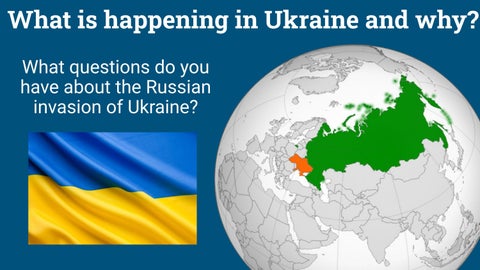
What is happening in Ukraine and why? What questions do you have about the Russian invasion of Ukraine?
What is happening in Ukraine and why? 1. Why is this so important? 2. Why did Russia invade Ukraine? 3. What was the Soviet Union? 4. Who is Putin? 5. Who is Zelensky? 6. What is NATO? 7. Could an all-out war break out? 8. What can we do about it?
1. Why is this so important? This is the first large European war since World War Two. It will quickly impact our daily lives as prices rise of things we use every day. Ukraine is a modern country of a population of over 45 million people. Their lives will be completely turned upside down, and a humanitarian crisis is already under way. Over 2000 civilians have died so far from collateral or direct fighting. With dwindling food and energy supplies and the potential for blockade of the cities, this number is expected to increase dramatically. Shelling, cluster bombs, cruise missiles and potential thermobaric weapons have been used on civilian targets and this has been argued to be a war crime. The ICJ is investigating this. Up to 1 million refugees have fled so far.
2. Why has Russia invaded Ukraine? Modern Ukraine is a very young nation – only 31 years old. It was declared independent following the fall of the Soviet Union in 1991. A referendum was held in which 92.3% of voters said they would prefer the country to be independent rather than remain tied to Russia. It is now a modern nation with the 8th highest population in Europe with a GDP of 150 billion. It has very rich and fertile fields. Ukraine's History is very rich. In the year 1000 it was the location of one of the strongest states in Europe, the Kieven Rus’. It has a rich Christian tradition. However, it also has a strong history of invasion. It became part of the Russian Empire in the late 1600’s under the Tsars. It continued to be a part of the Russian empire until the fall of the Soviet Union in 1991. The recent History goes back to 2014.
2. Why has Russia invaded Ukraine? In 2014 Russia annexed (took over) Crimea, an important island of Ukraine. Pro Russian forces in South and East Ukraine (Rebels) with Russian backing took over from the Ukrainian Government. Putins stated reason for the invasion of the rest of Ukraine is to protect Russians in Ukraine. He says he wants to protect those who have been subjected to "bullying and genocide by the Kyiv regime". He says he intends to demilitarise and "de-nazify" Ukraine, but not occupy it. A key reason is because Ukraine wants to be part of Nato and the EU. Putin wants pro-Russian Governments on his border.
https://www.bbc.co.uk/newsround/60417806
3. What was the Soviet Union? The Soviet Union, or USSR (Union of Soviet Socialist republics) was the Empire led by Communist Russia until the collapse of the USSR in 1991. The Soviet Union fought on the side of the ‘Allies’ during WW2 against Nazi Germany. After WW2 America and the USSR came to a tense and often bloody competition for expansion across the world. This was known as the Cold War. The most famous leader of the USSR was Josef Stalin. He created what was called the ‘Iron Curtain’ in Eastern Europe by Winston Churchill. This was the nickname given to countries in Eastern Europe that were invaded and controlled by the USSR. In these countries, there was no free speech or free elections. Living standards were low. So many people were trying to escape places like East Berlin that in 1961 the USSR constructed the Berlin Wall to make it more difficult for people to flee the Communist side of the City. The USSR was communist. Their control could be brutal. In the 1930s there was a famine that killed between 4-8 million people in the Ukraine. Many people have called this a genocide. This famine is known as the Holodomor.
4. Who is Vladimir Putin? The War in Ukraine has been called Putin's War. Putin was a junior agent of the KGB, the spy agency of the Soviet Union. In office since 2000, when he was first elected president, Putin has ruled Russia continuously for two decades. The laws in Russia, similar to America actually put limits on length of rule. However, Putin has amended these rules. Having reset his term, he could now in theory rule until 2036, by which point he will have bested Joseph Stalin as the longest-reigning ruler in Russia’s modern history. Putins term began by massively boosting the russian economy. However, there have been allegations of election fraud, silencing of any critics and even assassinations of opponents. Many of Putin's closest friends have amassed great personal wealth as they have been given contracts and links in business. These are the ‘Oligarchs’ you might hear about.
https://www.bbc.co.uk/newsround/60521909
5. Who is President Zelensky? President Zelensky was a comedian and actor before becoming President of Ukraine in 2019. He is Jewish. He is now leading the Ukrainian Army against the Russian invasion. Since the invasion started and despite being the no1 target of Russian forces, Zelensky has refused to be evacuated to France, stating “I need ammunition, not a ride.”
6.What is NATO? NATO, or the North Atlantic Treaty Organisation is a military alliance between 28 European countries and 2 North American countries. Established in the aftermath of World War II, the original 12 countries joined this alliance as they were concerned about a conflict with the USSR. NATO is an alliance where if any country is attacked by a foreign power then the other members will come to their aid. Nato was involved in Afghanistan following the 9/11 attacks. Since 1949 the alliance has increased from the original 12 countries to 30. The most recent member state to be added to NATO was North Macedonia in 2020. NATO currently recognizes Bosnia and Herzegovina, Georgia, and Ukraine as aspiring members. Vladimir Putin, President of non-member Russia, has demanded that NATO promise never to accept Ukraine as a member. NATO is different to the United Nations, of which Russia is a part of. The UN was formed after WW2 as a forum for governments to meet to discuss issues and stop wars. The UN undergo peacekeeping missions but will not be involved in the Ukraine conflict as Russia is a leading member.
7. How might the war progress? The invasion began on on the 24 February, where as many as 200,000 troops were launched on 3 fronts from Belorussia, Russia and Crimea. Ukraine is significantly outnumbered and outgunned. Its army and civilians have been armed and trained by Western Countries. So far, the Russian advance has not achieved its initial aims to invade Kyiv and install a pro Russian Government. Many believe that Putin wants a similar situation to Belorussia - a puppet government. So far the Russian army seem to have been surprised by the level of resistance in Ukraine. Should Russia achieve its aim of taking over Ukraine, it is likely that there will be an insurgency, where the fighting continues by irregular and civilian forces.
7. Could an all-out European war break out? Biden warns Russia that the US will 'defend every inch of NATO territory'. Although many countries are providing a great deal of military aid, including Britain and Germany, no NATO forces are being sent into Ukraine. Because Ukraine is not a NATO country, there are no legal agreements that mean troops can be sent. Should Russia attack a NATO country, then this would escalate further. This is very unlikely. Putin has declared that his Nuclear forces are on standby. 9 different powers have nuclear weapons. These are known as the Nuclear deterrent. Nato and Russia both have around 5000 nuclear weapons each including ICBMs and submarine launched rockets.
“The US will defend every inch of NATO territory” Biden Feb 27th
8. What can you do to help? There are a number of charities that you could support to have a direct impact on the lives of people in Ukraine. Save the Children have stated that; “7.5 million children in Ukraine are in grave danger. Your donation today can help provide children and families with immediate aid, such as food, water, hygiene kits, psychosocial support and cash assistance. Together, we can protect children in crisis.” In 2014, the world did little to stop the invasion of Crimea. As a result, Putin likely felt he could get away with it. Across the world there are protests whose purpose is to put pressure on their Governments to act to ensure this does not happen again. You can use social media to discuss and raise awareness of these issues. However, you need to be very careful about what you see and fact check what you are reading by using moderated news such as the BBC, newsround and Channel 4.