




Carleton place - heddy sourour
editorial@pdgmedia.ca
Students in Carleton Place joined a provincewide student walkout March 12 to protest changes to the Ontario Student Assistance Program.
The lunchtime protest, held around 12:30 p.m., was part of a coordinated action at schools across Ontario targeting the government of Premier Doug Ford and
changes to the student aid system. One student organizer estimated about 70 schools took part.
At Notre Dame High School in Carleton Place, Grade 12 student Edison Thompson helped organize the local walkout. “All of this is a long-winded way of saying that I am pissed off,” Thompson said. “I am pissed off on my behalf and on behalf of all students in Ontario.”
Thompson said he first learned about the changes while visiting the University of Ottawa campus.
“I had just been looking into residence and scholarship applications when I heard the news, and I was justifiably disappointed and upset,” he said. “The future of not only my education but my career and quality of life is being actively threatened by these changes.”
Students at Carleton
Place High School also gathered outside during the lunch hour to raise concerns about the changes.
“My personal concern is that two thirds of students use OSAP and now they won’t even be able to afford that,” said Abby Neale, a Grade 11 student and walkout organizer at CPHS. “I will be going nowhere without it. My family and I cannot afford the high cost of university.”
Neale said the reduction in maximum grants has left many students uncertain about their ability to pursue post-secondary education.
Thompson said the financial pressure is already significant for students planning their next steps.
“I’m an only child raised by a single mom,” he said. “I work three part-time jobs, all paying over minimum wage, and I still can’t afford a car, or tuition, or the cheapest options for university residence.”
For CPHS Grade 12 student Finn MacDonald, the issue reflects wider concerns about the future facing many young people.
“With the rising costs of living and house prices going through the roof, many people growing up in this
economy are afraid that we will never be able to afford a house and live comfortably in a career that doesn’t make us miserable,” MacDonald said.
He said financial barriers to higher education are already a reality for many families in the community.
“In our town of Carleton Place so many families struggle with money and many people I know personally are not going to be able to afford post-secondary school without support,” he said. “Or they would have to take on debt that they will be stuck paying off for years.”
Neale said students expect government support to help keep higher education accessible.
“The government should help students and make things easier for them,” she said. “But instead they subtracted the maximum grants available by 75 per cent.”
Thompson said the longterm effects could extend beyond current students.
“When Ford needs to go get his car fixed, he won’t be able to find a mechanic,” he said. “And when he asks, ‘Where have all the mechanics gone?’ someone will answer him: ‘No one
can afford to be one.’” MacDonald said the protest was meant to draw attention to what students believe is at stake.
“We protested for our future and for the future of the less fortunate,” he said. “We want to show that we care about our education and that we want our government to care about it too.”
Officials with the Upper Canada District School Board acknowledged that students may wish to express their views but encouraged other forms of advocacy.
“We recognize that students may wish to engage in civic dialogue around issues that matter to them,” said executive superintendent Chris Boulay. “However, we would encourage any students planning a walkout to consider alternative ways to show their advocacy, such as organizing discussions, writing to elected officials, engaging through student councils, or planning activities outside of instructional time.”
Neale said students intend to continue raising the issue.
“These cuts will change because I won’t rest until things are fair for me and my peers,” she said.
PERTH - heddy sourour
editorial@pdgmedia.ca
Changes to daytime access at the pool inside the Parkside Hotel and Spa are drawing mixed reactions from Perth residents, with some families saying the new rules leave them feeling excluded from a space many had come to rely on during the winter months.
The hotel recently introduced “quiet hours” at the pool from 9 a.m. to 5 p.m., a move intended to create a calmer daytime environment for hotel and
spa guests. While adults are still welcome to use the pool during those hours, children are now limited to designated family swim times outside the quiet-hour window.
Brian Mulville, operations manager at the Parkside Hotel, said the pool remains open daily from 6 a.m. to 10 p.m., but the daytime adjustment is meant to balance the needs of guests seeking a relaxing spa experience.
“We are a spa and hotel, and we’re trying to give our guests that quiet relaxation time that they’ve booked,”
Mulville said. “It’s something we’re trying out right now.”
The pool was originally designed for hotel and spa guests, according to general manager Tanya Jamieson.
Several years ago, the hotel began offering memberships and day passes to the wider community after hearing concerns that the municipal pool’s water temperature was too cold for some swimmers.
“Over time, the demand for the space has grown significantly,” Jamieson said.
“During busy periods, the volume of users has created challenges for both our
guests and our staff, and we have received consistent feedback from hotel and spa guests requesting a quieter and more relaxing environment during the day.”
Jamieson said the new schedule is intended to balance hotel guests, spa visitors, members, and families while ensuring the space remains safe and enjoyable.
“Families are still welcome to use the pool during designated family swim hours, and children of hotel guests and members continue to have access,” she said, noting the pool

Parkside Hotel and Spa Facebook photo [https://www.facebook.com/ BestWesternPlusPerth].
remains part of a private hospitality facility.
Still, the change has frustrated some parents who had become regular users of the pool during the winter months. Continues on page 6


Prime Minister Carney,
As a municipal councillor from the Township of Rideau Lakes, I am deeply concerned about the proposed Alto high-speed rail corridor and the provisions in Bill C-15.
From a rural perspective, this type of corridor could permanently divide farmland, disrupt local roads, and alter the landscape of rural communities like ours, where agriculture, tourism and small local economies depend on the land.
Equally troubling is the consultation timeline.
Many municipalities have not even been formally notified they may fall within a potential corridor, yet the consultation deadline is set for March 29. That does not give municipalities, landowners or residents enough time to understand the proposal or provide meaningful feedback.
Bill C-15 also raises serious concerns. As written, it appears to allow:
• Expropriation before environmental reviews and final routing decisions are complete;
• Removal of independent public hearings that allow landowners to challenge expropriation;
• Large land corridors to be secured before final design is confirmed; and,
• Reduced notice periods and procedural protections for property owners.
Projects of this scale should not move forward without clear evidence, proper consultation and confirmed funding.
Public reporting places the potential cost of the Alto project at roughly $100 billion. At a time when the Canadian economy is under pressure, municipalities are struggling with infrastructure deficits and homelessness is rising across the country. Many Canadians are questioning whether this should be the federal government’s priority.
Canada has seen the consequences of rushing federal infrastructure decisions before. In 1969, the federal government expropriated approximately 97,000 acres of farmland north of Montréal to build Mirabel Airport, displacing more
than 3,000 families based on projections that never materialized.
Canada does not need Alto high-speed rail to become the next Mirabel.
If the March 29 consultation deadline cannot be extended, then Bill C-15 must be amended to restore meaningful public consultation, protect landowners and ensure environmental reviews are completed before land acquisition powers are used.
Paula Banks Councillor,
Ward of Bastard and South Burgess Township of Rideau Lakes
PERTH - HEDDY SOROUR editorial@pdgmedia.ca
If the people behind the proposed Toronto–Quebec City high-speed rail line were hoping to get the public’s attention, they can check that box.
More than 1,000 residents — 1,022 to be exact — packed the Perth Lions Club Hall Thursday for a public consultation on the controversial project, estimated between $60 billion and $90 billion. The mood swung between curiosity, excitement, skepticism and flat-out frustration.
The event featured sev-
Grab a copy print edition of Hometown News at Your Independent Grocers across Lanark County.
Anderson’s Carleton Place Barnabe’s Perth Jonsson’s Almonte & Smiths Falls

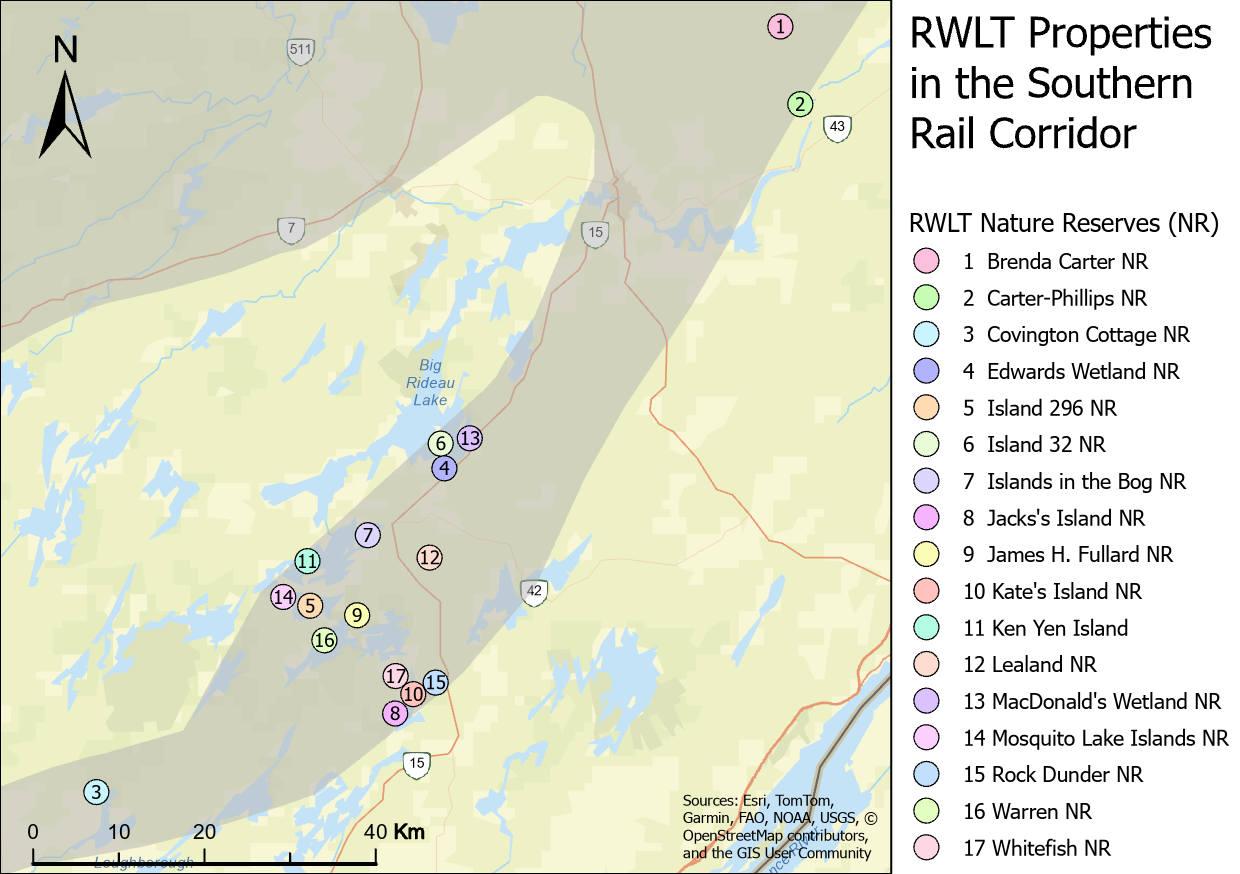
Rideau Waterway Land Trust (RWLT) has helped the community protect environmentally sensitive lands in the Ottawa–Kingston corridor for over 30 years. Most of the properties we steward were donated by landowners or purchased with the support of community donors. RWLT pledged to protect these lands in perpetuity, often under strict terms of the federal Ecological Gifts Program.

The attached map shows that 17 of the Trust’s 25 properties fall within the southern route of the proposed Alto high-speed rail corridor. If this route proceeds, the impacts could be significant. Lands the community invested in, in good faith, to preserve forever may face ecosystem degradation or even expropriation. This concern is heightened by the dense
Publisher: Patricia Krotki pmkrotki@pdgmedia ca
Managing Editor: Laurie Weir
cluster of conserved properties in the Rideau Lakes area, which creates a natural choke point of sensitive lakes and protected wetlands—conditions unsuitable for high-speed rail. RWLT’s lands are part of a broader network that creates connectivity with properties protected by governments, conservation authorities, non-profits, and other land trusts. Orga-
Reporter: Kathy Botham Heddy Sorour Laurie Weir
nizations such as A2A and FABN have spent decades strengthening ecological connectivity in the UNESCO Frontenac Arch Biosphere Reserve. This region forms a critical land bridge between Algonquin and Adirondack Parks—one of the last intact forest corridors in North America— and contains one of Canada’s highest concentrations of species at risk, with more than 50 species found here. Rail service that reduces greenhouse gas emissions is a laudable goal but the southern route risks creating a new barrier across this landscape. Mitigation measures may be proposed, but the wildlife crossings required for a truly permeable corridor may be prohibitively expensive or infeasible. Given the environmental impacts, the southern route should be abandoned or substantially re-routed. We urge the federal government not to let expediency lead to poor decisions that result in the degradation of critical habitats and wildlife corridors.
John Grass Board Chair, RWLT
Photography: Kathy Botham Laurie Weir
Layout/Design: Tara McNeil
eral information stations, each staffed by an Alto high-speed rail official answering questions.
“I thought the event was fantastic. They called it an interactive session, and it was,” said Perth Mayor Judy Brown.
The meeting, hosted by Alto high-speed rail officials, outlined the early vision for a 1,000-kilometre electric rail line linking Toronto, Peterborough, Ottawa, Montreal, Laval, Trois-Rivières and Quebec City. For supporters, it represents a long-overdue leap into the future. For many rural residents, it feels more like a fast train aimed straight at their property lines.
That tension could be felt throughout both the morning and evening sessions.
On the whole, people came seeking answers, but many left feeling they still did not have them.
Westport resident Gordon Craig is one of those facing the potential impact directly. His home sits within the massive 10-kilometre-wide study corridor currently being examined by engineers — a swath of land so wide it has left many homeowners wondering whether their property is safe.
“They’ve said the 10-kilometre corridor will eventually be narrowed down to one kilometre,” Craig told Hometown News. “But they haven’t talked about the fact that they haven’t even started this, and it’s already lowered my house evaluation.”
For homeowners, the uncertainty alone can sting.
“Would you want to buy a house that is poten-
tially in the expropriation zone?” he asked.
Property concerns were not the only issues raised.
Cindy Daigman, a county public works employee, said she attended less as a homeowner and more as someone who deals with rural infrastructure every day.
“I’m kind of here from a professional perspective,” she explained.
Rural municipalities rely on sprawling networks of small roads, many of them vital for emergency response.
“There are a lot of rural roads in our county,” she said. “When the high-speed rail corridor is developed, what will happen to those roads? Will they be blocked into dead ends?”
In rural communities where fire trucks and ambulances already travel long distances, that is not a minor concern.
Those kinds of questions are exactly what Alto officials say the consultation process is meant to surface and address.
The wide corridor shown on current maps, acknowledged Benoit Bourdeau, media relations officer with Alto high-speed rail, is creating more anxiety than was necessarily intended. However, the consultations are meant to better understand the concerns and challenges a project like this must address.
“We didn’t want to make a decision and come to communities and say, ‘This is what we’re going to do,’” Bourdeau explained. “We want feedback before narrowing it down.”
Continues on page 6

Website: HometownNews.ca
Everybody knows that the cost of housing has soared over the past few years, but it seems to me that each of us experiences this fact a little bit differently, and that not all of us know just how dramatically this has changed Canada, for the worse.
If you are a Boomer or a Gen-Xer like me, and you bought a house a decade or two (or three) ago, the price of housing is a question which you can regard dispassionately: Prices are high, and that is tough for some other people— but for us homeowners, things are actually pretty good. The house each of us bought, which seemed expensive at the time, is now worth twice as much, or more. (That’s when you take into account inflation—if you just look at the nominal price, the difference is even bigger.) For many people of my generation, the resale value of that mortgage-paid house is the foundation for what promises to be a comfortable retirement.
But if you don’t own a house—like most young people—things feel entirely different. When I was 25, back in 1990, it was possible for me to rent a small, fully detached 3-bedroom house, in a pleasant neighbourhood in Ottawa, for $850 a month ($1,840 in 2025 dollars). Recently, out
By Scott Reid, MP
of curiosity, I took a look online to see how much it would cost to do this now. A comparable home, in a comparable location, would be about 50% more.
As a result, for 49% of Canadians under the age of 25, just paying the rent costs half their income, according to a survey conducted earlier this year.
One can shrug and say that maybe it’s a bit much, for a 25-year-old, to expect to live in a three-bedroom house—although nobody thought that in 1990. But the fact is that most people this age are living in shared rooms or in apartments far smaller than what I once enjoyed (the survey shows that the average rent, for people in this age range, is about $1,400, and that they are living in very small spaces).
It’s not just the very young who have this problem: 34 per cent of renters of all ages are paying more than half their incomes in rent. And it’s not just a problem in the big cities—a substantial percentage of Lanark County residents also pay more for rent than for all other expenditures combined.
Given these facts, it seems hard to deny that in order for most young people to become financially secure, they have to escape the high cost of renting— which means buying a home. But to state the obvious, it is nearly impossible
for them to save up enough money for a down payment on a house (whose prices, of course, have skyrocketed), when the high cost of rent is soaking up so much of their income.
This leads, inevitably, to some depressing news: Statistics Canada reports that the percentage of people under the age of 30 who own their own home fell by one-third between 2011 and 2021. More recent statistics are not available, but it seems likely that by now, home ownership numbers among the young have fallen even more.
And this in turn points to an even more alarming statistic: while the average income, for Canadians in the bottom half of earners, has gone up by 250 per cent since 1982 (mostly due to inflation), the cost of housing of all sorts—house prices and rental costs combined—is up by more than three times as much.
In such an environment, those who already own housing are getting richer, and those who do not are getting poorer. There is a growing divide, in Canada, between mostly older “Haves” and mostly younger “Have Nots,” and the rising cost of housing is at its heart. Reversing this trend, and narrowing this divide, is the most important challenge facing policy-makers at every level of government.

SMITHS FALLS - LAURIE WEIR
editorial@pdgmedia.ca
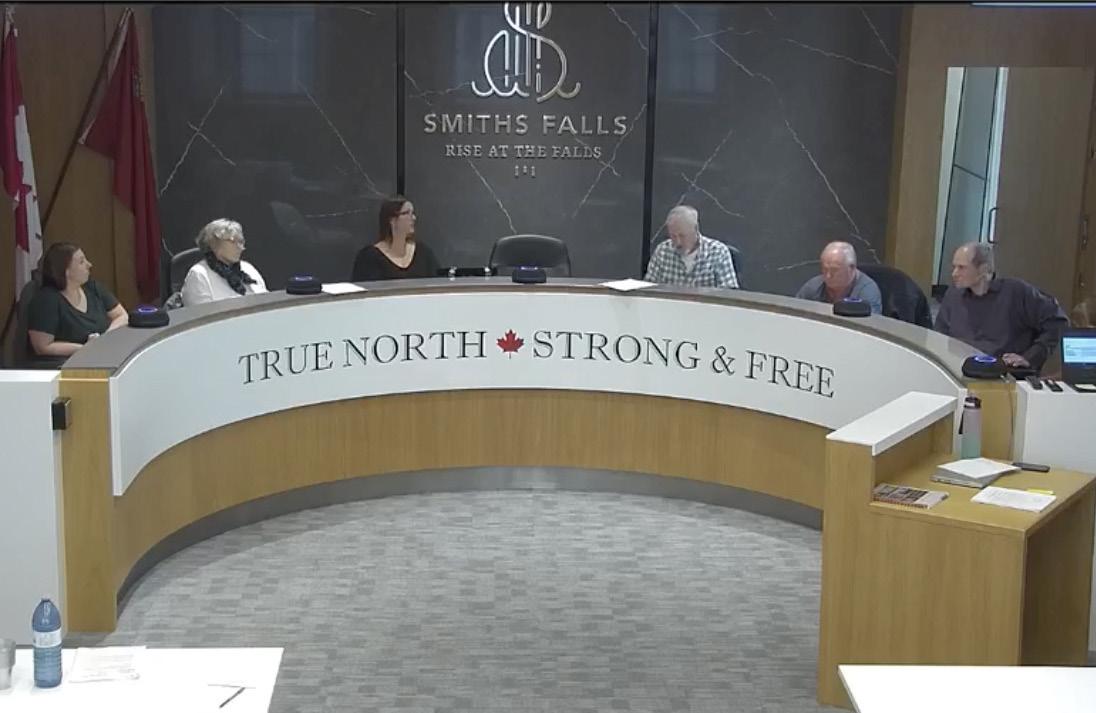
Smiths Falls council has delayed a decision on whether to cancel municipal recycling pickup for businesses after debating a staff recommendation first presented earlier this month.
A report brought forward at the March 2 committee of the whole meeting recommended ending the town’s contract with Glenview Iron and Metal for curbside recycling collection from commercial properties.
Staff said the fee-for-service model introduced earlier this year has not achieved the participation levels required to make the program financially sustainable.
The issue returned to council on March 9, where
councillors discussed whether the service should continue despite the low participation rate.
The change follows Ontario’s transition of the Blue Box program to a producer responsibility system on Jan. 1, shifting the cost of residential recycling to companies that produce packaging and paper products. Businesses remain excluded from the provincial program.
About 220 Smiths Falls businesses were historically included in municipal recycling routes. In response to the provincial change, the town attempted to continue the service through a voluntary fee model.
Under that approach, businesses would sign agreements with the town and pay about $27 per month for
recycling collection.
Of the 111 businesses that responded to the town’s outreach, 75 declined to participate while 36 indicated interest. Staff estimate the program cannot reach cost neutrality at that level of participation.
The contract with Glenview Iron and Metal costs about $71,994 annually. The town has already incurred roughly $10,800 in costs for January and February.
Three members of council — Mayor Shawn Pankow and councillors Dawn Quinn and Jennifer Miller — declared conflicts of interest and left the council table during the discussion. Coun. Steve Robinson was absent.
Coun. Jay Brennan said he was concerned about eliminating the service entirely.
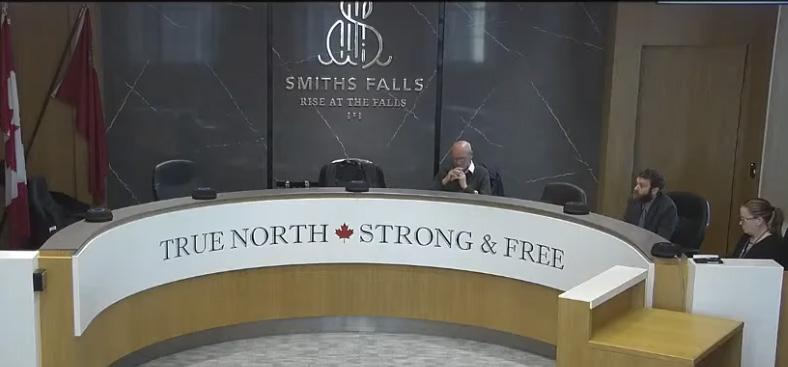
“I really struggle with this,” Brennan said. “The province has made a mistake in excluding businesses from the program.”
He said removing municipal recycling pickup could leave smaller businesses with few options.
“If you’re a mom-andpop shop, recycling could end up piling up or being thrown in the garbage when it shouldn’t be,” he said.
Brennan suggested the town consider continuing the service for a year while advocating for changes to provincial policy.
Coun. Chris McGuire said the limited response from businesses made it difficult to determine whether the service was necessary.
“I don’t have a strong opinion on this right now,” McGuire said. “It’s one of those situations where it


would be nice to have the full (council) around the table for the debate.” Council indicated the matter will return at a future meeting after businesses are notified and feedback is gathered from local business groups. If the program is ultimately cancelled, businesses would need to arrange recycling collection through private contractors.


PERTH - HEDDY SOROUR
editorial@pdgmedia.ca
After a one-year hiatus, the beloved Perth Garlic Festival is back, bursting with fresh energy, big heart and, naturally, plenty of garlic.
At the centre of the revival is Anne Bell, chair of

decided to step down.
“They’d been doing it for 25 years,” Bell explains. “They were tired. It was time.”
For Bell and the Perth Lions Club, however, the Garlic Festival is too important a fundraiser, and too important an event, to lose.
the festival and a volunteer who proves that community spirit has no age limit. Bell has been a Lion for more than 50 years and, after moving to Perth five years ago, simply could not let the 25-year tradition fade away when the longtime organizing committee
“The Garlic Festival is such a significant event for our community. It’s an annual favourite that draws both local residents and visitors to a well-attended weekend celebration here in Perth,” said Cathy McNally, the Town of Perth’s director of com-
munity services.
Although Bell volunteered at past festivals, this is her first year as chair, leading an entirely new 12-member committee. Planning began in the fall, ramped up in January, and the countdown is now on for Aug. 8 and 9 at the Perth Fairgrounds.
According to Bell, the two-day festival regularly draws more than 2,000 visitors, filling the grounds and downtown Perth with shoppers, diners and garlic lovers from across Ontario. Vendors travel from places such as
Niagara Falls, Muskoka, Brockville and Gatineau, alongside local vendors from the Perth area.
In 2024, the festival hosted 64 vendors. This year, more than 40 are already registered, with hopes of reaching 70 before registration closes. And it’s not just garlic growers. Visitors will find crafts, jewelry, specialty products and more.
The festival is entirely volunteer-run, primarily by the Lions. It takes muscle, too, with nearly 100 volunteers needed over the weekend to handle parking, the canteen, vendor registration and placement, and to keep everything running smoothly.
The Shriners will return to help with parking, while the Lions operate a popular canteen serving burgers, hot dogs and fries. Bell says people “flock” to the fries every year.
Funding for the festival comes largely from vendor fees, modest entrance fees and community support, Bell said. Sponsorship efforts are currently underway to help defray costs.
“The Town of Perth
provides in-kind support by providing tables and chairs for use at no cost. In the past, the Garlic Festival has utilized our Community Grant funding to support their operations,” McNally said.
The fun-filled weekend includes a 50/50 draw, live local music both days, a beer and refreshment tent, and cooking demonstrations that are still being finalized.
Saturday’s entertainment features the band Ruckus, while Sunday brings Three To Go, both local bands ready to keep the fairgrounds lively.
The festival opens at 9 a.m. Saturday and runs until 5 p.m. It reopens at 9 a.m. Sunday and wraps up at 4 p.m.
“The purpose of the Perth Lions Garlic Festival is to create demand for locally grown garlic so growers and consumers can network and share information and knowledge,” states the Lions’ Facebook page.
Visitors shop local, dine in town, stay overnight and reconnect with neighbours. Thanks to a new generation of volunteers, this cherished tradition is ready for its next chapter.

REGIONAL - LAURIE WEIR
editorial@pdgmedia.ca
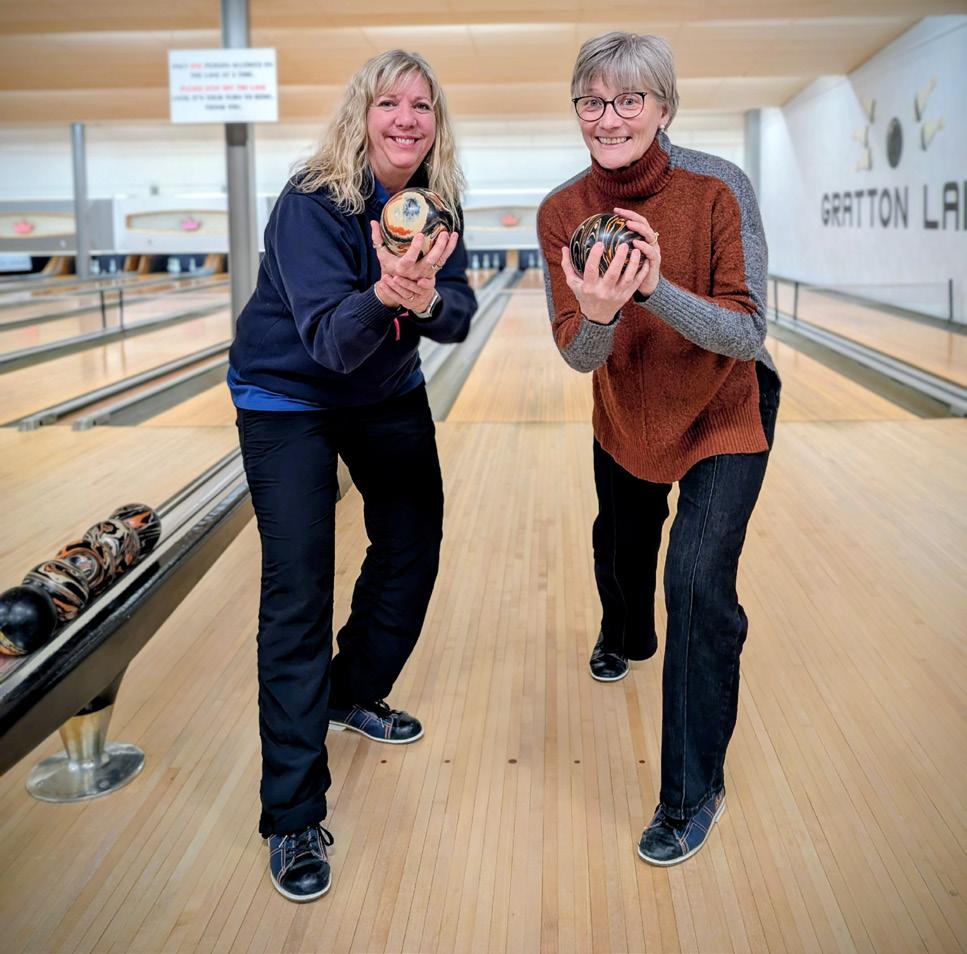
More than 400 bowlers laced up across Lanark County last month, helping raise more than $85,000 for Big Brothers Big Sisters mentoring programs.
The annual Tim Hortons Bowl for Kids’ Sake fundraiser took place Feb. 26 and 28 at three bowling centres: Gratton Lanes in Smiths Falls, Chasin’ Turkeys in Carleton Place and Spare Room Bowling Lanes in Perth.
Jennifer Miller, executive director of Big Brothers Big Sisters of Lanark County, shared with Hometown News the total marks one of the strongest years the event has seen since the pandemic.
“It’s a very strong year. We’re really, really grateful,” Miller said.
Bowl for Kids’ Sake has been running locally for 46 years and has raised hundreds of thousands of dollars to support mentoring programs for children and youth across the region.
Corporate sponsors covered the cost of running the event, allowing all pledges raised by bowlers to go directly toward local programming.
Big Brothers Big Sisters of Lanark County offers traditional one-toone mentoring matches, in school mentoring and group programs such as Go Girls and Game On, which focus on healthy lifestyles, confidence and positive decision making. These are school-based programs.
The agency also operates the Smiths Falls Youth Centre, which opened in 2017 and now draws between 20 and 40 young
people each night.
“We’re putting on a full meal every time we’re open,” Miller said. That’s three nights a week.
Across all of its programs, the agency served 680 children and youth in Lanark County in 2025, the highest participation level since the pandemic.
About half of the young people served through the agency are in Smiths Falls, where the organization’s staff and youth centre are based.
Miller said community support continues to play a major role in the agency’s success.
“We’re fortunate that people know we make an impact,” she said. “They believe in the work we do and they see us helping local children and youth in schools and in the community.”
Despite strong fundraising results, Miller said volunteers remain in short supply. Many longtime volunteers stepped away during the pandemic and have not returned.
“We draw quite a bit from early retirees,” she said. “We just haven’t seen them come back since COVID in the same way that we need them.”
Miller said mentoring can be one of the most rewarding ways to give back.
“What you get out of it as an adult giving back is so fulfilling,” she said. “There’s really no way to describe it until you try it. There’s something that fills your soul when you see the difference you can make.”

Rideau Lakes council has directed staff to continue work on revisions to the township’s proposed tourist campground licensing bylaw, despite ongoing questions about compliance at Lower Beverley Lake Park in Delta.
The motion, introduced by Coun. Marcia Maxwell at the March 2 council meeting, instructs staff to bring forward a revised version of the bylaw for council’s consideration.
The bylaw had previous-
PERTH - HEDDY SOROUR
editorial@pdgmedia.ca
The Table Community Food Centre continues to expand its role as both a food provider and community hub, executive director Rob Rainer told Perth’s committee of the whole on March 10.
Founded in 1998 as the Perth and District Food Bank, the organization evolved into a community food centre in 2012 and is now one of 18 in Canada supported by Right to Food. The model focuses not only on emergency food access, but also on building food skills, strengthening community connections and advocating for policies that address poverty.
Rainer said food insecurity remains a serious issue, with about one in four households affected annually, according to Public
Health Ontario.
The Table operates eight core programs, anchored by its food bank. It also hosts community meals three times a week, drawing about 90 to 110 people each evening. In Smiths Falls, the Falls Food Hub currently provides a free weekly lunch for roughly 100 to 120 people and is expected to expand programming once a renovated permanent location opens.
Additional initiatives include a community garden at Last Duel Park, children and youth cooking and gardening programs, adult community kitchen sessions and the Fresh Food Box program, which distributes fresh local produce twice a month.
“Our mission is to foster a healthier and more connected community by increasing access to healthy
food, improving food skills and food literacy, and advocating for social policies that address food insecurity and poverty,” Rainer said.
The organization also offers practical support through advocacy and navigation services, helping participants access government benefits, replace identification or file income taxes so they can receive eligible credits. A drop-in tax clinic runs each year for several weeks, while a social program called “The Buzz” provides opportunities for participants to gather and connect.
The Table employs 16 staff members, 14 in Perth and two in Smiths Falls, and relies on more than 150 volunteers.
Annual revenue has grown from about $569,000 a decade ago to roughly $1.2 million today, though Rain-
er said the organization ideally needs closer to $1.5 million to fully meet demand.
Funding comes from a mix of individual donors, local businesses, faith groups, foundations and municipalities, including Perth, Smiths Falls, Tay Valley Township and Drummond/North Elmsley. National partners also provide support, including about $200,000 annually from Right to Food and additional grants through Food Banks Canada.
Mayor Judy Brown praised the organization’s work following the presentation.
“This is such a fantastic organization. Not only do you give food to people, but you teach people how to cook and provide initiatives like that,” Brown said. “And you have a fantastic staff.”
ly been deferred following discussion at council’s Feb. 17 committee of the whole meeting while the township seeks clarification from the Ministry of the Environment, Conservation and Parks regarding compliance issues at the municipally owned Lower Beverley Lake Park campground.
Maxwell said the two matters should not be treated as the same issue.
“I’m not looking to change the deferral,” Maxwell told council. “But I am concerned that this bylaw has been delayed again to deal with the Lower Beverley Lake Park issues, and I feel they are two separate issues.”
She said staff should continue working on revisions outlined in a Feb. 17 report while the park issue is addressed.
Maxwell also argued that moving ahead would give privately operated campgrounds time to prepare for eventual licensing requirements.
“It would only be fair for all the other campgrounds to get their ducks in a row, along with the time that’s being allowed for Lower Beverley,” she said.
Several councillors supported continuing the bylaw work in the background.
Coun. Dustin Bulloch said providing direction to staff would allow progress to continue while the park situation is clarified.
“I think it’s important while we’re dealing with Lower Beverley Lake Park that staff continue developing their amendments,” Bulloch said. “I don’t see there
being any conflict there.” Coun. Paula Banks opposed the motion, arguing council should resolve questions surrounding the township’s own campground before proceeding with regulations affecting private operators.
“I am really, really confused about the conversation about Lower Beverley Lake Park,” Banks said.
“We cannot ethically pass a campground licensing bylaw when we have Lower Beverley Lake Park board members telling campers that MECP is not even involved in their issue, and we’re telling people they are.” Banks said the conflicting information has created confusion among campground users.
“Until we at least have that clarified, I don’t think we should pass this bylaw.”
Part of the debate centred on whether discussion about the park’s compliance should be considered relevant to the motion.
Maxwell raised a point of order, arguing the discussion was drifting away from the bylaw itself.
Mayor Arie Hoogenboom then asked council members to indicate whether the park discussion should continue.
A majority declined, and council proceeded to vote on the motion.
Council ultimately approved directing staff to continue work on revisions to the campground licensing bylaw.
The recorded vote was eight in favour and one opposed, with Banks voting against the motion.

PERTH - HEDDY SOROUR editorial@pdgmedia.ca
Continued from page 1
Perth resident Deanna Berry said many families relied on the facility as an alternative to the municipal pool.
“MANY members of the community use this pool, particularly in the winter with their children,” Berry said. “A lot of us are feeling excluded, but also confused.”
She added that many residents have supported the hotel in other ways and see it as an important part of the community.
“We get our hair done there. We use the spa. We’ve had massages there. I’ve had pedicures there,” Berry said. “Our family comes from out of town, and they stay at that
hotel because it’s a beautiful hotel in the middle of town that has a pool and all these amenities that we love to use as a community.”
While acknowledging the hotel is a private business, Berry said she hopes there may be room for greater flexibility.
“Yes, they’re private, but I still think they’re a big part of the community,” she said. “I just kind of wish there was a little bit more balance, a little bit more flexibility.”
Another resident, Brittany Grayson, said she shares similar concerns and echoed Berry’s view that many families feel a strong connection to the hotel and its amenities.
“I have always considered your hotel a family-friendly, warm and welcoming space,” Grayson said in cor-
respondence with the hotel. “I have now come to see that this is unfortunately no longer the case.”
Grayson said the restricted hours make it difficult for many families to realistically use the pool, particularly for young children with fixed routines.
“It makes it challenging to find a comfortable swimming pool during the winter months,” she said.
The discussion has also renewed attention on the town’s public swimming facility.
According to Cathy McNally, director of community services for the Town of Perth, the municipal pool is typically maintained between 80 and 82 degrees Fahrenheit. The temperature is set to accommodate a wide range of


users, including competitive swimmers, recreational swimmers and aquatic fitness participants.
“Pool temperatures are adjusted as needed,” McNally said. “However, we aim to maintain a temperature that balances the needs of all groups.”
Chlorine levels are maintained within the provincial health regulation range of 2.0 to 5.0 parts per million to ensure the water remains safe and sanitary, she added.
McNally said the town occasionally receives feedback about the water temperature but is not aware of recent concerns regarding chlorine levels.
Looking ahead, the possibility of a warmer therapeutic pool may be part of discussions with neighbouring municipalities about a potential regional recreation complex.
“While no decisions have been made, the concept of a smaller therapeutic or
warm-water pool has been identified as a potential feature worth exploring during the feasibility study process,” McNally said. For now, the Parkside Hotel says the quiet-hour policy is an operational trial as it works to balance growing demand with the expectations of its guests, while some local families say they hope a compromise can still be found that keeps the pool accessible to the wider community.
PERTH - HEDDY SOROUR editorial@pdgmedia.ca
Continued from page 2
Eventually, the corridor will shrink dramatically — first to about one kilometre, then even tighter once engineers finalize the precise alignment.
“The alignment of the corridor requires as straight a corridor as possible, and every effort will be made to follow existing transportation and hydro corridors, as well as follow property lines. No roads will be closed; they’ll either get an overpass or an underpass. If we have to bisect a farm, there will be consultation with the farmer to ensure they can access their property,” said Bourdeau.
He added that if land must be expropriated, compensation would be negotiated with individual landowners at the equitable market value.
Still, that does little to calm residents whose land sits inside the possible route today.
Elizabeth Boldt said the proposed southern corridor crosses property her family had hoped to develop.
“My husband has a property in Montague,” she said. “The southern corridor includes our property, which we plan to build on.”
Until the route becomes clearer, families like hers are left in a frustrating holding pattern.
Local political leaders are also feeling the pressure.
Both Lanark—Frontenac MP Scott Reid and Leeds— Grenville—Thousand Islands—Rideau Lakes MP Michael Barrett were present at the morning session and have been vocal in their opposition to the proposal.
Rideau Lakes Mayor Arie Hoogenboom said the map being circulated shows the southern corridor slicing through roughly two-thirds of his municipality.
“And I’m really upset about that,” he said.
Hoogenboom said his office has been fielding calls from worried residents ever since the maps appeared.
“I’ve had nobody contact me to say they’re in favour of this,” he said, though he suspects confusion and misinformation may be fu-
elling some of the alarm.
Still, he believes there are practical questions planners need to address, particularly for farmers.
“If a farm gets bisected, how do they move heavy equipment?” he asked. “How do they move animals from one field to another?”
He also worries that some roads that currently connect directly may require long detours to reach the nearest crossing, similar to changes made when Highway 401 expanded decades ago.
Hoogenboom said he would like to see a traditional town hall meeting held locally.
“I want a meeting in Elgin at the Lions Hall,” he said. “Not everyone is following this online.”
In Perth, the mayor said she remains conflicted about the proposal.
“On the whole, I’m worried about expropriation and disrupting farmland. I’m not sure it’s as catastrophic as people think it is,” Brown said.
Despite the concerns, the project is not without supporters.
Resident Richard Schooley argued the environmental payoff could be enormous. By his own rough calculations, high-speed rail could eliminate 200 flights a day between Toronto and Quebec City and remove 100,000 cars a year from Highway 401.
“This is going to be an electric train,” he said. “The greenhouse gas effect is significant — it’s huge.”
Critics often counter that building a new rail line will damage landscapes along the route. Schooley acknowledges that concern but believes careful planning could minimize the impact.
“The least offensive route might be north of Highway 7,” he suggested. “There’s more rock up there and less farmland.”
And if it means fewer cars clogging the highway?
“We all benefit,” he said. “If I’m driving on the 401 and there are fewer cars, I benefit too.”
He was not the only voice in favour, though perhaps the most enthusiastic.
“I would say as a millennial, I’m somewhat in favour and want to see Canada em-

brace modern technology,” said Perth resident Aydan Lalonde. However, he doubts the project will benefit him directly, given the timeline needed to build it. That timeline stretches decades.
The first segment, between Montreal and Ottawa, could begin construction around 2030 and take roughly seven years to complete. Other segments would follow, with the full 1,000-kilometre corridor potentially completed by 2042. Bourdeau said the broader goal is to shift how people travel along the corridor. He pointed to Spain’s Madrid–Barcelona high-speed rail line as an example. When it opened, trains carried about 20 per cent of travellers between the cities. Two decades later, that figure has climbed to roughly 80 per cent.
The population along the Toronto–Montreal–Quebec City corridor of about 18 million people is slightly larger.
But if Thursday’s meeting proved anything, it is that high-speed rail may move quickly while public opinion moves much more slowly.
Residents left the hall carrying maps, pamphlets and a long list of unanswered questions. For now, the sleek trains that politicians like to talk about remain decades away. The debate over where they might run, and whose backyard they might cross, has already arrived.
For continued coverage and updates on this hot topic, visit www.hometownnews.ca/ category/hot-topics/alto
‘Early part of the planning
SMITHS FALLS - LAURIE WEIR
editorial@pdgmedia.ca
A key piece of land at 361 Queen St. has cleared its first step for future development after the town’s planning advisory committee approved a severance application on March 12.
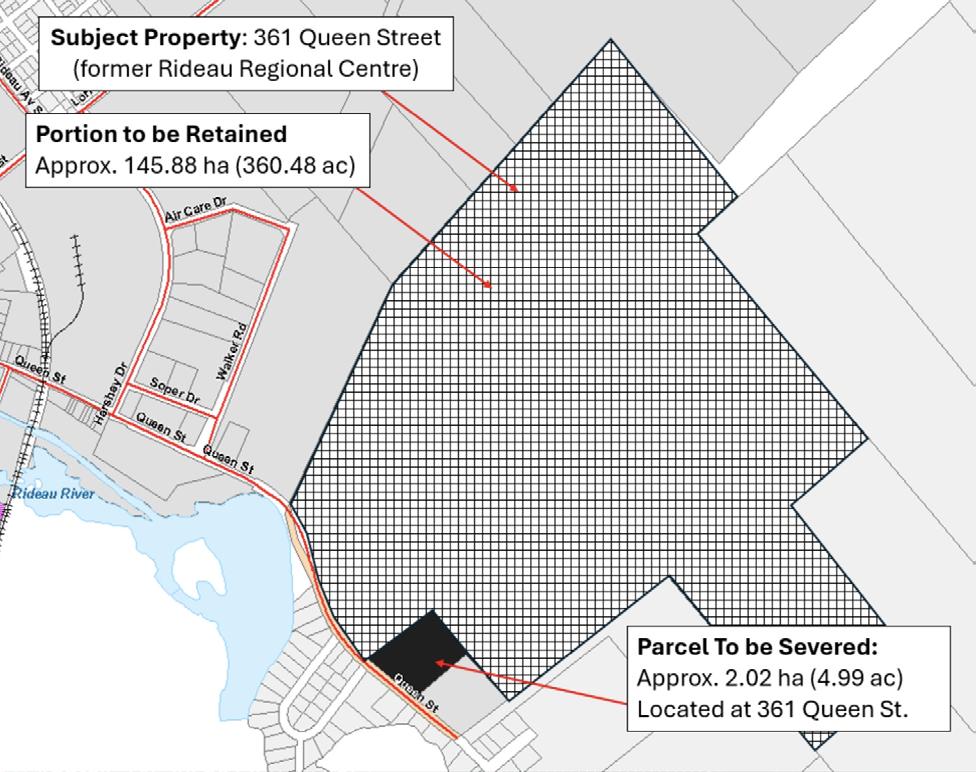
The application allows for the creation of a 2.02-hectare parcel at Rideau View Commons (formerly the Gallipeau Centre), separating it from the rest of the sprawling property. The retained lands exceed 145 hectares and include the balance of the former institutional complex.
While no development was formally approved at this stage, the severed parcel is intended to support a proposal by Omni, a longterm care facility builder in Ontario. There is a proposal for a four-storey, 256-bed facility to be built beside the Ontario Provincial Police Headquarters on Highway 43.
“This application concerns only the creation of the lot,” said Planner Richard Grant during the public meeting, noting that
any future development would require additional planning approvals.
Those approvals include an official plan amendment and changes to the town’s development permit bylaw, as long-term care facilities are not currently permitted within the site’s Corridor Commercial designation.
The lands are governed by the town’s development permit system rather than a traditional zoning bylaw, allowing for a more streamlined approval process that combines zoning, minor variance and site plan control.
The proposed parcel fronts Queen Street and is currently vacant. Municipal water and wastewater services are available at the road, and no objections were raised by reviewing agencies, including the Rideau Valley Conservation Authority, Enbridge Gas and the town’s public works department.
Staff concluded the lot is suitable for development, citing its size, flat terrain and lack of environmental constraints. A
preliminary tree assessment will be required before any site alteration or vegetation removal.
A representative for the applicant, Fotenn Planning and Design, told the committee the severance is an early step in a longer planning process.
“At this time, we’re just looking to create the parcel,” said associate planner Jacob Bolduc, who is acting on behalf of OMNI Quality Living, the intended operator of the long-term care home.
Bolduc said further studies and applications are expected to be submitted later this year. They have had preliminary discussions with the town on the future use of the property for a long-term care home, “but that would be subject to future development applications.”
A member of the public raised concerns during the meeting, focusing mainly on potential construction noise and site access to his
own property, which is nearby. Those details will be addressed through future applications.
Property owner Chris Saumure said preliminary site work suggests fewer construction challenges compared to the Broadview Nursing Home they built in Smiths Falls, including minimal need for rock blasting.
The planning advisory committee approved the severance subject to standard conditions, including the submission of a reference plan, payment of any outstanding taxes and compliance with tree protection requirements.
Coun. Jay Brennan, who sits on the planning advisory committee, said he supported the application.
“This is exciting news,” he said. “I understand this is the first step of probably what is a longer process.”
Brennan asked how long before the project would start and how the town could help facilitate it.

“It’s still very early,” Bolduc said, but the sooner the better. “Step one is knowing the boundaries of the property,” and they can ensure their studies are specific to the boundaries. “But we are looking to submit an application this summer.” Tara Crawford, director of construction and development with Omni, said they would be “looking forward to working with Smiths Falls and being part of the local community.”





ADVERTORIAL
editorial@pdgmedia.ca
Uniform Developments, an award-winning new home builder known for creating thoughtfully designed communities across the Ottawa region, has begun construction on its newest neighbourhood in the growing town of Carleton Place. The development, called McNeely Landing, marks an exciting new chapter for the Ottawa-based builder as it brings its approach to quality, architecture and
community design to one of the region’s fastest-growing communities.
McNeely Landing will feature approximately 430 homes built across roughly 60 acres of land. The community has been carefully planned to offer a variety of housing options designed to appeal to a wide range of residents. Homebuyers can expect a mix of single-family homes, bungalows and townhomes, along with low-rise luxury rental residences. The neighbourhood will also include a future school site, helping to support the needs of families and strengthen the commu-
nity’s long-term vision.
Founded more than 35 years ago, Uniform Developments is a family-owned company with deep roots in the Ottawa region. Over the past three decades, Uniform has established a reputation for creating distinctive homes and memorable neighbourhoods in some of the capital’s most sought-after areas. The company’s philosophy centres on a boutique approach to building, one that prioritizes quality, thoughtful design and attention to detail at every stage of development.
At Uniform Developments, residential construction is viewed as a blend of art, architecture and purposeful execution. Each home is designed to reflect timeless style and craftsmanship. Their goal is not simply to build houses, but to create homes that remain places of pride for years to come.
That attention to detail extends beyond the homes themselves. Uniform places significant emphasis on the design and cohesion of the communities it creates. Streetscapes, colour palettes,
landscaping, parks and naturalized spaces are all carefully considered to ensure each neighbourhood feels welcoming, harmonious and visually distinctive. The result is a community that balances aesthetic appeal with everyday livability.
Equally important to Uniform’s success is its dedicated team of professionals. From design and construction to sales and customer service through warranty, staff are committed to ensuring the home-buying experience is smooth, transparent and enjoyable. The goal is for homeowners to feel confident that choosing a Uniform home is a decision they will value for years to come.
Uniform is particularly excited to bring its work to Carleton Place, a town known for its small-town charm, natural beauty and strong sense of community. With steady growth and a vibrant local character, the town provides an ideal setting for Uniform’s design-focused approach to homebuilding.
The homes at McNeely Landing are designed by Ottawa architect Barry Ho-
bin and his team at Hobin Architecture Incorporated. Uniform Developments and Hobin Architecture share a long-standing collaboration and a common vision to create thoughtful, impactful and well-designed communities across Ottawa and the surrounding region.
Construction is now underway at McNeely Landing, with the first homes beginning to take shape. Two fully furnished model homes are currently being completed and are expected to open to the public later this spring. Once finished, the models will offer prospective buyers an opportunity to experience the craftsmanship, design and attention to detail that define a Uniform home.
Residents and visitors interested in learning more about the new community are invited to visit the McNeely Landing sales centre, located at 680 McNeely Ave. The centre is open Monday through Thursday from 11 a.m. to 6 p.m., and Saturday and Sunday from noon to 5 p.m. More information is available at www.uniformdevelopments.com.