
June 7th, 2026

June 7th, 2026
By Alex Njagi
Hometown Newsletter has been covering community matters for the past two editions, focusing on how young people get involved in football for better mental wellness, commitment to something, and pointing young minds towards success in society. The inclusion of women in football at Beef Field under the sponsorship of the Rotaract Club of Menengai revealed that giving young people an opportunity to be heard when faced with life challenges alleviates the pain and mitigates the adverse impact of stress.
As relevant as matters of mental health and young people are, they have remained even closer to our hearts and minds due to the topical and moving issue of the unfortunate arson case of Utumishi Girls High School that claimed 16 young lives and left several young women nursing injuries.
This is a story that has left many Kenyans asking difficult questions. Questions about discipline. Questions about responsibility. Questions about the kind of society we are building for our children.
When a school burns, bricks and timber are not the only things reduced to ashes. Dreams burn too. Years of sacrifice by parents, teachers, and taxpayers go up in smoke. The classroom that should nurture tomorrow's leaders becomes a monument to today's poor choices.
Yet before we point fingers at schools, perhaps we should first turn the mirror toward ourselves.
A school may sharpen the spear, but the home is where the metal is forged.
Why is it that some boys and girls eagerly ask for midterms and comfortably return home, knowing very well that a parent awaits them? Why do some walk through the door without fear of difficult conversations, correction, or accountability?
At the same time, there are children who think twice before making certain choices because they know someone at home will ask a simple but powerful question:
"Aje sasa?"
Not out of cruelty. Not out of fear. But out of love and responsibility.
Could it be that the fear of accountability is slowly disappearing from some of our homes?
Could it be that in our desire to protect our children, we sometimes shield them from the very lessons that help them grow?
Dr. Timothy Arege, in his renowned Kiswahili short story, Ndimi za Mauti, reminds readers how destructive forces often begin as small, seemingly harmless actions. A single spark can become an inferno. A moment of poor judgment can create consequences that last for years.

The lesson remains timeless: destruction rarely arrives without warning. The same applies to schools. When administrators notice smoke before the fire and act swiftly to prevent violence, chaos, or tragedy, should that wisdom be mistaken for weakness? When boundaries are drawn to protect life and order, should that be labeled as being "too permissive"?
A river cannot rise above its source. Schools may water the garden, but the roots are planted at home. Teachers may trim the branches, but character is first nurtured around dinner tables, during evening walks, in car rides, in family prayers, and through conversations that are sometimes uncomfortable but always necessary.
Research and educational reports continue to show that disruptions in learning hurt students deeply. The effects extend beyond lost lessons. They affect mental wellbeing, academic achievement, and future opportunities. In many cases, vulnerable learners suffer the most.
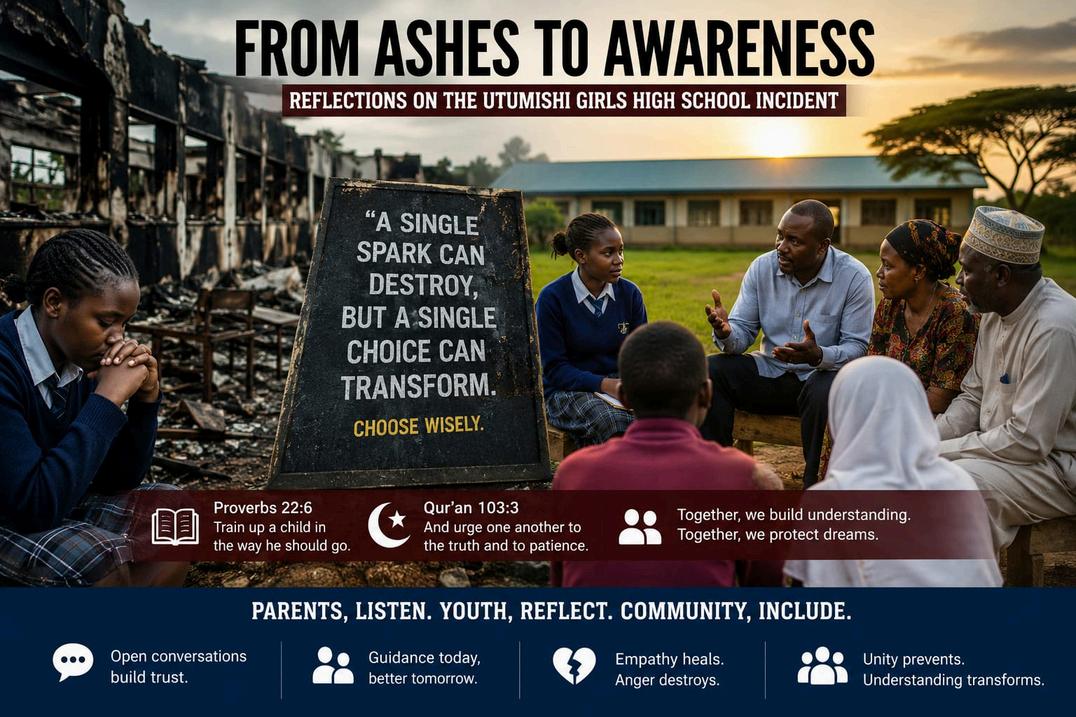
Proverbs 22:6 calls upon parents and guardians to train children in the right way. Ephesians 4:31 urges people to put away anger, bitterness, and rage. These teachings remind us that education is not merely about passing examinations. It is also about shaping character. Similarly, Islamic teachings uphold knowledge as a sacred pursuit and emphasize patience, self-control, and accountability.
The values of restraint and righteous action remain essential guides for young people navigating moments of frustration and conflict. The reality is that some of our boys and girls are becoming travelers without maps.
They are defended from correction, protected from consequences, and comforted even when they are wrong.
Yet life beyond the school gate offers no such guarantees. The world does not negotiate with indiscipline. It responds to it.
When home and school pull the rope in opposite directions, the child standing in the middle eventually falls. As our learners return home this season, let us embrace our responsibility intentionally. Let us be present. Let us speak truth even when it is uncomfortable. Let us set boundaries that may sting today but save tomorrow.
Let us expose our children to the realities of life. Let us teach them resilience, responsibility, respect, and accountability. The tragedy at Utumishi Girls High School should not only prompt investigations into what happened. It should inspire a deeper national conversation about who we are raising and how we are raising them.
Because long before a school catches fire, something else has already been burning unnoticed.
And that is where the real work begins.