
HOMERTONIAN


This edition of the Homertonian tells how the College’s friendly environment supports excellence and achievement. We hear from three recent graduates: Jeevan (p.14) tells us of an extraordinary project doing good in Tanzania; and Rebekah (p.7) and Phoebe (p.24) credit Homerton’s special qualities with making them ‘the women they are today’.
We will extend this Homerton welcome to a new cohort this October, when for the first time we begin to teach medical students (see Julia Kenyon’s article on p.12). Medicine is the last big subject to be added to Homerton’s portfolio, and we have been preparing for them for some time: when they come, we will be ready!
At the heart of the Homerton support network are our fantastic Porters: keeping an eye on young people away from home for the first time, and often providing an informal counselling service to complement the official student counsellors (without the ‘counsellees’ necessarily realising it). We celebrate their contribution on page 18.
And you can be part of this support network too: we’re recruiting alumni for Homerton Careers Connections, to advise current students on ‘what comes next’. See page 17 for how to sign up. Finally, if anything in this edition resonates with you or provokes you to laughter or wrath or tears, then do write to us: we publish a selection of your letters in each edition.
Matthew Moss
Director of External Relations and Development

The Homertonian is published once a year to keep members informed with College and alumni news. Do contact us in the Development Office on Telephone 01223 747066 or Email alumni@homerton.cam.ac.uk with feedback, news or letters. All our publications are available to read online on the Homerton College website: www.homerton.cam.ac.uk/alumni/publications.
Thank you to all of our contributors and to those who supplied images. The views expressed in this newsletter do not necessarily represent the views of Homerton College, Cambridge. Cover photograph: Martin Bond. Design and print management: H2 Associates, Cambridge. Editors: Matthew Moss, Amy Reeve and Jack Hooper
Sohow old is Homerton? As a constituent College of the University of Cambridge, we date merely from 2010, and a lot has been accomplished in those few years. One focus of intense activity has been to prepare for our first cohort of undergraduates coming here to read Medicine in October 2016. They will find a substantial welcoming party of Professors, clinical and pre-clinical Directors of Studies – not to mention three skeletons and a box of loose bones. I may hold the current record for a Cambridge Head of House with skeletons in his cupboard. As a bonding but also a practical exercise, one of the students’ first tasks will be to assemble the skeletons correctly, determine sex and other features, and then give names to these former people who will be their silent companions throughout their six years of study. Though the students have not yet arrived, Medicine has already brought a great deal to Homerton. We have a partnership with the Department of Public Health, a growing association with the Clinical School, plus Fellows who work for, and with, AstraZeneca, developing drugs to beat cancer. As the only College in South Cambridge, our links to medical development next door to the Cambridge Biomedical Campus, can only grow, benefitting our community, our University, and society at large. So the future looks bright for the six-year-old College.
Yet we are also teetering on the edge of becoming two and a half centuries old. It was in 1768 that a debating society, based at the King’s Head tavern, morphed into an
PRINCIPAL’S WELCOME
academy for the dissenting church. Two hundred and fifty years later, words such as ‘dissent’ and ‘academy’ have changed their meanings to encompass the issues facing us in 2016, not all of them positive or easy. As Homerton evolved, education stayed. Successive Homertons taught only men, then only women, then trained only teachers.
Now the College strives to draw out the best of each for the benefit of all. Earlier this year, those of us collecting our thoughts by listening to the Today programme on BBC Radio 4 while brewing the first cup of the day were delighted to hear Dr Chibeza Agley, Research Fellow at the College, talking about his work in gene editing. Chibeza finds answers to scientific questions we could not even have asked a decade ago. In one way this embodies the new Homerton. In another, it takes us on our winding, but always questing and positive journey, back to our roots, in the capital in 1768, and people whose aspirations and potential led them to ferment change. That’s in our DNA.
So which Homerton is, was, and will be yours? If anyone reading this was a student in 1768, then those skeletons have even more to teach us than I thought. But it doesn’t matter whether Miss Skillicorn was someone you knew or a name on a room and a face looking down in the Great Hall, or whether you only graduated this year. You are a Homertonian – an actor in our story. Homerton’s reach is now global. We have begun a scheme for Associate Fellows: past Fellows who have moved to pastures
new, but with whom it is mutually beneficial to maintain friendship and academic links. I hope that sooner or later you will have the opportunity to hear them talk about their work as they return to give presentations. And in August, I, the Charter Choir, and our Director of Development board a 757 heading for New York City, where we will meet and renew acquaintance with alumni. While there, I will launch my first novel, You’re Not Dead (more skeletons!). It will be a pleasure to show off our splendid choir, whose first CD Audite Finem has attracted strong attention, and who show by example the range of extra-curricular as well as scholarly achievements of the student body. We now award an impressive array of academic and non-academic prizes. Additionally, students have excelled this year in sport, with two Homertonians in the winning Blondie boat at this year’s Boat Races and another in the courageous, halfsunk Blue Boat. The captains of the University women’s lacrosse and hockey teams are from our College, and our men’s rugby team won the Cuppers Shield, their first silverware in eight years, with a resounding 36-7 score. On the more aesthetic side, Homerton held its first musical composition and performance competitions, and, of course, our actors remain the backbone of Thespian Cambridge.
And so Homerton – born in 1768, in 2010, in the minds of those yet to join us – goes from strength to strength.
Professor Geoff Ward Principal
The Cambridge Chamber Music Residency is funded jointly by Homerton College and the Radcliffe Trust, and organised by both the College and the Faculty of Music.
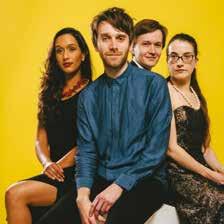
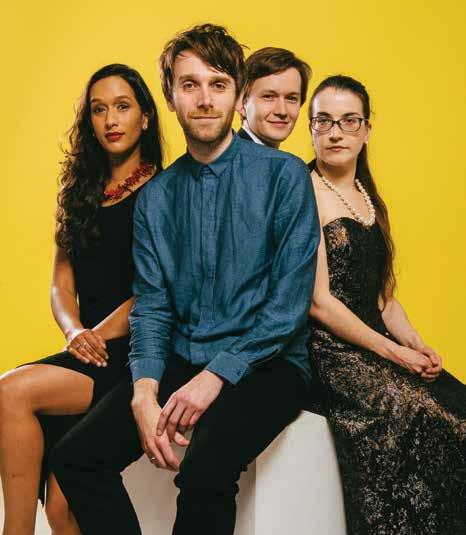
The Ligeti Quartet has been named as the first holder of the Cambridge Chamber Music Residency. From October 2016, at Homerton, the Quartet will hold the Maxwell Davies Residency – named in honour of Sir Peter Maxwell Davies, Honorary Fellow of the College and former Master of the Queen's music, who died earlier this year. They will be playing and curating concerts throughout the academic year. The Quartet have worked closely with Peter Maxwell Davies in the
HOMERTON’S FIRST RESIDENT ENSEMBLE
past, and plan to perform a concert of his music early in the next academic year.
The Quartet said: ‘We are delighted to be the inaugural ensemble for the Cambridge Chamber Music Residency. As a quartet dedicated to the performance of modern and contemporary music, and interested in collaborative and innovative projects, we believe we will make a strong and lasting contribution to music at Cambridge. The residency will be a tremendous opportunity for us to engage
with a vibrant community of composers, musicologists, and other performers, at the Faculty of Music and in Homerton College’.
John Hopkins, composer, Fellow, and Director of Studies in Music, said ‘the Quartet was simply the best of the groups we auditioned, with a quality of artistry that was truly outstanding. Their entire approach is totally refreshing in that they place contemporary music at the heart of their work’.
Formed in 2010, the Ligeti Quartet is united by their fascination with the music of György Ligeti (1923–2006), a Hungarian composer of contemporary classical music. The Quartet have established a reputation as leading exponents of new music, through work with performance artists, actors, and DJs. The group has performed at many prestigious classical music venues, including the Wigmore Hall, Purcell Room, and Barbican Hall. They are also no strangers to more unconventional venues, having performed in museums, galleries, and even on artificial icebergs, as part of a Greenpeace campaign.
A spokesperson from the University’s Faculty of Music said: ‘Their breath-taking performances, both technically and musically, coupled with outstanding artistic plans for working with student composers and performers will undoubtedly be an exciting new development in Cambridge music-making. The quartet will be working in particular with graduate composers but will also be performing, coaching and creating events for performers. Their current work crosses many artistic boundaries, and will be able to expand further within the Cambridge environment’.
From L-R: Mandira de Saram (violin), Richard Jones (viola), Patrick Dawkins (violin), and Val Welbanks (cello)
Mike Massaro
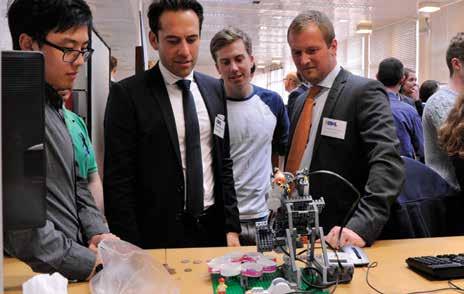
First-year Bill Jia won a prize for designing, building, and programming a LEGO robot. Bill, along with two students from Downing, came up with a fully functioning coin-sorting machine. Their robot could detect coins placed in the hopper via a light sensor, and rotate an array of containers into position according to the coin. The coin would be dropped into the appropriate container, and the robot was programmed to keep count of the number of coins, and their total value.
Thomas Kirk Kristiansen, Deputy Chairman of the LEGO Foundation, visited Cambridge recently, stopping off at the Engineering Department to give Bill’s project a test run. The LEGO Foundation recently donated £4 million to the Faculty of Education to fund the Research Centre on Play in Education, Development and Learning (PEDaL).
PRIZE ENGINEERS
Jonathan Ledger won a Computing Prize for his coursework, which included a project to calculate how many combinations of coins make up a given amount of money. Jonathan said: ‘I did a little extension to the set task to make the Six Homertonian undergraduates have been awarded academic prizes by the University’s Department of Engineering.
Whilst in Cambridge, they also met Dr Michelle Oyen, Fellow and Director of Studies in Engineering. Michelle heads a bioengineering lab, which researches mechanical behavior in biological materials, and members of her team built LEGO robots which can carry out repetitive tasks overnight, drastically decreasing the time spent by skilled workers on creating samples.
Alice Huntley and Evald Monastyrski won prizes for their Integrated Design Project. In teams of six, students had to design the mechanics, electronics and software for a robot that could identify the composition of metal rods. Alice and Evald’s robot, christened Gwinny, had to collect a rod, identify whether it was made of brass or steel, and deliver it to a corresponding slot.
computer program run fast enough using dynamic programming to calculate large amounts of money’.
Finally, Ed Broadhead and Maria Fernandes-Martos Balson were both awarded Language Prizes. Maria undertook a project, written in French, about avoiding bone resorption around hip prostheses. In this, she explored ways to produce hip implants which have the same stiffness as bone, in order to avoid loss of bone mass and integrity around the implant. Ed, currently studying abroad in Paris for a year, received a prize for his performance in a Spanish language paper, taken as an option in his second year.
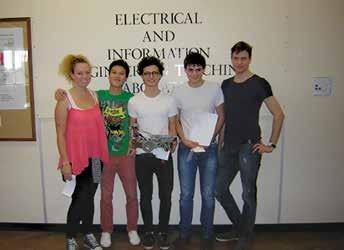
Alice (on the left) and Evald (on the right) won prizes for their robot, Gwinny (pictured central)
Bill Jia (pictured left) demonstrating his coin sorting machine to senior members of the LEGO Foundation
PARTNERSHIP FOR BIOSCIENCE
Homerton has a new way of supporting its students in biological science and medicine, thanks to a donation.
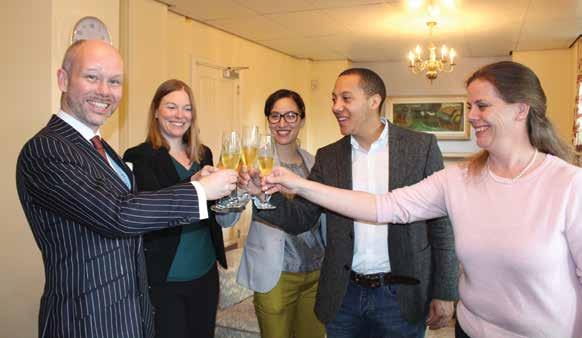
CamBioScience Ltd, an ambitious young company at the forefront of innovation in biotechnology, has made its first corporate donation, to support students in medicine and biological science at Homerton College. The donation sets up a fund at the College which will invite further support from companies in the Cambridge bioscience cluster.
Dr Chibeza Agley, CEO of CamBioScience and a Fellow of Homerton, said: ‘We’re delighted to be able to give back to Homerton. The College has been immensely supportive of our activities so far, hosting conferences, workshops, and art auctions alike, and it gives us great pleasure to be able to support the College’s students in return’.
CamBioScience Ltd is a life sciences consultancy firm which facilitates links between academia and industry. The company offers intensive workshops covering topics at the cutting edge of biomedical science, which are delivered by world-leading industrial and academic experts. Topics examined this year have included the propagation and manipulation of structures grown from intestinal stem
Dr Chibeza Agley (second right) toasts the agreement with (from left) Matthew Moss, Dr Julia Kenyon, Dr Sarra Achouri (Chief Technology Officer at CamBioScience) and Dr Rachel Williams (Director of Studies in Clinical Medicine)
cells, and the strategic design and control of the gene-editing system, CRISPR-Cas9.
Homerton’s Director of External Relations and Development, Matthew Moss, commented: ‘It’s remarkable to see such a young company thinking philanthropically, and we’re thrilled CamBioScience have chosen to donate to support our student body’.
Homerton will complete its academic diversification by welcoming its first medical students in October 2016. In preparation, the College has recruited a suite of Fellows engaged in the biomedical sciences. The College now boasts a preclinical Director of Studies (DoS), two clinical DoSes, and three Professorial Fellows in biomedical subjects.
Dr Julia Kenyon, Homerton’s Director of Studies in Pre-clinical Medicine, said: ‘This donation comes at a crucial period in our preparations to take our first cohort of medical students. This ongoing contribution will allow us to ensure that the College can help them thrive during their undergraduate years, and give them the best chance to succeed upon graduation’.
A DAY IN THE LIFE OF THE HUS
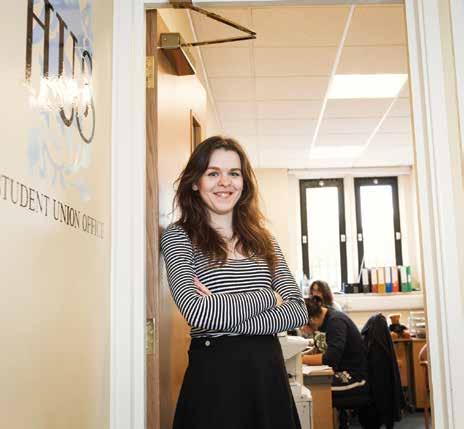
The Homerton Union of Students is unique within the University. We are the only College to have a sabbatical JCR President with their own office and professional Office Manager. Ruth Taylor, President for 2015–16, graduated in History last year. As she comes to the end of her Presidency, Ruth takes us through that mythical thing, a ‘typical day’.
In between meetings, I’ll try to work on one of our many ongoing projects. This year, we’ve worked with College on student rent contracts, the price of laundry services, and have campaigned for a new JCR common room.
12pm – 1pm
Leo, our Vice-President External, attends a lunchtime meeting with the University Counselling Service (UCS) and Cambridge University Students’ Union (CUSU) to discuss how the Service addresses student needs. The HUS works closely with CUSU on many different initiatives during the year, and the subject of student welfare is always a high priority. The HUS committee has two Vice-Presidents, and it is the role of the Vice-President External to communicate with CUSU.
9.30am
Arrive in the office and open up. It’s often quiet in the mornings, unless we get an influx of students who need to have their dissertations bound ahead of an impending deadline. I’ll spend some time answering emails – we get a huge variety of different questions and requests from students on a daily basis. Every day is different – you never know what is going to appear in your inbox!
10am – 11am
I attend a 2018 Working Group meeting. This group was recently set up to coordinate celebrations for the College’s 250th Anniversary. The College is planning a diverse range of events that will take place in 2018, including an Anniversary Ball. HUS and MCR Exec members sit on almost all of the College committees, and these meetings are a valuable chance to convey student views to College management.
1.30pm – 2pm
Lunch! The office is often really busy around lunch times, so often it’s difficult to sit down and properly eat a meal. Many students tend to come into the office and use it as a social space around this time, and it provides a great opportunity to chat to students in an informal context.
2pm – 4pm
I attend College Council – Homerton’s primary decision-making body. Council includes student representation from both the JCR and MCR. This is surprisingly rare across Cambridge Colleges – very few allow their students a seat. This month the Bursar briefed Council on plans for a new sports complex on Long Road that will be shared with St Mary’s School.
5pm – 7pm
The office is open for the evening shift. Much like at lunch time, students often come in to eat their dinner, to socialise or to get work done on quieter evenings.
7.30pm
Welfare film night. We organise a range of different events in the evenings, and our welfare team often hold more chilled-out events like film nights to help students unwind after a long day of lectures. Disney films are a staple favourite of our students. One evening each week, the committee also gets together to co-ordinate the HUS’s activities, and to plan our campaigns and events (the next Bop theme always features heavily!).
HUS JCR President, Ruth Taylor
In 2018, Homerton will celebrate the 250th anniversary of its establishment in the East of London.
A 250-YEAR-OLD START-UP 1768 – 2018
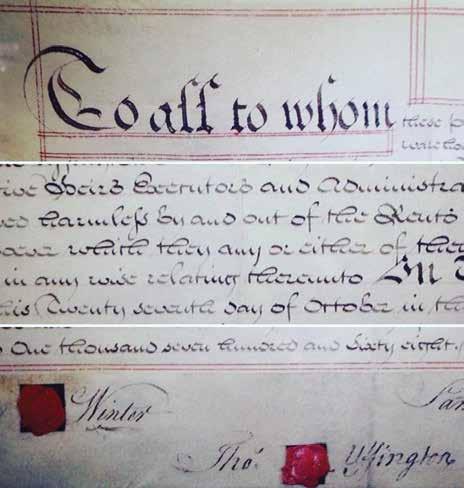
Inhis history of the College, and in an attempt to trace the College’s history to the first glimmer in the first eye, Tom Simms (former Vice-Principal) pointed towards the establishment of the Congregational Fund Board as early as 1695. There was also the King’s Head Society training young men of zeal for the Congregational ministry from 1730. We can even identify the first published lecture given on 12th November of that year. But it was on 27th October 1768 that these two organisations combined in a Trust Deed to work for the nonconformist ministry.
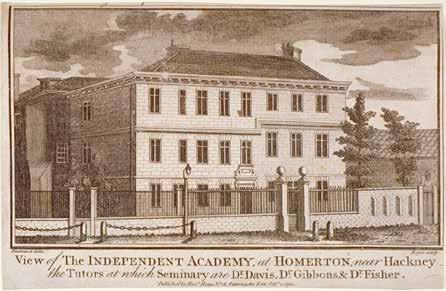
The Deed established Homerton Academy, later to become Homerton College, in a large house in Homerton High Street, Hackney, East London. From this precise point in time, five essential collegiate elements came together:
• its name associated with the East London village of Homerton, its legal constitution under a Trust Deed, governed by trustees,
• the acquisition of a permanent teaching and residential building,
• its first teaching staff appointed as Principal, John Conder, and Resident Tutor, Thomas Gibbons
• most importantly perhaps, students were admitted who then became the first in a long line of ‘Homertonians’ –our alumni.
The Trust Deed of 1768 forms part of a series of images from Homerton’s history, displayed along Paupers’ Walk
There are significant dates in Homerton’s long and complicated story, too: in 1824, when the house on Homerton High Street was rebuilt, the name of Homerton College was formally adopted – a date we associate with our College grace. A significant shift to teacher education took place in 1852. There was the date it moved to Cambridge in 1894 and the date when it was accepted as an Approved Society of the University in 1976. And of course, 2007, when the College made a formal submission to the University of Cambridge for full collegiate status and 2010, when this was granted
and Homerton was awarded a Royal Charter as a self-governing College of the University of Cambridge. In many ways the College has the agility and energy of a new, not an old, institution: a 250 year old startup, perhaps.
The evolution has been long and complex: Homerton in 1768 was a very different institution. The mission though – to serve the needs of society through education – is as critical as ever. It is with great pride that we will celebrate this important anniversary in 2018.


Robert Bragge checked in at The King’s Head, Swithun’s Alley, London – with 12 others 26 October 1730

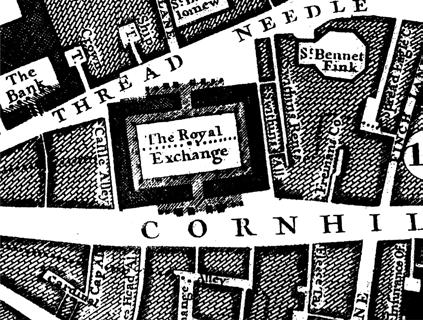
Most productive discussion today. Decided that we’d offer a course of six years (2 yrs grammarian, 4 yrs academical) for those wishing to enter the Calvinist ministry. We’ll begin a course of sermons defending some important doctrines of the Gospel at Lime Street, London, on November 12th, starting with “The Spirit’s Standard Lifted Up and Displayed Against Error”; come one and all.
King’s Head Society invited you to like their new Page Homerton Academy, London 20 October 1768


page
Visitors welcome to our new campus on High Street, Homerton – we have just purchased a house as a permanent site for our Academy.
John Conder liked this

Homerton College, Cambridge invited you to their event
23 January 1894
To celebrate us taking up the empty premises of Cavendish College, Cambridge, we’re throwing a welcome party! We’re moving to Cambridge to get away from the disease of East London – we’ve had a death from consumption, typhoid, or smallpox each year since ’78, so we’re off to Cambridge.
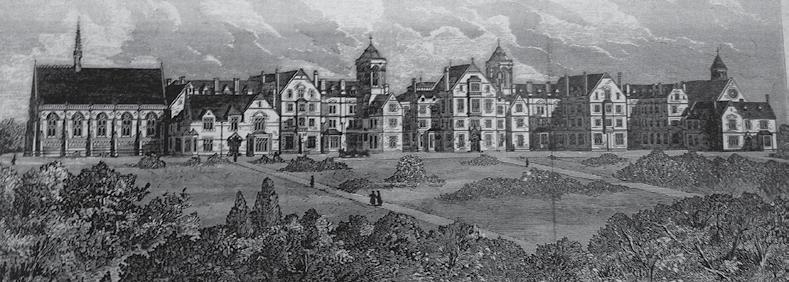
event invitation COLLEGE WARMING PARTY
Cavendish College, Cambridge, Hills Road

Homerton College, Cambridge changed their profile picture.
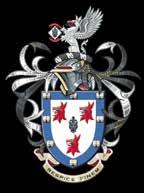
22 December 1954
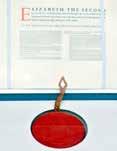
In this, the third year of the reign of our Queen Elizabeth the Second, the Arms following are granted and assigned to Homerton College, that is to say: Argent a leopard’s face Jessant de lys Sable between three Griffins heads erased Gules on a Bordure Azure eight open Books proper. And for a Crest on a Wreath of the colours A demi Griffin holding between the claws a Lozenge Argent charged with a Leopard’s face Jessant de lys as in the Arms.

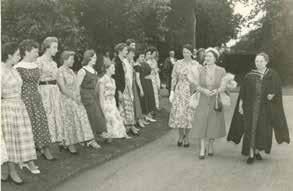
HM Queen Elizabeth the Queen Mother checked in at Homerton College, Cambridge 29 May 1957
a nice Wing! What are you going to call it?
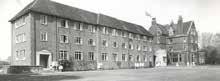


University of Cambridge
7 December 1976

Welcome to Homerton College, Cambridge, our newest Approved Society; passed after a vote in the Regent House today!
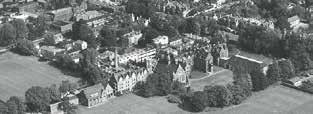
420 likes 222 dislikes
Comments

Shirley Williams (Secretary of State for Education)
The skill and dedication which have been applied to bring the lengthy negotiations for the introduction of the new four-year degree to such satisfactory conclusion is remarkable.
Congratulations Alison Shrubsole et al!

Cambridge University Boat Club
9 June 2001
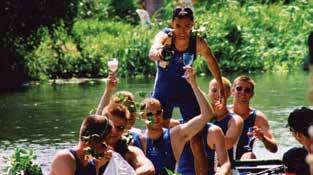
Homerton College Boat Club have today set an Oxbridge record, overbumping three times to jump a massive 14 places!!! Thanks to Lafayette Photography for the wonderful photo.

12 March 2010

Today brings our policy of ever closer union with University of Cambridge to its conclusion! We are now officially the biggest and newest full College of the University!
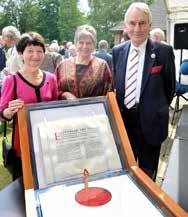

Alison Shrubsole shared University of Cambridge’s post – feeling proud
Homerton College, Cambridge – feeling fabulous
Dame Alison Richard, Dr Kate Pretty and Sir David Harrison liked this
FELLOW IN FOCUS
Dr Julia Kenyon
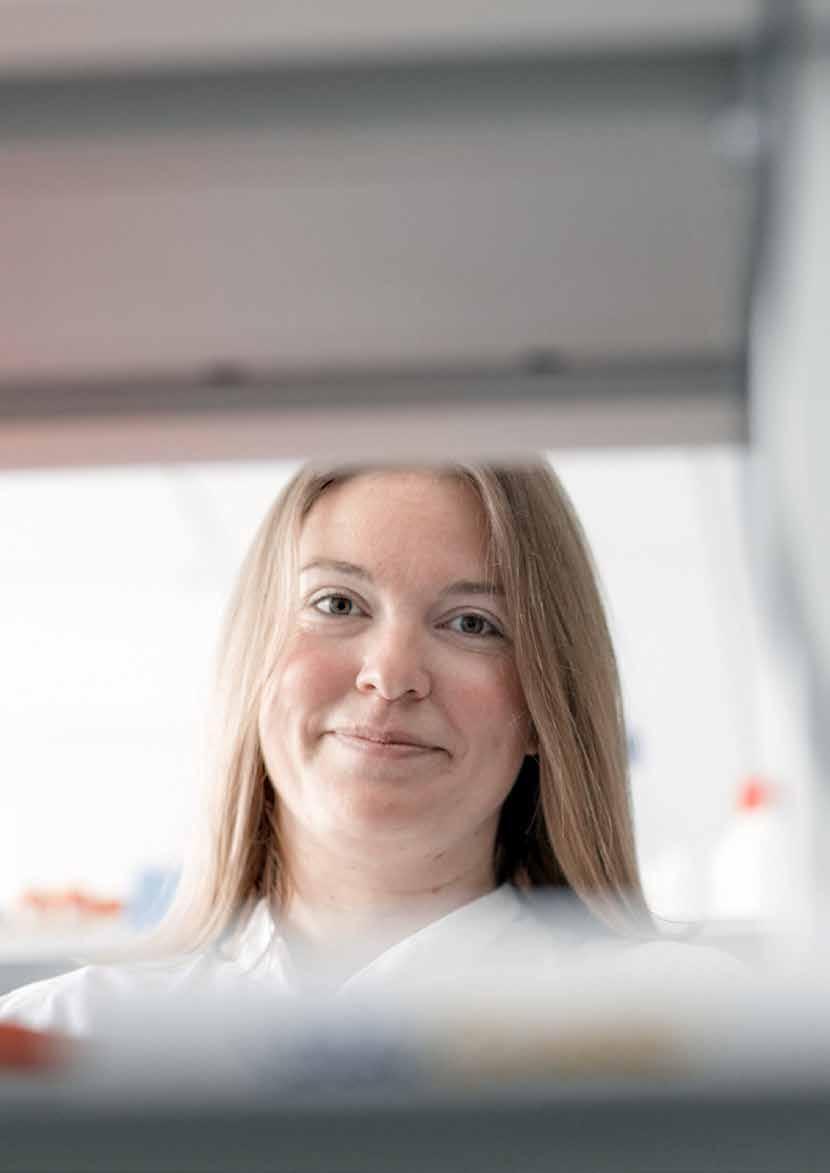
Dr Kenyon is a College Lecturer in Biomedical Science, Director of Studies for pre-clinical Medicine and Biological Natural Sciences, and a Tutor.
Being a research scientist
The aim of my work is to understand the molecules within a virus particle, and how they all fit together. My focus is human immunodeficiency virus (HIV). Anti-HIV drugs have been a real success as they control the spread of the disease as well as its symptoms. However, the virus mutates
quickly and eventually it has become resistant to each drug. A vaccine for HIV is by no means imminent and without effective new drugs the devastation caused by HIV will rise once again. The better the molecules in HIV particles are understood, the easier it will be to develop these new anti-HIV drugs.
Viral cuckoos
Much of the time I work in multidisciplinary teams of physical and biological scientists and medics, to try and examine each component of the virus. Human viruses live and hide inside our cells, and they need to hijack and use the cells’ molecular machinery to reproduce themselves and spread. We look to see which machinery they’re using and how the shapes of the viral building blocks change as new progeny viruses are pieced together. It’s incredibly complex – I think of the way a new virus particle forms as a bit like building a Lego structure where all of the pieces change shape each time a new one is added. My research niche within these teams is developing techniques that enable us to see snapshots of the virus that we couldn’t see before. The most exciting part of my job is when an experiment works and I know I’m the first person to be able to see part of the virus and understand it better than before.
Once we understand a component of the virus we can try to find drugs that stop it from working. I collaborate with

GlaxoSmithKline to try and develop a completely new type of anti-HIV drug, against a very tiny piece of the virus that we’ve found is crucial.
Teaching and mentoring
One of the most rewarding parts of my job is in teaching and mentoring our undergraduates at Homerton. During my research career I’ve encountered many people who consider teaching to be a distraction from research. I think it can be the opposite – there is no better way to make sure you understand your subject than to teach it, and when you teach really bright students like ours, they constantly challenge you to think about your subject in new ways.
The first Homerton medics
My biggest challenge for 2016 is to prepare for the arrival of our first six medical students in October. The Cambridge Medical and Veterinary Science Tripos begins with 3 years of pre-clinical training in medical science, enabling them, in the future, to understand what
is happening within their patients on a molecular level. This will become even more important as we learn more about the links between genetics and disease. It also gives our students the foundation to interweave medical research into their clinical careers and to become the medical innovators of the future. In years 4–6 the students will undergo their clinical training at Addenbrookes and regional hospitals, and learn the skills they need to become accurate and empathetic clinicians. I will be Director of Studies (DoS) for the preclinical course and Dr Rachel Williams and Dr Mark Manford are our new clinical medicine DoSes. Recent appointments to bolster our medical community are two professorial Fellows: Professor Tim Eisen and Professor Douglas Easton, two Clinical Research Associates: Dr Sophie Richter and Dr Nurulamin Noor, and two Junior Research Fellows, in partnership with the Department of Public Health: Dr Clare Oliver-Williams and Dr Siddhartha Kar. Each College has its own strengths, and at Homerton I think we’re in a really special place to build a strong medical community that supports our students, fosters research, and honours our heritage. On a recent volunteer placement in rural South Africa, one of my medical colleagues was astounded to find that many of the dozens of people he diagnosed as HIV positive had no idea what HIV was or how they could catch it. To me, this illustrates perfectly the importance of supporting scientific and medical research with education and public health measures. We can put all of our efforts into making amazing scientific discoveries, but we’ll never make a difference to peoples’ lives without working together with experts in education, public health, politics and economics. These are of course some of our traditional strengths, and discussions between our experts in these fields and our medical community are already beginning. I’m privileged to be a Fellow of Homerton in 2016 – but I’m looking forward to the future even more.
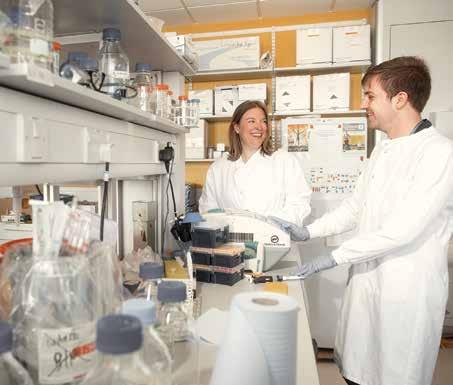
Julia pictured with Jack Hirst (2012, BA Natural Sciences)
CREATING ENTREPRENEURS IN DAR ES SALAAM
Jeevan Jayaprakash, who graduated from Homerton in Economics last year, used his Pilkington Travel Award to launch an ambitious eight week course for young entrepreneurs in Dar es Salaam, Tanzania
In 2015, I was fortunate enough to be selected to be a member of the Cambridge Development Initiative’s (CDI) Entrepreneurship Project. CDI runs four projects in Dar es Salaam in Entrepreneurship, Health, Engineering and Education. I worked with seven other Cambridge students on the Entrepreneurship Project which aims to address some of the problems faced by the youth of Dar es Salaam. In order to address the dual problem of mass youth unemployment, and a disaffection with entrepreneurship as a career, we devised an eight week course in social entrepreneurship called DAREnterprisers.
The course was underpinned by the human-centred design framework for
innovation developed by IDEO, an award winning international design and consulting firm. We chose to focus on social entrepreneurship because we wanted these young students to be the change makers in their society. We also wanted them to realise that you can do good by doing well and you can do well by doing good.
During the eight week course, we delivered workshops on both soft and technical skills, including what makes a good social entrepreneur, how to be a good leader and understand team dynamics, social impact measurement techniques, and how to write a business proposal, to name a few. We recruited 23 students
from the University of Dar es Salaam, Ardhi University and students from Kenyan and Rwandan universities and grouped people into three socially-driven business tracks: Waste, Water, Sanitation & Hygiene (WASH), Manufacturing and Urban Living (MUL) and Off-Grid Energy. I was given the privilege of being the Director for WASH. My role involved mentoring the nine students (four businesses) and preparing them to pitch their idea in front of 300 people and a panel of judges (consisting of local entrepreneurs, academics and NGO leaders) at the Bank of Tanzania. We secured the Bank of Tanzania as the venue for free, after meeting to promote our initiative.
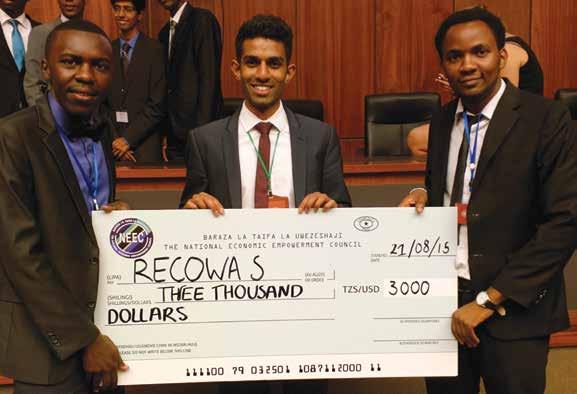
Jeevan (centre) with the winners of the Waste, Water, Sanitation & Hygiene track
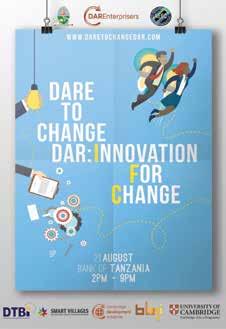
The National Economic Empowerment Council also signed an MOU with the team in which they agreed to award $3000 of seed capital to the winning businesses from the WASH and MUL tracks (Smart Villages had already agreed to sponsor the Off-Grid track at the beginning of the year).
The students learned a huge amount during the eight weeks and it was truly an incredible experience to be their mentor. They looked up to us as role models and worked incredibly hard. They turned up promptly at 8.30am every weekday, full of infectious enthusiasm and with the belief that they were learning skills that would stay with them for life.
We prepared the students as thoroughly as we could and although they were extremely nervous in the run up to the conference, they performed admirably in front of such a large audience. Many of the students had no business training or experience of presenting in front of people, so this was an unforgettable achievement for many of them.
There were three winners crowned at the conference, with one winner from each track. MagProtein (MUL track) uses houseflies to produce maggots which are used as a sustainable protein substitute to using small fish in animal feed. Chemolex (Off-Grid track) makes use of a distribution model using portable batteries to address off-grid energy problems. RECOWAS (WASH track) attempts to use the unconventional method of using moringa seeds to treat water before distributing it to households. I learnt a huge amount during these
Below Jeevan (right) helped co-ordinate a visit to the local Coca Cola factory (pictured) to gain an insight into how large corporations operate and how those lessons can be applied to the student startups
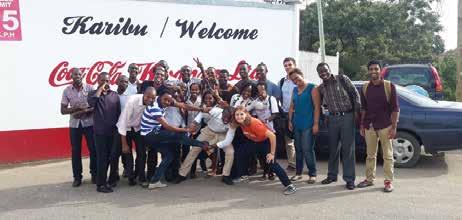
eight weeks. CDI is a superbly led student organisation backed by some incredible trustees. I gained an insight into what it takes to run a large organisation, how to mobilise stakeholders and I even had the opportunity to moderate a panel discussion at the conference which was an unforgettable experience. Our most important achievement, however, was helping to create 23 new entrepreneurs; even those who did not win are continuing to pursue their ideas. I have
also been truly inspired by my colleagues and we began discussing what we can do to help these remaining businesses to find seed capital. A few of us have decided to launch an organisation called ‘Bridges for Enterprise’ with the ambition of leveraging the knowledge of student consulting societies across the world in order to link start-ups with social impact investors. We want to start with our Tanzanian students and then we hope to scale up to early stage start-ups all over the world.
Thanks to Dr Roger Pilkington, who was a Trustee of Homerton for many years, we are able to offer students an annual travel award from the Pilkington Trust. It is directed towards Homertonians who are contemplating ambitious or out of the ordinary journeys during the summer vacation , the purpose of which must confer a benefit to others.
2015 RECIPIENTS
Name Year Subject
Country Visited
Jeevan Jayaprakash 3 Economics Tanzania
Frances Ballaster Harriss 1 Human, Social, and Political Sciences Brazil
Georgia Stewart 1 Natural Sciences Thailand
Annie Caffyn 2 Education with History Kenya
Liam Cawthorne 1 Geography Nepal
Amanda Folwell PGCE Modern Foreign Languages Colombia
2016 RECIPIENTS
Name Year Subject
Country Visited
Tarryn Biswas PGCE Art Uganda
Eleanor Chapman 2 Modern and Medieval Languages Morocco
George Clarke 3 Classics Zambia
Joshua Cozens 4 Chemical Engineering Zambia
Eun Mi Ha 1 Natural Sciences Tanzania
Fope Jegede 1 English Tanzania
Phoebe Rimmer 1 Geography Tanzania
WRebekah Clayton (2013, BA Education, English and Drama), who graduated this year, reflects on Homerton’s home comforts.
hen many students begin at university, they are around eighteen years old. Starting university is often considered ‘becoming adult’, leaving home, saying goodbye to childhood friends and taking responsibility for your own meals, your work, even getting up in the morning. Often this doesn’t come easily right away. Rather than adults, most students are in that space caught between child and adult, or rather caught between that space, the teenage years, and adulthood. After years of being taught a certain way of thinking for exams, Cambridge asks us to think originally, independently, to be innovative. Studentship can be an enormous dynamic shift which often leaves students feeling as though they need to have everything figured out straight away.
But Homerton never asked us to be ‘adults’ right away – that’s if it even believed these elusive beings, with their lives fully sorted, existed in the first place. The Porters handed students multiple packages from ASOS without judgement, made sure they
A SPACE TO GROW
knew who was dating who, and kept an eye out for students walking around with their heads down. When they dragged us from our beds in the early hours for fire alarms, when they made sure we got home safe after too many drinks at the Bop, when they comforted us when our bikes were stolen, they were looking after us. This system we benefit from is unparalleled at other universities; we have people who know us by name and who have watched us grow up during our time here. Whilst at moments the tension between not feeling ready to be an adult – yet equally wanting our own independence – has caused rebellion, there was always someone we could seek out, and sometimes someone who would even come looking for you.
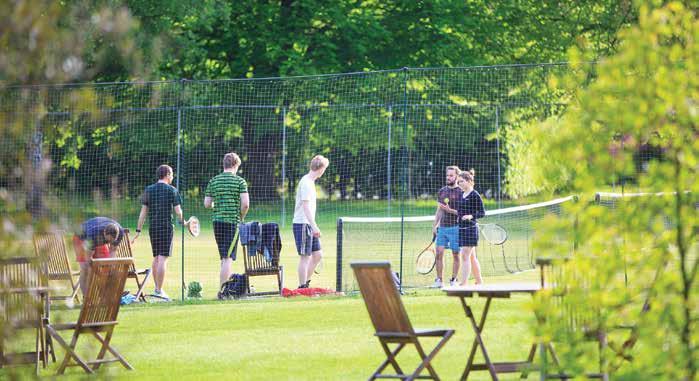
Structurally, Homerton supports this transition between adult and child, responsibility and freedom. The twentyfour hour library is a space that has allowed us to work as many Cambridge students do (throughout the night), whilst the grounds surrounding the orchard have seen
students with imminent deadlines climbing trees, playing football and sunbathing on the lawn. It’s a simple juxtaposition that can’t help but remind students to remember what is ultimately important (even if we often forget it). The summer exam term in particular, a time of intense stress and pressure, sees knots of students gather with their books on West House lawn. The tennis courts are often occupied and the grass scattered with calculators, 18th century literature and science textbooks. Exams can cause us to lose sight of our own happiness, but Homerton does its best to remind us. Our friends, our achievements and everything we’ve learnt here when we graduate, stay with us for life. ‘The beautiful thing about learning is that no one can take it away from you’ (B.B.King). Regardless of what class of honours we graduate with, we might not yet be adults, but we certainly aren’t children anymore either. I suppose this is what ‘young adulthood’ means? Personally, Homerton was the making of me.
LEVELLING THE PLAYING FIELD
Homerton calling
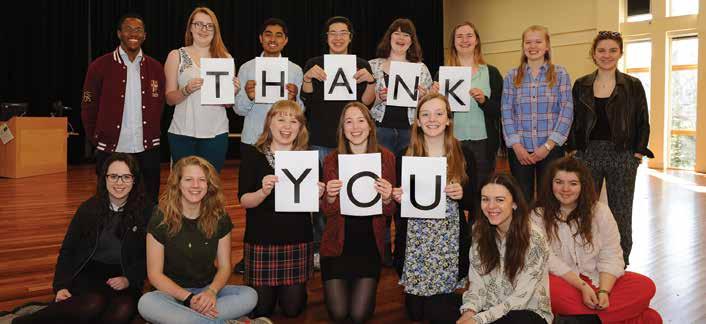
Each year a group of current Homerton students hits the phones to talk to alumni, raising crucial funds for students. This was a record year, with over £90,000 raised to support students academically, through periods of financial hardship, and to enhance student life. These donations make a huge difference: these funds help our Charter Choir go on their first tour outside Europe, flying the College flag in the USA, pay for field trips and study visits (see page 20), and alumni donations also help students in unexpected financial difficulty. Kevin Burri recently received a student support grant – entirely funded by donations – which allowed him to continue to his final year of studies at Homerton. As a Swiss national, Kevin was required to pay the much higher overseas fee when the rules for Swiss students changed after he had been offered admission.
‘My parents had made a lot of sacrifices to meet the new overseas fees, but supporting me in my final year would have been beyond them, especially with my younger sister about to head to university too. I am truly grateful for the support from Homerton alumni: without it, I wouldn’t be able to stay at Cambridge.’
Donations from alumni help ensure that top students like Kevin can achieve their goal and complete their studies: thank you.
Out into the world
Our students always have one eye on ‘life after Cambridge’, and two initiatives this year are helping Homertonians make their way after graduating. Thanks to alumna Victoria Brahm Schild (BEd 1980–84), the College now offers a hugely popular programme of internship funding to all year groups, including graduate students. Internships give students vital skills and experience, and help them test possible future careers – but many of these opportunities, especially in the arts and media, are unpaid, putting them out of the reach of students from less well-off backgrounds. The Victoria Brahm Schild Internship Bursaries level the playing field for these students.
Also this year, over 350 alumni have so far registered as ‘Homerton Careers Connections’, advising current students on careers, and complementing the University Careers Service’s provision. Amy Botwright, HUS Academic Affairs Officer, is a champion of the programme:
‘To exchange emails, have a phone call, or even arrange a meeting with someone who has progressed down a desired career path will provide a truly useful and personal insight into what life in that field is really like. As a member of the Homerton Union of Students (HUS) committee, I know that there is demand from current students for this type of programme.’
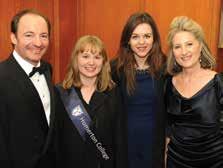
Victoria Brahm Schild (right) with husband Julian, Amy Botwright and Ruth Taylor of the HUS
ENJOYING THE UNEXPECTED
If ever there was a job that’s impossible to describe, College Porter is it. Here, we try to lift the lid.
Everyone who has been a student at Cambridge has a story about Porters. Some must surely be apocryphal (American tourist: is this College pre-war? Peterhouse Porter: Madam, this College is pre-American), but the contribution of Cambridge Porters to student life is a truth universally acknowledged. They are the glue that holds a College together: and Homerton’s Porters have an enviable reputation for being the friendliest in town.
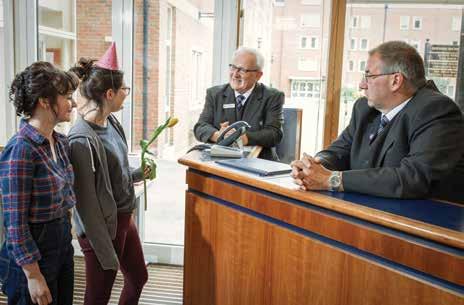
Formally, the Porters are responsible for the security and safety of members of the College, and are the first point of contact for most visitors and enquirers. Informally, they are student counsellors, messengers, coaches, comedians, shoulders to cry on and stand-in parents.
Over the course of 24 hours, Porters might hoist the College flag, receive and distribute post, issue replacement keys (multiple times), check in College visitors
(from VIPs to classes of schoolchildren), field enquiries, guide the lost, set up rooms for events, and patrol the grounds and buildings.
The true nature of the job, however, is revealed by a recent job advert for a Homerton Porter. As well as listing the predictable duties, it was honest enough to include the line ‘you should be a reliable, committed team worker who enjoys the unexpected’.
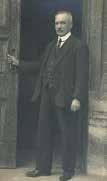
Fred Cousins ‘Indoor Man’ and Head Porter, from 1902 to 1946
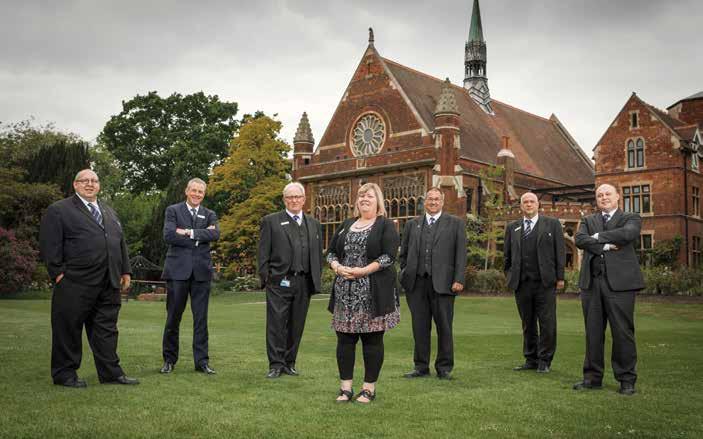
From L-R: Andy Miller, Gordon Murray, Lionel Whitehead, Maureen (Mo) Cooke, Rob Allen, Andy Drain and Neil Hopkinson
At Homerton the 11 Porters are reinforced by our two receptionists, Michelle O’Shea and Mo Cooke. They work more conventional hours and don’t have a remit for security or student discipline, but, like the Porters, their position at the College’s front door means that they get to know a lot of the students individually, and can provide the same early-warning service to the Tutorial team when they suspect a student is in difficulty. That’s a role they also share with the housekeeping staff, who see students more often in their accommodation where defences are down and emotional or health difficulties can be easier to spot.
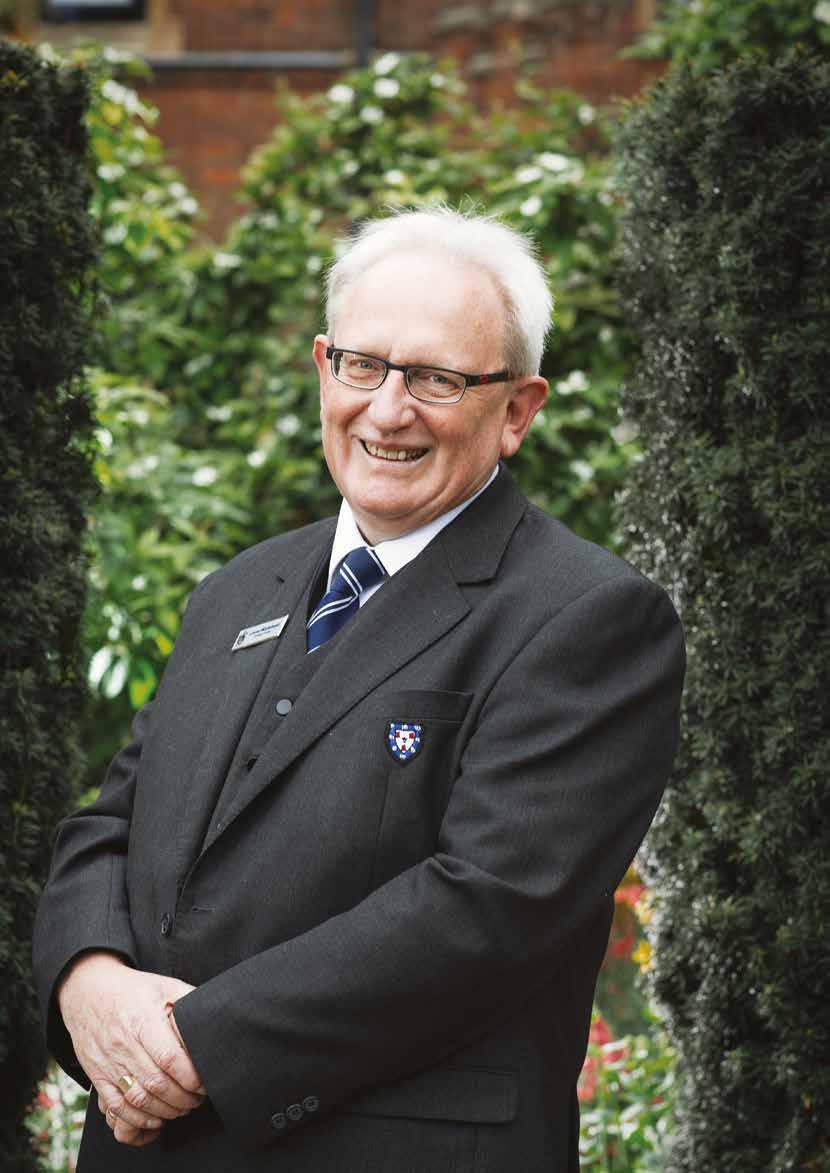
Alistair Glen is a new recruit to the team, after a career in education, working with young people experiencing a range of behavioural difficulties. It’s a background that helps with the ‘guerrilla counselling’ aspect of Portering.
‘I especially enjoy working with the students and find their enthusiasm for Homerton and their studies very uplifting. Some students find certain times of the year extremely stressful and the Plodge can be a reassuring place to have a chat over a cup of tea and put things in perspective.’
Head Porters tend overwhelmingly to have served in the police or the armed forces, to provide the necessary security and team leadership experience, and to ensure that they can carry their point with the occasional obstreperous student. Gordon
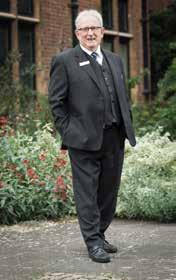
Murray, at Homerton since 2015, has a career behind him typical of the Cambridge breed of Head Porters. Gordon served for a few years in the Household Cavalry before joining first the City of London police and then Cambridgeshire Constabulary, where his duties included acting as Close Protection Officer to the then Prime Minister John Major, MP for Huntingdon. One of Gordon’s predecessors was Fred Cousins, who was engaged by Homerton in 1902 at the age of 28. Cousins’ first job for the College was as maintenance engineer, but the College Archivist, Svetlana Paterson, has deduced from wages records that before long he had considerable seniority among the College domestic staff. Cousins
was to stay with the College until his death at the age of 72, at which time he was described as the ‘Head Porter’. His duties as the sole ‘indoor man’ had evolved, to include many of the duties we would today recognise from a Porter’s job description, and he was fondly cherished by the students in his care.
Today’s students, for their part, are not unappreciative either. ‘I was hugged by a student in the Grafton Centre when I was out shopping with my daughter – and hugged again by the men’s rugby captain as I finished a shift at 2am!’ says Andy Drain, who goes to support the Homerton rugby team on his days off. ‘At least one of them was sober…’
LIONEL’S RETIREMENT DINNER
“When I first came I felt like I was their College dad (more grandad, now!). If they’re in trouble we try to steer the students towards taking the right decision for them, or towards sources of help. But sometimes they want to talk to someone who won’t try to give them advice or who seems to have an agenda: they just want a shoulder to cry on.”
Lionel Whitehead was a milkman for four years, and then a lorry driver for another eight years, delivering to building sites and prisons, before joining Homerton as a Porter in 2002.
After 14 years at Homerton, Lionel will be retiring this October. Whereas Fred Cousins (1874–1946) participated in student life by playing the French horn in student productions, Lionel is best known for playing the part of Professor Quirrell at the Harry Potter Formal Halls, and in particular for the annual auction in aid of Children in Need: the most hotly contested prize being a dinner cooked and hosted by Lionel and his wife Pat at their home. A key part of the prize is access to Lionel’s impressive wine and spirit collection.
Lionel would like to invite all students since he arrived in 2002, with a guest, back to College to mark his retirement, on Saturday 24 September 2016. The event will raise funds for student welfare at Homerton, and coincides with the annual Alumni Reunion weekend. Booking information on the back page.
Lionel Whitehead
CHARTER CHOIR GOES TRANSATLANTIC
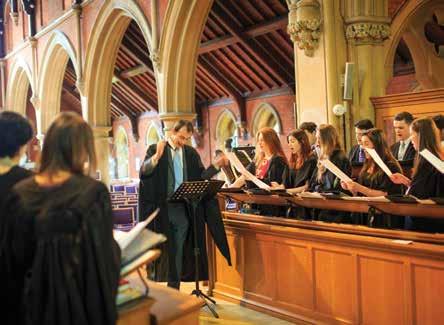
Daniel Trocmé-Latter and the Choir rehearsing
US TOUR DATES:
Sunday 28 August, 11am:
Choral Eucharist, St Thomas Church, Fifth Avenue, New York
Sunday 28 August, 6pm: Choral Eucharist, Grace Church, New York
Tuesday 30 August: Reception for all Cambridge alumni, Yale Club, New York
Wednesday 31 August, 6.30pm: Choral Vespers, First Lutheran Church, Boston
Thursday 1 September, 8.45pm: Choral Compline, joint with the choir of All Saints’, Brookline, Boston
Friday 2 September, 7.30pm: Concert, Old South Church, Boston
Sunday 4 September, 11am: Choral Eucharist, Cathedral of St John the Divine, New York
Sunday 4 September, 4pm: Choral Evensong, Cathedral of St John the Divine, New York
Tuesday 6 September, 1pm: Concert, Trinity Wall Street, New York
Friday 9 September, 10.30am: Community Eucharist, Marquand Chapel, Yale, New Haven
Saturday 10 September, 7.30pm: Concert, St Luke in the Fields, New York
Sunday 11 September, 11.15am: Choral Eucharist, joint with the choir of St Luke in the Fields, New York
Sunday 11 September, 5pm: Choral Evensong, St Mary the Virgin, New York
Dr Daniel Trocmé-Latter, College Director of Music, twenty four Charter Choir singers and two organ scholars, will be touring the Eastern seaboard of the United States this summer.
This year, with the Charter Choir expanding its membership to previously unseen numbers, copies of the CD selling fast, and an endorsement from the clergy of Canterbury Cathedral (no less), it was time to set the bar even higher. In August 2016 the Choir will be on the East Coast of the United States of America for our longest and most ambitious tour yet. Based in New York, we will be singing at locations including St Thomas’s Fifth Avenue, the Cathedral of St John the Divine, Grace Church, and Trinity Wall Street (close to the World Trade Center) interspersed with trips up the coast to New Haven and further inland to Boston. Since we will be in New York City for the 15th anniversary of the terrorist attacks, we will be commemorating that event in performance. If you’re likely to be in the USA at that time, keep an eye out for details via email and social media, including information on how to buy tickets or attend the services. If you can’t make it that distance to watch us perform, the Choir members hope to publish video updates so that you can see what they’ve been up to, in terms of both singing and of sightseeing (although hopefully not sightsinging).
Alumni are always welcome at Charter Choir services and concerts. The Charter Choir website (www.homerton.cam.ac.uk/ lifeathomerton/societies/charterchoir) contains full details of sung services. The website also contains biographies, and details of tours and recordings. Alumni can also follow the Charter Choir on their Facebook page www.facebook.com/ homcharterchoir
THE HOMERTON ROLL AND THE RSMA
Dr Peter Warner is an Emeritus Fellow of the College and formerly Senior Tutor. He is Keeper of the Roll and Chair of the Retired Senior Members Association.
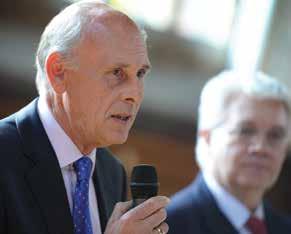
On retirement as Senior Tutor in 2013, I was asked to take on ‘Keeper of the Roll’ from Dr Ian Morrison. This strange post is not all it might seem: you could be forgiven for imagining some yellowing parchment scroll, locked away in a dark inner recess of the College, and a bunch of ancient keys wearing a hole in my pocket. But alas! There is no ‘roll’, no keys, no scrivened papyrus. What does exist, however, is a computer record of 15,000 alumni names and addresses, expertly ‘kept’ and maintained jointly by the Development Officers of the College and of the University. So where does this title come from? The first ‘Keeper of the Roll’ was Pauline Curtis (1954, CertEd), who, with great personal sacrifice, gathered together a set of shoe boxes containing a card index of thousands of names and addresses of former Homerton students. She worked at home in her spare time throughout the 1980s and 90s and this record then formed the basis for all subsequent computerised records. Pauline assiduously maintained an up-to-date record and endeavoured, before the days of computers, email and Facebook, to search for ‘lost sheep’. Pauline’s work was continued by John Hammond (former Principal Lecturer in Biology) and his wife Judith, again working from home in retirement (students’ details are now added to the database automatically
when they complete their studies, so future volunteers will not need to cover their livingroom floors with index cards to construct a list of today’s alumni!)
The role of the Roll
As an organisation, the Homerton ‘Roll’ was essentially independent of the College, maintained by volunteers and was a purely social ‘old members’ club. The Roll has always had great social cohesion, evidenced at the annual September alumni reunion gatherings, which regularly bring 200 or more members together. Nowadays there are many ways for members to keep in touch with the College and each other. On page 31 you can see the variety of benefits the College offers and ways to connect with the roll on social media.
If our body of alumni is not a ‘roll’, it is certainly an entity and has a role as a vital asset to the College, not the least because all our former students are our ambassadors, and the College needs to keep everyone informed of what it is doing.
The role of the Keeper?
Although I work as closely as I can with the Development Office, my ’keepering’ extends mostly to email correspondence with alumni, links with the College Archive and other College committee membership,
with the occasional trip out to London or the provinces to meet with regional groups. The title ‘Keeper of the Roll’, I do enjoy, because it is an anachronism, and as a historian I love anachronisms. Perhaps the time has come for a different title now, but I will leave that for my successors to sort out. Meanwhile it remains proudly on my College letterhead ‘Peter Warner, Keeper of the Roll’. It sounds great!
The ‘Senior Branch’
Recently I have been able to combine my responsibilities in respect of former students, with a similar function for former staff.
In 2013 I was delighted to be invited to join the Homerton Retired Senior Members Association as a new retiree. At first I avoided getting involved as I was busy in College as a part-time tutor and working on another College history. Then suddenly last year I was co-opted as temporary Chair following the illness of John Murrell who had himself just taken on the Chair from John Axon. I took up the post with some trepidation, but also felt honoured to be asked and thankful to be in a position to help.
The RSMA is a community supporting active members who meet regularly for events of all kinds: museum expeditions, visits to other College libraries in Cambridge, concerts given by the Emeritus Choir, garden parties, coffee mornings etc. Few other Colleges have such a vibrant association for retired senior members, which operates rather like a senior alumni branch. Other Colleges might be envious of the Homerton RSMA level of organisation and activity, and the degree to which we are closely integrated with the College. For all of this we ride on the selfless commitment of former officers, particularly John Hammond, Pauline Curtis, Ian Morrison, John Axon and John Murrell. In addition we now have the strong support of our current Principal, Professor Geoff Ward. Long may this remarkable association continue to thrive.
Peter Warner
A PLACE OF GREATER SAFETY
A chapter of Homerton’s history, involving wartime adoptions of friendly aliens and concert pianists, has recently been discovered. Jack Hooper (2011, BA Natural Sciences) tells the story.

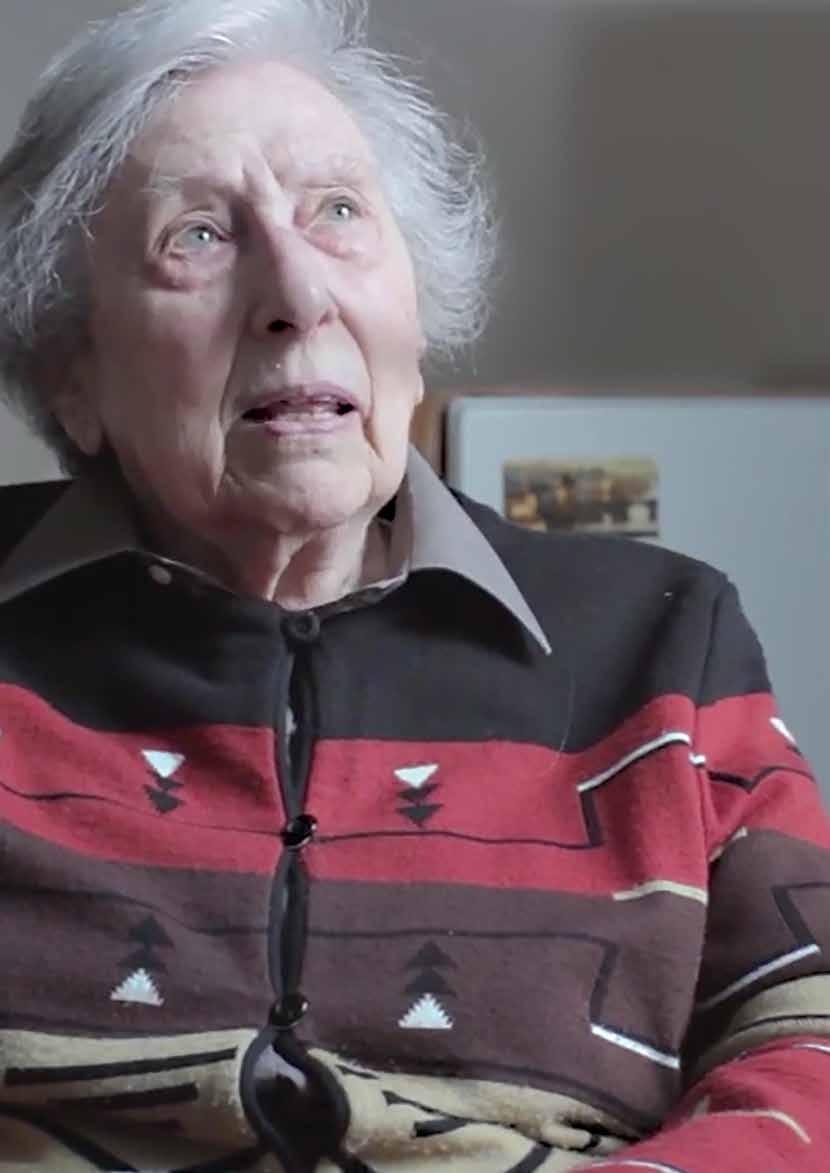
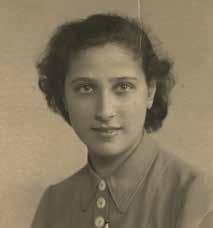
The remarkable story of Susanne Medas (née Bernstein, pictured left and below), who fled to Britain on Sir Nicholas Winton’s Kindertransport initiative in July 1939, has recently been brought to light by the College Archivist, Svetlana Paterson. Svetlana had been investigating the story of Mr Tseng Tsao, whose mother, a Dutch Jewish refugee, came to England after WWII and subsequently disappeared from the record. Whilst investigating this story, Svetlana got in touch with Mike Levy, a Fellow in Holocaust Education with the Imperial War Museum, London. He in turn pointed her towards Susanne, one of a number of Jewish children known to have come over to Cambridge.
Richard and Gisela Bernstein, with their daughter Susanne, fled their home city of Berlin for Prague in 1933. Six years later Susanne, now 16, was fleeing again on her way to London. Susanne arrived at Liverpool Street Station with a label around her neck, holding the hands of two other refugee girls. She came to Cambridge, where, for the first two weeks, she stayed with Professor Hersch Lauterpacht, and his wife, Rachel. Lauterpacht was already known as a leading figure in international law, and was later to be celebrated as its central theorist and practitioner, credited with introducing the concept of ‘crimes against humanity’ at the Nuremberg trials, where he was part of the British prosecution team.
Susanne was also fostered by a newlywed couple in Girton (who were on their honeymoon when she first arrived in Cambridge!), and the Boyle family of Cavendish Avenue, before Greta Burkill persuaded then-Principal Miss Alice Skillicorn to allow her to study at Homerton College. Burkill was the founder and secretary of the Cambridge Refugee
Committee, and, with her husband, helped to settle hundreds of children arriving from the continent.
Despite the fact Susanne had barely any grasp of the English language and culture, or any academic qualifications, she was determined to become a schoolteacher. In total, Susanne spent two years at Homerton, regularly attending lectures, and undertaking teacher training practice in a school in Ely. Miss Skillicorn made her repeat her first year, as she didn’t have the authority to allow her to complete the final year and qualify as a teacher.
Susanne’s official status was that of ‘friendly alien’ – she doesn’t appear on any of the student registers of the time, and she wasn’t allowed to have a room in the College, instead having to live across the road under a 7pm curfew. Despite this, Miss Skillicorn caught her sneaking out of the library late at night several times.
During her time at Homerton, Susanne became firm friends with Madeline Campbell. Although Madeline came from a very different background, having been brought up in a very wealthy family in Sussex and educated at a private school, the friendship endured far beyond their time here. Madeline helped Susanne find a job as a governess when she had to leave Homerton, and helped her to secure a place at the Charlotte Mason Teacher Training College in Ambleside, where Susanne finally completed her teaching qualifications in 1943.
Homerton was used to the idea of providing for European refugees by the start of WWII. Some 3,800 children had been evacuated from Bilbao in 1937 by Leah Manning, herself a Homertonian (Manning later became a Member of Parliament and was appointed a Dame in 1966). Homerton students would knit clothes for these children under the tutelage of the biology lecturer, Miss Smith. Throughout the period Homertonians would volunteer at the Refugee Club on Station Road, providing food and attempting to find them places to live. In 1939, Miss Skillicorn was able to take advantage of a government initiative to provide primary education for displaced persons and refugees to build Homerton Nursery, which took in large numbers of evacuee children from London.
Susanne’s story, though thoroughly
extraordinary, was not unique. Her friend Madeline, for instance, also doesn’t appear on the official records of the time, and it wasn’t only students who were taken in by Homerton to escape persecution. Lotte Schoeps decided to stay in Cambridge whilst on her way to the USA from Germany as an evacuee, and got a job as a washerwoman in the kitchens at Homerton. She was overheard one day playing the piano, and it emerged that she had been a concert pianist back in Germany.
There is also record of such ad hoc arrangements further afield in Cambridge. At the end of the Second World War, American GIs were able to follow a course similar to the first term of a University degree under the Training Within Civilian Agencies programme. 89 of the 149 officers accepted onto the programme were housed in the Bull Hotel, now a building belonging to St Catharine’s College. The suggestion, however jokingly it had been made, that the Hotel be referred to as Bull College by the Provost of King’s, John T Sheppard, was immediately latched upon.
Bull’s impact on Cambridge was significant particularly their sporting achievements. Their entry in the 1946 Lents was the first Bumps entry to be coxed by a woman, Connie Grayson, and attracted news crews from both sides of the Atlantic Ocean.
‘Bull College’ fell away as quickly as it had sprung up, however, and in March 1946, the order to cancel army educational programmes reached Cambridge.
As part of a research project undertaken to commemorate the work of the Cambridge Refugee Committee, Susanne shared her story in an interview in 2015, explaining that “when war broke out this country was totally unprepared; there was no conscription, and so no proper military defence. Chamberlain’s confidence that Hitler had no designs on Britain was unfounded and the feeling was that in six months we would all be dead!”
This wartime attitude must go some way to explain how the rules could be bent to accommodate those seeking refuge, and how so many were able to enjoy an education they otherwise wouldn’t have had access to.
Susanne Medas, born in 1923, died on Thursday 16th June 2016, surrounded by loved ones.
PHOEBE HAINES
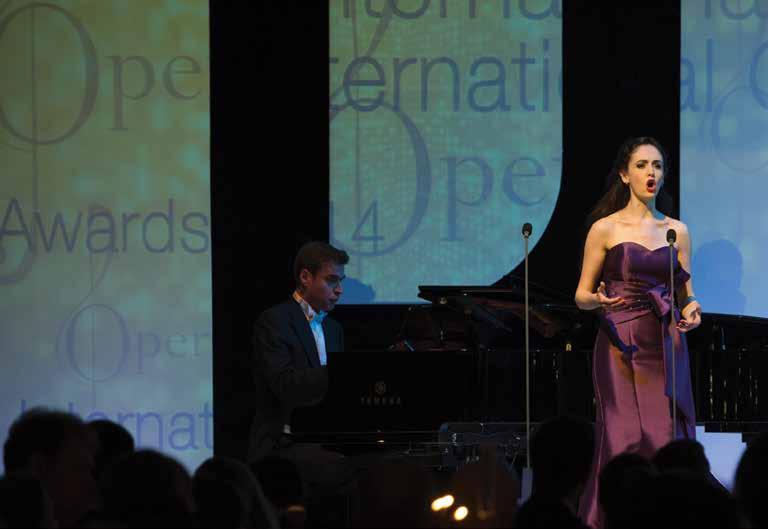
We spoke to Phoebe Haines, who graduated in 2011, about how her time at Homerton fed into her choice of career – singing opera in unexpected places.
Iarrivedat Homerton College in the autumn of 2008, and though I could not have fully appreciated or predicted the period of intellectual and emotional growth that would ensue over the next three years, I was tentatively aware that a great deal would be demanded of me.
Where did life take you after graduation?
This summer I have the great privilege of representing the United Kingdom in a cultural exchange in China. Over the course of six weeks I will be learning both sung and spoken Mandarin, and will be performing at a number of orchestral gala concerts throughout China, including Suzhou’s Grand Theatre and the Tiangqiao Performing Arts Center in Beijing. I
am looking forward to these performances, and the prospect of learning some pieces from traditional Chinese opera.
While I have studied the standard ‘operatic languages’ for many years now (namely Italian, German, French, and Russian), the only truly ‘foreign’ dialect I had sung was ancient Greek during my university years. In 2010, I was lucky enough to perform a sung role in the triannual Cambridge Greek Play, which that year was Aeschylus’ Agamemnon Having the chance to study with feted professors of the Classics department, alongside performing in a fully-staged Greek-language production at the Cambridge Arts Theatre, was an incredible and unique experience.
Are you building on your studies, or starting anew?
An area of my current career which I believe was moulded by my experiences at Homerton is my mentoring and voluntary work. During our final year of study, we embarked upon a research and investigation project, which for many of us, involved documenting teaching styles and learning attitudes in local schools. While I felt fairly out of my depth during this time (observing classes by my incredible friend, Steph, who was already a qualified primary school teacher), it opened my eyes to how praise worthy teachers are. It was then that I realised I was not gifted with the combination of skills required to be an inspiring school teacher, but I was curious
to see if there were ways to use music, and opera in particular, in a classroom setting.
The most fulfilling work that I have done so far has involved direct communication with others, either at hospitals or schools, or other unorthodox environments where there is no real separation between audience and performer. Renowned opera director Graham Vick made a speech recently at the Royal Philharmonic Society’s annual awards, in which he called for a wholesale change of focus on the part of opera companies, in order to release the art form from its ‘ghetto’ of elitism. He’s right: classical music is, and should be, a democratic art form, and, in as much as it speaks to us on an individual emotional level, it should also try to bind us to our common humanity.
What defined your time here at Homerton?
I did not begin my degree until I had reached the ripe old age of 20 (having spent two years at Junior conservatoire and two years studying singing full-time). I was thrilled to find out that I had been accepted into the English, Drama, and Education Studies Tripos; the dynamic and wide-ranging combination of subjects, spanning from psychology to philosophy, to experimental theatre, to postmodern literature really appealed. I received a warm welcome from everyone I met on my interview day and this impression continued throughout my studies. I believe it was this equal combination of intellectual
rigour and pastoral warmth that truly characterised the time I spent at Homerton.
I found the Cambridge system of weekly supervisions to be an enjoyable and engaging learning style, allowing for a fluid exchange of ideas. I was glad to be able to somewhat mimic this style in some of my recent musical teaching work.
Looking back on those incredible three years, I feel honoured to have been given the opportunity to study in such a magical place as Cambridge, and humbled to have had the chance to work alongside so many talented colleagues.
In the mere five years since we graduated, members of our cohort have gone on to pursue diverse careers. While many of us from the English, Drama, and Education course have gone into creative professions (amongst them a published poet, an award-winning director, a famous screen actress), many of my coursemates have pursued more wide-ranging career paths such as journalism and academia.
In moments of stress, I often call to mind the Bernstein quotation, “To achieve great things, two things are needed: a plan, and not quite enough time”…! This sentiment typifies my experience at Cambridge: many of us at Homerton were quite often walking a tightrope between our academic studies, and our commitments at the ADC and other theatre venues, along with extra-curricular musical, comedic, or literary pursuits that we were passionate about.
I am continually, and profoundly, grateful for my three years at Homerton.
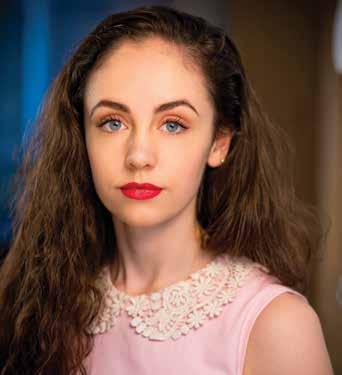
Right Mezzo soprano Phoebe Haines
Left Phoebe performing at the International Opera Awards 2014
OUR DONORS
1 July 2015 – 30 June 2016
The Principal, Fellows, students and staff of Homerton College wish to thank alumni and friends who have generously made donations to the College over the last year. Every effort has been made to ensure the list is accurate; do contact us if you believe we have made an omission.
Alumni
1936
Mrs Margaret Kent
1941
Mrs Teresa Lea (Deceased)
1943
Mrs Margaret CampbellSmith
Mrs Kathleen Hayward
Mrs Jacqueline J Welford (Deceased)
1944
Mrs Joan M Gray
Miss Margaret Rishbeth
Mrs Kathleen Russell
1946
Mrs Zoe M Coombe
Mrs Margaret E Dunsford
1947
Ms Christine Andrews Lady (Dorothy) Franklin
1948
Dr Brenda J Buchanan
Mrs Joyce Callaway
Mrs Jane A Charman
Mrs Janet K Farley
Mrs Rosemary J Langlois
Miss Elizabeth W Rainsbury
Mrs Marjorie A Robinson
1949
Mrs Margaret Blott
Mrs Mary L Dowse
Mrs Margaret Eedle
Mrs Coral Harrow
Mrs Molly D Payne
Mrs Sylvia M Saul (Deceased)
1950
Mrs Mavis J Blow
Mrs Cathleen M Butler
Miss Audrey M Martin
1951
Ms Ann J Barnes
Mrs Sheila A Duncan
Mrs Pamela J Lewis
Mrs Patricia M Stockdale
1952
Mrs Shirley D Haslam
Mrs Evelyn P Parker
1953
Mrs Norma A Blamey
Mrs Angela J Brooks
Dr Alison B Littlefair
Mrs Margaret D Trow
Mrs Elizabeth Tunnicliffe
1954
Mrs Pauline M Curtis
1955
Mrs Christine P Grainge
Mrs Gillian M Hewin
Miss Gwendoline E Lancaster
Mrs Rachel I Lewington
Mrs Jane R Matthews
Mrs Wendy E Oakley
Mrs Loraine Schorter
Mrs Maralyn Westwood
Mrs Gillian Williams
1956
Mrs Marguerite M Donkin
Mr John G Gaddes and
Mrs Pamela J Gaddes (deceased)
Mrs Eilidh S Scott
Mrs Alice A Severs
Mrs Jennifer M Varley
1957
Mrs Bernice A Barton (Deceased)
Mrs Gillian E Figures
Mrs Doreen E Hobbs
Mrs Chistine M Lincoln
Mrs Elisabeth A McOwan
Mrs Valerie B Read
Mrs Jacqueline Swegen
Mrs Sheila K Taylor
Mrs Rosemary Thomas
Mrs Josephine E Turner
Mrs Hillary J Young
1961
Mrs Janet M Campbell
Mrs Frances M Clare
Dr Olivia Craig
Mrs Joy M Kohn
Mrs Susan M Lovett
Mrs Susan McFarland
Mrs Mary D Reeve
Mrs Alison M Steer
Mrs Jean Thorman
Mrs Andrea Woodward
1962
Mrs Diana Dalton
Mrs Marion W Foley
Mrs Maureen R Frost
Mrs Carole Girdler
Mrs Carole R Nolan
Mrs Josephine M Sutton
Mrs Rosemary M Viner
1958
Mrs Jean M Appleton
Mrs Christine Carne
Mrs Gillian M Ganner
Mrs Wendy J Garforth
Mrs Jane M Grant
Mrs Diana Hadaway
Mrs Jill R Hicks
Mrs Angela M Hulme
Mrs Vivien Ivell
Mrs Beryl A Izzard
Mrs Rachel M Macdonald
Mrs Judy N Manson
Mrs Anthea and Mr Donald
R Stewart
Mrs Patricia K Stott
1959
Mrs Dora Beeteson
Mrs Pauline T Cavell-Northam
Mrs Christine H Frost
Ms Madeleine A Gair JP
Mrs R J Hammond
Mrs Ann F Hardie
Mrs Ruth E Jerram
Mrs Diana M Lucas
Mrs Ann-Marie Mackay
Mrs Barbara Sherlock
Mrs Pamela Smart
Mrs Sheila Spaul
1960
Mrs Rosemary L Allan
Lady (Gillian) Baker
Mrs Jacqueline and Dr J Norman Bardsley
Mrs Patricia A Blythe
Mrs Jean M Clarke
Mrs Susan Dickinson
Mrs Jenifer A Freeman
Mrs Jill Fuller
Mrs Christine A Kershaw
Mrs Jennifer S McKay
Mrs Gilliane P O’Keeffe
Mrs Christine A Parkyn
Mrs Jacqueline M Rupp
Mrs Margaret C Robbie
Mrs Jill Russell
Mrs Sheila E Stephens
Mrs Cheryl A Trafford
Mrs Janet Wilkinson
Mrs Elizabeth A Wilson
1967
Mrs Marjorie Caie
Mrs Avril H Growcott
Mrs Marion A Pogson
Mrs Annette Smallbone
Mrs Jennifer Taylor
1968
Mrs Kathleen L Down
Mrs Constance L Marriott
Mrs Robyn A Mitchell
Mrs Lynne Parsons
Mrs Anne R Rogers
Mrs Penelope M SpencerChapman
Mrs Alison F Syner
Miss Esme J Partridge
Mrs Gwendolyn J Williams
1963
Mrs Andrea Caish
Mrs Audrey C Knighton
Mrs Christine W Macpherson
Mrs Susan M Morris
Mrs Joan M Powell
Mrs Catherine Ryder
Mrs Christine Tipple
1964
Mrs Christine Dearman MBE
Ms Sylvia M Dibble
Mrs Corinne M Haworth
Mrs Celia M Jones
Mrs Margaret Meredith
Mrs Pamela and Dr Anthony Metcalfe
Ms Christine Purkis
Mrs Rosemary A Rees
Mrs Susan Rescorla
Ms Marjorie Thorley
Mrs Janet R Woodford
1965
Mrs Lorna Cordell-Smith
Dr Patricia Cusack
Mrs Wendy A Dunnett
Mrs Annie Illingworth
Mrs Dorothy M Nicholls
Mrs Susan M Pinner
Ms Gill Robertson
Mrs Ruth Watkin
Mrs Janet S Webb
Mrs Dilys West
1966
Mrs Jean D Carnall
Mrs Susan B Carter
Lady (Marilyn) Fersht
Mrs Margaret G Funnell
Mrs Sally Gibbons
Mrs Kathryn A Gilden
Mrs Judith O Martin-Jenkins
Mrs Margaret S Prue
Mrs Ruth M Rees
1969
Mrs Linda J Clark
Mrs Eileen P Coombes
Mrs Lynn Lemar
Mrs Gillian M Sallis
Miss Joyce L Welch
1970
Mrs Patrica A Bradley
Miss Fiona S Cook
Mrs Sheila A Crowther
Mrs Miriam France
Dr Diana M Gallop
Mrs Cynthia Garvey
Ms Bridget E Peachey
Mrs Patricia M Saxton
Dr Rosslyn J Sendorek
Mrs Denise E Shakespeare
Mrs Helen E Wood
1971
Mrs Patricia Darke
Mrs Sally E Mabon
Mrs Liliane Mitchell
Mrs Marilyn S Reid
Ms Helen R Sandle-Baker
Mrs Marilyn Stansfield
1972
Mrs Anne M Bambridge
Ms Catherine M Beavis
Mrs Dorothy Broughton
Mrs Fiona Karlin
Mrs Helen Malcolm
Dr Victoria M McNeile
Mrs Valerie J Mills
Mrs Anne V Ryder
Ms Hilary V Stokes
Mrs Sarah Taylor
Mrs Eunice M Williams
1973
Mrs Jean Addison-Fitch
The Revd Claire M Heald
Mrs Anne Mellor
Mrs Denise M Mitchell
Mrs Dilys E Murch
Mrs Helen E Sheppard
Mrs Mary Wyatt
1974
Mrs Mary E McCosh
Mrs Elizabeth J Rose
Ms Anne Sparrowhawk
1975
Mrs Alyson E Baker
Mrs Judith Davidson
Mrs Lesley T Dover
Mrs Sarah Flynn
Mrs Helen McRoberts
Mrs Caroline C Melrose
Mrs Ruth A Saunders
Mrs Maureen P and Mr Neil Weston
1976
Ms Stephanie Beardsworth
Mrs Wendy Bishop
Ms Jill M Grimshaw
Mrs Elizabeth J McLean
Mrs Susan Rodford
Mrs Tessa M Vivian
Mrs Heather R Wilkinson
1977
Mrs Ann J Kirkby
1978
Mrs Sandra E Burmicz
Mrs Denise E Burns
Mrs Judith A Clarke
Mrs Sally J Collins
Mrs Gillian M Dirks
Mrs Joan H Gibson
Mrs Elizabeth M Harrison
Mrs Fiona Holmes
Miss Amanda E James
Mrs Ann P Muston
Mrs Alison Roberts
Mrs Clare C Tanaka
Mrs Zena P Tinsley
Mrs Frances E Turner
1979
Ms Kathryn Armstrong
Miss Sheila M Berry
Mrs Jane S Bishop
Mrs Helen M Draper
Ms Jane E Edwards
Mrs Elizabeth C Harding
Mrs Ann E Jackman
Mrs Sarah A Meunier
Mrs Helen M Mitchell
Mrs Louise M Mursell
Mrs Clare L Myers
Mrs Amanda J Renwick
Mrs Elizabeth L Thomas
Mrs Angela M Wimbush
1980
Mrs Vanessa J Bacon
Mrs Marianne J Billitt
Mrs Ruth M Briant
Mrs Annette P Cameron
Mrs Clare M Danielian
Mrs Susan M Dinnage
Mrs Jacqueline M Matthews
Mrs Mary G Powles
1981
Mrs Jill C Burton
Mrs Clare F Harvey
Mrs Leonie M Hyde
Mrs Alison M Knights
Mrs Sally M Lomax
Mrs Deborah Moss
Mr Martin A Nutton
Mr Mark Sendell
Mrs Brenda J Thompson
1982
Mrs Elizabeth R Bond
Ms Victoria S Brahm Schild
Mrs Jacqueline A Butler
Mr Mark D Hanley-Browne
Mrs Catherine J Hicks
Mrs Sarah E Holmes
Mr Brian Howarth
Miss Anne Mitchell
1983
Mrs Gayatri Basu
Miss Anna J Chapple
Mrs Amanda J Edwards
Mrs Cordelia A Myers
Mrs Annabel Nnochiri
Mrs Sarah J Rawlins
Ms Rhiannon D Williams
1984
Dr Roger Ali
Mrs Della A Allen
Ms Sarah E Gordon
Mrs Helen E O’Hara
Mr Peter J Ventrella
1985
Mrs Alison Brinklow
Mrs Karen E Coombs
Mr Charles W Dod
Mrs Sarah Harrison
Mrs Susan C Hill
Mrs Karen L Miranthis
Mrs Frances R Surridge
Ms Sally M Woodcock
1986
Mr Colin Cook
Ms Alison Mesher
1987
Dr Kirsty N Byrne
Mrs Lorraine G Carlton
Mrs Rosemary S Gwinnett
Mrs Julia A Harker
Mrs Sally E Jaspars
Mr Luke N Lowry
Mrs Elizabeth M McCaul
Mrs Anna M Williams
1988
Mrs Keren E Cooke
Mrs Amanda E Le Breton
Mrs Sarah H McWhinnie
Miss Adrienne L Saldana
Mrs Paula M Tebay
1989
Mrs Alison E Allen
Ms Joanna Carlton
Mrs Kim C Chaplin
Mrs Ruth E Flanagan
Mrs Michaela R Khatib
Mrs Kerry A Merriam
1990
Mrs Tamsin J Austoni
Mr Philip C Coldicott
Mrs Lavinia F Colley
Mrs Suzanne D Gouldstone
Mrs Fiona Gruneberg
Mrs Hayley C Hobbs
Mr Ian C Hodgson
Mr Arjun Kumar
Mrs Katherine Mayne
Ms Phillipa C Rushby
Mrs Deborah J Stone
Mr Giles D Storch
Miss Jennifer D Svrcek
Mr James D Thomson
1991
Mr James M Davis
Dr John N Dodsworth
Mr Carl B Howarth
Mrs Charlotte A Irving
Mrs Penelope Smith
Miss Lisa C Tiplady
The Rev Wendy A Wale
1992
Mrs Naomi A Baynes
Mr Ian P Derwent
Mrs Karen J George
Mrs Louise S Hutchinson
Ms Diane M Rawlins
Mrs Charlotte R Watson
1993
Mr David W Chapman
Miss Julie A Hogg
Mrs Alison L Kent
Mrs Susannah L Lovegrove
Mrs Elizabeth R Sartain
1994
Mrs Michelle Henly
Mrs Lucy A Partridge
Mr Andrew D Robertson
1995
Mrs Carol W Carlsson Browne
Miss Manjit K Hayre
Mrs Rachel J Kelsey
Mr Jonathan R Lilley
Mrs Helen N Morgan
Mr James V O’Neill
Mrs Hilary J Studer
1996
Mr Benjamin L Caron
Miss Adrienne H Ferguson
Mrs Patsy Hinchliffe
Mr Christopher P OwenSmith
Mr Christopher A Shephard
Mrs Victoria M TrueBhattacharyya
Mrs Emma R Vyvyan
Mr Martin R Wigg
1997
Mr Matthew Buck
Mrs Lindsey F Davey
Mrs Elizabeth A Fryer
Mrs Kerry D Simoes
Ms Brigid Vousden
1998
Miss Alison E Buck
Mrs Lesley F Mensah
Ms Julie E Seplaki
1999
Dr Edward S Adams
Ms Erin L Bond
Dr Neil J Hennessy
Mrs Elizabeth C Jestica
Mr Paul R Jones
Mrs Lisa E Knight
Mrs Laura M Penrose
Miss Hayley Romain
Ms Louisa M Tipler
2000
Mrs Susan B Aldred
Mrs Victoria L Embry
Mr William H Essilfie
Mrs Hannah M Hames
Miss Katharine James
Dr Thomas E Kitchen
Mr Andrew J Wells
2001
Mr Laurence M Ball
Mrs Elisabeth J Craigen
Mrs Lesley-Anne Crooks
Miss Lidia Fesshazion
Mrs Amy V Fleming
Mrs Emma Forster
Dr Robert J Fulford
Mr David J Lawrence
Miss Yi J Lin
Mrs Kirsty Nottage
Mrs Kathryn M Paternoster
Miss Catherine L Payne
Mrs Kate L Spencer-Allen
2002
Ms Lisa J Aspinall
Mr Oliver T Bowles
Mrs Janet M Cottenden
Miss Bernadette M Crossley
Mr Sam Farmer
Mr Sutherland Forsyth
Mrs Carys A Gladdish
Miss Katy M Johnson
Ms Arti Krishna
Miss Sian M Mawditt
Mr Remi H Moynihan
Miss Krista A Pullan
Mr Thomas E Savill
Mr Timothy D Scott
Mrs Helen Smith
Mrs Sarah J Towers
Mrs Angela J Woodruffe
Mrs Katie Wright
Mrs Rhiannon L Wynne-Lord
2003
Mrs Rachel E Bardon
Miss Katherine J Bluck
Mr Raymond C Cilia
Miss Stephanie E Cohen
Miss Denise Djokic
Mr Glenn M Harris
Mr Gregoire A Hodder
Mrs Anne M Howell
Mr Jonathan S Levine
Mr Daniel W Roberts
Dr Tovah N Shaw
Miss Stephanie A Tillotson
Mr John J White
2004
Ms Tessa M Banham
Dr William H Boulware
Mr Michael J Dangerfield
Miss Natasha R Gray
Mr Richard A Hopkins
Miss Emily Ikelle
Mr Duncan R Loweth
Mr James M Marshall
Mrs Liisa M Metsaranta
Mr John R Pawson
Mr Ravi P Raichura
Mrs Sian M Shaw
Miss Jennifer R Sneyd
Mr Steven J Walker
2005
Mrs Janice Frankham
Mr Fabio and Mrs Lisa Galantini
Mr Joel C Gill
Miss Jocasta A Jones
Mr Regin T Lagaac
Mr Daniel A Martin
Mrs Rebekah H Perry
Mr Jonathan D Poland
Mrs Holly E Ranger
Mrs Jessica L Shingfield
Mrs Emma L Turner
Mrs Di Wu
2006
Miss Aniko Adam
Dr Theresa Y Adenaike
Mr Michael J Allen
Miss Kathryn J Bath
Mrs Ilona G Clifton
Miss Emily C Crowhurst
Miss Laura E Davenport
Mrs Eliza M de Uphaugh
Mr Thomas C Dix
Miss Judith Laidler
Dr Laura McPhee
Miss Chloe Orchin
Ms Maria L Peirce
Miss Anna Z Purkiss
Miss Emelia L Quist
Miss Victoria M Savage
Mr Luke Shepherd and Miss Hannah Drew
2007
Ms Claire-Audrey Bayan
Miss Nalân Burgess
Miss Fay Hendry
Miss Fiona A Holman
Mrs Chloe J Kee
Mr Andrew W Kindness
Miss Xiajuan Li
Mr Michael Lynch
Mr Benjamin N Mills
Miss Nicola Pollard
Mr Joseph J RandallCarrick
Mr George J van der Blom
Dr Susan L Wishart
Mrs Chikako Woodgate
2008
Mr Yusuf M Bhujwalla
Mr Luke Clarke
Mr James A Douglas
Mr Edward Freedman
Mr James Jones
Mr James D Lugton
Miss Chloe A MacKenzie
Miss Emily and Mr Siôn McCallum
Mr Matthew A McNally
Miss Amy L Munro-Faure
Miss Julia R Spence
Mrs Dominique E Turnham
Mr Kenichi Udagawa
Miss Lauren S Weller
Mr Justin Woolf
2009
Mr Thomas S Ashford
Miss Sophie A Bell
Mr Daniel S Beresford
Miss Shruti Chaudhri
Mr Jonathan D Edge
Mrs Kathryn A Francis
Miss Josephine A Hall
Mr William C Quinn
2010
Mr Paul Broker
Miss Kirsty Reid
2011
Mr Thomas J Danby
Miss Cordelia E Jackson
Friends of Homerton
Mrs Frances Barrett
Mr Frederick M Bibby (Deceased)
Mrs Ann L Cotton OBE
Mr David and Mrs Mandy Fletcher
Mr Roger Green
Dr Ahmad T Hindawi
Mr Jan and Mrs Erika Hummel
Mr Matthew Moss MVO
Mr Richard W Price
Dr Peter H Raby
Dr Peter Warner
Dr David Whitebread
Anonymous
Corporations
CamBioScience Ltd
Hill Residential Ltd
Santander UK plc
Trusts and Foundations
Backstage Trust
The Roger and Miriam Pilkington Trust
Legators
We are grateful to those who have indicated they will leave a gift to Homerton in their Will.
Mr John N Ball
Mrs Heather Bracewell
Miss Patricia K Cooper
Mrs Susan M Dunkerley
Mr John G Gaddes
Mrs Joan M Gray
Ms Deborah Griffin OBE
Mrs Coral Harrow
Miss Julie A Hogg
Mrs Susan E Holland
Mrs Elaine R Maunder
Mrs Karen L Miranthis
Mrs Sidella Morten
Mrs Gilliane P O’Keeffe
Mrs Moira E Pitchford
Mrs Margaret S Prue
Mr Simon Ray
Mrs Victoria Richardson
Miss Jean M Robinson
Mrs Rosemary Thomas
Dr Bernadette Tynan
Dr Peter M Warner
Mrs Dilys West
Anonymous
Cavendish Circle
The Cavendish Circle recognises alumni and friends of Homerton who make an annual gift of £1000 or more to the College.
Ms Victoria S Brahm Schild
1768 Society
The 1768 Society recognises alumni and friends of Homerton who are regular donors to the College, making a gift of at least £17.68 a month.
Mrs Marjorie Caie
Mrs Janet M Campbell
Mrs Kim C Chaplin
Miss Shruti Chaudhri
Mrs Diana Dalton
Mrs Clare M Danielian
Mr Ian P Derwent
Mr Charles W Dod
Mrs Sheila A Duncan
Mr Jonathan D Edge
Mr Sutherland Forsyth
Mrs Miriam France
Mrs Karen J George
Mrs Carole Girdler
Mrs Christine P Grainge
Miss Natasha R Gray
Mr Roger Green
Mrs Fiona Gruneberg
Mr Mark D HanleyBrowne
Miss Manjit K Hayre
Mrs Michelle Henly
Dr Neil J Hennessy
Mr Gregoire A Hodder
Mr Ian C Hodgson
Miss Louise Holyoak
Mr Richard A Hopkins
Mrs Anne M Howell
Mr Brian Howarth
Mr Tim Hubener
Mrs Celia M Jones
Mr Jonathan S Levine
Mrs Susan M Lovett
Mr Michael Lynch
Mrs Christine W Macpherson
Mrs Jane R Matthews
Mrs Helen McRoberts
Mrs Sarah H McWhinnie
Dr Anthony and Mrs Pamela Metcalfe
Mrs Liisa M Metsaranta
Mr Matthew Moss MVO
Mr Remi H Moynihan
Mrs Clare L Myers
Mr Ravi P Raichura
Ms Diane M Rawlins
Mrs Rosemary A Rees
Mrs Susan Rodford
Mrs Elizabeth J Rose
Mr Thomas E Savill
Mr Luke Shepherd and Miss Hannah Drew
Mrs Annette Smallbone
Mrs Elizabeth L Thomas
Mrs Brenda J Thompson
Mr Andrew J Wells
Mrs Dilys West
Mr John J White
2012
Mrs Corinne L Goullee
Miss Louise Holyoak
Mr Tim Hubener
Mrs Sally Gibbons
Dr Ahmad T Hindawi
Mrs Hilary J Studer
Anonymous
Ms Rhiannon D Williams
Dr Susan L Wishart
Mrs Helen E Wood
Anonymous
We are always delighted to receive your emails and letters, and in future editions would love to feature more of those we receive.
So if you have a memory of the College that you would like to share, or to update us on your life after Homerton, please get in touch.
You can email us at alumni@homerton.cam.ac.uk or write to us at:
Development Office, Homerton College, Hills Road, Cambridge, CB2 8PH.
Inthe 1960s and 1970s many Homerton students took part, as volunteers, in the running of summer camps for deprived children in Germany, Austria and the UK. The camps were under the auspices of a registered charity, Children’s Relief International (CR I), based in Cambridge. Initially, the main beneficiaries were the children of families who had fled to the West at the end of the Second World War. Later, camps were run in the UK for children from deprived areas. .
The first camps in the early 60s were run by groups of male Cambridge undergraduates who quickly sought the help of the ladies of Homerton and other women’s Colleges of the University. The fact that Homerton was a College where students concentrated on education meant that these volunteers were bringing relevant knowledge and experience to the existing teams.
I remember my favourite activity from those days fondly. Several of the camps, including the one I ran, developed the practice of establishing a sub-camp at a walkable distance from the main camp to which expeditions would be sent for two or three nights of more basic camping. A practice developed whereby a small group went from the main camp to ‘attack’ the sub-camp.
YOUR LETTERS
Surprise was of the essence and as the ‘attack’ became an expected feature more inventive ways were found to approach the small camp while maintaining the element of surprise. I remember wading up a river to get to the small camp, the subsequent surprise made the wetting worthwhile.
It is now about 50 years since we ran the camps and we thought it was a good time to celebrate our golden anniversary. We have established a website (www.chvarchive.net) for past volunteers to share their memories. Please get in touch via the website and add your tales and photographs so we can truly celebrate our anniversary.
Peter Watson Jesus College
A group of girls are ready to leave on a hike with their guides
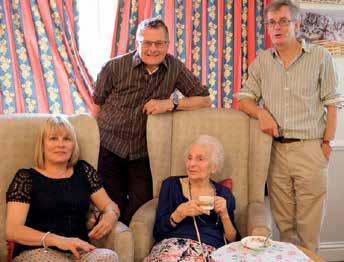
Iwantedto thank you for the lovely card that you sent to my mother, Margaret Foster, for her 90th birthday on 19 May 2016. She was thrilled and touched, and made a point of showing it to all her family at the tea party we held for her. In fact, she likes the picture so much that she has asked me to have it framed for her! I know that her time spent at Homerton still means a lot to her, and she made some close relationships there that she has maintained ever since.
Margaret Foster celebrating her 90th at a tea party with family and close friends
Jonathan Foster Son of Margaret Foster (1948)
Judi Venner walks in the woods with two children
ANNUAL REUNION
Friday 23 to Saturday 24 September 2016
PROGRAMME
Friday 23 September
18.30 – 19.30 Donor Reception Drinks and canapés by invitation
19.30 for 20.00 Dinner in the Great Hall
Saturday 24 September
09.30 – 10.30 Registration
10.30 – 11.00 Welcome address from the Principal and the President of the HUS
11.15 – 12.15 Anniversary Group meetings College Garden tours
12.30 Lunch in the Great Hall
14.30 – 15.30 Reforming Teacher Education
The near-constant reform of teacher education around the world is mirrored in England. Dr Elaine Wilson will discuss the key common themes and tensions associated with these reforms.
Retired Senior Members Association AGM College building tours and Garden tours
16.00 – 17.00 A performance by the Charter Choir College building tours and Garden tours
17.00 – 18.00 Afternoon Tea
19.30 for 20.00 Dinner to mark Lionel Whitehead’s retirement (College Porter for 14 years) or
19.30 for 20.00 General Dinner for Reunion attendees in the Fellows’ Dining Room
The Library will be open during the afternoon of Saturday 24 September displaying a selection of artifacts and photographs of Homerton past from the archives.
Please do book early if you’re able to; this not only greatly assists the organisation and planning of the Reunion Weekend, but also increases the possibility of our being able to accommodate all those who wish to attend and stay.
This year, bookings will close on Friday 9th September. Please do ensure that we receive your booking and payment by this date. The best way of booking for the Reunion Weekend is via our Alumni Events page on the College website. If you wish to book using the booking form attached to the back cover of the Homertonian, please ensure you post it to arrive before the deadline.
We look forward to welcoming you back to the College in September!
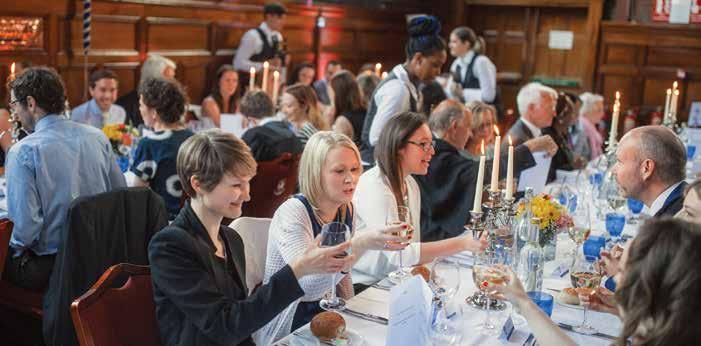
ALUMNI BENEFITS
As a lifelong member of Homerton and the University of Cambridge, you are most welcome to visit Homerton and use our College Library, Buttery and Bar, and dine at Formal Hall. Subject to availability, you can also book overnight accommodation at preferential rates, and book function rooms for private dinners and events.
You can take advantage of great deals at a growing number of Cambridge venues and retailers by using your CAMCard. You will also receive automatic membership to the University Centre and free entrance into most of the Cambridge Colleges. Alumni can also sign up for cantab.net, the University’s email for life service, and continue to use the University Careers Service.
For further information about alumni benefits, please email alumni@homerton.cam.ac.uk
WAYS OF STAYING IN TOUCH

Visit our website for details of our events, our regional branches, and alumni benefits. You can read our publications online, update your contact details and find out more about our current fundraising priorities and make a donation online to Homerton.


‘Like’ Homerton College on Facebook to keep up to date with what’s going on. Visit www.facebook.com/HomertonCollegeCambridge
Homerton College is on Twitter! Follow us for the latest news and updates @HomertonCollege
We are on Instagram. Check us out @homertoncollege
You can also connect with Homerton on LinkedIn. Simply search for ‘Homerton College’.
Have you received our email newsletter?
If you haven’t seen a copy recently, send us an email at alumni@homerton.cam.ac.uk to make sure we have your current email address so you don’t miss out.
Groups of Homertonians meet in local branches throughout the country and around the world. You may find that there is an active group near you; if there isn’t, and you’d like to set one up, you’d be most welcome to. You can also find the University of Cambridge Worldwide Directory at www.alumni.cam. ac.uk/get-involved/find-a-group
UNITED KINGDOM BRANCHES
Cambridge
If you would like to help co-ordinate alumni branch events in Cambridge, please contact alumni@homerton.cam.ac.uk.
London
Stephanie Beardsworth stephanie.beardsworth@btinternet.com
Stephanie Rogers stephanie.rogers51@gmail.com
Newcastle
Elise Wylie elise.wylie@gmail.com
Oxford
Lucy Barnett glebecottage@gmail.com
Wessex
Coral Harrow coralharrow@waitrose.com
INTERNATIONAL BRANCHES
Southern California Branch
Angela Das ad301@cantab.net
China
Xianwen Meng mengxianwenhf@gmail.com
A Snapshot of HOMERTON COLLEGE
Our student population is the biggest in Cambridge
Our undergraduates STUDY 36 different subjects from Anglo-Saxon to Zoology, and from 2016, Medicine
hWe have more en-suite rooms than any other Cambridge College, and our rents are among the lowest
We are the only College to elect a full-time sabbatical President of its Student Union
96% of Homerton students are employed or in further study within 6 months of graduating – higher than any Russell Group university
At 25 acres, we have one of the largest single sites of any Cambridge College
We are the University’s
NEWEST
C LLEGE,
though we’ve been in Cambridge for 120 years, and in London for over 125 years before that
All our undergraduates can live
ON SITE throughout their course
Each academic year we spend over half a million pounds on outstanding welfare provision for our community