HOMERTON COLLEGE
UNIVERSITY OF CAMBRIDGE

HOMERTON COLLEGE
UNIVERSITY OF CAMBRIDGE
From the Principal Senior Tutor’s Report Bursar’s Report
From the Library 2015 News Highlights
Professor Geoffrey Ward
Welcome to the first edition of Homerton’s Annual Review! This new publication is an opportunity to put on record some of the outstanding achievements, stellar events and exciting new departures that characterise a year at Homerton. While as a College we continue to look forward, confident in our future and committed to innovation, in the first month of a new year, it is worth a brief pause to look back at where we were and at the ground we have advanced across.
I began this academical year by welcoming alumni to a weekend of reunions and festivity, replete with a performance given by the Charter Choir and an engaging and entertaining talk given by Dr Zoe Jaques, Fellow in English. It is always a delight to meet graduates from different decades, and to hear them share their experience of the same,
overlapping or quite different Homertons. One of the tasks our growing Development Office have set themselves is an improved understanding of the different phases in our forever evolving College.
We are also dependent on our alumni for their generous giving. This year’s telethon, led by current undergraduates, raised nearly £80,000, and the two single largest donations that the College has received were both given during the last twelve months. After the long blip of the twentieth century, philanthropy is once more, and will remain, a sine qua non for Collegiate Cambridge, including its newest and largest College. The importance of philanthrophy is reflected in the launch of the Campaign for the University and Colleges of Cambridge, whose theme – ‘Dear World… Yours, Cambridge’ – focusses on the difference Cambridge can make to the world.
Homerton has been quietly changing the world for almost 250 years. As the leading establishment in the country for training teachers
for over a century, Homerton has made a tangible and profound difference to the lives of many thousands of young people around the world. Our rich history of making a real difference in the wider world continues in a new form this October, when we admit our first undergraduates to read Medicine.
Given the high quality of Cambridge applicants in this area, the brilliant new academics we have appointed as supervisors – as well as our physical proximity to Addenbrooke’s Hospital – this addition should aid the College, the community, and the discipline for many years to come.
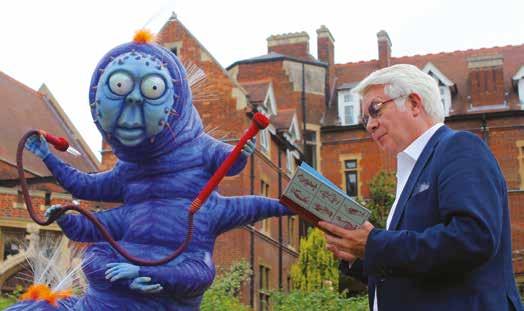
Some of the things I do as Principal I never expected to do. I did not expect that I would spend part of a morning, as I did today, exploring ways by which I might obtain skeletons for our new Medical students to work on. Nor did I expect to be photographed for the Cambridge News welcoming a ten foot-high animatronic caterpillar into College. But this was for an academic conference on Lewis Carroll’s Alice in Wonderland, on the occasion of Alice’s 150th anniversary, where fantasy became the new norm. Organised by our experts in Children’s Literature, it was also, we believe, the largest ever conference
Dr Penny Barton
The year started with a new initiative in the form of a oneday ‘Leadership in Action’ course. This was held on 12th January, just before the beginning of Term, and was mainly presented by the Cambridge University Officers’ Training Corps, but also included a talk from the Director of the University Careers Service. The course was not in
on this subject, with more academic papers than Alice has years, plus a further week of celebrations, films, and Mad Hatter tea-parties which showed us to be a serious institution where seriously fun things can go on. It also gave us an opportunity to partner with the Fitzwilliam Museum, of which I am Chair, and with the Faculty of Education, publishers and other organisations.
Partnerships are the key to many of our recent successes, for example our growing relationship with the Department of Public Health, with whom we have co-funded two Junior Research Fellowships. But our biggest and most important partner remains the University of Cambridge itself. Over this last year we have welcomed new Fellows in Geography, Drama, Law, Politics, Education, Management, Medicine and other areas, including from the University’s Human Resources Division, who we know will help our students pursue their academic ambitions but also help prepare them for the world of work. We are here to serve society’s needs. This was in our DNA from the outset, remains our raison d’être, and gives us renewed momentum as we move towards our 250th anniversary in 2018 n
any sense a recruitment drive for the armed forces, but the exercises were developed by Sandhurst. The course got extremely enthusiastic feedback from participants – the excerpt below is typical:
‘I was very impressed with the sensitivity of the course. As someone with no military interest, I was worried about balance, but at every stage we were reminded that this was just one perspective, and we were free to think independently and critically about it. I hope that at some point in my
career I will end up in a leadership position, and the course gave me some very useful insights and tips on potential challenges. We were introduced to scenarios in which we would be leading those similar or different to us, where layers of management and leadership intersect and can clash, and most usefully offered a chance to put together ideas about our own personal style of leadership, perfect for internship interviews, cover letters and hopefully for putting into practice. I am glad I attended, and strongly recommend the course to others, whether they already feel like a leader or not. It was a fantastic day, and I am truly very grateful to Homerton for proving such a good experience that I won’t forget for a long time. (Second year undergraduate, Human, Social, and Political Science).’
The success of this course impressed on me that in non-academic areas of student development it can be very positive and stimulating to bring in people from outside the College to widen students’ viewpoint beyond their academic horizons. In January 2016 we will repeat this course, which is now part of a new ‘Life Skills’ programme, incorporating presentations on interview technique, teamwork, financial planning and well-being – the programme will also include sessions on procrastination and perfectionism, and on controlling anxiety. This embryonic programme is an area I am very keen to develop going forward.
We have been focussing this year on fostering a culture of achievement, and we have been delighted to receive a substantial donation from Santander UK plc that has enabled us to reward high-achieving students in a tangible way. The biggest splash was a number of £1,000 prizes given to the highest achieving second year students –
based not only on their First-class marks but on their ranking within the university. Our rationale here was to incentivise consistent hard work in the second year, when students often drift a bit, leaving them vulnerable to a less strong result in their Finals. We had originally planned to make five awards but in the event there were six outstanding candidates and we were able to reward them all. Homerton has doubled the value of its other prizes, and we had a happy time at graduation in June giving out prizes to finalists whilst their proud parents looked on. In October, we awarded prizes to continuing students at a special Prize-winners’ Formal Hall, and in November, still more prizes were awarded to postgraduate students on their graduation. In 2015, 79% of all Homerton students (and 82% of finalists) gained First or Upper Second class marks – the ‘good’ degree that opens so many doors – and this is well in line with the University average of 78.5%.
As I write, we are in the midst of final arrangements for our first Subject Dinners. This is a new initiative to bring together all students in the College in a particular discipline, from first year undergraduate to final year PhD, with their Directors of Studies and supervisors, other Fellows in that field, and inspiring guests, who may be formal visiting speakers or alumni. The aim of the dinners is to enhance continuity, to facilitate bonding between the year groups and to engender a sense of progression throughout each student’s degree and beyond. Students have embraced the idea with great enthusiasm, as have the Catering Department, who have been inspired to create themed menus. I am sure we will learn a lot from our first year of such dinners, and we plan to make them permanent fixtures in the College calendar n
Deborah Griffin OBE
In July 2014, College Council received and approved the College Finance Strategy covering the period 2014–24. This will be a period of significant change for the College, including the completion of the development of Homerton Business Centre towards the end of 2016 and the
fulfilment of the 10-year Estates Strategy approved earlier in 2014. I am pleased to report that the College’s financial performance remains on track.
The accounts for the financial year to 30th June 2015 were approved by the Governing Body on December 3rd and indicate the increasing investment being made in the academic activities of the College and support for students. The full report is available on the College’s website.
Some of the areas in which we have invested include the recruitment of additional College Teaching Officers (CTOs) in Law and Mathematics, a pre-Clinical Medical CTO and additional Admissions resource. We have focussed on our Directors of Studies to enhance the teaching and resources available and we have doubled many of the prizes and awards given to students to encourage their efforts. Research allowances and grants for Fellows and graduate students have also been increased.
Music continues to receive increasing support from the College and the three-year programme to provide all Music students with digital pianos and replace practice pianos throughout the College is well under way. The Charter Choir has continued to grow from strength to strength this year with the addition of many talented new choral scholars. The Choir released their first CD last Christmas.
The subvention to the Homerton Union of Students (HUS) was increased for 2014–15 so that support for College societies and sports teams could be improved. Together with a generous donation from the parents of a Boat Club member, the College and the HUS were able to replace the Men’s First VIII boat in time for the May Bumps. It was also pleasing to see the Women’s First VIII win Blades this year.
Homerton continues to work hard at diversifying and increasing its income. Conference income remains an important contributor to College overheads, although revenues were down in the 2015 financial year as thirdparty summer school business decreased. A new Conference and Catering Manager was appointed in June 2015 and a new Homerton International Programme commencing next
summer will see income from this important area recover and grow.
Management of the investment portfolio was re-tendered in 2015. Rothschild was appointed to manage the portfolio going forward. Whilst returns of 6.6% for the 2015 financial year were in excess of our long-term Total Return target of RPI plus 4%, the economic outlook makes such return less likely for the 2016 financial year.
Work has continued on the development of Homerton Business Centre. Formerly the Michael Young Centre, this area of land adjacent to the College was bought by Homerton in 2011. Construction of 86,000 square feet of office space will be completed in spring 2016; later in the year, 89 residential units will be completed. All residential units will be sold on 125-year leases, including 40% sold to Cambridge City Council in fulfilment of the affordable housing planning requirement.
Adding to the crane count above Homerton College is the construction of a new 112-bedroom graduate accommodation block with an MCR and changing rooms. This is adjacent to the current graduate block, Harrison House, and will provide “a campus within a campus” for the College’s graduate community. Construction commenced at the end of June 2015 with a scheduled completion date of September 2nd 2016.
The new graduate accommodation building is the first phase of an ambitious 10-year Estates Strategy to provide our students with first class facilities. To fund the new building and later phases, the College raised £20m in August 2015 through a private placement repayable in 25 years. The College is now giving consideration to improvements to the catering facilities and next year will focus on a new Porters’ Lodge n
Liz Osman
The ebb and flow of the academic year changes little on the surface from year to year in the Library. Books are purchased, freshers are inducted, study takes place, and, finally, revision takes hold. However, each year we strive to see how we can do a little more for our students.
Academic skills sessions are one way we try to engage the students and help them in navigating the vast array of resources on offer to them. Whilst they are fortunate to have so much available, navigating the volume of material doesn’t always prove easy. The Library delivered a session in November to assist freshers with basic skills, followed by a more advanced session in Lent term dealing with referencing, plagiarism and literature searching –all invaluable tools for those writing dissertations or projects.
Whilst we don’t provide any teaching in Easter term we are perhaps more engaged with the students at that point in the year than any other time bar their first induction to the Library. The pressure of exams sees nesting behaviour and long hours. Our squash and biscuits break each afternoon has now been in place for 3 years and continues to be popular with students and Library staff. The jigsaw and chess set were joined this year by colouring books, which saw some masterpieces adorning the walls around desks throughout May and June.
Alongside my role in the College Library I have been working on a University-wide project to replace the current Library Management System in use by the University. This is a large project which has led to my regular part-time secondment. I am extremely grateful to the College, and to Alys
Butler for stepping in, for allowing this opportunity. I am confident that a product can be found that will improve student experience and allow Library staff to work with a system suited to the modern information world.
We have had a large number of books donated to the Library this year, predominantly swelling the shelves of the children’s literature collection. Our rare and noteworthy books now total over 900, from just 350 in 2011. This is wonderful progress, and in particular we are developing an fascinating snapshot of British childhoods from the 1920s–50s. Our thanks, as ever, are extended to all those who have made a donation to the Library in the past year.
But with donations comes the eternal need for more space. We have been fortunate in being able to acquire some cases from the University Library. These not only provided more storage space, but also added around a third extra in display case space.
This extra space was fortuitous, with Wonderland Week scheduled for September 2015. The Library, with generous assistance from collectors, curated an exhibition on ‘Alice through the Ages’, including first editions, foreign language material and an unusual (and suitably curious) array of ephemera.
This was the Library’s first full exhibition, and a real team effort. The result was well received by both casual visitors and Alice experts attending the academic conference. Whilst we do not have the resources to mount continuous exhibitions, I am keen that we build on the success of the Alice exhibition and the experience gained. If future building plans for the College include an exhibition space this would enable the Library to do more, and open exhibitions to the general public –something not easily achieved in a busy College Library at present.
So what for next year? Student life, and our support of it, will continue, as will the University-wide LMS project. We are working towards the first intake of medical students, taking advice and purchasing the materials they will need. We are also hoping to start
work on cataloguing the large collection of children’s annuals that we acquired in 2013. This will be a big job, but a necessary one to aid researchers and students access the full riches and resources of Homerton’s unique and expanding Library n
Liz Osman
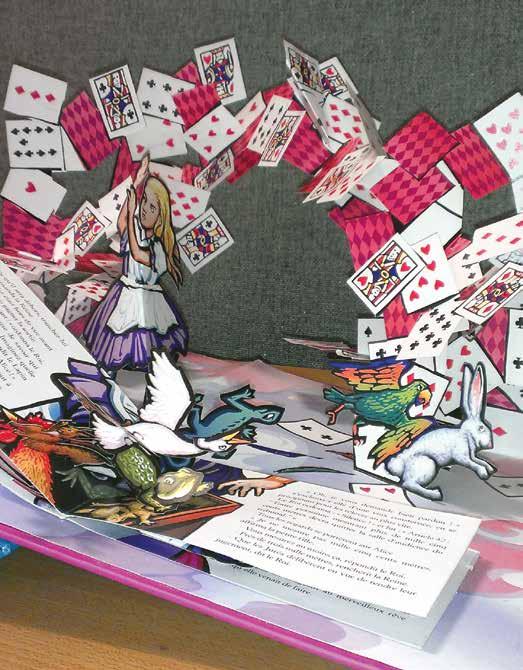
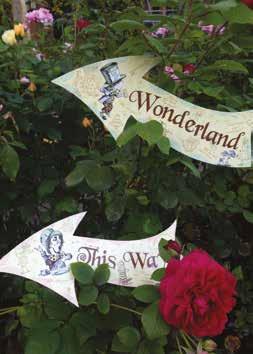
In late September, Homerton College played host to the UK’s largest celebration of the 150th Anniversary of Lewis Carroll’s Alice in Wonderland. ‘Wonderland Week’ combined the largest academic conference on Alice yet held with a number of other events held around Cambridge.
The sudden appearance (and equally abrupt disappearance) of animatronic smoking caterpillars, human-sized rabbits, and conference delegates from around the world gave the College a curiouser and curiouser feel throughout the week.
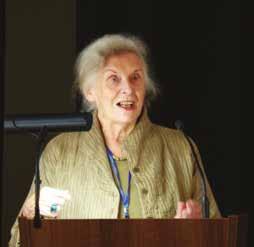
The core of Wonderland Week was the Alice through the Ages conference, organised jointly by Dr Zoe Jaques and Professor Maria Nikolajeva (both Fellows at Homerton in children’s literature). The Conference celebrated the enduring legacy of Carroll, Alice, and Wonderland over the past 150 years, and covered topics as diverse as female agency, Alice and neurodevelopment, and Russian translations of Alice.
Plenary Lectures were given by Professor Dame Gillian Beer (University of Cambridge), Professor Jan Susina (University of Illinois) and Dr Kiera Vaclavik (Queen Mary, University of London). Professor Beer explored how to situate Alice’s conversations in Wonderland within a pedagogical context, whilst Professor Susina spoke on comparisons between Lewis Carroll and Walt Disney. Closing the conference, Dr Vaclavik gave a lecture Alice as a fashion icon through her history, both on and off the page.
Brian Sibley, the President of the Lewis Carroll Society UK, praised “the diversity of opportunity to explore so many aspects of Alice” and thanked the organisers for “the wonderful opportunity to celebrate Messrs Dodgson, and Carroll, and Tenniel, and their Alice”.
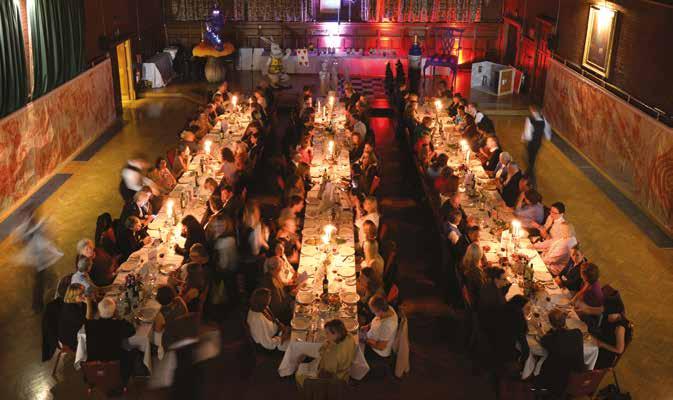
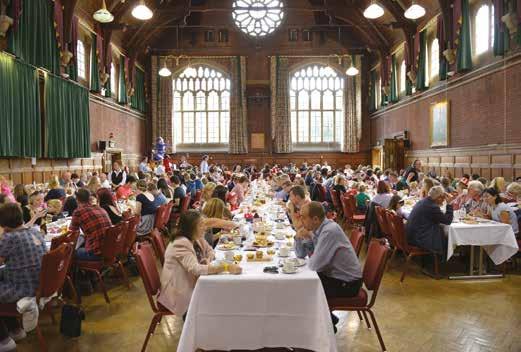
Conference delegates were also treated to a sumptuous banquet in the Victorian Great Hall, with a menu featuring mock “Mock Turtle Soup” as part of a host of Wonderland-inspired dishes. Artist William Stok kindly displayed his Alicethemed murals along the walls of the Great Hall for the Banquet, depicting a range of Wonderland scenes and characters.
A packed schedule of events had been built around the Conference. Homerton welcomed the UK’s leading cello octet, Cellophony, to perform a specially commissioned musical version of Alice in Wonderland. Cellophony have gained critical and popular acclaim for their mastery of both the standard cello repertoire, and an eclectic collection of exclusive adaptations. This musical Alice was written by Cellophony founder and director Richard Birchall, seeking inspiration from Schubert, Strauss, and Prokofiev, amongst others. The (necessarily abridged!) story was narrated by the Principal.
Venues around Cambridge took part in Wonderland Week, with The Arts Picturehouse cinema showing a double bill of the oldest and newest Alice in Wonderland films. Cecil Hepworth’s
1903 version was the longest film that had been produced in England at the time at 12 minutes long (only eight of which survive). This was followed by Tim Burton’s double Oscar-winning 2010 adaptation, which starred Johnny Depp and Helena Bonham Carter.
The Fitzwilliam Museum hosted an exhibition on the ‘Fantastical Victorians’, which permitted close consultation of materials which inspired the imagination of a culture deeply interested in the magical, the surreal, and the wonderful. Exhibits included sketches by Edward Lear, and an original handwritten letter from Carroll himself.
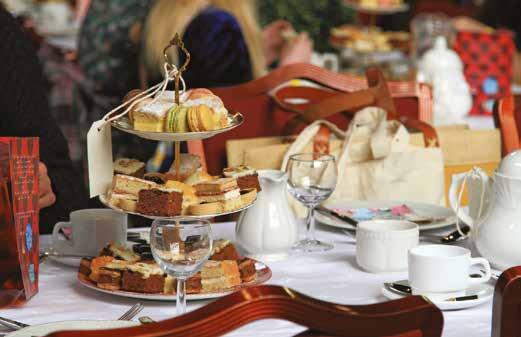
The Children’s Literature Special Interest Group of the English Association sponsored a “Wonderland in the Classroom” workshop for teachers and trainees, held in the Faculty of Education. This was followed by a round table discussion with children’s authors John Vernon Lord, Catherine Rizzo and Marcia Williams. Homerton’s own Wonderland Tea Party provided the grand finale to the week. With
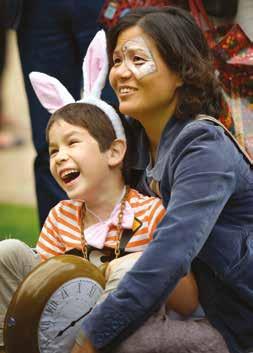
the Great Hall packed to the rafters, the guests were treated to a suitably eclectic mix of food, entertainment and company. Tea-cup rides, flamingo croquet and Victorian jazz tunes in the grounds were complemented by afternoon tea and a giant hookah-smoking caterpillar in the Great Hall. Many guests took the opportunity dress up, with several Mad Hatters, White Rabbits, and Alices in attendance, along with a particularly impressive Duchess (with baby pig!).
Professor Geoff Ward commented:
“Wonderland Week has been a fabulous way to celebrate Lewis Carroll’s brilliant, weird, wonderful and endlessly influential book. Serious scholarship and research underpinned the whole week, and the organisers worked hard to ensure that there was fun in the scholarly parts, and scholarship in the fun parts.
“The myriad events gave this truly memorable week a richness beyond what even the most highprofile conference can readily muster, and all that remains to be said is, roll on Alice 200!”
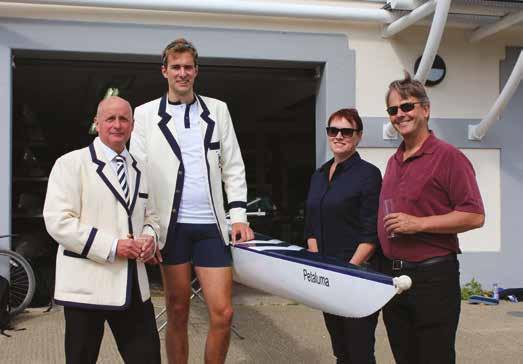
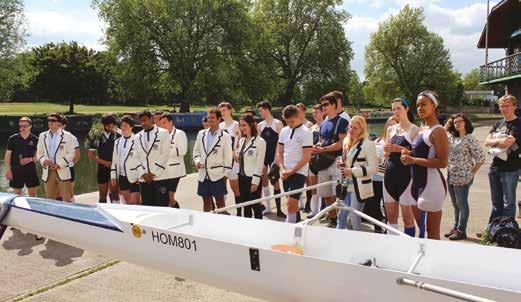
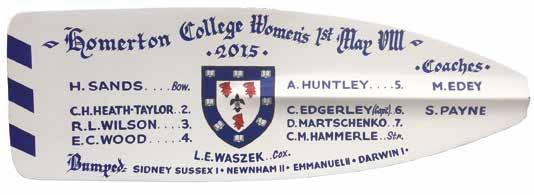
In June, Homerton College Boat Club celebrated the launch of the first new boat for three years with a ceremony by the Cam, during the May Bumps.
Petaluma’s maiden voyage was rowed by the Men’s First Eight, who successfully ‘bumped’ on the final day, having held off a chasing crew laden with University-level rowers the previous day.
The College and the Homerton Union of Students contributed to the cost, and HCBC raised funds from donors through a 24-hour sponsored row on indoor rowing machines, live-streamed on the web. It was initially hoped that enough money would be raised to purchase a second-hand boat to replace the aging (though much loved) Lady Hilary, but in the end, thanks to a tremendous donation from David and Lyan Huntley, in addition to other donations already pledged, it was possible to purchase a brand new Janousek boat.
David Huntley said, “I’m a rower myself, and I was moved by the students’ efforts to raise funds – all-night sponsored ergs included. But I thought: they shouldn’t be doing all this for a secondhand boat. Homerton deserves a new boat”. David and Lyan are parents of Alice, a current Homertonian rower in the Women’s First Eight. Petaluma is named after the Huntleys’ home town in California.
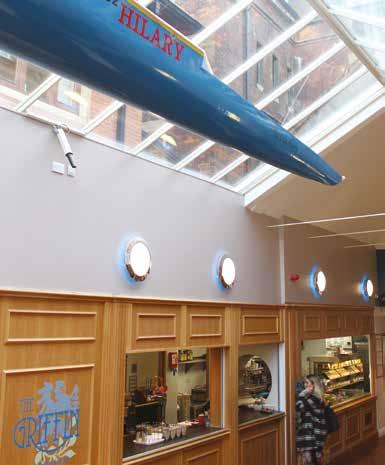
Philip Stephenson, Fellow of the College and Senior Treasurer of HCBC, said “the Club is hugely grateful to David and Lyan for this brilliant gift. Petaluma is a superb boat and a worthy replacement for Lady Hilary – we look forward to many victories in her!” While Petaluma continues to speed her teams to victory on the Cam, Lady Hilary, familiar to Homertonian rowers for many years, now hangs in the Griffin Bar, while blades from some of Homerton’s recent successes adorn the wall outside the HUS Office. Furnished with the right equipment, Homerton’s rowers look set for even more success in their future endeavours.
An Evening with Lucian Freud, a play written by alumna Dr Laura-Jane Foley, ran for three weeks in London’s West End in May 2015.
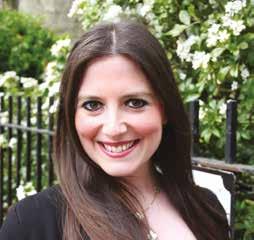
Described as “a portrait of Freud built through anecdotes, snippets of art history, biographical facts, fictionalised voices of his sitters, and the recollection of an evening spent in his company”, the play ran in May and June at the Leicester Square Theatre.
That evening was spent with Freud whilst Laura-Jane was still a student at Homerton. LauraJane had written to Freud to ask whether he’d be open to be interviewed for Varsity, the student newspaper, of which she was editor at the time.
Although Freud declined the interview, he later suggested that he and Laura-Jane meet anyway. According to Laura-Jane, “that meeting was the beginning of an association which took me through doctoral research focused on him, and is ending now with the play … I am really interested in how Freud used people to make art before casting them aside and I wanted to do the same, I wanted to use Freud to create a piece of art, a piece of theatre”.
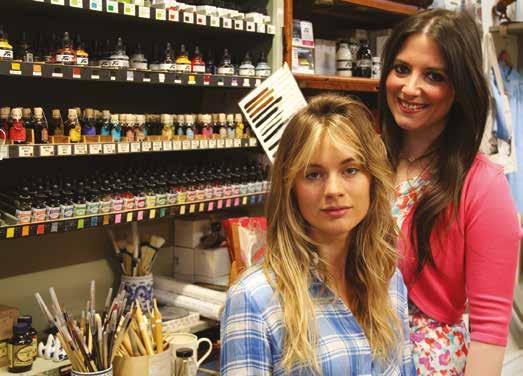
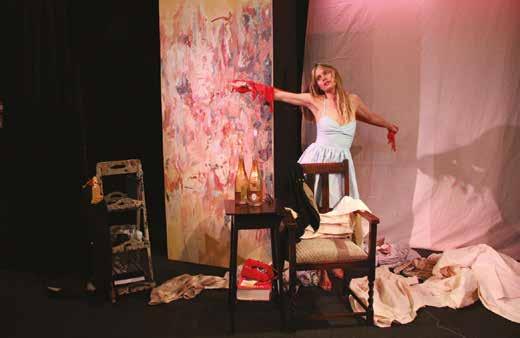
An Evening with Lucian Freud featured a starstudded cast. Cressida Bonas played ‘Laura’, with Laura-Jane commenting that she was “supremely talented” and “brought a different energy to the casting room. She was enchanting and absolutely compelling to watch”.
Although a one-woman show, the monologue was broken up through video cameos featuring household names such as Maureen Lipman, Russell Grant, and Alastair Stewart, and even Laura-Jane herself.
Laura-Jane graduated from Homerton after studying History of Art in 2004, and now lives in London, where she works as a writer. She also lectures part-time at the University of Cambridge’s Institute of Continuing Education. When asked about her time at Homerton, Laura-Jane said “I loved my time at Homerton and it really was the most perfect College for me. I was a bit naughty from the second year onwards when I really embraced all the exciting extra-curricular activities
Cambridge has on offer; the Union, student politics, Varsity, etc. etc. I was a choral scholar at Homerton, as well as receiving the Westall Prize when I graduated.”
Laura-Jane also studied for a Masters at Trinity College, Oxford, and completed her PhD at Kingston University.
The play opened to sell-out crowds and glowing reviews; according to one, “Foley’s story is fascinating and one that everyone can only dream of, and Bonas is completely loveable with just the right amounts of naivety and passion”. There was also praise for the “incredibly sensitive and engaging drama” and “perfect balance between insight to Freud’s life without revealing too much, or just becoming an hour’s worth of gossip”.
The play text is available at http://playdeadpress.bigcartel.com/product/ an-evening-with-lucian-freud
Homerton hosts 47 students for residential Summer Schools
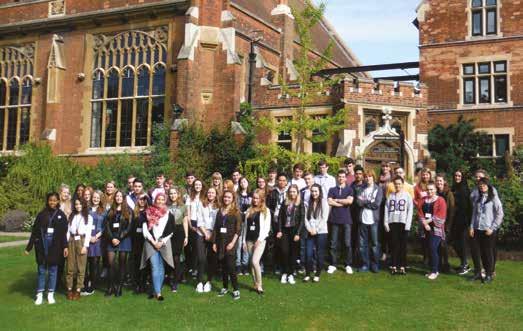
Homerton College hosted 47 students from 23 different schools across the country for its 3-day summer school in July 2015.
Most of the Year 12 students came from Homerton’s link areas of Doncaster, Rotherham, and the London Boroughs of Kingston, Richmond, and Hounslow. The summer school featured three strands: the Physical Sciences, Biological Sciences, and the Arts and Humanities. The residential kicked off with an introduction to the courses on offer in Cambridge given by Admissions Tutors Steve Watts and Paul Elliott.
Steve commented: “The summer school students had a chance to experience student life. They stayed in College for two nights, ate in the Hall and completed a taxing academic programme. They were all high achieving school students who were thinking about applying to top universities and we wanted to help them see how they would enjoy studying at the top one.”
Students on the Physical Sciences strand were able to attend sessions on Physics, Earth Sciences, Maths, Engineering and Chemistry, covering topics as diverse as chirality, bio-informatics, and how there might be more than one ‘infinity’.
Isobel Wilson, of Coombe Girls’ School, said she particularly enjoyed the maths sessions because “the lecturers were really passionate and it was very engaging!”
The Biological Science strand involved interactive sessions on Evolutionary Biology, Genetics, Pathology and, for the first time, Hospital Medicine, ahead of Homerton’s first intake of Medicine students in October 2016.
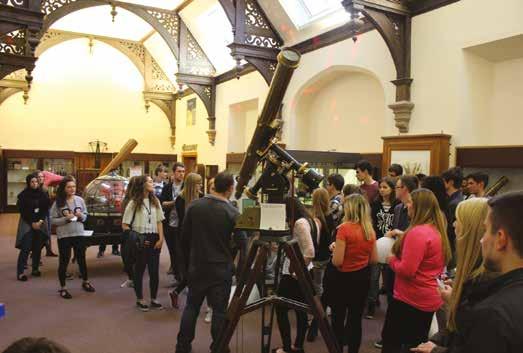
The students also undertook the “Quest for the Curator’s Code”, a science-based mystery devised with the University’s Whipple Museum of the History of Science. This involved students opening a series of locked safes in the Museum by finding hidden messages, listening to portraits talk, and solving puzzles involving probability and data analysis.
Paul Elliott, Science Admissions Tutor, said: “These events are a vital part of Cambridge’s
commitment to attracting the best and brightest students from all over the country and from every background. We give students a taste of the multitude of subjects that they can study at university, but we also talk to them about life at Cambridge, future job prospects and pastoral support. Most of the students leave with enhanced aspirations, and now realise that Cambridge is not the scary place that they had first thought!”
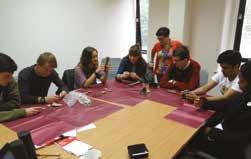
Amongst more standard school subjects like English, History and Music, the participants on the Arts and Humanities strand could learn about subjects which they may not have come across so far. For example, the alleged illegal treatment of prisoners at the Bagram Internment Facility in Afghanistan was discussed in the Law session, and Dr Juliana Cavalcanti talked about the ten major principles of Economics. The students also had the chance to get hands-on with bones and other artefacts in the Archaeology session.
The residential drew to a close with another talk from our Admissions Tutors, this time discussing how to make a good application to highly competitive universities like Cambridge, and laying misconceptions about the application process to rest. Eleanor Duce, of Gumley House Convent School in Hounslow, commented that the summer school was “a really good experience that has definitely helped to demystify the Oxbridge application process.”
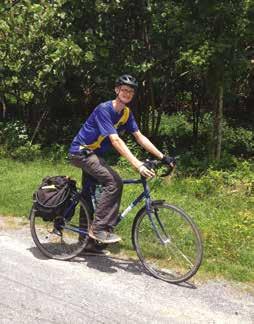
On June 27, 2015, Ben Jones became the first person to officially cycle the length of Cuba, at 1,250km long the largest island in the Caribbean.
Ben, who graduated from Homerton in 2014 after studying Politics and International Relations, undertook the journey in order to raise awareness of dyspraxia. His 36-day journey took him past Cuban military bases at Guantánamo, into a Cuban hospital after tearing the skin on his leg, and into the homes and lives of ordinary people across the nation. Although the most direct route measures in at 1,394km, Ben’s route took him over 1,600km. Although Ben didn’t own a bike at the start of the journey, his fellowship with the Winston Churchill Memorial Trust enabled him to make the crucial purchase. The Trust provides funding for British citizens to travel overseas to ‘bring back fresh ideas and new solutions to today’s issues’. Winston Churchill himself worked in Cuba as a war correspondent, during the Cuban War of Independence.
Ben said: “I would not have been able to accomplish this feat without the support of Homerton. Winning support from Homerton’s Pilkington Trust enabled me to discover the amazing possibilities for self-development that can be gained by travelling to areas most people do not think to visit, and it also enabled me to visit places including the Democratic Republic of Congo and Rwanda. The skills and experience I picked up at Homerton were crucial in making possible the successful planning and execution of my journey across Cuba.”
The Pilkington Trust helps to fund Homerton students planning ambitious or out of the ordinary journeys during the summer vacation. The grant was awarded to six students in 2015, who ventured to destinations as far flung as Brazil, Kenya, and Thailand.
Ben was diagnosed with dyspraxia whilst at Homerton. The motor coordination condition can present in a range of difficulties with everyday skills, and can have negative impacts on aspects as far-reaching as social and emotional functioning, time management, and memory. Dyspraxia affects between 2 and 6% of the population.
Homerton students have this year enjoyed academic success in a full range of disciplines. Engineering has seen particular success, with several Homertonians awarded prizes for their endeavours.
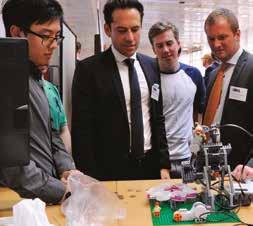
First-year Bill Jia won a prize for a project in which students were tasked with designing, building, and programming a LEGO robot. Bill, along with two students from Downing, came up with a fully-functioning coin sorting machine. Their robot detects coins placed in the hopper using a light sensor, and rotates an array of containers into position according to the size of the coin detected. The coin then drops into the appropriate container. The robot was also programmed to keep count of the number of coins and track their total value.
Thomas Kirk Kristiansen, Deputy Chairman of the LEGO Foundation, stopped by to give Bill’s robot a trial run. The LEGO Foundation recently donated some £4million to the Faculty of Education to fund the Research Centre on Play in Education, Development and Learning.
Alice Huntley and Evald Monastyrski won prizes for their Integrated Design Project, which involved designing the mechanics, electronics
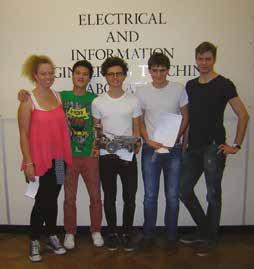
and software for a robot that could identify the composition of metal rods. Alice and Evald’s robot, christened Gwinny, successfully collected rods and identified whether they were made of brass or steel, before delivering them to the corresponding slots.
Jonathan Ledger won a Computing Prize for his coursework, which included a project to calculate how many combinations of coins make up a given amount of money. Jonathan said: “I did a little extension to the set task to make the computer programme run fast enough using dynamic programming to calculate large amounts of money”.
Finally, Ed Broadhead and Maria FernandesMartos Balson were both awarded Language Prizes. Maria undertook a project, written in French, about avoiding bone resorption around hip prostheses. In this, she explored ways to produce hip implants which have the same stiffness as bone, in order to avoid loss of bone mass and integrity around the implant. Ed, currently studying abroad in Paris for a year, received a prize for his performance in a Spanish language paper, taken as an option in his second year.
As murder mysteries go, it’s a big one: how do galaxies die and what kills them? A new study, published in the journal Nature, has found that the primary cause of galactic death is strangulation, which occurs after galaxies are cut off from the raw materials needed to make new stars.
Researchers from the University of Cambridge and the Royal Observatory Edinburgh, led by Homerton Research Associate Dr Yingjie Peng,
found that levels of metals contained in dead galaxies provide key ‘fingerprints’, making it possible to determine the cause of death.
There are two types of galaxies in the Universe: roughly half are ‘alive’ galaxies which produce stars, and the other half are ‘dead’ ones which don’t. ‘Alive’ galaxies, such as our own Milky Way, are rich in the cold gas – mostly hydrogen – that is needed to produce new stars, while dead galaxies have very low supplies. What had previously been unknown is what was responsible for killing the dead galaxies.
Astronomers had advanced two main

hypotheses for galactic death: either the cold gas needed to produce new stars is suddenly ‘sucked’ out of the galaxies by internal or external forces, or the supply of incoming cold gas is somehow stopped, slowly strangling the galaxy to death over a prolonged period of time.
In order to get to the bottom of this mystery, the team used data from the Sloan Digital Sky Survey to analyse metal levels in more than 26,000 average-sized galaxies located in our corner of the universe.
“Metals are a powerful tracer of the history of star formation: the more stars that are formed by

a galaxy, the more metal content you’ll see,” said Dr Peng “So looking at levels of metals in dead galaxies should be able to tell us how they died.”
If galaxies are killed by outflows suddenly pulling the cold gas out of the galaxies, then the metal content of a dead galaxy should be the same as just before it died, as star formation would abruptly stop. In the case of death by strangulation however, the metal content of the galaxy would keep rising and eventually stop, as star formation could continue until the existing cold gas gets completely used up.
While it is not possible to analyse individual galaxies due to the massive timescales involved, by statistically investigating the difference of metal content of alive and dead galaxies, the researchers were able to determine the cause of death for most galaxies of average size. “We found that for a given stellar mass, the metal content of a dead galaxy is significantly higher than a star-forming galaxy of similar mass,” said Professor Roberto Maiolino, co-author of the new study. “This isn’t what we’d expect to see in the case of sudden gas removal, but it is consistent with the strangulation scenario.”
The researchers were then able to independently test their results by looking at the stellar age difference between star-forming and dead galaxies, independent of metal levels, and found an average age difference of four billion years – this is in agreement with the time it would take for a star-forming galaxy to be strangled to death, as inferred from the metallicity analysis. “This is the first conclusive evidence that galaxies are being strangled to death,” said Peng. “What’s next though, is figuring out what’s causing it. In essence, we know the cause of death, but we don’t yet know who the murderer is, although there are a few suspects.”
This article was originally written by Sarah Collins at the University’s Office of External Affairs and Communications for the University website, and is gratefully re-published here.
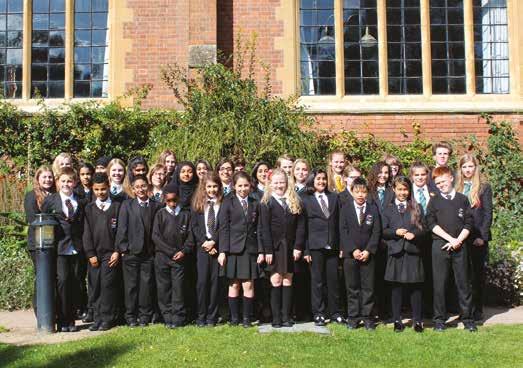
In the third week of September 2015, 37 pupils from three schools travelled to Homerton to celebrate their success on a university-style tutorial programme organised by The Brilliant Club.
The Brilliant Club is an educational charity that recruits and trains PhD and postdoctoral researchers to help students from non-selective state schools develop the knowledge, skills, and ambition they need to secure places at highly selective universities. Pupils from years 5, 6, 10, and 11 worked in school with a PhD Tutor over the course of six weeks, experiencing small group tutorials on the researchers’ areas of expertise. At the end of the course, pupils tackled final assignments of up to 2,500 words long on topics ranging from neuroscience to poetry.
The students, from St Bartholomew’s School in West Berkshire, Rivers Academy in Hounslow,
and Eastbury Primary in Essex, were hosted by Homerton College for a special graduation event. They received certificates, handshakes, and a big round of applause to congratulate them on completing the programme.
Each student experienced an inspiring tour of the College led by current undergraduates. Admissions Tutor Steve Watts offered a talk to students about why they might want to apply to University, particularly top Russell Group universities such as Cambridge. Steve said “Homerton is always pleased to see keen, committed students and to help deliver advice and encouragement to them. Working with The Brilliant Club is a great way to achieve this.”
At the end of the day, Dr Rajbir Hazelwood, Programme Officer with the Brilliant Club, gave a keynote speech celebrating the pupils’ hard work and encouraging them on the next stage of their educational journey.
Dr Mary Henes, The Brilliant Club’s Regional Director for London, says: “We are delighted to
see so many pupils at the University of Cambridge today to congratulate them on their success on our Scholars Programme. They have done tremendously well, studying with a researcher, in small groups, over the course of six weeks and addressing challenging questions in their extended final assignments. As part of the programme, they have also been able to visit two highly selective universities, where they met undergraduates, toured the campus, heard from university representatives, and thought about their choices for the future. I hope that they are proud of the work that they have produced, and that the experience of the
Scholars Programme inspires them to consider applying for a highly selective university.”
The University of Cambridge and its Colleges run hundreds of events each year to widen access to the University, and to higher education in general. Cambridge’s outreach work extends across the UK thanks to its Area Links scheme, which gives schools and colleges a direct contact with the University.
This article was written by Homerton’s Schools Liaison Officer, Emma Smith (access@homerton.cam.ac.uk)
HUS President’s Report
Sport
Music
Taylor, President of the Homerton
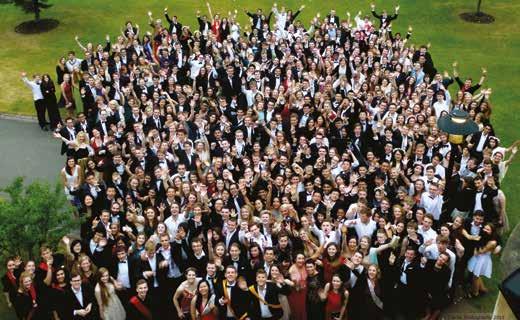
The past calendar year has seen a remarkable amount of extra-curricular activity from Homerton’s diverse, vibrant and multi-talented student community. Homerton really is coming of age as a full College of the University of Cambridge. Homertonians have been able to fit an impressive amount of activities around their academic schedules and have excelled across all areas of University life, inside and outside of the lecture theatre and the examination room. As a sabbatical JCR President I have the privilege of overseeing many of these activities without having the academic workload on top of my Presidential duties. I am continually proud of the effort that the Executive Committee of the HUS put into their roles on top of their degrees, and for this they should be commended. The committee is shaping up to be as strong as ever this academic
year, and there are many more exciting plans in the pipeline.
Many perennial favourites graced Homerton’s social calendar during the year. The College’s annual Harry Potter formals in February were as magical as ever. Indeed, they proved so popular that an extra night has been added for the coming year’s celebrations. Sponsorship Officer Anita Magee and the rest of the HUS team organised formidable amounts of decoration that wowed guests from across the University, transforming Homerton into Hogwarts for three enchanting nights. Principal Geoff Ward’s performance as Dumbledore was as entertaining as ever, and each dinner culminated with a chance for guests to meet some real-life owls.
There were also numerous themed formals across the year, with the black-tie ‘Grand’ formal masterminded by Will Hewstone proving to be especially popular. To celebrate the release of Spectre, the college hosted a James Bond-themed
formal complete with a casino (Royale), cocktails and a jazz band in the bar. November saw an Alice in Wonderland themed night in celebration of the 150th anniversary of the novel’s publication.
2015 was a May Ball year, and Homerton was transformed into a Dionysian paradise for the biennial event, for which this year’s theme was Olympus. The Ball was run in conjunction with The Sickle Cell Society, a charity which aims to promote awareness of sickle cell disease across the UK. The brilliant work of Poppy Ellis Logan in masterminding this collaboration should be particularly noted. Guests were treated to a delectable selection of Greek culinary delights, an evening of varied entertainment, some thrilling fairground rides and stunning decorations. However, the work of the committee extends far further than running social events. The HUS work throughout the year to represent student interests to College staff, and to the University’s central Students’ Union. And the HUS looks beyond the horizons of the University, too: Eireann Attridge, the HUS’s Target and Access Officer, organised a successful ‘Homerton Shadowing Scheme’,
which welcomed a group of year 12 students to Homerton to experience life in a Cambridge College for two nights during Lent Term.
The work of Welfare Officers Leo Buizza and Bryn Porter was notably prolific this year. They introduced a number of new initiatives, the most popular being ‘Pets As Therapy’, which invited students to spend some quality time with some furry canine friends as a de-stressing technique during the busiest periods of term. The committee have also introduced sexual consent workshops for all incoming first year students, an initiative that has received positive feedback at both College and University levels.
A team of thirteen students took place in the Homerton Telephone Campaign in March. They raised almost £80,000 over two weeks, with 50% of callers making donations. The college’s partnership with Santander is also now up and running. Santander have pledged to donate £45,000 over the next three years, money that will be used to fund undergraduate scholarships. The future is certainly looking bright for Homerton students n
Faye Kidd, HUS Sports Officer
Last year in the inter-college league the Men’s Badminton team were promoted in both Michaelmas and Lent terms, finishing first both times and losing only one match. This meant promotion from division 5 to division 3. In Cuppers, they reached the semi-final stage but lost to Jesus College in a close match finishing 2–1.
Homerton’s Basketball team had a successful year, achieving promotion from division 3 to division 1.
Homerton’s Cricket team had a weather affected season which allowed only three games to be played. The first, a friendly against Homerton Hackney, resulted in heavy defeat on a sodden pitch, but was essentially a warm up game for the season. In Cuppers, they were drawn against the seeded Christ’s, and against Magdalene. After a valiant fight, the team went down to Christ’s but went into the Magdalene game with boosted spirits and high expectations. These were thoroughly met, as Homerton batted steadily in cold rain and fading light, resulting in a well-deserved victory. Unfortunately the loss to Christ’s meant they didn’t progress to the Cuppers quarter finals.
The Homerton Football Club’s four teams were involved in numerous leagues and cups in 2015. Last year the First XI finished mid-table after a slow start to the season and a Cuppers that extended as far as the semi-final. The First XI also visited the Leyton Orient Supporters Club (Leyton Orient Football Club having been founded by Homerton alumni) and played them
at Brisbane Road, on 2nd May, in a high-scoring game which finished 6–4 to Leyton Orient. Martin Minkovski from Homerton’s First XI represented the Cambridge Falcons and has been selected this year again to play for them. The Fourth XI, captained by Mikael Åstrand, won the ‘bucket’, beating Trinity Bruces 3–1.
The 2014–15 season was one of great success for Homerton College Women’s Football Club, with both on- and off-pitch achievements. On the pitch, HCWFC were undefeated in League Two, winning the league, and therefore winning promotion into League One for the 2015/16 season. HCWFC also gained the highest goal difference in the league and due to the size and enthusiasm of the squad was one of the few teams in League Two not to have forfeited a match. Despite great success in the League, the HCWFC’s Cuppers bid was not quite so successful. Despite a convincing 3–0 victory over Catz, HCWFC suffered defeat in the second round of the Cup at the hands of Emma.
Off the pitch, the club secured sponsorship from our friends at the Maypole, meaning HCWFC had its own kit once more for the first time in three years. With new kit and our promotion into League One, HCWFC has high hopes for the 2015/16 season! With an awesome influx of enthusiastic freshers – all with strong footballing potential and abilities – giving us a sizeable squad, as well as having several of our players playing for the Cambridge Women’s Blues Teams, we are looking forward to a fantastic year with a great team! Last but not least, we’ll be having fun bonding times with some socials with the Men’s teams, football-match watching in the Buttery and of course, our weekly pub outings after matches.
Homerton Netball had a very successful year last year, with both the Mixed and the Ladies teams winning the majority of their matches! Playing with friends, old and new, was great fun, and the social events that punctuated the calendar helped to provide some vaguely netball-related frivolity. The highlight of the year for the Ladies team, however, was Cuppers; we made it all the way to the quarter-finals! We can only hope that Netball this year can live up to last!
The Squash Team reached the quarter finals of Cuppers before being narrowly defeated by Magdalene. They won promotion in the League, after beating all but one of the other teams in their division.
Last season’s performance could only be described as a triumph for Homerton College Boat Club. The season began with some admirable performances in Queens’ Ergs, Emma Sprints and Fairbairns and continued to improve with some solid rowing in Lent bumps. The M1s also put up a good fight in the Head of the River Race in March. However, true celebrations lay in store for May Bumps. With high hopes and the
pressure on, M1, M2, M3 and W1 took to the Cam. It was a tense week, to say the least, as M1 struggled to stay afloat at the beginning of the event before bouncing back to bump St Edmund’s and W1 getting closer with every stroke to the coveted blades of glory. The week ended with success for HCBC with sets of blades for W1 and M3. M2 also had reason to celebrate, having moved up three places in their division. Other highlights include the purchase of a new Janousek boat, ‘Petaluma’ for M1, thanks to a generous donation and HCBC’s 24-hour sponsored erg.
The rugby season was a successful yet ultimately disappointing one for a Homerton Rugby team chasing promotion. Homerton started the year brightly and continued to set the early pace in the division, winning five games in a row at the start of the season. These victories were built upon intricate interplay out wide on the wings as well as some resolute defending. As the season progressed, injuries began to take their toll on the squad and eventually Homerton fell to a 7 and 3 record. This was good enough only for second place in the league, just shy of promotion. Despite this, the season overall was a great success for Homerton rugby and showed plenty of promise for a sustained promotion push in the 2015–2016 season n
Dr Daniel Trocmé-Latter, Director of Music
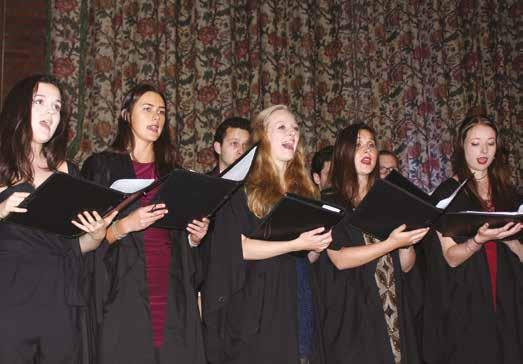
It is difficult to imagine that Homerton’s first ever CD (Audite Finem: a professional release with EM Records) came into existence just over a year ago. Since that time it has been listened to by students, alumni, and members of the public in the UK and in numerous other countries. One reviewer praised the Charter Choir’s ‘excellent balance and blend’, while Choir & Organ noted that the contents of the disc (English music ranging from the 16th to the 21st century, albeit with an emphasis on the modern) demonstrate Homerton’s ‘commitment not just to progressivism but to the English [choral] tradition as well’. Were further evidence of the
disc’s success needed, it even featured in a BBC Radio 3 broadcast on International Women’s Day, in the form of our rendition of Let all the world in every corner sing by Greta Tomlins, who lectured Music at Homerton during the 1940s.
Of course, the Choir has also found plenty of opportunities in the past year to perform music from a whole range of countries and eras. The end of January 2015 featured a moving rendition of Rachmaninov’s Bogoroditse Djevo at Evensong in St Edmundsbury Cathedral, after which the Choir was able to try out the rather special acoustic in the Cathedral Deanery hallway during a drinks reception in honour of the Choir. Back at home, Organ Scholar Jonathan Huse has been treating weekly congregations to an abundance of voluntaries by J. S. Bach as well a number of French
composers, including Clérambaut, Couperin, and Vierne. Audiences in France this summer heard the Choir’s renditions of Vierne’s Messe Solennelle, Lauridsen’s O Magnum Mysterium, Rheinberger’s Abendlied, and much more.
On which topic, the 2015 summer tour was without a doubt the most successful and rewarding the Charter Choir has undertaken. Performing a total of nine times in eight days across the south of France and Monaco, it was also the most gruelling in terms of the number – and temperature – of performances. Luckily our hostel’s proximity to the beach provided a daily chance for relaxation. The highlight of the tour may have been singing Mass at Monte Carlo Cathedral on our last day. The generous acoustics and appreciative clergy and congregation made for a spectacular rendition of the motet (Mealor’s Ubi caritas) and a rightfully proud Choir and Choir Director!
Other special events this past year have included joint services with the choirs of Magdalene, Churchill, and Robinson Colleges, as well as singing at two weddings in Cambridgeshire.
The year to come looks to be as exciting, with nine new Choir members on board, a trip to
Canterbury Cathedral and our summer tour to New York and Boston confirmed. More details will appear in the Homertonian. Alumni are always welcome at Charter Choir services and concerts. The Charter Choir website (www.homerton.cam.ac.uk/charterchoir) contains full details of sung services. Alumni are also encouraged to follow the Charter Choir on their Facebook page, at www.facebook.com/ homcharterchoir n
Kate Aspray Finn Brewer
Benjamin Butt Coleman Chan
Philip Colbran Aaron D’Souza
Poppy Ellis Logan Rowan Haslam
William Hewstone Faye Kidd
Flora Sagers Lizzie Shaw
Augustinas Šilalė Caroline Steel
Rachel Sweet Lucy Taylor
Ruth Taylor Hovman Wang
Isabella Yamamoto
Organ
Jonathan Huse
Research Roundup
Publications
With a growing Fellowship and body of graduate students and expanding expertise in everything from AngloSaxon to Zoology, Homerton is establishing itself as a centre for research as well as teaching. Research is central to Homerton’s mission to foster a culture of achievement and academic excellence and permeates almost everything that takes place at Homerton, and it is displayed most obviously in the series of research seminars that take place regularly throughout the year. The Homerton Research Seminars present the best and latest of Homerton’s home-grown research, presented by Fellows, Research Associates, and – since 2015 – also by graduate students. The 2015 Michaelmas term saw the introduction of a new lunchtime seminar slot on Thursdays, complementing the traditional talks on Tuesday evenings before Formal Hall. Seminars are open to all, and present cutting-edge findings in a way accessible to a wide academic audience. These engaging talks this year ranged from jets to climate change, from dyslexia to democracy, and from cultural appropriation to Roman material culture.
Dr Richard Hickman began the year’s seminars with a talk on ‘Art, Pedagogy and Dyslexia’, in which he presented research that examines the strategies employed by art teachers who identify as dyslexic. Building on this, his research then asks which of these strategies might be deployed as pedagogical tools, and finds useful connections between attributes often associated with dyslexia and classroom practices.
Does it make sense to call W C Handy’s ‘St Louis Blues’ an example of Modernist poetry; can it be said to be written in iambic pentameter? Or, rather, does this involve the appropriation of African American popular song into an incompatible critical apparatus? These were the question addressed by
Michael Skansgaard, PhD student in English. His research identifies new methods which can be applied to ethnomethodology, and which can allow for the development of sustainable and authentic educational systems.
Michael’s presentation was paired with one from James Gabrillo, MPhil student in Music, which aimed to address the methodological gap in assessing popular songs and performances that were specifically a result of appropriation and recontextualisation, such as cover songs. In particular, he examined the cover by American rock band Kings of Leon of Dancing on My Own by the Swedish popstar Robyn, in which genre and gender codes are distinctly switched.
In March, Kate Boehme, PhD student in History, and Pallawi Sinha, PhD student in Education, gave talks which examined the past, present and future of India, from the speculation mania and economic crash that crippled the Bombay economy of the 1860s to dilemmas facing contemporary Indian education.
Crossing the Himalayas, in May, attention shifted to Kazakhstan, as Peter Cunningham and Elaine Wilson presented their work on a major project of educational development in the country. The talk highlighted continuities in Homerton’s long-standing contributions to developing school education nationally and internationally, and reflected critically on schooling and teacher development in Kazakhstan in the context of the early 21st Century and 25 years since the country gained independence from the disintegrating Soviet Union.
Disintegration of a more physical and tangible variety lay behind Paola di Giuseppantonio di Franco’s talk in June. While it is often impossible to allow museum artefacts to be physically handled by visitors, as such handling leads inevitably to the
destruction of fragile objects, her paper suggests that 3D digital and printed replicas can provide an effective substitute and allow museum visitors the chance to form an intimate relationship with objects. This physical relationship allows visitors to construct freely their own narratives of the past and suggests that traditional museum practices, which see textual or similar provisions as necessary to facilitate learning, can be modified.
Asking ‘how?’ makes a difference when doing social science, but the question of ‘how?’ is often neglected in favour of asking ‘who?’ or ‘why?’.
Astrid Van Oyen’s presentation aimed to redress this, by setting out a ‘manifesto’ for the ‘how’ questions – and for ‘things’ – in social science. The key to rethinking human-thing relations, she argues, is to grant a historical, explanatory role to the ‘how’ question, which has the effect of introducing objects as historical actors and changing both historical narratives and current dilemmas.
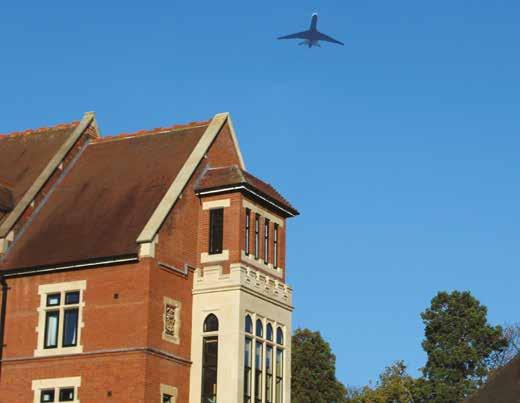
The final research seminar of 2015 examined an issue especially relevant to Homerton, given the College’s location right in line with the runway of Cambridge Airport: jet noise was the subject of Junior Research Fellow Karthik Depuru-Mohan’s paper. Jet noise, generated by turbulent mixing of the high-speed propulsive jet with ambient air, has historically been reduced by increasing the engine bypass ratio, but this in turn increases the fan noise. More subtle solutions are now required: one such solution, argues Dr Depuru-Mohan, is to deploy chevrons or corrugations around the lip of the jet-pipe, and a new theory of the physics of chevrons can make this possible at the preliminary design stage n
The seminar programme can be followed on http://www.homerton.cam.ac.uk/ lifeathomerton/research and on http://talks.cam.ac.uk/show/index/24296.
A selection of research published by Homerton academics in the past year.
Stephen Burgess and Simon G Thompson, Mendelian randomization: Methods for using genetic variants in causal estimation (Chapman & Hall/CRC Press, 2015)
Richard Hickman, An Art Miscellany for the Weary & Perplex’d (Corsham, National Society for Education in Art & Design, 2015). [Available at: http://www. nsead.org/downloads/An_ar_miscellany_2015.]
Richard Hickman and Heaton, R. “Visual Art”, in D. Wyse, L. Hayward and J. Pandya (eds.) Sage Handbook of Curriculum, Assessment, and Pedagogy (London, Sage, 2015)
Richard Hickman and Brens, M., “Art Teachers’ Professional Development”, in L. Burgess and N. Addison (eds.) Learning to Teach Art & Design in the Secondary School, 3rd Edition (Abingdon, Routledge, 2015)
Murray Hunt, Hayley J. Hooper, and Paul Yowell, Parliaments and Human Rights: Redressing the Democratic Deficit (Hart 2015), details here: http://www.hartpub.co.uk/BookDetails. aspx?ISBN=9781849465618
Zoe Jaques, Children’s Literature and the Posthuman (London, Routledge, 2015)
Melanie Keene, Science in Wonderland: the scientific fairy tales of Victorian Britain (Oxford University Press, 2015)
Daniel Trocmé-Latter, The Singing of the Strasbourg Protestants, 1523-1541 (Farnham, Ashgate, 2015). http://www.ashgate.com/isbn/9781472432063
Yuan, Y., Philip Stephenson and Richard Hickman, “Museums as Alternative Settings for Initial Teacher Education: Implications of and Beyond the “Take One Picture” Program for Primary Art Education” Visual Arts Research 41:1 (2015)
Katzelnick LC, Judy Fonville, Gromowski GD, Arriaga JB, Green A, James SL, Lau L, Montoya M, Wang C, VanBlargan LA, Russell CA, Thu HM, Pierson TC, Buchy P, Aaskov JG, Muñoz-Jordán JL, Vasilakis N, Gibbons RV, Tesh RB, Osterhaus ADME, Fouchier RAM, Durbin A, Simmons CP, Holmes EC, Harris E, Whitehead SS, Smith DJ, “Dengue viruses cluster antigenically but not as discrete serotypes”, Science 349 (2015) 1338–1343
Bangwen Xie et al., “Necrosis avid near infrared fluorescent cyanines for imaging cell death and their use to monitor therapeutic efficacy in mouse tumor models.” Oncotarget (2015)
Dr Bangwen Xie’s paper finds, for the first time, two fluorescent dyes which selectively bind to the proteins of dead cancer cells, in both lab and living conditions. This finding has clinical significance in that these dyes could be used in cancer diagnosis and prognosis, and in monitoring early-stage tumour response to chemotherapy.
Yingjie Peng, R. Maiolino, and R. Cochrane, “Strangulation as the primary mechanism for shutting down star formation in galaxies”, Nature 521, 192–195 (2015)
Dr Peng’s paper has been featured extensively in the media, including on the BBC News website, here: http://www.bbc.com/news/scienceenvironment-32734978 n
From the Development Director Donations
Matthew Moss Director of External Relations & Development, and Fellow
ACambridge College is an intimate community of gifted people, joined by shared experiences and aspirations. Those experiences and aspirations are life-long, and so the physical act of leaving Homerton, qualification in hand, is not the end of our students’ relationship with this place, any more than it is the end of the friendships that were born and flourished here. It is our job in the Development Office to keep our former students connected with Homerton and with the current life of the College.
The Development Office at Homerton has only been in existence for five or six years, and in the past year it has doubled in size. The need is threefold: to raise awareness of Homerton as Cambridge’s biggest and newest College, to keep our former students in touch with the College after graduation, and to raise funds to support current and future students.
As head of the office I am fortunate to have a talented and enthusiastic team: Erin Bond, Deputy Director of Development and herself a Homertonian who studied here as a Junior Year Abroad student from the USA in 1999–2000; Matt Hann who has joined us as Alumni Relations Officer fresh from a doctorate at the University of Durham, where he was President of his College’s Graduate Common Room for two years; Charlotte Jenner, our database assistant, who as a former head of the Tutorial Office provides
our institutional memory; and – successively –Francis Dearnley and Jack Hooper, both former Presidents of the HUS who have done one-year internships as Communications Associates.
Each year a dozen or so students hit the phones to speak to our alumni, their predecessors. Over two weeks in March they spoke to 684 people, and raised £78,189 to support current and future Homerton students. They confirmed contact details along the way, had great conversations with teachers, civil servants, business owners, a Formula 1 brake engineer and a clown – and got plenty of careers advice! Preparations are under way for the 2016 telethon, to take place at Easter.
In 2015 we launched the 1768 Society, to recognise and thank people who make regular donations to Homerton of £17.68 a month or more, and welcomed its first members. In Paupers’ Walk a Trust Deed is displayed dated that year, when the College first had bricks and mortar of its own, in Homerton High Street, Hackney. We are looking forward to celebrating our 250th Anniversary in 2018.
The College is enormously grateful to all who contribute, and it is heartening to mark the different motivations of our benefactors. Many give because their time at Homerton was so pleasurable, or formative, or both: we recently received a wonderful legacy from the late Jacqueline Welford (CertEd 1943–45). Others are concerned to make a positive impact on current students, and we are about to launch a great programme of internship bursaries with
generous funding from Victoria Brahm-Schild (BEd 1980-84) which will level the playing-field for students from less advantaged backgrounds who are looking for work placements. Yet others are excited by Homerton’s opportunity, as Cambridge’s newest and biggest College, to invent itself in a way that is relevant to the needs of 21st Century society. We are continuingly grateful to Jan and Erika Hummel, parents of two recent Homerton graduates, who support the vision for Homerton through a major donation to the Principal’s Fund.
All in all we received donations from 413 individuals during 2015, totalling over £195,000, all of which goes to support current and future students of Homerton. Many thanks indeed to all!
2015 also saw the launch of the Dear World… Yours, Cambridge fundraising campaign for the University and all 31 of the Colleges. The campaign emphasises the close link between the education and research undertaken here, and the impact we have on the world – and it asks what the
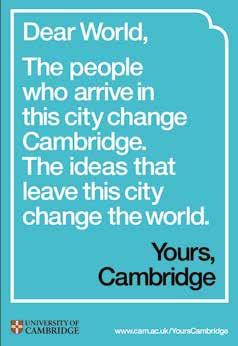
world needs next from Cambridge. Homerton plays a full part in the campaign, and a donation to Homerton for any purpose counts towards the campaign target of £2 billion for collegiate Cambridge. Visit www.philanthropy.cam.ac.uk to find out more.
There are plenty of opportunities to come back to Homerton – alumni are always most welcome to visit. This year the Alice in Wonderland celebrations gave us the chance to host a very splendid Tea Party for alumni and their families. The last weekend of September each year is the Reunion Weekend, when alumni are particularly encouraged to come back to Homerton to catch up with old friends. This year the College’s excellent Charter Choir gave an afternoon concert, there were special reunions for the ‘Diamond’ and ‘Golden’ cohorts, and an academic seminar on Alice through the Ages by Homerton Fellow Dr Zoe Jaques was tremendously well supported.
Also this year we have held two very successful drinks receptions in a central London wine bar, where alumni were invited to meet the Principal and Bursar, the Development Team, and student officers of the JCR – we’ll be doing more of this (because we had fun too!) so do look out for opportunities in 2016.
We have over 2,000 followers on Twitter and nearly 3,500 on Facebook – there’s a terrific community of Homertonians who use these to engage with the College and with each other, and we’re building up our use of Instagram and (in progress!) LinkedIn. Do join us: you can find the links from www.homerton.cam.ac.uk. There are many ways, electronic and ‘real’, to keep engaged with the College – as well as this new yearly publication, the Annual Review, we publish the Homertonian each summer, and we always, always, always want to hear from you. Homertonians have done amazing things – do drop us a line n
The following members and friends of Homerton College made donations to the College in 2015.
1936 Mrs Margaret Kent
1941 Mrs Teresa Lea (deceased)
1943 Mrs Margaret CampbellSmith
Mrs Kathleen Hayward
Mrs Jacqueline J Welford (deceased)
1944 Mrs Joan M Gray
Miss Margaret Rishbeth
1946 Mrs Zoe M Coombe
Mrs Margaret E Dunsford
1947 Ms Christine Andrews Lady (Dorothy) Franklin
Mrs Margaret I Johnson (deceased)
1948 Dr Brenda J Buchanan
Mrs Jane A Charman
Mrs Janet K Farley
Mrs Rosemary J Langlois
Miss Elizabeth W Rainsbury
Mrs Marjorie A Robinson
1949 Mrs Margaret Blott
Mrs Mary L Dowse
Mrs Margaret Eedle
Mrs Coral Harrow
Mrs Sylvia M Saul
1950 Mrs Mavis J Blow
Mrs Cathleen M Butler
1951 Ms Ann J Barnes
Mrs Sheila A Duncan
Mrs Patricia M Stockdale
1952 Mrs Shirley D Haslam
Mrs Evelyn P Parker
1953 Mrs Norma A Blamey
Mrs Angela J Brooks
Dr Alison B Littlefair
Mrs Elizabeth Tunnicliffe
1954 Mrs Pauline M Curtis
1955 Mrs Gillian M Hewin
Miss Gwendoline E Lancaster
Mrs Rachel I Lewington
Mrs Jane R Matthews
Mrs Maralyn Westwood
Mrs Gillian Williams
1956 Mrs Marguerite M Donkin
Mrs Pamela J Gaddes (deceased)
Mrs Alice A Severs
Mrs Jennifer M Varley
1957 Mrs Bernice A Barton (deceased)
Mrs Gillian E Figures
Mrs Doreen E Hobbs
Mrs Joan Hollinghurst
Mrs Chistine M Lincoln
Mrs Elisabeth A McOwan
Mrs Doris Stephenson
Mr Donald R Stewart
Mrs Josephine M Sutton
Mrs Rosemary M Viner
1958 Mrs Christine Carne
Mrs Gillian M Ganner
Mrs Wendy J Garforth
Mrs Jane M Grant
Mrs Diana Hadaway
Mrs Jill R Hicks
Mrs Angela M Hulme
Mrs Joyce V Ivell
Mrs Beryl A Izzard
Mrs Rachel M Macdonald
Mrs Judy N Manson
Mrs Patricia Mee
Mrs Beatrice M Pryce
Mrs Patricia K Stott
1959 Mrs Dora Beeteson
Mrs Ruth R Brass
Mrs Pauline T CavellNortham
Mrs R J Hammond
Mrs Ann F Hardie
Mrs Ruth E Jerram
Mrs Diana M Lucas
Mrs Ann-Marie Mackay
Mrs Barbara Sherlock
Mrs Pamela Smart
Mrs Sheila Spaul
1960 Mrs Rosemary L Allan Lady (Gillian) M Baker
Mrs Patricia A Blythe
Mrs Jean M Clarke
Mrs Susan Dickinson
Mrs Jenifer A Freeman
Mrs Jill Fuller
Mrs Jean E Jeffery
Mrs Valerie A Johnson
Mrs Christine A Kershaw
Mrs Jennifer S McKay
Mrs Gilliane P O’Keeffe
Mrs Christine A Parkyn
Mrs Jacqueline M Rupp
Mrs Sheila K Taylor
Mrs Hillary J Young
1961 Mrs Kathleen Abbott
Mrs Frances M Clare
Dr Olivia Craig
Mrs Anne C Hulse
Mrs Joy M Kohn
Mrs Pamela A Marshall (deceased)
Mrs Susan McFarland
Mrs Alison M Steer
Mrs Jean Thorman
Mrs Andrea Woodward
1962 Mrs Diana Dalton
Mrs Marion W Foley
Mrs Maureen R Frost
Mrs Carole R Nolan
Miss Esme J Partridge
Mrs Gwendolyn J Williams
1963 Mrs Audrey C Knighton
Mrs Christine W Macpherson
Mrs Joan M Powell
Mrs Catherine Ryder
1964 Ms Sylvia M Dibble
Mrs Margaret Meredith
Ms Christine Purkis
Mrs Rosemary A Rees
Mrs Susan Rescorla
Ms Marjorie Thorley
Mrs Janet R Woodford
1965 Mrs Lorna Cordell-Smith
Dr Patricia Cusack
Mrs Wendy A Dunnett
Mrs Rosemary J Howells
Mrs Susan M Pinner
Mrs Ruth Watkin
Mrs Janet S Webb
Mrs Dilys West
1966 Mrs Linda M Birtwhistle
Mrs Jean D Carnall
Mrs Susan B Carter
Mrs Margaret E Crowe Lady (Marilyn) Fersht
Mrs Margaret G Funnell
Mrs Sally Gibbons
Mrs Kathryn A Gilden
Mrs Judith O Martin-Jenkins
Mrs Margaret C Robbie
Mrs Jill Russell
Mrs Sheila E Stephens
Mrs Cheryl A Trafford
Mrs Diana M Wilkins
Mrs Janet Wilkinson
Mrs Elizabeth A Wilson
1967 Mrs Mary C Alpass
Mrs Marjorie Caie
Mrs Marion A Pogson
Mrs Annette Smallbone
1968 Mrs Kathleen L Down
Mrs Constance L Marriott
Mrs Robyn A Mitchell
Mrs Anne R Rogers
Mrs Penelope M Spencer-Chapman
1969 Mrs Eileen P Coombes
Mrs Lynn Lemar
Mrs Gillian M Sallis
1970 Mrs Elizabeth Atkin
Mrs Patrica A Bradley
Miss Fiona S Cook
Mrs Sheila A Crowther
Mrs Miriam France
Dr Diana M Gallop
Mrs Avril H Growcott
Mrs Denise M Mitchell
Ms Bridget E Peachey
Mrs Patricia M Saxton
Dr Rosslyn J Sendorek
Mrs Helen E Wood
1971 Mrs Sally E Mabon
Mrs Marilyn S Reid
1972 Mrs Anne M Bambridge
Ms Catherine M Beavis
Mrs Carolyn M Kural
Dr Victoria M McNeile
Ms Hilary V Stokes
Mrs Sarah Taylor
Mrs Eunice M Williams
1973 Mrs Jean Addison-Fitch
Ms Stephanie Beardsworth
The Rev’d Claire M Heald
Mrs Susan E Main
Mrs Dilys E Murch
Mrs Denise E Shakespeare
Mrs Helen E Sheppard
Mrs Mary Wyatt
1974 The Rev’d Canon
Rosemary J Brooke
Mrs Patricia Darke
Mrs E J Rose
Ms Helen R SandleBaker
Ms Anne Sparrowhawk
1975 Mrs Alyson E Baker
Mrs Sarah Flynn
Mrs Caroline C Melrose
Mrs Ruth A Saunders
Mrs Maureen P Weston
1976 Ms Jill M Grimshaw
Miss Amanda E James
Mrs Sheila A Martin
Mrs Elizabeth J McLean
Mrs Alison Roberts
Mrs Tessa M Vivian
1977 Ms Jane E Edwards
Mrs Ann J Kirkby
1978 Mrs Sandra E Burmicz
Mrs Sally J Collins
Mrs Joan H Gibson
Mrs Ann P Muston
Mrs Penelope J Stokes
Mrs Linda M Tavener
Mrs Zena P Tinsley
1979 Ms Gillian Barford
Miss Sheila M Berry
Mrs Jane S Bishop
Mrs Lesley A Daniel
Mrs Helen M Draper
Mrs Anna C Foster
Mrs Elizabeth C Harding
Mrs Ann E Jackman
Ms Brenda C Meek
Mrs Helen M Mitchell
Mrs Louise M Mursell
Mrs Clare L Myers
Mrs Elizabeth L Thomas
Mrs Angela M Wimbush
1980 Mrs Marianne J Billitt
Mrs Ruth M Briant
Mrs Clare M Danielian
Mrs Mary G Powles
1981 Mrs Jill C Burton
Mrs Clare F Harvey
Mrs Leonie M Hyde
Mrs Fiona S Morgan
Mr Mark Sendell
Mrs Brenda J Thompson
1982 Mrs Della A Allen
Ms Victoria S Brahm
Mrs Jacqueline
A Butler
Mr Mark D Hanley
Browne
Mrs Catherine J Hicks
Mrs Sarah E Holmes
Mr Brian J Howarth
Mrs Jacqueline M Tizzard
Mrs Sally A Woods
1983 Mrs Gayatri Basu
Miss Anna J Chapple
Mrs Amanda J Edwards
Mrs Sally M Lomax
Mrs Sarah J Rawlins
Ms Rhiannon D Williams
1984 Mrs Caroline L Brook
(deceased)
Ms Sarah E Gordon
Ms Gek-Ling Lee
Mrs Helen E O’Hara
Mr Peter J Ventrella
Mrs Carolyn F Whyte
1985 Mrs Alison Brinklow
Mrs Susan C Hill
Mrs Karen L Miranthis
Mrs Frances R Surridge
Mrs Alison M White
Ms Sally M Woodcock
1986 Mr Colin Cook
1987 Dr Kirsty N Byrne
Mrs Karen E Coombs
Ms Anne Hafford
Mrs Julia A Harker
Mrs Sally E Jaspars
Mr Luke N Lowry
Mrs Elizabeth M McCaul
Mrs Susan J Stirrup
Mrs Anna M Waters
1988 Mr Fabio M Galantini
Mrs Deborah J Stone
Mrs Paula M Tebay
1989 Mrs Alison E Allen
Mrs Kim C Chaplin
Mr Carl B Howarth
Mrs Michaela R Khatib
Mrs Angela P Lipson
Mrs Kerry A Merriam
1990 Mrs Tamsin J Austoni
Mrs Lavinia F Colley
Mr Ian C Hodgson
Mr Arjun Kumar
Ms Phillipa C Rushby
Mrs Rebecca Smith
Mr Giles D Storch
Miss Jennifer D Svrcek
Mr James D Thomson
1991 Mr Dennis S Gilbey
The Rev’d Wendy A Wale
1992 Mrs Naomi A Baynes
1993 Miss Julie A Hogg
Mrs Alison L Kent
Mrs Elizabeth R Sartain
Miss Lisa C Tiplady
1994 Mrs Lucy A Partridge
Mrs Victoria L Urding
1995 Ms Evroulla Agathangelou
Mrs Carol W Carlsson
Browne
Mr Gary Dadd
Mrs Wendy E Oakley
Mr James V O’Neill
1996 Ms Ruth K Eccles
Mr Christopher P OwenSmith
Mr Christopher A Shephard
Mrs Emma J Smith
Mrs Victoria M TrueBhattacharyya
Mrs Emma R Vyvyan
1997 Mr Matthew Buck
Ms Brigid Vousden
1998 Miss Alison E Buck
1999 Dr Edward S Adams
Ms Erin L Bond
Dr Neil J Hennessy
Mrs Elizabeth C Jestica
Mr Paul R Jones
Mrs Lisa E Knight
Mrs Laura M Penrose
Miss Hayley Romain
Mrs Joanna T Turner
2000 Mr Anthony J Delany
Mrs Hannah M Hames
Miss Katharine James
Dr Thomas E Kitchen
2001 Mrs Lesley-Anne Crooks
Dr Adam R Dennett
Miss Lidia Fesshazion
Mrs Amy V Fleming
Dr Robert J Fulford
Mr David J Lawrence
Miss Catherine L Payne
2002 Ms Lisa J Aspinall
Mrs Janet M Cottenden
Miss Bernadette M Crossley
Mr Sam Farmer
Miss Katy M Johnson
Mr Remi H Moynihan
Miss Krista A Pullan
Mr Timothy D Scott
Mrs Katie Wright
Ms Rhiannon L Wynne
2003 Mr Raymond C Cilia
Mr Gregoire A Hodder
Mrs Anne M Howell
Mrs Laura F Latham
Mr Che P Meakins
Mr Daniel W Roberts
2004 Mrs Charlotte A Bacon
Mr Jingdong Chen
Mr Richard A Hopkins
Miss Emily Ikelle
Dr Augustine J Pereira
2005 Mr Andrew C Gard
Miss Jocasta A Jones
Mrs Rebekah H Perry
Ms Elizabeth R Plumpton
Mrs Holly E Ranger
Mrs Barbara A Rumley
Miss Elizabeth R Telford
Mrs Emma L Turner
Ms Di Wu
2006 Dr Theresa Y Adenaike
Miss Amy Barnecutt
Mr Tobias A Bown
Miss Laura E Davenport
Mrs Eliza M de Uphaugh
Mr Thomas C Dix
Miss Alison Dunphy
Mr Alexander J Rolfe
Mr Salih M Sheikh
Mr Eric W Tung
2007 Mrs Chloe J Kee
Miss Xiajuan Li
Mr Benjamin N Mills
Mr Joseph J Randall-Carrick
Mrs Chikako Woodgate
2008 Mr James A Douglas
Mr James Jones
Mr James D Lugton
Mr Matthew A McNally
Miss Imogen C Ogilvie
Mr Kenichi Udagawa
2009 Miss Shruti Chaudhri and Mr Iain Cameron
Mr Jonathan D Edge
Mr William C Quinn
Mr Oliver J Rubens
2010 Mr Cameron C Evans
2014 Mr Tom Zille
Non-alumni donors
Dr Roger Ali
Mrs Frances Barrett
Mr Mike (Frederick) Bibby (deceased)
Mrs Ann L Cotton
Mr David S and Mrs Mandy Fletcher
Mr John G Gaddes
Professor John M Gray
Ms Deborah Griffin
Mr Jan and Mrs Erika Hummel
Mr David A Huntley
Dr Anthony R Metcalfe
Mr Matthew N H Moss
Professor Maria Nikolajeva
Mr John Nutter
Mr Richard W Price
Dr Peter H Raby
Mrs Frances E Turner
The 1768 Society Regular giving makes a great difference to Homerton because a commitment to make annual, quarterly or monthly instalments for an agreed number of years enables the College to plan for the future with a known and regular income. Named for the year of the College’s founding in Homerton, East London, the 1768 Society is formed of
donors who generously give £17.68 per month or more to Homerton.
Ms Victoria S Brahm
Mrs Marjorie Caie
Miss Shruti Chaudhri and Mr Iain Cameron
Mrs Diana Dalton
Mrs Clare M Danielian
Mrs Sheila A Duncan
Mr Jonathan D Edge
Mrs Miriam France
Mr Mark D Hanley-Browne
Dr Neil J Hennessy
Mr Richard A Hopkins
Mrs Anne M Howell
Mrs Christine W Macpherson
Mrs Jane R Matthews
Dr Anthony R Metcalfe
Mr Matthew N H Moss
Mrs Elizabeth L Thomas
Mrs Brenda J Thompson
Mrs Dilys West
Mrs Rhiannon D Williams
The College would also like to thank those donors who wish to remain anonymous, as well as those who have expressed an interest in leaving a legacy gift to Homerton in their will. We are also very grateful to those friends and supporters who give up their valuable time in support of the College n
News from the Branches
Alumni News
Retired Senior Members’ Association
Name
Homerton has a long and proud tradition of independent alumni branches up and down the country, who have been meeting for over a hundred years. If you would like to get involved, do please contact the branch leaders – contact details are provided below. All of Homerton’s alumni branches are looking for new members and alumni are always welcome to attend their events. Full contact details are provided below.
Ten members of the Homerton Group in London – the Homerton Rollers – visited the Geffrye Museum in Hoxton for our summer event in June. This is a little gem of a museum showing British rooms, furniture, and gardens through the ages. Both Stephanie Rogers and Stephanie Beardsworth, who together run the London Group, had separately been very fond of this museum for years so it was good to share with
Contact details
Cambridge
Anthea Wicks (1958–1960) roger.wicks@outlook.com
China
Xianwen Meng (2011–2012) mengxianwenhf@gmail.com
London (‘The London Rollers’)
Stephanie Beardsworth (1973–1977) stephanie.beardsworth@btinternet.com
Stephanie Rogers (1970–1974) stephanie.rogers51@gmail.com
others, including a Homertonian over from New Zealand on holiday.
The group also enjoyed an informal concert of summer songs by a local choir as well as exploring the gardens on a glorious summer’s day. Interesting but more sobering were visits to an alms-house (where it transpired that occupants were often impoverished retired governesses!) and an exhibition on the housing of London’s Victorian poor.
In December, the group met for a lunchtime concert at St Martins-in-the-Fields at Trafalgar Square, a mini tour of the National Gallery and then afternoon tea.
The Oxford Branch have enjoyed an active year, with visits to a number of places of interest. In April 2015 they enjoyed a tour of Christ Church Cathedral by Sue Dixon (née Partridge)
Newcastle upon Tyne and Durham
Elise Wylie (1958–1960) elise.wylie@gmail.com
Oxford
Lucy Barnett (1961–1964) glebecottage@gmail.com
Southern California
Angela Das (2000–2003) ad301@cantab.net
Wessex
Coral Harrow (1949–1951) coralharrow@waitrose.com
1965–1969, in which she pointed out the many connections to Alice in Wonderland in its 150th year.
In Autumn, the Oxford Branch returned for a guided tour of Christ Church Picture Gallery in November, suitably fortified by lunch beforehand at Quod Brasserie on the High.
All Homerton Alumni in the area are most welcome to attend the Oxford Branch’s events.
2015 marked the final official meeting of the Manchester Homertonians. Founded by Miss Morgan, Miss Lily Allen and Miss Alice Nichols as the ‘Northern Group’ of what was then the ‘Old Homertonian Association’ in 1904, the Manchester Branch has enjoyed a long history. A constant reminder of the Manchester Homertonians is provided by the bank of roses outside the Great Hall at Homerton was presented to the College by the Manchester Homertonians in 1994 to mark the centenary of Homerton’s move to Cambridge.
The Newcastle and Durham alumni group recently had a very happy and convivial coffee morning meeting at Harry’s Bar in Grey Street, Newcastle upon Tyne, and will be meeting again for lunch in Newcastle upon Tyne on 3rd February 2016.
They would be delighted if other Homertonians would care to join them, and new members are always welcome.
In March, the Wessex Branch met for lunch at the Kings Arms Inn on the A30 near Shaftesbury, where, they note, the food is always excellent. Although a number of members had other commitments on that Saturday, 12 Homertonians sat down to a most enjoyable meal. Later in the year, the Branch met again for lunch at Bowlish House, an imposing Georgian house in the picturesque town of Shepton Mallet in Somerset. New members are always most welcome n
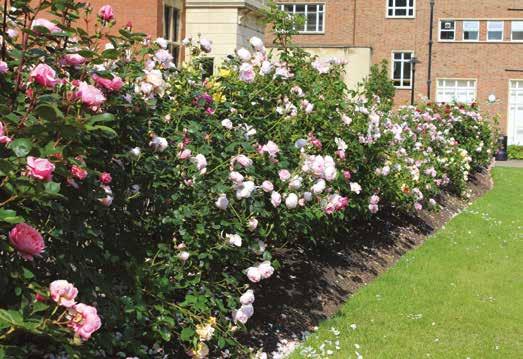
In each Annual Review we will be featuring a round-up of alumni news. Please do let us know if you would like any of your news to be included here.
Norah Thomas (Cert Ed 1948–1950) is enjoying retirement in Durban, South Africa, having moved from Britain in 1955, initially to what was then Southern Rhodesia. At first she taught at Wankie, where she met and married her husband, Barry, a member of the British South African Police, in 1957. She conducted a ladies’ choir and produced and directed a number of performances, including HMS Pinafore, Händel’s Messiah, and Mendelssohn’s Elijah.
Shirley Haslam (Cert Ed 1952–1954) is enjoying retirement after teaching for 40 years, mostly running nurseries attached to primary schools. She also set up playgroups in Yorkshire and lectured at the local Technical College. During retirement she has served on the local Parochial Church Council, as Governor of a local school, has run the local tennis club, and is enjoying being a grandmother to six children.
Audrey Huddart (Cert Ed 1954–1956) is now a grandmother to eight grandchildren, who have enjoyed successes which she attributes at least in part to her learning the importance of education at Homerton.
Sheila Mackenzie (Cert Ed 1954–1956) is now a grandmother to seven grandchildren. She is semi-retired, teaching 20 piano pupils and taking the occasional assembly at the local village primary school. She enjoys playing tennis regularly and is involved with both young and old in the village community.
Gerald Hendrie (Cert Ed 1962–1965) has recently had two books of his compositions published by Editions Billaudot, Paris: A Handful of Rags (five rags for piano solo) and Another Handful of Rags (ditto). A third volume, Five New Rags, is written but as yet not in press.
Olivia Dean (Cert Ed 1965–1968) has recently retired from a career in education. Initially teaching and holding management roles in secondary schools, she then moved into management in Further Education. Throughout her career she was closely involved in the development of assessment strategies for public examinations with the Cambridge Awarding Body. She maintains an active role in education, continuing to work in an advisory capacity with two national awarding bodies and is a governor of two institutions, including the University of Derby.
Karen Hindley (BEd 1978–1982) has recently retired after thirty-three years of service to state education, to spend more time with her father, David, Head of Music at Homerton from 1963 to 1985 and her mother, Olga, Music Librarian at Homerton from 1970 to 1985. However, she is still assisting in NQT induction and mentoring at a local Cambridge school a few times a week, following in her parents’ footsteps in helping teachers to teach.
Rachael Williams (née Maurice-Smith) (BEd 1984–1988) is Headteacher at Holly Meadows School, and lives in Norfolk with her husband, Glyn. A recent Ofsted report praised her ‘outstanding commitment’ to the school. When not teaching, she keeps busy with various house renovation projects and daily six-mile dog walks.
Clare Tanaka (PGCE 1988–1989) has recently built an environmentally friendly house along with her husband, Kris. Both are working as full-time teachers.
Steven Chapman (PGCE 1993–1994) provided the scientific expertise behind the recently published 365 Science Activities, which has been shortlisted for the Royal Society’s 2015 ‘Young People’s Book Prize’.
Marion Durnin (PGCE 1994–1995) has recently edited a scholarly edition of Sketches of Irish Character by Mrs S. C. Hall. This volume is No. 20 in the Chawton House Library Series, Women’s Novels and it was published in July 2014 by Pickering & Chatto, London.
Work on this volume was made possible by the award of a Chawton House Fellowship from Southampton University during September and October 2013 and Chawton House Library, a truly glorious place in which to carry out research.
Chris Woolf (PGCE 2000–2001) has been appointed Founding Headteacher of Pinner High School. Pinner High will open in September 2016 as a 6FE Secondary school in the London Borough of Harrow. Prior to this, Chris was Vice-Principal at The Bushey Academy, and, before this, Head of Senior School at Dulwich College, Beijing.
Laura-Jane Foley (BA History of Art 2001–2004) has written a play, An Evening with Lucian Freud, which recently ran in London’s West End for three weeks, in a production starring Cressida Bonas (more details on page 18).
Natalie Baxter (PGCE 2002–2003) married Damien Homden (PGCE 2008–2009) in 2010. They both work as teachers at Cavalry Primary School in March, live in Wisbech, and have two young daughters.
Thomas Savill (Biological Sciences with Education 2002–2005) married Ellen in April 2014, with the wedding reception held at Homerton.
Alexa Toy (BA Education with History 2002–2005, PGCE 2005–2006) is working as a teacher in London, and has also recently set up Teachers As Tutors (www.teachersastutors.org). This business provides after-school tuition from qualified and experienced teachers, which helps students consolidate school work, revise for exams or prepare for entrance examinations.
Jonathan Worton (BA Education with Biological Sciences 2002–2005) was recently shortlisted for the FMC dental awards in the category “Young Dentist of the Year” as one of the top 9 young dentists in the UK.
William Brooks (PGCE 2003–2004) was recently promoted to Deputy Headteacher in a four-form entry primary school.
Lucy Parsons (PGCE 2005–2006) has recently set up a blog and website, lifemoreextraordinary.com, which shares ‘how-tos’ and motivational material to empower 15–18 year olds achieve their academic dreams. She has also published an e-book, ‘The Ten Step Guide to Acing Every Exam You Ever Take’. The book is based on the system she developed while studying for her A-Levels, and was refined
during her time working as a Geography teacher in comprehensive schools. The book is available via her website.
Marianne Starkie (née Chilvers) (PGCE 2005–2006), since leaving Homerton, has coauthored a book (Anderson et al. (2011) AQA GCSE Design and Technology: Resistant Materials Technology, Hodder Education), and taught Design and Technology in the UK and in an international school in Dubai, setting up from the school’s opening in 2011. She also gained an MA in Educational Leadership and Management, before returning to the UK in 2015 to have some time off with her baby daughter.
George Kam Wah Mak (PhD Asian and Middle Eastern Studies 2007–2011) is now an elected Fellow of the Royal Asiatic Society of Great Britain and Ireland. In 2014, he won the Society’s BarwisHolliday Award for Far Eastern Studies for his research article entitled “To Add or not to Add? The British and Foreign Bible Society’s Defence of the ‘Without Note or Comment’ Principle in Late Qing China”. His award-winning article was published in the April 2015 issue of the Journal of the Royal Asiatic Society.
James Lugton (PGCE 2008–2009) has recently joined the English Department at Wellington College, Berkshire, having previously taught at Glenalmond College, Perthshire, for four years.
Rhiannon Williams (PGCE 2009–2010) took up a teaching position at Heath Mount School in Hertfordshire, teaching English, French and History, after completing her PGCE at Homerton. She was appointed Head of History and Head of Curriculum, before in 2015 becoming the Director of Studies at Heath Mount School.
Sam Lee-McCloud (PGCE 2000–2001) has recently completed an MEd in Autism (Children) at Birmingham University and will graduate in December 2015.
Lauren Weller (BA Education with English 2008–2011) has recently completed a Graduate Diploma in Agriculture at the Royal Agricultural College and now works for a small charity called Farming and Countryside Education (FACE). She manages an initiative called Countryside Classroom, which brings together the work of many organisations and individuals who are committed to ensuring that children learn about and experience food, farming and the natural environment. Countryside Classroom is a free to access online portal that pulls together high-quality resources to use in the classroom, places to visit with a class and people to ask for expert advice and support from across the UK.
The Countryside Classroom passport contains 18 challenges that will give children first-hand experience of growing their own produce, observing and caring for wildlife and tasting their own recipes, and is free to download from www. countrysideclassroom.org.uk/passport
Poppy Damon (BA History 2011–2014) has recently been appointed Communications Officer at Na’atik, a non-profit language school in an impoverished part of the Maya zone, Mexico. Na’atik provides access to immersive language learning for disadvantaged youth in the local community through scholarships and affordable classes. Over the Christmas of 2015, she ran a fundraising campaign to raise $1,500 to support students there. You can find out more at http://www.naatikmexico.com/
Ben Jones (BA Politics, Psychology and Sociology 2011–2014) this year became the first person to cycle the length of Cuba. His 36-day journey aimed to raise awareness of dyspraxia. More details on page 22.
Henry Fieldman (MPhil Education and Psychology 2012–2013) coxed the Great Britain Men’s Coxed Pair to victory in the World Rowing Championships in Aiguebelette, France in 2015. Earlier in 2015, he coxed the Great Britain Men’s Eight to gold at the second World Cup event in Varese, Italy. At the final World Cup event in Lucerne he coxed the Men’s Coxed Pair and won gold again.
Ronald Balzan (MEd 2012–2015) recently began a PhD in Experimental Psychology at Birkbeck, University of London.
Jonathan Poward (PGCE 2014–2015) is currently working as a full-time Geography teacher, after returning from the Charter Choir’s tour of Monaco. He intends to return to Homerton to complete his Masters after his NQT year.
Ashleigh Tutchener (PGCE 2014–2015) has recently begun working as a teacher at the University of Cambridge Primary School n
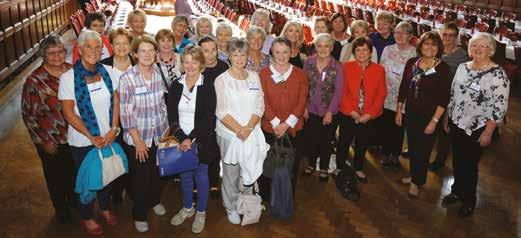
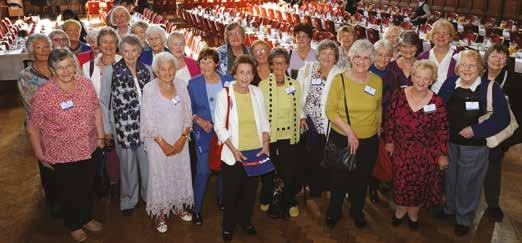
Professor John Murrell, MBE and Dr Peter Warner, Chairs of the RSMA in 2015
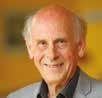
In this first edition of the Annual Review, it is appropriate to give some of its readers an explanation of the origins and aims of the RSMA, more commonly referred to as the “RSMs”.
In 1984, when the College had only recently received the status of an Approved Society within the University, Dr David Male, the Head of the Drama Department at Homerton, was due to retire at the end of the year. He raised with the then Principal, Miss Alison Shrubsole, the possibility of those retiring from Homerton’s academic staff keeping formal links with the College. The suggestion was that such retirees might be enabled to maintain contact with the College; have clear rights to use certain College facilities; remain on the University Residents List; and continue membership of the University Library and the University Graduate Centre. As a result, in March 1984, the Academic Board of the College, with the approval of the Staff Meeting, formally established the Homerton College Retired Senior Members Association.
Inevitably, the RSMA has seen many changes, and in its current form it is unique in the context of the Emeritus Societies of other Cambridge colleges in having membership representing a wider aspect of College life than just the academic. Election is now, with the approval of the Principal, not just open to members of academic staff retiring from Homerton and living locally, but to senior administrative staff and other individuals recommended by the committee as having served the College with distinction.
As a result, from those early beginnings, the Association, with its twelve founding members, has grown in numbers to more than eighty, scattered as far as Australasia.
We have a written constitution, with the main aim of promoting continued social and intellectual contact with the College, and an Executive Committee responsible for the organisation of activities appropriate to achieve this aim.
We have an annual Newsletter, a Website, a Book Club, and ‘Emeritus’, a group who meet fortnightly to enjoy the wonderfully therapeutic experience of singing together. This past year’s programme of events has also included visits to other College Libraries and regular seminars followed by luncheon in Hall. An important core element of the Association is its Almonry team, who are proactive in their concern for the wellbeing of members.
One important purpose of the RSMA is that the best of the past should be passed to the future. In this context an annual ‘Teacher Education Charter Bursary’ was established by the Association in 2010. This is awarded to a graduate of Homerton who has been accepted by the University of Cambridge PGCE programme and who can identify an educational experience, to be undertaken before the commencement of the PGCE programme, which will help to develop their classroom teaching competence. This year the award went to Miss Ellen Hurley, BA.
The saddest element in any Annual Report is the list of colleagues who have died during the year. This year has seen the loss of Michael Bibby, Helen Bunton, Elizabeth Cook, Barry Jones and Peter Huckstep. Fuller tributes to their contribution to Homerton and the world of education will be found elsewhere in this Review.
Over the years, and particularly during the development of Homerton to Royal Charter status, the College has benefitted from the reputation for excellence, both within the demanding standards of the University of Cambridge and nationally, which was built by these past members of the Homerton community. New publications by RSMs are still regularly displayed in the College Research Cabinet. Apart from their continued loyalty and support for the College (in the case of some individuals, spanning nearly half a century), RSMA members have also contributed many financial donations and other valuable gifts to the College.
Florence Nightingale said: “All one needs to do in order to move backwards, is to stand still”. Over the decades the RSMA has faced many needs to change. Current membership is still largely based on the role of Homerton as a College of Education. Now we move forward to embrace the New Homerton, its Emeriti, and its senior retirees as and when they choose to step down. Maintaining Homerton’s egalitarian traditions, retiring Fellows and Senior staff will be just as welcome in the Combination Room as they were as serving members n
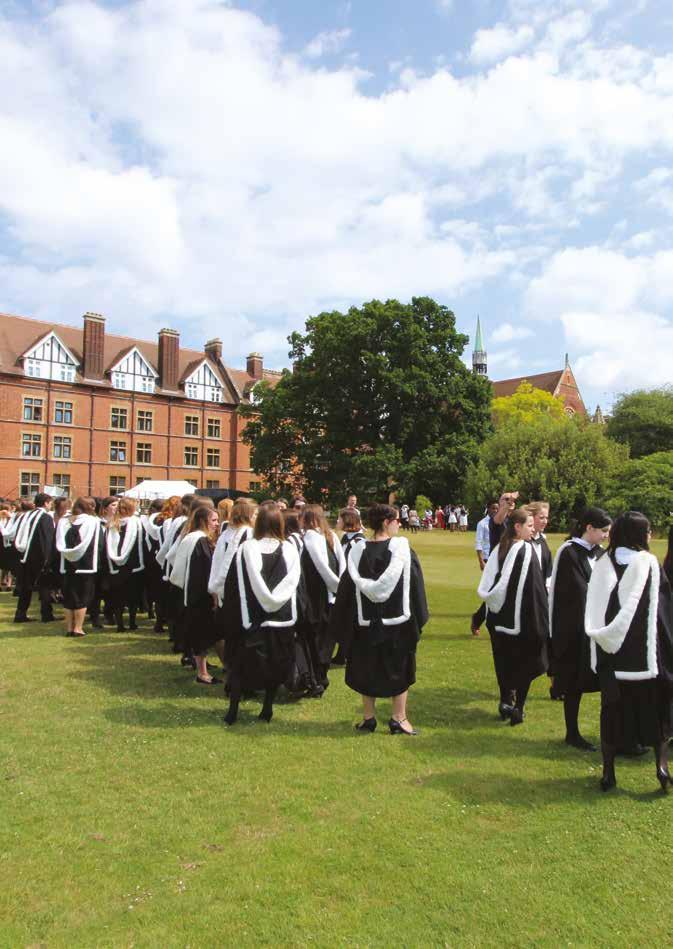
Principal and Fellows
Student Achievement
Blues Awards
Graduates
New Members
Intro text?
Principal
Professor Geoffrey Ward MA PhD FRSA
Fellows
2001 Mr Stephen Watts Admissions Tutor (Arts and Social Sciences)
2002 Dr Penelope Barton Senior Tutor
Dr David Clifford
Dr John Hopkins
Dr Molly Warrington
Mr David Whitley
2005 Mr Philip Stephenson
Dr Elaine Wilson
2006 Dr Richard Hickman Dean
Dr Louise Joy
2007 Ms Christine Doddington
Dr William Foster
Dr Simon Wadsley Secretary of Council and Governing Body, Vice-Principal
2008 Dr Theophilus Hacking
Dr Rosalind McLellan
Dr Olivier Tonneau
Dr Peggy Watson
Dr Stelios Zyglidopoulos
2009 Professor Maria Nikolajeva
2010 Dr André Neves Graduate Tutor, Natural Sciences
2011 Dr Thomas Graumann
Professor Simon Gregory
2012 Dr Katherine Boyle
Dr Juliana Cavalcanti
Dr Veronika Fikfak
Ms Deborah Griffin OBE Bursar
Dr Myrto Hatzimichali
Dr Michelle Oyen
Dr Daniel Trocmé-Latter Director of Music
2013 Dr Pauline Goyal-Rutsaert
Dr Georgina Horrell
Ms Yan Yan Shery Huang
Dr Julia Kenyon
Dr Timoleon Kipouros
2014 Dr Christopher Brooke
Dr Joel Chalfen
Dr Carmine Conte
Professor Douglas Easton
Professor Timothy Eisen
Dr Paul Elliott Admissions Tutor (Sciences)
Dr Zoe Jaques
Dr Francesca Moore
Mr Matthew Moss MVO Director of External Relations and Development
2015 Dr Chibeza Agley
Dr Anthony Ashton
Dr James Blevins
Ms Sheila Gupta
Dr Hayley Hooper
Dr Anthony Johnson
Dr Melanie Keene Graduate Tutor
Dr Jochem Kroezen
Dr Mark Manford
Mrs Liz Osman
Mr Paul Warwick
Dr Rachel Williams
Honorary Fellows
2007 Mrs Ann Cotton OBE Founder and President of CAMFED
2009 Sir Peter Maxwell Davies CH CBE Master of The Queen’s Music, 2004–2014
2010 Dame Carol Ann Duffy DBE Poet Laureate
2011 The Rev’d Dr Ralph Waller Principal of Harris Manchester College, Oxford
2013 Dr Katharine Pretty CBE Principal of Homerton College, 1991–2013
2014 Sir Andrew Motion Poet Laureate 1999–2009
2009 Dr Peter Raby Former Vice-Principal
2010 Mr John Beck
Dr Ian Morrison
Professor John Murrell MBE
2011 Professsor David Bridges
Mr Stephen Tomkins
2012 Commodore Gale Bryan Former Bursar
2013 Mr Dhiru Karia Former Finance Officer
Dr Peter Warner Keeper of the Roll and Former Senior Tutor
2014 Ms Patricia Maude
Professor Morag Styles
Mrs Elizabeth Anne Thwaites
2015 Dr Peter Cunningham
Professor John Gray
Mr Michael Younger
2013 Dr Neville Dean
Dr Linda King
Dr Louis Kovalevsky
Dr Richard Williams
2014 Dr Fabienne Bonnet
Dr Zhonghao Teng
Mrs Jane Warwick
Dr Mary Anne Wolpert
2015 Dr Stephen Burgess
Dr Pamela Burnard
Dr Bob Dillon
Dr Elizabeth Duignan
Dr Meredith Hale
Dr Joanna Haywood
Dr Richard Jennings
Dr Sohini Kar-Narayan
Dr Catherine MacKenzie
Dr Susanna Rostas
Dr Clementine Beauvais
Dr Judith Fonville
Dr Matthew Tointon
Dr Astrid Van Oyen
Dr Nagendra Karthik Depuru-Mohan
Dr Siddhartha Kar
Dr Deborah Kronenberg-Versteeg
Research Associates
Dr Srivas Chennu
Dr Gemma Clarke
Dr Frank Cornelissen
Dr Paulo di Giuseppantonio di Franco
Dr David Friesem
Dr Chiara Giuliano
Dr Elsa Lee
Dr Yingjie Peng
Dr James Wason
Dr Bangwen Xie
Dr Robin Bunce
Dr Georg Schneditz
Dr Tyler Kelly
Dr Claudio Battilocchio
Dr Felicity Davis
Dr Ya-hin Huang
Clinical Research Associates
Dr Nurulamin Noor
Dr Sophie Richter
Each year, Homerton makes a number of awards to students in recognition of academic merit and outstanding achievement. The following were awarded in 2015 and the College warmly congratulates the recipients.
The Accompanist Scholarship was awarded to Nicholas Walker
The Barton Prize, awarded to a graduate student who has made a most outstanding contribution to College life
Christopher Ashcroft
The Jonathan Beswick Memorial Prize for Mathematics, awarded for the best Mathematics essay
Robert Allen
The Charter Bursary, awarded on academic merit to a student embarking on a new course of graduate study
Cheng-Ting Chang
Mecu Ginting
Joseph McLoughlin
Babatunde Ojewunmi
Choral Scholarships were awarded to the following
Kerri-Anne Burger
Zoe Carpenter
Octavia Henderson-Cleland
Carolina Monck
Serena Perez-Storey
Hannah Robinson
Isabel Walker
The College Book Prize, awarded to students who received a University Prize for a dissertation or project
Michael Angland
Simon Conrad
Maciej Godek
Amir Montazeri
The Aditya Dalmia Prize, awarded to the best performing Land Economist
Mue I
The Everton Prize, awarded to the best student in Part II Mathematics
Oliver Sibley
The College Subject Prize for students judged by the Director of Studies to have reached First Class standard in the Preliminary Exam to Part I of English, History or Education
Julia Craggs
Nicholas Stromberg
The Foundation Scholarship, awarded to students who achieve a First in all papers
Maciej Godek
Amir Montazeri
Joned Sarwar
Ruth Taylor
The Homerton Retired Senior Members’ Charter Bursary Award, for a student considered to have best identified an Education experience before commencing the PGCE
Ellen Hurley
The Horobin Award, for women graduate students rowing for the University
Caroline Habjan
The Horobin Prize for best overall results in the Education Tripos
Emma Riggs
The Helen Morris Scholarship, for the most distinguished results in English in Part I of the Education Tripos
Arthur Hannah
The George Peabody Scholarship, for achieving a First in Part I of the Education Tripos
Arthur Hannah
The Pointon Prize, for the student reading Music or Education and Music who has made the most distinctive and valuable contribution to the College’s musical life
Coleman Chan
The Kate Pretty Bursary awarded as part of the CHESS
MPhil Awards Scheme
Gabriella Byfield
Edward Everett
The Jean Rudduck Charter Scholar, awarded on academic merit to a student embarking on a new course of graduate study
James Carroll
The Santander Second Year Prize, awarded to the highest performing students in Tripos in five subject areas
Kevin Burri
Arthur Hannah
Jonathan Ying Ho Leung
James King
Emily Prudence
Francis Smallwood
The Santander Master’s Prizes, awarded in recognition of outstanding research achievement
Alexander Milne
Vaughan Connolly
Kathrin Stark
Christopher Howarth
Udit Bhatia
Rosanna Fennessy
Annie Leigh
Bao Sheng Loe
Andrea Smith
Bohdan Tokarskyi
Yiding Lu
Jack Palmer
Deborah Cheesbrough
Robert Girgis
Stephanie Hobbs
Ali Meghji
Siddharth Pandey
Lucy Stone
The Santander PhD Prize, awarded to a STEM student and an Arts/Humanities student in recognition of outstanding research achievement
Luca Magri
Richard Brock
The Shuard/Simms Prize for achieving a First in the Education Tripos
Louise Banable
Emma Riggs
The Simms Benefaction and Scholarship for the Study of History, awarded to the student judged by the History Director of Studies to have benefitted most from the study of History
Chloe Beckett
The Morag Styles Award, awarded to the best Part II dissertation in Children’s Literature in the Education Tripos
Isolde Penwarden
Emma Riggs
The David Thompson Scholarship, in recognition of achieving First Class Honours
Fern Addy
Michael Angland
Leonardo Buizza
Kevin Burri
Luisa Callander
Matthew Chadwick
Wei Quan Kenneth Chee
Alexandra Chidgey
Simon Conrad
Rosemary Cross
Miranda Cupit
Zoe D’Avignon
Benjamin Ellis
Tobias Feick
Richard Fitton
Callum Fleming
Isabel Goodman
Cameron Grove
Victoria Hodgson
Rupert Horlick
Olivia Hurley
George Iles
Richard Jones
James King
Tim King
Jonathan Ying Ho Leung
Qinglin Li
Edgaras Liberis
Kilian Lohmann
Christopher Lynch
Jason McCammon
Dylan McDermott
Jack MacDonald
Melissa Macdonald
Samuel Martin
Sakari Mesimaki
Nick Niem
Imogen Page-Jarrett
Bryony Perks
Lauren Pick
Emily Prudence
Qasim Razvi
Rebecca Rowson
Isobel Sands
Helen Scott
Dominykas Sedleckas
Oliver Sibley
Janis Siebrecht
Augustinas Silale
Peter Skalski
Francis Smallwood
Aleksandar Sklyarov
David Stansby
Angharad Stell
Kate Stevenson
Jack Struthers
Laurence Tidy
Richard Turley
Alys Williams
Long Hei Wong
Daniel Yanev
The Peter Warner Prize, awarded to the student who has made the most academic progress over three or four years
Samuel Skipper
The Westall Prize, for the most outstanding contribution to College life
Poppy Ellis Logan
The following students were this year awarded the Pilkington Travel Award, which facilitated their travel to the countries indicated.
Frances Ballaster Harriss
Brazil
Annie Caffyn
Kenya
Liam Cawthorne
Nepal
Amanda Folwell
Colombia
Jeevan Jayaprakash
Tanzania
Georgia Stewart
Thailand
‘Blues’ are awarded by the Blues Committees in recognition of sporting excellence in representing the University of Cambridge. During the 2014–15 Academical Year, Blues were awarded to the following Homertonians:
Full Blues
Laurence Bruggemann Squash
Luke Frett Ultimate Frisbee
Kelvin Gomez Athletics
Sophie Hussey Netball
Faye Kidd Hockey
Alexander Milne Cross Country
Alexander Milne Athletics
William Morris Athletics
Simon Rodier Ice Hockey
Laura Spence Netball
Sjors Altemühl Lawn Tennis
Max Burrows Rugby League
Daniel Crenol Korfball
Emily Elliott Netball
Anton Evans Rugby League
Ellie Hiskett Hockey
Matt Shaw Real Tennis
Nicky Watmore Rugby League
Rebecca Wilson Hockey
The College congratulates the following students on completing their studies at Homerton and on being awarded their qualifications.
Bachelor of Arts
Ayodeji Ajijedidun Economics
Michael Angland Asian & Middle Eastern Studies
Mikael Astrand English
James Atkins Economics
Michael Bailey Politics, Psychology & Sociology
Louise Banable Education with English
Isabelle Barber English
Alexandra Barker Education with English
Chloe Beckett History
Johann Beleites Computer Science
Carlotta Belluzzi Classics
Thomas Blaksley Asian & Middle Eastern Studies
Kennedy Bloomer Education with English & Drama
Matthew Boyd Natural Sciences
Zara Boyd Natural Sciences
Rebecca Bradley Law
Zhiqi Bu Mathematics
Maximillian Burrows Natural Sciences
James Bush Natural Sciences
Jocelyn Butson Asian & Middle Eastern Studies
Charlotte Buzzard English
Eleonora Castelli Economics
Alexandra Chidgey Law
Tania Clarke Education with English & Drama
Simon Conrad Asian & Middle Eastern Studies
Millie Cooper Politics, Psychology & Sociology
Rosemary Cross English
Radley Cunliffe Economics
Zoe D’Avignon Politics, Psychology & Sociology
Leah Dudley Law
Poppy Ellis Logan Education with Music
Saul Farrell History
Georgia Feldmanis Classics
Julian Fernandes Engineering
Thomas Finney Archaeology and Anthropology
Lee Ford History of Art
Kit Fowler Theology & Religious Studies
Rhianna Frost English
Sarah-Isabel Geisler Management Studies
Francesca Gil Geography
Maureen Gisseleire Natural Sciences
Maciej Godek Linguistics
David Godwin English
Pawel Golabek Mathematics
James Goulbourne Economics
Dimitrios Goumenos Mathematics
Sarah Gregory Modern & Medieval Languages
Susannah Guinee Natural Sciences
Anna Hands Natural Sciences
Yu Hao Education with Physical Sciences
Matthew Harris Natural Sciences
Megan Henson Education with English & Drama
Jack Hirst Natural Sciences
Eleanor Hiskett English
Lily Hollins Politics, Psychology & Sociology
Emma Hollows Archaeology and Anthropology
Jack Hooper Natural Sciences
Caroline Hopper English
Tim Hubener Economics
Beth Huckstep Natural Sciences
Ellen Hurley History
Olivia Hurley History
Mue I Land Economy
Jeevan Jayaprakash Economics
Russell Jones History
Jia Khor Law
Robert Knaggs History
Jun Ku Mathematics
Emily Layton Education with English & Drama
Silas Lee Education with English & Drama
Tsun Lee Law
Hiu Li Economics
Guy Linch Economics
Tianfang Liu Mathematics
Harry Løvstrøm Modern &
Medieval Languages
Christopher Lynch Philosophy
Melissa Macdonald Politics, Psychology & Sociology
Benjamin Mack Natural Sciences
Oscar MacLean Natural Sciences
Anita Magee Education with English & Drama
Constantin Manea Computer Science
Samuel Martin Politics, Psychology & Sociology
Maura McKeon Anglo-Saxon Norse and Celtic
Connor Merrifield Law
Sakari Mesimaki Asian & Middle Eastern Studies
Sam Moody History
Constance Moss History
Callum Munday Law
Rok Nezic Natural Sciences
Dung Nguyen Economics
Daniel Offenbartl-Stiegert Natural Sciences
Annabel Parkinson Education with Modern Languages
Brijesh Patel Natural Sciences
Krishan Patel Natural Sciences
Isolde Penwarden Education with English & Drama
Alexander Peter Asian & Middle Eastern Studies
Rebecca Phillips Education with English & Drama
Helen Pierpoint Modern & Medieval Languages
Danielle Poole English
Eliza Prettyman Classics
Gabriel Quiros Rubio Politics, Psychology & Sociology
Alexander Rice Archaeology and Anthropology
Emma Riggs Education with English & Drama
Rebecca Rowson Philosophy
Helen Scott Politics, Psychology & Sociology
Molly Seymour Archaeology and Anthropology
Aarya Shah Land Economy
Caitlin Shaw Modern & Medieval Languages
Gurjinder Shergill Engineering
Olivia Sinclair Archaeology and Anthropology
Samuel Skipper Natural Sciences
Fiona Smith Theology & Religious Studies
Laura Spence Classics
Caroline Steel Natural Sciences
Lucy Taylor Education with Music
Ruth Taylor History
Joscha Thiele Education with English
Laurence Tidy Modern & Medieval Languages
Syed Uddin Land Economy
Felix Vaura Mathematics
Lorenzo Vitullo Mathematics
Alexandru Vlad Politics, Psychology & Sociology
Patricia Vlad Education with Modern Languages
Hefu Wang Economics
Eleanor Warner Music
Li Ting Celeste Wee Natural Sciences
Katharine Williams English
Louise Williams Archaeology and Anthropology
Ethan Yeung Education with English
Henry Young English
Bachelor of Arts with Master of Engineering
Matthew Chadwick Chemical Engineering
Andrew Cheung Chemical Engineering
Edward Cozens Engineering
Christopher Goodfellow Engineering
Alastair Hellyer Chemical Engineering
Cuong Kasperzyk Engineering
Benjamin Lauwers Engineering
Amir Montazeri Engineering
Nicholas Niem Engineering
Dhruvkumar Patel Chemical Engineering
Joned Sarwar Engineering
Dominykas Sedleckas Chemical Engineering
Jack Struthers Engineering
George Sykes Chemical Engineering
Miles Walker Engineering
Alexander Wright Engineering
Yuewei Yang Engineering
Jiawei Zhu Engineering
Bachelor of Arts with Master of Science
James Blake Natural Sciences
Yuanjie Chen Mathematics
Richard Fitton Natural Sciences
Glenn Hicklin Natural Sciences
Laurence Pritchard Natural Sciences
James Scott Natural Sciences
Augustinas Silale Natural Sciences
Aleksandar Sklyarov Natural Sciences
David Stansby Natural Sciences
Arturas Zukovskij Natural Sciences
Bachelor of Arts with Master of Mathematics
Timothy King Mathematics
Sarah Aguilar-Millan
Amelia Allen
Ben Allen
Amy Allton
Chloe Amsellem
Katherine Anders
Matthew Andrews
Peter Archdale
Natalie Armitage
Ben Aspin
Lucy Bailey
James Baker
Lee Baker
Sonika Bakkar Sheibani
Sean Ballester
Kate Barradell
Roxanne Barton
Charlotte Baxter
John Baxter
Laura Beatty
Holly Beckwith
Julia Bedser
Elizabeth Beecroft
Joanne Bennett
Henry Bertram
William Bidwell
Katherine Bills
Daniella Blackford
Caroline Blakemore
Nicola Boak
Ella Bordoli
Robert Brewster
Helen Briggs
Jemma Brightwell
Laura Brookes
Emily Brown
Sarah Brown
Catriona Brownlow
Laurence Bruggemann
Jack Bullen
Rachel Burt
James Buxton
Serena Caddell
Jennie Camps
Jenna Catlin
Sian Choo
Parvati Churchman
Sarah Clare
Emily Clark
Leah Clayton
Jennifer Clift
Sarah Cloughley
Roslyn Conway
Elspeth Coogan
Oliver Cooper
Rachael Coppin
Benjamin Couchman
Natasha Cranston
Tamsin Crouch
Ben Cuddon
Christopher Cuthbert
Maya Dalby
Grace Darlow
Jason Dicker
Anna Dickson
Olivia Doherty
Emma Doughty
Annabel Ducat
Rachel Duckhouse
Brigid Eades
Suzanne Earl
Georgina Edwards
Samantha Elliott
James Etheridge
Laura Evans
Rachel Evans
Louise Filby
Naomi Finn
Vittorio Fiorin
Robert Flack
Amanda Folwell
Seth Ford
Sarah Foster
Jack France
Grace Franckel
Luke Frett
Alice Gamper
Roseanna Gawthrop
Tess Gazeley
John Gilbert
Clarice Gill
Chloe Gillett
Rebecca Glanville
Michael Glover
Lucy Goddard
Aitor Gomez Lowes
Alexandra Graham
Stephanie Graham
Aimee Gray
Rebecca Gray
Victoria Green
Benjamin Greenwood
Margaret Guillaume
Peter Haffenden
Luke Haisell
Simon Hall
Emily Hammond
Rhian Hanson
Beth Harris
Rosalyne Harris
Rebecca Hayward
Ashley Hewitt
Caroline Hill
Natasha Hill
April Hills
Claudia Hindle
Anna Hollands
Victoria Hollison
Samantha Holroyd
Emily Horth
Amelia Houlder
Luke Howden
Luke Hughes
Richard Hume
Sarah Hunns
Sophie Hussey
Sophie Ivett
Robert Jago
Frederic Jayatilaka
Carl Jeffs
Thomas Jenkins
Kathryn Jones
Mathew Jones
Claire Jordan
Vinay Kathotia
Samantha Kellow
Zoë Kendrick
Elisabeth Kennedy
Raffina Khalil
Sarah King
Mark Knights
Mark Langton
Mary-Alice Larkin
Thomas Laws
Amy Lemos
Mark Lewis
Rhys Lewis
Janina Lindon
Lauren Lindop
Bethany List
Charlotte MacCormick
Jennifer Marshall
Alice Mathews
Lucy Matthews
Martha May
Francis McCrossan
Orla McGill
Aine McGreevy
Catherine McGuinness
Jake Meegan
Henry Metcalf
Charlotte Missen
Amy Moll
Chloe Montrose
Amanda Moore
Laura Moores
Anna Mulholland
Holly Murphy
Florence Nairac
Roseanna Nay
Isabelle Newman
Sara Nieto Encinar
Marcus Nisbet
Rebecca Nixon
Amy Norgrove
Jonathon Norrey
Emma Obertelli
Edward O’Brien
Helena Osborne
Lydia Page
Hannah Palfreman
Anna Pearson
Carla Pereira Jones Da Silva
Megan Pinches
Thomas Pinder
Jonathan Poward
Bethan Pritchard
Isabelle Proffitt
Susannah Pyke
David Quinlan
Thomas Radford
Emma Raven
Cerys Rees
Adam Robertson
Hannah Robinson
Suzanne Rochester
Natasha Rolt
Sally Rowe
Jessica Russell
Amy Ryder
Claire Rye
Bethan Sadler
Hannah Shairp
Sanjay Sharma
Hannah Sherratt
Victoria Slota
Adam Smith
Alexandra Smith
Harriet Smith
Stefan Smith
Viktoria Sokolova
Emily Sollis
Anna Spanring
Gabrielle Spears
Emma-Jane Speechley
James Spiller
Natalie Steele
Rebekah Steele
Matthew Stevens
Christopher Stewart
Marieke Stewart
Kate Stockings
Florence Stratton
Sarah Stringer
Philip Stythe
Margaret Summers
Timothy Summers
Hannah Sussams
Zahra Syed
Alexander Taylor
Robert Thomas
Holly Turner
Karl Turner
Ashleigh Tutchener
Melissa Varney
Rupesh Vekaria
James Vink
Laura Wakeley
Charlotte Wakelin
Louise Walker
Sarah Walsh
Matthew Waring
Rosamund West
Laura Wheeler
Anton Whittingham
Anna Whybrow
Hermione Williams
Nicole Williams
Lisa Williamson
Laura Wilson
Amy Wilson-Redding
Susan Yates
Charlotte Acheson
Jennifer Aggleton
Jennifer Amy
Jessica Anscomb
Ronald Balzan
Paula Barclay
Kirsty Barnett
Rachel Beggs
Caitlin Bennett
Ashleigh Bentham
Victoria Bower
Suzanne Bowles-Smith
Emily Brown
Samantha Buxton
Aileen Cameron
Kate Cameron
Phillip Copeland
Jennifer Corcoran
Junita Davies
Kerry Davies
Kim Deakin
Clare Deans
Jessica Dewes
Chloe Dorrington
Natasha Dutta Uniyal
Lucy Edge
Carl Edwards
Adele Fawthrop
Annelaure Fisher
Jennie Francis
Lucy Fryer
Ayesha Gamiet
Ranya Gashut
Anita Gatt
Suzannah Gilford
Fiona Gosden
Andrew Gould
Alice Greer
Timothy Hallas
Ashlie Harman
Emma Harpley
Louisa Hay
Joanna Haywood
Rebecca Helps
Angela Hicks
Jennifer Hodson
Helen Hurworth
Harrison James
Kate James
Sarah James
Lucie Jones
Lucy Joseph
Sylvester Juwe
Natalia Kieniewicz
Philipp Klaus
Teresa Lamb
James Langan
Svend Larsen
Emma Low
Susan Lowrey
Katrina MacDougall
Julia Mackintosh
Amanda Marty
Julia Mason
Carolyn Massey
Sugandha Mathur
Charlotte McCulloch
Rosanna Muir
Amy Mulvenna
Charlotte Murray
Sinead Naidoo
Ian Noakes
Faeeim Nori
Shona Norman
Lyndsey O’Connell
Dominik Palek
Bethan Parry
Aman Pasricha Balsara
Claudia Pichon
Katherine Pink
Clare Popham
Carole Rawley
Anna Remington
Jules Reston
Helen Riley
Miriam Ryan
Lucia Saggese
Qasim Sayed
Matthew Schofield
Anne Scott
Kirsty Seaton
Hannah Smith
Sydney Smith
Hege Soholt
Jose Sousa De Oliveira
Victoria Sutcliffe
Anna Swann
Theepan Tharmarajah
Rachael Thomas
Abigail Thurgood-Buss
Kate Turner
Maria Veselova-Smith
Annabel Warren
Laura Webb
Katie Webster
Emily West
Claire White
Lindsey Wightman
Nancy Williams
Rebecca Willis
Alexandra Wrigglesworth
Shakira Yassine
Master of Laws
Alexander Schubert
Ifigeneia Xanthopoulou
Sam Baker Applied Criminology, Penology, and Management
David Bamford Applied Criminology, Penology, and Management
Natalie Beal Applied Criminology, Penology, and Management
Mark Boother Applied Criminology, Penology, and Management
Natasha Cooke Applied Criminology, Penology, and Management
Martin Davies Applied Criminology, Penology, and Management
Louisa Dordoy Applied Criminology, Penology, and Management
Linda Dorward Applied Criminology, Penology, and Management
Denise Downie Applied Criminology, Penology, and Management
Bronwen Elphick Applied Criminology, Penology, and Management
Hayley Folland Applied Criminology, Penology, and Management
Adam Kerr Applied Criminology, Penology, and Management
Neil Martin Advanced Subject Teaching
Lucy Matthews Applied Criminology, Penology, and Management
Trudy McCaffery Applied Criminology, Penology, and Management
Hugh McCann Advanced Subject Teaching
Jennifer McLaughlin Applied Criminology, Penology, and Management
Sara Pennington Applied Criminology, Penology, and Management
Lorraine Roughan Applied Criminology, Penology, and Management
Matthew Ryan-East Advanced Subject Teaching
Stewart Smith Advanced Subject Teaching
Matthew Tilt Applied Criminology, Penology, and Management
Peter Vardon Applied Criminology, Penology, and Management
Patsy Wollaston Applied Criminology, Penology, and Management
Kerry Wood Advanced Subject Teaching
Trevor Worsfold Applied Criminology, Penology, and Management
Master of Advanced Studies
Sjors Altemühl Applied Mathematics & Theoretical Physics
Amy Harris Applied Mathematics & Theoretical Physics
Alexander Milne Astrophysics
Master of Business Administration
Andrea Corti
Han Guo
Samuel Harrison
Chee Ian Kok
Hachimi Maiga
Swetha Pathikonda
Master of Corporate Law
Tomilola Sola-Idowu
Doctor of Medicine
Mohammed Shariff
Master of Philosophy
Alex Bennie Classics
Naim Bro Modern Society and Global Transformations
Vaughan Connolly Education
Elizabeth Feigin Education
Christopher Howarth Classics
George Jenkins Classics
Alan Kaydul Technology Policy
Johannes Laubmeier Social Anthropology
Simon Rodier Medical Sciences
Vivek Saraswat Micro and Nanotechnology
Hardeek Shah Education
Christopher Skilbeck Medical Sciences
Andrea Smith Public Health
Kathrin Stark Advanced Computer Science
Ken Hian Titus Teo Education
Diqiu Wang Management Studies
Master of Science
Qi Hui Sam Pathology
Doctor of Philosophy
Nayla Aramouni “What’s the story?” A case study of young adults’ attitudes towards reading in Lebanon
Josefine Baark In the company of strangers: Danish-Asiatic trading networks and material culture 1620–1780
Lena Bahou Student (dis)engagement in post-war Lebanon: Barriers and pathways in school learning
Leonardo Carcagni Interfacing a trapped ion with neutral atoms and an optical cavity
Paul Collings Associations between objectively-measured habitual physical activity, sedentary time, sleep duration and adiposity in UK children and adolescents
Ivana Cosic Introduction of standardised assessment in Croatia: the matura and its effects on teachers and schools
Tara Coverdale Critical leadership versatility: From insight to practice
Anne Devlin Nurses’ constructions of learning in work: Exploring the process and potential of work-based learning within an NHS ‘Community of Practice’
Kayla Friedman Examining English planning as a barrier to the thermal improvement of conservation properties
Gavin Garland Investigating the contribution of NPM-ALK to epigenetic regulation in anaplastic large cell lymphoma
Julia Gottschalk The role of the Southern Ocean in millennial-scale atmospheric CO2 changes
John Gregson Further investigation of associations of Lp-PLA2 with coronary heart disease
Josephine Illingworth Seizure
precipitants in people with epilepsy and intellectual disability
Amjid Iqbal Synthesis and evaluation of thiamin diphosphate analogues
Dilrabo Jonbekova Skills mismatches among university graduates in post-soviet Tajikistan: challenges for higher education and the labour market
Chrysovalentini Konstantinou
Introducing technology in Cypriot primary music education: Examining change in teacher thinking and practice
Kristina Kozusko Molecular mechanisms of Perilipin-1 action: characterisation of a novel PLIN1 mutation identified in patients with familial partial lipodystrophy
John May Cheminformatics for genome-scale metabolic reconstructions
Dirk Mersch Wiring of photosystem II to hydrogenase for photoelectrochemical water splitting
Kyriaki Michailidou Statistical analyses of genome-wide association studies in breast cancer
Dinesh Mirpuri Vatvani
Predicting the morphology of crystals of organic molecules: assessment and development of chemical informatics and computational methods
Tu Anh Pham Nguyen The role of intestinal interleukin (IL)-22/ IL-22RA1 signalling in hostmicrobiota meostasis
Johanna Riha Feasibility studies to inform a salt substitute intervention to lower blood pressure in rural Ugandan communities
David Rose Nature in a changing climate: Knowledge and policy for conservation, England 1990–2011
Sarah Smith The function and genetics of the host IFITM locus
Patrick Stevens Unsteady low Reynolds number aerodynamic forces
Peerapat Thongnuek The role of tendon matrix proteins in muscle adhesion
Yi-Shan Tsai Young British readers’ engagement with Manga
Jiong Tu Health care transformation in contemporary China: moral experience in a socialist neoliberal polity
Andrew Walkinshaw New catalytic methods for chemical synthesis: Copper-catalysed electrophilic cyclisations of alkynes using hypervalent iodine reagents
Ashley Wilson Adopting the orphan’s God: Christianity and spirituality in nineteenth-and twentieth-century girls’ books
Yang Zhang Development of aptamers against Toxoplasma gondii rhoptry protein 18 through site-specific SELEX
The College welcomes the following students, who have joined Homerton in 2015.
Undergraduate
James Acomb
Geographical Tripos
Kiera Adams Psychological and Behavioural Sciences Tripos
Simanta Adhikari
Engineering Tripos
Daniel-Adrian Aleca
Computer Science Tripos
Elhan Ali Education Tripos with History
Saskia Allan Modern and Medieval Languages Tripos
Armin Amirsolimani
Human, Social and Political Sciences Tripos
Goncalo Araujo Regado
Natural Sciences Tripos
Harry Ashton Natural Sciences Tripos
Tudor Mihai Avram
Computer Science Tripos
Alexander Bailey
Engineering Tripos
Rachael Beasley
Natural Sciences Tripos
Joe Beaven Natural Sciences Tripos
Rachel Bellamy Psychological and Behavioural Sciences Tripos
Alexa Belsham
Engineering Tripos
Alice Catherine Thirza Bennett
Human, Social and Political Sciences Tripos
Thomas Edmund Bennett
Natural Sciences Tripos
Filippo Bertocchi Asian and Middle Eastern Studies
Zareen Bhatti Education Tripos with Physical Sciences
Lucy Binsted
Natural Sciences Tripos
Bali Birch-Lee Education Tripos with English and Drama
Cameron Daniel Booker
Mathematical Tripos
Eleanor Lind Booton
Classical Tripos (Four Year)
Olivia Joan Buckland Education Tripos with English and Drama
Xanthe Phoebe Lily Burdett
Education Tripos with English and Drama
Chagall Caprez
Economics Tripos
Thomas Henry Carlile
Human, Social and Political Sciences Tripos
Zoe Laura Carpenter
Historical Tripos
Andrew Martin Catherall Natural Sciences Tripos
Akarachai Chaimaneekarakate Law Tripos
Oscar Guoyin Chen Mathematical Tripos
Yihong Chen Natural Sciences Tripos
Isabel Huey Sien Chew Natural Sciences Tripos
William Raphael Albert Collinge Asian and Middle Eastern Studies
Carla Boix Constant
Natural Sciences Tripos
Rosemary Louise Cope
Education Tripos with Modern Languages
Rikesh Dahya Natural Sciences Tripos
Rebecca Dayan Modern and Medieval Languages Tripos
Jordan de la Prida
Human, Social and Political Sciences Tripos
Shuyuan Deng Mathematical Tripos
Peter Dennison
Engineering Tripos
Chandan Dhiman Human, Social and Political Sciences Tripos
Alavya Dhungana
Natural Sciences Tripos
Melissa Cielito Diaz
Historical Tripos
Sally Dickens Historical Tripos
Keira Dignan Human, Social and Political Sciences Tripos
Gefei Ding Mathematical Tripos
Ross Alexander Duncan
Historical Tripos
Joseph Duncan-Duggal
Natural Sciences Tripos
Chukwunedum Echeta
Chemical Engineering via Engineering
Rhys Errington Economics Tripos
Felix Evans Classical Tripos
Polly Evans English Tripos
Eugenio Fenoaltea Pieche
Chemical Engineering via Engineering
Holly Louise Firmin
Historical Tripos
Sophie Maria Bondonno
Foote Modern and Medieval
Languages Tripos
Cristina Gomez Gomez de la Torre Education Tripos with Modern Languages
Max Daniel Goodall
Music Tripos
Eun Mi Ha
Natural Sciences Tripos
Rowan Hall Maudslay Computer Science Tripos
Matt Harding Natural Sciences Tripos
Octavia Jane HendersonCleland Historical Tripos
Richard Eric Hibble
Geographical Tripos
Aimee Louise Hills
English Tripos
Samuel Ewan Hubbard
Computer Science Tripos
Marat Iangurazov
Engineering Tripos
George Samuel James Natural Sciences Tripos
Lewis Jarrett Natural Sciences Tripos
Fopefoluwa Deborah Jegede
English Tripos
Bill Zong Jia Engineering Tripos
Joseph Michael Mcdonald Kane Land Economy Tripos
Rafaella Keavney
Historical Tripos
Michael Kelly Economics Tripos
Alvee Khan Human, Social and Political Sciences Tripos
Tiffany Lok Tung Ki Education Tripos with Biological Sciences
Chelsea Kwakye
Historical Tripos
Nicole Ying Tung Lau Education Tripos with Music
Harriet Lea Historical Tripos
Gary Johnathan LeGresley Law Tripos
Rebecca Katherine Lennard
Economics Tripos
David Lennon Historical Tripos
Charmaine Joanne Li Law Tripos
Nicole Syuen Li Liew Natural Sciences Tripos
Kia Louise Lindley Psychological and Behavioural Sciences Tripos
Poppy Maeve Lindsley Classical Tripos Four Year
Wenzel Immanuel Lorenz
Human, Social and Political Sciences Tripos
Zhengyang Lu Engineering Tripos
Nicolau Aquino Lutz
Historical Tripos
Thomas Peter Leonard
MacKinnon Modern and Medieval Languages Tripos
Destin Maroy Human, Social and Political Sciences Tripos
Pelayo Martinez
Economics Tripos
Emily Jane Mason Modern and Medieval Languages Tripos
Grigori Dobri Matein Natural Sciences Tripos
Allison Mayers English Tripos
Thomas McGrade Modern and Medieval Languages Tripos
Benedict Lester McGuigan
English Tripos
Lucy Mclaughlan English Tripos
Jie Mei Economics Tripos
Munise Merteroglu Natural Sciences Tripos
Pushkar Mishra Computer
Science Tripos
Christian Chun Yan Mok
Law Tripos
Carolina Isabel Monck Natural Sciences Tripos
Ana Alvarez Montoya Natural Sciences Tripos
Jennifer Elizabeth Moran
Modern and Medieval Languages Tripos
Anna Mulry Linguistics Tripos
Pavan Murali
Mathematical Tripos
Synne Myhre Natural Sciences Tripos
Maximilian Nagy
Mathematical Tripos
Matias Nestore Modern and Medieval Languages Tripos
Chien Xen Ng Economics Tripos
Tsz Ching Ngai Psychological and Behavioural Sciences Tripos
Lewis O’Connell
Natural Sciences Tripos
Eva O’Flynn English Tripos
Cian O’Sullivan Land
Economy Tripos
William Gavin Palmer Natural Sciences Tripos
David Parsons Natural
Sciences Tripos
Cameron Pearce
Economics Tripos
Serena Belen Perez-Storey
Classical Tripos
Marco Pittatore Land
Economy Tripos
Nikhil Popat Land
Economy Tripos
Mathilda Pynegar Education
Tripos with English and Drama
Shinil Raina Natural Sciences Tripos
Enita Rastoder Natural Sciences Tripos
George Reynolds
Geographical Tripos
Phoebe Rimmer
Geographical Tripos
Eve Rivers English Tripos
Hannah Robinson Music Tripos
Catherine Ross English Tripos
Kalvin Joseph Schmidt-Rimpler
Dinh Education Tripos with English and Drama
Joseph Ewin Sefton Education Tripos with English and Drama
Najib Sharifi Natural Sciences Tripos
Ben Shergold Economics Tripos
Alice Grace Shinner
Human, Social and Political Sciences Tripos
Irina Shmeleva
Engineering Tripos
Emma Jane Simkin Psychological and Behavioural Sciences Tripos
Eloise Sinclair Historical Tripos
Emma Snell Philosophy Tripos
Mary Spence
Geographical Tripos
Valentina Steiner Asian and Middle Eastern Studies
Laura May Stevens Psychological and Behavioural Sciences Tripos
Anna Maria Szulfer
Human, Social and Political Sciences Tripos
Jon Wen Tsung Tan Law Tripos
Jovan Tasev Mathematical Tripos
Christopher Taylor Law Tripos
Georgios Terezakis
Mathematical Tripos
Riley Thorold Human, Social and Political Sciences Tripos
Nam Son Tran Land Economy Tripos
Anjali Vaz Historical Tripos
Helen Rachel Vella Taylor
Education Tripos with English and Drama
Hugo William Douglas Ventham Mathematical Tripos
Katherine Wainer Theological and Religious Studies Tripos
Isabel Rose Walker Modern and Medieval Languages Tripos
Shiyi Wang Natural Sciences Tripos
Xuezhou Wang Natural Sciences Tripos
Aicha Roseanne D’Arcy Whittaker Geographical Tripos
Chloe Bea Whittaker History of Art Tripos
Vere Whittome
Engineering Tripos
Amelia Wilkinson Education Tripos with Modern Languages
Juliette Wise Education Tripos with Classics
Hollie Witton Education Tripos with English and Drama
Chun Ho Kenneth Wong Law Tripos
Ying Lam Wong Law Tripos
Eleanor Younge Education Tripos with English
Zigan Zhen Mathematical Tripos
Jin Zheng Engineering Tripos
Chen Zhong Geographical Tripos
Postgraduate Certificate in Education
Zoe Abbott History
Luke Adam Music
Benjamin Adams Religious Studies
Molly Adkins English
David Agnew Modern Foreign Languages
Stacey Allen General Primary
Caroline Allen-Rogers
General Primary
Bahar Ardalan Science with Chemistry
Joshua Atkins General Primary
Rebekah Atkins Religious Studies
Elle Atterton General Primary
Jade Barnett Music
Denise Batchelor Latin with Classics
Gordon Bates Geography
Sophie Bates English
David Bennett Latin with Classics
Holly Bilverstone Design and Technology
Tarryn Biswas Art and Design
Emma Blake General Primary
James Blake Science with Chemistry
Alexander Bridges History
David Brits Latin with Classics
Ella Brown General Primary
India Brown History
Mandy Carpenter Early Primary
Callum Carroll Latin with Classics
Grainne Cassidy Latin with Classics
Glen Collier Science with Physics
Rebecca Collyer
General Primary
Adam Cook Science with Biology
Lucy Copping Design and Technology
Vincenzo Coppola Modern
Foreign Languages
Sarah Couchman
General Primary
Kristina Craven Music
Daniel Crittenden Science with Physics
Joshua Crossman Early Primary
Faye Curran Science with Biology
Francis Curran Mathematics
Lucy Daniels General Primary
Eleanor Dart Design and Technology
Huseyin Demirci Geography
Rebekah Denby
General Primary
Jenny Dickson Religious Studies
Nicholas Dodd Latin with Classics
Danielle Donaldson History
Katie Dzierozynski
General Primary
Holly Eden Design and Technology
Thomas Eilenberg
General Primary
Joshua Eldon General Primary
Harriet Eldridge Art and Design
Christopher Ellis Geography
Aled Rhys Elmore Science with Physics
Jamie Ewing General Primary
Robert Fisher Music
Andrew Flowers Music
Emily Foster English
Oliver Frazer Mathematics
Janine Gallagher
General Primary
Vanisha Ganatra Geography
Daniel Gardner General Primary
Conor George Religious Studies
Paula Goddard General Primary
Hannah Goodrham Art and Design
Thomas Gray Geography
Charles Greensitt Design & Technology
Elizabeth Gresham
General Primary
David Guinea Science with Chemistry
James Hamilton English
Jack Hartcup Religious Studies
Andrew Hawkins
General Primary
Elizabeth Haynes Latin with Classics
John-William Hepper
General Primary
Kristian Hewett Modern
Foreign Languages
Joanne Higginson
General Primary
Rachel Hill Science with Biology
Katy Hinchliffe English
Abigail Hindmarch Modern Foreign Languages
Thomas Hobbs Mathematics
Alexandra Hobman
General Primary
Laureen Hodge Music
Sarah Holdsworth
General Primary
Lauren Holman Design and Technology
Helen Holmes English
Amy Howe General Primary
Emma Hulme Early Primary
Lydia Hulme Science with Biology
Samantha Hulston
Early Primary
Ellen Hurley History
Sophie Ingram General Primary
Annabel Isherwood
General Primary
Alice Jackson Science with Physics
Eleanor Jacobs General Primary
Susan Jang General Primary
Laura Jeffery General Primary
Emily Jenkinson Early Primary
Catherine Johnson History
Eloise Johnson Modern
Foreign Languages
Emily Jones English
Stephanie Jones Science with Biology
Scott Jordan Modern Foreign Languages
Elisa Juncosa Umaran Art and Design
Hara Kaminioti-Dumont
General Primary
Tazreen Kassim-Lowe
General Primary
Philippa Kerby General Primary
Jennifer King General Primary
Jennifer Koenig Science with Chemistry
Alissa Farah Lamb
General Primary
Kathryn Lane English
Hannah Laurence Early Primary
Emma Law Latin with Classics
Courtney Lawrence
General Primary
Lucie Ledesve d’Heudieres
Early Primary
Chloe Lewis Religious Studies
Ellen Lewis Early Primary
Gareth Lewis Music
Kirsty Lloyd Design and Technology
Rachel Lubbock History
Alec Maguire Mathematics
Thomas Marlow Music
Jed Marshall Science with Physics
Katharine Martin
General Primary
Jane McConnell Music
Hannah Miller General Primary
Samuel Miller English
Emma Monteiro
General Primary
Sophie Mullan Geography
Simon Mullen Mathematics
Gabrielle Murphy Science with Biology
Jennifer Murray General Primary
Laura Neild General Primary
Rowan Newland Latin with Classics
Bridget Norton Art and Design
Nicholas O’Leary Early Primary
Robin Owen English
Denvor Owens General Primary
Callum Paine General Primary
Robert Peck Music
Hannah Perkins General Primary
Richard Peters General Primary
Elizabeth Poskett Early Primary
James Proctor General Primary
Nicole Prust General Primary
Richard Purchon
General Primary
Oliver Quayle History
Piers Rankin History
Adiba Rasulova Mathematics
Hayden Reynolds Science with Chemistry
Luke Rhodes General Primary
Danielle Rimmer
General Primary
Sally Riordan Science with Physics
Elizabeth Robinson
General Primary
Hannah Robinson-Moore
Early Primary
Sally-Anne Roden
General Primary
Amber Rutterford
General Primary
Esther Ryan General Primary
Victoria Ryder General Primary
Rebecca Sands General Primary
John Sarginson Art and Design
Adam Sear English
Jake Selby Science with Biology
Shahnaz Sharmin Mathematics
Craig Sidaway Mathematics
Sukhjeet Singh Mathematics
Sophie Smalldon
General Primary
Laura Smith General Primary
Rosemary Spence
General Primary
Alexander Springett History
Marianna Stammeijer Science with Physics
Su-Yin Stemp Art and Design
Lucy Stephens Mathematics
Kirsten Stewart Science with Chemistry
Marcella Stocker Modern Foreign Languages
Harriet Tapply General Primary
Imogen Taylor Latin with Classics
Jessica Taylor Modern Foreign Languages
Amy Thomas General Primary
Rebecca Thomas
General Primary
Helen Townshend Art and Design
Flora Turnbull Early Primary
Joseph Vincent General Primary
Emily Waddington Early Primary
Sophie Walker Science with Chemistry
Elisabeth Walmsley
General Primary
Holly Warrener Art and Design
Sophie Wells Science with Biology
Roseanna Weston
General Primary
Jasmine Wharmby
General Primary
Jessica White General Primary
Lucy White Geography
Suki-Jo Whitehouse Latin with Classics
Sophie Willcocks
General Primary
Jonathan Williams Design and Technology
Catherine Wilson Music
Laura Witherow Science with Chemistry
Sarah Witkowski-Baker
Early Primary
Merry Wright Geography
Samuel Wright Mathematics
Jiin Yang Mathematics
Megan Youell Art and Design
Hana Abu-elfailat
Amjad Ali
Maria Amenitskaya
Chloe Amsellem
Edward Avis
Dominic Barber
Emily Barrett
Martha Beardsworth
Michael Bigg
Sharlene Boekee
Kathryn Boyes
Lisa Brady
Alice Brighty
Charlotte Bunyan
Ann Burtonwood
Richard Candlin
Georgina Chivers
Mary Christie
Lisa Chung-How
Megan Clarke
Amy Coates
Natasha Colville
Erika Corcoran
Catherine Currie
Charlotte Davies
Charlotte Deadman
Daniel Dennis
Emma Desbruslais
Emily Doy
Anna Ducker
Peter Edwards
Byron Elliott
Vincent English
Verónica Escudero
Sarah Freestone
Jason Gallier
Katharine Gamble
Marc Gillingwater
Heather Goodwin
Kirsty Griffiths
Madeline Hale
Ruth Harding
Emily Henley
Louise Heritage
Phyllida Holliday
Claire Holliss
Lucy Hughes
Yasmin Idris
Olivia James
Reeka Kapoor
Jennifer Kerrison
Benjamin Killick
Aimee Kingston
Barbara Leeney
Rebecca Lefroy
Katie Mason
Georgina McHale
Olivia McLoughlin
Niamh Mealey
Jyoti Mehta
Sean Menzies
Seth Miall
Lindsey Milton
Laura Moores
Michelle Mountford
Anna Mulvin
Elizabeth Nutbrown
Kezia O’Kane
Anne Plumb
Sally Prosser
Arlene Pryce
Hannah Raban
Thomas Radford
Paul Ray
Amy Scott
Laura Shaw
Kate Shearer
Paul Slatford
James Sleightholm
Megan Smart
Nicola Stone
Berniece Szymanski
Gamuchirai Tauro
Sarah Triner
Alexander Wahnon
Ellen West
Elizabeth White
Rhiannon Wilkie
Maurice Williams
Nicola Yates
Mohammad Ahmad MPhil
Machine Learning, Speech and Language
Eman Al Sahan PhD Education
Elias Allara PhD Public Health and Primary Care
Sammy Al-Shakarchi MPhil Finance
Carina Ancell MSt Advanced Subject Teaching
Lucie Astier Such MPhil Development Studies
Ezra Aydin PhD Psychiatry
Katherine Baker MPhil
Education (Thematic route)
Chloe Beckett MPhil American History
Thomas Bellfield PhD Education
Grace Bingoto Mandoko MPhil International Relations and Politics
Daniel Burdett MRes Gas
Turbine Aerodynamics
Gabriella Byfield MPhil
Education (Thematic route)
Shengdan Cai MPhil Archaeology
Martha Carini MPhil Architecture and Urban Design
Chi Hei Chan MPhil Finance and Economics
Krishan Chana MRes Gas
Turbine Aerodynamics
Cheng-Ting Chang MPhil
Education (Thematic route)
Fenghua Chen MPhil Sociology
Ho Chai Chung LLM Master of Law
Tania Clarke MPhil Education (Thematic route)
Sophia Clementi MPhil Public Policy
Laura Cooper MPhil Veterinary Science
Matteo Craglia MPhil Energy
Technologies
Gary Dadd EdD Education
Andrew Day PhD Biochemistry (BBSRC)
Frederik De Ridder MPhil
Technology Policy
Miles Duckworth MPhil Real Estate Finance
Christiaan Eijsbouts MPhil
Computational Biology
Edward Everett MPhil Early Modern History
Nicolas Fagnoni PhD Physics
Sascha Feldmann Mphil (Erasmus) Chemistry
Ariana Fernandez MPhil
Archaeology
Matthew Frost MPhil Sociology
Thomas Fryer PhD Biochemistry
Ruggero Galtarossa
MPhil Sociology
Gautam Gauri MPhil Education (Thematic route)
Emma-Louise Gee MSt Genomic Medicine
Stefano Giandomenico PhD Biological Science
Mecu Ginting MPhil Education (Thematic route)
Leonardo Goncalves Lago PhD Education
Jiaqi Guo MPhil Education (Thematic route)
Arijit Gupta MASt in Mathematical Statistics
Caroline Habjan MPhil Medical Science
Matthew Harris PhD Biological Sciences (BBSRC DTP)
Max Hawkins MPhil Physics
Daniel Herr MPhil Economics
Wing In Ho LLM Master of Law
Stephanie Hobbs PhD Education
Felicitas Holzer MPhil History and Philosophy of Science and Medicine
Tristan Igglesden EdD Education
Timothy Jenkins PhD Biological Sciences (BBSRC DTP)
Rushda Joomun EdD Education
Prita Kalyansundaram MPhil Education (Thematic route)
Arfa Karani PhD Physics
Dornehl Kitching MPhil Education (Thematic route)
Ed Klinger MPhil Technology Policy
Baraa Kwieder PhD Medicine
Marcus Kwok MPhil Finance
Sarah Madden PhD Pharmacology (BBSRC)
Richard (Alex) Mahal LLM Master of Law
Sean Martin MSt Genomic Medicine
Josef Mattar MPhil Real Estate Finance
Joseph McLoughlin PhD Biological Sciences (BBSRC DTP)
Antonio Metastasio MSt Genomic Medicine
Martin Milenovsky MPhil Management
Ana-Maria Mocanu PhD Education
Sarah Morris EdD Education
David Morse MPhil Engineering
Benjamin Murdoch MPhil Development Studies
Gavin Murphy PhD Education
Samer Nehme MPhil Micro- and Nanotechnology
Hugo Paquet CPGS Computer Science
Guillermo Parada Gonzalez PhD Biological Science
Ataullah Parkar EdD Education
Fiona Peacock EdD Education
Inga Plaskocinska MSt Genomic Medicine
Alessandro Rossi MPhil Philosophy
Jeffrey Rubasingham MSt Genomic Medicine
Giuseppe Sanitate PhD Engineering
Leila Shelley PhD Engineering
Kanwar Nain Singh PhD Applied Mathematics and TP
Alice Standish MPhil Education (Thematic route)
Elaine Tang MSt Genomic Medicine
Shi Tang MPhil Innovation, Strategy and Organisation
Ngee Derk Tiong MPhil Education (Thematic route)
Marcin Tomczak MPhil Machine Learning, Speech and Language
Jun Wei Tong MPhil Public Policy
Felix Trottmann MPhil Biological Science
Gavin Turner EdD Education
Georgios Vasdekis MASt Pure Mathematics
Jacqueline Vyrnwy-Pierce MSt Advanced Subject Teaching
Zihuan Wang MPhil Education (Thematic route)
Luke Warde MPhil European and Comparative Literatures and Cultures
Joseph Watson PhD Education
Joseph Watt MPhil American History
Michael Wootton MPhil Medieval History
Ziheng Xiang MRes Integrated Photonic and Electronic Systems
Kai Xu MPhil Machine Learning, Speech and Language
Xiaoxuan Yan MPhil Education (Thematic route)
Junlin Yu PhD Education
Jiangbin Zhang PhD Physics
Zhuoran Zhang MPhil Advanced Computer Science
Xiaoxi Zhu MRes Graphene Technology
Zamir Zulkefli MBA
Obituaries
In memoriam
Intro text?
(Cert Ed 1957–1959)
Bernice Banton came up to Homerton College from Maris Stella Convent High School, New Brighton, and specialised in Art and Drama. She thoroughly enjoyed her two years in Cambridge and met her future husband David Barton, an Emmanuel Medic, and Mary ‘Topsy’ Hughes (Cert Ed 1957–1959), who was to become her lifelong friend.
Her first teaching post was at Kirklands Secondary Modern School, Birkenhead, which gave her a good grounding for later work in Harlow New Town, first at Brays Grove Secondary School and then at Netteswell Comprehensive School.
She devoted over ten years to bringing up her two sons and being a hands-on old fashioned GP’s wife in Herne Bay in Kent. Her elder son Sebastian attended Corpus Christi College for the five year medical course while her younger son Hugo went to Bristol University and studied Law. During these years she studied for an Open University BA, passing with Upper Second Class Honours, and followed this with an MA in Psychology at the University of Kent.
She then moved into Further Education and successfully taught Psychology and English at Thanet College, Broadstairs, for a number of years before being appointed Lecturer at the Open University in Psychology. She found great satisfaction in helping students with work at University level and continued until retirement. She was a keen attender of reunions at Homerton.
Dr David Barton
To say that Mike Bibby was a complex character is an understatement; both his sympathies and his antipathies were strong and freely expressed. Multi talented in sculpture, ceramics and painting, his work developed over the years into a mature, distinctive style.
He had a discerning palate and assembled an impressive wine cellar. At one point we had a disagreement over a choice of wine for a College event. Though somewhat aggrieved by his comments, I had to acknowledge that he was entirely correct in his judgment.
A generous host, he cooked an excellent meal for Jean and me when we stayed with him on a journey to Wales. He regaled us with lovely wines which led to a certain caution when driving the next day. He was a “character”, vivid in his enthusiasms, generous of spirit, occasionally cantankerous but generally benign. He was fortunate to find a supportive partnership in later life.
John Ball
I vividly remember meeting Mike for the first time at my interview back in 1973. His reddish hair and his height made an immediate impact as well as his big personality. For me, not being overly challenged in the verticality department, it was quite a surprise!
John Ball mentions Mike’s wine cellar, something Mike failed to mention at my interview. Upon being appointed, however, I soon was made aware of his extensive knowledge in this direction. At my first departmental social event I was quietly advised by Colin, the art technician, to leave my bottle of Hirondelle under a chair. I cannot recall ever having a less than superb wine in Mike’s presence.
Looking back I admired Mike’s ambition to create an Art Department that was the equal of an Art School learning environment. Everyone that he appointed was a practising artist or art historian. That balance between being a maker of art and a teacher was deemed essential and something I personally fought for right up to my own retirement. Mike led a talented group of people with a firm but kind touch.
After Mike retired, his creative work moved towards painting and an intense interest in the Worcestershire landscape. I was struck by his honesty when discussing his work and also his generosity towards me and my own painting. It was this later stage in our relationship that I treasure most. We had both slowed down, had time to take stock, and I came to fully appreciate him as a very generous and kind man. I will always remember Mike with affection.
Philip Rundall
Some time ago, Helen called me in and dictated to me what she wanted me to say on the occasion of her funeral. So what follows might be seen as the ‘authorised version’. However, we used to joke that I knew three of her secrets. Nothing exciting, just things she did not go out of her way to let people know. I am going to disclose two of those in the first line, and so, with some trepidation, I give you what might be seen as ‘very slightly revised’.
Marion Hewson Gotobed, was born in Scotton, Lincolnshire on 12th April, 1919. Her father William was a successful businessman and her mother, Kitty, worked for the Red Cross. She was raised in Downham Market, in Norfolk and educated at the Perse School for Girls in Cambridge, where she was a weekly boarder. This meant she often had to leave home at 5 am to catch the train to Cambridge. She greatly enjoyed school, and excelled in mathematics. After taking Higher School Certificate in 1938, she gained
a place at Bedford College, which was the first institution to offer higher education to women, and was at that time a constituent college of the University of London, based in Regent’s Park. It was at Bedford that she took the chance to change her name from Marion, which she disliked, to the Helen by which we all know her.
On the outbreak of the Second World War, Bedford students were moved to Cambridge, where, under a special arrangement between the two Universities, she became a Newnham College student. She took a First in Part I of the Natural Sciences Tripos, and decided to read Physics for Part II. This made her a rare bird, one of only two women in her year to make this choice. She looked back on this period as “Not an easy time”, recalling that, with the loss of the most able lecturers to the War, the availability of good supervision was limited, and even more irksome, since only two women were reading Physics, they were always last to be allocated laboratory experiments. Nevertheless, there were some consolations to be had socially, and it was during this time that she first met her husband-to-be, in the dark room of the Cavendish Laboratory in Free School Lane. She would not confirm that it was this meeting, which contributed to her graduating with a Third….
In 1942 she spent a year at Hughes Hall in Cambridge taking a Diploma in Education. Her teaching practice was at the then Long Road Grammar School for Girls, where she recalled on many occasions being mistaken for one of the Sixth Form.
This was followed by two years at Newcastle under Lyme Girls’ School, during which time she married John Bunton, who was then serving as an RAF Officer. At the end of the war she taught at Bedford High School for Girls, before moving to set up a family, first in Greenford, where Christopher was born, and then in Ruislip, where John was establishing a successful career with Philips. This immediate post-war period was still a time of hardship, when the country was slowly being rebuilt and rationing was still in operation.
In 1953, Helen decided to refresh her scientific knowledge and took an MSc at University College, London. Shortly after completing this, she saw an advertisement for a senior lecturer in Physics at Homerton College. She was interviewed by the Principal, Miss Skillicorn, in Millborough House, Hampstead, which was then owned by Homerton and used as a base for teaching practice in London schools. She recalled being in competition with “three very confident men”, but she was the one who got the job. For a while this involved her commuting to and from Cambridge at weekends, until the family moved to Cambridge a year later. In 1961, Penny was born.
Helen was head of the Physics department during a time of great expansion and change in teacher education and she played a significant part in the management of this change. Science teachers have always been in short supply and to counter this she initiated a supplementary course in science for qualified teachers, who wished to become specialists in science teaching.
When the University of Cambridge refused to offer a BEd degree, Helen was involved in the negotiation to enable Homerton students to take a BEd awarded externally by the University of London. When three years later, Cambridge eventually saw the light, she was again involved in setting up the first Cambridge B.Ed., degree.
Her expertise was recognised nationally and internationally. In 1956 she was elected to a Fellowship of the Institute of Physics and in 1961 she was awarded the Walter Heinz Page Scholarship. This involved visits to universities in the USA including Princeton, Columbia, Caltech and Harvard. She enjoyed this experience immensely and, among other things, was glad to be able to enlighten her new American colleagues on the appropriate way to drink Laphroaig malt whisky (A secret she condensed to “Raw, not ruined. A splash of water is permissible, but only if it is Scottish water.”). In 1966, she was a member of the British Council Education Mission, led by Lord James, to Guyana and East and West Pakistan.
Retiring from Homerton in 1980, she was one of the influential founding members of the Homerton Retired Senior Members Association (the RSMs) and acted as its Treasurer for five years.
She gave a number of generous gifts to the College, the most recent of which being a sculpture by a celebrated Tanzanian artist.
Asked what she enjoyed most about her time at Homerton she said: “ Helping to establish a sound base for science teaching in Cambridge –and being sociable.”
A confirmed Christian, Helen worshipped at Great St. Mary’s Church, where for 25 years she was a sidesman and on the PCC. Later, she became a very active member of her local church, St. Mark’s, in Newnham.
I have known Helen since I joined the staff at Homerton in 1968. She was one of a formidable group of ladies, who were members of a special generation. Americans refer to them as “The Greatest Generation”, and for once their tendency to overdo the hyperbole can be excused. Theirs was a tough world. It was bad enough to be in a battle for survival against Nazism and Fascism, without being in a world where educating women was considered by many to be a waste of time, and intelligent women were allocated the tail-end of experiments. But this gave them a special strength. That strength was evident in the way Helen battled her long illness. She kept her own high standards and expected others to do the same. Two very ‘Helen’ examples:
Once when I rang to ask if I could visit, she said “Not before noon, Johnny. My hair won’t be right.” And when I visited her shortly before her final illness, as I prepared to leave I pulled a chair on which I had been sitting during our chat, back to its original position by the window. She watched how I did this, smiled gently, and said: “It’s been lovely to see you, Johnny, and I do enjoy your visits. But next time please remember that you don’t move an 18th Century chair by dragging it by its back.”
I will miss Helen, who was a classy lady, but I am happy that her pain has ceased.
John Murrell
On Monday 19th January 2015, Victor Watson, Judy Watson, Barbara Pointon and I met in Balsham Church for Elizabeth’s funeral. It was freezing cold. Elizabeth had planned the service herself, from the coloured line-drawing of forget-me-nots on the front of the service booklet to the photograph of a solitary woodland flower on the back. It was her last, silent conversation with us all.
She was born in Chipstead, Surrey, in 1925. Her father was a Fellow and distinguished Professor of Music at the Royal College and the first organist at Southwark Cathedral, a post he occupied from 1905 until his death in 1953. From Croydon Girls’ High School she went on to Girton College to read English in 1943, where she was awarded the College’s Charity Reeves Prize for English. She took her first degree in 1946, and intended to continue to a higher degree with her research topic “The Tribe of Ben: English Classicism from Jonson to Dryden”. A number of post-graduate Fellowships at Radcliffe and Yale were immediately available to her and she decided to accept a one-year Augustus Anson Whitney Fellowship at Radcliffe College, Harvard. She left for the States in the autumn of that year and promptly published two articles in American Journals, one on the first edition of Thomas Browne’s Religio Medici (1643) and the other on the plays of Richard Brome, a 17th century playwright and sometime servant to Ben Jonson. On her return to Girton she became a Carlisle Major Research Scholar and was awarded a Cambridge MLitt in 1951.
A university career seemed to be hers for the asking, but instead she took up teaching in schools in North Norfolk, at Beeston Preparatory School and at Runton Hill School. From there she moved to Sherborne Girls’ School in Devon before finally finding her way back to Cambridge in, or about, 1959, on her appointment to the English Department at Homerton, where she remained until she retired.
Elizabeth was one of Homerton’s eccentrics: she was scholarly and aloof, vulnerable yet strong, a fastidious, demanding teacher, yet students invariably paid tribute to her patience. One of her trade-marks was an elegant, well-used chaise longue in her study and many a candidate was startled to find her reclining on this unusual piece of furniture, waiting to begin the interview. Other anxious candidates were no doubt heartened by the vase of flowers she kept on her desk. She was not afraid to be herself, and when so moved she could end a discussion with a sharp and peremptory remark.
At one department meeting in College, a new, young colleague on a temporary contract described how, in her practical criticism classes, it was her practice to give her students a poem or passage of prose and invite them to ‘respond’ Elizabeth retorted in icy tones that she had never in her life asked anyone to respond to anything.
Yet sometimes her defensive nature worked against her. Shortly after I joined the College I learned that for many years Elizabeth had avoided the Combination Room because of a disagreement some years earlier. After the next Departmental meeting, in a planned move, Elisabeth Brewer took her right arm, I took her left, and when we came to the parting of the ways we firmly steered her, startled but unresisting, into the Combination Room with the rest of us. She never again had her coffee alone in her room.
In 1969 Cambridge University Press published her distinguished book, The Ordinary and the Fabulous in hardback and paperback. She modestly declared that her book was “an attempt to show that a grown-up understanding of life is incomplete without an understanding of myths, legends and fairy tales.” It was much more than “an attempt.” Victor Watson added: “Only a handful of academics ventured into the suspect and disreputable world of classrooms and children’s books. Her book was avant garde in its time, if only because it was written for teachers, librarians and students, and stressed the value and appeal which children can find in fabulous
stories. Such a book was a valued rarity at a time when courses on children’s literature were few and far between.”
After she retired she concentrated on her work for Balsham church, looking after the flowers, the Church silver, as Church Warden, Sidesman, and as an occasionally intimidating member of the Parochial Church Council. She increased her already encyclopaedic knowledge of horticulture and her extensive collection of books – many of which she later donated to the College Library.
Despite the scale of her literary interests she remained to the last rooted in the area of her original research, the early 17th century, and particularly the devotional poetry of Donne, Vaughan and Campion, but George Herbert above all. She debated them at length with her last mentor and good friend, Canon W. Girard in Balsham. Reflecting on the many discussions they enjoyed in those last years, he commented: “Yes, I am sure Elizabeth prayed with the Poets, and when those 16/17th C. Poets were Christian it is no wonder that poetry and prayer ran together... And yet, and yet, Elizabeth and I often talked about language and religion. She was no ‘backs to the wall traditionalist’ about language; but she did expect modern language to make sense and be imaginative...
We went to the theatre occasionally (Cambridge Pantomime and the Cambridge Greek Play.) On one memorable occasion we were driven to London to see the Young Vic put on Ted Hughes adaptation of Ovid’s Metamorphoses. There was a lot of nude prancing around the stage, it fazed Elizabeth not one bit! We agreed, it was a very vigorous performance!”
The service ended quietly with Thomas Campion’s Never weather beaten saile after which Elizabeth was taken out of the Church and driven away to the Woodland Burial Ground in Barton accompanied only by the Vicar. To my mind, the final photograph of a solitary woodland flower was definitely her last word.
John Axon
(Cert Ed 1940–1942)
Mrs. Hilda Cook (née Todd) who attended Homerton from 1940–1942, died on 5th January 2013, at the Hope Nursing and Residential Care Home, just around the corner from Homerton, on Brooklands Avenue, Cambridge, aged 90. After teaching in inner London schools and a stint in the War Office, she married in 1946 and moved to Hampstead. In 1956, with her two young children in primary school and a flu outbreak in progress, she was lured back into teaching at the local primary school where she continued working part-time, teaching French until her retirement in 1982.
In seriously declining physical health in May 2009, and with her children living in Northern Scotland and New England respectively, her family decided it would be best to move her to the Hope Nursing Home, where she could be close to her two sisters who were both living in Cambridge. The wonderful staff at the Hope worked their magic, and gradually my mother recovered sufficiently to be able to enjoy daily outings with family members.
I managed to come over to the UK frequently during that time and we visited Homerton together in the summer of 2010, the first time for both of us in many years. It was wonderful to reconnect with the college on the 70th anniversary of her starting there, and my 40th!
Although she would grumble about not being in her own home in London, being back in Cambridge was actually really good for her and she loved recalling so many special and detailed memories from a very happy time in her life – including being on the night-time fire patrol at Homerton! Her short-term memory had become very patchy, but she was always bright and alert with a twinkle in her eye when recounting tales of her student days. I pushed her wheelchair around the college grounds numerous times in her final couple of years. She was amazed at the new buildings and upgrades, and so proud to be an alumna!
Fiona Cook (BEd 1970–1973)
(Cert Ed 1956–1958)
Died 23 June 2015
Pam was born in Sheffield but spent most of her early years in Wellingborough. She was educated at Wellingborough High School and Homerton College. She was married to Gordon for nearly 57 years and was mother to Sarah and Jim, Sister to Sue and grandmother to Sam, Fergus, Ben and Florence Pickles and to Faye, Emily, Sophia and Luca Gaddes.
Pam lived in Hemel Hempstead for 50 years, 5 years in Highfield and 45 years in Adeyfield, despite thinking that the stay there might only be for two years. She was a Junior School teacher for over 40 years, in Wellingborough, Cambridge and Peterborough and final in Hemel Hempstead at Belswains and Maylands Junior Schools, and then for 11 years at Aycliffe Drive, where she was a Teacher Governor. She was a founder Group Tutor for the Dacorum Adult Literacy Campaign. She was an inspiring teacher – aged 19, at the end of three Summer weeks of temporary teaching in a Wellingborough Junior School, the Head described her as ‘a most reliable and conscientious teacher’, who ‘conducted and marked end of term tests most efficiently’, whilst ‘playing the piano was a great help in assembly’ and ‘producing delightful musical items at the end of term concert’, and ‘her enthusasiasm and special ability in teaching PE was an inspiration to the children.’
Pam was heavily involved in her community, serving as an SDP Borough Councillor for Cupid Green, as a Dacorum Magistrate for 12 years, as Chairman then President of Relate for 15 years, as Chair of the Hemel Hempstead Anglican Deanery, Chair of the Hemel Hempstead and Berkhempstead Deaneries’ Social Responsibility Committee, and as a Church Warden at St Paul’s Church, Highfield. She was invovlved in the startup of two Nursery Play Groups, was a Member of the ‘DENS Future’ Working Party and a Founder
Trustee of the Langa Township Pre-School Trust, supporting young children in Cape Town.
Pam had many loves – her family and friends foremost – and enjoyed classical and church music and jazz, travel at home and abroad, reading, and sports including hockey, tennis, squash, golf and skiing. She loved entertaining at her hospitable Highfield Lane home, where she passed away peacefully on 23rd June, following a long stay in Watford and Hammersmith hospitals.
DR PETER HUCKSTEP
Fellow until November 2013, Lecturer in Education with Mathematics, RSM
Almost exactly thirty years ago, one day in 1985, I was sitting in an armchair in a small lounge in Homerton College opposite a young primary school teacher from Redbridge in East London. Peter Huckstep was an applicant for a place on a one-year diploma course in mathematics education. Even at this first encounter it was apparent that Peter had interests and qualities that marked him out as unusual amongst his peers. The course was to be in mathematics, but Peter held a post of responsibility for music in his school – he was a very good guitarist, in fact – and he had just been awarded an MA in philosophy of education from the London Institute of Education, and with distinction.
Fourteen years later, one afternoon in September, I sat with Peter again, this time in a pub close to the Institute of Education, just the two of us as before, and we raised our beer glasses in celebration of his successful defence of his PhD thesis a few hours earlier. The thesis was in philosophy of education, supervised by Professor John White, and it was about the fundamental purposes of mathematics education. This time we were looking forward to becoming colleagues in Cambridge, where he was now working, and to which I was about to return.
After leaving school, Peter spent the first ten
years of his working life in the carpet industry, before training as a teacher. 10 years in schools in Harrow and Redbridge, two years as an advisory teacher, and more study for a degree in mathematics at the Open University led to a post in teacher education at Anglia Poytechnic University in Chelmsford. After eight years at APU he came to Cambridge in 1997 to take up the job for which, I like to think, everything else had been a preparation. He was honoured further in 2005 by being elected a Fellow of Homerton College, a position he held until his illness began to limit what he could undertake.
His Cambridge appointment was as Lecturer in Primary Mathematics education, in which role he was a much-valued member of a strong team. His sessions with students, ostensibly on the teaching of some aspect of mathematics, invariably included a second, philosophical focus: on epistemology, aesthetics, on reason, or something else. Peter was also a core member of the teaching and supervising team for the Masters course in mathematics education, and latterly he took up his rightful place in the Philosophy of Education Team. As a College Fellow, he played an important part in building up Homerton as a multi-disciplinary College of the University.
Peter’s published research centred on three topics; the purposes of mathematics education; the nature of creativity in relation to school mathematics; and the nature of mathematics teachers’ knowledge. It was my great pleasure to work with him on these last two, and some of my happiest times as a researcher were spent with Peter, Anne Thwaites, Fay Turner and (initially) Jane Warwick. Most recently his research had turned to philosophical problems of what is called ‘testimony’, in recognition that much of what we ‘know’ rests on what others assure us to be the case.
Peter’s published output was relatively modest, and this fact takes us to the heart of who Peter was as a person, and what inspired the affection as well as the respect of his colleagues and students. These days the publishing universe is awash with
papers and books by academics anxious to build and sustain their reputations, and to satisfy their departmental managers. But Peter was different: in a recent email a mutual research colleague from York described him as a free spirit, who came to things “left of field”, recalling (and I quote) the “dreamy mystified look on his face I sometimes wondered if he was a bit baffled at the way [the rest of us just] got on with things”. Peter was not fond of administration, nor was he very good at it. He preferred working in teams to leading them. In all my professional dealings with Peter, I found him to be a deeply moral person, with a firm and instinctive desire to do the right thing. His ethics were guided more by Aristotle than the BERA handbook.
I conclude with what perhaps mattered most to his colleagues, students and friends: Peter’s generosity of spirit, his humanity and his faithfulness. Peter was simply a wonderful person to be with. He was naturally gregarious and he loved to be with people in both professional and social situations. He had a sharp mind and a gentle, often self-deprecating, sense of humour. He had a prodigious memory for facts, and was something of a renaissance man in the range of his expertise, but he wore his talents and his cleverness lightly, and seemed incapable of selfaggrandisement or boasting. A former musiciancolleague described Peter as a ‘living fire’, such was his total engagement in their discussions about music and mathematics. This passion for human life and endeavour made him an inspiring teacher; it is reasonable to say that his students loved him, for his enthusiasm, his interest in them, and his willingness to make time for them. Most endearingly of all, he took a genuine interest in the interests of others, seemingly no matter what they were. Even in his last months, when he was very ill, he asked about others and wanted to know what they were doing.
I shall miss Peter very much. And in that regard, I know that I am in very good company.
Tim Rowland, July 2015
25 Dec 1938 – 1April 2015
Barry Jones was born in Woking, Surrey on Christmas Day 1938. He attended Woking Grammar School and went on to Birmingham University, where he gained a BA in French and German. After university, he taught French and German in secondary schools in Birmingham and Hertfordshire, whilst completing a Licence-èslettres in History from the University of Lille. He came to Homerton as a Lecturer in the Modern Languages Department in 1971, eventually becoming Head of that department and, later, Lecturer in Education at the Faculty of Education of the University of Cambridge. During his long career at Homerton, in addition to his brilliance as a lecturer and trainer of teachers, he made an immense contribution to both national and international teacher-development programmes. Barry was totally committed to the College and was delighted when he was elected a Fellow and, later, Emeritus Fellow in 2010.
He saw his role as helping the development of the theoretical and practical expertise of teachers, encouraging them to use their ingenuity and creativity to create lessons, which would pioneer the use of IT in languages, he devised the first computer game (Granville) for French learners in secondary schools at a time when BBC computers were making their appearance in classrooms. He published over a hundred books, articles and resource materials for teachers and children and developed an assessment process for teachers of modern languages for use internationally.
In 1996, the French government appointed him Chevalier dans l’Ordre des Palmes Académiques
As a great Francophile, Barry was justly, though characteristically modestly, proud of this recognition of his contribution to French culture. In 2013, Barry was diagnosed with mesothelioma, a terminal disease and asbestosrelated cancer, which was probably triggered by exposure to the asbestos which was common
in the schools and institutions in which he spent a large part of his life. Positive, good humoured and stoic to the end, whilst realistically accepting the limitations of his illness, he constantly sought alternatives, rather than giving in. Last year, he bravely put aside his illness to attend a conference at the European Centre for Modern Languages, at which he was able to experience first-hand the influence of his life’s work. Until a few days before his death on 1st April this year, he was working with a dear friend and colleague on his selected writings, which will be made available online as a free resource.
Never ill-tempered, judgmental or intemperate, he loved life – his family, good wine, delicious food, the company of friends, and – his never-ending project – the reconstruction and upkeep of his beloved vintage Riley. In later years Calligraphy offered an outlet for his meticulous artistic talent. He was a wise, caring, warm man with the gentlest sense of humour and an infectious enthusiasm for whatever he did. We were privileged to know him.
He is survived by his wife, Gwenneth and by their two sons, Daniel and Matthew, to whom we extend our sincere sympathies.
John Murrell
(Cert Ed 1943–1945)
Jacqueline Joan Thompson was an only child born in Norfolk and brought up in Norwich. She attended The Blyth School and then trained as a teacher at Homerton College from 1943 to 1945. Her college report states that she “is a friendly and unselfconscious person, with plenty of vitality.” She had fond memories of Homerton and kept in touch with several of her contemporaries.
On graduating, in the mistaken belief that it was synonymous with the West End, she took a teaching post in West Ham, London. It was a fortunate error: she came under the beneficial influence of the charismatic headmistress Elsie
Parker, later president of the National Union of Teachers, and also made a life-long friend of her daughter, Barbara, and Barbara’s future husband Jack Tizard.
She married the scientist Walter Weinstein, later Professor of Physics at Imperial College. The family name was eventually changed to Welford.
Jacqueline was passionate about music and once queued overnight for tickets to hear Klemperer conduct a Beethoven symphony cycle at the Royal Festival Hall. She was a passable pianist and also took violin lessons at Blackheath Conservatoire. Languages were another love.
As well as prolific reading of English literature and writing of poetry, she took classes at various times in Hebrew, Russian and Latin. Her French and German were sufficiently fluent to enable her to translate scientific books and papers with technical assistance from Walter. The proceeds funded the purchase of a hi-fi system on which she enjoyed listening to Lieder and opera. A favourite singer was Kathleen Ferrier.
Jacqueline was a woman of deep convictions who was unafraid to state her position and expound her views on subjects such as politics (she was a devout socialist) and organised religion – which she abhorred and believed to be the root of most conflicts.
Jacqueline and Walter are survived by two children. David became a management consultant after a short flirtation with teaching and biochemistry research. Mark attended the Royal Ballet School, danced with Birmingham Royal Ballet for many years and now runs a successful floristry business. Through Mark, Jacqueline developed a keen interest in, and knowledge of, ballet and even accompanied the Company on several international tours.
The family lived in Blackheath and a memorial bench to Jacqueline and Walter is to be placed on the Heath near their home in Orchard Drive.
After their divorce, Jacqueline and Walter remained friends and enjoyed visits to the opera and ballet together. Jacqueline resumed her teaching career, specialising in remedial English. She always identified herself as a Norfolk woman and spent much of her retirement in the small Norfolk villages of Corpusty and Salle. After brief spells in London and St Leonards-on-Sea, she lived her final years in Battle, where she died aged 90 after a short illness on 12 May 2015.
Jacqueline will be remembered for her acerbic wit, her strong convictions and her generous charitable bequests n
The College was saddened to receive news of the deaths of the following Members.
Dr Patricia Ashton, Cert Ed. 1953–1955
Died 30th October 2015
Dr Catherine A Auffret, PGCE 1989–1990
Died 30 September 2015, aged 63
Bernice A Barton (née Banton), Cert Ed. 1957–1959
Died 23rd June 2015
Mr Mike (Frederick) Bibby, Principal Lecturer and Head of Art, Retired Senior Member
Died 15th February 2015
Mrs Barbara Patricia Blum (née Tarling), Cert Ed. 1950–1952
Died 2015
Mrs Mary Bounds (née Venables), Cert Ed. 1943–1945
Died 11th November 2015
Mrs Marian Bunton, Principal Lecturer in Physics
Retired Senior Member
Died April 2015
Mrs Louise (Caroline) Brook (née Carter), B.Ed. 1982–1986
Died 25th July 2015
Mrs Barbara Clarke (née Brown), Cert Ed, 1939–1941
Died 2014
Mrs Muriel Cole (née Francis), Cert Ed. 1962–1965
Died 22nd March 2015
Mrs Hilda Cook (née Todd), Cert Ed. 1940–1942
Died 5th January 2013
Mrs Patricia Currall, Cert Ed.1949–1951
Died 18th July 2015
Mrs Juliet Dyer (née Cheadle), Cert Ed. 1951–1953
Died 2015
Mrs Jean Fisher (née Seath), Cert Ed. 1966–1969
Died 14th April 2014
Mrs Margaret ffrench (née Randall), Cert Ed. 1940–1942
Died 2012
Muriel Fraser (née Huby), Cert Ed. 1951–1953
Died 2014
Mrs Pamela Gaddes (née Marchbank), Cert Ed. 1956–1958
Died 23 June 2015
Mrs Dilys Gillet, Cert Ed. 1959–1961
Died August 2015, aged 74
Mrs Barbara Jeffrey Green, Cert Ed. 1937–1939
Died 2015, aged 96
Mrs Freda Gregory (née Knagg), Cert Ed. 1958–1960
Died 27th June 2015
Dr Peter Huckstep, Fellow until November 2013, Lecturer in Education with Mathematics, Retired Senior Member
Died 20th July 2015
Mrs Clarice Huffer (née Anslow), Cert Ed. 1940–1942
Died 18th March 2015
Mrs Teresa Lea (née Baker), Cert Ed. 1941–1943
Died 7th July 2015
Miss Annie Melling, Cert Ed. 1949–1951
Died 2015
Mrs Brenda Moody (née Sawle), Cert Ed. 1949–1951
Died August 2015
Miss Mary Newham, Cert Ed. 1954–1956
Died 23rd January 2015
Mrs Susan Nicola Morgan-Jones (née Day), PGCE 2001–2002
Died 12th August 2015, aged 51
Mrs Freda Nancollas (née Weal), Cert Ed. 1946–1948
Died 9th July 2015
Mrs Petronella Stallworthy-van den Akker (née van den Akker), B.Ed. 1992–1996
Died 28th February 2015
Mrs Marianne Sykes, Cert Ed. 1961–1963
Died November 2014
Ms Margaret Todman, Cert Ed.1942–1944
Died 19th January 2015
Mrs Judith Vincent (née Gorman), B.Ed. 1980–1984
Died February 2015
Miss Mary Watts, Cert Ed. 1941–1943
Died 31st August 2015
Mrs Jacqueline Welford (née Thompson), Cert Ed. 1943–1945
Died 12th May 2015
Mrs Sheila Margaret Young (née Alderton), Cert Ed. 1943–1945
Died 3rd August 2015 aged 92 years.
Alumni Benefits
Making a Gift Keeping in Touch
Name
As a lifelong member of Homerton and the University of Cambridge, you are entitled to a number of benefits. You are most welcome to visit Homerton and to use our College Library, Dining Hall, Buttery and Bar. Overnight accommodation is also available at alumni rates.
Alumni of Homerton College are able to book accommodation at the College at a special alumni rate. Outside of term time, rooms are usually available for alumni. In order to book a room through the online booking system, which you can find at http://www.homertonconference. com/accommodation, please first email alumni@homerton.cam.ac.uk in order to obtain a booking code, which will enable to you book rooms at the alumni rate.
During term, we cannot guarantee a room will be available, as the needs of current students must take priority. However, if you enquire 10 days to a week in advance regarding rooms during term time, we should be able to advise you on availability. Unfortunately, during term time, we cannot accept bookings further in advance.
Alumni are welcome to dine in Hall at Homerton at their own expense; no prior notice is necessary. Alumni are also entitled to dine at Formal Halls at Homerton where space permits. If you would like to dine, please contact the Development Office (alumni@homerton.cam.ac.uk or
01223 747066); the Formal Halls price for Alumni is currently £17. Formal Halls are on Tuesdays; if you wish to attend, please let us know by the preceding Wednesday.
On occasions, alumni will be invited to dine at High Table; these occasions will normally be advertised in advance.
Alumni may use the College Library for reading purposes (we regret that at present it is not possible for alumni to borrow items). If you wish to use the Library, please notify the Librarian in advance (library@homerton.cam.ac.uk).
The University Alumni Relations Office can provide you with a CAMCard which grants privileges and discounts to alumni when visiting Cambridge. The card provides membership to the University Centre and entitles you to discounts from Cambridge University Press, Heffers, local hotels, and restaurants.
The CAMCard also entitles you and up to three guests free entrance to all Colleges when they are open to the general public (but not during closed periods). Please note that fewer guests are permitted at King’s College and St John’s College (two guests with the CAMCard holder) and Queens’ College (one guest only).
Homerton Alumni can also sign up for cantab. net, the University’s email for life service n
*Please also complete the Direct Debit Instruction overleaf
o I would like to make a regular gift of £ monthly * / quarterly / annually starting on 10th of 20 (at least six weeks from now)
ALLOCATION
I would prefer my gift to be utilised in the following manner (please tick only one box): o Unrestricted o Student Support o Other (please specify)
o Please send me information about making a gift to Homerton College in my Will o Please tick here if you wish to remain anonymous * The 1768 Society recognises alumni and friends of Homerton who are regular donors to the College, making a gift of at least £17.68 a month. It was in 1768 that the College was founded in Homerton, East London.
Please fill in the whole form using a ball point pen and send it to:
Ref (office use only):
Development Office, Homerton College, Hills Road, Cambridge, CB2 8PH
Name(s) of
Bank/building society account number
Branch sort code
Name and full postal address of your bank or building society
To: The Manager
Bank/Building Society
Address Postcode
Reference: Homerton ID (for official use only)
Instruction to your bank or building society
Please pay Homerton College Direct Debits from the account detailed in this Instruction subject to the safeguards assured by the Direct Debit Guarantee. I understand that this Instruction may remain with Homerton College and, if so, details will be passed electronically to my bank/building society.
Signature(s)
Date
Banks and building societies may not accept Direct Debit Instructions for some types of account.
• You can cancel a Direct Debit at any time by simply contacting your bank or building society. Written confirmation may be required. Please also notify us. THE DIRECT DEBIT GUARANTEE
• This Guarantee is offered by all banks and building societies that accept instructions to pay Direct Debits
• If there are any changes to the amount, date or frequency of your Direct Debit Homerton College will notify you 10 working days in advance of your account being debited or as otherwise agreed. If you request Homerton College to collect a payment, confirmation of the amount and date will be given to you at the time of the request.
• If an error is made in the payment of your Direct Debit, by Homerton College or your bank or building society you are entitled to a full and immediate refund of the amount paid from your bank or building society
– If you receive a refund you are not entitled to, you must pay it back when Homerton College asks you to
please cut along the line
On the web

www.homerton.cam.ac.uk/alumni
Do please visit our website for details of our events, our regional branches, and alumni benefits. You can also read our publications online, and we’d be grateful if you would check our ‘lost sheep’ list to see if you recognise any names to help us fill in the blanks. You can also find out details about our current fundraising priorities on the website and even make a donation to Homerton.
‘Like’ Homerton College on Facebook to keep up to date with what’s going on. Visit www.facebook.com/ HomertonCollegeCambridge
Homerton College is on Twitter! Follow us for the latest new and updates @HomertonCollege
You can also connect with Homerton on LinkedIn. Simply search for ‘Homerton College’.
Have you been receiving our email Newsletter? If you haven’t seen a copy recently, do please send us an email at alumni@homerton.cam.ac.uk to make sure we have your current email address so you don’t miss out.