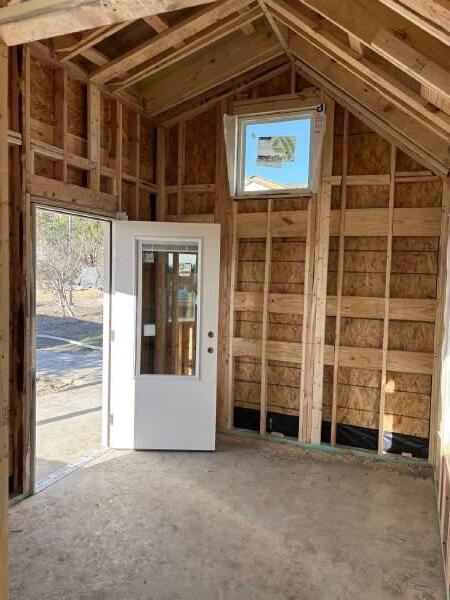
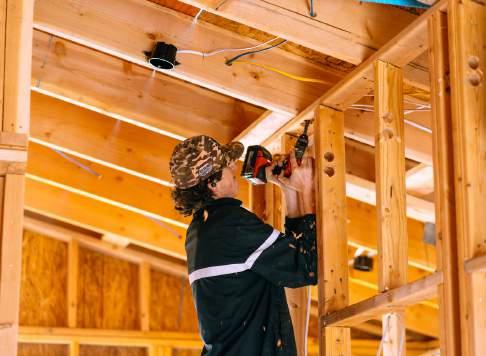







HomeAid’s Project Development Program connects builders, community leaders, trade partners, consultants, donors, volunteers, and service providers to combat homelessness. Guided by a builder captain, HomeAid constructs or renovates housing and programmatic facilities using skilled labor, services, and materials, which are donated mainly by the building industry. HomeAid has maintained a 40% in-kind donation rate, with most developments achieving over 80% throughout its history, enabling its service provider to develop affordable projects. This leverage conserves a large portion of the nonprofit funds for operations, housing, and transformative programs. Each HomeAid Affiliate is expected to complete at least one project each year.
Project Development begins with presenting the HomeAid mission to local nonprofit organizations that also have a mission to fight homelessness. It is essential for HomeAid Affiliates to educate local nonprofit service providers about HomeAid's mission. Service providers who understand this mission and HomeAid’s housing development priorities are more likely to submit thorough and complete Project Applications.
Affiliates can engage with service providers through various methods, such as one-on-one meetings, informal roundtable discussions, presentations at homeless coalitions, community councils, or Continuum of Care meetings.
As HomeAid Affiliates become more active within their communities and gain a better understanding of the local service providers, they will be better equipped to identify reputable organizations that deliver quality programs and services. Resources can be found in the employee portal, which includes examples of brochures, presentations, and materials designed to educate service providers.
The following exhibit visualizes the general project development process.
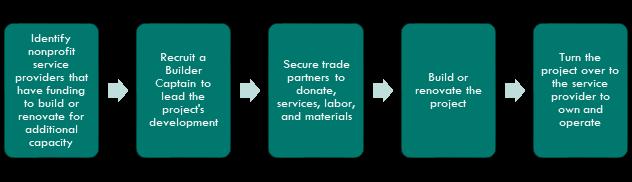

The HomeAid model of project development is a two-stage process.
The first stage is project selection, which involves identifying a qualified service provider, which may include a visit to the site from the Executive Director. To qualify for assistance as a HomeAid project, the service provider must have a program based in the HomeAid affiliates’ territory and meet the following criteria:
1. A mission to help those experiencing homelessness or at risk of homelessness.
2. Status as a 501(c)(3) organization or collaboration with a government agency.
3. Strong community and political support.
4. A solid track record of enabling clients to achieve stability and secure long-term housing.
5. Operational funding is in place to sustain and expand client programs.
6. Availability of capital funds or the demonstrated ability to raise the necessary funding to ensure project completion and continued successful operation thereafter.
7. Ownership or control of the property.
a. Affiliates will need to assess the service provider's level of ownership/control of the property. A service provider may be negotiating with a jurisdiction regarding a property or leasing it. Based on the likelihood of control or the length of a lease (a minimum of 5 to 10 years recommended), the affiliate can determine the potential investments and project value as it moves toward adoption. If the project includes a lease, the property owner must be notified about the project and the planned work. The affiliate, with help from their lawyer, should decide whether to include the property owner as a third party in the agreement and the insurance policies.
8. A strong commitment to the project.
9. No engagement in discriminatory practices.
Numerous details must align for a service provider to express interest, have a project considered, and potentially obtain approval. The graph below illustrates the steps from interest to project approval. The qualifying questionnaire is an optional step.


The Project Application is essential for assessing a project’s scope and the service provider's capacity for completing the project while maintaining operations. No verbal or written commitments should be made until the application process is complete. Project information should be entered into Salesforce once the application is received.
The Project Selection and/or Project Development Committee oversees the entire project selection process, from initial screening through adoption of the project. The Project Selection and/or Project Development Committee will be further mentioned as the committee. The committee can include the HomeAid Executive Director, board members, consultants, and current or past builder captains. The committee has key tasks that could include identifying a project that a building team can complete successfully; ensuring a qualifying and appropriate nonprofit will manage the facility to help homeless individuals and families achieve self-sufficiency; and recruiting the builder captain.
The committee evaluates the service provider’s eligibility based on:
• Application completion
• Financial capacity for construction and operations
• Quality of responses and documentation
• Staff and board commitment
• Community support
• Alignment with community needs (Housing Inventory Count (HIC) and Point in Time (PIT) data)
• Board involvement in fundraising

A negative response to any of these factors may signal potential issues.
The committee has two primary tools for evaluating applications if desired by the affiliate: the Threshold Review Form and the Technical Review Form. The Threshold Review Form checks whether the service provider meets the minimum requirements. If an application passes this review, it proceeds to the Technical Review, which assesses its quality If an application does not pass the Threshold Review, the service provider receives feedback on what improvements are needed for future submissions.
The Technical Review Form focuses on how effectively the service provider answered the application questions. The scores from both forms assist the committee in determining which projects are most likely to succeed.
Following the acceptance of an application, the HomeAid Executive Director and committee members may conduct additional site visits with the service provider. After completing these visits and summarizing the reviews, the committee votes on whether to approve or reject the project. If a project is not accepted, the applicant will receive a written notification along with feedback for future applications. If approved, a Provisional Letter of Acceptance will be issued.
HomeAid has faced challenges, including issues with service providers not having control over land entitlements or launching capital campaigns. It is crucial to secure adequate funding for the success of construction projects. Financial documents such as budgets and funding proposals should be reviewed by finance or construction specialists. To ensure their accuracy, these documents must also be checked by the Board Treasurer or a qualified banking professional. HomeAid America is available to assist throughout this process.
Construction delays and change orders can affect project funding, making it essential to discuss any additional costs in advance. Regularly update the project budget and ensure there are adequate contingency funds in place. Change orders that increase costs or expand the project's scope require prior approval from both the service provider and the builder captain. These orders should only move forward if the service provider can supply the necessary resources. Additionally, service providers should be prepared for the possibility that in-kind contributions may not meet expectations. HomeAid must also consider whether funding sources necessitate compliance with prevailing wage laws, as this can increase project costs. It's advisable to avoid projects subject to prevailing wage laws unless absolutely necessary. Some publicly funded projects may be eligible for prevailing wage exemptions.
HomeAid affiliates generally provide support for projects through in-kind services and oversight rather than direct financial contributions. Occasionally, an affiliate may have specific funds available for construction-related expenses. HomeAid can help service providers seek additional funding from public or private sources, including collaborative fundraising efforts. However, it is ultimately the responsibility of the service provider to secure the necessary financing for project completion, and this responsibility should be clearly outlined during the agreement process.
To ensure a successful project, it is crucial to keep detailed meeting notes, budget documents, and construction progress records. After the affiliate board approves the project, the status should be updated in Salesforce, and project details should be updated when details like the budget, dates, or status change. For insurance purposes and when entering data into Salesforce, the project's value should accurately reflect its retail value. Any funds raised for the project must be documented in audits and budgets as contributions from HomeAid and other donors. The Project Budget Tracking template can help organize and effectively track in-kind donations, streamlining the process of recording these contributions.
Selecting a builder captain is a critical decision for the committee and the HomeAid Affiliate. When choosing a builder, consider their proximity to the project site, the size and staffing of their company, their ability to secure in-kind donations, and their proposed timeline for project completion.
Typically, a builder captain is expected to undertake the project pro bono, meaning they do not earn a profit, and to provide general administrative services at no cost. These terms can be negotiated as the project scope is defined. While a builder captain is generally not required to contribute funds to the project, they may choose to do so at their discretion.
HomeAid Affiliates can identify the right builder captain by:
• Hosting a luncheon to connect service providers with builders, featuring a program graduate who can share community needs.
• Networking with local or national homebuilders, including those involved in multifamily or commercial projects, as well as connecting with past builder captains.
• Attending events hosted by local Building Industry Associations (BIA) and Home Builders Associations (HBA).
A builder captain is assigned to the project, and a Project Development Team is formed after the builder captain evaluates the project's scope and budget. This assessment is crucial before finalizing legal documents and obtaining insurance. Once the builder captain estimates the project's costs and accounts for potential in-kind donations and unexpected expenses, a Letter of Agreement or Exoneration Agreement can be drafted.
Construction cannot begin without a signed Letter of Agreement/Exoneration Agreement. This document protects HomeAid, the builder captain, trade contractors, suppliers, and donors from any liabilities associated with the construction process. It clearly outlines the financial, legal, and operational responsibilities of all parties involved.
For all new affiliates, local lawyers should perform an initial review of HomeAid's Letter of Agreement/Exoneration Agreement to ensure it complies with local laws. Each individual agreement should also be tailored to the project's specific details.
After selecting a builder captain, it's important to hold a meeting with potential trade partners, suppliers, and consultants early in the project process. This meeting should include HomeAid, the builder captain, and the service provider to generate interest and foster a sense of emotional ownership for the project. It is not uncommon for trade partners to later withdraw due to various schedules and financial circumstances. Be prepared to bring in substitutes to ensure the project's vision continues to prosper.
HomeAid America offers a General Liability WRAP/OCIP Insurance Policy to protect all stakeholders involved in a construction project. The service provider is also required to obtain course-of-construction or builder’s risk insurance that covers the full replacement value of the project and all associated risks during the construction period. Depending on the project's location, the Affiliate may also require additional coverage for earthquakes, floods, or other local hazards.
Before construction can commence, the service provider must sign the Letter of Agreement, provide proof of the course-of-construction (builder's risk) insurance, and pay the premium for the General Liability WRAP/OCIP insurance.
It is required that the service provider or builder captain either be covered under the general liability of WRAP/OCIP insurance policy or provide evidence of an alternative insurance policy.
If the service provider or builder captain chooses to obtain their own liability insurance, they must secure both comprehensive general liability and products liability insurance for the duration of the work. This insurance policy must receive approval from HomeAid America. Once the agreement is signed, they must add HomeAid Affiliate and HomeAid America as additional insured parties and provide proof of this coverage. Additionally, The Service Provider or Builder Captain agrees to include the entities listed on the subcontractor's enrollment form as additional insureds and to add any other parties that HomeAid identifies as having made significant contributions to the work.
This summary outlines the steps for submitting the General Liability WRAP/OCIP Insurance Application. It includes important details about insurance rates, documentation requirements, and the roles of various parties involved. Following these guidelines will help ensure a smooth process as you plan and execute the project.
• Submit the general liability WRAP/OCIP Insurance Application to HomeAid America, allowing 14 days for processing before the start of construction.
• Insurance rates are $15.25 per $1,000 of direct construction costs
• Include HomeAid America, the HomeAid Affiliate, and the service provider in the "Named Insured" section of the application.
• The HomeAid America Finance Manager will verify receipt of all necessary documents following the application submission.
• HomeAid America will generate an invoice for the insurance premium and send it to the Affiliate Executive Director for payment.
• Once full payment is received, the application will be forwarded to Lockton Insurance Brokers for processing.
• Lockton will coordinate with the builder captain to obtain the necessary certificates of insurance for all parties involved.
• Monthly reports, titled "Enrolled Contractors Report," OCIP Status Report will be provided to HomeAid Executive Directors for all trades that have signed the Subcontractor Enrollment Form. Affiliates should review these reports for accuracy.
• The builder captain and Trade Contractors are responsible for providing their own Workers' Compensation Insurance and vehicle coverage as required by state law.
• Adjust the insurance coverage when there are substantial budget changes to ensure that the coverage remains accurate by contacting the Director of Finance and Administration
HomeAid does not offer work warranties because many of the trade contractors contribute their services pro bono. The Project Development Program at HomeAid eliminates liability for all companies and individuals involved in the projects. Instead of warranties, HomeAid provides a General Liability WRAP/OCIP Insurance Policy as an alternative. It is important to note that manufacturers' warranties usually only apply to products that have been purchased.
Once the legal documents are finalized, the team will conduct a Project Kick-off meeting for all stakeholders. This meeting will outline the project development process, review costs, and clarify roles and schedules. It will also provide an opportunity to introduce participants and generate excitement for the project.
The Project Kick-off meeting will address the following topics:
• Approval and payment processes for invoices - Change order procedures
• Schedule and frequency of construction meetings
• Identification of key events (such as groundbreaking, topping off, wall-raising, frame walks, and dedication)
• Creation of an event budget
• Leadership roles and shared responsibilities between the service provider and HomeAid - Planning for communication and publicity - Submission of permits as necessary

The project development team has several key responsibilities, including:
1. Completing the project design
2. Conducting research and securing all necessary entitlements and permits
3. Recruiting trade partners
4. Continue to evaluate the project's financial viability
5. Coordinating the project from inception to completion
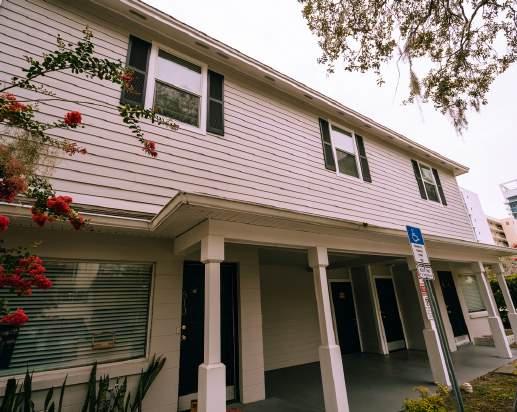
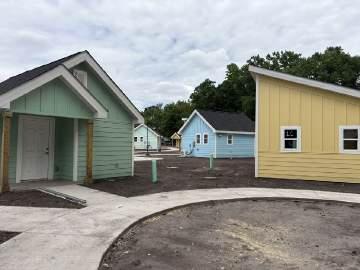
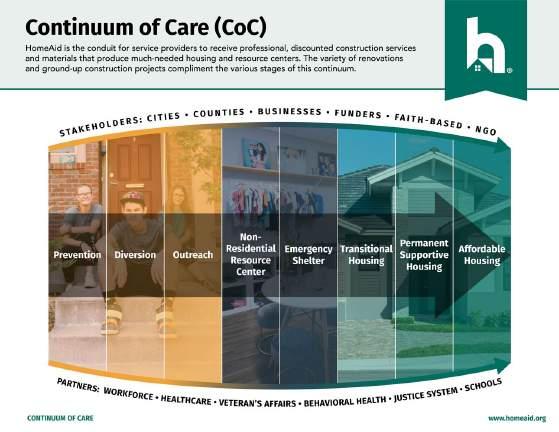
HomeAid has successfully completed a range of projects across the continuum of care to address local community needs. These projects include affordable housing, renovations, and new constructions for both residential and commercial purposes. Some projects add beds while others create space for supportive services like offices, kitchens, playgrounds, classrooms and counseling rooms, enabling service providers to better assist their clients. When considering multiple projects, priority should be given to those that add or preserve beds.
An Affiliate may invest significant time ranging from days to years working with a service provider on pre-development work. This phase may include tasks such as site selection, feasibility studies, financial planning, design development, and securing permits and approvals. For some projects, the scope of work may be limited to only the predevelopment phase. It is essential to assemble a skilled team, which may include a land developer, general contractor, civil engineer, architect, land surveyor, title company representative, soils engineer, or any other knowledgeable and interested individual.
Key questions for due diligence may include:
- Does the zoning meet your needs? - Are utilities available?
- Is the property plated or does it need replatting?
- Is the site too hilly? Is there too much grade?
- Is the property size adequate for your structure?
- Are land dedications in place?
- Is there property access?
- Is the land raw or previously developed?
- What are the timelines and costs for development and construction?
- Are bonds required by the jurisdiction?
- Are there local opposition issues or HOA concerns?
- Is the building historically designated?
A representative from HomeAid, alongside the Builder Captain, must attend all project meetings to ensure clear communication and effective project control. Their involvement keeps everyone informed and helps address issues promptly, supporting the project's success.
For projects that are larger than minor renovations or those requiring official approvals, a design team is crucial. This team develops the necessary plans and drawings and can also assist with fundraising.
An architect or planner typically leads the team, collaborating with civil engineers, electrical engineers, and other specialists. In some cases, the service provider may secure pro bono assistance. HomeAid will also seek additional consultants from local builders, aiming to obtain donated services, which will be tracked in the project budget. The budget should include estimates for all costs, including required bonds, which the service provider should be prepared to pay, with the expectation of receiving any unused funds back after the project's completion.
The design team can be assembled before a builder captain is selected. The journey from concept to final approval can take several years. If a builder captain has not been identified yet, the Affiliate should include a builder representative to assist in reviewing the plans. Gaining necessary approvals will require collaboration with local councils or supervisors. HomeAid plays a critical role in discussions and public hearings by advocating for the project.
The builder captain usually assigns a Project Manager to oversee the design and entitlement process and a Construction Superintendent to manage scheduling and construction. The Project Development Team, which comprises the service provider, builder captain, Affiliate Executive Director, and HomeAid Project Liaison, meets regularly to review the construction schedule and budget, addressing any issues that may arise. It is essential to have active cooperation from the builder captain’s purchasing agents to maintain commitments from trade partners and suppliers, ensuring that the construction schedule is met.
The Partnership and Project Promotional Addendum outlines how the HomeAid Affiliate and the service provider will work together to promote their partnership. It specifies the responsibilities of each party in recognizing the contributions made by HomeAid and other partners. This addendum should be included during the project development phase.
The Project Development team will create an inspiring public relations plan that utilizes both local resources and those from HomeAid America. This plan is a crucial component of the HomeAid program, as it aims to inform the public about the significant contributions of the building industry in providing housing and support for individuals who are experiencing or at risk of homelessness.
The public relations plan may include some or all the following elements:
1. Press conferences to announce significant project milestones.
2. Press releases distributed to media outlets.
3. Articles featured in magazines such as Builder, Builder and Developer, and local interest publications.
4. Advertisements placed in newspapers.
5. Editorials submitted by HomeAid, highlighting the contributions of donors.
6. Naming rights and a permanent plaque at the project site.
7. Special event recognition, e.g., for groundbreakings and dedications.
8. Proclamations from local governments, including city, county, state, or federal representatives.
9. Construction signage displayed at the site (if applicable).
10. Recognition in the service provider’s newsletters and publications.
11. Acknowledgment in HomeAid publications and on the website.
12. Issuance of recognition certificates and awards.
13. Updates and recognition shared on social media platforms.
14. Approved boilerplate text for all parties involved.
Groundbreaking and dedication events are essential forms of public recognition and should be included in every public relations plan. HomeAid Affiliates should organize and oversee
these events to raise awareness of the HomeAid mission and properly acknowledge partners.
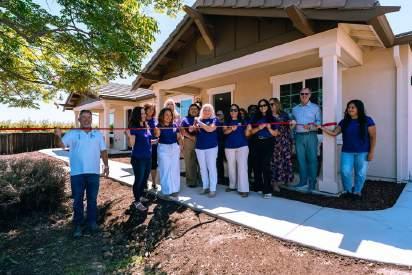
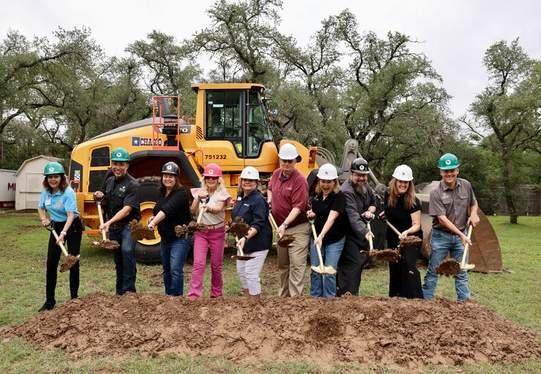
A groundbreaking ceremony typically includes speeches, gold shovels, hard hats, and refreshments, providing opportunities for media exposure and photography. In contrast, a dedication ceremony, which takes place upon project completion, may feature ribboncutting, awards, speeches, tours, a permanent plaque, and light refreshments.
It is important to establish funding responsibilities for these events early in the project development process. Additionally, special event insurance can be obtained from HomeAid America to protect against potential risks.XIII. Post-Construction Responsibilities
The Project Development Team is responsible for explaining how responsibilities will be managed after the construction is completed. Please note that there is no warranty, either implied or written. The HomeAid Affiliate must mark the project as "Completed" in Salesforce and update all relevant details following the dedication event. If there is no formal dedication date, use the date when the project received the Certificate of Occupancy or the date when the insurance coverage ended. The dedication date will also serve as the starting point for tracking the number of people served.
To support Affiliate operations and provide the service provider an opportunity to invest in the project, each HomeAid Affiliate may charge the service provider a fee. This fee is set at ten percent (10%) of the total value of in-kind (pro bono) contributions made by the builder captain, Trade Contractors, Suppliers, Consultants, and other Volunteers.
The fee will be based on the actual final value of these contributions assessed at the end of the project. A preliminary value will be included in the Letter of Agreement/Exoneration Agreement, but the final value will be determined after project completion. The service provider is required to pay the fee to the HomeAid Affiliate no later than 120 days after the project concludes.
Alternatively, the Affiliate may charge the service provider a flat fee, a predetermined amount, or a percentage of the overall project cost.
HomeAid is dedicated to making a significant impact through two exceptional opportunities for involvement beyond Build projects.
First, individuals can participate in Care Days, where volunteers come together to assist with maintenance, painting, landscaping, and minor improvements. These projects are usually completed within a few days. Care Days utilize WRAP/OCIP Insurance and are typically provided at no cost to service providers.
HomeAid also organizes Drives to collect items from communities or businesses. Volunteers typically gather to inventory the donated items, assemble Care Kits, stock houses, or distribute the collected items to people in need or service providers. These Drives are covered under special events insurance.
Both Care Days and Drives effectively complement Build projects, enhancing the impact and visibility of HomeAid within the community. They also offer engaging, low-pressure opportunities for collaboration with current and new service providers. Furthermore, these initiatives can serve as vibrant platforms for raising awareness about HomeAid's mission. Through hands-on activities or community engagement efforts, these events aim to foster a deeper connection and understanding of the vital work conducted by HomeAid, invigorating the spirit of collaboration and support within the communities served.