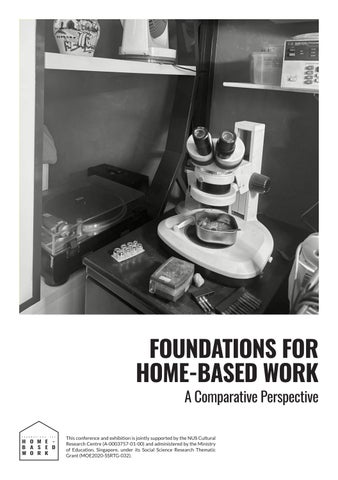
FOUNDATIONS FOR HOME-BASED WORK A Comparative Perspective
This conference and exhibition is jointly supported by the NUS Cultural Research Centre (A-0003757-01-00) and administered by the Ministry of Education, Singapore, under its Social Science Research Thematic Grant (MOE2020-SSRTG-032).
INTENSIVE VOCABULARY DRILLS
3
3
DRILLS
VOCABULARY
INTENSIVE INTENSIVE VOCABULARY DRILLS
A Comparative Perspective
3
29-30 November 2023 | 09:00-18:00
3 DRILLS
VOCABULARY
INTENSIVE
Hybrid (Online via Zoom & Seminar Room AS8-04-04) Asia Research Institute, National University of Singapore
Cases | Propositions
INTENSIVE
29 November - 7 December 2023 | 17:30
VOCABULARY DRILLS
3 DRILLS
VOCABULARY
INTENSIVE
3
FOUNDATIONS FOR HOME-BASED WORK
Architecture Exhibition Gallery, SDE3, Level 1 School of Design and Environment, National University of Singapore
FOUNDATIONS FOR HOME-BASED WORK
CONFERENCE
EXHIBITION
INTRODUCTION
A Comparative Perspective
Cases | Propositions
Organizing Committee
Home-Based Work and the Digital World; Precarity in Flexible Work; Paid Home-Based Work and the Domestic Sphere; The Spaces and Times of Home-Based Work
This exhibition documents the variety of paid work conducted in the Singaporean home – from an electrical repair service operating out of a study table, to a burgeoning urban farm on an adjacent green corridor*. The drawings are complemented by a series of speculative models that reimagine a 4-room public housing (HDB) flat as the site for four different types of homebased workers: a homebaker, a teleworker, a craftsperson, and an aesthetician. The models offer new typologies for the public housing flat that might adequately accommodate paid labour activities. Accompanying these home-based work case studies and design propositions are a selection of student projects from Domestic Capital, an Options M. Arch 1 design studio, led by A/P Dr Lilian Chee.
Lilian CHEE Associate Professor, NUS CDE Jane M. JACOBS Professor, University of Melbourne Natalie PANG Associate Professor, NUS CNM Audrey YUE Professor, NUS CNM
Contact for enquiries: foundationsforhbw@nus.edu.sg
The global pandemic restructured the locations and logic of paid work in profound ways, requiring many to work from home and setting society on a pathway that is transforming conventional boundaries between work and home. Be it the work-from-home office worker, the digital nomad or the precariously engaged gig worker, each one uses the home and neighbourhood in novel ways. This conference reflects on the social and infrastructural implications of this restructuring from a comparative perspective. How are domestic and neighbourhood infrastructures being drawn into this new era of work, and are current designs and facilities sufficient? What are the implications on digital equity and policy? How are the contours of work from home different in different contexts, and why? Further, how might these current and emergent trends in home-based work resonate with longer-held conventions of home-based paid work?
*The drawings are developed from data collected in a Home Audit exercise under Professor Jane M. Jacobs for Foundations for HomeBased Work.
ABOUT
This conference and exhibition is jointly supported by the NUS Cultural Research Centre (A-000375701-00) and administered by the Ministry of Education, Singapore, under its Social Science Research Thematic Grant (MOE2020-SSRTG-032).
FOUNDATIONS FOR HOME-BASED WORK
WELCOME & INTRODUCTORY REMARKS 09:00 - 09:10
SESSION 1: PAID HOME-BASED WORK & THE DOMESTIC SPHERE Keynote 1 09:10 - 10:10
Welcome Address
Tim BUNNELL, National University of Singapore, Singapore
12
SESSION 2: PRECARITY IN FLEXIBLE WORK Panel 1 10:30 - 12:00
Keynote 2 13:00 - 14:00
Asiya ISLAM, University of Leeds
Chair: ONG Ker Shing, NUS
22
Working the Night Shift from Home
14
Introduction
Lilian CHEE, National University of Singapore, Singapore
Noreen FATIMA, Rutgers-Newark University and Shalini SINHA, WIEGO Assemblages of Home and Work: Spatial Stories of Home-based Workers in Delhi’s Resettlement Colonies
16
Barriers to Implementing Digitalized Employment Platform for Women in Sri Lanka
SCHEDULE - DAY 1 WEDNESDAY, 29 NOVEMBER 2023
Working in/from Home: Entrepreneurial identities, business spatialities, and the security/precarity continuum amongst private tutors in England
Chair: Jane M. JACOBS, University of Melbourne 24
Shalini SINHA and Ana Carolina OGANDO, WIEGO Home as Workplace: Considerations on an Agenda for Recognition and Decent Work for Home-based Workers (HYBRID)
Uma RANI, International Labour Organisation Home-based Work: From Manufacturing to Digital Services in Developing Countries
(VIRTUAL)
(VIRTUAL)
26
Indralal De SILVA, University of Colombo and D.S. KODITHUWAKKU University of Kelaniya
18
Sarah HOLLOWAY, Loughborough University
Panel 2 14:30 - 15:30
Nicole COOK, University of Wollongong At Home With the (Post) Pandemic Creative City
28
Joshua VARGAS, Yale-NUS College / Singapore-ETH Centre From Chase Bank to the Countryside: The Emergence of Remote Work in the Philippine Business Process Outsourcing (BPO) Industry
FOUNDATIONS FOR HOME-BASED WORK: NUS SSRC-FUNDED RESEARCH 16:00 - 16:45
30
Lilian CHEE, National University of Singapore Jane M. JACOBS, University of Melbourne Audrey YUE, National University of Singapore Natalie PANG, National University of Singapore
EXHIBITION OPENING CEREMONY 17:30 - 18:30 Architecture Exhibition Gallery, SDE3 L1
SPEAKER’S MEETING 19:00 - 20:30 YALE-NUS College for Presenters, Chairpersons, and Invited Guests Only
FOUNDATIONS FOR HOME-BASED WORK
SESSION 3: SPACES & TIMES OF HOME-BASED WORK Keynote 3 09:00 - 10:00 44
SESSION 4: HOME-BASED WORK IN THE DIGITAL WORLD Panel 3 10:30 - 12:00
Keynote 4 13:00 - 14:00
Frances HOLLISS, London Metropolitan University
Chair: Erik G. L’HEUREUX, NUS
54
Designing for HomeBased Work Post-Covid
46
Sakshi PANDE, WD Architects
Panel 4 14:30 - 15:30
Melissa GREGG, RMIT University
Chair: Renyi HONG, NUS
Working From Home and the New Terms for Talent
56
Redefining the Architectural Threshold: Perception of the Space We Inhabit Now
Unequal Gains from Remote Work during COVID-19 between Spouses: Evidence from Longitudinal Data in Singapore
(VIRTUAL)
48
Renyi HONG, National University of Singapore
58
Telecommuting and White Plasticity
50
SCHEDULE - DAY 2 THURSDAY, 30 NOVEMBER 2023
Silvia LUCCIARINI, Sapienza University of Rome and Ilaria MARIOTTI, Polytechnic University of Milan From Office to Coworking: The Impact of Hybrid Working on Urban Spaces (VIRTUAL)
Zeewan LEE, National University of Singapore
Chair: Natalie PANG, NUS 62
Jean SEE, National Trade Union Congress Shawn TAN, Centre for Liveable Cities Peter FERNANDEZ, Sirius Support
Max HOLLERAN, University of Melbourne Geoarbitraging the Office: Digital Nomads, Housing Affordability, and Remote Work
60
INDUSTRY/STAKEHOLDER ROUNDTABLE 15:45 - 17:15
YE Xu, Katharina BORSI, and Jonathan HALE, University of Nottingham Juxtaposition, Collage and Layering: Digital Expressions of Live-Work Home (VIRTUAL)
SUMMARY & CLOSING REMARKS 17:15 - 18:00 Jane M. JACOBS, University of Melbourne
SESSION 1 PAID HOME-BASED WORK AND THE DOMESTIC SPHERE
FOUNDATIONS FOR HOME-BASED WORK
Session Chairperson: A/P Ar ONG Ker-Shing, National University of Singapore
10 11
KEYNOTE
Asiya ISLAM, University of Leeds Working the Night Shift from Home
PANEL
Noreen FATIMA, Rutgers-Newark University and Shalini SINHA, WIEGO Assemblages of Home and Work: Spatial Stories of Home-based Workers in Delhi’s Resettlement Colonies
Indralal De SILVA, University of Colombo Barriers to Implementing Digitalized Employment Platform for Women in Sri Lanka
Shalini SINHA and Ana Carolina OGANDO, WIEGO Home as Workplace: Considerations on an Agenda for Recognition and Decent Work for Home-based Workers (HYBRID)
ASIYA ISLAM
PAID HOME-BASED WORK AND THE DOMESTIC SPHERE | FOUNDATIONS FOR HOME-BASED WORK
University of Leeds, UK
12 13
KEYNOTE Dr Asiya ISLAM is a Lecturer in Work and Employment Relations at the University of Leeds. Her research explores the relationship between emerging forms of work and social inequalities, particularly gender and class inequalities. She is engaged in long-term ethnographic research with young women service workers in Delhi, India and has also conducted a mixed-methods study on gender, digital technology, and the future of work in India. Currently, she is leading comparatives research on the experiences of women platform delivery workers in Delhi, India and Buenos Aires, Argentina.
Working the Night Shift from Home: Emerging Tech-Corporate Subjectivities The night shift is a key feature of outsourced call centre work. In the Global South, it offers global belonging premised on communication via information technology with the Global North, and additionally for women a visage of freedom. What are the geopolitical and gender dimensions of night shifts when they are transposed to the space of home, as has happened due to the Covid19 pandemic? This paper draws on recent fieldwork with young women in Delhi, working for global corporates, offering services (such as, customer support and data maintenance) using digital technology to overseas customers/clients. As the women navigated the rhythm of working the night shift from home as a result of lockdowns, they expressed a preference for phone conversations over in-person meetings. In this paper, I will discuss the method of phone interviews that, to a certain extent, mirrored the women’s working practices. While, in theory, these phone interviews could be conducted from anywhere in the world, sharing time and space with the women enabled access. I will, further elaborate upon women’s accounts of spatial and temporal challenges of working the night shift from home, including having to minimise domestic sounds (the whirring of a fan, food preparation, watching TV) that contradict their reiteration of the corporate language of ‘flexibility’ and ‘work life balance’. Together, these reflections on ethnographic labour and digital corporate labour during and after the Covid-19 pandemic will highlight the discrepancy between labour narratives and labour practices, and the limits to flexibility, under digital capitalism.
NOREEN FATIMA
PAID HOME-BASED WORK AND THE DOMESTIC SPHERE | FOUNDATIONS FOR HOME-BASED WORK
Rutgers-Newark University, USA
and SHALINI SINHA WIEGO
14
Assemblages of Home and Work: Spatial Stories of Home-based Workers in Delhi’s 15 Resettlement Colonies Noreen FATIMA is a Ph.D.
Shalini SINHA is Home Based
candidate in the Global Urban Studies Program at the School of Arts and Sciences Newark at Rutgers University-Newark. She is a licensed architect and urban designer and has worked on several distinguished planning, design, and policy research projects in the past. She currently teaches Urban Sociology at Rutgers UniversityNewark. Her research lies at the intersection of infrastructure, citizenship, and governance in Delhi’s resettlement colonies. Her scholarly interests also include spatial injustice, politics of space, politics from below, informal urbanism, and the Global South.
Work Sector Specialist and Urban Asia Lead at WIEGO. She is based in India, and her work focuses on developing and documenting decent work and livelihood opportunities for women workers in the informal economy. ‘Home as a place of work is an area of abiding interest for Ms. Sinha; she has worked on issues related to home-based workers for many years. Recently, she has led the focal cities program for Delhi, which includes supporting member-based organizations of women informal workers in their capacity-building and advocacy efforts at the city/state level. Her most recent work includes an edited volume, Redefined Labour Spaces, Routledge, 2017.
Since their conception, housing, and planning authorities in India have treated home and work as separate categories. However, the informal “unplanned’ settlements in Indian cities predominantly illustrate that, in reality, home and work are spatially and conceptually overlapping categories. Cognitive sociologists argue that the notions of home and work’ are intrinsically interconnected and mutually defined. Examining either domain in isolation fails to capture the true essence of experiencing them individually and collectively. (Nippert-Eng, 1996, p. 4). Life in Delhi’s resettlement colonies is no exception to this phenomenon, where work and home are deeply co-entangled. Resettlement colonies in India are mass-built housing settlements planned to house evicted residents from bastis (slums), usually in the city’s peripheries. Although not planned to accommodate economic activities at home, in everyday practice, home is also a place of work for residents in Delhi’s resettlement colonies. Exploring these co-entangled relationships around home and work in women home-based workers’ lives, we present the case of Delhi’s Savda Ghevra and Sunder Nagri resettlement colonies in a pre-pandemic and post-pandemic world. Drawing from unstructured interviews and participant observations, we present visual spatial narratives of home-based work through Madiha and Samina’s stories (pseudonyms used). We aim to draw policy and planning-oriented lessons from these stories that respond to the complex relationships between domesticity, embodied space, economy, and urban politics and move towards more inclusive and userappropriate planning and policy reforms.
INDRALAL DE SILVA
PAID HOME-BASED WORK AND THE DOMESTIC SPHERE | FOUNDATIONS FOR HOME-BASED WORK
University of Colombo, Sri Lanka
and D.S. KODITHUWAKKU University of Kelaniya, Sri Lanka
16
W. Indralal De SILVA is
D.S. KODITHUWAKKU is Lecturer
Professor Emeritus at the Department of Demography, University of Colombo. He received Masters and Doctoral Degrees from Australian National University in 1985 and 1990 respectively. He was a Visiting Fellow at the National University of Singapore (ARI) in 2004, Takemi Fellow at the Harvard School of Public Health from 1996-98, and Visiting Fellow at the Australian National University in 1990-91. During his career, he received a number of prestigious awards including Senior Fulbright, Takemi, Rockefeller Foundation and Asia Research Institute Fellowships. In his academic life, he has published several books, presented papers at many international conferences and published over 80 research articles in reputed journals.
at the Department of Social Statistics, University of Kelaniya, Sri Lanka. She holds B.A. (Hons.) Degree in Social Statistics from University of Kelaniya, MSc. in Business Statistics, University of Moratuwa, Sri Lanka and currently reading Masters in Demography, University of Colombo.
17
Barriers to Implementing Digitalized Employment Platform for Women in Sri Lanka During the COVID-19 pandemic, labour markets in Sri Lanka faced significant disruptions and were forced to shift towards remote work. This led to an accelerated digitalisation of the labour market as organisations adopted technologies to facilitate remote work. However, many companies in Sri Lanka have reverted to physical work environments post-pandemic for various reasons even though such platforms offer sophisticated working environments for women and create more employment options. Thus, the overall research objective of this study is to identify the barriers to implementing a viable digitalized employment platform for women in Sri Lanka. Specifically, the study investigates the banking and manufacturing sectors in Sri Lanka, which currently have limited utilization of digital employment platforms but hold significant potential for enhancing it. Three key reasons are identified for the low level of women’s participation in the digital workforce of the banking sector. These reasons include organisational dynamics that fail to support gender diversity, the absence of an inclusive digital work environment for women, and a lack of career advancement opportunities that are inclusive of women. Conversely, in the manufacturing sector, two primary factors contribute to the limited engagement of women in digital labour platforms. First, skill and career limitations restrict the opportunities available to women within the sector. Second, gender-based barriers and work-life challenges further impede women’s participation in digital labour platforms in the manufacturing industry.
SHALINI SINHA
PAID HOME-BASED WORK AND THE DOMESTIC SPHERE | FOUNDATIONS FOR HOME-BASED WORK
WIEGO
and Ana Carolina OGANDO (virtual) WIEGO
Home as Workplace: Considerations on an Agenda for Recognition and Decent Work for Home-based Workers 18
Shalini SINHA is India Country
Ana Carolina OGANDO is
Representative for WIEGO. She is based in India and her work focuses on developing and documenting decent work and livelihoods opportunities for women workers in the informal economy. ‘Home’ as a place of work is an area of abiding interest for Sinha; she has worked on issues related to home-based workers for many years. Recently, she has led the focal cities program for Delhi, which includes supporting member-based organizations of women informal workers in their capacity building and advocacy efforts at the city/state level. Her most recent work includes an edited volume, Redefined Labour Spaces, Routledge, 2017.
WIEGO’s Research Coordinator. Her research interests include gender, qualitative and participatory methodologies, action research and participatory governance. Since joining WIEGO in 2012, she has worked closely with waste pickers in Belo Horizonte, Brazil on capacity building for membership-based organizations centred on raising gender awareness and occupational health and safety. She also led the qualitative research component of WIEGO’s COVID- 19 Crisis and the Informal Economy Study. She is based in Belo Horizonte, Brazil and holds a PhD in Political Science from the Federal University of Minas Gerais.
During 2020-2021, WIEGO (Women in Informal Employment: Globalising and Organising) and 19 its partners implemented a mixed-methods longitudinal study that assessed the impact of the COVID-19 economic, health and care crisis on specific occupational groups of informal workers and their households in 11 cities across the Global South and North. The COVID-19 Crisis and the Informal Economy Study examined the degree and pathways of impact on almost 2,000 informal workers working as home-based workers, domestic workers, street vendors, and waste pickers. This paper seeks to make visible the challenges and demands related to home as a workplace. The first section of the paper will provide an overview of impacts of COVID-19 on home-based workers in five cities - Pleven, Bulgaria; Ahmedabad, Delhi and Tiruppur, India; and Bangkok, Thailand. It will consider home-based workers earnings’ and ability to work, as well as how unpaid care responsibilities in households, coupled with marked digital divide strains and food insecurity, impacted home-based workers’ livelihood security during the pandemic. With a contextualization of impacts across five cities, the second section will hone in one particular city - Delhi, India. The section will focus on the key characteristics of home-based workers in Delhi, historic invisibility of the sector, and Covid-19 impacts. The third section will present a case of how home-based workers’ demands can shape urban planning and development. The final section presents policy recommendations that can strengthen home-based workers’ livelihoods, amidst current challenges related to the cost of living crisis and concrete climate change. The increased recognition of the disadvantages and contributions of home-based workers should be translated into an agenda for transformative change to protect and support these workers and their livelihoods.
SESSION 2 PRECARITY IN FLEXIBLE WORK
FOUNDATIONS FOR HOME-BASED WORK
Session Chairperson: Prof. Jane M. Jacobs, University of Melbourne
20 21
KEYNOTE
Sarah HOLLOWAY, Loughborough University Working in Homes/Working from Home: Entrepreneurial Identities, Business Spatialities, and the Security/Precarity Continuum amongst Private Tutors in England (VIRTUAL)
PANEL
Uma RANI, International Labour Organisation Home-based Work: From Manufacturing to Digital Services in Developing Countries (VIRTUAL)
Nicole COOK, University of Wollongong At Home With the (Post) Pandemic Creative City
Joshua VARGAS, Yale-NUS College / Singapore-ETH Centre From Chase Bank to the Countryside: The Emergence of Remote Work in the Philippine Business Process Outsourcing (BPO) Industry
SARAH HOLLOWAY
PRECARITY IN FLEXIBLE WORK | FOUNDATIONS FOR HOME-BASED WORK
(virtual)
Loughborough University, UK
22
Sarah HOLLOWAY is a Professor of Human Geography at Loughborough University. She is a Feminist Social Geographer who has played a leading role in establishing two burgeoning field of research: ‘Geographies of Children, Youth and Families’ and ‘Geographies of Education’. Her research has been funded by the Economic and Social Research Council and the Joseph Rowntree Foundation, and she is a former Philip Leverhulme Prize winner and British Academy Mid-Career Fellow and is a Fellow of the Academy of Social Sciences. She has over 80 publications (extant) since 1998 including 7 books with quality publishing houses; 53 papers in international, peer-reviewed journals (33 single or firstauthored); and 23 book chapters/ conference proceedings. She has mentored ESC Future Research Leader and British Academy Postdoctoral Award holders.
23
KEYNOTE
Working in Homes/Working from Home: Entrepreneurial Identities, Business Spatialities, and the Security/Precarity Continuum amongst Private Tutors in England Entrepreneurship is regarded by policy makers and politicians as an accelerant for economic development. Economic geography demonstrates that rather than stimulating entrepreneurship in general, policy makers should support specific forms of entrepreneurship that fuel wider growth. The paper’s original contribution is to insist that entrepreneurship research must also explore less growth-oriented, but crucially very widespread, forms of entrepreneurial activity. The paper therefore places solo self-employment—the self-employed without employees— centre stage as an exemplar of this trend. Research is presented on private tutors who run businesses from home, offering children one-to-one tuition in the burgeoning supplementary education industry. The paper scrutinises the causes, configuration and consequences of such solo self-employment as an economically marginal, but numerically dominant, form of entrepreneurship. First, it explores the multiple pathways into solo self-employment and the way these works deploy entrepreneurial subjectivities in crafting their home-centred businesses. Second, it considers dichotomous approaches to working in others or one’s own home, and the implications of COVID-19 for changing home-based business’ spatialities. Third, it reflects on the implications of working from home for workers differentially positioned in a security-precarity continuum.
UMA RANI
PRECARITY IN FLEXIBLE WORK | FOUNDATIONS FOR HOME-BASED WORK
(virtual)
International Labour Organisation
Home-based Work: From Manufacturing to Digital Services in Developing Countries
Uma RANI is Senior Economist at the Research Department of the International Labour Office. She has conducted research on informal economy, minimum wages, poverty and inequality issues with a focus on gender. Since 2016 she has been working on digital transformations in the world of work, wherein she tries to explore how labour and social institutions could be strengthened to address economic and social inequality. She coordinated the major flagship report of the ILO on “World Employment and Social Outlook 2021: The role of digital labour platforms in transforming the world of work” and co-edited the special issue on “Women, work and the digital economy” for Gender and Development, 2022.
One of the stylised facts of economic growth and development is the reallocation of production factors across broad sectors, which would bring about structural transformation. Early development economists, including Lewis (1954), postulated that shifts in labour from the low- 24 productivity subsistence sector to high-productivity manufacturing and services sector would 25 act as catalysts for structural transformations. This transition was envisioned not only to bring about economic transformation but also to facilitate the transition of labour from the informal to the formal sectors. Additionally, there was an underlying assumption that the informal sector is a temporary phenomenon that occurs in the development process, which would gradually disappear. However, the development literature seldom explored specific labour arrangements, such as home-based work within the evolving manufacturing sector, which was driven by the interplay of uneven technological advancements and globalisation. The advent of digital technologies is making home-based work a permanent phenomenon instead of a transient one, as it spreads to services sector. This lecture will focus on the impacts of technologies, particularly, the information and communication technologies (ICTs) since the mid-1980s, and the emergence of new digital technologies in the 2000s, such as online labour platforms (microtask, freelance and talent platforms), which have made home-based work (informality) a reality which will persist in the decades ahead. While the previous technological revolution predominantly impacted low-skilled workers in the manufacturing sector, the present trend has implications for highly skilled workers in the services sector, particularly within developing countries. The lecture will then present the difference and similarities between home-based work in the manufacturing and services sector. It will then focus on the implications of this technological evolution on the working conditions of the home-based workers in the services sector on the digital labour platforms and finally suggest what policies might be required to ensure decent working conditions especially in the context of developing countries.
NICOLE COOK
PRECARITY IN FLEXIBLE WORK | FOUNDATIONS FOR HOME-BASED WORK
University of Wollongong, Australia
At Home With the (Post) Pandemic Creative City
Nicole COOK is an urban geographer at the University of Wollongong researching the changing geographies of housing/ home and cities and suburbs. Specialising in theoretically rich, policy relevant research her work foregrounds the diverse agents, alliances and processes through which cities and housing systems evolve, the spaces and communities that result, and the implications for urban planning and housing policy. Nicole is a former co-convenor of the Urban Geography Study Group of the Institution of Australian Geographers, convenor of the National Housing Theory Symposium and lead editor of the Routledge collection: Housing and Home Unbound: intersections in economics, environment and politics in Australia.
The COVID-19 pandemic has reconfigured the boundaries between home and work with implications for the future of cities. The evident potential to work from home raised new questions about the future of cities. With enforced lock-downs and city-centres devoid of workers, concerns emerged around an oversupply of commercial, retail and office space in city 26 centres. At the same time, local neighbourhoods emerged as hubs of social life in decentralised 27 town centres. These trends have continued to shape the post-pandemic city and strategies for CBD regeneration have therefore moved quickly into focus for city authorities. Central to these strategies is the idea of the creativity as a lightning rod for CBD regeneration, the key focus of this paper. While often framed by discourses of inclusivity, these strategies have been critiqued as exclusionary-marginalising people and practices unable to contribute to competitive positioning of the CBD for investment and elite residents but also as spatially blind. Their emphasis on clustering creative endeavours within the CBD as a ‘precinct activation’ tactic sits uncomfortably with the dispersed and complex spatiality of creative work that takes place in home-offices, studios and backyards, as well as neighbourhood venues and third sector and community-based organisations. To foreground both the potential and the limitations of distributed home/neighbourhood — work models that characterise much creative work, intensified and untethered by COVID-19, this paper reports on a research project that sought to capture work from home experiences pre-, during and post-COVID. Drawing on in-depth qualitative interviews with 12 musicians in Sydney, Australia, we leverage insights from creative workers to better understand the importance of home/neighbourhoods to sustaining creative work and home lives. In so doing we seek to illuminate the critical incubators of creativity in everyday home/neighbourhoods foregrounding how home-neighbourhood-city networks function in diverse and less formalised ways than as envisaged in corporate city visions and the public planning policies enlisted in their implementation.
JOSHUA VARGAS
PRECARITY IN FLEXIBLE WORK | FOUNDATIONS FOR HOME-BASED WORK
Yale-NUS College / Singapore-ETH Centre, Singapore
From Chase Bank to the Countryside: The Emergence of Remote Work in the Philippine Business Process Outsourcing (BPO) Industry
Joshua VARGAS is a Research Assistant at Future Cities Laboratory Global (FCL), an interdisciplinary urban science research group at the Singapore-ETH Centre. There, he contributes to the development of ur-scape, a geospatial planning support tool created in collaboration with the Asian Development Bank, the Swiss Secretariat for Economic Affairs, and other government and intergovernmental organisations. His primary interests are in economic geography, data-driven policy, and inclusive development in Global South cities. In 2023, he graduated with a major in Urban Studies and a minor in Mathematical, Computational, and Statistical Sciences (MCS) specialising in Data Science.
While much of the world moves towards return-to-office (RTO) policies, business process outsourcing (BPO) firms in the Philippines – Southeast Asia’s BPO capital – appear to be bucking the trend. This is significant given the industry’s status as the country’s sustainable jobs creator, and the world’s reliance on the Philippines for IT services. BPO firms traditionally concentrated 28 their activities in purpose-built office parks; COVID-19 forced them to adopt home-based 29 work (HBW) setups. Defying industry predictions, firms experienced productivity gains but later struggled to implement RTO policies amid worker backlash. How was this possible despite infrastructure and time zone challenges? Drawing from ethnographic, spatial, and industry analysis, I investigate how BPO workers in Cebu – a secondary city disproportionately reliant on BPO for jobs creation – navigated the industry’s shift to HBW. Firstly, I describe barriers that prevented earlier adoption of HBW by BPO firms, such as infrastructure reliability, worker surveillance, and spatiotemporal mismatch. Workers felt the need to move near office parks, sacrificing work-life balance and paying high rents to access BPO jobs. I then describe strategies used by firms and workers to overcome these barriers during COVID-19. Workers could now move back home to the countryside, away from city centres, but needed to reorganise their home lives and spaces to make home-based outsourcing possible. They regained family time, but are now expected to juggle domestic responsibilities and demanding BPO work despite worker-client time zone differences. Lastly, I show that the removal of barriers to HBW gave rise to diversity in worker preferences. A new category of poorly regulated ‘virtual assistant’ (VA) direct outsourcing relationships emerged to cater to these preferences, offering more flexibility but significantly increased precarity. In response, BPO firms are either doubling down on RTO by establishing countryside offices or competing with VA in offering remote opportunities to candidates outside city centres. While some workers embrace HBW out of disdain for large cities, others struggle to navigate the precarity of new HBW opportunities and unclear career advancement. This project contributes a Global South perspective to discussions on the future of work, challenging notions of RTO inevitability and demonstrating the need for comparative HBW research.
FOUNDATIONS FOR HOME-BASED WORK
Cases | Propositions
Baker’s Home, 2 February 2023 This three-storey, terrace house hosts a bakery business, jointly operated by a thirty-six-year-old female baker and her husband, who live here with their four-year-old son. The home is used not only for baking, but also for the storing of supplies for and the packaging of the baked goods produced. The baker lists only the kitchen as her workspace, but when she talks about her baking operation it is clear other parts of the house are called into service. The combined living dining room is furnished mainly for family use and is where the four-year old son often plays. But this is also where the 5-10 self-pick-up customers a day come to collect their orders. They may wait at the side table area in the living room, browsing perhaps the freshly baked goods for sale on a small shelf, or wandering into the dining area to peruse the completed orders on the stainless-steel tables in the adjoining dining room. The baker’s outdoor patio area also functions as a collection point. Despite the large volume of orders handled by the baker, order prevails in the working spaces of the home. There is no clutter, every machine and utensil has its designated place, the use of each surface and zone understood in the overall production process. In this home functionality and efficiency take precedence.
30 31
FOUNDATIONS FOR HOME-BASED WORK
Cases | Propositions
Homebaker A home baker, who started in 2020 when the Covid-19 pandemic hit, lives and works out of this fourroom flat, purchased as a BTO. She lives here with her husband, an accountant who manages the baking business finances and also works a job outside. The couple have two children - a daughter in primary school, and a son in kindergarten. The family is relatively harmonious and good at compromise. This made the integration of the home baking business into the flat much easier her children were willing to share a room, so that her daughter’s former bedroom, located along the entrance corridor, could be converted into the front of house. To avoid overcrowding the corridors (and invoking the ire of her neighbours), the entrance corridor was also converted into a vestibule for receiving customers. The front of house also doubles as the family’s new dining room. Save for a bay of the IVAR shelf reserved for baked goods and other items for sale, the rest of the room looks notably domestic. While this might be part of the branding of a home baking business, this is more critically due to the need for the room to double as both a space for customers and the family, depending on the time of day, due to the space constraints. The dining table is large enough to accommodate customers, but put away the baked goods onto the tabletop pedestals, and meals, tuition, and stocktaking can all take place there.
32 33
FOUNDATIONS FOR HOME-BASED WORK
Cases | Propositions
Jewellery Maker’s Home, 21 March 2023 This is the studio of a thirty-fiveyear-old, female creative, who makes her living from two kinds of homebased work: freelance copy editing and creative jewellery making which she sells online. The studio is part of a large, landed bungalow owned by her parents, which has six bedrooms, a dedicated study, a combined living and dining area, a kitchen, two balconies, and a garden with a swimming pool. Living in the house are the parents, the jeweller, her two brothers and the family’s live-in helper. The studio room, originally designed as a bedroom, served mainly as a storage space, indicated by the unused bed. It now serves as her primary creative space, which she refers to as a “studio.” The studio holds worktops, shelving, and storage containers for the materials she uses to make her jewellery, and wall space dedicated to pin-ups of ideas, references and completed pieces. The workspace overflows to parts of the floor. Her material drawers store an impressive collection of natural materials the artist has accumulated on her travels. Her home-based copyediting work and any online meetings is done in other parts of the home, namely the kitchen and living/dining area. Having a dedicated studio is possible because of the size of the home relative to the household size.
34 35
FOUNDATIONS FOR HOME-BASED WORK
Cases | Propositions
Crafts (Modelmaker) A freelance modelmaker stays in one of the bedrooms in this flat. He is cotenants with a young couple, who stays in the master bedroom, and a university student from Myanmar, who stays in the bedroom next to the entrance corridor. The modelmaker lives and works entirely out of his bedroom, which has been divided more or less down the middle between rest and work. Towards the door are his closet and bed. Bathed in the full extent of light from his ribbon window are his heavyduty workable, as well as his storage shelf and material racks. The space also doubles as a photo studio for his models, which he regularly posts about on social media (where his customer base is). He edits his photos, and curates his social media posts at the desk at the center of the room, which also doubles as a space for personal browsing and gaming. Given how much must take place in so little space, certain storage innovations allow for space and surfaces to be economically used. His material rack is a hacked IVAR shelf, which allows for large, flat pieces of materials (such as Bristol and Grevboard) to be stored upright (a position where they occupy the least amount of floor area. The raised platform on which his heavy-duty worktable is placed also doubles as a surface upon which he can cut and reduce large boards of material to a more manageable size to work with at his workable.
36 37
FOUNDATIONS FOR HOME-BASED WORK
Cases | Propositions
Lash Artist’s Home, 9 June 2023 This is the room of a twenty-threeyear-old lash artist who lives in a five-room HDB flat with her mother, father, and younger brother. Her business occupies one of the spare bedrooms in the family home, and the lash artist is happy to be able to fully utilise the space, which otherwise would have been wasted. She has curated the spare bedroom to the extent of installing lash beds, ring lighting and tripod, a trolley with her lash equipment, a rolling work chair, a mirror, and even an extra air-conditioning unit. The room is small but curated to feel spacious and comfortable, with customer experience in mind – evident by the extra chair for guests who come with a friend or their child. The artist has framed QR codes to access her social media and payment for convenience, and some advertisement posters for certain lash products that she also sells to her customers. Her lash equipment is stored neatly in little plastic pull out shelves, on top of a white cabinet. She also places her laptop under a small bedside table to play music while the client is in the session.
38 39
FOUNDATIONS FOR HOME-BASED WORK
Cases | Propositions
Aesthetician An aesthetician, who refuses to share a room with anyone else (most certainly not his younger sibling), lives and works in the bedroom next to the entrance corridor. He worked at Jean Yip for 5 years before making the decision to strike out on his own and set up a comprehensive beauty salon that offers both lash and nail services. He stays with his parents, who own the flat, as well as a younger sibling with whom he has a less-thanharmonious relationship. The fellow occupant with whom he is able to get along best with is his Ragdoll named Popi (cats are not allowed in HDB flats, but on so many levels, no one cares). Aside from the clinical requirements of a beauty salon (proper lighting, a sink for sanitary purposes), the aesthetician also wanted to market his business as therapeutic and nourishing for one’s self-esteem. Customers walk down a long corridor, along which he has displayed his numerous beauty competition accolades and diploma degrees, before arriving at the salon. The primary light source is the wallhung ring light, under which he and his customer will identify and discuss the work that needs to be done during their session. At the end of the transformative processes, he draws open the sliding windows, unveiling his windowsill garden (which Popi can often be found snoozing in), and giving his customers a chance to recompress before having to head out the door back into the hustle and bustle of the Singaporean public.
40 41
SESSION 3 THE SPACES AND TIMES OF HOME-BASED WORK
FOUNDATIONS FOR HOME-BASED WORK
Session Chairperson: A/P Dr Erik G. L’Heureux, National University of Singapore
42 43
KEYNOTE
Frances HOLLISS, London Metropolitan University Designing for Home-Based Work Post-Covid
PANEL
Sakshi PANDE, WD Architects Redefining the Architectural Threshold: Perception of the Space We Inhabit Now (VIRTUAL)
Renyi HONG, National University of Singapore Telecommuting and White Plasticity
Silvia LUCCIARINI, Sapienza University of Rome and Ilaria MARIOTTI, Polytechnic University of Milan From Office to Coworking: The Impact of Hybrid Working on Urban Spaces (VIRTUAL)
FRANCES HOLLISS
THE SPACES AND TIMES OF HOME-BASED WORK | FOUNDATIONS FOR HOME-BASED WORK
London Metropolitan University, UK
KEYNOTE
Designing for Home-Based Work Post-Covid COVID-19 has accelerated the growth of home-based work globally. WFH policies, adopted in countries across the world in an attempt to contain the virus, have had the effect of shifting what had previously been a largely invisible minority working practice into the visible mainstream. Unexpectedly successful with employers and employees alike, surveys indicate that this is likely to be a permanent shift, to some extent or another. While some want to work either from home or in the office full-time, most prefer a hybrid schedule of between one and four days a week 44 working from home, with the rest of the week in a collective workplace. 45
Frances HOLLISS is an architect and emeritus reader in architecture at London Metropolitan University. She has been researching the architecture of home-based work since 2001 (www. theworkhome.com) and is widely published. In 2020, in response to COVID-19, Holliss launched the collaborative Workhome Project (www.workhomeproject. org) to explore the impact of home-based work on buildings and cities, laws and regulation, and to address social and spatial inequalities highlighted by the pandemic.
This has major implications for the built environment—at the scale of the city, the neighbourhood, the block, the building and the home or workplace. It is, of course, nothing new. Before the industrial revolution, working from home—or living at the workplace—was almost universal, often in buildings specifically designed for the dual-use. However, with the invention of the factory and mass transport systems, ‘going out to work’ became the dominant working practice. And over time, widespread disapproval for home-based work combined with the popularisation of Ebenezer Howard’s Garden City idea, to result in a culture of mono-functional buildings and functionally zoned cities. Twenty years’ research into the architecture of home-based work, carried out in phases primarily in the UK but also in the USA, Netherlands and Japan, has built a knowledgebase that may inform changes to both the theory and practice of how cities and buildings are designed, in the context of home-based work as a mainstream practice post-Covid. Based on an understanding of both the advantages and the disadvantages of home-based work, this paper will present a series of design principles and typologies that have emerged from this research. It will challenge commonly held ideas about which occupations can be carried out from home. And it will advocate for the fine-grained mixed-use that results from cities and buildings designed around homebased work, in terms of social, economic and environmental sustainability. It will draw on both historic precedent and contemporary buildings - vernacular and ‘high’ architecture. And it will discuss the issue of adaptive reuse, in the context of a predicted surplus of commercial buildings and a legacy of apartments built tight fit to minimal space standards around limited and purely domestic programmes.
SAKSHI PANDE
THE SPACES AND TIMES OF HOME-BASED WORK | FOUNDATIONS FOR HOME-BASED WORK
(virtual)
WD Architects, USA
Redefining the Architectural Threshold: Perception of the Space We Inhabit Now
Sakshi PANDE is an Indian architect based in Mumbai. After graduating from the National Institute of Technology (MANIT) Bhopal in 2021, she worked on various design projects mainly in Pune and Mumbai. She is currently an architect at WD Partners, a multi-disciplinary practice based in Ohio. The University of Toronto’s student engagement programme released her creative work “Nooks and Corners- Interior of Isolations,” which was the gist of human behaviour during the pandemic and subsequent understanding of spaces from it. Under UNESCO India for Architectural Heritage Conservation curated Louis I Khan’s trophy in 2019, she worked closely and led the documentation of Kothkhai Palace: semi-sacred places and research, designing of ‘Liminal Spaces’.
Amid the past three years of the COVID pandemic, people have become increasingly aware of their built environment. Urban design is ever-evolving according to societal shifts in ideologies, 46 and policies while this pandemic adds a fresh perspective to built spaces and urban architecture. 47 This short-term recalibration has altered the dynamics we had with these spaces, both outdoor and indoor. The paper emphasises the architectural upheaval faced by our homes and cities, accompanied by shifts in how we understand and use our built environment. Working from home has improved well-being, and technological connectivity, especially in urban areas where commuting is stressful and time-consuming. Simultaneously this encroachment of work on the house frequently integrates the public and private spheres: of our lives and spaces with different activities. People desire more cellular environments as a consequence of the conflicts of the public world being enacted in our homes. Open-plan living was prudent when homes were sanctuaries but became challenging when they had to be both public and private. Prolifically we desire spaces that are more functional and fluid in their purposes. Designs need to blend living areas with workspaces - but should be careful not to decrease the quality of either space. Since space is limited in most homes, flexibly transforming rooms that suit different functions while protecting the quality of those spaces is crucial. Inclusivity, exclusivity and visual interactions between the working and leisure spaces will become a chief concern during the planning stages. This analogy of living is a return to simplicity, with future designs focused on conserving energy and utilising essential spaces with added technology. The home working movement of the pandemic has also aggravated socioeconomic inequalities - consider the digitally excluded and those living in congested housing. Any new emphasis on the spatial relationship between home and work should address these issues. Redefining these spheres lies most in the architecture of these spaces and could consolidate with triangular knowledge transfer between researchers, designers and legislators.
RENYI HONG
National University of Singapore, Singapore
THE SPACES AND TIMES OF HOME-BASED WORK | FOUNDATIONS FOR HOME-BASED WORK
Telecommuting and White Plasticity Working-from-home is primarily understood as a recent work trend driven by what Gallup calls the “Great Global Work-From-Home Experiment” started during the lockdowns. This talk engages in a historical study of this trend by looking into the telecommuting movement started in the 1980s. From the very beginning, telecommuting was plagued by a central conundrum: who can lay claim to the identity of a “telecommuter”? Although “telecommuting” was initially coined by physicist Jack M. Nilles to emphasize the energy savings that could come from reducing the work commutes of executives, the term was quickly appropriated by feminists who pointed out that “homework” had been the exploitative reality of many prior to its popular iteration of “telecommuting.” And many of these homeworking industries had expanded to computing work-the clerical work of monitoring faxes, keying data into computers, and of soldering electronic parts were all done by a shadow workforce largely comprised of immigrant women and children. 48
Renyi HONG is Assistant Professor in Department of Communications and New Media at the National University of Singapore. He is interested in labour and its relationships with affect, technology, and capitalism. His first monograph, Passionate Work explores the uses of passion as a means of generating a milieu of endurance for those left out of the good life. His monograph in development, Bearable Media, examines the biopolitical relationship between human adaptation and computational media. His works can be found in Social Text, New Media & Society, and European Journal of Cultural Studies, among others.
Central to this struggle is a broader issue of whose well-being ought to be looked into as work 49 transforms. For the most part, managerial experts had refused to consider the “homework” of immigrant women as “telecommuting, so that they might advance the interests of the white, male professional classes, the subjects for whom working from home was made to represent freedom. Attempts were made over the next two decades to erase homeworking from telecommuting, and to suggest of the improvements that telecommuting could have on the lives of these men and their families. Telecommuting, experts suggested, could revive conjugal bliss, warm community relations, and produce intelligent, adaptable children. Contextualized in the 80s and 90s where mass retrenchments and the suburban malaise threatened white racial privilege, telecommuting suggested that the disappointments of work could be recuperated through time in the home. Positioned this way, we see that what is key to telecommuting and, consequently, workingfrom-home, is not necessarily the site of work (the work) but its imaginary how is working from home meant to transform the worker a question inevitably tied to who the worker is and what she does. Bringing up this history of telecommuting thus brings us to two major refrains that should proceed in research on the trend. First, it is important that we need to be inclusive in this concept, to consider the needs of workers working from home using a variety of technologies and workstyles, not limiting it to the professional and executive classes alone. Following this, we have to ask what the imaginaries centred around working-from-home are. The promise of time in the home often carries normative implications of what societies value-_which is also often middle-classed in nature. Being more inclusive requires us to push at this generalization of value and inquire more deeply into the variety of hopes and uses that working from home can have for different peoples.
SILVIA LUCCIARINI
THE SPACES AND TIMES OF HOME-BASED WORK | FOUNDATIONS FOR HOME-BASED WORK
(virtual)
Sapienza University of Rome, Italy
and ILARIA MARIOTTI (virtual) Polytechnic University of Milan, Italy
From Office to Coworking: The Impact of Hybrid Working on Urban Spaces In Italy, one of the European countries most affected by the COVID-19 pandemic, the transition to the “new normal” has necessitated a reorganisation of work, incorporating the main 50 innovations that emerged during the pandemic. Specifically, for individuals with jobs suitable for 51 telecommuting, both in the public and private sectors, the option to work remotely for a few days each week has been introduced. While this new work arrangement does not enable permanent residential choices, as seen in some countries where remote work has replaced office-based work, it has sparked a redefinition of workspaces and working hours for these individuals.
Silvia LUCCIARINI is Associate
Ilaria MARIOTTI is Associate
Professor of Economic Sociology at the Department of Social and Economic Sciences, Sapienza University of Rome, with an MA in Economic Sociology and PhD in Urban Studies. Her main research fields focus on the mechanisms of (re)production of inequalities, privileging both the spatial and the organizational dimensions of public and/or experimental policies. Her contributions have appeared in journals such as International Review of Sociology, International Journal of Sociology and Social Policy, Cities, Policy and Society.
Professor of Urban and Regional Economics at DAStU- Politecnico di Milano (Italy). She achieved a M.Sc. degree in Regional Studies at the University of Reading (UK) and a Ph.D in Economic Geography at the University of Groningen (NL). She teaches regional economics. Her main research interests concern: firm location, industrial districts and clusters; new working spaces and their effects on the urban context (i.e. enhancing innovation, and urban regeneration).
This paper examines the utilisation of work-away-from-office spaces, particularly co-working spaces, by employees engaged in remote work. While in Italy, until a few years ago, these spaces were mainly used by self-employed individuals, independent workers, and freelancers, today, approximately half of the users are employees from public or private sectors and digital nomads who follow a one-week/bi-weekly remote work schedule. The study aims to understand the implications of this new arrangement on urban spaces by comparing the two primary metropolitan areas, Milan and Rome. The worker can choose not to use the nearest coworking space to their residence but instead opt for one located in specific areas of the city, because they are considered “desirable” or functional. Within this context, the cases of two large cities in Italy — Rome and Milan — are explored with the aim to understand the effects of hybrid working on the urban space. Specifically, INAPP database about remote working is used to describe the remote working and hybrid working trend and data on the location and characteristics of coworking spaces allow to measure the supply of flexible spaces in the urban context, and their potential effects. Besides, interviews with local stakeholders will allow to explore the phenomenon and impact on the cities of Milan and Rome, thus underlying similarities and differences.
SESSION 4 HOME-BASED WORK IN THE DIGITAL WORLD
FOUNDATIONS FOR HOME-BASED WORK
Session Chairperson: Asst. Prof. Dr Renyi Hong, National University of Singapore
52 53
KEYNOTE
Melissa GREGG, RMIT University Working From Home and the New Terms for Talent
PANEL
Zeewan LEE, National University of Singapore Unequal Gains from Remote Work during COVID-19 between Spouses: Evidence from Longitudinal Data in Singapore
Max HOLLERAN, University of Melbourne Geoarbitraging the Office: Digital Nomads, Housing Affordability, and Remote Work
YE Xu, Katharina BORSI, and Jonathan HALE, University of Nottingham Juxtaposition, Collage and Layering: Digital Expressions of Live-Work Home (VIRTUAL)
MELISSA GREGG
HOME-BASED WORK IN THE DIGITAL WORLD | FOUNDATIONS FOR HOME-BASED WORK
RMIT University, Australia
KEYNOTE
Dr Melissa GREGG is a writer, consultant and visiting Professor at RMIT University, Australia, where she is International Advisory Board Member for the ARC Centre of Excellence for Automated Decision-Making and Society. For the past decade, she led user experience research at Intel, and built the first sustainability team addressing product carbon emissions. Her publications include The Affect Theory Reader (Duke 2010), Work’s Intimacy (Polity 2011), Counterproductive: Time Management in the Knowledge Economy (Duke 2018) and Media and Management (Meson 2021).
Working From Home and the New Terms for Talent In the sudden shift to remote work in March 2020, the rush to secure computers for everyone working and learning from home contributed to a global semiconductor supply shortage, made worse by a logistics bottleneck that crowded out shipping ports across the world. As the 54 pandemic continued, the mainstream reliance on digital tools to keep society going created an 55 unprecedented demand for silicon and software engineering talent, causing a notable “quit rate” in which workers traded up for higher salaries elsewhere. Meanwhile, in the United States, social unrest responding to racial violence made the workplace a site for unusual levels of political debate and discussion. Corporate protocol was temporarily upended, even if employees were not located in physical offices for these events. These multiple, intersecting impacts continue to effect the experience of digital labour years later. In contrast to my earlier research on working from home (Gregg 2011), this talk explains what changed about the employee/employer relationship during COVID, given the context of broader social inequities gaining attention. WFH went from being a rare experience often disguised by employees struggling to fit family life around long hours—to an accepted, widespread and popular practice. The speed of change caught employers unprepared. Companies that thrived tended to be those already working with distributed, agile methodologies conducive to remote collaboration. Now, as employers seek to bring new hires together in an office for the first time, tension remains over whether location and physical presence truly matter in a highly competitive industry. As I will argue, tension over “return to office” policies not only suggests a new front for labour activism since COVID, it reflects a positive development in the longer history of working from home. The choice to be “remote only” is a necessary and overdue rejection of the place-bound requirement for participating in high tech work, and the narrow forms of reward and privilege to which it gave rise.
ZEEWAN LEE
HOME-BASED WORK IN THE DIGITAL WORLD | FOUNDATIONS FOR HOME-BASED WORK
National University of Singapore, Singapore
56
Zeewan LEE is Assistant Professor at the Lee Kuan Yew School of Public Policy at the National University of Singapore. Zeewan’s primary research lies at the intersection of labour, aging, and technological changes. Zeewan conducts applied microeconomics research in the areas of institutional (Social Security, pension, and health insurance) and non-institutional (technological changes including the rise of remote work, skills, human capital investment, income) drivers of labor supply/ demand decisions. Zeewan’s endeavours in this stream of research reflects her deep curiosity and concerns regarding the future of work and the roles to be played by human workers in the society ridden with fast demographic- and technologicalshifts. She focuses especially on how older or other marginalized individuals fare in the labor market.
57
Unequal Gains from Remote Work during COVID-19 between Spouses: Evidence from Longitudinal Data in Singapore The rise of remote work arrangements under the COVID-19 pandemic has generated important benefits, enhancing worker productivity by providing flexibility and reducing commuting costs. Would such positive labour market outcomes be enjoyed equally between spouses? Using a longitudinal dataset of married women and their spouses before, during and after the lockdown in Singapore, we examine the effect of the pandemic and the availability of remote work on the respondents’ salary income, while accounting for the moderating roles of gendered differences in time use (e.g., in childcare) and presence of helpers. We find a significant salary income growth among male remote workers, but not among females. While both male and female remote workers experienced an increase in income if they spent less time on household work, women were less likely to face such smaller household responsibilities than men. This study provides empirical evidence that unequal division of household labour leads to unequal gains from remote work.
MAX HOLLERAN
HOME-BASED WORK IN THE DIGITAL WORLD | FOUNDATIONS FOR HOME-BASED WORK
University of Melbourne, Australia
Geoarbitraging the Office: Digital Nomads, Housing Affordability, and Remote Work
Max HOLLERAN is Lecturer in Social Policy at the University of Melbourne and author of Tourism, Urbanisation, and the Evolving Periphery of the European Union (Palgrave, 2019) and Yes to the City: Millennials and the Fight for Affordable Housing (Princeton, 2022). He is a frequent contributor to The New Republic on architecture and urban planning issues. Two articles from this project are published/forthcoming in City: Analysis of Urban Change, Theory, Action and Tourism Geographies.
This paper considers how housing prices in the Global North have motivated a new and larger wave of geoarbitrage in which people work in cheaper places. It will examine how the price of 58 rent in major European, North American, and Australian cities has increased the prevalence of 59 remote work with people subletting their homes; taking temporary accommodation in expensive cities, and maximising months spent in lower cost destinations. Using a two-year sample of over 50 interviews in a dozen countries, the project analyses how geoarbitrage has been normalised after the coronavirus pandemic and it is now, often, the responsibility of the employee to navigate a plethora of housing options from subletting, to rural relocation, to transnational sojourns. In particular, it shows how the combination of remote work, and a lack of affordable housing has made frequent movement for middle class workers more appealing in order to maximize their salaries. In many cases, white collar international mobility comes at the expense of rural and international gentrification, often creating fractious new relationships between remote workers and long-time residents in their destination locations. The project analyses how people who work remotely manage to keep their social and familial contacts as well as perform care work. Previously published aspects of this research show how those working remotely often have a fraught relationship with the welfare state in which they feel that benefits of health care and education are not worth high taxes. However, many with these views are confronted with the need for a stronger state during times of crisis (medical, political, personal) when a passport from a wealthy country and subsidised public services are necessary (as they were during the coronavirus pandemic or in the case of political upheavals such as the war in Ukraine). In summary, the paper will discuss how a range of remote work and geoarbitrage circumstances create a new relationship with the state experienced through visa arrangements, transnational gentrification, and an evolving sense of (in)dependence from the Global North welfare state.
YE XU
HOME-BASED WORK IN THE DIGITAL WORLD | FOUNDATIONS FOR HOME-BASED WORK
(virtual)
University of Nottingham, UK
and Katharina BORSI and Jonathan HALE (virtual) University of Nottingham, UK
Juxtaposition, Collage and Layering: Digital Expressions of Live-Work Home The global pandemic has accelerated the pre-existing trend of home-based work. Inside our homes, the digitisation of labour organisation leaves us engulfed by the digital world. We become a face within a box on someone else’s screen, limited to the confines of the camera’s view cone. The totally smooth surface of the screen offers us a frictionless portal into the wider world. Our perceptions are reset by multiple spatio-temporal scenarios that overlap and juxtapose at the same time. The digital expressions of live-work home disrupts the older boundaries between inside and outside, public and private, night and day, depth and surface, here and there, street 60 and interior, and so on. 61
YE Xu is currently a PhD
Katharina BORSI is an Associate
Jonathan HALE is an architect
candidate in Architecture at University of Nottingham. She graduated from Peking University with a master’s degree of Geography (urban and regional planning). Her research revolves around the intersection between domesticity, housing, and the urbanism; drawing and critical visual practices.
Professor of Architecture at the University of Nottingham. She teaches design and architectural and urban theory. Her research focuses on the intersection between housing, domesticity, and urbanism. She has lectured and published extensively on the history and theory of housing and urbanism.
and Professor of Architectural Theory in the Department of Architecture and Built Environment, University of Nottingham. He is Head of the Architecture, Culture and Tectonics research group. He has published extensively on architectural theory and criticism; phenomenology and the philosophy of technology; the relationship between architecture and the body; museums and architectural exhibitions.
This paper will explore the connection between different versions of home, the version that is lived in the ‘real’ physical world, and the version that is experienced digitally, by ourselves and by others. The paper makes no attempt to express a preference for one over the other, or to make claims of true authenticity for either version. What will be explored is the notion of the digital space of the home, mediated by screens, cameras and software, and its relationship to the physical place of home. The paper employs the drawing/mapping method. With the drawing as a visualisation agent, it analyses the live-work homes of young architects in China, revealing the density of inhabitation traces and intellectual production. The collage, juxtaposition and layering of drawings metaphorically illustrates the overlapping relationship between physical and virtual, domestic and professional space. The paper will take a material culture approach to considering what the screen and digital elements mean within this new home-life, and the relationship between the non-material and material objects. It will also build on Walter Benjamin’s critical theory of culture, illustrating the contemporary interactions between the individuals moving through digital networks and the increasingly transparent urban space. I will argue that home in this time presents itself as a constantly changing network composed of both physical and digital spaces, domestic and urban spaces. Contemporary man, especially young man, is connected to the outer world by means of ‘spatial-temporal leaping’. The living and working spaces at all spatial and temporal scales are constantly being collaged and re-contextualised and have transformed into a seamless continuum.
INDUSTRY/STAKEHOLDER ROUNDTABLE
FOUNDATIONS FOR HOME-BASED WORK
Session Chairperson: A/P Dr Natalie Pang, National University of Singapore
62 63
Home-Based Work: A Stakeholder Perspective
Jean SEE, National Trade Union Congress Director, NTUC Freelancers and Self-Employed Unit
Shawn TAN, Centre for Liveable Cities Deputy Director
Peter FERNANDEZ, Sirius Support Co-Founder and COO
The global pandemic restructured the locations and logic of paid work in profound ways, requiring many to work from home and setting society on a pathway that is transforming conventional boundaries between work and home. Be it the work-from-home office worker, the digital nomad or the precariously engaged gig worker, each one uses the home and neighbourhood in novel ways. This conference reflects on the social and infrastructural implications of this restructuring from a comparative perspective. How are domestic and neighbourhood infrastructures being drawn into this new era of work, and are current designs and facilities sufficient? What are the implications on digital equity and policy? How are the contours of work from home different in different contexts, and why? Further, how might these current and emergent trends in home-based work resonate with longer-held conventions of home-based paid work?
FOUNDATIONS FOR HOME-BASED WORK
ORGANISING COMMITTEE
Lilian CHEE is Associate
Jane M. JACOBS is currently an
Natalie PANG is an Associate
Audrey YUE is Professor
Professor of Architectural Theory and Design at the National University of Singapore, where she co-leads the Research by Design Cluster. She is also Academic Director of the NUS Museum. Her research connects experience and evidence with architectural representation, affect, transdisciplinary feminist politics, and creative practice methods. Recent work include Architecture and Affect (2023), Art in Public Space (2022), and Remote Practices (2022); the films Objects for Thriving (2022) and the award-winning 03-FLATS (2014). She leads the Social Sciences Research Council-funded Foundations for Home-based Work (202124). She writes on affect, architectural representation and domesticity.
Honorary Research Fellow with the School of Geography, Earth and Atmospheric Sciences, The University of Melbourne, and an Adjunct Professor with Monash Indonesia, Jakarta. She gained her PhD in human geography from University College London (1991) and has taught at The University of Melbourne (1991-2001), University of Edinburgh (2001-2011) and Yale-NUS College, Singapore (2012- 2023). Prof. Jacobs has published on postcolonial geographies, architecture and society, high-rise urbanism, and the politics of urban heritage. Her publications include Edge of Empire: Postcolonialism and the City (1996 Routledge), Cities of Difference (1998 University of Minnesota Press, edited with Ruth Fincher), Uncanny Australia (1998 University of Melbourne Press, co-authored with Ken Gelder), and Buildings Must Die: A Perverse View of Architecture (2014 MIT Press, co-authored with Stephen Cairns).
Professor at the Department of Communications and New Media and Principal Investigator at the Centre for Trusted Internet and Community, both at the National University of Singapore. She completed her PhD in Information Technology at Monash University and worked on the world poll and subjective well-being projects at The Gallup Organization prior to entering academia. Her teaching and research focuses on internet and new media studies, including social media and citizenship, digital humanities and digital inclusion/well-being. Her latest publication on digital vulnerabilities amongst youths was awarded the 2020 Bohdan S. Wynar Research Paper Award by the Association for Library and Information Science Education.
and Head of Department of Communications and New Media, and Deputy Director of the NUS Centre for Trusted Internet and Community at the National University of Singapore. She researches in transnational Chinese media cultures; cultural policy and development, and; queer Asian studies. She has published 8 scholarly books and more than 100 refereed journal articles, book chapters and commissioned reports. She is Editorial Board Member of International Journal of Communication; Television and New Media; Sexualities and Feminist Media Studies. She has received more than SGD$6m in international competitive research grants from the Australian, Hong Kong and Canada Research Councils.
64 65
FOUNDATIONS FOR HOME-BASED WORK
SESSION CHAIRS
ONG Ker Shing is a designer
Erik G. L’HEUREUX (PhD) FAIA
Renyi HONG is Assistant
and educator, co-founder of Lekker Architects, and Associate Professor (Practice) and BA Architecture Programme Director at NUS Department of Architecture. She is a registered Architect, with Masters degrees in Architecture and Landscape Architecture from Harvard GSD. Shing was granted the prestigious Wheelwright Traveling Fellowship in 2002, included in the third edition of the “20 Under 45” series organised by URA, and at Lekker, won the President’s Design Award of the Year in 2015 for The Caterpillar’s Cove Childcare and Development Centre and again in 2023 for Hack Care: Tips and Tricks for a DementiaFriendly Home. Shing sits on the Advisory Board of PSM, Singapore, and the Council of Singapore Institute of Architects.
is an award-winning architect and academic leader based in Singapore. Through his creative design practice, Erik specializes in designing for the dense equatorial city, using simple monolithic forms and delicate veils to calibrate buildings, interiors, and experiences to the hot air of the urban equator in delightful and surprising ways. Erik serves as a Dean’s Chair Associate Professor at the National University of Singapore where he teaches the next generation of architects to be committed to decarbonization and planet-positive architecture calibrated to the equator.
Professor in Department of Communications and New Media at the National University of Singapore. He is interested in labor and its relationships with affect, technology, and capitalism. His first monograph, Passionate Work explores the uses of passion as a means of generating a milieu of endurance for those left out of the good life. His monograph in development, Bearable Media, examines the biopolitical relationship between human adaptation and computational media. His works can be found in Social Text, New Media & Society, European Journal of Cultural Studies, among others.
66 67
NOTES
NOTES
68 69
NOTES
NOTES
70 71
ACKNOWLEDGEMENTS
MOE Social Science Research Council Department of Communications and New Media, NUS Department of Architecture, College of Design and Engineering, NUS Cultural Research Centre, NUS Asia Research Institute, NUS Keynotes: Doctor Melissa Gregg, RMIT University Professor Frances Holliss, London Metropolitan University Professor Sarah Holloway, Loughborough University Doctor Asiya Islam, University of Leeds Session Chairs: Professor Renyi Hong, National University of Singapore Professor Jane M. Jacobs, University of Melbourne Professor Erik G. L’Heureux, National University of Singapore Professor Ong Ker-Shing, National University of Singapore
Speakers: Professor Katharina Borsi, University of Nottingham Professor Nicole Cook, University of Wollongong Professor Indralal De Silva, University of Colombo D.S. Kodithuwakku, University of Kelaniya, Sri Lanka Ms Nooreen Fatima, Rutgers-Newark University Mr Peter Fernandez, Sirius Support Professor Jonathan Hale, University of Nottingham Doctor Max Holleran, University of Melbourne Professor Zeewan Lee, National University of Singapore Professor Silvia Lucciarini, Sapienza University of Rome Professor Ilaria Mariotti Polytechnic University of Milan Ms Ana Carolina Ogando, WIEGO Ms Sakshi Pande, WD Architects Doctor Uma Rani, International Labour Organization Ms Jean See, National Trades Union Congress Ms Shalini Sinha, WIEGO Mr Shawn Tan, Centre for Liveable Cities Mr Joshua Vargas, Yale-NUS College/Singapore-ETH Centre Doctor Ye Xu, University of Nottingham Guest of Honour: Professor Chua Beng Huat, Yale-NUS College Research Assistants: Ruella Che, Liyana Doneva, Rachel Sim Design and Drawings: Rebecca Chong, James Lim Website: Lin Derong Film: Third Street Studio Student Assistants - Anna Lim, Eunice Loh, Claire Low, Natalie Tan, Serene Wee, Mohammed Zuhair B Yusof
Layout: James Lim
FOUNDATIONS FOR HOME-BASED WORK
B D C
A
E
GETTING AROUND
A
B
F Seminar Room 04-04 AS8, Level 4 Asia Research Institute
Information Technology (A) A2, D1, E, 151, 95, 96
Architecture Exhibition Gallery, SDE3, Level 1 School of Design and Environment
SDE 3 (C) E, 33, 96, 96A, 183, 188, 188e
(10-min walk from Asia Research Institute)
Aft Architecture Dr (E) 95, 95B, 96, 96A, 96B, 151
Elm Rector’s Common, Elm College, Level 23 YALE-NUS College
Aft Kent Ridge Dr (F) 95, 151
(5-min walk from UTown Internal Bus Stop)
74
Central Library (B) A1, D1, BTC, K, 151, 95
Opp SDE 3 (D) K, 33, 33A, 183, 188
Information Technology (A) A2, D1, E, 151, 95, 96 Central Library (B) A1, D1, BTC, K, 151, 95
75
C
Yale-Nus College (A) 33, 96, 96A, 151, 183, 196 University Town (B) 33, 196 University Town (Internal) (C) D2, D1, BTC, E
ASIYA ISLAM SARAH HOLLOWAY FRANCES HOLLISS MELISSA GREGG NOREEN FATIMA SHALINI SINHA INDRALAL DE SILVA D.S. KODITHUWAKKU ANA CAROLINA OGANDO UMA RANI NICOLE COOK JOSHUA VARGAS SAKSHI PANDE RENYI HONG SILVIA LUCCIARINI ILARIA MARIOTTI ZEEWAN LEE MAX HOLLERAN YE XU KATHARINA BORSI JONATHAN HALE JEAN SEE SHAWN TAN PETER FERNANDEZ