Ballpark Figures Meet the Holy Family alumni behind every Phillies victory
Frame Work
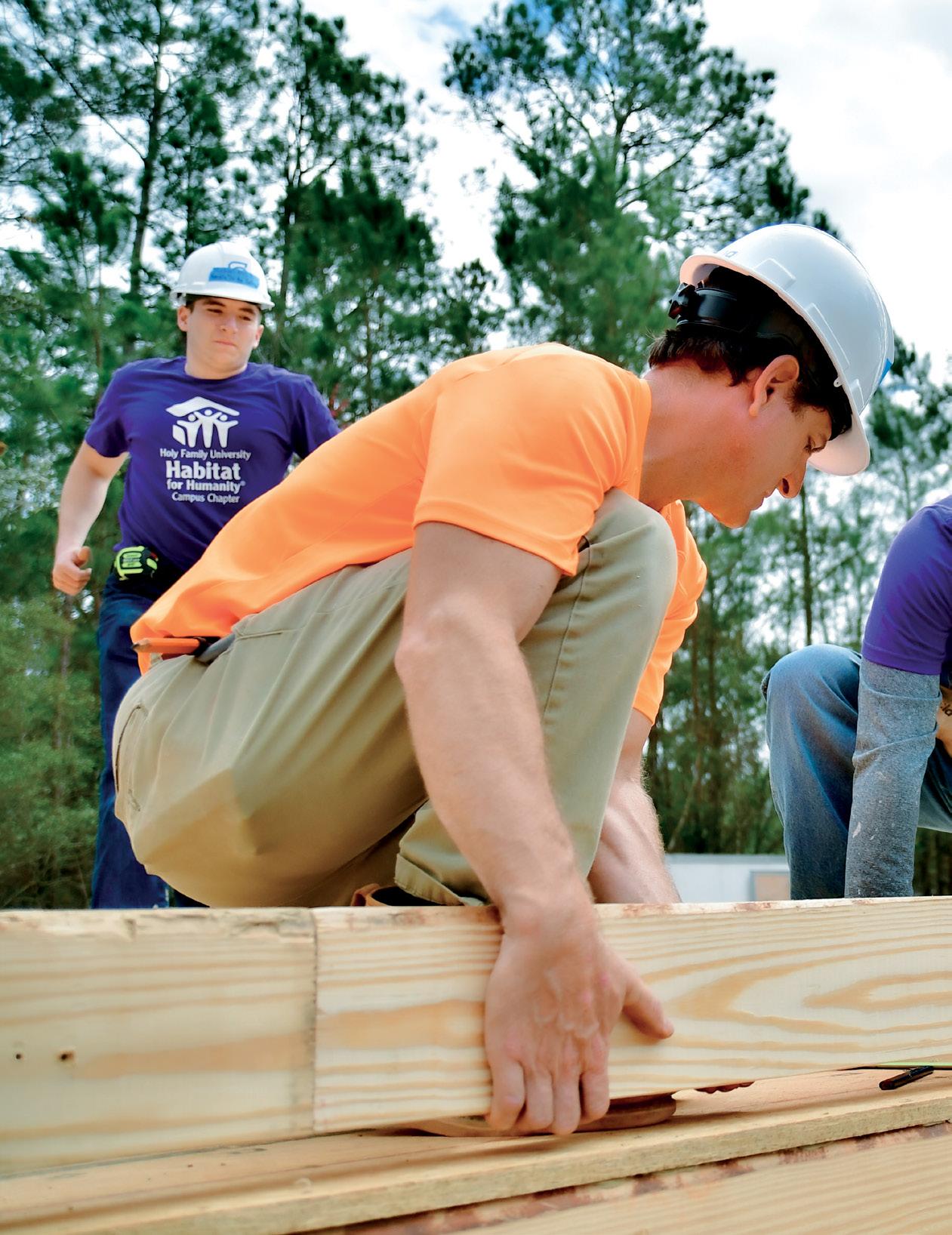
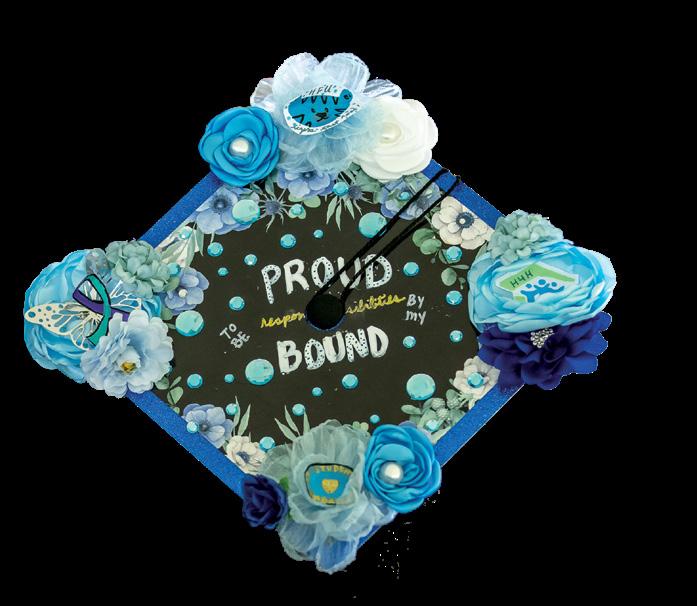
Michael Ferriello ’26 (left) and Eddie Earley ’26 (right) lived out the school’s motto—teneor votis, “I am bound by my responsibilities”—on a spring break trip with Habitat for Humanity. Twenty-two Holy Family students traveled to southeastern Louisiana to help a local family build their home.
TENEOR VOTIS
The Power of Local
In an age of globalization, regional universities have an unexpected advantage
30 Every Room Is a
Classroom
The University’s innovative new general curriculum takes a holistic approach to learning
36
My Mission
Living the lessons of Holy Family everywhere, from the classroom to a wildlife refuge. Plus: Everyday ways to embody the teachings
Ballpark Figures
Get to know the alumni behind every Phillies victory
5
5 Vision
What the World Cup means for the region; How to celebrate America’s birthday; Making history with Holy Family
Katherine Primus Vice President, Marketing and Communications
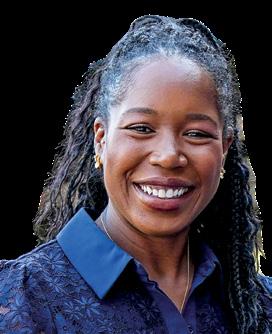
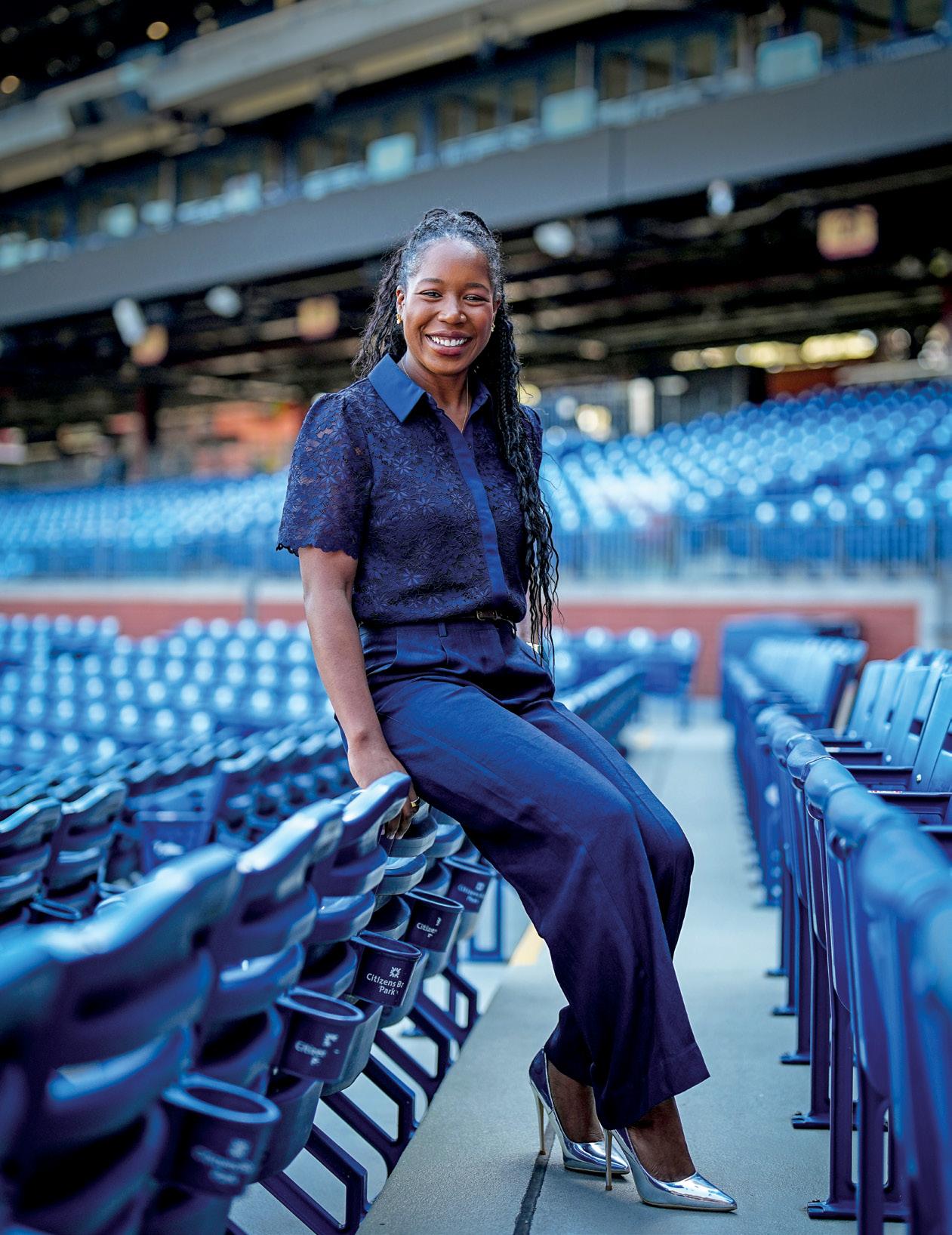
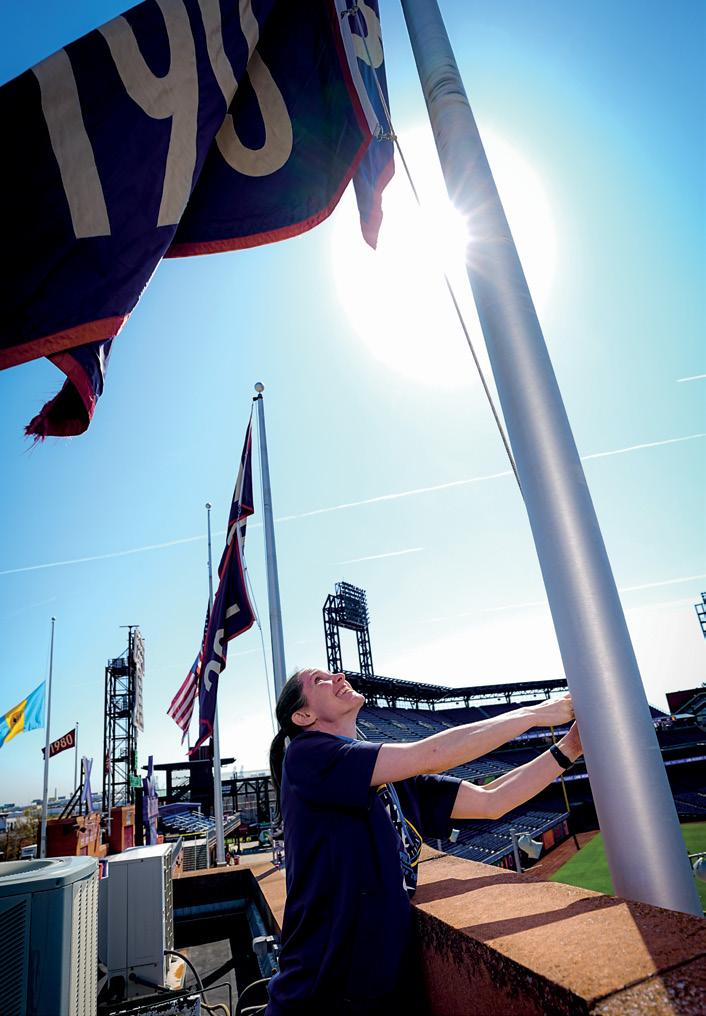
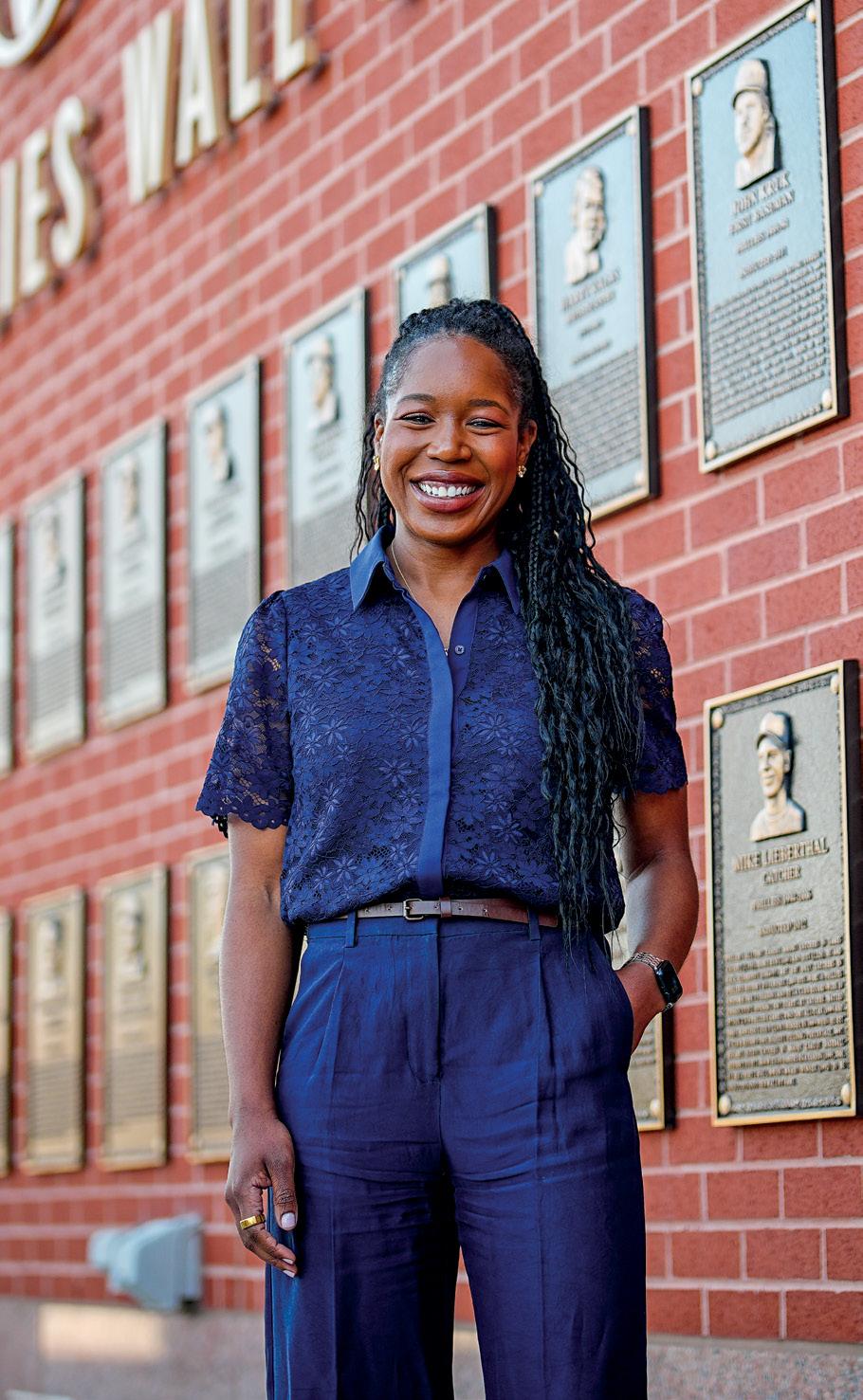
ON THE COVER: Bianca Freeman ’12, photographed at Citizens Bank Park by Miles Kennedy DEPARTMENTS
Holy Family University is a sponsored ministry of the Sisters of the Holy Family of Nazareth.
Updates from our community: a newly ordained priest, a feted transplant coordinator, a The Price Is Right! winner, and the Sisters’ 150th Jubilee
64
Final Details
Parting words from the Class of 2026 holyfamily.edu
YOUR SUPPORT
FUELS OPPORTUNITY, TRANSFORMS LIVES, AND ENSURES HOLY FAMILY’S LEGACY OF EXCELLENCE CONTINUES FOR GENERATIONS TO COME
We invite you to partner with us in this BOLD VISION, inspired by the Sisters of the Holy Family of Nazareth. To make a lasting impact on the future of Holy Family, contact Helene Baczkowski, vice president of advancement, at 267-341-3100.
NEWS AND VIEWS FROM HOLY FAMILY
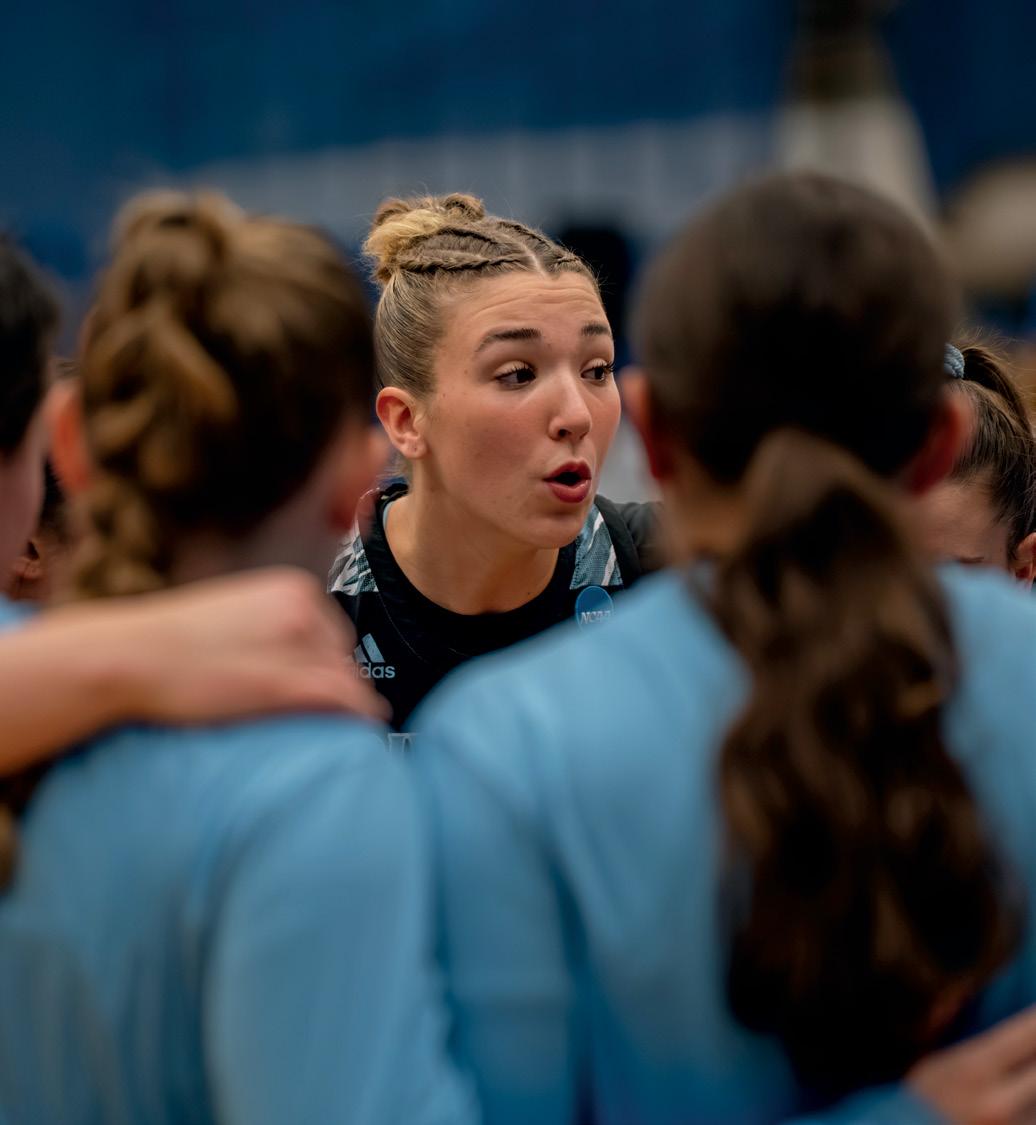
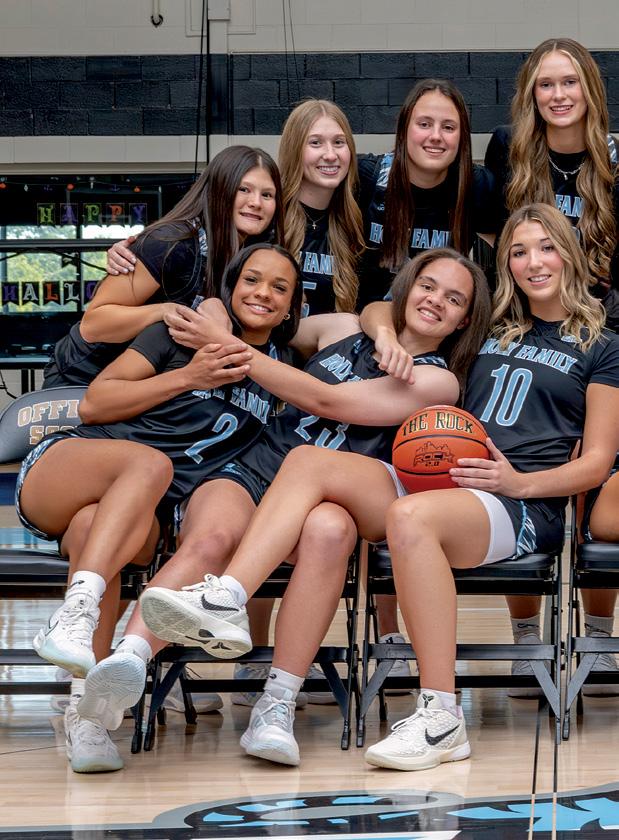
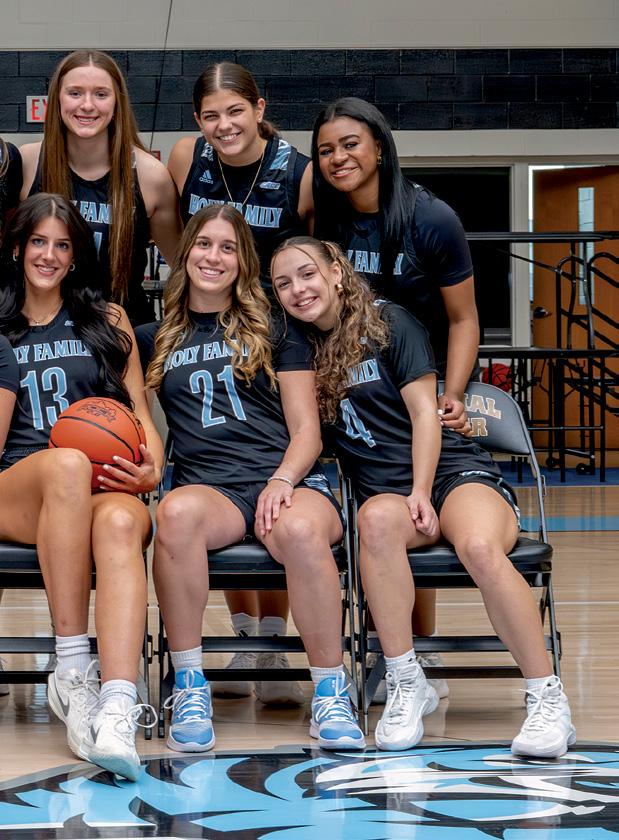
The most successful women’s basketball team in Holy Family history—including Taylor Hinkle ’26 credits its victories to teamwork both on and off the court.↓
Vision
Meet the Elite
The Holy Family women’s basketball team looked loose and jovial in the final minutes of a light morning shootaround. Overhead, the HFU Tigers logo dominated the 20-foot-high scoreboard in the UPMC Cooper Fieldhouse on the campus of Duquesne University in Pittsburgh.
As the practice session concluded, the players hurried to the center of the court, dividing into two rows and smiling for a photo to capture the magnitude of the moment. The next day, beneath the glow of the arena’s fluorescent lights, these women would become the first team in Holy Family program history to play in the NCAA Division II Elite Eight.
It would be the culmination of a season-long journey that began with a simple question: “Why not us?”
“That’s what we’ve been living by this season,” said Kara Meredith ’27.
The three-word motto had its origins in a team meeting that occurred in the summer of 2025. The Tigers were coming off a 2024–25 campaign in which they advanced to the NCAA Sweet 16, but they wanted more. As the athletes discussed what they hoped to achieve in the new season and how they would accomplish it, they settled on the phrase: Why not us?
It quickly became clear that few opponents had a winning response. The Tigers were 8–3 by New Year’s Day and proceeded to win the next 17 games, ending the regular season with a sterling 20–0 record in league play. Holy Family then won the first two rounds of the Central Athletic Collegiate Conference (CACC) tournament in early March before losing in the championship to Felician University on an overtime buzzer-beater.
But the team wasn’t done yet. The Tigers’ record earned them an at-large berth in the NCAA tournament for the second straight year.
“Understanding the importance of that sisterhood off the court, that’s what helped us get here,” said coach Bernadette Laukaitis ’00, crediting the team’s successes to the athletes’ work both on and off the court and the leadership of its seniors.
Taylor Hinkle ’26, one of the finest women’s basketball players to ever don the Holy Family uniform, was named the 2026 CACC Women’s Basketball Player of the Year and a consensus All-American. In four years with the Tigers, Hinkle was named to the All-CACC First-Team three times. “There’s nobody like her that we’ve seen in the CACC in a very long time,” Laukaitis said.
Skyler Searfoss ’26 embodied the will it takes to overcome life’s many adversities. She was the 2022–23 CACC Rookie of the Year but has since dealt with knee injuries and phenylketonuria, a metabolic disorder that requires a low-protein diet to manage. “It’s fairy-tale stuff,” Laukaitis said. “Anytime her team needs her, she’s ready to step up— not just as a player but as a leader of our team.”
Claire Dougherty ’26, a two-time CACC All-Academic Team honoree, was “one of the most mature kids I’ve
ever met in my life,” Laukaitis said. During a summer internship with KPMG, Dougherty worked from 8 a.m. to 4:30 p.m. and immediately hopped on a train to attend the team’s practices.
And Kaelah Carter ’26, a transfer to Holy Family, provided the Tigers with a jolt of shooting and defense on the court and added to the tight-knit sisterhood off of it. “The perfect piece to our puzzle,” Dougherty said.
The NCAA tournament began with two wins in Connecticut, propelling Holy Family to the East Regional final against Daemen University. When those two teams met in the regular season in late November, the Tigers lost by five points. But on March 16, Holy Family won, 78–62, punching its ticket to Pittsburgh. Following the win, players cut down the nets and took photos with loops of nylon hanging around their necks. Searfoss was named the East Regional’s Most Outstanding Player.
The evening before the Elite Eight, the team attended a banquet held for the remaining teams at Acrisure Stadium, home of the Pittsburgh Steelers. It marked another victory for Holy Family: Searfoss received the
← The 2025–26 Holy Family women’s basketball team earned a spot in the NCAA Division II Elite Eight.
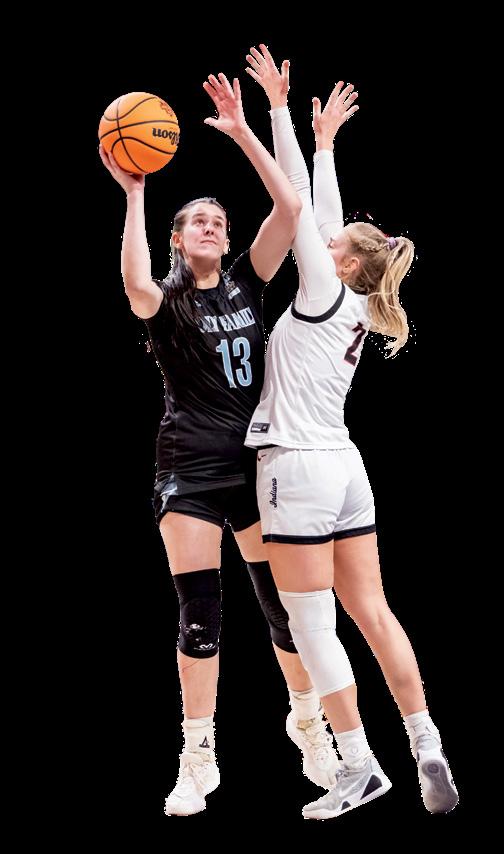
→ Claire Dougherty ’26 (right) scores against the Crimson Hawks during the NCAA tournament.
Elite Scholar-Athlete Award given to the student–athlete with the highest GPA at the NCAA championship.
The next afternoon, when the Tigers returned to the UPMC Cooper Fieldhouse to take on the Crimson Hawks from Indiana University of Pennsylvania (IUP), they still looked loose and comfortable—but there was now an unmistakable focus, despite the energy of the crowd, which included a contingent of Holy Family students and staff who had also made the trip.
IUP started the game in control and took a commanding 11–0 lead. Holy Family trailed by eight at halftime but fought to gain a 31–30 advantage late in the third quarter. The teams went back and forth, the tension mounting with each made basket, and the Crimson Hawks knotted the game at 48 with eight seconds remaining to force overtime. Holy Family couldn’t quite secure momentum in the extra period and ultimately fell, 57–52. Hinkle played 44 of 45 possible minutes and scored 19 points while pulling down 15 rebounds. The sleeve on her right knee was torn afterward—a sure sign she’d left everything she had on the court.
“All of them left it out there,” Laukaitis said, seated between Searfoss and Hinkle in the postgame press conference. “That makes you a proud coach. All you could ask for in these types of games is knowing that they went out there and did everything they could for their team and university. You could be nothing but proud of that result, no matter what.”
—Matt Press
7
things Tigers are talking about…
1
The Newest University Tradition
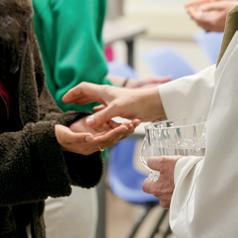
“Hands tell the story of what we do and who we are,” President Ann Prisco told the students, faculty, and staff who gathered at Holy Family’s recently opened Newtown West campus this spring. The community came together to start a new annual University tradition: the Blessing of the Hands, a cherished ceremony in the healthcare profession. “For nursing students and faculty, your hands will comfort patients, offer reassurance in moments of fear, and bring healing through knowledge, skill, and compassion,” President Prisco said. The inaugural Blessing of the Hands also recognized the contributions of the hands of the facilities team, which “made this campus ready for learning, for teaching, and for community.”
2
Alpha House’s Golden Anniversary
Look up at the ceiling in Alpha House and you’ll see its legacy—countless colorful handprints left behind by young graduates, some of whom have since sent their own children to the early childhood education center. This academic year marks 50 years for the school. It has been in its current location on Grant Avenue for 41 years, and for the last 24, Mary Becker M’11 has been a fixture for students and their parents, first as a teacher and later as director and principal. This year also marks her retirement from the school. “Her leadership was
defined by her ability to see the unique spark in every child,” says Jennifer DeCicco, dean of the School of Arts & Sciences and interim dean of the School of Education.
3
New Leadership in Business and Nursing
Two new leaders have stepped to the fore with complementary visions for the future of the University: Tobin Porterfield, the new dean of the School of Business & Technology, and Jinsy Mathew, the new dean of the School of Nursing & Health Sciences. Porterfield, who comes to Holy Family with industry experience and a record of academic leadership at Kean University, is already hard at work further integrating business leaders into the school, both in the classroom and through an advisory council. “We want students to be engaging with industry throughout their time here so that they’re ready for their internships and to go out into their career market,” Porterfield says. Mathew, a medical surgical nurse and nurse educator who has spent 11 years helping to shape the nursing school in vital academic and administrative roles, is pursuing a similar synergy between education and experience. “I am energized to cultivate an ecosystem that brings collaborative and interdisciplinary research together with clinical expertise to meet the needs of our students and our community,” Mathew says.
4 A Year of Big Wins
It wasn’t just women’s basketball. The 2025–26 academic year was a win for almost all of Holy Family’s sports teams. The University’s student–athletes made the playoffs in 15 of the 18 sports with post-season competitions. On the sidelines, three Holy Family coaches—Noah Morris of men’s lacrosse, Collin
Sibilia of women’s volleyball, and Bernadette Laukaitis ’00 of women’s basketball—were named Central Atlantic Collegiate Conference coaches of the year, and Holy Family’s student–athletes found success in the classroom, too. For the fifth year in a row, the University received the Presidents’ Award for Academic Excellence.
5
This Magazine
The magazine you are reading is named Votis for an important reason. Like the University motto from which it borrows its title, this new publication is a promise to the community. When it was selected by the Sisters of the Holy Family of Nazareth in 1954, the motto teneor votis—translated from the original Latin as “I am bound by my responsibilities”—was a response to the historical moment, explains Sister Brendan O’Brien, CSFN, ’75, who spent almost two decades as the University’s archivist. In the post-World War II United States, women’s colleges, especially those established by women’s religious communities, devoted themselves to service beyond self, modeling education oriented toward service, learning as a preparation for leadership, and a commitment to the common good. The dedication to community enshrined in Holy Family’s motto is “timeless and has reflected our University’s ability to continue its mission through the many changes and challenges,” Sister Brendan says. Votis will tell those stories.
6
Holy Family’s Future Podcasting Influencers
The next hit podcast just might get its start in a vibrant blue recording studio on the ground floor of Holy Family Hall. The new facility, outfitted with everything a student needs to record audio or video programs, was developed
in conjunction with English professor Robert Ficociello’s new course, Podcast & Vlogging. Over the course of the semester, students developed, recorded, branded, and debuted their own podcasts on topics ranging from commentary on internet culture to movie reviews to philosophical discussion. “Very rarely do I get smiles from my students for assignments,” says Ficociello, “but this was a lot of fun for them.”
7
Two Notable Retirements
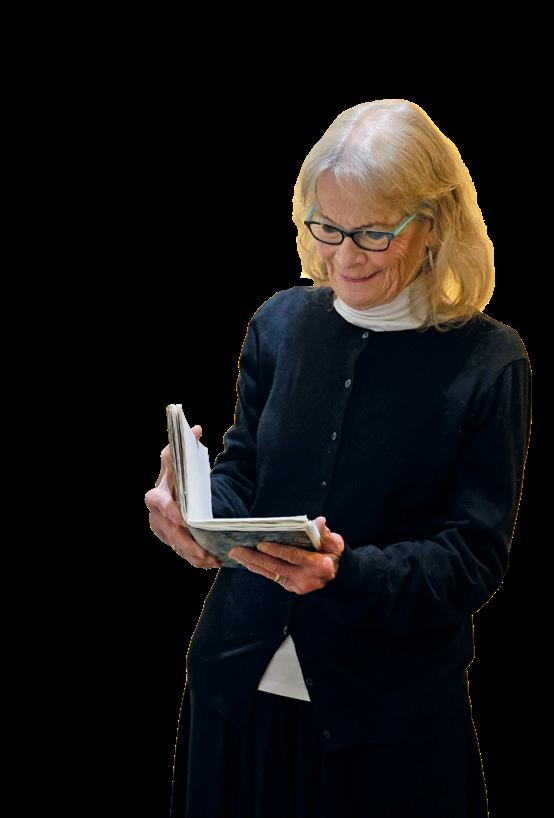
This fall, for the first time this century, Pamela Flynn (at right) and Claire Ann Sullivan will not be full-time faculty at the University. After a collective 63 years teaching Holy Family students, Flynn, a professor of art and the fine arts coordinator, and Sullivan, a professor of education, are both retiring. They will both continue to contribute to the community as professors emeriti. At the Celebration of Academic Excellence this spring, the professors were honored for their lasting impact. Flynn, who grew the art degree program, was celebrated for her legacy of artistic excellence and aca demic mentorship. Sullivan, who shaped the special educa tion programs, was feted for her dedication to her students and her scholarship and advocacy for people with disabilities.
BOLD IDEAS
Smart Mouths
New ways to think about your world from the experts at Holy Family
We asked Holy Family professors for their informed perspectives on some of the biggest questions facing the Philadelphia region right now. What does their academic research teach us about topics from the fentanyl crisis to the lasting impact of this summer’s World Cup?
The United States Has a Long History of Overcoming Divisions
By Mary Carroll Johansen, professor of history
In the 1770s, the idea of seeking independence from Britain was a minority position in the colonies as a whole and in Philadelphia in particular because of the pacifist Quaker influence. Only about 35% of people were in favor of independence, while about 25% of the population of the country was firmly loyalist and the other 40% really did not want to be involved. That split remained so stark after the war that tens of thousands left the new country. So, one of the first things the United States had to consider was, how do we deal with this division? That question was prominent in the drafting of the Constitution and shaped George Washington’s presidency. He worked hard to draw Americans together in support of the experiment in government they were embarking on.
The country has faced similar questions at each of its major anniversaries. At the centennial in 1876, the United States had just survived the Civil War and was facing a disputed presidential election. At the bicentennial in 1976, it was only a few years removed from the Vietnam War and the contentious issues of civil rights and women’s rights were center stage. And today, at the semiquincentennial, the country is deeply politically divided. But history shows us that Americans have figured out how to overcome differences before.
History shows us that Americans have figured out how to overcome differences before.
Emergency Teaching Certifications Alone Aren’t the Solution
By Claire Ann Sullivan, professor of education
We have a teacher shortage in the region, especially in special education and in secondary-education areas such as math and science. That has led some districts, including Philadelphia, to hire people with bachelor’s degrees who are not certified as teachers and enroll them in emergency certification programs. That sounds like a solution, but it isn’t. It’s a no-win situation. We’re asking people to figure out how to teach and how to learn at the same time, usually without any assistance from their schools. As a result, many people don’t finish the certification process, and the teacher shortage remains.
The issue is usually the most challenging in schools with the greatest need. Those schools often lack the resources to prepare these untrained teachers. What if we could offer classroom management seminars? What if we could create teaching partnerships and mentorship programs? These new teachers need a different type of support to be successful than those who have taken a traditional path into the profession. At Holy Family, we’re working on a new approach that brings these novice teachers together to access the resources and network necessary to thrive.
For the Region, World Cup Success Will Be Decided off the Field
By John Dellipriscoli, assistant professor of economics
I’m a soccer fan. I’ve played soccer; I’ve coached soccer; I study soccer. I think the World Cup is an amazing event—but it looks much different to an economist than it does to a fan. From an economist’s perspective, megaevents like the World Cup and the Olympics come with both benefits and costs. We mostly hear about the benefits: FIFA estimates the World Cup could generate $770 million for the Philadelphia economy. But that doesn’t account for, for instance, the financial investment needed to prepare SEPTA for increased ridership.
The overwhelming consensus of those who study these things is that when you look at the full picture, there is little to no short-term economic benefit in mega-events. The real value, then, is in the boost to people’s sense of civic pride and—if made smartly—the investment in community infrastructure that can accompany these events. The World Cup will be a win for the region if locals and visitors alike have a fantastic experience in Philadelphia both during the 39 days of soccer this summer and long afterwards.
Police and Public Health Officials Need to Work Together
By Patricia Griffin, associate professor of criminal justice
Fentanyl is an urgent and evolving crisis in Philadelphia. That’s what my co-author Darren Stocker and I wrote in a recent book chapter tracing the history of the synthetic opioid, which was documented in the heroin supply in Philadelphia in 2006 after an unexplained increase in overdoses. Over the next decade, despite short-term law enforcement successes, fentanyl became entrenched in the city, especially in Kensington, and it was clear new ideas were needed. The question was, where would those solutions come from? That’s what I ask in my research: Who is responsible for community safety and well-being? In Philadelphia starting in 2016, responsibility for addressing the fentanyl crisis fell almost entirely on the public health sector and harm-reduction strategies that could not ultimately stem the flow of the drug or address its effects on the community. Since 2024, Philadelphia has pursued a multipronged strategy that pairs law enforcement with the public health sector, two groups that don’t traditionally work together. It’s too soon to say if this novel approach will work, but it could provide a brighter future for Philadelphia and a new model for community safety and well-being.
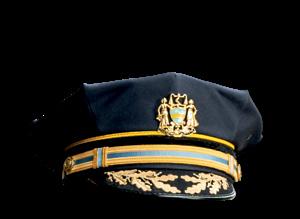
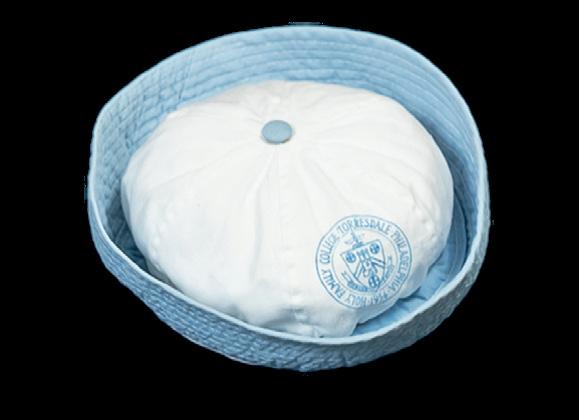
Through most of Holy Family’s first two decades, first-year students were welcomed to campus with “dinks” or “dinkie hats”—like this one donated by the late Linda DiSandro ’72—and some friendly ribbing from their “big sisters.”
Let’s Make History
Helping the University Archives preserve Holy Family’s traditions
Hoffman McGrath donated a lapel pin from Logos, Holy Family’s philosophy club. Logos— the “‘thinking’ man’s and woman’s club,” one yearbook says—was active at least through the ’60s and ’70s.
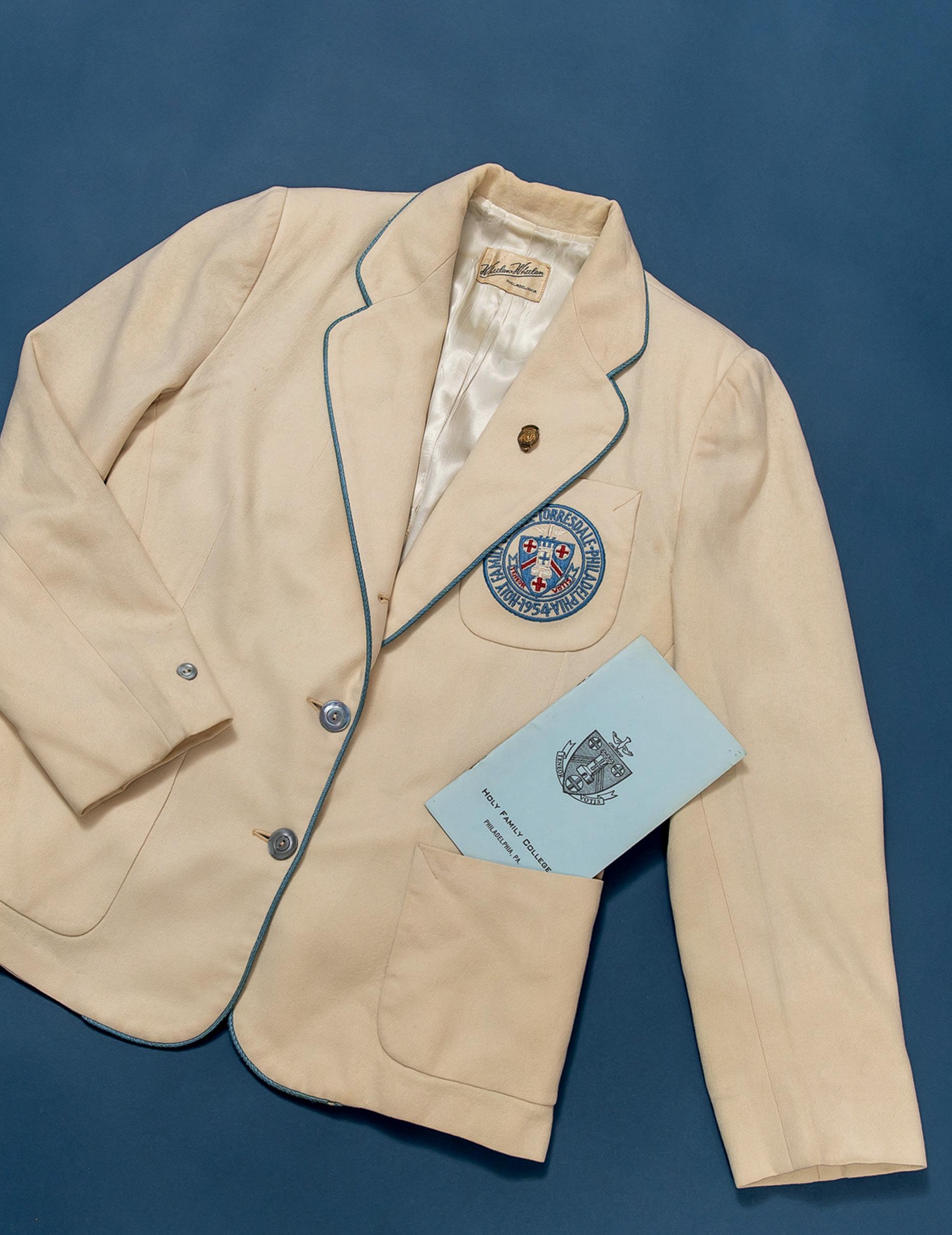
On a clear, sunny day in the fall of 1960, each sophomore at Holy Family College was presented with a prized symbol of the school: a white blazer trimmed in baby blue with the college’s seal embroidered on the pocket. More than 60 years later, Catherine Hoffman McGrath ’63 returned hers to the Philadelphia campus where she once wore it. In donating the garment to the Holy Family University Archives, Hoffman McGrath has ensured that Blazer Day, a rite of passage that ran from at least 1955 to 1969, will be remembered by future generations of graduates.
Holy Family’s first 72 years are rich with such traditions, and the University Archives is collecting the physical objects that have shaped students’ experiences—from a telephone switchboard that once sat in Holy Family Hall to the shovels used to break ground for the building’s current expansion. Alumni with mementos of the University can contact the Archives to explore the possibility of donation: holyfam.info/ archives.
—April White
In 1979–80, students faced each other in the Battle of the Classes, took to the rink for a roller-skating party, and competed in something called the “Jelly Bean Contest,” according to a planner in the Archives.
The Nation’s Party Planners
What it takes to throw America’s 250th birthday bash—and what the celebration will mean for the region
Philadelphia is America’s birthplace, and for nearly 250 years, the city has also been the epicenter of the nation’s birthday celebrations. In 1777, there were bonfires, music, and fireworks. A century later, the Centennial Exposition introduced the world to the typewriter, Heinz ketchup, the electric light, and the telephone. The sesquicentennial in 1926 reshaped the city’s landscape with landmarks like the Benjamin Franklin Parkway and the Benjamin Franklin Bridge, and the 1976 bicentennial brought cultural institutions and enduring icons such as the LOVE sculpture.
“It’s all about us,” says Dana Russikoff ’92. “This is where it all started, and we’re proud.”
Russikoff is the executive director of One River Alliance, a nonprofit that connects neighborhoods to the Delaware River through programming. Since 2019, the organization has hosted the July 4 FreedomFest in Pleasant Hill Park in East Torresdale. The event was inspired by the all-day Fourth of July gatherings Russikoff
remembers as a kid at her grandmother’s in Lawncrest, but it quickly grew from a fireworks show into an all-out party with food trucks, live music, beer gardens, children’s activities, and even a Ferris wheel that affords revelers sweeping views of the river. Russikoff and her team have been planning for 12 months
for the country’s 250th, which will include a grand fireworks finale and the installation of Pleasant Hill Park’s first permanent flagpole.
“When the fireworks are done and the finale’s over—everybody just clapping and hooting and hollering and the yells and the screams—I get emotional just thinking about it,”
Russikoff said. “It just brings us back to the basics and instills a real sense of civic pride.”
Tourism experts estimate that the region could see more than one million additional visitors this year drawn to the semiquincentennial and adjacent events. Everyone wants to be associated with the celebration, from Netflix, which opened its Netflix House attraction at the King of Prussia Mall, and Cirque du Soleil to the marquee sports leagues scheduling their signature matchups—the FIFA World Cup, the PGA Championship, and the Major League Baseball All-Star Game.
Valley Forge National Historical Park is among them. “I think we’re going to see an increase in visitation and therefore a positive economic impact, and we hope the lasting impression that people have is ‘wow, Valley Forge and Montco are great places to stay, and I want to go back,’” explains Rachel Riley ’04, vice president of marketing and communications at the Valley Forge Tourism & Convention Board. The organization has been planning for 2026 for two years. In addition to being the nation’s 250th, this July 4 also marks the 50th anniversary of the establishment of Valley Forge National Historical Park—the only national park that shares a birthday with the U.S. And the region is ramping up to commemorate the 250th anniversary of George Washington’s encampment at Valley Forge for the winter of 2027–2028. “We are encouraging everyone to retreat to Valley Forge now and return later,” Riley says.
Visitors to the region will find opportunities everywhere to learn more about the founding of the country: The First Bank of the United States, closed to the public since the bicentennial, will reopen in July with exhibits about American diplomacy
and Philadelphia’s role in celebrating the country, and traditional cultural sites like the Philadelphia Museum of Art and the Museum of the American Revolution are hosting special events throughout the year. But the country’s story will also be on display in less expected spots, such as along the southern Delaware where the Delaware River Waterfront Corporation is curating “As Freedom Flows,” an open-air art gallery stretching from Cherry Street Pier past Spruce Street Harbor Park. “We want to be a complementary resource to all the other things going on in the city to make sure that the people connect fully all the way around,” says Joe Forkin ’95, president and CEO of the organization.
Installations along the waterfront will include artist Paul Ramírez Jonas’s “Let Freedom Ring,” an interactive piece that plays “My Country ’Tis of Thee” and invites the listener to complete the song by ringing a 600-pound bell, and “Roots of Resilience,” a collection of flags designed by different artists in celebration of Philadelphia’s immigrant spirit. The goal is to draw both visitors and locals to the river, now and for years to come.
For Forkin, the real test will come after the crowds disperse.
“Have you properly set yourself up to take advantage of that year, a year from when it ends?” he says. “All of the programmatic activity that you placed in there, all the activations that you did, all the street cleaning and murals and flower planting and tree planting and all of that stuff to increase the visitor experience to Philadelphia, is that going to be maintained throughout?” That, he says, is what will ultimately determine if the semiquincentennial is a success in America’s hometown.
—Jennifer Myers
WASHINGTON (ALMOST)
SLEPT HERE
Centuries before it would become home to Holy Family University, the land on which the Philadelphia campus sits ran alongside the British colonies’ first highway, which reached from Boston to Charleston. Where the King’s Highway crossed the Poquessing Creek—more or less where Frankford Avenue does today—a tavern opened in about 1730. It would be known as the Red Lion Inn, and by virtue of its location, it would become a regular stop for people like John Adams, who traveled to Philadelphia to agitate for independence.
During the Revolutionary War, this stretch of road was key to the movement of the Continental Army. In the first days of September 1781, the army and its French allies camped along the banks of Poquessing on the way to the decisive Battle of Yorktown. Commander George Washington may have slept at the Red Lion Inn that night, although one diarist says he continued on “to Philadelphia, with forty or fifty men, who rode sword in hand as a guard.”
History would come even closer to Holy Family’s future campus after the British surrendered in Yorktown, according to the National Park Service. In late 1781 and early 1782, the victorious French troops established a camp near what is now the intersection of Grant and Frankford.
—April White
It All Adds Up
Neither Mary Rudy ’83 nor her husband, David Rudy ’83, planned to attend Holy Family. Circumstance— and a bit of fate—brought them to the University and ultimately to each other. But supporting the school that shaped their lives has been a deliberate choice for the couple.
Mary attended Nazareth Academy. A few years before she started at the school, her father died. Her mother supported the family on railroad death benefits that would end when
Mary turned 18. “So, it was either get a job or get into a college,” she says. “It was 1978, and there were not a lot of opportunities.”
Just as she began to lose hope, Mary received the call that would change her life: She had been awarded a full four-year scholarship to Holy Family from the McShain Foundation. “It was just dropped into my lap,” Mary says; she had not applied for the scholarship.
She suspects a quiet advocate may have helped. Sister Florence Tumasz, CSFN, one of the six Sisters of the Holy Family of Nazareth who founded the University and its first academic dean, was her mother’s cousin. “She may have dropped my name on some list, but she never admitted to it,” Mary says.
“I had fallen through the cracks until I got that phone call.”
Mary Rudy ’83 on the life-changing scholarship opportunity that allowed her to attend Holy Family
Meanwhile, David was working construction while earning an associate’s degree from Bucks County Community College. When mortgage rates hit 18% in 1981 and construction slowed, “I decided I should go to school since we weren’t doing any building,” he says.
The pair met crunching numbers.
“We were taking business classes together and he started following me around like a little puppy,” Mary recalls. “We started studying together and things just went from there.”
“She was bright—she was exceptionally bright,” David says.
“And he’s exceptionally bright,” Mary says.
They married the year after graduation.
Mary went on to spend 35 years as an accountant with the City of Philadelphia Department of Revenue. David founded a roofing company, later ran a cigar shop in State College during the cigar boom of the 1990s, and eventually built a
business buying and renovating rental properties.
The Rudys have long supported Holy Family with annual gifts, and their philanthropy has deepened in recent years. They established a scholarship fund, contribute to the general fund, and have included the University in their estate plans.
“It just feels good to give,” says David, who serves on the President’s Advisory Council. “We have everything set up in trusts and Holy Family will receive 25% of our estate.”
For Mary, the decision to give is deeply personal. She often reflects on the uncertainty she faced before receiving that scholarship. “I had fallen through the cracks until I got that phone call,” she says. “It is nice to know that someone else may not fall through the cracks or that the crack may not be as wide.”
—Jennifer Myers
GIVE BOLDLY. CHANGE LIVES. holyfamily.edu/give
BY THE NUMBERS
BOLD VISION Campaign
2,129 donors
$23.3 MILLION donated 93% of the way to the goal of $25 million
10,000 square feet of space in Holy Family Hall’s new Welcome Center, made possible by the campaign
BRENDA NADICJKA-HIGGINS ’73
Why I Give
My husband Brian and I support Holy Family University for many reasons.
Number one: the large percentage of students at Holy Family who are the first in their families to attend college. I can relate to this because my sister and I were the first to attend college from our family, and we were both really grateful for the help from Holy Family.
Number two: the tuition at Holy Family University is kept at a moderate level, much lower than other universities.
Number three: Holy Family University has increased the number of majors that are relevant and needed. Students can really get employment and attend graduate school with these majors.
Number four: Holy Family has had a succession of dynamic presidents who have held future visions for the University. We enjoyed speaking with Sister Francesca, Sister Maureen, and Dr. Prisco over the years and have seen many of their plans for our University fulfilled.
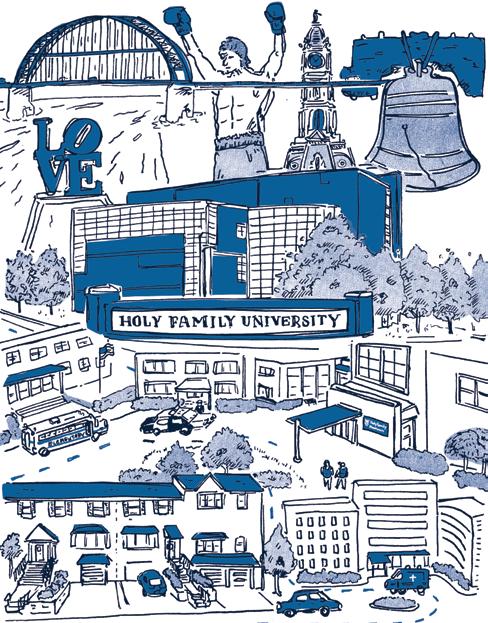
THE POWER
ILLUSTRATIONS BY SEAN
Philadelphia-based illustrator
LOCAL
IN AN AGE OF GLOBALIZATION, REGIONAL UNIVERSITIES HAVE AN UNEXPECTED ADVANTAGE
STORY BY ANNE PRISCO, P h .D. Holy Family University president
RYNKEWICZ
A FEW YEARS AGO, leaders at the Children’s Hospital of Philadelphia and Jefferson Health identified an urgent challenge facing hospitals and longterm care facilities nationwide: a growing shortage of certified nursing assistants, or CNAs. These essential caregivers monitor vital signs and support patients in their most vulnerable moments, often serving as the primary point of contact throughout a patient’s care. Yet the pipeline of trained CNAs was lagging far behind demand. In Pennsylvania alone, a survey by leading healthcare associations found a 17% vacancy rate among nursing support staff, leaving critical gaps in care across the commonwealth.
Those local healthcare leaders brought Holy Family into the conversation. Several were graduates of the school. They knew our mission, our programs, and our commitment to preparing students for service in their communities. They asked a simple question: Can you help?
Within months, Holy Family’s faculty and administrators were exploring solutions. The dean and vice dean of the School of Nursing & Health Sciences completed a “train-the-trainer” program to understand exactly what CNA preparation required. They developed a curriculum, secured state approval, and in about a year, by fall 2024, a simple conversation had turned into a real solution.
This is what it looks like when a university is deeply connected to its region. The ability to respond quickly didn’t come from a new initiative or a major grant. It came from listening, consistently and closely, to the needs of the community. At a moment when higher education is being asked to prove its value, that kind of responsiveness matters. It also points to something larger: Regional universities are uniquely positioned to meet both the current challenges facing higher education and the economic needs of the communities they serve.
HIGHER EDUCATION today is under intense scrutiny. Public confidence in colleges and universities has eroded in recent years across political and economic lines. Today, 70% of Americans say that higher education is headed in the wrong direction, according to a 2025 Pew Research Center survey. Families are considering not just tuition costs but the debt students may carry after graduation and whether a degree will lead to stable, well-paying employment. Employers, for their part, are looking for graduates with relevant skills who can contribute on day one.
The message is clear: Higher education can no longer assume its value—it has to prove it.
Regional universities are responding to that pressure in a fundamentally different way from either large national universities or small liberal arts colleges.
For much of higher education’s history, the phrase “town and gown” captured a divide between universities and the communities around them. But for many regional institutions like Holy Family, that separation has never fully existed. Our students are overwhelmingly local. They commute from nearby neighborhoods, balance coursework with jobs and family responsibilities, and often remain in the region after they graduate. That proximity creates something powerful: a continuous exchange between education and the workforce.
At Holy Family, when local healthcare systems face staffing shortages, we hear about it quickly. When school districts need teachers or regional businesses need employees with specific technical skills, those conversations often begin through existing relationships—with alumni, local leaders, and community partners who see the University not as a separate entity but as part of a shared ecosystem.
The CNA program is one example of this model in action. The University has long had a robust healthcare education program, graduating more than 350 highly qualified nurses each year, so it was natural to respond to this new gap in the medical workforce with multiple training pathways, including a yearlong program offered through a partnership with St. Hubert Catholic High School, a 15-week program, and an accelerated course. Students can move efficiently from training into certification and directly into jobs where they are urgently needed.
And the same pattern appears across disciplines. Regional growth in the life sciences sector has led to
“
expanded programs in biotechnology and advanced health professions at Holy Family. The rise in digital threats has driven the development of cybersecurity offerings. Conversations with labor organizations are shaping potential new business programs designed to help skilled tradespeople build and manage their own companies. Emerging needs in emergency response are guiding the development of new training programs in that field as well.
These efforts share a common principle: They are built in response to real, identified needs, not assumptions about what students or employers might want, but direct input from the communities we serve.
That kind of alignment benefits everyone. Students gain access to clear pathways into meaningful careers. Employers build reliable pipelines of talent. And regions strengthen their economic resilience by developing the workforce they need from within.
THIS MODEL WORKS in one place, so what could it look like at scale?
What would happen if communities across the country treated regional universities as essential partners in economic development? What if, instead of viewing them primarily as educational institutions, we recognized them as engines of workforce growth, social mobility, and regional stability?
The implications are significant.
Policymakers could prioritize investment in programs that are directly tied to local workforce needs, supporting universities that demonstrate strong partnerships with employers and clear outcomes for students. Employers could play a more active role in shaping curricula, creating training pipelines, and investing in the institutions that prepare their future workforce. And colleges and universities could build more agile systems, shortening the distance between identifying a need and launching a program designed to meet it.
Many regional universities are already doing this work. But with greater alignment and support, they could do far more. They could expand access to
At a time when higher education is being asked to demonstrate its relevance, regional institutions offer a clear and compelling answer. Their strength lies not in competing on a national or global stage but in being deeply rooted in the places they serve.”
affordable, flexible education for students whose lives don’t fit a traditional residential model. They could respond more rapidly to shifts in industry and technology. And they could help anchor opportunity in communities that might otherwise be left behind in broader economic change.
At a time when higher education is being asked to demonstrate its relevance, regional institutions offer a clear and compelling answer. Their strength lies not in competing on a national or global stage but in being deeply rooted in the places they serve.
Being local is not a limitation—it’s leverage. If we take that idea seriously, the future of higher education will be measured not by size or recognition but by the strength of its local impact and the vitality of the communities it serves.
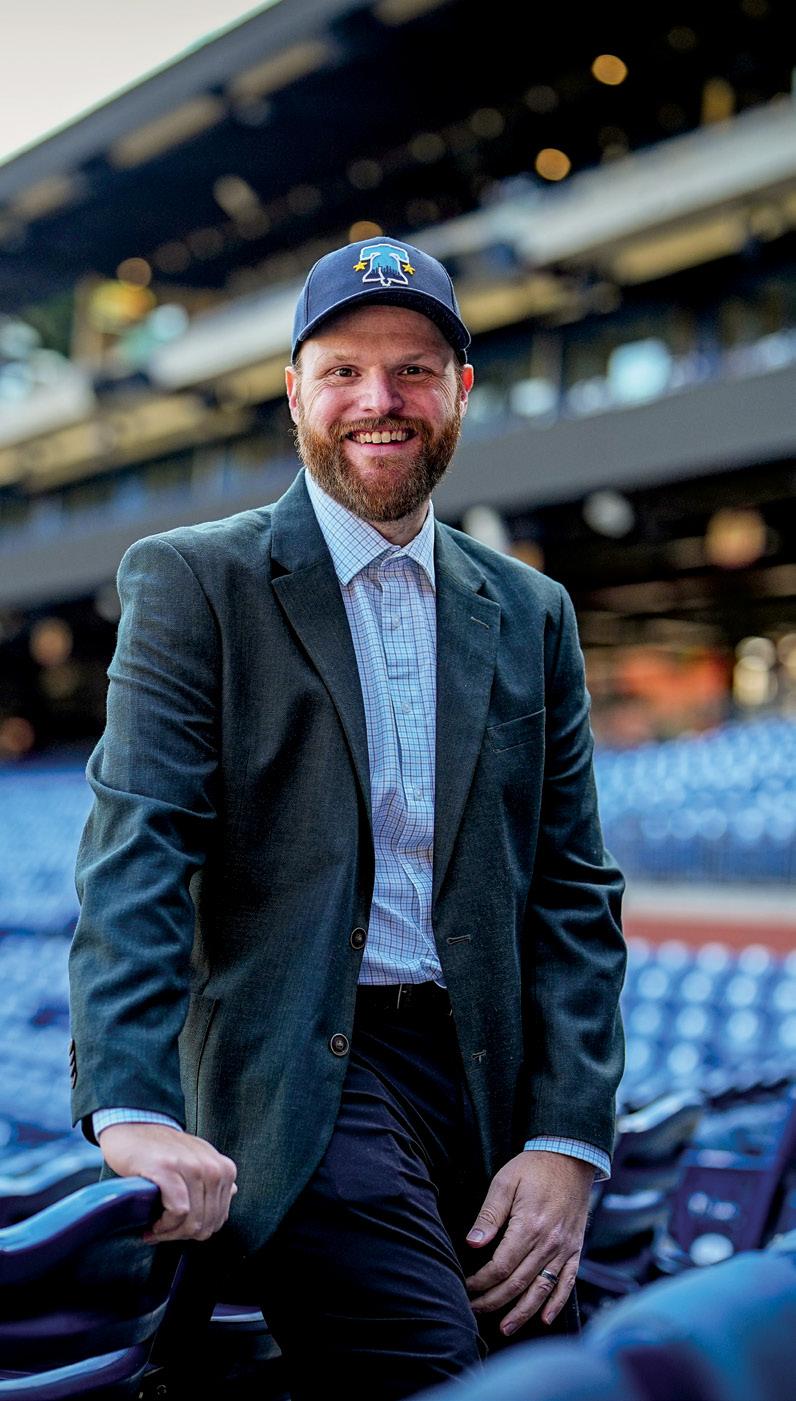
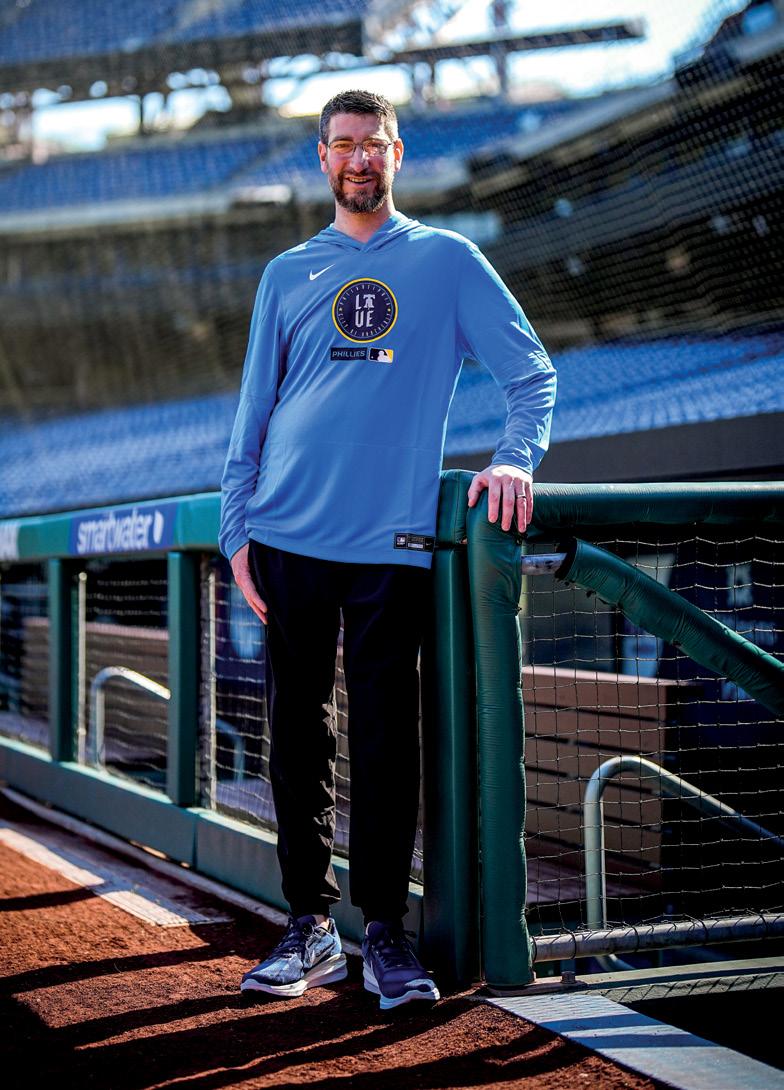
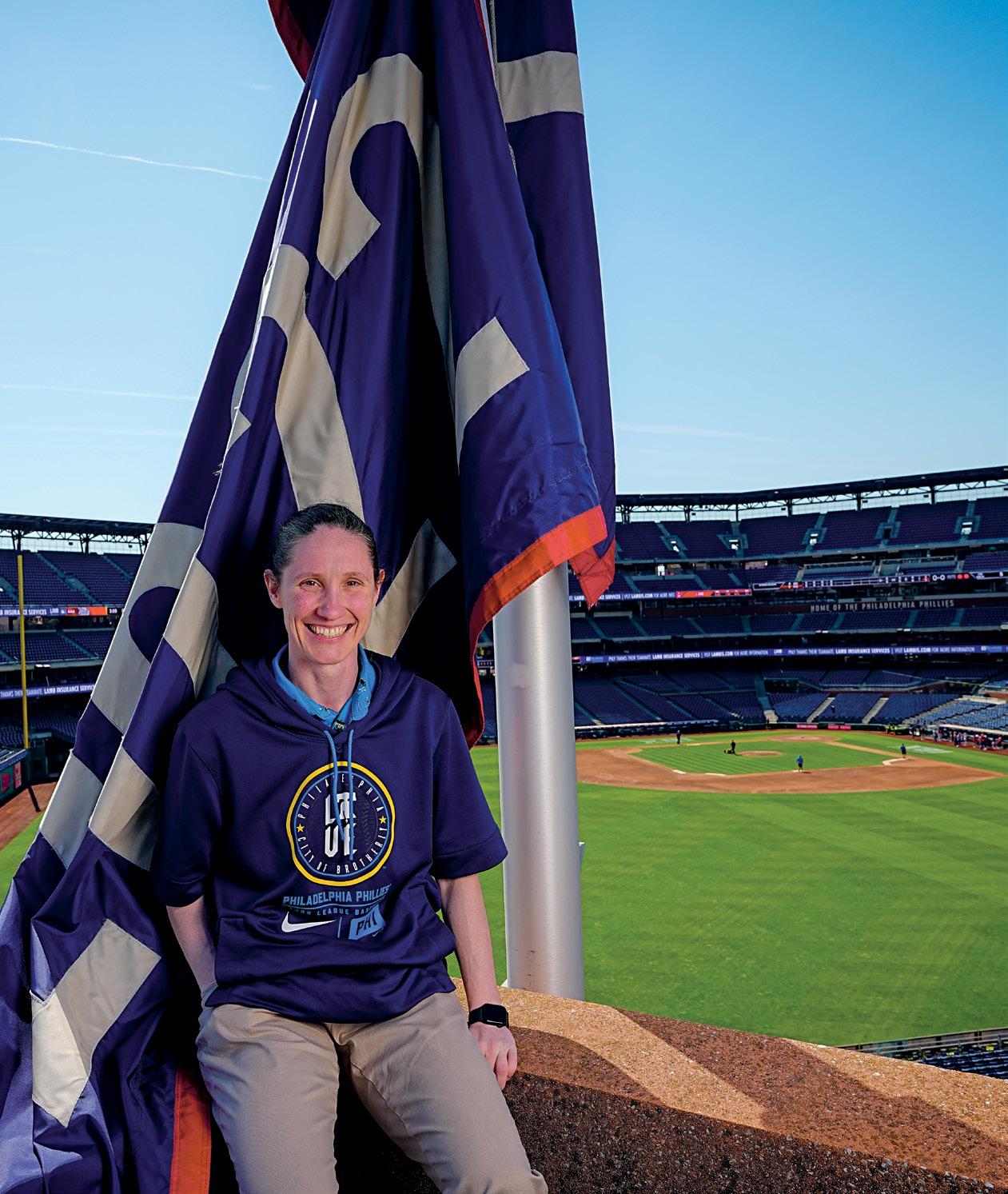
BBefore the men in red pinstripes run on to the diamond, before a single fan enters Citizens Bank Park, even before the first pitch of spring training in Clearwater, there are some 700 people at work yearround behind the scenes of the Phillies organization. (And as many as 1,750 more on game days!) It takes this unseen team—of operations experts, sales whizzes, marketing mavens, medical professionals, and many, many others—to make the team on the field the Philadelphia institution it is. We asked five Holy Family alumni what it takes to hit it out of the park every game from opening day well into October.
RYAN SIMON ’11 TICKET SERVICES MANAGER
Many hats: Simon has worked for the Phillies organization as an usher and a salesperson, in the merchandising department and on the giveaway staff, and he has spent the last 10 seasons in ticketing services. “I just love being at the ballpark.”
Coaching staff: “I often liken this role to a college football coach.” Managing ticketing services means recruiting talent, mentoring employees, and meeting the media, in a sense. “When things have gone sideways on the football field, the coach has to stand on the podium and talk to the press about what went wrong. That’s me on the phone with customers who are unhappy with one of my employees. I take accountability.”
The Philadelphia fan: “The beauty of Philadelphia is, the sky is falling if we lose three games in a row, but when we win three games, there’s no better place to be.”
Off the field: “We have no control of what happens on the field, but what we can control is the experience that fans have with us. The beauty of the Phillies—and it’s one of the things I think that separates us—is we try to do our best in making decisions that are fan-first. ”
Unexpected claim to fame: While in merchandising, Simon also served as a bobblehead model. His hand was the basis for Phillies pitcher Cole Hamels’s and his foot stood in for 1990s fielder John Kruk’s. “They put me in a mullet wig when they did that photo shoot.”
SEAN BOWERS '07
CLUBHOUSE OPERATIONS
COORDINATOR
In the club: Bowers started as a bat boy for the team in 2002 at the age of 16 and continued in the role while at Holy Family. After an operations internship at Phillies spring training, “I told myself I wanted to stick around as long as I could in the clubhouse.”
The job: “We are essentially the equipment managers.” Bowers and his colleagues have to anticipate next season’s team’s needs nearly a year in advance. They also pack up the athletes’ basic gear for road trips. “If they’re going to Denver and San Francisco, we make sure everybody has a lightweight and a heavy jacket in the bag. That’s not always something they will think about.”
It has happened: “Guys have forgotten their gloves. That one’s on them.” (Bowers will overnight the missing game equipment.)
All that laundry: Between batting practice gear, game uniforms, and lots and lots of towels, Bowers often runs 20 loads of laundry a day. “Early season grass stains are the worst—I always thought they must spray-paint the field, but they say it’s the fertilizer—and super-thick pine tar is tough to get out, too.”
What fans don’t see: The predawn unpacking. “Anytime the team comes back from a road trip, we meet the team and we unpack the equipment, the laundry, and the luggage.” That includes the golf clubs many players take on the road. “We have a separate storage area for that.”
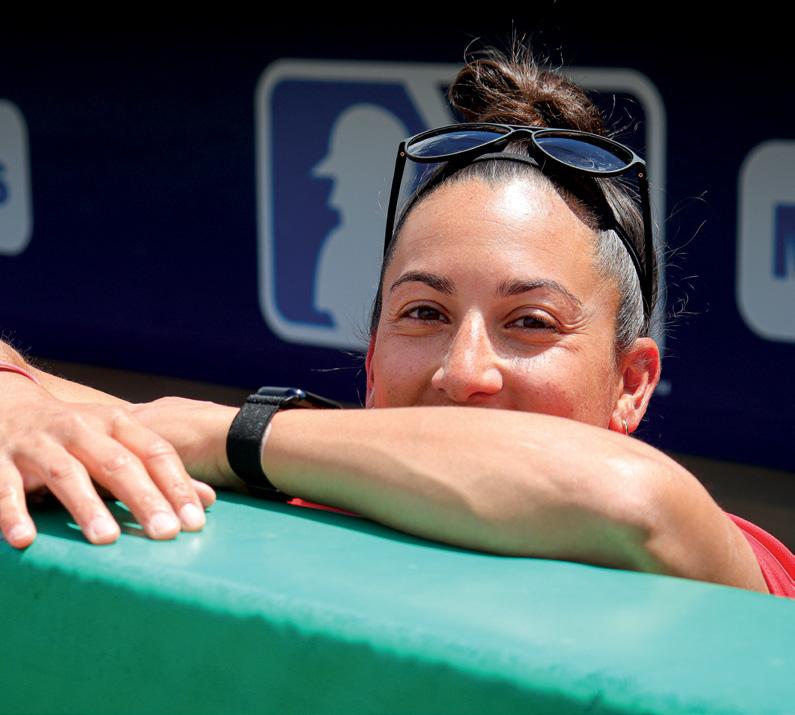
BIANCA FREEMAN ’12 DIRECTOR OF PARTNERSHIP MARKETING
First role with the Phillies: As an usher in 2012, during her senior year at Holy Family. “I was positioned somewhere different within the ballpark every home stand, and I greeted fans, answered any questions they had about the ballpark, and showed them to their seats.”
On the field: Freeman played centerfield for the Holy Family softball team, recording more than 100 hits in her career as a Tiger.
Why this team:
“I grew up watching the Phillies with my mom and dad. It was always my dream to work here in some capacity. So, I figured majoring in sports marketing was the next stepping stone there and then I would figure out the best way to get my foot in the door within the organization after graduation.”
Day-to-day duties: “I oversee the partnership marketing team, which is responsible for managing all of our partner relationships and bringing every element of those partnerships to life. That includes everything from stadium signage to branded social content, TV and radio commercials, and any sponsored community events—anything that you see tied to a brand in the ballpark. A big part of the partnership marketing is making sure our partners feel like true extensions of the organization and not just sponsors.”
New this season: Freeman and her team helped to create and launch the Kings Swings Playground inside the First Base Gate, the exclusive Philadelphia Insurance Club behind home plate, and the newly renovated Cadillac Hall of Fame Club overlooking the diamond.
GIANNINA CIPOLLONI M’18 MENTAL PERFORMANCE COACH
Most common question: “What is a mental performance coach?” People often confuse mental performance resources with mental health resources—two different departments in the Phillies organization. “I’m helping the player’s performance from a mentality standpoint: how to maintain your calm under pressure, how to focus on the right things. When people hear that they say, ‘That’s amazing’ and ‘I need that.’”
Why this profession: “I had the yips playing softball at the University of Virginia. I had never experienced a mental block that stopped me from being able to play a sport that I’d been doing since I was eight years old. So, I started working with a mental performance coach. I felt like I ran out of time in college, so it’s really been a
passion of mine to work with athletes to help them develop their mental game before they even get to a block.”
Where to find her: Cipolloni works primarily with rookie-level players in Clearwater, Florida “on the field, in the dugout, in the batting cages, in the bullpen, working sideby-side with other coaches to help the players be the best version of themselves they can be.”
How to keep your calm in front of 43,000 fans: “Some people actually thrive in that environment. They’re using that adrenaline to focus in on what they need to do. For others, it’s learning how to regulate emotions. We work a lot on how to breathe correctly and focus on the right things at the right time. When the pitcher releases the ball, a hitter can’t be focused on ‘wow, these fans are all here and, oh my gosh, what happens if I strike out?’”
VALERIE MILLER ’14 BALLPARK OPERATIONS COORDINATOR
First pitch: “I started playing baseball in the first grade.” Miller continued on to play softball at Holy Family and the love of the game led her to a Phillies internship during her senior year.
Out of the park: In 2015, Miller was a ball girl, a role with on- and off-field responsibilities. “We were assigned to Philadelphia Parks & Recreation locations to teach kids about fitness. Running around outside and playing games—I wouldn’t trade that for anything.”
What it takes: “As a kid I would just come to the games and I had no idea about all the stuff that happens behind the scenes. I’ve done a little bit of everything: pulled tarp on the field, driven a forklift, raised the championship pennants. I was even giving tours at one point. It’s different every day.”
A little help: Miller is involved in interviewing and onboarding the hundreds of game-day staff—ushers, security personnel, ticket-takers— who make the stadium run.
Fan favorite: “I handle all of our fan comments—all of the phone calls and emails and handwritten forms. They aren’t all bad. There are people who comment to praise our staff. Those make it worth it.”
Most memorable moment:
“The 2022 post-season was like lightning in a bottle. I never thought I would work a World Series game. It was all adrenaline. It all happened so fast.”
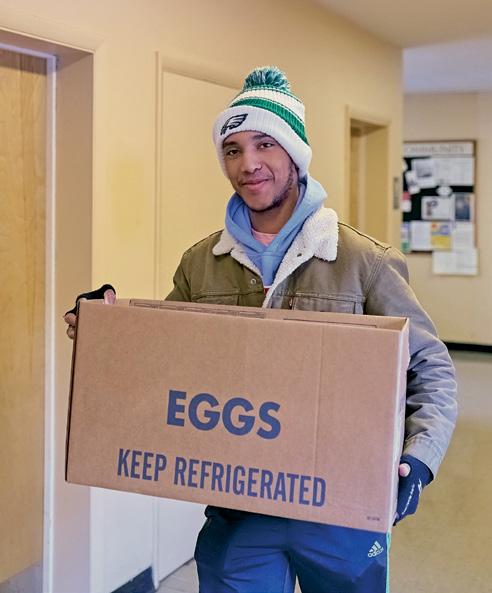
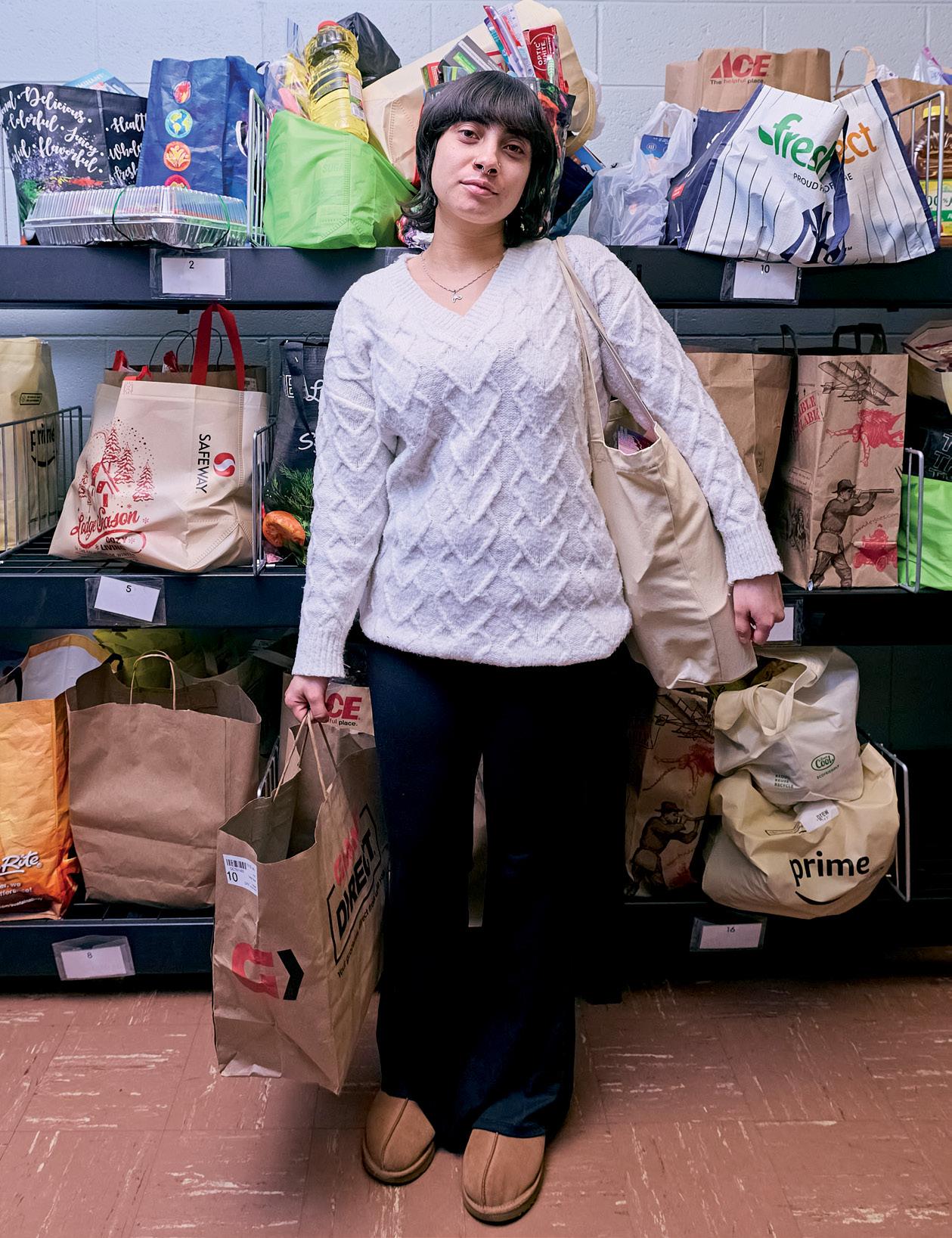
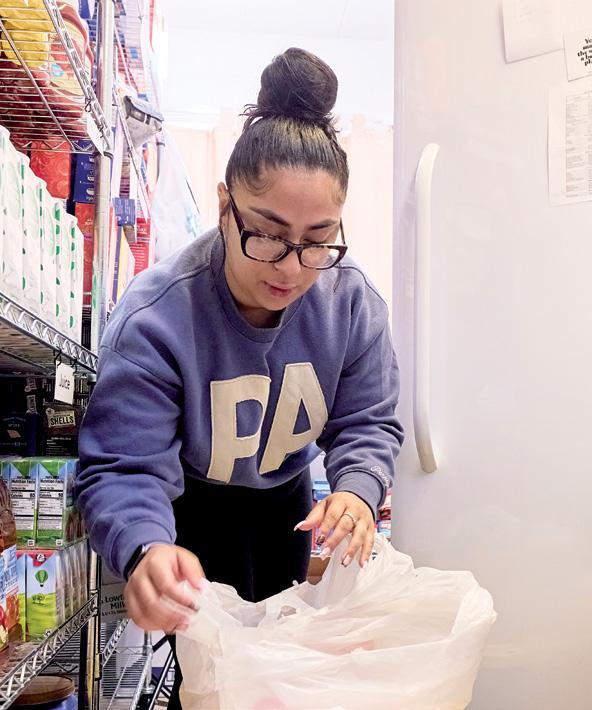
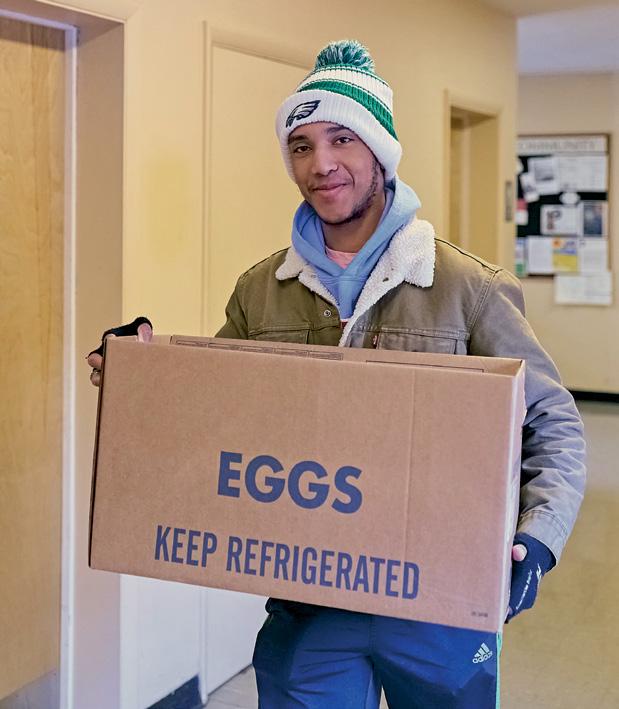
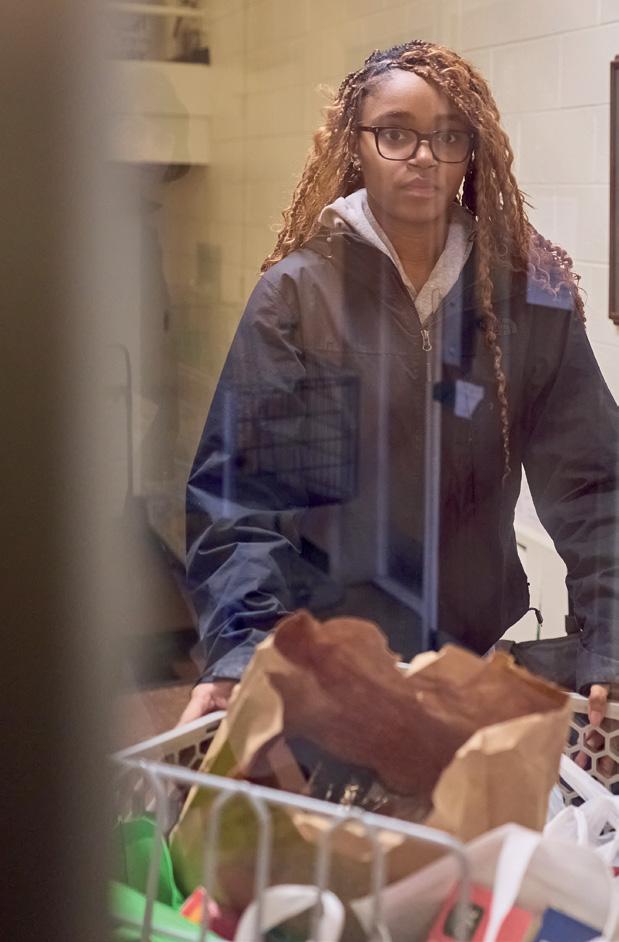
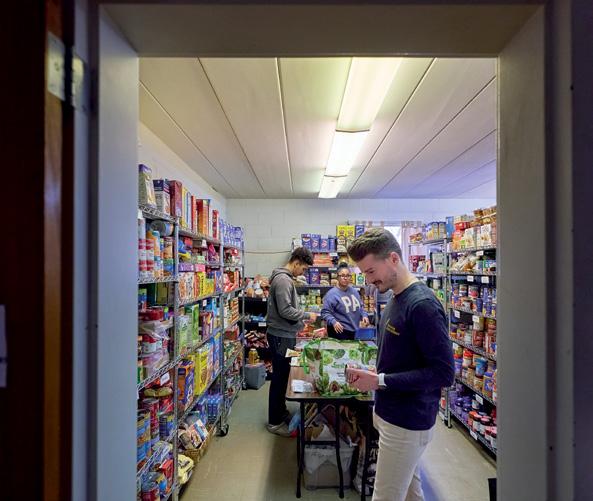
First-year students Alyah Ramos ’29 (left) and Jonathan Ramos-Pichardo ’29 were among the students who volunteered at a food pantry as part of a Holy Family course.
Every Room Is a Classroom
An innovative new general education curriculum takes a holistic approach to learning
STORY BY JEN KINNEY
CUNICELLI
PHOTOS BY ED
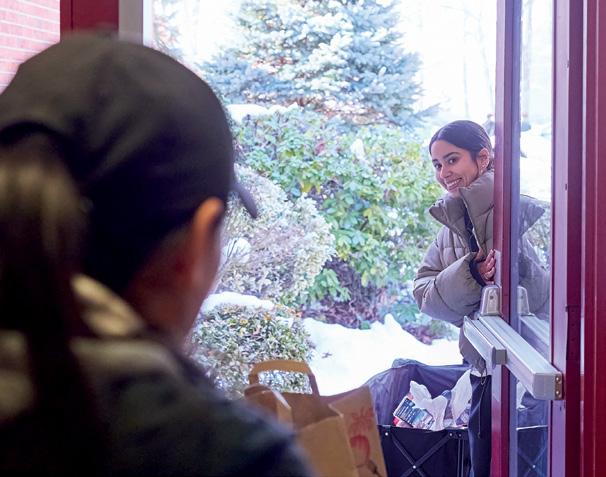
WHEN FAMILIES ARRIVED at the Interfaith Food Alliance in Morrisville, Bucks County, on a recent Saturday morning, they were greeted at the door by young volunteers. Outside, some offered bread and produce from local businesses. Inside, others made trips to the upstairs pantry to fetch grocery bags laden with cereal, milk, eggs, and cleaning supplies.
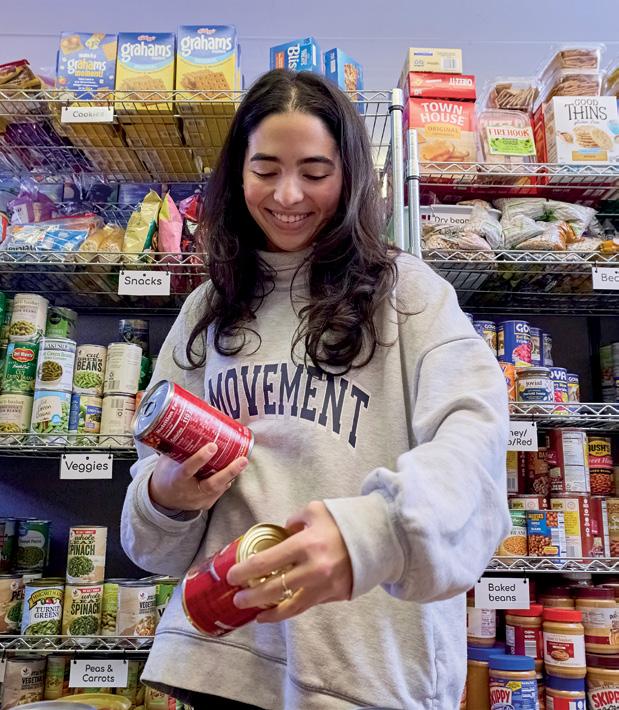
All were Holy Family University students on their last day of their community engagement class on food insecurity. For the past eight weeks, they had learned about food pantries and even designed their own. Now, they were getting a chance to see how a real pantry serves people in need of assistance.
The class and other community engagement courses like it are an innovative component of Holy Family’s new general education curriculum, which radically rethinks the foundational knowledge that students need, with an eye toward equity, student agency, and the University’s core values.
“We thought through the experiences and opportunities that are going to make students more marketable, more well-rounded, and ultimately better equipped to lead a meaningful life because they are developing skills that open doors and support long-term growth,” says Jenai Grigg, Holy Family’s assistant vice president of academic affairs. She says research shows most students will have multiple careers in their lives, so the redesign moves away
from rote requirements and toward a holistic education— intellectually, practically, and spiritually.
Grigg chaired the ad hoc committee formed to develop a new curriculum. This is the third time that she has been involved in an overhaul of Holy Family’s general education curriculum since 2006. It’s no easy task: General education is foundational to a student’s university experience and touches multiple departments across campuses. In the past two revisions, the general education committee made limited changes to the traditional required classes, but this time around—in a process that started in 2021 as part of the University’s strategic plan—the committee was given a broad mandate to rethink the purpose of a general education curriculum from the ground up, creating an approach that reflects both the practical needs of today’s students and the mission and values of the University.
The committee proposed discarding the model of general education that once dominated higher education: a checklist of subjects students had to tackle, whether they felt applicable or not. The new curriculum would give students a stake in their own education. “Increasing student agency really was the focus,” Grigg says.
Holy Family began to roll out the new curriculum during the 2023–24 school year. It consists of four tiers. The first comprises a tightly focused base of required courses: writing, public speaking, philosophy, religion, and an
Community engagement classes are part of Holy Family’s new general education curriculum, which was designed to meet the needs of today’s students and reflect the University’s values.
inquiry-based science class. The second tier emphasizes academic breadth. Students can take any five courses from across the University, allowing them to explore interests outside of their major. The third tier is integration. These classes help students draw cross-disciplinary connections, with the goal of connecting diverse university subjects to each other and to real-world applications. And final tier of the new curriculum is a capstone that synthesizes everything students have learned in their major, their internships and field placements, and in the general curriculum. These classes are complemented by Blueprint, a series of onecredit, workshop-style courses designed to help students navigate college, the workplace, and beyond.
The ultimate goal is to encourage students to look at their education holistically. For example, says Grigg, “our nursing students need to be able to incorporate their psychology and sociology and history and political science into their nursing practice. We don’t learn in silos.”
The food insecurity class, taught by Holy Family alumna Angela Cutchineal ’06, fits into the third tier: integration. This, says Grigg, is where many of Holy Family’s most innovative courses can be found. Some are taught by interdisciplinary teams, pairing humanities and natural-science professors. Many are service-based and experiential, like an American election course that culminates with students volunteering as poll workers, and others involve travel, like a three-week, language-immersion class in Barcelona.
Cutchineal is the economic self-sufficiency program manager at the Bucks County Opportunity Council and serves on the board of the Interfaith Food Alliance. Together, she and Grigg conceived of the food insecurity class, which blends a history of hunger in America and programs to alleviate it. The course gives students a systemic understanding of the causes and effects of hunger and poverty, a crucial perspective for Holy Family students, especially those who aspire to serve vulnerable populations as teachers, psychologists, nurses, or other service-oriented professionals. Student interest in the class was so high, Cutchineal developed a second community engagement class focused on the broader issue of generational poverty.
“Students need to be aware of what it truly looks like to be in poverty,” says Cutchineal. “If they’re going to be teaching in schools where a majority of kids are on the lunch ticket program, that means they’re coming from
food-insecure houses. So, what does that mean? How do I meet the students where they are? What are the challenges that they’re overcoming before they enter the classroom?”
For the first seven weeks of the food insecurity course, students learn about food waste, public and private programs to address hunger, and existing resources in their own region. Cutchineal says students often come into the course with misconceptions even about the basic definition of food insecurity. At the start of class, many think that only people without jobs or homes struggle to put food on the table. They leave with a greater awareness of the many factors that can contribute to hunger, like low salaries, limited benefits, medical debt, divorce, and much more.
About 48 million people in the U.S. are food insecure, according to Feeding America, and rates of both poverty and food insecurity are higher in the Philadelphia region than the national average. About 17% of Philadelphians are food insecure—nearly 278,000 people—and in Bucks County, 9.9% of residents are food insecure. Across Pennsylvania, nearly two million people rely on SNAP federal food benefits, and food pantries in the region have experienced record demand over the past few months as those benefits have been cut.
For their final project, students design their hypothetical own food pantries to address this very real need. With a fictional budget of $3 million, students decide every aspect: where it’s located, who it serves, what it stocks, and what other crucial services it offers.
Every pantry will distribute food, “but do they also offer drug and alcohol counseling? Are there legal services? Is there grief counseling?” says Cutchineal. “Who else needs to be in the room to address all of the reasons that a person could be in poverty?”
Christopher Harvey ’29, a nursing major, chose to locate his pantry in West Philadelphia’s University City because of a striking statistic he learned: Approximately 31% of University of Pennsylvania undergraduates are food insecure. Knowing that the rest of West Philadelphia has dense pockets of poverty, Harvey saw an opportunity for his pantry to bring together local residents, students in need of assistance, and students who want to volunteer. His pantry would be mobile, arriving at the edge of campus four times a month, and also offer health screenings to students and neighbors alike.
In learning about food insecurity, Harvey sees a direct connection to his future work as a nurse.
“In the medical field, you don’t know what you might see, not only with the condition, but people from different walks of life, different cultures,” Harvey says. “Having experience in this course teaches you how to care, how to
sympathize, and gives you more insight into people who might be unfortunately more desperate or not as well off.”
Kaileen Fermin ’29, a psychology major, also saw the course’s application to her studies—and her own life. “As someone who has been personally impacted by food insecurity in my life, I felt it was going to be extremely educating and enlightening to not only do the food pantry experience but to learn more about [food insecurity] and how it affects students and people through generations,” Fermin says.
Growing up with sometimes limited resources, Fermin says she and her family could have benefitted from a food pantry but didn’t utilize one. She’s interested in becoming a school counselor, where she can share her new awareness with her students. “ I’m going to take this as a resource to give to students who are eligible, like SNAP [food benefits], so that they won’t be limited in their nutrition because of
money,” she says. “I’m very grateful that I was able to be educated on what I experienced and how I can fix that.”
Fermin’s final project incorporated creative ways to spread awareness about her fictional pantry and its services, like hosting Sip and Paint events as a way to get people in the door and talking about their services out in the community.
“ I knew that I wanted my food pantry to be not only just a food pantry but a community gem. So, I wanted to have kid events, movie nights, craft days,” says Fermin. “People talk about it. ‘Hey, guess what I did last night? I went to the food pantry.’”
Bustling around the Interfaith pantry serving families this Saturday morning, students are making exactly the connections these classes were designed to promote—broadening their worldview and applying a systemic lens to both problems and solutions in society. “ Students get something from field experience and they get something from being in the classroom,” Grigg explained, “but if you can teach them about it before you go, their investment in that volunteering is exponential.”
Addressing food insecurity in particular can make students nervous, Grigg says. The course and its volunteer experience at Interfaith pushes them to interact with people they might not ordinarily and to confront poverty in challenging yet compassionate ways. Volunteering at a food pantry is “the kind of thing you want to do, but you never do it,” Desere Jaipaul ’27
said, as she packed tampons and diapers into bags for visitors to take. This was the education major’s second visit to Interfaith as part of a Holy Family course; she had taken Cutchineal’s class on generational poverty and wanted to learn more.
Interfaith, which is located within the Morrisville United Methodist Church, is what’s known as a choice pantry. Families “shop” ahead of time by selecting items from a list, marking their preferences for soups, pasta, pancake mix, and other staples. Volunteers assemble their orders from the well-stocked pantry, lining up bags of nonperishables for each family, much like a grocery delivery service would. When families arrive, they give their name at the door and a runner goes upstairs to the pantry to retrieve their order. Another volunteer packs a bag with the cold, perishable items from their list. Each visit, families receive a roll of paper towels and four rolls of toilet paper, and once a month, they get basics like sugar, flour, cooking oil, and laundry detergent.
Volunteers load the supplies into shopping carts—sometimes three or four full bags in all—and help families out to their cars. Founded in 2015, serving just three families, Interfaith now feeds over 100 families each month, relying on donations of food and cash from corporations, grocery stores, and individuals. On this particular Saturday, about 25 families picked up donations. The Kukharemka family was among them.
Interfaith president Diane Coyle greeted the Kukharemkas with a cry of joy. Natalia Kukharemka and her husband Aliaksandr are both from Belarus. For the past five months, Aliaksandr was being held in immigration detention. Natalia had to drop out of school and start working two jobs, full-time at Amazon and at night driving for Uber, to support their two daughters, who are 13 and 16. Natalia needed help feeding her family and turned to the food pantry for the first time.
“I had support here. It’s really helped. And people pray for us,” she said.
Just days earlier, Aliaksandr was finally released, and Natalia brought him to meet the people who had been praying for him. They left with a cart full of groceries, packed by Holy Family students.
Morrisville Mayor Gary Wallace (right) joined Holy Family students learning about food insecurity at the Interfaith Food Alliance pantry.
My Mission HOW DO YOU LIVE THE LESSONS OF HOLY FAMILY?
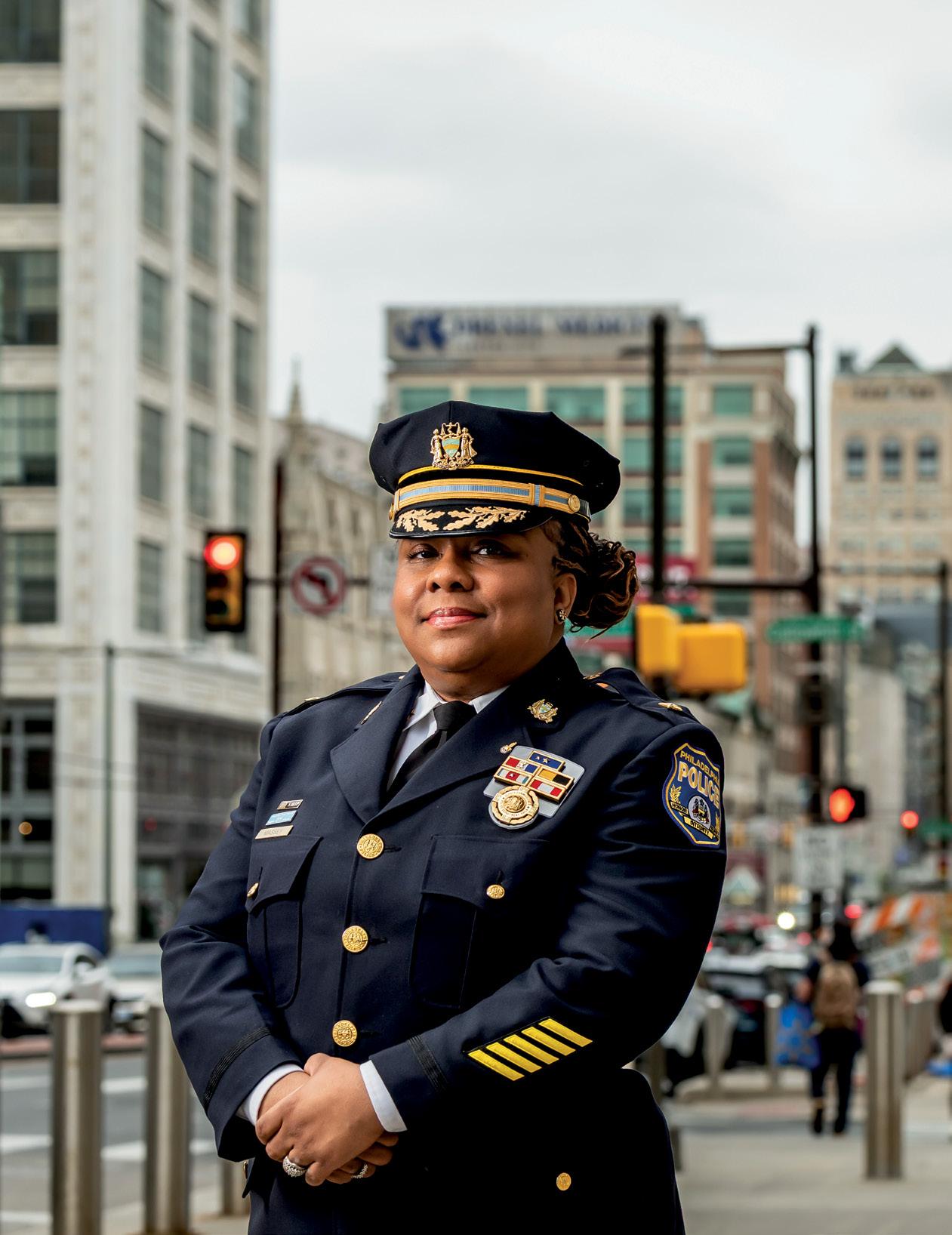
For Philadelphia Police Department Deputy Commissioner Myesha Massey ’22, the Holy Family mission—embracing lifelong responsibilities toward God, society, and self—means waking up each day thinking about how to keep city residents safe. For long jumper Desi Stroud ’27, the mission lies in the hard work of training that starts well before he sprints down the runway to the take-off board. Ask other members of the Holy Family community where they find their missions and the answer is “everywhere”—in the smile of a first grader, a meal shared with strangers, or the flight of a wild bird.
GOD AND THE GRIND
DESI STROUD ’27
Stroud is a rising senior studying sports marketing and management and competing in track and field.
In high school, I thought basketball was going to be my sport. Even when the track coach tried to get me out there, I would say, “No, I’m focused on basketball.”
But I tried it, and it just came naturally. I ended up at Holy Family because my coach told me he had a connection here.
an athletic director, either for college or high school, overseeing all the sports. I know I need experience, like coaching and training, so I’m trying to build that now and maybe get a minor in administration. I just want to lead programs in the right direction, like I’ve seen from the athletic director here.
BY CATHERINE O’NEILL GRACE
KELLY
Now I’m a long jumper on the track team, and I run sprints, too. I want to be
I’m trying to be my best for God and others and myself. Right now, I’m focused on going to nationals. You’ve got to fall in love with the grind before you fall in love with the result. The meets go by fast—it’s a lot of adrenaline—but the work leading up to them is what really matters.
STORIES
PHOTOS BY MELISSA
INSPIRED TO SERVE
SISTER MARY
ELLEN GEMMELL, CSFN
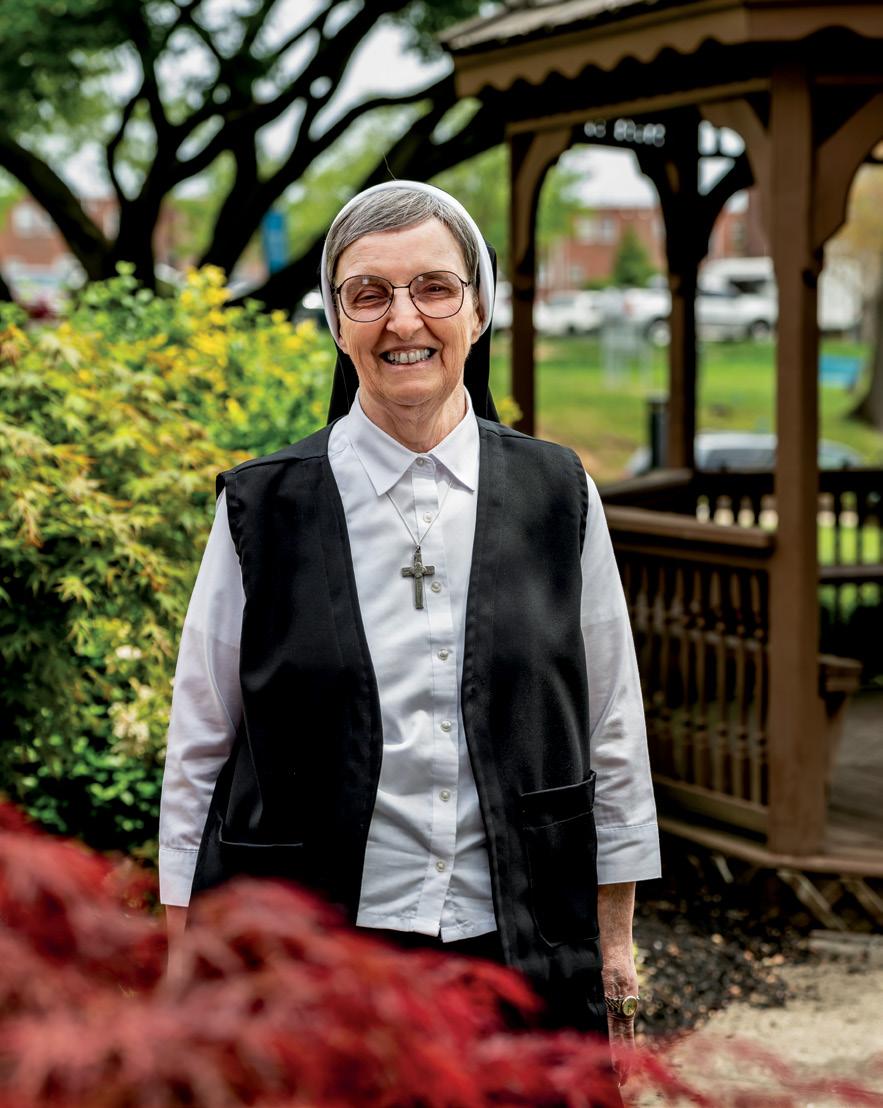
Sister Mary Ellen is a member of the Sisters of the Holy Family of Nazareth and an instructor at Holy Family.
As a Sister of the Holy Family of Nazareth since 1970, I know that the joy of our mission is deeply imbued in my heart. Guided by our foundress, we serve families by mirroring the unity of the Holy Family. Today, I carry this spirit forward as an instructor at Holy Family University, teaching Spanish, ESL, and interdisciplinary core seminars.
My path took a profound turn in 1976 when I was sent to serve in Puerto Rico. These enriching years were spent in various educational capacities, beginning at Colegio Espíritu Santo and later serving as principal at Academia del Carmen and Academia del Perpetuo Socorro. As associate superintendent for the Archdiocese of San Juan, I led a significant project
adapting a K–12 religion series, Hablamos de Dios, for Puerto Rican culture with 78 teachers across five schools. I was happy to integrate our Holy Family educational pedagogy into religious instruction for teachers across the region.
Life in Puerto Rico also taught me the beauty of community. During hurricane seasons, we often lived without water or electricity. Yet, in those moments, unity prevailed; we gathered to cook outside so no food would go to waste, transforming hardship into shared strength.
After returning to Philly, my heart remained attuned to the island. When Hurricane Maria struck, I asked leaders at Holy Family University if I could organize a relief effort. Thanks to their incredible support, we shipped roughly 11,000 pounds of goods to those in need.
Whether in the classroom in Philly or through service in Puerto Rico, it remains a privilege to live out our mission of unity and faith.
AIMING HIGH
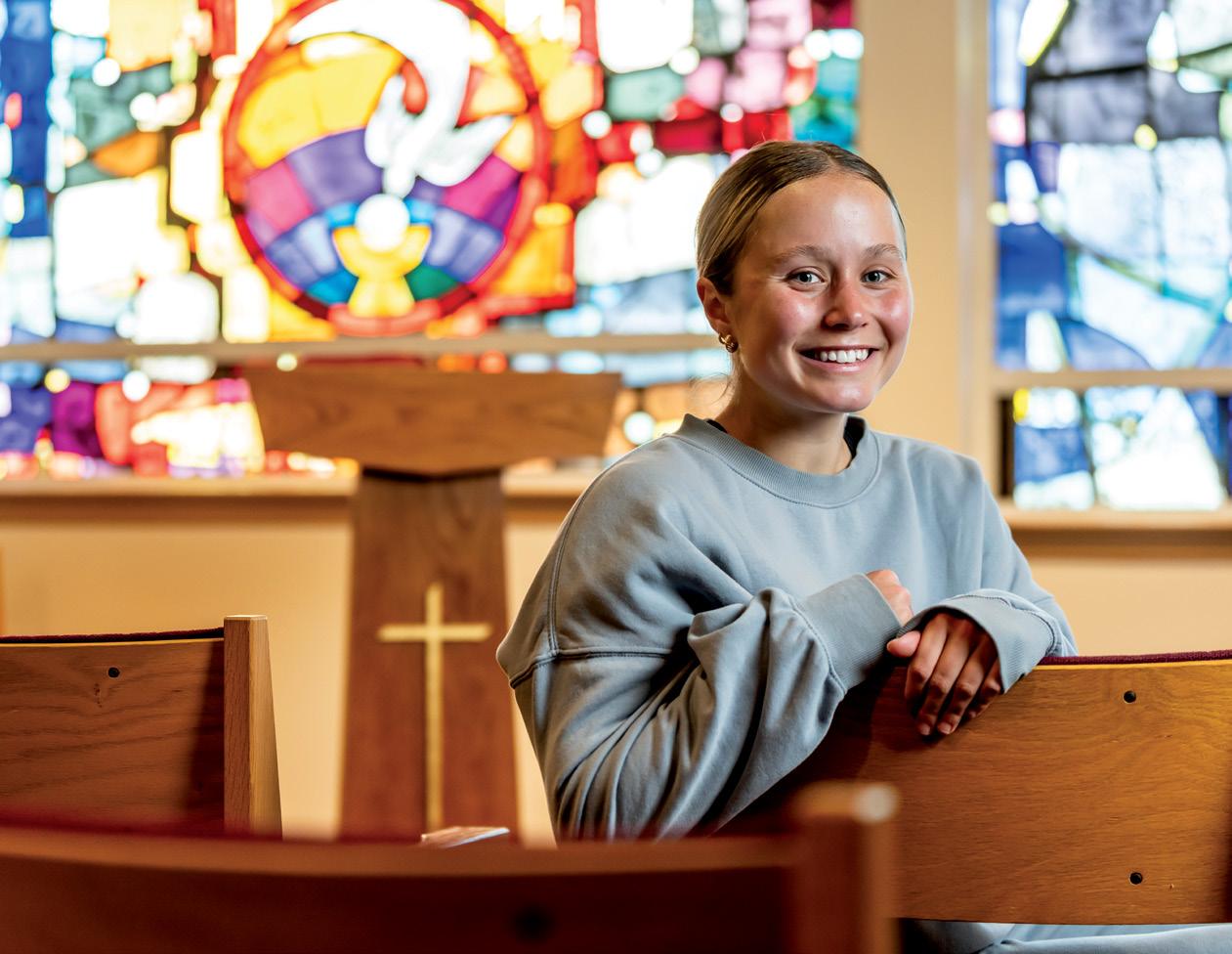
KENNA ROZANSKI ’29 Rozanski is entering her sophomore year at Holy Family, studying nursing and playing midfield for the women’s soccer team.
What the Holy Family mission means to me is surrounding yourself with
“The idea of being bound by my responsibilities guides me.”
good people and creating high expectations for yourself. I like being busy, and I like being involved in things that push me. I’m part of Campus Ministry, I’m on the Honors Program board, and I’ve started taking on more service leadership, too.
One of the things I’m most excited about is helping with a local food bank through Campus Ministry. Service has always mattered to me. I like the physical act of giving back and being able to help people directly, to actually involve yourself
with the people who are going through hard times firsthand. We helped out at a food bank; we did a Thanksgiving drive for families in need that couldn’t get meals on the table. I think Holy Family’s mission matters right
now because people need accountability and connection. The idea of being bound by my responsibilities guides me. You have to remember that you are the person you’re going to spend the rest of your life with.
Sister Mary Ellen Gemmell, CSFN (left) and Kenna Rozanski ’29 find opportunities for service on campus and beyond.
HEARTFORWARD LEADERSHIP
TED QUALLI ’00 Qualli is president and CEO of The Catholic Foundation of Greater Philadelphia, a nonprofit committed to meeting the needs of Catholic donors and organizations through charitable fund management and grantmaking.
Family is where you learn everything first: your faith, how to navigate conflict, how to treat people with respect, how to understand the world around you. Those early experiences shape your values and your worldview.
That’s what my time at Holy Family felt like. Interestingly, it wasn’t so much my fellow students that I remember most—it was the people who worked there. I remember Mrs.
White—Patricia White—in the admissions office walking me through financial aid and helping me understand how I could make school possible. It felt less like a transaction and more like someone taking the time to care for you the way they would for their own child. That deeper connection stayed with me.
Of course, I learned practical things: how to write better, how to communicate more effectively. But
Ted Qualli ’00 (left) and Jayda Pugliese ’09, M’14 take lessons in leadership from Holy Family’s mission.
the most valuable lessons were the intangibles. Values like respect, integrity, and responsibility became part of how I approach my career and leadership.
In my work at the foundation, I’ve had to make difficult decisions and have hard conversations. What I try to remember is that those decisions still need to be grounded in dignity and respect. You may have to say no, or make a choice someone doesn’t like, but you can do it with integrity. I’m far from perfect—I make mistakes like anyone else. But I try to center myself on those values and remember that leadership is stewardship. Organizations existed before us and will continue after us. Our responsibility is to care for them and the people in them the right way while we’re there. There’s a way to do it that’s grounded in love.
A PLACE TO BELONG
JAYDA PUGLIESE ’09, M’14
Pugliese is the principal of Nazareth Academy Grade School.
I’m hard of hearing and wear bilateral hearing aids, so when I was looking for a college, I knew I wanted
a smaller school where I wouldn’t feel like just a number. I wanted to be known as a person, as Jayda, and Holy Family offered that. I wanted to be someone who’s recognized for their contributions to the University.
I became deeply involved on campus. I was part of Campus Ministry and even signed the Masses in American Sign Language. When my father passed away during my junior year, nearly all of my professors came to his funeral. That moment showed me what the mission of Holy Family really means. It’s not just words—it’s family.
After graduating with degrees in special and elementary education, I
worked in Philadelphia schools in a variety of roles before returning to Holy Family for my master’s in teaching English to speakers of other languages and literacy. Later I began a doctorate in educational leadership. Along the way, I received a Milken Educator Award, a national honor given to about 30 teachers each year, for my work as a fifth-grade math and science teacher. Eventually, I became a principal in the Archdiocese of Philadelphia and then at Nazareth Academy Grade School, where I first began my journey as an educator.
At Nazareth, we welcome all who come to us. That welcoming standpoint is just so needed. There is so
much division in the world right now, and what we need are communities that model love, acceptance, and family. That’s something Holy Family taught me and something I try to live every day.
CARING FOR THE COMMUNITY
MYESHA MASSEY ’22 Massey is the deputy commissioner of the Office of Community Partnerships for the Philadelphia Police Department.
I’ve been with the Philadelphia Police Department for 28 years, and from the beginning
I always saw this work as service. My goal has always been to serve the community and make life better for the people of Philadelphia.
When I first joined the police department in 1998, I didn’t have a college degree. Years later, when I was promoted to sergeant, a commander asked me, “What are you doing with your career?” At the time I thought I had already made it. She encouraged me to go back to school. That’s when I started looking at Holy Family University.
I was a mom of two and working full time, and the faculty and staff were incredibly supportive. Many of them had backgrounds in law enforcement or public service, so they understood the demands of the job and helped build a schedule that worked with my life. Faith was also important to me. I’m very active in my church, and policing itself is a faith-based profession in many ways. We face difficult situations every day, and you need to feel connected to something higher. During a really challenging time in the country—during the civil unrest after George Floyd and Sandra Bland— it meant a lot to be in a place where professors understood what we were going through.
For me, this work is a calling. I wake up every day thinking about how to
“This job doesn’t feel like work to me. It feels like purpose.”
For Deputy Commissioner
is service.
Myesha Massey ’22, policing
make Philadelphia better—how to make a block safer, how to improve the quality of life for residents, how to speak up for people who feel unheard. This job doesn’t feel like work to me. It feels like purpose.
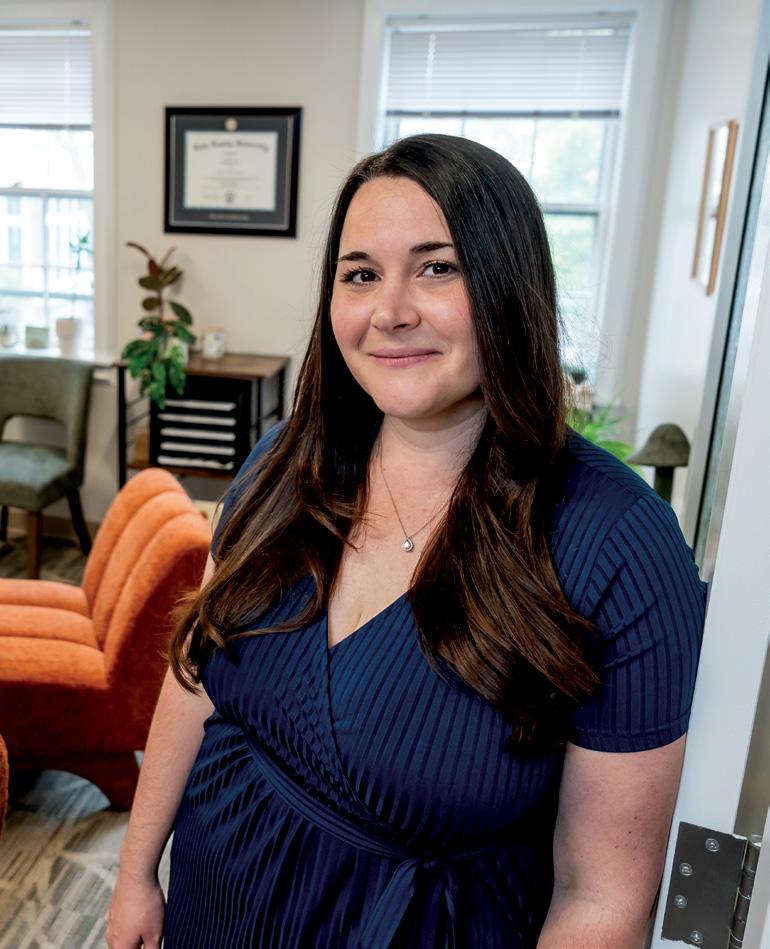
A CALL TO HEAL
LISA HARRELSON ’16, M’19, D’22
Harrelson is the owner of Flourish Psychiatry & Wellness in Philadelphia, where she is a psychiatric mental health nurse practitioner.
I really like teaching people how to be good people. That’s what I was taught at Holy Family, and I still try to teach that as much as I can. It doesn’t matter what profession you’re in; you need to maintain just being human no matter what.
I had my first degree and first life in music. I went to the University of the Arts in Center City, and I was a jazz singer. I was a wedding singer and did lots of fun stuff, but I had a vocal injury. I was told: “You can do this for fun, but you can’t do this six days a week.” So, I decided I needed to do something different. I looked at second-degree programs and landed at Holy Family.
I went to Holy Family through and through. I got my bachelor’s and then my master’s and then I attended the doctor of
“I really like teaching people how to be good people. That’s what I was taught at Holy Family, and I still try to teach that as much as I can.”
nursing practice family nurse practitioner program. The professors reached out on a personal basis regularly. It wasn’t just “check the box.” Even though the standards were really challenging and definitely enforced, there was still a very human aspect.
Holy Family taught me the idea that you’re just a human and the person in front of you is a human. You follow the rules, you check the databases, you do all the compliance, but you don’t make the person feel that. I opened my practice a year ago
thinking I’d do one day a week. It filled right away and just kept growing from one client to more than 1,000 and a staff of eight.
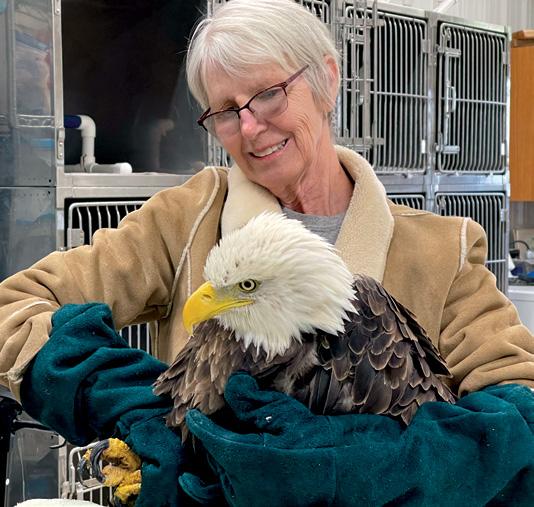
Lisa Harrelson ’16, M’19, D’22 (above) and Kathy Hershey ’76 embody the University’s teachings in their care for the world around them.
STEWARDSHIP OF THE WILD
KATHY HERSHEY ’76
Hershey is the founder of Utopia Wildlife Rehabilitators in Hope, Indiana.
I run a wildlife rescue and rehabilitation organization in Indiana. We’re federally licensed to care for native wildlife, including raptors like eagles and owls, as well as mammals, bats, and other animals that come through our doors. Every day is different. One day we might be caring for baby squirrels found in a car hood, and another day we’re treating an injured owl or releasing a hawk back into the wild.
A big part of what we do is education. We train
veterinarians, run summer programs for kids, and help people understand how important wildlife is to the ecosystem. Sometimes children come here years later and tell us their time at the center helped shape what they wanted to do with their lives. That’s incredibly rewarding.
I’ve always believed that Christianity is a verb—it’s about what you do. I try to use the gifts I’ve been given to contribute back to my community and to care for the world around us.
Wildlife rehabilitation is really about stewardship. We’ve been given an extraordinary world, and we have a responsibility to care for it. If we can help people understand that— and inspire them to protect it—then we’re doing something meaningful.
HOW TO Live the Mission
“Living the mission” does not require grand gestures, says Christopher Fuller, Holy Family’s vice president of mission integration. “One need only make small, consistent choices,” he explains.
In his role, Fuller seeks out ways to further intertwine the school’s mission and motto; its core values of family, service, and responsibility; and the Sisters of the Holy Family of Nazareth’s teachings about loving relationships into every aspect of the University. “Our alumni frequently tell us how much their time here shaped them and how it continues to do so after graduation,” he says.
On campus or off, these tenets come to life in actions that prioritize the holistic well-being— spiritual, intellectual, and physical—of everyone, regardless of their background or faith, and help build and strengthen compassionate relationships with others.
Fuller offers some practical ways to incorporate those ideas into every day:
• Instead of rushing through tasks, slow down, make eye contact, and truly listen to the person in front of you.
• Send an “I thought of you” message via email or a card to a family member, friend, or coworker.
• Advocate for the inclusion of those whose voices are missing at the table, especially regarding important family or workplace decisions.
• Be generous with understanding and support, especially when burdens are weighing someone down.
• Be a consistently warm and compassionate presence, ensuring every member of your different communities—your family, your friends, your colleagues, and so on—feels welcomed, respected, and supported from the moment they enter your space.
SCHOOL OF ARTS & SCIENCES
Doctor of Psychology in Counseling Psychology
Master of Science in Applied Behavioral Analysis
Master of Science in Counseling Psychology
Master of Fine Arts in Creative Writing
Child Life Specialist
Certification
SCHOOL OF NURSING & HEALTH SCIENCES
Doctor of Nursing Practice
Master of Science in Nursing
Family Nurse Practitioner Certificate
2nd Degree BSN
Daytime 14-Month Full-time
2nd Degree BSN
Evening & Weekends
22-Month Part-time
Nurse Aide Training Program
If you’re a full-time working professional and believe earning a graduate degree at the same time isn’t possible ...
THINK AGAIN
Holy Family’s online and hybrid graduate programs can make it happen.
SCHOOL OF BUSINESS & TECHNOLOGY
Master of Business Administration
SCHOOL OF EDUCATION
Doctor of Education in Educational and Organizational Leadership
Master of Education
Initial Teacher Certifications
• Early Elementary
Pre-K – 4
• Special Education
Pre-K – 12
• Secondary Education
7 – 12 (Biology, English, Mathematics, and Social Studies)
Master of Education
• Advanced Practice
Special Education
• Educational Leadership w/ Principal Certification
• Reading Specialist
• Special Education
• Superintendent Letter of Eligibility
• TESOL Endorsements
• Autism
• Online Instruction
• Social, Emotional and Behavioral Wellness
UPDATES FROM OUR COMMUNITY
Artist Alan Goldberg M’98 has a colorful perspective on the world, as he reveals in this vibrant rendering of the stairs spiraling up Florida’s tallest lighthouse. ↓
Family
Class Notes
THESE ARE YOUR STORIES. Votis compiles Class Notes from information provided by alumni to Holy Family directly or via social media and through media coverage of alumni successes. These notes are a celebration of the Holy Family community; they can reconnect classmates who have lost touch over the years and inspire new graduates as they look to the future. Send us your recent professional accomplishments and personal milestones for possible inclusion in the next issue: holyfam.info/familystories.
1960s
Sister Eileen Therese Przybylowski, CSFN, ’60, Sister Rosemarie Griffin, CSFN, ’63, and Sister Helen Petela, CSFN, ’63 celebrated their 75th anniversaries with the Sisters of the Holy Family of Nazareth in 2025.
1970s
Monica (Matejcek) Kolb ’70 is a board-certified chaplain, having served Temple University Hospital Jeanes Campus for more than 29 years. She is also certified in thanatology (death, dying, and bereavement) by the Association for Death Education and Counseling. Kolb currently serves as board secretary of Family Promise of Philadelphia. She delights in traveling individually with each of her grandchildren as they graduate from high school. This summer a trip to Eastern Europe is planned with the eighth of 11.
Brenda Nadijcka-Higgins ’73, Ph.D. and her husband, Brian Higgins, Ph.D., returned to campus and spoke at Legacy of Gratitude, Holy
Family’s annual stewardship reception, in March 2026. They live in McLean, Virginia.
1980s
John Coyne ’80 has joined Holy Family’s Board of Trustees. He and his wife, Jeanine Coyne ’81, live in Oreland, Pennsylvania.
Beth Ann (Reck) Swan ’80, Ph.D., FAAN was appointed the interim dean for the School of Nursing and Health Sciences at La Salle University. She previously held leadership positions at the Nell Hodgson Woodruff School of Nursing at Emory University in Atlanta, Georgia.
Gail (Garberina) Campbell ’82, M’02, a retired educator, is a member of Holy Family’s President’s Advisory Council.
Julie Bamberger-Herrmann ’83 retired from the Philadelphia Corporation for Aging after a 34-year social work career in the Caregiver Support Program. She serves on the alumni boards at
Holy Family, Archbishop Ryan, and Maternity B.V.M, as well as on the Northeast Philadelphia History Network Board of Directors. Bamberger-Herrmann and her husband, Robert Herrmann Jr., reside in Bustleton.
Karen O’Connor ’83, a product owner and senior project manager at CommonSpirit Health, was honored with a 2025 Innovator of the Year Award at Noteworthy 2025, Notable’s annual educational summit.
Lisa (Andrulonis) Sonderby ’85 was promoted to director of pharmacovigilance operations at Incyte, a pharmaceutical manufacturer.
Christine (Swanson) Tierney ’88, MSN, RN, FACHE joined the American Board of Internal Medicine as the vice president of talent and culture after more than eight years as the chief human resources officer of Pennsylvania Hospital, Penn Medicine. She was also recognized as a fellow in the American College of Healthcare Executives.
Sam Tancredi ’89 has retired from full-time teaching after 40 fulfilling years in education and banking. He now looks forward to dedicating more time to volunteer work and to teaching adjudicated youth parttime in Doylestown.
Evelyn (Goldberg Reynolds) Wexler ’89 is enjoying her retirement with her husband after a 30-year career in mental health and gerontological nursing at Friends Hospital, Warminster Hospital, and the Horsham Clinic.
1990s
Jerry Wydro ’90, MD has been named the chief medical officer of Nazareth Hospital and St. Mary Medical Center (Trinity Health Mid-Atlantic). Wydro also serves on Holy Family’s Board of Trustees. Wydro and his wife, Theresa (Toohey) Wydro ’90, live in Langhorne.
Kimberly (Livezey) McCauley ’91 was promoted to the role of director of student services at Elwyn, where she has worked for more than 25 years.
Ann Marie Reid ’91, M’12, DNP accepted a position with Temple Health as a clinical coordinator.
Karen (Menello) Fox ’94, M’08 is a senior vice president for talent attraction and engagement at Berkadia. She is a member of Holy Family’s President’s Advisory Council.
↓ Bill Donahue ’96 has started hosting an original podcast, Taming Monsters With Dirty Rotten Bill, interviewing writers and artists about the impact of their work on their life.
ALAN GOLDBERG M’98
A Long Strange Trip
When he thinks back on his life so far, Alan Goldberg M’98 says that a particular Grateful Dead lyric comes to mind: “What a long, strange trip it’s been.” He has worked at a children’s clothing manufacturer, spent decades as a teacher, and developed a career as a photographer. “I’m one of those people who can tie a lot of subjects together,” he says. That informs his work as a middle-school science teacher, where Goldberg might pair a lesson about the solar system with a crash course in the Roman gods for whom the planets are named along with classical music through Gustav Holst’s space-inspired orchestral suite, The Planets. Goldberg’s work as a photographer crosses genres as well. “I always had a camera in my hand from the time I was a kid,” he says. He started bringing his camera to concerts, where he photographed everyone from Billy Joel to Joe Walsh of the Eagles. Never one to stick to a single category, Goldberg also does portraits and landscape photography, and in recent years, he’s been experimenting with a unique editing style that makes some of his photographs look more like paintings, with surreal, brighter-than-life color palettes. Now living in southern Florida, Goldberg has shown his work at the Miami Art Week and Art Basel in Switzerland and Italy, among many other places.—Michelle Cassidy
Catherine Dooley ’97, M’05 has been named principal of Saint Lucy School for Children with Visual Impairments within the Archdiocese of Philadelphia.
Jennifer (DiGiacomo) Hutchinson ’97 joined pharmaceutical manufacturer Incyte as an associate director of field access.
Alan Goldberg M’98 exhibited his artwork at the Miami Art Show in 2025. It was the fourth year that he
was invited to participate. (Learn more above.)
Heather (Smith) Hagerty ’98 is the founder and CEO of H&H Settlement Services in Glenside.
Jennifer (Valentino) Imlay ’98 is an early learning resource coordinator for Community Services for Children. She previously served as editor-inchief for several Catholic publications and authors children’s books under her pen name, Jennifer Gladen.
SPOTLIGHT
Dennis Feltwell ’99, Ph.D. was appointed vice president of student services at Pasco-Hernando State College in New Port Richey, Florida. Prior to his appointment, he served as provost for PHSC’s East Campus in Dade City. He and wife, Christine (Stevenson) Feltwell ’94, live in Wesley Chapel, Florida.
Brigitte (Maurer) Hix ’99 serves as board chair of the Children’s Media Research and Reform Lab, where she leads initiatives that connect research, policy, and practice to enhance the quality of children’s media. She is an early childhood education instructor at Bucks County Community College and professional development chair for the Bucks County Chapter of the National Association for the Education of Young Children. She also founded BKH Early Learning & Safety Solutions.
Catherine Rousselle ’99 is now a national certified counselor. She works at the Charleston Dorchester Mental Health Center in Charlestown, South Carolina.
2000s
Patrick McElwaine ’00, M’04, Psy.D. has published a book, The Power of Recovery: Voices of Strength, Resilience, and Change, which brings together powerful stories from individuals who have experienced addiction, recovery, and healing, along with insights, hope, and practical perspectives.
Andrey Myketey ’00 joined GXP Engaged Group, a pharmaceutical manufacturer, as a business development director.
Ted Qualli ’00 is the president and CEO of the Catholic Foundation of Greater Philadelphia, the region’s largest independent Catholic community foundation. (Learn more on page 40.)
Alyssa (Alberts) Wolff M’00, Ed.D. joined the Upper Perkiomen School District as the director of curriculum and instruction for the district’s secondary schools.
Mary Ellen (Murphy) Nash ’02 works at Philadelphia Insurance Companies as a senior underwriting specialist.
George Golding ’03, M’15 is now an assistant principal at George Washington High School for the School District of Philadelphia.
Christine Johnston M’03, M’04 joined 151 Foods as the director of human resources after a 15-year career at Tasty Baking Company.
Robert Matza ’03, Pharm.D. accepted the position of pharmacy manager at Capsule, a digital pharmacy.
Kristen (Currier) Gilmore ’04 is the 2026 president-elect for the Philadelphia chapter of the Pennsylvania Emergency Nurses Association. She is the program manager for nurse well-being at Thomas Jefferson University Hospitals.
Rachel (McClain) Riley ’04, the vice president of marketing and communications for Valley Forge Tourism & Convention Board, was the keynote speaker at Holy Family’s 2025 Convocation and a featured presenter at Holy Family’s 2026 Professional Week.
Rob Simon ’04, DNP has been named the program director for the
nurse anesthesia program at La Salle University. He previously served as chief nurse anesthetist and PACU manager for Huntingdon Valley Anesthesia Associates within the Redeemer Health System.
Laura Beard ’05 founded Serenity Health of NJ, where she works as a family nurse practitioner.
Steve McElwaine ’05 advanced to the role of chief financial officer for Reaction Biology. He previously served as vice president of finance for the company.
Shawn Thomas M’05, Ed.D. has been appointed as the vice president of workforce development and community partnerships at Northampton Community College. She also published Called, Capable, Chosen: Aligning Your Career with God’s Plan, a workbook designed to merge faith and function.
Jennifer (Miller) Arms ’06 has risen to the level of IT manager at Charles River Laboratories, a leading American contract research organization.
Bryan Cole ’06 took on a new role as digital sales specialist for Audacy, an audio content and entertainment
company. His wife, Grace (Glavin) Cole ’17, M’19, is a critical care clinical nurse specialist and adjunct professor at Holy Family.
← Jeff Davis M’06 accepted a new position as park president at Busch Gardens Tampa Bay and Adventure Island in Tampa, Florida.
Bill Fitzgerald ’06, owner of Elite Water Damage Restoration, spoke during Holy Family’s Professional Week 2025. He and his wife, Cindy (Ziegler) Fitzgerald ’07, M’12, live in Richboro, Pennsylvania.
Carla Tarsitano M’06, Ed.D. joined The College Board as the director and platform analyst for digital testing and digital transformation.
Alison Barretta ’07 founded Midnight Brief Media & Consulting, a content agency for brands and publishers.
Brian Dever ’07 is the director of athletics and activities at New Foundations Charter School. He partners with Holy Family to give high school student athletes a chance to play on a Division II university campus.
Dustin Gremo ’07, M’09, a special agent at the Pennsylvania Office of Attorney General, spoke at Holy Family’s Professional Week 2025.
Asya Johnson M’07, Ed.D. founded the HBCU Early College Prep High School in Jamaica, Queens, New York, where she currently serves as
principal. She is also an adjunct professor at New York University.
Bob Raics ’07, M’10 is now the chief operating officer at Renu Labs, a contract manufacturer of beauty and wellness products. He and his wife, Susan (Wieczorek) Raics ’87, a nurse anesthetist, live in Red Hill, Pennsylvania.
Shawn Kane ’08 has been promoted to senior associate account manager at Graham Company, an insurance firm.
Kelly Killion ’08 was named the head coach of women’s basketball at American University, which is part of the Patriot League in NCAA Division I.
John Paone M’08 now serves as a CTE graphic design teacher for the Academies at Roxborough High School. He is also an adjunct professor at Rider University.
Gaetano “Guy” Sava ’08, M’10 was named Temple University Department of Public Safety’s deputy chief, bringing two decades of law enforcement, teaching, and leadership experience to the role.
Kristen (Faber) Hartman ’09 joined CORA Services as a student assistance program assessor and counseling intern supervisor.
Jose Mayan ’09 has become a borrower communications copywriter at Cenlar FSB, a mortgage subservicer. He and his wife, Kathleen (Rockford) Mayan M’03, live in Longport, New Jersey.
Jayda Pugliese ’09, M’14 has been named the principal and president of Nazareth Academy Grade School. She was also one of 20 educators selected for the Instructional Leadership Academy by the Philadelphia Academy of School Leaders, and she came to campus to speak during Holy Family’s Professional Week. (Learn more on page 40.)
2010
Sara Bonner ’10 now works for Visit Philadelphia as the director of accounting.
Marissa Donatone ’10 joined Holy Family as director of advancement events and communications. She also served as an advisor for Holy Family’s
KATRINA CARROLL-HASKINS ’11
The Work of Art
For Katrina Carroll-Haskins ’11, art is more than a way to make something beautiful—it’s a tool that can help people make sense of difficult things. As a board-certified art therapist who specializes in helping people work through trauma, she uses artistic mediums as a framework for healing. “When we experience trauma, it affects the language centers of our brain,” Carroll-Haskins says. “You’ll find that people get stuck, or they’re not able to speak, or they feel very frozen. And that is a sign for me to bring in the art component. Let’s mold some clay.”
Carroll-Haskins has been making art her whole life, dabbling in everything from drawing and painting to ceramics and fiber arts. It was through her own artistic practices that she found her way to art therapy. Support from the fine arts program at Holy Family helped CarrollHaskins hone her skills. “My community and my professors celebrated me and raised me up,” she says, reflecting on her undergraduate experience. “That gave me so much confidence.”
Carroll-Haskins launched a private practice, Illuminated Pathways, in May 2025, and is focused on growing the field. She also supervises therapists in training, helping them to develop their own skills in art therapy. And, along with the Pennsylvania Art Therapy Association, she recently met with state Senator Joe Picozzi to discuss his support of art therapy licensure in Pennsylvania.—Michelle Cassidy
Habitat for Humanity Collegiate Challenge 2026.
Brittany La Couture ’10, JD has been appointed as the vice president of health policy at Applied Policy, in Alexandria, Virginia, specializing in pharmaceutical policy, with a focus on Medicare and Medicaid coverage, coding, and reimbursement.
Alicia (DiBenedetto) Park ’10 joined Foundations, Inc., a nonprofit strengthening the skills of educators, as an education specialist.
Jessica (Kovalchick) Shinton ’10, M’14 spoke to a class of psychology
students during Holy Family’s Professional Week 2025.
Amy Sliwinski ’10 has been named the chief people and culture officer for SEI, a global financial and technology management company.
Adrianne Tecza M’10 happily retired from Cooper University Hospital after working more than 24 years in multiple positions. She was the director of managed care at the time of her retirement.
Kristina Ulmer M’10 is the founder and president of the $20 Kindness Challenge Foundation. Her initiative
was featured on CBS Mornings. She is a full-time English teacher and chair of the department at HatboroHorsham High School.
Emily (Sheridan) Wyatt ’10, M’12 joined Holy Family as an adjunct history professor. She previously taught history at her other alma mater, Nazareth Academy High School.
2011
Katrina Carroll-Haskins ’11, Ph.D. launched Illuminated Pathways Therapy, where she works as an art therapist. (Learn more on page 52.)
Mary Collins ’11 received a DAISY Award for Extraordinary Nurse Educator at Pennsylvania Hospital for her work as the nurse residency coordinator. She is also an adjunct professor in Holy Family’s School of Nursing & Health Sciences.
Sean Ryan M’11, a real estate agent with Keller Williams, spoke during Holy Family’s Professional Week 2025.
Ryan Simon ’11, a Marquis Who’s Who-recognized sports industry leader and manager of ticket services for the Philadelphia Phillies, returned to participate in Holy Family’s Professional
Week 2025 and 2026. He is also a member of Holy Family’s Alumni Board. (Learn more on page 25.)
Liz (Lipinski) Speers ’11 is a basic skills interventionist for Cherry Hill Public Schools. She was previously a special education teacher for the district. She is also finishing her master’s in education leadership at Holy Family.
Mike Ulrich ’11, M’16, a systems engineer at CBIZ, returned to campus to speak during Professional Week 2025. He and his wife, Nicole (Keller) Ulrich ’12, M’15, live in Magnolia, New Jersey.
2012
Shaikha BuAli M’12, Ed.D., chief academic officer at PA Virtual Charter School, was named to Drexel University’s 40 Under 40. Her husband, David Brown M’12, Ed.D. was named principal of William Bodine High School for International Affairs.
Eric Despinis ’12 joined IT services firm Kyndryl as the vice president of cloud modernization and global consult partner. He is also a member of the Forbes Technology Council.
Andrew Dua M’12, Ed.D. has been appointed as the new assistant principal at Great Valley Middle School within the Great Valley School District.
Jaclyn Ferry ’12, owner and head baker at Ferry Good Treats, celebrated the grand opening of the bakery’s new location in Parkwood.
Bianca (Robinson) Freeman ’12 advanced to the role of director of partnership marketing for the Philadelphia Phillies. (Learn more on page 26.)
Heather Johnson M’12 accepted a position with AmeriHealth Caritas as a service coordinator. She also adopted a new puppy, Nala Aubrey, on Mother’s Day.
Lou Katsis ’12, M’14 became the vice president of finance operations and transformation for Judi Health.
Christopher Mallard ’12, digital marketing manager at ProgenyHealth, spoke to students during Holy Family’s Professional Week 2025 and 2026.
JONATHAN DICK, OSFS, ’13
Answering the Call
After becoming a deacon last September, Jonathan Dick, OSFS, ’13 was ordained as a priest in the Oblates of St. Francis de Sales on May 30 and celebrated his first Mass at St. Anthony of Padua in Wilmington, Delaware, the following day. It’s the culmination of years of work and study that started more than a decade ago when he first came to Holy Family. “When I trace the roots of my journey, it starts at Holy Family University,” says Dick. During his time as an undergraduate, Dick worked with campus ministry. Father Jim MacNew, an Oblate of St. Francis de Sales who was serving as the University’s spiritual director, introduced him to Salesian spirituality. “It had a profound simplicity to it,” says Dick. That is what attracted him to St. Francis’s philosophy. St. Francis “was very compassionate and gentle toward the person, and I found that really beautiful. I think particularly when I look back at my 20s, I was not always necessarily gentle with myself.”
While preparing for his ordination, Dick worked at St. John Neumann Catholic Church in Reston, Virginia, where his service remains deeply influenced by his time at Holy Family. “The motto of the University, teneor votis, is something that I have not only tried to live in religious life but have begun to preach more to people.”—Michelle Cassidy SPOTLIGHT
Brandon McFadden M’12 progressed to the role of managing director of Bryn Mawr Trust Advisors in Doylestown, Pennsylvania.
Leigh (Neidermeyer) Merz ’12, FNP-C works with Loyal Source Government Services as the regional lead examiner trainer for a medical disability exam program serving veterans nationwide. She lives in Fuquay-Varina, North Carolina.
Sam Mushman ’12 is the founder of Streamline Vine, a hospitality consulting firm that provides training and management services. As a sommelier and entertainer, he hosts in-person and virtual wine-tasting events for corporate and private
clients. He spoke to students during Holy Family’s Professional Week 2025 and 2026.
Nancy Schaffer ’12 published her third book, Christian Yoder: Amish Immigrant, about an ancestor who came to this country in the 1700s and was part of the first Amish fellowship in America.
Juliana Victoria Caldas ’13 joined Unit21, an AI financial crime prevention company, as an enterprise account executive.
Jonathan Dick, OSFS, ’13 made his Perpetual Profession (“final vows”) to the Oblates of St. Francis DeSales in June 2025. In attendance were former campus minister Father James MacNew, OSFS, and many Holy Family alumni, including Jerry Wutkowski ’13; Bear O’Driscoll ’12, M’17; Ryan O’Driscoll ’13; Jenna (Spadaccino) Perese ’13; Sara Szymendera ’13; Cara (Przybylowicz) Ulrich ’13; Doug Ulrich ’12; and Stina Mastroeni ’13. He was ordained in May and celebrated his first Mass. (Learn more on page 54.)
Gayle Kennedy M’13 has risen to the position of managing director for Broad Street Development in New York City.
Pam King M’13 started as a lecturer for cybersecurity and technology classes for Penn State University, Brandywine Campus.
Diana (DiMarcantonio) Kott ’13, M’18, DNP was recognized with a 2025 Nightingale Award of Pennsylvania in the doctor of nursing practice category in October 2025. She is a senior-accredited provider program coordinator at Fox Chase Cancer Center.
Heather Phelps M’13 recently launched her private practice, HLP Wellness Solutions, as a licensed professional counselor, supervisor, and consultant.
Alex Rigney ’13 has been promoted to the role of applications architect at Penn Medicine.
Sara Szymendera ’13 has been promoted to e-commerce marketplace manager for Burpee Gardening. She serves on the Holy Family’s Alumni Board as immediate past president.
Patricia Velasco ’13 started at Siemens Healthineers, focusing on global mobility for the healthcare company.
2014
Amanda (Carroll) Girardo ’14, M’21, director of hospital operations at Jefferson Health, returned to campus to speak during Professional Week 2025.
Damita Harvey Harris M’14 received the Community Service Award and the Humanitarian Leadership Award from Bucks County Community College in 2025. She is the associate director of No Longer Bound and a community organizer with Bristol Cares Coalition. She also works full time as a senior talent development specialist for NJM Insurance Group.
→ Erin Herschberger M’14, K–8 principal at New Foundations Charter School, recently appeared on CBS’s The Price Is Right! She won a new car in a pricing game and $1,000 from spinning the Big Wheel.
Sarah Hood M’14 has risen to the position of Barclays’ vice president for loyalty and in-store marketing for Old Navy. She is based in Wilmington, Delaware.
Dennis Kahn ’14 was promoted to executive editor for Springer Nature. Kahn also works for the Philadelphia Eagles as a merchandise gameday supervisor.
Robert Landgraf ’14 signed on with FORT Robotics as regional sales manager, while simultaneously handling their enterprise account
motion. He also spoke to students during Holy Family’s Professional Week 2026.
Taylor (Miller) Mirabile M’14 joined ePlus Inc. as an account executive, helping streamline IT processes.
Sarah O’Neill ’14 joined Vanderbilt University Medical Center in Nashville, Tennessee, as an education facilitator.
Cassandra Redmond M’14, Pharm.D., FACHE became the associate chief operating officer for Penn Medicine, after working 12 years as part of the University of Pennsylvania Health System. She is the president of Pennsylvania Society of HealthSystem Pharmacists.
Kevin Sablich ’14 started as a pulmonary critical care nurse practitioner for Scripps Health Integrated Providers Medical Group in San Diego.
William Thomas M’14 was promoted to senior manager of tariff administration for American Water, a drinking water and wastewater utility company. He and his wife, Danielle Thomas ’22, and daughter, Ciara Thomas ’23, live in Williamstown, New Jersey.
Stephanie Tran ’14 was promoted to the role of the senior operations analyst at the investment firm Equinox Partners based in New York City.
Zachary Victor ’14 is the co-inventor and co-founder of Pickle Tally, an electronic pickleball scoreboard. He also works as a territory sales manager for Daikin Comfort and an adjunct professor at Holy Family. His wife, Naoana (Toso) Victor ’17, D’24, is a dermatology nurse practitioner at Connolly Dermatology.
Sabrina Yousfi M’14 was appointed as senior vice president, mid-revenue cycle at e4health.
2015
Gregory Anderson M’15 was promoted to the role of manager of financial planning and analysis for Toll Brothers.
Frank Boothman ’15 became a director of business intelligence and reporting at ControlExpert, an AI-powered automotive claim management company.
Casey Borish ’15 has been named the Young Professional of the Year for her work as vice president of ticket sales and overseer of community initiatives for the Trenton Thunder Baseball Team.
Lauren Massara ’15 has been named lead board-certified behavior analyst at Helping Hands Family.
Sean Moran ’15 joined U.S. Title Solutions as a controller. He is also the president of MAcc Tax Preparation and Consulting Services.
Ian O’Grady ’15 was promoted to electrophysiology clinical manager at Boston Scientific. He and his wife, Dana Pilla ’15, live in Dublin, Pennsylvania.
Robin Thomas ’15 was promoted to manager of case processing at Johnson & Johnson Innovative Medicine.
Kayla Wood ’15 is now a supervisor of project controls with Delmarva Power.
2016
Fran Bitting ’16 is now the senior manager for Bodyarmor Sports Nutrition. He spoke to students during Holy Family’s Professional Week 2025.
Alyda Dick ’16 accepted a new position with MelioREM Sleep Clinic as a registered polysomnographic technologist. She lives in Reno, Nevada.
Patrick Dorsey M’16 works as a police officer in the Abington Township Police Department.
Jeanette Einspahr ’16 completed her Ph.D. in biomedical sciences at Temple University and became a postdoctoral fellow at the school, researching cardiovascular disease.
Jordyn (Pearlman) Horan ’16 named one of the Organ Donation & Transplantation Alliance’s 40 Under 40 for her work at the Children’s Hospital of Philadelphia. (Learn more on page 57.)
Meghan Roberto ’16 was promoted to human resources operations manager at bet365, an online gambling company.
Roxanne Patricia Schleben ’16 advanced to the position of family nurse practitioner and nurse practitioner residency clinical lead at Santa Rosa Community Health in Santa Rosa, California.
2017
Al Curtis ’17 was promoted to executive director and plant manager at Estée Lauder Companies.
Rebecca Lawrence ’17, M’20, a teacher at Archbishop Ryan High School, returned to campus during Professional Week 2025.
Nora Leco M’17 now serves as a director of human resources for the National Football League.
Joseph Steward ’17, JD is a founding partner for Steward Legal, APC, a firm specializing in lemon law claims for California consumers. He and his wife, Koreen (Orozco) Steward ’19, live in Menifee, California.
James Tucker ’17 graduated from the Metropolitan Police Academy in Washington, D.C. (Learn more on page 58.)
Ann Zeuke ’17 joined Starr Bus Charter and Tours, focusing on charter sales and customer service.
2018
Ashley Beam ’18, vice president of the Holy Family’s Alumni Board, has been promoted to the role of assistant director for residential education and support at Arcadia University.
Amber Birch ’18 took a new role with Virtua Health. She is now a cardiovascular intensive care nurse.
↖ Jake Frye ’18 has risen to the level of captain and president of the Flourtown Fire Company Station 6. He is also the assistant director of emergency management and special operations at Montgomery County Department of Public Safety.
Bruce Garwood ’18 has risen to the position of program manager at Fresenius Medical Care. He and his wife, Sarah Garwood ’18, live in Glenside, Pennsylvania.
Paul Jones ’18, M’22 is now with Achievement House Cyber Charter School as a high school counselor.
Christopher Knechel M’18 is the principal of the Technical College High School Pickering Campus in Chester County.
Dawn Palmer-Vacchiano ’18, M’22 started as a certified consultant for NeuroChangeSolutions, a global network that brings neuroscience theory to business applications.
Tyrone Rorie M’18 was named assistant principal at North Caroline High School in the Caroline County Public Schools system in southern Maryland.
Alisha Santiago-Acevedo ’18 signed on with Vanguard Charitable as the head of talent acquisition.
JORDYN HORAN ’16
At the Heart of the Matter
Jordyn Horan ’16 always knew that she wanted to work in pediatrics. But when she was studying nursing at Holy Family, she didn’t imagine that her path would lead her to becoming the transplant program director at the Children’s Hospital of Philadelphia (CHOP). She began working at CHOP in March 2016 as a nurse on the gastrointestinal and endocrine floor, where she was introduced to the transplant specialty. “Being able to support patients through transplants and see them look and feel so much better is so incredibly rewarding to me,” Horan says. Although she has moved into a more administrative role, she still gets to see her patients at community events at the hospital. “There are liver transplant patients who I took care of 10 years ago who are now growing up, and I can see how well they’re doing after transplant.”
Horan’s typical day involves working across parts of the hospital to keep the complicated system of the transplant program running. Each year, CHOP handles 50 to 60 transplants of all major organs, including heart, lung, liver, and kidney. Horan also started a patient advocacy program and leads quarterly meetings with people working in pediatric transplant programs across the country to discuss challenges and find ways to make the system work better. In July, the Organ Donation and Transplantation Alliance named Horan one of their 40 Under 40 honorees to recognize her work in the field.—Michelle Cassidy
2019
Haile Bowers ’19, M’23, English teacher and cross-country coach at Franklin Towne Charter High School, spoke to students during Holy Family’s Professional Week 2026.
Ryan Foran ’19 became an HR business partner with Irex Services, a shared services company supporting specialty contractors operating throughout the United States.
Justin Goodman ’19 joined XpressConnect Supply as an inside sales representative.
Christopher Hentz ’19 became a learning business partner for Johnson & Johnson Innovative Medicine after two years as an immunology sales representativefor the company.
Brenna Murphy M’19 became the head of school for A Step Up Academy. She previously served as the director of educational programming.
2020
Matthew Breiner M’20 founded A Perceptual Shift, a company focused on providing individual therapy and licensed clinical social work supervision for Pennsylvanian clinicians. He is also a social worker at Pottstown Hospital.
Daina (Simola) Cetoute ’20, who works for a behavioral health managed care company in their quality management department, participated in Holy Family’s Professional Week 2025 and 2026. She is also a member of Holy Family’s Alumni Board.
Sayda Conteh ’20 advanced to the position of marketing specialist with Seward & Kissel, a law firm.
Caitlin Dombrosky ’20 accepted a position as a utilization management nurse consultant at CVS Health.
Delaney Donaghy ’20 has risen to the position of marketing coordinator for Kreischer Miller, an accounting, tax, and advisory firm. She also participated in Holy Family’s Professional Week 2025 and 2026.
Megan Fisher M’20 began at InMind Services as a marketing operations specialist.
Rachel Fox ’20 celebrated her one-year anniversary working as the communications manager at Villa Joseph Maria High School in Holland, Pennsylvania.
Connor Irwin ’20 progressed to the level of assistant vice president, commercial credit underwriter I for the middle market at M&T Bank.
SPOTLIGHT
JAMES TUCKER ’17
Dare to Dream
A Drug Abuse Resistance Education (D.A.R.E) program in grade school made James Tucker ’17 realize he wanted to be a police officer. That dream led him to an associate’s degree in criminal justice from Lackawanna College and then a bachelor’s degree in the same subject from Holy Family. While Tucker encountered academic hardships along the way, at Holy Family he found people and an environment that helped him succeed. “I made a conscious effort to surround myself with professors who were invested in my progress and committed to helping me complete my studies,” he says. After finishing his coursework, which included an internship at the Penn Vet Working Dog Center, Tucker started applying for jobs in police departments.
In December, Tucker graduated from the Metropolitan Police Academy in Washington, D.C. There were some challenges to going through the police academy at the age of 34 when many of his fellow recruits were younger, but Tucker took it all in stride. “My instructors often remarked that I was the one who smiled through everything,” he says. “I was genuinely grateful for the opportunity—whether it meant push-ups, sit-ups, or running a mile and a half.” For Tucker, the most important lesson was approaching police work with a spirit of compassion. “I try to view people as if they were my own family—my sister, my brother, my mother, or my father.”—Michelle Cassidy
Robert Mantuano ’20 has risen to the role of manager II for operations at J.B. Hunt Transport Services.
Gregory Olsen ’20 became the retail and e-commerce general manager for S Ambani Group, a cigar and tobacco company.
William Parrish M’20 was promoted to the role of team lead for North America renewals at LastPass, a password management company.
Melinda Ramos M’20 has been promoted to the role of compliance manager within the state filings unit of Philadelphia Insurance
Companies. This is her third promotion since graduating from Holy Family.
Matthew White M’20 was named the New Jersey Governor’s Educator of the Year for his work at Countryside Elementary in the Mount Laurel School District.
Eileen (Kilpatrick) Gross M’21 is now an assistant principal for the School District of Philadelphia. Gross
is the daughter of Maryann (Burns) Kilpatrick ’79.
Lavinia Harrison ’21, a research coordinator at Children’s Hospital of Philadelphia, returned to campus to speak with students during Holy Family’s Professional Week.
Laura Hornyak ’21 has become the engage life director at Atria Senior Living.
Emily Jordan M’21 joined the Philadelphia Education Fund as the director of development.
Caroline Mekhedav ’21 serves as a registered nurse for Penn Medicine Princeton Health and Capital Health Hopewell. She is also the vice president for Chapter 3109 of the Association of periOperative Registered Nurses.
2022
Josh Butler ’22 was promoted to senior accountant at ElliottLewis Corporation, an HVAC/R service company.
Grace Hesser ’22 was promoted to enterprise risk management (ERM) analyst at AIG, an insurance company.
Myesha Massey ’22, M’25 has been promoted to deputy commissioner for the Philadelphia Police Department, Office of Community Partnerships. (Learn more on page 41.)
Colin O’Hara M’22 advanced to the role of senior project engineer with Colliers Engineering & Design.
Drew Sagedy ’22 joined Camden Prep Charter School, part of
Uncommon Schools, as head men’s basketball coach, and he is now an AP history teacher at Camden Academy Charter High School. A former Holy Family rugby player, Drew is also the head coach of South Jersey Rugby’s 7s team.
Raymond Teel ’22 has been promoted to senior accountant with Comcast.
Annie Wolfe ’22 married Don Logan Jr. ’22 in June 2025. In attendance were many Holy Family alumni, including the groom’s parents, Maria Colon ’91 and Donald Logan Sr. ’92, as well as the bride’s siblings, Katie (Wolfe) Meisenzahl ’10, Jonathan Wolfe Jr. ’13, Robert Wolfe ’19, and Tim Wolfe ’20
Sean Touey ’23 is the director of leagues for Select Soccer Center in Montgomery County. He is also an assistant soccer coach at Delaware Valley University and a youth soccer coach for YTP Sports.
↖ Larry Tran ’23, M’24 was promoted to the role of airport operations officer at the Philadelphia International Airport.
Madeline Capezza ’23 began as a legal clerk with the Philadelphia Court of Common Pleas Family Division. She is also pursuing a master’s degree in forensic medicine at Philadelphia College of Osteopathic Medicine.
Alexis Morace ’23 joined Hydrate2o as an infusion nurse.
Laura Puglisi M’23 was promoted to product manager at Stryker, a medical equipment manufacturer.
LeeAnn Bushar M’24 was promoted to the role of Holy Family’s director of annual giving. In her tenure, she has helped foster a culture of philanthropy on campus through Ready. Set. Roar! and other advancement initiatives to benefit students.
Alyssa Chrzanowski ’24 has received a DAISY Award from Jefferson Health, where she works as a registered nurse in the intermediate care unit.
Rachel Jackson ’24 became a rates and budgets analyst for Northrop Grumman, the defense and space technology manufacturer.
Vernon Johnson ’24, M’25 joined The Harris Poll as a research analyst.
Nancy Nguyen ’24 is now a registered nurse at Saint Christopher in the pediatric intensive care unit.
Carly Nothnagel ’24 accepted a role as a foundational sales associate with Johnson & Johnson.
Diaka Thiam M’24, a school counselor at Franklin Towne Charter High School, spoke to students during Holy Family’s Professional Week 2025.
Faculty & Staff Notes
Publications
Assistant Professor Daniel Boches, Ph.D. published “Vertical Direction and the Social Control of Medical Mistakes” in the journal Deviant Behavior. His research investigated how doctors police medical errors among themselves.
Colin Emrich, Ph.D. associate director of institutional effectiveness, published “From Cradle to Congress: The Effect of Birthplace on Legislative Decision-Making” in Political Science Research and Methods. His research found that lawmakers’ birthplaces significantly influence how they vote in office, even beyond party affiliation or constituent interests, suggesting that their own life experiences shape their decisions more than commonly assumed.
Associate Professor Robert Ficociello, Ph.D. published his first children’s book, Lucia & Marcus Go to Space: Jupiter! The STEAM picture book features a young, female leader and a young male educator traveling to Jupiter.
Pamela Flynn, MFA, professor of art and the fine arts coordinator, published Not Yours to Destroy. The book features Flynn’s painting alongside the poetry of Amalie Flynn, her daughter.
Jenai Grigg, Ph.D., assistant vice president for academic affairs and professor of sociology, published three papers on counselor education for high-conflict divorces in
The Family Journal and the Journal of Family Trauma, Child Custody & Child Development. She also published “From Storm to Stability: How Children Navigate Divorce and Its Developmental Impact” in the Journal of Child and Adolescent Counseling.
Associate Professor Melinda Parisi Cummings, Ph.D. coedited Counseling Individuals with Eating Disorders: An Intersectional Approach and wrote several chapters for the publication.
↑ Assistant Professor Jill M. Swirsky, Ph.D. wrote “From Narnia to Neverland: A Guide for Developing and Teaching Popular Culture Themed Courses” with several coauthors, including master’s student Cole Belinsky ’23. The paper was accepted for publication in the Journal on Excellence in College Teaching. Swirsky also helped to launch a new academic journal, the Journal of Thematic Instruction, to investigate the impact of popular culture thematic instruction across disciplines. In addition, Swirsky appeared on the Psi Chi PsychEverywhere podcast, discussing psychology in Avatar: Fire and Ash.
Assistant Professor Edward A. Waddell, Ph.D. published a paper in the Journal of Insects as Food and Feed on the impact of diet on adult black soldier fly life span, behavior, and reproduction in order to address welfare concerns in the insect farming industry.
Assistant Professor Justin Walsh, Ph.D. published a paper in the Proceedings of the National Academy of Sciences on the evolution of fruit fly behavior. His research found it occurs not through a rewiring of the brain but through subtle changes in communication between neurons.
Conferences and Exhibitions
Pamela Flynn, MFA, professor of art and the fine arts coordinator, exhibited her work at Woman Made Gallery in Chicago; Vanda Gallery in New Rochelle, New York; the WCA Eco Art Sketchbook traveling exhibit; Leonovich Gallery in New York City; and Green Door Studio in South Orange Village, New Jersey.
Mark Green, Ed.D., vice president for institutional effectiveness, technology, and innovation, presented at several conferences on the role of artificial intelligence in higher education, including Ellucian Live, EDUCAUSE, MSCHE, and EdgeCon.
Associate Professor Patricia Griffin, Ph.D. attended the 11th International Day of Women & Girls in Science Assembly at the United Nations. She coauthored a paper submission for the assembly titled “Women in STEM Training: A Cautionary Enumeration.”
Mary Carroll Johansen, Ph.D., professor of history, presented at the Southern Association for Women Historians Triennial Conference on innovative ideas for teaching women’s history.
Jinsy Mathew D’20, dean of the School of Nursing & Health Sciences, and Rinu Elsa Stephen D’22, assistant professor of nursing and program coordinator for the second degree distance hybrid BSN program, presented at AACN Transform 2025. The presentation focused on the use of virtual simulation as an innovative teaching strategy to strengthen nursing students’ confidence and skills in addressing incivility in clinical environments.
Associate Professor Melinda Parisi Cummings, Ph.D. presented at the International Association of Eating Disorders Professionals Global Symposium. Her presentation focused on helping professionals treating eating disorders to navigate ethical tension between protecting patients from serious harm while honoring their autonomy and dignity.
President Anne Prisco, Ph.D. spoke at the 11th International Day of Women & Girls in Science Assembly at the United Nations. She discussed how social science serves as the bridge between scientific innovation and inclusive impact. President Prisco also presented at the American Council on Education on the topic of how mission-driven organizations are delivering outstanding student outcomes and at the Association of Catholic Colleges and Universities on responding to challenges in higher education through the lens of faith, mission, and community.
SPOTLIGHT
Celebrating With the Sisters
Holy Family University
President Anne Prisco traveled to Italy in November to celebrate the 150th Jubilee of the Sisters of the Holy Family of Nazareth. She was joined on the pilgrimage by other members of the Holy Family community, including Sister Loretta Theresa Felici, CSFN, ’97, and Sister Linda Yankoski, CSFN, both members of the Board of Trustees; Katherine Primus, the University’s vice president of marketing and communication; and Jayda Pugliese ’09, M’14, principal and president of Nazareth Academy Grade School.
In Assisi, the group visited Basilica of Saint Francis, the Basilica of Saint Clare, and the tomb of Saint Carlo Acutis, a millennial teenager canonized in September 2025.
In Rome, they were welcomed at the Motherhouse of Sisters of the Holy Family of Nazareth and toured the Generalate, or headquarters, to see some of the order’s most prized artifacts, including original writings of its foundress Frances Siedliska, and to learn more about the current work of the Sisters around the world.
As part of the Jubilee Celebration, President Prisco and the other travelers also joined the Sisters of the Holy Family of Nazareth for the pilgrimage walk through the Holy Doors at St. Peter’s Basilica.
—April White
Troy C. Young, assistant dean of students for resident life, community, and belonging, delivered keynote addresses at the Student Staff Live-In Conference and the Widener Student Leadership Conference on empowering student leaders.
Honors and Awards
J. Barry Dickinson, Ph.D., professor of business, received a Ray and Mildred Taylor Award from Holy
Family, which will fund his research into consumer trust in AI-generated marketing messages.
Donald Goeltz, DPS, professor of business; Ankit Lal, MBA, assistant professor of business; Gloria Carrasco, lead training and instructional technologist in the Center for Teaching & Learning; Robert Ficociello, Ph.D., associate professor of English; Jinsy Mathew D’20, dean of the School of Nursing & Health Sciences; and Janet McNellis, Ph.D., professor and program director for the Master in
Education program, received a Ray and Mildred Taylor Award from Holy Family to create a knowledge base on AI tools and applications.
Stanley Mauldin, Ph.D. and Dian He, Ph.D., professors of natural science, received a Ray and Mildred Taylor Award from Holy Family to analyze the biological structure and function of DNA polymerase zeta from Dictyostelium discoideum, an enzyme involved in DNA repair.
Melissa Rampelli, Ph.D., associate professor of English and the coordinator of English & Writing and the Health Humanities minor, received a Ray and Mildred Taylor Award from Holy Family to write a book on the rise and uses of writing in 19th-century asylums.
Justin T. Walsh, Ph.D. and Edward A. Waddell, Ph.D., assistant professors of biology, received a Ray and Mildred Taylor Award from Holy Family to study the genetic and neuronal basis of behavioral evolution.
Edward P. Wright D’25, vice president for enrollment management, was named a Diamond Honoree by ACPA: College Student Educators International for his work advising and providing access to education for all students as they pursue their educational goals. He also completed his two-year commitment as a national advisor to Carnegie Higher Education. Wright received his doctorate in education from Holy Family in 2025.
Troy C. Young, assistant dean of students for resident life, community, and belonging, was selected to be part of the faculty for RELI 2026, a professional development institute for housing officers.
George Haynes, professor emeritus, School of Arts & Sciences
Jim Higgins, professor emeritus, School of Business & Technology
Moya Kaporch Dittmeier, former assistant secretary of the Board of Trustees
Betty Klear, former adjunct professor, School of Education
Phyllis Weisberg, former adjunct professor, School of Education
OBITUARY
Amber Marie Fisgaer
2001–2025
Amber Marie Fisgaer ’24 passed away on December 24, 2025. Fisgaer was a proud Holy Family student and alumna whose impact was felt across the community.
Fisgaer graduated summa cum laude with a degree in criminal justice and pre-law. While a student at Holy Family, Fisgaer also served as a tutor in the tutoring center and was a dedicated member of the women’s cross country and the women’s track and field teams all four years. Fisgaer and her teammates made program history, winning the University’s first women’s indoor track and field championship title for two consecutive years. A natural leader, she served as captain of both teams during her senior year.
Fisgaer’s sister, Ashley Fisgaer ’24, established the Amber Fisgaer ’24 Memorial Scholarship, which will be awarded annually to a member of the Holy Family cross country and track and field teams who shows the dedication and discipline for which Fisgaer was known. Members of the Holy Family community can make donations to the scholarship fund at holyfam.info/fisgaer-scholarship.
Hat Tips
Parting words from the Class of 2026
When Holy Family’s 870 graduates turned their tassels at commencement last month, gratitude, good advice, and future ambitions were top of mind. Votis collected some wit and wisdom— and lots of glitter—from a few of the University’s newest alums.
1. Jillian Nicole Kemble M’26 Master of Education
2. Marc Neil Tolentino Lopez ’26 Bachelor of Science, Nursing
3. Mireliz Gonzalez ’26 Bachelor of Arts, Biology, Cum Laude
4. Kamila Azizova ’26 Bachelor of Arts, Accounting, Summa Cum Laude
5. Tyler M. Burke ’26 Bachelor of Science, Nursing
6. Hope C. Onu ’26 Bachelor of Science, Nursing
7. Emily Theresa Widmayer ’26 Bachelor of Arts, Psychology, Summa Cum Laude
8. Alyson M. Cittadino M’26 Master of Business Administration
9. Kira Long M’26 Master of Fine Arts in Creative Writing
10. Shajhay Riley ’26 Associate of Science, Radiological Science
11. Hannah Rose Donahue ’26 Bachelor of Arts, Criminal Justice, Cum Laude
12. Mikayla Nereida Lantz ’26 Bachelor of Arts, Criminal Justice
13. Gabriella White-Howard M’26 Master of Science in Counseling Psychology