Scroll2026
Mission Statement
The mission of the Holton-Arms School is to cultivate the unique potential of young women through the “education not only of the mind, but of the soul and spirit.”
Philosophy
Scroll features writings by students of the Holton-Arms School. Many pieces come from classroom assignments across grades 9-12; others come from writing assignments at Scroll Club meetings. In making final selections for the magazine, the editorial staff looks for original, powerful, insightful work as well as a range of genres. They choose artwork that exemplifies the best work of the artists and that also speaks to the ideas or images of the written pieces.
Recipient of the Columbia Scholastic Press Association High School Hybrid Publication Gold Crown Award in 2014, 2015, 2016, 2017, 2018, 2019, 2020, 2021, 2022, 2023, 2024, 2025, & 2026. Before Scrolling existed, Scroll magazine won in 2010.
Cover Artwork
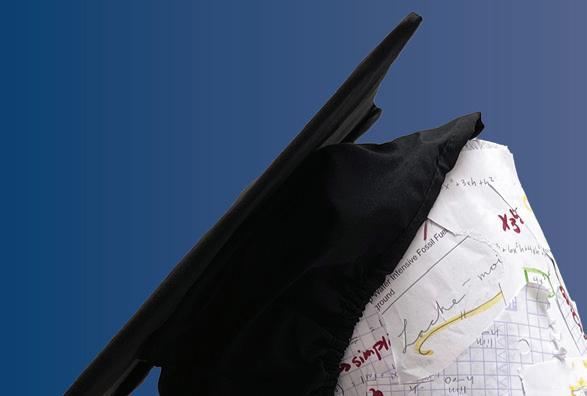
Front Cover •

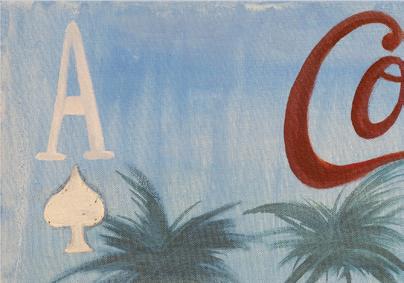
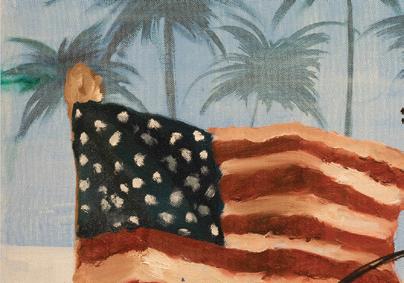
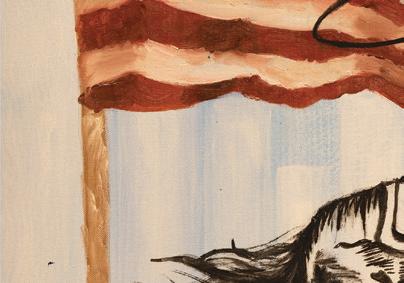
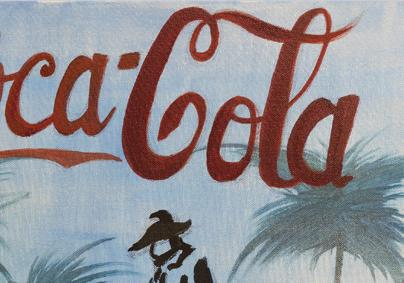
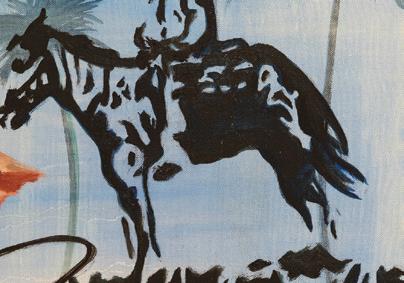
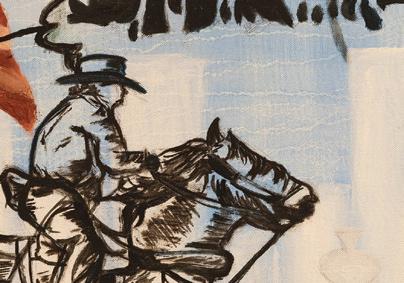

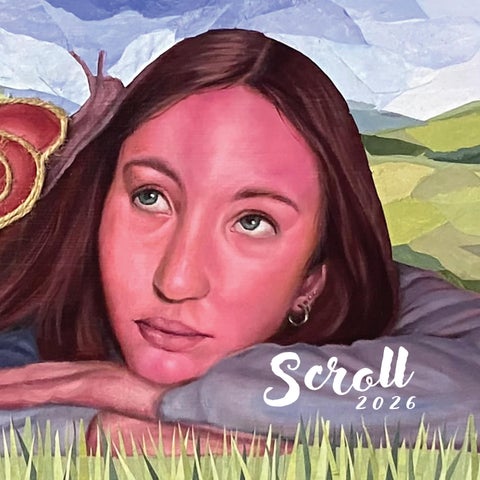
Sophia Grossman | A Practice in Patience, oil on wood panels
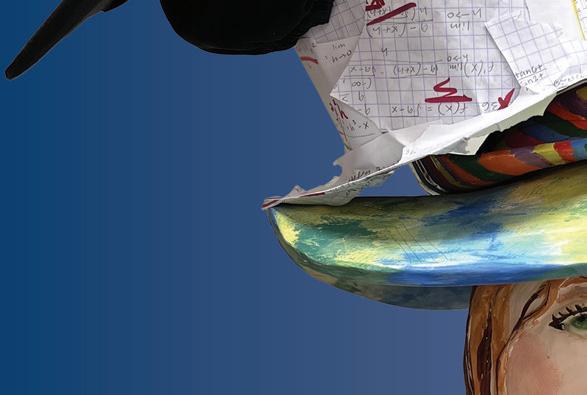
Back Cover •
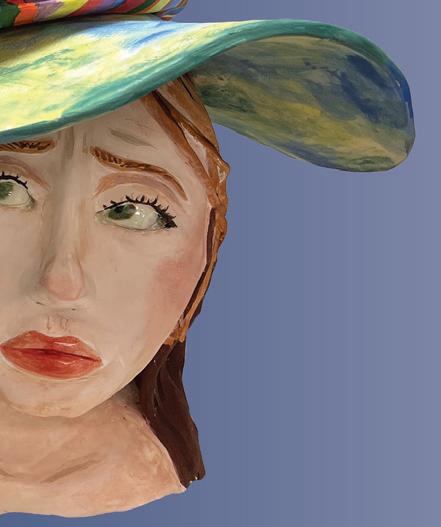
Helen Binner | Too Many Hats, earthenware
Inside Front •
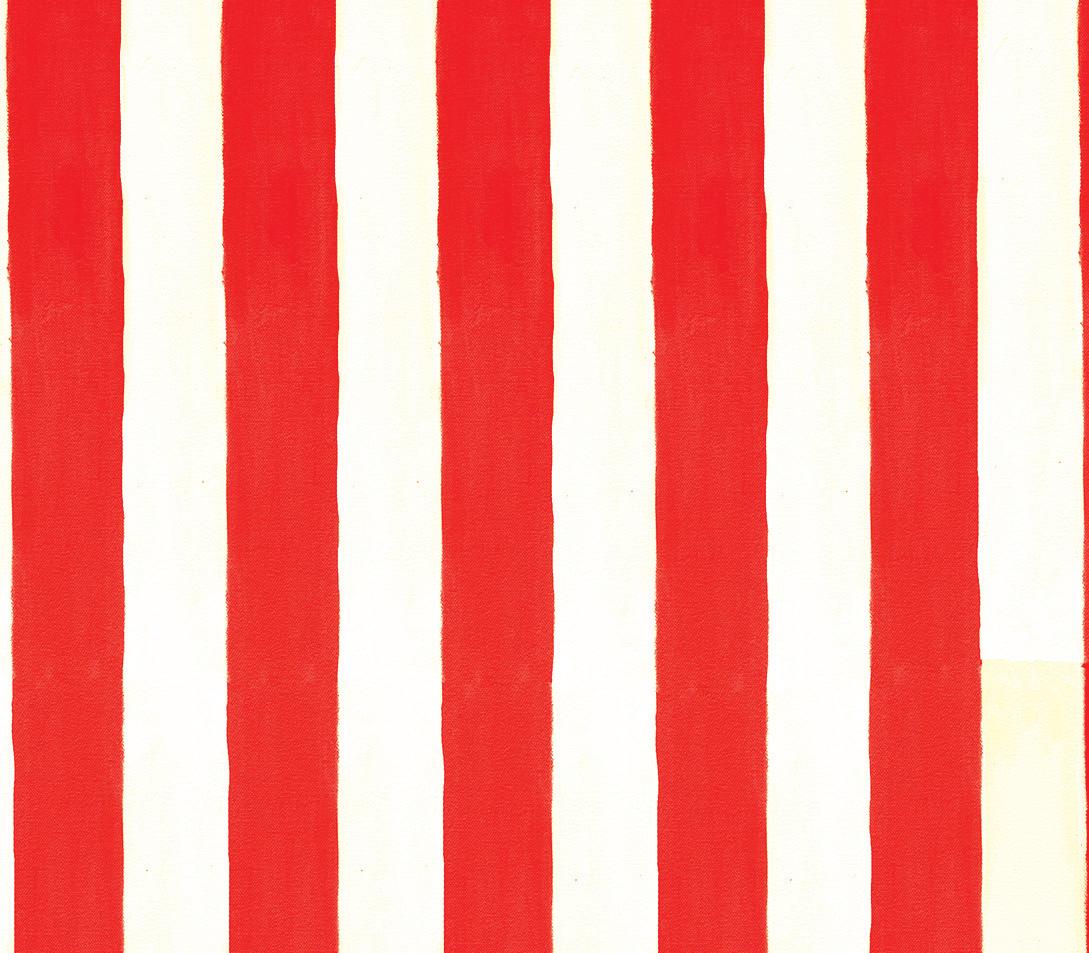
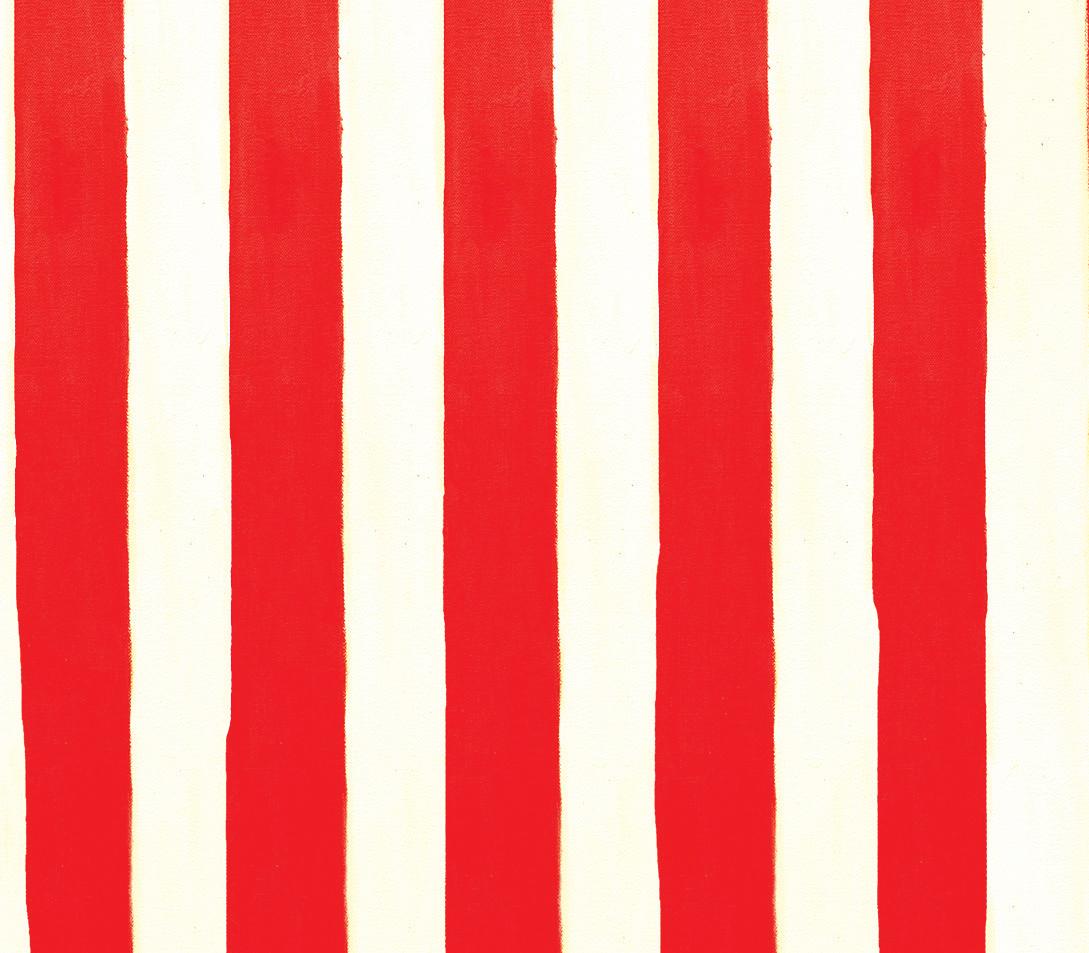
Caroline Best | Americana, oil on canvas
Reese Udler | Multiverse, stoneware
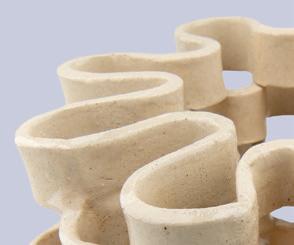
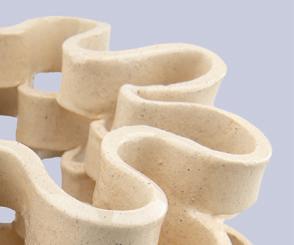

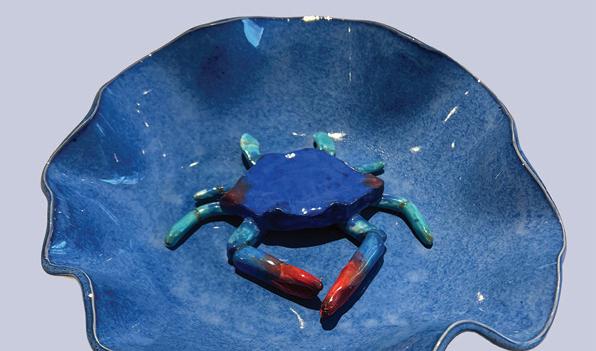
Tamsin Brightbill | Blue Crab, porcelain and earthenware
Inside Back •
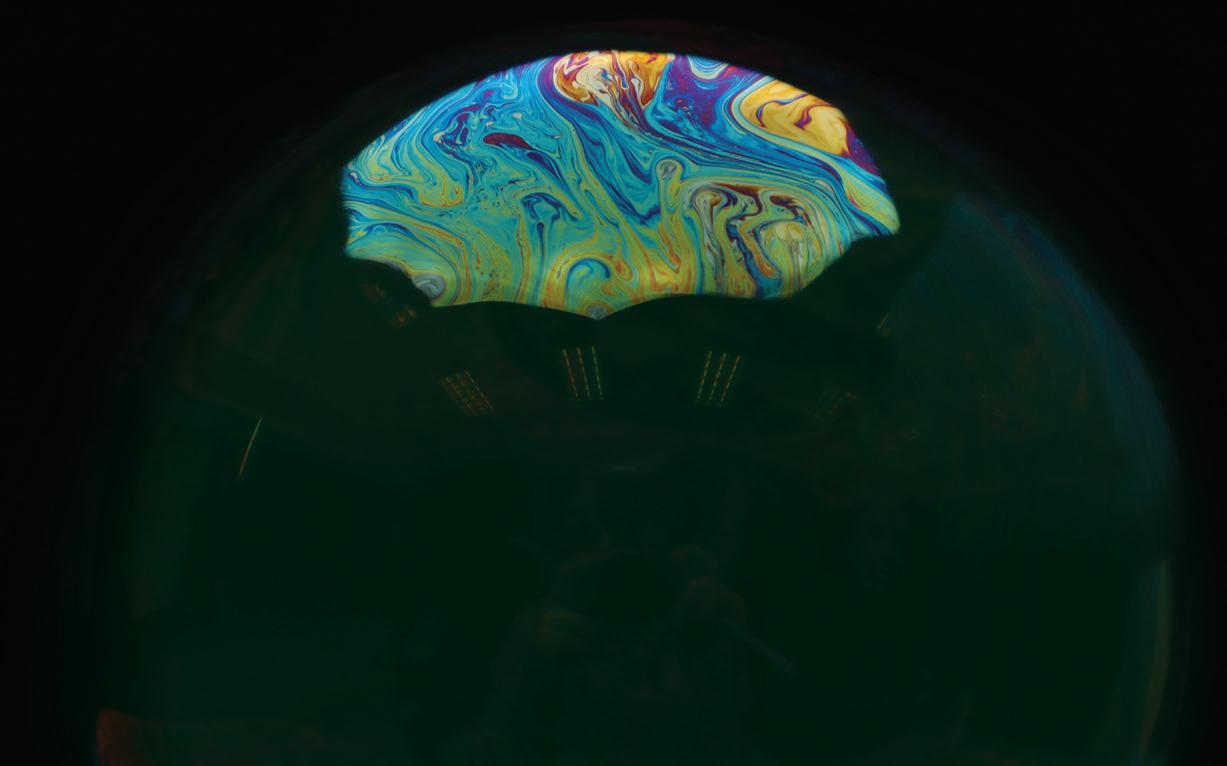
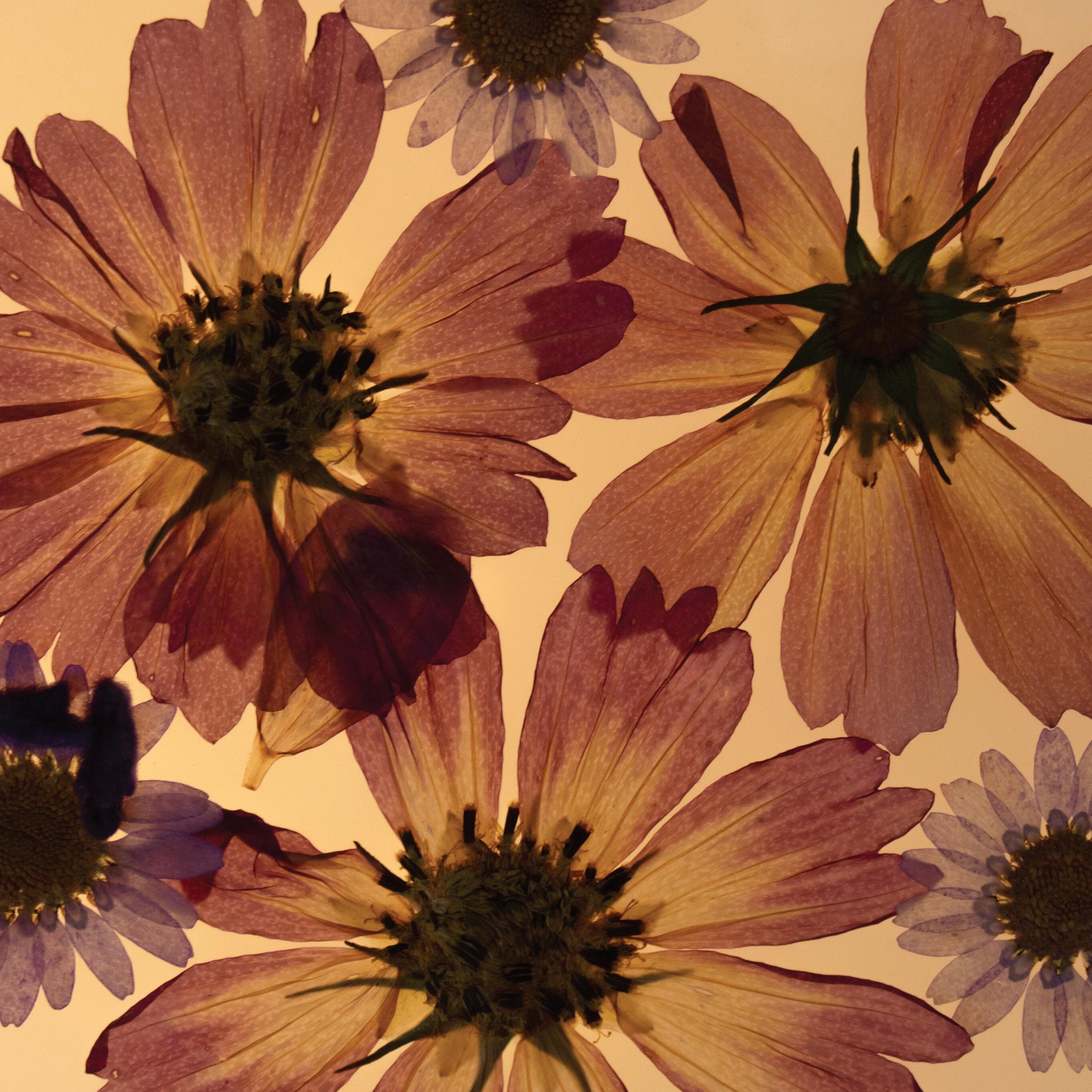
Peyton Fough | Light within Dark, digital photograph
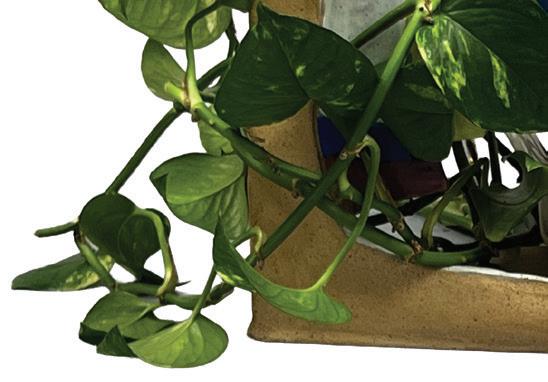
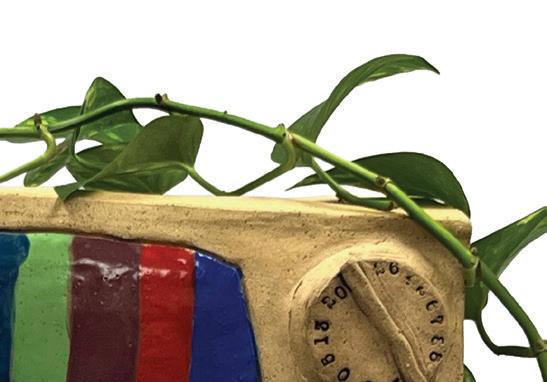
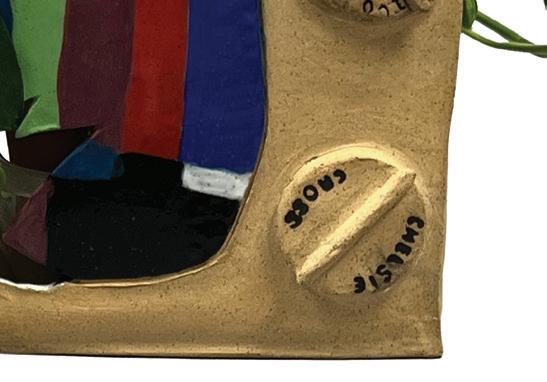
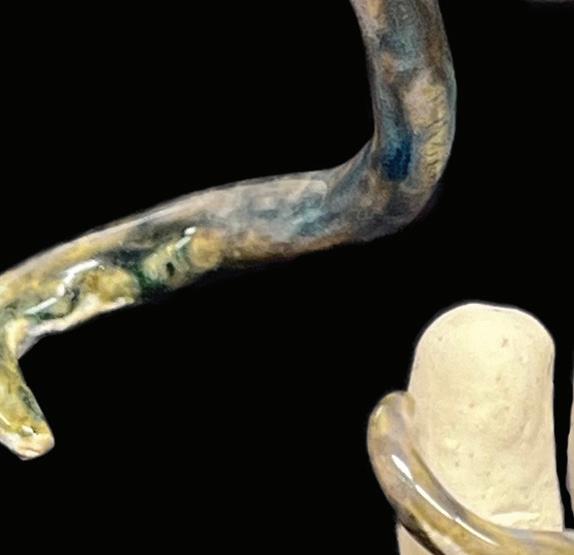
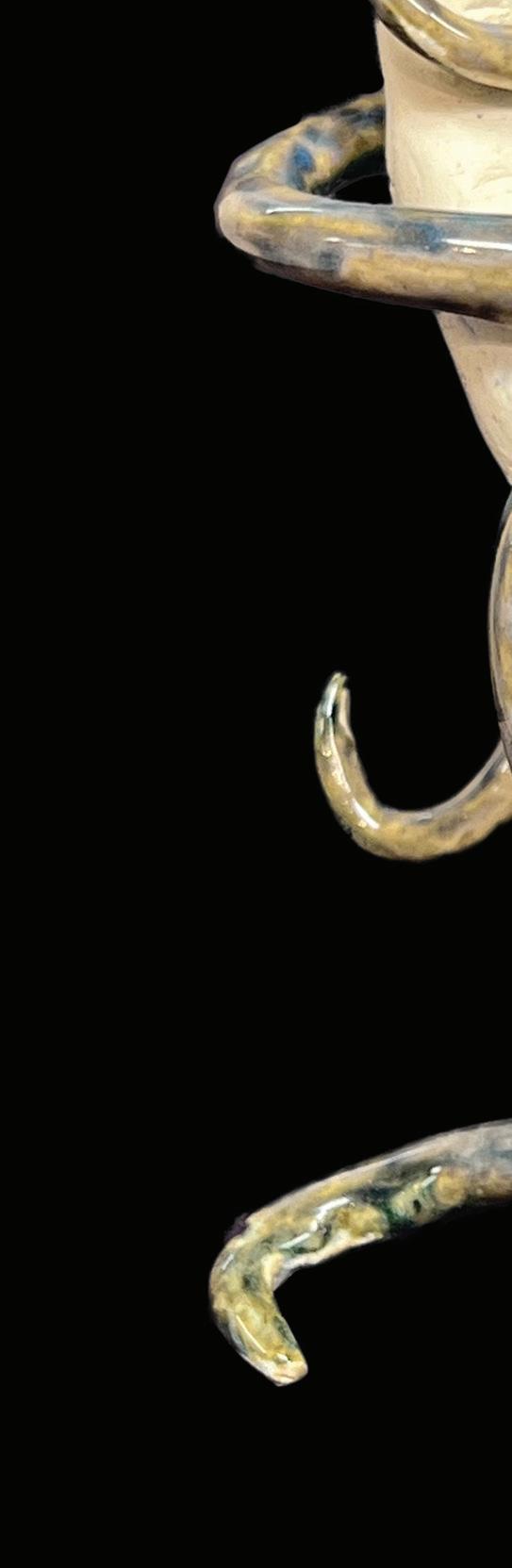
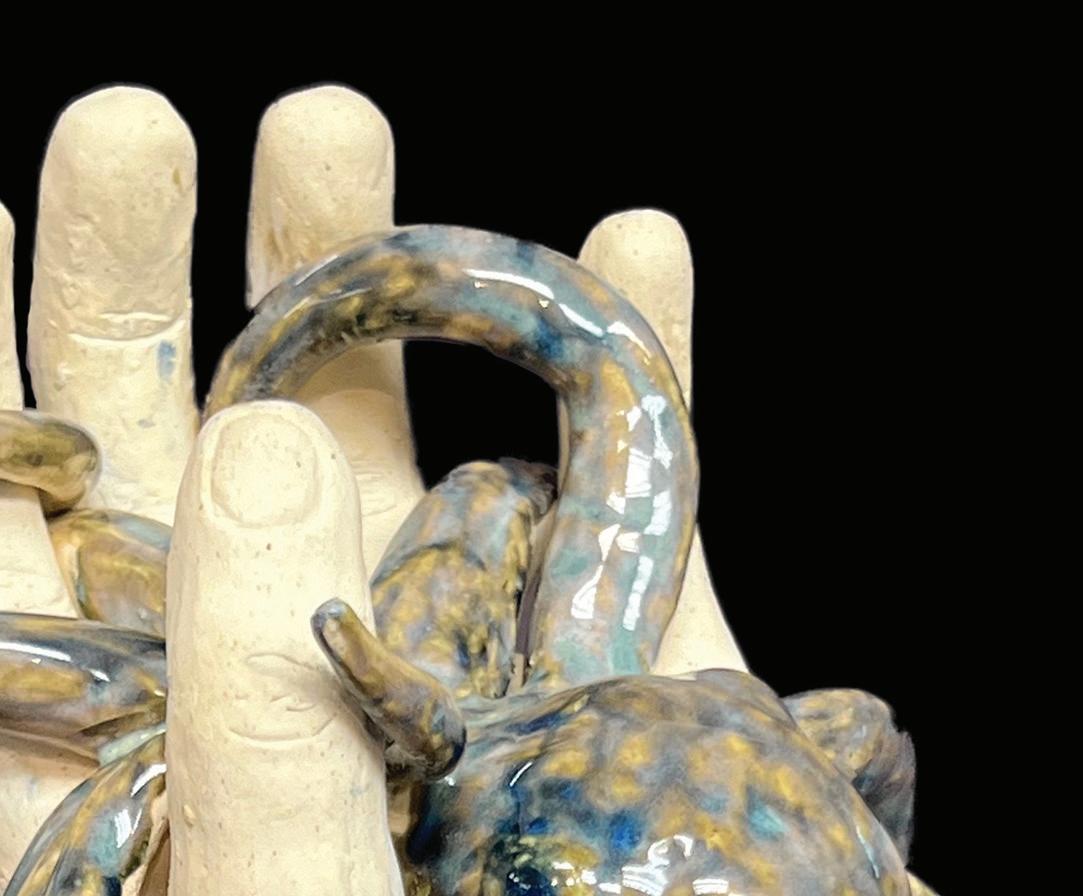
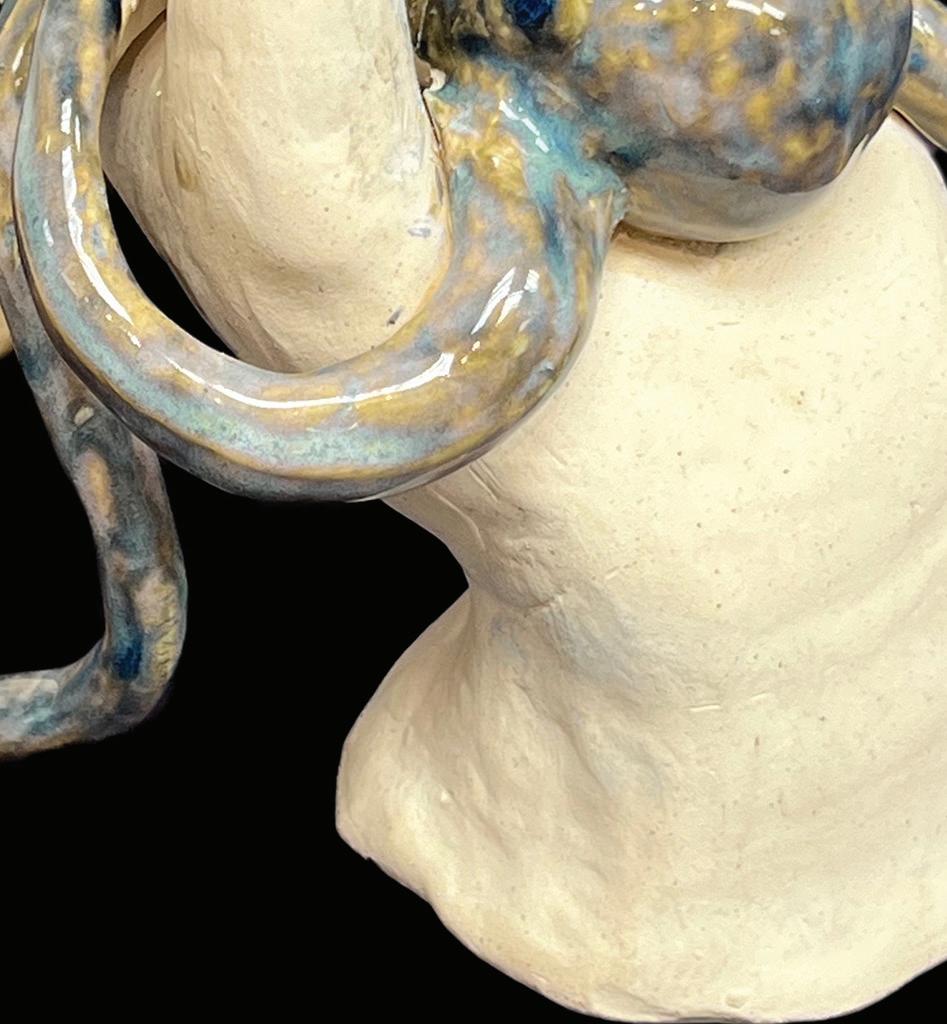
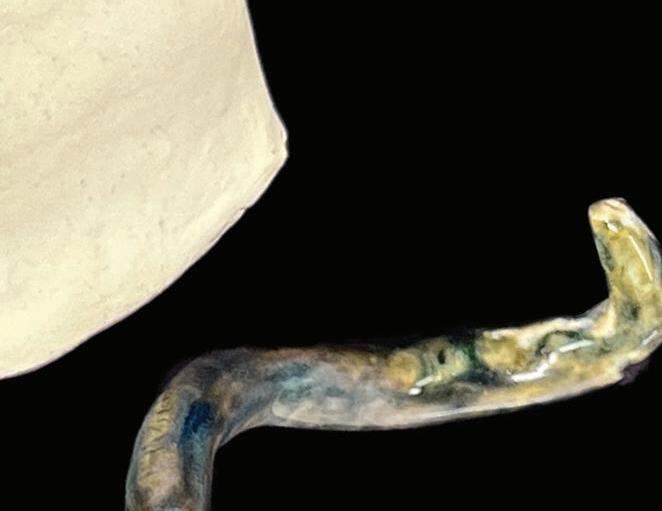
Chelsie Cross | Candy Serpents, earthenware
SCROLL 2026
Volume LXXII
eDItOrS-IN-cHIeF
Betty Rose Bean • Maggie Shelton
ASSIStANt eDItOrS
Corinne Lewandowski • Enaya Mohsin
• Charlotte Mount • Raniya Syed
DIGItAL cONVerSION eDItOr
Peyton Fough
cLUb PreSIDeNt
Lucy Berry • Zoe Nash
• Audrey O’Beirne
cLUb VIce PreSIDeNt
Sofia Aquino
ADVISerS
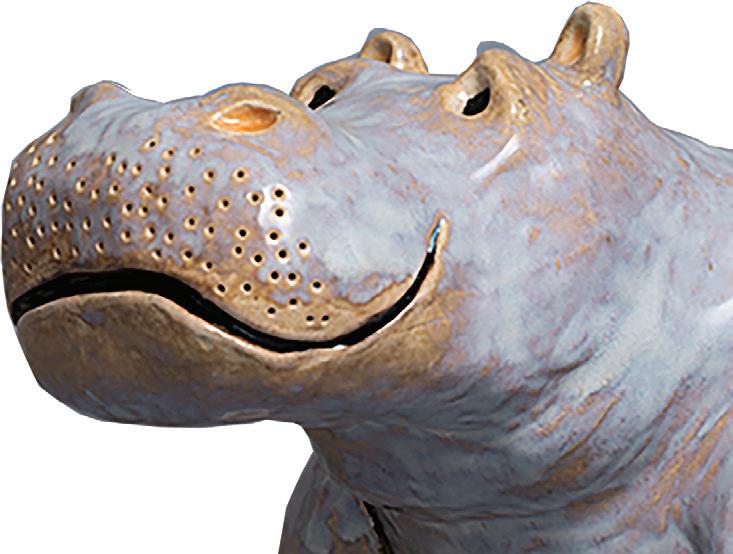
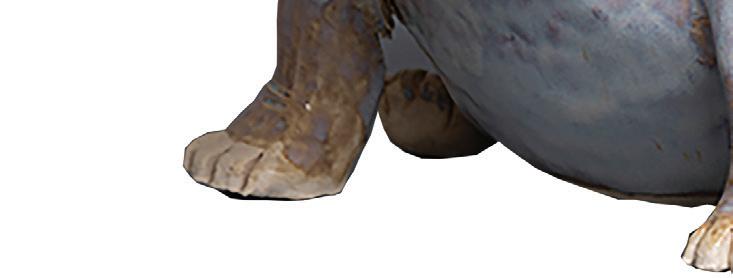
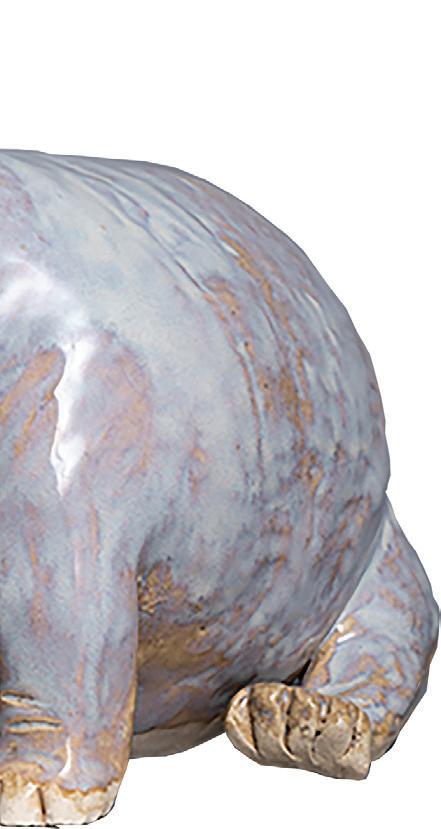
Melinda Salata • Rich Green Mackenzie Westerberg | Unsung Heroes, white
The Holton-Arms School 7303
stoneware


Poole
Oma Ndu
Carlisle Winn
50-51 Alexis Akwara
Marigold Brett-Major
54-57
Paisley Fromer 62
Paige Wollenhaupt
Hall
Hall
Marjan McNulty
PHOtOGrAPHY
Clara Tice
Wiseman



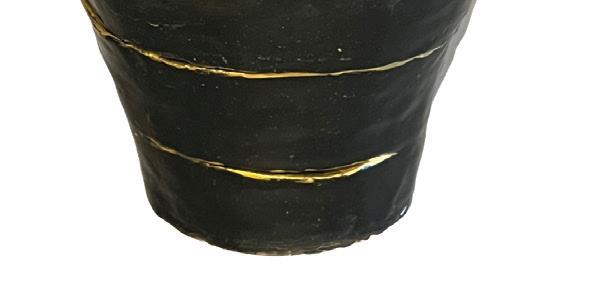

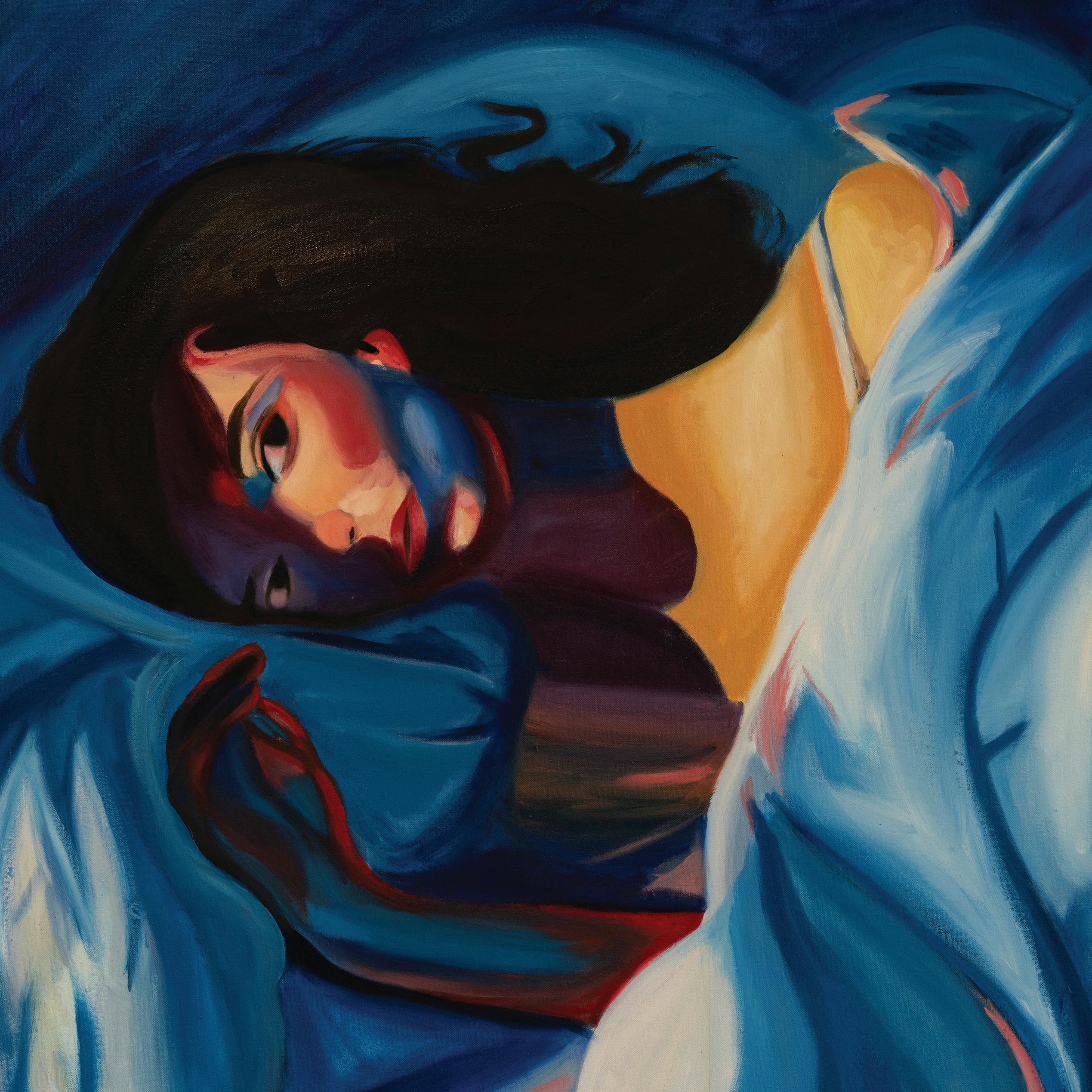
Carlisle Winn | Restless, oil on canvas
SevenMinutesbefore Heaven
Title of poem
They say that when you die, your brain lives for another seven minutes—
Reliving seven minutes of the greatest memories in your life.
What would your last seven minutes be like?
Maybe I’d remember the scent of midnight rain, Or puddles glimmering on pavements. Playing in the river of droplets, Dancing to the whispers of thunder.
Perhaps I’d recall the way my mother called my name, Like a song to be cherished and boasted. Swaying alongside every heartbeat, Gathering like breaths in the frosty air.
Maybe I’d see the four swings in my backyard, All but one rocking in unison. Reaching hands that seek together, Holding them for, supposedly, ever.
I think I’d relish the sunlight beaming through the window, Bathe in its warmth and quiet love. Let the heat fan my face, Let the sun-kissed freckles dot my arms.
But then I would come to wonder:
Would I hear the words I could never take back?
Would I taste bitterness I didn’t dare say aloud?
Would I feel the touch I yearned for once more?
Seven minutes of memories, mistakes, maybes, Seven minutes of would’ve, could’ve, should’ve.
Would’ve
Could’ve Should’ve
Would’ve loved deeper, Could’ve asked questions, Should’ve spoken louder.
All these things I once had time to do, Turning into bitter regret settling in my bones …
If only I had seven more minutes, I would say —
The words that never —
Rosie Lee
Grandy’s Room
Livie Thomas
If you ever need to find me during the school day, the first place you should look is Ms. Grandison’s office. Most Holton girls have their “spot,” the place they go to when they need to decompress. For me, this spot is Ms. Grandy’s office.
As soon as you walk in, you’re immediately hit with a wonderful aroma. A reed diffuser behind her desk expels scents of papyrus, lemon, and comfort. I’ve tried to replicate this smell in my room with an assortment of candles and have never come close to capturing it.







into the cozy room, my eyes are immediately drawn to the stitched tapestry of a tiger that hangs from the wall and then to the oversized feather plume pen that rests on her desk, far in my room with an assortment of candles and essential oils, but I

Upon walking stitched tapestry of a the wall and then to on her desk, far

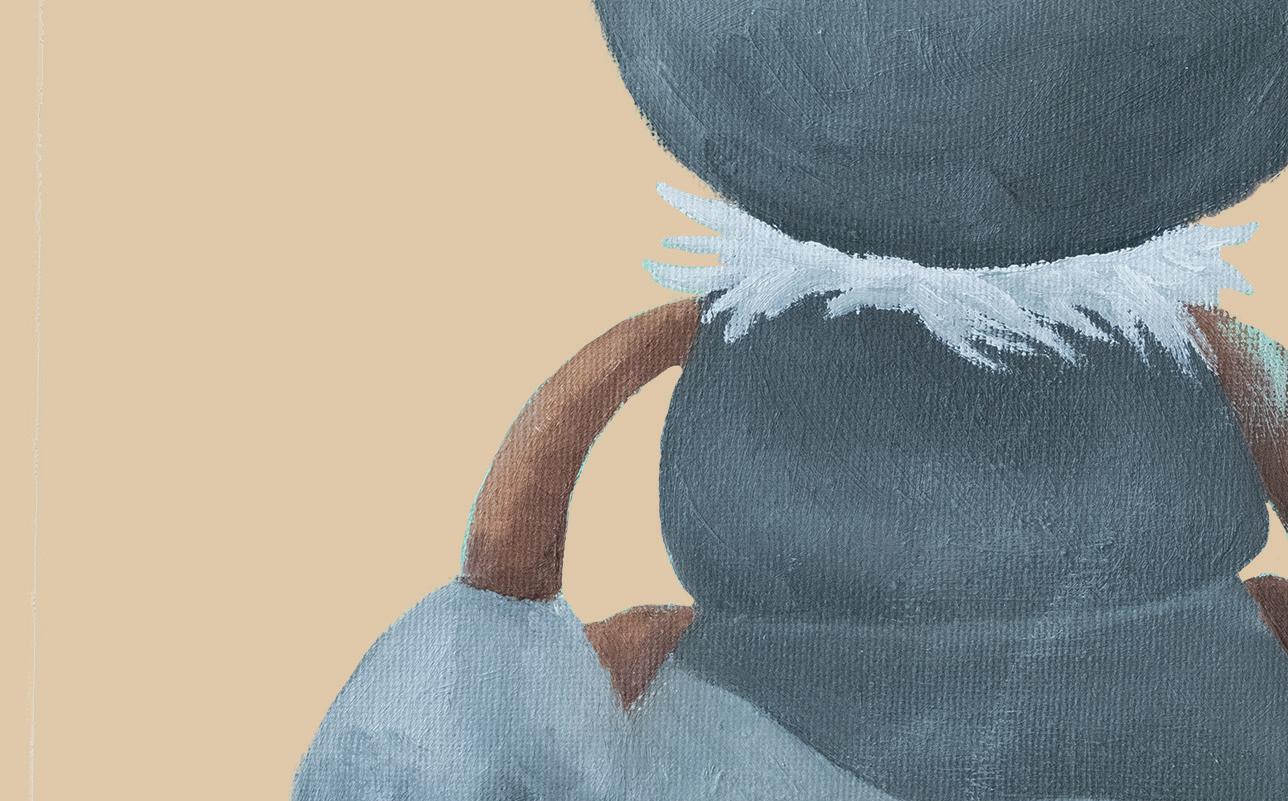
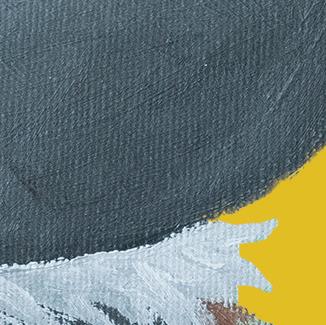
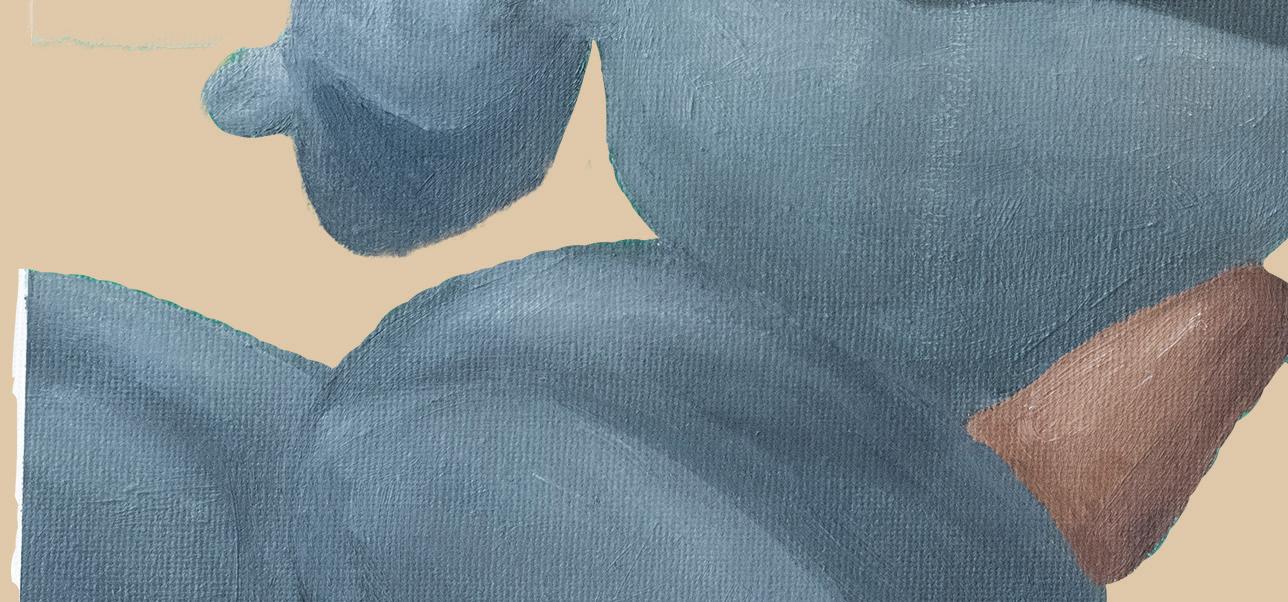




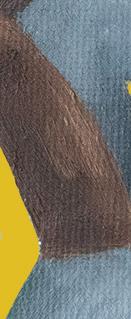
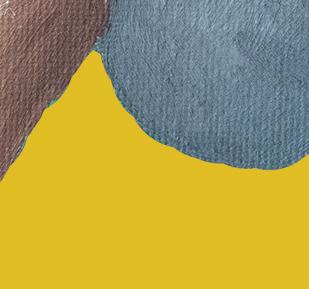

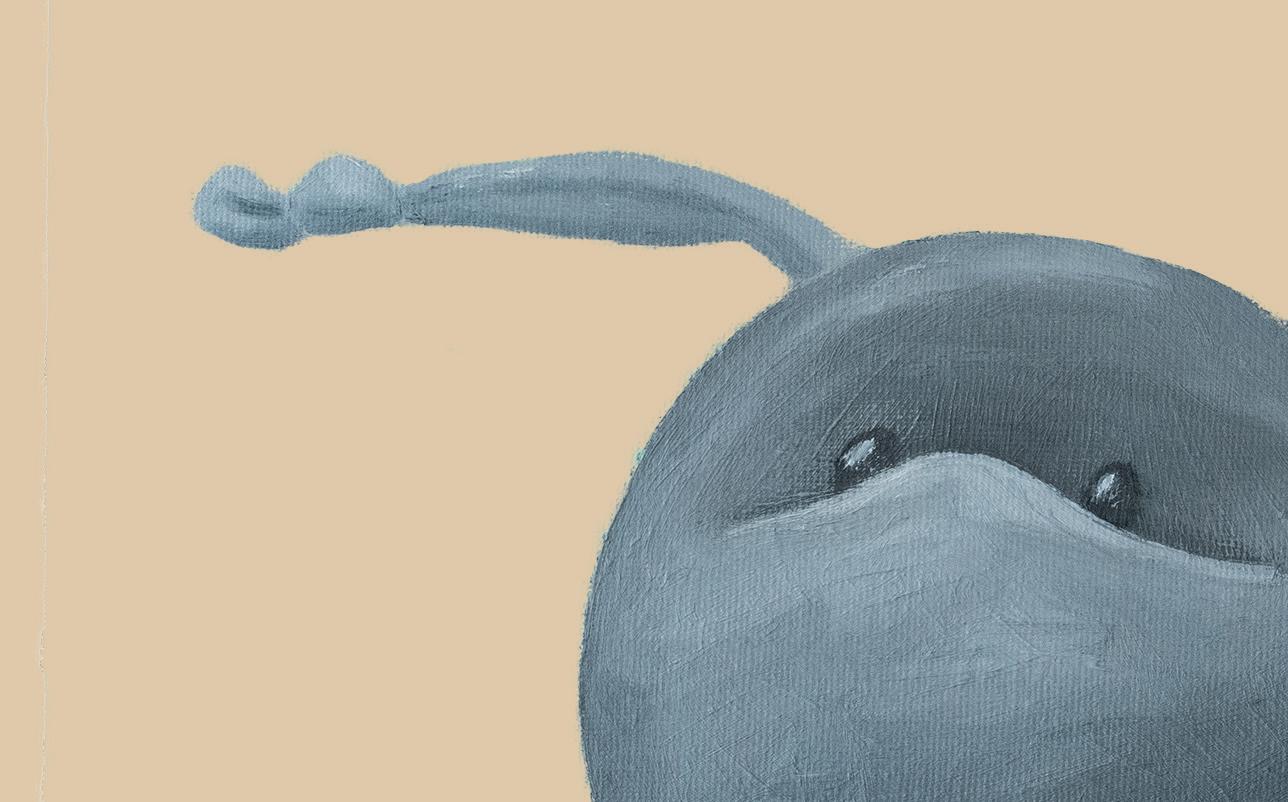
Betty Rose Bean | Ant, oil on canvas
too extravagant to write with and has, therefore, become a decoration.
layer of a pineapple squishy, spewing dozens of yellow gel balls onto the floor of her office.












I plop down on one of the two grand armchairs upholstered in floral patterns. The chairs are the perfect size for me to hoist my legs up and curl into a ball. If I’m feeling extra cozy, I snatch the fuzzy, gray throw blanket to drape over my knees. Most teachers do not have blankets in their office, so this is a special perk of Ms. Grandy’s.
Then of course, a clay ramekin filled with Hershey’s milk chocolate kisses is the Holton equivalent to a pot of gold. While I wander to Mrs. Grandison’s for the cozy ambiance, I typically leave with two or three chocolate kisses.




Whether we’re reminiscing about middle school advisory or laughing profusely about something random, she’s fully present in the conversation. knees. Most teachers do not have blankets in their


A collection of fidgets — foam squishies, Orbee stress balls, and more — rest on the table beside the chairs. Over my years spent in this office, I have experienced the phasing out of some fidgets as they accumulate dirt or become too worn as well as the introduction of new ones. I will admit that one time during my junior year, the especially aggressive clenching of my fist popped the silicone outer
But the heart of this office, of course, is Ms. Grandison herself. She usually sports a brightly colored pantsuit, with a bedazzled brooch (typically of an insect or bird) fastened to her lapel. Most of all, I admire that when I tell Mrs. Grandison a story, she truly listens. She does not just nod along with the occasional “mh-hm.”







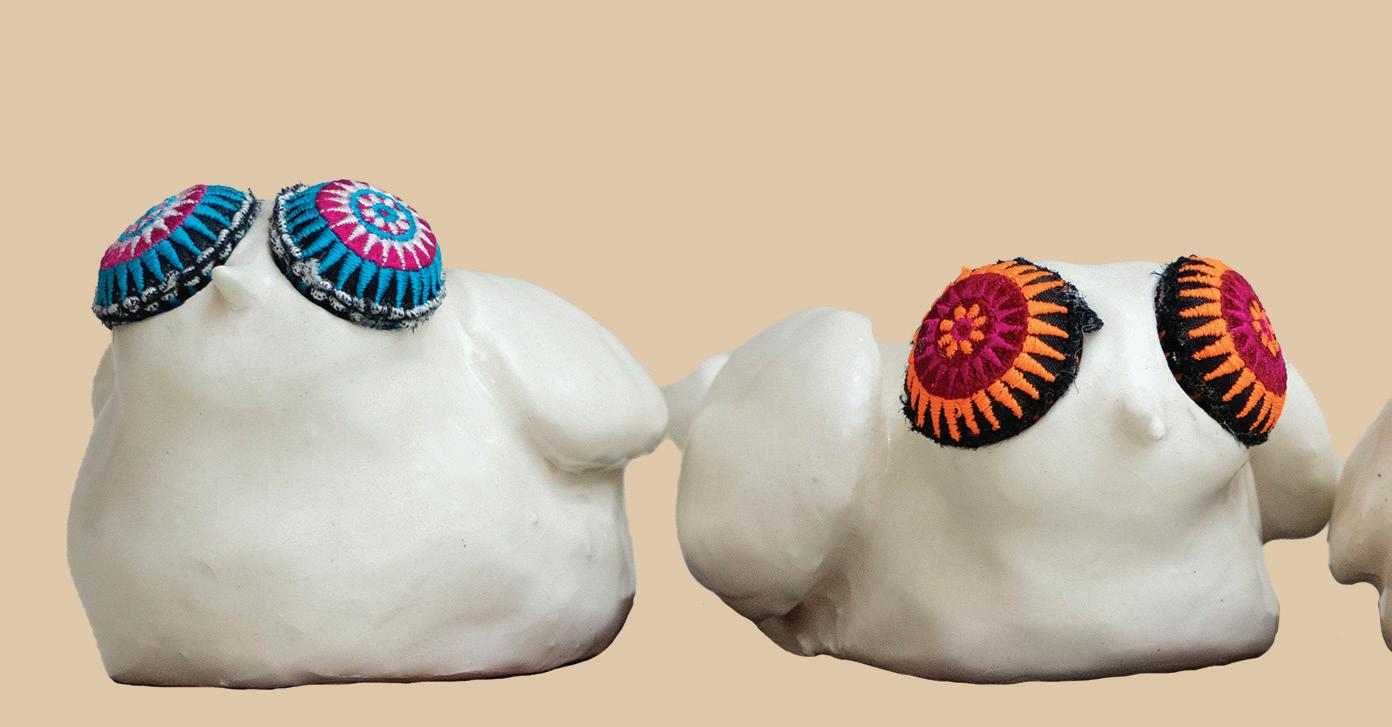
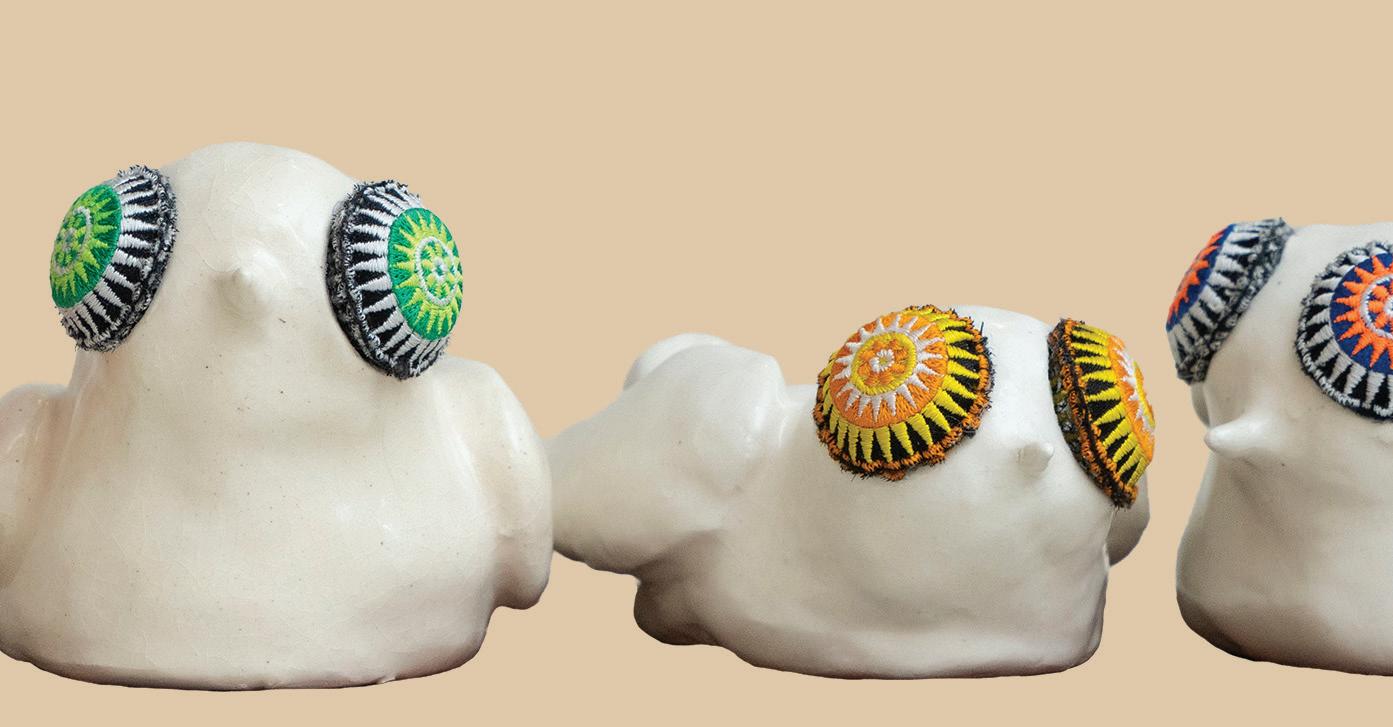
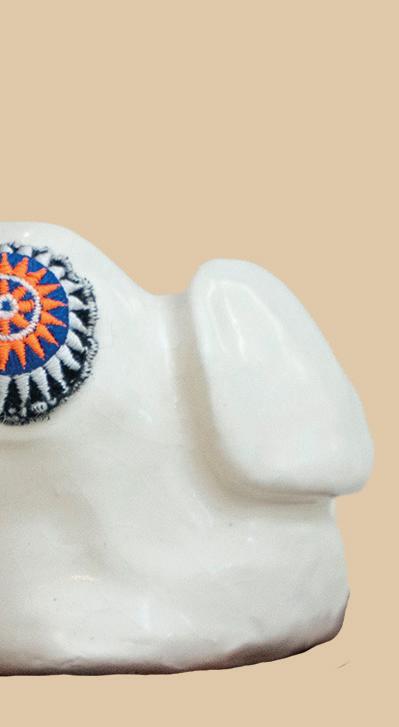
Sophia Dalton | Eyes Are the Window to the Soul, white earthenware and cloth
Betty Rose Bean | Baubles and Bubbles, graphic art
Littlestown
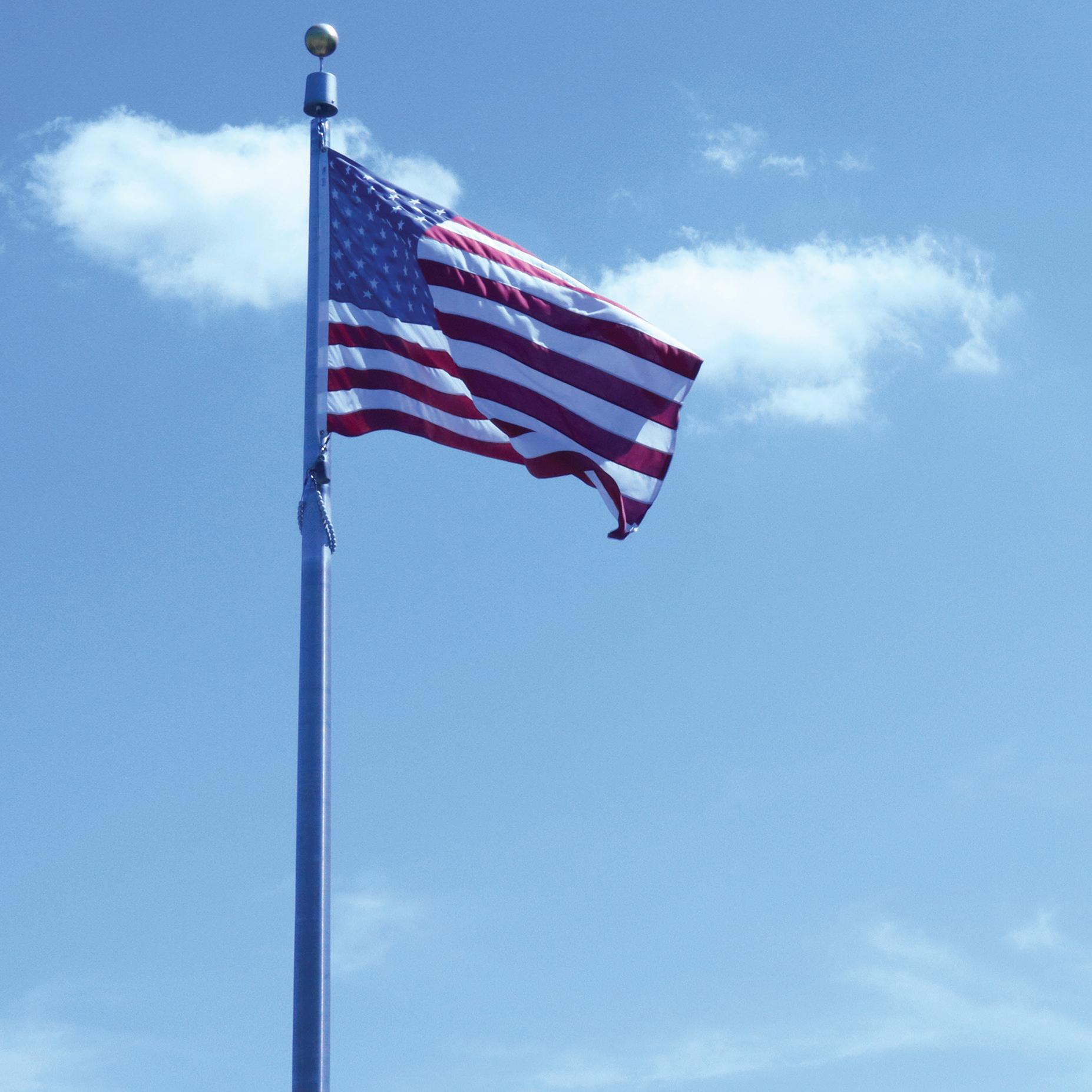
Clara Tice | Flag On Pole, digital photograph
Lauren Wah
Two hours away across the border of Maryland lies a town older than the United States. It’s aptly named Littlestown. Driving from Frederick to Littlestown, large chain stores slowly disappear, leaving you without a single Walmart in sight. The roads, tight and overgrown with weeds, compete with uneven sidewalks cracked from decades of wear. Lamp posts, intermittently placed on the sidewalks, hold fraying “hometown heroes” banners. Old, drooping telephone wires hang every which way. The brick buildings are squished together like dominos and look as if they’re about to crumble apart from centuries in the sun.
Harris Teeter, Trader Joe’s, and Whole Foods, foreign languages in this Littlestown, are replaced with something far more fitting: a Family Dollar store. The Family Dollar holds everything a small-town Pennsylvanian, or a seventeen-year-old girl from Potomac, could ever ask for. Popsicles, specifically the chocolate fudge ones that always induce her stomachaches; eye drops, for her itchy eyes; Claritin, for her allergies to the horses and cats; ice packs, for her occasional scraped knee, and more. Near her Family Dollar, there are salons, the ones where people emerge with fresh rollers in their hair, holding cigarettes between their pointer and middle fingers and wiping dirt from their boots, all while hootin’ and hollerin’ at their neighbors. There’s also Adam’s County Gold, Silver and Coin Exchange, which promises the best return on your goods, and a dull library with more
spiders and dust than books. Past the hometown heroes, the Family Dollar, the salons, and the library, you’ll see a red barn at the end of Littlestown’s main road. Trek up the hill past the horses, turn right, and you might even see Jeanie and Skip, the girl’s grandparents. Skip might be perched on his John Deere lawn mower or taking joyrides on his golf cart with its fraying leather seats and roof. And Jeanie, if she’s not practicing piano pieces for her church group or making deviled eggs with extra paprika, will be reading on the
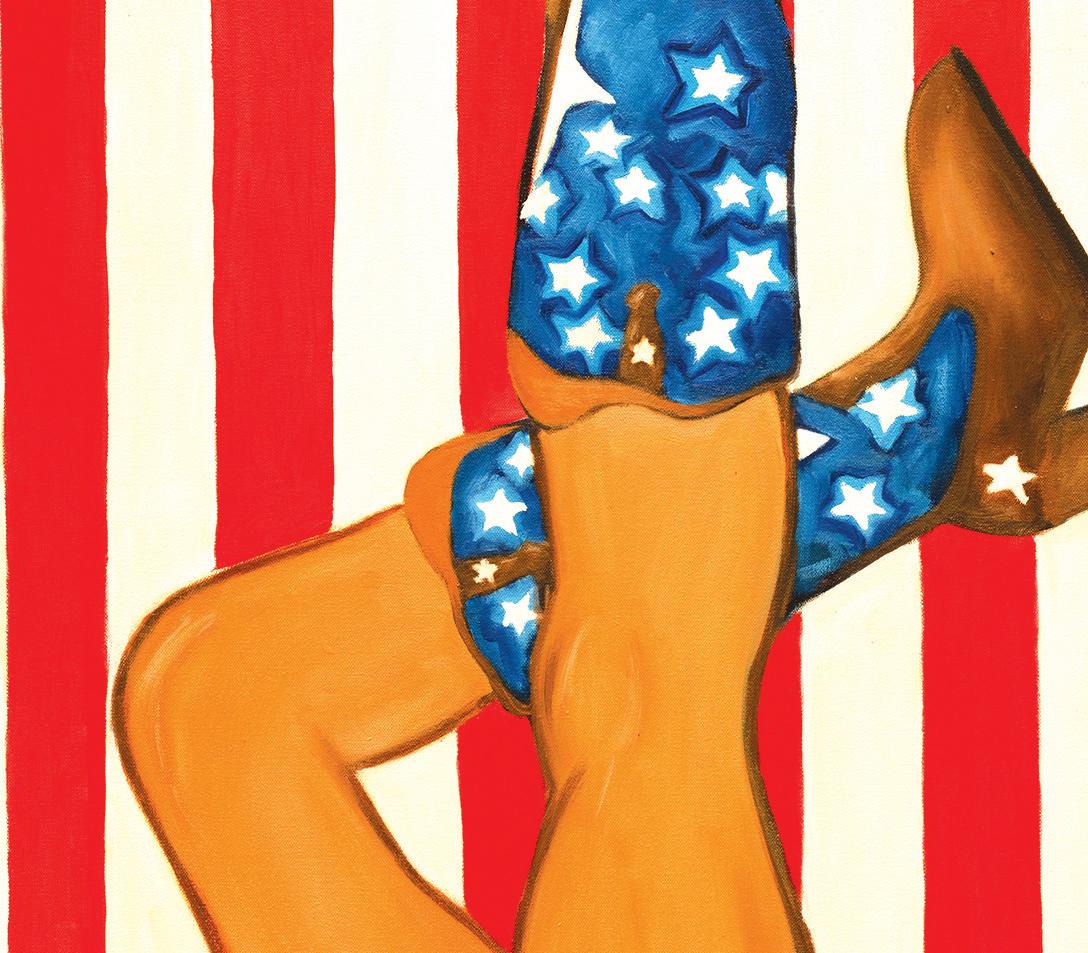

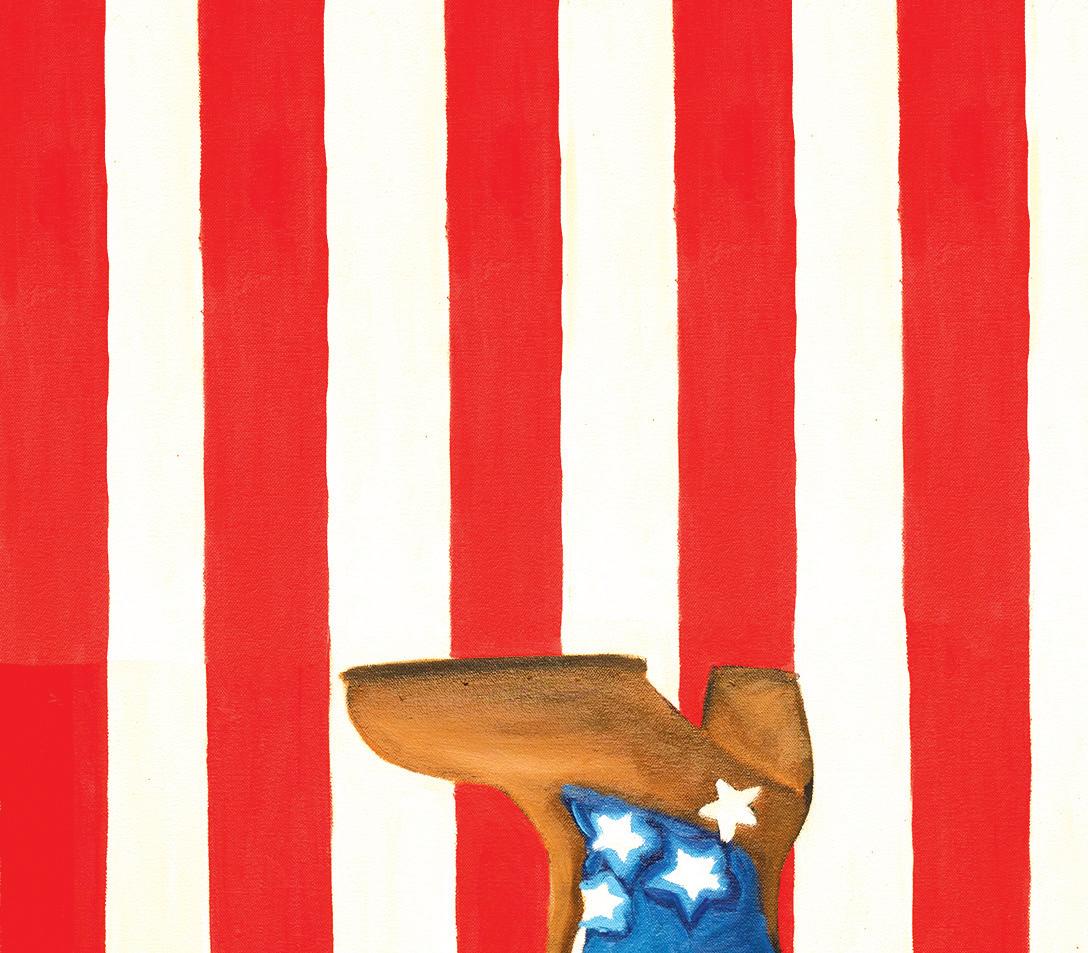
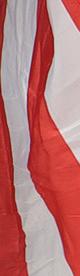
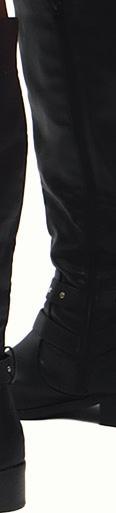
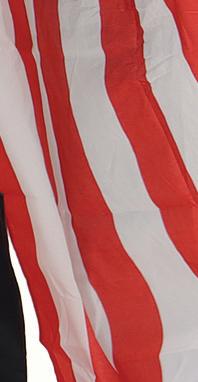
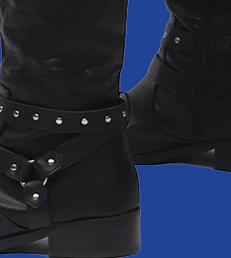
Audrey Grisius | Legs of Liberty, oil on canvas
porch with a comically large American flag flitting in the wind. When the seventeen-year-old girl pulls into their gravel driveway, she unbuckles Luke’s collar and lets him bound over to them. After many hugs and kisses, he soaks up the opportunity to be off-leash and frolics behind their house. The main attraction of the backyard is a large hill, affectionately known as a driving range for golf, a speed boost for golf carts, and a track for sled-riding escapades. Luke runs behind the hill to a large pile where Skip places leftover firewood and kindling in case anyone ever wants to make s’mores. And sometimes, the dog hears distant “bangs.” Instead of fireworks, though, it’s the echo of a gun as the girl shoots clay pigeons and old aluminum cans alongside the melody of Jeanie playing “Hallelujah” on the grand piano. The air smells like firewood, gunpowder, and hay.
More trucks pull into the driveway and more dogs get freed from their collars. Humans and dogs alike all gather inside the
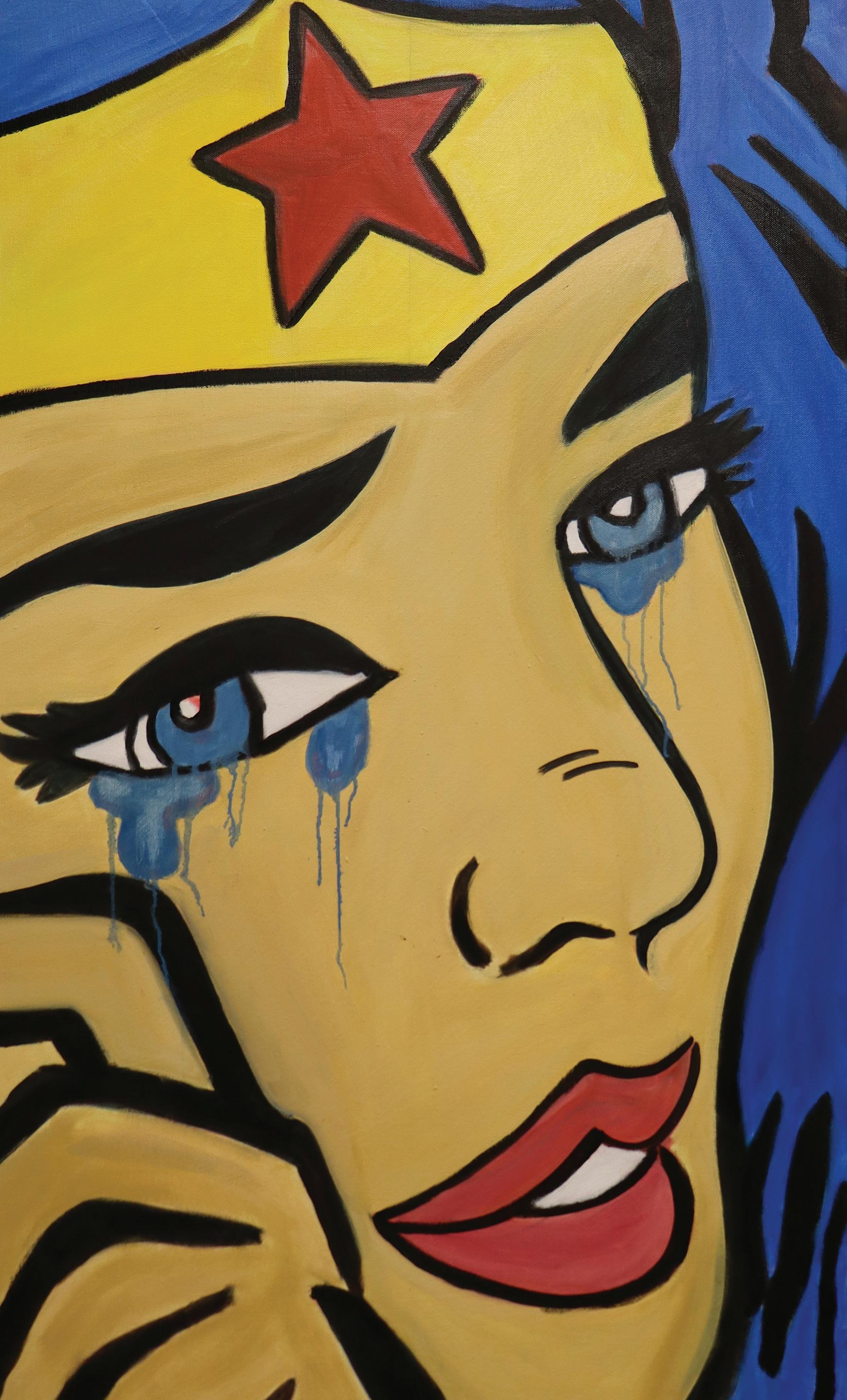
Reese Rosenkranz | Wonder Woman, oil on canvas
house. The TV is humming in the corner, and the fireplace is always crackling. Jeanie says you can keep your muddy boots on.
The counters are hardly ever seen without glass platters of deviled eggs, mashed potatoes, mac & cheese, and corn casserole. And on this day, Jeanie even made sure to buy canned olives and Skip even put on the Golf Channel for their granddaughter.
As people form a chain with their linked hands and bowed heads, the girl starts, “Dear Heavenly Father ….” And so begins a sequence of hopes, wishes, fears, regrets, things she wants for Christmas, and things she’s most grateful for, which is always something along the lines of her family and her dog, Luke. A slew of “Amens” — pronounced both “a-men” and “ah-men,” follows.
People begin to excuse themselves, one by one, to stand impatiently in line for the buffet-style meals. After, they sit with food precariously stacked on their delicate plates and Fanta in their wine glasses. It’s hard to hear over the quiet din of the discussions. Topics range from politics (oftentimes a touchy subject given the tables’ opposing views), to college, which Jeanie and Skip don’t know much about. Snippets of “Pass the ‘sawlt’” and “Can you pour me ‘wudder’” float above the noise.
Once plates are cleared and bellies are full, great-grandma’s china is pushed to the side, and ceaseless rounds of Uno start. People crease the

corners of their cards and bend them to prevent “bleeding.” They slam cards against the table in mock outrage and cry, “You looked at my cards!” Outside, some throw baseballs and others dribble basketballs against the pavement in a rhythmic thump, thump, thump while crickets chirp and horses clack their hooves.
















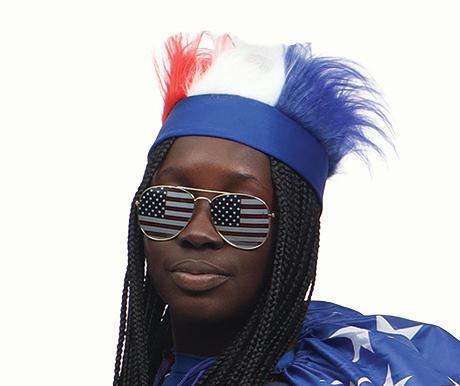




Once a year, the girl returns to search restlessly for small eggs containing a buck and a kiss. Once a year, she shoots lights into the sky, illuminating it with flashes of red, white, and blue. Once a year, she tears open boxes to find socks, video games, and scarves.


All year round, Littlestown is where she finds Jeanie and Skip and where she lets Luke run free. year, the girl returns small eggs containing a finds Jeanie and Skip and
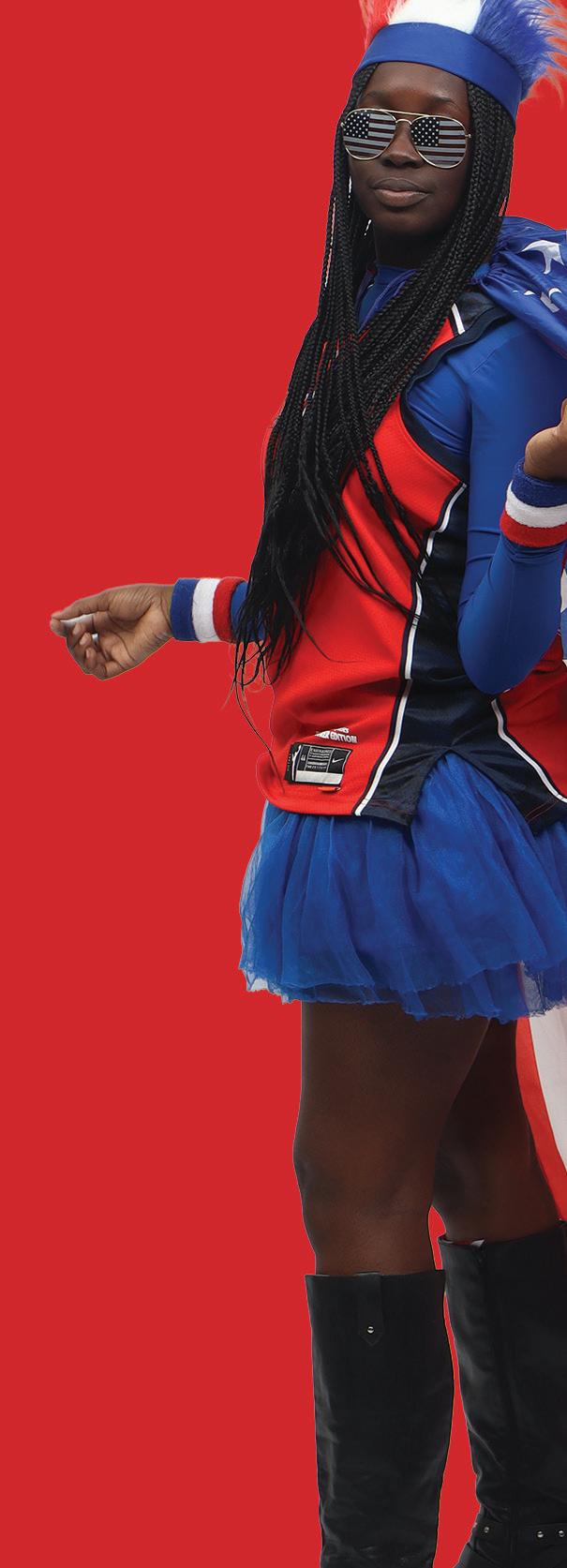
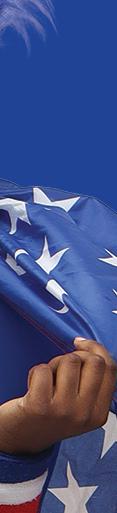
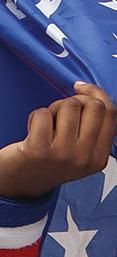
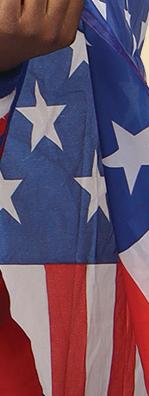





Hannah Wiseman | Awakening, , digital photograph
leftovers
Nell Choi
half-peeled hard-boiled egg her chubby toddler fingers picking away the eggshell, little white shards you would clean up for days and weeks to come
gallon of whole milk best by 9/22 two more weeks but the stench is already sliced with sour. It must just be buttermilk you screw on the red lid
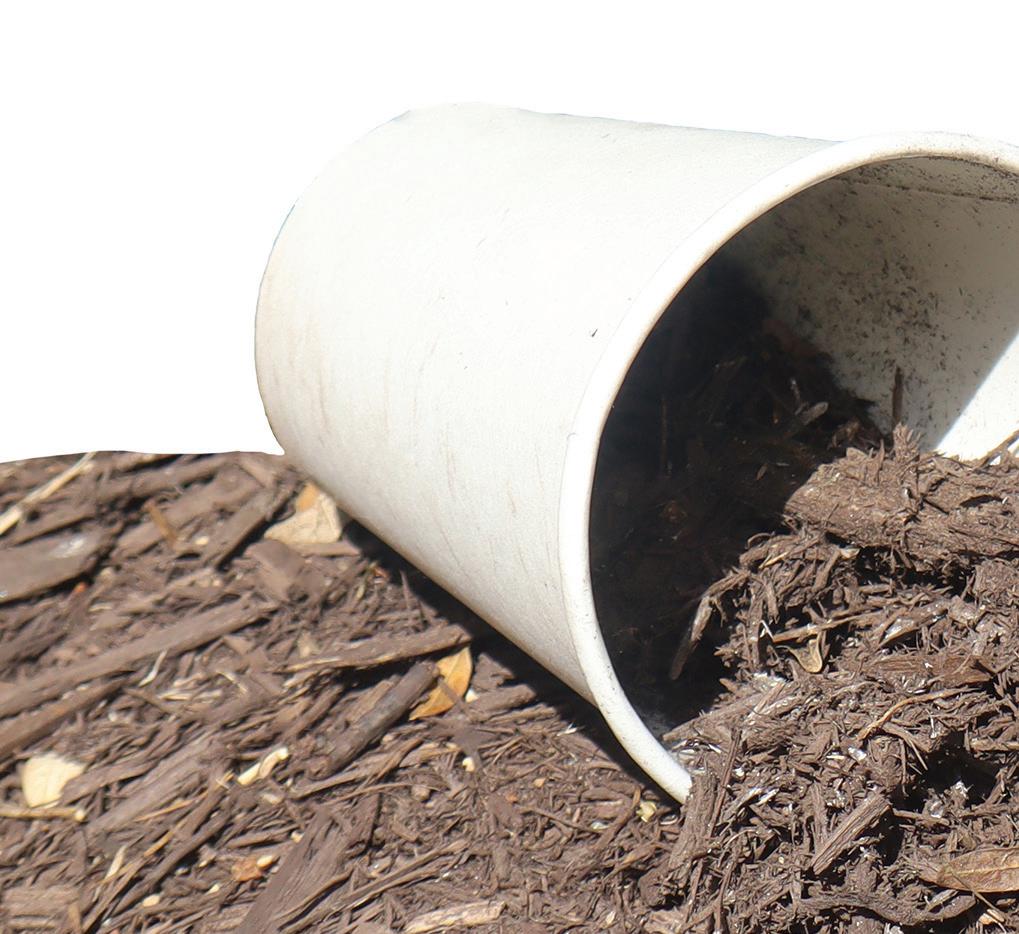
stale cornbread a year ago, you would’ve made stuffing — her favorite — sweetened with honey, sprinkled with garden-grown thyme but time is a bitter thing you know you cannot grow, only prune
white-spotted wonder bread like bumps on butterscotch skin you wonder how mold multiplies microscopically overnight too much moisture? how you let a fleet of cancer cells seize her
birthday parties basketball games
how maybe you could have stopped it
HannahWiseman|Loss,digitalphotograph
your mom’s sunday sauce smelling of heirloom tomatoes and browned bits of fennel-seeded sausage clinging to the cast iron skillet, like your knuckles clinging to her cold hands, whispering, it’s gonna be okay, scrape it. scrape the pan so it won’t burn
A paper coffee cup radiofrequency radiation;

A paper coffee cup crinkled, with brown stains holding crumpled papers you scan for a date printed on the plastic wrapping — there is none —only the september 9, 9 months gone, $16 on your hospital parking ticket

mcdonald’s nuggets flash-fried in preservatives sodium acid pyrophosphate that preserve a child’s happy meal like eggshell to yolk you want to believe that radiofrequency radiation; chemotherapy; sleep?? scrawled on an electric-pink post-it will maybe preserve a child’s happy life
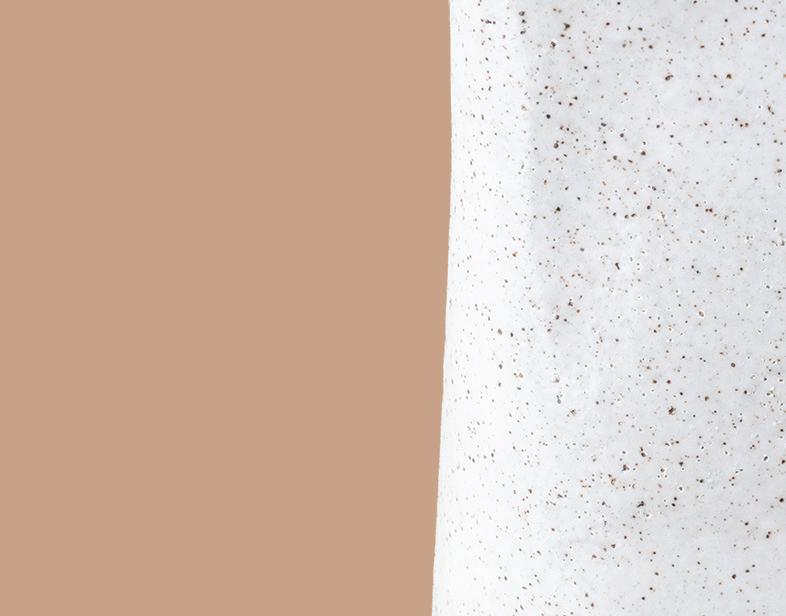
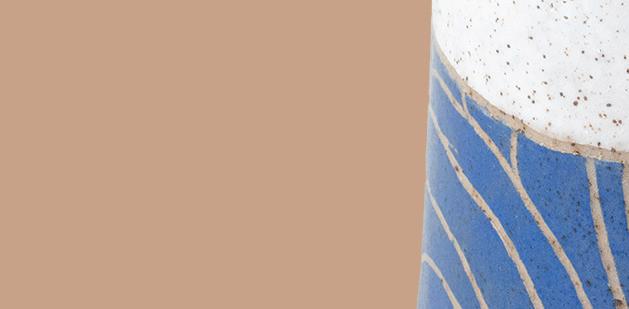
Dylan Agetstein | Depth, stoneware








AfterBirds of a Feather
Charlotte Knight

















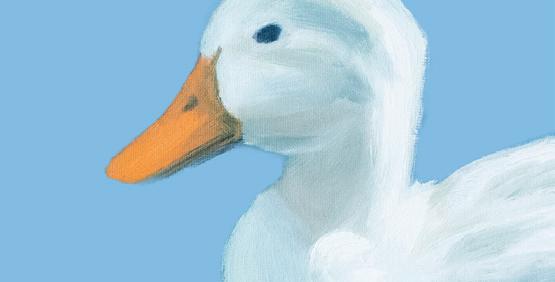
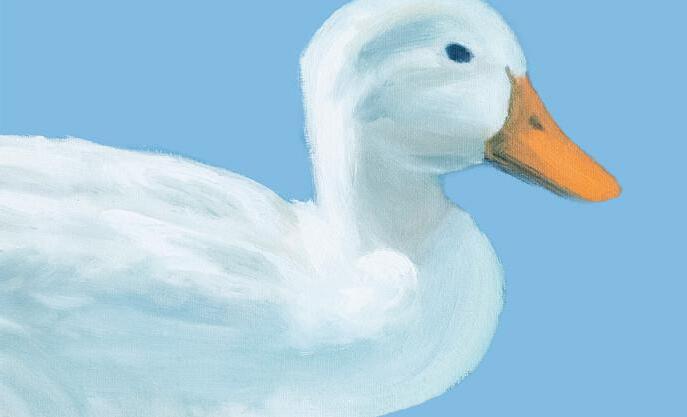
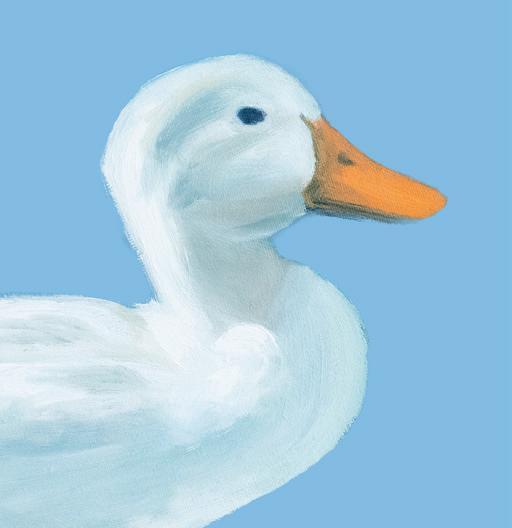
a violent encounter with a goose in fourth grade, I developed a fear of birds. The “violent” part is fairly questionable. I was walking around a small pond at my school when a goose across the water looked at me, honked, and began flying in my direction. Just as it almost reached me, it turned and flew straight over my head. I ran away screaming and crying. Whether the bird actually intended to attack me is a highly contested topic in my family, but I began to avoid birds at all costs.
I refused to eat outside at restaurants because of the tiny birds that ate the fallen fries under the table or to go to ponds that geese and swans frequented. Though I slowly got over the breakdowns about outdoor seating and ponds, I couldn’t shake the internal dread each time I saw a bird. They seemed to sense my fear, watching























A few years later, I came home one night and slammed my bags on the floor without bothering to turn on any lights. My dad entered









closely behind, having brought trash bins from the driveway. looked at the open bathroom, I noticed something




















and claw-like







the house in the












As I odd. A sliver of light from






tile beneath … I knew what this was.






“DAD, THERE’S A BIRD IN OUR HOUSE!” I




















The small bird seemed unbothered by the noise and remained standing in front of the door. After we grabbed a broom from the pantry, my dad and I crept down the hallway towards the bird, which refused to move. As my dad extended the broom to startle the bird, I hid under a table. He hesitated between each step as he approached the bird.
“You have got to be kidding me,” I exclaimed as I grabbed the thing to find a HomeGoods sticker still stuck swans



“Its tail feathers are stuck under the door,” he finally said. I stood to turn on the lights. The room filled with light, and we blinked as our eyes adjusted to the harsh brightness. Where the bird had stood sat a bronze-colored,







nails against the to the bottom.








The bird-themed decor didn’t end at the doorstop, though. My mom had found a new passion for interior design, and her taste was strictly avian. It seemed that every day there was a new delivery of bird centerpieces for the table or bird wallpaper for the bird bathroom. I shuddered each time







I walked past a bird haunting me in my own home.




In the dining room, three small glass terrariums


I directed them around corners and railings. When they finally set it down, I asked what was inside. My mom removed the tarp. To my horror, she revealed a shadow box of fifteen taxidermied birds. Some sat on perfectly placed logs while others swooped through the air, frozen in time.

“Your great-grandfather made it himself,” my mom proudly added as I watched my dad begin to hang the box up on the wall. “He made one for each of his daughters, but this one, for your grandmother, was the biggest.” I stood in fear as my dad mounted featured different colored bird figures with beady eyes. A dog-sized wooden swan sat on a tall cabinet in the kitchen, where it watched my every move as I ate breakfast.


“You haven’t even heard the best part!” she continued. “The bird box is handed down to the youngest daughter in each family, so one day, this will be yours!”
One day, my parents walked out of the attic carrying a massive rectangular box covered in a tan tarp. My dad held one end, and my mom held the other as the box to the wall in a perfectly visible spot where everyone who entered the home could see it.
Penelope Cox | Go with
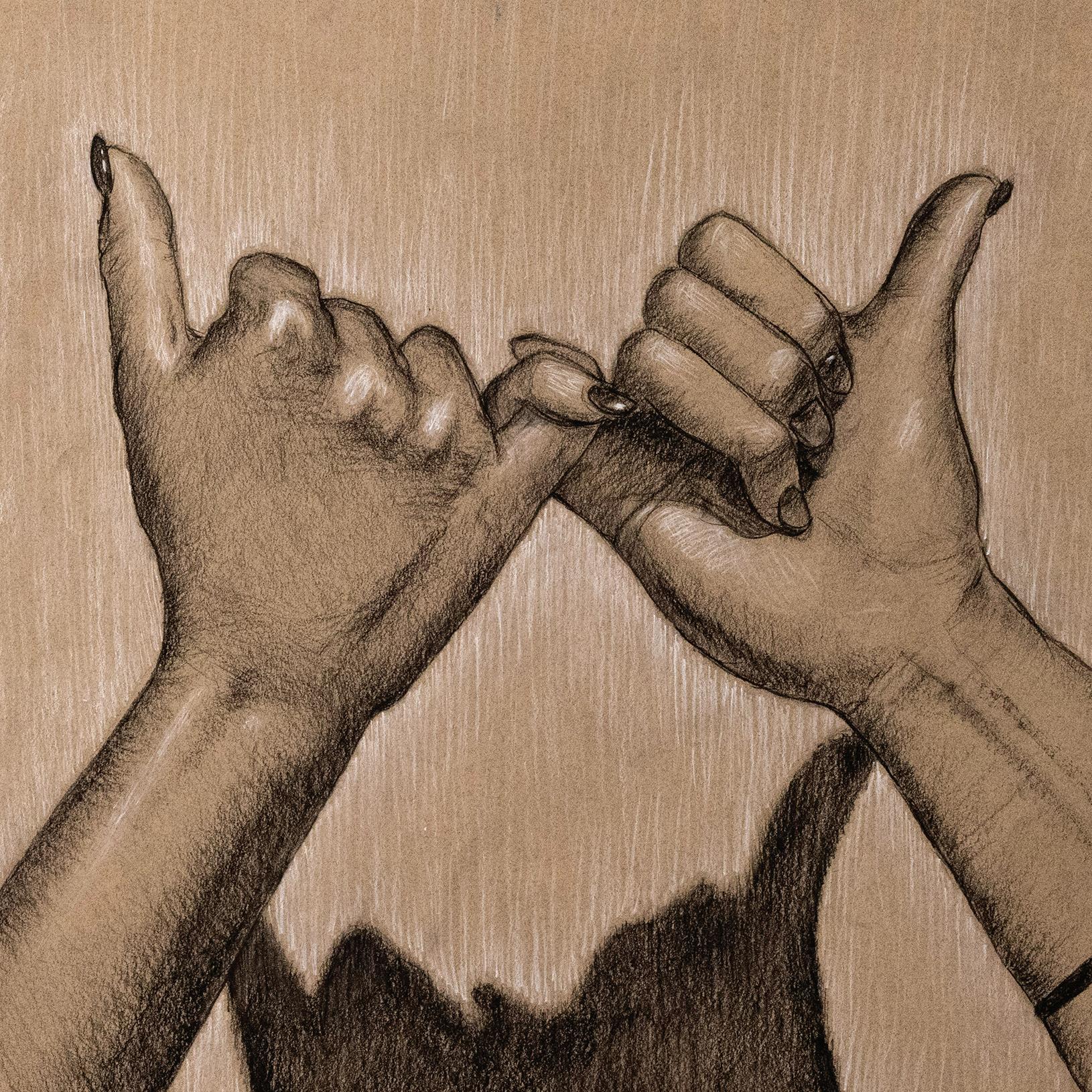
EddieLizzieFeder
Ifirst met Eddie when I was in eighth grade and skated at Fairfax Ice Arena every Thursday. All I knew about him was that he was my age, on the same level of skating skills as me (because my coach always had him demonstrate), super-good at jumping, and best friends with a boy named Cory. I also knew that he was incredibly friendly. Even though I saw him pretty much once a week for most of the school year, he would reintroduce himself each time we talked. After eighth grade, I stopped skating at Fairfax each week because I changed coaches. I didn’t see Eddie very often anymore, except at competitions and on Instagram.
In February of 2024, after a lot of drama with the management at Fairfax Ice Arena, many coaches, along with Eddie’s, moved to my rink in Arlington. They brought with
them all of their students. I began to see Eddie every day of the week. At first, most of the Fairfax skaters sat separately from us, so we only talked a little bit. All except Eddie. He walked himself over to where we sat on his very first day at the rink and introduced himself again. Never shy, he wanted to meet everyone at the rink. Eventually, the rest of the Fairfax skaters followed his lead, and we all merged into one group.
Eddie would get out of school mid-day and arrive at the rink around 1 PM, just like I did. We would tie our skates next to each other and complain about the horrors of junior year. We would offer condolences to one another whenever either of us had a math test, and we would celebrate our wins, both on the ice and at school. When I struggled terribly with my Precalculus summer work, Eddie taught me about the unit circle and basically walked me through each Khan Academy quiz.
On the ice, Eddie was no less friendly. Despite being the best skater at the rink, he was in no way intimidating. Every time I, or another skater, landed a jump near him, he would clap and say, “YAYYY!” Every time he passed me on the ice, he would wave, even if he was in a lesson. Eddie was the fastest skater I have ever met. Despite his friendly presence, people would dive out of his way during his program run-throughs. Not only was he fast, he was also a beautiful skater.
If you only saw his edges, you would assume he was an ice dancer. But he definitely loved jumping. Eddie’s programs had the hardest jumps of anyone at the rink. He did triple-triple combinations and worked on triple axels and quad salchows. I don’t know if he ever landed a triple axel, but he came close, so, so close. The only skill of Eddie’s that I did not envy was his outside edge camel spin. He would bend his knee and drop his body, and it was not attractive. I remember watching him do it and listening to my coach say, “He is an amazing skater, but that is a hideous spin.”
No one worked harder than Eddie.
He once told me he only skated around ninety minutes each day to make sure he had time for all his homework and extra online class, but he worked harder and improved more in those ninety minutes than any other skater of his level. Eddie would offer me tips on all my jumps and help me whenever I needed it. We all knew he was going to end up at Harvard or somewhere else for super smart people.
But . . .
On January 29, 2025, Eddie was flying back from Wichita, Kansas, when as it was preparing to land, his plane was struck by a helicopter over the Potomac River. He was returning from US Figure Skating’s National Development Team Camp, an invitation-only camp for the most talented young skaters. Eddie, Cory, and numerous other young figure skaters died in that crash.
I don’t remember the exact last time I saw him, but I will always remember what an amazing person Eddie Zhou was and would have been.
Betty Rose Bean | Heart strings, graphic art
O c t O b e r
October is the clock ticking my time away. October is the big red circle on my calendar, pass it and wait. Pass it and wait again. Count down days, hours, minutes, until the leaves turn red and the skies turn yellow. The Earth rests stiller, and I grow older. October is a cool breeze on a fall night. The chill lingers in your bones, a warning that winter sits ready to emerge from her hiding. October is the last flower that sits pretty while the grass around her is frosting over. Her petals darken and wither, only kept alive by the memory of summer’s warmth. Outlines of tanlines gently fade from collarbones. Rose-colored glasses gloss the long daylight hours of summer in a pink haze of nostalgia. Feels like a different lifetime, flickering and fleeting, far away. Long past the flowers, something else is in bloom. Fall begins to show itself inside the bud of the growing year.
Lindy Phillips
THE INTERVIEW ROOM
Rosie Lee
CAST OF CHARACTERS:
RHORI — A driven, perfectionist high schooler attending an elite private academy. Intelligent, but overprepares, overthinks, and is desperate to prove her worth.
THE INTERVIEWER — A figure with a blurred face. Always calm and poised. Speaks with stiff, mechanical politeness and lacks displays of emotion.
PROPS LIST:
SCENE ONE — Long, white table, white chairs, red countdown timer, mirror frame
SCENE TWO — Bed, nightstand, matching desk and chair, lamp, textbooks, notebooks, papers with grades
SETTING SETUP:
A bare interview room. Empty, except for one long table and two chairs, already placed at opposing ends of the table. The stage begins in complete darkness. Two figures enter. As they walk, the lights flicker erratically. Before they reach their chairs, complete darkness again. When the lights flash back on abruptly, both figures are already seated. Behind them, a red digital countdown glows faintly. It only begins ticking once the lights stabilize.
SCENE ONE LIGHTS ON.
(A beat of uncomfortable silence. Then, the interview begins as if nothing happened.)
INTERVIEWER: (Pleasant, practiced voice) Good morning, Rhori. Thank you for arriving on time.
RHORI: (Nods and clasps hands together tightly) Good morning. I’m ready.
INTERVIEWER: Are you?
(Another beat of tense silence.)
RHORI: (Straightens back) Yes. I’ve prepared for this.
INTERVIEWER: (Smiles, without eyes) We will see.
LIGHTS OUT. LIGHTS ON.
(The timer begins.)
INTERVIEWER: Let’s begin with something simple. Who are you?
RHORI: (Instant) My name is Rhori Lynn. I’m a junior at Hawthorne Academy, and I’m applying for—
INTERVIEWER: (Interrupts) No. Who are you?
RHORI: (Brows furrowed, visibly confused) I ... I just told you. I am currently seventeen years old, with a 4.2 weighted GPA—
INTERVIEWER: (Interrupts) You are reciting facts. Facts are convenient. People become numbers. But who are you, Rhori?
RHORI: (Attempts to remain professional, forces smile) I’m a dedicated student. I currently take three academic honors classes and an advanced class in—
INTERVIEWER: (Interrupts) You hesitated outside the door for thirteen seconds before entering. Why?
RHORI: (Shocked) I— What? How do you know that?
INTERVIEWER: You touched the doorknob twice. You stared at the metal frame. You memorized the patterns on the wood. But you did not open the door. Why?
RHORI: There’s no way ... how do you know?
INTERVIEWER: I am the one asking questions here. You were afraid. Why?
RHORI: I wasn’t afraid. I was preparing myself. Everyone does that before interviews. Rehearsing and getting ready, that is.
INTERVIEWER: But you are not everyone, are you?
LIGHTS FLICKER. LIGHTS ON.
(The countdown flashes brightly for a moment.)
INTERVIEWER: You rehearse in hallways. You rehearse before mirrors. You rehearse in your sleep. Yet, when the moment is here, you wait. Why?
RHORI: Because there is a right moment, and I want to do the right things in the right moment.

INTERVIEWER: How do you know when the moment is right?
RHORI:(Frustrated) When it feels right. When I’ve prepared enough, practiced enough, done enough. When everything is enough. And when everything is back to normal.
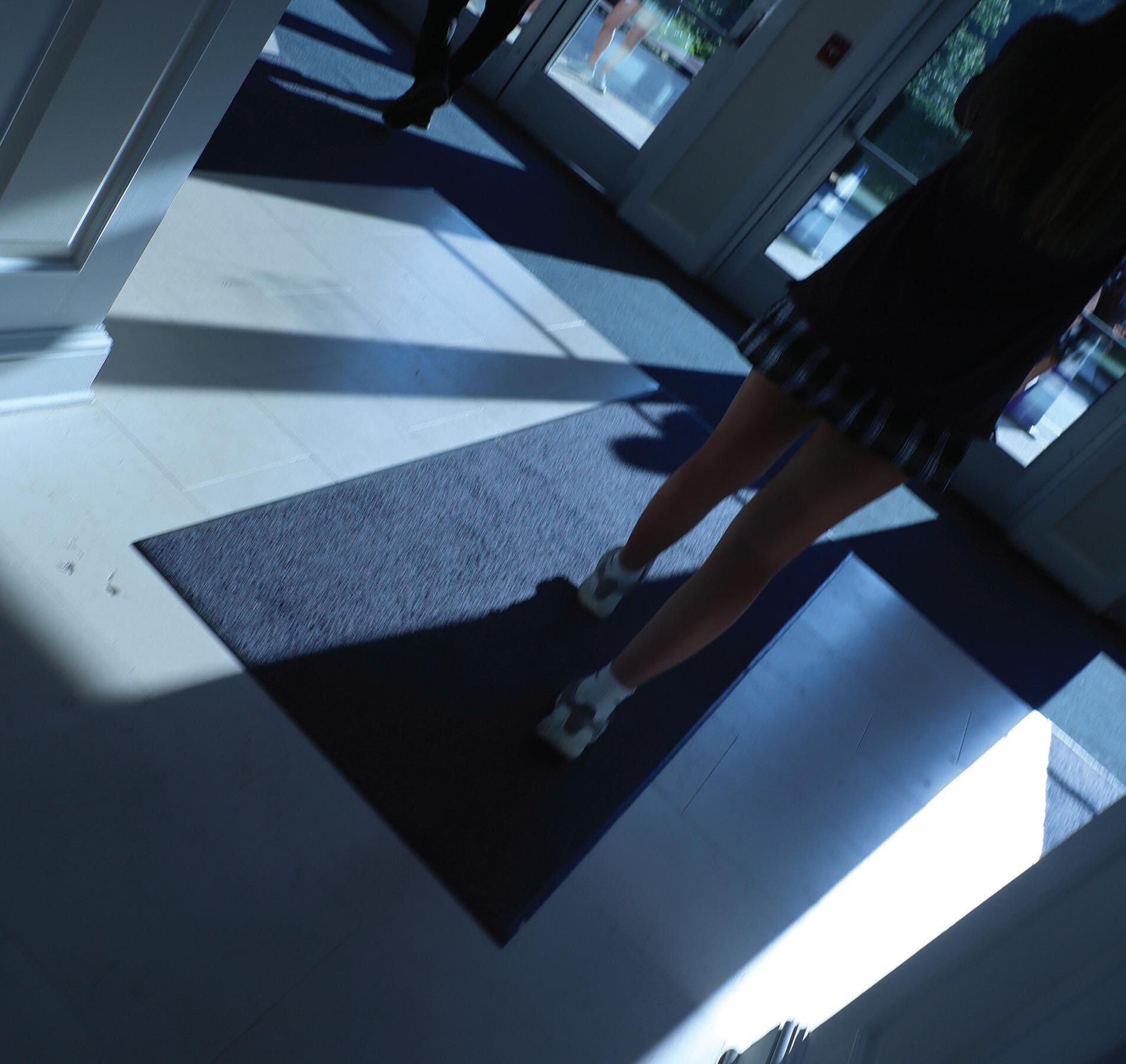
Soraya Farid | At the Lobby, digital photograph
INTERVIEWER: Normal. (Echoes the word, quieter each time) Do you believe that this room is normal?
RHORI:(Looks around) It’s ... an interview room.
INTERVIEWER: Is it?
(The countdown flickers, skipping numbers erratically before returning to the correct one.)
RHORI: (Under her breath) Did that just — did that just jump?
INTERVIEWER: Well, time tends to slip by when you let it go.
RHORI:What’s that supposed to mean?
INTERVIEWER: I’m asking the questions here, remember? Now, question two: What did you forget?
RHORI: (Confused) Forget? I don’t think I’ve forgotten anything …
INTERVIEWER: (Leans forward slightly) Really? And yet, it’s gone. (Points finger at the empty spot beside RHORI)
RHORI: (Realizes) My bag! I needed that! But I’m so sure that I packed it. I checked five times!
INTERVIEWER: (Shakes head) But what is it that you will miss?
RHORI: (Stammering) I … I had my letters of recommendation — my transcripts, achievements, records — everything!
INTERVIEWER: Everything. (Echoes the word, quieter each time) What is everything? Look closer. Not at the papers, not at the letters, not at the achievements. You can find more transcripts. You can get more letters. You can earn more achievements. Look at what’s missing. What is it you truly miss?
RHORI: What could possibly be missing? It’s all here.
INTERVIEWER: (Quietly) What have you carried without thinking? What mattered long before it became irrelevant?
RHORI: (Stares at the empty spot) Bracelets. Charm. Photographs.
INTERVIEWER: The cheap handwoven plastic bracelets. The charm that’s been rusting for twelve years. The photographs in black and white. You cling onto achievements. Grades. Awards. Recognition. Yet your bag ... (Gestures to the empty space) ... holds all that you left behind. How can those papers matter if the bag that holds them is gone?
RHORI: (Shakes head) I didn’t think about them ... I have ... forgotten.
INTERVIEWER: You may have left them, but they have not left you ... entirely.
RHORI: (Standing) That makes no sense! (Increasingly frustrated) They shouldn’t matter. They’re just small things. For decoration. They have no use, no purpose.
INTERVIEWER: (Smile softens) And the small things are what you lose when you chase big dreams.
LIGHTS FLICKER.
LIGHTS ON.
(The countdown flashes brightly for a moment.)
RHORI: (Stammers) I don’t ... I don’t even remember ... why I do this. All of this ... for what?
INTERVIEWER: (Walks to RHORI’s side of the table, stands behind RHORI, and grabs RHORI’s shoulders) Not because
you wanted to but because of what you feared you’d lose. (Leans in) Who you would lose.
RHORI: (Shouts) Stop! I — I can’t! (Clutches head)
INTERVIEWER: Did you notice the timer? (Points at red countdown, which is still ticking)
(The red glow of the countdown clock pulsates violently, Rhori’s body sways dramatically.)
RHORI: Why is it going down? What happens when it ends? How do I stop it?
INTERVIEWER: (Sighs) Rhori, Rhori. You still do not understand, do you? You are fixated on the perfections in life. You measure your worth in papers and numbers. Look at what you have become. You’ve stopped being a person, Rhori. Just another cog in the machine, a subset of the system you tried to best. You yearn for success but fail what matters most in the end.
RHORI: (Breathes heavily, grabs onto the table tightly) This doesn’t make sense. None of this makes sense.
INTERVIEWER: (Smiles genuinely) Dreams rarely do.
(Tables and chairs shift, falling over. The red countdown falls, shattering.)
(A mirror frame appears. Rhori and interviewer stand on opposing sides. Their movements mirror. Their hands meet in the middle.)
INTERVIEWER: Until next time, then, Rhori Hettie Lynn.
(Interviewer’s face unblurs at last. Appears to be an older version of Rhori, aged with wrinkles and experience. Smiles slightly. A real smile. The mirror frame cracks, then falls in pieces.)
(Everything goes black.)
SCENE TWO LIGHTS FLICKER.
SETTING CHANGES: A simple bedroom with a bed in the center and a nightstand beside it. A chair neatly pushed in beneath a desk, with mountains of textbooks and notebooks piled atop one another.)
LIGHTS ON.
(RHORI jolts up from under the bed covers, breathing heavily. RHORI presses a button to turn on the lamp by the bed.)
RHORI: (Softly) It was ... just a dream.
(Interviewer’s voice comes in as a dark, loud, echoing whisper.)
INTERVIEWER: Now, it’s time to wake up.
LIGHTS OFF.
THE END
THE SIDEWALK INCIDENT
Livie Thomas
“Buckle your seatbelt.”
“Okay.”
“Check your mirrors.”
“Mm-hm.”
“Give me your phone.”
“Here it is.”
“All right, now take your foot off the brake and slowly pull out of the driveway.”
I followed my dad’s instructions diligently and steered onto Peregrine Road with much caution. During winter break of my sophomore year, my dad decided it was the perfect time to teach me how to drive. Freezing temperatures but no precipitation meant the roads themselves weren’t icy or slick, just firm and frozen beneath the tires. All the streets in the Lewes, Delaware, development were broad and, for the most part, straight. They felt luxurious compared to the narrow Connecticut Avenue lanes back home. We were visiting my grandparents. Their neighborhood was mostly home to retired folks who rarely drove, and if they
did, they mostly went to the local farmers’ market or shops at a leisurely pace in the small town.
The wide roads, light traffic, and slow-moving neighbors calmed my nerves as I eased down on the gas pedal of my family’s 2017 Toyota minivan.
“You’re cruising,” my dad exclaimed as I increased my speed to double digits, which felt like a major accomplishment to me. “Feel free to pick up the pace a little if you’re comfortable.”
This was my first time driving in a neighborhood, an upgrade from my previous parkin-lot sessions. My mom had so far refused to get in the car with me even though I had been driving for a month. In contrast, my
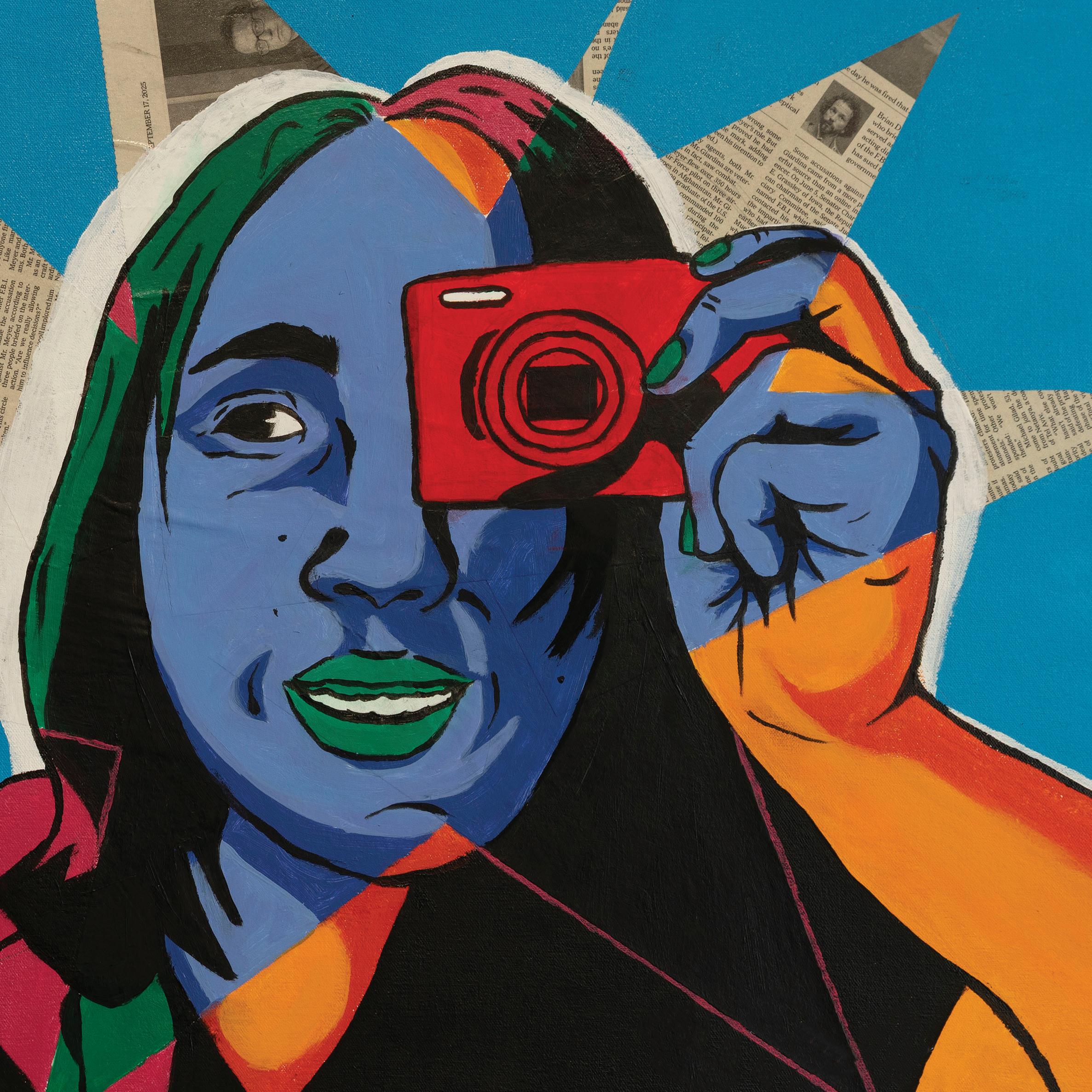
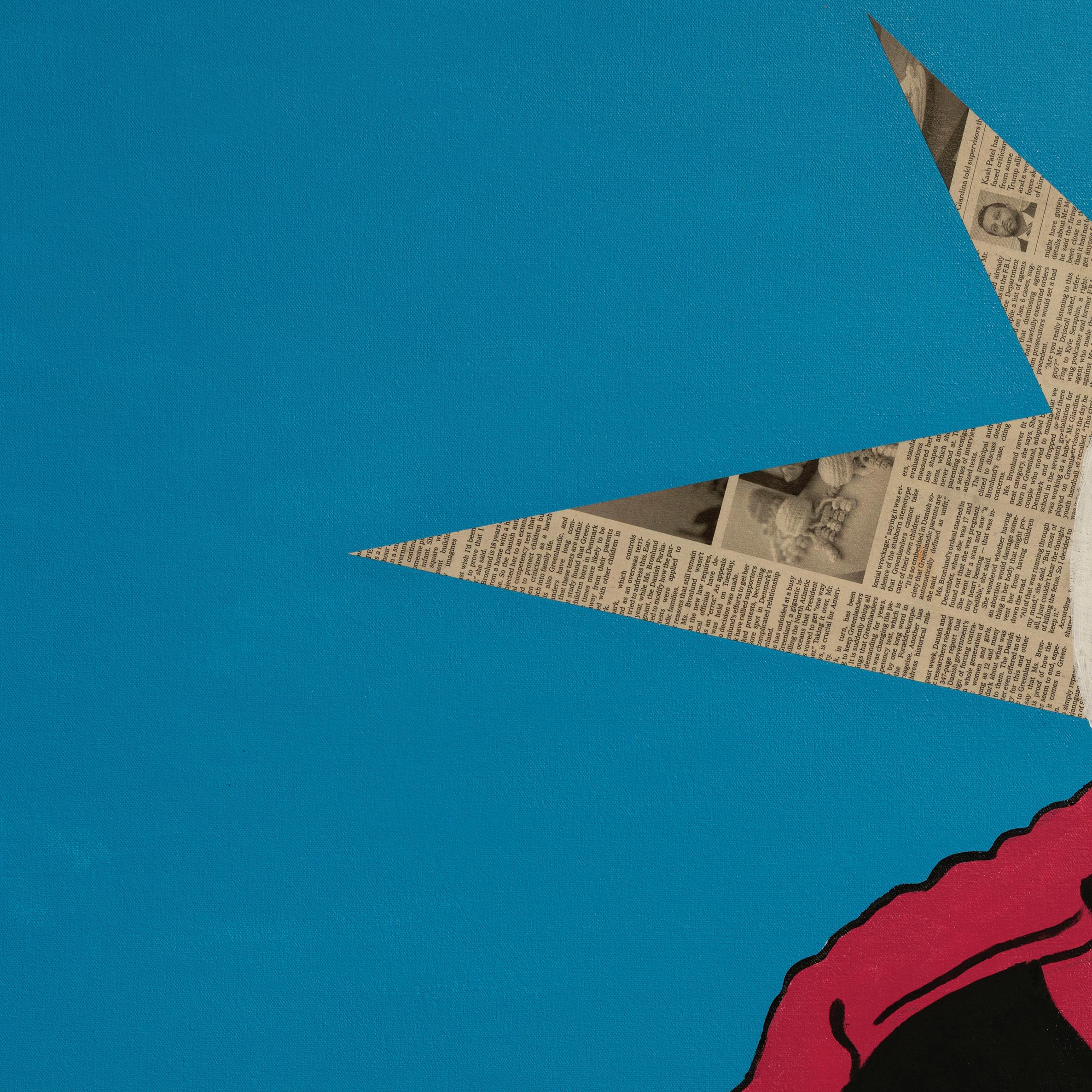
Yuru Wu | Snap!, oil, acrylic, and newspaper on canvas

dad was eager to teach me. He considered himself a driving-instructor veteran because he had not only taught my older brother but also his own three younger sisters back in the day. Besides, he couldn’t wait for me to assume some of the responsibility for driving my little sister to her early morning swim practices.
As I navigated through the development at a thrilling speed of fifteen miles per hour, I inevitably began to feel more comfortable. I loved the click of the turn signal and the soft whir of the heating unit. Each turn onto a new street felt like a small victory. Every road in the neighborhood carried the name of a different bird species, a detail my grandma always said gave the place its ‘character.’ I spent about twenty minutes circling Golden Eagle Boulevard and turning onto Hawks Nest Road before my dad deemed me ready for a challenge. Still in the development, we approached the main street, where a sidewalk ran down the middle of the road, serving as a median strip. I slowly turned onto the street and started cruising along. Feeling bold, I decided to test my luck and switched the radio on, just loud enough to hear above the hum of the engine. I could feel a disapproving look coming from my dad, who believed that driving
lessons should be done without distractions like the radio, but he didn’t turn it down.
Suddenly, I felt myself drifting leftward, getting dangerously close to the median. In a slightly alarmed voice, my dad said, “Press on the brake.”
Panicking at his tone, I slammed my foot on the brakes without thinking. But instead of stopping, the vehicle lurched forward up and onto the sidewalk. The bottom of the bumper caused a horrible screeching sound as it scraped against the curb. Then it dawned on me: I hadn’t pressed the brake. I had stomped on the gas. Heart pounding, I quickly lifted my foot off the gas pedal and transferred it to the brake.
“Oh, jeez, Livie,” my dad exclaimed. Only then did I notice an elderly couple who had witnessed the entire debacle from just fifteen feet away on the sidewalk in the median strip. They stood frozen, staring at our minivan, which was now embarrassingly lodged entirely onto the sidewalk. Thank God, I didn’t hit them.
My dad got out of the car and walked around to the driver’s side to inspect the damage.
“Sorry, new driver,” he said skittishly to the nearby couple and gave them a hasty wave.
Avalon Greene | Crushing, digital photorgraph
They didn’t respond at first, just stood there watching in disbelief before letting out an awkward laugh.
Meanwhile, I sat in the driver’s seat, still completely paralyzed.
“Get out. Let me get the car off the sidewalk,” my dad instructed.
Afraid of revealing my identity to the traumatized couple, I crawled across the center console into the passenger seat. I was mortified.
My dad eased the minivan off the sidewalk. Right then and there, I decided that I would go on temporary — or possibly permanent —
leave from driving; I knew it would take some time before I mustered the courage to get back behind the wheel.
But then my dad put the car in park and unbuckled his seat belt. “You still have to drive home.”
“Are you kidding me?” I exclaimed. No way I could drive again after what had just happened. I needed a hiatus.
“No, I’m not kidding. If you don’t drive home, you’re never gonna want to drive again. Now let’s switch spots.”
His tone told me there was no arguing with him, so I obeyed reluctantly. I resumed my spot in the driver’s seat and slowly began driving. We drove in
near silence with the occasional interjection from my dad reminding me to speed up or loosen my grip on the wheel. Finally, after what felt like twenty-five miles (in actuality, less than a mile), we arrived at my grandparents’ house. Once I turned off the engine, we sat in the minivan, staring blankly at the house.
“Are we gonna tell them?” I asked. I did not want to face the never-ending teasing by my older brother or the bewilderment of my grandpa.
“No, we don’t have to,” he replied.
A wave of relief washed over me. So we walked into the house. My family surrounded the TV, watching college football.
“How was it?” my mom asked eagerly.
“It was great,” my dad responded. “I feel like she’s really getting the hang of it!”
I forced a small smile, pretending my heart hadn’t stopped a million times that afternoon. My mom beamed, my brother barely looked up from the game, and that was that. We carried on as if the sidewalk incident was already miles behind us.
First para text
You’llbequiteyoungwhenyouhearaboutgirlpower. Youwon’tunderstandwhythereisn’taboypowershirt nexttothepinksparklyoneyourmompickedupfromtheTargetrack, Itisn’tfair,you’llsay.
Title of Piece author
Afew years later you won’t even look at the “like a girl” shirts, They aren’t cool. You won’t see why they’re there,
You don’t realize how lucky you are to be raised in an environment where “Girls can do anything boys can do.”
Thenyou’llstartwatchingmoresports, Ormaybeyou’llattendaspecificsummercamp.
You’llattendacamp,it’llbeallboys
You’llhearaboutpaydiscrepancies: TheNBAmascotsarepaidmorethanWNBAprofessionals; highestpaidprofessionalwomenhockeyplayermakes onehundredthousandannually; Thelowestpossibleentry-levelcontractinmen’sleagueswillbe morethaneighttimesthat, Itwillbeonemillionbythetimeyoustartcollege.
Noneofthemwilltakeyouseriouslyorlistentoawordyousay, They’llflocktogetherinasmallgroup. Ittakesyouansweringaquestionbeforethemor demonstratingsomethingcorrectly Forthemtotakeyouseriously. It will take hearing horrifying stories about girls walking alone on streets, Strange encounters your classmates have, Weird looks you yourself receive, Listening to women recount the lack of support they felt, For you to begin to understand girl power.
First para text
Title of Piece author
Leila Gamache
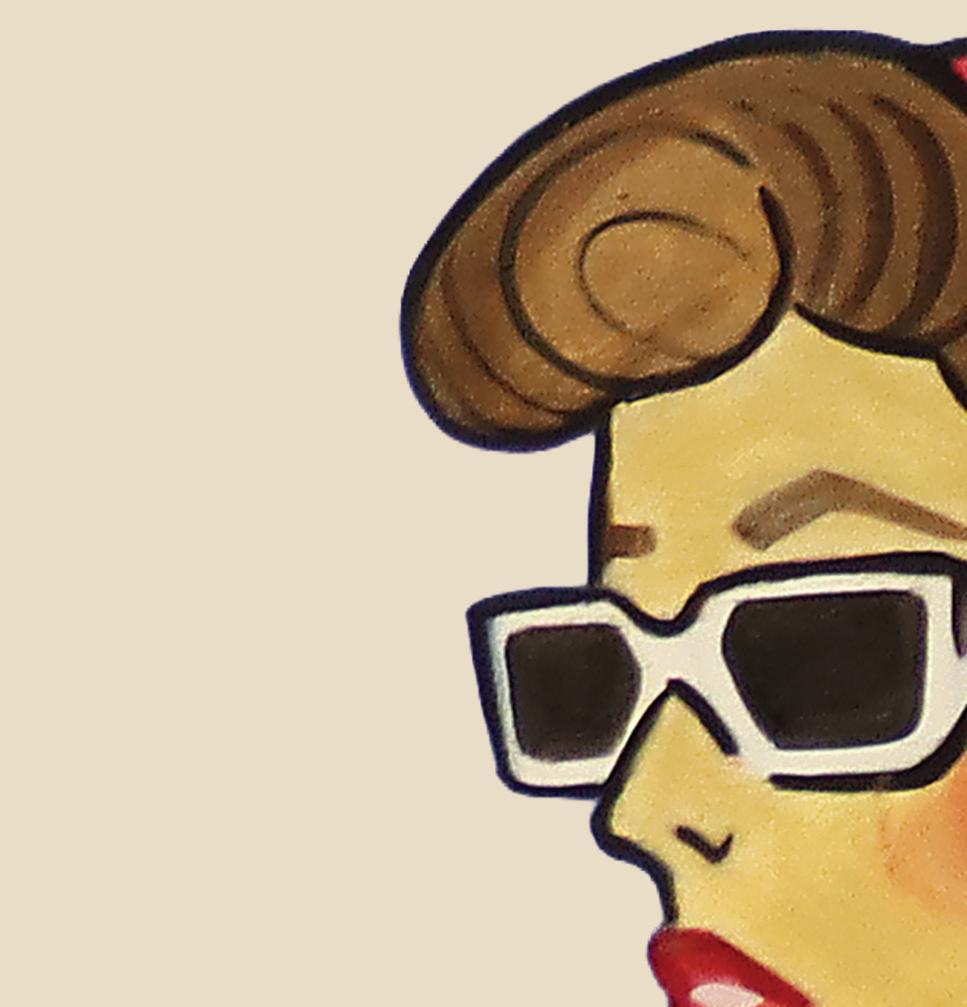
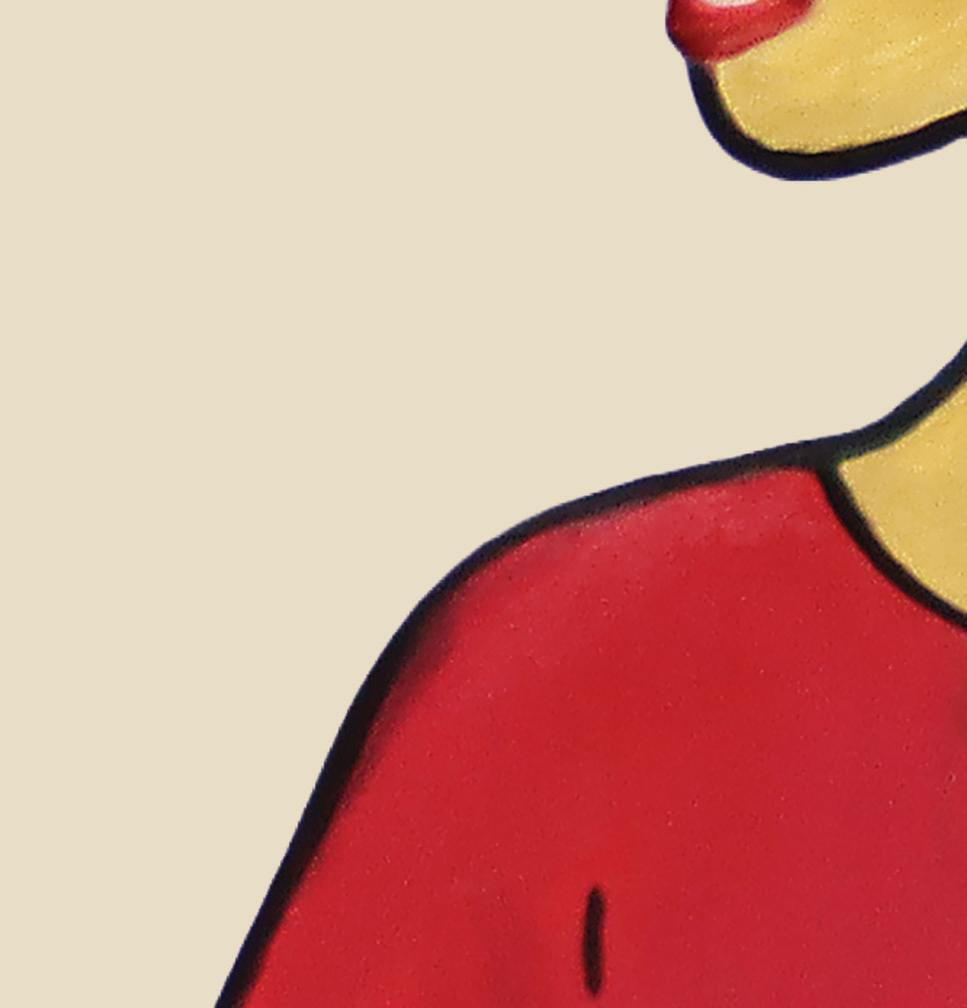
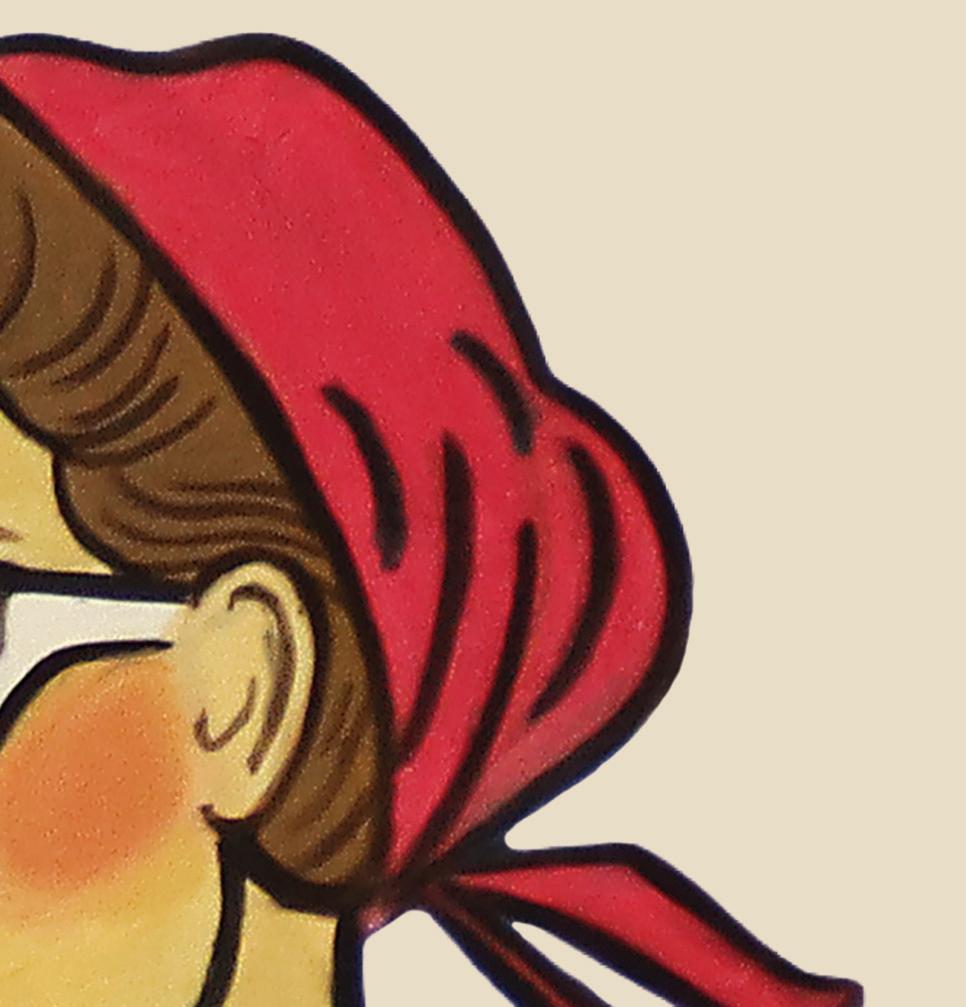
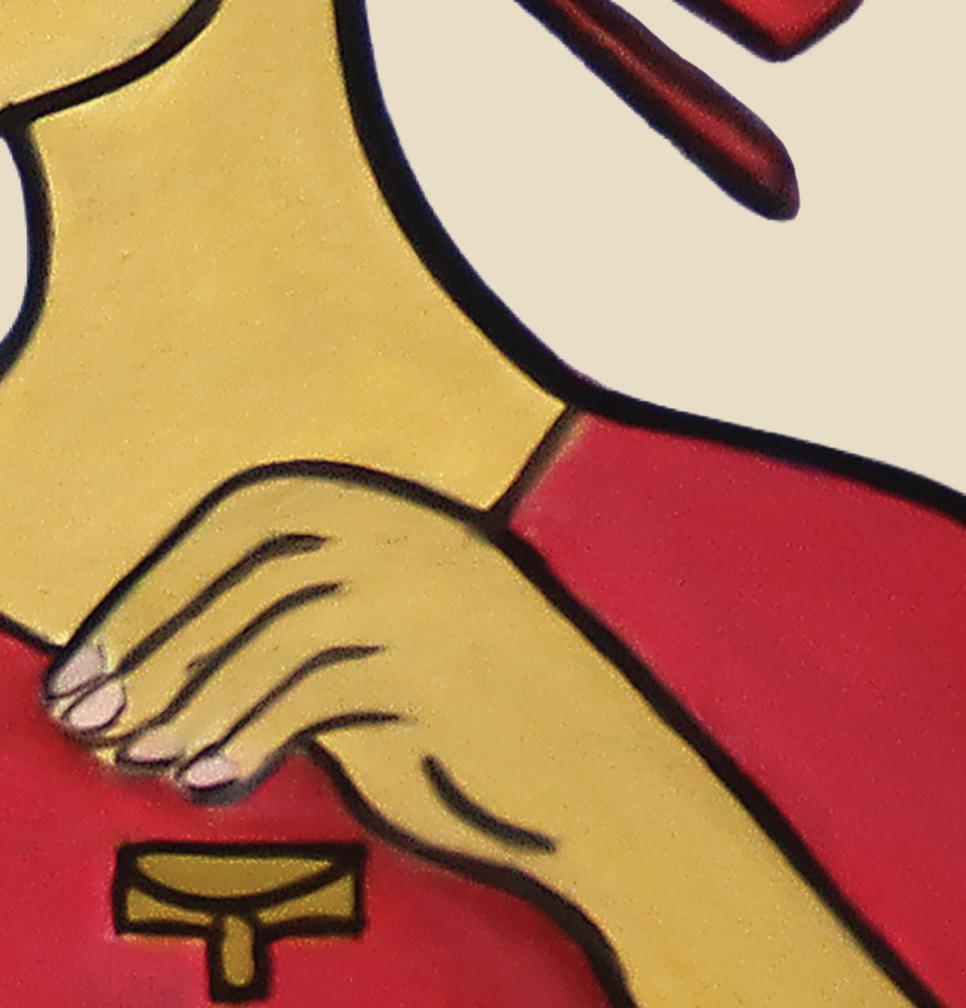
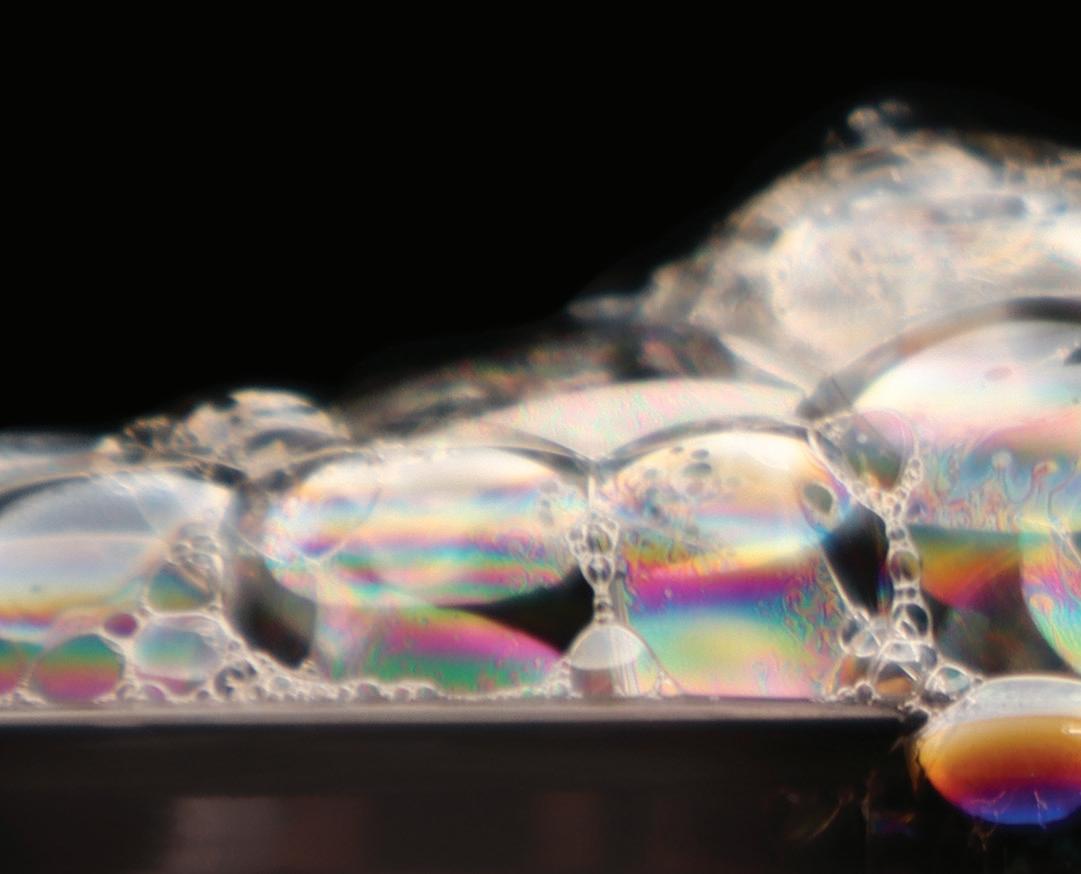
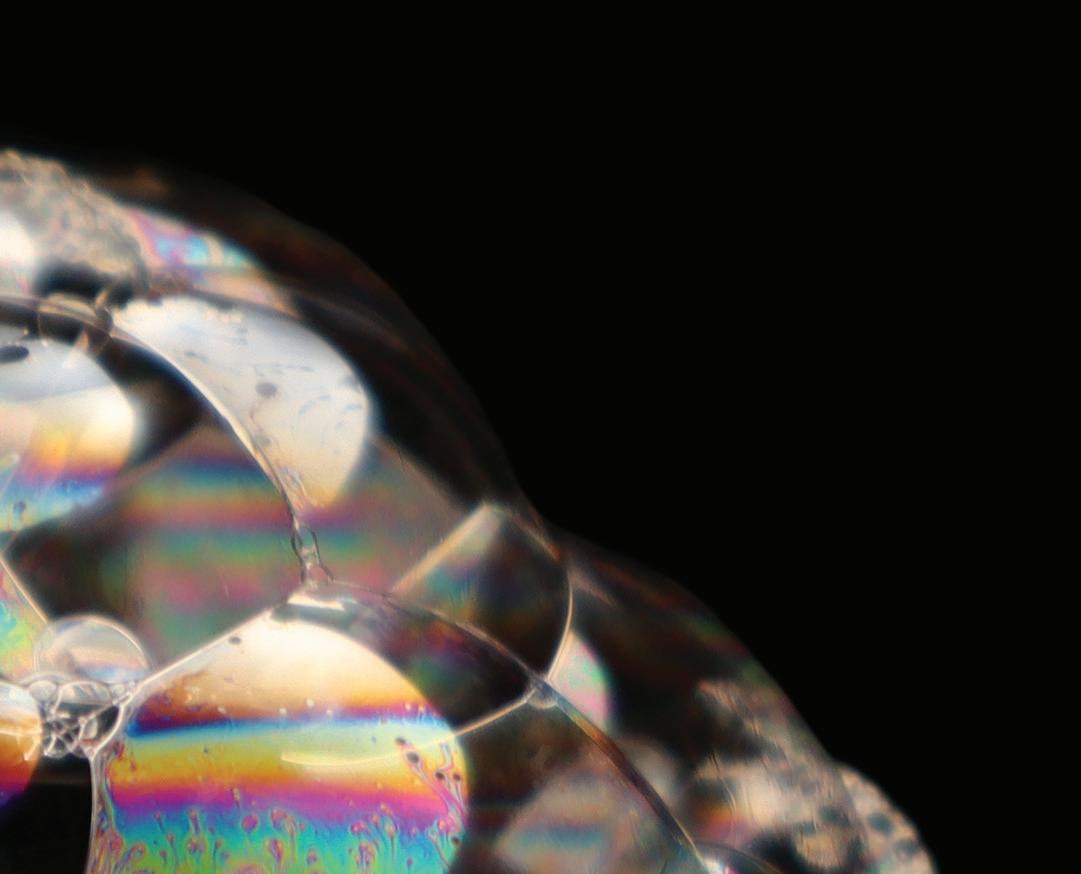



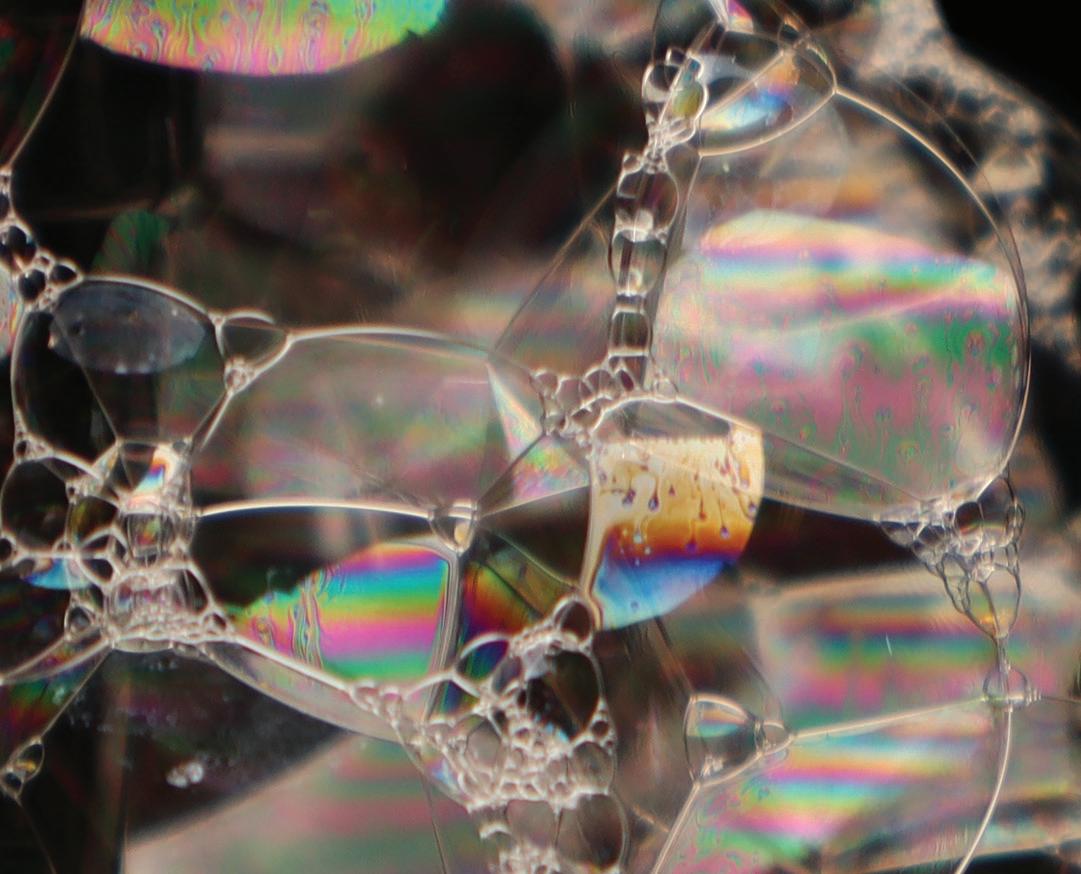
The Cup Runneth Over, digital photograph

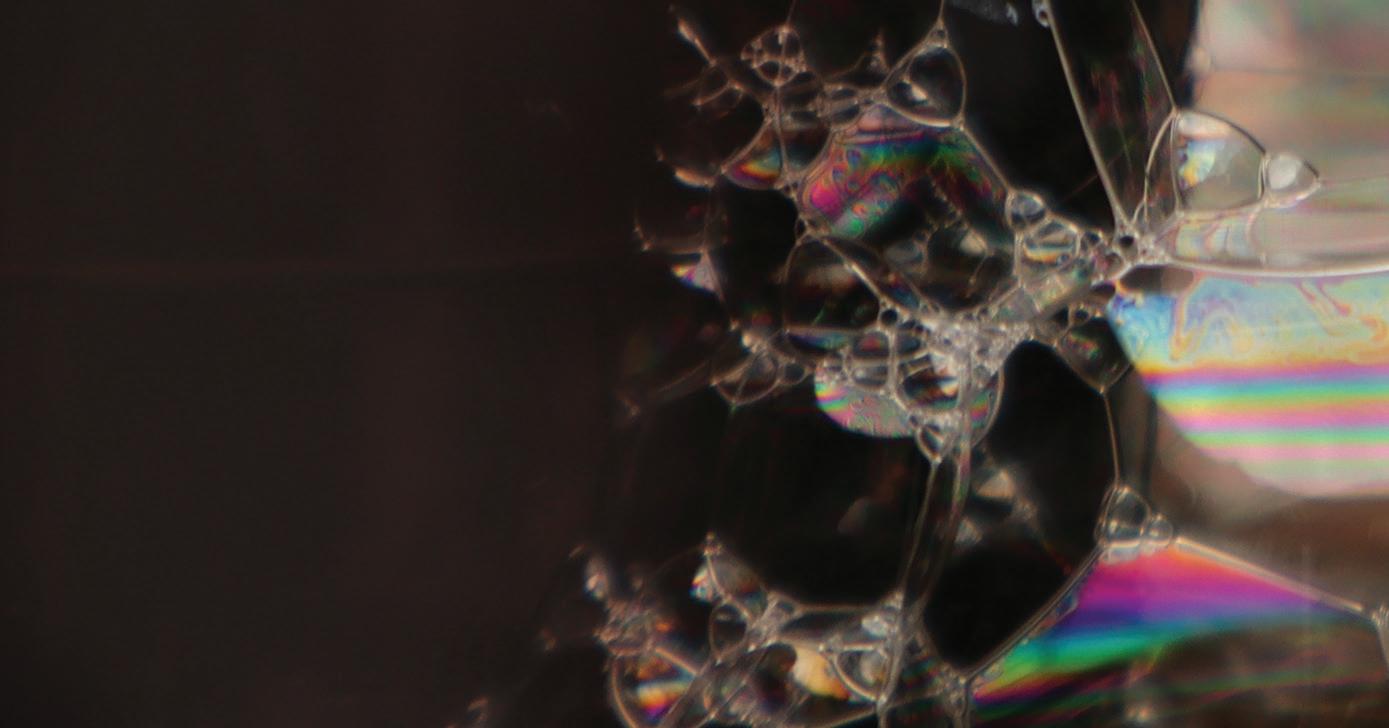
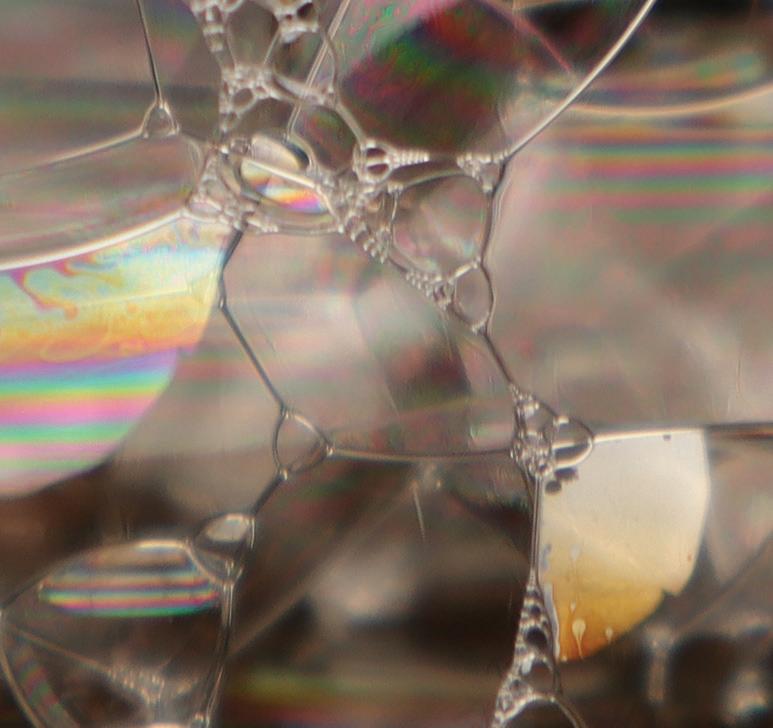

“BEEP BEEP BEEP,” my alarm shrieks as I lazily roll over and press the snooze button. My 5:45 AM alarm wakes me up just enough, so I'll be ready to actually get up for my next alarm at 6:00 AM.
Title of Piece author
For the next few minutes, I drift in and out of a light, ethereal slumber until “BEEP BEEP BEEP,” I’m up.
First para text
I grab my phone and turn off my 6:00 AM alarm. I slowly roll over to my other side and begin to scroll through my notifications. I allow myself five minutes to scroll on my phone until my next alarm goes off, aka, the one where I actually have to get up at 6:05.
“BEEP BEEP BEEP!” It’s time.
I roll out of bed, my feet sinking into my heather grey shaggy carpet. I blindly walk to the door, careful not to hit my knee on the corner of the bookcase narrowly squeezed into the already overcrowded room, ready to start my morning routine.
By the time I’m downstairs, my house is bursting with noise. My mom rushes past me, water bottle in hand, on the way to the gym. Just as she leaves, she runs into my dad, bursting through the front door, sweaty from his morning five-mile walk. As I move into the kitchen, I spot the clock on the stove. It reads 6:35. Perfect, I’m right on schedule.
I fill my water bottle, grab a cheese stick, and move back into the living room to grab my backpack.
“EMMETTTT,” I shout up the stairs, “Am I driving you today, or are you walking?”
“I’m walking,” he shouts back.
Thankfully, he always walks in the spring, and I have too much going on between Ms. Siddiqui’s English class and crew to be late because of him.
By 6:45, I am in the car, ready to inch my way out of the spot I carefully maneuvered into the night before. No
matter the spot, my routine never changes. The tires are already turned in towards the curb, a precaution against tire jacking, perfectly setting me up to leave each morning. I slowly reverse, careful not to back up too far and hit the car behind me. I quickly put the car into drive and turn the wheel all the way in the opposite direction. I pull out perfectly.
As I merge onto the highway, the heavy traffic ahead leads me to take my secret way. I don’t follow the sheep on the Richmond side of the highway; I instead follow the signs to Maine Avenue. I cruise through the green light and allow my hands to guide the wheel to the right as I glide onto the on-ramp, then “BOOM!”
What was that? Oh no! Maybe I was imagining it. Oh no!
I keep going, and the car seems fine. No bumps, no jolts, no weird wiggles. It’s gonna be fine.
The Daily blares in the background, I allow my muscle memory to take over, and I go on autopilot. By the time I make the left-hand turn off of River Road into Holton, I’ve completely forgotten about that little bump.
“Zoe, what’s wrong with your tire?!?” Delaney says to me as she sits down next to me in the school cafe.
“What do you mean?” I answer. “I didn’t notice anything on my drive to school.”
“There’s a massive bubble in the side of your tire,” she answers.
“What?!?” I exclaim. “What do you mean by a bubble?”
“Here, I took a picture of it!” She hands her phone to me, and I nearly keel over. It looks like there’s an orange bursting out of the side of my tire.
It looks bad, but honestly, how bad can it really be? I made it all the way to school; surely I can make it home.
I immediately text my parents, and my dad turns to ChatGPT for answers. Chat says I can make it home if I drive slowly, so of course, everything is going to be fine.
Title of Piece author
I make my way to class and once again forget all about my little tire problem until Mr. Wilson, the head of security, greets me as I walk out of Dr. Nill’s U2 Seminar.
Firstpara text
“Hey, Zoe, I just needed to find you because there was a slight issue with your car,” he explains.
“Oh God, is this about the bubble?” I ask.
“Well, about that bubble, it popped during carpool line,” he gently explains. “Security heard a loud bang, and, turns out, it was just your tire exploding. Why don’t you reach out to your parents and see what they want to do? They can call Triple A if they want, or I’d be happy to help you change the tire.”
“Ok, that sounds good. I have to go to Spanish, but I have study hall right after that, so I can come find you,” I tell him. “Thank you so much, Mr. Wilson. I’m so sorry about all of this!!!”
I feverishly text my parents the second I sit down in Profe’s Spanish class. They respond in seconds, explaining that I need to learn this important skill and that I need to deal with this myself. They also insist I express my gratitude to Mr. Wilson, seeing as teaching a Holton student how to change a tire is definitely not in his job description.
After Spanish ends, I sprint down to the front desk. I toss my backpack onto the couches in the lobby and make my way over to Mr. Wilson, keys in my hand.
“Mr. Wilson,” I exclaim, “I talked to my parents, and I am ready to learn how to change a tire!”
“Perfect,” he smiles, “let’s get started.”
Mila Weliwitigoda | The Color of Air, digital photograph
We walk through the double doors, across the front circle, and down the stairs leading to the parking lot and my minty green chariot. We make small talk about the comically bad and rainy crew practice the day before.
It turns out changing a tire is remarkably similar to rigging a boat. The tools are slightly different, and a boat only needs slings to hold it up, not the jack I painstakingly wrenched at five minutes.
Mr. Wilson calmly directs me from his seat on the curb, just like a coxswain directs the crew, coaching me through my race to change the tire.
By the time I have tightened the last lug nut, attached the wheel lock, and lowered my beloved Subaru Gloria back to the ground, my knees are covered in dirt and my hands equally covered in grease.
I jump to my feet and give Mr. Willson a big high five. “I did it,” I squeal, “I changed a tire!”
“You did,” he says, looking like a proud mentor, “and this will stick with you forever; it’s like riding a bike. Now you’re never going to have to rely on someone else for this. You know you can do it yourself!”
As I carefully drove ten miles under the speed limit on my way home that day, I felt like I had slayed a dragon. I had changed my tire all by myself. If I could do this, I could do anything.






Sophia Dalton | Santa Maria del Mar, white stoneware
Message in a Bottle
In and out, in and out, in and out.
It’s almost as if the ocean was breathing.
Why do you taunt me?
You come forward each day.
You creep up my shores tentatively, scouting new paths.
I invite you in with beaches a thousand miles wide,
Yet you never stay.
Why is it that you always retreat?
As soon as your tide reaches me, It flows back to your depths.
I am left with the memory of your cool touch.
But you just keep escaping.
I shudder with the weight of your distaste. This disrespect you show me as you refuse to give me time of day.
I writhe with the longing you initiate.
Deep in my core, I feel the anger rumbling, bubbling,
Threatening to burst.
It’s too late. My surface cracks as a millennium of pain erupts.
I feel the Earth quake. I see you begin to churn. The shaking won’t stop. I certainly can’t stop it.
As I watch the swells meet my edge, It’s clear that a little push was all you needed to join my open arms.
Crash into me, and finally stay, my dear.
Love floods my torn shore at last.
Corinne Lewandowski
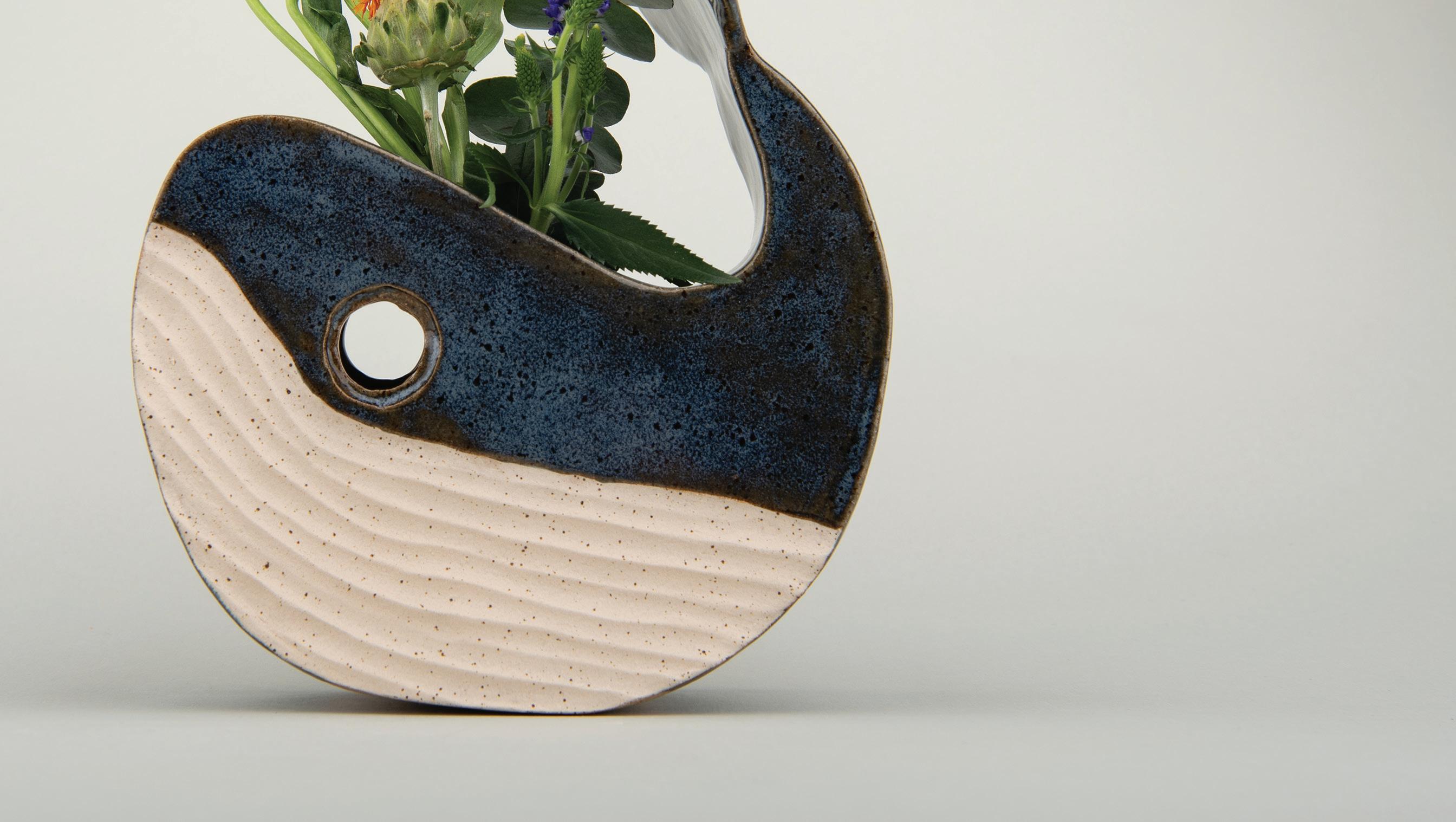
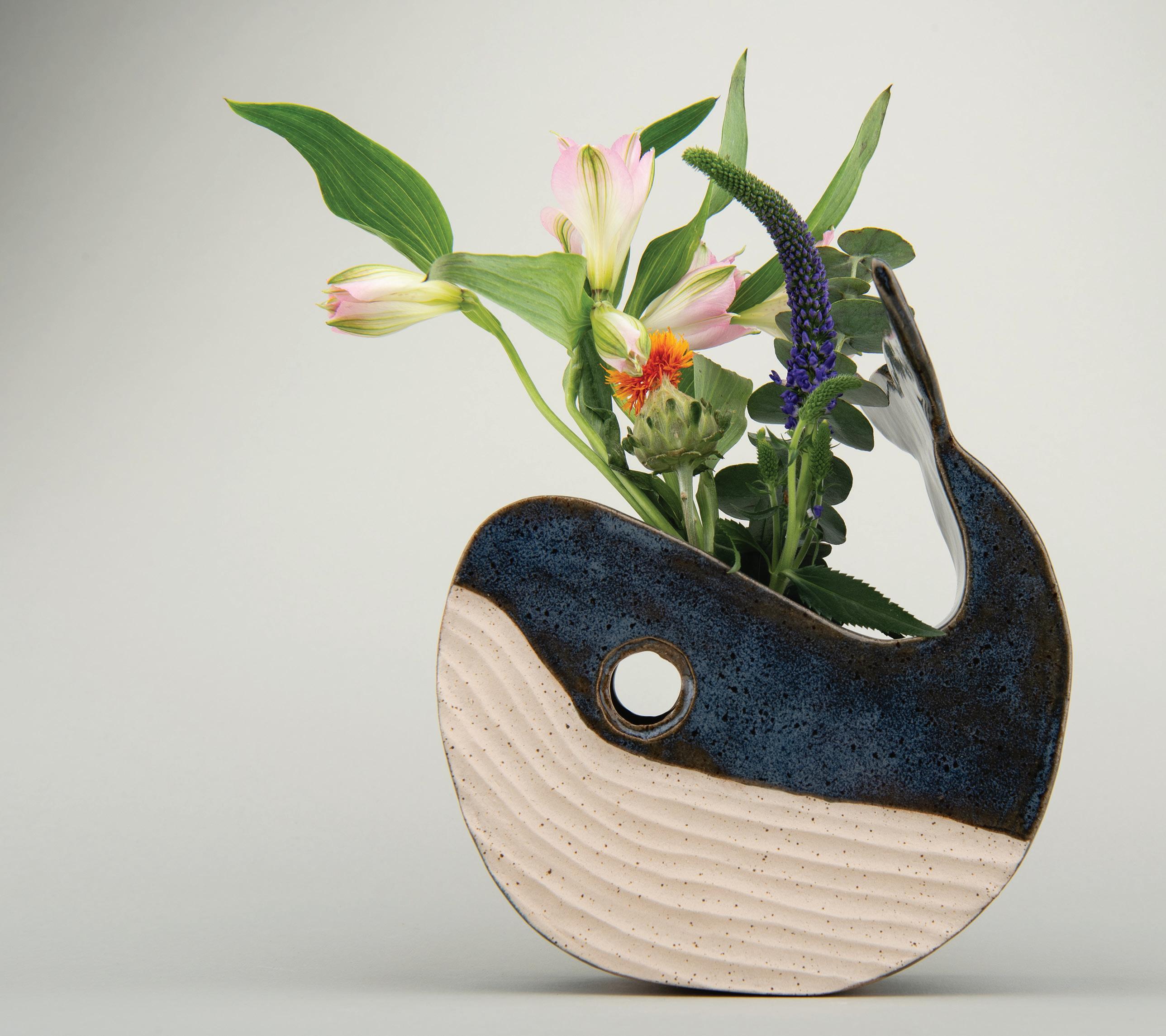
Sky Zhu | The Record Keeper, stoneware
Getting to the Farm
Betty Rose Bean
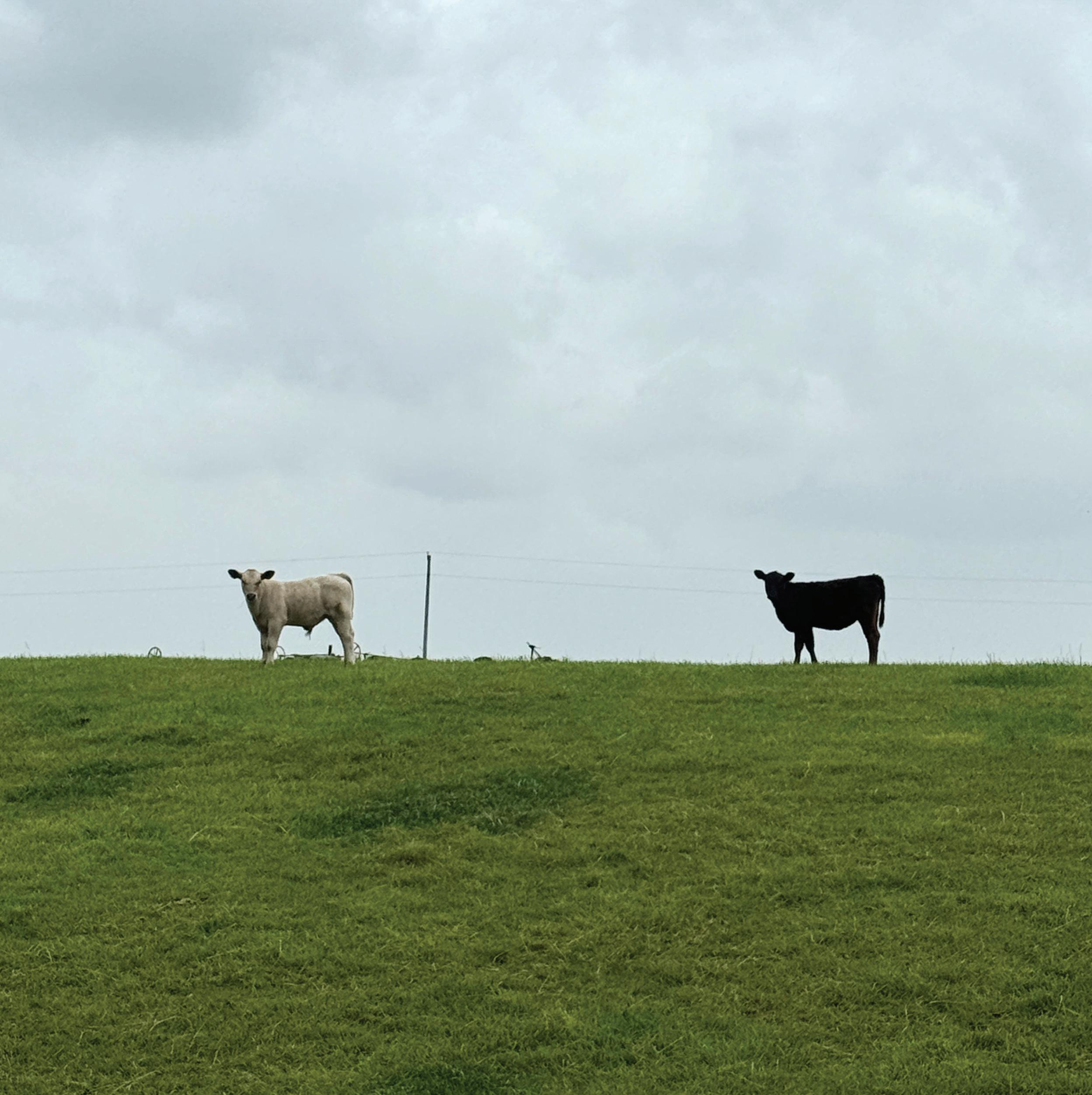
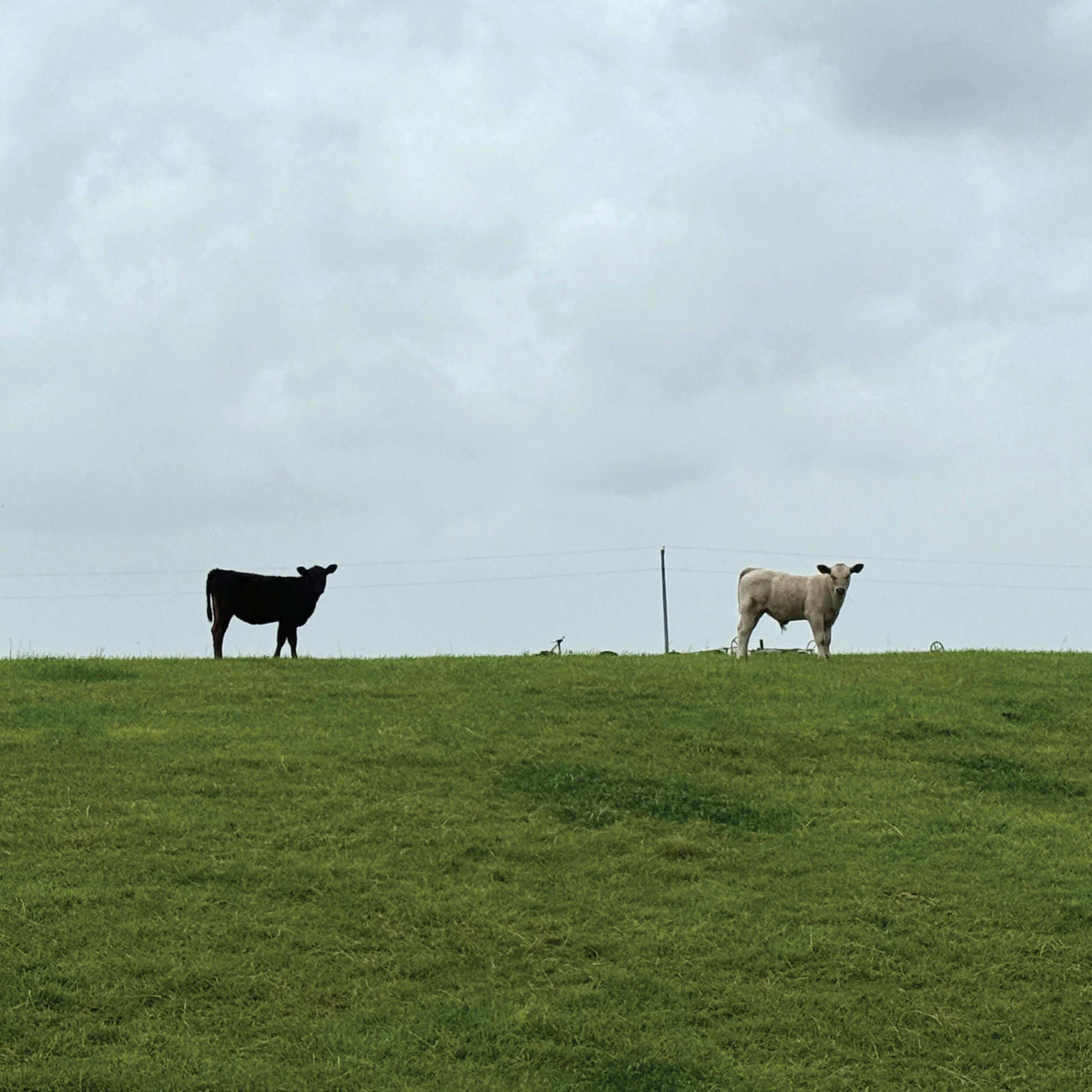
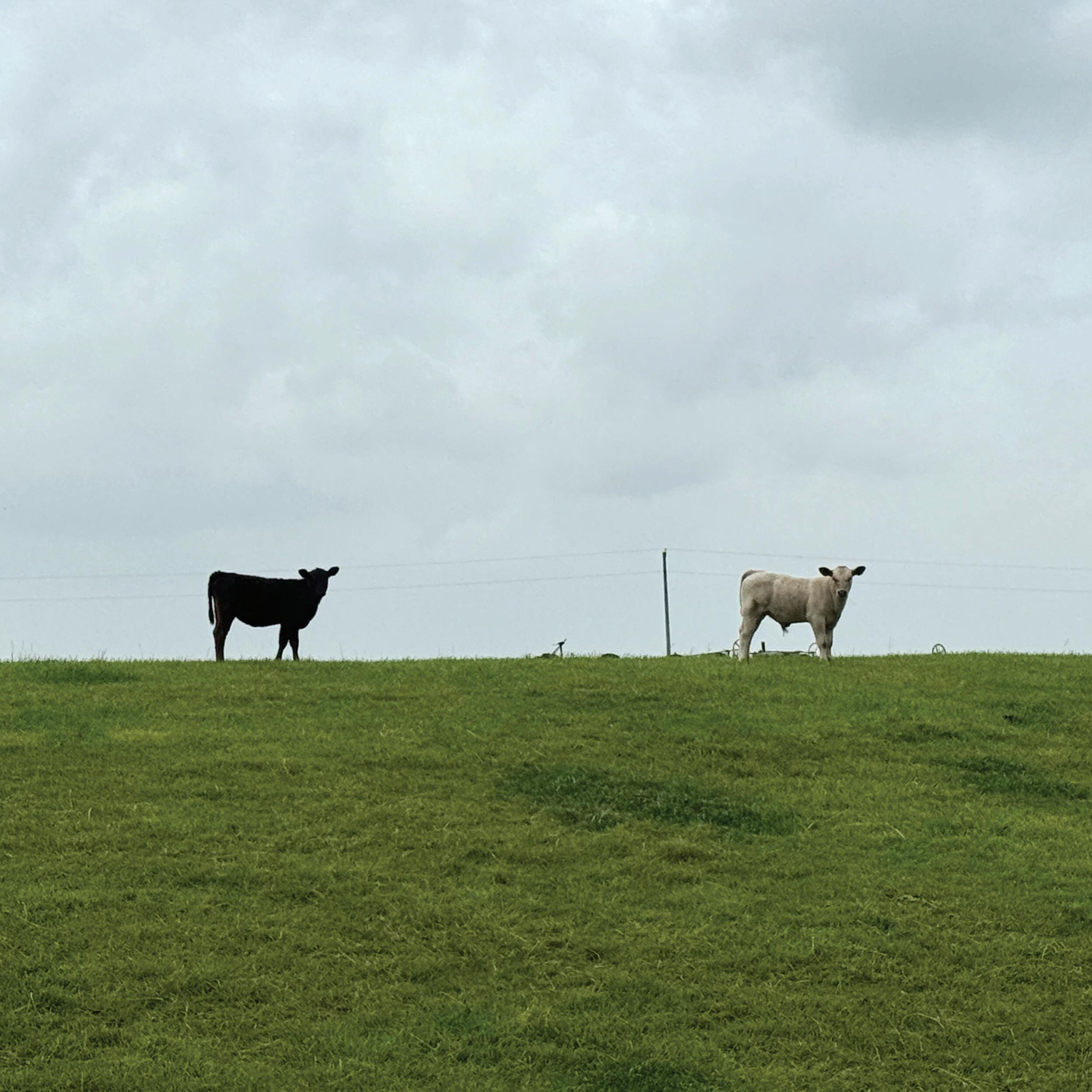
Vivienne Craig | The Midwestern Moo, digital photograph
My parents never wake me up early on weekends. So when I wake up at 7:30 Saturday morning to my usually quiet parents banging open the refrigerator and packing the car trunk, I jolt out of bed. Clearly, they forgot to tell me about today’s farm trip … again. I frantically pack all of my farm clothing: both of my flannels, my houndstooth tank top, three West-Virginia-related shirts, and my special farm jeans. The Farm, in Bean Settlement, West Virginia, is both where the Beans settled in the eighteen hundreds and where we spend the odd weekend a couple times a year in the present. It takes about fifteen minutes to get to the closest town from The Farm, but if you need a refrigerator, you have to drive to a bigger town forty-five minutes away. Five people live in a five-mile radius to our place, and I think we may all be related. Thirty minutes after getting up, I’m downstairs. Fifteen minutes after that, we leave, all packed into my dad’s car, the three of us kids piled in the back. As usual, I scheme my way into the back right side instead of being shoved into the middle seat because even though I’m the youngest, I’m also the only girl. It doesn’t matter much because my brothers may be the most polite children I have ever met, but I still revel in my victory each time. There are two staples of the Bean family road trip. First, we need to play the alphabet game. Even though my family has started to outgrow it, I still force them to play it on any road trip. In the alphabet game, you have to find the letter A on a sign somewhere. Once you do, you get to move to B. It keeps following that pattern through the alphabet until you get to Q. At Q, you’re done for. I have only ever seen two Q signs in the wild. One was a store that went out of business twelve years ago, and the other is the Chick-fil-A next to Fauquier Bank. That brings us
to the other staple of the Bean family road trip, going to Chick-fil-A. Often, we stop at the boring Chick-fil-A only twenty minutes from our house, which means we have to rely on the Audi Q model to finish our alphabet game, but on the best days, we stop an hour and a half in at the Chick-fil-A next to Fauquier Bank. It takes two and a half hours to get to The Farm, but three if we stop there — it’s a little distracting.
After the Chick-fil-A next to Fauquier Bank, the roads get smaller and smaller, and my mother gets more aggressive. She has been a Bean since birth and made this drive more times than she could count even before she could count. As such, she does not tolerate anything under twenty miles over the speed limit on the steep mountain roads. Usually my dad’s driving terrifies me, but this ten-minute race through the mountains with my mom at the wheel scares me the most. This road is carved into the middle of the mountains and surrounded by impossibly tall trees that I remember as always green, even in the dead of winter. On this stretch, I’ve learned that the dotted yellow lines mean that you sincerely must pass the too-slow car in front of you, that you can go ten miles above the suggested speed around sharp turns without flipping over, and, most importantly, that you should never, ever, allow yourself to get trapped behind a logging truck. They are interminably slow, and I’m ninety percent sure that one day the logs will just fall off and crush me.
The mountain pass ends at the gas station where I can finally pry my fingernails out of my palms and slow my borderline unhealthy heartbeat. We used to stop at the gas station for ice cream and Gatorade every trip, but now that we are older and our palettes more refined, we endure the extra five minutes to get to the Moorfield farmers
market. We always make a beeline for the same sections. I go straight for the fridge for pizza rolls. Max always goes for the sourdough with Thomas following suit. My dad sneaks a bag of granola to add to his evergrowing collection and also buys the four-pack cinnamon buns, our favorite four years ago, so he figures we must still love it. At the bakery stand, he also always asks if they have a green olive foccocia. They never do. They used to have it, my mom’s favorite, so he keeps trying.
Just as we pull out of the farmers market and get

hangs on the wall right next to the cardboard cutouts, so I like to think of the cardboard cutouts as a kid-friendly version of taxidermy. Once assembled, the cutouts take the shape of a brown or orange deer head you can mount on your wall. I have desperately wanted the brown deer head since birth, but it's been out of stock since I found my calling. I've contemplated giving in and opting for a real deer head, but it’s not really the same. Right when I reach the candle section, five minutes after we arrived, my mom has her latte and we get back on the road.
our bearings, we have to stop at the orange cow coffee shop. It is actually named the Lost River Trading Post, but I always remember it by the huge statue of an orange cow outside. The cow wears a cowboy hat and boots and watches everybody in and out of the shop. As my mom orders her coffee and at least three chocolate chip cookies and four scones and two more scones, and . . . you get the point, I go to the interesting side of the store — a whole shop full of local businesses. The first section has stickers of the orange cow next to washcloths and seeds. For many years, this section had a bright green shirt that read “Lady Farmer” with the West Virginia state outline on it. This section sits directly next to the haunted opossums and moths. Right after that comes the glassware.







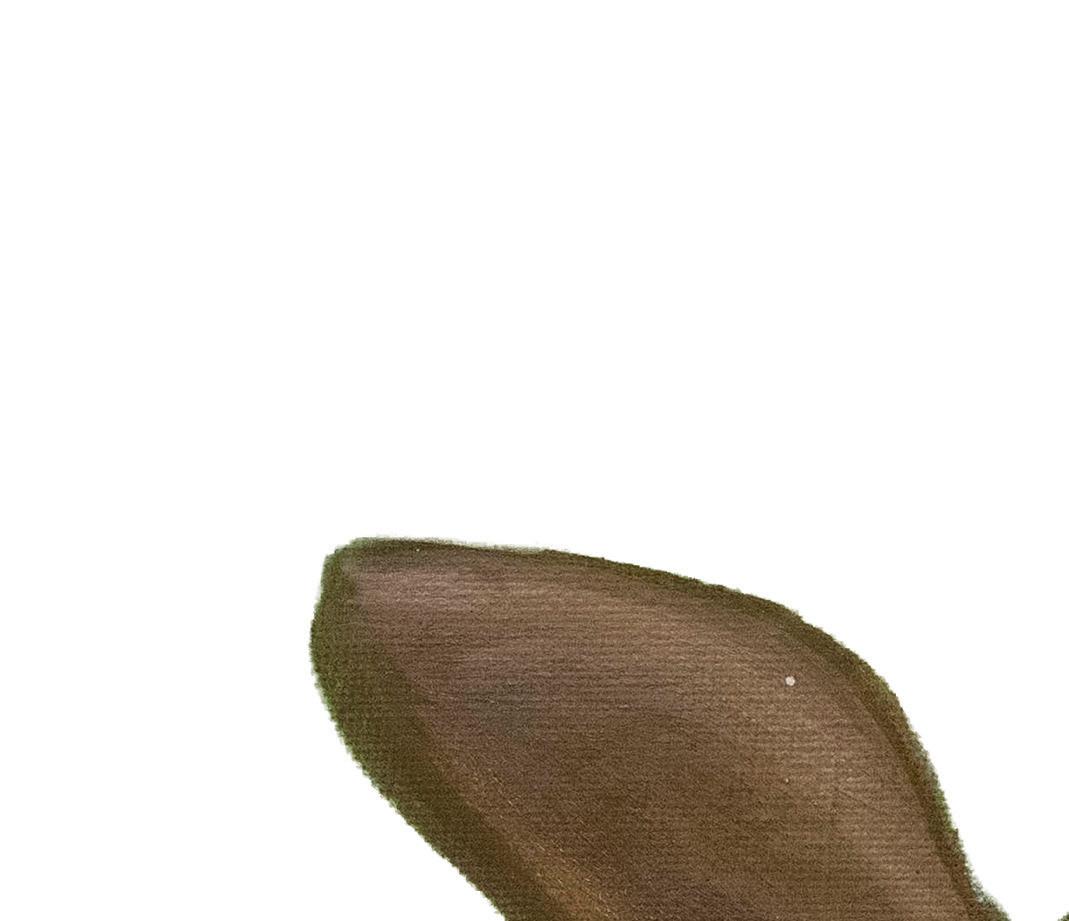
the back corner holding cardboard cutouts.

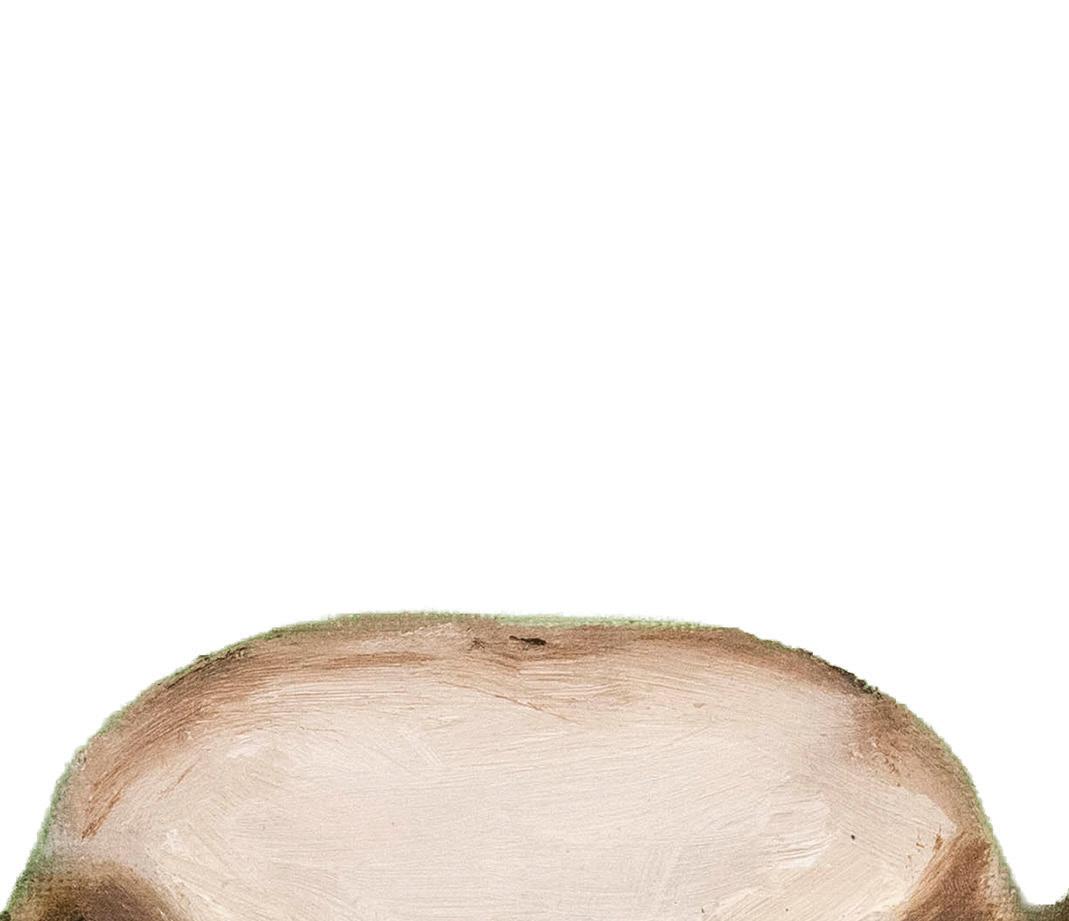
One thing I about West Virginia, it has no shortage of taxidermied deer heads. Even here, a huge moose head
My favorite part, though, is the little basket in know sickness


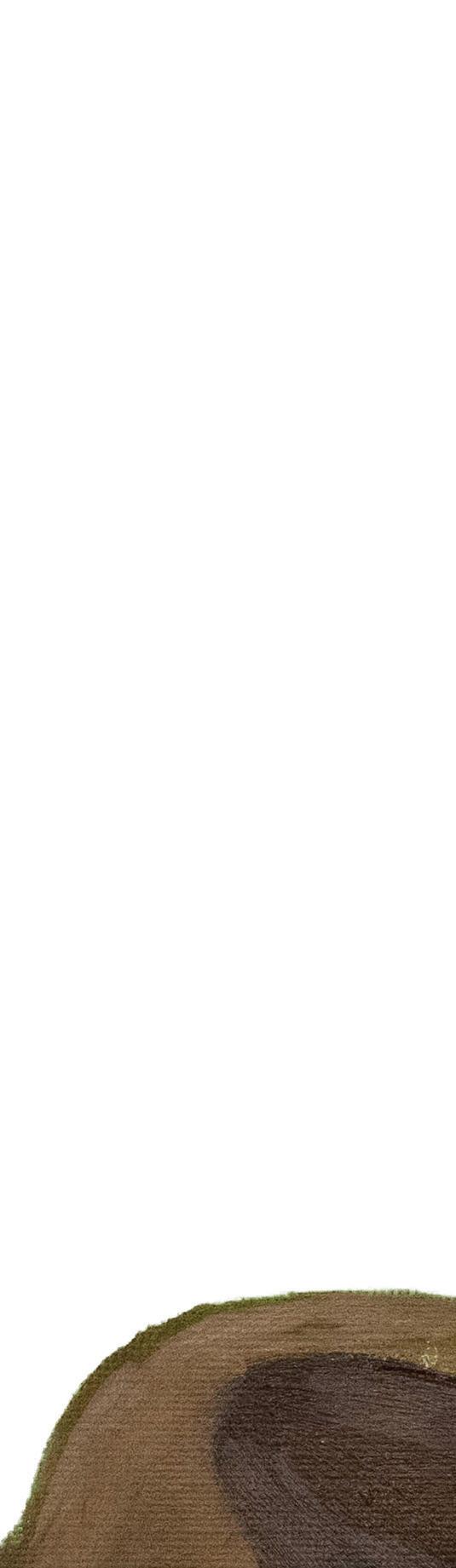
Driving out of Moorfield, you have to go five under the speed limit because the sheriff sits out with his radar, waiting to give you a ticket. You know you’re safe, though, when the speed limit jumps up to thirty, then forty, then fifty, then sixty all in rapid succession. This last part is my favorite road, the one on which I learned how to drive a car. Soon, the speed limit jumps up to seventy, but you shouldn’t go lower than around eighty. From there, it’s a straight shot to The Farm. In ten minutes you run into Upper Skaggs Run and make the sharp right off the highway. Immediately, the road switches from asphalt to gravel and grows thin enough that I fear for my life. Upper Skaggs provokes a different kind of fear than the mountain-pass terror. Calling it a two-lane road has always been a stretch, and I thank God I don’t have car every time I go bouncing down its blind turns. Finally, we pass



Grandma Bean’s house, and I know I only have to endure about fifteen more seconds and three more blind turns. No one lives in Grandma Bean’s house, but we still say hi to it every time we pass.

At the stop sign, the road becomes asphalt again, and we hit a fork in the road. If we go straight, we hit our neighbors. First, we would see my cousins, who live to the left in my grammies’s friend Clarice’s old house. Even with the amount of new wood piled on each side, it’s still Clarice’s house. To the right live Wayne and his son Trevor. I don’t know what exactly they do, but I do know that Trevor has peacocks, and almost any other animal, and Wayne was friends with my grandpa, so they have reason enough to live there. If we turn at the stop sign, it’s smooth sailing right on to our house. Every time we drive this last stretch, I see a random house of a person whom I don’t think I have ever met and whom I forget about the second we drive past, so at least one person nearby may not be related to us after all. But, let’s be honest, most
immediately have to do the whole routine in reverse to put the key back so the next family member can get in. Our house sits on two hundred acres of land that my great grandfather owned before us. I actually learned how to drive there. I started with one of those motorized toy cars, the John Deere brand, of course. Around ten, I graduated to sitting on my uncle’s lap steering a pickup truck. By twelve I'd learned to drive a motorcycle and an ATV. I dubbed myself my friend group’s getaway driver in case of emergency. I learned how to drive so early because driving is the only thing to do up there. At The Farm, my options for entertainment are to play in the hay bales in the hay barn, wait at the bear feed to see a bear, play board games with my brothers, watch one of our thirty DVDs, and, my favorite option, drive through the woods.
Twenty seconds down the road, we reach our house. Bright white, it has two floors and too many flies to count. To unload the bags, you have to make it through two different doors just to get to the front door. Then you remember the door is locked and have to go back out one of the doors to fish the key out of its hiding




do a likely they 100 percent are. To spot. Then once you open the door, you



After we get inside the house, I always go straight to my room. It’s mostly light yellow, but I remember it as all pink because of the blaring accent wall on the left side of the room. Nothing about my room has ever changed. The bedframe is probably an heirloom. I have the best mattresses in the house because my grammies bought them for me, and she got her granddaughter the most expensive ones she could find. My five stuffed animals all sit on my Anna and Elsa bedspread hugging each other so they don’t get lonely between visits. And, of course, dead flies lie everywhere. Still scared after that one time that there were in the back corner, I always quick once over to check that none of them actually made it into my bed. After a thorough search, I flop down and go back to my Saturday morning sleep-in.







Emme Poole | Quiet Curiosity, oil on canvas
AThe Garden
spray of cobblestones cascades down a shallow, grass-dusted slope, pooling at a narrow entranceway that barely fits a heavy oak door. The house itself stretches skyward, lichen-crusted shingles bleached from years of Rhode Island sun. If you turn your head at just the right angle, you can hear the rhythmic crash of ocean waves against the shore a mile away.
Alex Cox

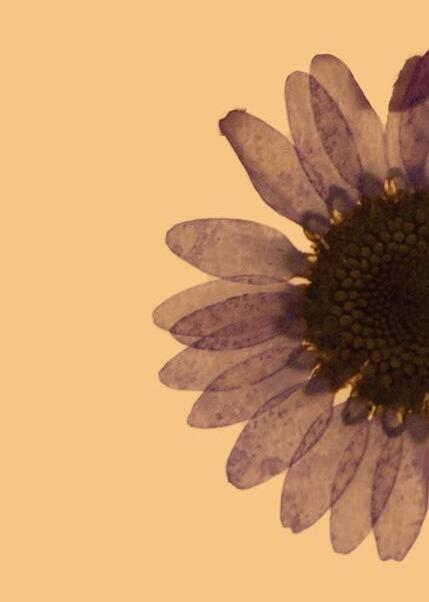
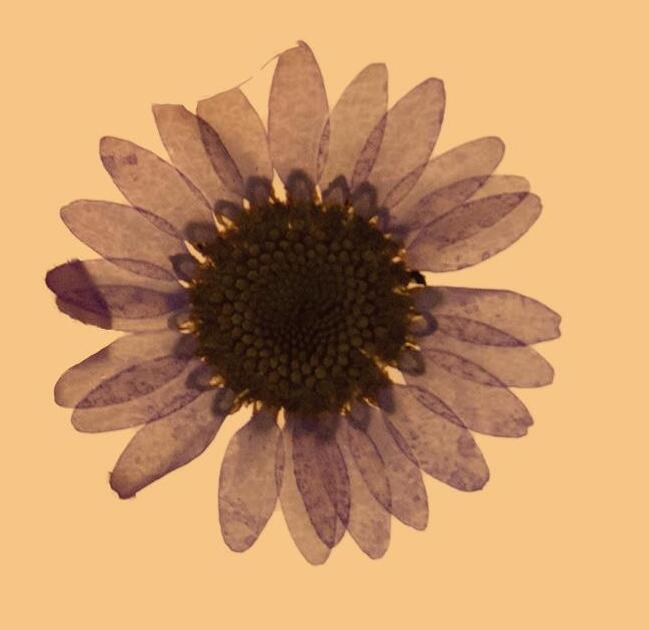
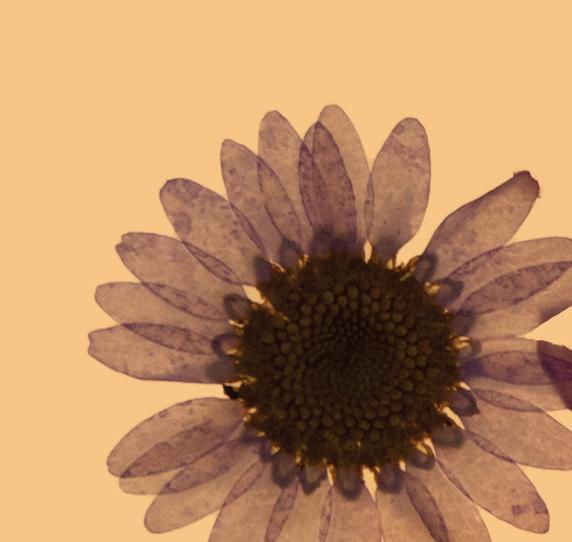
My oma (German for grandma) took meticulous care of her backyard garden. Its centerpiece, a massive, rustic sugar maple, tossed screens of shadow over the lush emerald bushes surrounding it. Just outside the breadth of the tree’s shadow stood a cluster of daisies, golden beads nestled within delicate snowy petals. Beside the daisies, a thicket of lavender perfumed the air with its soft fragrance. Around the garden were scattered black-eyed Susans, dainty purple lilacs, and cupped foxgloves. Oma watered her garden at 8:00 sharp every morning, and once my sister and I grew big enough to lift the bulky hose, we took over the garden maintenance duties. I remember running gleefully around the garden, an arc of water spraying behind me, darting between rocks taller than I was.
Like most beach house stories, summers at my grandparents’ house in Rhode Island remain crusted with salt and sand in my memory. The most magical part of our trips for me, however, lay just behind the house.
Oh, yes, did I mention the rocks? There were tens of them, fist-size and colossal alike, all slate-gray and dappled
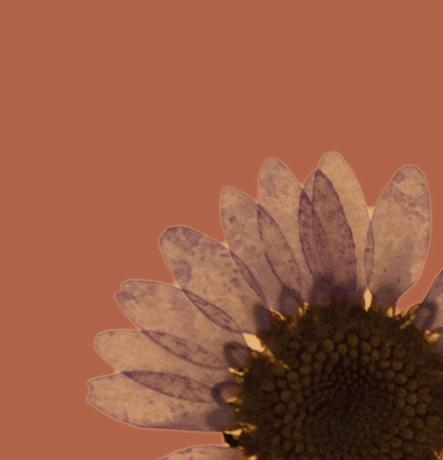





with lichen. No matter which way you turned, there would be a rock within a few feet of you. After dusting the garden with water, my sister and I would make a game out of climbing the rocks, hopping between them and grabbing at each other’s legs — the floor is lava! Don’t walk the plank!
The array of rocks made for an endless game, and we usually ended by attempting to best The Rock, the mammoth one at the back of the garden. The Rock was a mountain to us, and on the other side lay dragons, faeries, and jungle cats, an impenetrable thicket of forest holding terrors unimaginable. The Rock, too, was impenetrable — every time we tried to climb over it, our fingers slipped from the crooks of the stone and we tumbled onto the ground, defeated. Part of us didn’t quite mind this constant thwarting of

our adventure: perhaps it was better to stay in the garden, our haven, than to brave the unknown lurking behind The Rock. In the garden, we were safe and free, skipping through our own personal Eden until the scent of cookies baking lured us back inside the house. We thought it would never end.
Of course, it ended. Oma died, and the house fell into disuse after a family quarrel. The last time I went there, I must have been fifteen. I remember standing beneath the maple tree, surveying the wilting daisies and lavenders drooping with thirst. I walked through briars and weeds over to The Rock, and for the first time, I could see above it into the forest beyond. In fact, I could see through the forest to a quaint little cottage on the other side. The magic had shriveled, the forest no longer a den of faerie-tale creatures but a thin clump of shedding trees. I turned my back on The Rock and walked away.
Tales of the Elusive Tooth Fairy
Sasha Koeva Brooks
Myrelationship with the Tooth Fairy began violently. At six years old, I sat cross-legged on the living-room carpet with my little sister, watching Frozen for what must have been the fiftieth time that week. We both knew every song, every pause, every line of dialogue. My sister Misha, only a toddler then, had decided she was Elsa. She’d found a wooden spoon in the kitchen and declared it her ice wand.
“It’s snowing!” she yelled, twirling dramatically around the living room.
“It’s not snowing,” I said, my eyes glued to the screen. She gasped, deeply offended. She lifted the spoon and shouted, “I’m freezing you!”
The next moment was a blur of chaos. The spoon came down with the full conviction of a three-year-old goddess of ice. Whack. A sharp pain shot through my mouth. I can still remember the metallic taste of blood, the stunned silence that followed, and the sudden realization that something small and white had fallen to the carpet. My sister froze, her mouth forming a perfect O. I touched my lips and saw red on my fingers. Then I looked down at the tooth — my tooth — lying there like a fallen soldier. I started crying. My sister started crying. My mom came running in.
“What happened?” she demanded.
“She hit me with her magic spoon!” I sobbed. My sister’s face crumpled. “I didn’t mean to! I was just being Elsa!”
After a blur of paper towels and consoling hugs, my parents told me the Tooth Fairy would come that night and leave me money under my pillow. The concept struck me as bizarre but intriguing. Some sparkly creature collected teeth and paid cash for them? I decided I could live with that arrangement. That night, I slid the tiny canine under my pillow and tried to stay awake to catch her in the act. I pictured a tiny woman with glittery wings, jingling coins, and maybe a clipboard. But I fell asleep anyway. When I woke up, the tooth had disappeared, replaced by a crisp dollar bill. I stared at it, awestruck. My faith in the Tooth Fairy was secured.
The next few years of dental events were less violent but no less dramatic. Around my fourth or fifth lost tooth, I began The Great Lunch Strike. It started one afternoon in the noisy school cafeteria. I had just unwrapped a steaming slice of pizza from the foil when I felt one of my front teeth wobble dangerously. It leaned like a loose door hinge, ready to snap at any second. The idea of biting down and having it fall into my food filled me with dread.
I imagined it happening in excruciating detail: biting into the gooey cheese, feeling the tooth detach and sink into the red sauce, maybe even mistaking it for a lump of mozzarella and swallowing it. The thought
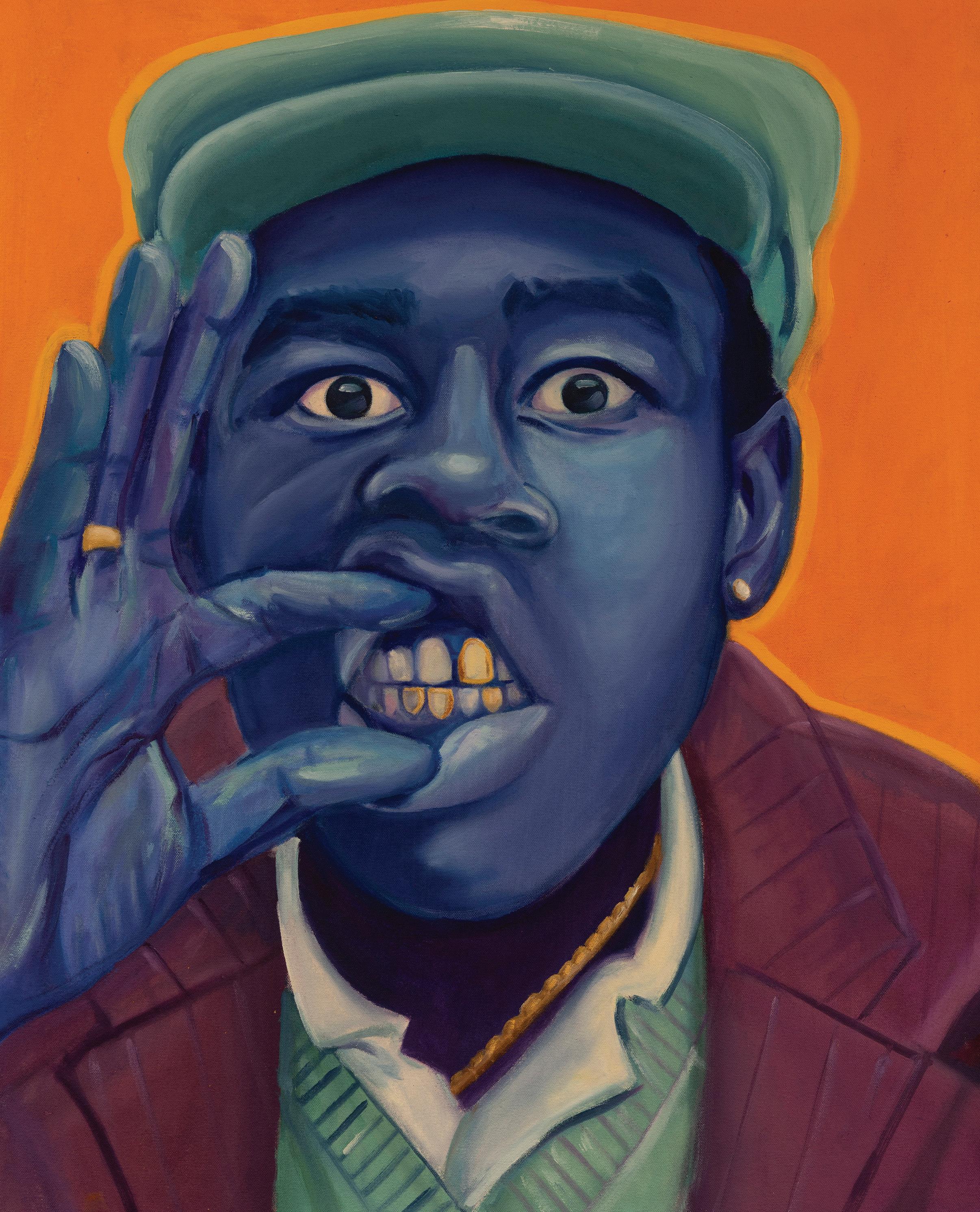
Oma Ndu| Tyler, The Creator, oil on canvas
made my stomach turn. What if it disappeared forever inside me? Would it show up on an X-ray, stuck somewhere in my intestines like a pearl? And worse, would the Tooth Fairy still pay me if I couldn’t provide evidence?
The cafeteria smelled of warm breadsticks and fruit cups, but I sat with my unopened lunchbox, guarding my mouth like a fortress. My friends asked if I felt sick. I told them I was “on strike.”
My teacher, Mrs. Kingsley, noticed quickly. “Sasha,” she said one day, kneeling beside my desk, “why aren’t you eating?”
“I’m protecting my tooth,” I said gravely. She blinked. “Protecting it?” she asked.
I responded, “I don’t want to swallow it by accident.”

Two days later, my parents got a call. I wasn’t in the room, but I can imagine how it went: Mrs. Kingsley, deeply concerned; my mom, trying not to laugh; my dad, attempting to explain that I was just “very cautious about dental matters.” That night, they sat me down at the dinner table and assured me that even if I did swallow the tooth, the Tooth Fairy would still find













out. “She has ways,” my dad said mysteriously. “She keeps track.”
I didn’t fully believe them, but hunger eventually overpowered fear. The next day, I opened my lunchbox again, carefully. I picked the softest food I could find: applesauce. I ate it with microscopic bites, my tongue constantly checking the loose tooth.
And then, a few days later, my caution proved useless anyway. I bit into an apple at lunch, and the tooth popped right out. I froze mid-bite, staring at it sitting in my palm. Surprisingly indifferent, I calmly asked Mrs. Kingsley if I could go to the nurse.
The hallway to the nurse’s office felt unusually long. My sneakers squeaked on the linoleum floors; the faint smell of bleach and pencil shavings hung in the air. I held the apple in one hand and the tooth in the other, afraid they might somehow mix again. When I arrived, the nurse looked up from her desk with a grin.











“Lost a tooth, huh?” she said, opening a drawer filled with tiny plastic treasures. She pulled out a small, translucent toothshaped container, a capsule with a snap lid and a thin string so you could wear it around your neck like a medal of honor.


I left the nurse’s office proudly wearing my prize, the tooth safely rattling around I left the nurse’s office

Firstpara text inside. The metal clasp of the string clicked softly as I walked back down the hallway, feeling like I’d achieved something monumental. That night, the Tooth Fairy rewarded my bravery with two dollars. I took it as a sign of recognition for professional excellence.

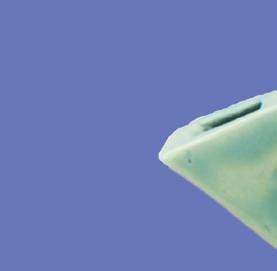
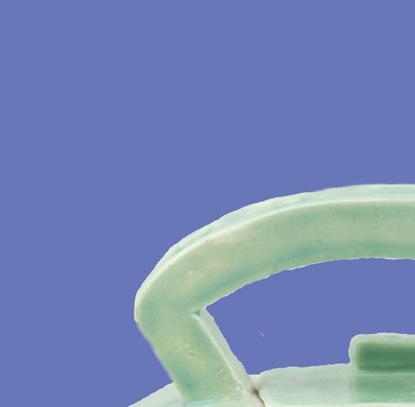
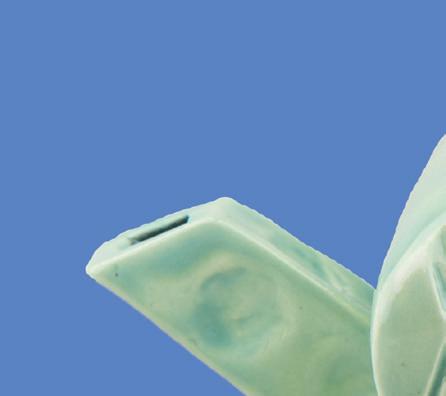
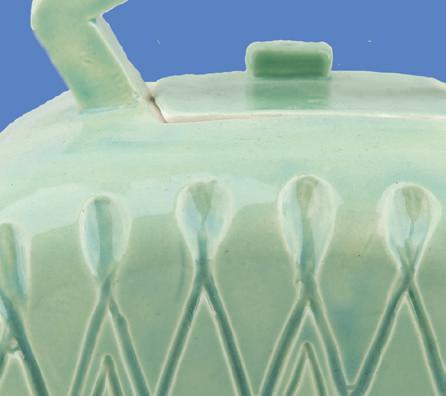
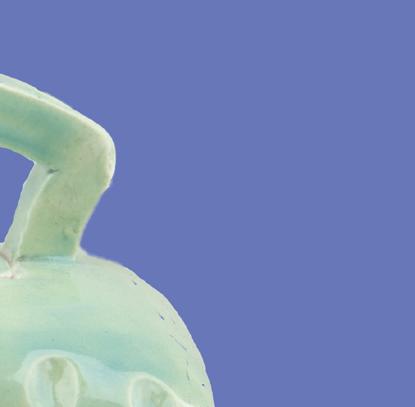
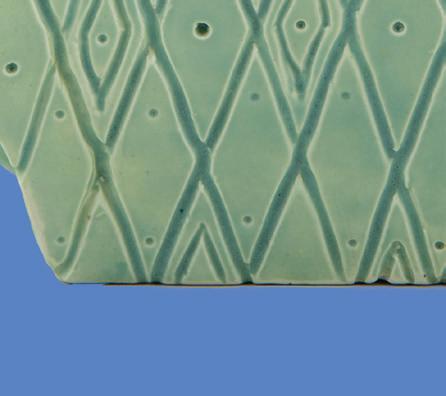
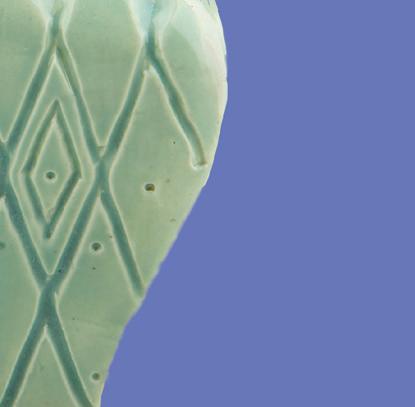
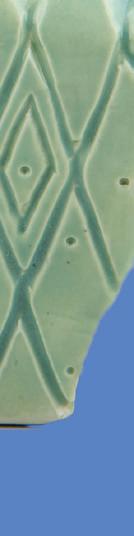
Zahra Rasheed | Ablution in Celadon, white earthenware
But by the time tooth number seven came along, I started to notice cracks in the Tooth Fairy’s business model. Her handwriting on the congratulatory notes looked suspiciously like my mom’s. She never seemed to visit before my parents went to bed. And the one time I lost my tooth at a friend’s house, she somehow “missed” their home entirely. So, I decided to conduct an experiment.
One evening, after dinner, I lost another tooth while brushing. This time, I told no one. If the Tooth Fairy was truly all-knowing, she’d come anyway. If she didn’t … well, then I’d have my answer. I prepared like a scientist. I got out a flashlight, a bowl of Goldfish crackers, and a notebook labeled The Tooth Fairy Files. My hypothesis: the Tooth Fairy was a myth perpetuated by parents to encourage dental hygiene or some other conspiracy.
I placed the tooth under my pillow and hunkered down. I watched the hallway shadows creep across my ceiling. Midnight came and went. My eyelids grew heavy. By 2 a.m., I was out of snacks and nearly asleep. When I woke up at dawn, sunlight spilling through my curtains, I reached under my pillow and there it was. The tooth. Still there. The evidence was irrefutable.
I marched into the kitchen holding the tooth like Exhibit A. My parents were drinking coffee; my






grandmother was sitting at the counter, reading the newspaper.
“The Tooth Fairy didn’t come,” I announced. My dad looked up. “What do you mean?” he slowly asked.
“I mean she didn’t come. Because she’s not real,” I responded.
There was a pause. My grandmother lowered her paper. My mom and dad exchanged a look. Finally, my mom sighed. “All right,” she said carefully. “What will it take to keep this quiet?”
I thought about it. This was leverage. “Twenty dollars,” I said after a moment. It was an outrageous demand but they agreed instantly. My grandmother even pitched in five. I walked away that morning twenty dollars richer and sworn to secrecy “for the sake of your sister’s imagination.” I had effectively blackmailed the Tooth Fairy, which, for a sevenyear-old, felt like an extraordinary accomplishment.

ChatGPT Said I’d Be Fine
Moments like Mirrors
Mahi Dumas
It was nighttime, but nowhere near quiet. New York bustled, as it always does. A model posed on a billboard for a L’Oreal ad, her glossy hair whipping in some breeze, framing her freckled face. A young couple crossed the street, giggling, hand in hand under one small umbrella. An old, grey-haired woman pushed a young toddler in a stroller. The world whirled around me, but I stayed still, taking it all in.
Dorothy Andama | Inside Joke, digital photograph
“Bpress the snooze button. My 5:45 AM alarm wakes me up just enough, so I will be ready to actually get up for my next alarm at 6 AM.
slumber until “BEEP BEEP BEEP,” I’m up.
I grab my phone and turn off my 6:00 AM alarm. I slowly roll over to my other side and begin to scroll through my notifications. I allow myself five minutes to scroll on my phone until my next alarm goes off, aka, the one where I actually have to get up at 6:05.
pet. I blindly walk to the door, careful not to hit my knee on the corner of the bookcase narrowly squeezed into the already overcrowded room, ready to start my morning routine.
mom rushes past me, water bottle in hand, on the way to the gym. Just as she leaves, she runs into my dad, bursting through the front door, sweaty from his morning five-mile walk. As I move into the kitchen, I spot the clock on the stove. It reads 6:35. Perfect, I’m right on schedule.
I fill my water bottle, grab a cheese stick, and move back into the living room to grab my backpack.
It felt so different from back home in the suburbs, where everyone is trapped within their own lives, never pausing to admire the world around them. Here, there was just so much going on that you faded into obscurity. I didn’t have to be the main character with all eyes on me, like I did back home. In a way, all this possibility was liberating.
“EMMETTTT,” I shout up the stairs, “Am I driving you today, or are you walking?”
“I’m walking,” he shouts back.
Thankfully, he always walks in the spring, and I have too much going on between Ms. Siddiqui’s English class and crew to be late because of him.
By 6:45, I am in the car, ready to inch my way out of the spot I carefully maneuvered into the night before. No matter the spot, my
And then there you were, crossing the street, walking with a purpose I had never seen before. A gleaming gem in the sea of faceless silhouettes, you stood tall, and your eyes shone bright with determination. “What’s that like?” I wondered. To walk with a purpose, knowing exactly where you’re going and what you’re doing. To have goals that are your own, not to fit vague ideals or please the people around you.
routine never changes. The tires are already turned in towards the curb, a precaution against tire jacking, perfectly setting me up to leave each morning. I slowly reverse, careful not to back up too far and hit the car behind me. I quickly put the car into drive and turn the wheel all the way in the opposite direction. I pull out perfectly.
But elusive like all beautiful things, you were gone in an instant, your poised frame engulfed by the endless crowd.
As I merge onto the highway, the heavy traffic ahead leads me to take my secret way. I don’t follow the sheep on the Richmond side of the highway; I instead follow the signs to Maine Street. I cruise through the green light and allow my hands to guide the wheel to the right as I glide onto the on-ramp, then “BOOM!”
What was that? Oh no! Maybe I was imagining it. Oh no!
I keep going, and the car seems fine. No bumps, no jolts, no weird wiggles. It’s gonna be fine.
The Daily blares in the background, I allow my muscle memory to take over, and I go on autopilot. By the time I make the left-hand turn off of River Road into Holton, I’ve completely forgotten about that little bump.
“Zoe, what’s wrong with your tire?!?” Delaney says to me as she sits down next to me in the school cafe.
“What do you mean?” I answer. “I didn’t notice anything on my drive to school.”
“There’s a massive bubble in the side of your tire,” she answers.
“What?!?” I exclaim. “What do you mean by a
“Here, I took a picture of it!” She hands her phone to me, and I nearly keel over. It looks like there’s an orange bursting out of the side of my tire.
It looks bad, but honestly, how bad can it really be? I made it all the way to school; surely I can make it home.
I immediately text my parents, and my dad turns to ChatGPT for
Caz Pisula | Off to the Side, digital photograph
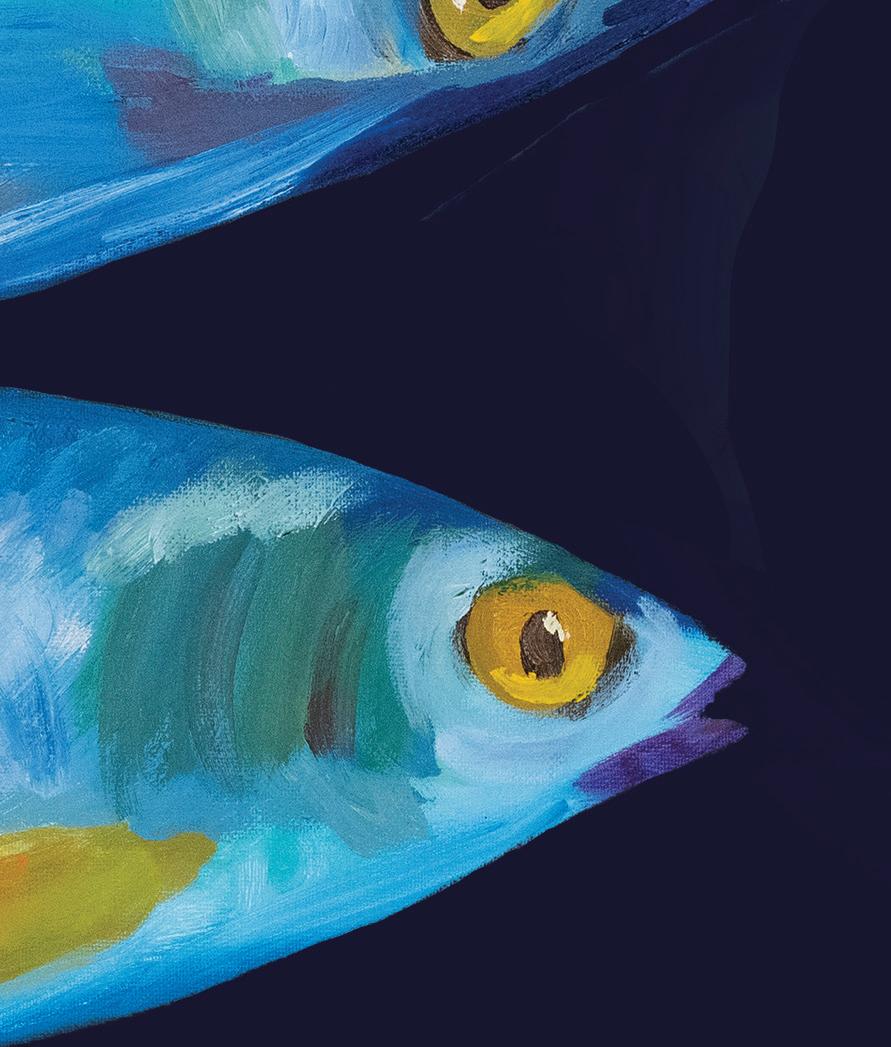



My golden fins glow Ooh a friend, I swim to them! Hold on, who are you?
Hannah Warfield



I dropped my note cards I lost my whole train of thought I was floundering
Betty Rose Bean












Hey, halibut we take A swim this summer break? You beta come with!
Natalie J. Tan


Food fight during lunch
I pelt her with battered cod Call that flying fish
Alex Cox
I am in hiding
From the boy I want to date. I am acting koi
I had a great date We hit it off really well It went swimmingly
Betty Rose Bean
I went out gambling I lost a tuna money I hit rock bottom
My fish ran away I don’t know how he did that Fish do not have legs
Warfield
Betty Rose Bean
“Are my fins shiny?
Do my scales look beautiful?”
“Stop fishing for praise!”
Alex C. & Hannah W.
Beer-battered or fried Salmon, mahi-mahi, cod
All it needs is chips!
Lily Rogers
I saw a big fish
Oh my cod it was crazy
Six feet long and red!
Betty Rose Bean



Hannah
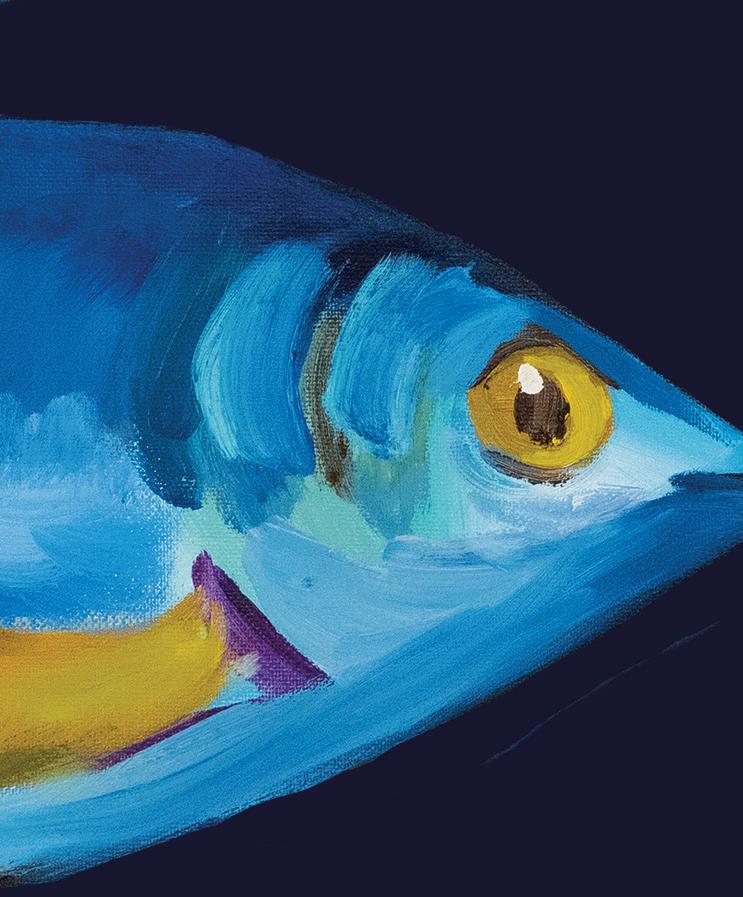
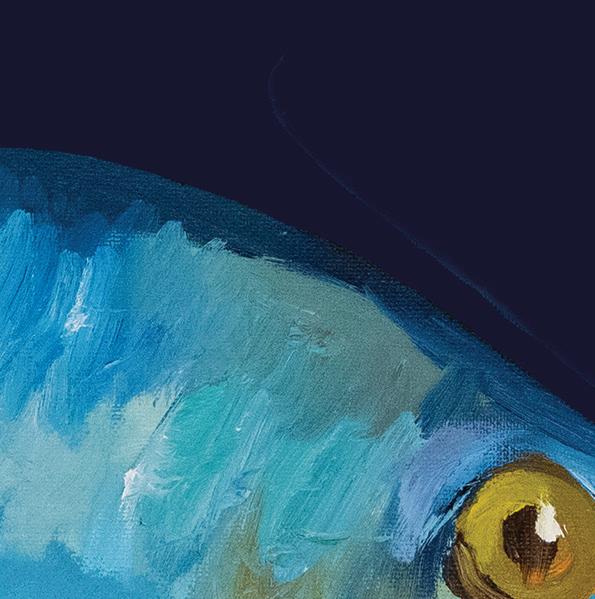
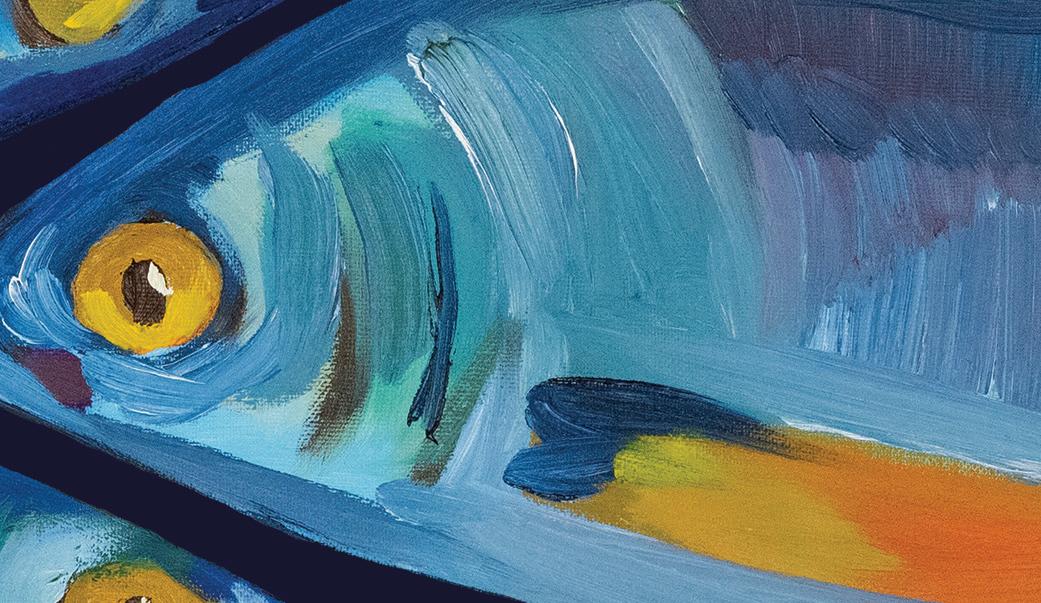
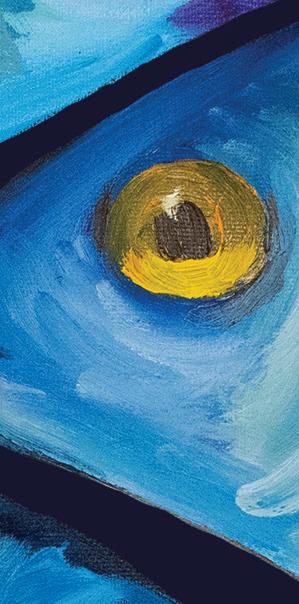
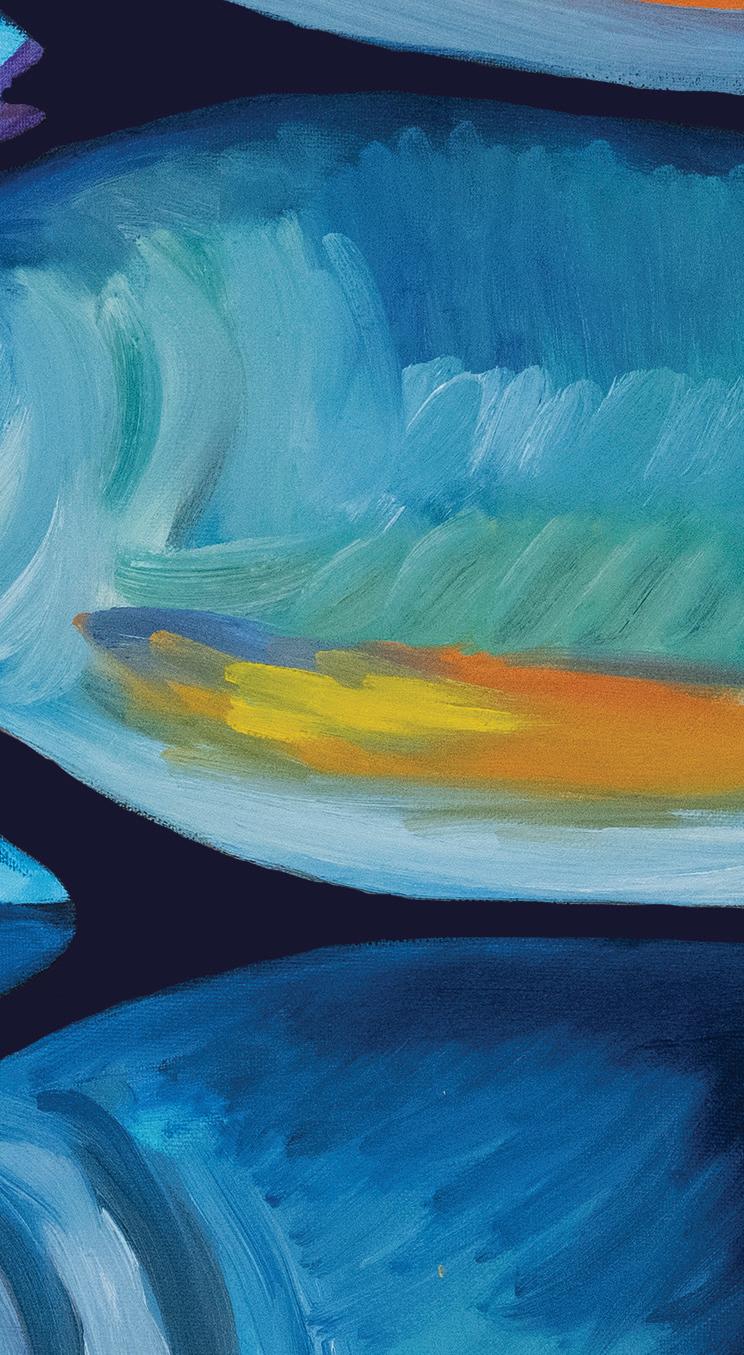
CarlisleWinn|Yellow-EyedFish,oiloncanvas
LetThem Talk
Enaya Mohsin
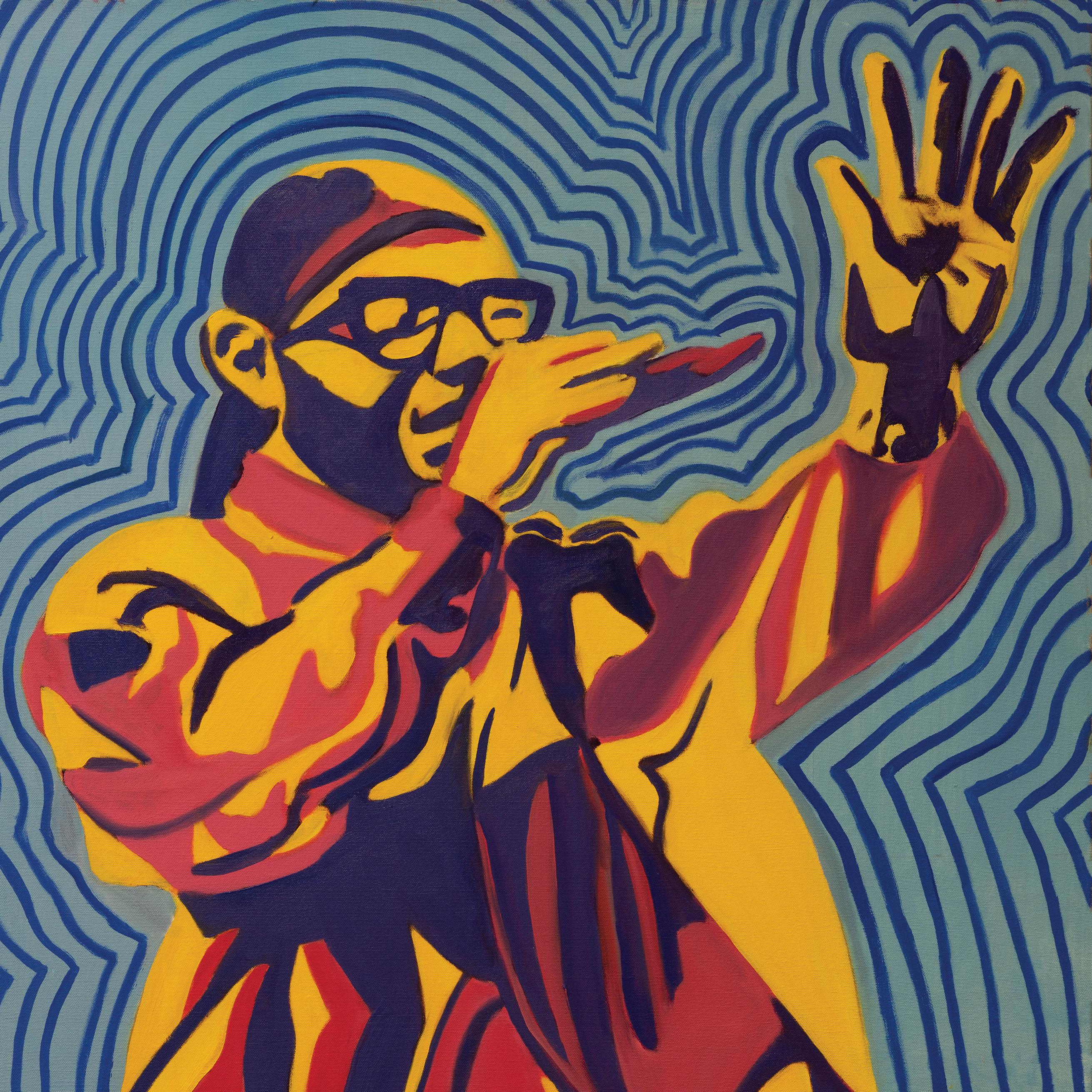
AlexisAkwara|Power, oiloncanvas
She walked through halls of gilded lies, let them talk. The chandeliers shook, and the walls bent, let them talk.
They traded virtue like counterfeit coins, She smiled at the fraud, let them talk.
The newspaper praised and demanded whatever she did, She left the ink to dry, let them talk.
Men bowed to shadows she ignored, Their crowns fell off, let them talk.
The city burned with quiet ambition, She poured the gasoline, let them talk.
And when the stars refused to witness, She lit her own sky, let them talk. Sloan
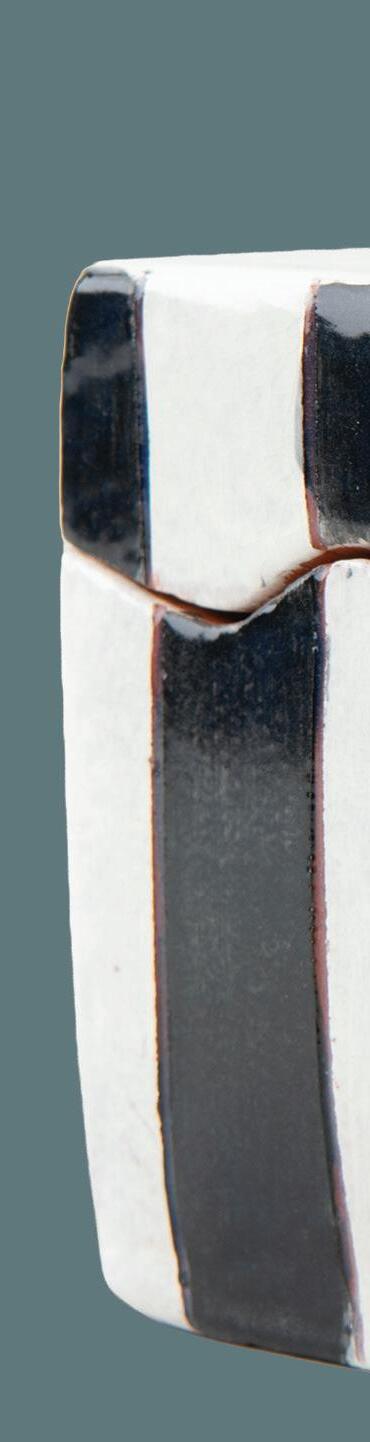
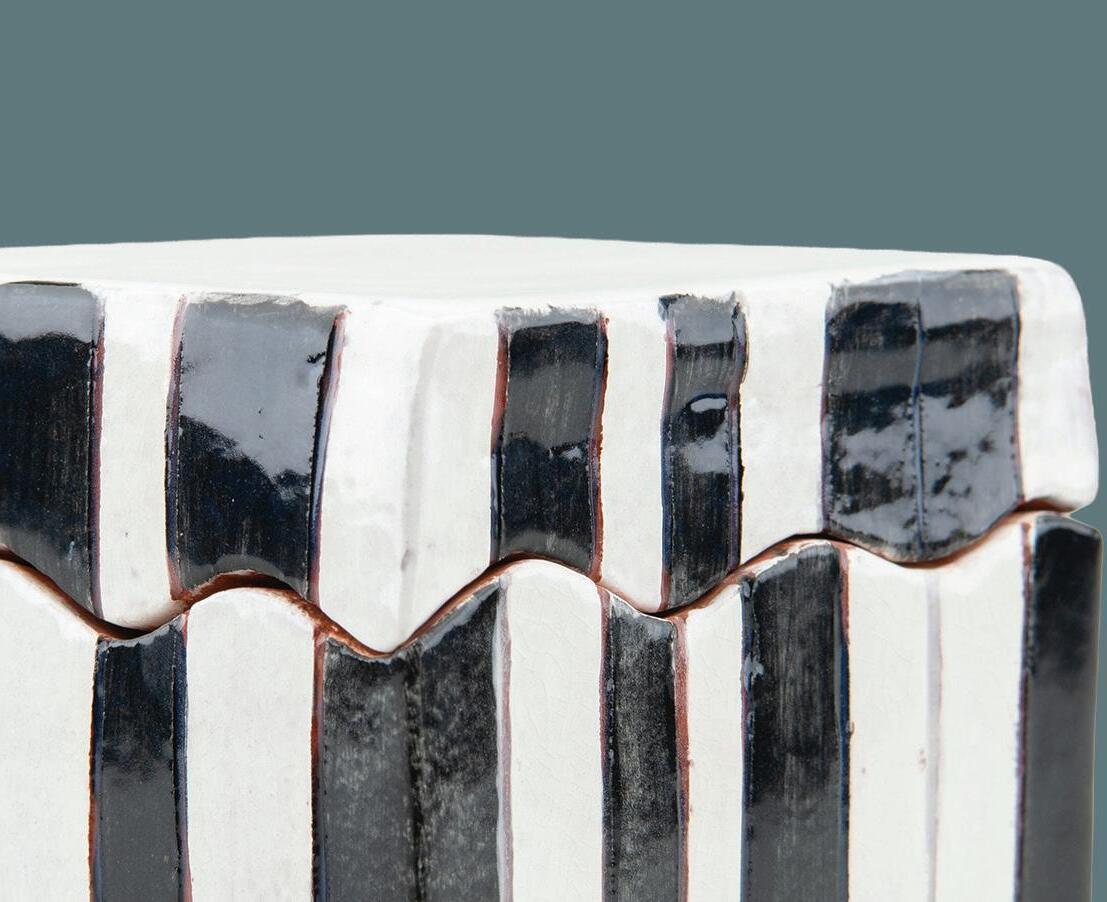
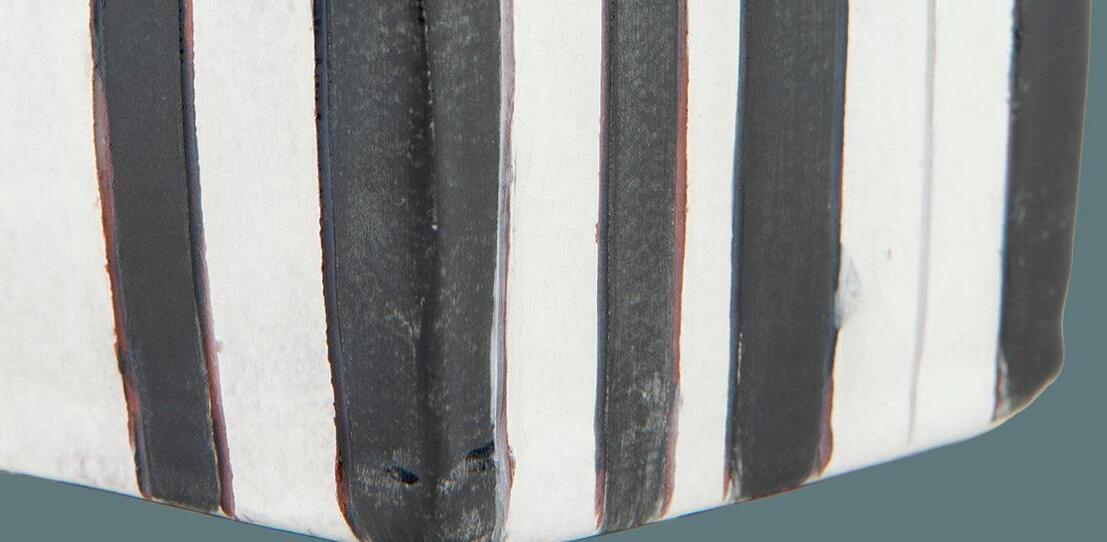
Quint | One Perspective, terracotta
The Elf on the Shelf AudreyO’Beirne
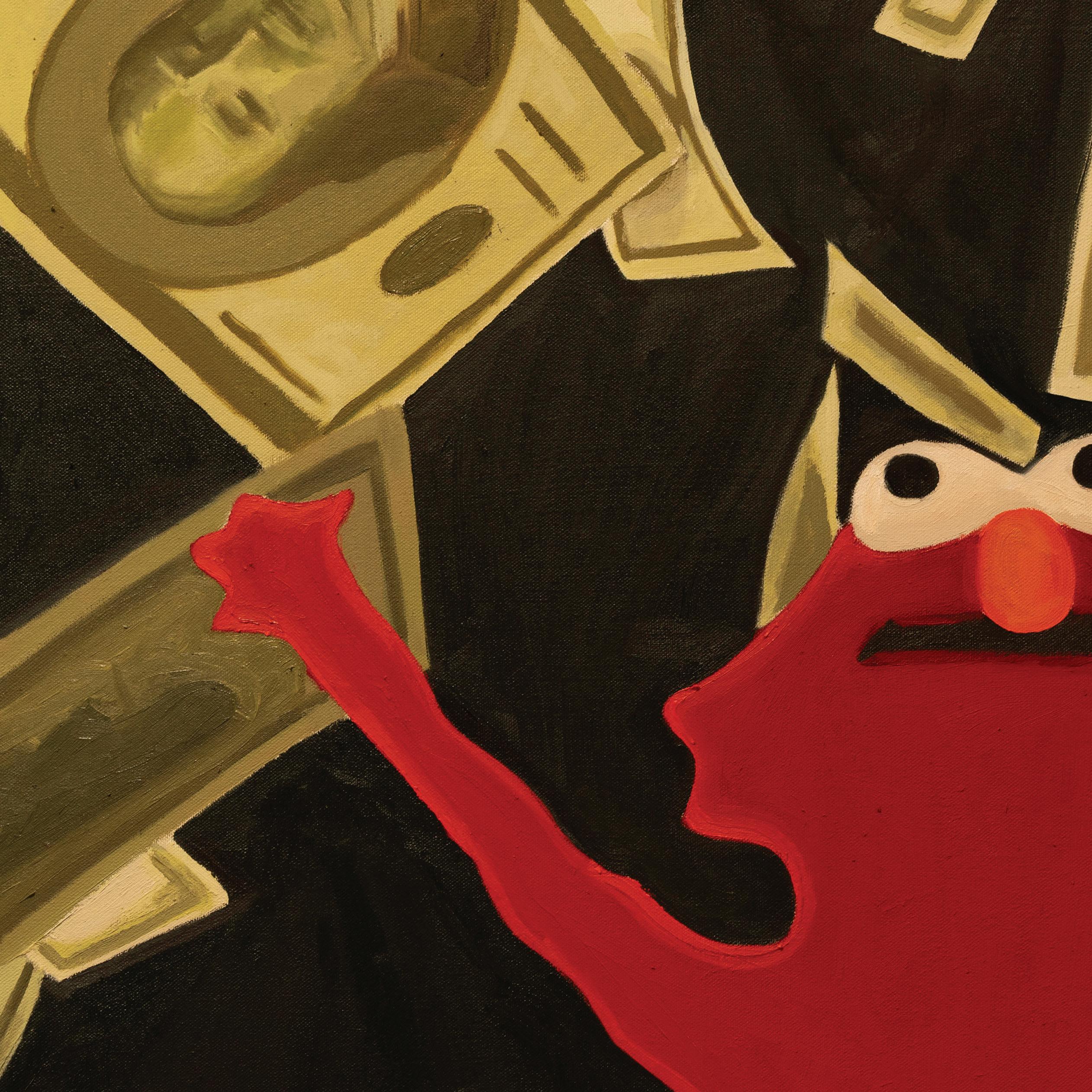
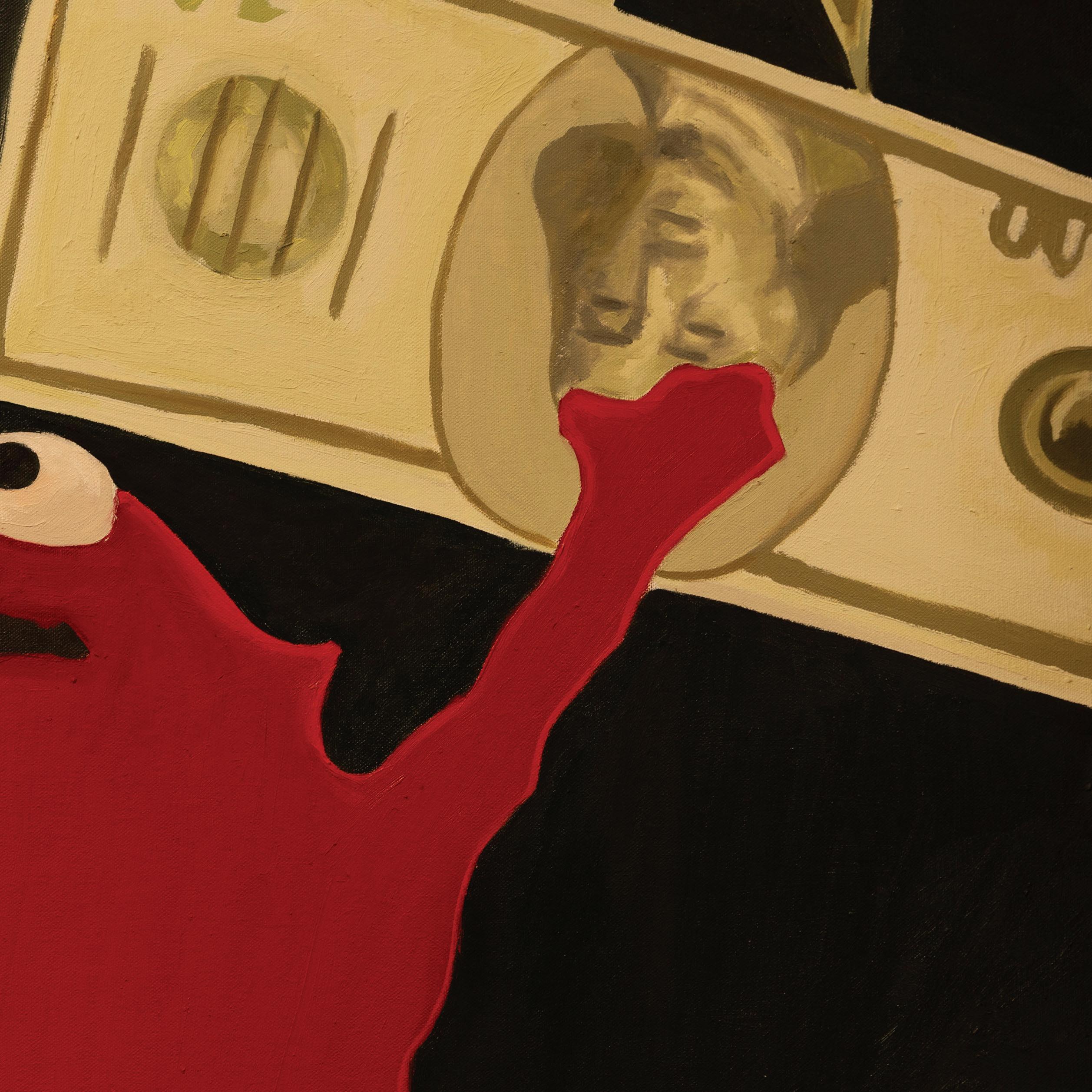
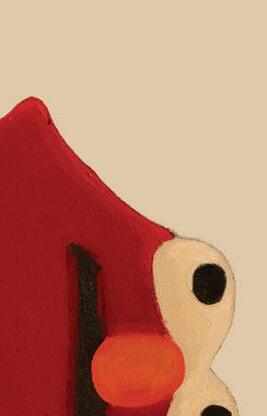
Marigold Brett-Major | Money Elmo, oil on canvas

Our Elf on the Shelf already looked like he had been through a war zone. The Elf — with his puffy, rosy cheeks, chestnut hair, bright blue eyes, and unforgettable red suit — had racked up more injuries than I’d managed to collect in my whole life. His right leg was burnt to a blackened crisp after he decided to perch on top of our hanging light fixture, the one whose bulbs had been blazing all day. It was only until he smelled smoke and melting plastic that he abandoned his post and decided to settle on the bookshelf in our living room. My brother and I peered at his leg in awe, careful not to get too close and accidentally touch him. The red fabric of his uniform had turned black, and we could see the metal wire that was, we assumed, his leg bone.

“That probably hurt,” my brother said.




“Yes, it probably did,” I agreed, shaking my head.
In a fixture, the one whose bulbs had been blazing all assumed, his leg bone. my said.



similar case, the Elf had decided to hang around a lamp pole, and the top of his red hat was singed down to his brown hair after catching fire from the bulb. After the hat incident, the Elf seemed lighting-fixture-shy, and he never perched on a lamp ever again. In addition to suffering severe burns, the Elf fell … constantly. His face, once shiny and pristine, had small dents and scratches from tumbling from his bookshelf or painting.


“Maybe he was drunk,” my mother would say, laughing.


As bad as his injuries — and supposed drunkenness — were, the worst accident happened just a few days before one particular Christmas. My brother and I had just run up the stairs, ready to begin our hunt for the Elf as we did every morning, when our dad approached us, stone-faced.


“The Elf had an accident last night while he was trying to find a new place to hide,” our dad said, solemnly.

“What type of accident,” we asked, startled. Had the Elf been chewed up by our dog? Had he tumbled off a high shelf, and shattered into a thousand pieces? Had he caught fire … for the third time? Was all that remained of him just a few scraps of red fabric and a goopy pile of melted plastic and wire?
“He fell … between the wall and our kitchen




cup- boards,” my dad said gravely.
“There’s no way to get him out,” my mom added.
As most kitchens do, ours had several built-in cupboards and shelves. In his hunt for a new place to spy on us for the day, the Elf had managed to slip behind one of the shelves and fall ten feet to the floor. He was, in concept, unreachable, unsavable, hopeless. But my brother and I weren’t ready to abandon the Elf who had accompanied each of our Christmases.

Step 2. Assess.

We needed to develop a plan to slide the Elf from under the shelf, but there were a few difficulties. First, and perhaps the most obvious limitation, was that we couldn’t touch the Elf or else he would lose his magic. Second, perhaps less important, was that he was practically unreachable. He was jammed up between a wall and a cupboard, the only exit point the inch-wide space between the shelf and the floor. Our parents, now equally invested in the Elf’s rescue, helped us devise a plan. We would use a metal hanger and slide it under the crack. With luck, we would be able to loop the curl around one of the Elf’s limbs and pull him out to safety.
Step 3. Rescue.
Step 1. Reconnaissance.
We set to work constructing a mechanism that would let us sneak a phone under the crack of the shelf to get eyes on him. Twenty minutes later, armed with a hanger, lots of tape, and a phone, we slid our contraption under the small space between the shelf and the floor. After a few seconds, we pulled the phone back out. With the camera setting set to video and flash, we replayed it, and there, after seconds of darkness, appeared the familiar red fabric of our Elf. He was covered in spider webs and dust, his limbs twisted at odd angles, his burnt right leg jutting out from under his left arm — but he was all right.
Laying on our stomachs, I with my flashlight, my brother with his hanger, and my dad sticking his arm through the crack, we began our rescue attempt.
“Flashlight,” my dad barked. I adjusted the position of the flashlight, attempting to give him the best view of our fallen soldier.
“Hanger,” he ordered. My brother quickly slid him the metal hanger. My dad slid his hand under the cupboard, the hanger entwined around his fingers. After what felt like an eternity, my dad let out a breath, “I got him,” he said. My mom came in from the living room, peering over the kitchen counter at the three of us laying on our stomachs. Slowly, with care and precision, my dad pulled
Title of Piece author
of the letter would travel to the North Pole. Only then, would the Elf regain his magical powers. Only then would we get taken off Santa’s naughty list.
Firstpara text out his own hand, then the metal hanger, then the Elf’s head covered in spider webs, then the Elf’s red torso, and finally his legs. My brother and I let out a cheer. My mom started clapping, praising our rescue efforts. That was, until our dad picked up the Elf with his hand, and set him on the kitchen counter. We went silent.


Stage 4. Recovery.
My brother lost his mind. I just stood there stunned. The Elf’s magic was gone. Erased by the simple touch of a human hand. Would Santa ever forgive us for disrupting one of his workers? My mom quickly resorted to damage control, reassuring my brother that the Elf still had his magic. My brother rushed to his school computer, eagerly asking Google what to do if you touched your Elf on the Shelf. Google, like the helpful advice giver it was, quickly ordered that you must write a letter to Santa, apologizing for touching the Elf, then burn the letter in your fireplace so that the smoke








At the conclusion of the letter, my brother threw the paper quickly caught fire, and in a matter of seconds, all that remained was white, glowing chimney, and entered the winter morning. Smoke that was on its way to the North Pole.
My mom hurried over to our fireplace and began stacking logs, old newspapers, pinecones, and other kindling in an attempt to start the fire. She lit a match and began poking and prodding at the logs. My brother hurried to find paper and a pen, and began reverently writing out our sincerest apology to Santa Claus. Ten minutes later, we were standing around our hearth, a burning fire crackling. We probably looked cult-like, holding hands, gazing into the orange blaze. My brother gravely read out our apology letter to Santa, begging for forgiveness. At the conclusion of the letter, my brother threw the piece of paper into the hearth. The edges of the paper quickly caught fire, and in a matter of seconds, all that remained was white, glowing embers and ash. Smoke rose up through the chimney, and entered the winter morning. Smoke that was on its way to the North Pole.

































That next morning, we crept up the stairs, hoping that the Elf had moved from its place on the counter to a new hiding spot. To our delight, we saw him perched atop a bookshelf, smiling and watching like nothing



hoping that the Elf had moved from its place on we saw him perched atop a watching like nothing ever happened.

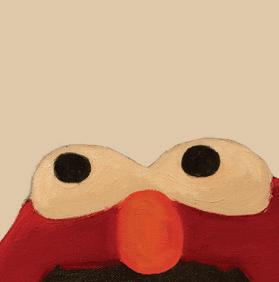











FDipping Dil em
Title of Piece author
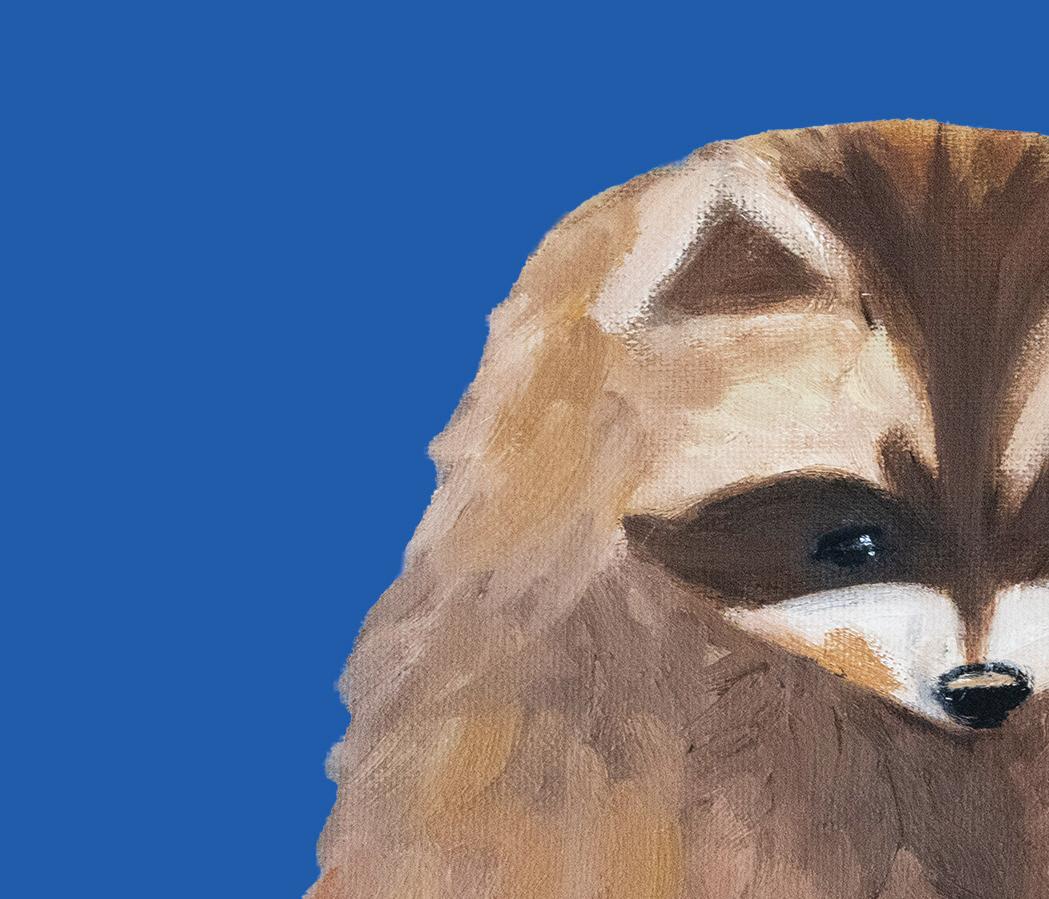
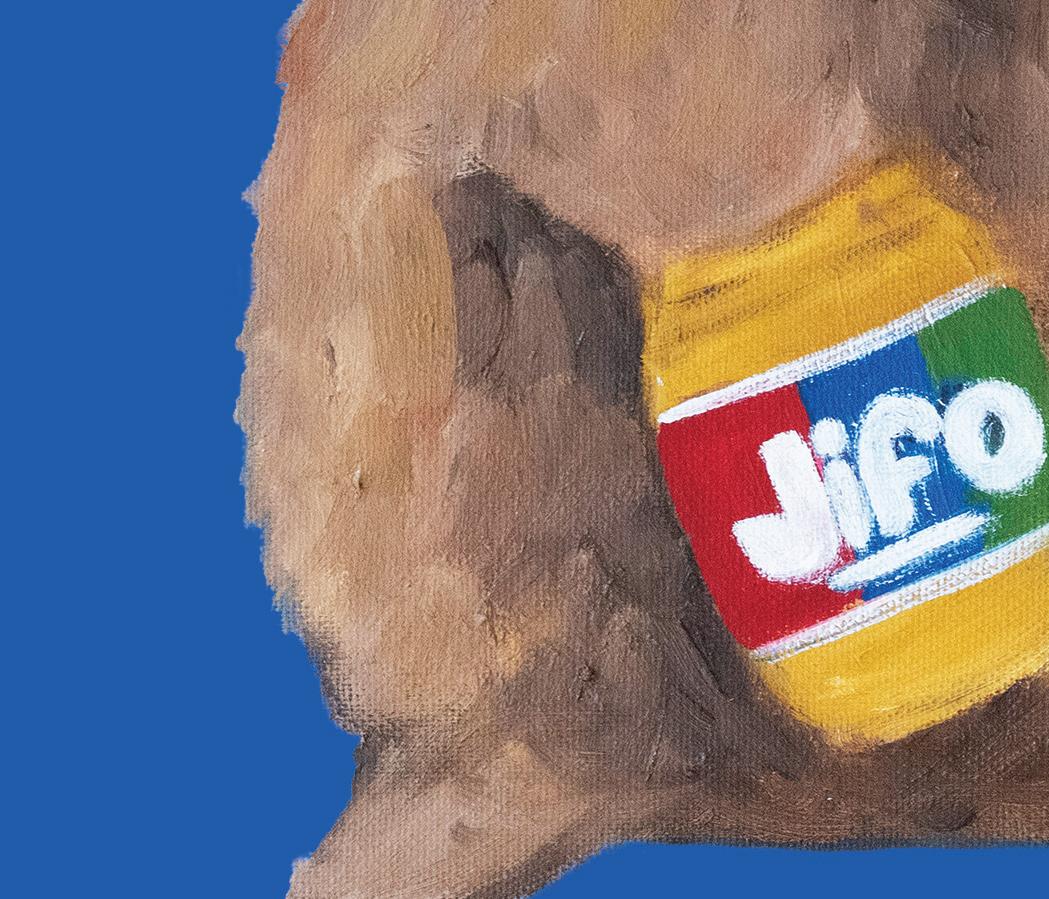

Eva Lan | Midnight Snack, oil on canvas
FirstBpara text
y third grade, I’d decided I was going to be the next star of the Great British Baking Show. Obsessed with baking, I possessed the confidence of a completely underqualified man in a job interview. One day, I strolled into the kitchen with my two partners in crime — my older brothers, James and Thomas — opened our favorite cookbook, Taste of Home, and flipped through the pages until I settled on the perfect recipe for that crisp December day: dipped gingersnaps.
Title of Piece author
Today was no ordinary day in the Shelton household. My parents had planned a lunch with their friends, so my grandmother came over to babysit my brothers and me, all still in elementary school at the time. After arriving, chatting briefly with my parents, watching them walk out the door, and playing a few rounds of the card game Golf with the three of us, Grandma lay down on the couch to take a nap.
This seemed like the optimal time for my baking talents to shine. I would bake the most delectable treats ever, then wait for my grandma to wake up again to show off my skills. As the youngest grandchild, I had a reputation to uphold. And, better yet, once my parents returned home, my baking prowess would impress them so much they’d ship me off to England as the youngest contestant ever on the Great British Baking Show. I could envision myself in the interviews, explaining in my eight-year-old voice how the support of my family got me where I needed to be. I couldn’t wait to make them proud.
James, Thomas, and I began preparing the gingersnap batter. We mixed molasses, vanilla, and sugar in a huge metal bowl, having realized after selecting the
recipe that it read, “Yields seventy-five to one hundred cookies” at the top. We plopped dollops of cookie dough onto long metal trays lined with parchment paper, then shoved them into the preheated oven in a strict rotation. We had an assembly line: I would prepare the trays, Thomas would arrange the cookies, and James would cycle the trays into the oven. Then I would extract the cookie-covered parchment from the blisteringly hot trays, slide each sheet onto a cooling rack, and re-parchment the trays so the process could begin again. After all, we had one hundred cookies to make.
As the last few gingersnaps emerged from the oven, rich, golden, and crackly as ever, I decided to begin the second, most important step of our glorious journey: making the dipping sauce.
In the image at the top of the recipe, the cookies (which, I proudly reported, looked just like ours) were dipped halfway in a white chocolate sauce, perfectly coated with a crisp line down the middle where the shiny glaze ended and the unglazed part of the cookie began. But I refused to settle for a basic white chocolate glaze. Against my silly, immature brothers’ advice, I opted to employ my Michelin-star-Great-BritishBaking-Show skills and prepare a dark chocolate ganache, with no recipe, of course, because I was no fool.
I set to work, adding the chocolate chips, butter, and a few other ingredients listed in the recipe. Then my inner Gordon Ramsey took over. I sprinkled in cocoa powder, letting the fluffy brown specks mix gently into the waves of chocolate. I stirred and sifted and stirred some more, allowing the luscious chocolate
Then everything went wrong.
First para text scent to fill the kitchen. This was my moment. I would dip the gingersnaps, one by one, and achieve the perfect half-moon line illustrated in Taste of Home.
Title of Piece author
The chocolate, once smooth and radiant, turned dull and crackly. It boiled and popped like lava in a volcano, huge bubbles forming and splattering all over the sides of the suddenly-too-small silver saucepan. My brothers, who again decided to interfere with my ways, stepped in, saying we should turn off the heat and move the pan so the sauce could cool. I reluctantly obeyed, reaching towards the gas knob on the stove and about to turn down the burner when suddenly a gargantuan bubble burst from the pot and plastered itself across my wrist. The chocolate seared my skin, and I jumped back from the stovetop with a scream of terror.
Thomas lunged for the pot, grabbing it from the heat with a clatter, but it was too late. My mixture from hell was too far gone. As soon as it left the burner, the poisonous concoction began to harden, turning absolutely rock solid both in the pan and on my wrist. James rushed to pluck off the chocolate shards from my skin, then dragged me to the sink to treat my wound. In accordance with our ill-advised medical expertise, we began to run my hand under frigid sink water, having decided against icing it directly. My eyes watered and I clenched my teeth as I stared at the seven massive red bubbles forming along my forearm. Even I had to admit, to some extent, that James saved me there. Maybe I’d have to bring him to the Great British Baking Show with me, I thought.
Now, in my house, the kitchen sink sits right in front of an incomplete half wall that looks straight
into the living room. As I stood, ashamed, in pain, picturing the possibly even more painful scenario of Paul Hollywood bashing my too-dry ganache, I spotted none other than Grandma, lying fast asleep on the couch, not having moved an inch since she took up her spot there before the whole ordeal. She slumbered peacefully, completely unaware of the attack of the possessed chocolate ganache.
I scorned the idea of waking up Grandma just to resolve a little kitchen mishap. So in an effort to look tough, I forced the tears from my eyes, extracted my hand from under the faucet, and slapped a cold towel across my arm to dull the pain. After we addressed our main concern (my second degree burn) with a little first aid, we turned to the much more pressing dilemma: the chocolate in the pot would not come out. While I stay seated at the counter, trying to ignore the piercing sensations in my arm, James and Thomas sprinted to the office in our house to acquire proper cleaning tools. They returned, bearing a bag of popsicle sticks to pair with the serrated grapefruit spoon they’d secured from the kitchen counter. Then they began to chisel away at the chocolate.
It didn’t budge.
They tried running the whole pan under scalding sink water. Still, the ganache didn’t budge. They hit the pan against the counter, put it back on the burner to melt it more, and chipped at it with steak knives, but still the ganache taunted us with its fortitude.
Having admitted defeat, I retrieved a new cold compress for my arm and instructed James and Thomas to leave our sorry stinkpot in the sink. And, after grabbing a gingersnap each, we limped off to the living
room to watch the most healing show we knew: Kratts.

Grandma still did not wake up, her breathing steady and calm as my burn became worse and worse.
Firstpara text


Around fifteen minutes later, Mom and Dad arrived home, only to bear witness to the wreckage of the gingersnap dip. Their eyes widened as they saw the pot in the sink, then widened even more when they noticed my burn.


“Maggie … what did you do?!” my mom sputtered, aghast at the idea that Grandma had allowed us to attempt such a feat with no supervision. Mom rushed to help me wrap the burn, grabbing gauze, Neosporin, and bandage tape in a split second so she could outfit my arm with the biggest cast I’d ever seen.
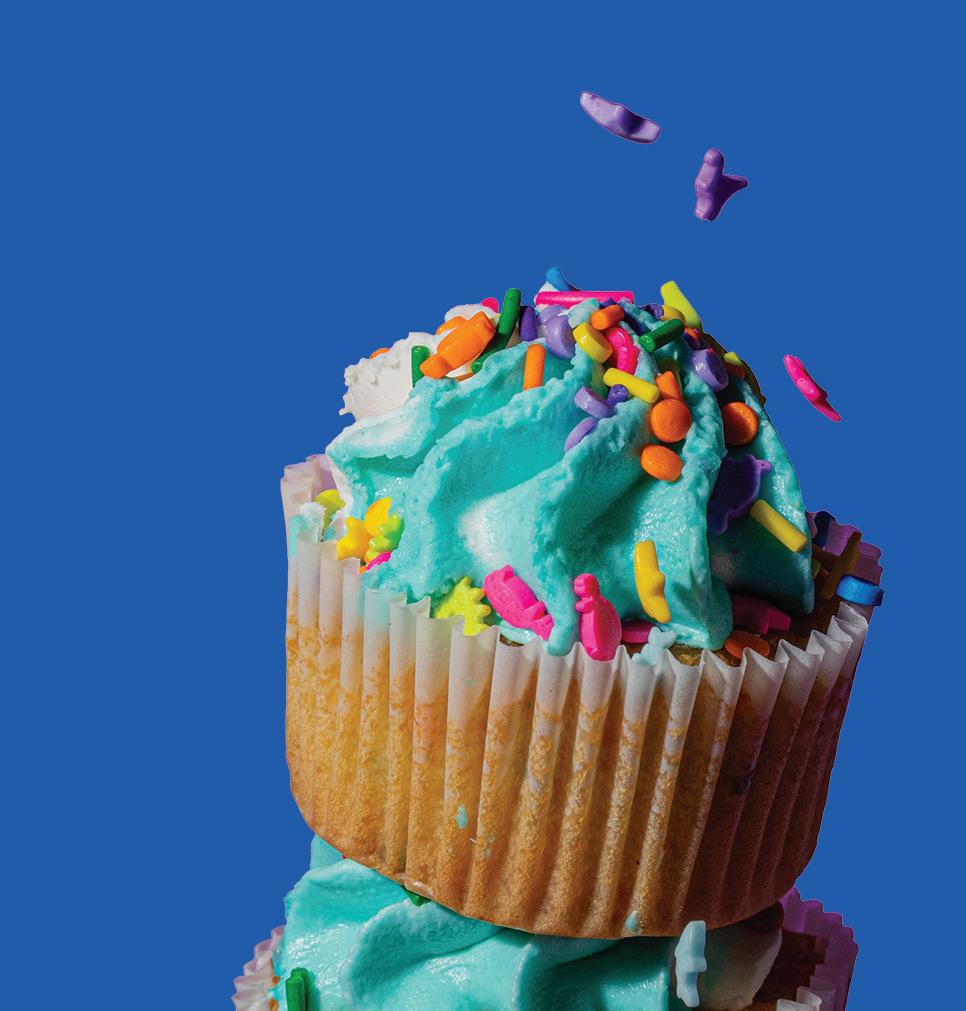

mom enough to awaken Grandma, at whom my dad stared together how she could have slept through our evident-


Mom and Dad’s entrance to the house had been enough to awaken Grandma, at whom my dad stared incredulously for a solid minute as he tried to piece together how she could have slept through our evidently very noisy kitchen accident. Grandma checked in on me about my arm, now in its own personal marshmallow cloud, which I told her felt completely fine even though it actively bled through my bandages.
“In fact, I have a present for you,” I said. “Would you like to try a gingersnap?”
Grandma sampled the gingersnap. She swallowed it. She smiled at me.
“Delicious!” she said.

I smiled with vindication. After all, this feeling, this appreciation, was what I had always wanted. I was finally ready to face the Great British Baking Show.
I smiled with vindication. After all, this feeling, Barrett


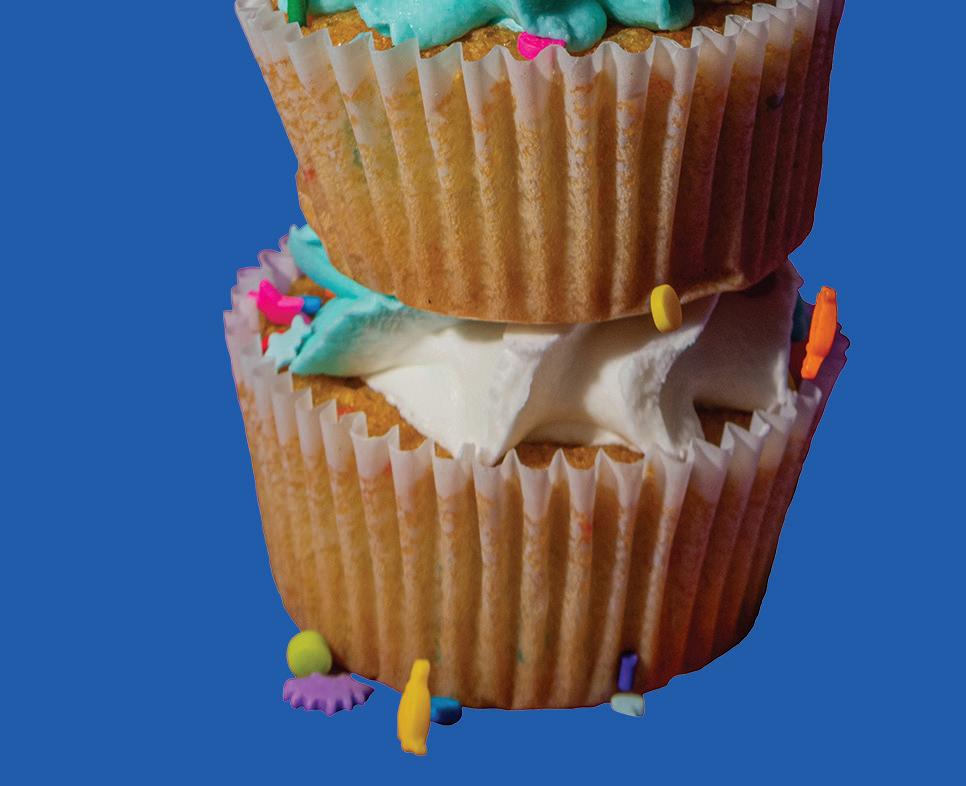
Wild
Poling | Cupcake Tower, digital photograph
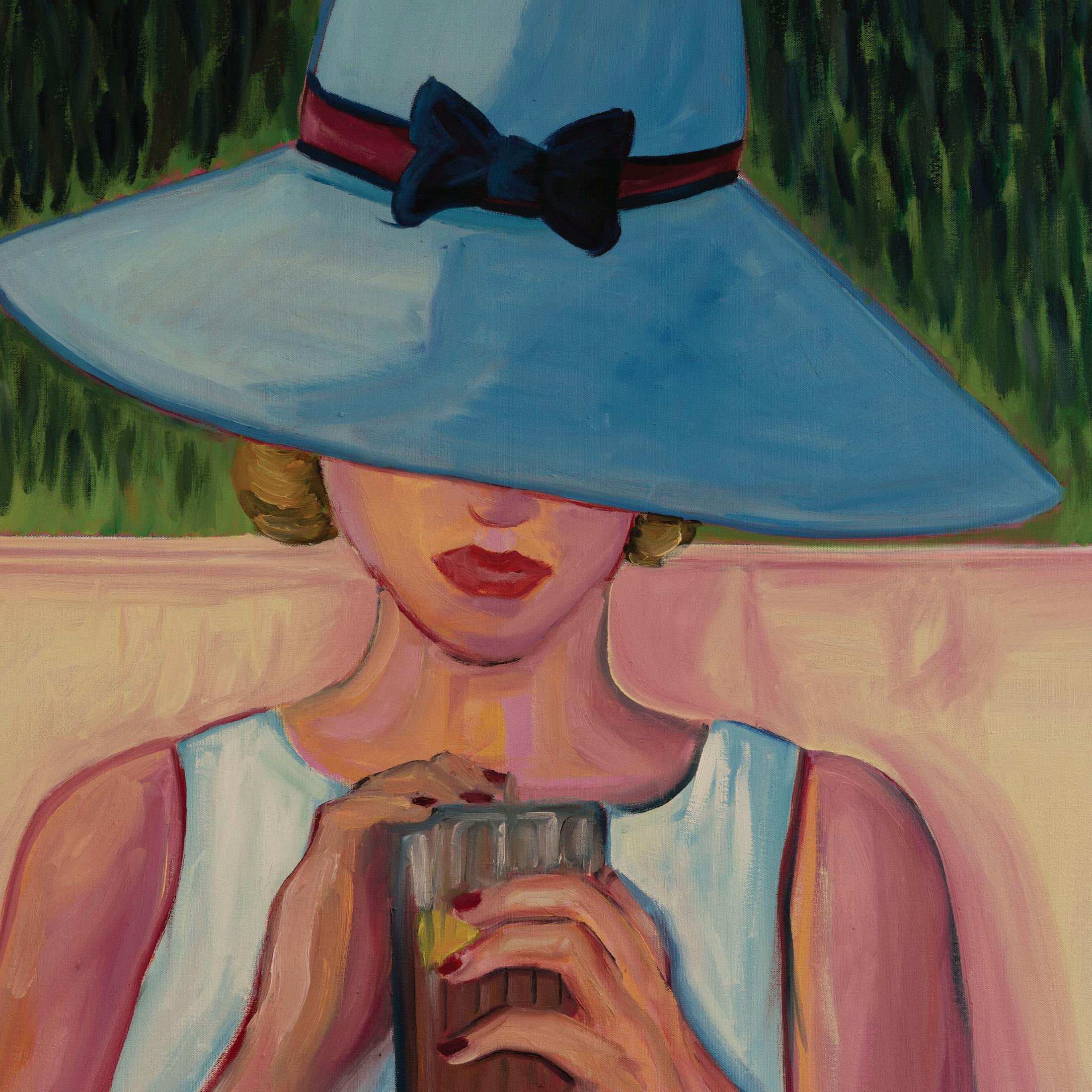
Love at Tea Time
PaisleyFromer|SippingIcedTea,oiloncanvas
Love poured the tea and forgot her spoon, She stirred with a sigh and hummed her tune.
The clock ticked softly, the window glowed, The biscuits waited, the jasmine flowed.
Milk clouded up like memories do, Sugar as sweet as her woo.
The teapot shrieks, the air turns warm, She smiles through the quiet storm.
No grand confession, no trumpet call — Just warmth in a cup, that was all.
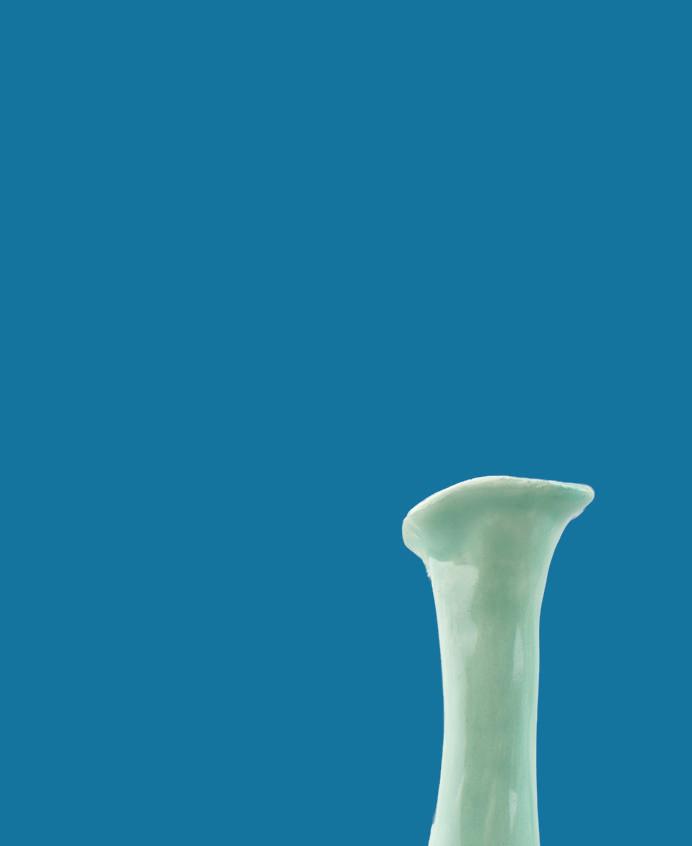
Enaya Mohsin
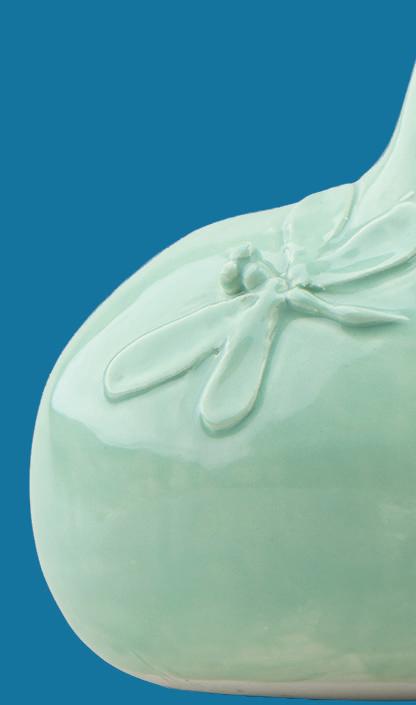





























































































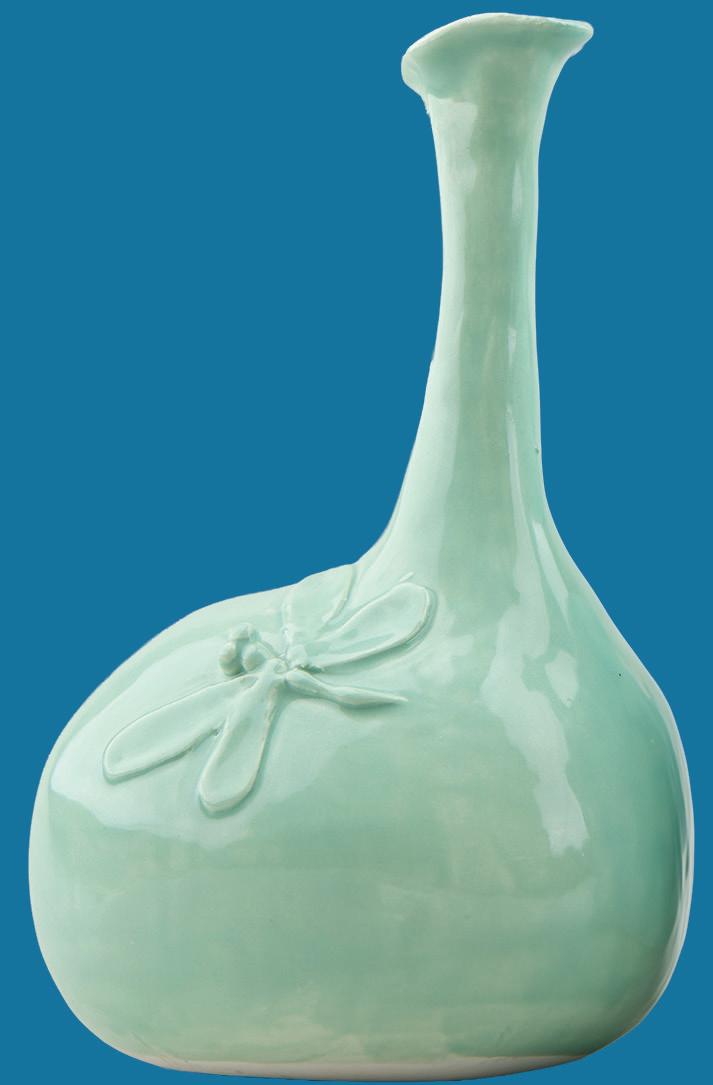



















































































































































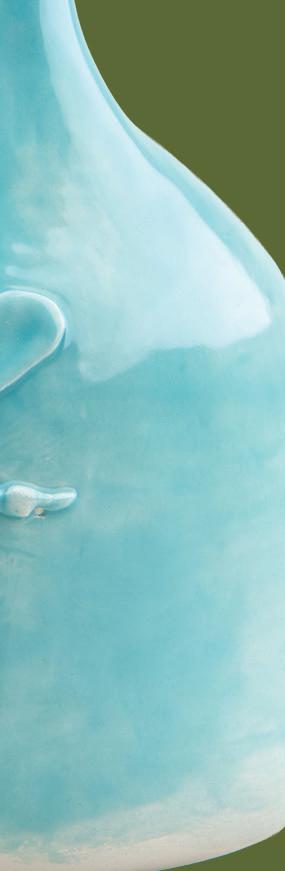


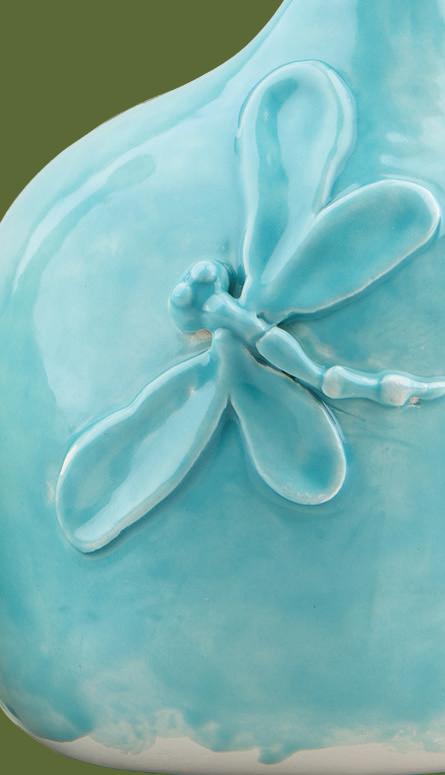


































































Ilsa Peterson | Let it Fly, earthenware
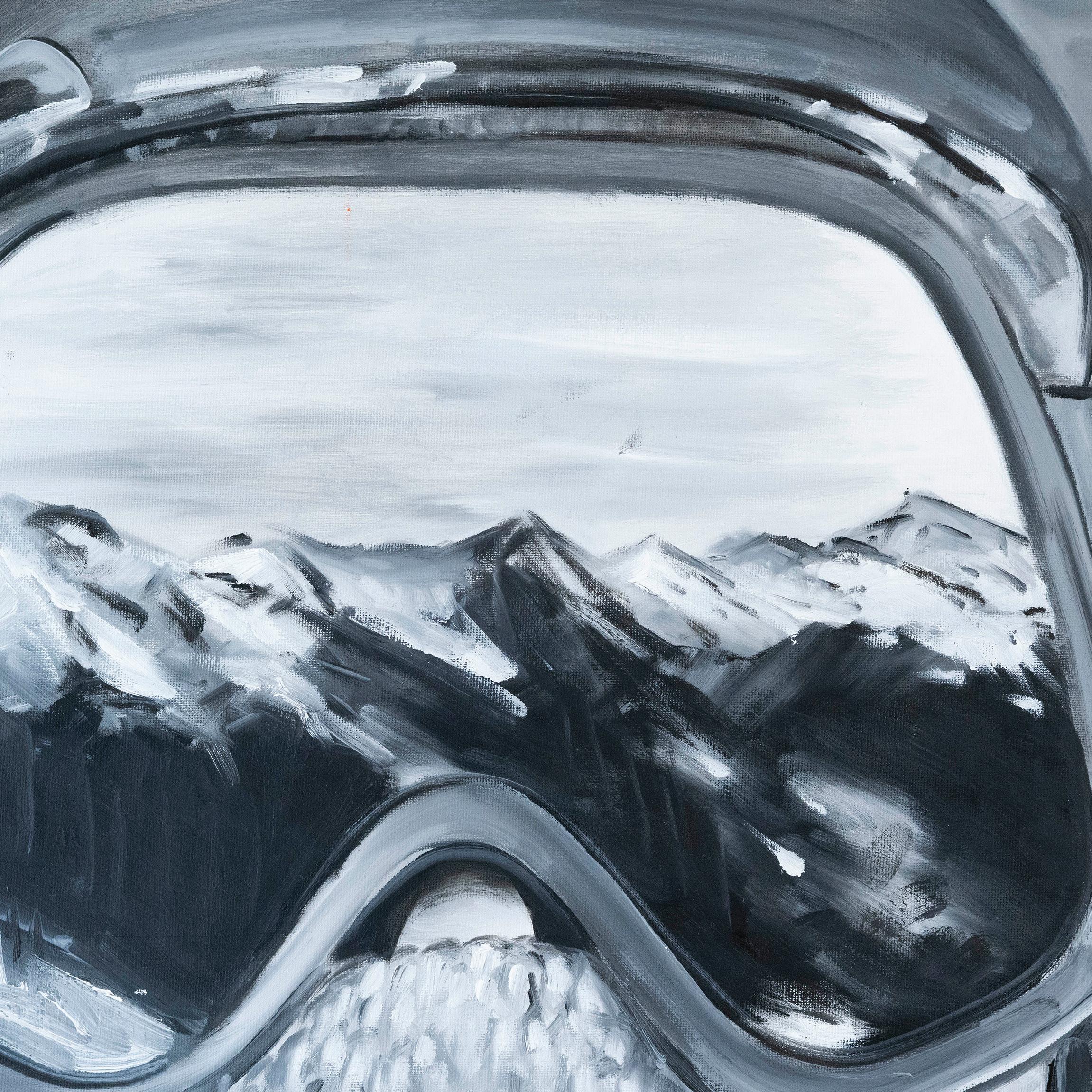
Paige Wollenhaupt | The Mountain Sees Back, oil on canvas
The Edge
Hannah Wiseman

Everyyear, my family goes on a ski trip. My mom grew up on the mountain, specifically in Snowmass, Aspen, Colorado. Shortly after 9/11, she packed her bags from her home state, the tight and cramped industrial city of New York, to move to the spacious mountains in Colorado, where she became a ski instructor. When she moved back to the flat East Coast, she met my dad. My dad said his one criterion when dating was that his date had to know how to ski. In fact, my dad’s original plan for proposing to my mom involved him falling over while skiing and faking getting hurt, and then pulling out a ring from his jacket. But, apparently, my mom was too impatient to wait for the next snowy season.
I started skiing before I learned how to ride a bike. On the first day of ski school, as a three-year-old, I learned to ski on the bunny hill. Located at the base of the mountain, the bunny hill was just barely steeper than the flat catwalks that lead to the lifts. We would ride what we called the magic carpet up the top of the hill.


Picture a slow, flattened escalator atop snow. The instructors, dressed all in uniform gray jackets outlined in red, taught us how to french fry and pizza down the mountain, fun ways for little kids to memorize what shape their skis should make. Over the next few years, I made my way up the ski-school levels until I graduated to the real mountain. At the ripe age of five and ski-school level three, I embarked on my first green run, Skittles. At level four, the ski school instructors took us through our first tree run. Throughout the winding runs of Snowmass Mountain lie secret passages through the trees to other runs. Passing scattered cartoonish signs of castles and witches stapled to the trees, six-year-old me felt like I was on a magical adventure. And of course, each tree run had an elaborate story behind it that our instructor shared with our class during lunch. Finally, at level five, age seven, I finally earned poles, a mark of a true skier.
Of all our ski trips, I remember one particular day best. I was eight years old, and we yet again returned to our favorite mountain, Snowmass, in Colorado. On a typical morning, my mom woke us up at 8:00. I grudgingly hobbled out of bed, rubbing my eyes to shield myself from the light, then started dressing. Getting ready for skiing is always an adventure. I have to look through my half-unpacked suitcase to find my long johns. Every skier needs these. They act as a compression sleeve for your entire body that keeps you warm even at the highest peak. But I had to unbury them first. I bent down to look through the pile of clothes scattered across the floor.

Finally finding them, I plucked them from the pile, put them on, and walked over to the crackling fireplace. The heat engulfed my face as I sat down next to my brother. He still needed help from my dad to put on his boots. HA! I grabbed my rental ski boots, still slightly damp from the day before, and painfully slipped them onto my feet. I buckled the straps together.
Our rental condo was located on the side of the mountain. Looking outside, I peered at the roofs of condos and town houses covered in snow. I could see the mountain from my window. The mountain peak pierced the top of the sky. The condo to the slopes was about a three-minute walk, an eternity for eight-year-old me. I had to lug my skis over my shoulder, and worse, walking in ski boots is always so slow. My heel thudded every time it hit the ground — like I was walking in slow motion each time I struggled to lift my heavy boot and then return it to the ground.
Luckily, our condo was halfway up the mountain, so each morning we got to ski down to the lifts where my parents dropped my brother and me off at ski school. As we arrived, people started to ski down the slopes. They created fresh tracks in the newly groomed snow. When all of us were ready, we stepped onto the mountain, our heavy boots sinking into the soft white powder. My new poles felt awkward in my tiny hands. I didn’t fully understand how to hold them.
We started down the hill. My dad waited with me to allow my brother to feel in charge, leading our pack. We finally arrived at ski school at 9:02, not bad, only two minutes late this time! I don’t remember much from ski school that day. But each day, I knew I could look forward to seeing my parents at the bottom of the mountain after class. We would then do a run or two together, my brother and I sharing what
we learned that day. All four of us fit perfectly on a chair lift. I don’t know what my parents would have done if my brother had a twin. How would we ever go skiing together?
But today, when I arrived at the bottom, only my dad and his friend Eddie waited for me because today was a special day. Today I would do my first black. My mom on the other hand took on the burn task of keeping my brother occupied while we, the real skiers, went on an adventure.
The three of us hopped in line for the biggest lift on the mountain, the Village Express, to make our way to the top. This massive lift could hold six passengers at a time. Everyone else was making their way to the base of the mountain. Some skiers headed to the various restaurants for some post-skiing meals while others went to pick up their kids to head up the lift for a couple more runs.
Once on the lift, my dad pulled the heavy metal bar down, revealing a map of the mountain. He pointed to where we were going, High Alpine. The lift carried us up, past the midway point where I typically get off for ski school. The air got thinner and the wind howled. My skis swung with the wind because I couldn’t yet reach the foot rest. Eddie sat next to me. I’d never met him before. His smile lit up his face, which radiated onto me. Whatever nerves I had about doing my first black washed away in his presence.
By the time we reached the top of High Alpine, I’d lost all feeling in my fingers. I pulled my neck gaiter up, tucking it underneath my goggles. Off the lift, we veered to the left. The snow was choppier up there. Instead of the slushy snow I was used to at the bottom, here I had to lean deeper into my boots and ride on my edges.
My dad led the way, with Eddie following behind me.
Elle Rasmussen | Blue Lines on White, stoneware
The three of us danced our way to the run, creating big S turns in the mountain. We passed Showcase and Raiders, two other blacks that I would conquer in the future.
As we made our way to the start of the run, the sun began going down, along with my visibility. With less light, the white snow appeared gray. The moist air made my goggles cloud up. Snow. All I could see was snow. The first lesson any skier learns is that when you can’t see, look to the trees. But I could barely see the tree lines. I was lost at the top of the mountain, way out of my league. I can’t do a black. What am I doing here? I had no more tricks to rely on, only skill. I was all alone.
Except I wasn’t. My dad was there, with me the whole way. Wearing his bright orange jacket, he stuck out like the sun on a dark and stormy day. He stopped before our run known as The Edge.Eddie never stopped, though; he flew right past me, gaining speed as he descended into the white bliss.
whole run to ourselves. I nervously glanced down the slope. Just take it slow, I thought. My dad sensed my fear and offered to lead the way. All I had to do was follow his tracks and I’d be fine.
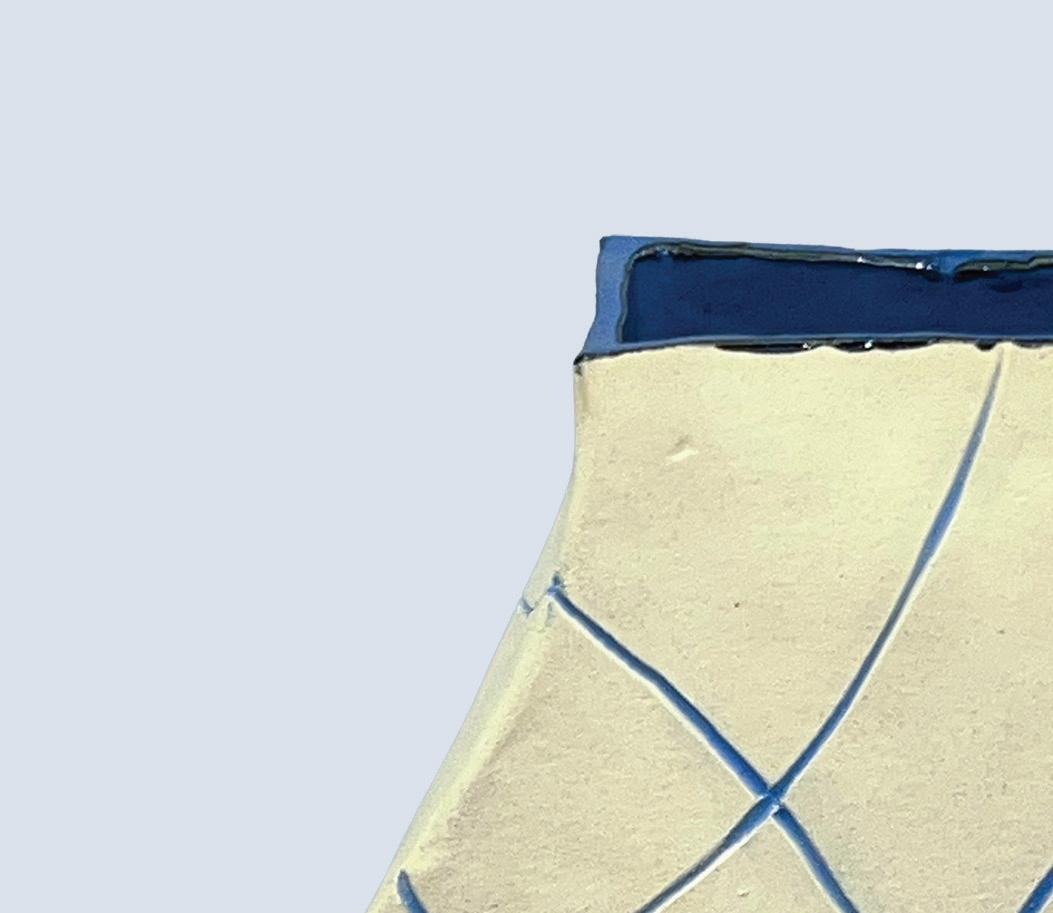
Other skiers passed us, disappearing off the edge. Only a few of them since it was late, so my dad and I had the
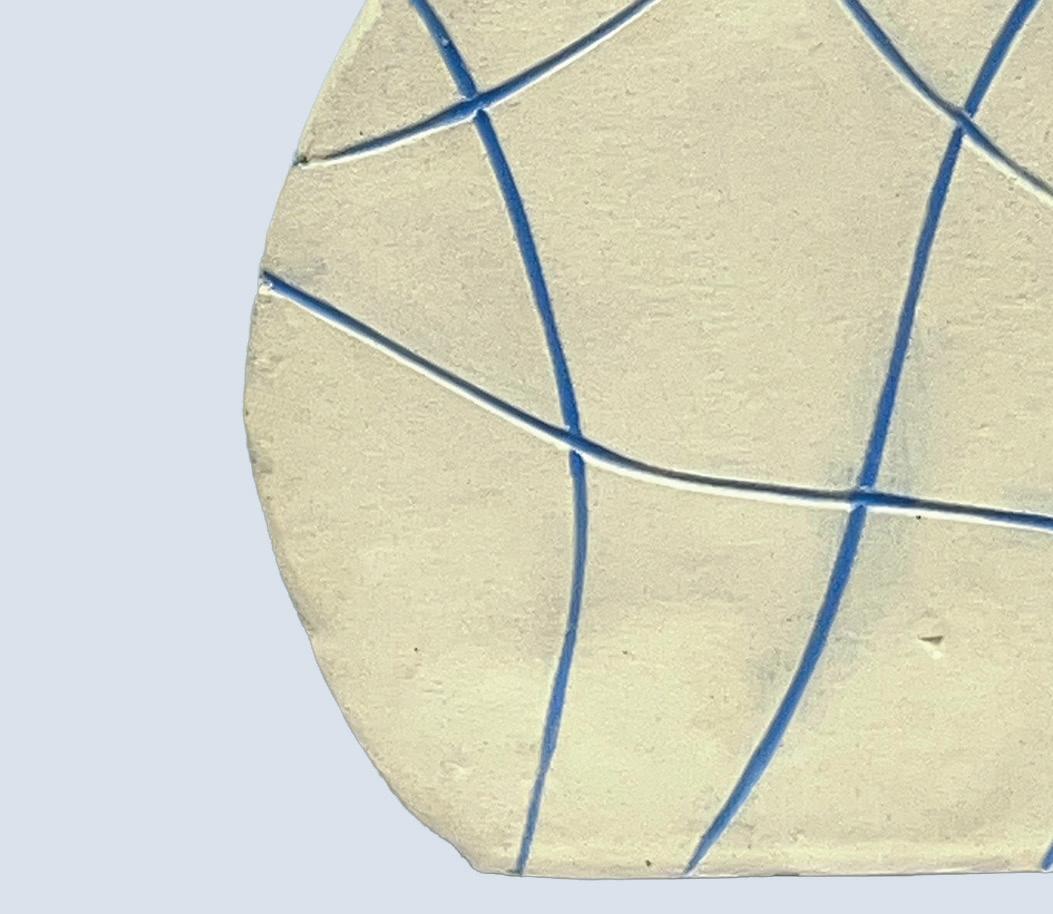
He went at my pace, slow. As I looked at the run ahead, the steep drop-off from the top daunted me. The snow no longer looked soft and fluffy but rock hard. Bits of snow tumbled down the mountain as other skiers flew by, breaking up the perfectly compact snow. At the first turn, I felt my ski catch an edge. I started to stumble, but through sheer luck, I managed to stay upright. Slowly, I let myself pick up speed and leaned deeply into the edges of my skis. The snow elegantly cut against my skis. I was gliding. The wind brushed against my face. The wind blew away my fear. I stretched out my arms, holding onto my dangling poles, and let the wind rush against me. As we continued down, I saw the faint outline of the chairlift above us. When we got to the bottom, Eddie was there, waiting, and together we skied down the rest of the way. At that moment, I knew that the Edge was
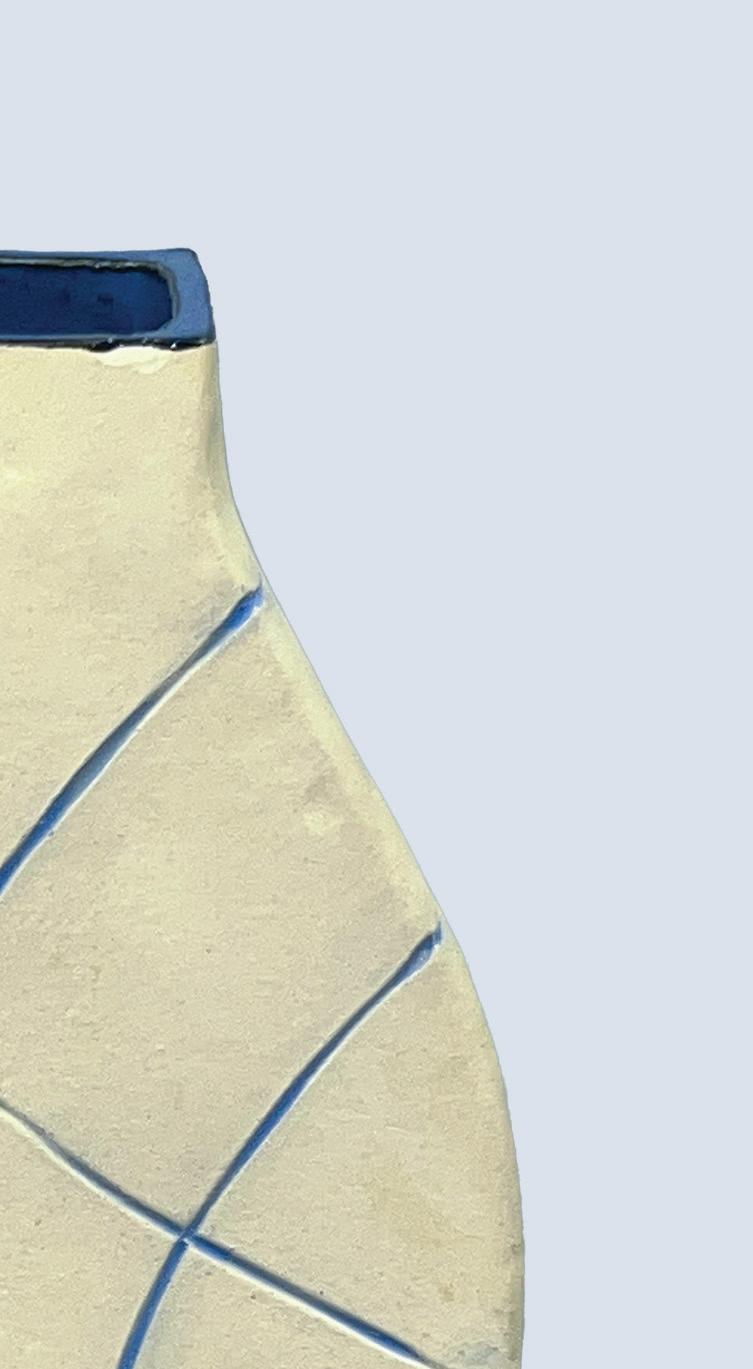
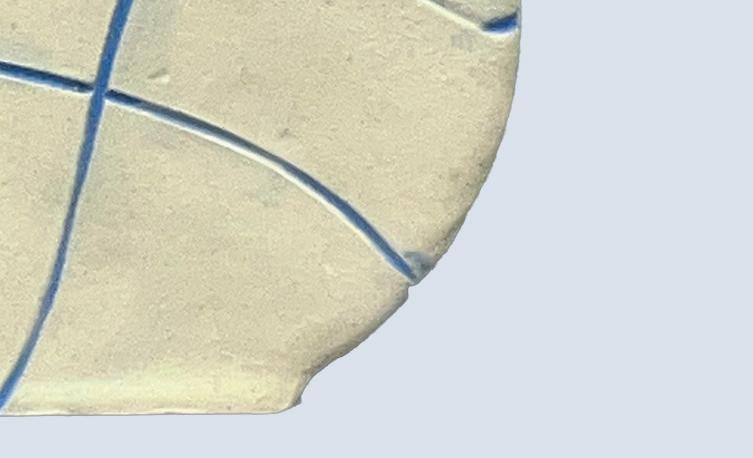
my favorite run.
A Piece of You
You walked me around with Elise, teaching me how to play, how to love life and lacrosse. Although not related by blood, you are my sister. Days with you were laughter and fun. What never crossed my mind was a world without you.
I sat on my kitchen barstool, watching my parents and sister sob, you were gone. Their voices cracked, suddenly our house felt too small for the hurt left inside.
Days with you were laughter and fun. grew.








The weeks, the days flew, as the pain grew and grew. The puzzle piece was missing, but we made a new one to help others just like you.




Campbell Rose Kuzmuk
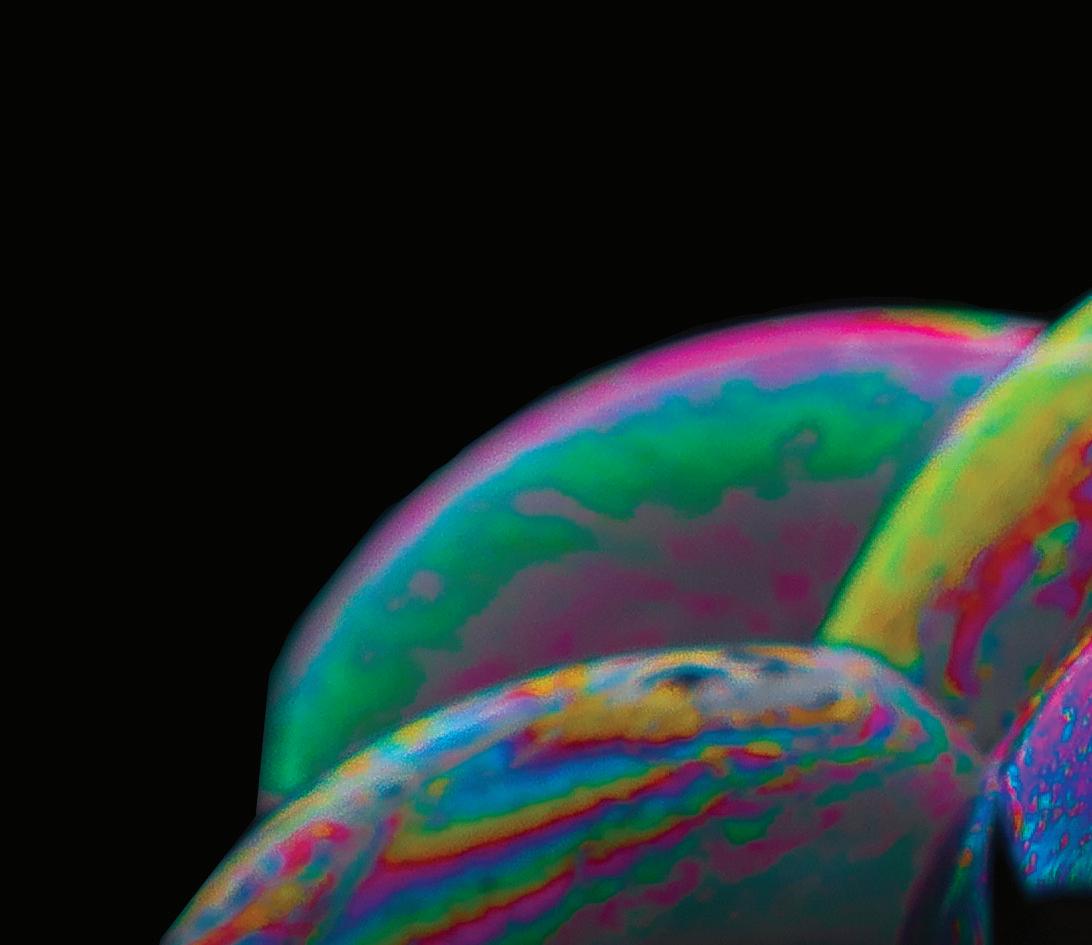
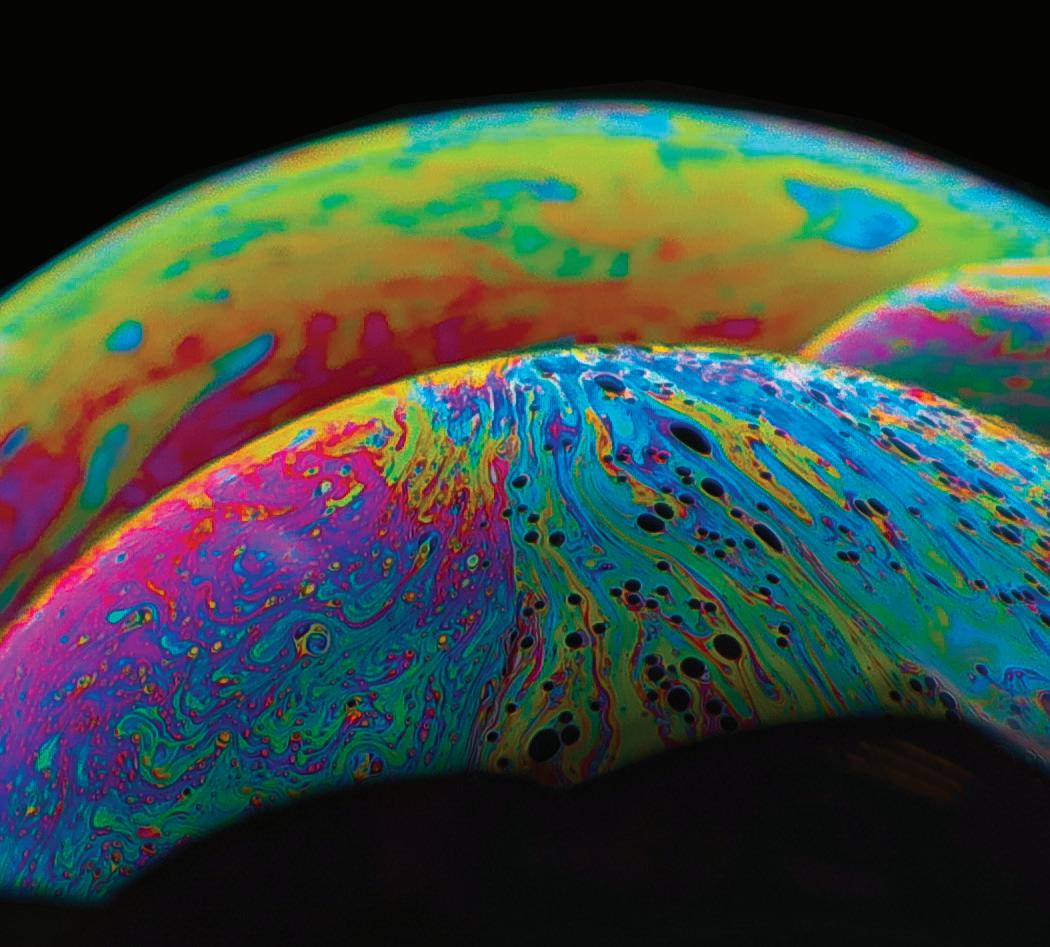
SorayaFarid|Reflection,digitalphotograph
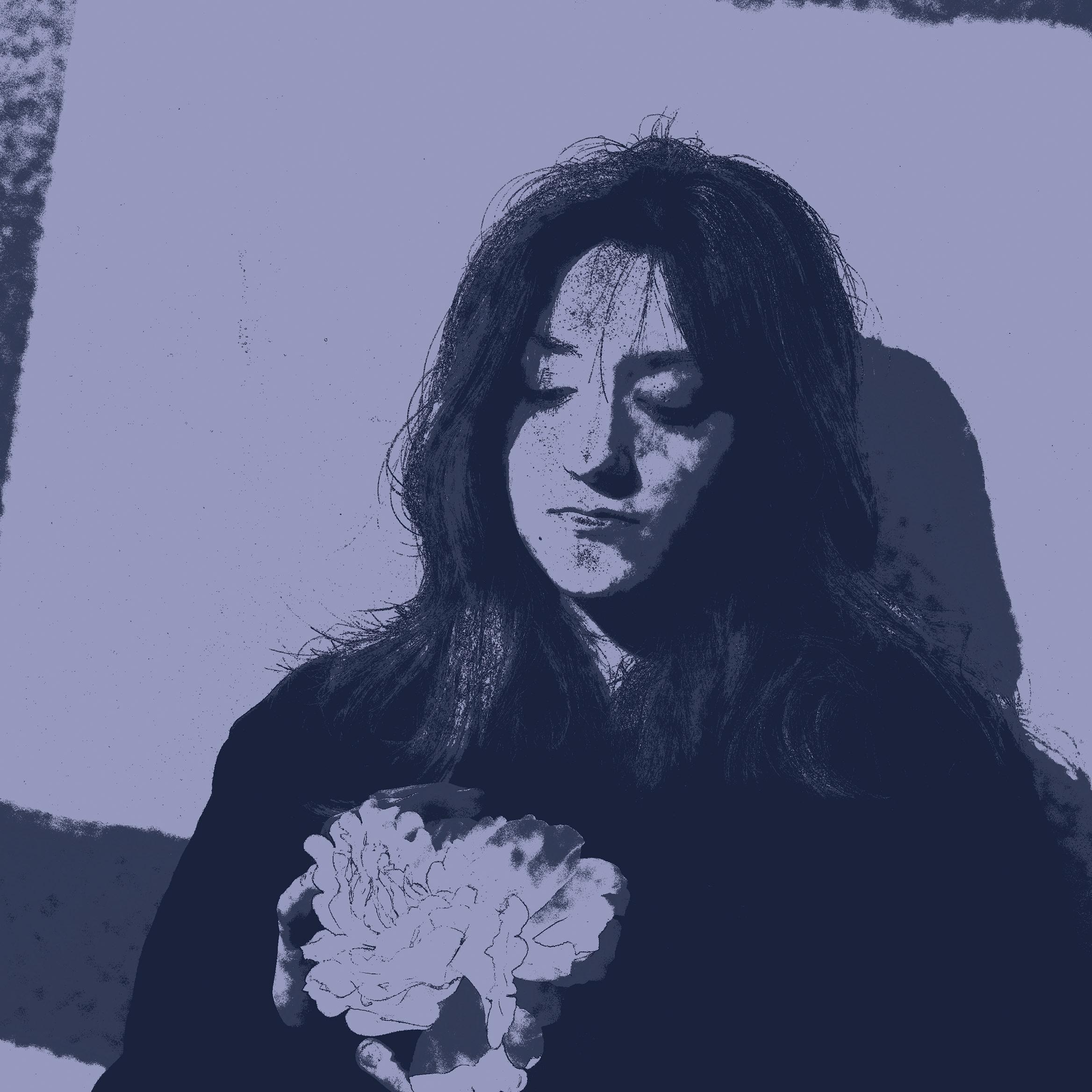
In Another Universe
LucyBerry
Dorothy Andama | Melancholy, digital photograph
In another universe, we are grabbing groceries. I am holding your hand as we cross the street, laughing as we jaywalk for the hundredth time that day. We are walking through a city we’ve come to know all too well. Each block, each intersection has been etched into the soles of our sneakers and imprinted along the ridges in our feet. As we walk, we are arguing over which brand of peanut butter to buy. I’d say Jif, and you’d say Smucker's, and I’d let you win.
In another universe, you welcome my father with a firm handshake and my mother with a warm squeeze during weekly family dinners. You’ll compliment my mother’s cooking, staring intently at her famous carrot cake placed gloriously upon the cake stand on the kitchen island. You’ll watch basketball with my father, who says he’s more of a football man, but in all honesty, he doesn’t care what sport it is; he just likes the company — especially when that company is you.
In another universe, later that year, when the snowfall tickles our noses and the cold, sharp air leaves our throats stiff and raw, I wouldn’t have to brush the light coat of snow off of your father’s grave. We come here every year, just for you to sit in the car, unable to face that cold, dull tombstone. Every time, without fail, I’ll go and pay my respects. In another universe, I wouldn’t have to solemnly whisper I’m sorry to him whenever you fail to get out of the passenger seat. I never got to meet him, never got to know him. But, then again, neither did you. Not really.
In another universe, we aren’t sitting on the couch, holding each other, watching those terrible, God-awful men call us sinners. Freaks of nature! they say. Signs are
stained with more than just the ink of Sharpies and Crayola markers. They’re stained with hate too. Your eyes widen as the news anchor calls us “inappropriate” and asks that we “censor” ourselves. Your horror makes my blood run cold. I watch the color drain from your skin and from your normally rose cheeks, and the world goes dark.
In another universe, your photo is placed in my wallet, folded with great care in the front pocket. It’s a photo-booth reel of the two of us on our third date, the day I asked you to be my girlfriend.
It is not there for the memory of you but there for the feeling. There for the trust that when I open the door of our one-bedroom flat you’ll be there, waiting, cooking up some new, probably burned, recipe for me to try. I’ll stomach your terrible cooking, knowing it was cooked with insurmountable amounts of love (and just a bit too much salt).
In another universe, we are singing Happy Birthday. You’re older then than you are now, and I made the cake.
You like the store-bought frosting messily plopped onto my mother’s famous carrot cake. She takes mild offense at the combination but finds herself staring, heart swelling with love for you, watching your eyes light up and your smile widen as the lights go out and the discombobulated but excited sound of our friends and family singing fills the atmosphere.
It fits. This fits. It all fits.
In another universe, we are rushing into a random coffee shop, frantically attempting to flee the sudden downpour outside. My long blonde hair, now a sleek,
deeper brown, and your lengthy dark curls, now pinned down to your scalp with baby hairs sticking to your forehead.
Your laugh tickles my brain as I sip my Caramel Macchiato. You tease me, saying it’s childish. I comment on the atrocity that is the black coffee firmly held between your fingers, calling it bitter. You snicker, taking in an exaggerated gasp, and I giggle. You and I both know we’ll both catch a cold from the frigid rain and sopping wet clothes.
Only a few days later you’ll come down with a fever and aches. You’ll be too sick to move, sick enough for me to worry. You tell me you’ll be fine, you tell me it’s just a cold. In another universe, it’s just a cold. A classic, common cold.
In another universe …
That’s all it was, right? A cold?
In another universe …
I never had to sit beside your bed in that dimly lit hospital room. I’ll never leave your side, too worried that you’ll wake up, I’ll be gone, and all you’ll have is cloudy skies and barren trees to welcome you once you wake up.
In another universe, when I’d slice my finger against a page of my book, you’d have the will to get up and give the wound a tender kiss. I don’t even wince anymore. I just watch, numb, staring as the blood stains
the thin pages of my book. I don’t even know why I’m reading it, it’s terrible. I wouldn’t let it slip that this was from the half-empty shelf of books for sale in the hospital gift shop. If you had the energy, you’d laugh at me for being stupid enough to pick up a book like that.
I’d agree, of course, because you’re right. It really is terrible. Now, though, the never-ending sound of your IV dripping replaces your low, long laughter. Now, still, you’re too weak to kiss me, and I instead let you rest as blood from my paper cut trickles down my finger. In another universe, I don’t kiss your forehead and shut my eyes, with only the faint sound of late-night city traffic and incoming ambulances to deafen the otherwise maddening sound of the heart rate monitor’s lurching beats. One, two … one, two, three … I could count these for ages. I do count them. One, two, three ... one, two … I’m scared if I stop, if I finally stop the counting, they will too.
In another universe, every winter, I wouldn’t have to brush the frost off of two graves.
Your grave, this time.
In another universe, we would still be us.
You, in that old denim jacket with those gorgeous long eyelashes. Me, in that floral sundress: A present from you. You loved me in it.
In this universe, you’re gone.
In another universe, you wouldn’t be.
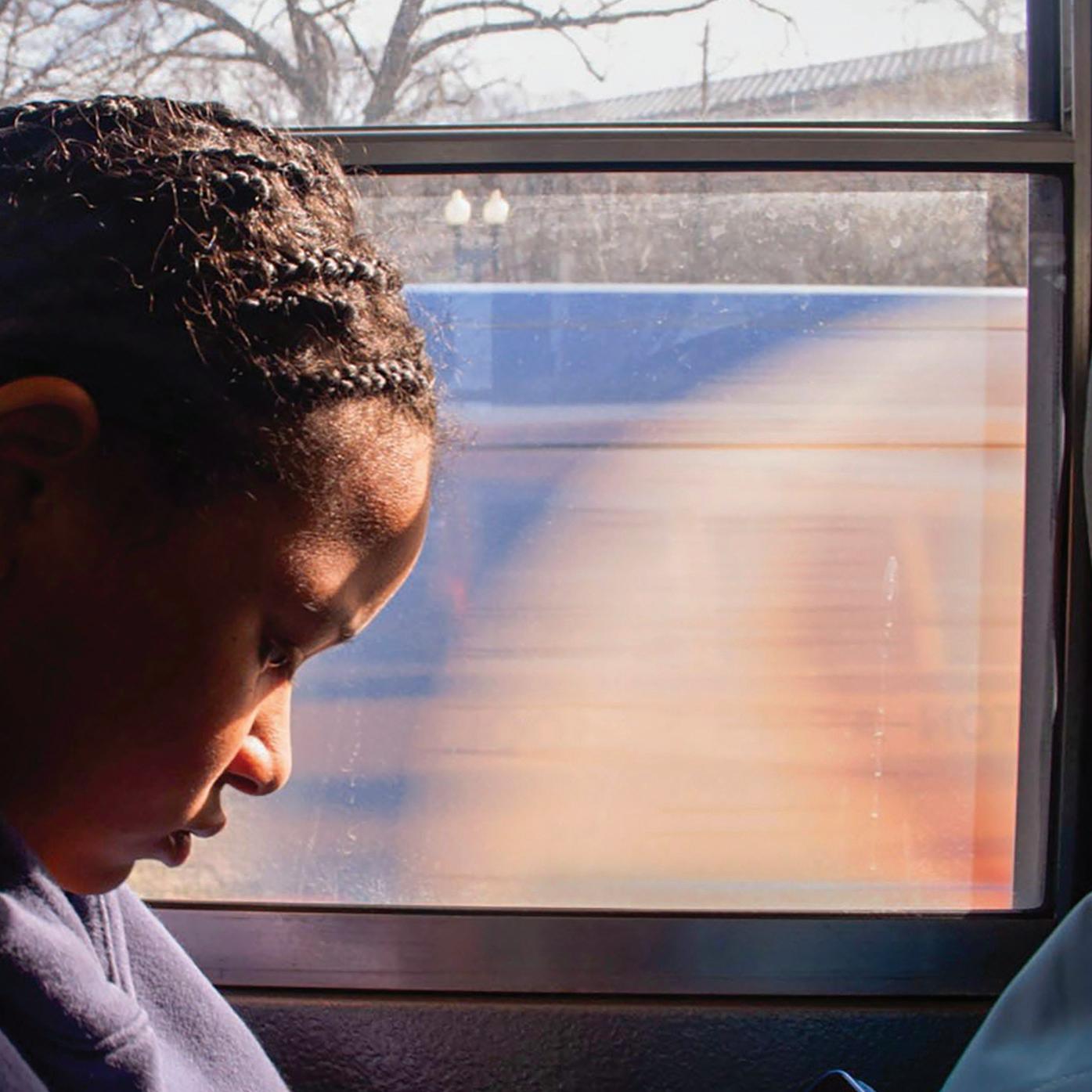
I’m Scared
Something bad seems to be happening in the world every day.
But no one seems to want to explain it to kids.
I know it has to do with people from other countries called immigrants.
But no one seems to want to explain it to kids.
I know the Kennedy Center is closed so we can’t see the ballet.
But no one seems to want to explain it to kids.
I know everyone is mad at Amazon.
But no one seems to want to explain it to kids.
I know everyone is mad at Tesla.
But no one seems to want to explain it to kids.
I know my class couldn’t go on our field trip.
But no one seems to want to explain it to kids.
I know you’re supposed to wear a mask when you go to protests.
But no one seems to want to explain it to kids.
I know my teachers aren’t allowed to talk about politics.
But no one seems to want to explain it to kids.
I know my friend’s soccer team was called the Ice Dragons, but they had to change it.
But no one seems to want to explain it to kids.
I know a lot of people are angry.
But no one seems to want to explain it to kids.
I’m scared.
Barrett Poling | Some Time to Think, digital photograph
Helena Miller
Grendel Dabbles in Today’s ‘Cancel Culture.’ Only This Time, He isn’t the Villain.
Sofia Aquino
“Hejust wanted connection.” “#Grendelcore.”
“He’s so misunderstood.”
The glare of my phone flashes from diamond to gold and back again, blinding me to the possibility of fault beneath this newfound empathy mankind has bestowed upon me. Hah! Who are they gaslighting now? Gaslighting, hah! — a “word I’d picked up from men in their [posts] …” (52). I wasn’t even sure what they’d meant, though I sensed their intent: to illustrate fantasies, to imitate kindness. The light ripples across the Dragon’s scales — his harsh face gleaming with ridicule, the same irony I recognized in the thousand pitying comments crying, “Poor Grendel!”
“They cry over the beast now,” he taunts. “Shall I start a fan club?”
I pretended to ignore the rudeness. “Alas,” I moaned, “O Dragon! Is it as though my old history has dropped out of existence? What do I make out of it now?”
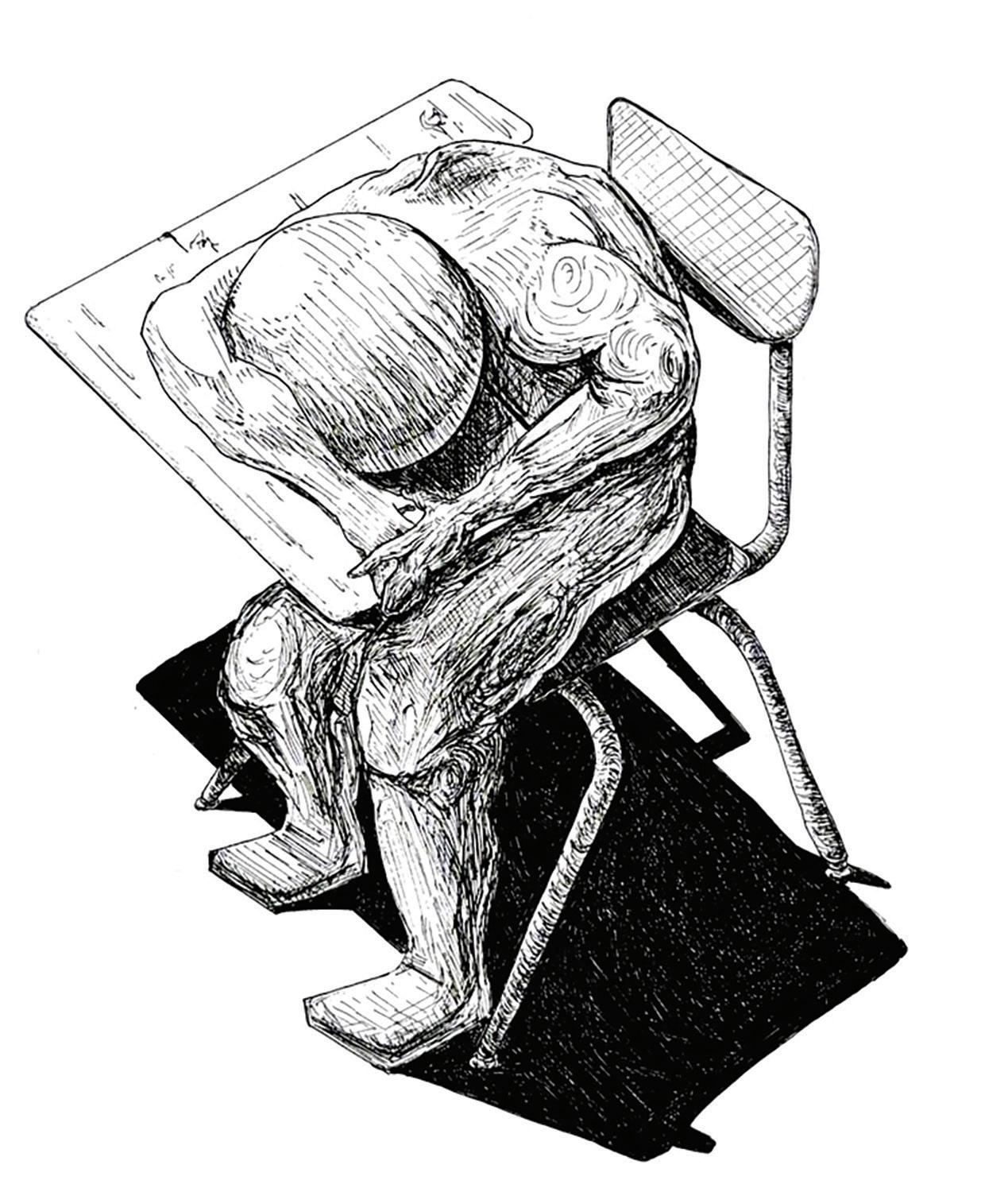
A faint breeze dances through the impossible cracks of his cave, brushing my fur. Winter fades. There’s a certain freshness with the longer days of
Catherine Hall | Guy in a Desk, pen and ink
sun. “Listen closely, my boy,” he says, leaving a long pause, letting scorn build up in the cave like the distaste in his breath. I listen to some extent, still lingering on the glow of my own meaningless delusions of validation — those pixelated proofs of love.
“You see, there has been and always will be a cycle. Leaders, you’ll see, rise through praise, then exhaustion, then decay. The media doesn’t care who’s right, Grendel. They care who’s trending. Their empathy is a mask, and once they heal you, they’ll forget you.”
“Maybe being seen is enough?” I whisper, ludicrously hopeful. The cave’s walls, like him, seem to shake with laughter at me: “The stupidity!”
“But why?” I clench my fists, though not to throw them. One does not punch a dragon.
“Why? Why anything? Man possesses no vision, no morality — only echo. No more identity than, say, crystals fallen from the same common geode. I could tell you a thousand stories of their absurdity. They build entire worlds from illusions and reflections of their idealizations.” He scoffs, “That’s
Quotations from Grendel by John Gardner (Vintage Books, 1989)
where [their so-called ‘cancel culture’] saves them. [A chorus of shadows shouting at shadows]” (65). I move the stones around with my feet. “It provides an illusion of reality — puts together all their [trends] with a gluey whine of connectedness” (65). I know the truth. Still, I ache for the constellations of kings and kin, a belonging written somewhere in the stars. (I convulse. O, pity!) Maybe, in their madness, I’ve begun to believe their stories of me in all their insanity. Such is the seduction of the media’s algorithm!
“I was so filled with sorrow and tenderness,” I say, “I can hardly find it in my heart to eat another man! They say Beowulf embodies an outdated alpha-male myth of toxic masculinity. My mother sends me reels from the mead hall — do you see?” I turn the phone towards his indifferent eyes. He groans, knowingly.
“Spare me, I beg you!” He covers his eyes with his claws, gives his hideous grin.
But I am stubborn. We read the caption: “THE MEAD HALL HAS A TOXIC WORK ENVIRONMENT!! #gettingsendy #partyculture #hazingwassooolastyear.”
Thus, he hollers, a prophet torn apart by mortal irony — rolling, wheezing, clapping. They may see me, yet they still don’t understand me. This, I already knew, despite the absolute humor of it all. “They’ve replaced fear with pity,” I whisper, “but it feels the same.”
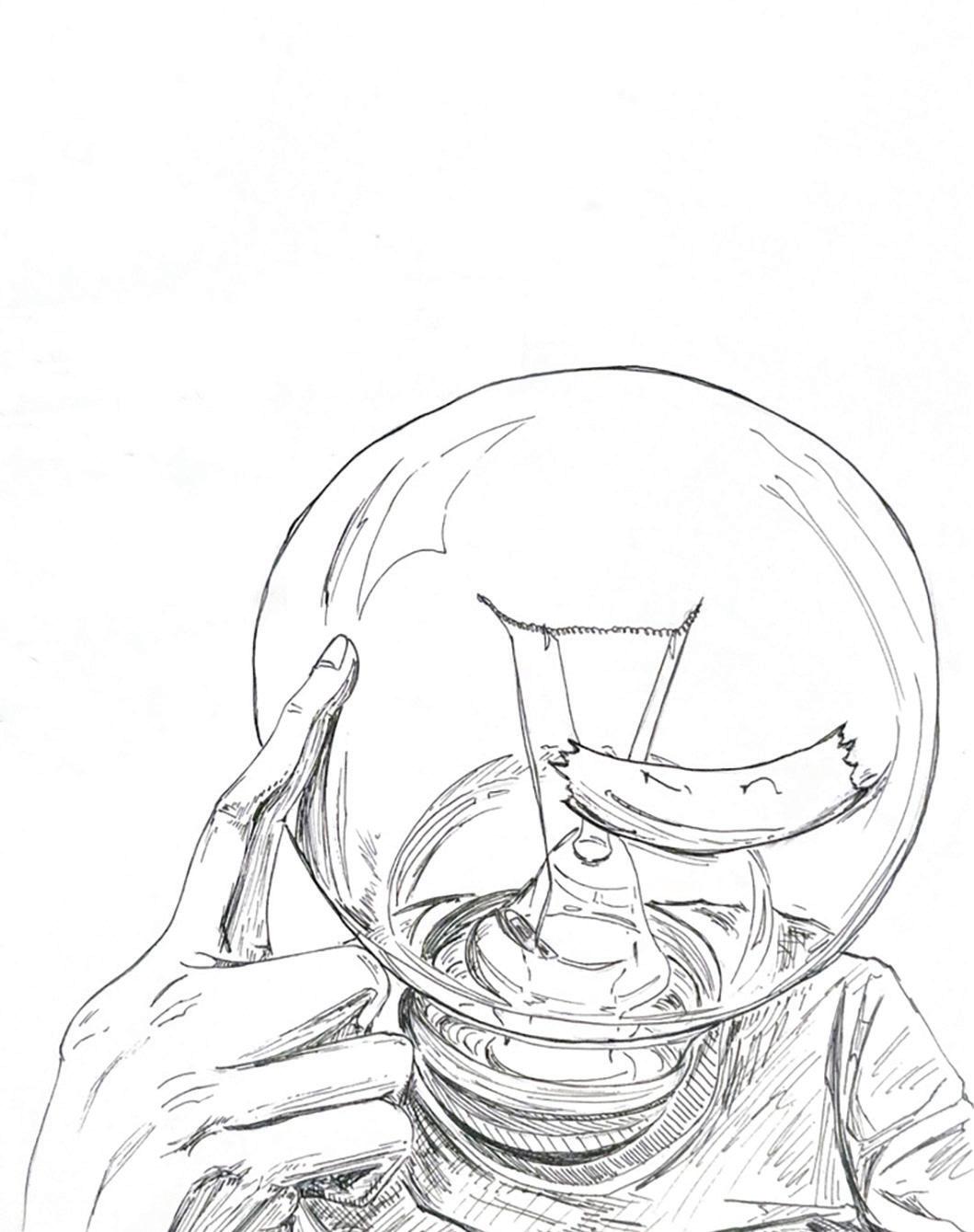
“Ah, Grendel! Can’t you see? They don’t love you — they love the idea of loving you. Trends rise and fall, and you, your aesthetic and romanticized melancholy, will fall with it, as I’ve seen.” I was sure he was lying. Or at least half-way lying, I hope.
Catherine Hall | Cheeky LightbulbGuy, pen andink
The music ends, the air forgets to move, hushed by the quiet after. Even the dust takes time to prove the quiet after.
They speak of dreams like relics from war, Each word half-buried in the groove of the quiet after.

The sky looks tired, holding all that light. It folds itself into the blue, searching the quiet after.
He built his house on hope and borrowed names,
Now the wine glasses reflect what isn’t true in the quiet after.
We learn to smile at what we can’t forgive, To love the echo, averting our eyes to the quiet after
And if I write, it’s only to recall How silence taught me something new — the quiet after.
Enaya Mohsin

Vivienne
I am gone. Can’t u feel it anymore?
Dazzling sunrises behind your eyes … Sparking with excitement
Dripping from your hair like gold …
I am gone.
Did I cross a line I didn’t know you could draw?
I don’t think I get the joke?
Maybe I missed the punch-line a year ago?
If we are gone, please let me know.
I could feel it drifting, like a branch towards a waterfall.
The Death of a Lifetime

Or maybe you were swimming while I was learning to float, Maybe I just sat, waiting at the shore.
Maybe in 27 years I won’t tell you, Maybe I won’t send you a reminder.
Or maybe it will all go back to how it was.
Did I miss the joke? Was it when I was dying?
Or was it when I left you to rot, or when you left me to drown.
Maybe you forgot to fill out a form or send a week’s notice.
You don’t deserve my time of day My worry and my fears.
But for nostalgia’s sake, Are we still friends?
Raniya Syed
Vivienne Craig | Flaming Silhouette, digital photograph





I’m Proud to be American

Avalon Greene
There are many words used to describe people like me in this country. African American, Black, and Soulaan are some of the more pleasant ones I can think of. Each one brings up a series of questions and answers. Why am I African American if I have no connection to the continent besides my ancestors 400 years ago? Why am I Black when my skin is clearly more caramel than deep umber? Am I Soulaan, a word meaning “people of the soul,” or is my identity invalid because of my mixed background? Each question only invites more until I find myself caught up in an identity crisis due to the overwhelming ambiguity of the terms I use to describe myself. What makes an American?
I was fourteen when I realized that the Black American experience is a unique one. Often, other

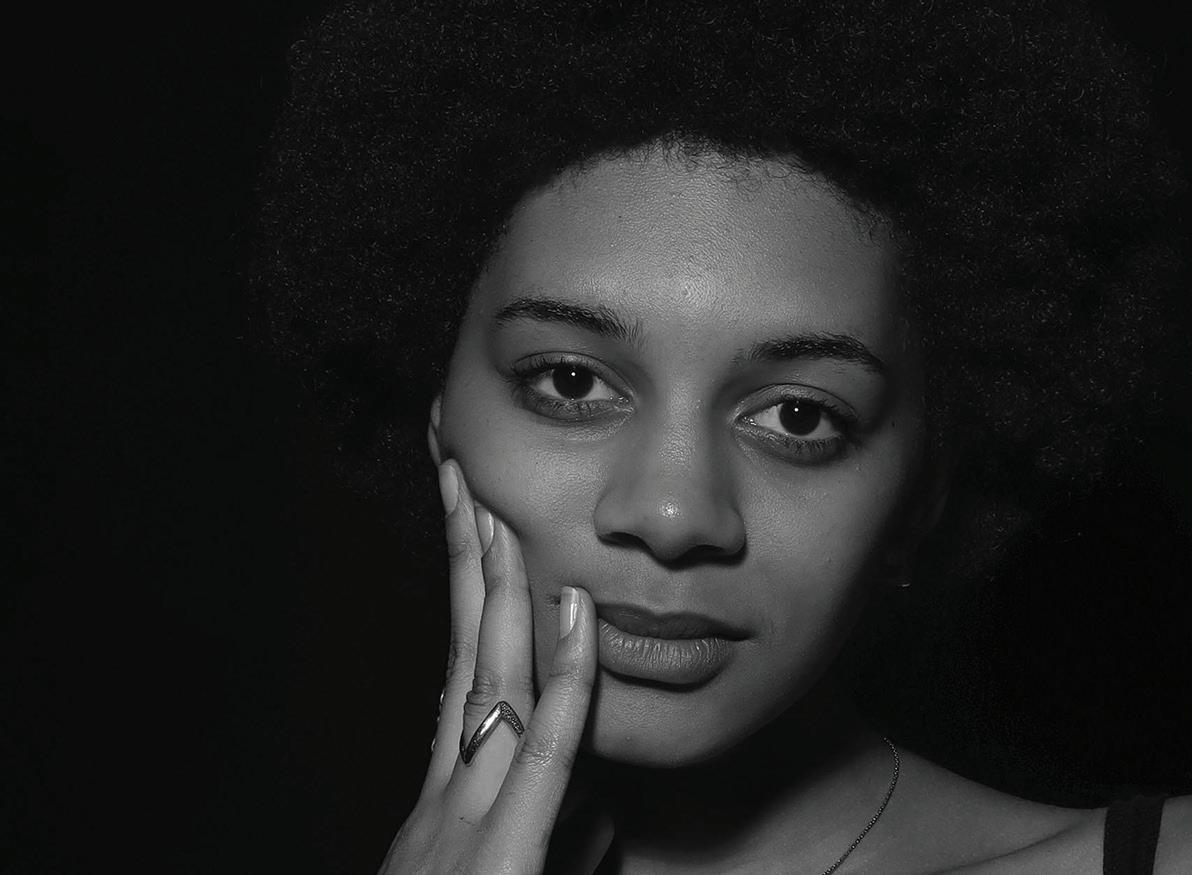
countries know little of the slave trade and its history in the formation of Foundational Black Americans. I distinctly remember being outside of a flea market in Madrid and being approached by a Senegalese man who was (although I didn’t realize it at the time) part of a running scam. He offered me a bracelet, and while I politely declined, what stuck with me was the question he asked: “Is your mom or your dad African?” I tilted my head, confused, and asked him to repeat the question. He did. “Is your mom or your dad African?” I’d never been asked that question before.

Living in America my whole life, it never occurred to me that people might assume
Vivienne Craig
|
The Glamorous Gaze, fi lm photograph
I was African. To him, a Senegalese man living in Spain, it might not have ever occurred to him that I consider myself to have no connection to the African continent at all. I answered his question, telling him that neither of my parents were from Africa, and he nodded before following up with, “So your grandparents, then. Where are they from?” I said that my grandparents were from America, too, but he didn’t seem to get it. It wasn’t a language barrier; he spoke English fluently. It was a cultural barrier, a historical one, a barrier that couldn’t be explained in that singular moment. I gave up trying, hastily said that my dad’s side was African (a distant truth), and rushed to find my parents in the market. That conversation often comes back to me when I think about my identity as part of the African Diaspora.
I was fifteen when I started wanting to find myself. The summer of fifteen was for reconnecting with my American identity, the words of Momo Boyd’s "American Love Song" echoing in my ears: “If I wasn’t so American, I might love you more/ But giving up my independence goes against my core.”
I found peace in the words, and still do, despite the brutal history between my people and the country I love so much. That summer was the summer of Beyoncé, of “American Requiem” and “Texas
Hold ‘Em.” I became enamored with my American identity, and by extension, my identity as a Black American. In a time of great American turmoil, I grounded myself in my Black American upbringing. I educated myself on Black culture, both past and present, and put Black at the forefront of everything I did. Black American music, Black American art,
Black American celebrities, Black American girls on my moodboards, on my TikTok, on my Instagram, and on my mind. By surrounding myself with such familiarity and reflections of who I could be, I was able to find myself.
I was sixteen when I found out my dad’s family was from Georgia. He always spoke of New Jersey, of Sundays at New Hope Baptist Church, and days spent in New York City. I knew nothing of Georgia, except that it was the state of my dream college, until I was sixteen. Before even his parents were born, my dad’s grandparents moved north from Georgia to New Jersey. Historically, they would have been part of the generations of African Americans moving during the Great Migration. I was sixteen when I added these people I never knew to the family history in my mind. Georgia is part of my history, too. Not just DC or New Jersey, I’m part of a line of Americans likely enslaved in the South. I’m part of a line of people and history that overcame all the odds to make me who I am today.
The more I find out about Black history in this country, the more I become “sick and tired of being sick and tired.” Still, there’s a unique beauty in being Black American. Since before the beginning of this country, my people have done the most for this country. We built its cities and railroads, farmed its soil, and we are the blueprint of American culture. We have, despite what some may claim, been at every major turning point in U.S. history. I’m proud of that. I’m proud to be African American, Black, Soulaan.
I’m proud to be American.
Where We Left the Barbies




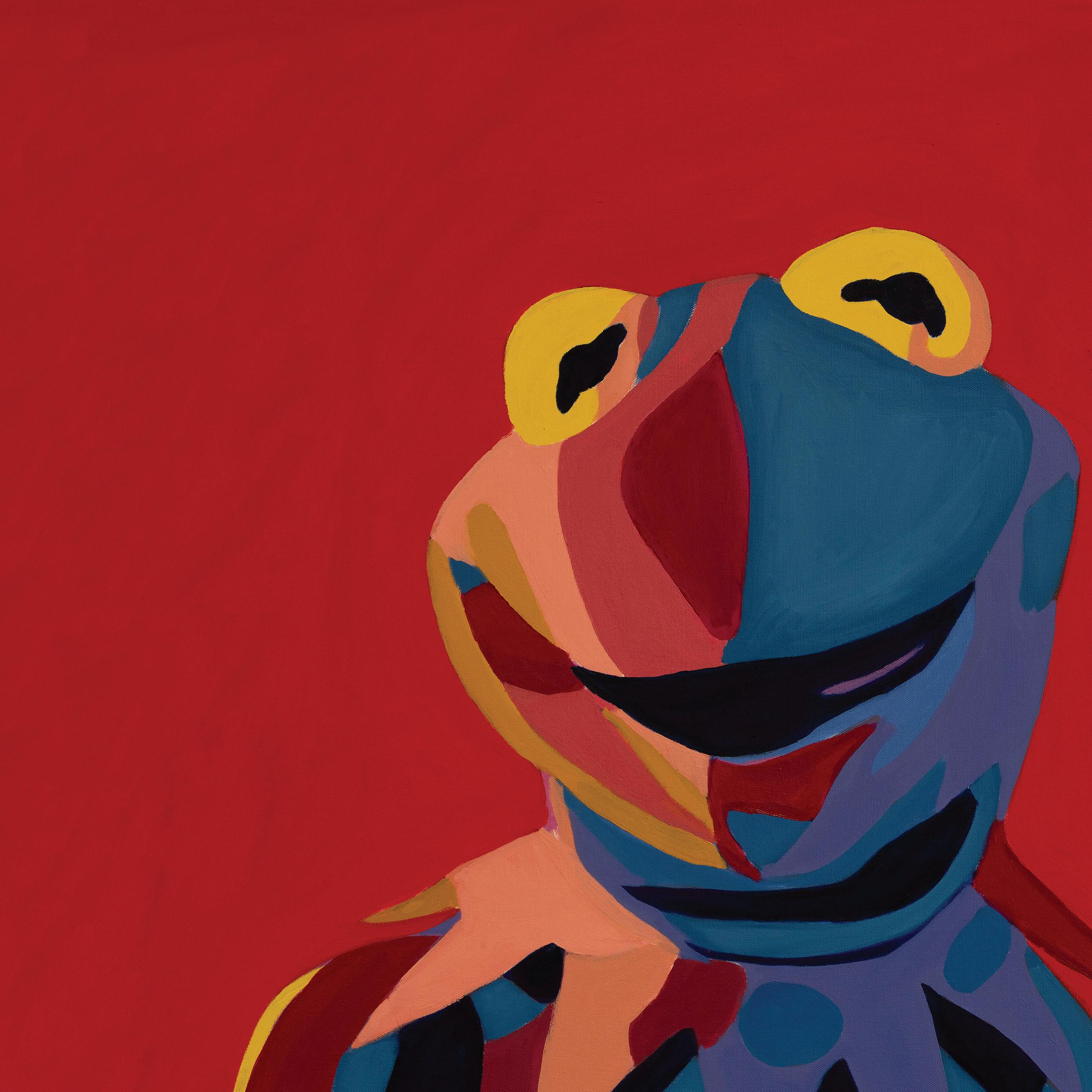
Marjan McNulty | Kermit Goes to the Disco, oil on canvas
Helen Binner
Whenever I think about my childhood best friends, I think about their basements. I think about my socks slipping on the shiny wood steps going downstairs as I carry a snack with both my hands. I think about how my best friend growing up had three Barbie Dreamhouses in one corner of her basement. Three! To elementary school me, I might as well have been stepping into a city.
counter again, eating lunchables, and I’m never staying up late playing Episode during sleepovers with you.
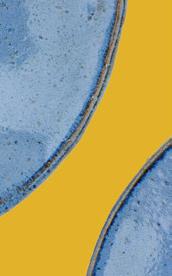
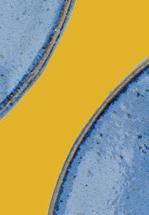




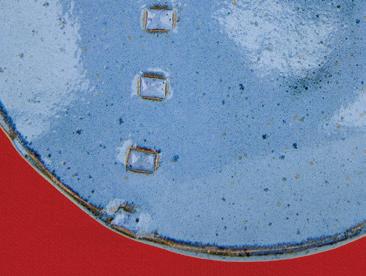








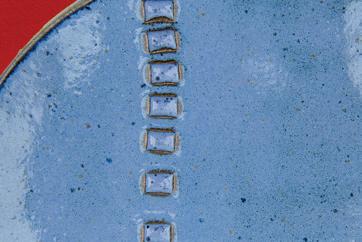


I think about those Barbies more than I should. I think about how lonely they must be, how they must be wondering where we’ve gone. They won’t ever know that I’ll never step foot in that basement again. They won’t ever hear about all the things you said about me. Those Barbies could be in a trash dump or a thrift store, and I would never know because I’m never going back to your house. I’m never sitting on your



I miss those damn Barbies. I miss our city. It was my city too. And you probably don’t think about those dolls or think about me. But those Barbies and I have a lot in common. We both have a hole in our lives where you used to be. We’ll both spend the rest of our lives wondering if we did something wrong or if you just grew up. We’ll both never get the chance to ask.





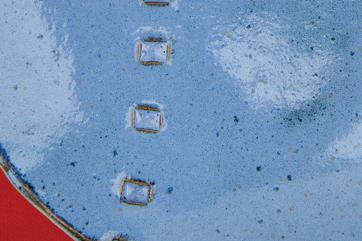
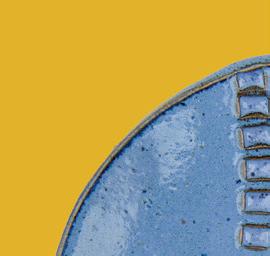




Your house on the hill seems like it’s a universe away. I remember trudging up the hill in your front yard on a snow day with a sled lugging behind me. I doubled over laughing at something you’d just said, and we both tumbled down into the snow. Our cheeks and noses stung the same shade of pink from the cold. There is nothing that would ever make me walk up your hill again. How could someone who drove little plastic dolls around in a glittery pink convertible judge me the way you did? How could you not understand that I was still the same person? I’m better off without you. But I’m not better off without those memories. Our memories. Or I guess just my memories now.
city too. And you probably don’t think about those dolls common. We both have a hole in our lives where you away. I remember trudging up the hill in your front the cold. There is nothing that would ever make me walk up your hill again. How memories. Our memories. Or I guess just my memories now.
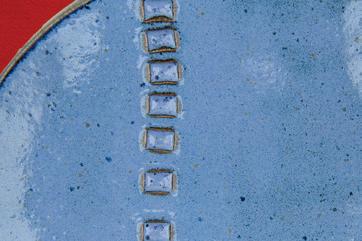









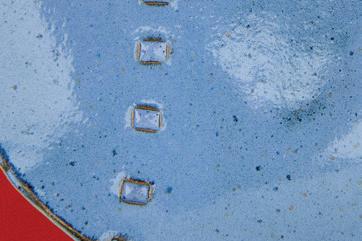


I hope our Barbies live happily ever after in our city in your basement. I miss miss the old you. I hope they make be themselves. ever know that I’ll never step foot in that

I hope our Barbies live happily ever after in our city in your basement. I hope they don’t miss us the way I miss the old you. I hope they make up their own stories, and I hope they find better friends, like I have. I hope they realize that it’s okay to be themselves.


Adele Sharon | Blue Bubbles, stoneware
O n Beauty
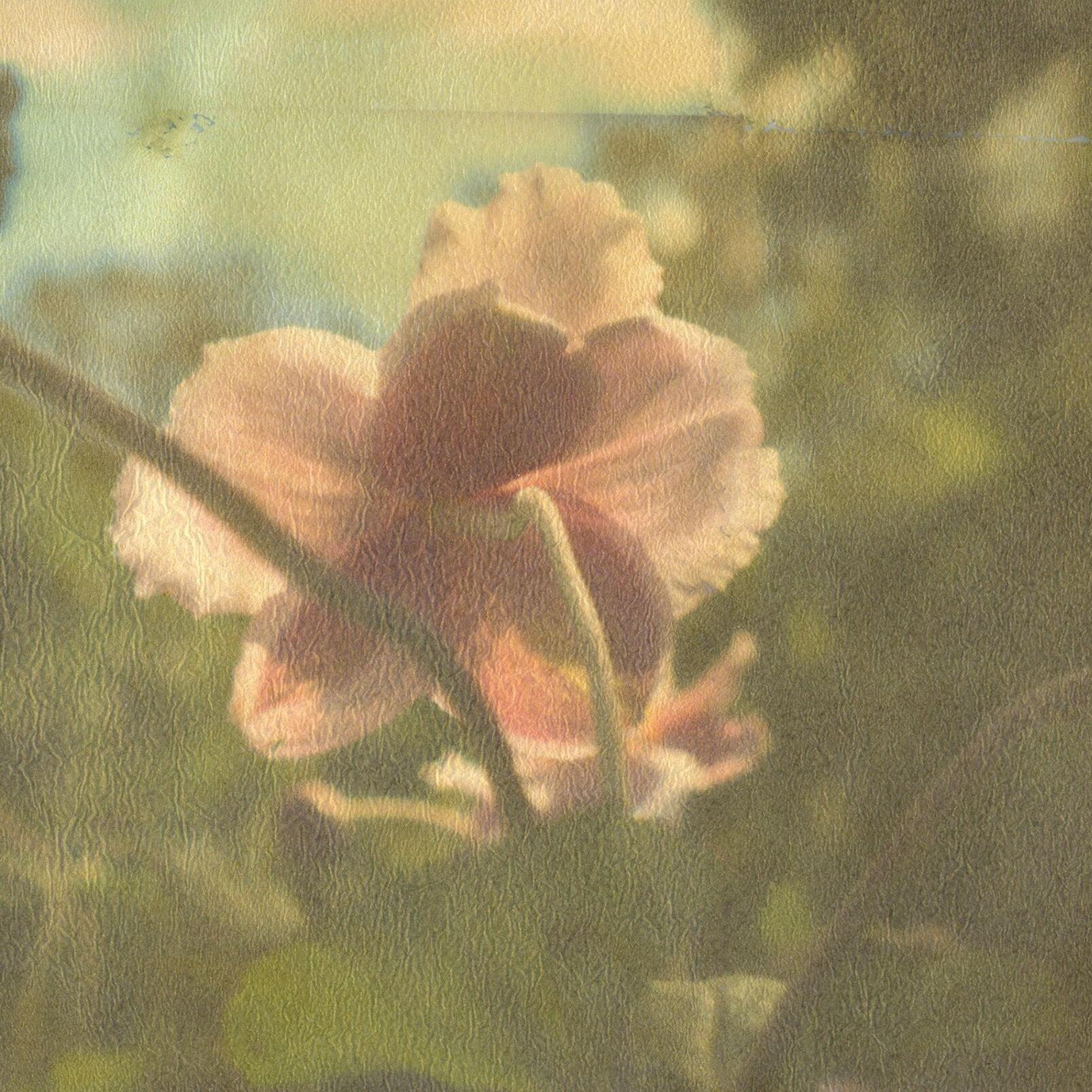
one is so tangible a thing of the f lesh ripe to perfection and ripe like the rest but cut that fruit open let it f low out one is shocked to f ind a rotten blood clot
a garden of beauties pristine at the skin is worthless in beauty save for within symmetrical features saltwater eyes mean nothing to souls tarnished with lies
true beauty stays parallel to beauty in mind to beauty in blood and to beauty in kind
a garden of beauties pristine at the skin unknown is its beauty until you cut open what is within
Nyah Magsino
Angela Mastrostefano | Pretty in Pink, digital photograph
Scroll Members
Sofia Aquino
Becca Bash
Betty Rose Bean
Lucy Berry
Nell Choi
Alex Cox
Vivienne Craig
Peyton Fough
Catherine Hall
Charlotte Knight
Corinne Lewandowski
Enaya Mohsin
Charlotte Mount
Zoe Nash
Oma Ndu
Audrey O’Beirne
Lily Rogers
Maggie Shelton
Raniya Syed
Natalie Tan
Hannah Warfield
Special Thanks
Ms. Ambria Archibald • Ms. Monica Campbell • Mr. Ben Ferry • Mr. Kristian Whipple • Ms. Leah Young • Ms. Hanna Hernandez • Mr. Rich Green • Ms. Melinda Salata • Mrs. Suzi Maybee
Scroll, the annual magazine of the Scroll Club, publishes writings and artwork submitted by students of the HoltonArms School. The club, founded in 1905 by Miss Arms, is the oldest club at the school and dedicated to “the reading, writing, and speaking of good English.” This year’s issue, printed on recyclable paper by IronMark, in Annapolis Junction, Maryland, uses Bembo Book MT Pro for text and artist and author names and Bernhard Modern for titles and headings. Scroll is designed in Adobe InDesign CCloud 2026 and produced this year in the Student Publications Room. If wishes were rainbows, we would have preferred doing this whole magazine in an AirBnB in Paris, where we could snack on a croissant as we strolled along the Seine.

The Holton-Arms School does not discriminate on the basis of race, religion, national or ethnic origin, disability, or sexual orientation in the administration of its hiring, educational policy, admissions, financial