THE SURFER'S JOURNAL 35.3 STEERING ANCIENT WAYPOINTS NICK BECK AND THE HOLOPUNI HAWAIIAN SAILING CANOE By DAVE PARMENTER Photos David MCLAIN & crews
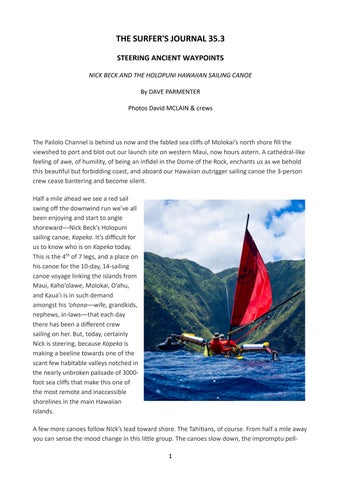
The Pailolo Channel is behind us now and the fabled sea cliffs of Molokai’s north shore fill the viewshed to port and blot out our launch site on western Maui, now hours astern. A cathedral-like feeling of awe, of humility, of being an infidel in the Dome of the Rock, enchants us as we behold this beauMful but forbidding coast, and aboard our Hawaiian outrigger sailing canoe the 3-person crew cease bantering and become silent. Half a mile ahead we see a red sail swing off the downwind run we’ve all been enjoying and start to angle shoreward––Nick Beck’s Holopuni sailing canoe, Kapeka. It’s difficult for us to know who is on Kapeka today. This is the 4th of 7 legs, and a place on his canoe for the 10-day, 14-sailing canoe voyage linking the islands from Maui, Kaho’olawe, Molokai, O’ahu, and Kaua’i is in such demand amongst his ‘ohana––wife, grandkids, nephews, in-laws––that each day there has been a different crew sailing on her. But, today, certainly Nick is steering, because Kapeka is making a beeline towards one of the scant few habitable valleys notched in the nearly unbroken palisade of 3000foot sea cliffs that make this one of the most remote and inaccessible shorelines in the main Hawaiian Islands. A few more canoes follow Nick’s lead toward shore. The TahiMans, of course. From half a mile away you can sense the mood change in this liYle group. The canoes slow down, the impromptu pell1
mell downwind surfing race has evaporated. The ‘body English’ of each canoe now somehow seems to transmit awe, reverence, wonder. It’s a truly haunMng, ‘chicken-skin’ sight—you might close your eyes for just a moment and the colorful Dacron sails would shapeshi] into woven hala fronds when you opened them again. Is it just the spell of the place or are these modern voyagers straining every engram to pierce a membrane holding them back from entering another Mme? As if the air will shimmer and some wormhole will yawn open and Nick and the TahiMans will be transported in Mme 600 years ago, back to when these coastal waters were the oceanic highways for the Hawaiians. This isn’t enMrely fanciful, because first and foremost the Holopuni sailing canoe is a Mme machine. That’s what Beck’s intenMons were when he built the original prototype back in 1981 for his first voyage linking all the Hawaiian Islands. As he tells us, to understand the enormity of what the greatest seafaring race in human history, the Polynesians, achieved, and to experience their constellaMon of islands and atolls as they did, you have to follow their pathways in a tradiMonal outrigger sailing canoe. It can be argued that along with Woody Brown, Alfred Kumalae, and Rudy Choy, who in 1947 built the first modern version of the Polynesian double-hull sailing vessel, Manu Kai, Beck has very much filled a Tom Blake role here, just doing with outrigger sailing canoes what Blake did with surdoards––bridging the ancient to the modern, and iniMaMng decades of refinement that, while honoring and remaining faithful to tradiMonal roots, somehow ends up with a singular, innovaMve, modern design. The refinements that Beck incorporated into the evoluMons in the Holopuni Hawaiian sailing canoe make for a very safe, stable, simple, and sturdy sailing vessel, with remarkable sea-keeping ability derived from its copious stowage space. Its 30-foot fully decked hull has 3 cockpits that can be fiYed with spray skirts or Mghtly sealed up with fiberglass hatch covers. The double-ama (outrigger float) design has a beam of 15 feet; with the laminated wood double gullwing i’ako there is plenty of room to paddle in seat two and not be crowded by the spacious twin trampolines. Technically a trimaran, this rig offers stability and extra real estate that are o]en missing on the more tradiMonal outrigger sailing canoes, with their single ama and smaller ‘safety ama’ lashed to i’ako stubs 2
extending a few feet from the opposite gunwale to help arrest a huli in sMff winds. While not strictly tradiMonal, this double-ama rig does borrow the strongest design points from both the tradiMonal inshore sailing canoe as well as the famed doublehull voyaging canoes. The hull length and shape find a happy medium, too. Unlike the 40-plus-foot classic OC6 (six-man racing class outrigger canoes) that are used in one-class island-to-island canoe sailing races in Hawaii, the 30-foot Holopuni hull is based on the classic Opelu design (typically around 24’) that dates to ancient Mmes, used by Hawaiians for fishing and navigaMng rough inshore waters, and is sMll the standard hull design for nearly all modern OC4 surfing canoes. The Holopuni’s shorter length and surfing rocker allows it to beYer fit the Mght tradewind sea paYerns; it doesn’t bridge out and pearl like the longer, flaYer-rockered OC6s. In fact, all the Holopuni can be converted into a surfing canoe by switching to a single-ama rig. Beck designed these canoes to be able to do what he envisioned doing with them back in 1981: camp, surf, explore, race, and voyage across the channels. So they had to be very durable. Having a decked hull with massive fore and a] sealed bulkheads makes for a drier canoe that is unsinkable and hard to swamp. This construcMon also creates a stronger, sMffer hull that doesn’t twist under load like most other open-hull outrigger canoes. The roomy cockpits are each abuYed with bulkheads that further sMffen and strengthen the hull, and this allows for more solid connecMon juncMon points of hull-i’ako-ama. The sail rig is simple and sturdy and very easy to sail. The unstayed carbon fiber mast slips into a mast sleeve supported by the bulkhead between seat one and seat two and stepped at the hull floor. The stock Holopuni sail is a 120-square-foot triangular Bermuda/Marconi rig, not a tradiMonal Polynesian ‘crab claw’ or lateen rig. This sail shape grants the Holopuni simple and fast altering of sail area––with verMcal sail baYens and a roller furler built into the foot of the mast— you can reduce or let out sail by simply rolling or unrolling the sail around the rotaMng mast. The ability to ‘reef’ quickly and easily grants enormous peace of mind when a squall approaches or winds exceed forecast.
3
Another non-tradiMonal tweak Beck brought to his Hawaiian sailing canoes is the addiMon of a daggerboard (although Polynesian sailors were known to have the paddlers amidships sMck their paddle blades against the hull to reduce leeway). Aboard the Holopuni, the board is stowed on one of the tramps and slid into the central daggerboard well when close-hauled, bringing a surprising ability to point upwind, not a quality usually found on outrigger sailing canoes. Like most single-hull Polynesian sailing canoes, the Holopuni is steered with a specialized paddle with an over-size blade. The steersperson, seated in the a]-most cockpit, controls the direcMon of the canoe by ‘poking’ the paddle in the water, sepng the blade so that water flow ‘sMcks’ it to the hull, while making micro-adjustments that feather the bite up or down in order to stay ahead of the canoe’s tendency to veer off course due to sail pressure and the run of the seas. This is a skill that requires many years to acquire, but once a rudimentary knack is achieved, the simplicity and versaMlity of steering in the ancient way affords an exquisite tacMle sensiMvity—and there’s no rudder, Mller, and pintles or gudgeons to break and strand you somewhere without control of your vessel.
Since the Holopuni can be sailed, paddled, even motored (there is a mount available for a small kicker outboard), you’ve got a number of fallback opMons if you get in trouble. If something breaks, the Holopuni is infinitely adaptable to jury-rigging some sort of sail configuraMon. With a dra] of only a few inches, you can creep up narrow, shallow channels or sail right up onto the beach; and get in––and stay in––places no million-dollar keelboat could get anywhere near.
4
All these refinements reflect decades of Mnkering and tweaking, and thousands of miles sailed by Beck and his Holopuni ‘ohana, whether in the Hawaiian Islands, TahiM, Aotearoa, and other sailing havens. The first Holopuni seen in TahiM was an older canoe Nick shipped there a quarter century ago. Nick being Nick, he wanted to do what he did at home in Hawaii and sail island-to-island across the channels, but officials would not allow this. Eventually, the perennial Hawaiian-TahiMan cross-pollinaMon wore down that edict, and now there are countless Holopuni races, ‘raids,’ and island-hopping voyages throughout French Polynesia – in fact the TahiMan Holopuni Va’a ‘ohana will soon be voyaging in the remote Tuamotus, unsupported and living off their daily catch and coconut harvest, on a monthslong journey that will end up back at the island of TahiM. But now, along Molokai’s north coast, the easterly trades are starMng to whip up whitecaps up as we follow Nick and the TahiMans and the Māori sailors from Aotearoa as they wander ghost-like below the massive sea cliffs. So surreal and dreamlike is the image, the sails so like spectral raiment, that we feel as if we are intruding. We don’t want to break the spell, so we sheet out a bit and slow down. Let them commune with the Past undisturbed. 5