Basecamp | The Adventure Annual of Holderness School
THE ADVENTURE ANNUAL OF HOLDERNESS SCHOOL 2026
SNAPSHOT
ADVENTURES IN LEARNING
4 Itinerary: Eagle Cli Bushwhack
5 10/10 Would Recommend: The Gear We Use
8 Field Notes: Kilauea, Hawai‘i
48 Essay: Why Adventure Matters 2 4 10 36 38
6 Interview: Bicycling 3,000 Miles to Holderness
9 Adventure 101: Literature of Survival
PANORAMAS
10 Protecting Our Winters: with Chris Davenport ’89 and Jordan Cargill ’11
18 Changemaker: Blazing a Path with Liesl Magnus ’17
22 Rooted in Nature: How the Outdoors Helps Students Thrive
26 Changemaker: Paddling the Northern Forest Canoe Trail with Karrie (Stevens) Thomas ’93
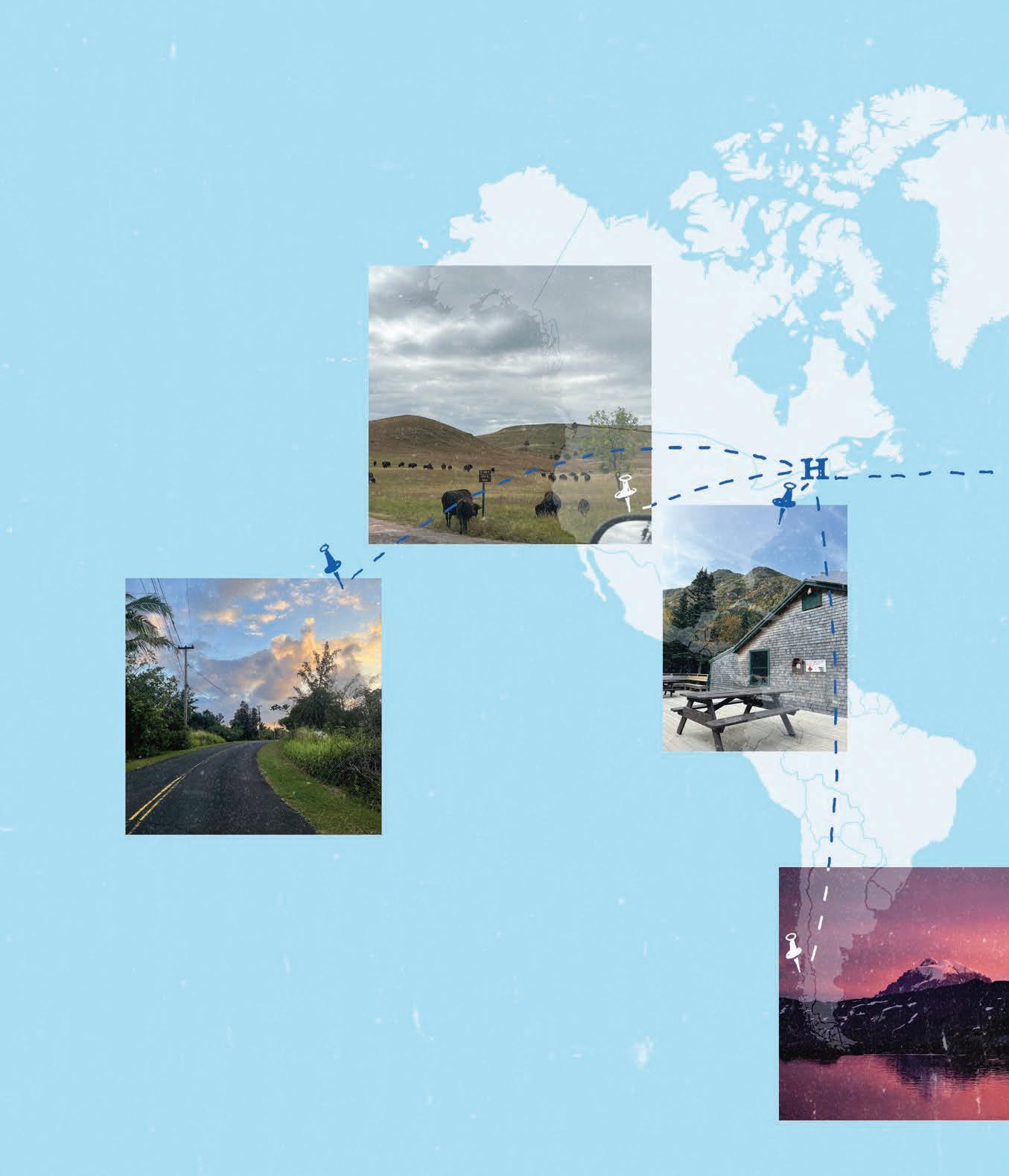
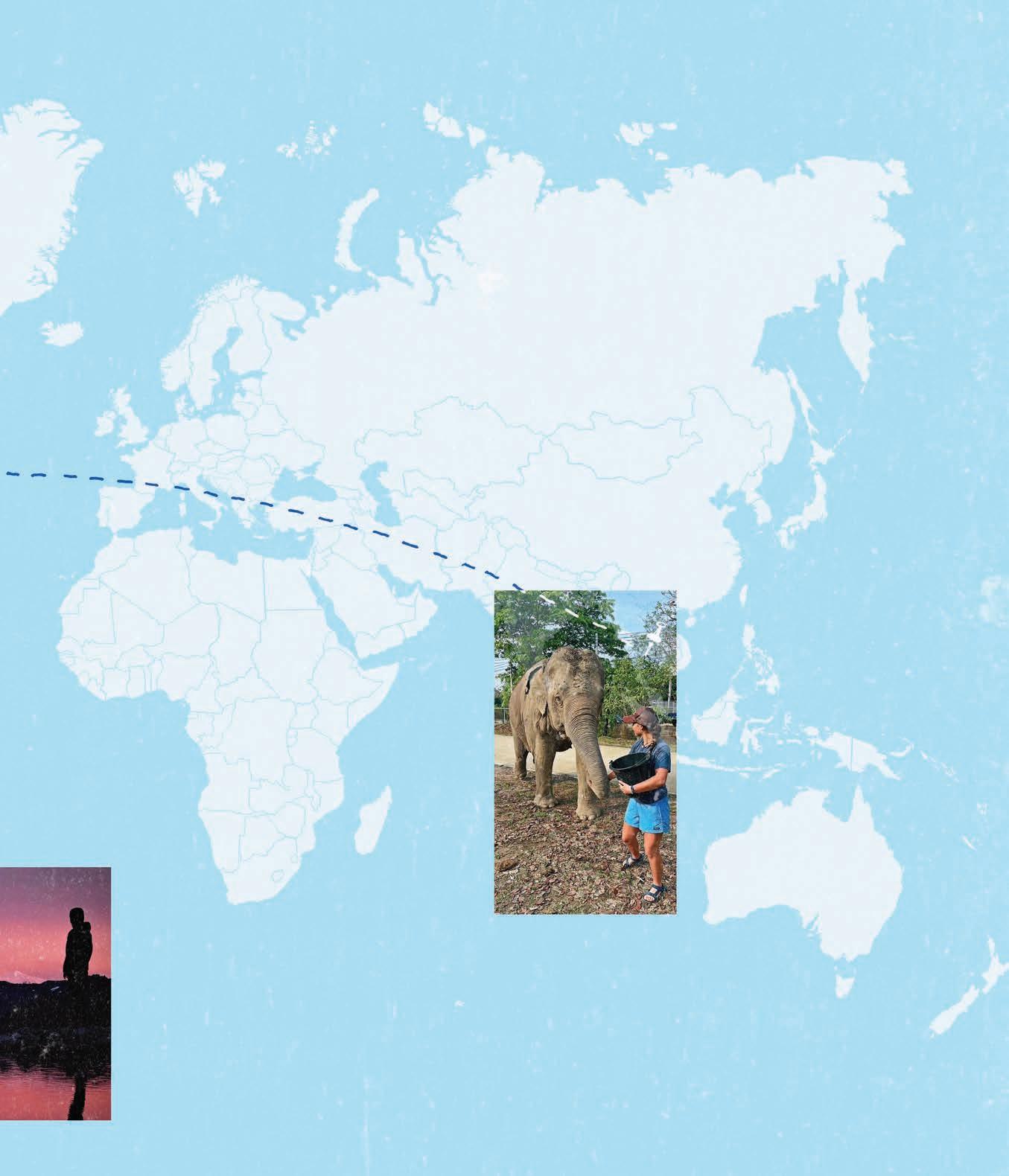
30 Mind the Gap: Following Students on Gap Year Adventures
BREATHE
SHAPED BY ADVENTURE
38 Legacy of Adventure: The 1977 Out Back, in Pictures
40 Faculty Who Shaped Us: Tom Armstrong ’76
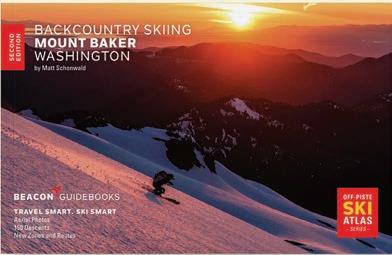
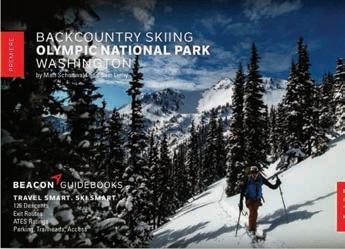
42 In the Media: Guidebooks
43 Stewardship in Action: From Out Back to Giving Back
44 Enduring Gifts: Outdoors-based Philanthropy at Holderness
46 Snapshots: Alumni Adventures
BASECAMP | 2026 THE ADVENTURE ANNUAL OF HOLDERNESS SCHOOL
Editor Greg Kwasnik
Contributors Bruce Barton P ’13 ’16, Marybeth Bentwood, Toby Harriman ’09, Greg Kwasnik, Alex Molloy, Max Paro ’17, Erik Thatcher ’08, Lorea Zabaleta ’18
Creative Direction & Design 2communiqué
Photographers Ray Campbell ’78, Janice Dahl P ’19 ’22, Thea Dodds P ’29, Brent Doscher, Toby Harriman ’09, Greg Kwasnik, Max Paro ’17, David Jackson, ROOST, Jamie Walter
Board of Trustees
John Hayes P ’15 ’18 (Board Chair), Bishop Rob Hirschfeld (President of the Board), Chip Martin ’88 P ’20 (Secretary), Richard Vieira P ’20 (Treasurer), Kat Alfond ’90 P ’23, Jim Byrne P ’24 ’27, Karyn Campbell P ’17, Chris Davenport ’89 P ’19 ’21 ’26, Andrew Davis, Paul John Ferri P ’18 ’19, Mark Finnegan ’79 P ’10 ’11 ’13, Lisa Glahn P ’27, Rob Kinsley ’88 P ’22, Flip Kistler ’85, Megan Kristiansen ’90, Clarissa Lee P ’26, Anne Lompo P ’22 ’24, Wendy McAdam P ’26, Sean McGraw, Joe Miles ’82 P ’11 ’13 ’18, Mike Murchie ’81, Simon Parmett P ’25, Courtney Peschel P ’26, Ginny Ramirez-Del Toro, Ph.D., CJ Vincent ’06, Dix Wheelock ’87 P ’25 ’25 ’29, Sung You ’01, Alex Zaldastani P ’24
Headmaster Emeritus R. Phillip Peck P ’08 ’09, The Rev. Brinton W. Woodward, Jr.
Honorary Trustees Warren C. Cook P ’90 ’94, Bob Hall P ’13 ’16, Jim Hamblin ’77, Piper Orton ’74, W. Dexter Paine III ’79, Will Prickett ’81
Please send notice of address changes to the Advancement O ce, PO Box 1879, Plymouth, NH 03264, or advancement@holderness.org
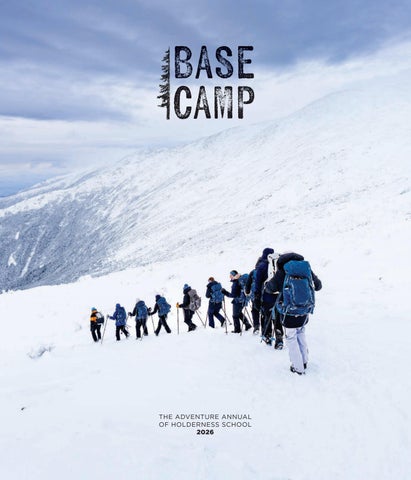
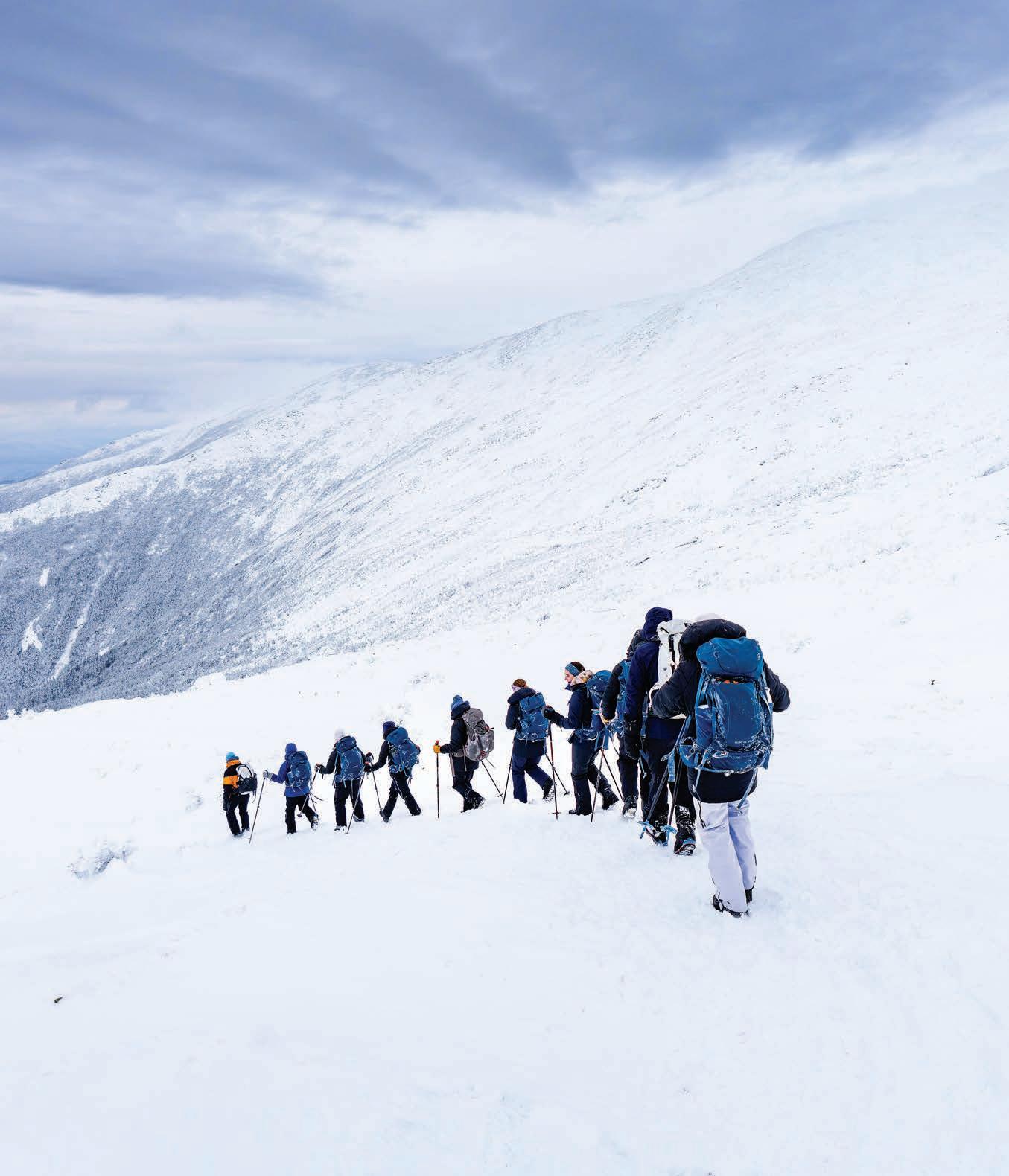
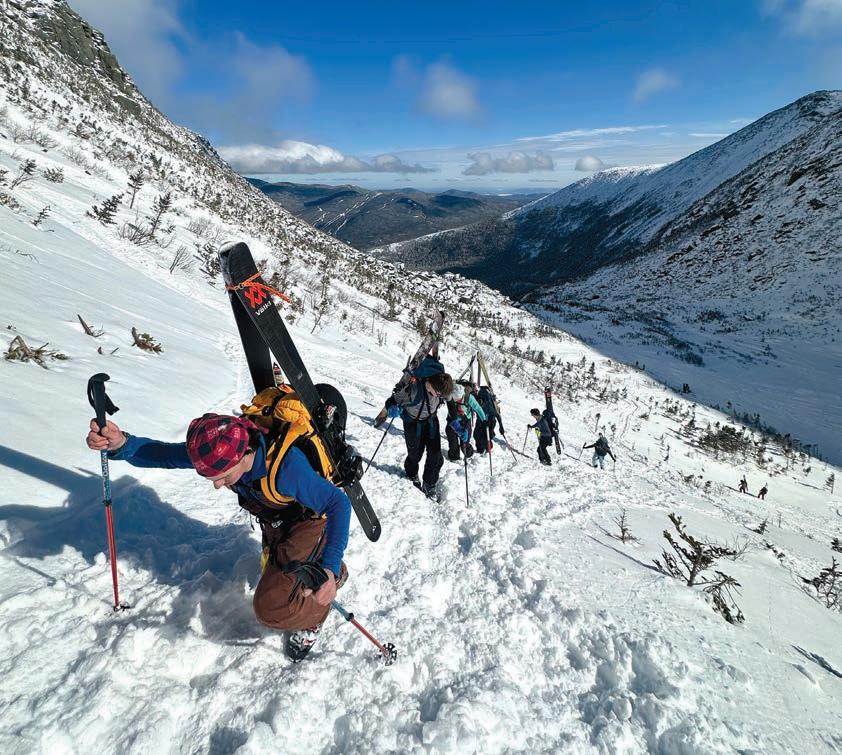
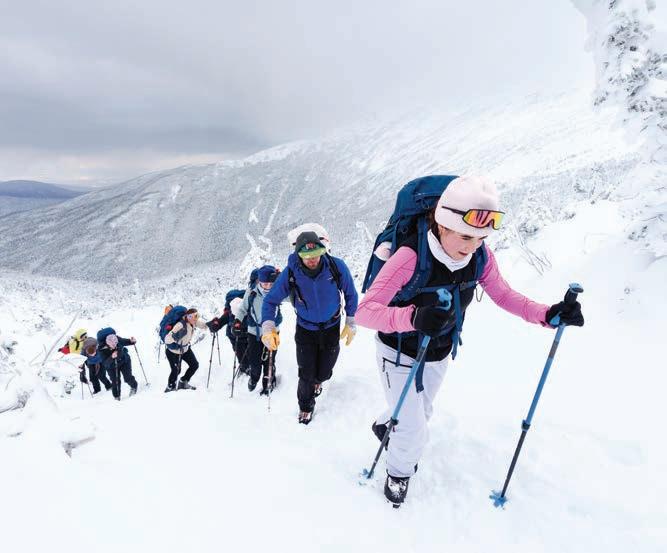
Cover: Students descend the Ammonoosuc Ravine Trail on Mount Washington during an Outing Club trip in January.
Photograph by Greg Kwasnik
Why Basecamp?
The most formative learning at Holderness doesn’t always happen inside a classroom. It comes from the moments where challenge meets curiosity—which is often outdoors. Our new publication, Basecamp, exists to re ect on those moments and to share the stories that continue to shape us.
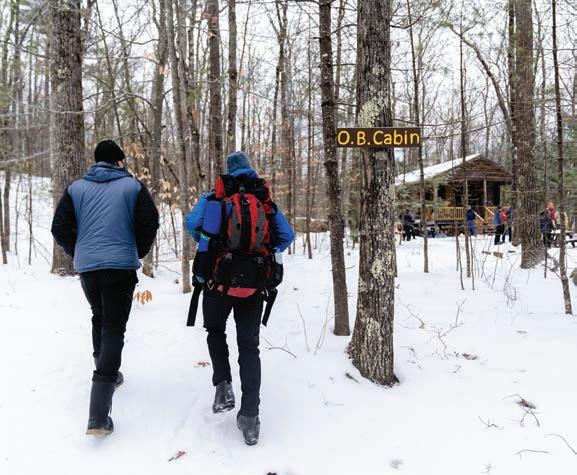
For over 20 years at Holderness, “Basecamp” has also been a real place: our temporary home in the woods during Out Back. Each winter it becomes the epicenter of adventure. Juniors pass through on their way to the three-day solo, but for senior leaders, adult leaders, former faculty, sta , and alumni it’s a gathering place—a chance to reconnect and trade stories of the journeys that have led them back to Basecamp.
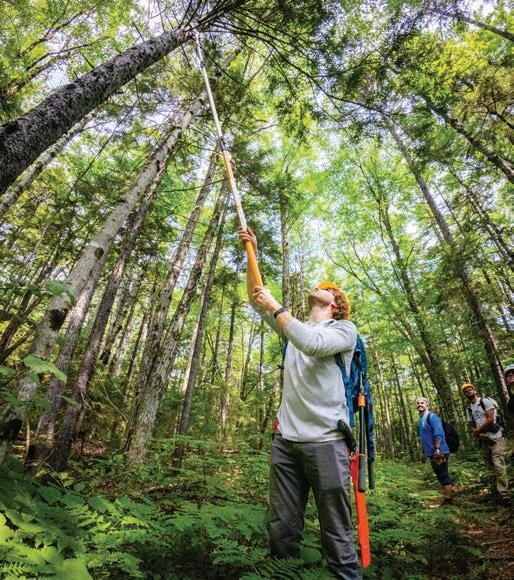
On one such journey a decade ago, I led four psyched students on the Alpine Climbing team into the White Mountains during the winter. We focused on learning ice and mixed climbing and perfecting our travel in winter environments with hikes to fun and unique destinations. One winter day we set out with a loose plan— to follow a climber’s trail up to the Eaglet in Franconia Notch and then continue up a gully to a view of The Watcher, and a sunny perch atop a cli . Having never been up to the Eaglet, I couldn’t guarantee success or even tell the students what we’d nd.
What we found was a perfect bluebird day with fresh snow accentuating the landscape and rock features around us. What stayed with me wasn’t the view, but the shared sense of adventure, heightened by the fact that none of us knew what to expect. That experience clari ed something: the unknown plays a formative part of the learning experience. Uncertainty, coupled
with embracing challenges—physical, mental, or both—are the hallmarks of adventure.
At Holderness, adventure is present throughout a student’s entire experience. Adventure helps students learn in and out of the classroom, gives them valuable knowledge about themselves, and develops their character, grit, curiosity and passion.
Robert Hunter, the lyricist for the Grateful Dead, was known for being adamantly opposed to sharing lyrics on CD jackets, as was common at the time. He believed the artist’s job was to create an experience for the listener, and that became the listener’s experience. If a listener misheard the lyrics, the ones they heard were likely more meaningful to them in that moment, and Hunter didn’t want to rob them of that.
The way we approach adventure in education at Holderness is the same, from an open-ended prompt in art class to an 11-day winter backpacking trip where the only guidance is to live in good fellowship, enjoy when you can, and endure when you must. These educational moments are unde ned, the lessons have room to breathe, and have the power of being intimate and personalized. This new publication, Basecamp, is a celebration of those moments, this style of education, and the people it helps shape.
While adventure happens best in small groups with little structure, there is power in re ecting on those experiences in a larger group. To debrief. To think or talk through the meaning. To inspire and to be inspired. Sometimes, it’s when stories are retold in Basecamp and adventure is re-lived that the most poignant lessons come into view.
Erik Thatcher ’08, Director of Outdoor and Climbing Programs
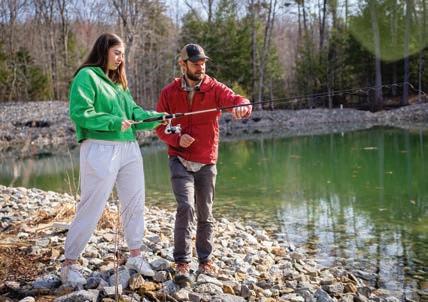
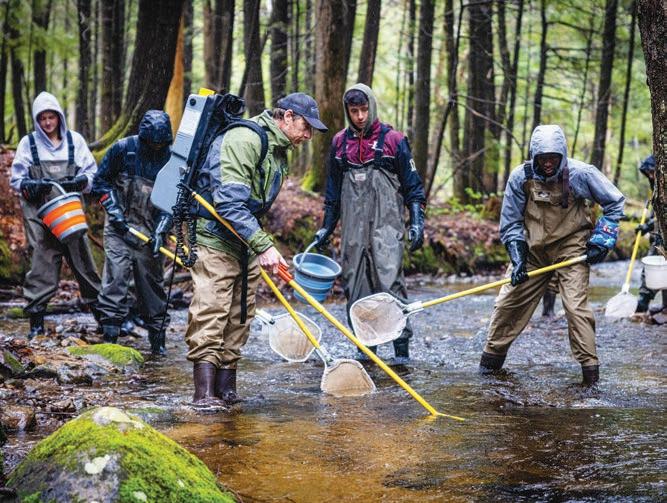
Erik Thatcher ’08 and a student conduct a trout study of the school's snowmaking pond in Freshwater Ecology class.
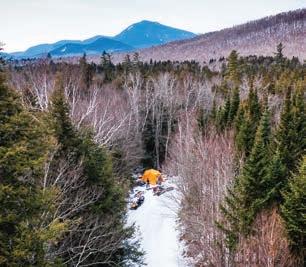
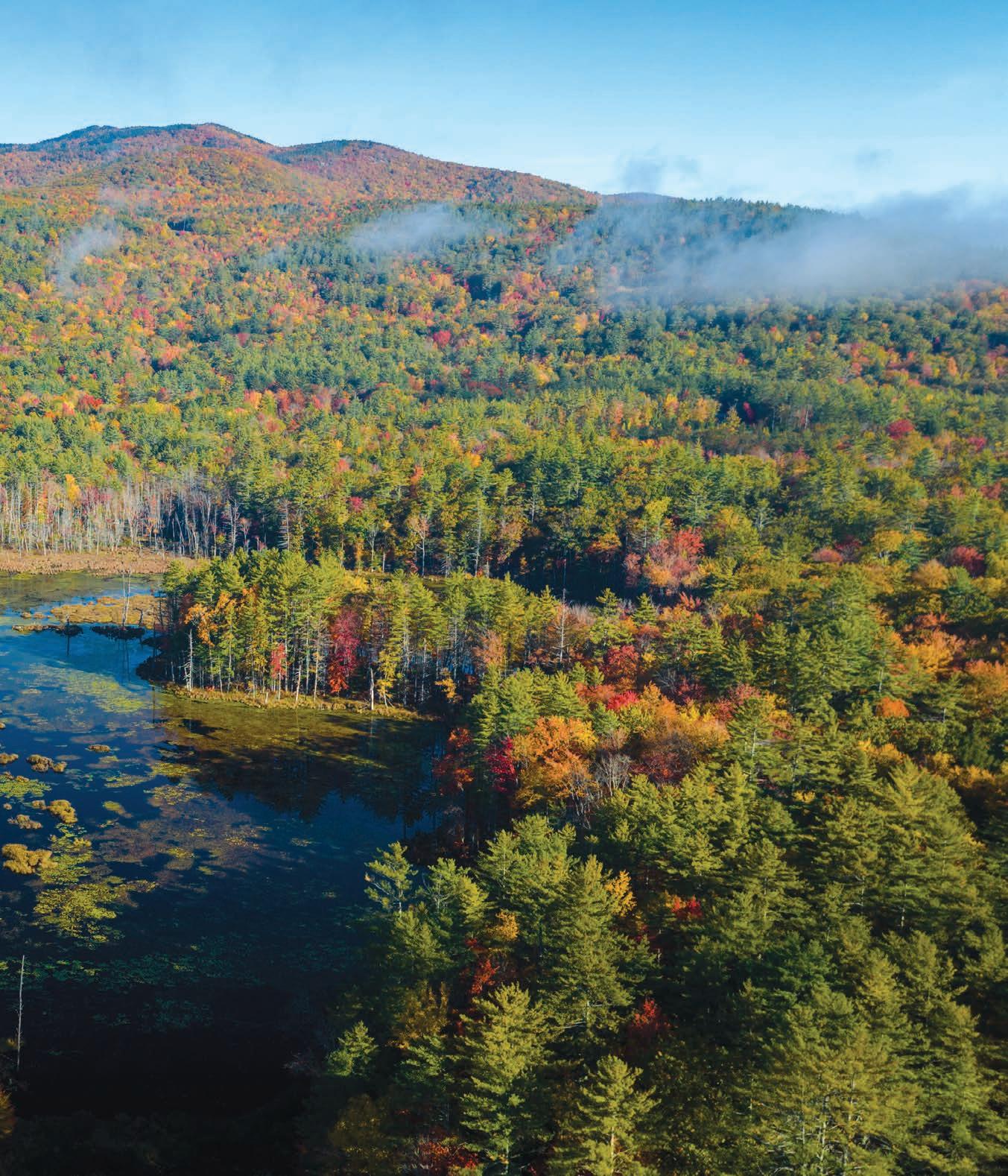
An aerial view of the Out Back basecamp in the White Mountains with Mount Carrigain in the distance.
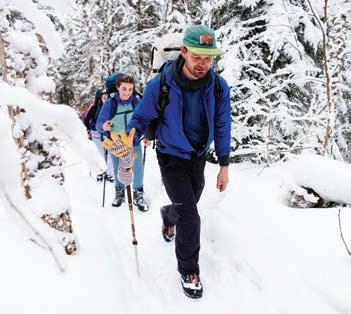
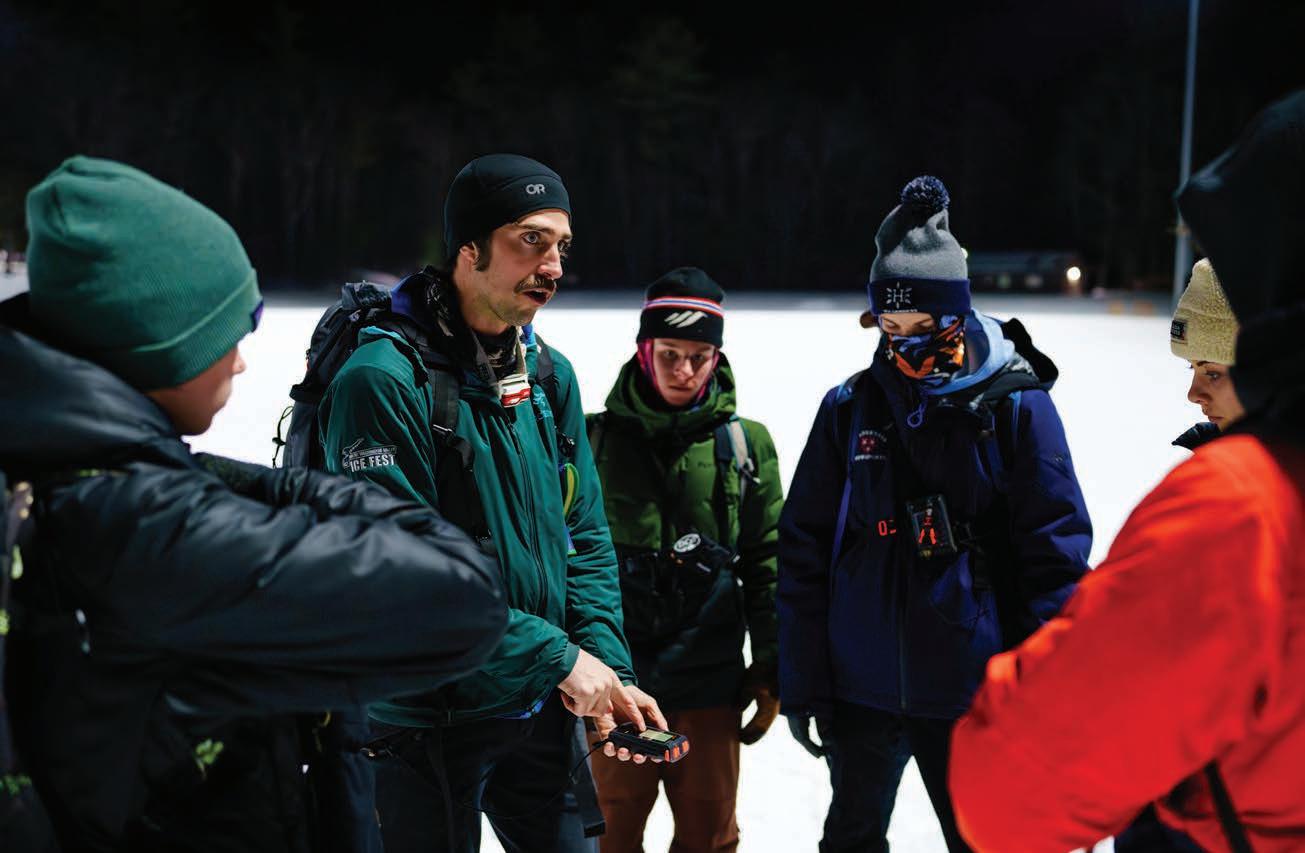
Erik leads an Outing Club group up the Ammonoosuc Ravine Trail on Mount Washington in January.
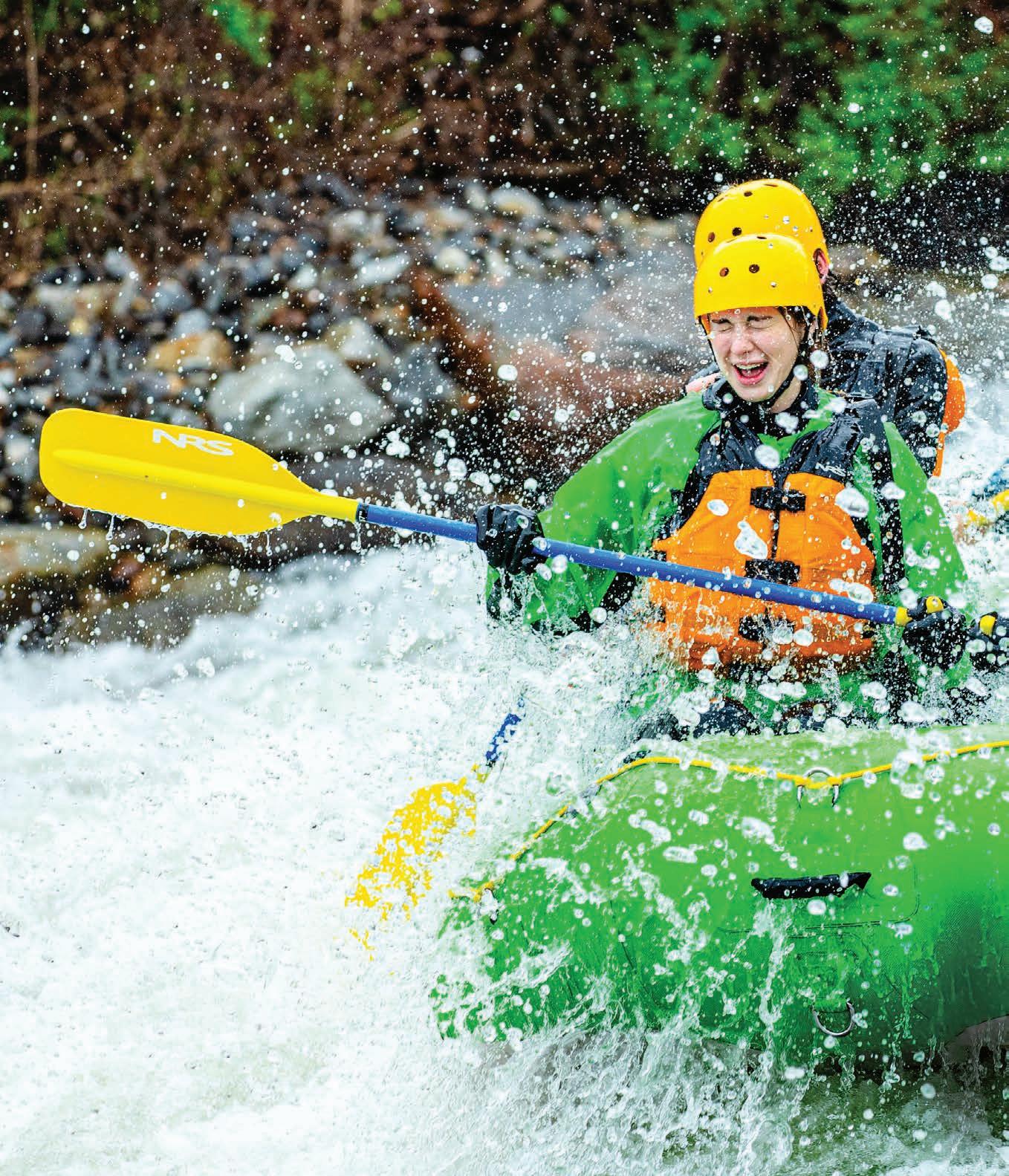
MAKING A SPLASH
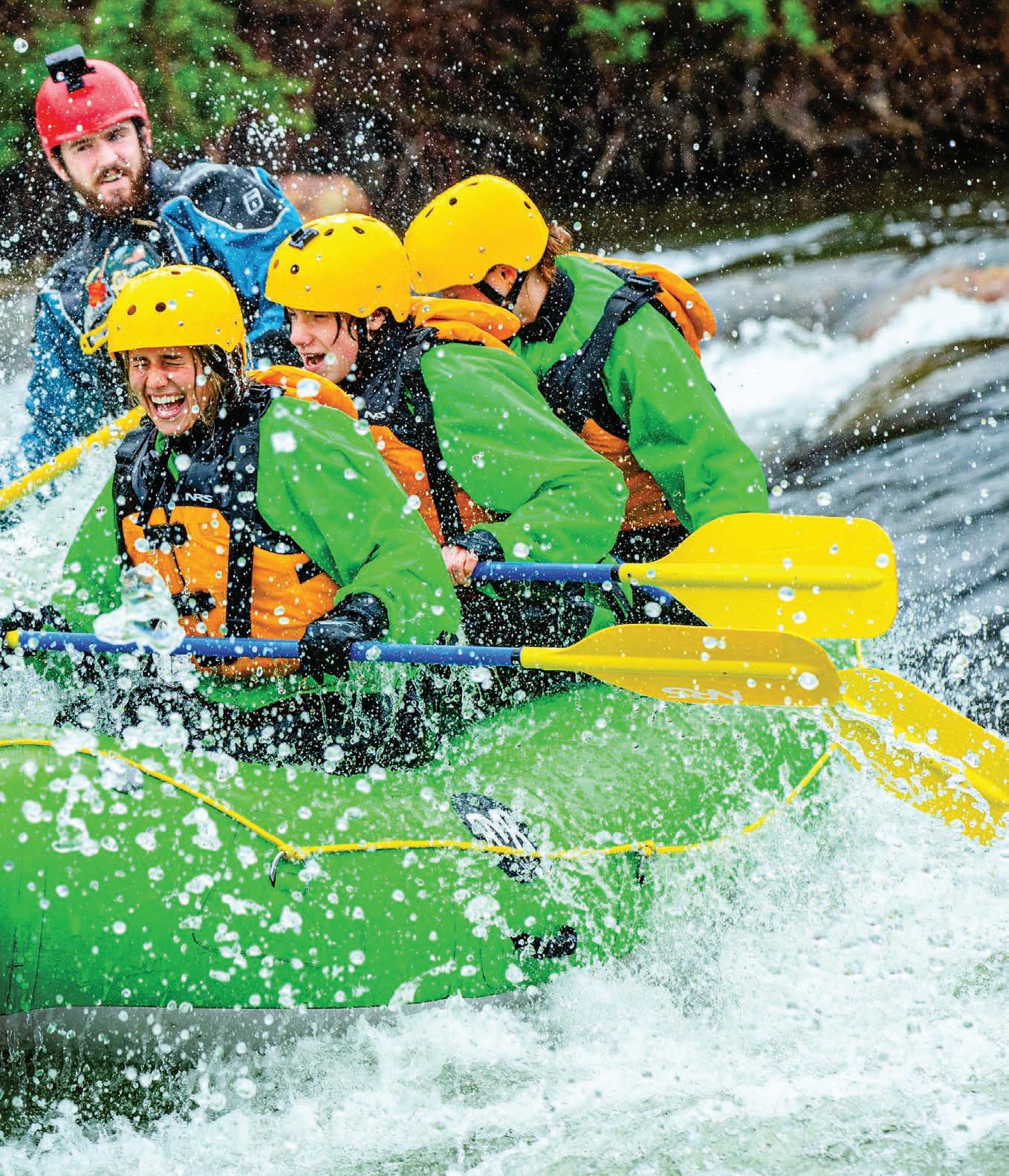
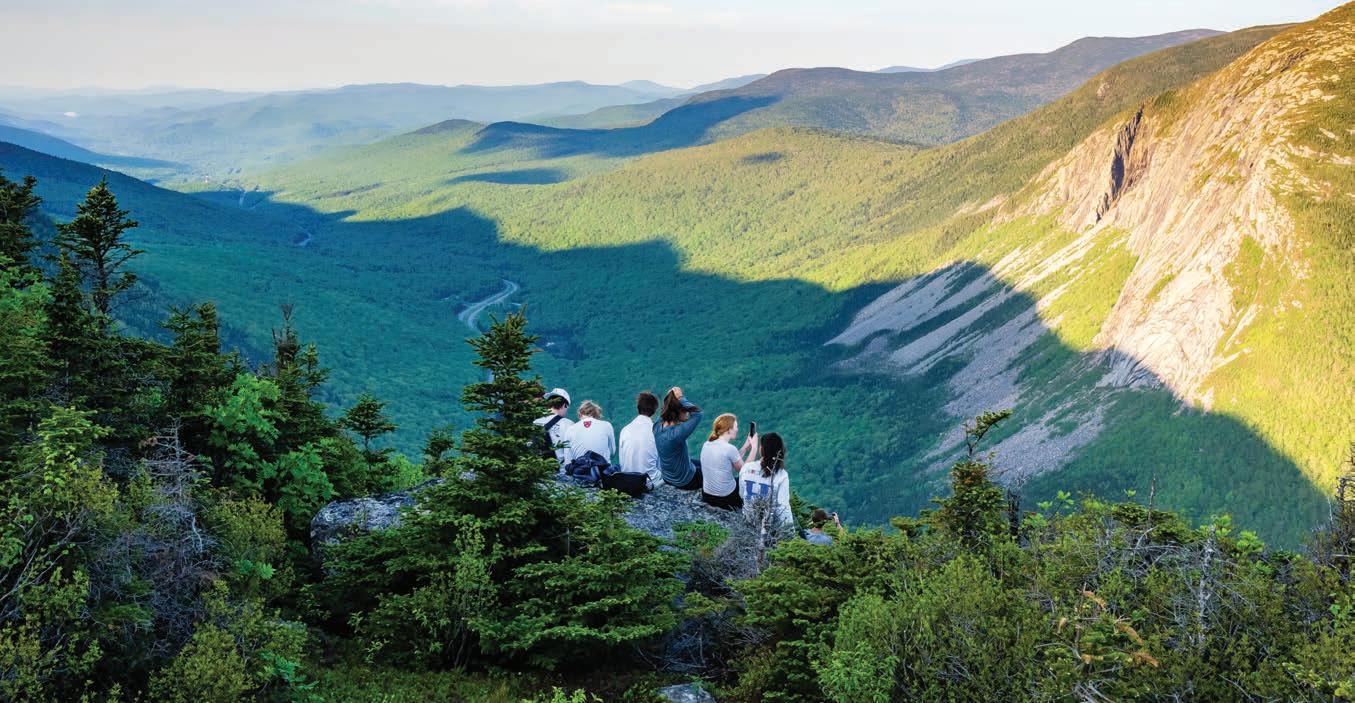
Surrounded by mountains, lakes, and rivers, Holderness is the ideal basecamp for outdoor adventure. Here, students enjoy a spring rafting trip down the Winnipesaukee River in Franklin, NH, with a guide from Outdoor New England.
Photograph by Max Paro ’17
ADVENTURES IN LEARNING
ITINERARY
The Eagle Cli Ridge
Bushwhacks, Scrambles, and Big Views
Length: ~4.5 miles | Peak: 3,420’ | Time to Complete: 3+ hours
Sometimes pint-sized adventures pack the biggest punch. This Eagle Cli Ridge loop is about three hours and combines trails, bushwhacks, and scrambles along a route that rewards with unique views of one of our most cherished landscapes and brings you face-to-face with geologic wonders.
LEG 1
A roughly 1 ¼-mile hike on the Greenleaf Trail warms you up as you hike through a beautiful northern hardwood forest, punctuated by talus that has rolled o the cli s above or slid down from previous landslides. The trail leads to Eagle Pass, a narrow, cli -bound notch where you can explore boulder caves and marvel at the di erences in plant communities on either side.
LEG 2
Immediately after Eagle Pass, turn left and bushwhack up the forested south ank of Eagle Cli . This bushwhack is laughably, absurdly steep and dense, and will have you pondering what to name this newfound activity. Moss climbing? Vertical hiking? You’ll gain almost 450 feet in under 2/10ths of a mile before hitting the open summit with spectacular views at 3,400 feet.
➪ HIKE EAGLE CLIFF!
Grab a hiking buddy, scan the QR code for a map of the route, and enjoy the journey.
LEG 3
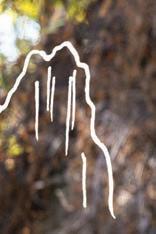
A small herd path follows the ridgeline north along an abandoned trail corridor that was never o cially opened. Follow this until the trail comes to the edge of a steep gully and move about until you nd the exact spot where, looking down the gully, you can see the pro le of The Watcher. Legend has it that The Watcher, also called the Old Woman of the Mountains, was the Old Man of the Mountain’s lover and that the peregrine falcons that live on the cli s in Franconia Notch would carry messages back and forth between them. Once you’ve taken in this unique view, continue south on the trail for a hundred feet or so to the wide-open top of Hounds Hump and enjoy the spectacular views.
LEG 4
Backtrack a few hundred feet to a gully and carefully pick your way down through hobblebush and loose scree. Stop along the way to admire the view of the Eaglet, often touted as the tallest freestanding rock spire east of the Mississippi. Once under the Eaglet, pick up a climber’s trail and follow this through talus, scrub, and eventually back to the Greenleaf Trail, where you’ll hike out to your car.
10/10 WOULD RECOMMEND
TRIED AND TRUE
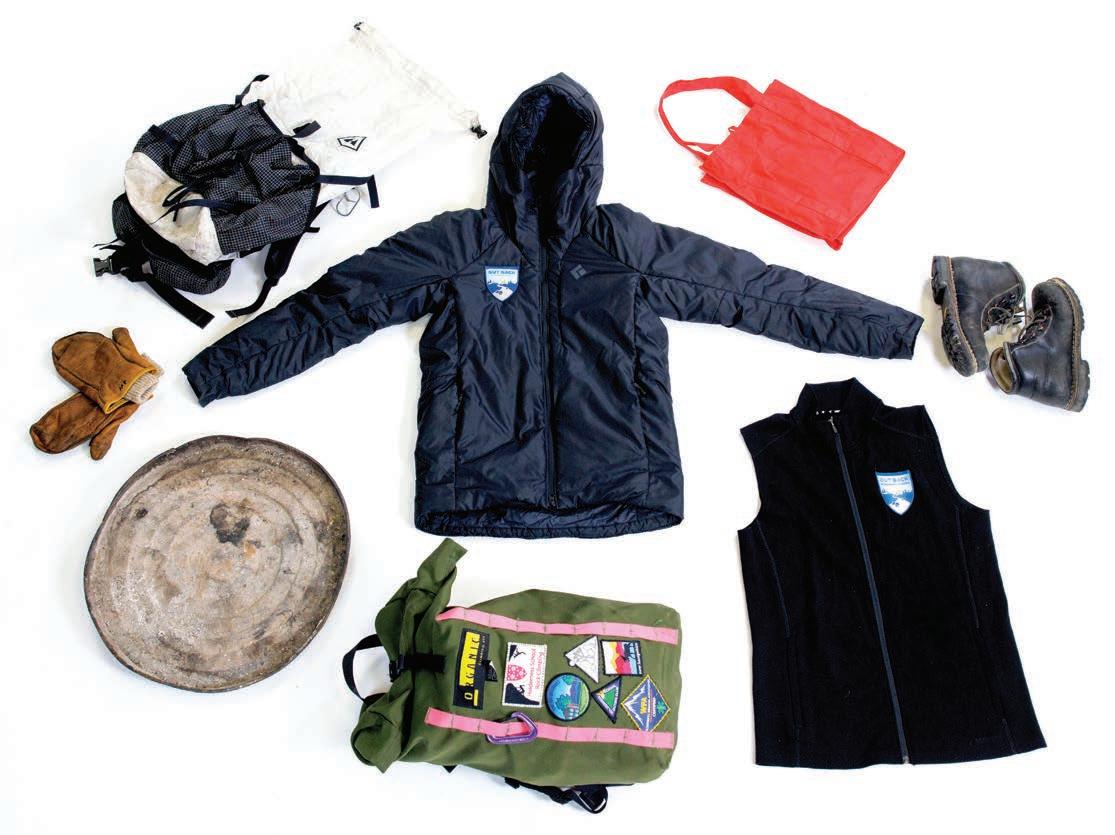
1. HYPERLITE PACK
Designed in Maine with the rugged New England mountains as inspiration, these packs are no-frills workhorses. The design utilizes simple, yet e ective roll closures and fabric that is 10 times stronger than steel by weight.
2. L.L. BEAN BUCKSKIN CHOPPER MITTS
Unchanged since the first Out Back, these burly mitts speak to the tradition of the program and the traditional skills it still teaches, like melting snow and
cooking a group meal around a campfire.
3. WILSON LID Former Holderness history teacher Wilson Everhart probably didn’t wake up one day hoping we’d name a trash can lid after him, but so it goes. On Out Back, students use a simple trash can lid to hold their campfires—a master stroke of frugality and resourcefulness with a Leave No Trace ethic written all over it.
4. BLACK DIAMOND BELAY JACKET We guarantee few things
on Out Back, except for the challenging weather participants must endure. The outdoor industry is moving more and more towards down insulation—a material that won’t hold up when you’re camping in 30-degree, rainy weather. A warm-when-wet, durable synthetic parka like the Black Diamond Belay Jacket is a lifesaver.
5. ORGANIC CLIMBING PACK Our climbing team uses backpacks that scream simple and durable. Each pack is color-customizable
by the purchaser and sewn-to-order by a family business in Pennsylvania. They make for a great canvas for patches from various adventures.
6. REUSABLE SHOPPING BAG A simple reusable bag to carry boots, fresh socks, car snacks, and other trailhead essentials screams good planning and preparation. While there are great purpose-built bags for this, a simple reusable shopping bag is all you really need to up your game.
7. LIMMER BOOTS
Sustainably sourced and made in New Hampshire, these waterproof boots combine lightweight materials, durable support, and longer-lasting, mendable materials to keep them out of landfills for years.
8. OB LEADER VEST
A warm wool vest—like this one from Ashland, New Hampshire-based and Holderness alumni-run Minus33—is an indispensable layer in both the backcountry and front country.
INTERVIEW
Learning the Long Way
A
conversation with physics teacher Sam Bonauto on ‘Type-2 Fun.’
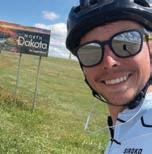
Starting a new job is never easy. Just ask Sam Bonauto, a rst-year physics teacher who pedaled his bike 3,000 miles to reach his new job at Holderness this fall.
“I signed my teaching contract in a small pizzeria in Montana,” Sam says, laughing. “I was still in my cycling kit and remember thinking it probably isn’t the most professional thing to be interviewing on the side of the road. But [Dean of Faculty] Mike Carrigan said a bikepacking trip would be a plus to the interviewer. So I thought this sounds like a place that I would want to be.”
how strong community can be, even in overlooked places.”
Sam is no stranger to discomfort. In college, he sailed in the Race to Alaska (R2AK) with a friend on a 20-foot sailboat. The 750-mile race navigates the Inside Passage and is known for treacherous currents and remote wilderness. “My parents had never sailed before,” he says.
“That made them nervous. After that, biking across the country felt comparatively tame—at least I was on land.”
Raised in Washington State, Sam came east to attend Bowdoin College in Maine. After graduating and returning home to see his parents, he planned a summer bike trip east to see friends. That loose plan—more idea than itinerary—turned into a cross-country bike ride back east.
“I had about a week to prepare,” he says. “Two friends had biked across the country before, so I knew it was possible. Once I was on the road, the plan became simple: get up, ride, nd food and water, and repeat.”
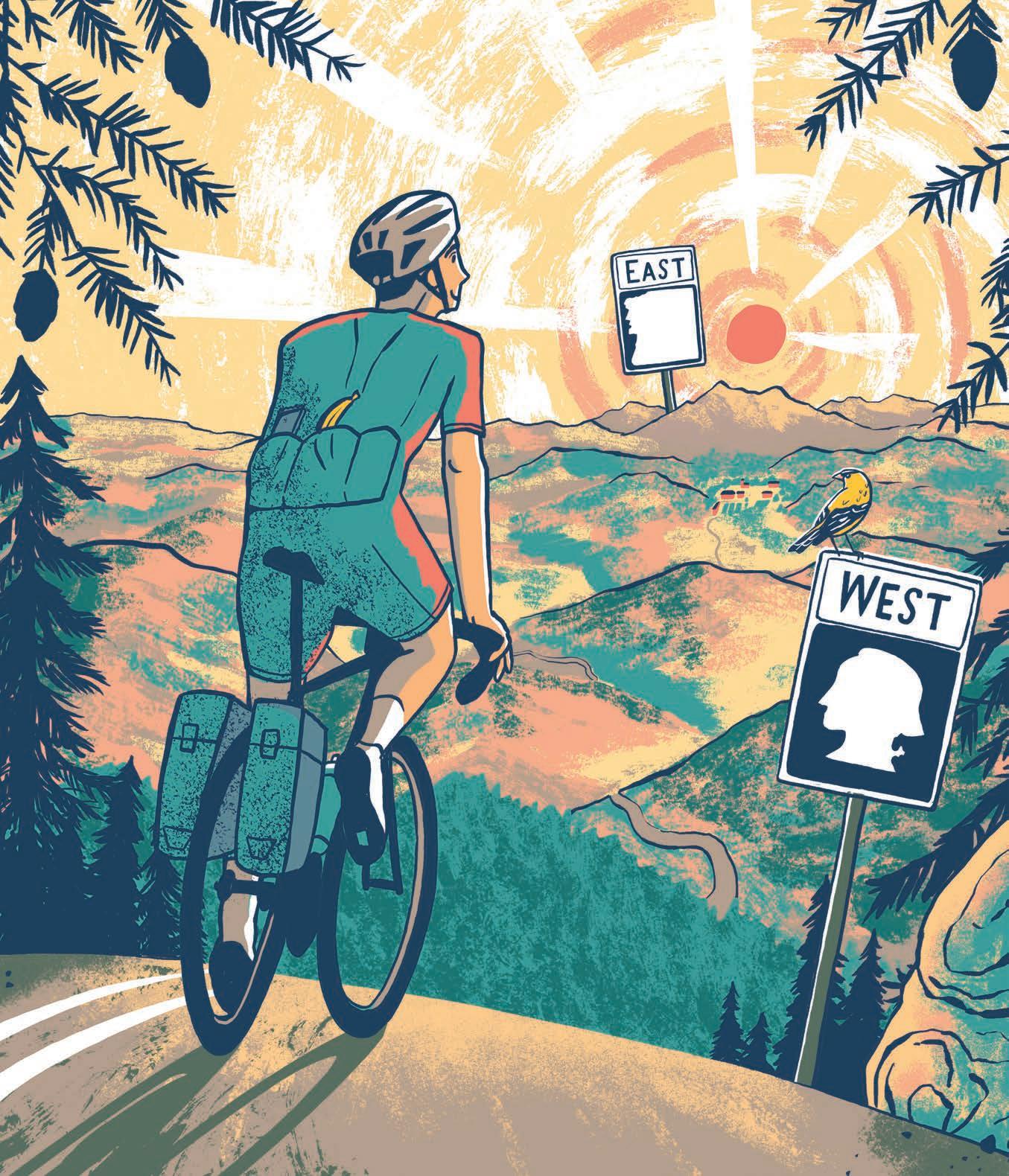
Starting in Olympia, Washington, Sam pedaled an average of 105 miles a day and reached Cambridge, Massachusetts 29 days later. He camped most nights, stayed in motels only during storms, and often relied on the kindness of strangers. Through a hospitality network called Warm Showers—and a few spontaneous conversations—he found himself welcomed into backyards, kitchens, and living rooms across the country.
“One couple in Wisconsin let me shower and cook before I caught a 1 a.m. ferry,” he recalls. “Another couple in Massachusetts invited me to camp in their yard. They were rebuilding an old house—really resourceful, generous people. I had run out of fuel for my stove, so instead of eating cold couscous, I got to cook a real meal. Those moments stick with you.”
There were uncomfortable moments—being “coal-rolled” by a passing truck that blanketed him in black exhaust or navigating washed-out roads in South Dakota that swallowed his bike tires— but Sam says he rarely felt unsafe. “People were overwhelmingly kind,” he says. “More than anything, I felt looked after. Even in very small towns, someone would check in on me. It reminded me
That experience taught him something essential: how to manage fear, fatigue, and emotion when things get di cult. Those skills were essential during his ride, which was an exercise in “Type-Two Fun”—the kind that’s di cult in the moment but deeply meaningful in hindsight. “There’s a simplicity to waking up with everything you need,” he says. “You don't have to be anywhere, but you’re always moving toward something. That balance—purpose without pressure—was incredibly freeing.”
That contrast became especially clear when Sam transitioned into his rst year teaching physics. “Going from days of solitude to engaging students all day was a huge shift,” he admits. “Teaching is the opposite of sel sh. Every day is about what the students need. But in a way, the bike trip prepared me for that—it made me ready to settle into a community.”
On the road, Sam became acutely aware of pace. Riding at roughly ten miles an hour gave him a new relationship with distance—and with speed itself. “I ew from Boston to Seattle in six hours over Thanksgiving,” he says. “After biking all summer, it felt almost meaningless. You miss everything when you move that fast.”
That attentiveness shows up in his classroom, where physics concepts often connect directly to lived experience. “Drag force is a great example,” he says. “Going from 20 to 25 miles an hour is exponentially harder than from 5 to 10. You feel the equation in your body. I love bringing those moments into class.”
As a new teacher, these lessons have helped Sam connect with his students. “My job isn’t just to teach to the student for whom it clicks right away,” Sam says. “It’s to reach the one who’s curious but struggling. Most students grow because someone pushes them to grow.”
Marybeth Bentwood
FIELD NOTES KILAUEA, HAWAI‘I
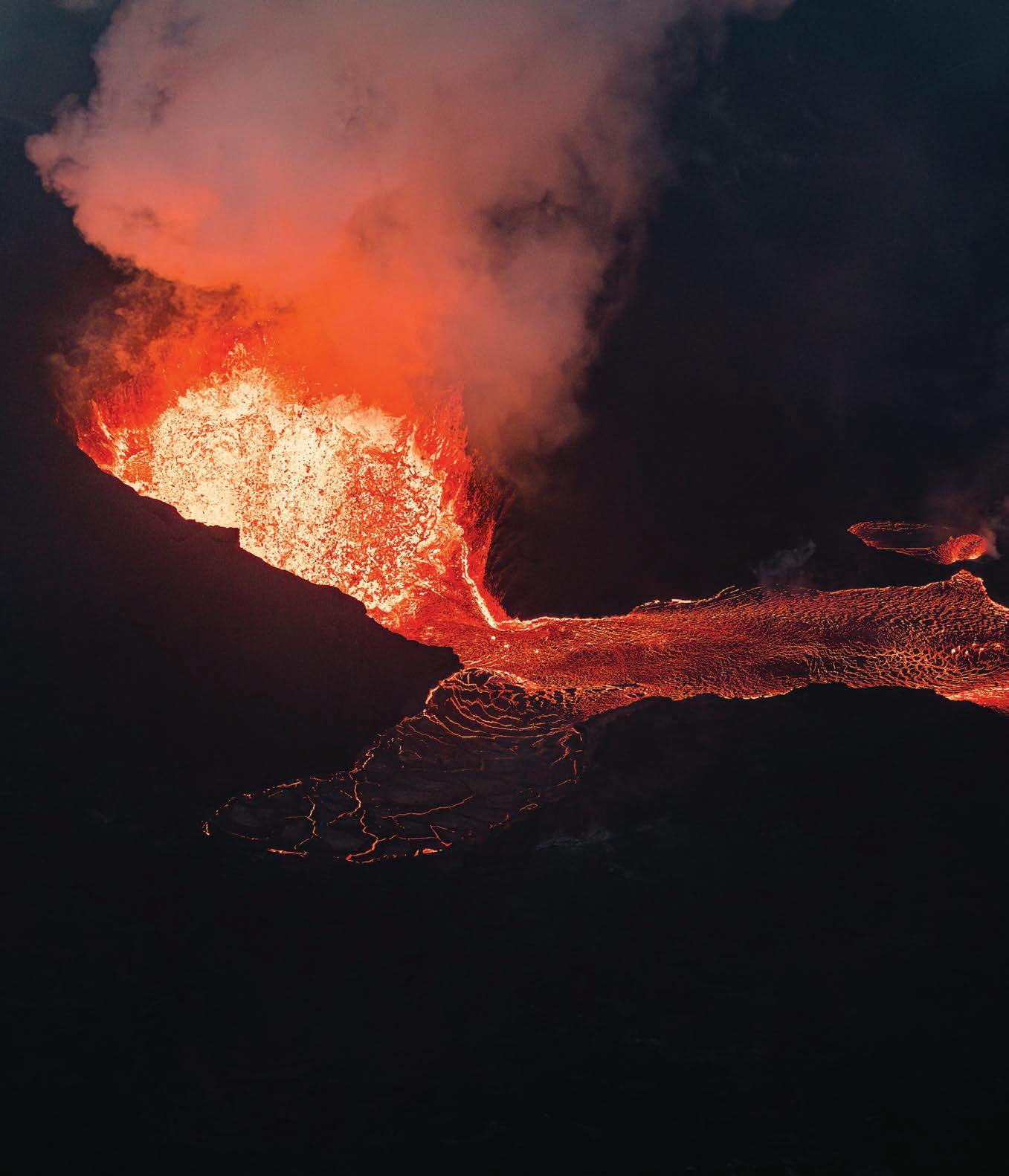
Adventure has a way of placing us face-to-face with the elemental forces that shape the world. Photographer and cinematographer Toby Harriman ’09 captured one of those moments during a spontaneous trip to Hawai‘i’s Big Island in June 2018, documenting the eruption of Kīlauea. Shooting from a helicopter, he witnessed lava surge from Fissure 8—rivers of molten rock consuming everything in their path, destroying more than 600 homes. From above, the scale was staggering. Yet the scene revealed something deeper: these islands are born from the same force. In volcanic landscapes, destruction and creation are inseparable.
To see more of Toby’s work, visit tobyharriman.com.
Photograph by Toby Harriman ’09
ADVENTURE 101
Roughing Lit
Lessons in Survival with Janice Dahl
Can you tell us how your Literature of Survival class came to be?
I was counting ballots for Holderness, pre-Covid, in a local election, and struck up a conversation with another volunteer who had been an English teacher in California. He told me about a survival literature course he’d taught, and it stuck with me. I remember thinking, this could be good. The timing felt right—students had just lived through a global disruption. We started the course the year after COVID, and it’s grown from there.
Tell us about the books you chose and why.
We begin with “The Revenant” by Michael Punke, based on the true story of Hugh Glass, a fur trapper in the 1820s who survives a brutal grizzly bear attack and is left for dead by his companions. It’s an intense survival story, but what makes it compelling isn’t just revenge—it’s the
small, practical decisions that keep him alive. Setting manageable goals. Using knowledge. Staying focused. Those are habits students can transfer directly into their own lives.
We pair that with excerpts from “Deep Survival,” which explores the brain science and social science behind why some people survive, and others don’t. It gives students a framework for understanding the psychology of resilience.
In the spring, we read “The Glass Castle” by Jeannette Walls. Her story shifts the focus from physical survival to emotional resilience. She grew up in a deeply unstable and neglectful home, yet goes on to build a successful life as an author. It broadens the de nition of survival to include social systems, identity, and perseverance. We also listen to the podcast “Real Survival Stories,” which exposes students to a wide range of scenarios and voices.
Together, the texts explore survival in multiple forms—physical endurance, psychological resilience, and emotional strength.
What do you hope students take away?
I hope they learn what strategies work best for them. Over the duration of the course, we look at many coping strategies and mindsets. They won’t need all of them—but if they can identify a few that resonate, they’ll be better equipped for life’s harder moments.
One theme we return to is taking things one step at a time. In “The Revenant,” it’s not grand gestures that save the main character—it’s incremental progress. When students feel overwhelmed—by exams, athletics, relationships—breaking challenges into manageable pieces helps.
How does this class support the stretch teachers and coaches ask of students? It invites them to confront di culty rather than avoid it. We talk openly about challenging situations. That re ection helps them begin forming a kind of “toolkit”: ideas, strategies, and examples drawn from stories and discussion that they can apply to themselves.
It also stretches them in everyday ways—speaking publicly, sharing perspectives, preparing thoughtfully, and keeping up with expectations.
What feels most transferable beyond the class?
Con dence and preparation. Students learn that when you choose adventure, you’re choosing challenge. The goal isn’t to eliminate hardship—it’s to meet it intentionally. If they leave thinking more clearly about how they prepare, adapt, and stay grounded, that self-awareness will serve them long after the class ends.
—Interview
by Marybeth Bentwood
PANORAMAS PROTECTING OUR WINTERS
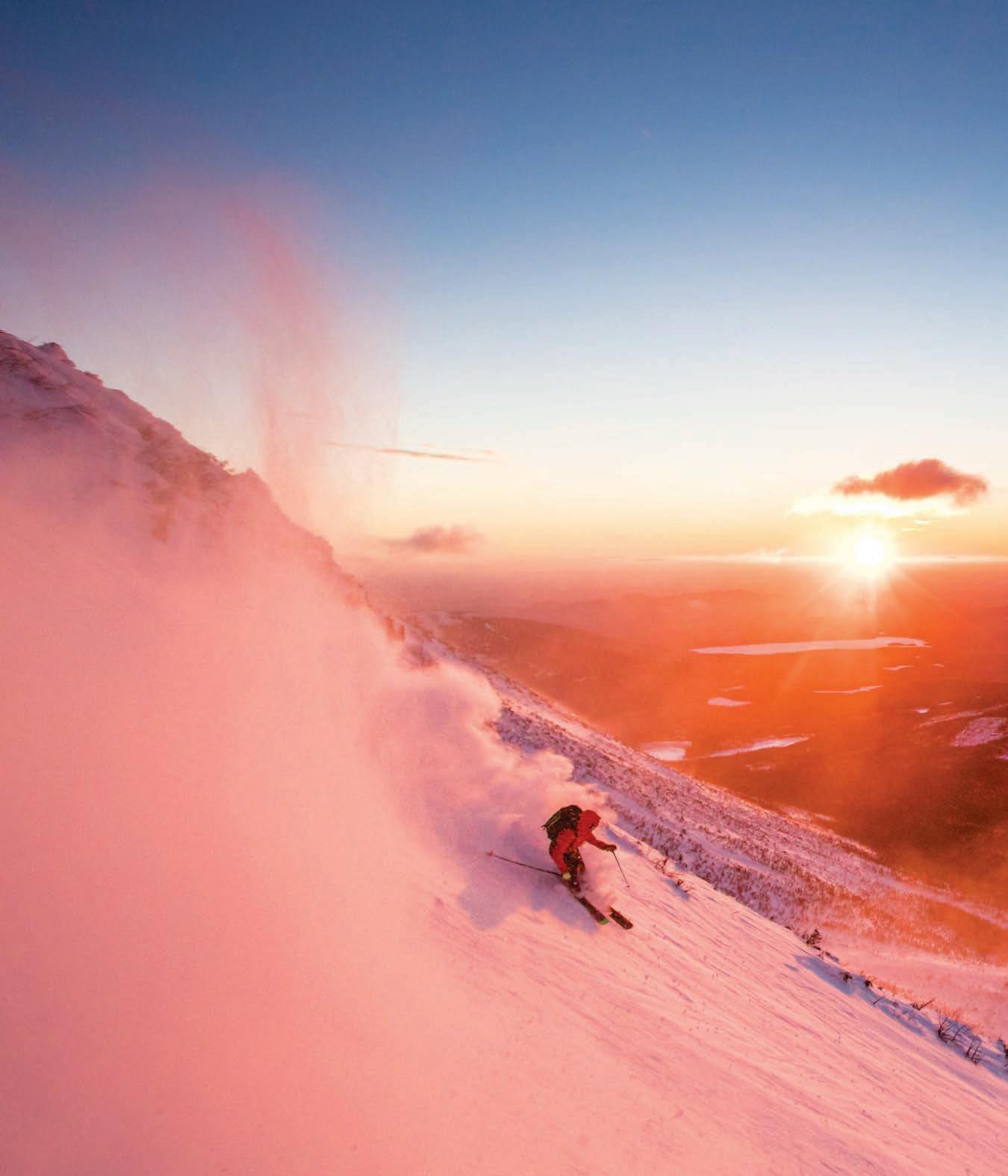
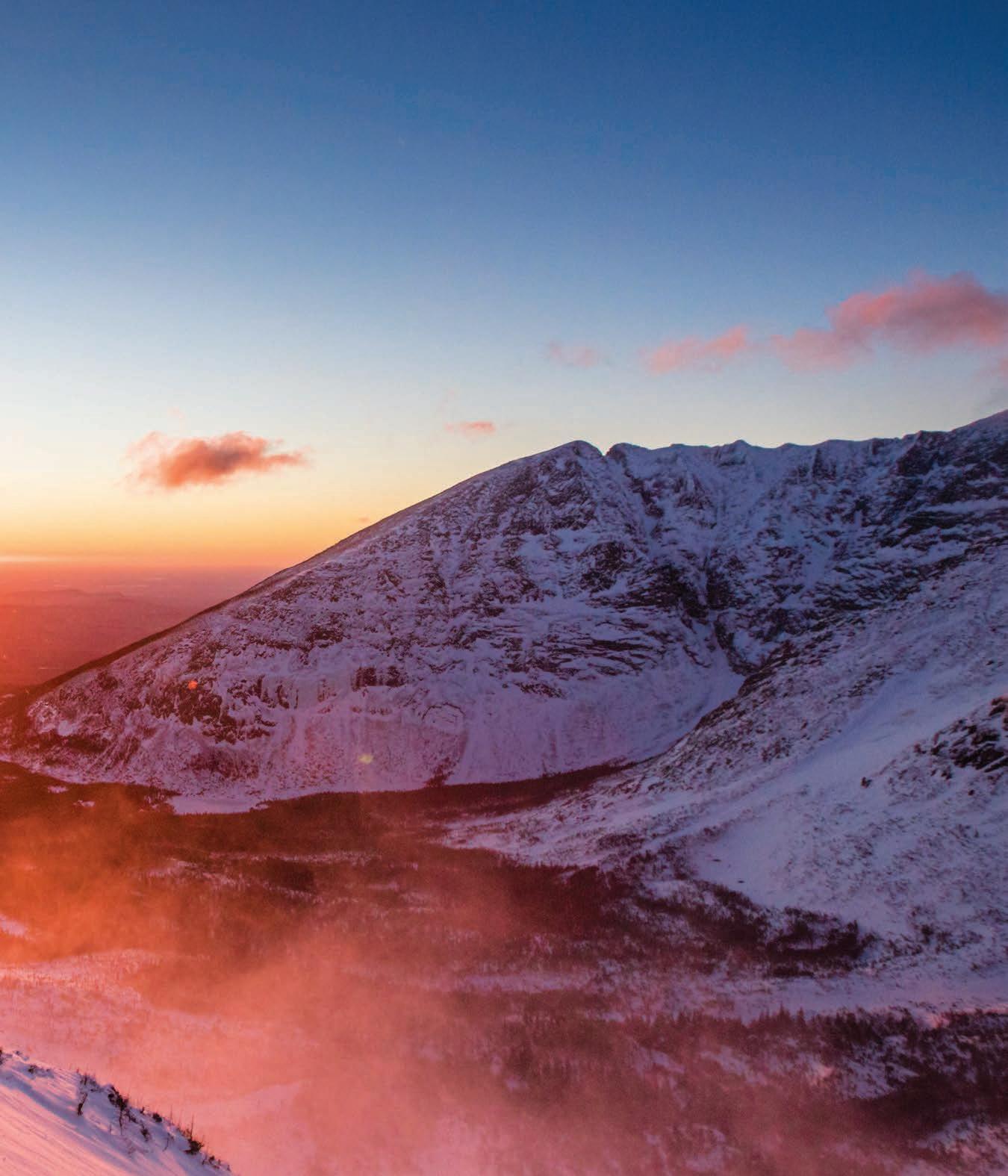
All in a day’s work. Professional Guide Jordan Cargill ’11 enjoys a beautiful sunrise—and some nice turns—on Mount Katahdin.
PROTECTING
By Greg Kwasnik
Photograph by Jamie Walter
On a beautiful spring day in 1988, long before he became a pion ring big mountain skier, guide, and climate advocate, Chris Davenport ’89 was just a kid sk ng Tuckerman Ravine with his friends.
“There were eight or ten of us from Holderness and we had this glorious blue-sky day with great snow. I remember topping out on the Headwall with my classmates Rob Frost ’89 and Ben Spiess ’89,” Chris remembers. Amazingly, the adults leading the trip had turned the kids loose and were o skiing their own lines in the bowl. “It’s a kind of scary section of terrain,” Chris says. “There are very few schools that would just allow that sort of freedom and independence of spirit in the outdoors, and Holderness did it.”
Having grown up skiing the ravine, Chris knew the mountain well and became the de facto guide for his peers. Although he didn’t know it at the time, the experience gave him a sneak peek into his future. “That was a really powerful moment for me,” Chris says, some 38 years later.
PANORAMAS
That future proved to be more rewarding than Chris could have ever imagined. After graduating from Holderness, Chris became a celebrated big mountain skier, twice winning the World Extreme Skiing Championships. Since then, he’s guided ski expeditions across the globe, appeared in more than 30 ski lms, and written two classic ski guidebooks: “Ski The 14ers” and “Fifty Classic Ski Descents of North America”. He and his wife Jessica also raised three sons—Stian ’19, Topher ’21, and Archer ’26—all of whom went to Holderness.
But just as Chris’s career was heating up, so too were global temperatures. Like skiers and snowboarders across the world, Chris couldn’t escape the changing climate. While humans have been measurably warming the Earth with carbon dioxide emissions since the Industrial Revolution, it was only in 1988—the same year Chris and his friends enjoyed that memorable day in Tuckerman Ravine—that the United Nations created the Intergovernmental
Panel on Climate Change (IPCC) to provide the world’s policymakers with scienti c assessments of the changing climate. Today, nearly four decades later, it’s clear that the IPCC has had limited impact. Temperatures have continued to warm at an exponential rate, and international treaties have failed to meaningfully limit emissions. A recent shifting of the political winds has made change even more di cult. In early 2026, the Trump Administration decided that the United States would exit the Paris Agreement, a legally-binding international treaty to limit global temperatures to under 2 degrees Celsius compared to preindustrial levels.
In a report it issued last year, the IPCC laid bare the latest worrying statistics: global temperatures had already risen 1.42 degrees Celsius from the pre-industrial average; Arctic sea ice extent had reached its lowest annual maximum extent in the satellite era; and 2025 was on track to be the second or third warmest year on record, right behind 2024.
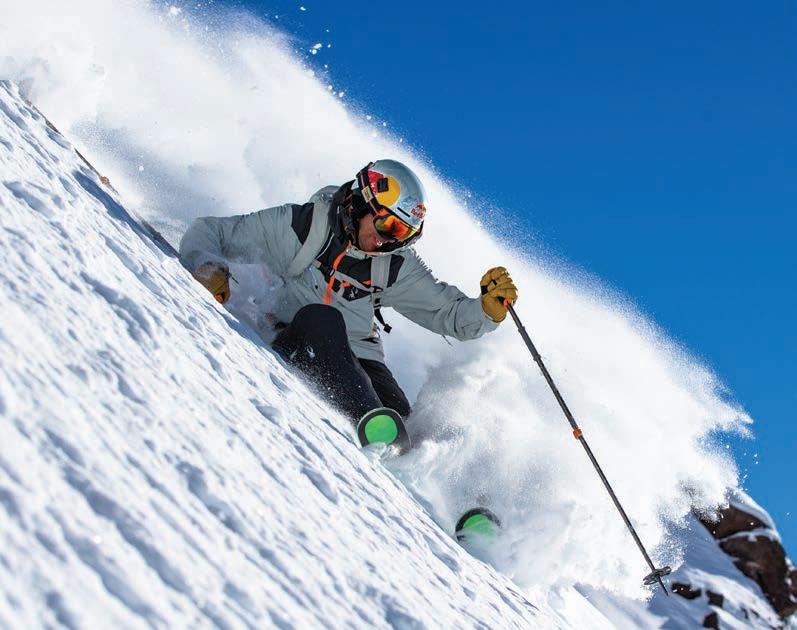
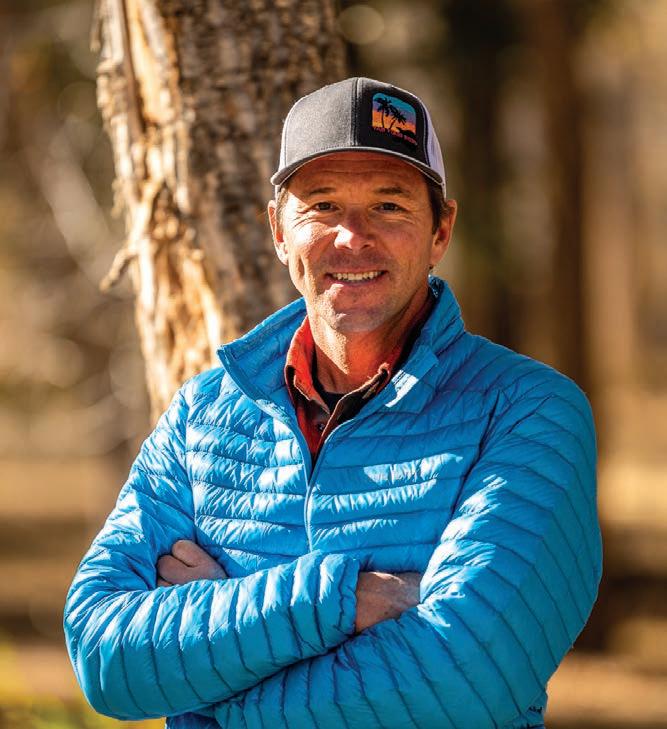
Chris Davenport ’89, two-time World Extreme Skiing Champion.
Photographs courtesy of Chris Davenport ’89
In New England, those cold hard facts have translated to noticeably milder winters. In December of 2023, New Englanders were given a glimpse of that warmer future when a heavy rainstorm and record high temperatures melted the early-season snowpack and caused massive ooding throughout the White Mountains. The Pemigewasset River, which abuts part of the Holderness campus, over owed its banks and ooded the low-lying areas between campus and downtown Plymouth.
At Hermit Lake, the shallow glacial tarn at the base of Tuckerman Ravine, more than 8" of rain fell from the sky.
None of this—the warming climate, winter rainstorms, and decreased snowfall—surprised Chris. He’d traveled all over the globe and had seen the melting glaciers and spotty snowpack himself. He’d even seen the e ects of climate change at home. When he moved to Aspen,
PANORAMAS
Colorado in 1993, he would often hike to ski the alpine snow eld that gave nearby Snowmass Mountain its name. Just a few years later, however, that patch of snow had all but disappeared. “I remember going up there one summer in the late nineties and all of a sudden the snow eld was kind of gone,” Chris says. “I was like, wow—this permanent snow eld is disappearing. It was kind of a lightbulb moment where I realized that things were really changing—not just in my backyard, but all over the place.”
So it was an easy call when legendary snowboarder Jeremy Jones approached Chris and asked him to join Protect Our Winters, the nonpro t he’d founded to rally skiers, snowboarders, and mountaineers—and eventually the entire outdoor industry—to push for change.
“I said ‘My gosh, this is right up my alley. Sign me up,’” Chris recalls. “I want to get on board.”
With that, Chris had become a member of the Protect Our Winters Alliance, a group of high-pro le mountain athletes—elite mountaineer Conrad Anker and Olympic Nordic skier Jessie Diggins are just two fellow Alliance members—who use their large platforms to advocate for climate action. Chris and his fellow athletes have given countless interviews about the growing impacts of climate change, spread the message to their audiences on social media, and have even climbed the steps of Capitol Hill to lobby legislators in Washington, D.C. For Chris, who at one point found himself discussing climate policy in the Oval O ce of the Obama White House, that ascent was just as intimidating as any he’d attempted in the mountains.
“Wearing a suit and sitting in front of a bunch of people in Washington was a lot scarier for me than standing on a steep line in Tuckerman Ravine,” Chris says.
“YOU CAN DO ANYTHING YOU BELIEVE YOU’RE CAPABLE OF. JUST GET OUT THERE AND DO IT.”
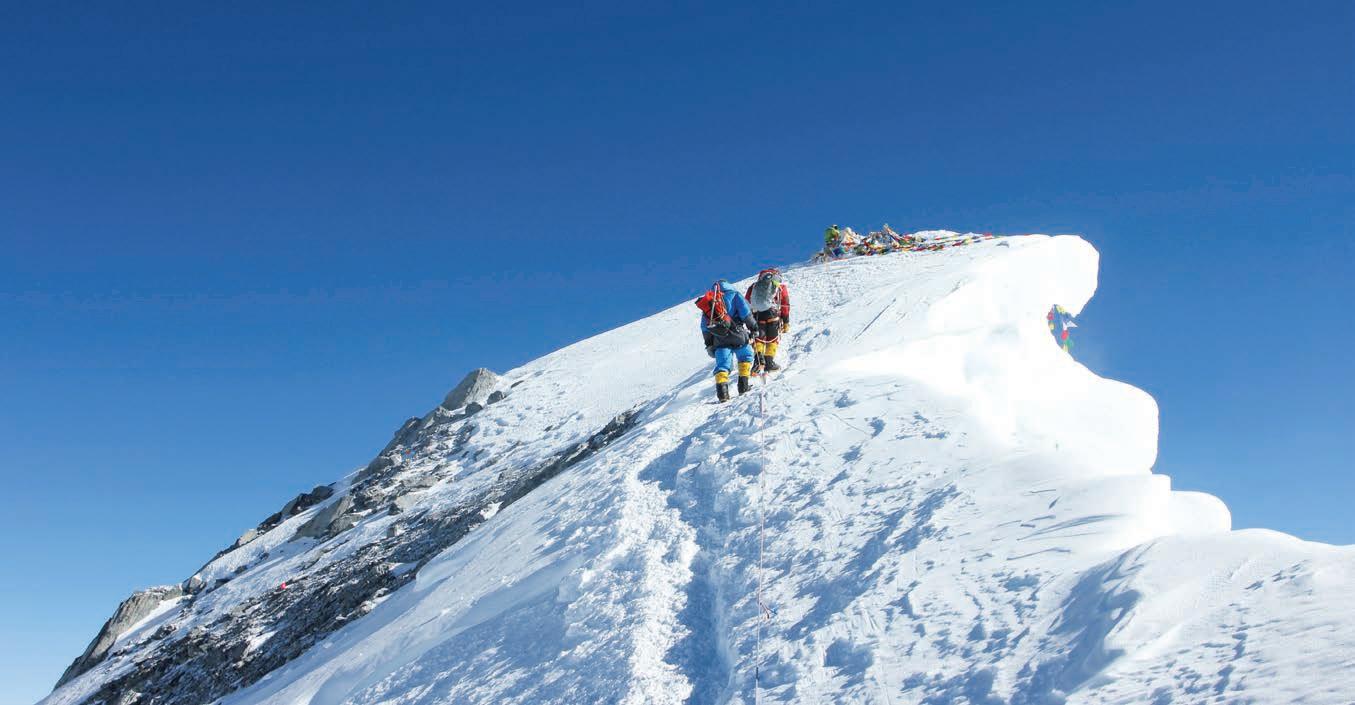
Chris nears the summit of Mount Everest on May 20, 2011.
PANORAMAS
A NEW GENERATION OF ADVOCACY
Just as Chris had company on the Tuckerman Headwall in 1988, he’s not the only Holderness alum ghting on the POW Alliance. He’s joined by New Hampshire native and elite mountain guide Jordan Cargill ’11.
Right around the time Chris became involved with Protect Our Winters, Jordan was still a Holderness student. Born and raised in the White Mountains, he came to Holderness as a competitive alpine skier but left with his sights set above and beyond the slopes. “Out Back was a huge piece of the puzzle—particularly
solo on Out Back,” Jordan says. “It was a wild experience to have as a 16-year-old. For me, it just set the hook for wanting to be out in wild places, particularly in the winter, as much as possible.”
The hook set, fate began reeling him in.
As a student at Bates College, Jordan ran the school’s outdoor orientation program, interned at the International Mountain Climbing School in North Conway, and moved west after graduation to guide on Mount Rainier. He’s been guiding ever since, and in 2020 founded his own guiding company, Mountain Shadow Adventures. In 2025, he reached the pinnacle of
his profession by becoming a “pinned” AMGA/IFGMA Mountain guide. It’s an elite designation given to members of the American Mountain Guides Association who earn the highest levels of Alpine, Rock, and Ski Guiding certi cation. Having achieved this benchmark, a guide automatically becomes a member of the International Federation of Mountain Guides and can guide in IFMGA member countries around the globe.
So it’s fair to say that Jordan has seen more than his share of mountain adventures. He’s guided on Denali in Alaska, ski toured West Greenland by
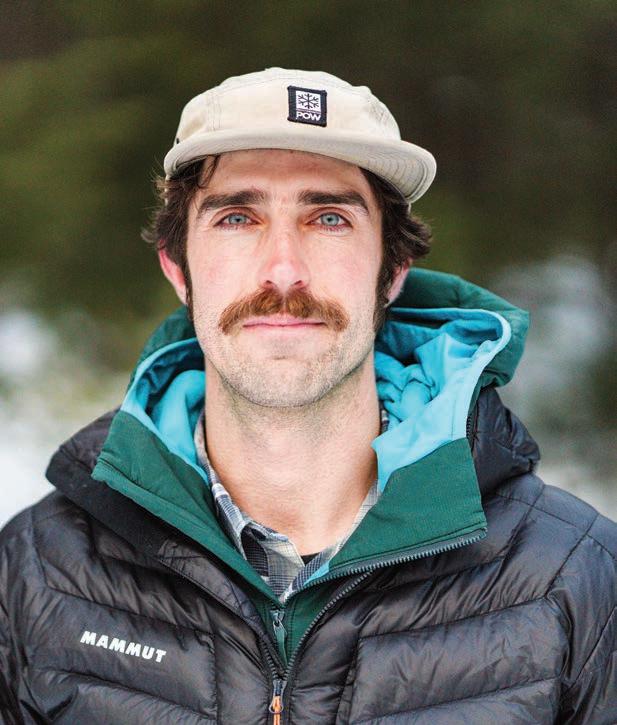
Jordan Cargill ’11 is a member of the POW Alliance.
Chris Davenport ’89 was an early board member of Protect Our Winters.
“I COULDN’T HELP BUT NOTICE THE CHANGES AND See IT HAPPENING IN REAL TIME.”
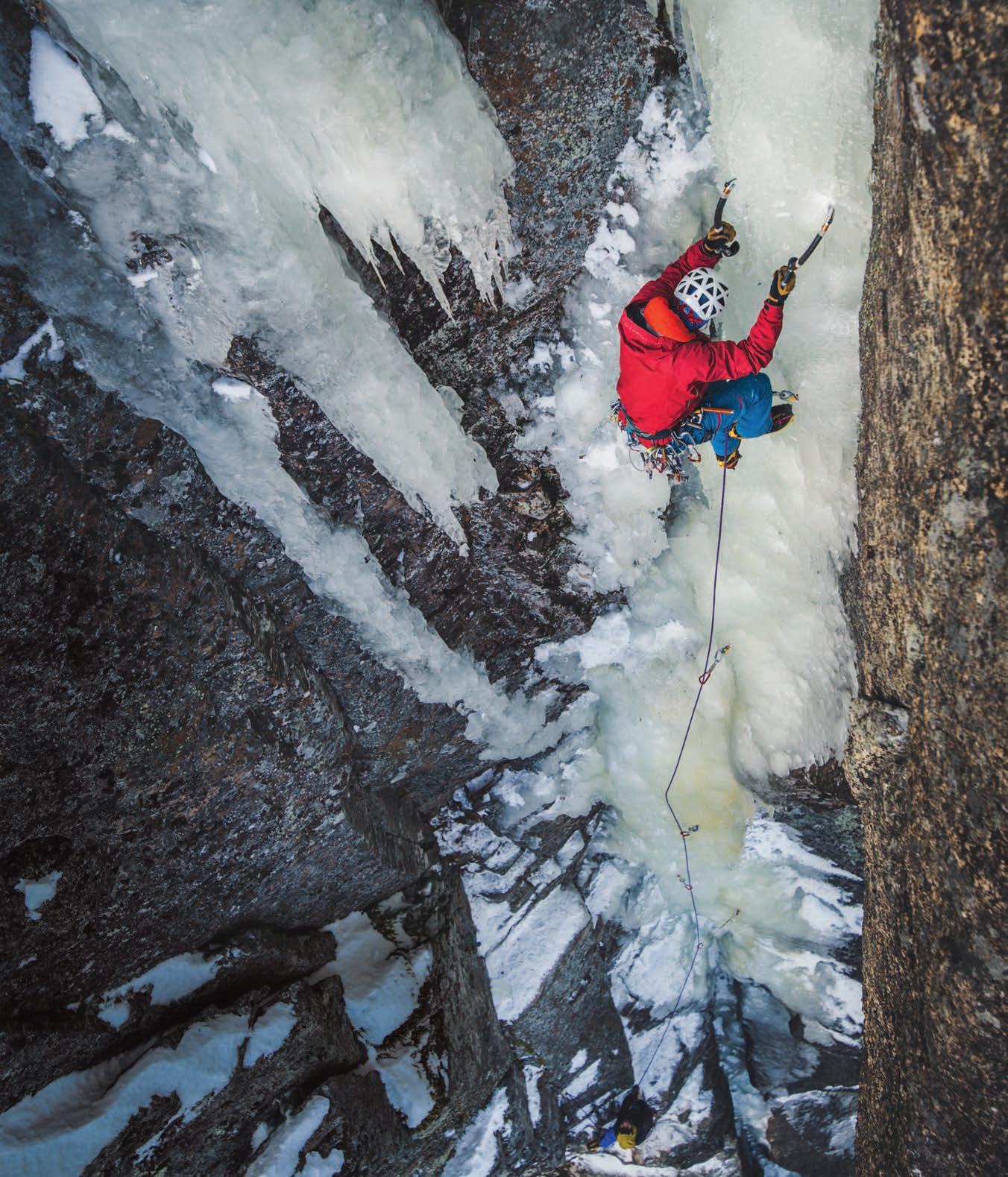
Jordan ascends the final pitch of Repentance, a climbing route on Cathedral Ledge in North Conway, NH.
sailboat, and led climbers up Ecuador’s highest peak, Mount Chimborazo. Along the way, he saw plenty of signs of a changing climate. On a 2024 expedition to 19,500-foot Mount Kilimanjaro, he was struck by how the mountain’s summit icecap, which measured 20 square kilometers in 1880, had shrunk more than 80 percent due to Tanzania’s warming, drying climate. “These equatorial glaciers are the canaries in the coal mine. They’re the rst to go,” Jordan says. He’d seen similarly alarming glacial retreats during intense summer heatwaves in the Paci c Northwest and in Alaska. “The more the glaciers melt, the
PANORAMAS
faster they melt because there are more positive in uences to promote melting,” Jordan says. “You can’t help but see it when you spend time in the mountains and in these fragile environments.”
Seeing those changes up close inspired Jordan to join the POW Athlete Alliance. “I couldn’t help but notice the changes and see it happening in real time, even during my short career so far,” Jordan says. “It feels like a really authentic way for me to get involved and advocate for realistic changes we can make as a society, and politically, to get where we need to be to protect these places and these sports that we love to do.”
GUIDING THE WAY
As mountain guides, Jordan and Chris are natural role models. Their clients literally follow in their footsteps—and now, through the POW Athlete Alliance, they’re setting a course for society to follow. For Chris, every trip is an opportunity to teach clients to follow his lead—both in the mountains and in his climate advocacy work. In 2022, he and Jordan spent a month aboard a ship just o the Antarctic Peninsula, guiding clients on short ski adventures over the region’s peaks and glaciers. It’s a stunning landscape that’s also one of the fastest-warming places on earth, where retreating glaciers and
Jordan teaches the basics of avalanche safety to Holderness students this winter.
collapsing ice shelves threaten ecosystems teeming with orca whales, penguins, and countless other vulnerable species. “When we guide in a place like that, we’re trying to deliver an incredible trip to people, but we’re also trying to create ambassadors for these special places that are worth protecting,” Chris says. “They might be hiking in the mountains or on a wild river. It might be on a wild continent like Antarctica—but at the end of the day, when people leave these trips, we want them to feel like it’s a special place.”
Many of those special places can be found a lot closer to home. On a bluebird day last February, Jordan found himself back in New Hampshire leading a group of Holderness students up the east side of Mount Washington. He’d spent several evenings that winter teaching
PANORAMAS
an Avalanche Partner Rescue course on campus, and now his students were in the eld practicing what they’d learned. New England had enjoyed a robust snow year so far, with more than four feet of snow on the ground at the Hermit Lake Snowplot. The cold and snowy winter had been a great one for Jordan, whose guiding service, Mountain Shadow Adventures, is based in the White Mountains. When he wasn’t guiding in far- ung locales this winter, you would have found him ice climbing with clients in Crawford Notch, leading backcountry ski tours, and teaching avalanche safety workshops. That gloriously sunny day in Tuckerman Ravine was a “cool full-circle experience” for Jordan, who relished the opportunity to pass on the love for adventure—and the natural world—that he’d discovered while
at Holderness. “These adventures are one of those ultimate crucibles—where you can get the most growth and challenge and get to experience things that few other people get to experience,” Jordan says. “It gives me a kind of unending gratitude towards these natural resources we have at our disposal and the opportunities we get.”
Those sorts of opportunities— particularly winter ski trips—may only become less common as the planet warms. While Jordan led his young charges into a snowy Tuckerman Ravine, Chris’s home in Colorado—and indeed most western states—were su ering through an apocalyptically warm winter. By midFebruary, Colorado’s average snowpack was just 41 percent of normal—bad news for skiers, and much worse news for the region’s rivers and reservoirs, which are replenished each spring by melting snow.
Such a disastrous winter will no doubt give Protect Our Winters even more reason to advocate for climate action, and it’s clear that Chris and Jordan won’t stop pushing for change. It will be a challenge, given the current political climate in Washington, but they’ve dealt with challenges before. Whenever he comes up against di cult moments in his life, Chris says he thinks back to his time at Holderness, when challenges like Out Back gave him the con dence to step outside of his comfort zone and do hard things.
So when the next generation of Holderness students decide to ski Tuckerman Ravine on a beautiful spring day, you might just nd Chris and Jordan taking on a di erent challenge: putting on a suit and tie and urging anyone who will listen—senators, congresspeople, presidents—to protect our winters.
“One of the things Holderness taught me was that you can do anything you believe you’re capable of,” Chris says. “Just get out there and do it.”
Holderness students climb Tuckerman Ravine in February with Jordan.
Photographs
PANORAMAS | CHANGEMAKER
Blazing a
By Greg Kwasnik | Photograph by Greg Kwasnik
Path
With AMC Trail Crew Manager Liesl Magnus ’17
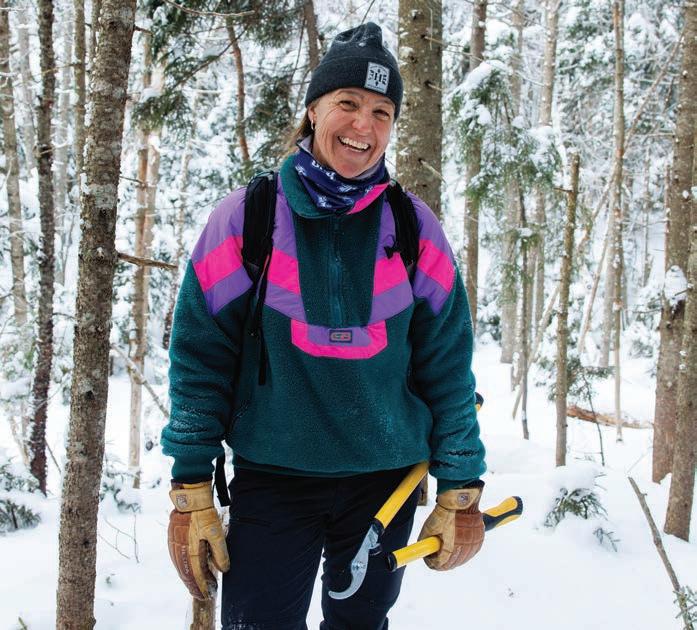
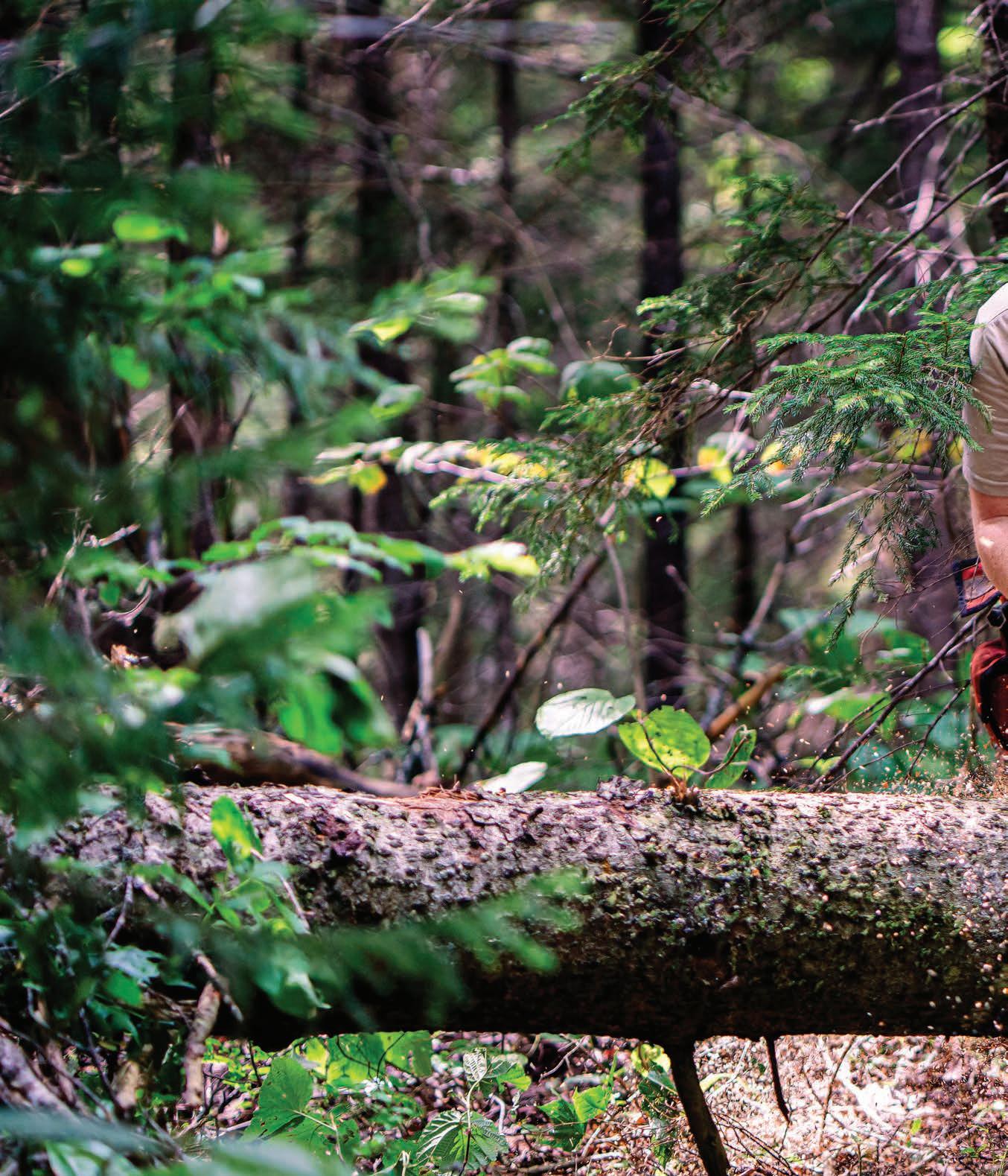
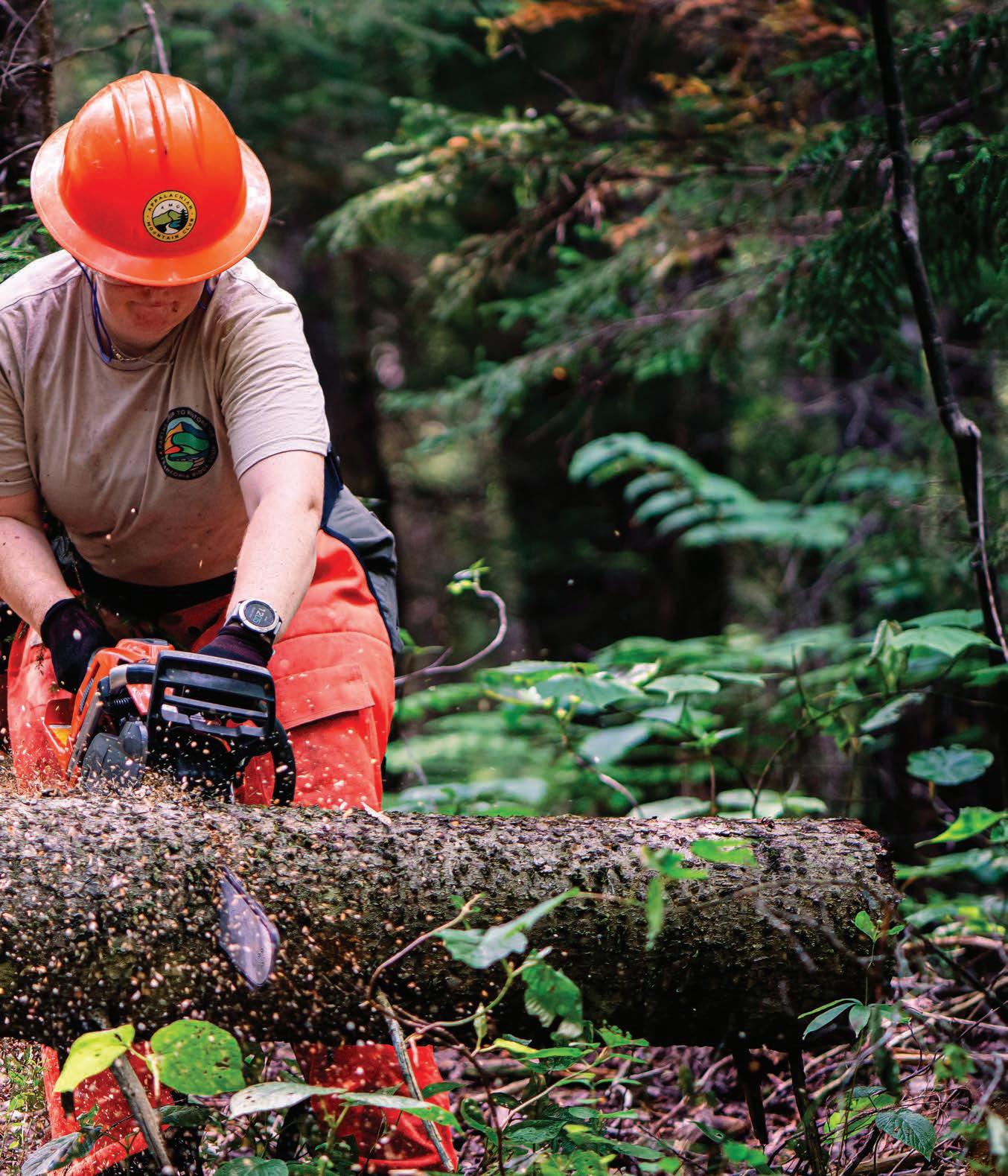
Liesl Magnus ’17 clears a blowdown on the Livermore Trail last summer.
If long woolen skirts, fussy three-piece tweed suits, and lush muttonchop sideburns were all the rage when many hiking trails were built in the White Mountains, then sustainable trail-building practices most de nitely were not.
Few people know this better than Liesl Magnus ’17, a Professional Trail Crew Manager for the Appalachian Mountain Club (AMC). She’s just one of the people responsible for rehabbing the steep and now-heavily-eroded trails blazed by our mutton-chopped forebears in the Victorian Era.
“It’s just really bad for sustainability, and a really steep trail is also a trail that’s very prone to erosion,” Liesl says. “A trail that has a lot of rocks is liable to make people want to go around the rocks, so the trail just gets bigger and bigger. Our focus—no matter what we’re working on, no matter what we’re doing—is keeping the people on the trail and the water o .”
Last summer, Liesl oversaw seven professional trail crews in the AMC’s Northern Region, which covers New Hampshire and Maine—including approximately 300 miles of trails in the White Mountain National Forest. Maintaining this network of aging, eroded trails, many of which rocket up steep mountainsides with nary a switchback in sight, is a massive undertaking. Just consider the Franconia Ridge Trail Loop, an 8.9-mile circuit listed on innumerable internet listicles—“Top 10 Most Beautiful Hikes Ever!”—that clog the Instagram feeds of the outdoors-curious.
The trails that comprise the Franconia Ridge Trail Loop, all built between 1826 and 1958, see more than 1,000 hikers a day during peak season and have become deeply eroded—so much so that parts of the trail resemble a ditch that runs several feet below the surrounding forest oor. If you’ve hiked the loop within the last four years, you’ve probably encountered Liesl’s trail crews toiling away in all kinds of weather: driving rebar in cold rainstorms, laying down fresh wooden boardwalks over pungent mountain bogs, and muscling heavy granite blocks into timeless rock stairways.
The ve-year project, funded by a $1.1 million federal budget appropriation, is absolutely essential for preserving one of the country’s most heavily-used trails. It’s also not without controversy, as surprised hikers encounter the gentler treadways, skillfully-built rock staircases, and fresh
wooden boardwalks that will protect the trail against the millions of footsteps it receives every year.
“The project has been going on for four years now, and it’s challenging because of just the sheer volume of public use that it gets, which introduces a whole mix of public opinion,” Liesl says, laughing. “It ranges from ‘This is amazing!’ to ‘You’re ruining God’s creation.’ That’s a line we hear a lot.”
If anyone is equipped to process that kind of public feedback, it’s Liesl. An environmental studies and government major while at St. Lawrence University, Liesl had considered attending law school before taking a recreation ecology class her junior year. The class, which studied the interaction between people and landscape through the lens of recreation, helped Liesl discover her true passion. After a professor encouraged her to apply for a Wilderness
Liesl Magnus ’17 is a Professional Trail Crew Manager for the Appalachian Mountain Club.
Photograph courtesy of Liesl Magnus
“The impact our crews have towards improving the accessibility, durability, and sustainability of natural resources is unbelievable.”
Ranger Fellowship with the Selway Bitterroot Frank Church Foundation in Missoula, Montana, her postgrad plans changed. Instead of sharpening her pencils for the LSAT, Liesl found herself clearing trails in the Idaho backcountry with crosscut saws and hand tools.
It was tough but rewarding work. Liesl and her crew would camp and work in the Idaho backcountry for nine days at a time, often clearing 1,000 trees over 40 to 50 miles of trail. Over those arduous miles, Liesl found a community and a vocation that were incredibly ful lling. “You work so closely with a group of four or ve, and you live together and travel together and work together for months,” Liesl says. “You know, the work is brutal—there’s no getting around that. But it really is the people that get you through and the people that keep you coming back.”
After that rst summer in the Idaho backcountry, Liesl took on a series of fascinating outdoor jobs. Over the next several years, she worked as a winter caretaker at Carter Notch Hut in the White Mountains; joined the Montana Conservation Corps, where she led a Women’s+ backcountry chainsaw crew and developed curriculum to train other group leaders; and spent a winter as a snow ranger in the Nez Perce Clearwater National Forest in Idaho. Today, she’s using those experiences—and the skills she acquired through them—to give back to the trails and the mountains that nurtured her love for the outdoors.
A New Hampshire native, Liesl grew up running, hiking, camping, and skiing in the White Mountains, and was an active member of Holderness School’s Outing Club while a student. She credits Alexandra Disney, a former faculty member, with helping foster her love for the outdoors. “She was just absolutely fundamental in encouraging me to keep pushing and trying to explore in whatever way that meant for me,” Liesl says.
Today, she’s returning the favor to her alma mater. When the inaugural Holderness Community Trail Work Day took place last August, Liesl showed up, chainsaw in hand, to lend a hand. She spent the day clearing blowdowns from Livermore Trail o the Kancamagus Highway, one of the
trails adopted by the school in recent years. It wasn’t your typical alumni event, where old friends chat over cocktails at happy hour. “I see all these alumni events, and it’s usually on a boat, and it’s never anywhere near where I live,” Liesl says. “I wouldn’t say that I’m particularly comfortable drinking cocktails on a boat, but I saw this and said: okay, trail work. This is something I can do. This is a way that I can be involved.”
That urge—to be involved, and to be of service—is something Liesl learned at Holderness. “I think Holderness uniquely prepares people to live in community with each other and be interested and willing to serve others,” Liesl says. “That’s a message that doesn’t always stick when you’re 17 years old, but I think about it a lot.”
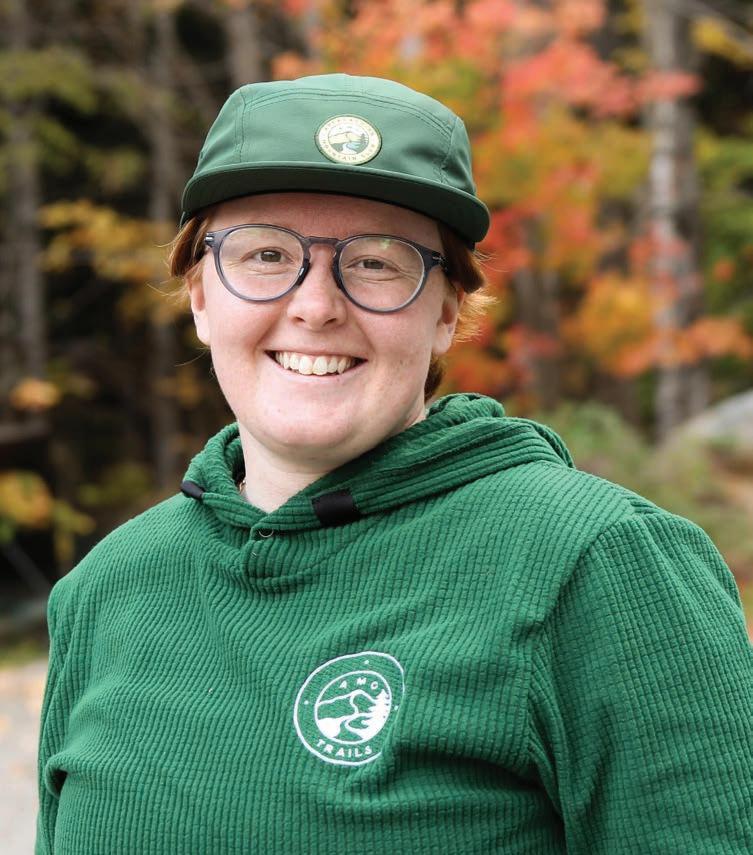
That lesson may not have made an impression on 17-year-old Liesl, but it’s a lesson that led her to where she is today. She’s found a job that she loves, and she’s carving a legacy in granite that will serve the region’s hikers for decades—and perhaps centuries—to come.
“Nobody is doing trail work for the money. I’m here and I do my job because I believe completely in the e ects that it has to steward and care for public lands,” Liesl says. “The impact our crews have towards improving the accessibility, durability, and sustainability of natural resources is unbelievable, and it’s my privilege as program manager to see that big picture.”
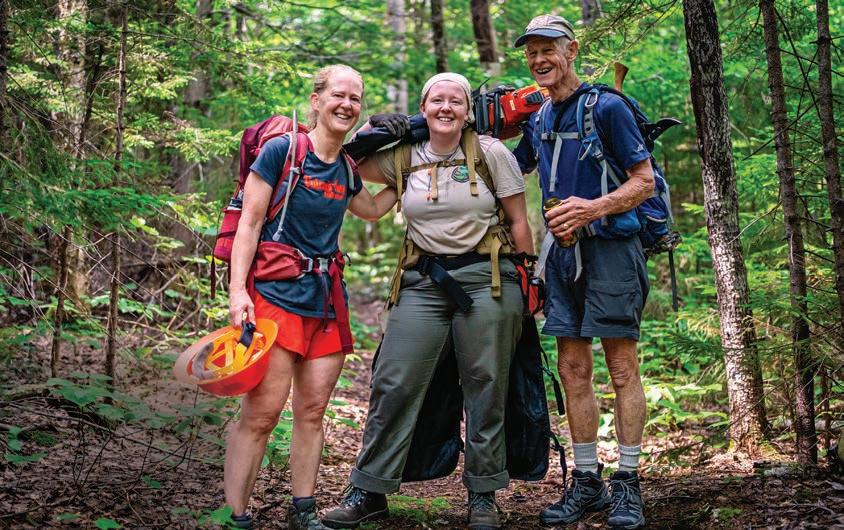
Liesl, her mother Emily Magnus ’88, and grandfather Van Adriance took part in the Holderness Community Trail Work Day last summer.
Getting outside and exploring our Nature Era through the biophilia hypothesis.
Rooted in Nature
By Erik Thatcher ’08, Director of Outdoor & Climbing Programs
PANORAMAS
Illustration by Davide Bonazzi
PANORAMAS
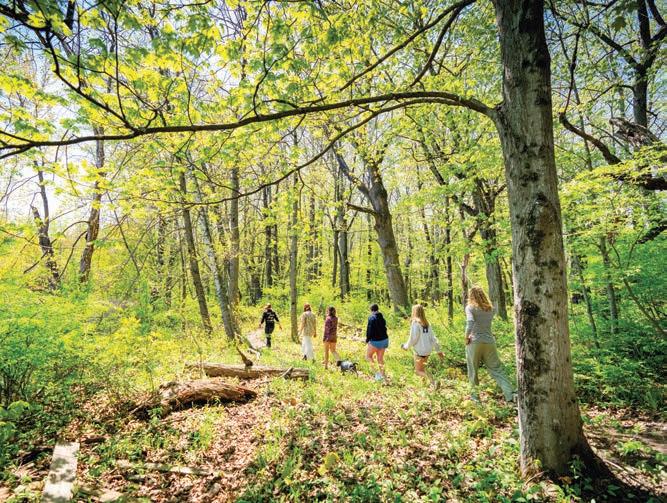
It all started with Zahra Kegode’s ’27 self-proclaimed nature phase.
In the winter of 2025, she was leaning into her connection with nature and how spending time in it made her feel better. She hatched a plan to gather a group of friends and start their weekday with a sunrise hike to the Top of the World, the height of land on our campus trail system. Any alumni or current student can understand the signi cance of what they were seeking simply by the lengths they went to to cram this experience into a typically-overbooked weekday at school.
Zahra, along with friends and fellow naturephiles Vivienne Maleska ’26, Marlena Maleska ’26, and Stella Regan ’26, rose before dawn and left their dorms on an early morning mission. They stopped in Pichette dorm to grab Outing Club snowshoes and made their way to the trails in the dark. Still half asleep, they trudged up the steep incline alongside the Outdoor Chapel with the silence of the predawn forest punctuated by the squeak of snowshoes, and perhaps twinges of regret that they were not still sleeping in a warm bed.
Once atop the incline, they settled into the snow at the top of the old ski hill and enjoyed each other’s presence, more often in silence than not, as the sun rose.
In a conversation I had with these early-morning adventurers, they reported their mood being elevated for the rest of the day, despite the early morning alarm. I can picture all of them carrying the joy of this shared experience behind a smile through classes and into study hall.
One element of why they felt happier after a morning outdoors could be explained by the biophilia hypothesis.
This idea, popularized by famed Harvard entomologist EO Wilson, tries to explain the science behind why we feel better after experiencing moments in nature. The hypothesis hinges on the understanding of human evolutionary history. For roughly 95% of
human history, our species has lived as hunter-gatherers, relying more on the abundance and health of natural ecosystems than human-shaped landscapes to sustain us. As our species evolved during this time, our emotions evolved to support our use of and interactions with nature, giving us a competitive advantage.
Since the Agricultural Revolution, the evolution of human culture and society has outpaced the evolution of human emotions and our ingrained connection to nature.
When our brain isn’t receiving the stimulus from nature that we are in the right place, at the right time, we become anxious, depressed, or feel lost. Our brain communicates to us using chemical signals that can a ect how we feel and, through that, our long-term mental and physical health. It’s a similar phenomenon to the stress we feel from a more heavily studied and understood evolutionary emotional holdover—our ght-or- ight response.
The gap between the evolution of our emotions and that of daily life has never been greater. Wilson sums up the current imbalance by saying, “The real problem of humanity is the following: we have paleolithic emotions, medieval institutions, and godlike technology.”
A host of studies have tried to prove this scienti cally. One study found signi cantly lower stress hormones in children who had recess on natural surfaces instead of arti cial ones. Another found better birth outcomes for women who lived on streets that were tree-lined than those who did not. Much of the scienti c research on this has come from the world of biophilic design— the idea of blending natural stimuli into our necessarily-human landscapes with the intention of achieving better mental health and performance outcomes. Studies have shown that simply having windows with views of nature can help students cope with academic stress in the moment and have greater attention restoration.
Many of these studies highlight just how little nature we need to bring back into our lives to start regaining balance and the physical and mental health bene ts that come with it. Luckily for those at Holderness, a nature-connected experience is the norm, and an immersive experience is easily achievable. There is a beauty in having to walk outside from building to building all day long, from marveling at the towering pines along the campus paths, to enjoying the sunset over Stinson Mountain—not to mention the health bene ts. A day in the life of a Holderness student or adult is punctuated by moments of awe and a connection to nature by necessity. Even when we go indoors, we bene t from intentional biophilic design elements such as the siding and windows of the Davis Center, designed to bring the outdoors in. And for those exploring their own Nature Era, and wanting a little bit more of it, exploration is just a few steps o the beaten path.
NORTH: Top Of the World
The height of land for our trail network hosts a craggy summit with a unique red oak – pine rocky ridge forest community of stunted and sparse oak trees and a carpet of mosses. Nearby is the Outdoor Chapel and old ski hill, providing views to the east and west.
Connecting with Nature on Campus
EAST: Upper Turf Trails
Behind the upper turf eld, a small brook has cut a little valley into the plain our campus sits on. Wandering down an old farm road and along the banks of the brook, one is likely to encounter deer or the resident beavers that have turned the far end of the brook into a beautiful meadow. In the shallow waters, if you look long enough, you can see native brook trout and sculpin darting around. If you are lucky, you may even see the moose that wanders out of these woods onto our upper elds from time to time.
SOUTH: South Side Trails
A trail network behind the Southside dorms, built by students on service days over the last six years, takes you past a pond, along a brook, and back up to the old Sargeant lot through a hemlock grove. Along the way, you pass through a silver maple ood plain and a northern hardwood forest. There’s a waterfall to appreciate in spring, and a cutaway bank where you can see the annual deposits of sediment from when this area was at the bottom of Glacial Lake Merrimack during the late Pleistocene epoch.
WEST: Lower Fields, Pemigewasset River access
Along the margins of the lower athletic elds is a network of current dirt roads and old abandoned roads that create a quick loop. Along this loop, you’re brought to the banks of the Pemi where you can see the process of river morphology playing out. You’ll pass an old homestead marked only by a cellar hole and dated corner stone, and likely see deer trotting along the treeline or birds picking away at the ample black cherries.
You Can Get There
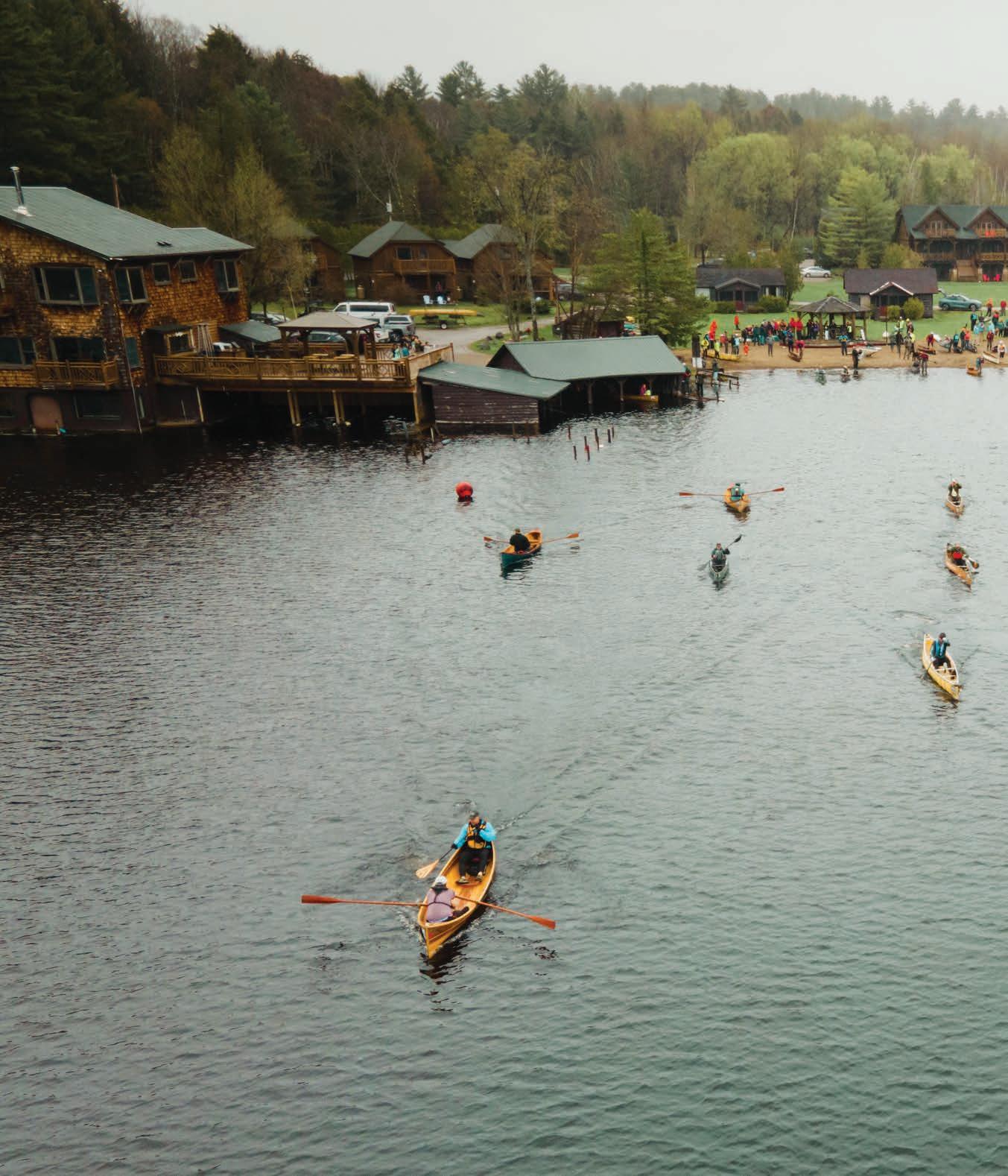
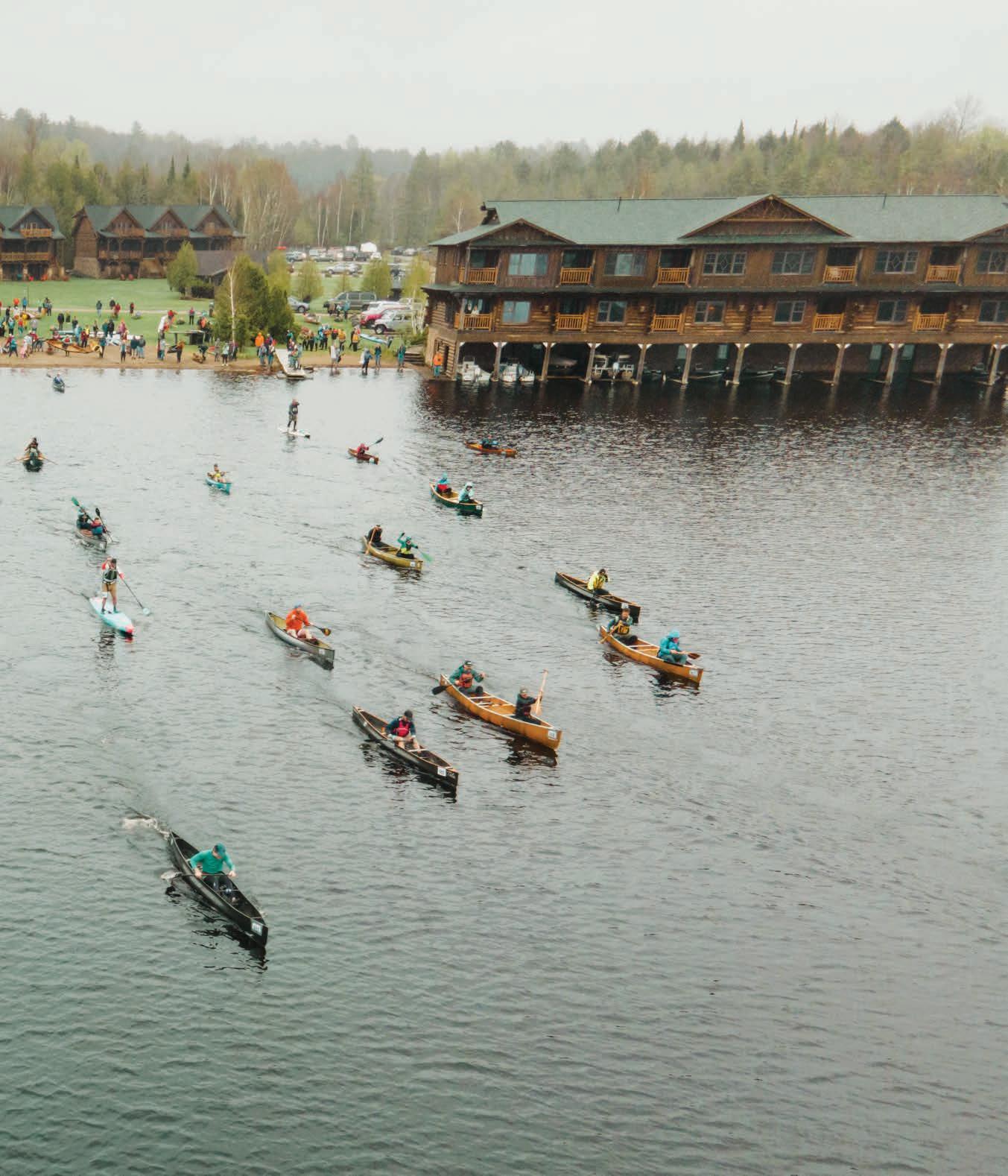
Paddlers set o at the start of the ’Round the Mountain race, Saranac Lake, NY.
PANORAMAS | CHANGEMAKER
From Here
Discovering Community Along the Northern Forest Canoe Trail with Karrie (Stevens) Thomas ’93
By Greg Kwasnik | Photograph by ROOST
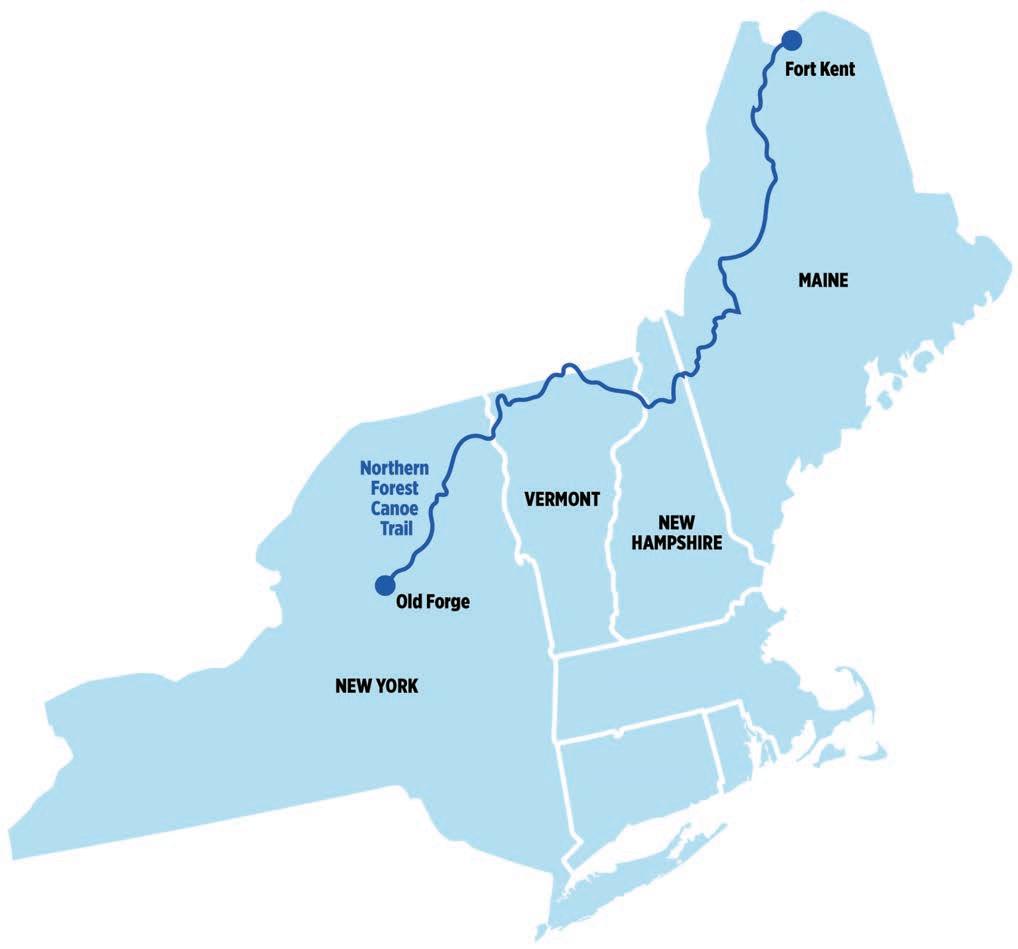
RRivers have a way of bringing people together. It’s a surprising truth many paddlers discover along the Northern Forest Canoe Trail, an epic waterway that connects 740 miles of rivers, lakes, and streams between Old Forge, New York and Fort Kent, Maine.
“One of the things I love is how people go into the trail and they expect it to be hard and expect it to be wild and they expect it to be beautiful,” says Karrie (Stevens) Thomas ’93, executive director of the Northern Forest Canoe Trail (NFCT), the nonpro t that stewards the route. “They don’t expect to meet so many incredible people.”
Those chance encounters can come at any point along the waterway, which was completed in 2006 but has funneled people through northern New York, New England, and Quebec since time immemorial. The region’s Indigenous peoples used rivers along the route like the Allagash, the Missisquoi, and the Androscoggin as traditional travel corridors for millennia;
European settlers and guides only later followed in their wake. Today, the route connects some 45 communities across the northern forest—mostly small towns and villages that come alive with the spring thaw and the seasonal ow of boaters and anglers.
When paddlers come into those communities after days on the water, sunburned and bedraggled, they’re often met by locals who o er dinner, or a place to sleep, or a ride into town. “I don’t think I’ve ever talked to anybody who didn’t say, ‘You know, the thing that surprised me most was the incredible people I met along the way,’” Karrie says.
Karrie knows the true power of water—to bring people together, to inspire, and to thrill. As a child growing up on the Holderness campus—her father Dick Stevens was the school’s longtime head of maintenance and her mother Gail ran the bookstore—Karrie fondly remembers early sailing excursions throughout the Lakes Region.
“My parents are big sailors and I remember when the motor turned o , that’s when the adventure really began,” Karrie says.
Perhaps it was those early water-borne adventures that led Karrie to take up whitewater kayaking while a student at Colorado College. She quickly fell in love with the sport, and it became her ticket to worldwide adventure. She ranged far and wide on numerous kayaking expeditions, running rivers in Mexico, Peru, Chile, Nepal, and India. On her honeymoon, she and her husband didn’t just travel across Europe like so many other newlyweds; they rented a car and kayaked across the continent. As Karrie explored the world in her kayak, she gained a deep appreciation of the communities and people nourished by the world’s wild rivers. “The kids come out of the woodwork and want to try on your helmet and pick up your paddle and cruise around the river and ask you all these questions,” Karrie says, re-running those
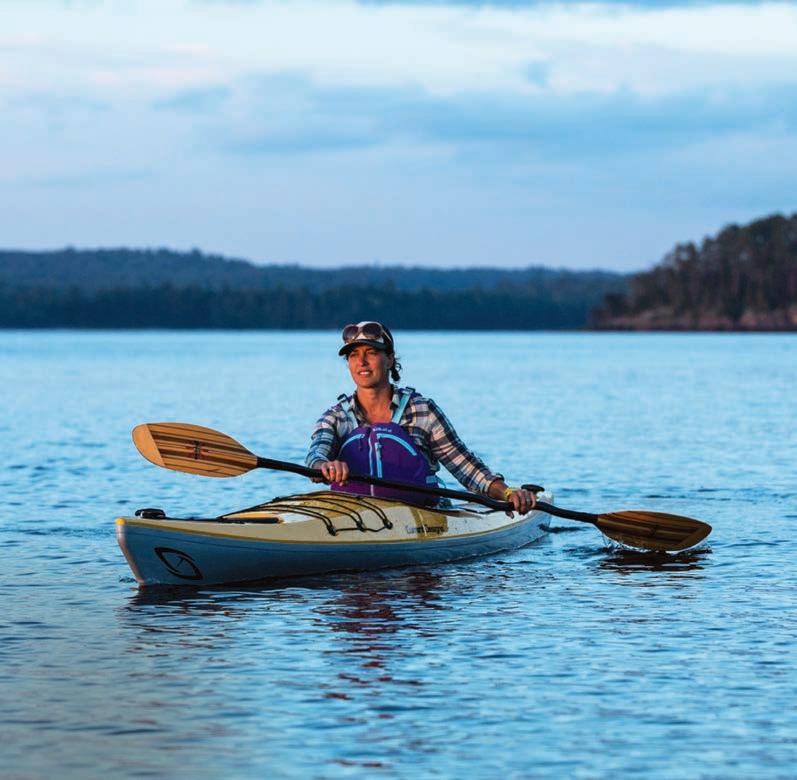
Karrie (Stevens) Thomas ’93 paddling Lobster Lake, Maine.
Photographs by David Jackson (left) and Northern Forest Canoe Trail (right)
PANORAMAS | CHANGEMAKER
river trips in her mind. “Then their parents come out and they want to talk to you.”
While Karrie was learning about di erent societies by kayak, she was also working to build community at home. As an anthropology major in college who studied community-supported agriculture, Karrie became directly involved in local farming and nonpro ts after graduating. She spent several years after college managing a 40-acre organic farm in Washington State, and then became Program Director for the Community Alliance with Family Farmers in California. In that role, she promoted local farming and helped to expand the state’s farmto-school program, now a nationwide movement that brings fresh, healthy food and farm education to schools.
After moving on to spend ve years as Community Relations Manager at Placer Land Trust in California, Karrie decided to return to her roots: New England, and paddling.
By taking the helm of the Northern Forest Canoe Trail in 2014, Karrie continued her longstanding work of community building. While living on the West Coast, she worked to strengthen communities through local agriculture and conservation; at the NFCT, she’s been focused on building a river-centered community. The NFCT, the nonpro t responsible for managing the 740-mile trail, builds community in numerous ways: by hosting community events like races and paddling clinics; building boat access ramps and campsites along the route; replacing trail signs; and inspecting portage routes. The NFCT’s ultimate goal in building out the trail’s infrastructure is twofold: to improve access to the trail for paddlers and to bring the paddlers’ tourism dollars to communities along the route. “That’s what the canoe trail is all about,” Karrie says. “Providing access for people to get on the water, but also connecting these
people with the communities of the region for all of the di erent bene ts that can come about as a result of that.”
The bene ts are almost too numerous to mention here. Thanks to the work of the NFCT, paddlers get to enjoy spectacular lakes and rivers; money ows into northern economies; and wild landscapes will (hopefully) be preserved by the people who treasure them. In many ways, the NFCT has succeeded in funneling society’s opposing crosscurrents into a 740-mile-long community—one united by a love for the water and the northern lands that surround it.
“We have all these events that bring together people from all di erent walks of life, all di erent perspectives, and somehow we manage to just enjoy each other and enjoy the time we have together,” Karrie says. “By taking the time to be together and be face-to-face in a space that isn’t full of con ict is probably a really good thing in the world.”
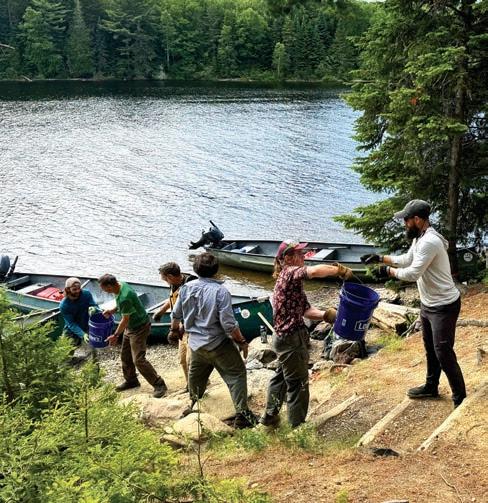
Improving campsites on the Allagash Wilderness Waterway.
PANORAMAS
Mind The Gap
While some students take a direct path to college, these Holderness graduates used gap years filled with mental and physical challenges to grow, reflect, and deepen their connection to the landscapes around them.
By Max Paro ’17
“I needed more time to explore the outdoors before settling into the classroom again.”
—Bryce Patterson ’23
BRYCE PATTERSON ’23
Gap Year Focus: Bike Guide and Mechanic Location: Colorado
What’s one thing you learned about yourself during your gap year?
Learning how to connect with people I would not have before, and nding community there. I guided people in their 50s and 60s as an 18-year-old. I didn’t think I had anything in common with them, but they gave me a lot of advice.
Did you ever have to lean into the motto of Out Back – enjoy when you can, endure when you must?
I had no idea what guiding was like; I didn't know how to drive the trailer, backing it up with bikes on the roof, under trees. We were given di erent ways to give people routes, one of them was a paper map, one of them was a GPS le, and none of them matched. It was a lot of guring out what I could trust.
Was there a moment that made you realize that outdoor recreation carries a responsibility for conservation?
When I lived in California, we had a ton of forest res. Riding through re-scarred areas and feeling the dry, windy conditions made the impact impossible to ignore.
CLAYTON SURBER ’23
Gap Year Focus: NOLS Patagonia
Semester | Location: Chile
What’s one thing you learned about yourself during your gap year?
It helped me understand what my instincts are and how I respond to being in a stressful or challenging environment. It also helped me identify my strengths in high-stress situations.
What’s one thing you learned while at Holderness that served you well?
Being comfortable sleeping in a tent, cooking outside, and being isolated (like Out Back solo). Those baseline skills made the expeditions more comfortable because I had done it before. Out Back was a good intro to a NOLS expedition.
Was there a moment that made you realize that outdoor recreation carries a responsibility for conservation?
While sea kayaking, we came upon beaches that felt untouched, yet trash had already washed ashore. Even in pristine, remote places, you see the impact of humans.
NOLS is big on Leave No Trace practices, and there are a lot of steps to minimize your impact. From how you cook and clean to even how you use the bathroom.
“The big climbs, the meals we shared, the goals we were able to achieve as a group, making the most of the experience, riding that energy, and savoring all of the small things are super important.”
—Clayton Surber ’23
GRACE KOELLER ’24
Gap Year Focus: Conservation for U.S. Forest Service, Caretaker for Appalachian Mountain Club Huts Location: New Hampshire
What’s one thing you learned about yourself during your gap year? The importance of mental endurance and strength.
What’s one thing you learned while at Holderness that served you well?
I learned how important it is to have people to struggle alongside. Reverend Vanderbrug said it’s easier to face challenges with others by your side. Even when I was alone in the backcountry, rst on search-and-rescue scenes, I still had my supervisor, the Forest Service, and New Hampshire Fish and Game on the radio if I needed help.
Was there a moment that made you realize that outdoor recreation carries a responsibility for conservation? That connection really started to take shape at Holderness, where learning outdoors, going on weekend trips, and Out Back built a foundation for exploring the outdoors and respect for the environment. I put that mindset into action while working with the Forest Service to maintain and conserve parks and with AMC to teach environmental stewardship and Leave No Trace principles. If we want to continue enjoying these spaces, we have to care for and preserve them.
KATE MIELE ’24
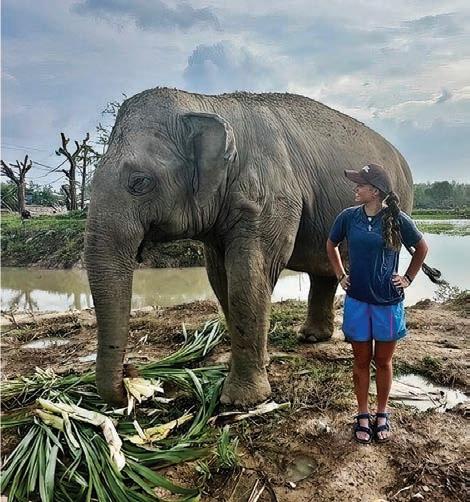
Gap Year Focus: NOLS Patagonia Semester, Elephant Volunteer at a Wildlife Sanctuary
Location: Chile and Thailand
What’s one thing you learned about yourself during your gap year?
NOLS has very deliberate peer-to-peer feedback sessions, and it changed my perspective on how I want to share and receive helpful feedback.
What’s one thing you learned while at Holderness that served you well?
Appreciating and valuing being alone and re ective. During Out Back solo, I started journaling, and now I do it a lot.
Did you ever have to lean into the motto of Out Back–enjoy when you can, endure when you must?
Sea kayaking at NOLS. It rained every day for 30 days. I've never been wetter and colder in my life. At rst, I didn’t have a good mindset about it, then realized there wasn’t anything I could do about the weather, thought about the motto–enjoy when you can, endure when you must–and started to appreciate the small things like a dry sleeping bag and having a good meal.
Book Recommendation: Embrace the Suck by Brent Gleeson
Was there a moment that made you realize that outdoor recreation carries a responsibility for conservation?
For 30 days, we didn’t see another person—just a helicopter dropping o rations. That kind of vast emptiness made me realize how much of our planet is still wild, and how important it is to preserve it so that others can have the same backcountry experience.
The elephant project in Thailand led me to think more about the importance of responsible tourism. It was one of the few humanely-managed wildlife conservation centers there that rescued elephants from being ridden and abused. I didn’t know that any elephant trained for riding has been abused—often starting by chaining the calf away from the mother. It’s really sad to see the e ects of that, but the e orts to educate people on responsible tourism are impactful.
MOLLY RHATIGAN ’24
Gap Year Focus: Appalachian Mountain Club Caretaker, NOLS Patagonia, Out Back Leader, Farm Hand in Hawaii
Location: New Hampshire, Chile, and Hawaii
What’s one thing you learned about yourself during your gap year?
My mental and physical capacity for resilience is a lot greater than I had previously thought.
What’s one thing you learned while at Holderness that served you well?
Being a senior leader on Out Back and part of the Outing Club helped me develop leadership skills, taking initiative when things needed to be done, and helping other members of the group.
Was there a moment that made you realize that outdoor recreation carries a responsibility for conservation?
The family on the farm in Hawaii was almost entirely self-sustaining–it was a completely di erent lifestyle. There was so much more connection to the land and appreciation for it. At home, we don't have as much connection to the land because we're not cultivating it, not sustaining ourselves o of it, so there’s a disconnect.
“Holderness has changed what I want to do in the future. In college, I'm planning to major in wildlife and fisheries biology and minor in education and conservation. The idea of conservation has become very important to me.”
—Viv
Maleska ’26
VIV MALESKA ’26
Gap Year Focus: Rescue Certification Programs and NOLS Patagonia Semester
Location: New Hampshire and Chile
Why are you doing a gap year—next year?
I want to get these certi cations before I’m busy with college.
What’s one thing you learned about adventure, the outdoors, or yourself while at Holderness?
How important it is to me to be outdoors. I’d rather go on a hike, Nordic ski, or go rock climbing than sleep in on the weekends.
Did you ever have to lean into the motto of Out Back –enjoy when you can, endure when you must?
On the winter Mount Washington hike, we didn't have ideal conditions. This year, we were able to summit, but the year before, we weren't due to the weather. We ended up hiking Monroe with wind gusts up to 60 or 70 miles per hour. It ended up being fun and rewarding once we got below tree line.
BREATHE
BOGGED DOWN
A short 10-minute drive from campus, the Quincy Bog Natural Area has served as the setting for countless field trips for our science classes. A mile-long trail and boardwalk circle the pond, providing the perfect vantage point to view birds and other forms of wildlife.
LEGACY OF ADVENTURE
Snapshots in Time
Ray Campbell ’78 Captures Out Back on Film
Thanks to smartphones and social media, there’s often zero lag time between when we take a picture and when we share it.
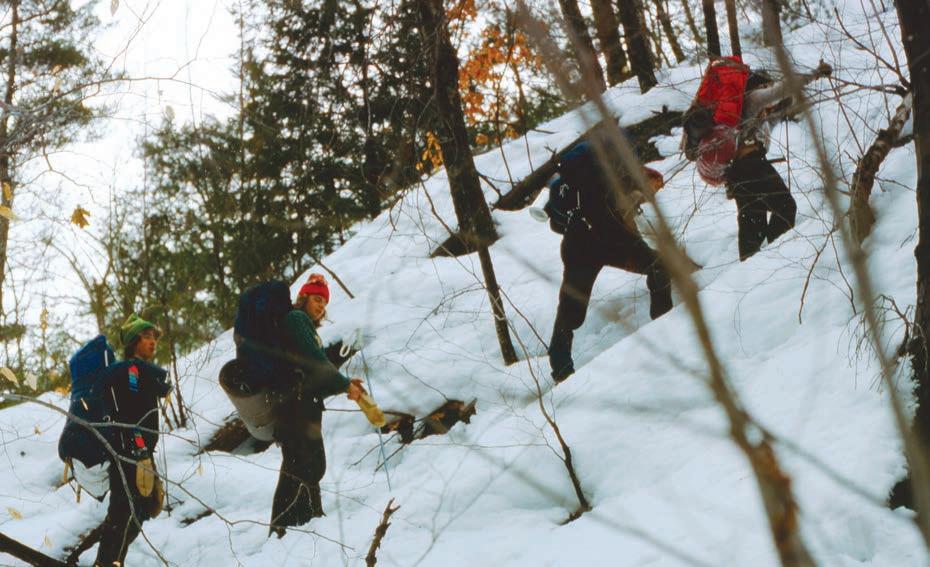
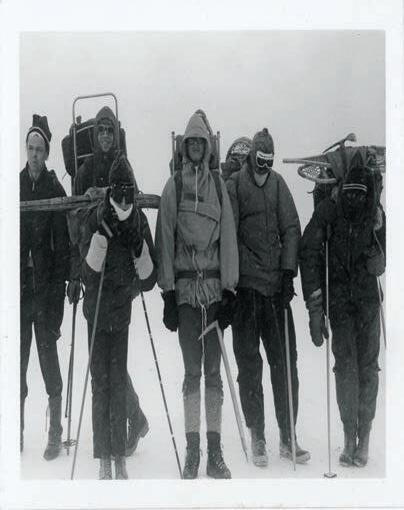
It’s a far cry from the pace of technology in 1977, when Ray Campbell ’78 lugged his trusty 35mm lm camera through the snowy White Mountains on Out Back. In the end, it took 48 years—give or take a few months—for Ray to share photos of the 11-day trek with his Holderness friends.
“People were pretty blown away by the photos when I shared them last year,” Ray said. “I know I was. It was like a time machine.” Here’s the story behind those long-lost shots.
THE LOST PHOTOS: 1977
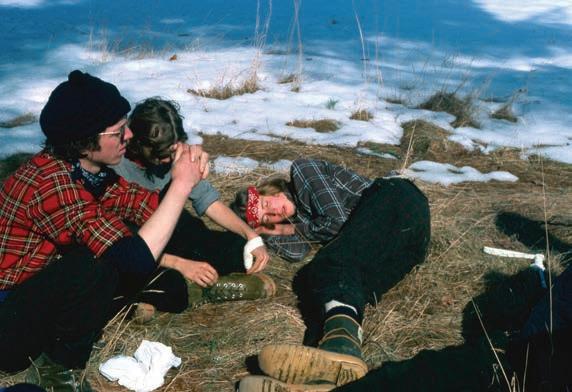
“I enrolled at Holderness in 1976. I bought the camera for a driving trip out West with my parents the previous summer. It was a Nikkormat, Nikon’s entry-level camera. It was probably $175 used back in the day. I knew OB [Out Back, then known as Outward Bound] was a big enough deal that I wasn’t going to just do black and white lm. So I bought slide lm. The funny thing is, unless you have a projector to show them, they’re really no good. I don’t recall ever showing them at Holderness. I used the slide format because that was what camera geeks tended to use rather than just getting little prints.”
THE DISCOVERY: 2025
“I bought a decent scanner recently and spent more hours than I can count in the basement going through pictures. It’s been maybe a two-year exercise and I’ve scanned something like 26,000 pictures dating from the 1940s. As I was working my way back through my pictures, I came across a couple of boxes of slides. I said ‘Oh, yeah, my Holderness slides—hell yeah!’ I scanned those and said, ‘Oh, this stu ’s too good not to share.’ I was just stunned by the color, the vibrancy, the sharpness. They hadn’t degraded at all. I was hyped. So I scanned them in and shared them with my classmates.”
1. OUT BACK: THE JOURNEY BEGINS
“We started by walking from campus down through Plymouth. Once you cross the river, you take the right on Main Street, and that goes out of town. And really, not far from town, you’re essentially in the White Mountain National Forest. About a mile out of town, we basically just left the road and hiked up into the woods. I remember it was a steep hike.”
2. FIT CHECK
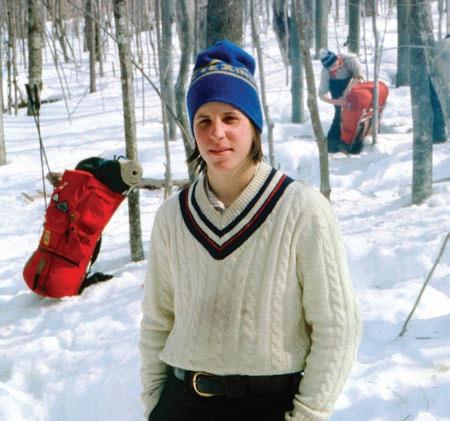
“There’s at least one photo of me that’s really easy to pick out. I’m the moron wearing the tennis sweater [laughs]. I had not had any signi cant camping experiences like this. So if you look closely, it’s like WTF? I’ve got a button-down dress shirt and a white cotton tennis sweater with the red and blue V-neck stripes…I’m wearing the standard-issue wool pants. Everybody’s hair was greasy because we were sweating our asses o .”
4. THE END OF THE ROAD
3.
UP AND OVER MT. MOOSILAUKE
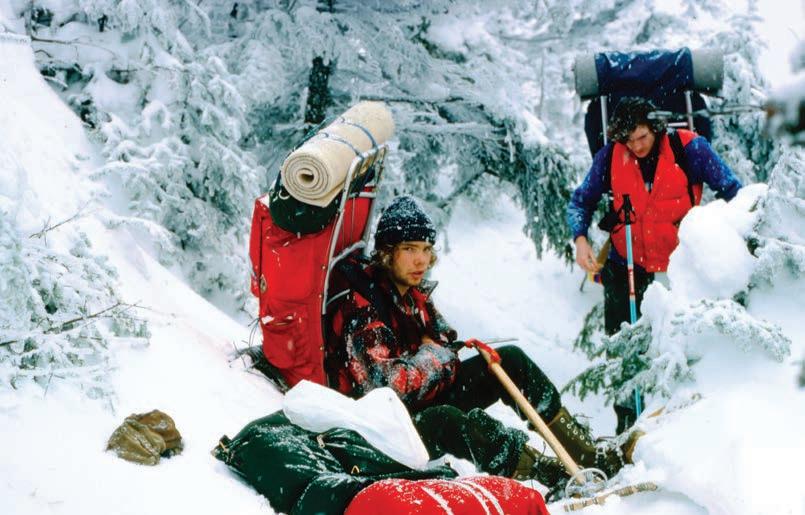
“That was probably the most memorable part of the trip. Next to Mt. Moosilauke is a place called Mt. Blue. And we ended up going up over the col between Moosilauke and Blue and then down Beaver Brook on the other side. It was super steep. We basically skied down on our snowshoes— we just sat on the back of our snowshoes and shot down a couple hundred yards. The snow was extremely deep, and there were no obstructions. But anyway, it was a brutal hike. There’s a picture of Don Whittemore ’78 in the red check jacket with the snow falling, and he’s just sitting o to the side of a snowy trail. You can tell that’s going up and over Moosilauke and Blue. That was probably the most intense, physical winter camping experience.”
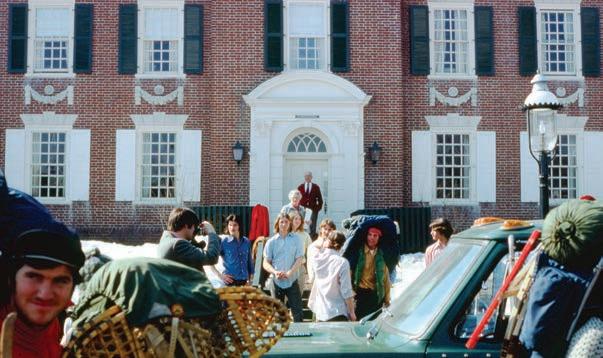
“After Moosilauke, we continued up to Lyman, the Lyman Grange. We were sitting there, and one other group joined us. We were picked up there. I mean, we must have gone…looking at the map…oh hell, what did they do to us? That’s got to be 45 miles. Wow. That’s a long hike. I just remember we were fantasizing about food and being able to shower. Everyone kind of arrived back on campus at the same time. There’s one picture where you can see Mr. Hagerman standing up on the steps of Livermore. He was the longtime headmaster, kind of observing the proceedings.”
5. ENDURE WHEN YOU MUST
“This was a whole lot harder than using an iPhone. I mean, I shot probably six or seven or eight rolls of lm. OB was one of the profound experiences of my life—I totally remember it. It was a great thing. I remember, at the end, wishing I’d done better because it was freaking hard. I mean the pictures convey, I think, some of the exhaustion. Everybody was tired. Everybody was bitching and moaning. I feel like I bitched and moaned too much. It was a tough experience that you got through, but also learned some lessons from. It was also just extremely beautiful. Even during OB, it was clear it was a special opportunity.”
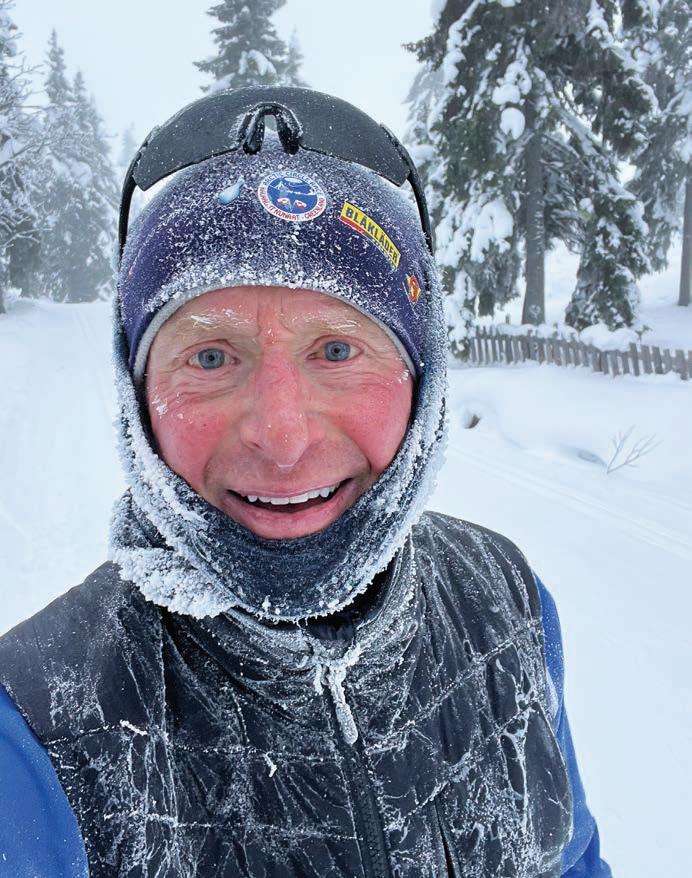
Norway, 2026
FACULTY WHO SHAPED US
Tom Armstrong ’76
A conversation with Tom Armstrong ’76, who returned to Holderness in the 1980s to teach and serve as director of Out Back. Tom went on to enjoy a long and successful career at L.L. Bean, where he retired as Chief Merchandising O cer in 2019. He is currently board chair of the Maine Coast Heritage Trust.
Could you tell us about your time at Holderness? How did the Outing Club, Out Back, and other parts of your Holderness experience shape the direction of your life?
Growing up in Maine and hiking all the White Mountain 4,000 footers with my father gave me a wonderful grounding
and appreciation for time spent outdoors. Given my upbringing, Holderness was the perfect t; the blend of academics, sports, a culture based in service to others and outdoor adventure made it feel like the right place to be.
I feel lucky to have had mentors such as Bill Biddle and Bill Clough. The
combination of reading Henry David Thoreau’s Walden in Bill Biddle’s English class, then having him lead us on a winter overnight outing club trip to traverse the Franconia Ridge was a beautiful link between the academic and outdoor experience. I clearly recall camping on the frozen pond just below the treeline on Mt. Lafayette, with classmates Charlie Woodworth ’76 and Brad Tanner ’76, where Bill with his infectious enthusiasm had us don crampons and ice axes for the ridge traverse and likely shared a few Thoreau quotes along the way!
Bill Clough was my OB leader and we were the ski group that year who used those white sawed o jumping skis. Bill’s leadership style was to allow us to make the route and compass decisions, whether we were right or wrong. Yet, I always felt safe knowing he would not allow us to get into too much trouble and his quiet competence in the outdoors would keep us safe—a wonderful leadership lesson for all of us. My memory of Ki Clough carrying a 5 lb. bucket of frozen peanut butter swinging o her pack (and she hated peanut butter) and Rick Brook ’76 singing the school musical’s theme song at midnight on our night hike brings a smile to my face!
Tom Armstrong ’76 today (left) and as a Holderness teacher in the early 1980s.
And how can I forget Fred Beams making us run sand hills in lacrosse practice? I do believe the coaches at Holderness were e ective in guiding a lifelong interest in overall tness.
You came back to Holderness as a teacher, and during that time you spent several years as OB Director. What was it like for you to come back in that capacity? Pete Woodward was gracious to o er me a winter intern role after nishing college. I taught history, helped Peter Barnum in admissions, coached JV hockey with Pete B., had dorm duty and led an OB group. I loved it and came back the following four years to teach Earth Science, coach soccer, hockey and lacrosse, eventually stepping into the large shoes of Bill Biddle and Fred Beams leading the Outing Club and OB. What I appreciated most was having the opportunity to spark an interest or passion for the earth sciences and outdoors with others; students, parents and peers. We ran a mini-OB weekend for parents in January which allowed us to provide a taste of the experience and generate program support. Even when we all woke up one morning at -25 degrees, I believe those who attended gained a deep appreciation for this aspect of the Holderness experience. It was so cold a bite into a frozen bagel broke a participant’s gold crown making for a good search and rescue operation in the snow—which was successful by the way!
Experiencing OB with Head of School Pete Woodward as my co-leader demonstrated that during outdoor adventures, traditional hierarchies fade, giving each team member the chance to nd their niche and their own style of leadership. I recall Pete was the one who every morning was up rst and got the re going, I know those kids took notice of that simple act of leadership.
The Outing Club was very active; every Sunday I had a group of “regulars” ready for that week’s adventure. Colby Coombs ’85 exempli es one who caught the passion for outdoor adventure. Colby joined nearly every Outing Club trip over four years, which led to his senior project of climbing Denali in Alaska with the guide I had met there a few years prior. After college, Colby worked for NOLS, then eventually returned to Alaska and became owner of the Denali guide service we both had climbed with years before. To me, Colby’s story exempli es the reward of being an educator—to light a spark of passion in a student and watch them grow far beyond one’s own ability.
Other Outing Club highlights included a winter Presidential traverse with Todd Seni ’81 and Louis D’Angio ’81. We camped two nights on the ridge; introducing them to ice axe and crampon use felt like I was in some small way lighting the same spark which Bill Biddle had ignited in me.
You spent several years as Chief Merchandising O cer at L.L. Bean. Could you talk about how you came to work there and what you did in that role? After teaching at Holderness, I found my way to L.L. Bean where I worked for 34 years. Bean was looking for someone with an outdoor background to run their product research and testing program— this seemed like a dream job for a young outdoor enthusiast!
I had been doing the Canadian Ski Marathon with some folks at Bean for several years and had heard much about the company and saw it as an opportunity to learn something about business while still being connected to the outdoors. Over the years I had the opportunity to lead most of the product divisions, eventually becoming the chief merchandising o cer with responsibility for all merchandising, design, product development, inventory and global sourcing.
By simply following a passion for the outdoors, I slowly came to understand my life’s purpose—to help inspire others to get outside on the premise that time spent outdoors adds tangible value to one’s life. Whether that involves teaching Earth Science, leading Outing Club or OB trips, making products for people to get outdoors, or protecting special places through land conservation, they are all in support of enabling an understanding, appreciation and love of outdoor activities and places. I am forever grateful to Holderness for fostering that passion which became a central purpose in my life.
You’ve got a ton of adventures under your belt. You’ve gone on expeditions to Everest, Denali, Mt. Logan, Mt. Rainier, and you’ve completed over two dozen ski marathons in the U.S., Canada, Norway, and Sweden—including a 250-mile ski across Finland along the Arctic Circle, and Greenland’s Arctic Circle Race. You also recently completed a 3,200-mile sea kayak expedition circumnavigating New England and the Canadian Maritimes. What fuels your passion for adventure? I don’t consider myself an expert in any of these activities. We have many Holderness alums who have far more expertise and talent than I do. What drives me is to have experiences which enable me to learn and grow, to see “what’s around the corner” and to do so with wonderful people. From climbing the Grand Teton with Mike Henriques ’76 to skiing in Greenland with classmate Charlie Woodworth ’76, it’s about being with great people while having new experiences.
—Interview by Bruce Barton P ’13 ’16
➪ ACCESS THE FULL INTERVIEW and watch One Week at a Time by L.L. Bean—a documentary following Tom’s circumnavigation of the New England coast.
IN THE MEDIA GUIDEBOOKS: FOLLOWING IN THEIR FOOTSTEPS
Drawing on years of exploration, meticulous observation, and a deep respect for the mountains, these alumni have turned a love of wild places into trusted guidebooks for climbers and backcountry skiers alike. Each guide is more than a map or route description; they contain aspect and exposure information, precise route details, and conversations with well-known experts you’ll instantly recognize.
The collection below—from Colby Coombs ’85, Matt Schonwold ’88, and Chris Davenport ’89—spans routes, ascents, and descents across North America.
The only question left: where will your next line take you?
By Matt Schonwald ’88
By Chris Davenport ’89
By Colby Coombs ’85
From Out Back to Giving Back
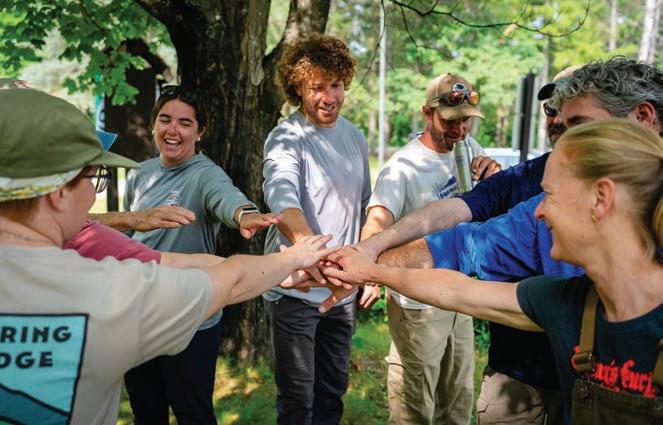
Outdoor education at Holderness is core to the school’s identity. From O-Hike to Mountain Day and Out Back, environmental awareness is a de ning element of the student experience. Students don’t just learn how to move through wild spaces—they learn responsibility for protecting them.
Extended time in the woods stretches a young person. Climbing a mountain tests endurance. The weather humbles certainty. The scale of the landscape reframes perspective. In wild spaces, students feel both stronger and smaller at once— challenged to stretch their limits while recognizing the enormity of the natural world. The mountains have a way of sanding down ego and sharpening responsibility.
Classroom learning extends into hands-on service trips where students get their rst taste of real trail work—clearing brush and blowdowns. For some, that experience grows into a vocation. Alumni Robert Biddle ’78 and Lesley Wright ’80 went on to work professional trail crews for the Appalachian Mountain Club (AMC), proving that a Holderness education doesn’t end at graduation—it gets put to work in the eld.
Several years ago, Holderness adopted the Upper Nanamocomuck Ski Trail through the White Mountain National Forest’s Adopt-A-Trail program, committing students and faculty to help maintain the 10-mile route along the Kancamagus Highway and Swift River. Last spring, the school expanded that stewardship by adopting sections of the Sawyer Pond, Livermore, and Hancock Notch trails—remote routes frequently used by Out Back groups. Clearing blowdowns and
cutting back brush may seem small tasks, but without that work, the forest quickly reclaims the trail.
Our great outdoor programs exist because of great leaders. Faculty and coaches who model a life of service create a culture that students absorb and carry forward. The mentorship threads— formal and informal—are what connect generations of Holderness outdoor leaders and keep the cycle turning.
Like most boarding schools, our faculty don’t clock out when the school day ends. But Erik Thatcher ’08, Randy Houseman P ’15 ’18, Stephen Uhlman, Nick Laurence, and Elizabeth Wolf take that commitment even further by serving on New Hampshire search and rescue teams. Their work in the mountains is not theoretical— it is a real responsibility in real conditions. “Search and rescue is a way for me to give back to the mountains that have given me so much in my lifetime,” says Math Department Chair Elizabeth Wolf. “Preparation is key, knowledge is important, and there’s some work that’s required to be ready to get out there.” Teachers stepping into that responsibility show students that stewardship isn’t just something you talk about—it’s something you practice.
Every student who learns to read a topo map, every alum swinging a Pulaski on an AMC trail crew, every faculty member heading into the backcountry on a rescue call—they’re part of the same trail. Holderness doesn’t just send students into the mountains. It inspires them to return to take care of them. At Holderness, the mountains are a classroom, but the real lesson isn’t how to summit; it’s learning that the trails that carried us up need us to carry them forward. Marybeth Bentwood
Tim Nolan ’08 gives back to the trails.
Holderness alums and employees join forces at the Holderness Community Trail Work Day in August.
Enduring Gifts
The philanthropy that supports outdoor leadership at Holderness.
Outdoor education at Holderness started long before Out Back. It has been an enduring part of the school’s fabric since the beginning, shaped by generations of students and faculty exploring, hiking, and climbing in the White Mountains. Over time, that spirit has been deepened and expanded through decades of belief and generosity. From early support for the Outing Club to the transformative investments that helped de ne Out Back and beyond, philanthropy has shaped every aspect of the program. Each gift has built on what came before, turning a tradition into a de ning program. This timeline traces the support that continues to equip students not just to explore the outdoors, but to care for it.
1969 EARLY SEED SUPPORT
Out Back (originally called Outward Bound) starts with early funding from families of young alumni who believed in the program’s transformative potential.
1975–76 DEWITT WALLACE–READER’S DIGEST SUPPORTS
Inspired by the success of Out Back, Reader’s Digest founder DeWitt Wallace provides two forms of support: a $75,000 challenge grant—matched through a telethon— to purchase essential expedition equipment, and the creation of two endowment funds that continue today: the Reader’s Digest Out Back Endowment Fund for the winter outdoor program and the Reader’s Digest Endowment Fund for scholarships.
1977 DODGE FOUNDATION GRANT Funds the Out Back and Backward Bound project, where students build a rustic cabin on campus using colonial construction techniques.
1997 GORIANSKY ’48
BOOK FUND
Michael E. Goriansky ’48 establishes a fund supporting writing and literature focused on environmental and outdoor pursuits.
1998 NED GILLETTE ’63
SCHOLARSHIP FUND Endowed scholarship supporting tuition and outdoor-focused initiatives.
2001 OUT BACK CABIN
Donated by the Class of 2001 with support from Ira Marvin, Rob Hopkinson, and Natalie Babony, creating a dedicated oncampus gathering space.
2016–17 OUTDOOR PROGRAM EXPANSION
An anonymous gift expands experiential learning, leadership trips, climbing programs, and outdoor classroom experiences.
2016–2025 PROGRAM INFRASTRUCTURE
Donor support funds major outdoor facilities including the trampoline, ski jump and airbag, Mittersill access, Davis Cross Country Ski Trails, and the upper turf field.
ONGOING SUPPORT
Philanthropy remains central to the school’s outdoor programming. Donors continue to provide resources and mountaineering gear that make epic outdoor experiences possible for every student, like the annual Mount Washington winter hike.
SNAPSHOTS
1. Dick Conant ’73 summits Mount Whitney, the highest point in California.
2. Glen Cousins ’73 (left) and friend Rick Hopkins at the top of Right Gully in Tuckerman Ravine.
3. Art restorationist John Coles ’68 works on the frieze of the First Baptist Church, Commonwealth Ave. Boston.
4. Bill Seaver ’61 captured this stunning photo of the sacred Mount Kailash in Tibet in 2004.
5. Charlie Woodworth ’76, Tom Armstrong ’76 and a friend ski the 160km Arctic Circle Race in Greenland.
6. Geordie Elkins ’88 climbs Alpamayo in the Cordillera Blanca of Peru.
7. Anna Jones ’18 pauses on a climb of Pigeon Spire in The Bugaboos, British Columbia.
8. Keenan Alnahas ’19 climbs Mount Washington in February of 2026.
9. Jennifer Crane ’01 enjoys atypical Scottish weather on the Isle of Skye's Trotternish Ridge in 2025.
10. John Roper ’61 photographed an incoming storm in Monument Valley, Arizona.
SHAPED BY ADVENTURE
Why Adventure Matters
As I write this, I am living the less glamorous side of adventure. This isn’t even Type II fun; the kind that’s miserable in the moment but rewarding in retrospect. No, this is just vaguely sweaty, greasy, and tired in an airport. A shower and my bed are still a full 24 hours away, somewhere in the Czech Republic.
I’m 26, which feels worth noting. My body can still handle a 14-hour ight in a cramped economy seat and teeter on the edge of a full day without sleep. But 26 is important for another reason. I am now one year older than my father was when he ed his home on foot, crossing the mountainous border between France and Spain, hunted by agents of a fascist state.
Who’s to say whose mid-20s were rougher, but I know his led to mine. For him, the mountains meant freedom—a truth that shaped a lifetime of climbing and mountaineering. For me, they were simply a constant. My childhood weekends, vacations, and afternoons were spent chasing him uphill or up rock faces. Sometimes at home in Montana, but often farther a eld, in countries where I didn’t speak the language or know the history. I was shaped by being thrown into
adventure: into curiosity, discovery, and the task of making sense of di erent realities.
At the time, I wasn’t always grateful for it. My mother used to say travel was important for “expanding my horizons.” I never really understood what that meant, until recently.
China is an enormous country, and I saw only a sliver of it. The highlight was Zhangjiajie National Forest Park, a stunning region where sharp mountains like towers emerge from a sea of mist.
My friend and I met two young Finns on the trail and spent the day hiking with them. We talked about many things, but what stuck with me was their surprise that Americans could be knowledgeable about world events and open-minded about, and traveling in, foreign countries. We also bonded over a shared reason for our travel (besides a recent ability for EU citizens to go visa-free).
For them, for my friend living in China, and for me, the answer was simple: it felt important to see a place our news and politicians had spent so many years demonizing. Yes, the nature was stunning, the monkeys adorable, the food delicious. But the core of travel, of adventure, is expanding your empathy, your
understanding of the breadth of humanity. It’s learning that the world is not nearly as small or as simple as we’ve been told.
You don’t have to cross continents to do this. It can happen on a walk through a new city, in a conversation with a stranger, in the quiet decision to be curious instead of certain.
Adventure doesn’t always require a passport.
What it does require is killing the voice that tells you to take the comfortable way out. That voice is loud right now, in the U.S. and beyond. It feeds on fear of di erence, of change, of being unmoored from a familiar reality. We like to dress that fear in rationality about economic or geopolitical security, but at its core, it’s something older and rawer. It’s the fear of encountering the unknown within your comfortable known.
You have to let that go. Not just for the sake of travel, but for the sake of living in a world with other people. Adventure, whether in the mountains, in a foreign city, or in the pages of a book, reminds us that we are not the center of everything. It humbles us. It connects us. And right now, that might matter more than ever.
Lorea Zabaleta
’18
Students cool off in one of the White Mountains’ many swimming holes during the school’s Orientation Hike in early September.