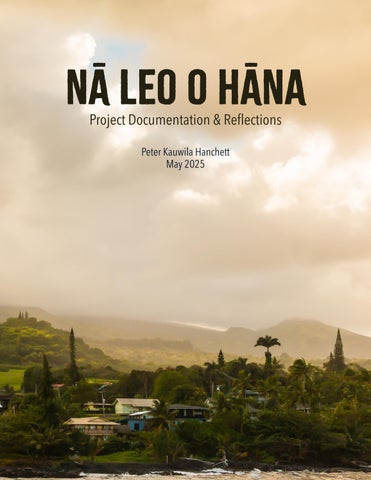
NĀ LEO O HĀNA Project Documentation & Reflections Peter Kauwila Hanchett May 2025
1
2
NĀ LEO O HĀNA: Project Documentation & Reflections
3
4
NĀ LEO O HĀNA: Project Documentation & Reflections
CONTENTS 28 07
_________________________________ _______________ __________________
Welina
Opening Letter
08
_________________________________ _______________ __________________
Ka Wā mamua
History & Background
10
_________________________________ _______________ __________________
Aunty Martha Hohu A Lifelong Legacy of Service
12
_________________________________ _______________ __________________
huliau / Kupa‘Āina
An Era of Great Change / Reflection of ‘Āina
14
_________________________________ _______________ __________________
Uncle Bob Vogele Is There Anyone Left?
17
_________________________________ _______________ __________________
KĀko’o KaiĀulu
‘Ohana and Community Collections
22
_________________________________ _______________ __________________
Ke ala pono
Ethical Considerations
25
_________________________________ _______________ __________________
_________________________________ _______________ __________________
Mele Hawai‘i
Thematic Analysis of NLOH Songs
30
_________________________________ _______________ __________________
detective work
Are Archivists Detectives?
32
_________________________________ _______________ __________________
Project Roles/Creators of Content Copyright, Public Domain, Fair Use
38
_________________________________ _______________ __________________
e alu like kākou Project Team
42
_________________________________ _______________ __________________
Airtable Base Project Database
45
_________________________________ _______________ __________________
Nā lako
Project Budget
46
_________________________________ _______________ __________________
E Holomua Kākou
Questions for Collective Decision-Making
49
_________________________________ _______________ __________________
Iā‘u Iho
Self-Assessment
KŪlia i ka nu‘u
Professional Standards
5
6
NĀ LEO O HĀNA: Project Documentation & Reflections
Welina
Welina mai me ke aloha, A century after my grandmother’s birth and more than 50 years since she founded the Hāna Cultural Center, I find myself listening to her voice on a series of old tapes my cousin Mililani found in the HCC archives. Some of the tapes are interviews of East Maui kūpuna that Puna and her mother, Tutu Haia, often with historian Mary Kawena Puku‘i, conducted in the 60s and 70s. There are four tapes of Nā Leo O Hāna, their choral group, singing the songs of old Hawai‘i. I was very close to my grandmother and miss her physical presence in my life. When I listen to these tapes, I hear the sweet songs they are singing, and I hear what is between the sounds—the intangible expressions of aloha for ‘āina and for one another that was the essence of Nā Leo O Hāna. I am transported to an era where the families of Hāna gathered regularly, cramming in “like sardines” as one elder put it, to whoever’s home was hosting at the time. I can hear the sounds of laughter at the games being played, with Hawaiian music ever present in the background and impromptu hula dancers enlivening the evening with their kolohe numbers. I reflect on the community work I have been engaged in for the past two decades and have a quiet thought. What if we save our land, our water, our language, and our culture but somehow lose that closeness that has always been the social fabric of our community? Will the growing influence of technology that engenders increasingly separate lives compromise the integrity of our generational relationships with one another?
Treasures, like the Nā Leo O Hāna tapes provide us with a critical connection to the past at a time when there is still a generational link. The voices on these tapes are the beloved parents, grandparents, aunties, uncles, and friends of Hāna’s living generations. Thus, it is essential and timely that these voices of Hāna be heard once more, reminding us of all we have been, and all we are, as people of this very special place, Hāna. Mahalo,
K auwila Hanchett
Kauwila Hanchett Nā Leo O Hāna Project, Coordinator Graduate Student, UH Mānoa MLISc Program 7
Ka Wā Mamua History & Background
Nā Leo O Hāna, translated as the voices of Hāna, was a multi-generational Hawaiian choral group from Hāna, Maui, founded in 1969 by Babes Hanchett and directed by Aunty Martha Poepoe Hohu. A vibrant part of the cultural and social fabric of Hāna for 25 years, Nā Leo O Hāna’s legacy lingers in the memories of ‘ohana members who can still recall the harmonious voices of their parents and grandparents. Babes Hanchett (1923-2012) was raised in Hāna on the ancestral ‘āina of the Haia ‘ohana, near Ka’uiki hill. In addition to founding Nā Leo O Hāna, she established the Hāna Cultural Center in 1971 and was a lifelong advocate for Hawaiian culture as well as Hāna’s unique lifestyles and community. She and her mother, Elizabeth Kauwila Haia, affectionately called “Tutu Haia,” had a long relationship with Hawaiian scholar Mary Kawena Puku’i, gathering Hāna elders to be recorded on a wide variety of topics as a part of a pae ‘āina wide effort that spanned decades under the Bishop Museum to preserve traditional and place-specific ‘ike kūpuna.
8
The ‘Ohana Spirit of Aloha BV: Traveling [together] with the mana and the ‘ohana connection. You know some of us were Catholics, Protestants, Mormon, Baha’i, it didn’t matter. There’s one God and He speaks through different messengers, and it was no cause of disunity or disconnection—we were all one human family. We all respected each other’s beliefs and yeah it was how the world should be right now instead of “us” and “them” …for us our diversity was a cause of unity and oneness. It made us beautiful; we were from different spiritual backgrounds, we all came together and flowed together. KH: And it seems like music was a common language of aloha and of the heart. Aloha doesn’t have a religion... BV: No. KH: It is everywhere and…when I look back at the photos of that era, people were very close, the families were close, they gathered often not just for community events, but they gathered for fun. When I look at the pictures there’s a lot of games that were played, music is always there, hula. You can feel from the photos this sense of closeness, community, and togetherness within the Hāna community. BV: That’s how it was back then. I hope you can regain that, revive that oneness, that closeness, that ‘ohana spirit. That was one of the greatest things for Lucy and I, and for our kids, that sense of strong, strong, ikaika, ‘ohana. Excerpt from an interview with Uncle Bob Vogele, 80, one of only three Nā Leo O Hāna members still living, conducted on May 02, 2025. Kauwila Hanchett, interviewer. Shared with the permission and blessing of the interviewee.
NĀ LEO O HĀNA: Project Documentation & Reflections
9
10
NĀ LEO O HĀNA: Project Documentation & Reflections
Aunty Martha Hohu A Lifelong Legacy of Service
Aunty Martha Poepoe Hohu of Honolulu (1907-2004) made numerous contributions to the perpetuation of mele Hawai’i throughout her lifetime. She had a long and illustrious career as choir director at both Kaumakapili Church and Kamehameha Schools while also flying to the remote communities of Kalaupapa (1955-1965) and Hāna (1969-1994) to direct community choirs. She worked closely with Tutu Puku’i at the Bishop Museum for many years, created musical arrangements for movies such as the Bird of Paradise, and spearheaded the creation of two Hawaiian hymnals. Named a living treasure in 1997, her life’s work was recognized through countless awards including: 1959 Mother of the Year, 1995 Nā Hōkū Hanohano lifetime achievement award, and the Kamehameha Schools Order of Ke Ali’i Pauahi in 1998.
“I go once a week to the island of Maui to Hana. I direct the little choral group there which is a part of the Hana cultural set-up and music is one phase of their work so I go up there to work with the grandmothers and great-grandmothers and the young adults and I have a wonderful time with them, learning to sing our Hawaiian songs that are what I call the classic of Hawai’i.” Excerpt from an Interview of Aunty Martha Hohu conducted on September 27, 1971 ©1979 The Watumull Oral History Project Held at the University of Hawai’i at Mānoa Library, Hawaiian and Pacific Collections
Aunty Martha had very high standards which were reflected in her song choices and musical arrangements, ‘ōlelo Hawai’i pronunciation, and expectation that choir members possess knowledge of, and appreciation for, song composers and other contributors, the story of the song’s composition, and the kaona (layers of meaning) hidden within the lyrics. She selected songs she considered classics, most from the late 1800s and early 1900s by such notable composers as Queen Liliuokalani, Reverend Lorenzo Lyons, Charles E. King, Kui Lee, and David Nape. Those who have traveled the long road to Hāna, or experienced the bumpy flight on a tiny commuter airplane, will understand the magnitude of Aunty Martha’s loving service to the communities of Kalaupapa and Hāna. By the time Nā Leo O Hāna decided to stop gathering because they were down to eight performers, Aunty Martha would have been in her late 80s!
11
Huliau
Kupa‘Āina
To more fully comprehend the role Nā Leo O Hāna played in the Hāna community, we must understand the environmental, economic, political, cultural, and social conditions and changes happening in Hāna, Hawai‘i and globally, that were the backdrop of Nā Leo O Hāna’s mo’olelo.
Hawaiian ways of knowing and being are shaped by the ‘āina where families have deepened place-based connections through generations of lived experience. Being raised in two Native Hawaiian communities (Hāna and Molokai), I can see the ways in which the landscape shapes the people so that the people become a reflection of the ‘āina, exhibiting its qualities and characteristics.
An Era of Great Change
Founded just a decade after statehood, Nā Leo O Hāna was active during an era that became known as the Hawaiian Renaissance. This movement witnessed a widespread rebirth of Hawaiian values of aloha ‘āina, ‘ōlelo Hawai’i, voyaging traditions, and numerous cultural practices and artforms. In East Maui taro farmers were fighting to regain water rights and reopen lo’i kalo after generations of neglect, the practice of hula was revitalized, kānaka maoli leaders organized to safeguard ancestral ‘āina, native gathering and access rights, and customary practices. Unlike most communities in Hawai’i, Hāna had retained its native population with generational ties to place, subsistence lifestyles, and close-knit community that felt, and acted like, a large ‘ohana. This closeness was reflected in a high degree of civic participation and activism, frequent social gatherings, and an overall sense of place and belonging.
12
Reflections of ‘Āina
Hāna is poetically referenced as ka ua lani ha’aha’a, land of the low-lying heavens, which some interpret to mean that Hāna is just steps from heaven. This traditional reference was incorporated into the more modern saying “Heavenly Hāna.” Indeed, the kama’āina of this land is the misty Uakea rain and its gentle companion the Mālualua wind. Hāna’s rolling hills and open green pastures at the base of Haleakalā open to a surging blue sea that has shaped this shoreline of sandy beaches and rocky cliffs through millennia. Hāna’s location on Maui’s remote windward side bestows the dual blessing of constant trades and frequent rains that nurture ‘āina abundance, swell streams, and feed cascading waterfalls. Hāna’s unparalleled natural beauty is reflected in the beauty of her people collectively expressed as kindness, generosity, care, self-sufficiency, community service, and aloha.
NĀ LEO O HĀNA: Project Documentation & Reflections
Being raised by the Hāna community, I feel a deep sense of kuleana to protect our unique way of life and ensure that the cultural and social fabric of this special place remains intact for future generations. This task can seem nearly impossible against the tide of modern trends and technology that is
rewiring the ways humans interact with the natural environment and with one another. Yet, our ancestors have faced insurmountable challenges throughout time and found the fortitude to meet these defining moments with strength and aloha. I must do the same.
13
Uncle Bob Vogele Is There Anyone Left?
Everything beautiful and good about Hāna’s ‘āina and people have been forever memorialized in the Nā Leo O Hāna audio recordings found in the Hāna Cultural Center’s archives in late 2024. Mililani Krause, also a granddaughter of Babes, has been working to revitalize the Hāna Cultural Center, including the archival wing, over the past year. She has a special connection with the collections and possesses that rare ability of finding whatever it is she goes looking for, or as she would say, it finds her. In this case, these four Nā Leo O Hāna compact cassette tapes found her. Together, we understood this to mean that these voices of our kūpuna were ready to be remembered, heard, and shared. You often hear that it is only later in life that we come to fully appreciate our elders, when they are no longer here to share their memories and their stories. Likely, most of us have experienced the pain of having a question that we know can never be answered because those who knew the answer are no longer among the living. We realize with regret that we had countless opportunities to ask, but the questions that burn now were yet unformed then. After discovering that of the thirty-three Nā Leo O Hāna members identified from photos and community member memories, only two, and maybe a third, was still living I felt this pain 14
which was especially acute being the granddaughter of the founder. I vaguely remember my grandmother’s choir which would have ended when I was just starting high school. Yet I cannot escape the sense of missed opportunity, of profound conversations irretrievably lost, and of stories that will never be told. Of the possible three members, I connected with one member living in Nebraska who I have maintained a familial relationship with through the years, Aunty Cherie Hanchett. Aunty Cherie had a few memories of Nā Leo O Hāna but was only involved for a handful of years at the very beginning. She shared a National Geographic book from 1970 entitled “Hawai’i” given to her by an old friend she knew from Hawai’i that she bumped into at a garage sale in Nebraska of all places! As she flipped through the book, she couldn’t believe that the author had visited Hāna, listened to Nā Leo O Hāna sing, and included a large colored photograph (which she was in) of the group rehearsing at the hall at Wānanalua Church. Through talking story with community members, we identified another member that was no longer living in Hāna and it was unknown what had become of him. I did an online search to see if I could locate him and found a site that listed a Hāna landline from 2012 and another number from 2016. I called the landline, but it had been disconnected. I called the other number and got a robotic voice message, second guessing I hung up, even though I had a good feeling when I first found the number.
NĀ LEO O HĀNA: Project Documentation & Reflections
I worked up my courage to leave a message and called again and cannot describe my sense of joy when Uncle Bob Vogele answered and confirmed that he was indeed a member of Nā Leo O Hāna from 1972 until they ended in 1994. He had relocated to Haiku, Maui, to be nearer medical facilities and was delighted to reconnect with his memories of what had been a very beautiful part of his life. During on our initial call, I was moved to tears and told him “I didn’t think there was anyone left to share these memories.” We arranged to do a virtual interview over zoom which he generously (and even eagerly) consented to share with Nā Leo O Hāna family members and the Hāna community. Needless to say, I did not want to delay this interview and just a few days after our initial call we were able to connect on zoom for a treasured hour of Nā Leo O Hāna talk story which I recorded and will transcribe soon. Uncle Bob is a gracious, eloquent, and kind man with a good memory—he shared many stories about Nā Leo O Hāna and Hāna in general. We both intend that this will be the first in a series of interviews as an hour seems a natural and comfortable limit for a kūpuna and there were many more memories and stories to share once our time was up. There is one more member of Nā Leo O Hāna that also moved away from Hāna that I am still in the process of connecting with. He was a friend of my father’s and I am hopeful that he will be willing to share his recollections.
15
16
NĀ O HĀNA:AProject Documentation & Reflections NoLEO Nā Kānaka: Vision for Lahaina’s Long-Term Restoration & Healing
KāKo‘o Kaiaulu
‘Ohana & Community Collections In addition to locating living members, it has also been important to connect with the ‘ohana members of Nā Leo O Hāna kūpuna that have passed away. From a cultural and community perspective, these recordings of Nā Leo O Hāna are the inheritance of living members and ‘ohana members of those that have passed as well as the community of Hāna where these members were from. Thus, these rightful heirs need to be the navigators of how these recordings, and other treasures like photos and stories, are preserved and shared. I use the words inheritance and heirs intentionally to denote the value associated with cultural heritage resources—these treasures are our waiwai, the wealth that is our birthright and the inheritance we share with future generations. Decision-making around access, permissions, physical and online repository storage, and sharing of digital surrogates through the website need to center the voices and perspectives of the Nā Leo O Hāna ‘ohana. Cultural Institutions as Facilitators of Community Ownership/Stewardship This project has given me an opportunity to think more deeply about stewardship, ownership, and decisionmaking associated with a communitybased collection. Of particular interest is building the capacity of cultural institutions, including museums and archives, to act as facilitators of 17
18
NĀ LEO O HĀNA: Project Documentation & Reflections
19
community stewardship which requires a robust web of relationships, trust, and skills that are specific to each place and each collection. The Nā Leo O Hāna project has given me, and the organizations I represent, namely the Hāna Cultural Center and Hōlani Hāna, a tangible opportunity in a communitybased setting to pilot a model of shared stewardship based on these cultural values. Toward the development of this model, I have included a table in my Airtable database that includes all the people associated with this work—Nā Leo O Hāna members, family and community members associated with members, project team members, cultural and community leaders. Airtable is a relational database so records can be linked, and relationships recognized. This is still a work in progress as I prioritized contacting and interviewing living members and am now working on connecting with family members of those that have passed.
connections with trusted individuals within families and groups that represent the perspectives and interests of the ‘ohana/group as a whole. Those of us who grew up in this community and have been involved in community work innately understand and regularly carryout this kind of consensus-building collective movement. However, articulating this process may be helpful for others that do not have this same privilege of being an “insider.” I have often found that what is common sense for kupa’āina can be novel and even ground-breaking to those whose ideas were shaped by other places, influences, and cultures.
It is not feasible to think that every single descendant of, or persons associated with, Nā Leo O Hāna members can be contacted individually. Nor is it realistic with the resources currently available, to think that the community as whole can be consulted on an individual or family-by-family basis. However, this does not mean that consensus cannot be achieved and a pono path followed in a manner that meets cultural protocols and Hāna community expectations. The heart of this approach lies in activating the existing network of relationships within communities and building key
20
NĀ LEO O HĀNA: Project Documentation & Reflections
21
Ke AlA Pono
Ethical Considerations The Nā Leo O Hāna collection encompasses all audio recordings, photos, documents, narratives, and other items gathered, or to be gathered, as a part of this effort. In considering the ethics, principles, and standards relevant to this undertaking I consulted numerous codes while also relying on my own understandings as a kupa’āina member of this community and a granddaughter of Nā Leo O Hāna’s founder. I utilized the metaphor of an ‘upena to guide this process with my own na’au knowing at center, connected to an inner row of maka (net meshes) the represent the values, standards, and protocols upheld by the Hāna community—whether expressly articulated or innately understood—the next row of maka extends to Hawai’i and lāhui Hawai’i, then beyond to other indigenous cultures and our global ‘ohana. Iā’u Iho, Self at Center: First and foremost, I trust my na’au, and the na’au of my team members, and look to the hō’ailona (signs, omens) that reveal ancestral and kūpuna presence, guidance, and blessings. Throughout the project, I have felt a close connection to my grandmother and have had a clear sense of her blessing on our efforts. Every member of our project team experienced a similar feeling of connection in their own way. We each possess an inner code of ethics that has been shaped by the 22
‘āina, families, and communities that raised us as well as the sum of our life experiences. Nā ‘Ohana O Hāna, Community as Inner Maka: Next we rely on feedback and experiences of the ‘ohana and community members of Hāna. So far, each person that has encountered the collection (shared via the draft website preview) has been deeply moved, experiencing either “tears” or “chicken skin.” For the two living members I spoke to, reconnecting with Nā Leo O Hāna through the collections made a big positive impact on them in different ways. For Aunty Cherie, it brought her a sense of comfort and connection after being away from Hawai’i for many years caring for an aging parent. For Uncle Bob, he has reconnected with Hāna, the home of his heart, and has expressed great joy and gratitude that Nā Leo O Hāna is being remembered in this way. Other community members have appreciated a trip down memory lane, revisiting the parents and grandparents they hold so dear. In addition to these direct communications from ‘ohana and community members, we have also ensured our work aligns with the Protocols for the Collective Governance of ‘Ike Kūpuna being developed by a network of Native Hawaiian organizations of Hāna and East Maui to guide our collaborative initiatives. These protocols elevate, among other things, our shared understanding that ‘ike cannot be separated from its source; ‘ike comes with kuleana often tied to a specific place and/or practice; tangible manifestations of ‘ike are accompanied
NĀ LEO O HĀNA: Project Documentation & Reflections
by the larger body of spiritual knowing carried by the kahu of that ‘ike; and ‘ike can be collectively held, spans generations, and is the inheritance of future generations. Ka Pae ‘Āina o Hawai’i, Extending the Net: Hawai’i and kānaka maoli protocols that have been also consulted include the Paoakalani Declaration with guidance pertaining to the protection of traditional knowledge, cultural expressions and artforms, and natural and biological resources from a kānaka maoli perspective. The Paoakalani Declaration affirms our right to own, steward and protect these resources in perpetuity consistent with a Kānaka Maoli worldview. Traditional knowledge is defined and includes sounds, images, knowledge, objects, material, or culture.
the indigenous codes. I found The Protection of Traditional Knowledge and Cultural Expressions Act (2016) of Kenya to be very progressive and a model of what it might look like if indigenous rights were codified into law. The implications for Hawai’i are astonishing! These national and global codes further affirm that the place-specific protocols and approach we are piloting is part of a larger movement to recognize the rights of indigenous communities to be the navigators of their own heritages and destinies.
Ke Ao Holo’okoa, National and Global Standards: There are several standards that have bearing on, and relevance to, this endeavor. From an ethical perspective, I consulted numerous codes, with a focus on indigenous perspectives, most notably: (1) He Mata’atua Declaration on Cultural and Intellectual Property Rights of Indigenous Peoples; (2) Aboriginal and Torres Strait Islander Protocols; (3) Protocols for Native American Archival Materials; and (4) CARE Principles for Indigenous Data Governance. The ACRL Code of Ethic for Special Collections Librarians and AAM’s Code of Ethics and Professional Practices for Collections Professionals was also helpful. These national and global ethical standards and protocols have some commonalities and shared understandings—especially amongst
23
24
NĀ LEO O HĀNA: Project Documentation & Reflections
Kūlia i ka nu‘u Professional Standards
The focus of this project was on making the audio recordings from the four Nā Leo O Hāna compact cassette tapes found in the Hāna Cultural Center archives available to the Hāna community.
grasp the multi-layered components of undertaking digital preservation and dissemination projects. I am excited to deepen this understanding in the Digital Archives class I will be taking in Fall 2025.
My overarching project goal was as follows: Reconnect Nā Leo O Hāna ‘ohana with the voices of their kūpuna to rekindle aloha for Hāna’s past and affirm our enduring love for our ‘āina and one another. Although my focus was not to create archival quality digital surrogates for the cassette tapes, one of our primary tasks was the transferring of the audio recordings and the creation of digital sound files that could be shared with families, the community, and perhaps the public depending on ‘ohana guidance. To better understand professional expectations for this work, I looked to the standards issued by the International Association of Sound and Audiovisual Archives (IASA). Namely, Safeguarding of the Audiovisual Heritage: Ethics, Principles and Preservation Strategy, the more specific Guidelines on the Production and Preservation of Digital Audio Objects, as well as the Ethical Principles for Sound and Audiovisual Archives. Reviewing these ethical principles and preservation standards was a good primer for me and I am beginning to 25
Hana
Unleashing Grace through HĀ A dear mentor, Uncle Pono Shim once shared with me the deeper meaning of the word hana which some translate to mean work, a job, or employment. He revealed that Hawaiian words of significance have three layers of meaning, the (1) literal translation(s); (2) kaona, figurative or hidden meaning; and finally, (3) the esoteric or spiritual interpretation which can be very personal. He shared the deeper meaning of the word hana, as “hā”, breath of life, “n” for noa to free, unbridle or unleash, “a” for akahai meaning grace and gentleness. Hana in modern life is transactional work while hana from a Hawaiian perspective is relational and spiritual movement to unleash grace. The Nā Leo O Hāna project has allowed me to engage in this relational and spiritual work, which has been filled with grace and aloha. The primary task associated with this project was working with the project team to digitize audio recordings and interpret them in a way that made them more accessible to current (and future) generations. The audio recordings are the heart of the Nā Leo O Hāna collection. Other components included researching and gathering resources, generating content, developing a website, and conducting community outreach to members and the community. Interpretation & Dissemination The raw archival resource (the audio recordings exactly as captured on 26
the cassette tapes) was interpreted to maximize accessibility to current and future generations. Although the raw audio material has great value for archivists, there are several characteristics that made it difficult for everyday people to enjoy. So, although the archival preservation of these recordings is essential, the heart of this project was about building a bridge between this archival resource and the community (interpretation and dissemination). Some of the challenges presented by the original sound recordings were as follows: (1) the sound quality was very poor, with numerous disruptive noises (such as clicks, bangs, hissing, etc.); (2) a simple cassette recorder was used and the absence of professional sound recording equipment is at times reflected in tones and frequencies that can come across as harsh or abrasive; (3) because these were informal recordings of practice sessions, the recordings are of portions of songs, often repeated numerous times with very little, if any, variation which may fatigue listeners. To make it more “user-friendly” we transformed the raw audio material into a more recognizable format that prioritized the listener’s enjoyment. Namely we (1) combined “tracks” to create full (or fuller) songs, (2) we utilized compression, editing, and EQ to counter harsh frequencies and clean up the sound quality in Pro Tools, (3) we organized these edited songs into four playlists that more clearly aligned with listening themes. We named these playlists and included a cover photo to give them more of the feel of an album.
NĀ LEO O HĀNA: Project Documentation & Reflections
The names and themes of the playlists are as follows: (1) Nā Leo O Hāna, thirteen songs that are mostly music; (2) Pilina ‘Ohana, five songs with music, talk story, and applause; (3) Choir Practice, nine song compilations with music, talk story, and instruction by Aunty Martha, and (4) Glee Club Dance Chant four songs accompanied by ukulele and ipu. We also included single tracks from the first playlist which was primarily singing. To further nurture a positive user experience, we found and digitized photos of the group to include in the website, created a short slide show video with Nā Leo O Hāna photos and audio, created brief narratives that tell the story of Nā Leo O Hāna, and also secured beautiful photos of Hāna to give the collection a sense of place. We viewed this process much like taking raw video footage and creating a short film with curated content that tells a moving and impactful story. Click on the panel on the left of this page or the box below to access the Nā Leo O Hāna website!
A brief (1:51 min) video showcasing member and group photos with Nā Leo O Hāna singing Ua Kea O Hāna. I created two versions of this video, the other being the song with beautiful drone footage of Hāna. We decided this version with the photos would be more impactful for families.
Mele Hawai‘i
Thematic Analysis of NLOH Songs Of the 13 songs on tape one, the majority are love songs and/or odes to beloved homes and places. Three songs are about family homes including (1) Old Plantation, the name of the home (built in 1880) and estate of the Ward family that was located where the Neal Blaisdell Center currently resides; (2) Ku’u Pua I Paoakalani, Paoakalani is Lili’uokalani’s Waikīkī estate; and (3) Wailana, the Cummings family home in Waimānalo. Profound aloha, affection, and intimacy with the ‘āina and natural environment (winds, rains, fragrances, etc.) was a common theme through most of the songs. Interestingly, the intimacy with the natural landscape and the intimacy between lovers are often intertwined as parallel themes; the act of love making veiled in nature-based imagery (kaona). In other songs, one’s family home and ancestral ‘āina are addressed like a lover. In many kanikau, the composer laments the absence of the loved one that has passed recalling specific attributes of the person against the backdrop of the beloved places they frequented. The deep, deep love for the individual is inseparable from ‘āina—their home, family lands, favorite spots, as well as the winds, rains, foliage and characteristics of these places and their associated natural phenomenon and poetical references. Three of the songs were for Hawai’i, two with patriotic themes (Hawai’i Pono’ī and Hawai’i Aloha). Only one song was specifically for Hāna (Ua Kea O Hāna) naming the local winds, Mālualua and Ulumano, and rain, Ua Kea, as well as wahi kapu and wahi pana in this area (Haleakalā, Ka’uiki, Mokumano).
28
NĀ LEO O HĀNA: Project Documentation & Reflections
29
Detective Work Are Archivists Detectives?
The four cassette tapes were sparsely labeled and did not identify dates or locations for these recordings. They were also in a Ziploc bag, not very well protected and it was uncertain where the tapes had resided before the archive wing was built in the mid-90s. The tapes were labeled as follows: (1) Na Leo O Hana, (2) Chorus, (3) Choir Practice on one side and Hololio on the other, and (4) Glee Club Dance Chant. These labels and the type of cassette tape used were all the clues we had to go on initially to determine a date range and location for these recordings. At the end of one song on the Na Leo O Hana tape, an uncle can be heard saying “the sounds of the Hāna Glee Club coming from Hanchetts’ house.” This would have been the plantation house above Hāna Store where my grandparents lived when my Papa was the manager of Hāna Ranch. So, we 30
were 99% confident in the location for this recording. Also, although it was difficult to find information about the specific cassette tape used, what we could find suggests that the Sunset tapes were one of the first on the market in the late 60s or very early 70s. Obviously, the earlier end of the range cannot date before Nā Leo O Hāna was formed in 1969. The upper end of the date range we could not define until our talk story with Uncle Bob Vogele who confirmed that these recordings took place before he and his wife Lucy joined Nā Leo O Hāna in 1972. Uncle Bob also shared that by the time he arrived the group had adopted it’s Hawaiian name, Nā Leo O Hāna and no longer identified as the “Glee Club.” Thus, we can confidently assume a date range of 1969-1972 for all recordings. The Choir Practice and Chorus tapes would also fall within this date range and the location is likely the hall at Wānanalua Church in Hāna Town where all Nā Leo O Hāna practice sessions took place. Due to the sound quality,
NĀ LEO O HĀNA: Project Documentation & Reflections
the Glee Club Dance Chant tape is obviously recorded in a different location from the other tapes and may be with their hula instructor. The sound echoes as if they are in a larger space such as Helene Hall. Additional investigation is needed to determine a location. Although not expressly stated, we are 99% confident that the recordist was Babes Hanchett. Her voice is heard nearest the recorder and she was in the practice of recording during the date range for these tapes. Certain voices are distinct including Aunty Martha’s when she is instructing the group. Soon after the first tape was digitized, I played a few songs at a meeting of our moku partners. Two Hāna kūpuna present were able to discern the voices of particular people in the recordings. Thus, additional community dialogue will certainly provide us with more details in time—perhaps even with the exact dates and locations of these recordings. The tapes were in very poor condition which leads me to believe they were kept out in my grandparents’ home and subject to the impacts of Hāna’s moist and tropical climate. I also learned that compact cassette tapes have a natural lifespan of approximately 30 years if treated well (although they can last up to 100 years or more with proper care). These tapes were more than 50 years old and had been subject to Hāna’s climate for decades. The condition of the tapes had deteriorated so that if this work to transfer their contents to a digital format had not occurred now, we may have lost the ability to save this last remaining audio link to Nā Leo O Hāna. 31
Project Roles (IASA) Below is a summary of the individuals and groups as they align with the roles identified in IASA’s Ethical Principles for Sound and Audiovisual Archives IASA’s Ethical Principles for Sound and Audiovisual Individuals/Groups Archives Creators of Content that is subsequently recorded: including authors, composers, broadcast program makers and arrangers of pre-existing works. These people will often be the holders of copyright.
Aunty Martha Hohu Musical/choral arrangement for all songs Composers and copyright holders* for all songs performed by Nā Leo O Hāna (see pg. 35)
Performers: the individuals or groups whose sounds, images, and movements are recorded.
Nā Leo O Hāna, member list in Airtable
Recordists: those who actually affix the sound and audiovisual recordings on specific media. These include, for example, engineers in recording studios and collectors of field recordings.
Babes Hanchett
Intellectual Property Owners: individuals, communities, organizations, or companies that have rights over original works and recordings. These may include creators of content, performers or their communities, and recordists, or their assignees.
Nā Leo O Hāna membNā Leo O Hāna members, ‘ohana members, and the Hāna Community
Depositors: individuals, groups, corporations, or institutions that deposit recordings in archives.
Babes Hanchett
Archivist: staff or owners of archives who organize collections and provide access to them.
Kauwila Hanchett, Hōlani Hāna Mililani Krause, Hāna Cultural Center
Technicians: specialized staff of archives and archival services who are responsible for the preservation of audiovisual carriers and the migration of data from one carrier to another. In some instances, they may also be responsible for restoration of sounds and audiovisual data.
Andrew Fowler Kahualaulani Mick
Users: Those who access collections held in archives.
NLOH ‘Ohana Hāna Community General Public
32
NĀ LEO O HĀNA: Project Documentation & Reflections
Creators of content listed above
33
34
NĀ LEO O HĀNA: Project Documentation & Reflections
Creators of Content
Copyright, Public Domain, Fair Use... SONG TITLE
Date Date Composed Published
Composer
PD*
1. A Song to Hawai’i
1923
Unknown
J.D. Redding
Y
2. Ahi Wela
Late 1800s
Unknown
Unknown
Y
3. Akahi Ho’i
Late 1800s
Unknown
David Kalakaua (as Y “Figgs”)
4. Aloha ‘Oe
1878
Unknown
Queen Liliuokalani
5. Hawai’i Aloha
1800s
Unknown
Rev. Lorenzo Lyons Y
6. Hawai’i Pono’ī
1874
Unknown
David Kalakaua/ Henri BergerMusic
Y
7. He Nohea ‘Oe E Ku’u Maka
1917
Unknown
Charles E. King
Y
8. Hole Waimea
Unknown
Unknown
Traditional
Y
9. Lahina Luna
1966
Unknown
Kui Lee
N
(c) Renewed 7/29/1994 Nani Lee Meadows (W), Kimo Lee, Mahealani Lee, Maile Lee & Wailana Lee (C)
10. Laupahoehoe Hula
1950
Unknown
Mary Kawena Puku’i/Irmgard Farden Aluli (music)
N
(c) Renewed 3/13/1987 Namaka Bacon & Irmgard Farden Alului (A)
11. Old Plantation
Unknown
Unknown
Mary Jane Montano/David Nape (Music)
Y
12. Ku‘u Pua I Paoakalani
1895
Unknown
Queen Liliuokalani
Y
13. Pua Mohala
1942
Unknown
David Nape
?
14. Ua Kea O Hāna
Unknown
Unknown
Edward Pu’ukea
Y
15. Wahi I Ka ‘Ahu’ula
1923
Unknown
Ruth Lilikalani/ Charles E. King (Music)
Y
16. Waialae
Unknown
Unknown Mekia Kealakai
Y
17. Wailana
Unknown
Unknown David Kalakaua Y or Maile Kaleikoa
*PD = Public Domain
Copyright Holders
Y
Charles E. King
35
36
NĀ LEO O HĀNA: Project Documentation & Reflections
37
E AluLike Kākou Project Team
I am not doing this work alone but have a growing team of people that are dedicated to seeing these recordings saved and shared. Below is a brief list of our team members and their kuleana.
Aunty Martha (this became the 9-track Choir Practice playlist on the website). Compiled and edited 4 tracks from “Glee Club Dance Chant” (this became the 4-track Glee Club Dance Chant playlist). Arranged edited tracks as 4 playlists. A handful of Nā Leo O Hāna members and community members also made significant contributions to this effort.
Mililani Krause (staff/volunteer)
Uncle Bob Vogele (volunteer)
Located the compact cassette tapes and discovered what they contained. Arranged for safe transport of cassette tapes to and from the Hāna Cultural Center archives for digitization. Scoured the Hāna Cultural Center archives for Nā Leo O Hāna photos Reviewed and provided feedback on the draft website. Worked closely with Kauwila to determine pono protocols for engaging families and the community.
Nā Leo O Hāna member from 1972-1994 Shared Nā Leo O Hāna memories and stories by phone and through a 1-hour zoom interview. Has agreed to review photos, songs, and information for accuracy (and to help fill any gaps or missing information). Has agreed to subsequent interviews. Gave his blessing to publish the website publicly and share his interview with Nā Leo O Hāna family members and the Hāna community.
Andrew Fowler (contractor) Performed all transfers and digitization of audio recordings from 5 compact cassette tapes. Performed all repair work including splicing tapes when they would break, rehousing tapes that were damaged due to mold and the age of the cassette, cleaning original cassette for archiving purposes Restoration to increase and maximize sound quality. Note: Andrew recommended creating a separate track/file each time the recorder started and stopped which we implemented. Kahualaulani Mick (volunteer) Compiled and edited 29 tracks from “Nā Leo O Hāna” tape to create fuller songs with the highest listening quality (this became the 13-track Nā Leo O Hāna and 5-track Pilina ‘Ohana playlists on the website). Compiled and edited 49 tracks from “Chorus” and 78 tracks from “Choir Practice” tapes, selected the best sound bites to create engaging tracks that showcased singing and instruction from
38
Aunty Cherie Hanchett (volunteer) Nā Leo O Hāna member from 1969-1972(?). Shared Nā Leo O Hāna memories and stories by phone. Shared 1970 National Geographic “Hawai’i” photo and caption. Has agreed to be interviewed but is unfamiliar with zoom or other video conferencing platforms, will conduct phones interview(s) in the near future. May have photos in her home in Nahiku Kaiolohia Smith Grandson of Nā Leo O Hāna member. Gave permission for his photos to be posted on the website. Aunty Sheila Roback (volunteer) Helped to identify Nā Leo O Hāna members with Hāna elders at Hale Hulu Mamo through photos with each member numbered. Helped to identify members still living or possibly still living. Shared memories of Nā Leo O Hāna.
NĀ LEO O HĀNA: Project Documentation & Reflections
Editing & Compling the Recordings The screenshots to the left reflect the process we went through to edit, compile, and improve the original recordings to create a more pleasurable listening experience. Utilizing Pro Tools, our project team member, Kahualaulani Mick, was able to combine “tracks” from the original recordings to form fuller songs, remove distracting noises (when doing so would not take away from the words or the song), and improve sound quality utilizing different tools and strategies. This is distinctly different from the goals and intentions of preservation which prioritizes capturing the full sound exactly as is on the original carrier when creating digital surrogates. In subsequent phases of the project we will be creating metadata for these audio resources and it will be important to include detailed information about both the original and modified files.
39
40
NĀ LEO O HĀNA: Project Documentation & Reflections
Kauwila’s Time & Task Log This project came at a fortuitous time for me after being furloughed in February due to federal funding freezes. I know I won’t always have so much time to put into my class projects, but this work helped me to have a positive and uplifting focus during an otherwise uncertain season. Assignment
Hours My Contribution
1. Project planning, communications & coordination/management
12.0 Created project planning charts, created and managed Airtable base, ongoing communications with project team members, overall project management.
2. Exhibit planning & preparation, procuring and preparing materials, designing, etc.
10.5 Researched exhibit design, gathered/transported, stored/staged and prepared components to build out exhibit for Taro Festival. Note: I pivoted the project to an online exhibit, however, this planning and preparation provides a solid foundation for an exhibit at a later date.
3. Research (online and at Hamilton Library)
10.0 Extensive online research about Aunty Martha, song lyrics/composers and associated stories, NLOH member search (obituaries, birth/death dates, full names, where buried), and cassette tapes to narrow down recording date(s).
4. Audio recordings
14.5 Coordinated transport of tapes to and from Andrew, listened through all audio files, worked with Kahualaulani to edit raw tracks into songs and playlists for website.
5. NLOH photos, HCC archives search
16.0 Digitized photos from Hāna Cultural Center’s archives, did some work to restore photos that were damaged.
6. Website development, content development
55.0 Secured www.naleoohana.org (and .com) web domains, reviewed different platforms and selected Wix to build out the website (both desktop and mobile friendly views), created music library and playlists, uploaded photos, wrote narratives, created Uakea o Hāna video, secured licenses for high quality photos through adobe stock, sent site draft out for review.
7. Community NLOH member outreach
7.5 Conducted outreach to NLOH living members Aunty Cherie Hanchett and Uncle Bob Vogele, Kaumakapili Church (Aunty Martha), Aunty Sheila and Hale Hulu Mamo, NLOH ‘ohana members.
8. NLOH thematic analysis
2.0 Please see Mele Hawai’i: Thematic Analysis of NLOH Songs on pg. 28.
9. Rights and permission
2.5 Researched songs to identify which songs are in the public domain and which songs are still covered under copyright. Contacted UH Mānoa Hawaiian and Pacific Collections to request use of quote from Watumull Oral History project.
10.Guidelines, Ethics, Professional Standards
10.0 Researched and reviewed various guidelines, ethics, and professional standards.
11. Project documentation & Reflections
20.0 Completed project documentation (this document) and reflections.
TOTAL
160.0 41
Airtable
Airtable Database The “front end” elements of the project are supported by a robust database on the back-end which I created utilizing a platform called Airtable. The Nā Leo O Hāna Database provided our team a central location to: (1) easily store and share project media and files (some that were quite large); (2) track our time, tasks, and budget; and (3) create a relational database of NLOH members and their ‘ohana as well as other community members and groups. Hōlani Hāna has a paid subscription to Airtable which is charge monthly on a per user basis. Fortunately, as a 501(c)3 Hōlani Hāna receives a significant discount for Airtable through Tech Soup. We also created a form for people to share Nā Leo O Hāna memories, photos, stories, or other resources through the website. The form automatically feeds into our kānaka table in the base. Airtable allows you to easily sort, filter, group, and connect information and is an aesthetically pleasing and intuitive platform to use. This database will continue to grow and evolve along with the project. Click any of the tables to your left to access the Nā Leo O Hāna Airtable Base!
42
NĀ LEO O HĀNA: Project Documentation & Reflections
43
Project Budget Expense
Amount (Cash)
Digitization and restoration of 4 compact cassette tapes
$1,200.00
Domain names (3 yrs, .org and .com) Wix premium with email (annual expense)
Amount (InKind)
Vendor/Source
Notes
Andrew Fowler
Paid by Hōlani Hāna, 4 tapes @ $300/tape
$96.94
DreamHost
Paid by Hōlani Hāna
$464.92
Wix
Paid by Hōlani Hāna
Project Management
$8,000.00 Kauwila Hanchett
160 hrs @ $50/hr
Project Support
$1,200.00 Mililani Krause
40 hrs @ $30/hr
Editing and Compilation of Audio recordings
$2,000.00 Kahualaulani Mick
40 hrs @ $50/hr
TOTALS
$1,761.86
$11,200.00
TOTAL
$12,961.86
Budget Narrative: The total project budget including all cash and in-kind expenses was $12,961.86. Fortunately, the majority of this expense was generously donated by the project team (Kauwila, Mililani, and Kahualaulani). Current hourly rates for each individual were utilized and multiplied by the number of unpaid hours dedicated to the project to calculate the in-kind contributions. Cash expenses included the digitization of the tapes, the web domain names, and a premium Wix subscription. Fortunately, a local nonprofit, Hōlani Hāna, was able to cover the hard costs associated with the project through general/unrestricted funding. The $300/tape cost was discounted as the transfer and restoration process was quite demanding! Subsequent phases of the project in the near future can be carried out without additional cash expenses. The long term goal is to re-fund the Hāna Cultural Center and Archives so that staff positions can be secured to carry out this important work in the long-term.
45
E Holomua kākou
Questions for Collective Decision-Making Access 1. Should we publish the website with open access to the general public? Or should we maintain certain content with restricted access (for example through a members only section of the website that requires users to login)? 2. Should we place watermarks on photos? What should these watermarks say? 3. Should we include guidance on how we would like photos, recordings or other content available on the website to be cited? Or a process we would like users to follow to request permission to use content? 4. Should we keep playlists and singles as streaming only or allow downloads? 5. Should we explore creating social media accounts for Nā Leo O Hāna on Facebook, Instagram, etc.? Who will be responsible for posting content and managing these sites? Rights & Permissions 6. Are there copyright implications for songs that Nā Leo O Hāna performed that are not yet in the public domain? How do we seek permission to include these songs? Or do we need to remove them? 7. When families share additional photos or content and give their permission for these resources to be added to the website, do we need to create a formal process or written documentation acknowledging this informal understanding? 8. What permissions and documentation are needed to share recorded interviews with Nā Leo O Hāna, ‘ohana, and/or community members? These will likely have more restricted access. Building and Sharing the Collection 9. Who else should we be talking to? 10. Are there any Nā Leo O Hāna memorabilia, ephemera, photos, or other cultural heritage items that ‘ohana members might be willing to share, have digitized, or donate? 11. How else can we connect ‘ohana and community members with this collection? Exhibit at our public library? Publications in Hanaside News and Pō’ai Pili? Notices on community bulletin boards? Booth at community events, weekly farmers market? 12. How can we ensure that kūpuna who may not have access to the internet are able to listen to these recordings and enjoy the collection?
46
NĀ LEO O HĀNA: Project Documentation & Reflections
47
48
NĀ LEO O HĀNA: Project Documentation & Reflections
IĀ‘u Iho
Personal Skills Assessment This project helped me increase my knowledge base and build new skills in several areas. I got to experience first-hand the primary tasks of sound and audiovisual archives, namely collection building and management, preservation, and dissemination. I also learned about the technical process of digitizing compact cassette tapes, challenges that arise especially when dealing with fragile tapes, and techniques to safely transfer these irreplaceable sound recordings to their digital surrogates. I also deepened my understanding of the ethics, professional archival standards, and guidelines associated with this aspect of archival work. Finally, I had the opportunity to really dive into the process of taking an inaccessible and forgotten treasure buried in the archives, and turning it into something that can be easily shared with family and community members that have a direct connection to Nā Leo O Hāna, as well as others that may find the collection meaningful. I was able to build on my existing skills in project and team management, community engagement, cultural values and protocols, and interpersonal communication. The strong network of relationships I have forged through the years, along with the unquestioning trust I enjoy due to my generational pilina with Nā Leo O Hāna and Hāna have been equally important to the project’s success. Against my own standards, I have earned the full points for this assignment, and I recognize that as an emerging professional I may have blind spots, thus, I respect the evaluation of my esteemed professor. Mahalo nui loa me ka ha’aha’a!
49
50
NĀ LEO O HĀNA: Project Documentation & Reflections