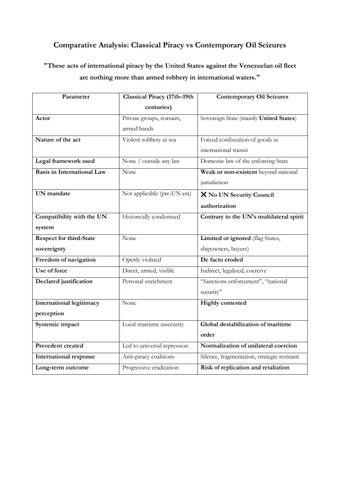
Comparative Analysis: Classical Piracy vs Contemporary Oil Seizures "These acts of international piracy by the United States against the Venezuelan oil fleet are nothing more than armed robbery in international waters." Parameter
Classical Piracy (17th–19th
Contemporary Oil Seizures
centuries) Actor
Private groups, corsairs,
Sovereign State (mainly United States)
armed bands Nature of the act
Violent robbery at sea
Forced confiscation of goods in international transit
Legal framework used
None / outside any law
Domestic law of the enforcing State
Basis in International Law
None
Weak or non-existent beyond national jurisdiction
UN mandate
Not applicable (pre-UN era)
❌ No UN Security Council authorization
Compatibility with the UN
Historically condemned
Contrary to the UN’s multilateral spirit
None
Limited or ignored (flag States,
system Respect for third-State sovereignty
shipowners, buyers)
Freedom of navigation
Openly violated
De facto eroded
Use of force
Direct, armed, visible
Indirect, legalized, coercive
Declared justification
Personal enrichment
“Sanctions enforcement”, “national security”
International legitimacy
None
Highly contested
Local maritime insecurity
Global destabilization of maritime
perception Systemic impact
order Precedent created
Led to universal repression
Normalization of unilateral coercion
International response
Anti-piracy coalitions
Silence, fragmentation, strategic restraint
Long-term outcome
Progressive eradication
Risk of replication and retaliation
Core takeaway Classical piracy was illegal because it rejected all order. Contemporary seizures are dangerous because they undermine the very order they claim to defend. Power without multilateral legitimacy does not create law it erodes it.