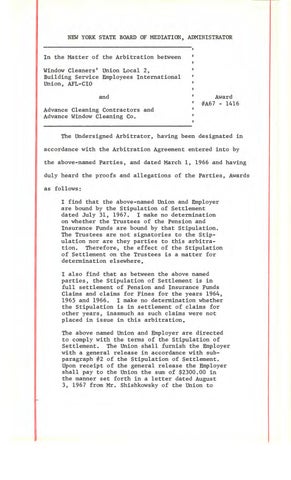
NEW YORK STATE BOARD OF MEDIATION, ADMINISTRATOR
In the Matter of the Arbitration between Window Cleaners' Union Local 2, Building Service Employees International Union, AFL-CIO
and
Award #A67 - 1416
Advance Cleaning Contractors and Advance Window Cleaning Co.
The Undersigned Arbitrator, having been designated in accordance with the Arbitration Agreement entered into by the above-named Parties, and dated March 1, 1966 and having duly heard the proofs and allegations of the Parties, Awards as follows: I find that the above-named Union and Employer are bound by the Stipulation of Settlement dated July 31, 1967. I make no determination on whether the Trustees of the Pension and Insurance Funds are bound by that Stipulation. The Trustees are not signatories to the Stipulation nor are they parties to this arbitration. Therefore, the effect of the Stipulation of Settlement on the Trustees is a matter for determination elsewhere. I also find that as between the above named parties, the Stipulation of Settlement is in full settlement of Pension and Insurance Funds Claims and claims for Fines for the years 1964, 1965 and 1966. I make no determination whether the Stipulation is in settlement of claims for other years, inasmuch as such claims were not placed in issue in this arbitration. The above named Union and Employer are directed to comply with the terms of the Stipulation of Settlement. The Union shall furnish the Employer with a general release in accordance with subparagraph #2 of the Stipulation of Settlement. Upon receipt of the general release the Employer shall pay to the Union the sum of $2300.00 in the manner set forth in a letter dated August 3, 1967 from Mr. Shishkowsky of the Union to
- 2the Employer, a copy of which is attached hereto and made a part hereof. The form of the general release which the Union is to furnish the Employer is also attached hereto and made a part hereof.
Eric J. Schmertz Arbitrator
DATED: October STATE OF New York COUNTY OF New York
1967 ) ) S *:
On this day of October, 1967, before me personally came and appeared Eric J. Schmertz to me known and known to me to be the individual described in and who executed the foregoing instrument and he acknowledged to me that he executed the same.
NEW YORK STATE BOARD OF MEDIATION, ADMINISTRATOR
In the Matter of the Arbitration between ' i Building Service Employees International ' Union, Local 32B, AFL-CIO and Allied Maintenance Corporation
Award and Opinion #A67 - 331
The issue as stipulated is: Are employees Thomas Clark and James Byers entitled to receive Christmas Bonds under the terms of the Collective Bargaining Agreement?
The pertinent part of Paragraph 4(d) of the contract between the parties reads: "In addition, all other terms or conditions of employment which were in effect prior to January 1, 1950, which are higher or better than those provided for herein, shall be maintained for all employees who were employed prior to January 1, 1950 ...." The Company took over the maintenance work at Saks Fifth Avenue in 1944.
Certain conditions of employment were in effect
at that time, including the benefit of a $100 Christmas Bond yearly after an employee had accumulated twenty years of service.
There is no dispute that this was a condition of employ-
ment in effect prior to January 1, 1950 which is higher or better than that provided under the terms of the current Agreement.
Similarly, there is no dispute that the grievants were
employed prior to January 1, 1950, and that they have, since the date of their hire, accumulated twenty years of service.
- 2 What is in dispute is whether the grievants are entitled to the higher condition of employment (Christmas Bonds) within the meaning of the foregoing contract provision. It seems to me that the grievants have met the contract requirements for eligibility.
They were employed prior to the
cut-off date of January 1, 1950.
The contract does not specify
by whom they are to be employed prior to that date.
Indeed,
the contract is between the above named parties, and therefore contemplates that an employee hired before January 1, 1950 could have been, as in the case of the grievants, hired by the Company any time after 1944, rather than by Saks Fifth Avenue. Therefore, under the specific language of the contract itself, I must reject the Company's assertion that the right to a Christmas Bond applies only to those hired prior to January 1, 1950 by Saks Fifth Avenue. Also, under the language of the contract, I cannot accept the Company's argument that the Christmas Bond benefit attached only to those who could have accumulated twenty years of service in the employ of Saks Fifth Avenue if the Company had not succeeded to the maintenance work in 1944 - thereby limiting eligibility to those who were in the employ of Saks Fifth Avenue on or before 1944.
For this assertion to be upheld, the con-
tract, either by explicit language, or by logical implication should include the proviso that employees eligible for the Christmas Bond are only those who were in the employ of Saks at the time that the Company took over the maintenance work. such proviso can be found or inferred.
No
Indeed the balance of
the first sentence of the foregoing contract clause does specify
- 3 an exception, namely: except the elevator operators at Bonwit Teller who shall have a cut-off date of January 15, 1958. If the parties intended that the benefit of a Christmas Bond after twenty years of service would attach only to those employees working for Saks in 1944, and not to any other employees hired by the Company between then and January 1, 1950, that exception would and should have been included along with the exception concerning Bonwit elevator operators.
But it was not, and hence
cannot be read into the Agreement now. Additionally it should be noted that the benefit of a Christmas Bond after twenty years of service, includes not only the right to receive the Bond when that longevity has been fulfilled, but also the right to accumulate years of credit toward that benefit.
In other words, the right of accumulation is it-
self a higher or better condition of employment which must attach to all employees hired prior to January, 1950. right, its ultimate realization cannot be denied.
And as a
Therefore,
since the grievants who were hired prior to January 1, 1950, cannot be denied the right to accumulate years of service towards the twenty years needed to receive the annual Christmas Bond, they cannot now be deprived of receiving that benefit with the completion of the requisite number of years of service. For the foregoing reasons I make the following AWARD: Employees Thomas Clark and James Byers are entitled to receive annual Christmas Bonds under the terms of the Collective Bargaining Agreement.
Eric J. Schmertz Arbitrator
- 4 -
DATED: June 21, 1967 STATE OF New York COUNTY OF New York
ss, i
On this 21st day of June, 1967, before me personally came and appeared Eric J. Schmertz to me known and known to me to be the individual described in and who executed the foregoing instrument and he acknowledged to me that he executed the same,
AMERICAN ARBITRATION ASSOCIATION, ADMINISTRATOR
Voluntary Labor Arbitration Tribunal
In the Matter of the Arbitration between Local 365 UAW, AFL-CIO and
Award
American Machine & Foundry Company
The Undersigned Arbitrator, having been designated in accordance with the Arbitration Agreement entered into by the above-named Parties and dated July 20, 1966 and having been duly sworn and having duly heard the proofs and allegations of the Parties, Awards as follows: Based on the evidence the Company has not established just cause for the discharge of Edward Smith. Therefore the Company's action in discharging Edward Smith on April 25, 1967 was a violation of the contract. He shall be reinstated with full seniority and back pay less earnings if any, during the period since his discharge.
Eric J. Schmertz Arbitrator
DATED: STATE OF New York COUNTY OF
ss,
On this day of August, 1967, before me personally came and appeared Eric J. Schmertz to me known and known to me to be the individual described in and who executed the foregoing instrument and he acknowledged to me that he executed the same. Case # 1330 0381 67
In the Matter of the Arbitration between Local 365 UAW, AFL-CIO and
Opinion
American Machine & Foundry Company
In accordance with Article IV of the Collective Bargaining Agreement dated July 20, 1966 between American Machine & Foundry Company, hereinafter referred to as the "Company" and Local 365 UAW, AFL-CIO, hereinafter referred to as the "Union," the Undersigned was designated as the Arbitrator to hear and decide the following stipulated issue: Was the Company's action in discharging Edward Smith on April 25, 1967 a violation of the contract? If so, what shall the remedy be? A hearing was held at the offices of the American Arbitration Association on July 17, 1967 at which time Mr. Smith, hereinafter referred to as the "grievant," and representatives of the Union and Company, hereinafter referred to jointly as the "parties" appeared.
Full opportunity was afforded all
concerned to offer evidence and argument and to examine and cross examine witnesses.
The parties filed post hearing
briefs and the hearings were declared closed as of August 2,
1967. The grievant was discharged for fighting.
The fight in-
volved the grievant and another employee, one John DiNatale, and took place immediately after the conclusion of their shift, outside the plant exit, but in the Company parking Lot. DiNatale suffered a severe concussion requiring hospitalization.
Both
employees were discharged, but the dispute in this case is
- 2 confined to the grievance filed on behalf of the grievant. The Company took its action under Article II (Management Rights), Exhibit "B" Rule #12, and Article IV Section 5(c)3 of the contract. These contract clauses, or their pertinent parts read as follows: Article II (Management Rights) The management of the plant and the direction of the working force including the right to .... discharge fibr just cause .... is vested exclusively in the Employer. Exhibit "B" Group 1 For violation of the following an employee is subject to discharge. Rule 12 Fighting, wrestling or other physical violence or provoking other employees into such. Article IV Section 5(c)3 In cases involving the Company's exercise of discretion or judgment pertaining to the Rules and Regulations contained in Exhibit "B" of this Agreement, the Arbitrator will not substitute his judgment or discretion for that of the Company. By relying on the foregoing contract provisions, the Company recognizes that all three must be read together. Under Article II the Company has the right to discharge employees, not indiscriminately, but for just cause.
Hence its
invocation of any of the Rules set forth in Exhibit "B" must be within that framework.
And consequently its exercise of
discretion and judgment, pertaining to or in application of those Rules must also be based on a reasonable conclusion that just cause warranted the imposition of the disciplinary penalty.
In other words, if the available evidence supports
a reasonable conclusion that a Rule was violated and that the circumstances of that violation warrant discharge, the
- 3 judgment or discretion of the Company should not be overturned by the Arbitrator.
But implicit, of course, is that the Com-
pany's exercise of discretion or judgment be based on a fair and reasonable interpretation of the evidence at hand.
Other-
wise an arbitrary or discriminatory exercise of discretion or judgment by the Company would be immune from challenge.
And
in view of the contract requirement that discharges be founded on just cause, it is clear that such an unlimited exercise of discretion or judgment by the Company is neither permitted nor contemplated by the contract.
In short, the Arbitrator may
not substitute his judgment for that of the Company if there is evidence to support the reasonableness of the latter's exercise of discretion or judgment; but if the evidence is insufficient, then per force, the Company's discretion or judgment is subject to reversal. What then is a fair and reasonable exercise of discretion and judgment in applying Rule 12?
Certain principles regard-
ing fights that take place during working hours or on Company property are well settled.
There is just cause to discharge
the employee who is the aggressor; who is guilty of an assault; who provokes the altercation or who is otherwise responsible for its occurrence.
Beyond that just cause exists for the dis-
charge of an employee who willingly participates in the fight; who wilfully exerts far greater force than is necessary to defend himself; or at times, who fails to avoid a fight when avoidance is clearly available; even if, as in the latter three instances, he is not the aggressor.
In my view, again
considering the contract requirement of just cause to sustain
- 4a discharge, Rule 12 must be invoked in accordance with these well settled principles. element of misconduct.
As I see it, common to each is the An aggressor or one who provokes is
clearly guilty of misconduct.
And an employee responding
thereto is also misconducting himself if he willingly participates, wilfully exerts excessive force,or fails to avoid the altercation where practicable.
In short, to sustain a dis-
charge for fighting, some degree of culpability must be affixed to the dischargee.
Otherwise an innocent victim who mere-
ly protects himself against an unprovoked assault would be as subject to discharge as the employee who attacked him. The result would be punishment for a reason wholly beyond the innocent victim's control.
Neither the line of arbitration
cases on the question of fighting, nor do I believe this contract between the parties, enunciates or contemplates that result. In this case the Company does claim that the grievant shared responsibility and guilt for the fight.
So that if
this claim is upheld, the grievant's discharge would be for just cause under the foregoing interpretation of Rule 12. As a discharge case, the burden of proving just cause is on the Company.
Based on the evidence before me, the
Company has not met this burden to my satisfaction.
It may
well be that the grievant was guilty of misconduct in connection with the fight, but based on the record before me I cannot reach that conclusion, nor can I find that the Company's conclusion in that regard was fair and reasonable. There is a paucity of evidence in support of the Company's
- 5 contention that the grievant shared responsibility for the fight.
Not a single Company witness saw the fight.
The Com-
pany's assertion that the grievant was either the aggressor or a willing participant is based on evidence that the grievant clocked out a little earlier than was his usual custom (but after his shift ended); that he left and returned to the plant in his working clothes (whereas he usually changes into his street clothes before clocking out); that he was seen, after the fight, standing over DiNatale "bouncing up and down like Cassius ClayJ" and of the position in which DiNatale was found on the ground.
Counter-balancing this evidence is dir-
ect testimony of Union witnesses who not only saw the fight, but who witnessed an earlier "scuffle" between DiNatale and the grievant inside the plant during their shift.
These wit-
nesses, who were not impeached either on cross examination or by rebuttal evidence, testified that earlier in the day DiNatale angrily approached the grievant at the latter's work area, and initiated a scuffle with the grievant.
They testified that
they overheard DiNatale hurl provocative language at the grievant after the scuffle was broken up.
Those who witnessed the
fight outside the plant in the parking lot, testified that DiNatale waited outside the exit door for the grievant and attacked the latter as soon as he exited from the plant. They stated that the grievant merely defended himself by throwing up his hands, one of which struck DiNatale, and that off balance, DiNatale fell and struck his head on the paved ground. Not only does the testimony of the witnesses to both the scuffle and the fight outweight the circumstantial and - speculative evidence advanced by the Company, but the record
- 6 indicates that DiNatale had a motive for attacking the grievant.
On the day of the fight, because of a back ailment, the
grievant was moved to DiNatale's regular machine, which afforded the grievant less strenuous work than required of him on his own machine, and DiNatale was moved elsewhere, requiring heavier work on his part.
There seems no question
but that this angered DiNatale and lead to his provocative action and the scuffle between the two in the plant.
Based
on the evidence, it would appear that DiNatale had a reason not only to start the scuffle, but to attempt to finish the fight after working hours.
Of significance also is the testi-
mony of the supervisor of both the grievant and DiNatale that the former was "an honest man" with "no chip on his shoulder" and "mild mannered;" whereas the latter was "excitable" and 'got into arguments."
The conclusion is inescapable.
DiNatale
was clearly more capable of belligerence than the grievant. Nor do I find that the grievant failed to avoid a fight when it was practicable for him to do so.
The scuffle inside
the plant had been broken up and both employees were warned about a recurrence.
I do not think that DiNatale's provoca-
tive remarks at that time were sufficient to forewarn the grievant that a fight was in the offing when he left the plant. Obviously the grievant had the right to clock out at the end of his shift even though it may have been a few minutes earlier than his ordinary custom.
I do not see how he could have avoid-
ed DiNatale if the latter was waiting for him, even if he waited another five or ten minutes before clocking out.
Cer-
tainly the grievant cannot be required to wait inside the
- 7 plant indefinitely, especially when there is reason to conclude that he was unaware of what was awaiting him. Though explanations were advanced in connection with the grievant's earlier clock-out, his remaining in work clothes, and the physical position of DiNatale on the ground, I find no need to discuss these explanations in this Opinion simply because the Company's contentions regarding these factors are insufficient in the face of evidence offered by the Union in support of the grievant's story. Based on the record before me, and in view of the burden on the Company to establish just cause, I can reach no conclusion other than that the Company's case falls short of what is required, and that the Company's exercise of discretion and judgment in discharging the grievant was unreasonable. The weight of the evidence supports the conclusion that the grievant was the victim of an attack by another employee; that the attack was unprovoked; that the grievant was merely protect ing himself from the attack and was not a willing participant; and that no other elements of misconduct or culpability for the fight can be attributed to the grievant.
A contrary re-
sult could only be based on evidence not presented in this arbi tration, and absent such evidence, the Company has not met the test of proving just cause. Accordingly the discharge of Edward Smith is reversed. He is to be reinstated with full seniority and back pay less any earnings elsewhere during the period of his discharge.
Eric/Jo Schmertz | Arbitrator
NEW YORK STATE BOARD OF MEDIATION, ADMINISTRATOR
In the Matter of the Arbitration Between Local Union No. 249, Blueprint, Photostat and Photo Employees Union, IJWU, AFL-CIO and
Case No. A66-1326
Beacon Photo Service, Inc.
The purpose of an arbitration is to adjudicate an existing adversary issue and to render an Award that is performable and enforceable. I hold that this purpose has been rendered academic and moot by the decision of the National Labor Relations Board in Case #29-RM107 dated March 30, 1967 between the above parties. Accordingly, the matter before me is dismissed without prejudice and without an Award.
Eric J. Schmertz Arbitrator
DATED: April 12, 1967 STATE OF New York COUNTY OF New York
) ss. )
On this 12th*day of April, 1967, before me personally came and appeared Eric J. Schmertz to me known and knownto me to be the individual described in and who executed the foregoing instrument and he acknowledged to me that he executed the same.
AMERICAN ARBITRATION ASSOCIATION, ADMINISTRATOR
Voluntary Labor Arbitration Tribunal
In the Matter of the Arbitration between Utility Workers of America, Local No.369 AFL-CIO
and
Award of Arbitrators
Boston Edison Company
The Undersigned Arbitrators, having been designated in accordance with the Arbitration Agreement entered into by the above-named Parties and dated April 23, 19.65 and having duly heard the proofs and allegations of the Parties, Award as follows: The Company did not violate the contract in its discharge of Robert J. Mulkern.
Eric /. Schmertz Chairman
John S. Madden Concurring
Thomas M. Sullivan Dissenting
DATED: May 15, 1967 STATE OF New York COUNTY OF New York On this 15th day of May, 1967, before me personally came and appeared Eric J. Schmertz to me known and known to me to be the individual described in and who executed the foregoing instrument and he acknowledged to me that he executed the same, Case No. 1130 0217 66 ' .
"
N ••" -':'iir, St^to ot "«w Vo:' •',•). 41-23-910? i!)>.ni!>i'"i in f]u^;:s C.untv T'--m Expires M.^c.i ;•('!, \'^1
DATED: STATE OF COUNTY OF
) ss. : )
On this day of May, 1967 before me personally came and appeared John S. Madden to me known and known to me to be the individual described in and who executed the foregoing instrument and he acknowledged to me that he executed the same,
DATED: STATE OF COUNTY OF
) . jo..
On this day of May, 1967 before me personally came and appeared Thomas M. Sullivan to me known and known to me to be the individual described in and who executed the foregoing instrument and he acknowledged to me that he executed the same.
In the Matter of the Arbitration between Utility Workers Union of America Local No. 369, AFL-CIO and
Opinion of Chairman
Boston Edison Company
In accordance with Article XXXIII of the Collective Bargaining Agreement dated April 23, 1965 between Boston Edison Company, hereinafter referred to as the "Company" and Utility Workers Union of America,
Local No. 369, AFL-CIO, hereinafter
referred to as the "Union," the Undersigned was designated as the Chairman of a tripartite Board of Arbitration to hear and decide the following stipulated issue: Did the Company violate the contract dated April 23, 1965 in its discharge of Robert J. Mulkern? If so, what should the remedy be, if any? Messrs. Thomas M. Sullivan and John S. Madden served respectively as the Union and Company designees to said Board of Arbitration.
A hearing was held at the offices of the
Company in Boston, Massachusetts on January 30, 1967 at which time Mr. Mulkern, hereinafter referred to as the "grievant," and representatives of the Union and Company, hereinafter referred to jointly as the "parties," appeared.
Full opportun-
ity was afforded all concerned to offer evidence and argument and to examine and cross examine witnesses. Arbitrators was expressly waived.
The oath of the
The Company filed a post
hearing brief on March 22, 1967; and the Board of Arbitration met in executive session in New York City on May 8, 1967, following which the hearings were declared closed.
- 2 Pertinent to this dispute is the following part of Article V (Management Rights) of the contract: ... If the Union claims that the Company has exercised the right to suspend, discipline, demote or discharge employees in an unjust or unreasonable manner, such claim shall be subject to grievance procedure in Article XXXII and arbitration in Article XXXIII. In my judgment the manner of the grievant's discharge would be both reasonable and just if the Company's action was procedurally and substantively consistent with the stipulation entered into by the parties on March 7, 1966.
I find that it
was. The events giving rise to that stipulation are material. It is conceded that the grievant is an alcoholic.
Prior to
February 14, 1966 he underwent various treatments for this ailment, including periods of specialized hospitalization, for which the Company granted him leaves of absence.
His drinking
problem was the proximate cause of a record of unsatisfactory job attendance.
In January 1966 the grievant was imprisoned
for thirty days for being "drunk and disorderly" and consequently was unable to report for work for the period January 18 to January 22, 1966.
As a result the Company discharged him; but
upon the intervention of the Union the discharge was reduced to a suspension, and the grievant was reinstated effective March 15, 1966 in accordance with the written stipulation entered into and signed by representatives of the parties dated March 7, 1966. Pertinent to the instant case is Paragraph 2 of that stipulation which reads"
- 3 Mr. Mulkern is afforded a warning that a recurrence of unauthorized absence from work will mean more severe disciplinary action which may include discharge. There is no dispute that the phrase "unauthorized absence from work" meant an absence because of intoxication or the effects of drink. With his reinstatement, the grievant enrolled in the Company's Rehabilitation Program for alcoholics.
This Company
program is under the direction of a trained rehabilitation counsellor and is maintained in conjunction with the Company Medical Department.
The grievant's attendance at andattention
to the program was neither diligent nor determined, but rather sporadic. To my mind there is no doubt about the meaning of the second paragraph of the March 7 stipulation.
The parties
agreed that severe discipline including discharge would be warranted if the grievant was again absent as a result of his drinking problem.
By agreeing to the stipulation the Union
expressly conceded that the penalty of discharge, as well as lesser penalties, would be proper in that event.
In other
words the parties agreed that the degree of penalty would be left to the Company upon the recurrence of "unauthorized absence from work."
I cannot agree with the Union's assertion
that it thought the next penalty would be a suspension rather than a discharge, and that the ultimate penalty of discharge would be imposed only after more than one recurrence of unauthorized absence.
The wording of the stipulation does not support
this assertion.
It does not provide for penalties less than
- 4discharge for the next recurrence of an unauthorized absence, and for discharge later, if a record of unauthorized absences continued.
Rather, it specifically provides for severe dis-
ciplinary action including discharge upon a recurrence of unauthorized
absence; meaning that the most severe penalty,
namely discharge, was contemplated by the parties as the penalty which could be imposed if the grievant was again absent under circumstances similar to his absence from January 18 to January 22, 1966 - because he was drunk or suffering from the influence of drink.
Indeed, not only does the language of the
stipulation so provide, but this interpretation is logical as well.
The grievant1s reinstatement in March did not vitiate
the prior discharge altogether, but merely reduced it to a suspension.
So, by agreement of the parties, the grievant re-
turned to work with a suspension on his record.
It follows,
under the accepted procedure of "progressive discipline" that the penalty for the next recurrence of the same offense could be more severe than a suspension - in other words, discharge. Hence I cannot accept the Union's contention that it did not expect or intend that the second paragraph of the March 7 stipulation would be used to apply the penalty of discharge for the next time the grievant was absent because of his drinking problem. The grievant was absent from work on May 13, 16, 17 and 18, 1966.
Though he reported to the Company on May 13 that
he was "sick with a cold," and though there is some question about whether he suffered from this bona fide illness on that day, he admitted to the administrators of the Company Rehabili-
- 5tation Program and again admitted at the Arbitration hearing that his absences of May 16, 17 and 18 were because he "had been drinking and was hung over."
So that at least as to the
latter three days, his report that he was sick with a cold was either false or incomplete, and again as to those three days, he was certainly "not fit for duty."
Consequently I
find that his absence of those three days, because they were due to his drinking problem, were manifestly
"unauthorized"
within the meaning of the second paragraph of the March 7 stipulation and the language the Company used in notifying him of his discharge - "for false report and being unfit for duty" is, because the record demonstrates these charges to be factual, synonymous with a charge of "unauthorized absence from work." In short, I find that the March 7 stipulation expressly allowed the penalty of discharge if the grievant was again absent because of his drinking problem; that his absences on May 16, 17 and 18, if not on May 13 as well, were such unauthorized absences, and that his discharge by the Company was for that reason. There remains the question of the manner in which the Company learned of the true reason for the grievant's absence on the latter three days.
Though the grievant reported him-
self sick with a cold on May 13 to his department, he reported to the Company's Rehabilitation Counsellor that he could not come to work because he had begun drinking again.
This
information was made known to the Company physician who reported it to the Industrial Relations Department of the Company.
- 6 A subsequent investigation by that Department resulted in the grievant's discharge. The Union suggests that the manner in which the Company obtained the information about the grievant's absence was improper because it came out of the Rehabilitation Program, about which some degree of confidentiality, especially conversations between the Counsellor and a participating employee, should be maintained.
The Union argues that the grievant's appeal to the
Rehabilitation Counsellor for help in accordance with the purpose of the Rehabilitation Program, was used by the Company to the grievant's prejudice.
And to do so is wholly
inconsistent
with the intent and usefulness of the Rehabilitation
Program.
It appears that the Union relies on this in its contention that the "manner" of the discharge was improper. I am inclined to agree with the Union's assertion that to reveal what transpires between a participating employee and the Rehabilitation
Program administrators, is to undermine the
effectiveness of that program.
Employees should feel that what
occurs during and as part of their period of treatment will not be revealed to others.
Otherwise, the fear that prejudicial
or embarrassing information may be disclosed to others within or without the Company could seriously deter an alcoholic employee from voluntary and diligent participation in the program. However, the Arbitrator is bound by the stipulation of March 7, 1966 and not by what might constitute good therapy or wisdom in the administration of the Rahabilitation Program. The March 7 stipulation does not preclude the obtaining of evidence of unauthorized absences from the Rahabilitation Program.
In-
- 7 deed, the stipulation makes no mention of the Rehabilitation Program at all.
It only provides for discipline, including
discharge upon the happening of an unauthorized absence. And there is no proviso as to the source of or manner in which information about that absence reached or was obtained by the Company.
Moreover, the record indicates that the Rehabilita-
tion Program itself never assured or led participating employees to believe, expressly or by implication, that what transpired therein would be treated confidentially.
In other
words, the Rehabilitation Program was designed to make an effort at rehabilitation, but in no way immunized the participating employees from disciplinary action.
It is a device which the
Company hopes will obviate discipline, by curing or controlling alcoholism, but upon failure the Company is not barred from taking disciplinary action. As a practical matter the parties, upon entering into the March 7 stipulation could have taken into consideration the possibility that the grievant would "back slide" once or twice even if he underwent treatment.
If so, the parties
could have given the grievant a reasonable time to improve his attendance record and to eliminate any absence due to drinking.
But as I have indicated earlier, the parties did
not do so.
The stipulation proscribes any recurrence of un-
authorized absence due to drink, and it is to that stipulation that the Arbitrator must adhere.
Hence neither procedurally
nor substantively do I find a defect in the Company's action under that stipulation.
There was nothing improper procedur-
ally in the manner in which the Company learned of the griev-
- 8 ant's absence and there is no doubt that his absence was unauthorized within the meaning of the second paragraph of the stipulation.
And finally, the stipulation expressly
contemplated discharge as a penalty for that absence.
The
Union may have hoped that the Company would impose a lesser penalty, yet the ultimate penalty of discharge was clearly authorized. If this result disturbs the effectiveness of the Company's Rehabilitation Program, it is a matter which the parties must consider in future cases of a similar type and in their future negotiations with each other.
Eric J. Schmertz V Chairman
FEDERAL MEDIATION & CONCILIATION SERVICE, ADMINISTRATOR
In the Matter of the Arbitration between Retail Clerks Union Local 212
and
Award 67A/4952
Colonial Super Markets, Inc.
The Undersigned Arbitrator, having been designated in accordance with the Arbitration Agreement entered into by the above-named Parties and dated October 16, 1964 and having duly heard the proofs and allegations of the Parties, Awards as follows: The grievant's penalty should have been a suspension rather than discharge. However, he does not seek reinstatement. His claim is limited to back pay for the period of time from his discharge to his full time employment elsewhere less earnings in the interim. That claim for back pay is denied in its entirety.
Eric ^J. Schmertz Arbitrator
DATED: July 31, 1967 STATE OF New York COUNTY OF /J»vM^YW
)ss.: )
On this 31st day of July, 1967, before me personally came and appeared Eric J. Schmertz to me known and known to me to be the individual described in and who executed the foregoing instrument and he acknowledged to me that executed the same.
MORTON S.SEHTCTUi Not,,, Put*: i.; thT. State of New Y.fl
In the Matter of the Arbitration between Retail Clerks Union Local 212 and
Opinion
Colonial Super Markets
In accordance with the Arbitration Provisions of the Collective Bargaining Agreement dated October 16, 1964 between Colonial Super Markets, Inc., hereinafter referred to as the "Company," and Retail Clerks Union Local 212, hereinafter referred to as the "Union," the Undersigned was selected as the Arbitrator to hear and determine the following issue: Was the discharge of Michael Brown for just cause? If not, what shall be the remedy? A hearing was held in Buffalo, New York on July 19, 1967 at which time Mr. Brown, hereinafter referred to as the "grievant," and representatives of the Union and Company, hereinafter referred to jointly as the "parties," appeared. Full opportunity was afforded all concerned to offer evidence and argument and to examine and cross examine witnesses.
The parties ex-
pressly waived the Arbitrator's oath. The grievant was a part time employee, classified as a clerk, in the Company's Bottle Department.
He was discharged
on December 26, 1966 for generally unsatisfactory performance of his duties and for failure to carry out certain specific assignments on December 24, 1966.
The Company contends that
the unsatisfactory nature of the grievant's work in the Bottle Department extended over the five months of his employment from July to the end of December, 1966; that the grievant had been warned on several occasions by the Company Store Manager that
- 2 his work was unsatisfactory and would have to improve if his employment was to continue; and that on December 24, 1966 the grievant was given specific instructions to clean up the Bottle Department, remove empties to the basement and to clean up the basement area before he left work that day, but failed to do so.
The latter alleged incident precipitated the grievantTs
discharge. The grievant, and the Union on his behalf, contend that the quantity of the work in the Bottle Department (stocking the shelves; keeping the shelves, fixtures and aisles clean and clear-, accepting empties and issuing credit slips; removing bottles to the basement and stacking them for return to the vendors; and maintaining neatness and cleanliness in the basement area) was beyond the capability of one man, and that the grievant was never given adequate assistance to perform all these tasks.
Though he acknowledges receiving directions and
instructions from supervision about his duties, some of which were in the form of criticism, the grievant denies that he was ever warned that his work was unsatisfactory or that his job was in jeopardy if he did not improve.
Moreover, he denies re-
ceiving any specific instructions on December 24, 1966 with which he did not comply. The grievant is presently employed full time in a job in another industry.
Neither he nor the Union seeks his reinstate-
ment with the Company.
Instead, because the Union contends
that his discharge was unjust, the grievance is limited to a claim for money damages in the form of back pay from his discharge to the date that he obtained full time employment else-
- 3 where, less any earnings during the interim. Based on the record I am persuaded that the grievant's work in the Bottle Department was not up to satisfactory standards.
I accept as fact the heavy quantity of work involved.
Yet I believe that the grievant could have performed his tasks more efficiently and with a more determined attitude especially in the face of the specific instructions and directions given him by supervision.
I am convinced, for example, that the
grievant performed necessary clean-up duties only within his regular working hours.
And though instructed to sweep and
clean up each night before leaving work, he rarely if ever, worked beyond his normal quitting time to comply with that assignment even though he would have been paid overtime for doing so.
This is not to say that he was required to work
overtime.
Rather, it is symptomatic to me of his general cav-
alier attitude about the basic and specific job requirements in his department. I am in general agreement with the Union's argument that little or no distinction was made between instructions to the grievant and warnings about his job performance.
I believe
that what the Company may have considered as a warning, the grievant may have logically interpreted merely as a work directive.
No written warnings were given.
All exchanges be-
tween the grievant and supervision were oral.
And though the
Company asserts that it informed the grievant that he either "shape up or ship out" I find some justification for the grievant's claim that he was never directly told that his job was
•
in danger.
- 4I am not persuaded that the Company took the necessary and precise steps required in order to effectuate a discharge for unsatisfactory job performance.
If specific and written
warnings had been served upon the grievant, no doubt would exist that he had been put on notice.
But though I conclude that
his work was indeed below a satisfactory level, I cannot conclude that he was so notified unequivocally.
And again, though
I accept the testimony of the Company witnesses that the grievant was told to clean up the basement area before he left work on December 24, 1966, I am not satisfied that this directive also took the form of a warning. It is well settled that an employee may be discharged for unsatisfactory work performance. that ground is not warranted.
But a summary discharge on
Unless the Collective Bargaining
Agreement provides otherwise, an employee performing below standard is entitled to warnings and possibly even a suspension before the ultimate discharge.
In other words, an employee's
termination for poor work is one of the prime instances where the classical rule of progressively severe discipline is applicable.
And I see no reason why that rule should not have
been used in this case. Accordingly, I find that the grievant's discharge was summary and hence precipitous.
If he had been warned, those
warnings should have taken a more formal and less ambiguous form.
And assuming that he did or should have understood that
the Company was both dissatisfied with his work performance and warning him of the danger of discharge, the proper penalty for his failure to carry out the clean-up instructions on
- 5 December 24, 1966 would, in my judgment, have been a suspension for some appropriate period of time. But the grievant does not seek reinstatement.
Therefore,
the only question before the Arbitrator is whether he is entitled to any back pay for the period of time between his discharge and his employment elsewhere.
Though I have found
that his discharge was too severe and the proper penalty would have been a suspension, I nonetheless deny his claim for any back pay.
I do so for two reasons.
First because of his ob-
vious failure to mitigate the damages, and second because of his lack of candor concerning earnings from part time employment at a gas station and possibly elsewhere, during the period from his discharge to his present full time employment. After his termination by the Company, the grievant did not seek another comparable job.
The record indicates that
other super markets and similar types of businesses in the Company's geographic area were at the time, seeking part time help for which the grievant qualified.
Instead, the grievant
sought employment in an entirely different field - with an insurance company or real estate agency. right to seek that type of job.
Of course he had the
But in doing so, he voluntar-
ily took himself out of the market for a job similar to the one he had with the Company or similar to the duties for which he would have been paid had he continued in the Company's employ.
And therefore he may not now make a claim for back pay
when he deliberately avoided seeking the kind of job for which that pay would be occupationally applicable.
Moreover, I am
not at all satisfied that an Award of back pay would not unjustly enrich the grievant.
On direct testimony he stated
- 6 that he was not employed at all from the period of his discharge until he obtained his present full time job.
On cross
examination he grudgingly disclosed that he had been working at least two and possibly three days a week, for about ten hours a week, over a two month period at a gas station, earning the minimum hourly wage.
I must conclude that the grievant in-
tended to withhold this information.
Accordingly, I am not at
all certain that there were not other part time jobs at which he also worked during the interim period which were not disclosed.
Hence, based on the grievant!s less than candid testi-
mony, I am unable to determine what damages, if any, he suffered, even if his discharge is reduced to a suspension.
Accord-
ingly, his claim for back pay is denied.
Eric It Schmertz Arbitrator
In the Matter of the Arbitration between Warehouse, Production & Sales Employees Union, Local 11, N.O.I.T.U. and
Award
Columbian Carbon Co. Plastics Division
The Undersigned Arbitrator, having been designated in accordance with the Arbitration Agreement entered into by the above-named Parties and dated May 1, 1965 and having duly heard the proofs and allegations of the Parties, Awards as follows: 1. Under Article XVI, paragraph a of the contract dated May 1, 1965, Frank Cavaluzzi, the senior man, is entitled to bump John Jones, the junior man, in the class 3 truck dsiver job. 2. Among the following employees the proper seniority list is: Name Frank Cavaluzzi Frank Ruland Hayes Poole Sterling Richards Joe Misa John Jones
Seniority January 2, 1957 April 17, 1957 May 12, 1958 May 22, 1958 July 7, 1958 June 3, 1959
Eric J. Schmertz Arbitrator DATED: December 14, 1967 STATE OF New York COUNTY OF New York
) Ss.: )
On this 14th day of December, 1967, before me personally came and appeared Eric J. Schmertz to me known and known to me to be the individual described in and who executed the foregoing instrument and he acknowledged to me that he executed the same.
AMERICAN ARBITRATION ASSOCIATION, ADMINISTRATOR Voluntary Labor Arbitration Tribunal _ _™_™, ___
_____
«_„„_
__™__™_~
:
_
_ _ _ _ _ _ , _ _ „ ^
In the matter of the Arbitration between ' United Steelworkers of America on behalf of Local Union 5641, AFL-CIO
' ' !
and Geo. J. Meyer Manufacturing Co. Worcester Division
' i ' ' i
Award
The Undersigned Arbitrator, having been designated in accordance with the Arbitration Agreement entered into by the above-named Parties, and dated December 16, 1965 and having been duly sworn and having duly heard the proofs and allegations of the Parties, Awards as follows: The discharge of the grievant is mitigated to a suspension. He shall be on suspension from the date of his discharge until such time as he produces a physician's certificate stating that his stomach ailment in particular, and his physical condition in general, are such that he is capable of working a full eight hour shift during each regular work day of the week. Upon presentation of such a certificate the Company shall reinstate him without back pay but with his seniority intact. If thereafter his attendance record falls below an acceptable level, he may be discharged.
Eric J. Schmertz Arbitrator
DATED: March 1967 STATE OF New York COUNTY OF
) ss>. )
On this day of March, 1967, before me personally came and appeared Eric J. Schmertz to me known and known to me to be the individual described in and who executed the foregoing instrument and he acknowledged to me that he executed the same. Case No. 1130 0266 66
I
In the Matter of the Arbitration between
'
United Steelworkers of America on behalf of Local Union 5641, AFL-CIO
' '
and Geo. J. Meyer Manufacturing Co. Wo rc e s ter Diy i s ion
'
Opinion
'
i
'
In accordance with Article 26 of the Collective Bargaining Agreement dated December 16, 1965 between Geo. J. Meyer Manufacturing Co., Worcester Division, hereinafter referred to as the "Company" and United Steelworkers of America, on behalf of Local Union 5641, AFL-CIO, hereinafter referred to as the "Union," the Undersigned was designated as the Arbitrator to hear and decide the following stipulated issue: Was the discharge of Gerald Dionne on September 30, 1966 for proper cause? If not what shall the remedy be? A hearing was held in Worcester, Massachusetts on February 13, 1967 at which time Mr. Dionne, hereinafter referred to as the "grievant," and representatives of the Union and Company, hereinafter referred to collectively as the "parties," appeared. Full opportunity was afforded the parties to offer evidence and argument and to examine and cross examine witnesses. If one phrase could summarize the facts in this case, it would be "that the grievant managed to snatch defeat out of the jaws of victory." Prior to his termination, the grievant's status was most anomalous.
His position was one of precarious balance between
facing discharge for an unsatisfactory attendance record, or being promoted to a foreman's job in recognition of his superior ability as a drill press operator.
- 2 There is no dispute about the grievant's superior technical competence.
The Company readily concedes it, as well
as the fact that his productivity was consistently at a high incentive level.
Moreover, the Company believed that the
grievant possessed leadership qualities.
As a consequence the
Company suggested to the grievant that he had the potential to be a foreman and urged him to take an examination to establish his qualifications for a foreman's job; which he did and which he passed.
Simultaneously, however, the grievant was compil-
ing an unsatisfactory record of attendance.
Over an extended
period of time, and to an excessive degree, he was either unable or unwilling to put in a full day's work on his second shift of 3 P.M. to 11 P.M.
At times he reported to work late,
and more often he left work early before the 11 P.M. quitting time.
He was warned several times by the Company about this
practice, and early in February of 1965 he was given a two day disciplinary suspension because the practice persisted. It is obvious that these two seemingly contradictory conditions - his superior ability and potential as a foreman on the one hand, and his unsatisfactory attendance record on the other, set up a collision course between loss of employment or promotion to supervision.
These alternatives coincided in
August of 1966 when the Company asked the grievant to take the foreman's test.
For at the same time it warned him that
his attendance record was still unsatisfactory; that only if it improved over the subsequent 60 days could he be considered for promotion to a foreman's position; and that if it did not improve he would be subject to severe discipline including discharge.
Given this option, and though he passed the fore-
- 3 man's test, the grievant's attendance record, particularly his practice of leaving work before the 11 P.M. quitting time, became worse.
In short, instead of meeting the condition for
promotion to a foreman, he travelled the opposite direction. The Union does not claim that the grievant's attendance record was satisfactory.
Nor does it assert that the number
of times he failed to work a full shift was within reasonable bounds.
Instead, the Union attempts to excuse or justify the
grievant's conduct.
It contends that he left work early or
reported late, in most instances, because he suffered from a chronic ulcer condition, and each time that problem had flared up.
It points out that with each early departure the grievant
either notified his foreman, obtained the foreman's consent or the consent of the Company nurse.
Additionally the Union
points to the fact that the grievant's productivity was well in excess of the standard, even on the days he did not work the full eight hours.
But the main thrust of the Union's case
is that the Company, in considering the grievant for a foreman's position, and by urging him to take the foreman's test, condoned the grievant's single defect - his attendance record. And that therefore the Company erred when it relied upon that record as the basis for the grievant's
discharge.
I cannot accept the Union's arguments.
It is well settled
that an incentive employee must give the Company a full day's work regardless of the quantity of his productivity.
He may
not leave work early merely because he has met or exceeded standard production.
It is similarly well settled that a poor
attendance record is not excused because of chronic illness
- 4or disability.
An Employer is entitled to rely upon consist-
ent and regular service by its employees.
If an employee is
unable to report for work regularly, or is unable to put in a full day's work on a consistent basis, even if it be due to a physical condition beyond his control, the Company need not tolerate the situation indefinitely.
Hence, the bona fides
of the grievant's ulcer condition would not mean that the Company is required to continue the grievant in its employ when his attendance record is so spotty.
Accordingly, the fact
that he notified his foreman or the Company nurse before leaving, is immaterial. I do not find that the Company's interest in the grievant as a potential foreman worked to condone his record of attendance.
The Company made it quite clear by its several warnings,
by the two-day disciplinary suspension and by its final warning, that at no time did it accept the grievant's practice of cutting his work day short.
Though he was afforded an
opportunity to be considered for a foreman's job, he was warned just as clearly, and simultaneously, that unless his attendance record improved he would not get that job and instead would face more severe discipline, including discharge.
Of
course if the Company had failed to so admonish the grievant, its consideration of hig as a possible foreman might be construed as a condonation of his attendance record. are not the facts. and unequivocal.
But such
The warnings and the suspension were clear The Company considered his attendance record
poor and unsatisfactory; told him so; and warned him that he would face discharge if it did not improve.
Moreover, over
- 5 the last 60 days of his employment during which his attendance record became worse, I find some evidence of the grievant's defiance of managerial authority.
Possibly some of his early
departures were caused by his stomach disorder.
But those days
that he punched out at 10:55 P.M., only five minutes before the regular quitting time, clearly could not have been for that reason.
In the face of the final warning that his record for
a period of 60 days had to improve, his punch outs only five minutes before the regular quitting time is subject to only one interpretation - a willful disregard of that warning. Also those departures cannot be justified on the grounds that they took place during the five minute wash up period before the end of the shift.
The regular procedure is for employees to
stop work at 10:55; then to wash up for five minutes; and then to punch out not before 11 P.M.
For the grievant to be at the
time clock in order to punch out at 10:55 P.M., meant that he quit work before 10:55, or before he was permitted to do so. Hence the Union's suggestion that he merely left work without taking his wash up period and without loss of production time, is not persuasive. The record indicates that both parties have made a sincere and determined effort to rehabilitate the grievant.
The Company
found him to be a superior employee when he worked and thought that if he was given the prospect of more responsibility, his attendance record would improve.
Representatives of the Union
urged the grievant to make an effort to cure his single deficiency particularly in view of his demonstrated superior ability as a drill press operator.
The Company indicated at the hearing
- 6 that ordinarily few employees possess the qualifications for promotion to supervisory positions.
And that when one is
found, it seeks to give him the opportunity, not solely as a benefit for the individual involved, but because the Company needs foremen.
Accordingly, I believe one final effort to
salvage the grievant is not inappropriate, and I trust not unwelcome.
After all everyone else has tried his hand at rehab-
ilitating the grievant.
So this Arbitrator, with the authority
of his office chooses to try also.
I do so not merely to give
the grievant another chance - because his entitlement to that is open to question - but because if it succeeds, the Company may profit by the retention of an employee of superior technical ability who henceforth can give a full day's work. Though I have held that some of the grievantfs early departures were unnecessary and in defiance of warnings, others may have been because of his stomach ailment.
If so, he may
be entitled to some consideration, provided he demonstrates that he is physically able to work his full shift.
He is ad-
monished that if re-employed, he must regularly and consistently work his full shift.
He may neither report in late nor
leave early, including early departures of only a few minutes. If he is unable to meet that requirement, for whatever the reason, he shall be deemed incapable of performing the duties of his job and need not be retained in the Company's employ. Accordingly, as a last effort at rehabilitation, I shall mitigate the discharge to a suspension.
The grievant shall
be considered on suspension from the date of his discharge until such time as he procudes a physician's certificate stating
- 7 that his stomach ailment in particular, and his physical condition in general, are such that he is capable of working a full eight hour shift during each regular work day of the week. Upon presentation of such a statement the Company shall reinstate him without back pay but with his seniority intact. If thereafter his attendance record falls below an acceptable level, he may be discharged.
Eric J.Schmertz Arbitrator
In the Matter of the Arbitration between
'
Local 484 American Bakery and Confectionery ' Workers International Union, AFL-CIO ' t and
'
The Great Atlantic & Pacific Tea Company
Award
'
The Undersigned Arbitrator, having been designated in accordance with the Arbitration Agreement entered into by the above-named Parties and dated October 18, 1964 and having duly heard the proofs and allegations of the Parties, Awards, as follows: The covered employees are not entitled to vacation pay for 1967 under the facts and circumstances of this case.
Eric J. Schmertz Arbitrator
DATED: STATE OF New York COUNTY OF
)ss.: )
On this day of October, 1967, before me personally came and appeared Eric J. Schmertz to me known and known to me to be the individual described in and who executed the foregoing instrument and he acknowledged to me that he executed the same.
In the Matter of the Arbitration between Local 484 American Bakery and Confectionery Workers International Union, AFL-CIO and
Opinion
The Great Atlantic & Pacific Tea Company
In accordance with Article XXII of the Collective Bargaining Agreement dated October 18, 1964 between the Great Atlantic & Pacific Tea Company, Inc., hereinafter referred to as the "Company," and Local 484 American Bakery and Confectionery Workers International Union, AFL-CIO, hereinafter referred to as the "Union," the Undersigned was designated as the Arbitrator to hear and decide the following stipulated issue: Are the covered employees entitled to vacation pay for 1967 under the facts and circumstances of this case? A hearing was held at the offices of the American Arbitration Association on October 4, 1967 at which time representatives of the Union and Company, hereinafter referred to jointly as the "parties" appeared.
The parties were afforded full
opportunity to offer evidence and argument and to examine and cross examine witnesses.
The parties expressly waived the
Arbitrator's oath. The facts and circumstances of this case concern two employees who claim vacation pay for the year 1967; a year during which they did not actively work any day, but during which they were on sick leave or disability leave of absence.
More
specifically the claimants last actively worked in the year 1966 and received vacation pay for that year.
They became
ill in 1966; exhausted their sick benefits for that year, but
- 2continued on sick leave or disability leave into 1967 under a contract provision which "recycles" sick benefits each year, until totally exhausted.
Both claimants are or were complet-
ing their terminal sick leave or disability leave during 1967 and it is conceded that neither will again return to active employment. The Union contends that both claimants and others similarly situated, (the parties have agreed that the issue before the Arbitrator is a general one to be applied not only to the two claimants, but to other cases where appropriate) who have been full time employees for more than fifteen years are entitled to four weeks vacation with full pay each year that they are in the Company's employ in accordance with Article X Section 1 Paragraph C of the contract.
That section reads:
Effective January 1, 1965 all full time employees who have been in the employ of the Company for fifteen (15) years shall receive four (4) weeks vacation with full pay. The Union asserts that the claimants were full time employees during 1967, albeit on sick or disability leave; that their seniority continued to accrue during 1967; that they enjoyed credit for holidays which fell within that year; and that there is no contract requirement that they actively engage in work for the Company in order to qualify for the vacation pay. The Company relies on the first sentence of Article X Section 6 of the contract which reads: In determining eligibility for any of the above vacations, present practice shall prevail.
- 3 In support of its position the Company points to a uniform and unvarying practice, going back as far as "one can remember," to pay employees for vacations only in those years in which they actively worked on their jobs.
For example, the
Company cited thirteen instances over the period from 1963 to 1965 in which employees remained on the Company's employment rolls while on sick leave or disability during the year following the one in which they last worked actively.
And in
each case their last vacation pay was for the year in which they actively worked; in no case was vacation paid for the subsequent year during which they were on sick or disability leave. The Union does not dispute this practice.
Instead it
asserts that it should not be bound because it was unaware of it; and that the first sentence of Article X Section 6 should only obtain if the practice does not contravene some other specific provision or benefit of the contract.
In this case,
the Union argues, the conceded practice is in violation of Article X Section 1 Paragraph C of the contract. In general the Union is correct in its assertion that a past practice is not binding unless both sides agree, knew of or participated in it, or acquiesced because of a failure to object.
But this is correct only where the contract does
not specify otherwise, or where the contract is silent on the effect of a past practice. it is explicit.
Here the contract is not silent;
Article X Section 6, which is part of the
bargain entered into by the parties, provides that present practices shall prevail.
It is unconditional.
It does not
- 4state that present practices accepted by or known to the Union shall prevail.
Rather, it means, as I see it, that if there
is a present practice, that practice is binding on both parties no matter how knowledgable or innocent either may be of it.
And here there is no dispute about the existence of
the practice. I also agree with the Union's statement that a practice, even under Section 6, should not stand if it is both unknown to the Union and in violation of some other specific provision of the contract.
But in the instant dispute I do not
find that the practice contravenes any of the vacation benefits set forth elsewhere in Article X of the contract.
As I
interpret it, Section 6 clarifies the manner in which Article X Section 1 shall be administered.
Article X Section 1 Para-
graph C sets forth the quantity of vacation for full time employees who have been in the employ of the Company for fifteen years but less than twenty-five years.
It is part of
a schedule of increasing vacation entitlement from two weeks under Section 1 Paragraph A to five weeks under Paragraph D. If Section 6 was not part of the contract it would be left to the Arbitrator, unless the parties agreed, to determine the eligibility of "full time employees who have been in the employ of the Company" for the various years delineated under Section 1, And an Arbitrator might very well decide that an employee on terminal sick leave was not only "a full time employee, but also in the 'employ' of the Company" during the year of his terminal sick leave or disability even if he did not actively work on his job any time that year, thereby entitling him to
- 5 vacation pay.
But the first sentence of Section 6 ousts the
Arbitrator from this authority.
The parties have provided
contractual language setting forth the method by which eligibilty "for any of the above vacations" shall be determined. Under that language eligibility shall be determined by present practice.
Consequently, because the present practice, and indeed
the long standing past practice, has been to deny vacation pay to employees during the year that they have been on sick or disability leave if they have not actively worked that year, that practice must also apply to this case.
Eric/J. Schmertz Arbitrator
AMERICAN ARBITRATION ASSOCIATION, ADMINISTRATOR
Voluntary Labor Arbitration Tribunal _.__
:
,
,
:
.
_
:
:
___
_-«,—
.„
_^
In the Matter of the Arbitration between
' i
United Steelworkers of America, AFL-CIO
' t ' f ' i
and Grinnell Corporation (Cranston Plant)
Award
The Undersigned Arbitrator, having been designated in accordance with the Arbitration Agreement entered into by the above-named Parties, and dated March 19, 1966 and having duly heard the proofs and allegations of the Parties, Awards as follows: The discharge of Emanuel Johnson on June 15, 1967 was proper under the terms of Article XIV Section 2 of the contract.
Eric J. Schmertz Arbitrator
DATED:
October
STATE OF New York COUNTY OF New York
1967 ) ss • )
On this day of October, 1967, before me personally came and appeared Eric J. Schmertz to me known and known to me to be the individual described in and who executed the foregoing instrument and he acknowledged to me that he executed the same. Case No. 1130 0226 67
t
In the Matter of the Arbitration between
'
United Steelworkers of America, AFL-CIO
'
and
'
Opinion
r
Grinnell Corporation
(Cranston Plant)
' i
In accordance with Article IX of the Collective Bargaining Agreement dated March 19, 1966 between Grinnell Corporation (Cranston Plant), hereinafter referred to as the "Company," and United Steelworkers of America, AFL-CIO, hereinafter referred to as the "Union," the Undersigned was designated as the Arbitrator to hear and decide the following stipulated issue; Was the discharge of Emanuel Johnson on June 15, 1967 proper under the terms of Article XIV Section 2 of the contract? If not what should the remedy be? A hearing was held at the Company plant in Cranston, Rhode Island on September 20, 1967 at which time Mr. Johnson, hereinafter referred to as the "grievant," and representatives of the Union and Company, hereinafter referred to jointly as the "parties," appeared.
Full opportunity was afforded all con-
cerned to offer evidence and argument and to examine and cross examine witnesses.
The parties expressly waived the Arbitra-
tor's oath. Article XIV Section provides: The Company shall have the right to discharge employees (other than probationary employees) at any time for just cause and shall notify the Union prior to such action being taken, but if the Union shall claim that any such discharge has been made without just cause, such claim shall be presented in writing within five (5) working days from the date of such discharge
- 2and shall be disposed of under Steps 2, 3, and 4 of the grievance procedure set forth in Article IX hereof. The charge against the grievant is insubordination. The Company asserts that despite repeated instructions, the grievant refused to operate the full number of machines available on his line;. That this attitude continued despite warnings of possible disciplinary action; and that his defiance was compounded by a belligerent and menacing remark he made to the plant Superintendent. The Union takes the position that the Company has not met its burden of proof.
It asserts that the evidence shows that
when told to do so the grievant operated all available machines; that any reluctance to do so stemmed solely from confusion and disagreement over incentive earnings and the application of the incentive plan; and that the grievant1s remark to the plant Superintendent was conciliatory.
Moreover, the
Union contends that the Company did not notify the Union prior to discharging the grievant, thereby failing to comply with the procedural requirement of Article XIV Section 2. I cannot agree with the Union.
On the procedural ques-
tion, no evidence was offered by the Union to rebut the testimony of the Company Personnel Manager that he notified the then Union President by telephone of the Company's decision to discharge the grievant before the letter of discharge was sent.
It is unfortunate that the then Union President is
now deceased. But merely because the Union is unable to offer his testimony in no way impeaches the Company's evidence. And the Union advanced no other rebuttal evidence.
Accordingly,
- 3 based on the evidence before me, I must conclude that the Company did notify the Union as prescribed by the contract. On May 31, 1967, seven machines were available for the grievant to run.
He was found by the General Foreman
to be operating only six.
In discussions on that day with
the General Foreman, the then Union President and the Union Steward, and later with the plant Superintendent, the grievant was instructed to operate all available machines up to a total of eight.
Though it appears that thereafter on that
day he operated the seven available machines, he challenged Supervision's instructions on this point the very next day, June 1st.
Again the grievant was told by Supervision in the
presence of Union representatives, that he would be expected to operate all available machines up to eight and that if he refused he would be directed to clock out and that his job might be in jeopardy.
He was told that any dispute regard-
ing incentive earnings, down time or the number of machines to be operated, should be taken up under the grievance procedure of the contract. While the events of a few days later, June 6, are not completely clear, it is apparent to me that soon thereafter, on June 14, the grievant again refused to comply with the Company's directive that he run all available machines.
On
June 6 one of the machines which the grievant said he was operating registered only a relatively few pieces of production, suggesting to the Company that the grievant was making no real effort to operate that machine up to the level of normal production.
It is possible, as the Union
- 4 contends, that that machine was defective or troublesome on that day, accounting for its low production. of June 14 leave no such doubt.
But the events
The unrefuted testimony of
the plant Superintendent is that he found the grievant on that day operating only six machines.
The Superintendent asked
the grievant whether there was anything wrong with the other machines assigned to him; to which the grievant answered that there was nothing wrong with them, but that he "was only going to operate six."
The grievant was again advised by
Supervision that he would stand in jeopardy of losing his job unless he complied with instructions to run all machines available up to a total of eight.
Substantially thelsame events
took place on the following day, June 15.
Of the eight mach-
ines seven were available to be run (one was being repaired by the electrician.)
Again the grievant ran only six; acknowl-
edged that nothing was wrong with the seventh, but again informed Supervision that he would only run six.
The grievant
was then informed that he was suspended for insubordination and told to clock out.
After a review of all circumstances
the Company discharged him later that day. In my view the foregoing events unmistakenly spell out a pattern of resistance and defiance by the grievant to instructions from Supervision.
That on any given day he operated
all of the available machines after being directed to do so, is immaterial, because on subsequent days he reverted to his original defiant attitude.
To comply with an order one day
but to defy the same order on the following days, when the order, as here, was clearly applicable to any work day, can
- 5 be construed in no way other than a refusal to carry out a work assignment.
That the grievant may have thought that the
operation of more than six machines was inconsistent with or violative of his rights under the incentive plan, is equally immaterial.. His right to pursue any complaint in that regard lay within the grievance procedure of the contract, and any wrong done him could have been rectified by pursuing that procedure.
The grievant was told this.
He knew or should
have known that an employee must carry out a work assignment and dispute its legitimacy through the grievance procedure. Only if the work is unsafe, illegal or indecent may he refuse. Nome of those exceptions were present here. Accordingly, I must reject the Union's assertion that he operated all the machines when told to do so or that his resistance, if any, should be excused on the grounds that he disputed the application of the incentive plan. It is well settled that a persistent refusal to carry out work assignments, after being warned that discipline may be imposed constitutes insubordination and warrants the imposition of a severe disciplinary pentalty, including discharge.
The circumstances of this case meet that test.
If
there was any doubt in my mind over the justification of the ultimate penalty of discharge rather than a suspension - it is resolved in the Company's favor by the grievant1s demeanor with the plant Superintendent.
On June 15 in a meeting with
the Superintendent relating to his suspension, the grievant concededly stated to the Superintendent "if you have anything further to say to me come out on the street and settle
- 6it like a gentleman."
Though colloquially the first reaction
to such a remark is to view it as a challenge to fight, considered alone, it could, I suppose, be interpreted as ambiguous enough for the grievant to be granted the benefit of the doubt.
But the statement cannot be considered alone.
It
must be viewed together with another remark which the grievant made, shortly thereafter, in the wash room to an inspection Supervisor.
The testimony of that Supervisor is unrebutted.
He stated that the grievant told him, "I have invited your boss out to Elmwood Avenue and I am going to knock him on his ass."
To be considered also, following the grievant's offer
to the Superintendent to continue the discussions outside, is the following remark by the then Union President to the plant Superintendent: "I'd be careful when you go out tonight." All three statements stand undenied by both the grievant and the Union.
Judged together, as they must, because they arose out
of the same incident, leads to only one logical conclusion. And that is that the grievant's remark to the plant Superintendent was by no means conciliatory, but rather belligerent, provocative and contemptuous of the Superintendent's authority. Accordingly, I find that the grievant's refusal to operate all machines available to him, coupled with the intent of his statement to the plant Superintendent, warrant not only a disciplinary penalty, but justify the extreme penalty of discharge.
Eric 2'. Schmertz Arbitrator
In the Matter of the Arbitration
between
Petroleum Trades Employees Union, Inc.
Award and Opinion of Arbitrator
and Gulf Oil Corporation
In accordance with Article IX of the Collective Bargainin Agreement dated February 19, 1965 as amended, between Gulf Oil Corporation, hereinafter referred to as the "Company," and Petroleum Trades Employees Union, Inc., hereinafter referred to as the "Union," the Undersigned was designated as the Arbitrator to hear and decide the following stipulated issue: Was there just cause for the discharge of Thomas F. Kane? If not, what shall the remedy be under the terms of the Collective Bargaining Agreement? Hearings were held at the offices of the American Arbitration Association on October 17 and 28, 1966, November 8 and 21, 1966, December 14 and 19, 1966 and January 11 and 16, 1967, at which time, Mr. Kane, hereinafter referred to as the "grievant," and representatives of the Union and Company, hereinafter referred to jointly as the "parties," appeared.
Full opportunity
was afforded all concerned to offer evidence and argument and to examine and cross examine witnesses. waived the Arbitrator's oath.
The parties expressly
Subsequent to the oral hearings,
the Arbitrator, accompanied by representatives of the parties, visited the Woodcleft Canal in Freeport, Long Island and observed the boat "Speedy" at dock and a Company oil truck, which for the purpose of that visit, was positioned at the curb adjacent to the dock. briefs.
Thereafter the parties filed post hearing
- 2 At the outset of the hearings counsel for the Company stated that because of the nature of the case, he thought an Award by the Arbitrator without an Opinion, or with a brief Opinion, would be appropriate and adequate.
Counsel for the
Union stated that whatever was preferred in this regard by the Company and the Arbitrator would be acceptable to the Union. However, it was agreed that an Opinion, if one was written, would be treated as confidential by the Arbitrator and counsel for the parties.
The Award, however could be disseminated to
interested persons.
With this in mind and in conjunction with
my Award, I have prepared the following brief Opinion, merely summarizing my conclusions upon which my Award is based.
Opinion The grievant was discharged for an alleged act of dishonesty -- making an unauthorized
delivery of fuel to the boat
Speedy -- docked at the Woodcleft Canal in Freeport, Long Island. I do not conclude that the grievant is innocent.
Rather,
I hold that the Company has not established his guilt beyond a reasonable doubt, the standard of proof which both parties recognize as applicable in this case. Specifically, the Company has not dispelled reasonable doubt over the question of whether significant gallonage from the 6500 conceded to be on the grievant's loaded truck the morning of May 20, 1966, is unaccounted for.
In my mind there
is reasonable doubt that the Company's audit of Certified's records, meters and tanks, showing that the delivery of May 20th
- 3 was 1400 gallons short, made not before August 1966, or three months after the grievant's discharge and at a time when the Company was seeking evidence to support its case, and introduced unilaterally by the Company without testimony by representatives of Certified, is any more accurate than Certified's claim, within days after the May 20th delivery, that that delivery was short by only 1200 gallons.
Though the delivery to
Ryan, on the same day, may have been short, there is no evidence of it in the record before me. Thus, based on the evidence, it is just as reasonable to conclude that the May 20th delivery to Certified was short 1200 gallons as it is to find that the shortage was 1400 gallons. The former, to which the excess on the grievant's truck at the end of the day on May 30th is virtually equal, would leave no gallonage unaccounted for, and hence none which could have gone into the boat Speedy.
Consequently, the other events of the
day - including the grievant's detour with his truck from his route; the manner he positioned the truck at the Canal; the observations of witness Mitchell; the absence of a tachograph; the missing meter seals; the unloading difficulties at Certified; and the grievant's lack of excuse when confronted with the charge - as circumstantially prejudicial to the grievant as they may be, cannot be conclusively interpreted against him. This is not to say that those events, especially their coincidence on the same day, cannot logically be construed against the grievant, but rather, with the burden of proof on the Company to establish its case beyond a reasonable doubt, due process demands that they not be so construed unless there
- 4is no reasonable doubt that some significant gallonage is unaccounted for and missing. Though this is not a
criminal proceeding, the parties
recognize that the nature of the offense charged herein, and its effect, if upheld, on the grievant's ability to find employment elsewhere, is comparable to a criminal accusation; requiring the application of both due process and the standard of proof beyond a reasonable doubt.
And in so doing, it
is well settled that where doubt remains, it is unquestionably preferable to err in favor of the guilty than to wrongly adjudge the innocent. So if the grievant did not commit the offense charged, our determination is manifestly correct.
If he did commit
it, he must live with his knowledge of his guilt, from which, if true, he has no doubt suffered considerably, since his discharge, throughout the arbitration and while awaiting this Award.
If so, let him know that he has been the lucky
beneficiary of a judicial philosophy that will exonerate, even where probative evidence of guilt has been offered, but where such evidence falls short of dispelling all reasonable doubt.
It would be imprudent in the extreme, not only for
his job but also for his liberty, for him to press his luck ever again. Accordingly, the Undersigned Arbitrator, having duly heard the proofs and allegations of the above-named parties, makes the following
- 5 -
AWARD The discharge of Thomas F. Kane on May 20, 1966 was not for just cause, and is therefore reversed. However, he shall not go undisciplined. For his misconduct in disregarding established rules and practices, including taking a fully loaded Company truck off his route and failing to insert a tachograph, he shall suffer a one month suspension. The Company shall reinstate Mr. Kane, with seniority intact, and with back pay, less one month for the suspension and less Unemployment Insurance benefits he drew and his earnings while employed elsewhere since his discharge.
Eric J. Schmertz Arbitrator
DATED: March 1967 STATE OF New York COUNTY OF New York
)ss . )
On this day of March, 1967, before me personally came and appeared Eric J. Schmertz to me known and known to me to be the individual described in and who executed the foregoing instrument and he acknowledged to me that he executed the same.
AMERICAN ARBITRATION ASSOCIATION, ADMINISTRATOR Voluntary Labor Arbitration Tribunal
In the Matter of the Arbitration between Textile Workers Union of America, AFL-CIO and
Award
IMCO Container Co.
The Undersigned Arbitrator, having been designated in accordance with the Arbitration Agreement entered into by the above-named Parties, and dated October 11, 1965 and having duly heard the proofs and allegations of the Parties, Awards, as follows: The Company should have scheduled fork lift operator Thomas McDonald to operate the fork lift in conjunction with the maintenance work of the maintenance crew on Sunday, April 24, 1966. He shall be paid at the overtime rate in accordance with Article III Section 3:01 Paragraph (c) of the contract for the hours worked by the maintenance crew.
Eric/J.Schmertz Arbitrator
DATED: February "2- J 1967 )Ss. : STATE OF New York COUNTY OF Vt^M^vf^ ) On this 2-'7 day of February, 1967, before me personally came and appeared Eric J. Schmertz to me known and known to me to be the individual described in and who executed the foregoing instrument and he acknowledged to me that he executed the same,, Case No. 14 30 0639. 66
V2&«tV*"iViORTON S/*a6ENSTEIN Notary Pub ic i- tsLolate of New York Appointed foii WesiehesterCounh'/—-^ Commiwinr ^ ;D i;<- ...larch 30. I9..C /
In the Matter of the Arbitration between Textile Workers Union of America, AFL-CIO
and
Opinion
IMCO Container Co.
In accordance with Article XIV of the Collective Bargaining Agreement dated October 11, 1965 between IMCO Container Co., hereinafter referred to as the "Company" and Textile Workers Union of America AFL-CIO, hereinafter referred to as the "Union," the Undersigned was designated to hear and decide the following stipulated issue: Did the Company violate the contract in requiring a maintenance man from the maintenance department to operate a fork lift in the normal performance of his duties on Sunday, April 24, 1966, rather than calling in Thomas McDonald, a fork lift operator from the shipping department? A hearing was held at the Company plant in Belvidere, New Jersey on January 20, 1967 at which time Mr. McDonald, hereinafter referred to as the "grievant," and representatives of the Union and Company, hereinafter referred to as the "parties," appeared.
Full opportunity was afforded the parties to offer
evidence and argument and to examine and cross examine witnesses The Arbitrator's oath was expressly waived.
The parties filed
post hearing statements and the hearings were declared closed on January 30, 1967. On Sunday, April 24, 1966, a non-production day, a group of maintenance employees were at work in the plant cleaning filters in overhead air-conditioning equipment.
When they
found that working from atop a ladder did not provide them with sufficient flexibility of movement, they used a fork lift
- 2(Clark) loader on which they fashioned a platform, to hoist them to the level of the air-conditioning equipment.
The fork
lift loader was operated by one of the maintenance men.
The
maintenance crew worked about five hours that day, and the fork lift was used a total of about one hour over that period of time. It is the Union's contention that the grievant, a Clark Lift operator should have been called in to operate the lift truck, and that its operation by a maintenance man was violative of the contract and the grievant's rights.
The Union
asserts that by practice the fork lift operators have regularly and uniformly operated the fork lift trucks whenever these trucks were used in conjunction with the maintenance crew or a maintenance operation. The Company makes a distinction between maintenance work and production work, and between production days and non-production days.
It concedes that on production days (the regular
working days of the week) the fork lift trucks are operated by the Clark Lift operator.
And that when the maintenance crew,
on those days, requires the use of a fork lift truck to move machinery, equipment, or other material, a Clark Lift operator is detached from the shipping department for that purpose. However, it contends that on a non-production day, when Clark Lift operators are not at work in the shipping department, there is no prohibition against the operation of a fork lift truck by the maintenance crew, especially when it is used solely for a maintenance purpose.
In the instant case the
Company points to the fact that the cleaning of the air-con-
- 3 ditioning filters was scheduled and performed on a non-production day when no fork lift operators were at work and that the fork lift was used simply as a piece of maintenance equipment just as any other tool, in order to assist the maintenance men in carrying out their duties.
It also asserts that the
use of the truck was de minimus - for a total of only one hour, and that to require the Company to call in a fork lift operator and pay him overtime for the time worked or the call-in guarantee of four hours at overtime, is unreasonable and unwarranted.
The Company also rejects the Union's conclusion
that fork lift trucks must, at all times, be operated by a Clark Lift operator, in pointing to the fact that the Compounding department employees use a fork lift in the performance of their assignments, without the services of a Clark Lift Operator. I am persuaded that with the exception of the Compounding department, and except for emergencies, training and instruction, the parties intended, both by contract and by practice, that a fork lift truck be operated by a Clark Lift operator. And that this applies to maintenance work as well as production work, not only on production days but also on non-production days. The contract expressly lists the job classification, Fork Lift Truck Operator (concededly the same as Clark Lift operator) Accordingly there is a general presumption that the use of a fork lift truck falls properly within that job classification. Otherwise there would have been no need to establish that job and fix a rate of pay for it.
Exceptions to this presumption,
- 4namely, the use of the fork lift truck by employees outside of that classification, should be clearly expressed or clearly established by a practice agreed to or followed by the parties, or acquiesced in by the Union.
I am not satisfied that the
evidence offered by the Company meets this test. The fact that the Compounding department used a fork lift without a fork lift operator does not establish that the Maintenance department may do so.
The evidence indicates
that the situation in the Compounding department was expressly negotiated and agreed to by the parties and hence is limited to that department without any precedent for other areas of work within the plant.
That this exception was reached by
agreement of the parties indicates that otherwise the operation of the lift truck is for the lift truck operator.
But
the evidence of practice regarding the use of a fork lift truck in conjunction with the maintenance crew supports the Union's case.
On production days, when the maintenance men
need a fork lift, they obtain it with its operator from the shipping department.
No evidence was offered to show that on
a production day the maintenance crew at any time, used a fork lift truck without a fork lift operator running it. More-
I over, the evidence establishes that on production days the fork lift operator ran the fork lift truck even when the truck was used solely for a maintenance purpose.
In short,
the use of a fork lift truck in the maintenance department for a maintenance purpose exclusively has been uniformly performed by the fork lift operator on production days.
- 5 I am persuaded that the same practice should apply for non-production days, because there has been no practice to the contrary.
The Company offered no probative evidence in
support of its assertion that on non-production days the maintenance crew has made use of a fork lift without a fork lift operator.
Company witnesses made some general statements that
they believed that such had been done but no specific examples were offered.
Indeed, it appears to me that there has been no
practice, one way or the other, regarding the use by the maintenance crew of a fork lift truck on non-production days. That being so, neither the general presumption under the contract, nor the well established practice in effect on production days, has been overturned.
Thus I find nothing in the evidence to
base a conclusion that the rule of using a fork lift operator in the running of a fork lift truck to perform a maintenance function in conjunction with the maintenance crew, should be different on a non-production day than on a production day. Indeed, I doubt that there would be any dispute if on the day in question the fork lift truck had been used to lower the airconditioning equipment from its overhead location to the factory floor in order to be cleaned.
In that case, no doubt, the
fork lift operator would or should have been called in to operate the truck.
I see no reason why the same rule should not
apply when the procedure is the other way; i.e. when the maintenance men are hoisted by the fork truck from the factory floor level to the overhead position of the air-conditioning equipment. I cannot accept the Company's de minimus argument.
The
- 6 overtime and call-in provisions of the contract were negotiated by the parties to provide premium pay or a minimum guarantee of four hours at overtime.
This does not mean any work
of an overtime or call-in nature must be four hours or more of duration before an employee is entitled to the work involved. In other words, the Company cannot assign the work out of classification, merely because it is to be performed on a premium day or its quantity falls below the minimum guarantee. Moreover, the use of the fork lift truck in the instant case was not, as T understand it, for an uninterrupted one hour.
Rather, it was used off and on for a cumulative total
of about one hour over the five hours that the maintenance men worked that day.
I would be surprised if the maintenance
men worked a total of five hours continuously in the cleaning of the air-conditioning filters.
The actual cleaning work,
I am sure, took less time, with the rest consumed in preparing the tools and equipment for that work. ance men worked a total of five hours.
Yet the mainten-
Similarly, though the
fork lift operator would have run the truck no more than one hour that day, his work, properly coordinated with that of the maintenance men, would have actually spanned the entire period that the maintenance men worked.
Hence, while his
work would have been less than that of the maintenance men, I cannot find that it would have been of a de minimus nature. I might have ruled otherwise if the fork lift truck had been used for a few minutes, for a purpose only incidental to what the maintenance men did that day.
But it was not. Rather,
It was used off and on throughout the hours worked by the
- 7 maintenance men, and for a purpose integral to their cleaning duties. For all the foregoing reasons, the Company erred when it used a maintenance man to operate a fork lift truck on Sunday, April 24, 1966.
The Company should have called in the griev-
ant to perform that work.
Inasmuch as this was overtime work
and not an emergency, the Company shall pay him for the time involved in accordance with Article III Section 3:01 Paragraph (c) of the contract.
Eric /. Schmertz Arbitrator
AMERICAN ARBITRATION ASSOCIATION,
ADMINISTRATOR
Voluntary Labor Arbitration Tribunal
In the matter of the Arbitration between Field Representatives Union and
Award
Insurance Workers International Union, AFL-CIO
The Undersigned Arbitrator, having been designated in accordance with the Arbitration Agreement entered into by the above-named Parties, and dated October 1, 1966 and having been duly sworn and having duly heard the proofs and allegations of the Parties, Awards as follows: The Employer did not violate Section 12 Paragraphs a and c in making assignments to Field Representatives.
Eric J. Schmertz
DATED: April 1967 STATE OF New York COUNTY OF New York On this day of April, 1967, before me personally came and appeared Eric J. Schmertz to me known and known to me to be the individual described in and who executed the foregoing instrument and he acknowledged to me that he executed the same.
Case No. 1330 0179-67
In the Matter of the Arbitration between Field Representatives Union and
Opinion
Insurance Workers International Union, AFL-CIO
In accordance with the contract dated October 1, 1966 between Insurance Workers International Union, AFL-CIO, hereinafter referred to as the "Employer," and Field Representatives Union, hereinafter referred to as "FRU," the Undersigned was designated as the Arbitrator to hear and decide the following stipulated issue: Is the Employer in violation of Section 12 Paragraphs a and c in making assignments to Field Representatives? A hearing was held at the offices of the American Arbitration Association on April 19, 1967 at which time representatives of the Employer and FRU, hereinafter referred to jointly as the "parties," appeared.
The parties were afforded full
opportunity to offer evidence and argument and to examine and cross examine witnesses. Opinion Section 12 Paragraphs a and c read: Assignments a) Permanent changes in an employee's assignment shall not be made as a punitive measure. The Employer shall designate the city in which an international representative shall maintain the base of his operations. In the event of a permanent transfer from one city to another, the Employer shall pay the moving costs of the international representative and the transportation costs of his family. The Employer agrees to pay said representatives an away-from-home per diem allowance until the international representative is able to relocate, but in no event for a period of more than ninety (90) days after the effective date of such transfer.
- 2 -
c) Temporary assignments away from home base shall be divided among the personnel as equitably as possible, and with due regard for the representative's rights. The FRU contends that certain permanent and/or temporary transfers and work assignments required of Field Representatives Rubano, Valimont, Adams, Jones and Zabraskes were made for punitive reasons, without due regard for the representatives' rights, and were not divided equitably. The evidence does not sustain this charge.
Basically,
FRU objects to the Employer's practice of transferring Field Representatives from districts in which they have worked for some time and which are near their homes, to other geographic areas elsewhere, principally within ten states.
It contends
that the Representatives have been uprooted from their homes and families; have been required to drive or travel long distances to get from their homes to their assignments, making it difficult to return home on week-ends; and that these distant transfers are unnecessary because the Representatives have sufficient work, and could be just as effective, in organizing insurance agents in those districts closer to their homes. The FRU objects particularly to the "criss-crossing" of Representatives -- sending a new Representative into a district in which another has been working for some time, or where two Representatives who have been working in districts near their homes are exchanged so that each must travel a considerable distance to what previously had been the other's assignment.
Addition-
ally, Mr. Rubano asserts that though he lives in the New York
- 3 City area, he has been temporarily transferred to points in Ohio, for the express purpose of making his job onerous if not intolerable.
He claims that his transfers and the nature of
the assignments given to him (such as merely compiling of mailing lists of prospects and obtaining signed membership cards), together with the Employer's opinion that he lacks the ability to carry on an organizing campaign through to a successful conclusion, is evidence of the Employer's
discriminatory
attitude towards him. The Employer is presently engaged in a ten state campaign to organize the Metropolitan Life Insurance Company.
There is
no dispute that the six available Field Representatives have been transferred, permanently or temporarily to various assignments within these ten states, and that there has been some frequency in the change of the locale of those assignments. In addition, there is no question but that these transfers and assignments have required considerable travel, and have been disruptive of normal family life because the Field Representatives have been unable to return home as often as would be possible if they worked in nearer districts.
There may even
be some question as to the validity or soundness of the Employer's "business judgment" in deciding to assign a Field Representative living in Ohio to the Northeastern district, and a New York based Representative to the district in and around Cincinnati.
It is conceivable, as the FRU alleges, that if
each continued to work in districts nearer their homes they could do as much productive work as if their territories were exchanged.
But this is simply a challenge to the judgment
- 4that the Employer has made regarding which agents, based on their particular individual talents, could be more effective in a particular geographic area at a particular stage of the organizational campaign.
But whether the Employer's business
judgment is sound, subject to criticism, or in error, does not establish that the assignments resulting therefrom, were either punitive, inequitable, or violative of a Representative's rights.
It is in this respect that the FRU's case is
vulnerable. Based on the record I am satisfied that the permanent and/or temporary transfers about which the FRU complains were made by the Employer because he felt that the Field Representatives could be better used at those places and at those times in the campaign to organize the Metropolitan Insurance Company.
It may have imposed more difficult and demanding
working conditions on the Representatives involved.
They must
travel further and spend more time away from home.
They may
be required to live and work in cities less desirable than those from which they came.
They may be convinced of the lack
of wisdom and organizational effectiveness of the transfers. Yet none of this proves that their assignments, re-assignments, permanent and/or temporary transfers were made for punitive reasons.
The word punitive means to "inflict punishment."
Though the FRU makes the allegation, I find no evidence in the record to support a conclusion that the transfers and assignments were made for the purpose of punishing any agent. Nor were the transfers inequitably distributed.
A com-
parison of their work records demonstrates that time away from
- 5 home and the number of week-ends at home, were not markedly different from any one of the Representatives.
Indeed, Mr.
Rubano, the FRU spokesman and one of the grievants, spent less time at out-of-town assignments and more week-ends at home than did two of the other grievants. Nor do I find that the rights of the Field Representatives have been abridged.
The Employer is engaged in a massive or-
ganizational campaign.
It covers ten states.
Only six Field
Representatives are available for travel and assignments to and from these areas.
The FRU recognizes the demands on
the Field Representatives during such a campaign.
A Field
Representative knows that his job, as a Union Organizer, demands long hours, travel, and a dedication to duty beyond that of a normal employee.
There is no doubt in my mind that the
Field Representatives involved in this case possess that dedication to duty.
Clearly, they have demonstrated it over the
years in what has been a successful growth of the Employer. Hence, transfers from one location to another, long hours and travel and a less than normal home or family life are recognized conditions of this type of employment.
Though these con-
ditions may become more pronounced during a specific organizational campaign, I fail to see how it can be interpreted as an infringement on a Representative's rights. It seems to me that in this proceeding, the FRU is complaining about its conditions of employment. fer to work in areas near their homes.
Its members pre-
As some of them get
older, they resist travelling long distances to new geographic districts.
They object if the Employer assigns one Represen-
- 6 tative to encroach upon the territory of another.
They resent
it when officials of the Employer participate in the last stage of an organizing campaign.
And they disagree not only
with the Employer's analysis of the individual strengths and weaknesses of each of the Field Representatives, but also by consequence with the assignment of and transfers based thereon. But none of this demonstrates a punitive attitude by the Employer, nor does it show that the Employer is discriminating against any of the Field Representatives or treating them capriciously.
Hence there is no violation of Section 12 Para-
graphs a and c of the contract. In short, the FRU objects to certain working conditions. But because these conditions are not violative of the contract, a change is a matter for negotiations between the parties, and not for arbitration.
Eric J. Schmertz Arbitrator
AMERICAN ARBITRATION ASSOCIATION, ADMINISTRATOR
Voluntary Labor Arbitration Tribunal
In the Matter of the Arbitration
between
United Steelworkers of America Local 4985, AFL-CIO and
Award
International Smelting and Refining Company
The Undersigned Arbitrator, having been designated in accordance with the Arbitration Agreement entered into by the above-named Parties, and dated November 11, 1964 and having duly heard the proofs and allegations of the Parties, Awards as follows: For reasons of safety, the parties have followed a working practice regarding lathe operations. Under that practice lathe operators have not been assigned to work on lathes during hours and at locations where at least one other full time and fully occupied employee is not located. The lathe work in Continuous Casting, which isolates the operator in a separate room for extended hours away from other employees, is inconsistent with this practice. Article XI Section 1 of the contract provides for the continuation of established working practice and working conditions, unless changed by mutual consent of the parties. Accordingly, without the Union's consent, the scheduling of work by the Company at the lathe in Continuous Casting, under present conditions, is violative of Article XI Section 1. The Company is directed to take whatever steps may be necessary to bring the lathe work in Continuous Casting into conformity with the established work practices as required by Article XI Section 1 of the Agreement.
Eric J. Schmertz Arbitrator
DATED: January STATE OF New York COUNTY OF New York
1967 ) ss.: )
On this day of January, 1967, before me personally came and appeared Eric J. Schmertz to me known and known to me to be the individual described in and who executed the foregoing instrument and he acknowledged to me that he executed the same.
Case No. 1330-0738-66
In the Matter of the Arbitration between United Steelworkers of America Local 4985, AFL-CIO and
Opinion
International Smelting and Refining Company
As stipulated, the issue is: Is the Company scheduling work under unsafe conditions at the lathe in Continuous Casting and in violation of the provisions of the Labor Agreement? If so, what shall the remedy be? In my view it is not the role of the Arbitrator to make a personal and independent judgment about the safety of the operation involved. safety.
For it is obvious that there are degrees of
A job may be basically safe, but may be made safer by
the introduction of additional safety factors.
Most, if not
all factory jobs carry some risk, and to that extent contain some unsafe elements.
A job may meet the minimum statutory
conditions of safety, and yet be less safe than an employee, the Union or the Employer may desire„ Therefore, the issue must be answered within the context of what the parties, by rules, practice and working conditions, have established as the level of safety for the type of job in question. The Union offered unrefuted testimony showing that the lathe operators do not work alone in separate areas isolated from other working employees.
Except for the instant lathe
operation in Continuous Casting all other lathes are located in the Machine Shop.
On the day shift several lathe operators
work simultaneously on their respective machines in the open
- 2 area of that shop.
On the second shift the Company has al-
ways scheduled at least two lathe operators to work, thereby placing at least two employees together in the Machine Shop area.
The uncontradicted testimony reveals that on the second
shift, when one of the two operators is absent, the other is relieved of his duties on the lathe, and assigned bench work instead, or assigned to work with some other employee on some other type of work.
It is evident that this practice has been
followed for reasons of safety.
A lathe operator working alone,
in an area where no other employee is regularly and simultaneously employed would be unable to call out to a fellow employee for assistance if he became entangled in the machine, suffered an illness or accident, was exposed to a dangerous condition such as fire or gas, or was otherwise disabled.
This is not
to say that to require an employee to operate a lathe at a location where he works alone, falls below minimum safety standards.
Rather, by practice, the parties herein have recognized
that it would be safer if lathe operators were scheduled to work either together, or at times and locations when and where other employees are present.
And the fact that a lathe operator
is not required to perform lathe duties on the second shift if he finds himself in the Machine Shop alone, leads to no other logical conclusion other than that the practice is designed to increase the degree of safety in the operation of a lathe. Consequently, without determining the degree of safety or lack of safety attendant to the lathe operation in Continuous Casting, it is clear that that job, as presently performed and located, is inconsistent with the foregoing practice.
It is
- 3 located in a room by itself.
Only one operator is assigned.
No other employee works full time in that room.
Though an
electrician and perhaps other employees pass in and out of the room from time to time, there are stretches of several consecutive hours during which the lathe operator finds himself entirely alone.
The unrefuted reasons advanced by the Union as
to why a second shift Machine Shop lathe operator is not required to work in the Shop alone, are equally applicable to the lathe operator in Continuous Casting.
It is unlikely, if
he needs assistance, that his calls for help from inside the room could be heard outside.
He is as much subject to accident
and injury from his lathe as are the lathe operators in the Machine Shop.
Additionally he works with burning propane gas
which may give rise to a fire danger.
Therefore, if the parties
have followed a practice to safeguard lathe operators in the Machine Shop, that practice is no less applicable to the lathe operator in Continuous Casting. The Company is correct when it states that no where in the Safety Hand Book is there a rule prohibiting a lathe operator from working alone in an isolated area.
Yet by the terms
of the Collective Bargaining Agreement, matters of safety are not confined to the Safety Hand Book.
Section 1 of Article XI
(Working Conditions) obtains as well.
The pertinent parts of
that section read: Local rules or regulations covering working practices and working conditions of employees which have been established by custom or local agreement and were in effect prior to the execution of this Agreement, shall not be changed during the life of this Agreement without mutual consent.
- 4 Clearly, the practice referred to above, uncontroverted by the Company, is a working practice and working condition established at least by custom if not by local agreement. And there is nothing in Section 1 which excludes therefrom working conditions established for the purpose of safety. trary, Section 1 is most inclusive.
On the con-
It provides for the con-
tinuation of an established practice and condition, unless changed by the mutual agreement of the parties, regardless of the reason for its establishment.
Hence, while employees in
other classifications may, and apparently are, working alone and perhaps in isolated areas, the practice regarding lathe operators has been otherwise.
And therefore with regard to a
new lathe operation, the Company may not change that working practice without the Union's consent. I reject one of the Union's suggestions - namely that the lathe operator in Continuous Casting be assigned a Helper. There is just not enough work to sustain a Helper in full employment.
And the assignment of a Helper, where he could not
be fully and gainfully employed throughout his shift, is unwarranted and improper.
But the Union is entitled to a con-
tinuation of the practice of lathe operators working at times and at locations where other fully occupied employees are also present.
The Company can comply with this practice by moving
the lathe work in Continuous Casting to the Machine Shop; or by placing at its present location some other full time operation, handled by one or more fully occupied employees.
Or
the Company may, if the business warrants, expand the lathe work in Continuous Casting to an extent, requiring two or more
- 5 employees.
Or the Company may have some other solution which
it may be able to use in order to bring the lathe operation in Continuous Casting in conformity with the established working practice regarding lathe operations.
I will not tell the Com-
pany what specific steps it should take.
For I believe the
Company, and perhaps the parties jointly, are in a better position to work that out.
Instead, I merely direct the Company
to make whatever changes are necessary in the lathe operation in Continuous Casting so that it conforms with the requirements of Article XI Section 1 of the contract.
Eric j. Schmertz Arbitrator
AMERICAN ARBITRATION ASSOCIATION, ADMINISTRATOR Voluntary Labor Arbitration Tribunal
.
,
In the Matter of the Arbitration between United Automobile Workers, Local 259 and
Award
KLZ Corporation d/b/a Town & Country Motors
The Undersigned Arbitrator, having been designated in accordance with the Arbitration Agreement entered into by the above-named Parties, and dated June 24, 1964 and having been duly sworn and having duly heard the proofs and allegations of the Parties, Awards as follows: The Company did not violate the contract by laying off Mario Mellito on March 27 or 28, 1967.
Eric J. Schmertz Arbitrator
DATED: November STATE OF New York COUNTY OF
1967 )gg . )
On this day of November, 1967, before me personally came and appeared Eric J. Schmertz to me known and known to me to be the individual described in and who executed the foregoing instrument and he acknowledged to me that he executed the same.
Case No. 1330 0696 67
I
In the Matter of the Arbitration between United Automobile Workers, Local 259
' t '
and
'
KLZ d/b/a/ Town & Country Motors
Opinion
'
In accordance with the Arbitration Provisions of the Collective Bargaining Agreement dated June 24, 1964 between Automobile Dealers Industrial Relations Association of New York City, Inc. on behalf of KLZ Corporation, d/b/a/ Town & Country Motors, hereinafter referred to as the "Company," and Local 259 "United Automobile Workers, AFL-CIO, hereinafter referred to as the "Union," the Undersigned was designated as the Arbitrator to hear and decide the following stipulated issue: Did the Company violate the contract by laying off Mario Mellito on March 27 or 28, 1967? If so what shall be the remedy? A hearing was held at the offices of the American Arbitration Association in New York City on November 20, 1967 at which time Mr. Mellito, hereinafter referred to as the "grievant," and representatives of the Union and Company, hereinafter referred to jointly as the "parties," appeared0
Full
opportunity was afforded the parties to offer evidence and argument and to examine and cross examine witnesses. The grievant is classified as a Mechanic A.
There is
no dispute between the parties that a fall-off in available work for Mechanics A precipitated the grievant1s layoff the latter part of March, 1967.
The Union contends, however,
that the grievant should have been retained in active employ-
- 2 merit, and that a Mechanic B, junior to the grievant in seniority, should have been laid off instead. The Union's position is two-fold.
It asserts that both
Mechanics A and B should be grouped for purposes of layoff, and that the junior mechanic (whether A or B) should be laid off first.
And second that the grievant was a steward and
entitled to super-seniority among the Mechanics in accordance with Section III Paragraph C of the contract. The Company takes the position that the contract does not contemplate the grouping of Mechanics A and Mechanics B for the purpose of applying seniority in cases of layoff; that the two mechanic jobs are different classifications with different duties; that the Company may lay off in either classification upon the diminution of work within that classification; that the contract does not provide for nor did the Union assert a right to bump from the Mechanic A classification to Mechanic B; and that the Company has no knowledge of and does not recognize the grievant as a steward. I am unable to accept the Union's argument regarding the grouping of Mechanics A and Mechanics B for purposes of layoff. There is no dispute that the jobs are different.
The parties
agree that while the Mechanics A can perform the work of Mechanics B, the reverse is not true.
And the Union does not
dispute the Company's assertion that Mechanics A actively resist assignment to and performance of the less important work of Mechanic B.
Moreover, Appendix "A" of the contract lists
Mechanic A and Mechanic B as separate classifications with different wage rates.
So by the terms of the contract; by the
- 3 practice of the employees; and by a recognition of the parties of the work duties involved, the jobs of Mechanic A and Mechanic B are separate and distinct classifications. Under Section XVII of the contract, seniority is within a classification.
The Section provides:
"Seniority shall be on the basis of classifica-tion at all times ... " For these reasons I am not persuaded that the reference in Paragraph B of Section XVII to layoffs "on a group classification basis" means that the two classifications, Mechanic A and Mechanic B should be grouped together for purposes of layoff.
The Union merely asserts that the language should be
interpreted to require such grouping, but advances no evidence or testimony of any practice in that regard.
I might be in-
clined to agree if the Union claimed that a Mechanic A had the right to bump a junior Mechanic B and assume the latter's job and pay rate.
Certainly I would be sympathetic to the
proposition as equitable.
But neither at the time of the
grievant's layoff from the Mechanic A classification nor in this hearing did the Union claim that the grievant had the right to assume the Mechanic B job at the Mechanic B wage rate.
Therefore, because the Union contends that the griev-
ant should have been retained as a Mechanic A and paid at that rate, even if he was assigned Mechanic B work, I find no need in this proceeding to decide whether the grievant had the right to bump the junior Mechanic B. In view of the evidence regarding the recognized differences between a Mechanic A and a Mechanic B, I am satisfied
- 4 that the use of the word "group" in Paragraph B means that in cases of layoff all employees in the group of a specific classification shall be subject to layoff in accordance with their seniority.
In this case the group subject to layoff
was made up by the four men in the Mechanic A classification, of which the grievant had the least seniority.
Moreover, con-
sidering the conceded fact that a Mechanic B lacks the ability to perform the work of a Mechanic A, the Union's argument regarding the grouping of the two classifications for purposes of layoff is unrealistic.
It could mean that a junior Mechanic A
would be subject to layoff where the diminution of work was in the Mechanic B classification.
As a consequence, the retained
Mechanic B, for whom there is no work in his classification would be required to assume the available Mechanic A work for which he is not qualified.
And I find nothing in the contract
or practice of the parties that contemplates that result. I choose to decide the question of whether the grievant was a steward entitled to super-seniority, on the basis of what transpired at the time of the layoff.
It is conceded
that when the grievant was laid off, neither he nor the Union on his behalf, claimed that he was a steward entitled to super-seniority within his classification.
Clearly, if
he was a steward, with attendant knowledge of the terms of the contract; or if the Union considered him a steward, either or both would have asserted his immunity from layoff on the basis of the contract grant of top priority to stewards.
That they did not, but raised it for the first time
at the arbitration hearing, indicates to me that the grievant was not considered either by himself or by his Union as
- 5a steward entitled to special protection in cases of layoff. I must say that if he or the Union had raised this defense, either at the time of the layoff or during the processing of the grievance, I would probably have held that the Company violated the grievant's super-seniority rights when it laid him off.
Under that circumstance I would have re-
solved the reference to the grievant as an "alternate steward" in the Union's letter to the Company of November 11, 1963, in the grievant's favor.
Clearly Paragraph C of Section III of
the contract allows for more than one steward in the Company's shop.
It refers to a chief shop steward who shall head the
seniority list and stewards who head the seniority list in their group classifications.
So it should not have come as
a surprise to the Company when the Union, in its letter of November 11, 1963, named two persons; Mr. Parisi as Chief Steward and Mr. Mellito as "alternate steward."
This conclu-
sion is also consistent with the purpose of naming more than one steward in a given place of employment.
That purpose,
of course, is to insure that a Union representative is actively at work at all times including but not limited to times when the Chief Steward is on vacation, ill or otherwise absent.
And both are therefore entitled to a priority of sen-
iority.
Hence based on the purpose and intent of the super-
seniority clause in this contract for shop stewards, a reasonable interpretation of the November 11, 1963 notice would be that the grievant was to be a steward together with chief steward Parisi and therefore entitled to super-seniority. But because neither the grievant nor the Union raised
- 6 this either at the time of layoff or during the processing of the grievance, the designation, "alternate steward" takes on in my mind, a different meaning.
Not only was that notice
filed by the Union with the Company four years ago (and at the time of the hearing the Company was unable to acknowledge its receipt) but the activity of the grievant as a representative of the Union during recent years further limits the meaning and intent of the reference to him as an "alternate steward."
He never processed a grievance and he only acted
as a steward when Parisi was on vacation.
In other words,
his rights as a steward were not concurrent with those of Parisi but attached only to those times when he was the sole Union representative in the shop.
He enjoyed the role of a
steward along with Parisi, but only in Parisi1s absence. Thus if he was entitled to super-seniority at all, it was limited to those periods of time when Parisi was not at work. The record indicates this to be the limit of the grievant's activity and responsibility as a representative of the Union, and explains why the Union chose to use the word "alternate" rather than naming the grievant, as it had the right to do, as a steward without limitations.
And it also explains why,
at the time of his layoff (when Parisi was working) neither the Union nor the grievant thought to contend that the grievant was entitled to super-seniority.
Accordingly, based on
the grievant's own conduct and that of the Union on his behalf when the layoff was announced, I am unable to conclude that he was a steward within the meaning of Section III Paragraph C of the contract.
- 7 In substance it is my finding that Mechanics A and Mechanics B are separate classifications and need not be grouped together for the application of seniority in layoff situations; that I need not decide whether the grievant had a right to bump down to the job of Mechanic B because the Union does not claim that right on his behalf; and that under the particular circumstances of this case, the grievant was not a steward within the meaning of Section III Paragraph C of the contract. Accordingly, his layoff on March 27 or 28, 1967 was not violative of the contract.
Eric J. Schmertz Arbitrator
In the Matter of the Arbitration between Office and Professional Employees International Union, Local 153, AFL-CIO and
Award
Lithographers and Photoengravers International Union
The Undersigned Arbitrator, having been designated in accordance with the Arbitration Agreement entered into by the above-named Parties, and dated January 1, 1967 and having duly heard the proofs and allegations of the Parties, Awards as follows: The Employer has not met its burden of proving sufficient and reasonable cause for the discharge of Dick Pastor. Mr. Pastor shall be reinstated to his former position without loss of seniority or rank and shall suffer no reduction in salary. He shall be compensated by the Employer for all time lost computed at the regular rate he received prior to the date of discharge, less any earnings he received from employment elsewhere during the period since his discharge. Upon reinstatement and in the course of his employment thereafter, Mr. Pastor shall, as expressed in his memorandum of June 29, 1967, accept the editorial guidance of Mr. Moody, his Managing Editor.
Eric J. Schmertz Arbitrator
DATED: October STATE OF New York COUNTY OF
1967 ss.
On this day of October, 1967, before me personally came and appeared Eric J. Schmertz to me known and known to me to be the individual described in and who executed the foregoing instrument and he acknowledged to me that he executed the same.
In the Matter of the Arbitration between Office and Professional Employees International Union, Local 153, AFL-CIO Opinion
and
Lithographers and Photoengravers International Union
In accordance with Article XVIII of the Collective Bargaining Agreement dated January 1, 1967 between Office and Professional Employees International Union, Local 153, AFL-CIO, hereinafter referred to as the "Union," and Lithographers and Photoengravers International Union, hereinafter referred to as the "Employer," the Undlersigned was selected as the Arbitrator to hear and decide the following stipulated issue: Was there sufficient and reasonable cause for the discharge of Dick Pastor? If not, what shall be the remedy? Hearings were held at the offices of the American Arbitration Association in New York City on October 9 and October 17, 1967 at which time Mr. Pastor, hereinafter referred to as the "grievant," and representatives of the Union and Employer, hereinafter referred to jointly as the "parties," appeared. Full opportunity was afforded all concerned to offer evidence and argument and to examine and cross examine witnesses.
The
parties expressly waived the Arbitrator's oath. In the almost 1000 arbitration cases which this Arbitrator has handled over the last five years, he has, in virtually every case, written a detailed opinion in which the facts and evidence were fully analyzed and the reasons for his conclusions fully set forth.
On rare occasions a case comes before
him, in which, in his judgment, such an opinion is either un-
- 2 -
necessary or indeed may be harmful to the continued relationship between the parties.
He has determined that such is the
situation in the instant case. This is a discharge case.
The dispute is between two
unions; one as the Employer and the other the bargaining agent representing a discharged employee.
Nonetheless as in all
discharge cases, the burden of proving just cause by clear and convincing evidence is on the Employer.
This means, in my
view, that at least the weight of the credible evidence must be on the side of the Employer in order for the discharge to be upheld.
In the instant case I am not satisfied that the
Employer has met this burden.
The Employer's case against the
grievant is based virtually on Mr. Moody's testimony.
What
additional testimony and evidence were advanced by the Employer related solely to the very end of the grievant's employment, and did not cover these charges alleged by Mr. Moody, extending over a lengthy period of time.
So that on the matter of
meeting its burden, the Employer's case is based on Mr. Moody's testimony.
This is not to say that the testimony and evidence
advanced by Mr. Moody are not credible or that it is not subject to belief; but rather that the testimony and evidence offered by and on behalf of the grievant, by way of defense and denial, are no less credible.
And therefore it cannot be
concluded that the weight of the credible evidence falls on the side of the Employer.
Consequently, the Employer failed
to meet what is universally recognized as his burden in such cases. With this conclusion on my part, it follows that the
- 3 grievant must be reinstated to his former position without any loss of seniority or rank; with no reduction in salary; and with back pay for the time lost as prescribed by Article X Paragraph (b) of the contract. However, I am most mindful of the fact that the relationship between the grievant and his superior, Mr. Moody, is strained perhaps beyond the point of rehabilitation.
The
grievant's reinstatement which I am compelled to order for the reasons already stated, will bring both once again into a close working relationship.
I am in no position to judge
whether they will be able to make adjustments; start anew; and rebuild a cooperative and mutually respectful relationship in their own self interest and in the interest of the magazine for which they both labor.
I am convinced however
that an effort in that direction is essential, and that a recitation by me, in an Opinion, of the charges and counter charges of each against the other, together with my views on those respective positions, would not make a positive contribution towards that end. In short, though the absence of an Opinion may not necessarily help or improve the relationship between these two men, the writing of such an Opinion may indeed exacerbate an already difficult situation.
It think it is for these two
men and their respective representatives, the Union and the Employer, to make the effort to rebuild a mature and professional working relationship.
And in this case at least
this Arbitrator thinks that a review of the reasons why each in the past could not get along with the other, together with
- 4 a judgment on which was in the right ar in the wrong, may well impede what must now be done if both individuals are to have any meaningful future in their present jobs.
For
these reasons and solely in that interest, I choose to say nothing further.
Eric /{J. Schmertz Arbitrator
AMERICAN ARBITRATION ASSOCIATION, ADMINISTRATOR Voluntary Labor Arbitration Tribunal In the Matter of the Arbitration between International Guards Union of America, Local 39 and
Award
Metropolitan Life Insurance Company Parkchester Housing Development
The Undersigned Arbitrator, having been designated in accordance with the Arbitration Agreement entered into by the above-named Parties, and dated August 16, 1965 and having been duly sworn and having duly heard the proofs and allegations of the Parties, Awards, as follows: The grievant's discharge is reduced to a lengthy suspension. The grievant's suspension shall run for a period of six months from the date of his discharge, April 21 to October 21, 1967. He shall be reinstated on the first working day after October 21 without back pay. As a condition of his reemployment, if the Company and Sgt. Kushner wish it, the grievant shall apologize to Sgt. Kushner directly, and if the Company and Sgt. Kushner wish it, and if Sgt. Woodley agrees, the latter shall be present when the apology is made.
Eric J. Schmertz Arbitrator DATED: October 13, 1967 STATE OF New York COUNTY OF New York On this 13th day of October, 1967, before me personally came and appeared Eric J. Schmertz to me known and known to me to be the individual described in and who executed the foregoing instrument and he acknowledged to me that he executed the same. Case No. 1330 0547 67
In the Matter of the Arbitration between International Guards Union of America, Local 39 and
Opinion
Metropolitan Life Insurance Company Parkchester Housing Development
In accordance with Article VII of the Collective Bargaining Agreement dated August 16, 1965 between Metropolitan Life Insurance Company, Parkchester Housing Development, hereinafter referred to as the "Company," and International Guards Union of America, Local 39, hereinafter referred to as the "Union," the Undersigned was designated as the Arbitrator to hear and decide a dispute between the Union and Company, hereinafter referred to jointly as the "parties" concerning the propriety of the discharge of James R. Kelleher, hereinafter referred to as the "grievant." A hearing was held at the offices of the American Arbitration Association on August 23, 1967 at which time the grievant, and representatives of the parties appeared.
Full opportunity
was afforded all concerned to offer evidence and argument and to examine and cross examine witnesses.
The parties filed post
hearing statements and the hearings were declared closed on September 13, 1967. The grievant held the position of a guard, performing routine security duties at the Company's Parkchester Housing Development. There is no doubt that the grievant's conduct shortly after 12 midnight on April 21, 1967 was reprehensible in the
- 2 extreme.
He directed obscene and grossly insulting language
at his superior, Sgt. Kushner, in an abusive and menacing manner.
That this took place after both of them had punched out -
thus technically after their work day was at an end - is immaterial and provides the grievant with no excuse.
The incident
occurred while both were still on Company property; the grievant' s outburst was directly related to his job and to Sgt. Kushner as his superior in the employment relationship; and the superior-subordinate status of both men clearly survived the brief period between the 12 midnight punch out and the incident. All this would suggest the grievant's culpability for an act of blatant insubordination, warranting his discharge.
But
while I find that he committed an act of insubordination for which he must be severely punished, there are circumstances about the case which lead me to reduce the penalty. Though he was in error, I think it probable that the grievant thought his abuse of Sgt. Kushner was on a man-to-man basis rather than as that of a subordinate to a superior. The grievant came into the locker room or lunch room area in a highly agitated and high strung state.
However he did not,
during the few minutes before punch-out, commence any oral altercation with Sgt. Kushner though the Sgt. was in open view in the same area.
Moreover, after both men punched out, the
grievant followed the Sgt. out of the lunch room area into the hall and before beginning his abusive remarks closed the door between the lunch room and the hall thereby isolating the Sgt. and himself from others who were still in the lunch room. This suggests that the grievant may have attempted, despite his
- 3 obvious anger and near irrational state, to confine the upcoming incident to the two of them after each had clocked out from their respective work responsibilities.
Of course I
recognize that the grievant's purpose in closing the door may have been more menacing.
He may have wished or anticipated a
physical altercation, as evidenced by the undisputed testimony that he took off his jacket, placed it in a corner and carried a set of keys in his clenched fist0
The fact is however,
that a physical altercation did not take place, though the grievant could have initiated one just as he initiated the name calling.
So that either explanation for the closing of
the door between the hall and the lunch room (as well as other speculative explanations) may be accepted.
But I lean to the
former because of the undisputed testimony that following the incident the grievant stated to a fellow employee that it "took place after punching out" and he asked whether under that circumstance "he could get into trouble.':' Also if the grievant planned or sought a physical altercation, he must have known that a closed door would not be sufficient to hide such a fight from the others still in the lunch room.
The
noise and the scuffling would alert them almost immediately. Indeed the noise of the grievant's loud, uncontrolled, and abusive language was heard through the door by Sgt. Click, who reported it to Sgt. Woodley, prompting the latter to open the door and to intervene,, It must also be noted that the incident between the grievant and Sgt. Kushner was all one sided. conduct boarded on the hysterical.
The grievant's
Sgt. Kushner kept his
- 4 head, remained calm; and commendably, sought to prevent the situation from assuming more serious consequences.
At Sgt.
Soodley's urging, Sgt. Kushner attempted to ignore the grievant and left the plant as speedily as possible.
The point is
that despite the furiousness of his demeanor, the grievant did not translate his words into physical action, though he had every opportunity to do so while he stood alone with Sgt. Kushner in the hall.
And hence I am inclined to think
that he closed the door for privacy rather than for a fist fight. Another factor troubles me. of provocation.
I find a probable element
The grievant testified that at about 12 mid-
night as they both prepared to punch out, Sgt. Kushner questioned him as to his whereabouts during the four to midnight tour of duty that day, and used an obscene word or phrase as part of that question.
Though Sgt. Kushner made no mention
of this alleged incident during his direct testimony, he did not rebut the grievant's testimony subsequently.
This is not
to say that the word or words allegedly used by Sgt. Kushner in questioning the grievant in any way compare in obscenity or intensity to those used by the grievant.
But rather that
the Sgt.'s remark, considering the grievant's extremely agitated state, may well have triggered the outburst which might otherwise have not occurred.
I think it probable that Sgt.
Kushner made such a statement to the grievant at the time clock because Sgt. Woodley testified that when the grievant came into the locker room shortly before midnight, he (Sgt. Woodley) asked Sgt. Kushner whether the grievant was seen
- 5 making his rounds during the evening and night.
Asked this
question by Sgt. Woodley, I think it both natural and logical that Sgt. Kushner should make inquiry of the grievant concerning his whereabouts, especially when, as the testimony revealed, Sgt. Kushner told Sgt. Woodley that he had not seen the grievant during the hours of his tour0
And if Sgt. Kushner
did confront the grievant with this question shortly before punch out, I think it possible that the question was studded with an obscene word or phrase. A word about the language used.
One may say that the
obscenities together with the grievantrs conduct have no place amongst those responsible for security and tranquility. Ideally I would agree.
Yet realistically I am not prepared
to accept the notion that private guards, security men or others with similar duties are any different from other employees with similar backgrounds and education.
Though we
would like to think that a man responsible for the maintenance of calm ought to himself be peaceable.
Yet like any
one else, he may become angry, emotionally unstable, and engage in arguments with his superiors though this conduct may be improper.
And I think it to be merely a fanciful hope
that his language would be more impeccable than any other human being of similar background, experience and education. For all the foregoing reasons I have decided to reduce the discharge to a lengthy suspension.
The grievant1s sus-
pension shall run for a period of six months from the date of his discharge, April 21 to October 21, 1967.
He shall be
reinstated on the first working day, after October 21 without
- 6 back pay.
As a condition of his re-employment, if the Company
and Sgt. Kusner wish it, the grievant shall apologize to Sgt. Kushner directly, and if the Company and Sgt. Kushner wish it, and if Sgt. Woodley agrees, the latter shall be present when the apology is made.
Though I recognize that this latter con-
dition for reinstatement is unusual, I deem it essential to insure the restoration of a proper superior-subordinate relationship between Sgt. Kushner and the grievant. The grievant is warned that any further offenses or misconducts on his part may result in his immediate discharge which, in my view, considering his entire record, any subsequent arbitrator would uphold„
Eric/J. Schmertz Arbitrator
In the Matter of the Arbitration between Office & Professional Employees International Union, Local 153 AFL-CIO
and
Award
MEBA Pension & Welfare Plan
The Undersigned Arbitrator, having been designated in accordance with the Arbitration Agreement entered into by the above-named Parties and dated May 10, 1963 as extended by the Memorandum of Understanding Dated May 9, 1966 and having duly heard the proofs and allegations of the Parties, Awards as follows: The grievance of Sandra Tanner was justly denied. The grievance of Florence Corbellini was not justly denied. Her claim for personal leave for three days off with pay because of the death of her sister-in-law is granted.
Eric ,/.Schmertz Arbitrator
DATED: July 31, 1967 STATE OF New York^ COUNTY OF k^fx^^V^
)ss.: )
On this 31st day of July, 1967 before me personally came and appeared Eric J. Schmertz to me known and known to me to be the individual described in and who executed the foregoing instrument and he acknowledged to me that he executed the same. S
o^y
f
March 30,, 1 9...? 7
In the Matter of the Arbitration between Office & Professional Employees InterNational Union, Local 153 AFL-CIO and
Opinion
MEBA Pension & Welfare Plan
In accordance with the Arbitration Provisions of the Collective Bargaining Agreement dated May 10, 1963 as extended by the Memorandum of Understanding dated May 9, 1966 between MEBA Pension & Welfare Plan, hereinafter referred to as the "Employer," and Office & Professional Employees International Union, Local 153 AFL-CIO, hereinafter referred to as the "Union," the Undersigned was selected as the Arbitrator to hear and dejcide the following stipulated issue: Were the grievances of Sandra Tanner and Florence Corbellini dated March 8, 1967 and March 9, 1967 respectively justly denied under the Collective Bargaining Agreement? A hearing was held at the offices of the American Arbitration Association on June 20, 1967 at which time representatives of the Employer and Union, hereinafter referred to jointly as the "parties" appeared.
Full opportunity was afforded the par-
ties to offer evidence and argument and to examine and cross xamine witnesses.
The Arbitrator's oath was expressly waived.
e parties filed post hearing briefs and the hearings were delared closed on July 10, 1967. The Union contends that both grievants were improperly denied personal leaves, in violation of the last paragraph of Section 1 of Article V of the aforementioned Memorandum of
- 2 Understanding.
Grievant Tanner requested a personal leave
for one day with pay to have her automobile inspected. Grievant Corbellini requested a personal leave of three days with pay because of the death of her sister-in-law. I grant the latter grievance, but deny the former.
And
I do so on a contract theory advanced by the Employer as one of his defenses - the theory of ejustem generis.
But I inter-
pret and apply that theory in a less narrow manner than does the Employer. The last paragraph, and pertinent part of Section 1 of Article V, as set forth in the Memorandum of Understanding reads: "In addition to the foregoing, any employee shall be allowed three (3) days personal leave per calendar year. If the employee does not use the personal days, they cannot be accumulated, nor can he receive additional pay for them at the end of the calendar year. The personal days are intended to provide the employee the opportunity to take care of personal matters; such as, Jury Duty Notification, illness in the family, etc. Except in an emergency, an employee must make the appropriate arrangements with management prior to taking his personal day." The Union asserts that the foregoing contract clause requires the Employer to grant up to three days personal leave per calendar year for any justifiable personal matter.
The
language of this section does not support that view.
If the
parties intended that personal leave with pay be granted for any justifiable personal reason, the contract section would and should have said so.
But it does not.
Instead the parties
negotiated a delineation, by example, of the type of personal matters for which personal leave with pay would be granted.
- 3Obviously the parties intended that personal leave with pay would be extended not for any reason nor even for any personal matter of a justifiable nature, but for "such as Jury Duty Notification, illness in the family, etc."
If the parties had
not intended to limit the types of personal matters for which the leaves would be granted, these specific examples together with the "etc." would not have been negotiated as part of this contract provision.
Therefore the question is whether the
reasons for the grievants' requests for personal leave fall within the type of personal matters for which personal leaves with pay were intended. Neither of course involve Jury Duty Notification or service.
The Tanner claim involves neither of the two specified
examples.
And I agree with the Employer that the Corbellini
claim does not meet the test of "illness in the family."
I
am not prepared to hold, in this case, that a death is an illness.
And because elsewhere in the contract "family" is
defined as the immediate family, I am not prepared to expand that reference to include a sister-in-law.
In other words, I
do not view the Corbellini claim as an "illness in the family" but rather the death of a relative.
Since neither grievance
falls within the two specific examples for which personal leaves with pay will be granted, the question narrows itself as to whether the grievances fall within the "etc." provision, which follows the two explicit examples. I agree with the Employer that the word "etc.," based on the doctrine of e jus tern generis, means "for things of like kind,f1 To define which other things are of like kind, it is necessary
- 4to determine what the two specific examples - Jury Duty Notification and illness in the family - have in common.
As I see
it both involve an encroachment on normal working hours and regular working days.
Both are not only personal matters, but
their occurrence or scheduling is either unexpected and unforeseeable (as in the case of illness in the family) or outside of the control of the employee (in the case of Jury Duty service).
In both instances, the absence of the employee from
work is either compelled or compelling and beyond his direct control.
Additionally, each presumes the absence of the em-
ployee from work for at least one and perhaps more days.
In
this jurisdiction Jury Duty service requires an employee's absence for at least five working days, and illness in the family at least one day, in all probability. I am fully satisfied that the Tanner claim does not meet the test of this common thread. most, a matter of hours. owner's control.
A car inspection requires, at
Its scheduling is not beyond the car
He may take his car for an inspection at any
time convenient to him over an extended period of several weeks. The inspection does not necessarily encroach on working hours or working days.
It may be accomplished at other times; the
car may be left at an inspection station for that purpose; and some other person may have it inspected for the owner.
It
does not involve a circumstance where the employee's presence is compelled by the authorities for a specific time beyond his control, nor is it a personal emergency, such as illness in the family, which by emotional commitment compels his attention and concern.
In short, I find that the Tanner claim does not
- 5 fall within the meaning and intent of the "etc." of the personal leave section of the contract because it is not a circumstance common to or like the two specific contract examples. Accordingly, the Tanner grievance is denied. However, I view the death of a sister-in-law differently. Absent evidence to the contrary (and there is none in this record) I accept the presumption that grievant Corbellini was sufficiently close to her sister-in-law to grieve and observe the latter's death.
Certainly it was an occurrence beyond the
grievant's control, and not a matter which could be confined to non-working hours or days.
There is no doubt, even if a
sister-in-law is not part of the immediate family, that under normal conditions an employee would be compelled emotionally and by family commitment (to her husband or brother) to observe the death of her sister-in-law.
Accordingly, I am per-
suaded that in this particular instance the death of grievant Corbellini's sister-in-law constituted a pressing personal matter of a type common to the specific examples set forth in the personal leave section of the contract, therefore falling within the scope of the word "etc." following those specific examples. In reaching this conclusion it should be clear that I have neither expanded the scope of the word "illness" nor that of the word "family."
Since I have held that the death of the
sister-in-law to be within the "etc." provision, and not part of "illness in the family," the latter phrase is not disturbed or changed in the least.
For example, I am quite certain that
I would not grant personal leave with pay for the illness of
- 6 a sister-in-law, because that would not be an illness within the family.
Nor would I hold, for the same reason, that the
death of the sister-in-law fell within the death in the family section of the contract.
Therefore, my holding neither en-
larges or makes any change in the meaning of "illness in the family" or "death in the family" or any sections of the contract relating thereto.
Instead my conclusion is limited to a find-
ing that the death of grievant Corbellini's sister-in-law - a relative by marriage - though not within the immediate family, is sufficiently akin to the definitive examples in the personal leave clauses of the contract as to properly fall within the meaning of the "etc." reference therein, under a reasonable and logical application of ejustern generus. I do not find that the Employer's denial of personal leave with pay to grievant Corbellini was either arbitrary or capricious.
Rather, I find that the Employer interpreted the per-
sonal leave clause too narrowly and hence erroneously, and that is reason enough
to overturn the denial and grant griev-
ant Corbellini her claim for three days of personal leave with pay.
Eric J. Schmerl Arbitrator
AMERICAN ARBITRATION ASSOCIATION, ADMINISTRATOR
Voluntary Labor Arbitration Tribunal i
In the Matter of the Arbitration between Motion Picture Film Editors Local 771 International Alliance of Theatrical Stage Employees and Moving Picture Machine Operators of United States and Canada
Award
and National Broadcasting Company, Inc.
The Undersigned Arbitrator, having been designated in accordance with the Arbitration Agreement entered into by the above-named Parties and dated June 10, 1963 and having been duly sworn and having duly heard the proofs and allegations of the Parties, Awards as follows: The Union's objection to the designation of Robert Loweree as Chief Film Editor is arbitrable and meritorious. That designation was in violation of Article III (a) of the Collective Bargaining Agreement. The Chief Film Editor position presently occupied by Loweree shall be vacated. The Union^s demand that a Union employee in the film editing unit be designated as the replacement for Loweree or as a Chief Film Editor is not arbitrable.
Eric J. Schmertz Arbitrator
DATED: February STATE OF New York COUNTY OF New York
1967 ) ss.. )
On this day of February, 1967, before me personally came and appeared Eric J. Schmertz to me known and known to me to be the individual described in and who executed the foregoing instrument and he acknowledged to me that he executed the same. Case No. 1330-0535-66
I
In the Matter of the Arbitration between ' t Motion Picture Film Editors Local 771 ' International Alliance of Theatrical ' Stage Employees and Moving Picture ' Machine Operators of United States ' and Canada ' i and ' i National Broadcasting Company, Inc. '
Opinion
r
In accordance with the Collective Bargaining Agreement dated June 10, 1963 between National Broadcasting Company, Inc., hereinafter referred to as the "Company," and Motion Picture Film Editors Local 771, International Alliance of Theatrical Stage Employees and Moving Picture Machine Operators of United States and Canada, hereinafter referred to as the "Union," the Undersigned was designated as the Arbitrator to hear and decide the following stipulated issue: Is the issue arbitrable? Did the Company violate the provisions of its Collective Bargaining Agreement with the Union when it designated Robert Loweree, a Chief Film Editor on June 27, 1966? If yes, what shall the remedy be? A hearing was held at the offices of the American Arbitration Association on September 10, 1966, at which time representatives of the Union and Company, hereinafter referred to jointly as the "parties" appeared.
Full opportunity was afford-
ed the parties to offer evidence and argument and to examine and cross examine witnesses.
The parties filed post hearing
briefs and the hearings were declared closed on January 10,1967. The contract clauses pertinent to this dispute are Article III (a) which reads:
- 2 Chief Film Editor - Whenever there are five (5) or more Union employees in a film editing unit, one of them shall be a Chief Film Editor and Article IX which reads: Promotions The Company agrees that the Union shall have the right prior to promotion of an employee to a higher classification hereunder to discuss the Company's choice; further it is the Company's desire that such discussion shall result in agreement as to the individual to be promoted. In the event that such discussion results in a serious disagreement as to the Company's choice, the Business Agent of the Union may request a meeting with the Company's Labor Relations Representative to discuss such choice. Promotions shall be based on the qualifications of the employee and due consideration will be given to seniority. It is agreed that promotions shall not be arbitrable under this Agreement. The Company further declares that it is its intention to make promotions to higher jobs from the ranks of employees covered by this Agreement. I find that the Union's complaint is both arbitrable and meritorious, but that the remedy it seeks is not arbitrable. The language of Article III (a) means, to my mind, that the Chief Film Editor shall be appointed from the ranks of the bargaining unit members of the film editing unit, whenever that unit equals five or more employees.
The phrase "one of them"
must have some significance, otherwise the parties would not have used it.
Logically it can refer to only the five or more
Union employees in the film editing unit.
And it must mean
that not only is the Chief Film Editor classification a job within the bargaining unit, but that it shall be filled from the ranks of the bargaining unit employees in the film editing unit.
If it was not so intended, the parties would have had
no need to use that phrase.
Instead, Article III (a) could
- 3 have provided merely that a Chief Film Editor shall be appointed when there are five or more Union employees in a film editing unit.
Instead, however, Article III (a) provides that
one of them, namely one of the five or more bargaining unit employees in a film editing unit, shall be the Chief Film Editor.
Hence I reject the Company's contention that Article
III (a) is limited to determining the complement or manning of a film editing unit and I accept the Union' s assertion that the Chief Film Editor is to be appointed from amongst the five or more bargaining unit employees in that film editing unit. There is no dispute that on June 27, 1966 there were five or more Union employees in the film editing unit with which the instant dispute is concerned.
However, Mr. Loweree was
not one of the five or more bargining unit employees in the film editing unit.
He was a supervisory employee, who, upon
his designation as Chief Film Editor, returned to the bargaining unit.
Though the Company recognized the contractual fact
that the Chief Film Editor is a job within the bargaining unit, Loweree was not eligible to be appointed to that position because he did not come from the ranks of the five or more Union employees in the film editing unit.
In short, he was not
"one of them" when he was appointed Chief Film Editor, and his appointment, therefore, was violative of Article III (a) of the contract. Loweree's appointment, if not a demotion, was certainly not a promotion within the meaning of the Collective Bargaining Agreement. Consequently an order directing his removal from that post is not proscribed by Article IX of the contract.
I
- 4 direct therefore that the position of Chief Film Editor presently occupied by Loweree, be vacated. As its principal remedy the Union demands that one of the bargaining unit employees in the film editing unit be appointed to the Chief Film Editor job in place of Loweree.
Though,
as indicated earlier, Loweree's appointment to the job from his previously held managerial position can in no way be construed as a "promotion" under the Collective Bargaining Agreement, the designation of a Union employee from the film editing unit as Chief Film Editor would unquestionably be a promotion.
And although Article IX provides for procedural dis-
cussions between the parties prior to a promotion, and sets forth the Company's intention to make promotions to higher jobs from the ranks of bargaining unit employees, it also explicitly states: "...that promotions shall not be arbitrable under this Agreement." Thus, though it appears to me that the designation of Loweree rather than a bargaining unit employee to the position of Chief Film Editor was inconsistent with the stated intent of Article IX, an order from this Arbitrator designating a Union employee of the film editing unit to that job, would be to legislate his promotion by arbitration.
And that result is
denied the forum of arbitration and is beyond the Arbitrator's authority by the express language of Article IX that "promotions shall not be arbitrable under this Agreement."
^£>< Eric 'f. Schmertz Arbi/rator
i
AMERICAN ARBITRATION ASSOCIATION, ADMINISTRATOR Voluntary Labor Arbitration Tribunal
In the Matter of the Arbitration between
' i Federation of Business Machine Technicians ' and Engineers Association ' r
and
' i ' t
National Cash Register Company
Award
The Undersigned Arbitrator, having been designated in accordance with the Arbitration Agreement entered into by the above-named Parties and dated March 7, 1967 and having been duly sworn and having duly heard the proofs and allegations of the Parties, Awards as follows: There was not good and sufficient cause for the discharge of Herbert Harrup. The discharge is reduced to a one week suspension. Mr. Harrup shall be reinstated with full seniority and with back pay less one week's pay for the suspension, and less earnings if any, from employment elsewhere since his discharge.
Eric J. Schmertz Arbitrator
DATED: December 12, 1967 STATE OF New York COUNTY OF New York
) )
O C
*
'"
On this 12th day of December, 1967, before me personally came and appeared Eric J. Schmertz to me known and known to me to be the individual described in and who executed the foregoing instrument and he acknowledged to me that he executed the same. Case No. 1330 0636 67
In the Matter of the Arbitration between Federation of Business Machine Technicians and Engineers Association and
Opinion
National Cash Register Company
In accordance with Article IX of the Collective Bargaining Agreement dated March 7, 1967 between the National Cash Register Company, hereinafter referred to as the "Company," and Federation of Business Machine Technicians and Engineers Association, hereinafter referred to as the "Union," the Undersigned was designated as the Arbitrator to hear and decide the following stipulated issue: Was there good and sufficient cause for the discharge of Herbert Harrup? If not what shall be the remedy? A hearing was held at the offices of the American Arbitration Association in New York City on October 24, 1967 at which time Mr. Harrup, hereinafter referred to as the "grievant," and representatives of the Company and Union, hereinafter referred to jointly as the "parties," appeared.
Full
opportunity was afforded all concerned to offer evidence and argument and to examine and cross examine witnesses.
The
Company filed a post hearing brief and the hearings were declared closed on December 4, 1967. The Company charges that the grievant was rude to an important customer, the Franklin National Bank, when assigned to repair an office machine at one of the Bank's Long Island locations on August 11, 1967.
It is the Company's
- 2contention that this offense, together with the grievant's previous employment record of other infractions, warrant his discharge. Standing alone, the grievant's prior employment history cannot be the basis for his termination because, as to it, the Company previously chose to discipline him only by the issuance of reprimands for some of the offenses.
I am not
persuaded that the grievant's conduct at the bank was so serious a breach of his duties as an employee, as to trigger the extreme penalty of discharge, even considering his entire employment record.
Rather, I think that that employ-
ment history represents a classical case for the imposition of the well established formula of "progressive discipline." The grievant was sent to the bank to repair an office machine.
He had lost his Company identification card.
Con-
sequently, the bank's representative, quite understandably, declined to permit him to enter a security area of the bank where the machine was located.
The grievant assured the
bank's representative that he was from the Company and persisted in his attempts to be permitted to repair the machine. When the bank continued to resist, the grievant stated: "well, you are probably not too anxious to get the machine fixed."
However, as a result of showing his driver's license
and the clearly marked Company truck to the bank's representative, he was finally allowed to enter the bank area where the machine was located to effectuate repairs. It is the grievant's remark to the bank's representative,
- 3 as substantially quoted above, which the Company deems to be the act of rudeness.
I appreciate the Company's sensitivity
to the importance of good customer relations, especially where, as here, the customer is a substantial one.
I also
take note of the fact that the grievant's job classification calls for the exercise of tact in dealing with customers. There is no doubt that the grievant fell short of exercising a high degree of tact in dealing with the bank.
Yet, the
circumstances of the incident lead me to conclude that the bank did not consider it as serious or as offensive as did the Company itself. Significantly the bank did not file a complaint, and there is no evidence that the bank would have done so if the Company had not investigated the incident on its own initiative.
Indeed, the investigation was undertaken not by infor-
mation from the bank, but by the fact that the grievant reported to one of his superiors that he had lost his identification card and had had some difficulty in gaining access to the machine at the bank.
He did not hide these facts.
Only
when the Company investigated what the grievant had voluntarily reported, did it learn of the conversation between the grievant and the bank's representative and of the grievant's quoted remark.
Moreover, the grievant's remark was not defam-
atory or abusive.
It did not deprecate either the bank as an
institution or any of its employees personally.
Instead, it
was made in the context of the job he was sent to do, and in an effort to complete that assignment.
Granted, his attitude
was perhaps too aggressive, or abrasive.
But, in mitigation,
- 4it was in furtherance of making the repairs, not an effort to shirk his responsibility.
In short, though the grievant ex-
hibited some lack of politeness, the circumstances surrounding the incident, including the grievant's intent and the manner in which the Company learned of the event, lead me to conclude that his error was not so gross as to warrant the extreme industrial relations penalty of discharge. However, because he is not blameless and in view of a prior employment record which includes some reprimands, some penalty should be imposed in accordance with the well recognized theory of progressive discipline.
Based on his over
all record, and the special importance of good customer relations to the Company, I am satisfied that a suspension of one week is proper.
Accordingly the grievant's discharge is
reduced to a one week suspension.
He shall be reinstated
with full seniority and with back pay, less the one week suspension, and less his earnings elsewhere during the period since his discharge„
Eric J. Schmertz Arbitrator
AMERICAN ARBITRATION ASSOCIATION,
ADMINISTRATOR
Voluntary Labor Arbitration Tribunal _~
___
:
-
:
_
_
:
.
,
:
— —
_
_
_
_
_
_
^
In the Matter of the Arbitration between
' i
United Steelworkers of America, AFL-CIO
' t
and
'
Award
!
New England High Carbon Wire Corp.
'
The Undersigned Arbitrator, having been designated in accordance with the Arbitration Agreement entered into by the above-named Parties and dated November 23, 1965 and having duly heard the proofs and allegations of the Parties, Awards as follows: I am not persuaded that the grievant, Ralph E. Lundgren, was the sole cause of the commencement or duration of the unauthorized work stoppage. Therefore it was improper that he be the sole employee disciplined for that work stoppage. Accordingly his one month suspension is reversed and the Company shall make him whole for the time lost.
Eric/3. Schmertz Arbitrator
DATED: November 16, 1967 STATE OF New York COUNTY OF Westchester
) ss>. )
On this 16th day of November, 1967, before me personally came and appeared Eric J. Schmertz to me known and known to me to be the individual described in and who executed the foregoing instrument and he acknowledged to me that he executed the same. Case No. 1130 0111 67
In the Matter of the Arbitration between United Steelworkers of America, AFL-CIO and
Opinion
New England High Carbon Wire Corp.
In accordance with Article X of the Collective Bargaining Agreement dated November 23, 1965 between New England High Carbon Wire Corp., hereinafter referred to as the "Company," and United Steelworkers of America, AFL-CIO, hereinafter referred to as the "Union," the Undersigned was designated as the Arbitrator to hear and decide the following stipulated issue: Did the Company violate the contract in the suspension of Ralph E. Lundgren? If so what shall be the remedy, if any? A hearing was held in Auburn, Massachusetts, on September 1, 1967 at which time Mr. Lundgren, hereinafter referred to as the "grievant," and representatives of the Union and Company, hereinafter referred to jointly as the "parties," appeared.
Full opportunity was afforded all concerned to
offer evidence and argument and to examine and cross examine witnesses.
The parties expressly waived the Arbitrator's
oath as well as the tripartite Board of Arbitration set forth in Article X Paragraph 4 of the contract; agreeing instead to submit the foregoing issue to the Undersigned as sole Arbitrator.
The Company filed a post hearing brief.
From April 3 to April 6, 1967 some 290 bargaining unit employees of the Company engaged in an unauthorized work stoppage.
The Company estimates that as a result it lost in
- 2excess of $110,000 in production plus administrative and overhead expenses. Only the grievant was disciplined as a consequence of this illegal strike.
He was suspended for one month.
The
Company took this action solely against the grievant because it deemed that he was solely responsible for the strike. The evidence convincingly shows that the grievant refused to carry out a work assignment to unload mixed coils; and if he had been disciplined for this I would uphold that disciplinary action.
The evidence also shows that the grievant was
defiant of and insubordinate to certain representatives of Management; and if he had been disciplined for this I would uphold the penalty.
The record further shows that the griev-
ant was one of the leaders of the unauthorized work stoppage and participated in the picketing, and if he and the others similarly situated had been disciplined for this misconduct I would sustain the Company's action.
But the grievant was
not suspended for any of these reasons.
Rather he was sus-
pended, singly and alone, as the sole cause of the illegal stoppage - which means that the Company considered him exclusively responsible for its commencement and duration. Based on the evidence I am not persuaded of the grievant1s sole culpability. It is factual that on April 3, 1967 when the grievant declined to unload mixed coils he stated that he "would go home;" that he ran up the wires on his furnace; that he stated in a loud voice that "he would set up a picket line and no one would dare cross it;"
And that he was the first
- 3 employee to punch out at 9:51 P.M.
The Company also offered
testimony of a foreman who stated that some other bargaining unit employee told that foreman that "Lundgren pulled them out on strike." However, it is also true, based on the evidence, that other bargaining unit employees prepared strike signs and set up a picket line outside the plant before the grievant joined them; that International Representative Sullivan, upon reporting the failure of his attempt to end the stoppage stated that he "could not make headway with the men"(collectively, not just the grievant); that another furnace operator, John Howard, told Supervision (on the question of unloading mixed coils) that he "had to go along with the boys." (Not just the grievant); that the employees who came to work on subsequent shifts were told of the strike, not solely by the grievant, but by other bargaining unit employees manning the picket lines and also by representatives of Management; and that a threatening act against the son of a Company guard, relating to the son's presence at or near the plant, was engaged in not by the grievant, but by another employee participating in the strike. Moreover, I attach considerable significance to the fact that the local Union officers and stewards participated in the work stoppage and were not disciplined, despite the well settled rule that in instances of illegal strikes, when (as here) the plant remains open, Union officers
should present themselves
for work to set a proper example for the rest of the employees. To my mind this means that though the grievant, and his refusal to unload mixed coils represented a focal point, and
- 4no doubt triggered the work stoppage, other employees particularly in the tempering department were ready and willing, and in fact made use of the incident to join with the grievant in the commencement of a work stoppage.
I am persuaded that a
group of employees, of which the grievant was one, acted voluntarily and in concert in commencing the stoppage.
That the
strike was precipitated by a group of employees is evidenced by the fact that Mr. Sullivan attempted but failed to dissuade "the men" and that another furnace operator felt he had to go along with "the boys."
Additionally, the fact that the strike
signs were made and in the hands of the pickets other than the grievant, indicates group planning and group action.
And this
conclusion is further reinforced by the fact that the picket line was established at the outset by employees other than the grievant.
Moreover other bargaining unit employees must have
been equally intent and equally eager as the grievant to engage in the strike, for them (or at least one of them) to threaten the guard's son for his presence at the plant.
In
view of these factors I cannot give much weight to the testimony of Foreman Borglund that he was told by furnace operator, Lebel, that the grievant "pulled them out on strike."
Though
admissable, the testimony is not only hearsay, but the Company offered no supporting evidence to show from whom Lebel obtained his information.
Lebel did not testify and it is as possible
as not that LebelTs statement was also based on secondary knowledge.
And even if Lebel1s statement was accurate, it is
not inconsistent with my conclusion that the grievant was a leader of the strike, but not the sole leader.
- 5 By disciplining only the grievant, the Company cannot escape making the charge that the grievant was not only responsible for starting the strike, but was also responsible for keeping some 290 bargaining unit employees away from work for the three dyas.
The evidence does not support the latter con-
clusion either.
Employees reporting on shifts subsequent to
the commencement of the strike were not turned away by the grievant but by other bargaining unit pickets and, surprisingly, by foremen as well.
So others were directly responsible
for those later shift employees not working.
A major contrib-
uting factor in that regard, in my view, is that the local Union officials did not work and did not present themselves for work.
It seems to me that a rank and file bargaining unit
employee would sooner refuse to report to work or cross a picket line because his Union officials were not working than to be influenced solely by the action or attitude of the grievant, who held no Union office.
So again the duration of
the illegal strike can be as much attributed to the conduct o£* the example of the Union officials as to any other reason. And hence neither sole cause nor sole responsibility can be attributed to the grievant. This is not to condone the grievant's role in the illegal strike nor to condone the conduct of any one else.
Rather,
it is to say that though the grievant acted improperly, he did not do so alone; others were equally or significantly responsible for the strike and its duration; and to punish only the grievant is an unfair and uneven application of discipline.
If the grievant is to be punished, others should
- 6 have been penalized as well.
Because the others enjoyed
immunity from punishment, the grievant:s penalty must per force be set aside. Accordingly, the grievant's one month suspension is reversed.
He shall be made whole for the time lost.
Eric ft. Schmertz Arbitrator